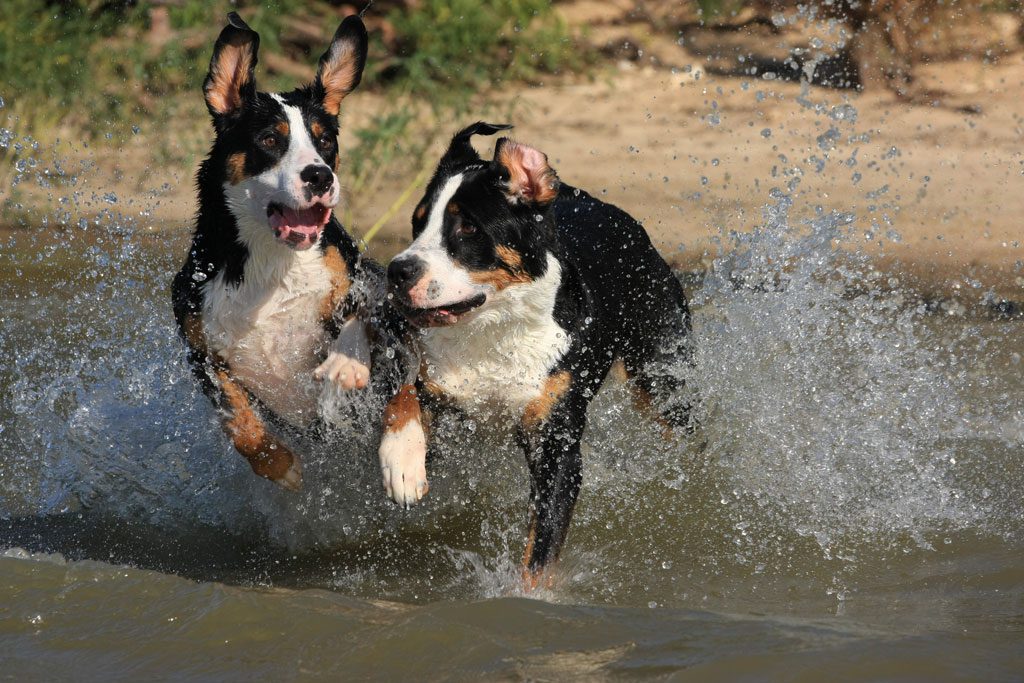
The Greater Swiss Mountain Dog is an old Swiss farm dog. It is the largest of the family of mountain dogs. These served in the mountains and valleys of the Swiss Alps as a complete tool for farmers. They watched the house and the farm. If a herd of cows had to be moved from one meadow to another, they made sure everyone stayed on the road and no cow was left behind.
The great mountain dogs, from which the current one emerged Greater Swiss Mountain Dog, harnessed in front of larger wagons and served as all-terrain and mountain tractors, more or less like the old one Unimog. It was not unusual for them to be harnessed in pairs in front of a cart full of valuable cheese, so they could independently find their way from the alpine pasture to the village, to the merchant and back. Mountain Dogs and Swiss Cattle Dogs used to be a single family of dogs. What they have in common is a strong bond with family and their farm., a confident self-awareness, a widely lost hunting instinct, a high degree of vigilance, a loving attitude towards his own people and a reserved attitude towards strangers.
A few ago 100 years, mountain dogs were divided into four breeds: Entlebucher, Appenzeller, Berne, Greater Swiss Mountain Dog – in order of size. This and the artificial fixation in a tricolorism conceived by the breed have not been good for the health of these great dogs.. So the statistics of the British Kennel Club 2014 document a life expectancy of only 8 years for Mountain Dogs and Bovine Dogs. Healthy servants could easily live 4 more years. More about this in the portrait of the respective mountain and cattle dogs.
The Greater Swiss Mountain Dog became a valuable companion dog, but still has the skills of a working dog. In 1912 The "Club of Great Swiss Mountain and Cattle Dogs" was founded in Switzerland.
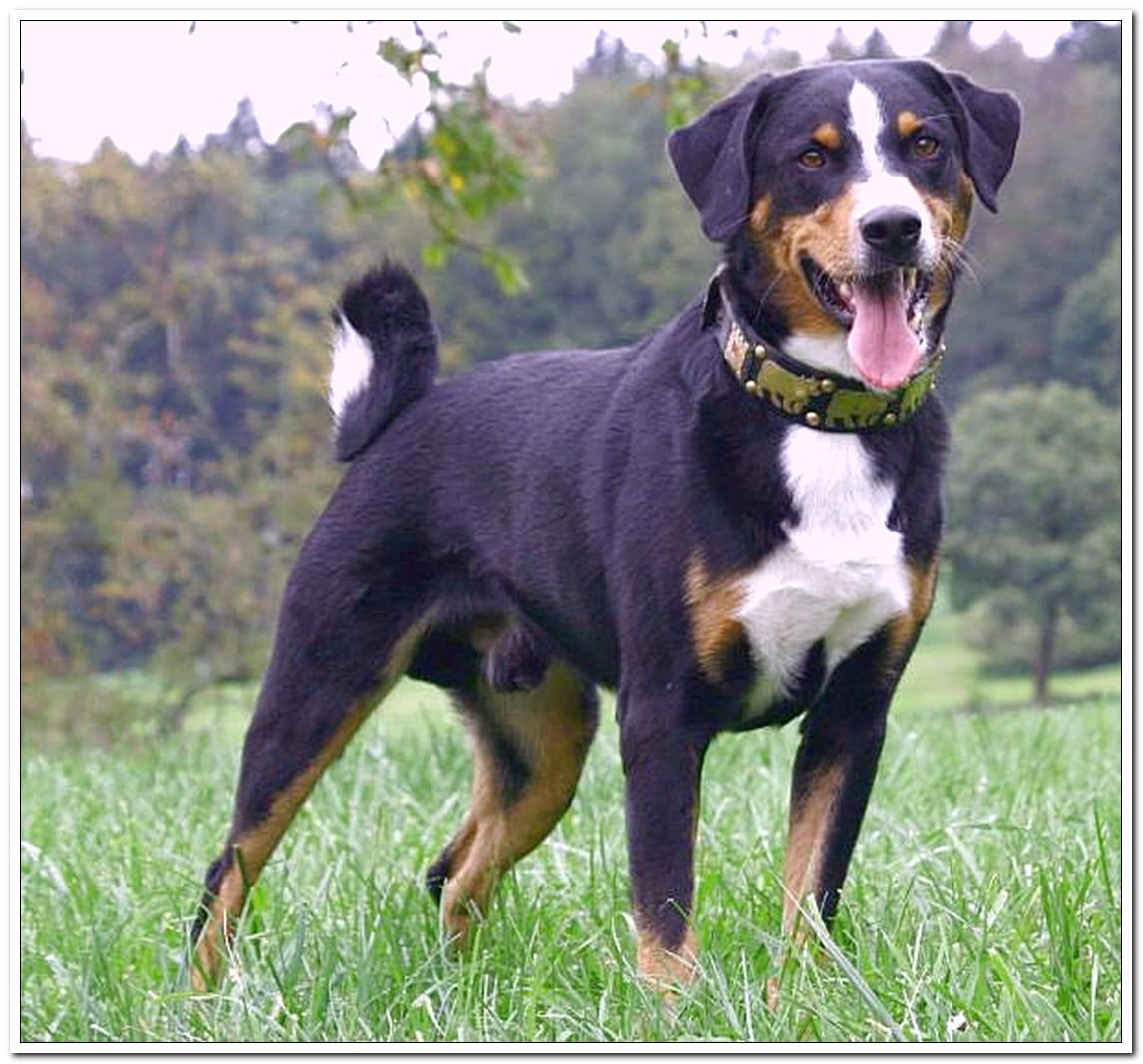
The Greater Swiss Mountain Dog is a big dog, robust, strong-boned and well-muscled. Radiates sovereign calm and self-confident composure, and that's how it is. The difference between the sexes should be quite large.
The males must have a height at the withers of 65 to 72 centimeters, the females of 60 to 68. The weight is between 35 and 50 kg.
The standard establishes numerous regulations on the details of coloring, texture and pattern of its coat. I should have brush hair and be tricolor. We see detailed regulations, where white marks are allowed and where they are not. In the interest of dogs, do not take these external characteristics so seriously, that are only devised by your breeder. Turning those details into breeding selection criteria is not in the interest of the welfare of the offspring. Greater Swiss Mountain Dog, they only have an extremely small gene pool anyway. What matters is the character and physical condition of the dogs. this last, Unfortunately, not too rare a problem. The Greater Swiss Mountain Dog it has better qualities than the color of its coat.
The Greater Swiss Mountain Dog feel more comfortable in the field. He wants to be moved and you can experience wonderful stress-free walks in nature with him. As it has little hunting instinct and usually has a good ear, you can enjoy relaxed and stress-free hours outdoors with it, even without a strap. But, It is not a companion dog for athletes..
One Greater Swiss Mountain Dog not suitable for life in the middle of the big city. You don't need a house with a big garden, what would be ideal. He likes to have a land or a yard where he can take care of things. Otherwise, does not have any special requirement regarding its maintenance. Most important is their close integration into the human family. For a permanent or even partial stay in a kennel these dogs are completely unsuitable.
Educating the Greater Swiss Mountain Dog
One Greater Swiss Mountain Dog can be trained very well. He likes to learn. It is strongly oriented towards its people, what you can use well. The Great swiss you can read the mood and wishes of your people on their faces. This in turn means that one must approach one's education with feeling and of course with consequence.. He has a pronounced sense of justice and, the other way, expect an equally fair deal. One must not only accept their occasional stubbornness, but you must like it. They challenge an intimate and mutually respectful relationship between dog and owner. The reward is a happy coexistence for both parties.
Care and health of the Greater Swiss Mountain Dog
The Greater Swiss Mountain Dog it is very easy to care for, just brush it occasionally.
Like many large dog breeds, tends to have hip problems (HD) or elbows (ED). La endogamia, unfortunately partly strong, has a negative effect on physical fitness and life expectancy.
Nutrition / Food
The Greater Swiss Mountain Dog has no special demands on their diet. Like many dogs of his size, tends to churn your stomach. Therefore you should not eat too fast and let it rest after eating.. Veterinarians often recommend an elevated feeding bowl, that can be purchased in specialized stores. During the breeding season, special attention must be paid to an adapted nutrition.
The life expectancy of the Greater Swiss Mountain Dog
One Greater Swiss Mountain Dog is relatively strongly affected by inbreeding and breeding selection that is one-sidedly oriented toward outward appearances, such as fur color details. So, their life expectancy has decreased in part enormously. It's between eight and -healthily- twelve years.
Buy a Greater Swiss Mountain Dog
When buying a puppy you must be careful that no ancestor appears twice in the pedigree. (endogamia). Otherwise, you should look for a breeder affiliated with the Swiss Mountain and Cattle Dog Club. You can also find the dog of your dreams at the animal shelter or in an emergency initiative.
Characteristics "Greater Swiss Mountain Dog"
Coexistence is important that you have with your new friend. Before considering the acquisition of a dog of the breed "Greater Swiss Mountain Dog" you know certain factors. Not all breeds of dogs are apt to live in an apartment, you must take into account his character, their need for exercise, their interaction with other pets, their care and if you have small children, their level of tolerance towards them.
Adaptation ⓘ
3,0 of 5 stars (based on 1 review)
|
friendly dog ⓘ
4,0 of 5 stars (based on 1 review)
|
hair loss ⓘ
3,0 of 5 stars (based on 1 review)
|
Affection level ⓘ
4,0 of 5 stars (based on 1 review)
|
Need for exercise ⓘ
3,0 of 5 stars (based on 1 review)
|
Social need ⓘ
4,0 of 5 stars (based on 1 review)
|
Home ⓘ
2,0 of 5 stars (based on 1 review)
|
Toilet ⓘ
1,0 of 5 stars (based on 1 review)
|
Friendly with strangers ⓘ
3,0 of 5 stars (based on 1 review)
|
barking ⓘ
4,0 of 5 stars (based on 1 review)
|
Health ⓘ
3,0 of 5 stars (based on 1 review)
|
Territorial ⓘ
5,0 of 5 stars (based on 1 review)
|
Cat friendly ⓘ
3,0 of 5 stars (based on 1 review)
|
Intelligence ⓘ
4,0 of 5 stars (based on 1 review)
|
Versatility ⓘ
4,0 of 5 stars (based on 1 review)
|
Child friendly ⓘ
4,0 of 5 stars (based on 1 review)
|
Surveillance ⓘ
3,0 of 5 stars (based on 1 review)
|
joy ⓘ
5,0 of 5 stars (based on 1 review)
|
Images "Greater Swiss Mountain Dog"
 Greater Swiss Mountain Dog 4
 Greater Swiss Mountain Dog 3
 Greater Swiss Mountain Dog 2
 Greater Swiss Mountain Dog 1
Photos:
1 – Greater Swiss Mountain Dog, tricolour by Canarian / CC BY-SA
2 – Greater Swiss Mountain Dog by jude / CC BY
3 – Big Swiss Mountain Dog and Entlebucher Mountain Dog during International show of dogs in Katowice – Saucer, Poland by Pleple2000 / CC BY-SA
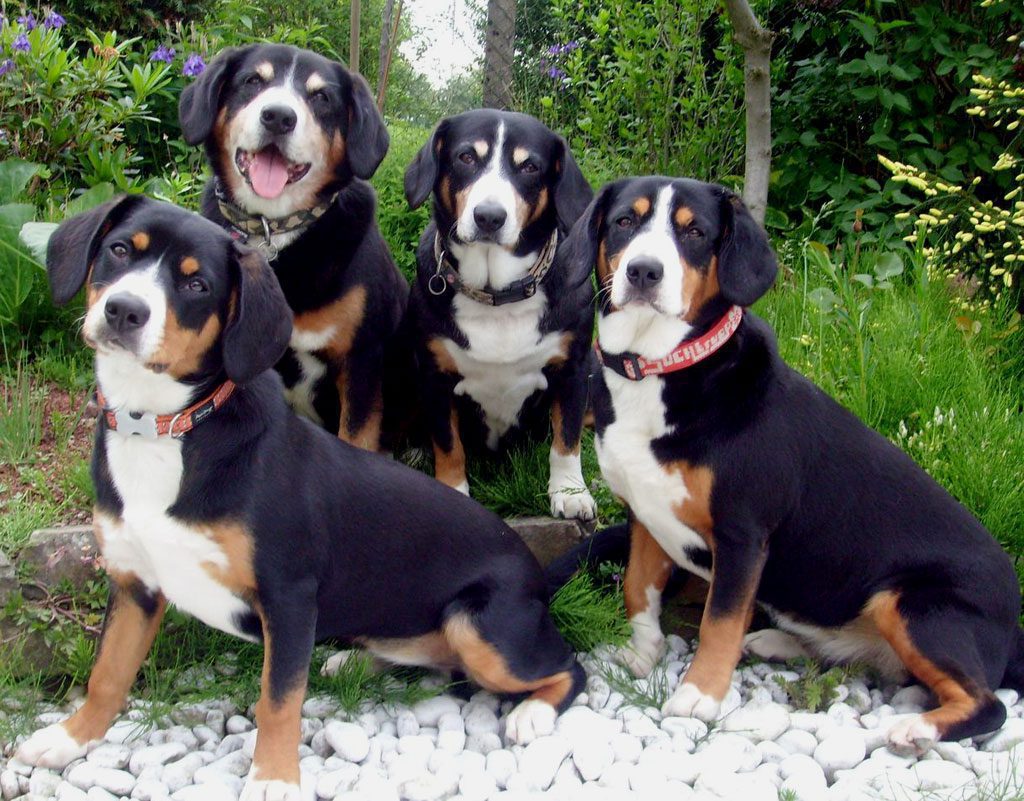
4 – All Mountain Dogs: Greater Swiss Mountain Dog, the Bernese Mountain Dog, the Appenzeller Mountain Dog an the Entlebucher Mountain Dog by Shining dog / CC BY-SA
Videos "Greater Swiss Mountain Dog"
- FCI CLASSIFICATION:
- Group :
- Section : . .
Federations:
- – FCI – Pinscher and Schnauzer-Molossoid type dogs – Swiss Mountain Dogs and Cattledogs. Section 2.2 Molossoid, mountain type. ⓘ
- – AKC – Working dogs ⓘ
- – CKC – Working dogs ⓘ
- – KC – Working dogs ⓘ
- – UKC – Watchdog ⓘ
FCI breed standard "Greater Swiss Mountain Dog"
Origin:
Switzerland
Date of publication of the valid original standard:
25.03.2003
Use:
Originally used as a guard and traction dog. He is currently used as a family dog., companionship and protection.
General appearance:
It is a tricolor dog, robust, strong bone and good musculature. Despite its size and weight, demonstrates agility and endurance. The sexual characteristics of the male and female are pronounced.
IMPORTANT PROPORTIONS:
- body length (measured from the tip of the shoulder to the tip of the buttock: height of the cross: = 10 : 9.
- Chest depth: height of the cross: = 1 : 2.
- Length of the skull: nose length: = 1 : 1.
- Skull width: muzzle width: = 2 : 1.
Behavior / temperament:
insurance, attentive, awake and fearless in everyday situations, kind and dependent with people he trusts and self-confident in relation to strangers; medium temperament.
Head:
In relation to the body, it's strong but not heavy. The head of the males is more powerful than that of the females.
Cranial region:
- Skull: Flat and wide with a front groove that gradually heads and disappears upward.
- Depression links (Stop): Notorious.
facial region:
- Truffle: black.
- Snout: Strong, longer than deep, without looking pointy from above or from the sides. Straight nose cane, no middle groove.
- Lips: Poorly developed, tight; black pigmented; not hanging.
- Jaw – Teeth: Strong jaws. Full scissor bite, strong and regular. Lack of 2 teeth (premolars 1 y/ o 2) is tolerated. The absence of the M3 is not taken into account.
Eyes: Medium, in the form of almond, not deep or bulging, hazelnut brown or chestnut, of happy and awake expression. Eyelids are well attached. The darkly pigmented edge of the eyelids.
Ears: Medium-sized, triangular and fairly high set. When the dog is calm, supported and flat; when you are attentive, directs them forward. With enough hair both on the outside and on the inside.
Neck:
Strong, muscular, chubby and no chin.
Body:
Slightly longer than the height at the withers.
- Back: Moderately long, strong and straight.
- Pork loin: Wide and well muscled.
- Rump: Long and wide, with a gently rounded fall; neither too high nor abruptly dropped.
- Breast
: Strong, width, reaching to the elbows; round-oval rib diameter chest neither flat nor crowded. Well developed sill.
- Abdomen and lower line: The abdomen and flanks are poorly gathered.
Tail:
Inserted in harmonic continuation with the rump. Pretty heavy, reaching the hock; if the dog is calm, the tail hangs; if you are at attention or on the move, wears it higher and slightly curved, but never ringed or on the back.
Tips
PREVIOUS MEMBERS:
- As a whole: Seen from ahead straight and parallel placed rather apart.
- Shoulder: The long shoulder blade, strong, inclined, glued and well muscled, forming a not very obtuse angle with the arm.
- Forearm: Straight and strong bone.
- Metacarpus: Strong, seen from the front, in straight extension of the forearm; seen from the sides almost perpendicular.
LATER MEMBERS:
- En set: Seen from behind, straight and not too close. Metatarsals and feet must not be inclined inward or outward; dewclaws must be amputated, except in countries, in which amputation is not permitted by law.
- Thigh: Rather long, width, strong and well muscled.
- Knee: Claramente an obtuse angle.
- PinScheme: Relatively long.Hock: Strong and well angled.
FEET: Strong, straight, closed, fingers well together, well arched and strong nails.
Movement:
Wide and uniform in all types of gears. Good forward reach and good momentum from hindlimbs. When jogging, limbs move in a straight line, seen both in front and behind.
Mantle
- Fur: double hair, composed of dense outer layer of medium length, and inner fleece, equally dense, preferably dark gray to black. Short external hair is allowed, if the inner fleece is thick.
- Color: Typically tricolor: Basic color is black with symmetrical reddish-brown fire markings and white markings. The reddish-brown fiery markings lie between black and white on the cheeks, above the eyes, on the inner side of the ears, at the sides of the chest, on all four limbs and at the bottom of the tail. White markings are located on the head (forehead and muzzle), from throat to chest (without interruption), on the feet and at the tip of the tail. Between the white mark on the forehead and the brown fire marks- reddish over the eyes should be a black streak. White spot on neck or white collar is tolerated.
Size and weight:
| TAHAND: |
|
| Alturto the cross |
In males: |
65 – 72 cm., |
| |
In females: |
60 – 68 cm.. |
Fouls:
Any deviation from the aforementioned criteria is considered as a fault and the severity of this is considered to the degree of the deviation to the standard and its consequences on the health and well-being of the dog..
- Dubious behavior.
- Lack of other teeth, maximum two premolars (PM1 and / or PM2). M3s are not taken into account caliper bite.
- light eyes; insufficient eyelid occlusion
- Mantle: Internal fleece of brownish-yellowish or light gray color visible. Dirty colors.
- Lack of marking
- Lack of white mark on the head; very wide list.
- White mark of the muzzle visibly reaching beyond the corners of the lip
- «White boots» (white color that reaches above the metacarpal or metatarsal joints.
- Notoriously asymmetrical drawings
FALTAS DESCALIFICANTES:
- Aggressiveness or extreme shyness.
- Any dog showing clear signs of physical or behavioral abnormalities must be disqualified..
- Upper or lower prognathism, arcade of the deviated incisors
- Entropion, ectropion.
- One eye or two blue eyes.
- Short hair without undercoat.
- Long hair.
- Non tricolor dog.
- Basic color other than black.
N.B.:
- Males should have two normal-appearing testicles fully descended into the scrotum..
- Only functionally and clinically healthy dogs, with the typical conformation of the breed, should be used for parenting.
TRANSLATION: Federation Canófila Mexicana a.c.
Source:
F.C.I - International Cynological Federation
 FCI 45 - Swiss Cattle Dogs



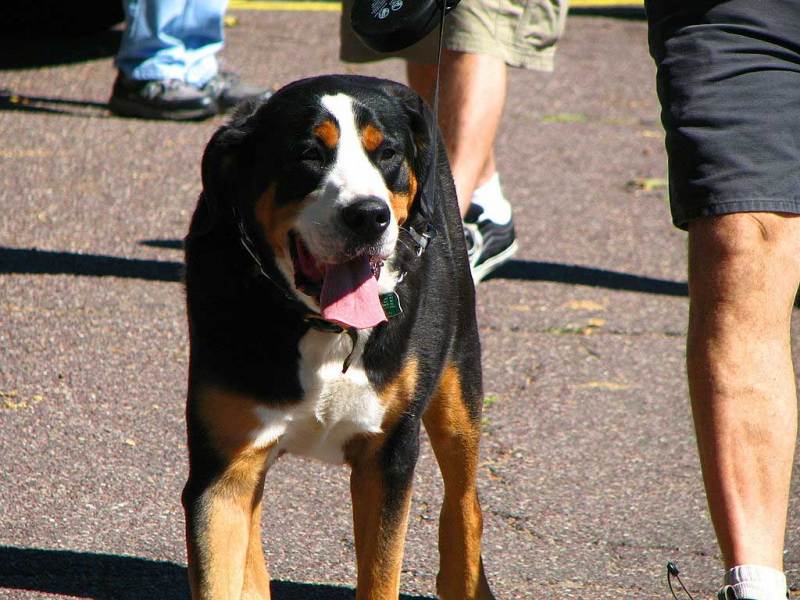

 Great Swiss Mountain Dog (Swiss big boy) / Breed of dog
 Varied Breed – Greater Swiss Mountain Dog – Crufts 2013
 Dogs 101 – GREATER SWISS MOUNTAIN DOG – Top Dog Facts About the GREATER SWISS MOUNTAIN DOG
 Murphy: Greater Swiss Mountain Dog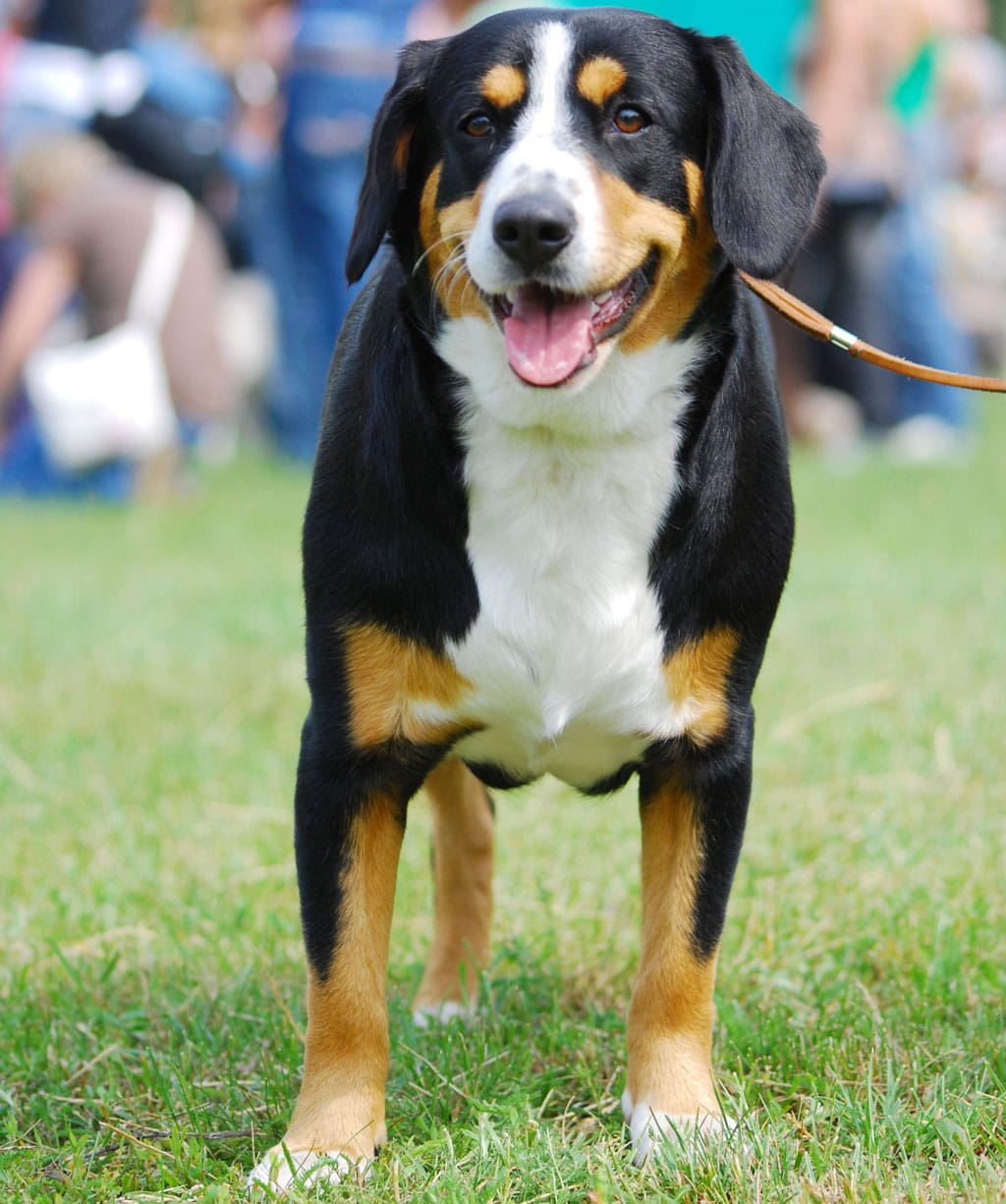


 Appenzell mountain dog Finn with 10 Months
 Appenzell Mountain dog- Jack is swimming
 Großer Schweizer Sennenhund Greater Swiss Mountain Dog Cattle Dog Swissy
 Claire – 8 1/2 weeks
 FCI - Appenzell Cattle Dog



 Entlebucher Mountain Dog / Entlebucher Sennenhund: Happy to visit 2. Birthday
 Entlebucher pool party
 Entlebucher action
 Entlebucher Sennenhund Yanni


