โ–ท The world of Pets: Dogs, cats, birds, reptiles, amphibians

Yellow-crowned Parrot
Amazona ochrocephala

Yellow-crowned Parrot

Content

Description

35 to 41 cm.. height and between 380 and 500 g. of weight.

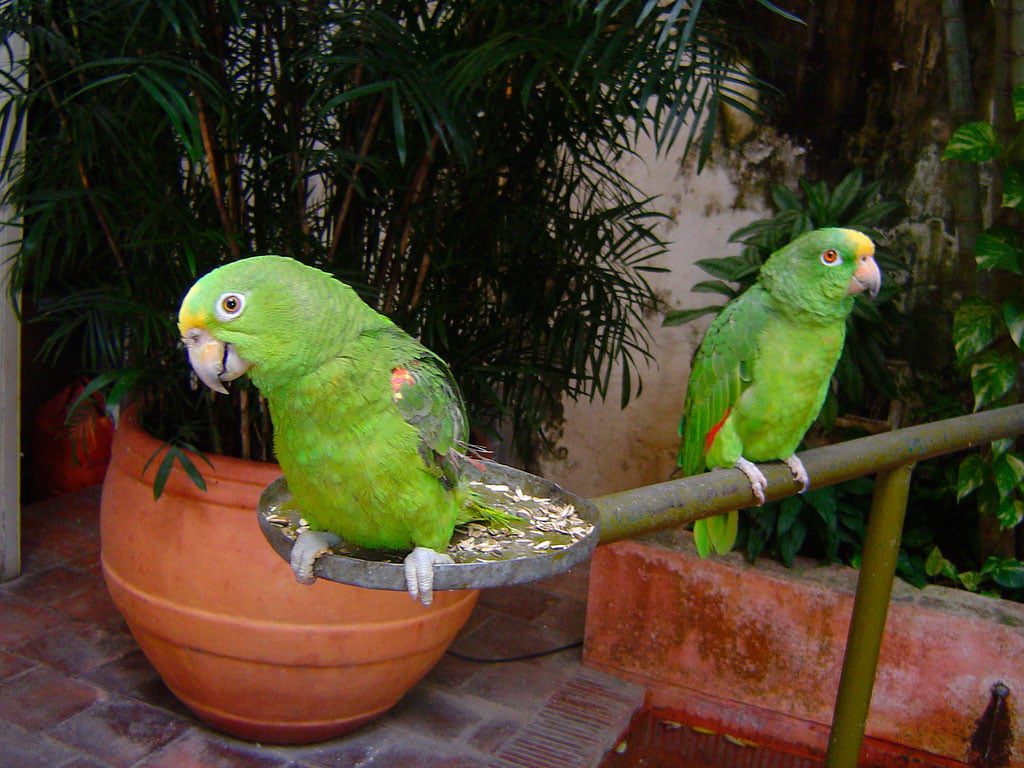
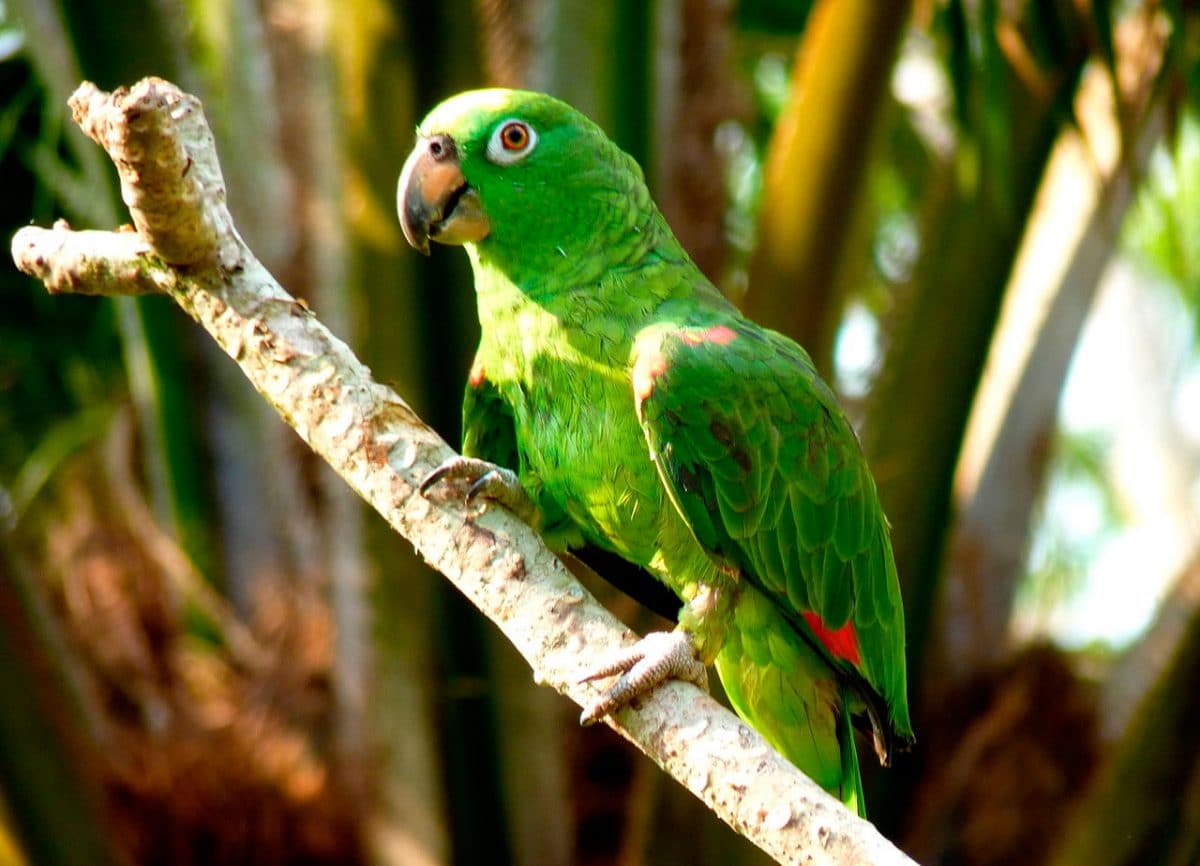
The Yellow-crowned Parrot (Amazona ochrocephala) has the forecrown and front area crown, bright yellow; lores, cheeks and supercilii area, green in most birds, but sometimes with yellow extending over lores and around eyes, and some birds with red bases hidden by yellow feathers crown; sides and back of the neck, nape and the mantle, green with dark margins, giving scalloped effect.
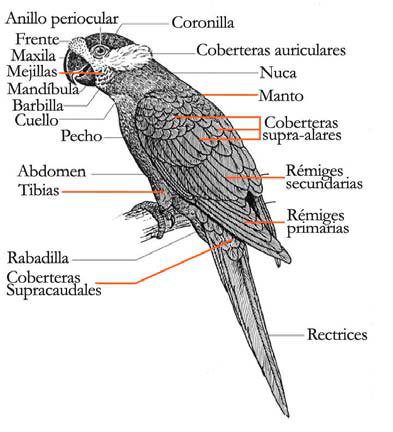

Anatomy-parrots

Upperparts green. coverts lower red, other coverts green; edge front of the wing yellowish; five o'clock outer secondaries They are green with bright red to outerweb forming speculum; flight feather green with blue tips to secondaries and primary outerweb, dark to black in points. Underwing-coverts, dull green with blackish tips. Underparts green with plenty of blue in the chest; yellow feathers on the the thighs (often few and discrete).
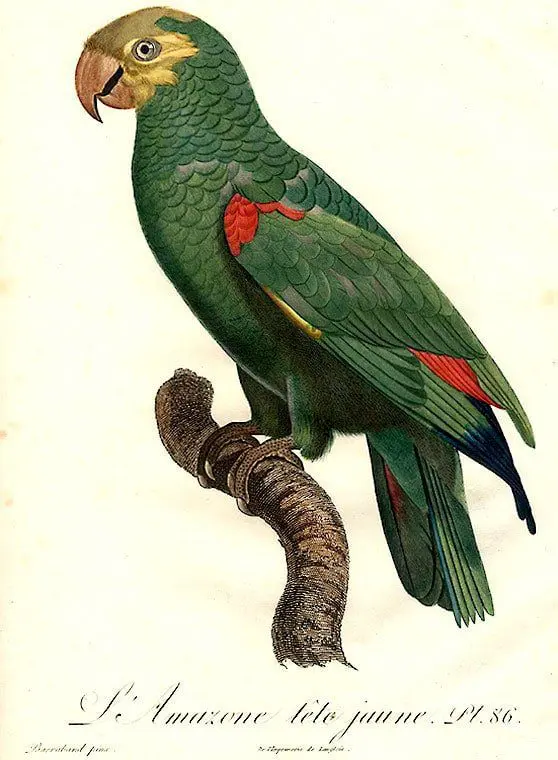
Yellow-crowned Parrot

Upper, the tail It is green with yellow stripes; below green with wide yellow ends; both with outer feathers basically red and a bluish puckered in outerweb.

Dark gray Bill, reddish at base of upper jaw; iris orange; legs grey.

Both sexes they are similar. The immature It has a narrower yellow patch on the head, stripes orange-red to yellow feathers crown; less red at the base of feathers tail; feathers of the tail more pointed and irises brown.

Description 4 subspecies
  • Amazona ochrocephala nattereri

    (Finsch, 1865) – Less yellow in the head that the nominal species, with frontal band green. Cheeks, supercilii area and lores with blue tint. Red curve wing often mixed with yellow feathers.

  • Amazona ochrocephala ochrocephala

    (Gmelin, 1788) – Nominal.

  • Amazona ochrocephala panamensis

    (Cabanis, 1874) – Bill horn-colored pink, yellow feathers restricted as V in forecrown and front of the crown. Possibly average smaller than the nominal species.

  • Amazona ochrocephala xantholaema

    (Berlepsch, 1913) – More extensive yellow in the head which extends to the back of the neck, around the eyes, to cheeks and to the ear-coverts. Often with frontal band narrow green. bluish tint in the chest.

Habitat:

Video – "Yellow-crowned Parrot"

They Real (Amazonas Ochrocephala)

They inhabit in open forests, moist forest edges, gallery forests, deciduous forest, open savannas and wetlands in lowland rain forests, also cultivated and suburban areas in some localities, and often near rivers.

The gallery forest It is your preferred Panama where Yellow-crowned Parrot avoid continuous humid forest, being replaced, possibly, there and in many areas of South America, by the Orange-winged Parrot (Amazona amazonica).

Usually observed in the lowlands; reported to 500 metres in Colombia and Venezuela and a 750 metres in Honduras. Usually in pairs or small flocks of 10-30 birds, with occasional gatherings up 300. Birds gather in common trees.

Reproduction:

Son Monogamie, couples joined in for life.

His time of reproduction It is from December to May. During this time, they lay clutches of 2 to 4 eggs, only Por those Nidada Tempordaa. Nest palm trunks and termite mounds.

It takes about 25 days for the eggs to hatch and near 56 days to become fledglings. The young become independent 2 months after hatching. Both male and female Yellow crowned Parrot reach sexual maturity around the 3 years.

Food:

Foods reported in the diet include fruit Immature American Curatella, Pereskia guamacho and other Cactus. Mainly feeds on treetop.
It is considered a plague in some localities for their love of eating bananas (Mussa paradisea), handles and Corn crops.

This species is considered a pest in some areas by his fondness for the consumption of bananas (Mussa paradisea), mangoes and corn crops.

Distribution:

Size of its range (reproduction / resident): 8.010.000 km2

The Yellow-crowned Parrot are in Panama, in Central America and in South America, from south to east Brazil and to the North of Bolivia.

They are present in Panama, mainly on the slope of the peaceful, from Chiriqui, to the West of Darien, but also in the shed Caribbean (for example, in the eastern San Blas Islands); also along the Pearl Islands and Coiba National Park.

They are also distributed in northern Colombia, from the North of the Chocรณ and lower basin of Atrato River, as well as along the Caribbean coast and tropical zone of the Magdalena River Valley, to the base southeast Sierra Nevada de Santa Marta and western part of the Serrania del Perija.

Observed in the eastern foothills of the Andes and adjacent lowlands Colombia; eastward across the tropical zone Venezuela and south, from the coastal mountains through Bolรญvar (where apparently it is not known from south) and amazon, until Guyanas and Trinidad (where their status is uncertain due to the captive birds introduced).

Present in the basin Amazonas Brazil, to the south, to the Northwest of Mato Grosso and west, in the lowlands of eastern Ecuador and through the Peruvian Amazon, to the North of Bolivia.

Apparently residents throughout its distribution area. very small numbers in Panama, although locally fairly common, especially in those areas more dry; it is the most common parrot (at least once) in the San Blas Islands. generally common (even locally abundant) in South America, but the numbers are reduced in the more accessible areas due to trade.

Distribution 4 subspecies
  • Amazona ochrocephala nattereri

    (Finsch, 1865) – South of Colombia in Caqueta, is of Ecuador, is of Peru, West of Brazil and North of Bolivia. Possibly integrated with nominal species in border areas Goal and Caquetรก in Colombia.

  • Amazona ochrocephala ochrocephala

    (Gmelin, 1788) – Nominal. It is from Colombia, Venezuela, Trinidad, Guianas and North of Brazil south to the tributaries of the lower margin right amazon in amazon and For.

  • Amazona ochrocephala panamensis

    (Cabanis, 1874) – North of Colombia, north and west of the Andes to western Panama, including Pearl Islands and Coiba National Park.

  • Amazona ochrocephala xantholaema

    (Berlepsch, 1913) – Isla Marajรณ at the mouth of amazon.

Conservation:

State of conservation โ“˜


minor concern Minor Concern โ“˜ (UICN)โ“˜

โ€ข Current category of the Red List of the UICN: Least concern.

โ€ข Population trend: Decreasing.

This species is considered at present as minor concern BirdLife International, and, as a result, also by UICN.
Even though the populations it is believed that are in decline, still do not approach the threshold specified by BirdLife International to evaluate the species as Near-threatened.

It is listed in the Appendix II of the CITES.

The Yellow-crowned Parrot in captivity:

Known for his pranks and excellent skills imitate the human voice. Having said that, the ability to mimic will vary between birds and although many of them are excellent conversadoras, Some will never come to talk. These Amazons are generally affectionate. Its friendly and playful nature make them excellent pets.

Son easily domesticable and easy to train. Known to be very active, What makes them more suited to an environment that enables them to fly.

Son known for their voices. It is said that it is the strongest of all Amazon parrots. People who are not tolerant to noise, they will do well to live with this Parrot.

like most parrots, this horsewoman it can be very destructive. We must "personalize their environment" by providing them with objects to chew such as different toys and branches.

Its longevity should also be a consideration. These parrots They can live between 60 and 80 years.

Alternative names:

Yellow crowned Parrot, Yellow-crowned Amazon, Yellow-headed Amazon, Yellow-headed Parrot (English).
Amazone ร  front jaune, Amazone ร  tรชte jaune, Amazone verte de Colombie (French).
Gelbscheitalamazone, Gelbscheitelamazone, Panama Amazone, Surinamamazone (German).
papagaio-campeiro, ajurรบ-apara, papagaio-de-Suriname (Portuguese).
Amazona Real, Cotorra Cabeciamarilla, Lora Cabeciamarilla, Lora coroniamarilla, Lora Real (espaรฑol).


scientific classification:

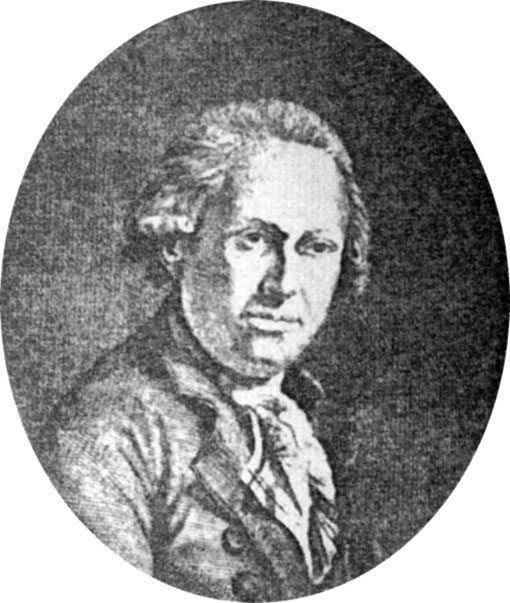
Gmelin Johann Friedrich

Order: Psittaciformes
Family: Psittacidae
Genus: Amazona
Scientific name: Amazona ochrocephala
Citation: (Gmelin, JF, 1788)
Protonimo: Psittacus ochrocephalus


Images Yellow-crowned Parrot:


Species of the genus Amazona


Sources:

avibase
Parrots of the World โ€“ Forshaw Joseph M
Parrots A Guide to the Parrots of the World – Tony Juniper & Mike Parr
Birdlife
Parrot Book, Parrots and macaws Neotropical

Photos:

(1) – A pet Yellow-crowned Amazon in Puerto Maldonado, Peru By Kate from UK (Lola) [CC BY-SA 2.0], via Wikimedia Commons
(2) – A pet Yellow-crowned Amazon By Freegiampi (From Giuseppe's farm) [CC BY-SA 2.5], via Wikimedia Commons
(3) – Yellow-crowned Amazon or Yellow-crowned Parrot (Amazona ochrocephala) in captivity By Stephen Joyce from barcelona, Spain (Parrot) [CC BY-SA 2.0], via Wikimedia Commons
(4) – Yellow-crowned Amazon or Yellow-crowned Parrot (Amazona ochrocephala) in captivity in the Parrotโ€™s Garden (Jardim dos Louros), in the Botanical Garden of Funchal, Madeira island, Portugal By jmaximo [CC BY 2.0], via Wikimedia Commons
(5) – A Yellow-crowned Amazon in Gatorland, Florida, USA By greyloch from Washington, DC, area, U.S.A. (green parrot preening) [CC BY-SA 2.0], via Wikimedia Commons
(6) – Amazona ochrocephala panamensis, Panama Amazon (also known as the Panama Yellow-headed Amazon); two in captivity By TJ Lin (originally posted to Flickr as DSCN1005) [CC BY-SA 2.0], via Wikimedia Commons
(7) – A Yellow-headed Amazon (or Parrot) near the Brazil-Peru-Colombia triple junction By Dick Culbert from Gibsons, B.C., Canada (Amazona ochrocephala) [CC BY 2.0], via Wikimedia Commons
(8) – A Yellow-crowned Amazon at Bloedel Floral Conservatory, Vancouver, Canada By Karen Neoh (Parrot) [CC BY 2.0], via Wikimedia Commons
(9) – Yellow-crowned Amazon or Yellow-crowned Parrot (Amazona ochrocephala) in a tree in Venezuela By Rufino (originally posted to Flickr as camouflage) [CC BY-SA 2.0], via Wikimedia Commons
(10) – Amazona ochrocephala From Natural History of Parrots (by Francois Levaillant, 1801-1805) – Wikimedia

Sounds: Edson Guilherme
โ–ท The world of Pets: Dogs, cats, birds, reptiles, amphibians

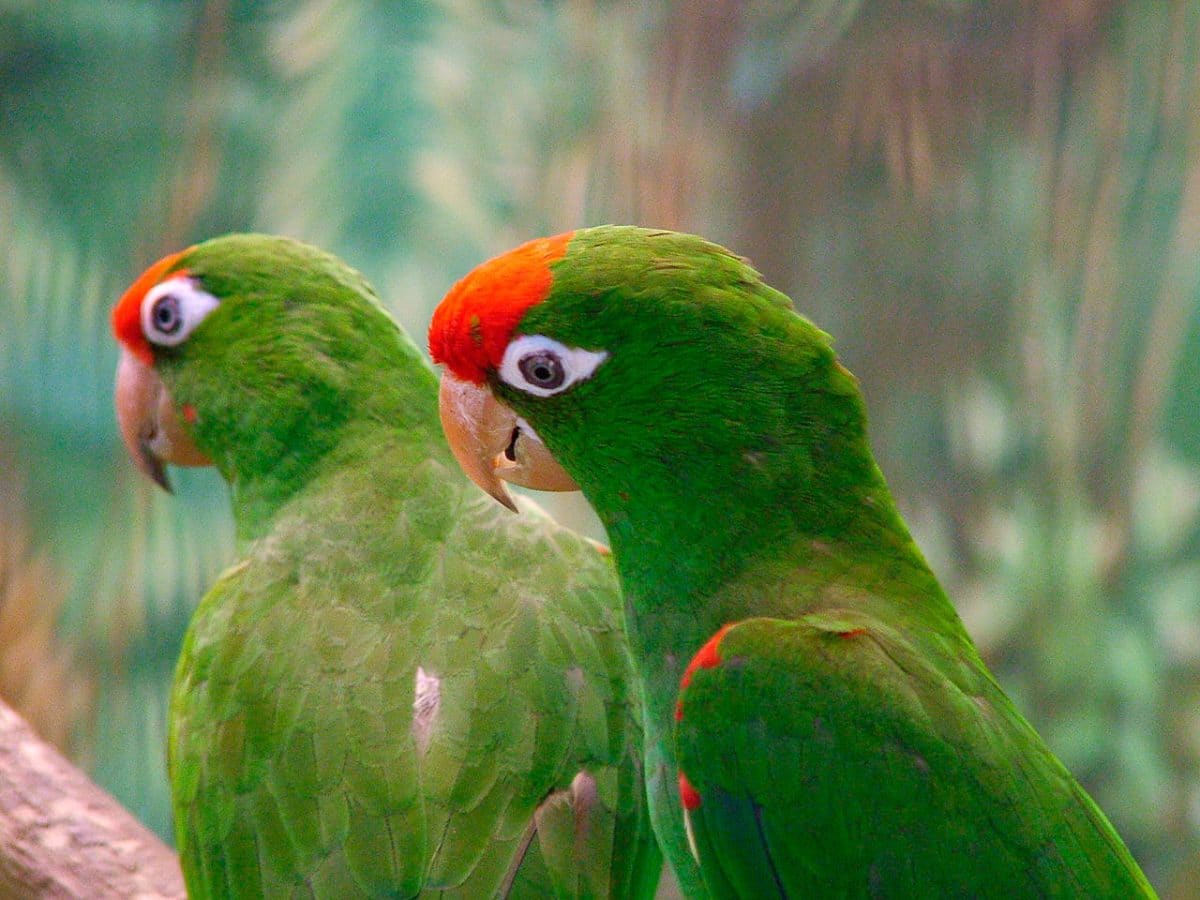
Red-masked Parakeet
Psittacara erythrogenys

Aratinga de Guayaquil

Content


Anatomy-parrots

Description Aratinga of Guayaquil:

33 cm.. length between 165 and 200 g.. weight.

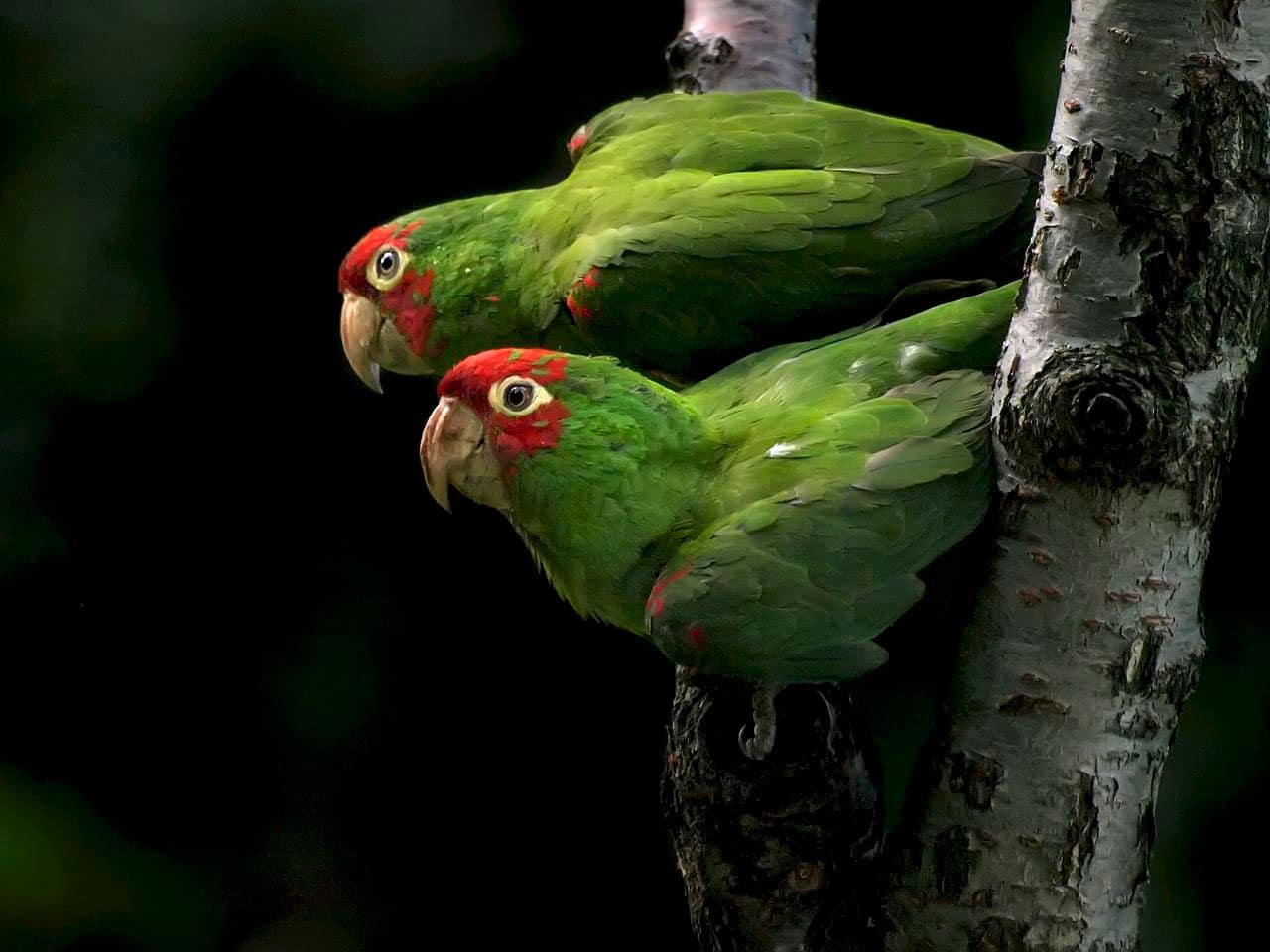
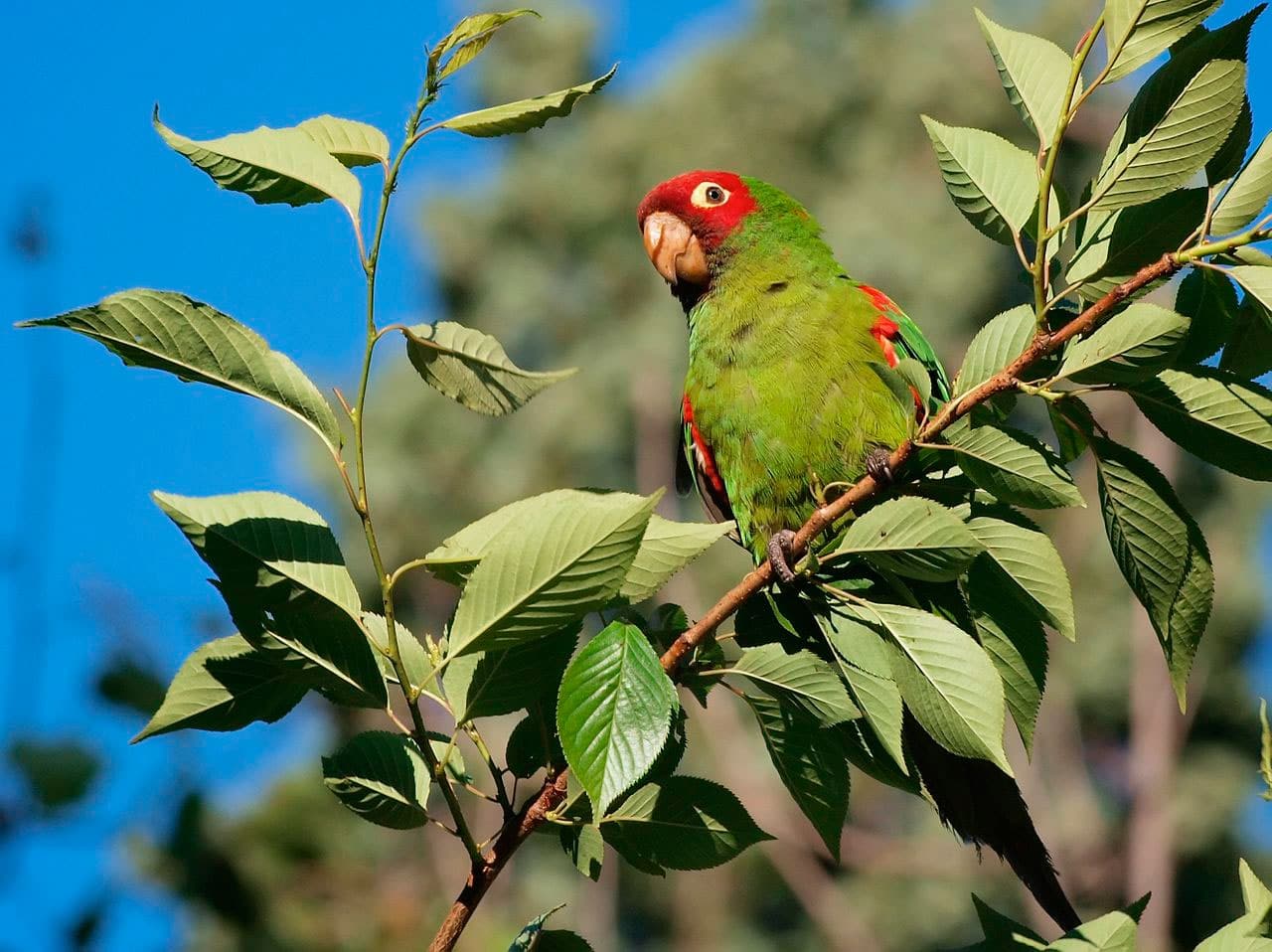
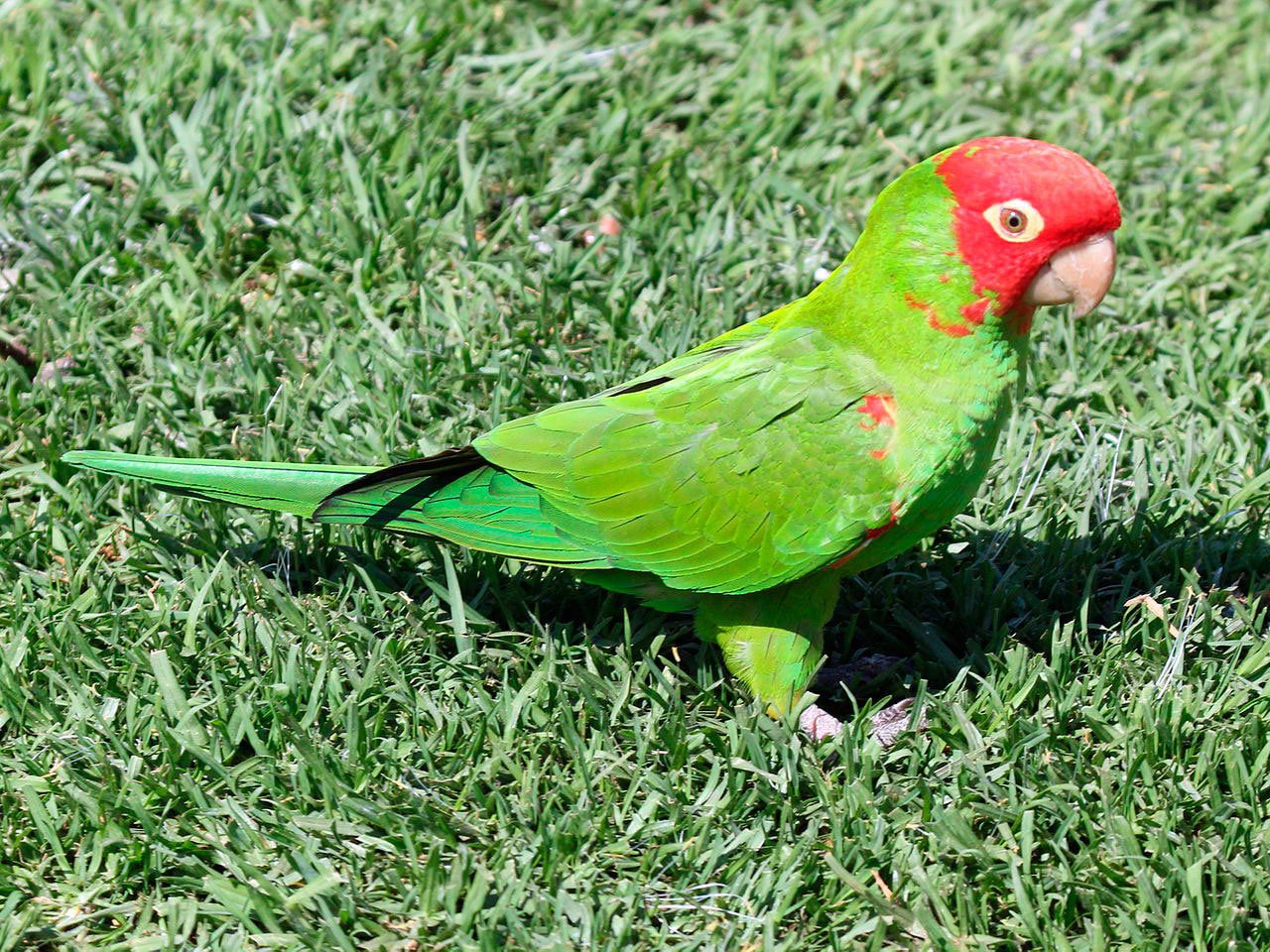
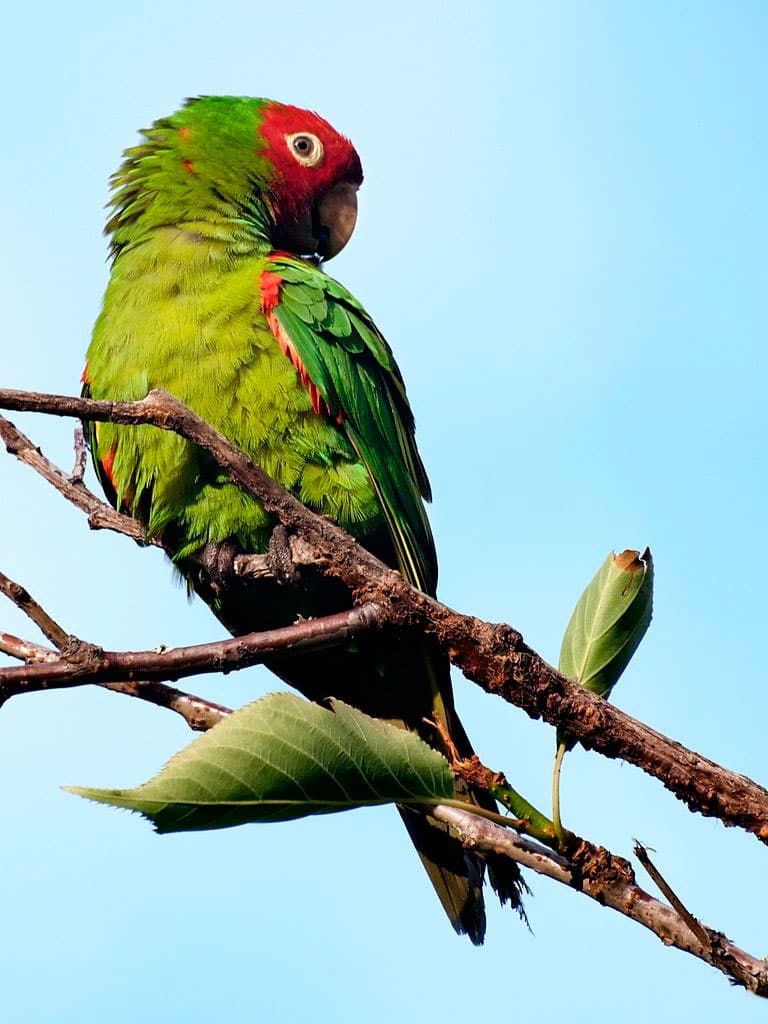
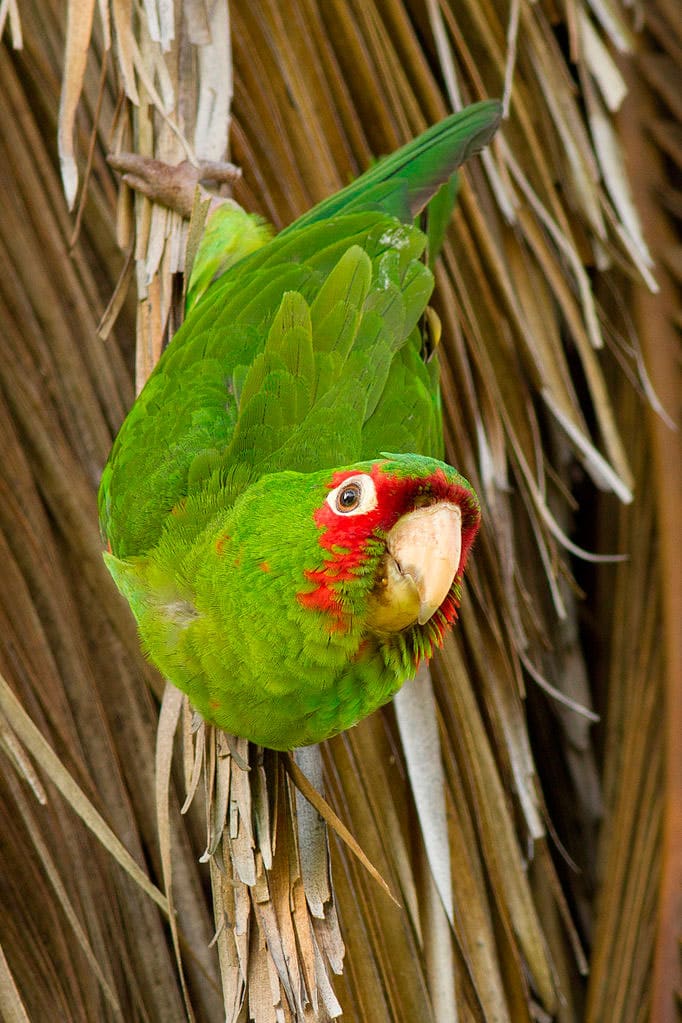
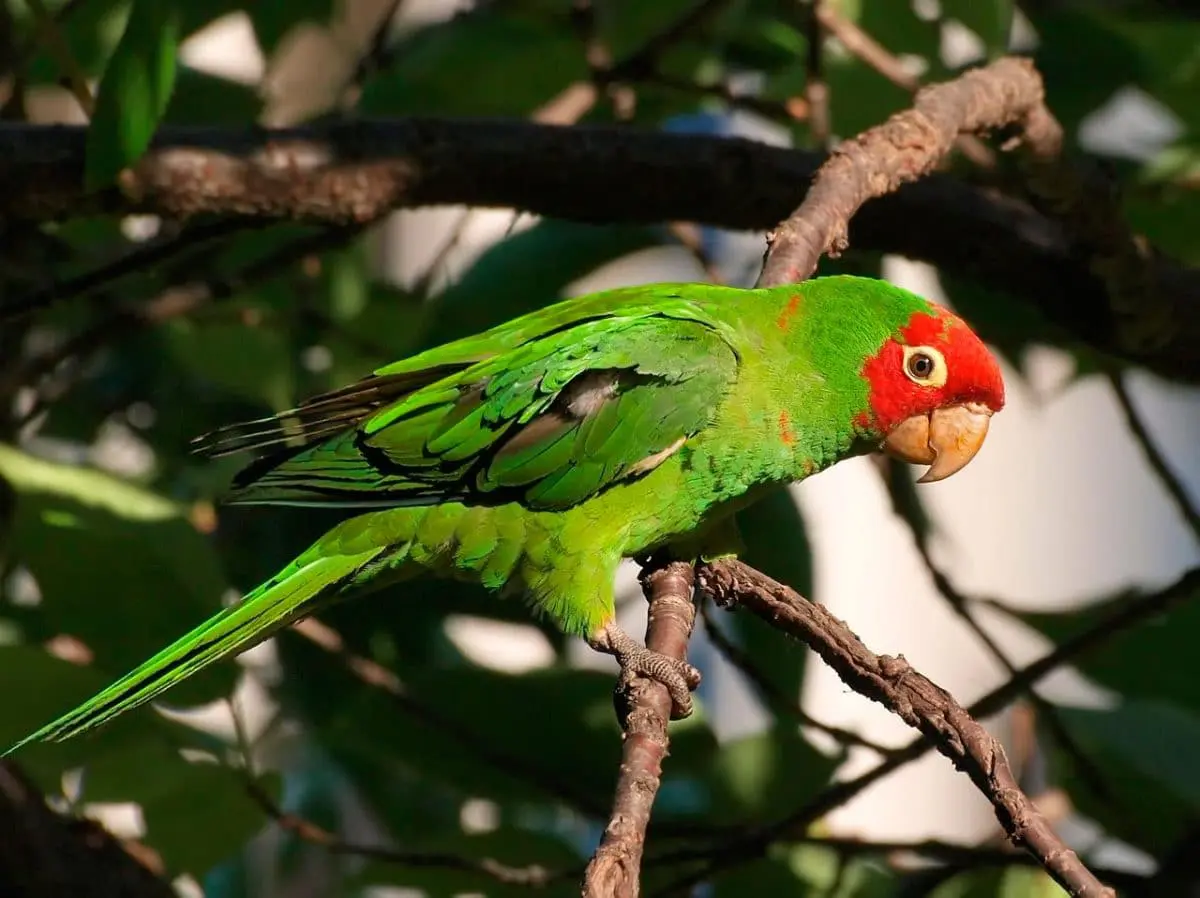
The Red-masked Parakeet (Psittacara erythrogenys) It is very similar to birds Scarlet-fronted Parakeet and to the Mitred Parakeet, but smaller and with more red area in the face, extending continuously up to the throat and nape.

Has the forecrown, crown, lores, the cheeks and the area around the eyes, bright red, generally forming a complete red mask to join to the chin (Sometimes the mask extends up to the throat). Since the nape up to the uppertail-coverts dark green, sometimes with scattered red feathers. The upperwing-coverts children with some feathers of red and the bend of wing red; remaining upperwing-coverts dark green, with dye Emerald to them vane outer the primary. The flight feather Brown Gold below; underwing-coverts minors, bright red, the greater coverts yellowish brown. The underparts brighter yellowish green, sometimes with mottled red and almost always with the the thighs red. Upper, the tail dark green; by below grayish brown.

The bill color pale horn; bare periophthalmic off-white; irises yellow; legs distant.

Both sexes similar.

The immature with the head and the thighs green.

Habitat Red-masked Parakeet:

Video – "Red-masked Parakeet" (Psittacara erythrogenys)

Telegraph Hill Parrots January 30, 2008 (HD)

The Red-masked Parakeet It occupies a wide range of vegetation types, from arid zones to rainforests, Since the sea level to altitudes 2.500 m, Although its usual habitat is below of the 1.000 m, in humid forests, deciduous forests, areas of dry thorny scrub and arid with cactus; They also live in degraded forest, areas cultivated with scattered trees, and around the urban areas. They tend to prefer arid and semi-arid habitats, not avoiding moist forest habitats.

Outside the breeding season, is a bird gregarious; in general, observed in pairs or in groups of up to 12 individuals, forming groups of up to 200 birds in the places where their communal roosts are. Formerly registered flocks of thousands of birds in Guayaquil, Ecuador.

Often associated in mixed flocks with the Grey-cheeked Parakeet (Brotogeris pyrrhoptera) and also observed in mixed flocks with the Bronze winged Parrot (Pionus chalcopterus).

Reproduction Red-masked Parakeet:

Nests in holes of mature trees, for example of Ceiba trichistandra or Cochlospermun vitifolium, There are also records of nests in termite mounds, with a report in a nest on a cliff. The breeding season in the southwest of Ecuador recorded during the rainy season (January-March). The laying, between 2 and 4 eggs. The female the incubated eggs during 23 to 24 days. The pups they are born very little developed, blind and naked. They are fed with food previously digested by their mothers.

Food Aratinga of Guayaquil:

Few details exist about food preferences of the Red-masked Parakeet, Although seasonal movements from the more arid areas are probably related to food supply.

Reported foods include fruits of Hieronyma, Anacardiaceae, Oleaceae and Boraginaceae, as well as flowers of Erythrina.

Distribution:

Size of the area of distribution (reproduction / resident): 151.000 km2

The Red-masked Parakeet is distributed to the West of Ecuador and the Northwest corner of Peru.

In Ecuador, the species has been recorded from Manabi near south of the equator, through Pichincha, The rivers, Guayas, Azuay, Gold and Loja, until Tumbes, Piura, Lambayeque and Cajamarca, in the North of Peru and the region of Chachapoyas, amazon (6ยฐ 10โ€™S).

In Ecuador, the distribution of the Red-masked Parakeet is limited to the lowlands of the peaceful, Western slope of the Andes and valleys, Although it is apparently absent from the eastern slope; similar pattern in the Peru most Eastern records in the basin of the amazon (Valley of the Utcubamba River) to 77ยฐ 54โ€™W.

The seasonal movements to and from the more arid areas, otherwise, residents.

Usually considered to be common (described as the most common parrot in various locations in the province of Gold, Ecuador), but numbers fluctuate widely in some locations due to irregular seasonal movements. In some areas there has been a very drastic decrease of copies, reflecting the combined effects of the loss of habitat and your capture for the trade in live birds, for example, in Guayas, Ecuador.

There are at least eight protected areas, of which seven are in Ecuador.

There are leaks in Spain; so also in EE. UU., with breeding populations in the California cities of San Diego, Los Angeles, San Gabriel, Sunnyvale and San Francisco, You can see them eating fruits of cultivated tropical plants, and nesting in Palm trees.

Maintained in captivity at the local level (where is the most common Parrot kept in captivity) and commercialized in large quantities at the international level, especially since Peru.

Conservation:

State of conservation โ“˜


Near-threatened Near Threatened โ“˜ (UICN)โ“˜

โ€ข Red List category of the UICN current: Near-threatened

โ€ข Population trend: Decreasing

The size of the population This species has not been estimated officially, but, in the absence of sufficient data, It is suspected that it may be in around the 10.000 specimens, more or less equivalent to 6.700 mature individuals.

The population of the species is suspected that it may be subjected to a moderately rapid decrease, due to its capture for him pet trade together with the loss of habitat and fragmentation. Further research is required.

Conservation Actions Underway:

  • Appendix II of CITES.

Conservation Actions Proposed:

  • Carry out surveys to get an estimate of the population.
  • The current threat of trade research.
  • Enforcing trade restrictions.
  • Census of population and monitoring.
  • Monitor the rates of loss and fragmentation of habitat.
  • Study its ability to persist in altered and fragmented habitats.

The Red-masked Parakeet in captivity:

Shy and distrustful. Little common in captivity outside its area of distribution.

They may live until 25 years, Although the average tends to be between 10 and 15 years.

Their diet: fruit as, Apple, pear, orange, bananas, grenades, Kiwi, papaya, cactus fruits, they form a 30 percent of the diet. Vegetables, such as: Carrot, celery, green beans and peas in the pod, sweet corn on the cob, green leavess, such as: chard, lettuce , Kale, healer, Dandelion, Aviary grass, spray millet, mixture of small seeds, such as: Millet and small amounts of oats, buckwheat, safflower and hemp.

This species is found threatened from the wild bird trade local in Peru and Ecuador, where are rates of mortality due to mismanagement and stress high.

Never buy these birds in the illegal trade, Since these tend to come from its natural environment and it must be remembered that the Red-masked Parakeet is one endangered species.

Alternative names:

Red-masked Parakeet, Red Masked Conure, Red masked Parakeet, Red-headed Conure, Red-headed Parakeet, Red-masked Conure (English).
Conure ร  tรชte rouge, Conure ร  tรชte cerise, Conure ร  tรชte รฉcarlate, Perriche ร  tรชte rouge, Perruche ร  tรชte rouge (French).
Guayaquilsittich (German).
Periquito-de-cabeรงa-vermelha (Portuguese).
Aratinga de Guayaquil, Loro de cara roja, Periquito de Cabeza Roja, Perico Cara Roja (espaรฑol).
Loro de cara roja (Chile).
Cotorra de Cabeza Roja (Peru).
Perico caretirrojo (Ecuador).


scientific classification:

Renรฉ Primevรจre Lesson

Order: Psittaciformes
Family: Psittacidae
Genus: Psittacara
Scientific name: Psittacara erythrogenys
Citation: (Lesson, 1844)
Protonimo: Psittacara (psittacus) Erythrogenys

Red-masked Parakeet pictures:


Species of the genus Psittacara

Sources:

Avibase
– Parrots of the World โ€“ Forshaw Joseph M
– Parrots A Guide to the Parrots of the World – Tony Juniper & Mike Parr
– Birdlife
Feather wind

Photos:

(1) – A feral Red-masked Parakeet (also known as the Red-masked Conure and Cherry-headed Conure) in San Francisco, USA By Ingrid Taylar [CC BY 2.0], via Wikimedia Commons
(2) – Red-masked parakeet, Aratinga erythrogenys. Two birds in a tree in San Francisco, California By Jef Poskanzer (Flickr) [CC BY 2.0], via Wikimedia Commons
(3) – Red-masked Parakeet (Psittacara erythrogenys) at the Presidio, San Francisco, California By Frank Schulenburg (Own work) [CC BY-SA 4.0], via Wikimedia Commons
(4) – Red-masked parakeet (Aratinga erythrogenys). A juvenile parrot which is mostly green and just starting to get some red feathers on its head By Eliya Selhub (Flickr) [CC BY 2.0], via Wikimedia Commons
(5) – Red-masked Parakeet preening on a branch in San Francisco, USA By Ingrid Taylar from San Francisco Bay Area – California, USA [CC BY 2.0], via Wikimedia Commons
(6) – Red-masked Conure at Birds of Eden, South Africa By Dick Daniels (http://carolinabirds.org /) (Own work) [CC BY-SA 3.0 or GFDL], via Wikimedia Commons
(7) – A feral Red-masked Parakeet (also known as the Red-masked Conure and Cherry-headed Conure) in San Francisco, USA By Ingrid Taylar [CC BY 2.0], via Wikimedia Commons
(8) – Two feral Red-masked Parakeets in San Francisco, USA By Ingrid Taylar from San Francisco Bay Area – California, USA (Wild in SFUploaded by Snowmanradio) [CC BY 2.0], via Wikimedia Commons
(9) – Several Red-masked Parakeets eating a discarded apple in San Francisco, USA By Ingrid Taylar from San Francisco Bay Area – California, USA (A Big Find for ParrotsUploaded by Snowmanradio) [CC BY 2.0], via Wikimedia Commons

Sounds: (Xeno-canto)

โ–ท The world of Pets: Dogs, cats, birds, reptiles, amphibians

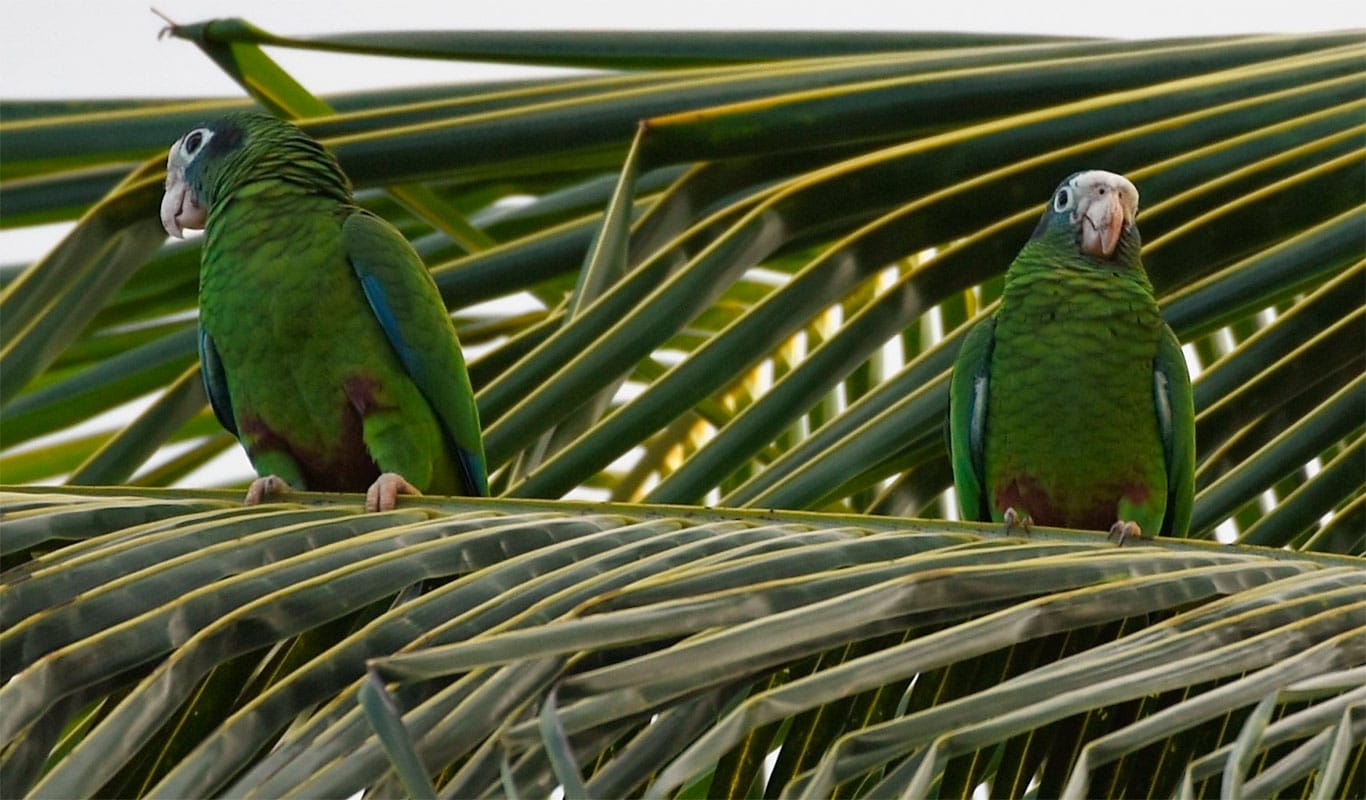
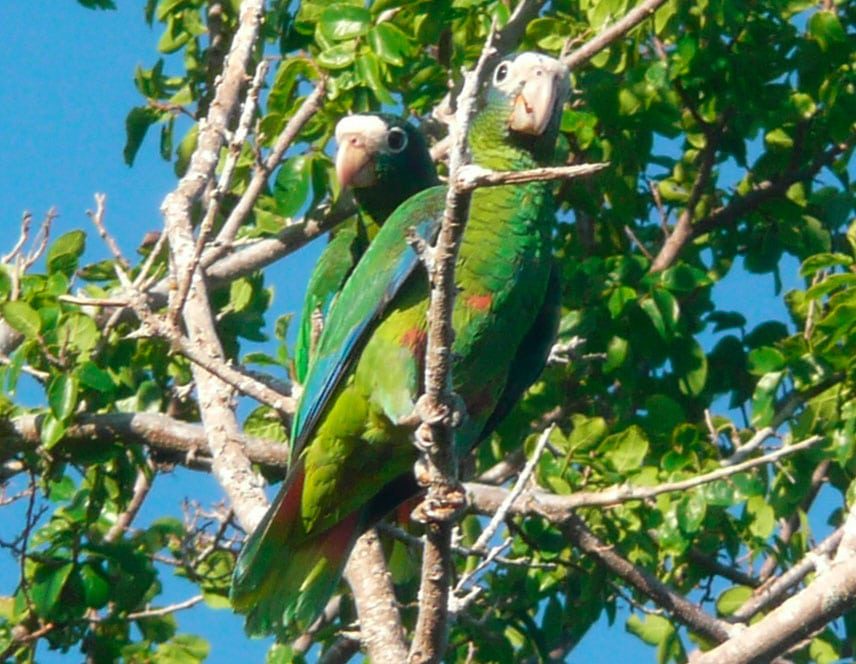
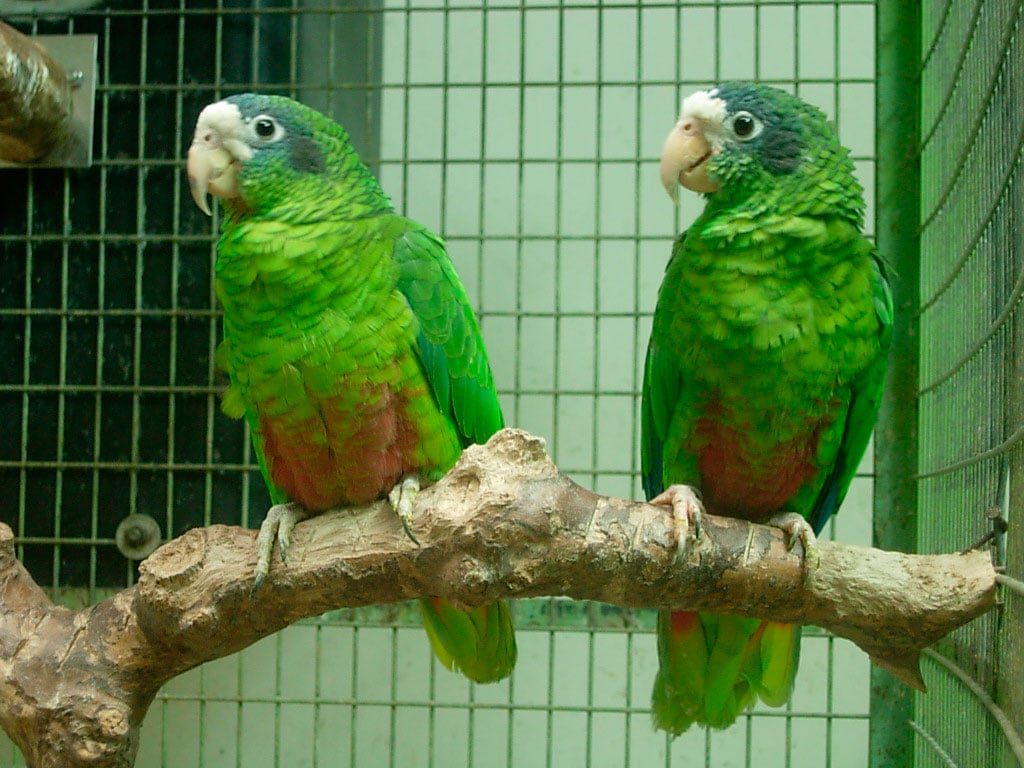
Hispaniolan Parrot
Amazona ventralis

Hispaniolan Parrot

Content

Description:

28-31 cm.. length and 250 g. of weight.

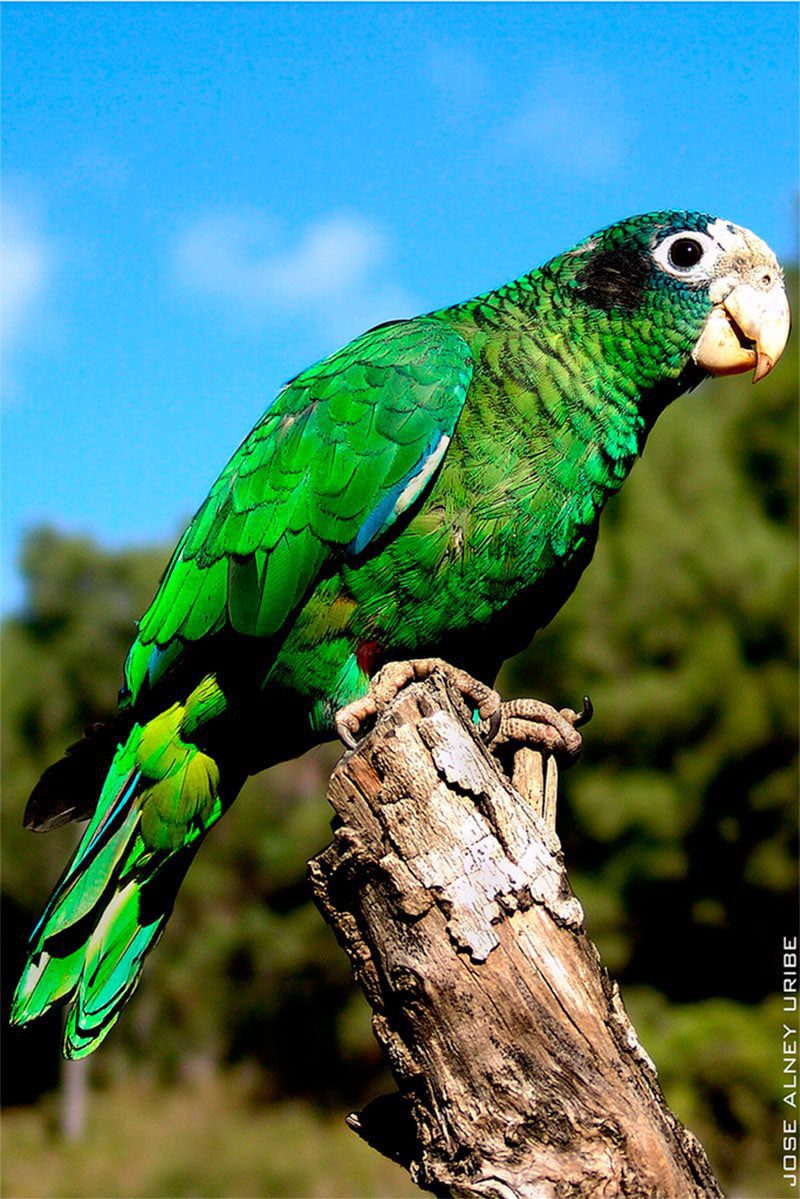
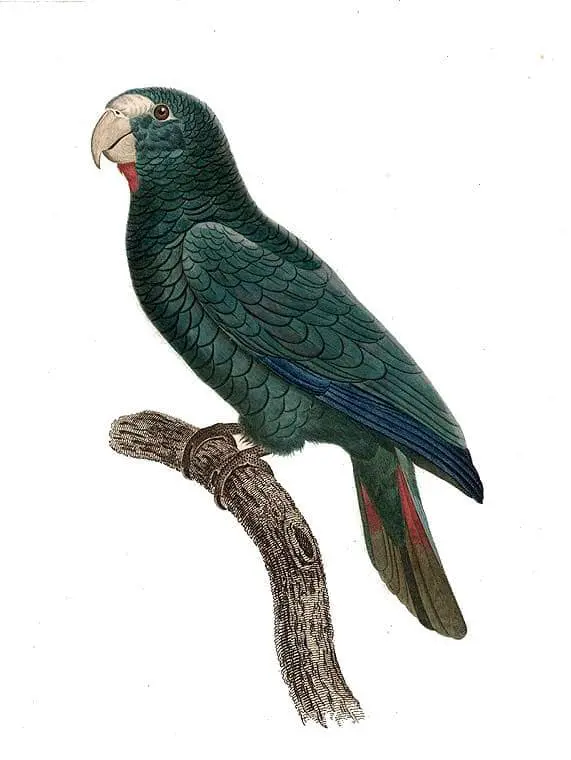
The Hispaniolan Parrot (Amazona ventralis) has the forecrown Lords color and white (variable extension); the crown and upper cheeks with blue feathers and black colored ends; ear-coverts and lower cheeks, charcoal colored (variable measure); feathers nape and the sides of the neck, emerald green with visible black tips.
Hispaniolan Parrot
Mantle and back green grass with black tips, which become progressively less visible to the bottom; rump green, slightly yellowish; uppertail-coverts brighter yellowish green. greater coverts blue; remaining coberteras grass-green. Primaries and secondaries, blue, darker towards the tips, on the innerwebs. Under the wings, green; flight feather bluish green.

The underparts usually green, slightly yellowish, with most feathers showing fairly conspicuous black margins (especially in the upper region) but sometimes with some red feathers chin; patch resizable brown in the center of belly; undertail-coverts pale yellow-green. Upper, the tail is green (perhaps a little darker than the rest of the upperparts) with visible yellowish tip and outerweb external feathers with blue margins; undertail, the tail It is yellowish with the bases of the outer feathers red. Bill Pink; cere brownish white; skin bare periophthalmic white; brown the irises; legs pale grey.


Anatomy-parrots

There is no sexual dimorphism. Immature as an adult but less blue in the crown and the patch abdominal is paler brown.

NOTE

Some authors consider that the Hispaniolan Parrot It conspecific (belonging to the same species) with the Cuban Parrot. Although closely related, It is believed to be quite different due to differences in hue pronounced plumage.

  • Sound of the Hispaniolan Parrot.

Habitat:

Video "Hispaniolan Parrot"

The Hispaniolan Parrot They are distributed in a variety of forested habitats, from lowland sandy palm savannahs to montane pine forests and moist montane forests. Currently most commonly observed in montane forests on the island Hispaniola, due to continued deforestation, although birds also feed at lower altitudes. Observed above 1,500 m (Hispaniola).

Views in pairs during breeding; outside the breeding season, observed in small flocks, usually up to a dozen birds; much larger meetings, until 500 reported in the nineteenth century birds. Couples and couples with young often identifiable in flocks.

Reproduction:

Nests generally constructed in tree cavities, but also in rock crevices, cactus voids and cavities in coconut. Territorial and very aggressive while playing. The breeding season It covers the months of February to May. Clutch 2-3 eggs.

Food:

They feed on, among others, of seeds or fruits of Caesalpinia, Psidium and Ficus, seeds of oranges wild Citrus, corn and bananas.

Distribution:

Size of its range (breeding/resident): 99.000 km2

The Hispaniolan Parrot are distributed by the islands of Hispaniola (Dominican Republic and Haiti), Gonave Island (Haiti), Isla Saona (Dominican Republic), Puerto Rico and probably Snake (Puerto Rico) in the West Indies. It is found in moderate numbers in parts of the Sierra de Bahoruco, Sierra Neiba and Cordillera Central in Dominican Republic. More restricted and less numerous in Haiti, with the remaining population apparently largely in the south of the country.

introduced in Puerto Rico, where the wild population derived from captive birds escaped and at least one consignment of illegally traded birds were released after discovering an attempt to import Puerto Rico. Also wild populations in US Virgin Islands.

Formerly very common in Hispaniola, although there have been during the twentieth century a strong decline in its population, mainly due to the habitat destruction (arising from agriculture and charcoal production). As well persecuted due to crop damage, hunted for food and trapped for sale as pets at local and international level.

In the Decade of 1930 It was limited to the interior mountain forests of the island of largely Hispaniola.

Although it remains locally common, it is enough rare and rare in the wild.

The population in Puerto Rico It is at least several hundred birds and apparently increasing.

Conservation:

State of conservation โ“˜


minor concern Minor Concern โ“˜ (UICN)โ“˜

โ€ข Current category of the Red List of the UICN: Vulnerable.

โ€ข Population trend: Decreasing.

โ€ข Population size : 6000-15000

Rationale for the Red List category

This species is considered Vulnerable because anecdotal evidence suggests there has been a rapid reduction of the population. The size of the population and the exact extent of the decline are unclear, clarification and may lead to the species be reclassified as near threatened.

Justification of the population

The population size It is preliminarily estimated to fall in the band between 10.000 and 19.999 individuals. This is equivalent to 6,667-13,333 mature individuals, rounded here to 6,000-15,000 mature individuals.

Justification of trend

No new data on population trends, but it is suspected that the species is declining quickly, as a result of the hunting, the loss of habitat and capture.

Threats

The agricultural conversion and charcoal production have destroyed the most suitable habitat. It is also persecuted as a crop pest, hunted as food and trapped for Local trade and above for international trade cage birds. (Juniper and Parr 1998).

Trapping adults and stealing hatchlings from nests to supply the Local pet trade It is a particular concern because in some areas most families own a parrot, and they only live a few years before they have to be replaced (G. Woolmer in some. T. White one bit., 2012). It also, activities theft nests often they cause destruction of the nest cavity or nest tree, further aggravating the loss of nesting habitat other causes (T. White in a little .

Conservation Actions Underway

โ€ข CITES Appendix II.

โ€ข You have started a education strategy with community participation to protect species (Vasquez et to the., 1995).

โ€ข In 1997-1998, 49 birds bred in captivity were released and you radiographed in East National Park, Dominican Republic (Vilella et al., 1999).

โ€ข The Biological Reserve Loma Charco Azul, created in 2009, It has populations of the species. in addition, They have carried out recent activities public education and outreach, including some actions of law enforcement, in several communities surrounding the Jaragua National Park, near the border with Haiti.

โ€ข In January of 2012 there was also a Liberation of 10 parrots raised in captivity they had been confiscated as young chicks from poachers nests. These chicks were raised and rehabilitated in National Zoological Park, and released successfully in the grounds of the zoo (T. White in a little ).

Conservation Actions Proposed

โ€ข Assess current population size.

โ€ข Establish a program of comprehensive monitoring.

โ€ข Determine at extension remaining habitat.

โ€ข Determine the impact of various threats.

โ€ข Apply laws and regulations that protect this species and its habitat (Snyder et to the., 2000).

โ€ข Promote better bird-keeping practices to reducing demand for wild birds and develop a captive breeding program.

โ€ข Educate the public about the negative impact of pet trade in native Dominican Republic (T. White in a bit., 2012).

The Hispaniolan Parrot in captivity:

It is easily reproduced in captivity and used as substitute mother to raise the young Puerto Rican Parrot as part of the recovery program for the species (highly threatened).

Each captive specimen of this species which is capable of reproducing, It is placed in a well-managed program captive breeding and not be sold as a pet, with the objective of ensure their survival long-term.

Alternative names:

Hispaniolan Amazon, Hispaniolan Parrot, Salle’s Amazon, Salle’s Parrot, San Domingo Amazon, San Domingo Parrot (English).
Amazone ร  ventre pourpre, Amazone de Sallรฉ, Amazone d’Hispaniola (French).
Blaukronenamazone, Haitiamazone (German).
Papagaio-de-hispaniola (Portuguese).
Amazona de la Espaรฑola, Amazona Dominicana, Cotorra, Cotorra de la Espaรฑola (espaรฑol).

scientific classification:

Order: Psittaciformes
Family: Psittacidae
Genus: Amazona
Scientific name: Amazona ventralis
Citation: (Statius Mรผller, 1776)
Protonimo: Psittacus ventralis

Images Hispaniolan Parrot:


Species of the genus Amazona


Sources:

  • Avibase
  • Parrots of the World โ€“ Forshaw Joseph M
  • Parrots A Guide to the Parrots of the World – Tony Juniper & Mike Parr
  • Birdlife

Photos:

(1) – The parrot Cuca – Cuca The Parrot by Jose Uribe AlneyFlickr
(2) – Hispaniolan Amazon. Two in a cage By TJ Lin (originally posted to Flickr as DSCN0712) [CC BY-SA 2.0], via Wikimedia Commons
(3) – Couple of parrots Amazona ventralis in the Jaragua National Park, Dominican Republic By Yolanda M. Leon (Own work) [Public domain], via Wikimedia Commons
(4) – A Hispaniolan Amazon in a cage By Patrick Hawks (originally posted to Flickr as Hispaniolan Parrot) [CC BY-SA 2.0], via Wikimedia Commons
(5) – Blaukronenamazone (Amazona ventralis) Bรกvaro, Punta Cana, Dominican Republic By Martingloor (Own work) [CC BY-SA 4.0], via Wikimedia Commons
(6) – BARRABAND, Jacques (1767/8-1809) [male red-faced parrot (Hispaniolan Amazon [Amazona ventralis])] From Natural History of Parrots (by Francois Levaillant, 1801-1805) – Wikimedia

Sounds: Ante Strand, XC15749. accessible www.xeno-canto.org/15749

โ–ท The world of Pets: Dogs, cats, birds, reptiles, amphibians

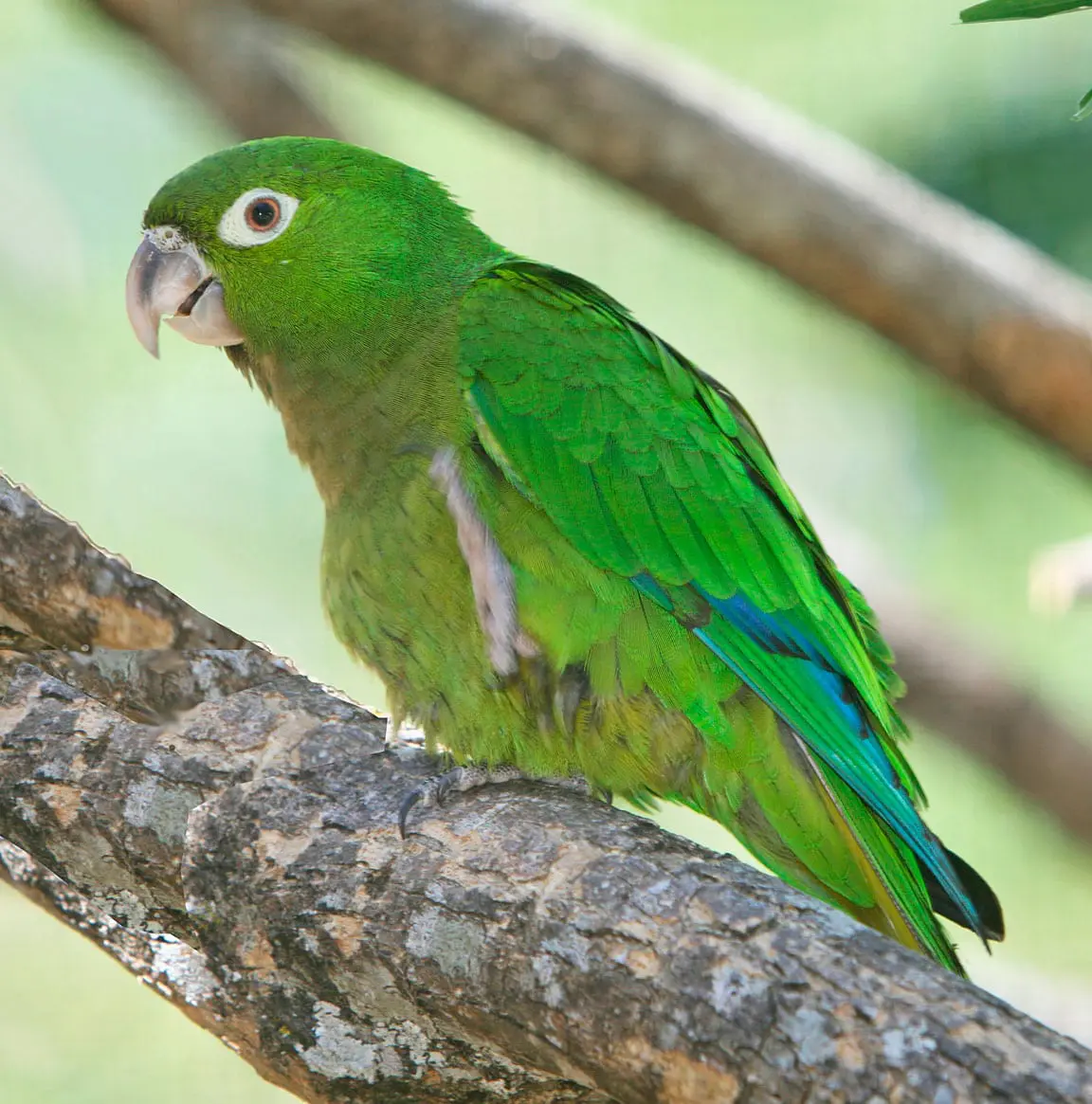
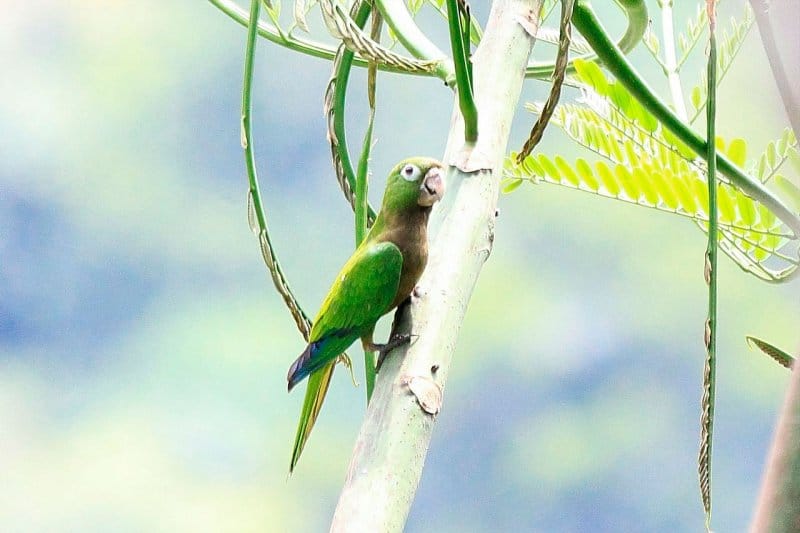
Olive-throated Parakeet
Eupsittula nana

Olive-throated Parakeet

Content

Description:


Anatomy-parrots

20 to 26 cm. in length and 72โ€“85 grams in weight. It is one of the smallest Aratingas.

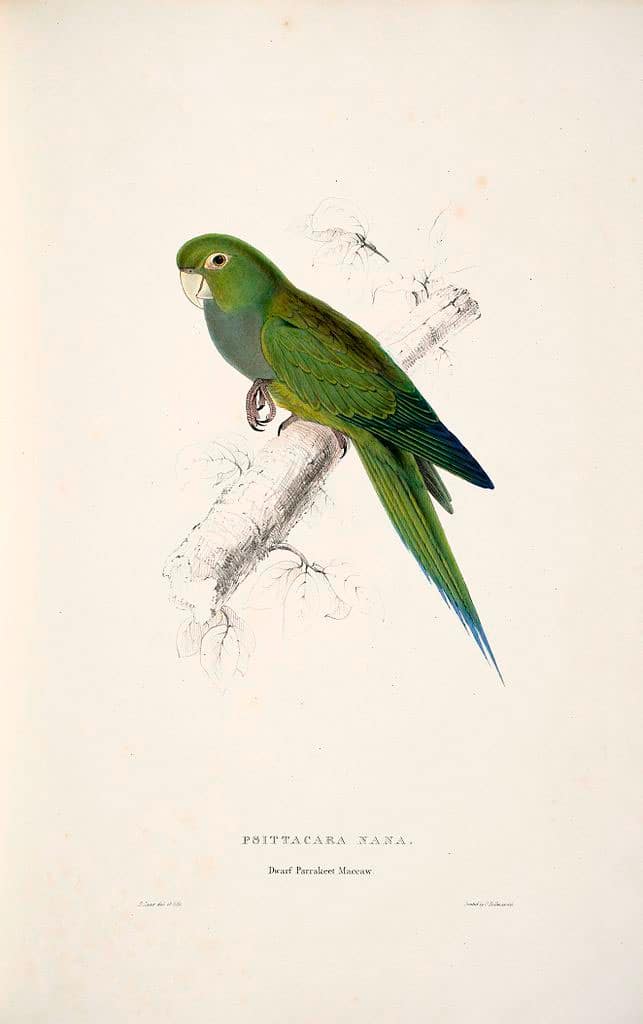
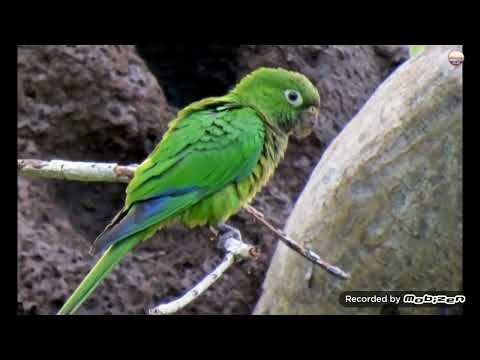
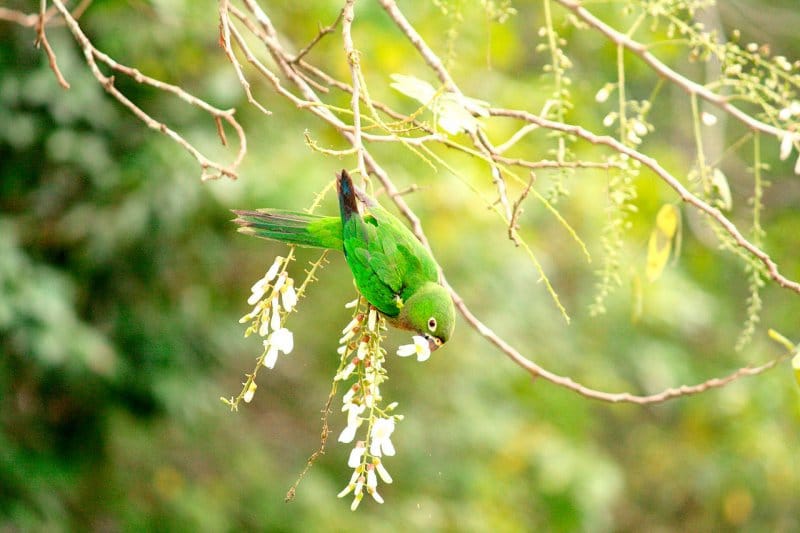
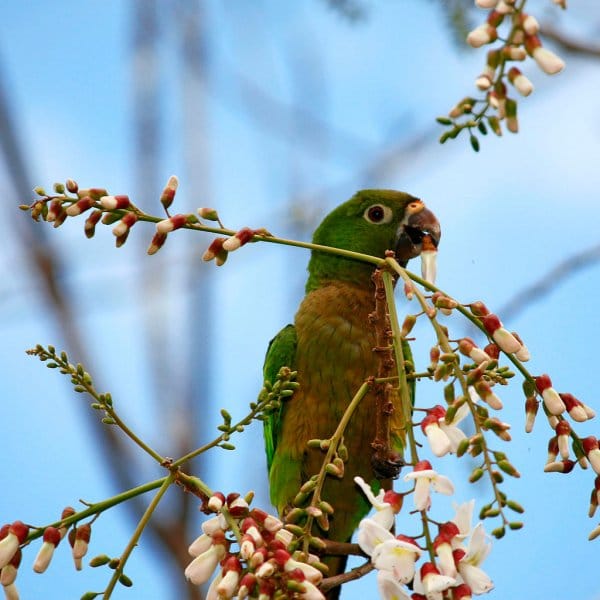
The Olive-throated Parakeet (Eupsittula nana) has the head and upperparts dark green; feathered area of cere yellow to orange-red.

Upperwing-coverts dark green, outer more emerald. The Outer secondaries and inner primaries deep dark blue tipped black above; the outer primary blue only towards tips. The greater underwing-coverts and underside of the flight feather dull slate or brownish-grey; the remaining coberteras are light green. Chin, throat and sides neck chocolate-brown they are merging with brownish olive on top of chest which turns yellow at the bottom and the belly; undertail-coverts light green. Uppertail dark green with blue diffusion, especially towards the tip; undertail metallized yellow-olive. Bill brown with the tip paler; irises yellow to orange; legs blackish-gray.

Olive-throated Parakeet

All plumages are similar but immature has irises brown.

  • Sound of the Olive-throated Parakeet.

Subspecies description:

three subspecies Panamanian and Honduran birds previously bore the respective names outmost and melloni, but light regional variations in Central America (p. e.g.. birds in southern paler and those of Tabasco, Mexico and Honduras They are darker) not justify more separations as described below.

  • Eupsittula nana astec

    (Souance, 1857) – Similar to the nominal but the throat and (especially the underparts) more pale brown, the bill perhaps smaller average.

  • Eupsittula nana nana

    (Vigors, 1830) – Nominal.


  • Eupsittula nana vicinalis

    (Bangs & Penard,TO, 1919) – Slightly larger than the subspecies Eupsittula nana astec, up brighter and greener down

NOTE The continental population is sometimes treated as a full species under the name A. astec, although the differences with Jamaican birds are minimal.

Habitat:

Video – "Olive-throated Parakeet" (Eupsittula nana)

Information on the Eupsittula nana

They live mainly in forests and forest edges (especially adjacent lowland) in wet areas (to 1.100 m in Honduras, to 700 m in Costa Rica and a 300 m in southern Mexico), It is less frequent in large tracts of rainforest; reported in arid areas (Veracruz) and pine forests (Honduras), open country with scattered trees (including acreages) and plantations. More common in Jamaica in mid-level humid limestone forests. Usually it remains below the canopy. larger groups can be formed (c. 30) after breeding or when food is abundant. mixed flocks with Crimson-fronted Parakeet reported in Costa Rica.

Reproduction:

Arboreal termitarium prefer to lay their nests, where birds excavate the cavity; also used treeholes. Often nests at the edge of a river or forest. Breeding season March, Jamaica; April May, Belize and Guatemala. The implementation is of 3-4 eggs that hatch in 26-27 days. After hatching, it takes about 50 days until chicks are ready for independence.

Note: In most birds, male/female bonds occur only during the breeding season and function solely in coordinating parental care. La monogamy perenne, or linking partner throughout the year, It occurs in at least a dozen families of birds, including cockatoos and other parrots.

Food:

Registered foods include higos ficus, Psidium, Inga, Hura, fruit of Hieronyma and guilt of tamarindo unripened. attacking crops, especially corn, and it is considered highly destructive in some areas.

Distribution:

Extending its range (breeding/resident): 1,373,500 km2

distributed by the Gulf and the Caribbean slope of Central America and Jamaica; a population in Hispaniola (Sierra de Bahoruco, Dominican Republic) It comes from a recent introduction from Jamaica. In Mexico, the Olive-throated Parakeet It extends from eastern San Luis Potosi and South of Tamaulipas, through South Veracruz until Oaxaca, North of Chiapas and Yucatan; then through the humid north of Guatemala and the Caribbean slope of Honduras, Nicaragua and Costa Rica to western Panama. It is located along Jamaica except in the high mountains and the humid mountain range of John Crow in the East.

Resident and locally common to abundant (commonly the most abundant parrot in some localities) although it is likely to be decreased in some areas (p. and. Jamaica and Costa Rica) due to the loss of habitat. Less common in southern Costa Rica and uncommon in Panama, where possibly a seasonal visitor Southern Lemon.

Caught for live bird market, but rare in international trade.

Subspecies description:

  • Eupsittula nana astec

    (Souance, 1857) – Veracruz, Mexico, to Panama


  • Eupsittula nana nana

    (Vigors, 1830) – Nominal. Jamaica, apparently in most areas except the high mountains and the humid Cordillera de John Crow


  • Eupsittula nana vicinalis

    (Bangs & Penard,TO, 1919) – East of Mexico south of Veracruz, zone of contact with the last unknown species

Conservation:

โ€ข Current category of the Red List of the UICN: Least concern.

โ€ข Population trend: Decreasing.

โ€ข Population size : 500,000-4,999,999 individuals.

Rationale for the Red List category

Although the demographic trend appears to be declining, the decline is not believed to be rapid enough to approach the Vulnerable thresholds based on demographic trend criteria (> 30% decrease in ten years or three generations). The population size is very large, and therefore does not approach the thresholds for Vulnerable under the criterion of population size (<10.000 individuos maduros con un descenso continuo estimado en >10% in ten years or three generations, or with a specific population structure). For these reasons, the species is evaluated as Least concern.

The subspecies Eupsittula nana nana It is endemic to Jamaica, where still widespread but probably has a moderately small population (approximately 10.000 mature individuals), all in one subpopulation, inferring that is in continuous decline due to a variety of threats including loss and degradation of the habitat, pursuit and capture for trade. So, It has been classified as Near-threatened.

Justification of the population

Partners in Flight They estimate that the total population is 500,000-4,999,999 individuals (A. Panjabi a slightly. 2008).

Justification trend

They suspected that the population is declining due to continuing habitat destruction and unsustainable levels of exploitation.

"Olive-throated Parakeet" in captivity:

Uncommon in international trade. Their life expectancy is over 15 years.

It is included in the appendix ll of the Convention on International Trade in Endangered Species of Wild Fauna and Flora Silvestre (CITES).

The Olive-throated Parakeet It is important to attract tourists with hotel advantages in the Caribbean and tropical areas that offer free bird tour with reservations. It is one of the reasons why this beautiful bird should remain free..

Alternative names:

Dwarf Conure, Dwarf Parakeet, Jamaican Conure, Jamaican Parakeet, Olive-throated Parakeet, Olive-throated Parakeet (Jamaican) (English).
Conure aztรจque , Conure naine, Conure naine (nominal), Conure naine (nominale), Conure naine (race nominale) (French).
Aztekensittich, Jamaikasittich (German).
Periquito-da-jamaica (Portuguese).
Aratinga jamaicana, Aratinga Pechisucia, Perico Amargo, Perico azteco, Perico Pechiolivo, Perico Pechisucio, perico pecho sucio, perico pecho-sucio, Periquito pechisucio (espaรฑol).
Perico azteco (Costa Rica).
Perico Amargo (Dominican Rep.).
Periquito pechisucio (Honduras).
Perico Pechisucio, perico pecho sucio, perico pecho-sucio (Mexico).
Perico Pechiolivo (Nicaragua).

scientific classification:

Order: Psittaciformes
Family: Psittacidae
Genus: Eupsittula
Scientific name: Eupsittula nana
Citation: (Vigors, 1830)
Protonimo: Psittacara nana

Images Olive-throated Parakeet:


Especies del gรฉnero Eupsittula
  • Eupsittula nana
  • —- Eupsittula nana astec
  • —- Eupsittula nana nana
  • —- Eupsittula nana vicinalis
  • Eupsittula canicularis
  • —- Eupsittula canicularis canicularis
  • —- Eupsittula canicularis clarae
  • —- Eupsittula canicularis eburnirostrum
  • Eupsittula aurea
  • Eupsittula pertinax
  • —- Eupsittula pertinax aeruginosa
  • —- Eupsittula pertinax arubensis
  • —- Eupsittula pertinax chrysogenys
  • —- Eupsittula pertinax chrysophrys
  • —- Eupsittula pertinax griseipecta
  • —- Eupsittula pertinax lehmanni
  • —- Eupsittula pertinax margaritensis
  • —- Eupsittula pertinax ocularis
  • —- Eupsittula pertinax paraensis
  • —- Eupsittula pertinax pertinax
  • —- Eupsittula pertinax surinama
  • —- Eupsittula pertinax tortugensis
  • —- Eupsittula pertinax venezuelae
  • —- Eupsittula pertinax xanthogenia
  • Eupsittula cactorum
  • —- Eupsittula cactorum cactorum
  • —- Eupsittula cactorum caixana

  • Sources:

    Avibase
    – Parrots of the World โ€“ Forshaw Joseph M
    – Parrots A Guide to the Parrots of the World – Tony Juniper & Mike Parr
    Birdlife

    Photos:

    (1) – Jamaican Parakeet (aka Olive-throated Parakeet or Aztec Parakeet) in captivity in Costa Rica By http://www.birdphotos.com (Own work) [CC BY 3.0], via Wikimedia Commons
    (2) – Aratinga nana astec in Belize By Dominic Sherony [CC BY-SA 2.0], via Wikimedia Commons
    (3) – Aratinga (nana) astec in Tikal, Guatemala By Aztec_Parakeet_(Aratinga_astec)_-Guatemala-8.jpg: Walter Rodriguez from Berlin, Germanyderivative work: Snowmanradio [CC BY 2.0], via Wikimedia Commons
    (4) – Aratinga (nana) astec in Tikal, Guatemala By Walter Rodriguez from Berlin, Germany (parakeetUploaded by Snowmanradio) [CC BY 2.0], via Wikimedia Commons
    (5) – Eupsittula nana. Celestรบn Biosphere Reserve, Yucatan, Mรฉxico By Katja Schulz from Washington, D. C., USA (Olive-throated Parakeet) [CC BY 2.0], via Wikimedia Commons
    (6) – A painting of an Olive-throated Parakeet, also known as the Olive-throated Conure, (originally captioned ยซPsittacara nana. Dwarf Parakeet Maccaw.ยป) by Edward Lear 1812-1888 [Public domain], via Wikimedia Commons

    Sounds: Guy Kirwan, XC284214. accessible www.xeno-canto.org/284214
    [contact-form][contact-field label=ยปNombreยป type=ยปnameยป required=ยปtrueยป /][contact-field label=ยปEmailยป type=ยปemailยป required=ยปtrueยป /][contact-field label=ยปWebยป type=ยปurlยป /][contact-field label=ยปMensajeยป type=ยปtextareaยป /][/contact-form]

    โ–ท The world of Pets: Dogs, cats, birds, reptiles, amphibians

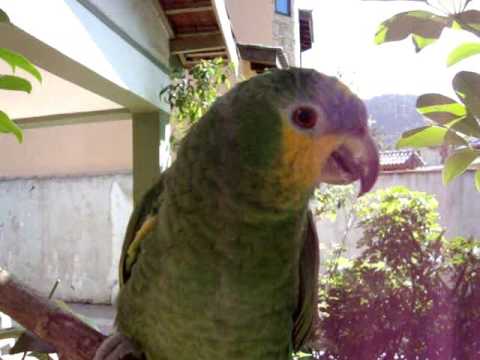
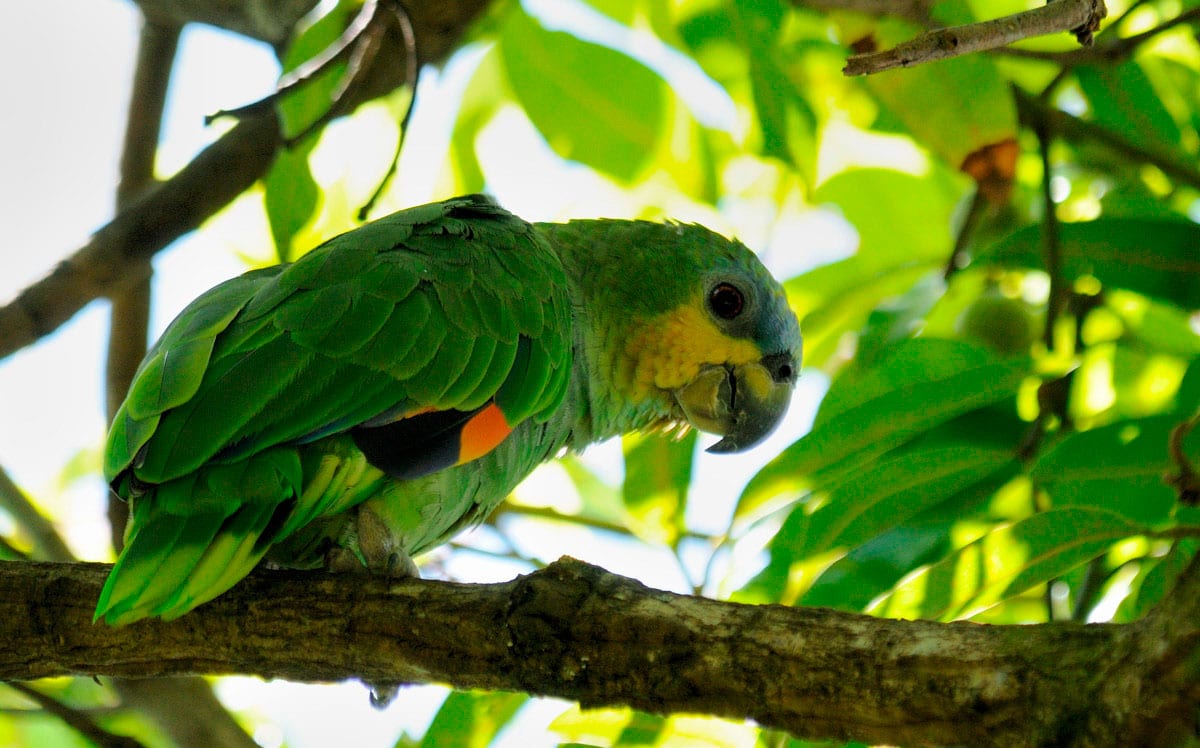
    Orange-winged Parrot
    Amazona amazonica

    Amazona Alinaranja

    Content


    Anatomy-parrots

    Description Orange-winged Parrot

    Of 33 to 36 cm.. height can weigh between 350 gr y 450 gr.
    The Orange-winged Parrot (Amazona amazonica) It is distinguishable by having the Centre of the crown and cheeks yellow, separated by the forecrown and sides of the crown pale blue, edge of the wing orange, and inside of the tail Orange with stripe green in the Middle.
    The copies juveniles have a color different to it of them adults; the head is green, Blue and pale yellow.
    It is not possible to determine the sex of the Amazons in a safe manner by their appearance.

    Habitat:

    Present in varied habitats (dry forests, morichales, Savanna, stubble, mangroves, etc.) below the 500 m.

    Frequently is seen in pairs or in flocks numerous out of it breeding season.

    Reproduction:

    It is a kind monogamous (the couple stays together for life).

    It nests in trunks of Palms killed apparently at the end of the season dry.
    The female lays from 3 to 5 eggs and she incubates them for three weeks approximately. the chicks take two months to develop.

    Food:

    It feeds on various fruits, seeds and sprouts leaves. Including the fruit of Palms (Sloanea, Richeria and Byrsonima) , flowers Erythrina and sometimes cocoa.
    You can take oranges and mangoes of the cultivated areas when other food is scarce.

    Distribution:


    Size of the area of distribution (reproduction / resident): 7.420.000 km2

    North and Central South America to the East of Peru, Brazilian Amazon and northeast of Bolivia.

    Conservation:

    State of conservation โ“˜


    minor concern Minor Concern โ“˜ (UICN)โ“˜
  • Current red list category of the UICN: Least concern.
  • The population trend: Decreasing.

  • Trapped for the wild bird trade: they have been 268.510 wild-caught individuals for international trade from 1981.
    In some areas of their range they are hunted for food by the indigenous population.
    The loss of habitat is also a concern.


    "Orange-winged Parrot" in captivity:

    Video – "Orange-winged Parrot"

    Amazona Amazonica

    Popular as a mascot for more than 100 years.
    Loving, playful, with good ability to speak, sociable with people.

    Known for being very friendly, easy to train, very Smart.
    They need constant attention of their owners, they carry out all kinds of fun pranks to get that attention.
    Over time they will form a strong bond with their owner., they can however be quite noisy. They will make noise early in the morning and when the Sun is setting. This usually lasts for a few 10 minutes, to wake up and just before sleep.

    Alternative names:

    Orange winged Parrot, Common Amazon Parrot, Orange-winged Amazon, Orange-winged Parrot (English).
    Amazone ร  ailes orange, Amazone aourou (French).
    Venezuelaamazone (German).
    curica, airu-curuca, ajuru-catinga, ajuru-curau, ajuru-curuca, curau, curuรงรก, Papagaio-do-mangue, papagaio-grego, papagaio-poaieiro (Portuguese).
    Amazona Alinaranja, Amazona Guaro, Cotorra Alianaranjada, Lora Amazรณnica, Loro Real, Lora alianaranjada (espaรฑol).
    Lora Amazรณnica (Colombia).
    Loro Guaro (Venezuela).

    scientific classification:

    Order: Psittaciformes
    Family: Psittacidae
    Genus: Amazona
    Scientific name: Amazona amazonica
    Citation: (Linnaeus, 1766)
    Protonimo: Psittacus amazonicus

    Orange winged Parrot images :


    Species of the genus Amazona


    Sources:

    – Parrot Book, Parrots and macaws Neotropical
    avibase

    Photos:

    Our beautiful world
    – An Orange-winged Amazon at Kuala Lumpur Bird Park, Malaysia. It is eating a slice of corn on the cob by Vasenka – Wikimedia
    – by Patrick Ingremeau – IBC.lynxeds.com
    – by Snowmanradio (talk) – Wikimedia
    – by Thore Noernberg – IBC.lynxeds.com

    Sounds: Joao Antonio de B.. Vitto (Xeno-canto)

    โ–ท The world of Pets: Dogs, cats, birds, reptiles, amphibians

    Scarlet-fronted Parakeet
    Psittacara wagleri

    Scarlet-fronted Parakeet

    Content

    Description:


    Anatomy-parrots

    34 to 36 cm.. of length and a weight of 162 to 217 g..
    The Scarlet-fronted Parakeet (Psittacara wagleri) He has the crown and forecrown bright red; lores and cheeks dark green with red feathers scattered in some birds. Of the nape even up to the uppertail-coverts dark green. Upperwing-coverts dark green; flight feather green, dyed Emerald above and olivaceous at the bottom. The greater underwing-coverts, also of color olivaceous, the remaining underwing-coverts, green. The underparts brighter yellowish green, sometimes with scattered red feathers on the throat and in the the thighs. Upper, the tail dark green; by down olive green.

    The bill color pale horn; bare periophthalmic grey; irises yellow; legs distant.

    Ilustraciรณn Aratinga de Wagler

    Both sexes similar.

    The immature with a reduction (or even absence) Red Feather in the head.

    Subspecies Psittacara description wagleri
    Subspecies
    • Psittacara wagleri frontatus

      (Cabanis, 1846) – Red of the head vaster than the species nominal, extending to the rear of the eyes. Red in the the thighs and bend of wing in most birds. Larger than the species nominal (40 cm.).


    • Psittacara wagleri minor

      (Carriker, 1933) – Similar to the subspecies Frontata but smaller (38 cm.) and more green with pale red in the wings. Some specimens with yellow on the bend of wing.


    • Psittacara wagleri transilis

      (Peters,JL, 1927) – darker than kind nominal, with less extensive red on the rear of the crown. Smaller that the species nominal (34 cm.).


    • Psittacara wagleri wagleri

      (Gray,GR, 1845) – The species nominal

    Habitat:

    Video – "Scarlet-fronted Parakeet" (Psittacara wagleri)

    Psittacara wagleri RN Victoria Feb016

    They inhabit in humid forests, deciduous, from gallery, cloudy and second-growth forests with acacias, Prosopis and Ochroma, mainly in the lower subtropical and upper tropical zones, Although they can also penetrate in sub-templadas areas.

    In Peru, observed in cloud forests semi-arid.

    Reported at lower elevations in humid plantations, cornfields and cactus thickets. Key requirement in their habitat are the cliffs, in which it breeds and rests.

    In general, observed the altitudes of 2.000 m, above the 3.000 metres in Peru. Gregaria, usually in close flocks to the 20 individuals, sometimes up to 300 birds.

    Communal hangers on the cliffs with diurnal movements towards the areas of power.

    Reproduction:

    Nest communally in Rocky steep, between December and June in the North of Colombia and between April and June in Venezuela. Average of the laying of 3 to 4 eggs and the incubation is of 23 or 24 days. The pups they leave the nest after 50 days, with a plumage green.

    Food:

    Its diet includes a variety of fruits, nuts and seeds; You can include cereal crops and fruit plantations. Usually they feed in the canopy.

    Distribution:

    Size of the area of distribution (reproduction / resident): 866.000 km2

    The Scarlet-fronted Parakeet It is distributed discontinuously in the northwest and west of South America, in the area of the Andes, from Venezuela until Peru.

    In Venezuela stretching from West of the Paria Peninsula in the foothills of the Andes (between 500 and 2,000m, more altitude farther south), up to the Serrania del Perija and in the North of Colombia, including the Department of Magdalena and the West and center of the mountain range of the Andes Although apparently absent in the southwestern tip of Colombia.

    Their status in the eastern slope of the Andes in Colombia is uncertain. Found around the skirts of the Andes in the South of Ecuador and South of Peru until Tacna at latitudes of I8ยฐ S.

    Apparently, observed in the Western Andean slopes in the Peru with some reports from the South of the Valley of the Maranon River until Ayacucho and apurimac, in the central andes.

    Usually residents Although seasonal visitors in some areas. Irregularly-common, often abundant, Although scarce or non-existent in many areas; more scarce in the South. Decrease in its population in some areas (for example, Colombia), due to loss of habitat.

    Trapped for the trade in live birds, with 16.644 specimens exported from Peru in 1982.

    The large number of birds escaped from her cage makes it considered them are introduced in Spain, Florida, Hawaii and California.

    Subspecies Psittacara distribution wagleri
    Subspecies
    • Psittacara wagleri frontatus

      (Cabanis, 1846) – West of Ecuador and South of Peru, approximately 18ยฐ S


    • Psittacara wagleri minor

      (Carriker, 1933) – South of the Valley of the Maranon River until Ayacucho and apurimac in the center of the Peruvian Andes.


    • Psittacara wagleri transilis

      (Peters,JL, 1927) – The northeastern coastal mountains of Venezuela up to the Paria Peninsula, Sucre. Possibly records in Bethlehem, Caquetรก, on the eastern slope of the East of the Of the Andes in Colombia. Unclear relationship with the species nominal.


    • Psittacara wagleri wagleri

      (Gray,GR, 1845) – The species nominal

    Conservation:

    State of conservation โ“˜


    Near-threatened Near Threatened โ“˜ (UICN)โ“˜

    โ€ข Red List category of the UICN current: Near-threatened

    โ€ข Population trend: Decreasing

    The population trend of the Scarlet-fronted Parakeet apparently it has not quantified, but you suspect that your decline It moderately fast due to the persecution and change of land use (pit et to the., 1997).

    The species has been the subject of a intense trade and individuals captured in nature have been recorded in international trade (UNEP-WCMC trade database CITES).

    One high internal trade This species has been observed in Venezuela (pit et to the., 1997).

    Pursued, due to its status as a crop pest, It can also be contributing to their decline.

    Current levels of hunting pressure and persecution are not known, but it is assumed that it is producing a negative trend in their population.

    Although this species shows a flexible use of the habitat and makes use of the crops, It is suspected that the the land use change It is contributing to a population decline of the species, and habitat clearance is presumed that it has led to the decline of this species in Colombia (pit et to the. 1997).


    Conservation Actions Underway:

    โ€ข The species is listed in Appendix II.

    Conservation Actions Proposed:

    โ€ข Carry out surveys to assess the population size of the species and the trend.

    โ€ข Quantify the current impact of entrapment.

    โ€ข Monitor trade levels.

    โ€ข Carry out awareness activities to reduce the activities of capture and trade of Psittacidas..

    โ€ข Increase the area of โ€‹โ€‹suitable natural habitat that receives effective protection..

    "Scarlet-fronted Parakeet" in captivity:

    The poultry farming of the Scarlet-fronted Parakeet rarely achieved as this species is difficult to obtain and difficult to maintain. This Parrot will only spawn several years kept in captivity.

    It is a bird animated, although, initially shy, that is because you provide a environment of Cologne, even in the breeding season. Itร‚ยดs resistant Once you have moved. Pretty noisy, something that must be taken into account if the neighbors are close.

    Chomping hard, in need of a steady supply of fresh branches to meet the great need to chew. Enjoy the daily bath.

    Alternative names:

    Scarlet-fronted Parakeet, Red-fronted Conure, Red-fronted Parakeet, Scarlet fronted Parakeet, Scarlet-fronted Conure (English).
    Conure de Wagler, Conure ร  front rouge, Perruche de Wagler (French).
    Columbiasittich (German).
    Periquito-de-cara-vermelha (Portuguese).
    Aratinga de Wagler, Perico Frentirrojo, Periquito de Frente Roja (espaรฑol).
    Loro frentirrojo, Perico Frentirrojo, Perico Chocolero (Colombia).
    Cotorra de Frente Escarlata (Peru).
    Chacaraco (Venezuela).
    Perico frentiescarlata (Ecuador).

    scientific classification:

    Order: Psittaciformes
    Family: Psittacidae
    Genus: Psittacara
    Scientific name: Psittacara wagleri
    Citation: (Gray, GR, 1845)
    Protonimo: Conurus Wagleri

    Scarlet-fronted Parakeet pictures:


    Species of the genus Psittacara

    Sources:

    Avibase
    – Parrots of the World โ€“ Forshaw Joseph M
    – Parrots A Guide to the Parrots of the World – Tony Juniper & Mike Parr
    – Birdlife

    Photos:

    (1) – Scarlet-fronted Parakeet (Aratinga wagleri) at Jurong BirdPark, Singapore By Michael Gwyther-Jones (originally posted to Flickr as Singapore 2006 249) [CC BY 2.0], via Wikimedia Commons

    (2) – Scarlet-fronted Parakeet, also called Scarlet-fronted Conure at Jurong Birdpark, Singapore By Lynn Zheng (bird park_012) [CC BY 2.0], via Wikimedia Commons
    (3) – pericon found By the Selimalabi (Own work) [GFDL, CC-BY-SA-3.0 or FAL], via Wikimedia Commons By Selimalabi (Own work) [GFDL, CC-BY-SA-3.0 or FAL], via Wikimedia Commons
    (4) – Chacaraco [Scarlet-fronted Parakeet] (Aratinga wagleri transilis) by barloventomagicoFlickr
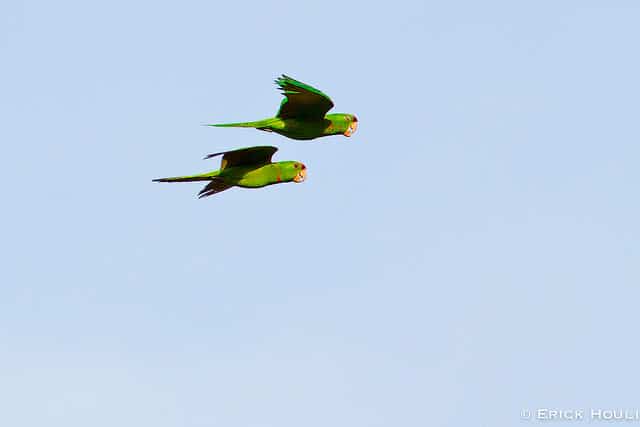
    (5) – Chacaraco / Scarlet-fronted Parakeet (Aratinga wagleri) by Erick HouliFlickr

    (6) – Illustration By Gray, George Robert; Hullmandel & Walton; Hullmandel, Charles Joseph; Mitchell, D. W. [CC BY 2.0 or Public domain], via Wikimedia Commons

    Sounds: (Xeno-canto)

    โ–ท The world of Pets: Dogs, cats, birds, reptiles, amphibians

    Lilac-crowned Parrot
    Amazona finschi

    Lilac-crowned Parrot

    Content

    Description:


    Anatomy-parrots

    33 cm. head to tail and weighs on average 310 g..

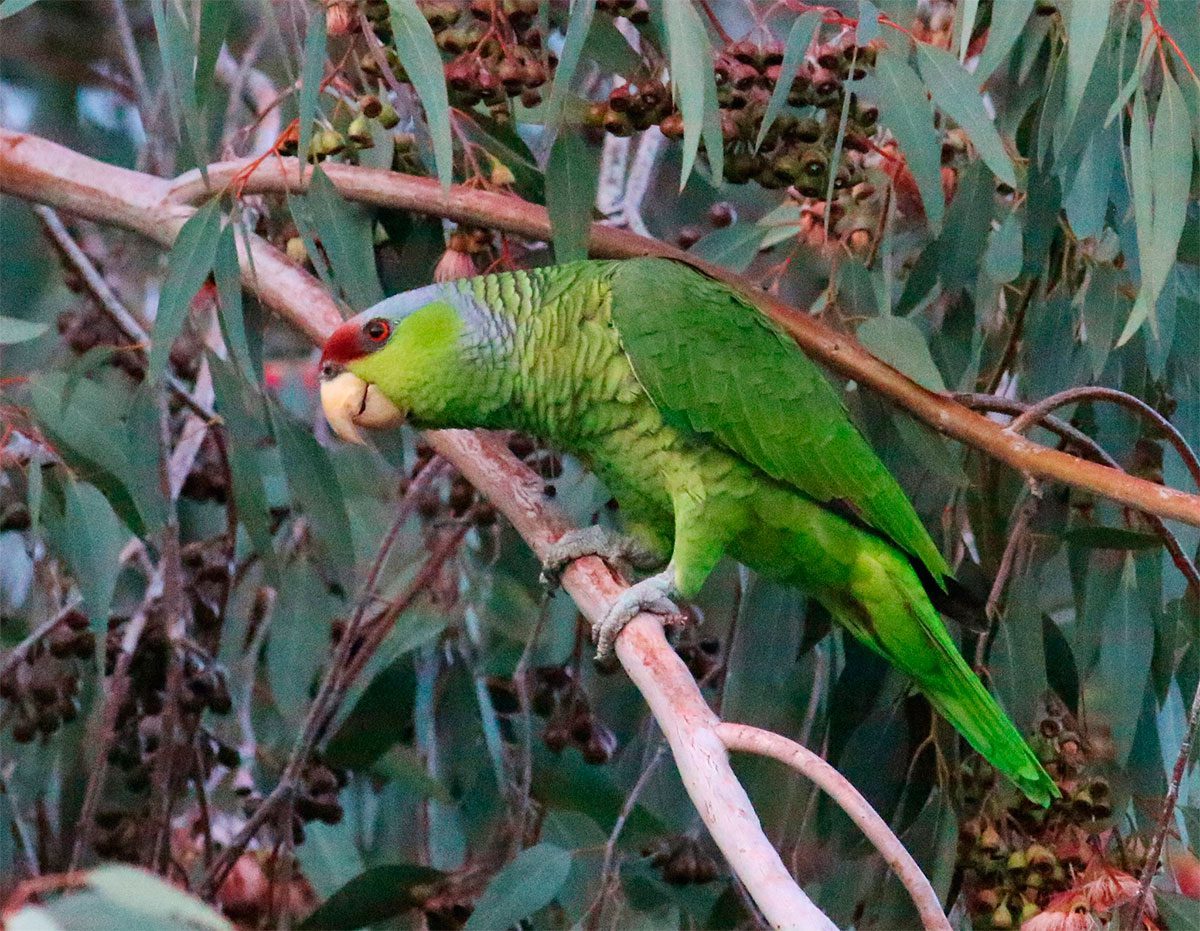
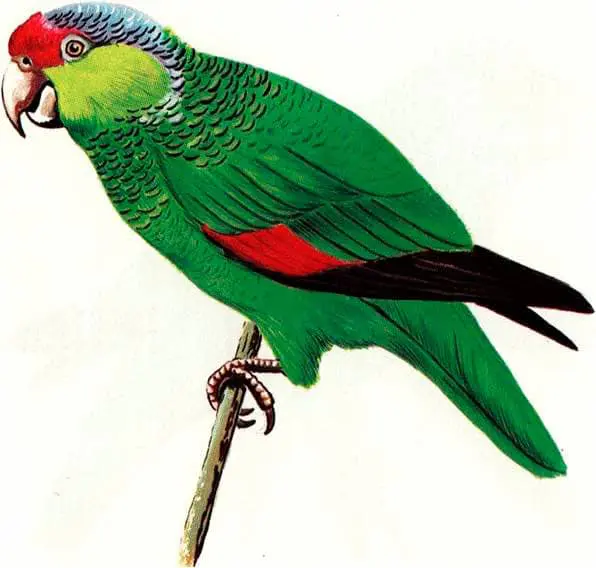
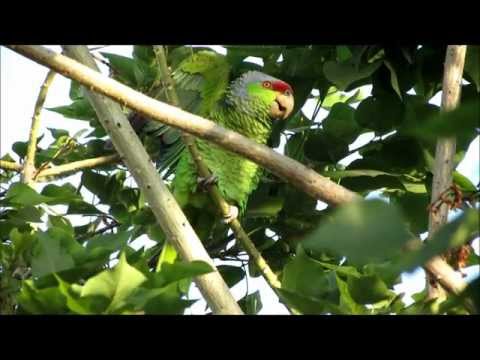
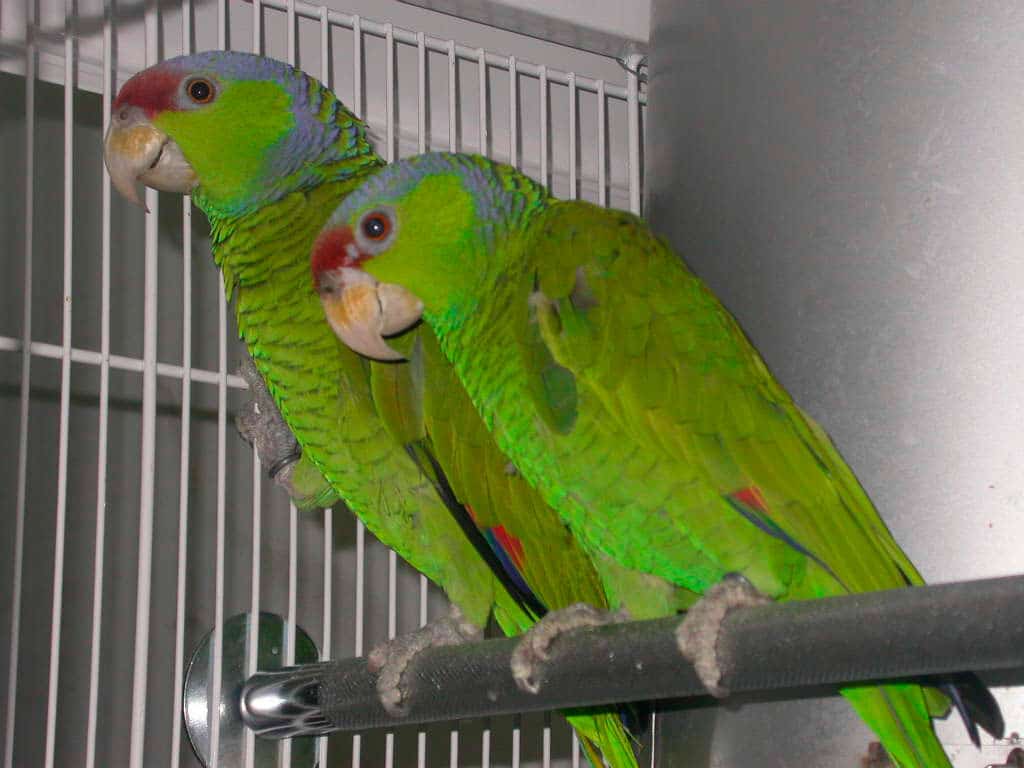
    The Lilac-crowned Parrot (Amazona finschi) has the forecrown and the higher lords, red off; the lower lores, the cheeks and ear-coverts, pale lime green; crown, sides neck and nape, lilac or pale blue with some feathers crown showing narrow black margins.

    Mantle green with broad black edges giving distinct scalloped effect; back and scapulars weak green with black borders to some feathers; rump and uppertail-coverts, green, slightly brighter than the back. Wing coverts green. Primaries blue toward the tip, green at the base; the base outerweb the first five secondaries, red with subterminal band yellow and blue tips, secondaries, otherwise, green, becoming blue at tips. Under the wings, brighter yellowish green; flight feather dull green.

    Lilac-crowned Parrot

    Throat yellowish green with bluish tint to some feathers; remaining underparts, yellowish-green with black margins to some feathers (especially in the chest), giving scalloped effect. Tail green tip yellowish green, lateral feathers blue margin to the base of the outerweb. Bill color horn; irises orange red; legs grey.

    Both sexes are similar. Immature has the irises dark brown (rather than red).

    • Sound of the Lilac-crowned Parrot.

    Habitat:

    "Lilac-crowned Parrot"

    Lilac Crowned Amazons (Amazona Finschi)

    The Lilac-crowned Parrot Living mainly in wooded hills and mountains, from the tropical zone in the lower levels of the deciduous forests, to the forests of oak and pine-oak forest in the highlands, preferably through the valleys with lush vegetation along streams that run on the basis of cannons; often also in areas of arid or semi-arid vegetation, or clear forest edge, coming into cultivated areas and orchards adjacent to the forest.

    mainly in altitudes of 600 to 2.000 m, but recorded at sea level Sinaloa and from sea level to the temperate forest Colima. observed between 360-1.700 metres in Sonora and 880-1.480 metres in Oaxaca. Usually in pairs or small groups, although larger groups are formed in the dry season (500 birds reported) and in communal roosts (more than 1,000 birds reported in the same place Nayarit).

    Reproduction:

    They nest in tree hollows (for example, Ficus), including old nests woodpeckers (for example, Phloeoceastes) or arboreal termite mounds.

    The breeding season It comprises from February to June, nesting with a cycle consisting of 28 incubation days eggs, followed by two months of growth of chickens in the nest (Forshaw 1989, Renton 1998, 2002).

    Food:

    Eating habits are poorly documented: It has been observed a particular preference for figs. During the dry season the diet consists mainly of Astronium graveolens, Brosimum alicastrum, Celaenodendron mexicanum, Comocladia engleriana and Ficus insipida. during the rains The diet consists of species such as Caesalpinia pulcherrima, Celaenodendron mexicanum, Esenbeckia nesiotica, Jatropha spp and Sciadodendron excelsum (Renton 1998, 2001)

    cause some crop damage corn and banana.

    They have been observed wild species groups, feeding with the Red-crowned Parrot (Amazona viridigenalis) in Los Angeles, California.

    Distribution:

    Size of its range (breeding/resident): 372.000 km2

    The Lilac-crowned Parrot inhabits Pacific coast of Mexico, from the southeast end of Sonora and Southwest Chihuahua, to the South by Sinaloa, Durango Western, Nayarit, Jalisco, Colima, Michoacรกn and Warrior, until Oaxaca, west of Isthmus of Tehuantepec.

    It is mostly residents, but outside the breeding season, visit during autumn, lowlands, for example in Oaxaca. generally common. Described as fairly common locally in southeastern Sonora. abundant in Colima. Very rare in the highlands of Oaxaca. Several wild populations reported in several locations in the United States.

    Conservation:

    State of conservation โ“˜


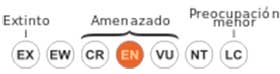
    Endangered Endangered โ“˜ (UICN)โ“˜

    โ€ข Current category of the Red List of the UICN: In danger of extinction.

    โ€ข Population trend: Decreasing.

    โ€ข Population size : 4700-6700.

    Rationale for the Red List category

      This species has been selected in danger of extinction because it is suspected that is decreasing very quickly as a function of contractions recorded ranges and due to the unsustainable exploitation and loss of habitat.

    Justification of the population

      Renton and Elias (2003) estimate the world population between 7.000 and 10.000 individuals, based on surveys covering most of the global range of the species. This equates to approximately 4.700-6.700 mature individuals. An estimate that 5.400 individuals each year are caught illegally in Mexico (Cantu et al ., 2007), implies that the estimation of population Renton and Elias (2003) could be an understatement, but it remains in this evaluation to best data available.

    Justification of trend

      It is suspected that the population of this species is in decline very fast, based on a study of Marin-Togo et al . (2012), who estimated the current distribution of this species along the Pacific coast of Mexico and he showed a reduction 72.6% its estimated original distribution.
    Threats

    โ€ข The Capture for national and international trade It is the greatest threat to wild populations.

    โ€ข It is highly valued in trade (Cantu et al., 2007) and it was the kind of Amazon parrot most caught in the early eighties (Inigo-Elias y Ramos 1991).

    โ€ข The illicit trade is intense and widespread, and Lilac-crowned Parrot It is one of the most frequently confiscated Mexican parrots (K. Renton in litt., 2005).

    โ€ข During the period 1981-2001, were registered 4.061 individuals in international trade, of which 79% It was exported directly from Mexico and the 64% it took Nature (CITES 2004a).

    โ€ข Remains one of the five species of Mexican parrots most caught, with an estimated 5.400 individuals / year caught illegally Mexico (Cantu et al ., 2007).

    โ€ข Los Adults and young people are easily trapped in large numbers due to their habit of congregating at communal shelter sites in the late afternoon (Renton 2005, K. Renton in some 2005).

    โ€ข Chicks are commonly poached from nests (K. Renton in litt., 2005).

    โ€ข During interviews with local people throughout the range of the species, the 75% reported poaching in your area (K. Renton in litt., 2005).

    โ€ข Also, it is said that this species requires semi-deciduous forest with tall mature trees for nesting and can not adapt to the changed areas nesting (Marin-worm Togo et al ., 2012).

    โ€ข Habitat loss and degradation, mainly for conversion to small and large crops and pastures (K. Renton in some . 2007, A. Salinas in some . 2007, Ortega-Rodriguez and Monterrubio-Rico 2008), are serious threats, with the semi-deciduous forest along the Pacific coast lost at a higher rate than any other type of forest in Mexico (Masera et al ., 1996, K. Renton in litt., 2005), It is resulting in the destruction of nesting sites and reducing the extent of this crucial critical habitat (Renton 2005).

    โ€ข In Michoacรกn, nesting areas potentially more accessible, as plains or hills, have been converted to livestock or agricultural farms (Ortega-Rodriguez and Monterrubio-Rico 2008).

    โ€ข Large development projects, such as dams, also they resulted in loss of breeding habitat for the species (K. Renton in some ., 2007).

    โ€ข The semi-deciduous forest now covers only 5.106 km2 within the range of the species (Renton and Elias 2003, K. Renton in litt., 2005).

    โ€ข The decrease in rainfall that could result from the global climate change would lead to a decrease in the reproductive potential of wild populations in tropical dry forests (K. Renton in some ., 2007).

    โ€ข Despite the various pressures on habitats, by showing that the species has disappeared from more than 70% of its former range, Marin-Togo et al. (2012), has reinforced the view that the capture pressure is the predominant threat to the species.

    Conservation Actions Underway

    โ€ข In 1999, the Mexican government established a Conservation Plan, Protection and Recovery Psitรกcinos in Mexico, in which the Lilac-crowned Parrot It is considered a priority species (Macias Caballero et al ., 2000).

    โ€ข In 2004, the species was updated to Appendix 1 of CITES and in 2007 It approved a proposal to change its state species conservation 2008 of "threatenedยป a ยซin dangerยป under the Mexican wildlife law (K. Renton in some.)

    โ€ข In Mexico, They have made considerable efforts to combat illegal domestic trade, with at least 52 seizures during 1997-2003 (CITES 2004b).

    โ€ข Inspections carried out in Mexico They resulted in the seizure of 266 live individuals of the species that were offered illegally in the pet trade between 1995 and 2003 (CITES 2004b).

    โ€ข The species It is in three biosphere reserves; Sierra de รlamos-Rรญo Cuchujaqui flora and fauna protection area in Sonora meridional, and Reserva de la biosfera Chamela-Cuixmala and Biosphere Reserve Sierra de Manantlรกn, in Jalisco, and according to sources, It is distributed in seven other important bird areas; However, some of them lack official protection or conservation programs (CITES 2004a)

    Conservation Actions Proposed

    โ€ข Monitor the demographic trends through regular surveys.

    โ€ข Monitor levels of destruction and degradation of habitat.

    โ€ข Implement trade regulation strategies in the plan 1999.

    โ€ข Carry out extension work and environmental education as described in the plan 1999.

    โ€ข Perform the habitat conservation and recovery of wild populations as it recommended in the Plan 1999.

    โ€ข Monitor the success of the strategies of the plan of 1999.

    โ€ข Protect the rest of the tropical forest supports in areas where the slope is greater than 6 ยฐ: ideally all areas on steep slopes should be restored to forest, to provide habitat for all native wildlife (including the Lilac-crowned Parrot)

    โ€ข Prevent soil erosion AND promote alternative economic activities in rugged coastal areas such as recreation and tourism. (Ortega-Rodriguez and Monterrubio-Rico 2008).

    The Lilac-crowned Parrot in captivity:

    Very popular as a pet throughout its area of distribution; It has cultural value as a pet or ornamental bird by its feathers; ability to imitate sounds and its tendency to form bonds with people; widespread in captivity internationally.

    Currently protected by the Appendix 1 of CITES.

    Each copy captive of this species which is capable of reproducing, should be placed in a well-managed breeding program in captivity and not be sold as a pet, with the objective of ensure their survival long-term.

    Alternative names:

    Finsch’s Parrot, Lilac crowned Parrot, Lilac-crowned Amazon, Lilac-crowned Parrot, Pacific Amazon, Pacific Parrot (English).
    Amazone ร  couronne lilas, Amazone de Finsch, Amazone verte de Finsch (French).
    Blaukappenamazone (German).
    Papagaio-de-finsch (Portuguese).
    Amazona de Corona Violeta, Amazona Guayabera, Loro Corona Lila, loro corona-lila, Loro Corona-violeta (espaรฑol).


    scientific classification:

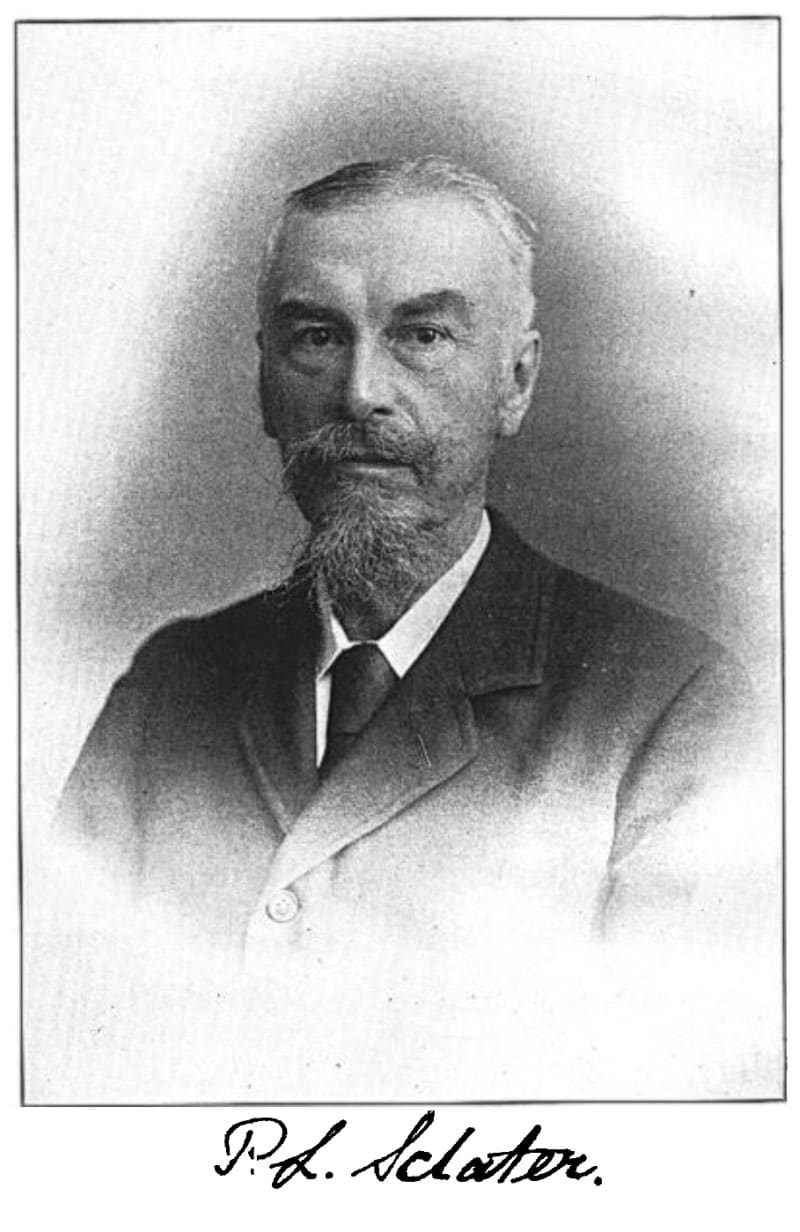
    Philip Sclater
    Philip Sclater

    Order: Psittaciformes
    Family: Psittacidae
    Genus: Amazona
    Scientific name: Amazona finschi
    Citation: (Sclater, PL, 1864)
    Protonimo: Chrysotis finschi


    Images Lilac-crowned Parrot:


    Species of the genus Amazona


    Sources:

    Avibase
    Parrots of the World โ€“ Forshaw Joseph M
    Parrots A Guide to the Parrots of the World – Tony Juniper & Mike Parr
    Birdlife
    Naturalist

    Photos:

    (1) – Lilac-crowned Parrot by Tom BensonFlickr
    (2) – Lilac-crowned Amazon perching on a branch By Amazona_finschi_-perching_on_branch-8.jpg: Cรฉdric Allierderivative work: Snowmanradio [CC BY 2.0], via Wikimedia Commons
    (3) – Lilac-crowned Amazon (Amazona finschi) by Emilie ChenFlickr
    (4) – Lilac-crowned Parrot by wplynnFlickr
    (5) – A pet Lilac-crowned Amazon; head and neck By Gary Denness (originally posted to Flickr as Pretty Boy) [CC BY 2.0], via Wikimedia Commons
    (6) – Lilac-crowned Amazon; two in a cage By TJ Lin (originally posted to Flickr as DSCN0549) [CC BY-SA 2.0], via Wikimedia Commons
    (7) – Lilac-crowned Amazon (Amazona finschi) By CDest [Public domain], via Wikimedia Commons
    (8) – Lilac-crowned Amazon at the Arizona-Sonora Desert Museum, Tucson, Arizona, USA By DrStarbuck from Madison, WI, USA (Arizona-Sonora Desert Museum 18) [CC BY 2.0], via Wikimedia Commons
    (9) – A Lilac-crowned Amazon at Arizona-Sonora Desert Museum, USA By Dave Bezaire & Susi Havens-Bezaire [CC BY-SA 2.0], via Wikimedia Commons
    (10) – Amazona finschi Uploaded by Francisco_aviarioPhotobucket

    Sounds: Richard E. Webster, XC353198. accessible www.xeno-canto.org/353198

    โ–ท The world of Pets: Dogs, cats, birds, reptiles, amphibians

    Cactus Parakeet
    Eupsittula cactorum

    Cactus Parakeet

    Content

    Description:


    Anatomy-parrots

    25 cm.. length and 75-90 g. of weight.

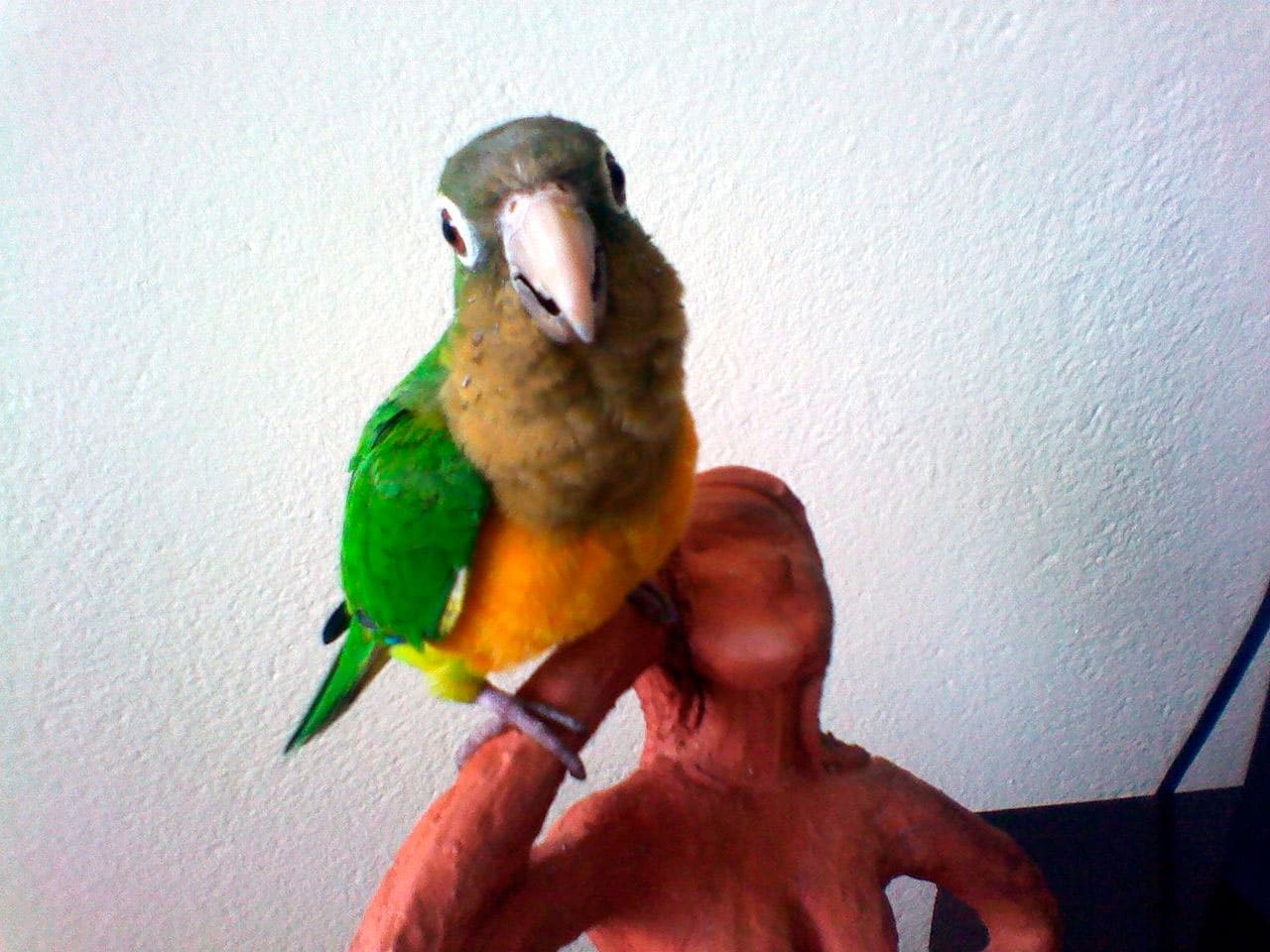
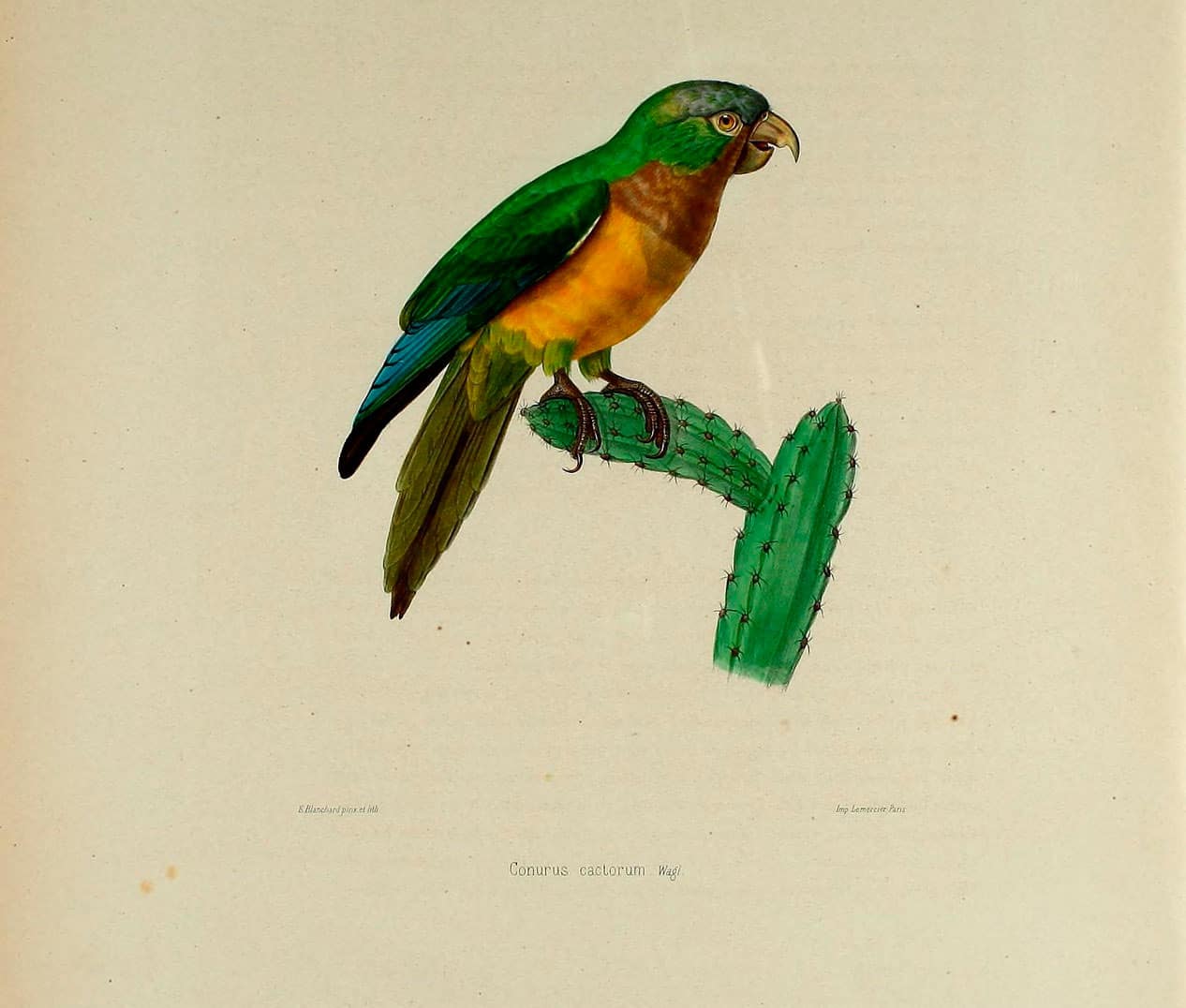
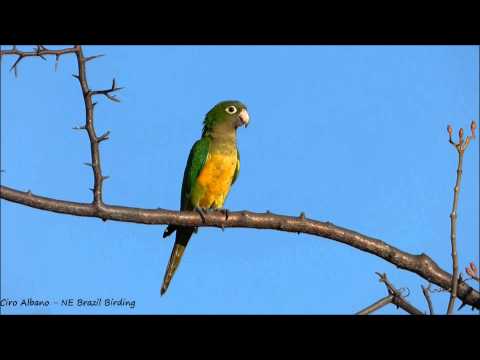
    The Cactus Parakeet (Eupsittula cactorum) has the forecrown, lores lower cheeks and brown off; crown with slaty tinge; sides neck, the nape and upperparts up to the rump grass-green.

    The primary coverts They are bluish green in the outerweb, the remaining are green grass. Flight feathers (above) green on innerwebs, blue green on outerweb, blue black at the tips (below) gray. Underwing-coverts greenish yellow. Throat and upper breast dull brown; lower breast and belly fairly bright orange-yellow, the thighs and vent greenish-yellow color. Uppertail green, four distal blue central feathers; undertail gray.

    Cactus Parakeet

    upper jaw horn, greyish at base and lower jaw; perioftรกlmico patch naked white; irises brown-orange; gray-gray legs.

    Both sexes similar. Immature paler than adult, with crown green, more olive upper chest and throat, and the irises darker.

    • Sound of the Cactus Parakeet.

    Subspecies description:

    • Eupsittula cactorum cactorum

      (Kuhl, 1820) – Nominal.


    • Eupsittula cactorum caixana

      (Spix, 1824) – Generally paler than nominal, with belly yellow instead of orange.

    Habitat:

    Video – "Cactus Parakeet" (Eupsittula cactorum)

    Cactus Parakeet - Caatinga Parakeet - Eupsittula cactorum -

    Its distribution area closely matches the dried vegetation and prickly caatinga Northeast Brazil, but it encompasses higher drier semi-desert areas created by overgrazing and dry forests (caatinga arborea) and seasonal savannah lusher (closed). Usually in pairs or (mainly outside the breeding season) flocks of up to 20 birds, most abundant where food is abundant (as rice crops).

    Reproduction:

    Crianza undocumented released. Clutch six eggs in captivity.

    Food:

    The diet includes seeds, fruits (including cactus), berries, dried fruits, flowers and cocoons, taken both trees and shrubs and soil. Sometimes it attacks crops (for example rice, grapes and corn).

    Distribution and status:

    Population expansion (breeding/resident): 1.220.000 km2

    Distributed by the interior Northeast Brazil. The Cactus Parakeet extending from the drier parts of Bay and adjacent northeast Minas Gerais, Brazil north through Piauรญ and Southeast of maranhรฃo, up to Pernambuco and Paraรญba, passing by Rio Grande do Norte and Cearรก. Absent in coastal areas: a record of Bethlehem at the mouth of amazon in For It seems wrong or possibly refers to a leak.

    It is usually common (the most common parrot in some localities) with a stable population, although the decline is inevitable in some areas due to massive loss of habitat by agriculture and plantations of exotic trees. Continuing degradation and conversion caatinga by grazing and cultivation they represent a long-term threat. Present in the Serra da Capivara National Park. Any Local persecution due to predation crop. Atrapada to trade small numbers in captivity.

    Subspecies distribution:

    Conservation:

    State of conservation โ“˜


    minor concern Minor Concern โ“˜ (UICN)โ“˜

    โ€ข Current category of the Red List of the UICN: Least concern.

    โ€ข Population trend: Stable.

    โ€ข Population size : Unknown.

    Rationale for the Red List category

    The trend population seems to be stable and, therefore, the species does not approach the thresholds for Vulnerable under the criterion of population trend (> 30% decrease in ten years or three generations). The population size has not been quantified, but it is not believed to approach the thresholds for Vulnerable under the criterion of population size (<10.000 mature individuals with an estimated continuous decrease in> 10% in ten years or three generations, or with a specific population structure). For these reasons, the species is evaluated as Least concern.

    Justification of the population

    The size of the world's population has not been quantified, but this species is described as ยซquite commonยป (Stotz et to the. (1996).

    Justification trend

    It is suspected that the population is stable the absence of evidence of any reduction or substantial threat.

    Threats

    Local persecution because of the invasion of crops. This species is also trapped for pet bird trade.

    "Cactus Parakeet" in captivity:

    Young birds are removed from their nest before they can fly, and then sold, for example, at the fair in inner cities.
    These birds can become very tame, and it is not rare to see a Cactus Parakeet living "freely" in the owner's house, as a member of the family so to speak. It however is seeing a rare bird in captivity outside their range. It is not as common as other more familiar species of aratinga. It also, usually they reach very high prices.

    The illegal trade It has greatly reduced the population of these Aratingas in nature, and threatens the survival of the species in many areas. Habitat destruction appears to be a minor problem.

    For more information – Loro Parque

    Alternative names:

    Caatinga Conure, Caatinga Parakeet, Cactus Conure, Cactus Parakeet (English).
    Conure des cactus, Perriche des cactus, Perruche des cactus (French).
    Kaktussittich (German).
    Aratinga-vaqueira, giguilim, Jandaia-gangarra, merequรฉm, periquito-da-caatinga, periquito-gangarra (Portuguese).
    Aratinga Cactรกcea, Aratinga de los cactos, Periquito de los Cardones (espaรฑol).


    scientific classification:

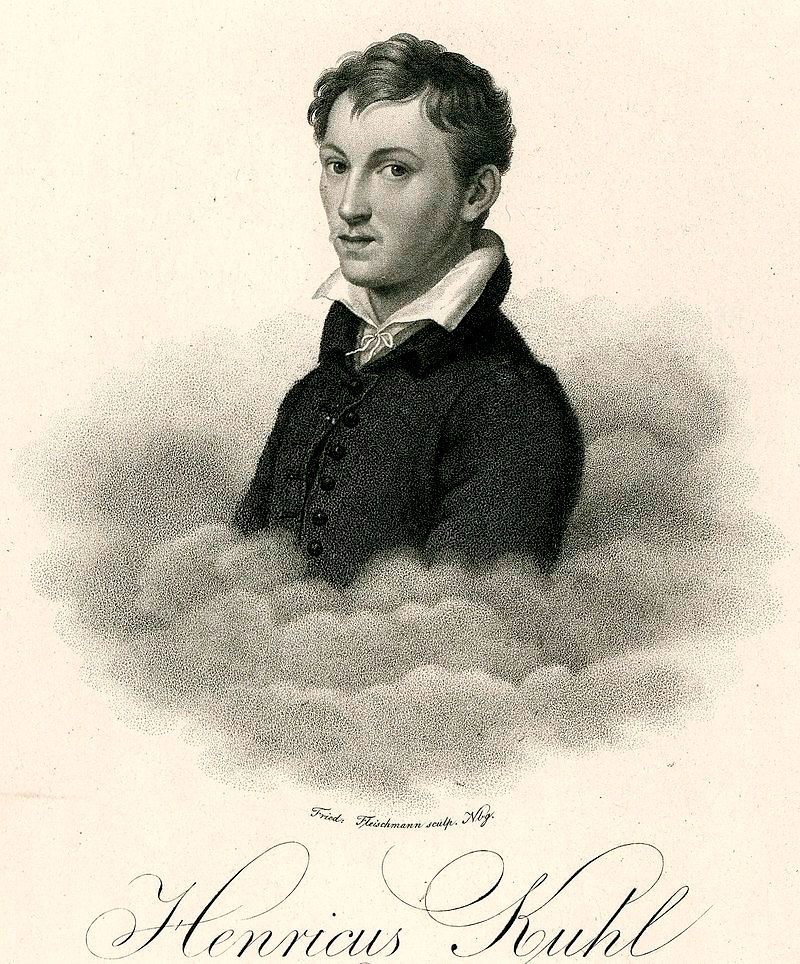
    Kuhl, Heinrich
    Heinrich Kuhl

    Order: Psittaciformes
    Family: Psittacidae
    Genus: Eupsittula
    Scientific name: Eupsittula cactorum
    Citation: (Kuhl, 1820)
    Protonimo: Psittacus cactorum


    Images Cactus Parakeet:


    Especies del gรฉnero Eupsittula
  • Eupsittula nana
  • —- Eupsittula nana astec
  • —- Eupsittula nana nana
  • —- Eupsittula nana vicinalis
  • Eupsittula canicularis
  • —- Eupsittula canicularis canicularis
  • —- Eupsittula canicularis clarae
  • —- Eupsittula canicularis eburnirostrum
  • Eupsittula aurea
  • Eupsittula pertinax
  • —- Eupsittula pertinax aeruginosa
  • —- Eupsittula pertinax arubensis
  • —- Eupsittula pertinax chrysogenys
  • —- Eupsittula pertinax chrysophrys
  • —- Eupsittula pertinax griseipecta
  • —- Eupsittula pertinax lehmanni
  • —- Eupsittula pertinax margaritensis
  • —- Eupsittula pertinax ocularis
  • —- Eupsittula pertinax paraensis
  • —- Eupsittula pertinax pertinax
  • —- Eupsittula pertinax surinama
  • —- Eupsittula pertinax tortugensis
  • —- Eupsittula pertinax venezuelae
  • —- Eupsittula pertinax xanthogenia
  • Eupsittula cactorum
  • —- Eupsittula cactorum cactorum
  • —- Eupsittula cactorum caixana

  • Sources:

    • Avibase
    • Parrots of the World โ€“ Forshaw Joseph M
    • Parrots A Guide to the Parrots of the World – Tony Juniper & Mike Parr
    • Birdlife

    • Photos:

    (1) – A pet Caatinga Parakeet in Riachรฃo do Jacuรญpe, Baiano northeast, Brazil By Paulo Marcos from Painted-BA, Brazil (Periquito MartinsUploaded by snowmanradio) [CC BY 2.0], via Wikimedia Commons
    (2) – Caatinga Parakeet (also known as Cactus Parakeet) in Brazil By Phillipe (Picasa Web Albums) [CC BY-SA 3.0], via Wikimedia Commons
    (3) – Eupsittula cactorum – cactus conure – Cactus conure – conure cactus by Florin FeneruFlickr
    (4) – Parakeet CAATINGA (Eupsittula cactorum) by Cantosdanatureza WITH
    (5) – Cactus Parakeet โ€” aratinga cactacea by Animal Encyclopedia 2
    (6) – Cactus parakeet – conographie parrots :.Paris :P. Bertrand,1857.. biodiversitylibrary.org/page/47804387