โ–ท The world of Pets: Dogs, cats, birds, reptiles, amphibians

Neapolitan mastiff
Italia FCI 197 - Molosoids โ€“ Doge

Mastรญn Napolitano

Despite his fierce appearance, the Neapolitan mastiff It is a balanced dog and friend of children.

Content

History ยซMastin Napolitanoยป

The Neapolitan mastiff, like all broadcast, most likely descends from the molossus Tibetan. According to historical data, Italy has been inhabited since very remote times, which could date back to the second millennium before Christ..

This shows that this architect of Campania (South Italy region, on the coast of the Tyrrhenian Sea, whose capital is Naples) brings lot of history under its belt.

All European mastiffs descend from the Tibetan Mastiff, the oldest representative of dog breeds.
Probably the first Asian mastiffs were carried in the India Greece by Alexander the great, around the year 300 a.C.

Some historians argue that it was the Greeks who were known to the Romans these dogs so spectacular, to see them is struck and (for a change) they used them in their famous circuses like fighting dogs. The Neapolitan mastiff fought with Lions, bears, Tigers, He was also a dog bred for war.

According to the English cinofilia, on the other hand, the mastiff was taken to Britannia (term designated to the island of Great Britain before that occurred the Germanic invasions) by the Phoenicians in the year 500 to. C. from that moment the spread throughout Europe would have begun.

Beyond disagreements as to the diffusion of the breed you can ensure, years. At that time, that the "Neapolitan Mastiff" has lived in Campania for at least two thousand years, Although its first official appearance in the cinophilia data of 1946 and its official standard was approved in the year 1949.

During the course of World War II, the race was on the verge of extinction but was recovered by a writer and called cinรณlogo Piero Scanziani that between 1941 and 1980 published a dozen volumes of fiction and nonfiction, including various Cynology treatises. He was responsible for the reconstruction of the Neapolitan mastiff during the postwar period, and he did so on the basis of the few copies remaining.

Physical characteristics

ยซNeapolitan Mastiffยป Videos

Neapolitan Mastin ALACRAN
Neapolitan Mastin bruce dello stradone (Leonardo lopez)Lightbox for Video by VideoLightBox.com v1.11

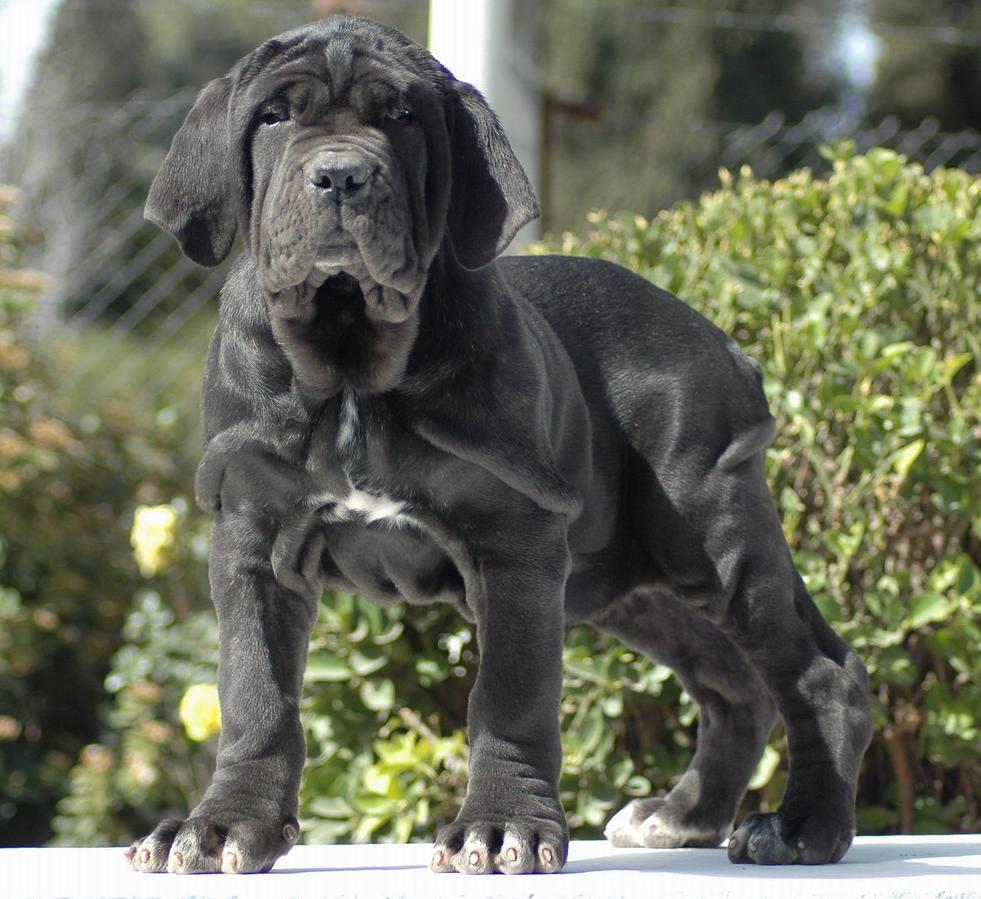
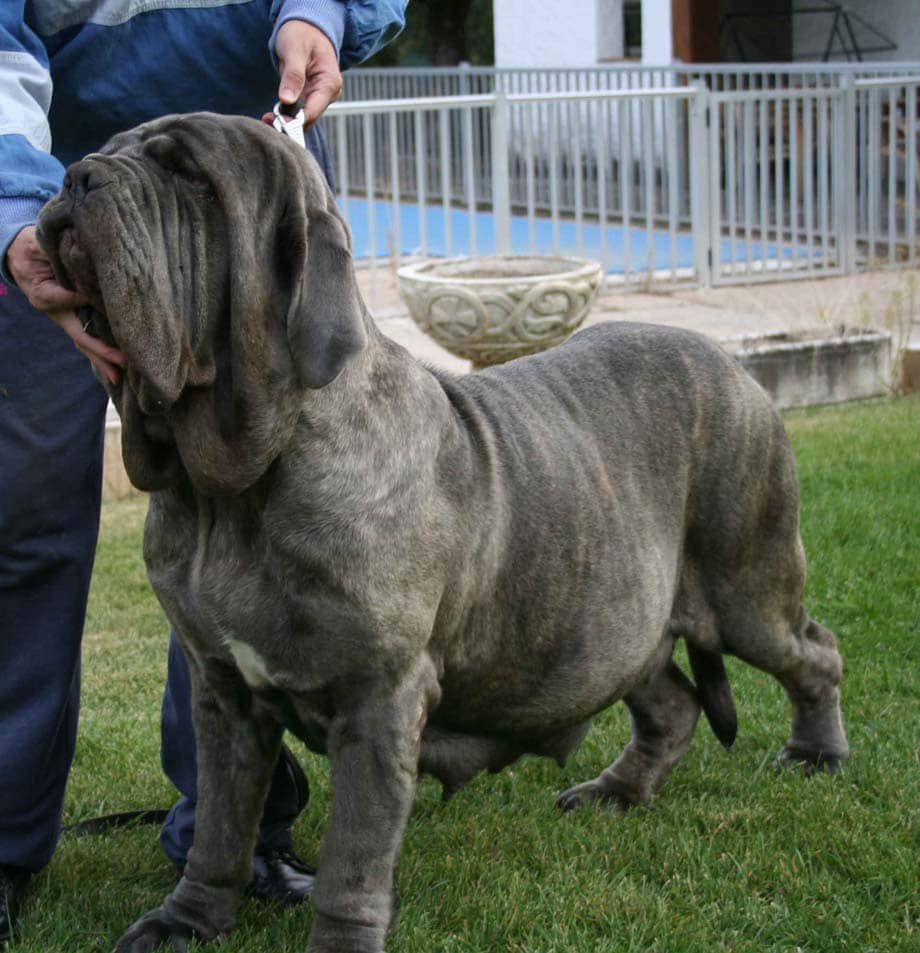
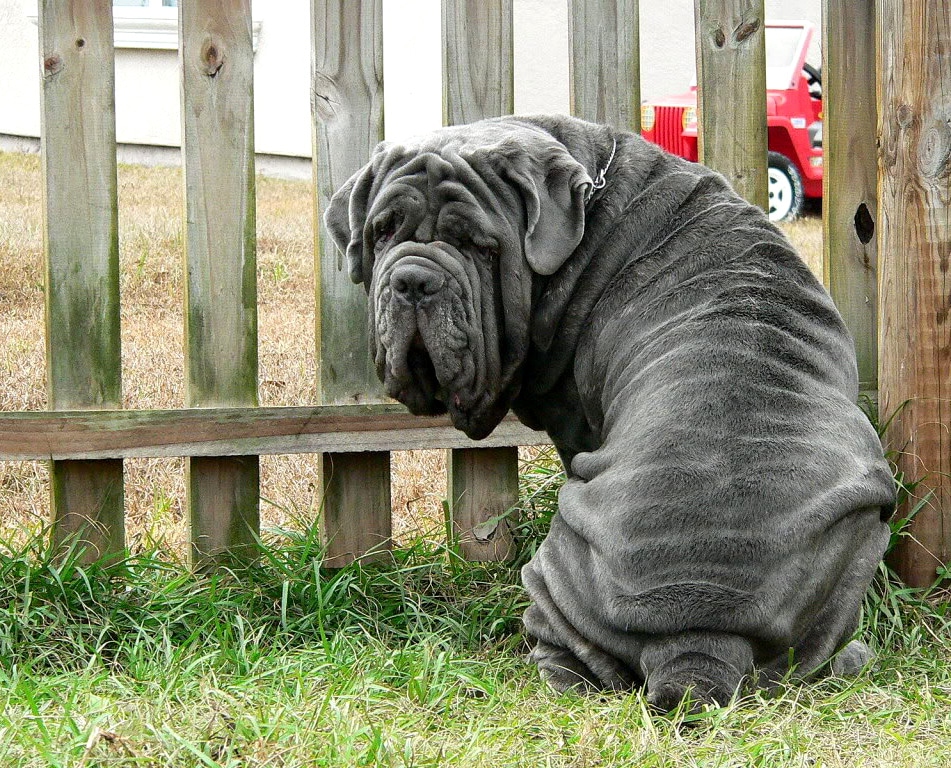
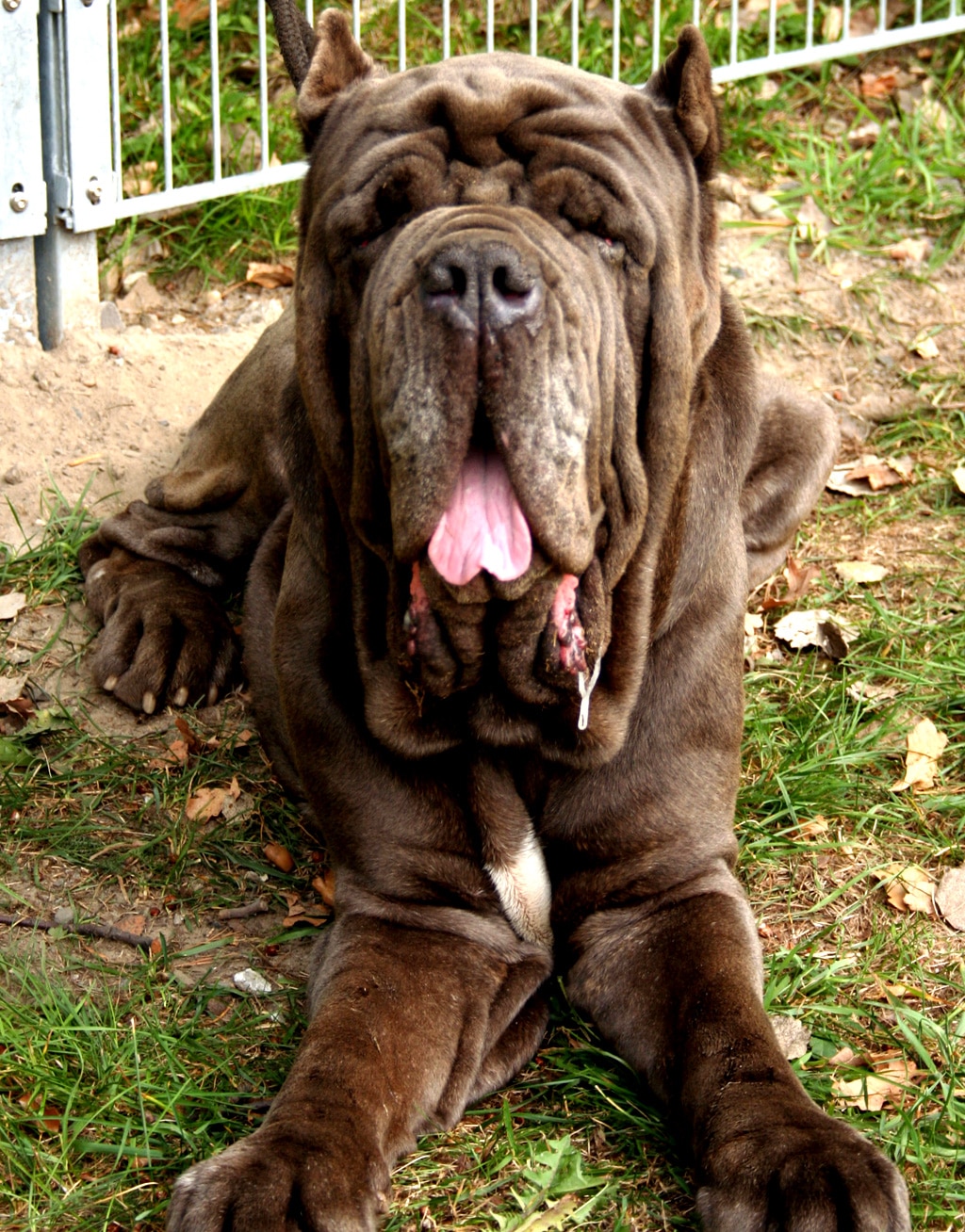
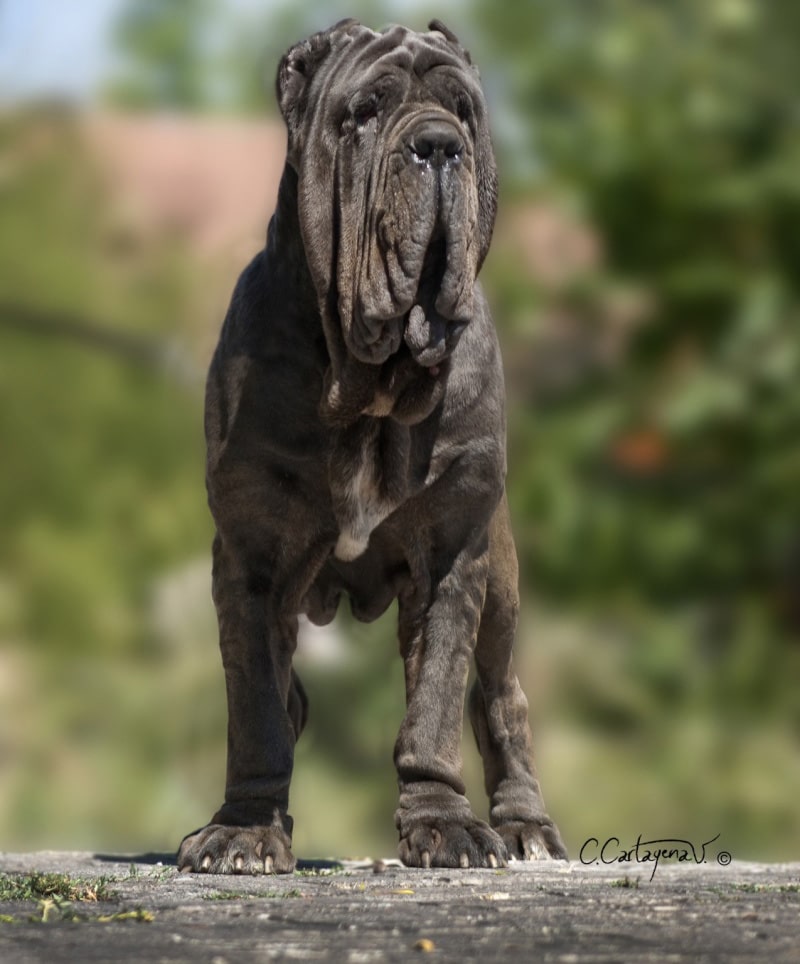
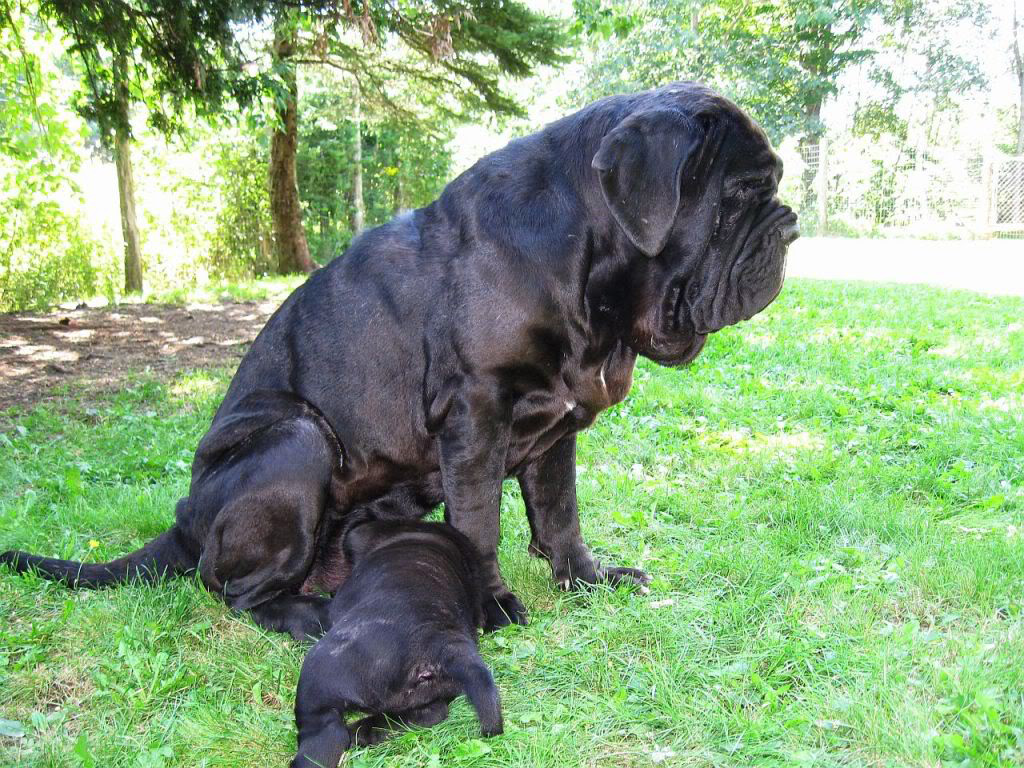
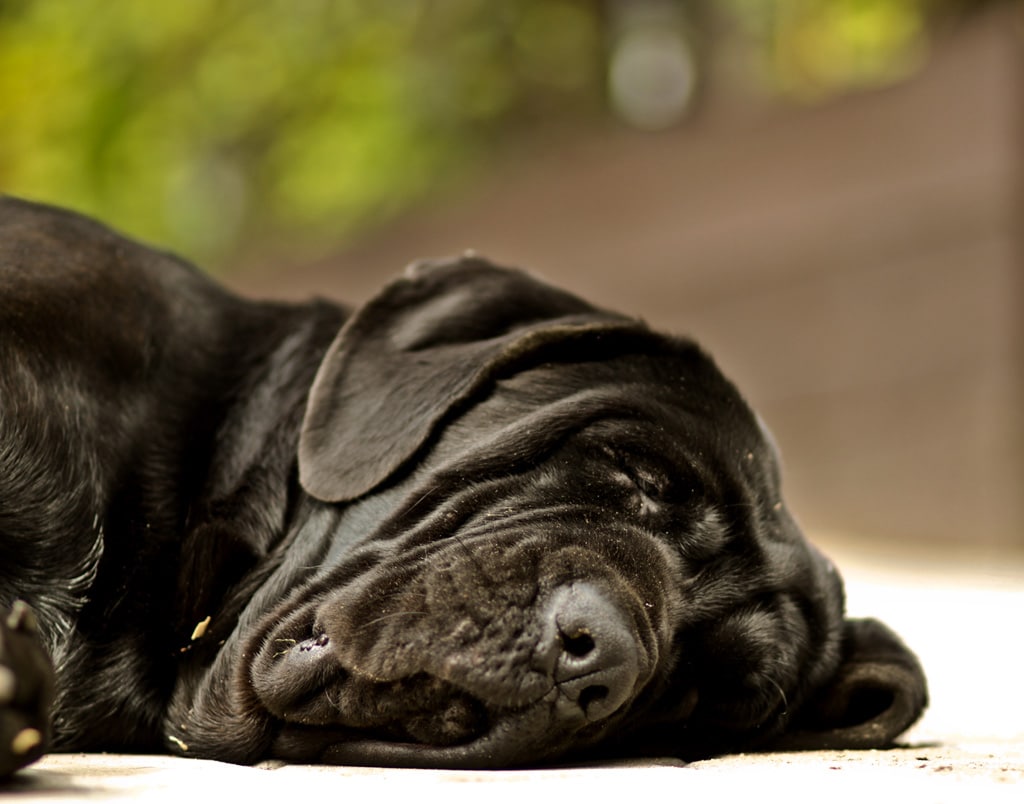
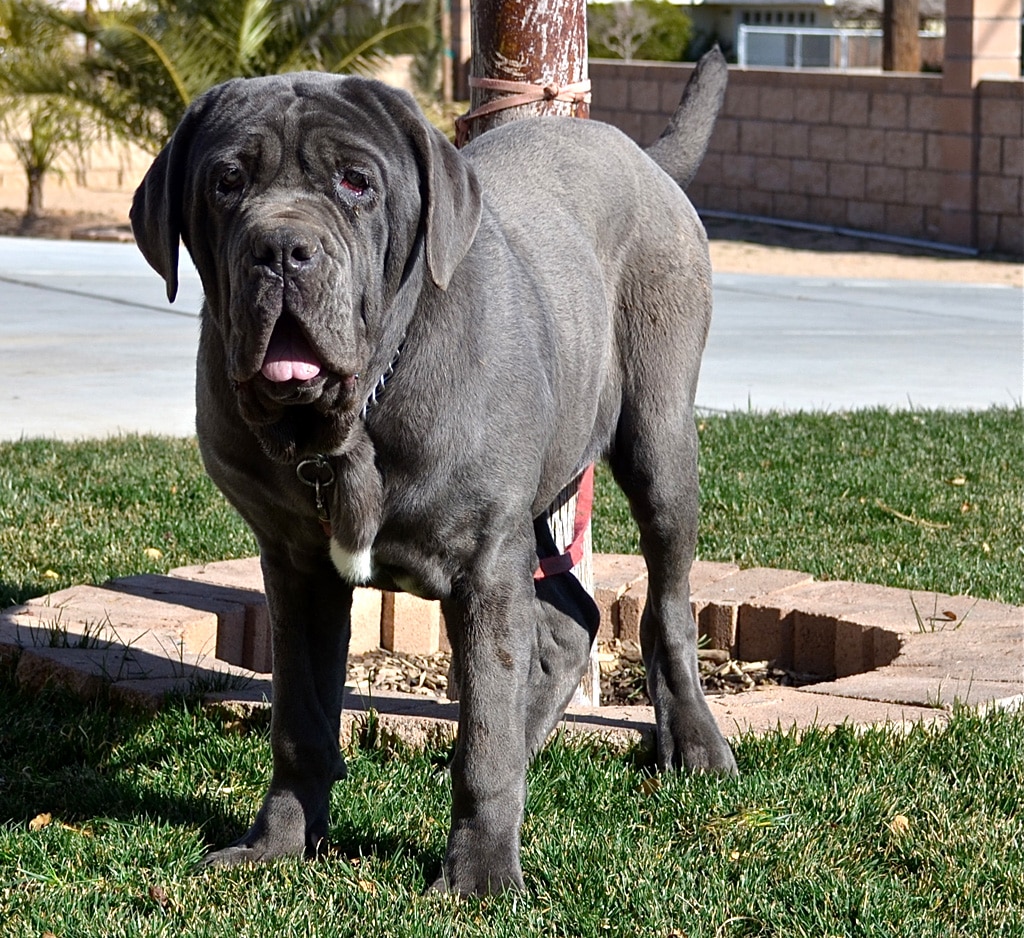
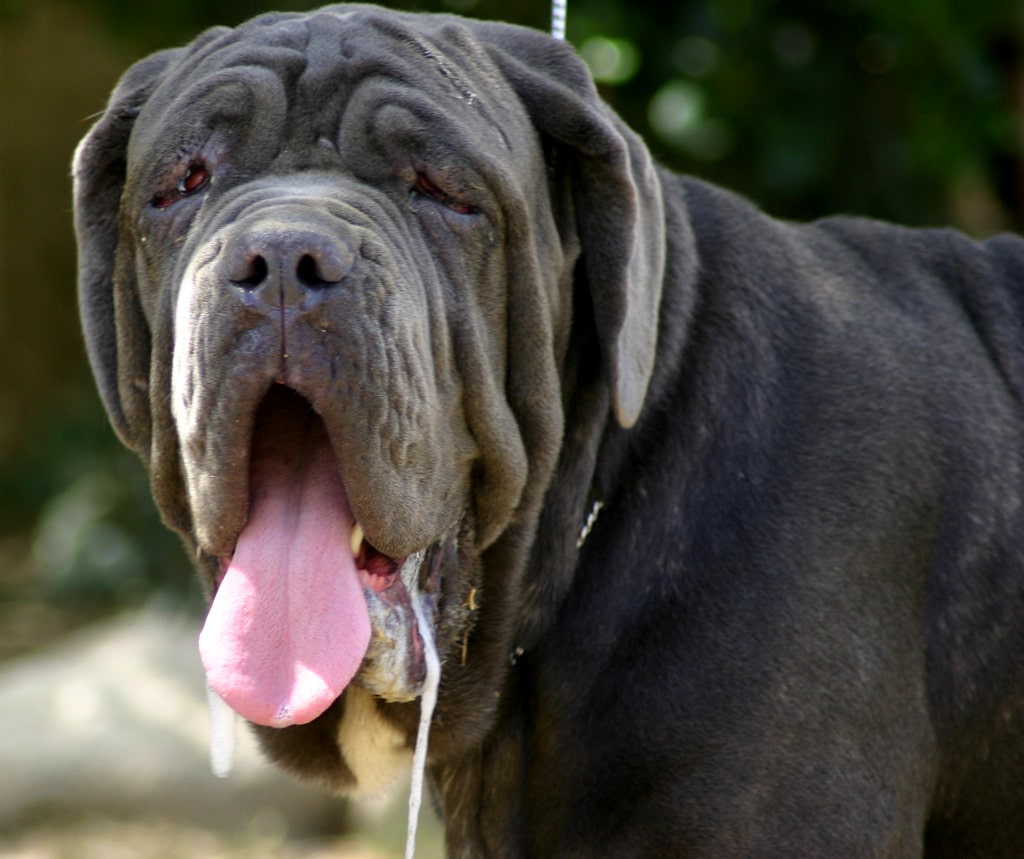
The Mastino Napoletano impresses even from a distance with its impressive physique. Especially the huge head stands out. It is a typical molossoid head, but he has particularly pronounced full lips. His facial expression is cool and relaxed, his overall impression is impressive. Its coat is short and smooth.

Modern breeding has given the Mastino Napoletano an excess of loose skin, that borders on the torture of the brood. For animal welfare reasons only, one must make sure that the skin is taut and there are not too many wrinkles and folds. Only slight wrinkles should be allowed in the neck area and on the dewlap.. Especially the head has grown an overabundance of skin and wrinkles in recent decades, partly so extreme that dogs can barely see due to all the wrinkles. It also, severe wrinkles are a treasure for infections and itchiness.

According to him standard official of the breed the males of Neapolitan mastiff They must be measured of 66 to 72 cm in the cross and his weight is of 70 kg, males can easily reach up 90 kg, females should be measured in 60 to 68 cm.. The weight of the males due of 60 to 70 Kg and females of 50 to 60 kg.

The head is huge and short, the rounded and flattened skull between the ears. It has the straight snout, a great truffle and fat lips it fall heavily.

It has the eyes well separated and the accumulation of skin seems they were oval shaped but in reality are round. The ears are triangular, medium and high insertion.

The body, in general, It is longer than high with the neck well massif and the Pope and grupa broad. The tail is amputated two-thirds of its length.

The favorite colors they are the lead, the grey and black (sometimes with small white markings on the chest and the tip of the fingers), the fawn, the mahogany, the Fawn and stag.

All cloaks can be atigrados, but the possibility that a Neapolitan mastiff come out color "tabby" is one in a million.

Observations

Despite its large size, no need for large spaces to be happy, because it moves shortly. although yes, It is important to establish a relaxed routine of daily walks that help keep your muscles toned.

Another issue to highlight is that they significantly drool-worthy.

Character and skills

Despite his surly and even fierce aspect, the Neapolitan mastiff he is a peaceful dog, balanced, sweet, fell, very affectionate with the master and friend of children.

Never behaves aggressively without a real reason, But if he were to have the answer, could be terrible.

Its temperament is peaceful, but it may become aggressive if its owner is not able to educate him with wisdom and responsibility.

Due to its structure it solid, its movement is heavy and clumsy, but appearance because it is aware of its size and enough to see him interact with children to confirm (disarms in delicacy).

Has been dog of war, combat in the circus, police assistant, dog sledge drag, companion and self-defense dog. Currently it is trained as a guardian of houses and farms and is increasingly appreciated as a companion dog..

In fact, it is more a guard dog than a companion or exhibition dog. Of the molossians foster, It is the quietest character.

One Neapolitan mastiff serious upbringing is, therefore, educated, an extremely simple dog. Here and there the fat man is a bit stubborn. Only if it is good to persuade and ask for help, then it will do everything for its owner or caretaker. As a family member, is extremely adorable. He seeks the proximity of his humans and is a reliable protector.

In case of acute threat to your humans, will try to keep danger away from them by facing the attacker with his body, but it won't attack him anymore. Does all of this quietly. Barks very rarely. His calm and serene temperament makes him a loyal and child-friendly companion, who forgives everything. Towards strangers, However, is initially waiting and watching. The Neapolitan mastiff he's a cool guy and a fascinating dog.

Not an easy dog รขโ‚ฌโ€นรขโ‚ฌโ€นto keep just because of his strength. By its nature it has very few demands. A daily walk, sometimes brushing the coat, that is all. Only the food is a certain challenge in terms of quantity and quality. You don't need a big garden, but a garden is already useful. A small apartment on the nth floor would not be suitable. The Neapolitan mastiff he's a great partner, but it is not a companion for runners, dog athletes or performance junkies.

Education

It must be remembered that in a Neapolitan mastiff adult, the line is just a symbolic control. Large dog easily has the power to maneuver the other end of the leash at will. But he doesn't want, at least if you have enjoyed the basics of a good education. The Neapolitan mastiff it is very easy to train. Only his stubbornness has to be broken here and there with consistent smoothness.. He wants to follow his master and mistress and he does it very reliably. It is an elementary duty of an owner of Neapolitan mastiff pay attention to a consistent education already in the puppy. Because only education and not the leash makes wonderful walks in nature possible, that together with this calm four-legged friend they become a balm for the soul of agitated people.

Care and health ยซNeapolitan Mastiffยป

Caring for a Neapolitan mastiff healthy breed is not problematic. Brushing the coat here and there is enough.

Bad habit of extremely strong folding of the head and body often leads to chronic inflammation. They are usually a source of constant itching for dogs.. Sometimes it even makes vision difficult. Such dogs need expensive time and care.

Nutrition ยซMastรญn Neapolitanยป

You need a lot of high quality food. It is helpful to have an elevated feeding bowl to counteract the risk of stomach churning. Weight must always be carefully considered.

Life expectancy ยซNeapolitan Mastiffยป

Breeding mistakes have cost this dog, formerly robust, many years of his life expectancy. Before they were 12, today they are more likely to be 6 to 9 years. But, exact data not available.

Buy a "Neapolitan Mastiff"

The purchase of a Neapolitan mastiff it must be long-term and well considered. You should check carefully if you have all the requirements in order to spend many wonderful years together with this strong friend.. Also financially the attitude is a challenge. If you are looking for a puppy, you must make sure that the dogs are not too massive and wrinkled. You must ask about the ancestors, its appearance, their illnesses, your age. To get a Neapolitan mastiff solid character, you should just look directly at a serious breeder. For animal welfare reasons you should refrain from buying puppies from parents with severe wrinkles. A puppy Neapolitan mastiff from a good breeder costs about 2.500 EUR.

Characteristics "Neapolitan mastiff"

Coexistence is important that you have with your new friend. Before considering the acquisition of a dog of the breed "Neapolitan mastiff" you know certain factors. Not all breeds of dogs are apt to live in an apartment, you must take into account his character, their need for exercise, their interaction with other pets, their care and if you have small children, their level of tolerance towards them.

Adaptation โ“˜

2,0 of 5 stars (based on 1 review)

friendly dog โ€‹โ€‹โ“˜

1,0 of 5 stars (based on 1 review)

hair loss โ“˜

3,0 of 5 stars (based on 1 review)

Affection level โ“˜

3,0 of 5 stars (based on 1 review)

Need for exercise โ“˜

2,0 of 5 stars (based on 1 review)

Social need โ“˜

3,0 of 5 stars (based on 1 review)

Home โ“˜

2,0 of 5 stars (based on 1 review)

Toilet โ“˜

3,0 of 5 stars (based on 1 review)

Friendly with strangers โ“˜

1,0 of 5 stars (based on 1 review)

barking โ“˜

2,0 of 5 stars (based on 1 review)

Health โ“˜

5,0 of 5 stars (based on 1 review)

Territorial โ“˜

5,0 of 5 stars (based on 1 review)

Cat friendly โ“˜

3,0 of 5 stars (based on 1 review)

Intelligence โ“˜

3,0 of 5 stars (based on 1 review)

Versatility โ“˜

3,0 of 5 stars (based on 1 review)

Child friendly โ“˜

3,0 of 5 stars (based on 1 review)

Surveillance โ“˜

2,0 of 5 stars (based on 1 review)

joy โ“˜

5,0 of 5 stars (based on 1 review)

Images ยซNeapolitan Mastiffยป

ยซNeapolitan Mastiffยป Videos

Type and recognitions:

  • FCI CLASSIFICATION:
  • Group :
  • Section : . .

Federations:

  • – FCI – Pinscher and Schnauzer-Molossoid type dogs – Swiss Mountain Dogs and Cattledogs. Section 2.1 Molossoid, mastiff type. โ“˜
  • – AKC – Dogs working โ“˜
  • – ANKC – Group 6 (utility dogs) โ“˜
  • – CKC – Working dogs โ“˜
  • – โ€‹KC – Working dogs โ“˜
  • – NZKC – Utility dog โ“˜
  • – UKC – Watchdog โ“˜

FCI breed standard "Neapolitan mastiff"

Origin:
Italy

Date of publication of the valid original standard:
13.11.2015

Use:

Protection and watchdog.


General appearance:

Big dog, heavy and solid with high volume appearance. The length of the trunk exceeds its height at the withers.

IMPORTANT PROPORTIONS: Body length is a 15% more than the height at the withers.

  • The skull-snout ratio is 2 to 1.
  • The length of the head is approximately 3,8 / 10 the height at the withers.
  • Neck is rather short.
  • Chest circumference is wide.


  • Behavior / temperament:

    Steady and loyal, is not aggressive. Guard dog of the property and its inhabitants, always vigilant, Intelligent, noble and majestic.

    Head:

    Short and massive, with the skull wide at the level of the zygomatic arches. The skin is abundant and has wrinkles and folds, of which the most accentuated and characteristic part of the external palpebral angle to descend to the labial angle. The superior longitudinal axes of the skull and muzzle are parallel.

    Cranial region:
    • Skull: The skull is wide and flat, particularly between the ears, seen from the front, it is slightly convex at the front. The zygomatic arches are very prominent, but with flat muscles. The protrusions of the frontal bones are well developed; the front groove is marked; occipital ridge is barely visible.
    • Stop: Well defined.

    facial region:

    • Truffle: Located in the prolongation of the nasal cavity, should not protrude from the anterior vertical line of the lips; it should be bulky and the large nostrils should be wide open. The color is according to the color of the fur: black for black specimens, dark gray in dogs of other colors, and the chestnut for brown dogs.
    • Snout: Very broad and deep; its width is approximately equal to the length. The length should be equal to one third of the length of the head. The sides are parallel so that, seen from the front, the shape of the muzzle is practically square. The depth of the muzzle is approximately twice its length.
    • Lips: fleshy, thick and full. The upper lip, seen from the front, forms an inverted "V" at its junction point. The lower lateral profile of the muzzle is determined by the upper lips, its lower part is the corner of the lips, with visible mucosa, located vertically from the outer corner of the eye.
    • Jaws / Teeth: Powerful with strong jaws and dental arches that fit together perfectly. The lower jaw should be well developed in width. Well developed white teeth, regularly aligned and complete in number. Scissor bite, that is, the upper incisors overlap the lower incisors in close contact, implanted in the vertical of the jaws; or pincer bite, that is, the upper incisors are joined edge to edge with the lower incisors. The outer edge of the upper incisors should be in close contact with the inner edge of the lower incisors.. An inverted scissor bite is tolerated.

    EYES: well separated on the same front level; rather round shape, but never protruding or too deep. Iris color is generally darker than coat color, except in shades of diluted shades where the color of the eyes is lighter. The skin never folds to interfere with the eyes.

    EARS: Small, in relation to the size of the dog, form triangular, located above the zygomatic arch, flat and glued to the cheeks. Ears are natural.

    Neck:

    The upper profile is slightly convex. Trunk rather short and conical, good muscular. The lower neck profile is well covered in loose fur that forms a well-separated double dewlap, but not exaggerated. Double chin begins at the level of the lower jaw and does not reach below the middle of the neck.

    Body:

    The length of the trunk exceeds by 15% the height at the withers.

    • top line: The upper line of the back is straight. Cross: It is wide, long and not very prominent.
    • Back: Width and length approximately 1/3 the height at the withers. The muscular and well developed lumbar region in its width should be harmoniously connected with the back.
    • Pork loin: Width, strong and muscular. The hip bones are prominent as they reach the upper lumbar line.. Breast : Large, with well-developed pectoral muscles. The rib cage is wide, with long, well-arched ribs. Chest circumference is wide. The tip of the sternum is at the level of the tip of the shoulder.

    Tail:

    It is wide and thick at the root; strong, slightly tapering towards the tip. Its length reaches the hock joint. At rest it carries it hanging and curved in the shape of a saber, in action raised horizontally or only slightly above the top line.

    Tips

    PREVIOUS MEMBERS:

    • General appearance: Previous members, from the floor to the tip of the elbow, seen in profile and from the front, they are vertical with a strong bone structure in proportion to the size of the dog.
    • Shoulder: Long and well sloped, muscles are well developed, long and well defined.
    • Arms: Well angled to the shoulder blade and with significant musculature.
    • Elbows: They must be parallel to the median plane of the body, that is to say, neither turn inward nor outward.
    • Forearm: Its length is almost equal to the length of the arm. Placed in a perfect upright position. Strong bone structure with lean, well-developed muscles.
    • Carpo: Width, slim and knotless, follows the vertical line of the forearm.
    • Metacarpus: Continue the vertical line of the forearm. Angulation and moderate length.
    • Previous feet: Round shape, large, fingers well arched and well joined. The pads are hard and well pigmented. The nails are strong, curved and dark colored.

    LATER MEMBERS:

    • General appearance: They must be powerful and robust, in proportion to the size of the dog and capable of giving the required propulsion during movement.
    • Thigh: Its length is 1/3 from the height to the cross and its obliqueness is about 60 ยฐ. Broad with thick muscles, prominent and clearly marked. Thigh bone and hip bone (femur and coxal) they form an angle of 90 ยฐ.
    • Knee: The femoro-tibial angle is about 110 ยฐ -115 ยฐ.
    • Leg: The length is slightly less than that of the thigh and of an obliqueness of 50 ยฐ -55 ยฐ, with a strong bone structure and well visible muscles.
    • Hock: The tibio-tarsal joint forms an angle of 140 ยฐ โ€“ 145 ยฐ.
    • Metatarsus: Strong and slim, almost cylindrical in shape, perfectly straight and parallel and quite low.
    • Hind feet: Smaller than the previous ones, round with well-joined fingers. Dry pads, hard and pigmented. The nails are strong, curved and dark colored.

    Movement:

    It is a typical characteristic of the breed. Movement is feline type, like the steps of a lion. It is slow and also resembles that of a bear. The jog is characterized by a strong push from the rear and a good extension of the front. The dog rarely gallops; the usual gait is walking and jogging. Ambition is tolerated.

    Mantle

    SKIN: Thick, abundant and loose throughout the body, especially on the head, where it forms numerous folds and wrinkles, and at the bottom of the neck where it forms a double dewlap. Never in abundance to interfere with the health and well-being of dogs.

    Fur: short, hard and bushy, the same length everywhere. Uniform length of 1,5 maximum cm. Must not show any trace of long hair.

    Color: Gray colors are preferred, leaden gray and black, although also brown, reddish and reddish rose, that sometimes have small white spots on the sill and on the fingertips. All colors can be brindle. Hazelnut tones accepted, soft gray and isabella.


    Size and weight:

    Height to the cross:

    • Males: 65-75 cm..
    • females: 60-68 cm..

    Weight:

    • Males: 60-70 kg.
    • females: 50-60 kg.


    Fouls:

    Any deviation from the aforementioned criteria is considered as a fault and the severity of this is considered to the degree of the deviation to the standard and its consequences on the health and well-being of the dog..

    SERIOUS FAULTS:

  • Pronounced undershot.
  • Tail size too high.
  • Size greater or less than the allowed limits.
  • FALTAS DESCALIFICANTES:

  • Aggressiveness or extreme shyness.
  • Any dog โ€‹โ€‹showing clear signs of physical or behavioral abnormalities.
  • Accentuated convergence or divergence of the cranial-facial axes.
  • Upper line of the snout concave or convex or very aquiline (roman nose).
  • Total depigmentation of the trua.
  • Upper prognathism.
  • Entropion / ectropion.
  • Eyes gazeos, total depigmentation of both edges of the eyelids; strabismus.
  • Absence of wrinkles, creases and double chin.
  • Absence of congenital or artificial glue.
  • Extensive white spots; white marks on the head.


  • N.B.:
  • Males should have two normal-appearing testicles fully descended into the scrotum..
  • Only functionally and clinically healthy dogs, with the typical conformation of the breed, should be used for breeding
  • TRANSLATION: Mrs. Brรญgida Nestler. Official language: IN.

    Technical direction: SR. Miguel Angel Martinez.

    Source: F.C.I - International Cynological Federation

    Alternative names:

    1. Mastino Napoletano Italian (English).
    2. Mรขtin de Naples, Napolitain (French).
    3. Neapolitanischer Mastiff (German).
    4. Mastino napoletano, Neapolitan mastiff (Portuguese).
    5. Mastรญn napolitano (espaรฑol).

    โ–ท The world of Pets: Dogs, cats, birds, reptiles, amphibians

    Newfoundland
    Canadรก FCI 50 - Molossoid - Mountain

    Terranova

    The Newfoundland radiates majestic serenity.

    Content

    History

    The Newfoundland was born on the east coast of Canada. The great island of Newfoundland, which is in front of Canada, gave him his name. The fact that it descends from the dogs of the Vikings of pre-Columbian times or from the dogs of the Indians is a legend that has not been proven until now.. Its relationship with the molossi can be seen but also proved in the genetic map of the Heidi G dog breeds. Parker.

    Probably the ancestors of the Newfoundlands came with the first settlers as molossi from Europe. It proved to be an aid to fishermen and sealers and was occasionally useful when hunting bear and big game on land.. It transported loads and served as a draft dog for the sleds with the dead game.. Working with fishermen in the rough North Atlantic was extremely demanding. The Newfoundland had to think, had to do heavy work on the networks. The Newfoundland saved the lives of the castaways over and over again. In this way, he developed the peculiarities of his character and physique that allowed him to face the harsh weather conditions on land and the dangers of the sea as a water and rescue dog..

    With the cod ships he came to England over and over again as early as the 18th century. Here he became famous early on due to his impressive achievements. Was not up 1886 that the Club of Newfoundland in England, and soon after, in 1893, The club of Newfoundland for the Continent, now called the "German Club of Newfoundlandยซ. Even today, Newfoundland keep working as a water rescue dog.

    Did you know??

    One Newfoundland named Rigel sank with the Titanic and swam alongside a lifeboat for three hours in the icy water, apparently looking for its owner, that had gone down with the ship. The people in the lifeboat were nearly run over by the steamer Carpathia because the crew could not hear their faint cries., but Rigel's bark was noticed and the people and the dog were saved.

    Physical characteristics

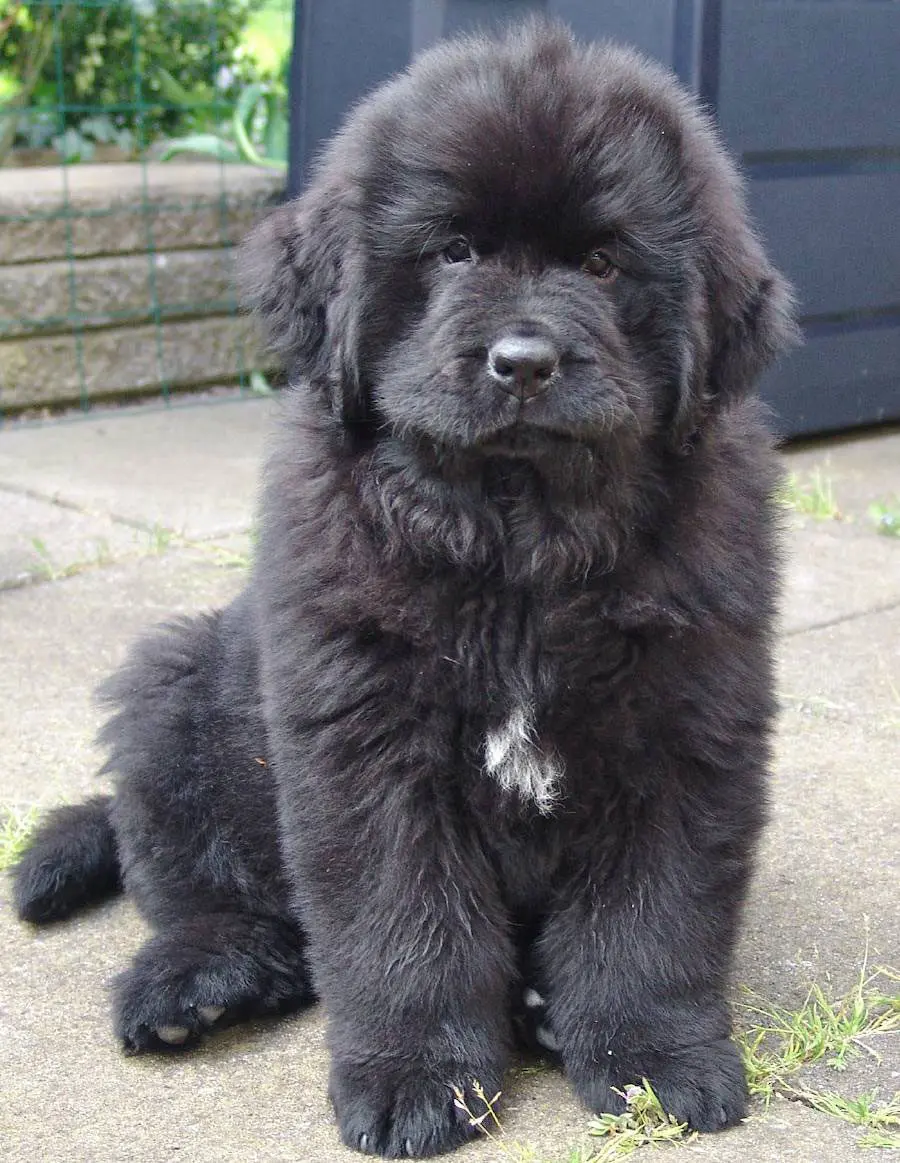
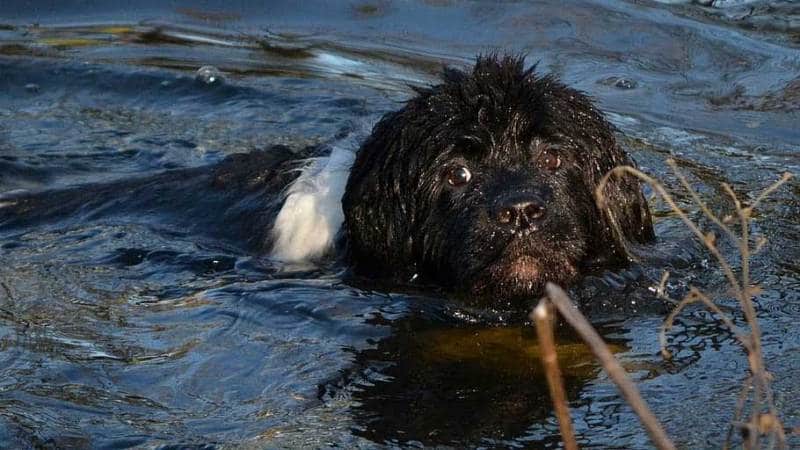
    The Newfoundland is a big dog. According to the standard, adult males must weigh an average of 68 kg and females 54 kg. It is a very strong dog, very muscular and with long dense hair. Her coat is water repellent. It has a strong and soft undercoat, which makes it look even bulkier. This shouldn't tempt you to raise him like a teddy bear.. Because the real Newfoundland combines enormous power with agility, sportiness and impressive skills in the water. Its exterior does not deceive its interior. Master challenges with a committed calm. The hair on your head, muzzle and ears is short and thin. The front and rear legs are covered in fur. The tail is completely covered in long thick hair. The black, brown and black and white are allowed as coat colors.

    Character and skills

    Even the mere appearance of Newfoundland has a relaxing and calming effect, at least for people who are not usually afraid of dogs. The Newfoundland radiates majestic serenity. Its character is as stable as it appears on the outside. It has a friendly and kind nature. But that must not be misleading: He knows very well how to distinguish between friend and enemy, which you can unequivocally underline by your calm but more determined appearance. If required, defends his family with all his might without hesitation. Barking is not necessary to be heard.

    He is extremely friendly with his friends. The Newfoundland he is very close to his family and loves children more than anything. He wants education and he absolutely needs it. Because like a powerful big dog it is always stronger than the other end of the leash.. Sometimes he has a hard head, but after a friendly request from his master or caretaker he does everything, as long as it's well connected. The Newfoundland impresses by the unity of two apparently irreconcilable poles: on the one hand it radiates calm and tranquility, on the other hand it can save people from drowning in a short time in the most difficult conditions. Usually, the Newfoundlands are real water rats. They are excellent swimmers, which they are happy to proudly demonstrate.

    The Newfoundland not a dog for the city or a flat. He likes long walks, but water is the best for him. Due to its strength and the high technical demands of its maintenance, not suitable for beginners, although it can be trained and managed well. It is a great family dog. But he also likes to sleep outside, even with wind and rain. What you don't need is running or doing activities in the heat.

    The Newfoundland It is a natural lifeguard and can be a good helper for parents who have a pool or enjoy taking children to the lake or ocean, although you should never be solely responsible for your safety.

    Newfoundland Education

    The Newfoundland can be educated very well. It is intelligent, interested and quickly understand what you are allowed to do and what you are not. Sometimes it's a little slow, but a little motivated, he is very cooperative and strives to make his master and lady happy. The puppy should already show itself clearly and without exception where the hammer hangs. There should be no doubt about the orientation of your humans, as well as about the intimate relationship and respect for him.

    It must always be kept in mind that this dog is the physically strongest and that leadership only works through unquestioning recognition of the human leadership role.. With praise and results, basically you can achieve everything with it. On the basis of a good education you can train him very well Newfoundland. Many terranovas they are successfully used as guide dogs for the blind and especially as water rescue dogs, but also on land. For this you can do work tests with water in the clubs.

    Caring for a Newfoundland

    Maintain and care for the Newfoundland it is very expensive. The dense, weather-resistant coat must be brushed every day with a special brush.. Should not be sheared or trimmed. Due to its constitution and dense coat, do not tolerate heat well.

    Nutrition / Food

    Like all large dogs, Newfoundland need a lot of food. Especially in the growth phase you need professional nutritional planning.

    Newfoundland life expectancy

    Life expectancy is between 8 and 12 years. That depends a lot on the upbringing. Thin and light dogs tend to age more than heavy, plump dogs.

    Newfoundland Health

    as could be predicted, given its large size, the Newfoundland can suffer a series of joint and structural problems. It is important that young and growing dogs are kept lean and are not allowed to exercise too hard or eat too much, since this will cause injuries and problems that can be paralyzing in the future. In fact, all the Newfoundland they need to stay slim, since obesity increases the chances of them developing structural problems and makes them more painful when they occur.

    One such structural problem is genetic hip deformation known as hip dysplasia.. The head of the femur does not fit well into the hip socket; with the time, the cartilage in the joint wears away and the underlying bone is damaged. Serious arthritis occurs that usually affects very young dogs. In some cases, expensive surgery required, including total hip replacement surgery. If not treated, the dog will suffer pain and a poor quality of life. Elbow dysplasia is another inherited joint problem, resulting from abnormal elbow formation.

    The possibility that a Newfoundland develop dysplasia of the hip or elbow just because the parents are free of the disease, although it reduces the possibilities. And while a puppy's bones keep growing, it can sometimes be difficult to confirm a diagnosis, depending on the tests performed and the severity of the condition.

    To each Newfoundland X-rays of your dog's hips and elbows should be taken by two years of age, regardless of whether or not he shows symptoms of lameness or stiffness. For dogs that show lameness before that age (that is to say, during the puppy stage), diagnostic tests should be performed promptly.

    The Newfoundlands are at risk of heart disease, including dilated cardiomyopathy and subaortic stenosis (SAS). There is currently no genetic test for SAS, who has a complex inheritance, making it difficult to develop a test. Breeders must not breed Newfoundland with no signs of SAS and puppies should be examined by a certified veterinary cardiologist.

    Cystinuria is a genetic kidney defect that leads to the formation of bladder stones that are very difficult to manage with diet or medication and often requires surgery both to remove the bladder stones and to repair urinary obstructions.. There may be no early signs that the dog is forming cystine stones, which can create a life-threatening emergency if they cause an obstruction. Fortunately, there is a genetic test for cystinuria. Given the availability of the genetic test, no need for a breeder to produce a dog with the disorder

    Not all of these conditions are detectable on a growing puppy, and it can be difficult to predict whether an animal will be free of these diseases, so a reputable breeder must be found who is committed to raising the healthiest animals possible. Must be able to produce an independent certification that the parents of the dog (and grandparents, etc.) have been screened for these defects and considered healthy for breeding. That's where health records come in..

    Not all visits by Newfoundland to the vet they are due to a genetic problem. It is known that the Newfoundland experience cruciate ligament rupture. They are also among the deep-breasted breeds predisposed to bloating., a condition in which the stomach is distended by gas and may twist in on itself (called gastric torsion), cutting off blood flow. Swelling and torsion appear very suddenly, and a dog that was fine a minute can die a few hours later. Watch for symptoms such as restlessness and pacing, la baba, the paleness of the gums, lip licking, unsuccessful attempt to vomit and signs of pain. Swelling requires immediate veterinary intervention, and surgery is necessary in many cases. Unfortunately, dogs that have swollen can do it again, So most veterinarians offer a procedure known as gastropexy or "stomach turning.", which anchors the stomach to the body wall to help prevent future twisting. This procedure can also be done as a preventive measure.

    Buy a Newfoundland

    You should only buy a puppy locally from a breeder who is affiliated with the FCI. should come from a baby, where dogs are rather sporty, thin and not too fat and ยซbearyยป. A puppy in the kennel is usually sold at a price between 1500 and 2000 EUR.

    Valuations "Newfoundland"

    Coexistence is important that you have with your new friend. Before considering the acquisition of a dog of the breed "Newfoundland" you know certain factors. Not all breeds of dogs are apt to live in an apartment, you must take into account his character, their need for exercise, their interaction with other pets, their care and if you have small children, their level of tolerance towards them.

    Adaptation โ“˜

    5,0 of 5 stars (based on 1 review)

    friendly dog โ€‹โ€‹โ“˜

    4,0 of 5 stars (based on 1 review)

    hair loss โ“˜

    5,0 of 5 stars (based on 1 review)

    Affection level โ“˜

    4,0 of 5 stars (based on 1 review)

    Need for exercise โ“˜

    3,0 of 5 stars (based on 1 review)

    Social need โ“˜

    4,0 of 5 stars (based on 1 review)

    Home โ“˜

    3,0 of 5 stars (based on 1 review)

    Toilet โ“˜

    5,0 of 5 stars (based on 1 review)

    Friendly with strangers โ“˜

    4,0 of 5 stars (based on 1 review)

    barking โ“˜

    3,0 of 5 stars (based on 1 review)

    Health โ“˜

    5,0 of 5 stars (based on 1 review)

    Territorial โ“˜

    5,0 of 5 stars (based on 1 review)

    Cat friendly โ“˜

    5,0 of 5 stars (based on 1 review)

    Intelligence โ“˜

    4,0 of 5 stars (based on 1 review)

    Versatility โ“˜

    3,0 of 5 stars (based on 1 review)

    Child friendly โ“˜

    5,0 of 5 stars (based on 1 review)

    Surveillance โ“˜

    3,0 of 5 stars (based on 1 review)

    joy โ“˜

    5,0 of 5 stars (based on 1 review)

    Images "Newfoundland"

    Photos:

    1 – Terranova by Maria Amaro Jimenez / CC BY-SA
    2 – Terranova by https://pixabay.com/es/photos/terranova-perro-negro-609531/
    3 – Terranova by https://pxhere.com/es/photo/112392
    4 – Terranova by https://www.publicdomainpictures.net/es/view-image.php?image=197196&picture=newfoundland-cute-puppy-dog
    5 – Terranova by https://www.pxfuel.com/es/free-photo-obraa
    6 – Terranova by https://www.pxfuel.com/es/free-photo-jttkx

    Videos "Newfoundland"

    Type and recognitions:

    • FCI CLASSIFICATION:
    • Group :
    • Section : . .

    Federations:

    • – FCI – Pinscher and Schnauzer-Molossoid type dogs – Swiss Mountain Dogs and Cattledogs. Section 2.2 Molossoid, mountain type. โ“˜
    • – AKC – Dogs working โ“˜
    • – ANKC – Group 6 (utility dogs) โ“˜
    • – CKC – Group 3 โ“˜
    • – โ€‹KC – Working dogs โ“˜
    • – NZKC – Utility dog โ“˜
    • – UKC – Watchdog โ“˜

    FCI breed standard "Newfoundland"

    Origin:
    Canada

    Date of publication of the valid original standard:
    29.10.1996.

    Use:

    Sled dog for heavy loads, water dog.


    General appearance:

    The Newfoundland has a powerful body, solid, muscular. Their movements are well coordinated.

    IMPORTANT PROPORTIONS: The length of the body, measured from the scapulo-humeral joint to the tip of the ischium, is greater than the distance from the cross to the ground (height to the cross). The body is compact. The female's body may be slightly longer and less massive than the male's. From the withers to the lower chest the distance is slightly greater than from the lower chest to the ground.


    Behavior / temperament:

    The expression of the Newfoundland reflects kindness and sweetness. Worthy, happy and creative, is characterized by its genuine gentleness and serenity.

    Head:

    Solid. The female's head has the same general configuration as the male's, but it is less massive.

    Cranial region:
    • Skull: It is wide; the apex is slightly arched and the occipital bone is well developed.
    • Depression links (Stop): It is well observable, but never abrupt.

    facial region:

    • Truffle: Wide and well pigmented. Windows are well developed. In black dogs and black and white, It is black; it is brown in dogs of this same color.
    • Snout: Definitely square, deep and moderately short. It is covered by short fine hair and has no wrinkles. The corners of the lips are apparent, but not too pronounced.
    • Belfos: soft.
    • Jaws / Teeth: The bite is uniform or scissor-shaped.

    Eyes: Moderately sunken and relatively small. They are well separated and there is no presence of a third eyelid.. They are dark brown in black and black and white dogs. Lighter shades are allowed in brown dogs.

    Ears: They are relatively small, triangular and rounded edges. They sit back on both sides of the head and are very heavy.. When the adult dog's ear is extended forward, it reaches the inner corner of the eye on the same side of the head.

    Neck:

    It is strong, muscular and well-seated on the shoulders. It is long enough to allow a distinguished bearing of the head. The double chin should not be excessive.

    Body:

    The bone structure is everywhere solid. In profile, the body is deep and vigorous.

    • top line: It is horizontal and firm from the cross to the rump.
    • Back: Wide.
    • Pork loin: Strong and well muscled.
    • Rump: Wide. Tilts at a 30ยฐ angle.
    • Breast : Width, deep and spacious; the ribs are well arched.
    • bottom line: Almost uniform and never raised.

    Tail:

    While the Newfoundland is swimming, the tail serves as rudder; therefore, It must be strong and wide at the root. When the dog is at rest, the tail is down, perhaps forming a small curve at the tip; reaches the hock or a little lower. When the dog is moving or animated, the tail is carried straight with a slight upward curve, but it never comes rolled up on the back, nor curved between the hind limbs.

    Tips

    PREVIOUS MEMBERS: They are straight and parallel also when the dog walks or jogs slowly.

    • Shoulder: They are well muscled and oblique.
    • Elbows: stuck to the chest.
    • Metacarpus: They are slightly inclined.
    • Previous feet: Large and in proportion to the body. They are rounded and compact, with also compact and firm fingers. The fingers have an interdigital membrane.

    LATER MEMBERS: Since the urge to drag heavy loads, swimming and covering a lot of ground efficiently depends largely on the hindquarters, in Newfoundland their structure is very important. The pelvis must be strong, wide and long.

    • Thigh: He is broad and muscular.
    • Knee: It is well angled, but not enough to give the impression that the dog is crouched.
    • Leg: It is strong and quite long.
    • Hocks: They are relatively short and are well lowered and separated, parallel to each other. They don't even deviate inwards, nor out.
    • Hind feet: Firm and compact. In case of dewclaws, these must have been removed.

    Movement:

    The Newfoundland's forelimbs have good range and their hindlimbs give a strong boost, which denotes ease and strength. A slight rocking of the back is considered natural. As speed increases, the top line remains uniform.

    Mantle

    • Fur: The Newfoundland has a double layer of waterproof hair. The outer layer is moderately long and straight hair without curls; a slight wave is allowed. The inner layer is soft and dense. It is denser in winter than in summer, but still it is always existing in the rump and chest. The hair of the head, the muzzle and ears are short and thin. Front and rear limbs have bangs. The tail is completely covered with long, dense hair, but it has no flag shape. Any haircut or grooming should not be encouraged.
    • Color: Negro, black and white and chestnut.
      • Negro: This is the traditional color. It should be as uniform as possible, but a slight tan tone is allowed. White markings on chest are also allowed, fingers and tip of tail, the both.
      • black and white: This variety has historical significance for the breed. The preferred marking pattern is: black head, preferably with a white list that extends to the muzzle, black saddle with uniform markings and black upper back and tail. Other parts of the body should be white with minimal mottling.
      • Chestnut: This color ranges from chocolate to bronze. White markings on chest allowed, fingers and tip of tail, the both. Black and white and brown dogs must be shown in the same class as blacks.


    Size and weight:

    Height to the cross: The average height at withers in adult males is 71 cm and of 66 cm in adult females. The average weight is approximately 68 kg in males and 54 kg in females.

    A large animal is valued, but this should not be more important than the general state of health, symmetry, strong structure and correct movement.


    Fouls:

    Any deviation from the aforementioned criteria is considered as a fault and the severity of this is considered to the degree of the deviation to the standard and its consequences on the health and well-being of the dog..

    • General appearance: very long limbs, lack of substance.
    • General structure of the bones: flojedad, fine bones.
    • Character: aggressiveness or shyness.
    • Narrow head.
    • Long or pointed snout.
    • Pronounced noses.
    • Round eyes, saltones, yellow, or with a pronounced third eyelid.
    • Convex back, float or concave.
    • Forelimbs: sunken metacarpus, crushed feet, fingers that turn inward or outward, absence of membrane between fingers.
    • Hind limbs: knee joint very straight, cow hocks, crowded limbs, feet twisted inward.
    • Short tail, long, doubled or bent.
    • Take short, quick steps, dragging the feet, obliquely displaced like a crab; tight and knitting motion, crossing the front limbs, with deviated feet in or out; high movement (hockney action); amble step.
    • Sparse hair; absence of inner layer of hair

    FALTAS DESCALIFICANTES:

    • Aggressiveness or extreme shyness.
    • Any dog โ€‹โ€‹showing clear signs of physical or behavioral abnormalities must be disqualified..
    • Upper or lower prognathism, arch of deviated incisors.
    • Short straight hair.
    • Marks of a color other than white on black or brown dogs.
    • Any color other than black or black and white or brown.


    N.B.:
    • Males should have two normal-appearing testicles fully descended into the scrotum..
    • Only functionally and clinically healthy dogs, with the typical conformation of the breed, should be used for parenting.

    TRANSLATION: IRIS Carrillo (Puerto Rico Kennel Federation).

    Source: F.C.I - International Cynological Federation

    Alternative names:

    1. Newfs, Newfies (English).
    2. Retriever de Terre-Neuve, Chien de Terre-neuve (French).
    3. Newfoundland (German).
    4. Cรฃo terra-nova (Portuguese).
    5. Perro de Terranova (espaรฑol).