โ–ท The world of Pets: Dogs, cats, birds, reptiles, amphibians

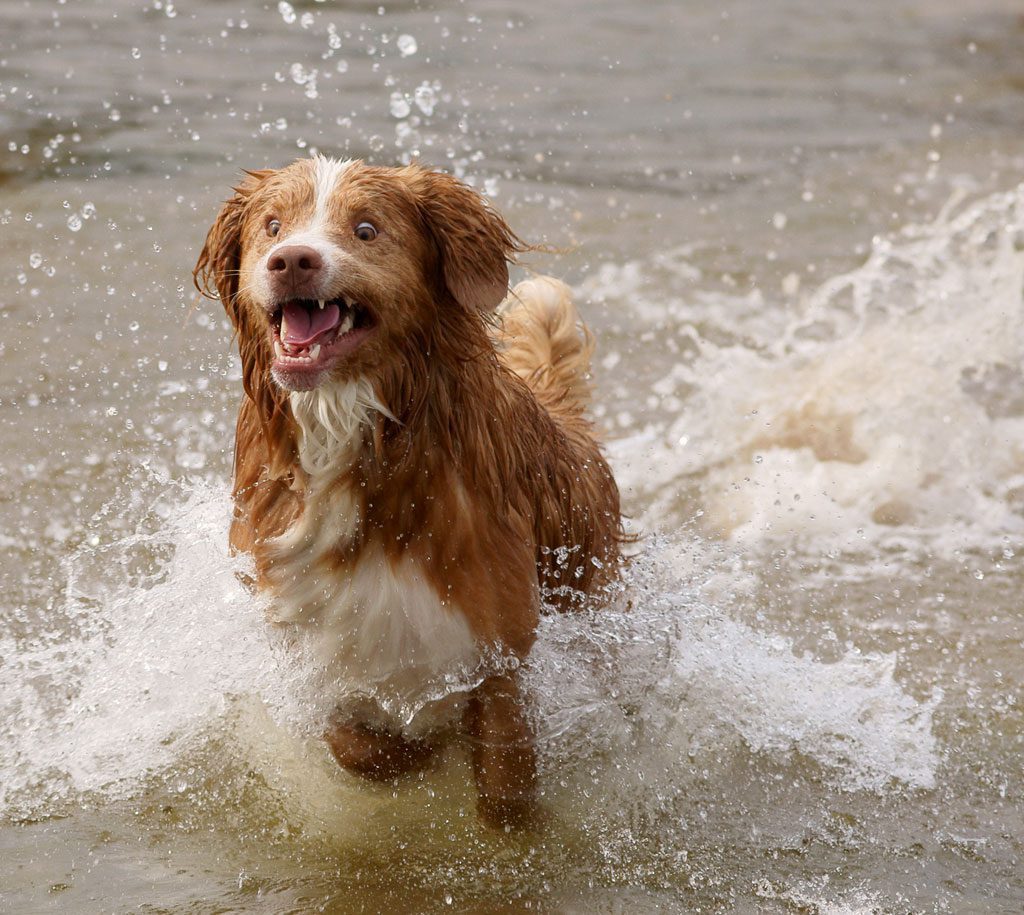
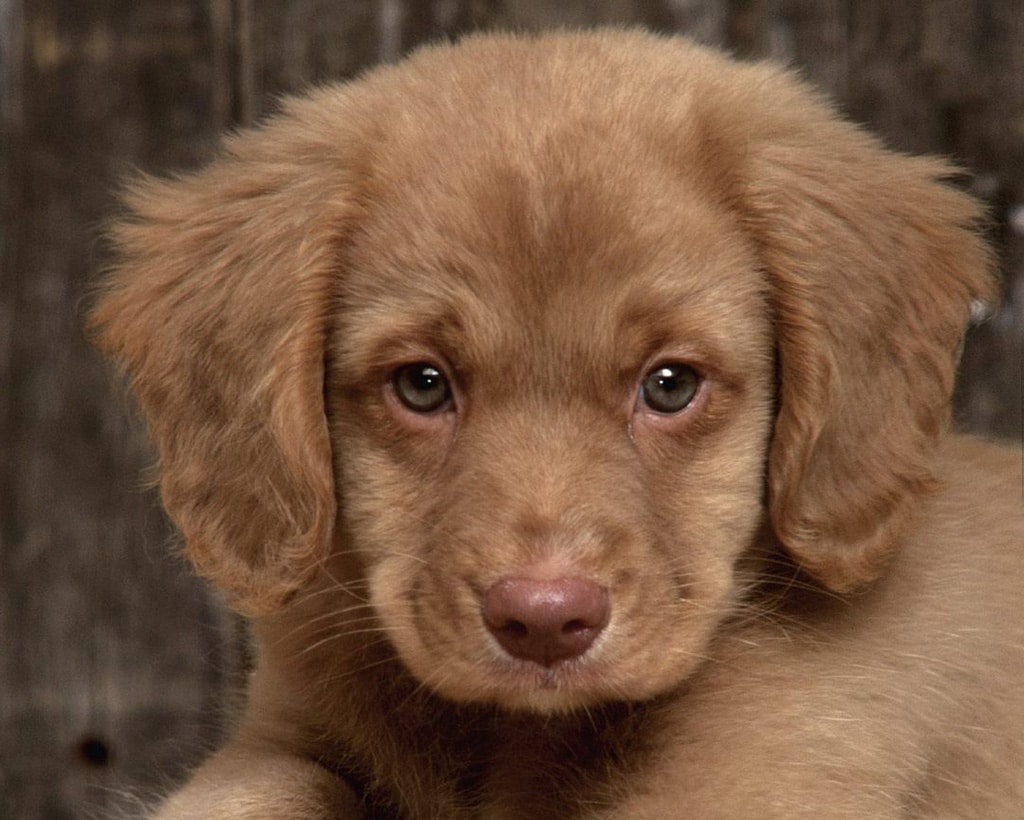
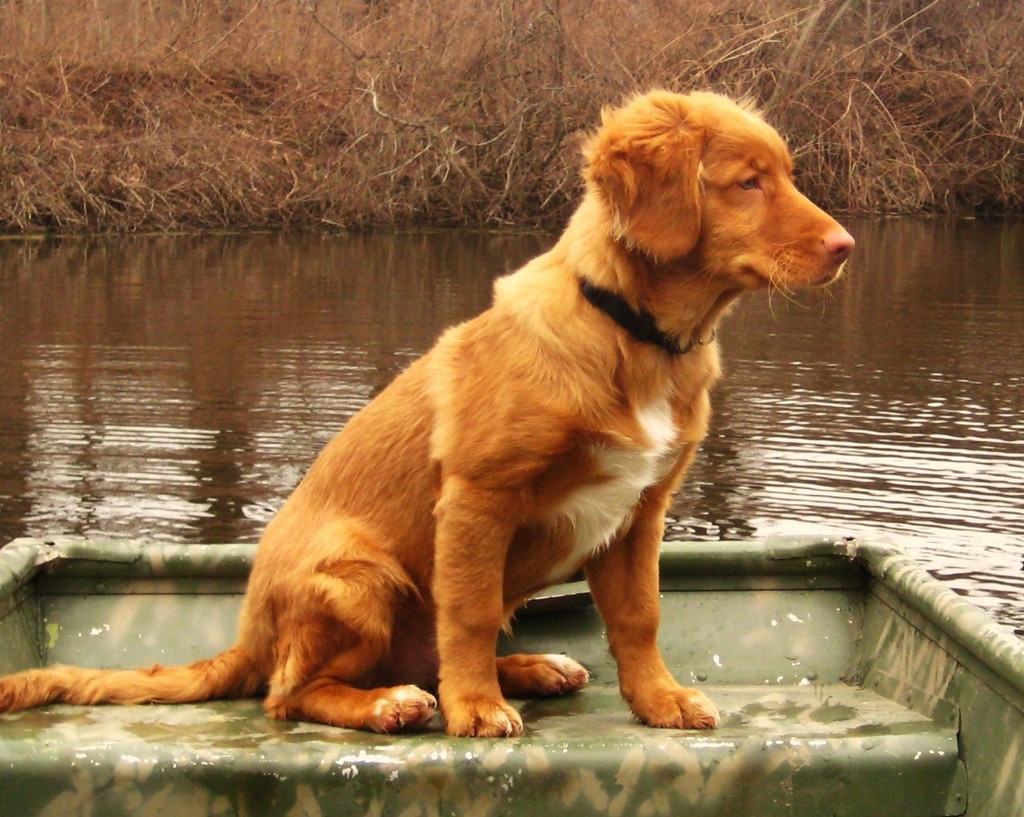
Nova Scotia Duck Tolling Retriever
Canadรก FCI 312 . Retrievers

Nova Scotia Duck Tolling Retriever

The Nova Scotia Duck Tolling Retriever is a very intelligent dog, resistant and playful.

Content

History

Sometimes nicknamed "Tollerยซ, the Nova Scotia Duck Tolling Retriever is originally from the Little River area of รขโ‚ฌโ€นรขโ‚ฌโ€นNova Scotia, a province on the Atlantic coast of Canada. It was long known as "Little River Duck Dog" before adopting its current name in 1945.

Although its exact origins remain uncertain, it is well established that it was developed both to bring the aquatic game and to lure it to the hunter's shore in advance. The Micmacs (Mi’kmaq), First Nations people of Eastern Canada, were the first to instill this technique in their dogs. The idea came from observing how red foxes attract waterfowl to shore by splashing water to excite their curiosity, before attacking them once they have approached.

Regarding the idea of รขโ‚ฌโ€นรขโ‚ฌโ€นtraining dogs to recover waterfowl, spread rapidly in the 19th century. It was then that breeders based in England, The United States and Canada developed various breeds of Retrievers, almost all of which are named after their place of origin (Labrador Retriever, Chesapeake Bay Retriever, etc.). This is also what Canadian breeders in the Little River area did, more specifically from Yarmouth County, with the exception that they aspired to create a dog capable of attracting game, drawing inspiration from the knowledge of the Micmacs. To achieve your goal, crossed the dogs used by the Micmacs with others Retrievers (as the Golden Retriever), as well as with him English Springer Spaniel, the Irish Setter and some Collies used by farmers in the region. The result of his work was called the Little River Duck Hunting Dog.

The fact that this place was quite remote is probably largely due to, for more than a century, only known in his native region. In 1945, the Canadian Kennel Club (CKC) officially recognized the breed and renamed it Nova Scotia Duck Tolling Retriever. This recognition took her out of anonymity.

Over the years 60, the Toller began to be used more in the United States, although its popularity remained limited. Was not up 1984 when a breed club was created in the country, and up 1987 when it was officially recognized by the United Kennel Club (UKC). Regarding the other reference organization in the country, the American Kennel Club (AKC), did the same only 16 years later, in 2003.

It also spread across Europe, especially after its recognition for the Fรฉdรฉration Cynologique Internationale (FCI) in 1981.

In England, made its appearance mainly through hunting clubs and dog competitions, like the ring and agility. He was recognized by the Kennel Club (KC) in 1988.

Both in Canada and in the rest of the world, the breed is known primarily to fans of waterfowl hunting. Its use as a family dog โ€‹โ€‹is gaining popularity in many countries., but it is still far from being one of the most popular breeds.

In United States, for example, the race occupies around the post 80 (of something less than 200) in the AKC breed classification based on the number of annual AKC registrations, having uploaded some 20 put in 2010.

The rise has been even steeper in France, where, However, started from a lower base. In effect, while the number of registrations in the Livre des Origines Franรงais (LOF) I was not in my twenties before 2010, multiplied by more than five over the next decade, until exceeding one hundred at the end of the latter.

On the other hand, en el Reino Unido, the appeal of Nova Scotia Duck Tolling Retriever has been generally stable over the same period: despite occasional spikes in some years, the Kennel Club registers around 200 births per year.

Physical characteristics

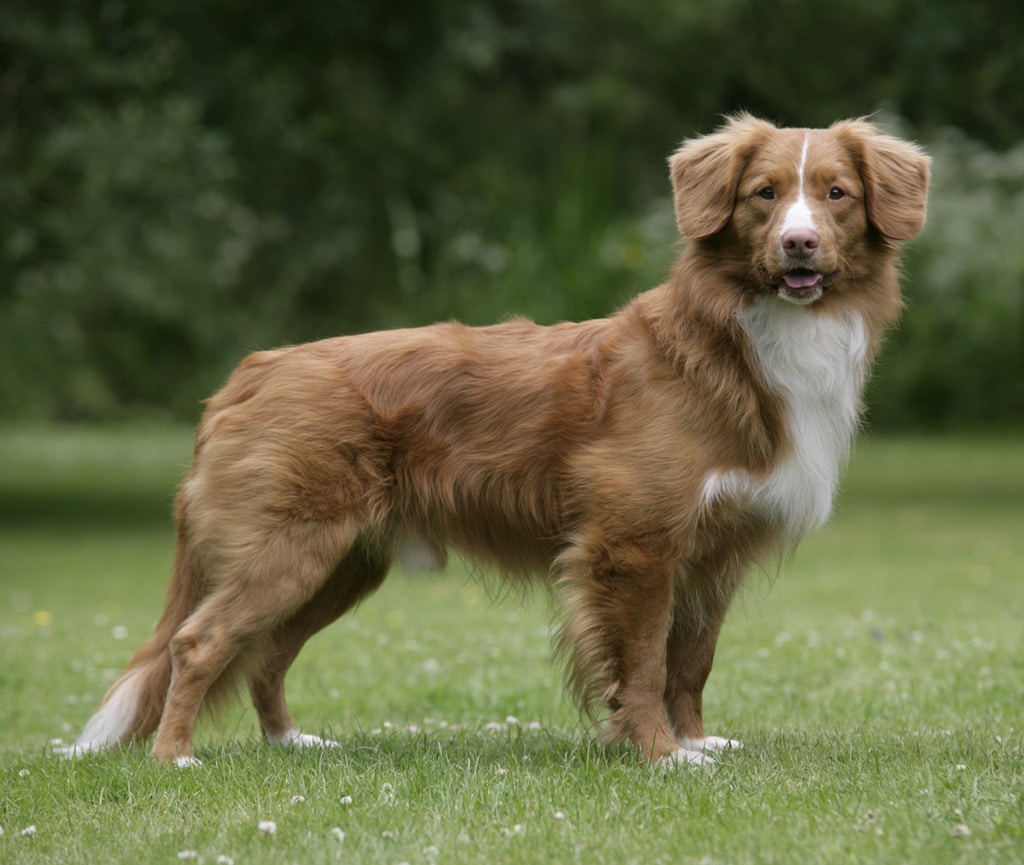
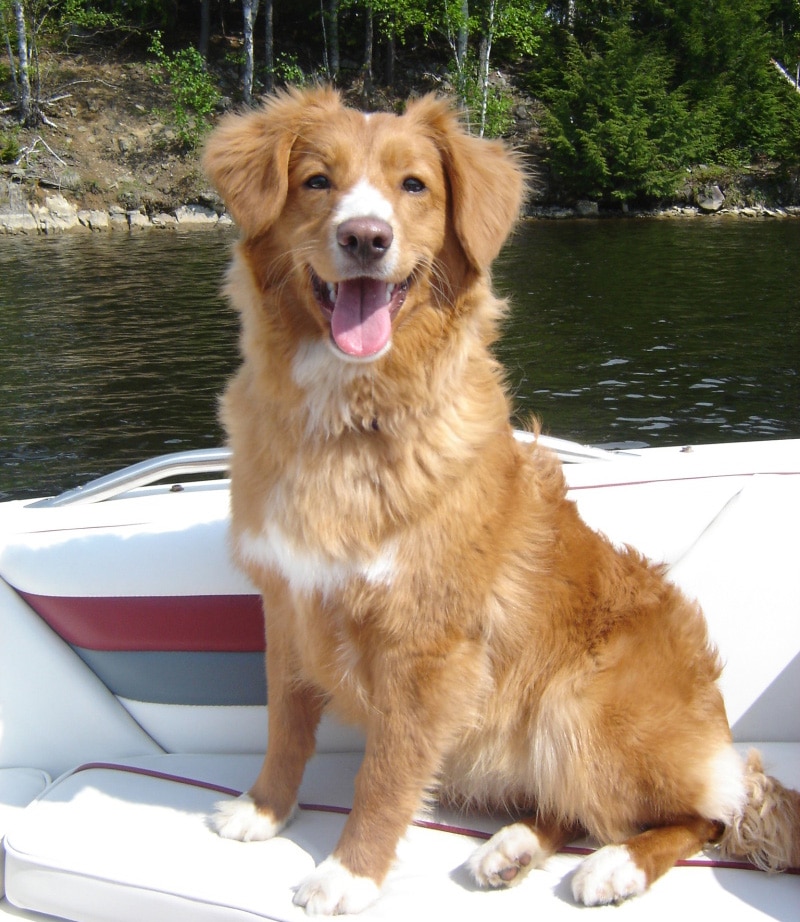
The Nova Scotia Duck Tolling Retriever, is a dog from medium-sized, powerful, compact structure, muscular and well-proportioned body.

One of its many characteristics to highlight is its extreme agility, determination and Security their movements.

It is from the section of the Retrievers, the smallest of all, the males measuring of 48 to 51 cm. and females of 45 to 48 cm..

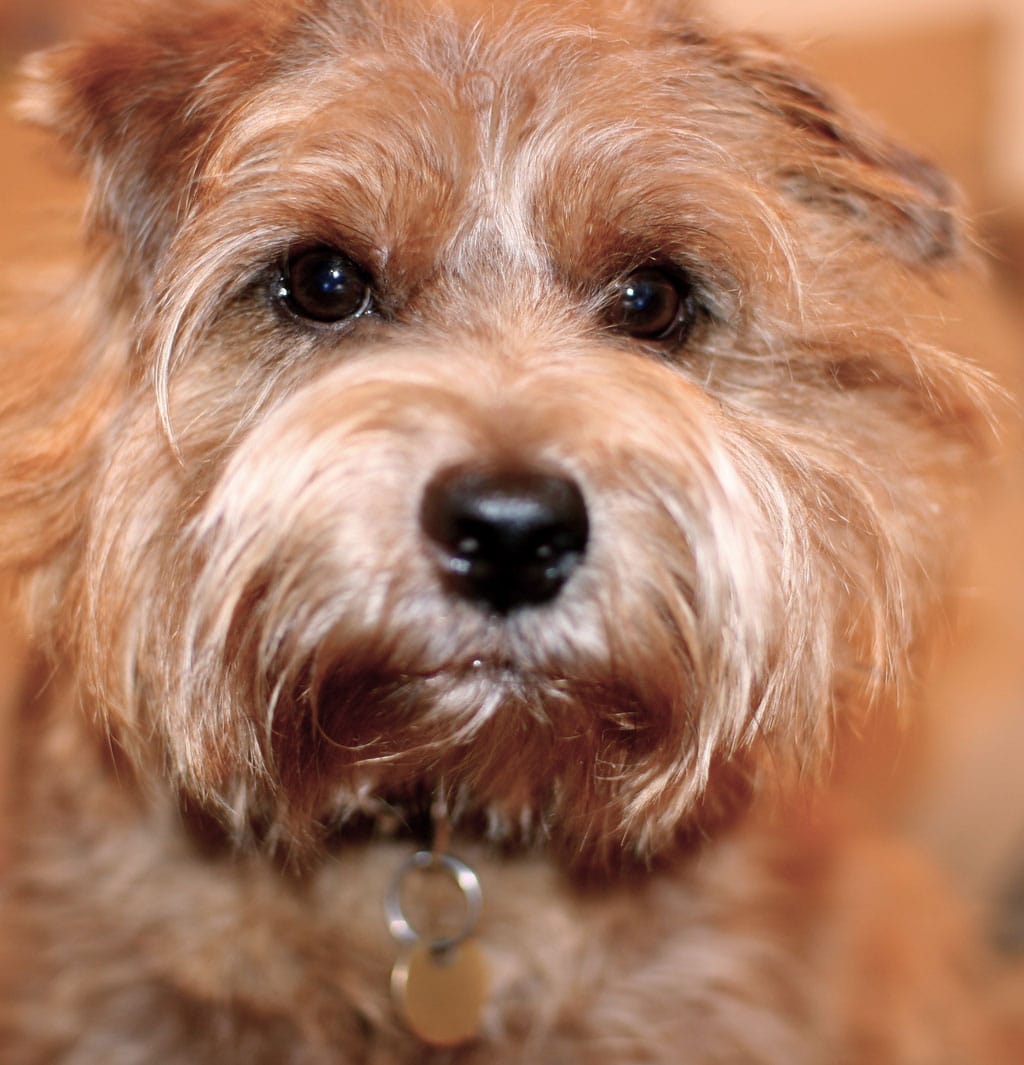
Their eyes are size medium, almond-shaped and mostly range from amber to brown in color. Its expression is friendly, lively and with some mischief.

The ears they are medium-sized and form triangular. Its tail, wide at the base and thinner towards the tip is populated with generous fringes.

Its the mantle of double layer and waterproof, the layer external the way a soft hair with medium length, and internal layer, It is composed of a dense and even softer hair.

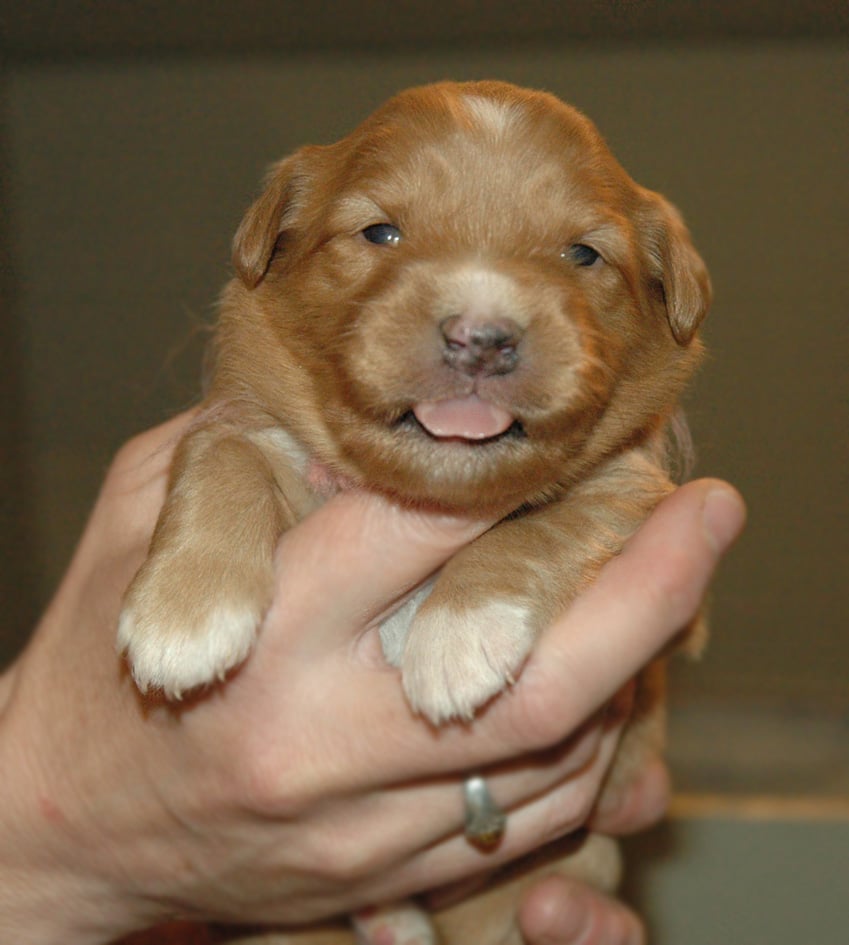
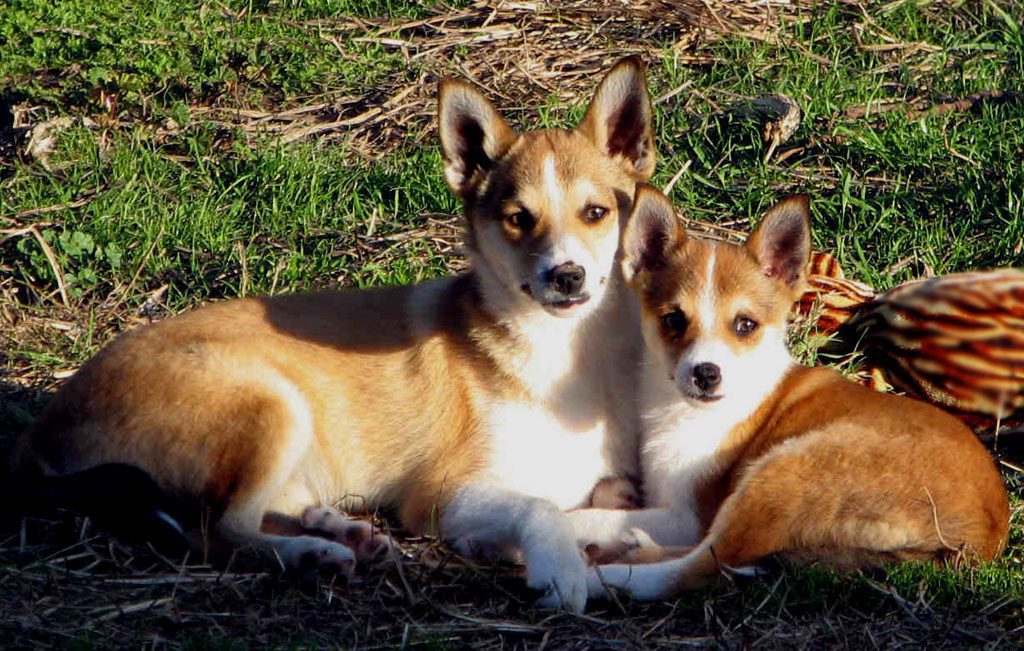
The color the layer can be of several all within the range of the Orange. They may have white markings at the tip of the tail, the feet, the breast and chest.

It is currently used mostly for waterfowl hunting, When you separate charge, acts as a lure, attracting the birds' attention with its movements and jumps.

Height and weight

    ▷ Male size: of 48 to 51 cm.
    ▷ female size: Of 45 to 48 cm.
    ▷ Male weight: Of 20 to 23 kg
    ▷ female weight: Of 17 to 20 kg

Character and skills

The Nova Scotia Duck Tolling Retriever He is intelligent and independent, with sense of humor, curiosity and ability to play. But, needs a firm master who provides a framework with clear boundaries, or else you can become the master of your own mind and become the master of the house.

In particular, it is an ideal dog with children, since it shows an energy at least equal to theirs and does not stop bringing what they send for. But, It's important to put attention on, regardless of race, a dog should never be left alone with a young child without adult supervision.

He usually gets along well with his peers - especially those of his own race- and is usually happy in his company. Living with other pets, on the other hand, it's much more chaotic. His strong hunting instinct leads him to consider cats and other small domestic animals as prey, and therefore to chase them. Fencing the garden is strongly recommended to prevent it from chasing other animals. It is useless to hope that an underground electric fence can stop it., since the discomfort he feels is no match for his hunting instinct. The latter also clearly explains why it is preferable to keep him on a leash when out in public.

In any case, can be counted on to report anything that seems abnormal. Constantly on the prowl, will not stop warning as soon as someone approaches the house. Next, he usually copies his answer to his master's, and does not hesitate to defend it if necessary. On the other hand, if you see that the newcomer is welcome, does the same, maintaining the natural reserve that it has towards strangers.

The Toller is not recommended for apartment living, if only because it can be relatively noisy. Does not bark excessively, but when he gets excited (either by certain noises, from the sight of small animals or from the game), emits an almost shrill bark, which some breeders and owners describe as hard to bear. Of course, this problem is less pronounced if the apartment is rather quiet. In any case, adjusting to apartment living depends on being provided with a sufficient amount of exercise, that is to say, at least an hour a day.

This is especially true during their first year of life., during which he is extremely active and playful. It is then necessary to provide a large number of stimuli and activities, but at the same time you have to know how to moderate your ardor. In effect, while in full development and has not fully developed its muscles (what happens around one year of age), remains especially fragile. So, you need to increase the duration and intensity of exercise very gradually throughout your growth period, at the risk of causing injuries or even malformations that would penalize him for the rest of his life.

After his first birthday, the Nova Scotia Duck Tolling Retriever becomes much less hyperactive. Conserve a large amount of energy, but you can settle for a good hour of daily activity to keep your feet on the ground. But, there is something else: it is an ideal dog for a sports master, who wants to take his partner for long walks, for example. Able to easily adapt to different environments, it is a very good traveling companion.

During their pilgrimages, always willing to take a dip if the opportunity presents itself: having been developed to hunt in aquatic environments, swimming is one of his favorite activities, even in murky water. Not necessarily an ideal choice for a master who wants a perfectly clean companion and a flawless interior., as it gives you smart pleasure to play in the mud and roll in the dust.

Created to help humans during their hunting sessions, the Nova Scotia Duck Tolling Retriever seeks the company of his family and needs mental stimulation. He likes nothing more than keeping busy and feeling useful.. Otherwise, they are likely to get bored and start digging, chew on things or bark incessantly.

The average life expectancy is of some 12-14 years.

Observations

It is a race very rare in Europe, However in North America it is quite popular and is widespread.

Education

Because they are constantly trying to please their owners, the Nova Scotia Duck Tolling Retriever they are quite easy to train. This is especially true because he likes to be mentally stimulated and useful., so he is always ready to learn new orders.

But, as he has a relatively strong temperament, it is best to avoid trying to train him under pressure or duress, as he finds it hard to bear and may even refuse to cooperate. On the other hand, dog training techniques based on positive reinforcement, employed by a quiet master, patient and persistent, are exactly what you need. As long as you are motivated and find an interest in what you do, he is a very good student.

It may take some subtlety to establish authority and respect for your dog without rushing him, but this is necessary to develop your trust in your master and for both of you to have fun together during training sessions. Consistency is also important: if the rules are not clear or consistent over time or among household members, most likely he will decide for himself what to expect.

Puppy socialization is important to all breeds, but it is even more important for the Toller, who can be especially reserved with strangers. Thus, it is important to let you meet all kinds of people, other animals and situations from an early age, to prevent him from becoming a shy adult.

One of the easiest things to do in raising a Nova Scotia Duck Tolling Retriever is to teach you to bring things home to order, because he is a born dog. This can be checked if it is used for hunting: requires few stimuli and quickly integrates behaviors such as baiting or game recovery, that are quite natural for him.

Imitation learning can be an important part of your education, since he is very attentive and learns a lot through observation. Clicker training is also especially effective with it, as it is more stimulating for him to learn to perform tasks in response to a visual or auditory cue, like the sound of a whistle or clicker, that by repetition. It also, hates repeating the same exercise over and over again: to ensure your full cooperation, it is better to diversify the training sessions.

Also performs very well in shows and obedience, as well as in agility competitions. Teaching him these dog sports and practicing them with him are excellent levers to use in his education.: keeps you busy and stimulates you both mentally and physically.

Translation done with the free version of the translator www.DeepL.com/Translator

Health

The Nova Scotia Duck Tolling Retriever is generally a healthy dog.

But, the relatively small gene pool on which it is based has led to the emergence of inbreeding-related diseases in the breed's population.

The main risks to which you are exposed are the following:

  • the Hip Dysplasia, which may be favored by a hereditary predisposition. Is a source of pain, lameness and then osteoarthritis. The set reduces the mobility of the animal;
  • The patella dislocation, an orthopedic condition that, according to its severity, may be asymptomatic and cause simple discomfort or total loss of knee mobility. In the most serious cases, corrective surgery is required;
  • Progressive retinal atrophy, an inherited disease that first affects night vision, then to the daytime and, finally, leads to total blindness of the dog;
  • Collie eye abnormality, an inherited disease that may or may not be progressive. when it is so, can end up causing blindness of the dog;
  • The Addison's disease (hipocorticism), an endocrine disorder that develops more often in women between the ages of four and six. Produces general weakness, anorexia, vomiting, diarrhea and weight loss;
  • The Hypothyroidism, which is the result of an alteration of the thyroid gland and causes lethargy, weight loss and hair loss, as well as great fatigue;
  • The deafness, that usually appears around the 7 u 8 years in affected individuals. Some bloodlines seem to be more prone to it than others.

It also, due to the folded shape of his ears, are more prone to infections at this level, like otitis.

Adopt from a breeder Nova Scotia Duck Tolling Retriever professional and reputable offers guarantees for a number of possible genetic diseases, thanks to the tests that have had to be carried out on the parents or the puppy. The breeder should also be able to provide details of the vaccinations the puppy has received, as recorded in your health or vaccination record, as well as a certificate from a veterinarian attesting to the good health of the puppy.

Of course, this does not exempt you from doing everything possible to keep you healthy throughout your life. In this issue, prevention plays an important role, just like in humans: it is important to make sure they are examined by a vet at least once a year. This routine check-up can allow, in particular, detect a possible health problem at an early stage, but also make sure you don't miss one of your shots.

Life expectancy

Of 12 to 14 years

Grooming

The Nova Scotia Duck Tolling Retriever it is an easy-care dog.

A weekly brushing is usually enough to keep their coat shiny and tangle-free.. The exception is during the spring and fall shedding periods., when daily brushing is recommended to remove the numerous dead hairs.

How sometimes he likes to play in the mud and get dirty, regular bathing may be necessary, especially to avoid the accumulation of dirt in the coat. How you like water, not usually recalcitrant. But, be sure to use a shampoo specially designed for dogs, as it can damage your skin.

Take advantage of your dog's weekly coat maintenance session to check the condition of his eyes and clean them.

Looking at your ears, require special vigilance, since its folded shape implies an increased risk of infection. They should also be carefully examined and cleaned weekly.. It also, It is recommended to dry them after swimming to prevent moisture from settling, as it facilitates the development of bacteria.

You should also brush your teeth at least once a week. Otherwise, as with any dog, plaque build-up will eventually lead to tartar build-up, which can cause bad breath and other ailments. Even more frequent brushing is recommended, ideally every day. In any case, it is essential to use a toothpaste specially designed for dogs.

Looking at its claws, natural wear and tear is usually enough to file them. But, You must periodically check that this is the case.. If that is not the case, must be manually trimmed with a dog nail clipper, as otherwise there is a risk that they will become a nuisance or break.

The different gestures to maintain the coat, the eyes, the ears, your dog's teeth or claws aren't necessarily natural, especially for a beginner owner. But, it is not only essential to do them, but also to do them without risk of injuring or even harming the animal. So, it may be wise to learn them from a vet or groomer the first time, to make sure you know how to do them correctly after. By the way, the sooner you get used to your dog, the less likely you are to feel uncomfortable or even recalcitrant during these operations.

It is also essential to ensure that you exercise on uneven and rather abrasive surfaces: this keeps your pads in good condition and prevents them from becoming too soft, since then they would accumulate dirt more easily and be more prone to lacerations.

Use

The Nova Scotia Duck Tolling Retriever It is mainly used as a hunting dog for waterfowl, which is capable not only of recovering, but also to attract the hunter. English name Nova Scotia Duck Tolling Retriever reflects this particularity, since the word ยซtollingยป comes from the verb ยซtollenยซ, What does "attract" mean?.

To attract waterfowl, plays on the edge of the pond and makes splashes that sound a bit like a duck flapping its wings on the surface of the water. curious by nature, waterfowl come to shore to see what happens. When they are close enough, the great retreats behind the hunter's shed, and it rises to chase away the game and make it fly: just shoot your prey. Next, the dog re-enters the scene, this time to search and retrieve the downed game. This ingenious technique requires a lot of control, obedience and complicity, and it is precisely by emphasizing these traits that the race was created and developed.

In addition to his quite unique hunting skills, the Toller also excels in a large number of canine sports disciplines, like the ring, el agility, obedience, the flyball and even the canine frisbee (discdog).

It is also a good family dog, who gets along especially well with children and loves to do all kinds of activities with his master.

Quite suspicious of strangers and always attentive, is always alert barking when a stranger approaches the house, although not the most dissuasive or aggressive of guard dogs, far from it.

Last, as long as, of course, receive specific training, They can also be part of the very selective group of maritime rescue dogs..

Characteristics "Nova Scotia Duck Tolling Retriever"

Coexistence is important that you have with your new friend. Before considering the acquisition of a dog of the breed "Nova Scotia Duck Tolling Retriever" you know certain factors. Not all breeds of dogs are apt to live in an apartment, you must take into account his character, their need for exercise, their interaction with other pets, their care and if you have small children, their level of tolerance towards them.

Adaptation โ“˜

3,0 of 5 stars (based on 1 review)

friendly dog โ€‹โ€‹โ“˜

5,0 of 5 stars (based on 1 review)

hair loss โ“˜

3,0 of 5 stars (based on 1 review)

Affection level โ“˜

5,0 of 5 stars (based on 1 review)

Need for exercise โ“˜

5,0 of 5 stars (based on 1 review)

Social need โ“˜

4,0 of 5 stars (based on 1 review)

Home โ“˜

3,0 of 5 stars (based on 1 review)

Toilet โ“˜

2,0 of 5 stars (based on 1 review)

Friendly with strangers โ“˜

3,0 of 5 stars (based on 1 review)

barking โ“˜

2,0 of 5 stars (based on 1 review)

Health โ“˜

4,0 of 5 stars (based on 1 review)

Territorial โ“˜

3,0 of 5 stars (based on 1 review)

Cat friendly โ“˜

3,0 of 5 stars (based on 1 review)

Intelligence โ“˜

4,0 of 5 stars (based on 1 review)

Versatility โ“˜

3,0 of 5 stars (based on 1 review)

Child friendly โ“˜

5,0 of 5 stars (based on 1 review)

Surveillance โ“˜

2,0 of 5 stars (based on 1 review)

joy โ“˜

5,0 of 5 stars (based on 1 review)

Images ยซNova Scotia Retrieverยป

ยซNova Scotia Retrieverยป Videos

  • FCI – Group 8: Retrievers - Flushing Dogs - Water Dogs – Section 1: Retrievers โ“˜
  • AKCSporting โ“˜
  • ANKC Group 3 (Gundogs) โ“˜
  • CKCSporting Dogs โ“˜
  • โ€‹KC – Gundog โ“˜
  • NZKCGundog โ“˜
  • UKCGun Dogs โ“˜

FCI breed standard "Nova Scotia Duck Tolling Retriever"

Origin:
Canada

Date of publication of the valid original standard:
24.06.1987

Use:

The retriever runs, jump and play along the shore in sight of a flock of ducks, sometimes disappearing and then quickly reappearing, supported by the action of the hidden hunter, who throws wands or a ball at him. The dog game attracts the attention of ducks that approach the shore and are drawn within range of the shooting line.. Then, the hunter
order the dog to collect the injured or dead birds.


General appearance:

This is a medium-sized dog, powerful, compact, well balanced and muscular with medium to thick bones. Has great agility and determination and is always alert. Many dogs of this breed have a slight expression of sadness, but when they work their appearance changes and they show great concentration and enthusiasm. During work, moves and rushes quickly, raises the head almost to the level of the back and constantly wags its tail covered with abundant fringes of hair.


Behavior / temperament:

This is a very intelligent and easy-to-train dog that has great stamina.
He is a good and skilled swimmer, a tenacious collector by nature, both on land and in the water. He is ready for action as soon as he receives the slightest hint that the hunt will have to charge.. His great enthusiasm as a collector and his playful nature are essential qualities that he must possess to deceive and collect the game..

Head:

The head is well defined and has a slight wedge shape.

Cranial region:
  • Skull: The broad skull is only slightly rounded; occiput is not prominent and cheeks are flat. Some measures
    suitable for an average male would be 14 cm between ears, decreasing to 3,8 cm on the muzzle. The length of the head is approximately 23 cm from nose to occiput, but its size must be in proportion to the size of the body.
  • Depression links (Stop): Moderate.

facial region:

  • Truffle: Tapers from base to tip. The Windows are wide open. The color must be black, or harmonize with the coat.
  • Snout: It decreases in a well-defined line from the naso-frontal depression to the nose.. The lower jaw is strong, but not prominent. The lower line of the muzzle is almost straight from the corner of the lip to the angle of the jaw. The depth of the muzzle at the level of the naso-frontal depression is greater than at the level of the nose. The hair on the muzzle is short and fine.
  • Lips: Lips are quite tight, forming a smooth curve in profile. The lips are not thick.
  • Jaws / Teeth: The jaws are strong enough to hold a sizable bird.. Mouth smoothness is essential. The correct joint is in the form of a narrow scissor; a full denture is required.

EYES: They are well separated, they are almond-shaped and medium in size. Its color ranges from amber to brown. They are friendly in expression, alert and intelligent. The skin around the eyes should be the same color as that of the lips.

EARS: They have a triangular shape, they are medium in size and set high, well toward the back of the skull; the base is very slightly erect. The back of the double has a fringe of hairs. The hair is short at the tip, which is rounded.

Neck:

Is medium sized, well muscled and well inserted. There is no presence of dewlap.

Body:

  • top line: Evenly horizontal.
  • Back: It's short and straight.
  • Pork loin: Strong and muscular.
  • Breast : Deep, chest descends to elbows.. Snugly ribs, neither flat nor barrel-shaped.
  • Belly: Moderately withdrawn.

Tail:

Follows the slight natural slope of the rump. It is wide at the base, with abundant and exuberant fringe of hair. The last vertebra reaches at least as far as the hock. The tail can be carried lower than the level of the back, except when the dog is alert, in which case he hunches over and stands up, although it never touches the body.

Tips

PREVIOUS MEMBERS:

  • As a whole: Front members should look like parallel columns. They are straight and strong boned.
  • Shoulder: They must be very muscular; shoulder blade is well attached and tilted back, allowing the inclination of the withers towards the region of the back, which is short The shoulder blade and forearm are approximately the same length.
  • Elbows: They must be attached to the body, without deviating or inward, nor out. Its movement must be free and uniform.
  • Metacarpus: They are strong and slightly sloping.
  • Front feet: They are medium in size and rounded with well developed skin between the toes.. Fingers are well together and arched. The pads are thick. Dewclaws can be removed.

LATER MEMBERS:

  • As a whole: They are muscular, wide and square in appearance, posterior and anterior angulations should be balanced. Thigh and leg are approximately the same length.
  • Thighs:Well muscled.
  • Knee: Well angled.
  • Hocks: Well placed close to the ground,without deviating or inward,nor out. There should be no dewclaws.
  • Rear feet: Like the forwards.

Movement:

The Nova Scotia Collector movement is powerful at the same time, elastic and lively. The forelimbs show good range and the hindlimbs give great momentum. The feet should not deviate or inward, nor outwards and the limbs must move in a straight line. As speed increases, the feet tend to come closer when they land on the ground, forming a single footprint; the top line must remain uniform.

Mantle

HAIR : Since this dog was bred to collect hunting in icy waters,must have a double coat, waterproof,of moderate length and softness, and a softer and denser undercoat. On the back it can be slightly wavy, but in the rest of the body it is stretched. In winter it can form a long, loose curl in the throat. The fringes of hair are soft on the throat,behind the ears and behind the thighs. In the forelimbs the fringes of hair are moderately developed.

COLOR: It comes in various shades of red or orange; the fringes of hair and the lower part of the tail are lighter. For the usual, one of the following white markings can be seen: at the tip of the tail, the feet (without extending beyond the metacarpals or hocks), the chest, and a white list on the forehead. A dog that shows otherwise great qualities should not be penalized for not presenting white markings.. The pigment of the nose, the lips and the rim of the eyes should be flesh-colored, harmonizing with that of the fur, or black.


Size and weight:

Ideal height: For males over 18 months is 48 to 51 cm., and for females over 18 months, is of 45 to 48 cm..
Allowed 2,5 cm above or below the ideal size.

Weight: It should be in proportion to the height and bone structure of the dog; of 20 to 23 kg for adult males, and 17 to 20 kg for adult females.


Fouls:

Any deviation from the aforementioned criteria is considered as a fault and the severity of this is considered to the degree of the deviation to the standard and its consequences on the health and well-being of the dog..

SERIOUS FAULTS:

โ€ข Longitudinal axes of the nasal ridge and snout diverging or converging.
โ€ข Abrupt naso-frontal depression.
โ€ข Clearly pink nose.
โ€ข Truffle, eyes and rim of the eyes of a color other than the established one.
โ€ข Superior prognathism.
โ€ข Round and large eyes.
โ€ข Convex or concave back.
โ€ข Loose loin.
โ€ข Tail carried below the level of the back when the dog is moving. Tail too short, or if it curls up and touches the back.
โ€ข Pasterns too inclined.
โ€ข Crushed feet, with thin pads.
โ€ข Separate coat (not thick enough).
โ€ข Adult dog that lacks substance.
โ€ข Dogs with 2,5 cm above or below ideal height.

FALTAS DESCALIFICANTES:

โ€ข Aggressiveness or extreme shyness.
โ€ข Any dog โ€‹โ€‹showing clear signs of physical or behavioral abnormalities.
โ€ข Any signs of shyness in adult dogs.
โ€ข Partially depigmented nose.
โ€ข Superior prognathism of 3 mm (1/8 inch).
โ€ข Lower prognathism. Deviated arch of incisors.
โ€ข Absence of skin between the toes.
โ€ข White color on the shoulders, around the ears, behind the neck, through the back or on the flanks.
โ€ข Silver fur, gray or with black areas.
โ€ข Any color other than red or orange tone.


N.B.:

โ€ข Males must have two normal-appearing testicles fully descended into the scrotum..
โ€ข Only functionally and clinically healthy dogs, with the typical conformation of the breed, should be used for parenting.

Source: F.C.I - International Cynological Federation

Alternative names:

1. Yarmouth Toller, Tolling Retriever, Little Red Duck Dog, Little River Duck Dog, Toller, Duck Toller (English).
2. Nova Scotia, (Nova Scotia Duck Tolling Retriever en anglais) (French).
3. Nova Scotia Retriever, Toller (German).
4. (em inglรชs: Nova Scotia duck tolling retriever) (Portuguese).
5. en inglรฉs: Nova Scotia Duck Tolling Retriever, Toller, Novie, Retriever (espaรฑol).

โ–ท The world of Pets: Dogs, cats, birds, reptiles, amphibians

Norwegian Hound (Dunker)
Noruega FCI 203 - Medium-sized Hounds

Norwegian Hound

The Norwegian Hound (Dunker) is found only in its country of origin and is virtually unknown outside its borders.

Content

History

The Norwegian Hound was originally called Dunker, in honor of the Norwegian captain and breeder Wilhelm Conrad Dunker (1806-1860), who established the first breed standard in 1850. During the first half of the 19th century, there was a large population of hounds in norway, including various types used for hare hunting. Wilhelm Dunker selected those with the keenest sense of smell and crossed them with a Russian Harlequin Hound to produce a versatile hound, able to hunt rabbits and hares by smell rather than sight, and tough enough to withstand the harsh weather conditions of Norway.

In 1902 was founded the Norsk Harehundklub, a club dedicated to hounds. That same year the hounds were divided into two main groups, known today as Dunker y Hygenhounds. The first was the most numerous and included local dogs from all over the country., providing a wide and varied breeding base.

Although Norway was less affected by World War II than other European countries, the demand for these dogs dropped dramatically, which made it difficult for the breeders to continue their work properly. As a result, the number of specimens decreased significantly.

After the conflict is over, the Dunker regained some popularity and was officially recognized by the Fรฉdรฉration Cynologique Internationale (FCI) in 1956.

But, this bounce was only short lived: lost ground again from the decade of 1970, due to competition from foreign breeds of hunting dogs imported into the country.

Things did not improve much in the 80, to the point that inbreeding problems began to appear. In fact, the decline in its population led many breeders to resort to inbreeding to continue breeding. This led to a high rate of congenital deafness.. For this reason, in 1987, the breeding committee Norwegian Hound asked the Norsk Kennel Klubb (NKK), the reference canine organization in Norway, permission to cross the Dunker with other races, but they denied it. But, how things did not improve much, the NKK finally gave his approval for some crosses two years later. This resulted in a more varied and healthy genetic makeup, while maintaining the characteristic traits of the breed.

The United Kennel Club (UKC) recognized it in 1996. But, the other American reference organization, the American Kennel Club (AKC), has not done the same to this day – nor does the neighboring Canadian Kennel Club (CKC) or the prestigious British Kennel Club (KC). In fact, at the global level, recognition of the breed is still quite partial.

It's the same for broadcast. Even in the other Scandinavian countries, is almost absent, with the exception of Sweden, where the Svenska Kennelklubben records a number of births each year that can be counted on the fingers of one hand, compared to around twenty in the early nineties. In France, not a single entry was made in the Book of French Origins (LOF) during the first two decades of the 21st century.

In Norway, The number of Dunkers recorded each year in the NKK has been around 150 since the mid-decade 2000. But, this marks a halving of the number compared to the change in years 90. This limited number is partly explained by the deafness problem present in this breed.: almost the 75% of its population suffers from deafness.

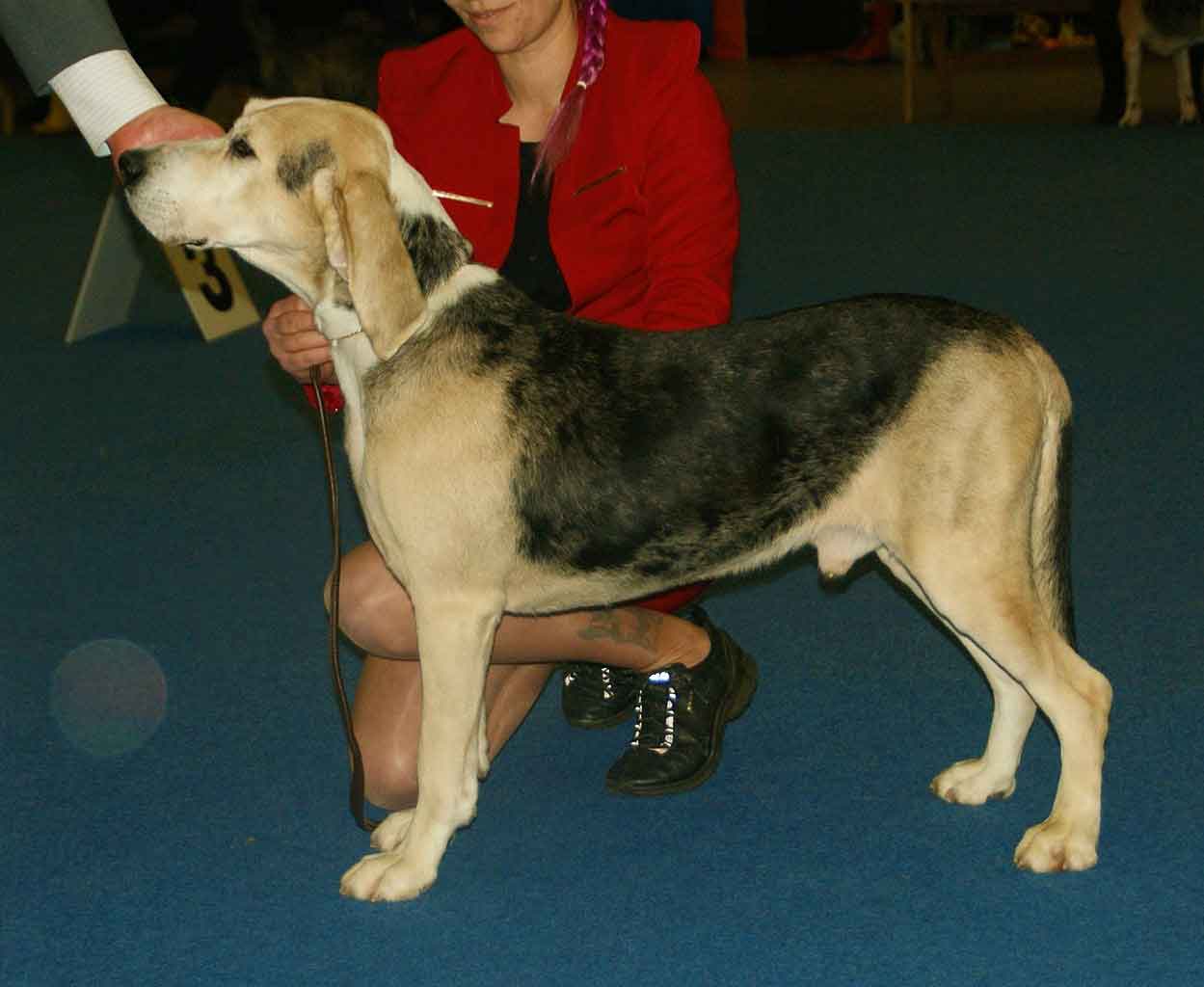
Photo: A Norwegian Hound by Canarian, CC BY-SA 4.0, via Wikimedia Commons

Physical characteristics ยซNorwegian hound (Dunker)ยป

The Norwegian Hound It is a medium-sized dog distinguished by its long, well-proportioned body, his energetic and clear walk and his light weight. They have solid bones, giving an impression of strength and endurance. The back is straight, firm and long enough to give length to the rib cage. Lets on strong, dry front legs. The tail is wide and thick at the base and tapers at the tip. Descends to the hock or slightly protrudes from the hock.

Dunker
Dunker

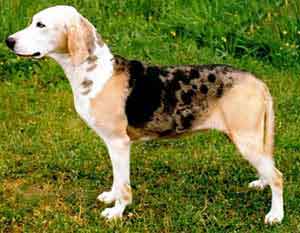
Quite long, its head is characterized by a slightly domed skull and a marked stop. Located at half height, the ears are flat, without folds, hanging and soft to the touch. medium width, taper towards its tip, which is rounded. Its mouth has scissor-shaped teeth dominated by a square, well-developed snout., a black nose and wide nostrils.

His eyes are round, large and very penetrating. Although they are usually dark in color, there are also individuals with one or two blue eyes, a characteristic that is associated with an increased risk of deafness. Minnow eyes are allowed in blue individuals (variegated). Regardless of the color of the eyes, the eyes express calm and seriousness.

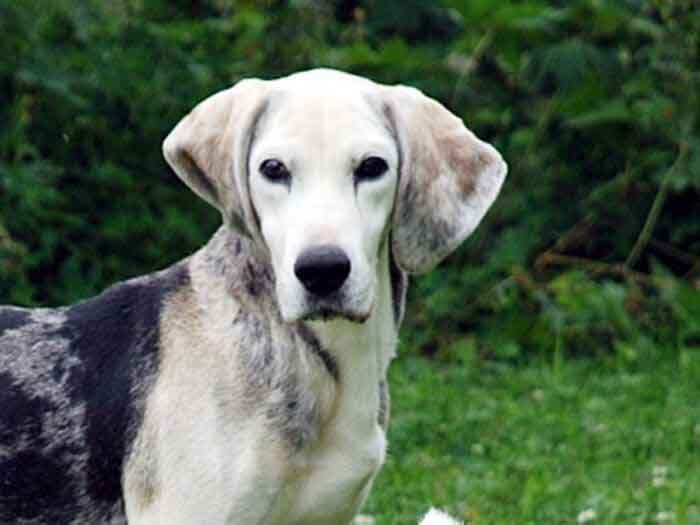
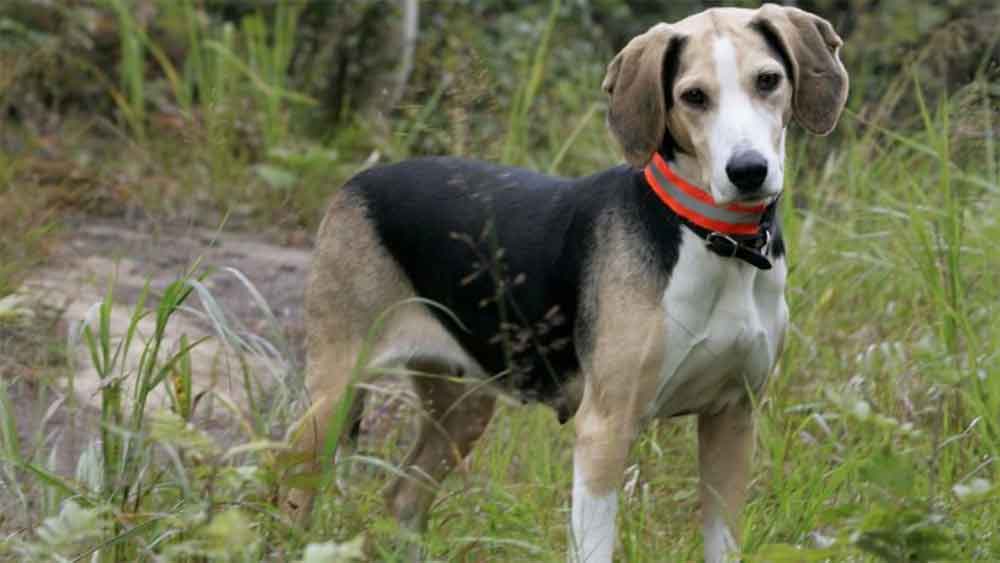
The coat of the Dunker consists of short hair, hard, tight and dense. Its coloration is a distinctive sign of the breed: they are either black with light fawn and white spots, or blue merle (ยฟbigarros?) and mottled with light fawn and white spots. Jet black coats with dark tawny markings are less desirable, and those in which white predominates (to the point of representing at least the 50% Of the surface) are considered undesirable by the norm.

Last, sexual dimorphism is not very marked in this breed: males and females are quite similar in size and weight.

Life expectancy: 12 years of age.

Size of Norwegian Hound

    – female weight: Of 24 to 25 kg
    – Male weight: Of 24 to 25 kg
    – female size: Of 47 to 53 cm.
    – Male size: Of 50 to 55 cm.

Character and skills ยซNorwegian Hound (Dunker)ยป

The Norwegian Hound is a fast and tenacious hunter with an above-average olfactory ability. They excel particularly in hunting hare and rabbit.

Being also gentle, loving, cheerful and friendly, they have all the qualities required to be an excellent companion dog. balanced, patients, tolerant and devoid of aggressiveness, they are very good playmates for children. But, it is important to note that a dog should never be left alone with a small child without adult supervision, and this applies to all races.

His total lack of aggressiveness and his attraction to humans, even for those you don't know, make it totally impossible to use as a guard dog. In effect, not reserved at all, shy, fearful or aggressive with strangers, rather they tend to welcome them positively and trust them. They are more likely to greet a malicious person with curiosity and licking them rather than barking to warn their master or make them understand that they better go their way.

His sociability extends to other dogs too. So, it is quite possible to share a house with a dog companion without fearing that conflict situations will multiply, and is generally friendly with those he meets on his walks.

With cats and other animals, things are a little more complicated. His hunting instinct naturally leads him to chase any small furry animal that is not part of the canine species.. Although he has grown up with him and must consider his little companion as a member of the family and not as a potential prey, risk can never be ruled out, so it is better to avoid such cohabitation. As for those that can be found on your walks, you probably want to chase them. So, it is preferable to keep it on a leash during excursions, to avoid any accident.

Dunker
Dunker

In any case, the fear that it will chase other animals does not mean that you should not take it out enough each day, knowing that you need a lot of activity to spend your great energy. Need at least 45 minutes of exercise per day, but his stamina makes him happy to go further if given the chance. It also, it is preferable to vary the pleasures to allow him to fully expend his energy: long walks, run through the park, sports with dogs, etc. Sports that require running (like canicross) and those that appeal to your senses (like tracking) they are the most recommended. In fact, this dog is very happy when he has to mobilize his physical and mental capacities. In any case, in addition to allowing you to exercise, all these activities reinforce the relationship with his master, which is especially important if you are hearing impaired.

From the above it follows that the Dunker not suitable for an elderly or very sedentary person, that I couldn't give you all the exercise you need. The ideal for him is a master of sport, and willing to take his partner in his various activities. Retirees may be right for him, if they are active enough.

In any case, life in the city is not ideal for him, that needs large spaces to fully develop. A house with a garden in the country is a much more appropriate environment to live in.. But, it is important to ensure that the garden is well fenced and that the environment is safe, as his instincts and hunting instincts soon lead him to follow leads and flee.

Once your need for exercise is satisfied, the Norwegian Hound has an easy and docile character; is far from being as stubborn as many hunting dog breeds. But, your sense of smell can make training difficult, as he is easily distracted by a scent and not really responsive to his master's commands.

Their propensity to bark can also be quite annoying. He is particularly prone to doing it if his master is away for a long time without having given him any exercise beforehand and without having the means to do it himself.. In fact, inactivity can be a burden and cause those behavior problems, as well as destruction, for example. But, as long as you have something to take care of in the absence of your family, not the type of dog that suffers a lot from separation anxiety.

Education ยซNorwegian Hound (Dunker)ยป

Like all the other hounds, the Norwegian Hound must be socialized from an early age. In other words, so that he becomes a balanced adult and has no trouble finding his place, should be given without delay a maximum of opportunities to meet all kinds of humans (veterinary, neighbors, delivery man, etc.), Other animals, but also to face various noises, smells and situations. This is even more important since he is easily distracted by his sense of smell..

The rules established in your education should also be taught to you from an early age, when your ability to learn and docility are at their best. As with any race, bad habits pick up quickly when he's still a puppy and become real problems when he gets older.

In any case, the Dunker it is a breed of dog that is easy to train and that listens to its master, as long as he uses a dog-friendly training method. Treatments generally prove to be very effective in positively reinforcing your good deeds and facilitating learning. But, sometimes it is necessary to show firmness and affirm your own authority to prevent this dogged dog from doing what he pleases. It can also be difficult to get their attention., given their tendency to be distracted by their sense of smell.

Since it has a strong inclination to follow its nose and to chase passing small animals, Teaching your dog to call back is especially important to avoid the risk of a frantic tug on the leash or running away if it moves freely.

It may also be helpful to try to teach him to channel his propensity to bark.. But, as it is deeply ingrained in him, should not be expected to be the calmest of dogs. If it is impossible to make him understand that some things do not necessarily require him to bark, at least he can be taught to stop on command.

Last, if the dog is deaf from birth, as is the case with a significant fraction of the representatives of the breed, the master must obviously adapt to this restriction: Training a deaf dog is not done in the same way as training another dog that is able to hear its master's voice.. Trust is then even more crucial in the relationship between the animal and its master., so that you can learn and live in good conditions despite your disability. Of course, communication is then done through non-verbal communication, and it's up to the teacher to adopt explicit body language, based on gestures and precise mimicry, specific for each indication you want to give.

Health ยซNorwegian Hound (Dunker)ยป

The Norwegian Hound is very resistant, generally have excellent health and very good longevity.

Used to living in harsh Norwegian weather, can tolerate cold and damp without difficulty. Their coat is naturally waterproof and offers good protection from the elements. On the other hand, shows some intolerance to high temperatures, even if it is able to adapt to a Mediterranean climate. You simply need to lighten up your activities during hot flashes, or at least privilege those that are carried out inside, to ensure that you always have access to a place in the shade or even air conditioning and to avoid any excessive physical exertion in the hottest hours.

Its small population and its limited diffusion prevent a very important deterioration of health, but it has been shown that it is predisposed to certain problems:

  • deafness, what is a hereditary disease. According to the Orthopedic Foundation for Animals (OFA), almost the 75% of the population of the breed is today deaf in at least one, if not both ears;
  • hip dysplasia, a joint malformation that may be characterized by a hereditary predisposition. It can cause joint pain as well as difficulty moving;
  • Elbow dysplasia, which can also be favored by a hereditary predisposition. It is painful and leads to difficulty moving and the development of osteoarthritis;
  • progressive retinal atrophy, a hereditary and incurable eye disease. Causes loss of night vision first, then loss of daytime vision, to the point that the dog becomes totally blind;
  • Demodecic scabies, a contagious parasitic disease that causes itching and true discomfort to the dog, gradually losing appetite and sleep;
  • ear infections (otitis, etc.), due to its hanging shape.
  • It also, individuals used for hunting are exposed to the various risks associated with this activity: wounds, parasites, thorns, etc.

    It also, the Dunker has a strong appetite. How it is usually active, this is not usually a problem. But, if it is not, soon becomes overweight.

    Given the hereditary conditions to which the breed is predisposed, the breeder's work plays a decisive role in the adoption of a Norwegian Hound that he is in perfect health and that he will probably remain so. In addition to the results of genetic tests performed on the parents and the puppy to reduce the risk of such diseases, every serious and responsible breeder must be able to present a certificate of good health established by a veterinarian, as well as documents related to the vaccines administered.

    It also, when the dog is small and still growing, your bones and joints are particularly fragile: therefore, any excessively intense or prolonged physical exercise should be avoided, since I could pay it off one day or another, with potentially permanent sequelae (malformations, etc.).

    Last, it is necessary to consult a veterinarian at least once a year to ensure that the dog is in good health or, on the other hand, to be able to detect as soon as possible any problem whose symptoms are not yet visible. This health check is also an opportunity to carry out your immunization reminders, which are another essential lever to keep the dog in good health. Still on the prevention registry, it is the owner's responsibility to renew the antiparasitic treatments whenever necessary throughout the year, so your partner is never unprotected.

    Care and maintenance ยซNorwegian Houndยป

    A tough breed, the Norwegian Hound do not require much maintenance.

    But, they lose a lot of hair, so brushing your hair twice a week is not too much to help remove dead hairs and keep it in good condition. During their molting periods in spring and fall, when it should be done more often (even daily) to prevent hair growth throughout the house.

    Since his hair is not very dirty and therefore does not have a strong odor, bathing him two or three times a year is generally sufficient. In any case, a too frequent bath will make the sebum naturally present on the skin disappear, insulates and protects it from the elements. Having said that, do not hesitate to give him a bath if he has gotten very dirty, for example during a particularly muddy hunting trip. In any case, you can only use a shampoo specially designed for dogs, at the risk of damaging your skin.

    Dunker
    Dunker

    The ears, on the other hand, require special attention, since its hanging shape implies an increased risk of infections (ear infections, etc.). They must be cleaned every week with a damp cloth or a cleaning product specially designed for this purpose.. They should also be dried after each bath or after a long period of time in a damp place..

    Their eyes they must also be examined weekly and cleaned if necessary with a damp cloth.

    It is also necessary to brush the teeth of your dog every week or even every day to avoid the formation of dental plaque and its possible consequences (bad breath, diseases, etc.). A toothpaste specially designed for dogs should always be used.

    It also, it is important to regularly check your dog's claws to make sure they are not getting too long and to trim them if this is the case. This could not only hinder your walking, but you could also break and potentially injure yourself at the same time. Having said that, while you're active and spending long hours outdoors, natural wear and tear is usually enough to file them.

    To know how to proceed during maintenance sessions, it is useful to benefit from the experience of a veterinarian or a groomer the first time. In fact, whether the various procedures for grooming the coat, the ears, the eyes, your pet's teeth or claws are not done properly, not only will satisfactory results not be obtained, but the owner may even injure or injure his pet. It also, the owner should get used to his pet very soon, so that throughout his life he accepts to be manipulated without being rebellious.

    It also, when your pet returns from a long time in the wild, it is a good idea to systematically take a little time to inspect it carefully: parasites, spikes or dirt may have gotten into their fur, and may also have been injured.

    What price does a โ€œNorwegian Houndโ€ cost?

    In Norway, a puppy Dunker It costs around 7000 Norwegian crowns (a few 650 EUR). The sale price varies from one individual to another depending on the prestige of the breeding, the lineage of the dog and its intrinsic characteristics.

    Since the breed does not have a wide international distribution, it is almost impossible to find a breeder of it outside of its country of origin.

    So, whether you are in France, Belgium, Switzerland, Canada or elsewhere, who wants to adopt a Norwegian Hound you must opt รขโ‚ฌโ€นรขโ‚ฌโ€นfor the import solution. In this case, keep in mind that transportation and administrative costs are added to the purchase price and, of course, you must respect the regulations to import a dog from abroad.

    Characteristics "Norwegian Hound (Dunker)"

    Coexistence is important that you have with your new friend. Before considering the acquisition of a dog of the breed "Norwegian Hound (Dunker)" you know certain factors. Not all breeds of dogs are apt to live in an apartment, you must take into account his character, their need for exercise, their interaction with other pets, their care and if you have small children, their level of tolerance towards them.

    Adaptation โ“˜

    2,0 of 5 stars (based on 1 review)

    friendly dog โ€‹โ€‹โ“˜

    4,0 of 5 stars (based on 1 review)

    hair loss โ“˜

    4,0 of 5 stars (based on 1 review)

    Affection level โ“˜

    4,0 of 5 stars (based on 1 review)

    Need for exercise โ“˜

    4,0 of 5 stars (based on 1 review)

    Social need โ“˜

    4,0 of 5 stars (based on 1 review)

    Home โ“˜

    4,0 of 5 stars (based on 1 review)

    Toilet โ“˜

    2,0 of 5 stars (based on 1 review)

    Friendly with strangers โ“˜

    4,0 of 5 stars (based on 1 review)

    barking โ“˜

    4,0 of 5 stars (based on 1 review)

    Health โ“˜

    4,0 of 5 stars (based on 1 review)

    Territorial โ“˜

    4,0 of 5 stars (based on 1 review)

    Cat friendly โ“˜

    2,0 of 5 stars (based on 1 review)

    Intelligence โ“˜

    3,0 of 5 stars (based on 1 review)

    Versatility โ“˜

    3,0 of 5 stars (based on 1 review)

    Child friendly โ“˜

    4,0 of 5 stars (based on 1 review)

    Surveillance โ“˜

    2,0 of 5 stars (based on 1 review)

    joy โ“˜

    4,0 of 5 stars (based on 1 review)

    Videos "Norwegian Hound (Dunker)"

    norwegian hound (Dunker) - Breed of dog
    Sabueso Noruego (Dunker) – Raza de Perro
    Dunker ๐Ÿถ๐Ÿพ Everything Dog Breeds ๐Ÿพ๐Ÿถ
    Dunker ?? Everything Dog Breeds ??

    Type and recognitions:

    • FCI CLASSIFICATION:
    • Group :
    • Section : . .

    Federations:

    • FCI – Group 6: Scent hounds, and related breeds. – Section 1.2: Medium-sized Hounds. โ“˜
    • UKCScenthounds โ“˜

    FCI breed standard "Norwegian Hound (Dunker)"

    Origin:
    Norway

    Date of publication of the valid original standard:
    12.03.1999

    Use:

    Hound


    General appearance:

    Medium-sized; obviously rectangular, strong structure, without giving the impression of being heavy. Must show the ability to be tenacious and resilient.

    IMPORTANT PROPORTIONS :
    The depth of the chest should be approximately half the length of the height at the withers.


    Behavior / temperament:

    The Norwegian Hound is considered the tough and robust trail dog of the old days., a dog with an excellent temperament. The breed is characterized by nerves of steel and for being especially sociable and trusting.. They are known to have performed well in hunting tests.. In this way, They can be characterized as an excellent combination of a hunting and companion dog.. Due to his good temperament and open character, the breed is also easy to train.

    Head:

    You should not carry it high. Clean, carried with dignity, with good length and parallel lines, non-cuneiform.

    Cranial region:
    • Skull : Slightly bulky, prominent occipital protuberance. If the snout is long and well developed, the skull is allowed to be wider, especially in males, as long as it does not lose its parallel planes.
    • Depression links (Stop) : Marked, but not deep or abrupt.

    facial region:

    • Truffle : black, well open Windows.
    • Snout : Rather long than short, square cut. Straight and evenly wide nose cane.
    • Jaws / Teeth : Scissor bite. Complete denture.
    • Cheeks : clean, no prominent cheekbones.

    Eyes : dark colored, round, rather big, but not outstanding. Expressive eyes, brilliant intelligence, calm and gravity. Close-fitting eyelids. Doe eyes are allowed in ยซBlue merleยป dogs.

    Ears : Medium implementation, rather low than high. soft, moderate width, tapering towards the rounded tip. Flat, without folds. Hanging close to the face. Long enough to reach the middle of the snout when stretched forward.

    Neck:

    Relatively long, no visible double chin.

    Body:

    • top line : Level.
    • Back : Straight, firm and not too long.
    • Loins : Wide and well muscled, not convex.
    • Rump : With a slight drop, well muscled, not too short.
    • Breast : Large capacity, with well arched ribs; the last ribs must be particularly well developed, making the chest look long.
    • Bottom line and abdomen : Slightly gathered.

    Tail:

    Implementation at the top line level. Thick at its root, tapering towards the tip. It should be straight and carried with a slight upward curvature; reaching to the hock or a little below it.

    Tips

    PREVIOUS MEMBERS :

    • As a whole : Strong, thin and sinewy.
    • Shoulder : Muscular, wide and inclined scapula, well attached to the trunk; tips of shoulder blades close together at the top. Well-angled shoulder and elbow joints.
    • Arm : Straight.
    • Metacarpus : Slightly inclined.
    • Front feet : Closed and arched fingers with a lot of fur between them. Durable pads. Feet should point forward.

    LATER MEMBERS :

    • As a whole : Well angled, parallel in standing position. Without being too angled or with a "cow" hock.
    • Thigh : Large.
    • Knee : Well angled.Leg : Wide.
    • Hocks : Thin and low position, wide if seen from the side.
    • Rear feet : Like the front feet.

    Movement:

    Libre, with good scope. The extremities, views from behind, they are parallel; without cow hocks and without being too angled.

    Mantle

    HAIR : Straight, hard, dense and not very short. The back of the thighs and tail may have more hair, as long as the rest of the body has good fur.

    COLOR : Black or "Blue merle" with pale fawn or whitish markings. The intense brown or predominantly black color, reaching from the snout lower than the hocks with a so-called mask is less desirable. When the white, increasing too much, reaches below the shoulders to the lower belly or to the feet (socks), These are correct and accepted brands.


    Size and weight:

    Height to the cross:

    • Males: 50-58 cm., ideal 52-54cm
    • females: 47-54cm., ideal 49-51 cm..


    Fouls:

    Any deviation from the aforementioned criteria is considered as a fault and the severity of this is considered to the degree of the deviation to the standard and its consequences on the health and well-being of the dog..

    โ€ข When in black or light fawn dogs the white reaches the middle of the back, or if blue-merle dogs show white markings, The rating of these dogs should be decreased in proportion to the extent of the target's extent..

    MISS PLAYOFFS :

    โ€ข Aggressiveness.
    โ€ข Predominantly white color (50% or more).

    Any dog โ€‹โ€‹showing clear signs of physical or behavioral abnormalities must be disqualified..


    N.B.:

    Males should have two normal-appearing testicles fully descended into the scrotum..

    Source: F.C.I - International Cynological Federation

    Alternative names:

    1. Dunker (English).
    2. Dunker (French).
    3. Dunkerbracke, Dunkerlaufhund (German).
    4. Dunker (Portuguese).
    5. Cazador noruego, Dunker, Sabueso de Dunker (espaรฑol).

    โ–ท The world of Pets: Dogs, cats, birds, reptiles, amphibians

    Norman Artesian Basset
    Francia FCI 34 . Small-sized Hounds

    The Norman Artesian Basset is a minor hunting dog

    Basset Artesiano de Normandรญa

    Content

    Characteristics "Norman Artesian Basset"

    Coexistence is important that you have with your new friend. Before considering the acquisition of a dog of the breed "Norman Artesian Basset" you know certain factors. Not all breeds of dogs are apt to live in an apartment, you must take into account his character, their need for exercise, their interaction with other pets, their care and if you have small children, their level of tolerance towards them.

    Adaptation โ“˜

    2,0 of 5 stars (based on 1 review)

    friendly dog โ€‹โ€‹โ“˜

    3,0 of 5 stars (based on 1 review)

    hair loss โ“˜

    3,0 of 5 stars (based on 1 review)

    Affection level โ“˜

    4,0 of 5 stars (based on 1 review)

    Need for exercise โ“˜

    3,0 of 5 stars (based on 1 review)

    Social need โ“˜

    3,0 of 5 stars (based on 1 review)

    Home โ“˜

    4,0 of 5 stars (based on 1 review)

    Toilet โ“˜

    2,0 of 5 stars (based on 1 review)

    Friendly with strangers โ“˜

    3,0 of 5 stars (based on 1 review)

    barking โ“˜

    2,0 of 5 stars (based on 1 review)

    Health โ“˜

    4,0 of 5 stars (based on 1 review)

    Territorial โ“˜

    2,0 of 5 stars (based on 1 review)

    Cat friendly โ“˜

    2,0 of 5 stars (based on 1 review)

    Intelligence โ“˜

    3,0 of 5 stars (based on 1 review)

    Versatility โ“˜

    3,0 of 5 stars (based on 1 review)

    Child friendly โ“˜

    4,0 of 5 stars (based on 1 review)

    Surveillance โ“˜

    2,0 of 5 stars (based on 1 review)

    joy โ“˜

    4,0 of 5 stars (based on 1 review)

    History

    The first written mentions of a basset hound date back to the 16th century. In his book La venerie (1561), Jacques du Fouilloux describes an Artois dog (a former French province that straddles the border between Picardy in France and Flanders in Belgium), that runs on legs and is particularly formidable at hunting pests, like badgers.

    Much later, in the second half of the 19th century, when work began on cataloging, categorization and establishment of the characteristics of the various dogs of the world, the Norman Artesian Basset was one of the first breeds to be listed.

    In the decade of 1870, two types of Artois Hounds: the servants by him Conde Le Couteulx by Canteleu, based near Etrepagny, in the Eure, and those of the kennel of Louis Lane, who lived near Rouen. The two men had different views on what the Artois Hound.

    The Couteulx, as a skilled hunter, favored the utilitarian aspect of the dog and its physical efficiency. Selected dogs with almost straight front legs, a slightly compact body, a fairly common head, but above all a spirit of initiative and enthusiasm for hunting similar to the characteristics of the great and old Artois Dachsbracke.

    Louis Lane, on the other hand, gave more importance to the beauty of his dogs. They had magnificent heads with long, well-wound ears and twisted front legs that echoed the nobility of the ancient Norman race.. The dogs of Louis Lane they were less wanted for hunting, especially since their exaggeratedly crooked front legs left them almost crippled, but his temperament was more thoughtful and less stalking oriented.

    These two types of artisan hounds coexisted during 20 years. Thereafter, most breeders of Basset dโ€™Artois preferred to cross the two models to get a dog that combined the best qualities of both bloodlines. Like this, when the first breed standard was written in 1898, most dogs had a mix of artisan traits (model Le Coulteulx) and normans (model Lane).

    It was at that time that Lรฉon Verrier, the "father" of modern Norman Artesian Basset, raised the best representatives of the breed, dominating dog shows for about fifteen years from 1896. Unfortunately, their calf was decimated by the disease during World War I.

    This did not prevent the French Basset Club from deciding on 1922 promote only the Verrier model for breeding the breed. In 1927, in recognition of their mixed origins, the Basset Artesian changed his name to Norman Artesian Basset. Having said that, an observation that appeared in 1930 in the standard suggests that the Norman Artesian Basset it was only considered as a transition in the creation of a new race, since it establishes that "the committee of the Sociรฉtรฉ de Vรฉnerie decides and observes that the Norman Artesian Basset it should only be a transitional stage towards a Norman type, without any trace of Artois. ยป

    But, this hypothesis was never fulfilled, as evidenced by the rejection of a name change of the breed to Basset of Normandy in 1932, but also and above all the recognition of the breed by the Fรฉdรฉration Cynologique Internationale (FCI) the 29 in October of 1963. The American United Kennel Club will recognize the breed much later, in 1995. On the other hand, is still ignored by the American Kennel Club, the other great american canine organization.

    Today, the Norman Artesian Basset is still very little present outside france and the United States. It is often confused with the Beagle and the Basset Hound, at the moment it is mainly known to hunters.

    Physical characteristics

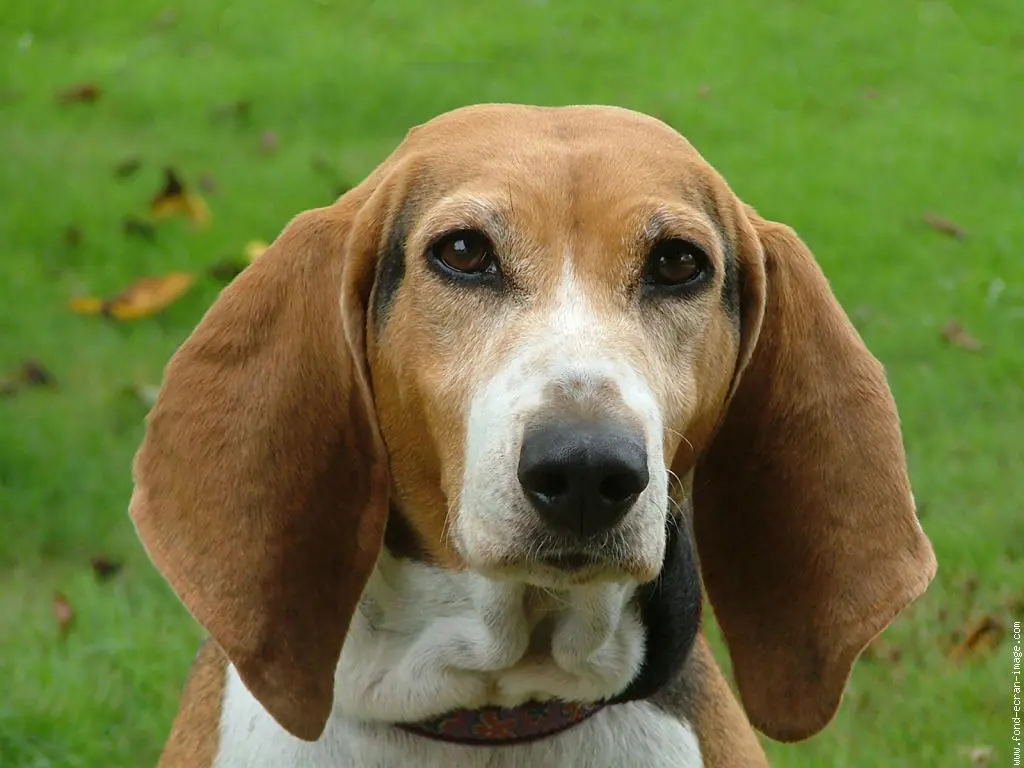
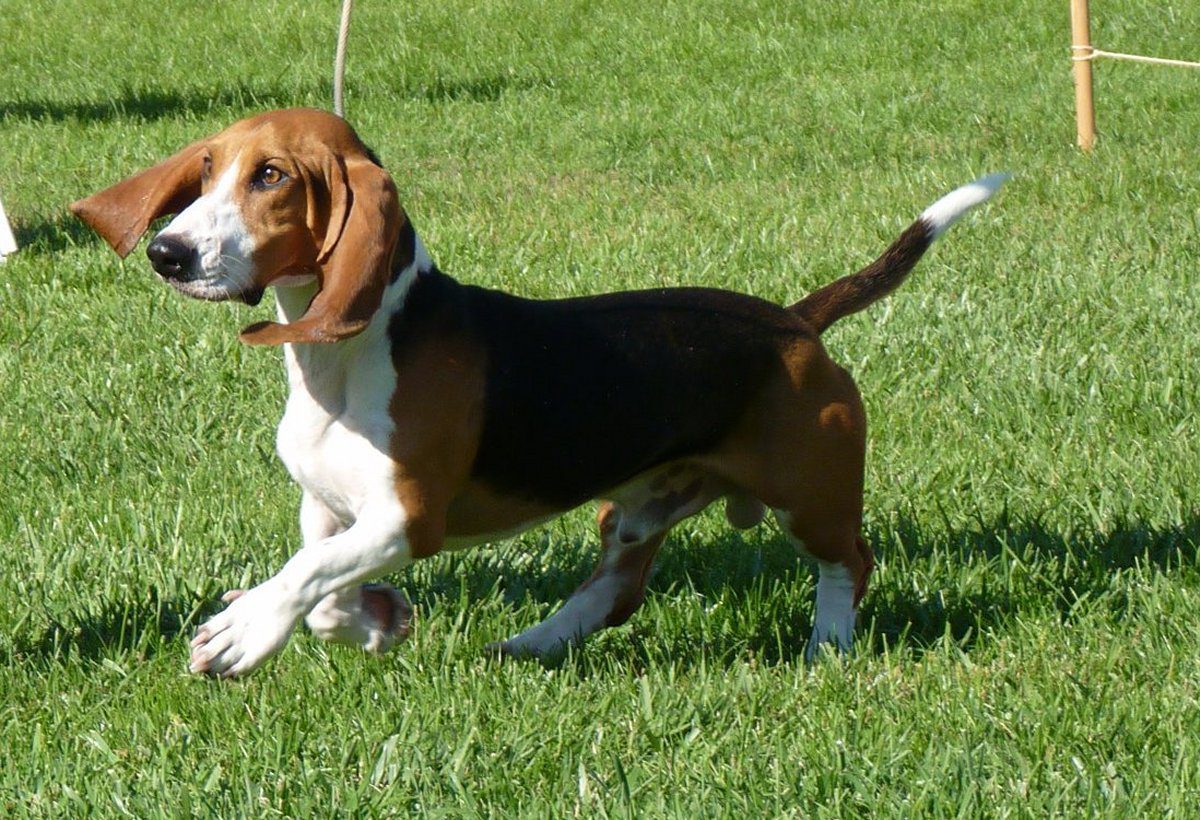
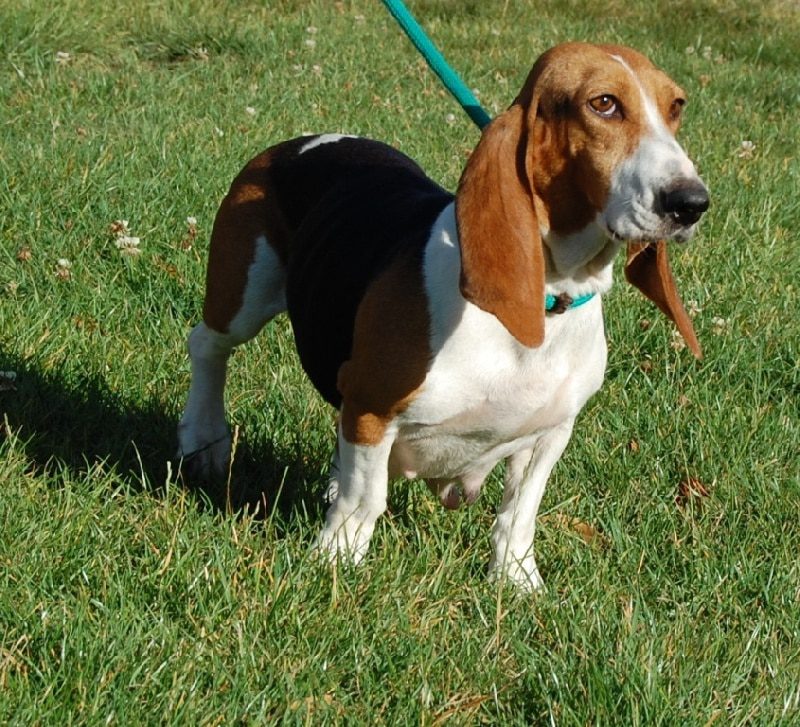
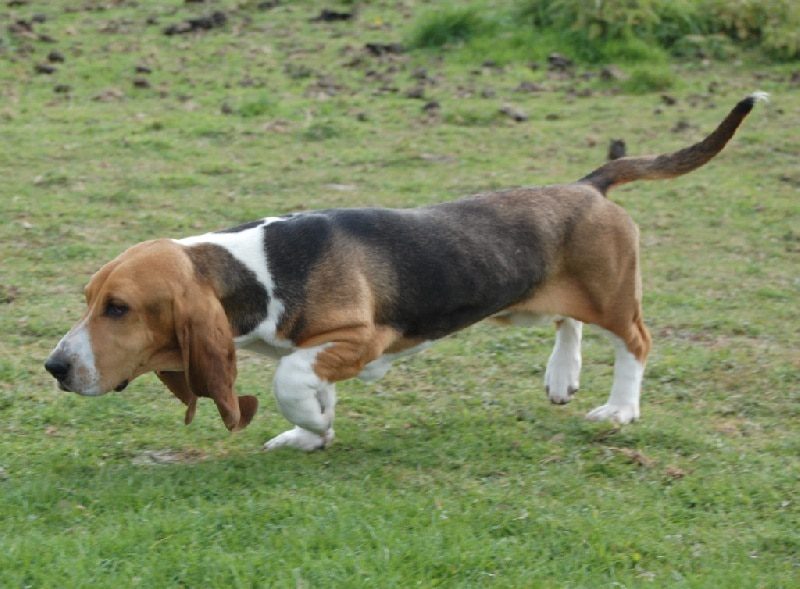
    The family of the Basset hound. Slim body and short limbs. The head has a scrawny appearance because its cheeks are made up solely of skin. The eyes are large (I) dark. The ears are so long as the snout, ending at tip. The neck has a slight double chin. The tail is long and wide at its base.

    Their short legs allow you to delve into the denser undergrowth to leave his hideout dam, which can do a larger dog. Preferably hunting rabbits, but you can also catch both hares, as a deer. While, has no speed, it does have a lot of precision in its movements. Their weight is between the 15 and 20 kg., and its appeal among 30 and 36 centimeters.

    It is very dog very appreciated by hunters.

    Character and skills

    Fairly calm and very obedient at first glance, the Norman Artesian Basset proves to be a real clown and a ball of affection within his family. Mainly a pack dog, finds it difficult to tolerate loneliness and seeks companionship at all costs, either from his classmates, of other animals in the house (even from cats, if they have already been presented to you before) or the humans around him. Very affectionate, needs a lot of attention to really bloom. So, not recommended for a teacher who is not very available. On the other hand, resourceful and kind by nature, it is a very suitable dog for children, for those who will be an inexhaustible and very patient playmate.

    Attention, otherwise, for homeowners in urban or residential areas: though less vocal than his hunting companions, the Norman Artesian Basset remains, However, an expressive and not very discreet dog, especially when playing. Bark to greet a newcomer, expressing your satisfaction or pointing out that you have found something interesting is second nature, and it is very difficult to prevent it from doing so. So, It is not a breed of dog that is recommended for use in apartments.

    This is all the more true since, despite her wobbly appearance, the Norman Artesian Basset he's a consummate sporting dog, who needs to exercise to maintain their physical and psychological balance. Your relaxation, surprising for such a small size, allows it to jump over small walls and stand on its hind legs. It is a very resistant dog, can cover long distances without recoil: a breed of dog suitable for a sports teacher looking for a jogging partner, for example, as long as the terrain is not too steep.

    The qualities mentioned, combined with keen intelligence and excellent memory, make this dog very suitable for hunting, but also to learn tricks, practice dog sports, or even… take advantage of the lack of attention of his master to get away from it all. In fact, his hunting instincts and his developed sense of smell often lead him to follow the clues he finds interesting and to turn a deaf ear to any return order.. So, should not hesitate, for example, in equipping it with a GPS dog collar to limit the risks in case the dog escapes.

    Finally, in a rather paradoxical way, the Norman Artesian Basset they are also very homey, and like the routine. Once they get used to the arrangement of things in the house, the location of your basket and your pace of life, they hate change. So, the news, for example the arrival of a baby at home, adopting a pet or even moving a dog, should be introduced gradually as far as possible.

    Education

    Depending on the use that is given to the Norman Artesian Basset, his education is not the same.

    If it is intended to accompany its master in everyday life as a companion dog, the puppy should be socialized from an early age and should be taught good manners in the company of humans; for example, curb your hunting instincts and don't bark at all costs.

    If, on the other hand, it is intended to be used as a hunting dog, the education of the dog should be directed to the exploitation of these hunting instincts, through socialization with other dogs, hunting search training and teamwork.

    In any case, the dog's life rules must be clearly defined from the start and applied consistently throughout its life. In fact, although affectionate and obedient, this highly intelligent dog can be a real mule head when faced with conflicting commands. So, it is important to think about the role that the dog will play before the puppy comes home, and be firm – but respectful – throughout the training process.

    Health

    The Norman Artesian Basset enjoys fairly robust health compared to other bassets. But, does not escape the health problems inherent in its morphology (long body and short legs). So, you are particularly prone to back problems, and can easily crack or break vertebrae.

    In the case of an obese or overweight dog, being overweight can aggravate back pain that you naturally experience with age, hence the need for owners to closely monitor the dog's diet and provide sufficient and regular physical activity.. Regular exercise is essential to strengthen your back structure and maintain your joints..

    It is also important that your dog is screened for hip dysplasia, especially if there is a history of hip dysplasia in your lineage.

    Last, the Norman Artesian Basset are sensitive to ear infections, and they also have a predisposition to hypothyroidism. This disease can be in some cases hereditary, Therefore, it is recommended not to reproduce the individuals that suffer from it.

    Grooming

    The Norman Artesian Basset it is quite easy to maintain. Her short hair only requires an occasional brush stroke., essentially to get rid of the dried grass and mud that accumulates during your walks in the woods.

    But, like many hounds, tends to have a slightly stronger scent than other breeds, what no dog shampoo will be able to remedy.

    Apart from these considerations, it is important to examine and maintain your dog's ears about once a week, especially to clean any residue that may lodge in them, in order to avoid ear infections and other painful infections.

    โ€œNormandy Artesian Bassetโ€ Price

    The price of a puppy Norman Artesian Basset is between 400 and 900 EUR.

    Photos ยซBasset Artesiano de Normandรญaยป

    Videos ยซBasset Artesiano de Normandรญaยป

    Type and recognitions:

    • FCI CLASSIFICATION:
    • Group :
    • Section : . .

    Federations:

    • FCI – Group 6: Scent hounds, and related breeds. – Section 1.3: Small-sized Hounds. โ“˜
    • UKCScenthounds โ“˜

    FCI breed standard "Norman Artesian Basset"

    Origin:
    France

    Date of publication of the valid original standard:
    12.12.1991

    Use:

    It is a minor hunting dog, used to hunt with shotgun. Hunt the same alone as in a group, giving the signal to barking. Its short legs allow it to penetrate even the densest undergrowth to expel the prey that hides in it, which can do a larger dog. Preferably hunting rabbits, but the hare can also hunt both, like deer. Vent the dam and recover it with great safety, his movement is not fast, but yes noisy and orderly.


    General appearance:

    It's a long dog, in relation to his height at the withers, vigorous, compact ; Its head evokes the nobility of the great Normandy dog.

    IMPORTANT PROPORTIONS :

    Height to the cross / body length : approx.. 5 : 8Chest height / height to the cross : approx.. 2 : 3Skull width / head length : approx.. 1 : 2Length of the snout / skull length : approx.. 10 : 10


    Behavior / temperament:

    Very good nose and tenacious when following the trail; barking on the trail, allows the master to take advantage of his movement without having to advance too quickly. Happy temperament and affectionate nature.

    Head:

    ---

    Cranial region:
    • Skull : Vaulted in shape and medium width; occipital protrusion is clearly observable. As a whole, the head should have a slightly fleshy appearance.
    • Depression links (Stop) : The sinking of the forehead is accentuated, but without exaggeration.

    facial region:

    • Truffle : Black and wide, approaching a little to the lower lip, nostrils wide open.
    • Snout : About the same length as the skull and slightly bulging.
    • Lips : The upper lip broadly covers the lower lip, they are however not too hanging, nor does it extend too far back.
    • Jaws / Teeth : Scissor-shaped denture, That is, the upper incisors cover the lower incisors with firm contact and are implanted at right angles to the jaws.

    Eyes : Oval, large, dark (in harmony with the coat); the calm and serious look; the conjunctiva of the lower eyelid can sometimes be seen, but without exaggeration. The cheeks have one or two folds.

    Ears : Located as far as possible towards the bottom of the head and never above the eye line, they are narrow at the base and have a well marked corkscrew shape, they are flexible, fine, very long, reaching at least the length of the muzzle and preferably ending in a point.

    Neck:

    Rather long, with a little double chin, but without exaggeration.

    Body:

    • Back : Wide and firm.
    • Pork loin : Slightly arched.
    • Rump : The haunches are a bit oblique, imparting a slight incline to the rump.
    • Breast : Oval in appearance, long, the sternum is well extended at the back and protruding at the front ; the apron is well developed. The flanks are solid. The line of the sternum is clearly seen above the elbows. Long ribs, extending all the way back.

    Tail:

    Rather long, thick, at the base and becoming progressively thinner. During rest the tip of the tail should just touch the ground. It must be in the shape of a saber, but without ever falling on the animal and the end should not be in the shape of a feather. Regarding this point, It is absolutely forbidden to modify the appearance of the tail of the dogs participating in the exhibition.

    Tips

    PREVIOUS MEMBERS : As a whole : Front limbs are short and thick. They should be semi-twisted or slightly less than semi-twisted, as long as the kink is conspicuous enough. A few folds in the skin of the wrists, if they are not excessive, should be considered as a quality.

    Correct semi-twist forelimbs

    • Shoulder : Muscular and oblique.
    • Elbows : Well glued the body.

    LATER MEMBERS :

    • As a whole : Seen from behind, you can see a vertical line that starts from the tip of the buttock and crosses the center of the leg., hock, metatarsal and foot.
    • Thighs : Well rounded and muscular.
    • Correct hind limbs Well rounded thighs
    • Hocks : Strong, they descend a lot, they are relatively layered, causing the hind foot to be slightly under the dog when at rest. Small nail bag located at the tip of the calcaneus, formed by excess skin, does not constitute a fault.
    • Metatarsals : Short and strong.

    FEET : Oval, a little elongated, the fingers are fairly close and have a correct poise, in such a way that they rest firmly on the ground.

    Movement:

    Regular step, executed with enough ease. Calm movement.

    Mantle

    SKIN : Elastic and fine.

    HAIR : Satin, short and tight though not too fine.

    COLOR : Tawny, with black and white cloak (โ€œtricolorโ€) or fawn and white (โ€œbicolorโ€). In the first case, head should be extensively covered with intense reddish fawn and retain a small patch of darker hairs on each side of head. The mantle ( or the spots that remain in case the patches of different color spread), will be made up of black or striped hairs (thus complying with the old qualifiers of โ€œhare hairโ€ or โ€œbadger hairโ€).


    Size and weight:

    Height to the cross : Males and females : 30 โ€“ 36 cm..

    Tolerance of more or less 1 cm for exceptional subjects.

    Weight : 15 โ€“ 20 kg.


    Fouls:

    Any deviation from the aforementioned criteria is considered as a fault and the severity of this is considered to the degree of the deviation to the standard and its consequences on the health and well-being of the dog..

    Head

    โ€ข Flat skull.
    โ€ข Wide forehead.
    โ€ข Too marked median groove.
    โ€ข Light eyes, round and bulging, leaving the conjunctiva too visible.
    โ€ข Flat ears, too round, thick or set very high and wide.
    โ€ข Short.Body
    โ€ข Flabby or sunken back.
    โ€ข Absence of xiphoid appendix or its collapse.
    โ€ข Flat or deformed ribs. Tail
    โ€ข Too long, deviated or coarsePrevious limbs
    โ€ข Straight shoulder, short and muscled.
    โ€ข Elbows out.
    โ€ข Carpals that approach or deviate forward.
    โ€ข Pasterns deviated outwards or exaggeratedly twisted.
    โ€ข Crushed feet. Hind limbs
    โ€ข Flat thighs.
    โ€ข Hocks closed or too open. Coat
    โ€ข Soft hair, clearly long or fringed.
    โ€ข Carbonate head.

    Temperament/behavior

    โ€ข Shy dog.

    MISS PLAYOFFS

    โ€ข Fearful or aggressive dog.
    โ€ข Strong anatomical anomaly.
    โ€ข Disabling and recognizable hereditary defect.
    โ€ข Lack of type
    โ€ข Upper or lower prognathism.
    โ€ข Eyes too light.
    โ€ข Sternum too short at the back, with absence of xiphoid appendix.
    โ€ข Very deformed ribs.
    โ€ข Forelegs completely straight.
    โ€ข Limbs too weak.
    โ€ข Very carbonated head.
    โ€ข Very abundant black spots, giving the white color of the coat a bluish tone.
    โ€ข Height at the withers different from the standard.

    Any dog โ€‹โ€‹showing clear signs of physical or behavioral abnormalities must be disqualified..


    N.B.:

    Males should have two normal-appearing testicles fully descended into the scrotum..

    Source: F.C.I - International Cynological Federation

    Alternative names:

    1. Basset Artรฉsien Normand, BAN (English).
    2. BAN (French).
    3. BAN (German).
    4. (em francรชs: Basset artรฉsien normand) (Portuguese).
    5. BAN (espaรฑol).

    โ–ท The world of Pets: Dogs, cats, birds, reptiles, amphibians

    Norwegian Lundehund
    Noruega FCI 265 - Nordic Hunting Dogs
    Lundehund

    Most of the Norwegian Lundehund live in Norway and Finland, it is believed that there are some 2000 copies around the world.

    Content

    History

    The Lundehund (Norsk Lundehund or Norwegian Puffin Dog) It is a small breed of dog of Spitz type, originally from Norway. Its name is composed of the prefix Lunde, Norwegian lundefugl (puffins), and the suffix hund, What dog. The breed was developed to hunt these birds and their eggs.

    The Norwegian Lundehund is a small, rectangular Spitz, with a wide variety of mobility in the joints of your bones, What makes him able to enter through small and intricate passages.

    They remain able to rotate the head back on the backbone and bend the hind legs to the side at an angle of 90 degrees such as the arms of humans, In addition to six toes on the feet.

    The breed has a long history. Already in 1600 It was used for hunting puffins along the Norwegian coast. Its flexibility and extra toes were ideal for hunting of birds in their places of nesting in the inaccessible cliffs and caves.

    Video ยซNorwegian Lundehundยป


    My lundehund

    Interest in the breed declined as new hunting methods for puffins, as for example, the use of networks…, and this ex officio contortionist, was no longer needed. Puffins were a precious object of hunting, the meat was horse and kept and feathers were used to make quilts.

    The breed was nearly extinct around World War II, when the canine distemper hit Vรฆrรธy and the islands surrounding. In 1963, the population was decimated… Only six copies of Lundehund (one Vรฆrรธy and 5 in Soon, to the South of Norway), These five puppies was of the same litter.

    Due to the care of the brood with the strict guidelines, currently there are approximately 1500 or 2000 copies of Lundehund around the world, of this population around 1.100 are in Norway and almost 350 in the United States.

    The official registration of the Lundehund was approved by the American Kennel Club's in the miscellaneous class. 1 in July of 2008, After a unanimous vote of the Board the 13 in November of 2007. The race debuted at the AKC National Championship / Eukanuba in Long Beach, California (United States), the 13 and 14 in December of 2008, being one of the most important events of the American canine world.

    The 12 in February of 2010, The American Kennel Club Board of Directors voted to accept the Lundehund in the AKC Book of Origins and became part of it on 1 in December of 2010. The 1 in January of 2011, became part of the "Non-Sports Group".

    For the American Kennel Club and Canadian Kennel Club, the non-sports group is a diverse classification that comprises a variety of robust dogs with different personalities and appearances as the Chow Chow , and the Keeshond, among others. Covered by the non-sporting group breeds, It is very diverse in terms of appearance, size, layer, personality and, in general.

    According to the FCI classification it is located in the Group 5 Spitz-type dogs and primitive type. Section 2 Nordic Hunting Dogs.

    Physical characteristics

    The Lundehund medium in size looks a bit like a fox and is, also because it is one of the rare races, sometimes mistaken for a mestizo, a Nordic mongrel. On the contrary, is very specialized: The Lundehund has been bred for hunting puffins, a species of bird that breeds in burrows. This brings with it some unique physical characteristics: your shoulder joints are more flexible, allowing it to turn its front legs 90ยฐ to the side. It also, this dog can close his pointed, upright ears, allowing you to dive better.

    The most striking features are undoubtedly the six toes of each foot and the up to eight pads, which give the ancient cliff hunter immense security. Some of these dogs also lack molars, which facilitated the transport of the captured birds without damaging them.

    The Norwegian Lundehund It has a height at the withers of up to 38 cm and weighs 7 kg. sporty and light. The dense coat is short and red to fawn, with black hair tips in places. have a smooth undercoat, very fine and a rough top coat.

    Character and skills

    The Norwegian Lundehund is a four legged friend, simple and skillful, but he has a lot of energy and wants to live it. Due to its independent nature – the Lundehund was left to fend during the hunt – always kept his own head and thus will never fully subordinate himself. Who respects this, win with him Lundehund an easy to train and loyal friend for life.

    Basically the breed is considered to be quite shy, so a close relationship with its owner is especially important – that's how your Lundehund gain security. Towards strangers he is usually reserved – it is also considered to be alert. He usually gets along well with other dogs. The Lundehund not a typical hunting dog, but is also wonderfully suitable as a companion dog.

    The education of the Norwegian Lundehund

    This is a breed of dog with a stubborn and stubborn character, even so they are easy to train and learn the basic commands with great motivation.

    Although the breed belongs to hunting dogs, the Lundehund can accompany you, with some effort in their education, on your nature walks without the need for a leash, since it is not an elusive dog, nor a traditional prey tracker. A major challenge is getting our dogs out of the habit of barking: Lundehund, like all nordic dogs, announce aloud all the supposedly interesting things in their environment – and that in part is quite persistent. So patience is absolutely necessary when training a Lundehund. Already in puppyhood, be sure to keep this in mind when training your dog. Play lessons for puppies, as well as attendance at a canine school, have a positive effect on Lundehund – here you can not only socialize him more with other four-legged friends, but you will surely also get some tips and tricks for the education of this dog.

    Health: the syndrome Lundehund

    Since the population dates back to only five dogs, Controlled breeding of the breed made a new start in the 1990s. 1960, with what the Lundehund has a very small gene pool. One of the five founding dogs developed stomach and intestinal symptoms at the age of about three years, which have spread further among the descendants. Today, this is known as the lundehund syndrome: a chronic, inflammatory bowel disease that is associated with increased protein loss through the intestines. About half of the population is affected by it, although to varying degrees. A genetic test can be used to determine if a dog intended for breeding is a carrier, so that the risk of Lundehund syndrome can be reduced. There is no cure for this disease, only the symptoms can be relieved. While some dogs are barely limited by the disease and have long symptom-free phases, other affected quadrupeds have a more severe course and ultimately lead to death.

    Before deciding to acquire a representative of this breed, must be informed in detail about the lundehund syndrome and the corresponding genetic test and its meaning. The Nordic Dog Clubs can also provide you with more information on this.. The healthy ones Norwegian Lundehund are, for the rest, very robust and can reach an age of about 14 years.

    Norwegian Lundehund "care

    The coat of this Norwegian Coastal Dog is insensitive to weather conditions and requires little grooming. But, the more you brush, less hair is distributed in your home – especially during coat change a daily brushing may make sense, because the Lundehund then lose a lot of hair. Otherwise, care is quite simple: dirt brushes better when dry. By the way, the Norwegian Lundehund It is one of the few dogs that really enjoys grooming. If you support them with the brush, you are also doing something for their bonding.

    Check the ears and eyes regularly and clean them with special ear and eye cleaners if necessary. If the eyes get wet, what happens in many dogs due to narrow tear ducts, it is enough to gently clean and dry them once a day with clear water. Some dog owners opt for daily dental care in the form of toothbrushing with dog toothpaste and toothbrush.. If you already introduce your puppy to this ritual, is an optimal prevention against tartar and associated secondary diseases.

    Activities ยซLundehund Norwegianยป

    Long walks in nature, enjoying the wind and the weather are the base of activity of this Norwegian breed. It also, most of these dogs love to swim. Make your partner happy and give him the opportunity to do it!! But you should also encourage and challenge their brain and skills. There is a wide range of joint activity possibilities at your disposal: Dog lovers can enjoy almost all types of sports with dogs, with the exception of sports with training dogs. Due to his great independence you should not expect unconditional obedience from him, but a relaxed approach to the respective human-animal hobby jointly. Try together with your animal companion which sport you like the most!!

    Is a "Norwegian Lundehund"?

    One Norwegian Lundehund fits well in a sporty family, where at least one family member already has experience with dogs. Learn easily and with pleasure, but for education you still need a certain knowledge and consistency. It also, it is important to use the dog to its full potential – the small Lundehund not a couch dog, needs a lot of outdoor exercise and a lot of time.

    He is usually very fond of children and can also make friends with cats, especially if you met them as a puppy. This dog can also live in a medium-sized apartment, but of course also enjoy a garden (leak proof). It is important to direct the joy of the breed's barking in a controlled manner.

    Before moving, make sure no one in your home has allergies to pet hair and consider whether you can and want to take the dog on vacation – many hotels today welcome four-legged friends – or how you organize care. Although the Lundehund it's more like a small dog, can be quite expensive in terms of regular costs: Apart from a high quality diet with a high content of fish, this includes taxes and dog insurance, as well as visits to the vet. It also, is, of course, the not inconsiderable purchase price of this rare four-legged friend – with possible travel expenses – and if necessary the basic equipment.

    Where can I find my "Norwegian Lundehund"?

    First of all: One Norwegian Lundehund It's very weird. In total, there are some 1.300 specimens all over the world. So, you may very well have to wait a long time and travel many miles to get hold of such a rare dog. Most of the Lundehunds they live in norway. Check with a Norwegian dog club in your country to find out how to contact breeders of the Norwegian Lundehund. Ask your potential dog breeder about the lundehund syndrome and the diet of the breed.

    His young Lundehund will move in with you at the earliest at the age of eight weeks – if you come from a European country, you will normally need a valid rabies vaccine for the trip in addition to the necessary papers. It is essential that you remember booster shots and also talk to your vet about regular deworming of your four-legged friend.

    It is extremely unlikely to find an adult dog, especially outside of norway. So if you're looking for a four-legged adult friend, it is advisable to contact a Nordic dog club. There are also often wonderful mongrel dogs looking for a new home., value the adoption of one of them.

    We wish you much joy with your extraordinary Norwegian Lundehund!

    Characteristics "Norwegian Lundehund"

    Coexistence is important that you have with your new friend. Before considering the acquisition of a dog of the breed "Norwegian Lundehund" you know certain factors. Not all breeds of dogs are apt to live in an apartment, you must take into account his character, their need for exercise, their interaction with other pets, their care and if you have small children, their level of tolerance towards them.

    Adaptation โ“˜

    3,0 of 5 stars (based on 1 review)

    friendly dog โ€‹โ€‹โ“˜

    3,0 of 5 stars (based on 1 review)

    hair loss โ“˜

    4,0 of 5 stars (based on 1 review)

    Affection level โ“˜

    4,0 of 5 stars (based on 1 review)

    Need for exercise โ“˜

    4,0 of 5 stars (based on 1 review)

    Social need โ“˜

    4,0 of 5 stars (based on 1 review)

    Home โ“˜

    4,0 of 5 stars (based on 1 review)

    Toilet โ“˜

    5,0 of 5 stars (based on 1 review)

    Friendly with strangers โ“˜

    3,0 of 5 stars (based on 1 review)

    barking โ“˜

    4,0 of 5 stars (based on 1 review)

    Health โ“˜

    2,0 of 5 stars (based on 1 review)

    Territorial โ“˜

    4,0 of 5 stars (based on 1 review)

    Cat friendly โ“˜

    3,0 of 5 stars (based on 1 review)

    Intelligence โ“˜

    3,0 of 5 stars (based on 1 review)

    Versatility โ“˜

    3,0 of 5 stars (based on 1 review)

    Child friendly โ“˜

    3,0 of 5 stars (based on 1 review)

    Surveillance โ“˜

    4,0 of 5 stars (based on 1 review)

    joy โ“˜

    4,0 of 5 stars (based on 1 review)

    Images "Norwegian Lundehund"

    photos:

    1 – "Norwegian Lundehund" by http://www.petsadviser.com/
    2 – "Norwegian Lundehund" by https://pxhere.com/es/photo/754827
    3 – "Norwegian Lundehund" by https://pxhere.com/es/photo/880994
    4 – Norwegian puffin town Andrva / CC BY-SA
    5 – "Norwegian Lundehund" by https://commons.m.wikimedia.org/wiki/File:Lundehund.jpg
    6 – The Norwegian Lundehund ยซGydaยป looking out at the ocean on the north side of the island Vรฆrรธy in Northern Norway. The island on the top, in the middle, is ยซMoskenยป, the island in the top left is ยซMoskenesยป by ZorroIII / CC BY-SA

    Type and recognitions:

    • FCI CLASSIFICATION:
    • Group :
    • Section : . .

    Federations:

    • FCI – Group 5 – Section 2 Nordic Hunting Dogs. โ“˜
    • AKC – Nordic Hunting Dogs. โ“˜
    • CKC – Nordic Hunting Dogs. โ“˜
    • UKC – Nordic Hunting Dogs. โ“˜

    FCI breed standard "Norwegian Lundehund"

    Origin:
    Norway

    Date of publication of the valid original standard:
    10.11.2011

    Use:

    Its anatomical peculiarities train these dogs for the hunting of the frailecillos in the steep rocks around the fjords and in the cliffs.


    General appearance:

    The "Norwegian Lundehund" is a Spitz type dog, rectangular, small, flexible, relatively light, with well -defined sexual characteristics.


    Behavior / temperament:

    Alert, energetic and vivacious.

    Head:

    Dry, medium width, wedge shaped.

    Cranial region:
    • Skull: Slightly rounded, protruding supraciliary arches
    • Stop: Pronounced but without excess.

    facial region:

    • Horcico: Cuneiform, medium long. Slightly convex muzzle.
    • Jaws / Teeth: Preferably scissor bite. Pincer bite and moderate undershot are acceptable. The lack of premolars in both jaws is allowed.
    • Eyes: Slightly oblique, not outstanding. The iris is yellowish brown. The pupil is surrounded by a dark colored ring.
    • Obars: The triangular ears are medium in size, wide at its base, carried erect and very mobile. They have the special characteristic that the pavilion cartilage can be contracted and the external part can be bent or specially crooked (backwards or upwards at right angles), so that the ear canal is closed.

    Neck:

    Delgado, medium long, quite strong and covered in a relatively abundant collar.

    Body:

    Rectangular.

    • top line: Straight.
    • Back: Strong.
    • Glikeness: Slightly inclined.
    • Pecho: Elongate, average amplitude, proportionally deep and spacious; it is not barrel shaped.
    • Lรญnand the bottom: Slightly retracted belly.

    Tail:

    Insertionmoderatelyhigh, medium long, well covered with dense hair, but without forming feathers. Carried in shapemildringon the back, or he wears it hanging. The tip of the tail must not be carried too high on the back or fall next to the flanks.

    Tips

    PREVIOUS MEMBERS:

    • Apgeneral arience: Moderately angled.
    • Antarm: Straight.
    • Pinis previous: Oval, slightly deflected out. Feet with a minimum of six fingers, of which five step on the ground. Eight pads on each foot. Anatomically the two inner fingers are formed by a finger with three phalanges and one with two phalanges with the corresponding tendon and muscular apparatus. Gives the foot a very strong appearance.

    LATER MEMBERS:

    • Apgeneral arience: The position of the hind limbs is a bit narrow.
    • Thighs: Muscular and strong.
    • Rodinllto: Moderately angled.
    • PinScheme: Muscular and strong.
    • Pinis later: Oval, Something diverted out with a minimum of six fingers, of which four step on the ground. Seven pads on each foot. The middle pad, the most important for its size, attached to the inner pad corresponding to the middle fingers. When the dog is normally standing on a flat surface, your body weight is evenly distributed over all pads.

    Movement:

    Light and elastic. The movement of the anterior members has a characteristic turn of the race and movement of the posterior members is a bit narrow.

    Mantle

    • Plink: Soft inner fluff, dense and rough outer coat. The hair is short on the head and the anterior part of the extremities. Thicker fur around the neck and on the back of the thighs. Dense tail hair, but without forming feathers.
    • Colorr: Always in combination with white. From reddish to more or less mixed with hairs with black tips Fawn; white with dark markings. Usually, the adult specimen presents more hairs with black tips to the young dog.


    Size and weight:

    Alturto the cross:

    • Males from 35 cm to 38 cm.,
    • Females from 32 cm to 35 cm..

    Pthat:

    • Males approximately 7 kg,
    • Females approximately 6 kg.


    Fouls:

    Any deviation from the aforementioned criteria is considered as a fault and the severity of this is considered to the degree of the deviation to the standard and its consequences on the health and well-being of the dog..

    FALTAS DISQUALIFYING:

    • Aggressiveness or extreme shyness.
    • Any dog โ€‹โ€‹showing clear signs of physical or behavioral abnormalities must be disqualified..


    N.B.:
    • Males should have two normal-appearing testicles fully descended into the scrotum..
    • Only functionally and clinically healthy dogs, with the typical conformation of the breed, should be used for parenting.

    Itlatest changes are in bold.

    Source: F.C.I - International Cynological Federation

    Alternative names:

    1. Norsk Lundehund, lundehund, Norwegian Puffin Dog (English).
    2. lundehund (French).
    3. Norsk Lundehund (German).
    4. Cรฃo de papagaio-do-mar (Portuguese).
    5. Perro frailecillo, Lundehund (espaรฑol).

    โ–ท The world of Pets: Dogs, cats, birds, reptiles, amphibians

    Norwegian Buhund
    Noruega FCI 237 . Nordic Watchdogs and Herders.

    The Norwegian Buhund It is usually excellent obedience and dog agility competitions.

    Content

    History

    The Norwegian Buhund (Norsk Buhund, Nordiske Spitz-Hunde, Norwegian Sheepdog or Pastor Noruego) is a breed of dog Spitz type of Norwegian origin which is closely related to the races Icelandic Sheepdog (Icelandic Sheepdog) and Jรคmthund.

    The name Buhund derives from the Norwegian word โ€œBUโ€, meaning farm, farm or mountain refuge, place where the shepherd lived while tending his flock in the summer. The Norwegian Buhund used as a grazing dog and as a watchdog.

    as we said, the Norwegian Buhund belongs to a class of dogs called the type Spitz. They all have pointy ears and a curled tail in common.. Within the races Spitz, There is much variation in terms of size, to the coat and the color.

    The Norwegian Buhund is a very ancient race, part of the existing documentation on the excavation of the "Gokstad shipโ€ entombed at Gokstad farm in Sandar, Sandefjord, Vestfold (Norway) in 1880, contains in addition to the great discovery, they found a Viking grave (that it dated back to the year 900) in which lay the skeleton of a man from between 50 and 70 years of age, and its about the skeletons of six dogs of different sizes, similar to Norwegian Buhund of our times.

    Norwegian Buhund Videos
    Norwegian Buhund in Bath Aftermath (MP4 Version)
    Norwegian Buhund Kahsha Eating Peanut Butter

    This famous archaeological research was directed by Nicolay Nicolaysen (1817-1911) a well-known antiquarian and Norwegian archaeologist. He was a founding member of the Society for the Conservation of Ancient Norwegian Monuments, which presided in 1851. The discoveries from that research are currently on display at the Viking Ship Museum in Oslo..

    Returning to the skeletons of found dogs along with the Tomb Viking, scholars of the subject, pose that these dogs were the ancestors of modern Buhund. and they were there, because in those days when vikings died, necessary and precious possessions were buried with them. It was believed that they would need them in their future life.

    In those days dogs Buhund of the time protected agricultural and livestock farms, he herded sheepโ€ฆaccording to his beliefs, They hoped that dogs continue carrying out their work in the more than. It has been documented that these dogs were with the Vikings on many of his travels, by sea and land.

    Photo: Vali.org

    Physical characteristics

    Returning to the present day the Norwegian Buhund has a rather square profile, are medium-sized and long legs, well takes a tail wrapped around the center of the back. The head is wedge-shaped, with well erect ears and nose of black.

    According to the standard of Norwegian Buhund the height at the cross goes from 43,2 to 45,8 cm., the females are slightly smaller than males. The weight of the males is of 15 to 18 Kg and females of 12 to 16 Kg.

    The colors of the coat may be:

    • Wheat: It includes any shade of colour ranging from pale cream to cream darker, with or without dark markings on the tip of the hair, It is possible to display the color white, but it will have to be minimal, the black mask is acceptable.
    • Solid black: with areas where the color white is allowed, for example, a narrow white ring around the neck, a narrow white tuft in the face, a small spot of white hairs on the chest (by way of tie), at the end of the legs and the tail. In the UK the color โ€œSable Wolf (Wolf Sable)โ€, also permitted, according to the Kennel Club standard of the breed.

    The Norway Buhund is prone to suffer from hereditary eye problems and hip dysplasia.

    The hair coat of the Norwegian Buhund has an average length, the coat is easy to care for, post that is not entangled, a weekly brushing is enough.

    Perhaps the hair when moved, need brushing more often, but is only a seasonal matter.

    Character and skills

    The Norwegian Buhund it's a very cheerful and active race. They never tire easily and require exercise daily and generous. The Norwegian Buhund needs to expel its energy because if not, destructive tendencies may appear (break furniture, objectsโ€ฆ).

    Beyond your high level of activity and energy, they are also very affectionate and famous for his love for unconditional towards children.

    It is a hyper affectionate breed, they love to give and receive affection of his family, that will form strong bonds. You will have a distant and distrustful behavior with strangers, but he is very intelligent so he will notice who is well received and will go in search of affection. They are very sociable and somewhat ladradores, but he will never throw to bite if there is no provocation.

    The Norwegian Buhund, as well, He is very stubborn and shows a strong desire to learn new things, but if the stimulus is not adequate, It is safer to resort to destructive or inappropriate behavior. This is because they get bored easily and are restless. That is why it is necessary that they have ongoing activity.

    This breed is ideal for homeowners that they can devote time and desire to exercise and training of your pet.

    With that insatiable desire for activity and learning combined with his high energy level, the Norwegian Buhund he is usually an excellent dog in obedience and dog agility competitions.

    This breed is an excellent companion for a lover of sports.

    Norwegian Buhund Education

    The Norwegian Buhund is smart and cooperative and likes to serve its people, learns quickly. So, training this dog is not a challenge for already experienced dog owners. Before moving in with a dog of this breed, beginners should intensely attend to their characteristics, as well as the training of dogs in general and especially with regard to herding dogs.

    In addition to basic obedience, it is important that the Norwegian Buhund pay special attention to the control of barking and the training of loneliness from the age of the puppy: Of course you shouldn't leave your dog alone for long, but you must get used to the fact that he has to endure without his beloved human herd from a very young age. A game lesson for puppies, as well as a visit to a dog school, are a good help for the Norwegian Buhund, who doesn't always get along with his congeners, familiarize yourself with other different canine characters and to socialize it more in this regard. With this vivacious four-legged friend, always remember that only a physically and mentally exhausted dog can be successfully trained – otherwise he'll look for a way out for his boredom.

    Norwegian Buhund Health

    The Norwegian Buhund are considered robust and weatherproof. The breed has largely been freed from hereditary diseases to this day. Occasionally there is an increased risk of painful dysplasia of the hip joint, as well as hereditary eye diseases. You can be sure if you only buy from a breeder who performs the proper preliminary exams with the parents' animals. Responsible breeding with technical knowledge is the best way to minimize the risk of hereditary diseases.

    Especially in summer, make sure your pet doesn't get too hot and switch sports activities to early morning or late afternoon – After all, the Norwegian Buhund is designed for cooler climates.

    The optimal diet of Norwegian Buhund

    This active four-legged friend needs a proper workload for the species, as well as proper nutrition, that provides you with high-quality energy. Give your partner a grainless meal, but with a high meat content. This means that the meat must be at the top of the ingredients list. This applies to both dry and wet foods..

    The manufacturer's feeding recommendations regarding daily rations can only be guidelines that you should adapt depending on your dog's constitution and actual activities. Snacks or treats can be both tasty and healthy. These may include, opt for sugar-free dental care snacks or jerky snacks to reward your dog. With dry chewables like cow's ears, you can meet their chewing needs. Weigh your adult dog regularly to counteract any possible weight gain or loss in time. Its Norwegian Buhund should always have enough fresh water available.

    Norwegian Buhund Care

    The dense fur of the Norwegian Buhund it's weatherproof and easy to care for, but loses it relatively in abundance, so it's best to leave the corduroy pants in the closet during the weeks of change of coat. Shedding in spring and autumn can be shortened to a few days by daily combing. Out of this "hairy period", it's enough to comb your hair once a week.

    Get your puppy used to the grooming ritual:

    This not only prepares him to be combed in adulthood, but also strengthens the bond. Dirt can be brushed from dry coat, in difficult cases it helps to clean the area with a damp cloth. You should only give your Norwegian quadruped a bath every few months to protect the dog's skin.. In this case, use a mild dog shampoo. Check your pet's eyes and ears regularly and clean them with an eye or ear cleaner if necessary. Older dogs, in particular, or those who walk almost exclusively on soft soils, may need help with claw care: Go for a pedicure if the claws get too long to avoid painful hooking.

    Where can I find a Norwegian Buhund?

    You won't find a Norwegian Buhund in all cities – you often have to travel hundreds of miles or abroad to find a representative of this breed as a new family member. However, should remain selective and only buy from breeders who belong to a club and can give information on parental animal health care openly and with appropriate evidence. Ideally, you can visit the breeders at home before making a decision, despite being away, to exchange information about their upbringing, puppies, but also his personal experience with dogs. Because a serious breeder makes sure he only puts his protรฉgรฉs in an environment suitable for them.

    Adult dogs are very difficult to find outside of Scandinavia and the countries mentioned.. So if you are interested in a bug of this breed, you're looking for a new home, you should search the Internet on the pages of Nordic dog clubs or contact these clubs. If required, can help you or have knowledge about dogs that are very similar to Norwegian Buhund or mixed breeds that might be considered. Some Nordic grazing dogs are similar in their character and exterior appearance, for example the Finnish Lapphund or the Icelandic Sheepdog. Keep your eyes open when you're looking for your partner, but also find out the history of your possible new partner to see if it is a good match for you and your environment.

    Characteristics "Norwegian Buhund"

    Coexistence is important that you have with your new friend. Before considering the acquisition of a dog of the breed "Norwegian Buhund" you know certain factors. Not all breeds of dogs are apt to live in an apartment, you must take into account his character, their need for exercise, their interaction with other pets, their care and if you have small children, their level of tolerance towards them.

    Training ?

    4,0 of 5 stars (based on 1 review)

    Suitability of the apartment ?

    2,0 of 5 stars (based on 1 review)

    Can be alone all day ?

    1,0 of 5 stars (based on 1 review)

    Suitable as a first dog ?

    3,0 of 5 stars (based on 1 review)

    Weight gain ?

    3,0 of 5 stars (based on 1 review)

    Health ?

    4,0 of 5 stars (based on 1 review)

    Intelligence ?

    4,0 of 5 stars (based on 1 review)

    Kindness with child ?

    4,0 of 5 stars (based on 1 review)

    Tendency to bite ?

    3,0 of 5 stars (based on 1 review)

    Tendency to bark ?

    4,0 of 5 stars (based on 1 review)

    Tendency to flee ?

    2,0 of 5 stars (based on 1 review)

    hair loss strength ?

    4,0 of 5 stars (based on 1 review)

    Suitable as a guard dog ?

    4,0 of 5 stars (based on 1 review)

    Joy ?

    4,0 of 5 stars (based on 1 review)

    Cat friendliness ?

    3,0 of 5 stars (based on 1 review)

    Power level ?

    4,0 of 5 stars (based on 1 review)

    Images of the Norwegian Buhund

    Videos "Norwegian Buhund"

    Type and recognitions:

    • FCI CLASSIFICATION:
    • Group :
    • Section : . .

    Federations:

    • FCI – Group 5 – Section 3 Nordic Watchdogs and Herders.. โ“˜
    • AKC – Nordic Watchdogs and Herders. โ“˜
    • ANKC – Nordic Watchdogs and Herders. โ“˜
    • CKC – Nordic Watchdogs and Herders. โ“˜
    • โ€‹KC – Nordic Watchdogs and Herders. โ“˜
    • NZKC – Nordic Watchdogs and Herders. โ“˜
    • UKC – Nordic Watchdogs and Herders. โ“˜

    FCI breed standard "Norwegian Buhund"

    Origin:
    Norway

    Date of publication of the valid original standard:
    09.08.1999

    Use:

    guard dog, farm and multipurpose shepherd


    General appearance:

    It is a typical Spitz dog of just medium size., square form, with an awake and frank expression. It has pointed and erect ears. The tail is carried firmly screwed on the back.


    Behavior / temperament:

    Energetic, brave, Kind.

    Head:

    Size proportional to the body, not too heavy, cuneiform and thin. The particularities of the male and female sex must be well defined.

    Cranial region:
    • Skull: Almost flat. The upper axes of the snout and skull are parallel. Well filled under the eyes.
    • Depression links (Stop): Well defined, but not too steep.

    facial region:

    • Truffle: black.
    • Snout: The length of the muzzle should be approximately equal to that of the skull. Not too narrow, not too heavy. The nasal helm is straight.
    • Lips: Firmly tightened, blacks.
    • Jaws/Teeth: Scissor bite. Complete denture.
    • Eyes: Oval, color as dark as possible. The edges of the eyelids are black.
    • Ears: Medium-sized, pointy; carried firmly erect.

    Neck:

    medium width, delgado, strong with a well raised demeanor.

    Body:

    • Back and loin: Short, strong, straight.
    • Rump: As less oblique as possible.
    • Breast : Deep with well sprung ribs.

    Tail:

    High insertion, tightly screwed, carried over the center of the back, not too far to the side.

    Tips

    PREVIOUS MEMBERS:

    โ€ข General appearance: Strong, with good bones. Shoulder: Moderately oblique.
    โ€ข Elbows: Well glued, turned neither in nor out.
    โ€ข Forearms: Straight.
    โ€ข Metacarpos: Moderately oblique.
    โ€ข Front feet: Oval, compact.

    LATER MEMBERS: Moderate angulations.

    โ€ข Thigh: Powerful, good muscular.
    โ€ข Leg: Well musculada.
    โ€ข Hind feet: Oval, compact.

    Movement:

    Effortless, parallel, with good push. Firm back line.

    Mantle

    Fur: Thick outer layer, abundant and hard, but rather smooth and glued. On the head and front of the limbs, the hair is comparatively short, in the neck, on the chest, on the back of the thigh and on the tail is longer. Soft, dense inner layer of hair.

    Color:

    • Wheat (Biscuit): Varies from pale to yellowish red, with or without hairs with charred tips; but that should not modify the basic color. A light and bright color is favored. As white as possible.
    • Negro: Uniform preference (without too much tan). As white as possible.


    Size and weight:

    Height to the cross:

    • In males 43 โ€“ 47 cm..
    • In females 41 โ€“ 45 cm..

    Weight:

    • Males: approximately 14 โ€“ 18 kg.
    • females: approximately 12 โ€“ 16 kg.


    Fouls:

    Any deviation from the aforementioned criteria is considered as a fault and the severity of this is considered to the degree of the deviation to the standard and its consequences on the health and well-being of the dog..

    ยท Very fine or too coarse constitution, lack of elegance.
    ยท Liver colored truffle (brown) or pink.
    Pincer bite.
    ยท Clear eyes, protruding eyes.
    ยท Insufficiently coiled tail, hanging tail, unwanted feathers.
    ยท Croup higher than the withers.
    ยท Circular movement of the forelimbs, short steps, productivity-free.
    ยท Wavy or too long hair.
    ยท Nervousness.

    FALTAS DESCALIFICANTES:

    ยท Aggressiveness or extreme shyness.
    ยท Any dog โ€‹โ€‹showing clear signs of physical or behavioral abnormalities should be disqualified.
    ยท Superior or inferior prognathism.
    ยท Ears not erect.
    ยท Any color different from the one mentioned above.
    ยท Dogs that measure 1 cm minus 2 cm more than the height at the cross indicated in the standard.


    N.B.:

    ยท Males must have two normal-appearing testicles completely descended into the scrotum.
    ยท Only functionally and clinically healthy dogs, with the typical conformation of the breed, should be used for parenting.

    Source: F.C.I - International Cynological Federation

    Alternative names:

    1. Norsk Buhund, Norwegian Sheepdog (English).
    2. Berger norvรฉgien (French).
    3. Norsk Buhund (German).
    4. Pastor norueguรชs (Portuguese).
    5. Buhund, Pastor de Noruega (espaรฑol).

    โ–ท The world of Pets: Dogs, cats, birds, reptiles, amphibians

    Norrbottenspets
    Suecia FCI 276 - Nordic Hunting Dogs

    Norrbottenspets

    The Norrbottenspets also used as a draft dog.

    Content

    History

    The Norrbottenspets (North Bothnian Country Spitz) probably originates from the small spitz-type Laika that was known to live with hunters in the North Cape area, already in prehistoric times. Small hunting spitz have survived for thousands of years through natural selection โ€“ survival of the fittest. In the very harsh and difficult areas of the northern part of the Scandinavian Peninsula, hunting for food and skins was a necessity in order to survive. Precious skins like saber, sable fur and ermine were the only valid currency for centuries. When fur prices fell drastically after WWII, so did the interest in the Norrbottenspets.

    The breed disappeared and there were no records for many years, hence the Kennel Club of Sweden (SKK) declared it extinct. But only a decade later news came that true-type specimens had been found living as pets and watchdogs in small homes inland in North Bothnia.. Due to the very dedicated work of a few men, this ancient hunting spitz was saved.
    In 1967 the Norrbottenspets was introduced to the Registries and a new standard was drawn up.

    Source: https://www.fci.be/en/nomenclature/NORRBOTTENSPITZ-276.html

    Physical characteristics

    It is a small spitz-type dog with a rather square appearance, compact and plump, with a lean and strong musculature. The bearing is handsome, with head and tail high. The breed has a strong sexual dimorphism, although the ideal specimen for both sexes is a well-characterized small spitz, attentive, good guardian, of harmonious construction and good character.

    The skull is sharp, with the ears set high and relatively small, eyes are dark and bright, and express calmness and predisposition towards work.

    Ears are slightly below average size with sparse hair and erect bearing. The tail is set relatively high, with fairly tall carriage in a semicircle, with the tip touching the sides of the thighs. When it stretches, must not exceed the tip of the hock.

    Fur: hard, short, straight and quite bushy, with fine and dense undercoat. The length varies depending on the area of โ€‹โ€‹the body: longer around the neck and on the thighs and shorter on the skull and front of the extremities.

    Color: all colors are allowed. The ideal is white with yellow or brownish red spots.

    Size: males 45 cm.; females, 42 cm.

    Character and skills

    Norrbottenspets

    The pretty white colored Spitz, of medium size and short hair is very rare in its native country and practically unknown outside of Sweden.

    He is an excellent guard with a lot of drive, temperament and stubbornness. With the appropriate physical and mental tension, It is also a nice and friendly companion dog..

    As a born hunter, the Norrbottenspets He is very Brave, fearless and alert. He is extremely lively and has a great temperament and self-confidence.. The Norrbottenspets it is very suitable as a guard dog, because it reports everything I miss immediately without being aggressive. In the family he is very sociable, friendly and gentle. But the intelligent and self-assured dog can also be headstrong and needs sensitive training and clear guidance..

    The Norrbottenspets he is very docile, but it needs a lot of movement and a lot of demanding and varied activity. The ideal are, for example, tests with companion dogs, sports tournaments with dogs or rescue dog training. Only with the appropriate mental and physical activity the Norrbottenspets It is also a nice and friendly family companion dog.. As a pure house dog or for a life in the city it is not the right dog.

    Characteristics "Norrbottenspets"

    Coexistence is important that you have with your new friend. Before considering the acquisition of a dog of the breed "Norrbottenspets" you know certain factors. Not all breeds of dogs are apt to live in an apartment, you must take into account his character, their need for exercise, their interaction with other pets, their care and if you have small children, their level of tolerance towards them.

    Adaptation โ“˜

    2,0 of 5 stars (based on 1 review)

    friendly dog โ€‹โ€‹โ“˜

    2,0 of 5 stars (based on 1 review)

    hair loss โ“˜

    3,0 of 5 stars (based on 1 review)

    Affection level โ“˜

    3,0 of 5 stars (based on 1 review)

    Need for exercise โ“˜

    4,0 of 5 stars (based on 1 review)

    Social need โ“˜

    3,0 of 5 stars (based on 1 review)

    Home โ“˜

    2,0 of 5 stars (based on 1 review)

    Toilet โ“˜

    2,0 of 5 stars (based on 1 review)

    Friendly with strangers โ“˜

    2,0 of 5 stars (based on 1 review)

    barking โ“˜

    5,0 of 5 stars (based on 1 review)

    Health โ“˜

    4,0 of 5 stars (based on 1 review)

    Territorial โ“˜

    4,0 of 5 stars (based on 1 review)

    Cat friendly โ“˜

    2,0 of 5 stars (based on 1 review)

    Intelligence โ“˜

    4,0 of 5 stars (based on 1 review)

    Versatility โ“˜

    2,0 of 5 stars (based on 1 review)

    Child friendly โ“˜

    4,0 of 5 stars (based on 1 review)

    Surveillance โ“˜

    4,0 of 5 stars (based on 1 review)

    joy โ“˜

    2,0 of 5 stars (based on 1 review)

    Type and recognitions:

    • FCI CLASSIFICATION:
    • Group :
    • Section : . .

    Federations:

    • FCI – Group 5 – Section 2 Nordic Hunting Dogs. โ“˜

    FCI breed standard "Norrbottenspets"

    Origin:
    Sweden

    Date of publication of the valid original standard:
    22.07.1982

    Use:

    hunting dog.


    General appearance:

    Small Spitz type dog, slightly rectangularwell balanced, With thin muscles andwell developed. Alert holding your head up, fearless and extremely agile attitude. Sexual dimorphism must be clearly visible.


    Behavior / temperament:

    In his capacity as a hunting dog he must be attentive and fearless. He is an enthusiastic dog, live, self-confident, with a friendly disposition. Although the breed is mainly used to hunt large partridges of the bush (Grouse etc.) It is also capable of hunting prey of hair and howler elk.

    Head:

    Strong ofclean cut, top or side view, gradually tapering towards the nose.


    Cranial region:
    • Skull: Relatively widethe forehead is slightly arched, the upper part of the skull is rather flat.
    • Depression links (Stop): Evidentbut only slightly marked.

    facial region:

    • Truffle: black.
    • Snout: Its length is half the length of the head or somewhat shorter. Clearly tapering towards the nose but never pointed
    • Lips: Thin, and tightly fitted.
    • Cheeks: Defined.
    • Jaws / Teeth: Well developed jaws and teeth. Scissor bite.

    EYESMedium-sized, almond shaped and inserted obliquely.Bright with calm and energetic expression. dark brown color.

    EARS: High insertion, upright, slightly larger than medium size, with hard skin, slightly rounded tips.

    Neck:

    Moderately longin proportion with the body, dry and muscular, slightly arched, with good scope.


    Body:

    Cross: Defined.

    Back: Short, strong, muscular andelastic

    Pork loin: Short and broad.

    Rump: Moderately long and wide, slightly inclined and with well developed musclesand strong.

    Breast : Moderately deep and long.The depth of the chest should be approximately half the height at the withers and with well developed back ribsSeen from the front, the thorax is oval in shape andwith a normal width. Well developed and well defined forechest.

    Bottom line and belly: Seen on side, The lower part of the rib cage must be in line with the elbow or barely under it and emerge gently on the belly line. Bellyonly moderately retracted.

    Tail:

    Proportionally high insertion, carried in a fairly high curve, slightly curled so the tip of the tail touches one side of the thigh. The length of the tail must not reach below the hock. Tail docked is not allowed.

    Tips

    PREVIOUS MEMBERS :

    • Blades : Long and wide, With well developed spine and muscles. Glued to the chest and properly oblique.
    • Arm : It must be the same length as the scapula, strong, well attached to the chest but allowing freedom of movement and forming a marked angle with the spine of the scapula.
    • Elbows : Directed backwards Forearm : Straight, with strong bones, thin but flexible muscles.
    • Carpus and metacarpus : Strong, forming a straight line with the forearm, when seen from the front. Seen on side, The metacarpo is slightly oblique.
    • Previous feet : Small, strong, directed straight ahead, well arched and closed, with hard, well-developed pads.

    LATER MEMBERS : Seen from behind, the hind limbs are parallel.

    • Thigh : Proportionally long, forming a right angle with the pelvis. Strong muscles.
    • Knee joint : Strong.
    • Leg : Form a sharp angle with your thigh.
    • Warm-foot joint : Side and front view, is strong.
    • Metatarsus : Delgado, elastic and rather long.
    • Hind feet : Similar to the previous. Headed straight forward.

    Movement:

    During the trot and canter, Norrbottenspets should show smooth and regular movements, with great momentum and covering the ground well. In action, The upper line must remain firm and the posterior parallel members.

    Mantle

    HAIR : The hair is hard, short, straight, and rather close to the body, with fine and dense undercoat. Must be short on the muzzle, skull, ears and front of limbs, longer at the nape, back of the thighs and under the tail.

    COLOR : All colors are permitted. The ideal color is white with yellow or reddish-brown markings.


    Size and weight:

    Height to the cross :

    Ideal height :

    • in males : 45 cm.
    • in females : 42 cm..


    Fouls:

    Any deviation from the aforementioned criteria is considered as a fault and the severity of this is considered to the degree of the deviation to the standard and its consequences on the health and well-being of the dog., and the dog's ability to perform its traditional task.

    SERIOUS FAULTS:

    • Meat or liver color nose.
    • Dental missing except for P1.
    • Tan markings.
    • Roan or speckled.

    FALTAS DESCALIFICANTES:

    • Aggressiveness or extreme shyness.
    • Any dog โ€‹โ€‹showing clear signs of physical or behavioral abnormalities.
    • Short tail.


    N.B.:
    • Males should have two normal-appearing testicles fully descended into the scrotum..
    • Only functionally and clinically healthy dogs, with the typical conformation of the breed, should be used for parenting.

    The latest changes are in bold.

    Source: F.C.I - International Cynological Federation

    Alternative names:

    1. Nordic Spitz, Norrbottenspitz, Pohjanpystykorva (English).
    2. Spitz nordique (French).
    3. Norrbottenspets, Pohjanpystykorvat (German).
    4. Spitz nรณrdico (Portuguese).
    5. Spitz nรณrdico (espaรฑol).

    โ–ท The world of Pets: Dogs, cats, birds, reptiles, amphibians

    Norwich Terrier
    Inglaterra FCI 72 . Small sized Terriers.
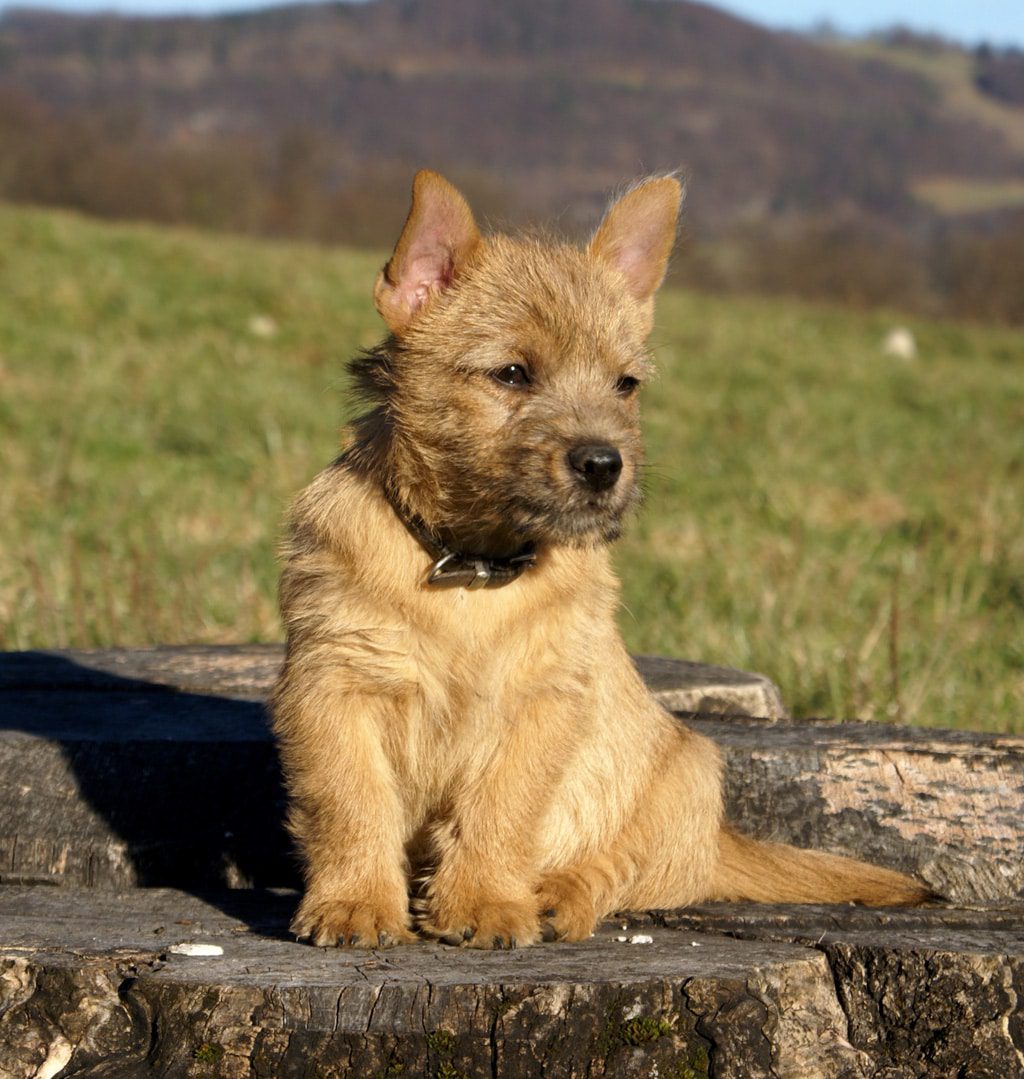
    Norwich Terrier

    The Norwich Terrier, has lively character, joyful, affectionate and is curious by nature.

    Content

    History

    One of the reasons there are so many Terrier breeds is because many were created to measure for a given area or population.. The Norwich comes from the East Anglia of England, Cambridge University Headquarters. Like college students of any age, Cambridge students of the decade 1880 they thought it was a lot of fun betting on sporting events, including your dogs' mouseing skills. Los terrier, including those in yorkshire and ireland, they were bred to develop small red or black and tan dogs with a spirit of play. They were known as Terriers Trumpington.

    A Trumpington named Rags, he was a stable dog near the city of Norwich, He had such a reputation as a buzzard that he had a profound influence on what would become known as Norwich Terrier. Rags and their descendants were crossed with other Terriers, including a small Staffordshire Terrier, and became known for a new skill: get foxes out of their burrows.

    Since the 19th century there are documented sources that confirm the breeding of the Norwich Terrier. But, At that time there was also Norfolk Terrier, which is closely related to the Norwich Terrier. Back then it was considered the same race, nowadays they differ in insignificant points. Since the decade of 1960 the two races have been handled differently.

    A particularly different trait is the ears, in the Norwich Terrier tend to be more upright, While in the Norfolk Terrier they are slightly bent. After many years of upbringing, you can see some character differences. The Norwich Terrier, for example, is considered more affectionate than the Norfolk Terrier. At that time animals were especially used as rat catchers and were often used on farms.

    Physical characteristics

    It is one the smaller Terrier its height is maximum 25 cm the cross and his weight is between 5 and 5.5 kg.

    Recently on United States, There has been a great fraud with these dogs, they sold fake Norwich Terriers with pedigree, by Internet.

    Son difficult to create because their births tend to be by caesarean section. His cloak is twofold and can be red, Red wheat, Black fire or salt and pepper (grey).

    Norwich Terrier has a fur two layers, a foreign finish hard, rough and a warm and soft layer, attached to the skin.

    Ideally, styling it once a week to remove the loose hairs killed.

    As minimum, the hair should be stripped once in the fall and once in the spring.

    Observations

    The cut or Court it adversely affects the appearance of the natural colors of the layer and texture.

    Character and skills

    The Norwich Terrier, they have a character lively, joyful, loving and they are curious by nature.

    One advantage is that they are not anti-social dogs or they tend to show aggressiveness.

    They were originally bred to hunt burrowing animals but today they have become excellent companion animals..

    These small but sturdy dog, brave, Smart and very loving. They were bred for chasing varmints and accompanied their owners farmers on horseback. A good daily walk is therefore, the minimum necessary to meet exercise requirements, and give a healthy lifestyle.

    They are sensitive to the scolding, as the 100% Terrier. Much like family life, and very little loneliness. It is not meaningless ladrador, But if you notice something strange, It will be.

    It is a dog that She loves children. They adapt perfectly to other pets.

    The life expectancy the Norwich Terrier is 12 to 16 years.

    Characteristics "Norwich Terrier"

    Coexistence is important that you have with your new friend. Before considering the acquisition of a dog of the breed "Norwich Terrier" you know certain factors. Not all breeds of dogs are apt to live in an apartment, you must take into account his character, their need for exercise, their interaction with other pets, their care and if you have small children, their level of tolerance towards them.

    Adaptation โ“˜

    5,0 of 5 stars (based on 1 review)

    friendly dog โ€‹โ€‹โ“˜

    5,0 of 5 stars (based on 1 review)

    hair loss โ“˜

    2,0 of 5 stars (based on 1 review)

    Affection level โ“˜

    4,0 of 5 stars (based on 1 review)

    Need for exercise โ“˜

    4,0 of 5 stars (based on 1 review)

    Social need โ“˜

    3,0 of 5 stars (based on 1 review)

    Home โ“˜

    4,0 of 5 stars (based on 1 review)

    Toilet โ“˜

    3,0 of 5 stars (based on 1 review)

    Friendly with strangers โ“˜

    2,0 of 5 stars (based on 1 review)

    barking โ“˜

    4,0 of 5 stars (based on 1 review)

    Health โ“˜

    2,0 of 5 stars (based on 1 review)

    Territorial โ“˜

    3,0 of 5 stars (based on 1 review)

    Cat friendly โ“˜

    4,0 of 5 stars (based on 1 review)

    Intelligence โ“˜

    4,0 of 5 stars (based on 1 review)

    Versatility โ“˜

    2,0 of 5 stars (based on 1 review)

    Child friendly โ“˜

    4,0 of 5 stars (based on 1 review)

    Surveillance โ“˜

    4,0 of 5 stars (based on 1 review)

    joy โ“˜

    3,0 of 5 stars (based on 1 review)

    Norwich Terrier Images

    Norwich Terrier Videos

    Type and recognitions:

    • FCI CLASSIFICATION:
    • Group :
    • Section : . .

    Federations:

    • FCI – Terriers 2 Small sized Terriers. โ“˜
    • AKC – Terriers โ“˜
    • ANKC – Terriers โ“˜
    • CKC – Terriers โ“˜
    • โ€‹KC – Terriers โ“˜
    • NZKC – Terriers โ“˜
    • UKC – Terriers โ“˜

    FCI breed standard "Norwich Terrier"

    Origin:
    United Kingdom

    Date of publication of the valid original standard:
    13.10.2010.

    Use:

    Terrier


    General appearance:

    One of the smallest terriers. It's a cunning dog, short limb, compact and strong, with good structure and skeleton. Honorable scars resulting from deterioration and natural tears should not be unfairly penalized.


    Behavior / temperament:

    One of the smallest ground dogs. Loving but not quarrelsome, tremendously active and robustly built. Cheerful and brave.

    Head:

    ---

    Cranial region:
    • Skull: Wide and slightly rounded, with good width between the ears.
    • Depression links (Stop): Well defined.

    facial region:

    • Snout: Strong and wedge-shaped (its length is less than a third of the distance measured from the occipital to the base of the naso-frontal depression).
    • Lips: Glued.
    • Jaws / Teeth: Strong and sharp jaws. Pretty big teeth, strong, with healthy teeth, complete and scissor bite, that is to say, that the inner face of the upper incisors is in close contact with the outer face of the lower incisors; the teeth should be set at right angles in the jaws.
    • Eyes: relativelysmall, oval-shaped, dark, full of expression, bright and lively.
    • Ears: erect, placed well apart on the skull. Medium-sized and pointed. When the dog is excited he carries them perfectly erect and can throw them back when he is not attentive.

    Neck:

    Strong and of good length, in proportion to the overall balance of the dog, and it descends harmoniously towards the well inclined shoulders.

    Body:

    Compact

    • top line: Level.
    • Back: Short
    • Pork loin: Short.
    • Breast : Long, well-rounded chest. With good depth.

    Tail:

    Previously optional tail amputation.
    • Medium amputation: High implementation, completing a perfectly level dorsal line. Carried upright.
    • Without amputation: Tail of moderate length to give the dog a general balance, thick at the base and is tuned toward the tip, as straight as possible, live, but not too happy, completing a perfectly level dorsal line.


    Tips

    PREVIOUS MEMBERS:

    • Elbows: Glued to the body.
    • Forearm: Short limbs, powerful and straight.
    • Metacarpus: Firm and straight.
    • Previous feet: Round, with thick, cat-like foot pads. Headed straight forward when the dog moves or stands.

    LATER MEMBERS:

    • General appearance: Widths, strong and muscular.
    • Knee : good angulation.
    • Metatarsus: Hockslowered with great pushing capacity.
    • Hind feet: Round, with thick, cat-like foot pads. Headed straight forward when the dog moves or stands.

    Movement:

    The forelimbs should move forward in a straight line when the dog is moving.; the hind limbs follow the tread of the forelimbs; hocks are parallel and flex to show pads.

    Mantle

    • Fur: Lasted, rough texture, straight and close to the body, with a dense undercoat. Longer and rougher at the neck forming a collar that frames the face. The hair on the head and ears is short and straight, except for slight eyebrows and a mustache.
    • Color: All shades of red, wheat, black and Tan or grey. Stains or white markings are undesirable.


    Size and weight:

    The ideal height to cross is between 25 cm..


    Fouls:

    Any deviation from the aforementioned criteria is considered as a fault and the severity of this is considered to the degree of the deviation to the standard and its consequences on the health and well-being of the dog..

    FALTAS DESCALIFICANTES:

    1. Aggressiveness or extreme shyness.
    2. Any dog โ€‹โ€‹showing clear signs of physical or behavioral abnormalities must be disqualified..


    N.B.:
    1. Males should have two normal-appearing testicles fully descended into the scrotum..
    2. Only functionally and clinically healthy dogs, with the typical conformation of the breed, should be used for parenting.

    The latest changes are in bold.

    TRANSLATION: Brรญgida Nestler / Original version: (IN) Technical supervision: Miguel Angel Martinez

    Source: F.C.I - International Cynological Federation

    Alternative names:

    1. Norwich (English).
    2. Norwich (French).
    3. Norwich (German).
    4. Norwich (Portuguese).
    5. Terrier de Norwich (espaรฑol).

    โ–ท The world of Pets: Dogs, cats, birds, reptiles, amphibians

    Norfolk Terrier
    Inglaterra FCI 272 . Small sized Terriers.

    Norfolk Terrier

    The Norfolk Terrier is lively, cheerful and adapts both the countryside and the city.

    Content

    History

    The Norfolk Terrier he is a very small terrier, low rise. Until 1964 formed a dog breed along with the Norwich Terrier. Both differ only in the shape of their ears. While the Norfolk Terrier has slanted ears, the Norwich Terrier has standing ears. In the past these dogs were raised together and it was always a surprise that puppies had ears. Because the judges at the shows at least felt they preferred lop-eared dogs, wanted to have floppy or tilted ears in a class of their own. But, either standing or with ears hanging, they are wonderful terriers, vivacious little ones you can enjoy. They come from the Middle East of England. There these little terriers served the town for many years as watchdogs and hunters at home and at court..

    Keeping rats and mice, driving away a marten or fox that wanted to feed on chickens or pigeons at night, they proved to be useful helpers at home and in court. But, the small Norfolk Terrier was not, like many other somewhat larger terriers, used for active fox hunting, the marten and the otter. Didn't have to go in pursuit of these predators. He would not have lacked courage and determination. The Terriers de Norwich and Norfolk they were useful as a cat, but much more defensive and effective, especially when it came to fighting rats. They also had the added value of being watchdogs and danger alarms and were better able to deal with harsh, wet and cold weather conditions of central England.

    So these little terriers were already widespread in cities centuries ago.. Consequently, they were bred solely for their suitability for their tasks. Either with upturned or drooping ears, it did not matter. As their tasks drifted away from rats to accompany the human psyche, the subtleties of his outward appearance also came into play. One separated the terrier into two breeds. In 1954, both were officially recognized by the FCI under the name of Norwich Terrier. The tipped-ear variant was recognized as a separate breed in 1962.

    Physical characteristics

    It is a small dog, clever, short limb, compact and vigorous; It has short back and its structure and strong bones.

    Norfolk Terrier has a hair double layer: a hard top layer, ribbed and a warm and soft layer.

    Ideally, is due comb the hair once a week to remove the loose hairs, dead and prevent mat.

    Itร‚ยดs one of the smaller Terrier dogs, a "demon" for its size. Affectionate but not quarrelsome, robust Constitution.

    The tail amputation is optional. Medium amputation, set level with the dorsal line and carried erect. Tail of moderate size to give the dog an overall balance, thick at the base and is tuned toward the tip, as straight as possible, happily held, but not in an excessive manner.

    Its movement is natural, low and high thrust. Previous members directed straight forward from the shoulders. A good angulation of the hindlimbs provides you with a great driving force.

    The Member posterior move in line with the anterior, with free movements from the hips, and they must bend well at the knees and hocks. level top line.

    The hair It hard, rough texture (wire), straight and well attached to the body. Long and rough in the neck and shoulders.

    The hair is short and smooth on the head and ears, with the exception of a few light eyebrows and mustache.

    With regard to the color, We find all the shades of reddish, wheat, black and Tan or grey. Stains or white markings are undesirable, but allowed.

    The height ideal to the cross is between 25 and 26 cm..

    Character and skills

    Norfolk Terrier should not be aggressive despite being able to defend itself if necessary. Them, along with Norwich Terrier and the Border Terrier, has the softer temperament of the Terrier group.

    Videos of the Norfolk Terrier
    Two norfolk terriers playing
    Norfolk TerrierLightbox for Video by VideoLightBox.com v1.11

    Like fellow, they love people and children and they are good pets. His level of activity is generally a reflection that the pace of its environment.

    This breed should not stay or live outside, that thrive with human contact. In general, Norfolk Terrier does not generally dig, but, like any dog, will dig out of boredom when left alone for too long a period.

    Usually, living well with other pets when introduced as a dog. In the open air, they are natural hunters and have a strong instinct for prey to small bugs.

    The Norfolk Terrier is a dog self-confident, they are elegant, they are erect tail and head. A Norfolk Terrier that is shy or tucks its tail between its legs is unusual..

    The typical Norfolk Terrier temperament is happy, cheerful and self-confident. His greatest punishment would be to be ignored by the family..

    Norfolk Terrier were bred as barn dogs to rid the stables of animal pests. Today, they are household companions and must have a pleasant willingness to live with the people.

    The life expectancy of a Norfolk Terrier is of 12 to 15 years.

    Observations

    Today, the demand for Norfolk Terrier is much more to offer

    They are dogs that tend to have small litters and responsible breeders developed the breed, they only breed healthy dogs that are of good temperament, lineage, good pedigree and those that best reflect the breed standard.

    Norfolk Terrier Education

    The education of this breed is an often underestimated chapter. Although the already little dog looks so cute, especially in his first months of life, he is a true terrier very sure of himself. And such a terrier wants to be educated and guided. So, the Norfolk Terrier requires consequences in education from puppy age. Although small, dreams like most terriers in some corner of his brain of assuming leadership of the pack. Deep down he feels loose like a mastiff or a great dane. So you just have to take your education seriously.. Otherwise, there is no problem. He wants and needs the guidance of his master or mistress and is a docile companion., friendly and sociable, that always brings a smile to our faces.

    Norfolk Terrier Health and Care

    The coat should be regularly groomed. The Norfolk does not know a change of coat. Two or three times a year dead hair should be trimmed, that is to say, ripped – but with moderation.

    The small Norfolk Terrier it is a fairly robust breed of dog.

    Nutrition / Food

    Norfolk Terrier nutrition has no problems.

    Norfolk Terrier life expectancy

    The Norfolk Terrier they tend to have robust health and an average life expectancy of 15 years and more.

    Buy a Norfolk Terrier

    The best way to buy your puppy Norfolk is to buy it locally from an FCI member breeder or take a look at the shelter. A dog of this breed costs around 1.000 EUR.

    Characteristics "Norfolk Terrier"

    Coexistence is important that you have with your new friend. Before considering the acquisition of a dog of the breed "Norfolk Terrier" you know certain factors. Not all breeds of dogs are apt to live in an apartment, you must take into account his character, their need for exercise, their interaction with other pets, their care and if you have small children, their level of tolerance towards them.

    Adaptation โ“˜

    5,0 of 5 stars (based on 1 review)

    friendly dog โ€‹โ€‹โ“˜

    4,0 of 5 stars (based on 1 review)

    hair loss โ“˜

    4,0 of 5 stars (based on 1 review)

    Affection level โ“˜

    4,0 of 5 stars (based on 1 review)

    Need for exercise โ“˜

    4,0 of 5 stars (based on 1 review)

    Social need โ“˜

    3,0 of 5 stars (based on 1 review)

    Home โ“˜

    4,0 of 5 stars (based on 1 review)

    Toilet โ“˜

    1,0 of 5 stars (based on 1 review)

    Friendly with strangers โ“˜

    4,0 of 5 stars (based on 1 review)

    barking โ“˜

    4,0 of 5 stars (based on 1 review)

    Health โ“˜

    4,0 of 5 stars (based on 1 review)

    Territorial โ“˜

    3,0 of 5 stars (based on 1 review)

    Cat friendly โ“˜

    4,0 of 5 stars (based on 1 review)

    Intelligence โ“˜

    4,0 of 5 stars (based on 1 review)

    Versatility โ“˜

    5,0 of 5 stars (based on 1 review)

    Child friendly โ“˜

    4,0 of 5 stars (based on 1 review)

    Surveillance โ“˜

    4,0 of 5 stars (based on 1 review)

    joy โ“˜

    5,0 of 5 stars (based on 1 review)

    Norfolk Terrier pictures

    Norfolk Terrier Videos

    Type and recognitions:

    • FCI CLASSIFICATION:
    • Group :
    • Section : . .

    Federations:

    • FCI – Terriers 2 Small sized Terriers. โ“˜
    • AKC – Terriers โ“˜
    • ANKC – Terriers โ“˜
    • CKC – Terriers โ“˜
    • โ€‹KC – Terriers โ“˜
    • NZKC – Terriers โ“˜
    • UKC – Terriers โ“˜

    FCI breed standard "Norfolk Terrier"

    Origin:
    United Kingdom

    Date of publication of the valid original standard:
    13.10.2010

    Use:

    Terriers


    General appearance:

    It is one of the smallest ground dogs. Crafty, short limb, compact and vigorous; It has short back and its structure and strong bones. Honorable scars resulting from deterioration are allowable.


    Behavior / temperament:

    He is a "demon" for his size. Affectionate but not quarrelsome, robust Constitution. Alert and brave.

    Head:

    ---

    Cranial region:
    • Skull: Width, just slightly rounded and wide between the ears.
    • Depression links (Stop): Well defined.

    facial region:

    • Snout: Strong and wedge-shaped; its length is less than a third of the distance measured from the occipital to the frontal-nasal depression (Stop).
    • Lips: Attached.
    • Bite / Teeth : Robust jaws, strong and fairly large teeth, with healthy teeth, complete and scissor bite, that is to say that the internal face of the upper incisors is in contact with the external face of the lower incisors; teeth should be set at right angles in the jaws.
    • Eyes: Oval, dark brown or black, with an alert expression and a smart and lively look.
    • Ears: Medium-sized and V-shaped, slightly rounded at the tip, carried forward along the cheeks.


    Neck:

    Strong and medium length.

    Body:

    Compact, short, level back, well rounded ribs.

    Tail:

    Previously optional tail amputation.
    1. Medium amputation, tail set level with dorsal line and carried erect.
    2.  Tail of moderate size to give the dog an overall balance, thick at the base and is tuned toward the tip, as straight as possible, happily held, but not in an excessive manner.


    Tips

    PREVIOUS MEMBERS:

    • General appearance: Sharp.
    • Shoulder: Well leaning back and approximately arm length.
    • Forearm: Short forelimbs, powerful and upright.
    • Previous feet: Round and with thick pads.

    LATER MEMBERS:

    • General appearance: Well muscled.
    • Knee: Well angulated.
    • Metatarsus: Hockswell descended and straight when viewed from behind, endowed with great driving force.
    • Hind feet: Round and with thick pads.

    Movement:

    Natural, low and high thrust. The forelimbs are directed straight forward from the shoulders. A good angulation of the hindlimbs provides you with a great driving force. The hind limbs move in line with the forelimbs., with free movements from the hips, and they must bend well at the knees and hocks. level top line.

    Mantle

    • Fur: Lasted, rough texture (wire), straight and close to the body. Long and rough in the neck and shoulders. The hair is short and smooth on the head and ears, with the exception of a few light eyebrows and mustache. Excessive grooming is undesirable.
    • Color: All shades of red, wheat, black and Tan or grey. Stains or white markings are undesirable, but allowed.


    Size and weight:

    The ideal height at the withers is: 25 cm..


    Fouls:

    Any deviation from the aforementioned criteria is considered as a fault and the severity of this is considered to the degree of the deviation to the standard and its consequences on the health and well-being of the dog..

    FALTAS DESCALIFICANTES:

    • Aggressiveness or extreme shyness.
    • Any dog โ€‹โ€‹showing clear signs of physical or behavioral abnormalities must be disqualified..


    N.B.:
    • Males should have two normal-appearing testicles fully descended into the scrotum..
    • Only functionally and clinically healthy dogs, with the typical conformation of the breed, should be used for parenting.

    The latest changes are in bold.

    TRADUCCION: Brรญgida Nestler / Original version: (IN) Technical supervision: Miguel Angel Martinez

    Source: F.C.I - International Cynological Federation

    Alternative names:

    1. Norfolk (English).
    2. Norfolk (French).
    3. Norfolk (German).
    4. Norfolk (Portuguese).
    5. Terrier de Norfolk (espaรฑol).