FCI 224 . Spaniel type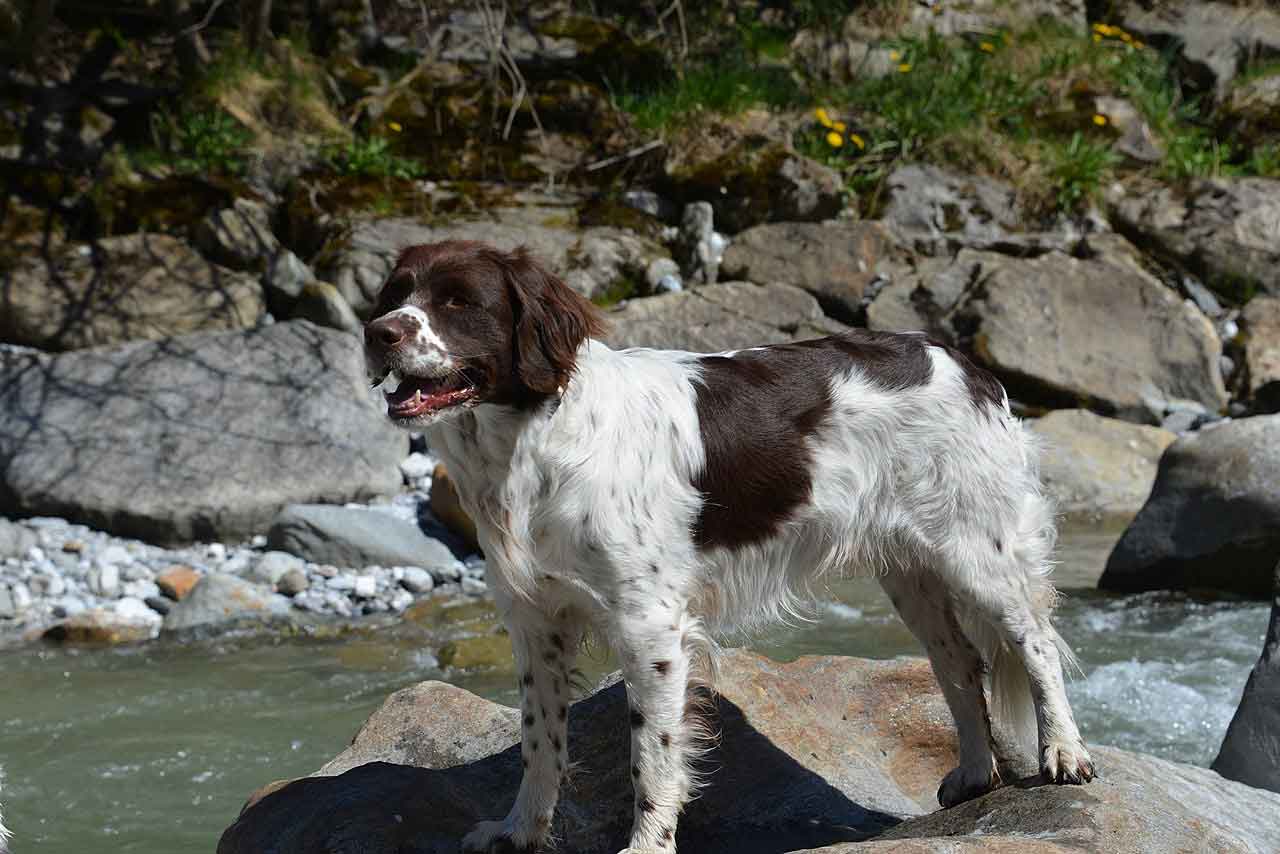
Content |
|---|
Characteristics "Dutch Partridge Dog"
Coexistence is important that you have with your new friend. Before considering the acquisition of a dog of the breed "Dutch Partridge Dog" you know certain factors. Not all breeds of dogs are apt to live in an apartment, you must take into account his character, their need for exercise, their interaction with other pets, their care and if you have small children, their level of tolerance towards them.
Adaptation ⓘ3,0 of 5 stars (based on 1 review)
|
friendly dog ⓘ4,0 of 5 stars (based on 1 review)
|
hair loss ⓘ5,0 of 5 stars (based on 1 review)
|
|---|---|---|
Affection level ⓘ5,0 of 5 stars (based on 1 review)
|
Need for exercise ⓘ4,0 of 5 stars (based on 1 review)
|
Social need ⓘ3,0 of 5 stars (based on 1 review)
|
Home ⓘ2,0 of 5 stars (based on 1 review)
|
Toilet ⓘ2,0 of 5 stars (based on 1 review)
|
Friendly with strangers ⓘ3,0 of 5 stars (based on 1 review)
|
barking ⓘ4,0 of 5 stars (based on 1 review)
|
Health ⓘ4,0 of 5 stars (based on 1 review)
|
Territorial ⓘ2,0 of 5 stars (based on 1 review)
|
Cat friendly ⓘ2,0 of 5 stars (based on 1 review)
|
Intelligence ⓘ4,0 of 5 stars (based on 1 review)
|
Versatility ⓘ4,0 of 5 stars (based on 1 review)
|
Child friendly ⓘ4,0 of 5 stars (based on 1 review)
|
Surveillance ⓘ2,0 of 5 stars (based on 1 review)
|
joy ⓘ4,0 of 5 stars (based on 1 review)
|
History
The Dutch Partridge Dog it is an ancient canine breed, that can be found in paintings painted centuries ago.
Originaria de Drenthe, a dutch province, the breed was developed during the 16th century from dogs from Spain, what were called Spionenen or Spaniolen. In the Netherlands they were given the name of Patrijshond, what does retriever mean.
in the east of the country, especially in the province of Drenthe, these dogs were bred as pure breeds, without any mix with other foreign races, as it happened in other places. This isolation allowed the Perdiguero to remain unchanged during 3 or 4 centuries.
The 15 in May of 1943, was recognized by the Raad van Beheer op Kynologish Gebied from the Netherlands, a recognition strongly encouraged by Baroness van Hardenbroek and Messrs. van Heek junior and Quartero.
The responsible breed club was founded on 5 in June of 1948, with the name of Nederlandse Vereniging of Drentsche Patrijshond.
Related to him Small Munsterlander and the French Spaniel, the Dutch Partridge Dog is quite limited in number, and the breed is almost unknown outside its borders.
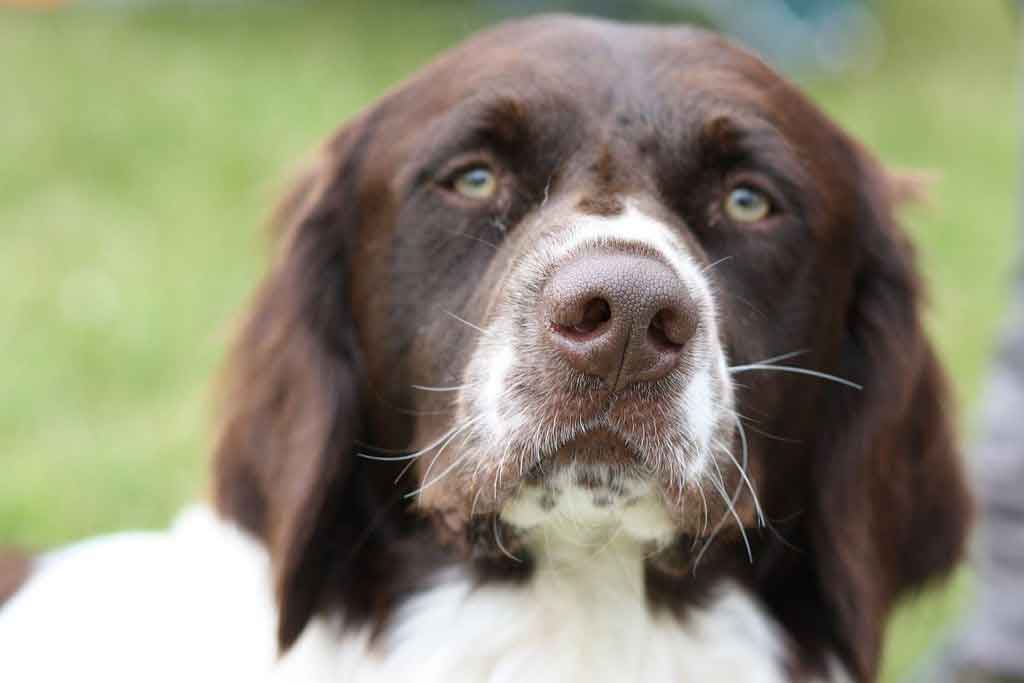
Photo: «Drentsche Partridge Dog» macho by Stefanie Joksch, CC BY-SA 4.0, via Wikimedia Commons
Physical characteristics
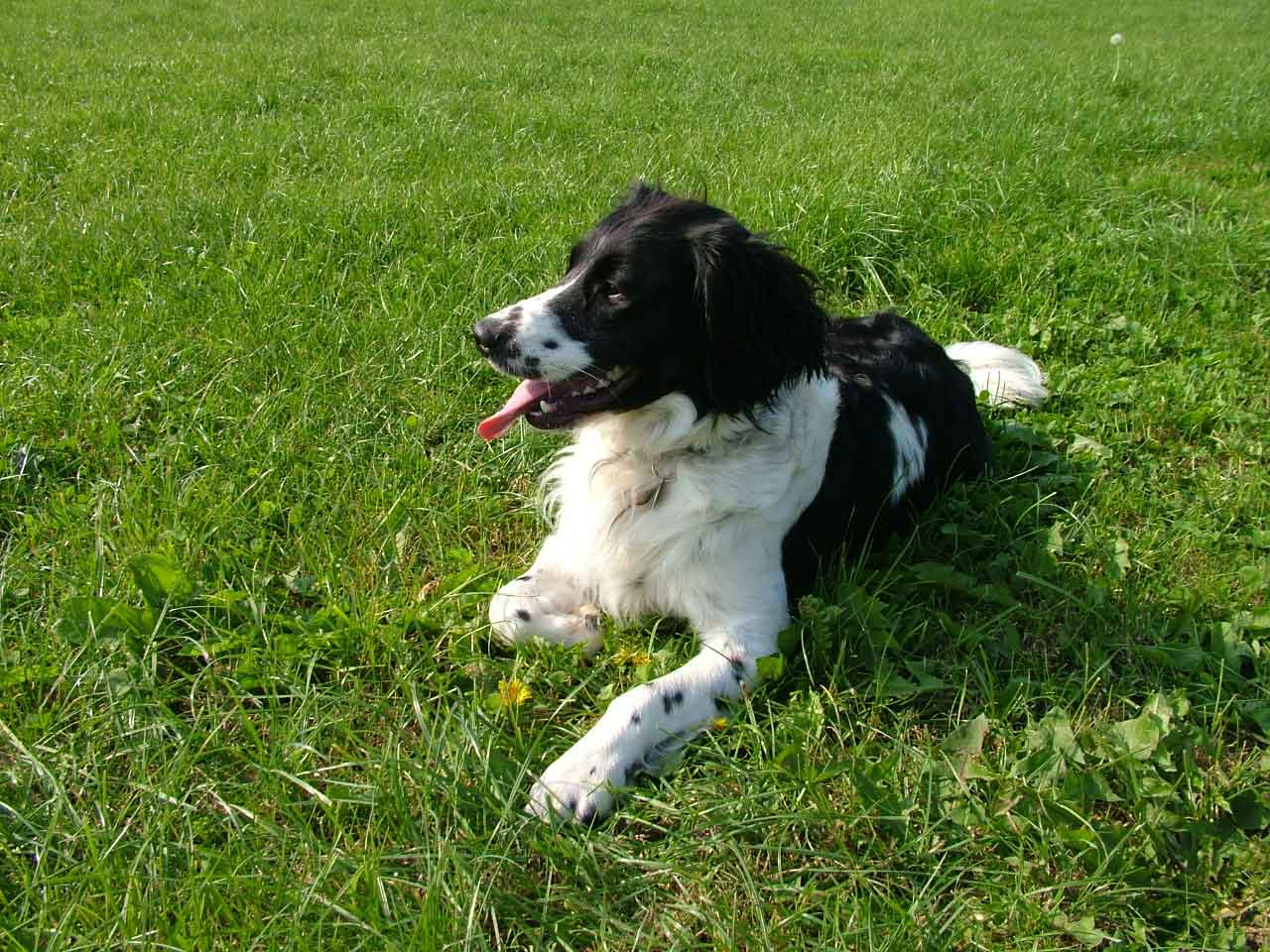
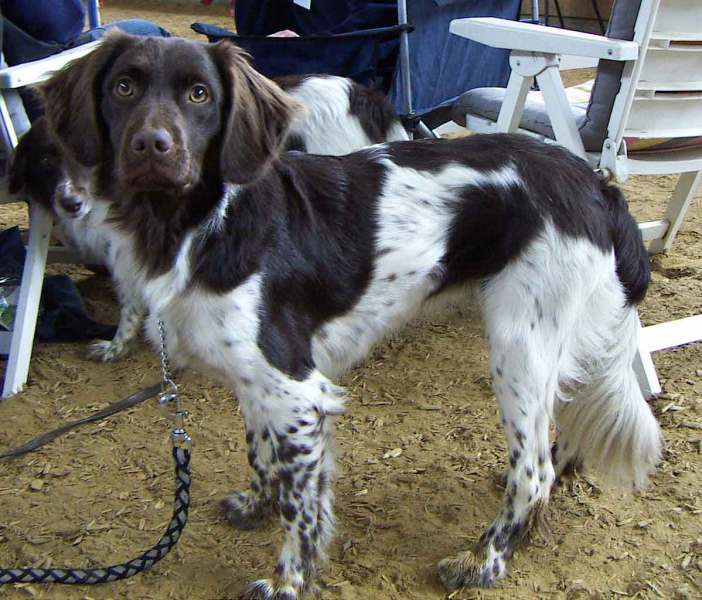
The Dutch Partridge Dog he is a well proportioned dog, with dry muscles, pure in its lines. His body reveals power and also the ability to run at the speed that suits a hunting dog. Wedge-shaped muzzle is slightly shorter than skull. The lips are quite dry and are not hanging. Her body, slightly longer than the height of the withers, is slightly elongated. Although the fur is not really long on the body, gives the impression of being so because of the well-populated ears, more abundant hair on the neck and chest, the fringes on the front and back legs and on the bushy tail, abundantly populated on all sides.
They have a dense coat that covers the body well. Not curly. The hair is not really long, but as it is longer in some parts, the dog, as a whole, gives the impression of having long hair. On the neck and chest, the hair is longer. In the ears, the hair is long and preferably wavy. The ears, the back of the front and back legs and the back of the thighs are fringed. Hair preferably wavy on the upper part of the body and tail. Except for its base, the tail is abundantly provided with long hair on all sides. These hairs are gradually shortened towards the tip.
COLOR: White fur with brown spots, mottled or not. Coats with a mix of brown and white hairs, with or without marks, are less desirable, like the cloak coats. The ears are brown, like the hair around the eyes.
SIZE:
Males: 58 to 63 cm..
females: 55 to 60 cm..
Weight: Of 20 to 25 kg
Character and skills
They are ideal for hunting in a wide variety of terrain. They hunt with pistol shooting. Maintaining contact with the hunter is apparently an innate quality. A characteristic feature of many dogs of this breed is that, during the hunt, the tail describes a circular motion, especially when the dog is aware of the proximity of the prey. When he's close to hunting, the dog waits for the hunter to approach and when the hunter is late, turn your head to look for the game. Thanks to its adaptability, the dog is capable of hunting all kinds of animals on the plains and swamps. It is also a good retriever and excels at searching for lost game.. These characteristics are innate. Thus, does not require long training.
The Dutch Partridge Dog it is also a very good companion dog because it is faithful, friendly, attentive. Your education should be done smoothly, without aggressiveness or too much firmness.
This dog requires regular maintenance. It will be an accomplice of the children and it is possible to leave them together. under surveillance, of course. Apartment living will get you down, you need to have at least one garden for him. to let off steam and also for daily walks.
Health
The Dutch Partridge Dog he is a robust dog, but can be injured while hunting (fracture, sprain, tendinitis, wound…). His ears are down, poorly ventilated, prone to ear infections. Some dogs may be affected by hip-femoral dysplasia, a malformation of the hips that causes lameness and pain.
Grooming
The Dutch Partridge Dog should be brushed once a week to remove dead hairs and dirt. You can bathe once a month with a suitable shampoo.
Inspect and clean floppy ears once a week. When we come back from the hunt, we will check that he is not injured. Good antiparasitic and vacation coverage will be launched.
Images "Dutch Partridge Dog"
 Drentsche Patrijshond Bowi the Gloucester during upland game hunt in Idaho by DutchID, CC BY-SA 3.0, via Wikimedia Commons
|
 |
|---|
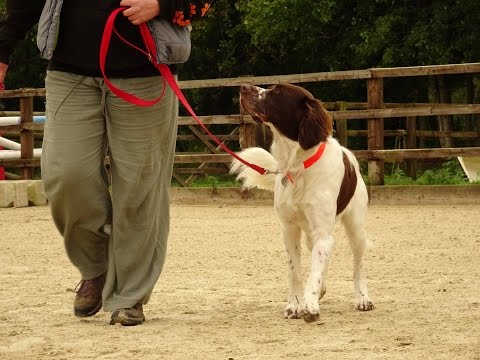
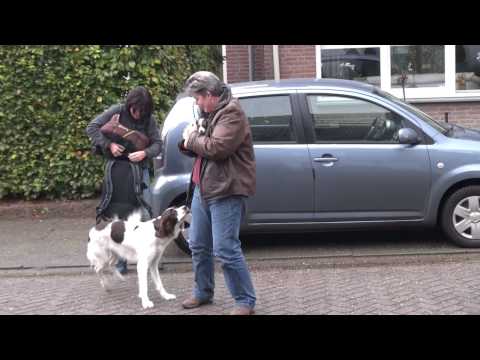
Videos "Dutch Partridge Dog"
Type and recognitions:
- FCI CLASSIFICATION:
- Group :
- Section : . .
Federations:
- – FCI – Group 7: Pointing Dogs. – Section 1: Continental Pointing Dogs. 1.2: Spaniel type ⓘ
- – UKC – Gun Dog ⓘ
FCI breed standard "Dutch Partridge Dog"
Use:
Pointing Dogs.
General appearance:
Well proportioned dog, dryly muscled and with a well-defined cut structure, whose body shows power and also the ability to develop the speed necessary for a hunting dog.
It has a wedge-shaped snout which is a little shorter than the length of the skull and relatively dry., no hanging lips. His body is a little longer than his height at the withers , therefore slightly elongated. The mantle, although it is not really long in the body, It gives this appearance because the ears and tail are well covered with hair and because of the abundance of hair on the neck and chest., as well as the presence of fringes on the ears, front and hind limbs and especially in the tail.
It is the ideal hunting dog for various types of terrain. Hunt within shotgun range. Keeping in touch with the hunter seems to be an innate quality. A characteristic of several dogs of this breed is that while searching for prey, the tail has a circular movement, especially when you feel the trail. When approaching the prey, the dog waits for the hunter to arrive., when it is delayed, He looks back looking for his master.
It has the adaptability that makes it capable of hunting all types of prey on land or in water., Besides, he is a good collector and finder of lost prey.. These characteristics are innate therefore, needs very little training.
Due to his gentle nature, it is not okay to use force methods for his training..
He is loyal and intelligent, which does, along with good education and training, a very esteemed family dog, apart from a valuable hunter's companion.
Head:
---- The skull It is quite wide and only slightly domed. In the midline it has a groove barely visible from the stop, which is mild, up to half the distance to the occipital protuberance, moderately developed.
- Depression links (Stop) : Seen from the front and from the side, the skull gradually tilts towards the snout, the cheeks also gradually decrease towards the muzzle. Superciliary ridges are well developed.
facial region:
- Truffle : Well developed and brown in color. Windows wide open.
- Snout : Wedge-shaped and slightly shorter than the skull, truncated at the end, without any sign of cut under the eyes. The nasal cannula is wide, It is neither concave nor convex. A very slight upward curve behind the nose is permitted. Roman nose is a serious fault.
- Lips : Quite thin and dry.
- Jaws / Teeth : strong bite, well-fitting scissors bite.
- Cheeks : Moderately developed.
Eyes : They are widely spaced and placed in such a way that they are well protected; They are neither prominent nor sunken, medium sized and oval shaped. Its expression shows the kind and intelligent character of this hunting dog.. It is desirable that the eye color be amber, that is to say, that are neither dark nor too light like the eyes of a bird of prey. The eyelids are well attached to the eyeball.
Ears : They are not heavy, They are high insertion; Since their insertion, they remain close to the cheeks without forming folds.; When they are pulled forward, three fingers are missing so that their length reaches the tip of the nose.. They are wide at the insertion and rounded at the tip.. The abundant hair that covers the ears is wavy and long; does not have curly hair. The hair is shorter at the tips of the ears, the inner edge also with abundant fringe. When attention is drawn, he puts his ears forward and raises them. Seen from the front, the ears form a triangle with the fold in the middle of the leather of the ears.. The ears are mobile showing different moods.
Neck:
Strong, medium long, rather short than long; forms a continuous, fluid line between the head and the trunk. A longer neck than desired, giving the impression of more elegant but lacking strength is undesirable. The dewlap and loose skin on the throat are atypical in the appearance of this dog with a dry build and well-defined lines and are therefore undesirable..Body:
- top line : A smooth line from the neck, of moderate length, with a straight back and loins, forms a fluid line that ends in a slightly descending rump.
- Back : Strong, medium long, not very short; Together with the well-angled forelimbs and hindlimbs, it gives the impression that the body is elongated..
- Pork loin : Strongly muscled.
- Rump : Wide and long, slightly descending.
- Breast : Deep that reaches up to the elbows; Seen from the front it is quite wide; the forelimbs should not be obstructed by overly arched ribs, narrow and shallow chest is considered fault. Elongated rib cage; well developed back ribs, arched, not flattened or barrel-shaped.
- bottom line : Little withdrawn.
Tail:
Very high insertion, the length of the tail reaches the tibio-tarsal joint. The first half is hanging and the rest forms a slight upward curve.. In action, part of the tail is carried horizontally and the last part in a slight upward curve.. It never has its tail curled over its back.. With the exception of its root, the tail is covered with a lot of fringe, which decreases towards the tip.Tips
PREVIOUS MEMBERS :
- Shoulders and arms : Long scapulae, well inclined backwards positioned in such a way that the shoulder, the arm and forearm have good angulation. Also when seen from the front, The scapulae are very oblique, which keeps the body well united and harmoniously integrated..
- Elbows : Tight to the chest, no deviations outwards or inwards, which could limit the dog's movement.
- Forearm : Straight and well muscled.
- Articulation of the carpus : Strong, with good bone.
- Metacarpus : No outward or inward deviation, slightly tilted.
- Front feet : Rounded or oval in shape with closely knit fingers, arched and strong, with solid foot pads.
LATER MEMBERS : well developed, wide and well muscled.
- Thigh and leg : The set of bones of the pelvis, of the thigh and leg show good angulations relative to each other. Hind limbs, seen from the back, They are neither too close nor too far apart.; They are straight and in an absolutely vertical position.
- Warm-foot joint : Placed low.
- Metatarsus : Short, no deviations outwards or inwards.
- Rear feet : Equal to the forwards.
Movement:
Energetic and harmonious movement, that covers a lot of ground; during trotting the limbs do not move too close together or too far apart; without wobbling or deviating the elbows or tibiotarsal joints outwards. As speed increases, it tends to look for the middle line..Mantle
HAIR : Dense fur, that covers the body well, without being curly; the cloak is not really long, but because in some parts of the body it is longer, the dog gives the impression of being long-haired. On the neck and chest, the hair is longer. over the ears, the hair is long, preferably wavy. The ears, the back of the forelimbs and hindlimbs, the thighs and tail are covered with hair in the form of fringes.
Without being at the base, the tail, It is covered with long hair which gradually shortens towards the tip.
COLOR : White with brown markings, with or without mottling. Less desirable is a coat with a mix of white and brown hair with or without markings.. The mantle is less desirable. The ears are brown as is the hair around the eyes..
Size and weight:
Height to the cross :
- Males: 58 to 63 cm..
- females: 55 to 60 cm..
One or two more centimeters are acceptable if the dog is well proportioned.
Fouls:
FAULTS: Any deviation from the aforementioned criteria is considered a fault and its severity is considered to the degree
of the deviation from the standard and its consequences on the health and well-being of the dog.
The offenses listed must be in accordance with their severity..
• Dogs with a coat.
• Eyes that are too round.
• Lips that are too heavy or not accompanied by a double chin.
• Ears with open bearing.
• Long curly hair over the ears and back.
SERIOUS FAULTS:
• Convex or sunken nasal bridge.
• Roan all over the body.
• Narrow and shallow rib cage.
• Somehow too elegant appearance.
• Steep and very weak pastern.
• Short legs.
FALTAS DESCALIFICANTES:
• Aggressiveness or extreme shyness.
• Any dog showing clear signs of physical or behavioral abnormalities.
• White or partly white ears,
• White marks around one or both eyes
• Bite: Prognathic or enognathic
• Dogs that are clearly typical for the breed.
• Males must have two normal-appearing testicles fully descended into the scrotum..
• Only functionally and clinically healthy dogs, with the typical conformation of the breed, should be used for parenting.
Alternative names:
1. Drentse Patrijshond, Drent (English).
2. (en néerlandais : Drentse Patrijshond), épagneul à perdrix de Drente, épagneul hollandais de Drente (French).
3. Drentscher Hühnerhund (German).
4. (em neerlandês: Drentsche patrijshond) (Portuguese).
5. Drentsche Patrijshond, Drent (español).