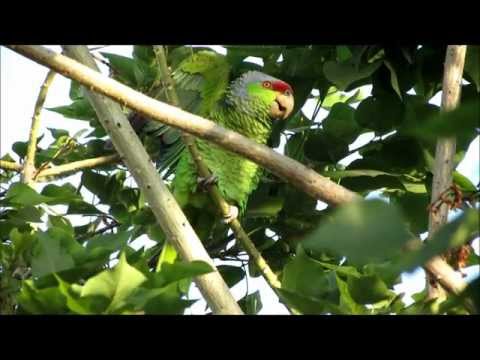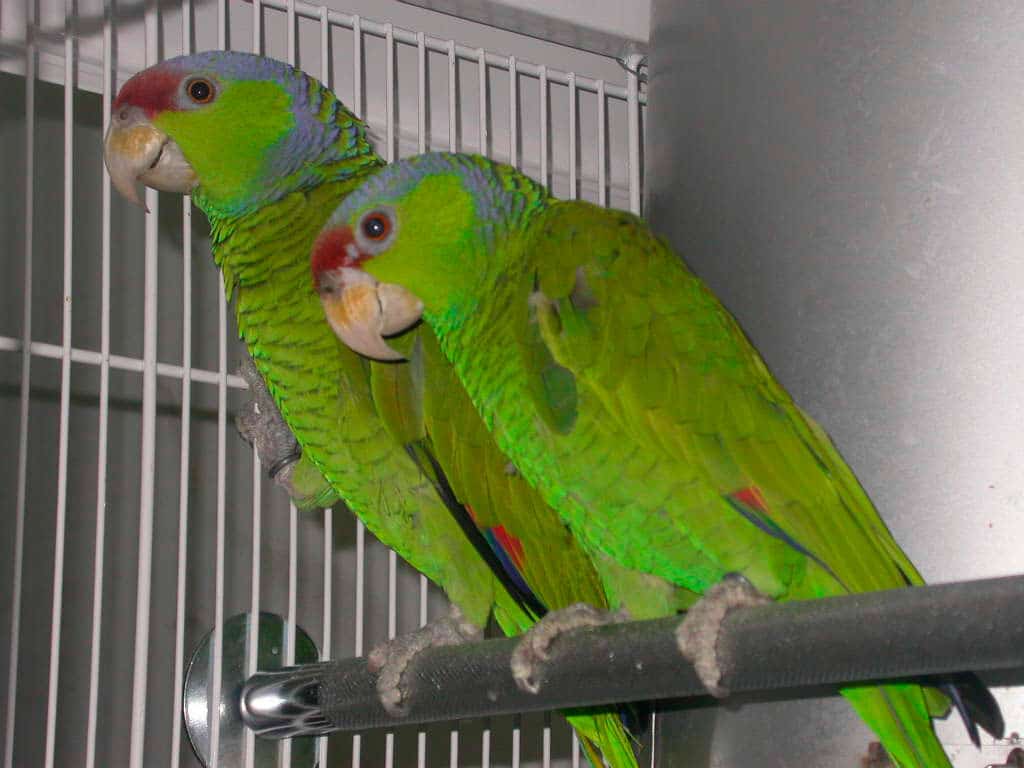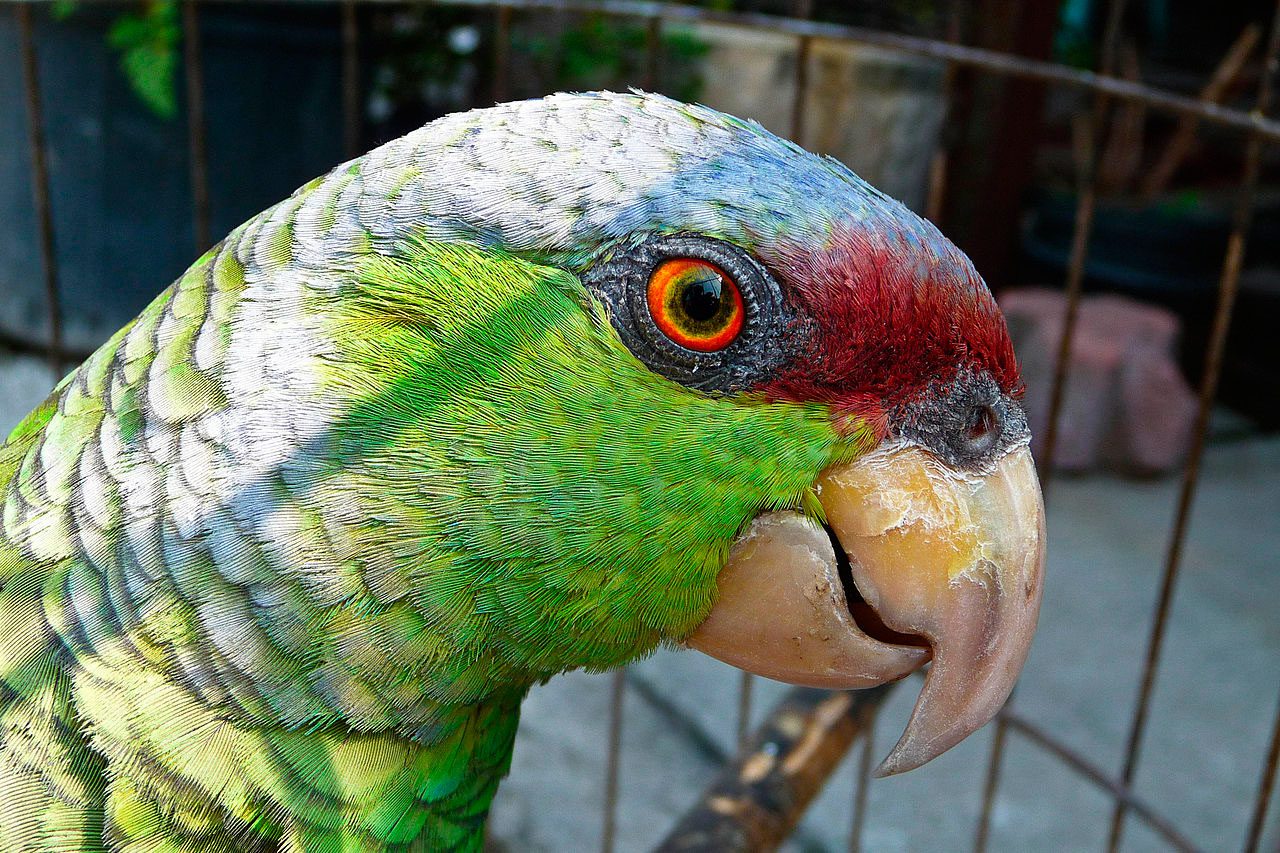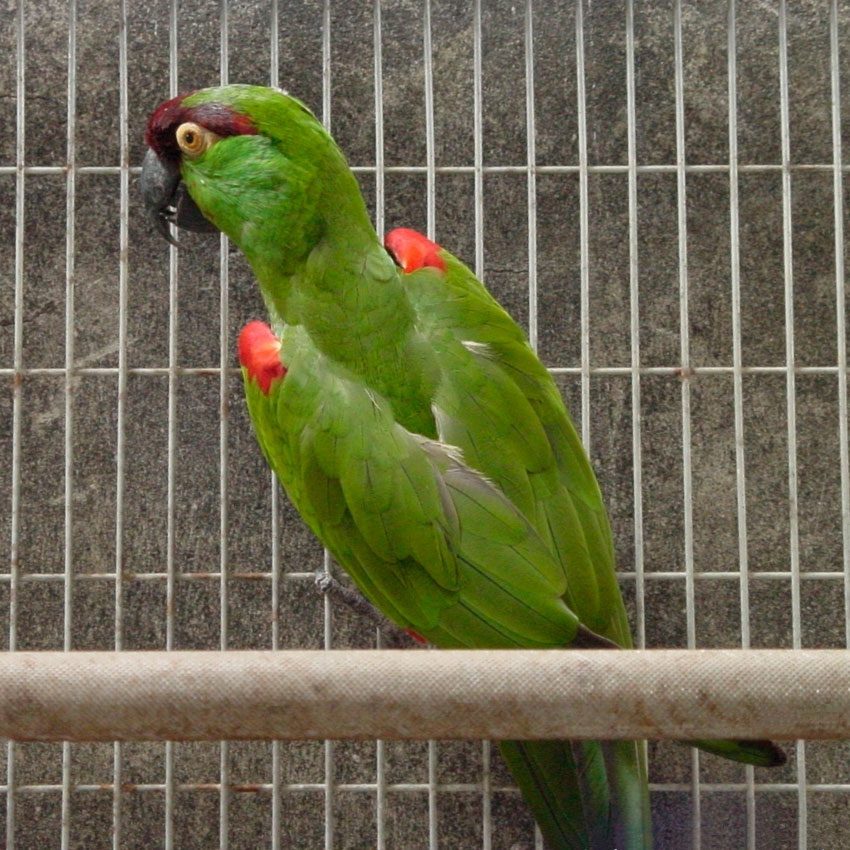
23 centimeters long, not to mention their racquets, and a weight between 100 and 140 g..
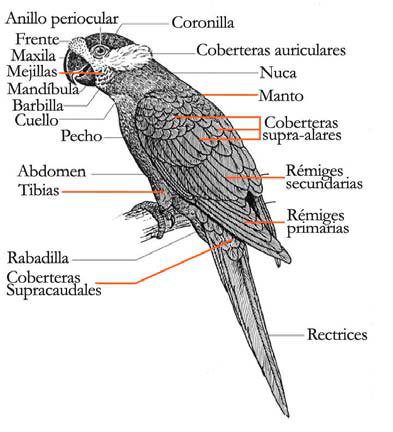
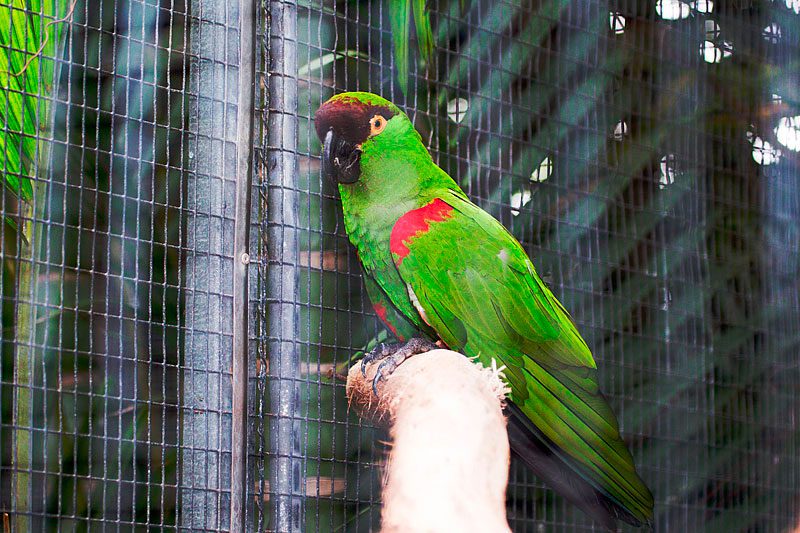
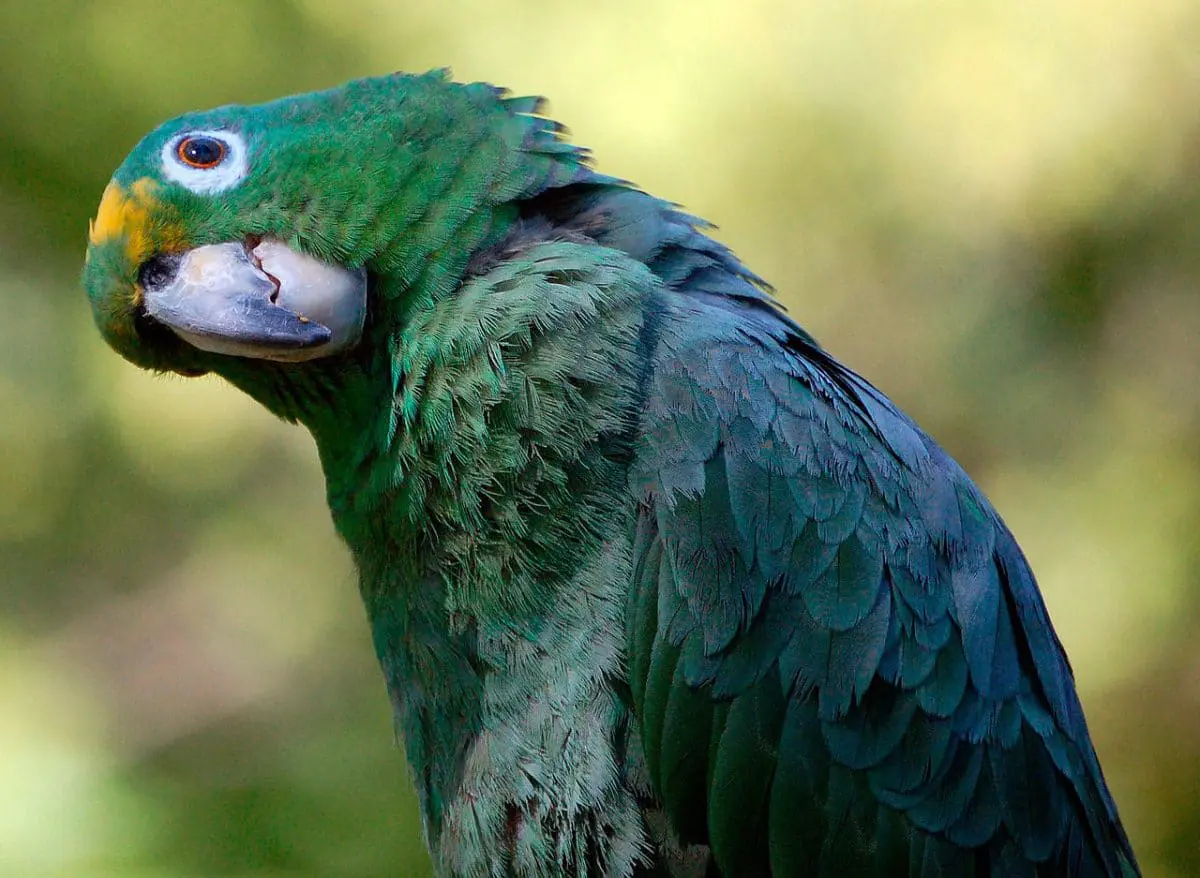
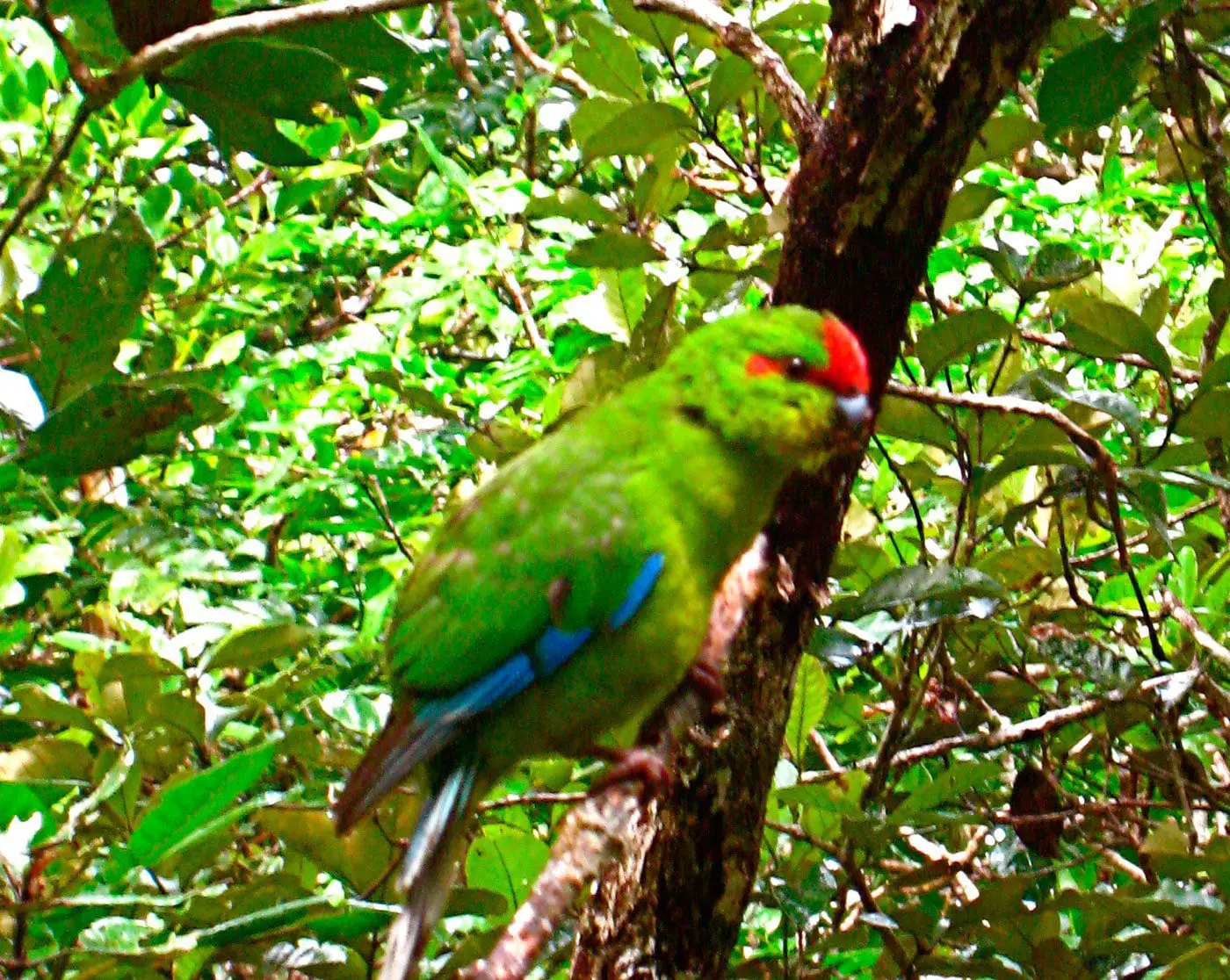
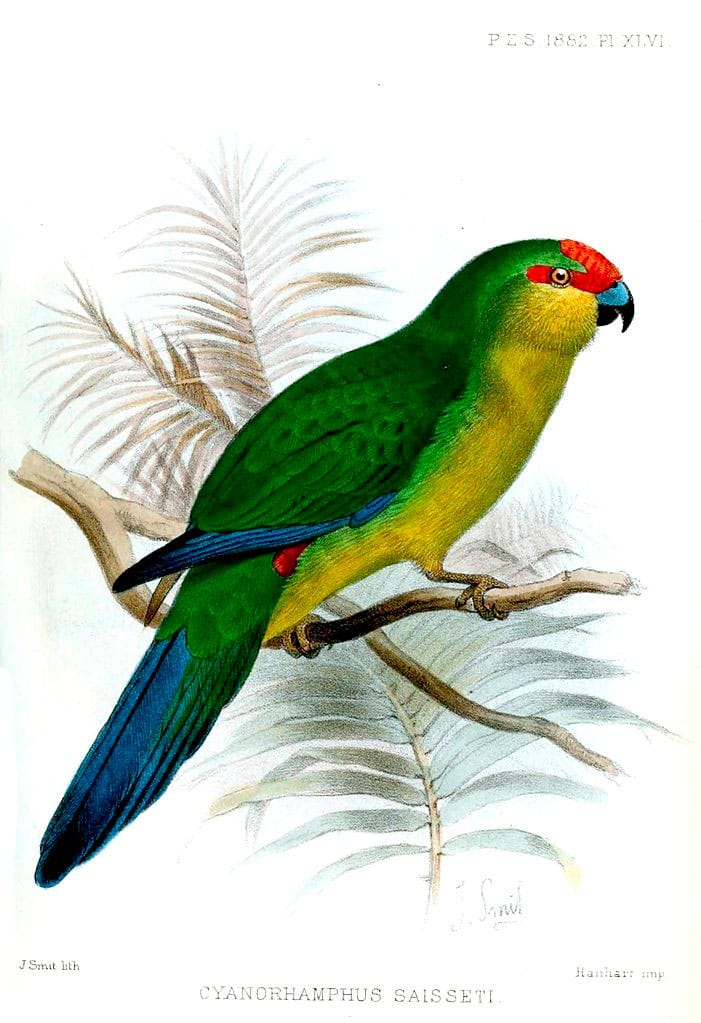
The Luzon Racquet-tail(Prioniturus montanus) has the head of color green with a strong diffusion of color blue turquoise in the face; point red in the center of the crown. Upperparts dull green. Wings green, vane outside of the flight feather, green; vane grey internal, Yellow-edged; networks internal of secondary marked in color yellow pale.
green wing feathers, bottom of bluish flight feathers; paler in network interiors to secondary internal. The underparts more green beige that the area of the back. Upper, the tail green in the center, black blue at the ends laterally; undertail, dark, blue margin to vane inner; spatulas blackish.
Bill blue; irises dark brown; legs black blue.
Female lacks of the point red and has less blue on the crown; rackets also shorter.
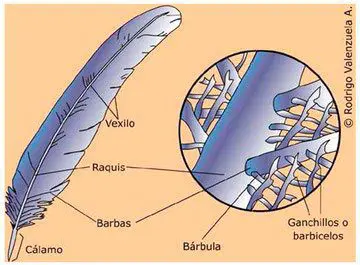
Young have tail Central with extensions of feathers narrow. Pens eventually lost beards to leave spatulas.
Little-known. Is distributed in the moist montane forests at altitudes ranging between the 850 and 2.000 m.
Reproduction:
The breeding season you have registered in the months of August and September. A nest was observed in the stump of an oak high (Quercus) at a height between 3 and 4 meters above the ground.
Food:
The birds feed on seeds, fruit, berries and nuts, and there have also been incursions into fields in the company of the Green Racquet-tail.
Distribution:
Size of the area of distribution (reproduction / resident): 10.400 km2
Endemic to Luzon. Being common in the Cordillera Central (for example, area Mount Pulag) and Sierra Madre, but threatened by the capture and loss of habitat in other places. The population world is inferior to 10.000 specimens.
Conservation:
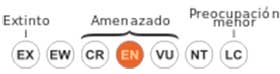
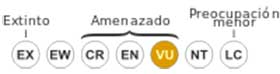
โข Current category of the Red List of the UICN: Near threatened
โข Population trend: Decreasing
Lambert et to the. (1993) estimated a maximum of 10.000 individuals.
The population is suspected of being in decline due to destruction of habitat, hunting and capture for the cage bird trade.
Conservation Actions Proposed:
Calculate loss of forests within its altitudinal range in Luzon. Estimate the remaining area of suitable habitat and, through surveys, produce an estimate of density to permit calculation of the size of its population. Protect effectively important tracts of forest right in key places, both in the areas of strict protection. as in multi-use areas.
Of 35 cm.. length between 105 and 143 g. of weight.
The Mallee Ringneck(Barnardius barnardi) has the plumage predominantly Green, crown and sides of the head bright green, with the cheeks slightly tinged blue and a small red band across the forecrown. The neck It is olive brown with a yellow ring around its back.
The lower area of the back is dark blue. The chest and the abdomen are turquoise blue, separated one from the other by a transverse band of yellow color which is more or less wide. The curvature of the wing It shows a greenish blue that overflows on the mantle.
The greater coverts are yellowish-green. The secondaries They are pale blue, In contrast with the covered and primaries which they are dark blue.
The underparts is blue. The upperparts tail is dark green, their central feathers with blue spikes and outer blue with pale tips.
The bill is whitish grey. The strait bare periophthalmic is solid gray. The irises is of color Brown dark and the legs grey.
The female It has colors more muted than your partner. The back and the lumbar area show a dark greenish gray. The underside is grey, with a more or less visible clear band.
The immature with even duller colors than females. They have the neck and back of the crown brown. The cheeks blues are often more developed. The back and tail are greyish green. The band underwing usually visible.
Two species were traditionally recognized in the genus Barnardius, Barnardius zonarius and Barnardius barnardi, but both hibridaban in the contact area and are currently considered a single species.
Taxonomic status:
This taxon is considered a subspecies of Barnardius [zonarius or Barnardi] (sensu lato) by some authors
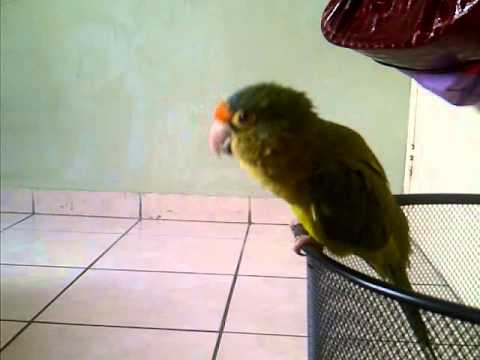
: (Mathews, 1912) Of 35 cm.. length. It has feathers off, especially the chest and abdomen where the turquoise color is absent. Female plumage more clear than the nominal. Is believed to be a hybrid of the Barnardius Zonarius with the Barnardius Barnardi.
Barnardius barnardi macgillivrayi
: (North, 1900) Of 33 cm.. length. More small, more pale, with the greenish-yellow forehead more pale and with clear bright blue hue on the cheeks and below the headphone feathers. Broad band of yellow on the abdomen.
Barnard's Parakeet Habitat:
The Parakeets Barnard They are mainly sedentary, but there may be some moves to small scale in response to climate change.
The species occupies the arid areas of mallee composed almost exclusively of Eucalyptus gracilis. Also found in shrubs of acacia and cypresses and in a wide variety of very similar habitats.
The species living in the areas of the North has a clear preference for the rubber Red (Eucalyptus camaldulensis) It covers temporary streams and shows a more arboreal lifestyle.
Generally less common in populated areas and in more humid regions. Large flocks are more rare to observe; pairs or small groups are the usual social units.
Less bold and curious that the Australian Ringneck, Although the two species share habits, diet and cortejo similar.
During courtship, the male shrugs, causing the wings to vibrate slightly.
Like most other parrot species, the Mallee Ringneck they have as a practice gnaw and chew wood, whether to put his personal stamp on his favorite tree, or to enlarge the cavity entrance. This activity allows them to keep their beaks in good condition.
The nest is usually in a hollow tree, and usually four to five eggs make up the implementation, deposited on a base of wood decaying waste.
In the North, breeding season tends to be governed by weather, and the nesting coincides with the end of the wet planting season.
In the South, playback starts in July or August and the season can be extended until January with a second litter. Incubation lasts around 20 days and is carried out by the female.
The young birds leave the nest after 5 weeks, but remain in the household with his parents for a while.
Food:
The Mallee Ringneck they are mainly vegetarians, they feed on seeds – Melon seeds (Cucumber myriocarpus), bitter melons (Citrullus lanatus), fruits of the tree of the tobacco (introduced), fruits, nectar and flowers. Its menu is complemented with insects and larvae.
ยซBarnard's Parakeetยป Distribution:
The Mallee Ringneck they are distributed through the interior of the East Australia, to the West of the Great dividing range, with a practically isolated population in the Northwest of Queensland, stretching across the border of the Northern Territory, along the nicholson river, in the North, and reaching Glenormiston, and western part of Queensland, in the South; its eastern limit is about Kynuna.
(North, 1900) This, Territory of the North and Northwest Queensland
Conservation ยซBarnard's Parakeetยป:
โข Current category of the Red List of the UICN: Least concern
โข Population trend: Growing
The species is considered common throughout its range..
The world population is estimated at around 500 000 individuals and it seems stable.
But, seems less able to adapt to the changes that have occurred in the habitat that the Australian Ringneck.
In captivity:
The Mallee Ringneck It is appreciated as a pet, but the birds in captivity are relatively few.
Una muestra viviรณ 17,9 years in captivity. According to some sources, these animals can live up to 31,6 years in captivity, but this has not been verified.
Most common in Europe and Australia; not so much in the United Kingdom or United States.
Initially it is a timid and nervous bird, Although soon it acclimatizes caregiver. Bonding with a partner to do when both birds are young, as adults they do not usually live in harmony. Aggressive with other parrots.
– Avibase
– Parrots of the World โ Forshaw Joseph M
– Parrots A Guide to the Parrots of the World – Tony Juniper & Mike Parr
– LoroMania
AnAge: The Animal Ageing and Longevity Database – Genomics.senescence.info
– Birdlife
The Orange-bellied Parrot(Neophema chrysogaster) is a small ‘Grass parakeetโ, so called for spending a lot of time on the ground feeding on seeds and grasses.
adults have, approximately, 21 cm length and a weight of around of 45 to 50 g..
Has the crown, the nape and the the mantle bright green, with one frontal band dark blue and a lighter blue later point that does not extend beyond the eyes.
Face and lores are yellowish-green. You have a few different bands in the wings Green and blue colors, the vane inmates of the wing-coverts are green, the blue outer.
The primary coverts are dark blue. The primary feathers Black has the outside edges with fine violet blue and yellow. The secondaries has a green border.
The underparts is blue. The chest Green is mixed with the greenish yellow color under the tail. The belly is very stained Orange. The top of queue is green with blue tip. The lateral tail feathers they are yellow with blue-green bases.
Peak and iris are black, the legs are grey.
The female is more off than the male, the frontal band has a single tone. The stain ventral Orange is smaller.
Between the juveniles, the frontal band is barely visible. The Wing band is very prominent and the bill is pale.
As one migratory species, its habitat varies throughout the year, with the birds that live in the marshes, coastal dunes, pastures, scrub, estuaries, Islands, beaches and Moors generally within the 10 km of distance from shore.
There is practically no records more towards the inside of 5 km and most are within 2 km from the coast. The holes of mature eucalyptus, as the Smithton Peppermint (Eucalyptus nitida) and the Swamp gum (Eucalyptus ovata), they are used by the Orange-bellied Parrot for the nesting during the breeding season in Tasmania, and breeding habitat is a mosaic of moorland and reed-covered land, dominated by the Button Gras (Gymnoschoenus sphaerocephalus) and forests.
The behavior of foraging species are usually characterized by the power in the suelor or in low vegetation, in general a less than 1 m above ground.
The birds they feed usually in pairs or individually during the breeding season, and in small herds of variable size in non-breeding season. Solitary birds often have been feeding with other species, especially with the Blue-winged Parrot (Neophema chrysostoma).
Reproduction:
In Tasmania, the only breeding place, spawning takes place in the months of November and December.
The nest of the Orange-bellied Parrot is located in natural cavities, between the 8 and 25 meters of height in eucalyptus (Eucalyptus nitida) and less frequently, in the (Eucalyptus ovata). The nest is sometimes maintained during several consecutive years. The marital ties they are strong and sometimes last a lifetime.
The spawning included among 3 and 6 eggs they are incubated during 21 days. Young people are altricial and remain in the nest for at least 5 weeks.
Food:
Initially, on Spring, the Orange-bellied Parrot they feed on plants. They mostly eat seed Sedge (Reedy) and parts of the herbs of the genus Boronia or Actinotus.
At the beginning of Winter, the regime being vegetarian, suffering some transformations. the Orange-bellied Parrot consume algae in decomposition, seeds and herbs Poaceae and Halophyte, that is to say, you adapt to saline environments, as the Rock Samphire (A maritime rhythm).
The goosefoot )Chenopodium) and Salt plants (Atriplex) also classic in their food. Introduced plants such as the Sea rocket (Cakile maritima) they are also popular.
Distribution:
Tamaรฑo del รกrea de distribuciรณn (reproducciรณn/residente) 3.100 km2
They migrate across Islands in the West of the bass strait (mainly King Island) towards the coast South of Australia, to Hibernate from the months of March to July, mainly along the coasts of the Bahรญa Port Phillip, Victoria (largest number of birds in Point Wilson and Swan Island, including the Queenscliffe Golf Course). They also overwinter in small numbers., from Gippsland, Victoria, to the West of the Coorong, Southern Australia. Occasionally occur during winter in areas of Tasmania and surrounding islands, as well as other individuals spend the summer on the mainland.
Every summer around 40 couples are reproduced, and an analysis of nine nests showed an average offspring of 1,7 pups per pair. The post-breeding population increased by about 50 individuals, of around 170 birds, but the population is becoming increasingly smaller, which suggests a high annual mortality. Adults begin to leave the breeding area in February and fly across the coast of Tasmania, crossing the bass strait, mainly through King Island (also records in the Hunter Croup) towards the coast of the Southeast of Australia (young birds usually travel a month later).
The Orange-bellied Parrot They tend to move around the continent, and are in the South of Australia at the end of winter. They return to breed in the months of September and October, they usually travel directly back to their breeding grounds. Since 1979 to 1990, the wintering population has remained relatively stable, with a count of 67 to 126 individuals registered every year (with a maximum of 50% of the world's population known with presence in Point Wilson).
In the last century the species flying in flocks of thousands of individuals (and raised as far East as Sydney up to approximately 1907). Wintering habitat loss and capture for the bird trade are cited as factors in its decline.
Possible winter habitat loss remains a threat, as does competition from introduced herbivores, the disturbance, and the possibility of exploration and exploitation of minerals. A detailed recovery plan includes the management of winter habitat with the exclusion of grazing animals, the diversion of economic activity and the development of Murtcaim Wildlife Management Area about Point Wilson. Captive-bred birds have been released and mixed with wild individuals.
Conservation:
โข Current category of the Red List of the UICN: Critically Endangered
โข Population Trend: Decreasing
The Orange-bellied Parrot It has a very low population size. This very low population size is even more significant, given that the species migrates through of the Bass Strait, with which this species is subjected to the additional risk by stormy phenomena on their migratory journey.
Has a restricted geographic range when breeding, and apparently a limited supply of food during migration and winter.
The species is found in a single population of between 100 and 150 mature individuals. Habitat loss, fragmentation and modification, particularly on the migration route and in the wintering areas, they are the key threats to the survival of the species.
For a small population, stochastic factors, as the disease, storms during the migratory species, and the destruction of nests by forest fires have the potential to reduce the survival of the species in the long term.
The Orange-bellied Parrot It has a restricted geographical distribution which is precarious for its survival.
The Scientific Committee of Threatened Species considers that the Orange-bellied Parrot has suffered a historic decline since European colonization. It is considered, In addition, that the recent recovery actions that have been implemented are having a beneficial impact on the species and the possibility of future stability in the reproduction sites is becoming apparent. But, as the population of the Orange-bellied Parrot is so low, the data that we have are based on a small area of occupancy and it is likely that this species continue suffering from a series of threats in course, with what the Committee may not be sufficiently secure that available information indicate that the population is stable and safe.
Future declines in population are still likely as a result of potential threats, especially the stochastic and genetic threats to small populations are likely and that can lead to the extinction.
"Orange-bellied Parrot" in captivity:
The Orange-bellied Parrot is very rare in captivity and is, probably, more present in the hands of European collections. There are also some captive birds by some fans in Australia, to the South of the continent.
Fifteen years ago in South Australia, under expert supervision, were built cages with the aim of raising these birds and avoid that the Orange-bellied Parrot disappeared completely. In the early years, most of the young people died from diseases of the beak and feathers (PBFD), a viral disease (virus BFD). Similarly, cold winters in this region, where was launched the project, they had a negative effect on the end result.
Once the aviaries were displaced to areas more temperate and increased its amount, the result is improved and each year dozens of parrots have been released into the wild.
The Orange-bellied Parrot they are birds calm, peaceful and little noisy. They belong to the less active within the genre of the kind Neophema, so tend to the Obesity. These birds spend much time ashore. Usually, bathe once a day, in long baths. Reproduce well in captivity. They are exceptionally susceptible to various infections, including the intestinal parasites. These birds also, often, they die without apparent reason.
Parrots A Guide to the Parrots of the World – Tony Juniper & Mike Parr
Ministry of the environment – Australia – Environment Protection and Biodiversity Conservation Act 1999 (EPBC Act)
Birdlife
Photos:
(1) – Orange-bellied Parrot (Neophema chrysogaster) male, Melaleuca, Southwest Conservation Area, Tasmania, Australia By JJ Harrison (jjharrison89@facebook.com) (Own work) [CC BY-SA 3.0], via Wikimedia Commons
(2) – Orange-bellied Parrot (Neophema chrysogaster) female, Melaleuca, Southwest Conservation Area, Tasmania, Australia By JJ Harrison (jjharrison89@facebook.com) (Own work) [CC BY-SA 3.0], via Wikimedia Commons
(3) – Orange-bellied Parrot (Neophema chrysogaster) Melaleuca,Tasmania by Ron Knight – Flickr
(4) – Orange-bellied parrot, Neophema chrysogaster, photographed at Tasmania, Australia – Image: David Boyle/National Geographic [velociraptorize]
(5) – Photo: Justin McManus
(6) – John Latham – Allen, ELSA G. (1951) The History of American Ornithology before Audubon. Transactions of the American Philosophical Society, New be. 41(3):387-591. See page for author [Public domain], via Wikimedia Commons
35 to 40 cm. length and a weight between 215 and 315 gr.
The plumage of the Black Parrot(Coracopsis nigra) It, usually, blackish brown (iridescent green glow during breeding season) with inconspicuous grayish color marks in undertail- coverts and gray in vane external to the primary.
Bottom of flight feathers pale grey. Upper, the tail brown-black color; undertail, light grey: subterminal band dark.
The bill color horn, more off-white to modify the moult; irises dark brown: periophthalmic ring grey-brown (does not reach the peak); legs dark brown.
(Milne-Edwards & Oustalet, 1885) – Smaller, of about 30 cm., and paler than the nominal species. The chocolate color replaces the blackish brown of the nominal. No grey in the vane the primary external
Habitat:
The Black Parrot are resident with some movements of foraging day.
It is found in a wide variety of forests and savanna areas, including ecosystems modified by man, wooded land of cities and towns, as well as primary forests, from the level of the sea up to 2,050 m altitude.
You can see more on the dense forests, swamp forest (including mangroves) and scrublands, that the Vasa Parrot, in order to avoid large areas of humid forests.
Usually seen in small noisy groups, either flying or sitting on the tops of the trees; active on moonlit nights.
In Seychelles, However, the Black Parrot seldom form flocks and in general you seen alone or in pairs, except when the food, locally, they are abundant.
Is not known to form mixed flocks with the Vasa Parrot.
Reproduction:
Nest in the hollow trunk of tree or in a branch, usually above the 15 m.
Breeding probably from November to February.
Clutch of 2 to 8 eggs.
Food:
The Black Parrot they feed on seed, berries, fruits and nuts; more frugivorous than Vasa Parrot.
The species that are found in Madagascar and the Comoros they are generally described as common.
Officially treated as pests in Madagascar where the Black Parrot they are persecuted because of the damage caused in crops; Also hunted as food and as domestic fowl.
Despite their intense persecution, apparently they are not at risk and are distributed in many protected areas of Madagascar.
The size of the world's population has not been quantified.
The subspecies of the Praslin island (Seychelles), found in the The Valle de Mai nature reserve, is located in critical state (probably less than 100 birds). Competition for nesting sites with the common mine (Acridotheres tristis) can be one of the threats of the remaining birds.
The โBlack Parrotโ in captivity:
It is possible to keep them in community with its kind, but out of breeding period. At first he can be shy. It is a active parrot and nervous, generally outgoing Once accustomed to people and environment, tends to be entrusted, although it also depends a lot on its breeding method (natural or by hand) and earlier experiences.
As a pet it can be a wonderful company., loving, playful and very smart.
With regard to its longevity, sources they indicate that a sample lived 34.1 years in captivity.
Alternative names:
– Black Parrot, Lesser Vasa Parrot, Lesser Vasa-Parrot (English).
– Vaza noir, Perroquet noir (French).
– Rabenpapagei (German).
– Papagaio preto (Portuguese).
– Loro Negro (espaรฑol).
– Avibase
– Parrots of the World โ Forshaw Joseph M
– Parrots A Guide to the Parrots of the World – Tony Juniper & Mike Parr
– Birdlife
– Parromania
– Photos:
(1) – Madeira_botanischer_garten_Coracopsis_nigra By Hedwig Storch (Own work) [GFDL or CC BY-SA 3.0], via Wikimedia Commons
(2) – Lesser Vasa Parrot (also known as the Black Parrot). Two in a cage with a nestbox By TJ Lin (originally posted to Flickr as pic-264) [CC BY-SA 2.0], via Wikimedia Commons
(3) – Lesser vasa parrot (coracopsis nigra) in Anjajavy Forest, Madagascar By Charlesjsharp (Own work) [CC BY-SA 3.0], via Wikimedia Commons
(4) – Lesser Vasa Parrot or Black Parrot (Coracopsis nigra); picture taken at Mangily, Western Madagascar By Axel Strauss (Own work) [GFDL or CC BY-SA 3.0], via Wikimedia Commons
(5) – Male Lesser Vasa Parrot in an aviary at Tropical Birdland, Leicestershire, England By Snowmanradio (Own work) [CC BY-SA 3.0 or GFDL], via Wikimedia Commons
Among 13 and 15 cm.. length and a weight between 43 and 47 g., the Yellow-collared Lovebird(Agapornis personatus) They are surprisingly beautiful.
They have head, the throat and the top of the nape blackish brown, merging into yellow at the bottom of the nape and top of the the mantle, forming a distintivo collar. The remaining the mantle, scapulars and rump, are green; uppertail-coverts blue. Upper, the wing-coverts green; primaries green, darker in vane inner; vane outside of secondaries green, the vane internal black.
Under, wing-coverts green; underside of flight feather grey-black. Top of the chest bright lemon yellow; belly and undertail- coverts pale green. Tail mostly green, but all feathers, except the central pair, labeled orange opaque; subterminal band negruzca.
Bill coral red, white at the base of the upper jaw; cere white; irises brown; eye ring white (2mm wide); legs pale grey.
Both sexes are similar.
Immature and adults, but the head it is less dark and bright; neck yellow duller; black markings, sometimes at the base of the upper jaw.
The Yellow-collared Lovebird They are distributed in well wooded pastures, including the cultivated areas, with Acacia, Commiphora and, above all, Adansonia, at altitudes between 1,100-1,800 m. Avoid miombo woodland.
Usually observed in small flocks of 4-5 birds but sometimes they can meet up to a hundred.
Reproduction "Inseparable Cabecinegro":
The nests of the Yellow-collared Lovebird they find, normally, in tree cavities, with a strong preference for Adansonia. They can also use free domed nests of other species. In Dar-es-Salaam, the nest, sometimes, They build it in the cavity of a building or in a free nest Little Swift (Apus ajffinis).
The nest is a complex domed structure built from long stems and strips of bark, carried by the female at the peak. The Eggs are laid in the dry season (March-April and June-July). The laying is of 3-8 in captivity. The egg incubation hard 23 days. During the first six weeks after hatching, the females they feed the young. Then, Once the young birds leave the nest, the males They take care of feeding pigeons During two weeks, or until young birds achieve independence.
"Inseparable head":
The Yellow-collared Lovebird feed of grass seeds, the millet and the sorghum, Also seed Cassia. They require regular access to water and can drink several times a day.
Distribution:
Size of its range (breeding/resident): 224.000 km2
Except track in southwest Kenya (in Taveta), the Yellow-collared Lovebird appear to be limited to the plateau in eastern and southern Tanzania, from northern, Mount Meru south to Morogoro and west on Regiรณn de Rukwa and Mbeya Region.
In Kenya, there are considerable feral populations in Naivasha, Nairobi and Mombasa; smaller in some highlands and the coastal towns (6.000 birds in 1.986.); in Tanzania, in Dar-es-Salaam and Thong.
Sedentary, in general, common and sometimes abundant. Wild population probably in decline due to the large scale capture for the bird trade. One large number in captivity.
Until this year (2007) It was included in Appendix II (o anexo B) convention C.I.T.E.S.. Not globally threatened, but still vulnerable by presenting a reduced distribution area. Importation is no longer necessary to be a sufficient number in captivity.
The population size World has not been quantified, but the species according to sources is locally quite common.
The "inseparable head" in captivity:
The Yellow-collared Lovebird It, next to the Rosy-faced Lovebird and the Fischer's Lovebird, one of the most Lovebird bred in captivity.
The Yellow-collared Lovebird (Agapornis personatus) It is a bird very sociable with his kind and can live in a group.
Its aggressiveness does not reach the limit of being able to kill a fellow, as if they would Rosy-faced Lovebird.
Very common, available in all pet stores. A bit less noisy some other Lovebirds, their cry is less annoying. Like all Lovebirds, the Yellow-collared Lovebird they are very agile, Dynamic, good climbers and skilled in all kinds of acrobatics. After the breeding period, Some couples prefer to be alone if they spent this time with other couples of their species.
The Lovebirds rarely talk, but there is the possibility that learn to imitate human speech if they are taught since very young. It is important to remember that you should never have the expectation that a bird can speak.
With regard to its feeding, We provide our Yellow-collared Lovebird a set of seeds, such as millet, mixture of canary, sunflower and hemp. Alternatively, we can provide insect, ears of corn and an abundance of fruit, vegetables.
Give them opportunity to bathe and change the water regularly.
The Yellow-collared Lovebird are very easy to play, at humidity 70%. Three nidadas by year. The female tends to lead twigs on his rump to decorate your nest.
A cage of 80 x 40 x 40 cm.. It is suitable for these Lovebirds. The nest It must be a horizontal box height 25cm, 18cm wide and 18cm deep. The laying is of 3 to 6 eggs. The time of incubation of these eggs is 23 days and the chicks leave the nest 4 to 5 weeks after hatching.
Mutations Agapornis personatus
No sex-linked mutations present, All are autosomal. They can be recessive, dominant and incomplete dominant. They are recessive: blue, pastel, ino, albino, recessive harlequin, DEC, dilute, bronze fallow y pale fallow. The only dominant as such they are dominant harlequin and slaty. Incomplete dominant They are dark factor, purple, misty y edged.
One type of harlequin which it is transmitted to different recessive and dominant form, is the progressive harlequin o mottle. The harlequin is increasing as the bird will be more adult, as it is getting older.
This species has been used to "pass" its mutations to other species such as A. fischeri and A. nigrigenis. This step is called transmutation (type hybridization). In fact, personatus lutino comes from the transmutations with A. lilianae, species which came first. This whole process is possible to be fertile birds resulting from joining any of these 4 species including. With the A. roseicollis sterile individuals out. For all that we have seen, Finding Agapornis Persatus "pure" is a difficult task.
Avibase
Parrots of the World โ Forshaw Joseph M
Parrots A Guide to the Parrots of the World – Tony Juniper & Mike Parr
Birdlife Wikipedia
Photos:
(1) – Masked Lovebird (Agapornis personata) at Auckland Zoo By Chris Gin (originally posted to Flickr as Masked Lovebird 2) [CC BY 2.0], via Wikimedia Commons
(2) – A Yellow-collared Lovebird in Serengeti, Tanzania By Demetrius John Kessy from Arusha, Tanzania (Serengeti(Fisher Love Bird)) [CC BY 2.0], via Wikimedia Commons
(3) – The blue colour mutant of the Masked Lovebird, at ฤastolovice Castle, Czech Republic By Mistvan (Own work) [CC BY-SA 3.0 or GFDL], via Wikimedia Commons
(4) – Several Yellow-collared Lovebirds at Kansas City Zoo, Missouri, USA By KCZooFan from Olathe, KS, U.S.A (Black-masked Lovebirds) [CC BY-SA 2.0], via Wikimedia Commons
(5) – A Yellow-collared Lovebird at Pukekura Park, New Plymouth, Taranaki, New Zealand By Virginia McMillan from Wellington, New Zealand (yellow breasted bird) [CC BY 2.0], via Wikimedia Commons
(6) – A Yellow-collared Lovebird at Honolulu Zoo, Hawaii, USA. It is perching by the entrance to a nestbox By Daniel Ramirez from Oakland, USA (Masked Love Bird) [CC BY 2.0], via Wikimedia Commons
(7) – A pet Yellow-collared Lovebird in a cage with toys By Mike Fernwood from Santa Cruz, California, United States (Lauraโs prisoner) [CC BY-SA 2.0], via Wikimedia Commons
(8) – Lovebird hybrids (Fischerโs Lovebird x Masked Lovebird) in a back garden near Bangkok, Thailand By krisprachant [CC BY 2.0], via Wikimedia Commons
(9) – The blue mutant of the Masked Lovebird Agapornis personata. This variety is called blue Masked Lovebird By Autor: norasuered [CC BY-SA 2.0], via Wikimedia Commons
Origin: Malaysia, Brunei, India, Indonesian, Thailand
Character: active, Shy
Life expectancy: ---
Height: Of 40 to 48 cm..
Content
Description:
Of 40 to 48 cm.. length and 168 to 196 g. of weight.
The Long-tailed Parakeet(Psittacula longicauda) has the plumage, in general, green. The throat, the chest and the abdomen are greenish-yellow; and lores (the regions between the eyes and the beak, on both sides of the head) are bluish-black. The crown is a green dark, and the sides of the head and nape are pinkish Red. They have a black stripe in the cheeks.
The upperparts is yellowish wash of blue-grey. The lower part of the back is pale-blue. The upperwing-coverts are yellowish. The supracaudales-coverts and infracaudales, as well as the the thighs are pale green. The central feathers of the tail are blue with pale tips and outer feathers are green.
The bill top is red and the lower beak is brown-black color. The irises they are amarillos-blanquecinos, and legs are grey.
The females they have the nape green. The band to their cheeks is dark green, and cheeks superiors are an orange-red live. Their feathers of the tail they are much shorter, and the bill top and bottom are brown-black color.
The young birds they have the head variable green interspersed with orange-red. The feathers of the tail they are shorter, and both the bill top and bottom are brown.
The young male they have a tint blue in the lower part of the back and some birds can have a reddish tint in the bill top.
Immature birds reach your adult plumage When they are near the 30 months of age.
The lutino and other colorations, It is believed that they are mutations observed both in the wild and in captivity.
(Chasen, 1935) – Of an average length of 42 cm.. As the species nominal but but the pinkish red from the sides of the head It is deep orange-red-streaked.
(Fraser, 1845) – Of 48 cm.. Plumage as of the species nominal, but the crown It has a reddish-brown core and a green at the end of feather edging, becoming pink on the back of the head and nape, thus causing in the crown more Brown than green appears in many birds . The black stripe in the lores is more clearly defined, continuing in some birds to form a narrow band in the forecrown. The upper cheeks they have a deep pinkish-Red, orange-red stripes.
Psittacula longicauda nicobarica
(Gould, 1857) – Of 48 cm.. As the species nominal, but the back of the head, the nape and back are greenish-yellow and slightly washed with pale blue. The ear-coverts and cheeks are deep red. The lower part of the back is green.
Psittacula longicauda tytleri
(Hume, 1874) – Of 44 cm.. length. As the species nominal but the back of the head, the nape and back are yellowish green washed with grisaceo-malva. The throat, the chest and the top chest they have a pale bluish tint. The lower part of the back is green.
Habitat:
Video – "Long-tailed Parakeet" (Psittacula longicauda)
The Long-tailed Parakeet distributed over all types of lowland (below 300 metres in Sumatra), Evergreen from mangrove forests, swamps, tropical forests, to plantations of oil palm plantations (Elaeis) and coconut trees. It prefers the edges of high forest, especially with large dead trees, including close cultivated areas.
Flocks of thousands of birds reported in the Islands Andaman and Borneo but smaller groups (minor's 20) they are typically, especially during breeding. They form mixed flocks with the Blue-rumped Parrot (Psittinus cyanurus) in Kalimantan.
The Long-tailed Parakeet It is a restless bird that are constantly in motion. They fly quickly around branches, moving quickly from a tree to another. Although they are usually well camouflaged in green foliage, its continuous chirp betrays its position. They tend to feed shortly after sunrise and resume foraging around sunset..
Reproduction:
The Long-tailed Parakeet nests in tree cavities, usually dead, often to a considerable height (for example, reported nest in a tree of the species Koompassia in Sumatra to 45 meters above sea level); in the andaman islands commonly nest in trees of the species Pterocarpus marsupium; in the Nicobar Islands sometimes in Pandanus, some 4 meters above ground and in larger trees to 10 metres in height.
Breeds in colonies.
The nest It is full of pieces of bark and chewed wood. In the natural habitat, the average clutch consists of 2 to 3 eggs, each one measures 30,6 x 24,7 mm.
During the courtship, the male bows before the female, by spitting up, circular motions with his head and gently touching its beak.
The breeding It is between the months of December-February, Although pigeons have been observed in July in the Malacca Peninsula; Feb-Mar in the Nicobar Islands and Andaman. Reports of eggs in July sunsets in Sumatra.
Food:
The nominal species diet includes plants from Borneo camphor (Dryobalanops sumatrensis) and fruit of the Dillenia; the subspecies nicobarica largely feeds on fruits as the papaya (Carica papaya) and Pandanus; occasionally feed on the outer cover of the betel nuts (Areca catechu). On the other hand, They assail orchards and fruit plantations to feed, for example, of the oil palm plantationsElaeis, grains and seeds, and they can have an important impact in the fields of ripening rice (for example in the Islas Andaman) and fruit of the oil palm plantations (for example in the Malay Peninsula).
Insects and their larvae can also be part of your daily diet; If these parrots seek them actively unknown, but they may be ingested ,probably, While they feed on fruits and flowers.
Distribution:
Size of the area of distribution (reproduction / resident): 877.000 km2
The size of the world population Long-tailed Parakeet It has not been quantified, but the species is described as very common and widespread in southern Borneo, locally common in Sumatra and Peninsular Malaysia and common in Brunei, the andaman islands and Nicobar Islands (pit et to the. 1997).
The destruction of forests in the lowlands of Sundaland in Indonesian, as well as in Thailand and Malaysia It has been wide (Kalimantan almost lost the 25% its perennial forest during 1985 to 1.997, and Sumatra almost lost the 30% your coverage 1985), still, the species is still numerous in a number of areas, due to its ability to forage away from forested areas and nest communally. So, the decrease is estimated to have been of the order of 20 to 30% in the last ten years.
Conservation Actions Underway:
– CITES Appendix II.
Conservation Actions Proposed:
– Monitor the species in trade.
– Monitor habitat trends and rates of deforestation in the lowlands of Sundaland using satellite imagery and remote sensing.
– The investigation of the ecology of the species to improve the understanding of the movements it makes.
– Effectively protect significant areas of habitat at key sites, both in strictly protected areas and in multiple use areas.
"Long-tailed Parakeet" in captivity:
Rare in captivity, their mortality is high and breeding successes are rare.
It is a bird very noisy. It is a principle very shy and slow to get your confidence. They don't bathe often, Although they occasionally sit in the rain. They enjoy gnawing fresh branches. The main problems for captive breeding are the difficulty of matching compatible pairs; the Long-tailed Parakeet they usually do not accept a mate that they have not chosen themselves and even if they are breeding pairs, it is very difficult to keep the chicks alive. Sudden deaths no apparent cause they have been reported – possibly as a result of stress.
Some birds may refuse to eat. Have been observed Occasional attacks of females to males, coming to Peck them on the penis, causing them serious injury. It also, these delicate parrots are difficult to acclimatize. Newly imported birds are susceptible to cold, wet conditions. During the acclimatization period, should not be exposed to temperatures below to 24 ยฐC and at no time below 10 ยฐ C.
Given that these parrots are so rare, experts prefer well managed breeding programs the possibility of keeping them captive in private hands.
The size of the clutch average consists of 2 – 4 eggs laid at daily intervals, with an incubation which lasts approximately 23 days. The young leave the nest 7 weeks after hatching and are independent 2 weeks later.
The Long-tailed Parakeet, in any case, you will need a large aviary which is a very active bird and will need plenty of room to move.
It is important to place the bird in a quiet and protected, as well as provide a rest box (22 x 22 x 60 cm.) at all times.
Alternative names:
– Long-tailed Parakeet, Long tailed Parakeet, Malaccan Red-cheeked Parakeet, Malayan Red-cheeked Parakeet, Pink-cheeked Parakeet, Red-cheeked Parakeet (English).
– Perruche ร longs brins, Perruche de Malacca (French).
– Langschwanzsittich (German).
– Periquito-mustache-cauda-longa (Portuguese).
– Cotorra Colilarga, Cotorra de Cola Larga (espaรฑol).
Origin: Venezuela, Guyana, Suriname, Brazil, Bolivia, Peru
Character: Sociable
Life expectancy: 30 years
Height: 30 cm..
Content
Description:
30 cm.. length and a weight between 130 and 170 g..
The Red-shouldered Macaw(Diopsittaca nobilis) along with the other two subspecies belong to the Group of the small macaws often called dwarf macaws or mini macaws parrots.
They have forecrown, front of the crown and top of the eyes blue; rest of the head and upperparts, including the wings and the top of the tail, grass-green. Rojas the carpal joints and the leading edge of the wing
. Lesser and medium underwing-coverts red; large underwing-coverts brown; underside of flight feather Golden olive.
The underparts green, but more yellowish than the upper. The bottom of the tail Golden olive.
Bill blackish; bare skin of the lores and top of the cheeks white; irises orange-brown; black legs.
Both sexes similar; Perhaps a little smaller females.
The immature with the head completely Green: has no red color in the carpal joints.
With they are distributed in a variety of open wooded habitats, including savannah with scattered shrubs and palm trees (for example of Mauritia) in Suriname, morichales and the coast plantations in Guyana, closed with palm groves of Mauritia on the inside of Brazil and margins of caatinga in the northeast of Brazil with palm groves of Mauritia.
A persistent feature in its preferred habitat is the presence of palm trees., especially of the genus M. flexuosa, Orbignya martiana and Maximiliana maripa (the latter especially in the southern region of the Amazon). Also observed in wetlands with palms, gallery forests and cultivated areas.
Avoid large expanses of closed canopy forests, but they can be seen around human settlements and it is common in the city of Georgetown, Guyana.
They reach the 1.400 metres in Venezuela, to the South of the Orinoco.
Gregarious, often in large flocks outside breeding season; If not in couples.
Reproduction:
Nest in tree cavities, termite tree or in holes of palmas. Copulations registered in the month of October to the South-West of Brazil; Probably engender between February and June in Guiana. Clutch four eggs in captivity. The average period of incubation is of 24 days, the chicks leave the nest about 54 days after birth.
Food:
Its diet, probably, It is similar to its closest relatives, nuts are included in the, seeds, fruits and flowers, but with some signs of favorite seeds; known his preference for flowers of Terminalia argentea and Erythrina glauca, as well as the berries Cordia and fruits Euterpe. They also feed cereals and fruits in cultivated fields and are considered as one plague in some areas.
Distribution:
Size of the area of distribution (reproduction / resident): 910.000 km2
endemic to northeast South America, from the East of the Andes toward the center of Brazil.
In East Venezuela they are distributed, mainly, to the South of the Orinoco (Delta Amacuro and parts of Bolรญvar), also at the East end of Monagas.
The few records of Trinidad they are probably elopements captive birds.
Are distributed through of the Guianas, in areas of seasonal forests (mainly near the coast) and in Brazil to the North of the amazon in Roraima, Amapรก and North of For. Returns disjoint inside of Brazil, to the South of the Amazon from the southeast of For and maranhรฃo the wetlands of Mato Grosso and to the South by the dry northeast in Piauรญ, Bahia and, according to reports south of Alagoas until Holy Spirit, Rio de Janeiro and Northwest of Sรฃo Paulo (with a population introduced in the City of Sรฃo Paulo).
They occupy the Center and East of Bolivia and Southeast of Peru, where there are records in the Heath pampas.
In general residents, with seasonal movements in some coastal areas (for example Guianas) and distributed irregularly, to the North of amazon, where they remain scattered on the basis of suitable habitat.
In general common, especially in the Centre and northeast of Brazil, although rare in Guianas.
Distribution 3 subspecies:
Diopsittaca nobilis cumanensis
(Lichtenstein, 1823) – Northwest of Brazil, to the South of the Amazon River, from Alagoas and West of Bay until maranhรฃo and Southeast of For, and South to the Centre of goias.
โข Red List category of the UICN current: Least concern
โข Population trend: Stable
Global population size has not been quantified, but this species is described as ยซquite commonยป (Stotz et to the., 1996).
The population of Red-shouldered Macaw suspected to be stable in the absence of evidence of any reduction or substantial threats.
Currently capture and trade of wild individuals is illegal.
"Red-shouldered Macaw" in captivity:
Quite common.
They are the smaller macaws commercially available pet and enough popular due to its small size (only a little bigger that a cockatoo) and for its excellent ability to imitate sounds.
In captivity, These birds are sociable and friendly.
The Red-shouldered Macaw they are easy to breed in captivity birds. They have proven to be prolific breeders and they have brought successfully for many years. In his book "All about parrotsยซ, the author Arthur Freud He points out that the first Red-shouldered Macaw It was bred in captivity in the United Statess in the year 1939 and again in 1940, the Lord and Lady Vance Wright. But it was the British success during the year 1949 by EMT Vane, the best known. In fact Vane received the first breeding metal from the British Avicultural Societyโs for his achievements with the Red-shouldered Macaw.
The Red-shouldered Macaw are commonly held as pets, but their number has been declining in nature due to the habitat destruction and to his capture to the pet market.
With regard to its longevity, according to sources, It is known that a specimen lived 22,9 years in captivity.
– Avibase
– Parrots of the World โ Forshaw Joseph M
– Parrots A Guide to the Parrots of the World – Tony Juniper & Mike Parr
– Birdlife
– Photos:
(1) – A Red-shouldered Macaw at Parque das Aves, Foz do Iguaรงu, Brazil. This subspecies is also know at the Noble Macaw By Chad Bordes (Picasa Web Albums) [CC BY 3.0], via Wikimedia Commons
(2) – The photograph shows a Hahnโs Macaw (D. n. nobilis) pet parrot perching on a finger By derivative work: Snowmanradio (talk)Diopsittaca_nobilis_-pet-2.jpg:Evenprime at en.wikipedia. Photo by Walter Maier. Picture of family pet. Later version(s) were uploaded by Snowmanradio at en.wikipedia. (Diopsittaca_nobilis_-pet-2.jpg) [GFDL or CC-BY-SA-3.0], from Wikimedia Commons
(3) – Two Red-shouldered Macaws in the Pantanal, Mato Grosso, Brazil By Nori Almeida (originally posted to Flickr as Pantanal 2009) [CC BY 2.0], via Wikimedia Commons
(4) – Long-wing Macaw or Hahnโs Macaw); two in a cage By TJ Lin (originally posted to Flickr as DSCN9927) [CC BY-SA 2.0], via Wikimedia Commons
(5) – Two Red-shouldered Parrots at Lisbon Zoo, Portugal By Jorge Andrade from Rio de Janeiro, Brazil (Lisbon zoo (107)Uploaded by snowmanradio) [CC BY 2.0], via Wikimedia Commons
(6) – Red-shouldered Macaw (Diopsittaca nobilis), also known as the Noble Macaw By Snowmanradio (Own work) [CC BY-SA 3.0 or GFDL], via Wikimedia Commons
(7) – A Red-shouldered Macaw at Bird Park, Kaluga region, Zhukovsky District, Russia By Remiz [CC BY-SA 2.0], via Wikimedia Commons
(8) – Three Red-shouldered Macaws at a zoo By DSuร r (To be coldUploaded by Snowmanradio) [CC BY-SA 2.0], via Wikimedia Commons
(9) – Red-shouldered Macaw (this subspecies is also known as Hahnโs Macaw) at Jungle Island, Miami, USA By Chris Acuna from Miami, USA [CC BY 2.0], via Wikimedia Commons
Of 31 to 38 cm.. length and a weight between 219 and 275 g.
The Mitred Parakeet(Psittacara mitratus) It has a reddish-brown forehead with a bright red fusion on the front of the crown; the lores and cheeks to the rear of the eyes, bright red; the sides of neck dark green with scattered red feathers. The upperparts from the back of the crown up to the uppertail-coverts, dark green with some scattered red feathers (especially in the nape).
Upperwing-coverts and flight feather, at the top, green, sometimes with one or two dark red feathers on the bend of wing; flight feather color marron-oliva below. Underwing-coverts opaque green. The underparts, dull, Green pale with dye olive, usually with scattered red marks, especially in the the thighs. Upper, the tail dark green with Brown tips; Brown down.
The bill off-white; bare periophthalmic creamy white; irises beige color; legs distant.
Both sexes similar.
The Immature with fewer red feathers on the head, in special, in the cheeks and Brown, not Orange, the irises.
(Arndt, 2006) – Front band Red that extends to the lores and Strait, e incomplete bare periophthalmic; upper zone of the cheeks and ear-coverts, green.
They usually inhabit in areas of dry subtropical vegetation, There are also records in temperate zones: montane deciduous forest, cloud forests drier, cultivated areas, hills covered with tall grass, areas populated with scattered trees and fields, as well as sheets of legumes dry grasslands with patches of forests of Prosopis.
Often can be seen near high and steep rock walls. Usually, at altitudes of 1.000 to 2.500 Metros in Argentina, Although there are records to 4.000 metres in the Peru. Rarely, or never, descends to the lowlands. Commonly seen in groups of 2 to 3 birds, but until 100 individuals outside the breeding period.
Reproduction:
They nest in cliffs or hollow trees. There has been a egg laying in Oran, Argentina. Probably the clutch is between 2 and 3 eggs.
Food:
It usually feeds in areas of Virgin forest, but also full of grain crops in populated areas. This and other parrots migrate to the Lerma Valley in the Northwest of Argentina for feeding of the berries in maturity during the month of October.
Distribution:
The Mitred Parakeet are distributed in the southwest of South America, from the South of Peru through the Center-West of Bolivia, to the North of Argentina. Observed in the great valleys of the center of the Peru, from Huanuco until Cuzco. Disintegrated in the valleys of the Eastern Andes in the Centre-West of Bolivia, where there are records in Peace, Santa Cruz, Cochabamba, Oruro, Padilla and South of Sucre, to the Northwest of Argentina in Jujuy, Salta, Tucumรกn and South of Catamarca, until La Rioja and Cรณrdoba.
In general residents, Although some with seasonal movements in the North of Argentina and Bolivia.
Locally distributed within its range, Although most widespread in the South of Cochabamba, Bolivia. In Argentina, generally common, abundant in some locations (apparently more numerous in Catamarca and Salta), but perhaps decreasing.
Maintained in captivity and sold in large quantities at the international level (mainly from Bolivia) at the end of 1980.
Subspecies distribution:
Psittacara mitratus chlorogenys
(Arndt, 2006) – Its habitat ranges from the North and centre of Peru, in the Valley of the Utcubamba River and surrounding Highlands in amazon and North of Cajamarca, as well as in the eastern valleys of the Andes, in Huanuco and Junin..
โข Red List category of the UICN current: Least concern
โข Population trend: Stable
The size of the world population Mitred Parakeet It has not been quantified, but this species is described as ยซcommonยป but of irregular distribution (Stotz et to the., 1996).
The population suspected to be stable in the absence of evidence of any reduction or substantial threats, Although it has been the subject of intense trade: from 1981 When it was included in the Appendix II, 158,149 individuals were captured in the wild and reported in the international trade (UNEP-WCMC trade database CITES, January 2005).
"Mitred Parakeet" in captivity:
This bird is usually available in pet stores or breeders.
They are known to be very attached to their owners. Very playful, they can also become good conversadoras and are considered the more strong and lively group of Aratinga parrots. The Mitred Parakeet It is good for owners who want a large bird and is easy to care for and handle. Can entertain herself if you give it a lot of toys, but they also enjoy interacting and playing with his human flock.
Parrots A Guide to the Parrots of the World – Tony Juniper & Mike Parr
Birdlife
Photos:
(1) – A feral Mitred Parakeet in Fort Lauderdale, Florida By http://www.birdphotos.com (Own work) [CC BY 3.0], via Wikimedia Commons
(2) – Mitred Parakeet (Aratinga mitrata), Inka Trail to Machu Picchu, Peru By D. Gordon E. Robertson (Own work) [CC BY-SA 3.0 or GFDL], via Wikimedia Commons
(3) – Mitred Parakeet by vil.sandi – Flickr
(4) – Mitred Parakeet (Psittacara mitrata) by Gregory "Slobirdr" Smith – Flickr
(5) – Member of an escaped flock roughly 35-50 strong in Sunnyvale, CA By Shravans14 (Own work) [CC BY-SA 4.0], via Wikimedia Commons
(6) – A pair of parakeets in the escaped flock in Sunnyvale, AU. This flock has been around for at least 20 years By Shravans14 (Own work) [CC BY-SA 4.0], via Wikimedia Commons
(7) – Wild parrot (Mitred Parakeet) in Redondo Beach. (Aratinga mitrata) by Ingrid Taylar – Flickr
(8) – A pet Mitred Parakeet (also known as the Mitred Conure) By Lee (originally posted to Flickr as Gaspar4) [CC BY-SA 2.0], via Wikimedia Commons
(9) – A wild SoCal parrot (Mitred Parakeet) eating Bottlebrush in Redondo Beach. This bird is part of a local flock that frequents the neighborhood by Ingrid Taylar – Flickr