โ–ท The world of Pets: Dogs, cats, birds, reptiles, amphibians

Brown-throated Parakeet
Eupsittula pertinax

Aratinga Pertinaz

Content

Description:


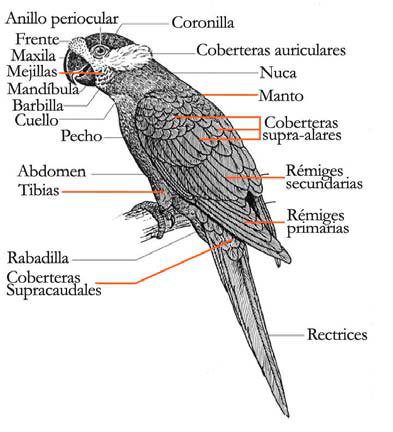
Anatomy-parrots

Of 17 to 20 cm. length between 76 and 102 g. of weight.
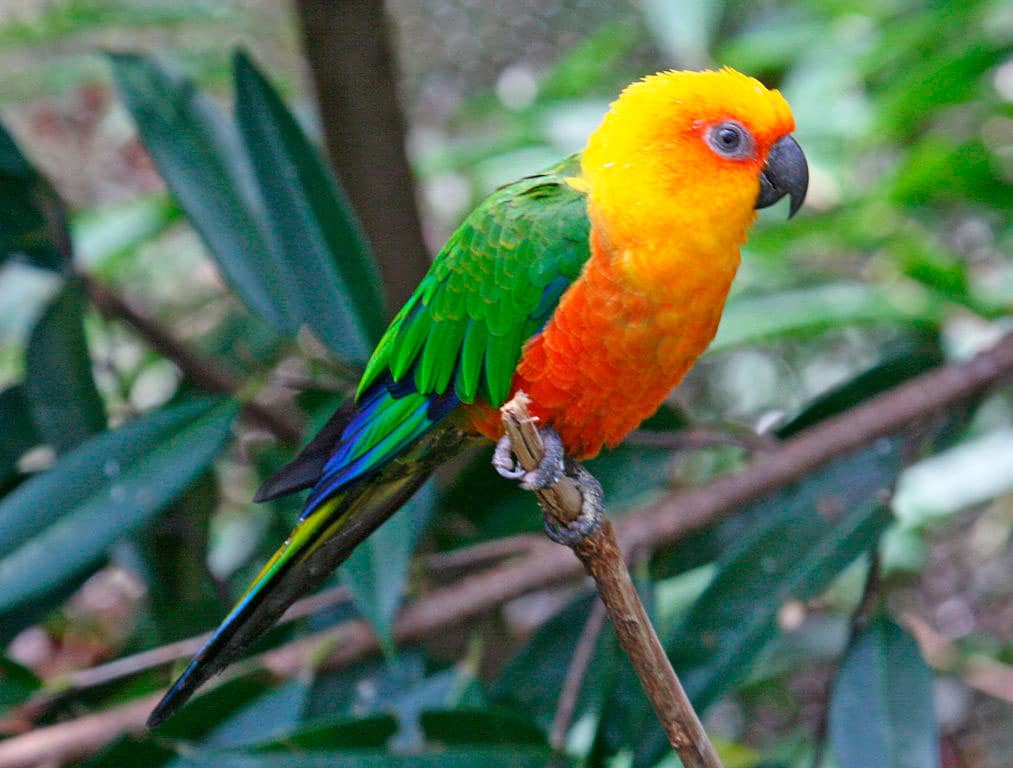
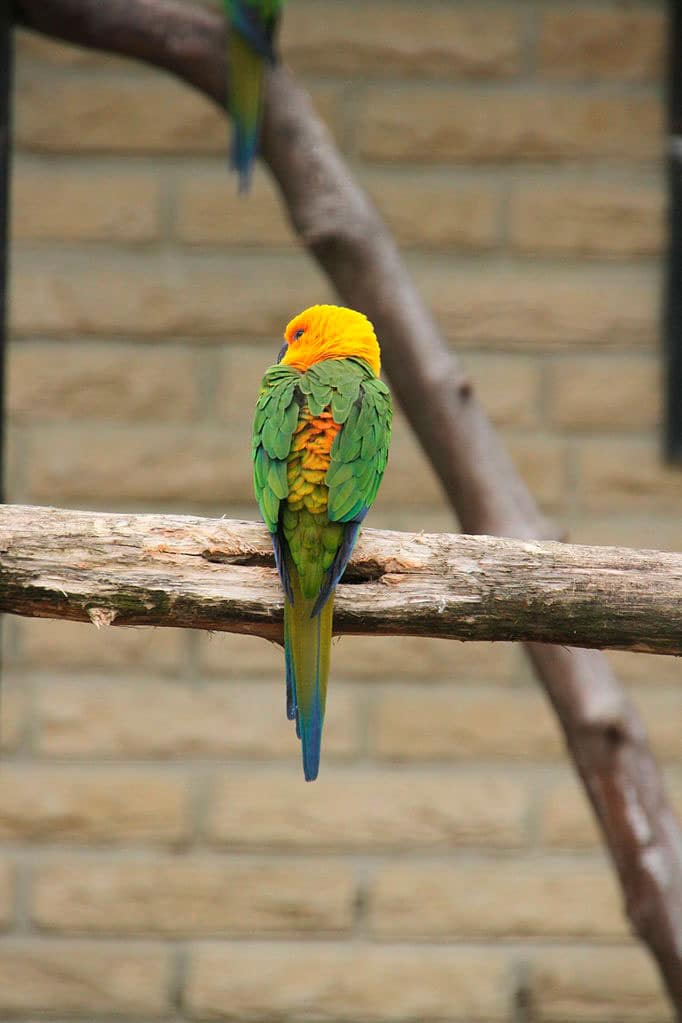
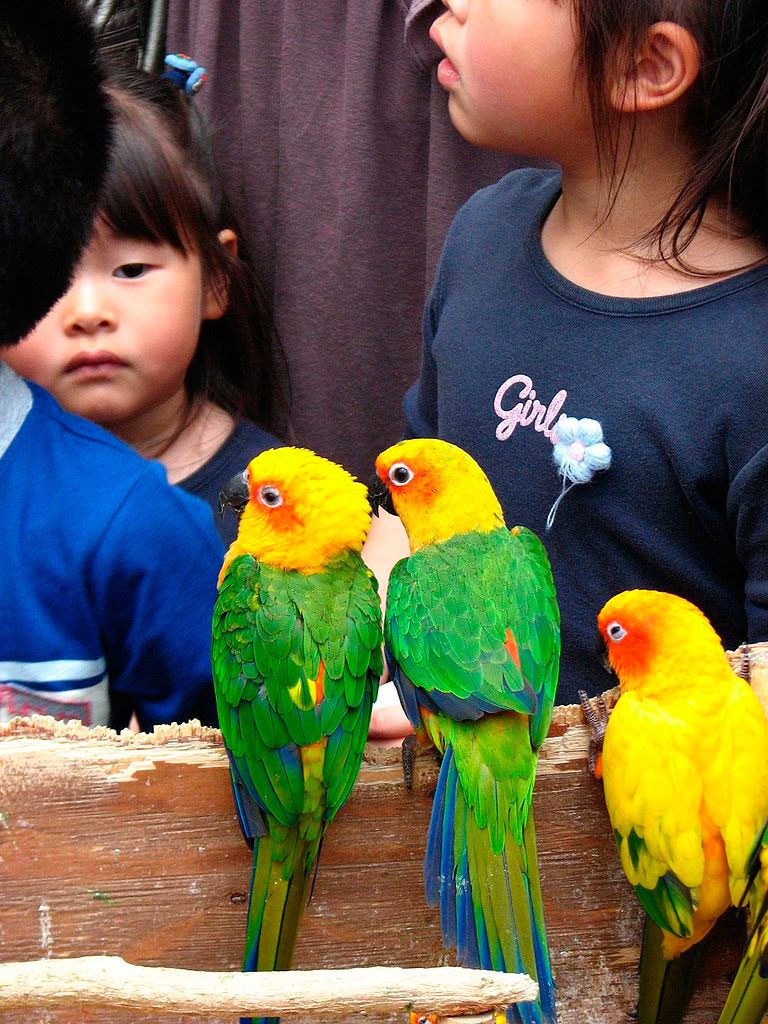
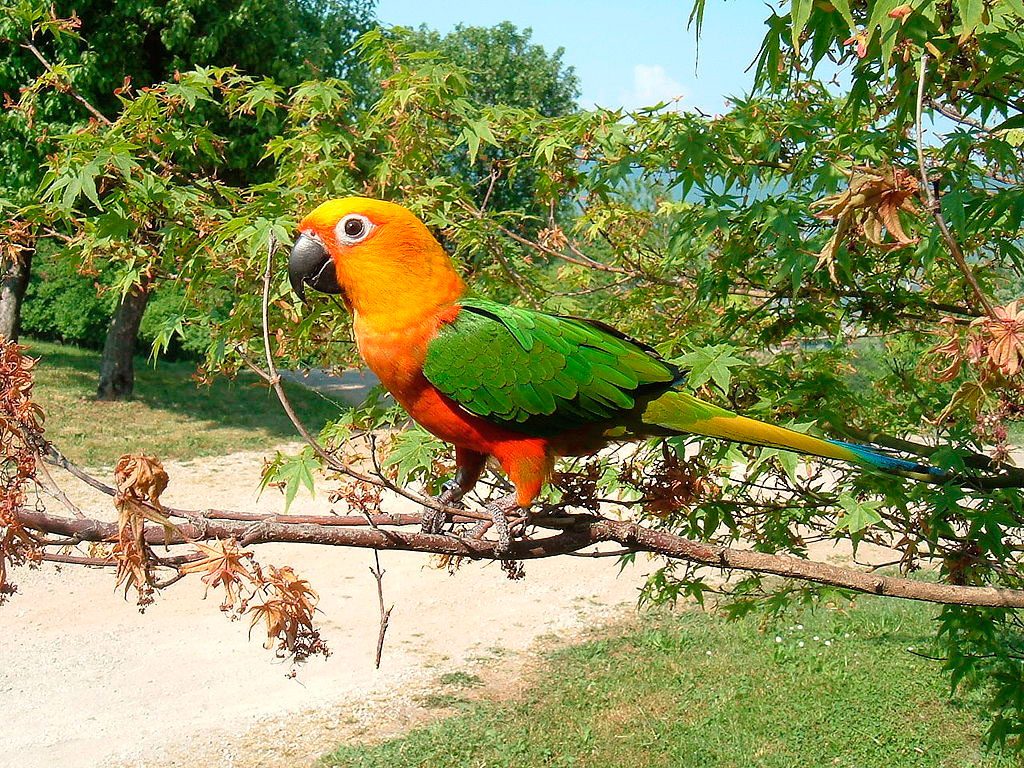
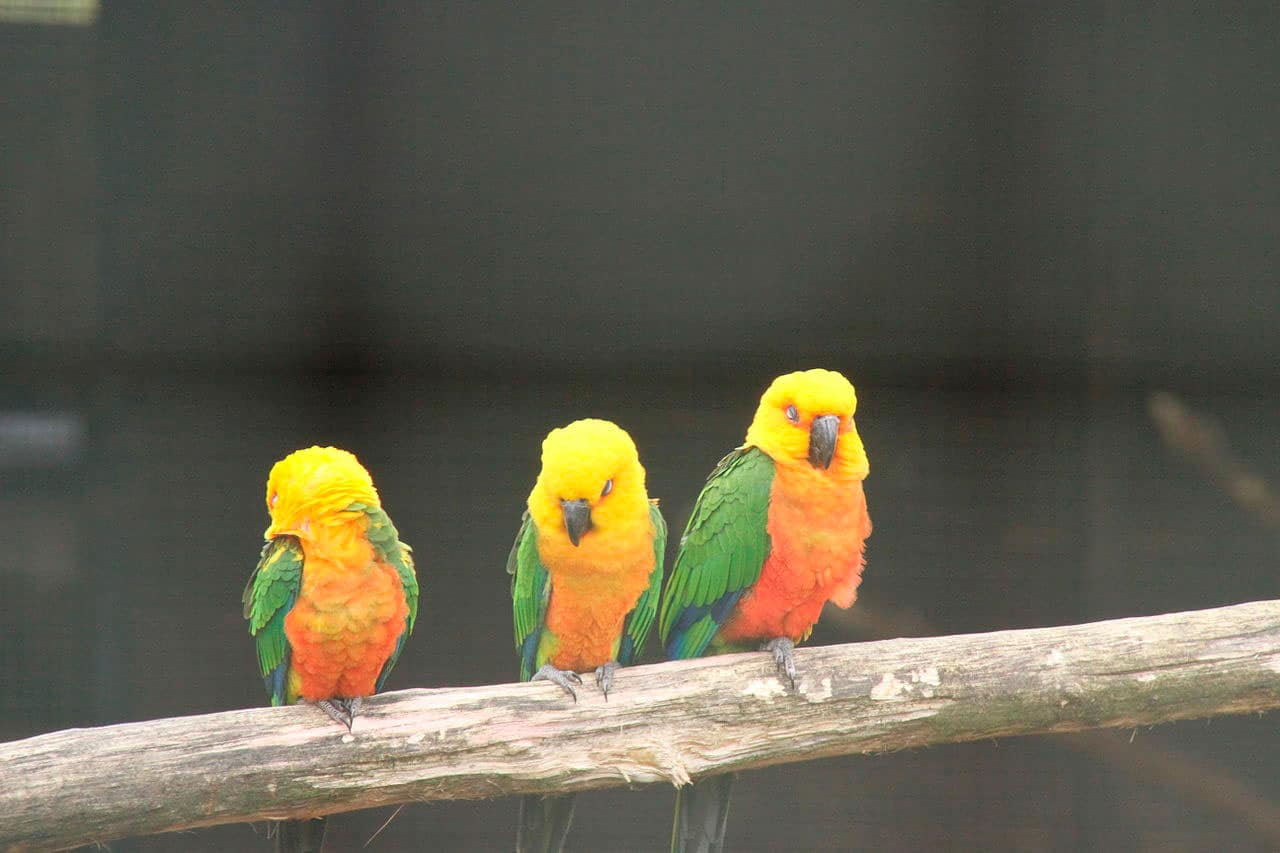
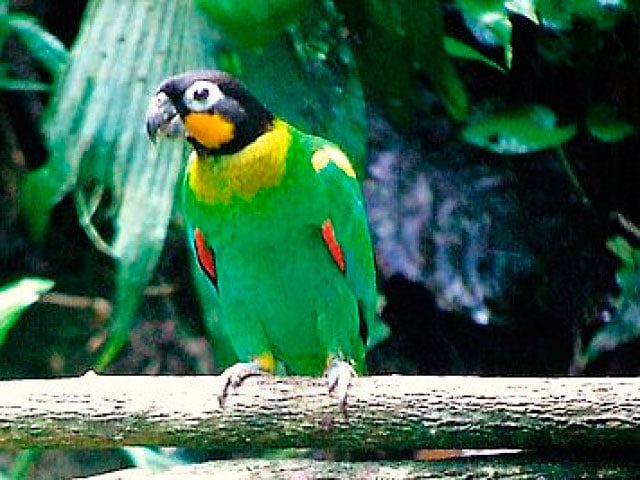
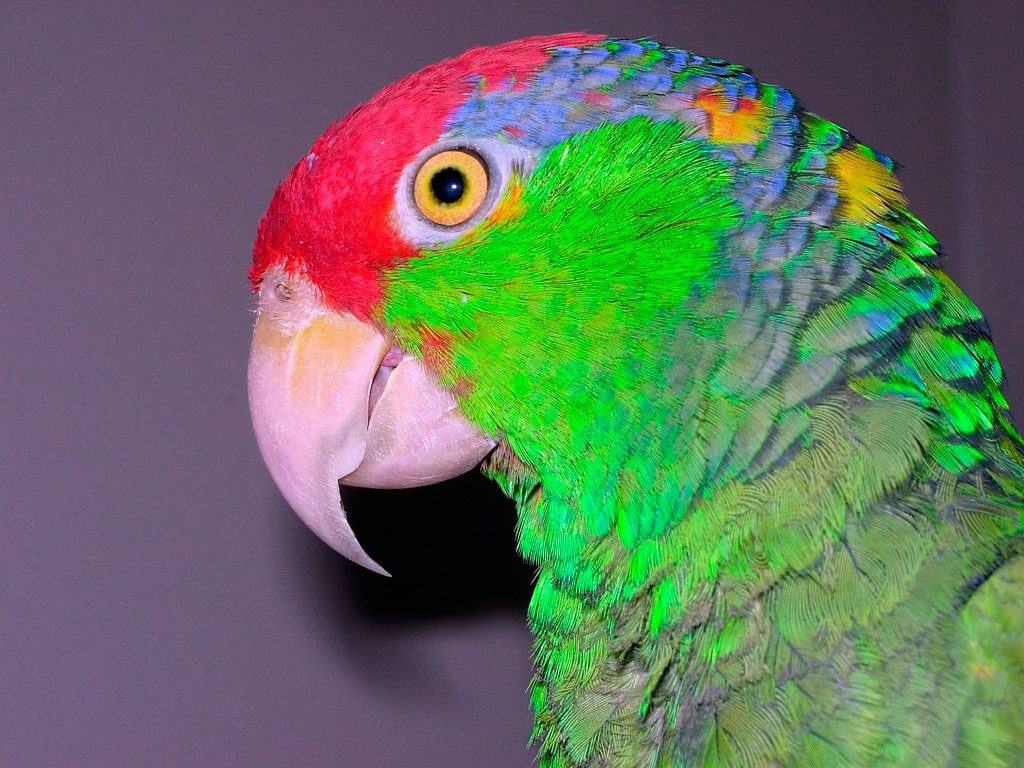
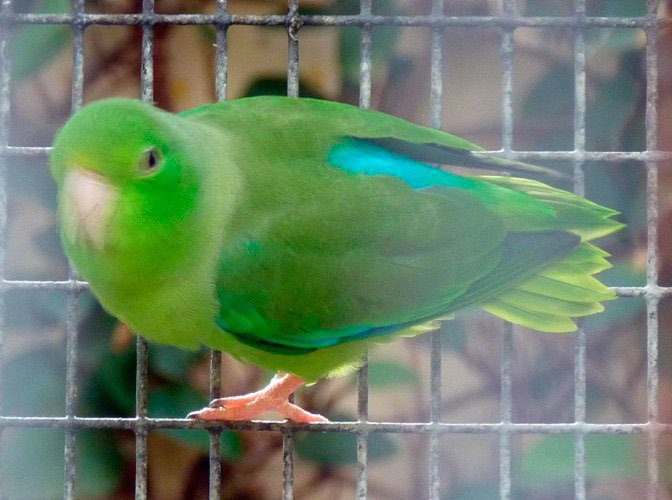
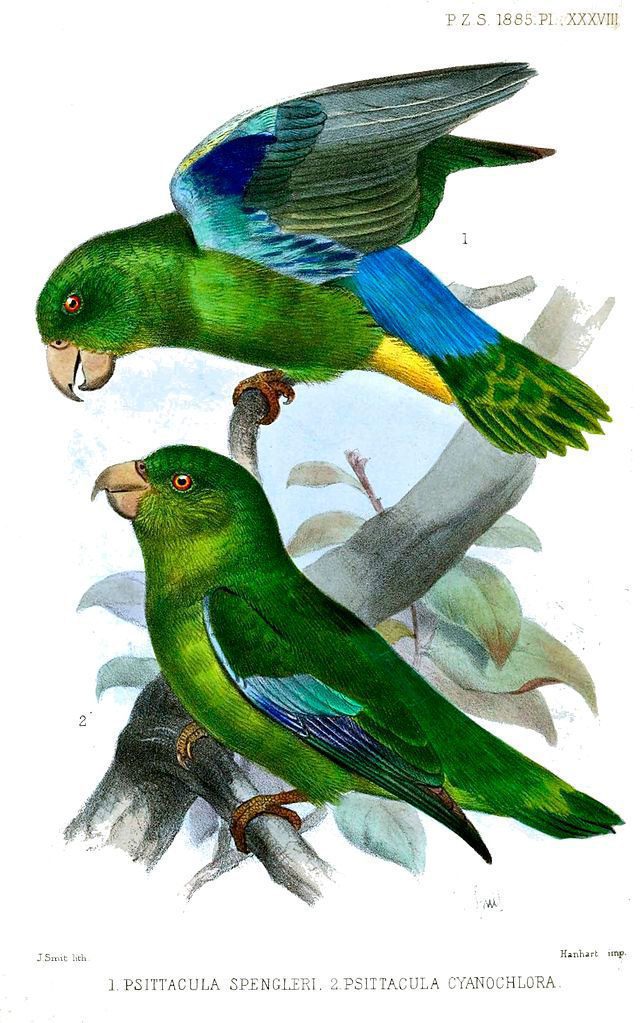
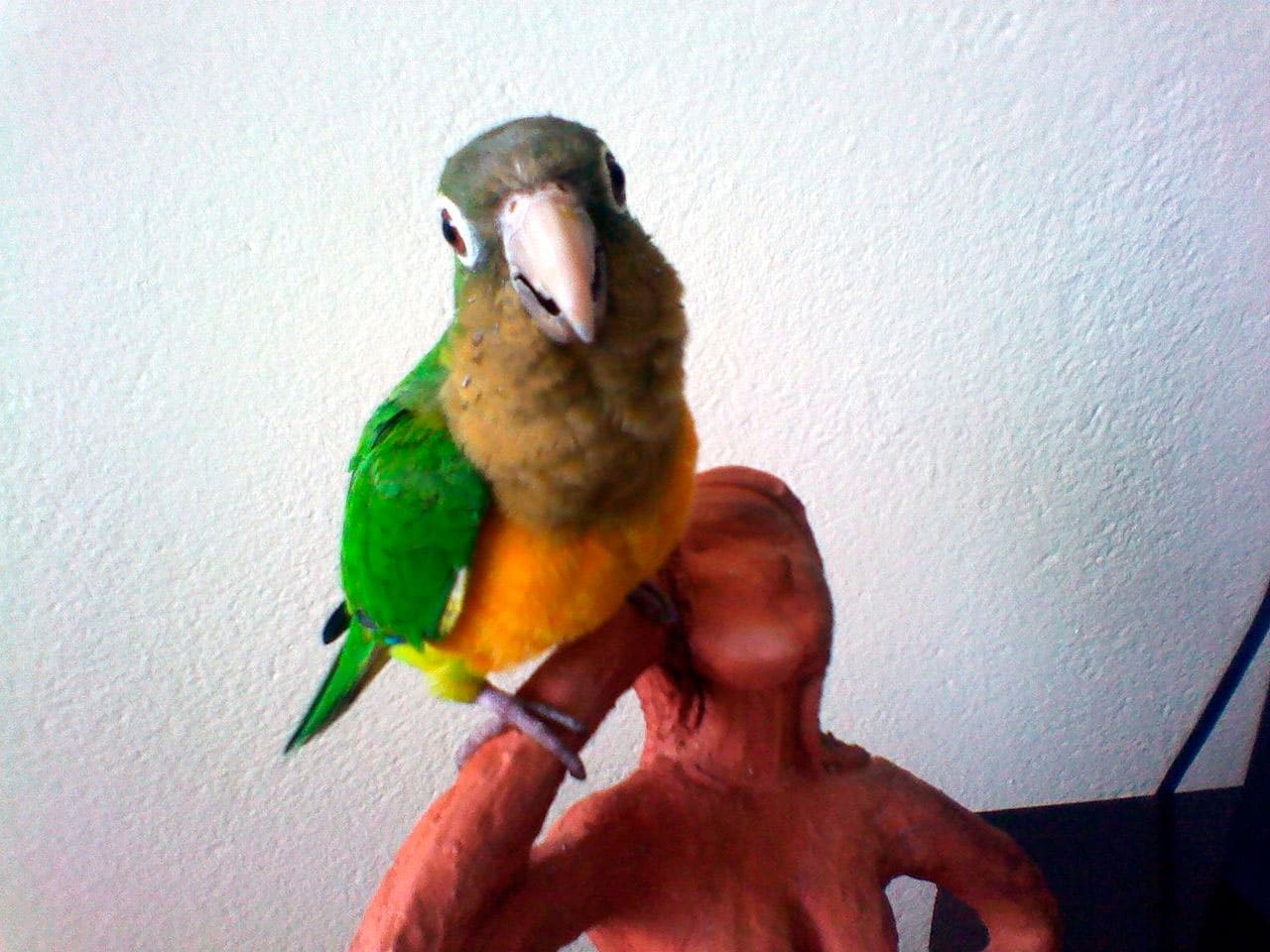
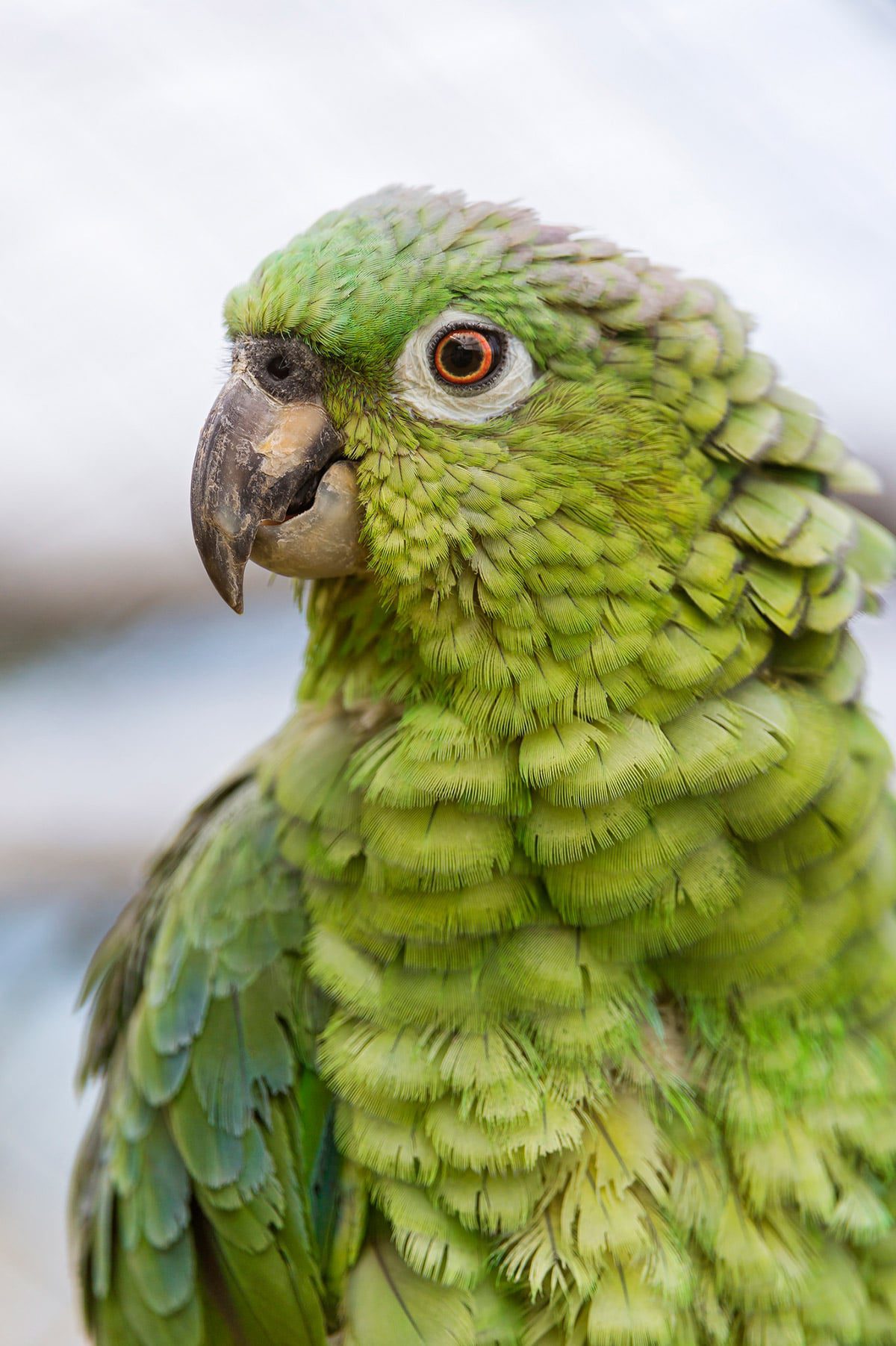
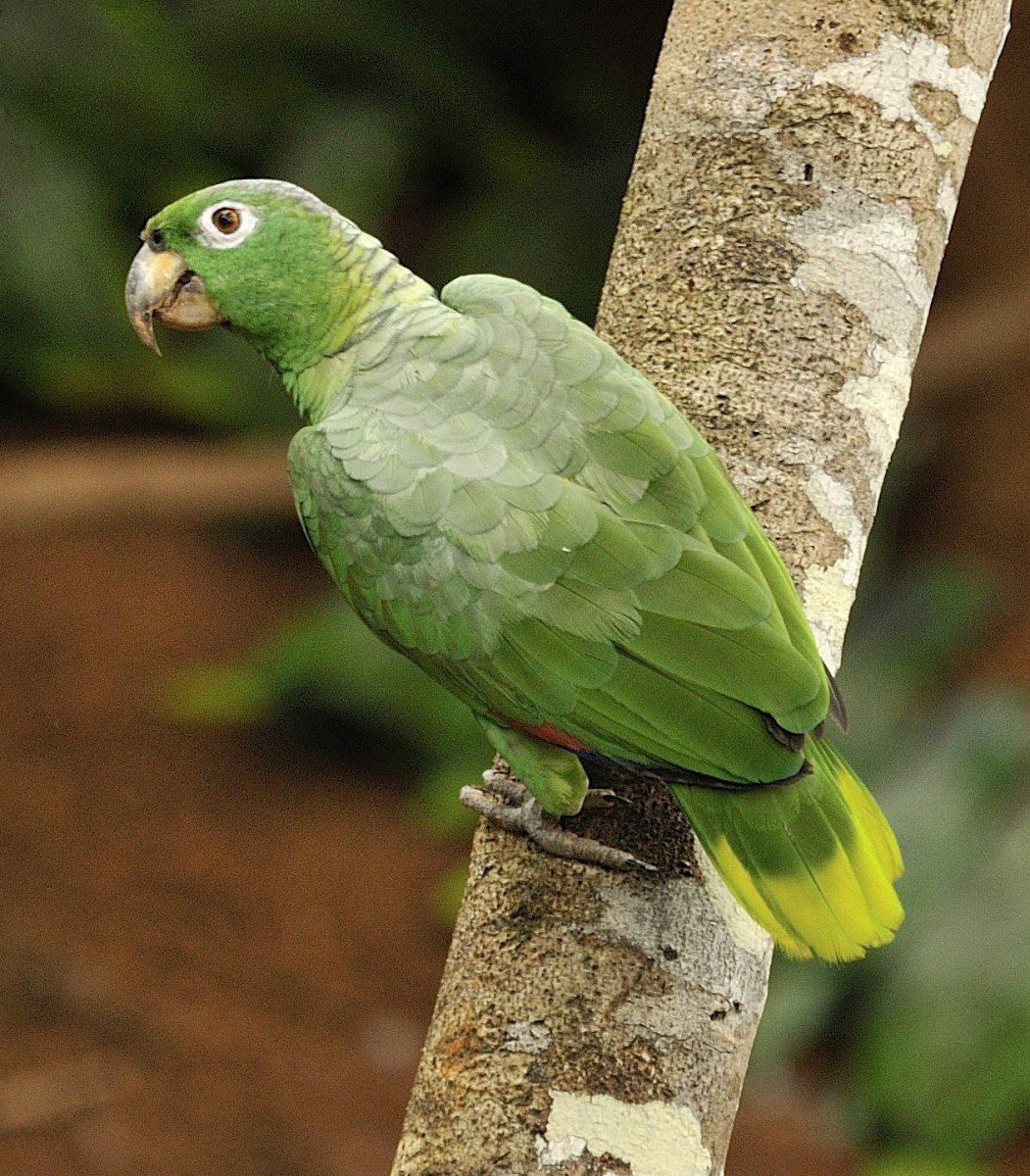
The Brown-throated Parakeet (Eupsittula pertinax) it is a polytypic species. Its fourteen subspecies are distinguished by the mix yellow and Brown on his face and throat.

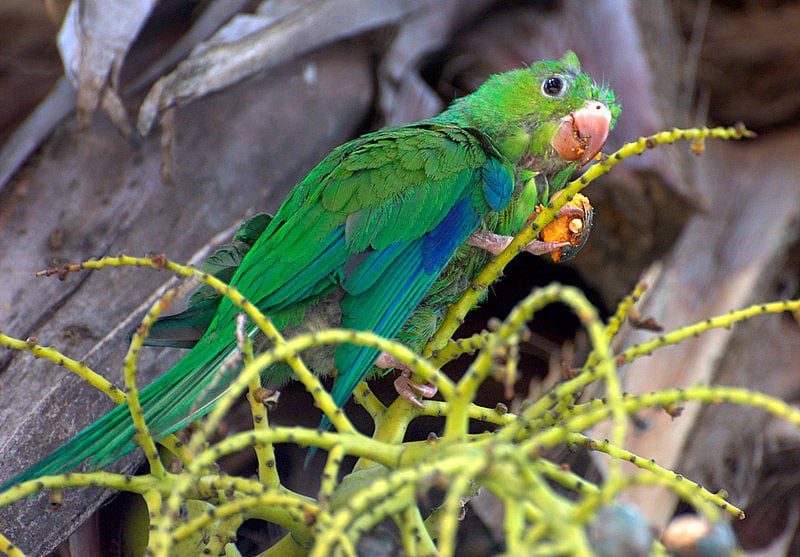
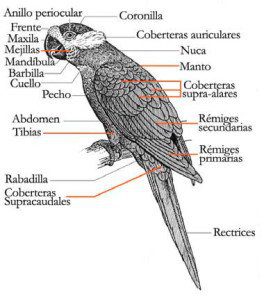
In the case of the Eupsittula pertinax aeruginosa, the lores previous, the frontal area, underside of cheeks, both sides of the neck and ear-coverts, are dark brown; dark stripes visible on the cheeks; the feathers of the ocular region are of color orange-yellow; the crown greenish blue. Upperparts olive green. Lesser and medium coverts green; bluish green the primaries and greater coverts. Primaries and secondaries green up, Blue dark on the tips, Blue them vane outer in the secondaries; by down dark grey. Underwing-coverts brighter yellowish green. The throat and the top chest dark brown; the underparts Matte yellowish green with an orange patch in the central area of the belly. For above, the tail is of color green blue, bluer towards the tip; undertail greyish-yellow.

Eupsittula pertinax

The bill brownish-grey; bare periophthalmic yellowish white; irises yellow, legs grey.

Both sexes similar, without sexual dimorphism, where males are larger than females.

The youth they tend to lack intense yellow, that is alive in individuals adults. Its forecrown is dark greenish blue. The throat and the chest are greenish, while the belly is green with a bit of orange or yellow.

Description subspecies Eupsittula pertinax
Subspecies
  • Eupsittula pertinax aeruginosa (Linnaeus) 1758 – See description.

  • Eupsittula pertinax arubensis (Hartert) 1892 – Cara and throat color opaque marron-oliva. Narrow yellow line on the eyes. Crown greenish blue.

  • Eupsittula pertinax chrysogenys (Massena & Souance) 1854 – Similar to the aeruginosa subspecies, but darker.

  • Eupsittula pertinax chrysophrys (Swainson) 1838 – Similar to the subspecies margaritensis and venezuelae but with the forecrown a pale yellowish brown.

  • Eupsittula pertinax griseipecta (Meyer de Schauensee) 1950 – Similar to the aeruginosa subspecies, with the cheeks, the throat and top of the chest, Gray-olive, veins in the cheeks absent. The crown Green with little blue.

  • Eupsittula pertinax lehmanni (Dugand) 1943 – Is similar to the aeruginosa subspecies, but with yellowish feathers around the eye more extensive; the Blue head limited with the forecrown and less blue in the flight feather.

  • Eupsittula pertinax margaritensis Cory 1918 – Forehead whitish, the cheeks and ear-coverts color oliva-marron with forecrown greenish blue.

  • Eupsittula pertinax ocularis (Sclater,PL & Salvin) 1865 – Patch distinctive yellow below and behind the eyes (absent in the immature). Forehead and crown green color with tint blue in some birds. Throat, top of the chest, the cheeks and lores warm brown; ear-coverts slightly darker.

  • Eupsittula pertinax paraensis (Sick) 1959 – Similar to the aeruginosa subspecies, but with the irises of color red and the vane outer of primaries and secondaries blue.

  • Eupsittula pertinax pertinax (Linnaeus) 1758 – The nominal. Extensive but variable amount of yellow color in the forecrown, the cheeks, the throat and lores. It may be more off or more Orange under and behind the eyes. Crown Green with only a few light blue indications.

  • Eupsittula pertinax surinama (Zimmer & Phelps,WH) 1951 – Similar to the subspecies margaritensis but with narrow frontal band orange-yellow color, orange-yellow colour around the eyes extending towards the cheeks and yellowish-green (not brown) the throat.

  • Eupsittula pertinax tortugensis (Cory) 1909 – Similar to the aeruginosa subspecies but larger, orange-yellow color on both sides of the head and underwing-coverts more yellowish.

  • Eupsittula pertinax venezuelae (Zimmer & Phelps,WH) 1951 – Similar to the subspecies margaritensis but more pale and yellow on the underparts.

  • Eupsittula pertinax xanthogenia (Bonaparte) 1850 – Clearer (almost sallow) the head the species nominal, with yellow tones ranging from a variable on the front of the crown and nape.

Habitat:

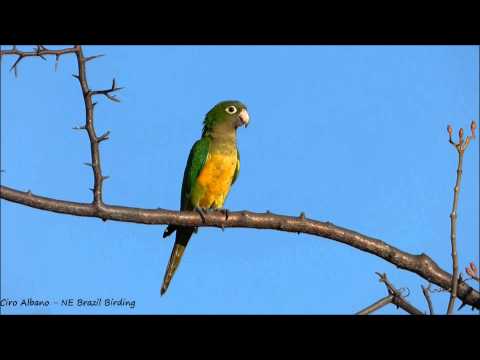
Video – "Brown-throated Parakeet" (Eupsittula pertinax)

Brown-throated Parakeet Eupsittula pertinax / dirty face parakeet

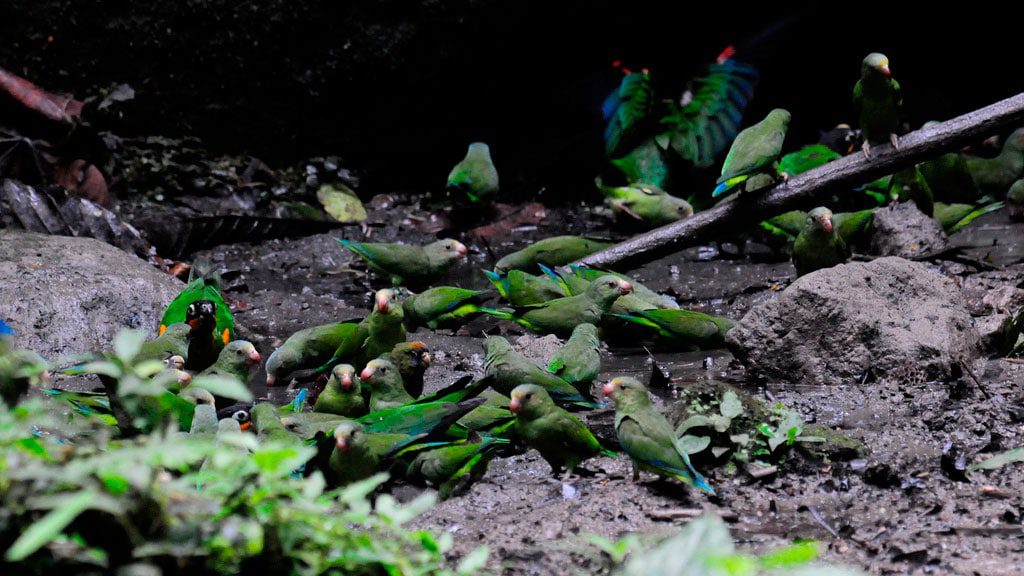
The Aratinga Pertinaz occupies all kind of fields wooded open of the Savannah, transparent areas of dry scrubland full of cactus and acacias, forests of mangrove, tropical forests (where is the most abundant parrot species often), gallery and white sand forests, Mangroves of Rhizophora, edges of moist evergreen forests, and agricultural areas with palms and other trees.

Move at altitudes on the 1.200 m or more, Although they tend to stay below the 1.200 m. This Aratinga also lives in artificial clearings such as public parks or gardens..

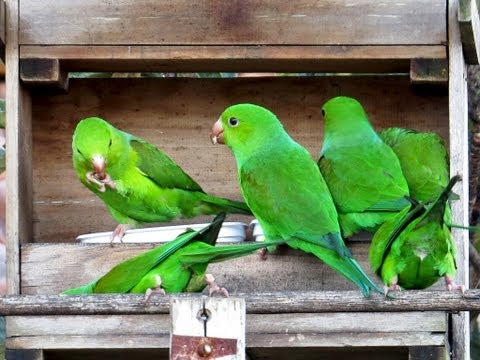
In general, observed in flocks or pairs, forming larger groups where food is abundant and in communal roosts.

Reproduction:

The Brown-throated Parakeet It monogamous. With plays After the season of rains, in general from February to April. Birds very social, assess potential mates in large communal roosts. Also used strong calls in select to your mate / to.

Its breeding season It begins after the rainy season, and varies geographically between the months of February and September. Between February and April in Goal, Colombia; from February to April in Venezuela and any time of the year in Suriname, Curacao, Aruba and Bonaire.

When the conditions are favorable this species You can reproduce several times a year. Son colonial and have been observed up to seven pairs nesting next to each other.

Nest in the cavities of trees, artificial nesting boxes, or in arboreal termite. There are reports of nests made in cracks in rocks. The nests they are very simple, without any plant covering and the eggs, often, they are placed on the floor of the cavity nude. The number of eggs in a nest varies from two to seven.

The female is the primary incubator, with one incubation which can last thirty-six to thirty-seven days in the wild. The chicks they leave the nest after 50 days. The young join their parents and form small family groups that last until the parents begin a new breeding season..

Food:

The Brown-throated Parakeet consuming a wide variety of food, including, for example, in the Northwest of Venezuela seeds of Cassia, Peltophorum, Lagerstroemia and Cedrela, fruits of Muntingia, Swietenia, Psidium and Solanum as well as flowers of Tabebuia, Delonix, Eryihrina and Gliricidia.

Sometimes it causes damage to crops (for example, of millet and handle), of corn in Colombia and in fruit plantations of the Netherlands Antilles. Despite being considered pests in some areas, the Brown-throated Parakeet they are not strongly persecuted.

They feed in very vocal groups that often include macaws and amazon parrots.

Distribution:

The Brown-throated Parakeet are distributed to the North of South America, Panama and the islands of the Southern Caribbean.

In Panama are present in the slope of the peaceful, rarely on the side of the Caribbean, even in the canal area. But, they occupy the lowlands of the Northern Caribbean and northeast of Colombia, from the East of the Sinu River up to the Guajira peninsula, including the Center and low Magdalena valley, and observed at elevations more low in the East of the Andes and the lowlands of the South of the Alto Orinoco, to the North of Vaupรฉs.

Probably can be observed in all Venezuela, extending to the Margarita Islands, Turtle (Venezuela), Curacao, Aruba and Bonaire (Netherlands Antilles); introduced in St Thomas, virgin islands, in the 19th century.

Its distribution extends through of the Guianas and the North of Brazil, from Roraima until Amapรก, as well as discontinuously in the upper part of the basin of the Tapajos River, For and in the basin of the Black river, amazon.

In spite of his uneven distribution, usually common to abundant, in many places it is the most common parrot (for example in localities of Guyana), locally common in Panama and reportedly very common in black rivers and Branco, Brazil.

Your area of distribution possibly be increasing due to deforestation. In general resident with local seasonal movements (for example, in the region of Santa Maria, Colombia) the availability of food and the dispersion of the areas of reproduction-related.

Distribution subspecies Eupsittula pertinax
Subspecies
  • Eupsittula pertinax aeruginosa (Linnaeus) 1758 – North of Colombia, Northwest of Venezuela and the upper part of the basin of the Rio Branco, in the Northwest of Brazil

  • Eupsittula pertinax arubensis (Hartert) 1892 – Aruba

  • Eupsittula pertinax chrysogenys (Massena & Souance) 1854 – Region of Black river and, possibly, Solimรตes River, North of Brazil; There are no details about its area of distribution

  • Eupsittula pertinax chrysophrys (Swainson) 1838 – Southeast of Venezuela, Guyana Interior and North of Roraima, Brazil.

  • Eupsittula pertinax griseipecta (Meyer de Schauensee) 1950 – Valley of the sinu river, North of Colombia. Range in relation to the aeruginosa subspecies unclear

  • Eupsittula pertinax lehmanni (Dugand) 1943 – It is from Colombia and possibly Venezuela.

  • Eupsittula pertinax margaritensis Cory 1918 – Islands Margarita and The friars, Venezuela. the birds of the Paria Peninsula in the North of Venezuela, they can be of this subspecies; see the subspecies venezuelae

  • Eupsittula pertinax ocularis (Sclater,PL & Salvin) 1865 – Pacific slope of Panama.

  • Eupsittula pertinax paraensis (Sick) 1959 – High of the Tapajos River and Cururu River, For, Brazil.

  • Eupsittula pertinax pertinax (Linnaeus) 1758 – The nominal. Curaรงao and introduced in St Thomas

  • Eupsittula pertinax surinama (Zimmer & Phelps,WH) 1951 – French Guiana and Suriname through the coast of Guyana to Delta Amacuro, Northeast of Venezuela.

  • Eupsittula pertinax tortugensis (Cory) 1909 – Turtle Island, Venezuela.

  • Eupsittula pertinax venezuelae (Zimmer & Phelps,WH) 1951 – North and Central Venezuela. Areas of contact with other little-known Venezuelan subspecies: see aeruginosa, surinama and chrysophrys.

  • Eupsittula pertinax xanthogenia (Bonaparte) 1850 – Bonaire

Conservation:

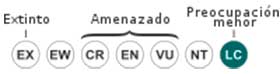
โ€ข Red List category of the UICN current: Least concern

โ€ข Population trend: Growing

The Eupsittula Pertinax (Pit and neck of 2014) was considered, previously, belonging to the genus Aratinga.

The subspecies Griseipecta, endemic of the sinu valley in Colombia, There have been since 1949 and is likely to be extinct (T. Donegan in litt. 2011).

The size of the population world of this kind not has been quantified, but it is described as "commonยป (Stotz et to the. (1996). Is considered as the Parrot more abundant in the land low for the Caribbean, Plain in Colombia, Guyana, North of Suriname and the three islands of the Netherlands Antilles.

A density of five to eighty and nine birds by kilometer square is has estimated in the regions of the Northwest of Venezuela.

It is believed that populations on the continent are increasing their range in response to an increase in the conversion of the forest into farmland.

This species is often captured with commercial purposes, but not has been consequences serious, with the exception of the subspecies Aratinga pertinax margaritensis and Aratinga pertinax tortuguensis.

The Aratinga pertinax tortuguensis It is also vulnerable to severe climate changes. (Juniper and Parr, 1998;. Pit, et to the, 1997)

"Brown-throated Parakeet" in captivity:

The Brown-throated Parakeet has a average vinein the nature of about ten years. But, When live in captivity with the proper supervision, they have come to live up to twenty-five years.

common in the industry of the pet because, mainly, to your behavior affective. Captured for the pet trade and occasionally as food.

Pretty noisy, both in the nature as in captivity. With certain skills for repeated whistles and words short.

Alternative names:

Brown-throated Parakeet, Brown throated Parakeet, Brown-throated Conure, Caribbean Parakeet, Curacao Conure, Curacao Parakeet, St. Thomas’s Conure (English).
Conure cuivrรฉe, Conure de Saint-Thomas, Perriche cuivrรฉe, Perruche cuivrรฉe (French).
Braunwangensittich (German).
Aratinga de-cara-parda, aratinga-de-bochecha-parda, periquito-de-bochecha-parda (Portuguese).
Aratinga Pertinaz, Perico cara sucia, Perico Carisucio, Perico Gorgicafรฉ, Periquito de Cola Corta, Periquito Gorgimoreno (espaรฑol).
Loro carisucio, Perico Carisucio (Colombia).
Perico Gorgicafรฉ (Costa Rica).
Perico Cara Sucia (Venezuela).


Carl Linnaeus
Carl Linnaeus

scientific classification:

โ€ข Order: Psittaciformes
โ€ข Family: Psittacidae
โ€ข Genus: Eupsittula
โ€ข Scientific name: Eupsittula pertinax
โ€ข Citation: (Linnaeus, 1758)
โ€ข Protonimo: Psittacus pertinax

Brown-throated Parakeet Images:


Especies del gรฉnero Eupsittula
  • Eupsittula nana
  • —- Eupsittula nana astec
  • —- Eupsittula nana nana
  • —- Eupsittula nana vicinalis
  • Eupsittula canicularis
  • —- Eupsittula canicularis canicularis
  • —- Eupsittula canicularis clarae
  • —- Eupsittula canicularis eburnirostrum
  • Eupsittula aurea
  • Eupsittula pertinax
  • —- Eupsittula pertinax aeruginosa
  • —- Eupsittula pertinax arubensis
  • —- Eupsittula pertinax chrysogenys
  • —- Eupsittula pertinax chrysophrys
  • —- Eupsittula pertinax griseipecta
  • —- Eupsittula pertinax lehmanni
  • —- Eupsittula pertinax margaritensis
  • —- Eupsittula pertinax ocularis
  • —- Eupsittula pertinax paraensis
  • —- Eupsittula pertinax pertinax
  • —- Eupsittula pertinax surinama
  • —- Eupsittula pertinax tortugensis
  • —- Eupsittula pertinax venezuelae
  • —- Eupsittula pertinax xanthogenia
  • Eupsittula cactorum
  • —- Eupsittula cactorum cactorum
  • —- Eupsittula cactorum caixana

  • Sources:

    Avibase
    – Parrots of the World โ€“ Forshaw Joseph M
    – Parrots A Guide to the Parrots of the World – Tony Juniper & Mike Parr
    – Birdlife
    Animal Diversity Web

    Photos:

    (1) – Aratinga pertinax By Genes Luna (Flickr: IMG_0309.jpg) [CC BY-SA 2.0], via Wikimedia Commons
    (2) – Aratinga pertinax xanthogenia By gailf548 (originally posted to Flickr as Young Parrot) [CC BY 2.0], via Wikimedia Commons
    (3) – Eupsittula pertinax arubensis By Alexander Yates (originally posted to Flickr as Aruba Parakeet) [CC BY 2.0], via Wikimedia Commons
    (4) – Brown-throated Parakeet (Aratinga pertinax venezuelae) in Cagua, Estado Aragua, Venezuela By Cristรณbal Alvarado Minic [CC BY 2.0], via Wikimedia Commons
    (5) – Aratinga pertinax aeruginosa By Aratinga_pertinax_-Colombia-8a.jpg: anthrotectderivative work: Snowmanradio [CC BY 2.0], via Wikimedia Commons
    (6) – Eupsittula pertinax By Leizelt, Balthasar Friedrich; Wilhelm, Gottlieb Tobias [CC BY 2.0 or Public domain], via Wikimedia Commons

    Sounds: Peter Boesman (Xeno-canto)

    โ–ท The world of Pets: Dogs, cats, birds, reptiles, amphibians

    Rusty-faced Parrot
    Hapalopsittaca amazonina

    Rusty-faced Parrot

    Content


    Anatomy-parrots

    Description:

    23 cm.. height and a weight between 97 and 115g.

    The Rusty-faced Parrot or Parrot mountain (Hapalopsittaca amazonina) It is distinguishable by the dirty red of his face and crown. Its bill is pale with to the base of the lower jaw and the chin of color red orange. Headphones coverts reddish brown with yellow lines that extend behind the nape and the neck. The rest of upperparts they are green. Its chest This is olive green, with red spots in the shoulders similar to their Wing coverts internal minors. The rest of your wing-coverts they are blue-green and the remiges bluish-black. Its tail It is mainly dull red with wide blue apexes.

    It has no sexual dimorphism. The youth are green-yellow color, with the face pale red and the secondaries grey.

    Description 3 subspecies:

    • Hapalopsittaca amazonina amazonina

      (Des Murs, 1845) – Nominal.


    • Hapalopsittaca amazonina theresae

      (Hellmayr, 1915) – The plumage with more olive tones and the face dark red.


    • Hapalopsittaca amazonina velezi

      (Serious,GR & Restrepo, 1989) – With part of the crown and nape, brighter yellowish green; forecrown red; list fine near to the ear; below and behind the eye, green. More information.

    Habitat:

    It inhabits in mountains with semi-humid and cloud forests, between the 2000 to 3600 m, with the presence of Oak (Quercus humboldtii) and Alder (Alnus acuminata).
    Fly high in the forest canopy, in groups of 5-30 individuals. Presents aggregation behaviors for the night, establishing communal bedrooms in groups of between 2-35 individuals.

    Reproduction:

    Many aspects of the reproductive biology of the Rusty-faced Parrot. Probably nests in tree hollows of Oak dead.

    Food:

    Consumes fruits of the "matapaloยซ, flowers and seeds, including the of Clusia sp. and some GUIs of which is fed with high frequency.

    Distribution:

    Size of the breeding range / resident): 234.000 km2

    Is located in Colombia and Venezuela and Peru. In Colombia lives between 2000 and 2700 m above the sea level in the Cordillera Oriental and in the The upper Magdalena valley (South of the Department of the Huila). Among 3100 and 3600 m of height in the cordillera Central in Caldas (where it is considered Bird emblem), in the basin of the White River in the municipality of Manizales. In the Cordillera Oriental is known only in Norte de Santander and the southwest of Bogotรก. Has also been recorded in the departments of Risaralda, Tolima, Huila (Cave of the Guacharos, Meremberg nature reserve) and Cauca (Puracรฉ National Park).

    Distribution 3 subspecies:

    • Hapalopsittaca amazonina amazonina

      (Des Murs, 1845) – Nominal. East of the Colombian Andes.


    • Hapalopsittaca amazonina theresae

      (Hellmayr, 1915) – Eastern edge of the Andes of Colombia and Northwest of Venezuela.


    • Hapalopsittaca amazonina velezi

      (Serious,GR & Restrepo, 1989) – Center of the Colombian Andes. More information.

    Conservation:


    Vulnerable


    โ€ข Current category of the Red List of the UICN: Vulnerable.

    โ€ข Population trend: Decreasing.

    From makes several years appears in the book red of species threatened by fault of the destruction of their habitat, including, the Palm of wax (Ceroxylon quindiuense).

    Rationale for the Red List category

    This species is classified as Vulnerable Since its small population consists of subpopulations very small and scattered that probably will be experiencing declines continuous due to the loss widespread of habitat.

    Justification of the population

    Renjifo et to the. (2002) estimated that in Colombia the population can count 2,500-10,000 individuals, based on a hypothetical C.1 density of individuals / km2, and the 25% occupation of the approximately 13.890 km2 of habitat suitable. This may be an overestimate and the population could be right around the few thousand mark in Colombia (P. Salaman in litt., 2005). There are also much smaller populations in Venezuela. Its location in the Ecuador is uncertain. Be placed better in the band 2.500-9.999 mature in general individuals, which is equivalent to 3.750-14.999 individuals, rounded here to 3.500-15.000 individuals.

    Justification of trend

    Se sospecha una lenta y continua disminuciรณn de la poblaciรณn del Rusty-faced Parrot sobre la base de la continua destrucciรณn y fragmentaciรณn del hรกbitat.

    "Rusty-faced Parrot" in captivity:

    No encontrado en avicultura.

    Alternative names:

    Rusty-faced Parrot, Bogota Parrot, Little Amazonian Parrot, Rusty faced Parrot (English).
    Caรฏque ร  face rousse, Caรฏque ร  face rouge (French).
    Caรฏque ร  face rousse (German).
    Rusty-faced Parrot (Portuguese).
    Cotorra Montaรฑera, Lorito Amazonino, Lorito Multicolor, Loro fantasma (espaรฑol).
    Cotorra Montaรฑera, Lora montaรฑera (Colombia).
    Perico Multicolor (Venezuela).


    scientific classification:

    Marc Athanase Parfait Oeillet Des Murs
    Marc Athanase Parfait Oeillet Des Murs

    Order: Psittaciformes
    Family: Psittacidae
    Genus: Hapalopsittaca
    Scientific name: Hapalopsittaca amazonina
    Citation: (Des Murs, 1845)
    Protonimo: Psittacus amazoninus


    Images ยซLorito Amazoninoยป:

    Videos ยซLrito Amazoninoยป:


    ยซAmazonino Blondoยป (Hapalopsittaca amazonina)


    Sources:

    Avibase
    Parrots of the World โ€“ Forshaw Joseph M
    Parrots A Guide to the Parrots of the World – Tony Juniper & Mike Parr
    Birdlife

    Photos:

    (1) – Iconographie ornithologique By Marc Athanase Perfect Carnation Walls (1804-1878) (Iconographie ornithologique) [Public domain], via Wikimedia Commons

    Sounds:

    Restrepo, Daniel Uribe

    * – Restrepo, Daniel Uribe

    Daniel has been chasing birds since he was 9-years old, growing on a farm in the Central Andes of Colombia, with his bedroom walls covered with colorful prints of John James Audubonโ€™s birds. Daniel graduated in Veterinary Medicine and Animal Science and has pursued bird and nature photography as his main passions in life.

    He is co-founder of the Caldas Ornithological Society (SCO) based in Manizales. Dedicated mainly to conservation and sustainable development projects, Daniel has consulted for many of the most prominent environmental organizations in Colombia and currently assists private nature reserves in Colombia in the establishment of agritourism and ecotourism services.

    โ–ท The world of Pets: Dogs, cats, birds, reptiles, amphibians

    Pileated Parrot
    Pionopsitta pileata

    Pileated Parrot

    Content

    Pileated Parrot

    Description:

    22 cm.. length and a weight between 98-120 g..

    The Pileated Parrot (Pionopsitta pileata) has the forecrown, lores, crown anterior upper cheeks to behind eyes, bright red; patch reddish brown in ear-coverts; the lower cheeks, sides and rear of the neck, green.

    The upperparts, green. Primaries and greater coverts, alula and feathers bend of wing, violet blue; other coverts, green. Outerwebs of the primary and secondary, violet blue with blue-green edges. Under, the wings bluish green, coverts with some darker blue feathers. Underparts green with bluish tint in the chest and throat, and with a yellowish tint in the belly and undertail-coverts. Upper, the tail centrally green, laterally violet blue; undertail, bluish green.

    Bill dark brown, becoming dark horn distally in both jaws; bare periophthalmic naked, pale grey, irises and legs, grayish brown.

    The female has most of its head green but with a pretty pale blue in the forecrown.

    Immature as female, but with grayish green or green spots and dark spots on the base bill; young male sometimes with red limited in forecrown with a patch orange behind.

    • Sound of the Pileated Parrot.

    Habitat:

    They inhabit in forests, including humid tropical forests and forests dominated by araucarias, mainly in lowlands in the south of the mountain range, although penetrating the coastal mountains Brazil, at altitudes of 300 to 1.500 m; also in areas partially cleared. gregarious in groups of approximately 10 birds; apparently rare in greater numbers.

    Reproduction:

    They nest in the cavities of trees. probably reproduce mainly in the months of November to January. Clutch 3-4 eggs in captivity.

    Food:

    The fruits of Euterpe edulis They are among the favorite foods during the winter in eastern Paraguay; also recorded fruits Podocarpus and Solanum, and bark Eucalyptus; visit when ripe fruit orchards in Rio Grande do Sul.

    Distribution and status:

    Size of its range (breeding/resident ): 1.650.000 km2

    The Pileated Parrot It is located in southeast Brazil, to the South of Bay, through the belt of the Atlantic forest in Espirito Santo, probably east of Minas Gerais, Brazil, Rio de Janeiro, Sรฃo Paulo, Paranรก and Santa Catarina, until Rio Grande do Sul, extending to the east Paraguay and northeast of Argentina in Missions and possibly in Currents (no recent records); also they have been reported east of Chaco in Argentina, where they can arrive as an irregular visitors.

    Some seasonal movements occur Paranรก, where birds leave the inland coastal plateau after breeding, and in Paraguay where it is in Amambay in October.

    Nomad in the Intervales State Park of Sรฃo Paulo. Its population is widespread but declining due to the extensive loss of forests by urban growth, agriculture and mining.

    Described as uncommon to fairly common in Missions, Argentina. Apparently its population is still not at risk due to habitat loss, since birds are still quite numerous where fragments of forest remain. (for example, east of Paraguay) and travel between them on land without trees. More numerous are more extensive where the remains of forest, It is more common in eastern Paraguay and adjacent Paranรก and Sรฃo Paulo in Brazil.

    Conservation:


    minor concern


    โ€ข Current category of the Red List of the UICN: Least concern.

    โ€ข Population trend: Stable.

    Rationale for the Red List category

    This species has a very large range and therefore it is not close to the thresholds for Vulnerable under the criterion of size range (Extension Occurrence <20,000 km2 combinada con un tamaรฑo de rango decreciente o fluctuante, extensiรณn / calidad de hรกbitat o tamaรฑo de poblaciรณn y un pequeรฑo nรบmero de lugares o fragmentaciรณn severa). La demographic trend appears to be stable and, therefore, the species does not approach the thresholds Vulnerable under the criteria of population trend (> 30% decline over ten years or three generations). The population size It has not been quantified, but it is not believed to be close to the thresholds for Vulnerable under the criterion of population size (<10.000 individuos maduros con un descenso continuo estimado> 10% in ten years or three generations or a population structure). For these reasons the species is evaluated as the least concern.

    Justification of the population

    The size of the world's population has not been quantified, but this species is described as ยซRareยป (Stotz et to the., 1996).

    Justification of trend

    They suspected that the population is stable in absence of evidence of any decline or threatens substantial.

    "Pileated Parrot" in captivity:

    Very rare in captivity.

    Alternative names:

    Pileated Parrot, red-cappe parrot, Red-capped Parrot (English).
    Caรฏque mitrรฉ, Perroquet mitrรฉ (French).
    Scharlachkopfpapagei, Scharlachkopf-Papagei (German).
    Cuiรบ-cuiรบ, caturra, cuiรบ, cuiuiรบ, curica-cuiรบ, maitaca-de-cabeรงa-vermelha, periquito-rei, tui-maritaca (Portuguese).
    Catita cabeza roja, Catita decabeza roja, Lorito cabeza roja, Lorito de Cara Roja, Lorito Pileado (espaรฑol).
    Catita cabeza roja, Catita decabeza roja (Argentina).
    Lorito cabeza roja (Paraguay).


    scientific classification:

    Giovanni Antonio Scopoli
    Giovanni Antonio Scopoli

    Order: Psittaciformes
    Family: Psittacidae
    Genus: Pionopsitta
    Scientific name: Pionopsitta pileata
    Citation: (Scopoli, 1769)
    Protonimo: Psittacus pileatus


    "Lorito Pileado" images:

    Videos "Pileated Parrot"

    ————————————————————————————————

    "Pileado Lorito" (Pionopsitta pileata)


    Sources:

    Avibase
    – Parrots of the World โ€“ Forshaw Joseph M
    – Parrots A Guide to the Parrots of the World – Tony Juniper & Mike Parr
    – Birdlife

    Photos:

    (1) – Pileated Parrot Loro Parque – Tenerife (Spain) by Florin FeneruFlickr
    (2) – Pileated Parrot Loro Parque – Tenerife (Spain) by Florin FeneruFlickr
    (3) – Pileated Parrot Loro Parque – Tenerife (Spain) by Florin FeneruFlickr
    (4) – Pionopsitta pileata by Taguatรณ yetapaFlickr
    (5) – Red-capped parrot (Pionopsitta pileata) – ยซCuiรบ-Cuiรบยป Campina Grande do Sul | The Birds of Brazil by Ben TavenerFlickr
    (6) – Catita Cabeza Roja by Argentavis โ€“ Birds of Argentina

    โ–ท The world of Pets: Dogs, cats, birds, reptiles, amphibians

    Yellow-headed Parrot
    Amazona oratrix

    Yellow-headed Parrot

    Content


    Anatomy-parrots

    Description:

    35-38 cm. in length weighing up 500 g..

    Yellow-headed Parrot

    The Yellow-headed Parrot (Amazona oratrix) has head and nape bright yellow; sides neck sometimes with scattered green feathers.

    Upperparts green grass with ends of darker green in some feathers; uppertail-coverts paler. Wing coverts green, sometimes with paler yellow margins on some feathers; edge front of the wing and carpal area with red marks and / or yellow variables. Primaries and secondaries green at the base (more emerald than coverts), blue at the tips; five base outer secondaries bright red, forming a speculum. Under wings green. The chin is bright yellow, the throat variable green and dark blue suffusion margins in the feathers of some birds; chest and belly green with yellowish suffusion in some birds, bluish suffusion in other; the thighs with yellow feathers in some birds. Tail green with red tips yellow and green at the base of the innerwebs of the lateral feathers. Bill gray horn; bare periophthalmic whitish; irises orange; legs grey.

    Both sexes are similar.

    Immature It is very green part with little or no yellow in the head without red and yellow in the wings.

    • Sound of the Yellow-headed Parrot.

    Geographic Variation:

    All birds puerto Barios at the East end of Guatemala show yellow concentrate lores and crown. While it described as near the subspecies belizensis, the birds of puerto Barios at the northwest end of Honduras They may represent another subspecies of oratrix (not yet formally described) provisionally named guatemalensis (see belizensis below). The hondurensis, described below, It was widely regarded as a subspecies of undescribed Yellow-crowned Parrot (Amazona ochrocephala), but now treated at the southern end as a cline (gradual change of phenotypic traits of the same species due to environmental influences and conditions) Yellow decreasing in head Group of birds yellowhead.

    Description 3 subspecies:

    • Amazona oratrix belizensis

      Monroe,BL Jr & Howell,TR, 1966) – Less yellow in the head that the nominal species, without yellow on the throat. Cheeks green, bare periophthalmic grayish-white and probably on average smaller. Fowl Guatemala, to the Northwest of Honduras, sometimes show yellow in head as a patch wide in front of the crown and around eyes, and perhaps they represent a species not yet described (known as guatemalensis); although some birds also show yellow feathers on nape (see geographic variation in Yellow-naped Parrot (Amazona auropalliata).


    • Amazona oratrix hondurensis

      (Lousada & Howell,SNG, 1997) – Yellow on head limited to forecrown and in front of the crown, some birds show patch yellow in nape. One bill paler and more extensive yellow on the nape and the head subspecies caribea of the Yellow-naped Parrot. The patch Yellow crown It is also rounded or triangular, against a narrowband subspecies caribea. The subspecies panamensis of the Yellow-crowned Parrot has a bill darker and lacks the patch yellow in nape.


    • Amazona oratrix oratrix

      (Ridgway, 1887) – Nominal.

    Habitat:

    The Yellow-headed Parrot frequent savannas, Bosques Tropicales deciduous (including clear), dense forests of thorns, marshy forests peaceful, flood forest evergreen, dense gallery forest, forests Pinus caribea (Belice) and cultivated land with trees, mainly in lowlands below 500 m.

    Mainly observed in pairs or in large groups in communal roosts and feeding areas favorites. They snuggle into pine-covered ridges in Belice, moving to nearby humid forests to feed. Apparently, only flocks form in Tamaulipas.

    Reproduction:

    The Yellow-headed Parrot put their nests in cavities of trees 6-15 meters and in the holes of the palmeras Roystonea. Along the Pacific coast of Michoacรกn in Mexico, the Yellow-headed Parrot nests in trees Astronium graveolens, Brosimum allicastrum and at least five other species of trees (T. Monterrubio-Rico et al., In 2007)

    In Belice, preferred pines nest. Breeding season in the months of February to May in the south, to June in the north (for example in Tamaulipas). Clutch, usually 2-3 eggs, they are incubated between 27 and 28 days. The young leave the nest at eight weeks.. On average, only 1.2 hatchlings reach adulthood in each clutch.

    Food:

    Food in diet of the Yellow-headed Parrot include outbreaks, leaves news, fruits of Palma, seeds of Acacia, fruits of Macuna, Ficus, Zuelania guidonia, Bumelia laetivirens, Solanum and Pithecellobium flexicaule.

    They can cause damage to crops, including corn, mango and green bananas.

    Distribution and status:

    Size of its range (breeding/resident ): 1.020.000 km2

    The Yellow-headed Parrot It is confined to Central America in Mexico, Belice, the east end Guatemala and the Northwest corner of Honduras. They are distributed by the slope of peaceful of Mexico in Colima, Michoacรกn, Warrior, Oaxaca (two disjunct populations on the slopes of peaceful and of the Gulf on Isthmus region) and Chiapas. also observed in the shed Gulf from the central and southern Tamaulipas, to the East of San Luis Potosi, Puebla, Veracruz, Tabasco and Campeche, as well as in Belice and around puerto Barios at the East end of Guatemala to the northwest corner of Honduras in the Sula Valley.

    Distribution in the east of its range poorly documented, with dubious appearances Campeche and in the region of Petรฉn in the North of Guatemala, confirmed only 1993.

    Reports Yellow-headed Parrot outside the normal range Mexico (for example, City of Mexico) probably involving leaks. Wild populations Miami (Florida) and Puerto Rico.

    local residents, and rare sparsely distributed along most of its distribution (perhaps locally common in parts of Belice) with diminished by the loss of habitat populations and their capture for live bird markets.

    The population of Sula Valley survives as remainder. marketed widely both within and outside the species range, being one of the most searched Neotropical parrots pet (reputedly one of the best talkers). The most drastic falls have probably been in the northeast of Mexico, where habitat loss has been more rapid and severe. The wild population is probably less than 7.000 individuals (1994).

    Distribution 3 subspecies:

    • Amazona oratrix belizensis

      Monroe,BL Jr & Howell,TR, 1966) – Belice.


    • Amazona oratrix hondurensis

      (Lousada & Howell,SNG, 1997) – Sula Valley, Honduras.


    • Amazona oratrix oratrix

      (Ridgway, 1887) – Nominal.

    Conservation:


    Endangered


    โ€ข Current category of the Red List of the UICN: In danger of extinction.

    โ€ข Population trend: Decreasing.

    โ€ข Population size: 4700

    Rationale for the Red List category

      This species qualifies as in danger of extinction due to demographic decline very fast. The population is now so small that it is likely to fall (but still very significant) rates decrease in the future (Collar et al., 1992).

    Justification of the population

      The population It was estimated 7.000 copies in 1994. This is roughly equivalent to 4.700 mature individuals.

    Justification of trend

      It is estimated that the population of the species is declining very fast, due to the loss and degradation of habitat and the levels of capture and persecution. On the coast of Michoacรกn, Mexico, it is estimated that the species occupies the 45.6% its estimated historical distribution (Monterrubio-Rico et al ., 2007 ). Throughout all Pacific coast of Mexico, its historical range has contracted by a 79% (Monterrubio-Rico et al ., 2010). The population of Punta de Manabique It decreased by 30% between 1994 and 2001 mainly due to the Poaching of nests (our man 2003 , Eisermann in a bit., 2007).
    Threats

    โ€ข The habitat loss It has been extensive, with the 80% lowlands of Tamaulipas cleared for agriculture and pasture, and growing settlements along the Autopista del Oeste in Belice (Somerville 1997).

    โ€ข In Belice, where much of the suitable habitat is outside the sistema national protected area, the regions occupied by species remain under heavy development pressure (B. Miller in a little ., 2007).

    โ€ข Las palm savannas at the only known breeding site in Guatemala They are used for no intensive cattle grazing (our man 2003), who is still a threat here (Fundary et al ., 2006).

    โ€ข Many thousands of Individuals of this species are exported illegally from Mexico and some from Belice each year, and it is popular in domestic markets (Low 1995b, Miller and Miller 1997, Somerville 1997).

    โ€ข The illegal internal traffic is intense in Mexico and may represent the 38% of recent species loss distributive (T. Monterrubio-Rico et al., In 2007).

    โ€ข In the Mexican states of Michoacรกn, Warrior and Oaxaca, They are mainly pups those taken to the pet trade (T. Monterrubio-Rico et al., In 2007).

    โ€ข In Guatemala, It is reported that Local military authorities are complicit in the illegal trade of this species, and poachers frequent nest nesting site of the species (our man 2003, Eisermann in some). It also, has reported its hunting for food from local fishermen in Guatemala (our man 2003, Eisermann in some ., 2007).

    โ€ข In Belice, It is hunted and persecuted by damage to crops (SNG Howell in some 1998) and it remains a victim of the illegal pet trade, whose capture involves logging nesting (B. Miller in a little ., 2007).

    โ€ข It is estimated that its extension around the coast of Michoacรกn It has decreased 1.507 km2 , of which 576 km2 can not be attributed to habitat loss and, therefore, They may be due to the poaching for trade (Monterrubio-Rico et al., 2007).

    Conservation Actions Underway

    โ€ข CITES Appendix I.

    โ€ข In Mexico It is distributed in nine protected areas (T. Monterrubio-Rico et al., In 2007).

    โ€ข The nominal subspecies inhabits Biosphere Reserves of Heaven, Los Tuxtlas, Swamps Centla and Terms Lagoon.

    โ€ข The species Tres Marias Parrot (Amazona tresmariae), considered by some authors as a subspecies of Amazona [oratrix gold tresmariae], It is protected in Islas Marรญas Biosphere Reserve.

    โ€ข The nominal subspecies It is in the Reserva Chamela-Cuixmala, in the Lagunas de Chacahua, in the Huatulco National Park, and in the Biosphere Reserve Zicuirรกn-Infiernillo in Michoacรกn (T. Monterrubio-Rico et al., 2007), as well as in seven protected areas in Belice (EC Enkerlin-Hoeflich in some 1994, Miller and Miller 1997, Snyder et to the., 2000).

    โ€ข The only one breeding population known in Guatemala It was declared Wildlife Refuge in 2005, but effective protection is difficult due to organized crime in the area (Eisermann in some ., 2007).

    โ€ข There are several awareness campaigns nationally in Mexico (Roberson y Carratello, 1997).

    โ€ข It is bred in captivity, but the reintroduction of captive bred birds is unfeasible (Baja 1995b).

    Conservation Actions Proposed

    โ€ข Carry out surveys for an updated estimate of population size.

    โ€ข Monitor rates of habitat loss and degradation.

    โ€ข Monitor hunting levels, catch and trade.

    โ€ข Apply the trade restrictions.

    โ€ข To protect effectively as key sites Las Colorados Ranch, Soto La Marina / Fishing, Tamaulipas, orange river, focused on Las Abritas (San Luis Potosi) and Punta de Manabique.

    โ€ข Survey to identify other important sites.

    โ€ข Investigate habitat use and local movements.

    โ€ข Continue zooming awareness campaigns.

    โ€ข Develop structured captive breeding programs and investigate the possibility of future release.

    "Yellow-headed Parrot" in captivity:

    The Yellow-headed Parrot are popular in domestic markets.

    protected by CITES Appendix I (Species that are endangered. Prohibited international trade of specimens of those species, except when the import is non-commercial purposes).

    In Mexico It is listed as endangered in both the NAME-059-SEMARNAT-2001, as in the NAME-059-SEMARNAT-2010, and by the Article 60 Bis of the General Law on Wildlife removal of specimens from the environment is prohibited, marketing, tenure, import, export, use of any of its parts. They are up 9 years in prison and fines very high who are surprised by the Profepa with specimens of this species in their possession and do not have papers proving their legal provenance.

    Should be avoided in all cases buy this or any of the protected species by different appendices CITES.

    Alternative names:

    Yellow-headed Amazon, Yellow-headed Parrot, Yellow-headed Parrot (Mainland) (English).
    Amazone ร  tรชte jaune, Amazone ร  tรชte jaune (continentale), Amazone ร  tรชte jaune (forme continentale) (French).
    Gelbkopfamazone (German).
    papagaio-de-cabeรงa-amarela (Portuguese).
    Loro Cabeza Amarilla, Amazona cabecigualda (espaรฑol).


    scientific classification:

    Robert Ridgway
    Robert Ridgway

    Order: Psittaciformes
    Family: Psittacidae
    Genus: Amazona
    Scientific name: Amazona oratrix
    Citation: Ridgway, 1887
    Protonimo: Amazona oratrix


    ยซYellow Headed Parrotยป Images:

    Videos "Yellow-headed Parrot"

    ————————————————————————————————

    ยซYellow Headed Parrotยป (Amazona oratrix)


    Sources:

    Avibase
    – Parrots of the World โ€“ Forshaw Joseph M
    – Parrots A Guide to the Parrots of the World – Tony Juniper & Mike Parr
    Birdlife

    Photos:

    (1) – A Yellow-headed Amazon (also known as the Double Yellow-headed Amazon) in an aviary By Ernst Vikne (IMG_4451.JPG) [CC BY-SA 2.0], via Wikimedia Commons
    (2) – Yellow-headed Amazon at Baltimore Aquarium, USA By Christine Schmidt from Laurel, USA (Parrot pair) [CC BY 2.0], via Wikimedia Commons
    (3) – Yellow-headed Amazon, also known as the Yellow-headed Parrot or Double Yellow-headed Amazon, at Lion Country Safari, West Palm Beach, Florida, USA. Photograph is a close up of head By Duncan Rawlinson from Vancouver, BC (Parrot) [CC BY 2.0], via Wikimedia Commons
    (4) – Yellow-headed Amazon (Amazona oratrix) playing on his cage by Mbtskysurfer at English Wikipedia [GFDL or CC BY 3.0], via Wikimedia Commons
    (5) – Yellow-headed Amazon (Amazona oratrix) also known as the Yellow-headed Parrot, Double Yellow-headed Amazon. Two parrots on a perch By Gary Denness (originally posted to Flickr as Parrot Portrait) [CC BY-SA 2.0], via Wikimedia Commons
    (6) – Yellow-headed Amazon (also known as the Yellow-headed Parrot and the Double Yellow-headed Amazon) at Vancouver Aquarium, Canada By Lizzy Foulkes (originally posted to Flickr as Hello, Goregous) [CC BY-SA 2.0], via Wikimedia Commons
    (7) – A Yellow-headed Amazon at Palmitos Park, Gran Canaria, Canary islands, Spain By William Warby (Flickr: Parrot) [CC BY 2.0], via Wikimedia Commons
    (8) – A Yellow-headed Amazon in Jungle Island, Miami, Florida, USA By Humberto Moreno (Parrot Jungle, Miami) [CC BY 2.0], via Wikimedia Commons
    (9) – Yellow-headed Amazon (also known as the Yellow-headed Parrot and the Double Yellow-headed Amazon) at Dallas World Aquarium, USA By texas_mustang (Dallas Aquarium 2008 with Meredith) [CC BY 2.0], via Wikimedia Commons

    Sounds: Peter Boesman, XC218407. accessible www.xeno-canto.org/218407

    โ–ท The world of Pets: Dogs, cats, birds, reptiles, amphibians

    Blue-throated Parakeet
    Pyrrhura cruentata

    Blue-throated Parakeet

    Content

    Description:

    Blue-throated Parakeet
    30 cm.. length and 90 g. of weight.

    The Blue-throated Parakeet (Pyrrhura cruentata) It is a very colorful bird; has the forecrown, crown and rear of the neck, dark brown with pale orange sides and with some feathers (especially posteriorly) giving speckled appearance; lores, cheeks top, supercilii area and ear-coverts, dull red, merging on sides of neck with yellowish patch bordered behind by blue band running across nape; bottom of the cheeks, green.

    Mantle, back and scapulars, green; broad crimson patch on lower back and rump; uppertail-coverts green. Bend of wing bright red; upperwing-coverts green. Outerwebs of the primaries, blue, green on the innerwebs; secondaries green on outerweb, Gray on innerwebs; flight feather with dark tips; infra-wing coverts minor, olive green, the gray greater coverts; underside of flight feather, olive gray wash. Chin green; the throat and the top chest, blue with some dark tips; underparts green with a patch of variable size of crimson color on the belly. Upper, the tail It is golden in color with green tint; brown below. Bill grey; bare periophthalmic grey; irises yellow orange; legs grey.

    Both sexes similar, but the irises perhaps brighter in the male. Immature more off, with less red at bend of wing.

    • Sound of the Blue-throated Parakeet.

    Habitat:

    The Blue-throated Parakeet inhabit, mainly, in primary forests of the Atlantic forest or on the edges of forests and, sometimes, in slightly modified natural forests, penetrate into agricultural areas where tall forest trees shade cocoa crops. Unknown seasonal and dry forests. (Usually in lowlands below 400 m, but 960 metres in Minas Gerais, Brazil, usually in flocks of 6-20 birds(mainly 8-12), at least where they are locally common.

    Reproduction:

    Nests in tree hollows. The breeding, apparently, It occurs in the austral spring, from June to October. Clutch 2-4.

    Food:

    The diet of the Blue-throated Parakeet includes plants of Talisia esculenta, Alchornea iricurana, Mabea fistulifera, Trema micrantha and Cecropia. The fruits of Miconia hypoleuca can be important in times of scarcity. Birds feeding in the canopy and the lower edge vegetation, never out of the woods; Once he observed feeding on the Golden-capped Parakeet (Aratinga auricapillus).

    Distribution and status:

    Size of its range (breeding/resident): 281.000 km2

    endemic to eastern Brazil, from Bahia until Rio de Janeiro. They were formerly known from Jequiรฉ and islanders, Bay, but the latest reports are North Jequitinhonha River, south of which, reports come from remaining patches of forest (including the Monte Pascoal National Park) to the border Holy Spirit.

    The birds continue in the few wooded areas of eastern Minas Gerais, Brazil as the Rio Doce State Park, the Book Caratinga (about Raรบl Soares) and about Mantena and several locations in northern Espirito Santo, including Biological reserves Great stream and Sooretama and neighboring Linhares Sooretama reserve. It is apparently absent from the southern state but survives near Desengano State Park in the State of Rio de Janeiro, the southernmost site which have been observed recently.

    Resident. Common and widespread at the end of the 19th century, but decreased dramatically with massive deforestation within its range due to agriculture, speak, mining, roads and urban development. The final bastion (the only place where birds remain common) It is complex reserve Sooretama / Linhares; much smaller numbers exist in other forest remnants (protected but widely separated). Habitat loss continues in Bay with some sites (for example Monte Pascoal) under intense pressure.

    Rare in captivity, but trapping for illegal trade is an additional threat. Listed in Appendix I of the CITES and protected by Brazilian law.

    Conservation:

    State of conservation โ“˜


    Vulnerable Vulnerable โ“˜ (UICN)โ“˜

    โ€ข Current category of the Red List of the UICN: Vulnerable.

    โ€ข Population trend: Decreasing.

    โ€ข Population size : 2500-9999 individuals.

    Rationale for the Red List category

    This species survives in scattered fragments of Atlantic Forest, where the extent of suitable habitat continues to decline rapidly. The remaining populations are small, severely fragmented into isolated reserves, where protection is largely inadequate and are suspected to be declining rapidly. So, qualifies as Vulnerable.

    Justification of the population

    The population is calculated in the number 2.500-9.999 mature individuals based on an evaluation of known records, descriptions of abundance and size range. This is consistent with estimates of population density recorded for congeners or close relatives with similar body size, and the fact that only a proportion of its distribution area is occupied. This estimate is equivalent to 3.750-14.999 individuals, rounded here to 3.500-15.000 individuals.

    Justification of trend

    continued rapid population decline is suspected because rates loss of habitat.

    Threats

    The extensive and continuous clearing of the forest You are responsible for its current fragmented distribution. Their apparent tolerance to shade cocoa plantations provides little hope because shading techniques since the early 1980 They have involved the use of banana trees and Erythrina, rather than stand, and unstable prices have led to conversion to pasture. Many remaining populations are affected by site-specific threats, as conflicts between habitat conservation and the rights of local communities in the Monte Pascoal National Park. The capture for the cage bird trade It is a relatively new phenomenon, Although the species is rare in domestic and international markets.

    Conservation Actions Underway

    CITES Appendix I. It is considered nationally Vulnerable in Brazil (Silveira y Straube 2008, MMA 2014), and is protected by Brazilian law. It is in the National Parks of Chapada da Diamantina and Monte Pascoal, on Experimental Station Barrolรขndia, on Linhares Forest Reserve, on Book Caratinga, in sweet River and probably in the Desengano State Parks, and in the Biological Reserves Great Stream, Deer Stream and Sooretama (Wege and Long 1995).

    Conservation Actions Proposed

    Survey to locate additional populations and protect undetected (Snyder et to the., 2000), especially in southern Bay and northeast of Minas Gerais, Brazil. Ensure protection de facto key reserves, especially Sooretama, Linhares and Vera Cruz Station. Confiscation of birds of trade and well-planned release of these birds in areas of the previous range of species to improve recovery and connectivity of disjunct populations (J. Gilardi in little).

    "Blue-throated Parakeet" in captivity:

    Protected by CITES Appendix I.

    Rara in national and international markets. Each captive specimen of this species which is capable of reproducing, must be placed in a well-managed captive breeding program and not sold as a pet, in order to ensure its long-term survival.

    Alternative names:

    Black-tailed Parakeet, Blue throated Conure, Blue throated Parakeet, Blue-chested Parakeet, Blue-throated Conure, Blue-throated Parakeet, Ochre Marked Conure, Ochre-marked Parakeet, Red-eared Parakeet, Red-rumped Parakeet (English).
    Conure tiriba, Perriche tiriba, Perruche tiriba (French).
    Blaulatzsittich, Blaulatz-Sittich (German).
    cara-suja, fura-mato, tiriba, tiriba-fura-mato, Tiriba-grande, tiriva (Portuguese).
    Cotorra Tiriba, Perico Grande (espaรฑol).


    scientific classification:

    Prince Maximilian of Wied-Neuwied
    Prince Maximilian of Wied-Neuwied

    Order: Psittaciformes
    Family: Psittacidae
    Genus: Pyrrhura
    Scientific name: Pyrrhura cruentata
    Citation: (Wied-Neuwied, 1820)
    Protonimo: bloody parrot


    Images Blue-throated Parakeet:


    Especies del gรฉnero Pyrrhura

    Blue-throated Parakeet (Pyrrhura cruentata)


    Sources:

    Avibase
    – Parrots of the World โ€“ Forshaw Joseph M
    – Parrots A Guide to the Parrots of the World – Tony Juniper & Mike Parr
    Birdlife

    Photos:

    (1) – Ochre-marked Parakeet (also known as Blue-chested Parakeet, Blue-throated Parakeet, or Blue-throated Conure) at Palmitos Park, Gran Canaria, one of the Canary islands, Spain By ipfreaks (originally posted to Flickr as Papagei) [CC BY-SA 2.0], via Wikimedia Commons
    (2) – Blue-chested Parakeet, (Pyrrhura cruentata) also known as Blue-throated Parakeet or Blue-throated Conure. Pet parrot By โžจ Redvers (originally posted to Flickr as Hector and toy 8) [CC BY 2.0], via Wikimedia Commons
    (3) – Blue-chested Parakeet (Pyrrhura cruentata) also known as Blue-throated Parakeet or Blue-throated Conure at Central Park Zoo, New York, USA By Claire Houck [CC BY-SA 2.0], via Wikimedia Commons
    (4) – Blue-chested Parakeet (Pyrrhura cruentata) also known as Blue-throated Parakeet or Blue-throated Conure. Pet with yellow toy By โžจ Redvers (originally posted to Flickr as Hector and toy 4) [CC BY 2.0], via Wikimedia Commons
    (5) – Blue-chested Parakeet (also known as Blue-throated Parakeet or Blue-throated Conure); two on a perch By TJ Lin [CC BY-SA 2.0], via Wikimedia Commons
    (6) – Parrots A Guide to the Parrots of the World – Tony Juniper & Mike Parr

    Sounds: Jeremy Recall, XC85365. accessible www.xeno-canto.org/85365

    โ–ท The world of Pets: Dogs, cats, birds, reptiles, amphibians

    Sulphur-breasted parakeet
    Aratinga maculata

    Sulphur-breasted parakeet

    Content

    Description:


    Anatomy-parrots

    30 cm. length and 110 g. of weight.
    The Sulphur-breasted parakeet (Aratinga maculata) is pale orange, with the head and back of the neck pale yellow

    . The throat and the chest are pale yellow, the the thighs are greenish; flanks pale orange, undertail-coverts greenish, the mantle pale greenish yellow; rump pale yellow orange, tail blue-green, wings green-yellow, underwing-coverts pale yellow. Close orange stripe on the front of the crown, in the lores and around eyes. Orbital ring pale grey. Iris dark gray / brown. Bill almost black.

    The immature presumably as of adults, but with cheeks and top of the chest Yellow olive. (Observed one specimen).

    • Sound of the Sulphur-breasted parakeet.

    taxonomy:

    described in 2005 under the name of Aratinga pintoi, but later it was shown that the current name, It considered invalid for a long time, indeed it applies to this form, and therefore takes precedence; of holotype of Aratinga pintoi It has now been designated as neotype of Psittacus maculatus, which formally stabilizes synonymity. The species was misidentified as a juvenile of the Sun Parakeet (Aratinga solstitialis) or a hybrid between the latter and the Jandaya Parakeet (Aratinga jandaya); now generally recognized as a separate taxon, differing greatly reduced due to the orange-red in the face (where it forms an irregular mask), Breast and belly.

    Habitat and behavior:

    The species inhabits areas with large tracts of forest and Savannah adjacent (O’ Shea 2005, Mittermeier et to the. 2010). performs movements nomads.

    It is similar in behavior and general ecology to the species of the group of the Aratinga solstitialis. Are in groups of 2-10 birds and they are relatively Meek, feeding along roads and orchards.

    Reproduction:

    Not much is known about their breeding habits. One nest observed with an egg of unknown size.

    Breeding season: August October

    Food:

    Feeds of fruit and seeds of Guateria sp., Dalechampia sp., Byrsonima sp. and Myrcia sp.

    Distribution:

    Extending its range (breeding/resident): 159.000 km2

    The Sulphur-breasted parakeet (Aratinga maculata) (formerly pintoi; see Nemรฉsio y Rasmussen 2009) It has a fragmented range in For and Amapรก in Brazil, and at the southern end of Suriname (p. e.g.. Silveira et al. 2005, Mittermeier et to the. 2010, Vieira da Costa et al. 2011). After a three-day survey conducted in 2003, Silveira et al. (2005) They claim that Sulphur-breasted parakeet was quite common in Monte Alegre, For. in addition, in Suriname the species has been characterized as uncommon to fairly common (O’ Shea 2005, Mittermeier et to the. 2010).

    Conservation:

    โ€ข Current category of the Red List of the UICN: Least concern.

    โ€ข Population trend: Growing.

    โ€ข Population size : unknown.

    Rationale for the Red List category

    The trend of the population It seems to be increase, and therefore the species does not approach the thresholds for Vulnerable under the criteria of population trend (> 30% decrease in ten years or three generations). The population size has not been quantified, but it is not believed to approach the thresholds for Vulnerable under the criterion of population size (<10.000 individuos maduros con un descenso continuo estimado en >10% in ten years or three generations, or with a specific population structure). For these reasons, the species is evaluated as Least concern

    Threats

    The distribution area this species is affected by the deforestation, mainly driven by the expansion of agriculture as they build new roads; However, deforestation Brazil You may be benefiting this species and facilitating their spread to new areas (Vieira da Costa et al. 2011). Long-term, deforestation may become so rapid and extensive that the balance of extensive forest tracts and savannas required by the species will be exceeded and the species may begin to decline. Silveira et al. (2005) They claim that Monte Alegre, For, no obvious signs of a strong pressure entrapment. in addition, Mittermeier et to the. (2010) state that no hunting or capture of the species by Amerindians in the savannah was reported Sipaliwini of Suriname meridional.

    "Sulphur-breasted parakeet" in captivity:

    virtually unknown; maintained by local people and zoos Brazil. It can live up 30 years in captivity.

    Alternative names:

    Sulfur-breasted Parakeet, Sulphur-breasted Parakeet (English).
    Conure de Pinto, Conure ร  poitrine soufrรฉe (French).
    Schwefelbrustsittich (German).
    cacauรฉ (Portuguese).
    Aratinga Pechisulfรบrea (espaรฑol).

    scientific classification:

    Order: Psittaciformes
    Family: Psittacidae
    Genus: Aratinga
    Scientific name: Aratinga maculata
    Citation: (Statius Mรผller, 1776)

    Images Sulfur-breasted Aratinga:


    Species of the genus Aratinga

    Sources:

    Avibase
    – Parrots of the World โ€“ Forshaw Joseph M
    – Parrots A Guide to the Parrots of the World – Tony Juniper & Mike Parr
    Birdlife
    World Parrot Trust

    Photos:

    (1) – Aratinga maculata by Sidnei DantasFlickr
    (2) – alexanderlees, IBC1058449. Accessible at hbw.com/ibc/1058449

    Sounds: Thiago V. V. Costa, XC57522. accessible www.xeno-canto.org/57522

    โ–ท The world of Pets: Dogs, cats, birds, reptiles, amphibians

    Chatham Parakeet
    Cyanoramphus forbesi

    Chatham Parakeet

    Content


    Anatomy-parrots

    Description:

    23 cm. length and 95 g. of weight.

    The Chatham Parakeet (Cyanoramphus forbesi) They are one of the two medium bright green parrots of Chatham Islands. Although they look very similar to those Yellow-crowned parakeet (Cyanoramphus auriceps) of New Zealand continental, the color of the crown is not a reliable indicator of taxonomic relationships.

    It believes that the Chatham Parakeet descended from an ancient lineage of parrots who reached the Chatham Islands before the division Yellow-crowned parakeet and Red-crowned parakeet happened in New Zealand continental, after which the Red-crowned parakeet (Cyanoramphus novaezelandiae) also they colonized Chatham Islands.

    The Chatham Parakeet They are medium-sized parrots, of tail long, with wings wide and rounded and plumage predominantly emerald. have a crown bright yellow front and a crimson front band that does not reach to the eyes, unlike in the Red-crowned parakeet. Males are larger than the females.

    taxonomy:

    Since 1930 is commonly treated as a subspecies of the Yellow-crowned parakeet (Cyanoramphus auriceps), and clearly the two are closely related; the species differ, However, in size considerably, It is larger species Cyanoramphus forbesi. Currently considered Monotypic.

    Habitat:

    The Chatham Parakeet They are at higher densities in forests and dense vegetation regenerating areas than in open grassland. Despite its rather erratic flight, They fly hard and move easily between islas Mangere and little Mangere. Occasionally they have been observed Chatham Parakeet individual in the forests of southern Chatham Island (> 20 km from the Mangere Island) and nearby islands Pitt and owner. Their social behavior is similar to other species of parakeets Cyanoramphus. They are strongly territorial around nests, calling loudly and chasing intruders from nearby.

    Reproduction:

    The Chatham Parakeet have a long breeding season, with eggs laid between October and March. Son nesters cavity, preferring tree holes but also using rock crevices and under dense vegetation. The size medium of laying is of 5 eggs. Like all the other parakeets Cyanoramphus, females are responsible for preparing the nest, incubation, rearing and feeding the chicks until the 10-14 days old. During this period all your food is provided by your partner.. From then on, male and female parrots feed the chicks in the nest until they leave the nest.

    The incubation usually begins after the start of the second egg, resulting in chicks within a clutch that vary greatly in age and size. The last chicks to hatch are usually born at a younger age and are less developed than their older brothers.. More than one brood may be attempted if the initial nest fails or if the food supply allows..

    Food:

    The foods consumed by Chatham Parakeet They are affected by seasonal availability, and include seeds, flowers and leaves of various plants, It is the most important invertebrates in spring. They feed extensively in soil in open areas.

    Distribution and status:

    Sw extension of its distribution area (reproduction / resident): 3 km2

    The Chatham Parakeet It is restricted to of Tapuaenuku ISLA ISLA Pequeรฑa Mangere and Mangere in the Group of chatham islands, New Zealand. In 1930 He quenched in Mangere Island, but in 1973 had recolonized and numbered 40 birds and a small number of hybrids with the subspecies Cyanoramphus novaezelandiae chathamensis (of which there were 12 on the island) (Higgins 1999).

    In 1996, two estimates indicated that the population of the Mangere Island It was from 50 to 120 Purebred birds. The population on the small island of little Mangere It is little known because the few visits made (H. Aikman a slightly. 1999). In 1999, it was estimated that the total population was about 120 birds (Aikman et al. 2001), but studies 2003 estimated 900 individuals on Isla Mangere (Aikman y Miskelly 2004, D. Houston y C. Miskelly a slightly. 2008).

    A recent study estimated that more than 50% of the population of parakeets in Isla Mangere consisted of individuals hybrids (Chan et al. 2006), but this is expected to decrease due to mating positive range (T. Greene a slightly. 2012); the number of phenotypes forbes It is approaching the threshold management 10% (D. Houston a slightly. 2012) (that is to say, the number above which culling can be resumed as a management tool). There have been birds visiting South isla Chatham, the Pitt island and ISLA ISLA Chief of Sudeste (Taylor 1998, D. Houston y C. Miskelly a slightly. 2008, T. Greene a slightly. 2012).

    Conservation:


    Vulnerable


    โ€ข Current category of the Red List of the UICN: Vulnerable.

    โ€ข Population trend: Stable.

    โ€ข Population size : 250-999 individuals.
    Rationale for the Red List category

    This species may still have a small purebred adult population.. Possible removal by hybridization has been avoided thanks to three decades of conservation efforts, which they have seen increasing population size. It is restricted to one place (given the proximity of the small islands that lives and mobility), and its small population size means it still deserves to be listed in a threatened category, but it is likely that their population size has been more than 250 mature for more than 5 years, so it has been transferred to the category of Vulnerable.

    Justification of the population

    The population of phenotypes similar to those of Forbes It has increased dramatically in the Mangere Island, with the best estimates placing the population between 800 and 1.000 individuals. A survey in 2011 It assessed that the phenotypes of interest are in the 10%, the trigger level for management action (D. Houston a slightly. 2012). It is likely that populations have exceeded 250 mature for more than 5 years, so now it is in the range of 250-999 mature individuals.

    Justification trend

    The population has shown minor fluctuations in recent years, since the species recolonized the Mangere Island over the years 70 and it has benefited from habitat restoration, while hybridization has also suffered. In general, It is estimated that the population has remained stable for the last ten years, and It is probably increasing (T. Greene a slightly. 2012).

    Threats

    โ€ข Disappeared from Mangere Island due to a combination of deforestation for grazing, decades of burning, the effects of introduced grazing mammals and predation by feral cats (Higgins 1999).

    โ€ข The greatest current threat is the hybridization with the Cyanoramphus novaezelandiae chathamensis, subspecies Red-crowned parakeet (Cyanoramphus novaezelandiae) What, despite the sacrifice, still it is settling in Mangere Island (J. Kearvell a slightly. 1999).

    โ€ข It is believed that the rate of hybridization High above is the result of the then low population sizes of the two species (D. Houston y C. Miskelly a slightly. 2008).

    โ€ข The levels of hybridization They have remained below 10% of the total population of parakeets Mangere Island over the last decade, so no management intervention was not necessary.

    Conservation Actions Underway

    โ€ข Appendix I and II of CITES. The Mangere Island It has been substantially replanted (Aikman et al. 2001, D. Houston y C. Miskelly a slightly. 2008).

    โ€ข An ecological and genetic research program has investigated population dynamics, the hybridization and selection of partners (H. Aikman a slightly. 1999, Chan et al. 2006).

    โ€ข During 1976-1999, hybrid birds and individuals of the subspecies Cyanoramphus novaezelandiae chathamensis They were sacrificed population (Nixon 1994).

    โ€ข In 1998, 40 hybrids And six Cyanoramphus novaezelandiae chathamensis were killed, leaving 10 copies between hybrids and Cyanoramphus novaezelandiae chathamensis after the operation (H. Aikman a slightly. 1999).

    โ€ข Surveys of the relative proportion of hybrids regarding type phenotypes Forbes They are held every two years (D. Houston a slightly. 2012).

    โ€ข The translocation a fenced area predator proof in Chatham Island It is planned for 2017 (D. Houston a slightly. 2012).

    Conservation Actions Proposed

    โ€ข Complete the investigation ecological, biological and genetic, including analysis and dissemination of results.

    โ€ข Monitor trends in the extent and quality of forest habitats on the island of Mangere.

    โ€ข Restore forest habitats Mangere Island to increase the number and reduce the hybridization.

    โ€ข Work for the establishment of one or more populations in the Chatham Island (H. Aikman a slightly. 1999).

    "Chatham Parakeet" in captivity:

    There are no data from Chatham Parakeet in captivity.

    In the wild, its lonjevidad is probably similar to that of Yellow-crowned parakeet (Cyanoramphus auriceps): 10 years.

    Alternative names:

    Chatham Island Yellow-crowned Parakeet, Chatham Islands Parakeet, Chatham Parakeet, Forbes’s Parakeet (English).
    Kakariki de Forbes, Kakariki des รฎles Chatham, Perruche des Chatham, Perruche des รฎles Chatham (French).
    Chathamsittich (German).
    Periquito-de-peito-amarelo-da-Ilha-chatham (Portuguese).
    Perico de las Chatham (espaรฑol).

    scientific classification:

    Lionel Walter Rothschild
    Lionel Walter Rothschild

    Order: Psittaciformes
    Family: Psittaculidae
    Gender: Cyanoramphus
    Scientific name: Cyanoramphus forbesi
    Subpoena: Rothschild, 1893
    Protonimo: Cyanorhamphus [sic] forbes

    "Perico de las Chatham" images:

    Perico-de-las-Chatham

    Sources:

    โ€ข Avibase
    โ€ข Parrots of the World โ€“ Forshaw Joseph M
    โ€ข Parrots A Guide to the Parrots of the World – Tony Juniper & Mike Parr
    โ€ข Birdlife
    โ€ข Greene, T.C. 2013 [updated 2017]. Forbesโ€™ parakeet. In Miskelly, C.M. (ed.) New Zealand Birds Online. www.nzbirdsonline.org.nz

    Photos:

    (1) – Chatham Islands Parakeet on Mangere Island by Markanderson72 [CC BY-SA 4.0], from Wikimedia Commons
    (2) – Andrew Sutherland, IBC1065693. Photo of Chatham Parakeet Cyanoramphus forbesi at Chatham Islands, New Zealand. Accessible at hbw.com/ibc/1065693.

    โ–ท The world of Pets: Dogs, cats, birds, reptiles, amphibians

    Azure-rumped parrot
    Tanygnathus sumatranus


    Azure-rumped parrot

    Content


    Anatomy-parrots

    Description

    32 cm.. length between 173 and 334 g. of weight.

    The Azure-rumped parrot (Tanygnathus sumatranus) has the head and the the mantle a light yellowish green (slightly more yellowish mantle). The low back, buttocks and uppertail-coverts strongly impregnated with light blue.

    Wings Green darker that the the mantle, with fine verde-amarillentos margins to coverts; primary coverts Blue sharp; bend of wing turquoise blue color marked; primaries Foreign and blackish green in vane inner.

    Wing feathers greenish yellow; underside of flight feather, blackish. The underparts yellowish-green illuminated.

    Upper, the tail green, marked in yellow on the vane inmates of the lateral feathers; Under, the tail varies from yellow to dark brown.

    Bill red; irises yellow; legs grey.

    It presents sexual dimorphism. The female has the bill yellowish or whitish grey; less greenish-yellow in the the mantle and less blue in the under wing-coverts.

    Male young acquires the bill Red after ten to twelve months.

    Subspecies

    List of subspecies Tanygnathus sumatranus
    • Tanygnathus sumatranus sumatranus (Raffles, 1822): La nominal.

    • Tanygnathus sumatranus sangirensis

      (AB Meyer & Wiglesworth, 1894): Presenta mรกs azul en los bordes de las alas y sus coberteras, cabeza de tono verde mรกs oscuro e iris.

    • Tanygnathus sumatranus burbidgii

      (Sharpe, 1879): Sus tonos verdes son mรกs oscuros y tiene el cuello mรกs claro, sus iris son amarillos.

    • Tanygnathus sumatranus everetti

      (Tweeddale, 1877): Tiene el manto y espalda mรกs oscuros, cabeza y obispillo mรกs claros. Presenta algo de azul en el manto y su iris es rojo.

    • Tanygnathus sumatranus duponti

      (Parkes, 1971): Es de color verde oscuro con el cuello amarillo, sus coberteras de la parte inferior de las alas son amarillentas y su iris rojo.

    • Tanygnathus sumatranus freeri

      (McGregor, 1910): Color mรกs uniforme y menos contrastado, con mรกs amarillo en la nuca y con el iris rojo.

    Habitat:

    Azure-rumped parrot

    It is distributed mainly in lowland and lower montane forests, next to forests, and from time to time in the plantations or rice fields until 800 m altitude (less common in coastal habitats).

    The birds are usually found in pairs or in small groups and may be quite accessible. They can be harmful to the crops, especially corn crops, and they are often active at night.

    Reproduction:

    Little is known of the species reproductive cycle, but a condition of being reproductive female was observed in April and birds have been investigating possible nests in September. In Sulawesi during November were observed in several nests chicks.

    Food:

    The diet includes fruits, seeds, nuts and berries.

    Distribution:

    The Mรผller's Parrot is distributed throughout the Celebes island e close Islands, including Button and Tobea in the South-East, groups Togian and Banggai the east, and Talisei, Bangka and Manadotua in the North, extending northward through the Sangir group, at least in Karakelong in the Talaud group.

    In Philippines, the species going from the Sulu archipelago, in the South-West, including at least Bongao, Sanga Sanga, Sibutu, Tawitawi, Jolo, Loran and Basbas.

    Also distributed in the main islands of Philippines Luzon, Samar, Leyte, Surigao del Sur, Blacks, and Mindanao, as well as the Polillo Islands, but it is very rare in the country.

    Elsewhere widespread and locally common, While the capture and loss of habitat have caused declines in some areas. Apparently less common than Blue-naped Parrot, which cohabit.

    Subspecies

    Distribution subspecies Tanygnathus sumatranus

    Conservation:


    minor concern


    โ€ข Current category of the Red List of the UICN: Least concern

    โ€ข Population trend: Stable

    The size of the world's population has not been quantified, It is estimated over the 50.000 specimens.

    The species was reported to be common to very frequent (pit et to the. 1997).

    The population is suspected to be stable in the absence of evidence of any reduction or substantial threats.

    "Azure-rumped parrot" in captivity:

    It adapts well to captivity, Although they are rare.

    Alternative names:

    Blue-backed Parrot, Azure-rumped Parrot, Blue backed Parrot, Mรจller’s parrot, Mueller’s Parrot, Muller’s Parrot, Mรผller’s Parrot (ingles).
    Perruche de Mรผller, Perroquet de Mรผller (French).
    Everettpapagei, Everett Papagei, Everett-Papagei (German).
    Tanygnathus sumatranus (Portuguese).
    Loro de Mรผller (espaรฑol).

    scientific classification:

    Order: Psittaciformes
    Family: Psittaculidae
    Genus: Tanygnathus
    Scientific name: Tanygnathus sumatranus
    Citation: (Raffles, 1822)
    Protonimo: Psittacus Sumatranus

    Images ยซMรผller's parrotยป:

    Videos "Azure-rumped parrot"

    ————————————————————————————————

    ยซLoro de Mรผllerยป (Tanygnathus sumatranus)

    Sources:

    Avibase
    – Parrots of the World โ€“ Forshaw Joseph M
    – Parrots A Guide to the Parrots of the World – Tony Juniper & Mike Parr
    – Birdlife
    Wikipedia

    Photos:

    (1) – ยซTanygnathus sumatranus-adult male-8-1cยป by Tanygnathus_sumatranus_-adult_male-8. jpg: Chrisderivative work: Snowmanradio (talk) – originally posted to Flickr at Parrot and uploaded to Commons as Tanygnathus_sumatranus_-adult_male-8. jpg. Licensed under CC BY 2.0 via Wikimedia Commons.
    (2) – ยซTanygnathus sumatranus-captive-6aยป by TJ Lin – originally posted to Flickr as mullerโ€™s parrot. Licensed under CC BY-SA 2.0 via Wikimedia Commons.
    (3) – Female Mรผllerโ€™s Blue-backed Parrot (Tanygnathus sumatranus) By Nick@Amsterdam – Zoochat
    (4) – Tanygnathus sumatranus sumatranus By ยฉ Angie Pattison – igoterra
    (5) – Azure-backed – animalphotos
    (6) – ยซTanygnathuseverettikeulemansยป by John Gerrard Keulemans – Catalogue of the Birds in the British Museum. Volume 20. Licensed under Public Domain via Wikimedia Commons.

    Sounds: David Farrow (Xeno-canto)