▷ The world of Pets: Dogs, cats, birds, reptiles, amphibians

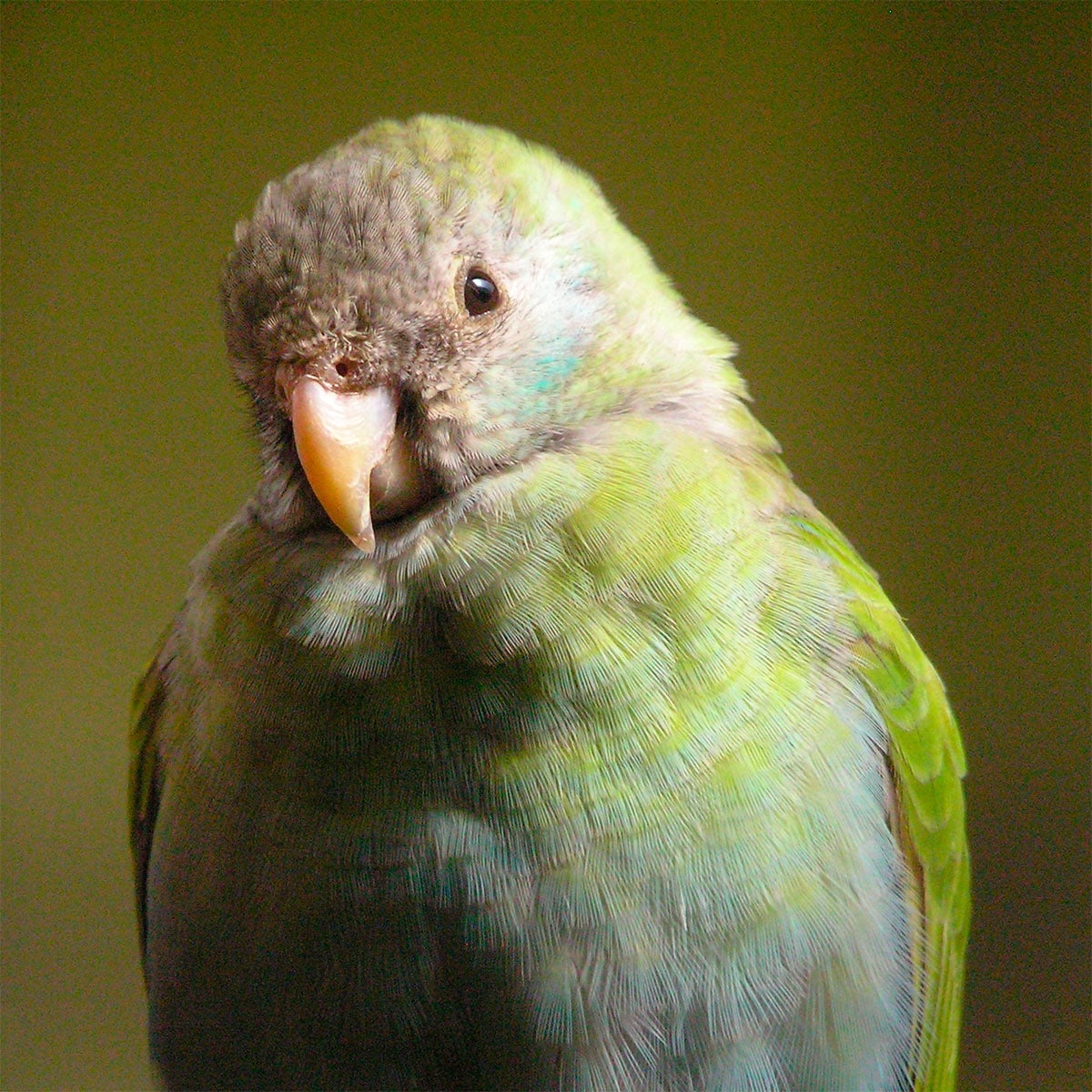
Ceylon Hanging-Parrot
Loriculus beryllinus


Ceylon hanging

Content

Description

13 cm.. length.

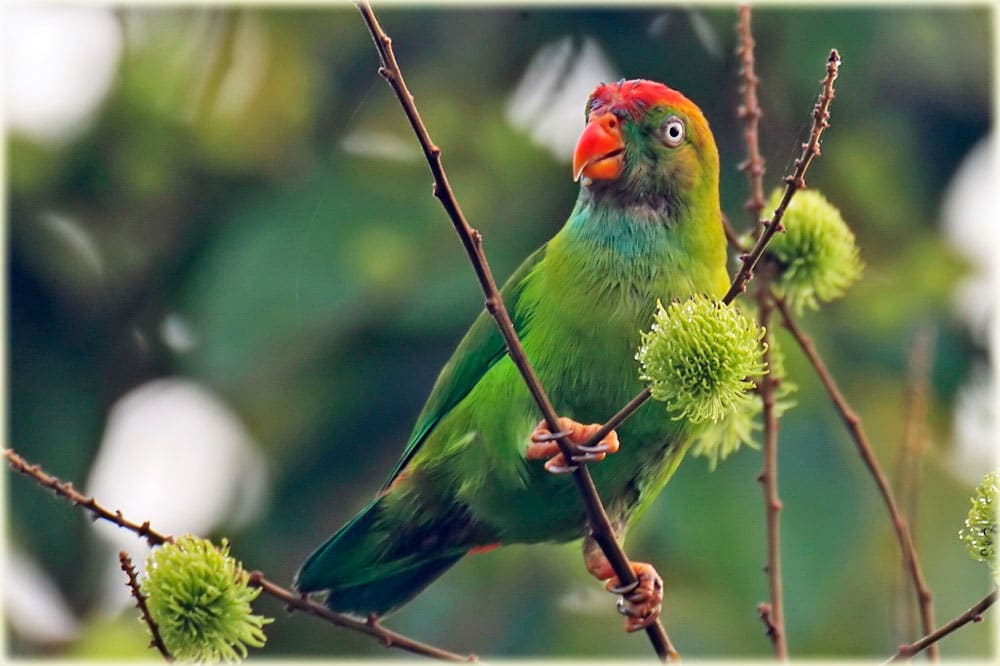
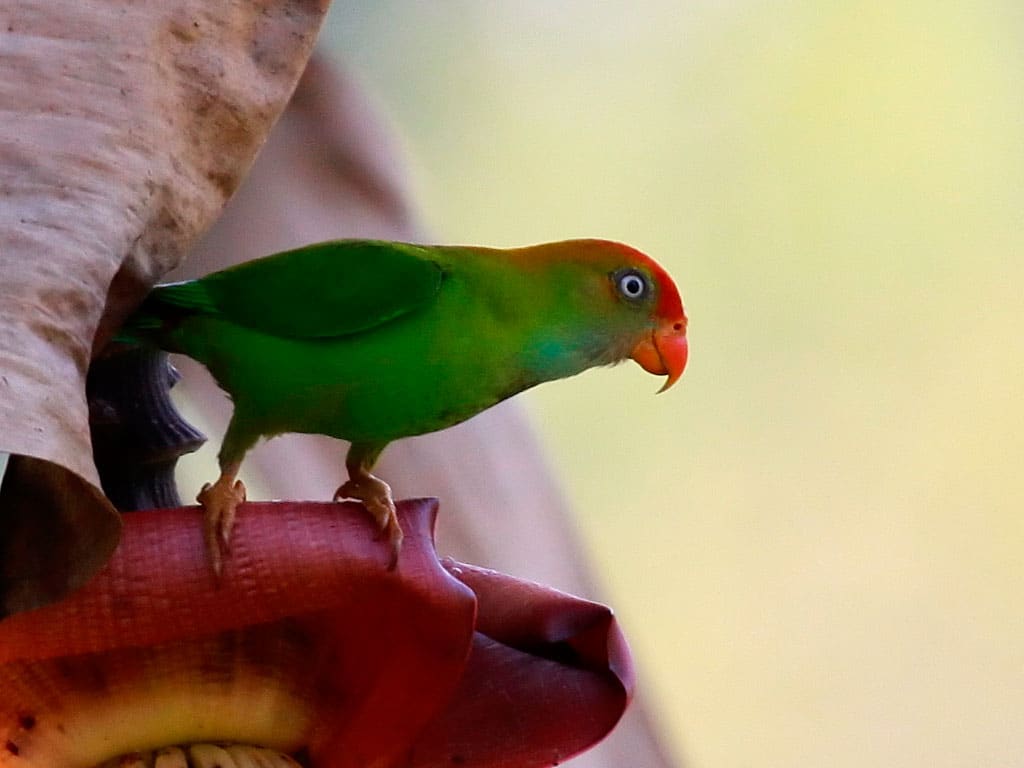
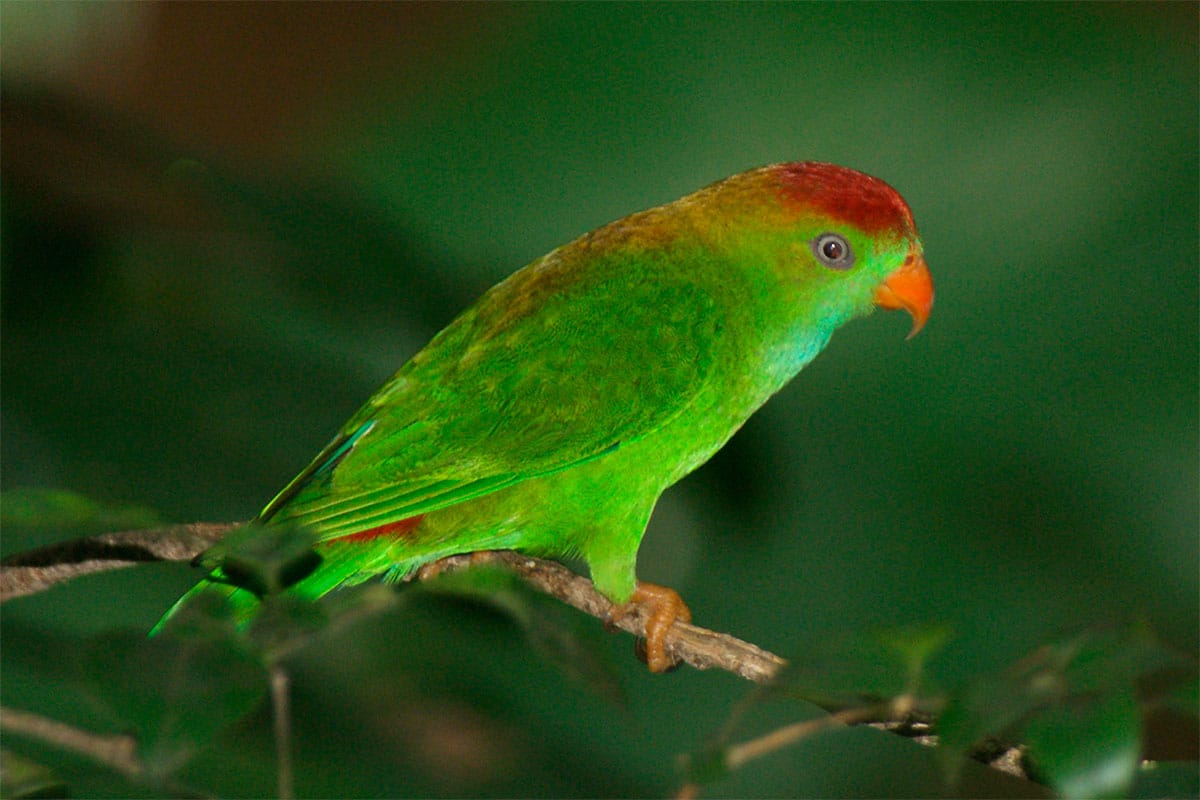
The Ceylon Hanging-Parrot (Loriculus beryllinus) has the crown red, merging into orange-yellow in the area of the nape; eyebrows, lores and the area in front of the eyes light green (lightly bathed in pale blue); sides of the front of the crown red. Mantle green, Bañado de slightly reddish and yellowish orange color in the Center; back green; rump and uppertail-coverts, red. Wings green up, with the exception of vane inner of the blackish flight feathers ; undertail, the wings bright turquoise color with the exception of coats and axillary green. The underparts bright green, paler and more yellowish which the upperparts and light blue marking in the throat. above the tail green color; Turquoise below.

Bill orange red, paler at the tip; irises off-white; legs dark yellow.

Female as the male, but most off and only a trace of blue in the throat.

The young birds they are even duller, the crown reddish-tinged, the patch blue of the throat absent, the rump with some green feathers, the bill paler, the iris and the legs brown; the face nude in the fledglings.

Habitat:

Seen in a range of habitats, from sea level to 1.600 m, reaching the highest areas according to seasonal conditions. The species is found in forests of coconut trees, Evergreen and deciduous forests, semicultivadas areas, open woodland and around the dwellings.

birds are not shy, and is usually found in pairs or family groups, although outside the breeding season larger flocks congregate high up in flowering trees. They are active and acrobatic feeding.

Reproduction:

Observations, they have registered the male approaching his partner upright, with the high peak, swollen throat, extended tail and rump feathers erect, while emitting a screeching chirp. Wiggles head in courtship period have also been observed.

The breeding begins in January and although the main nesting period is between March and May, a second litter is, sometimes, until September. The nest is located in a hollow branch filled with fragments of vegetation that the female carefully cuts with her beak and carries to the nesting sites tucked between her rump feathers.. Only two to four white eggs she incubates, sitting firmly, screeching and creating a 'thumping' sound’ Yes is the annoying. The young Chick has the face exposed, presumably to avoid getting dirty by liquid food.

Food:

Feed on fruits such as Ficus figs and guava (Psidium guajava); berries; flowers, including Erythrina, Salmalia and eucalyptus; seeds, including Casuarina. Poisonings have been reported after drinking Palm wine collected pots attached to the trunks of the trees.

Distribution:

Endemic to Sri Lanka, where most records come from the South, Although there have been North of Trincomalee and should be observed in suitable habitats throughout the country. Records include proximities of Colombo, around Kandy, Yala and National parks Gal Oya, the district Welimada, and to the South of Galle and Hambantota, on the coast.

Conservation:


minor concern


• Current IUCN Red List category: Least concern

• Population trend: Stable

The size of the world's population has not been quantified, Although it is estimated at 10.000 specimens. The species is qualified as widespread and abundant in the South-West and almost absent in the North of its distribution area (pit et to the. 1997).

The population is suspected to be stable in the absence of evidence of any reduction or substantial threats, However, the bird trade is judged as a potential threat.

"Ceylon Hanging-Parrot" in captivity:

Rare.

Alternative names:

Ceylon Hanging-Parrot, Ceylon Hanging Parrot, Ceylon Lorikeet, Sri Lanka Hanging Parrot, Sri Lanka Hanging-Parrot, Sri Lankan Hanging Parrot (ingles).
Coryllis de Ceylan, Coryllis du Sri Lanka (French).
Ceylonpapageichen, Ceylon Papageichen (German).
Loriculus beryllinus (Portuguese).
Lorículo de Ceilán, Lorículode Ceilán (español).

scientific classification:

Order: Psittaciformes
Family: Psittaculidae
Scientific name: Loriculus beryllinus
Genus: Loriculus
Citation: (Forster,JR, 1781)
Protonimo: Psittacus beryllinus

«Ceylon loricle» images:

Video of the "Ceylon Hanging-Parrot"

————————————————————————————————

«Ceylon loricle» (Loriculus beryllinus)


Sources:

Avibase
– Parrots of the World – Forshaw Joseph M
– Parrots A Guide to the Parrots of the World – Tony Juniper & Mike Parr
– Birdlife

Photos:

(1) – «Loriculus beryllinus-Sri Lanka-adult-8» by Hafiz Issadeen – originally posted to Flickr as Sri Lanka Hanging Parrot. Licensed under CC BY 2.0 via Wikimedia Commons.
(2) – «Thimindu 2010 03 06 Sinharaja Sri Lanka Hangling Parrot 1» by ThiminduOwn work. Licensed under CC BY-SA 3.0 via Wikimedia Commons.
(3) – Perched in a tree by John A Thompson – lynx
(4) – Birds-pet-wallpapers/Parrot-birds – link
(5) – A fight by Guy Poisson – lynx

Sounds: Tero Linjama (Xeno-canto)

▷ The world of Pets: Dogs, cats, birds, reptiles, amphibians

Camiguin Hanging Parrot
Loriculus camiguinensis


Loriculo the Camiguin

Content

Description

14 cm.. length.

The Camiguin Hanging Parrot (Loriculus camiguinensis) has the plumage mostly green, with the throat, front side of the face and the thighs light blue; the forecrown, the pyleus, the obispillo and the top of the tail red, While the rest of the tail It is also blue. Underwing coverts blue. Band of orange-red in the nape, that varies from bird to bird.

Bill orange. Iris grayish brown.

The males and females they have a similar appearance, the female has less blue on the cheeks.

The youth they are similar to the adult female but with only a slight tinge of blue in the cheeks and red on the forehead minimal or absent. Bill a pale.

In 2006 described as a separate species to the loricles who lived on the island of Camiguin, to the North of Mindanao, Since then it was considered a subspecies of the Philippine loricle in the.

Habitat:

Probably sedentary. Found between the 300 and 1350 meters in montane forests, secondary forests, at the edges of the forest near the settlements, in plantations in the areas planted with shrubs and coconut.

Usually seen individually, in pairs, mixed flocks or small families. Feeds in trees or shrubs; difficult to detect. It´s shy and cautious.

Reproduction:

Breeding season probably between the months of September to November. Nest placed in the hole of a dead arbol-helecho. No other information.

Food:

It is said that they feed on nectar, seeds, especially wild banana (Musa), also soft fruit, berries and flowers.

Distribution:

Endemic in the Philippine island of Camiguin, off the North coast of Mindanao.

Conservation:


minor concern


This species is threatened by its limited range, the natural habitat destruction and capture for the wild bird trade.

"Camiguin Hanging Parrot" in captivity:

Probably not remain outside the island of Camiguin.

Alternative names:

Camiguin Hanging-parrot, Camiguin Hanging Parrot (ingles).
Coryllis de Camiguin (French).
Camiguin-Fledermauspapagei, Camiguinpapageichen (German).
Loriculus camiguinensis (Portuguese).
Lorículo de Camiguin (español).

scientific classification:

Order: Psittaciformes
Family: Psittaculidae
Genus: Loriculus
Scientific name: Loriculus camiguinensis
Citation: Tello, Degner, Bates,JM & Willard, 2006

Images "Camiguin Hanging Parrot"

Videos "Camiguin Hanging Parrot"

————————————————————————————————

"Camiguin Loricle" (Loriculus camiguinensis)


Sources:

Avibase
– Parrots of the World – Forshaw Joseph M
– Parrots A Guide to the Parrots of the World – Tony Juniper & Mike Parr
Wikipedia

Photos:

(1) – By Alexkant – zoochat

Sounds: George Wagner (Xeno-canto)

▷ The world of Pets: Dogs, cats, birds, reptiles, amphibians

Hooded Parrot
Psephotellus dissimilis

Hooded Parrot

Content


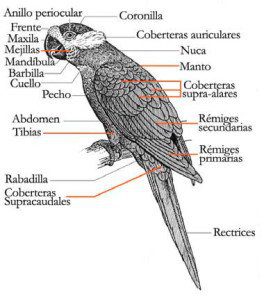
Anatomy-parrots

Description

25,5 to 28 cm.. length and a weight between 50 and 60 g..

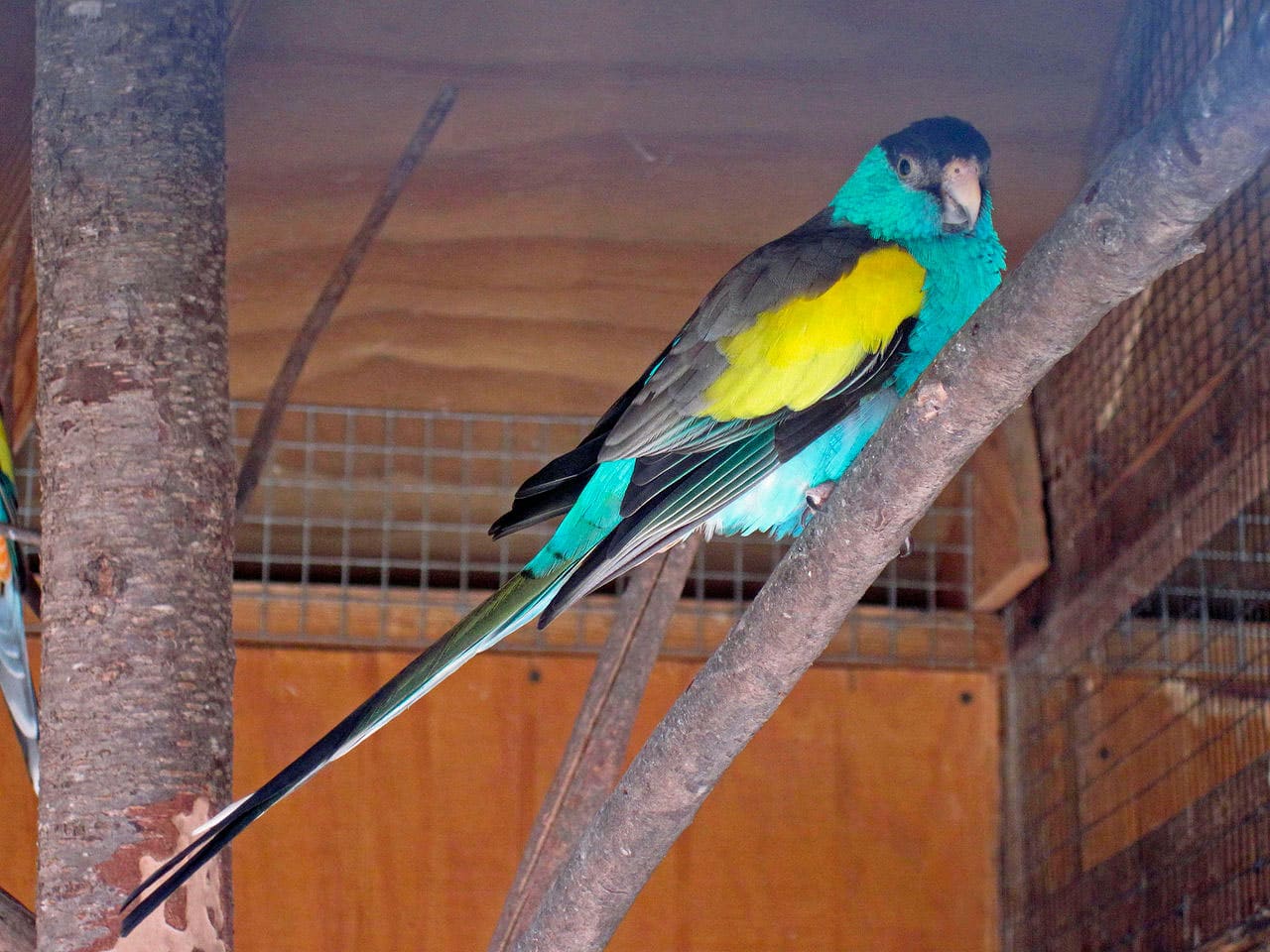
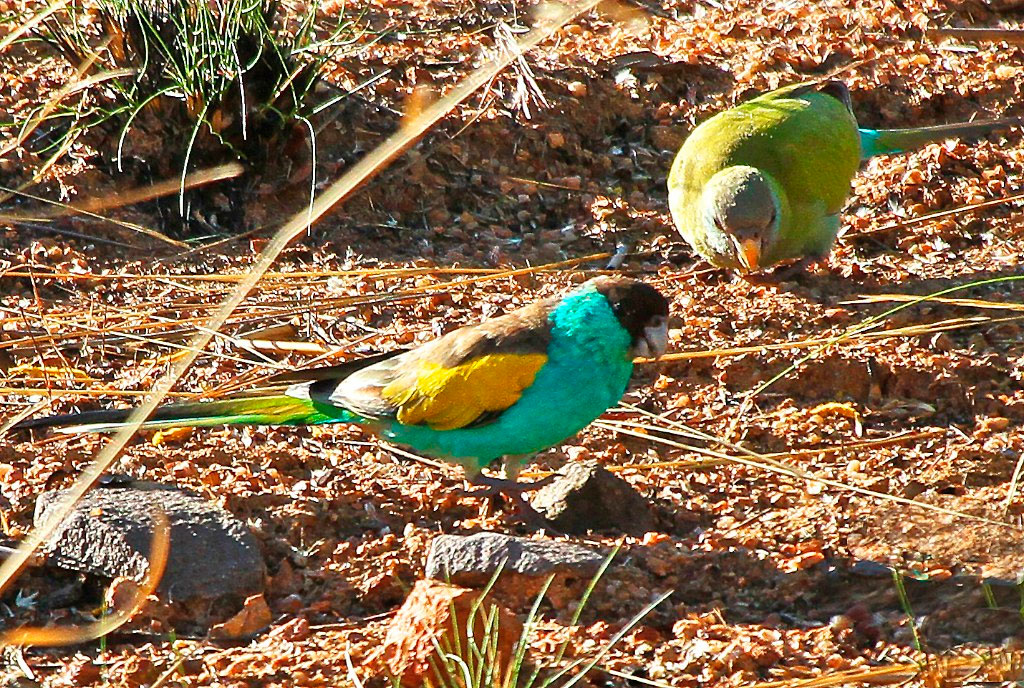
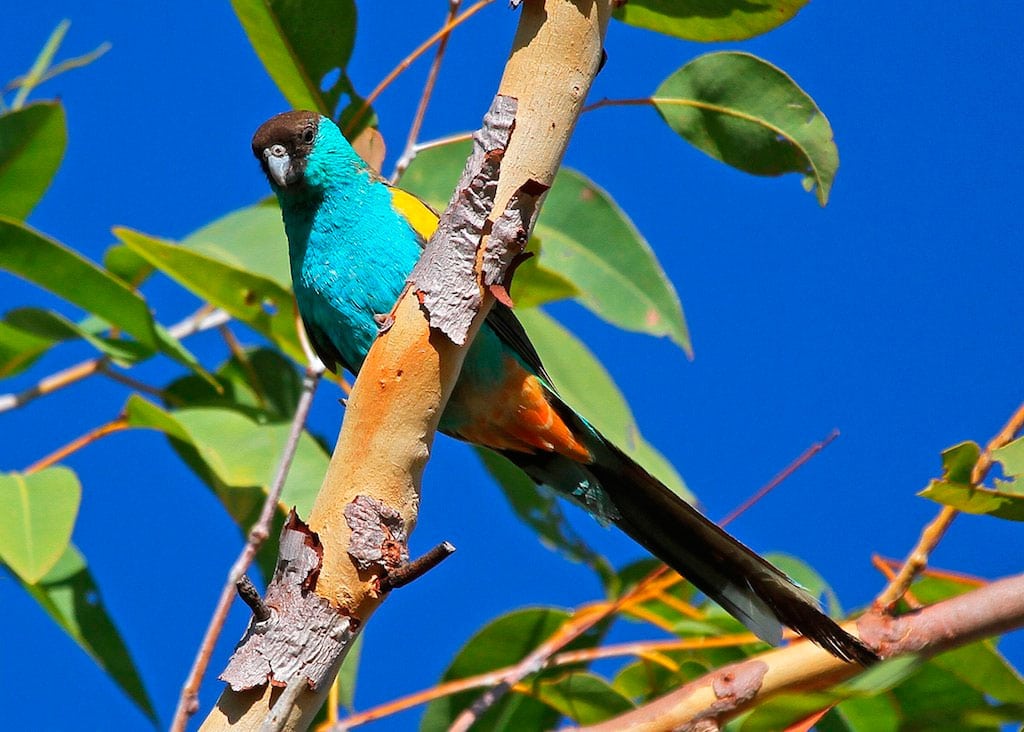
The Hooded Parrot (Psephotellus dissimilis) is a very striking species, restricted to the dry forests of the North of Australia. The male has a pileum black, their underparts are Turquoise with a patch in the shoulders golden yellow.

The females are pale green with a pale turquoise diffusion in the cheeks, abdomen and cadwas.

The Golden-shouldered Parrot, with which it is closely linked, is very similar in appearance, but they are only observed in the Cape York Peninsula, in the North of Queensland, and males differ in their tones slightly. The Hooded Parrot does the yellow colour in the forecrown or in the lores and the yellow markings of the shoulders and reddish of the belly, they are smaller than. The females they are very similar, but the Golden-shouldered Parrot It shows a faint red marks on the area, white, bass belly, has the undertail- coverts Bluish, bluish color of the belly is absent and the undertail- coverts They have a pinkish tone; also has a Brown Suffusion in the crown, a forecrown yellowish and the cheeks they are greener.

The Northern Rosella shares territory with the Hooded Parrot and also has a pileum black, but it lacks of the underparts Turquoise and yellow markings on the wings.

The Hooded Parrot they have an elegant flight, and males they are very bright with a Flash of bright yellow showing in the wings. The flight fast and slightly wavy. Bird perch, times, phone cables, and can make long flights at high altitude.

Providing more detail to its description, the Hooded Parrot has the pileum, lores and the area below and in front of the eyes, black, merging into grey-brown colour in the the mantle (darker uppers than the Golden-shouldered Parrot). The rump is turquoise blue and the uppertail-coverts green. Wing coverts golden yellow (grey dark in vane inner).

Flight feathers Blackish with difusion-verde turquoise at the edge of the vane outer (thin yellow color at the outer edge). feathers of the wings and bend of wing bluish green; underside of flight feather blackish brown. The cheeks, the neck and the chest Turquoise, lightly coated with emerald green; rest of the underparts Turquoise with the exception of undertail- coverts they are orange-red with yellow tips. Uppertail dark bars.

Central feathers of the tail Green bronze with black tips, side green blue with white tips, with a blackish central bar; undertail, the tail apparently light blue with black tips when it is closed. Bill pale grey; irises dark brown; legs light brown.

The female is usually pale, a light yellowish green, with wing-coverts a bright yellowish-green, flight feather blackish, and a turquoise color broadcasting in the rump, from the top of the breast to belly, and vaguely in the cheeks. Subcaudales coverts bathed in Pink salmon; pale marks in the wings.

The immature they are like the females, but males have the head darker and the cheeks bright. Adult plumage they would earn in the second annual moult.

The very young birds they have the peaks yellow.

Habitat:

Sedentary, although some early records of the Melville Island probably related to post-breeding dispersal. Scattered sparsely through the open dry forests, flooded Plains, especially grasslands of Malaleuca-dominated and Spinifex Triodia, grasslands with termite mounds, also in rows of eucalyptus trees along watercourses and the rocky ridges.

Usually, they are in pairs or in small groups, but after the breeding season, from September (end of the dry season) onwards, they may gather in groups of up to 100 birds feeding.

Reproduction:

Egg-laying range from late January until mid-April, at the end of the rainy season, and the nest is a tunnel in a Termite Mound. The direction and height of the entrance of the nest is variable, but nest chamber temperatures are more stable inside larger mounds. A recent study of nesting ecology in the Northern Territory showed a density of 0,45 to 0,70 nests per square kilometer, with a 50% from eggs producing hatchlings. Between two and six eggs make up the clutch, and are incubated for around 20 days for the female. In about five weeks the young leave the nest.. The females., sometimes, they roost far from their nests during the heat of the day.

Food:

The diet is composed, mainly, of pasture seeds seasonal during the dry season and perennial plants during the wet season. Variation in the ability to master feeding techniques for different seed types may explain the apparent early dispersal of immatures in the wet season.. Birds feed quietly on the ground, resting in foliage near water during the heat of the day. When drinking, they often walk into the water along banks of sand. They are sometimes seen feeding on road verges, often in association with the Black-faced Woodswallow (Artamus cinereus).

Distribution:

Endemic to North of Australia where is located in the western part of Arnhem Land, Northern Territory, from the South of the alligator river, to the southwest of Pine Creek and the South-East of Include. The birds also disperse further east and west to the rivers. Roper and upper area of the Daly.

The Hooded Parrot formerly extended eastward to the MacArthur river, but its territory, covering the Kakadu National Park, has recently been hired.

In general, It Rare. Although now it is fully protected. Capture is believed to it has been a problem in the past. Burning and grazing may limit the availability of herbs seeds during the dry season.

Mining also threatens the habitat of the species. There are a moderate number of birds in captivity.

Conservation:


minor concern


• Current category of the Red List of the UICN: Least concern

• Population Trend: Stable

The world population is estimated at 20.000 specimens (Garnett and Crowley 2000).

Population trends have not been quantified, but populations seem to be stable, without descents recent (Garnett and Crowley 2000).

The species remains common in areas under park management. Aboriginal and National, where grazing is minimal and where there are programs that guarantee their survival, or around the Rocky slopes, where is the availability of food in the rainy season relatively assured.

"Hooded Parrot" in captivity:

Although the popularity of the Hooded Parrot has increased considerably in the last decade, this species is still quite unknown in aviculture. The main reason is, probably, that they are not easy to care for and reproduce in captivity, due to its high demands care and difficulty it in terms of its food supply. The Hooded Parrot they are not recommended for a beginner breeder birds.

No one knows exactly when these birds were imported for the first time to Europe, but it was probably at the beginning of the last century. In the autumn of 1912 English Hubert Astley was the one who obtained the first satisfactory breeding result with the Hooded Parrot, got 4 young people from a litter of 5. in the netherlands, the Dr. Polak It also had results before the second world war. Once the pups are born, they were taken along with a couple of Red-rumped Parrot (Psephotus haematonotus) with which they grew up without any problem.

There is a variety of the Hooded Parrot because different crosses with other species such as Mulga Parrot (Psephotellus varius) and the the Golden-shouldered Parrot (Psephotellus chrysopterygius). So, we must pay attention to the characteristics when we are going to buy a pair of future reproducers of this species. If you have doubts about the purity of certain birds, consult with a person who is familiar with this type of parrots.

In terms of the behavior, the Hooded Parrot adapt to the European climate relatively well, although they are sensitive to cold and wet weather. They are quiet birds, enable, not shy and quickly adapt to their caregiver. His voice is not worrying. Love these birds being on the ground, where spend much time. They love to swim and are not rodents of wood. During the breeding season they are aggressive towards other birds.. Even outside the breeding season, It is not advisable to fit them with their peers or keep them with other bird species. Young birds together may stay in a birdhouse. As a basic rule, Ave predict an area of one square meter.

It is not known exactly how these birds can live, according to sources, one specimen was still alive after 18 years in captivity

Alternative names:

Hooded Parrot, Antbed Parrot, Anthill Parrot, Black-hooded Parakeet, Black-hooded Parrot, Golden-shouldered Parrot, Hooded Parakeet (ingles).
Perruche à capuchon noir (French).
Collettsittich, Hooded Sittich (German).
Periquito-encapuzado (Portuguese).
Perico Capirotado, Periquito encapuchado (español).

scientific classification:

Order: Psittaciformes
Family: Psittaculidae
Genus: Psephotellus
Scientific name: Psephotellus dissimilis
Citation: Collett, 1898
Protonimo: Psephotus dissimilis

Images «Capitola Parakeet»:

Videos "Hooded Parrot"

————————————————————————————————

«Perico Capirotado» (Psephotellus dissimilis)


Sources:

Avibase
– Parrots of the World – Forshaw Joseph M
– Parrots A Guide to the Parrots of the World – Tony Juniper & Mike Parr
– Birdlife

Photos:

(1) – A male Hooded Parrot, about 30 km south of Pine Creek, Northern Territory, Australia By birdphotosneill (Hooded ParrotUploaded by snowmanradio) [CC BY 2.0], via Wikimedia Commons
(2) – A pair of Hooded Parrots, about 30 km south of Pine Creek, Northern Territory, Australia By birdphotosneill (Hooded ParrotsUploaded by snowmanradio) [CC BY 2.0], via Wikimedia Commons
(3) – A pair of Hooded Parrots about 30 Km south of Pine Creek, Northern Territory, Australia. The male is in the foreground By birdphotosneill (Hooded ParrotsUploaded by snowmanradio) [CC BY 2.0], via Wikimedia Commons
(4) – By originally posted to Flickr as parkiet xxx and uploaded to commons at Psephotus_dissimilis_(female)_-Burgers_Zoo-8a.jpg: frank woutersderivative work: Snowmanradio (Psephotus_dissimilis_(female)_-Burgers_Zoo-8a.jpg) [CC BY 2.0], via Wikimedia Commons
(5) – Male Hooded Parrot (Psephotus dissimilis) – Sylvan Heights Waterfowl Park in Scotland Neck, North Carolina By SandyCole (Own work) [CC BY-SA 3.0 or GFDL], via Wikimedia Commons
▷ The world of Pets: Dogs, cats, birds, reptiles, amphibians

Derbyan Parakeet
Psittacula derbiana


Cotorra de Derby

Content

Description:

50 cm.. of length and a weight of 320 g..

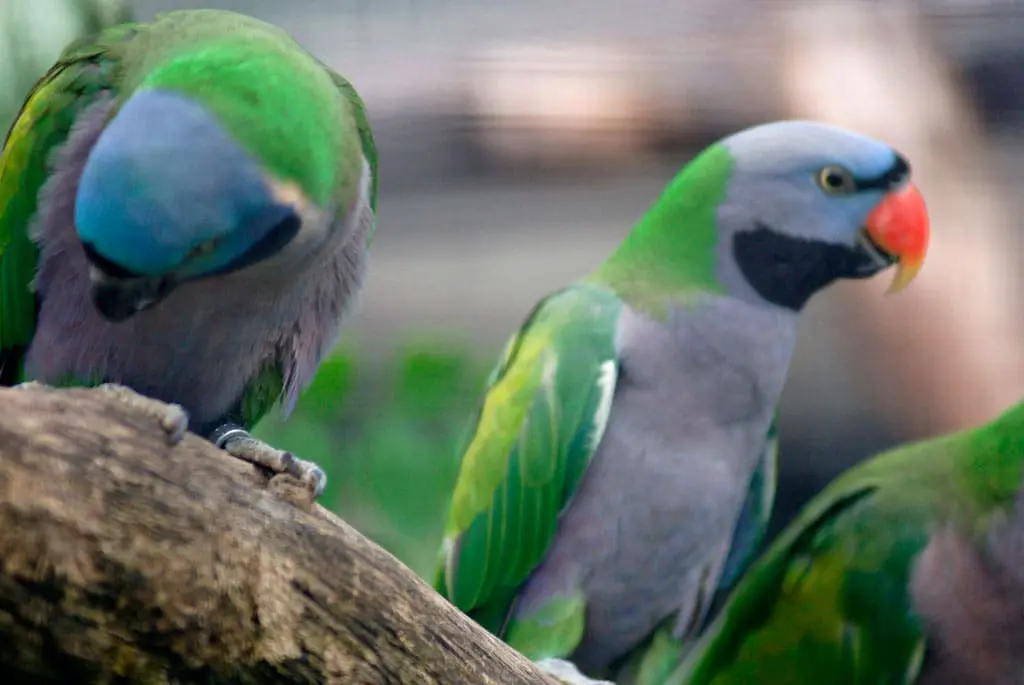
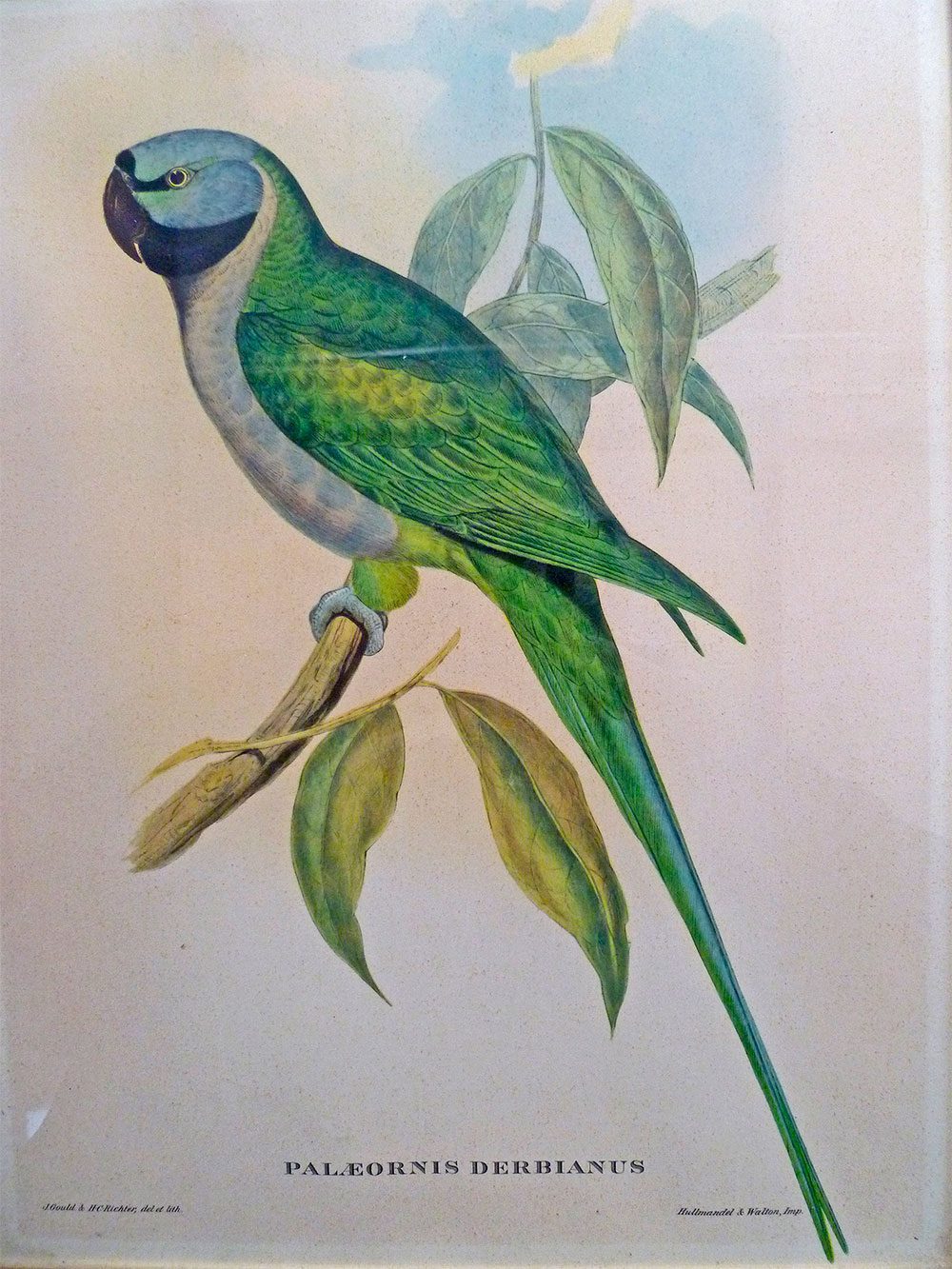
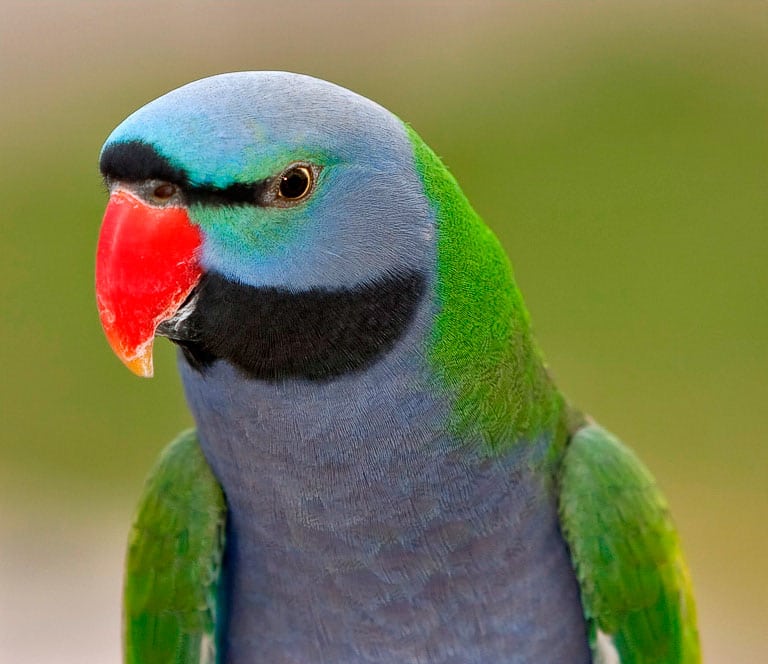
The Derbyan Parakeet (Psittacula derbiana) has the crown and lower cheeks lavender blue with pale iridescent blue shading on the forecrown and pale green bright in the upper cheeks and periophthalmic region; narrow black stripe that extends horizontally from the eyes to the area above the bill; spacious malar stripes («moustache«) Black fuse next to the chin to create a great patch.

Since the nape until uppertail-coverts green, bright in the the mantle. Upperwing-coverts Green with yellow or marginalized feathers with yellow in median and greater coverts, creating distinct pale patch. The primaries and secondaries emerald green.

The underparts to belly lavender-bue; the thighs, vent and undertail-coverts grass-green. Uppertail centrally blue, outer feathers Blue in vane outer, green on inner.

Ilustración Cotorra de Derby

upper jaw red tipped yellow, the lower black; cere blue-gray, irises straw-colored; legs dark grey.

The female has the bill black.

The immature they have the head green and the underparts much paler.
The very young birds has bill pink, turning black later and then red again in males.

Habitat:

Observed in forest, between 1.250 and 4.000 meters above sea level. It is thought that you can make vertical migration seasonal. Views in the Tibet in 3.300 m, even in winter.

According to reports, have priority for coniferous forests or mixed forests of Pinus and Quercus, also of Alpine growth as the rhododendron. Visit valleys culture, especially during harvest.

Gregaria, usually seen in noisy flocks of up to several dozen birds. Only rarely are in pairs or individually.

Reproduction:

Holes for their nests they are located in tree hollows, usually at a certain height, commonly in a himalayan poplar Populus ciliata.

The breeding they performed it during the month of June.

The put in captivity is between 2 and 5 eggs.

Food:

Reported foods include barley, the corn, catkins of Populus ciliata, cones of Pinus tabulaefornis and fruit grown according to availability, including peaches; they can be highly destructive crops. It is believed that they may eat some invertebrates, Hoja-brotes and berries.

Distribution:

Distributed by the Of the Himalayas and South of the Tibetan plateau. Since Arunachal Pradesh and Assam, India, to the southeast of Tibet and Southwest China in Sichuan Western fence of 32 °N and west of Yunnan to the South up to around Tengchong to 25 ° N.

Visitors during the summer in the northeast of the India (May-September). Resident elsewhere, apparently with some seasonal altitudinal movements.

Usually common. Live birds traded in small numbers with a modest population captive outside their area of distribution.

Conservation:

State of conservation ⓘ


Near-threatened Near Threatened (UICN)ⓘ

• Current Red List of UICN: Near-threatened

• Population trend: Decreasing

The population of the Derbyan Parakeet It is suspected that it may be suffering a moderately rapid decline mainly due to the pressure that is subjected , not only due to its continuous capture for the cage bird trade, but also by the indiscriminate felling of trees in the nest, together with evidence of local extinctions and declining birds in some parts of its area of distribution.

Threats:

    – This species was previously threatened by deforestation campaigns, that it resulted in, loss of much of their breeding habitat; However, This threat ended in the Decade of 1990 (Zeidler and Francis 2011).

    – Today, Middle-aged trees, some of which provide the perfect place for the construction of the nest, they are being felled for the construction of housing and firewood, even in protected forests (Zeidler and Francis 2011).

    – Recent observations indicate that this species is subject to a strong pressure catch and the collection of eggs for the pet trade (J. Eaton in litt. 2010, Zeidler and Francis 2011).

    – The collection of eggs and subsequent incubation, for the breeding of Derby Parrots and subsequent sale, is very organized in some areas (Zeidler and Francis 2011).

    – The species is sold openly and are kept, in large numbers, as a pet in its natural distribution area (J. Eaton in litt. 2010, J. Hornskov in litt. 2010, Zeidler and Francis 2011).

Actions of conservation in CITES Appendix II course.:

    – Is listed in Schedule I of the law of 1972 for nature (Protection) on India (The India Government, 1993) and the collection for the pet trade is illegal in China (Zeidler and Francis 2011).

    – In some areas, as the Shachong valley (Szechwan), the monks provide protection for wildlife, including trap activities (Zeidler and Francis 2011).

Conservation Actions Proposed:

    – Population trends and monitor hunting pressure.

    – Addressing the threat of trade through the application of the legislation and awareness-raising activities.

    – Steadily increase the number of sites that are protected.

    – Support monks engaged in activities for the protection of wildlife (Zeidler and Francis 2011).

    – Evaluate the effectiveness of a scheme of nest boxes (Zeidler and Francis 2011).

"Derbyan Parakeet" in captivity:

The Derbyan Parakeet is a pet very popular at the local level due to the wonderful color of its plumage, his intelligence and its excellent speaking skills, that distinguishes it from other Asian parrots, usually you do not have that voice clarity.
While these parrots do not have the ability to learn an extensive vocabulary, his manner of speaking looks like the speech of Amazon parrots. Having said that, there are never guarantees that a Derbyan Parakeet you will learn to speak, but most do – even the females.

It is a bird that needs much stimulation. She loves to chew and can be very destructive, provided that provide it a variety of toys to chew, It will inhibit its destructive behavior and avoid his boredom.

It is a species with demand among farmers for several reasons, including its striking plumage, its ease of reproduction and its excellent parenting skills.

The
Derby Parrot reach sexual maturity between the 2 and 3 years of age. It reported that it may reach sexual maturity later in nature, possibly to the 5 years.

The typical breeding season It will begin in April or June and average clutch sizes are of 2 – 4 eggs. The incubation period lasts 23 – 28 days, and the chicks leave the nest to the 8 to 9 weeks of age.

The Derbyan Parakeet It must be kept in an Aviary, or in a large cage, providing a daily time flying out. They are social birds and like to be “part of a flock.” – which could be a group of birds in an aviary environment or a human family.

It requires much interaction to keep its meekness. By nature, it is a shy bird to human contact, Although considered usually placid compared to some other parrots.

If they are kept outdoors they may require periodic deworming – since they spend considerable time at the bottom of your aviaries or cages. Because of this habit, they are also susceptible to fungal infections. Good hygiene is especially important to keep healthy this Parrot.

Even so, the Derby Parakeet is a rare bird outside its range and with limited breeding.

Alternative names:

Derbyan Parakeet, Chinese Parakeet, Lord Derby’s Parakeet, Upper Yangtze Parakeet (English).
Perruche de Derby (French).
Chinasittich (German).
Periquito-da-china (Portuguese).
Cotorra de Derby, Cotorra Verde China (español).

scientific classification:

Order: Psittaciformes
Family: Psittaculidae
Genus: Psittacula
Scientific name: Psittacula derbiana
Citation: (Fraser, 1852)
Protonimo: Palaeornis Derbianus

Derbyan Parakeet images:

Videos "Derbyan Parakeet"

Derbyan Parakeet (Psittacula derbiana)


Especies del género Psittacula

Sources:

Avibase
– Parrots of the World – Forshaw Joseph M
– Parrots A Guide to the Parrots of the World – Tony Juniper & Mike Parr
– Birdlife

Photos:

(1) – A pair of Lord Derby’s Parakeet (also known as Derbyan Parakeet)s at Wilhelma Zoo, Stuttgart, Germany By krislorenz (_DSC2098Uploaded by Snowmanradio) [CC BY-SA 2.0], via Wikimedia Commons
(2) – A male Derbyan Parakeet (also known as Lord Derby’s Parakeet) in Hangzhou, Zhejiang, China By Michael Vito from South Orange, NJ, USA (Hangzhou RevisitedUploaded by Snowmanradio) [CC BY-SA 2.0], via Wikimedia Commons
(3) – An adult male Derbyan Parakeet at Shenlong Eco Park, People’s Republic of China By Doug Janson (Own work) [CC BY-SA 3.0 or GFDL], via Wikimedia Commons
(4) – A male Lord Derby’s Parakeet (also known as Derbyan Parakeet) in an aviary By Richard J. Blach (Own work (Original text: eigene Fotografie)) [GFDL or CC-BY-SA-3.0], via Wikimedia Commons
(5) – Derbyan Parakeet (Psittacula derbiana) at Wellington Zoo, New Zealand. A male bird showing red beak by Peter Halasz – Wikipedia
(6) – Psittacula derbiana, drawing from nature by J. Gould & H.C. Richter By JoJan (Own work) [CC BY 3.0], via Wikimedia Commons

Sounds: jon hornbuckle (Xeno-canto)

▷ The world of Pets: Dogs, cats, birds, reptiles, amphibians

Scarlet-fronted Parakeet
Psittacara wagleri

Scarlet-fronted Parakeet

Content

Description:


Anatomy-parrots

34 to 36 cm.. of length and a weight of 162 to 217 g..
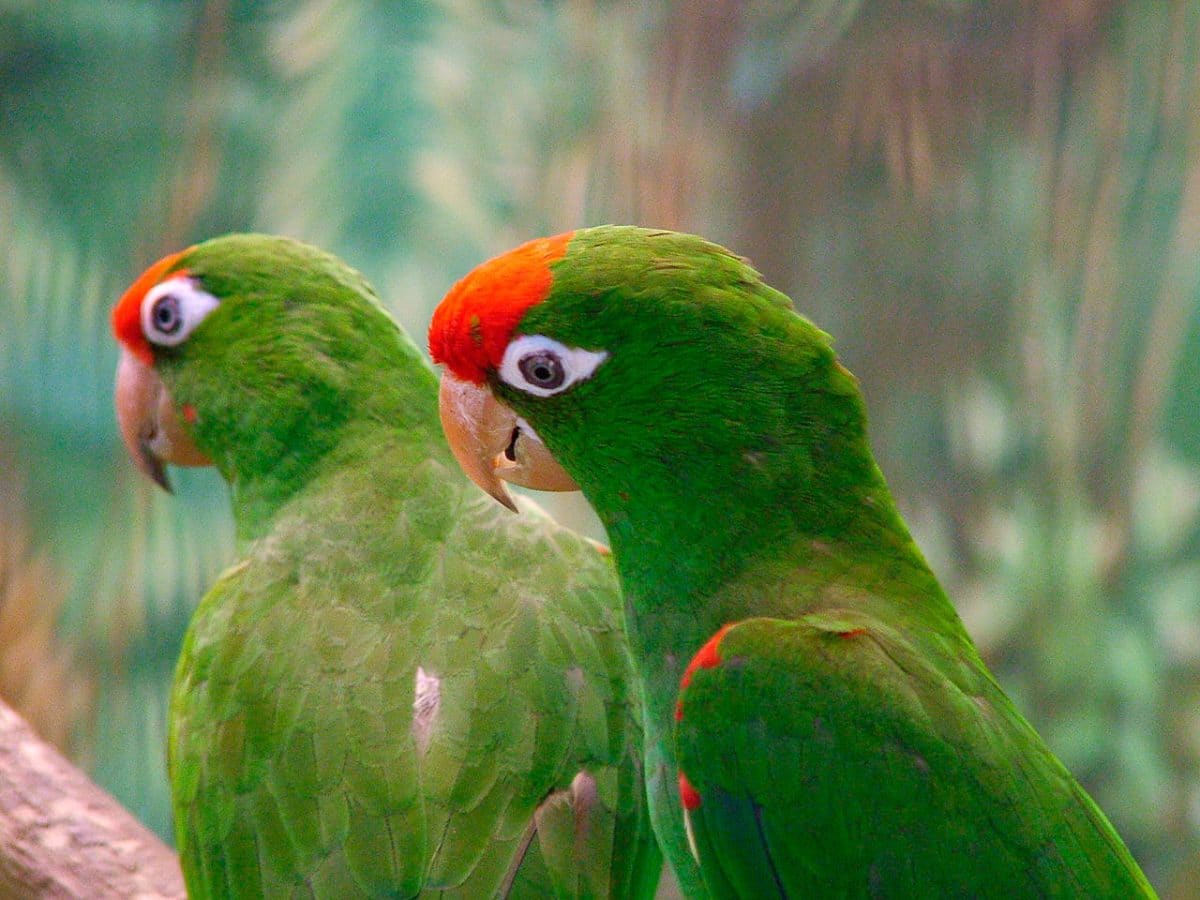
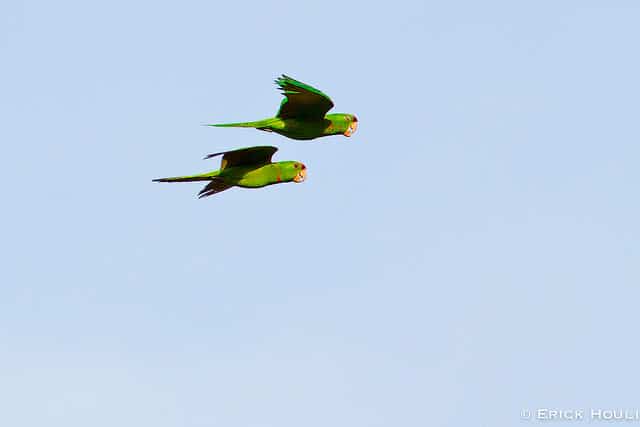
The Scarlet-fronted Parakeet (Psittacara wagleri) He has the crown and forecrown bright red; lores and cheeks dark green with red feathers scattered in some birds. Of the nape even up to the uppertail-coverts dark green. Upperwing-coverts dark green; flight feather green, dyed Emerald above and olivaceous at the bottom. The greater underwing-coverts, also of color olivaceous, the remaining underwing-coverts, green. The underparts brighter yellowish green, sometimes with scattered red feathers on the throat and in the the thighs. Upper, the tail dark green; by down olive green.

The bill color pale horn; bare periophthalmic grey; irises yellow; legs distant.

Ilustración Aratinga de Wagler

Both sexes similar.

The immature with a reduction (or even absence) Red Feather in the head.

Subspecies Psittacara description wagleri
Subspecies
  • Psittacara wagleri frontatus

    (Cabanis, 1846) – Red of the head vaster than the species nominal, extending to the rear of the eyes. Red in the the thighs and bend of wing in most birds. Larger than the species nominal (40 cm.).


  • Psittacara wagleri minor

    (Carriker, 1933) – Similar to the subspecies Frontata but smaller (38 cm.) and more green with pale red in the wings. Some specimens with yellow on the bend of wing.


  • Psittacara wagleri transilis

    (Peters,JL, 1927) – darker than kind nominal, with less extensive red on the rear of the crown. Smaller that the species nominal (34 cm.).


  • Psittacara wagleri wagleri

    (Gray,GR, 1845) – The species nominal

Habitat:

Video – "Scarlet-fronted Parakeet" (Psittacara wagleri)

Psittacara wagleri RN Victoria Feb016

They inhabit in humid forests, deciduous, from gallery, cloudy and second-growth forests with acacias, Prosopis and Ochroma, mainly in the lower subtropical and upper tropical zones, Although they can also penetrate in sub-templadas areas.

In Peru, observed in cloud forests semi-arid.

Reported at lower elevations in humid plantations, cornfields and cactus thickets. Key requirement in their habitat are the cliffs, in which it breeds and rests.

In general, observed the altitudes of 2.000 m, above the 3.000 metres in Peru. Gregaria, usually in close flocks to the 20 individuals, sometimes up to 300 birds.

Communal hangers on the cliffs with diurnal movements towards the areas of power.

Reproduction:

Nest communally in Rocky steep, between December and June in the North of Colombia and between April and June in Venezuela. Average of the laying of 3 to 4 eggs and the incubation is of 23 or 24 days. The pups they leave the nest after 50 days, with a plumage green.

Food:

Its diet includes a variety of fruits, nuts and seeds; You can include cereal crops and fruit plantations. Usually they feed in the canopy.

Distribution:

Size of the area of distribution (reproduction / resident): 866.000 km2

The Scarlet-fronted Parakeet It is distributed discontinuously in the northwest and west of South America, in the area of the Andes, from Venezuela until Peru.

In Venezuela stretching from West of the Paria Peninsula in the foothills of the Andes (between 500 and 2,000m, more altitude farther south), up to the Serrania del Perija and in the North of Colombia, including the Department of Magdalena and the West and center of the mountain range of the Andes Although apparently absent in the southwestern tip of Colombia.

Their status in the eastern slope of the Andes in Colombia is uncertain. Found around the skirts of the Andes in the South of Ecuador and South of Peru until Tacna at latitudes of I8° S.

Apparently, observed in the Western Andean slopes in the Peru with some reports from the South of the Valley of the Maranon River until Ayacucho and apurimac, in the central andes.

Usually residents Although seasonal visitors in some areas. Irregularly-common, often abundant, Although scarce or non-existent in many areas; more scarce in the South. Decrease in its population in some areas (for example, Colombia), due to loss of habitat.

Trapped for the trade in live birds, with 16.644 specimens exported from Peru in 1982.

The large number of birds escaped from her cage makes it considered them are introduced in Spain, Florida, Hawaii and California.

Subspecies Psittacara distribution wagleri
Subspecies
  • Psittacara wagleri frontatus

    (Cabanis, 1846) – West of Ecuador and South of Peru, approximately 18° S


  • Psittacara wagleri minor

    (Carriker, 1933) – South of the Valley of the Maranon River until Ayacucho and apurimac in the center of the Peruvian Andes.


  • Psittacara wagleri transilis

    (Peters,JL, 1927) – The northeastern coastal mountains of Venezuela up to the Paria Peninsula, Sucre. Possibly records in Bethlehem, Caquetá, on the eastern slope of the East of the Of the Andes in Colombia. Unclear relationship with the species nominal.


  • Psittacara wagleri wagleri

    (Gray,GR, 1845) – The species nominal

Conservation:

State of conservation ⓘ


Near-threatened Near Threatened (UICN)ⓘ

• Red List category of the UICN current: Near-threatened

• Population trend: Decreasing

The population trend of the Scarlet-fronted Parakeet apparently it has not quantified, but you suspect that your decline It moderately fast due to the persecution and change of land use (pit et to the., 1997).

The species has been the subject of a intense trade and individuals captured in nature have been recorded in international trade (UNEP-WCMC trade database CITES).

One high internal trade This species has been observed in Venezuela (pit et to the., 1997).

Pursued, due to its status as a crop pest, It can also be contributing to their decline.

Current levels of hunting pressure and persecution are not known, but it is assumed that it is producing a negative trend in their population.

Although this species shows a flexible use of the habitat and makes use of the crops, It is suspected that the the land use change It is contributing to a population decline of the species, and habitat clearance is presumed that it has led to the decline of this species in Colombia (pit et to the. 1997).


Conservation Actions Underway:

• The species is listed in Appendix II.

Conservation Actions Proposed:

• Carry out surveys to assess the population size of the species and the trend.

• Quantify the current impact of entrapment.

• Monitor trade levels.

• Carry out awareness activities to reduce the activities of capture and trade of Psittacidas..

• Increase the area of ​​suitable natural habitat that receives effective protection..

"Scarlet-fronted Parakeet" in captivity:

The poultry farming of the Scarlet-fronted Parakeet rarely achieved as this species is difficult to obtain and difficult to maintain. This Parrot will only spawn several years kept in captivity.

It is a bird animated, although, initially shy, that is because you provide a environment of Cologne, even in the breeding season. It´s resistant Once you have moved. Pretty noisy, something that must be taken into account if the neighbors are close.

Chomping hard, in need of a steady supply of fresh branches to meet the great need to chew. Enjoy the daily bath.

Alternative names:

Scarlet-fronted Parakeet, Red-fronted Conure, Red-fronted Parakeet, Scarlet fronted Parakeet, Scarlet-fronted Conure (English).
Conure de Wagler, Conure à front rouge, Perruche de Wagler (French).
Columbiasittich (German).
Periquito-de-cara-vermelha (Portuguese).
Aratinga de Wagler, Perico Frentirrojo, Periquito de Frente Roja (español).
Loro frentirrojo, Perico Frentirrojo, Perico Chocolero (Colombia).
Cotorra de Frente Escarlata (Peru).
Chacaraco (Venezuela).
Perico frentiescarlata (Ecuador).

scientific classification:

Order: Psittaciformes
Family: Psittacidae
Genus: Psittacara
Scientific name: Psittacara wagleri
Citation: (Gray, GR, 1845)
Protonimo: Conurus Wagleri

Scarlet-fronted Parakeet pictures:


Species of the genus Psittacara

Sources:

Avibase
– Parrots of the World – Forshaw Joseph M
– Parrots A Guide to the Parrots of the World – Tony Juniper & Mike Parr
– Birdlife

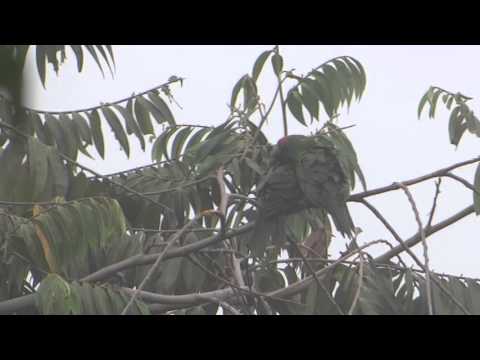
Photos:

(1) – Scarlet-fronted Parakeet (Aratinga wagleri) at Jurong BirdPark, Singapore By Michael Gwyther-Jones (originally posted to Flickr as Singapore 2006 249) [CC BY 2.0], via Wikimedia Commons

(2) – Scarlet-fronted Parakeet, also called Scarlet-fronted Conure at Jurong Birdpark, Singapore By Lynn Zheng (bird park_012) [CC BY 2.0], via Wikimedia Commons
(3) – pericon found By the Selimalabi (Own work) [GFDL, CC-BY-SA-3.0 or FAL], via Wikimedia Commons By Selimalabi (Own work) [GFDL, CC-BY-SA-3.0 or FAL], via Wikimedia Commons
(4) – Chacaraco [Scarlet-fronted Parakeet] (Aratinga wagleri transilis) by barloventomagicoFlickr
(5) – Chacaraco / Scarlet-fronted Parakeet (Aratinga wagleri) by Erick HouliFlickr

(6) – Illustration By Gray, George Robert; Hullmandel & Walton; Hullmandel, Charles Joseph; Mitchell, D. W. [CC BY 2.0 or Public domain], via Wikimedia Commons

Sounds: (Xeno-canto)

▷ The world of Pets: Dogs, cats, birds, reptiles, amphibians

Red-fronted Parrotlet
Touit costaricensis

The few records Red-fronted Parrotlet existing in Costa Rica come from, mainly, from the central-southern highlands of the Caribbean slope.
Red-fronted Parrotlet
A captive Costa Rican Parrot eating – Nrg800, CC BY-SA 3.0, via Wikimedia Commons
Content

Description:


Anatomy-parrots

17,5 cm.. length.

The Red-fronted Parrotlet (Touit costaricensis) has the forecrown, anteriorly of crown, lores and stripe under the eyes, red; sides neck, cheeks and upperparts, green with the back of the crown and nape slightly paler and yellower. Inner wing-coverts green; exterior and median coverts and wing leading edge, red; primary coverts black.

Primaries and outer secondaries, black with green margin to outerweb of the primaries. Inner underwing-coverts, yellow, the outer, red. Feathers on base of the beak, on chin and throat, brighter yellowish green; the chest, the belly and undertail-coverts, green tinted yellowish. The tail greenish yellow with a black tip (except the outermost feathers) and dark green subterminally. Bill pale yellow; cere and bare periophthalmic, grey; irises grey; legs slaty.

The female It has less red on the upperwing-coverts, and perhaps more yellow in the underwing-coverts; probably, on average, are smaller than males. The immature It has little or no red on the head.

Note:

The Red-fronted Parrotlet It has sometimes been treated as conspecific with the Blue-fronted Parrotlet (Touit dilectissimus) North of South America and Panama. Although these taxa are clearly allied and share a recent common ancestor, most authors now treat them as separate on the basis of their clear and consistent plumage differences. The structural divergence can also exist in the Red-fronted Parrotlet longer seems to show the uppertail-coverts (extending almost to the end of the tail) its counterpart Southern, While (although the sample is small) it suggests a sexual dimorphism by the length of the wings and tail on Red-fronted Parrotlet but not in Blue-fronted Parrotlet.

Habitat:

Generally observed in the canopy moist forests at mid-altitudes. It moves towards the thicket, on forest edges, flying over the clear, sometimes in the lowlands (sometimes at sea level, especially in southeast Costa Rica), where perhaps it is a seasonal visitor. Tolerates some habitat alterations.

Observed in association with Red-headed Barbet (Eubucco bourcierii) and Blue-and-gold Tanager (Bangsia arcaei), both species associated in cool wet forests in the upper tropics and subtropics.

Observed to 3.000 meters in Costa Rica in the early dry season and reported regularly at altitudes 500-1.000 m during the wet season. Usually in pairs or small flocks family.

Reproduction:

The family size usually between 4-5 birds, suggests the clutch usual 2-3 eggs. probably plays during the season, dry.

Food:

They feed on fruits trees and epiphytes, such as Cavendishia and Clusia, but probably also include flowers and seeds.

Distribution:

Size of its range (breeding/resident): 10.000 km2

The few records Red-fronted Parrotlet existing in Costa Rica come, mainly, the highlands of central-south Caribbean side, where its range seems to extend to the south, from Monteverde, Turrialba volcano and Lemon.

Although there are no records in much of the east of Costa Rica, its existence can be continuous along the Cordillera de Talamanca (perhaps only in the Caribbean side) to western Panama. The handful of panamanian specimens and records from observations, They are mainly from the western highlands to a report from the east, about the Cocle Province.

It is obviously a kind rare and presumably in decline due to continued deforestation (at least in the lowlands) in a limited range.

Conservation:


Vulnerable

• Current category of the Red List of the UICN: Vulnerable.
• Population trend: Decreasing.

Population size : 2500-9999 specimens.

Rationale for the Red List category

This species is classified as Vulnerable because the clearing and forest fragmentation at middle elevations, mainly in the Central Volcanic Range and in the Sierra de Tilarán of Costa Rica, It is likely to be causing significant slopes in its small range and (presumably) in population.

Justification of the population

It is estimated that the breeding population of the Important Bird Areas of Costa Rica is 1.000 to 4.000 mature individuals (J. And others Craido 2007, J. Sánchez et al., In 2007), so it is believed that the total population may be within the range of 2.500-9.999 mature individuals. This is equivalent to 3.750-14.999 individuals in total, rounded here to 3.500-15.000 individuals.

Justification of trend

It is suspected that the population species is decreasing at a moderate rate, in line with continued clearing of its forest habitat in the northern part of its range.

Conservation Actions Underway

CITES Appendix II. Live in several areas protected, including national parks Braulio Carrillo, Tapantí-Cerro de la Muerte and Monteverde, Costa Rica, and La Amistad International Park and adjacent reserves in both countries. But, The legal protection of Palo Seco Protected Forest (BPPS) (a booking Panama adjacent to La Amistad) has not prevented clearance for agriculture (Angehr and Jordan, 1998).

Conservation Actions Proposed

Evaluate the importance of habitat outside the breeding season (J. Created en lit. 2007, J. Sanchez et al., In 2007). Conduct surveys to determine the total size of the population. Study of the ecology of the species (J. Sanchez et al., in bed. , 2007). Monitor population trends through regular surveys. Monitor rates of loss and recovery of forests (J. Sanchez et al., In 2007). Effectively protect the Bosque Protector Palo Seco (BPPS).

"Red-fronted Parrotlet" in captivity:

No reports are known captive birds.

Alternative names:

Red-fronted Parrotlet, Red fronted Parrotlet (English).
Toui du Costa Rica (French).
Costa-Rica-Papagei (German).
Red-fronted Parrotlet (Portuguese).
Cotorrita Costarricense, Lorito de Pecho Rojo, Periquito alirrojo (español).

scientific classification:

Order: Psittaciformes
Family: Psittacidae
Genus: Touit
Scientific name: Touit costaricensis
Citation: (Cory, 1913)
Protonimo: Urochroma costaricensis

Images of the "Red-fronted Parrotlet"

Video of the "Red-fronted Parrotlet"


Species of the genus Touit


"Cotorrican Parrot" (Touit costaricensis)


Sources:

Avibase
– Parrots of the World – Forshaw Joseph M
– Parrots A Guide to the Parrots of the World – Tony Juniper & Mike Parr
– Birdlife

Photos:

(1) – Papagei am Rincon de la Vieja by Kovac – GEO Reisencommunity

Sounds:

▷ The world of Pets: Dogs, cats, birds, reptiles, amphibians

Chatham Parakeet
Cyanoramphus forbesi

Chatham Parakeet

Content


Anatomy-parrots

Description:

23 cm. length and 95 g. of weight.

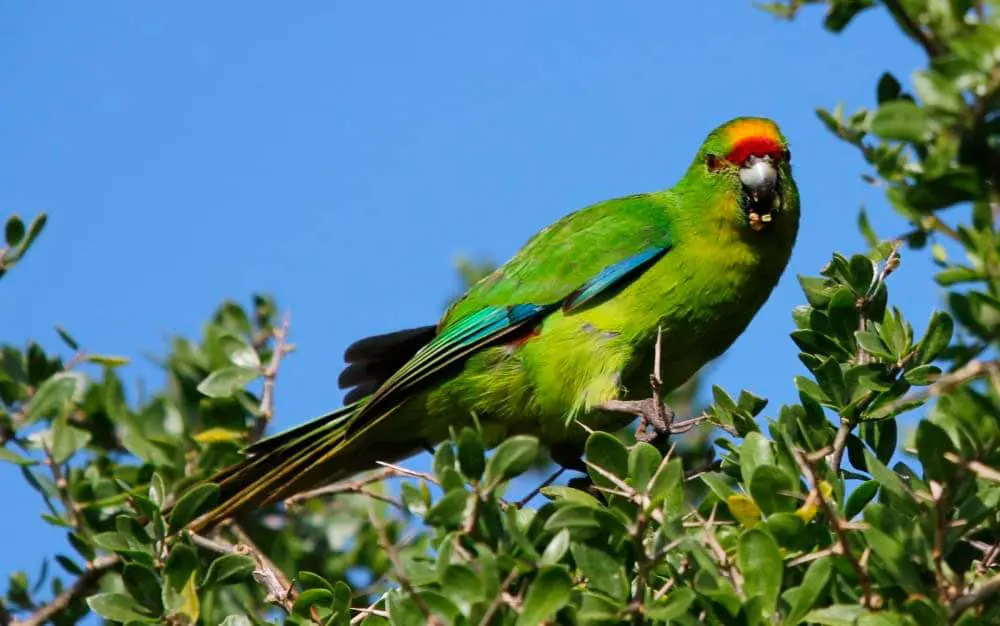
The Chatham Parakeet (Cyanoramphus forbesi) They are one of the two medium bright green parrots of Chatham Islands. Although they look very similar to those Yellow-crowned parakeet (Cyanoramphus auriceps) of New Zealand continental, the color of the crown is not a reliable indicator of taxonomic relationships.

It believes that the Chatham Parakeet descended from an ancient lineage of parrots who reached the Chatham Islands before the division Yellow-crowned parakeet and Red-crowned parakeet happened in New Zealand continental, after which the Red-crowned parakeet (Cyanoramphus novaezelandiae) also they colonized Chatham Islands.

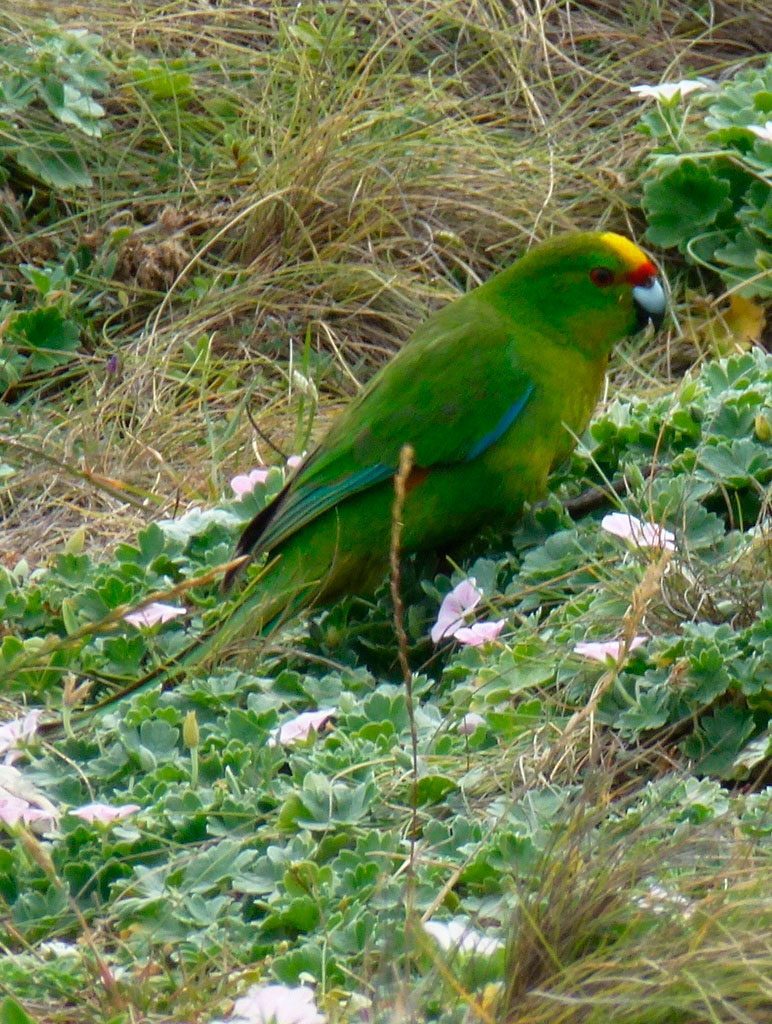
The Chatham Parakeet They are medium-sized parrots, of tail long, with wings wide and rounded and plumage predominantly emerald. have a crown bright yellow front and a crimson front band that does not reach to the eyes, unlike in the Red-crowned parakeet. Males are larger than the females.

taxonomy:

Since 1930 is commonly treated as a subspecies of the Yellow-crowned parakeet (Cyanoramphus auriceps), and clearly the two are closely related; the species differ, However, in size considerably, It is larger species Cyanoramphus forbesi. Currently considered Monotypic.

Habitat:

The Chatham Parakeet They are at higher densities in forests and dense vegetation regenerating areas than in open grassland. Despite its rather erratic flight, They fly hard and move easily between islas Mangere and little Mangere. Occasionally they have been observed Chatham Parakeet individual in the forests of southern Chatham Island (> 20 km from the Mangere Island) and nearby islands Pitt and owner. Their social behavior is similar to other species of parakeets Cyanoramphus. They are strongly territorial around nests, calling loudly and chasing intruders from nearby.

Reproduction:

The Chatham Parakeet have a long breeding season, with eggs laid between October and March. Son nesters cavity, preferring tree holes but also using rock crevices and under dense vegetation. The size medium of laying is of 5 eggs. Like all the other parakeets Cyanoramphus, females are responsible for preparing the nest, incubation, rearing and feeding the chicks until the 10-14 days old. During this period all your food is provided by your partner.. From then on, male and female parrots feed the chicks in the nest until they leave the nest.

The incubation usually begins after the start of the second egg, resulting in chicks within a clutch that vary greatly in age and size. The last chicks to hatch are usually born at a younger age and are less developed than their older brothers.. More than one brood may be attempted if the initial nest fails or if the food supply allows..

Food:

The foods consumed by Chatham Parakeet They are affected by seasonal availability, and include seeds, flowers and leaves of various plants, It is the most important invertebrates in spring. They feed extensively in soil in open areas.

Distribution and status:

Sw extension of its distribution area (reproduction / resident): 3 km2

The Chatham Parakeet It is restricted to of Tapuaenuku ISLA ISLA Pequeña Mangere and Mangere in the Group of chatham islands, New Zealand. In 1930 He quenched in Mangere Island, but in 1973 had recolonized and numbered 40 birds and a small number of hybrids with the subspecies Cyanoramphus novaezelandiae chathamensis (of which there were 12 on the island) (Higgins 1999).

In 1996, two estimates indicated that the population of the Mangere Island It was from 50 to 120 Purebred birds. The population on the small island of little Mangere It is little known because the few visits made (H. Aikman a slightly. 1999). In 1999, it was estimated that the total population was about 120 birds (Aikman et al. 2001), but studies 2003 estimated 900 individuals on Isla Mangere (Aikman y Miskelly 2004, D. Houston y C. Miskelly a slightly. 2008).

A recent study estimated that more than 50% of the population of parakeets in Isla Mangere consisted of individuals hybrids (Chan et al. 2006), but this is expected to decrease due to mating positive range (T. Greene a slightly. 2012); the number of phenotypes forbes It is approaching the threshold management 10% (D. Houston a slightly. 2012) (that is to say, the number above which culling can be resumed as a management tool). There have been birds visiting South isla Chatham, the Pitt island and ISLA ISLA Chief of Sudeste (Taylor 1998, D. Houston y C. Miskelly a slightly. 2008, T. Greene a slightly. 2012).

Conservation:


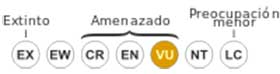
Vulnerable


• Current category of the Red List of the UICN: Vulnerable.

• Population trend: Stable.

• Population size : 250-999 individuals.
Rationale for the Red List category

This species may still have a small purebred adult population.. Possible removal by hybridization has been avoided thanks to three decades of conservation efforts, which they have seen increasing population size. It is restricted to one place (given the proximity of the small islands that lives and mobility), and its small population size means it still deserves to be listed in a threatened category, but it is likely that their population size has been more than 250 mature for more than 5 years, so it has been transferred to the category of Vulnerable.

Justification of the population

The population of phenotypes similar to those of Forbes It has increased dramatically in the Mangere Island, with the best estimates placing the population between 800 and 1.000 individuals. A survey in 2011 It assessed that the phenotypes of interest are in the 10%, the trigger level for management action (D. Houston a slightly. 2012). It is likely that populations have exceeded 250 mature for more than 5 years, so now it is in the range of 250-999 mature individuals.

Justification trend

The population has shown minor fluctuations in recent years, since the species recolonized the Mangere Island over the years 70 and it has benefited from habitat restoration, while hybridization has also suffered. In general, It is estimated that the population has remained stable for the last ten years, and It is probably increasing (T. Greene a slightly. 2012).

Threats

• Disappeared from Mangere Island due to a combination of deforestation for grazing, decades of burning, the effects of introduced grazing mammals and predation by feral cats (Higgins 1999).

• The greatest current threat is the hybridization with the Cyanoramphus novaezelandiae chathamensis, subspecies Red-crowned parakeet (Cyanoramphus novaezelandiae) What, despite the sacrifice, still it is settling in Mangere Island (J. Kearvell a slightly. 1999).

• It is believed that the rate of hybridization High above is the result of the then low population sizes of the two species (D. Houston y C. Miskelly a slightly. 2008).

• The levels of hybridization They have remained below 10% of the total population of parakeets Mangere Island over the last decade, so no management intervention was not necessary.

Conservation Actions Underway

Appendix I and II of CITES. The Mangere Island It has been substantially replanted (Aikman et al. 2001, D. Houston y C. Miskelly a slightly. 2008).

• An ecological and genetic research program has investigated population dynamics, the hybridization and selection of partners (H. Aikman a slightly. 1999, Chan et al. 2006).

• During 1976-1999, hybrid birds and individuals of the subspecies Cyanoramphus novaezelandiae chathamensis They were sacrificed population (Nixon 1994).

• In 1998, 40 hybrids And six Cyanoramphus novaezelandiae chathamensis were killed, leaving 10 copies between hybrids and Cyanoramphus novaezelandiae chathamensis after the operation (H. Aikman a slightly. 1999).

• Surveys of the relative proportion of hybrids regarding type phenotypes Forbes They are held every two years (D. Houston a slightly. 2012).

• The translocation a fenced area predator proof in Chatham Island It is planned for 2017 (D. Houston a slightly. 2012).

Conservation Actions Proposed

• Complete the investigation ecological, biological and genetic, including analysis and dissemination of results.

Monitor trends in the extent and quality of forest habitats on the island of Mangere.

Restore forest habitats Mangere Island to increase the number and reduce the hybridization.

• Work for the establishment of one or more populations in the Chatham Island (H. Aikman a slightly. 1999).

"Chatham Parakeet" in captivity:

There are no data from Chatham Parakeet in captivity.

In the wild, its lonjevidad is probably similar to that of Yellow-crowned parakeet (Cyanoramphus auriceps): 10 years.

Alternative names:

Chatham Island Yellow-crowned Parakeet, Chatham Islands Parakeet, Chatham Parakeet, Forbes’s Parakeet (English).
Kakariki de Forbes, Kakariki des îles Chatham, Perruche des Chatham, Perruche des îles Chatham (French).
Chathamsittich (German).
Periquito-de-peito-amarelo-da-Ilha-chatham (Portuguese).
Perico de las Chatham (español).

scientific classification:

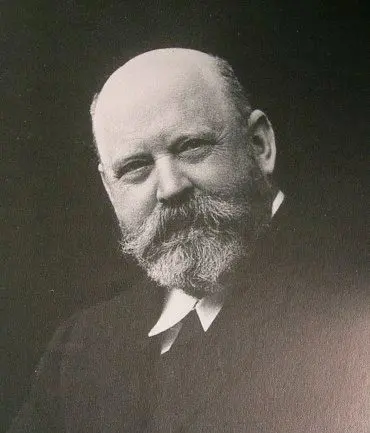
Lionel Walter Rothschild

Order: Psittaciformes
Family: Psittaculidae
Gender: Cyanoramphus
Scientific name: Cyanoramphus forbesi
Subpoena: Rothschild, 1893
Protonimo: Cyanorhamphus [sic] forbes

"Perico de las Chatham" images:

Perico-de-las-Chatham

Sources:

Avibase
• Parrots of the World – Forshaw Joseph M
• Parrots A Guide to the Parrots of the World – Tony Juniper & Mike Parr
Birdlife
• Greene, T.C. 2013 [updated 2017]. Forbes’ parakeet. In Miskelly, C.M. (ed.) New Zealand Birds Online. www.nzbirdsonline.org.nz

Photos:

(1) – Chatham Islands Parakeet on Mangere Island by Markanderson72 [CC BY-SA 4.0], from Wikimedia Commons
(2) – Andrew Sutherland, IBC1065693. Photo of Chatham Parakeet Cyanoramphus forbesi at Chatham Islands, New Zealand. Accessible at hbw.com/ibc/1065693.