▷ The world of Pets: Dogs, cats, birds, reptiles, amphibians

Long-billed corella
Cacatua tenuirostris

Cacatúa Picofina

Content

Description

35 to 41 cm.. length. The weight of 500 to 600 g..
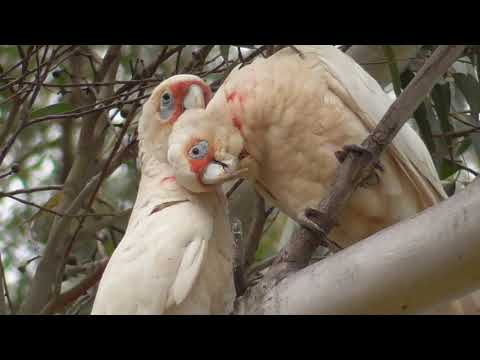
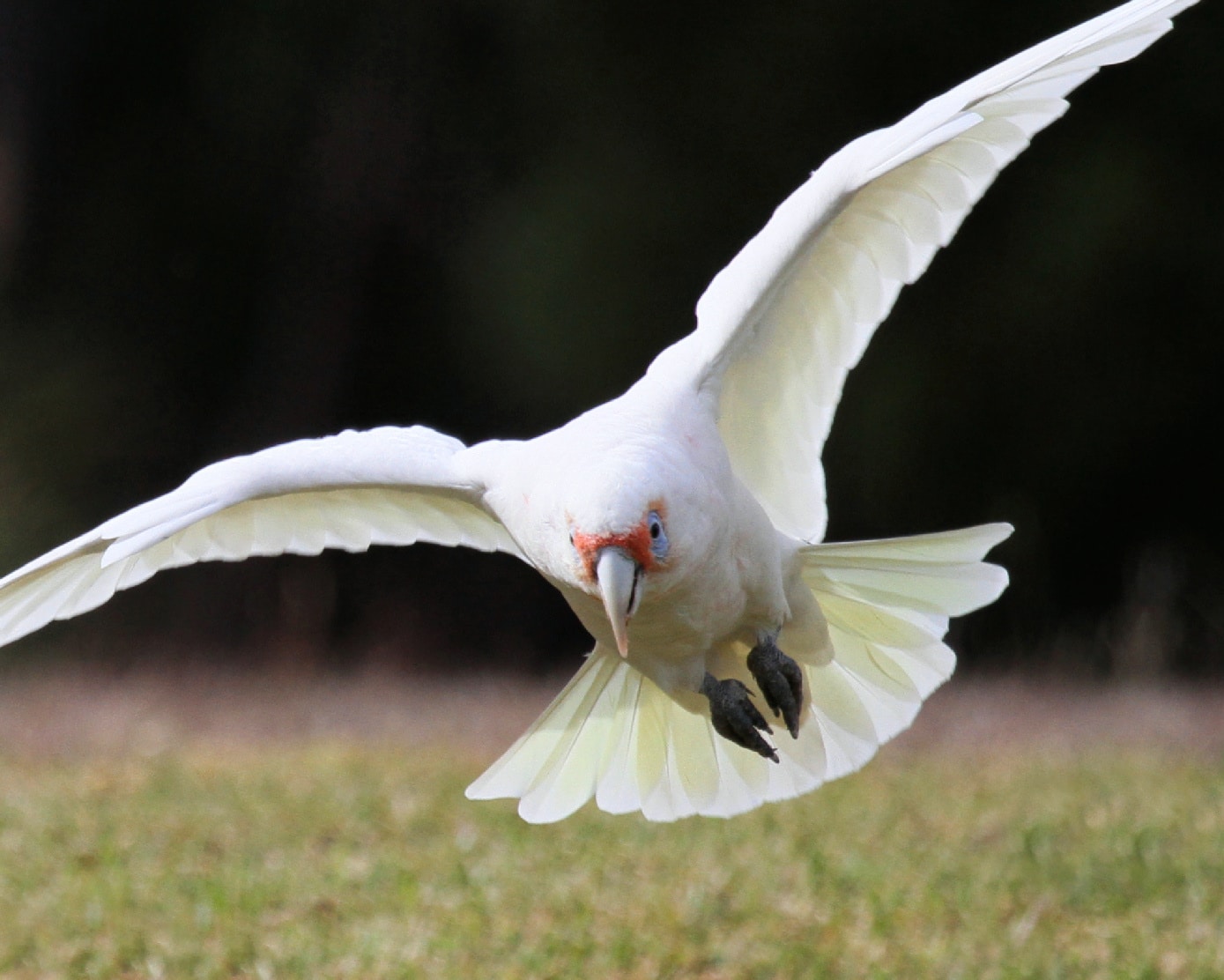
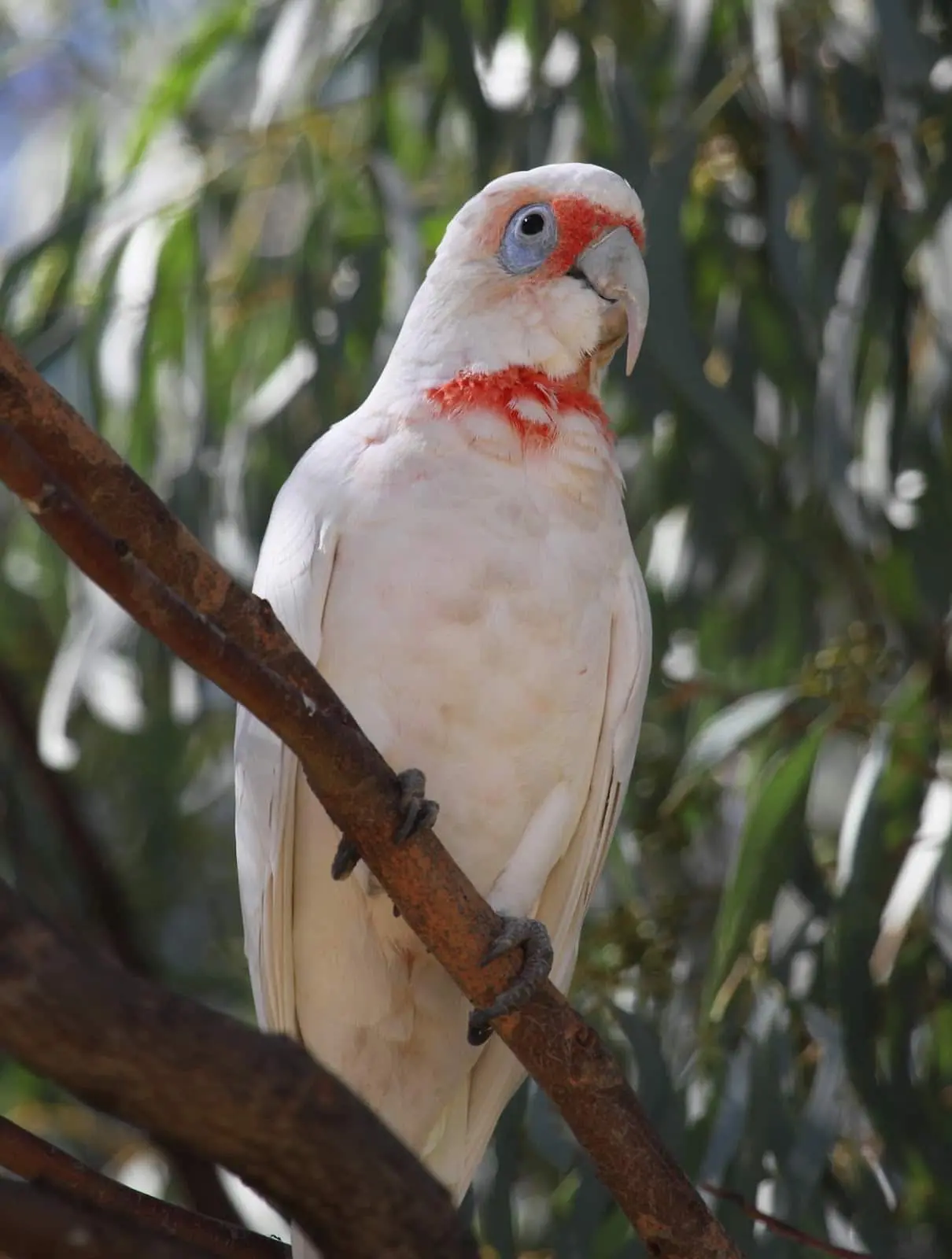
The Long-billed corella (Cacatua tenuirostris) has white plumage. The undertail coverts and the parts below from the wings they are bathed in pale yellow, very visible in flight. It has red coloration in the throat and the chest, with a Red Crescent ranked in the upper breast.
The Head shows a small crest white, Red front and a wide, nude and fleshy eye ring blue-grey around the eyes dark browns. The bill is white with blue base. upper jaw is long and hooked. The legs and feet are dark gray.

The female is similar to the male, with the upper jaw more short and less red.

There are two similar species:

– Cacatua sanguinea. Lack of forecrown Red and the red color in the neck. The upper jaw is shorter.

– Cacatua galerita. Similar in flight, has crest yellow and lacks of colour red. The bill is black.

Habitat:

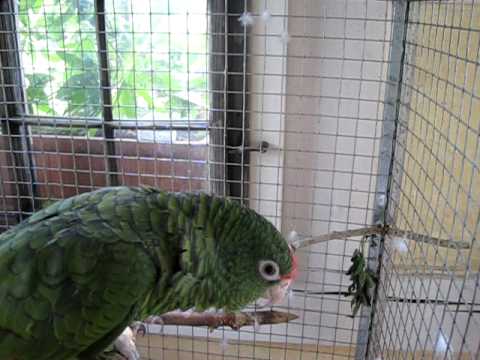
Video – "Long-billed corella" (Cacatua tenuirostris)

Long-billed corella ~ Cacatua tenuirostris

Common in forests and remnant trees on farmland. It nests in Eucalyptus camaldulensis in the flooded Plains or close to streams. Wild populations living on farms and parks in urban areas.

Behavior:

It´s resident in their area of distribution, some local movements. Outside of breeding season, You can see in large flocks of up to 2.000 birds or more. Son noisy and visible, pronouncing discordant calls.

Pose in large eucalyptus near water. They leave the roost in the morning to drink, and then, go to the feeding areas. Again when the darkness comes to sleep, but not before excited participate in games and stunts .

They move on the floor with stunning movement jump. They do not have the other species waddling gait cockatoo.
It causes damage to crops of cereals and tree fruit, considered as one pest for farmers.

Nest colonies. They can create their nests with other species of Corella, and sometimes they hybridize. Populations feral in Sydney and Perth, from the release of unwanted birds, they may hybridize with endangered species such as the Cacatua pastinator

Reproduction:

Held from July to November. Forman couples monogamous. The male and female prepared the nest in the Hollows of large old eucalypts. If you do not find a suitable tree, You can make a burrow in soft soil Bank. They fill the nest of wood chips and often reuse it for several years.

They nest in large colonies, with several nests in the same tree.
The female lays 2-4 eggs White. The incubation lasts a few 24 days, shared by both parents. The young leave the nest 55 days after hatching, being fed by the parents for three weeks more.

Food:

Feeds mainly on what obtained from soil, seeds, estate and bulbs that unearths with its upper jaw. They feed in the coolest hours of the day. Also consumes insects.

Distribution:

Size of the area of distribution (reproduction / resident): 382.000 km2

Is located in the southeast of Australia. Introduced in urban centers of Australia and Tasmania.

Conservation:

State of conservation ⓘ


minor concern Minor Concern ⓘ (UICN)ⓘ

• Current IUCN Red List category: Least concern.

• Population trend growing


Populations may be declining due to loss of breeding grounds in its original distribution area.
But, the Long-billed corella It common in its range.

Is created that in the world there are more than 250 thousand individuals.


"Long-billed corella" in captivity:

It is very popular as a pet for the most part of Australia, and has been classified as the best «talkative" of the australian cockatoos for its ability to mimic words almost to perfection.
Has a personality playful and active.

Out of its area of distribution is rare in poultry farming.

Alternative names:

– Long billed Corella, Long-billed Cockatoo, Long-billed Corella, Slender-billed Corella (ingles).
– Cacatoès nasique (French).
– Nasenkakadu (German).
– Cacatua-corella-de-bico-longo (Portuguese).
– Cacatúa de Pico Largo, Cacatúa Picofina (español).

scientific classification:

– Order: Psittaciformes
– Family: Cacatuidae
– Genus: Cockatoo
– Scientific name: Cacatua tenuirostris
– Citation: (Kuhl, 1820)
– Protonimo: Psittacus tenuirostris
–

Images Slender-billed Cockatoo:


Species of the genus Cacatua

Sources:
– Avibase
– Photos: Alice Springs in Australia’s Red Centre, commons.wikimedia.org, Ian Barker (ibc.lynxeds.com/)
– Sounds: Marc Anderson (Xeno-canto)
▷ The world of Pets: Dogs, cats, birds, reptiles, amphibians

Glossy black cockatoo
Calyptorhynchus lathami


Glossy black cockatoo

Content

Description

46 to 51 cm.. height and between 400 and 500 g. of weight.
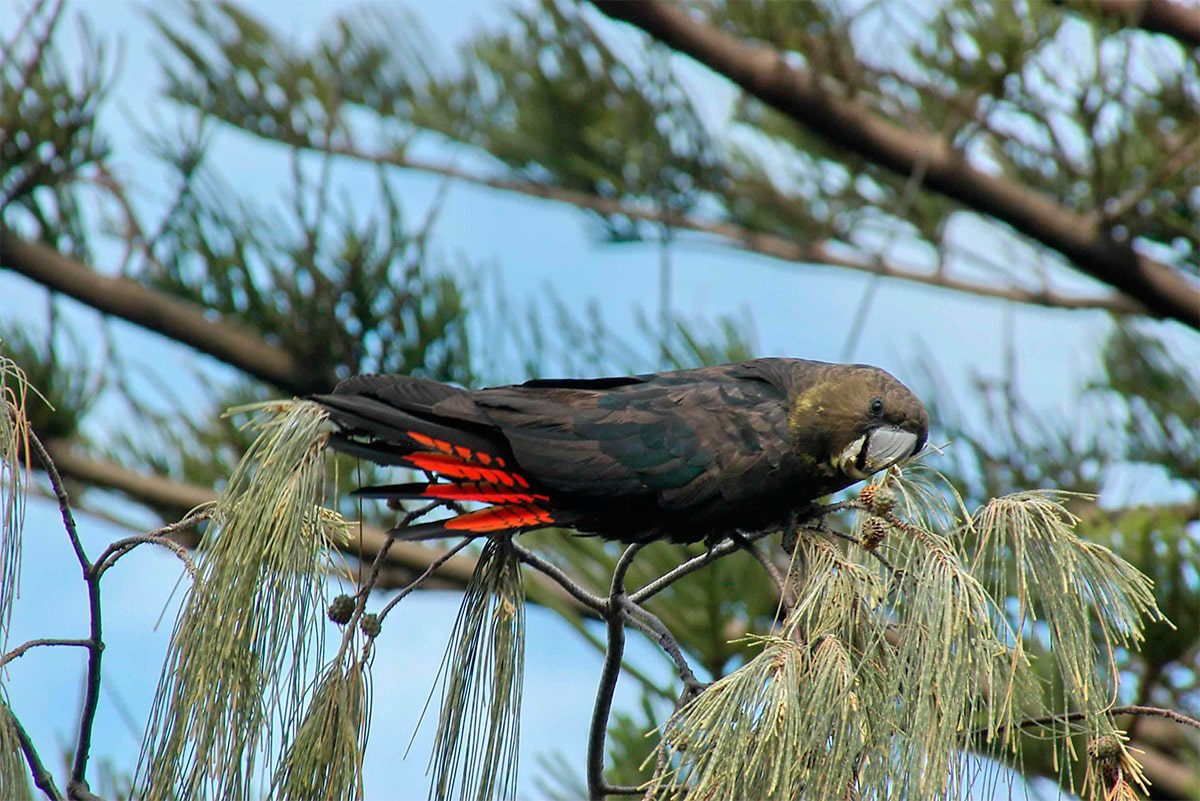
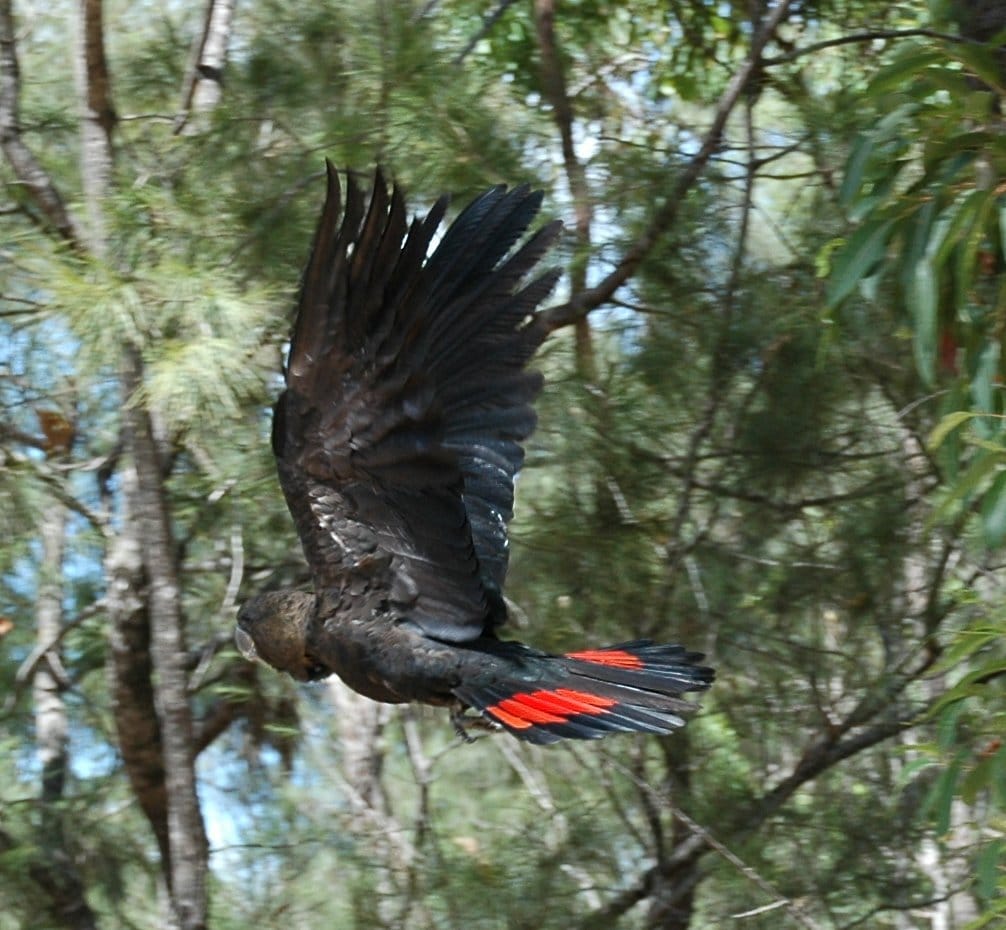
The Glossy black cockatoo (Calyptorhynchus lathami) is the smallest of the 5 black cockatoos and is restricted to the East coast of Australia (a population isolated also is reproduced in the Islands Kangaroo).
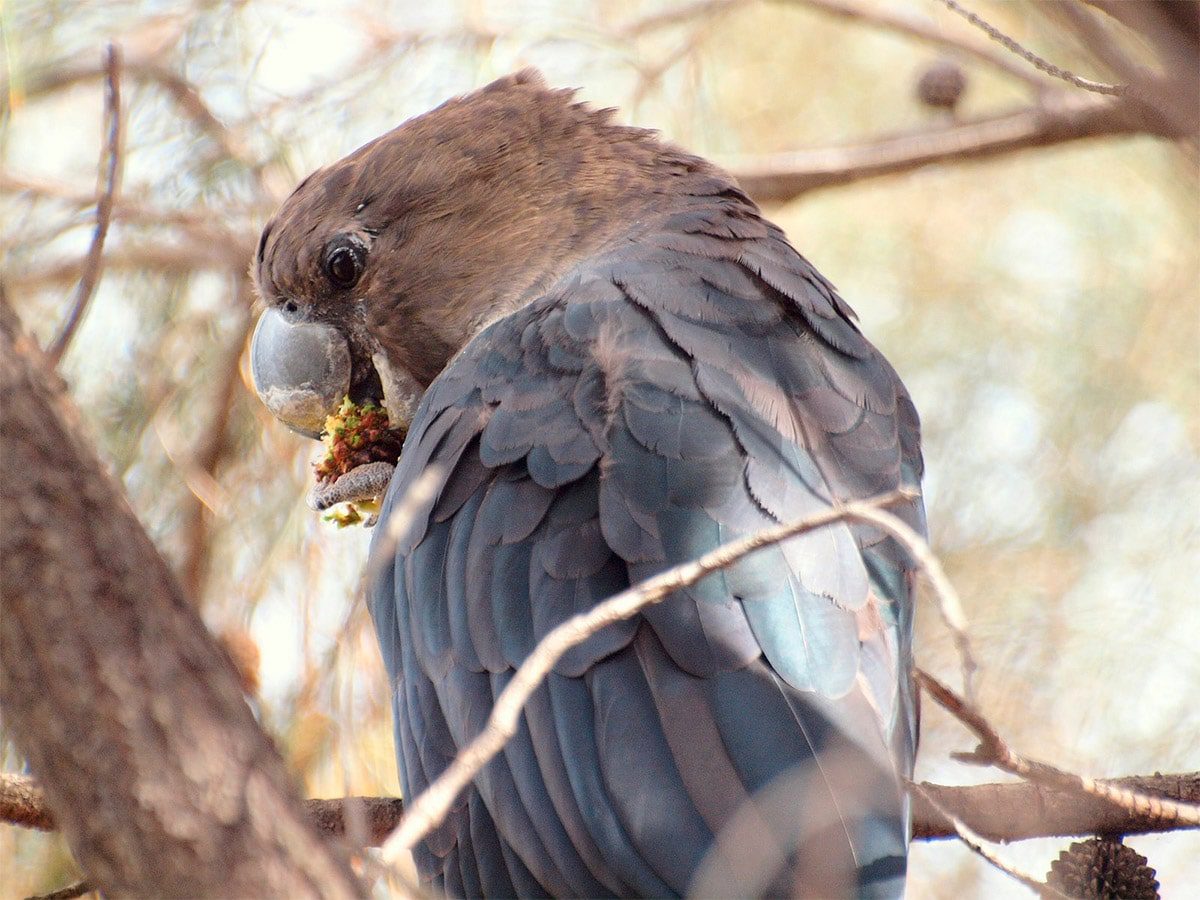
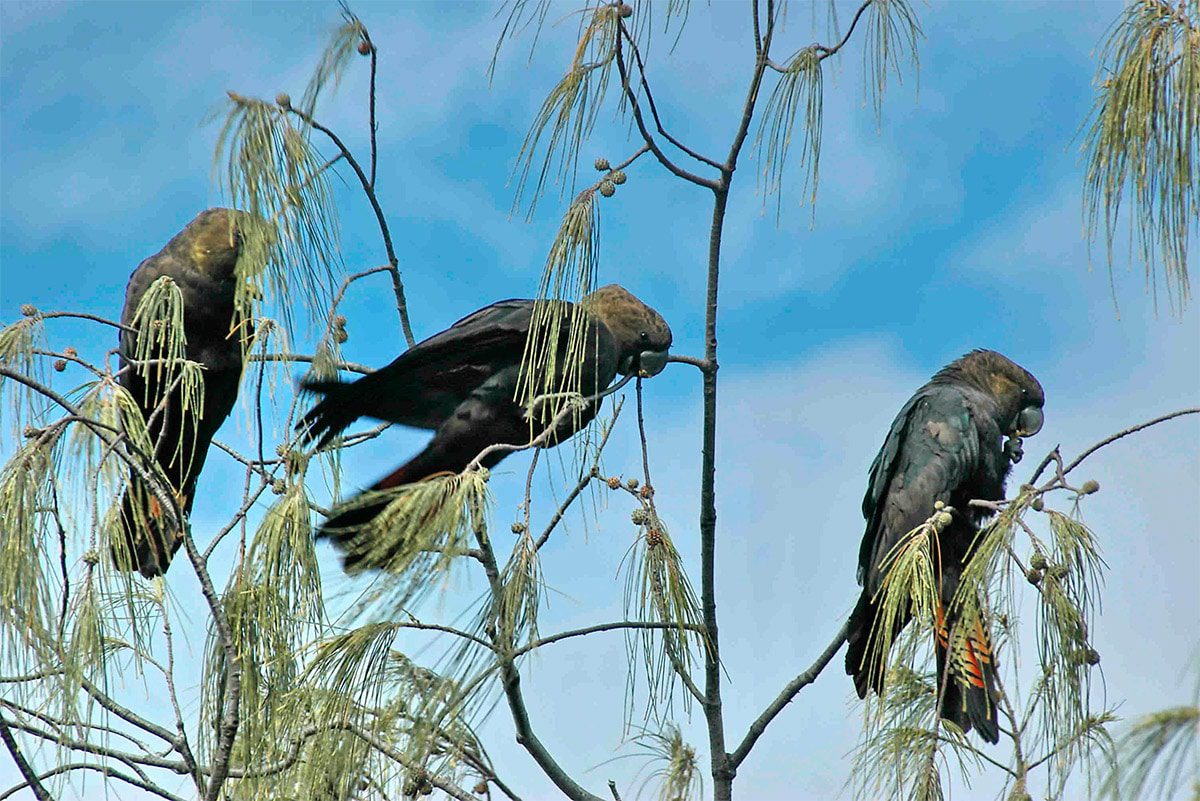
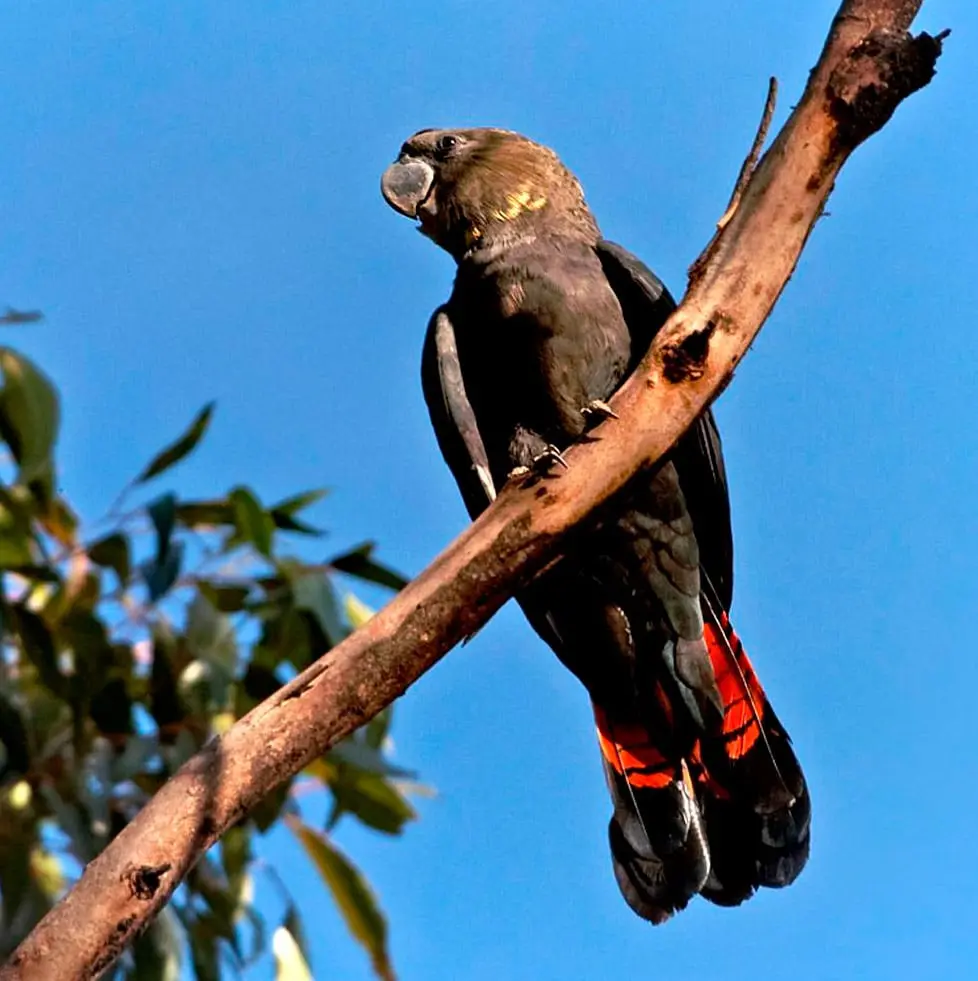
The male is brown-black color with a small crest rounded and bright Scarlet spots in the tail. The female shows spots irregular in color yellow in it head, The Scarlet patches in the tail they are permeated by narrow black bars and edges of pale yellow on the underparts of the wings.
The immature they are similar to the females, but they lack the yellow markings on the head and show different yellowish tones in the feathers, the chest and in the belly.

Subspecies description

  • Calyptorhynchus lathami lathami

    (Temminck, 1807) – The nominal.


  • Calyptorhynchus lathami halmaturinus

    (Mathews, 1912) – Medium-size ones 48 cm. length and 510 to 515 weight g, with a wing of approximately 90 cm.. The of adults they are mainly black, dark brown in the head, the neck and the bottom of the body, and Red panels (in males) or orange-red with bars Black (in females) on tail. The female adult is also conspicuous in the head. These patches are absent from most males., Although they can be expressed faintly in a few individuals (Higgins 1999).

    The immature are similar in appearance to the male adult, but have small stains yellow in it head; spots or bars yellow in the chest, belly and flanks; yellow or orange spots on the wing (mainly on the bottom); Red or orange-yellow panels with black bars at the tail; One bill pale grey (instead of dark); And a ring of skin around the eye pale grey (instead of grey dark) (Higgins 1999, L. Pedler 2007, com. Pers.).


  • Calyptorhynchus lathami erebus

    (Schodde & Mason,IJ, 1993) – The only difference with the nominal species resides in that has the bill shorter.

Habitat:

Video – "Glossy black cockatoo" (Calyptorhynchus lathami)

Glossy-black Cockatoo (Calyptorhynchus lathami ) HD Video clip 1/3

Areas forested frequently dominated by casuarinas of which are highly dependent for its food. These are small shrubs commonly known as the Sheoaks, wood for beef (Beefwood) or Australian pine. These shrubs are widespread in tropical and subtropical regions.

They are also distributed in open humid forests, difficult terrain where deforestation has not been too great. They have an imperative for natural tree cavities to nest.

Reproduction:

Forman couple during all the life. The couple has relationships throughout the year. This type of family of them parrots prefers to nest in cavities natural of the eucalyptus, whether dead or in full vitality. The nest usually placed at an altitude that ranges between the 3 and 30 meters above the ground. The cavity is filled with leaves and branches. Sometimes, together with other breeding pairs, they share the same tree year after year.

In New South Wales the season extends from March to August. The spawning It consists of a single egg white. It is the female that takes charge of most of the tasks.: It prepares the nest and incubates herself. Never leave the nest until the small is reached the age of one week. In most cases, the male provides the female with food and assistance until the young can fend for itself, normally four months which remains with them until the next breeding season.

Food:

It feeds almost exclusively on the seeds several species of She-oak (Casuarina and Allocasuarina). You can also sometimes eat larvae of wood-boring. They feed in threes, less frequently in pairs, small groups or flocks of up to 60 birds. They can be detected by the snapping of their beaks and the remains of the casuarina cones and twigs that fall.

Distribution:

Size distribution (reproduction / resident): 770.000 km2

The species is Rare Although widespread in suitable forests of the central coast and forest habitats of Queensland and in the interior of the southern plateaus and Plains of the Midwest's New South Wales, with a small population in the Riverina. There is an isolated population in the Kangaroo Island, South of Australia.

Subspecies distribution

  • Calyptorhynchus lathami lathami

    (Temminck, 1807) – The nominal.


  • Calyptorhynchus lathami halmaturinus

    (Mathews, 1912) – Kangaroo Island (South of Australia)


  • Calyptorhynchus lathami erebus

    (Schodde & Mason,IJ, 1993) – It is from Australia (the central eastern coastal area of Queensland)

Conservation:

State of conservation ⓘ


minor concern Minor Concern ⓘ (UICN)ⓘ

• Current category of the Red List of the UICN: Least concern.

• Population trend: Decreasing.

Like most parrot species, the Glossy black cockatoo is protected by the Convention on international trade in endangered species of Fauna and Flora Silvestres ( CITES ), with its inclusion in the list of the Appendix II of vulnerable species, What makes the import, the export and trade of animals captured in the wild is illegal.

Justification of the population

Garnett and Crowley (2000) estimated the size of the population in the following way: 12.000 individuals of the subspecies lathami, 70 breeding pairs of the subspecies halmaturinus (equivalent to 140 individuals) and 5.000 individuals of the subspecies erebus giving a total of 17.140 individuals.

Justification of trend

They suspected that the population is declining in general Since the largest subpopulation, lathami, It is slowly decreasing throughout its range. However it is believed that the subspecies Erebus is increasing and the subspecies halmaturinus It is increasing as a result of conservation efforts in the Island Ganguro (Garnett and Crowley 2000).

"Glossy black cockatoo" in captivity:

Like the other black cockatoos, the Glossy black cockatoo (Calyptorhynchus lathami) is extremely rare in the poultry. In Australia It has attained breed in captivity.

Alternative names:

– Glossy Black-Cockatoo, Casuarina Cockatoo, Casuarine Cockatoo, Latham’s Cockatoo, Leach’s Black-Cockatoo, Leach’s Red-tailed Cockatoo, Nutcracker (English).
– Cacatoès de Latham, Cacatoès noir étincelant (French).
– Braunkopfkakadu (German).
– Cacatua-preto-brilhante (Portuguese).

scientific classification:

– Order: Psittaciformes
– Family: Cacatuidae
– Scientific name: Calyptorhynchus lathami
– Genus: Calyptorhynchus
– Citation: (Temminck, 1807)
– Protonimo: Psittacus Lathami

Images Calyptorhynchus lathami:


Species of the genus Calyptorhynchus
  • Calyptorhynchus banksii
  • —- Calyptorhynchus banksii banksii
  • —- Calyptorhynchus banksii graptogyne
  • —- Calyptorhynchus banksii macrorhynchus
  • —- Calyptorhynchus banksii naso
  • —- Calyptorhynchus banksii samueli
  • Calyptorhynchus lathami
  • —- Calyptorhynchus lathami erebus
  • —- Calyptorhynchus lathami halmaturinus
  • —- Calyptorhynchus lathami lathami

  • Sources:
    – Avibase
    – Parrots of the World – Forshaw Joseph M
    – Parrots A Guide to the Parrots of the World – Tony Juniper & Mike Parr
    – Birdlife

    – Photos: commons.wikimedia.org, The Glossy Black Conservancy,

    – Sounds: Nigel Jackett (Xeno-canto)

    ▷ The world of Pets: Dogs, cats, birds, reptiles, amphibians

    Spot-winged Parrotlet
    Touit stictopterus

    Spot-winged Parrotlet

    Content

    Description:


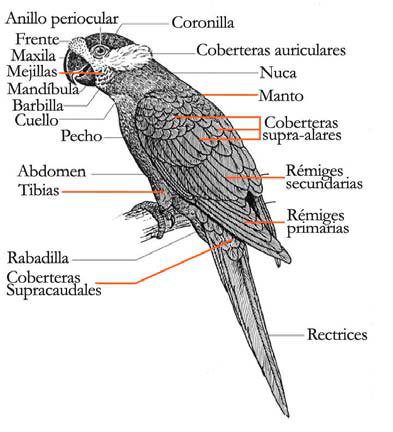
    Anatomy-parrots

    17 to 18 cm.. height.

    The Spot-winged Parrotlet (Touit stictopterus) It has a green overall coloration, clearer to the abdomen, wings brownish with white spots; below the tail opaque olive is yellow with blue edge.

    The female differs from the male by feathers middle-lower wing which they are green; the forecrown and the face They are yellowish green.

    Habitat:

    Very rare species. Observed at the local level and in low densities in a Habitat in decline. Its population It is likely to be small and declining, with very small sub-populations in each known locality.
    It inhabits in semi-humid cloud forests and seasonal crop areas, between 600 and 2400 m. Apparently performs altitudinal migrations, Perhaps conditioned by the supply of food.

    Reproduction:

    The reproduction It is performed in March.

    Food:

    They feed on fruit and corn.

    Distribution:

    Size of the area of distribution (reproduction / resident): 129.000 km2

    It lives in the wild in the Andes, southern Central cordilleras and Eastern in Colombia, western Ecuador and North of Peru.

    Conservation:

    State of conservation ⓘ


    Vulnerable Vulnerable ⓘ (UICN)ⓘ

    Globally it is in the category vulnerable (VU) and in Colombia in danger of extinction (IN). Deforestation in Andes It is their main threat.

    "Spot-winged Parrotlet" in captivity:

    Because of its condition It is not recommended that you keep this bird as a pet.

    Alternative names:

    – Spot-winged Parrotlet, Brown-shouldered Parrotlet, Emma’s Parrotlet, Spot winged Parrotlet (English).
    – Toui tacheté, Toui d’Emma (French).
    – Tüpfelpapagei, Tüpfel-Papagei (German).
    – Spot-winged Parrotlet (Portuguese).
    – Cotorrita Alipinta, Lorito de Alas Moteadas, Periquito Alipunteado (español).
    – Periquito Alipunteado (Colombia).
    – Periquito de Ala Punteada (Peru).


    scientific classification:

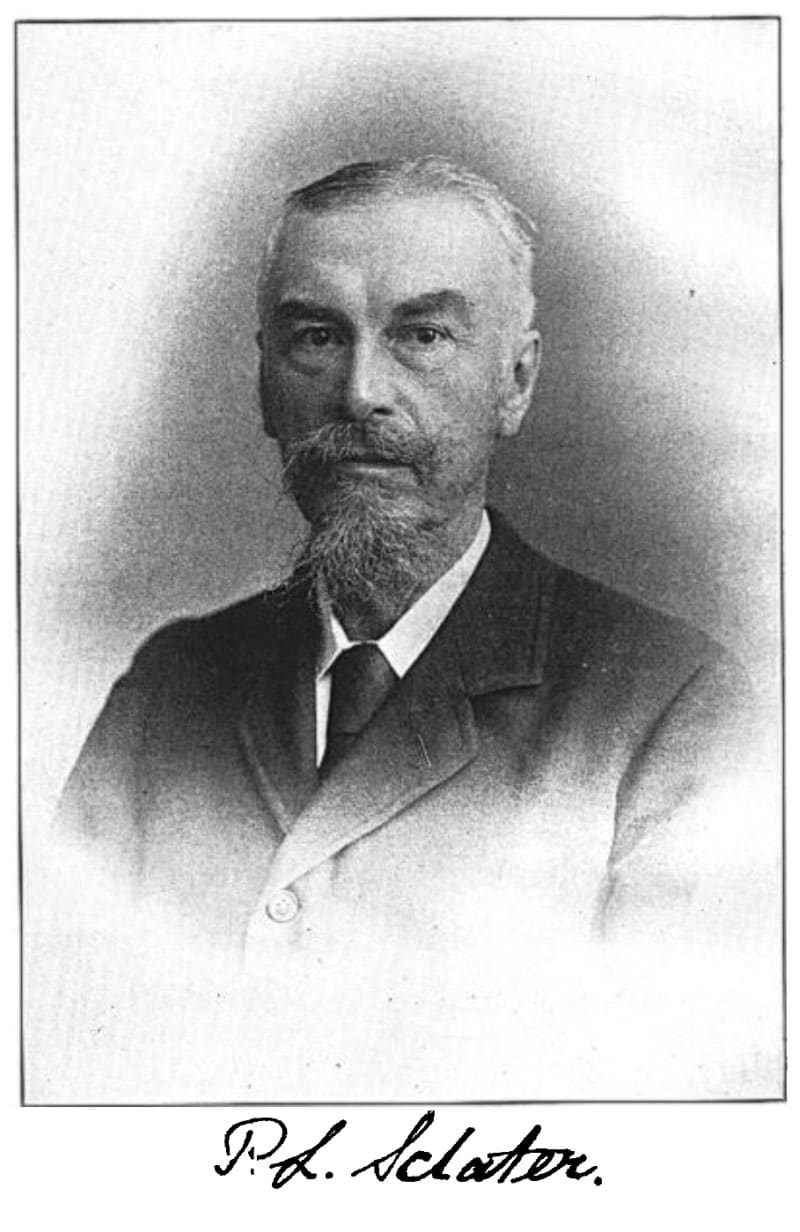
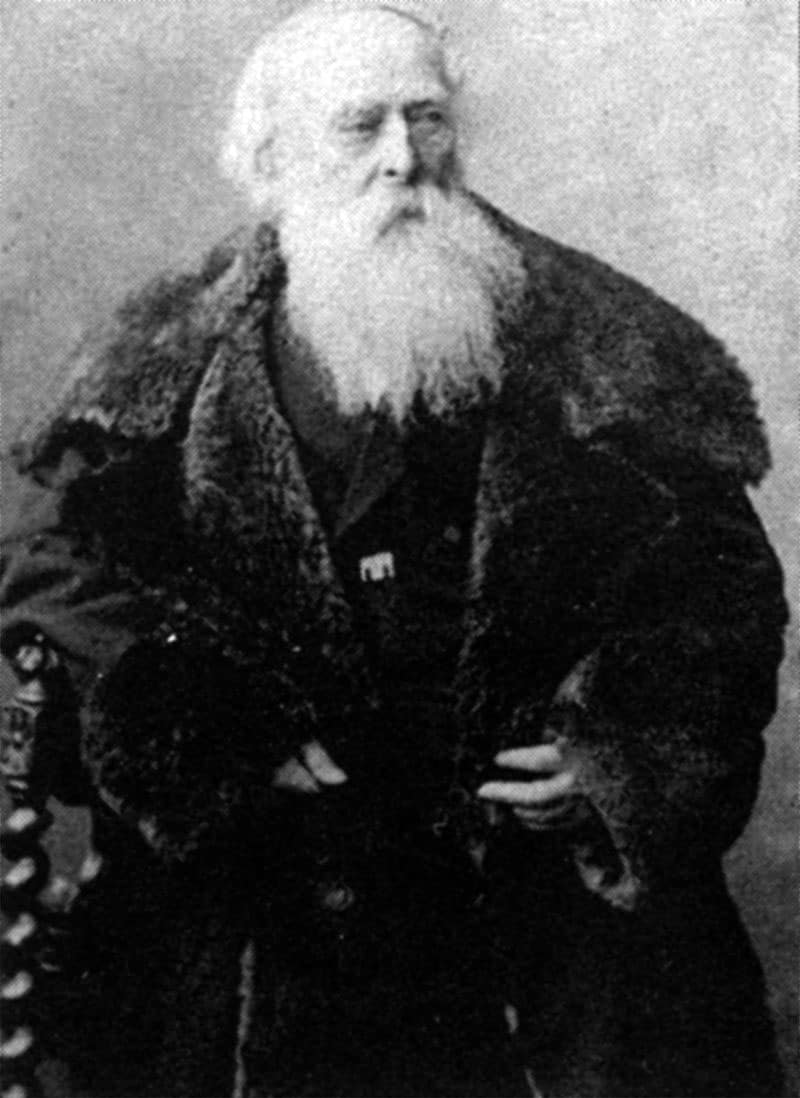
    Philip Sclater
    Philip Sclater

    – Order: Psittaciformes
    – Family: Psittacidae
    – Genus: Touit
    – Scientific name: Touit stictopterus
    – Citation: (Sclater, PL, 1862)
    – Protonimo: Urochroma stictoptera


    Images Spot-winged Parrotlet:


    Species of the genus Touit


    Spot-winged Parrotlet (Touit stictopterus)


    Sources:

    • Avibase
    • Parrots of the World – Forshaw Joseph M
    • Parrots A Guide to the Parrots of the World – Tony Juniper & Mike Parr
    • Birdlife
    • Parrot Book, Parrots and macaws Neotropical

    • Photos:

    (1) – Urochroma stictoptera = Touit stictoptera by Joseph Wolf [Public domain], via Wikimedia Commons

    ▷ The world of Pets: Dogs, cats, birds, reptiles, amphibians

    Yellow-streaked Lory
    Chalcopsitta scintillata

    Lori Chispeado

    Content

    Description

    Measured between 30 to 31 cm.. and a weight between 180 and 245 gr.

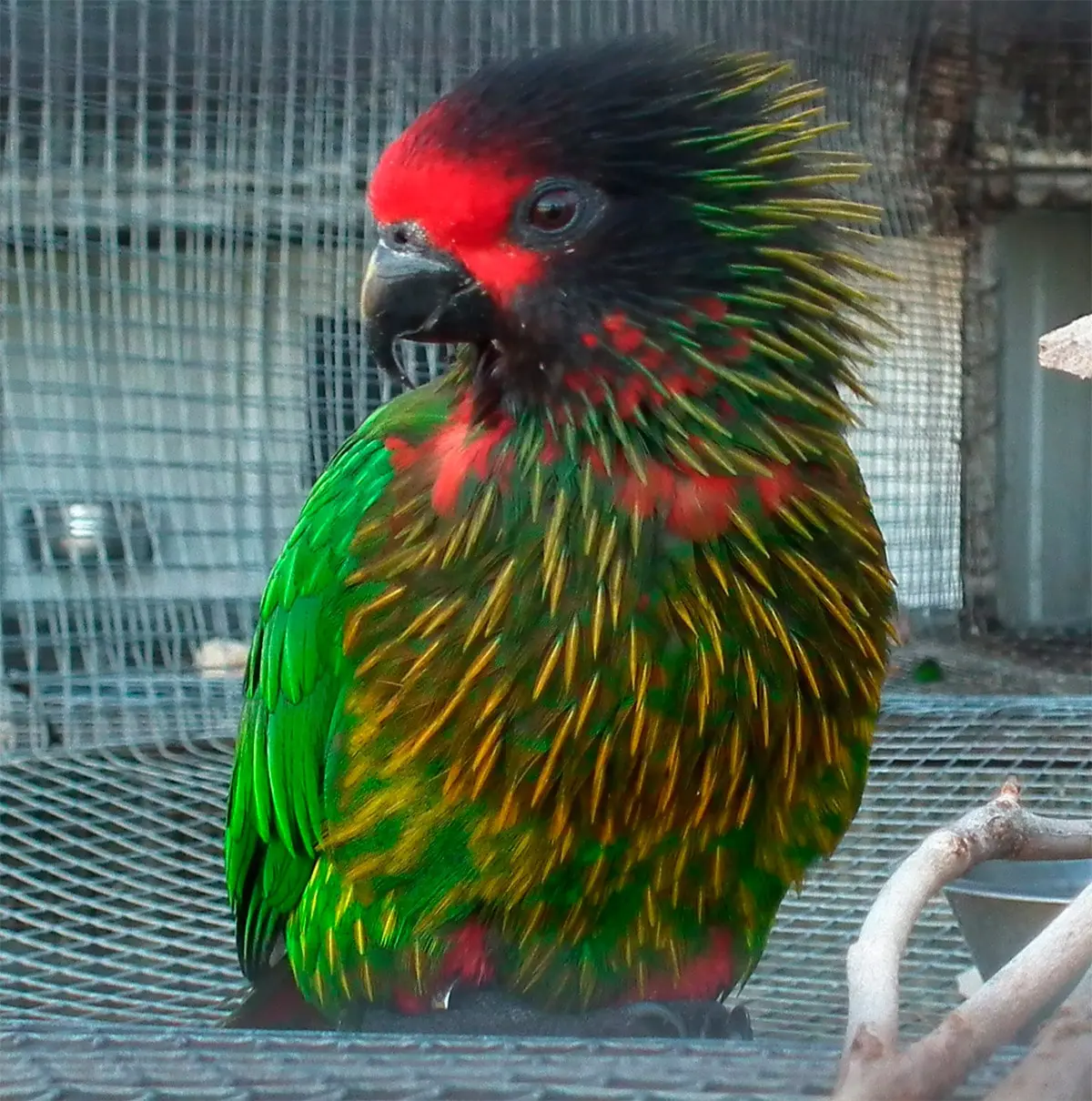
    The adults of the species Yellow-streaked Lory (Chalcopsitta scintillata) have plumage dark green, pale green veins in head and the abdomen, and bright yellow bands in the chest and in the the mantle.

    Chalcopsitta sintillata rubrifrons

    The forecrown, cheeks and the thighs are bright red. The sides of the chest with large red infiltrations.

    The under wing It is crossed by a thick yellow band. The bill is black. Bare skin eye and at the base of bill is dark gray. The irises are orange-red, the legs grey.

    There is no sexual dimorphism, but in the female, the front spot It is less pronounced.

    The immature They resemble adults, but have less red in the forecrown. The basis of the bill It is less stained yellow. The irises They are brown.

    They are particularly visible in the early hours of the day, When the bands fly over canopy, sometimes very large heights.

    They have a direct flight with rapid wing beats. In spite of this, they give the impression of moving slowly, almost in a hesitant way. Its neck tense and the tail feathers widely deployed gives them a vision in flight that is very characteristic. Couples often engage in stunts, with many screams.

    Description 3 subspecies

    • Chalcopsitta scintillata chloroptera

      (Salvadori, 1876) – Adults of this subspecies differ little from those of the nominal species. But, they differ from the latter by the narrower stripes on the plumage. The bottom of your wings They are green or green with red markings.


    • Chalcopsitta scintillata rubrifrons

      (Gray,GR, 1858) – In this subspecies, both adults and juveniles, they are identical to the nominal species, but the veins of body plumage They are more spacious and orange-yellow.


    • Chalcopsitta scintillata scintillata

      (Temminck, 1835) – Nominal.

    Habitat:

    common in the lowlands, in the Savanna They are covering the hills, in plantations cocoteros and in the mangroves.
    They are also in the primary forest and secondary adjacent, even in narrow bands of gallery forests bordering rivers in open country.
    Occasionally, the Yellow-streaked Lory They sit near or inside Gardens in local villages.
    They can fly to 800 m above sea level.

    Reproduction:

    Typically install their nests in treeholes high. There is not much information about the reproduction in the center of nature.

    In captivity, the implementation is of 2 eggs which both parents incubate alternately during 26 days. At hatching, hatchlings weigh 7 u 8 g.. Duration reproductive cycle It is very long and can overcome 80 days. Despite this, There may be a second clutch in the season.

    Food:

    They feed in the trees.

    consume nectar, pollen and fruit. Are said to some insects complete this predominantly vegetarian diet.

    Distribution:

    Size of its range (breeding/resident): 586.000 km2

    These birds are endemic to the Islas Aru and South of Papua New Guinea.

    Distribution 3 subspecies

    • Chalcopsitta scintillata chloroptera

      (Salvadori, 1876) – High of the fly river to Southeast Papua New Guinea.


    • Chalcopsitta scintillata rubrifrons

      (Gray,GR, 1858) – Only in the islas Aru.


    • Chalcopsitta scintillata scintillata

      (Temminck, 1835) – Nominal. South of New Guinea (triton bay to lower fly river.

    Conservation:


    minor concern

    • Current IUCN Red List category: Least concern.

    • Population trend: Stable.

    It is not an endangered species. In a study in Southeast New Guinea, its density was estimated at 20 birds per square kilometer.
    Its world population approaches the 100.000 birds.

    The population suspected to be stable in the absence of evidence of any reduction or substantial threats.

    "Yellow-streaked Lory" in captivity:

    Pretty common.

    They are birds very noisy People who like to let their loud cries are heard. They are playful, they have no fear and they can easily become meek in the hands of your caregiver. They are not only extremely aggressive against other Yellow-streaked Lory, also as with other species.

    Alternative names:

    – Yellow-streaked Lory, Greater Streaked Lory, Streaked Lory, Yellow streaked Lory, Yellowish-streaked Lory (ingles).
    – Lori flamméché, Lori à front jaune, Lori à front rouge, Lori strié (French).
    – Schimmerlori (German).
    – Lóris-listrado-amarelo (Portuguese).
    – Lori Chispeado (español).

    scientific classification:

    – Order: Psittaciformes
    – Family: Psittaculidae
    – Genus: Chalcopsitta
    – Scientific name: Chalcopsitta scintillata
    – Citation: (Temminck, 1835)
    – Protonimo: Psittacus sintillatus

    “Sparkling Lori” Images:

    Videos "Yellow-streaked Lory"

    ————————————————————————————————-

    "Sparkling Lori" (Chalcopsitta scintillata)


    Sources:
    – Avibase, Oiseaux.NET

    – Photos:

    – Wikipedia
    – Goura (zoochat.com)
    – loryland.NET
    – Wikimedia
    – Wikipedia
    – Chalcopsitta rubrifrons = Chalcopsitta sintillata rubrifrons by Joseph Wolf [Public domain], via Wikimedia Commons

    – Sounds: BAS van Balen (Xeno-canto)

    ▷ The world of Pets: Dogs, cats, birds, reptiles, amphibians

    Dusky lory
    Pseudeos fuscata

    Lori Sombrío

    Content

    Description

    23-28 cm.. height and a weight between 140 and 190 gr.

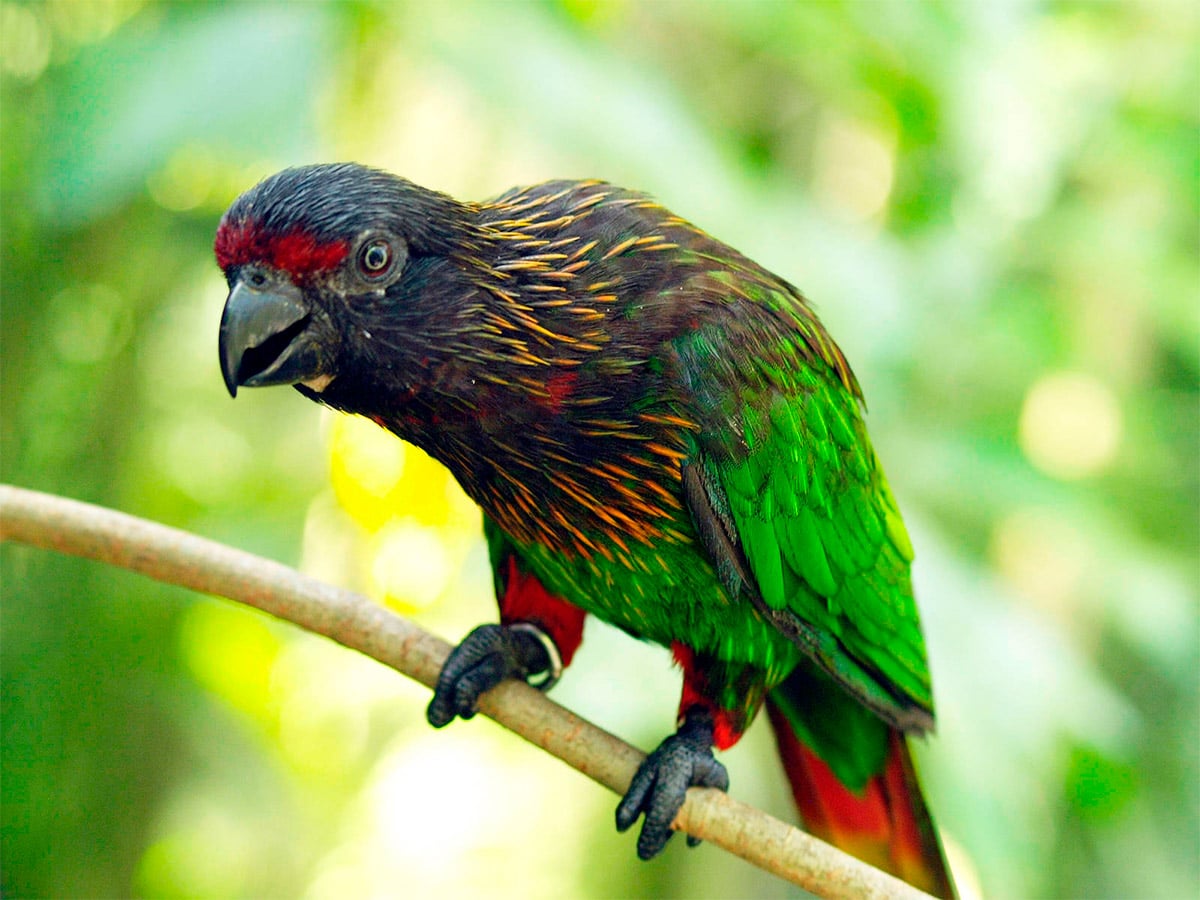
    The plumage of the Dusky lory (Pseudeos fuscata) It is difficult to describe since there are many differences in tonality between one and the other specimens.. Some are of a very dark brown color, almost black and others have a much lighter shade. In addition the same happens with the two bands that cross you the chest Since the species goes through three phases: red, Orange and yellow, according to age, gender and the place of origin.

    Characteristic of this species is the area of ​​bare skin under the lower jaw until the birth of the throat. The lower wing coverts are orange and the lower flows dark blue. The obispillo is a silvery-white the bill is bright orange. The irises is orange and the legs dark.

    There is no sexual dimorphism and the only way to differentiate male and female will be through DNA, Although some authors (Tomas Arndt) they are running that adult females lack the white feathers of the obispillo.

    Habitat:

    The Dusky lory they are quite widespread and locally common in primary forests , that is to say, those who have not undergone any transformation. But they are also found in wooded areas, up to an altitude of 2.400 m, During regeneration, especially those with large mature trees.

    They are also distributed among residual tree beds during their flowering period., including those located in the parks and gardens in cities.

    They are occasionally present in the lightly wooded Savannah or plantations of teak and coconut trees.

    They normally reside in the landscape of hills or slopes steep slightly from low and middle mountain.

    It´s gregarious and when flies or are fed in the cup of them trees full of flowers it makes in groups of 20 to 100 individuals or more.

    Reproduction:

    The nesting season It is very different depending on the region: It extends from November to April in the mountainous areas of East, While in Irian Jaya, the Indonesian part, they do in July.

    The Dusky lory they prefer to nest in tall trees in the mountain area, the choice of a hole at high altitude on Earth probably do to protect itself against potential predators.

    If the site is of your liking, reuse it for many years consecutively. Male and female participate in the work, the enlargement of the entrance or the cavity itself. Even if the nest has been used in the past, There are always minor changes to be carried out.

    Although this species is quite common, We really know very little about its reproduction in the wild. In captivity, the female lays two eggs which are incubated for approximately 24 days. As in most New Guinea lories, the reproductive cycle is very long, about 70 days.

    Food:

    Consumes mainly nectar and perhaps the pollen it accumulates in plants of the genus schleffera or tree Rudraksha (Elaeocarpus sphaericus). Also consume flowers and fruits. It can be seen in large flocks in mango plantations and other cultivated trees. Feeds, occasionally, teak moth (Hyblaea puera).

    Distribution:

    The Dusky lory It has its area of distribution largely of New Guinea, except the mountains more high of the interior and the peaks more high of the mountains of Parotia.

    They are present in Salawati on the Western Islands of papua and further to the East in the Yapen island on Cenderawasih Bay.

    Conservation:


    minor concern


    – Current IUCN Red List category: Least concern

    – The population trend: Stable

    The species are not threatened. Common and very sociable, It often forms bedrooms that can reach thousand of birds.

    A wild population estimated above 100.000 individuals.

    In some parts of the southeast of New Guinea, its density may be superior to 30 birds per square kilometer.

    "Dusky lory" in captivity:

    Are birds enough prolific and sociable you adapt easily to captivity.

    Contrary to other parrots that eat mainly seeds and nuts; The loris require a greater percentage of fruits, outbreaks, nectar and pollen in your diet. In fact, in the nature, they can feed a maximum of 640 flowers in a day. They also feed on seeds.

    It is usually aggressive with other species of lory. Easy to startle with strangers.

    Alternative names:

    – Dusky Lory, Dusk-orange Lory, Dusky-Orange Lory, White-rumped Lory (ingles).
    – Lori sombre, Lori à dos blanc (French).
    – Weißbürzellori (German).
    – Lóris-dusky (Portuguese).
    – Lori Sombrío, Lorito crepuscular (español).

    scientific classification:

    – Order: Psittaciformes
    – Family: Psittaculidae
    – Scientific name: Pseudeos fuscata
    – Genus: Dusky
    – Citation: (Blyth, 1858)
    – Protonimo: those darkened

    Images "Lori Mson":


    "Lori bleak" (Pseudeos fuscata)


    Sources:

    Avibase, mundoexotics, Oiseaux.NET

    Photos: Wikimedia, birdsville.NET.au, Dick Daniels – Tampa’s Lowry Park Zoo, Dusky Lory – Woburn Safari Park (Wikimedia),

    Sounds: BAS van Balen (Xeno-canto)

    ▷ The world of Pets: Dogs, cats, birds, reptiles, amphibians

    Red-and-blue Lory
    Eos histrio

    Eos histrio

    Content

    Lori-of-them-sangihe-6

    Description

    31 cm.. length and a weight between 150 and 185 gr.

    The two main colors of the Red-and-blue Lory (Eos histrio) they are the red and blue.

    A broad blue-purple line extends from the eyes through the ears and for the sides of the neck. A broad transverse band blue on the chest. The tail coverts they have blue pink. The feathers of the part superior of the tail they are reddish purple.

    The irises is red, the legs grey.

    Both sexes are very similar.

    In immature, the feathers of the head and the chest they have a dark blue edging. The blue of the crown extends up to the neck and below the eyes. Thighs they are dull purple. The irises They are brown.

    Description 3 subspecies

    • Eos histrio challengeri

      (Salvadori, 1891) – The band blue of the chest is of smaller size and mixed with red; the blue band of the eyes does not extend to the the mantle; smaller.


    • Eos histrio histrio

      (Statius Müller, 1776) – Nominal.


    • Eos histrio talautensis

      (Meyer,AB & Wiglesworth, 1894) – More black in the corbeteras wing and in the flight feather.

    Habitat:

    The Red-and-blue Lory they are common in primary forests, and on the hills of the hills. The feed, they made raids in coconut plantations along the coast and in the more open areas.

    They make short trips daily. In the Talaud Islands You can see flying from island to island.

    Initially, They lived in large flocks and concentrated in large numbers in common dormitories..

    Today, in view of its decline, them find in pairs or in small groups. Large gatherings have become extremely rare or virtually non-existent.

    In the Karakelong island were seen, However, on two occasions, more groups of 400 birds.

    The Red-and-blue Lory they are birds noisy, which makes them quite easy to observe.

    Reproduction:

    The species nests in holes in tall trees, most belonging to the class canarium family Burseraceae, and the breeding period main seems to be from May to June, Although it is suspected that nesting may include other months.

    We find nests, both in the forests and cultivated areas. The spawning usually includes 2 eggs which are incubated for approximately 25 or 26 days. There is no any other information in the natural environment.

    Food:

    Although they also consume some insect larvae, the Red-and-blue Lory are mostly vegetarian. They feed on coconut plantations, in the fig trees and trees of the genus canarium It produces edible nuts.

    Distribution:

    Size of the area of distribution (reproduction / resident): 1,000 km2

    The Red-and-blue Lory is confined to the Talaud Islands (almost exclusively in Karakelang) front North of Sulawesi, Indonesian

    Description 3 subspecies

    Conservation:


    Endangered

    • Current category of the Red List of the UICN: Endangered.

    • Population trend: Decreasing.

    This species has a very small range (It is known only in some places), and it is declining due to habitat loss. It has been a downhill fast in the population, largely as a result of their capture for trade, and this is expected to increase in the future. So, qualified as In danger.

    Although it was previously abundant, the species has decreased and the population in KarakelongIt was estimated in 8,230-21,400 birds in 1999 (Riley 2003). The subspecies of the nominal of the Sangihe Islands, is likely that has been extinguished.

    The encroachment and logging are driving the loss of forests, aggravated by the threat of illegal trade in the species, contribute to the acceleration in the decrease of the population.

    In 1999, the investigation concluded that you the 1.000 and 2.000 birds were being captured in Karakelang each year, the 80% (illegally) for the markets of birds of the Philippines.

    Ongoing conservation actions:

    Since 1995, the project "Action Sampiri» has been working for the conservation of biodiversity in Sangihe and Talaud, in the implementation of awareness-raising programmes of field work and the conservation and development of ideas for the future use of the land.

    Efforts have been made to promote the local support of the species at Talaud, his last bastion.

    It has been reported that the poaching and the trade of this species have decreased drastically after the confiscation of assets by Ranger of the forest Department in 2005 (RT Prayudhi in litt., 2008).

    The bird is part of the European Association of Zoos, the program Aquaria’s European Endangered [species] and Parrot Taxon Advisory Group (Wilkinson 2000), where it is being bred in captivity (Sweeney, 1998).

    "Red-and-blue Lory" in captivity:

    It is currently very rare in captivity.

    Due to its status in danger of extinction, any specimen that can not be returned to their natural habitat (natural range) should preferably be placed in a well-managed breeding program to ensure the survival of the species.

    Alternative names:

    – Red-and-blue Lory, Blue-tailed Lory, Red & Blue Lory, Red and Blue Lory, Red-blue Lory (ingles).
    – Lori arlequin, Lori histrion (French).
    – Harlekinlori (German).
    – Lóris-arlequin (Portuguese).
    – Lori de las Sangihe, Lori Rojo y Azul (español).

    scientific classification:

    – Order: Psittaciformes
    – Family: Psittaculidae
    – Genus: Eos
    – Scientific name: Eos histrio
    – Citation: (Statius Müller, 1776)
    – Protonimo: A player parrot

    “Sangihe Lory” images:

    ——————————————————————————————————-

    «Lori de las Sangihe» (Eos histrio)


    Sources:

    – Avibase, BirdLife.org

    – Photos:

    1 – En Loro Parque (Spain, Tenerife) by Drägüs – Wikimedia
    2 – Lori en Loro Parque, Tenerife, España by Drägüs – Wikimedia
    3 – En ZooParc de Beauval, France by User:Edhral – Wikimedia
    4 – Red-and-blue lory. two in a cage. by TJ Lin – Wikimedia
    5 – A Red-and-blue lory in a zoo by jojo nicdao – Wikimedia
    6 – The Red and Blue Lory (Eos histrio now Eos histrio histrio) and The Challenger Lory (EOS challengeri now Eos histrio challengeri) Chromolithograph. Plate VII from A monograph of the lories, or brush-tongued parrots, composing the family Loriidae. By St. George Jackson St. Mivart (1827–1900). Artwork by John Gerard Keulemans (1842-1912). This was published by R. H. Porter (London) in 1896. By John Gerard Keulemans [Public domain], via Wikimedia Commons

    – Sounds: Frank Lambert (Xeno-canto)

    ▷ The world of Pets: Dogs, cats, birds, reptiles, amphibians

    Ornate Lory
    Trichoglossus ornatus

    Lori Adornado

    Content

    Description

    Of 25 cm.. length and 100 to 120 gr. weight.

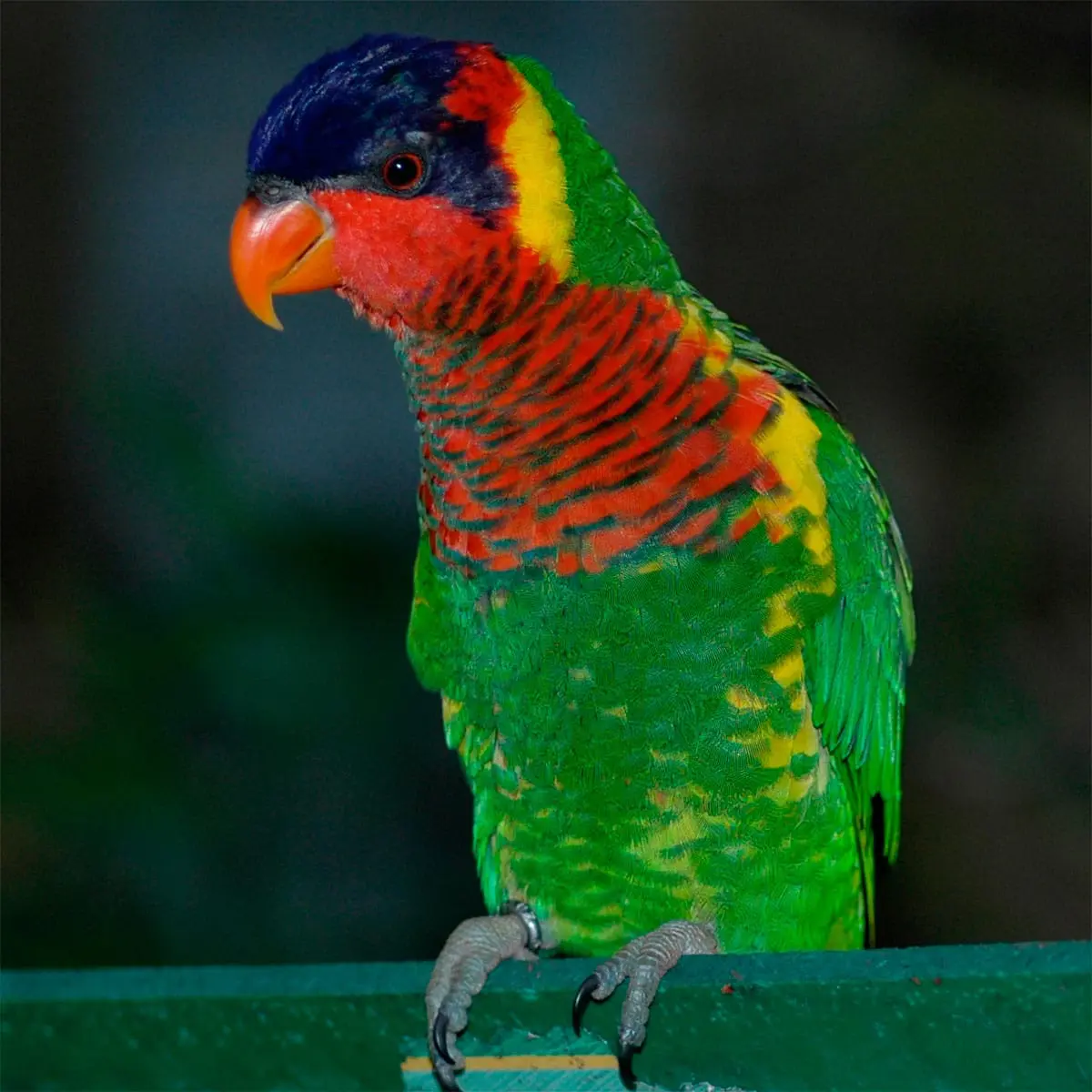
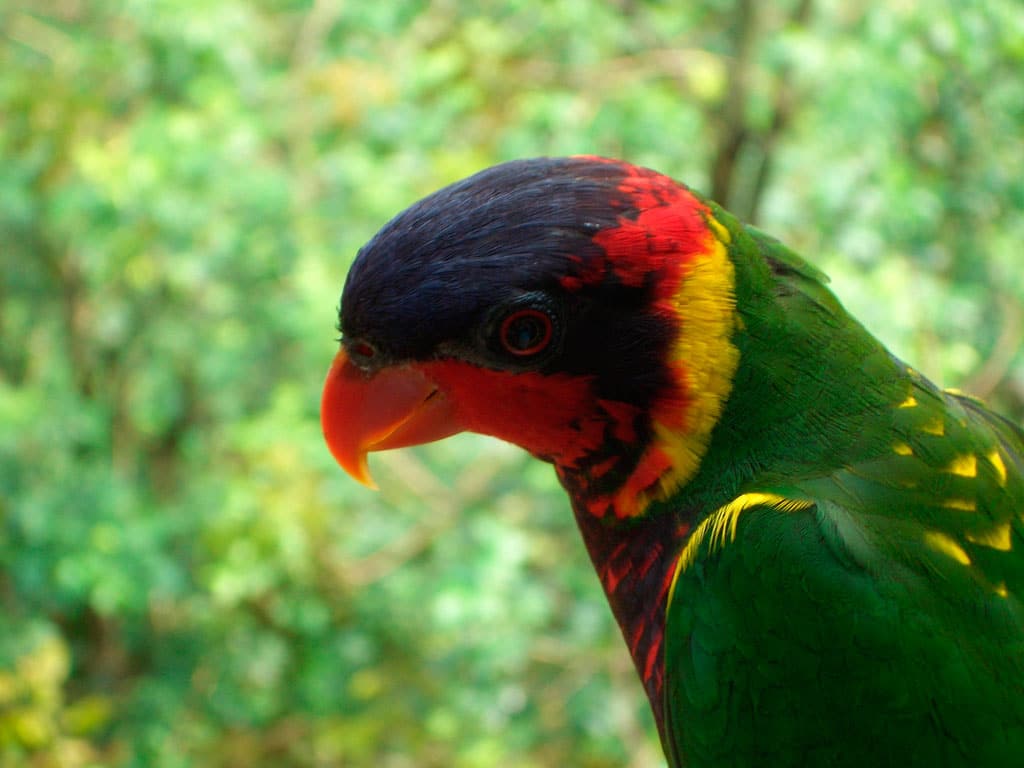
    The general plumage of the Ornate Lory (Trichoglossus ornatus) is green. The front, the head and feathers that cover the ears are blue. It has a small red stripe that goes from the upper right corner of the eye to the nape of the neck, It also has a yellow stripe on the sides of the neck. The throat and chest are orange-red and in each pen has a bluish-black wide table. Underwing feathers are yellow.

    The rest of the bottom is green with yellowish scales.
    Belly pale green with dark green bars. Green-yellow under the tail is bright green ends. The upper part of the tail is dark green with yellow edges in outer feathers. The base of the outer tail feathers is pink.

    The circle around the eyes is narrow and dark gray. The iris is red, the legs are grey and orange beaks.

    Habitat:

    The Ornate Lory they usually visit the swamps and marshy woodlands where there is fresh water. They are also found in the forest, the plots during the regeneration near the edges, scattered shrubs in cropland, including coconut plantations.

    Usually, They appreciate the open areas and do not venture far from the primary forests.

    In the North and center of the main island, These birds live from sea level up to the 1.000 meters above the sea level, While in the South, You can climb up to the 1.500 m. Its preferred habitat is between 300 and 500 m.

    The Ornate Lory They mainly live in pairs or in small groups. Sometimes, when feeding in fruit trees or at the edges of the forest, are associated with the Yellow-and-green Lorikeet (Trichoglossus flavoviridis).

    Benefiting from stable climate, These birds are probably sedentary.

    Reproduction:

    We really know very little about the reproductive habits of this species in the wild.

    Most of the birds are able to breed in the months of September and October. There is no information on the construction and composition of the nest.

    Spawning usually consists of 3 eggs that are incubated during 27 days. The chicks are nidicolous and depend on their parents during 80 days after hatching.

    Food:

    The Ornate Lory they are vegetarian birds, most of its menu is made up of nectar, pollen and fruit. When feed, these birds may concentrate in large numbers on flowering trees. The seeds of the trees of the genus Tectona and Casuarina they are also part of their diet.

    Distribution:

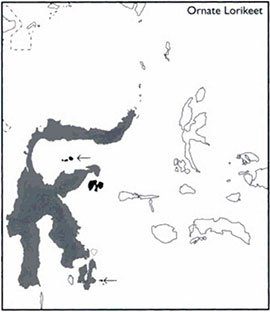
    Distribution Lori adorned
    This species is endemic to Indonesia , where is widespread in Sulawesi and surrounds the coast islands including Togian, Peleng, Banggai and the archipelago Tukang Besi. It has been reported that it is no longer common in parts of northern and central Sulawesi, but still seems to be common on the islands Togian and in the lowland forest in Torout (Bogani Nani NP) and to a lesser extent in Tangkoko.

    Conservation:


    minor concern

    – Current IUCN Red List category: Least concern

    – The population trend: Decreasing

    It has been described as common and locally very common., with a total population of over of 50.000 specimens.

    The trend has not been quantified, but slow descents can be seen due to some pressure from capture, and although it does not require primary forest it is more common in the lowlands and therefore may be affected by habitat loss.

    It seems that the Ornate Lory is trapped in national parks as Tangkoko and Lore Lindu, and they are commonly seen in bird markets.

    "Ornate Lory" in captivity:

    Due to its state of decline in its population, any specimen that can not be returned to their natural habitat (natural range) should preferably be placed in a well-managed breeding program to ensure the survival of the species.

    Alternative names:

    – Ornate Lorikeet, Ornate Lory (ingles).
    – Loriquet orné (French).
    – Schmucklori (German).
    – Lóris-ornado (Portuguese).
    – Lori Adornado, Tricogloso Adornado (español).

    scientific classification:

    – Order: Psittaciformes
    – familia: Psittaculidae
    – Scientific name: Trichoglossus ornatus
    – Citation: (Linnaeus, 1758)
    – Protonimo: parrot furniture

    Images "Lori adorned":

    —————————————————————————————————

    «Lori adorned» » (Trichoglossus ornatus)


    Sources:

    – Avibase
    – Oiseaux.NET

    – Photos:

    – Ornate Lorikeet at San Antonio Zoo, Texas, USA. by George Coller – Wikimedia
    – by © 2004 Jeff Whitlock – Jacksonville Zoo
    – by iggino – IBC.lynxeds.com
    – Trichoglossus ornatus parrot eating banana – free-pet-wallpapers.com

    – Sounds: Mike Nelson (Xeno-canto)
    ▷ The world of Pets: Dogs, cats, birds, reptiles, amphibians

    Tucuman Parrot
    Amazona tucumana

    Tucuman Parrot

    Content

    Description:


    Anatomy-parrots

    31 cm.. length.
    The Tucuman Parrot (Amazona tucumana) It is mostly green, with black borders on the feathers, giving the whole a scalloped appearance.

    Relatively large and stocky have the forecrown red and eye rings white. Has also patch Red in the wing-coverts (most notoriously in flight); thin yellow line on shoulder almost half of wing ; the primary wing feathers They have the blue tips, and the thighs They are orange-yellow. The tail It is short and feathers yellow.

    The bill It is yellowish to pinkish, and eyes adults are orange-yellow. The legs They are pale gray.

    As he male as the female They are similar in appearance, but the immature They are generally green in full, with the thighs green than orange and less red on the forecrown. Another key difference between adult and immature is that eyes young people are gray.

    Taxonomic note:

    Until a few years ago it was considered a subspecies of the Red-spectacled Parrot (Amazona pretrei) (Fjeldså y Krabbe 1990), but now they are recognized as separate species, although closely related to each other and, In addition, with the Vinaceous Parrot (Amazona vinacea), who possibly form a basal group to all other parrots of the genus (Russello y Amato 2004).

    • Sound of the Amazona tucumana.

    Habitat:

    Video – "Tucuman Parrot"

    Unser Tucuman Amazone Lacky 6 year old

    It is found in open forests Andean mountain forests Yungas, particularly in areas with Alnus acuminata or Podocarpus parlatorei, as well as other species of Alnus, Podocarpus and Nothofagus. This species It is in elevations of between 1.600 and 2.600 metres in the breeding season, but during the non-breeding season they descend to lower elevations of about 350 m. Right now, sometimes you can enter inhabited areas.

    Often gathers in large flocks, often numbering more than 200 individuals.

    Reproduction:

    The Tucuman Parrot They breed between November and January or February, building usually your nest in a hole in a tree Alnus or Podocarpus. The normal size clutch is three to four eggs, although they have been reported sunsets from one to five eggs. The incubation lasts around 26 to 29 days, usually it is the female that the male incubates and which feeds, and the main source of food for chicks come from seeds and flowers Podocarpus parlatorei. Young they leave the nest usually after seven to nine weeks.

    Food:

    The Tucuman Parrot They feed on trees Family Myrtaceae, as well as the seeds and flowers trees as Podocarpus parlatorei, Juglans australis and Alnus, of the immature fruits of the species Cedrela and flowers species Erythrina.

    Distribution and status:

    Size of its range (breeding/resident ): 86.200 km2

    The Amazona tucumana It is located in northwest Argentina and in southern Bolivia, where it is known in 12 locations departments Tarija, Chuquisaca and Santa Cruz (A. Maccormick in some. 2005, R. Hoyer in some. Slightly., 2012).

    A recent study of the situation and distribution of the species Argentina registered 6.015 individuals (Rivera et al., 2007) and estimated that the Argentine population amounted to about 10.000 birds, but around 20.000 They were exported from Argentina in the mid 80, suggesting that there may have been a substantial population decline.

    After inclusion in the Appendix I of the CITES, international trade was cut, although the continuous local exploitation. But, It does not appear that the stocks have recovered, and loss of habitat is of concern, particularly in Argentina, where their habitat is highly degraded and there are only a few remains of small forests and isolated. Threats to habitat are less severe in Bolivia, but the species has declined there and is projected to continue to do so (A. Maccormick in a bit., 2005).

    The main concentrations of this species in Bolivia are in clad hills, Villa Serrano and Tariquía National Reserve of Flora and Fauna, with 1.643 individuals recorded in several places during a recent study (Rivera et al., 2009).

    Conservation:

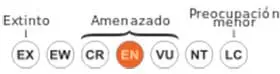
    State of conservation ⓘ


    Vulnerable Vulnerable ⓘ (UICN)ⓘ

    • Current category of the Red List of the UICN: Vulnerable.

    • Population trend: Decreasing.

    • Population size : 6000-15000.

    Rationale for the Red List category

    This species is classified as Vulnerable, as it is experiencing rapid population decline due to the loss of habitat and capture for the bird trade.

    Justification of the population

    A recent study of the situation and distribution of the species Argentina registered 6,015 individuals and Argentina estimated that the population was approximately 10.000 birds (L. Rivera in a bit., 2004). It also, 1.643 individuals were recorded at several sites in Bolivia during another recent study (Rivera et al., 2007). The total population is thus situated in the band 10.000-19.999 individuals (L. Rivera in a bit., 2012). This is equivalent to 6,667-13,333 mature individuals, rounded here to 6,000-15,000 mature individuals.

    Justification of trend

    The results of the survey, observations on habitat loss and the local occurrence of the species, and catch and trade data suggest that the population is suffering rapid population decline (L. Rivera in some.)

    Conservation Actions Underway

    • CITES Appendix I, although the convention is not respected in Bolivia (AB Hennessey in litt., 2012).

    • Present in several protected areas, including the El Rey National Park, Argentina, mainly in the non-breeding season (L. Rivera in some. 2012).

    • In 2006, was appointed the Iñao National Park and Integrated Management Natural Area, which it was the basis for the conservation of one of the largest shelters species Bolivia (Rivera Et al . 2009).

    • A species conservation action plan is currently being developed for each of its native countries. (L. Rivera in a bit., 2012).

    Conservation Actions Proposed

    • Apply the local trade ban (L. Rivera in a bit., 2012).

    • Evaluate the current population size.

    • Produce a species action plan.

    • Conduct additional research to clarify the scope of the current threat of trade.

    • Effectively protect core areas of remaining habitat; review their habitat requirements and complement nesting sites using boxes where appropriate (AB Hennessey in some. 2012).

    • Address unsustainable use of resources and illegal activities in protected areas..

    • Designate a clad hills a protected area.

    The Tucuman Parrot in captivity:

    Parrots Gender Amazona are among the most recognizable and sought-after pet birds. Their colorful plumage and ability to imitate the human voice have made them highly sought after for centuries, and one unfortunate consequence of this is the threatened status of most species. (Russello y Amato 2004). In the Red list of Threatened Species International Union for the conservation of nature, 16 parrot species of this genus are included either as Vulnerable, Endangered or Critically Endangered (IUCN 2010). In the same way, 16 species are listed in Appendix I of the Convention on International Trade in Endangered Species (CITES).

    The Amazona tucumana It is a species that should only be kept in captive with the sole purpose of achieving their reproduction and subsequent insertion into the wild.

    Alternative names:

    – Tucuman Parrot, Alder Amazon, Alder Parrot, Tucuman Amazon (English).
    – Tucumanaamazone, Tucumanamazone (German).
    – Amazone de Tucuman (French).
    – Papagaio-tucumă (Portuguese).
    – Amazona Alisera, Amazona Tucumana, Loro alisero (español).
    – Loro alisero (Argentina).
    – Loro alisero (Bolivia).


    scientific classification:

    Jean Louis Cabanis
    Jean Louis Cabanis

    – Order: Psittaciformes
    – Family: Psittacidae
    – Genus: Amazona
    – Scientific name: Amazona tucumana
    – Citation: (Cabanis, 1885)
    – Protonimo: Chysotis tucumana


    Images Tucuman Parrot:

    Videos "Tucuman Parrot"


    Species of the genus Amazona


    Sources:

    – Avibase
    – Parrots of the World – Forshaw Joseph M
    – Parrots A Guide to the Parrots of the World – Tony Juniper & Mike Parr
    – Birdlife
    – RIVERA, Luis; POLICE, Natalia y BUCHER, Enrique H. Ecology and conservation of the Alder Parrot (Amazona tucumana). Hornero [online]. 2012, vol.27, n.1 [aforementioned 2017-01-29], pp. 51-61 . Available in: . ISSN 0073-3407.

    – Photos:

    (1) – Tucuman Parrot (Amazona tucumana) by birdsandbirds

    – Sounds: Niels Krabbe, XC29107. accessible www.xeno-canto.org/29107