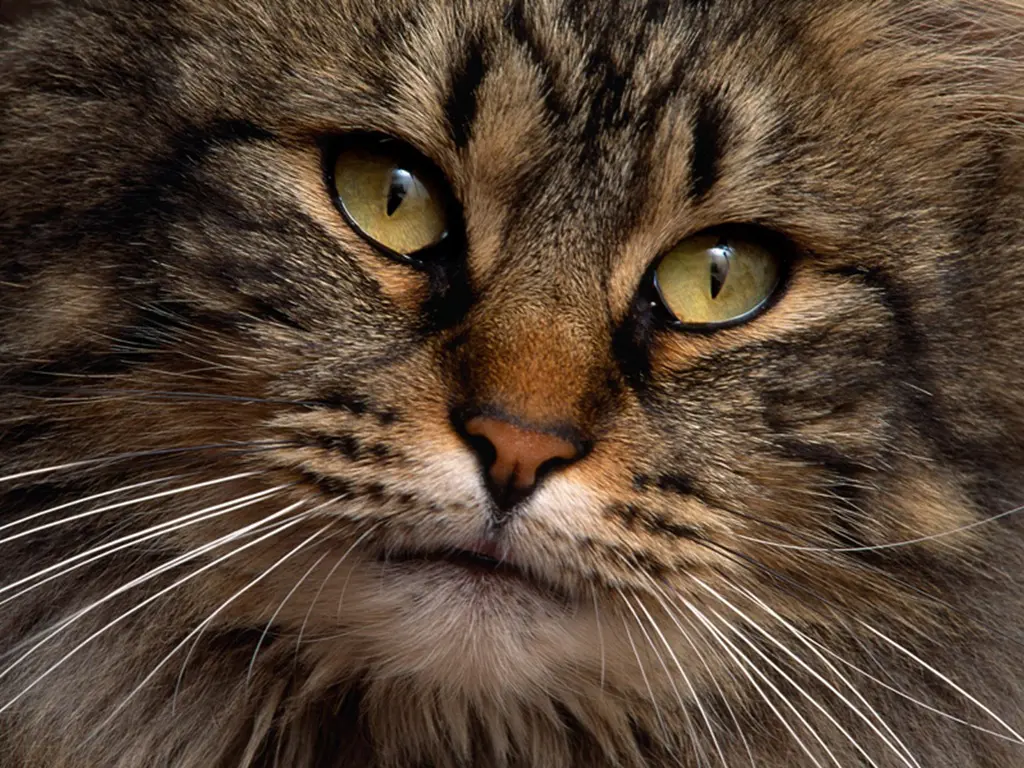
The British Shorthair cat (BKH) It is presented in more than 300 recognized color varieties, the best known being the silver tabby and the one with blue fur, the British bleu cat.
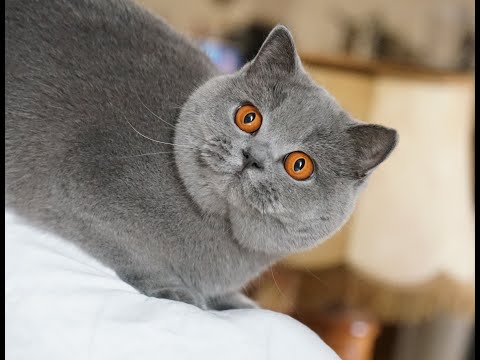
Like we have already said, the best-known color variant of the British Shorthair cat is the British bleu cat, with a solid blue-gray coat, orange eyes and a medium-sized tail.
Cats with blue fur have beautiful shades in their fur that will make them especially coveted by potential adopters.. Being able to admire a light gray coat with color reflections in the male or, on the other hand, a gray that really gets into the blue notes is quite rare to admire.
But, not all cats with a particular gray color are classified as British bleu cat. As such, eye color should be gold to copper. If that is not the case, the cat of this breed will be considered simply as a gray cat.
The combination of a blue fur with the intensity of that look makes British bleu cat be absolutely beautiful. The two colors contrast perfectly, which is why this cat is so successful.
Recognized by the CFA, cTIC, ACF, ACFA/CAA, CCA-AFC
Origin: United States
Antiquity: decade of 1960
Character: active and curious
Weight: 2,5-5 kg
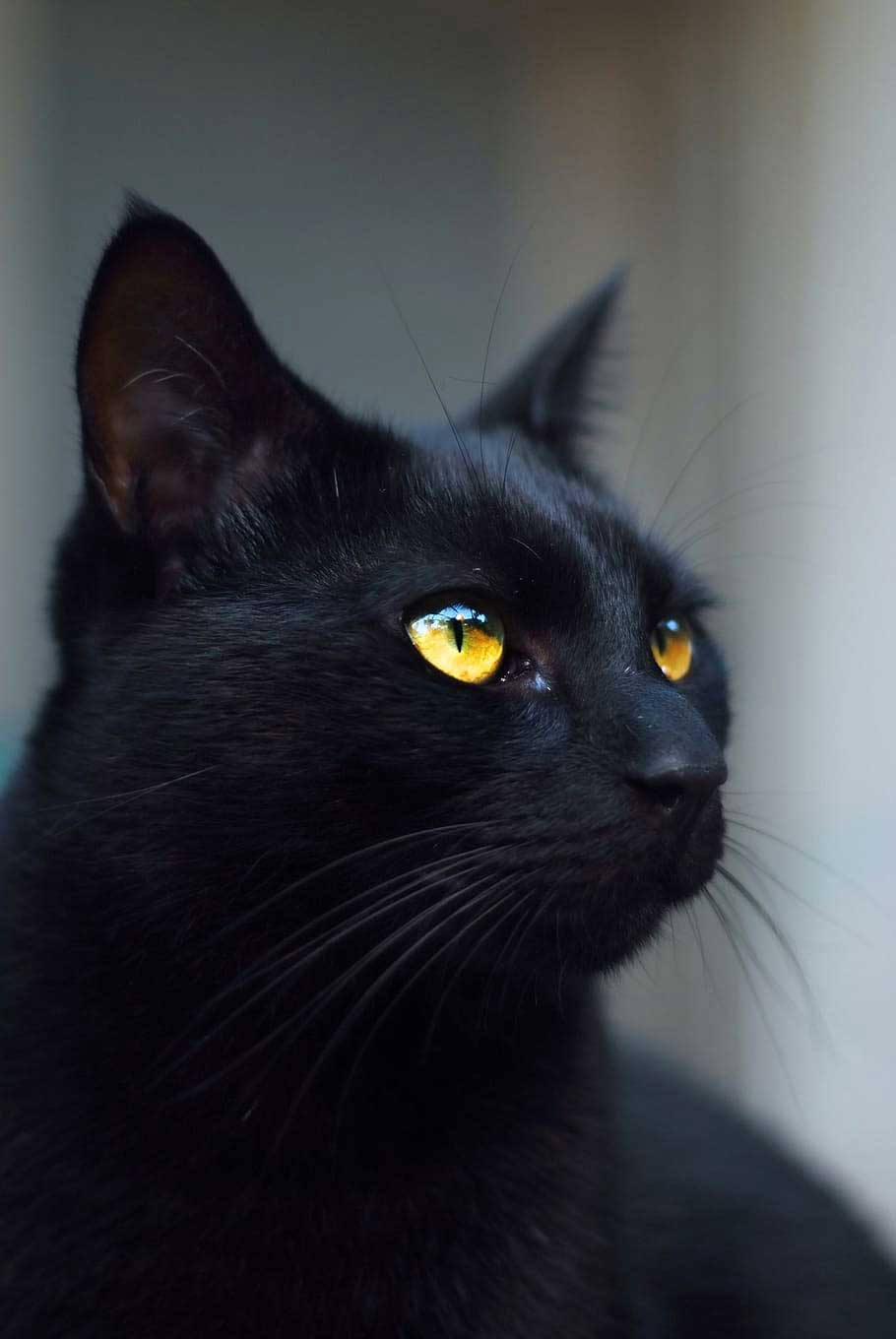
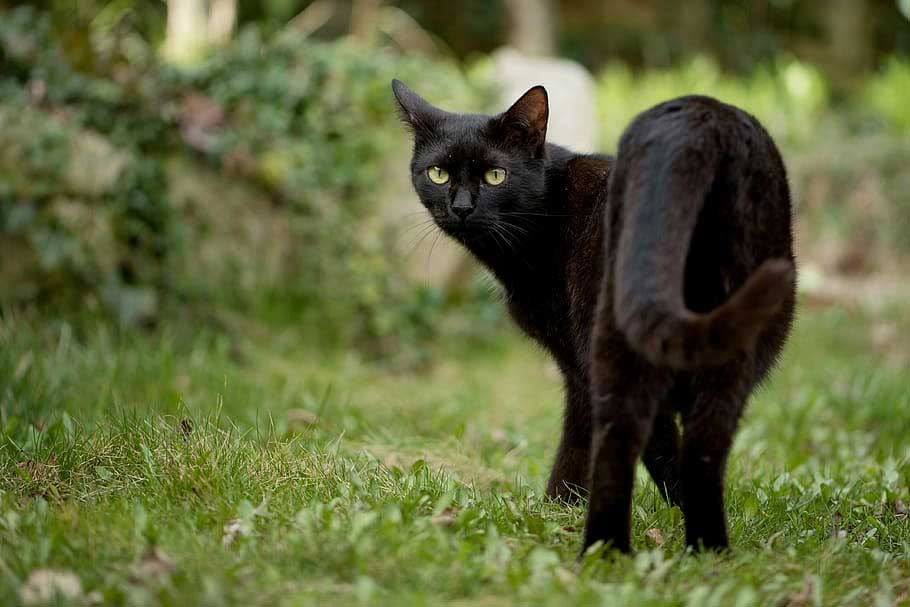
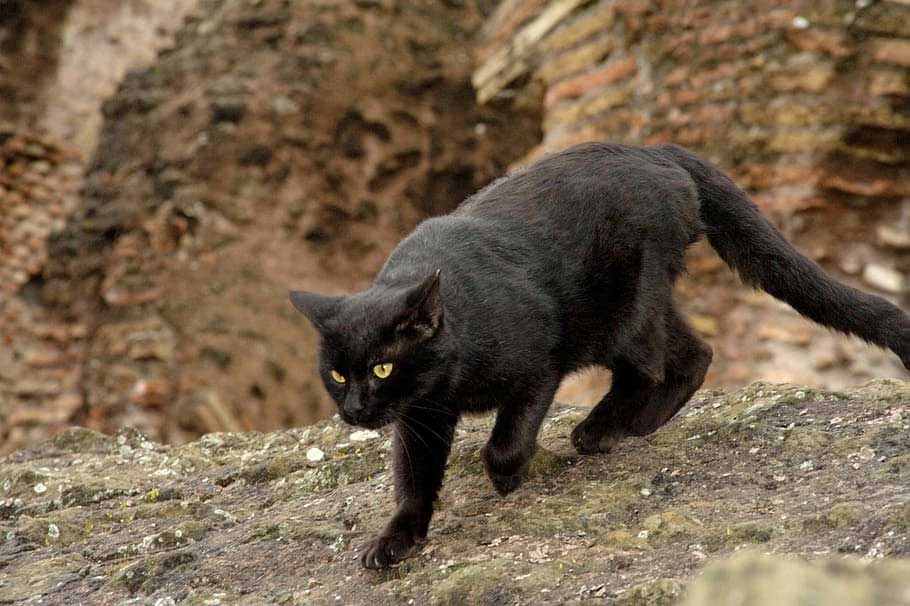
Although the Bombay looks like a little panther, does not have the character of a: it is neither wild nor aggressive.
Content
History
The Bombay cat it was created in 1958 by Nikki Homer, a breeder of American shorthair cat based in Kentucky, United States. Dreaming of having a cat similar to a black panther, but in miniature and as meek as a lamb, That year he decided to cross specimens from his breeding program with the American Burmese Cat.. His morphology seemed perfectly adapted to his project, since like the panther, this breed has a very apparent musculature.
A first mating was carried out between a female sand-colored American Burmese Cat and a American shorthair cat black, which was followed by other marriages between representatives of the two races. But, the results were not really satisfactory. The resulting cats looked more like the American shorthair cat black than the little panthers. Nikki Homer decided to neuter them and sell them as pets.
But, did not give up and tried again a similar breeding in 1965. After two years of selective breeding, he got the black cat he had imagined: a majestic look, coppery eyes and a very shiny ebony black fur. He named it after Bombay, in honor of the Indian city of the same name (now mumbai), where you can see black panthers in the Sanjay Gandhi National Park, which is part of the city.
Among 1967 and 1972, managed to produce nothing less than 27 litters and allowed the birth of some 100 kittens. But, only kept the kittens from the breeding program of the Bombay who met the criteria that she herself had established; the others were given away as pets.
Delighted with the result, dedicated himself to gaining recognition for the breed he had created. It took him a few more years to achieve his goal, but his efforts were finally crowned with success: in 1976, the American Cat Fan Association (CFA) became the first feline organization to take the step of recognizing the Bombay.
After putting so much energy into the cat for almost 20 years, Nikki Homer wanted to move on. Decided to stop raising the Bombay.
But, other American breeders who fell in love with the little black panther took up the torch. Among them, Suzanne y Herb Zwecker played an especially important role, investing a lot of time and effort in the development and recognition of the breed. They decided to create additional new lines from scratch, instead of just using existing copies.
But, despite the best efforts of everyone involved, the breed had a hard time breaking through. Superstitions about black cats and the reluctance of American Burmese cat breeders, who saw the newcomer as a competitor. But, interest in the black cat became more important when in 1985 Luv It Black, one of the copies presented by Suzanne y Herb Zwecker, was honored by the CFA in the events organized by the organization.
But, the development of Bombay cat was also hampered by genetic issues. Because breeders are the American shorthair cat, the American Burmese cat or the same Bombay cat, and in the same litter the Bombay and kittens with different coat colors and eyes, more in line with those of the American shorthair cat. These are systematically withdrawn from the breeding program and sold as pets..
In France, the breed's arrival dates back to 1989. It was in that year when the first pair of specimens was introduced into the country., Opium and Bagheera. A breeding program was created and imported 10 more copies in the next five years.
Bombay cat
The recognition of "Bombay cat"
Although the Bombay still pretty weird, is recognized by many organizations, starting with the most important on an international scale.
Having been created in the United States, no wonder the breed was first recognized by the Cat Fanciers’ Association (CFA), the country's leading feline institution. This was done in 1976, and neighboring Canadian Cat Association (CCA) followed suit in 1988. Many other national organizations followed suit, like the french Livre Officiel des Origines Félines (LOOF), the Australian Cat Association (ACF) wave New Zealand Cat Fancy (NZCF).
The International Cat Association (TICA) awarded him recognition in 1979, making it part of a group that also includes the American Burmese Cat. The World Cat Federation also accepts it.
On the other hand, the Fédération Internationale Féline (FIFé), which brings together organizations from around forty countries -among them Felis Belgica, from Belgium, y the Swiss Feline Federation (FFH), from Switzerland-, does not recognize the Bombay.
There is also an English version of the breed, which was developed in Britain in the decade of 1980 and that differs substantially from American Bombay. It is recognized since 1994 by the Governing Council of the Cat Fancy (GCCF), the main feline organization in the country. The GCCF considers it a variety of the Asian race, along with the Asian Smoke Cat, Asian tabby cat, Burmilla and Tiffany. But, does not recognize the Bombay, that can be found all over the world.
Physical characteristics
Bombay cat
When crossing the American shorthair cat Black and American Burmese Cat, the creator of Bombay, Nikki Homer, I wanted to create a cat that looked like a “miniature black panther.”. It's fair to say the gamble paid off. Y, like is logic, the resulting breed has inherited most of the physical traits of its ancestors.
The elegant Bombay It is a stocky breed with a medium-sized body and a greater weight than one might think at first glance.. It must be said that it has a fairly strong bone structure, on which also rests an important and very apparent musculature. The chest it is round and wide, the back straight from shoulder to rump. The tail is straight and of medium length, tapering to the tip.
The legs are proportionate to the body, good muscular, and they last in feet round with black pads.
The head It is medium and round in size. On the top of the head are the ears well spread and moderately large. They are wide at the base, rounded at the tip, and lean slightly forward giving the dog an alert look.
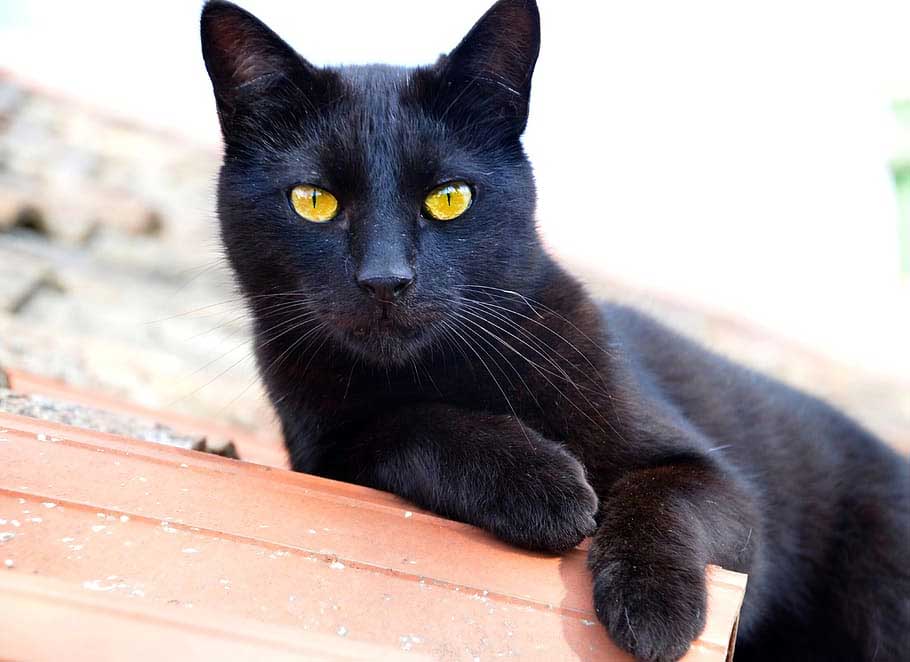
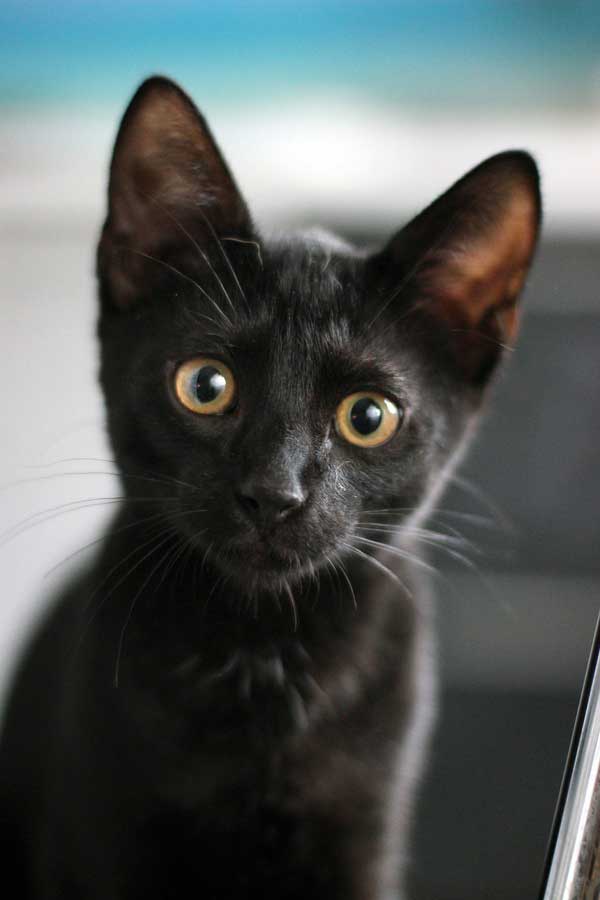
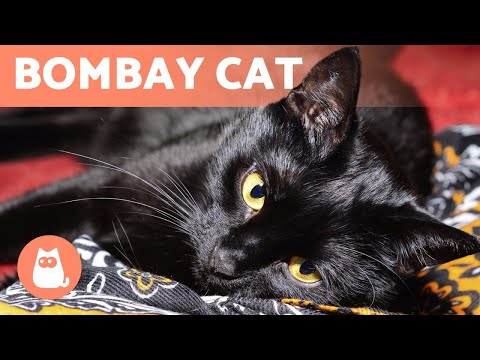
It is said that the Bombay cat has the eyes as round as shiny copper coins. In fact, they are big, round and located in the extension of the base of the ears. Its bright color ranges from copper to gold, being the first the most appreciated. They are even more beautiful because they contrast with the totally black fur, and this combination is a distinctive feature of the breed.
The profile also shows a slight stop, and nose has a slightly rounded tip. The nose is black and is crowned by a snout short, wide and rounded. The chin is well developed, but it is neither prominent nor sunken.
The Bombay practically does not have undercoat. The upper coat is short, dense but fine, silky and satin, What is another characteristic of the breed?. This is another characteristic of the breed. The fur of this cat should be shiny like patent leather.
It is also jet black from root to tip., and this cat is the only breed that is consistently black. But, It is not until they are two years old when they acquire their final color: are born with a slightly lighter coat, that gets darker as they grow, until it turns into a deep black.
There is also a slight sexual dimorphism in this breed. Males and females are very similar in size, but its weight differs more. The male can weigh up to 5 kg, while the female must not exceed 4 kg.
Last, It is worth mentioning the English version of the Bombay, having some specific physical characteristics. In effect, while his american cousin is cobby type, this one is midline type (a slightly less slim body type). So, has thinner legs, ending in oval feet. Its head is triangular and slightly hollow. It is also distinguished by its almond-shaped eyes., whose color varies from golden yellow to green. But, Apart from these few features, the American Bombay and the English Bombay they are physically quite similar.
Size and weight
Male size: 20 – 25 cm.
female size 20 – 25 cm.
Male weight: 3 – 5 kg
female weight: 3 – 4 kg
Bombay cat
Character and skills
Although the Bombay looks like a little panther, does not have the character of a: it is neither wild nor aggressive. On the other hand, He is very sociable and affectionate, and it is an ideal option for those looking for a cat to live in the family, so much that he seeks the company of humans. He is especially attached to the person who cares the most for him, without being a one-man cat: your closeness to a particular person does not prevent you from giving affection to all family members.
He also likes to be caressed, and this is good: caressing him is really very nice, since her hair has the texture of silk. And since he especially likes warm places, it is not uncommon for him to get under the covers in bed, or snuggle up on the couch with one of your family members.
Bombay cat
To the Bombay he likes attention and pampering. If you feel neglected, will call out to your family members with gentle vocalizations that don't break the ground. In other words, this cat can be talkative to claim attention, but their meows have the good taste not to be shrill.
They like to play with children and are patient with them, provided they are treated with respect. With a little boy, there is a real risk that this condition will not be met, so it is better never to leave him alone with a small child, without adult supervision. The safety of both parties is at stake, and this is valid for any breed of cat.
The Bombay He is a very affectionate cat that needs the attention and love of those around him. He loves to interact with his surroundings and follows his owner everywhere: in the classroom, the bedroom, the kitchen…
This, coupled with his intelligence and very active temperament, explains that he is an excellent student for anyone who wants to teach their cat tricks such as, for example, to look for an object.
But, also needs alone time and can be left alone for a few hours at home, This does not mean that you should not provide your cat with games when he is out, to keep you busy and not suffer from anxiety when your owners are away too long. Invest in interactive games, like the puzzles, it's a great way to stimulate your high brainpower, whether you play with them alone or with your family.
Having him share his home with a small companion is also a sensible way to make the absences of his owners more bearable.. In fact, the Bombay cat cohabits easily with peers or even a dog, as long as you feel loved and receive the care you need. This coexistence is all the better if it is established from the earliest age of the two protagonists. If that is not the case, at least it's better to make sure they get to know each other little by little, so that they get used to each other and each find their place.
On the other hand, it is less appropriate to make him live with a bird or a small rodent, since the Bombay has a highly developed predatory instinct: he is an excellent hunter. If you must spend some time with that animal, it is better to place it in a cage inaccessible to the cat, or even better, in a room reserved for him. This will avoid unpleasant surprises..
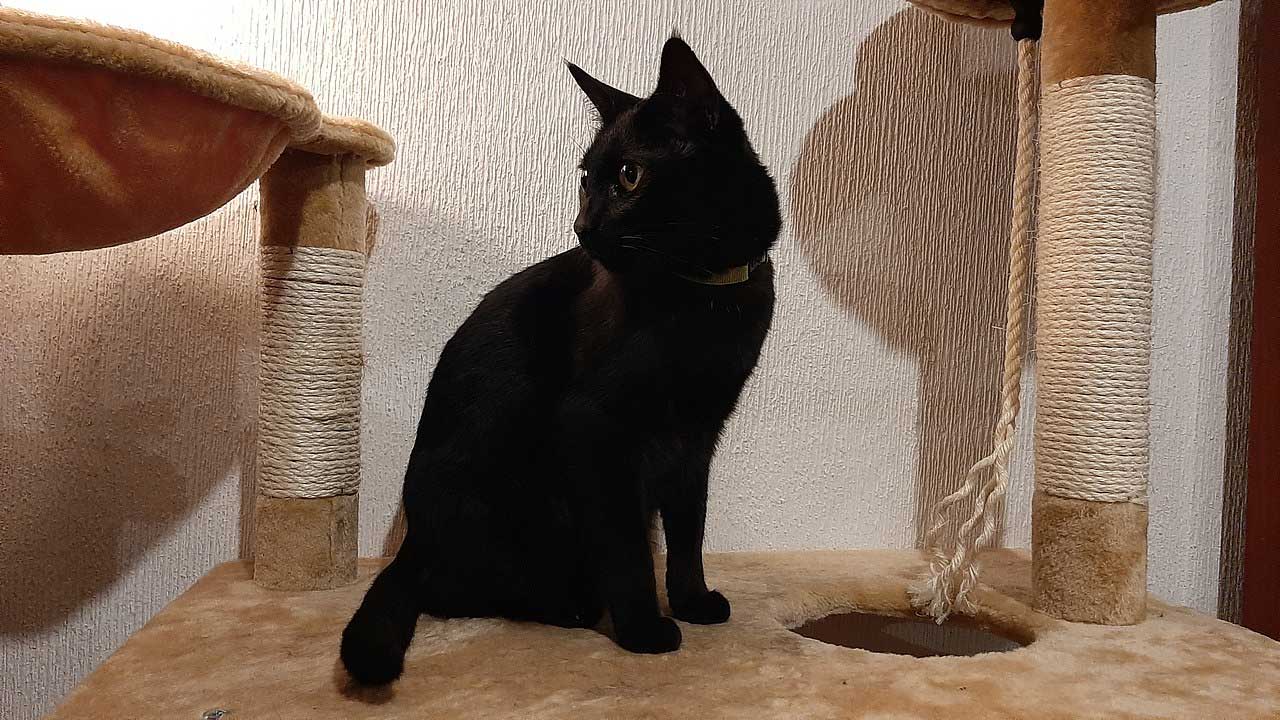
As for the unknown humans, the Bombay cat seems to be often torn between his spontaneous distrust of them (hence he is not one of those who approach them immediately) and his intrinsic curiosity. As soon as you feel comfortable, the latter is in charge of encouraging him to approach them to smell the new scents and to ask for some caresses from time to time. In any case, it is essential that you have a cat tree at your disposal: it is a place where you feel safe and can take refuge at any time, either to observe your surroundings from your perch or simply to rest in peace.
Like any cat, the Bombay need rest periods, but he has plenty of energy. Living in a house with a garden that can be accessed at any time through a cat flap is ideal for him.: so he can roam and climb trees all he wants, which helps your head feel as good as your legs.
It is not surprising, because, that his facet of ferret and / or his hunting instinct lead him to explore other territories or to follow a prey outside his domain: that does not stop him from being happy to return to his cozy nest, where caresses and good food await you.
As long as he is surrounded by his owners, this cat can be relatively flexible in terms of living environment: as long as it is spacious enough for you to play, run and expend your energy, can adapt very well to a flat life. But, it is important to note that they generally accept being walked on a leash, as long as they get used to them from a young age: for people who live in such a household, This can be a good option for your little feline to discover new horizons and to roam outside.
Whether you have access to the outside or not, the Bombay you should be able to do your first steps whenever you want, like all his classmates. So, it is essential that you have a scratching post available at all times: this saves you from having to turn to furniture or curtains to satisfy this irrepressible need.
Last, It is worth mentioning that the English version of the Bombay cat has the same character traits as their American counterparts, inherited largely from their ancestors burmese.
Bombay cat
Care and Cleaning of the "Bombay cat"
The Bombay has a dense but short top coat, and its bottom layer is very light. This explains that their coat does not require much maintenance.: you only have to brush it once a week to remove dead hairs and maintain its characteristic shiny appearance. The shedding periods, in spring and autumn, they are not very important, but it is necessary to brush two or three times a week to keep the coat healthy and beautiful.
It is necessary to check the ears of the Bombay once a week and wash them with a clean, damp cloth to remove dirt and limit the risk of infection.
The weekly maintenance session should also be an opportunity to check the eyes. They are more likely to be dirty if the Bombay is prone to epiphora (excessive tearing). In this case, it is essential to clean the corners of the eyes with a damp cloth to minimize the risk of infection.
Regular brushing of the teeth of the Bombay it is essential to avoid all kinds of health problems in this area. This is true of any breed, but the risk of improper maintenance is even greater for the Bombay cat, since it is prone to gingivitis. Regular brushing with a special cat toothpaste prevents plaque buildup, which can cause more or less serious diseases when it becomes tartar. Once a week is the minimum, but daily is the ideal.
Bombay cat
You should get used to checking the length of your claws. Bombay each month. As long as you have access to the outside, natural wear and tear is usually sufficient. If that is not the case, it is necessary to cut them manually: if they get too long, they are likely to break, that bother you or even hurt you. It also, there should be a scratching post available at all times so that you can satisfy your irresistible need to scratch, instead of having to resort to furniture…
coat care, the ears, the eyes, the teeth and claws of the Bombay does not require any special skills. But, instead of doing it only the first time, the expertise of a veterinarian or cat groomer may be helpful. Learning the correct gestures from a professional, the probability of not only being ineffective is greatly reduced, but also and above all to act clumsily and thus injure or even traumatize your pet.
It also, It is essential that your pet is used to these grooming sessions from his first months: the sooner they become part of your routine, more easily accept them throughout your life. Like this, he and his owner are in the best position to make them spend special moments together, and the opportunity to caress and hug. Being very affectionate and close to its owner, appreciates being groomed even more.
Indoor or outdoor cat?
The Bombay cat it is an excellent indoor cat. In any case, prefers to be with his humans and does not have a great desire for freedom. In a big and cozy apartment for cats, with a scratching post, a litter tray and a feeding area, nothing stands in the way of a happy life together.
You must avoid unrestricted access to the outside, since this open minded and curious cat is not afraid of anything. Unfortunately, this also includes cars and receivers. Ideally, let the black cat run in a safe garden or on a balcony.
Some representatives of the breed can even be taught to walk on a leash like a dog. With a little practice, these smart and loving cats will do as well as a dog. But, this depends on the individual character, as well as the conditions of the "walk" area. You should not walk your cat where there are many dogs or other dangers.
How much activity does he need? "Bombay cat"?
How many members of the breed are indoor cats, need a certain amount of activity. This mini panther appreciates emotions and loves to play with children or other cats. Both classic cat toys and learning tricks are fun for these cats.
With a challenging intelligence toy, the Bombay they are also very busy. The most important thing is that you offer your cat variety. He is a human-oriented cat and should not be left alone too often either.. Should be pampered regularly.
Health and nutrition
Both the American and British lines enjoy, in general, Of good health.
It also, this little cat can live in all climates, except in the coldest. But, must be well protected from cold and drafts at low temperatures, since its scarce undercoat means that it is not ideally equipped for winter weather.
On the other hand, the Bombay have a tendency to be overweight and even obese. This is even more true if you don't have access to the outdoors., since then you have fewer opportunities to exercise. It is not a matter to be taken lightly, since being overweight can cause illnesses or worsen existing ones.
In any case, to adopt a Bombay in the best conditions, it is essential to contact a breeder worthy of the name. In effect, a serious professional cares about genetic testing of proposed breeders (in particular, for the hypertrophic cardiomyopathy and the facial cleft syndrome media), in order to rule out those who could give birth to unhealthy kittens. It is also concerned with offering kittens an ideal environment for their physical and mental balance., and strives to develop their sociability from the first weeks. This is absolutely crucial for the rest of their lives.. In any case, at the time of adoption, the breeder must be able to provide a certificate of good health issued by a veterinarian, as well as the health card (or vaccination) in which the vaccines the cat has received are recorded.
To keep your cat healthy throughout its life, it is important that you take him to the vet for a complete check-up at regular intervals, although everything seems to be fine. These reviews give the professional the opportunity to detect as soon as possible any possible problem other than (yet) visible, allowing you to treat it in optimal conditions. It is also an opportunity to carry out any necessary booster shots.. These visits must be scheduled at least once a year, and even more as the animal ages.
At the same time, the owner is also tasked with protecting his little feline against parasites throughout the year, remembering to renew your deworming treatments each time it is time to do so. It is important to remember that even a cat that lives in an apartment can contract parasites and must be dewormed..
Bombay cat
Life expectancy
12 to 18 years
Food
Like any other cat, the Bombay you need a diet adapted to your nutritional needs, both in terms of quality and quantity. So, should be chosen with your age in mind, your state of health and your level of physical activity.
It is advisable to monitor the amounts of food that are given, because unlike many of his peers, the Bombay does not know how to regulate itself. Greedy and a little gluttonous, have a true propensity for obesity. So, it is not possible to leave food in self-service, at the risk of gorging. That is why, the best solution is to offer two meals a day, given at fixed times and rigorously weighed.
Bombay cat
It is perfectly possible to give him industrial food, as long as they are of good quality and carefully chosen to suit your needs. On the other hand, you have to be very careful with human food, although do not hesitate to ask, for example, during their owners' meals. Not only is there little chance that the nutritional intake provided corresponds exactly to your needs, rather, some foods appreciated and regularly consumed by humans are toxic to cats. This also explains why it is best to avoid giving him the table scraps or letting him rummage through the trash..
Last, the fact that you tend to gain weight easily makes it essential to monitor your weight every month. If the weight gain is confirmed or even increased during several consecutive weighings, it is necessary to visit the vet. In effect, only a healthcare professional can diagnose the cause of the problem (improper diet, disease, side effect of a medication, etc.) and, Therefore, determine how to remedy it.
To finish, like any cat, the Bombay you should have fresh water available at all times so you can drink as soon as you feel the need.
For sale "Bombay cat"
Before purchasing a Bombay cat, you need to make sure you have enough time for the people-facing cat. The first obstacle to overcome is the lack of breeders in Europe. It is best to do research on the internet and contact a private breeder. But, beware of fake offers and take a good look at the breeder. Observe the kitten's parents and siblings, as well as the accommodation conditions. For a healthy kitten, vaccinated and dewormed, will pay about 750 EUR.
Characteristics "Bombay cat"
Coexistence is important that you have with your new friend. Before considering the acquisition of a cat of the breed "Bombay cat" you know certain factors. You must take into account their character, their need for exercise, their interaction with other pets, their care and if you have small children, their level of tolerance towards them.
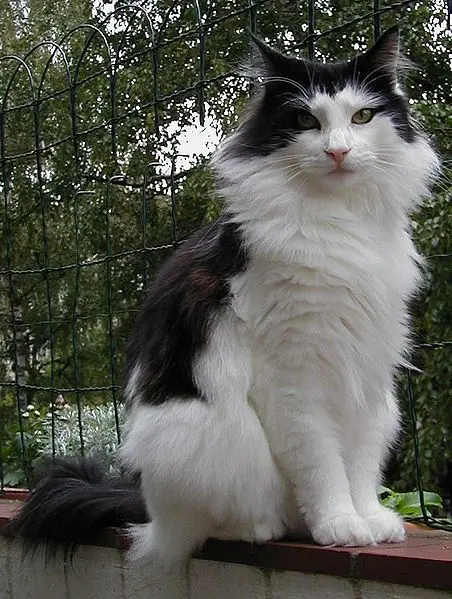
The only true thing about the cat Norwegian Forest Cat It's an ancient race.
The legend, He says that he is none other than the troll of Scandinavian fairy tales cat, But history suggests otherwise.
It is known that the domestic cat reached Norway by the year 1000 d. c. In addition to arrive with the gradual expansion of cats throughout Europe during previous centuries, cats arrived in Scandinavia due to the trade between the Vikings and the Byzantine Empire. Evidence of this movement are in some colors of fur, which are common in Turkey and Norway, but rare in the rest of Europe.
This relationship suggests the possibility that the gene for long hair came to Norway by the same trade routes. Long hair gave advantages to the harsh winters of the North, and became a widespread feature in Norwegian cats.
Photo: Wilkipedia
The skogkatt or skaukatt, as is known, not recognized as a race in his native land until the Decade of 1930, and only a few decades later their selective breeding was carried out.
But, Since the Norwegian Forest cat has gained acceptance in its terra and abroad, Although it remains less well known that the Maine Coon , another similar past long-haired cat.
This race, also known as wegie, continues to reflect its origins as a farm cat, and breeders sometimes refer to him as their "little lynx".
It is great, robust and muscular, and his triangular head is defined by a long nose. His glossy hair has a waterproof layer and a less thick, insulating. It still also has the personality of a farm cat.
These cats are flexible and agile, excellent hunters, and it is known that they fish. Although they are calm and docile companions, they are independent and tend to vigorously defend their territory. A Norwegian lives happily being the only cat in the house.
Alternative names:Skogkatt / Skaukatt / Norsk Skogkatt / Norsk Skaukatt / Weegie
Cat breeds: Norwegian Forest Cat
▷ The world of Pets: Dogs, cats, birds, reptiles, amphibians
Recognized by the LOOF, CFA, ACF, ACFA, TICA, FIFé, WCF
Origin: Russia
Antiquity: decade of 1980
Character: Sensible and resourceful
Weight: 4,5 to 9 Kg
As other breeds of cats big and hairy, It is the result of the harsh climate of the Earth, that favored the hardier hunters with fur that protected them from the cold. Not recognized as a race until the Decade of 1980, but then spread quickly through their export to Europe and North America in the Decade of 1990, first with the name of Siberian forest cat. Now accepted in most registries, but his name has been changed to avoid confusion with the cat in the Norwegian Forest. The dotted version, so-called neva masquerait, is not recognized in all countries.
Despite his wild looks, the California Spangled cat is perfectly tame. It is one of the rarest cat breeds in the world.
Content
History
The breed name is a conjunction of California, the US state. where it originated, and Spangled, a term used to describe the round, dark spots on the plumage of some birds.
In the Decade of 1970, a Hollywood screenwriter, Paul Casey, during a trip to Tanzania, learned that the last male leopard in the region had been killed, partly because of her skin. Very saddened to learn of the local extinction of this species, he undertook on his return the creation of a domestic cat similar to the spotted wild cats of Africa, reminiscent of the leopard, with the aim of dissuading people from killing them for their skin.
As such, began a long breeding and selection program. The California Spangled cat It was thus created from crosses between Siamese twins (for its morphology), british shorthair and american shorthair (for its fur), and some stray cats from Egypt and Southeast Asia.
It took a total of fifteen years and eleven generations of cats to establish the breed as envisioned by Paul Casey and as it is still known today.: was not up 1986 when it was first introduced to the public.
Although it is recognized by some feline organizations, like TICA (The International Cat Association, one of the largest feline organizations in the world tasked with setting breed standards and pedigrees), still one of the rarest feline breeds, and even an endangered breed. In fact, Though a few enthusiasts still keep it alive, It is estimated that there are currently only a few 200 cats Californian Spangled in the world.
Physical characteristics
A California Spangled Cat – Flamingice007sg, Public domain, via Wikimedia Commons
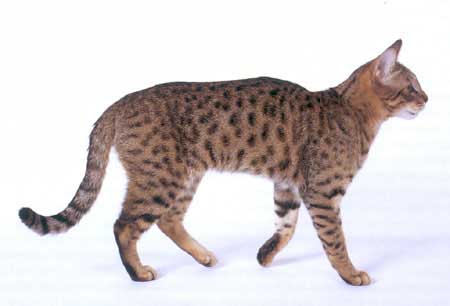
The California Spangled cat he's a lanky cat. Its body lean and muscular gives an impression of power. The tail is medium in size with rings.
The fur short can be 8 different colors: black, brown, blue, bronze, dark grey, red, gold or silver. It is "dotted" with round spots, arranged in triangle or rectangle, and evenly distributed throughout the body. Head and throat are scratched.
The head has a triangle shape, with rounded forehead. The eyes they are big, oval and slightly almond shaped, and they go from amber to brown. The ears they are medium in size and set high and back.
Size and weight
Size: 30 cm..
Male weight: 5,5 to 7 kg
female weight: 4,5 to 6 kg
Varieties
There is a variety of California Spangled cat with a white fur stained with black, which is also distinguished by its blue eyes: it's called the version Snow Leopard.
Character and skills
Despite his wild looks, the California Spangled cat is perfectly tame. Intelligent, loving and sensitive, knows how to come to receive caresses and is able to anticipate certain wishes of his master.
However, is a lively and energetic cat, very active without being aggressive, that needs a lot of activity.
Health
The California Spangled cat it is a rare breed, and at present very little is known about her. Possible hereditary diseases are still being investigated.
In any case, vaccinating your cat is essential to protect him from certain life-threatening diseases.
Life expectancy
10 to 14 years
Grooming
The beautiful coat of the Californian Splangled requires very little maintenance: a weekly brushing is enough.
For sale "California Spangled cat"
The rare is expensive, as the saying goes. The Californian Spangled It is a rare breed of cat., and it is no exception to the rule, since the price of a cat of this breed ranges between 600 and 2.000 EUR.
Characteristics "California Spangled cat"
Coexistence is important that you have with your new friend. Before considering the acquisition of a cat of the breed "California Spangled cat" you know certain factors. You must take into account their character, their need for exercise, their interaction with other pets, their care and if you have small children, their level of tolerance towards them.
A breed from Central Europe, solemnly developed for aesthetic purposes. The modern European shorthair has its origin in common domestic animals. By creating a new breed, breeders strove to realize its usefulness, while reducing their desire to wander the streets and, in general, made them more emotionally stable. To get it, the domestic cats they crossed paths with Persians and, especially in France, with Carthusians. Contemporary British Celts were blue, and the Germans bred mostly silver and white.
The breeding process began at the beginning of the 20th century, and the first standard is dated in 1925. Even despite that, FIFe has given its official acclaim as late as in 1982, And they were treating the Celts like shorthaired Brits from before. According to the WCF standard, The "Celtic" in the name of the breed indicates its historical origin.
Physical characteristics
According to the World Cat Federation standard (WCF)
Body
Medium to large in size, strong and muscular, not too compact, but agile. The rib cage is round and well developed. Strong and solid legs of medium length, tapering evenly to firm, round legs. The tail is of medium length with a broad base and tapers slightly to a rounded tip..
Head
Wide head gives a rounded impression, it is a little longer than it is wide. The nose is straight, medium in length and equally wide throughout its length. The profile is clearly curved, the neck is of medium length and muscular..
Ears
The ears are medium in size with slightly rounded tips, that they can have tufts. The ears are wide and almost erect. The ears are as high as their width at the base.
Eyes
The eyes are round and open, well spaced and set at a slight angle. The color of the eyes must be uniform and correspond to the color of the coat.
Shelter
The fur is short, dense, firm and shiny.
Color varieties
The colors chocolate and cinnamon, as well as its dilution (lilac and fawn) they are not recognized in no combination (bicolor, tricolor, striped).The pointy pattern is also not recognized. All other colors and patterns are recognized Any amount of white is allowed Description of the colors is included in the general color list.
Observations
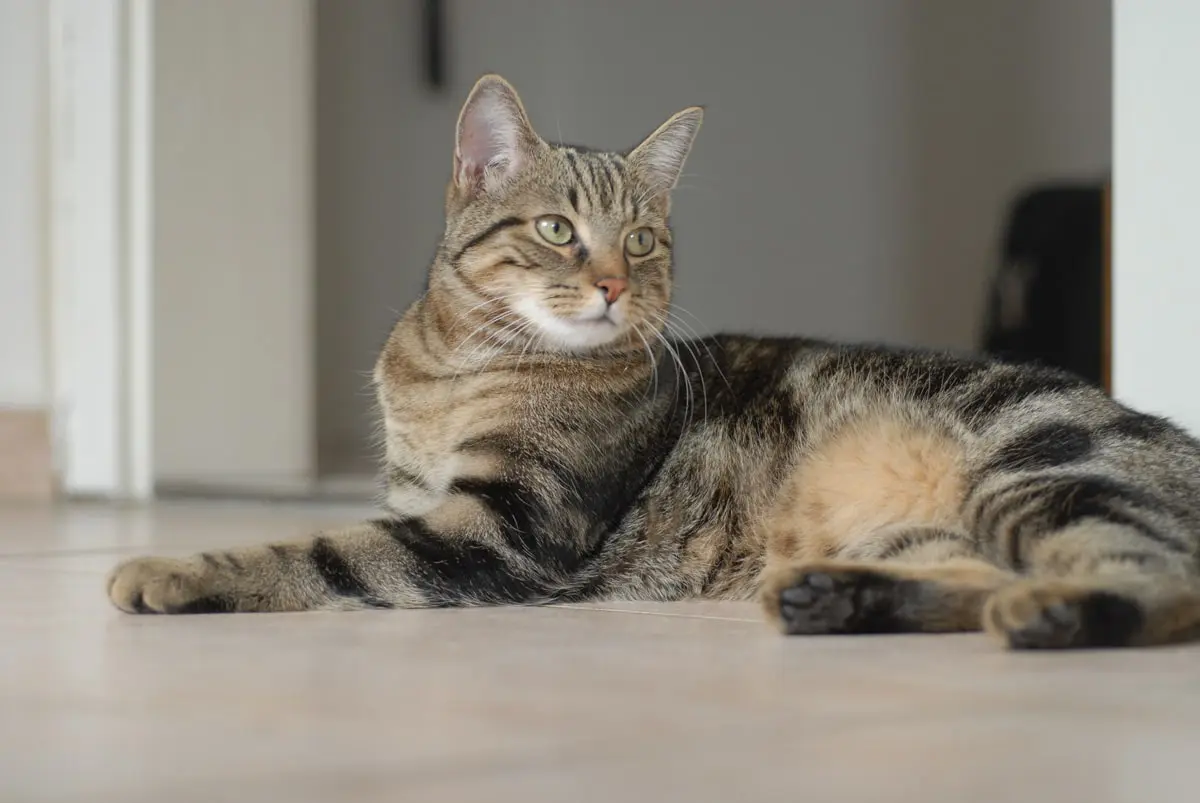
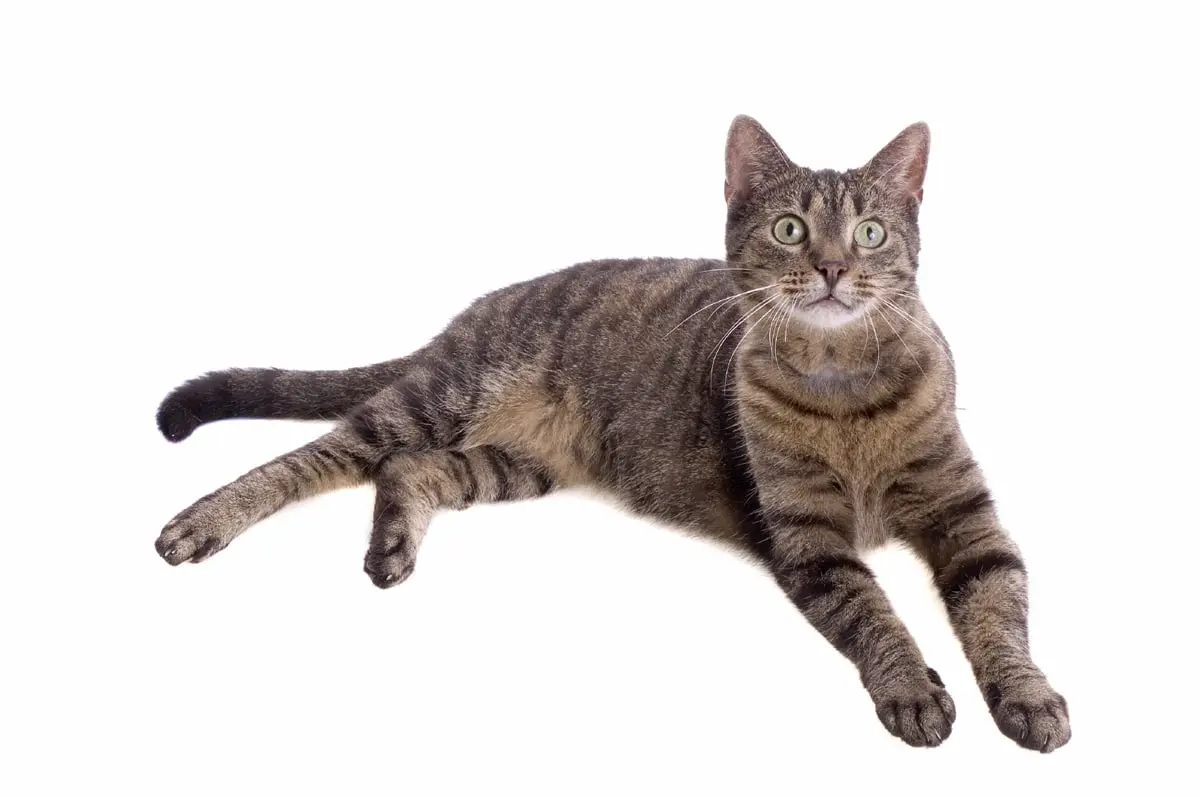
The Celtic shorthair cat equates to a European domestic cat medium, that has developed naturally, without any planned breeding goal.
The Celtic shorthair cat ideal is free from any crossing with other recognized breeds.
Character and skills
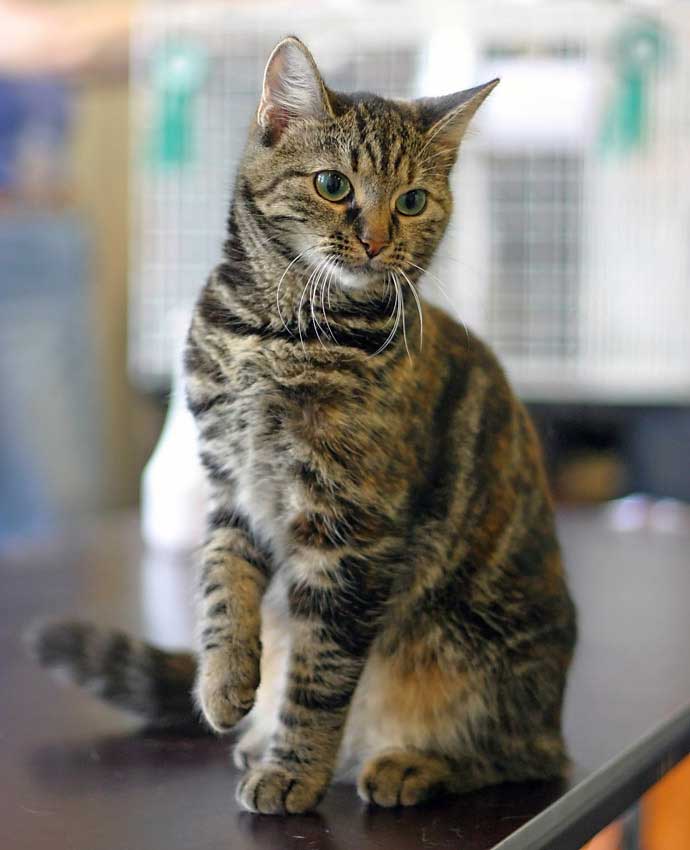
Femelle European shorthair in Helsinki cat show – Heikki Siltala, CC BY 3.0, via Wikimedia Commons
Since the breed was developed from domestic cats, they have very different temperaments, the character of the European or Celtic shorthair cat it is impossible to summarize.
The members of this breed can be very affectionate, but there are others who prefer to be outside and chase mice. Most of the European they are strong and healthy, and they are generally friendly. They get along well with other cats and tolerate dogs well. They are intelligent and playful, and most of them are experts in keeping houses and gardens free of mice.
Health
They are known for their good health and resistance to infection.
Grooming
These cats are very easy to care for, since their coat looks good when brushed periodically. But, during the hot season, their coat may require additional attention.
Alternative names:
Celtic Shorthair (WCF)
European Shorthair (FIFe)
▷ The world of Pets: Dogs, cats, birds, reptiles, amphibians
The German Longhair Cat it is the only long-haired cat developed on German soil
Content
History
The German Longhair Cat and the German Angora Cat share a tangled history, which includes a deviation through the Traditional Long Hair (Original), the European Long Hair and the German Forest Cat, before eventually becoming a single breed of "German Longhaired Cat".
The German Longhair Cat has waited a long time to be recognized internationally, although since 1929 there is a breed standard and a point scale. The only thing that was missing until a few years ago was a registered breed that corresponded to this standard.. After the 2nd World War, that interrupted cat breeding in Germany, the only indigenous breed of German longhair cat was considered extinct.
In the beginning there was the Cat of Angora which was imported to Europe. Through crossing with other long-haired cats it became the Persian, although the term "angora" became a generic term meaning "long hair". From the Decade of 1920, the preferred conformation in England and France gave rise to the cats we now call Persian Cats "old style", that is to say, They were "Persians with a nose", as opposed to modern brachycephalic Persians (flat-faced).
Long-haired cats in Germany were generically called Angoras and they were raised for the color, not by conformation. Biologist and zoologist Dr.. Friedrich Schwangart (1874-1958) criticized that, in general, did not meet the “Hochzuchtperser” standard ("high breed Persian") seen in british persians, so he created separate standards for the Persian cat and the German Longhair Cat in 1929, describing the differences between the two types. From that moment on, the breeders of «Angoras» had to decide whether to breed British-style Persians or more natural-looking German longhairs. Schwangart hoped that the German Longhair Cat, with your hair silkier and easier to wash, became the most natural counterpart of the Persian cat who had been raised in Britain for decades. The German Longhair Cat was exhibited and recognized for the first time at the national level at the Exhibition of the Federation for the Breeding and Protection of Cats in 1930 In Berlin. In the following years it was seen frequently in cat shows and in 1932, the German Longhair Cat «Fox of the Rhine Castle», owned by Dr. Heine en Leipzig, became a federal winner.
With the standards established in 1929, the types of long-haired cats were divided into 2 categories in the «Classification, Pedigrees and Systems of House Cats" and these should not be crossed to maintain their different types (in Britain, the first Persian Cats, Angoras and long-haired british natives they had interbred to create a single Long haired persian). There was more information in the Schwangart post of 1932 «Training and breeding of domestic cats (results and problems)», in which it was pointed out that other long-haired breeds were the german long hair founded by Schwangart himself and, in the previous two years, the Burmese breed appeared in Paris (that is to say, the Khmer / Birman).
In May of 1935 breeding was officially allowed German Longhair Cat under the auspices of the single state society “Katzenverein des Deutschen Reiches” (German Reich Cat Club), which was the only breeding club at that time. It was grouped in the long-haired class along with the Persian Cat and the Burmese cat, and followed the Schwangart standard. In October of 1939 was recognized by the Confédération Internationale Féline (CIF) como "Borealis" o "Boreali" («Norte»). The CIF was the predecessor of the Fédération Internationale Feline (FIFe) and had been founded by the Societa Felina Italiana, the Paris Cat Club and the Swiss Federation. World War II interrupted the breeding program and the German Longhair stagnated for several years before, apparently, to become extinct. After the Second World War, the DEKZV, the only cat breeding club in Germany until 1969, he again used the race name «Angora«. Until 1965, the German Longhair Cat (which lost most of its players during the war) and the Persian cat they were bred under the same name and the old standard, that he did not distinguish the races according to their conformation.
Unlike in the Persian cat, the German Longhair Cat was not sponsored by a feline association, possibly due to hostility between then-board members and Schwangart. In 1965, the name of the breed «Angora" He was removed, leaving only the Persian cat. The German Longhair Cat it was simply forgotten. When the german longhaired got going again, there was a debate on the name of the breed: ¿German Angora cat or German Longhair Cat? For a time, the German Angora cat he was raised like him Domestic long-haired cat, and the German Longhair Cat it was the traditional long hair (original).
Dagmar Thies reported in 1979 that Mrs.. Renate Aschemeier had managed to locate german longhair cats from original bloodlines and had bred them at the Blasheimer factory since 1968. These cats were considered very typical representatives of the breed and later their descendants would be useful in re-establishing the breed..
The German Angora cat he grew up with that name since the year 2000, but it was not recognized by any feline association and, on the other hand, it was a registered trademark. The breeders of the German Angora cat they affirm that there is no german longhair cats authentic because they have become extinct. The history of modern breeding of the German Angora/longhair cat began in the year 2000 with Dr.. With. Brigitte Leonhard with her long-haired white cat Shiva. According to Bettina Muenter, Shiva was born on a farm in September 2000. The conditions were very poor, but Münter got two white kittens: a strange-eyed white female they named Shiva and a male named Romeo. Unfortunately, Romeo's errant tendencies forced him to be castrated.
In 2001 came across a Burmese black cat x Domestic called Bommel, and then, in 2002, with a Persian cat blue. This sowed the seed of the recreation of the «German Angora cat» that Prof.. Friedrich Schwangart called “German long hair” (Deutsche Langhaar).
In 2003, la Sra. Münter bought two stallions British shorthair, and the sharp purple "Alfons of Golden Kennel" (Rossini) played a special role in founding the German angora cat.
In 2004, Rossini crossed with Shiva and gave rise to a silvery blue torbie, Ashanti (later renamed "Isis"), what happened to Britta Steckelbach, and a short haired sister named Askara. The Sra. Steckelbach crossed Ashanti with the British Longhair “Jo-Jo of Sandokan”. The two women decided to create a race, but after discussing it with an important association they decided that their ideas did not fit with established feline fashion, So they founded the “German Angora Cat Club.” (GACC) in 2005 with other interested breeders who wanted to create a natural feline breed.
In 2005 there was a growing number of breeders interested in preserving or recreating the German Longhair Cat under the name of German Angora cat. They found foundation cats among free-range farm cats that approached the standard of German long hair de Schwangart. The herd book of the German Angora cat opened in 2005. The names of the founding kennels were Bettina Münter («vom Allerfeinsten») y el de Britta Steckelbach («of Mystic German Angoras»). (Although Mrs.. Munter claimed that there was no place for them in the established feline, Anneliese Hackmann, President of the German Edelkatze eV and the WCF, supported his vision from the start).
In 2006 the GACC was affiliated with the WCF and the development of the breed was more focused. Unfortunately, there were disagreements over foundation animals and breeding plans. The Sra. Hackmann suggested that breeders dissatisfied with the GACC move to Deutsche Edelkatze eV. In response, la Sra. Münter and Mrs.. Steckelbach registered the name «German Angora cat» to prevent long haired mixed breeds from being passed off as German Angoras. Only GACC breeders could use the name. Breeders who had joined Deutsche Edelkatze eV needed a new name for their breed. They also rewrote the pedigrees so that the ancestors of the German Angora cat were retrospectively documented as German long hair. German longhairs obtained formal recognition (a sore point with the breeders of Angora Alemán), so the German Angora cat Happened to be called European longhair cat to gain recognition as a long-haired equivalent of the European shorthair cat.
Until 2007, when the German Longhair Cat, the Angora Alemán and the german longhaired they were considered synonyms of the same race. The German Longhair Cat was bred to fit the old image. Both breeds were described as very similar and both had been crossed with Persian Cats old-fashioned to improve conformation and coat. the Board of Directors of the first Cat Club of German Angora discarded the idea that they were the same race, which led to a dispute that divided the group of breeders. In 2009, el GACC (including its founders, Bettina Munter y Britta Steckelbach) applied for recognition of the German Angora, but it was rejected. Munter and Steckelbach tried to put obstacles to the breeders of the German Longhair Cat, but they finally lost in a legal battle.
In 2010 the German Longhair Cat sought breed recognition and several cats were evaluated at a Deutsche Edelkatze exhibition in Grefrath-Oedt. Unfortunately, WCF rejected application for recognition. WCF recognized the Traditional Long Hair (TLH, renamed as Original Long Hair due to trademark issues over a paper record that prefixed numerous breed names with “Traditional”) presented by South African breeders. This breed was an old-style Persian in the Silver and Gold color series. A WCF judge suggested that Original Longhair could be seen as a collective name for primitive longhaired cats and suggested that the Long German Hair should be considered part of that group. This was rejected by most breeders of the German Longhair Cat because the vision of Prof. Schwangart was that of a cat other than the old type Persian. A few raised and exhibited their cats as TLH, but many stayed with the name of German Longhair Cat.
The «Deutsch Langhaar» (DLH, long hair german), with its distinctive type and not Persian, was finally recognized by the WCF at the general assembly of 2012 with a revised standard that, However, still based on Schwangart's description. The few breeders who had tried to obtain recognition through the traditional way (original) long-haired could now raise the German Longhair Cat. In the same general assembly, WCF also recognized TLHs in all other colors.
In 2012, the breeders of German Angora cat they again requested the recognition of their cats, this time under the name of European Long Hair, and with the support of the Internationaler Royal Cat Club (IRCC) y de Mr Stein. The European Long Hair was recognized and the standard was the same as that of the European shorthair cat, except for fur length. Not all german angoras they met that standard. To accommodate the breed name change, The German Angora Cat Club changed its name to the German Cat Club. In 2013, the IRCC and the Katzenverein Leverkusen e.V. (KVL) agreed to treat the European longhair cat and to the one of German long hair due to their similar breeding goals and common ancestry. Ancestral cats were fully recognized without being considered "experimental". Depending on the association, descendants could be registered as German Longhair Cat or European Long Hair. But, in 2014, Herr Stein revoked the recognition of the European Long Hair and, default, the German Angoras they became Long Hair German. The clubs associated with each breed eventually agreed that the two breeds were equivalent.. The German Cat Club (GACC) appears to be inactive since 2014 and in July 2015 there were hardly any breeders of «German Angora cat«.
Physical characteristics
By the standards of the time, both the Persian Cats as the German longhair cats they had a compact conformation, short sturdy legs, a broad head with a relatively short and wide muzzle and moderately small ears (similar to those of the European wildcat). Both had rather short, well-carried tails., level back and long coat (with age differences, seasonal coat and pregnancy to watch out for). And in both cases a "half Angora" type with a slender body or a narrow, pointed face was not desirable..
But, the Persian cat was described as thicker, with a rounded head and a prominent forehead that fell sharply towards a wide, short snout that gave an "angry" expression. (that is to say, a shorter face). The coat of the Persian cat it was denser and woolly, with a well developed collar, and cats were bred with size and density in mind. In contrast to the Persian cat, the German Longhair Cat had a more moderate head: a less prominent and tapered forehead that gently curved upward from a longer nose with a gentler slant. The conformation was less compact, the movement more fluid and the tail longer than that of the Persian. In essence, the German Longhair Cat did not allow the short face and prominent forehead of the Persian cat and in profile the face resembled that of the Short Brindle Hair.
The German Longhair Cat it was in the same colors and patterns as the Persian: monocolor/autocolor (black, blue, cream, Red and white), bicolor, tortoisehsells (with or without white), «masks» (colourpoints), smoked, Chinchilla (tipped), peach (smoky red / cameo), silvers and tabbies both “tiger” (mackerel) like "marble" (Classic).
The description given for the "German Longhair Cat" it was that of a cat with a gently sloping forehead, not bulky or too round, traveling a flat curve or with a slight drop to the arch of the nose. Somewhat long nasal bridge, straight or very slightly arched. Wide snout, not pointed. This head is a companion of the S.H. Tabby. The structure is less rough, "The tail is longer and the action is freer than in the Persian.".
In his latest work «Overview and description of domestic cat breeds» (1954), Schwangart described in detail the German Longhair Cat, pointing out the existence of intermediate forms between the Persian and the German Longhair Cat that were in some of the colors, and the need to eliminate intermediates to reestablish the 2 races as different from each other. It is clear that Persians they had grown up together, perhaps due to the difficulties of maintaining the races in times of war, perhaps to improve the traits of one or another breed or perhaps due to ignorance that they had originally been separate breeds.
Drew up the breed standard, though by then he might feel it was a losing battle due to the growing popularity of the Persian cat. In the German longhaired solid color, amber / yellow was the preferred eye color, except solid white cats, in which amber was allowed, blue or odd eyes. Deafness was a disqualifying offense in white cats, they were to be examined with a whistle out of sight of the cat. He also mentioned the potential for degenerative problems, like deafness, related to "albinism" (blue-eyed white was confused with albinism), so some indication that the cat was not albino was desirable, like a dark membrane. Bicolor and tricolor cats should have more color than white. "Masked" cats were allowed to be less symmetrically marked than bicolor or tricolor cats.. This group included the “black and yellow” and the “Spanish” tortoiseshell. (tortoiseshell and white). Tortoiseshells should ideally have large patches of color, but Schwangart admitted that this was weird. In partial colored cats, eye color should reflect the predominant coat color. Chinchilla eye colors (black tip), peach colors (golden?), smoked and silver were related to the color of their fur (that is to say, in parallel to shorthairs and Persians).
In 2008 a provisional standard of the German Longhair Cat in the World Cat Federation, based on the standards of 1929 and 1954. It is the only long-haired cat developed in German lands and is the long-haired "sister" of the European short-haired breed., to which it resembles in its general conformation.
The modern standard calls for a medium-sized cat with a long figure, rectangular, robust and flexible. It is distinguished from European Shorthair / Celtic Shorthair for having a deeper chest and a bushy tail of medium length that is reduced to a round tip. The sturdy legs are short to medium long with large, firm legs.. The head is rounded, but it is longer than it is wide with a moderately long and sloping nose with a slight stop (a pronounced stop is a foul). Strong chin and cheeks, the latter suggest the Nordic breed of the European wildcat (F. silvestris silvestris). The ears are small to medium size, straight and broad at the base with a rounded tip. The eyes are round to oval, large and slightly diagonal; color is related to coat color / pattern (or with the predominant color in partially colored cats).
The coat is medium long on the shoulders and shorter on the head. It is longer in the flanks, the back and the belly, and it is particularly long on the gola, hind legs and tail. But, the coat is easy to maintain, shiny and not as woolly as that of the Persian. All colors are accepted, except for chocolate, the cinnamon and its diluted, the lilac and the tawny (both in solids and in drawings). Otherwise, colors / patterns include auto / solid, the bicolor, the tortoiseshell, the turtle and the white, the masked", el tipped, the cream, red, the smoked, shading, the silver and the mackerel and the classic tabby. Personality is human-oriented.