โ–ท The world of Pets: Dogs, cats, birds, reptiles, amphibians

Golden-plumed Parakeet
Leptosittaca branickii


Aratinga de Pinceles

Content


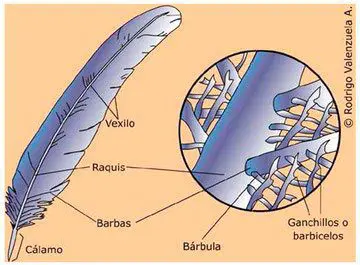
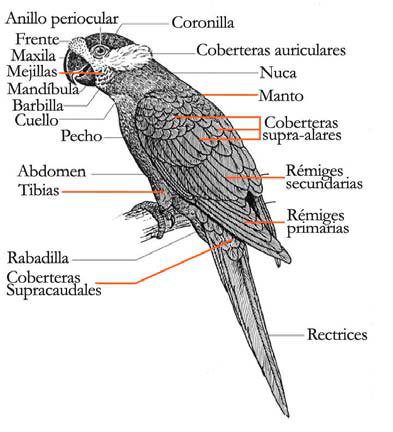
Anatomy-parrots

Description:

Approximately from 36 cm.. of length and a weight of 150 g.
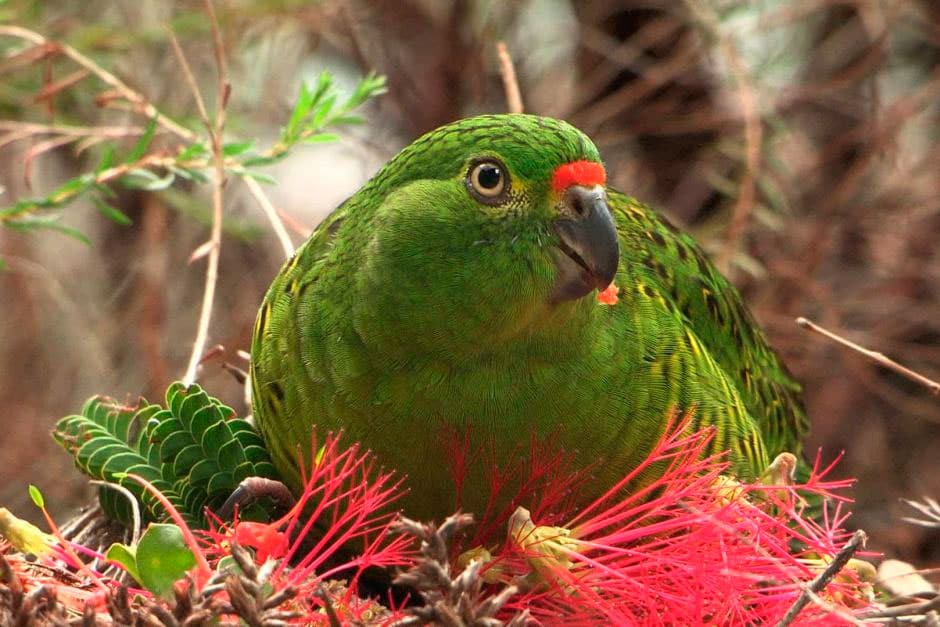
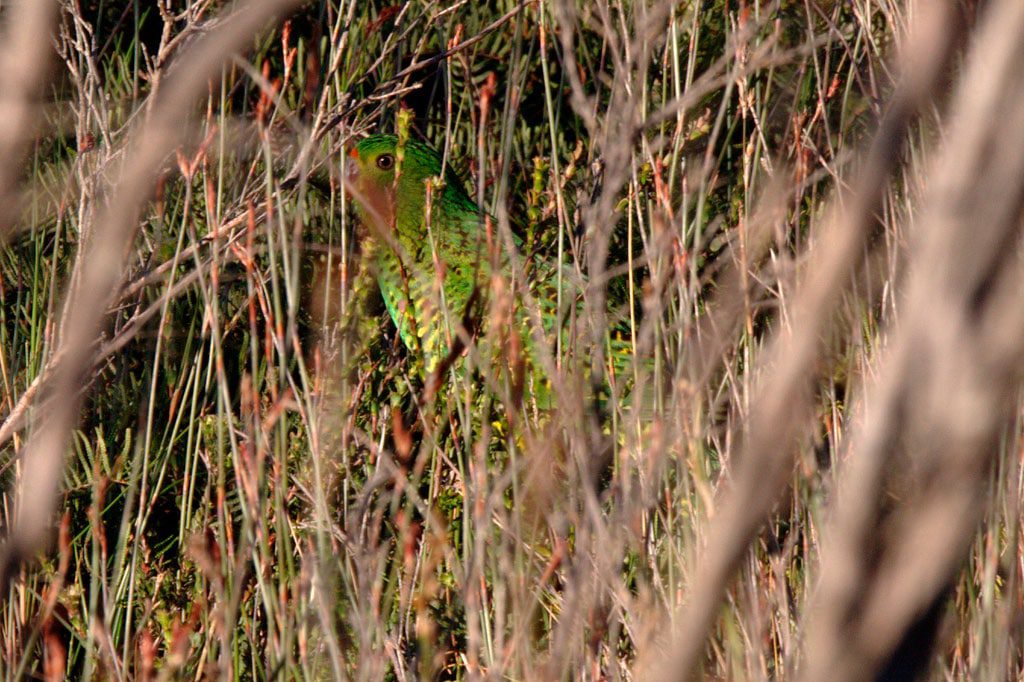
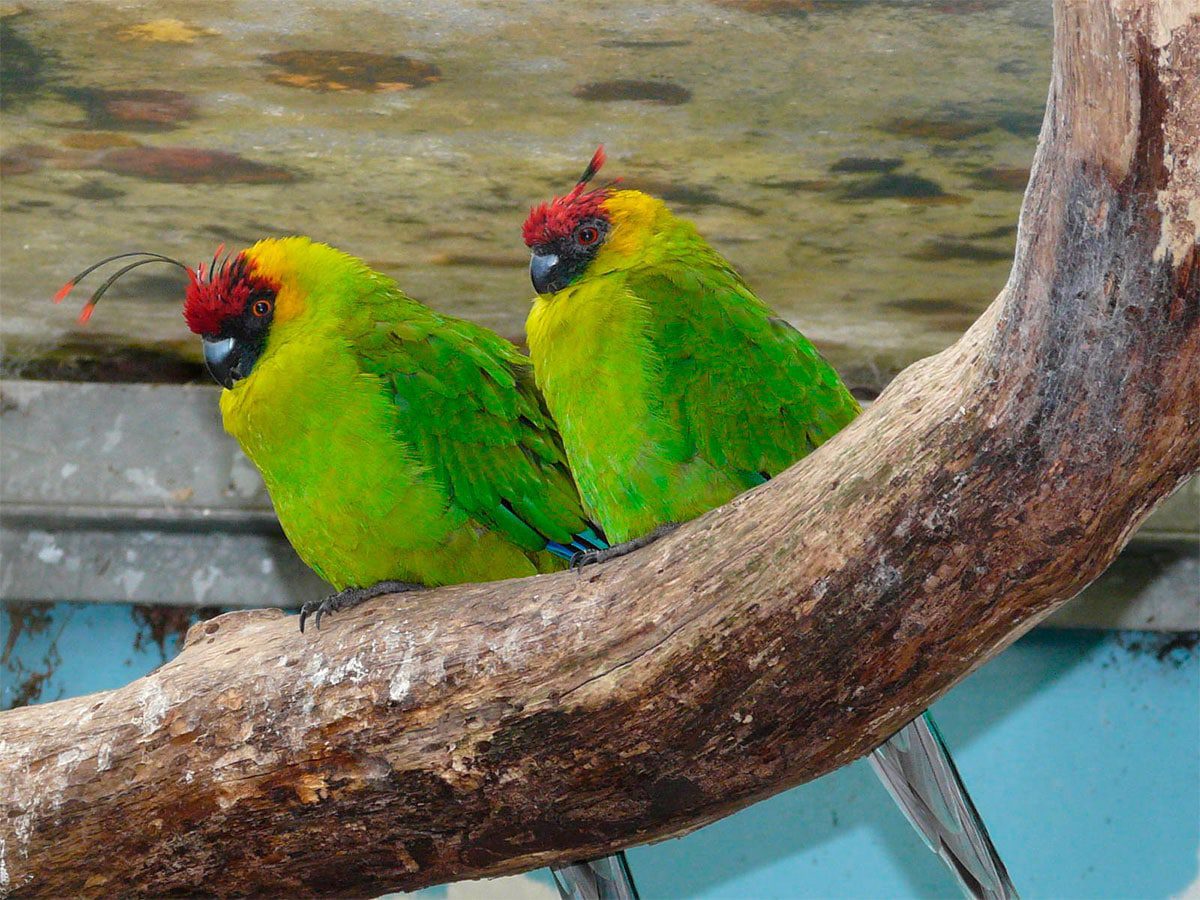
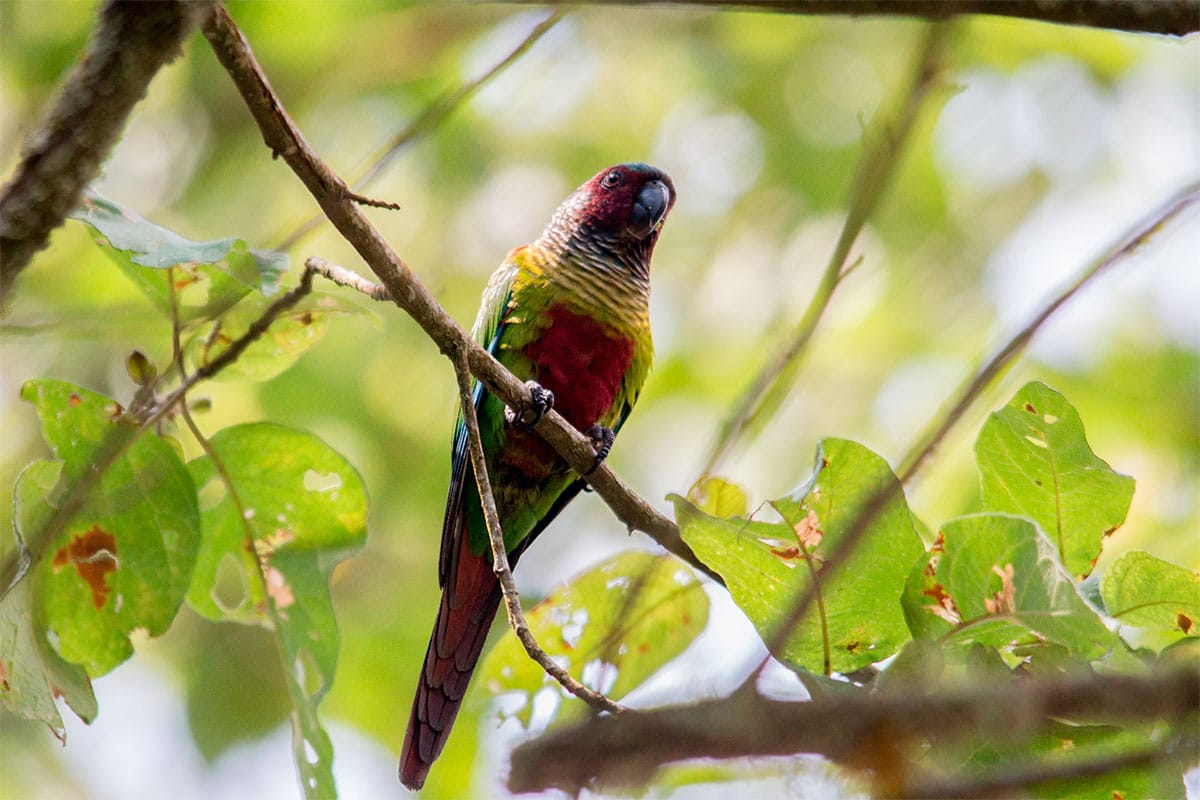
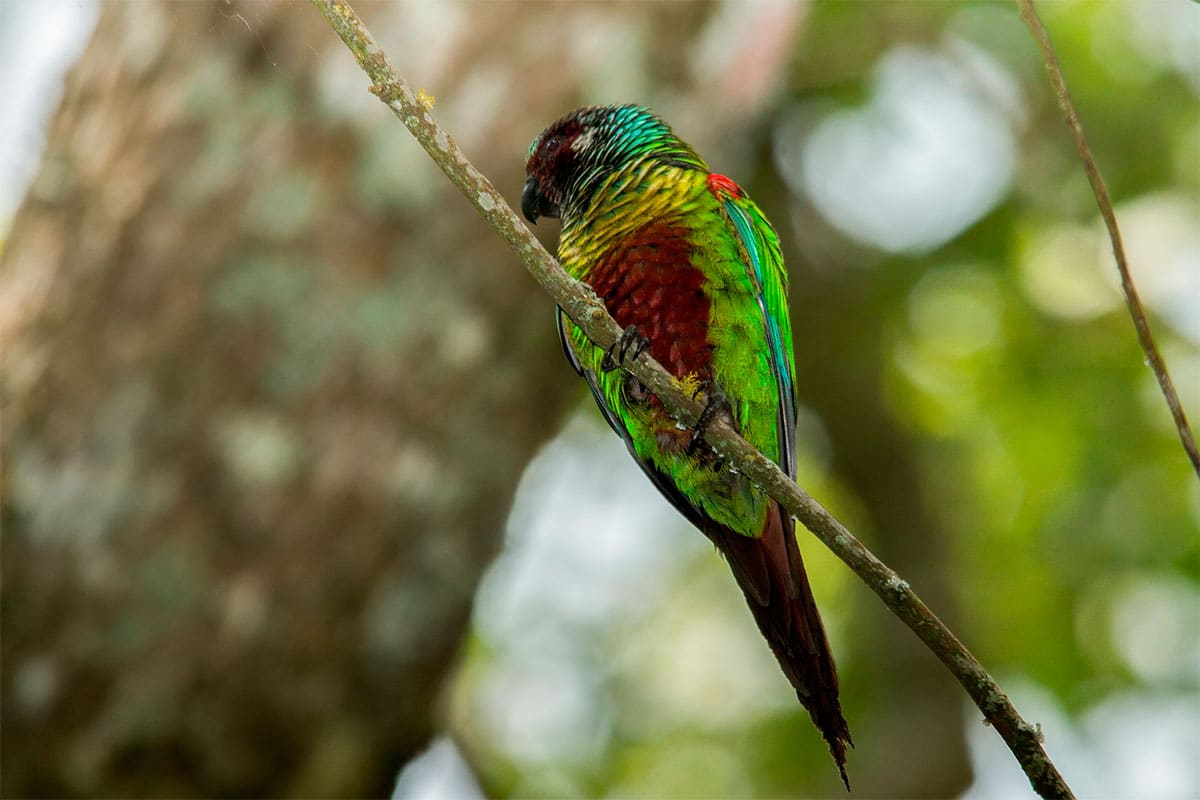
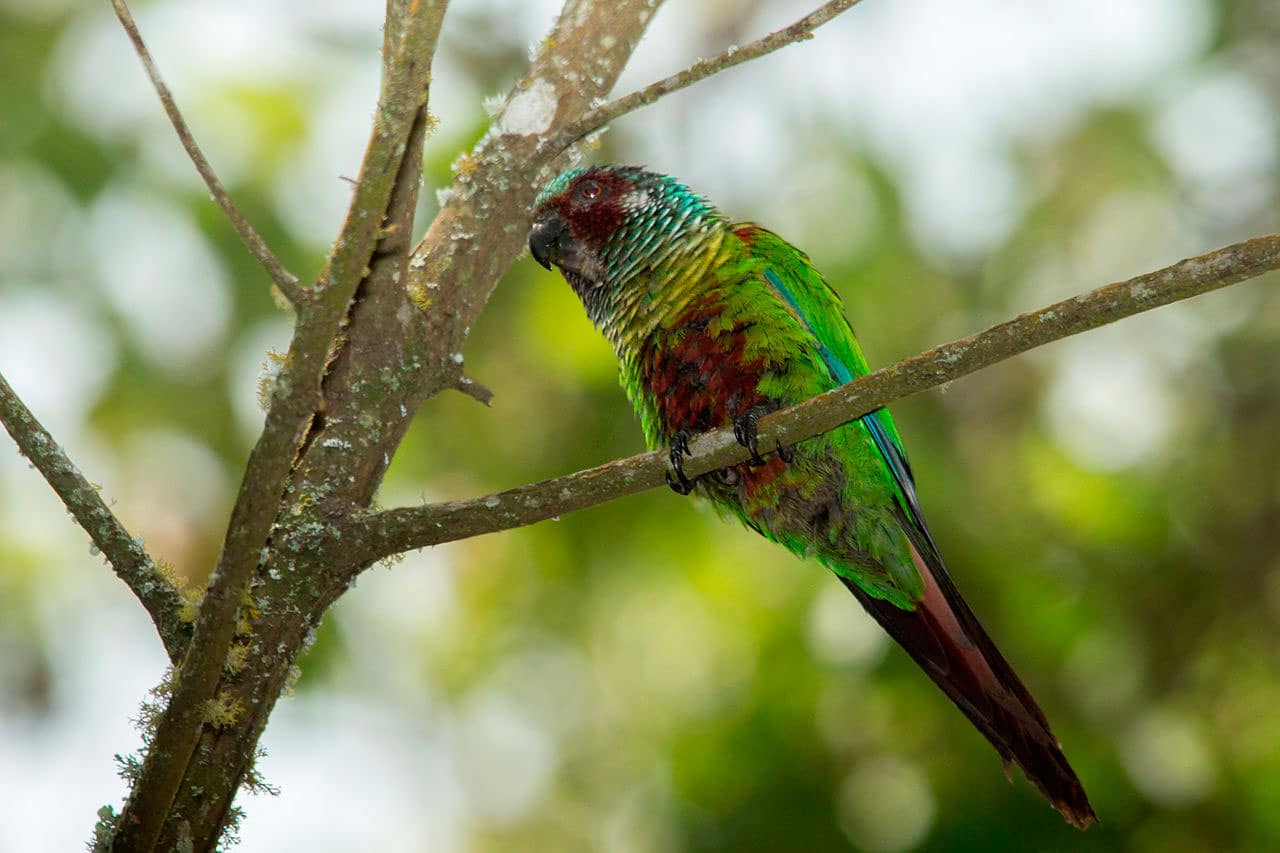
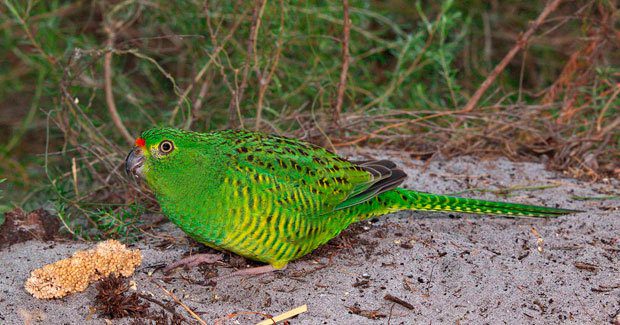
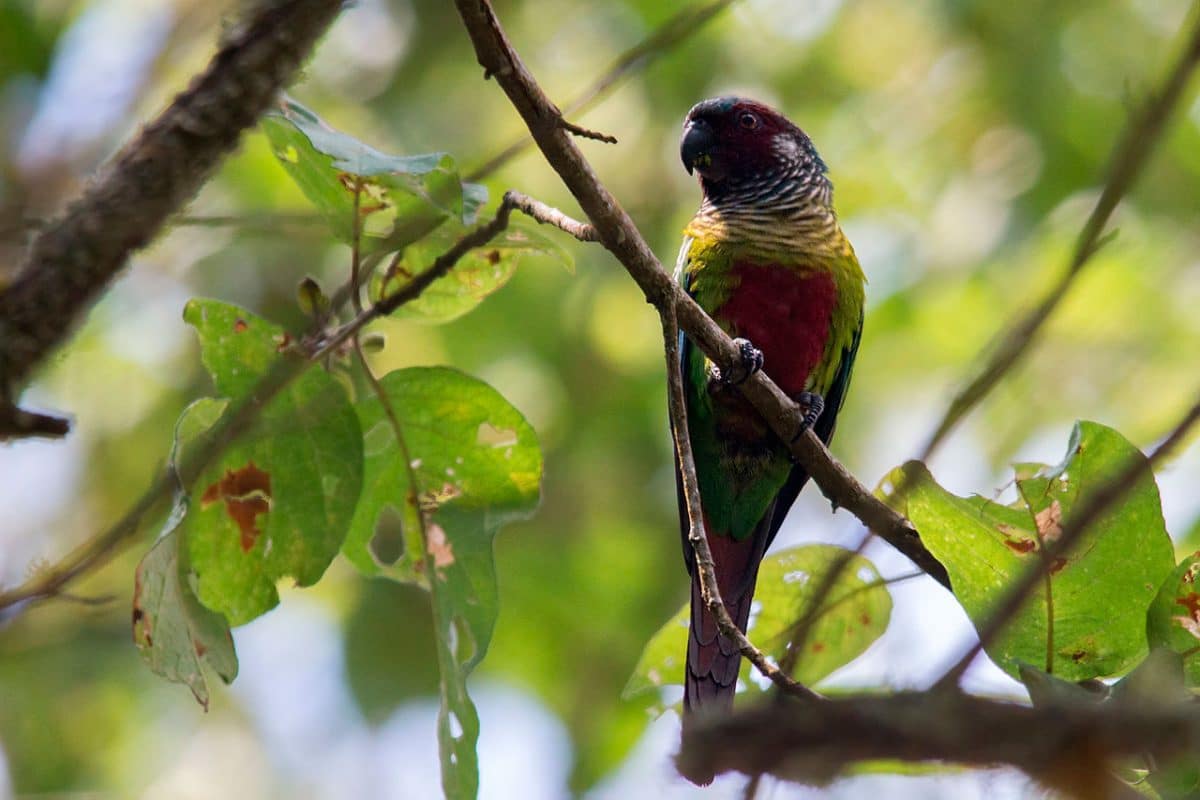
The Golden-plumed Parakeet (Leptosittaca branickii) has the crown, most of the forecrown, the cheeks, the sides of neck and ear-coverts grass-green; close frontal band on bottom of the forecrown orange, extending towards the upper lores; a feature yellowish stripe at the lower lores extending below the eyes to then join in a loop of yellow the part located behind the eyeball.
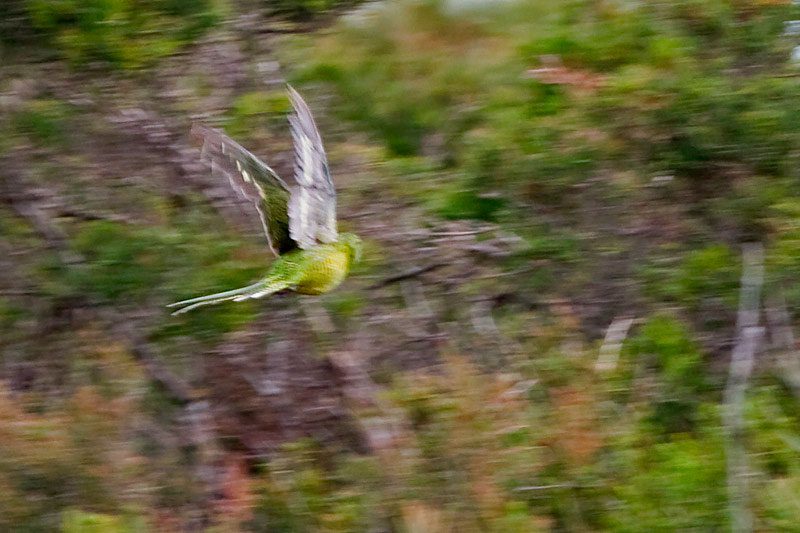
Upperparts green. above the wings green. Underwing-coverts greenish yellow; underside of feathers opaque yellow flight.

The underparts green, slightly more yellow than the upper, with a large yellow and orange patch at the bottom of the chest.

Upper, the tail of color green with red off on them vane inner; below its long and acute tail opaque reddish.

The bill color horn; cere grey; bare orbital skin pale whitish-grey; Orange the irises; legs grey.

Both sexes similar. The immature not described.

NOTE: Some authors include the species within the genus Aratinga. But, the facial feathers they are distinctive and monotypic, so the gender Leptosittaca is justified for this species.

Habitat:

Video – "Golden-plumed Parakeet" (Leptosittaca branickii)

Near endemic, Golden-plumed Parakeet, Leptosittaca branickii, White River (manizales)

These birds are found in high altitude formations, between 2,400 and 3.400 m, Sometimes you can see them at altitudes lower, about 1.400 m. With distributed in temperate zones, stunted forests, cloud and tree growth limits. Sometimes they cross cleared areas to visit residual plots.

Its distribution is possibly linked to the trees Podocarpus, at least in the Azuay province and parts of Colombia, Although more studies are needed to confirm this.
The Golden-plumed Parakeet make altitudinal movements day towards the Moors, returning to the lower forests for sleep; in the Puracรฉ national natural park This pattern is reversed, and birds perch on community in paramo areas (above 3.000 m), descending to feed during the day.

In general, in flocks (at least outside of breeding season) of up 20 birds (sometimes more).

Reproduction:

The Golden-plumed Parakeet nests on trunks of Palm wax (Ceroxylon quinduense) and encenillo (Weinmania sp.). Played during the first half of the year. Birds in breeding conditions during the month of February, Colombia, and birds mating in August, Ecuador.

The female lays 2-3 eggs they are incubated both during 28 to 32 days. Only the female incubates during the day., while at night, both dealt with the work. The chicks leave the nest 64-68 days after birth and are fed by both parents, While they are in the nest.

Food:

They feed on coniferous seeds, especially of cones of Podocarpus, as well as the seeds and fruits of some plants, among them included the Rosacea, Elaeocarpaceae, Lauraceae, Brunelliaceae, Loranthaceae, Moraceae, Croton, Styrax subargentea, otodectes nitida, Ficus and the corn cultivated. Sometimes it can be powered from leaves.

It forages generally in the canopy (birds frequently moving among the trees), sometimes in the layer of shrubs and fields.

Distribution:

The natural habitat of the Golden-plumed Parakeet It is discontinuous and runs from the North of the Andes from Colombia to the South of Peru.

The species is known in three areas of the Colombian Andes:

In West Cerro Munchique and at the borders of Tolima, Risaralda, Quindio and Caldas; in the Center from the North of Caldas until Cauca, including the Volcano Puracรฉ; in the East, to the East of Nariรฑo.

It has been reported from six or seven areas in Ecuador, including the province of Imbaburato in the North and the mountains of Chilla on The Oro Province, high mountains in the Azuay province and Morona Santiago province, as well as various locations in the Loja province in the South.

In Peru are distributed from the Amazonas Department and South of Departments of Cajamarca through Department of San Martin, Freedom, Department of Huรกnuco and Junin Department until Guzco.

Seasonal and nomadic, unusual and very local, especially in Colombia, in where the drastic decrease of birds is due to the deforestation; in Ecuador It scarce, possibly more common in the southeast, but absent in apparently suitable habitats in the Eastern Andes. In Peru, where is deforestation less severe, It may be more widespread. Your local observation is unpredictable and may be linked to the fructification of your favorite plants.

They are observed (Although perhaps non-resident) in many protected areas, including the Puracรฉ national natural park in the center of the Andes of Colombia, the Podocarpus national park in the South of Ecuador and the Manu National Park, Peru.

VULNERABLE.

Conservation:

State of conservation โ“˜


Vulnerable Vulnerable โ“˜ (UICN)โ“˜

โ€ข Red List category of the UICN current: Vulnerable

โ€ขPopulation trend: Decreasing

You suspect a rapid descent and ongoing in the population of the Aratinga of brushes based on the destruction, degradation and fragmentation of their habitat to large scale.

Currently its population It is estimated within a range between 1.500 and 7.000 mature individuals.

The habitat loss and fragmentation It has been significant throughout its range, with between the 90% and the 93% lost mountain forests in Colombia. In the Peru the loss of habitat is less (Salaman et to the. 1999b, PGW Salaman in litt., 1999).

Logging of the Quindio wax Palm for the services of the Palm Sunday It is a serious problem in some parts of Ecuador. (1999b Salaman et to the.).

The road construction is continuous through many areas of dwarf and humid forests in Peru, causing a severe loss of habitat in areas such as Mรกlaga (H. Lloyd in litt., 2007).

In Colombia, are persecuted as corn pests and as pet birds (1999b Salaman et to the.).

Many protected areas they are affected by the burning and grazing Moor, settlements, cleared for agriculture, logging, Narcotics and the extraction of gold (Wege and Long 1995, Salaman et to the., 1999b).

Conservation Actions Underway:

Appendix II of CITES.

Is known of many protected areas (Wege and Long, 1995), including the national parks Los Nevados and Cave of the Guacharos in Colombia, and the Podocarpus national park in Ecuador (PGW Salaman in litt., 1999, Clements and Shany 2001).

The reserves, Ucumari Regional Natural Park, Puracรฉ National Park (Colombia), Huashapamba native forest (Ecuador) and the Rio Abiseo National Park (Peru) they are apparently well protected (Wege and Long 1995).

In Ecuador, an organized campaign by Birds and conservation and Fundaciรณn Jocotoco with the support of the Government is aimed at reducing the unsustainable exploitation of the Quindio wax Palm. The Fundaciรณn Jocotoco you have installed nest boxes your reservations, that they are being used (even in preference to the natural cavities) for this and other species of parrot (D. Waugh in litt., 2010).

Conservation Actions Proposed:

Assess their condition from Peru (Flanagan et to the., 2000).

Establish the degree of dependence of the Quindio wax Palm in different regions (Sornoza Molina and Lopez-Lanรบs 1999).

Develop a network of mountain protected forest. Protect the Nevado del RuizNevado del Tolima and Cordillera de Chilla in the The Manu National Park (Jacobs and Walker 1999, PGW Salman in litt., 1999, Lรณpez-Lanรบs et al., In press).

"Golden-plumed Parakeet" in captivity:

Very rare in captivity, Some examples in Colombia.

Alternative names:

Golden-plumed Parakeet, Branicki’s Conure, Golden Plumed Conure, Golden plumed Parakeet, Golden-plumed Conure, Golden-plumed Parrot (English).
Conure ร  pinceaux d’or, Perriche ร  pinceaux d’or, Perruche ร  pinceaux d’or (French).
Pinselsittich, Pinsel-Sittich (German).
Papagaio-de-bochechas-douradas (Portuguese).
Aratinga de Pinceles, Cotorra Moteada, Perico Paramuno, Catanica de pรกramo (espaรฑol).
Loro paramuno, Perico Paramuno (Colombia).
Perico de Mejilla Dorada (Peru).
Perico cachetidorado, Cotorra moteada o Loro de mejillas doradas (Ecuador).


scientific classification:

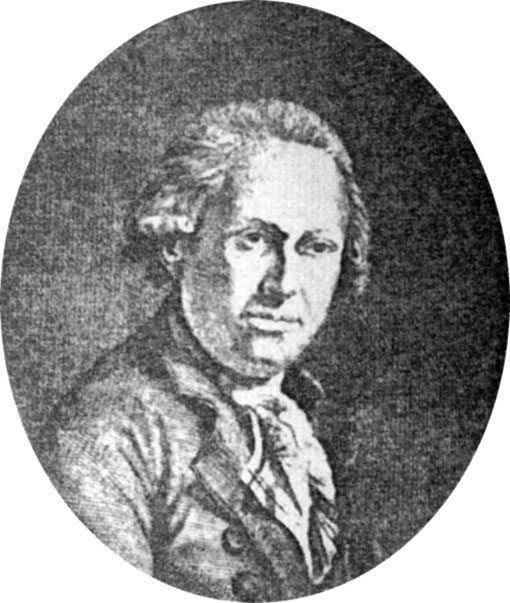
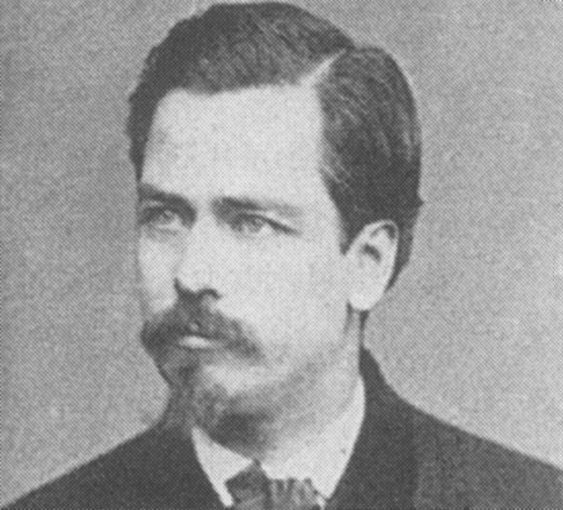
Jan Sztolcman
Jan Sztolcman

Order: Psittaciformes
Family: Psittacidae
Genus: Leptosittaca
Scientific name: Leptosittaca branickii
Citation: von Berlepsch & Stolzmann, 1894
Protonimo: Leptosittaca branickii


Golden-plumed Parakeet images:


Sources:

Avibase
– Parrots of the World โ€“ Forshaw Joseph M
– Parrots A Guide to the Parrots of the World – Tony Juniper & Mike Parr
– Birdlife
– Parrot Book, Parrots and macaws

Photos:

(1) – Golden-plumed Parakeet in Tapichalaca Reserve, Ecuador By markaharper1 [CC BY-SA 2.0], via Wikimedia Commons
(2) – Leptosittaca branickii – Golden-plumed Parakeet by ProAves ColombiaFlickr
(3) – GOLDEN-PLUMED PARAKEET by Bryant OlsenFlickr
(4) – GOLDEN-PLUMED PARAKEET by Bryant OlsenFlickr
(5) – Leptosittaca branickii – Golden-plumed Parakeet by ยฉ Carl Downing – NeotropicalBirds
(6) – Leptopsittaca branickii via Wikimedia Commons

Sounds: (Xeno-canto)

โ–ท The world of Pets: Dogs, cats, birds, reptiles, amphibians

Flores Lorikeet
Trichoglossus weberi

Flores Lorikeet

Content

 Flores Lorikeet

Description Lori Flores:

25 cm. length and 100-150 g. of weight.

The Flores Lorikeet (Trichoglossus weberi) is generally Green; light green / blue stripes on the forecrown and lores, the rest of the head with brighter green stripes; underwing-coverts yellow / green. The chest and the thighs are yellowish or reddish. The bill It is orange-red and irises orange-red. The legs son grises. Smaller size than other species Trichoglossus.

The youth they are similar to adults.

    taxonomy:

Sometimes you think you're closer Olive headed Lorikeet (Trichoglossus euteles). With one exception, so far it has been treated as a subspecies within the complex Coconut Lorikeet (Trichoglossus haematodus), but differs in its chest rather pale green; abdominal patch medium green; head dark green with streaks of bright green; small size (less than a Scarlet-breasted Lorikeet (Trichoglossus forsteni) relatively small). Monotypic.

  • Sound of the Flores Lorikeet. (1)

(1) Some species are under extreme pressure because of traps and harassment. The open availability of high-quality recordings of these species may make the problems even worse.. For this reason, transmission and download of these recordings is off. Recorders are free to share in xeno-edge, but they will have to approve access to these recordings.

Habitat:

It's more common in the lowlands, but it is up 2400 meters above sea level. Wide variety of areas including settlements, forests, coconut plantations, Savanna, eucalyptus forests and mangroves.

It is found in mixed flocks with other parrots; small and noisy groups. Nomads, since they depend on flowering trees. It perches communally in groups of hundreds of birds.

Reproduction:

Birds have been recorded in conditions reproduction in June and is reported reproduction between February and August (White and Bruce 1986, Reeve y Rabenak 2016).

It will nest on the ground in some of the predator-free islands.

Food:

It feeds mainly from nectar, but also feeds on figs, insects and can be found around artificial feeding stations.

Distribution:

Extension of the distribution (breeding/resident): 25.500 km2

The Lori Flores are endemic to the flower island, Indonesian, where it is described as common (pit et to the. 1997).

Conservation Lori Flores:


Near-threatened

1. Current red list category of the UICN: Near-threatened.

2. The population trend: Decreasing.

3. Population size : 10000-19999 individuals.

    Rationale for the Red List category

It is believed that this species has recently split a moderately small population (approaching 10.000 mature individuals), forming one subpopulation, inferring that is suffering moderately rapid decreases due to the pressure of capture and loss of habitat. So, It has been classified as Near threatened, but more information on population size, trends and threats can lead to a reassessment of their status.

    Justification of the population

It is believed that the population of Flores Lorikeet It is moderately small (that is to say, approaching 10.000 mature individuals).

    Justification trend

They suspected that the population is declining due to loss of habitat and unsustainable levels of exploitation.

    Threats

The habitat destruction through the combined impacts of firewood collection, commercial logging, timber extraction for construction materials and clearance for agriculture may represent the most relevant threat.

The loss and fragmentation of forests It is already extensive in Flowers, where no semi-permanent forest below the 1.000 meters is included within the protected areas published in the Official Gazette. These threats are exacerbated by the expansion of human population, with large volumes of wood needed for housing construction, and the fact that the application of the laws by the government is little or no.

The moist deciduous forest is being cleared extensively through land grabbing and the establishment of agricultural areas, a factor that is inevitably reducing the range and population of this species. Forest clearing continues in the coastal belt to make way for crops, and illegal logging continues in protected areas.

It is presumed that the capture for trade in wild birds It represents an additional threat, as for other subspecies of the complex (Trichoglossus haemotodus).

Conservation actions and research in progress

Appendix II of the CITES. CMS Appendix II. It has been recorded in the Mbeliling Forest Reserve (Reeve y Rabenak 2016).

Proposed Research and Conservation Actions

1 – Estimate the population and assess population trends and scale of the pressure catch.

2- Conduct a species-specific study to identify important sites, in order to provide protection.

3- Carry out research on their status and habitat use (with special attention to feeding ecology and forest fragmentation) so that long-term management of the species facilitate.

4- Monitor trade to investigate whether this represents a significant threat.

5- Initiate campaigns sensitization to get the support of local people in forest protection.

In captivity:

In captivity it is kind enough rare de lori. He was raised for the first time Great Britain, in 1969, in Germany in 1984.

Because of its endangered status, Any suitable specimen can not be released back into their natural habitat (native range) It should preferably be placed in a breeding program well managed to ensure the continued survival of this species.

Alternative names

Flores Island rainbow lory, Flores Lorikeet, Leaf Lorikeet, Rainbow Lorikeet (Leaf) (English).
Loriquet ร  tรชte bleue (Weber), Loriquet ร  tรชte bleue (weberi), Loriquet de Flores, Loriquet de Weber (French).
Flores Blauwangenallfarblori, Flores-Allfarblori, Webers Lori (German).
Periquito-arco-รญris (weberi) (Portuguese).
Lori de Flores, Lori Arcoiris (weberi) (espaรฑol).

scientific classification:

Order: Psittaciformes
Family: Psittaculidae
Gender: Trichoglossus
Scientific name: Trichoglossus weberi
Subpoena: (Buttikofer, 1894)
Protonimo: Psitteuteles weber

"Lori de Flores" images:

Videos "Flores Lorikeet"


ยซLori de Floresยป (Trichoglossus weberi)


    Sources:

    1. Avibase
    2. Parrots of the World โ€“ Forshaw Joseph M
    3. Parrots A Guide to the Parrots of the World – Tony Juniper & Mike Parr
    4. Birdlife

    Photos:

    (1) – Flores Lorikeet, Trichoglossus (haematodus) weberi, at New Port Aquarium, Cincinnati, USA by derivative work: Snowmanradio (talk)Trichoglossus_haematodus_weberi_-New_Port_Aquarium-8.jpg: Serge Melki [CC BY 2.0], via Wikimedia Commons
    (2) – Weberโ€™s Lorikeets (Trichoglossus haematodus weberi) at Newport Aquarium by Ltshears [CC BY-SA 3.0 or GFDL], from Wikimedia Commons
    (3) – Fig. 1: Flores Lorikeet (Trichoglossus = Psitteuteles Weber Weber)
    Fig. 2: Olive-headed Lorikeet (Trichoglossus euteles = Psitteuteles euteles) by A Weberโ€™s lorikeet (Trichoglossus weberi) at the Jerusalem Biblical Zoo by SuperJew [CC BY-SA 4.0], from Wikimedia Commons
    (4) – Trichoglossus haematodus weberi Buttikofer, 1894 bt Huub Veldhuijzen van Zanten / Naturalis Biodiversity Center [CC BY-SA 3.0]

    (5) – Weberโ€™s lorikeet, Picture taken at Loro Parque in Puerto de la Cruz / Tenerife by Dominik DeobaldFlickr
    (6) – Johann Buttikofer [Public domain], via Wikimedia Commons

    Sounds: Raf Floats, XC350575. accessible www.xeno-canto.org/350575

โ–ท The world of Pets: Dogs, cats, birds, reptiles, amphibians

Golden-winged Parakeet
Brotogeris chrysoptera


Catita Alidorada

Content

Description:

Golden-winged Parakeet

18 cm.. height.
The Golden-winged Parakeet ((Brotogeris chrysoptera)) has a tail short and finished in tip, bill Of course, body almost all green.

Its main characteristic is to have wing a patch orange or gold and the end blue (more visible on the fly). Crown bluish, forecrown and throat orange.
The eye ring is whitish and without feathers; the irises is of color Brown dark and the legs flesh-colored.
The immature is distinguished by not having the Golden wing patch.

Subspecies description
  • Brotogeris chrysoptera chrysoptera

    (Linnaeus, 1766) – The nominal.


  • Brotogeris chrysoptera chrysosema

    (Sclater,PL) – Golden parakeets. Its plumage is generally more yellow. L0s adults have yellow-orange the forecrown and the regions between them eyes and the peak, on the sides of the head. There is a patch in the chin orange. The primary coverts are yellow. Son bigger the species nominal.


  • Brotogeris chrysoptera solimoensis

    (Gyldenstolpe, 1941) – Codajรกs Golden parakeets. Similar to subspecies nominal, but the frontal band is more pale and of color brown reddish. The patch of the chin is a yellow-brown color.


  • Brotogeris chrysoptera tenuifrons

    (Friedmann, 1945) – Black River Parakeets. Similar in appearance to the subspecies Brotogeris chrysoptera tuipara, with the exception of the frontal band orange, which is minimal or absent.


  • Brotogeris chrysoptera tuipara

    (Gmelin, 1788) – Parakeets Tuipara. It also seems to refer to the species, with the exception of its plumage that is usually more yellow. adults have a frontal band fine of color orange and a patch Orange in the chin. The lateral feathers with edges yellow. They are also bigger that the subspecies nominal.

Habitat:

Video – "Golden-winged Parakeet" (Brotogeris chrysoptera)

It inhabits in humid forest and savannah, more common to 300 meters although it has reported to them 1200 m. You in groups small of 8 to 16 individuals not reproductive time, It is common to see more than 100 consuming fruits in the canopy. Noisy when flying and silent when they feed on.

Reproduction:

Nest on trees, in hollows and termite mounds. Breeding season in November, February and April.

Food:

With feeds of the nectar of the flowers, fruit, figs, berries and seeds.

Distribution:

Size of the distribution (reproduction / resident): 3.110.000 km2

Its population is distributed between the East of Venezuela, Guyanas, Center and East of the Brazilian Amazon.

Subspecies distribution

Conservation:

State of conservation โ“˜


minor concern Minor Concern โ“˜ (UICN)โ“˜

โ€ข Current category of the Red List of the UICN: Least concern.

โ€ข Population trend: Decreasing.

Justification of the population

The size of the world population It has not been quantified, but this species is described as ยซcommonยป (Stotz et to the., 1996).

Justification of trend

It is suspected that this species has lost 20,7-24,8% of habitat suitable within their distribution during three generations (15 years), on the basis of a model of Amazon deforestation (Soares-Filho et to the., 2006, Bird et to the., 2011). So, It is suspected that will decrease in <25% durante tres generaciones.

"Golden-winged Parakeet" in captivity:

Rare in captivity. They are birds a bit nerve until you are acclimatized to its owner. They can be housed in an Aviary with other parrots.

Alternative names:

Golden-winged Parakeet, Golden winged Parakeet, Golden-winget parakeet, Tuipara Parakeet (English).
Toui para (French).
Braunkinnsittich (German).
periquitinho, Periquito-de-asa-dourada, periquito-de-asas-douradas, tuipara-de-asa-dourada, tuipara-de-asa-laranja, periquitinho, periquito-de-asas-douradas, tuipara-de-asa-dourada, tuipara-de-asa-laranja (Portuguese).
Catita Alidorada, Periquito de Alas Amarillas (espaรฑol).
Periquito Ala Dorada (Venezuela).

Carl Linnaeus
Carl Linnaeus

scientific classification:

Order: Psittaciformes
Family: Psittacidae
Genus: Brotogeris
Scientific name: Brotogeris chrysoptera
Citation: (Linnaeus, 1766)
Protonimo: Psittacus chrysopterus


Images "Golden-winged Parakeet"


Species of the genus Brotogeris

Sources:

Avibase
– Parrots of the World โ€“ Forshaw Joseph M
– Parrots A Guide to the Parrots of the World – Tony Juniper & Mike Parr
Birdlife
– Parrot Book, Parrots and macaws Neotropical

Photos:

(1) – animalphotos
(2) – Modern accepted name (2012) is Brotogeris chrysoptera By William Swainson, F.R.S., F.L.S. (Zoological Illustrations, Volume I.) [Public domain], via Wikimedia Commons

Sounds: controles-canto.org

โ–ท The world of Pets: Dogs, cats, birds, reptiles, amphibians

Eclectus Parrot
Eclectus roratus


Eclectus Parrot

Content

Description


Anatomy-parrots

35 to 42 cm.. length and a weight between 355 and 615 g..

The Eclectus Parrot (Eclectus roratus) It has the head and upper parts of bright green. green wing coverts; curve of the wing and the carpal edge blue; primary coverts dark blue. Feathers of flying with vane very dark blue external, vane internal black on the edge inside. Wing of bright red feathers; bottom of the black flight feathers. Green underparts with flanks and axillary Red. Upper, the Green tail with narrow pale yellow tips, drenched side of blue and yellow-tipped feathers (more external with more blue); undertail, tail black with yellow tips.

Yellow-tipped red Bill, black lower jaw, iris orange, greyish Brown legs.

In all the eclectus sexual differences machos-hembras are so large that at the beginning he qualified them as different species. The female of the Eclectus Parrot it is bright red with a purple ruff across the top of the mantle, with bluish black in flight feathers, purple blue wing feathers, purple diffusion over the chest, dull purple-blue on lower chest and belly, coverts yellowish-tipped red infracaudales, and a tail of red with yellow tips (Feather darker bases). The beak is black and the iris is usually yellow (variable).

The young birds they move directly the adult plumage but they have brown peaks.

  • Sound of the Eclectus Parrot.

Subspecies

List of subspecies Eclectus roratus
  • Eclectus roratus vosmaeri

    (Rothschild, 1922) – Larger than the nominal. Male with bright green plumage, more red on the flanks, broader yellow tail ends. Female with the red light, broader yellow tail and yellow in the coverts infracaudales ends.

  • Eclectus roratus roratus

    (Statius Mรผller, 1776) –

  • Eclectus roratus cornelia

    (Bonaparte, 1850) – Larger than the nominal. Male with more blue in the queue, the upper parts of lighter green color. Female completely red except for the edges of the Carpus, wing feathers and flight feathers, that are blue. Narrow yellow tip to the tail.

  • Eclectus roratus westermani

    (Bonaparte, 1850) – (Known only from a few copies of populations in captivity; the origin is unknown). Smaller than the nominal. The male It has no visible red flanks when wings are closed and shows foreign banks of green to flight feathers. Female with the darker red color with broad yellow tip to tail. The possibility that the few copies are abnormal individuals of the subspecies E. r. flushed It has not ruled out.

  • Eclectus roratus riedeli

    (A.B. Meyer, 1882) – Smaller than the nominal. Male with wide yellow tips on the tail (25 mm). Female as E. r. Cornelia, but it shows bright yellow on the coverts infracaudales.

  • Eclectus roratus aruensis

    (G.R. Gray, 1858) – Males as the subspecies E. r. biaki, with a little more spacious yellow tips to the tail. Female Red clear, especially tail.

  • Eclectus roratus biaki

    (Hartert, 1932)- As the subspecies E. r. tortoiseshell but smaller. The female just like the female of the E. r. tortoiseshell but more bright red underparts and back of neck (dubiously distinct race).

  • Eclectus roratus polychloros

    (Scopoli, 1786) – Larger than the nominal. Male, Yellow tail more yellowish-green tips. Female with red chest and less violet blue in the bottom region restricted to belly, green in vane external primary. Narrow periophthalmic ring blue. Coverts red infracaudales.

  • Eclectus roratus solomonensis

    (Rothschild & Hartert, 1901) – Smaller that the E. Eclectus tortoiseshell and the male more yellowish green. Female Red clear. Size is reduced clinalmente from West to East

  • Eclectus roratus macgillivrayi

    (Mathews, 1913) – As the E. Eclectus tortoiseshell but larger.

Habitat:

The Eclectus Parrot It is distributed in a wide range of habitats, from second growth forests, Savannah, mangrove, coconut plantations and eucalyptus Woods, until 1.900 m.

The species is most common in lowland forests, around growing areas and coastal habitats.

The birds are alone, in pairs or in small groups, often composed of only males (presumably during playback).
They sometimes soar above the forest and draw attention with their shrill calls while flying over the canopy, or they perch on an exposed branch.

They are cautious, groups of foraging usually remain in the treetops, Although birds feeding on low-altitude or even on the ground have also been observed.

The Eclectus Parrot they are most active at dawn and at dusk, When traveling to and from their roosts in noisy groups of up to 80 birds.

Have been recorded roosting in Sumba where the Eclectus Parrot they share space with the Sulphur-crested cockatoo.

The species is considered an agricultural pest in some parts of New Guinea.

Reproduction:

Breeding can apparently occur at any time of the year in Papua New Guinea, While active nests observed in Australia It was between the months of February and July; There has been during the month November in Buru, During August in Seram, and between June and September in the Solomon Islands.

Up to eight birds have been registered by attending a nest. It is not clear if these are brood helpers., young from a previous litter still attached to the family group, or additional hens females.

In courtship, birds become involved with mutual grooming and Wiggles head.

The nest is a hollow in a tall tree, until 30 metres in height, sometimes exposed; The cavity may have around 6 depth meters.

Putting two eggs are deposited on a bed of wood dust, hatching in about 26 days, and taking ahead 12 weeks to breeding.

The female takes care of the incubation, leaving only the nest twice a day to be fed by the male; Also is fed by the male when the first eggs hatch, but then begins to feed if same.

Food:

The diet includes fruits, seeds, flowers, outbreaks, fruits and nectar: they are especially fond of (Pandanus) banana, corn, figs and Papaya.

Distribution:

Sumba in the Small Oriental Sunda Islands, Indonesian and Moluccan Islands including Buru, Seram, Ambon, Haruku, Saparua, the Gorong Islands (apparently introduced), OBI, Damar, Bacan, Halmahera, Mare. Ternate and Morotai, in the West of the papuan islands,including Waigeo, Batanta, Salawati and Misool; thence through the lowlands of New Guinea, and Tanimbar Islands, Kai and islas Aru, to the South of the Islands in the Cenderawasih Bay (Numfor, Biak, Yapen, My Num).

In the East, the Eclectus Parrot are distributed among archipelagos of D'Entrecasteaux and the Luisiadas, Papua New Guinea, including Goodenough and Normanby, and in the Trobriand Islands extending through the Bismarck Archipelago including Umboi, New Britain, the Witu Islands, Lolobau, Uatom, Duke of York, New Ireland, New Hanover, Tabar, Lihir, Thong and FeNi, reaching Manus and Rambutyo in the the Admiralty archipelago and Nissan in the South.

The species is also through of the Solomon Islands, including Buka and Bougainville (Papua New Guinea) to the East of San Cristรณbal and its satellites.

There is an isolated population in the North of the Cape York Peninsula, Australia, that goes from the Iron range National Park and the pascoe river, to the South of the McIlwraith range, regularly visiting smaller islands in the Torres Strait, in the continental part of New Guinea.

There is an introduced population of the Eclectus Parrot in Koror and some smaller islands in the archipelago of Palau In the pacific, but likely to be occasional escapes from Hawaii, where apparently cannot have been established. This is one of the parrots most common and most familiar throughout much of their range.

The world's population is estimated over of 300.000 birds. Local entrapments in Ambon, Saparua and Haruku It has apparently made the species becoming extinct in these three islands. The distinctive population in Sumba is in danger.

Subspecies

Distribution subspecies Eclectus roratus

Conservation:


minor concern


โ€ข Current category of the Red List of the UICN: Least concern

โ€ข Population trend: Decreasing

The size of the world's population has not been quantified, It is estimated over the 300,000 specimens. The species is described as common to rare.. The population in Sumba It is estimated in 1.900 individuals, although Sumba It represents a very small proportion of the global range of the species (pit et to the. 1997).

The population is suspected to be declining due to the destruction of habitat in course and unsustainable levels of exploitation.

"Eclectus Parrot" in captivity:

3 the common subspecies in aviculture: Eclectus roratus flushed, Eclectus roratus vosmaeri and Eclectus roratus tortoiseshell; other rare breeds.

Es a curious and intelligent with an acceptable language ability, they learn without difficulty to say words and phrases.

It happens to be fairly quiet and able to live without too much attention. Males can be somewhat distant while in females it must be emphasized the theme that in the case that have nest can not out of it. On the topic food tends to be accepted that the eclectus have a greater need for vitamin A than other parrots.

When considering the purchase of a new Eclectus, it would be wise to obtain a photo and request a consultation with an authority on Eclectus to verify that you are not purchasing a hybrid.

When to acquire housing for our Eclectus Parrot, one should consider your major and arrange them in a cage as large as possible; reasonable steps would be 4,4 m x 1,5 m x 2 m.

We should keep in mind that our parrots should spend at least one hour each day outside the cage during the game.

DIET:

The Eclectus diet consists mainly of vegetables, fruit, legumes and granulated meal. Given that our Eclectus Parrot do not eat many seeds in the nature, and since they are deficient in nutrients, we must consider that their intake should be the exception and not the rule in our house.

The Eclectus they require a diet high in vegetable protein and beta carotene. Their digestive system is longer than most other species., with a greater proventriculus and longer intestines, so fat intake should be limited to avoid fatty tumors. But this does not mean "fat-free.", especially for young people who are very active. It takes some fat to store fat-soluble vitamins A, E and D. It also, with all species, If the cholesterol is too high, the excess accumulates in the liver and, through the bloodstream, travels to the heart where it accumulates; a problem evidenced by fatigue, lack of breed, secondary nutrient deficiency problems (for example, Candida, hypocalcemia, hypoprotenia, etc.), fatty liver, plumage and discoloration-poor quality, bad state of health in general and the inability of the other nutrients to be used correctly.

Too much oil in the diet can cause black feathers on the male and female. They are easily distinguished from the black marks of stress or liver disease because the pattern is different.. Some diets based on pelleted food are high in sugar and can cause kidney problems or hyperactivity. Some are also high in colorants and flavors and can cause toxicity problems. There are some diets which in the market that are organic; But the lack of condoms can cause growth of unwanted yeast and bacteria if left in the cage for more than one hour.

Reproduction Eclectus Parrot:

The reproduction of the Eclectus Parrot It is not difficult as long as we have a compatible partner, Since a female in heat can be aggressive with the male and pursue him while he nears the trough.

Nesting box can have very different ways. The measures are 30 x 30 x 80 cm and inlet of 10 cm.. Diameter. The Z-shaped nest is highly recommended for breeding the Eclectus Parrot Since it allows the male to stay on the top platform in the event that the female is shown aggressive to protect the nest. Inside the box you can put some kind of material, as pine bark.

The incubation period is 28 to 30 days and can breed throughout the year. A sunset happens to another and is not interrupted even during the time of molt. However often the eggs are not fertile or parents do not feed the chicks. It is best to allow them only two released per year, so the nest will have to be removed or the male will have to be separated for a few days. The only drawback, If we choose to separate the male, It is called the female strident so your partner.

The implementation is usually two eggs, and occasionally three.

Alternative names:

Eclectus Parrot, Kalanga, King Parrot, Red-sided Eclectus Parrot, Red-sided Parrot (ingles).
Grand ร‰clectus, ร‰clectus, Grand Eclectus (French).
Edelpapagei, Salomonen Edelpapagei (German).
Papagaio-eclectus (Portuguese).
Loro Eclรฉctico, Loro Eclectus (espaรฑol).

scientific classification:

Order: Psittaciformes
Family: Psittaculidae
Genus: Eclectus
Scientific name: Eclectus roratus
Citation: (Statius Mรผller, 1776)
Protonimo: Psittacus roratus

ยซEclectic Parrotยป Images:

Videos "Eclectus Parrot"

ยซEclectic Parrotยป (Eclectus roratus)

Sources:

Avibase
– Parrots of the World โ€“ Forshaw Joseph M
– Parrots A Guide to the Parrots of the World – Tony Juniper & Mike Parr
– Birdlife
mundoexotics
– Birds N Ways

Photos:

(1) – ยซEclectus roratus-20030511ยป by Doug Janson – Licensed under CC BY-SA 3.0 via Wikimedia Commons.
(2) – ยซEclectus roratus-Malagos Garden Resort, Davao City, Philippines-male-8aยป by Raymund James BareFlickrUploaded by Snowmanradio. Licensed under CC BY 2.0 via Wikimedia Commons.
(3) – ยซEclectus Parrot (Eclectus roratus) -6-4cยป by derivative work: Snowmanradio (talk)Eclectus_parrot_(Eclectus roratus)_-6. jpg: Bear golden retriever – originally posted to Flickr as Img_4575. JPG and uploaded to commons as Eclectus_parrot_(Eclectus roratus)_-6. jpg. Licensed under CC BY 2.0 via Wikimedia Commons.
(4) – ยซEclectus roratus (male) -juvenile pet-atedยป by Peter Bรฉkรฉsi from Budapest, Hungary – Img_0983Uploaded by snowmanradio. Licensed under CC BY-SA 2.0 via Wikimedia Commons.
(5) – By J E Three from houston, usa (parrots eating hairUploaded by snowmanradio) [CC BY 2.0], via Wikimedia Commons

Sounds: Niels Krabbe (Xeno-canto)
โ–ท The world of Pets: Dogs, cats, birds, reptiles, amphibians

Green Parakeet
Psittacara holochlorus


Aratinga Verde

Content

Description:


Anatomy-parrots

Among 28 and 30.5 cm.. of length and a weight of 232 g..
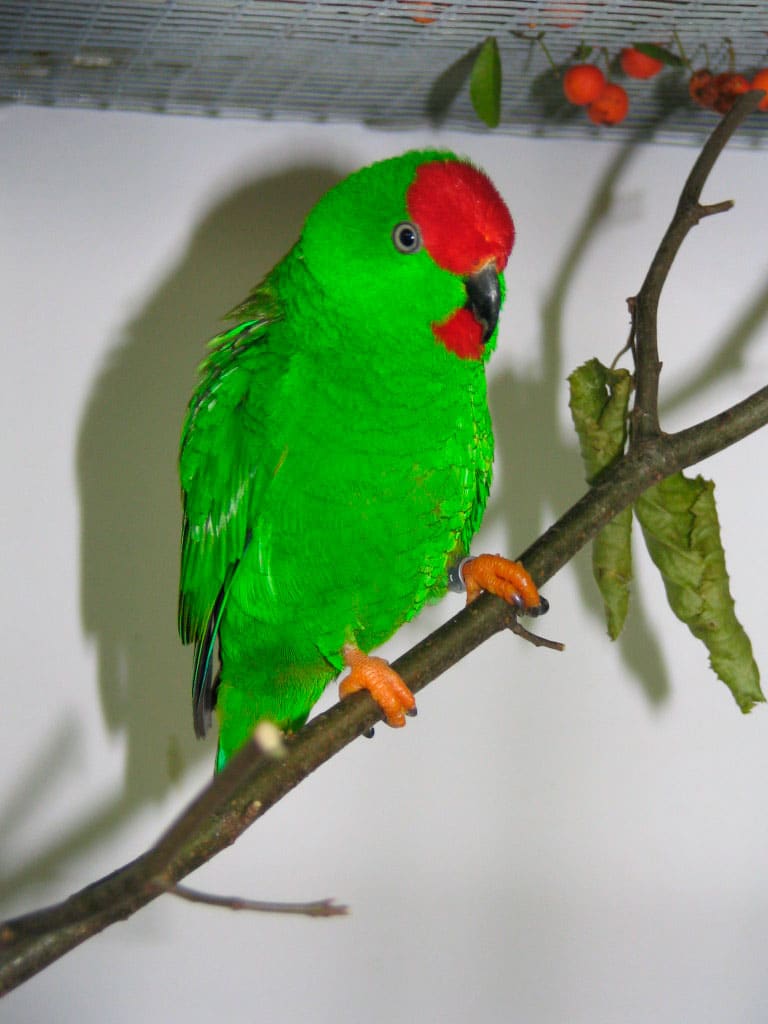
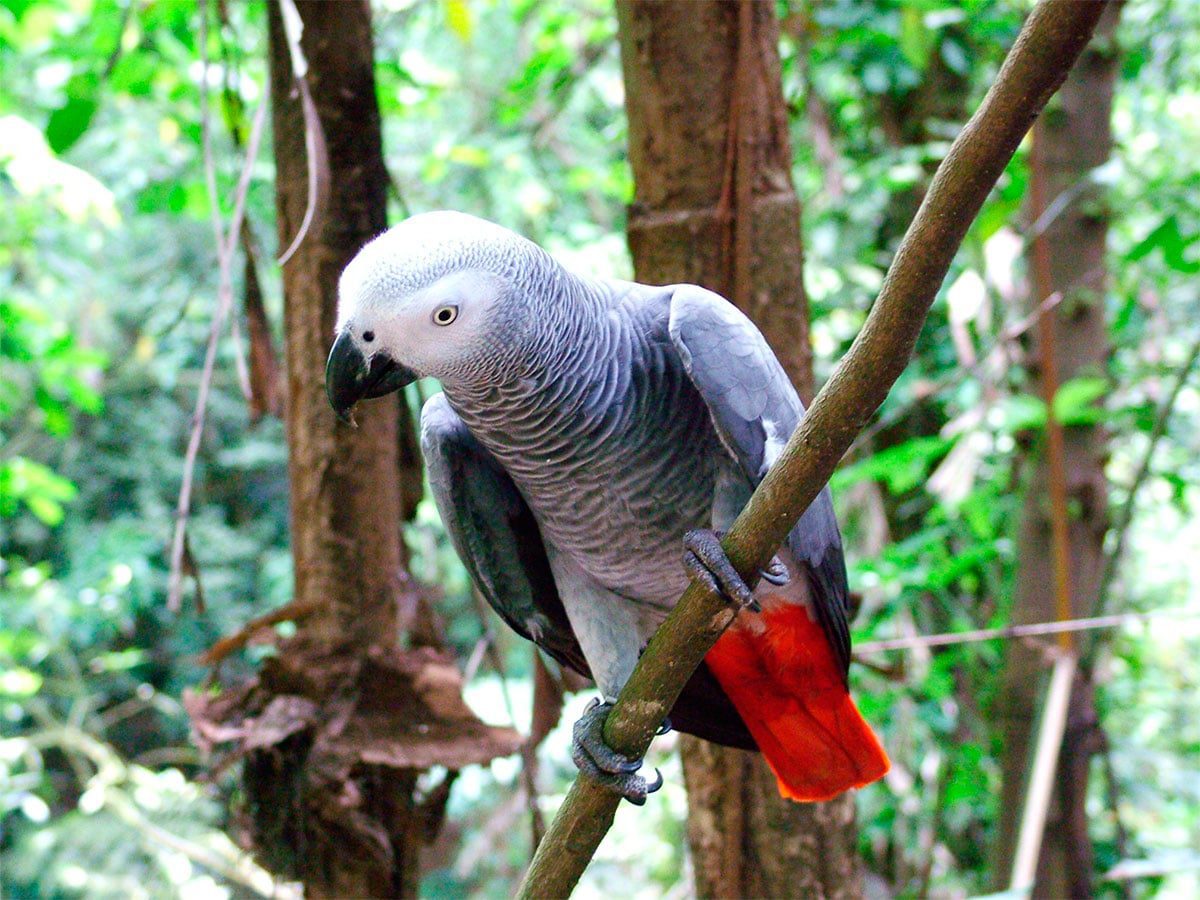
The Green Parakeet (Psittacara holochlorus) is a medium-sized Parrot with the wings in sharp form and the tail long and stitch. Its plumage is bright green, and can present several pens red or orange in the neck. In general, the underwing-coverts are metallic greenish-yellow color, While the the flight feathers and the bottom sides of the the tail feathers are yellow-olive. Presents a eye ring pale beige and the irises orange, the legs yellowish brown.

It has no sexual dimorphism.

The immature has irises Brown color.

Subspecies description:

  • Psittacara holochlorus brewsteri

    (Nelson, 1928) – Plumage, in general, darker green than that of the species nominal, with yellowish green tint and bluish suffusion at the crown.


  • Psittacara holochlorus holochlorus

    (Sclater,PL, 1859) – The species nominal.

Habitat:

Video – "Green Parakeet" (Psittacara holochlorus)

Psittacara holochlorus (green spider) pets of my niece.

The Green Parakeet, as well as their subspecies, avoid moist lowland forests; Instead, prefer deciduous forests and gallery forests, scrub, clear and the edges of the forest.

In East Mexico, mainly seen in upland forest with some movements toward deciduous forests at elevations lower than during the non-breeding season. Registered to 2.100 meters in Mexico (the subspecies ยซbrewsteriยป at altitudes between 1,250 and 2,000m).

Views in flocks outside the breeding season, sometimes in groups of more of 100 birds, being larger groupings in places where food is abundant.

Reproduction:

The nests of the Green Parakeet they are located in tree cavities (for example, cavities made by woodpeckers), crack in rocks, holes in buildings or termite mounds. Colonial nesting reported in caves in the East of Mexico.

The breeding season has been recorded in the month of January to the East of Mexico (young in the nest); in April in Tamaulipas, to the South of Mexico.

The clutch most common consists of four eggs.

Food:

Diet Green Parakeet is based on seeds, nuts, berries and fruits; reported foods include the fruits of Myrica mexicana, seeds of Mimosa and corn (they can be destructive with their crops).

Distribution:

Size of the area of distribution (reproduction / resident): 275.000 km2

Disjunct in slope populations of the Atlantic, from the East of Nuevo Leรณn and Tamaulipas at the center of Veracruz; Southeast of Veracruz, is of Oaxaca and to the East of Chiapas; Southwest of Chihuahua, North of Sinaloa and South of Sonora.

Some specimens settled in cities in southeastern Texas; It is not clear if they come from Pet escapes or are wild vagrant who emigrated from the North of Mexico. It is generally not migratory, but you can scroll to get food.

Subspecies distribution:

  • Psittacara holochlorus brewsteri

    (Nelson, 1928) – Mountains of Northwest of Mexico, to the South of Sonora, Northeast of Sinaloa and South of Chihuahua.


  • Psittacara holochlorus holochlorus

    (Sclater,PL, 1859) – The species nominal.

Conservation:

โ€ข Red List category of the UICN current: Least concern

โ€ข Population trend: Decreasing

The population of the Green Parakeet It is suspected that it is between a slow to moderate decline due to the expansion of intensive farming and capture for the wild bird trade (Juniper and Parr 1998).

The State of conservation, globally, regards it as a kind of Least concern because it is abundant and widely distributed. It is considered one endangered species within the Mexican law by its restricted distribution. Nest boxes they have been provided in the South of Texas nest (Brush 2007).

The world population is estimated at 200.000 mature individuals.

Although it is not as popular as other large amazon parrots, the Green Parakeet is maintained as pet by the local population; have also been exported as pets to the United States. Although there are no accumulated figures, during the period of 9 months between October of 1979 and June of 1980, 327 birds were imported to the United States (Roete et to the. 1982).

While the loss of habitat It is probably the factor affecting the population of the Green Parakeet, their capture for the bird trade It is likely to be negative at the local level.

With the signing of the Wild birds Protection Act of 1991, the Green Parakeet can not be imported to the EE.UU. unless they are part of a breeding program authorized.

The marketing of all the species Mexican species parrots (parakeets, parrots and macaws) is banned in Mexico. Since the year 2008 It is a federal crime to catch, sell, buy this type of animal.

"Green Parakeet" in captivity:

Maintained as pet by the locals although its marketing is prohibited in Mexico.

The illegal trade in parrots and macaws is held thanks to demand from consumers. If the demand for these wild species is reduced, then the offer would be reduced and therefore the illegal capture.

According to sources, a specimen lived 21,8 years in captivity

Alternative names:

Green Parakeet, Cut-throat Parakeet, Green Conure, Green Parakeet (Green), Red-collared Parakeet, Red-throated Conure (English).
Conure verte, Perriche verte (French).
Grรผnsittich (German).
Periquito-verde (Portuguese).
Aratinga Verde, perico mexicano, Perico Verde, Perico Verde Mexicano, Periquito verde (espaรฑol).
perico mexicano, Perico Verde Mexicano (Mexico).
Perico Verde (Nicaragua).
Periquito verde (Honduras).

Philip Sclater
Philip Sclater

scientific classification:


Order: Psittaciformes
Family: Psittacidae
Genus: Psittacara
Scientific name: Psittacara holochlorus
Citation: (Sclater, PL, 1859)
Protonimo: Conurus holochlorus


Green Parakeet pictures:


Species of the genus Psittacara

Sources:

Avibase
– Parrots of the World โ€“ Forshaw Joseph M
– Parrots A Guide to the Parrots of the World – Tony Juniper & Mike Parr
– Birdlife

Photos:

(1) – Green Parakeet From The Crossley ID Guide Eastern Birds By Richard Crossley (Richard Crossley) [CC BY-SA 3.0], via Wikimedia Commons
(2) – Green Parakeet by Vince Smith – Flickr
(3) – Aratinga verde by G. Lasley/Vireo – audubon.org
(4) – Aratinga verde by G. Lasley/Vireo – audubon.org
(5) – Aratinga holochlora (Psittacara holochlorus) – Bellas Aves de El Salvador

Sounds: Peter Boesman (Xeno-canto)
โ–ท The world of Pets: Dogs, cats, birds, reptiles, amphibians

Festive Parrot
Amazona festiva

Amazona festiva

Content

Description


Anatomy-parrots

38-41 cm.. tall and 370g. weight.
The Festive Parrot (Amazona festiva) has the cheeks and sides neck Green with strong blue diffusion; lores and a close frontal band red; feathers above and behind them eyes blue; Forehead rather yellowish green. Crown Green but darker; Feathers of the nape of color green with a band terminal dark. Mantle, scapulars, top of the back and uppertail-coverts dark green; Rump and the greater part of the low back bright red. Primary coverts Violet Blue. Other coverts dark green.

Amazon-festive-6

Edge carpal of the wing and margin of the outerweb of the primaries, blue; innerwebs black; secondaries dark blue-tipped, secondaries more interior Green. Underwing-coverts green. Chin and throat blue; Breast and belly green; coverts infra-flows brighter yellowish green. Tail green, of paler green yellowish at the tip; Trace reddish at the base of some feathers.

The bill color cuerno-marron; Iris yellow, legs dark grey.

Both sexes are similar.

Immature have irises dark and show a less intense color in the head. Its back low is practically Green; some of the pens outside of it tail they have a red base.

Subspecies description

  • Amazona festiva bodini

    (Finsch, 1873) – It has a broadband Violet Blue and red in the front behind the eyes.


  • Amazona festiva festiva

    (Linnaeus,1758) – The nominal.

Habitat:

Video – "Festive Parrot" (Amazona festiva)

Festive Amazon "Charlie"

The Festive Parrot they attend primary and secondary lowland forests, mainly vรกrzea, swamp forest and River Islands, as well igapรณ (permanently flooded forest), usually are found near the water and can prevent forests of Earth firm, although also reported in gallery forests and savannahs with scattered trees.

Observed in cocoa plantations in Brazil. At altitudes of 500 metres in Colombia and 100 metres in Venezuela. Usually in small flocks with larger meetings occasionally reported. Flocks of up to 50 birds are about Leticia between the months of May-June. Tend to gather is by the afternoon and in the evening in products communal.

Reproduction:

It nests in hollow of trees dead between mayo to June.
A breeding pair averages 3 eggs in each clutch and the incubation period is generally about 28 days.

Food:

Usually in numerous flocks, little of its power is known.

Distribution:

The Festive Parrot found in the North of South America mainly as two large populations disjunct in the basins of the amazon and Orinoco.

A population occupies the Northwest of Guyana (very few records) and Venezuela in southern Apure in the Meta River and a half Orinoco to Delta Amacuro.

The second extends from parts of the lowlands of the East (Colombia including the lower part of the Casanare River, lower Meta River and Vaupes River towards the South through the amazon of Ecuador (where birds are reported in Napo River, but few recent records) and northeast of Peru, and further to the East through the West of Brazil, from Rio Branco, Black river and bottom of the Madeira river up to the Basin Amazon East in Amapรก and For and at the mouth of the amazon on Ilha Mexiana (where is its status uncertain).

Probably in its greater part resident, Although sporadic Bird on the edge of its distribution area in Ecuador and Guyana, They suggest seasonal movements outside their range, obviously low in Guyana and local in Venezuela, Ecuador and Peru, but more common in parts of the Amazonia occidental in Brazil and locally the Amazona more common in some areas Colombia (for example by of Leticia).

Pursued to the trade in live birds in parts of its area of distribution (for example, Peru). Its swampy habitat is not much in demand for agriculture, by what does not seems to have a contraction apparent large scale of its population.

Subspecies distribution:

  • Amazona festiva bodini

    (Finsch, 1873) – It is from Colombia to the basin of the Orinoco of Venezuela


  • Amazona festiva festiva

    (Linnaeus, 1758) – The nominal.

Conservation:

State of conservation โ“˜


Near-threatened Near Threatened โ“˜ (UICN)โ“˜

โ€ข Current category of the Red List of the UICN: Least concern.

โ€ข Population trend: Decreasing.

While it has declined locally, still fairly common throughout much of its range, and may even be close to cities as Manaus and Iquitos.

The size of the world population It has not been quantified, but this species is described as ยซRareยป

Consequently, is considered of least concern by BirdLife International and the IUCN , Although it was categorized as vulnerable in 2012, because of patterns of deforestation in the Amazon rainforest and the susceptibility to hunt, predicts that the population will decrease quickly during the next three generations.

Festive Parrot in captivity:

Very rare in captivity.

His temperament is extremely excitable. Males tend to be aggressive. Good to excellent imitator.

It feeds on the sunflower seeds or other provided you ,fruit, vegetables etc..

Alternative names:

Festive Parrot, Festive Amazon, Red-backed Amazon, Red-backed Parrot (English).
Amazone tavoua, Amazona festiva (French).
Blaubartamazone (German).
Papagaio-da-vรกrzea, papa-cacau, tauรก, tavua (Portuguese).
Amazona de Lomo Rojo, Amazona Festiva, Lora Festiva (espaรฑol).
Lora Festiva (Colombia).
Loro de Lomo Rojo (Peru).
Loro Lomirrojo (Venezuela).


scientific classification:

Carl Linnaeus
Carl Linnaeus

Order: Psittaciformes
Family: Psittacidae
Genus: Amazona
Scientific name: Amazona festiva
Citation: (Linnaeus, 1758)
Protonimo: Psittacus festivus


Festive Parrot Images:


Species of the genus Amazona


Sources:

  • Parrot Book, Parrots and macaws Neotropical
  • avibase

Photos:

(1) – Festive Amazon at Loro Parque, Teneriffe By derivative work: Snowmanradio (talk)Festive_Amazon_BW. JPG: Berthold Werner (Festive_Amazon_BW. JPG) [Public domain], via Wikimedia Commons
(2) – A Festive Amazon at Tulsa Zoo, USA. This subspecies is known as Bodinus’ Amazon By Christopher G from Tulsa Oklahoma, USA (Amazon Parrot) [CC BY-SA 2.0], via Wikimedia Commons
(3) – A pet Festive Amazon By Tutu … F. Lopes (originally posted to Flickr as โ™ ) [CC BY 2.0], via Wikimedia Commons
(4) – Two Festive Amazons in an aviary at a bird park in Kaluga Oblast, Russia. They are the subspecies Amazona festiva bodini, common name Bodinus’ Amazon. They are probably jostling for room on their perch By Remiz [CC BY-SA 2.0], via Wikimedia Commons
(5) – Festive Parrot By derivative work: Snowmanradio (talk)Amazona_festiva-8.jpg: frank wouters [CC BY 2.0], via Wikimedia Commons

Sounds: Sergio Chaparro Herrera

โ–ท The world of Pets: Dogs, cats, birds, reptiles, amphibians

Green Rosella
Platycercus caledonicus


Green Rosella

Content


Anatomy-parrots

Description

37 cm.. length between 127 and 142 g. of weight.

The Green Rosella (Platycercus caledonicus) has the forecrown and lores bright red; a crown of a showy color yellow, marked in red and dotted with of Brown olive dark towards the part rear; area low of them cheeks and throat of color blue cake; ear-coverts a bright yellow, with the edges more dark. Strong contrast between the yellow and the dark area of the crown; Brown olive uniform in the the mantle, with fine dark green stripes on their feathers; feathers of the rump and uppertail-coverts have a diffusion of color yellow orange.

Curve of the wing blue; lesser coverts black; corbeteras internal Middle, black, lined in green dark, the light blue external; greater coverts Blue with feathers Interior black finished off with edges of color green; secondaries Blackish with vane blue externals (innermost with green edge); primaries Brown dark with vane external and dark blue margins; tertiary Brown dark with stripes Green.
Under, the wings blackish, with coverts and axillary blue.

The underparts is of color yellow with a tone clear of Orange and with small spots of color orange on the periphery of the area anal. Upper, the tail olive-green tipped off blue, lateral feathers of color blue pale with them tips white; undertail, the tail of color blue pale with them tips white.

Bill White grey; irises dark brown; legs grey.

The female It is smaller than the male and has the bill smaller; also shows more often a wash of orange-red in the upper part of the chest.

The immature they are more muted than adults, show more green in wing-coverts and have them upperparts of color grey olive and yellow olive in them underparts. Plumage adult is reached after the first comprehensive molt, in a few 15 months.

Subspecies description:

  • Platycercus caledonicus caledonicus

    (Gmelin, JF, 1788) – The species nominal


  • Platycercus caledonicus brownii

    (Kuhl, 1820) – Too little differentiated with the species nominal, according to some experts, to justify the recognition as subspecies.

Habitat:

The Green Rosella they are in all types of forest habitats in the territory in which they reside. But, more and more often, they come in orchards and gardens in urban areas, finding favorable conditions in those places to nest and feed themselves. But, its main habitat are still sclerophyllous forests and thickets. Apparently, on Hunter island, they have a strong preference for small ravines filled with piles of rocks.

Like most of the island birds that live in a small area, to the Green Rosella It is cataloged as sedentary. But, the specimens that live in altitudes of up to 1500 meters in the Alpine regions, they make altitudinal movements and approaching at low altitude towards the coastal regions in winter season. At the end of the nesting season, young birds roam in small flocks which do not exceed more of 4 or 5 individuals. The Green Rosella be associated at times with them Eastern Rosella (Platycercus eximius). Although they are not shy, These parrots take precautions and are very cautious When venturing to Earth to find their food. They prefer to stay in the foliage for this activity. Like most of the parrots, the female is attached to your partner by strong ties conjugal it last for many years. They maintain and strengthen these links practicing processions which are very similar to the one of other parrots.

Reproduction:

The Green Rosella nest during the period from September to February. The nest It is usually placed in a cavity of any branch or hollow tree trunk, normally a eucalyptus. They also occupy, exceptionally, the walls of old buildings. They use abandoned nests of sparrows into disuse.

The spawning usually contains between 4 and 6 eggs and your incubation takes a few 19 days. The chicks are altricial and leave the nest only after 3 weeks after hatching. No additional information on the care and development of the offspring.

Food:

The Green Rosella they eat mainly eucalyptus seeds, Mirto, acacia, ragwort large aromatic flowers, canaigre, Solanaceae (Solanum) and pimelea. Most flowers are toxic to pets.

These parakeets also eat many types of seeds of grasses and shrubs, some of which are at higher altitudes.

Do not disdain the berries of coprosma and the Hawthorn, they represent an important part of their diet in winter. The menu is sometimes supplemented with psyllids they are small homoptera and insect larvae .

Distribution:

Size of the area of distribution (reproduction / resident): 68.100 km2

The Green Rosella they are endemic in Tasmania. Also found in the larger islands of the Bass Strait, that is to say, on isla King and Flinders island. Has also been recorded in the Maatsuyker island, front South of Tasmania.

Birds coming from leaks can be found around Sydney.

The species is common and widespread within its range, with a stable world population of more than 50.000 specimens.

One small number in captivity.

The Green Rosella is protected, but it can be killed with a permit when they cause damage to crops.

The population living in the North of Tasmania It is sometimes differentiated under the name brownii, but this so-called subspecies differences are not as marked enough to consider it as such.

Destribuciรณn subespecies:

  • Platycercus caledonicus caledonicus

    (Gmelin, JF, 1788) – The nominal species

  • Platycercus caledonicus brownii

    (Kuhl, 1820) – isla King.

Conservation:


minor concern


โ€ข Current category of the Red List of the UICN: Least concern

โ€ข Population Trend: Decreasing

The size of the world population It has not been quantified, Although estimated at more of 50.000 specimens. The species according to sources, it is common throughout its small range (pit et to the. 1997).

The population is suspected that it may be declining due to the habitat destruction in course of King Island (pit et to the. 1997).

The Green Rosella It may cause damage to the apple orchards and, Although protected, It can be controlled under a system of licensing.

"Green Rosella" in captivity:

It is not a popular Aviary bird, possibly due to its lack of color and its aggressive reputation.

Alternative names:

Green Rosella, Caledonia Parrot, Green Parrot, Mountain Parrot, Tasmanian Rosella, Yellow-bellied Parakeet, Yellow-bellied Parrot, Yellow-breasted Parakeet, Yellow-breasted Parrot (ingles).
Perruche ร  ventre jaune (French).
Gelbbauchsittich (German).
Rosela-da-caledรดnia (Portuguese).
Perico de Tasmania, Rosela Verde (espaรฑol).

scientific classification:

Order: Psittaciformes
Family: Psittaculidae
Genus: Platycercus
Scientific name: Platycercus caledonicus
Citation: (Gmelin, JF, 1788)
Protonimo: Psittacus caledonicus

ยซTasmanian parakeetยป images:

Videos "Green Rosella"

————————————————————————————————

"Tasmanian parakeet" (Platycercus caledonicus)


Sources:

Avibase
– Parrots of the World โ€“ Forshaw Joseph M
– Parrots A Guide to the Parrots of the World – Tony Juniper & Mike Parr
– Birdlife

Photos:

(1) – A Green Rosella at Tasmanian Devil Conservation Park, Tarana, Tasmania By rockmasterp (Beautiful ParrotUploaded by snowmanradio) [CC BY-SA 2.0], via Wikimedia Commons
(2) – Green Rosella (also known as Tasmanian Rosella) in Tasmania, Australia By Sammy Sam (Picasa Web Albums) [CC BY-SA 3.0], via Wikimedia Commons
(3) – Green Rosella (also known as Tasmanian Rosella) in Tasmania, Australia By Sammy Sam (Picasa Web Albums) [CC BY-SA 3.0], via Wikimedia Commons
(4) – Green Rosella (Platycercus caledonicus), Collinsvale, Tasmania, Australia By JJ Harrison (jjharrison89@facebook.com) (Own work) [CC BY-SA 3.0], via Wikimedia Commons
(5) – Green Rosella (also known as Tasmanian Rosella) in Tasmania, Australia By Sammy Sam (Picasa Web Albums) [CC BY-SA 3.0], via Wikimedia Commons

Sounds: Marc Anderson (Xeno-canto)
โ–ท The world of Pets: Dogs, cats, birds, reptiles, amphibians

Hispaniolan Parakeet
Psittacara chloropterus

Aratinga de la Espaรฑola

Content

Description:


Anatomy-parrots

32 cm. of length and a weight of 150 g..

The Hispaniolan Parakeet (Psittacara chloropterus) has the head whole and both sides of the neck green grass with some scattered red feathers; the upperparts and upperwing-coverts Green with external ends of the Middle coverts red. Primary and secondary dark green with bluish-green tips on margins vane inner. The underwing-coverts yellowish brown in the flight feather, more grayish towards the tip; coverts Green except smaller and medium-sized external coverts, they are red and the primarys which are green and Red.
The underparts brighter yellowish green, usually with scattered red feathers.
Upper, the tail dark green and below, grayish brown.
The bill color horn; bare periophthalmic whitish: irises yellowish; legs grayish brown.

Ilustraciรณn de Psittacara euops y Psittacara chloropterus

Both sexes similar.

The immature has less red and more green in underwing-coverts, No red on the upper surface of the bend of wing and grey at the base of the bill and on the cutting edge.

  • Sound of the Hispaniolan Parakeet .

Subspecies description:

Psittacara chloropterus maugei
  • Psittacara chloropterus chloropterus
  • (Souance, 1856) – The species nominal.

  • Psittacara chloropterus maugei โ€ 
  • (Souance, 1856) – Similar to the species nominal, but with a duller green in the underparts; more red in the large underwing-coverts.

Habitat:

Video – "Hispaniolan Parakeet" (Psittacara chloropterus)

Wild baby Hispaniolan Parakeet (Aratinga chloroptera) at nest hole. AVI

This species covers all types of natural habitats from arid lowland forests, to sheets of palmas, but obviously prefers upland forest (including the dominated by Pinus), to 3.000 meters above sea level, scarce, Perhaps because of the persecution, in the adjacent cultivated areas.

In general, observed in pairs or in small flocks, but sometimes in meetings of more than one hundred, at least in the past, When were most abundant. Discernible couples even within large flocks.

Reproduction:

They build their nests in tree cavities, including old holes made by woodpeckers, as well as in arboreal termite mounds.

The laying compose it between 3 and 5 eggs, exceptionally 7.

Food:

There are few details about the diet of the Hispaniolan Parakeet, but it is apparently similar to the fellow and and depends on local availability of fruits, seeds, nuts, outbreaks, flowers and beads; Some reported foods include Ficus figs and corn.

Distribution:

confined in Haiti and Dominican Republic, la Espaรฑola, Greater Antilles. Previously in the Mona Island (Psittacara chloropterus maugei), extinct between 1892 and 1901, probably as a result of the pressure due to the hunting and, possibly, the perturbations by the explosions in the guano mine; possibly, also distributed in Puerto Rico, and its, probably, at the end of the century 19, due to loss of habitat and hunting.

In Hispaniola It is subject to a significant and continuous decrease, due to destruction of habitat, trade and persecution, especially in Haiti, where possibly is extinct.

In Dominican Republic still distributed in a few upland areas, for example, Cordillera Central.

Possibly small wild populations in Puerto Rico and Florida. A small number in captivity; the international trade small volume, probably, keep going.

Subspecies distribution:

  • Psittacara chloropterus chloropterus
  • (Souance, 1856) – The species nominal.

  • Psittacara chloropterus maugei โ€ 
  • (Souance, 1856) – Formerly distributed by the Mona Island and, possibly, Puerto Rico, but the last recorded specimen was in 1892. Currently extinct.

Conservation:

State of conservation โ“˜


Vulnerable Vulnerable โ“˜ (UICN)โ“˜

โ€ข Red List category of the UICN current: Vulnerable

โ€ข Population trend: Decreasing

There is no new data on the evolution of the population; But, the species is suspected that it may be in decline, slow to moderate due to the hunting, capture and habitat loss.

Habitat loss and persecution as crop pest they are the greatest threats to this species. Is exploited for the local and international trade, Although only reported 12 individuals for international trade between 1991 and 1995 (Snyder et to the., 2000).

The number of copies of Hispaniolan Parakeet ranges between 1500 and 7000.

Conservation Actions Underway

โ€ข Appendix II of CITES.

โ€ข In the Dominican Republic, is legally protected against the hunt, but this legislation is not applied properly (Snyder et to the., 2000).

โ€ข A education strategy with community participation has been launched for the protection of this species (Vasquez et to the., 1995).

โ€ข Las interactions between this species and the Olive-throated Parakeet (Eupsittula nana), due to the recent increase in the number of the latter in the Sierra de Bahoruco [S. Latta in litt., 1998] ), they are being investigated (Anon. 2007).

โ€ข A group of volunteers for the protection of the parrot will work reforming the damaged nests. (Anon. 2007)

Conservation Actions Proposed.

โ€ข Clarify the status of the species in Haiti.

โ€ข Study ecology and reproductive success to determine the natural limiting factors.

โ€ข Comply with current legislation in the Dominican Republic.

The Hispaniolan Parakeet in captivity:

Rare in captivity and legally protected in Dominican Republic against the hunt and capture.

Alternative names:

Hispaniolan Parakeet, Haitian Paroquet, Hispaniolan Conure, San Domingo Conure (inglรฉs).
Conure maรฎtresse, Perruche maรฎtresse (francรฉs).
Haitisittich (alemรกn).
Periquito-de-hispaniola (portuguรฉs).
Aratinga de la Espaรฑola, Perico , Periquito Antillano, Periquito de la Espaรฑola (espaรฑol).
Perico, Xaxavi (Repรบblica Dominicana).

scientific classification:

Order: Psittaciformes
Family: Psittacidae
Genus: Psittacara
Scientific name: Psittacara chloropterus
Citation: (Souancรฉ, 1856)
Protonimo: Psittacara chloroptera

Images Hispaniolan Parakeet:


Species of the genus Psittacara

Sources:

Avibase
Parrots of the World โ€“ Forshaw Joseph M
Parrots A Guide to the Parrots of the World – Tony Juniper & Mike Parr
Birdlife

Photos:

(1) – Haitisittich Psittacara chloropterus Aufnahme in La Romana By Martingloor (Own work) [CC BY-SA 4.0], via Wikimedia Commons
(2) – Haitisittich Psittacara chloropterus By Martingloor (Own work) [CC BY-SA 4.0], via Wikimedia Commons
(3) – Haitisittich Psittacara chloropterus Aufnahme in La Romana By Martingloor (Own work) [CC BY-SA 4.0], via Wikimedia Commons
(4) – Perico de la Hispaniola / Aratinga chloroptera by Carlos De Soto MolinariFlickr
(5) – Perico de la Hispaniola / Aratinga chloroptera by Carlos De Soto MolinariFlickr
(6) – Evopsitta maugei. Illustrations from Iconographie des perroquets non figurs dans les publications de Levaillante et de M. Bourjot Evopsitta maugei = Aratinga chloroptera maugei == Psittacara chloropterus maugei By 48 hand-coloured lithographic plates by E. Blanchard and J. Daverne (pl. I-XV) or Juliot of Tours (XVI-XLVII, 79). [Public domain], via Wikimedia Commons
(7) – Psittacara euops Syn: Evopsitta euops & Psittacara chloropterus Syn: Psittacara chloropter bzw. Psittacara euops St. Domingue By Charles Emile Blanchard (1819โ€“1900) (biodiversitylibrary.org) [Public domain], via Wikimedia Commons

Sounds: Lance A. M. Benner (Xeno-canto)