18 cm.. height.
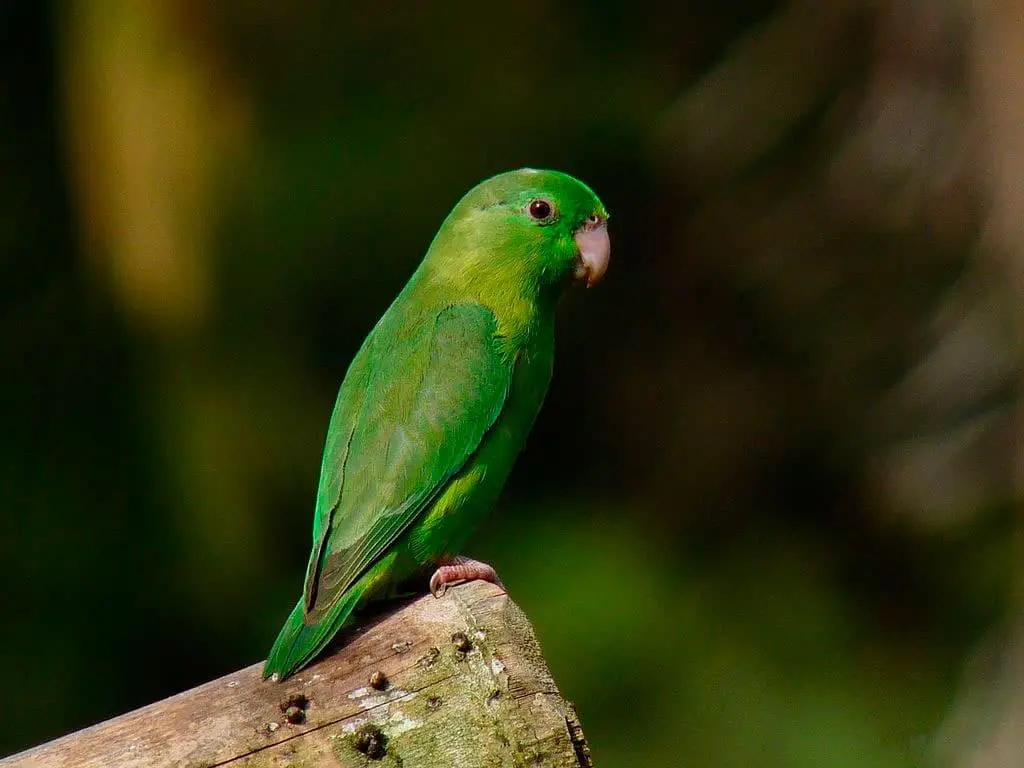
The Rufous-fronted Parakeet(Bolborhynchus ferrugineifrons) has an unmistakable band narrow in the forecrown, face and around the base of the bill, brown-red color; cheeks and throat, brighter yellowish green; crown, rear area of the neck, the mantle, scapulars, wing-coverts and skull, green; uppertail-coverts a green slightly paler. Outerwebs to primaries, bluish green. Under, the wings bluish green. Breast
of color green beige tinted in green olive; rest of underparts brighter yellowish green. Upper, the tail green; by down green dyed blue. Bill brownish (slightly thickness and width) with grey base to the upper jaw; bare periophthalmic grey; irises dark brown; legs grey.
Video – "Rufous-fronted Parakeet" (Bolborhynchus ferrugineifrons)
Occupies the area warm upper and low of the Páramo of the high mountains in bushes, sparsely forested slopes near tree line, and habitats more open including fields of potatoes; those records are in altitudes of 2.800 to 4.000 m, most above 3,200m. Probably roams outside of breeding season. Highly gregarious, they forage in flocks of 5 to 50 individuals, Noting with relative frequency in the soil. Communal dormideros on the cliffs.
Reproduction:
They have reported nesting on cliffs. The male reproductive condition taken in mid-January.
Food:
It feeds mainly on ground of seeds grass, as Calamagrostis effusa, and of herbs, as flowers and achenes of Espeletia hartwegiana.
Distribution:
Size of the area of distribution (reproduction / resident): 18.600 km2
Endemic the high slopes of the Central Andes of Colombia, in where have been sightings in two areas General. The group over North of records involves the complex volcanic Nevado del Ruiz and Nevado del Tolima, where are the departments of Tolima, Quindio, Risaralda and Caldas. The southern part is located on the slopes of the Purace volcano in the Cauca. The high mountains are located between these two areas, by what the distribution can be continuous or of low density in all the chain Andean central, from Caldas until the Cauca.
The Rufous-fronted Parakeet be found in several areas protected including the Alto Quindío Acaime Reserve and the Los Nevados National Park, considered the last bastion of the species; is common there with more than 100 birds observed during eight hours in 1993. But, overgrazing can pose a threat to long term on this site.
Conservation:
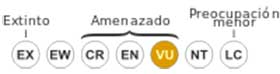
State of conservation ⓘ
Vulnerable ⓘ(UICN)ⓘ
• Current category of the Red List of the UICN: Vulnerable.
• Population trend: Decreasing.
Usually low density of the species (perhaps only a bird by km2) and scarce. Total population Perhaps 1.000-2.000 birds, probably less. IN DANGER OF EXTINCTION.
Threats
The conversion of forests for agricultural purposes has spread below the 3.300 m in the Central Andes. In the elevations more high, the forest is exploited for firewood and grazing, Although left large areas. Given its adaptation to the agricultural environment, the level of threat posed by deforestation is unknown (Snyder et to the. 2000). On the other hand, the widespread destruction of Páramo vegetation, even in Los Nevados, seems to have affected seriously to the population of the Rufous-fronted Parakeet. This is caused by the burning frequent, intense grazing and, to a lesser extent, the conversion to the cultivation of the potato. Colombian authorities have not been able to buy existing properties within national parks, making often that the parks are ineffective. From time to time stored as a pet.
"Rufous-fronted Parakeet" in captivity:
Occasionally stays as a pet locally but it is not known in captivity outside its area of distribution.
Alternative names:
– Rufous-fronted Parakeet, Rufous fronted Parakeet (English).
– Toui à front roux (French).
– Rotstirnsittich (German).
– Periquito-tolima (Portuguese).
– Catita de Frente Parda, Catita Frentirrufa, Periquito Frentirrufo (español).
– Avibase
– Parrots of the World – Forshaw Joseph M
– Parrots A Guide to the Parrots of the World – Tony Juniper & Mike Parr
– Birdlife
– Parrot Book, Parrots and macaws Neotropical
55 cm.. height and a weight between 815 and 975 g..
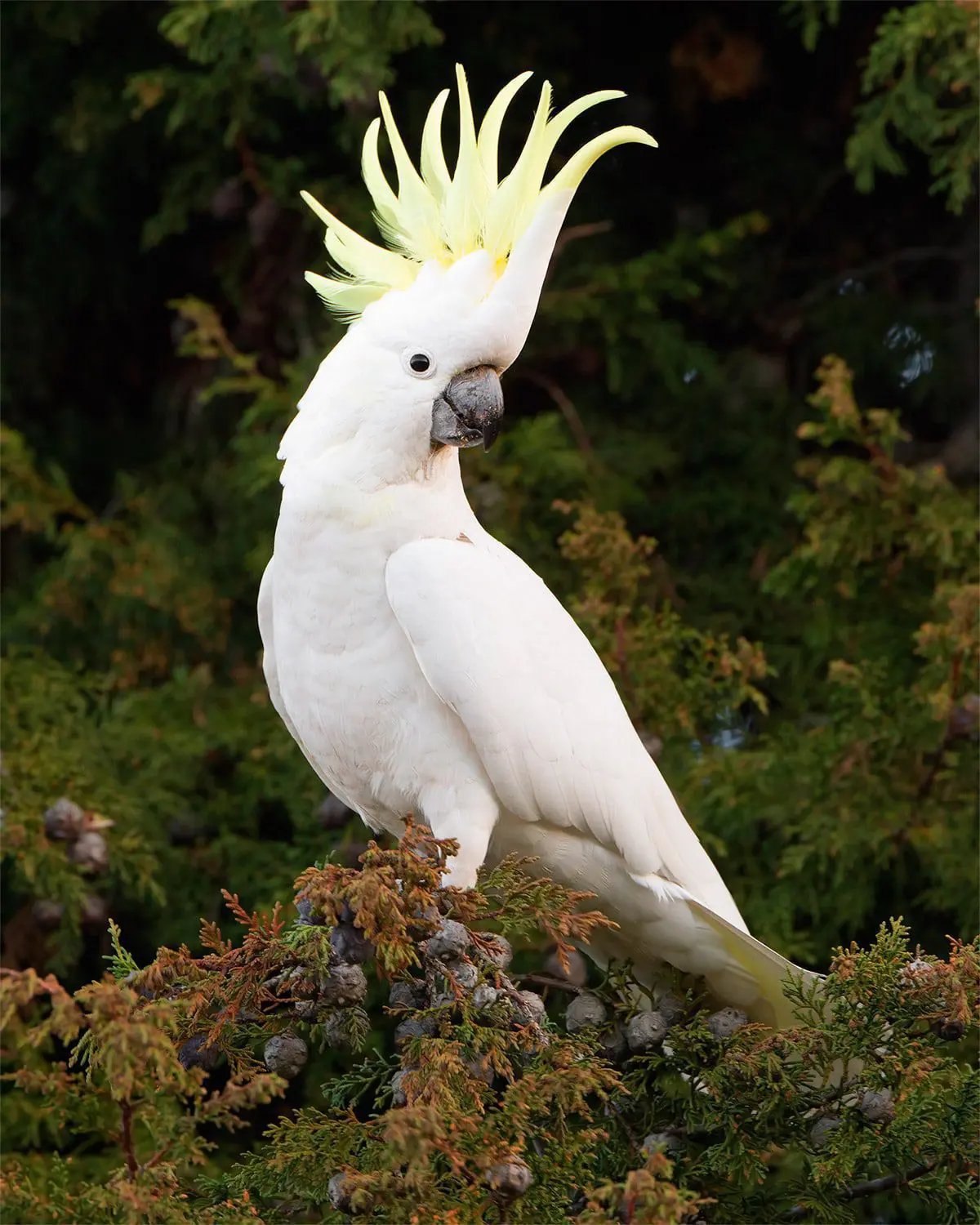
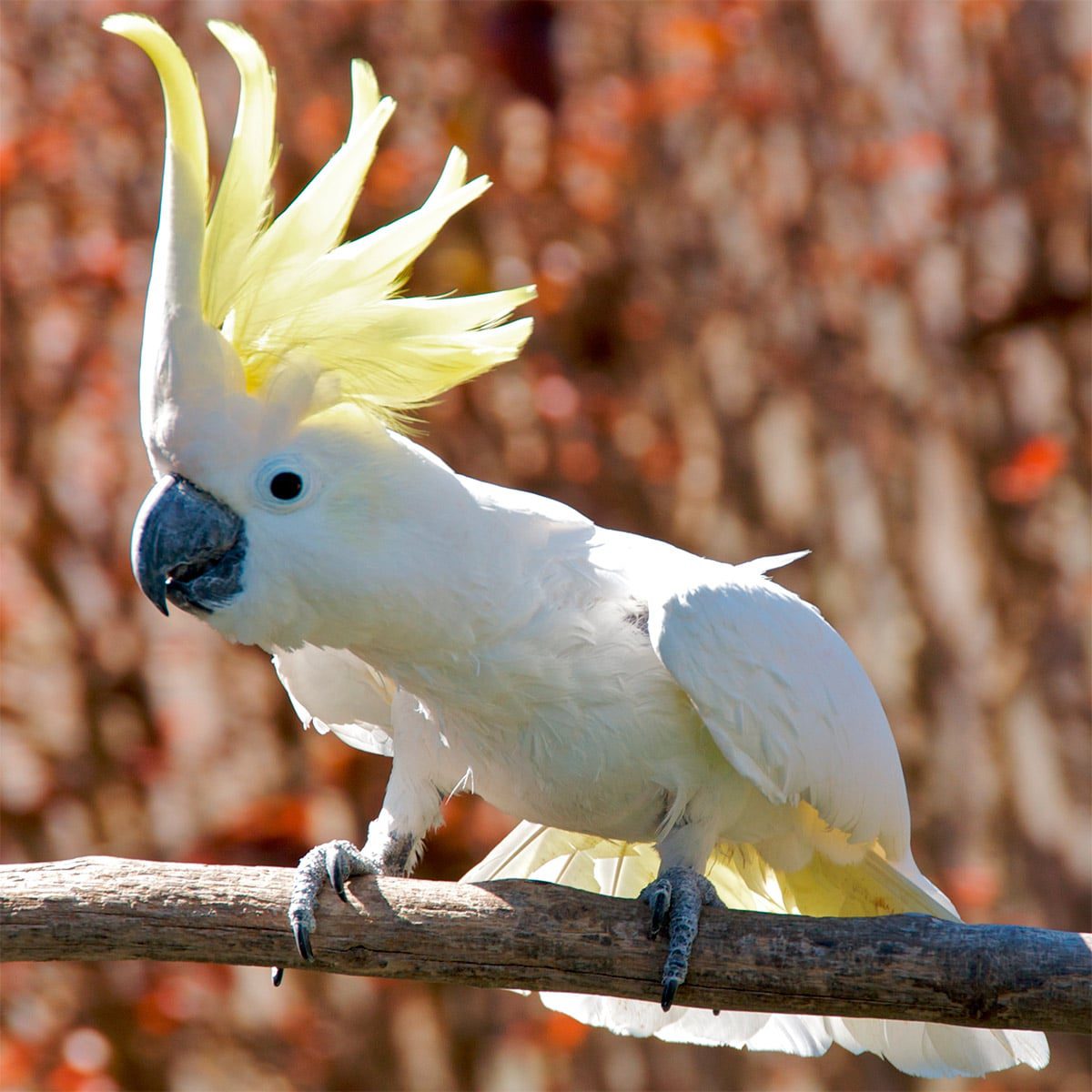
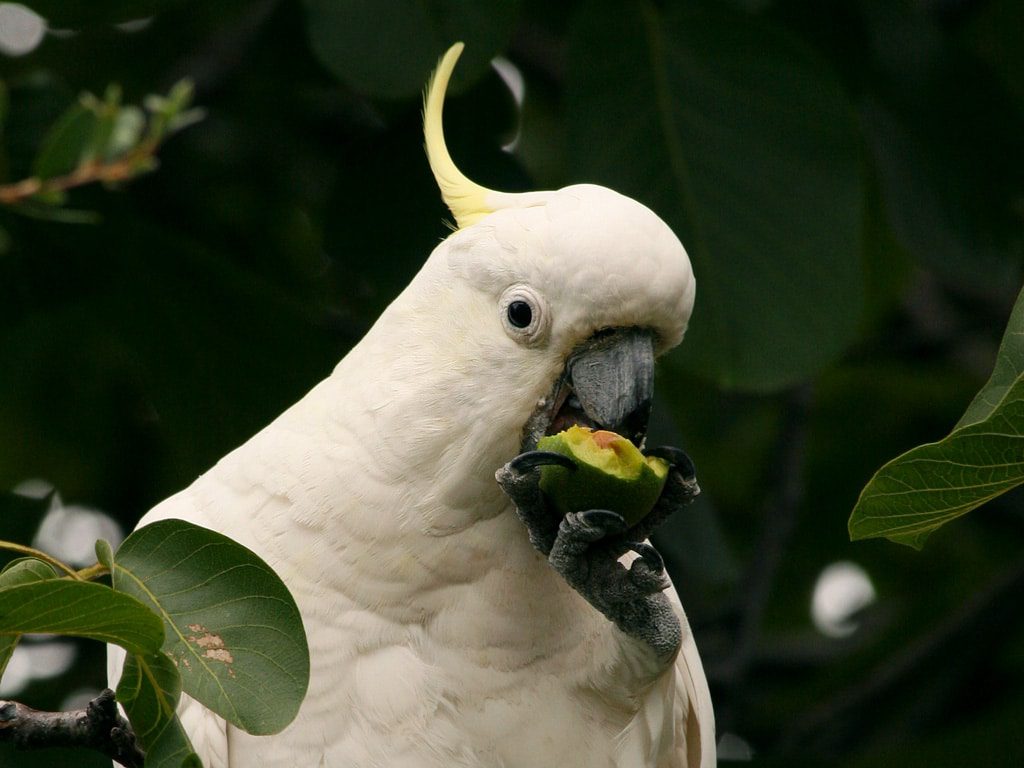
The Sulphur-crested cockatoo(Cacatua galerita) It is a bird with a predominantly white plumage.
In adults, the ear-coverts, bases feathers throat and cheeks, are pale yellow. the arista formed by the 6 Erectile feathers slightly inclined forward, are yellow. The crest You can reach up 14 centimeters in length. The bottom of the wings and of the tail van dyed pale yellow.
The ring surrounding the eye shows a white. The irises is dark brown in the male and reddish brown in the female. The bill is blackish grey, the legs grey.
The immature They are just different from adults. The irises They are pale brown.
(Temminck, 1849) – Something smaller, the crest WIDER and eye ring pale blue.
Behavior:
They are very noisy and very easy to observe, Although they are more identifiable by their cries.
During the breeding season, they live in pairs or in small family groups, but the rest of the year, They are in flocks that may contain hundreds of birds.
In the urban areas and in places that they are equipped with feeders, adopt a family behavior.
In other places, It inspired his distrust and his usual prudence, the Sulphur-crested cockatoo they are very difficult to deal with.
In open areas these birds are implementing a sentinel system that is organized as follows: while most of the flock feeds, Some birds seen from a nearby perch and are likely to sound the alarm if danger.
Habitat:
Video – "Sulphur-crested cockatoo" (Cacatua galerita)
Is located in variety of forest areas, forests (including swamps and river areas), mangroves, Open field, on farm land (including rice fields and plantations of Palm), Savannah, Mallee and suburban areas. Found up to 1.500 meters in parts of Australia, 2.400 metres in Papua New Guinea.
Reproduction:
In Australia, the breeding season occurs from May to August in the North and between August and January, in the South.
In New Guinea, It takes place during every month of the year, although the most active months are during the period from May to December.
This species occasionally breeds in colonies. The nest is a natural cavity in a eucalyptus large near a stream between 3 and 30 meters above the ground. Sometimes the residence of the Sulphur-crested cockatoo It is located in the holes of the limestone cliffs along the murray river. In this case, the eggs are deposited directly in the sand.
In New Zealand, These birds lay amid bales of hay in barns. The nest generally it contains 3 white eggs. These are deposited on a layer of debris decomposing at the bottom of the cavity. incubate both parents alternately for a period of 30 days. Hatchlings have a yellowish color and leave the nest after 6 to 9 weeks. Quite regularly, they return to the nest to rest for about two weeks.
The juveniles They remain within the family group for several months. They feed together in small scattered groups.
Food:
forages in grasses and herbs. You can take corn and wheat sprouts. It also feeds harmful herbs like cotton thistle. other foods include: estate, Rhizomes, nuts, berries, flowers, bulbs, flower and insect larvae.
They can cause great damage to crops. They dig in lands that were recently planted to eating fruit ripening, It also causes damage to crops that are stored and bales of hay to tear the plastic covering them.
Distribution:
Size of the area of distribution (reproduction / resident): 10600000 km2
This species is endemic to the north and east of Australia, New Guinea and nearby islands, especially islas Aru, Indonesian.
It was imported successfully to Palau Islands in Micronesia, New Zealand and some Maluku islands.
The population in Taiwan It has been estimated at about 100 introduced breeding pairs
Lives mainly below 1.000 m, but sometimes you can see in Australia to 1500 m. and 2000 m in east New Guinea.
(Latham, 1790) – Nominal. east and southeast of Australia, North of Queensland, South of Tasmania and Southeast of Australia, including the Kangaroo Island. Introduced in southwest Australia and New Zealand
Cacatua galerita triton
(Temminck, 1849) – West islands papua, Indonesian and New Guinea. introduced in Palau Islands, Micronesia, and some islands in the East Moluccas, Indonesian.
Conservation:
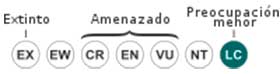
State of conservation ⓘ
Minor Concern ⓘ(UICN)ⓘ
• Current category of the Red List of the UICN: Least concern.
• Population trend: In decline.
It is thought that his population It is greater than 500.000 individuals.
It is not an endangered species. But, despite protection Indonesian this species is followed by trapping wild bird trade. Nor is a protected species in Australia, therefore sacrifices occur.
In New Guinea, sometimes it is hunted for its feathers.
It is suspected that his population is in decline due to ongoing habitat destruction.
"Sulphur-crested cockatoo" in captivity:
and valued species often as a pet.
Very Intelligent, sociable and playful. It is a cockatiel for experienced bird owners. You can be dominant and aggressive. It can be very noisy.
There are anecdotal reports of some Sulphur-crested cockatoo who they have lived more than 100 years. In the news, However, longevity record, according to sources, belongs to a captive specimen called "Cocky" who lived more than 57 years in the London Zoo. Another report suggests that these animals can live up 73.0 years in captivity, but this has not been verified.
Alternative names:
– Sulphur-crested Cockatoo, Greater Sulphur-crested Cockatoo, White Cockatoo, Yellow-crested cackatoo (ingles).
– Cacatoès à huppe jaune, Grand Cacatoès à huppe jaune (French).
– Gelbhaubenkakadu (German).
– Cacatua-de-crista-amarela (Portuguese).
– Cacatúa de Moño Amarillo, Cacatúa Galerita (español).
Origin: Indonesian, Papua New Guinea, Solomon Islands
Character: Shy
Life expectancy: ---
Height: 9 cm..
Content
Description
9 cm.. length between 12 and 16 g. of weight.
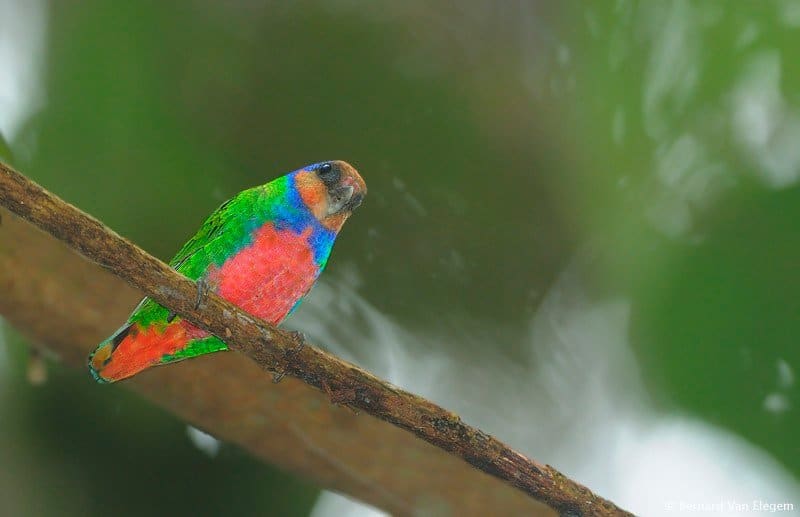
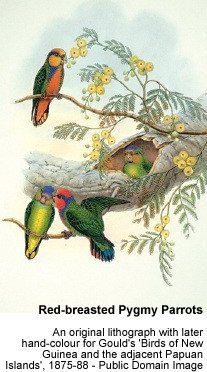
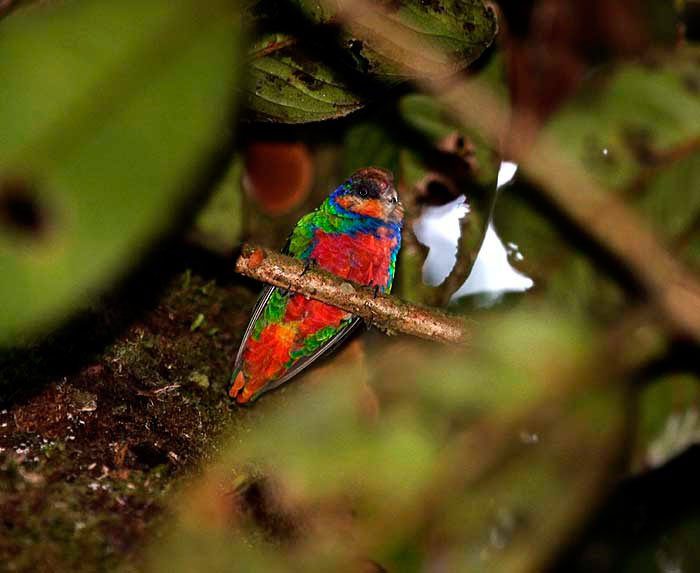
The crown of the tiny Red-breasted Pygmy-Parrot(Micropsitta bruijnii) various of pink to Brown towards the nape; cheeks, chin and ear-coverts, pale pink; line that goes from eyes up to the nape, iridescent blue. Banda wide in the part back from the nape, iridescent blue, rest of the upper region Green with fine dark margins. The flight feather Black finely lined in green; under wing-coverts Green with centers black. feathers of the wings grey-black.
The underparts are pink, with collar narrow blue iridescent in the part superior of the chest, merging is in color green in them lower flanks and blue in the part back from the neck; sides chest, blue. Uppertail Pink dark. Central feathers of the tail of color blue opaque, dotted black; Black yellow-orange-tipped outer.
Bill grey, cere pink, irises brown; legs grey.
Female mainly green and devoid of underparts Roses and the neck Blue of the male. The crown Pink is replaced by the blue (with the exception of the front that is pink), and uppertail-coverts are of color green yellow, not pink. The wing feathers show some brands of color green and the throat is grayish white.
Immature are like females, but are orange in the underparts, and they have forecrown and lores White.
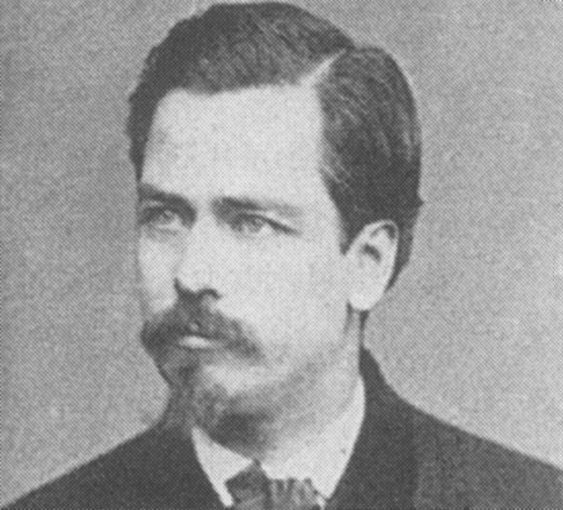
Note: scientific name bruijnii commemorates the Dutch merchant's feathers Antonie Augustus Bruijn.
(Hartert, 1925) – Crown the male is brown with a yellowish Center. The cheeks, the throat and the part middle of the chest and abdomen are reddish in colour. The uppertail-coverts are yellow. The female is like the female of the nominal but the crown it's more purple-blue.
Micropsitta bruijnii pileata
(Mayr, 1940) – The male has the crown of color red more dark that the nominal, and extends below, to nuchal collar blue.
Micropsitta bruijnii rosea
(Mayr, 1940) – The Red of the underparts is richer, but restricted to the center of the part inferior of the chest and the abdomen. The Red of the cheeks and Arch of crown also is more rich. Female as the female of the nominal.
Note: Birds observed recently in OBI, Center-North of Moluccas, possibly belong to a new subspecies. (Mittermeier, J.C., Cottee-Jones, H.E.W., PURBA, E.C., Attack, M.., Hesdianti E. & Supriatna, J. (2013)
A survey of the avifauna of Obi island, North Moluccas, Indonesian. Forktail 29: 128–137.)
Habitat:
The microloro pechirrojo they can be observed in primary and secondary forests on mountain, along the forest margins, and also have been recorded in the Albizia moluccana, in coffee plantations. They are usually between 500 and 3.000 m, but they can be found at lower altitudes. There is a record of a wandering bird observed at the level of the sea.
The species is usually found in pairs or in groups of up to 20 individuals, quickly moving in small groups through the second half of upper canopy. They are most commonly found for their high-pitched calls..
Birds prefer dead trees and can "jump" from one branch to another in search of fungi and lichens to feed on.. They also take fruit and flowers.
Unlike other Pygmy parrots, they build their cavities for nesting on the sides of the dead trees, not in termite mounds. The entrance tunnel leads up into the cavity and enters from the rear. One of the registered tunnels had 100 x 55 mm. with a coating of wood inside.
Reproduction:
The breeding season, according to sources, is between the months of December and April. The nest It is a hole in a stump or dead tree to an altitude that ranges between 3 and 4 meters above the ground; apparently one of these nests counted with the presence of one male and two females.
Food:
Fungi and lichens, Sometimes they feed on fruit and flowers.
Distribution:
Size of the area of distribution (reproduction / resident): 269.000 km2
The Red-breasted Pygmy-Parrot are distributed by the islands of Buru and Seram, and in the mountain forests along the New Guinea, the Bismarck Archipelago, and three of the Solomon Islands. In New Guinea, are observed in the mountains Tamrau and Parotia of Vogelkop, along the Onin Peninsula, and through the central mountain range, including the mountains, Kubor, and coming up to Adelbert, Saruwaged and Owen Stanley ranges in the North and Southeast. There are also in New Britain and New Ireland (Hans Meyer Range) and in Bougainville, Kolombangara and Guadalcanal in the Solomon Islands.
The size of the world population It has not been quantified, probably over the 100,000 specimens. The species is released between common and rare due to deforestation and loss of habitat in this limited range.
The population suspected to be stable in the absence of evidence of any reduction or substantial threats.
"Red-breasted Pygmy-Parrot" in captivity:
It is not in captivity. Difficult to keep alive for more than a few hours or days.
Alternative names:
– Red-breasted Pygmy-Parrot, Mountain Pygmy Parrot, Mountain Pygmy-Parrot, Red breasted Pygmy Parrot, Red-breasted Pygmy Parrot, Rose-breasted Pygmy Parrot (ingles).
– Micropsitte de Bruijn, Perruche pygmée de Bruijn (French).
– Rotbrust-Spechtpapagei (German).
– Papagaio-pigmeu-de-peito-vermelho (Portuguese).
– Microloro de la Montaña, Microloro Pechirrojo (español).
22 cm.. length and a weight between 105 and 132 g..
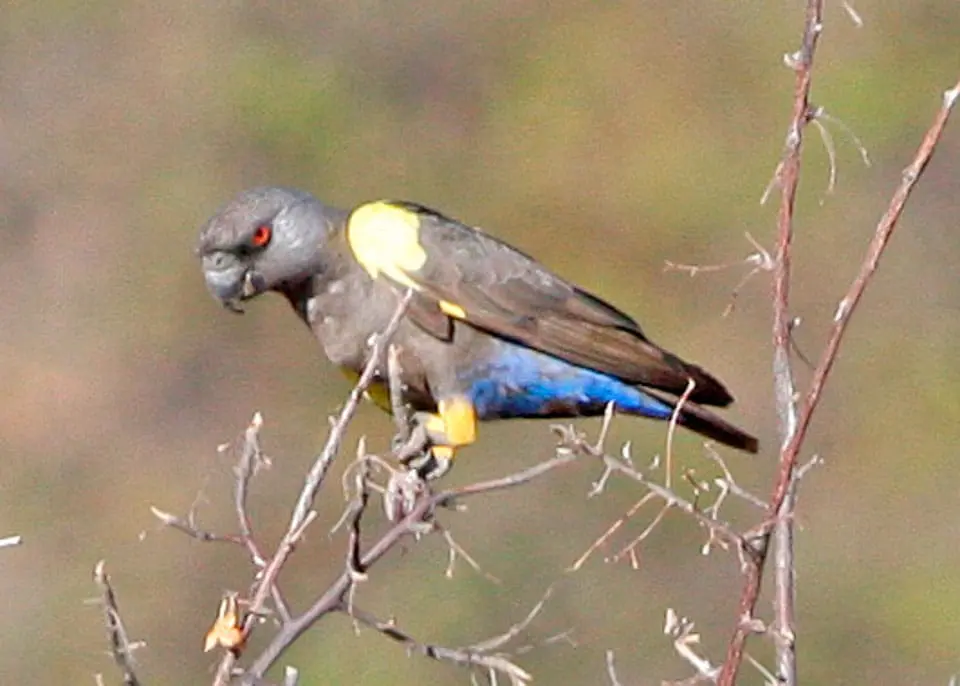
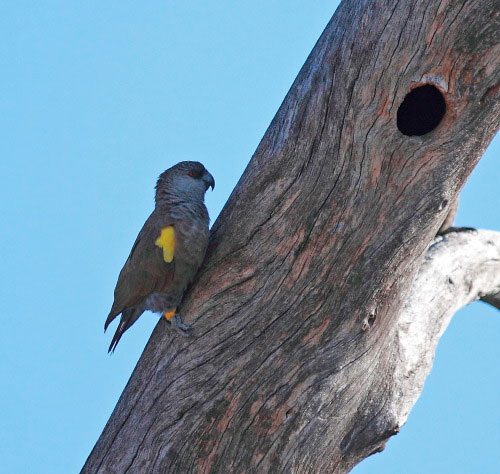
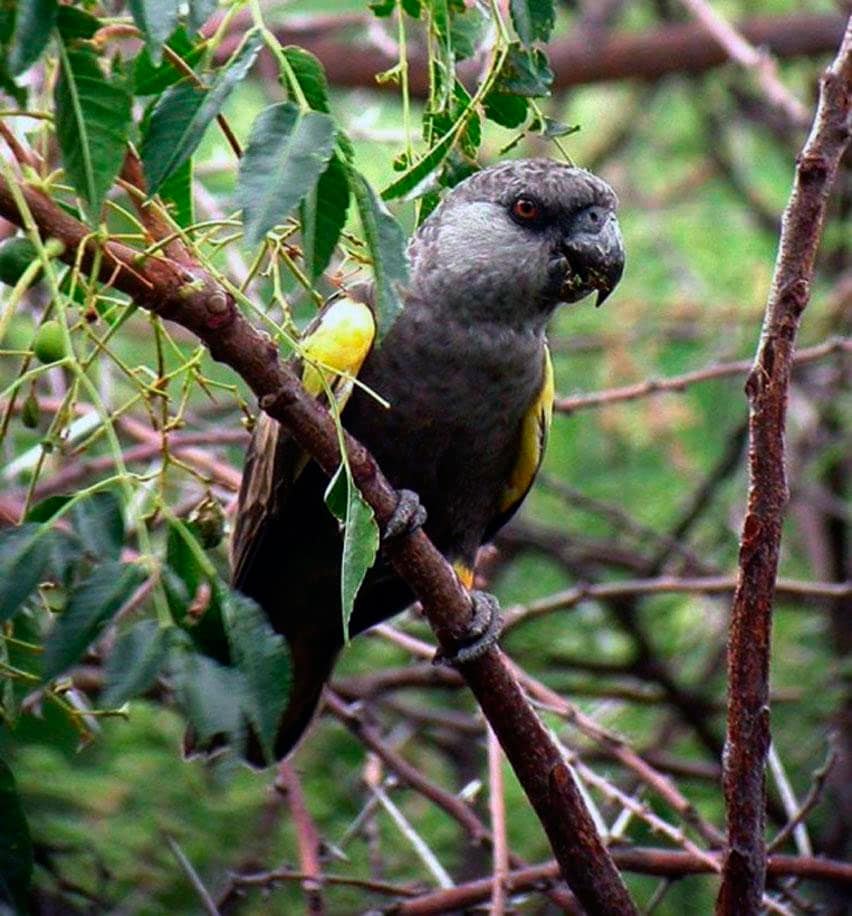
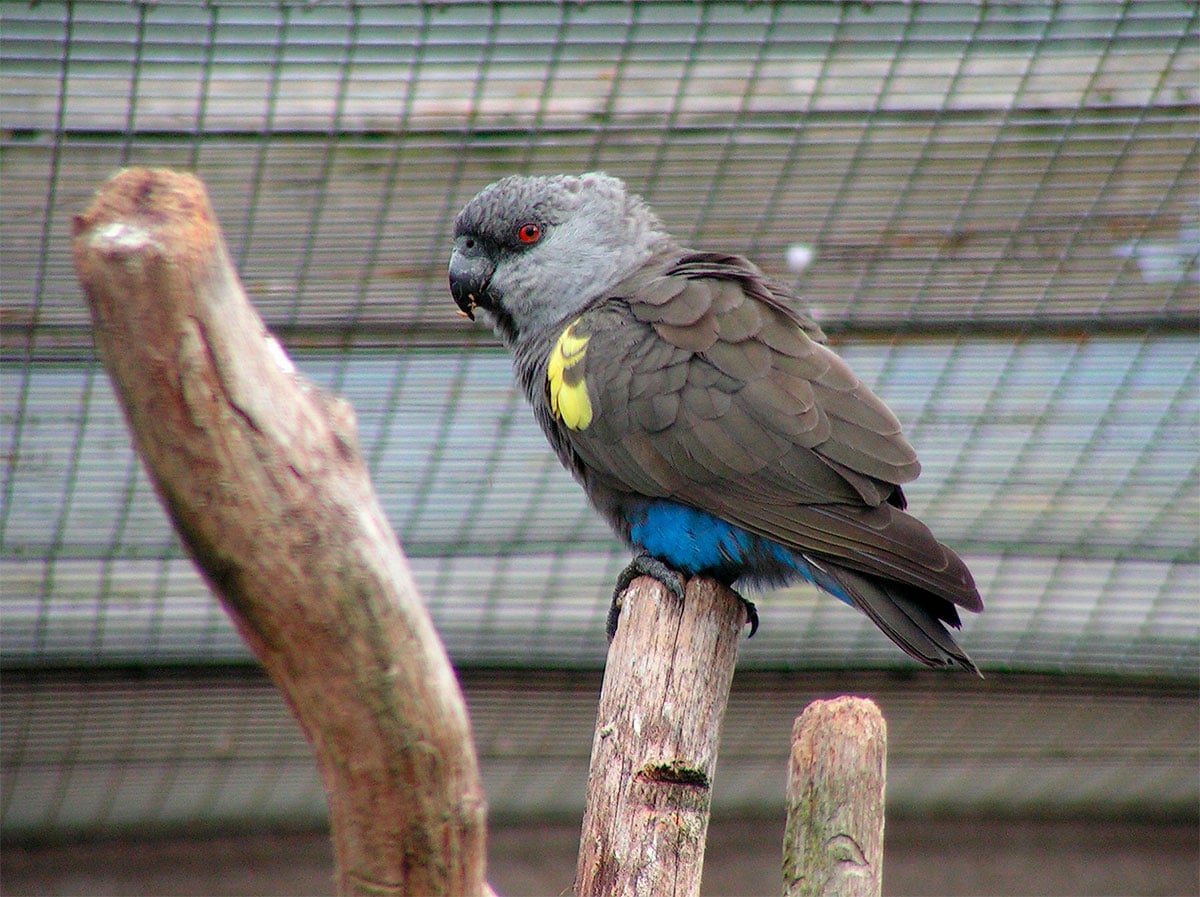
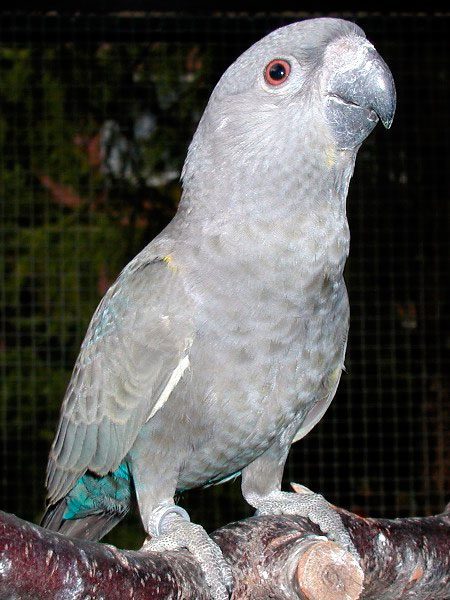
The Rüppell's parrot(Poicephalus rueppellii) has the head, generally, dark brown, clearer in the sides of the face with ear-coverts Silver. Nape, the mantle and scapulars brown in color with slightly paler silver tips and rather diffused on most feathers (especially in the nape); rump brown with blue wash, occasionally feathers Bright blue. Upper, the under wing-coverts brown. Leading Edge wing
, Since the carpal joints at the base of the primaries bright yellow. The primaries and secondaries brown above, paler below. Wing feathers bright yellow.
The underparts, above all, uniformly brown, clearly lighter than the upperparts; the thighs bright yellow; undertail- coverts and posterior flanks with blue wash, sometimes a few feathers with bright blue tips. Tail darker brown than the rest of the plumage.
Bill greyish black; cere black; irises orange-red; perioftalmico ring black ; legs black.
The females They have lower back, rump, uppertail-coverts, lower abdomen, undertail- coverts and the back of the flanks bright blue..
The immature They are similar to females but duller blue and less extensive, lighter brown in the body, the thighs brown. Wing feathers and set carpiano yellowish brown brown; clear margins in the wing-coverts.
They live in forests along water courses dry, dry forests (including forests Euphorbia), dry steppe thorny veld, showing a preference for areas with Adansonia or other tall trees; also in formations Acacia / Commiphora in Escarpment Namibia. Not registered above 1.250 metres in Angola.
Usually they found near water, in small flocks (until 20 birds); sometimes in greater numbers when food is plentiful.
Reproduction:
The nest usually it located in the old hole of a carpenter, at a height of up to 5 meters above the ground. It is believed that usually they breed from the months of February to May, but juvenile birds have been observed in September: the breeding It may be more closely linked to precipitation of the season. Of 3 to 5 egg white, rounded form the usual commissioning.
Some local nomadic movements in relation to the food supply, otherwise residents. Usually they reported as locally common but fluctuations can occur with nomadic movements.
Conservation:
• Current IUCN Red List: Least concern
• Population trend: Decreasing
The size of the world's population has not been quantified, although it is estimated below 30.000 individuals.
The species according to information, It quite common within suitable habitat.
The population is suspected of being in decline due to unsustainable levels of exploitation. Also their population numbers are threatened by the cage bird trade – an estimated number between 600 and 1000 birds are exported annually to South Africa and Europe, approximately 60-70% of them die during transport.
"Rüppell's parrot" in captivity:
Very rare in captivity.
Take it easy, It is a species in which males seem to speak better than females, usually they have easy to mimic sounds of other birds.
In terms of their longevity, according to sources, a specimen lived 34,3 years in captivity.
Alternative names:
– Rueppell’s Parrot, Ruppell’s Parrot, Rüppell’s Parrot (English).
– Perroquet de Rüppell (French).
– Rüppellpapagei, Rüppell Papagei, Rüppell-Papagei (German).
– Papagaio de Rüppell, Papagaio-de-rüppell (Portuguese).
– Lorito de Ruppell, Lorito de Rüppell (español).
– Avibase
– Parrots of the World – Forshaw Joseph M
– Parrots A Guide to the Parrots of the World – Tony Juniper & Mike Parr
– Birdlife
– Photos:
(1) – An adult female Rüppell’s Parrot near Hobatere Lodge, Kamanjab, Namibia By Ron Knight from Seaford, East Sussex, United Kingdom (Ruppell’s ParrotUploaded by snowmanradio) [CC BY 2.0], via Wikimedia Commons
(2) – In captivity by Udo Berg –> Heggy – Wikipedia
(3) – Rüppel's parrot – papageien.org
(4) – Poicephalus rueppellii rueppells parrot – Birds-pet-wallpapers
(5) – Poicephalus rueppellii in Erongo Mountains, Namibia – Buckham Birding
(6) – Proceedings of the Zoological Society of London 1882 by Joseph Smit [Public domain], via Wikimedia Commons
Approximately from 33 cm.. length, and a weight of 140 g.
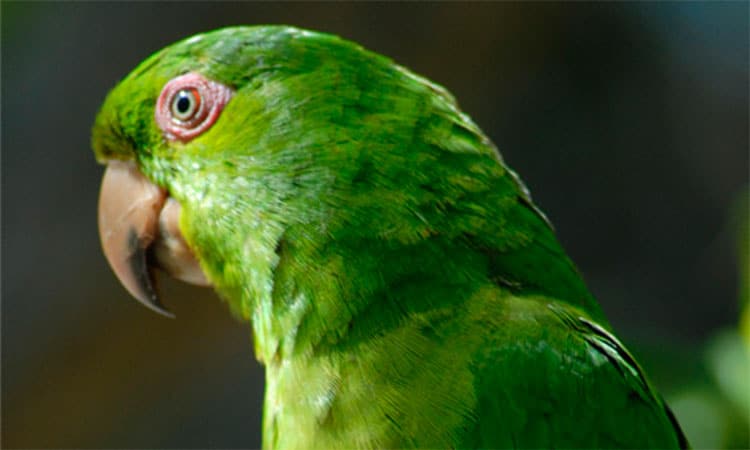
The Socorro Parakeet(Psittacara brevipes) is a medium Parrot with the plumage bright dark green, with the crown, the forecrown and lores grass-green, the sides of neck slightly brighter, the head and the neck, sometimes with one or more scattered feathers of orange-red. The upperparts are green grass, slightly brighter in the area of the rump. Upperwing-coverts herb with bluish green in the outside greater coverts. Primaries and secondaries Green in the part superior with tint blue in them vane outer; olive Oliva-Amarillo down. Underwing-coverts green. Underparts grass-green. Above, the tail dark green, by down color yellowish olive.
The bill color horn; eye ring pale beige; irises orange yellow or orange; legs yellowish brown.
Gender-related differences are unknown although the immature has irises Brown color.
NOTE:
The Socorro Parakeet It is often considered a subspecies of the Green Parakeet. But, Howell and Webb They presented evidence that supports the separation of the species from the other subspecies of Aratinga holochlora. They found that the bill of the Socorro Parakeet is larger than, and noticed differences in the color of the skin of the eye ring, also has a Wing formula different, the tenth primary feather It is shorter than the seventh and Green Parakeet is the reverse. Both species also differ in the vocalization, calls of the Green Parakeet they are richer in harmonics that the of the Socorro Parakeet.
Most commonly observed in forests of species such as Bumelia socorrense, Guettarda insularis, Ilex socorroensis, with trees of at least 8 metres in height. Usually, above 500 m (especially on the South side of Socorro island), because in most of the rest of its distribution area, in the lower elevations, It has lost its vegetation preferred because of the sheep pasture.
Registered at low altitudes, 4 m, where the native forest (in canyons), near the sea level, especially in tall trees of Croton masonii, Conocarpus erecta and Ficus.
Usually, in flocks of up to 40 birds, rarely come to the 100 specimens. They gather in numerous flocks on the branches of the guayabillo, in smaller flocks (until 6) or only in pairs during the breeding season.
Son social, even there is care collective nests, They show strong fidelity to nesting sites, based on observations of re-use of nests.
Reproduction:
They nest in tree cavities, especially of the species Bumelia socorrense. the size of the clutch It is unknown, but the breeding It is thought that it can begin in the month of November. The young are altricial.
They aim to feed in the tips of the trees or the highest branches, Although also has observed them are home on the floor
Distribution:
Endemic, It is only in the Socorro island in the The Revillagigedo Islands archipelago off the West coast of Mexico. Estimated population in 400-500 birds in 1992 (approximately nine birds per km² of suitable habitat). considered common, but recent decreasepossible n due to loss of preferred habitat (still present in about 22% of the island) and the resulting erosion of the sheep that graze in excess. Predation by feral cats can also be a threat.
Conservation:
State of conservation ⓘ
Endangered ⓘ(UICN)ⓘ
• Red List category of the UICN current: In danger of extinction
• Population trend: Decreasing
Threatened in the Mexican official standard NOM- 059-ECOL-2001, but in Danger of extinction in the NOM-O59-SEMARNAT-2006 that is not yet published. CITES Appendix II
The Socorro Parakeet (in danger of extinction; It is only in the Socorro island and this species the habitat destruction threatens, as well as the introduction of cats, sheep and rodents.
Estimated population in 400-500 birds in 1992.
"Socorro Parakeet" in captivity:
The species, unlike most continental psittacines, does not face problems of extracting pups for the pet market.
Alternative names:
– Socorro Parakeet, Green Parakeet (Socorro), Socorro Conure (English).
– Conure de Socorro, Perruche de Socorro (French).
– Socorrosittich, Socorro-Grünsittich (German).
– Periquito-de-socorro (Portuguese).
– Aratinga de Socorro, Perico de Socorro, Perico mexicano (español).
– Perico de Socorro (Mexico).
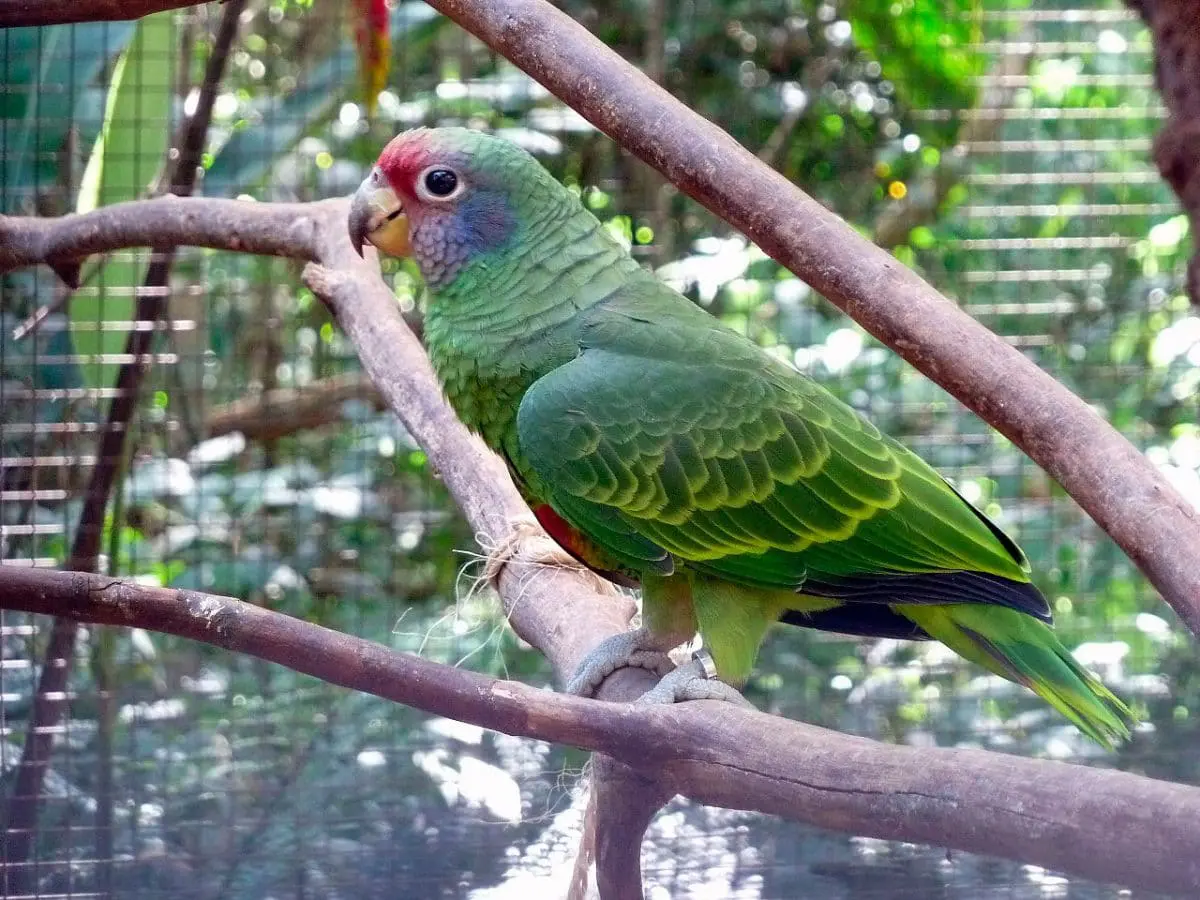
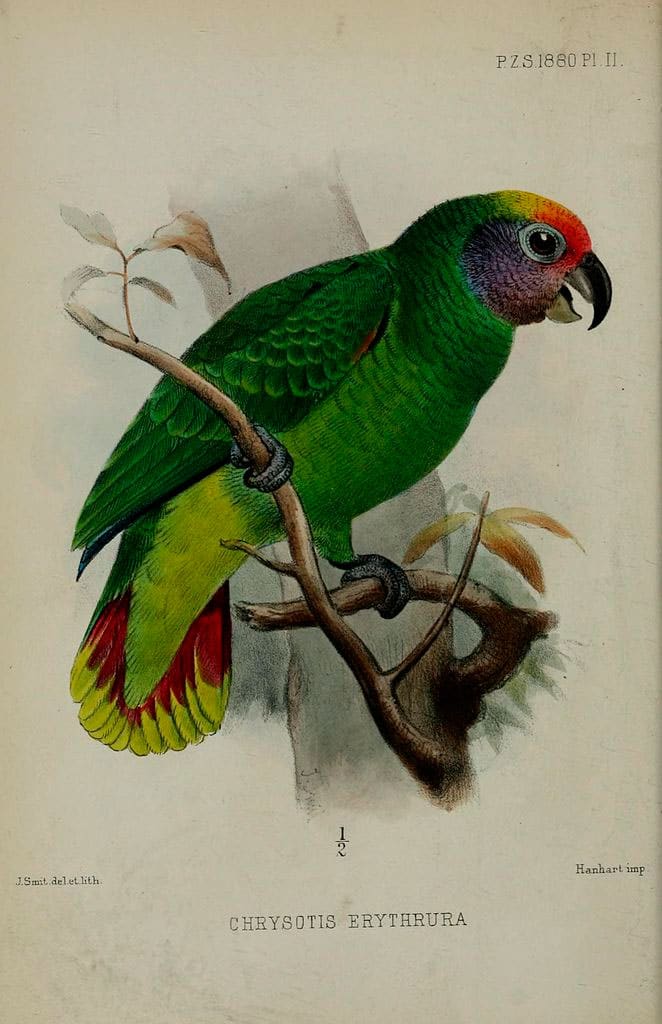
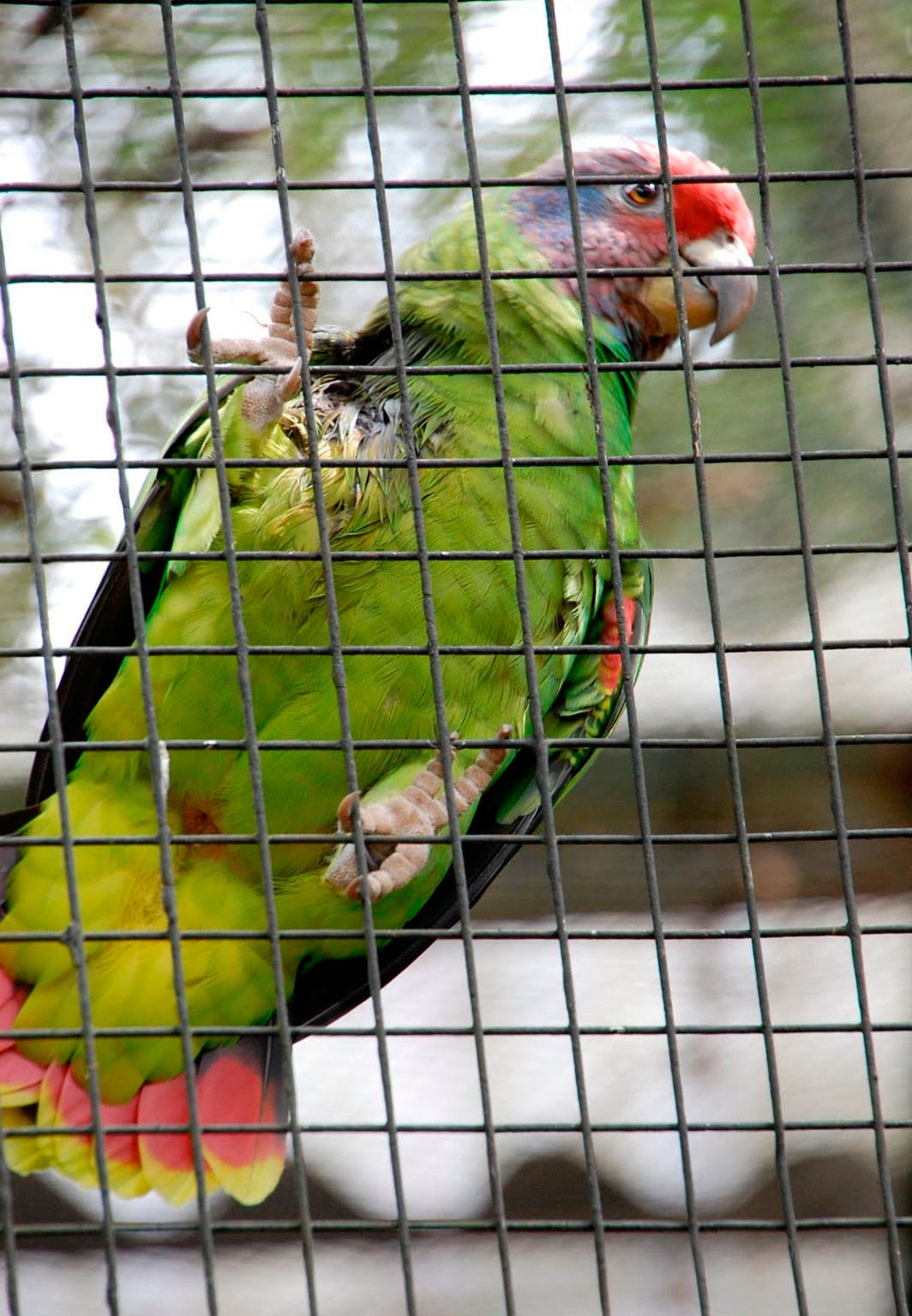
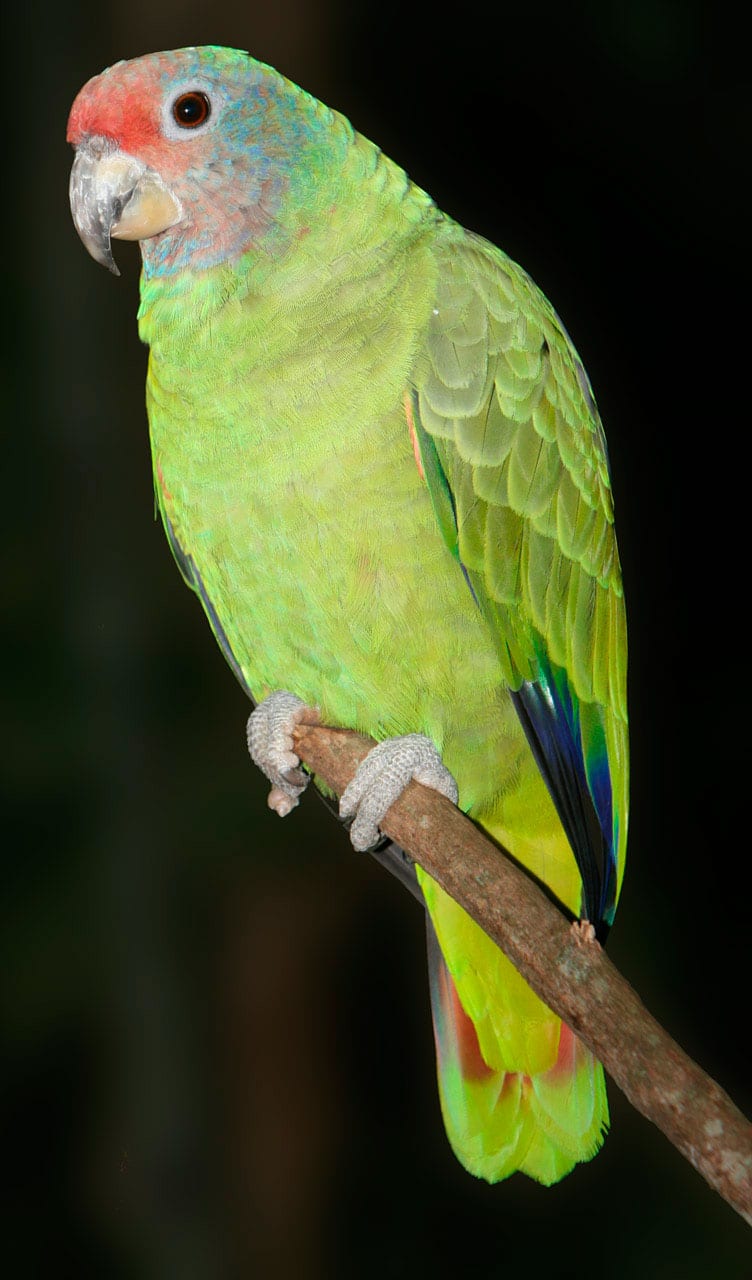
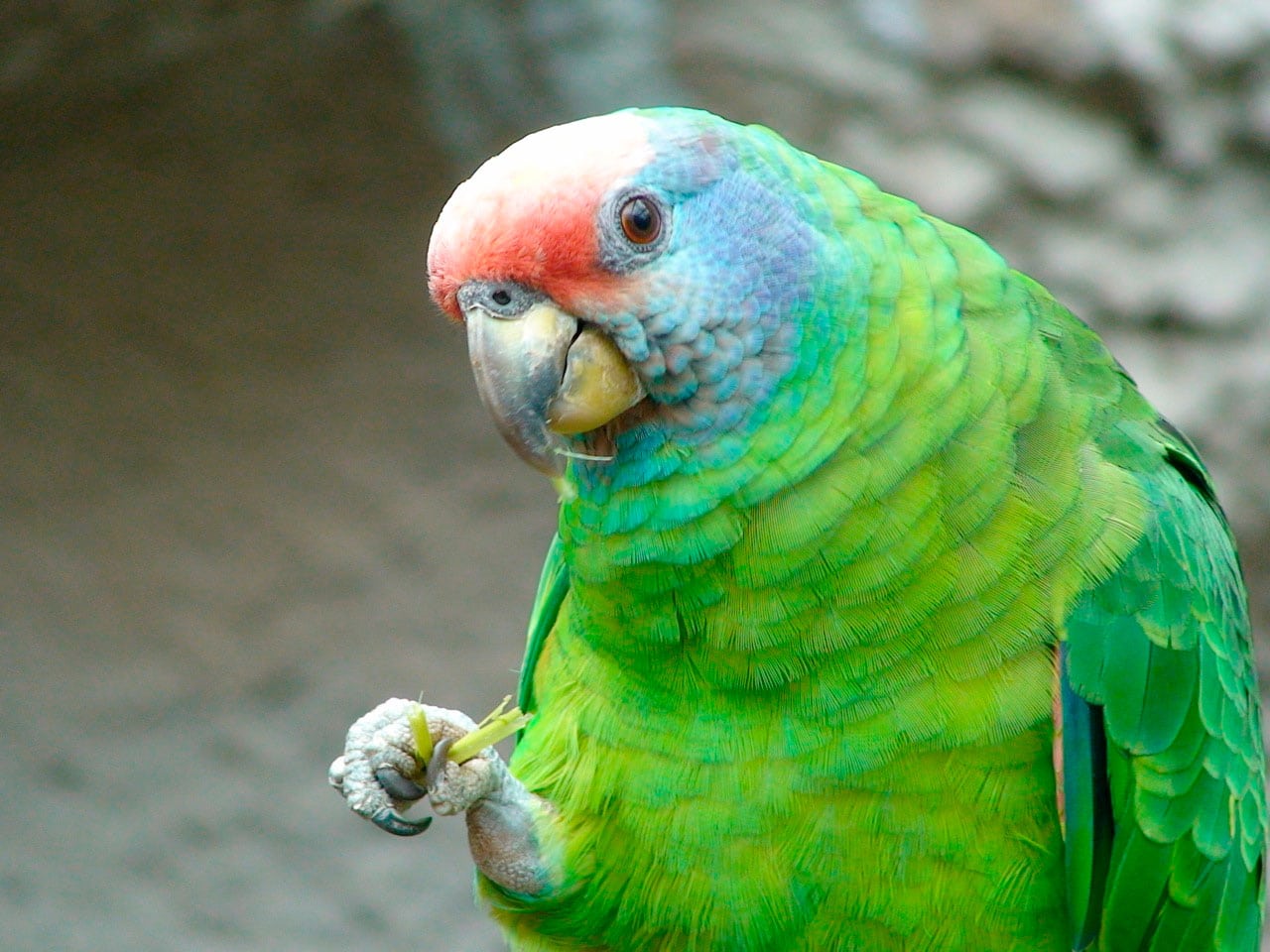
The Red-tailed Parrot(Amazona brasiliensis) has forecrown, front of crown and lores, red; Subsequent red feathers crown with purple tips; cheeks, ear-coverts, sides neck and throat, mauve-blue; back of the crown and nape, green with black tips.
Upperparts green, some feathers rump with yellow points. The median, greater coverts and secondary internal clearly appear yellow; edge front of the wing
Red and yellow; primaries grey-black, secondaries green, turning blue towards the tips.
Under the wings, brighter yellowish green; flight feather of black and blue color on the basis of innerwebs. Underparts brighter yellowish green, paler in undertail-coverts. Tail green with broad greenish-yellow tips, lateral feathers marked basally with purplish-blue on outerweb and tipped yellowish-green with broad subterminal band red.
Bill pale horn with dark tip; irises orange; legs pink-gray.
Both sexes are similar. The immature It is less extensive in red head, a plumage darker overall and irises darker.
Sound of the Red-tailed Parrot.
taxonomic note:
The molecular study suggests that this species is closest to the Orange-winged Parrot(Amazona amazonica). Previously it thought to form a group with Blue cheeked Parrot (Amazona dufresniana) and Red-browed Parrot (Amazona rhodocorytha), and it has been treated as conspecific with one or both. monotypic.
Habitat:
Video "Red-tailed Parrot"
The Red-tailed Parrot dwells in a restricted area or coastal lowland forest and wetlands with rare species and structural diversity, including moist lowland forests, restinga, freshwater marshes and mangroves. Your preferred coastal habitats have complex channel networks, swamps and wetlands. Trees characteristic of its forest habitat include Luehea and Andira, while the vegetation of the islands, where they sleep and breed, They are dominated by several species Halophyte and formations restinga.
Apparently, some birds are practically living in flooded forests, probably due to increased availability of nests. Sympatric presence and partnership with the Red-spectacled Parrot(Amazona pretrei) in forests Araucaria, probably wrong. Lives in altitudes not exceeding the 300-400 m, Although there are records to 700 metres in Paraná. Forman communal shelters (often in mangroves) during at least part of the year, with more than 750 birds reported at a meeting (1985).
Reproduction:
They nest in the cavity of a living or dead tree, for example, palms Jerivá(Syagrus romanzoffianum) and guanandi(Callophyllum Brasiliense) and occasionally arboreal nests of termites; height generally, but recorded only a nest 1 meter above the floodwater. Usually it played in flooded or swampy areas, including mangroves. breeding season in September to February, in some cases in April. Clutch 5-4 eggs. The eggs are hatch during 27 to 28 days, and the period until nest abandonment is thought to last from 50 to 55 days
Possibly they inhabit the extreme northeast Santa Catarina, adjacent to Paraná, but there are no reliable records. An old record Rio Grande do Sul it seems unlikely. possibly some seasonal movements lower in winter (May-August).
The rapid decline in population in the twentieth century it is due in part to the loss of habitat, with most areas densely settled and totally deforested, the remaining threatened are given by urbanization (for example, in isla Long), the felling of trees nesting and feeding, as well as the Palmas for human use (shipbuilding and food) and conversion of wetlands for water buffalo and rice production (birds also face competition from grazing animals for consumption of fruits Erythrina speciosa). But, direct human exploitation of the species is not now a less serious problem, some related to their hunting for food, although most suffer their capture illegal for trade. A recent study 49 showed that nests 41 of them they were illegally stolen their young, while the 1,27% available habitat was lost only in 1993.
Total wild population estimated in 3.600 birds (1995) with rapid decline of several hundreds Predicted. Distribution area probably no more than 6.000 km2, with large parts of this extension susceptible to sea level rise caused by climate change.
protected by national legislation. Live in several areas protected (for example, Isla del Cardoso, Sao Paulo), but in them there is only a very small proportion of birds.
Conservation:
State of conservation ⓘ
Vulnerable ⓘ(UICN)ⓘ
• Current category of the Red List of the UICN: Vulnerable.
• Population trend: Increasing.
• Population size : 6000-6700.
Rationale for the Red List category
The catch for cage bird trade and loss of habitat are the major threats to this species. Despite the heavy pressure to capture the early nineties, It is believed that the range of the species remained essentially the same, and populations have been stable or declined less steeply than feared, According to a recent estimate that suggests a population increase. Due to its small breeding range and highly fragmented habitat, the species qualifies as Vulnerable.
conservation project "Red-tailed Parrot"
Amazona brasiliensis - Puffin of red-tailed - Red Parrot-tailled
The winter counts in 2015 registered 7.464 and individuals in Paraná 1.712 in São Paulo, with both populations continuing to increase (D. Waugh in some ., 2015). The population It is estimated, therefore, between 9.000 and 10.000 individuals, equivalent approximately to 6.000 to 6.700 mature individuals.
Justification of trend
It is suspected that the conservation measures long term have contributed to a recent increase in population at a rate unquantified, although habitat fragmentation and poaching remain significant threats (Waugh 2006).
Threats
In the municipality of Canaanite (a quarter of the distribution of the species) (Freire 1994), has been caught during the breeding period of 1991-1992 for domestic trade and (especially) international with 356 birds. Of 47 controlled nests between 1990 and 1994, six were naturally default and the other 41 stolen by human (Freire 1997). Nest cavities are almost always damaged when the chicks are captured, reducing the number available (Freire 1994). Habitat loss persists for shipbuilding, banana plantations, cattle and buffalo and beach houses (Lalime 1999, Snyder et to the., 2000). They cut the Palmitos for processing in Guaraqueçaba (Lalime 1999). The proposed construction of a bridge to Ilha Comprida increase the pressure of tourism and habitat conversion (Snyder et to the., 2000).
Conservation Actions Underway
CITES Appendix I and II and protected by Brazilian law. This species is not considered of conservation concern nationwide in Brazil (MMA 2014). They are distributed within 15 protected areas, but these do not apply locally (Freire 1994, Lalime 1999). The Superagui National Park in Paraná, It is a bastion for the protection of the species (R. Bóçon in litt., 2006). The creation of new reserves is hampered by economic interests (Freire 1994). Several programs are increasing local awareness (Freire 1994, Lalime 1999 , Padua et al. 2001). Conservation projects and protected areas created in the area of ​​distribution of species appear to be paying off, although there are still pitfalls. There are herd books and successful captive breeding programs in the European Union and Brazil (Lucker 1998) and the provision of artificial nests and repair of natural nesting cavities is enhancing reproductive success in the wild (Waugh 2006). Conservation Project of the Amazon Redstart is monitoring the population in Paraná (R. Bóçon in litt., 2006).
Conservation Actions Proposed
Conduct surveys to monitor population trends and support captive breeding programs. Monitoring discount rates for trade. Monitor trade levels. Monitor the rates of loss and degradation of habitat. Apply laws on trafficking, especially in the paths to breeding islands (Lalime 1997, Lalime 1999). effectively protect existing reserves (Lalime 1997, Lalime 1999). formally appoints the Ilha Comprida State Park and Ecological Station Itapanhapina (Snyder et to the., 2000). Expand Superagüi National Park to include Ilha do Pinheiro (Snyder et to the., 2000). Reforest nursery islands (Lalime 1999). Continue and expand awareness efforts (Lalime 1999).
The "Red-tailed Parrot" in captivity:
CITES Appendix I and II and protected by the Brazilian legislation.
Each captive specimen of this species which is capable of reproducing, It is placed in a Program well managed captive breeding and not be sold as a pet, in order to ensure long term survival.
– Avibase
– Parrots of the World – Forshaw Joseph M
– Parrots A Guide to the Parrots of the World – Tony Juniper & Mike Parr
– Birdlife
Photos:
(1) – A Red-tailed Amazon at Parque das Aves, Foz do Iguaçu, Brazil By Kee Yip from Union City, California, USA (IMG_4509_P1040018) [CC BY 2.0], via Wikimedia Commons
(2) – A juvenile Red-tailed Amazon which is grasping something in its right foot, probably to chew or eat it By writhedhornbill (originally posted to Flickr as Red tailed amazon) [CC BY 2.0], via Wikimedia Commons
(3) – Red-tailed Amazon (Amazona brasiliensis) bird Park, Foz do Iguaçu, Brazil By http://www.birdphotos.com (Own work) [GFDL or CC BY 3.0], via Wikimedia Commons
(4) – Red-tailed Amazon at the zoo By Elcio Ferreira [CC BY-SA 2.0], via Wikimedia Commons
(5) – A Red-tailed Amazon at Parque das Aves, Foz do Iguaçu, Brazil By Chad Bordes (Picasa Web Albums) [CC BY 3.0], via Wikimedia Commons
(6) – CHEYSOTIS ERYTHRURA By Zoological Society of London.; Zoological Society of London. [CC BY 2.0 or Public domain], via Wikimedia Commons
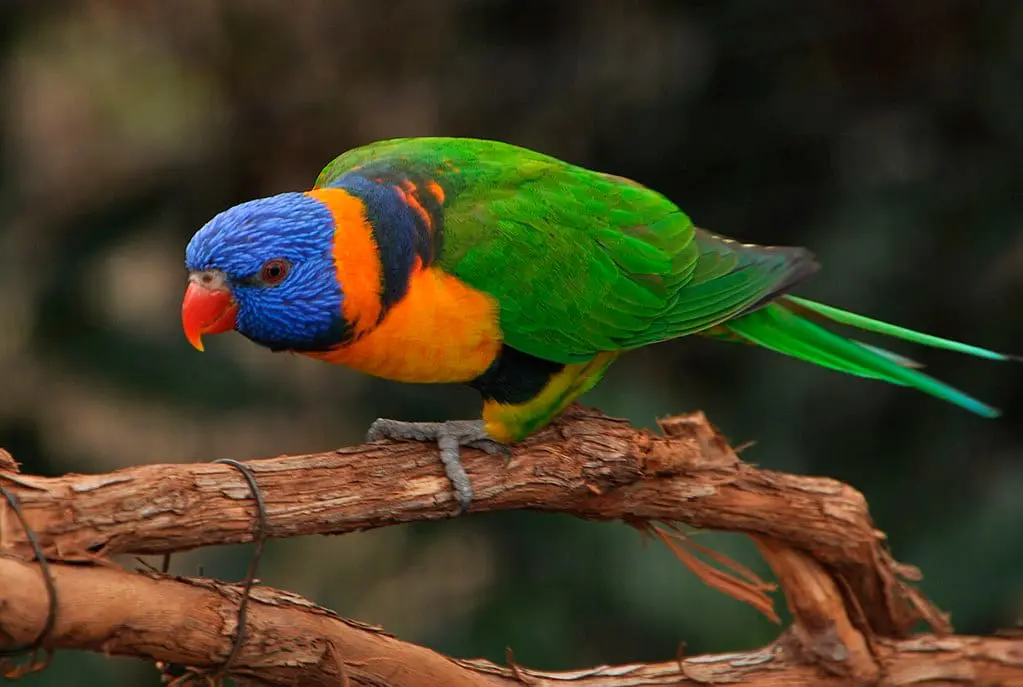
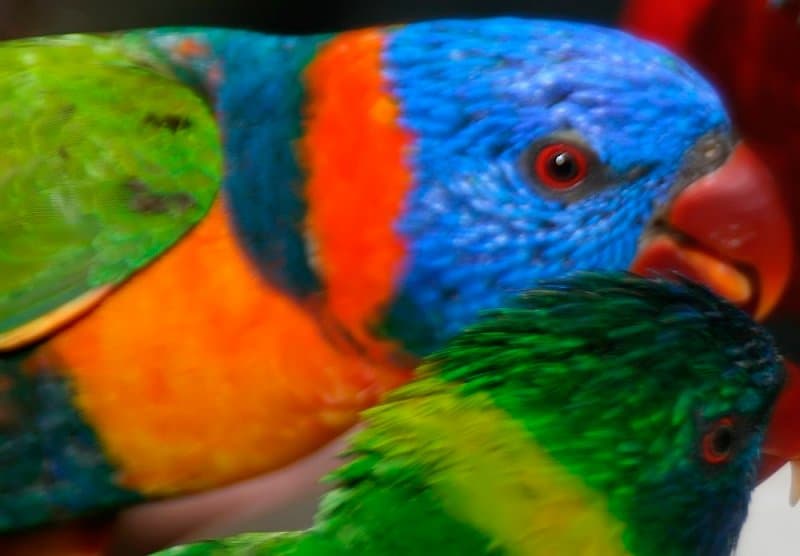
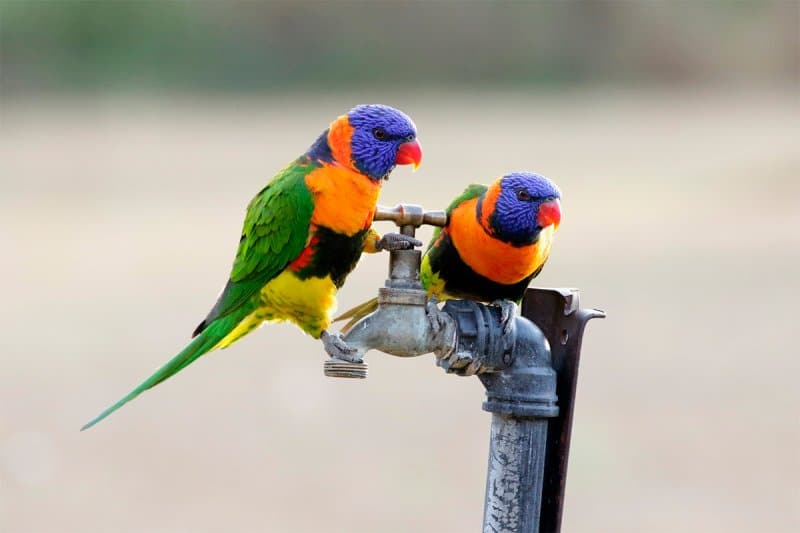
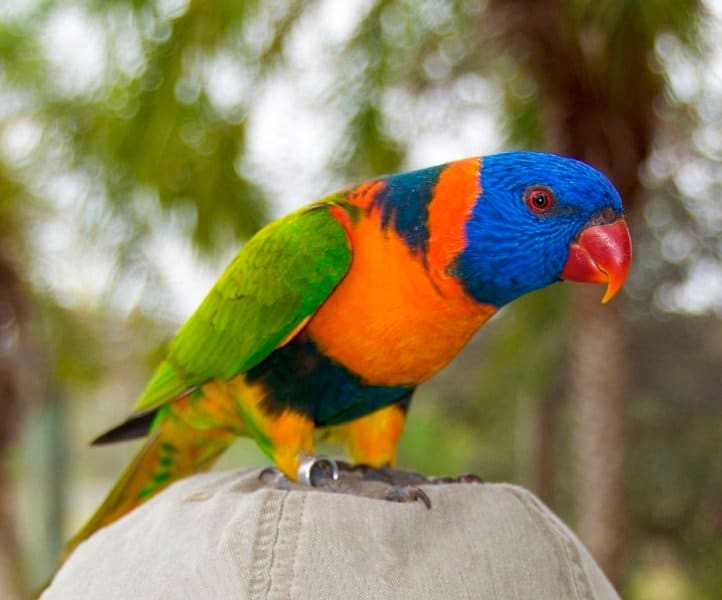
The Red-collared Lorikee(Trichoglossus rubritorquis) they have the head violet / blue with purple / blue streaks on face; throat and sides of the nape blackish; neck orange / red; chest yellow / orange without sweeping; abdomen dark green; the thighs green / yellow until undertail-coverts; upperparts and tail green; underwing-coverts orange; yellow and broadband under the wing
. Bill orange / red. Eyes dark orange.
The youth they are similar to adults.
taxonomy:
Occasionally he treated in Australian literature as a separate species of Coconut Lorikeet(Trichoglossus haematodus), but this is only appropriate review, as here, the whole complex of Rainbow Lorikeet: differs from Rainbow Lorikeet(Trichoglossus moluccanus) in his collar Orange Fire vs. pale green; Blue neck vs. green; vs belly black. blue; and of the Scarlet-breasted Lorikeet(Trichoglossus forsteni) in his collar Orange Fire vs. yellowish green; nape blue vs. red crab; nape blue vs. dark blue or green; larger size.
Species Monotypic.
Sound of the Red-collared Lorikee.
Habitat:
There have been no large-scale seasonal movements are common throughout the year in some places.
It's more common in lowlands, but it is up 2400 meters above sea level. They can be observed in a wide variety of areas including settlements, forests, coconut plantations, Savanna, eucalyptus forests and mangroves. They are in mixed flocks with other parrots; small and noisy groups. Nomads, since they depend on flowering trees. It perches communally in groups of hundreds of birds.
Reproduction:
Reproductive biology very similar to that of the Coconut Lorikeet(Trichoglossus haematodus). May-January season in Northern Territory. The laying Typically two or three eggs.
Food:
Diet very similar to the Coconut Lorikeet(Trichoglossus haematodus) which feeds on nectar, fruit, flowers and insects, including Pandanus spiralis. It can also be found around artificial feeding stations.
I necked Lori distribution:
Extension of the distribution (breeding/resident): 1.100.000 km2
North Autóctono Australia, which they inhabit the lowlands. Integrated or hybridized with Coconut Lorikeet(Trichoglossus haematodus) on queensland peninsula, Australia, in southwest Cape York.
Red-collared Lorikeet Conservation:
Rationale for the Red List category
1. Current red list category of the UICN: Least Concern..
2. The population trend: Decreasing.
3. Population size : It is unknown.
This species has a extremely large distribution area, and therefore does not approach the thresholds Vulnerable under the criterion of size range (Extent of Occurrence <20,000 km2 combined with a decreasing area size or fluctuating distribution, extension / habitat quality, or population size and a small number of places or severe fragmentation).
While the trend of the population seems to be decreasing, the decline is not believed to be rapid enough to approach the Vulnerable thresholds according to the population trend criterion (decrease of more than 30% in ten years or three generations).
The population size has not been quantified, but it is not believed to approach the thresholds Vulnerable under the criterion of population size (<10.000 mature individuals with an estimated continuous decrease in> 10% in ten years or three generations, or with a specific population structure). For these reasons, the species is assessed as Least concern.
Justification of the population
Global population size has not been quantified, but the species is described as abundant (pit et to the. 1997).
Justification trend
It is suspected that the population is declining due to unsustainable levels of exploitation.
Threats
The species has been the subject of a intense trade: from 1981, When it was included in the Appendix II of the CITES, they have been 100.388 individuals caught in international trade (UNEP-WCMC CITES Trade Database, January 2005).
In captivity:
In Europe, this species of lori has been largely imported from early last century, and in 1910 it managed to raise in the zoo London (four years later, the first calf in France). Currently it is rare outside Australia. Life expectancy: 20 years in nature, 15-25 years in captivity.
Alternative names
– Australian rainbow lory, Rainbow Lorikeet (Red-collared), Red collared Lorikeet, Red-collared Lorikeet (English).
– Loriquet à col rouge, Loriquet à collier rouge, Loriquet à tête bleue (à col rouge), Loriquet à tête bleue (rubritorquis) (French).
– Australischer Blauwangenallfarblori, Darwin-Allfarblori, Rotnackenlori (German).
– Periquito-arco-íris (rubritorquis), Lóris-de-colar-rojo (Portuguese).
– Lori cuellirrojo, Lori Arcoiris (rubritorquis) (español).
1. Avibase
2. Parrots of the World – Forshaw Joseph M
3. Parrots A Guide to the Parrots of the World – Tony Juniper & Mike Parr
4. Birdlife
Photos:
(1) – A Red-collared Lorikeet at Cincinnati Zoo, Ohio, USA by Fr. Ted Bobosh [CC BY-SA 2.0], via Wikimedia Commons
(2) – A Red-collared Lorikeet at Cincinnati Zoo, Ohio, USA by Ted [CC BY-SA 2.0], via Wikimedia Commons
(3) – Red-collared Lorikeet standing on a man’s cap at Lion Country Safari, Florida, USA by derivative work: Snowmanradio (talk)Trichoglossus_haematodus_rubritorquis_-Lion_Country_Safari-6.jpg: Duncan Rawlinson from Vancouver, BC [CC BY 2.0 or CC BY 2.0], via Wikimedia Commons
(4) – Red-collared Lorikeet (Trichoglossus rubritorquis) in the Walsrode Bird Park, Germany by Quartl [CC BY-SA 3.0], from Wikimedia Commons
(5) – Red-collared Lorikeet (Trichoglossus haemotodius rubritorquis) by Geoff Whalan – Flickr
(6) – Red-collared Lorikeet (Trichoglossus haemotodius rubritorquis) by Geoff Whalan – Flickr
(7) – Red-collared Lorikeet (Trichoglossus haematodus rubritorquis) by Graham Winterflood – Flickr
(8) – Trichoglossus haematodus rubritorquis Location taken: Lion Country Safari, Loxahatchee, Florida Photo by David J. pole [CC BY-SA 4.0], via Wikimedia Commons
(9) – Red-collared Lorikeet (Trichoglossus haemotodius rubritorquis) by Geoff Whalan – Flickr
(10) – A painting of a Red-collared Lorikeet (originally captioned «Trichoglossus rubritorquis. Scarlet-collared Parrakeet by Edward Lear [Public domain]
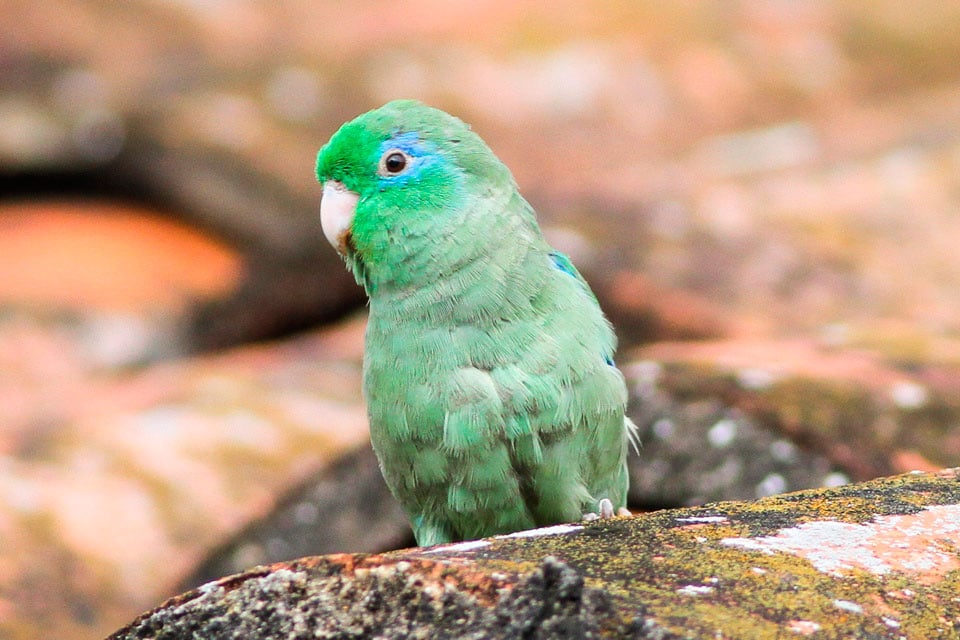
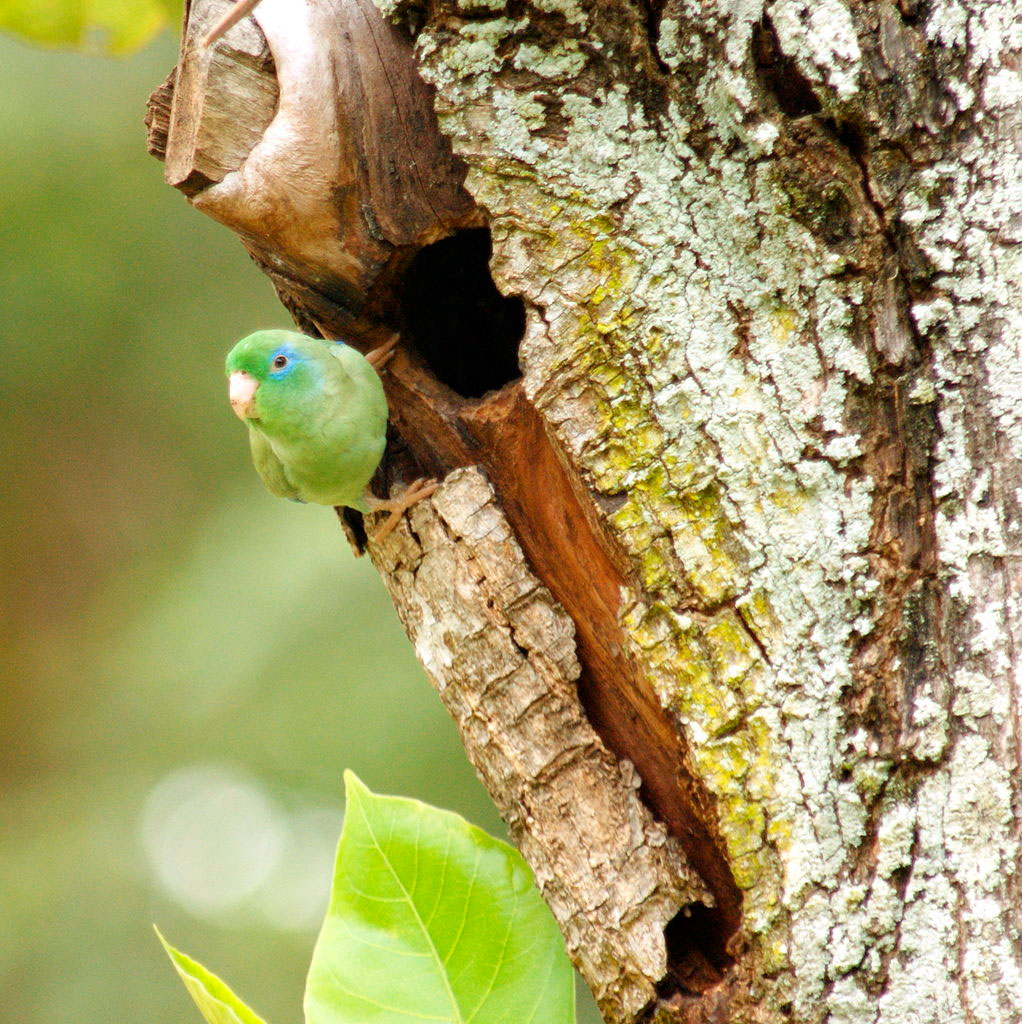
The male of the Spectacled Parrotlet(Forpus conspicillatus) has a yellowish green forehead extending the cheeks and to the throat.
The underparts They are slightly off in colouration, with a bluish gray suffusion in chest. The area surrounding the eyes It is cobalt blue. The wings and upperparts is dark green, with the back and rump blue-violet color, with a darker shade on own rear.
The bill Pink is white. The legs They are pink. The irises is dark brown.
the colors of the female they are duller in terms of the general coloring. Their upperparts They are brighter, with the area around the eyes, emerald green. The underparts They are more yellowish green.
It is very common. It is found in varied ecosystems, patches of forest, clear with scattered trees, cultivated areas, from 200 m to 1800 m (migrate attitudinally up 2600 metres in Bogotá). They are noisy flocks of more of 120 individuals.
Reproduction:
Nest in postholes and termiteros.
Food:
Feeds on grass and weed seeds, fruit, berries, flowers and buds.
Distribution:
Size of the area of distribution (reproduction / resident): 822.000 km2
Patchy and discontinuous distribution. east of Panama, Colombia and West of Venezuela.
Distribution 3 subspecies:
Forpus conspicillatus caucae
(Chapman, 1915) – Southwest of Colombia, to the West of the Andes (Cauca and Nariño); possibly west of Ecuador.
Forpus conspicillatus conspicillatus
(Lafresnaye, 1848) – Nominal. From the tropical eastern Panama north central Colombia.
Forpus conspicillatus metae
(Borrero & Hernandez-Camacho, 1961) – Slope of the Andes of Colombia to the west end of Venezuela.
Conservation:
State of conservation ⓘ
Minor Concern ⓘ(UICN)ⓘ
• Current category of the Red List of the UICN: Least concern.
• Population trend: In increased.
Justification of the population
The size of the world population It has not been quantified, but this species is described as «common» (Stotz et to the., 1996).
Justification of trend
It is suspected that the population is increasing as habitat degradation is creating new areas of suitable habitat.
"Spectacled Parrotlet" in captivity:
In captivity is common in some European countries, rare elsewhere. It is a bird lively, Intelligent and with attitude. They are highly valued for being quiet; they can learn many words and whistle very well. Son loving and they love spending time with their owners, However, they are happy and independent enough to happily play with their toys while the owner is absent. Need much space as it is a bird very active, as well as different toys.
Alternative names:
– Spectacled Parrotlet (English).
– Toui à lunettes, Perruche-moineau à lunettes (French).
– Brillensperlingspapagei, Augenring-Sperlingspapagei, Brillenpapagei (German).
– Tuim-da-colômbia (Portuguese).
– Catita Enana Pálida, Cotorrita de Anteojos, Periquito de Anteojos (español).
– Periquito Ojiazul (Venezuela).
– Avibase
– Parrots of the World – Forshaw Joseph M
– Parrots A Guide to the Parrots of the World – Tony Juniper & Mike Parr
– Birdlife
– parrots book, parrots and macaws Neotropical.
– Photos:
(1) – A female Spectacled Parrotlet in Manizales, Caldas, By Julian Londono from Colombia Manizales, Colombia [CC BY-SA 2.0], via Wikimedia Commons
(2) – A male Spectacled Parrotlet in Manizales, Caldas, By Julian Londono from Colombia Manizales, Colombia [CC BY-SA 2.0], via Wikimedia Commons
(3) – A pair of Spectacled Parrotlets in Manizales, Caldas, By Julian Londono from Colombia Manizales, Colombia [CC BY-SA 2.0], via Wikimedia Commons
(4) – A male Spectacled Parrotlet in Colombia just outside the entrance of its nest By Rogier Klappe [CC BY 2.0], via Wikimedia Commons
(5) – Spectacled Parrotlet (Forpus conspicillatus) by Ron Knight – Flickr
(6) – PSITTACULA CONSPICILLATA By Internet Archive Book Images [No restrictions], via Wikimedia Commons

 Vulnerable ⓘ (UICN)ⓘ














.jpg)


.jpg)
.jpg)


_(14729508596).jpg)