โ–ท The world of Pets: Dogs, cats, birds, reptiles, amphibians

Cape Parrot
Poicephalus robustus


Lorito Robusto

Content

Description:

32 cm. medium length and a weight between 300 and 400 g..

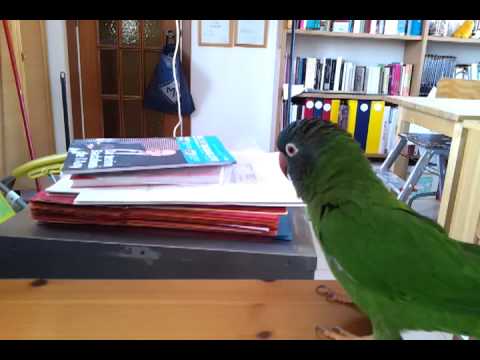
The Cape Parrot (Poicephalus robustus) has the head, neck and throat between olive brown and olive yellow, with darker spots (almost black in some birds), especially in the crown; lores and cheeks blackish; pale red frontal band, is present, occasionally, in males (generally evident in females).

The mantle feathers and scapulars dark green opaque, bright green-edged; rump bright green.

Coverts on the leading edges of the wings, Since the carpal joints at the base of the primaries, bright orange red; upper wing coverts, dark green to black, with lighter green edges; below, the feathers of the wings blackish and green. The primaries and secondaries black top, dark brown below. High area of the chest, stomach and vent, bright green; the thighs orange red glossy. Upper, the tail black; undertail, dark brown.

Some birds (around the 10%) have feathers yellow in the plumage spread.

Bill color horn; irises dark brown to reddish brown; legs bluish grey.

The females, generally (Although not always), they have well defined orange red frontal band.

The youth lack of color marks orange red envelope the wing-coverts and the thighs, but tend to show a bit of red in the forecrown.

Subspecies description:

Taxonomic status:

In a study initiated in 1992, the taxonomic status of Lorito was revised Robusto (Poicephalus robustus) (Gmelin), and two species were proposed; Poicephalus robustus, restricted to montane forests of southern Africa, Poicephalus fuscicollis suahelicus, with wider distribution in wooded areas, and Poicephalus fuscicollis fuscicollis, similar to the Poicephalus fuscicollis suahelicus ostensibly, but with discontinuous, restricted to a narrow range of forests and West Africa.

Subspecies Poicephalus robustus

  • Poicephalus robustus robustus

    (Gmelin, 1788) – The nominal species


  • Poicephalus robustus suahelicus

    (Reichenow, 1898) – Of larger size the species nominal, the male has the head and the neck a silvery gray and lacks the reddish frontal band. The female has orange colouring in the the thighs and in the shoulders and in the cere, while the male not. Blue tint in the rump.


  • Poicephalus robustus fuscicollis

    (Kuhl, 1820) – The smaller subspecies. With more blue tones, especially in rump and bottom of the back.

Habitat:

They live in a variety of forest types, including Red Mangroves (Rhizophora mangle) (for example, in Gambia), riparian forests (for example in Ghana, Zimbabwe), Savanna Woods (for example, Nigeria, Ivory Coast), in montane forests at altitudes of 3,750m (for example, east of Zaire), in lowland forests (for example, South Zaire).

The birds of the Southern Africa they have favoritism by the Acacia mearnsii and Podocarpus forests at altitudes between 1.000 and 1,700 m, separating attitudinally and ecologically in the subspecies suahelicus, It occurs in lowland forests.

The birds of the Southern Africa (also perhaps other species) they form communal roosts before spreading to power remote areas (until 90 km) in small flocks.

Sometimes seen separately but more usually found in groups of up to 20 birds (sometimes 50). It forms mixed flocks with peers.

Reproduction:

The nest in hollow trees (including in Brachystegia, Adansonia or Podocarpus) between 6 and 12 meters above the ground.

The season of breeding varies with locality. In Gambia, reportedly, breeding takes place between the months of February and April, While in Zimbabwe It is estimated to be between the months of March to June, and between October and November. In South Africa, breeding takes place in June and between August and October.

The laying tends to be of 3 to 4 eggs.

During the courtship the male feeds the female making exaggerated turns his head and dropping their wings to form a kind of layer around the lower half of your body. The pair shows a strong union ties and they spend much time grooming each other.

Food:

In Zimbabwe, In addition to daily trips in search of food, seasonal movements are performed in search of Uapaca and fruits of Sysygium.

They feed on fruits of ficus, Olea capensis, Mimusops caffra, Acacia molissima, Melia azecdarach, Terminalia, Calodendron capense and Commiphora, the consumption of seeds has also been recorded from the acacia mearnsii, Monotes glaber and the fruits of the Parinari curatellifolia. But, they may prefer the pulp of fruit, discarding the seeds and grains of the seeds.

Has been feeding of millet in Zimbabwe and Malawi, of peanuts harvested in Gambia and, occasionally, visiting gardens of Apple trees, but numerous enough to be considered a plague serious nowhere.

The birds of the Southern Africa feed almost exclusively on fruit of the Podocarpus, long as they are available.

Use the peak to climb between the branches when they feed in the trees; They also feed on the ground. The Cape Parrot make daily trips to secret locations for drinking water.

Distribution:

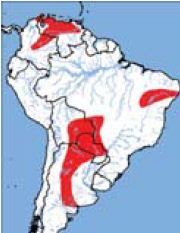
Probably occupy three zones separated, in the West, South-Central and South of Africa.

In West Africa, are from Gambia and South of Senegal to the East of Ghana and Togo.

In the Center-South of Africa, from the southwest of Congo, South and East of Zaire, Southwest of Uganda, Rwanda and from the center of Tanzania to the North of Namibia, North of Botswana, Zambia and Zimbabwe.

In South Africa from the North-East of Transvaal to the Province Eastern Cape.

Flocks of foraging roam unpredictably and can remain away from traditional sites for weeks. Sometimes they make seasonal movements in relation to the availability of food, for example, in the northern savannas of Ghana.

Local and mostly uncommon across the range, Although more numerous and frequent in Ghana.

Subspecies distribution:

  • Poicephalus robustus robustus

    (Gmelin, 1788) – The nominal species


  • Poicephalus robustus suahelicus

    (Reichenow, 1898) – Are distributed by the center of Angola; Southeast of the Democratic Republic of the Congo, Rwanda and South of Tanzania until Zimbabwe, North of Mozambique, and far northeast of South Africa; in populations along the lower Congo River the three subspecies can mix.


  • Poicephalus robustus fuscicollis

    (Kuhl, 1820) – Are distributed from the South of the Senegal and Gambia to the North of Ghana

Conservation:


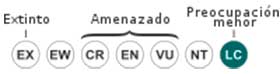
minor concern


โ€ข Current Red List of UICN: Least concern

โ€ข Population trend: Decreasing

In 1988 included for the first time in the red list of threatened species by the IUCN as least concern species.

The size of its current population is estimated at less than 1.600 birds in their natural habitat.

Why not join this parrot species in critical hazard is due to the subspecies of this they comprise an area of diffusion much greater than that of the nominal species, whereupon, This leads to a growth in the population of subspecies and the decrease of the nominal species. The subspecies occupy all the Central Africa and Western, while the Poicephalus robustus only lives in some provinces of South Africa as they are Eastern Cape, KwaZulu-Natal and Limpopo.

Over time the Poicephalus robustus, they have drastically dropped its population due to the uncontrolled felling of the forests of Sandalwood to manufacture furniture. Thus reaching that there is only two percent of the forest of Sandalwood.

Diffusion area of Poicephalus fuscicollis and Poicephalus robustus

In captive the Cape Parrot it is found in small quantities by several countries of Europe and without many successful breeding advances, so the first objective to preserve the nominal species is to control the logging of forests, Since the Cape Parrot they have to travel many miles to feed, as there is no food have to descend to feed from the crop fields where many die because they are hunted by the owners of the fields. Forests are also needed in the life of the Poicephalus robustus since they nest in cavities of the trees, they feed on.

The legal and illegal trade It is another point to be highlighted in the conservation of this species. Since 1998 the countries with the most legal exports have been Tanzania, Guinea-Bissau, Guinea, Democratic Republic of the Congo and Ivory Coast. What makes think that the nominal species It has been the least affected in the terms of trade while the subspecies they have been the most affected and the most marketed. This can be known by looking at the area of diffusion of the subspecies and the countries with the most exports made..

The diseases they are also a major threat, above all in the nominal species. The disease of PBFD or beak and feather disease (Psittacine Beak and Feather Disease virus) is that more deaths has caused to the Poicephalus robustus.

"Cape Parrot" in captivity:

It is very similar in nature to the Grey Parrot.
Its capacity for imitation is still little known since, for years, has been very difficult to get in poultry farming.

Not advisable to keep mixed aviaries. Son quiet and depending on their way of breeding (natural or by hand) and previous experiences, they can be quite confident and curious, even without being hand reared do not usually take to commit themselves. As pets they are very Welcome to, Smart and affectionate, with a very good character.

Captive breeding of this species may be the last hope of saving it from total extinction.. The number of specimens in captivity is low, but enough, If handled properly to strengthen the species.

In terms of their longevity, according to sources, a Cape Parrot lived 29,7 years in captivity. In captivity, These birds can be raised from the 5 years of age.

Alternative names:

Cape Parrot, Brown necked Parrot, Brown-necked Parrot, Cape or Brown-necked Parrot, Gray-headed Parrot, Grey-headed Parrot (English).
Perroquet ร  cou brun, Perroquet du Cap, Perroquet du Cap ou P. ร  cou brun, Perroquet robuste (French).
Graukopfpapage, Kap Papagei, Kappapagei (German).
Papagaio-de-bico-grosso (Portuguese).
Lorito Robusto, Loro de El Cabo, Lorito del Cabo (espaรฑol).


scientific classification:

Gmelin Johann Friedrich

Order: Psittaciformes
Family: Psittacidae
Genus: Poicephalus
Scientific name: Poicephalus robustus
Citation: (Gmelin, JF, 1788)
Protonimo: Psittacus robustus

Images "Lorito Robusto":

————————————————————————————————

Cape Parrot (Poicephalus robustus)


Sources:

Avibase
– Parrots of the World โ€“ Forshaw Joseph M
– Parrots A Guide to the Parrots of the World – Tony Juniper & Mike Parr
– Birdlife
Wikipedia
– Loromania
Mundoexotics

Photos:

(1) – To Brown-necked Parrot at Jurong Bird Park, Singapore By Peter so [CC BY 2.0], via Wikimedia Commons
(2) – Cape Parrot en Benvie, Karkloof, KwaZulu-Natal, South Africa By Alan Manson [CC BY-SA 2.0], via Wikimedia Commons
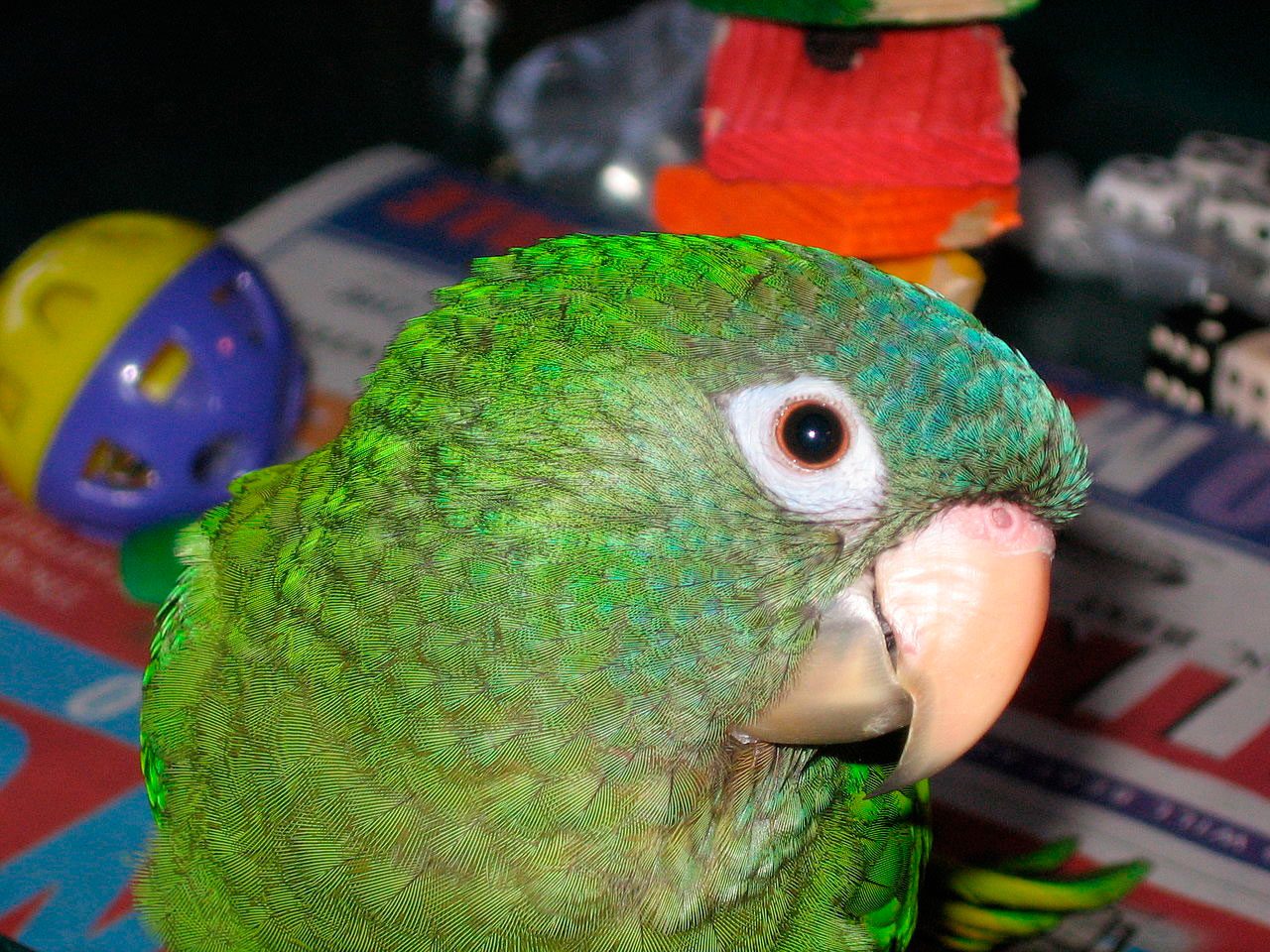
(3) – Youth, captive, friendly Poicephalus robustus fuscicollis by Bob Corrigan – Flickr
(4) – Male Cape parrot (Poicephalus robustus). Image credit: Cyril Laubscher – SCI-news.com
(5) – Cape parrot flying low over to wild plum tree. Africa's most endangered parrot like never before... (Rodnick Biljon) – nationalgeographic
(6) – Diffusion area of Poicephalus fuscicollis and Poicephalus robustus By Juan Caparrรณs (Own work) [GFDL or CC BY-SA 4.0-3.0-2.5-2.0-1.0], via Wikimedia Commons

Sounds: Daniel Danckwert (Xeno-canto)
โ–ท The world of Pets: Dogs, cats, birds, reptiles, amphibians

Slaty-headed Parakeet
Psittacula himalayana


Slaty-headed Parakeet

Content

Description:


Anatomy-parrots

Of 39 to 41 cm.. of length and a weight of 125 g..

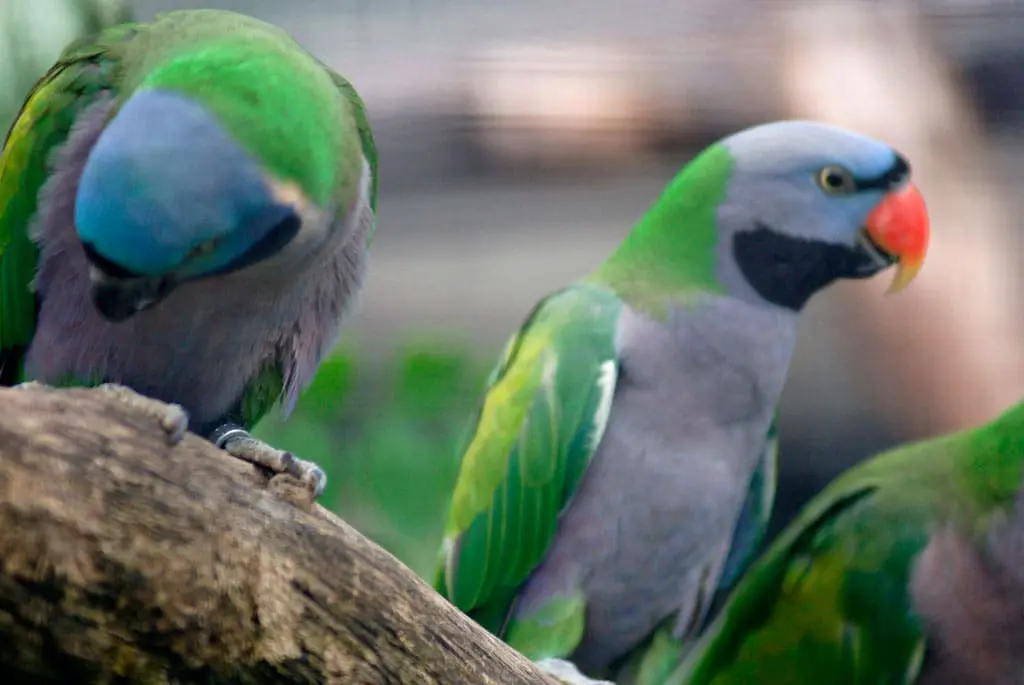
The Slaty-headed Parakeet (Psittacula himalayana) has the forecrown, crown, lores and ear-coverts slaty-grey; chin and lower cheeks black, extending in the lateral narrow shaped collar black, to mark a clear boundary between the dark head and back neck bright green and nape, whose colour fades to duller green on rest of upperparts..

Lesser wing-coverts outer, green, brown the inner coverts, with a distinctive patch shoulder; remaining upperwing-coverts green.
The primaries Green with narrow yellow margins in vane outer; secondaries green. Underwing-coverts bluish green. Underparts bright pale green. Uppertail bright blue green, tipped chrome yellow color in the center, outer feathers green with yellowish tips; undertail-coverts bright yellow.

upper jaw orange-red, tipped pale yellowish, the lower yellower; cere whitish; irises creamy white; legs yellowish green.

The female smaller, more opaque in nape, usually with the tail shorter and often they lack the brown in the patch of the shoulders.

The immature with the head greenish brown opaque; acquire gray slate after first winter. The young birds they have the irises dark.

Habitat:

The Slaty-headed Parakeet Mountain forests are distributed, at altitudes around 2.500 meters in summer; rarely above the 250 meters in winter. Otherwise residents, although there are fluctuations depending on local food supply.

Occupy denser forest than most of its congeners, but preferably in extensions near orchards or farms with high trees. Registered in a variety of slopes and steep wooded valleys, including oak forests, cedars, Oak, rhododendrons and pines.

Observed, in general, in small flocks or family groups, no large gatherings, although flocks 50 birds have been recorded at the end of the monsoon.
Also registered with mixed banndadas Rose-ringed Parakeet, the Plum-headed Parakeet and Blossom-headed Parakeet. Registered a flock of 15 males during the month of November Nepal.

Reproduction:

The nest Slaty-headed Parakeet usually it located in a recess, on top of a tree, at an altitude between 6 and 20 m above the ground; a rotten branch used to excavate a cavity or modificadan the old nest of other species.

In East Afghanistan, the nest is ,normally, an old hole made by a Scaly-bellied Woodpecker (Pico squamatus).

Often several nests are close together.

The breeding season in the west of the range is between March and May, (maybe later at higher altitudes); they leave the breeding area in July; the laying is of 3 to 5 eggs.

Food:

The Slaty-headed Parakeet it feeds on various fruit, cultivated and wild, dried fruits and seeds, depending on the season.

Registered foods include berries of Cornus, Viburnum and Durant, seeds of Terminalia myriocarpa, seeds of Pine Pinus, acorns OAK wide and seedpods Dalbergia, flowers of Bauhinia purpurea and nectar of Woodfordia fruticosa.

Although the overall economic impact of this species is probably light, they are considered locally as a pest due to attacks on corn crops, Apple trees (flower and fruit), pear and walnuts Juglans regia.

Distribution:

Size of the area of distribution (reproduction / resident): 696.000 km2

The Slaty-headed Parakeet It is distributed by the Himalaya occidental, where they are, Commonly, above the 1.350 m, from the East of Afghanistan through northern Pakistan, northern India and Nepal until Bhutan, West of Arunachal Pradesh and Assam (about 92 it is) to the North of the Brahmaputra.

Conservation:

State of conservation โ“˜


minor concern Minor Concern โ“˜ (UICN)โ“˜

โ€ข Current Red List of UICN: Least concern

โ€ข Population trend: Stable

The size of the world population Slaty-headed Parakeet It has not been quantified, but the species, according to sources, is usually common, although apparently very poorly documented in recent decades; uncommon in China.

The population is suspected to be stable in the absence of evidence of any reduction or substantial threats.

"Slaty-headed Parakeet" in captivity:

Fairly common in Australia, not so much in other places. In general, trade is not significant.

Alternative names:

Slaty-headed Parakeet, Himalayan Slaty-headed Parakeet (English).
Perruche de l’Himalaya, Perruche ร  tรชte ardoisรฉe (French).
Himalayasittich, Finsch-Sittich, Schwarzkopf-Edelsittich (German).
Periquito-himalayana (Portuguese).
Cotorra de Cabeza Pizarra, Cotorra del Himalaya (espaรฑol).


scientific classification:

Renรฉ Primevรจre Lesson

Order: Psittaciformes
Family: Psittaculidae
Genus: Psittacula
Scientific name: Psittacula himalayana
Citation: (Lesson, 1832)
Protonimo: Psittacus (conurus) รคฦ’Imlynus

Images "Slaty-headed Parakeet"

Videos "Slaty-headed Parakeet"


Especies del gรฉnero Psittacula

Slaty-headed Parakeet (Psittacula himalayana)


Sources:

Avibase
– Parrots of the World โ€“ Forshaw Joseph M
– Parrots A Guide to the Parrots of the World – Tony Juniper & Mike Parr
– Birdlife

Photos:

(1) – Slatina-headed Parakeet Psittacula Himalayas, Corbett National Park, India By Francesco Veronesi from Italy (Slaty-headed Parakeet – Corbett NP_1842) [CC BY-SA 2.0], via Wikimedia Commons

Sounds: David Farrow (Xeno-canto)

โ–ท The world of Pets: Dogs, cats, birds, reptiles, amphibians

Golden-plumed Parakeet
Leptosittaca branickii


Aratinga de Pinceles

Content


Anatomy-parrots

Description:

Approximately from 36 cm.. of length and a weight of 150 g.
The Golden-plumed Parakeet (Leptosittaca branickii) has the crown, most of the forecrown, the cheeks, the sides of neck and ear-coverts grass-green; close frontal band on bottom of the forecrown orange, extending towards the upper lores; a feature yellowish stripe at the lower lores extending below the eyes to then join in a loop of yellow the part located behind the eyeball.
Upperparts green. above the wings green. Underwing-coverts greenish yellow; underside of feathers opaque yellow flight.

The underparts green, slightly more yellow than the upper, with a large yellow and orange patch at the bottom of the chest.

Upper, the tail of color green with red off on them vane inner; below its long and acute tail opaque reddish.

The bill color horn; cere grey; bare orbital skin pale whitish-grey; Orange the irises; legs grey.

Both sexes similar. The immature not described.

NOTE: Some authors include the species within the genus Aratinga. But, the facial feathers they are distinctive and monotypic, so the gender Leptosittaca is justified for this species.

Habitat:

Video – "Golden-plumed Parakeet" (Leptosittaca branickii)

Near endemic, Golden-plumed Parakeet, Leptosittaca branickii, White River (manizales)

These birds are found in high altitude formations, between 2,400 and 3.400 m, Sometimes you can see them at altitudes lower, about 1.400 m. With distributed in temperate zones, stunted forests, cloud and tree growth limits. Sometimes they cross cleared areas to visit residual plots.

Its distribution is possibly linked to the trees Podocarpus, at least in the Azuay province and parts of Colombia, Although more studies are needed to confirm this.
The Golden-plumed Parakeet make altitudinal movements day towards the Moors, returning to the lower forests for sleep; in the Puracรฉ national natural park This pattern is reversed, and birds perch on community in paramo areas (above 3.000 m), descending to feed during the day.

In general, in flocks (at least outside of breeding season) of up 20 birds (sometimes more).

Reproduction:

The Golden-plumed Parakeet nests on trunks of Palm wax (Ceroxylon quinduense) and encenillo (Weinmania sp.). Played during the first half of the year. Birds in breeding conditions during the month of February, Colombia, and birds mating in August, Ecuador.

The female lays 2-3 eggs they are incubated both during 28 to 32 days. Only the female incubates during the day., while at night, both dealt with the work. The chicks leave the nest 64-68 days after birth and are fed by both parents, While they are in the nest.

Food:

They feed on coniferous seeds, especially of cones of Podocarpus, as well as the seeds and fruits of some plants, among them included the Rosacea, Elaeocarpaceae, Lauraceae, Brunelliaceae, Loranthaceae, Moraceae, Croton, Styrax subargentea, otodectes nitida, Ficus and the corn cultivated. Sometimes it can be powered from leaves.

It forages generally in the canopy (birds frequently moving among the trees), sometimes in the layer of shrubs and fields.

Distribution:

The natural habitat of the Golden-plumed Parakeet It is discontinuous and runs from the North of the Andes from Colombia to the South of Peru.

The species is known in three areas of the Colombian Andes:

In West Cerro Munchique and at the borders of Tolima, Risaralda, Quindio and Caldas; in the Center from the North of Caldas until Cauca, including the Volcano Puracรฉ; in the East, to the East of Nariรฑo.

It has been reported from six or seven areas in Ecuador, including the province of Imbaburato in the North and the mountains of Chilla on The Oro Province, high mountains in the Azuay province and Morona Santiago province, as well as various locations in the Loja province in the South.

In Peru are distributed from the Amazonas Department and South of Departments of Cajamarca through Department of San Martin, Freedom, Department of Huรกnuco and Junin Department until Guzco.

Seasonal and nomadic, unusual and very local, especially in Colombia, in where the drastic decrease of birds is due to the deforestation; in Ecuador It scarce, possibly more common in the southeast, but absent in apparently suitable habitats in the Eastern Andes. In Peru, where is deforestation less severe, It may be more widespread. Your local observation is unpredictable and may be linked to the fructification of your favorite plants.

They are observed (Although perhaps non-resident) in many protected areas, including the Puracรฉ national natural park in the center of the Andes of Colombia, the Podocarpus national park in the South of Ecuador and the Manu National Park, Peru.

VULNERABLE.

Conservation:

State of conservation โ“˜


Vulnerable Vulnerable โ“˜ (UICN)โ“˜

โ€ข Red List category of the UICN current: Vulnerable

โ€ขPopulation trend: Decreasing

You suspect a rapid descent and ongoing in the population of the Aratinga of brushes based on the destruction, degradation and fragmentation of their habitat to large scale.

Currently its population It is estimated within a range between 1.500 and 7.000 mature individuals.

The habitat loss and fragmentation It has been significant throughout its range, with between the 90% and the 93% lost mountain forests in Colombia. In the Peru the loss of habitat is less (Salaman et to the. 1999b, PGW Salaman in litt., 1999).

Logging of the Quindio wax Palm for the services of the Palm Sunday It is a serious problem in some parts of Ecuador. (1999b Salaman et to the.).

The road construction is continuous through many areas of dwarf and humid forests in Peru, causing a severe loss of habitat in areas such as Mรกlaga (H. Lloyd in litt., 2007).

In Colombia, are persecuted as corn pests and as pet birds (1999b Salaman et to the.).

Many protected areas they are affected by the burning and grazing Moor, settlements, cleared for agriculture, logging, Narcotics and the extraction of gold (Wege and Long 1995, Salaman et to the., 1999b).

Conservation Actions Underway:

Appendix II of CITES.

Is known of many protected areas (Wege and Long, 1995), including the national parks Los Nevados and Cave of the Guacharos in Colombia, and the Podocarpus national park in Ecuador (PGW Salaman in litt., 1999, Clements and Shany 2001).

The reserves, Ucumari Regional Natural Park, Puracรฉ National Park (Colombia), Huashapamba native forest (Ecuador) and the Rio Abiseo National Park (Peru) they are apparently well protected (Wege and Long 1995).

In Ecuador, an organized campaign by Birds and conservation and Fundaciรณn Jocotoco with the support of the Government is aimed at reducing the unsustainable exploitation of the Quindio wax Palm. The Fundaciรณn Jocotoco you have installed nest boxes your reservations, that they are being used (even in preference to the natural cavities) for this and other species of parrot (D. Waugh in litt., 2010).

Conservation Actions Proposed:

Assess their condition from Peru (Flanagan et to the., 2000).

Establish the degree of dependence of the Quindio wax Palm in different regions (Sornoza Molina and Lopez-Lanรบs 1999).

Develop a network of mountain protected forest. Protect the Nevado del RuizNevado del Tolima and Cordillera de Chilla in the The Manu National Park (Jacobs and Walker 1999, PGW Salman in litt., 1999, Lรณpez-Lanรบs et al., In press).

"Golden-plumed Parakeet" in captivity:

Very rare in captivity, Some examples in Colombia.

Alternative names:

Golden-plumed Parakeet, Branicki’s Conure, Golden Plumed Conure, Golden plumed Parakeet, Golden-plumed Conure, Golden-plumed Parrot (English).
Conure ร  pinceaux d’or, Perriche ร  pinceaux d’or, Perruche ร  pinceaux d’or (French).
Pinselsittich, Pinsel-Sittich (German).
Papagaio-de-bochechas-douradas (Portuguese).
Aratinga de Pinceles, Cotorra Moteada, Perico Paramuno, Catanica de pรกramo (espaรฑol).
Loro paramuno, Perico Paramuno (Colombia).
Perico de Mejilla Dorada (Peru).
Perico cachetidorado, Cotorra moteada o Loro de mejillas doradas (Ecuador).


scientific classification:

Jan Sztolcman
Jan Sztolcman

Order: Psittaciformes
Family: Psittacidae
Genus: Leptosittaca
Scientific name: Leptosittaca branickii
Citation: von Berlepsch & Stolzmann, 1894
Protonimo: Leptosittaca branickii


Golden-plumed Parakeet images:


Sources:

Avibase
– Parrots of the World โ€“ Forshaw Joseph M
– Parrots A Guide to the Parrots of the World – Tony Juniper & Mike Parr
– Birdlife
– Parrot Book, Parrots and macaws

Photos:

(1) – Golden-plumed Parakeet in Tapichalaca Reserve, Ecuador By markaharper1 [CC BY-SA 2.0], via Wikimedia Commons
(2) – Leptosittaca branickii – Golden-plumed Parakeet by ProAves ColombiaFlickr
(3) – GOLDEN-PLUMED PARAKEET by Bryant OlsenFlickr
(4) – GOLDEN-PLUMED PARAKEET by Bryant OlsenFlickr
(5) – Leptosittaca branickii – Golden-plumed Parakeet by ยฉ Carl Downing – NeotropicalBirds
(6) – Leptopsittaca branickii via Wikimedia Commons

Sounds: (Xeno-canto)
โ–ท The world of Pets: Dogs, cats, birds, reptiles, amphibians

Rusty-faced Parrot
Hapalopsittaca amazonina

Rusty-faced Parrot

Content


Anatomy-parrots

Description:

23 cm.. height and a weight between 97 and 115g.

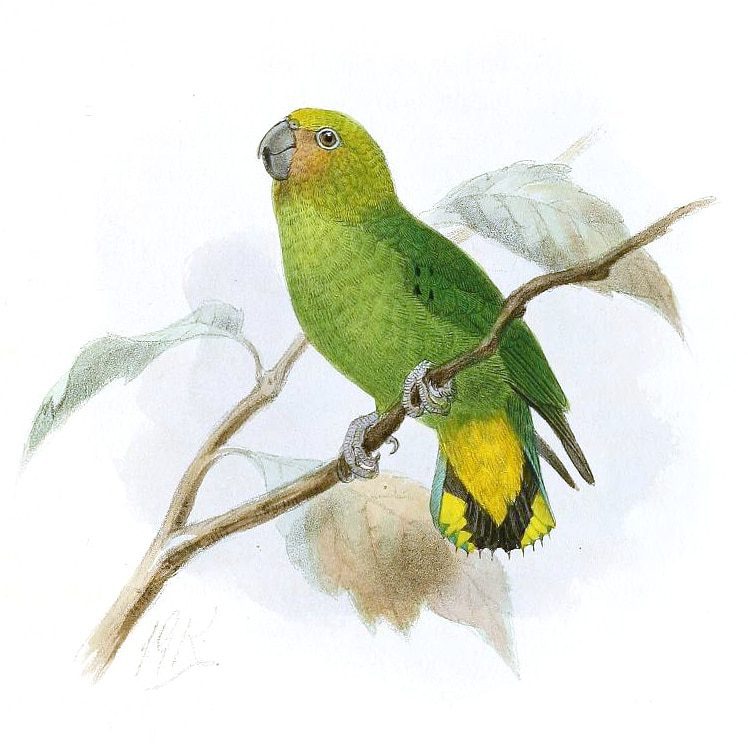
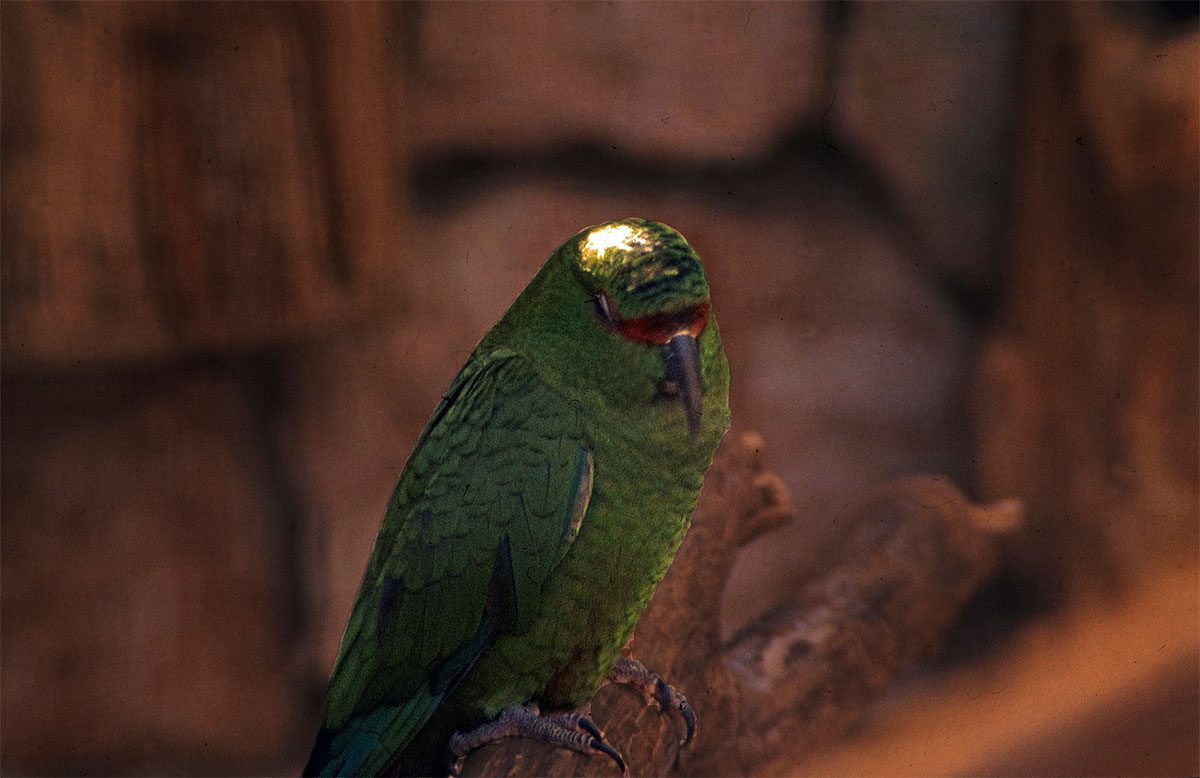
The Rusty-faced Parrot or Parrot mountain (Hapalopsittaca amazonina) It is distinguishable by the dirty red of his face and crown. Its bill is pale with to the base of the lower jaw and the chin of color red orange. Headphones coverts reddish brown with yellow lines that extend behind the nape and the neck. The rest of upperparts they are green. Its chest This is olive green, with red spots in the shoulders similar to their Wing coverts internal minors. The rest of your wing-coverts they are blue-green and the remiges bluish-black. Its tail It is mainly dull red with wide blue apexes.

It has no sexual dimorphism. The youth are green-yellow color, with the face pale red and the secondaries grey.

Description 3 subspecies:

  • Hapalopsittaca amazonina amazonina

    (Des Murs, 1845) – Nominal.


  • Hapalopsittaca amazonina theresae

    (Hellmayr, 1915) – The plumage with more olive tones and the face dark red.


  • Hapalopsittaca amazonina velezi

    (Serious,GR & Restrepo, 1989) – With part of the crown and nape, brighter yellowish green; forecrown red; list fine near to the ear; below and behind the eye, green. More information.

Habitat:

It inhabits in mountains with semi-humid and cloud forests, between the 2000 to 3600 m, with the presence of Oak (Quercus humboldtii) and Alder (Alnus acuminata).
Fly high in the forest canopy, in groups of 5-30 individuals. Presents aggregation behaviors for the night, establishing communal bedrooms in groups of between 2-35 individuals.

Reproduction:

Many aspects of the reproductive biology of the Rusty-faced Parrot. Probably nests in tree hollows of Oak dead.

Food:

Consumes fruits of the "matapaloยซ, flowers and seeds, including the of Clusia sp. and some GUIs of which is fed with high frequency.

Distribution:

Size of the breeding range / resident): 234.000 km2

Is located in Colombia and Venezuela and Peru. In Colombia lives between 2000 and 2700 m above the sea level in the Cordillera Oriental and in the The upper Magdalena valley (South of the Department of the Huila). Among 3100 and 3600 m of height in the cordillera Central in Caldas (where it is considered Bird emblem), in the basin of the White River in the municipality of Manizales. In the Cordillera Oriental is known only in Norte de Santander and the southwest of Bogotรก. Has also been recorded in the departments of Risaralda, Tolima, Huila (Cave of the Guacharos, Meremberg nature reserve) and Cauca (Puracรฉ National Park).

Distribution 3 subspecies:

  • Hapalopsittaca amazonina amazonina

    (Des Murs, 1845) – Nominal. East of the Colombian Andes.


  • Hapalopsittaca amazonina theresae

    (Hellmayr, 1915) – Eastern edge of the Andes of Colombia and Northwest of Venezuela.


  • Hapalopsittaca amazonina velezi

    (Serious,GR & Restrepo, 1989) – Center of the Colombian Andes. More information.

Conservation:


Vulnerable


โ€ข Current category of the Red List of the UICN: Vulnerable.

โ€ข Population trend: Decreasing.

From makes several years appears in the book red of species threatened by fault of the destruction of their habitat, including, the Palm of wax (Ceroxylon quindiuense).

Rationale for the Red List category

This species is classified as Vulnerable Since its small population consists of subpopulations very small and scattered that probably will be experiencing declines continuous due to the loss widespread of habitat.

Justification of the population

Renjifo et to the. (2002) estimated that in Colombia the population can count 2,500-10,000 individuals, based on a hypothetical C.1 density of individuals / km2, and the 25% occupation of the approximately 13.890 km2 of habitat suitable. This may be an overestimate and the population could be right around the few thousand mark in Colombia (P. Salaman in litt., 2005). There are also much smaller populations in Venezuela. Its location in the Ecuador is uncertain. Be placed better in the band 2.500-9.999 mature in general individuals, which is equivalent to 3.750-14.999 individuals, rounded here to 3.500-15.000 individuals.

Justification of trend

Se sospecha una lenta y continua disminuciรณn de la poblaciรณn del Rusty-faced Parrot sobre la base de la continua destrucciรณn y fragmentaciรณn del hรกbitat.

"Rusty-faced Parrot" in captivity:

No encontrado en avicultura.

Alternative names:

Rusty-faced Parrot, Bogota Parrot, Little Amazonian Parrot, Rusty faced Parrot (English).
Caรฏque ร  face rousse, Caรฏque ร  face rouge (French).
Caรฏque ร  face rousse (German).
Rusty-faced Parrot (Portuguese).
Cotorra Montaรฑera, Lorito Amazonino, Lorito Multicolor, Loro fantasma (espaรฑol).
Cotorra Montaรฑera, Lora montaรฑera (Colombia).
Perico Multicolor (Venezuela).


scientific classification:

Marc Athanase Parfait Oeillet Des Murs

Order: Psittaciformes
Family: Psittacidae
Genus: Hapalopsittaca
Scientific name: Hapalopsittaca amazonina
Citation: (Des Murs, 1845)
Protonimo: Psittacus amazoninus


Images ยซLorito Amazoninoยป:

Videos ยซLrito Amazoninoยป:


ยซAmazonino Blondoยป (Hapalopsittaca amazonina)


Sources:

Avibase
Parrots of the World โ€“ Forshaw Joseph M
Parrots A Guide to the Parrots of the World – Tony Juniper & Mike Parr
Birdlife

Photos:

(1) – Iconographie ornithologique By Marc Athanase Perfect Carnation Walls (1804-1878) (Iconographie ornithologique) [Public domain], via Wikimedia Commons

Sounds:

Restrepo, Daniel Uribe

* – Restrepo, Daniel Uribe

Daniel has been chasing birds since he was 9-years old, growing on a farm in the Central Andes of Colombia, with his bedroom walls covered with colorful prints of John James Audubonโ€™s birds. Daniel graduated in Veterinary Medicine and Animal Science and has pursued bird and nature photography as his main passions in life.

He is co-founder of the Caldas Ornithological Society (SCO) based in Manizales. Dedicated mainly to conservation and sustainable development projects, Daniel has consulted for many of the most prominent environmental organizations in Colombia and currently assists private nature reserves in Colombia in the establishment of agritourism and ecotourism services.

โ–ท The world of Pets: Dogs, cats, birds, reptiles, amphibians

Puerto Rican Parrot
Amazona vittata

Puerto Rican Parrot

Content

Description:


Anatomy-parrots

29 cm.. length and 320 g. of weight.

The Puerto Rican Parrot (Amazona vittata) has the forecrown and lores, red; rest of the head and nape, feathery green grass bordered with black color, giving a strong intricate scaly appearance.

feathers of the the mantle grass-green; back and scapulars with less pronounced dark margins; rump and uppertail-coverts, paler, more green-yellow. The large external coverts they are blue; rest of the coverts color green grass. Primaries and outerweb of the outer secondaries, blue; the innerwebs of the external side and secondary internal, green. Under, the wings They are green and flight feather bluish green.

Underparts green stained yellowish; feathers throat and the chest with dark edges. Upper, the tail is green; below is more yellowish, with its end yellow; both with outerweb blue towards outer feathers. Bill color pale horn; brown the irises; legs pale grey.

Both sexes similar. Immature adult-like, but with the bill light yellow with gray on the basis of upper jaw.

  • Sound of the Puerto Rican Parrot.

Description 2 subspecies:

  • Amazona vittata gracilipes โ€ 

    (Ridgway, 1915) – Extinct. Of smaller and with feet smaller and thinner than the species nominal.


  • Amazona vittata vittata

    (Boddaert, 1783) – Nominal.

Habitat:

Video – "Puerto Rican Parrot"

parrot liberation 2013, in the forest of Rio Abajo

The Puerto Rican Parrot formerly he frequented the main types of natural vegetation (various forest habitats, from mangroves to montane forests) in Puerto Rico, with the possible exception of dry forests in the southern coastal regions.

Its Current small population remainder inhabits the mountain rainforest to 200-600 m. In the lower mountain slopes dominated by trees tabonuco of the species Dacryodes excelsa, in swampy forests at higher elevations characterized by the abundance of Cyrilla racemiflora and areas Sierra palm Prestoea montana.

Observed in pairs or (especially when they fed) in small flocks, having formed, formerly, flocks of several hundred.

Reproduction:

The Amazona Puerto Rican nidifican in large and deep cavities of trees; in the past they put their nests in the limestone hollows, in the west of the island. The amazon of Luquillo usually nest in species Cyrilla racemiflora. They defend their territory aggressively in the vicinity of the nest while playing. The egg laying, between February and April, possibly to coincide with the availability of fruit. Clutch 2-4 eggs (usually three).

Since 2001, all nesting known in the wild they have occurred in artificial cavities (White et al ., 2006).

Food:

The diet of the Puerto Rican Parrot It consists of a variety of fruit, seeds, flowers and leaves, among which include fruit of Prestoea montana and Dacryodes excelsa, flowers of Piptocarpha tetrantha and bracts of Marcgravia sintenisii.

Distribution and status:

Size of its range (breeding/resident): 1.000 km2

The Puerto Rican Parrot It is endemic to Puerto Rico and the former neighboring islands Mona and Snake; there are reports of parrots Vieques and St Thomas, probably belonging to this species. Formerly found in all forested regions Puerto Rico (with the possible exception of dry coastal strip south), but from around 1960 their habitat was limited to the Luquillo forest, in the East.

drastic population decline and rank the mid-nineteenth century. The pre-European population was probably hundreds of thousands of birds. There was a dramatic decline, which it reduced its population to about 2.000 copies in 1937 and in 1950 they were only a 200: a search in 1968 only revealed the existence of 24 birds.

The conservation program, initiated in 1968, It includes captive breeding, the provision of nests, detailed investigation ecology and reproductive biology and the control predators and competitors.

In 1992 the wild population was 39-40 birds 58 in captivity (all in Puerto Rico). Its population has declined, to near extinction, mainly by habitat loss (in 1912 only 1% the virgin forests of the island they remained), the hunting and capture as pets. The continuing threats to the tiny remaining population include impact of hurricanes (wild population halved to 21-23 after the passage of birds hurricane Hugo in 1989), competition with introduced bees Apis mellifera by tree cavities, the loss of broods due to parasitic flies Philornis pici, losses caused by predators and competition for nesting cavities with Pearly-eyed Thrasher (Margarops fuscatus). The Puerto Rican Parrot, inhabitants of the Culebra island (dubiously separated as subspecies Amazona vittata gracilipes), extinguished early twentieth century, probably because of persecution due to damage of crops and the impacts of hurricanes. existing population protected inside of the El Yunque National Forest.

Description 2 subspecies:

  • Amazona vittata gracilipes โ€ 

    (Ridgway, 1915) – Extinct. Culebra Island (Puerto Rico).


  • Amazona vittata vittata

    (Boddaert, 1783) – Nominal.

Conservation:

State of conservation โ“˜


critical hazard critically endangered โ“˜ (UICN)โ“˜

โ€ข Current category of the Red List of the UICN: critically endangered.

โ€ข Population trend: Increasing.

โ€ข Population size: 33-47.

Rationale for the Red List category

Once you have done a count of birds, are only 13 Puerto Rican Parrot in the nature, leaving the species on the verge of extinction. The conservation action the population has increased from 1975, but remains critically endangered because the number of mature individuals is still minuscule. If the released birds breed successfully in nature and the figures remain stable or increase, the species can justify a change of state in the future.

Justification of the population

From 2011, the population was between 50-70 individuals divided into two areas, approximately equivalent to 33-47 mature individuals. In 2013, its population had only increased to 80-100 individuals in the nature (64-84 in Down river and 15-20 in The anvil). But, since the released birds are not counted as mature individuals until they have successfully bred in nature (UICN 2011), and the entire population of Down river It is derived from released birds. The total number of mature individuals is uncertain but may well be less than 50, therefore, estimating 2011 of mature is maintained in this figure.

Justification of trend

It is estimated that increase 1-19% has occurred in the last ten years, based on regular accounts of the total wild population.

Conservation Actions Underway

โ€ข CITES Appendix I.

โ€ข And Recovery Program the species has involved a partnership between the Fish and Wildlife of the United States, the Forest service of the United States and the World Wide Fund for Nature together with Department of Natural and Environmental Resources of Puerto Rico (White et al. 2012).

โ€ข In 1968 an important intervention was initiated to preserve the species, the provision of artificial nests highly successful, the predator control nest and its competitors, and captive breeding and reintroduction.

โ€ข The success of the Newborns parrots It monitored using radio telemetry (Meyers 1996).

โ€ข All the rest of the habitat is protected in the El Yunque National Forest (above the Caribbean National Forest) (Snyder et to the., 2000) and in the Rio Abajo State Forest (T. White in a little.

โ€ข The population is monitored to help inform management decisions.

โ€ข The predator control exotic mammals (Entrapment and toxic bait) It has proven to be a highly profitable way to preserve the species (Engeman et al. 2003, 2006, R. M. Engeman in some. 2012).

โ€ข Catch data have shown that the Luquillo Forest It has between densities black rat studied highest in the world and optimal strategies have been devised rat bait for application during the nesting.

โ€ข Los economic analysis based on empirical costs of production of parrots raised in captivity showed very high cost-benefit ratios for predator management, estimating that preventing a loss of parrot each 4-12 years more than makes up all forms of predator management (for all species) intervention time (Engeman et al., 2003).

โ€ข Hay two captive breeding centers, one The anvil which it was established for the first time 1973 with a new facility built in 2007 and one in Down river built in 1989 with the first birds transferred The anvil to Down river in 1993 (White et al 2012).

โ€ข About 280 birds are currently in captivity in Down river and The anvil (T. White one bit., 2012).

โ€ข Captive birds are being managed to preserve the greater genetic diversity possible.

โ€ข A release technique known as precision release was tested with six birds in 2008. This involves the release of a small number of captive-reared subadult parrots into each active nest immediately after chick rearing., and it aims to promote the immediate and close interaction between wild parrots and birds released (T. White in a bit., 2005, 2008).

โ€ข Nearly 100 birds have been released the aviary Down river in an attempt to establish a second population, which may be helped by a lower annual precipitation in the site, lower levels of predation and a change in management techniques (T. White in a little. ).

โ€ข Although the after release mortality remains high, there has been a successful breeding and the size and range of the flock is increasing (Breining 2009, Valentin 2009, T. White in a little.)

โ€ข The newly established population in Down river It is located around the site Aviary of Down river and it is believed that the presence of captive birds encouraged released birds to establish their population close (White et al., 2012).

โ€ข Forty specimens were released in The anvil between 2000 and 2004, eight 2008 and six birds in 2010 (Velez-Valentin 2011). In 2013 plans were made to establish a third population on the island in the Maricao State Forest (West of Puerto Rico) (Anonymous 2014).
Conservation Actions Proposed

โ€ข Continue to monitor population trends.

โ€ข Follow the fate of released birds.

โ€ข Maintain the integrated conservation management program.

โ€ข Improve synchronization of breeding of wild and captive birds to increase the number of captive-bred chicks that can be fostered by wild parents. (Thompson 2004).

โ€ข Integrate control of exotic mammal predators (black rat, small Indian mongoose, wild cats) in the management program and monitor existing conservation predator populations to study the effectiveness of these measures (R. M. Engeman in some. 2012).
The Puerto Rican Parrot in captivity:

According to sources, A copy of Puerto Rican Parrot lived 10,1 years in captivity. But, considering the longevity of similar species, likely maximum longevity is underestimated in this species. In fact, it has been reported that They can live up to 27,2 years in captivity, what it is plausible but has not been confirmed. Taking into account that the Cuban Parrot (Amazona leucocephala), closely related, You can live up 50 years (Wilson, et to the., 1995), an age close to the latter figure may be possible for the Puerto Rican Parrot.

Each captive specimen of this species which is capable of reproducing, must be placed in a well-managed captive breeding program and not sold as a pet, in order to ensure its long-term survival.

Alternative names:

Puerto Rican Amazon, Puerto Rican Parrot, Red-fronted Amazon, Red-fronted Parrot (English).
Amazone ร  queue courte, Amazone de Porto Rico (French).
Puertoricoamazone, Puerto-Rico-Amazone (German).
Papagaio-de-porto-ricoโ€Ž (Portuguese).
Amazona Portorriqueรฑa, Amazona Puertorriqueรฑa, Cotorra de Puerto Rico, Cotorra Puertorriqueรฑa (espaรฑol).


scientific classification:

Pieter Boddaert
Pieter Boddaert

Order: Psittaciformes
Family: Psittacidae
Genus: Amazona
Scientific name: Amazona vittata
Citation: (Boddaert, 1783)
Protonimo: Psittacus vittatus


Images Puerto Rican Parrot:


Species of the genus Amazona


Sources:

Avibase
– Parrots of the World โ€“ Forshaw Joseph M
– Parrots A Guide to the Parrots of the World – Tony Juniper & Mike Parr
Birdlife

Photos:

(1) – Amazona vittata – Photo via Good Free Photos
(2) – A Puerto Rican Amazon By Pablo Torres of U.S. Fish and Wildlife Service Southeast Region (PRParrot_cototrapuertorriqueรฑa byPablo Torres) [Public domain or CC BY 2.0], via Wikimedia Commons
(3) – A Puerto Rican Amazon at Iguaca Aviary, Puerto Rica By Tom MacKenzie ofU.S. Fish and Wildlife Service Southeast Region (Puerto Rican parrot 4) [CC BY 2.0], via Wikimedia Commons
(4) – A Puerto Rican Amazon at Iguaca Aviary, Puerto Rica By Tom MacKenzie of U.S. Fish and Wildlife Service Southeast Region (Puerto Rican parrot 4) [CC BY 2.0], via Wikimedia Commons
(5) – A pair of Puerto Rican Amazons See page for author [Public domain], via Wikimedia Commons
(6) – A Puerto Rican Amazon at Iguaca Aviary, Puerto Rica By Tom MacKenzie of U.S. Fish and Wildlife Service Southeast Region (Puerto Rican Parrot by Tom Mackenzie) [CC BY 2.0], via Wikimedia Commons
(7) – Amazona vittata – Author: Mike Morel, USFWS – pixnio
(8) – Flying Parrot, blue feathers visible By Tom MacKenzie [Public domain], via Wikimedia Commons
(9) – A Puerto Rican Amazon at Iguaca Aviary, Puerto Rica By Tom MacKenzie of U.S. Fish and Wildlife Service Southeast Region (Puerto Rican parrot 1) [CC BY 2.0], via Wikimedia Commons

Sounds: Eric DeFonso, XC173411. accessible www.xeno-canto.org/173411

โ–ท The world of Pets: Dogs, cats, birds, reptiles, amphibians

Turquoise-winged Parrotlet
Forpus spengeli

Turquoise-winged Parrotlet

Content

Description:

Turquoise-winged Parrotlet

12โ€“13 cm. length and 28 g. of weight.
The male of the Turquoise-winged Parrotlet (Forpus spengeli) It has shades of blue at the bottom of the back, still it rump of a turquoise hue; turquoise / blue with purple on the underwing-coverts and axillary.

The wing coverts are dark green. Primary coverts are violet; wing edge bright green. Supracaudals coverts are bright green; undertail-coverts, bright yellow. Dark brown eyes with iris gray; flesh-colored legs; peak light colored horn.

The female It is green instead of blue; their face is green / yellow, It is his forecrown yellower.

taxonomy:

Until now treated as conspecific the species Forpus xanthopterygius, or sometimes as a subspecies of Forpus passerinus, or a subspecies of Forpus cyanopygius. differs, However, of the Forpus xanthopterygius in pale turquoise against the rich color tone blue rump and of the wing-coverts of the male; in the dark blue, against the rich blue color in underwing-coverts of the male; the forecrown and lores yellow in female.

  • Sound of the Turquoise-winged Parrotlet.

Habitat:

they prefer forested habitats drier as open forests and riparian, closed caatinga; Also they found in savannas, palm groves, semiarid scrub and grassland areas.

With feed in open areas and sometimes on the floor. Highly social; found in groups of up 50 individuals.

Reproduction:

Breeding season, May-August. Clutch, 3-7 eggs.

Food:

Diet Turquoise-winged Parrotlet in their natural environment it is composed of fruit of Cecropia, seeds of Mikania and tremble mirantha and flowers of Ambrosia and Marcgravia.

Distribution:

Size of its range (breeding/resident): 29.200 km2

Restricted north of Colombia, from the coastal region Caribbean western and southern mountains Santa Marta, Atlantic, south along the Magdalena river in Bolรญvar and Cรฉsar.

Conservation:

โ€ข Current category of the Red List of the UICN: Least concern.

โ€ข Population trend: Decreasing.

Justification of the Red List of the Category

State of conservation โ“˜


minor concern Minor Concern โ“˜ (UICN)โ“˜

Although this species may have a small range, It not believed to approach the thresholds for vulnerable under the range size criterion (extent of occurrence <20.000 km2 combinan con un tamaรฑo gama disminuciรณn o fluctuante, hรกbitat medida / calidad, o tamaรฑo de la poblaciรณn y un pequeรฑo nรบmero de localidades o fragmentaciรณn severa). La tendencia de la poblaciรณn no se conoce, pero la poblaciรณn no se cree que estรฉ disminuyendo con la rapidez suficiente como para acercarse a los umbrales del criterio tendencia de la poblaciรณn (> 30% decrease of more than ten years or three generations). The population size has not been quantified, but it is not believed to approach the thresholds for Vulnerable according to the criterion of population size (<10.000 individuos maduros con una disminuciรณn continua estima en> 10% in ten years or three generations, or a specific population structure). For these reasons, the species is evaluated as Least concern.

Justification of the population

The world's population has not been quantified, but this species is described as rare and local (Juniper and Parr 1998).

Justification trend

The population trend is unknown, but according to some reports, the species may be declining. (Juniper and Parr 1998).

"Turquoise-winged Parrotlet" in captivity:

Rare.

Alternative names:

Blue-winged Parrotlet (spengeli), Blue-winged Parrotlet (Turquoise-winged), Green-rumped Parrotlet (spengeli), Turquoise-winged Parrotlet (English).
Toui de Spengel, Toui de Spix (spengeli), Toui รฉtรฉ (spengeli) (French).
Tรผrkisflรผgel-Sperlingspapagei (German).
Turquoise-winged Parrotlet (Portuguese).
Cotorrita aliturquesa (espaรฑol).


scientific classification:

Gustav Hartlaub

Order: Psittaciformes
Family: Psittacidae
Genus: Forpus
Scientific name: Forpus xanthopterygius spengeli
Citation: (Hartlaub, 1885)
Protonimo: Psittacula spengeli

Images Turquoise-winged Parrotlet:


Species of the genus Forpus

Turquoise-winged Parrotlet (Forpus spengeli)


Sources:

Avibase
– Parrots of the World โ€“ Forshaw Joseph M
– Parrots A Guide to the Parrots of the World – Tony Juniper & Mike Parr
Birdlife

Photos:

(1) – Forpus xanthopterygius spengeli (24-3-15 Loro Parque) by barFlickr
(2) – (above) Psittacula spengleri [sic] = Forpus xanthopterygius spengeli (Hartlaub, 1885), ?โ™‚ (below) Psittacula cyanochlora = Forpus passerinus cyanochlorus (Schlegel, 1864), โ™‚ by Joseph Smit [Public domain], via Wikimedia Commons

Sounds: ndrew Spencer, XC165598. accessible www.xeno-canto.org/165598

โ–ท The world of Pets: Dogs, cats, birds, reptiles, amphibians

New Caledonian Parakeet
Cyanoramphus saisseti

New Caledonian Parakeet

Content


Anatomy-parrots

Description:

26 cm.. length and 100 g. of weight.

The upperparts of the New Caledonian Parakeet (Cyanoramphus saisseti) they are mostly green, with some bluish green in the tail, violet-blue along the outerweb flight feathers, and red patches on each side of the rump. The underparts are yellowish green, yellower near throat, and gray below tail (Forshaw 1989, Juniper & Parr 1998, Doughty et al. 1999).

A red patch extends from the crown up to the forecrown, and it extends in a narrow band from the forecrown up to the ears (Juniper & Parr 1998).
The bill is leaden gray, with black tips, the irises is red-orange and legs are dark gray. (Layard & Layard 1882b, Juniper & Parr 1998).

The males typically exceed the females in size, although its plumage is similar (Verreaux & walls 1860, Layard & Layard 1882b, Salvadori 1891, Forshaw 1989)

taxonomy:

In the past it was considered to New Caledonian Parakeet conspecific of Red-crowned parakeet (Cyanoramphus novaezelandiae) of New Zealand, but genetic studies have shown that it is a separate species and occupying a basal position on gender Cyanoramphus, which indicates that the genus would have its origin in New Caledonia.

  • Sound of the New Caledonian Parakeet.

Habitat:

New Caledonian Parakeet

The New Caledonian Parakeet They were primarily fed at low altitudes canopy, and regularly they observed on the edge of the forest, on slopes or in the forest maquis (scrub).

Seem to have small populations and their distributions are expected to shrink as a result of climate change.
They are not particularly shy, although they tend to be rather calm and difficult to observe.

Reproduction:

It has been reported that the nesting It occurs between November and January, and nidadas They consist of two to five eggs, that they are placed in holes in trees (Hannecart & Lรฉtocart 1980, Theuerkauf et al. 2009b).
Genetic evidence suggests that the species is polyandrous, and the presence of male food assistants suggests that probably involves mating system poliandria cooperative (Theuerkauf et al., 1999).

Food:

It is usually fed in average heights, low canopy, but it has also been observed that feeds on the floor.
Essentially it is granivore. It feeds mainly on seeds and fruits, besides berries, nuts and other plant parts (outbreaks, flowers and leaves).

Distribution:

The New Caledonian Parakeet It is endemic to the main island of New Caledonia, although there are still uncertainties about the extent of its range and population size (Taylor 1985, Juniper & Parr 1998). The species was considered rare at the time of its introduction (Verreaux & walls 1860). But, in the decade of 1880, Flocks of birds were reported in the West, flying into the valleys Moindou from nearby mountain forests, where it is rumored to have slept in large quantities (Layard & Layard 1882b).

It has the lowest population density of parrots New Caledonia.

Conservation:


Vulnerable


โ€ข Current category of the Red List of the UICN: Vulnerable.

โ€ข Population trend: Decreasing.

โ€ข Population size : 2500-10,000 individuals.

The New Caledonian Parakeet They face a variety of threats, and their populations seem to be in decline. But, it is difficult to determine the cause or extent of their declines due to the paucity of ecological data.

classified as Vulnerable because it has a single small population suspected to be declining due to predation by invasive species; his fortress is in an area threatened by nickel mining and may be in rapid decline in the near future.
The humid mountain forest is not threatened, but it is possible that this species in need of other habitats, some of which, particularly semi-deciduous forests lowland, They have almost disappeared from the island. It is possible that introduced diseases (such as avian malaria) or the mammals (especially rats) It has been a cause of decline.

There is no evidence that nest poaching is widespread.

"New Caledonian Parakeet" in captivity:

unregistered.

Alternative names:

New Caledonian Parakeet, New Caledonian Parrot, New Caledonian Red-crowned Parakeet, Red-crowned Parakeet (inglรฉs).
Perruche ร  front rouge, Perruche calรฉdonienne, Perruche de Nouvelle-Calรฉdonie (francรฉs).
Cyanoramphus saisseti (alemรกn).
Periquito-da-nova-caledรดnia (portuguรฉs).
Perico de Nueva Caledonia (espaรฑol).

scientific classification:

Jules Verreaux

Order: Psittaciformes
Family: Psittaculidae
Gender: Cyanoramphus
Scientific name: Cyanoramphus saisseti
Subpoena: Verreaux & Des Murs, 1860
Protonimo: New Caledonian Parakeet

Images "New Caledonian Parakeet"

Videos "New Caledonian Parakeet"

Sources:

โ€ข Avibase
โ€ข Parrots of the World โ€“ Forshaw Joseph M
โ€ข Parrots A Guide to the Parrots of the World – Tony Juniper & Mike Parr
โ€ข Birdlife

Photos:

(1) – Cyanoramphus saisseti, blue river park, New Caledonia by Mickaรซl T. [CC BY 2.0], via Wikimedia Commons
(2) – Cyanoramphus saisseti Proceedings of the Zoological Society of London 1882 (Web) by Joseph Smit [Public domain]

โ–ท The world of Pets: Dogs, cats, birds, reptiles, amphibians

White-bellied Parrot
Pionites leucogaster

Lorito Rubio

Content

White-bellied Parrot

Description:

23 cm.. height.

the unmistakable White-bellied Parrot (Pionites leucogaster) has the lores, cheeks and throat, bright yellow lemon; "ear coverts", forecrown and crown, bright orange red; sides and rear of the neck, orange, but paler.

Upperparts green. Primary coverts blue; other coverts green. Primaries blue with green margins in outerweb. Underwing-coverts green. Breast and center belly, white; undersides of belly and feathers the thighs, green; undertail-coverts Yellow. Upper, the tail green; undertail, pale grayish brown. Bill, color pale horn; cere Pink; irises reddish brown; legs pink.

Both sexes are similar.

Immature paler, especially the yellow color face.

  • Sound of the White-bellied Parrot.

Description 3 subspecies:

  • Pionites leucogaster leucogaster

    (Kuhl, 1820) – Nominal.


  • Pionites leucogaster xanthomerius

    (Sclater,PL, 1858) – As the nominal species but with the thighs and flanks bright yellow lemon (no verde); tail green.


  • Pionites leucogaster xanthurus

    (Todd, 1925) – As the nominal species, but with the thighs yellow; flanks and tail, yellow and green the uppertail-coverts.

Habitat:

Prefers low humid forests, areas of land and vรกrzea with probable preference for the latter and for clearings in the forests. Also observed in the drier forests (where it is less common) in the South of its range. Gregarious; Observed in the company of Blue-headed Parrot (Pionus menstruus) on Eastern Amazonia. Seen in small groups or couples.

Since they have very heavy body and very short wings, the White-bellied Parrot You can not fly long distances.

Reproduction:

With plays in January and nests in hollow trees; a nest 30m found in the cavity of a tree in the east of its range. Clutch Normal probably 2-4 eggs.

Food:

Very similar in habits Lorito Chirlecrรฉs (Pionites melanocephalus) but no specific information about their diet; probably seeds, fruit and berries.

Distribution:

The size of its distribution area (reproduction / resident): 2.140.000 km2

The White-bellied Parrot It extends through southern amazon in Brazil, from northwest maranhรฃo and around Bethlehem in the State of For, west on Mato Grosso to the North of Bolivia and Southeast of Peru, to the top of Ucayali, where it approaches the range of Lorito Chirlecrรฉs (Pionites melanocephalus). Reports in eastern Ecuador (well within the limits of the latter) still not substantiated.

Distribution 3 subspecies:

Conservation:


Endangered


โ€ข Current category of the Red List of the UICN: In danger of extinction.

โ€ข Population trend: Decreasing.

Usually common but perhaps more scarce in drier forests on the southern fringes of the range. It is not at serious risk, but decreases locally (for example, the Eastern Amazonia) due to deforestation, and possibly extinct now Santa Cruz, Bolivia, due to the loss of habitat. Trapped for Local international trade (at least years), but apparently not yet having a serious impact on wild populations.

Conservation Actions Underway

โ€ข No specific conservation actions are known for this species.

Conservation Actions Proposed

โ€ข Expand the network of protected areas to effectively protect the IBA.
โ€ข Effectively treat resources and manage existing and new protected areas., using the emerging opportunities for funding the management of protected areas with the overall goal of reducing carbon emissions and maximize the conservation of biodiversity.
โ€ข Conservation on private land is also essential, through the expansion of market pressures for rational land management and prevention of logging on land not suitable for agriculture (Soares-Filho et to the., 2006).
โ€ข Campaign against proposed changes to the Brazilian Forest Code that would lead to a decrease in the width of protected riparian forest areas such as Permanent Preservation Areas (APPs), that function as vital corridors in fragmented landscapes.

"White-bellied Parrot" in captivity:

Do not have the capacity to speak of his larger parrots cousins, but they are very assets and can be very good pets, Despite not being very common to see them in captivity.

Alternative names:

White-bellied Parrot, White bellied Parrot, White-bellied Caique (English).
Maรฏpouri ร  ventre blanc, Caรฏque ร  ventre blanc (French).
Rostkappenpapagei, Rostkappen-Papagei (German).
Marianinha-de-cabeรงa-amarela, maipurรฉ, marianinha, mariquita, periquito-d’anta, periquito-de-anta, periquito-de-cabeรงa-preta Pionopsitta barrabandi (Portuguese).
Lorito Gordo de Cabeza Rojiza, Lorito Rubio (espaรฑol).
Loro de Vientre Blanco (Peru).


scientific classification:

Kuhl, Heinrich
Heinrich Kuhl

Order: Psittaciformes
Family: Psittacidae
Genus: Pionites
Scientific name: Pionites leucogaster
Citation: (Kuhl, 1820)
Protonimo: Psittacus leucogaster


Images "Lorito Rubio":

Videos "White-bellied Parrot"


ยซBlond Parrotยป (Pionites leucogaster)


Sources:

  • Avibase
  • Parrots of the World โ€“ Forshaw Joseph M
  • Parrots A Guide to the Parrots of the World – Tony Juniper & Mike Parr
  • Birdlife

  • Photos:

(1) – Pionites leucogaster xanthomeria By Mirjam (Picasa Web Albums) [CC BY-SA 3.0], via Wikimedia Commons
(2) – Pionites leucogaster leucogaster White-bellied Parrot (this subspecies is also know as the Green-thighed Parrot). Two in a cage with a nestbox By TJ Lin (originally posted to Flickr as 140) [CC BY-SA 2.0], via Wikimedia Commons
(3) – Pionites leucogaster xanthomerius A pet adult male White-bellied Caique perching by a row of books By pionetes (Own work (self-portrait)) [CC BY-SA 3.0], via Wikimedia Commons
(4) – Five White-bellied Parrots (also known as White-bellied Caique) at Bird Park, Foz do Iguaรงu, Brazil. This subspecies is also known as the Green-thighed Caique (Pionites leucogaster leucogaster) By Chad Bordes (Picasa Web Albums) [CC BY 3.0], via Wikimedia Commons
(5) – White-bellied Parrot by Peter TanFlickr
(6) – White-bellied Parrot in captivity at Iguaรงu Bird Park, Foz do Iguaรงu, Brazil. Photographed on 23 April 2003 By Arthur Chapman [CC BY 2.0], via Wikimedia Commons
(7) – White-bellied Parrot (Pionites leucogaster) often referred to as the White-bellied Caique in captivity by whiskymac (Flickr) [CC BY 2.0], via Wikimedia Commons
(8) – White-bellied Parrot (often referred to as the White-bellied Caique); a chick. Its feathers have not opened yet By Ruth Rogers (originally posted to Flickr as Caique) [CC BY 2.0], via Wikimedia Commons
(9) – A painting of a White-bellied Parrot (originally captioned ยซPsittacus badiceps. Bay-headed Parrotยป) by Edward Lear (1812-1888) Edward Lear [Public domain], via Wikimedia Commons