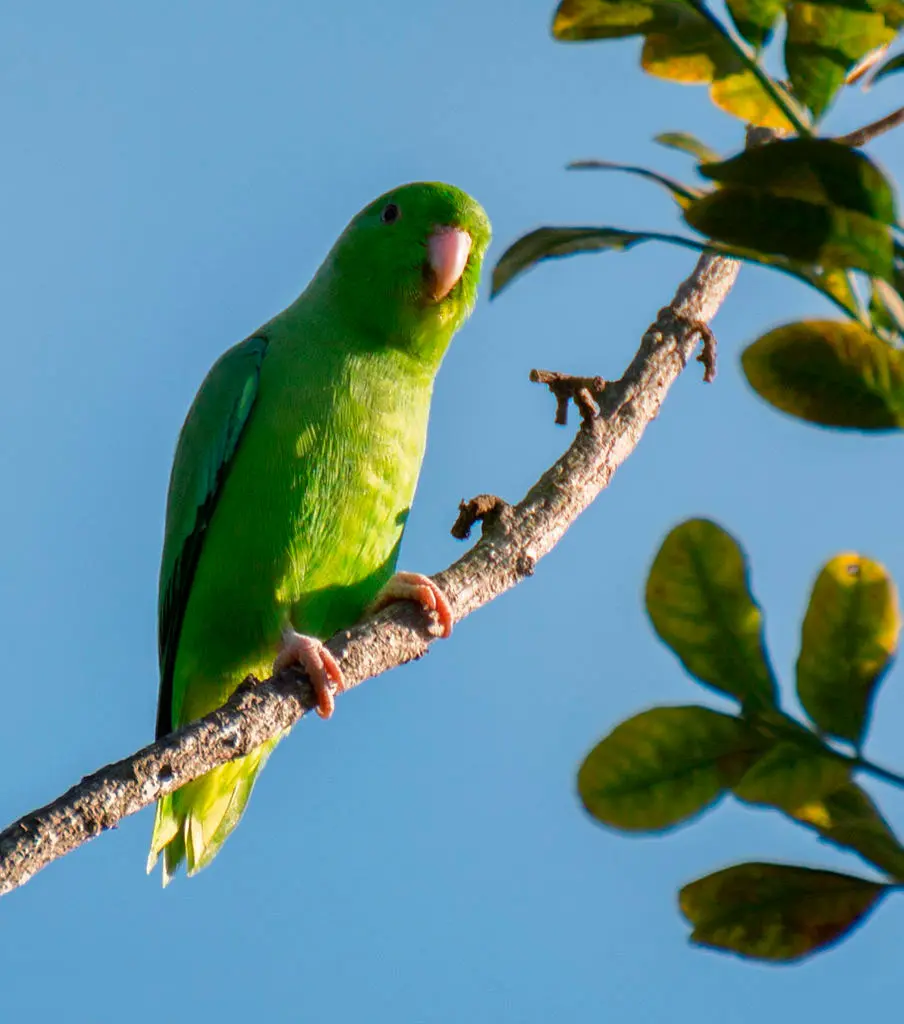
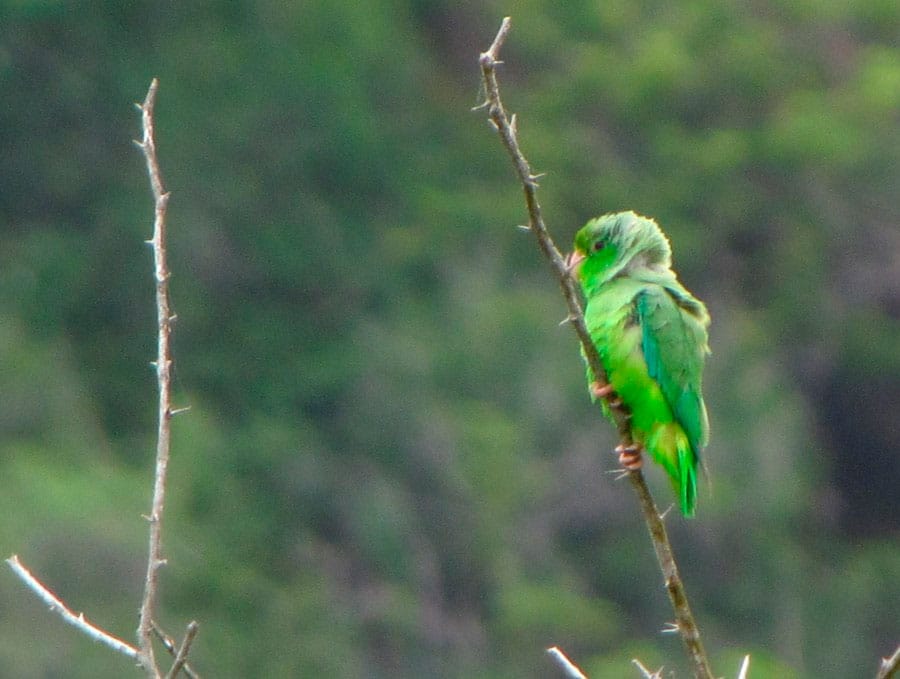
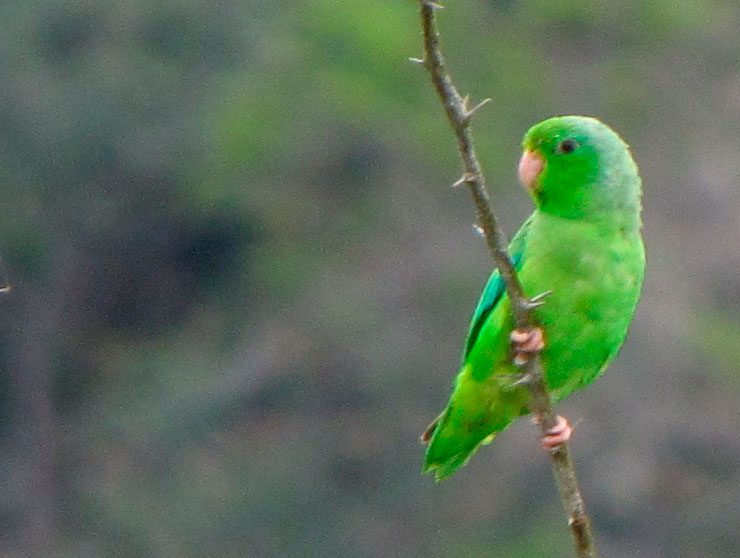
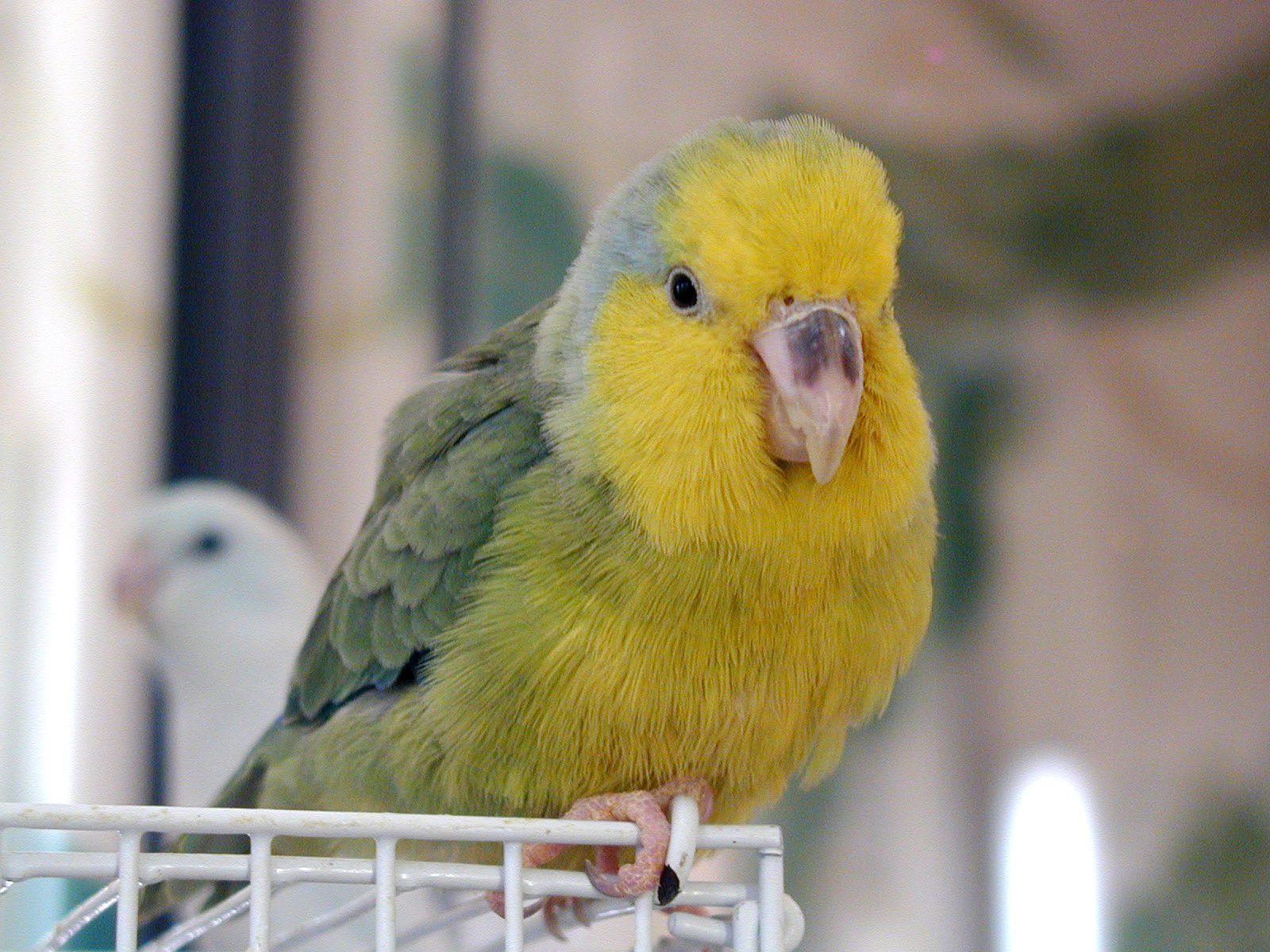
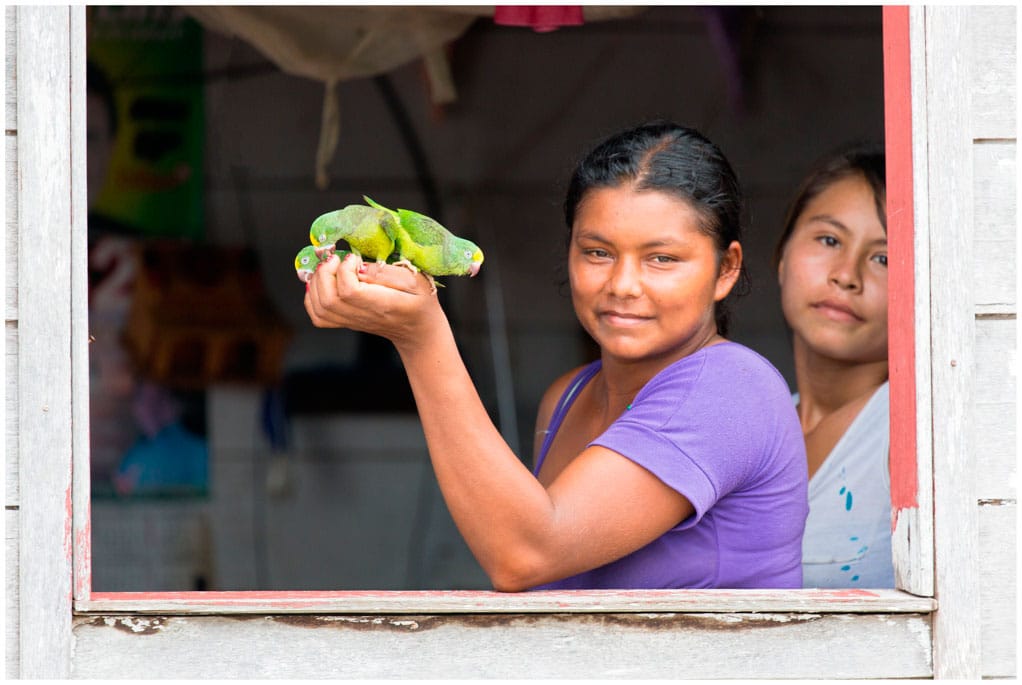
The Green-rumped Parrotlet(Forpus passerinus) is the psittacine smaller that can be found on the American continent. It is distinguished by being green, with a brighter green in the front, cheeks, lower part of the body and behind the neck; the rump bright green in the two sexes, wing
with one Strip Turquoise Blue followed by another greenish-blue in males; belly lighter than the back, tail with yellow border.
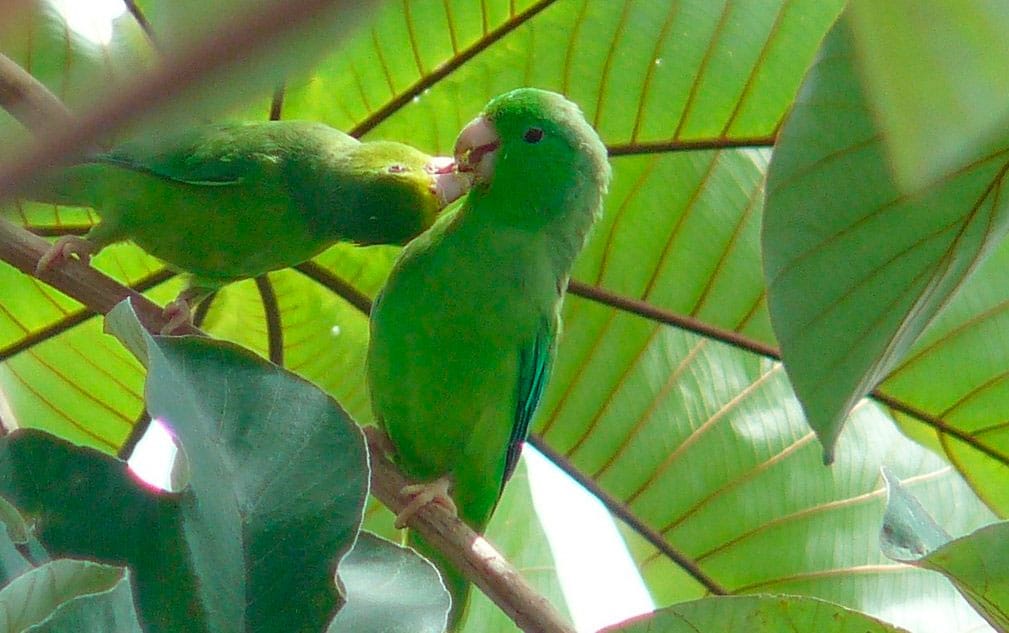
Female with rump greenish-yellow and wings without blue. It is possible to have dyes more yellowish forehead.
(Schlegel, 1864) – Also known as Parrotlet Schlegel. Similar to the subspecies Forpus passerinus passerinus, but the feathers of the tail of the female they are more green in the bottom. Also it has more yellow along the forecrown .
Forpus passerinus cyanophanes
(Todd, 1915) – Show more blue with the wing
closed in the other subspecies.
Forpus passerinus deliciosus
(Ridgway, 1888) – The male has the rear area Emerald green with blue and pale blue tint at the edge of the the greater wing coverts. Female has more yellow in all the facial area.
(Lafresnaye, 1848) – Also known as Venezuela green parakeet. The plumage is green in males; in females varies considerably according to the region they inhabit.
Habitat:
It is found in dry forest, semi-open areas, crops, among others, until the 500 m. In flocks of more of 100 individuals. You can perform altitudinal migrations.
Reproduction:
It nests in abandoned nests of woodpeckers or in other holes, from May to November.
Food:
They feed on seeds, including the of the grasses.
Distribution:
Size of the area of distribution (reproduction / resident): 1.060.000 km2
This is a very widespread and common. They are distributed in the northeast of Colombia, North of Venezuela, Guyanas to the northeast of Brazil, also in Curacao, Trinidad and the West Indies.
(Todd, 1915) – Are found in the areas around the North of Colombia.
Forpus passerinus deliciosus
(Ridgway, 1888) – Is located in the lower basin of the amazon, in Brazil.
Forpus passerinus passerinus
(Linnaeus, 1758) – The nominal. Found in the Guianas.
Forpus passerinus viridissimus
(Lafresnaye, 1848) – Found in the North of Venezuela, Trindad and Tobago.
Conservation:
State of conservation ⓘ
Minor Concern ⓘ(UICN)ⓘ
• Current category of the Red List of the UICN: Least concern.
• Population trend: Decreasing.
Justification of the population
The size of the world population It has not been quantified, but this species is described as «common» (Stotz et to the., 1996).
Justification of trend
It is suspected that this species has lost 19,2-21% of habitat within its distribution in three generations (12 years) based on a model of Amazon deforestation (Soares-Filho et to the., 2006, Bird et to the., 2011). Given the susceptibility of the species to hunt or capture, It is suspected that it will fall in <25% durante tres generaciones.
"Green-rumped Parrotlet" in captivity:
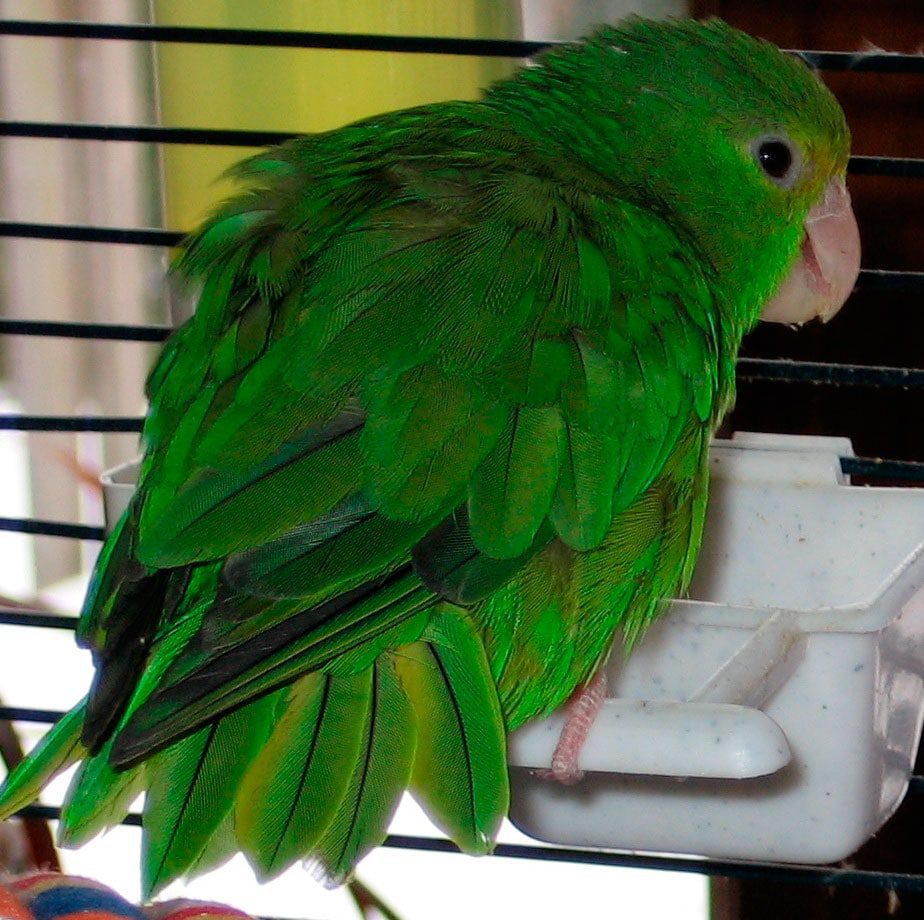
It´s common bird cage. In captivity they are sweet and playful. It might be possessive with toys and people.
– Avibase
– Parrots of the World – Forshaw Joseph M
– Parrots A Guide to the Parrots of the World – Tony Juniper & Mike Parr
– Birdlife
– Parrot Book, Parrots and macaws Neotropical
– Photos:
(1) – Forpus passerinus in Trinidad 2014, Caribbean By Jam.mohd (Own work) [CC BY-SA 4.0], via Wikimedia Commons
(2) – Photograph of pet Green-rumped Parrotlet (Forpus passerinus) By self (Own work) [Public domain], via Wikimedia Commons
(3) – Green-rumped Parrotlet, (Forpus passerinus), a pair, male (right) and female (left), in Venezuela By kulyka on flickr (Flickr) [CC BY 2.0], via Wikimedia Commons
(4) – Periquito mastrantero [Green-rumped Parrotlet] (Forpus passerinus viridissimus) by Cristóbal Alvarado Minic – Flickr
(5) – Periquito mastrantero [Green-rumped Parrotlet] (Forpus passerinus viridissimus) by Cristóbal Alvarado Minic – Flickr
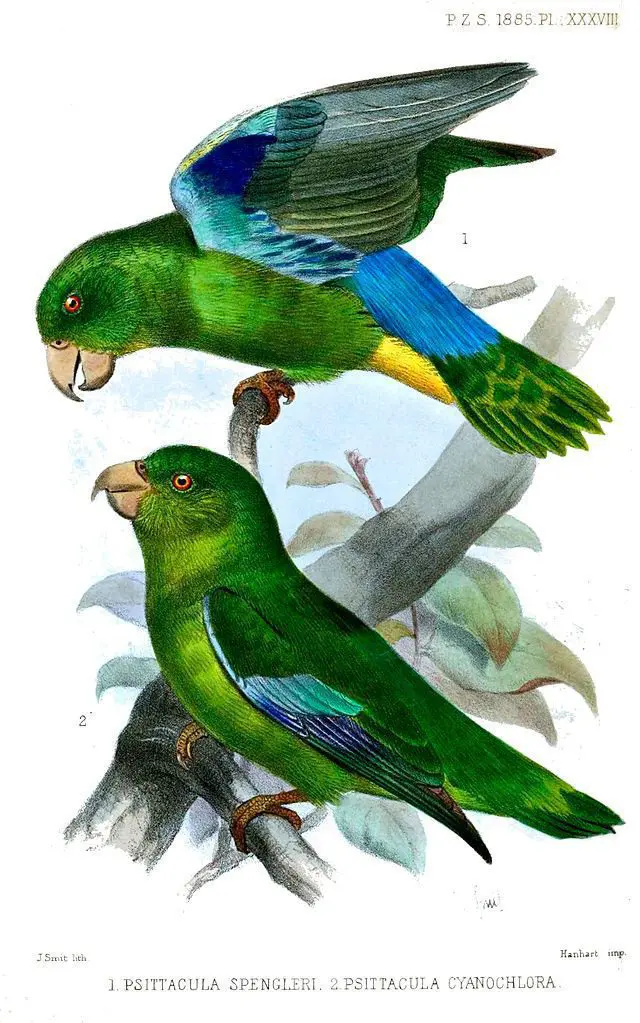
(6) – Blue-winged Parrotlet, adult male (above); Green-rumped Parrotlet, young(?) male (below) Joseph Smit [Public domain], via Wikimedia Commons
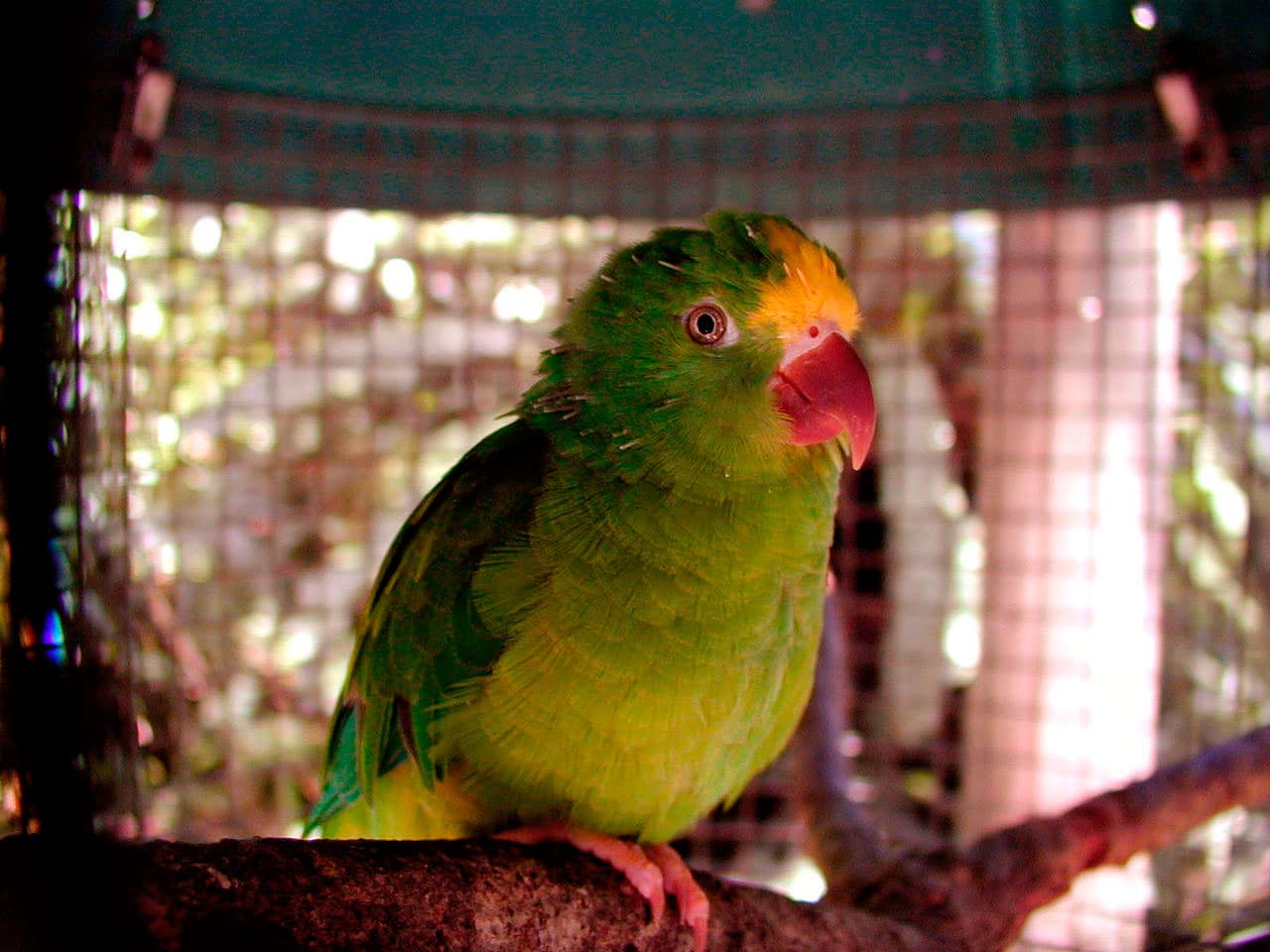
14 cm.. height. Plump appearance and short tail terminated tip. Distinguishable by the Crown, face, Yellow chest and belly, with strong wing blue patch, Flying Blue occupies almost half of the wing. Dorsally gray cafesoso, with the blue rump. The female has the blue patch on the rump and wings paler and smaller.
The Yellow-faced Parrotlet He lives in varied habitats, usually arid, forest riparian in the tropical and subtropical area, between 1000 to 1600 m, Although it has been reported to 2745 m. It is gregarious. Their diet includes cactus, In addition to fruit trees and other things. They nest in communal area, using tree hollows or sand. The breeding season is from March to April..
Distribution:
They are found in northwestern Peru., in the upper valley of the Marañón river, from the east of La Libertad to the southeast of Cajamarca and the south of Amazonas.
Conservation:
State of conservation ⓘ
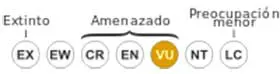
Vulnerable ⓘ(UICN)ⓘ
According to the IUCN categories it is considered as Vulnerable (VU). Habitat degradation and trade are adversely affecting the population.
The ban on the capture and trade has improved the status of this species. The rate of decline was very rapid in the Decade of 1980, Although at present has been reduced and even stabilized. But, the population is still very small, with records in very few places, and as a result, according to the IUCN categories, qualified as vulnerable.
"Yellow-faced Parrotlet" in captivity
Captured for the trade of wild birds, It is estimated that 17.000 birds were captured between 1981 and 1994. The rate of mortality during capture is estimated between the 40% and the 100%. Rare and unknown in captivity until 1979-1980.
Images "Yellow-faced Parrotlet"
Alternative names:
1. Yellow-faced parrotlet (English).
2. Toui à tête jaune, Perruche-moineau à tête jaune (French).
3. Gelbmasken-Sperlingspapagei, Gelbmaskenpapagei (German).
4. Tuim-de-cabeça-amarela, Tuim, Periquito-de-cabeça-amarela (Portuguese).
5. "Catita enana de cara amarilla", Cotorrita carigualda, Periquito de Cara Amarilla (español).
16,5 to 17,5 cm.. height.
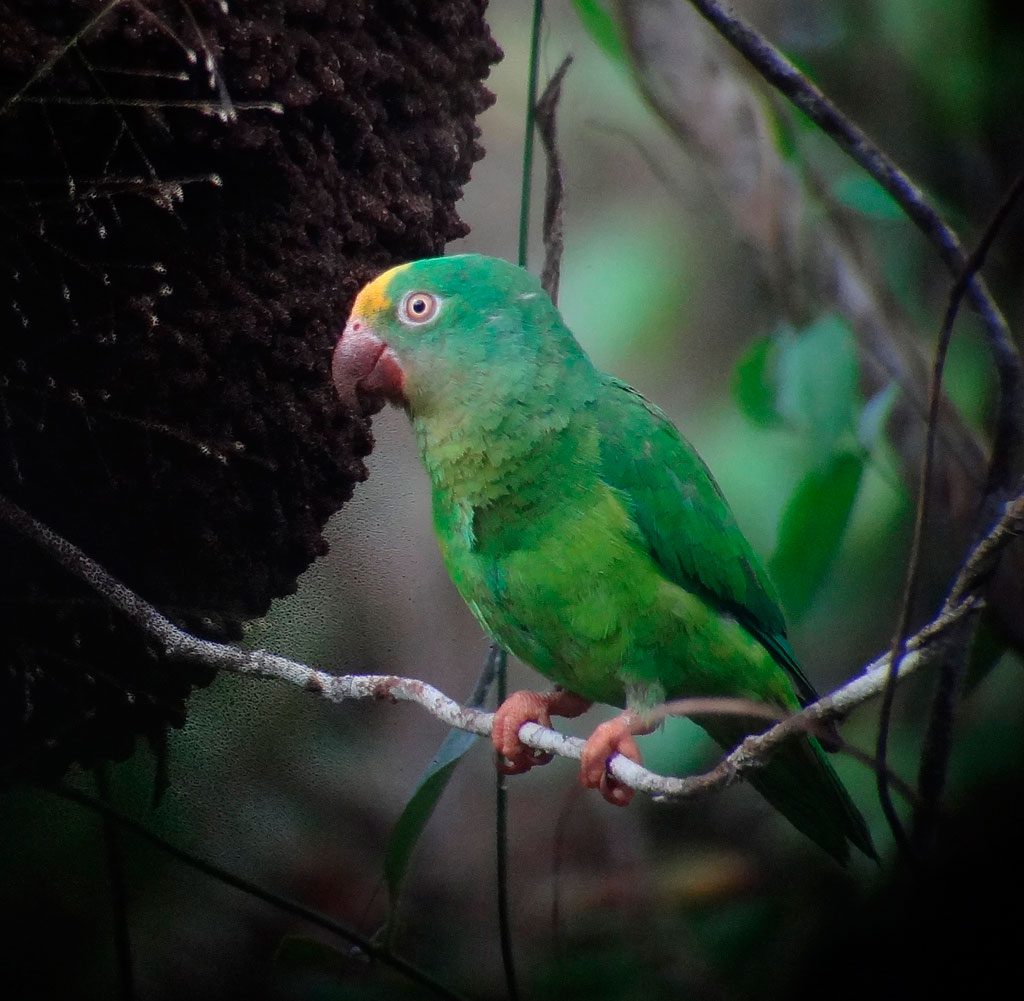
The Tui Parakeet(Brotogeris sanctithomae) has the forecrown and the front of the crown, bright yellow; rest of the head and nape, bluish green.
Mantle, back and scapulars dark green, paler and brighter in the rump and in the uppertail-coverts. Alula blue on the innerwebs, greenish on the outerweb; primary coverts greenish blue; other coverts green, the smaller and medium slightly impregnated olive green. Flight feathers greenish-blue on outerweb, dark green innerwebs, and light blue below; infra-wing coverts minor, green, the greater coverts, blue. Underparts brighter yellowish green. Upper, the tail is green; below is more yellowish.
The bill It is quite dark orange-brown; Cere pale pink; the irises brown; legs grayish bone.
(Neumann, 1931) – The yellow stripe behind (and sometimes below) of the eyes It extends over the ear-coverts. The yellow patch on the forecrown sometimes it is larger.
Habitat:
Mainly inhabits in second-growth forests, in humid areas of tropical forest, forests and marshes on the banks of large rivers and river islands and clearings near watercourses; to 100 metres in Colombia and 900 metres in Peru. Gregaria, usually in small flocks; sometimes in larger meetings. The Tui Parakeet it is very common in riverside towns and cities where it arrives in large flocks to spend the night. Visit palms on the banks of rivers.
Reproduction:
It nests on trees, in natural hollows or termiteros, small and noisy groups. views in nests in May and July, with immature during the month of June Colombia.
Food:
Few details about their diet; taking views flowers Erythrina in Colombia.
Distribution:
Size of the area of distribution (reproduction / resident): 3.870.000 km2
This species is confined to the Basin Amazon Southeast Colombia (area of Leticia), northeast and southeast Peru and to the West of Brazil, possibly on the right bank of Black river and in river basins Purus, Solimões (this to about Cojadás) and south of Juruá, to the North of Bolivia in Pando and Beni, It is able to see so dispersed in the Eastern Amazonas, around river mouths Negro and Madeira, to the this to Amapá and Pari Eastern, possibly up area Bethlehem.
Apparently sedentary. Local (for example, in Loreto, Peru) but common or abundant in many places (for example, about Leticia).
Perhaps its population has been reduced due to trade locally (for example, in Peru), but the effect of habitat loss remains within the range lower. Present in many protected areas (for example, > Manu National Park, Peru).
Distribution 2 subspecies:
Brotogeris sanctithomae sanctithomae
(Statius Müller, 1776) – Nominal. West Basin amazon, from the southeast of Colombia to the North of Bolivia.
Brotogeris sanctithomae takatsukasae
(Neumann, 1931) – Both sides of the basin under amazon, from the junction with the Black river to the East of Pari.
Conservation:
State of conservation ⓘ
Minor Concern ⓘ(UICN)ⓘ
• Current category of the Red List of the UICN: Least concern.
• Population trend: Stable.
Justification of the population
The size of the world population It has not been quantified, but this species is described as «common» (Stotz et to the., 1996).
Justification of trend
It is suspected that this species has lost 15,9-17,4% of habitat within its distribution over three generations (15 years) starting from a model of deforestation Amazon (Soares-Filho et to the., 2006, Bird et to the., 2011). Given the susceptibility of the species to hunting and / or capture, suspected population decline in <25% durante tres generaciones.
"Tui Parakeet" in captivity:
saved pet locally but uncommon in captivity outside its range.
– Avibase
– Parrots of the World – Forshaw Joseph M
– Parrots A Guide to the Parrots of the World – Tony Juniper & Mike Parr
– Birdlife
– Parrot Book, Parrots and macaws Neotropical
Origin: Venezuela, Guyana, Suriname, French Guiana, Trinidad and Tobago
Character: Quiet and intelligent
Life expectancy: 25 to 30 years
Height: 14 cm..
Content
Description:
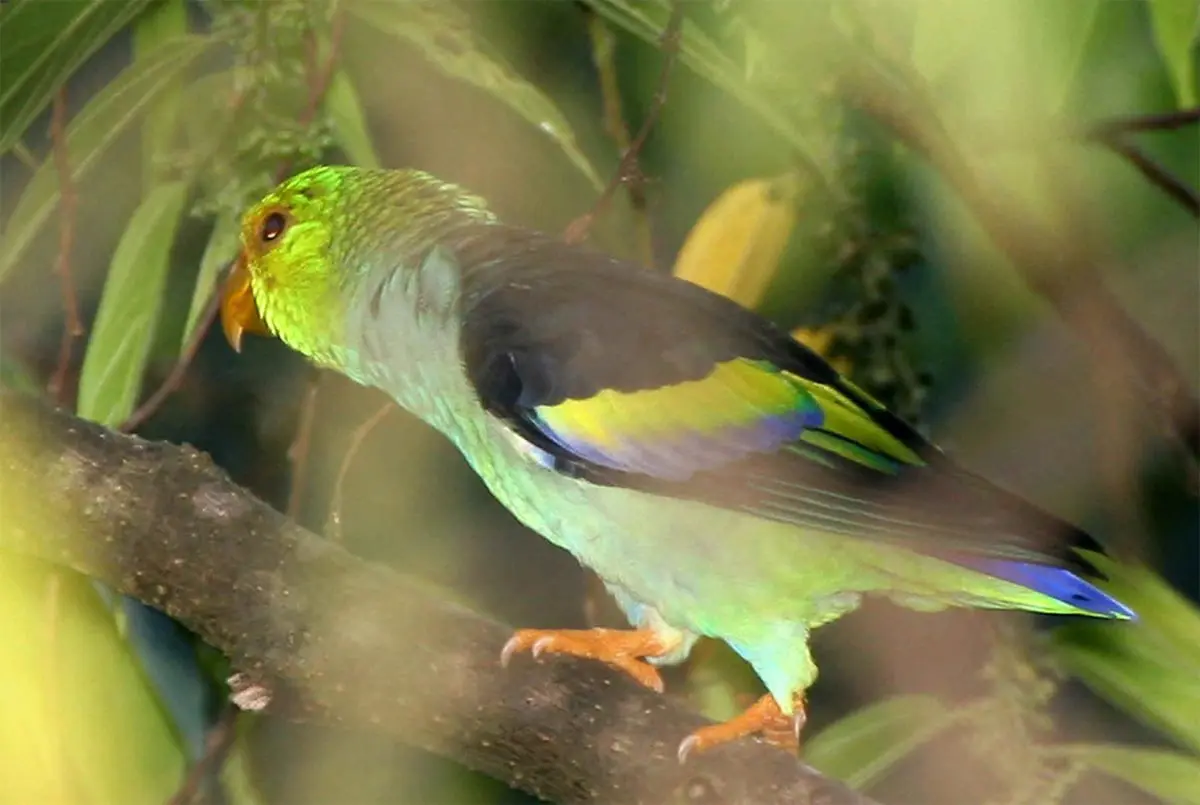
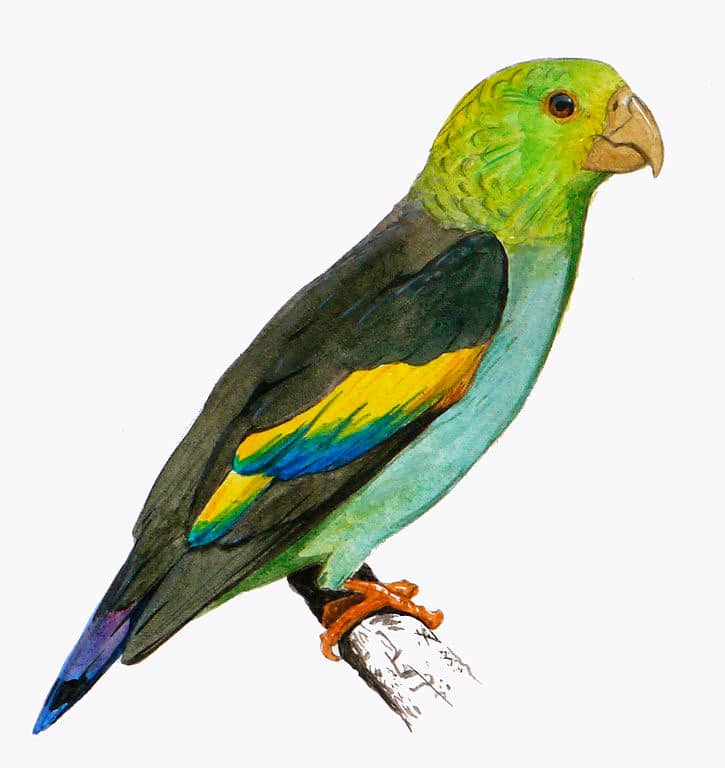
The Lilac-tailed Parrotlet (Touit batavicus) has 14 cm.. height. Usually black in it upperparts (back and wings) and green in it lower. With the crown and nape yellowish-green with black border (What gives a suspiciously aspect). The forecrown, cheeks and chin Yellow Gold, chest Azure Blue, Yellow patch in the wing
, tail ends reddish purple and black subterminal edge.
It inhabits in forest dry and jungles cloudy between 400 and 1700 m (in Colombia).
Considered powerful flying, the sharp profile of its wings, They quickly fly over the forest canopy, in groups of 10 to 50 and they are gregarious except in the time reproductive.
It is of a forest Ave, but it can be seen near the shore of the sea in the areas where the edge of the forest close to the coast.
The calls during the flight they are soft and nasal, reaching a high tone, Buzz.
Reproduction:
It nests in hollows in trees or in arboreal termite holes, between the months of February and March. It is thought that it has migratory movements.
Food:
Its diet is composed of flowers, nectar, fruit, outbreaks, berries and seeds.
Distribution:
Size of the area of distribution (reproduction / resident): 330.000 km2
Can be found from the North of Venezuela According to the East up to Guyana, Suriname, French Guiana and in Trinidad and Tobago.
Conservation:
State of conservation ⓘ
Minor Concern ⓘ(UICN)ⓘ
• Current category of the Red List of the UICN: Least concern.
• Population trend: Decreasing.
Justification of the population
The size of the world population It has not been quantified, but this species is described as «quite common» (Stotz et to the., 1996).
Justification of trend
They suspect that this species has lost a 8,2-8,4% of habitat suitable within their distribution during three generations (15 years) based on a model of Amazon deforestation (Soares-Filho et to the., 2006, Bird et to the., 2011). Given the susceptibility of the species to the hunting or the capture, It is suspected that will decrease in <25% during three generations.
"Lilac-tailed Parrotlet " in captivity:
It's hard to keep alive captivity, refuses food during the acclimatization period. Deaths occur for this reason and the unbalanced diet.
Origin: Peru, Guyana, Brazil, Venezuela, Colombia, Ecuador, Bolivia
Character: Divertida.
Life expectancy: 30 to 40 years
Height: 21 to 23 cm..
Content
Description:
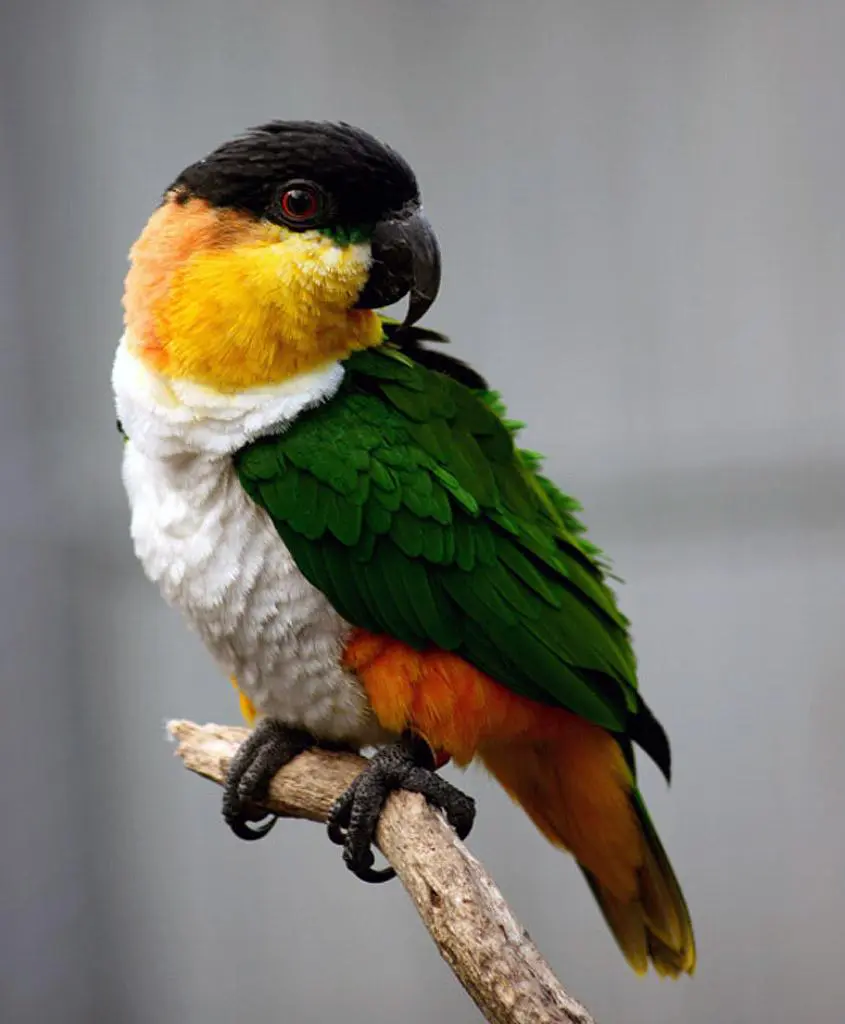
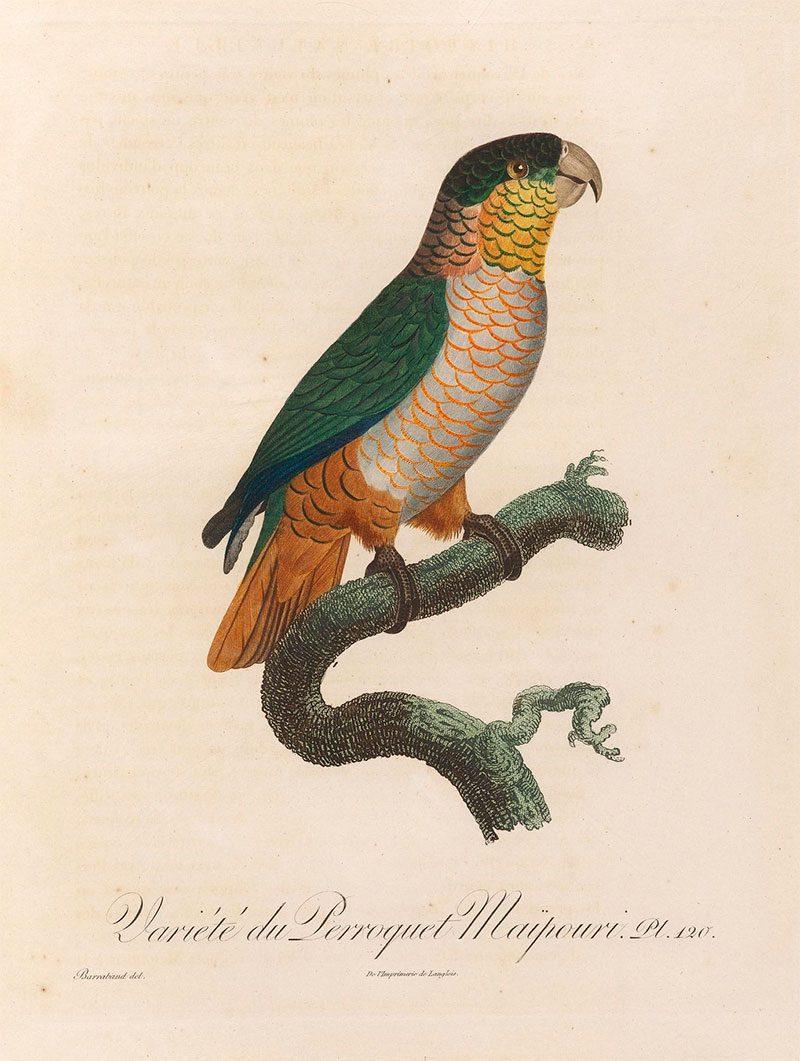
The Black-headed Parrot(Pionites melanocephalus) measures of 21 to 23 cm.. height.
Unmistakable by crown black, chest and belly white, the latter with yellow sides (very visible on the fly). Breast
bright yellow, nape orange acanelada, back and rump green. Tip pens of wings They are blue and dark go the closer they get to the body.
Legs and bill dark gray.
The youth They have bluish green spots on the nape, with chest and belly yellowish.
There is no sexual dimorphism in this species. The identification of genus must be performed by DNA testing or a surgical probe.
(Berlepsch, 1890) – It has bright yellow in the throat, the thighs and tail.
Habitat:
It inhabits humid jungles, semi-wet, swampy, gallery woods, stubble and crop to the 1000 m. Walks in small flocks between 3 to 10 individuals, feed in the canopy, very rare in stratum low forest.
Reproduction:
Its laying is of 2 to 4 eggs and the breeding season It is from December to February in French Guiana, april in Venezuela, April to May Colombia, October to November Suriname.
Food:
Feeds of seeds several species of plants cellulose, plants, flowers and leaves. There is also evidence of some insects in your diet.
Distribution:
She can be seen in the wild along the Amazonia, from the North of the Amazon River, bordering south to northeastern Peru, also in the Guyanas.
(Berlepsch, 1890) – South of Colombia to the East of Ecuador and northeast of Peru.
Conservation:
State of conservation ⓘ
Minor Concern ⓘ(UICN)ⓘ
Although not in danger of extinction Its population has declined significantly. The illegal marketing is the main theory against its appearance and adaptation in an environment foreign to its natural environment. Poaching of pigeons and felling of trees are common in the south of the country.
"Black-headed Parrot" in captivity:
Popular poultry farming. They adapt easily to the bird or Aviary cages. You need a degree quite high commitment and attention by the owner. The like to interact with other birds and people. The love to play with toys and can be quite noisy. An interesting feature of the Black-headed Parrot It is their habit of rolling on his back and play with toys help of their paws.
He manages to replace their jungle habitats in parks or green areas of large cities.
Its price is quite high compared to other species due to its striking plumage and friendliness..
Alternative names:
– Black headed Parrot, Black-crowned Parrot, Black-headed Caique, Black-headed Parrot(English)
– Cotorra pechiblanca, Loro cacique o Loro mocho (Colombia)
– Perico calzoncito (Venezuela)
– Loro coroninegro (Ecuador)
– Chirricles cabeza negra (Peru)
– Grünzügelpapagei, Grünzügel-Papagei (Germany)
– Lorito Chirlecrés, Lorito Chirlicrés, Lorito Gordo de Cabeza Negra (Spain)
– Caïque à tête noire, Caïque maïpouri (France)
– cabeça-preta, maipuré, marianinha-da-cabeça-preta, Marianinha-de-cabeça-preta (Brazil)
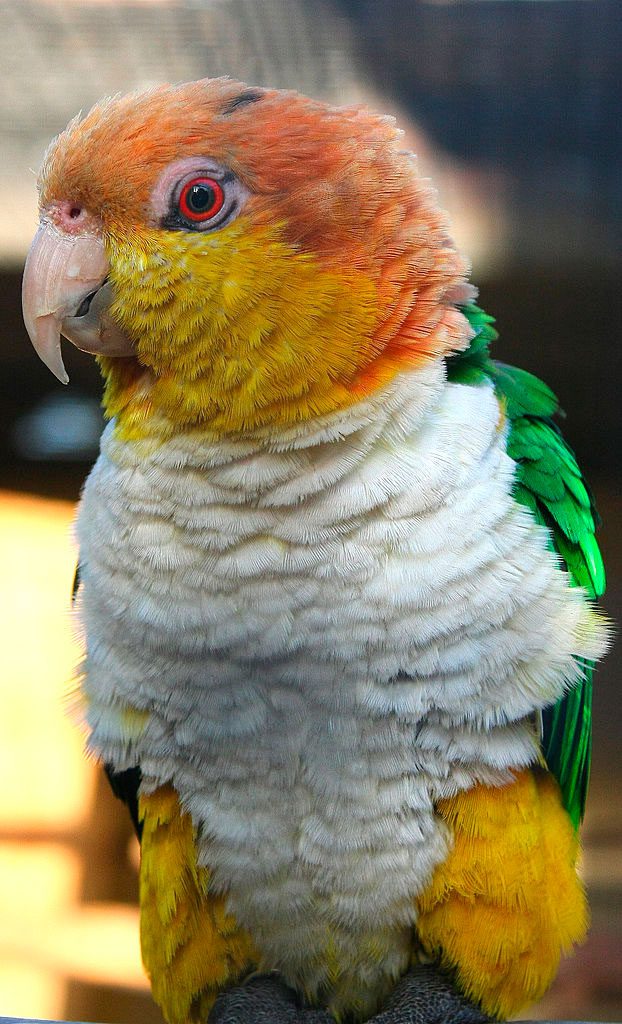
the unmistakable White-bellied Parrot(Pionites leucogaster) has the lores, cheeks and throat, bright yellow lemon; "ear coverts", forecrown and crown, bright orange red; sides and rear of the neck, orange, but paler.
Upperparts green. Primary coverts blue; other coverts green. Primaries blue with green margins in outerweb. Underwing-coverts green. Breast
and center belly, white; undersides of belly and feathers the thighs, green; undertail-coverts Yellow. Upper, the tail green; undertail, pale grayish brown. Bill, color pale horn; cere Pink; irises reddish brown; legs pink.
(Sclater,PL, 1858) – As the nominal species but with the thighs and flanks bright yellow lemon (no verde); tail green.
Pionites leucogaster xanthurus
(Todd, 1925) – As the nominal species, but with the thighs yellow; flanks and tail, yellow and green the uppertail-coverts.
Habitat:
Prefers low humid forests, areas of land and várzea with probable preference for the latter and for clearings in the forests. Also observed in the drier forests (where it is less common) in the South of its range. Gregarious; Observed in the company of Blue-headed Parrot(Pionus menstruus) on Eastern Amazonia. Seen in small groups or couples.
Since they have very heavy body and very short wings, the White-bellied Parrot You can not fly long distances.
Reproduction:
With plays in January and nests in hollow trees; a nest 30m found in the cavity of a tree in the east of its range. Clutch Normal probably 2-4 eggs.
Food:
Very similar in habits Lorito Chirlecrés(Pionites melanocephalus) but no specific information about their diet; probably seeds, fruit and berries.
Distribution:
The size of its distribution area (reproduction / resident): 2.140.000 km2
The White-bellied Parrot It extends through southern amazon in Brazil, from northwest maranhão and around Bethlehem in the State of For, west on Mato Grosso to the North of Bolivia and Southeast of Peru, to the top of Ucayali, where it approaches the range of Lorito Chirlecrés(Pionites melanocephalus). Reports in eastern Ecuador (well within the limits of the latter) still not substantiated.
(Sclater,PL, 1858) – West Basin amazon, in the southeast of Peru, North of Bolivia and West of Brazil, where the subspecies intergran Pionites leucogaster xanthurus in the upper area of Yurua River
• Current category of the Red List of the UICN: In danger of extinction.
• Population trend: Decreasing.
Usually common but perhaps more scarce in drier forests on the southern fringes of the range. It is not at serious risk, but decreases locally (for example, the Eastern Amazonia) due to deforestation, and possibly extinct now Santa Cruz, Bolivia, due to the loss of habitat. Trapped for Local international trade (at least years), but apparently not yet having a serious impact on wild populations.
Conservation Actions Underway
• No specific conservation actions are known for this species.
Conservation Actions Proposed
• Expand the network of protected areas to effectively protect the IBA.
• Effectively treat resources and manage existing and new protected areas., using the emerging opportunities for funding the management of protected areas with the overall goal of reducing carbon emissions and maximize the conservation of biodiversity.
• Conservation on private land is also essential, through the expansion of market pressures for rational land management and prevention of logging on land not suitable for agriculture (Soares-Filho et to the., 2006).
• Campaign against proposed changes to the Brazilian Forest Code that would lead to a decrease in the width of protected riparian forest areas such as Permanent Preservation Areas (APPs), that function as vital corridors in fragmented landscapes.
"White-bellied Parrot" in captivity:
Do not have the capacity to speak of his larger parrots cousins, but they are very assets and can be very good pets, Despite not being very common to see them in captivity.
Alternative names:
– White-bellied Parrot, White bellied Parrot, White-bellied Caique (English).
– Maïpouri à ventre blanc, Caïque à ventre blanc (French).
– Rostkappenpapagei, Rostkappen-Papagei (German).
– Marianinha-de-cabeça-amarela, maipuré, marianinha, mariquita, periquito-d’anta, periquito-de-anta, periquito-de-cabeça-preta Pionopsitta barrabandi (Portuguese).
– Lorito Gordo de Cabeza Rojiza, Lorito Rubio (español).
– Loro de Vientre Blanco (Peru).
(1) – Pionites leucogaster xanthomeria By Mirjam (Picasa Web Albums) [CC BY-SA 3.0], via Wikimedia Commons
(2) – Pionites leucogaster leucogaster White-bellied Parrot (this subspecies is also know as the Green-thighed Parrot). Two in a cage with a nestbox By TJ Lin (originally posted to Flickr as 140) [CC BY-SA 2.0], via Wikimedia Commons
(3) – Pionites leucogaster xanthomerius A pet adult male White-bellied Caique perching by a row of books By pionetes (Own work (self-portrait)) [CC BY-SA 3.0], via Wikimedia Commons
(4) – Five White-bellied Parrots (also known as White-bellied Caique) at Bird Park, Foz do Iguaçu, Brazil. This subspecies is also known as the Green-thighed Caique (Pionites leucogaster leucogaster) By Chad Bordes (Picasa Web Albums) [CC BY 3.0], via Wikimedia Commons
(5) – White-bellied Parrot by Peter Tan – Flickr
(6) – White-bellied Parrot in captivity at Iguaçu Bird Park, Foz do Iguaçu, Brazil. Photographed on 23 April 2003 By Arthur Chapman [CC BY 2.0], via Wikimedia Commons
(7) – White-bellied Parrot (Pionites leucogaster) often referred to as the White-bellied Caique in captivity by whiskymac (Flickr) [CC BY 2.0], via Wikimedia Commons
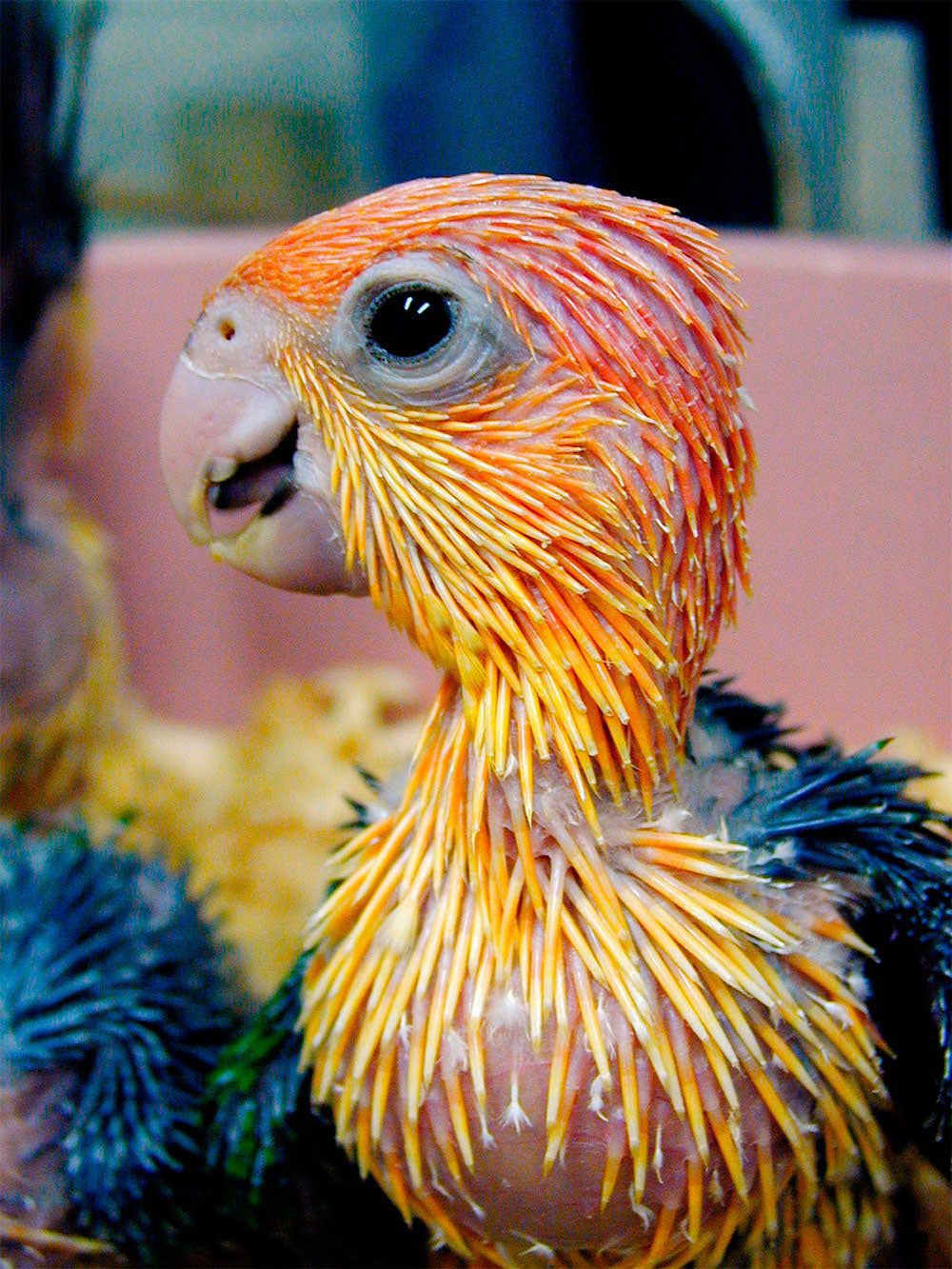
(8) – White-bellied Parrot (often referred to as the White-bellied Caique); a chick. Its feathers have not opened yet By Ruth Rogers (originally posted to Flickr as Caique) [CC BY 2.0], via Wikimedia Commons
(9) – A painting of a White-bellied Parrot (originally captioned «Psittacus badiceps. Bay-headed Parrot») by Edward Lear (1812-1888) Edward Lear [Public domain], via Wikimedia Commons
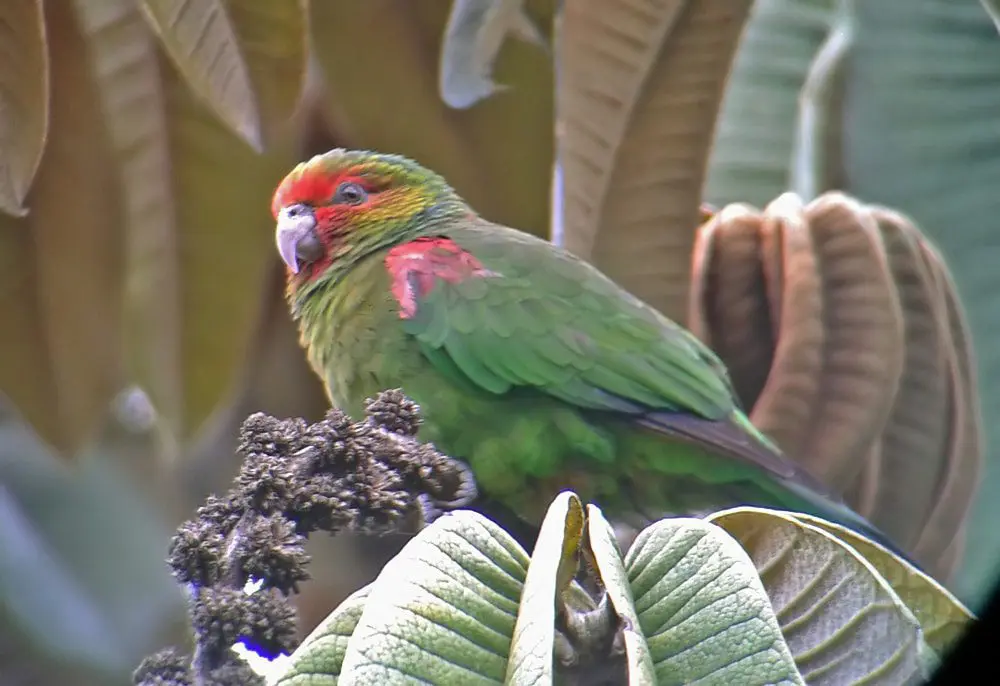
The Red-faced Parrot(Hapalopsittaca pyrrhops) It is distinguishable by the intense red in face and pink magenta in shoulder.
Of bill Of course, yellow feathers on the sides of the neck, crown Green with more bluish back.
Dorsally, wing
with blue stain and end blackish; tail with blue border.
In flight, wing with armpit red, Blue-Green rest, tail Red with blue tip. Youth with the face less red.
Rare. It inhabits in the Woods high Andean, near fells, edges and secondary forests, from the 2400 to 3500 m. They are gregarious, usually in pairs or small flocks of 4 to 6 individuals, rarely more.
They are mostly sedentary. But, can arise some movements seasonal altitudinal.
Reproduction:
Nest in the cavities of trees in October-January; the laying of eggs in late November; the chicks are born in early December, and they leave the nest in late January.
Food:
They feed in the canopy of the forest.
Its diet includes outbreaks, flowers, berries and seeds.
Distribution:
Size of the area of distribution (reproduction / resident): 33.800 km2
Inhabits the southern Andes Ecuador and North end of Peru.
Conservation:
• Current category of the Red List of the UICN: Vulnerable.
• Population trend: Decreasing.
The population is estimated to be a number of 2.500-9.999 mature individuals.
Threats
Its decline is attributed to the destruction and fragmentation of habitat, largely through the conversion of burning forests to small farms (Jacobs and Walker, 1999).
Severe loss of this species can be expected due to deforestation and degradation of forests, by burning and grazing, on Cordillera de Chilla, Loja of Ecuador, although 1995 there were still extensive forest areas (Toyne and Flanagan 1997, Jacobs and Walker 1999).
"Red-faced Parrot" in captivity:
Unknown in the poultry.
Alternative names:
– Red-faced Parrot, Ecuadorian Parrot, Red faced Parrot (English).
– Caïque de Salvin, Caïque à face rouge (French).
– Salvinpapagei, Salvins Zwergpapagei (German).
– Red-faced Parrot (Portuguese).
– Lorito Ecuatoriano (español).
– Loro de Cara Roja (Peru).
27 to 29 cm.. height and between 233 and 293 g. of weight.
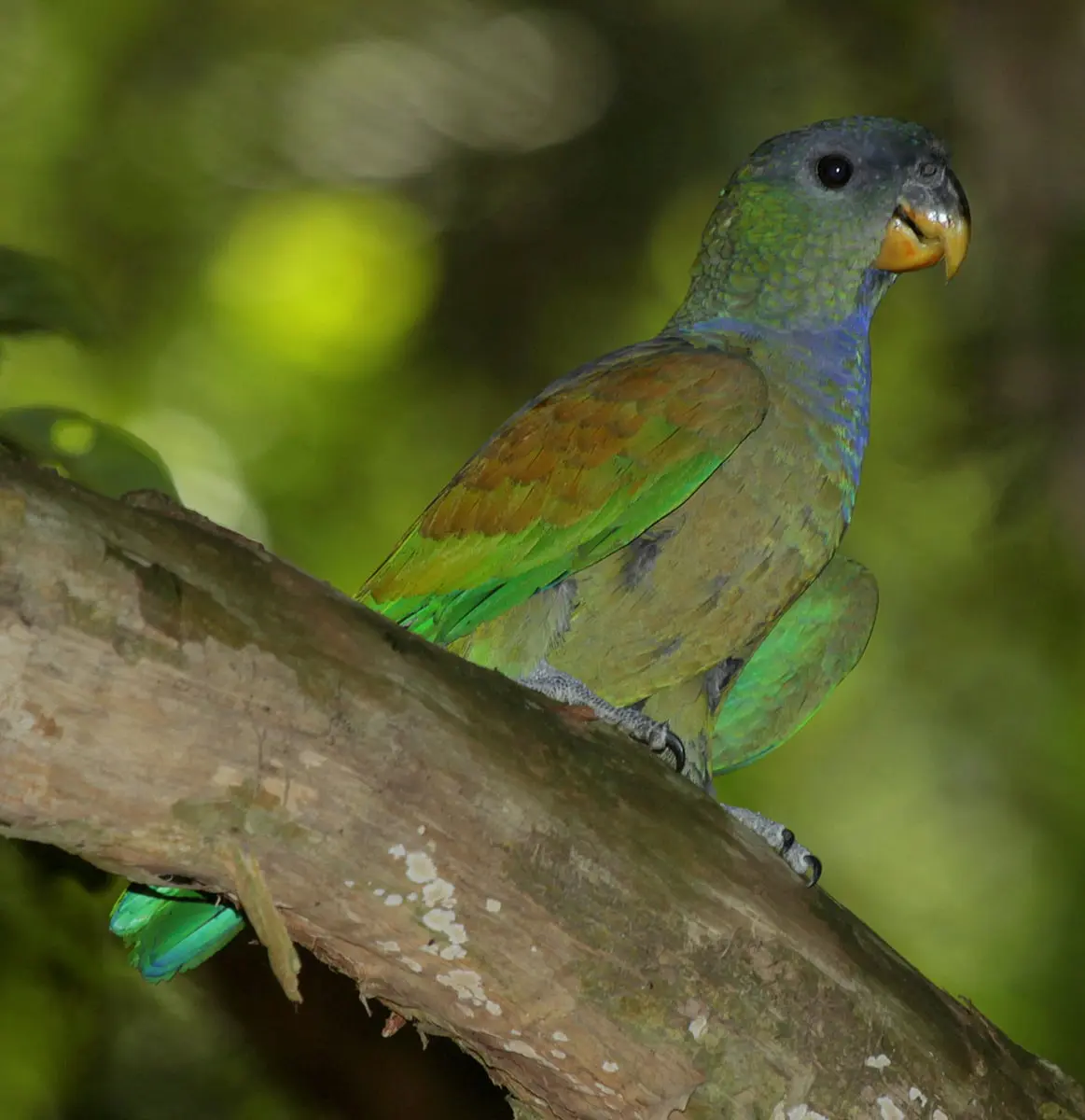
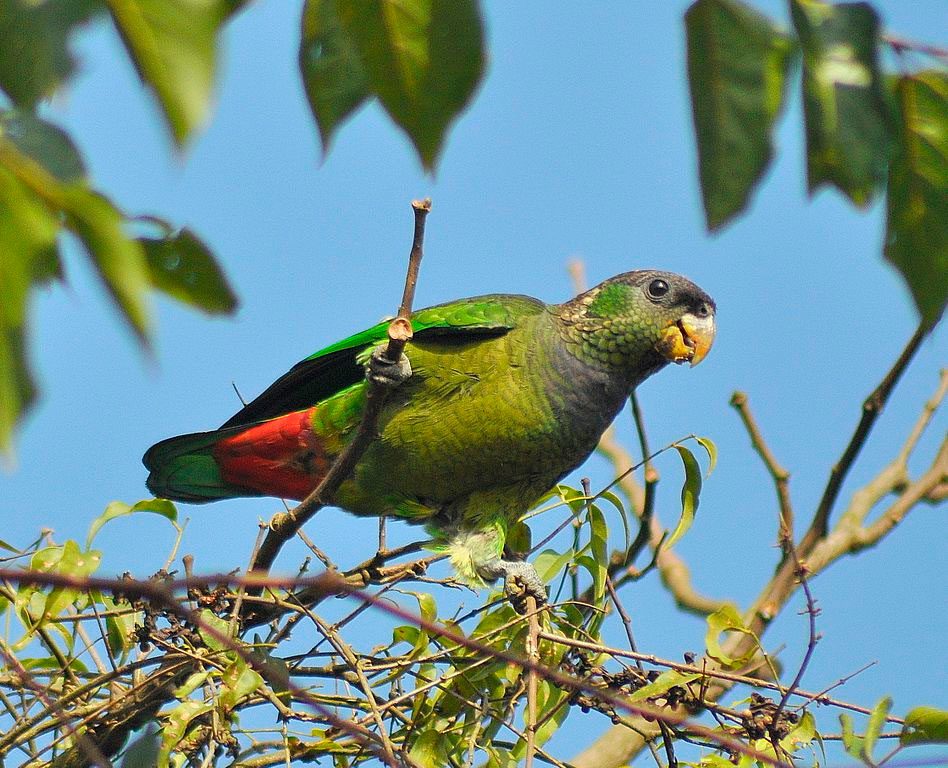
The Scaly-headed Parrot(Pionus maximiliani) It is medium in size and tail very short; has the lores, the forecrown and the eye area opaque dark bronze; the feathers on crown, the cheeks, the chin and the sides of the neck, basal green with wide enough margins bronze that give the appearance of flake; ear-coverts with dark green margins but brighter than other pens head.
The back of the neck and green the mantle become more brown and olive green upper lower parts, where some feathers have quite indistinct darker tips. Coverts smaller and medium-sized green olive brown with indistinct dark tips; alula, primary and greater coverts and flight feathers, brighter green, contrasting with the upperparts brown, duller.
Under the wings, opaque green. The throat and the top chest blue violet off that fade in brownish olive green in the bottom of the chest and most of the belly, but they are become brighter and greener in flanks and the thighs; undertail-coverts crimson. Upper, the tail green in the center, outer feathers mainly blue and red at the base; undertail, the tail, bluish green duller. Bill black with yellow edges on the upper jaw and the bottom tip; orbital skin pale grey; irises dark brown; legs grey. Both sexes are similar. Immature It has less intense the blue throat; feathers head more green with less distinct margins.
(Ribeiro, 1920) – Blue darker in throat and darker above. Larger.
Pionus maximiliani siy
(Souance , 1856) – Much like the nominal species but darker below, more purple and less blue in the chest, yellower in back and Blue throat lighter.
Habitat:
It inhabits in a wide range of forested habitats, but mostly in dry forests lowland ranging from caatinga very dry, inside the northeast of Brazil, through the savannas Cerrado seasonal, to chaco; also in wetter forests, including gallery forests and forests of araucarias, especially in southeast Brazil. They can also be seen in subtropical forests in Eastern Andean slopes some 2.000 meters in the Northwest of Argentina and some 1.500 meters in the mountains of the South of Brazil.
Tolerant to human alteration of forest habitats and sometimes cultivated areas. Usually gregarious, arriving to form flocks numerous in places in where the food is abundant probably is hiding in small groups in them cups of them trees.
Reproduction:
They nest in tree hollows. Birds in terms of breeding in the month of October in Paraguay; November in São Paulo; laying 3-5 eggs.
Mainly resident, although it may not grow in the drier parts of the Argentine Chaco. Apparently more numerous in the center of its area of distribution, where its abundance is only surpassed by the Maroon-bellied Parakeet(Pyrrhura frontalis); progressively more scarce toward the periphery.
Locally quite common the common in Bolivia and locally common in the North of Argentina, where it is most abundant in the South of Salta, Tucumán and areas adjacent in Catamarca. Moderately common in Rio Grande do Sul and common in the pantanal; densities Brazilian more high in São Paulo.
The decrease apparent, in some parts of the range, (for example, North of the Argentina) is attributable to the trade, but in other places (for example, the southeast of Brazil) is undoubtedly its decline due to the loss of forests.
(Ribeiro, 1920) – It is from Paraguay, Brazil and northeast of Argentina (Missions)
Pionus maximiliani siy
(Souance , 1856) – Southeast of Bolivia until Paraguay, West of Brazil (Mato Grosso), North of Argentina.
Conservation:
• Current category of the Red List of the UICN: Least concern.
• Population trend: Decreasing.
Justification of the population
The size of the world population It has not been quantified, but this species is described as «quite common» (Stotz et to the., 1996).
Justification of trend
It is suspected that the population is in decline due to the continuous habitat destruction and to levels of exploitation unsustainable.
Threats
The species has been object of strong exchanges: from 1981, When is included in the Appendix II of the CITES, they have been 93.234 individuals captured in the wild in the international trade (database CITES from the UNEP-WCMC, January 2005).
"Scaly-headed Parrot" in captivity:
Curious, very intelligent and social. Quiet and relatively little aggressive. Prone to obesity. You can learn to imitate.
Pretty common in captivity. Life expectancy: 20 years.
Housing: Enclosure suspended at least 2 metres in height.
Diet: fruit as: Apple, pear, orange, banana, granada, cactus fruits, they form approximately the 30 percent of the diet; vegetables as: Carrot, celery, green beans, pea in the pod; corn fresh; green leaves such as: chard, lettuce, dandelion, Aviary grass; millet; mix of seeds small e.g.: millet, and small amounts of buckwheat, oats, safflower and hemp; soaked and sprouted from seeds of sunflower; beans, cooked legumes and boiled corn.
It needs regular exercise it is necessary to provide you with an Aviary as large as possible. Provide shallow bowls of water for bathing. Also provide stairs, swings, strings, different sizes of hooks and assorted toys.
Alternative names:
– Scaly-headed Parrot, Maximilian’s Parrot, Scaly headed Parrot (English).
– Pione de Maximilien, Pionus de Maximilien (French).
– Maximilianpapagei (German).
– Maitaca, baitaca, maitaca-bronzeada, maitaca-de-Maximiliano, maitaca-suia, maitaca-verde, suia, umaitá (Portuguese).
– Loro Bronceado, Loro choclero, Loro maitaca (español).
(1) – IBC.lynxeds.com
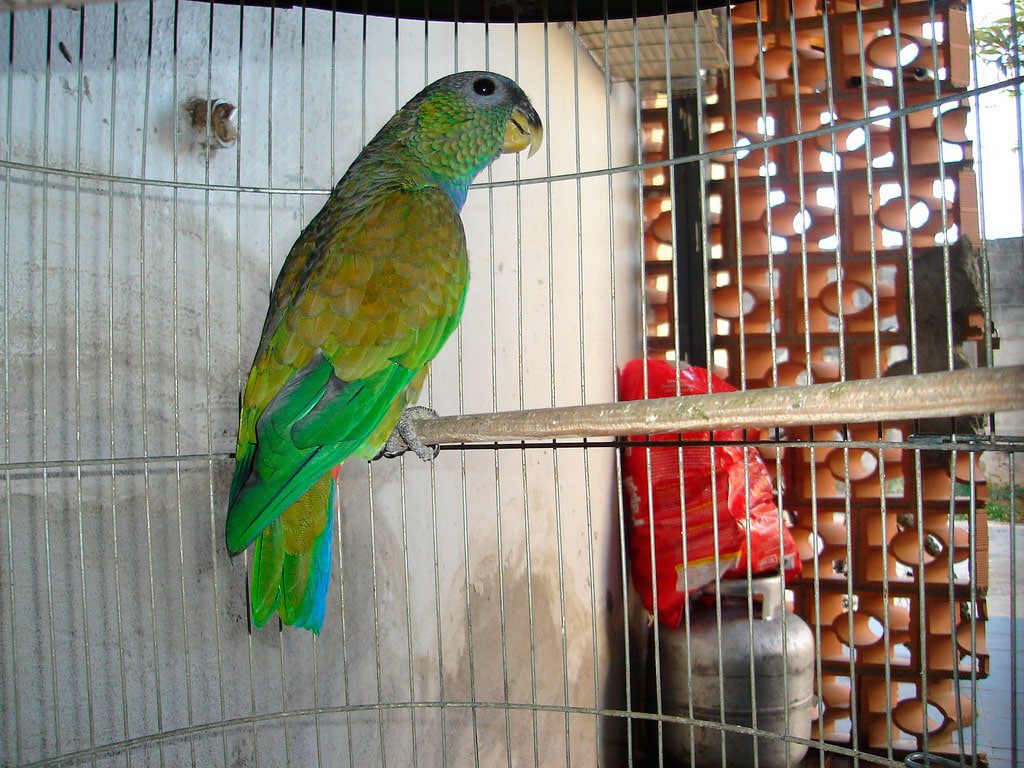
(2) – A Scaly-headed Parrot (also called a Scaly-headed Pionus, Maximilian’s Pionus, amd Maximilian’s Parrot) in a cage By Alex Knowles [CC BY 2.0], via Wikimedia Commons
(3) – A pet male Scaly-headed Parrot (also called Maximilian Pionus, Maximilian Parrot, Maximilian’s Pionus, or Maximilian’s Parrot) By Snowmanradio (Own work) [CC BY-SA 3.0 or GFDL], via Wikimedia Commons
(4) – Scaly-headed Pionus (also called Maximilian Pionus, Maximilian Parrot, Maximilian’s Pionus, or Maximilian’s Parrot) at Zoológico de Americana, Sao Paulo, Brazil By Moe Oliveira [CC BY 2.0], via Wikimedia Commons
(5) – Loro Choclero By Danbrazil (Own work) [CC BY-SA 4.0], via Wikimedia Commons
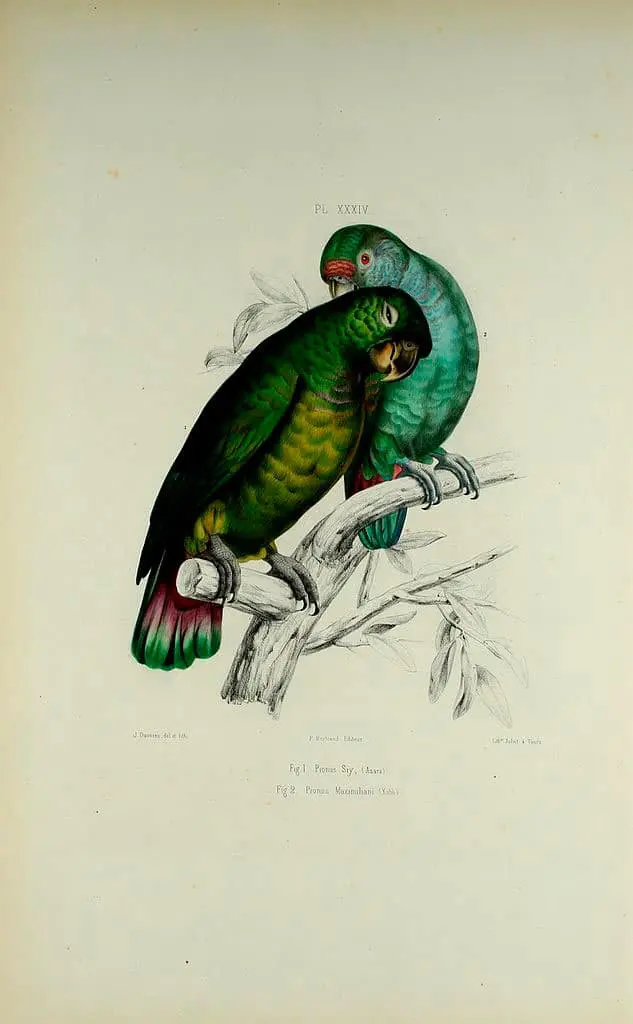
(6) – Iconographie des perroquets : non figurés dans les publications de Levaillant et de M. Bourjot Saint-Hilaire By Blanchard, Emile; Bonaparte, Charles Lucian; Bourjot Saint-Hilaire, Alexandre; Le Vaillant, François; Souancé, Charles de. [CC BY 2.0 or Public domain], via Wikimedia Commons

 Minor Concern ⓘ
(UICN)ⓘ
Minor Concern ⓘ
(UICN)ⓘ












.jpg)


.JPG)
.jpg)