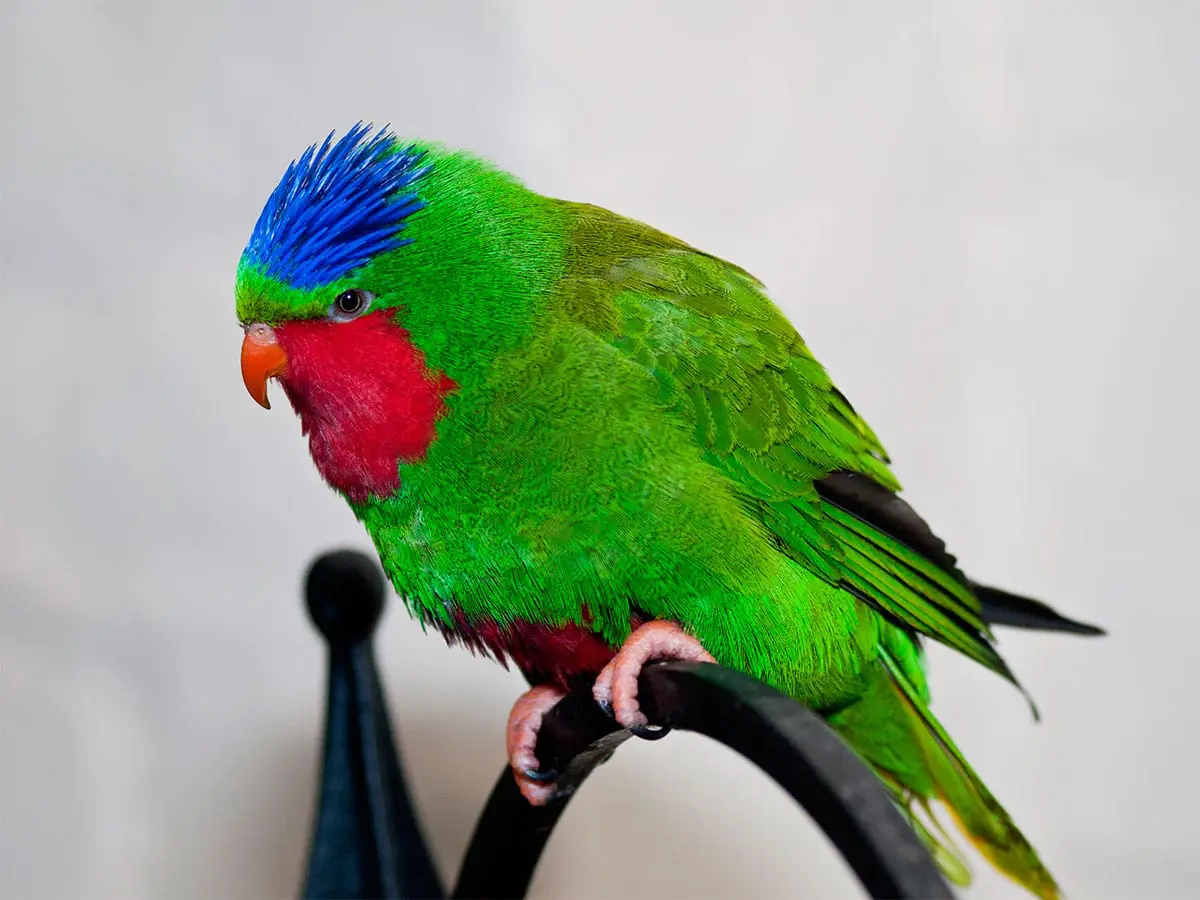
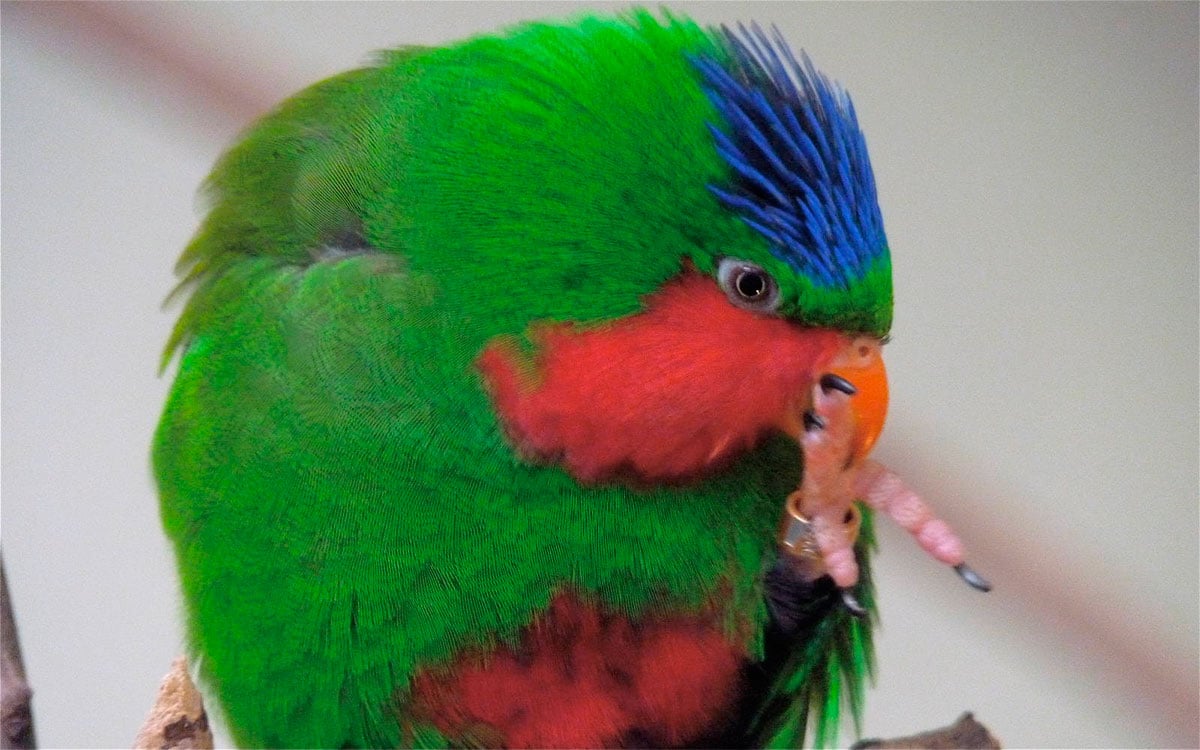
The Blue-crowned Lorikeet(Vini australis) has a plumage mostly green. The upper part of the head is dark blue with light blue streaks. The region of the windows of the nose, the cheeks, the ear-coverts, the neck and the abdomen They are red. the lower part of abdomen and the thighs they are purple blue. The back is green, the interior of the tail is yellowish-green. The irises is reddish brown. The legs are of color red and the bill is orange.
The youth are equal to adults, but with less red in the face and throat, little or none abdominal patch, stripes blue shorter in the crown, no purpura on the thighs, brown the eyes.
It is found in forests, coconut palms or any habitat where flowering trees; coastal mountains, gardens and agricultural areas. Nomad, sometimes traveling between the Islands.
Daily movements in search of food. Aggressive but gregarious, they often move in flocks of up to 12 individuals, except during the breeding season they live with their partners.
In Samoa it is common around villages and plantations and less common in moist forests, higher elevations in the rain forest and secondary growth.
Reproduction:
Nests in holes or hollows of trees, It has also been reported that they dig burrows in the banks of Earth, Although it has not confirmed. The laying is one or two white eggs. Breeding registered in June and August. In captivity the incubation It has been calculated in 23 days.
Food:
It feeds on nectar, pollen and red fruits. It particularly prefers Erythrina, Wild hibiscus and coconut.
Distribution:
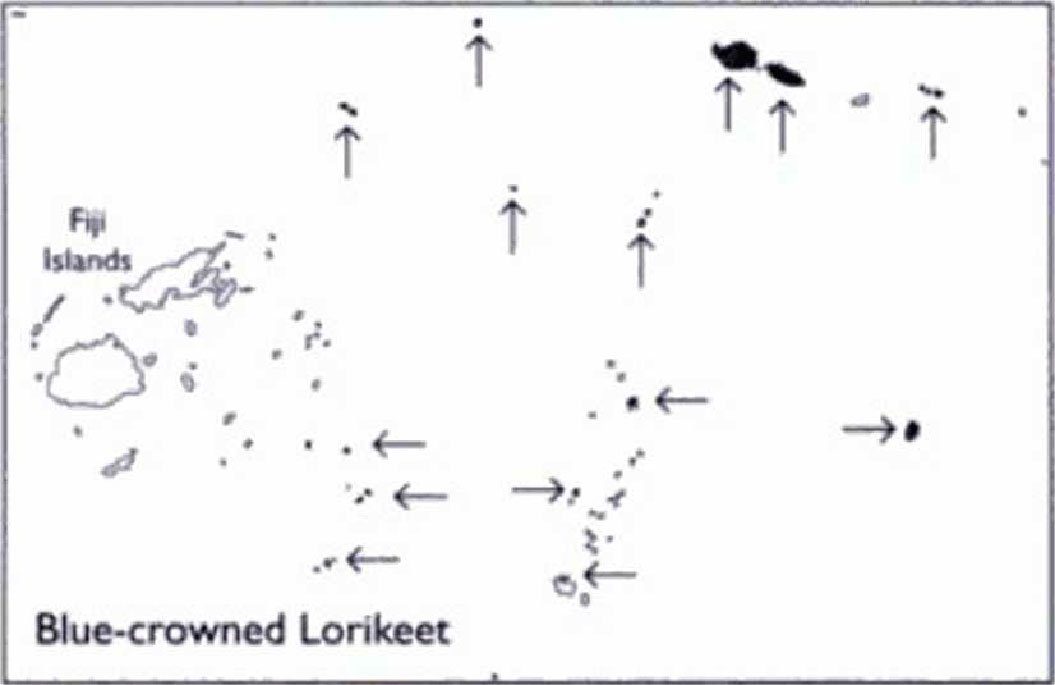
Extends over the archipelagos of Samoa, Tonga and LAU, distributed by Islands: Love, Futuha'a, Fulago, Futuna, Ha'afeva, You're young, Moce, Niue, Ofu, Olosega, Samoa, Salt, Tafahi, Say, Tofua, Tungua, Fire, It's cool, Varoa, I'm sorry and Voleva. In the past was also in ‘USA, Tongatapu and Mata-Utu but there it is extinct.
Conservation:
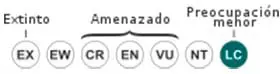
– Current IUCN Red List category: Least concern.
– The population trend: Decreasing.
The world population It has not been quantified, but the species is informed that it is common in much of its restricted area of distribution.
The population is suspected to be in decline due to the predation by species invasive.
Still fairly common throughout its range, but it has become extinct on many islands and it is decreasing in Tonga (probably because of the rats).
"Blue-crowned Lorikeet" in captivity:
Like the others Vini lories, the Blue-crowned Lorikeet still quite rare in poultry farming, probably as a result of the protection they receive in their native South Pacific countries.
Alternative names:
– Blue-crowned Lorikeet, Blue crowned Lorikeet, Blue-crowned Lory (ingles).
– Lori fringillaire (French).
– Blaukäppchen (German).
– Loris Vini Australis (Portuguese).
– Lori de Samoa (español).
31 cm.. length.
The Tucuman Parrot(Amazona tucumana) It is mostly green, with black borders on the feathers, giving the whole a scalloped appearance.
Relatively large and stocky have the forecrown red and eye rings white. Has also patch Red in the wing-coverts (most notoriously in flight); thin yellow line on shoulder almost half of wing
; the primary wing feathers They have the blue tips, and the thighs They are orange-yellow. The tail It is short and feathers yellow.
The bill It is yellowish to pinkish, and eyes adults are orange-yellow. The legs They are pale gray.
As he male as the female They are similar in appearance, but the immature They are generally green in full, with the thighs green than orange and less red on the forecrown. Another key difference between adult and immature is that eyes young people are gray.
Taxonomic note:
Until a few years ago it was considered a subspecies of the Red-spectacled Parrot(Amazona pretrei) (Fjeldså y Krabbe 1990), but now they are recognized as separate species, although closely related to each other and, In addition, with the Vinaceous Parrot(Amazona vinacea), who possibly form a basal group to all other parrots of the genus (Russello y Amato 2004).
It is found in open forests Andean mountain forests Yungas, particularly in areas with Alnus acuminata or Podocarpus parlatorei, as well as other species of Alnus, Podocarpus and Nothofagus. This species It is in elevations of between 1.600 and 2.600 metres in the breeding season, but during the non-breeding season they descend to lower elevations of about 350 m. Right now, sometimes you can enter inhabited areas.
Often gathers in large flocks, often numbering more than 200 individuals.
Reproduction:
The Tucuman Parrot They breed between November and January or February, building usually your nest in a hole in a tree Alnus or Podocarpus. The normal size clutch is three to four eggs, although they have been reported sunsets from one to five eggs. The incubation lasts around 26 to 29 days, usually it is the female that the male incubates and which feeds, and the main source of food for chicks come from seeds and flowers Podocarpus parlatorei. Young they leave the nest usually after seven to nine weeks.
Size of its range (breeding/resident ): 86.200 km2
The Amazona tucumana It is located in northwest Argentina and in southern Bolivia, where it is known in 12 locations departments Tarija, Chuquisaca and Santa Cruz(A. Maccormick in some. 2005, R. Hoyer in some. Slightly., 2012).
A recent study of the situation and distribution of the species Argentina registered 6.015 individuals (Rivera et al., 2007) and estimated that the Argentine population amounted to about 10.000 birds, but around 20.000 They were exported from Argentina in the mid 80, suggesting that there may have been a substantial population decline.
After inclusion in the Appendix I of the CITES, international trade was cut, although the continuous local exploitation. But, It does not appear that the stocks have recovered, and loss of habitat is of concern, particularly in Argentina, where their habitat is highly degraded and there are only a few remains of small forests and isolated. Threats to habitat are less severe in Bolivia, but the species has declined there and is projected to continue to do so (A. Maccormick in a bit., 2005).
• Current category of the Red List of the UICN: Vulnerable.
• Population trend: Decreasing.
• Population size : 6000-15000.
Rationale for the Red List category
This species is classified as Vulnerable, as it is experiencing rapid population decline due to the loss of habitat and capture for the bird trade.
Justification of the population
A recent study of the situation and distribution of the species Argentina registered 6,015 individuals and Argentina estimated that the population was approximately 10.000 birds (L. Rivera in a bit., 2004). It also, 1.643 individuals were recorded at several sites in Bolivia during another recent study (Rivera et al., 2007). The total population is thus situated in the band 10.000-19.999 individuals (L. Rivera in a bit., 2012). This is equivalent to 6,667-13,333 mature individuals, rounded here to 6,000-15,000 mature individuals.
Justification of trend
The results of the survey, observations on habitat loss and the local occurrence of the species, and catch and trade data suggest that the population is suffering rapid population decline (L. Rivera in some.)
Conservation Actions Underway
• CITES Appendix I, although the convention is not respected in Bolivia (AB Hennessey in litt., 2012).
• Present in several protected areas, including the El Rey National Park, Argentina, mainly in the non-breeding season (L. Rivera in some. 2012).
• A species conservation action plan is currently being developed for each of its native countries. (L. Rivera in a bit., 2012).
Conservation Actions Proposed
• Apply the local trade ban (L. Rivera in a bit., 2012).
• Evaluate the current population size.
• Produce a species action plan.
• Conduct additional research to clarify the scope of the current threat of trade.
• Effectively protect core areas of remaining habitat; review their habitat requirements and complement nesting sites using boxes where appropriate (AB Hennessey in some. 2012).
• Address unsustainable use of resources and illegal activities in protected areas..
Parrots Gender Amazona are among the most recognizable and sought-after pet birds. Their colorful plumage and ability to imitate the human voice have made them highly sought after for centuries, and one unfortunate consequence of this is the threatened status of most species. (Russello y Amato 2004). In the Red list of Threatened Species International Union for the conservation of nature, 16 parrot species of this genus are included either as Vulnerable, Endangered or Critically Endangered (IUCN 2010). In the same way, 16 species are listed in Appendix I of the Convention on International Trade in Endangered Species (CITES).
The Amazona tucumana It is a species that should only be kept in captive with the sole purpose of achieving their reproduction and subsequent insertion into the wild.
Alternative names:
– Tucuman Parrot, Alder Amazon, Alder Parrot, Tucuman Amazon(English).
– Tucumanaamazone, Tucumanamazone(German).
– Amazone de Tucuman(French).
– Papagaio-tucumă(Portuguese).
– Amazona Alisera, Amazona Tucumana, Loro alisero(español).
– Loro alisero(Argentina).
– Loro alisero(Bolivia).
– Avibase
– Parrots of the World – Forshaw Joseph M
– Parrots A Guide to the Parrots of the World – Tony Juniper & Mike Parr
– Birdlife
– RIVERA, Luis; POLICE, Natalia y BUCHER, Enrique H. Ecology and conservation of the Alder Parrot (Amazona tucumana). Hornero [online]. 2012, vol.27, n.1 [aforementioned 2017-01-29], pp. 51-61 . Available in: . ISSN 0073-3407.
– Photos:
(1) – Tucuman Parrot (Amazona tucumana) by birdsandbirds
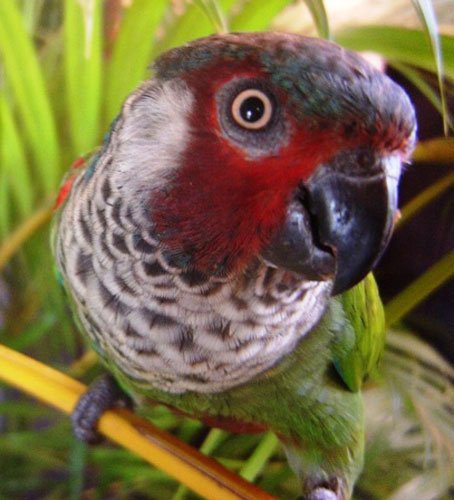
The Todl`s Parakeet(Pyrrhura picta caeruleiceps) It is generally green with the forehead and areas around the eyes, dark red.
In flight the dark red stain is very evident abdomen. Wings below greyish. The crown and nape they are blue; the front and sides of the strip head, red and scaly appearance of the chest with wider margins. This subspecies is included within the species Pyrrhura picta.
Notes:
Historically, classification of Pyrrhura picta caeruleiceps (Todd 1947) He has been subject to opinions found. While some authors recognize this taxon at the species level, others consider it a subspecies of Pyrrhura subandina (Todd 1947) or Pyrrhura picta (Meyer de Schauensee 1949), the latter being the most widely followed classification (Hilty & Brown 1986, pit et to the. 1997, Rodríguez & Hernandez-Camacho 2002). Based on analysis of morphological characters, Joseph (2000) and Joseph & Stockwell (2002) suggested that P. caeruleiceps should be considered as a distinct phylogenetic species and that the taxon Pyrrhura pantchenkoi (Phelps 1977), described from two specimens with worn plumage, is its synonym. Hilty (2003) He continued this treatment, but the classification committee Bird South America of the American Ornithologists’ Union recently it considered that existing information was insufficient to support this taxonomic change according to the biological species concept and kept provisionally caeruleiceps like a subspecies of painted parakeet (Remsen et al. 2010).
They inhabit in humid jungle, semi-humid and low cloud forests. Nest sizable trees in abandoned nests of other species.
Distribution:
The enigmatic and little known Todl`s Parakeet(Pyrrhura picta caeruleiceps) It has a very restricted range in the rainforest, mainly between 500 and 900 Attitude meters along the border between Colombia and Venezuela, as well as patches of tropical forest in the foothills of the Serrania del Perija.
Its Freedom population It is believed to be about 30 to 50 individuals.
Conservation:
State of conservation ⓘ
Endangered ⓘ(UICN)ⓘ
The forest loss and fragmentation are the main threats facing this bird, but the species is also trapped and kept in cages as a pet. According to the categories of UICN It is considered In danger (IN), mainly due to the habitat destruction.
24-25 cm.. height.
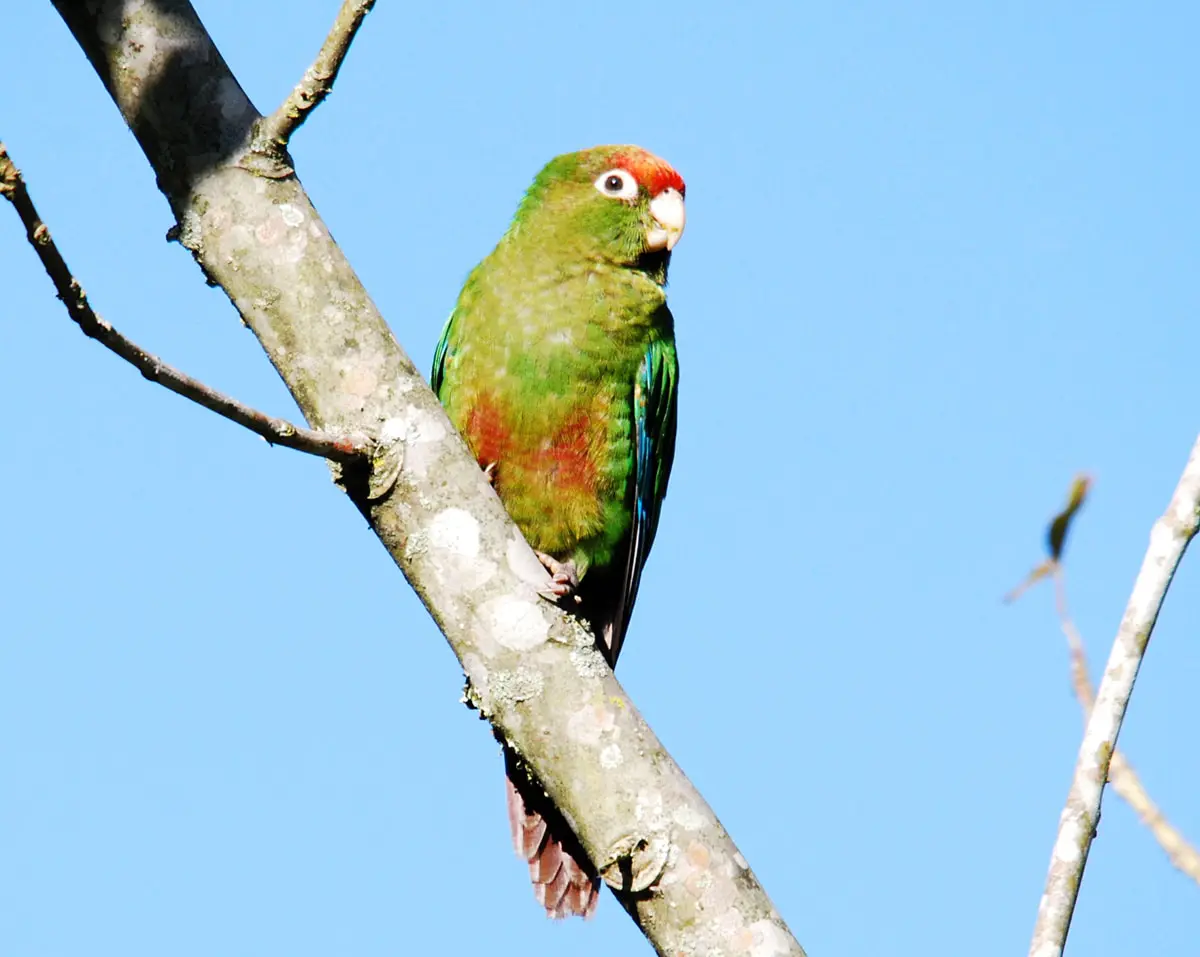
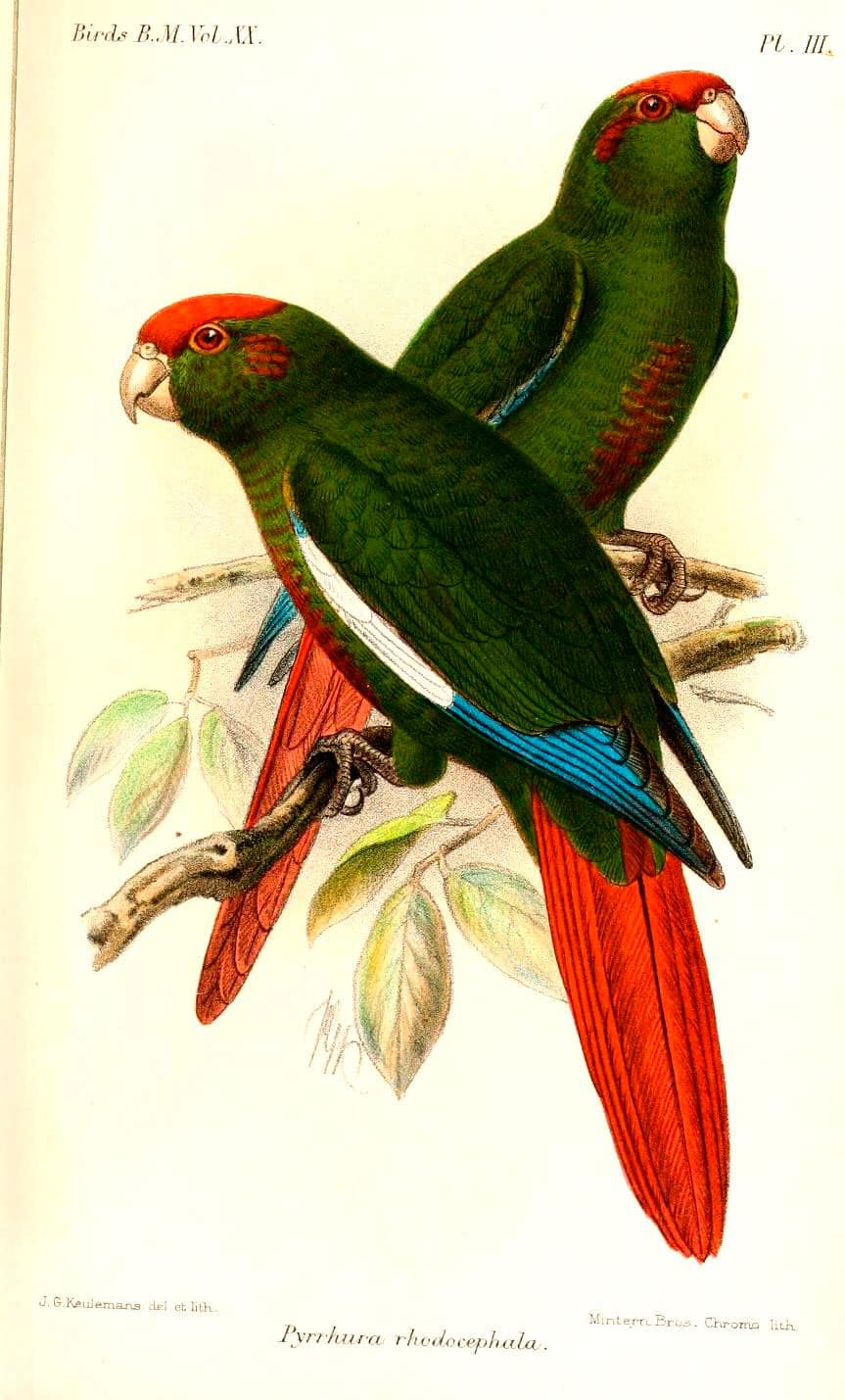
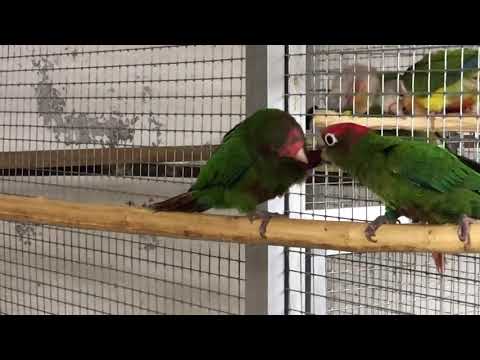
The Rose-headed Parakeet(Pyrrhura rhodocephala) is a small parrot with the body almost all green and a long tail. The more notorious is the hood pink reddish and the patch red behind them eyes; cheeks until uppertail-coverts green. Primary coverts white, other coverts green except, sometimes, some feathers scattered red-orange in the bend of wing. Outerwebs of them flight feather, Blue with black tips. Undertail-coverts green. Feathers of the throat, the chest and the sides of the neck, of color green olive with tips brownish that give an effect of scaly very dim; belly slightly more green olive that the upperparts, with a pale patch red in the center; the undertail-coverts green; at the top, the tail brownish red color; undertail, red clear.
Bill color pale horn; bare periophthalmic white; brown the irises; legs dark gray.
Both sexes similar.
The immature shows a crown bluish green with scattered red feathers, primary coverts Blue and base green until it tail.
It inhabits mainly in humid forests, secondary, and páramo, between 800 to 3400 m. Resident Although daily make long migrations.
Fly in flocks of 10 to 30 individuals.
Reproduction:
There is little information on reproduction, probably it breeding season between the months of May-June.
Food:
It probably feeds on berries, seeds, fruits and flowers.
Distribution:
Size of the area of distribution (reproduction / resident): 17,000 km2
This Parrot is endemic to the Andes, in the Northwest corner of Venezuela, on both slopes of the Cordillera de Mérida from Táchira until Trujillo, with records in the mountains of Merida and North of Barinas.
Is probably resident but perform movements daily to distances considerable. They are distributed in several protected areas, apparently, effective, but the continuous deforestation in its small range must represent a threat to long term.
Conservation:
State of conservation ⓘ
Minor Concern ⓘ(UICN)ⓘ
• Current category of the Red List of the UICN: Least concern.
• Population trend: Stable.
Justification of the population
The size of the world's population has not been quantified, but the species is described as quite common (Hilty 2003).
Justification of trend
They suspected that the population is stable in absence of evidence of any decline or threatens substantial.
– Avibase
– Parrots of the World – Forshaw Joseph M
– Parrots A Guide to the Parrots of the World – Tony Juniper & Mike Parr
– Birdlife
– Parrot Book, Parrots and macaws Neotropical
– Photos:
(1) – fouragesofsand
(2) – Pyrrhura rhodocephala, Rose-crowned Parakeet by John Gerrard Keulemans [Public domain], via Wikimedia Commons
– Sounds:
▷ The world of Pets: Dogs, cats, birds, reptiles, amphibians
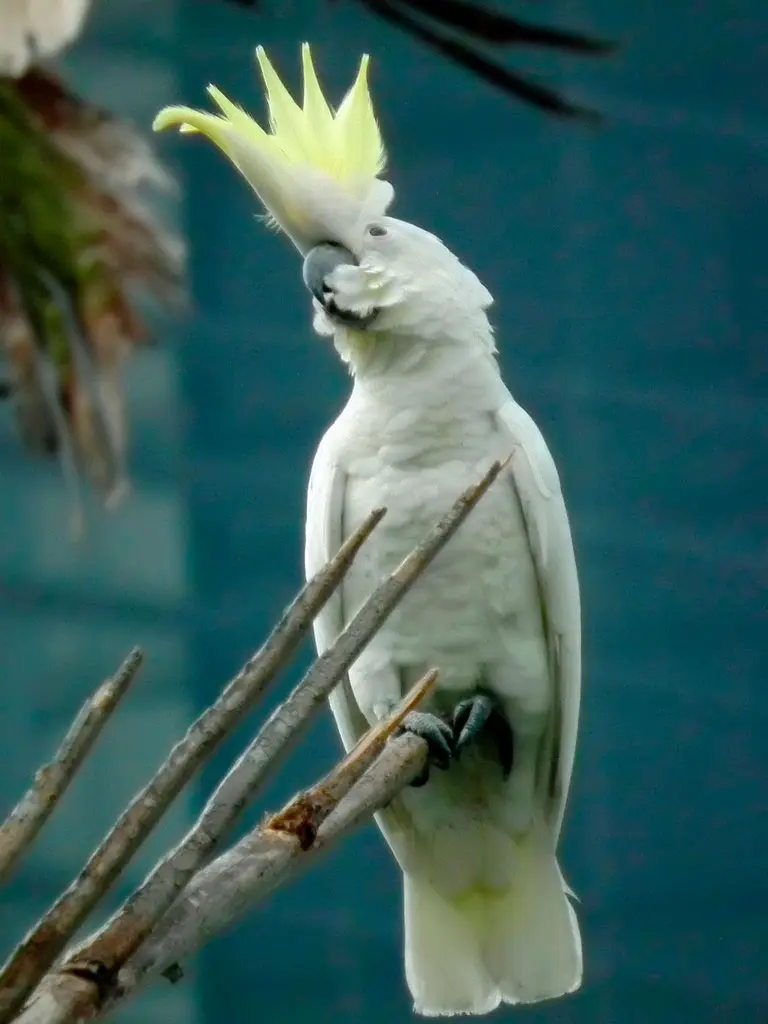
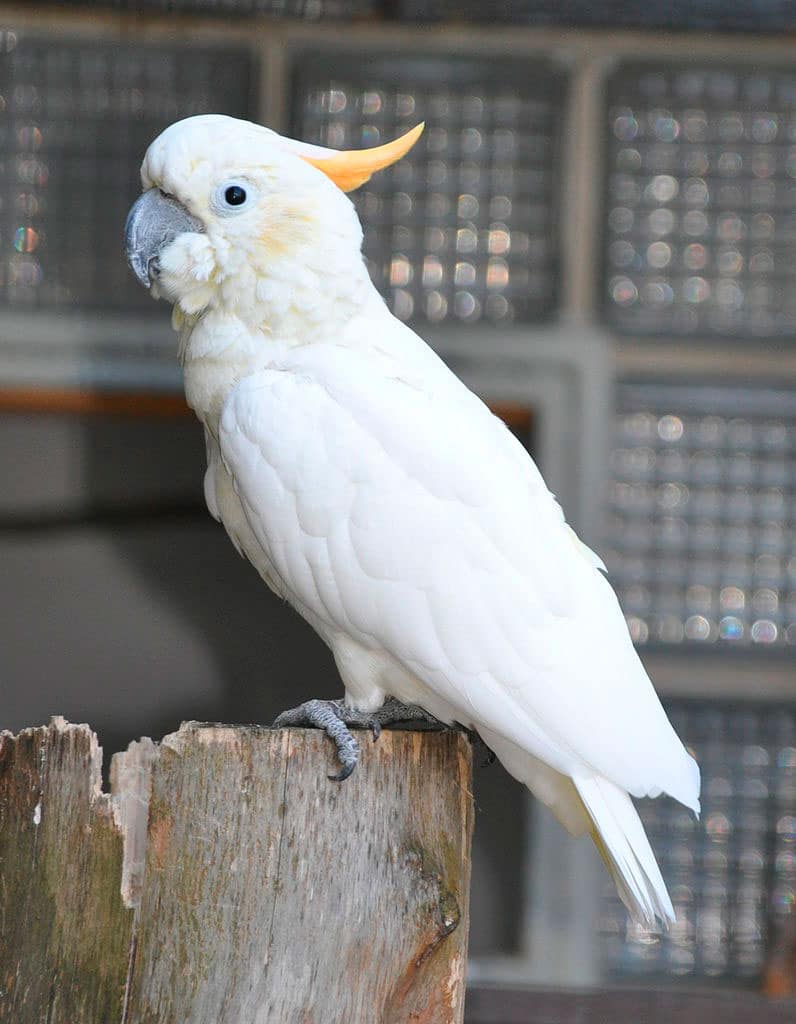
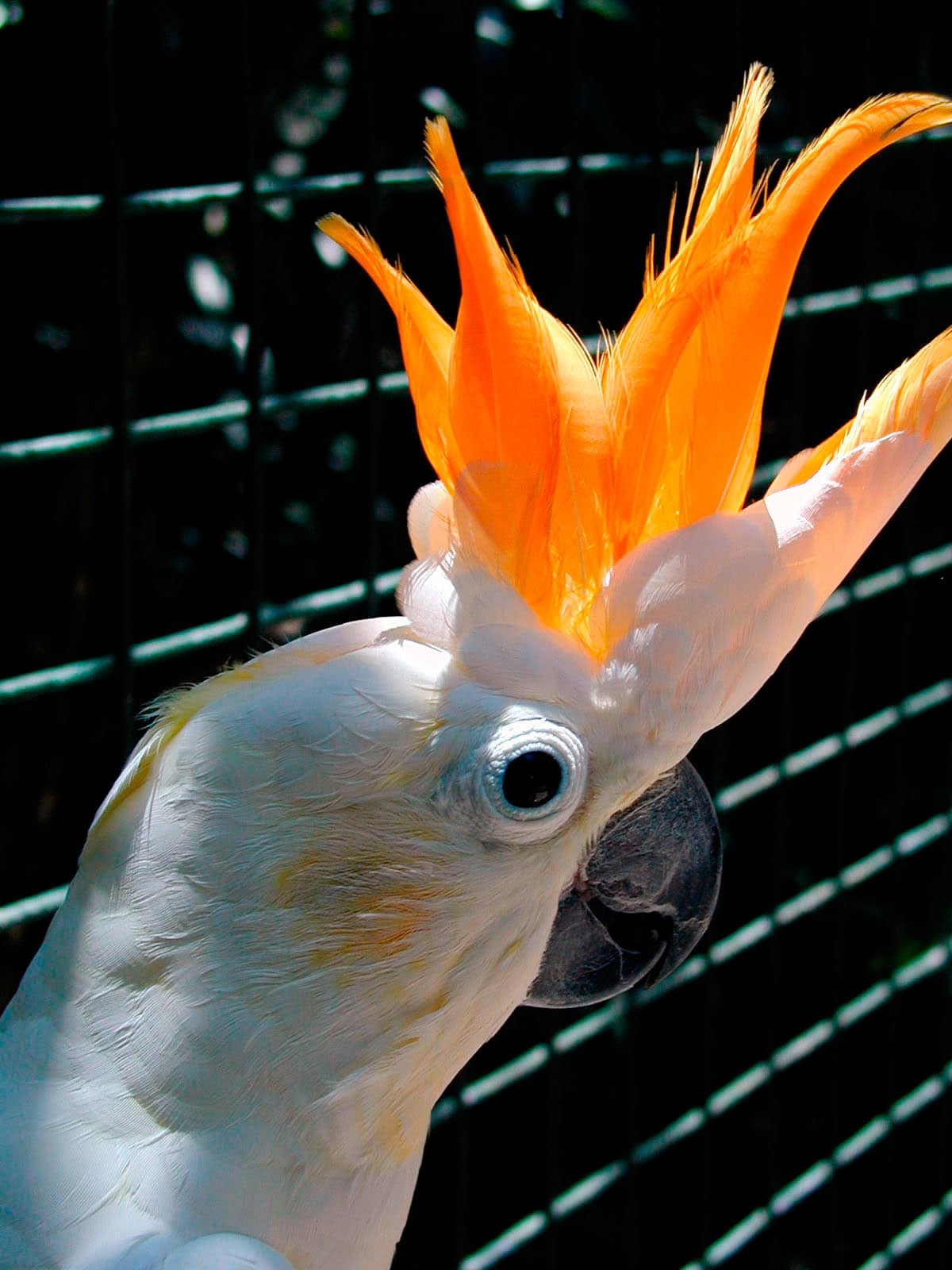
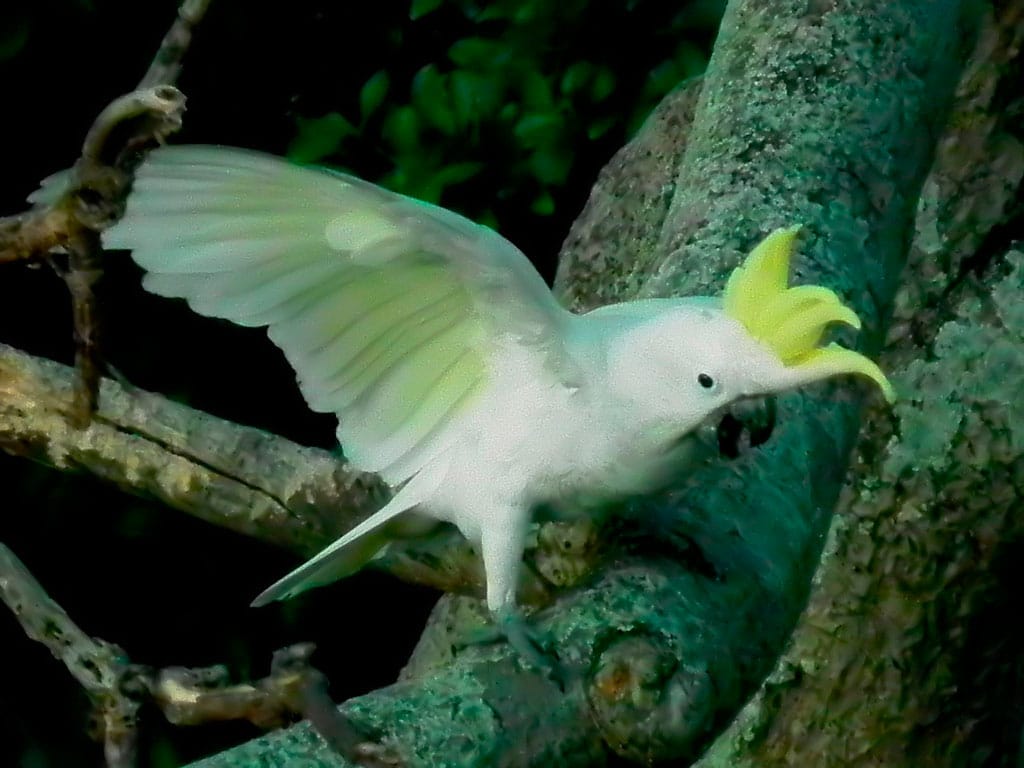
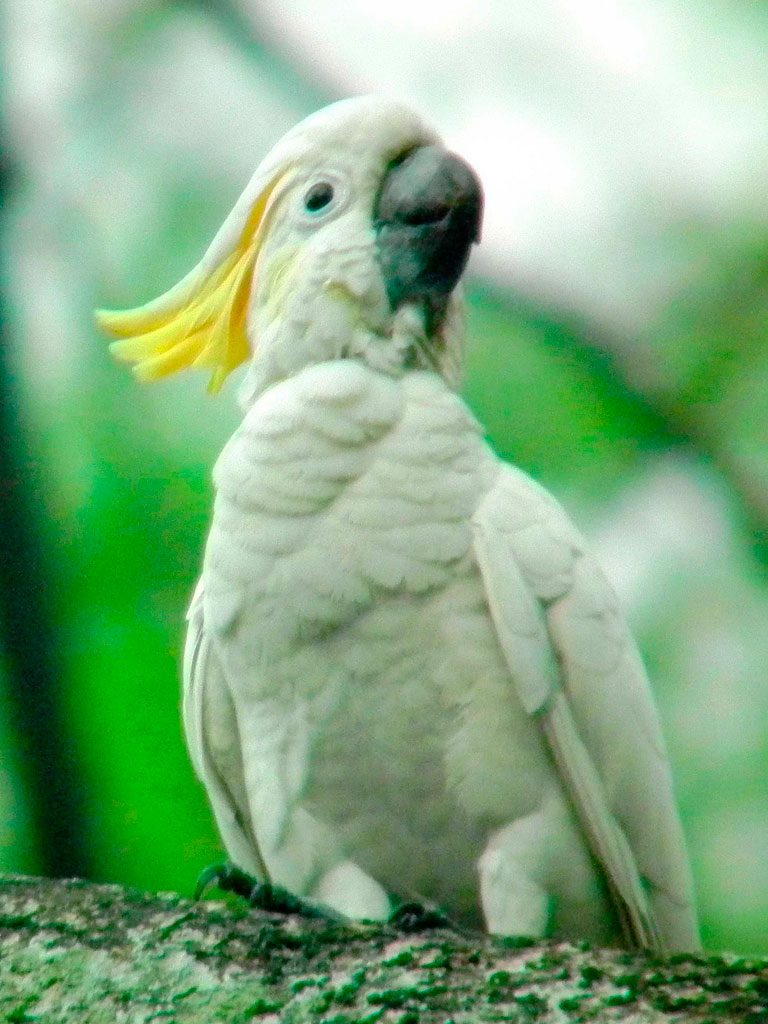
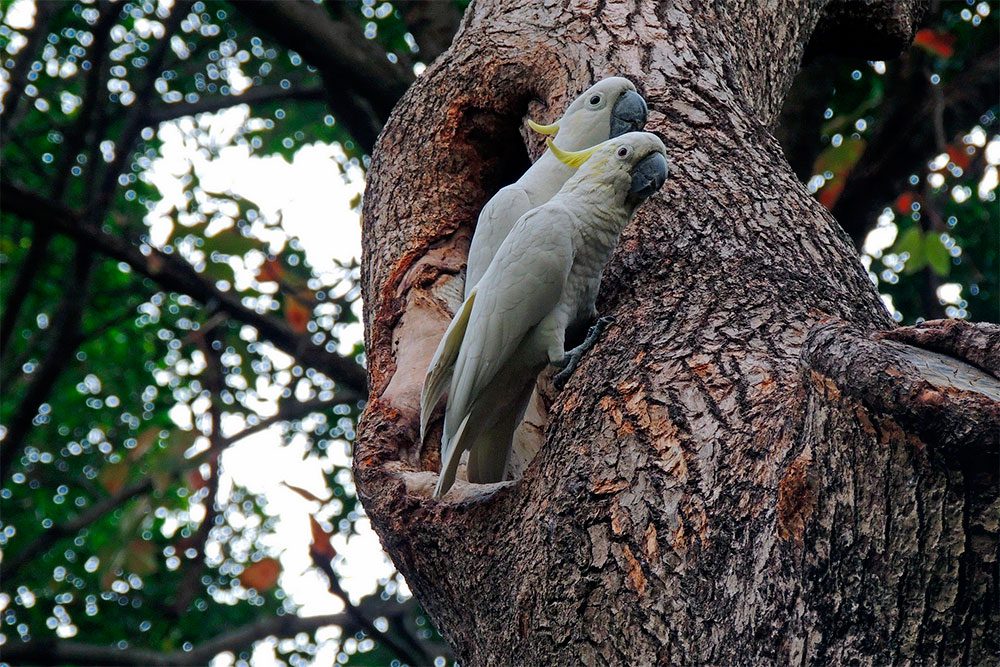
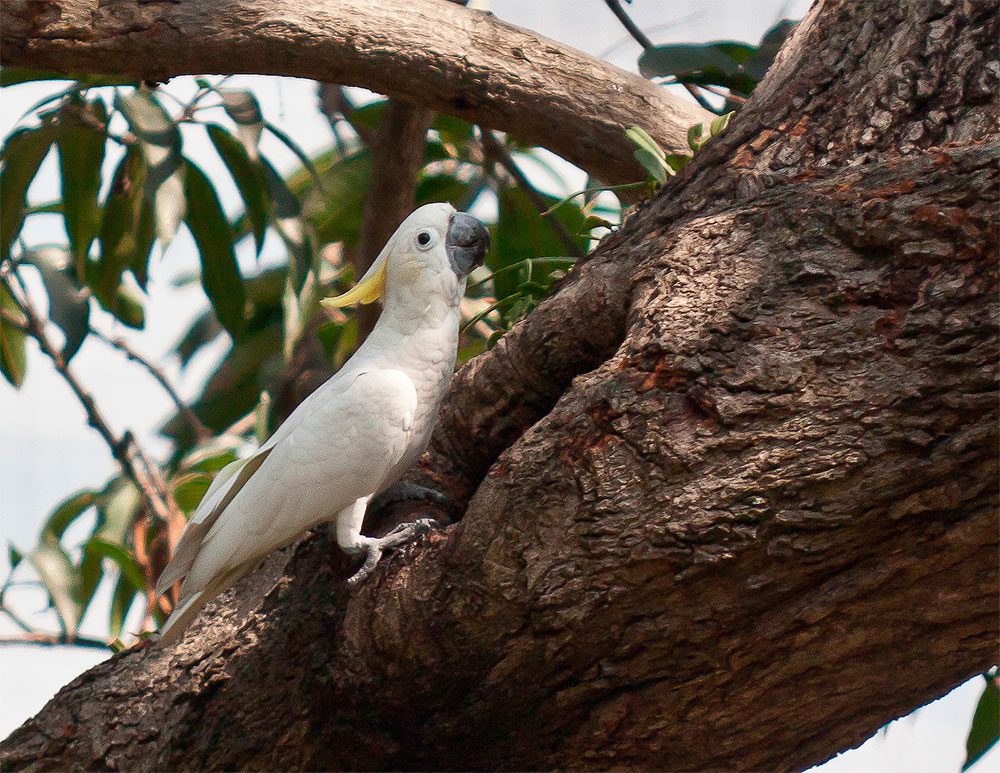
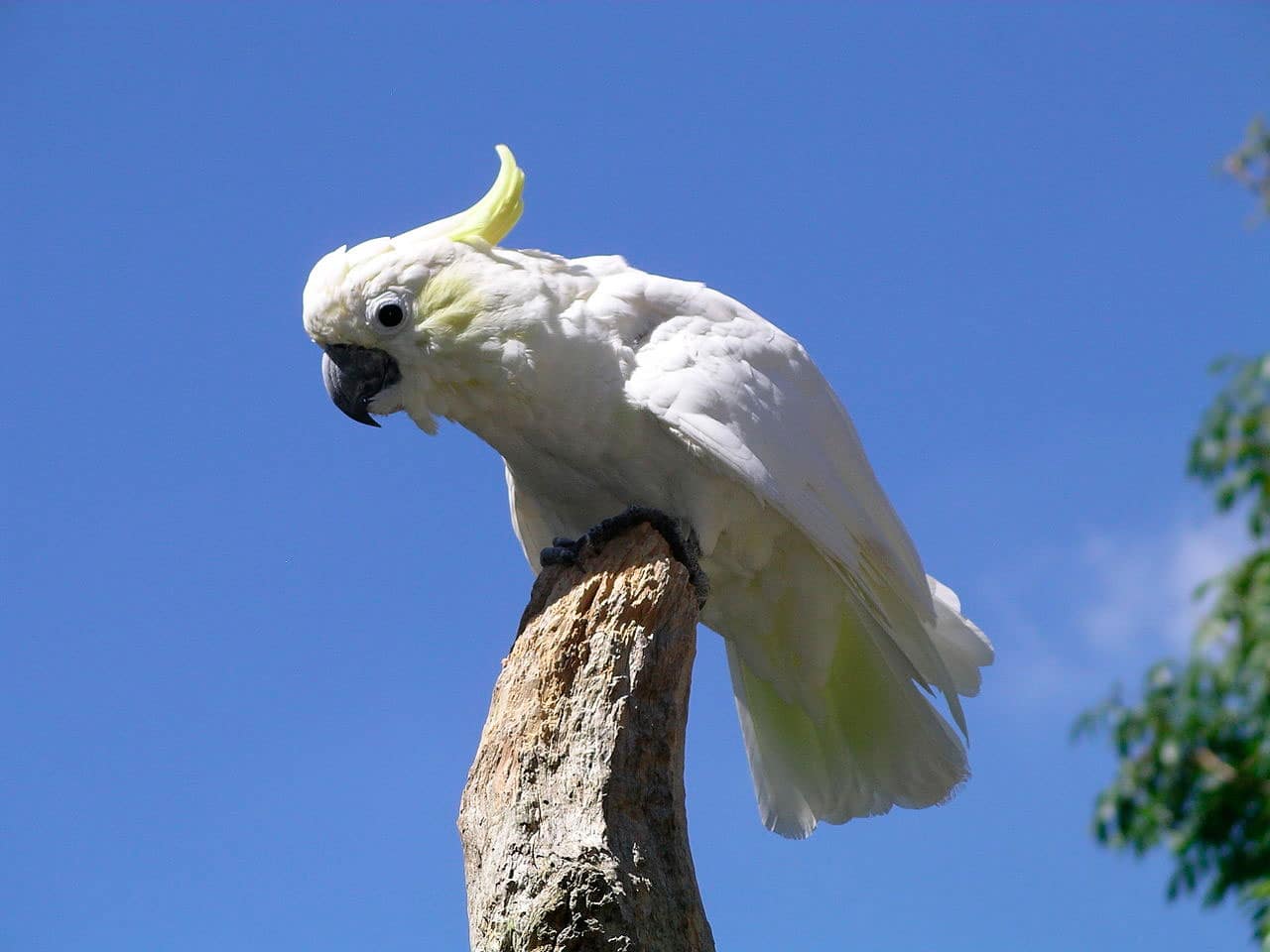
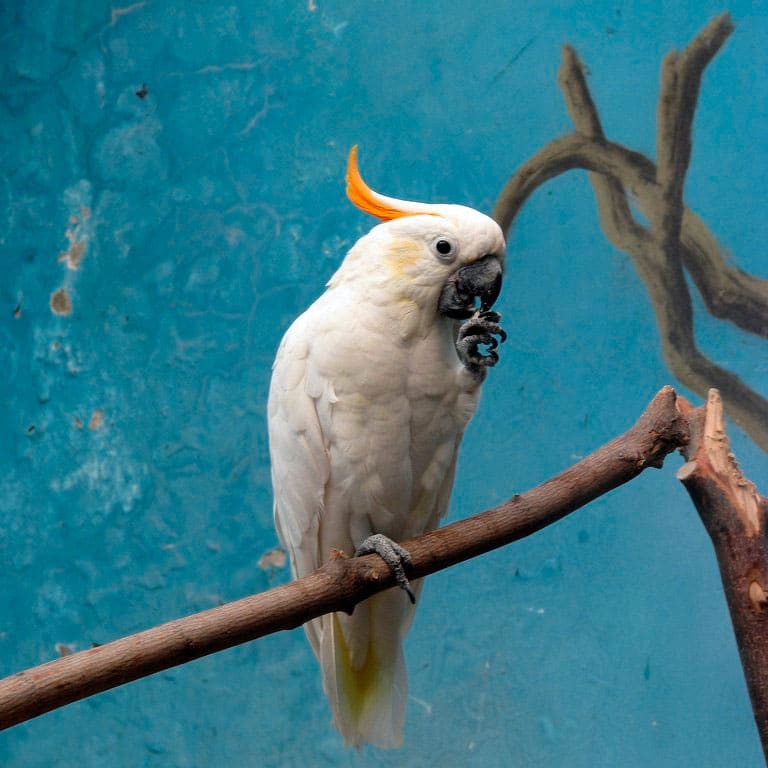
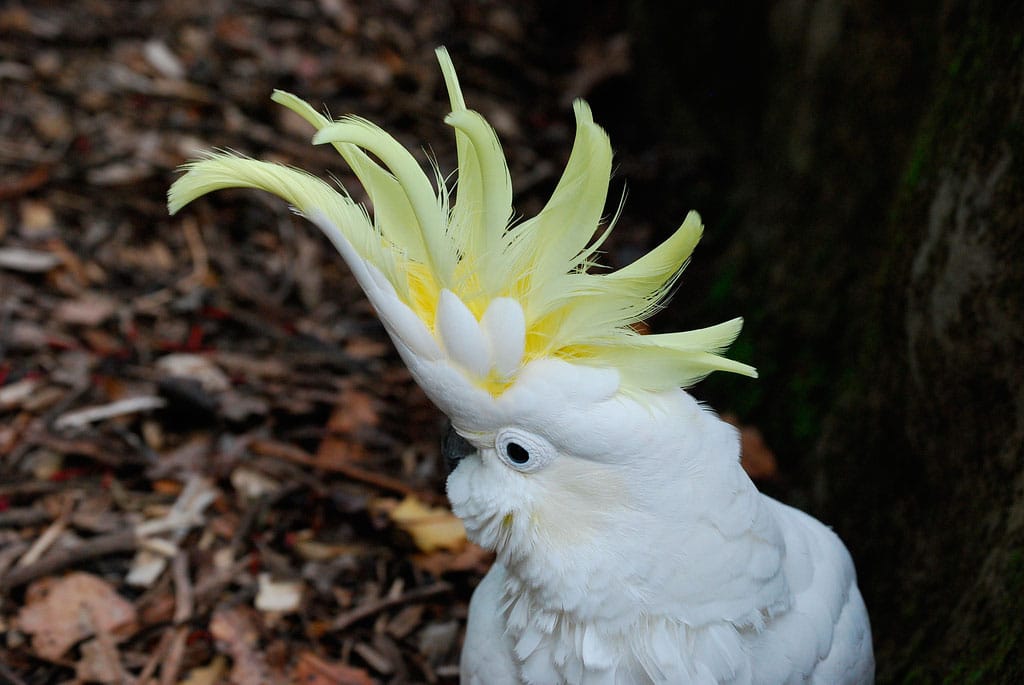
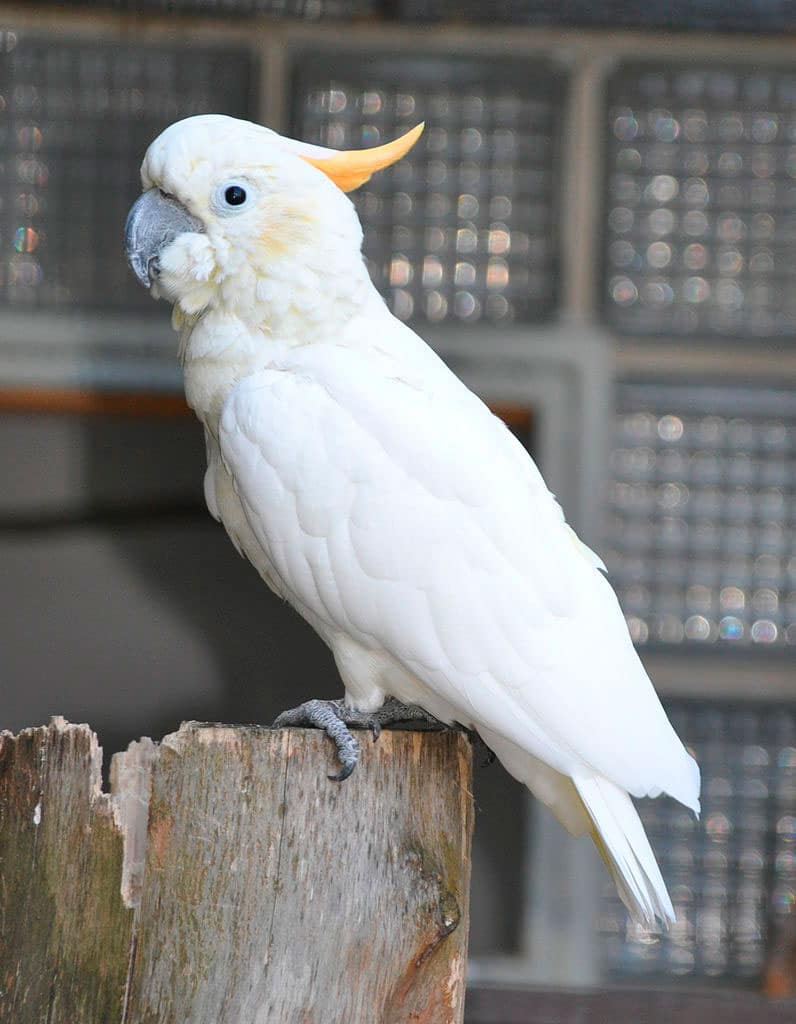
The Yellow-crested cockatoo(Cacatua sulphurea) It is distinguished by its long, thin yellow erectile crest, that curves forward, and extending upward, above the nape, when it folded. The front of his crown and main feathers crest, are white. The rest of your plumage It is also white, except in yellow suffusion ear-coverts, under the wings and in the innerwebs of the undertail-coverts. The bases of the hackles and underparts, They are yellowed; some birds show a slight yellow tone, particularly on chest and the belly. The bill It is black; eye ring pale bluish; irises dark brown; legs grey. The female is similar to the male but with the irises reddish and slightly smaller.
The young birds They show both sexes irises dark taupe, although females They begin to acquire the red coloration in the first year. The bill and legs immature are also lighter.
(Oberholser, 1917) – Similar to the parvula, but largest.
Cacatua sulphurea citrinocristata
Cacatua sulphurea citrinocristata
(Fraser, 1844) – Slightly larger than the nominal, with one crest orange & ear-coverts orange yellow. Additional research may provide a basis for improving this subspecies to a specific status..
Cacatua sulphurea parvula
(Bonaparte, 1850) – Similar to the nominal species, but with the ear-coverts paler and less yellow on yellow feathers underparts. the size of the bill in this subspecies it increases clinically towards the west.
They inhabit at the edges of the forest, wooded areas, farmland, cocoteros, semi-arid areas and forests until the 800 m (locally 1.200 m).
The Yellow-crested cockatoo usually they found in pairs or small groups of up to ten individuals, although they may meet in larger flocks to feed on fruit trees. They can form flocks with Eclectus Parrot(Eclectus roratus).
They tend to be noisy and visible, but can be difficult to spot when moving silently in the canopy, and they are more often in flight. The groups who leave their resting places in the montane forest areas frequently displace forage at lower altitudes including cultivated fields. Pairs may hover conspicuously above the forest canopy searching for fruitful trees, allowing a reasonably close approach when resting on a branch.
The crest It is generally stands when landing, or when an individual is making calls from a perch. Like most of the Cockatoos They enjoy a bath in the rain.
Reproduction:
Specimens of Yellow-crested cockatoo on the island of button in State reproductive during the months of September and October, although Nusa Tenggara the breeding It occurs in the months of April and May. The female It lays two or three white eggs in the hollow of a tree, and incubation lasts around 28 days with both parents participating. Chicks they leave the nest to 10 weeks and are dependent parent for about two months.
Food:
They feed in trees and soil. Its diet It includes seeds, corn (Zea mays) of cultivated fields, fruit, berries, egg yolks, flowers and nuts (including large coconuts (cocos nucifera)).
Distribution and status:
Size of its range (breeding/resident ): 1.360.000 km2
The Yellow-crested cockatoo They are confined Indonesian, where they can be seen in the lowlands Isla Celebes (virtually extinct in the north), islands in the Flores sea, in Nusa Tenggara and isolated islands Masalembu in the Java Sea.
introduced in Singapore and Hong Kong. The species is found in both wooded areas and cultivated and is scarce throughout its range. It is estimated that the world population total is less than 40.000 birds and is decreasing. Although populations of the nominal subspecies and of the subspecies parvula may still be close to 10.000 specimens, the citrinocristata subspecies It has an estimated population between 800 and 7.200 only individuals, having declined by 80% between the years 1986 and 1989, while the distinctive subspecies abbotti It is now represented by only nine individuals in nature.
Although habitat loss is clearly a factor in Sumba, where distribution appears to be linked to the extent of primary forest (is only about 15% the original forest), trade is the main threat to the species as a whole. Trade data show that exported almost 100.000 birds in years 1980-1992. The export citrinocristata subspecies It was banned in 1992 by local authorities, and 26 birds were confiscated in September of that year. There are probably at least 50 individuals of each subspecies in public collections and more than 2.000 in private aviculture, although the numbers for the subspecies abbotti They are unknown.
(Fraser, 1844) – Sumba, where it can be seen in the remaining forest around left, or east of the island, where it may still be locally common; an expedition of the Manchester Metropolitan University found it common in the remaining forest areas in 1990, with the greatest discovery of birds, a group of five birds, found in primary forest near Tabundung
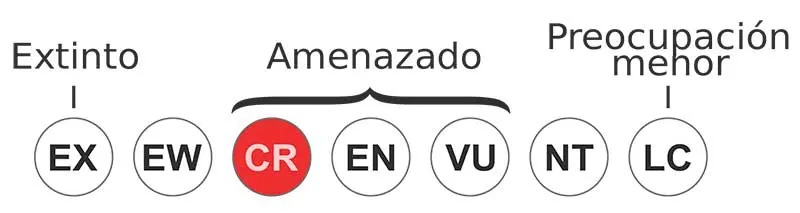
• Current category of the Red List of the UICN: critically endangered.
• Population trend: Decreasing.
Its crashing fall It is almost entirely attributable to the unsustainable exploitation for domestic and international trade. Logging to the conversion of forests for agriculture as well as the use of pesticides for land and large-scale.
Justification of the population
Based on recent surveys in various parts of the range of the species, C. Trainor in some (2007) It has been estimated the world population in less than 7.000 individuals: 3.200-5.000 en Sumba (though perhaps only 562 in 2012, Burung Indonesia en preparación), 500 en Komodo, 200-300 en Timor Leste, 200-300 en Sulawesi, 20-50 in West Timor, 40-70 Flores, 50-100 en Sumbawa, 100 in Rinca and other 700 birds in total. The best data is located in the band 2.500-9.999 individuals, equivalent to 1.667-6.666 mature individuals, rounded here to 1.500-7.000 mature individuals.
Conservation actions and research in progress
CITES Appendix I (2005). It has developed and adopted a recovery plan cooperative and has prepared an update 2012 (D. Mulyawati in some. 2012). The populations are found in various protected areas, It is the most important Rawa Aopa Watumohai (55 copies in 2011 [Waugh 2013]) and National Parks Caraente (en Sulawesi), supporting up 100 individuals (transgressed 2006) , Reserva Natural de Wildlife en Pulau Moyo, Komodo National Park and two national parks in Sumba: Manupeu-Tanadaru y Laiwangi-Wanggameti. Nini Konis Santana National Park declared in Timor has a 100 estimated birds (Trainor et al., Without date) . In Rawa Aopa Watumohai nests they have been protected from predators by removing vegetation pendant necklaces and installation of plastic around the tree trunks nesting (Waugh 2013). Moratoriums on international trade are in effect, although it is likely that a large proportion of trade is a national. Several subpopulations of Sulphur-crested Cockatoo have increased in Sumba between 1992 and 2002, due to conservation efforts (including local education, ecotourism and law enforcement), although densities remained below those typical for other cockatoo species (Cahill et al ., 2006) . Capture for trade has declined dramatically in Sumba through a variety of awareness and protection measures of the community (D. Mulyawati in some. 2012).
Following the surveys of 2008 and 2009, the Indonesia Parrot Project and Konservasi Kakatua Indonesia have started meetings with community leaders and villagers in Masakambing and Masalembu, as well as with the military and local police, to raise awareness and gain support for Sulphur-crested Cockatoo conservation (Metz et al. Al., 2009) . A conservation program-awareness-pride has also begun to involve adults and school Archipelago Masalembu (Metz et al. , 2009, Translating et al., 2009) And in Southeast Sulawesi (Anon., 2012). A "village regulation" was written to catch, possess or transport the species and initiate measures to reduce habitat destruction and employ a former village chief to guard and protect nests and study Sulphur-crested Cockatoos (Translating et al., 2009) . Moronone community in Rawa Aopa Watumohai NP, where four members of the village have been hired as Forest Wardens (Anon., 2012), have established similar community-based regulations. The guards protect the species against poachers and perform monitoring activities (Waugh 2013). The pest status of the species can be addressed by planting crops to compensate for losses and to act as a "sacrifice culture", for example, sunflower fields are used to attract the species out of other crops (Waugh 2013). Mangrove restoration is also being used to increase nesting habitat available (Waugh 2013). a repeat of the population census is planned abbotti , together with studies on its biological history and ecology (Metz et al., 2009) .
Proposed Research and Conservation Actions
Carry out further studies (including Roti, but also more studies on Alor and Pantar) to identify the most appropriate action for conservation areas and to periodically monitor key population surveys repeating ago 8-10 years. Provide relevant support for protected areas and conservation initiatives within its range and protect nests when possible. Strengthen the protection of forest Poronumbu, Sumba, declaring Nature Reserve (Translating y Agustina 2012). Strengthen control, the enforcement and monitoring of trade and establishing greater management of captive populations. Improve law enforcement in designated protected areas and other key areas for trade, including ports, markets, etc. Promote widespread community conservation initiatives. These may include, en la isla de Pasoso, Sulawesi Central, work to protect the Sulphur-crested Cockatoo should involve all five families living on the island and introduce community involvement programs for children and adults on several other islands where the species occurs (Translating y Agustina 2012). The recommendations formulated specifically for the protection of the species in the Komodo National Park consisted of carrying out an annual monitoring, maintain regular patrols, sensitize local communities and studying human activities and impacts within the park (Imansyah et al ., 2005, Benstead 2006) . Conduct ecological research to clarify options for management and conservation. Other objectives should be to study the abundance and distribution of nest holes and water sources.. The provision of artificial sources of water near the nesting sites, that is to say, water ponds, It is essential for the species on the island of Komodo and may also be necessary to protect the nests of young Komodo dragons in Komodo (Translating y Agustina, 2012).
"Yellow-crested cockatoo" in captivity:
The male Yellow-crested cockatoo It is especially aggressive with the female, sometimes to kill her. This phenomenon is known in many cockatoo species..
among the white cockatoos, this is somewhat difficult to breed in captivity. As a pet can be a formidable partner provided it has been raised for that purpose and to provide much attention.
It is very difficult for them to disconnect in the presence of their owners and entertain themselves without seeking continuous interaction.
Great ability to imitate human sound within the world of cockatoos.
Note: Because of its status, CRITICALLY ENDANGERED, only controlled captive breeding is recommended in an attempt to recover this species in the wild.
– Avibase
– Parrots of the World – Forshaw Joseph M
– Parrots A Guide to the Parrots of the World – Tony Juniper & Mike Parr
– Birdlife
– Photos:
(1) – Cacatua sulphurea by Charles Lam – Flickr
(2) – Citron-crested Cockatoo(Cacatua sulphurea citrinocristata) in the Walsrode Bird Park, Germany By Quartl (Own work) [CC BY-SA 3.0], via Wikimedia Commons
(3) – A Yellow-crested Cockatoo at Auckland Zoo, New Zealand By Ashleigh Thompson (originally posted to Flickr as Captain) [CC BY 2.0], via Wikimedia Commons
(4) – Cacatua sulphurea citrinocristata, Citron-crested Cockatoo. Photograph of upper body and crest By Ruth Rogers (originally posted to Flickr as Citron Cockatoo) [CC BY 2.0], via Wikimedia Commons
(5) – Citron-crested Cockatoo (Cacatua sulphurea citrinocristata). The glass between the camera and this parrot makes the picture just a little bit blurry By Alexander Tundakov (originally posted to Flickr as White Parrot) [CC BY 2.0], via Wikimedia Commons
(6) – Photo of Lesser Sulphur-crested Cockatoo (wings clipped) By Snowmanradio, with permission from Tropical Birdland, Leicestershire, England. (Own work) [GFDL or CC BY-SA 3.0], via Wikimedia Commons
(7) – Yellow-crested Cockatoo (Cacatua sulphurea) at the KOBE Oji Zoo by opencage.info
(8) – Lesser Sulphur-crested Cockatoo (wings clipped) By Snowmanradio, with permission from Tropical Birdland, Leicestershire, England. (Own work) [GFDL or CC BY-SA 3.0], via Wikimedia Commons
(9) – Yellow-crested Cockatoo (Cacatua sulphurea) by Darren – Flickr
(10) – Yellow-Crested Cockatoo, Cacatua sulphurea by Sek Keung Lo – Flickr
(11) – Cacatua sulphurea by Charles Lam – Flickr
(12) – Cacatua sulphurea by Charles Lam – Flickr
(13) – Cacatua sulphurea by Pichon Charles Lam – Flickr
(14) – A painting of a Yellow-crested Cockatoo, also known as the Lesser Sulphur-crested Cockatoo, (originally captioned «Plyctolophus sulphureus. Lesser Sulphur-crested Cockatoo») by Edward Lear 1812-1888. [Public domain], via Wikimedia Commons
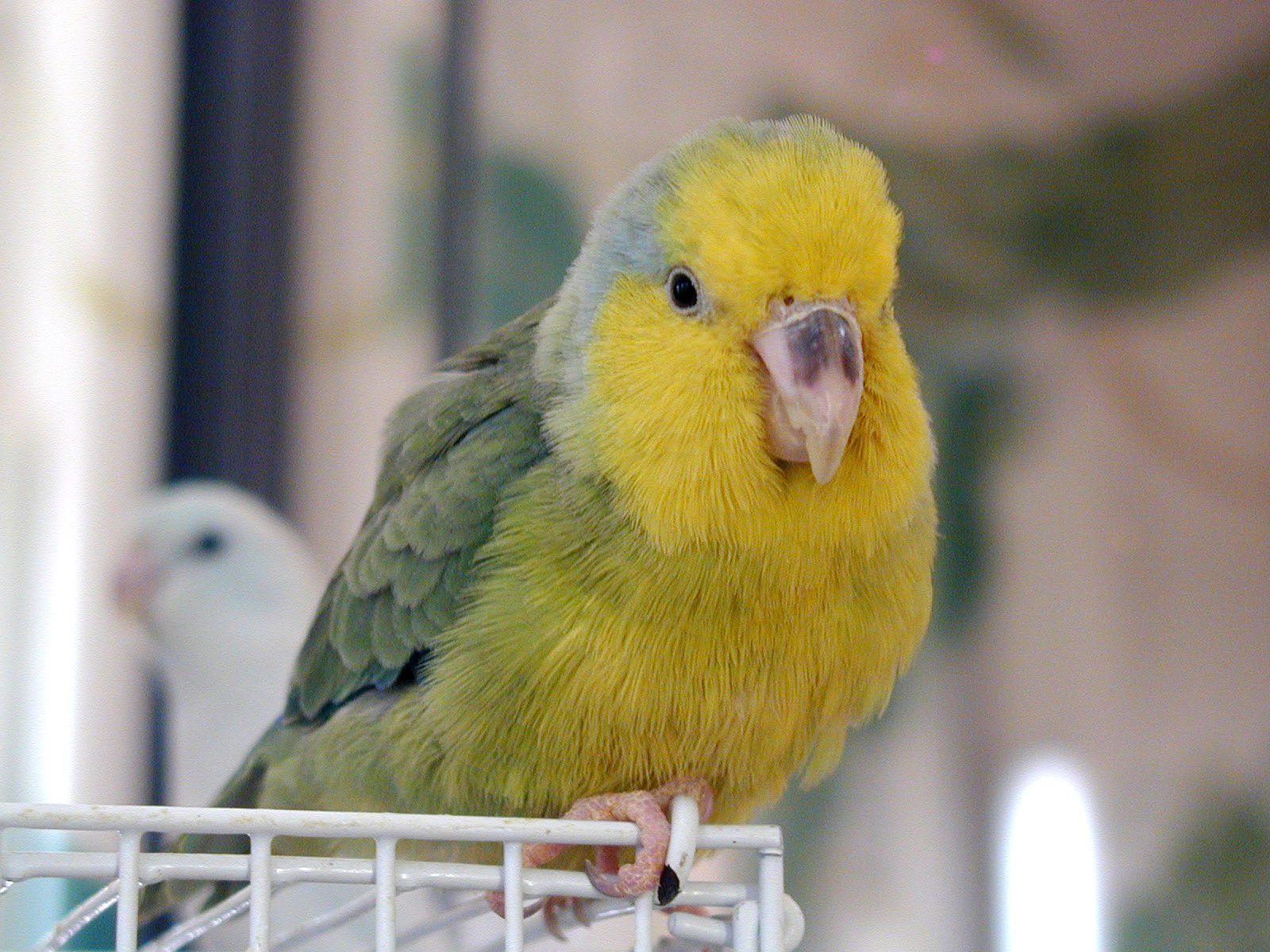
14 cm.. height. Plump appearance and short tail terminated tip. Distinguishable by the Crown, face, Yellow chest and belly, with strong wing blue patch, Flying Blue occupies almost half of the wing. Dorsally gray cafesoso, with the blue rump. The female has the blue patch on the rump and wings paler and smaller.
The Yellow-faced Parrotlet He lives in varied habitats, usually arid, forest riparian in the tropical and subtropical area, between 1000 to 1600 m, Although it has been reported to 2745 m. It is gregarious. Their diet includes cactus, In addition to fruit trees and other things. They nest in communal area, using tree hollows or sand. The breeding season is from March to April..
Distribution:
They are found in northwestern Peru., in the upper valley of the Marañón river, from the east of La Libertad to the southeast of Cajamarca and the south of Amazonas.
Conservation:
State of conservation ⓘ
Vulnerable ⓘ(UICN)ⓘ
According to the IUCN categories it is considered as Vulnerable (VU). Habitat degradation and trade are adversely affecting the population.
The ban on the capture and trade has improved the status of this species. The rate of decline was very rapid in the Decade of 1980, Although at present has been reduced and even stabilized. But, the population is still very small, with records in very few places, and as a result, according to the IUCN categories, qualified as vulnerable.
"Yellow-faced Parrotlet" in captivity
Captured for the trade of wild birds, It is estimated that 17.000 birds were captured between 1981 and 1994. The rate of mortality during capture is estimated between the 40% and the 100%. Rare and unknown in captivity until 1979-1980.
Images "Yellow-faced Parrotlet"
Alternative names:
1. Yellow-faced parrotlet (English).
2. Toui à tête jaune, Perruche-moineau à tête jaune (French).
3. Gelbmasken-Sperlingspapagei, Gelbmaskenpapagei (German).
4. Tuim-de-cabeça-amarela, Tuim, Periquito-de-cabeça-amarela (Portuguese).
5. "Catita enana de cara amarilla", Cotorrita carigualda, Periquito de Cara Amarilla (español).
18 cm.. height.
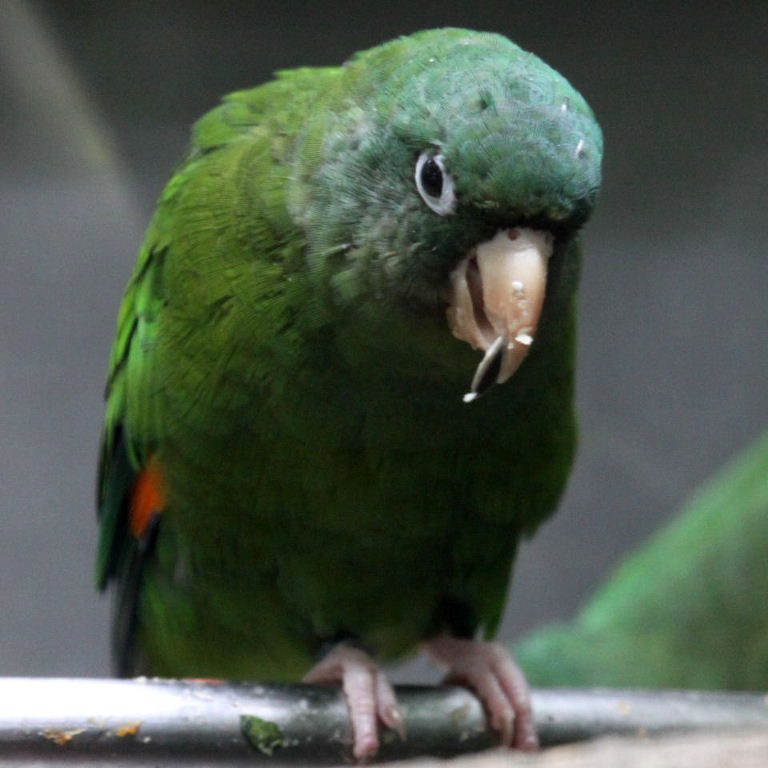
The Golden-winged Parakeet((Brotogeris chrysoptera)) has a tail short and finished in tip, bill Of course, body almost all green.
Its main characteristic is to have wing
a patch orange or gold and the end blue (more visible on the fly). Crown bluish, forecrown and throat orange.
The eye ring is whitish and without feathers; the irises is of color Brown dark and the legs flesh-colored.
The immature is distinguished by not having the Golden wing patch.
(Sclater,PL) – Golden parakeets. Its plumage is generally more yellow. L0s adults have yellow-orange the forecrown and the regions between them eyes and the peak, on the sides of the head. There is a patch in the chin orange. The primary coverts are yellow. Son bigger the species nominal.
Brotogeris chrysoptera solimoensis
(Gyldenstolpe, 1941) – Codajás Golden parakeets. Similar to subspecies nominal, but the frontal band is more pale and of color brown reddish. The patch of the chin is a yellow-brown color.
Brotogeris chrysoptera tenuifrons
(Friedmann, 1945) – Black River Parakeets. Similar in appearance to the subspecies Brotogeris chrysoptera tuipara, with the exception of the frontal band orange, which is minimal or absent.
Brotogeris chrysoptera tuipara
(Gmelin, 1788) – Parakeets Tuipara. It also seems to refer to the species, with the exception of its plumage that is usually more yellow. adults have a frontal band fine of color orange and a patch Orange in the chin. The lateral feathers with edges yellow. They are also bigger that the subspecies nominal.
Habitat:
Video – "Golden-winged Parakeet" (Brotogeris chrysoptera)
It inhabits in humid forest and savannah, more common to 300 meters although it has reported to them 1200 m. You in groups small of 8 to 16 individuals not reproductive time, It is common to see more than 100 consuming fruits in the canopy. Noisy when flying and silent when they feed on.
Reproduction:
Nest on trees, in hollows and termite mounds. Breeding season in November, February and April.
Food:
With feeds of the nectar of the flowers, fruit, figs, berries and seeds.
Distribution:
Size of the distribution (reproduction / resident): 3.110.000 km2
Its population is distributed between the East of Venezuela, Guyanas, Center and East of the Brazilian Amazon.
• Current category of the Red List of the UICN: Least concern.
• Population trend: Decreasing.
Justification of the population
The size of the world population It has not been quantified, but this species is described as «common» (Stotz et to the., 1996).
Justification of trend
It is suspected that this species has lost 20,7-24,8% of habitat suitable within their distribution during three generations (15 years), on the basis of a model of Amazon deforestation (Soares-Filho et to the., 2006, Bird et to the., 2011). So, It is suspected that will decrease in <25% durante tres generaciones.
"Golden-winged Parakeet" in captivity:
Rare in captivity. They are birds a bit nerve until you are acclimatized to its owner. They can be housed in an Aviary with other parrots.
Alternative names:
– Golden-winged Parakeet, Golden winged Parakeet, Golden-winget parakeet, Tuipara Parakeet (English).
– Toui para (French).
– Braunkinnsittich (German).
– periquitinho, Periquito-de-asa-dourada, periquito-de-asas-douradas, tuipara-de-asa-dourada, tuipara-de-asa-laranja, periquitinho, periquito-de-asas-douradas, tuipara-de-asa-dourada, tuipara-de-asa-laranja (Portuguese).
– Catita Alidorada, Periquito de Alas Amarillas (español).
– Periquito Ala Dorada (Venezuela).
– Avibase
– Parrots of the World – Forshaw Joseph M
– Parrots A Guide to the Parrots of the World – Tony Juniper & Mike Parr
– Birdlife
– Parrot Book, Parrots and macaws Neotropical
– Photos:
(1) – animalphotos
(2) – Modern accepted name (2012) is Brotogeris chrysoptera By William Swainson, F.R.S., F.L.S. (Zoological Illustrations, Volume I.) [Public domain], via Wikimedia Commons
– Sounds: controles-canto.org
▷ The world of Pets: Dogs, cats, birds, reptiles, amphibians
Origin: Venezuela, Guyana, Suriname, French Guiana, Trinidad and Tobago
Character: Quiet and intelligent
Life expectancy: 25 to 30 years
Height: 14 cm..
Content
Description:
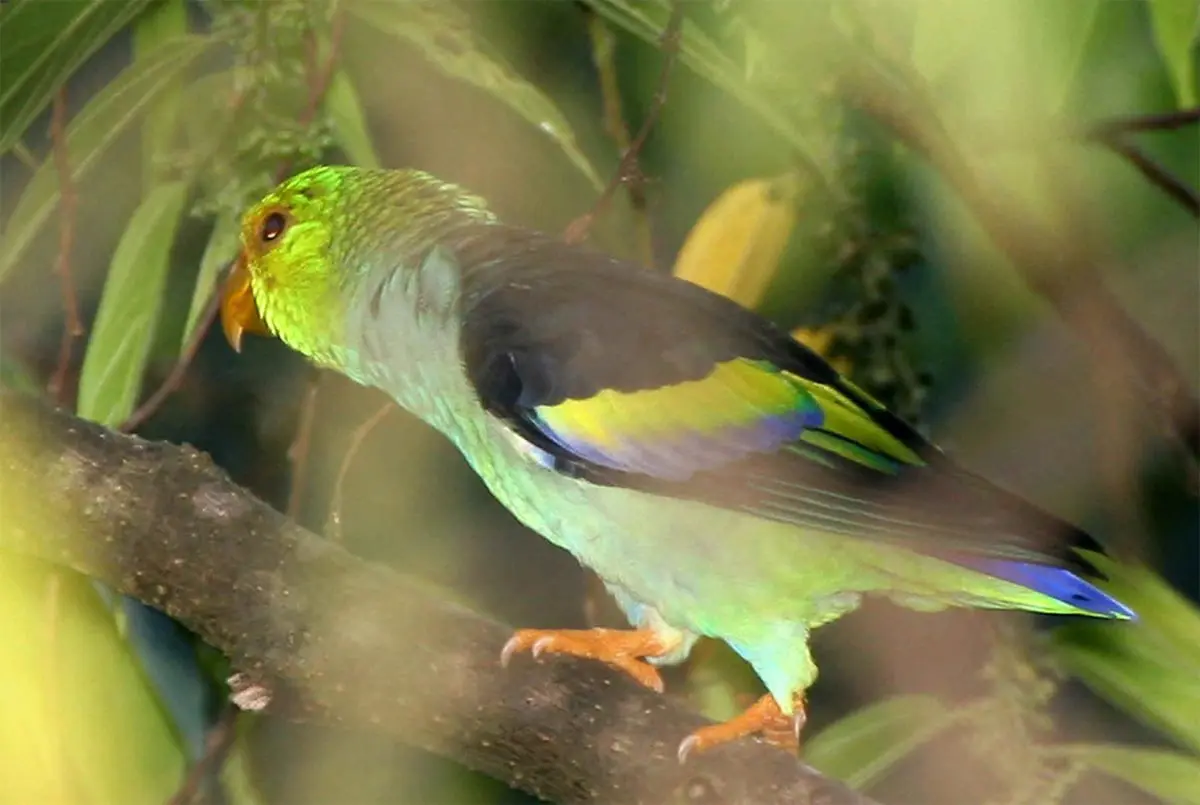
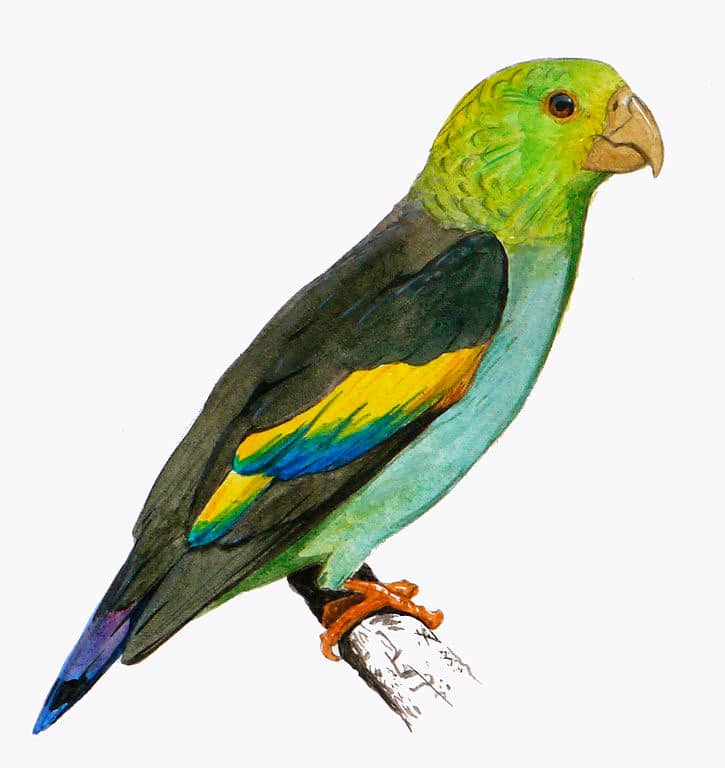
The Lilac-tailed Parrotlet (Touit batavicus) has 14 cm.. height. Usually black in it upperparts (back and wings) and green in it lower. With the crown and nape yellowish-green with black border (What gives a suspiciously aspect). The forecrown, cheeks and chin Yellow Gold, chest Azure Blue, Yellow patch in the wing
, tail ends reddish purple and black subterminal edge.
It inhabits in forest dry and jungles cloudy between 400 and 1700 m (in Colombia).
Considered powerful flying, the sharp profile of its wings, They quickly fly over the forest canopy, in groups of 10 to 50 and they are gregarious except in the time reproductive.
It is of a forest Ave, but it can be seen near the shore of the sea in the areas where the edge of the forest close to the coast.
The calls during the flight they are soft and nasal, reaching a high tone, Buzz.
Reproduction:
It nests in hollows in trees or in arboreal termite holes, between the months of February and March. It is thought that it has migratory movements.
Food:
Its diet is composed of flowers, nectar, fruit, outbreaks, berries and seeds.
Distribution:
Size of the area of distribution (reproduction / resident): 330.000 km2
Can be found from the North of Venezuela According to the East up to Guyana, Suriname, French Guiana and in Trinidad and Tobago.
Conservation:
State of conservation ⓘ
Minor Concern ⓘ(UICN)ⓘ
• Current category of the Red List of the UICN: Least concern.
• Population trend: Decreasing.
Justification of the population
The size of the world population It has not been quantified, but this species is described as «quite common» (Stotz et to the., 1996).
Justification of trend
They suspect that this species has lost a 8,2-8,4% of habitat suitable within their distribution during three generations (15 years) based on a model of Amazon deforestation (Soares-Filho et to the., 2006, Bird et to the., 2011). Given the susceptibility of the species to the hunting or the capture, It is suspected that will decrease in <25% during three generations.
"Lilac-tailed Parrotlet " in captivity:
It's hard to keep alive captivity, refuses food during the acclimatization period. Deaths occur for this reason and the unbalanced diet.
















_-Moscow_Zoo.jpg)


