โ–ท The world of Pets: Dogs, cats, birds, reptiles, amphibians

Yellow-shouldered Parrot
Amazona barbadensis

Yellow-shouldered Parrot

Content

Description:

33 to 36 cm.. height and an average weight of 270 g.

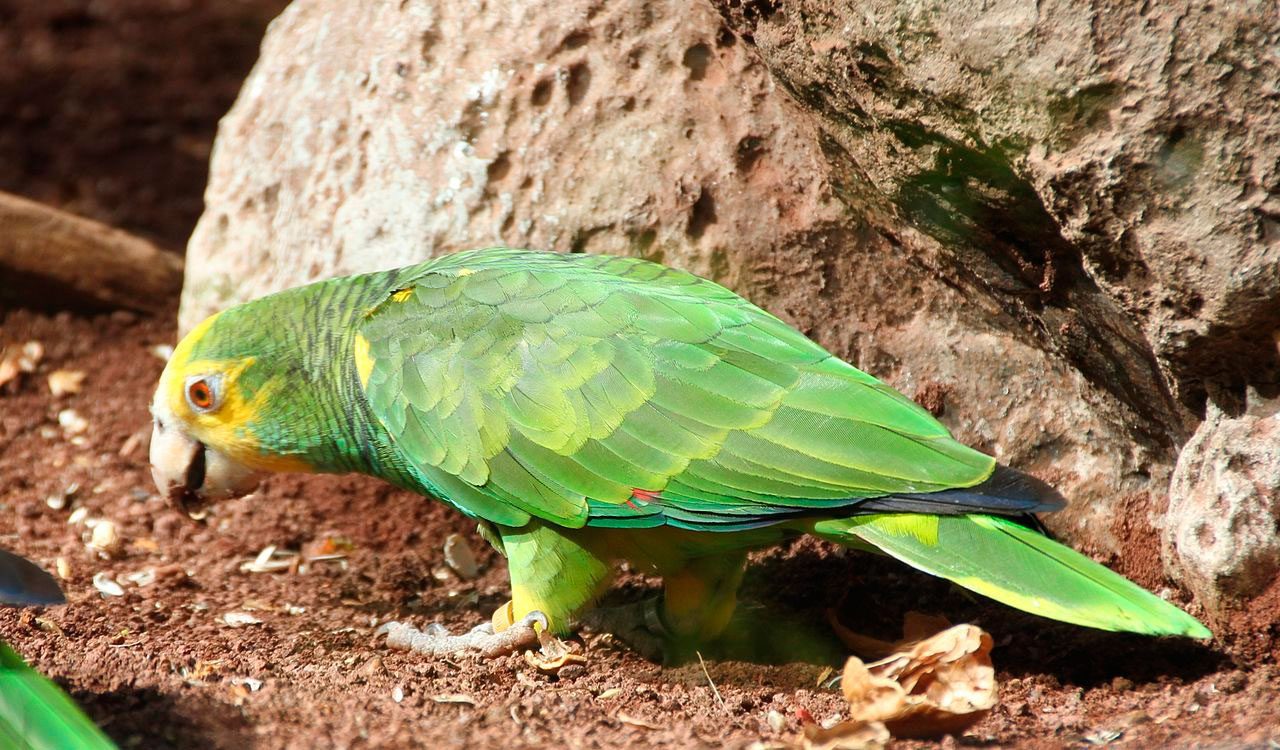
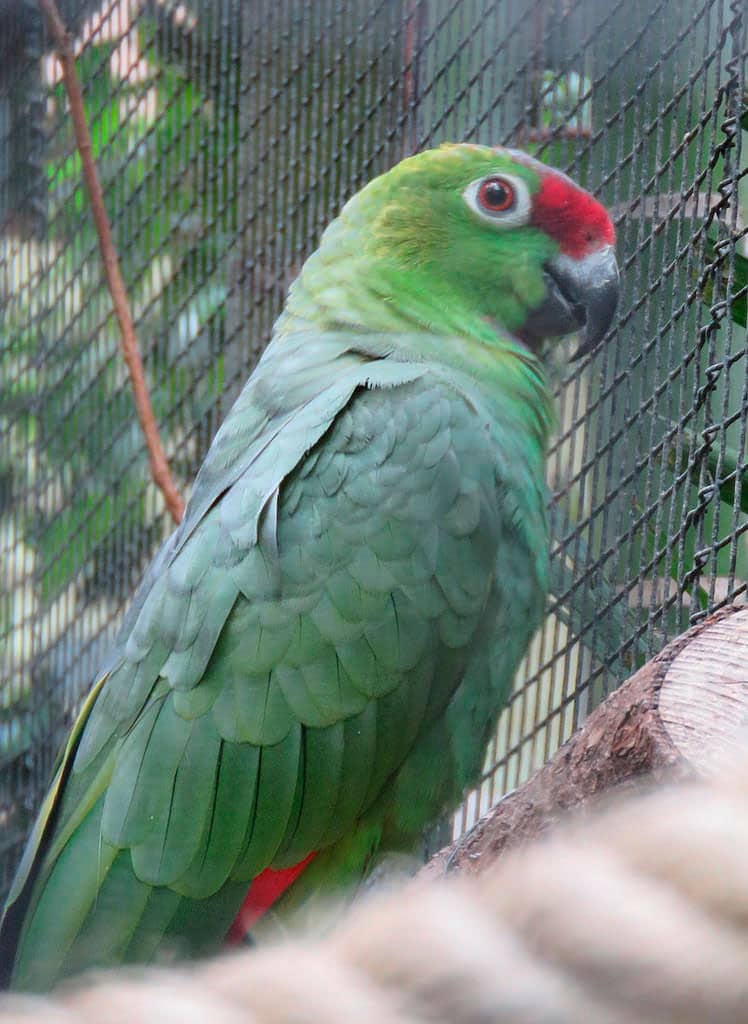
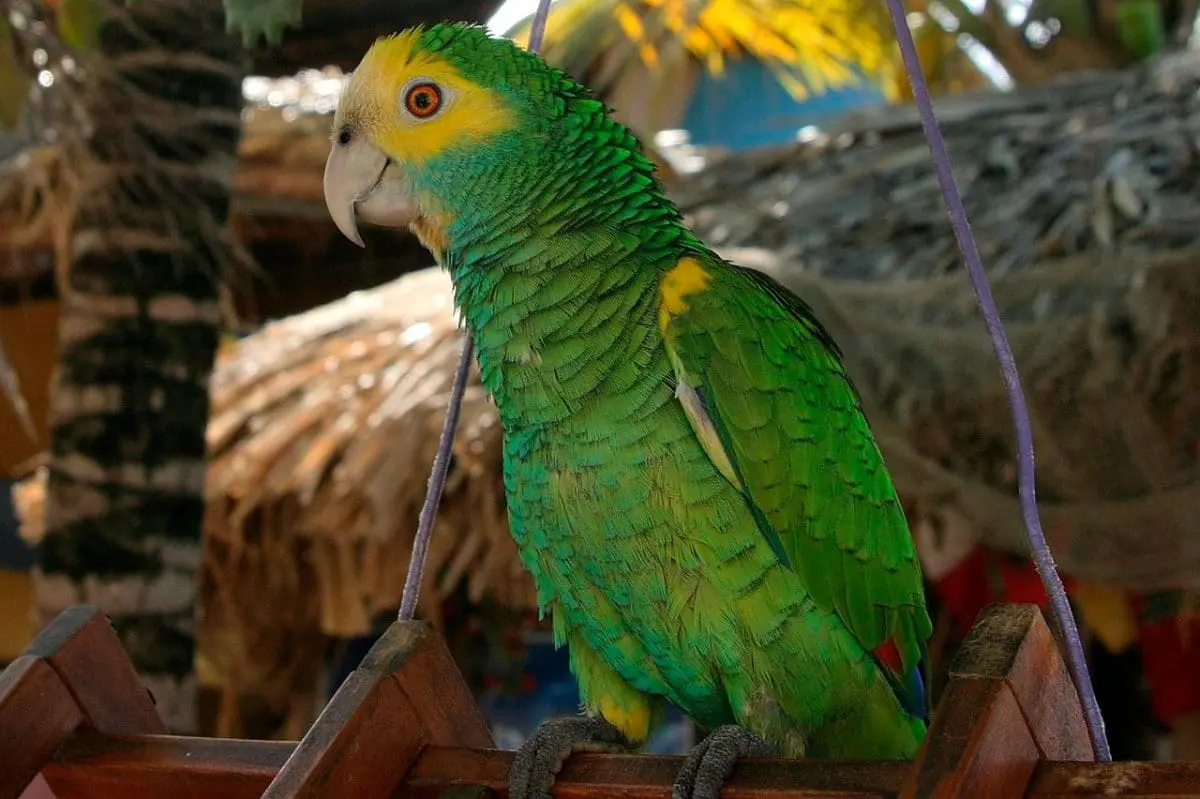
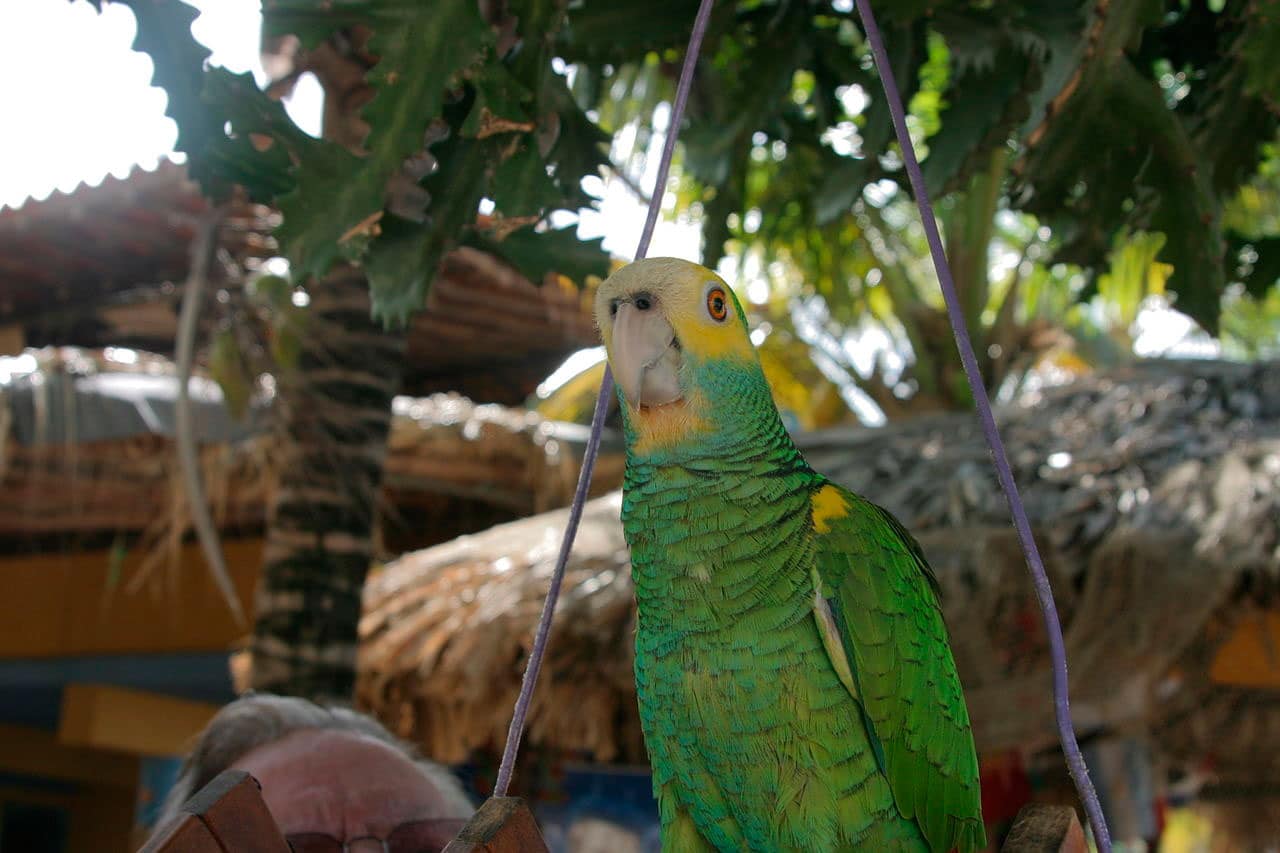
The Yellow-shouldered Parrot (Amazona barbadensis) It has a short tail, head yellow, some with forecrown white.

Its body is usually green, with black feathers edge neck, chest and back; greenish yellow in underparts.

Chin yellow with bluish tint in lower cheeks and around the chin. Shoulder and the thighs yellow.

Speculum red. dark blue tips to the flight feathers. The black edge of their feathers give them a look scaled.
Yellow-shouldered Parrot


Anatomy-parrots

The irises are red or orange and bill whitish.

The young birds are similar to adults but may distinguish by their irises and the absence darker blue hue in the lower body.

In the most notorious flight apart from the head, is the wing with shoulder yellow, Red patch and blue end.

Habitat:

They live in areas xerophytic vegetation, frequenting desert scrub dominated by cactus, cardรณn and shrubs or small trees; also frcuentan cultivated areas, until the 450 m. They move in pairs or flocks of up 100 individuals, especially at the time of feed.

Reproduction:

The nesting takes place in tree cavities, cactus or cliffs, in general, between March and August (Sanz and Rodriguez-Ferraro 2006). The average size of clutch is of 3,38 eggs per nest, and most of the eggs survive until the hatching. The incubation lasts a few 26 days and leave the nest 60 days after hatch.

It tends to rest communally in tall trees, with groups of up 700 birds recorded (Juniper and Parr 1998).

Food:

Their diet is composed of Cactus and other fruits. They have been reported in their diet fruits 22 genders. rich flowers nectar, cardรณn and the urero, which eats fruits, flowers and trunk, fruits and seeds Stenocereus, seeds and flowers guatacaro (Boarreria Sumnensis) and yaque.

Distribution:

Size of its range (reproduction / resident): 11,000 km2

The Yellow-shouldered Parrot It has a disjoint range with seven genetically isolated populations in northern Venezuela (Lara (Cerro Saroche National Park, which)), Falcon (Dabajuro, Casigua), Anzoรกtegui (about Piritu and Barcelona) and Sucre (Araya Peninsula), as well as the Margarita Islands, the blanquilla, Curacao and Bonaire (Rodriguez-Ferraro 2009).

He is currently extinct on Paraguana Peninsula (Briceรฑo-Linares et. To the. 2011). References to the presence of a population of wild parrots in Curacao They are based on a historical source of the century 18 (AO Debrot in some 1999, 2007.); there have been reports from modern 1988 (The farmer 2008, A. Rodriguez-Ferraro in litt. 2012), although it has been suggested that these birds can be released or escaped cages. (Williams 2012).

It became extinct in Aruba towards 1950 (Rojas-Suarez & Rodrรญguez 2015).

The numbers on the islands seem to fluctuate, but they have increased in Margarita of 750 birds in 1989 (Sanz y Grajal 1998) until around 2000 in 2015 (Rojas-Suarez & Rodrรญguez 2015).

The population in Bonaire It was estimated in 400 individuals in 2006 (Williams and Martin 2006) and 650-800 individuals in 2012 (Department of Resources and Planning, Bonaire by R. Martin y S. Williams a slightly. 2012).

The continent's population was considered in decline 2003 (Hilty 2003).

Their habitat continues to be lost in the eastern part of the continental mountain range (V. Sanz in some. 2016) and the population of together (is of Venezuela) it is believed that are declining due to poaching and habitat conversion for agriculture (V. Sanz n bit. 2016), so it is likely that the continental population continues to decline.

Conservation:

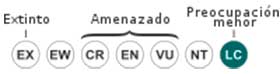
State of conservation โ“˜


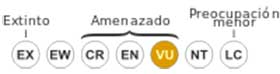
Vulnerable Vulnerable โ“˜ (UICN)โ“˜

โ€ข Current category of the Red List of the UICN: Vulnerable.

โ€ข Population trend: Unknown.

The population size: 1700-5600 specimens.

It is classified as a endangered specie, It is the main threats capture their young for pet trade, and habitat destruction of nesting and feeding by the extraction of sand for the construction industry.

The recovery of the population of this bird has been the spearhead of Provita's work in Macanao, since its conservation benefits a large part of the biodiversity of the peninsula, as their habitat covers large areas, it is also a charismatic species, that easily attracts the public to conservation efforts.

Source: PROVITA

"Yellow-shouldered Parrot" in captivity:

Rare but increasing due to the successes of captive breeding.
have a participatory personality, inquisitivas and curious to the point of being "nosy" and her gentle nature only adds to her charm. Mild to moderate its ability to speak.
Always playful, enable They require a cage equipped with toys. They worship a bathroom and displayed chatty while bathing under running warm water.

Alternative names:

– Yellow-shouldered Parrot, Yellow shouldered Parrot, Yellow-shouldered Amazon (English).
– Amazone ร  รฉpaulettes jaunes (French).
– Gelbflรผgelamazone, Kleine Gelbkopfamazone (German).
– Papagaio-de-cabeรงa-branca (Portuguese).
– Amazona de Cabeza Amarilla, Amazona de hombro gualda, Amazona Hombrogualda, Cotorra margariteรฑa (espaรฑol).
– Cotorra Cabeciamarilla (Venezuela).
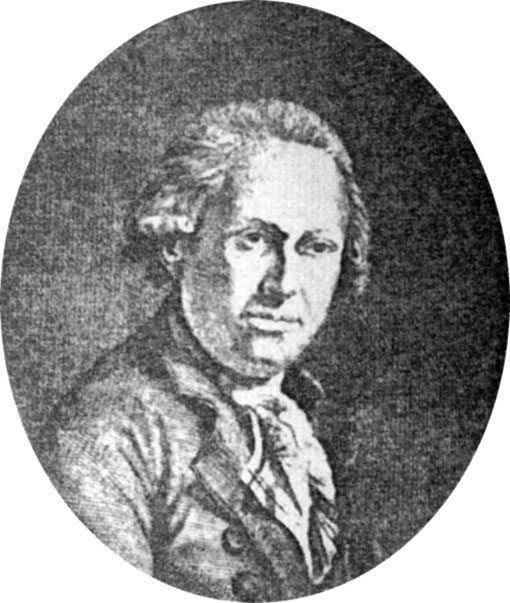
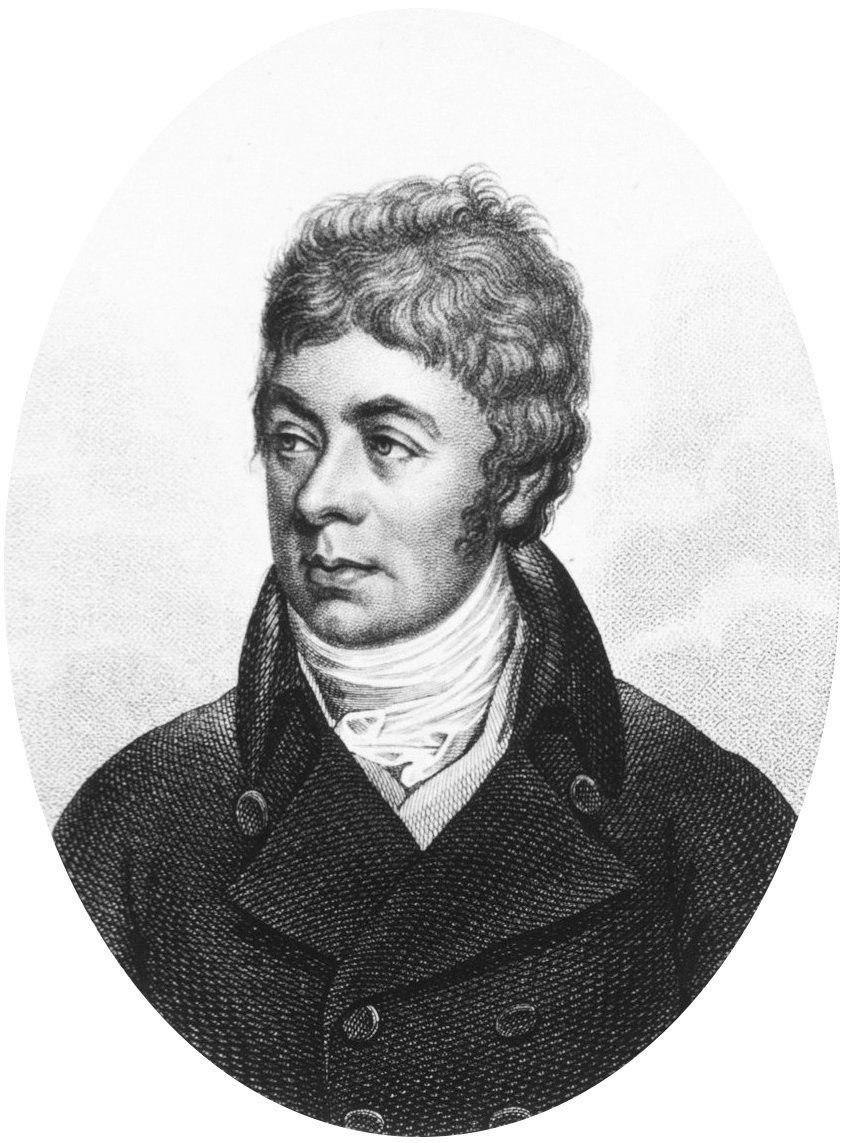
Gmelin Johann Friedrich

scientific classification:


– Order: Psittaciformes
– Family: Psittacidae
– Genus: Amazona
– Scientific name: Amazona barbadensis
– Citation: (Gmelin, JF, 1788)
– Protonimo: Psittacus barbadensis


Images "Yellow-shouldered Parrot":

Species of the genus Amazona


Sources:

  • Avibase
  • Parrots of the World โ€“ Forshaw Joseph M
  • Parrots A Guide to the Parrots of the World – Tony Juniper & Mike Parr
  • Birdlife

  • Photos:

(1) – Yellow-shouldered Amazon (Amazona barbadensis) also known as Yellow-shouldered Parrot. Pet in Venezuela perching on the top of a wooden frame. By John Bรคckstrand (originally posted to Flickr as IMG_2721) [CC BY 2.0], via Wikimedia Commons
(2) – Yellow-shouldered Amazon in the Walsrode Bird Park, Germany By Quartl (Own work) [CC BY-SA 3.0], via Wikimedia Commons By Quartl (Own work) [CC BY-SA 3.0], via Wikimedia Commons
(3) – Yellow-shouldered Amazon (also known as Yellow-shouldered Parrot). Two in the foreground in a cage By TJ Lin [CC BY-SA 2.0], via Wikimedia Commons
(4) – Yellow-shouldered Amazon (Amazona barbadensis) also known as Yellow-shouldered Parrot. Pet in Venezuela perching on a hand. Shows crown By John Bรคckstrand (originally posted to Flickr as IMG_2469) [CC BY 2.0], via Wikimedia Commons
(5) – Yellow-shouldered Amazon (Amazona barbadensis) also known as Yellow-shouldered Parrot. Pet in Venezuela By John Bรคckstrand (originally posted to Flickr as IMG_2468) [CC BY 2.0], via Wikimedia Commons
(6) – Amazona barbadensis in the Loro Parque zoo of Tenerife, Spain By Bjoertvedt (Own work) [CC BY-SA 4.0], via Wikimedia Commons
(7) – Amazona barbadensis in the Loro Parque zoo of Tenerife, Spain By Bjoertvedt (Own work) [CC BY-SA 4.0], via Wikimedia Commons
(8) – Yellow-shouldered Amazon (Amazona barbadensis) also known as Yellow-shouldered Parrot. Pet in Venezuela – side view – a little red and blue seen at edge of wing By John Bรคckstrand (originally posted to Flickr as IMG_3117) [CC BY 2.0], via Wikimedia Commons
(9) – Yellow-shouldered Amazon (Amazona barbadensis) also known as Yellow-shouldered Parrot. Pet in Venezuela on the top of a wooden climbing frame. Mainly showing its upper body By John Bรคckstrand (originally posted to Flickr as IMG_2723) [CC BY 2.0], via Wikimedia Commons
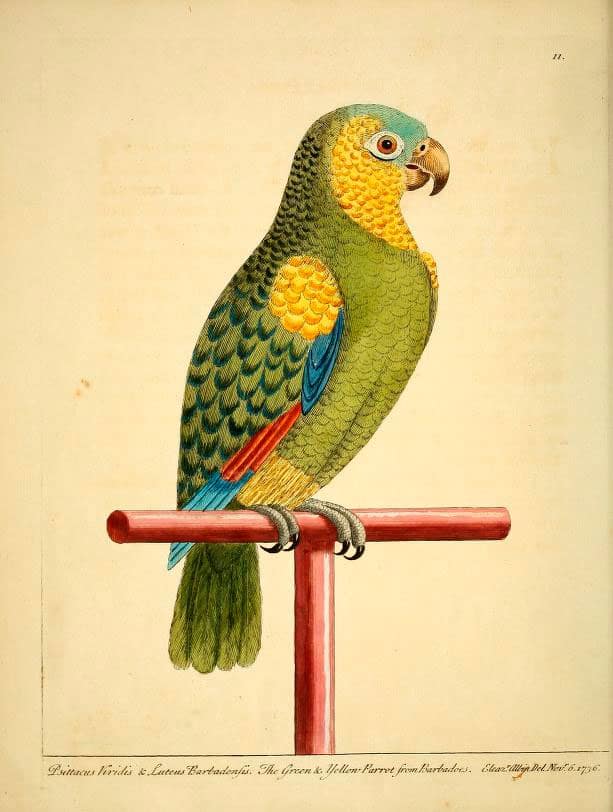
(10) – Original illustration of the ยซGreen & Yellow Parrot from Barbadosยป, currently known as Amazona barbadensis – Wikipedia

  • Sounds: ยฉ 2014 Cornell University
โ–ท The world of Pets: Dogs, cats, birds, reptiles, amphibians

Diademed Parrot
Amazona Diadema

amazona autumnalis

Content

Description:

31โ€“35 cm. length and 450-550 g. of weight.

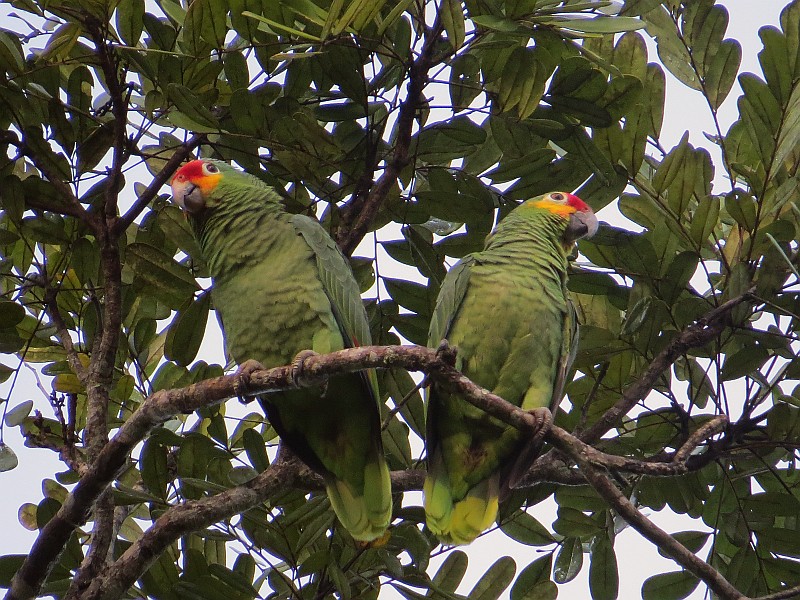
The Diademed Parrot (Amazona Diadema) It is generally green, with black edges to feathers crown, to the mantle and the chest; crown green to nape; the back of the green neck, mauve margin; feathers of the cere and forecrown, red; yellow-green, less yellow in upper cheeks, up to the ear-coverts; secondaries red on the bases, the green rest; tail green; eye ring pale yellow; eyes oranges; bill dark grey.


Note:

Previously treated as conspecific with the Red-lored Amazon (Amazona autumnalis), It is very similar to the subspecies Amazona autumnalis salvini

  • Sound of the Diademed Parrot.

Habitat:


Anatomy-parrots

It is likely to frequent a variety of habitats from lowland forest species, including edges evergreen forest, as well as modified areas containing scattered trees or plantations (Del Hoyo et al., 1997, pit et to the., 2016).

They are in loose flocks or pairs, are gregarious When feed.

Reproduction:

The laying is of 2-3 eggs. Breeding season, It is supposed to be in early: January-March.

Food:

It feeds mainly from fruits and seeds, even some cultivated species (Del Hoyo et al., 1997), although there are no published data (Del Hoyo et al., 2016).

Distribution:

Size of its range (breeding/resident): 71.800 km2

Endemic low Black river and the northern margin of Amazon River, in the states of amazon and Northwest of For, in Brazil.

Conservation Amazona diadema:

State of conservation โ“˜


Endangered Endangered โ“˜ (UICN)โ“˜

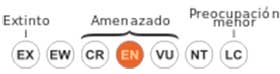
โ€ข Current category of the Red List of the UICN: In danger of extinction.

โ€ข Population trend: Decreasing.

Rationale for the Red List category

    Based on a model of future deforestation on amazon basin and susceptibility to this new species capture, it is suspected that its population will suffer a very fast along three generations descent from 2002, so it is in danger of extinction.

Justification of trend

    This species is expected to lose between 49 and 55% suitable habitat within its distribution throughout three generations (37 years) starting at 2002, based on a model of Amazon deforestation (Soares-Filho et to the). Given its susceptibility to capture, It is suspected that species decline by 50-79% during this time.
Threats

โ€ข The main threat to this species is the accelerating deforestation in the Amazon Basin as land is cleared for ranching and soy production, provided by the expansion of the road network, together with his susceptibility to capture (Soares-Filho et to the. 2011).

โ€ข The species is assumed to experience some pressure catch, probably mainly for internal trade, since this species is rare in aviculture (Del Hoyo et al ., 1997, pit et to the ., 2016).

โ€ข Proposed changes to the Brazilian Forest Code reduce the percentage of land to a private owner is legally obliged to keep as forest (including, critically, a reduction in the width of forest buffers with perennial vapors) and include an amnesty for owners who deforested before July 2008 (That they would later be absolved of the need to reforest illegally vacated land) (Bird et to the., 2011).

Conservation Actions Underway

โ€ข No specific conservation actions are known for this species, although part of their habitat is protected.

โ€ข It is distributed in the Jau National Park where it is rare or uncommon (Borges et al ., 2001, Borges & Almeida 2011).

Conservation Actions Proposed

โ€ข Carry out surveys to estimate the size of the population.

โ€ข Monitor deforestation rates in the range using remote sensing techniques.

โ€ข Study the level of Trapping threat.

โ€ข Increase the area of โ€‹โ€‹suitable habitat that receives protection effective.

โ€ข Boost changes in laws related to deforestation and forest protection.

The Diademed Parrot in captivity:

Rare in aviculture.

Each captive specimen of this species which is capable of reproducing, It is placed in a well managed captive breeding program and not be sold as a pet, in order to ensure its long-term survival.

Alternative names:

– Diademed Amazon, Diademed Parrot, Red-lored Parrot (Diademed) (English).
– Amazone ร  diadรจme, Amazone diadรจme, Amazone du Brรฉsil (French).
– Diademamazone (German).
– Papagaio-diadema (Portuguese).
– Amazona diadema (espaรฑol).


Scientific classification Diademed amazon:

Johann Baptist von Spix

– Order: Psittaciformes
– Family: Psittacidae
– Genus: Amazona
– Scientific name: Diademed Parrot
– Citation: (von Spix, 1824)
– Protonimo: Psittams diadema


Diademed Parrot images.:


Species of the genus Amazona


Sources:

Photos:

(1) – diadem parrot. Red lored parrot. 11 November 2015, Tikal, Guatemala by ze_da_binha
(2) – Diademed Parrot – amazon with tiara – Diademed amazon – amazon tiara By Florin Feneru from Orpington, UK (Diademed Parrot) [CC BY 2.0], via Wikimedia Commons
(3) – A Red-lored Amazon at Loro Parque, Cross port, Tenerife, Spain. This subspecies is also called the Diademed Amazon By Carlos Urdiales [CC BY-SA 2.0], via Wikimedia Commons
(4) – A Red-lored Amazon at Xcaret Eco Park, Riviera Maya, Mexico. Photographed as it started to rain By Tomasz Wagner from Burnaby, BC, Canada (Parrot – Amazona autumnalis) [CC BY-SA 2.0], via Wikimedia Commons
(5) – Diademed amazon (Diademed Parrot) Loro Parque, Tenerife by Florin Feneru – Flickr
(6) – PL. XXXI I Chrysolis diadema (รฎ^wl By Blanchard, Emile; Bonaparte, Charles Lucian; Bourjot Saint-Hilaire, Alexandre; Le Vaillant, Franรงois; Souancรฉ, Charles de. [CC BY 2.0 or Public domain], via Wikimedia Commons

Sounds: GABRIEL MILK, XC119110. accessible www.xeno-canto.org/119110

โ–ท The world of Pets: Dogs, cats, birds, reptiles, amphibians

Olive-throated Parakeet
Eupsittula nana

Olive-throated Parakeet

Content

Description:


Anatomy-parrots

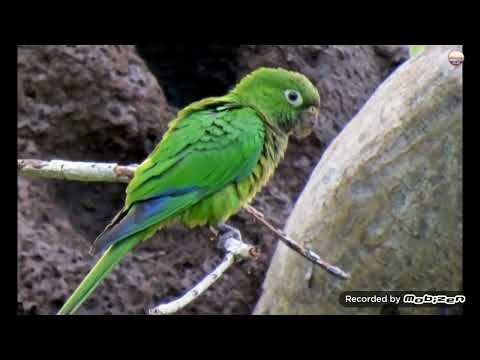
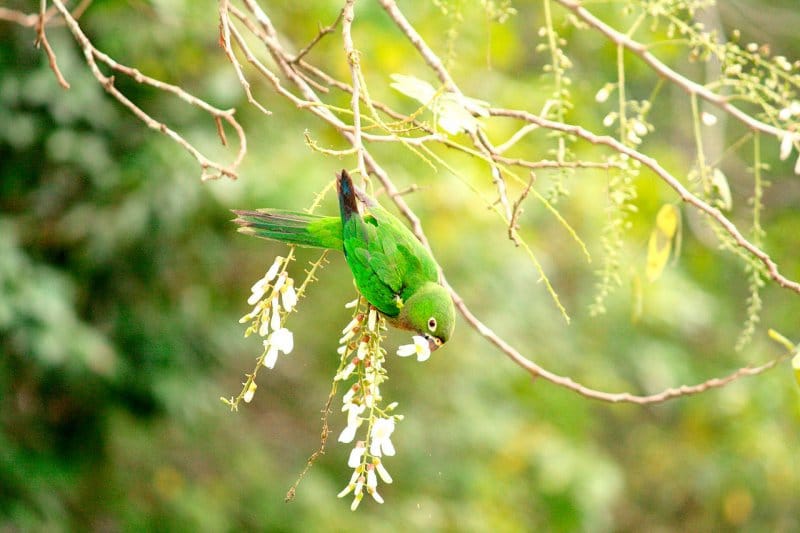
20 to 26 cm. in length and 72โ€“85 grams in weight. It is one of the smallest Aratingas.

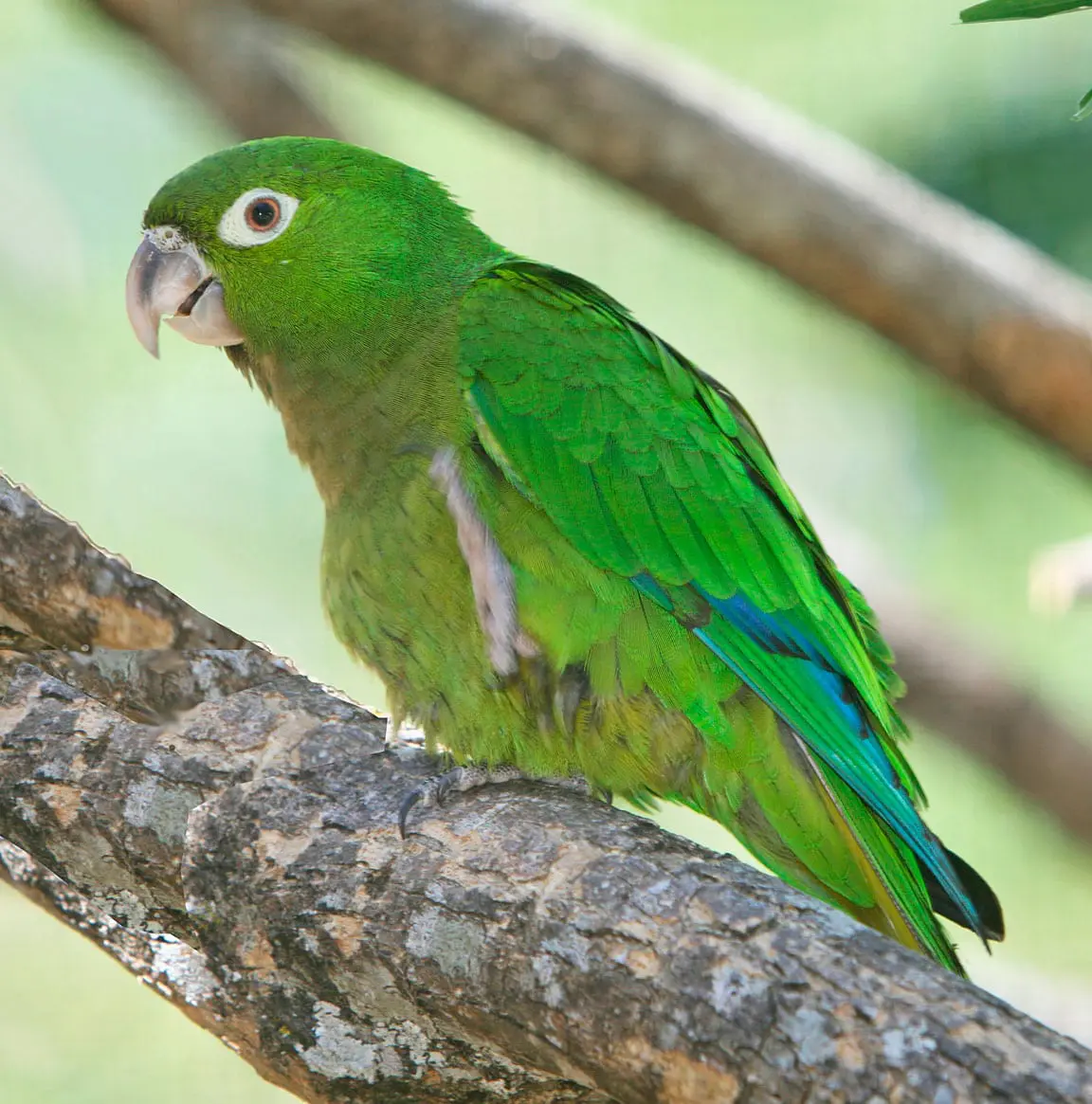
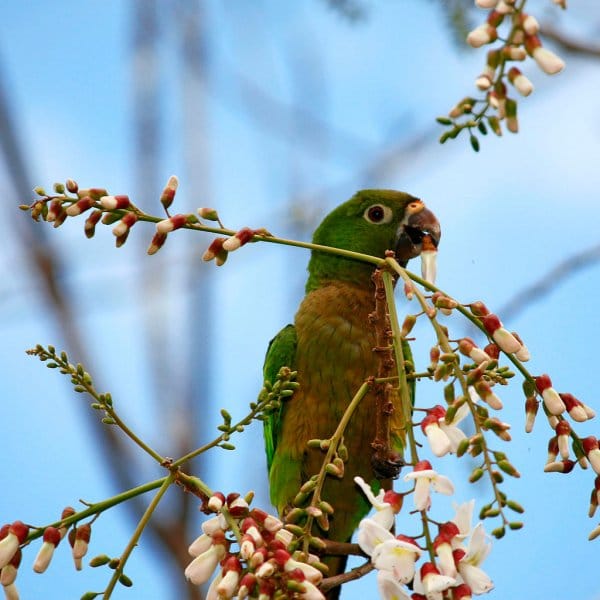
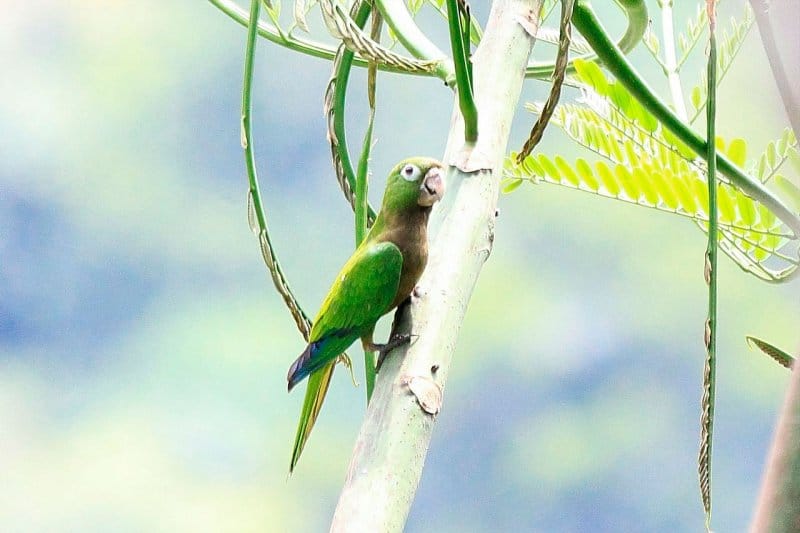
The Olive-throated Parakeet (Eupsittula nana) has the head and upperparts dark green; feathered area of cere yellow to orange-red.

Upperwing-coverts dark green, outer more emerald. The Outer secondaries and inner primaries deep dark blue tipped black above; the outer primary blue only towards tips. The greater underwing-coverts and underside of the flight feather dull slate or brownish-grey; the remaining coberteras are light green. Chin, throat and sides neck chocolate-brown they are merging with brownish olive on top of chest which turns yellow at the bottom and the belly; undertail-coverts light green. Uppertail dark green with blue diffusion, especially towards the tip; undertail metallized yellow-olive. Bill brown with the tip paler; irises yellow to orange; legs blackish-gray.

Olive-throated Parakeet

All plumages are similar but immature has irises brown.

  • Sound of the Olive-throated Parakeet.

Subspecies description:

three subspecies Panamanian and Honduran birds previously bore the respective names outmost and melloni, but light regional variations in Central America (p. e.g.. birds in southern paler and those of Tabasco, Mexico and Honduras They are darker) not justify more separations as described below.

  • Eupsittula nana astec

    (Souance, 1857) – Similar to the nominal but the throat and (especially the underparts) more pale brown, the bill perhaps smaller average.

  • Eupsittula nana nana

    (Vigors, 1830) – Nominal.


  • Eupsittula nana vicinalis

    (Bangs & Penard,TO, 1919) – Slightly larger than the subspecies Eupsittula nana astec, up brighter and greener down

NOTE The continental population is sometimes treated as a full species under the name A. astec, although the differences with Jamaican birds are minimal.

Habitat:

Video – "Olive-throated Parakeet" (Eupsittula nana)

Information on the Eupsittula nana

They live mainly in forests and forest edges (especially adjacent lowland) in wet areas (to 1.100 m in Honduras, to 700 m in Costa Rica and a 300 m in southern Mexico), It is less frequent in large tracts of rainforest; reported in arid areas (Veracruz) and pine forests (Honduras), open country with scattered trees (including acreages) and plantations. More common in Jamaica in mid-level humid limestone forests. Usually it remains below the canopy. larger groups can be formed (c. 30) after breeding or when food is abundant. mixed flocks with Crimson-fronted Parakeet reported in Costa Rica.

Reproduction:

Arboreal termitarium prefer to lay their nests, where birds excavate the cavity; also used treeholes. Often nests at the edge of a river or forest. Breeding season March, Jamaica; April May, Belize and Guatemala. The implementation is of 3-4 eggs that hatch in 26-27 days. After hatching, it takes about 50 days until chicks are ready for independence.

Note: In most birds, male/female bonds occur only during the breeding season and function solely in coordinating parental care. La monogamy perenne, or linking partner throughout the year, It occurs in at least a dozen families of birds, including cockatoos and other parrots.

Food:

Registered foods include higos ficus, Psidium, Inga, Hura, fruit of Hieronyma and guilt of tamarindo unripened. attacking crops, especially corn, and it is considered highly destructive in some areas.

Distribution:

Extending its range (breeding/resident): 1,373,500 km2

distributed by the Gulf and the Caribbean slope of Central America and Jamaica; a population in Hispaniola (Sierra de Bahoruco, Dominican Republic) It comes from a recent introduction from Jamaica. In Mexico, the Olive-throated Parakeet It extends from eastern San Luis Potosi and South of Tamaulipas, through South Veracruz until Oaxaca, North of Chiapas and Yucatan; then through the humid north of Guatemala and the Caribbean slope of Honduras, Nicaragua and Costa Rica to western Panama. It is located along Jamaica except in the high mountains and the humid mountain range of John Crow in the East.

Resident and locally common to abundant (commonly the most abundant parrot in some localities) although it is likely to be decreased in some areas (p. and. Jamaica and Costa Rica) due to the loss of habitat. Less common in southern Costa Rica and uncommon in Panama, where possibly a seasonal visitor Southern Lemon.

Caught for live bird market, but rare in international trade.

Subspecies description:

  • Eupsittula nana astec

    (Souance, 1857) – Veracruz, Mexico, to Panama


  • Eupsittula nana nana

    (Vigors, 1830) – Nominal. Jamaica, apparently in most areas except the high mountains and the humid Cordillera de John Crow


  • Eupsittula nana vicinalis

    (Bangs & Penard,TO, 1919) – East of Mexico south of Veracruz, zone of contact with the last unknown species

Conservation:

โ€ข Current category of the Red List of the UICN: Least concern.

โ€ข Population trend: Decreasing.

โ€ข Population size : 500,000-4,999,999 individuals.

Rationale for the Red List category

Although the demographic trend appears to be declining, the decline is not believed to be rapid enough to approach the Vulnerable thresholds based on demographic trend criteria (> 30% decrease in ten years or three generations). The population size is very large, and therefore does not approach the thresholds for Vulnerable under the criterion of population size (<10.000 individuos maduros con un descenso continuo estimado en >10% in ten years or three generations, or with a specific population structure). For these reasons, the species is evaluated as Least concern.

The subspecies Eupsittula nana nana It is endemic to Jamaica, where still widespread but probably has a moderately small population (approximately 10.000 mature individuals), all in one subpopulation, inferring that is in continuous decline due to a variety of threats including loss and degradation of the habitat, pursuit and capture for trade. So, It has been classified as Near-threatened.

Justification of the population

Partners in Flight They estimate that the total population is 500,000-4,999,999 individuals (A. Panjabi a slightly. 2008).

Justification trend

They suspected that the population is declining due to continuing habitat destruction and unsustainable levels of exploitation.

"Olive-throated Parakeet" in captivity:

Uncommon in international trade. Their life expectancy is over 15 years.

It is included in the appendix ll of the Convention on International Trade in Endangered Species of Wild Fauna and Flora Silvestre (CITES).

The Olive-throated Parakeet It is important to attract tourists with hotel advantages in the Caribbean and tropical areas that offer free bird tour with reservations. It is one of the reasons why this beautiful bird should remain free..

Alternative names:

– Dwarf Conure, Dwarf Parakeet, Jamaican Conure, Jamaican Parakeet, Olive-throated Parakeet, Olive-throated Parakeet (Jamaican) (English).
– Conure aztรจque , Conure naine, Conure naine (nominal), Conure naine (nominale), Conure naine (race nominale) (French).
– Aztekensittich, Jamaikasittich (German).
– Periquito-da-jamaica (Portuguese).
– Aratinga jamaicana, Aratinga Pechisucia, Perico Amargo, Perico azteco, Perico Pechiolivo, Perico Pechisucio, perico pecho sucio, perico pecho-sucio, Periquito pechisucio (espaรฑol).
– Perico azteco (Costa Rica).
– Perico Amargo (Dominican Rep.).
– Periquito pechisucio (Honduras).
– Perico Pechisucio, perico pecho sucio, perico pecho-sucio (Mexico).
– Perico Pechiolivo (Nicaragua).

scientific classification:

– Order: Psittaciformes
– Family: Psittacidae
– Genus: Eupsittula
– Scientific name: Eupsittula nana
– Citation: (Vigors, 1830)
– Protonimo: Psittacara nana

Images Olive-throated Parakeet:


Especies del gรฉnero Eupsittula
  • Eupsittula nana
  • —- Eupsittula nana astec
  • —- Eupsittula nana nana
  • —- Eupsittula nana vicinalis
  • Eupsittula canicularis
  • —- Eupsittula canicularis canicularis
  • —- Eupsittula canicularis clarae
  • —- Eupsittula canicularis eburnirostrum
  • Eupsittula aurea
  • Eupsittula pertinax
  • —- Eupsittula pertinax aeruginosa
  • —- Eupsittula pertinax arubensis
  • —- Eupsittula pertinax chrysogenys
  • —- Eupsittula pertinax chrysophrys
  • —- Eupsittula pertinax griseipecta
  • —- Eupsittula pertinax lehmanni
  • —- Eupsittula pertinax margaritensis
  • —- Eupsittula pertinax ocularis
  • —- Eupsittula pertinax paraensis
  • —- Eupsittula pertinax pertinax
  • —- Eupsittula pertinax surinama
  • —- Eupsittula pertinax tortugensis
  • —- Eupsittula pertinax venezuelae
  • —- Eupsittula pertinax xanthogenia
  • Eupsittula cactorum
  • —- Eupsittula cactorum cactorum
  • —- Eupsittula cactorum caixana

  • Sources:

    – Avibase
    – Parrots of the World โ€“ Forshaw Joseph M
    – Parrots A Guide to the Parrots of the World – Tony Juniper & Mike Parr
    – Birdlife

    – Photos:

    (1) – Jamaican Parakeet (aka Olive-throated Parakeet or Aztec Parakeet) in captivity in Costa Rica By http://www.birdphotos.com (Own work) [CC BY 3.0], via Wikimedia Commons
    (2) – Aratinga nana astec in Belize By Dominic Sherony [CC BY-SA 2.0], via Wikimedia Commons
    (3) – Aratinga (nana) astec in Tikal, Guatemala By Aztec_Parakeet_(Aratinga_astec)_-Guatemala-8.jpg: Walter Rodriguez from Berlin, Germanyderivative work: Snowmanradio [CC BY 2.0], via Wikimedia Commons
    (4) – Aratinga (nana) astec in Tikal, Guatemala By Walter Rodriguez from Berlin, Germany (parakeetUploaded by Snowmanradio) [CC BY 2.0], via Wikimedia Commons
    (5) – Eupsittula nana. Celestรบn Biosphere Reserve, Yucatan, Mรฉxico By Katja Schulz from Washington, D. C., USA (Olive-throated Parakeet) [CC BY 2.0], via Wikimedia Commons
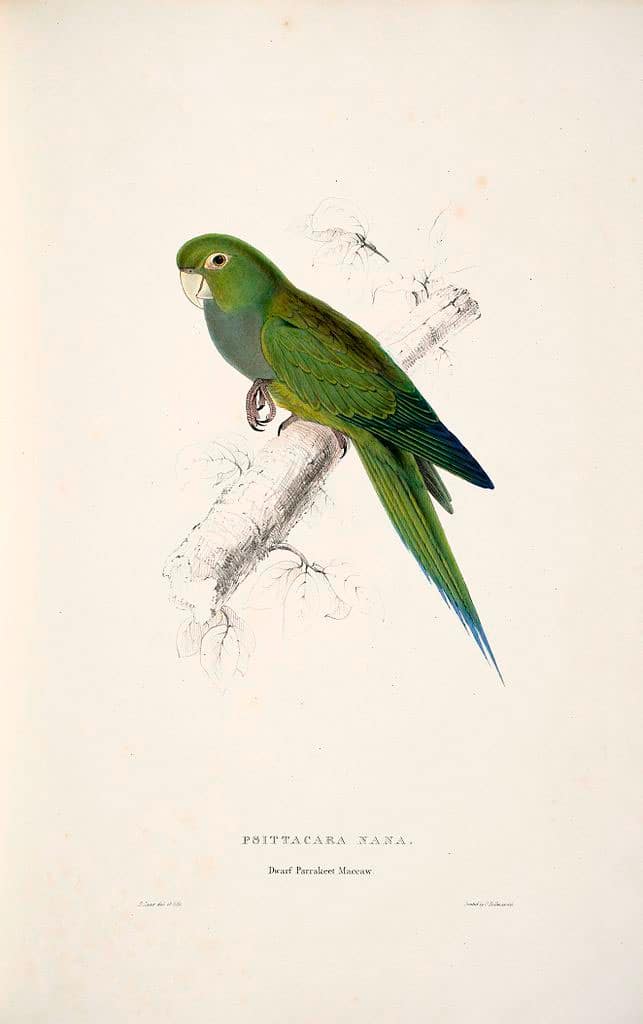
    (6) – A painting of an Olive-throated Parakeet, also known as the Olive-throated Conure, (originally captioned ยซPsittacara nana. Dwarf Parakeet Maccaw.ยป) by Edward Lear 1812-1888 [Public domain], via Wikimedia Commons

    – Sounds: Guy Kirwan, XC284214. accessible www.xeno-canto.org/284214
    [contact-form][contact-field label=ยปNombreยป type=ยปnameยป required=ยปtrueยป /][contact-field label=ยปEmailยป type=ยปemailยป required=ยปtrueยป /][contact-field label=ยปWebยป type=ยปurlยป /][contact-field label=ยปMensajeยป type=ยปtextareaยป /][/contact-form]

    โ–ท The world of Pets: Dogs, cats, birds, reptiles, amphibians

    Reischek's Parakeet
    Cyanoramphus hochstetteri

    Reischek's Parakeet

    Content


    Anatomy-parrots

    Description:

    28 cms. length and 140 g. of weight.

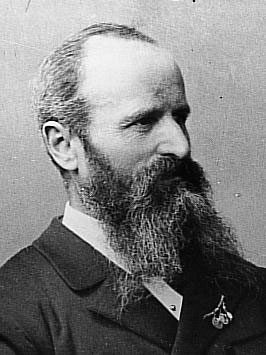
    The Reischek's Parakeet (Cyanoramphus hochstetteri). They are named after the Austrian ornithologist and taxidermist ยซAndreas Reischekยซ, the first scientist to visit the Antipodes Islands. He was a passenger of Stella and reached the Antipodes Islands in February 1888.

    It is one of two species of parakeets Cyanoramphus who live in remote Antipodes Islands. It is a medium-sized green parrot, brightly colored, the outer flight feathers are light blue with a crown red, which looks a lot like other parakeets of "red crown" (for example, Cyanoramphus novaezelandiae). But appearances are deceptive. Genetic studies reveal that crown color may not be a good indicator of parakeet taxonomy, and the tiny Malherbe's parakeet (Cyanoramphus malherbi) It may be the closest relative of Reischek's Parakeet. It is common in all Antipodes Islands, particularly in more open areas and along shorelines close to penguin colonies.

    Habitat:

    The Reischek's Parakeet They are more abundant than Antipodes parakeet (Cyanoramphus unicolor) in most habitats. Significant differences were observed in diet between the two species of parakeets. are also evident strong seasonal and annual differences in diet related food availability. The Reischek's Parakeet They are strong fliers and have been observed flying between islands within the Antipodes group.

    Social behavior is similar to other species of parakeets Cyanoramphus, but have been observed to spend considerable periods basking and preening in sheltered areas. Like other species Cyanoramphus, are strongly territorial around nests, and they call loudly and chase intruders from nearby.

    They are usually found in pairs or, more commonly, in small groups that feed on or near the ground. You can often see them in meetings springs and wells isolated. Occasionally they flock fly to neighboring islands in search of food.

    Reproduction:

    We know relatively little about the breeding of the Reischek's Parakeet. Apparently nest from October to March inside tunnels modified or built inside the bases of groups of tussocks or ferns. The nest is lined with small pieces of wood, feathers, moss, herbs and other dry materials. They can reuse nests each year.

    clutch size is unknown in nature. Its ecology and reproductive behavior are likely to be similar to those of other parrots. Cyanoramphus.

    Food:

    It has been recorded feeding on leaves, flowers, berries and seeds 14 plant species. Invertebrates are a minor component of the diet. The Reischek's Parakeet occasionally feed carcasses petreles and albatrosses, but not as often as Antipodes parakeet (Cyanoramphus unicolor). They feed on the floor often, including mud and feces accumulated within colonies antipodean penguin (Eudyptes sclateri) unoccupied, when penguins are away on their winter migration.

    Distribution:

    The Reischek's Parakeet is endemic of the Antipodes Islands. It is common in all the Antipodes Islands, particularly in more open areas and along shorelines close to penguin colonies.

    Conservation:


    Vulnerable

    โ€ข According to the New Zealand Threat Classification System of 2008: Vulnerable.

    โ€ข Population trend: Stable.

    โ€ข Population size : 4000-6000 individuals.

    The Reischek's Parakeet apparently they have a stable population, and are common within their distribution area of 2,000 has. They are protected by the isolated situation of the islands and their status Natural reserve strict. The greatest threat to long-term survival Reischek's Parakeet is the arrival of mammalian predators. In the winter of 2016 we attempted to eradicate the mice Antipodes Islands.

    The species is also affected negatively by forestry operations: logging and burning have drastically reduced the available habitat, and selective logging can reduce the number of trees with suitable nesting holes and foraging opportunities..

    It was hunted by Maori to feed, and previously it was persecuted because birds were damaging crops and orchards.

    "Reischek's Parakeet" in captivity:

    Son confident from the beginning and not at all shy. Usually they are ready to breed in captivity. Although they are ripe (about five months), It is best not to allow them to play in the first year.

    Alternative names:

    – Antipodes Island Parakeet, Antipodes Red-crowned (English).
    – Perruche de Reischek, Perruche des Antipodes (French).
    – Antipoden-Ziegensittich (German).
    – Periquito de Reischek (Portuguese).
    – Perico de Reischek, Perico Frentirrojo de las Antรญpodas (espaรฑol).

    scientific classification:

    Andreas Reischek
    Andreas Reischek

    – Order: Psittaciformes
    – Family: Psittaculidae
    – Gender: Cyanoramphus
    – Scientific name: Cyanoramphus hochstetteri
    – Subpoena: (Reischek, 1889)
    – Protonimo: Platycercus hochstetteri

    Images:

    New Zealand Birds Online – Photos

    Sources:

    โ€ข Avibase
    โ€ข Parrots of the World โ€“ Forshaw Joseph M
    โ€ข Parrots A Guide to the Parrots of the World – Tony Juniper & Mike Parr
    โ€ข Greene, T.C. 2013 [updated 2017]. Reischek's parakeet. In Miskelly, C.M. (ed.) New Zealand Birds Online. www.nzbirdsonline.org.nz

    Photos:

    (1) – Cyanoramphus hochstetteri by Auckland Museum [CC BY 4.0]

    Sounds: Captive birds calling, Mount Bruce National Wildlife Centre, April 1973, 1215, Les McPherson, McPherson Natural History Unit Sound Archive, www.archivebirdsnz.com

    โ–ท The world of Pets: Dogs, cats, birds, reptiles, amphibians

    Budgerigar
    Melopsittacus undulatus


    Common Budgie

    Content

    Description

    18 cm. length and a weight between 22 and 32 g..

    Periquito-Comun

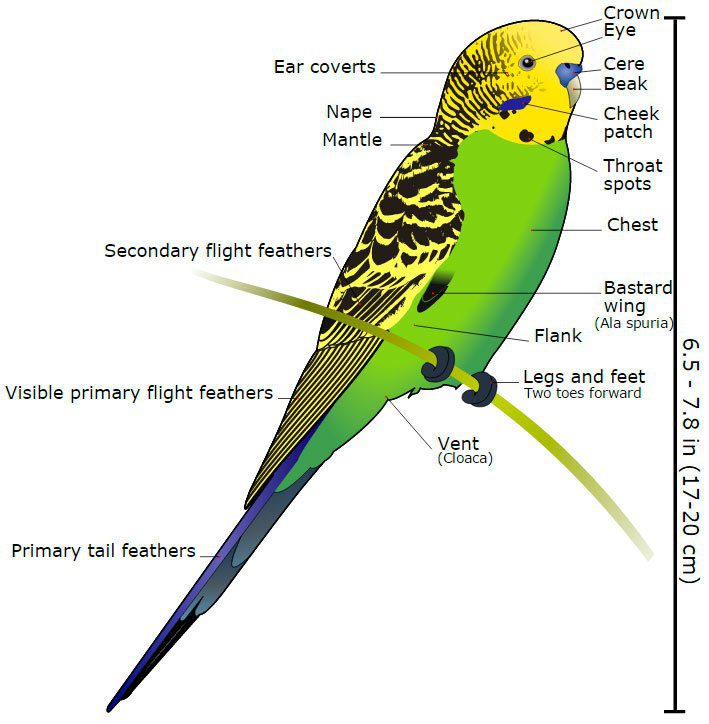
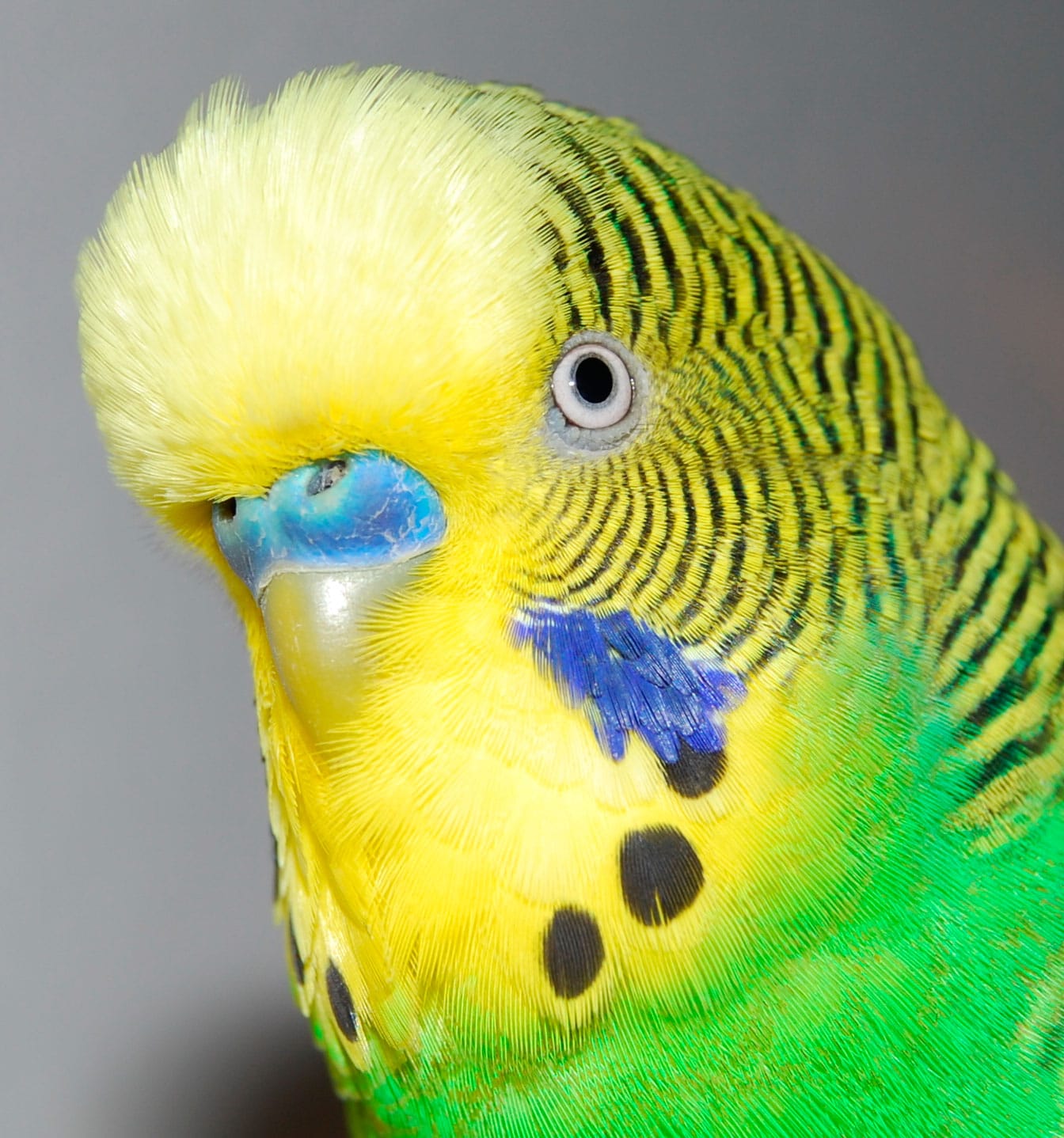
    In the Budgerigar (Melopsittacus undulatus) of adults, the cere Blue contrasts with the frontal zone; the front of the face and throat are pale yellow. The latter is covered by a line of black dots. The area which is located below the cheeks it's purple.

    The central part of the pileum extending from the rear of the eyes to neck It is covered with alternating thin black bands and bands of pale yellow. These bars are expanded on the the mantle and wing-coverts, forming a scaly effect.

    The underparts, the area beneath the wings, the lower part of the back and rump create a beautiful pale green together. The tail is opaque blue tones with a central yellow stripe on the side feathers.

    The female has a Brown wax.

    The immature they are more turned off with bars on the front. The black spots on the throat they are absent.

    Habitat:

    The Budgerigar they are distributed by a wide variety of open habitats, including open forests, lightly wooded grasslands and savannas. Also appreciate the areas of Mallee, farmland, vegetation that grows along rivers, drought-adapted scrub and open plains. They come fitted with desert areas of Mulga (Acacia aneura). Although they are able to survive several days without water, These birds are never far from a water source.

    In areas where fruit production is constant and in others where it is stable for very long periods, the movements of the Budgerigar they are easily predictable.

    In the South end, Pilgrimages exist only in cases of prolonged drought and wandering parakeets return to their territory with the first rains and recolonize when river levels return to normal.

    Reproduction:

    The Budgerigar they build their nests of June to September in the North its area of distribution. They reproduce between August and January in the South. Nests can be installed at any time of the year after the rains fall. They establish a second brood as soon as conditions are favorable.

    These parakeets usually nest in colonial way. The nest is located in a natural cavity in a tree, in a strain, an any fence post, or on a big fallen branch.

    The female lays from 4 to 6 eggs and incubation lasts a few 18 days. The chicks remain in place of birth during 30 days before flying.

    Food:

    The Budgerigar It vegetarian, they eat herbs and seeds of quenopodios. Plants vary in categories and in proportions, according to which regions and times.

    The East inside of Australia, These birds feed exclusively on seeds that are on the ground, While in the middle of the continent, There is more variety of plants to select. In the first case, grain size barely exceeds the 2 mm diameter and the second, more than 40 plant varieties make up the diet of these parakeets.

    From time to time, the Budgerigar, they come in growing areas and take advantage of the ripe fruits.

    Distribution:

    The Budgerigar are distributed widely throughout the Interior of Australia, Although they are rare in the coastal districts of the This and the end South-West (absent of Tasmania, Arnhem Land and Cape York Peninsula).

    The species may be of common to very abundant, but they are nomadic, and may change from year to year areas.

    These parakeets, frequently, they burst from the arid zones to the more humid zones and there are temporary movements towards the south during the summer, but these changes may be affected by annual rainfall patterns.

    We have introduced, without success, in a number of places around the world (or they have escaped from captivity and could not be) including South Africa, United Kingdom, Japan, Hong Kong, Puerto Rico, Brazil, Switzerland, Colombia, the Society Islands, New Zealand and Oman.

    In the EE.UU. the species has managed to colonize Hawai and California (leaks also occur regularly in the city of New York City). In Florida a population was originally registered in the area of St. Petersburg, in the decade of 1950 and now has more of 3.000 individuals; These birds are mobile and have been recorded along the coast This of all the South from Jacksonville to Miami, and in the West everything Hudson to South of Fort Myers, from time to time go towards the North in Gainsville.

    Parakeets, occasionally escaped, they may appear in Tasmania.

    The world population is estimated at around 5.000,000 copies.

    Conservation:


    minor concern


    โ€ข Current category of the Red List of the UICN: Least concern

    โ€ข Population Trend: Growing

    This species is not threatened at all, even they are abundant, and in some places where resources are good, countless flocks darken the sky, to cause branches to break from 4 centimeters in diameter, When large number of birds used them as support for their breaks.

    Populations fluctuate widely depending on weather conditions.

    Livestock living on farms in central Australia have caused Budgerigar they will benefit from new water supplies. Like this, the number of parakeets are constantly increasing.

    These parakeets are the most well known psittacidas in the world.

    "Budgerigar" in captivity:

    This parakeet was discovered in 1805 and since then it has become the most popular captive bird in the world. While it is considered as domestic fowl, However, is a gregarious and instinctive animal, with the same needs that the parrots who freely roam the lands of Australia.

    The Budgerigar It dynamic, curious, melodious and because of its small size, the beauty of their plumage and their entertaining behaviour, truly charming. This is what makes it a coveted bird. But, It is still a bird that needs to fly, play and socialize with their peers. Like any bird, It is sensitive to the social and environmental context. In fact, their real needs are too often overlooked, many parakeets suffer neglect or even abuse.

    In captivity, the Budgerigar It is larger than its counterpart in nature. Measures of 20 to 25 cm. from head to tail and weighs between 30 and 45 g.. In addition to the colour of your coat, wild type, There are numerous mutations (other coat colors) associated with the increase in crossings and selections in certain genes, that translates into more spontaneous mutations.

    The Budgerigar has two silent by year average, and the first moult occurs between the fourth and sixth month. The molt is complete renovation of the plumage of the bird. Pens fall to others push, includes your tube of keratin that parakeets will open with their beaks to release pen and relieve the irritation that engenders the same thrust. It can be more or less painful and intense. Some plucking is so fast that the bird may experience some difficulties during the flight.

    Check the intensity of the change of the parakeet through black head tubes, tiredness and especially the number of feathers on the ground.

    The feeding of the Budgerigar is based on the millet and the birdseed, Although it must be complemented with other seeds or vegetables (as the lettuce, Spinach, pepper, Carrot, corn). The fruits are also a good dietary supplement for these birds. Occasionally it can provide a little bread or biscuit, but always with caution that not give them anything very sweet. The avocado, the chocolate and the parsley they are deadly toxic for the Australian parakeets.

    The the parakeet cage must be protected from the cold, a temperature between the 20-25 C. It must be of one sufficient size so you have freedom of movement and can exercise. The balusters must be arranged horizontally so that they can climb up them. The cage must be washed at least once a month with a disinfectant, change the water daily and clean the shells of the food. A cat litter tray can be placed to make their needs.
    It is also important to let the parakeet out occasionally and fly freely around the room. Windows must be closed and curtains, because you can hit them.
    Son very sociable birds and it is better to live with other parakeet. The best couple is formed by a male and a female. This will try to kill its companion if it is of the same gender.

    With regard to its longevity, according to sources, these animals can come to live until 21 years in captivity. The same sources indicate that these parakeets suffer from a high incidence with respect to ovarian cancer.

    Alternative names:

    – Budgerigar, Budgerygah, Budgie, Canary Parrot, Grass-Parakeet, Lovebird, Scalloped Parrot, Shell Parakeet, Shell Parrot, Undulated Parrot, Warbling Grass-Parrot, Zebra Parrot (ingles).
    – Perruche ondulรฉe (French).
    – Wellensittich (German).
    – Periquito-australiano (Portuguese).
    – Periquito Australiano, Periquito Comรบn, Cotorra Australiana, Cata Australiana (espaรฑol).

    scientific classification:

    George Shaw


    – Order: Psittaciformes
    – Family: Psittaculidae
    – Genus: Budgerigar
    – Scientific name: Melopsittacus undulatus
    – Citation: (Shaw, 1805)
    – Protonimo: Psittacus undulatus

    ยซCommon Parakeetยป Images:

    Videos "Budgerigar"

    ————————————————————————————————

    ยซCommon Parakeetยป (Melopsittacus undulatus)


    Sources:

    – Avibase
    – Parrots of the World โ€“ Forshaw Joseph M
    – Parrots A Guide to the Parrots of the World – Tony Juniper & Mike Parr
    – Birdlife

    – Photos:

    (1) – Budgerigar at Zoo Atlanta, USA By TheSussman (Mike) (originally posted to Flickr as Parakeet) [CC BY 2.0], via Wikimedia Commons
    (2) – Two budgerigar at Henry Doorly Zoo, USA By Jeff Coffman (originally posted to Flickr as DSC_1265) [CC BY 2.0], via Wikimedia Commons
    (3) – male budgerigar. taken near Cameronโ€™s Corner, Qld By Benjamint444 (Own work) [GFDL 1.2], via Wikimedia Commons
    (4) – Detail shot of budgerigars head By Kirk (Own work) [CC BY-SA 3.0 or GFDL], via Wikimedia Commons
    (5) – Melopsittacus undulatus flock, Karratha, Pilbara region, Western Australia By Jim Bendon from Karratha, Australia (budgies_4) [CC BY-SA 2.0], via Wikimedia Commons
    (6) – By User Magnus Manske on en.wikipedia [Public domain], via Wikimedia Commons
    (7) – Exterior diagram of a green budgerigar By ZooFari [CC BY-SA 3.0], via Wikimedia Commons

    – Sounds: Marc Anderson (Xeno-canto)

    โ–ท The world of Pets: Dogs, cats, birds, reptiles, amphibians

    Scaly-headed Parrot
    Pionus maximiliani

    Scaly-headed Parrot

    Content


    Anatomy-parrots

    Description:

    27 to 29 cm.. height and between 233 and 293 g. of weight.

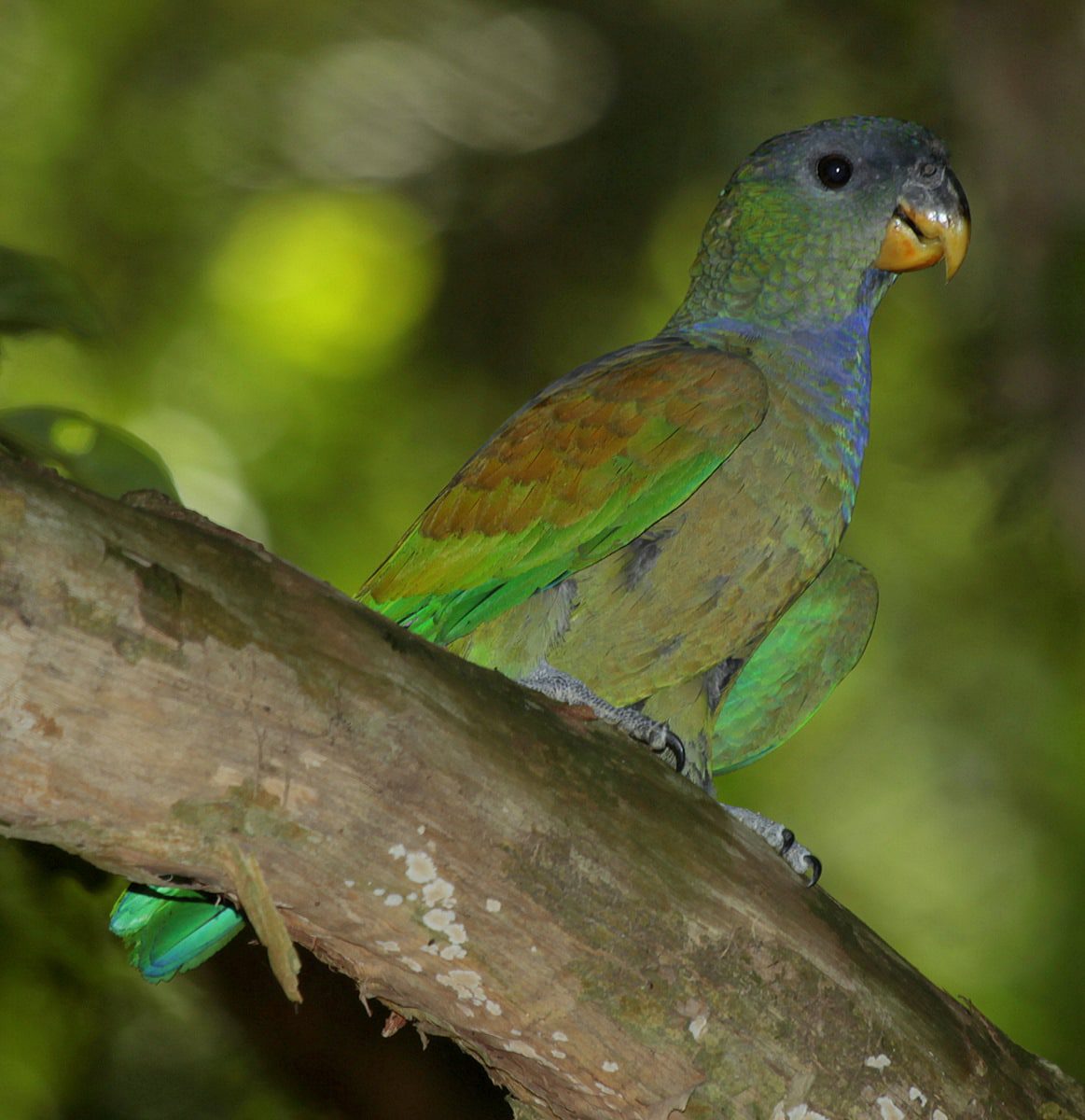
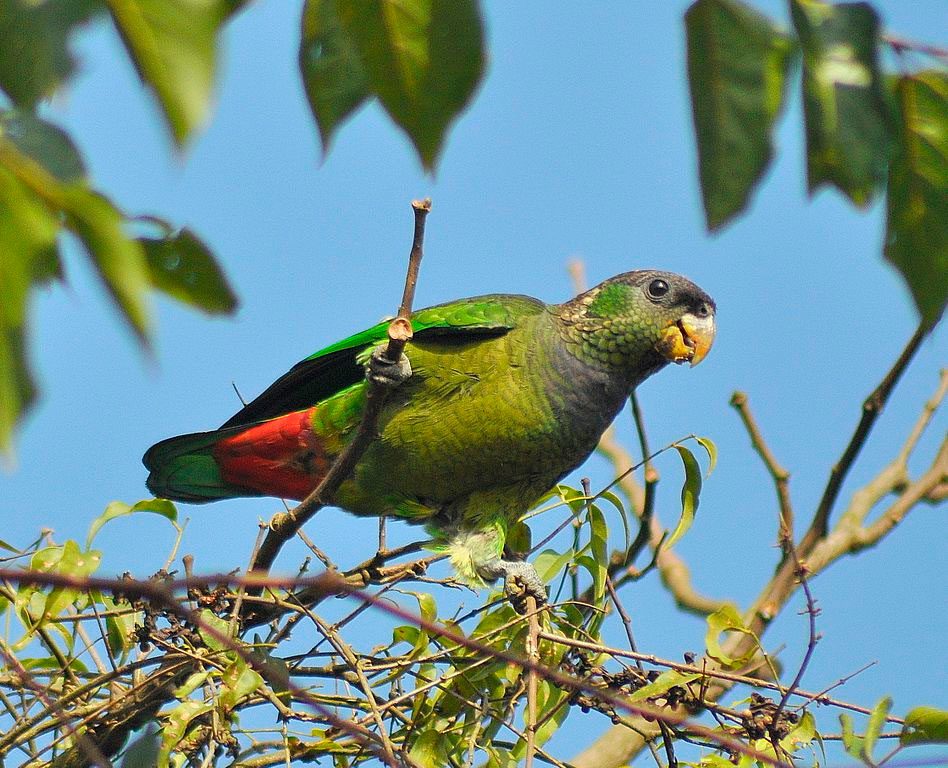
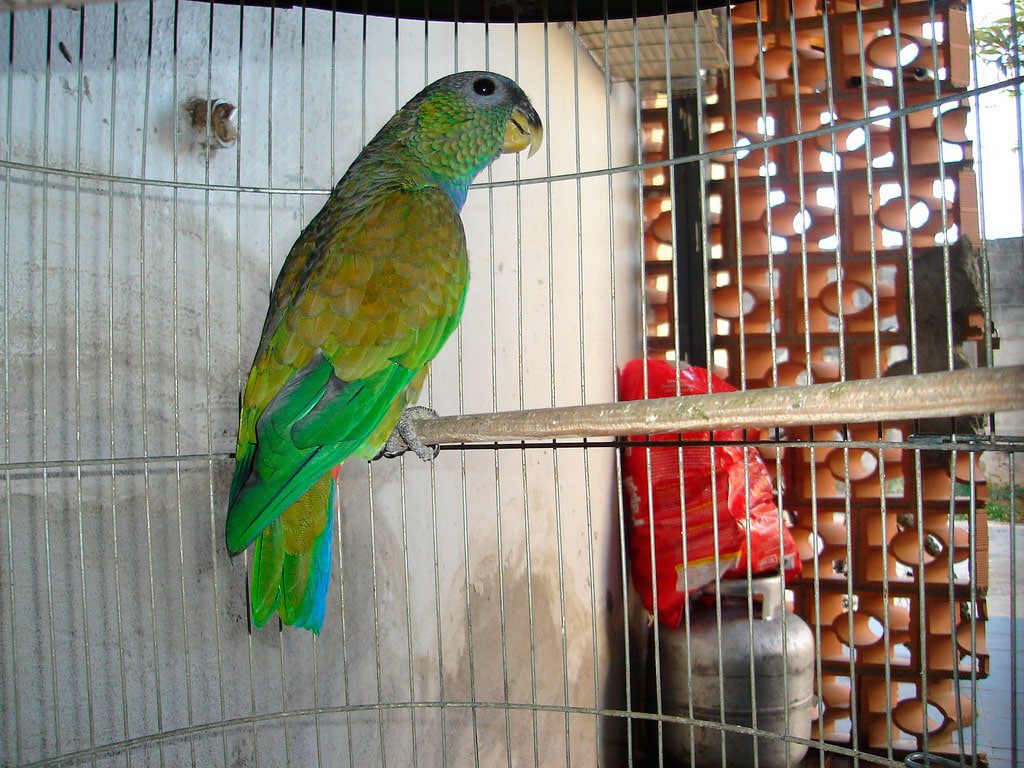
    The Scaly-headed Parrot (Pionus maximiliani) It is medium in size and tail very short; has the lores, the forecrown and the eye area opaque dark bronze; the feathers on crown, the cheeks, the chin and the sides of the neck, basal green with wide enough margins bronze that give the appearance of flake; ear-coverts with dark green margins but brighter than other pens head.

    The back of the neck and green the mantle become more brown and olive green upper lower parts, where some feathers have quite indistinct darker tips. Coverts smaller and medium-sized green olive brown with indistinct dark tips; alula, primary and greater coverts and flight feathers, brighter green, contrasting with the upperparts brown, duller.

    Under the wings, opaque green. The throat and the top chest blue violet off that fade in brownish olive green in the bottom of the chest and most of the belly, but they are become brighter and greener in flanks and the thighs; undertail-coverts crimson. Upper, the tail green in the center, outer feathers mainly blue and red at the base; undertail, the tail, bluish green duller. Bill black with yellow edges on the upper jaw and the bottom tip; orbital skin pale grey; irises dark brown; legs grey.
    Scaly-headed Parrot
    Both sexes are similar. Immature It has less intense the blue throat; feathers head more green with less distinct margins.

    Description 4 subspecies:

    • Pionus maximiliani lacerus

      (Heine, 1884) – Similar to the subspecies Pionus maximiliani siy but with a bill stronger, the chest more purple and perhaps larger on average.


    • Pionus maximiliani maximiliani

      (Kuhl, 1820) – Nominal.


    • Pionus maximiliani melanoblepharus

      (Ribeiro, 1920) – Blue darker in throat and darker above. Larger.


    • Pionus maximiliani siy

      (Souance , 1856) – Much like the nominal species but darker below, more purple and less blue in the chest, yellower in back and Blue throat lighter.

    Habitat:

    It inhabits in a wide range of forested habitats, but mostly in dry forests lowland ranging from caatinga very dry, inside the northeast of Brazil, through the savannas Cerrado seasonal, to chaco; also in wetter forests, including gallery forests and forests of araucarias, especially in southeast Brazil. They can also be seen in subtropical forests in Eastern Andean slopes some 2.000 meters in the Northwest of Argentina and some 1.500 meters in the mountains of the South of Brazil.

    Tolerant to human alteration of forest habitats and sometimes cultivated areas. Usually gregarious, arriving to form flocks numerous in places in where the food is abundant probably is hiding in small groups in them cups of them trees.

    Reproduction:

    They nest in tree hollows. Birds in terms of breeding in the month of October in Paraguay; November in Sรฃo Paulo; laying 3-5 eggs.

    Food:

    The plants food include Erythrina, Inga, Piptadenia, Copaifera, Croton, Pachystroma, Plathymenia reticulata, Ficus and Araucaria.

    Distribution:

    Size of the area of distribution (reproduction / resident): 6.650.000 km2

    The species is found in the Center, South and East of Brazil, from maranhรฃo and Cearรก in the Northeast, to the South by Piauรญ, Bay, Goiรกs, Minas Gerais, Brazil and the eastern coastal States up to Rio Grande do Sul and to the South of Mato Grosso (region pantanal), extending to the southeast of Bolivia, from Santa Cruz to the South in the Eastern Andes and to the North of Argentina in Salta, Tucumรกn and Catamarca in the East and North of Santa Fe in the West.

    Mainly resident, although it may not grow in the drier parts of the Argentine Chaco. Apparently more numerous in the center of its area of distribution, where its abundance is only surpassed by the Maroon-bellied Parakeet (Pyrrhura frontalis); progressively more scarce toward the periphery.

    Locally quite common the common in Bolivia and locally common in the North of Argentina, where it is most abundant in the South of Salta, Tucumรกn and areas adjacent in Catamarca. Moderately common in Rio Grande do Sul and common in the pantanal; densities Brazilian more high in Sรฃo Paulo.

    The decrease apparent, in some parts of the range, (for example, North of the Argentina) is attributable to the trade, but in other places (for example, the southeast of Brazil) is undoubtedly its decline due to the loss of forests.

    Distribution 4 subspecies:

    • Pionus maximiliani lacerus

      (Heine, 1884) – Northwest of Argentina.


    • Pionus maximiliani maximiliani

      (Kuhl, 1820) – Nominal. Northeast of Brazil.


    • Pionus maximiliani melanoblepharus

      (Ribeiro, 1920) – It is from Paraguay, Brazil and northeast of Argentina (Missions)


    • Pionus maximiliani siy

      (Souance , 1856) – Southeast of Bolivia until Paraguay, West of Brazil (Mato Grosso), North of Argentina.

    Conservation:


    minor concern


    โ€ข Current category of the Red List of the UICN: Least concern.

    โ€ข Population trend: Decreasing.

    Justification of the population

    The size of the world population It has not been quantified, but this species is described as ยซquite commonยป (Stotz et to the., 1996).

    Justification of trend

    It is suspected that the population is in decline due to the continuous habitat destruction and to levels of exploitation unsustainable.

    Threats

    The species has been object of strong exchanges: from 1981, When is included in the Appendix II of the CITES, they have been 93.234 individuals captured in the wild in the international trade (database CITES from the UNEP-WCMC, January 2005).

    "Scaly-headed Parrot" in captivity:

    Curious, very intelligent and social. Quiet and relatively little aggressive. Prone to obesity. You can learn to imitate.
    Pretty common in captivity. Life expectancy: 20 years.

    Housing: Enclosure suspended at least 2 metres in height.

    Diet: fruit as: Apple, pear, orange, banana, granada, cactus fruits, they form approximately the 30 percent of the diet; vegetables as: Carrot, celery, green beans, pea in the pod; corn fresh; green leaves such as: chard, lettuce, dandelion, Aviary grass; millet; mix of seeds small e.g.: millet, and small amounts of buckwheat, oats, safflower and hemp; soaked and sprouted from seeds of sunflower; beans, cooked legumes and boiled corn.

    It needs regular exercise it is necessary to provide you with an Aviary as large as possible. Provide shallow bowls of water for bathing. Also provide stairs, swings, strings, different sizes of hooks and assorted toys.

    Alternative names:

    – Scaly-headed Parrot, Maximilian’s Parrot, Scaly headed Parrot (English).
    – Pione de Maximilien, Pionus de Maximilien (French).
    – Maximilianpapagei (German).
    – Maitaca, baitaca, maitaca-bronzeada, maitaca-de-Maximiliano, maitaca-suia, maitaca-verde, suia, umaitรก (Portuguese).
    – Loro Bronceado, Loro choclero, Loro maitaca (espaรฑol).


    scientific classification:

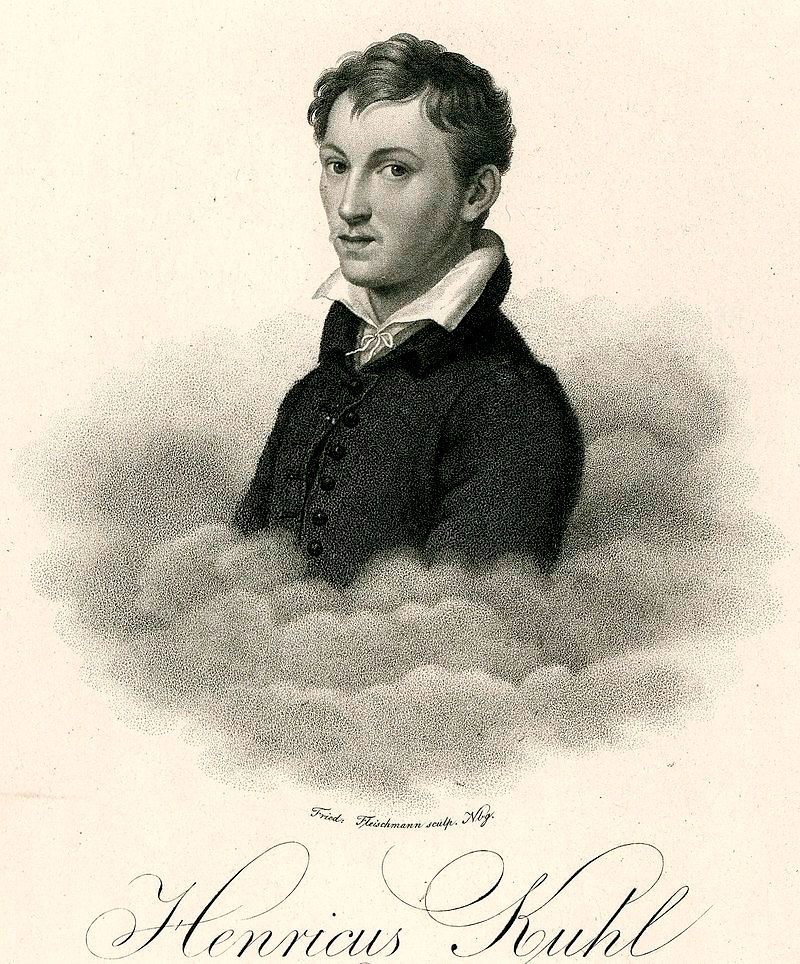
    Kuhl, Heinrich
    Heinrich Kuhl

    – Order: Psittaciformes
    – Family: Psittacidae
    – Genus: Pionus
    – Scientific name: Pionus maximiliani
    – Citation: (Kuhl, 1820)
    – Protonimo: Maximilian parrot

    ยซChoclero Parrotยป Images:

    Videos "Scaly-headed Parrot"

    pichu - My Maximilian Pionus

    Scaly-headed Parrot (Pionus maximiliani)


    Sources:

    • Avibase
    • Parrots of the World โ€“ Forshaw Joseph M
    • Parrots A Guide to the Parrots of the World – Tony Juniper & Mike Parr
    • Birdlife
    • Parrot Book, Parrots and macaws Neotropical
    • parrots.org

    • Photos:

    (1) – IBC.lynxeds.com
    (2) – A Scaly-headed Parrot (also called a Scaly-headed Pionus, Maximilianโ€™s Pionus, amd Maximilianโ€™s Parrot) in a cage By Alex Knowles [CC BY 2.0], via Wikimedia Commons
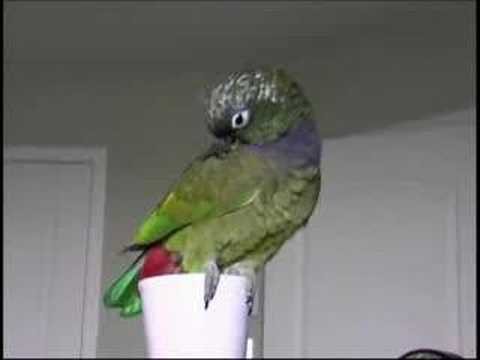
    (3) – A pet male Scaly-headed Parrot (also called Maximilian Pionus, Maximilian Parrot, Maximilianโ€™s Pionus, or Maximilianโ€™s Parrot) By Snowmanradio (Own work) [CC BY-SA 3.0 or GFDL], via Wikimedia Commons
    (4) – Scaly-headed Pionus (also called Maximilian Pionus, Maximilian Parrot, Maximilianโ€™s Pionus, or Maximilianโ€™s Parrot) at Zoolรณgico de Americana, Sao Paulo, Brazil By Moe Oliveira [CC BY 2.0], via Wikimedia Commons
    (5) – Loro Choclero By Danbrazil (Own work) [CC BY-SA 4.0], via Wikimedia Commons
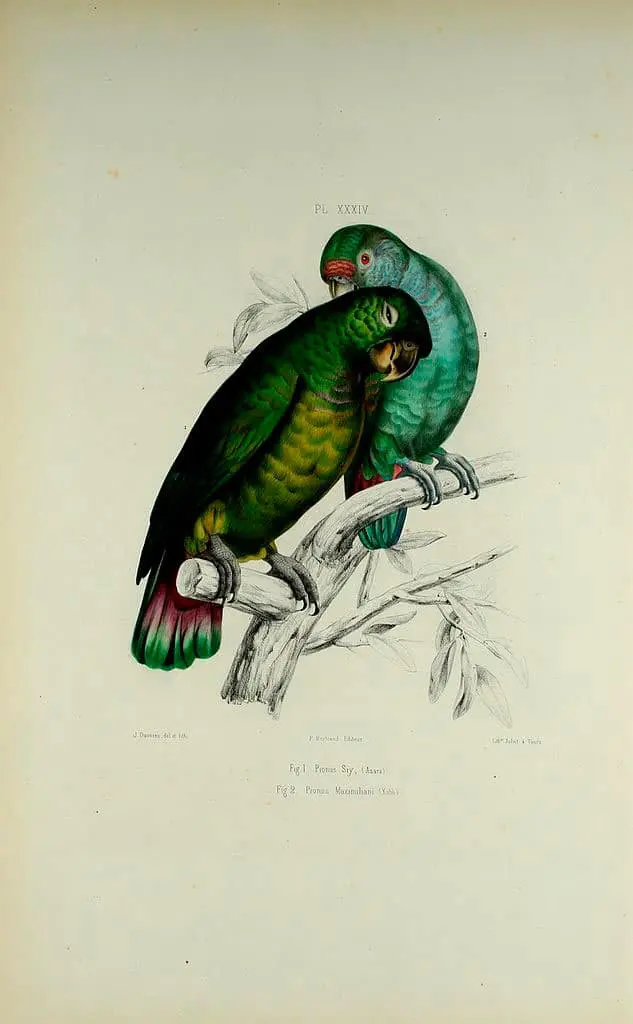
    (6) – Iconographie des perroquets : non figurรฉs dans les publications de Levaillant et de M. Bourjot Saint-Hilaire By Blanchard, Emile; Bonaparte, Charles Lucian; Bourjot Saint-Hilaire, Alexandre; Le Vaillant, Franรงois; Souancรฉ, Charles de. [CC BY 2.0 or Public domain], via Wikimedia Commons

    โ–ท The world of Pets: Dogs, cats, birds, reptiles, amphibians

    Meek's Pygmy-Parrot
    Micropsitta meeki

    Meek's Pygmy-Parrot

    Content


    Anatomy-parrots

    Description

    10 cm. length.

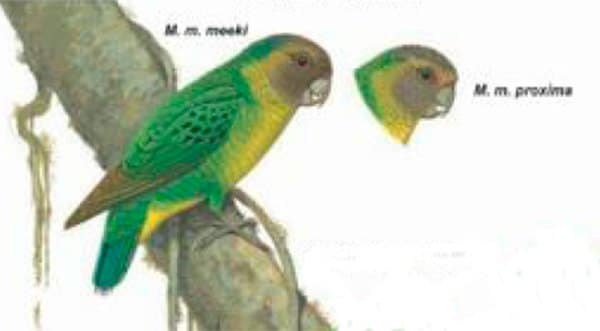
    The Meek's Pygmy-Parrot (Micropsitta meeki) has the feathers of the head dark brown, strongly scalloped in color yellow on them ear-coverts and the sides of the throat, and usually with the eyebrows in a vague color yellow; feathers of the crown with fine greyish yellow tips.

    Upperparts dark green, darker on the margins and the Center to the Middle coverts black. Feathers primary Black with green trim; secondaries mainly green. Wing feathers more dark with the tips of color yellow; underside of flight feather blackish. Top of the chest and centre of belly, opaque yellow, with brown spots at the tips of the feathers; flanks color green dark; under the tail, coverts yellow. Tail greenish blue in the Center, feathers laterales blackish with stains yellow on the tips or with pointed blue and yellow.

    Bill yellow rose pale; irises yellowish brown; legs Pink.

    Similar to males females.

    Subspecies

    • Micropsitta meeki meeki

      (Rothschild and Hartert, 1914) – The nominal.


    • Micropsitta meeki proxima

      (Rothschild and Hartert, 1924) – The face is more pale and the grey more beige that the of the nominal species; light diffusion of greenish color instead of the yellow markings of the nominal, and a band front yellow with find in them eyebrows.

    Habitat:

    Microloro-of-Meek-(2)

    Not well known. It occurs in forests, high secondary growth, and even in trees around inhabited areas. The birds are found in small groups. Habits are like those of the Buff-faced Pygmy-Parrot.

    Reproduction:

    The nest they usually build it on a tree termite mound, Sometimes it can be very close to the ground.

    Food:

    They feed on lichens and fungi collected from trunks of trees.
    They nourish also of seeds, nuts, berries and fallen fruits that they can find, Although they prefer to eat fruits of plants. They also feed on insects and insect larvae.

    Distribution:

    Size of the area of distribution (reproduction / resident): 2,400 km2

    Endemic to the forests of the lowlands, until 700 meters of altitude on the Islands in the Northwest Bismarck Archipelago including Manus, Lou and Rambutyo in the Group of Admiralty and Mussau and Emira in the Saint Matthias group.

    Of the two subspecies:

    Conservation:


    minor concern


    โ€ข Current IUCN Red List category: Least concern

    โ€ข Population trend: Stable

    The size of the world population It has not been quantified, It is thought that it may be above the 10,000 specimens. According to sources, the species is common both in Manus as Lou (pit et to the. 1997).

    The population is suspected to be stable in the absence of evidence of any reduction or substantial threats.

    "Meek's Pygmy-Parrot" in captivity:

    Not found in captivity.

    While attempts have been made to keep Pygmy parrots in captivity, These have not been successful. This may be due to the fact that birds suffer from stress or a lack of understanding of their dietary needs.

    Alternative names:

    – Meek’s Pygmy-Parrot, Citrine Pygmy Parrot, Meek’s Pygmy Parrot, Yellow-breasted Pygmy Parrot, Yellow-breasted Pygmy-parrot (ingles).
    – Micropsitte de Meek (French).
    – Meekspechtpapagei, Meek-Papagei (German).
    – Micropsitta meeki (Portuguese).
    – Microloro de Meek (espaรฑol).

    scientific classification:

    – Order: Psittaciformes
    – Family: Psittaculidae
    – Genus: Meeki
    – Scientific name: Micropsitta meeki
    – Citation: Rothschild & Hartert, 1914
    – Protonimo: Micropsitta meeki

    Images "Meek's Pygmy-Parrot"

    ————————————————————————————————

    ยซMicroloro de Meekยป (Micropsitta meeki)


    Sources:

    – Avibase
    – Parrots of the World โ€“ Forshaw Joseph M
    – Parrots A Guide to the Parrots of the World – Tony Juniper & Mike Parr
    – Birdlife

    – Photos:

    (1) – Parrots of the World โ€“ Forshaw Joseph M
    (2) – Meekโ€™s Pygmy-Parrot on Manus – BIRDING AROUND THE WORLD

    – Sounds: Frank Lambert (Xeno-canto)

    โ–ท The world of Pets: Dogs, cats, birds, reptiles, amphibians

    Green Racquet-tail
    Prioniturus luconensis


    Green Racquet-tail

    Content

    Description

    29 cm.. length.

    The Green Racquet-tail (Prioniturus luconensis) has the head of color green light, impregnated of green yellowish around them lores and the base of the bill. Mantle light green, slightly yellowish. Wings green; vane outer, the first three primaries green, impregnated blue; vane Dark internal, the more internal with pale inner edge. Wing feathers greenish yellow, underside of flight feather impregnated of blue dark. The underparts brighter yellowish green, more yellow in the undertail-coverts. Upper, the tail green, lateral feathers strongly impregnated dark bluish-green and dark-tipped; undertail, the tail bluish.

    Bill grey bluish pale ; irises dark brown; legs grey.

    The female has the rackets of the tail shorter.

    The juveniles they do not have rackets on tail.

    Habitat:

    Previously reported in the strata media of the land low of forest primary, and in the nearby cornfields, mostly below 700 m. Recent records are from small groups of a maximum of seven birds that live most degraded or selectively, in exploited forests outside of settlements.

    Reproduction:

    Young have been observed in Luzon during the month of may. The nest It , apparently, a hollow tree. Little more is known about the habits of this rare Parrot.

    Food:

    The diet includes fruit, Tender corn, rice, seeds and flowers.

    Distribution:

    Size of the area of distribution (reproduction / resident): 93.500 km2

    Endemic to Luzon and Marinduque, North of Philippines. Although the species was considered quite common at the end of the last century in the center of Luzon, seems to have suffered a rapid decline in recent years. Has not been registered in the Cordillera Central in this century, and now you can have their stronghold in the Sierra Madre, where it was reported to be generally rare or uncommon in the decade of 1990. It is rare in all currently considered Luzon except perhaps in the Subic Bay Naval Reserve Forest (Bataan, to the East of Manila). There are no recent records of Marinduque.

    Conservation:


    Endangered


    โ€ข Current category of the Red List of the UICN: Danger

    โ€ข Population trend: Decreasing

    The population is in the band of 1,000 to 2,499 mature individuals.

    The threats by the tala generalized and their captures to the trade of birds of cage, suggest that this species is experiencing a downhill fast in the population.

    There is no national legislation to protect trade and hunting, Although this is often violated. It is currently known from two protected areas, the Bataan Natural Park / Subic Bay forest reserve and the Parque Natural del North Sierra Madre. Receive nominal protection in the Maria Aurora Memorial Park.

    In captivity:

    Parrot moderately loud, with nice voice. New birds are highly susceptible to diseases. Initially shy, but eventually he acclimatizes to the caregiver.

    Practically unknown in captivity.

    Alternative names:

    – Green Racquet-tail, Green Racket-tail, Green Racket-tailed Parrot, Green Racquet tail, Green Racquet-tail Parrot, Green Racquet-tailed Parrot, Green recket-tailed parrot, Green-crowned Racket-tailed Parrot, Green-headed Racket-tailed Parrot, Green-headed Racquet-tailed Parrot (ingles).
    – Palette verte, Perroquet ร  raquette verte (francรฉs).
    – Luzon-Spatelschwanzpapagei, Luzonpapagei (alemรกn).
    – Prioniturus luconensis (portuguรฉs).
    – Lorito momoto de Luzรณn, Lorito Momoto Verde, Lorito-momoto de Luzรณn (espaรฑol).

    scientific classification:

    – Order: Psittaciformes
    – Family: Psittaculidae
    – Genus: Prioniturus
    – Scientific name: Prioniturus luconensis
    – Citation: Steere, 1890
    – Protonimo: Prioniturus Luconensis

    Images "Green Racquet-tail"

    Videos "Green Racquet-tail"

    ————————————————————————————————

    ยซLuzon Motmock Parrotยป (Prioniturus luconensis)

    Sources:

    – Avibase
    – Parrots of the World โ€“ Forshaw Joseph M
    – Parrots A Guide to the Parrots of the World – Tony Juniper & Mike Parr
    – Birdlife

    – Photos:

    (1) – By marco cooked – Forum of The European Ornithological Association

    – Sounds: Cedric MROCZKO (Xeno-canto)