โ–ท The world of Pets: Dogs, cats, birds, reptiles, amphibians

Norrbottenspets
Suecia FCI 276 - Nordic Hunting Dogs

Norrbottenspets

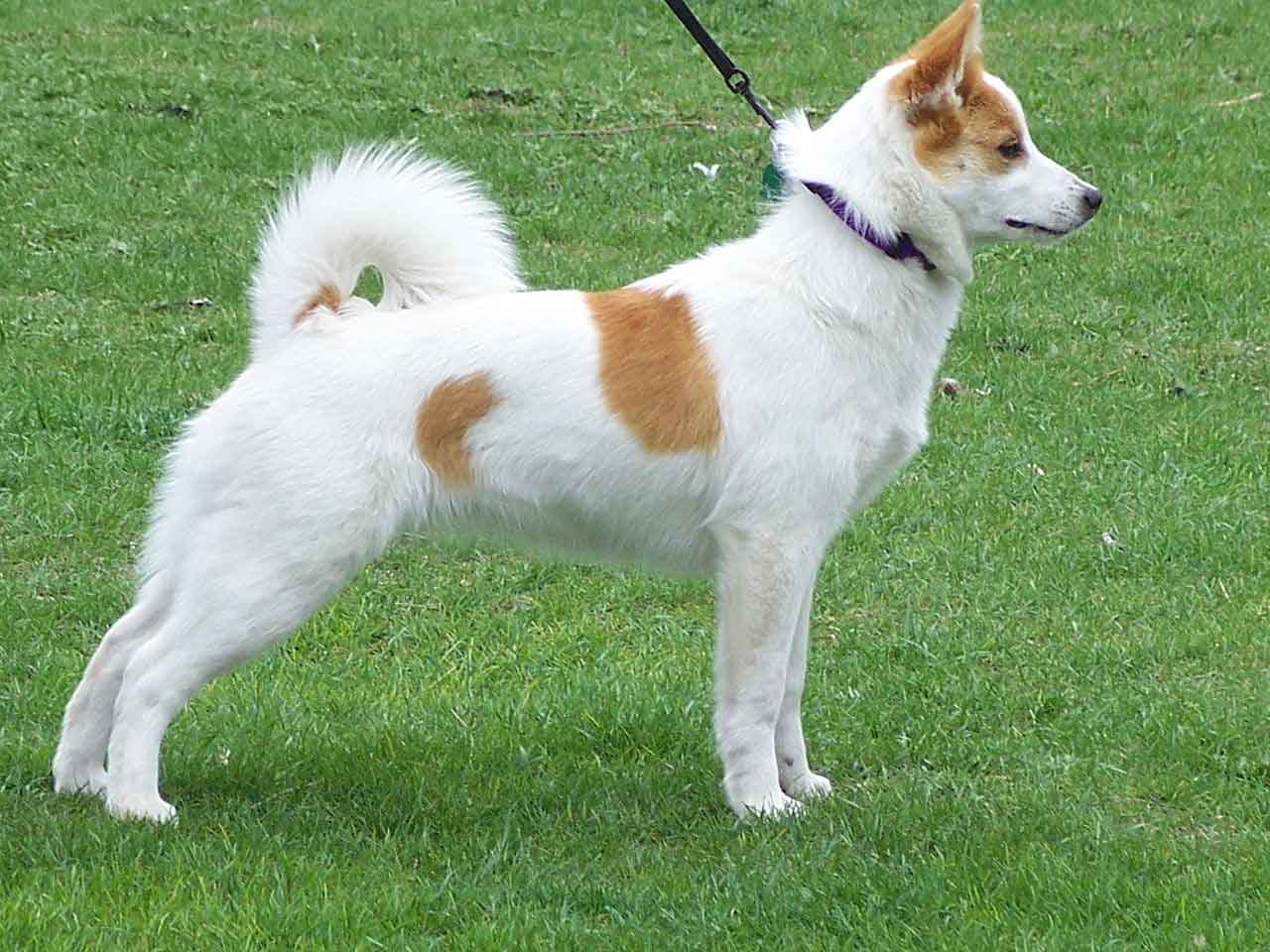
The Norrbottenspets also used as a draft dog.

Content

History

The Norrbottenspets (North Bothnian Country Spitz) probably originates from the small spitz-type Laika that was known to live with hunters in the North Cape area, already in prehistoric times. Small hunting spitz have survived for thousands of years through natural selection โ€“ survival of the fittest. In the very harsh and difficult areas of the northern part of the Scandinavian Peninsula, hunting for food and skins was a necessity in order to survive. Precious skins like saber, sable fur and ermine were the only valid currency for centuries. When fur prices fell drastically after WWII, so did the interest in the Norrbottenspets.

The breed disappeared and there were no records for many years, hence the Kennel Club of Sweden (SKK) declared it extinct. But only a decade later news came that true-type specimens had been found living as pets and watchdogs in small homes inland in North Bothnia.. Due to the very dedicated work of a few men, this ancient hunting spitz was saved.
In 1967 the Norrbottenspets was introduced to the Registries and a new standard was drawn up.

Source: https://www.fci.be/en/nomenclature/NORRBOTTENSPITZ-276.html

Physical characteristics

It is a small spitz-type dog with a rather square appearance, compact and plump, with a lean and strong musculature. The bearing is handsome, with head and tail high. The breed has a strong sexual dimorphism, although the ideal specimen for both sexes is a well-characterized small spitz, attentive, good guardian, of harmonious construction and good character.

The skull is sharp, with the ears set high and relatively small, eyes are dark and bright, and express calmness and predisposition towards work.

Ears are slightly below average size with sparse hair and erect bearing. The tail is set relatively high, with fairly tall carriage in a semicircle, with the tip touching the sides of the thighs. When it stretches, must not exceed the tip of the hock.

Fur: hard, short, straight and quite bushy, with fine and dense undercoat. The length varies depending on the area of โ€‹โ€‹the body: longer around the neck and on the thighs and shorter on the skull and front of the extremities.

Color: all colors are allowed. The ideal is white with yellow or brownish red spots.

Size: males 45 cm.; females, 42 cm.

Character and skills
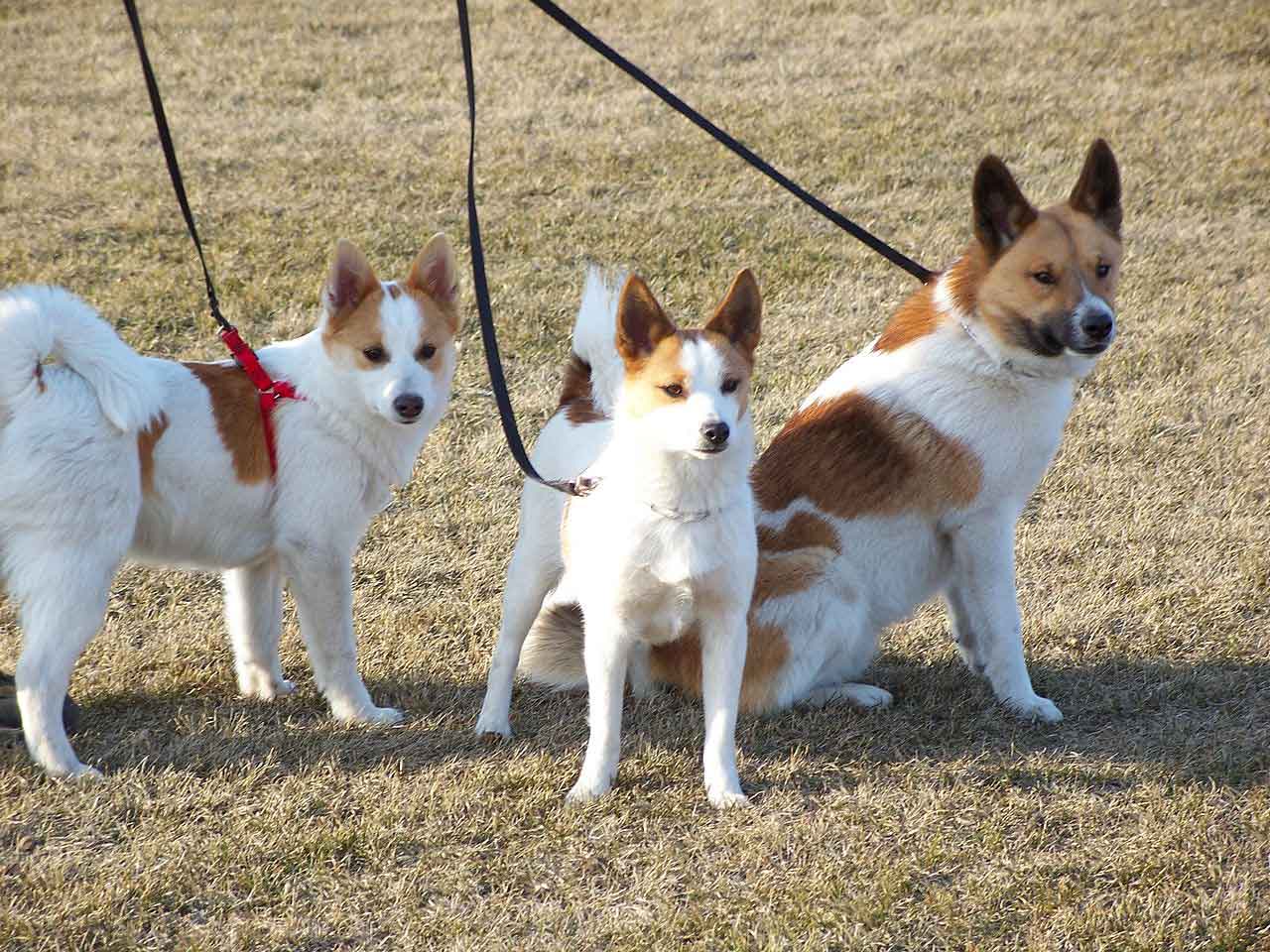
Norrbottenspets

The pretty white colored Spitz, of medium size and short hair is very rare in its native country and practically unknown outside of Sweden.

He is an excellent guard with a lot of drive, temperament and stubbornness. With the appropriate physical and mental tension, It is also a nice and friendly companion dog..

As a born hunter, the Norrbottenspets He is very Brave, fearless and alert. He is extremely lively and has a great temperament and self-confidence.. The Norrbottenspets it is very suitable as a guard dog, because it reports everything I miss immediately without being aggressive. In the family he is very sociable, friendly and gentle. But the intelligent and self-assured dog can also be headstrong and needs sensitive training and clear guidance..

The Norrbottenspets he is very docile, but it needs a lot of movement and a lot of demanding and varied activity. The ideal are, for example, tests with companion dogs, sports tournaments with dogs or rescue dog training. Only with the appropriate mental and physical activity the Norrbottenspets It is also a nice and friendly family companion dog.. As a pure house dog or for a life in the city it is not the right dog.

Characteristics "Norrbottenspets"

Coexistence is important that you have with your new friend. Before considering the acquisition of a dog of the breed "Norrbottenspets" you know certain factors. Not all breeds of dogs are apt to live in an apartment, you must take into account his character, their need for exercise, their interaction with other pets, their care and if you have small children, their level of tolerance towards them.

Adaptation โ“˜

2,0 of 5 stars (based on 1 review)

friendly dog โ€‹โ€‹โ“˜

2,0 of 5 stars (based on 1 review)

hair loss โ“˜

3,0 of 5 stars (based on 1 review)

Affection level โ“˜

3,0 of 5 stars (based on 1 review)

Need for exercise โ“˜

4,0 of 5 stars (based on 1 review)

Social need โ“˜

3,0 of 5 stars (based on 1 review)

Home โ“˜

2,0 of 5 stars (based on 1 review)

Toilet โ“˜

2,0 of 5 stars (based on 1 review)

Friendly with strangers โ“˜

2,0 of 5 stars (based on 1 review)

barking โ“˜

5,0 of 5 stars (based on 1 review)

Health โ“˜

4,0 of 5 stars (based on 1 review)

Territorial โ“˜

4,0 of 5 stars (based on 1 review)

Cat friendly โ“˜

2,0 of 5 stars (based on 1 review)

Intelligence โ“˜

4,0 of 5 stars (based on 1 review)

Versatility โ“˜

2,0 of 5 stars (based on 1 review)

Child friendly โ“˜

4,0 of 5 stars (based on 1 review)

Surveillance โ“˜

4,0 of 5 stars (based on 1 review)

joy โ“˜

2,0 of 5 stars (based on 1 review)

Type and recognitions:

  • FCI CLASSIFICATION:
  • Group :
  • Section : . .

Federations:

  • – FCI – Group 5 – Section 2 Nordic Hunting Dogs. โ“˜

FCI breed standard "Norrbottenspets"

Origin:
Sweden

Date of publication of the valid original standard:
22.07.1982

Use:

hunting dog.


General appearance:

Small Spitz type dog, slightly rectangular, well balanced, With thin muscles andwell developed. Alert holding your head up, fearless and extremely agile attitude. Sexual dimorphism must be clearly visible.


Behavior / temperament:

In his capacity as a hunting dog he must be attentive and fearless. He is an enthusiastic dog, live, self-confident, with a friendly disposition. Although the breed is mainly used to hunt large partridges of the bush (Grouse etc.) It is also capable of hunting prey of hair and howler elk.

Head:

Strong ofclean cut, top or side view, gradually tapering towards the nose.


Cranial region:
  • Skull: Relatively widethe forehead is slightly arched, the upper part of the skull is rather flat.
  • Depression links (Stop): Evidentbut only slightly marked.

facial region:

  • Truffle: black.
  • Snout: Its length is half the length of the head or somewhat shorter. Clearly tapering towards the nose but never pointed. 
  • Lips: Thin, and tightly fitted.
  • Cheeks: Defined.
  • Jaws / Teeth: Well developed jaws and teeth. Scissor bite.

EYES: Medium-sized, almond shaped and inserted obliquely.Bright with calm and energetic expression. dark brown color.

EARS: High insertion, upright, slightly larger than medium size, with hard skin, slightly rounded tips.

Neck:

Moderately long, in proportion with the body, dry and muscular, slightly arched, with good scope.


Body:

Cross: Defined.

Back: Short, strong, muscular andelastic. 

Pork loin: Short and broad.

Rump: Moderately long and wide, slightly inclined and with well developed musclesand strong.

Breast : Moderately deep and long.The depth of the chest should be approximately half the height at the withers and with well developed back ribs. Seen from the front, the thorax is oval in shape andwith a normal width. Well developed and well defined forechest.

Bottom line and belly: Seen on side, The lower part of the rib cage must be in line with the elbow or barely under it and emerge gently on the belly line. Bellyonly moderately retracted.

Tail:

Proportionally high insertion, carried in a fairly high curve, slightly curled so the tip of the tail touches one side of the thigh. The length of the tail must not reach below the hock. Tail docked is not allowed.

Tips

PREVIOUS MEMBERS :

  • Blades : Long and wide, With well developed spine and muscles. Glued to the chest and properly oblique.
  • Arm : It must be the same length as the scapula, strong, well attached to the chest but allowing freedom of movement and forming a marked angle with the spine of the scapula.
  • Elbows : Directed backwards Forearm : Straight, with strong bones, thin but flexible muscles.
  • Carpus and metacarpus : Strong, forming a straight line with the forearm, when seen from the front. Seen on side, The metacarpo is slightly oblique.
  • Previous feet : Small, strong, directed straight ahead, well arched and closed, with hard, well-developed pads.

LATER MEMBERS : Seen from behind, the hind limbs are parallel.

  • Thigh : Proportionally long, forming a right angle with the pelvis. Strong muscles.
  • Knee joint : Strong.
  • Leg : Form a sharp angle with your thigh.
  • Warm-foot joint : Side and front view, is strong.
  • Metatarsus : Delgado, elastic and rather long.
  • Hind feet : Similar to the previous. Headed straight forward.

Movement:

During the trot and canter, Norrbottenspets should show smooth and regular movements, with great momentum and covering the ground well. In action, The upper line must remain firm and the posterior parallel members.

Mantle

HAIR : The hair is hard, short, straight, and rather close to the body, with fine and dense undercoat. Must be short on the muzzle, skull, ears and front of limbs, longer at the nape, back of the thighs and under the tail.

COLOR : All colors are permitted. The ideal color is white with yellow or reddish-brown markings.


Size and weight:

Height to the cross :

Ideal height :

  • in males : 45 cm.
  • in females : 42 cm..


Fouls:

Any deviation from the aforementioned criteria is considered as a fault and the severity of this is considered to the degree of the deviation to the standard and its consequences on the health and well-being of the dog., and the dog's ability to perform its traditional task.

SERIOUS FAULTS:

  • Meat or liver color nose.
  • Dental missing except for P1.
  • Tan markings.
  • Roan or speckled.

FALTAS DESCALIFICANTES:

  • Aggressiveness or extreme shyness.
  • Any dog โ€‹โ€‹showing clear signs of physical or behavioral abnormalities.
  • Short tail.


N.B.:
  • Males should have two normal-appearing testicles fully descended into the scrotum..
  • Only functionally and clinically healthy dogs, with the typical conformation of the breed, should be used for parenting.

The latest changes are in bold.

Source: F.C.I - International Cynological Federation

Alternative names:

1. Nordic Spitz, Norrbottenspitz, Pohjanpystykorva (English).
2. Spitz nordique (French).
3. Norrbottenspets, Pohjanpystykorvat (German).
4. Spitz nรณrdico (Portuguese).
5. Spitz nรณrdico (espaรฑol).

โ–ท The world of Pets: Dogs, cats, birds, reptiles, amphibians

Karelian Bear Dog
Finlandia FCI 48 - Nordic Hunting Dogs

Karelian Bear Dog

The Karelian Bear Dog is a very independent and intelligent dog.

Content

History

The Karelian Bear Dog, which also bears the name of zyrians dog, is considered the progenitor of the breed. But the basic strain of the breed came from the Carelia de Ladoga, the Olonets and the Carelia Rusa, where these dogs were used to hunt in different ways. Breeding started in 1936 with the aim of developing a robust dog that could make noise when hunting big game. At that time it was agreed that the breed name should be Karelian Bear Dog. The first standard was created in 1945. In 1946 the first dogs were registered in the stud book. Today the breed is well established in Finland..

Physical characteristics

This four-legged friend has a great similarity to the Laika related to him.

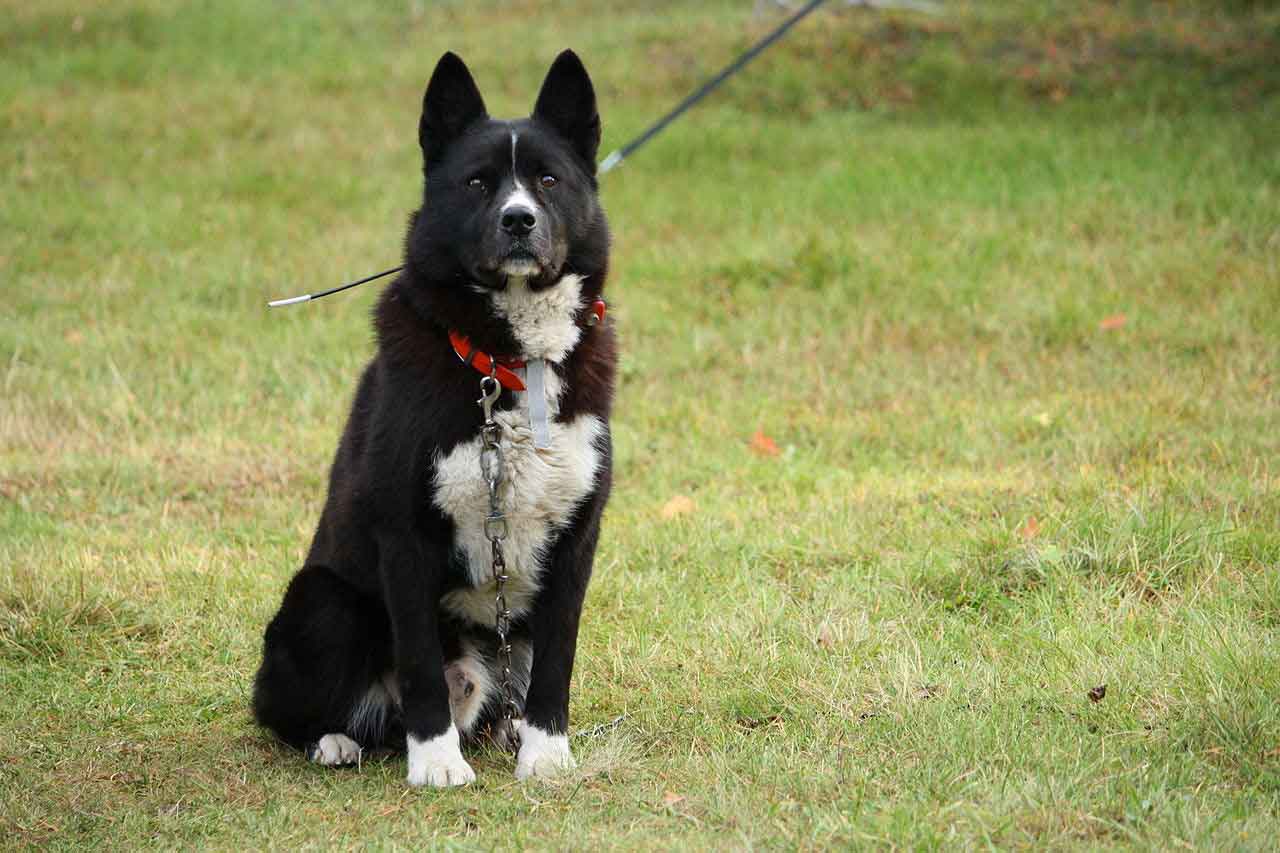
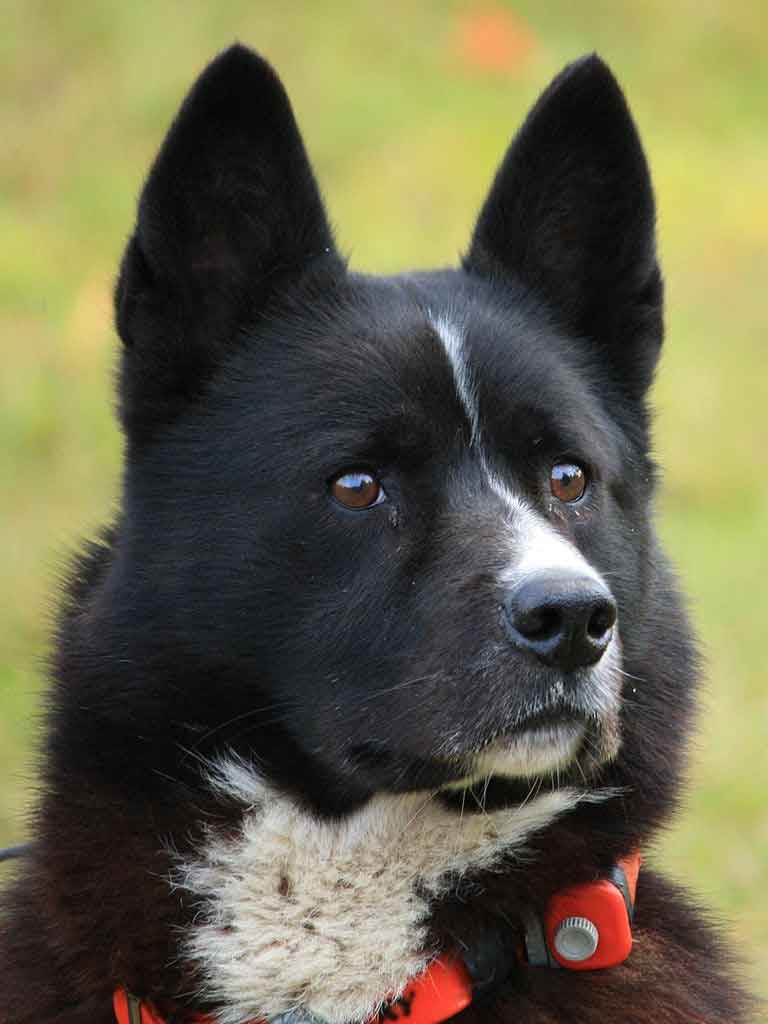
With a height at the withers of up to 60 cm., males weigh about 28 kg. Bitches are slightly smaller and should not weigh more than 20 kg. The Karelian Bear Dog has a strong trunk and generally a compact and dynamic stature. On his head there are medium and erect ears and he wears a folded tail on his back. The icing on the cake is usually a white tip. Otherwise, dense coat color is usually black with white markings. The rough top layer is very close to the dense undercoat, that glows with a slight brown hue.

Character and skills

The freedom-loving character

This dog loves the vastness of the forest and its independence, a combination that combines his attitude with some challenges, because he'll take any chance to roam free. As this four-legged friend acts very independently during the hunt and must place the game alone, it is also, for the rest, a confident partner, who gladly takes command when the opportunity presents itself.

He is considered brave and is always ready to defend his loved ones. Contact with other dogs can be problematic without extensive socialization, because some Karelian Bear Dog show aggressiveness when meeting other dogs. But, other owners report their dogs great balance and praise their social compatibility. It is a fact that many Karelian Bear Dog they are also working together as hunting assistants – so with good conditioning and socialization this should not be a problem.

They are excellent watchdogs, that reliably indicate intruders. Despite all the lovely nooks and edges, the Karelian Bear Dog they also have their soft sides: They are not aggressive with people, they like to be petted at home and they love to be petted by their caregivers.

Karelian Bear Dog Education<

Education without subordination

Its independent nature requires a lot of knowledge, but it should be clear from the start to anyone considering having a Karelian Bear Dog: that this proud quadruped will never be subservient. Their independence reaches such a point that many Karelian Bear Dog they disappear into the woods for days in their native country, just to show up again when it suits him.

Harshness and yelling are absolutely out of place in training this sensitive dog, which will then retreat or crawl. But, with the right mix of positive reinforcement, empathy and consistent behavior, good daily obedience can be achieved.

It is important to socialize extensively with other four-legged friends from puppy age onwards., since some Karelian Bear Dog are considered incompatible with other dogs of the same species, what can become problematic on daily trips. It is a challenge to keep this dog available and away from independent hunting trips.. Specialists with experience in dogs of this breed are definitely needed.

Karelian Bear Dog Health and Nutrition

The original breed is considered very robust. If you buy it from a serious breeder and pay attention to a balanced and age-appropriate diet- plenty of exercise, your four-legged friend can reach a age up to 13 years.

Important for a healthy dog รขโ‚ฌโ€นรขโ‚ฌโ€นlife is, of course, also the daily food content. give to you Karelian Bear Dog a high quality food with a high proportion of meat and little grain. The energy needs of your four-legged friend depend on their constitution and daily exercise. So make sure to adjust your food accordingly and keep an eye on her slim waist..

As in humans, extra kilos increase the risk of various diseases, including painful joint problems. Always provide fresh water. On the longest trips, you should also have enough water for your partner, which is also more sensitive to heat. Visit the vet at least once a year for a checkup with your pet and talk to him about necessary vaccinations and regular deworming.

Caring for the Karelian Bear Dog

The fur of this weather-resistant quadruped is easy to care for. But, loses more hair during coat change, so it can be useful to brush it every day, so that less hair is spread around the house. Otherwise, brush it every few days; this ritual also strengthens the bond and should already be practiced with the puppy for a relaxed routine.

Always check the eyes, your puppy's ears and claws and use a special eye and ear cleaner if necessary. The claws can become too long in dogs that walk a lot on soft ground – or they move too little, what in this quadruped, However, should only occur in very old or diseased specimens. In this case, shorten them with special tweezers.

Many dog โ€‹โ€‹owners brush their quadrupeds' teeth regularly with dog toothpaste and brush to prevent tartar and associated secondary diseases. You can now practice this with your puppy. Alternatively, you can offer your dog dental care snacks.

Activities with the Karelian Bear Dog

Occupation: go out into the woods!

This four-legged friend's favorite hobby is clearly hunting.: extensive travels through the forest and hunting tracking are his passion. The Karelian Bear Dog seek the game to be hunted almost silently. Once you have reached your destination, barks long and persistently at the hunt to keep it in place until the hunter arrives.

The Karelian Bear Dog sometimes they hunt in threes, so they can also keep larger animals like bears at bay. The breed does not necessarily have to be hunted. As an alternative to hunting, the karelian bear dog also suitable for dog sports, but in this case you can only do activities that you like. If you enjoy it, Agility sports can be a good activity for a Karelian Bear Dog adult. Also suitable as a companion for jogging or cycling – but you must keep his hunting instinct in check. Most of these excellent crawlers like crawling work of all kinds.

Is a Karelian Bear Dog right for me??

The Karelian Bear Dog belong to the hands of seasoned enthusiasts, preferably hunters. Alternatively, need a lot of exercise and outdoor work. Only then is it possible to keep them as family dogs. Dog experience should be available in any case. In addition, you must be clear that this quadruped can only be trained conditionally.. Does not belong to the group of dogs that subordinate to themselves – as a dog owner you must respect this, but still be able to direct their power in a controlled manner.

The Karelian Bear Dog not in any way suitable for a city apartment. The ideal would be to offer you a leak-proof garden, in addition to the daily run in forests and fields, but beware: the Karelian Bear Dog freedom lover is considered a fugue artist and can jump up to two meters high.

This four-legged friend likes to befriend children, but they should be older and have learned to treat animals with respect.

Cats in the same household are not necessarily a good idea, not to mention rabbits or other small animals. The norse hunter you will always see potential prey in them. Of course there are exceptions to the rule and there may even be friendships between Karelian Bear Dog and cats socialized at a young age – but you won't be able to get a guarantee before you move in. So you must bring a lot of time, space and experience if you want this proud dog to move in with you.

The Karelian Bear Dog is a four-legged friend for connoisseurs, which should not be chosen as a new roommate for its rustic appearance. If you are not looking for a true character head, you will have little joy with this animal roommate. Of course, before moving, it is also necessary to calculate the one-time expenses (buy creator, basic team, travel expenses) and regular expenses (food, veterinary, dog tax and insurance).

Where can I find a Karelian Bear Dog?

This breed of dog is found naturally mainly in Scandinavia, especially in finland. Further south there are only a few dogs of this very special hunting breed. In Germany, for example, not a single cub of Karelian Bear Dog in recent years. Special Nordic dog clubs can help you find the dog of your dreams. But, There are some things to consider if you are interested in a puppy from abroad. It's always better if you can get a picture of the puppies' house and meet their parents. The Nordic Dog Experts, who you should contact through the appropriate associations, can advise you if there are possible alternatives to Karelian Bear Dog that suit you, to your life situation and your wishes. Or you can refer them to the breeders of Karelian Bear Dogs, if there is currently no one in your country who will have a litter in the near future.

Characteristics "Karelian Bear Dog"

Coexistence is important that you have with your new friend. Before considering the acquisition of a dog of the breed "Karelian Bear Dog" you know certain factors. Not all breeds of dogs are apt to live in an apartment, you must take into account his character, their need for exercise, their interaction with other pets, their care and if you have small children, their level of tolerance towards them.

Training โ“˜

1,0 of 5 stars (based on 1 review)

Suitability of the apartment โ“˜

1,0 of 5 stars (based on 1 review)

You can be alone all day โ“˜

1,0 of 5 stars (based on 1 review)

Suitable as first dog โ“˜

1,0 of 5 stars (based on 1 review)

Weight gain โ“˜

3,0 of 5 stars (based on 1 review)

Health โ“˜

4,0 of 5 stars (based on 1 review)

Intelligence โ“˜

4,0 of 5 stars (based on 1 review)

Kindness with child โ“˜

3,0 of 5 stars (based on 1 review)

Tendency to bite โ“˜

2,0 of 5 stars (based on 1 review)

Tendency to bark โ“˜

4,0 of 5 stars (based on 1 review)

Tendency to flee โ“˜

5,0 of 5 stars (based on 1 review)

Hair fall force โ“˜

4,0 of 5 stars (based on 1 review)

Suitable as a guard dog โ“˜

4,0 of 5 stars (based on 1 review)

joy โ“˜

3,0 of 5 stars (based on 1 review)

Kindness with cat โ“˜

1,0 of 5 stars (based on 1 review)

energy level โ“˜

4,0 of 5 stars (based on 1 review)

Images "Karelian Bear Dog"

A 10-year-old male Karelian Bear Dog. Head shot with tracking collar around neck by Uusijani / CC0

Karelian bear dog by Friesian.marcin / CC BY-SA

Videos "Karelian Bear Dog"

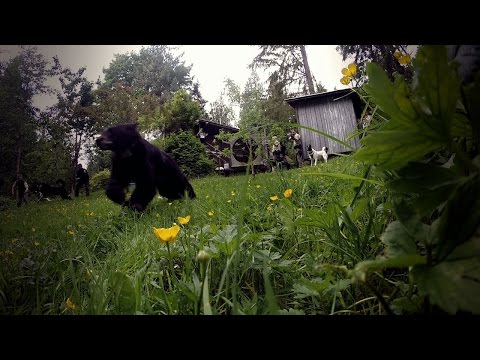
Watch the Karelian Bear Team in Action

Type and recognitions:

  • FCI CLASSIFICATION:
  • Group :
  • Section : . .

Federations:

  • – FCI – Group 5 – Section 2 Nordic Hunting Dogs. โ“˜
  • – AKC – Nordic Hunting Dogs โ“˜
  • – CKC – Nordic Hunting Dogs โ“˜
  • – UKC – Nordic Hunting Dogs โ“˜

FCI breed standard "Karelian Bear Dog"

Origin:
Finland

Date of publication of the valid original standard:
12.03.1999

Use:

It is used mainly for hunting moose and bear. It is very adept at keeping cornered prey barking. He is an enthusiastic and independent hunter, although he cooperates by pointing out with his bark the place where the prey is. All your senses are sharp, especially that of smell, so this breed is useful for hunting big game. Has a very good sense of direction.


General appearance:

It is of medium size and robust constitution. It's strong and something longer than tall. The coat is dense and the ears are erect.

IMPORTANT PROPORTIONS : The length of the body is only slightly greater than the height at the withers.. The depth of the body corresponds to half the height at the withers. The relationship between the muzzle and the skull is about 2 : 3. The length of the skull corresponds approximately to its width and depth.


Behavior / temperament:

It is balanced in nature and somewhat reserved. Is brave, persistent and very self-confident. Can be aggresive with other dogs, but never with people. His fighting instinct is highly developed.

Head:

Seen from the front, has a triangular shape.

Cranial region:
  • Skull: Seen from the front, it's wide; in profile, it is somewhat arched. It is wider between the ears. The frontal sulcus is barely visible. Superciliary arches are only poorly developed.
  • Depression links (Stop): Naso-frontal depression is not very pronounced; is rather long and gradually arches towards the skull region.

facial region:

  • Truffle:Wide, black.
  • Snout: Deep; tapers only a little to the nose. The nasal helm is straight.
  • Lips: They are thin and tight.
  • Jaws / Teeth: The jaws are very strong. The teeth are well developed and symmetrical. Teething is normal and the joint is scissor-shaped.
  • Cheeks: The zygomatic arches are strong.

Eyes: They are rather small and somewhat oval. In different shades of brown; never yellow. His expression is alert and fiery.
Ears: They are set high and stand erect. Medium-sized, with slightly rounded tips.

Neck:

Muscular, arched and of medium length. It is covered in thick fur. There is no presence of dewlap.

Body:

  • Cross: It is clearly defined, especially in males. In females, is less defined.
  • Back: Straight and muscular.
  • Pork loin: Short and muscular.
  • Rump: Wide, strong and slightly sloping.
  • Breast : Spacious, not very wide, rather long, reaches approximately to the elbows. The ribs are slightly arched; the sill is well visible, although not very wide.
  • bottom line: Slightly collected.

Tail:

High insertion. It is of medium length and hunches over the back; the tip of the tail touches the body on the back or on one of the flanks. Short tail is allowed from birth.

Tips

PREVIOUS MEMBERS:

  • As a whole : Robust, for strong bones. Seen from the front, they are straight and parallel. Arm and shoulder blade are the same length; the forearm is a little longer.
  • Shoulder : Relatively oblique and muscular.
  • Arm : It is strong, slightly oblique.
  • Elbows : They point well back and are placed on the vertical line drawn from the highest point of the shoulder..
  • Forearm : Strong and upright.
  • Metacarpus : Slightly oblique and of medium length.
  • Front feet : compacts, well arched. They are rounded in shape and point forward. The pads are flexible and have a dense coat on both sides.

LATER MEMBERS:

  • As a whole : Strong and muscular. Seen from the back, they are straight and parallel. The front line of the hind limb forms a harmonious arch.
  • Thigh : Width, long, of strong muscles.
  • Knee : Point to the front. It is of medium angulation.
  • Leg : She is long and muscular.
  • Hock : Low. Angulation is clearly visible.
  • Metatarsus : Short, strong and vertical.
  • Rear feet : They are compact and a bit longer and less arched than the front ones. The pads are flexible and have a dense coat on both sides.

Movement:

It's lightweight and covers the ground effortlessly. The dog easily changes from trot to gallop, which is the most natural movement. The members move in parallel.

Mantle

SKIN: It is well fitted throughout the body and does not form folds.

HAIR: The hair of the outer coat is rough and smooth. It is longer on the neck, the back and the back of the thigh. The undercoat of hairs is soft and dense.

COLOR: Negro; can be opaque or with brown tones. Most dogs have clearly defined white markings on the head, the neck, the chest, belly and limbs.


Size and weight:

Height to the cross: The ideal height at the withers is 57 cm in males and 52 cm in females, with a tolerance of +/- 3 cm..

Weight: In males, 25 to 28 kg and in females , 17 to 20 kg.


Fouls:

Any deviation from the aforementioned criteria is considered as a fault and the severity of this is considered to the degree of the deviation to the standard and its consequences on the health and well-being of the dog..

โ€ข Weak bones.

โ€ข Narrow skull.

โ€ข Strongly bulging forehead.

โ€ข Pointed snout.

โ€ข Yellow eyes.

โ€ข Bat ears

โ€ข Papada.

โ€ข Very deep or barreled rib cage.

โ€ข Tail straight or not curved enough.

โ€ข Straight shoulders.

โ€ข Straight hocks and flat feet.

โ€ข Dewclaws on the hind limbs.

โ€ข Wavy coat.

โ€ข Predominant white color, with black markings or color called wolf color.

MISS PLAYOFFS

โ€ข Aggressive or fearful dog.

โ€ข Upper or lower prognathism.

โ€ข Gaze eyes.

โ€ข Ears hanging or with the tip hanging down.

โ€ข Colors different from those stipulated in the standard.

Any dog โ€‹โ€‹showing clear signs of physical or behavioral abnormalities should be disqualified..


N.B.:

Males should have two normal-appearing testicles fully descended into the scrotum..

Source: F.C.I - International Cynological Federation

Alternative names:

1. Karjalankarhukoira, Karelsk Bjรถrnhund (English).
2. Karjalankarhukoira (French).
3. Karjalankarhukoira, Bjรถrnhund (German).
4. Karjalankarhukoira (Portuguese).
5. Karjalankarhukoira (espaรฑol).

โ–ท The world of Pets: Dogs, cats, birds, reptiles, amphibians

Finnish Spitz
Finlandia FCI 49 - Nordic Hunting Dogs

Finnish Spitz

The Finnish Spitz it is a dog that can annoy the neighbors, because he barks a lot and with a particularly piercing voice.

Content

This fox-colored four-legged friend from Finland with the typical concise character of the Spitz is a Nordic hunting dog, who has gathered a small but loyal following around the world. It is especially popular in its homeland, Finland. Below you can read interesting facts about the Finnish Spitz, which in Finnish is called ยซSuomenpystykorvaยซ.

History

Finnish national dog

For centuries, the Finnish Spitz has been used as a hunting companion in northern and eastern Finland. In particular, has helped hunt small predators, moose and waterfowl, and later this dog became more and more specialized in grouse and black grouse: Scare these large birds into the surrounding treetops. Now him Finnish Spitz barks persistently until its two-legged partner is close enough to shoot prey.

Little is known about the exact development of the breed. But, the Finnish Spitz probably descended from dogs Spitz, who have been the everyday helpers of the people in Russia for more than 1.000 years. Towards the end of the 19th century, finnish Hugo Roos observed the original Spitz in northern Finland while hunting and recognized its extraordinary abilities. He advocated selective breeding and thus developed the modern Finnish Spitz – although the standard has been changed several times since then. In Russia, the four-legged friend is also known as the Karelo-Finnische Laika, but in 2006 the Finnish and Russian breeding associations agreed that the two names are the same breed. This means that Finland has been recognized as the country of origin of the breed and is responsible for the standard..

Since 1979 the Finnish Spitz has been the national dog of Finland.

Physical characteristics

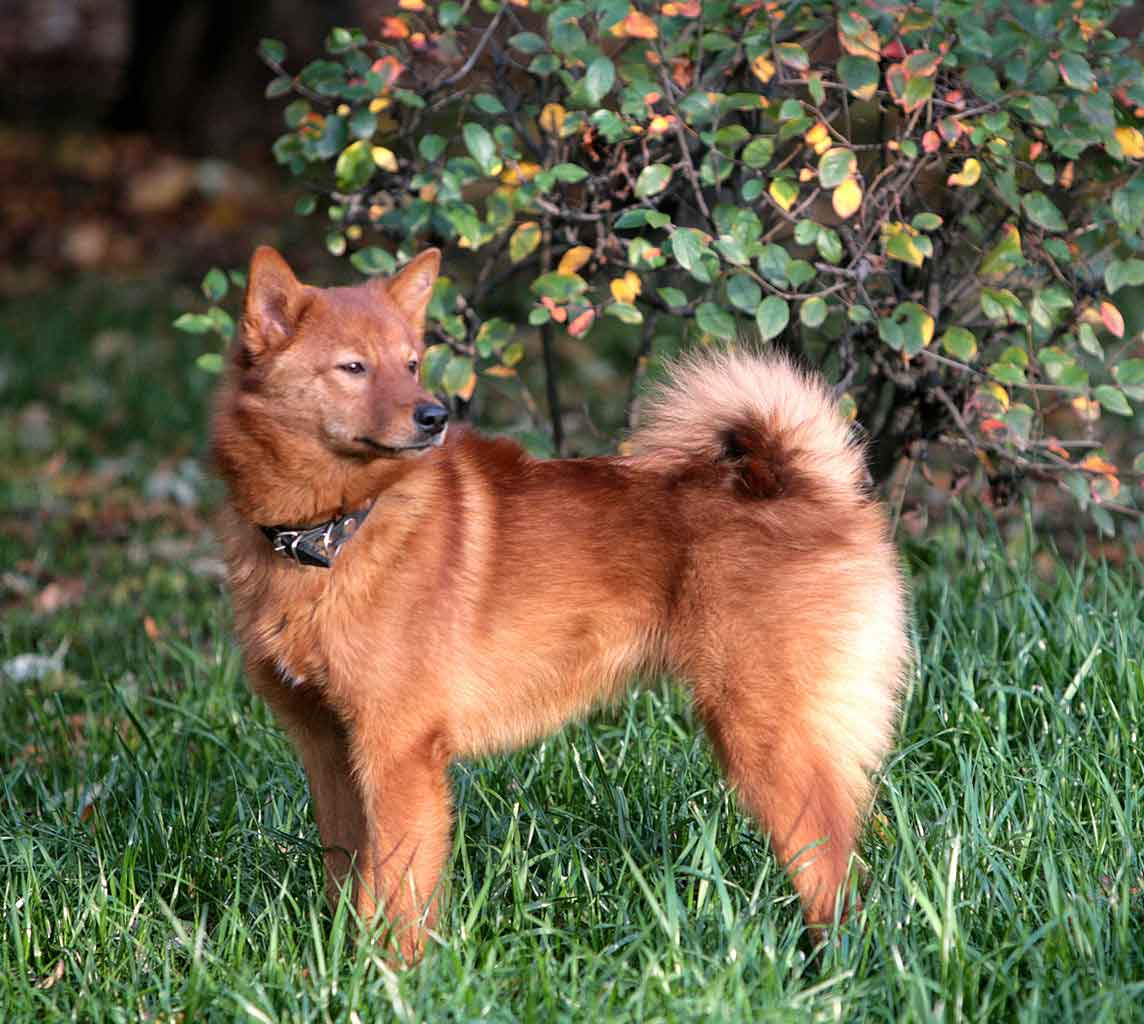
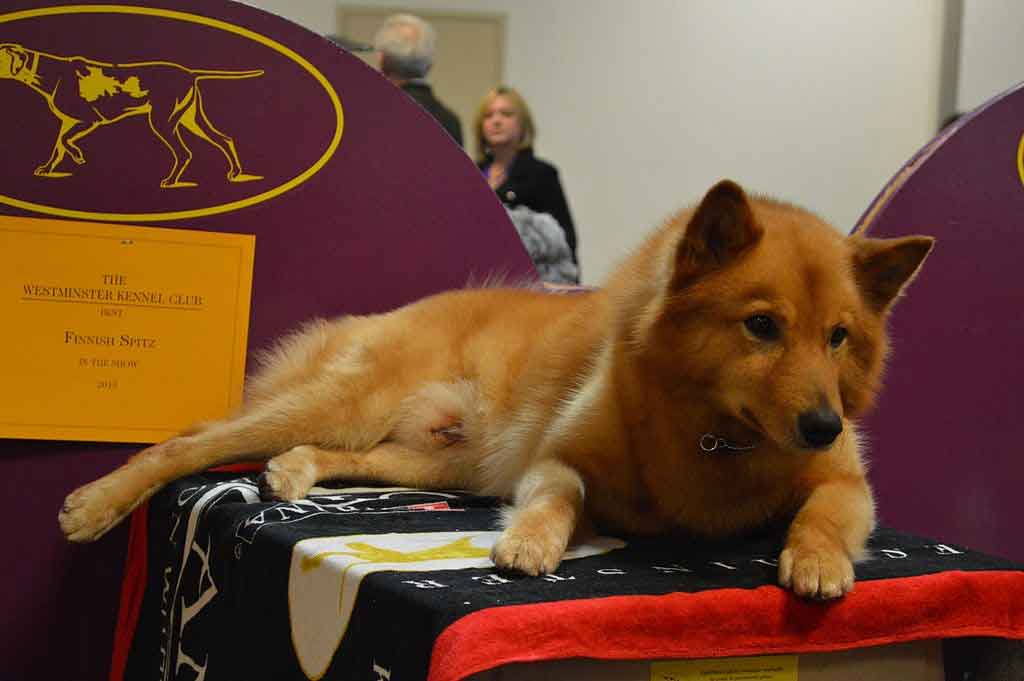
Compact body, upright ears and a bushy tail curled over the back: The Finnish Spitz medium-sized it is optically a typical Spitz and stands out especially for its red or golden-brown fur. This consists of two layers: The soft, dense undercoat and the hard top coat. The undercoat is always a little lighter.

Males can reach a height at the withers of about 47 cm., the females some 42 cm.. Depending on its size, the dogs weigh between 10 and 15 kg.

Character and skills

If you want a stuffed dog that always strives for recognition from his two-legged friends, you are wrong with a Finnish Spitz. This independent and sovereign dog knows better than anyone where he is going, and therefore never fully subordinate. He is extremely intelligent and loves to learn, if you can teach him something new. Frequent repetitions quickly bore you, so your willingness to cooperate can decrease rapidly. He is brave and very keen to bark: one of his characteristics is a penetrating voice – More on this later. One Finnish Spitz can be used as a guard dog, but he needs to be connected to his human pack. He is friendly with his caregiver or family and enjoys spending time with children.

Attention: It is a very Barking Dog.

At this point we would like to point out a special feature of this dog, the bark of joy Finnish Spitz. Please, consider it: In finland, with a population density of about 16 Inhabitants per square kilometer, the closest neighbor usually lives far away. Here the dog is not only known for his strong voice, but also positively emphasized and encouraged in the form of barking competitions.

This skill is extremely important for hunting, so that the dog can offer good guidance to the two-legged hunter who cannot move so easily through partially snowy forest. The Finnish Spitz they don't just bark, they also dominate different variations, from short sounds to a kind of song.

Many Finnish Spitz they can do up 160 sounds per minute. So if you are thinking about the arrival of such a dog, you must first inform yourself about their joy of barking. Even if you can control or reduce it, some Finnish Spitz they will continue to bark more than most other dogs – this is simply in their genes. If you live in a rural area, you can use the Finnish Spitz as an excellent guardian of the house and the yard.

Activities with the Finnish Spitz

To the Finnish Spitz he loves the time he spends with his reference person, as well as being outside. So, it's better to combine both as often as possible and take it for long, long walks. It is a wonderful companion on walks, if you keep him on a leash or have his hunting instinct under control. this last, However, is a challenge with this breed, if recoverability is not trained from the beginning. Frequent repetitions are not fun for him Finnish Spitz, but they are looking for a common activity that also trains their smart little head. The trace job, for example, it's a pleasure for him Finnish Spitz. In all sports activities, you must ensure that your partner does not overexert himself., so you stay motivated and injuries don't occur.

Finnish Spitz education

If you are thinking that a Finnish Spitz move in with you, You should already have some canine experience to guide this independent companion to the required basic obedience. Don't expect me to be completely subordinate to you, race is too independent for that. Be consistent with everything that is important to you, but leave the Finnish Spitz his own head (testaruda) elsewhere.

With a loving consistency and positive reinforcement you can train this dog well as a rule. In any case, he is very intelligent and likes to learn new things – then it is also, as a result, cooperative. Use this for your training. With a young man Finnish Spitz it makes sense to visit the puppy school, to establish positive contacts with puppies of other breeds and to strengthen or develop your social streak. Also basic command training at a dog school can be very helpful with him. – it's best if you find a dog school that already has experience with the idiosyncratic character of Spitz.

Robust health

The typical Finnish Spitz is a robust and weather resistant dog: the breed is considered to be hardly affected by specific hereditary diseases. If you are thinking of acquiring a dog of this type, it is important that you buy it from reputable breeders, as they reduce the risk of genetic diseases through responsible breeding. An example would be the predisposition of some dogs to Hip Dysplasia or problems with the knee and elbow joints. Talk to the breeder in question about the health care of parental animals.

You yourself can contribute a great deal to your dog's health by providing him with a healthy diet and exercising appropriately for his age and level of training..

This breed of Spitz it is quite sensitive to heat due to its origin in the far north… The walks in winter, on the other hand, are to the taste of this four-legged friend. The breed reaches an average age of 12 to 13 years.

The Finnish Spitz diet

It also, a balanced diet adapted to the needs of your four-legged friend is an important component for their health. Like all dogs, the Finnish Spitz requires a meat-based diet. So, make sure meat is the first component for the pet food you choose. The grain should not be included. This applies regardless of whether wet or dry food is chosen. With a pure diet of dry food you must pay special attention to the fact that your quadruped ingests enough liquid.

Water must always be freely available. After meals, their Finnish Spitz definitely must have time for a digestive nap, so it is better to feed after joint excursions. Remember that treats must be added to the daily ration, otherwise your dog's slim waist will be in danger. It is also possible to bring dry food as a reward.

Dry chews, like cattle ears, satisfy your partner's chewing needs. Dental care treats or freeze-dried meat snacks especially for dogs are other sensible rewards that you can give your four-legged friend a tasty little treat with..

Care for the Finnish Spitz

Although caring for this dog's coat is quite easy, should not be careless, especially during coat change. In spring and autumn the Finnish Spitz usually has a lot of hair – help him get rid of dead hairs by brushing him regularly – preferably daily. This way you can prevent skin irritation, which can develop rapidly if too many hairs from the dense undercoat remain on the dog. Outside the coat change, just brush your partner once a week. During this grooming ritual, that you should already practice with your puppy, it is better that I also look in the ears, which should be cleaned with a dog ear cleaner if necessary. A brief claw check should also be performed at regular intervals – usually older quadrupeds or those that only walk on soft ground need support from you in the form of a pedicure. Here a dog clip provides valuable services.

Is a Finnish Spitz right for me??

A dream home for a Finnish Spitz It is a large plot of land in the field to watch over her, including family connection. The breed is suitable for dog lovers with a great sense of independence, who like to move in nature with their partner and who can impart basic obedience to the stubbornness of their four-legged friend thanks to the skill, consistency and calm. He is not a city dog โ€‹โ€‹and his barks of joy alone could make him unsuitable for keeping indoors., even if you can have a quiet Finnish Spitz as a roommate through lots of activity and patient training.

As a family dog รขโ‚ฌโ€นรขโ‚ฌโ€นit is very suitable, provided you have the appropriate occupation and education. It also, is patient and trusting with children with whom he usually has a good relationship – but make sure the four-legged friend can back off if he feels like it. The Finnish Spitz not suitable for hot regions and also not a companion for a beach holiday – loves cooler climates, what is much better for him.

Talking about vacation: Before deciding on this dog, Please also consider that you should be well looked after in case of illness and on vacation. Preferably from someone who already knows you and is familiar with the characteristics of a Spitz. Of course, you can also take it on vacation with you, but before registering it in a hotel, you must be sure that you do not want to charm every hotel guest with your loud voice. So, this type of trip is only possible with a very well bred Finnish Spitz.

Also consider in advance the one-time costs and especially the regular costs that you will have to pay when your new pet roommate moves in.: In addition to the basic equipment and purchase price of a dog from a reputable breeder, there may be considerable travel expenses for a puppy bought abroad. Once your Spitz lives with you, there will be high quality food costs, taxes and insurance for the dog and expenses for regular visits to the vet, including vaccinations and deworming.

Where can I find my Finnish Spitz?

Like many other races from the far north, the Finnish Spitz is a rarity in southern Scandinavia. In many countries not a single litter of Finnish Spitz in a year, so if you have fallen in love with this breed, you will usually have to travel long distances to get a puppy as a new member of the family. Contact the Nordic dog breed clubs, that can help you find a dog of this breed, which is especially popular in its home country, and possibly establish contacts with breeders in Scandinavia. If you adopt a puppy from abroad, there are some things you should consider… Find out in time! Remember: It always makes sense to visit the puppy in the kennel to meet the parents and the circumstances in which the four-legged friends live.. If possible, you should also visit the breeder personally before deciding to buy a puppy from abroad. Here too there is the possibility to sniff each other and ask questions without time pressure. After all, buying a puppy is a matter of trust.

If you want a Finnish Spitz adult as companion, there is little chance in most Central European countries to get a matching dog – maybe you are considering a trip to Finland in the near future and find it there. Otherwise, nordic dog breed clubs will help you on your quest. Maybe a Nordic cross or another breed of Spitz can conquer your heart.

advice: Start looking for your new partner with watchful eyes and an open heart, because many hybrids of Spitz have similar characteristics.

Characteristics "Finnish Spitz"

Coexistence is important that you have with your new friend. Before considering the acquisition of a dog of the breed "Finnish Spitz" you know certain factors. Not all breeds of dogs are apt to live in an apartment, you must take into account his character, their need for exercise, their interaction with other pets, their care and if you have small children, their level of tolerance towards them.

Training ?

3,0 of 5 stars (based on 1 review)

Suitability of the apartment ?

1,0 of 5 stars (based on 1 review)

Can be alone all day ?

1,0 of 5 stars (based on 1 review)

Suitable as a first dog ?

2,0 of 5 stars (based on 1 review)

Weight gain ?

3,0 of 5 stars (based on 1 review)

Health ?

4,0 of 5 stars (based on 1 review)

Intelligence ?

4,0 of 5 stars (based on 1 review)

Kindness with child ?

3,0 of 5 stars (based on 1 review)

Tendency to bite ?

2,0 of 5 stars (based on 1 review)

Tendency to bark ?

5,0 of 5 stars (based on 1 review)

Tendency to flee ?

4,0 of 5 stars (based on 1 review)

hair loss strength ?

4,0 of 5 stars (based on 1 review)

Suitable as a guard dog ?

4,0 of 5 stars (based on 1 review)

Joy ?

3,0 of 5 stars (based on 1 review)

Cat friendliness ?

2,0 of 5 stars (based on 1 review)

Power level ?

4,0 of 5 stars (based on 1 review)

Images "Finnish Spitz"

Spitz finlandes

Spitz finlandรฉs by Pets Adviser from Brooklyn, USA / CC BY

Spitz finlandes

Spitz finlandรฉs by Pets Adviser from Brooklyn, USA / CC BY

Videos "Finnish Spitz"

Type and recognitions:

  • FCI CLASSIFICATION:
  • Group :
  • Section : . .

Federations:

  • – FCI – Group 5 – Section 2 Nordic Hunting Dogs. โ“˜
  • – AKC – Nordic Hunting Dogs โ“˜
  • – ANKC – Nordic Hunting Dogs โ“˜
  • – CKC – Nordic Hunting Dogs โ“˜
  • – โ€‹KC – Nordic Hunting Dogs โ“˜
  • – NZKC – Nordic Hunting Dogs โ“˜
  • – UKC – Nordic Hunting Dogs โ“˜

FCI breed standard "Finnish Spitz"

Origin:
Finland

Date of publication of the valid original standard:
04.04.2016

Use:

A hunting dog mainly for forest birds, also small game predator, waterfowl and moose. Eager hunter; rather independent that works marking the prey with its barks.


General appearance:

It is small to medium in size and has an almost square body. Its configuration is slim, firm, and has a good bearing.

important proportions

The length of the body is equal to the height at the withers. The depth of the chest is slightly less than half the height at the withers. The ratio of the muzzle to the skull is about 3:4. The skull is slightly wider than it is long; its width is equal to its depth.


Behavior / temperament:

This is a lively dog, vigorous, courageous and determined. Can be somewhat reserved with strangers, but never malicious.

Head:

---

Cranial region:
  • Skull:Seen from above, has an ovoid shape. It gradually widens towards the region of the ears and is wider between the ears. Seen from the front and profile, skull is slightly convex. Upper axes of skull and muzzle are nearly parallel. The frontal furrow is very superficial. Superciliary crest and occiput are not very visible.
  • Depression front naso (Stop): It is not very pronounced. The angle between the muzzle and the skull is well visible.

facial region:

  • Truffle:It is rather small and jet black.
  • Snout:Narrow and thin. Viewed from above and in profile, gradually decreases. The nasal helm is straight. The lower jaw is clearly visible.
  • Lips:Together, rather thin and tight. Are well pigmented.
  • Jaws/Teeth:The jaws are strong. The teeth are symmetrical and well developed; teething is normal. Joint is narrow scissor-shaped.
  • Cheeks:The zygomatic arches are slightly pronounced.
  • Eyes:Medium in size and almond shaped. They are somewhat oblique and preferably dark. His expression is lively and alert.
  • Ears:They are rather tall, always upright. They are rather small, pointed and very mobile. They are covered with fine hair.

Neck:

He's muscular. It appears rather short in males due to the thick collar of hairs. In females, is of medium length. There is no presence of dewlap.

Body:

  • Cross: It is clearly outlined, especially in males.
  • Back: She is straight and muscular; rather short.
  • Pork loin: Short and muscular.
  • Rump: Medium length, well developed and slightly sloping.
  • Breast : Deep, reaches almost to the elbows and is not very wide. The ribs are slightly arched. The sill is well visible and not very wide.
  • bottom line: It is slightly raised.

Tail:

Bends strongly forward from its base, worn tightly across the back. Below and behind it rests against the thigh and its extremity extends to the middle of it. When extended it reaches almost to the hock.

Tips

Former members

  • As a whole:Seen from the front, they are straight and parallel. The bones are of medium strength. The arm is somewhat shorter than the shoulder blade and forearm.
  • Shoulder:His firms, very mobile and relatively straight.
  • Arm:A little shorter than the shoulder blade. It is somewhat inclined and very strong.
  • Elbows:They appear in front of a vertical line drawn from the highest point of the shoulder blade. They are directed straight back.
  • Forearm:Rather strong, vertical.
  • Metacarpus:Medium length; slightly inclined.
  • Front feet:Rounded climbing shoe. The fingers are close together and well arched. The pads are elastic, always black, and its lateral parts are covered with dense hair.

Later members

  • As a whole:Seen from the back, they are straight and parallel. They are strong and of medium angulation. The bones are moderately strong. The thigh is a little longer than the leg.
  • Thigh:Medium length. It is rather wide and has well-developed muscles..
  • Knee:It is presented pointed forward. Angulation is medium.
  • Leg:Muscled.
  • Hock:It is moderately low and the angulation is medium.
  • Metatarsus:It's rather short, strong and vertical.
  • Hind feet:They are a little longer than the forwards, but otherwise they are equal to these. The dewclaws must be removed.

Movement:

It's lightweight and covers the ground effortlessly. Easily switch from trot to canter, which is the most natural movement. The members move in parallel. When it is launched after the prey, the dog bursts into a fast gallop.

Mantle

Skin: It is well fitted throughout the body and does not form folds.

Fur: It is rather long on the trunk, upright or semi-erect and more rigid in the neck and back. It is short and tight in the head and limbs, except on the back of the hind limbs. Stiff shoulder hair, especially in males, is visibly longer and rougher. In the back of the thighs (pants) and in the queue, the hair is long and dense. The undercoat of hairs is short, soft, dense and light in color.

Color: The hair on the back is reddish brown, or golden brown, preferably bright. Of a lighter shade, are the hairs inside the ears, cheeks, the chest, the throat, the belly, the inside of the limbs, the back of the thighs and tail. A white stripe on the chest and small white markings on the feet are allowed.


Size and weight:

Height to the cross

  • Males:47 cm with a tolerance of +/- 3 cm..
  • females:42 cm with a tolerance of +/- 3 cm..

Weight

  • Males:Among 12 and 13 kg.
  • females:Among 7 and 10 kg.


Fouls:

Any deviation from the aforementioned criteria should be considered as fault, and its severity is considered in proportion to the degree of the standard deviation.

  • Heavy head.
  • Thick snout.
  • Loose lower jaw.
  • Ears pointing forward at an acute angle, or whose tip points inward or outward. Ears that droop back, or with long hairs inside.
  • Loose or excessively curved tail.
  • Pasterns too loose.
  • Long coat, soft, too short or tight.
  • Visibly delimited different colors.

ELIMINATING fAULTS

  • Aggressive or fearful dog.
  • Flesh colored nose.
  • Upper or lower prognathism.
  • Bright yellow eyes or gazy eyes.
  • Ears with droopy tips.
  • Bent tail.
  • Wavy or curly coat.
  • Visibly different from the basic color
  • Large white patches on the chest or / and a white stocking.

Any dog โ€‹โ€‹showing clear signs of physical or behavioral abnormalities should be disqualified..


N.B.:

Males should have two normal-appearing testicles fully descended into the scrotum..

Source: F.C.I - International Cynological Federation

Alternative names:

1. Finnish Hunting Dog, Finnish Spets, Finsk Spets, Loulou Finois, suomalainen pystykorva, suomenpystykorva (English).
2. Spitz finlandais (French).
3. Karelo-Finnische Laika, Suomenpystykorva (German).
4. Spitz finlandรชs (Portuguese).
5. Loulou Finois, Suomalainen pystykorva, Finsk Spets (espaรฑol).