โ–ท The world of Pets: Dogs, cats, birds, reptiles, amphibians

Armenian Gampr
Armenia Not recognized by the FCI

Gampr Armenio

Content

History

Armenian Gampr (Armenian Wolfhound Gampr) is the name of a breed of guard dog of cattle that originated in the Armenian mountains (including the territories known today as Eastern Anatolia of Turkey).

The Armenian Gampr was bred by the local population starting from the primitive dogs of the area that, It was on par with the evolution of societies domesticated.

Not even being recognized by several important canine clubs as a breed of dog and undergoing an intensive genetic research, in April of 2011 the International Canine Union officially recognized the Armenian Gampr as the national dog breed of Armenia.

The Gampr has been living for a long time in the prehistoric Armenian mountains, This is demonstrated by thousands of petroglyphs (that symbolic motifs are stones or rocks which have been carved, belonging to very ancient cultures) found throughout the territory. The teacher Oktay Belli from the University of Istanbul has studied petroglyphs found near the modern city of Kars and according to data from his research, various domestic breeds from the area have lived there since the Neolithic period.

It is not known for sure when the Gampr, and while there is a great diversity among endemic species, back to tens of thousands of years, the Gampr modern is believed to have existed for at least 3.000 years. Petroglyphs found in the plateau of Armenia, show a large number and variety of dogs similar to the Gampr, What has given rise to generate a comprehensive record of development.

Of the hundreds of petroglyphs found in Ughtasar and the Geghama mountain range, up a 20% of the carved motifs resemble modern ones Gampr, while others show a remarkable diversity of dogs that do not already exist.

The results of an excavation carried out in 1954 in Lake Sevan, site dating from 800 or 1000 years before Christ, they found the skeleton of a dog perfectly preserved in a tomb. When comparing the skull found with that of a Armenian Gampr and other indigenous dogs, They concluded that he was an ancestor of the race, Although it presented some differences from the modern form in the face, her you estreches of the skull and powerful teeth, counting on these data and adding the changes that caused the selection and breeding process of the last 3.000 years that inevitably, affect the general appearance of the dogs, could affirm that the Armenian Gampr was already established and formed as a race in the first millennium BC.

The issue is that, the Armenian Gampr modern has changed little through the history of its existence in the highlands of Armenia. It is one of the few natural breeds that exist, โ€œnaturalโ€ because they were not subjected to the harsh selection of phenotypes by the human hand. So they keep intact the genetic diversity they had initially, While they have crossed with other locatarios dogs. But that genetic variation has been something natural and spontaneous.

Physical characteristics

The Gampr it is a mountain dog that has a large head, body well delineated and developed, without prominent cheekbones. The back is wide, straight, muscular and strong. To the cross, the height in the males is of 65 centimeters or more, and in females is of 62 centimeters or more. The weight is proportional to the size of the dog, and generally varies between 45 and 60 kg.

The Armenian Gampr has a highly developed double-layer coat of hair in order to protect it from the extreme temperatures and harsh weather conditions of the area where it was born. The outer layer is long and thick hair, and the hair is short and dense internal.

Varieties

There are two varieties of Gampr, guardian and the of Pastor. Pastor tends to be smaller in size, tireless, and a little lighter. The Gampr the guardian type is, generally, higher, more square, and loving and very protective. They have a tendency to be more sedentary, and stay in one place.

The geographical and cultural coexistence of the Caucasian Shepherd Dog and the Central Asian Shepherd Dog, and its use on farms over time has caused a problem since the survival of the creole breed Armenian Gampr has been threatened…

The Club of the Armenian Gampr of the United States tries to make it clear -given the similarity between the dogs- that the Armenian Gampr IT IS NOT: a Caucasian Shepherd Dog, a Kangal Shepherd Dog, a Kangal Shepherd Dog, a Akbash, a Karakachan, a Alabai (Central Asian Shepherd Dog), a Koochee, a Tornjak, a Sharplaninac, Although it has some similarities it is good to be able to differentiate between these breeds.

Character and skills

The Gampr is distinguished by its vitality, its independence, intelligence and instinct of self-preservation, capacity in the defence and protection of livestock, the exclusive kindness to humans.

The Armenian Gampr it is a guard dog by nature, Unlike other dogs, This has developed this ability naturally, without previous training. In Armenian the word "Gampr" means "guard dogโ€, but it is also known by other names, like for example "Gelkhehtโ€ (which is derived from the word Wolf), if it is usually used for hunting bears it is known as โ€œArchashoonโ€ (โ€œdog-bearโ€) and if it performs typical functions of a shepherd dog, it is called "Chobanishoonโ€.

One of the main features of Gampr, It is his innate ability to adjust independently to different situations and reach a decision appropriate to the circumstances. If he Gampr he sees that his master needs his help, will protect it, but if not, pass it… They are affectionate but not corporate.

Images "Armenian Gampr"

Photos:

1 – Armenian Gampr dog by hy.wikipedia user Zara-arush, GFDL, via Wikimedia Commons
2 – Armenian Gampr by Gampr1, CC BY-SA 3.0, via Wikimedia Commons
3 – Armenian Gampr by Safi-iren, CC BY-SA 4.0, via Wikimedia Commons
4 – Sheepdog, Gampr dog in Azerbaijan by Elkhan Ganiyev, CC BY-SA 4.0, via Wikimedia Commons

Videos "Armenian Gampr"

Armenian Gampr

Gampr puppies

Photo: gampr.org

โ–ท The world of Pets: Dogs, cats, birds, reptiles, amphibians

Russian Hunting Sighthound
Rusia FCI 193 . Long-haired or fringed Sighthounds.

Galgo Ruso

The Russian Hunting Sighthound or Borzoi, It is a breed of dog developed in Russia.
It descends from the Arabian greyhound being similar to a Russian sheepdog. Formerly known as the Russian Greyhound, It was originally bred to hunt wolves and hares. It is graceful, strong and fast, reaching a height of between 66 and 79 cm and a weight from 25 until 48 kg.

It has a long and narrow head, small ears. Its tail is long and stooped and his coat is silky and it can be smooth or slightly curly. It is almost always white with dark spots. It is notorious for its elegant appearance. The Russian Greyhound or Borzoi had its moment of greatest glory in the Court of the Tsars where it was bred with great mastery to be used in hunting the Siberian wolf..

It is a good Hunter of small animals, It is an affectionate and obedient dog with the master but, very distrustful with strangers, to the extent of showing aggression and even bite.

As all greyhounds, It also adapts to live in the House on condition of having large spaces where to move with great freedom.

Among all the Greyhound, The Borzoi is certainly the most "noble" both for its characteristics and its gait.

It presumably descended from the Egyptian hound and there are no accurate data on its occurrence in Russia.

But he knows, by writings dated to the year 1200, It was already used for hunting Hare and other larger animals.

For centuries it has been the dog of the families of the nobility and of the tsars. You can say without a doubt, that the Grand Duke Nicholas he was the largest breeder of this breed and used to kennel around a hundred of these magnificent dogs.

The fall of the Tsars and the Russian nobility, was the cause of the almost total disappearance of this breed from its country of origin, However, It is quite widespread in Europe and America.

His first appearance in England took place about a century ago, when Tsar Alexander II gave him a pair of Borzoi to Queen Victoria.

Exists in all colors but the most appreciated are the white uniform, White with grey spots, Red and atigradas. Unlike other races, the white spots should not have very defined limits, but window gradually with the other colors. The hair is long, with silky reflections, corrugated and big curls. Smooth on the head, in the ears and in front of the extremities. You can be absolutely white, or white with yellow spots, Orange, red, atigradas, grey.

The appeal of the males is of 70 to 82 cm., in females it decreases approximately 5 cm..

  • Alternative names: Borzoi / Russian Wolfhound / Russkaya Psovaya Borzaya / Psovoi / Russischer wondhund
  • Group 10 / Section 1 – Long-haired or fringed Sighthounds

Dogs breeds: Russian Wolfhound


โ–ท The world of Pets: Dogs, cats, birds, reptiles, amphibians

Wicklow Terrier
Irlanda FCI 302 . Large and medium sized Terriers
Glen of Imaal Terrier

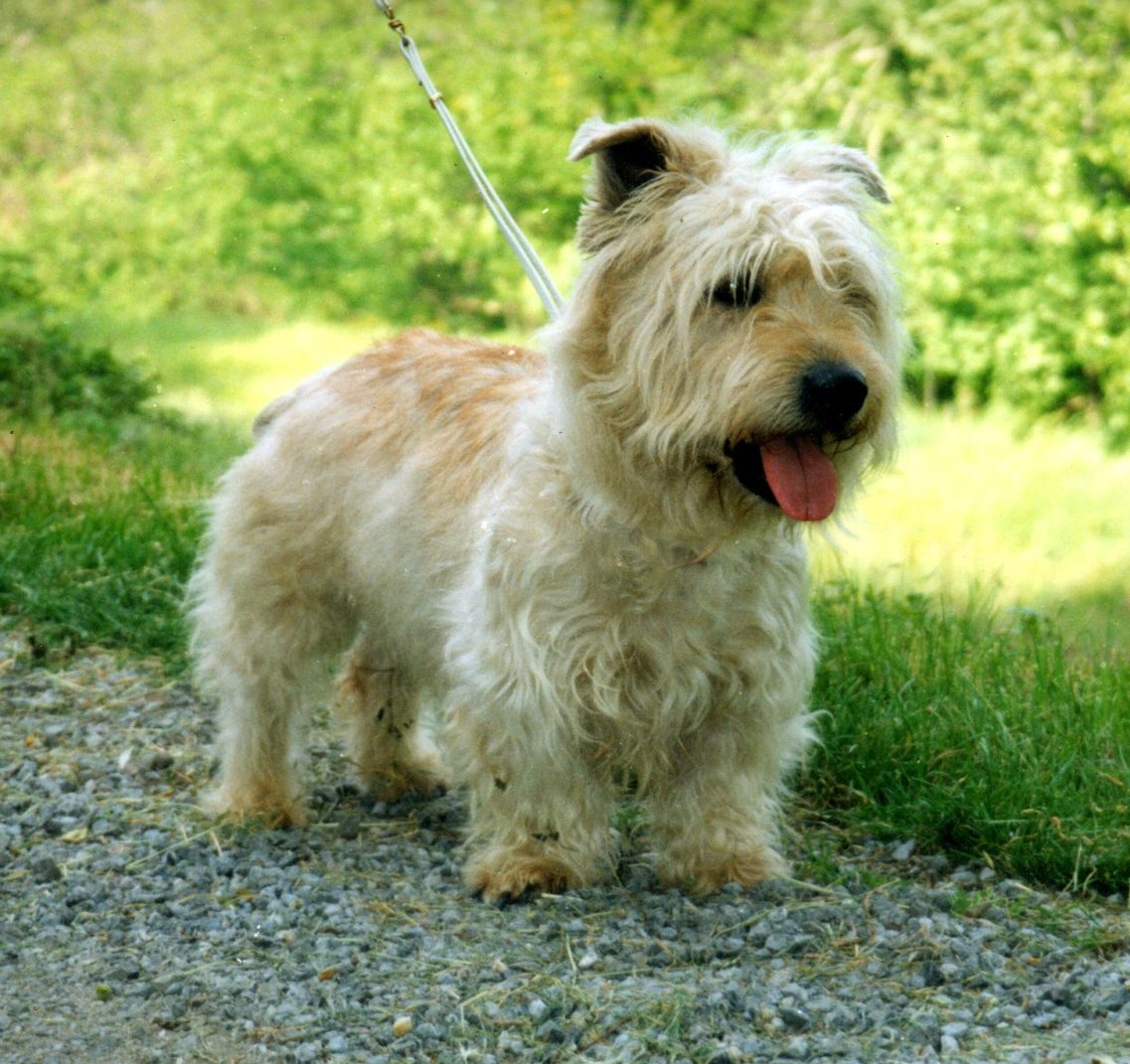
The Wicklow Terrier It is a breed of dog of Terrier type and one of the four Irish varieties of Terrier. It is also known as the Irish Glen of Imaal Terrier or Wicklow Terrier and it is a rare breed.

Its origin is in the Glen of Imaal in the county wicklow, Ireland, the breed was recognized in 1934 by the Irish Kennel Club and the American Kennel Club in 2004.

The race took place during the reign of Elizabeth I, who hired French and mercenaries to end the civil unrest in Ireland. After the conflict, many of these soldiers settled in the area of Wicklow, bringing with them their dogs, He met with the Terrier of the area, giving rise to the Glen of Imaal Terrier.

At first they were dogs used for grazing and the eradication of animal, understood โ€“then- as pests, the Fox, the Badger and Otter. It is a great Tracker.

The Glen of Imaal Terrier, nowadays it is a rare breed. It is a very intelligent and energetic dog who need a responsible master, firm and much discipline. It is a very confident dog, not afraid of anything, they are very loyal to their masters, but they may become aggressive if they do not receive adequate training. They tend to be docile and calm, If not causes them. But calm!! There is no record of damage caused by these dogs.

It is a very intelligent dog, learn quickly if you receive an adequate education, and if so, the aggressiveness, disappears.
Their coat is double layer, a gentle to the skin, and another one takes out is which protects it from the inclement weather. An outstanding feature of this breed is that, they do not move the fur.

The color is type wheat, It may be striped with a bluish-black (from puppy), but as the dog moves in age the hair is ineffectual all, color wheat.

In general, Glen of Imaal Terrier is a very strong and healthy dog. They may live 15 years or more.

Wicklow Terrier