 FCI 293 . Sheepdogs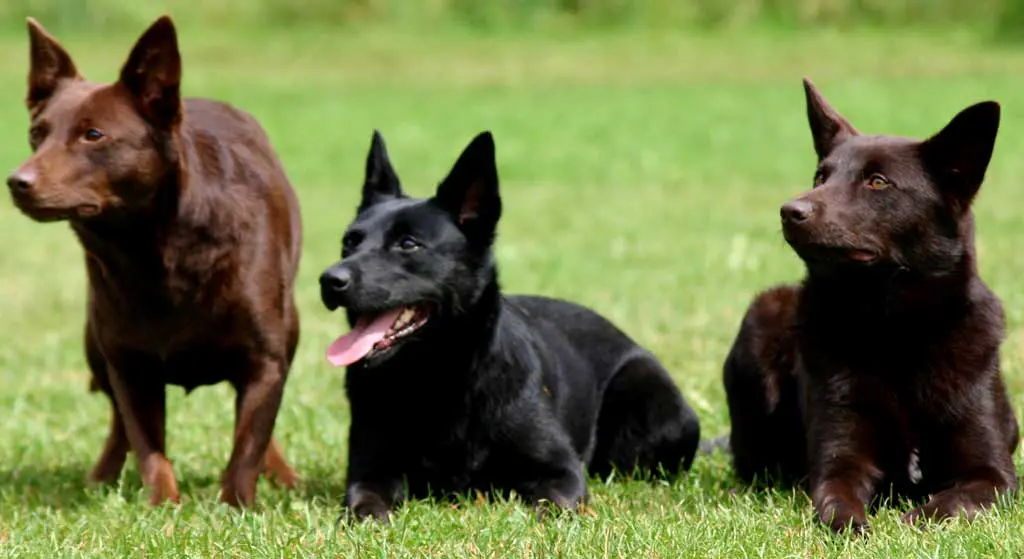
Content |
|---|
History
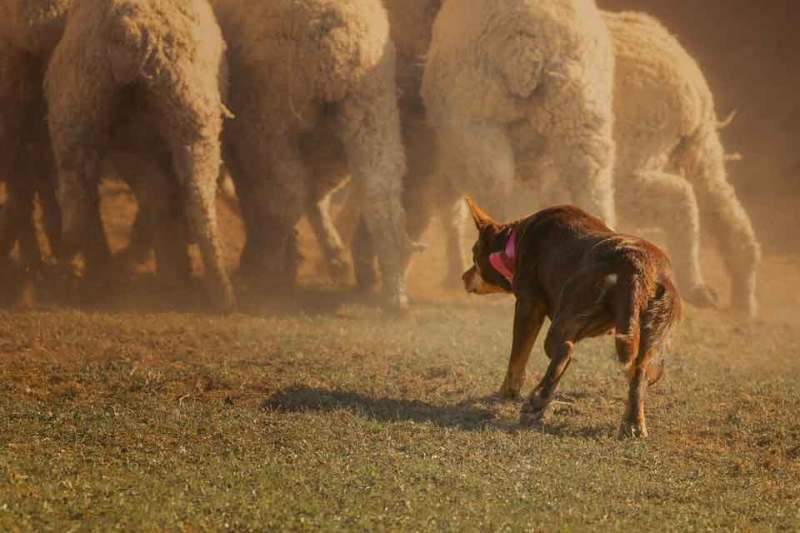
The Australian Kelpie is a sheepdog developed around the decade of 1870 by Australian breeders by mixing several sheepdogs from Collie type imported directly from England. His goal was to develop a breed well adapted to Australian climatic conditions., especially to heat, and with enough independence to herd sheep and cows over a vast territory without too much supervision.
Until very recently, the race was also thought to be mixed with the Dingoes, australian wild dog, but recent genetic studies have shown otherwise. But, towards the end of the 19th century the Australian Kelpie also mixed with shorthaired Scottish Sheepdogs, giving it the features it has today.
The word Kelpie has its origin in Celtic mythology.. In fact, a Scottish legend mentions metamorphic spirits called kelpie, that appear most often in the form of a horse made of water, And that lurk in the rivers and lochs of Scotland. These malevolent spirits are meant to attract humans, especially to children and young people, to his death. It is unclear how the name came to be associated with this breed of dog.. But, the story that comes up most often, although it is not officially documented, is that of a Scottish breeder named George Robertson who, in 1872, it is said that he named Kelpie one of the first specimens of this breed; this name would simply have remained later to designate all the dogs of this breed.
Today, there are around of 450.000 sheepdogs in Australia, and most of them are Australian Kelpie. Since the decade of 1930, two types of Kelpie have been used in Australia: those used as working dogs and those used as show dogs. Show lines developed as the breed gained popularity in dog shows.. Having said that, in most other countries, this distinction doesn't really exist.
In any case, the Australian Kelpie has been exported to many countries. This is particularly true in the United States., where its great flexibility has allowed it to adapt to different climates and terrains, as well as working with different types of cattle.
Whether in Australia or anywhere else in the world, the Australian Kelpie has convinced by its versatility. In fact, not only is it an excellent sheepdog, both in real conditions and in sheepdog competitions, it can also be found in many other roles, like the police sniffer dog, therapy dog ​​or assistance dog for the blind.
Although not yet officially recognized by the American Kennel Club (AKC), the Australian Kelpie is authorized from 2015 to participate in sheepdog competitions organized under the auspices of the organization. It is also not recognized in Great Britain by the Kennel Club.. On the other hand, the Fédération Cynologique Internationale (FCI) recognizes the breed from 1973.
Physical characteristics
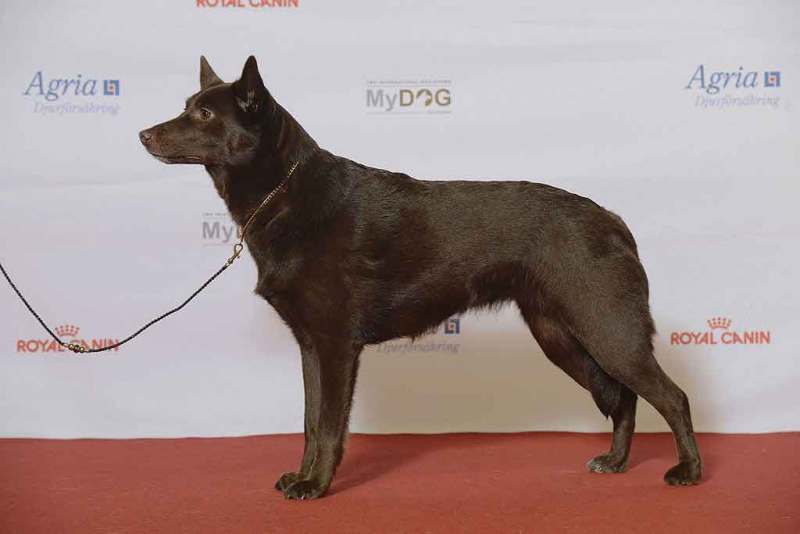
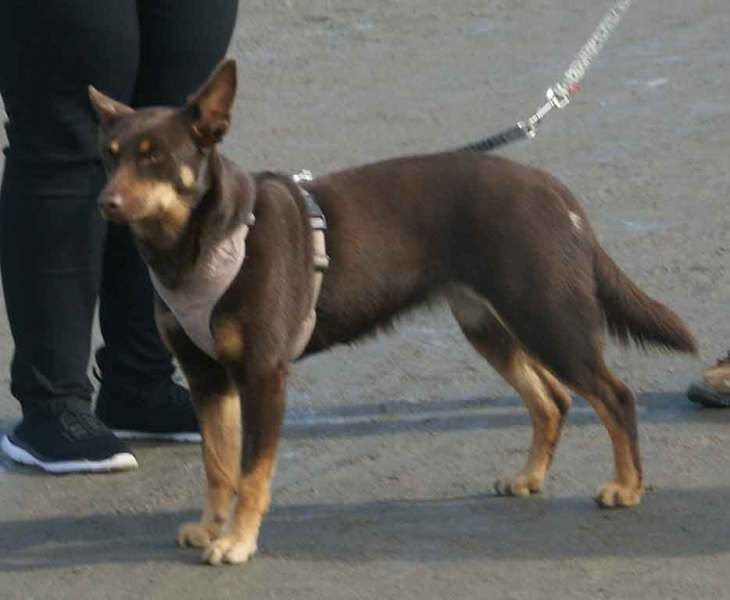
The Australian Kelpie worker and the Australian Kelpie competitive look similar, although the latter is slightly smaller and slightly less thin. They are medium-sized dogs, very athletic and muscular that doesn't look heavy. Their characteristics give them great flexibility of movement and unlimited energy..
The australian kelpie are slightly longer than tall, what gives them a perfect body for running. They have a slim appearance, with a deep chest and long strong legs. One of its peculiarities is that it seems to make no effort when running., a bit like I'm flying, with its four legs that seem to touch the ground at the same time.
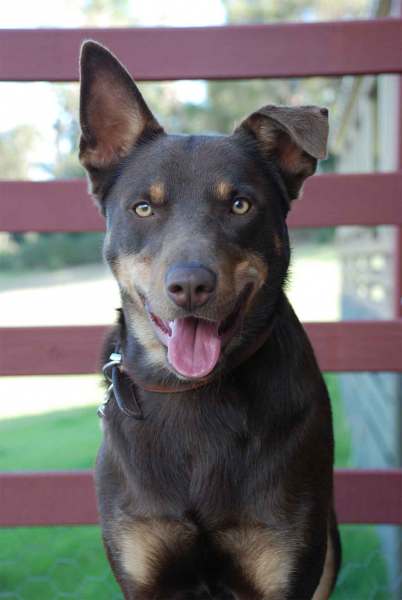
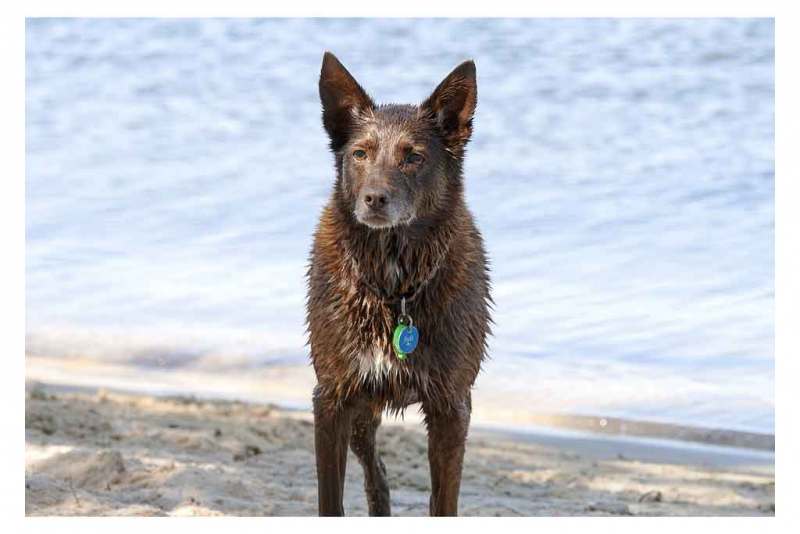
The Australian Kelpie has a slightly rounded skull with large, straight ears on top. The muzzle is conical, with a fairly small mouth and large teeth ready to chew. The eyes are oval in shape and in shades of dark brown.
The standards of Australian Kelpie established by the various organizations that recognize the breed allow a fairly wide range of coat colors. But, in the countries – like australia – where there is a distinction between lines of work and lines of exhibition, only a solid color layer is recognized for the latter. In fact, regardless of lineage, the Australian Kelpie is most often black or chocolate with red markings, blue-gray or beige.
His hair is of medium length and covers a fairly soft undercoat..
Character and skills
The Australian Kelpie not a suitable animal for all families. In fact, is an extremely intelligent and energetic dog that requires a lot of attention. Hates being alone, and must be strongly stimulated mentally and physically, through at least two hours of daily exercise. In fact, not at all a suitable breed of dog for an elderly or very sedentary person, but rather for a very active and sporty master, willing to do different activities with your dog. Excels in activities that require agility like Frisbee or agility competitions.
Like the vast majority of sheepdogs, to the Australian Kelpie he likes to be busy; you are never happier than when you have a task to do. Like this, in addition to the essential walks and / or races, it is recommended that each dog play with him or train him in various activities in which he must apply the instructions given by his master, what he does with great devotion and seemingly boundless energy.
Lack of stimulus would be a huge problem for the Australian Kelpie; if bored, can become destructive, disobedient and engaging in various other behaviors intended to combat boredom, whether or not it conforms to the rules of the home. These may include, can gnaw through various objects or make the garden look like a minefield by digging holes everywhere.
So, the Australian Kelpie he is not a sedentary dog and can only be unhappy in a home that has little time and/or energy to give him. On the other hand, space is not necessarily a problem, as long as you get enough attention: can even cope with apartment living, whenever he has the opportunity to follow his master on excursions and activities, and thus be active daily.
Usually makes a good family dog, but you may be tempted to "play" the shepherd with the children or even with passing visitors. So, take special care with the youngest, as you may be tempted to nibble on your heels to get them back to where you feel they belong, or to encourage them to participate in an activity. With the Kelpie, the shepherd instinct is never far away.
The same goes for other pets, so it should be kept under surveillance if necessary. In any case, socializing him from a young age with other species can only be beneficial to prevent him from being mistaken for a herd once he is an adult.
It also, although they can get along with other dogs, generally prefer the company of humans to that of other dogs.
Although originally developed for life on the farm, the Australian Kelpie not a dog to leave outdoors, since he gets bored quickly if separated from his family. But, as they are used to operating independently without much instruction, want to be an integral part of family life and tend to act like a member of the family rather than a pet. As a result, he is also a sensitive dog who does not like to be excluded from family activities.
With a lot of frequency, owners who have not taken the trouble to inform themselves seriously before adoption end up abandoning their Australian Kelpie because it takes too much time and attention. The energetic character, Kelpie's need for activity and intelligence should be taken very seriously when it comes to choosing the breed of dog to adopt. In any case, when your needs are well cared for, he is a very nice and loyal companion.
Does not easily trust strangers and is very territorial, it is also a very good watchdog, very alert and vocal, that alerts as soon as it hears a strange noise. So, it is best to prevent strangers or even neighbors' pets from venturing into your territory, since it could be aggressive with them. The loud barking of the dog can also be problematic in an urban environment; if the dog is destined to live in the city, this is an aspect that should be particularly worked on as part of your education.
«Australian Kelpie» Education
The Australian Kelpie It is a breed of dog reserved for an experienced and very active owner. Either during training or after, it is important to give you clear and consistent rules, as it works much better in a structured environment.
But, your training is made easier by the fact that you need to keep busy, and is therefore generally content to participate in dog training activities. Can also be trained to participate in family chores: either picking up the mail, picking up clothes or toys off the floor or helping bring groceries, always ready for a new activity, even at a young age. Completing tasks is an integral part of Kelpie's personality, and can help you feel part of the family.
This willingness to be active and helpful makes the Australian Kelpie one of the easiest dog breeds to train. Excel in dog sports, they love to learn new orders and enjoy helping their owner. Training is not a particular problem, since they are completely obedient when sufficiently stimulated both intellectually and physically. On the other hand, boredom sets in soon, because he is an intelligent dog, and therefore learn quickly: it is useless to make him repeat the instructions too often, but he must be able to find new challenges and new activities for him regularly. A good solution may be to join a dog club that offers agility courses and games like Frisbee. (discdog).
Dog training techniques based on positive reinforcement, leading to rewarding the dog for desired behavior rather than punishing it for inappropriate behavior, are preferable with the Australian Kelpie, who has a rather sensitive personality and does not respond well to punishment or an overly imposing master. In fact, there is no point wanting to show your dog at all costs that you are the master, since he does not perceive his dog as superior, but rather as a companion. So, you should treat him with respect and not underestimate his intelligence, especially since he is used to working alone and without too many instructions.
Last, education should give priority to the socialization of the puppy from an early age, because the Australian Kelpie it is a territorial and distrustful dog. Otherwise, you risk becoming aggressive towards strangers and / or other animals. This will help you learn to react appropriately to strangers., preventing his natural mistrust from taking hold of him.
Health «Australian Kelpie»
The Australian Kelpie it is usually a healthy dog, but you run the risk of some of the problems often associated with the sheepdog group:
- Abiotrofia cerebelosa;
- Collie eye anomaly: despite its name, this condition not only affects Collie: the Australian Kelpie you can also be a victim of it. This inherited recessive disease can even lead to blindness;
- Rupture of the anterior cruciate ligament: rupture of this ligament located in the knee can be caused by trauma (20% of the cases), but more often it is simply due to joint fragility or false movement. It can also be caused by early deterioration of the joint, which is common in very active dogs like Kelpie. It is the most common cause of lameness in this breed., and can cause arthritis;
- dog hypothyroidism;
- dog microphthalmia;
- Progressive retinal atrophy (ARP): It is the most common hereditary disease in Collie family.
Most genetic diseases can be prevented by strict control of the genetics of breeding animals to reduce inbreeding., as well as by detecting these diseases to prevent individuals carrying these genes from producing offspring. These are, of course, points that any breeder of Australian Kelpie worthy is particularly attentive.
Last, the Australian Kelpie also leans for :
- dog cryptorchidism;
- Hip Dysplasia;
- dislocation of the patella. May be of congenital origin, due to trauma or simply caused by wear and tear. This last case is frequent in an active dog like the Australian Kelpie.
You also have a higher than average risk of being overweight, so special vigilance is required at this level, in particular by regularly weighing your dog to control his weight.
Care and maintenance «Australian Kelpie»
Like the fur of the Australian Kelpie can vary quite a bit from one individual to another in terms of density and length, so does its maintenance. But, usually sheds a large amount of hair throughout the year, so it is necessary to brush the dog twice a week. Hair loss is obviously even more pronounced during molting periods., in spring and autumn, and then it is necessary to opt for a daily frequency to remove dead hairs.
On the other hand, it is rare that you have to give your dog a bath: this is only necessary if you come into contact with a dirty or harmful substance.
It also, being a very active breed of dog, their claws tend to wear out naturally, and therefore rarely need to be trimmed.
Looking at your teeth, do not present any particular risk. All you need to do is brush your dog's teeth once a week.
In general, the Australian Kelpie It is a fairly easy dog ​​to take care of. Above all, it is their great need for exercise and intellectual stimulation that makes them a demanding dog on a daily basis.
Uses and activities »Australian Kelpie»
It was originally developed as a sheepdog to herd and guide livestock, the Australian Kelpie has since become a versatile companion. Of course, also found in sheepdog competitions, but also as a sniffer dog for the police, psychological support dog, guide dog for the blind, but also simply as a family dog. In summary, it is a versatile animal that likes to keep busy and easily adapts to different contexts.
In Australia, but the Kelpie still primarily a sheepdog, it is also increasingly used as a therapy and companion dog. In fact, his sensitivity and need to be in the company of humans make him an exceptionally attentive dog.
In Sweden, Holland and Finland, they are particularly used as search and rescue dogs during accidents and disasters.
How much does an "Australian Kelpie" cost??
In Australia, a puppy of Australian Kelpie normally sold for about 580 Australian dollars (a few 350 EUR). Most of the individuals offered are from working dog lines..
In other parts of the world, depending on lineage and pedigree, the price of a puppy Australian Kelpie is between 750 and 3.000 EUR. As individuals sold outside of Australia are primarily from show dog lines, the price range is quite wide because the price goes up quickly if the puppy comes from a line with a reputation for having distinguished itself in the field.
Characteristics "Australian Kelpie"
Coexistence is important that you have with your new friend. Before considering the acquisition of a dog of the breed "Australian Kelpie" you know certain factors. Not all breeds of dogs are apt to live in an apartment, you must take into account his character, their need for exercise, their interaction with other pets, their care and if you have small children, their level of tolerance towards them.
Adaptation ⓘ4,0 of 5 stars (based on 1 review)
|
friendly dog ⓘ3,0 of 5 stars (based on 1 review)
|
hair loss ⓘ3,0 of 5 stars (based on 1 review)
|
|---|---|---|
Affection level ⓘ4,0 of 5 stars (based on 1 review)
|
Need for exercise ⓘ5,0 of 5 stars (based on 1 review)
|
Social need ⓘ4,0 of 5 stars (based on 1 review)
|
Home ⓘ3,0 of 5 stars (based on 1 review)
|
Toilet ⓘ2,0 of 5 stars (based on 1 review)
|
Friendly with strangers ⓘ2,0 of 5 stars (based on 1 review)
|
barking ⓘ4,0 of 5 stars (based on 1 review)
|
Health ⓘ4,0 of 5 stars (based on 1 review)
|
Territorial ⓘ5,0 of 5 stars (based on 1 review)
|
Cat friendly ⓘ3,0 of 5 stars (based on 1 review)
|
Intelligence ⓘ5,0 of 5 stars (based on 1 review)
|
Versatility ⓘ5,0 of 5 stars (based on 1 review)
|
Child friendly ⓘ3,0 of 5 stars (based on 1 review)
|
Surveillance ⓘ5,0 of 5 stars (based on 1 review)
|
joy ⓘ4,0 of 5 stars (based on 1 review)
|
Images "Australian Kelpie"
 4
4
 3
3
 1
1
 2
2
 5
5
 6
6
Photos:
1 – Diesel, a pure-bred Australian Kelpie by davepaku, CC BY-SA 2.0, via Wikimedia Commons
2 – Australian Kelpie, liver & tan by Canarian, CC BY-SA 4.0, via Wikimedia Commons
3 – Kelpie australiano by https://pixabay.com/es/photos/kelpie-australiano-perro-ovejas-4217941/
4 – AUSTRALIAN KELPIE, KORAD SE UCH Deepeyes Dance With Dragons III by Svenska Mässan from Sweden, CC BY 2.0, via Wikimedia Commons
5 – Kelpie australiano by https://pixabay.com/es/photos/nube-roja-kelpie-perro-pastor-2992780/
6 – Chocolate Female Kelpie by Spinefly, CC BY-SA 4.0, via Wikimedia Commons
Videos "Australian Kelpie"
 Kelpie Australian
 Dogs 101 – Australian Kelpie
 Australian Kelpie – TOP 10 Interesting Facts
 Burke’s Backyard, Working Kelpie Road Test
Type and recognitions:
- FCI CLASSIFICATION:
- Group :
- Section : . .
Federations:
- – FCI – Group 1 Herding dogs, Section 1 Sheepdogs ⓘ
- – AKC – PASTORAGE ⓘ
FCI breed standard "Australian Kelpie"
Use:
Shepherd dog.
General appearance:
This should be that of an active and very useful dog.; great muscular condition combined with the elasticity of your limbs provides the ability to work tirelessly. Your appearance should not reflect weakness.
important proportions: The length of the dog, measured from the anterior tip of the forechest in a straight line towards the protuberance of the ischium, is greater than the height at the withers by a proportion of 10:9.
The Kelpie is very smart, laborious and always alert. He also has a docile disposition and almost inexhaustible energy.. On the other hand, shows great loyalty and devotion to work. Has a natural instinct to work with sheep, both in the field, as in the corral.
Any defect in structure or temperament should be considered atypical..
Head:
The head should be in proportion to the size of the dog. As a whole, the shape and contour of the head give it a fox-like expression, but it is attenuated by the almond shape of the eyes.- Skull: Slightly rounded and wide between the ears. View from the side, the forehead descends in a straight line towards the naso-frontal depression.
- Depression links (stop): Marked.
facial region:
- Truffle: Its color harmonizes with the color of the coat.
- Snout: Clearly molded and defined, should preferably be somewhat shorter than the skull.
- Lips: Tight and clearly delineated, no slack.
- Jaws / Teeth : The teeth must be strong, healthy and regularly aligned. The lower incisors are placed closely behind the upper ones, that is, the joint must be scissor-shaped.
- Cheeks: Neither thick nor prominent, but round towards the muzzle.
- Eyes: Almond shaped, they are medium in size and their angle is well defined. They are intelligent and alert in expression. The color must be brown, harmonizing with the coat color. Lighter colored eyes are allowed in the case of dogs with blue fur.
- Ears: They are upright and end in a fine point; the ear shell is thin, but strong at the base. The ears are set well apart, slope outward and form a slight curve at their outer edge. Are medium-sized. They are well provided with hair on the inside.
Neck:
It is of moderate length, strong, slightly arched, gradually inserting into the shoulders. There is no presence of double chin, but yes, a quite abundant necklace of hair.Body:
- top line: Firm and uniform.
- Pork loin: Strong and well muscled; flanks are deep.
- Rump: Rather long and sloping.
- Breast : Deep, muscular and moderately wide. Well sprung and back ribs, not barrel shaped.
Tail:
During rest, should hang slightly arched. When the dog is in motion or at attention, it may appear raised, but under no circumstances should it exceed the vertical line of the birth of the tail. It must be provided with abundant brush hair. It is inserted in a way that harmonizes with the slope of the croup and should reach approximately to the hock..Tips
- General appearance: Muscular, strong but not thick boned, straight and parallel viewed from the front.
- Shoulder (scapulae) : They must be well delineated. They are muscular and well leaning, shoulder blades being well together in the region of the withers.
- Arm (humerus): Upper arm should be at right angles to shoulder blade.
- Elbows: They should not deviate or inward, nor out.
- Metacarpus: Seen from the sides, pasterns should be slightly sloping to allow flexibility in movement and the ability to turn quickly.
- Previous feet: They must be round and strong. Thick pads. The fingers are close together and well arched; nails are short and strong.
- General appearance: They must be wide and strong. Seen from the back, hind limbs, from hocks to feet, they are straight and parallel, nor together, not too far apart.
- Knees: Well angulated.
- Hocks: Placed fairly close to the ground.
- Hind feet: They must be round and strong. Thick pads. The fingers are close together and well arched; nails are short and strong.
Movement:
To manifest the limitless vigor and perseverance required of a sheepdog working in open spaces, the Kelpie must be of very robust constitution and have a perfect gait. The movement should be loose and effortless and the dog should be able to turn suddenly without slowing down.. As speed increases during trotting, the feet tend to come closer when they land on the ground; but when the dog is resting, all four feet are in the correct perpendicular position.Mantle
- Fur: The coat is double, with a short and dense undercoat. The outer layer is tight, the hairs are of a hard and stretched texture and are well glued, so that the coat is resistant to rain. Below the body, back of the limbs the coat is longer, and near the thigh forms a "pants" light. In the head (including the inner part of the ears), in the front of the limbs and feet, the hair is short. On the neck it is long and thick, forming a necklace. The tail must be provided with a generous brush. Hair that is too long or too short is a fault. Usually, body hair should be about a length of 2-3 cm.
- Color: Negro, black and tan, red, red and fire, leonado, chocolate, smoke color.
Size and weight:
Height to the cross:
- Males 46 - 51 cm.
- females 43 -48 cm.
Fouls:
Any deviation from the aforementioned criteria is considered a fault and the severity of this is considered to the degree of the deviation from the standard and its consequences on the health and well-being of the dog and your ability to do your traditional job.
Serious misconduct:
- Shoulders too loose.
- Any tendency to a cow hock or barrel-.
- Crossing or zigzagging movement.
- Restricted or stiff movement.
disqualifying fouls:
- Aggressiveness or extreme shyness.
- Any dog showing clear signs of physical or behavioral abnormalities must be disqualified..
Males should have two normal-appearing testicles completely descended into the scrotum..
The latest changes are in bold.
Source: F.C.I - International Cynological FederationAlternative names:
1. Kelpie (English).
2. Kelpie (French).
3. Kelpie (German).
4. Kelpie (Portuguese).
5. Kelpie (español).
 FCI 48 - Nordic Hunting Dogs
 FCI 334 . Asian Spitz and related breeds
 Not recognized by the FCI
 FCI 244 - Medium-sized Hounds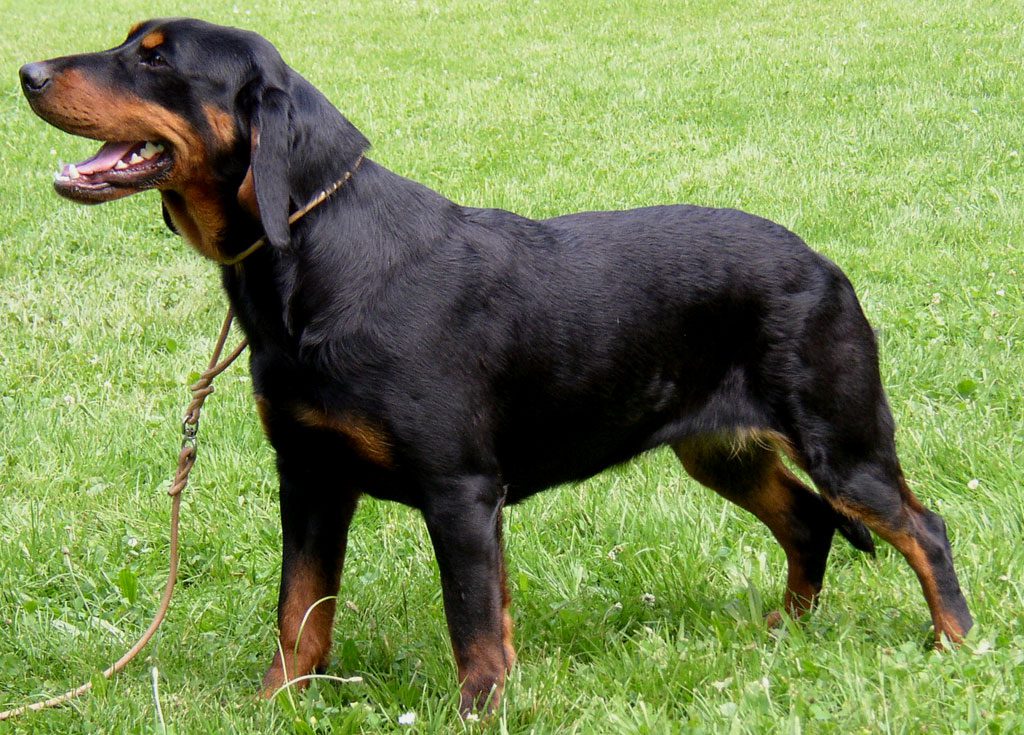


.jpg)
