โ–ท The world of Pets: Dogs, cats, birds, reptiles, amphibians

El Oro Parakeet
Pyrrhura orcesi


Cotorra de El Oro

Content

Description:

22 cm. of long and 73 g. of weight.

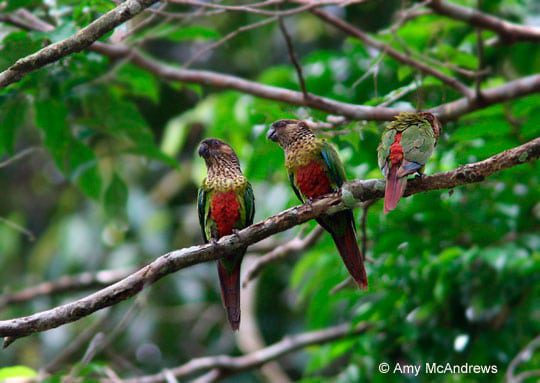
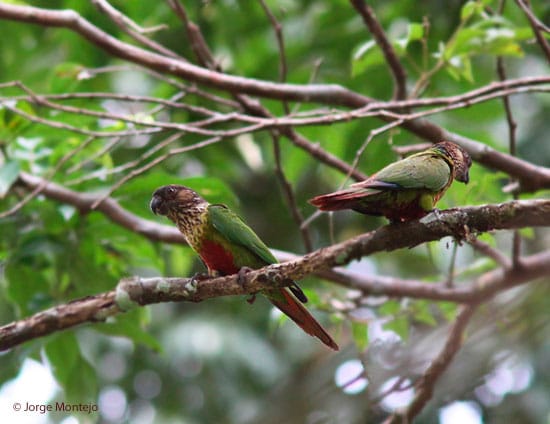
The El Oro Parakeet (Pyrrhura orcesi) is a bird relatively striking, with mostly green plumage. Has the forecrown red; feathers on the sides of the neck with the white base; Red patch from the shoulder up to the half of the wing , end of the wing blue (more visible in flight), tail above with a reddish tint and below completely red except the base.

Beak and legs blackish.

The females It is thought that less red have around the face.

the youth they are generally paler and lack much of the red marks that are seen in adults.

Habitat:

It inhabits in the very humid tropical forest between 800-1.200 m (occasionally at altitudes as low as 300 m). It has been reported that he tolerates some habitat fragmentation (Schaefer and Schmidt 2003). Performs seasonal movements. Are usually distributed in groups of 4-15, Although it has been observed in flocks of up to 60 birds. They may be closely related with the Maroon-tailed Parakeet (Pacific) (Pyrrhura melanura pacifica) and the Maroon-tailed Parakeet (Pyrrhura melanura)

The rest sites They seem to change frequently and are generally located between 2 and 24 meters above the ground, in natural cavities in trees or open branches.

It is extremely noisy and conspicuous when flying.

Reproduction:

As is a species discovered recently, very little is known about its ecology.

Seems to prefer the Dacryodes peruviana family Burseraceae for nest (Garzon 2007), and communal, sharing the tasks of incubation between several birds, Although a couple exhibited a behavior of pre-anidamiento in the cavity of a small tree Meliaceae in 1997 (Snyder et to the. 2000), and reported nests in natural cavities of 1,8-24 m above the ground in a variety of tree species (Schaefer and Schmidt 2003).

The time of incubation is of approximately 31 days.

The main breeding station seems to be between November and March (Garzon 2007), although it is difficult to specify because with the effects of 'El Niรฑo' they mate between December and January.

Movements seasonal altitudinal down to forests have been reported in the Buenaventura reserve (T. Schaefer in litt., 2007).

Food:

Discreetly feeding in the canopy, composing your diet of various fruits (including fig Ficus spp.), Fruits and flowers Cecropia (Snyder et to the., 2000).

Distribution:

Size distribution (reproduction / resident) 750 km2

The El Oro Parakeet is an endemic bird. They inhabit in the western slope of the Andes, in the southwest of Ecuador (in Caรฑar, Azuay, Gold and Loja), where was discovered in 1980.

Apparently, its population is limited to an area of only 100 km from North to South, and a maximum of 5-10 km wide (Juniper and Parr 1998), with its highly fragmented Habitat and with a population estimated in less than 1.000 individuals (Garzon 2007).

Its population in the town of Buenaventura has remained stable since 2002-2007 (Juniper and Parr 1998), estimated in 171 birds in period 2005-2006 (2007 Garzon, HM Schaefer in litt. 2012).

Conservation:

State of conservation โ“˜


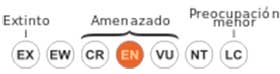
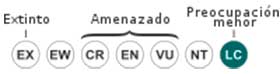
critical hazard critically endangered โ“˜ (UICN)โ“˜

โ€ข Current category of the Red List of the UICN: In danger of extinction

โ€ข Population trend: In decline.

The El Oro Parakeet is in danger of extinction due to deforestation and extreme forest fragmentation for cattle ranching, What causes the habitat degradation. This degradation destroy sites of nesting and feeding that these birds need to survive and reproduce at a healthy pace.

Population estimated in less than 1.000 individuals.

The habitat limited only to the Andes, to the West of Ecuador and because of this, sensitivity to the destruction of the Habitat is very heavy. Protection for some of the habitat of this species has been established in the Book ecological Buenaventura. In reserves, bird houses have been built in trees to help promote reproduction and has had some success. Other projects have been proposed to evaluate the size of the population.

BUENAVENTURA RESERVE REPORT

"El Oro Parakeet" in captivity:

Don't usually see in the poultry farming.

Alternative names:

El Oro Parakeet, El Oro Conure (English).
Conure d’Orcรฉs, Conure d’Orcรจs, Perruche d’El Oro (French).
Orcessittich, Orces Sittich, Orces-Sittich (German).
Tiriba-do-el-oro (Portuguese).
Cotorra de El Oro, Perico de orcรฉs (espaรฑol).

scientific classification:

Order: Psittaciformes
Family: Psittacidae
Genus: Pyrrhura
Scientific name: Pyrrhura orcesi
Citation: Ridgely & Robbins, 1988
Protonimo: Pyrrhura orcesi

Images "El Oro Parakeet"

Videos "El Oro Parakeet"


Especies del gรฉnero Pyrrhura

El Oro Parakeet (Pyrrhura orcesi)


Sources:

  • Avibase
  • Parrots of the World โ€“ Forshaw Joseph M
  • Parrots A Guide to the Parrots of the World – Tony Juniper & Mike Parr
  • Birdlife

Photos:

(1) – fjocotoco.org

โ–ท The world of Pets: Dogs, cats, birds, reptiles, amphibians

Painted Parakeet
Pyrrhura picta

Painted Parakeet

Content

Description:


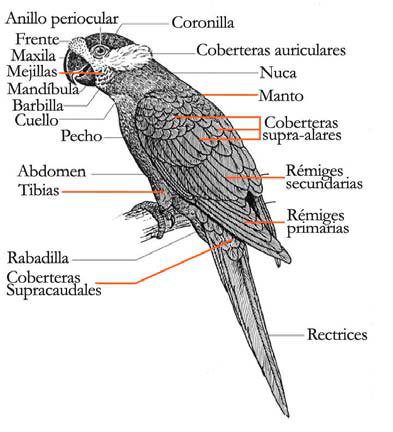
Anatomy-parrots

23 cm.. length and 54-70 g. of weight.

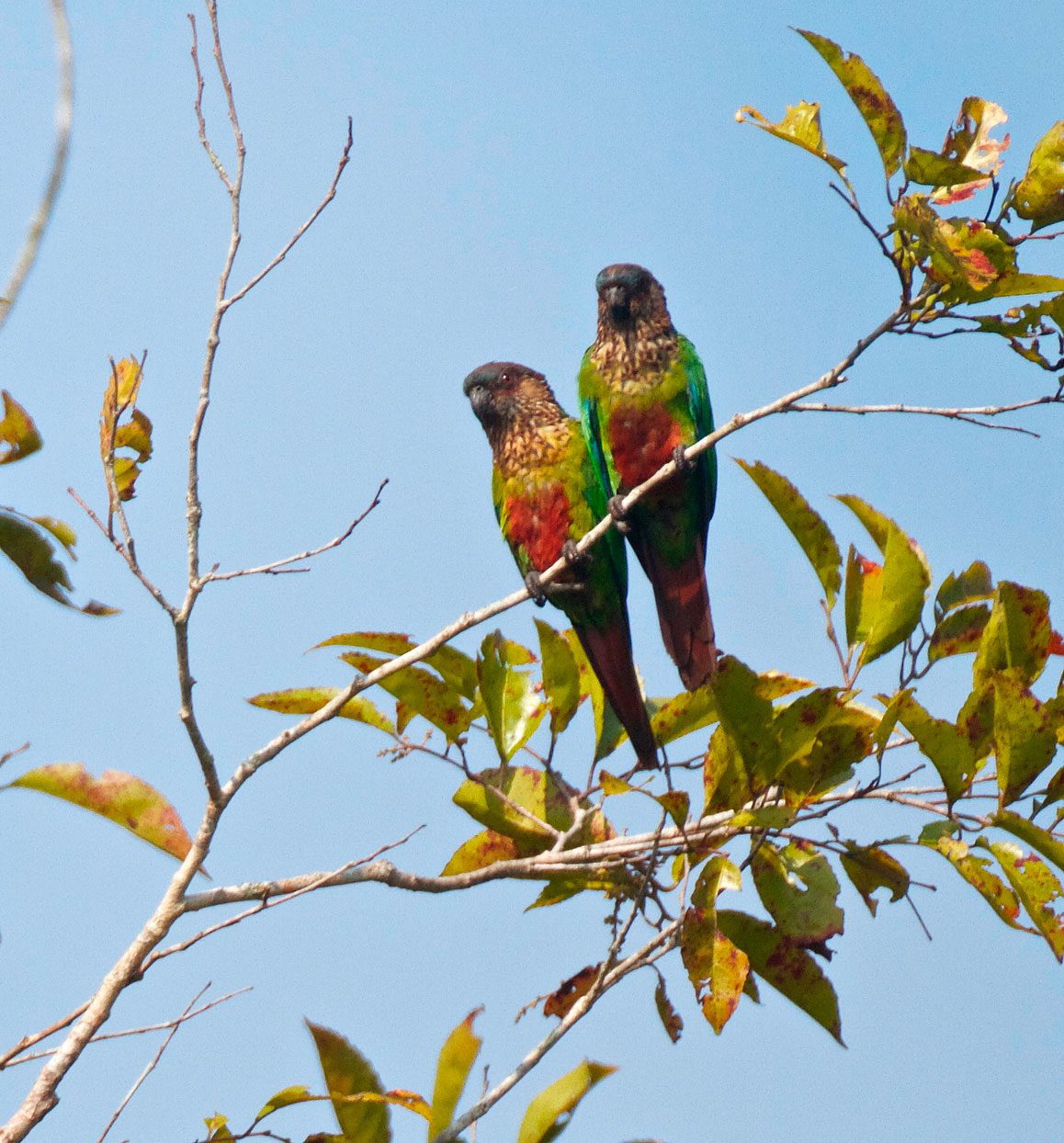
The Painted Parakeet (Pyrrhura picta) has a close frontal band, lores, upper cheeks and area around eyes, dull red.

lower cheeks matte red with blue points on some feathers; the front of the crown is blue; rear area of the crown and of the neck, opaque reddish brown with some blue spots; ear-coverts yellowish. Nape bluish green to green in fusion area the mantle; the scapulars and the top and bottom of the back They are brown; rump and uppertail-coverts, green. Upperwing-coverts green except for primary coverts external blue and some red feathers in the carpal area. Primaries blue up, gray below. Underwing-coverts green. Feathers of the throat, upper region chest and sides neck, opaque yellowish brown with wide margins, which results in a surprising scaled in the form of half diamonds or semicircles; bottom area chest and sides belly, green; center of belly brown; undertail-coverts green. Tail verde basalmente, brown distally. Bill brownish-grey; bare periophthalmic grey; brown the irises; legs grey.

Both sexes are similar.

Taxonomic status:

This taxon is considered a subspecies of Pyrrhura [picta, roseifrons, lucianii, amazonum, snethlageae or peruviana] (sensu lato) by some authors

  • Sound of the Painted Parakeet.

Description 4 subspecies
  • Pyrrhura picta caeruleiceps

    (Todd, 1947) – 22 cm.. length. Mostly green with a long tail reddish brown, patch belly dark red color and the primaries Bright blue. The front of the crown blue is becoming fuzzy blue brown behind; the area of the carpus red and ear-coverts gray-brown pale.


  • Azuero parakeet By Itzel Fong Gadea (www.itzelfong.com) [GFDL or CC BY 3.0], via Wikimedia Commons
  • Pyrrhura picta eisenmanni

    (Dr. Francisco Delgado – ornithologist panameรฑo, 1985) – 22 cm.. length. Of mostly green with a long tail brown, the flight feathers blue, belly dark red and white patch cheek. This species has most of its face Red Color, Lacking any blue has except in the rear area neck. It has the eyes dark. Pens top chest They are dark gray with cream colored tips. The front of the crown It is red, quickly becoming a dark brown from the middle of the crown to the back of the neck.


  • Pyrrhura picta picta

    (Statius Mรผller, 1776) – Nominal.


  • Pyrrhura picta subandina

    (Todd, 1917) – 21 cm.. Has the face bright brownish-red; the forecrown blue and dull red; Scalloped yellow and gray in the chest. Share with other species Pyrrhura a long tail red, the primaries blue and patch belly dark red. The zone of carpus is green, Unlike the red color Pyrrhura picta caeruleiceps which it is the closest geographically.

Habitat:

They inhabit in humid forests of mainland and borders, seasonally flooded forests (vรกrzea), and on the slopes of tepuyes.

They travel in flocks with quick flights.

Reproduction:

The breeding season It is between the months of December and February. Nest in hollow trees or old abandoned nests of woodpeckers.

Food:

They feed on, to a large extent, of fruit of Goupia glabra, Bagassa guianensis, Trema micrantha, Heisteria spruceana, Zanthoxylum, flowers and seeds.

Distribution:

Size of its range (Play / residents): 1.560.000 km2

The Painted Parakeet It is located in northeast South America, distributed south of Orinoco, in Venezuela, eastward through Guyana, French Guiana, Suriname and the state of Amapรก in the North of Brazil (pit et to the. 1997).

In the states of amazon and western and southern Bolรญvar, in Venezuela They can be observed, mainly, on the slopes of the tepuyes, while further east inhabit the lowlands.

Distribution and status of 4 subspecies
  • Pyrrhura picta caeruleiceps

    (Todd, 1947) – It is located on the western slope at the northern end of the Andes to the east, from south Cesar state north through Los Motilones on Sierra de Perija, at the border of Venezuela and Colombia. It is estimated to have lost about 70% of its original habitat within their distribution Colombia, and its area of รขโ‚ฌโ€นรขโ‚ฌโ€นoccupation within Colombia It is expected to be less than 3.700 km2 (Botero-Delgadillo et to the. 2012to, b). It's kind extremely poorly known Venezuela, there are some samples and records of sightings in only four locations, all in the Zulia state; very infrequently recorded in recent years, despite the significant fieldwork (Sharpe 2015, CJ Sharpe in litt . 2015).

  • Classified as danger of extinction. Its population is constantly declining due to fragmentation of their habitat and capture for the pet trade.

  • Pyrrhura picta eisenmanni

    (Dr. Francisco Delgado – ornithologist panameรฑo, 1985) – Known only in the Cerro Hoya National Park in provinces Veraguas and The Saints, in the South of Panama. The distribution area is considered to be less than 700 km2; is common locally up to 1.660 m (Juniper and Parr 1998, Forshaw 2006, 2010, Montaรฑez and Angehr 2007). But, the population It has been estimated less than 2.000 individuals (World Parrot Trust 2014), and it is considered nationally threatened (Montaรฑez and Angehr 2007).


  • Pyrrhura picta picta

    (Statius Mรผller, 1776) – Nominal. They can be observed in Northeast South America, distributed south of Orinoco, in Venezuela, eastward through Guyana, French Guiana, Suriname, and in the North of Brazil, state Amapรก (pit et to the. 1997). In amazon and western and southern Bolรญvar states Venezuela mainly inhabit hillside tepuyes, while further east are distributed in the lowlands.

  • This species is classified as least concern, although the size of its population is decreasing mainly because of its capture for trade in bird cage.

  • Pyrrhura picta subandina

    (Todd, 1917) – Observed only in the Valley of the sinu river in the North of Colombia, although recent searches have not been able to find the species, so it may be extinct (PGW Salaman in litt. 2011). 18 specimens are known from four locations; Jaraquiel, Quimari and Murucucu in Bolivar, and Tierra Alta Nazareth (Joseph and Stockwell 2002). Placements Nazareth and in Jaraquiel, apparently, They have been deforested, but apparently small areas of suitable habitat may occur in Quimari and in the Murucucu hills although searches of these sites failed to find any evidence of the continued presence of the Pyrrhura picta subandina (Pgv Salman in Lit. . 2011).

  • There have been no confirmed records of this parakeet from Colombia 1949 despite extensive searches, and any remaining population is likely to be extremely small and declining. So, It has been classified as critically endangered (possibly extinct).

Conservation:

State of conservation โ“˜


minor concern Minor Concern โ“˜ (UICN)โ“˜

โ€ข Current category of the Red List of the UICN: Least concern.

โ€ข Population trend: Decreasing.

Justification of the Red List of the Category

The Painted Parakeet has a range very large, and therefore does not approach the thresholds for Vulnerable under the range size criterion. While the trend of the population seems to be decreasing, the decline is not believed to be rapid enough to approach the thresholds for Vulnerable under the population trend criterion (> 30% decrease of more than ten years or three generations). The population size has not been quantified, but are not believed to approach the thresholds for Vulnerable based on population size criteria (<10.000 individuos maduros con una disminuciรณn continua estima en> 10% in ten years or three generations, or a specific population structure). For these reasons, the species is evaluated as Least concern.

Justification of the population

The world population It has not been quantified, due to recent taxonomic divisions.

Justification trend

This species is suspected that there may be lost 6,5-7,3% of habitat within its distribution over three generations (18 years) based on a deforestation model of the Amazon (Soares-Filho et to the . 2006, Bird et to the . 2011). Given the susceptibility of this species to hunting and / or entrapment, It is suspected that it will fall in <25% en tres generaciones.

"Painted Parakeet" in captivity:

Rare.

Alternative names:

Painted Parakeet, Painted, Azuero, Sinu or Todd’s Parakeet (English).
Conure versicolore, Conure versicolore, C. d’Eisenmann, C. du Sinu ou C. de Todd (French).
Rotzรผgelsittich (German).
Tiriba-de-testa-azul (Portuguese).
Cotorra Pintada, Periquito Pintado (espaรฑol).
Periquito Pintado (Colombia).
Perico Pechiescamado (Venezuela).

scientific classification:

Order: Psittaciformes
Family: Psittacidae
Genus: Pyrrhura
Scientific name: Pyrrhura picta
Citation: (Statius Mรผller, 1776)
Protonimo: Psittacus pictus

Images Painted Parakeet:

Videos of the "Painted Parakeet"


Especies del gรฉnero Pyrrhura

Painted Parakeet (Pyrrhura picta)


Sources:

Avibase
– Parrots of the World โ€“ Forshaw Joseph M
– Parrots A Guide to the Parrots of the World – Tony Juniper & Mike Parr
Birdlife

Photos:

(1) – Venezuelan Parakeet | Perico Pintado ( Pyrrhura picta emma) By Fernando Flores from Caracas, Venezuela [CC BY-SA 2.0 or CC BY-SA 2.0], via Wikimedia Commons

Sounds: William Adsett, XC82876. accessible www.xeno-canto.org/82876