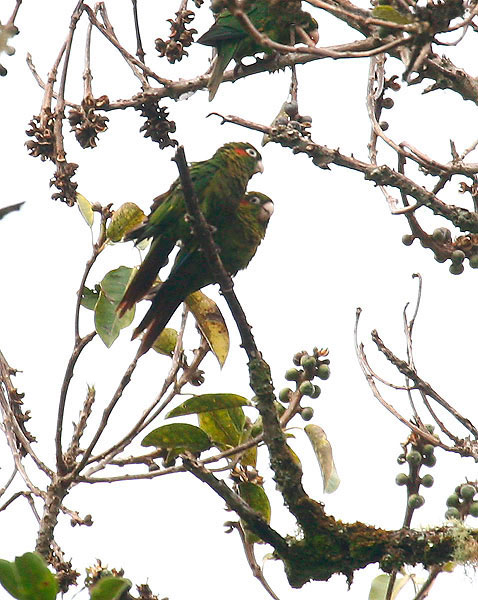
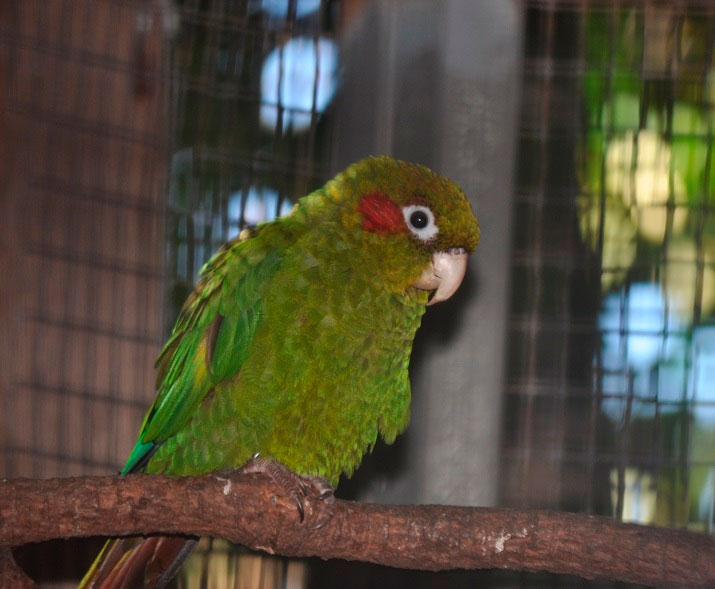
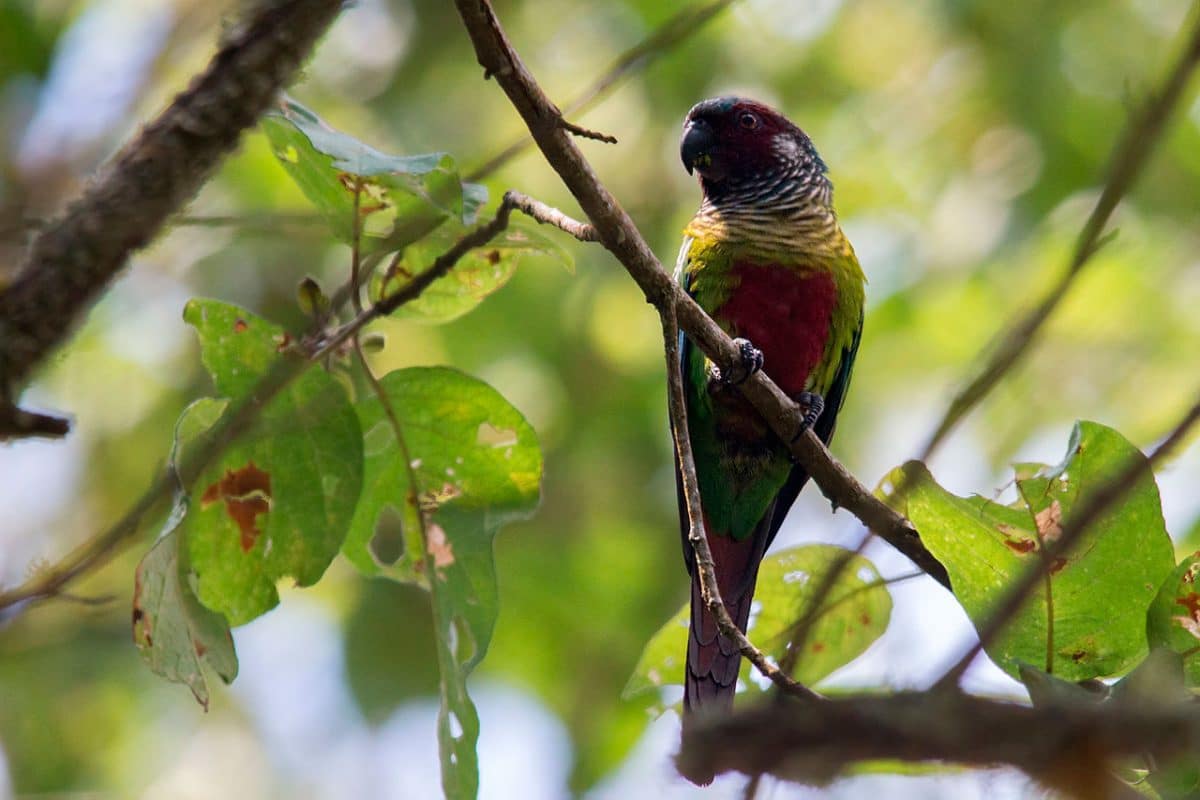
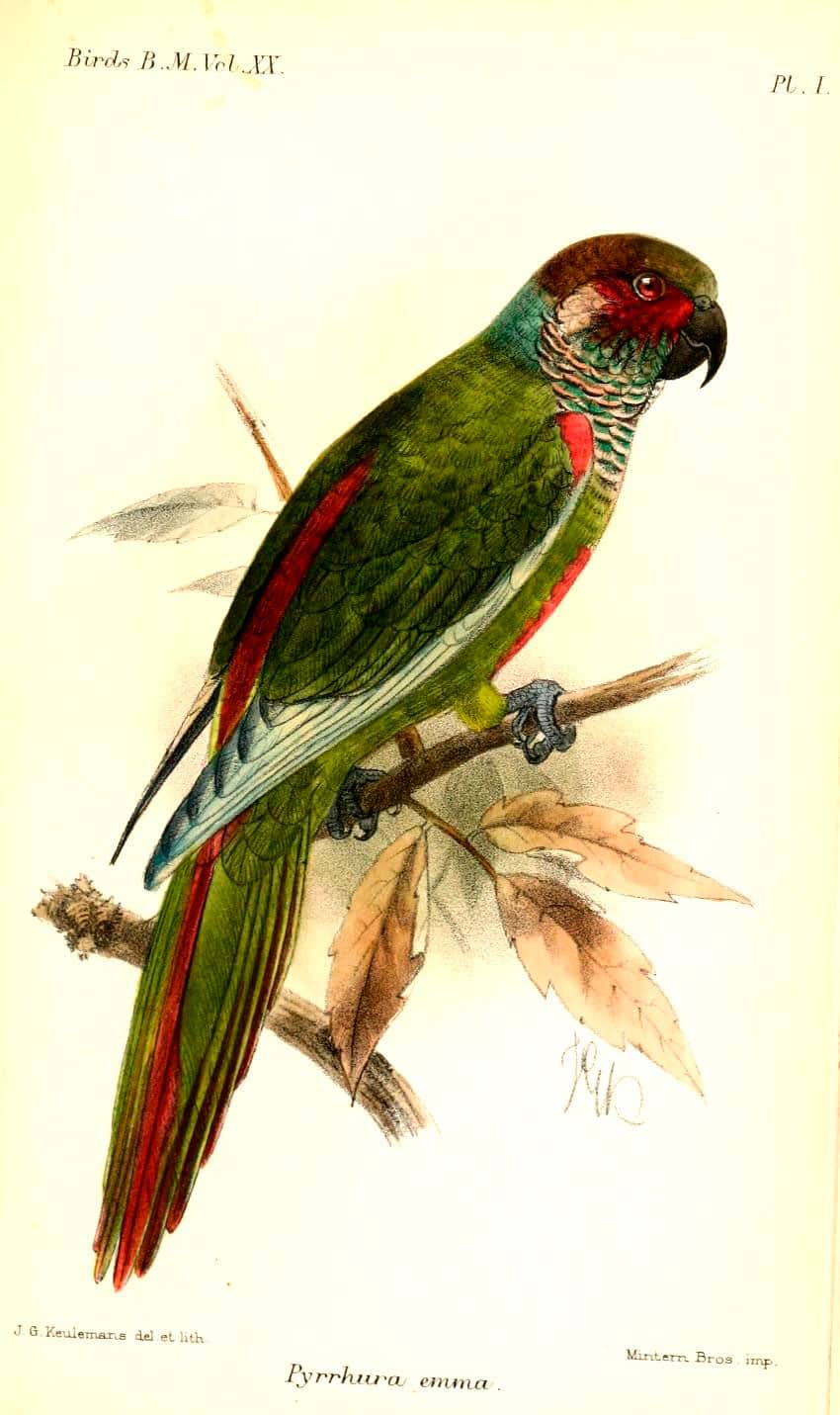
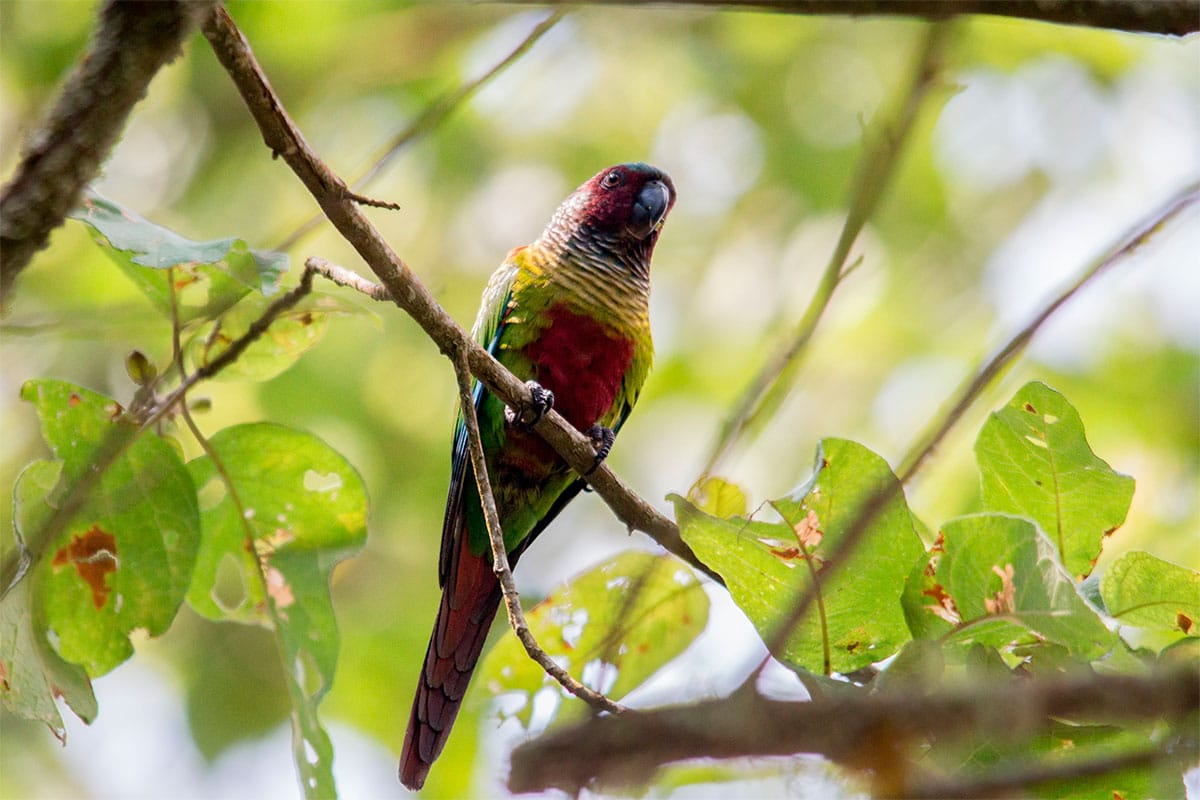
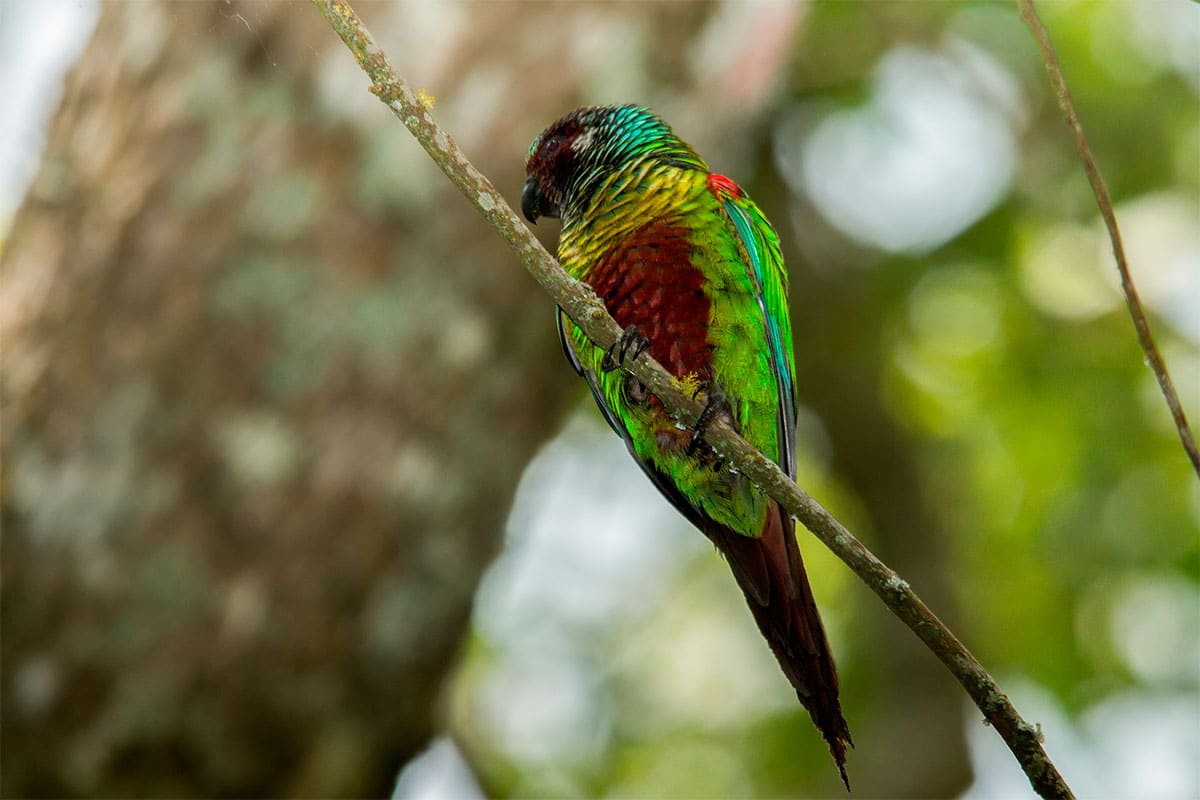
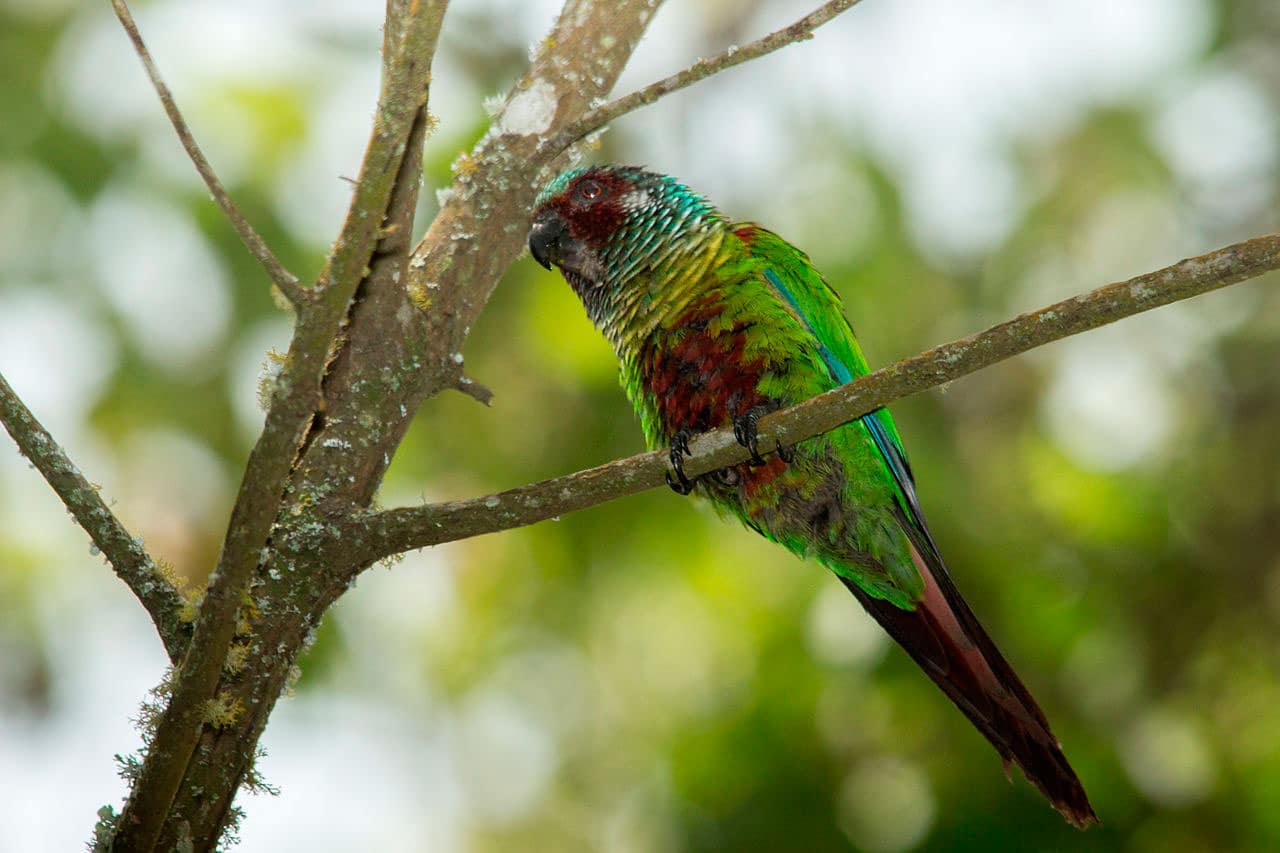
The Emma's Parakeet(Pyrrhura emma) is a bird, mostly, green, with blue in the wings, reddish-brown in rump, on tail and in the back; Scaled plumage chest yellowish color on a gray background olive; wings with red shoulder, inconspicuous.
The face red plum, while the pileum It is brown and gray forecrown blue. Abdomen with dark red stain, tail with green base, edge red and below all red.
Eye ring grey, cheeks red with white spot on ears. Bill dark. It has no sexual dimorphism.
They can be seen in hill forests in the coastal mountain range in Venezuela, in humid forests and edges as well as in adjacent clearings with sparse trees and groves (pit et to the., 1997).
Usually it moves in flocks, on quick flights up 25 specimens, before landing in the canopy.
Reproduction:
There is insufficient information regarding reproduction and feeding. Breeding season probably between May and July. Period of incubation: 24-25 days.
Food:
They have been observed eating flowers of Ochroma and nectar (Hilty 2003).
Distribution:
Size of its range (reproduction / resident): 88.300 km2
The Emma's Parakeet inhabits forested areas of the northern coastal range Venezuela, from Yacacuy and Carabobo until Miranda, and disjuntamente from Anzoátegui to Sucre and northern part of Monagas (Del Hoyo et al., 1997, Juniper and Parr 1998, Hilty 2003, Forshaw 2006).
It is mainly found at altitudes 250-1.700 m, but you can see at sea level in eastern Sucre (Hilty 2003), where is quite common (Hilty 2003, P. Boesman in a bit., 2006). Its distribution within this range is complex and disjoint, found especially in mountainous terrain at lower elevations (Hilty 2003).
Conservation:
• Current category of the Red List of the UICN: Least concern.
• Population trend: Decreasing.
Justification of the population
State of conservation ⓘ
Minor Concern ⓘ(UICN)ⓘ
Apparently, the population size of this species has not been quantified.
Justification of trend
The capture for trade and changes in land use may be causing a decrease in population of this species, although the trend has not been quantified, and none of these is considered serious threats to this species today(CJ Sharpe a slightly. 2014).
Conservation Actions Underway
They live in several national parks (P. Boesman in a bit., 2006), with a "substantial" population in the Guatopo National Park, Miranda (Juniper and Parr 1998, Hilty 2003).
Conservation Actions Proposed
Continue to monitor this species in the field and in trade.
Strengthen the network of protected areas within the range of this species.
"Emma's Parakeet" in captivity:
Very rare in captivity. Very intelligent, active and playful. They are very aggressive with other species. Price per couple: 400 EUR.
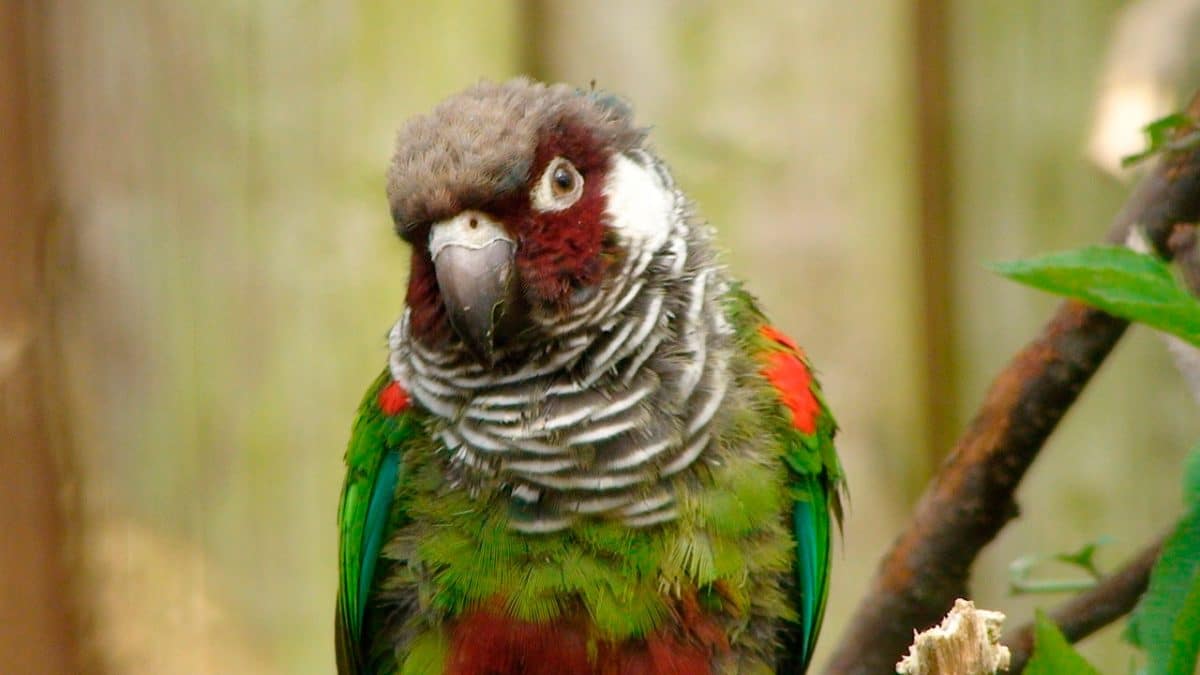
The Grey-breasted parakeet(Pyrrhura griseipectus) is a bird marked by a mask in reddish face, interrupted by a surrounding white coloration in the regions orbitals and ear-coverts.
The feathers of the neck to the upper region chest They have a gray coloration with light streaks interspersed, giving the region a striped appearance or escamado. The species has a characteristic patch reddish in belly, highlighting green coloration, its predominant body. The region forecrown up to the nape, It is dark brown with white or lighter brown spots that vary from bird to bird.. rear area neck green blue border with a width. They have a patch reddish brown in the bottom of the back which leads to the crown. The tail It is long and maroon. Bill gray-black; eye ring white gray; irises brown-orange.
It has no sexual dimorphism. The immature they are more muted than adults; You have scattered green feathers in the abdomen; the cere and the bare periophthalmic is white, less gray tone.
Taxonomic status:
This species is considered to be a subspecies of Pyrrhura [leucotis, emma or griseipectus] by some authors
Sound of the Grey-breasted parakeet.
Habitat:
It is in the rainforests, often located in Serranas regions, where orographic rains favor the occurrence of enclaves Atlantic Forest and Mata dry amid caatinga.
Reproduction:
The breeding season It occurs during the rainy season. The laying It is five to eight eggs in holes dug by woodpeckers since they are not able to dig their own nests; They use these holes to sleep.
When the pups are born, the couple divides the task of feeding. Sometimes they have help from even a third member of the flock to successfully raise all the young..
Food:
Probably it feeds on fruits, flowers, seeds and algae.
Distribution and status:
Size of its range (players / residents): 830 km2
This species was formerly known in 15 Locations (. Anon 2014) within Brazil. At present it is in only three areas in the state of Ceará, the Serra de Baturité and Quixadá(C. Albano in a little . 2006, Waugh et al 2010.) and most recently observed in a rocky mountain Ceará, where five birds were recorded in March 2014 (Anon. 2014).
In Serra do Baturité appears to be very rare and seems to have been extinct from several areas, but recent records of groups in the Environmental Protection Area mountains Baturité; surveys 2007 half of the remaining habitat in this site revealed near 80 individuals (C. Albano in a little. 2007, 2008) and the population here is now estimated to be about 250 birds(Waugh et al . 2010).
Forests of Baturite mountains They have been greatly reduced to make way for coffee plantations and only 13% of the jungle remained in 1996. The discovery in 2010 a population of about 50 birds in Quixadá(Waugh et al ., 2010) It raises the known world population of this species in about 300 birds.
The Grey-breasted parakeet It was previously known two other areas: the eastern slope of the Saw Ibiapaba in Ceará, and small Serra Negra, in Pernambuco, where it was very common in 1974, with flocks of 4-6 individuals regularly seen in the early 1980, although there are no recent records. There are also unconfirmed reports 1991 in organic station Murici Alagoas in which possibly it refers to individuals released; Recent fieldwork was unable to locate the species.
Its known range is very small, and the species has declined dramatically in the past, a trend that may be permanent.
Conservation:
Justification of the Red List of the Category
Recent surveys indicate that this species has a extremely small population, which continues to decline after dramatic historical declines. For these reasons it qualifies as Critically Endangered.
Justification of the population
State of conservation ⓘ
critically endangered ⓘ(UICN)ⓘ
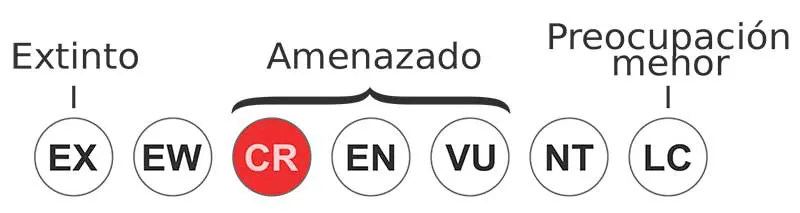
• Current category of the Red List of the UICN: critically endangered.
• Population trend: Decreasing.
• Population size : 200 individuals.
The population in the Area of Baturité Mountains Environmental Protection It is estimated at about 250 birds, and discovery in 2010 a population of about 50 birds in Quixadá raises the known world population of about 300 birds(Waugh et al ., 2010). This equates to approximately 200 mature individuals.
Justification trend
This species is suspected to be decreasing quickly because of their capture and habitat loss in progress within its range.
Threats
The habitat destruction He has played a role in the decline of the species with the original forest cover now reduced to only 13%.
The coffee plantations (especially where coffee is grown in the sun instead of shade coffee) They are impacting the habitat of the species.
The main threat, However, It is believed to come from the capture illegal underway for local and national trade (C. Albano a slightly 2006, Anon 2009..) and captive breeding (Fernandes-Ferreira et al 2012.); the Grey-breasted parakeet They can be easily purchased through Internet (Girão and Albano 2008).
It is easily found in the international trade in bird cage.
The lack of natural nesting sites also it believed to are limiting reproductive success of the species (Campos et al . 2014).
Conservation Actions Underway
Appendix II of CITES.
In Brazil, It was considered above in critical hazard(Silveira y Straube 2008), but it has now been legally designated as endangered national(MMA 2014), and protected Brazilian law.
Dwelleth within Baturité Mountains Environmental Protection Area, but this area has been designated for sustainable use and traditionally has not been achieved for conservation.
Management of land by a private owner in the area has led to an increase in a small town known (C. Albano a slightly . 2006).
Since 2007, NGO AQUASIS Brazil has been conducting two research projects: one sponsored by the Brazilian Foundation O Boticário for the Protection of Nature, the topography of the Baturite mountains to monitor their condition and research their biology; and another sponsored Fundación Loro Parque, for additional populations (C. Albano in a little. 2007, 2008).
The surveys carried out in the historical sites and areas of potential habitat in the period 2007-2008 They have not been able to locate members of this species, although there are strong indications of individuals that may still be inhabiting the degraded Serra do Estevão, municipality Jaw, state Ceará(C. Albano in a little. 2007 2008, Anon 2007), where it was actually rediscovered in the 2010 (Waugh et al ., 2010).
A team of AQUASIS, funded by an award Leadership Program for Conservation in 2012, conducted searches for the species on an isolated mountain in Ceará and he found a small population of five individuals in March 2014(Anon. 2014).
You can also persist in Serra Negra Biological Reserve, state Pernambuco, although a combination of marijuana crops and hostile local culture makes research work in this latter area difficult (C. Albano in a little. 2007, 2008).
At least 11 private reserves (RPPN) They are in the process of being created in the Serra de Baturité(C. Albano in a little. 2007, 2008) and AQUASIS They are now engaged in the process of developing a nature reserve in the Baturite mountains(Campos et al . 2014).
AQUASIS has strengthened ties with government agencies in order to influence policy decisions (Campos et al . 2014).
Scheme nest box sponsored by Loro Parque It has been carried out with nest boxes installed in different places with the consent of the landowners. (Anon, 2009).
AQUASIS also they provided nest boxes Insecticide treated to reduce infestations of bee and wasp (Campos et al . 2014). These measures have proved effective, with 16 boxes occupied in 2012 give place to 97 eggs and 71 chicks hatched successfully.
A education and awareness campaign large scale was carried out in the Serra de Baturité in 2008 (C. Albano in a little. 2007, 2008) and continues today, with many schools currently participating in education programs AQUASIS(Campos et al . 2014).
A main objective of AQUASIS is to promote the Cotorra pechigris as a flagship species, the work being supported by commercial NGOs and ecotourism WATER Trails of the Park(Anonymous 2009).
AQUASIS also it aims to develop the ability to bird watching and a development process of consciousness creating alternative livelihoods (Anonymous 2009). A visitor center has recently been established (Campos et al . 2014).
It breeds well in captivity and stocks are held in Brazil and abroad. Always captive breeding is well managed and coordinated, could be used for reintroduction into the wild.
They are being conducted studies on factors influencing the survival rate of chicks, population's genetics (in future DNA techniques can be used as a deterrent against illegal collection of wild birds); both adults and juveniles have been banded (Campos et al . 2014).
Conservation Actions Proposed
Conduct more studies in areas similar to the mountains Baturité in the northeast of Brazil, such as Sierras de Aratanha, Maranguape and Machado, by the presence of additional existing populations.
improve conservation management practiced in the Guaramiranga Ecological Park.
Provide incentives for landowners to increase the network of private reserves Baturite mountains.
Monitor and control trade locally, National and international.
Investigate the feasibility of using giant bamboo(Dendrocalamus giganteus) as sites for constructing artificial nests (Campos et al . 2014).
continue making awareness campaigns to promote the Grey-breasted parakeet as a symbol for the conservation of humid forests and associated biodiversity in the Baturite mountains.
Investigate in situ conservation measures.
"Grey-breasted parakeet" in captivity:
Its continuous capture, both for domestic and international trade, They have taken this beautiful bird to a critical situation, there are only 200 specimens in the nature. There are probably more animals captivity in its natural habitat
Protected by the Appendix II of CITES, each captive specimen of this species that is capable of reproducing, must be placed in a well-managed captive breeding program and not sold as a pet, in order to ensure long term survival.
Origin: Brazil, Colombia, Ecuador, French Guiana, Guyana, Peru, Suriname, Venezuela
Character: active and playful.
Life expectancy: 30 to been
Height: 35 a 41cm.
National Zoo - Washington DC
Content
Description
35 to 41 cm.. height and between 190 and 277 g. of weight.
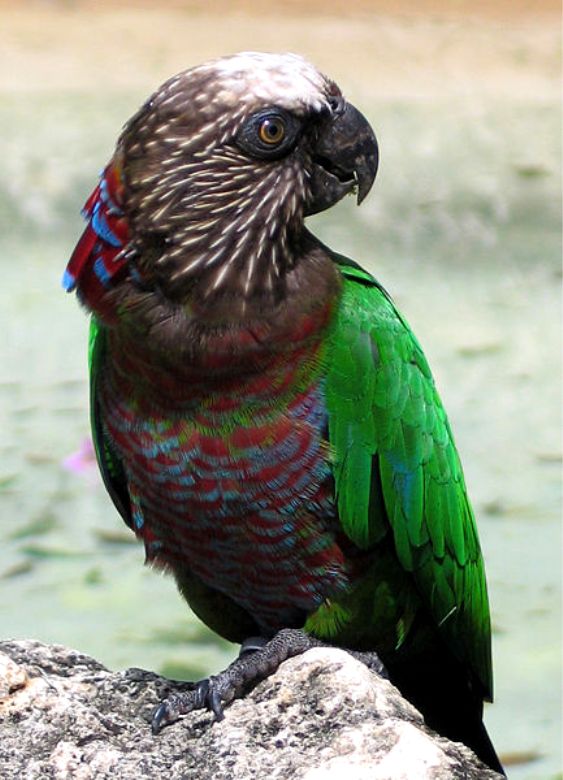
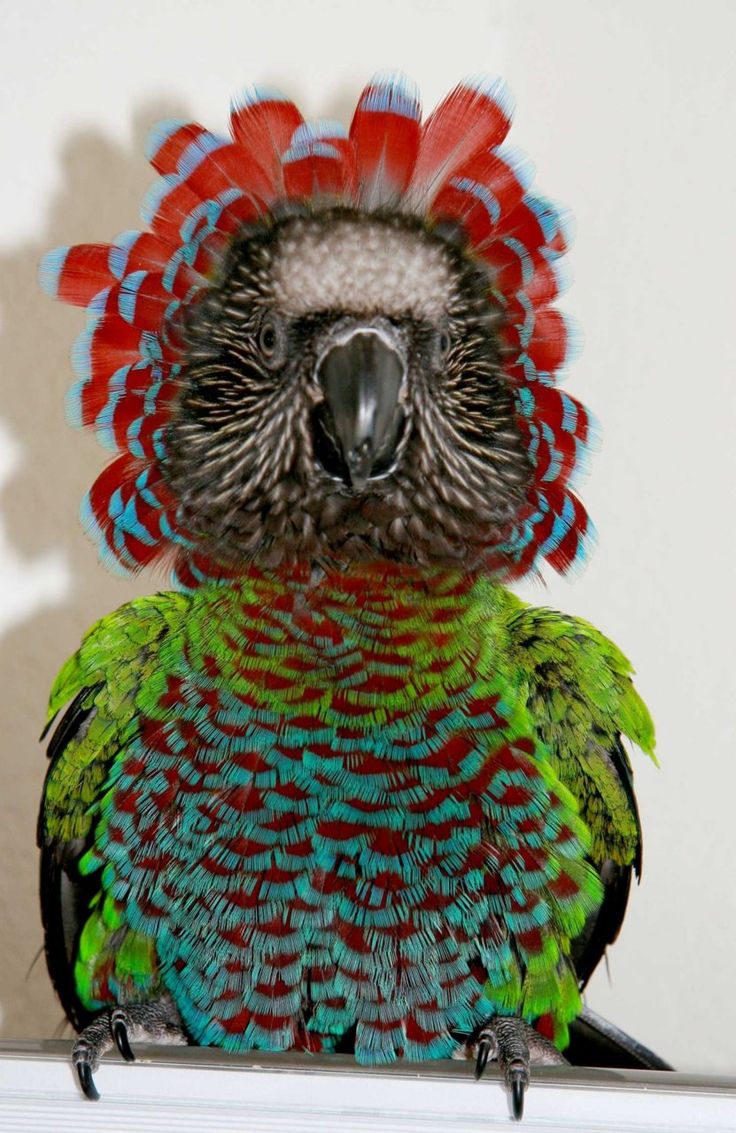
The Red fan Parrot(Deroptyus accipitrinus) is unmistakable for its showy colours. Has the forecrown and crown yellowish white, fading is back to Brown with striped pale in the part back from the neck and a bordered of feathers elongated in form of collar of color red Bordeaux in its base and blue bright in the tips; lores brown; cheeks, throat, sides neck and supercilii area, brown, strongly striped with shades yellow.
The upperparts are green. The under wing-coverts medium-sized and small are green; primary coverts of color blue dark dark. Primaries blackish, secondaries Green with dark tips. Under, the wings green, flight feather blackish. Sides of chest and belly green; center of chest and the belly red Bordeaux with blue tips, creating an effect bleached blue and Red, sometimes with a little bit of green, especially in the part superior of the chest; the thighs and undertail-coverts green. Upper, the tail green with blue tips, outer feathers with blue in the outerweb and Red hidden in the base of the innerwebs; undertail, the tail black. Bill blackish, paler at the tip; cere black; yellow the irises; legs dark grey.
It is not possible to determine the sex safely by their appearance.
Immature has lower jaw of color Horn and a rainbow Brown warm.
The Red fan Parrot living in the jungle tropical of land low, preferring the formations of land firm, including the ground slightly wavy or of the hills (perhaps due to a greater diversity of plants of which is fed). Apparently prevents them forests and marshes, edge of forest and clear, but there is a report of birds in forest flooded in the drainage of Morona River, Peru, and feeds mainly on riverine forests in Venezuela. Only comes to them 400 meters in the southeast of Colombia and a 200 metres in Venezuela.
Not is very gregarious, are distributed in pairs or small groups of 3-4. On rare occasions, until 10. Pre-breeding aggregations appear to break up into pairs or trios at the onset of nesting. Rest in the cups give the trees in small groups (Perhaps alone in tree cavities). It feeds mainly in the canopy.
Not are very sociable. They show an appearance of Raptor, Deploying the feathers of the back of the head fan.
Reproduction:
Nest in tree holes, including an old nest of Woody Woodpecker, for example of a Woodpecker grebes (Campephilus rubricollis). The rapid flapping of wings, followed of a mild decline of sliding, they give a deeply undulating display flight during the breeding period. Breeding March-June, Venezuela; January-March, Guiana; February-April, Suriname; December-February, Brazil. Clutch 2-3 in captivity.
Size of the area of distribution (reproduction / resident): 4.240.000 km2
Discontinuous. Amazonia, from the South of Venezuela to the northeast of Ecuador and Peru, the Guianas and Amazonia Brazil.
Distribution 2 subspecies:
Deroptyus accipitrinus accipitrinus
(Linnaeus, 1758) – Nominal. From the South-East of Colombia to Venezuela, the Guianas; Northeast of Peru and North of Brazil.
Deroptyus accipitrinus fuscifrons
(Hellmayr, 1905) – Brazil, to the South of the amazon rivers (from For to the North of Mato Grosso) possibly Bolivia.
Conservation:
• Current category of the Red List of the UICN: Least concern.
• Population trend: Decreasing.
Justification of the population
The size of the world population It has not been quantified, but this species is described as «quite common» (Stotz et to the., 1996).
Justification of trend
It is suspected that this species has lost 24-31.3% of habitat suitable within their distribution during three generations (23 years) based on a model of Amazon deforestation (Soares-Filho et to the., 2006, Bird et to the., 2011). But, given the tolerance of the species to the effects of fragmentation / degradation / edges and / or the magnitude of the losses global, It is suspected that will decrease in <25% en tres generaciones.
"Red fan Parrot" in captivity:
The Red fan Parrot or Parrot Hawk is a bird very Intelligent, playful and very beautiful. However and, Despite its undeniable appeal, It is not ideal to have captive species. Are extremely nervous and in occasions this is translated in that is start or bite them feathers or even can get to self-harm is.
Are parrots extremely noisy and having a copy inside the house does not seem too tolerable and yes, a tough test for our patience.
The head of the Fairy Lorikeet(Charmosyna pulchella) is dark red with the back of the crown Black extending from above and behind the eyes up to the nape. Mantle Green with a black area below the nape and collar of color red dark at the height of the shoulders; under the back It shows a patch of dark violet interspersed with some green feathers on the ends; rump and tail coverts view from above of color green.
Wings Green with extremes of color black in them flight feather and in the internal parts of the coats. below the wings Red with coverts marginal green; flight feather blackish.
The underparts Red with stripes of pale yellow in the center of the chest, the thighs purple with yellow stripes. The tail view from the top of green at the top with a black shaft in the Center and the rest of red and yellow at the tip; view from below, the tail is yellow, bathed in red and green ends.
The bill is orange with gray tip; irises yellow red; legs oranges.
The female shows a color green beige, not red, on the sides and a yellow patch in the flanks that extends to the sides of the rump.
The female of the subspecies Rothschildi also shows more green in the underparts males and a green mottling on the upper part of the chest.
The Immature They show the yellow patch of the flanks more defined than the females. The lower part of the back, mainly green with some blue-violet. Top of the chest Green mottled without clearly defined yellow stripes adult. Crown Red with black patch restricted to the nape and mixed with the green of the upper mantle. Lack of the Red of the part back from neck clearly defined in adults. Yellow area at the bottom of the flight feather. Iris brown. Beak and feet grayish brown.
Subspecies description
There are two subspecies including the nominal. A third, Charmosyna pulchella beautiful, described by Devis (1900), is considered here as Charmosyna pulchella pulchella.
: (Hartert, 1930) – The patch of the crown descends to find is with them eye; Green fusion behind the yellow lines of the chest, and green fusion in the flanks and the thighs (that can also show some yellow stripes); without the Red of the neck and much less defined the violet patch in the lower part of the back.
Habitat:
Nomads. They are mainly distributed in montane forests, at the edges of forests and secondary growth forests. Its preferred habitat are the mountains between 500 and 1.800 m, but also found in lowlands up to the level of the sea and in the mountains up to 2.300 m.
Found in pairs or flocks of 15 or more members, uniting in the tops of trees in flower with others Charmosyna lorikeets, including the Josephine's Lorikeet.
Reproduction:
In captivity it nests continuously, with incubation of 25 days shared by both parents. Usually, It lays two eggs in a hole in the base of one epiphyte. In nature it is intended that nests between January and April (Pratt picked up breeding males in March).
Food:
It feeds on pollen and nectar.
Distribution:
The Fairy Lorikeet is distributed between New Guinea in Irian Java (Indonesian) and Papua New Guinea, from the East of Vogelkop to the peninsula of Huon. Owen Stanley mountains and southeastern intervals.
Subspecies distribution:
Charmosyna pulchella pulchella
: The nominal
Charmosyna pulchella rothschildi
: The mountains Cyclops and the slope North of the mountains on the idenburg river (Irian Java).
Conservation:
• Current IUCN Red List category: Least concern.
• Population trend: Stable.
The world's population has not been quantified, It is thought that it surpasses the 500.000 birds. the species, according to information, is abundant in some areas, but few in others due to the trade (pit et to the., 1997). Suspected that the population is stable in the absence of evidence of any reduction or substantial threats.
"Fairy Lorikeet" in captivity:
A small number of captivity.
Alternative names:
– Fairy Lorikeet, Little Red Lorikeet, Little Red Lory (ingles).
– Lori féérique, Lori à croupion noir, Lori féerique, Loriquet à croupion noir (French).
– Goldstrichellori (German).
– Lori Lindo (español).
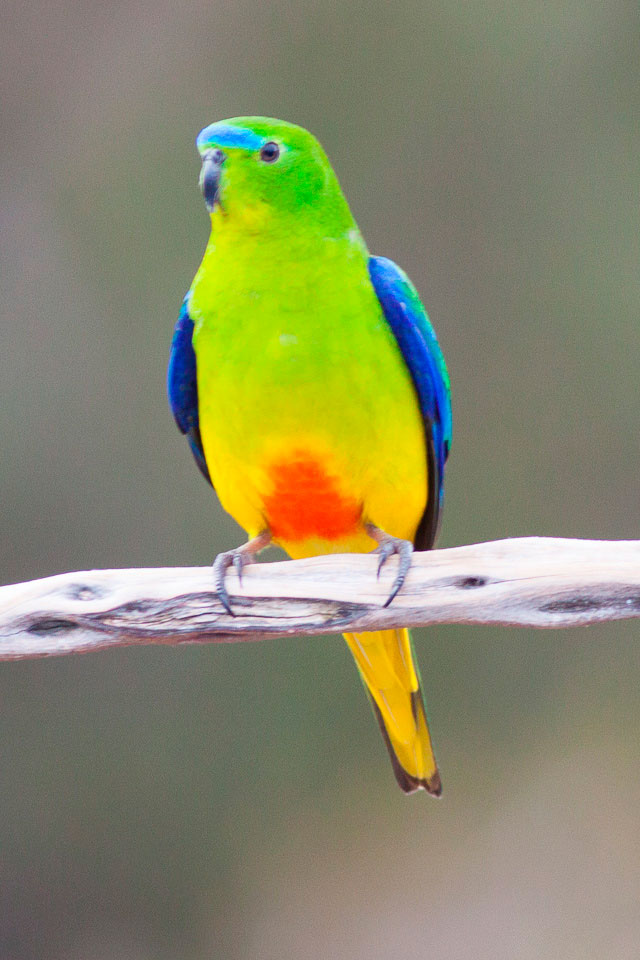
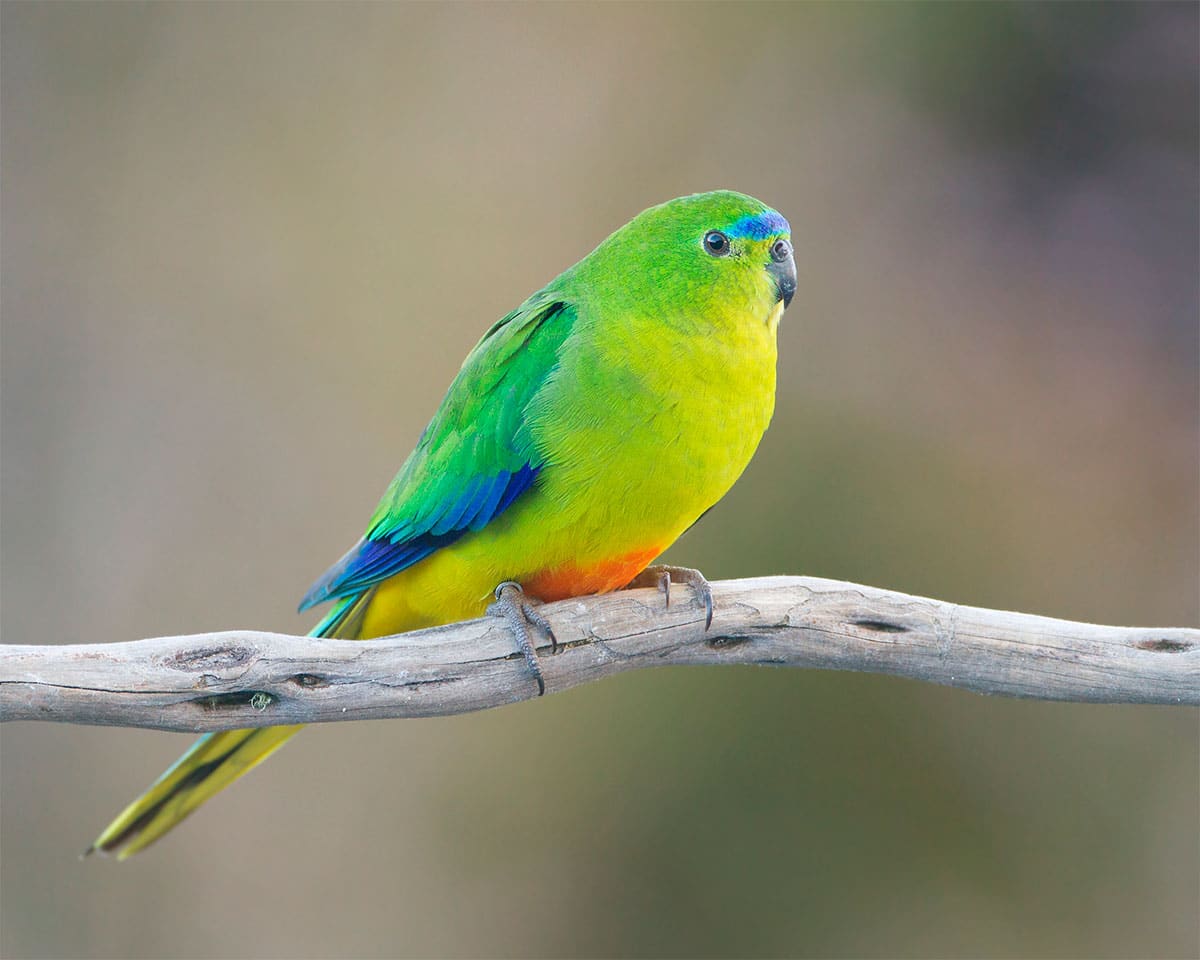
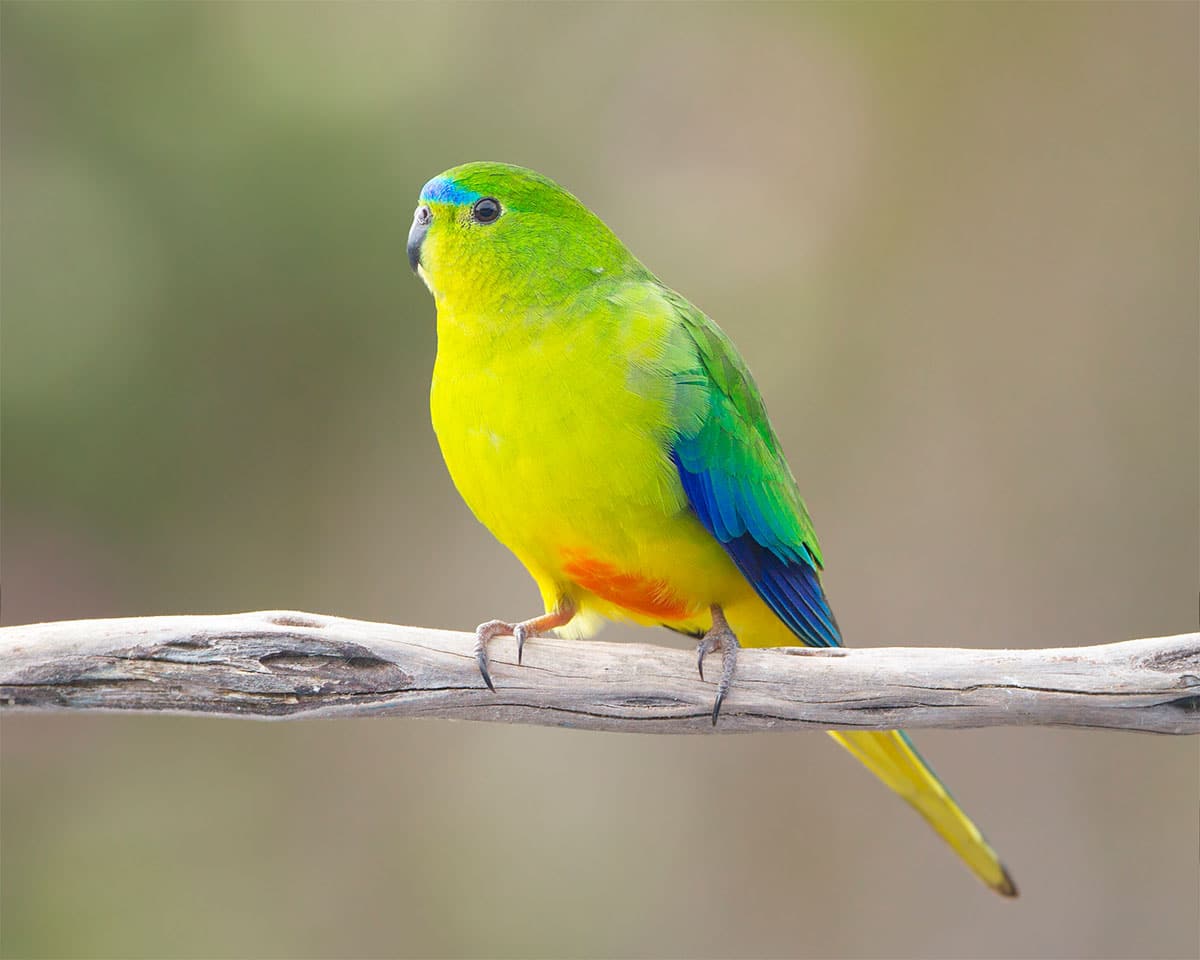
The Orange-bellied Parrot(Neophema chrysogaster) is a small ‘Grass parakeet‘, so called for spending a lot of time on the ground feeding on seeds and grasses.
adults have, approximately, 21 cm length and a weight of around of 45 to 50 g..
Has the crown, the nape and the the mantle bright green, with one frontal band dark blue and a lighter blue later point that does not extend beyond the eyes.
Face and lores are yellowish-green. You have a few different bands in the wings Green and blue colors, the vane inmates of the wing-coverts are green, the blue outer.
The primary coverts are dark blue. The primary feathers Black has the outside edges with fine violet blue and yellow. The secondaries has a green border.
The underparts is blue. The chest Green is mixed with the greenish yellow color under the tail. The belly is very stained Orange. The top of queue is green with blue tip. The lateral tail feathers they are yellow with blue-green bases.
Peak and iris are black, the legs are grey.
The female is more off than the male, the frontal band has a single tone. The stain ventral Orange is smaller.
Between the juveniles, the frontal band is barely visible. The Wing band is very prominent and the bill is pale.
As one migratory species, its habitat varies throughout the year, with the birds that live in the marshes, coastal dunes, pastures, scrub, estuaries, Islands, beaches and Moors generally within the 10 km of distance from shore.
There is practically no records more towards the inside of 5 km and most are within 2 km from the coast. The holes of mature eucalyptus, as the Smithton Peppermint (Eucalyptus nitida) and the Swamp gum (Eucalyptus ovata), they are used by the Orange-bellied Parrot for the nesting during the breeding season in Tasmania, and breeding habitat is a mosaic of moorland and reed-covered land, dominated by the Button Gras (Gymnoschoenus sphaerocephalus) and forests.
The behavior of foraging species are usually characterized by the power in the suelor or in low vegetation, in general a less than 1 m above ground.
The birds they feed usually in pairs or individually during the breeding season, and in small herds of variable size in non-breeding season. Solitary birds often have been feeding with other species, especially with the Blue-winged Parrot (Neophema chrysostoma).
Reproduction:
In Tasmania, the only breeding place, spawning takes place in the months of November and December.
The nest of the Orange-bellied Parrot is located in natural cavities, between the 8 and 25 meters of height in eucalyptus (Eucalyptus nitida) and less frequently, in the (Eucalyptus ovata). The nest is sometimes maintained during several consecutive years. The marital ties they are strong and sometimes last a lifetime.
The spawning included among 3 and 6 eggs they are incubated during 21 days. Young people are altricial and remain in the nest for at least 5 weeks.
Food:
Initially, on Spring, the Orange-bellied Parrot they feed on plants. They mostly eat seed Sedge (Reedy) and parts of the herbs of the genus Boronia or Actinotus.
At the beginning of Winter, the regime being vegetarian, suffering some transformations. the Orange-bellied Parrot consume algae in decomposition, seeds and herbs Poaceae and Halophyte, that is to say, you adapt to saline environments, as the Rock Samphire (A maritime rhythm).
The goosefoot )Chenopodium) and Salt plants (Atriplex) also classic in their food. Introduced plants such as the Sea rocket (Cakile maritima) they are also popular.
Distribution:
Tamaño del área de distribución (reproducción/residente) 3.100 km2
They migrate across Islands in the West of the bass strait (mainly King Island) towards the coast South of Australia, to Hibernate from the months of March to July, mainly along the coasts of the Bahía Port Phillip, Victoria (largest number of birds in Point Wilson and Swan Island, including the Queenscliffe Golf Course). They also overwinter in small numbers., from Gippsland, Victoria, to the West of the Coorong, Southern Australia. Occasionally occur during winter in areas of Tasmania and surrounding islands, as well as other individuals spend the summer on the mainland.
Every summer around 40 couples are reproduced, and an analysis of nine nests showed an average offspring of 1,7 pups per pair. The post-breeding population increased by about 50 individuals, of around 170 birds, but the population is becoming increasingly smaller, which suggests a high annual mortality. Adults begin to leave the breeding area in February and fly across the coast of Tasmania, crossing the bass strait, mainly through King Island (also records in the Hunter Croup) towards the coast of the Southeast of Australia (young birds usually travel a month later).
The Orange-bellied Parrot They tend to move around the continent, and are in the South of Australia at the end of winter. They return to breed in the months of September and October, they usually travel directly back to their breeding grounds. Since 1979 to 1990, the wintering population has remained relatively stable, with a count of 67 to 126 individuals registered every year (with a maximum of 50% of the world's population known with presence in Point Wilson).
In the last century the species flying in flocks of thousands of individuals (and raised as far East as Sydney up to approximately 1907). Wintering habitat loss and capture for the bird trade are cited as factors in its decline.
Possible winter habitat loss remains a threat, as does competition from introduced herbivores, the disturbance, and the possibility of exploration and exploitation of minerals. A detailed recovery plan includes the management of winter habitat with the exclusion of grazing animals, the diversion of economic activity and the development of Murtcaim Wildlife Management Area about Point Wilson. Captive-bred birds have been released and mixed with wild individuals.
Conservation:
• Current category of the Red List of the UICN: Critically Endangered
• Population Trend: Decreasing
The Orange-bellied Parrot It has a very low population size. This very low population size is even more significant, given that the species migrates through of the Bass Strait, with which this species is subjected to the additional risk by stormy phenomena on their migratory journey.
Has a restricted geographic range when breeding, and apparently a limited supply of food during migration and winter.
The species is found in a single population of between 100 and 150 mature individuals. Habitat loss, fragmentation and modification, particularly on the migration route and in the wintering areas, they are the key threats to the survival of the species.
For a small population, stochastic factors, as the disease, storms during the migratory species, and the destruction of nests by forest fires have the potential to reduce the survival of the species in the long term.
The Orange-bellied Parrot It has a restricted geographical distribution which is precarious for its survival.
The Scientific Committee of Threatened Species considers that the Orange-bellied Parrot has suffered a historic decline since European colonization. It is considered, In addition, that the recent recovery actions that have been implemented are having a beneficial impact on the species and the possibility of future stability in the reproduction sites is becoming apparent. But, as the population of the Orange-bellied Parrot is so low, the data that we have are based on a small area of occupancy and it is likely that this species continue suffering from a series of threats in course, with what the Committee may not be sufficiently secure that available information indicate that the population is stable and safe.
Future declines in population are still likely as a result of potential threats, especially the stochastic and genetic threats to small populations are likely and that can lead to the extinction.
"Orange-bellied Parrot" in captivity:
The Orange-bellied Parrot is very rare in captivity and is, probably, more present in the hands of European collections. There are also some captive birds by some fans in Australia, to the South of the continent.
Fifteen years ago in South Australia, under expert supervision, were built cages with the aim of raising these birds and avoid that the Orange-bellied Parrot disappeared completely. In the early years, most of the young people died from diseases of the beak and feathers (PBFD), a viral disease (virus BFD). Similarly, cold winters in this region, where was launched the project, they had a negative effect on the end result.
Once the aviaries were displaced to areas more temperate and increased its amount, the result is improved and each year dozens of parrots have been released into the wild.
The Orange-bellied Parrot they are birds calm, peaceful and little noisy. They belong to the less active within the genre of the kind Neophema, so tend to the Obesity. These birds spend much time ashore. Usually, bathe once a day, in long baths. Reproduce well in captivity. They are exceptionally susceptible to various infections, including the intestinal parasites. These birds also, often, they die without apparent reason.
Parrots A Guide to the Parrots of the World – Tony Juniper & Mike Parr
Ministry of the environment – Australia – Environment Protection and Biodiversity Conservation Act 1999 (EPBC Act)
Birdlife
Photos:
(1) – Orange-bellied Parrot (Neophema chrysogaster) male, Melaleuca, Southwest Conservation Area, Tasmania, Australia By JJ Harrison (jjharrison89@facebook.com) (Own work) [CC BY-SA 3.0], via Wikimedia Commons
(2) – Orange-bellied Parrot (Neophema chrysogaster) female, Melaleuca, Southwest Conservation Area, Tasmania, Australia By JJ Harrison (jjharrison89@facebook.com) (Own work) [CC BY-SA 3.0], via Wikimedia Commons
(3) – Orange-bellied Parrot (Neophema chrysogaster) Melaleuca,Tasmania by Ron Knight – Flickr
(4) – Orange-bellied parrot, Neophema chrysogaster, photographed at Tasmania, Australia – Image: David Boyle/National Geographic [velociraptorize]
(5) – Photo: Justin McManus
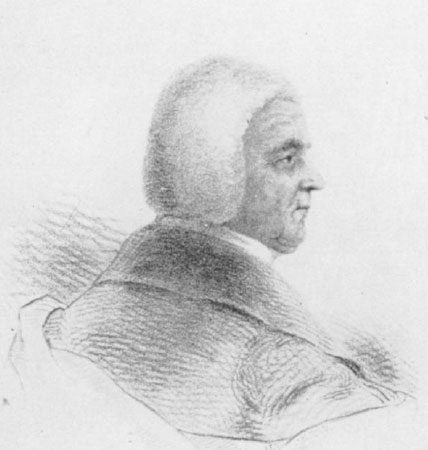
(6) – John Latham – Allen, ELSA G. (1951) The History of American Ornithology before Audubon. Transactions of the American Philosophical Society, New be. 41(3):387-591. See page for author [Public domain], via Wikimedia Commons
Origin: Panama, Venezuela, Guyana, Suriname, Brazil, Ecuador, Peru, Bolivia
Character: Sociable
Life expectancy: 40 years.
Height: 86 cm..
Content
Description:
Of 86 cm.. length and a weight between 995 and 1380 g..
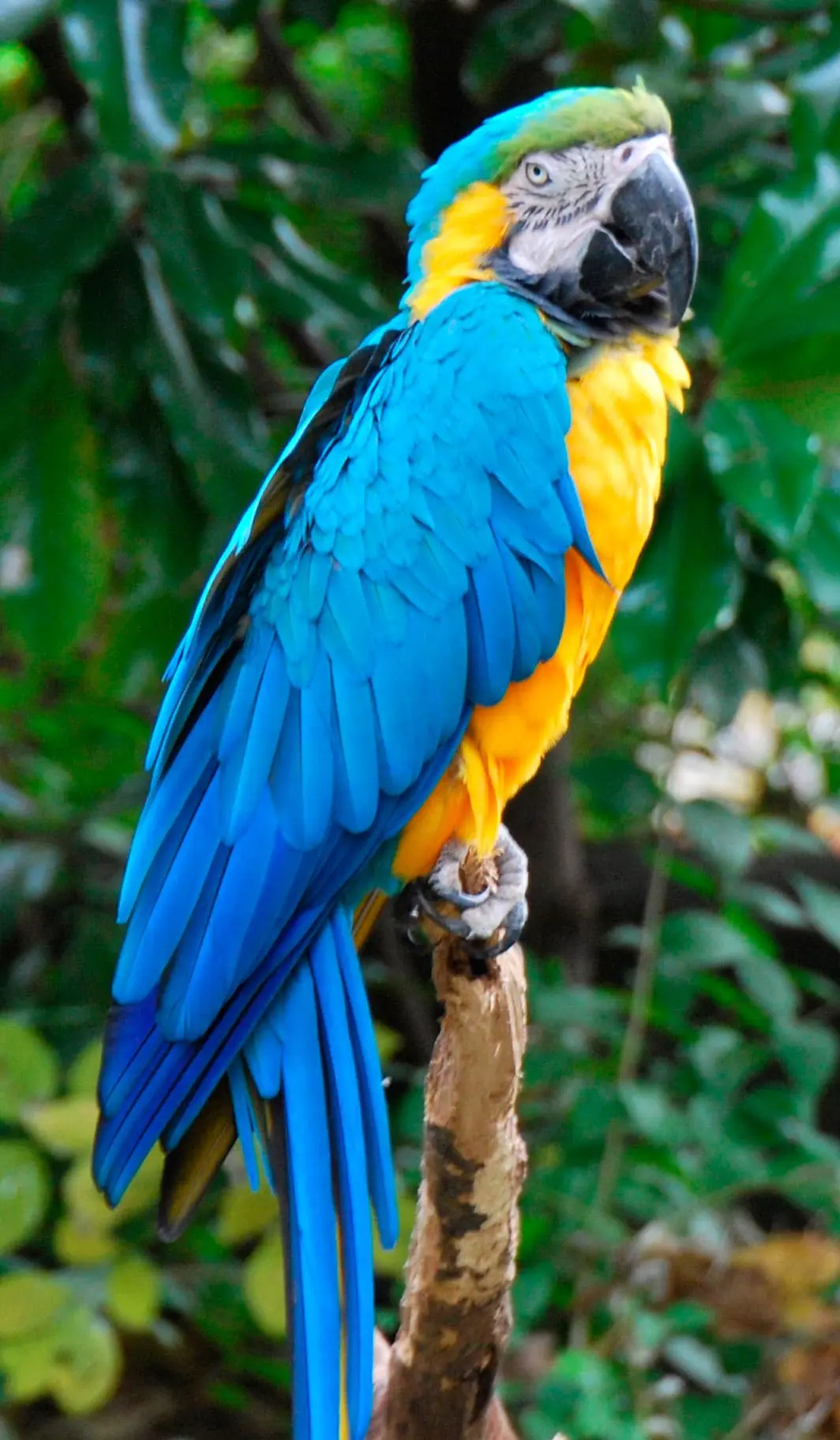
The Blue-and-yellow Macaw(Ara ararauna) has the forecrown and both sides of the head to behind eyes bright green, faded to bright ultramarine blue in the crown and nape.
The upperparts Blue bright overseas. Upper wing coverts Blue bright overseas; flight feather Violet Blue top, Yellow Gold to olive brown down; Depending on the light, the underwing-coverts, yellow.
Large patch yellow on the sides of the neck and ear-coverts edged ahead by a black stripe, to expand to form a black patch in the throat.
Undertail-coverts blue. Uppertail dark purple suffusion overseas; undertail, the tail golden yellow to olive brown depending on the light; Tips new feather of the tail striped wide.
Bill dark grey; cere naked and facial patch (including lores and cheeks to behind eyes) white crossed by narrow lines of feathers Black in knowledge and cheeks top (the skin of the face pink when they are excited); irises pale yellow; legs dark grey.
Both sexes similar.
The youth they have the wings and tail Cafe-grisacea and eyes browns.
They inhabit areas with large trees, often near water, including moist lowland forest edges (mostly forests and marshes, avoiding the lowland forest of tierra firme), gallery forest in the savannah, Savannah with trees and scattered Palms, marshy forests and swampy areas with Palm trees (Mauritia flexuosa). As well bosque deciduous away from the water in Colombia and Panama.
They sometimes feed in more open areas, posing on the floor, for example, for feeding of fruits of Palm.
Gregarious. Usually, observed in pairs, family groups or flocks of up to 25 birds (sometimes many more, especially near the roosts).
The Blue-and-yellow Macaw are observed more often in the morning and afternoon, halfway between the roosts and feeding areas.
Communal roosts in the trees.
Reproduction:
Son monogamous and they usually form a couple throughout their lives.
It nests in a hole in the top of a dead Palm tree (for example, Mauritia flexuosa).
Breeding between the months of February and March in Suriname; Between January and may in Trinidad (formerly); Between December and February in Colombia (birds observed in breeding conditions). Egg laying observed in February in Guyana and between November and January at Peru.
The laying, generally, is two or three eggs, incubated by the female for a few 28 days, the chicks leave the nest to the 90 days after birth.
The Blue-and-yellow Macaw they eat quietly at the top of the canopy, often near clearings. Large flocks may congregate in areas of ribera, often with other species of parrots, to supplement their diet with minerals that are ncuentran in clayey soils.
Distribution:
Its distribution is varied and discontinuous: east of Panama and the tropical lowlands of South America to the South-East of Brazil, Bolivia and Paraguay.
Along the lower tropics (some 500 m) in Colombia; apparently absent from the Valle del Cauca, Nariño, and the moist rain forests of central Choco.
In the eastern lowlands of Ecuador, and perhaps earlier in Guayas, on the slope of the peaceful.
Tropical zone of Venezuela, mainly to the South of the Orinoco, in Monagas only in the north shore (for example in the drainage of the amana river).
extinct in Trinidad from 1970; escapes of captive birds reported since.
Spread sheets and coastal river systems of Guyanas and Suriname.
Widespread in Brazil, but extinct in Bay, South of Rio de Janeiro and in Santa Catarina, during the years 1950 or 1960; they remain in the southeast of Brazil only in the State of São Paulo Western, as a wandering bird from populations further to the West in the region of the Pantanal and the lowlands of Bolivia and Peru.
Current situation in the Paraguay (probably Northeast, perhaps earlier in the South) It is not clear.
The records of Argentina remain corroborated.
Resident general, but with some movements of foraging season.
Locally common, but, apparently, decrease in Panama.
Fairly common in less disturbed areas of Colombia.
Scarce, irregular and decreasing to the West of the Andes in Colombia and Ecuador.
Local in Venezuela.
The largest population of the Blue-and-yellow Macaw It is located in the coastal area of Suriname and it appears to be very common in northwestern Guyana, much less numerous in the South; local in the French Guayana due to the persecution. More common in parts of Brazil (especially in the Amazonia), but rarer in Pantanal. Locally common in the Amazon area of Peru but with a drastic drop around the main capture centers (for example, Iquitos and Pucallpa).
Apparently rare Bolivia, in the Northwest area, but common (at least locally) in the East.
In the 15th century and probably until the end of the 19th century its distribution area encompassed virtually all the the Caribbean basin.
The size of the world's population has not been quantified, but this species is described as ‘Rare‘ (Stotz et to the. 1996).
Not regarded as threatened, Although it is appreciated as bird cage, and their populations are declining and several are now extinct, including the of Trinidad.
The species has undergone intense trade: from 1981, When it began trading in the Appendix II of CITES, 55,531 individuals captured in nature have been registered in international trade (UNEP-WCMC CITES Trade Database, January 2005).
An investigation by the UN indicates that removal of chicks of Blue-and-yellow Macaw, in the Amazon, exceeds the 26%, which leads to overexploitation of the species.
“If a stock is already being overexploited, any rate and type of extraction would have serious effects on its viability and could quickly drive it to extinction. The extraction of adults, even in healthy populations, is even more critical as a rate of 3% already produces population declines, and if they are being subjected simultaneously to extraction of chicks and adults, hunting rates must not exceed the 1% or 2% so that there is no risk of extinction”, Esteban Carrillo and Diego Fernando Builes doors explained, authors of research.
The genera Amazon (Loras) and Ara (macaws) they are particularly vulnerable, due to factors such as its low reproductive rates, low survival of chicks, late age of first breeding, large proportion of non-breeding adults and specific requirements for nest building. In addition are the two most desired genera as pets, and whose extraction generates greater economic “profits” for local hunters.
In particular, the Blue-and-yellow Macaw (Ara ararauna), that it is distributed in lowland forests from Panama to Bolivia Centre and the South-East of Brazil, it is common, but decreases according to the human activity and local extinctions have already.
Sensitivity analysis in the adult hunting scenario for crafts shows that this type of extraction can have profound effects.. Through a program of modelling, It was determined that only extract the 3% of adults, the growth rate turns negative, to extract the 8% the adult begins to have chance of extinction, and with extraction rates equal or greater to the 10%, the probability of extinction of the population in the following 100 years ranges between 52% and 100%.
Researchers warn that the only form of sustainable extraction is subsistence hunting, which is carried out in order to obtain animal protein or hunting by-products to meet the needs of human groups linked to rural areas. Likewise, they needed to hunt for chicks rates are decreased below the 10%, in order to not affect population viability.
"The recommendation we make is that protected areas be established that include their important nesting and feeding places such as the salted ones and the cananguchales, as well as including the species in Appendix I of Cites and completely prohibiting its trade until studies and Population Viability Analysis are carried out. (PVA, for its acronym in English), that establish the rates and forms of sustainable extraction”, conclude the researchers.
Habitat degradation in South America, pollution, development and logging are also affecting the populations of Blue-and-yellow Macaw.
"Blue-and-yellow Macaw" in captivity:
The Blue-and-yellow Macaw they have great popularity as pets. They are beautiful birds with complex behavior, and a good ability to mimic words and sounds. Son social and Smart and they can be great companions of their owners, If managed well. (Juniper, 1998)
With regard to its longevity, There is anecdotal records of animals kept as pets who have lived more than 50 years, but none has been confirmed. If it has been confirmed a specimen that lived 43 captive years. In captivity, these animals have been known that they can be raised from the 8 years of age.
Although these birds are rewarding colleagues, its large size, the complexity of their behavior and its longevity, they do need to have a large space and a big commitment. Their capture in native habitats also often includes the killing of the parents in order to obtain their young., as well as the destruction of important nesting trees.
The results of illegal trade involves much destruction.
Alternative names:
– Blue-and-yellow Macaw, Blue & Yellow Macaw, Blue and yellow Macaw, Blue-yellow Macaw (English).
– Ara bleu, Ara ararauna, Ara bleu et jaune, Ara bleu et or (French).
– Gelbbrustara, Ararauna (German).
– Arara-canindé, arara-amarela, arara-azul, arara-de-barriga-amarela, araraí, ararauna, arari, Canindé (Portuguese).
– Guacamaya Azuliamarilla, Guacamayo Azul y Amarillo, Guacamayo Azulamarillo, Guacamayo azuliamarillo, Papagayo amarillo, Paraba azul amarillo (español).
– Guacamayo, Guacamaya azul, Papagayo, Guacamaya pechiamarilla (Colombian).
– Guacamaya azuliamarillo, Guacamayo pecho amarillo (Ecuadorian).
– Paraba azul (Bolivian).
– Canindé (Guarayo).
– Ararakáng (Guarani).
scientific classification:
Carl Linnaeus
Order: Psittaciformes Family: Psittacidae Genus: ARA Scientific name: Ara ararauna Citation: (Linnaeus, 1758) Protonimo: Psittacus Ararauna
Avibase
Parrots of the World – Forshaw Joseph M
Parrots A Guide to the Parrots of the World – Tony Juniper & Mike Parr
Birdlife
Book, Parrots, parrots and macaws.
Photos:
(1) – Blue-and-yellow Macaw at Cincinnati Zoo, USA By Ted (originally posted to Flickr as DSC_0389) [CC BY-SA 2.0], via Wikimedia Commons
(2) – A Blue-and-yellow Macaw (also known as the Blue-and-gold Macaw) at Gramado Zoo, Rio Grande do Sul, Brazil By diegodobelo (Zoo de GramadoUploaded by Snowmanradio) [CC BY-SA 2.0], via Wikimedia Commons
(3) – Guacamayo azul y amarillo by, Luc Viatour [GFDL, CC BY 2.0 or CC BY-SA 3.0], via Wikimedia Commons
(4) – Portrait of a Blue-and-yellow Macaw (Ara ararauna) in the Vogelburg (bird park) Hochtaunus, Weilrod, Germany – Wikipedia
(5) – Ara ararauna ou Arara-canindé By No machine-readable author provided. Observatore assumed (based on copyright claims). [GFDL or CC-BY-SA-3.0], via Wikimedia Commons
(6) – Blue-and-yellow Macaw (Ara ararauna) in Santa Fé do Sul, São Paulo State, Brazil By Miguelrangeljr (Own work) [CC BY-SA 3.0], via Wikimedia Commons
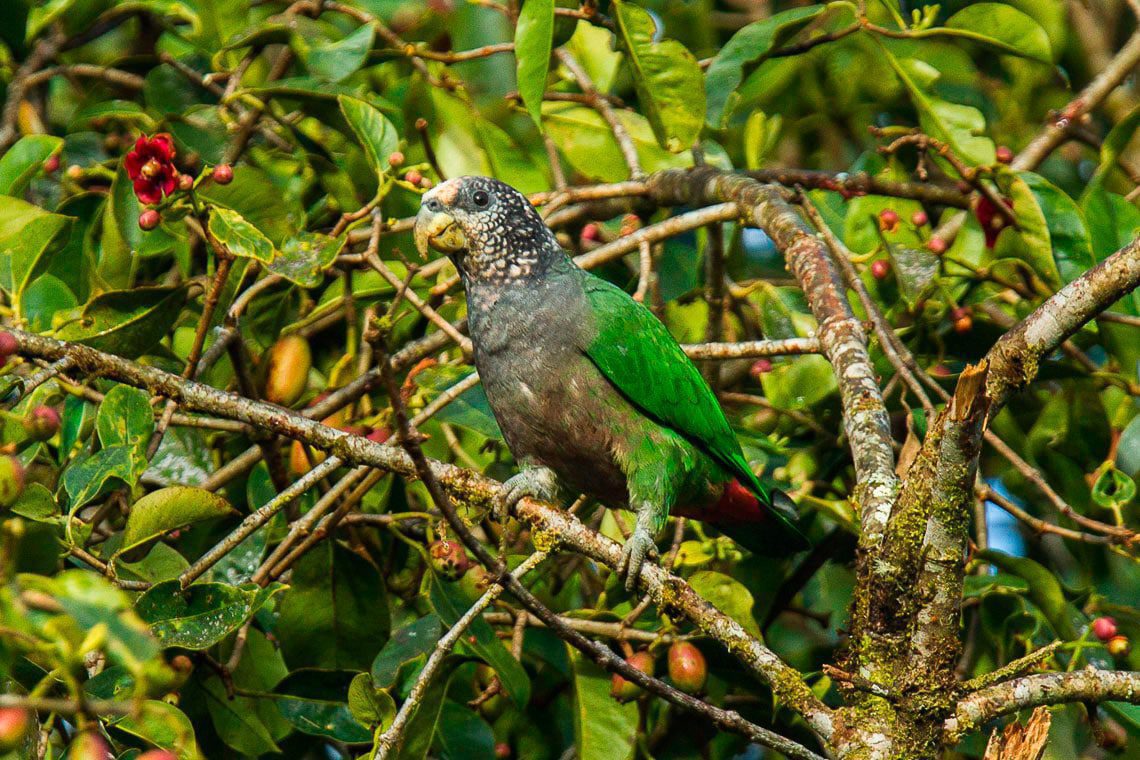
The White-capped Parrot(Pionus seniloides) It is easily identifiable by the "peak" yellow, head usually white, with the crown with reddish speckles, feathers of the nape and sides of the head with dark blue edges and red dyes which gives the appearance of flake.
Breast
with greenish blue edges, under belly and internal base tail red.
Iris of color Brown and legs gray-green.
The youth have crown and chest green, and green spots on the sides of the head and neck.
Note:
Previously he was treated as a subspecies of the species Pionus tumultuosus, that is to say, Pionus tumultuosus seniloides. A midyear 2014 it is considered as own species.
It is a kind Rare. It inhabits in humid jungle and edges, from the 1900 to 3000 m. It is mainly a species of temperate zone, but you can descend to lower elevations.
Like most highland parrots, the White-capped Parrot are rather nomads, widely wandering in search of fruits and seeds (now perhaps more as a result of extensive deforestation). Usually observed in flocks 3-25 birds, sometimes more. More active with grey weather, overcast skies. Difficult to see while feeding or resting in the upper canopy. Its silhouette in flight resembles a Amazona but with the beating of wings deepest.
Reproduction:
It nests in tree hollows.
Food:
Feeds of seeds, fruit of Turpinia paniculata and plants of the family Clusiaceae; sometimes in cornfields, causing damage to their crops.
Distribution:
Size of its range (reproduction / resident): 1.020.000 km2
Live west of Venezuela (from the border Trujillo–Lara) through the East of the Andes of Colombia (rare in the western Andes), and on both sides of the Andes in Ecuador and Northwest of Peru (west to Cajamarca and this, at least until Freedom)
Conservation:
• Current category of the Red List of the UICN: Least concern.
• Population trend: Decreasing.
Justification of the population
The size of the world population It has not been quantified, but this species is described as «quite common«, but irregular distribution (Stotz et to the., 1996).
Justification of trend
They suspected that the population is declining due to the continuous habitat destruction.
"White-capped Parrot" in captivity:
Rare in captivity. In Europe they arrived first at the beginning of the century 20 and then the early 70. In captivity, However, They were raised for the first time in the second half of the 80.
Alternative names:
– White-capped Parrot, Speckle-faced Parrot (White-capped), White-headed Parrot (English).
– Pione givrée (French).
– Greisenkopfpapagei, Glatzenkopfpapagei, Greisenkopf-Papagei (German).
– White-capped Parrot (Portuguese).
– Loro de Cabeza Blanca, Loro seniloide, Loro gorriblanco (español).
– Cotorra Cabeciblanca (Venezuela).
– Avibase
– Parrots of the World – Forshaw Joseph M
– Parrots A Guide to the Parrots of the World – Tony Juniper & Mike Parr
– Birdlife
– Parrot Book, Parrots and macaws Neotropical
– parrots.org
23 cms. length and 84 g. of weight.
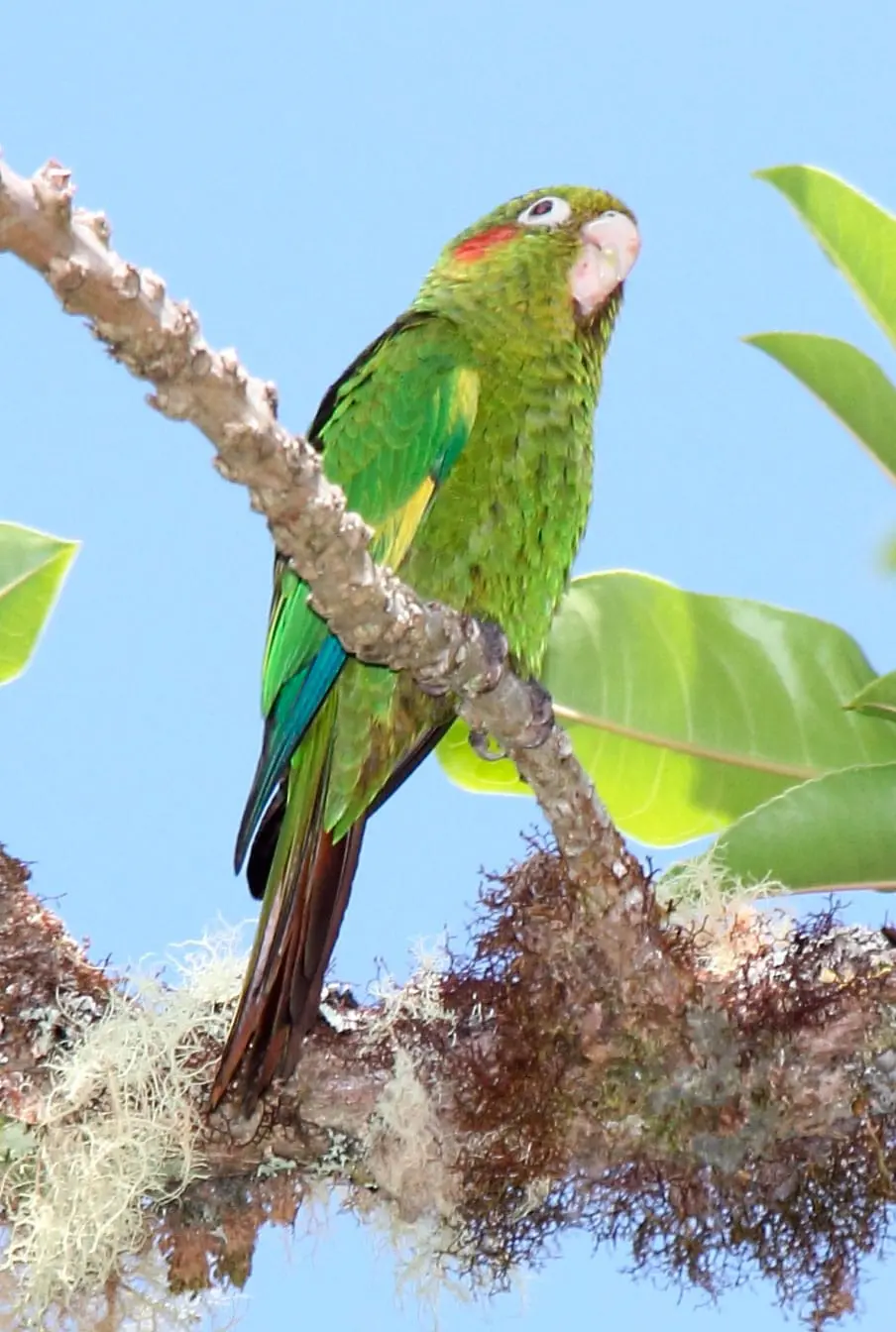
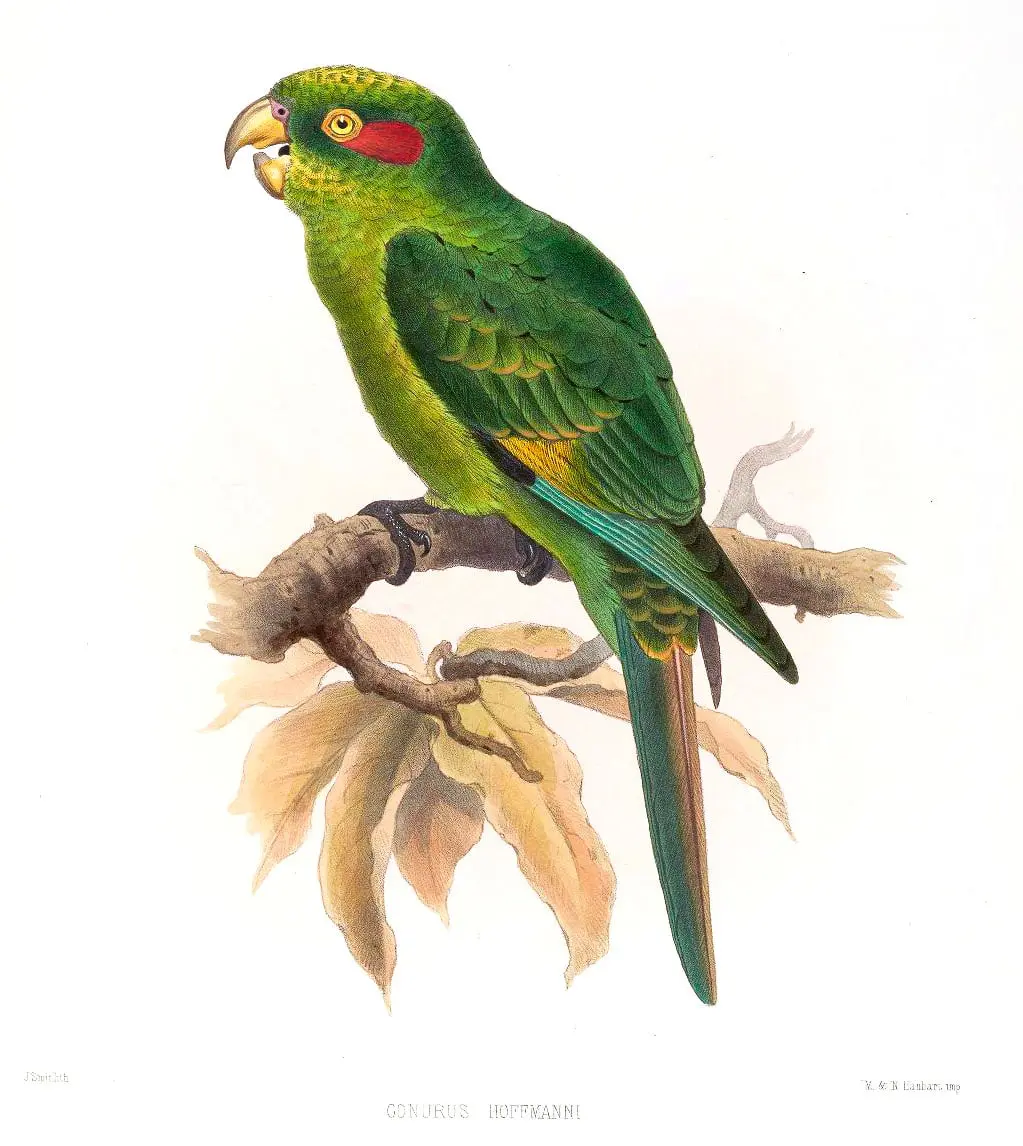
The Sulphur-winged Parakeet(Pyrrhura hoffmanni) It, mostly, green with some individual variations in plumage.
It has a distinctive tail long and round about ear-coverts crimson red. Yellow at the top of the wings, largely hidden when the bird is at rest, but perfectly visible in flight.
The feathers of the forecrown, crown, cheeks and nape, They are green with yellow centers (the proportion of the yellow color is higher in the forecrown, lower in the back of the crown). Above predominantly green, It is the leading edges of the wings, sometimes, yellow. The lesser coverts and median are, generally, green, sometimes with some yellow in outer median coverts and feathers alula.
Yellow at the base of the outerweb of the greater coverts. Outerwebs of primaries, to a great extent, blue; primaries and secondaries with bright yellow patch, especially on the basis of innerwebs; flight feather with black tips. Under, the wings with the lesser coverts green, the majors, greenish yellow; a central portion flight feather yellowed with greyish tips.
Chin reddish; throat, sides neck and the top chest, green with yellow tips on feathers, which gives an overall light effect Scaled. The belly, the flanks and undertail-coverts, are green. Upper, the tail is green, below, reddish.
The bill and cere They are pink colored horn; bare periophthalmic white or yellowish white; the irises brown; legs pale grey.
Both sexes are similar, but the male player has yellow stripes on pens crown.
The Immature It has less yellow in head, the chest and wings.
Sound of the Sulphur-winged Parakeet.
Subspecies description:
Pyrrhura hoffmanni gaudens
(Bangs, 1906) – Very similar to nominal, although feathers crown and nape They have yellower, with their ends red or red and orange (in some birds, red ends of the feathers may extend over the back, the throat and the chest). Underparts slightly darker.
Observed, mainly, in mountainous areas, preferring montane forests in the subtropical zone, mainly 1.000 to 2.400 meters above sea level, although views 550 meters in the region Admiral's Bay, Panama and a 3.000 metres in Costa Rica.
They appear to tolerate a considerable disturbance of habitat, including managed forests, areas and the second growth partially cleared, forests and wooded pasture shrubs. Usually seen in pairs or small flocks of 5-15 birds. You can perform altitudinal movements daily to feed, returning to the mountains to rest. Forage occurs in the canopy or smaller trees and bushes near the edge of the woods.
Reproduction:
They nest in tree hollows, including old nests woodpeckers, to 8-20 meters of land. With reproduce dry season (January June). Clutch six eggs in captivity.
Extending its range (players / residents): 18.400 km2
Confined south of Costa Rica and western Panama.
The species is found in the highlands of the southern half of Costa Rica, including the slopes of Caribbean, the mountains of the central plateau south and the two sides of the Cordillera de Talamanca, sometimes the region Cartago and Paradise and the Irazu volcano.
In western Panama They are mainly distributed in the west and center chiriqui and areas adjacent in Bull's mouths, in the highest mountains (including the chiriqui volcano and the high ridges on Boquette) and at lower elevations around, for example, of the Chiríqui Lagoon and Admiral Bay.
The easternmost Panamanian registry was found east of the central mountain range in 1868.
Some altitudinal movements (higher in the dry season). Birds are perhaps only sporadic in the extremities of their range. Apparently, It is common in the middle to high elevations of the Cordillera de Talamanca and in isolated areas, and it is believed to be quite numerous throughout the main range.
Its habitat It is now highly fragmented, though still apparently numerous, even in areas where the forest is partly cloudy. Rare in captivity.
• Current category of the Red List of the UICN: Least concern.
• Population trend: Stable.
• Population size : Unknown.
Rationale for the Red List category
Although this species may have a small range, it is not believed that approximates the thresholds for Vulnerable under the criteria of size range (Extension <20,000 km2 combinada con un tamaño de rango decreciente o fluctuante, extensión / calidad del hábitat o tamaño de la población y un pequeño número de lugares o fragmentación severa). La trend of the population It appears to be stable, so that the species does not approach the thresholds for Vulnerable under the criteria of population trend (> 30% decline over ten years or three generations). The population size It has not been quantified, but it is not believed to be close to the thresholds for Vulnerable under the criterion of population size (<10.000 individuos maduros con un declive continuo estimado> 10% in ten years or three generations or a population structure). For these reasons, the species is evaluated as Least Concern.
Justification of the population
The size of the world's population has not been quantified, but this species is described as «quite common» (Stotz et to the., 1996).
Justification of trend
They suspected that the population of Catana Cotorra is stable in absence of evidence of any decline or threatens substantial.
"Sulphur-winged Parakeet" in captivity:
Rare in captivity. Quieter than other parakeets. In Panama the export of these birds is prohibited from 1980.
– Avibase
– Parrots of the World – Forshaw Joseph M
– Parrots A Guide to the Parrots of the World – Tony Juniper & Mike Parr
– Birdlife
– Photos:
(1) – Sulphur-winged Parakeet (Pyrrhura hoffmanni). Photographed at Savegre, in Costa Rica By Dominic Sherony [CC BY-SA 2.0], via Wikimedia Commons
(2) – Parakeet HOFFMAN (Pyrrhura hoffmanni) Loro Parque, Tenerife by ZOOTOGRAFIANDO
(3) – A Sulphur-winged Parakeet at Savegre, Costa Rica By Dominic Sherony [CC BY-SA 2.0], via Wikimedia Commons
(4) – Sulphur-winged Parakeet (Pyrrhura hoffmanni) at Savegre Lodge, near San Gerardo, Costa Rica By Michael Woodruff [CC BY-SA 2.0], via Wikimedia Commons
(5) – Sulphur-winged Parakeet or Hoffmann’s Conure (Pyrrhura hoffmanni) by elite-pets
(6) – Conurus hoffmanni = Pyrrhura hoffmanni by Joseph Smit [Public domain], via Wikimedia Commons
 Minor Concern ⓘ
(UICN)ⓘ





 Captive Management Using Biological Data