▷ The world of Pets: Dogs, cats, birds, reptiles, amphibians

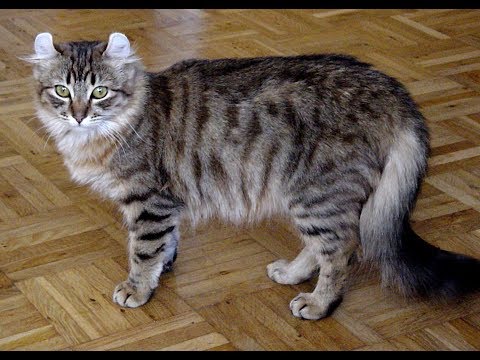
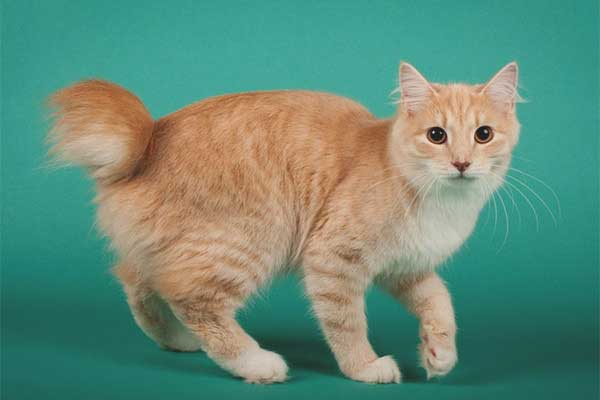
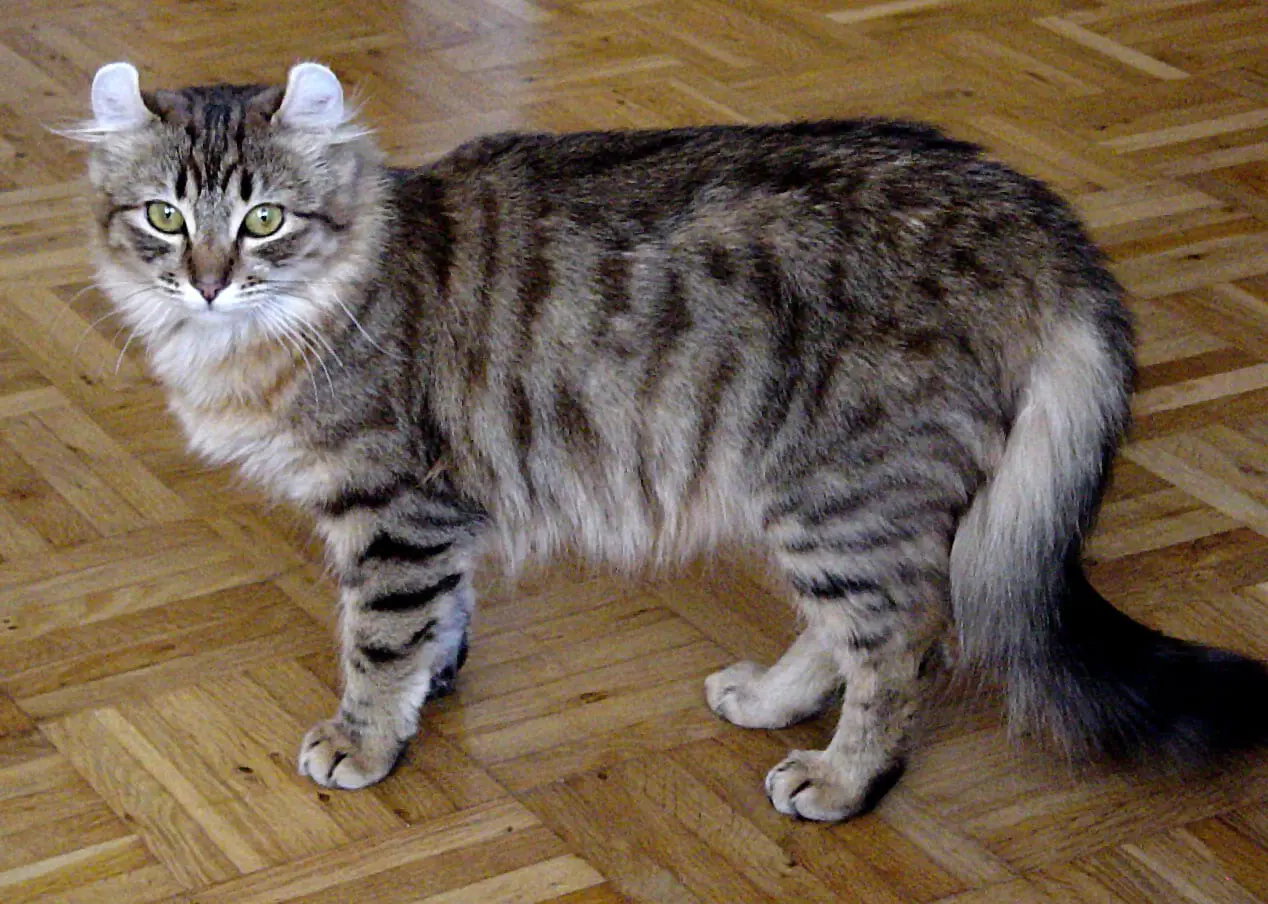
American Curl
Recognized by the CFA - AACE - TICA - ACFA - CAA

The American Curl not to be confused with Scottish Fold, having ears folded forward due to a mutation.
American Curl
Photo: Wilkipedia

Content

Characteristics "American Curl"

Coexistence is important that you have with your new friend. Before considering the acquisition of a cat of the breed "American Curl" you know certain factors. You must take into account their character, their need for exercise, their interaction with other pets, their care and if you have small children, their level of tolerance towards them.

Joy

4,0 of 5 stars (based on 1 review)

Activity level

4,0 of 5 stars (based on 1 review)

Friendliness to other pets

4,0 of 5 stars (based on 1 review)

Friendliness to children

4,0 of 5 stars (based on 1 review)

Grooming requirements

3,0 of 5 stars (based on 1 review)

Vocality

1,0 of 5 stars (based on 1 review)

Need for attention

4,0 of 5 stars (based on 1 review)

Affection towards its owners

4,0 of 5 stars (based on 1 review)

Docility

3,0 of 5 stars (based on 1 review)

Intelligence

4,0 of 5 stars (based on 1 review)

Independence

3,0 of 5 stars (based on 1 review)

Hardiness

4,0 of 5 stars (based on 1 review)

History

The American Curl was born in june 1981 en Lakewood, California ((UNITED STATES)UU.), when Joe Ruga saw two kittens in his garden on the way home from work and told his wife Grace not to feed them, to prevent them from being installed. Grace Ruga did the opposite, since he brought them food. It also, gave each one a name: the long-haired black female was named Shulamith, while his sister, white and black with semi-long hair, it was called Panda. An interesting feature of both females was that their ears were curved backwards.. But, at first the Ruga did not pay much attention to this feature.

Panda disappeared after a few weeks, and only Shulamith stayed with his adoptive family. A few months later, in December of 1981, gave birth to her first litter of four kittens, two of whom had the same curved ears as their mother. intrigued, Joe and Grace Ruga began to investigate and realized that these cats were not of any known breed. This was the beginning of American Curl, and all current representatives of the breed are direct descendants of Shulamith.

The Rugas were quick to consult Jean Grimm, judge of the Cat Fan Association (CFA) and breeder of Scottish Fold, who confirmed that this mutation was indeed new, but noted that it would be a long way to get recognition for a new breed.

In 1983, Shulamith was featured at a CFA feline show in Palm Springs, California, and the interest was immediate. A first standard was drawn up and many breeders decided to participate in the breed creation program by crossing kittens born from Shulamith..

At the same time, contacted two renowned feline geneticists, the Dra. Solveig Pflueger and Dr.. Roy Robinson, to study the genetic mutation responsible for the ears curled back American Curl. They quickly concluded that the mutation was a dominant gene, that is to say, that only one gene is required for the trait to occur.

The doctor. Robinson, settled in London, continued this study and analyzed 383 kittens of 81 litters before publishing a report in the Journal of Heredity in December of 1989, whose conclusion was to be paramount for the recognition of this new race: none of the cats studied had a defect, so the mutation was healthy for the animal.

But, the breeding program had started before the publication of this article, and the American Curl had already begun to attract professional and domestic cat fanciers, with unusual rapidity for such a new and still developing breed. The CFA allowed the registration of copies of American Curl already in 1986, and in 1988 the International Cat Association (TICA) became the first major organization to definitively recognize the breed, allowing its representatives to participate in feline exhibitions organized under its auspices.

In 1993, the CFA also definitively recognized the American Curl. It was even further, by recognizing two varieties in their own right: the American curl longhair and the American curl shorthair. Recognition of the latter is largely due to Shulamith, who gave birth to the first short-haired individual in her third litter, which showed that it was indeed the same race.

In 2003, the Fédération Internationale Féline (FiFé) also recognized the American Curl and its two varieties. But, some major organizations have not yet taken the step, in particular the Governing Council of the Cat Fancy (GCCF).

Although the American Curl is now all over the world, it is in North America where it is still most popular. In particular, is in the middle of the pack in number of annual CFA registrations.

In France, with an average of about 60 specimens registered each year in the Official Book of Feline Origins (LOOF) between 2013 and 2019, the American curl longhair represents less than 0,2% of the feline population. The short-haired variety is even rarer., with only 11 specimens registered in the same period.

Physical characteristics
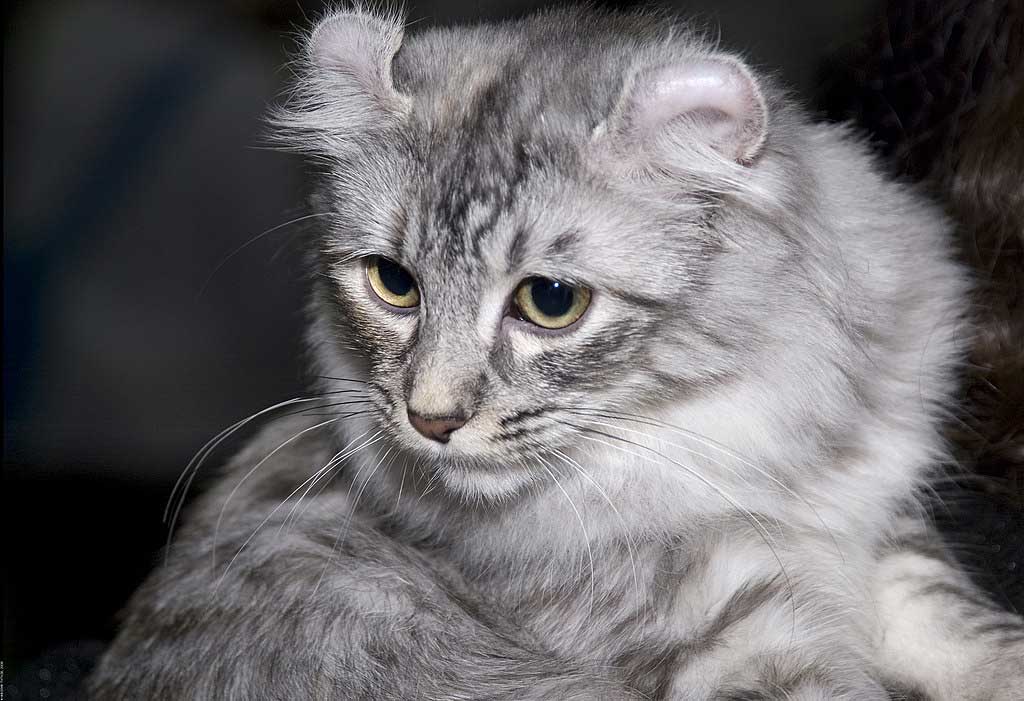
American Curl
Pointocurl Fiorentina, American curl presented at cat show. Nickolas Titkov from Moscow, Russian Federation, CC BY-SA 2.0, via Wikimedia Commons

The American Curl it is a medium-sized cat with a rectangular and moderately muscular body. The legs are straight and proportionate to the rest of the body, and tail it is as long as the body.

The head it is slightly longer than it is wide, well proportioned and without sharp transitions. The eyes are almond-shaped and moderately large, are well spaced and set slightly obliquely. They can have several colors, without any correlation with fur.

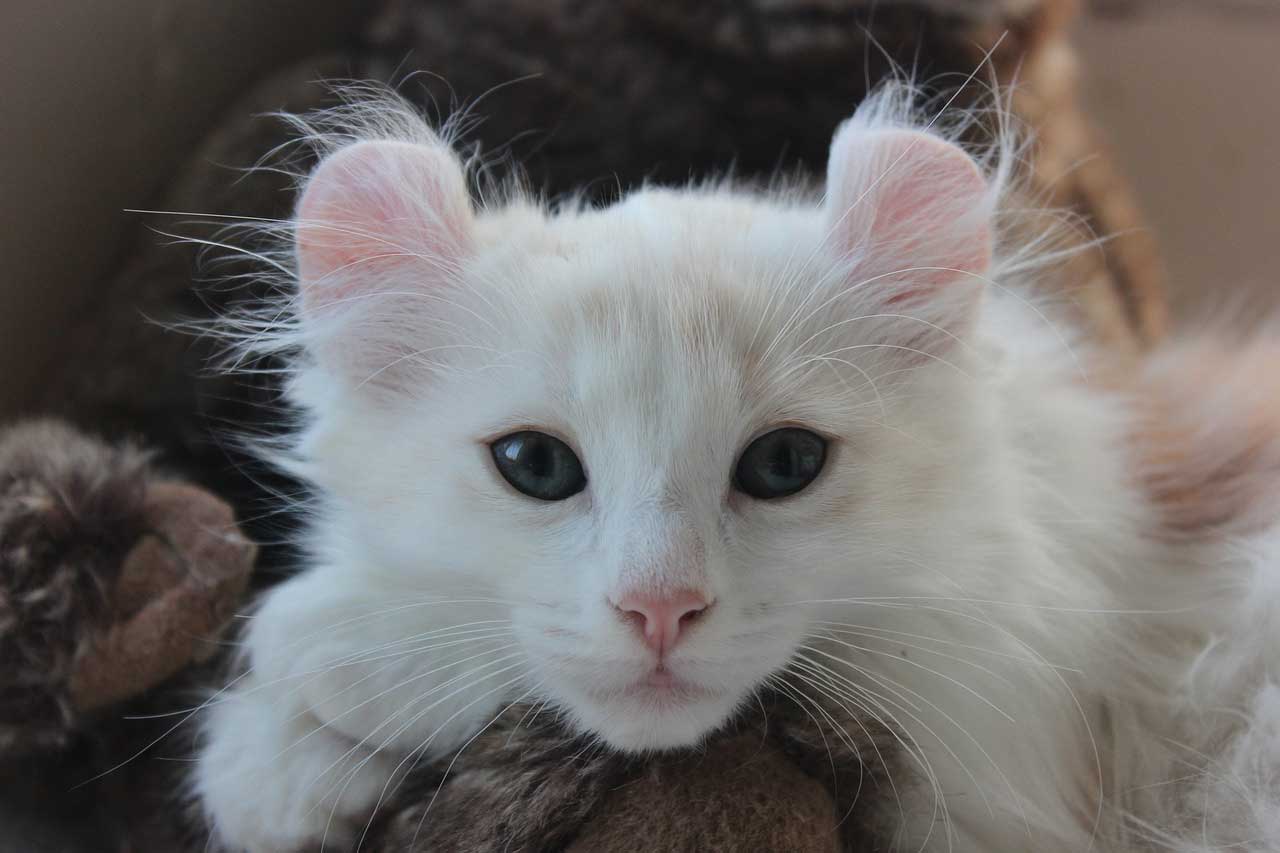
The term "Curl" ("curl" in Spanish), does not refer to fur, but at ears, which are the specificity of the breed. They are wide and open at the base, while the tip is rounded and curves back at an angle of between 90 and 180 degrees. At least the first third of the ear is made up of firm cartilage, similar to that of the human ear. On the other hand, the rest of its surface is smooth and flexible.

It is important to note that ears of the American Curl are curved back, not "broken": the line of curvature should be smooth like a circle, not steep like an oval.

But, the kitties American Curl are born with straight ears, then the cartilage begins to harden and they begin to take their typical shape. Its final shape occurs around the 4 months of age, and the breeder then determines the classification of the kitten:

  • first grade: slight curvature. The individual is destined to become a pet;
  • second grade: pronounced curvature, At right angles. The individual is destined for reproduction;
  • third degree: well marked curvature, in "crescent moon". The individual is destined for exhibitions.

  • The hair can be long or short, depending on the variety. In all cases, the texture is fine, silky smooth, and the undercoat is minimal or non-existent. It also, different standards accept all coat colors and patterns.

    Last, the sexual dimorphism it is well marked, being the male larger than the female.

    Size and weight

  • Male size: Of 22 to 28 cm.
  • female size: 20-26 cm.
  • Male weight: 3,2-4,5 kg
  • female weight: 2,3-3,6 kg

  • Varieties of "American Curl"

    The American Curl it comes in two varieties: the American curl longhair (ACL) and the American curl shorthair (ACS).

    Both varieties are officially recognized by the American Cat Fancier’s Association (CFA), as well as for the Fédération Internationale Féline (FIFé) and International Cat Association (TICA).

    Character and skills
    American Curl
    American Curl

    The American Curl is known for his great sociability and affection for his family. He likes to follow his master around the house and snuggle up next to him. But, they are not very affectionate: they appreciate being caressed, but they are just as happy when they are around their family.

    It is a breed of cat recommended for use with children: He gets along very well with them and often seeks their company., either to play or just to have a moment of tenderness. But, you have to be careful with younger children to make sure they know how to behave around a cat: despite his affable nature, to the American Curl does not like to have his tail or whiskers pulled, and can respond with a scratch.

    Their sociability extends to other animals, and accepts the presence of other cats and / or dogs accustomed to cats without difficulty. On the other hand, coexistence with small rodents is not recommended, reptiles or birds: the american curl is still a feline, and his hunting instinct can resurface at any time.

    On the other hand, the other side of its sociable nature is that it is a breed of cat that does not like to be alone. Homeowners who are away often find things spilled and / or shit out of the litter box: it's his way of letting you know he's not happy to be left alone. The presence of other pets is an interesting solution to partially solve this problem: if you have a playmate at home, being left alone all day while their owners are away is much less likely to be a problem.

    On the other hand, the American Curl is moderately active, but he is a very playful cat. Although they reach maturity around 2-3 years of age, they retain their kitten behavior until old age. Some call them the "Peter Pan of cats.". Thus, it is common to see a American Curl chasing a ball or playing with an object thrown by its owner.

    You don't necessarily need an outside space, It is a breed of cat adapted to life in a flat. But, it is important to note that many American Curl They have learned to handle a door knob and do not hesitate to open doors and cabinets.

    Whether they are confined indoors or have access to the outdoors, they like to be able to observe their territory from above: That is why it is quite common to find this excellent climber perched on top of a closet or on a curtain rod., or even on a tree or even on the roof, if you can go abroad. A tall tree for cats, where can i play, sleep and observe what happens around you, it is undoubtedly one of the best gifts that its owner can give it.

    Last, the American Curl it's not very noisy, but he likes to show his affection by butting his head, a common habit among his older cousins, the Lions. As these displays of affection can occur at any time of the day or night, the master who allows his cat free access to his bedroom should expect to be woken from time to time by his little companion, who comes to rub against him to show his affection, before falling asleep next to him.

    Health
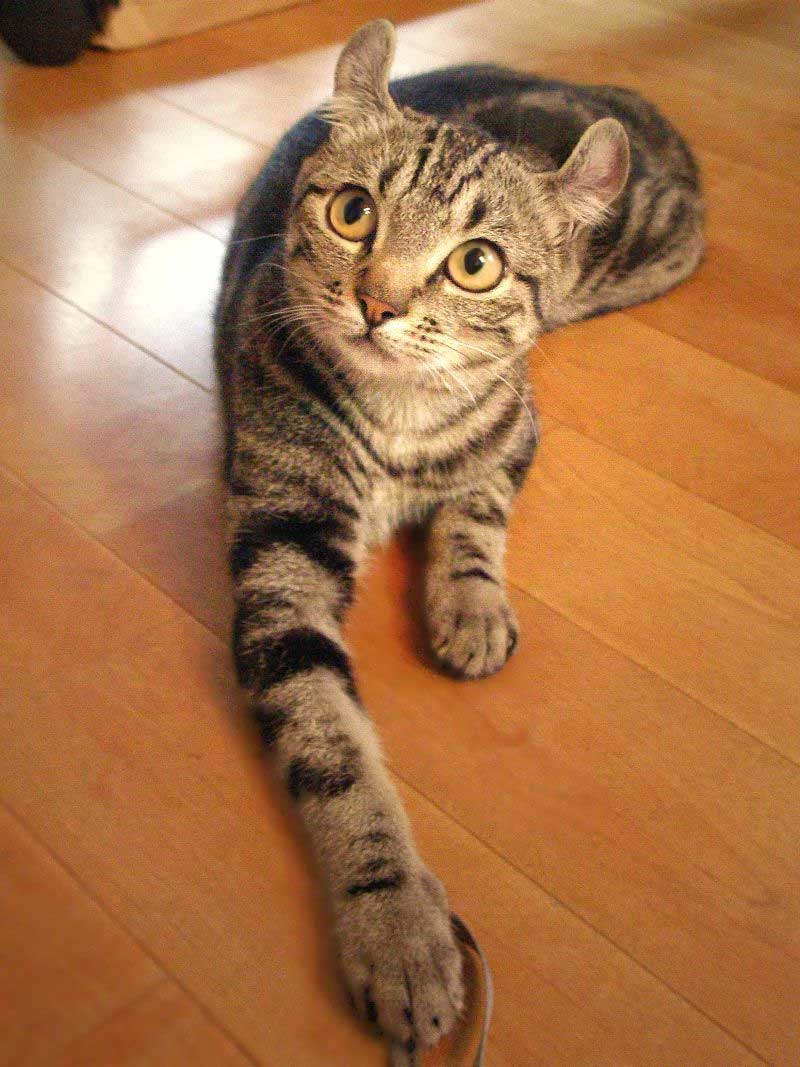
    American curl
    American curl – tanakawho, CC BY 2.0, via Wikimedia Commons

    The American Curl it is a very robust cat breed. Thanks to its stray cat origins and a breeding program that has favored crosses with other perfectly healthy domestic cats, does not present any genetic problem.

    But, some lines have a narrow ear canal, which is not a problem in itself, but it poses a higher risk of infection if the cat's ears are not maintained regularly enough.

    Obesity is another risk, and a responsible owner must ensure that the cat is sufficiently active and not overweight.

    Life expectancy

    12 to 14 years

    Grooming

    The maintenance of American Curl is simple, since brushing once a week is enough to keep the coat healthy and shiny and avoid possible knots.

    The American Curl molts very little in general, although the long-haired variety can shed a bit more when temperatures rise. So, in summer it may be useful to increase the number of brushing sessions to two per week to remove dead hair.

    The brushing session should be complemented by a quick check of the teeth, eyes and ears to make sure they are clean.

    You should also check from time to time that its claws are not too long, which may be especially the case if you don't have a scratching post available. If they are, just cut them with a nail clipper.

    Food

    The American Curl is not picky and can be fed commercial cat food, either kibble or cat food, without any problem. But, the food must be of good quality and adapted to their age and activity level, to provide you with the necessary nutrients and vitamins.

    Like most cat breeds, are capable of self-regulation, so it is better to leave food at their disposal. You must also have access to fresh water at all times.

    But, it is important to regularly check that your cat is not overweight: if so, it is advisable to consult a veterinarian to establish a feeding program that best suits his lifestyle and needs.

    For sale "American Curl"

    If you want to buy a American Curl, you should find a trusted breeder in your area. As the breed is not far outside its country of origin, you will have a hard time finding one. If there is no breeder association, you will have to resort to private breeders.

    On the Internet you can always find kittens at a great price, But you have to be careful. Before buying a kitten, inform yourself well and also look at parents and siblings. You can get a healthy, purebred kitten from a reputable breeder for about 800 EUR. The price depends on the curvature of the ears. The more elegant the curved ears are, the more expensive the cat will be. Only cats with third degree ears, that is to say, a graceful curve like a crescent, can be officially used for breeding and exhibition.

    Videos "American Curl"

    Get to Know the American Curl
    Get to Know the American Curl
    American curl / Cat Breed
    Curl americano / Raza de Gato

    ▷ The world of Pets: Dogs, cats, birds, reptiles, amphibians

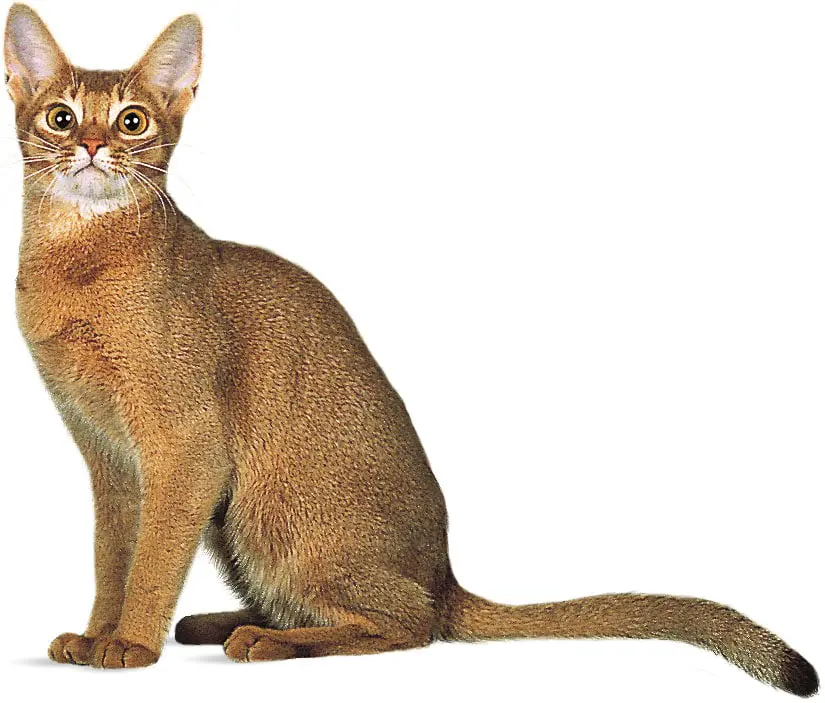
    Abyssinian cat
    Tabby and Silver/Smoke.

    Abisinio
    Photograph. Encyclopædia Britannica

    Content

    History

    The name of Abyssinia refers to Ethiopia, but most of the stories about the origins of the Abyssinian refer to Egypt. Investigation of its genes suggests that the Abyssinian cat breed originated near the coast of the Indian Ocean., where could settlers have bought the animal traders of wild animals. The breed was developed in Egypt.

    The race could originate from an Egyptian cat named Zula, which was purchased in a port of Alexandria by a British soldier and brought to England in 1868. This theory is not established because there is no strong link between Zula and the first cat on the list named as an Abyssinian in 1882.

    Many sources date the Abyssinian breed to be a few thousand years old., coming from the old Egypt , as cats that appear in ancient paintings. The ancient Egyptians made sculptures of them. There are also stories that wild "Abyssinians" living in parts of North Africa today.

    Physical characteristics

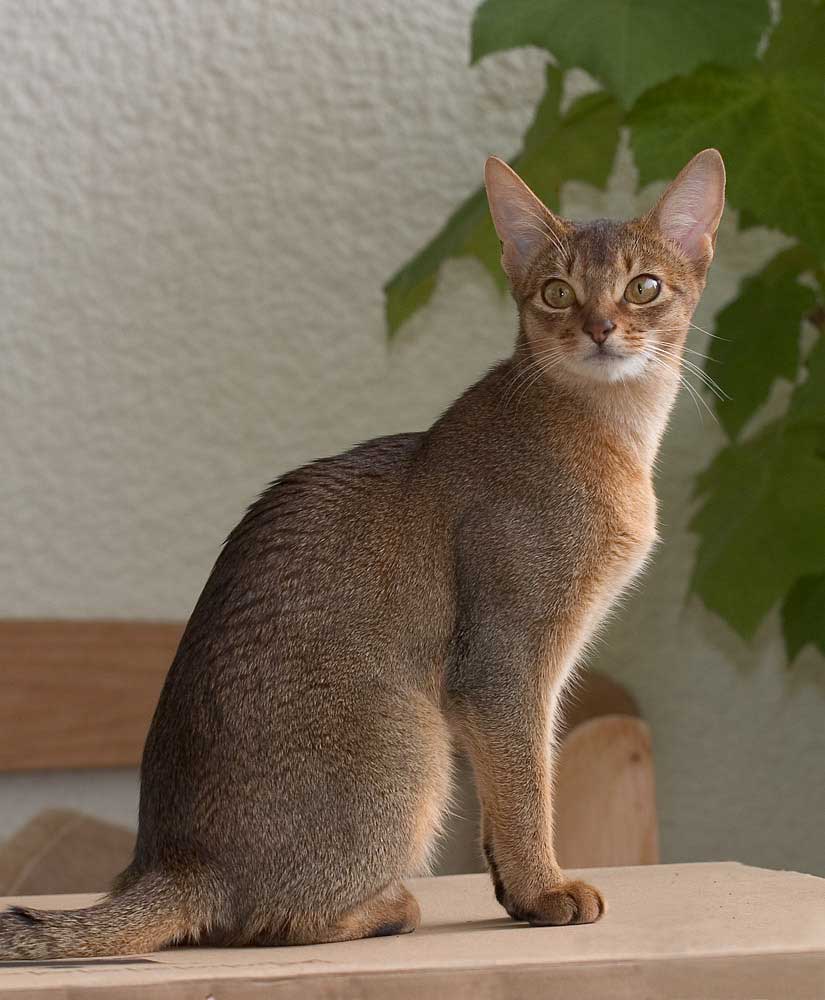
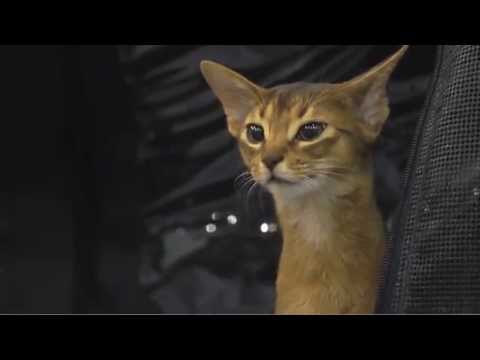
    The appearance of the "Abyssinian cat" resembles that of a small puma. They are elegant and athletic cats with long, small legs.. Wedge-shaped head sits atop a graceful neck and has large ears set wide apart. Some cats have tufts of hair on their ears similar to those of the lynx. The eyes, big and almond shaped, they can be green, walnut brown or amber. The specially colored coat of the purebred cat is short, soft and close to the body. Each of the hair is ringed in various colors, which creates a great effect. This so-called tic-tac can be pronounced in different variations.

    The breed standard includes all four chestnut colors (bright copper red with chocolate brown bands), blue (warm blue-gray with dark steel gray bands), leonado (muted beige with dark cream bands) and the typical wild color (reddish brown with black bands). Of all the colors there is also the Silver variety, where the base color is a light silver shade. Ideally, cats should be completely free of patterns and markings..

    Character and skills

    The "Abyssinian cat" is considered an intelligent and active cat breed, who gets excited about any kind of game. Especially when he's young, the cat has an irrepressible temperament and a great desire for movement. Prefers to play with other cats, so it is not recommended to have it alone. These curious cats are very people-oriented and follow their humans everywhere. In doing so, they rarely become pushy with a soft voice and prefer to watch their two-legged friend's every action. When they get stressed, these uncomplicated cats react extremely robustly and do not let anything disturb them.

    Care "Abyssinian cat"

    Indoor or outdoor cat?

    The "Abyssinian cat" it is an active and freedom loving breed that needs a lot of exercise. It's hard to be happy locked up in a small apartment. Secure access to the outdoors would be ideal for this active breed.. Walks in the enclosed garden or on the balcony give the cat a lot of pleasure. If neighborhood conditions permit, it is also a great outdoor cat.

    How much activity does he need? "Abyssinian cat"?

    If you purchase a "Abyssinian cat", you should not expect a well behaved lap cat. He loves to explore his surroundings, climb and jump. Thanks to its enormous resistance and jumping power, no part of the house is safe from her. A tall, stable cat tree is an absolute must for every cat owner.. Here you can live your desire to move, as well as sharpen their claws and rest. The clever velvet paws also rejoice in any kind of mental occupation and cheerfully accept intelligence toys. They like to be taught little tricks and enjoy going for a walk on or off the leash with their owner..

    Care and feeding

    Thanks to its short coat with little undercoat, cat grooming is especially easy. It is enough to remove the loose hairs from the coat with a rubber brush from time to time. When the coat changes, brush a little more often to soothe the cat. To be happy, cats also need a balanced and healthy diet. It is best to adapt the food to the age of the cat and its desire to move. There should also always be enough fresh drinking water available. A bubbling water bowl is easily accepted by most breed representatives.

    For sale "Abyssinian cat"

    Before acquiring an Abyssinian cat, you need to make sure you can offer this four-legged friend a species-appropriate home. Once the decision is made, it is best to buy the kitten from a reputable breeder from a registered breeding association.

    Pay attention to the behavior and appearance of kittens and parents. For a purebred kitten with papers you pay a few 800 EUR.

    Characteristics "Abyssinian cat"

    Coexistence is important that you have with your new friend. Before considering the acquisition of a cat of the breed "Abyssinian cat" you know certain factors. You must take into account their character, their need for exercise, their interaction with other pets, their care and if you have small children, their level of tolerance towards them.

    Joy

    5,0 of 5 stars (based on 1 review)

    Activity level

    5,0 of 5 stars (based on 1 review)

    Friendliness to other pets

    3,0 of 5 stars (based on 1 review)

    Friendliness to children

    2,0 of 5 stars (based on 1 review)

    Grooming requirements

    2,0 of 5 stars (based on 1 review)

    Vocality

    1,0 of 5 stars (based on 1 review)

    Need for attention

    4,0 of 5 stars (based on 1 review)

    Affection towards its owners

    4,0 of 5 stars (based on 1 review)

    Docility

    1,0 of 5 stars (based on 1 review)

    Intelligence

    4,0 of 5 stars (based on 1 review)

    Independence

    3,0 of 5 stars (based on 1 review)

    Hardiness

    2,0 of 5 stars (based on 1 review)

    images of "Abyssinian cat"

    Abyssinian cat

    Videos "Abyssinian cat"

    Abyssinian cat

    Abyssinian cat
    Abyssinian Cat Breed

    Abyssinian Cat Breed

    Alternative names:

    1. Abyssinian, Abys (English).
    2. Bunny Cat, Aby (French).
    3. Abessinier (German).
    4. Abisinio (Portuguese).
    5. Abisinio (español).

    ▷ The world of Pets: Dogs, cats, birds, reptiles, amphibians

    Manx cat
    Federations: LOOF, CFA, ACF, ACFA, TICA, FIFé, WCF

    According to reports, King Edward VIII was a fan of the Manx cat and often attended cat shows with the breed. The British formed the first club on the Isle of Man in 1901.

    Content

    Characteristics "Manx cat"

    Coexistence is important that you have with your new friend. Before considering the acquisition of a cat of the breed "Manx cat" you know certain factors. You must take into account their character, their need for exercise, their interaction with other pets, their care and if you have small children, their level of tolerance towards them.

    Joy

    4,0 of 5 stars (based on 1 review)

    Activity level

    3,0 of 5 stars (based on 1 review)

    Friendliness to other pets

    5,0 of 5 stars (based on 1 review)

    Friendliness to children

    5,0 of 5 stars (based on 1 review)

    Grooming requirements

    3,0 of 5 stars (based on 1 review)

    Vocality

    2,0 of 5 stars (based on 1 review)

    Need for attention

    3,0 of 5 stars (based on 1 review)

    Affection towards its owners

    4,0 of 5 stars (based on 1 review)

    Docility

    4,0 of 5 stars (based on 1 review)

    Intelligence

    4,0 of 5 stars (based on 1 review)

    Independence

    3,0 of 5 stars (based on 1 review)

    Hardiness

    1,0 of 5 stars (based on 1 review)

    History

    The Manx cat It has existed since the middle of the 18th century on the Isle of Man, situated between England and Ireland, but its exact origins are the subject of speculation. A legend says that it was the last animal to climb into Noah's Ark and that its tail was cut off when the door was closed.. Another legend claims that the invaders, Vikings or Irish depending on the version, they cut off the kittens' tails to use as good luck charms: to protect their young, mother cats would have cut off their tails with their teeth at birth. Last, another wild theory is that it is the result of a cross between a cat and a rabbit, but it has been scientifically proven that it has no basis.

    In fact, the most likely explanation is that it is a genetic mutation that appeared spontaneously among the island's feline population and spread rapidly thanks to its dominance (it is enough that one of the two parents is a carrier of the corresponding gene, and therefore have this characteristic, so that some of the kittens are in the same case).

    Manx cat
    This is a one year old rumpy manx cat – Michelle Weigold, CC BY-SA 4.0, via Wikimedia Commons

    The presence of cats on the Isle of Man is also the subject of speculation. One of the theories is that the Vikings took them to the 9th century, another that the English sailors took on their frequent voyages from the 13th century and another that arrived with the survivors of the sinking of a Spanish galleon in 1588. All these explanations may have some basis of truth, but one thing is true: the first representatives of the feline species that appeared on the island had a full tail.

    What is also true is that the fact that the Isle of Man was a port with some international traffic in a context of increasing trade facilitated the spread of manna around the world during the 19th century., especially in the UK (since the beginning of the century) and then in the United States. This is how the Manx became one of the breeds exhibited in the first cat shows in history, which were held in Great Britain from 1871. In 1903 a breed standard was developed and the famous Cat Fanciers’ Association (CFA) recognized the breed at its founding in 1906. The same happened with the creation of the Fédération Internationale Féline (FIFé) in 1949, and then with the TICA (The International Cat Association) in 1979.

    Authentic national symbol of its island of origin, where it appears mostly in coins, seals, postcards and badges, manx is still unpopular outside, despite its long history and international recognition. In United States, CFA statistics place the Manx cat between the posts 25 and 30 (of about 45) in the ranking of breeds according to the number of annual registrations. In Great Britain, there has even been a certain disaffection for this cat since 2006: while in 1997 and 2006 about forty individuals were registered per year, now their number can be counted on the fingers of one hand, although 2018 marked a jump, with 22 registered births. It remains to be seen if this holds up over time.… In France, In addition, it is a rare breed of cat, since they only registered 56 specimens in the Official Book of Feline Origins (LOOF) between 2003 and 2019. Their number is even zero in some years.

    Physical characteristics

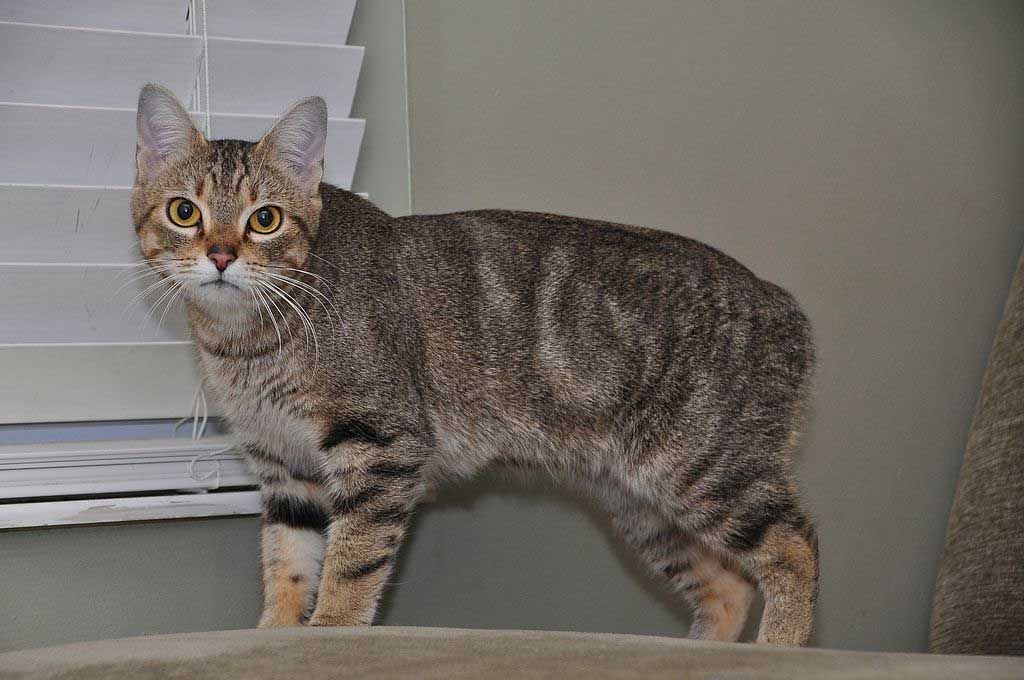
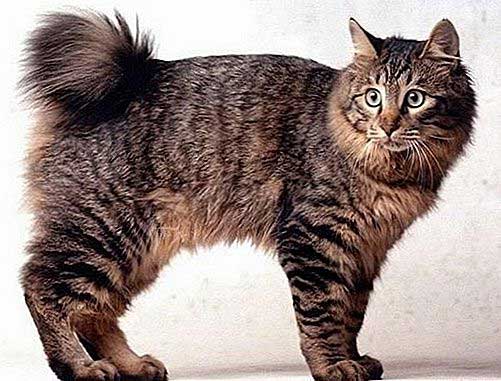
    The Manx has a short morphology / Cobby. Its body it is compact and curvilinear, but well muscled and with good bones. The legs foreheads are short and widely spaced, while the rear ones are much longer.

    Like the rest of the body, the head of the Manx cat she is also plump, seated on a neck wide and short. The ears are size medium, wide at the base and rounded at the tip. The eyes they are large and round and can be of various colors: yellow, copper, Hazelnut, green or even blue.

    The no tail is the most distinctive feature of this cat. Unlike in the Bobtails, they have a short tail, the Manx has no tail at all (variety rumpy), or just a bone growth (variety riser) consisting of one to three sacral vertebrae, that is to say, at hip level. The standard of the Official Book of Feline Origins (LOOF) also recognizes specimens with a short tail formed by between 1 and 3 caudal vertebrae, that is to say, located beyond the hips and that, Therefore, already forms a queue (variety "stumpy«), but neither the Cat Fancier’s Association (CFA) neither him Governing Council of the Cat Fancy (GCCF) accept them. There's also Manx cats that have a tail as long as that of another breed (variety "longy«); they are not recognized as Manxs by no rule, but they remain in the breeding program, since they can still give birth to tailless individuals («rumpy» o «riser«).

    The fur consists of a dense, cottony undercoat and a harder, glossier topcoat. The undercoat may be less dense in summer, and white or light-colored specimens may have a softer top coat. Your top coat can be short or long. But, while some organizations consider that the Manx longhair it is a mere variety, other (as the Fédération Internationale Féline or The International Cat Association) consider it a breed in its own right, other than Manx and named Cymric cat.

    All are accepted coat colors, except for those resulting from hybridization: chocolate or lavender. Similarly, all patterns are possible except the Himalaya.

    Last, the sexual dimorphism it is well marked, the female being smaller than the male.

    Size and weight

    • Size: 35 cm.
    • Weight: Of 3,5 to 5,5 kg
    Manx
    Chatelaine, ginger tabby Manx cat – Flickr

    Varieties of the “Manx Cat”

    The Manx longhair, also known as Cymric cat, is considered by feline associations well as a simple variety of the Manx (this is the position taken by the British Governing Council of the Cat Fancy and American Cat Fanciers’ Association), fine as a breed in its own right (this is the case, for example, of the Fédération Internationale Féline and The International Cat Association).

    It also, not all individuals, whether they are short or long hair, completely lack a tail (variety rumpy) or have a small bump made up of one to three sacral vertebrae (variety riser). There are also short-tailed individuals (stumpys) with one to three vertebrae in the tail, and long-tailed individuals.

    The latter are not considered Manx, but nevertheless they are used in the breeding program, since they can give birth to healthy litters with kittens rumpy or riser. This is lucky, since the offspring of two parents rumpy or riser it's troublesome, since some of their offspring are victims of the manx syndrome or even die before being born.

    Character and skills

    The Manx cat he is affectionate with his whole family, but he usually has a favorite person who he follows around the house and with whom he likes to rest. They are perfectly capable of spending the day alone when their owners are away., but they prefer the company of their humans to solitude: they are not a suitable cat breed for someone who is absent often.

    Its playful nature makes it a breed of cat suitable for children, provided they have learned to behave with and respect animals. He also gets along well with other cats and with dogs accustomed to cats, as long as they get to know each other little by little. On the other hand, how he has preserved his hunting instincts, the little rodents, birds or fish would run a great risk of a quick and tragic end if they had to cohabit with a Manx.

    Rather suspicious in character, is reserved with strangers and is even an excellent guardian cat -or at least alert-, who does not stop warning his master when a newcomer approaches. If you see that the owner remains calm, accept the situation and observe it.

    Clever and skillful, the Manx cat It is a good option for those who want to teach their cat tricks, as for example, to retrieve an object. They are also very good when walked on a leash. On the other hand, his intelligence can also turn against his master: It is very probable, for example, who understands how a doorknob works, so it is advisable to close the food cupboard.

    This is especially true because, despite his fat and lack of a tail, that might be mistakenly thought to impair your sense of balance, the Manx is surprisingly agile and active. Its powerful hind legs make it an excellent jumper, and it is quite common to find it sitting on top of a cupboard. Having said that, it is also a breed of cat that adapts well to life in a flat, as long as I have enough opportunities to run and play.

    From its island origins, the Manx cat retains a fascination for water, what can take you, for example, to observe a tap that is open for a long time or to play with the water in the bath. But, this does not go much further: does not like to get wet and, therefore, does not have the possibility to follow his master in the shower.

    Last, this cat has a nice voice, who does not hesitate to share with others by having a conversation from time to time.

    Grooming "Manx cat"

    Manx
    Manx cat – pixabay

    The Manx it is an easy cat to care for: just brush it once a week to keep its coat healthy. But, this frequency should be increased during the annual spring and fall molts, when it is necessary to brush every 2 or 3 days to remove excess dead hair.

    Weekly brushing of the cat's hair is an opportunity to ensure that its teeth are free of cavities and tartar., and that their eyes and ears are clean. They should be cleaned with a damp cloth.

    Last, if they have become too long, you should cut your cat's nails with a nail clipper to prevent it from being hindered in its movements. But, this operation is not usually necessary, since a cat trims its nails regularly and keeps them in good condition and with the right length.

    Health and nutrition

    The Manx cat is a carrier of a gene responsible for the disappearance of its tail, what has consequences on your health. This gene is dominant (it is not necessary for both parents to have this anatomical feature for their kittens to have it), but it is not expressed in the same way in all cats, so some do not have a tail, while others have a partial tail.

    "Manx cat"

    rumpy riser tail Manx cat
    This is an example of a «rumpy riser» tail in a Manx cat – Michelle Weigold, CC BY-SA 4.0, via Wikimedia Commons

    A fetus that receives two mutated genes has serious developmental problems and usually dies in the womb.. Those with only one mutated gene manage to develop, either no tail or with a short tail; In the latter case they are called variety «stumpy«. But, between 20% and the 30% of them are affected by what is commonly called "Manx syndrome.".

    Affects the spine and various internal organs, like bladder, intestines or stomach. These deformities are fatal in the long run, so affected kittens are usually euthanized. Those who are not usually die after 3 or 4 years, with a peak of 5 years. The syndrome is detectable from 4-6 months old watching the kitten, so a responsible Manx breeder will not put kittens up for adoption before this age.

    Individuals who are saved tend to live long, most exceed 15 years of age and some reach 20. Yes indeed, are more likely to suffer from certain diseases:

    • The tail arthritis, which mainly affects purebred individuals and can be very painful for the animal;
    • The corneal dystrophy, a genetic eye disease that begins around the 4 months old and causes vision problems that can lead to blindness.

    Food

    The Manx is not picky about food and can be fed commercially available industrial cat food without any problem. It must be ensured that the quality of the feed is sufficient to provide the necessary essential nutrients, depending on the age and activity level of the cat.

    This cat is a greedy guy and has a healthy appetite. So, not necessarily capable of self-regulation, so it is best to avoid leaving food at your disposal all the time: its owner must, on the other hand, make sure to provide you with daily rations tailored to your needs, and ensure that you are not overweight. If this is the case, a veterinarian should be consulted to establish an appropriate feeding program.

    For sale "Manx cat"

    The price of a kitten Manx male is about 800 EUR, while that of a female Manx is of some 700 EUR.

    Videos "Manx cat"

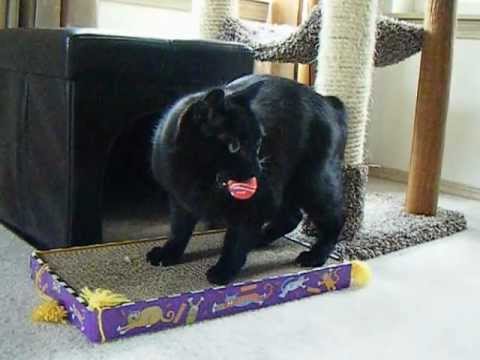
    Silly Manx cat playing

    Epic battle between Boston Terrier and Manx cat

    Alternative names:

    • Manks
    • Stubbin
    • Rumpy
    • Isle of Man cat

    ▷ The world of Pets: Dogs, cats, birds, reptiles, amphibians

    Himalayan cat
    Federations: ACFA, TICA, WCF

    The Himalayan cat it is an extremely sweet pet, playful and gentle that can be adapted to practically any type of home.

    Himalaya

    Content

    Characteristics "Himalayan cat"

    Coexistence is important that you have with your new friend. Before considering the acquisition of a cat of the breed "Himalayan cat" you know certain factors. You must take into account their character, their need for exercise, their interaction with other pets, their care and if you have small children, their level of tolerance towards them.

    Joy

    3,0 of 5 stars (based on 1 review)

    Activity level

    1,0 of 5 stars (based on 1 review)

    Friendliness to other pets

    4,0 of 5 stars (based on 1 review)

    Friendliness to children

    4,0 of 5 stars (based on 1 review)

    Grooming requirements

    5,0 of 5 stars (based on 1 review)

    Vocality

    1,0 of 5 stars (based on 1 review)

    Need for attention

    4,0 of 5 stars (based on 1 review)

    Affection towards its owners

    5,0 of 5 stars (based on 1 review)

    Docility

    5,0 of 5 stars (based on 1 review)

    Intelligence

    2,0 of 5 stars (based on 1 review)

    Independence

    2,0 of 5 stars (based on 1 review)

    Hardiness

    2,0 of 5 stars (based on 1 review)

    History

    Also know as Colourpoint Persian, the Himalayan cat It is a breed of cat that combines the colors of the Siamese cat with the Traditional Persian cat. It is a cross between semi-long-haired Siamese twins and blue and black persian cats.
    Some feline associations, as the American Cat Fanciers’ Association (ACFA), they consider it a separate breed, while others, as the Cat Fanciers’ Association (CFA), they see it rather as a variety of Persian cat, from which it only differs in the color of the coat. Its name is due to the similarity of its coloration with that of a domestic rabbit also called Himalaya.

    Its origins date back almost a century., when breeders dreamed of combining the colors of the Siamese Cat with the Traditional Persian cat. At the beginning of the year 30, in United States, the Dr. Clyde Keeler, researcher at Harvard University School of Medicine, undertook a hybridization program for this purpose, in collaboration with a breeder, the Mrs. Virginia Cobb. The results were not entirely satisfactory and the experiment was interrupted by the Second World War.. After the war, another passionate breeder, the Mrs. Marguerita Goforth, took the torch and managed to create a «Colourpoint Persian cat» which was recognized in 1957 by the CFA and ACFA as a new breed called «Himalayan«. At that time, the breeder had to prove the existence of three generations of «Colorpoint» pure so that this line was accredited as a new breed and could participate in competitions and championships.

    In the meantime, in Britain, Brian Sterling-Webb, another enthusiastic breeder, worked for a decade on the development of a similar hybrid that, in 1955, was registered as a separate breed called «Colorpoint longhair cat" for him Governing Council of the Cat Fancy (GCCF).

    Over the next decade, the popularity of Himalayan cat grew significantly. But, breeders began to interbreed only with himalayan. As a result, the characteristics inherited from Persian cat they were lost in favor of individuals with a less flattened face. This led some breeders over the years 70 to use occasionally pure persian cats at the crosses, in order to increase again the characteristics of this breed in the Himalayan cat. This was so successful that the cats resulting from this selection ended up having all the characteristics to compete in competitions. Persian cat. Inevitably, the question arose: should he Himalayan cat still consider themselves a breed unto themselves?

    In response to this question, the CFA decided on 1984 consider the Himalayan as a subdivision of the Persian cat, keeping your name. It was followed by World Cat Federation (WCF). But the ACFA, as well as the International Cat Association (TICA), they kept it as a separate race.

    Today, the Himalayan cat still a very popular cat in North America, but less in Europe.

    Physical characteristics

    Himalayan cat
    Himalayan cat – Joseph Morris, CC BY-SA 4.0, via Wikimedia Commons
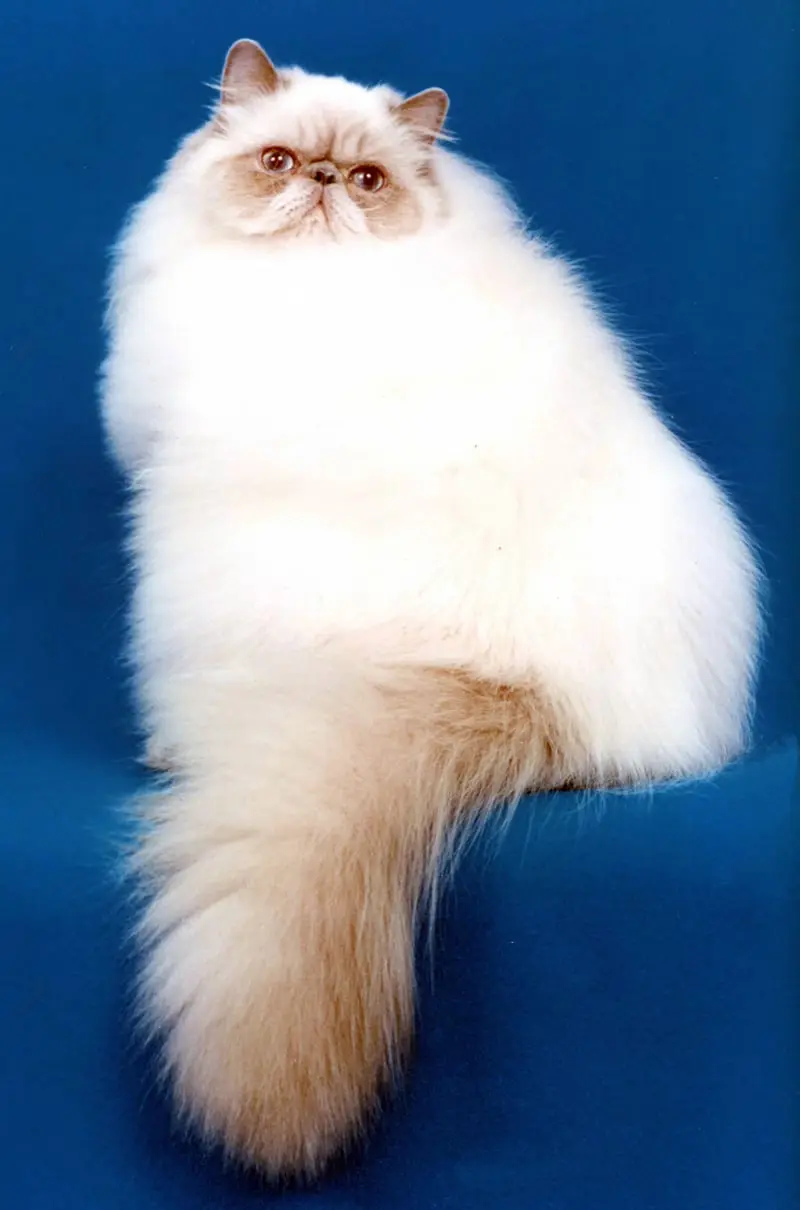
    The Himalayan cat, like the persian, it is a solid and round cat, with short legs, short tail and small, rounded ears. According to American Cat Fanciers Association (ACFA), must have five fingers in front and four behind.

    As with the Persian, There are two types of himalayan: the classic “baby face” and the flatter “Pekingese face”, which gets its name from its similarity to the dog Pekingese.

    Most of the cat's coat is white or cream in color, but there are some varieties, according to the different shades of the tips of the coat and the extremities of the body.

    Size and weight

    • Size: 30 cm.
    • Weight: Of 3 to 6 kg

    Varieties of "Himalayan cat"

    Distinguished by the color of the extremities of the body and the tips of the coat, the main Himalayan varieties are

    Blue Point:
    • the tips of the fur are blue, like feet, the ears, tail and face. The rest of the body is slightly bluish white, and the eyes are bright blue.
    Lilac Point:
    • In this variety, the extremities of the body and the tips of the coat are paler and lilac than blue. The rest of the body is whiter and brighter than in the Blue Point.
    Seal Point:
    • The extremities of the body and the tips of much of the body are black or dark brown (similar to the color of the seal, that inspired his name). It is the variety whose color is most similar to that of the Siamese.
    Chocolate Point:
    • The tips of the body and the tips of the coat of this variety are chocolate brown, a shade lighter than Seal Point. The rest of the fur is also whiter and brighter than that of the Seal Point. The color of the foot pads is a characteristic that strongly distinguishes the two varieties.: those of the Chocolate Point they are pink, while his Seal Point are dark brown.
    Red Point o Flame Point:
    • The dominant color of the limbs and points of this cat is red, which can be orange. The rest of the body is white or cream.
    Cream Point:
    • This variety of Himalayan is a diluted version of Flame Point. The coloring of the mask and the extremities is reddish or pale orange, while the rest of the body is white or slightly cream.

    Character and skills

    Himalayan cat
    Himalayn cat named ‘Monte.’ Flickr
    The Himalayan cat it is a wonderful indoor cat. They are gentle, calm and sweet temperament, and they also have a playful side. Like him Siamese cat, to the himalayan he loves to play fetch, and a crumpled piece of paper or a cat toy will entertain them for hours, or until your next nap.

    The Himalayan cat They are devoted and depend on their humans to accompany and protect them. They crave affection and love to be petted and groomed., which is lucky, since all owners of this breed of cat spend part of the day doing just that.

    Like his Persian brethren, they are docile and will not harass you for attention like some breeds do. They have the same level of activity as the Persian cat and they are not noisy like the Siamese cat.

    Grooming and caring for the "Himalayan cat"

    If you are not willing to spend some time on daily grooming, the Himalayan cat probably not the right cat for you. Since they have long, silky hair that tangles and weighs down easily, the fur of the himalayan should be brushed with a sturdy, wide-toothed comb daily. This will remove and prevent tangles and mats, and will help remove dirt, dust and debris. It is also recommended that the Himalayan cat visit a professional groomer every few months to make sure his coat is healthy and clean. The good news is that himalayan they love to receive the attention of their owners, which makes grooming easy and is an excellent bonding experience for the owner and his feline companion.

    You can protect your legs and your furniture by trimming your nails Himalayan regularly. Examine your legs weekly and trim them if necessary to keep them healthy and injury free. Also spend time a week examining your cat's ears. The pointed ears of the Himalayan are susceptible to trapping dirt and debris, which can lead to infections and other ear problems in the future. If you find debris in your cat's ears, use a pet ear cleaner and a cotton pad to remove them carefully. Never use a cotton swab in your cat's ears, as it can severely damage the delicate structures of the inner ear. If the ears are very red or swollen, very dirty or smell funny, take him to the vet asap.

    The himalayan have low exercise needs, but they are extremely playful and will do mischief if they get bored. You can keep them entertained and engaged by providing plenty of cat toys and a few minutes of play each day.. Like the Himalayan they have such a playful personality, something as simple as a ball of paper will keep you entertained for hours.

    How much activity does he need? "Himalayan cat"?

    The himalayan you need to exercise to stay in top shape. Likes to play with their owners and will play with interactive toys, chase balls and attack mice with catnip, but you may have to chase him to get him exercising on a daily basis.

    Health and nutrition

    Himalayan
    Himalayan – Aaa803287, CC BY-SA 4.0, via Wikimedia Commons
    The Himalayan cat you are prone to certain skin diseases: seborrhea, cheyletiellosis and dermatophytosis (had).

    It also, like the persian, may have a tendency to be overweight. So, you need to pay attention to your diet, to avoid any risk of obesity in the cat.

    It also, due to his persian heritage, may be a carrier of the gene that causes renal polyquistosis. This inherited disease causes cysts to develop slowly and progressively in the kidneys.. But, the presence of the offending gene can be detected by genetic testing. So, before adopting a kitten of this breed, it is advisable to check with the breeder of himalayan that this genetic test has been performed and has given a negative result. If not done, it is a wise precaution to demand that it be done.

    It also, the flattened shape of the face may predispose to himalayan certain health problems. These may include, you may be prone to breathing problems due to narrow nostrils. They can also suffer malocclusion (misaligned teeth) or abnormal watering.

    The himalayan you can also suffer the feline hyperesthesia syndrome (a little-known disease that causes behavior problems).

    Last, the length of their coat can cause hair ingestion problems, what ends up creating hairballs in the stomach of the cat (tricobezoares), causing pain and / or digestive problems.

    Food

    As the Himalayan cat have a tendency to be overweight, special attention should be paid to your diet.

    Some companies have developed a range of foods specially adapted to the needs of the Persian cat (and therefore of himalayan). Available in the form of croquettes or cans, these foods offer a low-fat diet that contributes to the health of the cat, while helping to maintain a silky coat and limit hairball formation. Some of the kibbles available on the market are shaped to fit the brachycephalic jaw of the Persian and of the himalayan.

    The quality of the products in the market varies, so make sure that the ones you offer your dog are reliable. The ingredient list on the packaging can help you, but you can also ask the breeder for advice himalayan or your vet.

    For sale "Himalayan cat"

    The kitties himalayan (pet quality) cost between 700 and 1400 EUR, depending on coat colors and bloodline. the kitten's quest himalayan perfect begins with the search for a reputable breeder. One Himalayan cat known breeding sites, with good color and perfect proportion can cost between 1500 and 3000 EUR,

    Videos "Himalayan cat"

    Cats 101: Himalayan
    Cats 101: Himalayan
    TOP 10 HIMALAYAN CATS BREEDS
    TOP 10 HIMALAYAN CATS BREEDS

    Alternative names:

    ▷ The world of Pets: Dogs, cats, birds, reptiles, amphibians

    Honey Bears cat
    The current RagaMuffin Cat

    Content

    History

    The Honey Bears It was the version of the International Ragdoll Cat Association (IRCA) of the Traditional Persian cat.

    The Honey Bears had been raised from a couple of persian cats and could be registered as Persian cat in the Cat Fanciers’ Association (CFA).


    Ann Baker the Ragdoll creator

    Ann Baker stated that the genes of the Skunk were infused into the female and that her kittens resembled the young skunks, born silver before turning black with stripes across the head, the back or the bottom. For the rest of the feline world, this sounds like shaded silvers develop their color.

    Supposedly, cats had tails flattened on the sides - actually, an illusion caused by the long fur- that they held on their backs like skunks. Baker stated that the Honey Bears looked like a Persian cat, but he didn't have a cat skeleton.

    Essentially, the cats were Persians and were even marketed as similar to hairless persians, but the breeding philosophies of Baker and the increasingly outlandish claims, made it impossible to register as Persian cat in conventional registers.

    For practical purposes, the Honey Bears they were Persians, although of a less extreme type than those seen on the display bench. A few breeders persevered with them, but otherwise they were absorbed by the RagaMuffin cat.

    Observations

    The Foundation Cats RagaMuffin include only the lines of the Cherubim cat previously registered in the International Ragdoll Cat Association (IRCA) as:

    Miracle Ragdolls

    Solid, Tabby, mink, Sepia

    «a very updated Ragdoll Cat»

    Honey Bears

    All colors

    IRCA verison/style de Older Type Persian

    Maxamillions

    Silver y Silver Tabbies

    IRCA Ragdolls

    Color Pointed only

    Not the first copies of Cat Fancy Ragdolls

    Note: Ann continued to develop more lines for a short time until her death in 1997 after the RagaMuffins were established as a separate race. These new fledgling lines were not used in the development of our RagaMuffins.: Ragdoll Tu, Catenoides, Ragdoll HobbyType, Baby Dolls, Angels, Shu Schoo, Symoneese / Symonees, Manxees, Fuzz

    The founders were actively breeding the full spectrum of cat lines Cherubim in the International Ragdoll Cat Association (IRCA) until 1992, When, due to deteriorating health and stability of Ann, they decided to leave the IRCA and seek recognition as a race within the formal organizations of Cat Fancy.

    His contracts with Ann stipulated that if the breeders continued to breed cats from the International Ragdoll Cat Association (IRCA) off your record, name "Ragdoll» could not be used to describe the cats produced. The name Cherubim had also been recorded by Ann at that time. So, even though the RagaMuffins they were in fact the cats Cherubim original, and that the logical thing would have been to keep Cherubim as breed name, The need arose to “change brands” to remain ethically faithful to their contracts.

    ▷ The world of Pets: Dogs, cats, birds, reptiles, amphibians

    Jungala Ocicat cat
    Federations: CATZ

    Content

    History

    Most people have heard of or seen cats. Ocicats, But you never hear about the classic "Jungala". An image of one may not be found on a website, that farmers are allowed to breed with them, However, they may not exhibit them. There are three additional variants in the breed Ocicat, The classic «Jungala,», the classic tabby Ocicat which in New Zealand is called a cat Jungala, as well as the name of the race of the Ocicat cat (‘Oci‘), It is derived from the name of the cat of Ocelot, a "wild" Central American or a cat "jungle", The new name in Spain for the "Jungala", which is also taken from the Sanskrit word that means "the jungle".

    "Jungala Ocicat cat"

    This breed was achieved by crossing a mixture of the Abyssinian cat, the Siamese cat and of the American shorthair cat. As such, is a home race, that was selectively bred to emulate the ocelot is found in nature, while retaining the friendly disposition of domestic.

    In New Zealand, the first cats Jungala were registered by the Karakakat kennel, with CATZ Incorporated, who recognized the Jungala cat as an independent breed with full championship status in August 2001.

    Physical characteristics

    The so -called "Jungala" is a Ocicat cat without stains. Or more specifically, a cat with genetics Ocicat that express only one pattern Tabby Classic. The conformation and personality type are exactly the same as an Ocicat, but the pattern should conform to that of the classic brindle model of the American shorthair cat

    "Jungala Ocicat cat"

    The Oci-Classic has a large bullseye circle on each side of the torso broadly defined with a beautiful color contrast. Their stomachs are also marked with spots. The spotted kittens are very nice, the classical coloring is awesome, with a luxurious and exceptional velvety color, an authentic and unusual color combination. Are highly prized for its stunning beauty. This pattern is especially striking when viewed on a Tabby Silver, where the silver under light allows a strong contrast with the marks of the final layer color depth.

    Character and skills

    The Jungala cat, just like their counterparts Ocicat, they are very sociable and somewhat similar to dogs in their devotion for the people. They are bright, easily manageable and often are outgoing, even with strangers. As such, they are an ideal cat for households where there are other pets and children.

    Source: catzinc.org

    ▷ The world of Pets: Dogs, cats, birds, reptiles, amphibians

    Karelian Bobtail
    Federations: WCF

    Content

    History

    The Karelian Bobtail is a Russian cat breed originating from the Republic of Karelia, on the Finnish border. It appeared naturally at least 200 years on the islands of Lake Ladoga, and has not undergone many human modifications.

    It is probable that the race had a link in its history with the Norwegian Forest Cat , a Scandinavian breed that also has a natural origin. But, to date there are no DNA studies that demonstrate this relationship. Specialists have also long linked the Karelian Bobtail with the Kurilian Bobtail, a feline breed also Russian but originally from the Kuril Islands, located near the coast of Japan. But, science has since established that these natural races, both with short tail and, in fact, with many physical and psychological similarities, they are actually completely different.

    The Karelian Bobtail He was highly appreciated by the inhabitants of his native region not only for his great ability to hunt vermin, but also because, according to an old legend, owning a cat without a tail or with an especially short tail brought good luck to its owner.

    This morphological peculiarity is the result of a genetic mutation that occurred naturally in cats that live on the islands of Lake Ladoga.. It is transmitted spontaneously from generation to generation and is different from Kurilian Bobtail. In the Kurilian Bobtail, the gene is dominant: it is only necessary that one of the two parents transmit it for the kittens to be carriers. On the other hand, in the Karelian it is a recessive gene, which means that both parents must have a short tail for the kitten to inherit this characteristic.

    It was in the years 80 when felinologists from present-day Saint Petersburg, members of the commission of the Kotofey KLK, a major Russian feline association, first became interested in the breed in detail and accurately described it.

    The first standard was drawn up by them in 1987, based on the breeder's cats Liliya Dvoryaninovich. I had some 15 short tailed cats, descendants of parents found on the north shore of Lake Ladoga.

    The breed was first recognized in Russia in 1990 by the Sovetskaya Felinologicheskaya Federatsiya (SFF), a Russian organization that no longer exists. He made his first appearance at a feline show at 1993, specifically at the Eurasia Intercontinental Exhibition, in Yekaterinburg. The Kotofey KLK registered the first representatives in 1994.

    Karelian Bobtail
    Karelian Bobtail
    – Lovely-dogs

    But, not much has changed since then in terms of breed recognition, which is still limited to its country of origin. These may include, nor international organizations such as the Fédération Internationale Féline (FIFé) o The International Cat Association (TICA), nor national structures like the American Cat Fanciers’ Association (CFA), el British Governing Council of the Cat Fancy (GCCF), el Official Book of Feline Origins (LOOF) inglés o the Canadian Cat Association (CCA) they recognize the breed. Still unknown outside of Russia, the Karelian Bobtail is very underrepresented around the world.

    Even in russia, their number is very small. Various attempts have been made by enthusiasts to develop the breed and increase its numbers., but so far they have not been successful. The most important program was developed by the Kotofey KLK in 2012, but it quickly reached its limits as the organization does not allow any crossbreeding with other breeds. Thus, it is difficult to create a sufficient population to guarantee a bright future for the Karelian. Even if you go into the wild to find animals in your home region, is not enough. But, it must be taken into account that a large part of the population of the breed - in fact, the majority- live in nature and, Therefore, is not included in the statistics.

    The number of farms Karelian Bobtail It is very small. Most of them are located in the territories near St. Petersburg, but there are also a handful in other cities (Medvezhyegorsk, Kirov, Petrozavodsk…).

    Physical characteristics

    Karelian Bobtail
    Karelian-Bobtail

    His admirers often compare him to Karelian Bobtail with a little lynx, for its lack of a tail and its large hind legs. Hind legs are much larger than front legs, but they are all strong and very powerful.

    Although it is a fairly standard size, it is much more massive and heavier than it seems. Built around a medium, muscular chest, has a compact overall look, without looking too beefy.

    The tail It is one of the most outstanding characteristics of the breed., and their exact appearance differs greatly from one individual to another. It is in all cases very short, measuring just over 4 to 13 cm.: a totally absent or longer tail than 13 cm is not accepted in the breed standard. Whatever its size, the fur is longer at this point, giving the appearance of a pompom. On the other hand, may be completely straight or have breaks.

    This uniqueness in the size of the tail is the result of a genetic mutation, and the gene that causes it is recessive. This means that both parents must have a short tail for the kittens to be short..

    The head of the Karelian Bobtail it is medium in size and triangular in shape. Its forecrown and their cheeks they are flat, and your nose it is rather long and straight. The ears are large and are located on the top of the head. Their tips are slightly rounded. Their eyes they are almond shaped, medium in size and its color generally corresponds to that of the coat. The most common colors are green and yellow.

    The fur of the Karelian Bobtail it consists of a very thick double layer of hair, that protects you from inclement weather. It can be short or long, but in any case it must be dense, bright and smooth. All colors are accepted except tan, chocolate, leonado, lila y colourpoint. The most observed colors are white, the black, blue and blue-cream. The coat can be bicolor, tricolor or brindle, and in many individuals it has silver and gold reflections.

    Last, this breed is marked by a certain sexual dimorphism, since females are mostly smaller and lighter than males. Regardless of your gender, pups take a long time to grow, since they only reach full physical maturity around the 5 years.

    Size and weight

  • Size: 30 cm.
  • Weight: Of 3 to 5 kg

  • Variations

    The Karelian Bobtail it comes in two varieties: short-haired and long-haired individuals. Apart from the length of its fur, there is no physical or psychological difference between them.

    Character and skills

    The Karelian Bobtail he is a smart cat, sociable and curious. They love spending time with their family members and enjoy being around them, proving that they fit well in any home. Often tends to favor a specific person to whom he is especially attached, but this does not mean that I turn my back on others.

    Its playful temperament and its marked taste for interaction make it a recommended breed of cat for a child.. As long as you know how to behave in a respectful way with the child, you both can spend hours having fun together. But, it is important to remember that, for the safety of both, a young child should never be left unattended with a cat. It is a matter of safety for both the animal and the child.
    This cat also gets along very well with older people.

    The Karelian Bobtail he's also not shy around people he doesn't know, although it may take time to know them.

    Their sociability also applies to other animals: even if you have to share your home and the care of its owners with them, tends to get along perfectly with his companions and tends to make a good pair with dogs, especially those of cat-loving breeds.

    On the other hand, there is no hope of making him cohabit harmoniously with small animals that could be considered prey for him. In fact, its acute hunting instinct makes a rodent, a bird or fish is never safe around it, although they have lived together since childhood. It also, if you have access to the outside, his owner should expect to regularly receive gifts from his pet in the form of prey brought home.

    In any case, although its origins make it very resistant to cold, Being able to evolve abroad is not necessarily essential for a Karelian Bobtail. Very adaptable, you can live just as well in a house with a garden to which you have free access as in an apartment, as long as you have something to occupy yourself with and exercise. If you live inside, must have a cat tree, for example. like most cats, they love to climb trees and furniture. But, just because they are very active does not mean that they do not also enjoy quiet time with their owners, and they are happy to share the sofa with them.

    In fact, the most important thing you need a Karelian to be happy is to be in contact with other living beings. So, where you live is less important than the presence of your owners and their availability to pay attention to you. So, not suitable for people who are usually out most of the day, that they would be better off with an independent breed of cat. Having said that, Sharing the home with one or more cats or dogs can be an interesting way to compensate for the absence of the owner.

    Knowing that, besides moving a lot, he also needs to be mentally stimulated and that he is very attentive to his owners, is a perfect student for those who want to teach tricks to their cat. These may include, can learn to respond to his name, to lie down when ordered or to pick up objects.

    Not only can he learn what is expected of him, it can also understand behavior that is considered undesirable. If you are caught on the spot, for example, getting on the table during the meal, a simple reprimand is usually enough to prevent him from repeating the act.

    The Karelian Bobtail it also has the good taste of being a rather calm breed of cat: he is not one of those who use his voice, although it is very soft and melodic, to ask for favors. When they want to express a wish, they generally prefer to communicate by touching their owner with their paw. Having said that, in general, it is not demanding or invasive.

    Last, the male has the peculiarity of marking his territory very little.

    Health

    The Karelian Bobtail is in good general health and is not known to have any particular genetic problem, nor any disease to which you are especially prone. Having said that, is also related to the lack of hindsight, since cat specialists have been interested in your case for a short time and its distribution is still very limited.

    Accustomed to the harsh climate of his native Russia, it is in any case particularly resistant to low temperatures and has no problem spending most of the time outdoors, even in winter.

    Although this breed does not present any particular health risk, it is important to choose a serious breeder of Karelian Bobtail. They must be able to present a certificate of good health from a trusted veterinarian, showing that the little cat shows no signs of illness or any other problem. You should also be able to show proof of vaccinations.

    Last, as prevention is better than cure, a routine visit to the vet at least once a year is strongly recommended to get a full check up and make sure everything is okay. It is also the opportunity to do any booster shots if necessary., and to review the antiparasitic treatments that the owner should take care of administering to his cat throughout the year.

    Grooming

    The coat of the Karelian Bobtail it is easy to care. For people with short hair, a weekly brushing is enough to remove dead hair. Long hairs should be brushed a little more often - at least twice a week- to prevent knots or hairballs from forming. In normal times, both shed very little hair. But, this is not the case during the shedding season in spring and fall, when daily shedding is usually necessary to prevent hair from being found throughout the house.

    Regardless of the length of its coat, it is rarely necessary to bathe him, unless, of course, that has gotten especially dirty. When i do, you must use a shampoo specially designed for cats.

    On the other hand, your eyes need to be checked at least once a week and cleaned if necessary. In addition to removing dirt from around you, this can detect any possible infection or small injury.

    The ears should also be examined and cleaned weekly to prevent dirt from building up in them., which could also be the cause of infections (otitis, etc.).

    Brushing your teeth is also very important, as it helps limit plaque formation, which can cause a lot of problems. The ideal is a daily brushing, but once a week is enough. Whatever the frequency, a toothpaste specially formulated for small cats should always be used.

    You should also check your cat's nails at regular intervals., for example, each month. If they get too long, you have to trim them manually. Otherwise, could get in the way or even break, with the consequent risk of injury. In any case, if you live inside, a scratching post is an essential investment to keep you from satisfying your natural urge to scratch furniture or curtains.

    coat care, of the eyes, from the ears, teeth and claws are basic gestures that every owner must learn to perform correctly, at the risk of hurting or injuring your pet. So, it is advisable to ask a hairdresser or veterinarian for advice the first time, to learn the proper gestures to adopt to keep your Karelian Bobtail. On the other hand, do not hesitate to get started quickly, to teach your kitten to be handled as soon as possible: sessions will be more enjoyable for both him and his owner.

    Food

    The Karelian Bobtail it is not difficult to feed and is content with a quality and balanced industrial feed. As in the case of any cat, the chosen products and the established rations must be adapted to age, the health and activity level of the cat.

    By being able to self-regulate, you can have food at all times without fear of becoming obese.

    But, it is important to monitor the weight of the cat, as you may gain weight for medical reasons (disease, reaction to a treatment, etc.). Weighing your cat once a month is an opportunity to make sure everything is going well or, on the other hand, to make an appointment in case a later slip is confirmed or even accentuated.

    It also, like any cat, a bowl of fresh, clean water should be available at all times.

    For sale "Karelian Bobtail"

    The Karelian Bobtail it is an extremely rare breed of cat. To adopt one, you have no choice but to turn to your country of origin, Russia. even there, the offer is not much less abundant. Most of the representatives and breeders of the breed are concentrated in the city of St. Petersburg and its surroundings., but there are also some hatcheries in the cities of Medvezhyegorsk, Kirov y Petrozavodsk.

    The price of a kitten Karelian Bobtail varies greatly from individual to individual depending on the lineage of the cat, of the reputation of the hatchery but also and above all of its physical characteristics. Usually, you have to count between 30.000 and 70.000 rubles (that is to say, between 350 and 900 EUR) for such an adoption.

    To this amount must be added the expenses related to bringing the cat from Russia: transportation expenses, administrative expenses, etc.

    Characteristics "Karelian Bobtail"

    Coexistence is important that you have with your new friend. Before considering the acquisition of a cat of the breed "Karelian Bobtail" you know certain factors. You must take into account their character, their need for exercise, their interaction with other pets, their care and if you have small children, their level of tolerance towards them.

    Joy

    5,0 of 5 stars (based on 1 review)

    Activity level

    3,0 of 5 stars (based on 1 review)

    Friendliness to other pets

    3,0 of 5 stars (based on 1 review)

    Friendliness to children

    5,0 of 5 stars (based on 1 review)

    Grooming requirements

    2,0 of 5 stars (based on 1 review)

    Vocality

    4,0 of 5 stars (based on 1 review)

    Need for attention

    4,0 of 5 stars (based on 1 review)

    Affection towards its owners

    5,0 of 5 stars (based on 1 review)

    Docility

    4,0 of 5 stars (based on 1 review)

    Intelligence

    4,0 of 5 stars (based on 1 review)

    Independence

    2,0 of 5 stars (based on 1 review)

    Hardiness

    5,0 of 5 stars (based on 1 review)

    ▷ The world of Pets: Dogs, cats, birds, reptiles, amphibians

    Kucing Malaysia
    Experimental cats

    Kucing Malasia

    Content

    History

    The idea of a cat that could identify with Malaysia arose at the end of 1994. Opinions were requested from the different international judges who were in Malaysia. For almost a year these opinions were collected and finally the President of the FIFe and also a member of the Council of the International World Organization for the maintenance and regulation of breed standards, the Mrs. Alva Uddin, proposed the selection of Kucing Malaysia or Malaysian cat.

    The breed is recognized by the Malaysian Cat Club – Kelab Kucing Malaysia (KKM).

    Physical characteristics

    It is the first cat of breed Malaysia. It has a conformation similar to that of Tonkinese cat While its color is similar to the Ragdoll. These cats have a white spot on the face and muzzle with white markings on legs colorpoint.

    The model for the Kucing Malaysia or Malaysian cat It is that of a medium-sized cat with a muscular body. The main feature is the head egg-shaped that together with the opening of the eyes, should give the characteristic alert appearance of the breed.

    The head, wide and rounded at the top has a good height and smooth rounded lines. Cheeks full, the nose long to medium, with the chin moderate. Profile showing a convex curve smooth giving an oval impression.

    The hair short and glued to the body, silky, with an inner layer almost hairless.

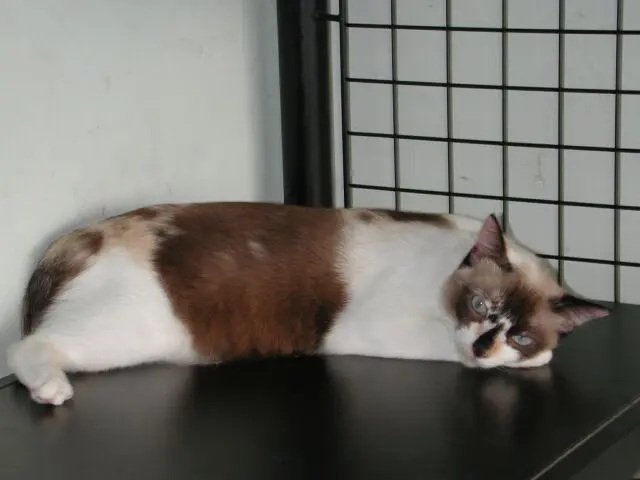
    Videos "Kucing Malaysia"

    kucing malaysia