โ–ท The world of Pets: Dogs, cats, birds, reptiles, amphibians

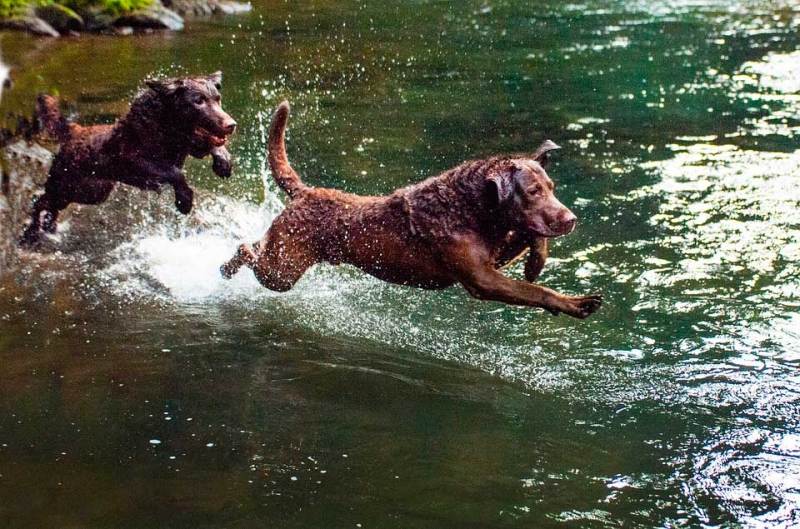
Chesapeake Bay Retriever
USA FCI 263 . Retrievers

The Chesapeake is a hunting dog, pure and simple.

Chesapeake Bay Retriever

Content

Characteristics "Chesapeake Bay Retriever"

Coexistence is important that you have with your new friend. Before considering the acquisition of a dog of the breed "Chesapeake Bay Retriever" you know certain factors. Not all breeds of dogs are apt to live in an apartment, you must take into account his character, their need for exercise, their interaction with other pets, their care and if you have small children, their level of tolerance towards them.

Adaptation โ“˜

3,0 of 5 stars (based on 1 review)

friendly dog โ€‹โ€‹โ“˜

2,0 of 5 stars (based on 1 review)

hair loss โ“˜

3,0 of 5 stars (based on 1 review)

Affection level โ“˜

3,0 of 5 stars (based on 1 review)

Need for exercise โ“˜

5,0 of 5 stars (based on 1 review)

Social need โ“˜

3,0 of 5 stars (based on 1 review)

Home โ“˜

1,0 of 5 stars (based on 1 review)

Toilet โ“˜

2,0 of 5 stars (based on 1 review)

Friendly with strangers โ“˜

2,0 of 5 stars (based on 1 review)

barking โ“˜

3,0 of 5 stars (based on 1 review)

Health โ“˜

3,0 of 5 stars (based on 1 review)

Territorial โ“˜

3,0 of 5 stars (based on 1 review)

Cat friendly โ“˜

3,0 of 5 stars (based on 1 review)

Intelligence โ“˜

5,0 of 5 stars (based on 1 review)

Versatility โ“˜

5,0 of 5 stars (based on 1 review)

Child friendly โ“˜

3,0 of 5 stars (based on 1 review)

Surveillance โ“˜

4,0 of 5 stars (based on 1 review)

joy โ“˜

3,0 of 5 stars (based on 1 review)

History

When a British brig was wrecked off the coast of Maryland in 1807, part of the cargo that was rescued included two Newfoundland dogs. Called Sailor and Canton, they were found to have excellent retrieval skills. The locals raised them with local dogs, and became the ancestors of the "Chesapeake Retriever". Other races that may have contributed to the composition of the Chesapeake were the ยซFlat-coated Retriever" and the "Curly-coated Retrieverยซ.

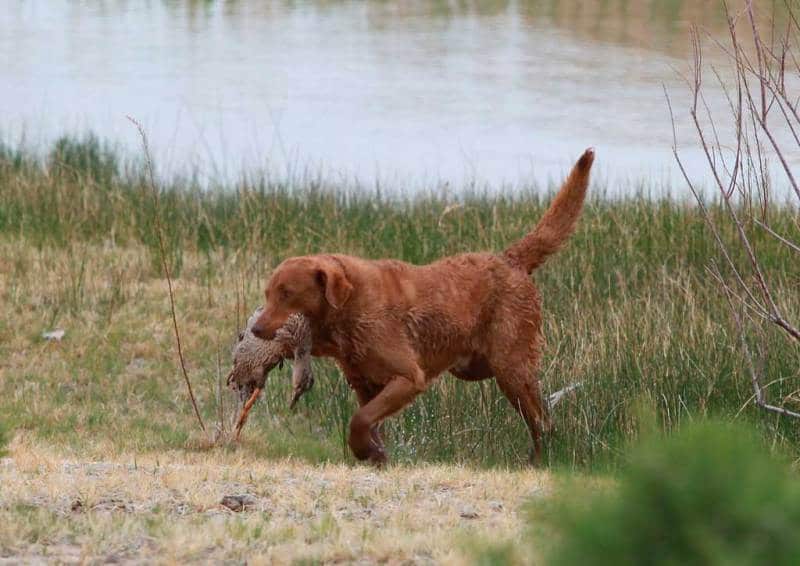
The result was a hard Retriever that he was ready and willing to endure the harsh and icy Chesapeake Bay being able to recover from 100 to 200 ducks a day. The first dogs came only in dark brown, but now any shade of brown, sedge or dead grass is acceptable.

The American Kennel Club registered your first Chessie, called Sunday, in 1878. The Chesapeake is ranked 48 breeds registered by the AKC, under the 41 a decade.

Physical characteristics

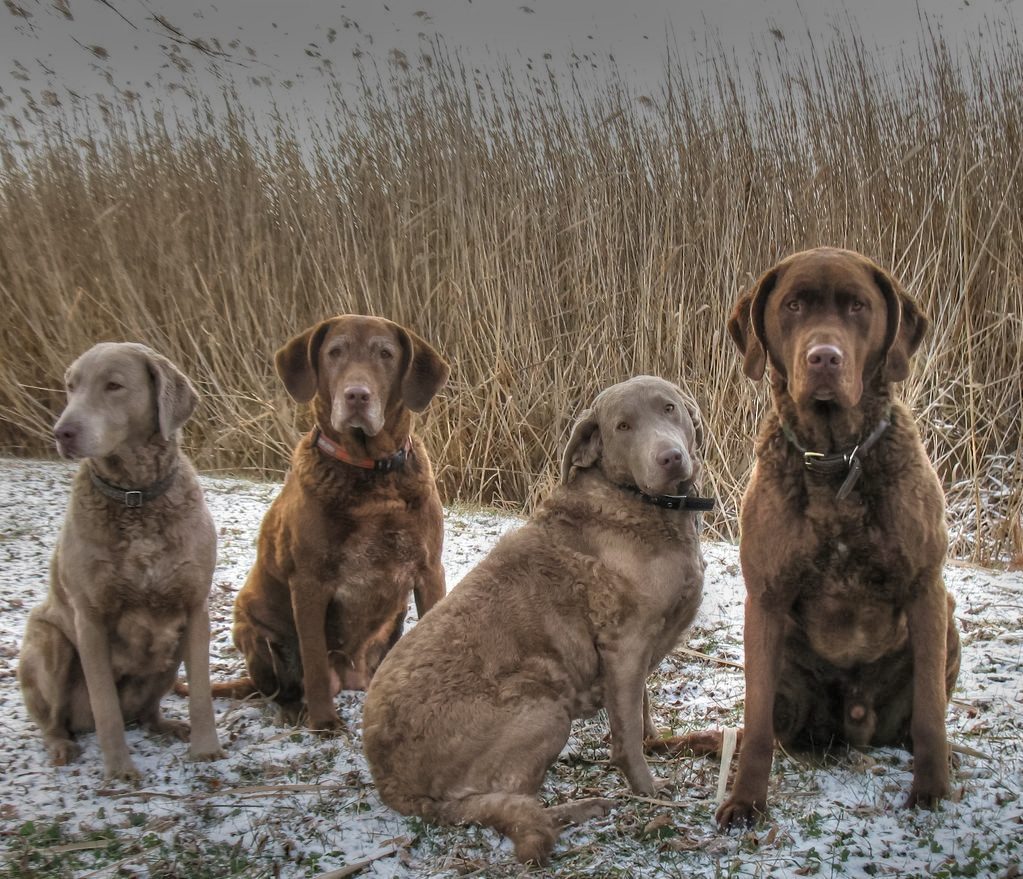
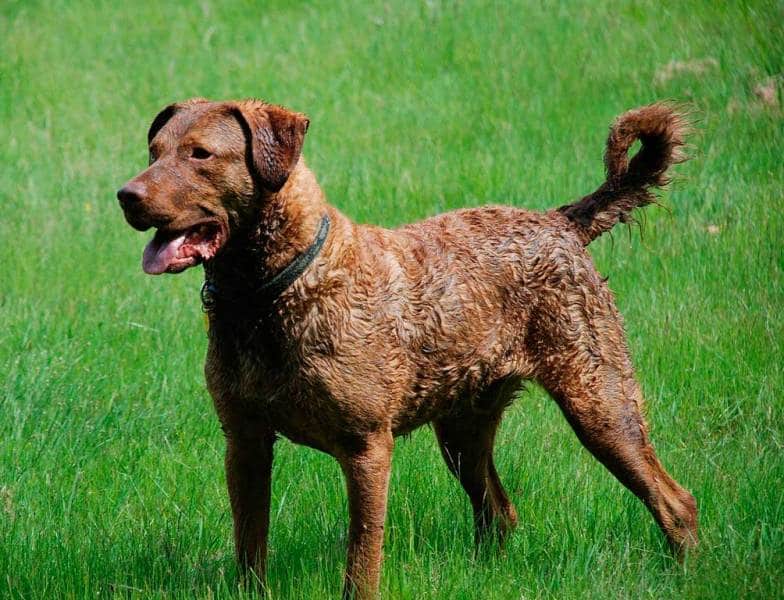
Distinctive features include eyes very clear, yellow or amber, rear quarters as high or slightly higher than the shoulders, and a double layer which tends to wave on shoulders, the neck, back and loins.

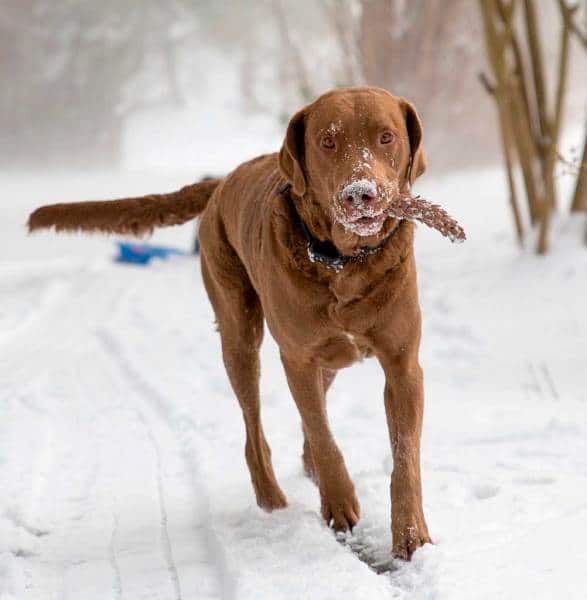
The Raincoats feels slightly oily and often is associated with a slight musky odor. three basic colors are usually seen on race: the brown, which it includes all shades from light brown to a deep dark brown; sedge, ranging from reddish yellow to bright red and brown tones; and dead grass in all shades, ranging from a faded tan to a muted straw color.

The breed standard states that the target may also appear, but it should be limited to the chest, the belly, the toes or back of feet. The head is round and wide with an average stop and muzzle. The lips are thin, and ears are small and medium leather. The Forelegs should be straight with good bone. The hindquarters are especially strong and the toes webbed as excellent swimming ability is important to the Chesapeake.

This breed is also known for its large and powerful chest, used to break ice when submerged in cold water while duck hunting.

Character and skills

The "Chesapeake Retriever" is highly appreciated for its alert and cheerful disposition., his intelligence, his calm demeanor and his affectionate nature and protective. The value, the willingness to work, vivacity, good sense of smell, the intelligence, The enjoyment of the water and especially the general quality and dispositions must take priority when selecting and breeding the "Chesapeake Retriever.". Extreme shyness or aggression are not desirable in this breed, whether the animal is used as a hunting dog or pet.

In the countryside, the Chesapeake he is a serious worker and has even been called neurotic in his eagerness to find fallen birds. It's not out there to play. The Chesapeake They are known for their excellent vision and memories when it comes to seeing where birds fall and remembering where to go to collect them.. His favorite activity is hunting for ducks.

When you train, respects their learning ability. Don't continue training him long after it's clear he knows what to do. The perfect Chesapeake is not prepared by the breeder. any dog, no matter how pleasant it, detestable levels can develop barking, excavation and other undesirable behavior if you are bored, untrained or unsupervised.

Did you know??

The Chessie not designed to be a companion, is a hunting dog, pure and simple. And not just any old hunting dog… He is a waterfowl dog and lives to get wet in pursuit of his feathered prey..

The health of the Chesapeake Retriever

According to a survey conducted in 2005 by the American Chesapeake Club, the most common health problems seen in the breed are hip dysplasia, progressive retinal atrophy and other eye problems, cancer, degenerative myelopathy and hypothyroidism. This breed can also be prone to a bleeding disorder called von Willebrand disease.

Find a breeder who uses the newly available genetic test for degenerative myelopathy, a form of progressive weakness and paralysis of the limbs. Although DM is rare, It is incurable and crippling. Not all dogs that test positive in the test of DM develop the disease, but farmers who try their race for this condition are probably the most conscientious.

The test can be used to determine whether a puppy's parents are clean, they are carriers or are at risk; a puppy whose parents are clean – neither carriers nor at risk – also will be. A puppy two carrier parents will be at risk, and a puppy parent with a carrier may be at risk. Even dogs tested for having two copies of the gene never show symptoms of the disease., but the status of the parents of your puppy, and his own dog, It can help you be aware of the early warning signs.

Careful breeders test their breeding dogs for genetic diseases and only breed the healthiest and best looking dogs., but sometimes mother nature has other ideas and a puppy develops one of these diseases despite good husbandry practices. Advances in veterinary medicine mean that in most cases dogs can still live a good life. If you're going to have a puppy, ask the breeder about the ages of the dogs in their lines and what they died of.

Remember that after hosting a new puppy home ut, has the power to protect you from one of the most common health problems: the obesity. Keeping a Chesapeake Retriever at an appropriate weight is one of the easiest ways to prolong its life.. Make the most of your preventative abilities to help ensure a healthier dog for life.

Chesapeake Retriever Grooming

The Chesapeake has a tough, oily outer coat over a dense undercoat, fine and wooly. The dirt and debris are easily removed with a rubber brush. The undercoat is very clear in spring, so be prepared to brush the dog more frequently during this time to prevent loose hair from collecting on clothing and furniture..

Give the Chessie Fresh water rinse after it has been in salt water or has swum in the mud of a pond or lake, but to keep the resistance of the coat to water, avoid bathing unless absolutely necessary. That can be as little as twice a year.

The rest is basic care. Keep your ears clean and dry so they don't get infected, and trim nails as needed, usually every two weeks. Brush your teeth for general good health and fresh breath.

ยซChesapeake Retrieverยป Images

credits:

1. A Chesapeake Bay Retriever by Keith Rousseau at en.wikipedia / CC BY-SA
2. Chesapeaker Bay retriever by Nevilley / CC BY-SA
3. Male, Chesapeake Bay Retriever competing in the conformation ring by George Makatura / Public domain
4. Chesapeaker Bay retriever by https://pxhere.com/es/photo/1407301
5. Chesapeaker Bay retriever by https://pixabay.com/es/photos/perros-mascotas-el-agua-1582148/
6. Chesapeake Bay Retriever by Diane – HTTPS://flic.kr/p/6k1uFQ
7. chesapeake bay retriever by https://www.peakpx.com/611264/chesapeake-bay-retriever
8. Brown Chesapeake Bay Retriever in the snow, carrying a plant part in its snout by Will Thomas / CC BY

Videos ยซChesapeake Retrieverยป

Type and recognitions:

  • FCI CLASSIFICATION:
  • Group :
  • Section : . .

Federations:

FCI โ“˜, AKC โ“˜, ANKC โ“˜, CKC โ“˜, โ€‹KC โ“˜, NZKC โ“˜, UKC โ“˜

FCI breed standard Chesapeake Bay Retriever

FCIFCI - Chesapeake Bay Retriever
Retriever

Alternative names:

1. Chessie, CBR, Chesapeake (English).
2. Chesapeake Bay Retriever, Chesapeake (French).
3. Chesapeake Bay Retriever (German).
4. Chesapeake bay retriever (Portuguese).
5. Chessie, CBR, Chesapeake (espaรฑol).

โ–ท The world of Pets: Dogs, cats, birds, reptiles, amphibians

Clumber Spaniel
Inglaterra FCI 109 . Flushing Dogs

Clumber Spaniel

This Clumber Spaniel medium to large size is sweet and gentle, with a deceptively relaxed appearance

Content

History

Little is really known about the origins of the breed., but legend says that the Duc de Noailles of France He gave his dear spaniels his English counterpart, the Duke of Newcastle, to save them from the horrors of the French Revolution. The dogs were sent to the estate of the Duke in Clumber Park, which later they acquired the name of race. Based on the paintings of that time, the Clumber They have not changed much in two centuries: Dogs still have a somewhat reserved temperament, as well as a sensitive appearance, rather than striking. The Basset Hound and a dog known as spaniel alpino (an extinct race), probably listed in your genealogy.

Interest in the race continued during the nineteenth century, and even they were exhibited Clumbers in one of the first dog shows in 1859. The Clumber Spaniels also they became popular among the British aristocracy. Real race fans included the prince albert and a Edward VII.

It has been allowed to be heavier, starting at 1950, and the weight limit is currently 34 Kg despite the excess in some specimens. Anyway, breed lovers make sure that this large does not cause any weakness in his hind.

Did you know??

Some major British were in love with the Clumber Spaniel: The husband of Queen Victoria, prince albert, as well as Edward VII, They were both fans of the race.

Physical characteristics

It is a well balanced dog, of bones strong, Active, with a reflective expression; overall appearance denoting strength. The Clumber should be firm, active and able to perform daily work in the field.

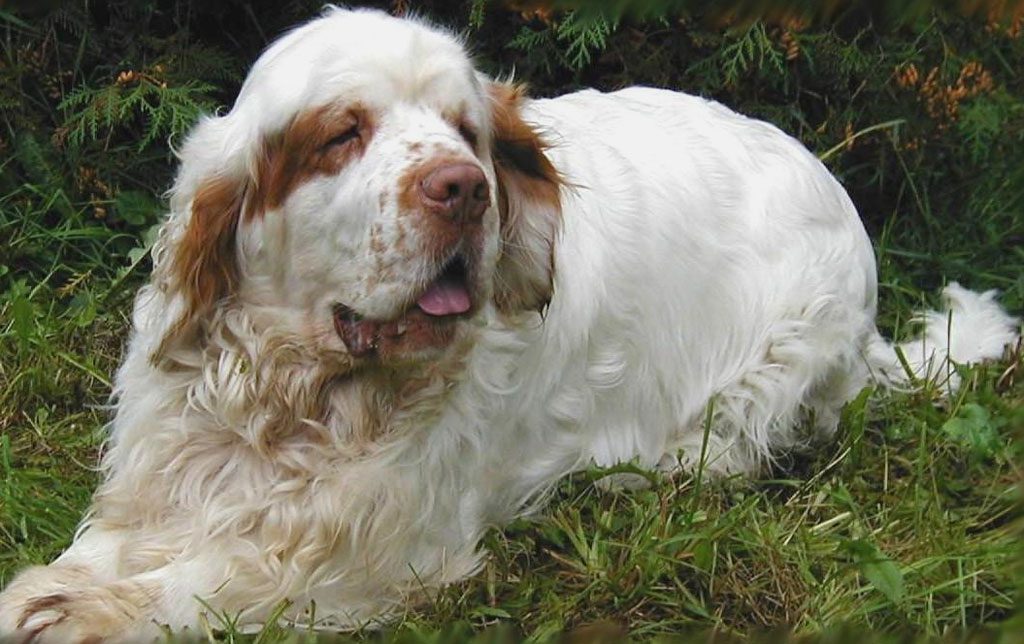
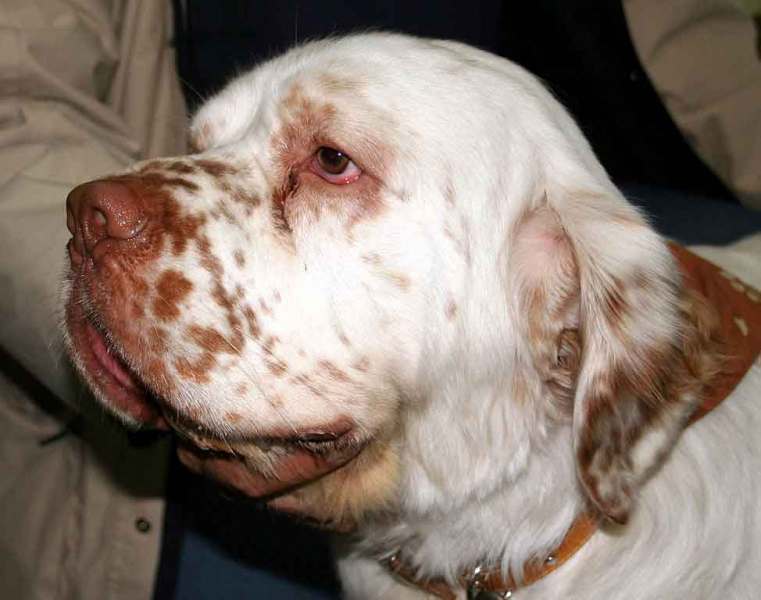
Its shape is similar to that of the Sussex Spaniel smaller. The Clumber It has a heavy bone structure, Their fur is dense, Weatherproof, straight and flat, with hair around the ears, belly and legs. The tufts are predominantly white with lemon colored spots, brown or orange around the eyes and the base of the tail.

WEIGHT:
Ideal weight: Males: 29,5 โ€“ 34 kg. females: 25 – 29,5 kg.

Character and skills

According to the breed standard, the Clumber Spaniel He is loyal and affectionate with his family. It can be reserved with strangers, but he is never aggressive or shy. Good words for firm include, reliable, friendly and worthy… but do not let that fool you their dignified behavior. The Clumber is very smart, determined to get what he wants, and more agile than it looks. During his puppy, which usually lasts until three or four years, it can be a wild dog running through the house at breakneck speed and gets into many problems. (For some, Part of getting into trouble never ends.) On the positive side, the Clumber also it tends to stay young at heart well into old age.

if they grow up together, the Clumber and children can become fast friends. If you don't have children yet, make sure your Clumber gets to know your friends' kids often and from an early age, to get used to the loud screams and rapid movements. The Clumber also gets along well with other dogs, and it is friendly with cats, ferrets and other small pets, as long as the know. Because of its sporty nature, considers that the furry or feathered creatures that live outdoors are animals hunting. In other words, is more likely that your Clumber swallow your whole wild bird to look after him delicately.

On a walk, the Clumber it moves at a slow and steady pace. Does not have the high energy levels of many other pick-and-point breeds, but it has the ability to break through any type of shrub that stand in your way. It also, It has an infinite resistance, so it is a great companion for hiking and hunting, recovering quickly and enjoys water. To keep fit and out of trouble, need rides 20 to 30 minutes twice a day. If you have a fenced yard, Do not assume that exercised. Like the rest of us, the Clumber need motivation from a friend to get up and go.

The Clumber It is an independent thinker, so i can be stubborn. Train Your Clumber requires patience and the ability to convince him to do what you want is actually all her idea. It's a good problem solver; The point is that the problem that often involves doing something forbidden resolved. any dog, no matter how nice it is, You may develop obnoxious barking levels… and the Clumber is no exception. Some Clumbers They are naturally quiet, other bark at all, and some of them fall somewhere in the middle. If you live with, Let's say, a burrow, expects you Clumber learn to bark a lot.

Start training your puppy the day you bring him home. Even at eight weeks old, He is able to absorb everything you can teach. Don't wait until you have 6 months to start training him or you'll have to deal with a more stubborn dog. If possible, take him to puppy kindergarten class when he's between 10 and 12 weeks, y socialize, socialize, socialize. But, Note that many kinds of training puppies require certain vaccinations (such as kennel cough) stay up to date, and many veterinarians recommend limited exposure to other dogs and public places until puppy vaccinations (including rabies, distemper and parvovirus) They are completed. Instead of formal training, You can start training your puppy to socialize at home and among family and friends until immunizations are completed in the puppy.

Grooming

White and fringed coat Clumber requires a moderate amount of toilet: If you want me to be handsome, bathe him once a month, and brush or comb his coat during 10 to 15 minutes, up to three times a week, to prevent tangles and remove dead hair. You should also cut back on their feet, ears and feathers.

The locks were off at a moderate pace strong throughout the year, so buy a good vacuum cleaner; regular brushing will also reduce the amount of hair floating in your home.

The rest are routine care: Trim his nails every few weeks and keep floppy ears clean and dry to prevent infection. You should also brush his teeth regularly to maintain good overall health and fresh breath.

Health

The Clumber Spaniel They are generally healthy, but they are susceptible to some conditions, including eye problems such as Entropion and ectropion, keratoconjunctivitis sicca, or dry eye, and falls. They may also be prone to hip dysplasia and an inherited condition called deficiency pyruvate dehydrogenase phosphatase , which can lead to exercise intolerance and heart and lung problems.

Not all of these conditions are detectable on a growing puppy, and it is impossible to predict if an animal will be free of these diseases, so you need to find a reputable breeder who commit to raise healthier animals possible. You must be able to produce an independent certification that the parents of the dog (and grandparents, etc.) have been examined for common defects and considered healthy for breeding. That's where health records come in..

Careful breeders their dogs examined for genetic diseases, and they only breed the best looking specimens, but sometimes Mother Nature has other ideas and a puppy can develop one of these conditions. In most cases, can still live a good life, thanks to advances in veterinary medicine. Having said that, not all visits to the vet involve a genetic problem. Puppies love to eat them things, so it's not uncommon for them to develop gastroenteritis (intestine garbage) or requiring surgery to remove random objects from the intestines, as hand towels and toys.

And remember that you have the power to protect your Clumber one of the most common health problems: the obesity. You keep a healthy weight is a simple way to prolong the life of your Clumber avoiding problems such as hip dysplasia.

Characteristics "Clumber Spaniel"

Coexistence is important that you have with your new friend. Before considering the acquisition of a dog of the breed "Clumber Spaniel" you know certain factors. Not all breeds of dogs are apt to live in an apartment, you must take into account his character, their need for exercise, their interaction with other pets, their care and if you have small children, their level of tolerance towards them.

Adaptation โ“˜

5,0 of 5 stars (based on 1 review)

friendly dog โ€‹โ€‹โ“˜

5,0 of 5 stars (based on 1 review)

hair loss โ“˜

4,0 of 5 stars (based on 1 review)

Affection level โ“˜

5,0 of 5 stars (based on 1 review)

Need for exercise โ“˜

4,0 of 5 stars (based on 1 review)

Social need โ“˜

4,0 of 5 stars (based on 1 review)

Home โ“˜

3,0 of 5 stars (based on 1 review)

Toilet โ“˜

4,0 of 5 stars (based on 1 review)

Friendly with strangers โ“˜

2,0 of 5 stars (based on 1 review)

barking โ“˜

3,0 of 5 stars (based on 1 review)

Health โ“˜

3,0 of 5 stars (based on 1 review)

Territorial โ“˜

3,0 of 5 stars (based on 1 review)

Cat friendly โ“˜

3,0 of 5 stars (based on 1 review)

Intelligence โ“˜

3,0 of 5 stars (based on 1 review)

Versatility โ“˜

3,0 of 5 stars (based on 1 review)

Child friendly โ“˜

3,0 of 5 stars (based on 1 review)

Surveillance โ“˜

3,0 of 5 stars (based on 1 review)

joy โ“˜

3,0 of 5 stars (based on 1 review)

Images "Clumber Spaniel"

credits:

1. Clumber Spaniel in Tallinn by Thomas / CC BY-SA
2. Clumber Spaniel during show of dogs in Rybnik – Stone, Poland by Pleple2000 / CC BY-SA
3. Clumber_spaniel at the World Dog Show in Poznaล„ by Pleple2000 / CC BY-SA
4. 2015 Westminster Kennel Club Dog Show, New York City by Pets Adviser from Brooklyn, USA / CC BYwww.petsadviser.com
5. Clumber Spaniel by audrey_sel / CC BY-SA
6. A Clumber Spaniel by Canarian / CC BY-SA

Videos "Clumber Spaniel"

Type and recognitions:

  • FCI CLASSIFICATION:
  • Group :
  • Section : . .

Federations:

FCI โ“˜, AKC โ“˜, ANKC โ“˜, CKC โ“˜, โ€‹KC โ“˜, NZKC โ“˜, UKC โ“˜

FCI breed standard Clumber Spaniel

FCIFCI - Clumber Spaniel
Clumber

โ–ท The world of Pets: Dogs, cats, birds, reptiles, amphibians

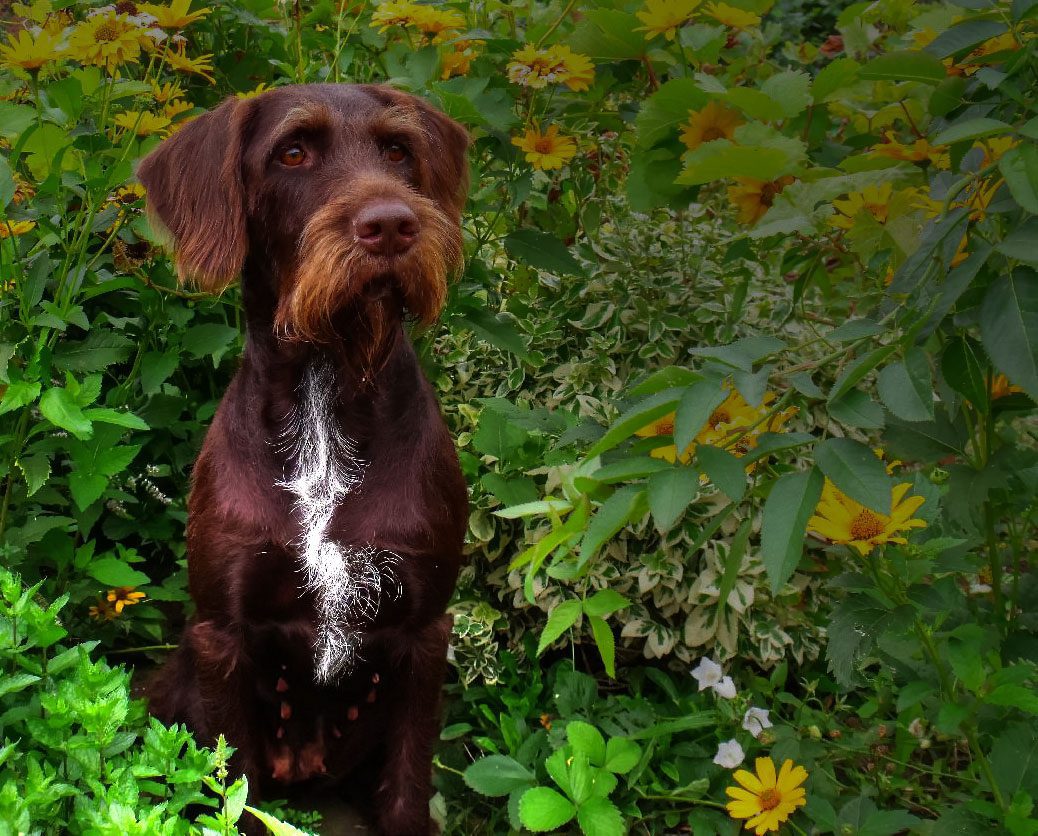
Cesky Fousek
Repรบblica Checa FCI 245 . Griffon type

Cesky Fousek

The Cesky Fousek It is a dog of Czech origin, defined as a breed of versatile.

Content

History

Before the First World War, The "Bohemian Wirehaired Pointing Griffon" was the most important wirehaired pointing dog in the region of present-day Czechoslovakia.. Because of the First World War and its consequences, This race was on the verge of extinction in the mid-twenties. Hereafter, a regeneration of this breed was proposed from some original typical dogs; By means of planned selection the modern type of ยซCesky Fousekยซ, which currently ranks second in number among hunting dog breeds used in the Czech and Slovak Republics.

Physical characteristics

He "Cesky Fousekยป is a noble pointer dog of medium size and rough hair that has innate qualities for work in the field, in the water and in the woods, so that its usefulness is multiple. Despite being a hunter bitterest, let easily guide and has developed attachment to man.

Did you know??

The name was given to this breed according to the "beard", It located on the chin and characterizes him.

Height to the cross: Males: 60-66 cm., females: 58-62 cm..
Weight: In males at least 28 kg, maximum 34 kg. In females minimum 22 kg, maximum 28 kg.

Character and skills

The Cesky Fousek It is a loyal dog, nice and very agile and active, very fond of hunting. It is a good retriever on land and water, but is used more frequently for exhibition games. Males are more stubborn, females are fairly quiet. It is friendly and playful with his family and acquaintances, it is customary to strangers more time. It may be too dominant during puberty, but it will fade over time. Very intelligent and insightful.

It works well with other animals , but supports the hunting instinct, chasing fast-moving objects, including pets or cyclists. It is advisable to breed in the herd, because socializes with other dogs perfection.

He is affectionate with children and has a perfect relationship with them..

It has a high bark to alert all passers-by and unwanted visitors. It's a good guard, and if you think something is wrong, You may intervene against thieves.

Care of the โ€œBohemian Wirehaired Pointing Griffonโ€

The hair Cesky Fousek It does not require a lot of care, I is sufficient occasionally comb with a brush with hard bristles. In case of heavy soiling, it is good to wash it with quality water and shampoo, as this type of hair could lose shine after an incorrect shampoo.

It is a very active and playful breed that likes to play and show hunting. He likes to do exactly that, but if it is sufficiently occupied by another type of movement, it will not lose. Every movement is suitable for him. It has an almost inexhaustible power supply, so it is particularly suitable for sports-minded people and provide them with enough exercise. Without moving, The โ€œBohemian Wirehaired Pointing Griffonโ€ could get bored and entertain itself by destroying your garden or house.

Training and education are necessary, without them it can become completely unmanageable and too dominant. You need a driver to raise him better without violence. It can be dominant, not nervous.

Characteristics "Cesky Fousek"

Coexistence is important that you have with your new friend. Before considering the acquisition of a dog of the breed "Cesky Fousek" you know certain factors. Not all breeds of dogs are apt to live in an apartment, you must take into account his character, their need for exercise, their interaction with other pets, their care and if you have small children, their level of tolerance towards them.

Adaptation โ“˜

4,0 of 5 stars (based on 1 review)

friendly dog โ€‹โ€‹โ“˜

3,0 of 5 stars (based on 1 review)

hair loss โ“˜

3,0 of 5 stars (based on 1 review)

Affection level โ“˜

3,0 of 5 stars (based on 1 review)

Need for exercise โ“˜

4,0 of 5 stars (based on 1 review)

Social need โ“˜

3,0 of 5 stars (based on 1 review)

Home โ“˜

3,0 of 5 stars (based on 1 review)

Toilet โ“˜

2,0 of 5 stars (based on 1 review)

Friendly with strangers โ“˜

2,0 of 5 stars (based on 1 review)

barking โ“˜

3,0 of 5 stars (based on 1 review)

Health โ“˜

3,0 of 5 stars (based on 1 review)

Territorial โ“˜

3,0 of 5 stars (based on 1 review)

Cat friendly โ“˜

2,0 of 5 stars (based on 1 review)

Intelligence โ“˜

4,0 of 5 stars (based on 1 review)

Versatility โ“˜

4,0 of 5 stars (based on 1 review)

Child friendly โ“˜

4,0 of 5 stars (based on 1 review)

Surveillance โ“˜

3,0 of 5 stars (based on 1 review)

joy โ“˜

4,0 of 5 stars (based on 1 review)

Images ยซHard-haired bohemian sample gryphonยป

credits:

1. https://commons.wikimedia.org/wiki/File:Cesky_Fousek_Betty.jpg When reusing, please credit me asauthor: Adam Kliczek, http://zatrzymujeczas.pl (CC-BY-SA-3.0)If you use my image on your website, please send me an email with webpage adress. If you use my image in your book, please send me an email.Contact me at: adam.kliczekgmail.complen+/โˆ’plen+/โˆ’ https://creativecommons.org/licenses/by-sa/4.0 CC BY-SA
2. Cesky Fousek by https://pxhere.com/es/photo/789408
3. Cesky Fousek by https://pxhere.com/es/photo/680392
4. Czech_fousek at the World Expo in Poznan by Pleple2000 / CC BY-SA
5. Czech_fousek at the World Expo in Poznan by Pleple2000 / CC BY-SA
6. Czech_fousek at the World Expo in Poznan by Pleple2000 / CC BY-SA
7. Czech_fousek at the World Expo in Poznan by Pleple2000 / CC BY-SA
8. Cesky Fousek by https://pxhere.com/es/photo/845285

Videos ยซBohemian Wirehaired Pointing Griffonยป

Type and recognitions:

  • FCI CLASSIFICATION:
  • Group :
  • Section : . .

Federations:

    FCI โ“˜, NZKC โ“˜, UKC โ“˜

FCI breed standard Cesky Fousek

FCIFCI - Cesky Fousek
Griffon

Alternative names:

1. Bohemian Wire-haired Pointing Griffon, Rough-coated Bohemian Pointer, Barbu tchรจque (English).
2. Ceskรฝ Fousek (French).
3. ฤŒeskรฝ fousek, Bรถhmisch Rauhbart (German).
4. Czeski fousek (Portuguese).
5. Terrier Checo (espaรฑol).

โ–ท The world of Pets: Dogs, cats, birds, reptiles, amphibians

Canarian Warren Hound
Espaรฑa FCI 329 . Primitive type - Hunting Dogs
Podenco Canario

The Canarian Warren Hound is brave, decided to, generous and extremely loyal to his master.

Content

History

The Canarian Warren Hound It is a breed canine Spanish Canary.

The Canarian Warren Hound, It is one of the oldest breeds known today., According to scholars of the breed, it dates from approximately 7000 years. This realize the numerous found vestiges of its representation in engravings, statues and bas-reliefs.

A native of Egypt, probably, He was taken by the Phoenicians, greeks, the same Egyptians to the Canary Islands and Carthaginian, where it is currently easy to see in the larger islands (Gran Canaria and Tenerife).

Since its inception, the Canarian Warren Hound has been placed in the wild and in the possession of the peasant who needed to hunt to survive. Given the perfect hunting qualities of this dog: his sense of smell, his hearing and his clear vision, as his great speed in the race after the dam, the peasant has had, always, a wonderful ally, It has been able to take advantage of.

The Canarian Warren Hound, as its name suggests it is found in the Canary Islands, and a dog is little known and disseminated outside their place of origin, It is not easy to find puppies.

Today, is perfectly adapted, both the flat lands as stony and mountainous, sandy, or soft like the prairies or very hard; You can both enter caves that penetrates in Lava Tubes or galleries, in thickets or forests, in the end, does not shy away from any obstacle.

Outside the hunting season, the living conditions of animals are very different: Well-kept dogs can be found and fed on clean kennels, as well as miserably neglected and malnourished chained dogs. Animals that are not or are no longer fit for hunting often suffer a cruel fate.
For this reason, dogs are increasingly placed abroad by animal protection organizations and individuals – an understandable and well-meaning activity, What, However, brings with it some problems: Dogs, who are usually already grown up, sometimes they are taken out of their simple rural living environment and taken to big cities. Noise and haste can be very harsh for them, his frequent lack of trust in humans further complicates it. His pronounced passion for hunting makes the free will, which would be absolutely necessary for the maintenance of the animals and to reduce stress, is often difficult or impossible. It also, in many cases are infected with so-called travel or Mediterranean diseases, that often require long and costly treatment.

Physical characteristics

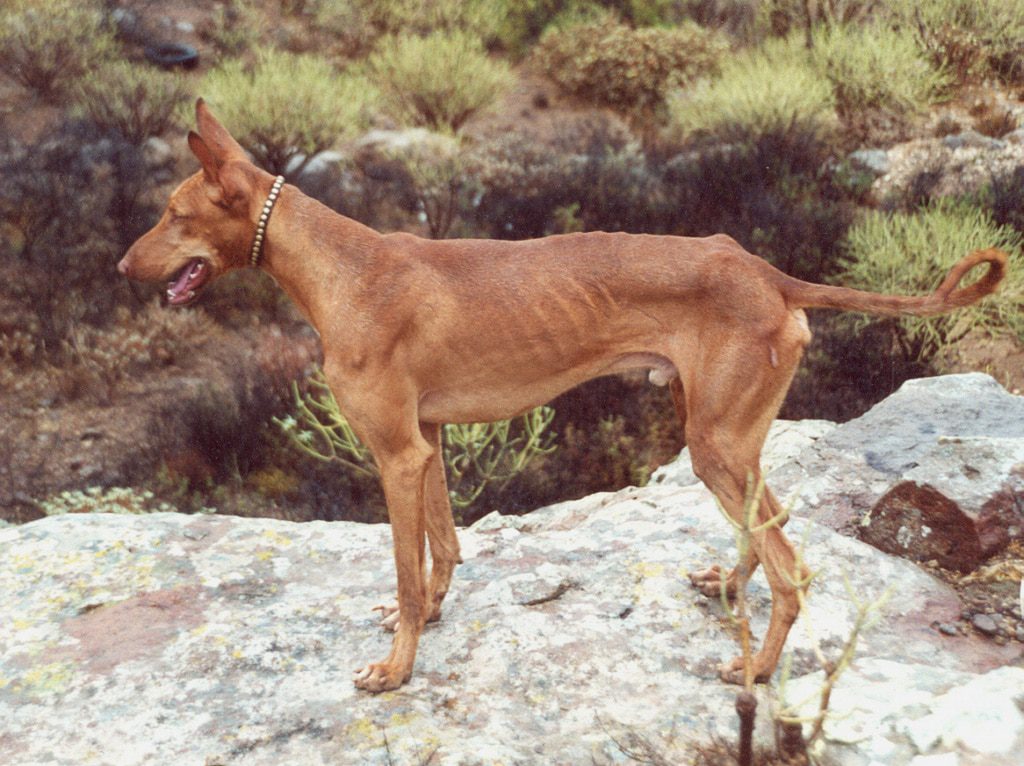
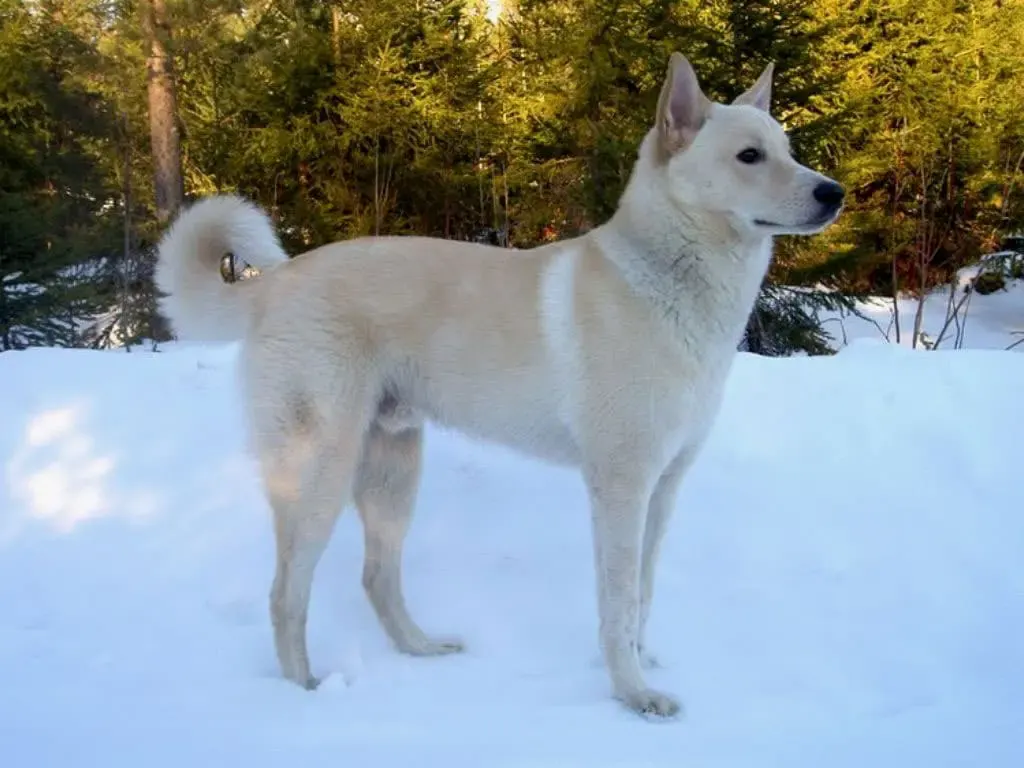
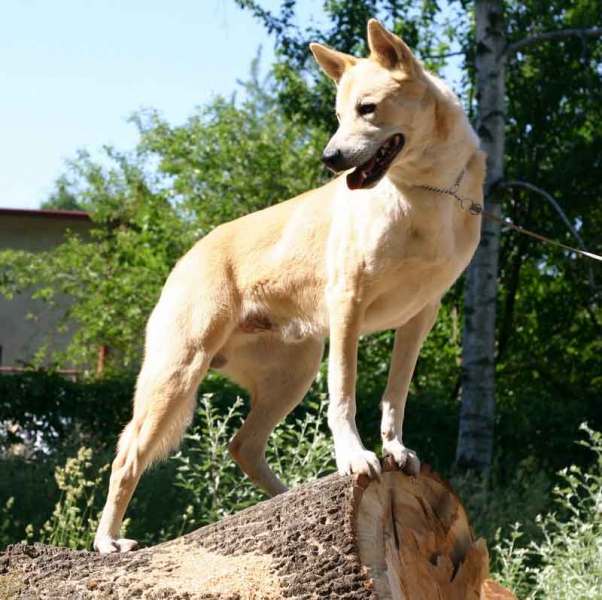
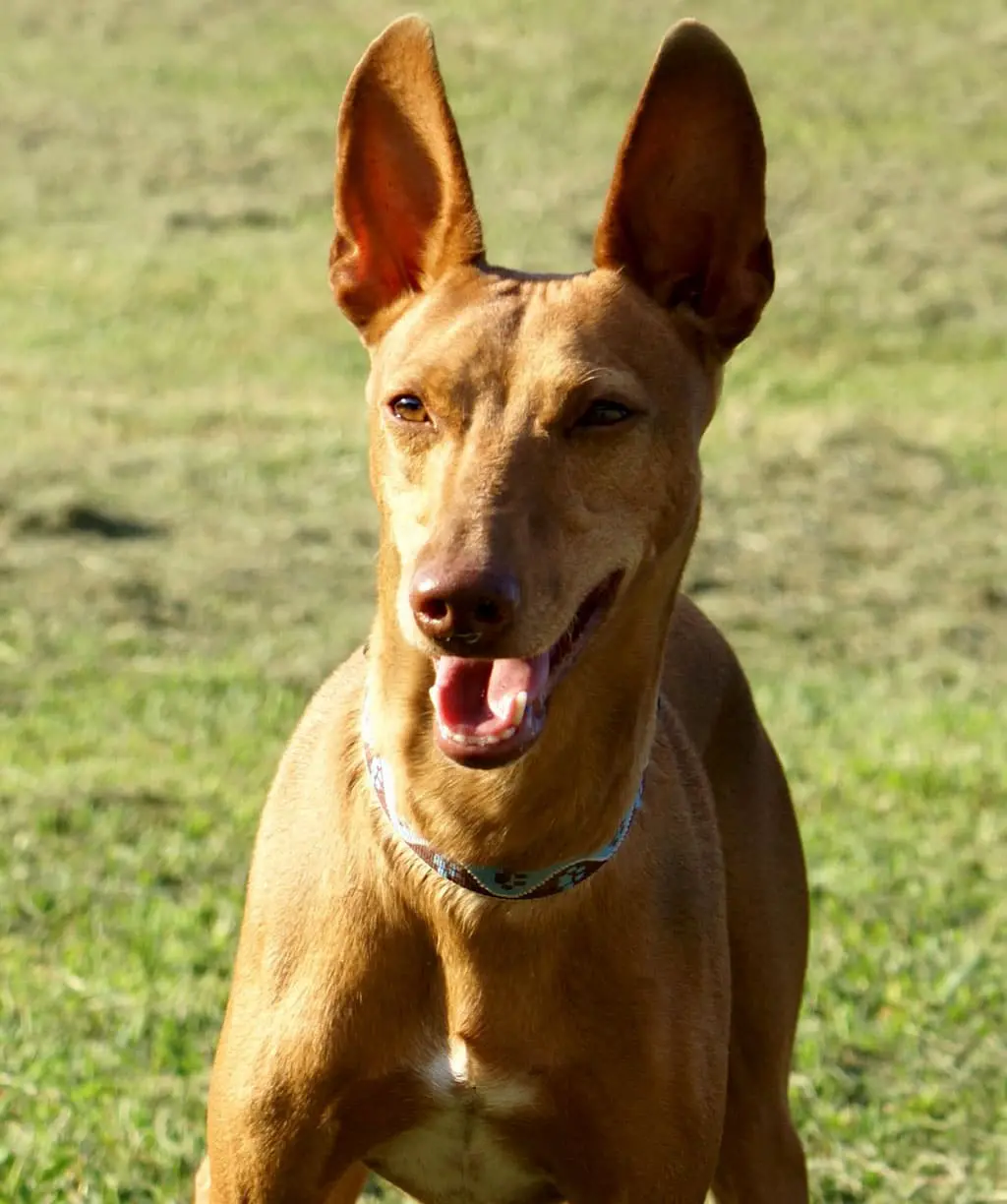
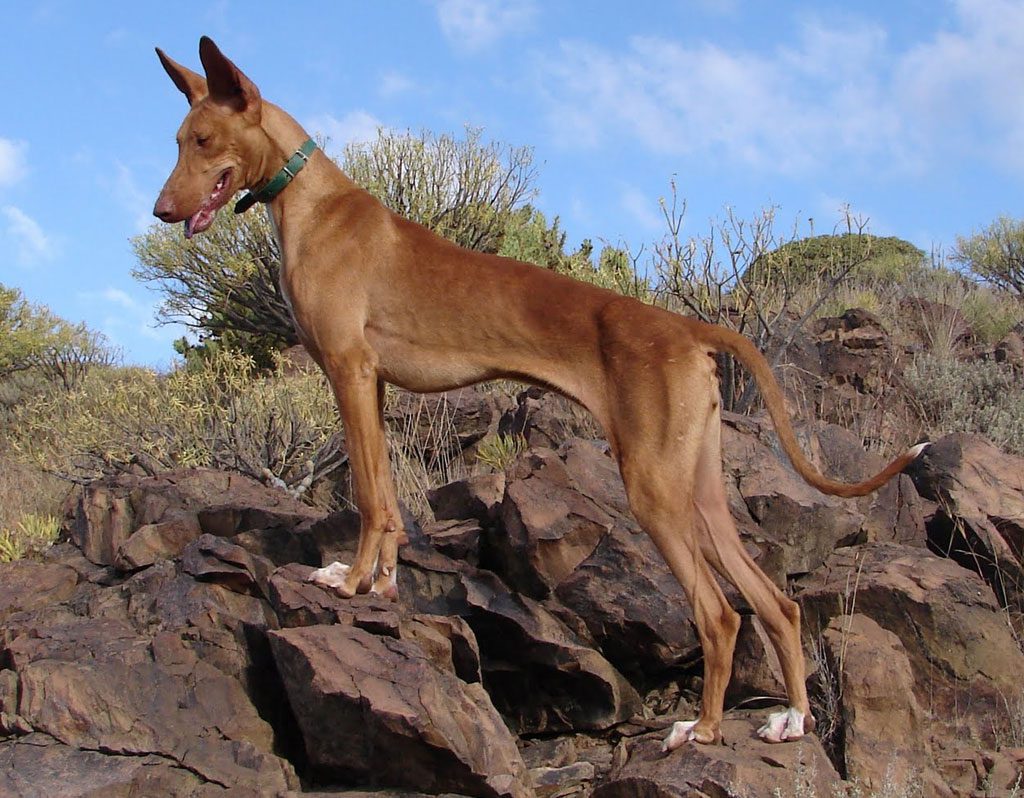
The Canarian Warren Hound, is a dog from size medium, very light but tough.

The height to the cross males will of 55 to 64 cm and the females of 53 to 60 cm.. These measures have 2 cm tolerance up or down.

Has the muscles hyper developed and as it does not present adipose panniculus it is very easy to appreciate the rib cage, the spine and hip bone.

Has the head elongated with little pronounced stop, the eyes are small, almond-shaped and oblique.

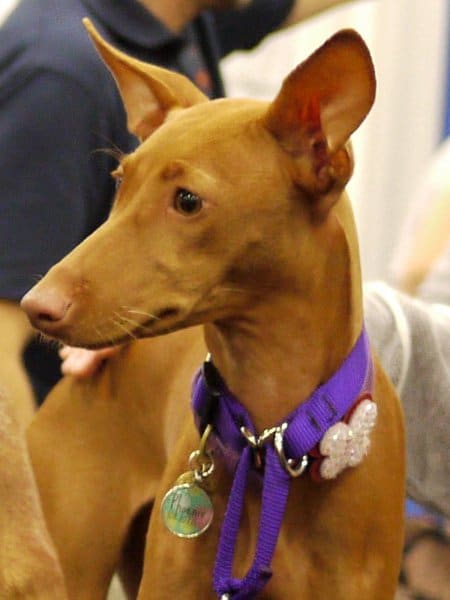
Their ears they are rather large, When the Earth State of arousal keeps them in erect and fall backwards when it is at rest, they are wide at the base and end up in tip.

The limb perfectly Plumb, they are straight, has fine but strong bones. The tail is low, You can take the low or sickle-shaped, but does not exceed Hock.

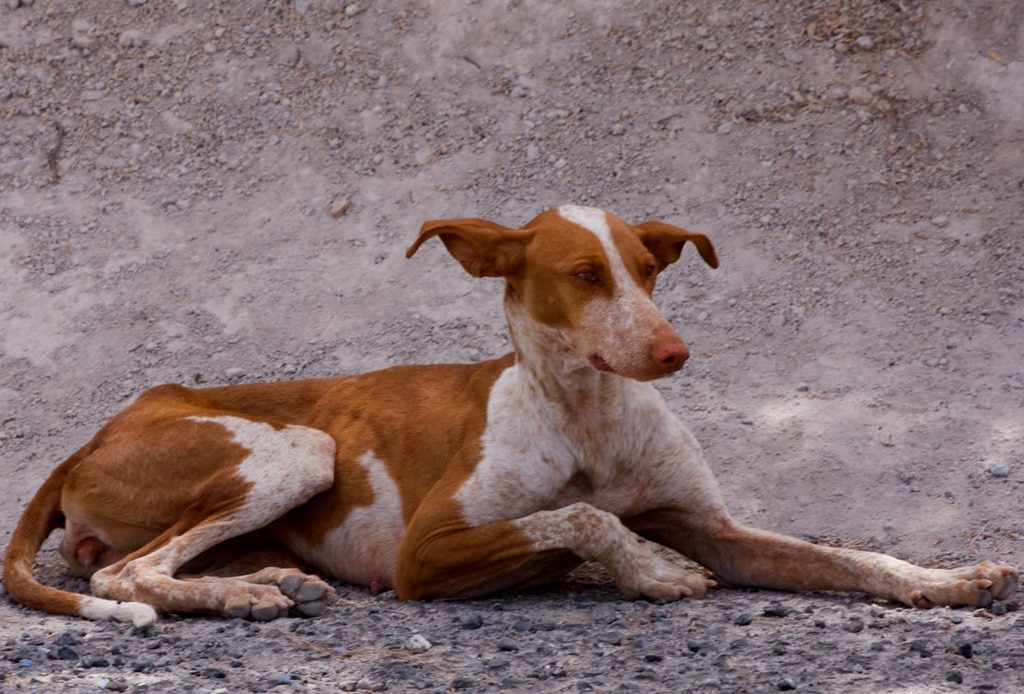
The hair the Podenco Canario is smooth, tight and short. In the layer color combinations within the following are supported colors: Red and white, with more or less intense red, and finally, Orange to mahogany.

Observations

:

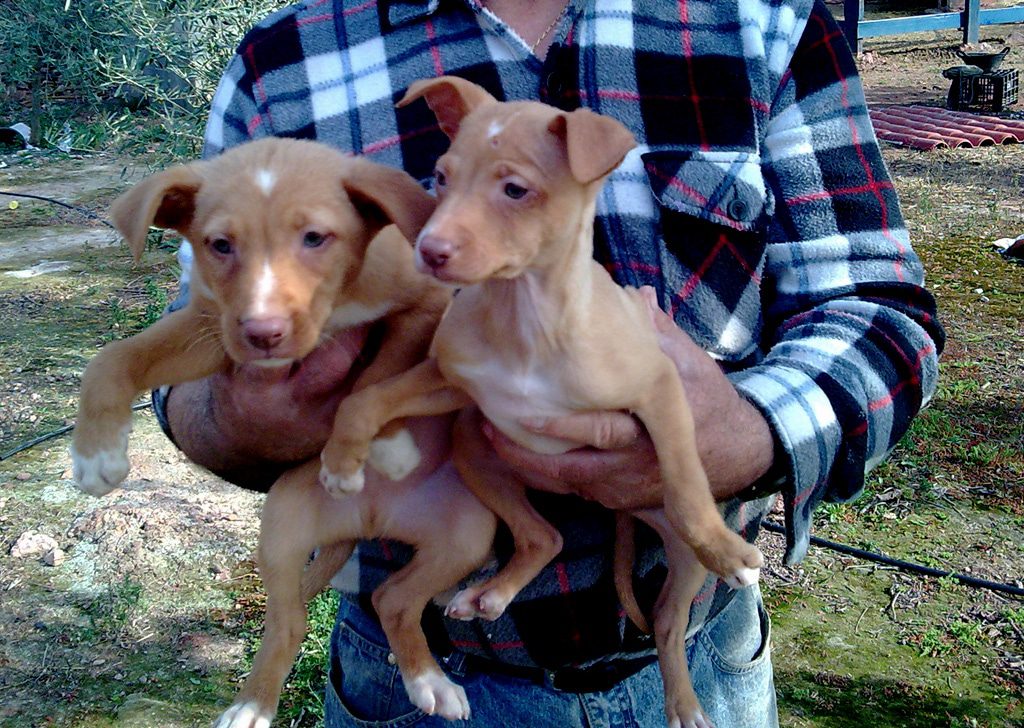
These dogs start to hunt from an early age, giving cases of animals less than three months that show strong hunting instinct.

When they discover and/or they chase prey, emit a characteristic short, repetitive bark, known to local hunters as "singing a rabbit".

Character and skills

The Canarian Warren Hound is an animal that shows no aggression normally, extremely loyal and noble to teammate, restless, independent, stubborn, worker and intelligent.

Itร‚ยดs brave and decided to, the race is fast and very agile, generous and extremely fell to its owner.

There are no guard and defense attitudes, at home it is "friend of all strangers", what makes it ideal as a pet.

If raised inside a Home, Once overcome the first six months of hyperactive life, shown as a quiet animal and customize, attitude changes drastically once comes to the field of hunting.

In its role of Hunter It has always been dedicated to the rabbit house and its most important feature is its ability to adapt to any type of terrain. It is capable of detecting the presence of the press inside cracks thorny bushes or stone walls, the Podenco Canario only to follow the trail of the prey with the sense of smell but without catching it.

Observations:

In the Canary Islands is used in conjunction with the huron, since the latter catches the rabbit by the throat.

Caring for Canarian Warren Hound

As already mentioned, the dog should be given a housing environment that corresponds to its predisposition. Rural areas with low traffic and a manageable hunting density are appropriate.
Proper exercise in any weather with as much free running as possible is a must for this active dog.

The short coat is very easy to care for; just brush from time to time.

Canarian Warren Hound Health

The breed is basically a robust dog with low susceptibility to disease; therefore, breed-specific diseases are largely unknown.

But, the Canarian Warren Hound can suffer from the typical travel or Mediterranean diseases of dogs (among others, leishmaniosis, dirofilariasis, babesiosis, ehrlichiosis) like all the other dogs.
Many animals are chronically infected without showing symptoms of disease. But, these dogs are unhealthy and can infect other animals through vectors (ticks and blood-sucking insects).
So, imported dogs should always be thoroughly examined for the diseases mentioned (the so-called "travel profile").

The average life expectancy is about 12 years.

Images Canarian Warren Hound

Canarian Warren Hound videos

Type and recognitions:

  • FCI CLASSIFICATION:
  • Group :
  • Section : . .

Federations:

  • FCI – Group 5: Spitz-type dogs and primitive type – Section 7: Primitive type โ€“ Hunting dogs.. โ“˜

FCI breed standard "Canarian Warren Hound"

Origin:
Spain

Date of publication of the valid original standard:
24.06.1987

Use:

It is used for rabbit hunting and adapts perfectly to the multiple variations of the terrain for this purpose., using their prodigious sense of smell as well as sight and hearing. Withstands high temperatures and hunts tirelessly from dawn to dusk. You can detect the presence of rabbits inside cracks with your sense of smell or hearing., stone walls, majano, volcanic tubes and thorny scrub. Its extraordinary preservation is undoubtedly due to its gifts, which have made it necessary throughout the centuries.. It is primarily a trail dog and should not bark or flap the part during tracking.. It is also used with the help of a ferret, modality allowed on the islands. It also usually catches rabbits by tooth.


General appearance:

It is a medium-sized dog, slightly elongated, leptosomatico, light, very resistant. The skeleton is well developed. The absence of adipose panniculus allows us to appreciate the relief of the rib cage, spine and hip bones. The muscles are highly developed, spandrel, transluciendo contractions through the skin.

IMPORTANT PROPORTIONS: Slightly longer than high. Well developed chest, without reaching the elbow. Muzzle slightly longer than the skull.


Behavior / temperament:

Brave, nervous, restless and radiating a dynamism. Noble, never aggressive. Selflessly addicted to its owner. Stoically supports more rigorous sessions without the less fatigue.

Head:

Elongated. Truncated cone shaped, very provided with the body, measuring length 21 to 22 cm.. Parallel craniofacial lines.

Cranial region:
  • Skull: Longer than width, plane, with prominent occipital bone.
  • Depression links (Stop): Not very marked.

facial region:

  • Truffle: Wide, sand color, harmonized with the coat color, slightly open nostrils.
  • Snout: Prominent and wide, dull finish, flesh-colored with more or less intensity in harmony with the color of the coat.
  • Lips: Fine and collected, harmonized with the color of the nose.
  • Teeth: Bite in scissors, in perfect opposition and well-developed.
  • Eyes: Oblique, almond-shaped and small. More or less dark amber depending on the intensity of the color of the layer. His gaze is smart and noble.
  • Ears: Rather large. Carried erect in attention, slightly divergent. Take them back to sleep. Wide at its base and pointy at the end.

Neck:

Muscular, straight, with smooth skin, without jowl, rounded and flexible.

Body:

  • Back: Strong, muscular, suitable for the race and exercise of hunting.
  • Pork loin: Somewhat elongated.
  • Rump: Something solid bones of the rump, more visible in the exemplary weak or in full hunting season.
  • Breast : Chest with no outgoing sternum, well developed, But however it does not reach the elbow. Oval ribs.
  • Chest perimeter more in 5 to 8 cm as height on the cross.
  • Belly: picked up, without being the Greyhound. Well marked flanks.

Tail:

Lowest insertion, as a continuation of the rump. Rounded, It descends somewhat lower than the Hock. Fallen or carried in the shape of a sickle. Something sharp at the tip which is usually white in color. Never screwed. Desirable not to raise in excess to the March.

Tips

PREVIOUS MEMBERS: Perfectly Plumb, straight, vertical and parallel, fine but solid bone. Cat feet, generally something diverted outwards. Strong and somewhat oval pads.

Angles:

  • Angles scapulo-humeral: close to 110ยฐ.
  • Humeral-radial angles: close to 140ยฐ.

LATER MEMBERS: Plumb, straight, strong, muscular, rather high Hock (some 18 cm from the ground). Straight feet, of cat, with strong and slightly oval pads. Without the presence of spurs.

Angles:

  • Lame-femoral angle: about 110ยฐ.
  • Femoral-tibial angle: about 120ยฐ.
  • Hock angle: about 130ยฐ.

Movement:

You must have a fast trot, long and very light.

Mantle

SKIN: Consistent, attached to the body and without wrinkles.

HAIR: Smooth, short and tight.

COLOR: Preferably red and white, the Red can be more or less intense coming from Orange to dark red (Mahogany). All combinations of these colors.


Size and weight:

Height to the cross:

  • For males: of 55 to 64 cm..
  • for females: of 53 to 60 cm..

These measures may vary due to the different land where living and hunting, therefore to accept differences in 2 cm above or below the maximum or minimum size, as long as the specimens are typical and with the prototype of the breed.


Fouls:

Any deviation from the aforementioned criteria is considered as a fault and the severity of this is considered to the degree of the deviation to the standard and its consequences on the health and well-being of the dog..

SERIOUS FAULTS

  • Excessively wide head.
  • Too marked stop.
  • Hanging lips.
  • Lack of premolars.
  • Prognathism.
  • Ears very divergent.
  • Flat chest.
  • Outgoing sternum.
  • Threaded queue.
  • Low or cow hocks.
  • Crossing of front feet and hocks in gear.
  • Aggressive temperament.
  • Any dog โ€‹โ€‹showing clear signs of physical or behavioral abnormalities must be disqualified..

FALTAS DESCALIFICANTES:

โ€ข Aggressiveness or extreme shyness.
โ€ข Any dog โ€‹โ€‹showing clear signs of physical or behavioral abnormalities.


N.B.:

โ€ข Males must have two normal-appearing testicles fully descended into the scrotum..
โ€ข Only functionally and clinically healthy dogs, with the typical conformation of the breed, should be used for parenting.

Source: F.C.I - International Cynological Federation

Alternative names:

1. Canary Island Podenco, Canary Island Hound, Podenco Canario (English).
2. Podenco canario (French).
3. Podenco Canario (German).
4. Podenco Canario (Portuguese).
5. Podenco Canario (espaรฑol).

โ–ท The world of Pets: Dogs, cats, birds, reptiles, amphibians

Canaan Dog
Israel FCI 273 - Primitive type

Canaan Dog

The Canaan Dog He is suspicious of strangers and very affectionate with his clan members

Content

History

The Canaan Dog They belong to the group of "pariah dogs", found throughout the Afro-Asian region. They live near human settlements, tolerated by humans, but they are not encouraged or fed. For primitive peoples they are useful as a destroyer of all organic residues.. Even today, the Canaan Dog they live in herds in the desert. If Bedouins need a guard dog for their camp or a herding dog for their sheep, they look for a wild female who raises her cubs in a cave, they throw a piece of bread at him every now and then until they have chosen the strongest male cub that will guard their camp in the future.

Cynologically, los ยซpariah dogยป belong to the Spitz family, the oldest family of dogs in the world. Cave paintings thousands of years old show these dogs as hunting helpers. With the time, the original type of Spitz adapted to the situation of its environment. The Canaan Dog is the most developed form of the type Spitz in israel today. The canaan dog still possess strong survival instincts, what makes them smart, independent and also very cautious dogs.

The Canaan breed has been domesticated by outcast wild dogs, namely, by Rudolphina Menzel, a canine behaviorist and cynologist who emigrated from Vienna to Palestine in the 1930. He took some of them home and was amazed at how easily they were tamed and trained. They were lively and loving. The teacher Menzel I call them canaan dogs in honor of the Biblical land of Canaan and campaigned for them to be recognized as a race.

Physical characteristics ยซCanaan Dogยป

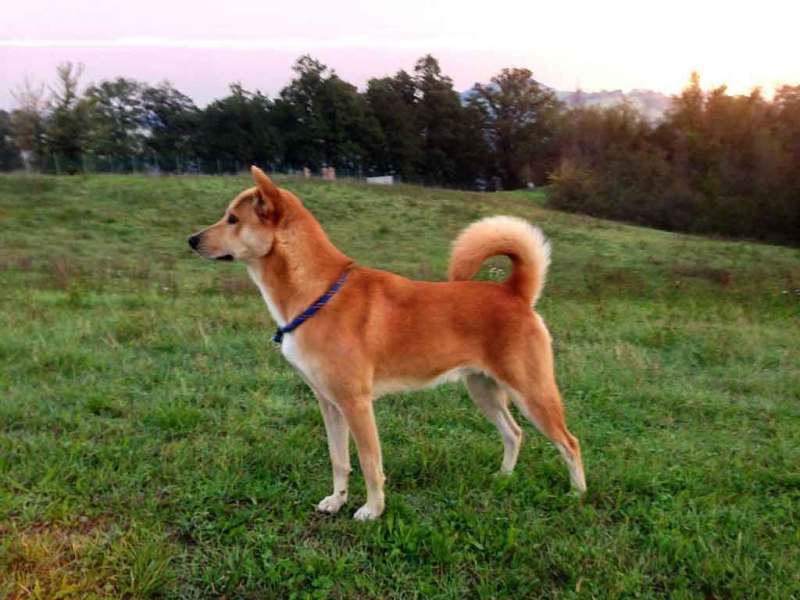
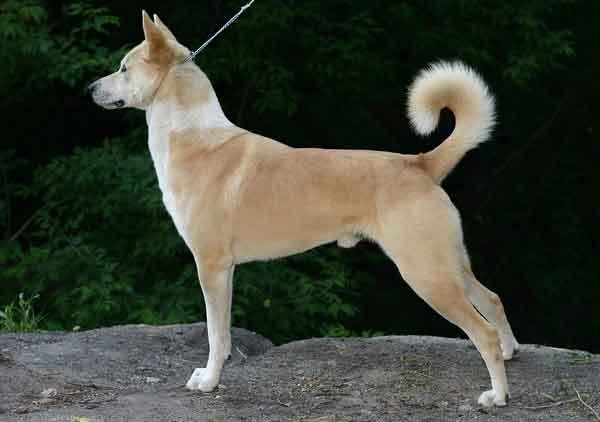
The height at the withers of these square animals, strong and medium in size is about 50 to 60 cm., while males are usually much larger than females. In general, the sex characteristics between female and male dogs are very pronounced. These may include, the rather broad skull of the Canaan Dog, that narrows at a point towards the front, is clearly visible, especially in males. The head is always well proportioned. Standing ears, slightly laterally arranged, triangular and wide, as well as his almond-shaped and dark eyes, give you a very alert and intelligent expression. In fact, nothing escapes the watchman Canaan Dog, even when asleep.

HAIR:
Thick layer, rough and straight, short to medium length. The inner layer is very close and abundant.

COLOR:
Sandy to reddish brown, white, black or mottled, with or without mask. If there is a mask, must be symmetrical. A black mask and white markings are allowed for all colors. A pattern such as the Boston Terrier. Gray colors are not allowed, striped, black and tan or tricolor. The characteristic colors of the desert – sandy, dorado, Red and cream – are particularly typical of the breed.

Character and aptitudes ยซCanaan Dogยป

The Canaan Dog is lively, sensitive, distrustful of strangers, defensive, but not aggressive by nature. Watcher not only of humans, but also other animals. He is faithful and devoted to his family. The relationship with its owner means for him a partnership, both sides taking and giving. The Canaan Dog you don't have to follow your owner everywhere and submissively read every wish in his eyes. There are times when he shows his love and wants to be caressed. But other times he minds his own business and only belongs to himself.. If one responds to his character, a deep understanding develops between man and animal, which is even more attractive, since one must acquire their trust and affection. This special bond makes it difficult to place the Canaan Dog adults in new settings.

Protects their owner's children and shows a lot of tolerance towards the little ones. But, parents should ensure the dog has a chance to withdraw.

The Canaan Dog they are good watchdogs, but they are not attackers by nature. Only when a Canaan Dog you have the impression that he or his family is seriously threatened, will attack. The Canaan Dog barks as a warning, gives a dangerous appearance, and that is usually enough.

The Canaan Dog can react aggressively to other dogs who dare to pass by his property. Aggression between dogs of the same sex is not uncommon among Canaanites. Each Canaan is different. You have to watch it closely to know what collisions – with other dogs on walks – it is better to avoid.

โ€œCanaan Dogโ€ Education

One Canaan Dog he would never do anything that could harm himself. Nor would it comply with its owner's commands without first questioning their meaning.. You can't demand obedience from this dog. But, once he has gained trust in his human and recognizes him as "leader of the pack", is very cooperative and obedient. Loyalty to his master and his quick understanding make him, despite its independence, an easy-to-handle dog, who can learn the necessary basic obedience without restrictions. But, during training its primitive nature must be taken into account, so it certainly takes some compromises and tricks to convince the Canaan Dog that obedience is worth it. For inexperienced beginners, this self-assured breed is not suitable.

Where can I get "Canaan Dog"?

Today, not only in his homeland Israel, but also in the US. and in several European countries, like germany, Finland, England, Italy or Switzerland, there are breeders who have dedicated themselves to this special and still very rare breed. The addresses of the breeders can be found in the national kennel clubs or, of course, on the Internet. If you are considering buying a Canaan, enough time should be taken to consider your purchase decision thoroughly. This is true of all dogs, but especially for him Canaan Dog, because this original and independent four-legged friend is no ordinary family dog.

โ€œCanaan Dogโ€ Care

The rough coat naturally repels dirt and only needs to be brushed once or twice a week. Only in the phase of the biannual coat change should it come into contact with a brush or comb daily to remove dead hairs from the dense undercoat and reduce the tuft of carpet hairs, the sofa or the blanket.

Nutrition of the โ€œCanaan Dogโ€

While the Canaan, as a "pariah dog" in freedom, forages for its own food and feeds on whatever organic waste humans leave behind, as a domestic dog it depends on the support of its owner. But what do you give such an original wild dog? In general: Dogs are carnivores by nature., regardless of whether they are shepherd dogs, Sausage dog or even Canaan. This means that the food must be largely meat. (around the 70 per cent). Meat is the most important source of protein for the dog. Its entire masticatory and digestive system is oriented to the processing of meat: the strong teeth, strong chewing muscles, the relatively short intestinal tract and digestive juices that are quite aggressive in contrast to humans.

Health ยซDog of Canaanยป

The race Canaan Dog It is very healthy, it does not have typical diseases and it is considered very clean..

Characteristics "Canaan Dog"

Coexistence is important that you have with your new friend. Before considering the acquisition of a dog of the breed "Canaan Dog" you know certain factors. Not all breeds of dogs are apt to live in an apartment, you must take into account his character, their need for exercise, their interaction with other pets, their care and if you have small children, their level of tolerance towards them.

Training ?

4,0 of 5 stars (based on 1 review)

Suitability of the apartment ?

4,0 of 5 stars (based on 1 review)

Can be alone all day ?

3,0 of 5 stars (based on 1 review)

Suitable as a first dog ?

2,0 of 5 stars (based on 1 review)

Weight gain ?

2,0 of 5 stars (based on 1 review)

Health ?

5,0 of 5 stars (based on 1 review)

Intelligence ?

5,0 of 5 stars (based on 1 review)

Kindness with child ?

3,0 of 5 stars (based on 1 review)

Tendency to bite ?

3,0 of 5 stars (based on 1 review)

Tendency to bark ?

4,0 of 5 stars (based on 1 review)

Tendency to flee ?

3,0 of 5 stars (based on 1 review)

hair loss strength ?

4,0 of 5 stars (based on 1 review)

Suitable as a guard dog ?

5,0 of 5 stars (based on 1 review)

Joy ?

3,0 of 5 stars (based on 1 review)

Cat friendliness ?

4,0 of 5 stars (based on 1 review)

Power level ?

4,0 of 5 stars (based on 1 review)

Images "Canaan Dog"

Photos:

1 – Canaan dog by Giora Sluzky, CC BY-SA 3.0, via Wikimedia Commons
2 – Canaan dog by Canaan Dog, Kennel Samorodok Hanaanahttp://www.ruscanaan.ru, CC BY-SA 3.0, via Wikimedia Commons
3 – Canaan dog by Giora Sluzky, CC BY-SA 3.0, via Wikimedia Commons
4 – Canaan dog by SamorodokhanaanaCanaan Dogs from "Samorodok" http://www.ruscanaan.ru, CC BY-SA 3.0, via Wikimedia Commons
5 – Canaan dog by https://pxhere.com/en/photo/1503483
6 – Canaan dog by Samorodokhanaanahttp://www.ruscanaan.ru, CC BY-SA 3.0, via Wikimedia Commons
7 – Canaan dog by Arikk, CC BY-SA 3.0, via Wikimedia Commons

Videos "Canaan Dog"

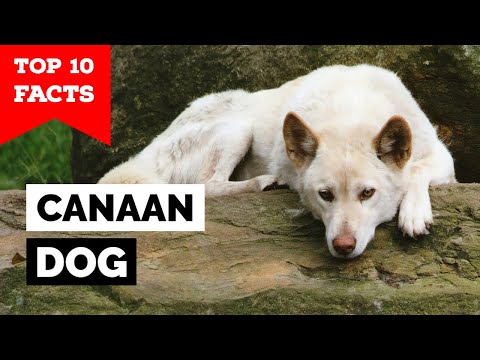
Canaan - Top 10 Facts
Canaan – Top 10 Facts
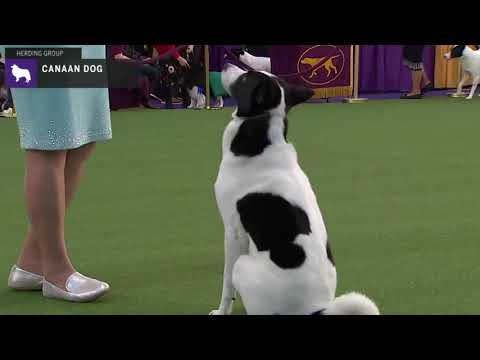
Canaan Dogs | Breed Judging 2020

Type and recognitions:

  • FCI CLASSIFICATION:
  • Group :
  • Section : . .

Federations:

  • FCI – Group 5: Spitz-type dogs and primitive type – Section 6: Primitive type. โ“˜
  • AKCHerding โ“˜
  • ANKC – Group 7 (Nonsporting) โ“˜
  • CKC – Group 7 (Nonsporting) โ“˜
  • โ€‹KCUtility โ“˜
  • NZKCNonsporting โ“˜
  • UKC – sighthounds and pariah โ“˜

FCI breed standard "Canaan Dog"

Origin:
Israel

Date of publication of the valid original standard:
26.03.1998

Use:

Guard and protection dog.


General appearance:

Medium-sized, square body, well balanced, strong, similar to the type of wild dog. There is a marked difference between both sexes.


Behavior / temperament:

You are always alert and react quickly. Distrustful of strangers, his character is strongly defensive, but not aggressive by nature. Is vigilant, not only with humans, but also with all the animals. It is very faithful and easy to train.

Head:

Is well proportioned, medium length, in the form of an obtuse wedge. It appears even wider because the ears are set low.

Cranial region:
  • Skull : Is something flat. Head may be wider in powerful males.
  • Depression links (Stop) : shallow, although well defined.

facial region:

  • Truffle : black.
  • Snout : Vigorous, of moderate length and width.
  • Lips : Tight.
  • Jaws / Teeth : Jaws must be strong. Teething is complete with a uniform scissor bite.

Eyes : Dark brown in color, slightly oblique and almond-shaped. Dark eye rim is essential.

Ears : erected, relatively short and wide. They are slightly rounded at the tip and are set low.

Neck:

Muscular and of medium length.

Body:

Square.

  • Cross : Well developed.
  • Back : Uniform.
  • Pork loin : Muscular.
  • Breast : Deep and moderately wide. Well arched ribs.
  • Belly : Well up.

Tail:

Set high it is worn curled over the back. The hair is abundant and dense.

Tips

PREVIOUS MEMBERS : Perfectly straight.

  • Shoulder : Oblique and muscular.
  • Elbows : Well attached to the body.

LATER MEMBERS : Powerful.

  • Buttocks : Strong and covered with a slight fringe of hair.
  • Knees : Well angulated.
  • Hocks : Well descended.

FEET : Jack's foot. They're strong, round and the pads are hard.

Movement:

The trot is fast, light and vigorous. The animal must show great agility and resistance. Correct movements are of essential importance.

Mantle

HAIR : The hairs on the outer coat are dense, hard, straight and short or of medium length. The hairs of the undercoat are abundant and well glued.

COLOR : Ranges from sand to reddish-brown, white, black or mottled, with or without mask. If there is a mask, this must be symmetrical. Black mascara and white markings are allowed in all colors. Brands like the Boston Terrier are common. Gray colors are not accepted, striped, Black with fire, nor tricolor. The most typical colors of the breed are the colors of the desert, sand, oro, Red and cream.


Size and weight:

Height to the cross : It is of 50 to 60 cm.. Males can be considerably larger than females.

Weight : It is of 18 to 25 kg.


Fouls:

Any deviation from the aforementioned criteria is considered as a fault and the severity of this is considered to the degree of the deviation to the standard and its consequences on the health and well-being of the dog..

Any dog โ€‹โ€‹showing clear signs of physical or behavioral abnormalities must be disqualified..


N.B.:

โ€ข Males must have two normal-appearing testicles fully descended into the scrotum..
โ€ข Only functionally and clinically healthy dogs, with the typical conformation of the breed, should be used for parenting.

Source: F.C.I - International Cynological Federation

Alternative names:

1. Bedouin Sheepdog, Palestinian Pariah Dog (English).
2. Canaan dog (French).
3. Canaan Dog, Israel-Spitz (German).
4. Cรฃo de canaรฃ (Portuguese).
5. Perro de Canaรกn, Kelev Kna’anรญ, kunean alkalb (espaรฑol).

โ–ท The world of Pets: Dogs, cats, birds, reptiles, amphibians

Chow Chow
FCI 205 - Asian Spitz and related breeds

Chow Chow

The Chow Chow are distinguished by their unusual blue-black tongue

Content

History

The Chow Chow has been known for more than 2500 years in China, where it is represented in bas-reliefs of the time. Dog of mysterious origin, belongs to the Spitz family. Some believe it is a cross between a Tibetan Mastiff and a Samoyed., while others think it is more of an original dog, that is to say, that comes from the Nordic dogs (internal temperature above average, particular shape of the bony structure of your skull…). In any case, stories about the origins of Chow Chow they are usually just hypotheses.

In Manchuria and Mongolia it was used as a war dog, to watch over herds or rushes and as a draft animal. The Chow Chow they were also found in Tibetan monasteries: his function was to defend the monks. Occasionally it was a hunting dog, it was eaten in some parts of china, and his skin was also traded.

It was introduced in Europe in 1865, when Queen Victoria of England received one as a gift and started raising it. It was officially recognized by the Kennel Club English little less than 30 years later, in 1894. Today, only used as a pet.

The term ยซChow Chowยซ has appeared recently. In fact, during the interwar period, the Chow-Chow It was known in the West as the "Hong Kong dog".

Despite some other blood additions over the years 50, the Chow Chow is a breed that has remained pure.

Physical characteristics

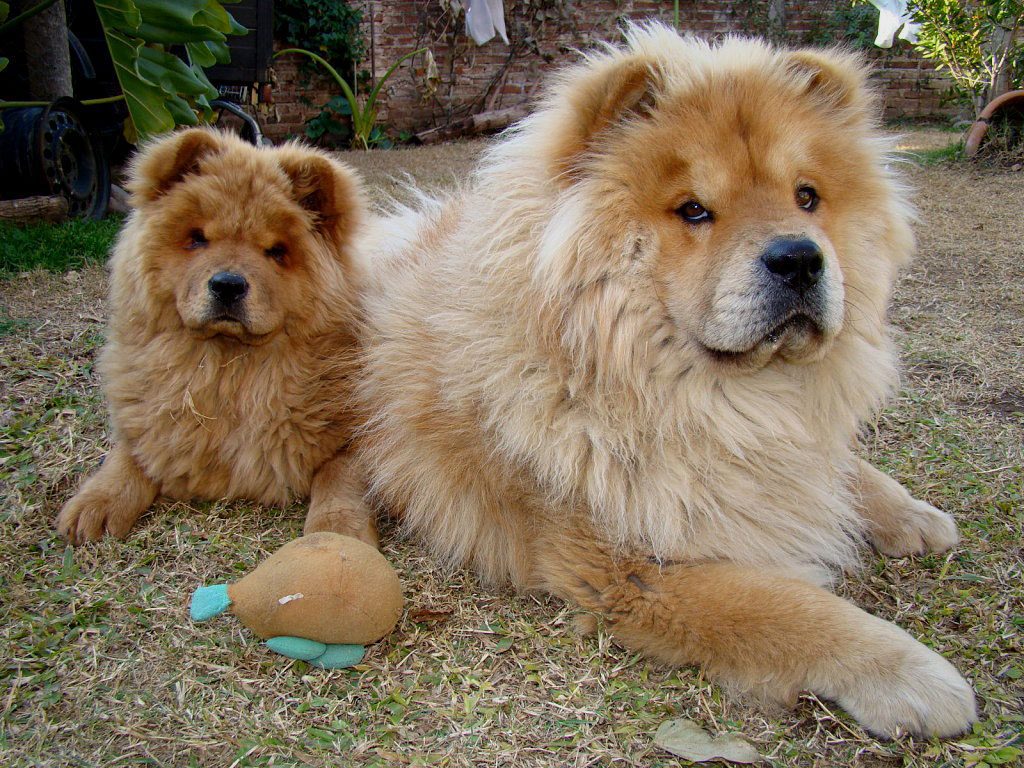
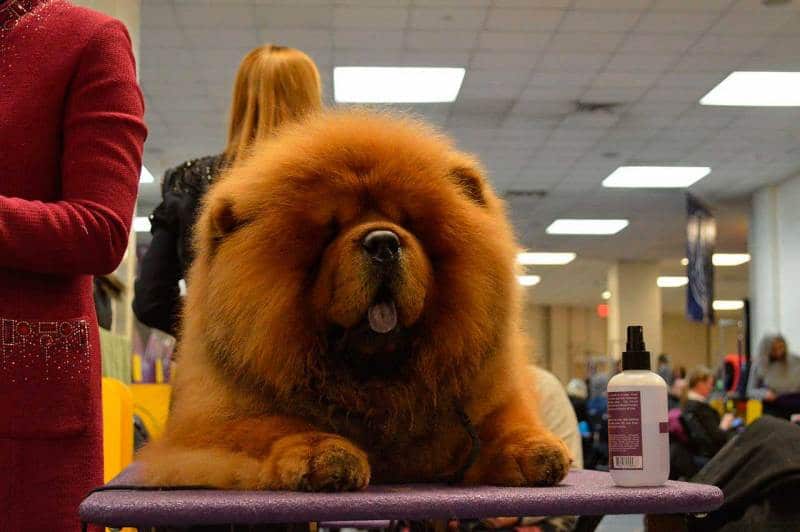
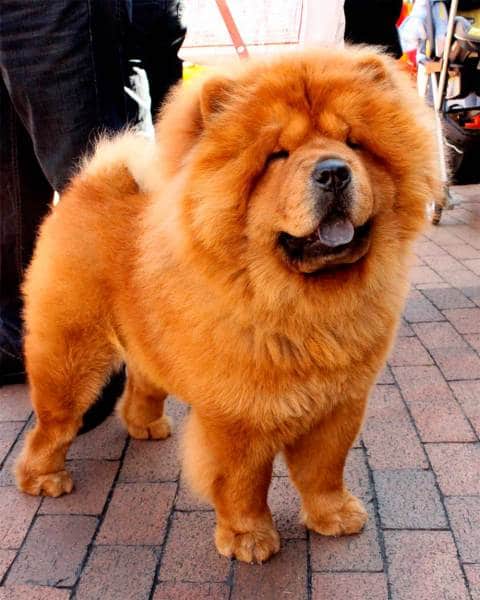
The Chow Chow It is a dog with a robust body that goes hand in hand with its wide skull and its small triangular ears slightly rounded at the tip and it carries them apart with the tip slightly inclined forward which are always erect. His eyes are dark, from Brown to black always small, almendrada form. The nose is completely black and wide except in color Chow cream and white, which supports the color pink. The mouth is wide and strong. They have a characteristic "stilt" movement, due to the peculiar conformation of their hind legs, which lack angle, and it makes it look like walking on stilts.

It is a dog of agile and balanced movement. By joining the legs in parallel to two in the movement. This breed has a very dense fur that can be rough or soft, which it accumulates more around his neck, giving it its distinctive frill or horsehair. Its fur can be red, black, Blue and cream. Those who have spotted or multi-coloured fur are considered outside the standards of the breed.

The Chow Chow They are distinguished by their unusual bluish-black or purple tongue and strong legs.. The gene for the bluish-black or purple tongue is usually dominant in this breed, and so it also tends to be in from mixed races of a Chow Chow.

A legend that says, When the gods placed the stars in the firmament, pieces of the sky fell that the Chow Chow licked and since that day he has had a blue tongue..

Character and skills

Today, the Chow Chow is commonly a companion dog. His strong sense of ownership of their homes with their - sometimes- intriguing approach to strangers may be misinterpreted by those who do not belong to his family. But, signs of shyness and aggression are not characteristic of this breed. Copies of the sex opposite usually coexist with less tension than with those of the same sex, but it is not uncommon to see Chow Chow of different sexes living together peacefully.

They are extremely loyal to their family and it costs change masters. Affection usually shown only to people you know, so visitors should not push them physically as they will not immediately accept strangers as quickly as they do with their family members.

They are not a very active breed. Life in an apartment suits them, if they are given the opportunity to get enough physical activity daily. The owners must take daily walks with their Chow Chow, so be it in a small place, to maintain their physical and mental abilities in a healthy way.

Although this breed shows low energy most of the time, needs a routine to be able to explore their environment and thus maintain a loving nature. Its typical behavior resembles that of a domestic cat more than that of a dog., for cleaning and its enigmatic nature.

Grooming

Grooming requirements depend on the type of fur. A Chow straight hair needs to be brushed weekly only. One with a rough coat should be brushed every other day. Both varieties molt twice a year, during which the coat will abundantly. Rarely need a bath, although a hot bath followed by a thorough drying can help remove the coat you're missing.

The rest is basic care. Trim nails as needed, usually once a month. Brush your teeth frequently for general good health and fresh breath. Check ears weekly for dirt, redness or odor that may indicate an infection. If the ears look dirty, clean them with a damp cotton ball and a mild ear cleaner recommended by your vet.

Health

The Chow Chow is the breed of dog most affected by Dysplasia elbow. It is also vulnerable to hip dysplasia, dislocation of patella, thyroid disease, Pemphigus Foliaceus and ocular disorders such as entropion and ectropion. The risk of these disorders increases exponentially when they are purchased at pet stores unscrupulous caregivers who do not test their dogs to see if there is existence of genetic disorders. Like this, a potential buyer of this breed should ask about the health status of the pet to buy. Animal caretakers must provide the client with a guarantee of the dog's health. But despite his delicate health, It is an excellent companion dog for humans..

Characteristics "Chow Chow"

Coexistence is important that you have with your new friend. Before considering the acquisition of a dog of the breed "Chow Chow" you know certain factors. Not all breeds of dogs are apt to live in an apartment, you must take into account his character, their need for exercise, their interaction with other pets, their care and if you have small children, their level of tolerance towards them.

Adaptation โ“˜

2,0 of 5 stars (based on 1 review)

friendly dog โ€‹โ€‹โ“˜

1,0 of 5 stars (based on 1 review)

hair loss โ“˜

5,0 of 5 stars (based on 1 review)

Affection level โ“˜

2,0 of 5 stars (based on 1 review)

Need for exercise โ“˜

2,0 of 5 stars (based on 1 review)

Social need โ“˜

2,0 of 5 stars (based on 1 review)

Home โ“˜

3,0 of 5 stars (based on 1 review)

Toilet โ“˜

5,0 of 5 stars (based on 1 review)

Friendly with strangers โ“˜

1,0 of 5 stars (based on 1 review)

barking โ“˜

5,0 of 5 stars (based on 1 review)

Health โ“˜

4,0 of 5 stars (based on 1 review)

Territorial โ“˜

3,0 of 5 stars (based on 1 review)

Cat friendly โ“˜

2,0 of 5 stars (based on 1 review)

Intelligence โ“˜

2,0 of 5 stars (based on 1 review)

Versatility โ“˜

2,0 of 5 stars (based on 1 review)

Child friendly โ“˜

2,0 of 5 stars (based on 1 review)

Surveillance โ“˜

2,0 of 5 stars (based on 1 review)

joy โ“˜

3,0 of 5 stars (based on 1 review)

Images "Chow Chow"

credits:

1 – Flickr: Chowdren
2 – International Dog Show, Szczecin 2007 by Remigiusz Jรณzefowicz
3 – Pets Adviser from Brooklyn, USA / CC BYwww.petsadviser.com
4 – by https://pxhere.com/es/photo/234926
5 – Flickr: Bokeh the Chow by Luigi Borromeo
6 – Flickr: Chowdren (chow chow) by Seongbin Im
7 – by https://www.needpix.com/photo/371158/chow-chow-dog-snow-canine-domestic-pet-portrait-looking-attentive
8 – Russian: photo from the exhibition by Vladimir gubanov

Videos "Chow Chow"

Type and recognitions:

  • FCI CLASSIFICATION:
  • Group :
  • Section : . .

Federations:

  • Federations: FCI โ“˜, AKC โ“˜, ANKC โ“˜, CKC โ“˜, โ€‹KC โ“˜, NZKC โ“˜, UKC โ“˜

  • FCI breed standard Chow Chow

    FCIFCI - Chow Chow
    CHOW

    Alternative names:

    1. Chow (English).
    2. Chow (French).
    3. Chow (German).
    4. Chow (Portuguese).
    5. Chow (espaรฑol).

    โ–ท The world of Pets: Dogs, cats, birds, reptiles, amphibians

    Canadian Eskimo Dog
    Canadรก FCI 211 . Nordic Sledge Dogs

    Esquimal Canadiense

    The dog Canadian Eskimo Dog it's a sled dog, the North of Canada natural. Possibly this is one of the most cold tolerant dogs.

    Content

    History

    Similar to the Hotocho (or Mongolian sheepdog), the Canadian Eskimo (or Qimmiq en inuktitut) it is a very old canine breed, perhaps one of the first to accompany man to this part of the globe, almost ago 4.000 years. Faithful companion of the Inuit people of Thule, was bred and trained to become a tough working dog, able to travel long distances at a steady pace. It also, your complexion, their excellent sense of smell and intelligence were used to locate the breathing holes of seals for hunting and to protect families from musk oxen and polar bears..

    In the Decade of 1920, the Canadian Eskimo remained closely associated with the Inuit culture, With almost 20.000 Eskimos working alongside men in the northern territories. But, this golden age was not going to last. In effect, the arrival of the snowmobile in the years 60, the massive and systematic killing of Inuit dogs by the Canadian government (officially, for public health reasons – unofficially, say some, to intimidate and forcibly assimilate Inuit peoples, eliminating their main work tool and a symbol of their culture), the introduction of new breeds of sled dogs such as the Siberian Husky, as well as a certain vulnerability to the diseases that these latter bring., are literally decimating purebred Canadian Eskimo populations. In 1963, there was only one Canadian Eskimo Dog registered in the breeding book of the Canadian Kennel Club, which then declared the race extinct.

    This statement proved premature. But, it did not count on the tenacity of William Carpenter, Bill Thompson, John McGrath (founders of the Research Foundation of the Canadian Eskimo Dog) and Brian Ladoon (breeder and musher, that is to say, sled driver). With government support to preserve Inuit cultural heritage, the quartet undertook an expedition to the most remote regions of the Canadian Arctic in order to find purebred Canadian Eskimos. Their efforts paid off and, thanks to the specimens unearthed in the Inuit villages, a breeding program was launched. few years later, in 1970, there was nothing less than 200 animals. Today, this figure reaches the 300 individuals around the world.

    Although the United Kennel Club American recognized the Canadian Eskimo as a race in its own right in 1996, was not up 2018, year in which the breed was recognized by the International Cynological Federationand (FCI) and Central Canine Society, when the breed really came to the forefront of the canine world and the general public and enlightened fans learned not only about the qualities of this dog, but also the precariousness of its existence.

    But, although some specimens have crossed the Atlantic to the United Kingdom, the spread of the breed remains for the time being essentially limited to Canada and the United States, and even there, the breeders of Canadian Eskimo Dog they are still scarce.

    Physical characteristics

    At first sight, it is clear why the Canadian Eskimo has helped the Inuit people for so long. Strength, power, resistance and vigor are the first adjectives that come to mind when describing this dog capable of constant effort in difficult environmental conditions.

    The Canadian Eskimo is of medium build, with a strong neck and chest, but with legs of medium height. With its well defined bones and muscles, his powerful and majestic physique reflects that he is mainly a very resistant dog, not very fast. It should be noted in passing that females are slightly smaller and less muscular than males.

    It is also interesting to note that the Canadian Eskimo is quickly big enough to work: although it does not reach full maturity until around the 3 years of age, it is capable of transporting loads from the 7 months. Puppies are often described as miniature adults, with the ears upright and upright on the skull and the tail coiled from the third week.

    Like most of the Spitz, the head of the Canadian Eskimo is angular and elevated, with straight, thick ears. The eyes are placed at an angle and give the animal a serious attitude. The bushy tail is carried high or curled on the back.

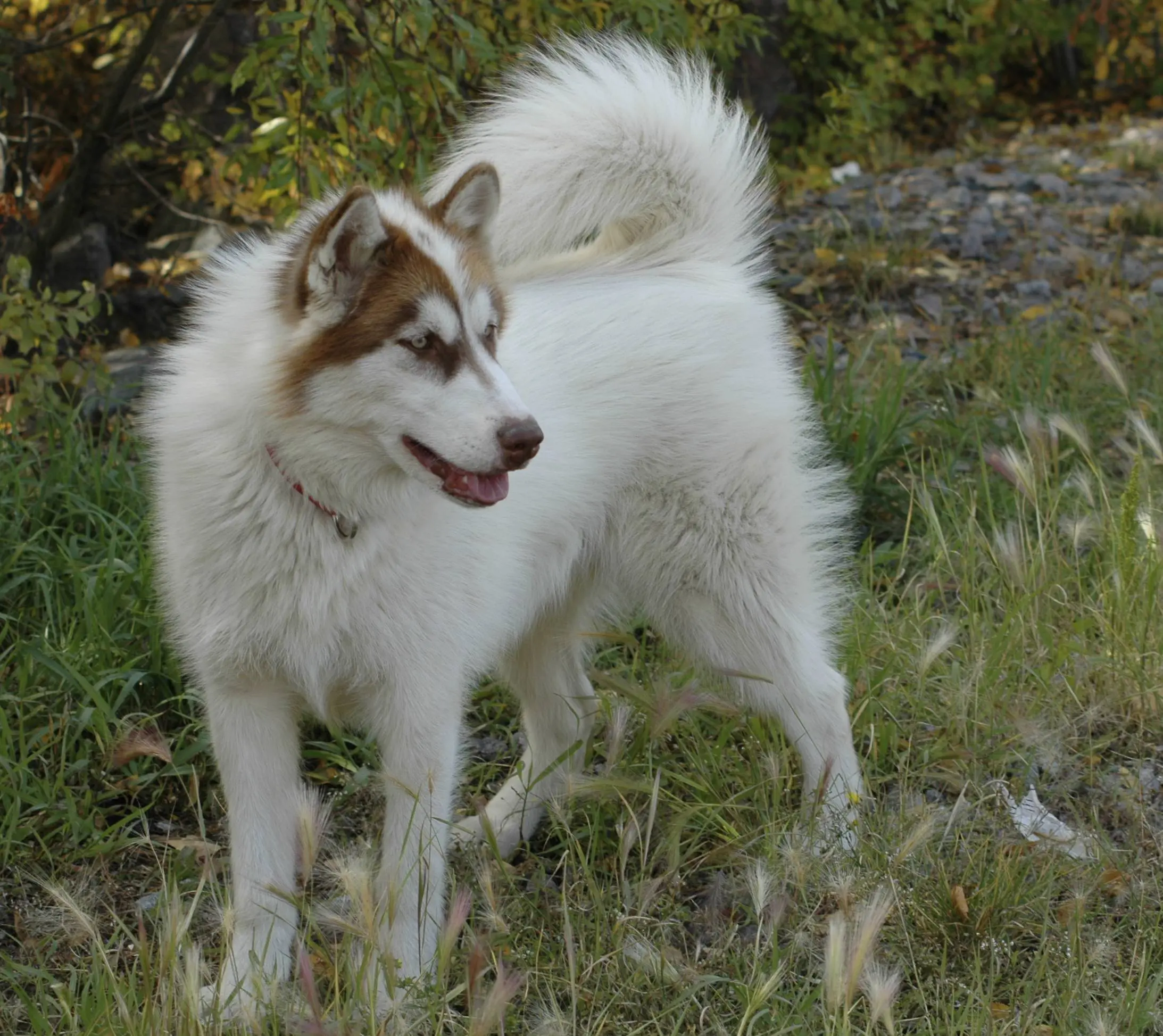
    The coat of the Canadian Eskimo It is thick, with a smooth top layer and a dense and uniform wool bottom layer, providing optimal thermal insulation for adverse weather conditions. This makes them one of the most cold-adapted dog breeds.. Males also have a long mane that covers the neck and shoulders. Females usually have the shortest upper layer, which contributes to give the impression of a finer animal.

    The breed standard does not allow smooth fur. So, the Canadian Eskimo must always have a coat with a combination of colors, without the distribution of one color taking precedence over the others:

    • Completely white fur with pigmentation around the eyes, on the nose and lips (is not an albino);
    • white coat with only a very small amount of red, buff (including cinnamon shading), gray or black around the ears and eyes;
    • white coat with red markings, beige, cinnamon, gray or black around the ears and eyes, or the head completely marked with these colors, sometimes with small spots of the same color on the body, usually around the hips or on the flank;
    • Red and white, or buff and white, or cinnamon and white, or black and white, with a distribution to 50% of each of the two colors in the different parts of the body;
    • red or beige or cinnamon, with white on the chest and/or on the legs and lower part of the body;
    • Sabre body or black or dark gray, with white on the chest and/or on the legs, under the body, occasionally extended to the neck like a gola;
    • silvery grey or greyish white fur;

    Brown bottom layer and black top layer.

    The white mask shaded around the eyes and/or around the nose, with or without dots above the eyes, it is a common physical characteristic in dogs with a well-defined color on the head. Very rarely, the dots above the eyes, as well as the cheek marks, can be buff-colored, adding a third color to a normally bicolored dog.

    Size and weight

    ▷ Male size: 58 to 70 cm.
    ▷ female size: 50 to 60 cm.
    ▷ Male weight: 30-40 kg
    ▷ female weight: 18-30 kg

    Character and skills

    The character of Canadian Eskimo reflects the harsh environmental conditions in which he lives and the work that dots his daily life. So, it is closer to the wild animal domesticated by the tribal peoples in a logic of labor collaboration than to a real pet overflowing with affection for its master. Intelligent, brave, but always on guard, so sometimes it may seem distant.

    This does not prevent this dog from being gentle and affectionate with his family, or express a friendly curiosity towards strangers your family welcomes. But moderation remains the key word for him.. The Canadian Eskimo rarely celebrates his master, although he does not hesitate to ask for a caress as a sign of recognition. As a pack dog, is fiercely loyal to his master, whom he considers the leader of the clan, and is less distant with it. Beware who shows signs of animosity towards this leader: the Canadian Eskimo it will quickly remind you of the meaning of the word respect, with many grunts.

    The herds of Canadian Eskimo have a reputation for being very organized. From time to time some fights and scratches may occur, but it is not a sign of serious struggle or rebellion against the established leader.

    It also, unlike many recent dog breeds, the Canadian Eskimo has retained a very sharp hunting instinct. The slightest encouragement, either the food, the start of a game or a fight, gives rise to a quick and very enthusiastic response by this dog. In fact, this dog is more suitable for a family of adults and should never be left with children, as this could lead to unintentional injury. You can live with dogs that do not belong to your herd, but with some reservations, since he tends to regard any animal smaller than him as a prey to devour rather than as a companion with whom to live. The cats, rodents and small dogs will be tested if they have to cohabit with it.

    Last, as an outdoor dog par excellence, who appreciates cold temperatures and prefers to sleep outdoors if given the opportunity, the Canadian Eskimo is not at all a breed of dog adapted to a floor. They need to spend many hours outside each day to maintain their physical and mental fitness.. Sporty and hyperactive dog, used to pulling sleds, the ideal for him is to have a master as tough as him. In other words, it is a perfect companion for those who want to practice cani-rando, cani-mountain biking, ski joering, canikart… Without physical activity up to their capabilities, becomes a destructive and/or aggressive dog.

    Last, being a very intelligent dog, is the king of escapes and mischief. There is no delicate plant or reinforced fence that resists it. If you have decided to be a runaway dog, it will be very difficult to stop.

    Health

    The Canadian Eskimo has excellent physical dispositions that make it resistant to many of the genetic diseases that are common in dogs of similar breeds.

    But, although they are a force of nature in their natural environment, are more susceptible to parasites and skin diseases that develop in warmer temperatures. Thus, it's important not to forget dog vaccine reminders, and give regular preventive treatment against ticks and fleas.

    It also, like many Nordic dogs, has predisposition to the following diseases:

    – Hip Dysplasia
    – waterfalls
    – Arthritis;
    – gastric torsion;
    – entropion.

    Life expectancy

    10 – 15 years

    Characteristics "Canadian Eskimo Dog"

    Coexistence is important that you have with your new friend. Before considering the acquisition of a dog of the breed "Canadian Eskimo Dog" you know certain factors. Not all breeds of dogs are apt to live in an apartment, you must take into account his character, their need for exercise, their interaction with other pets, their care and if you have small children, their level of tolerance towards them.

    Adaptation โ“˜

    4,0 of 5 stars (based on 1 review)

    friendly dog โ€‹โ€‹โ“˜

    3,0 of 5 stars (based on 1 review)

    hair loss โ“˜

    3,0 of 5 stars (based on 1 review)

    Affection level โ“˜

    4,0 of 5 stars (based on 1 review)

    Need for exercise โ“˜

    5,0 of 5 stars (based on 1 review)

    Social need โ“˜

    3,0 of 5 stars (based on 1 review)

    Home โ“˜

    2,0 of 5 stars (based on 1 review)

    Toilet โ“˜

    2,0 of 5 stars (based on 1 review)

    Friendly with strangers โ“˜

    3,0 of 5 stars (based on 1 review)

    barking โ“˜

    2,0 of 5 stars (based on 1 review)

    Health โ“˜

    2,0 of 5 stars (based on 1 review)

    Territorial โ“˜

    4,0 of 5 stars (based on 1 review)

    Cat friendly โ“˜

    3,0 of 5 stars (based on 1 review)

    Intelligence โ“˜

    4,0 of 5 stars (based on 1 review)

    Versatility โ“˜

    3,0 of 5 stars (based on 1 review)

    Child friendly โ“˜

    4,0 of 5 stars (based on 1 review)

    Surveillance โ“˜

    3,0 of 5 stars (based on 1 review)

    joy โ“˜

    3,0 of 5 stars (based on 1 review)

    Type and recognitions:

    • FCI CLASSIFICATION:
    • Group :
    • Section : . .

    Federations:

    • FCI – Group 5 – Section 1 Nordic Sledge Dogs. โ“˜
    • CKC – Nordic Sledge Dogs โ“˜

    FCI breed standard "Canadian Eskimo Dog"

    Origin:
    Canada

    Date of publication of the valid original standard:
    28.02.2018

    Use:

    For centuries this breed was used as a draft animal and was able to drag between 45 and 80 kg. per dog covering distances of 15 to 70 miles per day. It was also used as a hunting dog, to locate seal breathing holes for Inuit hunters. As a hunting dog, it also attacked and kept at bay the musk ox and the polar bear for the Inuit hunters.. In summer, The dog was used as a pack dog that could carry up to 15 kg.


    General appearance:

    The Canadian Eskimo Dog is a dog of moderate size, powerful build, with thick neck and chest and medium length legs. Typical of the Spitz family of dogs, has a wedge-shaped head with tall thick ears. The eyes are set obliquely giving a serious appearance. The dog has a bushy tail raised or curled over its back. About the same height at the hips as at the withers, medium to large in size and muscular, the dog displays a majestic and powerful physique that gives the impression that it is not made for speed but for hard work. Above all, the body must be muscular and not fat. Females will have a smaller and less muscular body than males. In the winter, the body is covered with an outer layer of straight or erect hair; underneath is a dense low-voltage layer that allows the animal to easily withstand the rigors of high latitudes. A mane-like growth of longer hair will appear over the neck and shoulder in male specimens.. The entire conformation of the Canadian Eskimo Dog must be one of strength, power and endurance balanced with agility, vigilance and audacity. The female of the breed will usually have a shorter coat than the male and will always be significantly smaller than the male.. Like young bitches, will be more boneless, among other things, with a narrower head that tends to produce a friendlier face than with men. Both males and females of the breed are known to have a rapid growth rate reaching working size around seven months. But, the maturation process extends to at least three years of age, giving them a very majestic look. The cubs have often been described as miniature adults, with erect ears and a curly tail at young ages between three and five weeks. There may be occasional periods during the adolescent growth stages when the ears may not be fully erect., but it is important to note that the Canadian Eskimo Dog's ears do not have the same gradual growth of erectness around four months of age., as seen in some other breeds.

    important proportions:

    The width of the forehead between the ears of males shall be 5 to 6 inches (13 to 15 cm.). In females, the distance will be 4-1 / 2 โ€“ 5-1 / 2 inches (11-14 cm.).


    Behavior / temperament:

    The temperament of the Canadian Eskimo Dog should reflect the tough, hardworking breed that it is. It should not be viewed as a domestic pet, but as a primitive dog originally domesticated by the Inuit for specific tasks in a harsh arctic environment. In general, mature canadian eskimo dog is kind and affectionate to the average guy, enjoying the attention. Even with strangers, dogs are rarely distant. Usually, exhibit fairly calm friendship and harmless curiosity or become completely distant. The dog is very pack oriented and, if raised as a group, dominant and subordinate roles will be played under the leadership of a fully dominant or boss dog. Behavior within a group or herd is generally well structured and controlled, but it is not uncommon to see battle scars or torn ears on dogs that originate from breeding areas where dogs are raised in groups or packs.. Compared to modern domestic breeds, The Canadian Eskimo Dog has an almost excessive response to any stimulus, either food, work, defense or game. For this reason, the dog should be a companion for adults and should not be considered a child's pet.

    Head:

    ---

    Cranial region:

    Skull: Massive but well proportioned being wide and wedge-shaped. Although it is often described as a species of wolf, the head of the canadian eskimo dog has a higher forehead. Immature females will have a much narrower skull than the male.

    facial region:

    • Truffle: The pigmentation of the nose will vary from black to light brown (especially in lighter colored dogs with red, cream or cinnamon on the body). Butterfly noses, sometimes they appeared with light brown noses.
    • Snout: Tapered and medium length.
    • Belfos: Black or brown with pink.
    • Mwalking / Teeth: The jaws are heavy and powerful and have large teeth with well-developed canine teeth.. The incisors meet in a scissor bite.
    • Eyes: In general, dark colored but hazel or yellow eyes will appear in the breed. They are small, widely spaced and set obliquely on head, which tends to look much wilder and more deceptive than the dog deserves.
    • Ears: Short, thick and slightly rounded ends. They are carried erect, they turn forward and cover themselves with dense short hair.

    Neck:

    Short, straight, thick and very muscular.

    Body:

    • Generality: About the same height at the hips as at the withers.
    • Back: The spine when felt through the hair body is well pronounced.
    • Pork loin: Well developed.
    • Breast : Deep, wide and well muscled.
    • bottom line: There is very little flank curve Very little flank curve.

    Tail:

    Large and bushy and usually carried up or curled over the back. Mature bitches can sometimes bring their tails down.

    Tips

    Former members

    • Shoulder: Large, obliquely fitted with moderate musculature.
    • Forearm: Straight, but may appear to be leaning, due to the well-developed triceps muscle above and behind the elbow and the pronounced muscle in the forearm.
    • Front feet: Large, almost round, well bowed, with thick pads that are well arranged between them; However, under extremely cold winter conditions, this fur will grow to be too long to cover the bottom of the pads.

    Later members

    • Generality: The hips can appear as pronounced and bony as the spine, and they are approximately the same height as the cross.
    • Thigh: The legs will be very muscular and the width of the thigh will carry well towards the hock..
    • Knee: Well folded.
    • Hock: From the back, the legs will appear straight with the hocks turning in and out.
    • Rear feet: Similar in design to the front but slightly longer.

    Movement:

    The working gait of this dog is a powerful, energetic trot with the hind legs moving in line with the front legs in the power movement., but showing some abduction during the forward movement of the stride. This can be especially pronounced in mature male dogs with many miles of harness.. This gait may seem uncomfortable to the untrained eye., but it is the result of a wide posture caused by well developed thighs. This particular gait is an efficient and well-balanced gait for pulling hard day after day.. The dog's movement must not appear in any way as a jerky or rowing movement. Females are much faster and freer in movement than heavier males and are capable of breaking the natural trotting stride and running or galloping for much longer distances than males..

    Mantle

    Skin

    Should feel thick and resilient.

    Fur: Subject to an annual molt, usually in August or September, the coat is thick and dense and the guard hairs are hard and rigid. This outer layer will vary from 3-6 inches (7-15 cm.) length. In males it will occur in a mane-like growth on the shoulder and neck, which makes the male appear much larger in size and taller at the withers than he actually is. The inner layer is very dense to provide excellent protection during the most extreme winter conditions. During the molt, This condition will release in clusters over a period of a few days. Females will generally have a shorter coat partly due to the additional shedding that will occur after the pups are born..

    Color

    No one color or color pattern should dominate the breed with the Canadian Eskimo Dog color and color patterns ranging from:

    • (to) A completely white body with pigmentation around the eyes, nose and lips (for example, not albino).
    • (b) White body with only the smallest amount of red, beige (including shades of cinnamon), gray or black around the ears or eyes.
    • (c) White bodies with red heads, polished, cinnamon, gray or black marks around the ears and eyes or the entire head and the occasional small spot of the same color on the body, usually around the hip or flank.
    • (d) Red and white, or cream and white, or tan and white or black and white with a distribution of approximately 50/50 of the two colors, in various parts of the body.
    • (and) Red body or soft body or tan body with white on the chest and / o legs and lower body.
    • (f) Saber or black body or dark gray body with white on the chest and / or legs and lower body that occasionally extend around the neck in the form of a necklace.
    • (g) Silver gray or greyish white body.
    • (h) Polished to brown under with black guard hairs.

    Very common for dogs with solid color over most of the head is a white mask around the eyes and / or muzzle with or without white spots on the eyes. Very rarely, the spots over the eyes, as well as the marks on the cheeks, will be buff color, which will add a third color to an animal that normally has two colors.


    Size and weight:

    • Height to the cross: Males: 58-70 cm., females: 50-60 cm..
    • Weight: Males: 30-40 kg, females: 18-30 kg.


    Fouls:

    Any deviation from the above mentioned criteria is considered to lack, and the severity of this is considered the degree of deviation from the standard and its consequences on the health and well-being of the dog and the dog's ability to perform its traditional task.

    Serious misconduct

    • Head: square muzzle or loose lips, round or bulging eyes.
    • Neck: Long and thin.
    • Body: Narrow chest, over all lack of muscle, excess fat, sloping back, coarseness or lack of finer bones in bitches.
    • Legs: thin, fine boned or set beef.
    • Pies: flat or open.
    • Shelter: Short, off prime.

    disqualifying fouls:

    • Aggressive or overly shy dogs.
    • Blue eyes.
    • Floppy ears, the exception is the ears torn by battle.
    • Trim or alter the coat using scissors.
    • There is no evidence of a curly or upright tail in male dogs (recognizing that a tail may occasionally hold down as a sign of subordination or stress).
    • Excess under or excess jaw.


    N.B.:
    • Any dog โ€‹โ€‹showing clear signs of physical or behavioral abnormalities must be disqualified..
    • The aforementioned fouls that are more pronounced or more marked are eliminatory..
    • Males should have two normal-appearing testicles fully descended into the scrotum..
    • Only functionally and clinically healthy dogs, with the typical conformation of the breed, should be used for parenting.

    Source: F.C.I - International Cynological Federation

    Alternative names:

    1. Canadian Inuit Dog, Qimmiq, Canadian Husky (English).
    2. Inuit canadien, Qimmiq (French).
    3. Canadian Eskimo Dog (German).
    4. (em inglรชs: Canadian Eskimo Dog), Qimmiq (Portuguese).
    5. (espaรฑol).

    โ–ท The world of Pets: Dogs, cats, birds, reptiles, amphibians

    Cirneco dell'Etna
    Italia FCI 199 . Primitive type - Hunting Dogs

    Cirneco del Etna

    This lively and friendly Sicilian Greyhound makes an excellent companion and keeper requiring regular exercise – 20 to 30 minutes a day –

    Content

    History

    He "Cirneco dell'Etnaยซ, also it is known as the Sicilian Greyhound, it can resemble a small Pharaoh Hound, but it is a different breed of Italian origin, with its own color markings, shaped tail and ears in a triangle. Named after Mount Etna, on the Italian island of Sicily, where their ancestors hunted rabbits and hares. Lurks silently, So you can even sneak up on birds.

    A Mediterranean dog of ancient origin probably descended from hunting dogs that existed at the time of the pharaohs in ancient Egypt and were introduced to the Mediterranean basin by the Phoenicians, Sicily as the region chosen for adoption. Evidence of the presence of the Cirneco on the island is given by its representation in currencies, engravings and mosaics that date back many centuries BC and was always considered the oldest hunting dog, select and highly respected.

    Today, This rare breed is predominantly a family companion.

    Physical characteristics

    It is primitive and elegant shapes and graceful. Their size is medium and compact body, robust with a thin layer of hair and ears pricked, always alert. Its structure is sub longilinear.

    Thanks to his innate athletic ability, It has a natural agility and ability to run after a complaint. The Cirneco It has a reputation for being easier to train than others hounds, provided that the training sessions are short.

    SIZE AND WEIGHT:

    Height to the cross: Males: 46 โ€“ 50 cm.. females: 44 โ€“ 48 cm.. tolerance 2 cm below the minimum and above the maximum height. Weight: Males: 10 โ€“ 13 kg. females: 8 โ€“ 11 kg.

    Character and skills

    The breed standard requires that the Cirneco be alert and be gentle, with an independent temperament. In this curious and playful greyhound loves to be with people. It's also smart and trainable, especially if positive reinforcement techniques are used as praise, games and goodies. Although small, the Cirneco is a hunter by nature. Always keep a tight leash, If you see a hare, the chase. But, a stern tone of voice should be enough to bring him back.

    Start training your puppy the day you bring him home. Even at eight weeks old, He is able to absorb everything you can teach him. Don't wait until you have 6 months to start training him or you'll have to deal with a more stubborn dog. If possible, take it to school for puppies when you 10 or 12 weeks of age, y socialize, socialize, socialize. But, Note that many kinds of training puppies require certain vaccinations (such as kennel cough) stay up to date, and many veterinarians recommend limited exposure to other dogs and public places until puppy vaccinations (including rabies, distemper and parvovirus) They are completed. Instead of formal training, you can start training your puppy to socialize at home and among family and friends until immunizations are completed in the puppy.

    Health

    As there are so few of these dogs, Little is known about the health of Cirnechi. In general, They seem to be a tough race, but they can suffer muscle injuries and the toes to the running. A reputable breeder will show potential health problems, including any conditions you have noticed on your own lines.

    Careful breeders their dogs examined for genetic diseases, and they only breed the best looking specimens, but sometimes Mother Nature has other ideas and a puppy can develop a genetic condition. In most cases, can still live a good life, thanks to advances in veterinary medicine. And remember that you have the power to protect your Cirneco one of the most common health problems: the obesity. It keep a proper weight is a simple way to extend the life of its Cirneco.

    Grooming

    The Cirneco has a bright coat, brown to brown, it is easy to care: Brush it weekly using a dog mitt or rubber hair brush. If you constantly brush, shouldn't need a bath very often.

    The rest are taken care routine: Often brush their teeth with a toothpaste pet approved by the veterinarian for general good health and fresh breath, and cut nails every week or two.

    Characteristics "Cirneco dell'Etna"

    Coexistence is important that you have with your new friend. Before considering the acquisition of a dog of the breed "Cirneco dell'Etna" you know certain factors. Not all breeds of dogs are apt to live in an apartment, you must take into account his character, their need for exercise, their interaction with other pets, their care and if you have small children, their level of tolerance towards them.

    Adaptation โ“˜

    5,0 of 5 stars (based on 1 review)

    friendly dog โ€‹โ€‹โ“˜

    5,0 of 5 stars (based on 1 review)

    hair loss โ“˜

    3,0 of 5 stars (based on 1 review)

    Affection level โ“˜

    5,0 of 5 stars (based on 1 review)

    Need for exercise โ“˜

    4,0 of 5 stars (based on 1 review)

    Social need โ“˜

    3,0 of 5 stars (based on 1 review)

    Home โ“˜

    5,0 of 5 stars (based on 1 review)

    Toilet โ“˜

    2,0 of 5 stars (based on 1 review)

    Friendly with strangers โ“˜

    3,0 of 5 stars (based on 1 review)

    barking โ“˜

    3,0 of 5 stars (based on 1 review)

    Health โ“˜

    1,0 of 5 stars (based on 1 review)

    Territorial โ“˜

    2,0 of 5 stars (based on 1 review)

    Cat friendly โ“˜

    3,0 of 5 stars (based on 1 review)

    Intelligence โ“˜

    3,0 of 5 stars (based on 1 review)

    Versatility โ“˜

    3,0 of 5 stars (based on 1 review)

    Child friendly โ“˜

    3,0 of 5 stars (based on 1 review)

    Surveillance โ“˜

    3,0 of 5 stars (based on 1 review)

    joy โ“˜

    3,0 of 5 stars (based on 1 review)

    Images "Cirneco dell'Etna"

    1. Cirneco dellโ€™Etna during International show of dogs in Katowice – Saucer, Poland by Pleple2000 / CC BY-SA
    2. Cirneco Dell Etna by Jan Eduard
    3. Cirneco dellโ€™Etna during International show of dogs in Katowice – Saucer, Poland by Pleple2000 / CC BY-SA
    4. Cirneco dellโ€™Etna during dogs show in Katowice, Poland by Pleple2000 / CC BY-SA
    5. Cirneco dell'Etna by Night-thing (Flickr)
    6. Cirneco by Oknolaz / CC BY-SA

    Videos "Cirneco dell'Etna"

    Type and recognitions:

    • FCI CLASSIFICATION:
    • Group :
    • Section : . .

    Federations:

  • FCI โ“˜, AKC โ“˜, ANKC โ“˜, โ€‹KC โ“˜, UKC โ“˜

  • FCI breed standard Cirneco dell'Etna

    FCIFCI - Cirneco dell'Etna
    Cirneco

    Alternative names:

    1. Cirneco (English).
    2. Cirneco (French).
    3. Cirneco (German).
    4. Cirneco (Portuguese).
    5. Cirneco (espaรฑol).