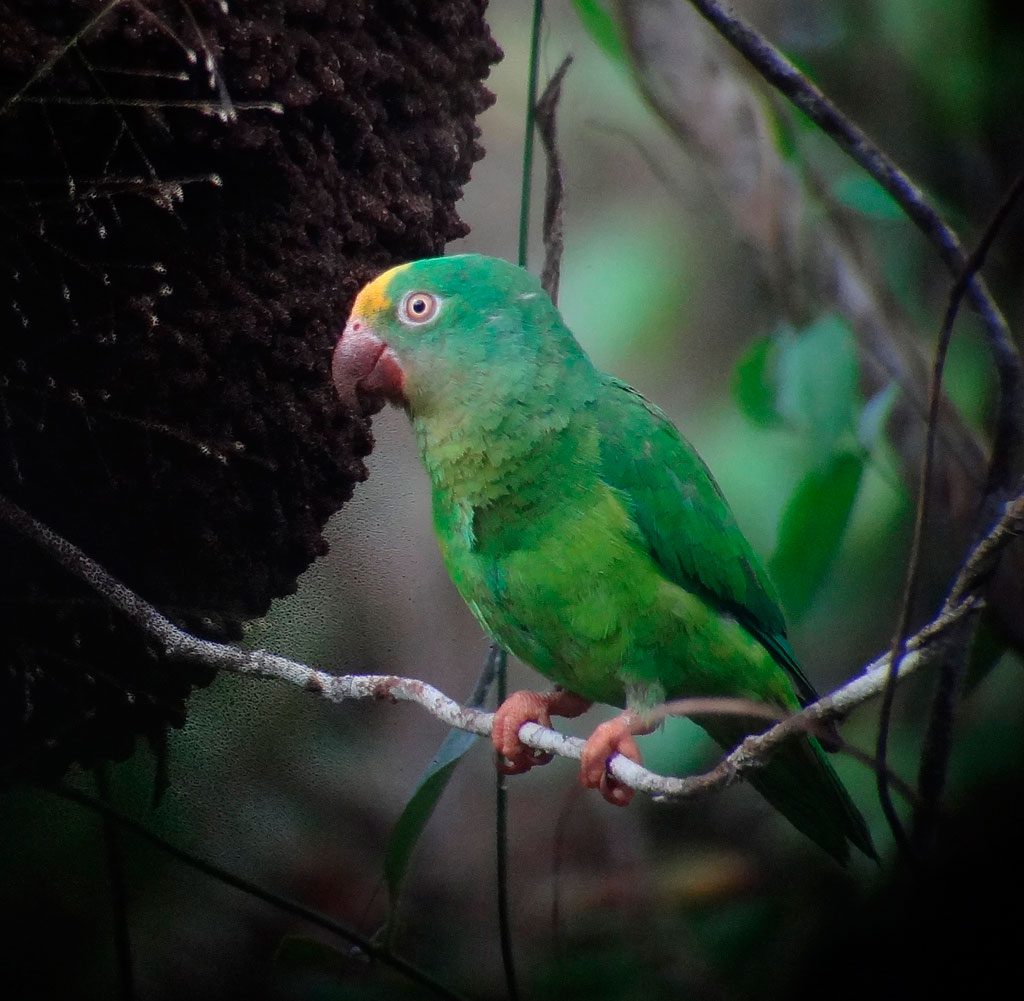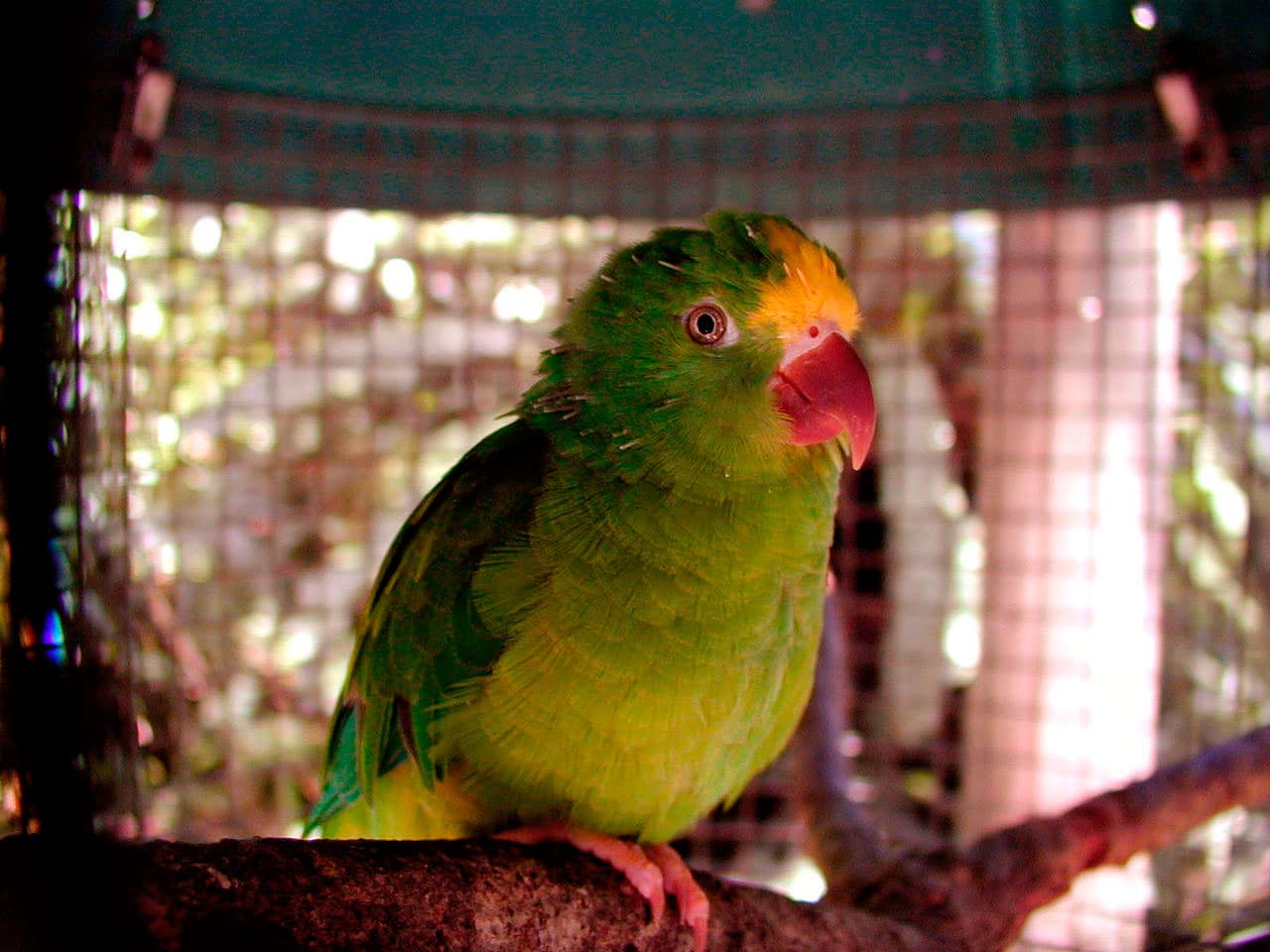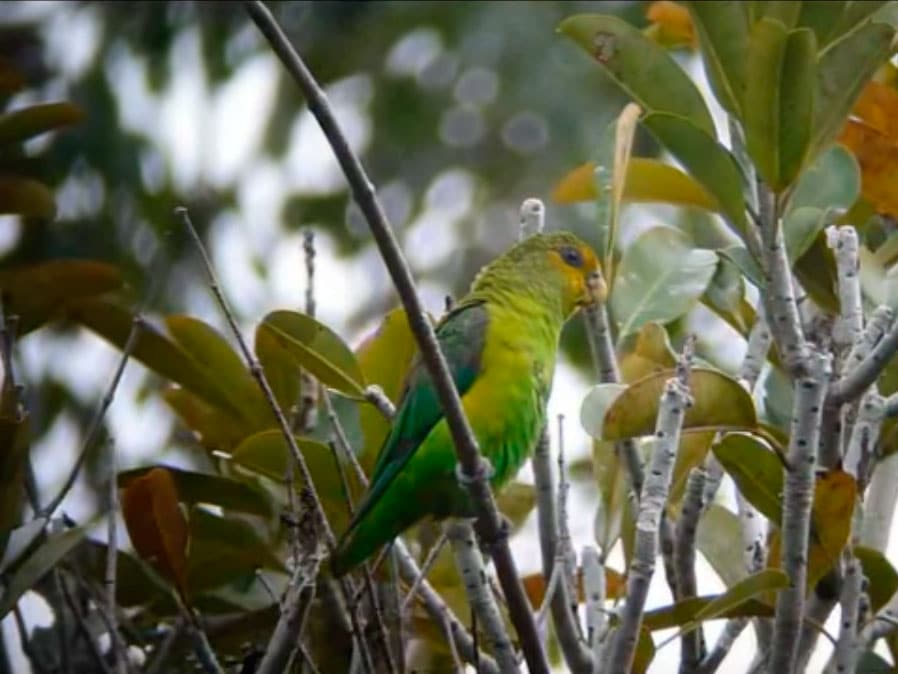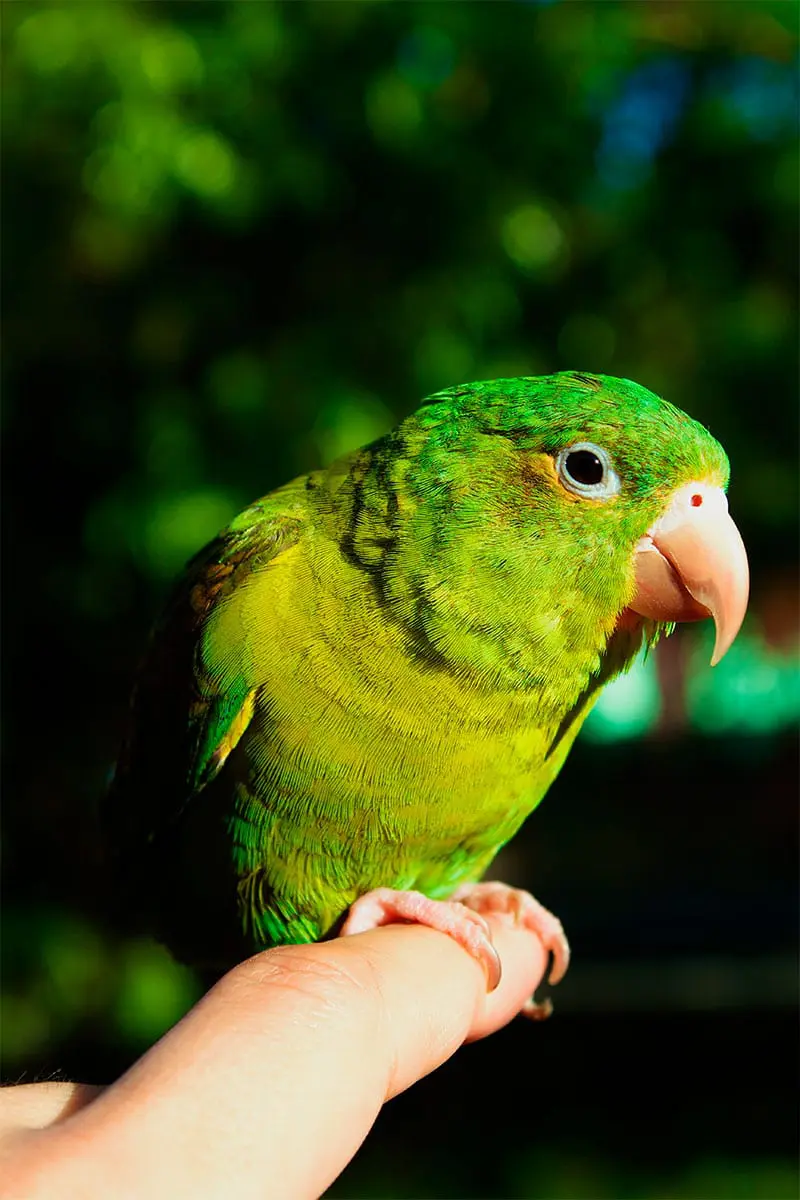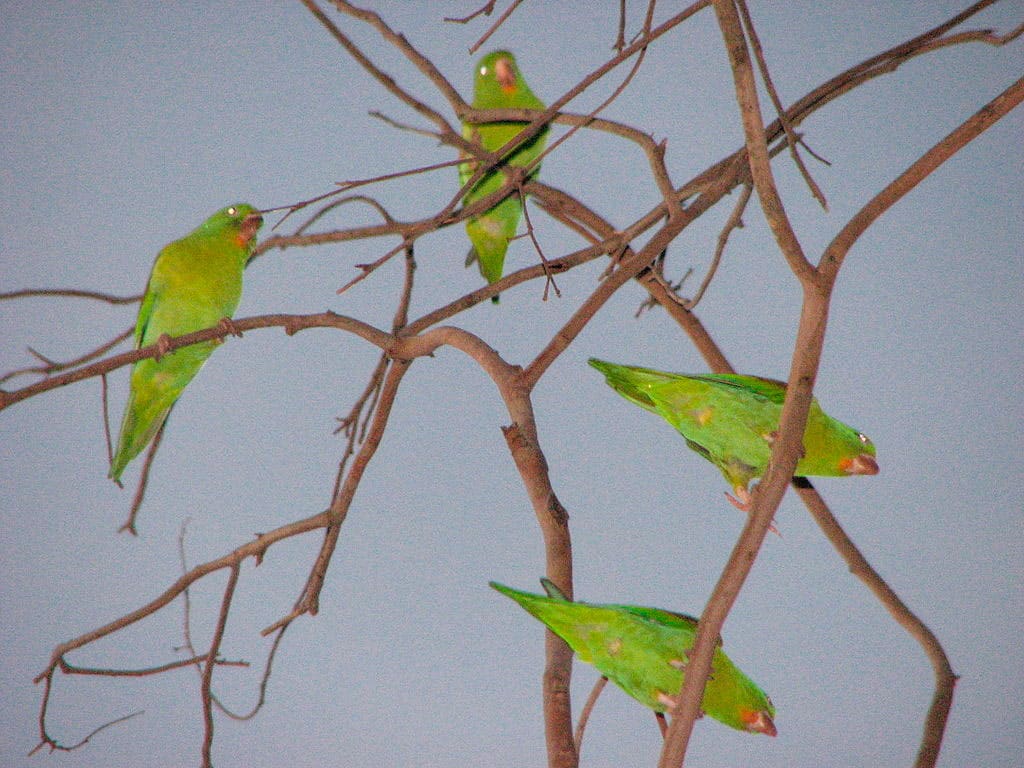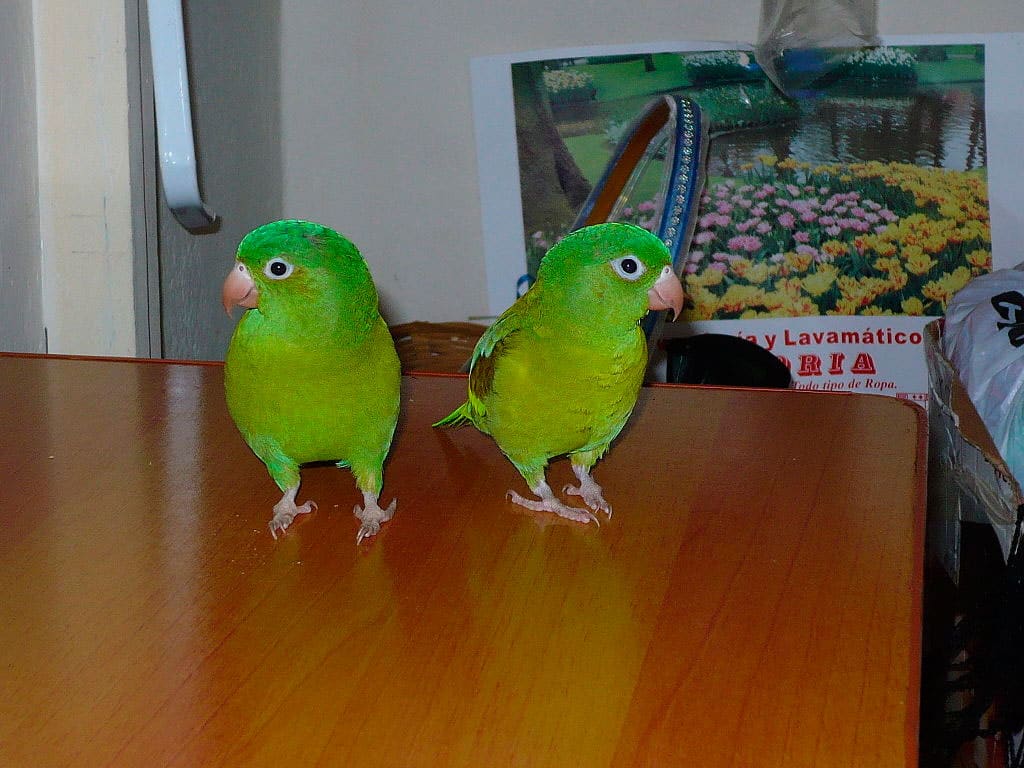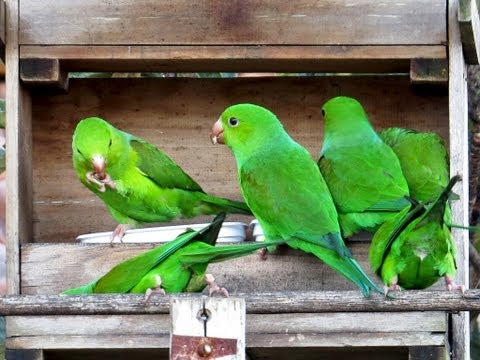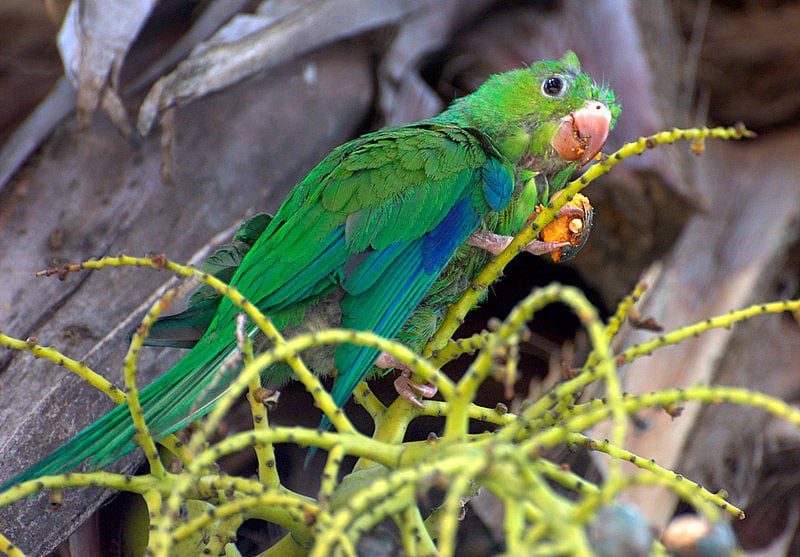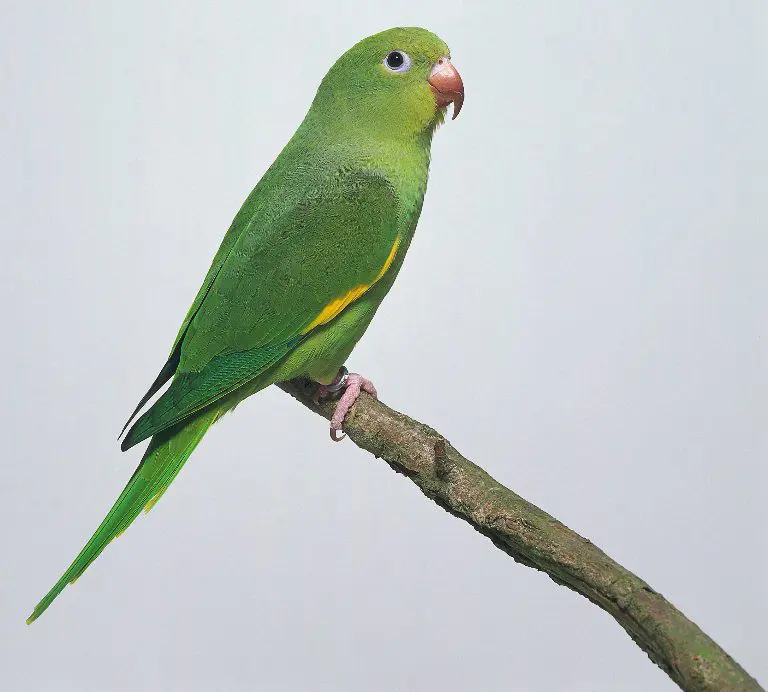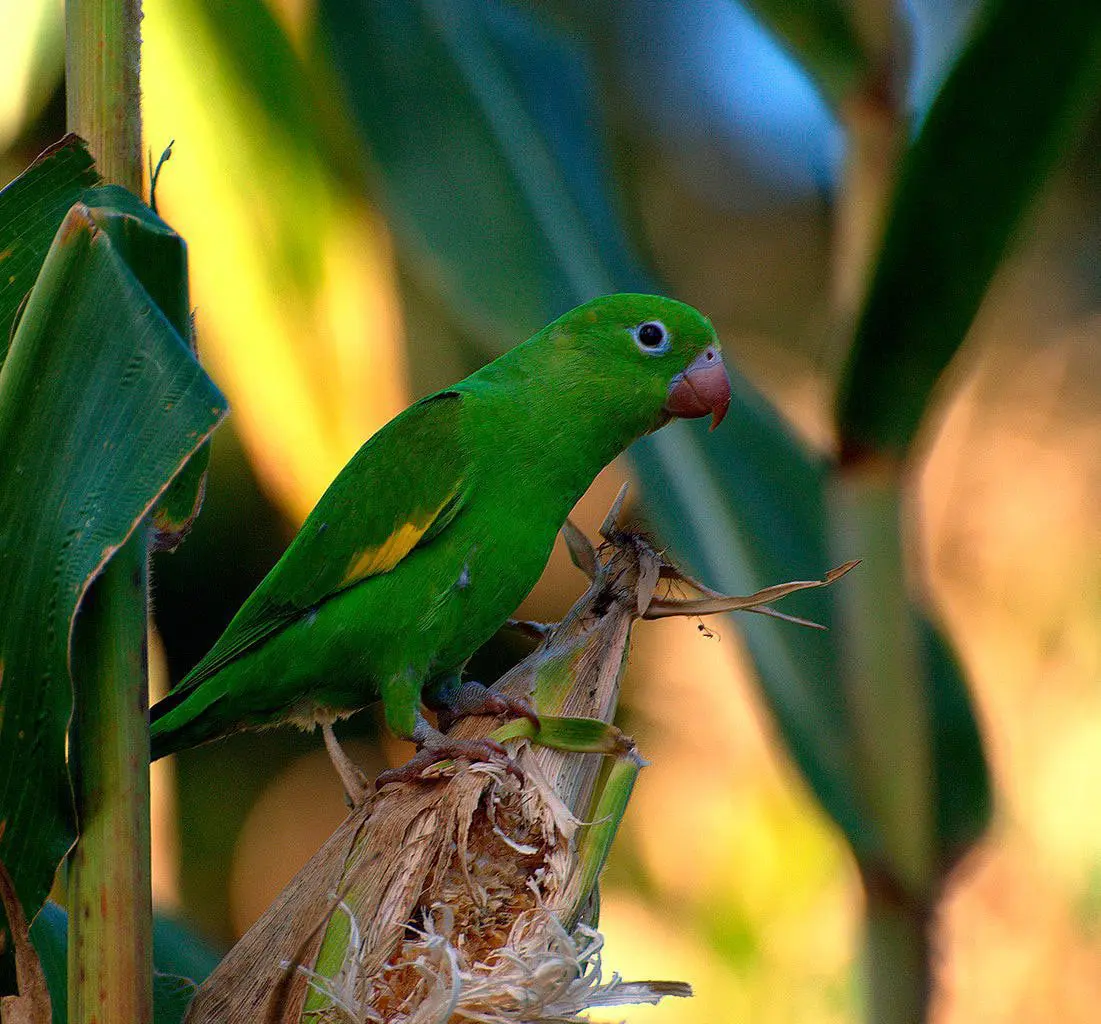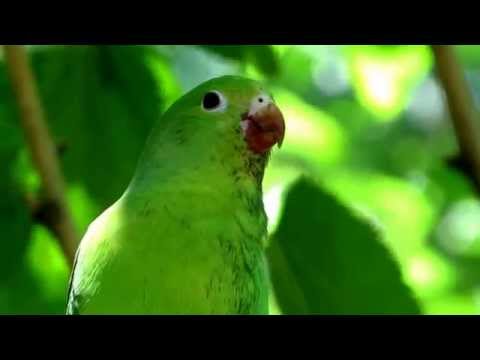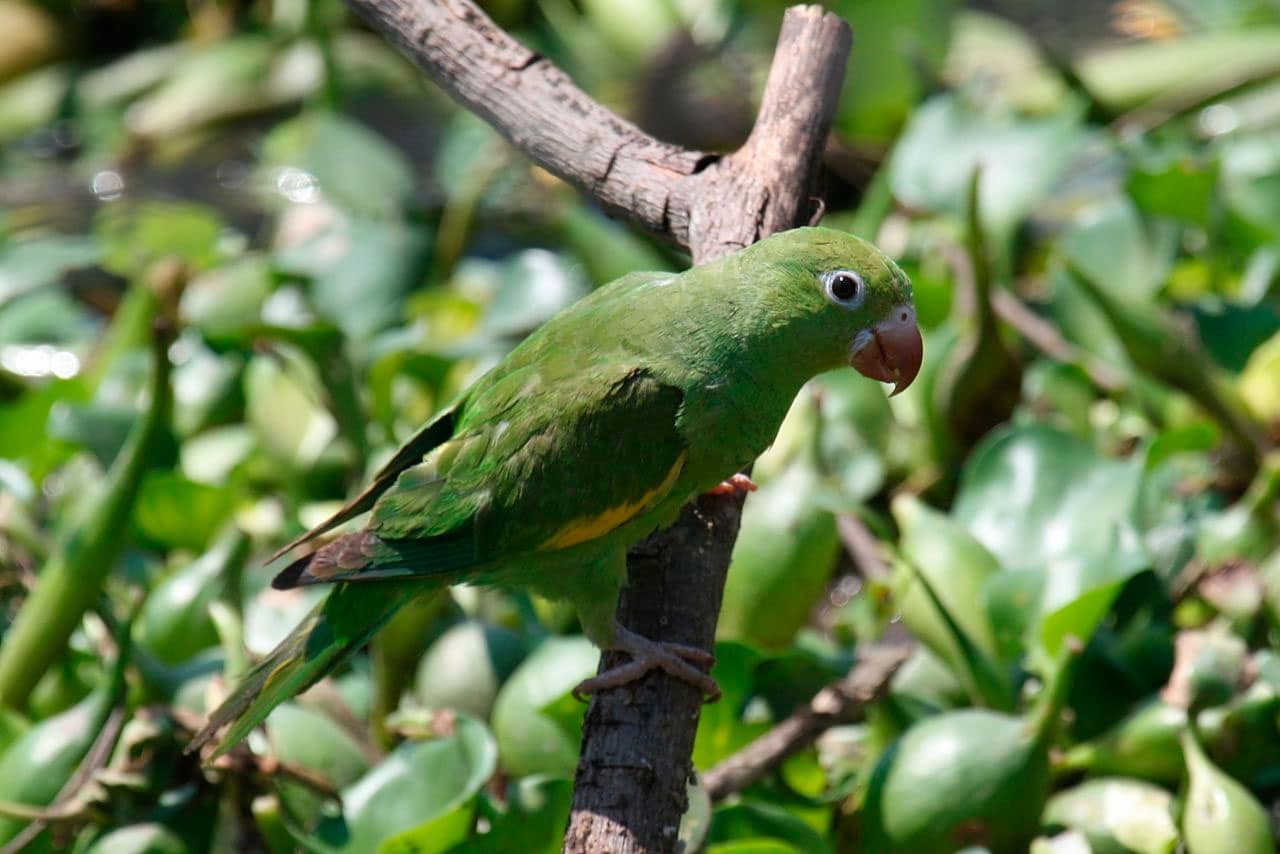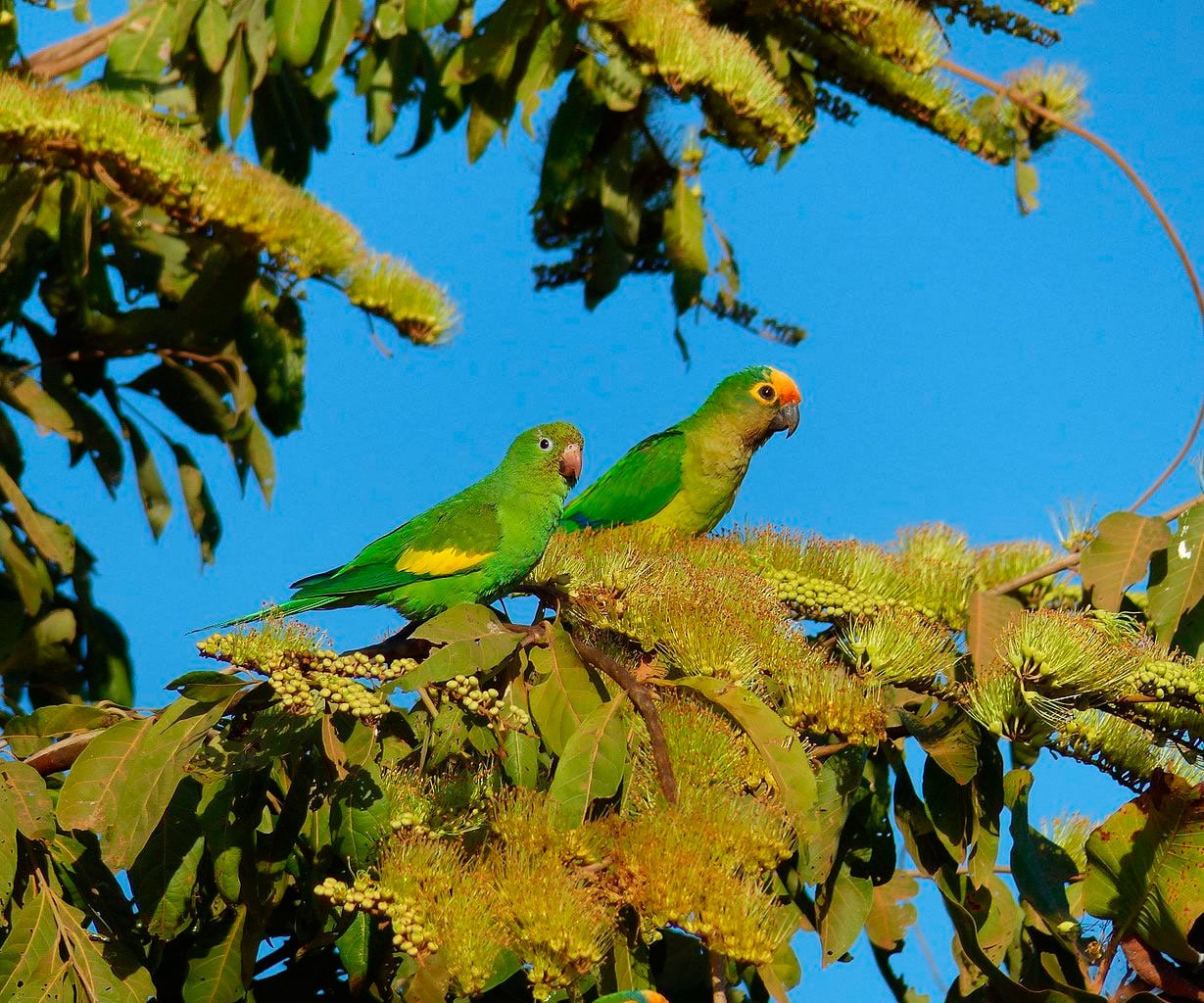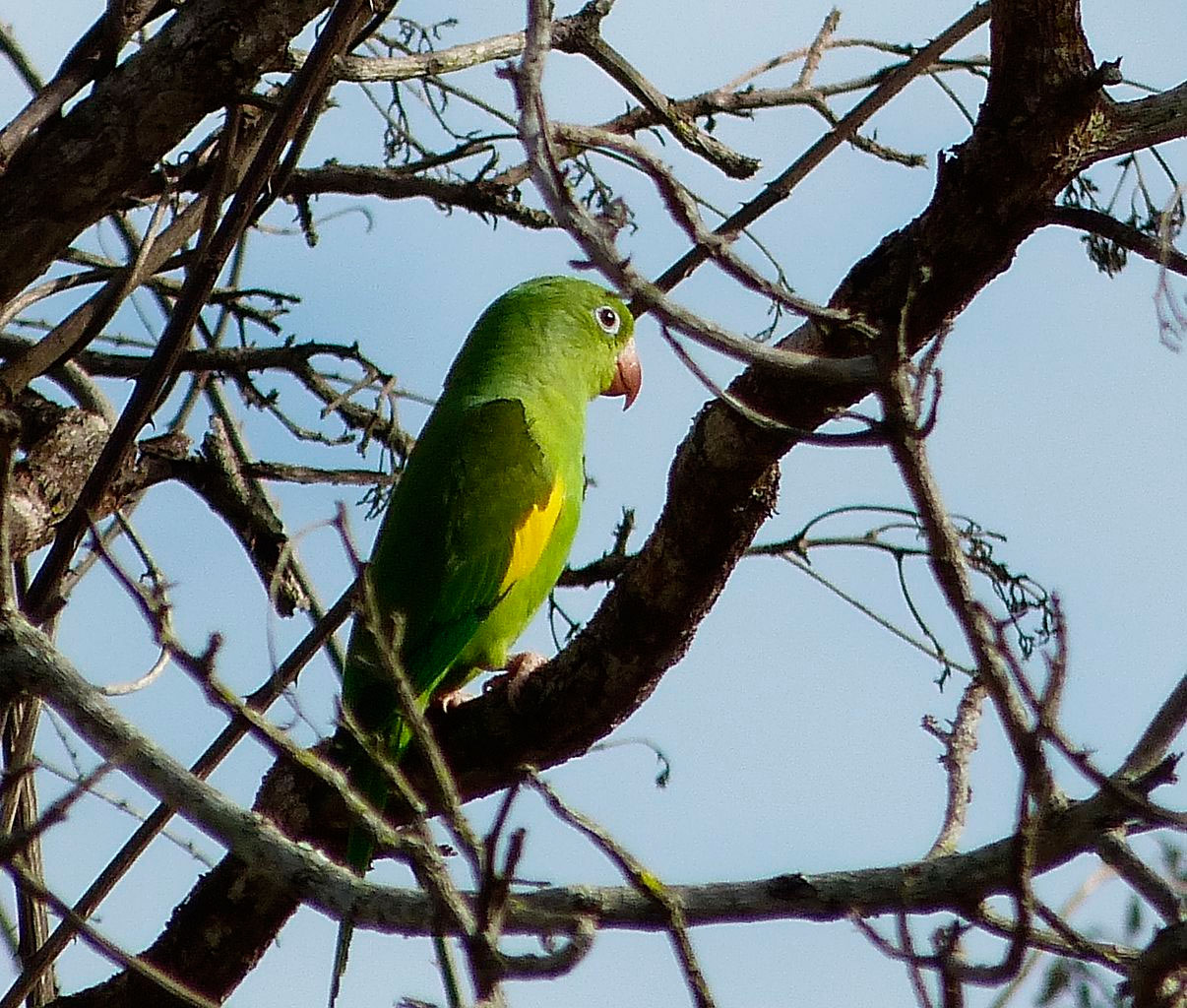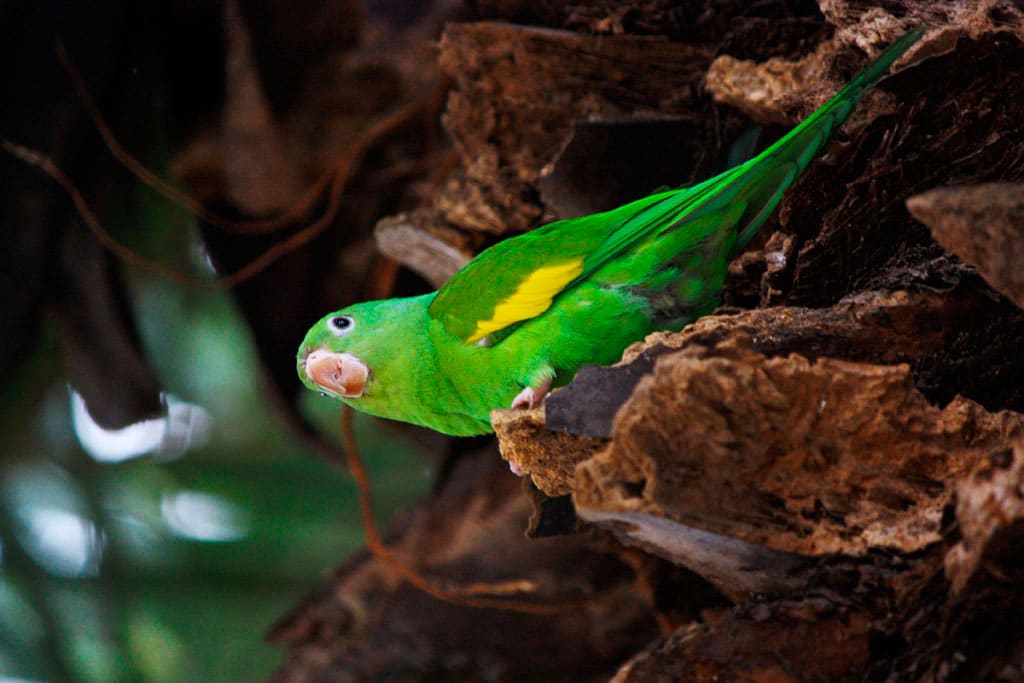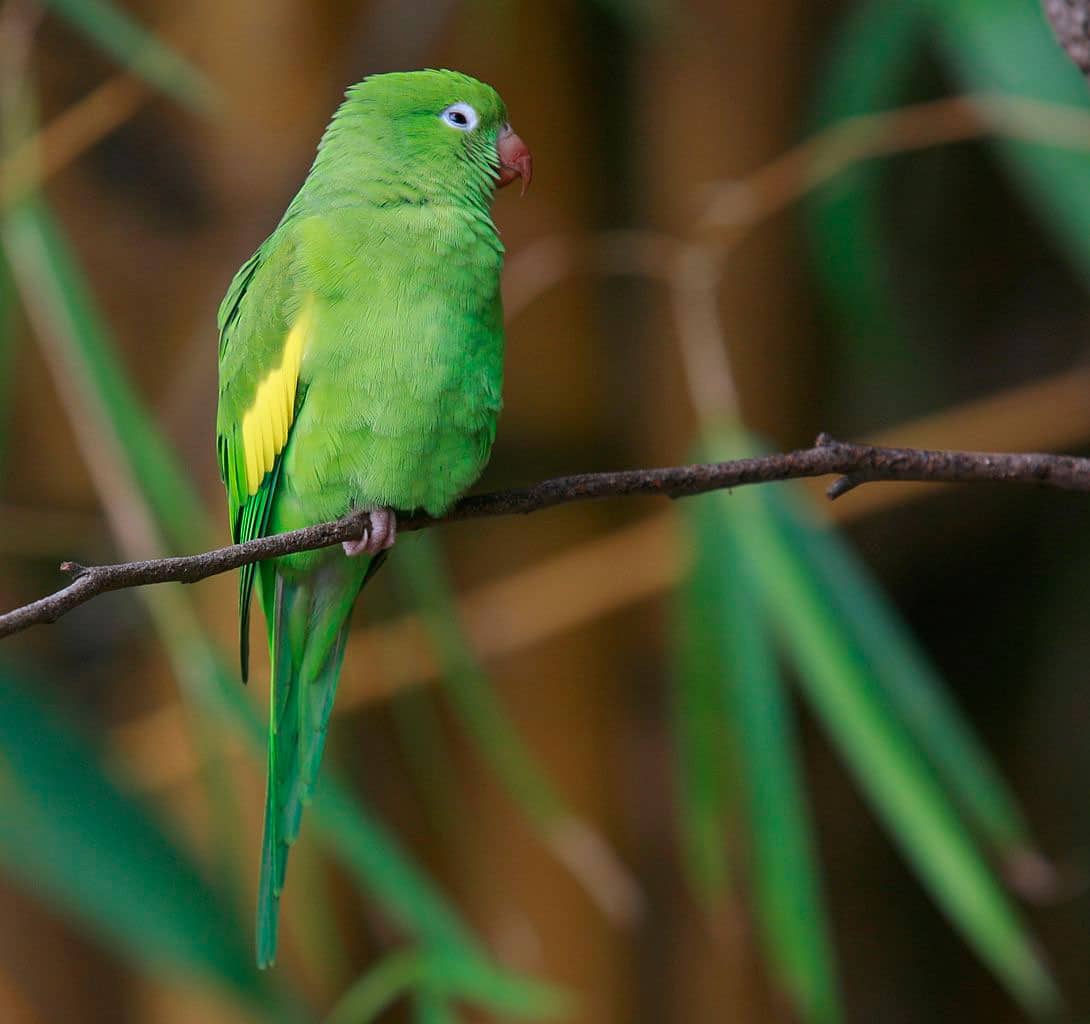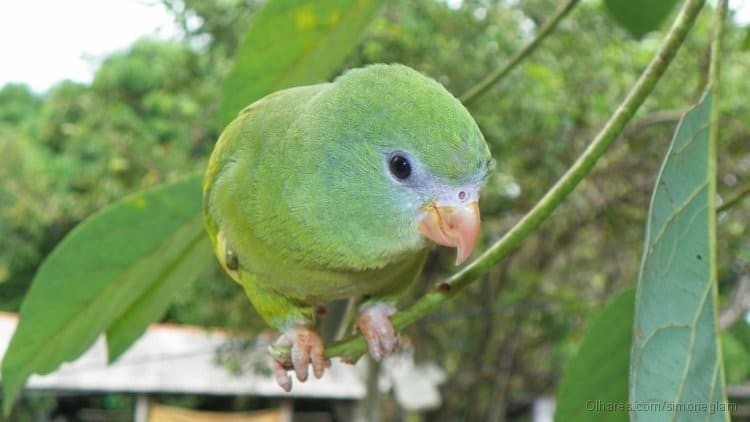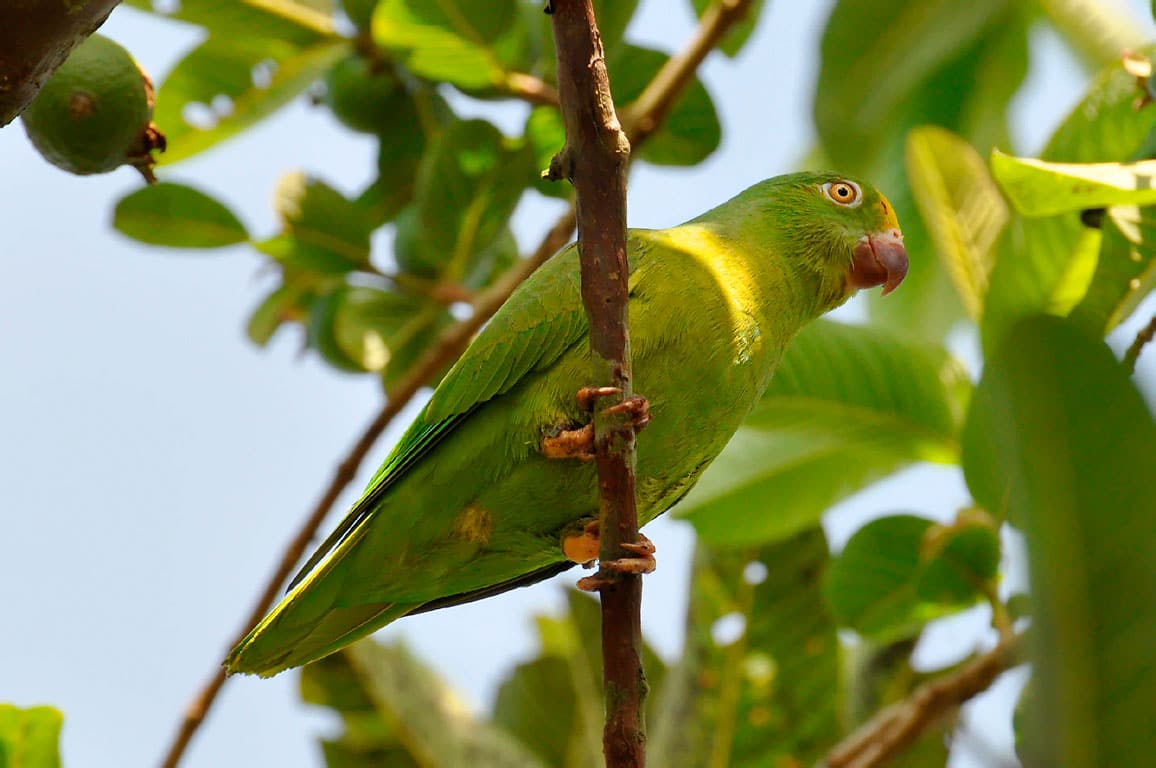
14 cm.. height. Plump appearance and short tail terminated tip. Distinguishable by the Crown, face, Yellow chest and belly, with strong wing blue patch, Flying Blue occupies almost half of the wing. Dorsally gray cafesoso, with the blue rump. The female has the blue patch on the rump and wings paler and smaller.
The Yellow-faced Parrotlet He lives in varied habitats, usually arid, forest riparian in the tropical and subtropical area, between 1000 to 1600 m, Although it has been reported to 2745 m. It is gregarious. Their diet includes cactus, In addition to fruit trees and other things. They nest in communal area, using tree hollows or sand. The breeding season is from March to April..
Distribution:
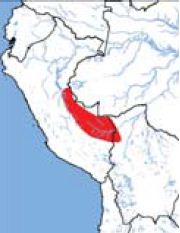
They are found in northwestern Peru., in the upper valley of the Maraรฑรณn river, from the east of La Libertad to the southeast of Cajamarca and the south of Amazonas.
Conservation:
State of conservation โ
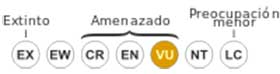
Vulnerable โ(UICN)โ
According to the IUCN categories it is considered as Vulnerable (VU). Habitat degradation and trade are adversely affecting the population.
The ban on the capture and trade has improved the status of this species. The rate of decline was very rapid in the Decade of 1980, Although at present has been reduced and even stabilized. But, the population is still very small, with records in very few places, and as a result, according to the IUCN categories, qualified as vulnerable.
"Yellow-faced Parrotlet" in captivity
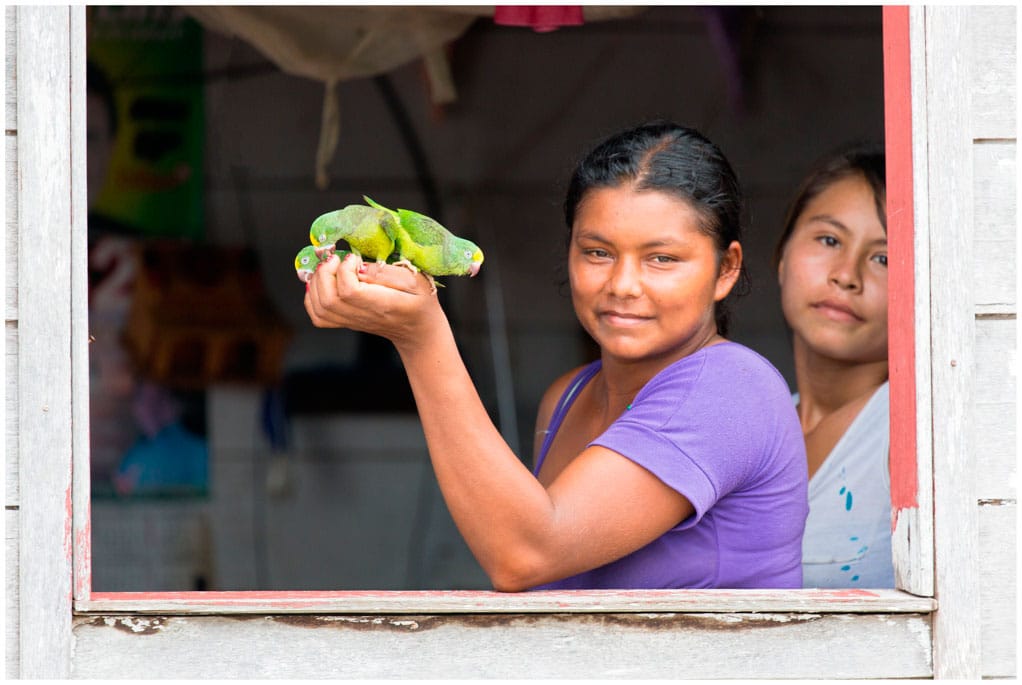
Captured for the trade of wild birds, It is estimated that 17.000 birds were captured between 1981 and 1994. The rate of mortality during capture is estimated between the 40% and the 100%. Rare and unknown in captivity until 1979-1980.
Images "Yellow-faced Parrotlet"
Alternative names:
1. Yellow-faced parrotlet (English).
2. Toui ร tรชte jaune, Perruche-moineau ร tรชte jaune (French).
3. Gelbmasken-Sperlingspapagei, Gelbmaskenpapagei (German).
4. Tuim-de-cabeรงa-amarela, Tuim, Periquito-de-cabeรงa-amarela (Portuguese).
5. "Catita enana de cara amarilla", Cotorrita carigualda, Periquito de Cara Amarilla (espaรฑol).
19-20 cm.. height.
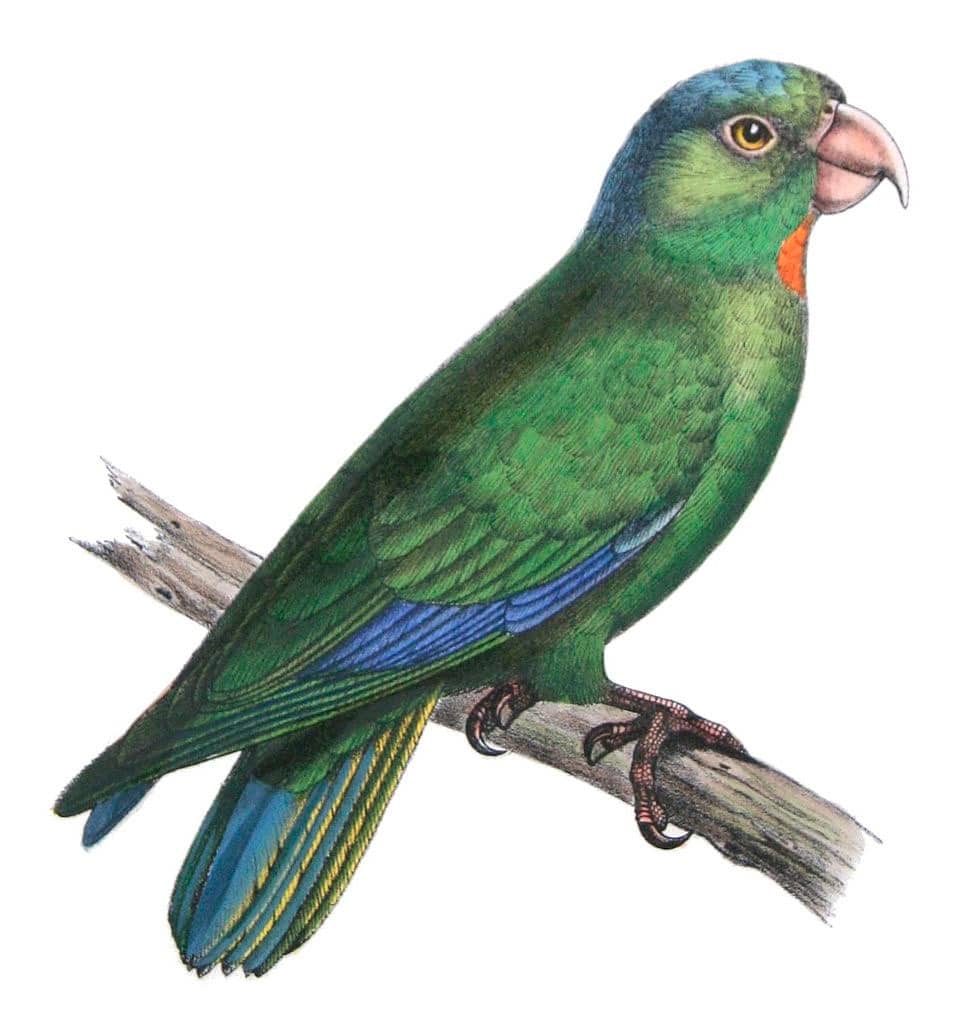
The Grey-hooded Parakeet(Psilopsiagon aymara) has the body mostly green, elongated and with a very long and pointed tail; the forecrown and lores, until the area back from the neck (including the ear-coverts), grayish brown, forming a kind of CAP that comes, slightly, to below the eyes. Mantle green, lightly olive dyeing; Back and scapulars green; rump and uppertail-coverts, green, slightly brighter; upperwing-coverts green; flight feather green with blackish tips; underwing-coverts of color greenish-yellow. Chin and throat pale-whitish grey; chest grey silver pale, sometimes with dye bluish on the feathers on both sides of the chest; flanks of color yellow pale greenish; the belly and undertail-coverts, green, with faint bluish tint.
Upper, the tail green; undertail, gray. The bill pale flesh-colored; irises dark brown; legs grey-brown.
Both sexes similar, though the male may have brighter grey in the chest.
Immature they have the tail shorter.
NOTE This species was treated as Bolborhynchus aymara.
You prefer arid habitats shrubs or Woody hills and ravines, dense scrub and trees around settlements and in agricultural areas, also distributed in high Andean steppes and sometimes in the Highlands, at altitudes of 1.800 to 3.400 m, sometimes more low (1,200 m in winter) and supposedly until the 4.000 m in Tucumรกn, Argentina.
The Grey-hooded Parakeet is a bird gregarious, usually seen in small flocks, at least outside the breeding season; large gatherings near areas with water.
Reproduction:
Nest sometimes in colonies, in holes dug in sand banks or in hollows and cactus in desert area. Egg laying in the month of November in Tucumรกn. Clutch 4-5 eggs. Up to seven in captivity.
Food:
The Grey-hooded Parakeet they tend to consume berries and other fruit, In addition to seeds herbaceous and grasses (by example Viguera and other compounds); they usually descend to the ground to collect fallen fruits and seeds from the grass.
Distribution:
Size of the area of distribution (reproduction / resident): 383.000 km2
Is it can be found in the Andes from the South of Bolivia until Argentina and possibly North of Chile.
In West Bolivia It is known from Peace and Cochabamba to the South of Tarija and potosi, and in the Northwest of Argentina on the slopes Andean of Jujuy to the South of Mendoza and to the hills of the South East of Cรณrdoba. In the North of Chile (for example, Tarapacรก) is reported as resident, visitor or absent.
Some movements at altitude seasonal; the Grey-hooded Parakeet move higher in summer. Usually common and apparently without pressure; Small numbers are caught and exported as cage birds.
Conservation:
State of conservation โ
Minor Concern โ(UICN)โ
โข Current category of the Red List of the UICN: Least concern.
โข Population trend: Stable.
Justification of the population
The size of the world population It has not been quantified, but this species is described as ยซquite commonยป (Stotz et to the., 1996).
Justification of trend
It is suspected that the population is stable in absence of evidence of any decline or threatens substantial, Although it is exported as bird cage in small quantities.
– Avibase
– Parrots of the World โ Forshaw Joseph M
– Parrots A Guide to the Parrots of the World – Tony Juniper & Mike Parr
– Birdlife
– Parrot Book, Parrots and macaws Neotropical
– Photos:
(1) – Grey-hooded Parakeets (also known as the Aymara Parakeet and the Sierra Parakeet) in Capilla del Monte, Cรณrdoba, Argentina By Nes (originally posted to Flickr as Periquitos) [CC BY 2.0], via Wikimedia Commons
(2) -Psilopsiagon aymara by John Gerrard Keulemans [Public domain], via Wikimedia Commons
Origin: Colombia, Ecuador, Peru, Venezuela, Bolivia, Guyana, Brazil
Character: Quiet and intelligent
Life expectancy: 25 to 30 years.
Height: 12 to 13 cm.
Content
Description:
13 cm.. length and 28 g. of weight.
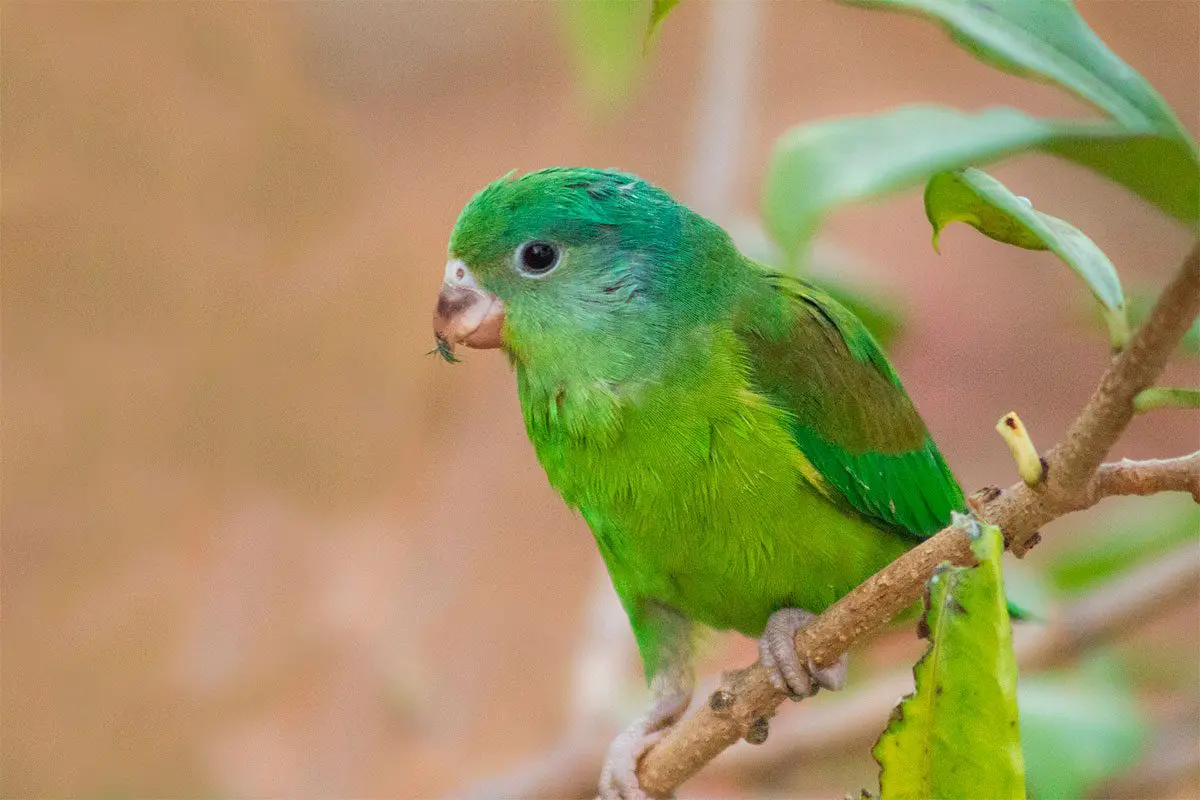
Chubby appearance, the Dusky-billed Parrotlet(Forpus modestus) has the forecrown, lores, cheeks and crown, emerald green, forming sometimes a visible mask; the sides and rear of the neck, the the mantle, the upper part of the back and scapulars, rather dark, of color green matte with light color of olive; lower back and rump of color blue cobalt dark: uppertail-coverts dark green. Primaries and larger covers, dark blue. Primaries with innerwebs green; Secondary of color blue dark with tips Green. Under the wings of color blue cobalt dark; flight feather grey-blue. Underparts opaque in color green dark with a light shade of olive. Upper, the tail dark green; undertail, paler.
upper jaw and cere dark gray, lower jaw clearer; Strait ring perioptalmico dark gray; Iris dark brown; legs grey.
Female all green except beige in it forecrown and front of the crown, contrasting with the Green more dark on the back of the crown.
(Gray,GR, 1859) – Similar to the nominal species but from a color green more pale, more yellowish below, male with blue pale in rump and wings ; the face Green Emerald bright.
Habitat:
They inhabit in tropical forest lowlands in clear, margins, coastal growth, forests and marshes, secondary habitats and sheets, mainly in lowlands (150-250 metres in Venezuela, to 500 metres in Colombia), but spreading in sub-tropical forests to 1,500-1, 800 m in the Eastern Andes of Ecuador.
Gregarious; Outside the breeding season, sometimes in flocks of 100 or more individuals
Reproduction:
It nests in hollows and dead trees. breeding season of registered in the month of July in Peru.
Food:
The diet comprises seeds (for example, Cecropia miparia), berries, egg yolks, etc. It takes the banks along with other parrots mineral soil.
Distribution:
Size distribution (reproduction / resident): 2.840.000 km2
Discontinuous distribution. Since the Guianas to the North of Bolivia. Although according to reports in Guyana and French Guiana not there are records (at least not recently). Be distributed by the Basin Amazon East of Brazil in Amapรก, Maranhรฃo and For, and in the Basin Amazon West from the high of the Black river to the North of Mato Grosso; in Venezuela, to the South of the Orinoco, on bass Caura River and Cuyuni River (a record of Carabobo; in the North, is apparently wrong); In East Colombia to the South from the East end of the Guainia (about him Black river) until Caquetรก to the East of Ecuador and East of Peru to the South and to the North of Bolivia at least Beni.
Reasonably frequent in the West of its range (the Forpus most common in the range in Ecuador and Colombia) but scarcer eastward, with few records in Venezuela and Guyanas.
Evidence of decline in the Eastern Amazonia (about Bethlehem) and possible increase in Colombia, perhaps linked to reduction of dense forests.
(Gray,GR, 1859) – Southeast of Colombia to the North of Bolivia and Brazilian Amazon.
Conservation:
State of conservation โ
Minor Concern โ(UICN)โ
โข Red List Category: Least concern
โข Population trend: Stable
Justification of the population:
The size of the world population Dusky-billed Parrotlet It has not been quantified, but this species is described as ยซquite commonยป (Stotz et to the., 1996).
Justification of trend:
It is suspected that this species has lost 11,6-12,6% of habitat within its distribution in three generations (12 years) based on a model of Amazon deforestation (Soares-Filho et to the., 2006, Bird et to the., 2011).
Given the susceptibility of the species to hunt or capture, It is suspected that it will fall in <25% durante tres generaciones.
"Dusky-billed Parrotlet" in captivity:
In captive not all known, However, this species is probably similar to other parakeet species โ quite quiet, best with a partner, although, they can be aggressive with other groups of parrots. It has a tendency to obesity.
You can learn to speak, usually up to around. 15 words. Males are generally more loquacious than females. They can also learn to whistle numerous tunes and perform some tricks..
This Parrot is very small, they do not occupy much space, It makes it an ideal pet for people living in apartments, residences, or anywhere else than in small size, do not require a large cage and its maintenance is simple.
– Avibase
– Parrots of the World โ Forshaw Joseph M
– Parrots A Guide to the Parrots of the World – Tony Juniper & Mike Parr
– Birdlife
– Photos:
(1) – Brazil – Crystal River (Amazonia)
(2) – Periquito de pico oscuro en Alta Floresta – MT – Brasil By Hector Bottai (Own work) [CC BY-SA 3.0], via Wikimedia Commons
(3) – Periquito de pico oscuro en Alta Floresta – MT – Brasil By Hector Bottai (Own work) [CC BY-SA 3.0], via Wikimedia Commons
(4) – Forpus modestus by Gunther Eichhorn – Flickr
(5) – Dusky Billed Parrotlets at the end of the branch with Dusky Headed Parrots by Vince Smith – Flickr
(6) – Psittacula sclateri = Forpus modestus, Dusky-billed Parrotlet by John Gerrard Keulemans [Public domain], via Wikimedia Commons
– Sounds: (Xeno-canto)
โท The world of Pets: Dogs, cats, birds, reptiles, amphibians
The Pacific Parrotlet(Forpus coelestis) It is a small bird, chubby with a tail short and finished in tip. Distinguishable in flight by the blue and Brown on the inside of the wings. It has blue behind the eye and in the middle of the wing
at the top. The female does blue stain on the top of the wing
and the blue behind the eye is paler. The Immature males they are similar to the adult male, but more pale and with back brownish.
The Pacific Parrotlet frequent most dry woodland habitats, such as scrub thorny, bosque deciduous, dense thickets of Captus with balsa trees, plantations of banana and mango, riparian zone, irrigated fields in Savannah and gardens, although their preferred areas are those of humid tropical vegetation such as the coastal mangales.
Older records of this species are from below sea level of 1.000 m, but are to 2.150 meters on the West side of the Andes in Huancabamba, is of Piura, Peru, and a 1.370-1.650 meters in the South of Loja, Ecuador.
Usually gregarious; they form large flocks where abundant food.
Reproduction:
It nests in the cavity of trees, in cactus, fence posts, pipes or the nests of the Pale-legged Hornero(Furnarius leucopus), of the Tie Neck Pijuรญ(Synallaxis stictothorax) or Fasciated Wren(Campylorhynchus fasciatus).
The breeding season includes the months of January to may. Sometimes, they breed a second time throughout the year. The laying of eggs 4-6.
Food:
The diet of the Pacific Parrotlet includes seeds grass, berries, fruit (example, of Tamarindus, Amaranthus spinosus) and cactus fruits. It forages among the vegetation and land.
Distribution:
Size of the area of distribution (reproduction / resident): 147.000 km2
irregularly common, sometimes abundant; most numerous in arid areas. The population has apparently not yet been severely affected by the trade in live birds or the conversion of natural and semi-natural habitats for the Agriculture. The species is probably Forpus most numerous in captivity.
Conservation:
State of conservation โ
Minor Concern โ(UICN)โ
โข Current category of the Red List of the UICN: Least concern.
โข Population trend: Stable.
Justification of the population
The size of the world population It has not been quantified, but this species is described as ยซcommonยป (Stotz et to the., 1996).
Justification of trend
Suspected that the population is stable in absence of evidence of any decline or threatens substantial.
"Pacific Parrotlet" in captivity:
Colorful, charming and intelligent. These small birds have become in very popular pets in recent years. Its small size and quiet nature make of the Pacific Parrotlet an ideal choice for people living in apartments. Nicknamed โpocket parrotsโ in the pet trade, These parakeets are actually the smallest of the family of parrots, and they are as smart as many larger species. Some learn to speak quite well, Although the species is not particularly known for the ability to speak.
An interesting fact upon the Pacific Parrotlet is that its closest relative is the Amazon parrot. Although the two species differ greatly in size, owners often report striking similarities between them. Despite being small birds, they are by no means โlow maintenance birdsโ. While it is true that they are, course, easy to clean, in comparison with the larger birds, However require your daily care to keep them docile, socialization at an early age is the key to be in a future good behavior.
They have tendency to obesity. They must be able to get out of their cages, spread your wings, and exercise your muscles to maintain your physical and mental health.
Their metabolism is very high, and they should have food available at all times. They are known for their appetite voracious, and occur in one diet varied that consists in fruits and vegetables fresh, small seeds such as millet, the high-quality commercial pellets, and protein sources from hard boiled egg.
Parrots A Guide to the Parrots of the World – Tony Juniper & Mike Parr
Birdlife
Parrot Book, Parrots and macaws.
Photos:
(1) – Male Green Pacific Parrotlet, named Jackson By Susan C. Griffin (Own work) [CC BY-SA 3.0], via Wikimedia Commons
(2) – Pacific Parrotlets (also known as Lessonโs Parrotlet and Celestial Parrotlet) at Wilhelma Zoo, Stuttgart, Germany By Undertable [CC BY 2.0], via Wikimedia Commons
(3) – A pet Pacific Parrotlet – yellow colour mutation By Becky Wetherington (originally posted to Flickr as 82/365 – Good bird.) [CC BY 2.0], via Wikimedia Commons
(4) – A pet male Pacific Parrotlet (also known as Lessonโs Parrotlet and Celestial Parrotlet) By Erin Purcell (originally posted to Flickr as [1]) [CC BY 2.0], via Wikimedia Commons
(5) – Pacific Parrotlet (also known as Lessonโs Parrotlet and Celestial Parrotlet) in El Empalme, El Oro Province, coastal SW Ecuador By markaharper1 [CC BY-SA 2.0], via Wikimedia Commons
20 cm.. height.
The Grey-cheeked Parakeet(Brotogeris pyrrhoptera) discovered in 1801. Is difference for them cheeks and sides neck grey, crown up to almost the nape, blue, bill yellowish, armpit reddish orange (only visible in flight), tail long and pointed, the rest of the body green.
The immature they have the crown greenish blue and the bill blackish.
hybrid species:
Brotogeris [erythrogenys x pyrrhoptera] (hybrid) Brotogeris [chevroned x pyrrhoptera] (hybrid) Brotogeris [pyrrhoptera x jugularis] (hybrid)
It inhabits in humid forest, semi-wet, secondary, formations of semi-deciduous forest and cultivated areas, until 1500 m. Has also seen it is in the banana plantations. Flies in pairs or small groups up to of 12 individuals, sometimes associated with other parrots.
Reproduction:
Nest in hollows and termite mounds on large trees and apparently be reproduced between January and March. It is still unknown why the termites tolerate their presence.
Their eggs, they are around for 2 cm.. x 1,6 cm.. they settle in sunsets of four to six eggs in a nest filled with MOSS. The female incubates them for a few 25-26 days, While the male mounts guard out of the nest.
Size of the area of distribution (reproduction / resident): 9.300 km2
The Grey-cheeked Parakeet distributed over the southwest of Ecuador and Northwest corner of Peru, from the Valley of the chone river, Manabi, to the South up to Gold and Loja in Ecuador, and Tumbes and Piura in Peru.
The populations more large is found in the coast of Manabi and Guayas, and at the border between Ecuador and Peru (Juniper and Parr, 1998).
There was a large decrease in the population during the 20TH century, at the beginning of the year 1980 (Best et to the., 1995, Juniper and Parr 1998), with 59.320 birds imported by countries CITES between 1983-1988. In 1995, the population Wild was estimated in 15.000 birds, mainly in Ecuador (Best et to the., 1995). This represents a very crude c.70% decline in 10 years, although it is still locally common in some remains of its habitat. (Juniper and Parr 1998).
โข Current category of the Red List of the UICN: In danger of extinction.
โข Population trend: Decreasing.
The main threat to this species is the wild bird trade. The habitat It is also losing out by logging, Agriculture and overgrazing. Its persecution as a pest crops can be also significant.
Is expected that the rate of decline is more slow in the next 10 years.
"Grey-cheeked Parakeet" in captivity:
Most of the existing populations are found in the houses of individuals such as pets. Because of this, effort has been made to save this species of Brotogeris.
Alternative names:
– Gray-cheeked Parakeet, Gray cheeked Parakeet, Grey cheeked Parakeet, Grey-cheeked Parakeet (English).
– Toui flamboyant, Perroquet ร flancs orangรฉs, Perroquet de Perico, Perruche ou (French).
– Feuerflรผgelsittich (German).
– Periquito-de-bochecha-cinza (Portuguese).
– Catita Macareรฑa, Periquito de Alas Naranjas (espaรฑol).
– Perico de Mejilla Gris (Peru).
– Avibase
– Parrots of the World โ Forshaw Joseph M
– Parrots A Guide to the Parrots of the World – Tony Juniper & Mike Parr
– Birdlife
– Parrot Book, parrots and macaws Neotropical
– Photos:
(1) – Grey-cheeked Parakeet (also known as the Fire-winged Parakeet) at El Empalme (also known officially as Velasco Ibarra), a town located in Guayas, Ecuador By markaharper1 [CC BY-SA 2.0], via Wikimedia Commons
(2) – Periquito macareรฑo (Brotogeris pyrrhoptera), Quito, Ecuador by Diego Delso [CC BY-SA 4.0], via Wikimedia Commons
(3) – Grey-cheeked Parakeet (Brotogeris pyrrhoptera) in captivity in Cuenca, Ecuador By Beatrice Murch (originally posted to Flickr as Grey headed parrot) [CC BY 2.0], via Wikimedia Commons
(4) – A pet Grey-cheeked Parakeet By Juano80 (Own work) [Public domain], via Wikimedia Commons
(5) – Grey-cheeked Parakeet Brotogeris pyrrhoptera in Rรญo Milagro in Yaguachi. Prov. Guayas. ECU by Ronald Navarrete-Amaya – Flickr
The Tepui Parrotlet(Nannopsittaca panychlora) measured between 14 and 15,7 cm.. height. Small size, with wings sharp and tail cut and wedge.
The head It is green with yellow tinge olivรกceo; the eye area is yellow, color extending below and behind the eyes. The upperparts they are green (brighter and less than olivรกceo head). Upperwing-coverts green. Flight feathers blackish green tipped primary, brownish opaque below; INFRACA-wing coverts green. The underparts yellowish green turn yellow-green in the undertail-coverts. Upper, the tail is green; undertail, yellower. Bill grey; cere grey; Bello to singr dark gray; irises brown; legs Rosaceae.
Both sexes are similar; the female has the forecrown Off-white to yellowish.
They inhabit moist montane forests. in tropical and subtropical highlands, sometimes in the rainforest of the lowlands around tepuyes, generally 750-1,850 m (Gran Sabana), although they observed at the top of Auyantepui to 2,200 meters and near the summit Monte Roraima A 2,200 m; to 750-950 metres in Sucre.
Can reproduce in subtropical and tropical zone descend to feed. Recent records in the view of birds in the lowlands suggest at least seasonal aparienciones at lower altitudes. Fly very high, fast and straight, in compact flocks of 6 to 150 individuals. Itรยดs resident but it shows seasonal migrations.
Reproduction:
Sleeps and nests in Tepuis. Not much more information about the reproduction of this species in the wild.
Food:
In their natural habitats, the Tepui Parrotlet normally eat fruits, seeds and small insects.
Distribution:
Size of the area of distribution (reproduction / resident): 486.000 km2
Mainly montana, It is distributed in several scattered populations in eastern Venezuela and the adjacent area of รขโฌโนรขโฌโนwestern Guyana; concentrated in Gran Sabana from the east of Bolรญvar in Venezuela (for example, Montes Roraima and Auyantepui); It is also present around the meseta del Duida and the lowlands of Ventauri River, amazon, and in the West of Guyana from the area Camaran River; a more distant population occupies the Paria Peninsula (for example, the Monte Papelรณn), Sucre, to the northeast of Venezuela. Probably you can be observed at the north end of Roraima, Brazil.
Apparently locally common and stable, but perhaps it diminished in Paria peninsula due to large-scale deforestation. Much of the range is included in Canaima National Park.
Conservation:
State of conservation โ
Minor Concern โ(UICN)โ
โข Current category of the Red List of the UICN: Least concern.
โข Population trend: Stable.
Justification of the population
The size of the world population It has not been quantified, but this species is described as ยซquite common, but unevenly distributedยป (Stotz et to the., 1996).
Justification of trend
It is suspected that this species has lost 6,9-11,6% of habitat within its distribution over three generations (15 years) starting from a model of deforestation Amazon (Soares-Filho et to the., 2006, Bird et to the., 2011). Given the susceptibility of the species to hunting and / or capture, It is suspected that its population decline by <25% during three generations.
"Tepui Parrotlet" in captivity:
Breeding in captivity outside of South America. It is intelligent, quiet and very sociable.
Can normally live about 20 years.
The Cobalt-winged Parakeet(Brotogeris cyanoptera) measured 15-21 cm.. in height and weighs around 67 g. Distinguishable on the fly by the cobalt blue of the the flight feathers; forecrown yellow and crown with blue dye; chin orange.
Has the tail short and acute. Its bill opaque beige es
(Berlepsch, 1889) – Has the forecrown light green, shoulder yellow and only a patch blue in half of the wing
.
Habitat:
Very common. It is found in secondary forest, riparian, edges and savanna, until the 600 m (occasional over of 1000 m). Fly in small flocks of 10 to 20 individuals (rare in couples), feed in the canopy.
Reproduction:
It nests in hollow and termite mounds on tree.
Food:
Its diet probably the same as for most species Brotogeris: fruit nectar, figs, berries and seeds.
Distribution:
Its population is distributed between the East of Colombia, Southwest of Venezuela to the North of Bolivia and Brazilian Amazon.
The few records Red-fronted Parrotlet existing in Costa Rica come from, mainly, from the central-southern highlands of the Caribbean slope.
A captive Costa Rican Parrot eating – Nrg800, CC BY-SA 3.0, via Wikimedia Commons
Content
Description:
17,5 cm.. length.
The Red-fronted Parrotlet(Touit costaricensis) has the forecrown, anteriorly of crown, lores and stripe under the eyes, red; sides neck, cheeks and upperparts, green with the back of the crown and nape slightly paler and yellower. Inner wing-coverts green; exterior and median coverts and wing leading edge, red; primary coverts black.
Primaries and outer secondaries, black with green margin to outerweb of the primaries. Inner underwing-coverts, yellow, the outer, red. Feathers on base of the beak, on chin and throat, brighter yellowish green; the chest, the belly and undertail-coverts, green tinted yellowish. The tail greenish yellow with a black tip (except the outermost feathers) and dark green subterminally. Bill pale yellow; cere and bare periophthalmic, grey; irises grey; legs slaty.
The female It has less red on the upperwing-coverts, and perhaps more yellow in the underwing-coverts; probably, on average, are smaller than males. The immature It has little or no red on the head.
The Red-fronted Parrotlet It has sometimes been treated as conspecific with the Blue-fronted Parrotlet(Touit dilectissimus) North of South America and Panama. Although these taxa are clearly allied and share a recent common ancestor, most authors now treat them as separate on the basis of their clear and consistent plumage differences. The structural divergence can also exist in the Red-fronted Parrotlet longer seems to show the uppertail-coverts (extending almost to the end of the tail) its counterpart Southern, While (although the sample is small) it suggests a sexual dimorphism by the length of the wings and tail on Red-fronted Parrotlet but not in Blue-fronted Parrotlet.
Habitat:
Generally observed in the canopy moist forests at mid-altitudes. It moves towards the thicket, on forest edges, flying over the clear, sometimes in the lowlands (sometimes at sea level, especially in southeast Costa Rica), where perhaps it is a seasonal visitor. Tolerates some habitat alterations.
Observed in association with Red-headed Barbet(Eubucco bourcierii) and Blue-and-gold Tanager(Bangsia arcaei), both species associated in cool wet forests in the upper tropics and subtropics.
Observed to 3.000 meters in Costa Rica in the early dry season and reported regularly at altitudes 500-1.000 m during the wet season. Usually in pairs or small flocks family.
Reproduction:
The family size usually between 4-5 birds, suggests the clutch usual 2-3 eggs. probably plays during the season, dry.
Food:
They feed on fruits trees and epiphytes, such as Cavendishia and Clusia, but probably also include flowers and seeds.
Distribution:
Size of its range (breeding/resident): 10.000 km2
The few records Red-fronted Parrotlet existing in Costa Rica come, mainly, the highlands of central-south Caribbean side, where its range seems to extend to the south, from Monteverde, Turrialba volcano and Lemon.
Although there are no records in much of the east of Costa Rica, its existence can be continuous along the Cordillera de Talamanca (perhaps only in the Caribbean side) to western Panama. The handful of panamanian specimens and records from observations, They are mainly from the western highlands to a report from the east, about the Cocle Province.
It is obviously a kind rare and presumably in decline due to continued deforestation (at least in the lowlands) in a limited range.
Conservation:
โข Current category of the Red List of the UICN: Vulnerable.
โข Population trend: Decreasing.
Population size : 2500-9999 specimens.
Rationale for the Red List category
This species is classified as Vulnerable because the clearing and forest fragmentation at middle elevations, mainly in the Central Volcanic Range and in the Sierra de Tilarรกn of Costa Rica, It is likely to be causing significant slopes in its small range and (presumably) in population.
Justification of the population
It is estimated that the breeding population of the Important Bird Areas of Costa Rica is 1.000 to 4.000 mature individuals (J. And others Craido 2007, J. Sรกnchez et al., In 2007), so it is believed that the total population may be within the range of 2.500-9.999 mature individuals. This is equivalent to 3.750-14.999 individuals in total, rounded here to 3.500-15.000 individuals.
Justification of trend
It is suspected that the population species is decreasing at a moderate rate, in line with continued clearing of its forest habitat in the northern part of its range.
Conservation Actions Underway
CITES Appendix II. Live in several areas protected, including national parks Braulio Carrillo, Tapantรญ-Cerro de la Muerte and Monteverde, Costa Rica, and La Amistad International Park and adjacent reserves in both countries. But, The legal protection of Palo Seco Protected Forest (BPPS) (a booking Panama adjacent to La Amistad) has not prevented clearance for agriculture (Angehr and Jordan, 1998).
Conservation Actions Proposed
Evaluate the importance of habitat outside the breeding season (J. Created en lit. 2007, J. Sanchez et al., In 2007). Conduct surveys to determine the total size of the population. Study of the ecology of the species (J. Sanchez et al., in bed. , 2007). Monitor population trends through regular surveys. Monitor rates of loss and recovery of forests (J. Sanchez et al., In 2007). Effectively protect the Bosque Protector Palo Seco (BPPS).
"Red-fronted Parrotlet" in captivity:
No reports are known captive birds.
Alternative names:
– Red-fronted Parrotlet, Red fronted Parrotlet (English).
– Toui du Costa Rica (French).
– Costa-Rica-Papagei (German).
– Red-fronted Parrotlet (Portuguese).
– Cotorrita Costarricense, Lorito de Pecho Rojo, Periquito alirrojo (espaรฑol).