Content
|
|---|
Description:
23 cm. length and 95 g. of weight.
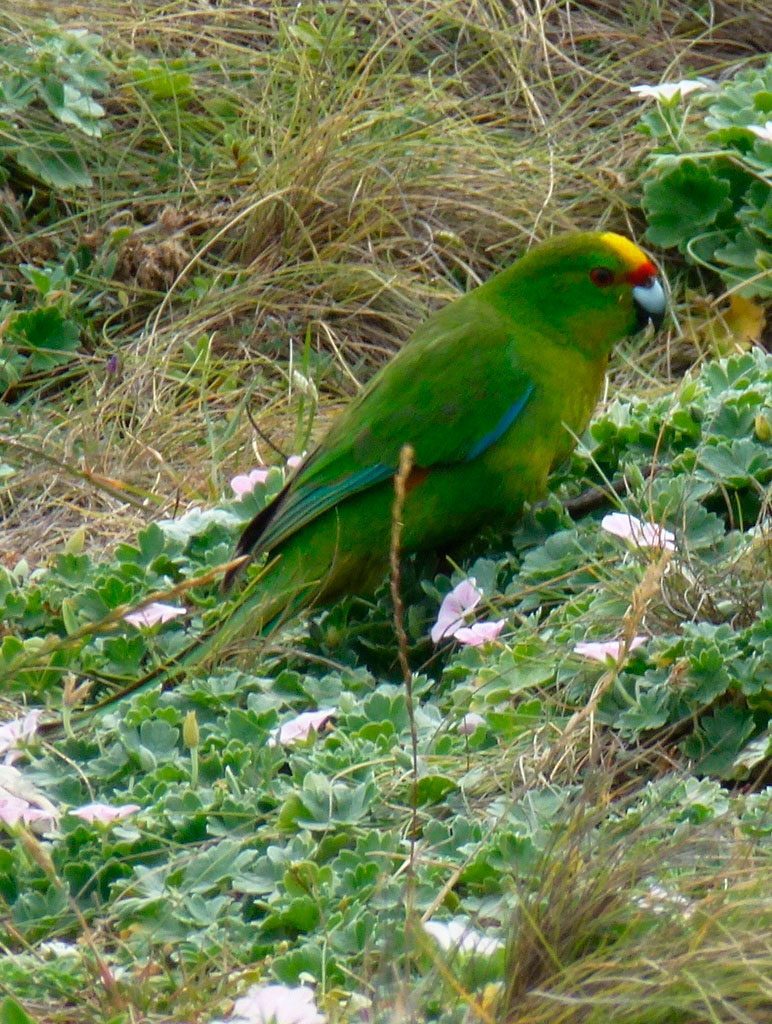
The Chatham Parakeet (Cyanoramphus forbesi) They are one of the two medium bright green parrots of Chatham Islands. Although they look very similar to those Yellow-crowned parakeet (Cyanoramphus auriceps) of New Zealand continental, the color of the crown is not a reliable indicator of taxonomic relationships.
It believes that the Chatham Parakeet descended from an ancient lineage of parrots who reached the Chatham Islands before the division Yellow-crowned parakeet and Red-crowned parakeet happened in New Zealand continental, after which the Red-crowned parakeet (Cyanoramphus novaezelandiae) also they colonized Chatham Islands.
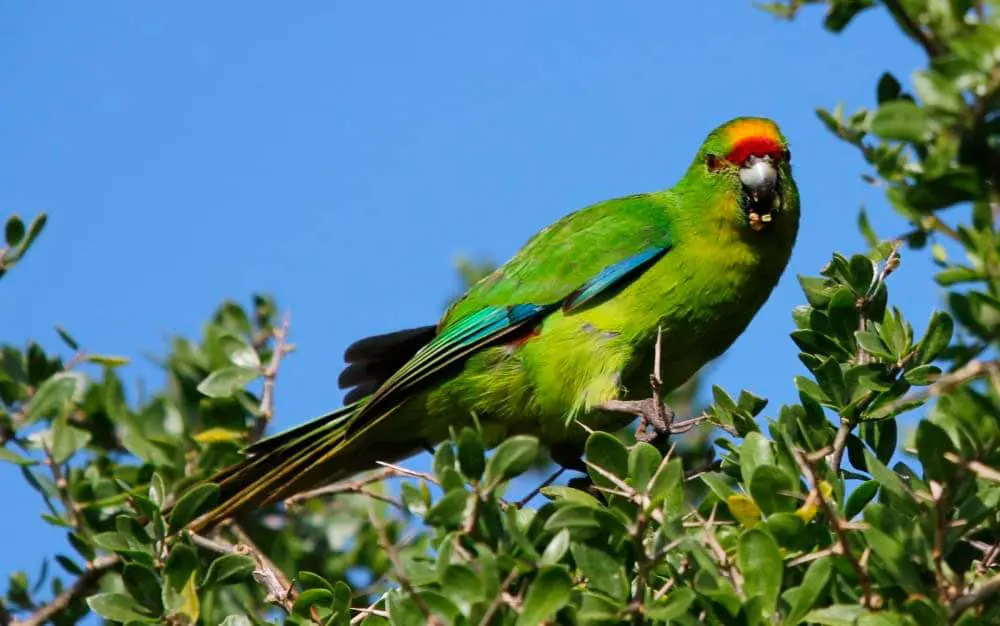
The Chatham Parakeet They are medium-sized parrots, of tail long, with wings wide and rounded and plumage predominantly emerald. have a crown bright yellow front and a crimson front band that does not reach to the eyes, unlike in the Red-crowned parakeet. Males are larger than the females.
taxonomy:
Since 1930 is commonly treated as a subspecies of the Yellow-crowned parakeet (Cyanoramphus auriceps), and clearly the two are closely related; the species differ, However, in size considerably, It is larger species Cyanoramphus forbesi. Currently considered Monotypic.
Habitat:
The Chatham Parakeet They are at higher densities in forests and dense vegetation regenerating areas than in open grassland. Despite its rather erratic flight, They fly hard and move easily between islas Mangere and little Mangere. Occasionally they have been observed Chatham Parakeet individual in the forests of southern Chatham Island (> 20 km from the Mangere Island) and nearby islands Pitt and owner. Their social behavior is similar to other species of parakeets Cyanoramphus. They are strongly territorial around nests, calling loudly and chasing intruders from nearby.
Reproduction:
The Chatham Parakeet have a long breeding season, with eggs laid between October and March. Son nesters cavity, preferring tree holes but also using rock crevices and under dense vegetation. The size medium of laying is of 5 eggs. Like all the other parakeets Cyanoramphus, females are responsible for preparing the nest, incubation, rearing and feeding the chicks until the 10-14 days old. During this period all your food is provided by your partner.. From then on, male and female parrots feed the chicks in the nest until they leave the nest.
The incubation usually begins after the start of the second egg, resulting in chicks within a clutch that vary greatly in age and size. The last chicks to hatch are usually born at a younger age and are less developed than their older brothers.. More than one brood may be attempted if the initial nest fails or if the food supply allows..
Food:
The foods consumed by Chatham Parakeet They are affected by seasonal availability, and include seeds, flowers and leaves of various plants, It is the most important invertebrates in spring. They feed extensively in soil in open areas.
Distribution and status:
Sw extension of its distribution area (reproduction / resident): 3 km2
The Chatham Parakeet It is restricted to of Tapuaenuku ISLA ISLA Pequeña Mangere and Mangere in the Group of chatham islands, New Zealand. In 1930 He quenched in Mangere Island, but in 1973 had recolonized and numbered 40 birds and a small number of hybrids with the subspecies Cyanoramphus novaezelandiae chathamensis (of which there were 12 on the island) (Higgins 1999).
In 1996, two estimates indicated that the population of the Mangere Island It was from 50 to 120 Purebred birds. The population on the small island of little Mangere It is little known because the few visits made (H. Aikman a slightly. 1999). In 1999, it was estimated that the total population was about 120 birds (Aikman et al. 2001), but studies 2003 estimated 900 individuals on Isla Mangere (Aikman y Miskelly 2004, D. Houston y C. Miskelly a slightly. 2008).
A recent study estimated that more than 50% of the population of parakeets in Isla Mangere consisted of individuals hybrids (Chan et al. 2006), but this is expected to decrease due to mating positive range (T. Greene a slightly. 2012); the number of phenotypes forbes It is approaching the threshold management 10% (D. Houston a slightly. 2012) (that is to say, the number above which culling can be resumed as a management tool). There have been birds visiting South isla Chatham, the Pitt island and ISLA ISLA Chief of Sudeste (Taylor 1998, D. Houston y C. Miskelly a slightly. 2008, T. Greene a slightly. 2012).
Conservation:
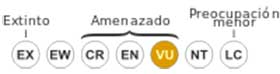
• Current category of the Red List of the UICN: Vulnerable.
• Population trend: Stable.
• Population size : 250-999 individuals.
Rationale for the Red List category
This species may still have a small purebred adult population.. Possible removal by hybridization has been avoided thanks to three decades of conservation efforts, which they have seen increasing population size. It is restricted to one place (given the proximity of the small islands that lives and mobility), and its small population size means it still deserves to be listed in a threatened category, but it is likely that their population size has been more than 250 mature for more than 5 years, so it has been transferred to the category of Vulnerable.
Justification of the population
The population of phenotypes similar to those of Forbes It has increased dramatically in the Mangere Island, with the best estimates placing the population between 800 and 1.000 individuals. A survey in 2011 It assessed that the phenotypes of interest are in the 10%, the trigger level for management action (D. Houston a slightly. 2012). It is likely that populations have exceeded 250 mature for more than 5 years, so now it is in the range of 250-999 mature individuals.
Justification trend
The population has shown minor fluctuations in recent years, since the species recolonized the Mangere Island over the years 70 and it has benefited from habitat restoration, while hybridization has also suffered. In general, It is estimated that the population has remained stable for the last ten years, and It is probably increasing (T. Greene a slightly. 2012).
"Chatham Parakeet" in captivity:
There are no data from Chatham Parakeet in captivity.
In the wild, its lonjevidad is probably similar to that of Yellow-crowned parakeet (Cyanoramphus auriceps): 10 years.
Alternative names:
– Chatham Island Yellow-crowned Parakeet, Chatham Islands Parakeet, Chatham Parakeet, Forbes’s Parakeet (English).
– Kakariki de Forbes, Kakariki des îles Chatham, Perruche des Chatham, Perruche des îles Chatham (French).
– Chathamsittich (German).
– Periquito-de-peito-amarelo-da-Ilha-chatham (Portuguese).
– Perico de las Chatham (español).
scientific classification:
– Order: Psittaciformes
– Family: Psittaculidae
– Gender: Cyanoramphus
– Scientific name: Cyanoramphus forbesi
– Subpoena: Rothschild, 1893
– Protonimo: Cyanorhamphus [sic] forbes
"Perico de las Chatham" images:
Sources:
• Avibase
• Parrots of the World – Forshaw Joseph M
• Parrots A Guide to the Parrots of the World – Tony Juniper & Mike Parr
• Birdlife
• Greene, T.C. 2013 [updated 2017]. Forbes’ parakeet. In Miskelly, C.M. (ed.) New Zealand Birds Online. www.nzbirdsonline.org.nz
Photos:
(1) – Chatham Islands Parakeet on Mangere Island by Markanderson72 [CC BY-SA 4.0], from Wikimedia Commons
(2) – Andrew Sutherland, IBC1065693. Photo of Chatham Parakeet Cyanoramphus forbesi at Chatham Islands, New Zealand. Accessible at hbw.com/ibc/1065693.
