โ–ท The world of Pets: Dogs, cats, birds, reptiles, amphibians

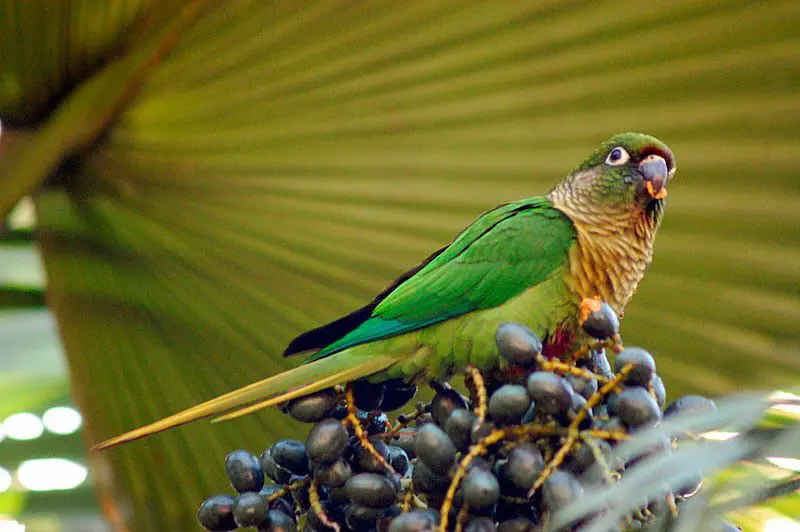
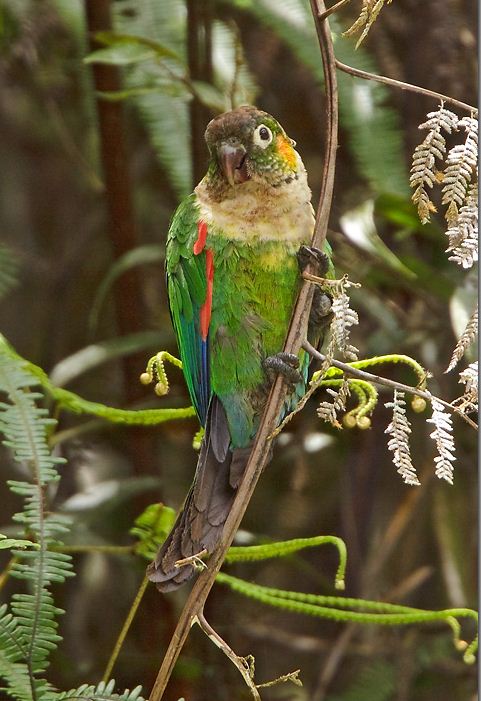
Fiery shouldered Parakeet
Pyrrhura egregia


Fiery shouldered Parakeet

Content

Description:

Fiery shouldered Parakeet

25 cm.. height.

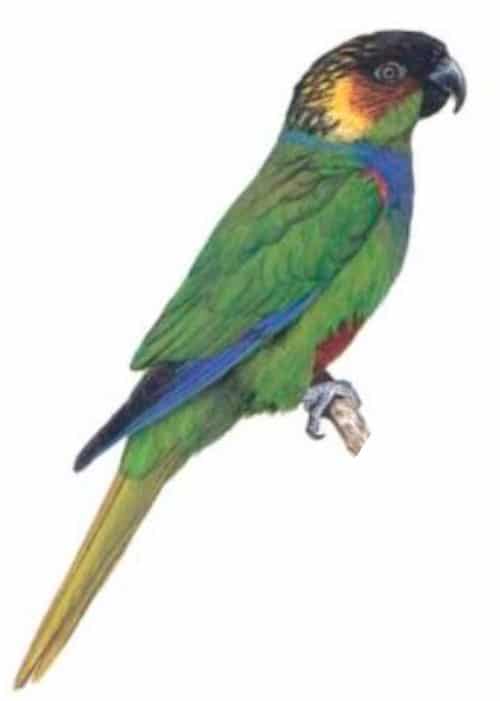
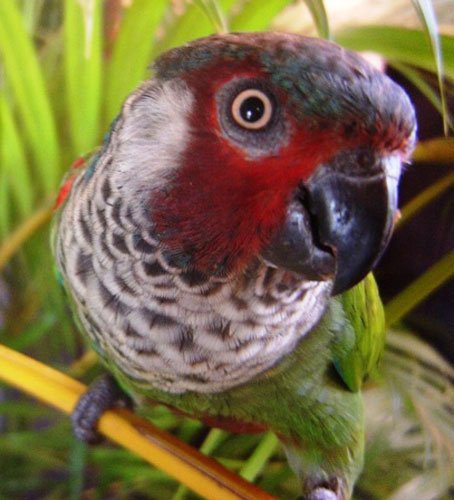
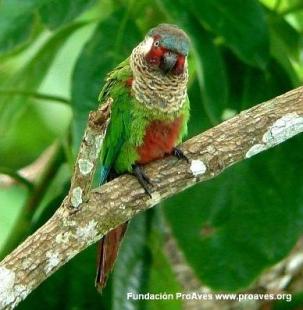
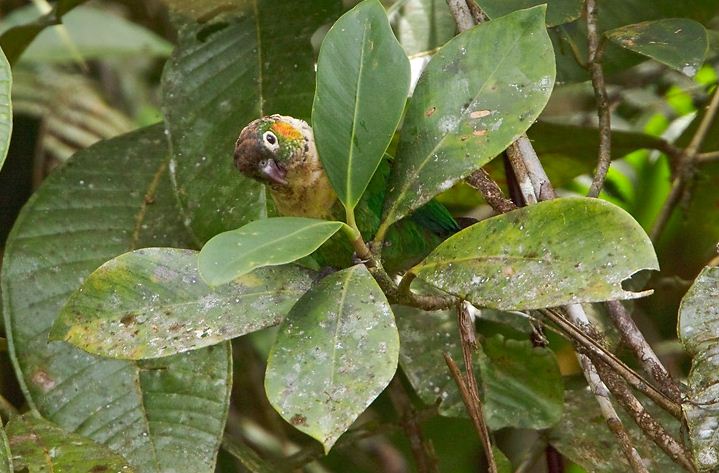
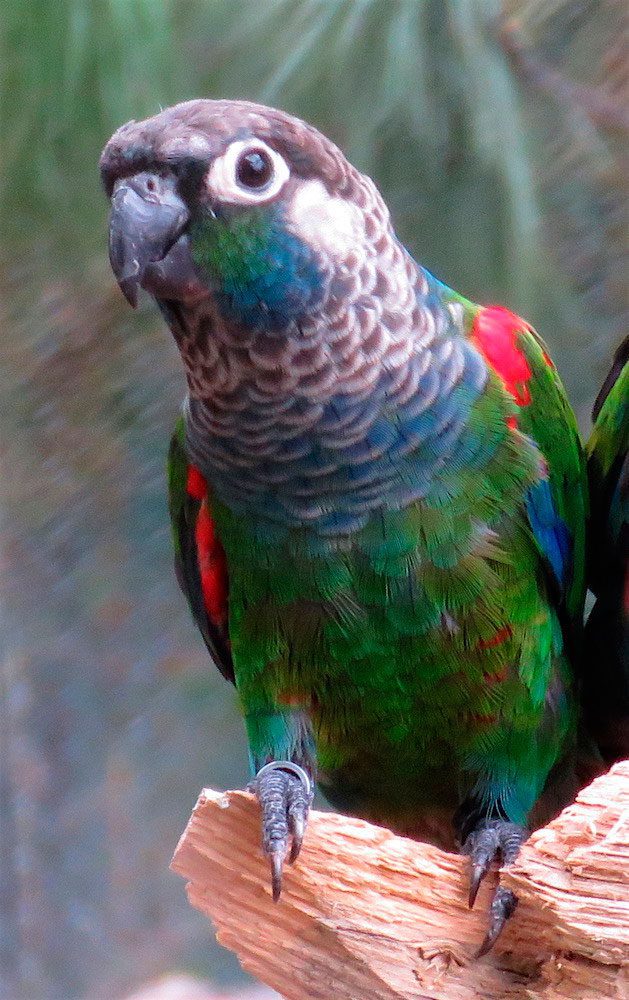
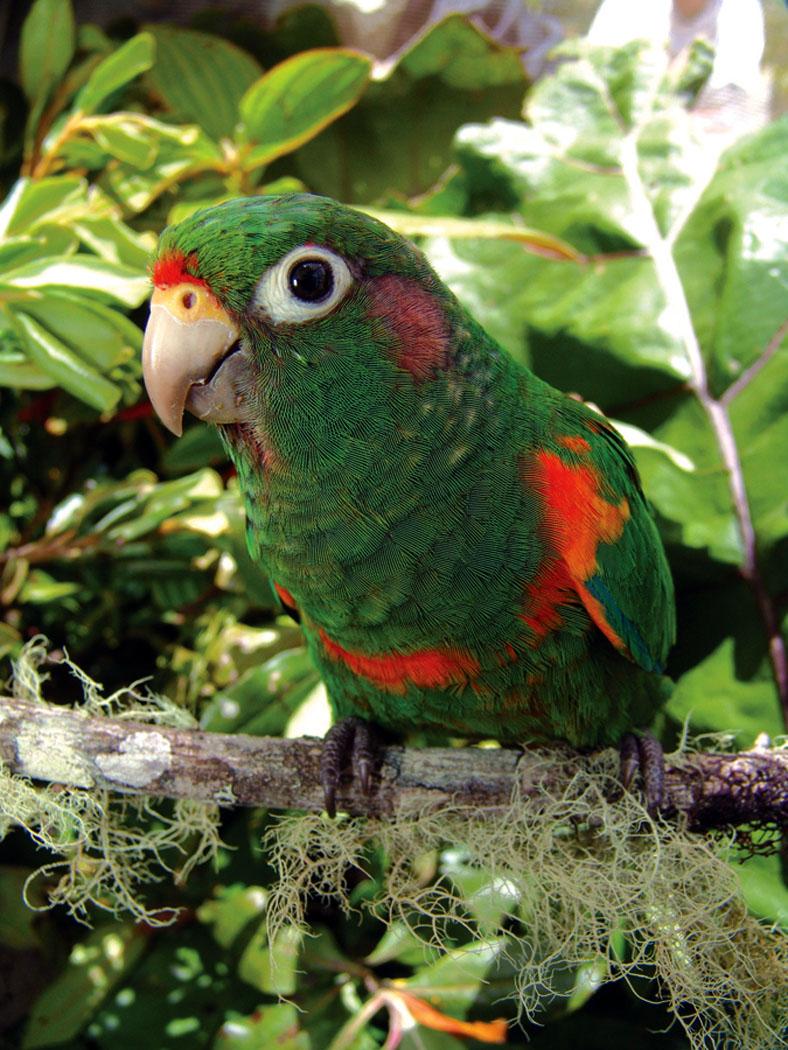
The Fiery shouldered Parakeet (Pyrrhura egregia) has a close frontal band brown; crown, lores, rear area of the neck and upper cheeks, brownish; ear-coverts reddish brown; feathers on the sides of the neck basically green with subterminal band of color beige, narrow dark tips giving a scaly appearance to the whole.

The upperparts Green with dark and narrow edges to some feathers. carpal area and front edge of the wing , Orange with yellow marks; primary coverts usually blue but sometimes colored yellow shiny; upperwing-coverts green. Outerwebs of flight feather, blue. Underwing-coverts marked with yellow orange; bottom of the flight feather gray. feathers in the throat and the chest basically green with the subterminal band Hazelnut color and dark tips, giving a scaly appearance; underparts green, with most of the feathers of the belly Brown at the base and green-tipped, sometimes forming a brown patch. Upper, the tail Brown very dark, green at the base; by down gray.

The bill color horn; skin peri-oftalmica naked white; brown the irises; legs Brown-Black.

Both sexes are similar.

The immature It has much less yellow and orange in the upperwing-coverts and infra-alares; the crown Green and flakes in the chest and on the sides of the neck less pronounced.

Subspecies description:

  • Pyrrhura egregia egregia

    (Sclater,PL, 1881) – The nominal.


  • Pyrrhura egregia obscura

    (Zimmer & Phelps,WH 1946) – Similar to the species nominal but with the upperparts darker green and the underparts also slightly more dark. Patch Brown in the belly less frequent and less prominent.

Habitat:

The species inhabits in humid premontane forests and dense secondary forest on the Tepuis, between 700 to 1800 m. usually in flocks of 7-25 birds.

Reproduction:

Little information on the breeding; is reproduce between March and April with fledged young people between May-June. Period of incubation: 23 Dias.

Food:

There is no information about the diet, except that birds visit Amerindian villages from July to August to feed of fruit of, for example, guavas mature.

Distribution:

Size distribution (reproduction / resident): 49.400 km2

Distribution restricted to the Tepui region in the north-eastern interior of South America. The species is known from Venezuela on Gran Sabana to the southeast of Bolรญvar, in the Mount Roraima and Arabopo and from the Mount Auyan-tepui and the Mt. Ptari-tepui.

Can be found in adjacent areas of the West of Guyana, for example, in the surroundings of the Camaran River and top of the Mazaruni River, the Merume mountains and Pacaraima mountains to the South of Annai.

The reports of Suriname still no confirmed. Probably are distributed in the northeast of Roraima, Brazil.

Inaccessible range and few details about his status, but apparently quite common. Large part of the range Venezuelan included in the Canaima National Park.

Small quantities exported from Guyana to end of the years eighty and subsequently bred in captivity.

Subspecies distribution:

Conservation:

State of conservation โ“˜


minor concern Minor Concern โ“˜ (UICN)โ“˜

โ€ข Current category of the Red List of the UICN: Least concern.

โ€ข Population trend: Decreasing.

Justification of the population

The population size World has not been quantified, but this species is described as ยซquite commonยป (Stotz et to the., 1996).

Justification of trend

It is suspected that this species has lost 3.3-10.5% of habitat suitable within their distribution during three generations (18 years), based on a model of Amazon deforestation (Soares-Filho et to the., 2006, Bird et to the., 2011). Given the susceptibility of the species to hunt or capture, It is suspected that will decrease in <25% durante tres generaciones.

"Fiery shouldered Parakeet" in captivity:

Intelligent, relatively calm and playful. Young birds are very shy.
They are aggressive with other birds and it is very rare in captivity, with small quantities exported from Guyana at the end of the 1980s and subsequently raised in captivity.

Price per couple: 300-400 EUR.

Alternative names:

Fiery-shouldered Parakeet, Fiery shouldered Parakeet, Fiery-shoulderd Conure, Fiery-shouldered Conure (English).
Conure aile-de-feu, Perriche aile-de-feu, Perruche aile-de-feu (French).
Feuerbugsittich, Feuerbug-Sittich (German).
tiriba-de-cauda-roxa (Portuguese).
Cotorra Egregia, Perico de Cola Morada, Perico colimorado (espaรฑol).
Perico de Pantepui (Venezuela).


scientific classification:

Philip Sclater
Philip Sclater

Order: Psittaciformes
Family: Psittacidae
Genus: Pyrrhura
Scientific name: Pyrrhura egregia
Citation: (Sclater, PL, 1881)
Protonimo: conurus outstanding


Fiery shouldered Parakeet images:

Videos "Fiery shouldered Parakeet"

Fiery shouldered Parakeet (Pyrrhura egregia)


Sources:

Avibase
– Parrots of the World โ€“ Forshaw Joseph M
– Parrots A Guide to the Parrots of the World – Tony Juniper & Mike Parr
– Birdlife

Photos:

(1) – Demerara Conure By Gazelle74 (Own work) [CC BY-SA 4.0], via Wikimedia Commons
(2) – Demerara female ยซat workยป. These little parrots love to gnaw at wood, paper and many other things By Gazelle74 (Own work) [CC BY-SA 4.0], via Wikimedia Commons
(3) – Fiery-shouldered Parakeet (Pyrrhura egregia) by Margareta Wieser. A pair perching on a branch – HBW
(4) – Fiery-shouldered Parakeet (Pyrrhura egregia) by Andrew Emmerson. An adult bird – HBW
(5) – Fiery-shouldered Parakeet (Pyrrhura egregia) by Andrew Emmerson. An adult preening – HBW
(6) – Conurus egregius ยป = Pyrrhura egregius (Fiery-shouldered parakeet) by John Gerrard Keulemans [Public domain], via Wikimedia Commons

Sounds: (Xeno-canto)

โ–ท The world of Pets: Dogs, cats, birds, reptiles, amphibians

Green-cheeked Parakeet
Pyrrhura molinae


Green-cheeked Parakeet

Content

Description:

cotorra-de-molina-6

25 cm.. in length and 62โ€“81 grams in weight.

The Green-cheeked Parakeet (Pyrrhura molinae) has a close frontal band and lores, you are reddish brown to blackish; crown, of color brown or brown grayish marked laterally in shades blue and green; rear area of the crown and nape with blue tips; cheeks and sometimes the supercilii area (area of the front), of color green with dye olive; ear-coverts of color grey clear to pale.

Upperparts green. The primary coverts are bluish green and the remaining are mainly green, except for some feathers scattered of color blue, yellow or orange in the leading edge of wing. Primaries blue, secondaries Green with blue near the axis; both grey below. Underwing-coverts green. feathers in the chest, the throat and the sides of the neck, brownish at base with pale purple, light grey, or yellowish opaque in the tips, giving effect squamous; central belly with brown patches of varying size (only scattered feathers some birds); sides of the belly, the thighs and bottom of the chest, green; undertail-coverts bluish green.

Upper, the tail brown, with green at the base of the center of the tail feathers (hidden under the coverts); below, the tail brown.

The bill, grey; the cere white; bare periophthalmic whitish; irises brown; legs grey.

Both sexes are similar.

Immature paler. with the irises darker and less a defendant patch brown of the belly.

Subspecies description
  • Pyrrhura molinae australis

    (Todd, 1915) – Slightly smaller the species nominal, pale margin to the throat and to the close down of the chest; Brown-colored area in the chest more extensive; less blue in the undertail-coverts.


  • Pyrrhura molinae flavoptera

    (Maijer, Herzog, Kessler, Friggens & Fjeldsa, 1998) – Similar to the nominal species, but with the bend of wing and the carpal edge, orange-red; Alula with feather blue and yellow / white mixed.


  • Pyrrhura molinae hypoxantha

    (Salvadori & Festa, 1899) – Previously listed as Pyrrhura molinae sordida. The cheeks more pale that the of the nominal species; the color red in the belly less prominent and the skirting of feathers in the throat and the chest less distinctive.


  • Pyrrhura molinae molinae

    (Massena & Souancรฉ, 1854) – The nominal.


  • Pyrrhura molinae phoenicura

    (Schlegel, 1864) – It differs from the species nominal and of the subspecies Pyrrhura molinae australis, by having the basal half of feathers of the Centre of the tail, green. Some birds are yellow in the leading edge of wing.


  • Pyrrhura molinae restricta

    (Todd, 1947) – More blue that other subspecies, with stain blue in them lower cheeks and strong blue subfusion in the undertail-coverts. The blue tips on the feathers of the nape and zone back in the neck they form a most distinctive collar which in the nominal species.

Habitat:

The species Green-cheeked Parakeet inhabits dense forests, often low and forests with clear primary and secondary , including stripes of chaco, Savannah, deciduous forest and pantanal gallery, as well as rainforests MOSS-covered in the Eastern Andes where is reported to 2.900 meters above sea level.

In Brazil the subspecies Pyrrhura molinae hypoxantha are located mainly in deciduous forest above the 500 m.

Gregaria (at least outside the breeding season), usually in flocks of 10-20, sometimes many more.

Very often seen in rapid flight, under, fairly erratic and slightly wavy. Difficult to detect while feeding calmly in the treetops.

Reproduction:

It nests in hollow natural of trees. The laying is of 4 to 6 eggs during the month of February in the northeast of Argentina. Period of incubation: 20-24 days.

Food:

There is no information about the diet of the Green-cheeked Parakeet, but probably similar to nearby conspecifics; Forages in the treetops.

Distribution:

Size of the area of distribution (reproduction / resident): 675.000 km2

Its distribution runs from the southwest of Brazil and Northwest of Argentina to the East of Bolivia and probably South of Peru.

To this species is it can be observed in Mato Grosso and Mato Grosso from the South, in the southwest of Brazil, and in Beni, Peace, Cochabamba, Chuquisaca, Tarija and Santa Cruz, to the East of Bolivia, to the fringes of the chaco. They can be distributed through the North of Bolivia up to the end South of Peru, where a hybrid individual was captured with the Black-capped Parakeet (Pyrrhura rupicola).

Apparently absent from the land low of the pantanal and restricted in the basin of the Paraguay River isolated plots of forests of chaco in highlands on the right bank of the river.

In the Northwest of Argentina is distributed in Salta, Jujuy and with less frequency in Tucumรกn (a record in Catamarca is probably wrong).

They can live on the fringes of the Northwest of Paraguay but not is tested. Some local seasonal movements they can occur, birds in the higher elevations down to altitudes lower in winter (Mar-Aug).

Usually common (very common in Salta and Jujuy); Highest densities in deciduous forest; It is the most common parrot in the wooded valleys of Bolivia eastern but probably declining there due to rapid habitat clearance.

Is sold during those years eighty and was extended in captive outside of its area of distribution.

Subspecies distribution

Conservation:

State of conservation โ“˜


minor concern Minor Concern โ“˜ (UICN)โ“˜

โ€ข Current category of the Red List of the UICN: Least concern.

โ€ข Population trend: Stable.

Justification of the population

The size of the world population It has not been quantified, but this species is described as ยซcommonยป (Stotz et to the., 1996).

Justification of trend

Suspected that the population is stable in absence of evidence of any decline or threatens substantial.

"Green-cheeked Parakeet" in captivity:

Unknown in those birds up to the Decade of 1970, nowadays it is quite common. They have become one of the favorite birds in the pet trade, due to his sweet personality and at your disposal for fun. Son playful, loving and Smart.

They are not considered the best talkers. But, some Green-cheeked Parakeet, especially smart, they learned to speak very well, according to their owners. Even so, most say only a couple of things, And there's no guarantee that they'll ever learn to speak. They also have low and serious voice, so even if managed to talk, it would not be easy for them to say something understandable.

Price per couple (ancestral): 120-200 EUR. Hypoxantha: 150-300 EUR.

Alternative names:

Green-cheeked Parakeet, Green cheeked Parakeet, Green-cheeked Conure, Yellow-sided Conure (English).
Conure de Molina, Perriche de Molina, Perruche de Molina (French).
Molinasittich, Molina Sittich, Molina-Sittich (German).
cara-suja, tiriba-de-cara-suja (Portuguese).
Chiripepรฉ cabeza parda, Chiripepรฉ de cabeza gris, Cotorra de Molina, Perico Amarillo, Perico Verde, Cotorra de mejillas verdes (espaรฑol).
Chiripepรฉ cabeza parda (Argentina).
Chiripepรฉ cabeza parda (Paraguay).
Chiripepe cabeza parda (Bolivia).
Kirki (Aymara).
Sira (Guarani).

scientific classification:

Order: Psittaciformes
Family: Psittacidae
Genus: Pyrrhura
Scientific name: Pyrrhura molinae
Citation: (Massena & Souancรฉ, 1854)
Protonimo: Conurus molinae

Images Green-cheeked Parakeet:

Videos "Green-cheeked Parakeet"


Especies del gรฉnero Pyrrhura

Green-cheeked Parakeet (Pyrrhura molinae)


Sources:

Avibase
– Parrots of the World โ€“ Forshaw Joseph M
– Parrots A Guide to the Parrots of the World – Tony Juniper & Mike Parr
– Birdlife
โ€“ Book Parrots, Parrots and macaws
avianweb

Photos:

(1) – A Green-cheeked Parakeet perching on the index finger of a left hand By Eric Sonstroem from California, USA (Green-Cheeked ConureUploaded by snowmanradio) [CC BY 2.0], via Wikimedia Commons
(2) – Green-cheeked Conure perching in an aviary at Kuala Lumpur Bird Park, Malaysia By Brandon Lim (Rainbow LorakeetUploaded by Snowmanradio) [CC BY 2.0], via Wikimedia Commons
(3) – Green-cheeked Conure perching in an aviary By Brandon Lim (Rainbow LorakeetUploaded by Snowmanradio) [CC BY 2.0], via Wikimedia Commons
(4) – A juvenile pet Yellow-sided Green-cheeked Conure (also Sordid Conure and the Yellow-sided Conure). It is a naturally occurring subspecies of the Green-cheeked Conure. The photograph shows a wing-clipped pet parrot in a bird cage. By therouxdown (Reese closeupUploaded by Snowmanradio) [CC BY-SA 2.0], via Wikimedia Commons
(5) – A juvenile pet Yellow-sided Green-cheeked Conure (also Sordid Conure and the Yellow-sided Conure). It is a naturally occurring subspecies of the Green-cheeked Conure. The photograph shows a wing-clipped pet parrot perching on a food bowel By therouxdown (originally posted to Flickr as Reese profile) [CC BY-SA 2.0], via Wikimedia Commons
(6) – Molinaโ€™s Parrot from Philip Lutley Sclater and W. H. Hudson, Argentine Ornithology: A Descriptive Catalogue of the Birds of the Argentine Republic (1888-89) in Wikimedia

Sounds: (Xeno-canto)

โ–ท The world of Pets: Dogs, cats, birds, reptiles, amphibians

Maroon-tailed Parakeet
Pyrrhura melanura


Maroon-tailed Parakeet

Content


Anatomy-parrots

Description:

26-28 cm.. height.

The Maroon-tailed Parakeet (Pyrrhura melanura) is distinguishable mainly by the tail and wings blackish (visible in flight); has the lores, the forecrown, the crown and the rear area of the neck, brownish, with paler reddish brown tips on the crown, forming altogether a speckled pattern; cheeks, ear-coverts and area behind the eyes, green; Brown in the shadows at the back of the crown Green in the nape.

Upperparts Green with tinge of olive in some feathers. Primary coverts Red with yellow tips; Front edge of the wing , red; upperwing-coverts of color green with dye olive. Primaries Dark greenish blue with dark tips. Underwing-coverts green; underside of flight feather blackish. Throat and feathers of the upper part of the chest, Green or greyish green with pale margins, giving a scaly striking effect; pale edges that become less clear on the sides of the neck; the belly and undertail-coverts Green with dye olive dark. Upper, the tail dark brown with green outer feathers; undertail, the tail shiny black.

Bill pale grey; bare periophthalmic naked, whitish: irises dark brown; legs grey.

Both sexes similar. The immature has less red (greener) in the primary coverts.

Subspecies description

Subspecies description
  • Pyrrhura melanura berlepschi

    (Salvadori, 1891) – Similar to the Pyrrhura melanura souancei, but with even broader and paler margins on the breast feathers (Some birds of Ecuador with almost entirely white breasts), less red on the front edge of the wing and more pronounced brown patch in the belly. Cheeks dyed with color olive, Red uniform at the edge of the carpus; abdomen more uniform brown/red color.

  • Pyrrhura melanura chapmani

    (Bond & Meyer de Schauensee, 1940) – With suspiciously in the chest more width, No yellow in the wing ; yellowish in the area of the ear and the green of the tail darker.

  • Pyrrhura melanura melanura

    (Spix, 1824) – Nominal.

  • Pyrrhura melanura pacifica

    (Chapman, 1915) – More dark, No yellow in the wing , grey around the eye, tail more short and reddish.

  • Pyrrhura melanura souancei

    (Verreaux,J, 1858) – With the edge top of the wing Red and not yellow; Green in the base of the tail more extensive and chest with scaled a little more width.

Habitat:

Maroon-tailed Parakeet

The Maroon-tailed Parakeet It occupies the temperate tropical formations, including forests of vรกrzea, forests of land low and pre-montanos rainforests and forests cloud, often in areas partially cleared and edges of secondary forests; 150 - 300m in Venezuela (nominal), to 3,200 m in the slopes Andean Eastern (souancei), 1.600-2.800m on the slope of the Andes central (chapmani), at 1,700 m in Nariรฑo (Pacifica), at 1500m (berlepschi). Usually in flocks of 6-12 individuals, staying in them cups of them trees to rest but moving is toward the branches more low for forage.

Reproduction:

Little information about breeding, observed during the months of April-June, headers of the Napo River, Ecuador. Copulation observed in January (Colombia). Clutch four eggs in captivity.

Food:

Few details about the diet, with foods known, including fruits of Miconia tkeaezans (Top of the Magdalena valley). Fagara tachuelo and tree bark (Amazonia).

Distribution:

Size of the area of distribution (reproduction / resident): 1.510.000 km2

The distribution of the Maroon-tailed Parakeet is discontinuous. Northwest of South America in the Western Amazon basin, southern portion of the the Orinoco basin and slope of the peaceful of the Andes, in the southwest of Colombia and West Ecuador.

In Venezuela the species is found in the Centre of the South of Bolรญvar along the upper Western Amazon basin of Brazil between the rivers Negro and Solimรตes. They are also distributed in Andes Central of Colombia, at the top of the Magdalena valley, from the South of Tolima until Huila and separated to the East from the Andes (in lowlands and up to 500 m in foothills) Since the Macarena mountains, southward through eastern lowlands Ecuador and Northeast and East of Peru.

A separate population is distributed to the West of the Andes, in the Northwest of the South of Ecuador, to the North of The rivers, with a single log in nose, to the southwest of Colombia.

Mainly resident Although the apparent absence during some seasons in some parts of Colombia suggests regular movements.

Unevenly distributed, in some areas very common, being the Parrot more numerous in some parts of the range such as high Magdalena valley and perhaps parts of Esmeraldas in the Northwest of Ecuador.

Alleged decrease in some areas (for example, Pacific slope of Ecuador) due to loss of habitat. Little known in the East of Peru. Not a locally popular cage bird if it has been traded internationally in significant numbers in late 1980 and fairly well known in captivity outside of its area of distribution.

Subspecies distribution

Subspecies distribution
  • Pyrrhura melanura berlepschi

    (Salvadori, 1891) – Valley of Huallaga, is of Peru and Southeast of Ecuador on Cutucรบ mountain range. A specimen with characteristics of this species was observed at the head of the Magdalena valley suggesting their distribution in Colombia.

  • Pyrrhura melanura chapmani

    (Bond & Meyer de Schauensee, 1940) – Hillside East of the top of the Magdalena valley in the center of the Andes from the South of Tolima until Huila at altitudes of 1600-2, 800 m

  • Pyrrhura melanura melanura

    (Spix, 1824) – Nominal.

  • Pyrrhura melanura pacifica

    (Chapman, 1915) – Northwest of Ecuador and southwest of Colombia.

  • Pyrrhura melanura souancei

    (Verreaux,J, 1858) – It is from Colombia since the Sierra de la Macarena Southwest, until Putumayo through the East of Ecuador, possibly up to the north end of Peru. Probably bordered on the eastern slopes of the Andes and mostly replaced by the nominal species in lowlands.

Conservation:


minor concern


โ€ข Current category of the Red List of the UICN: Least concern.

โ€ข Population trend: Decreasing.

Justification of the population

The population size world has not been quantified, but this species is described as ยซquite commonยป (Stotz et to the., 1996).

Justification of trend

This species is suspected that he has been able to lose 6,95 to 7,1% of a habitat within its distribution over three generations (18 years) based on a deforestation model of the Amazon (Soares-Filho et to the., 2006, Bird et to the. 2011). Given the susceptibility of the species to the cazay and/or the capture, It is suspected that will decrease in <25% durante tres generaciones.

"Maroon-tailed Parakeet" in captivity:

Ave shy and quiet, get used to people over time. Colonies in large birdcages are possible.

Alternative names:

Maroon-tailed Parakeet, Magdalena Parakeet, Maroon tailed Parakeet, Maroon-tailed Conure, Black-tailed Conure (English).
Conure de Souancรฉ, Perriche de Souancรฉ, Perruche de Souancรฉ (French).
Braunschwanzsittich, Braunschwanz-Sittich (German).
tiriba-fura-mata (Portuguese).
Cotorra Colinegra, Perico de Cola Negra, Periquito Colirrojo (espaรฑol).
Periquito Colirrojo (Colombia).
Periquito Colirrojo (Peru).
Perico Cola Negra (Venezuela).


scientific classification:


Johann Baptist von Spix

Order: Psittaciformes
Family: Psittacidae
Genus: Pyrrhura
Scientific name: Pyrrhura melanura
Citation: (von Spix, 1824)
Protonimo: Aratinga melanurus

Images "Maroon-tailed Parakeet"

Videos "Maroon-tailed Parakeet"

————————————————————————————————

"Black tail parakeet" (Pyrrhura melanura)


Sources:

Avibase
– Parrots of the World โ€“ Forshaw Joseph M
– Parrots A Guide to the Parrots of the World – Tony Juniper & Mike Parr
Birdlife

Photos:

(1) – pyrrhura.cz.
(2) – Maroon-tailed parakeet pyrrhura berlepschi = berlepschi, Maroon-tailed Parakeet ssp. by John Gerrard Keulemans [Public domain], via Wikimedia Commons

Sounds: (Xeno-canto)

โ–ท The world of Pets: Dogs, cats, birds, reptiles, amphibians

Santa Marta Parakeet
Pyrrhura viridicata

Cotorra de Santa Marta

Content

Description:

25 cm.. height.

The Santa Marta Parakeet (Pyrrhura viridicata) It, in general, green, with a characteristic red stripe in the middle of the chest which continues until shoulder and armpit. The scales of the chest is less evident; the flight feathers blue. Band front narrow red in the forecrown and behind the eye with red and yellow dye. Tail over green and below red opaque.

Bill color bone; brown iris; pale black legs. It has no sexual dimorphism.

Habitat:

It inhabits in humid mountain forest, clouded forest, pastures and edges, from 1900 to 2800 m. They fly at dawn and at dusk in compact and numerous flocks on the canopy of the forest. Is les has observed flying over them clear adjacent and each time more visiting them mulberry plantations.

The species rests and nests in couples and in lesser proportion in groups of three individuals in cavities of Palms of bouquet Ceroxylon ceriferum (Arecaceae).

Reproduction:

The period reproductive is starts in December and lasts until June, the cavities are visited on average 4 to 5 times a day. There is a sexual dimorphism and a low reproductive success can be associated with displacement or predation by the Aratinga wagleri wagleri (Scarlet-fronted Parakeet) or the Santa Marta Toucanet (Aulacorhynchus lautus prassinus) – Ramphastidae.

Food:

Twelve plant species are incorporated into the diet so far known to the Santa Marta Parakeet, It consists mainly of flowers and fruits, the inflorescence of the Croton bogotanus (Euphorbiaceae) is their main source of food. It forages in groups of size variable, presenting an integration and disintegration of subgroups throughout the day. A sentinel system was observed.

Distribution:

Size of the area of distribution (reproduction / resident): 1,600 km2

Endemic species of Sierra Nevada de Santa Marta, to the northeast of Colombia. The towns registered include The Summit, is of Taquiรฑa on the basis of the Pรกramo of Mamarongo in the Guajira, and Cerro Quemado in the mountains of San Lorenzo.

Will produce some movements altitudinal seasonal. Almost all the habitat forest subtropical is designated as reserve forest or Park national, but the clearing for plantations of marijuana has been extensive, similar to the use of herbicides to combat it. So it only remains for the 15% the original forest (especially in the hillsides North), including only 200 the preferred height of the species km2. Fairly common within this very restricted range, but the population probably below of the 5.000 birds.

Conservation:

State of conservation โ“˜


Endangered Endangered โ“˜ (UICN)โ“˜

โ€ข Current category of the Red List of the UICN: In danger of extinction.

โ€ข Population trend: Decreasing.

Rationale for the Red List category

The range of this species and its small population are probably decreasing as a result of habitat loss. So, qualifies as in danger.

Justification of the population

The population It has been estimated for a long time between 5.000 and 10.000 individuals, equivalent approximately to 3.300-6.700 mature individuals. The density of population is of 1 Ave per km2 (Botero-Delgadillo et to the. 2012). Assuming that the 680 km2 of habitat are fully occupied, the population total is calculated that is 2,900-4,800 birds, which is equivalent to 1,933-3,200 mature individuals; But, with occupation part is likely to remain less than 2.500 birds (Botero-Delgadillo et to the. 2012).

Justification of trend

Se sospecha una decrease moderate and continuous of the population on the basis of the rates of habitat loss.

Threats

only one left 15% the original vegetation of the Sierra Nevada de Santa Marta, to a large extent on the slope North, where this species is found (LM Renjifo, Com. 1993, 2000).

The main current threat is the expansion of plantations of non-native trees, such as the of Pine and eucalyptus, in addition to the clearing of land for livestock (C. Olaciregui in litt. 2012).

ยท Historically, the conversion of forests in plantations of marijuana and coca was also a major threat (LG Olarte in litt., 1993, com LM Renjifo. Comm., 1993, J. Fjeldsรฅ verbally they 2000, pers LM Renjifo. Comm., 2000, C. Olaciregui in litt. 2012), that is compounded by the Government with application of herbicides in the sierra (LG Olarte in litt., 1993, com LM Renjifo. Comm., 1993, 2000).

Other threats that followed the human migration to the area Since the Decade of 1950 hereafter include slash & burn (Dinerstein et to the., 1995, Snyder et to the. 2000, Salazar and Strewe undated, PGW Salaman in litt. 1999).

ยท It is known to be hunted in the cold river valley, and in the San Pedro district individuals in mulberry plantations have skyrocketed. The species not found in the local bird trade (Strewe 2005).

"Santa Marta Parakeet" in captivity:

Not marketed for captive.

Alternative names:

Santa Marta Parakeet, Santa Marta Conure (English).
Conure des Santa Marta, Perriche de Santa Marta, Perruche de Santa Marta (French).
Santa-Marta-Sittich, Santa Marta Sittich, Sittich (German).
Santa Marta Parakeet (Portuguese).
Cotorra de Santa Marta, Perico Oliva, Periquito de Santa Marta (espaรฑol).

scientific classification:

Order: Psittaciformes
Family: Psittacidae
Genus: Pyrrhura
Scientific name: Pyrrhura viridicata
Citation: Todd, 1913
Protonimo: Pyrrhura viridicata

Images "Santa Marta Parakeet"

Videos "Santa Marta Parakeet"


Especies del gรฉnero Pyrrhura

Santa Marta Parakeet (Pyrrhura viridicata)


Sources:

Avibase
Parrots of the World โ€“ Forshaw Joseph M
Parrots A Guide to the Parrots of the World – Tony Juniper & Mike Parr
Birdlife
Oliveros rooms, H.. 2005. Population and ecological evaluation of the Santa Marta parakeet Parrot parakeet in the sector of San Lorenzo, Sierra Nevada de Santa Marta, Colombia. (ProAves.org)

Photos:

(1) – ProAves Foundation – Proaves.org

Sounds: By GABRIEL MILK (Xeno-canto)
โ–ท The world of Pets: Dogs, cats, birds, reptiles, amphibians

Emma's Parakeet
Pyrrhura emma

Emma's Parakeet

Content

Description:

Emma's Parakeet

23 cm.. length.

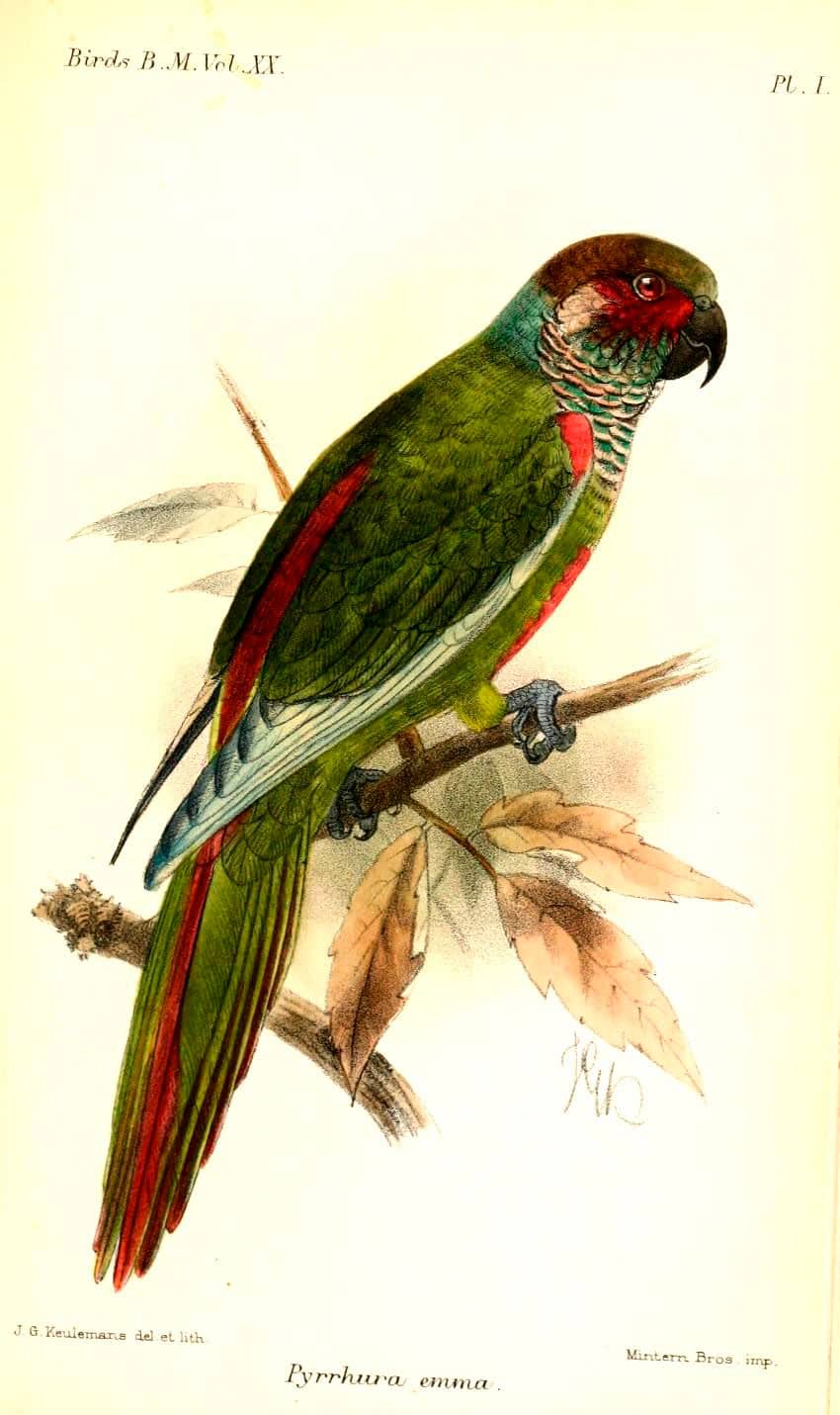
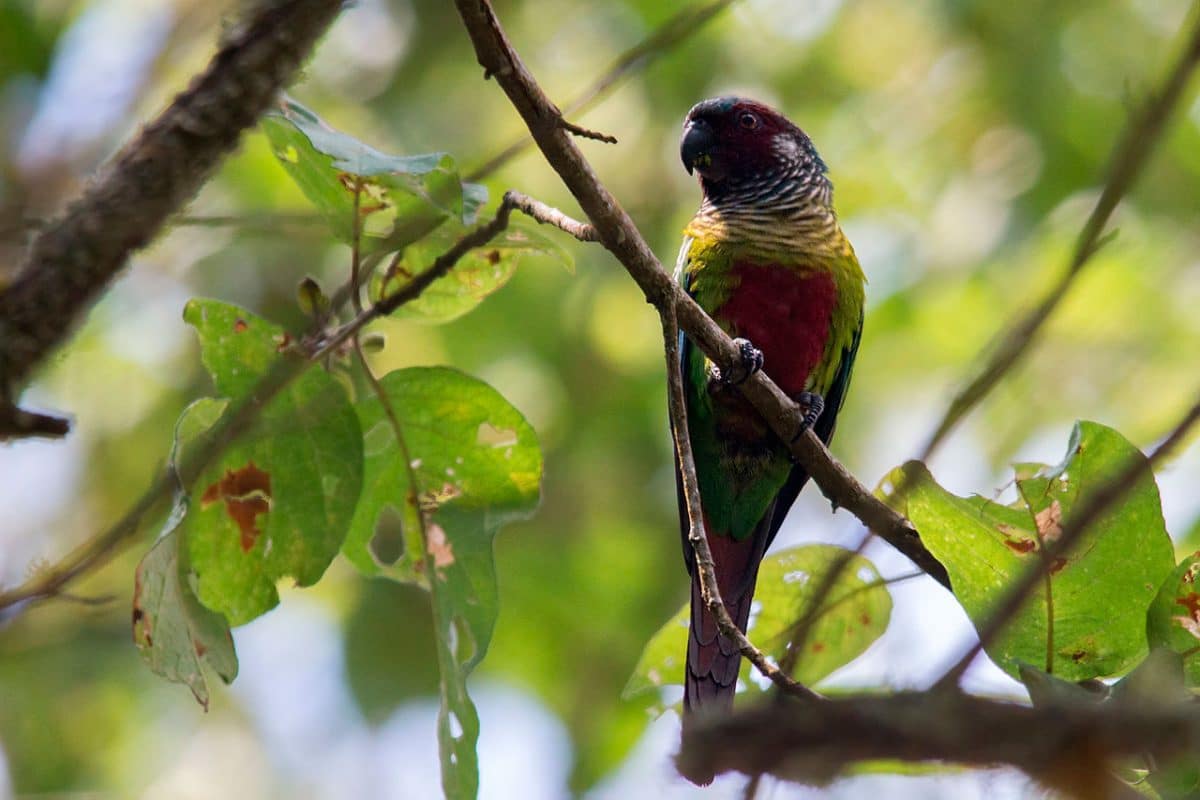
The Emma's Parakeet (Pyrrhura emma) is a bird, mostly, green, with blue in the wings, reddish-brown in rump, on tail and in the back; Scaled plumage chest yellowish color on a gray background olive; wings with red shoulder, inconspicuous.

The face red plum, while the pileum It is brown and gray forecrown blue. Abdomen with dark red stain, tail with green base, edge red and below all red.

Eye ring grey, cheeks red with white spot on ears. Bill dark. It has no sexual dimorphism.

Habitat:

They can be seen in hill forests in the coastal mountain range in Venezuela, in humid forests and edges as well as in adjacent clearings with sparse trees and groves (pit et to the., 1997).

Usually it moves in flocks, on quick flights up 25 specimens, before landing in the canopy.

Reproduction:

There is insufficient information regarding reproduction and feeding. Breeding season probably between May and July. Period of incubation: 24-25 days.

Food:

They have been observed eating flowers of Ochroma and nectar (Hilty 2003).

Distribution:

Size of its range (reproduction / resident): 88.300 km2

The Emma's Parakeet inhabits forested areas of the northern coastal range Venezuela, from Yacacuy and Carabobo until Miranda, and disjuntamente from Anzoรกtegui to Sucre and northern part of Monagas (Del Hoyo et al., 1997, Juniper and Parr 1998, Hilty 2003, Forshaw 2006).

It is mainly found at altitudes 250-1.700 m, but you can see at sea level in eastern Sucre (Hilty 2003), where is quite common (Hilty 2003, P. Boesman in a bit., 2006). Its distribution within this range is complex and disjoint, found especially in mountainous terrain at lower elevations (Hilty 2003).

Conservation:

โ€ข Current category of the Red List of the UICN: Least concern.
โ€ข Population trend: Decreasing.

Justification of the population

State of conservation โ“˜


minor concern Minor Concern โ“˜ (UICN)โ“˜

Apparently, the population size of this species has not been quantified.

Justification of trend

The capture for trade and changes in land use may be causing a decrease in population of this species, although the trend has not been quantified, and none of these is considered serious threats to this species today(CJ Sharpe a slightly. 2014).

Conservation Actions Underway

They live in several national parks (P. Boesman in a bit., 2006), with a "substantial" population in the Guatopo National Park, Miranda (Juniper and Parr 1998, Hilty 2003).

Conservation Actions Proposed

Continue to monitor this species in the field and in trade.

Strengthen the network of protected areas within the range of this species.

"Emma's Parakeet" in captivity:

Very rare in captivity. Very intelligent, active and playful. They are very aggressive with other species. Price per couple: 400 EUR.

Alternative names:

Emma’s Parakeet, Emma’s Parakeet (incl. auricularis), Painted Parakeet (Venezuelan), Venezuelan Parakeet (English).
Conure d’Emma, Conure emma, Conure emma (incl. auricularis) (French).
Emmasittich (German).
Emma’s Parakeet (Portuguese).
Cotorra de Emma (espaรฑol).


scientific classification:

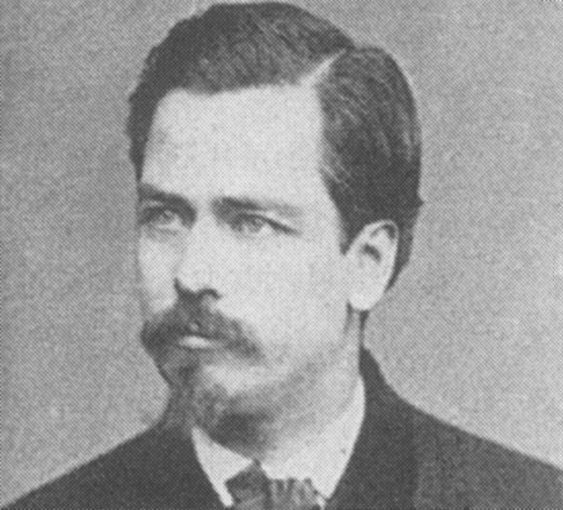
Salvadori Tommaso

Order: Psittaciformes
Family: Psittacidae
Genus: Pyrrhura
Scientific name: Pyrrhura emma
Citation: Salvadori, 1891
Protonimo: Pyrrhura emma


Images Emma's Parakeet:

Videos "Emma's Parakeet"


Especies del gรฉnero Pyrrhura

Emma's Parakeet (Pyrrhura emma)


Sources:

Avibase
– Parrots of the World โ€“ Forshaw Joseph M
– Parrots A Guide to the Parrots of the World – Tony Juniper & Mike Parr
Birdlife

Photos:

(1) – Venezuelan Parakeet | Perico Pintado ( Pyrrhura emma)By Fernando Flores from Caracas, Venezuela [CC BY-SA 2.0], via Wikimedia Commons
(2) – Venezuelan Parakeet | Perico Pintado ( Pyrrhura picta emma) By Fernando Flores from Caracas, Venezuela [CC BY-SA 2.0 or CC BY-SA 2.0], via Wikimedia Commons
(3) – Venezuelan Parakeet | Perico Pintado (Pyrrhura emma) by Fernando FloresFlickr
(4) – Venezuelan Parakeet | Perico Pintado (Pyrrhura emma) by Fernando FloresFlickr
(5) – Venezuelan Parakeet | Perico Pintado (Pyrrhura emma) By Fernando Flores from Caracas, Venezuela [CC BY-SA 2.0], via Wikimedia Commons
(6) – Pyrrhura emma = Pyrrhura picta, Painted Parakeet by John Gerrard Keulemans [Public domain], via Wikimedia Commons

Sounds:

โ–ท The world of Pets: Dogs, cats, birds, reptiles, amphibians

Sinรบ parakeet (sub)
Pyrrhura subandina

Cotorrita del Sinรบ

Content

Description:

21 to 23 cm.. height.

The Sinรบ parakeet (Pyrrhura subandina) It, in general, green, with the forecrown and areas around eyes dark red.

In flight It is very evident dark red stain abdomen, the wings below greyish. The cheeks They have a greenish blue tone, the area surrounding the ear It is yellowish-brown and the breast feathers with design marginalized gray escamado.

Lives or lived in humid jungle, semi-humid, deciduous and gallery forests,low. It nests on trees of considerable size in hollow nests woodpeckers.

endemic to Colombia, in the lower valley of sinu river, Jaraquiel, Murrucucรบ hill, Cรณrdoba.

Expeditions carried out in recent years have failed to sight it.

Estimated population: 0-100; The population trend: possibly extinct

We recommend that you devote to Sinรบ parakeet immediate attention to the conservation of this unique endemic species of the plain Sinu River.

Habitats in the jungle and near the Sinรบ river valley have been extensively altered and lost.

History:

The Sinรบ parakeet It was described by Todd 1917 as a distinctive bird endemic Valley Sinu River, Cรณrdoba Department, Northwest of Colombia. Peters (1937), without evidence or any basis placed the Pyrrhura subandina within the species Pyrrhura picta, and the species immediately fell into obscurity as subspecies. However, Joseph and Stockwell (2002) they restored the status to Pyrrhura subandina as a species, based on a detailed assessment and phylogenetic analyses recent (com. pers. 2003).

DNA analysis has shown that the population of the Sinรบ parakeet (Pyrrhura subandina) It is probably different (monotype) (Joseph & Stockwell 2002), although at present it remains a subspecies of the Pyrrhura picta pending further studies (SACC 2007).

There is no information on the ecology of the Sinรบ parakeet or current status. The species has never been reported alive and its range has been extensively deforested (Salaman obs. pers.)

At the beginning of 2004 Paul Salman He visited the four sites type; two are entirely deforested, While Quimari and the Cerro Murrucucรบ still have some fragmented forests. No evidence of any Pyrrhura It was obtained by observations and interviews with the local community. In May of 2004, a researcher at ProAves spent three months exploring in search of this species throughout the Murrucucรบ hill but their results were not favorable. The lack of recent records of this species and its restricted and unprotected range give reasons for concern about their survival and current status.

    Reference: Joseph, L. and Stockwell, D. 2002. Climatic modeling of the distribution of some Pyrrhura parakeets of northwestern South America with notes on their systematics and special reference to Pyrrhura caeruleiceps Todd, 1947. Ornitologia Neotropical 13: 1-8.

The Sinรบ parakeet (Pyrrhura subandina) was last reliably recorded in 1949. Almost nothing was recorded about their habits. Not found during searches on 2004 and 2006 (ProAves Colombia 2008). He may be extinct, but if it still survives, this bird will be seriously threatened by habitat loss and hunting associated with the armed conflict in the region; The future of this Pyrrhura It looks bleak.

* Subspecies included within the species Pyrrhura picta.

Sinรบ parakeet (Pyrrhura subandina)


Especies del gรฉnero Pyrrhura

Sources:

– Parrot Book, Parrots and macaws.
– eLibrary
– proaves
– Extinct Birds by Julian P. Hume, Michael Walters.

Photo: Parrots, Parrots and macaws Neotropical

โ–ท The world of Pets: Dogs, cats, birds, reptiles, amphibians

Blue-throated Parakeet
Pyrrhura cruentata

Blue-throated Parakeet

Content

Description:

Blue-throated Parakeet
30 cm.. length and 90 g. of weight.

The Blue-throated Parakeet (Pyrrhura cruentata) It is a very colorful bird; has the forecrown, crown and rear of the neck, dark brown with pale orange sides and with some feathers (especially posteriorly) giving speckled appearance; lores, cheeks top, supercilii area and ear-coverts, dull red, merging on sides of neck with yellowish patch bordered behind by blue band running across nape; bottom of the cheeks, green.

Mantle, back and scapulars, green; broad crimson patch on lower back and rump; uppertail-coverts green. Bend of wing bright red; upperwing-coverts green. Outerwebs of the primaries, blue, green on the innerwebs; secondaries green on outerweb, Gray on innerwebs; flight feather with dark tips; infra-wing coverts minor, olive green, the gray greater coverts; underside of flight feather, olive gray wash. Chin green; the throat and the top chest, blue with some dark tips; underparts green with a patch of variable size of crimson color on the belly. Upper, the tail It is golden in color with green tint; brown below. Bill grey; bare periophthalmic grey; irises yellow orange; legs grey.

Both sexes similar, but the irises perhaps brighter in the male. Immature more off, with less red at bend of wing.

  • Sound of the Blue-throated Parakeet.

Habitat:

The Blue-throated Parakeet inhabit, mainly, in primary forests of the Atlantic forest or on the edges of forests and, sometimes, in slightly modified natural forests, penetrate into agricultural areas where tall forest trees shade cocoa crops. Unknown seasonal and dry forests. (Usually in lowlands below 400 m, but 960 metres in Minas Gerais, Brazil, usually in flocks of 6-20 birds(mainly 8-12), at least where they are locally common.

Reproduction:

Nests in tree hollows. The breeding, apparently, It occurs in the austral spring, from June to October. Clutch 2-4.

Food:

The diet of the Blue-throated Parakeet includes plants of Talisia esculenta, Alchornea iricurana, Mabea fistulifera, Trema micrantha and Cecropia. The fruits of Miconia hypoleuca can be important in times of scarcity. Birds feeding in the canopy and the lower edge vegetation, never out of the woods; Once he observed feeding on the Golden-capped Parakeet (Aratinga auricapillus).

Distribution and status:

Size of its range (breeding/resident): 281.000 km2

endemic to eastern Brazil, from Bahia until Rio de Janeiro. They were formerly known from Jequiรฉ and islanders, Bay, but the latest reports are North Jequitinhonha River, south of which, reports come from remaining patches of forest (including the Monte Pascoal National Park) to the border Holy Spirit.

The birds continue in the few wooded areas of eastern Minas Gerais, Brazil as the Rio Doce State Park, the Book Caratinga (about Raรบl Soares) and about Mantena and several locations in northern Espirito Santo, including Biological reserves Great stream and Sooretama and neighboring Linhares Sooretama reserve. It is apparently absent from the southern state but survives near Desengano State Park in the State of Rio de Janeiro, the southernmost site which have been observed recently.

Resident. Common and widespread at the end of the 19th century, but decreased dramatically with massive deforestation within its range due to agriculture, speak, mining, roads and urban development. The final bastion (the only place where birds remain common) It is complex reserve Sooretama / Linhares; much smaller numbers exist in other forest remnants (protected but widely separated). Habitat loss continues in Bay with some sites (for example Monte Pascoal) under intense pressure.

Rare in captivity, but trapping for illegal trade is an additional threat. Listed in Appendix I of the CITES and protected by Brazilian law.

Conservation:

State of conservation โ“˜


Vulnerable Vulnerable โ“˜ (UICN)โ“˜

โ€ข Current category of the Red List of the UICN: Vulnerable.

โ€ข Population trend: Decreasing.

โ€ข Population size : 2500-9999 individuals.

Rationale for the Red List category

This species survives in scattered fragments of Atlantic Forest, where the extent of suitable habitat continues to decline rapidly. The remaining populations are small, severely fragmented into isolated reserves, where protection is largely inadequate and are suspected to be declining rapidly. So, qualifies as Vulnerable.

Justification of the population

The population is calculated in the number 2.500-9.999 mature individuals based on an evaluation of known records, descriptions of abundance and size range. This is consistent with estimates of population density recorded for congeners or close relatives with similar body size, and the fact that only a proportion of its distribution area is occupied. This estimate is equivalent to 3.750-14.999 individuals, rounded here to 3.500-15.000 individuals.

Justification of trend

continued rapid population decline is suspected because rates loss of habitat.

Threats

The extensive and continuous clearing of the forest You are responsible for its current fragmented distribution. Their apparent tolerance to shade cocoa plantations provides little hope because shading techniques since the early 1980 They have involved the use of banana trees and Erythrina, rather than stand, and unstable prices have led to conversion to pasture. Many remaining populations are affected by site-specific threats, as conflicts between habitat conservation and the rights of local communities in the Monte Pascoal National Park. The capture for the cage bird trade It is a relatively new phenomenon, Although the species is rare in domestic and international markets.

Conservation Actions Underway

CITES Appendix I. It is considered nationally Vulnerable in Brazil (Silveira y Straube 2008, MMA 2014), and is protected by Brazilian law. It is in the National Parks of Chapada da Diamantina and Monte Pascoal, on Experimental Station Barrolรขndia, on Linhares Forest Reserve, on Book Caratinga, in sweet River and probably in the Desengano State Parks, and in the Biological Reserves Great Stream, Deer Stream and Sooretama (Wege and Long 1995).

Conservation Actions Proposed

Survey to locate additional populations and protect undetected (Snyder et to the., 2000), especially in southern Bay and northeast of Minas Gerais, Brazil. Ensure protection de facto key reserves, especially Sooretama, Linhares and Vera Cruz Station. Confiscation of birds of trade and well-planned release of these birds in areas of the previous range of species to improve recovery and connectivity of disjunct populations (J. Gilardi in little).

"Blue-throated Parakeet" in captivity:

Protected by CITES Appendix I.

Rara in national and international markets. Each captive specimen of this species which is capable of reproducing, must be placed in a well-managed captive breeding program and not sold as a pet, in order to ensure its long-term survival.

Alternative names:

Black-tailed Parakeet, Blue throated Conure, Blue throated Parakeet, Blue-chested Parakeet, Blue-throated Conure, Blue-throated Parakeet, Ochre Marked Conure, Ochre-marked Parakeet, Red-eared Parakeet, Red-rumped Parakeet (English).
Conure tiriba, Perriche tiriba, Perruche tiriba (French).
Blaulatzsittich, Blaulatz-Sittich (German).
cara-suja, fura-mato, tiriba, tiriba-fura-mato, Tiriba-grande, tiriva (Portuguese).
Cotorra Tiriba, Perico Grande (espaรฑol).


scientific classification:

Prince Maximilian of Wied-Neuwied

Order: Psittaciformes
Family: Psittacidae
Genus: Pyrrhura
Scientific name: Pyrrhura cruentata
Citation: (Wied-Neuwied, 1820)
Protonimo: bloody parrot


Images Blue-throated Parakeet:


Especies del gรฉnero Pyrrhura

Blue-throated Parakeet (Pyrrhura cruentata)


Sources:

Avibase
– Parrots of the World โ€“ Forshaw Joseph M
– Parrots A Guide to the Parrots of the World – Tony Juniper & Mike Parr
Birdlife

Photos:

(1) – Ochre-marked Parakeet (also known as Blue-chested Parakeet, Blue-throated Parakeet, or Blue-throated Conure) at Palmitos Park, Gran Canaria, one of the Canary islands, Spain By ipfreaks (originally posted to Flickr as Papagei) [CC BY-SA 2.0], via Wikimedia Commons
(2) – Blue-chested Parakeet, (Pyrrhura cruentata) also known as Blue-throated Parakeet or Blue-throated Conure. Pet parrot By โžจ Redvers (originally posted to Flickr as Hector and toy 8) [CC BY 2.0], via Wikimedia Commons
(3) – Blue-chested Parakeet (Pyrrhura cruentata) also known as Blue-throated Parakeet or Blue-throated Conure at Central Park Zoo, New York, USA By Claire Houck [CC BY-SA 2.0], via Wikimedia Commons
(4) – Blue-chested Parakeet (Pyrrhura cruentata) also known as Blue-throated Parakeet or Blue-throated Conure. Pet with yellow toy By โžจ Redvers (originally posted to Flickr as Hector and toy 4) [CC BY 2.0], via Wikimedia Commons
(5) – Blue-chested Parakeet (also known as Blue-throated Parakeet or Blue-throated Conure); two on a perch By TJ Lin [CC BY-SA 2.0], via Wikimedia Commons
(6) – Parrots A Guide to the Parrots of the World – Tony Juniper & Mike Parr

Sounds: Jeremy Recall, XC85365. accessible www.xeno-canto.org/85365

โ–ท The world of Pets: Dogs, cats, birds, reptiles, amphibians

Todl`s Parakeet (sub)
Pyrrhura picta caeruleiceps

Cotorrita de Perijรก

Content

Perija Parakeet. Copyright ProAves Colombia.

Description:

21-23 cm.. height.

The Todl`s Parakeet (Pyrrhura picta caeruleiceps) It is generally green with the forehead and areas around the eyes, dark red.

In flight the dark red stain is very evident abdomen. Wings below greyish. The crown and nape they are blue; the front and sides of the strip head, red and scaly appearance of the chest with wider margins. This subspecies is included within the species Pyrrhura picta.

Cotorrita de Perijรก

Notes:

    Historically, classification of Pyrrhura picta caeruleiceps (Todd 1947) He has been subject to opinions found. While some authors recognize this taxon at the species level, others consider it a subspecies of Pyrrhura subandina (Todd 1947) or Pyrrhura picta (Meyer de Schauensee 1949), the latter being the most widely followed classification (Hilty & Brown 1986, pit et to the. 1997, Rodrรญguez & Hernandez-Camacho 2002). Based on analysis of morphological characters, Joseph (2000) and Joseph & Stockwell (2002) suggested that P. caeruleiceps should be considered as a distinct phylogenetic species and that the taxon Pyrrhura pantchenkoi (Phelps 1977), described from two specimens with worn plumage, is its synonym. Hilty (2003) He continued this treatment, but the classification committee Bird South America of the American Ornithologists’ Union recently it considered that existing information was insufficient to support this taxonomic change according to the biological species concept and kept provisionally caeruleiceps like a subspecies of painted parakeet (Remsen et al. 2010).
    Source: Rediscovery and notes on the ecology and vocalizations of Toddโ€™s Parakeet (Pyrrhura picta caeruleiceps) in northeastern Colombia

Ecology:

They inhabit in humid jungle, semi-humid and low cloud forests.
Nest sizable trees in abandoned nests of other species.

Distribution:

The enigmatic and little known Todl`s Parakeet (Pyrrhura picta caeruleiceps) It has a very restricted range in the rainforest, mainly between 500 and 900 Attitude meters along the border between Colombia and Venezuela, as well as patches of tropical forest in the foothills of the Serrania del Perija.

Its Freedom population It is believed to be about 30 to 50 individuals.

Conservation:

State of conservation โ“˜


Endangered Endangered โ“˜ (UICN)โ“˜

The forest loss and fragmentation are the main threats facing this bird, but the species is also trapped and kept in cages as a pet. According to the categories of UICN It is considered In danger (IN), mainly due to the habitat destruction.

Images "Todl`s Parakeet (sub)"

Videos "Todl`s Parakeet (sub)"


Especies del gรฉnero Pyrrhura

Sources:


– Parrot Book, Parrots and macaws Neotropical
– Proaves