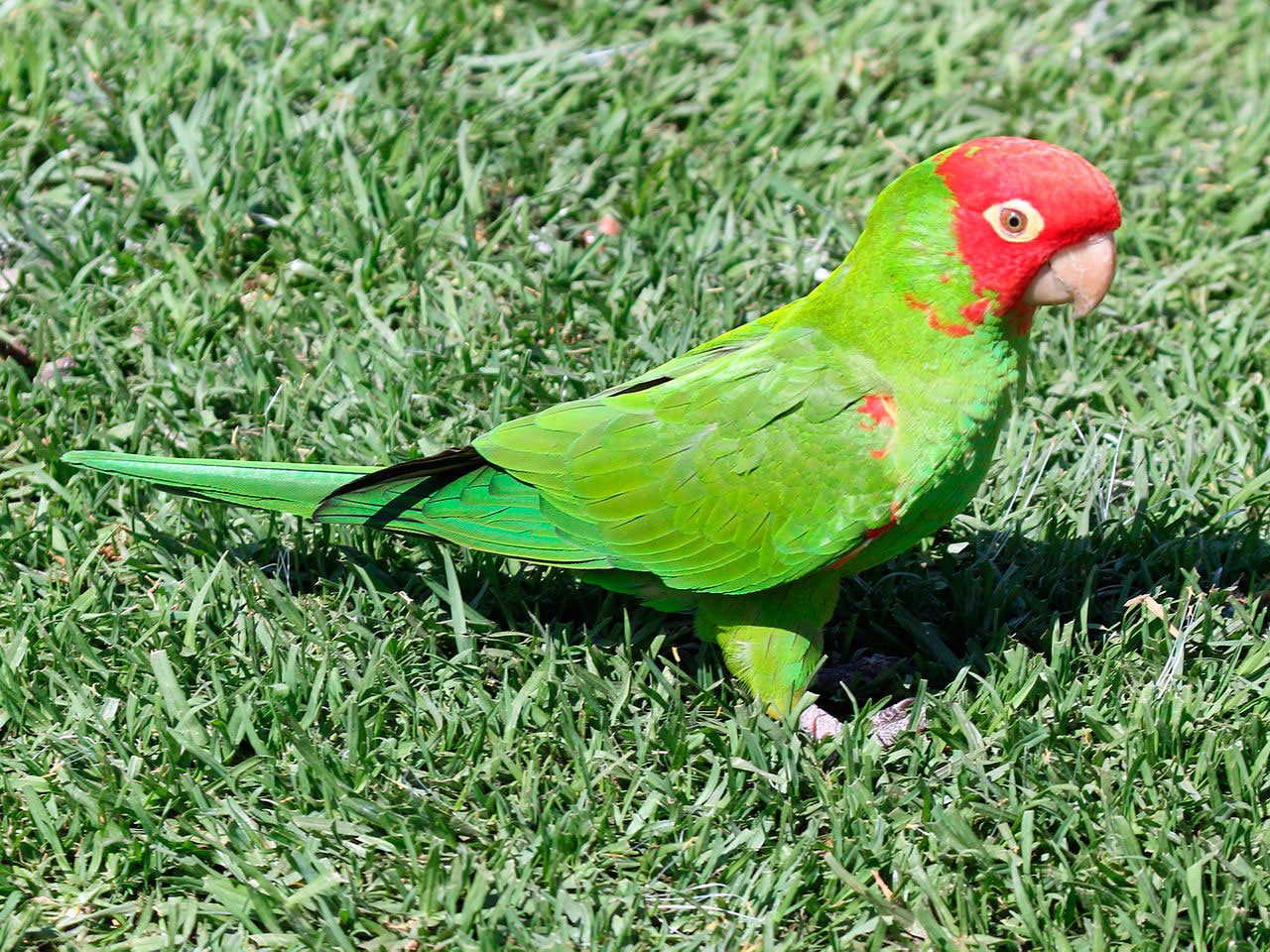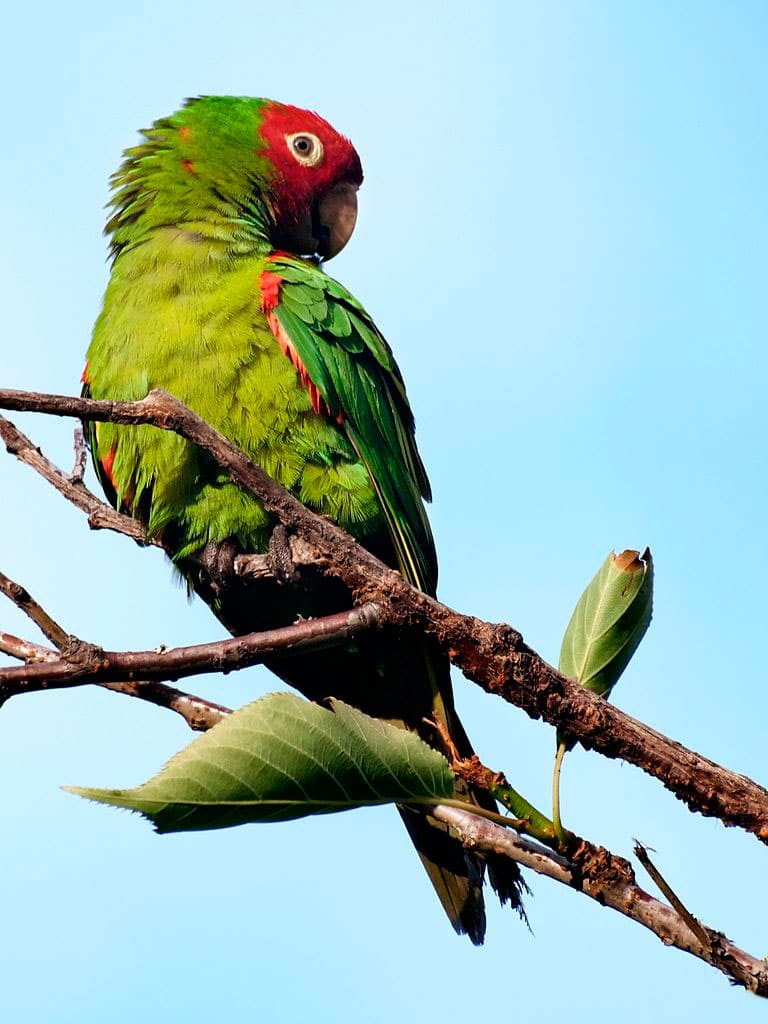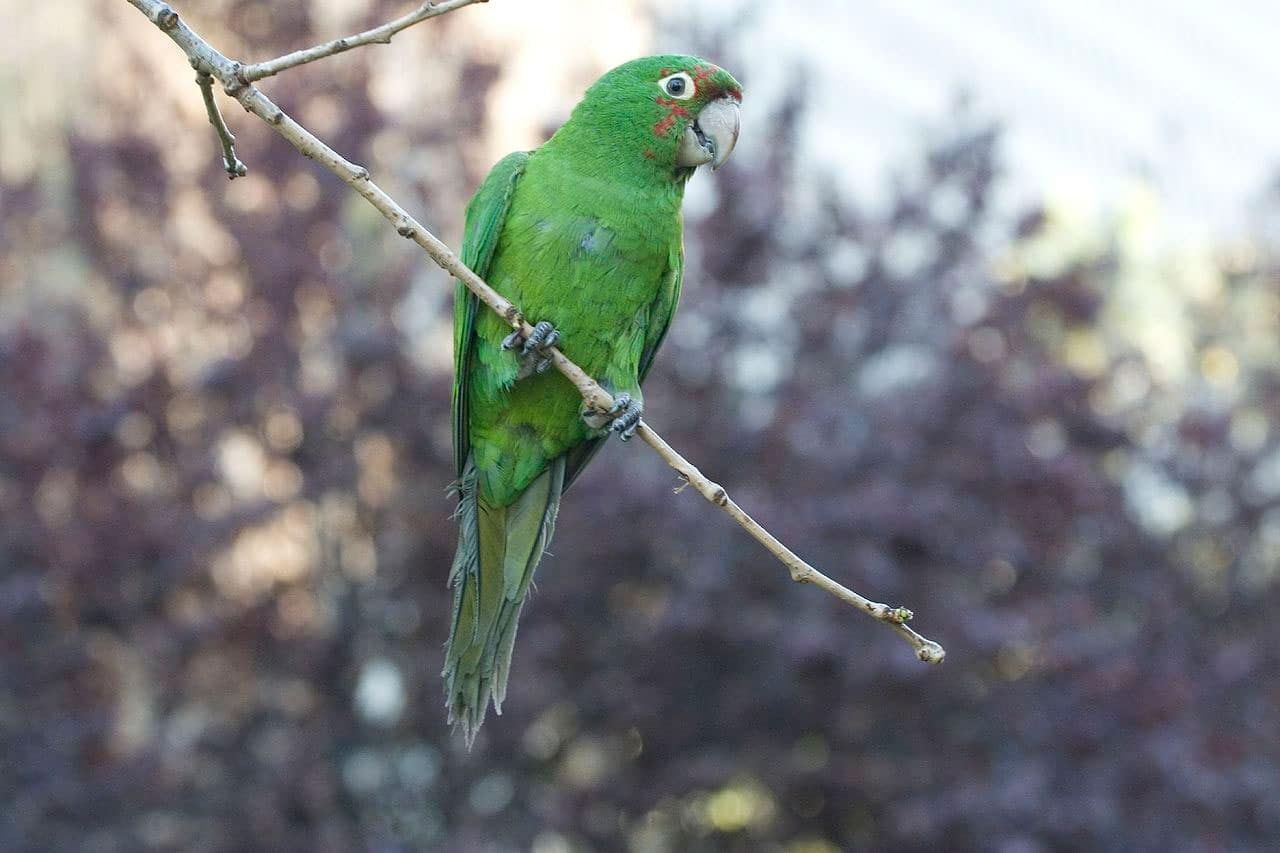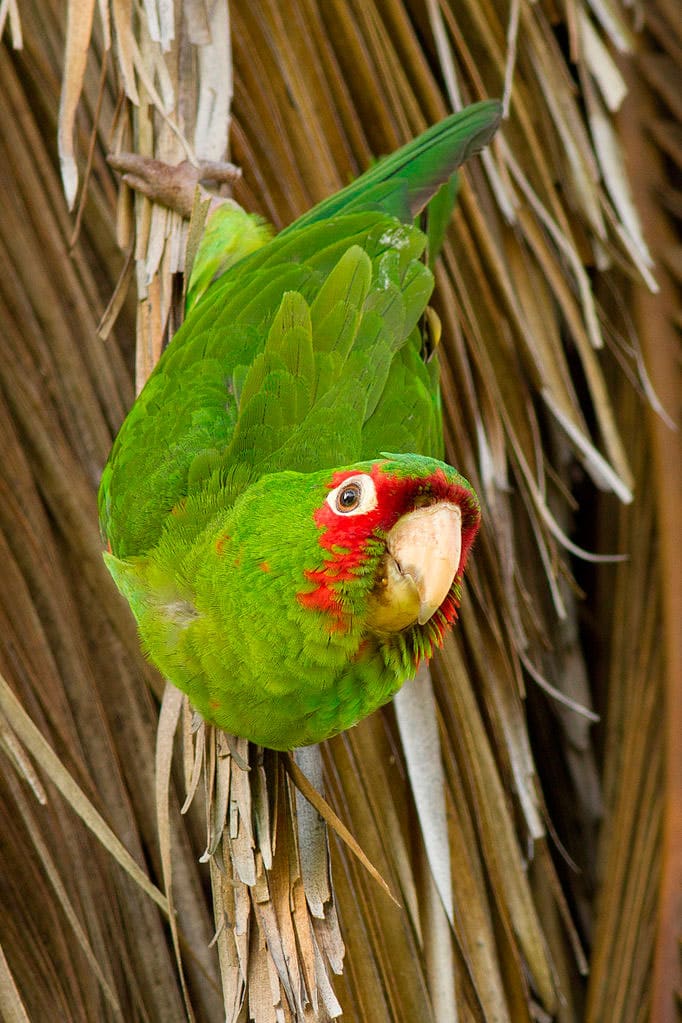
โ–ท The world of Pets: Dogs, cats, birds, reptiles, amphibians

Hispaniolan Parrot
Amazona ventralis

Hispaniolan Parrot

Content

Description:

28-31 cm.. length and 250 g. of weight.

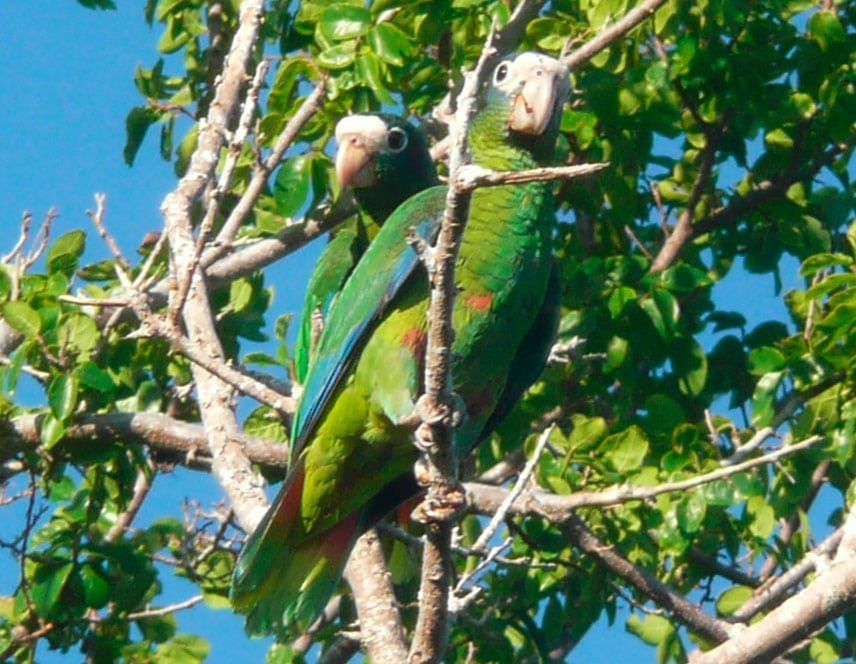
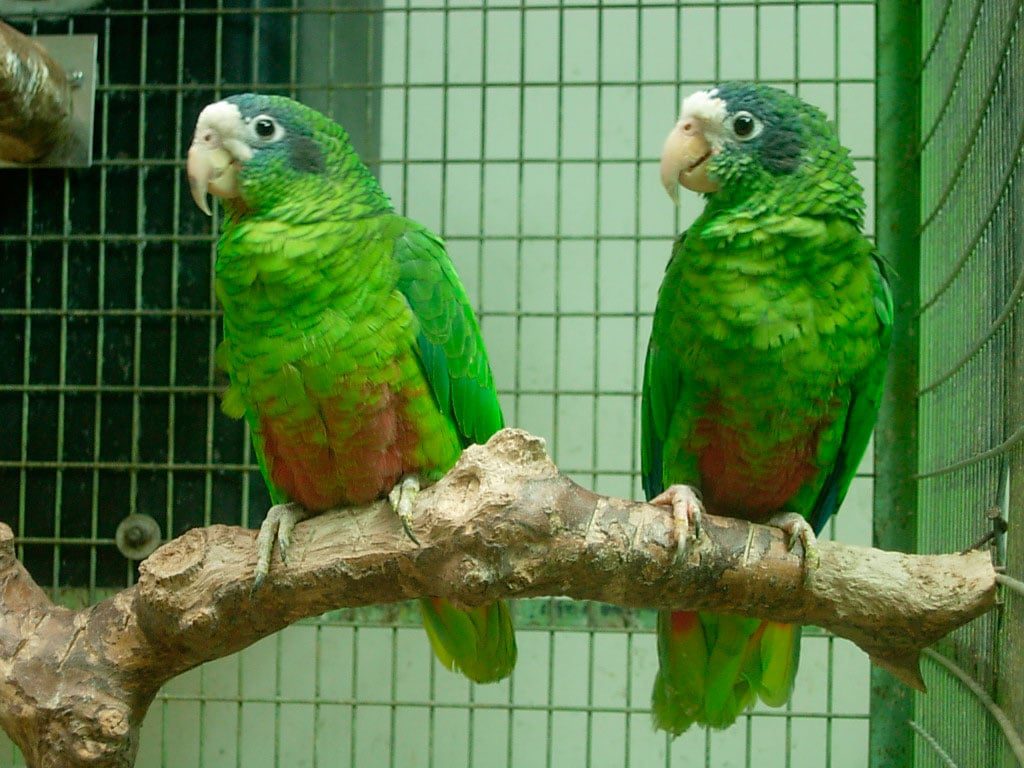
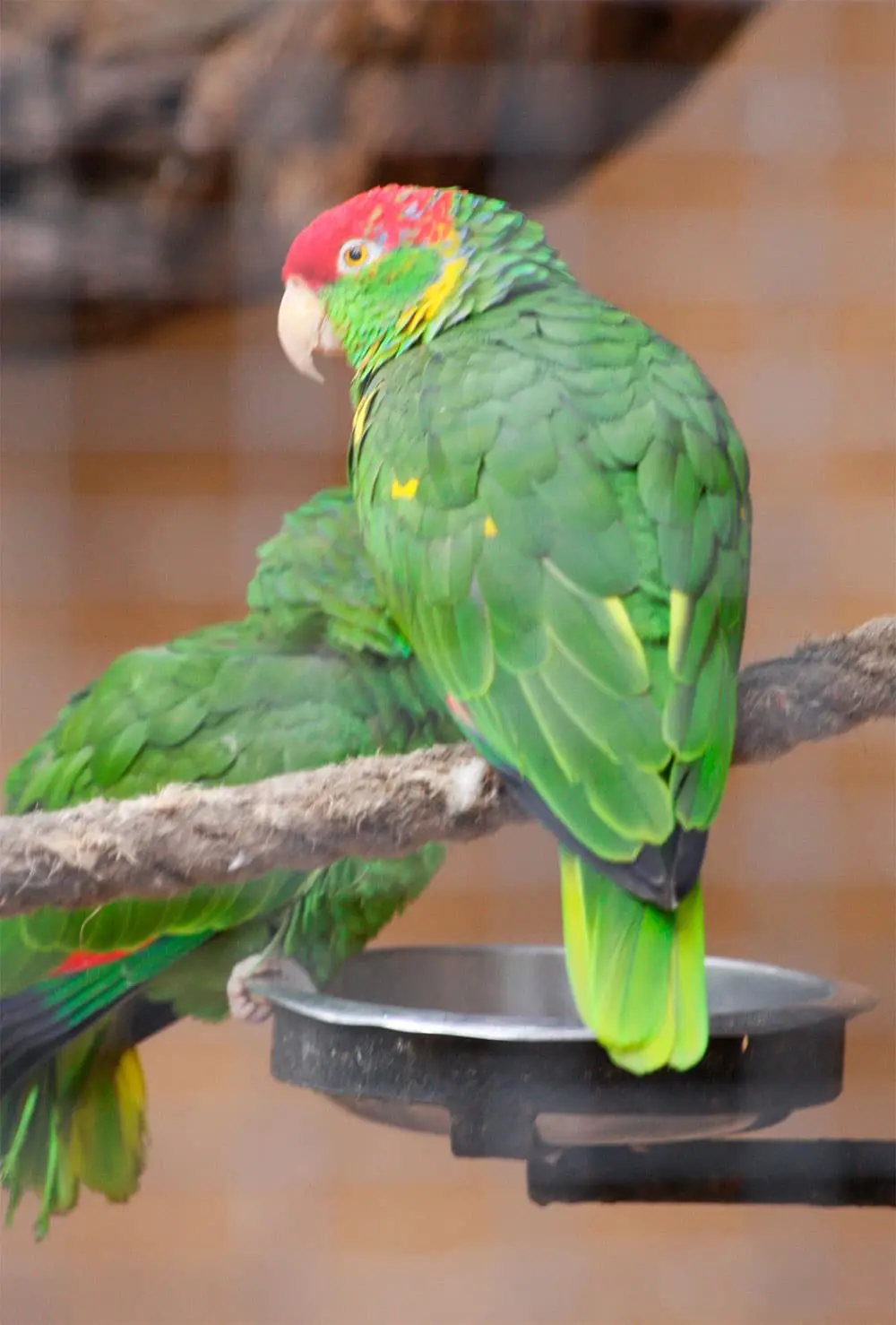
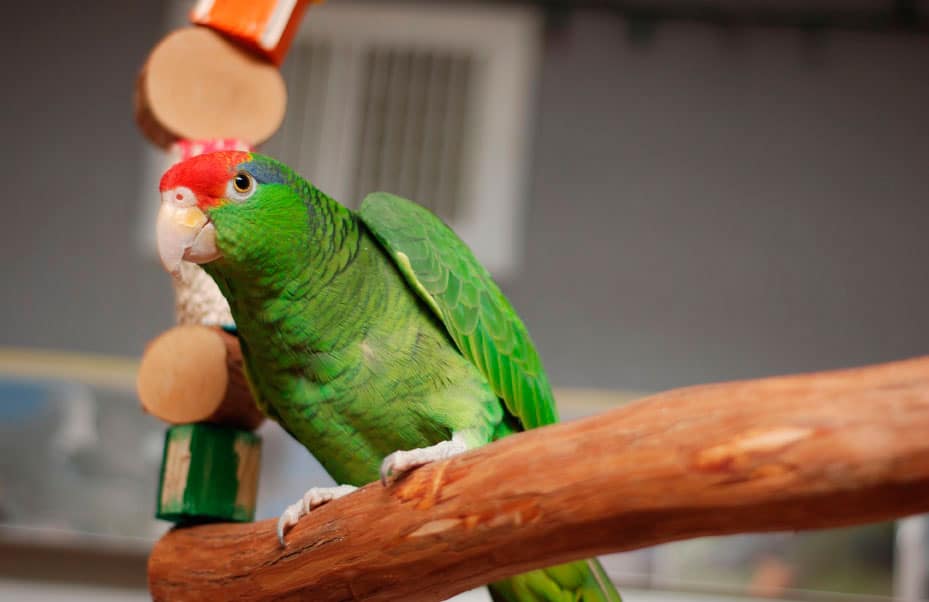
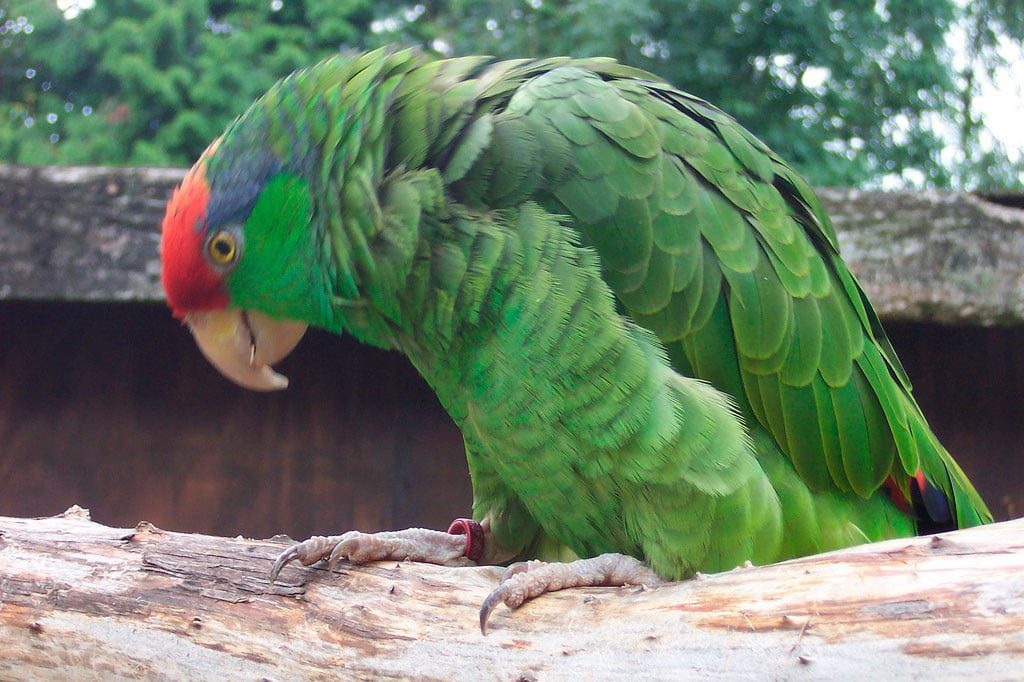
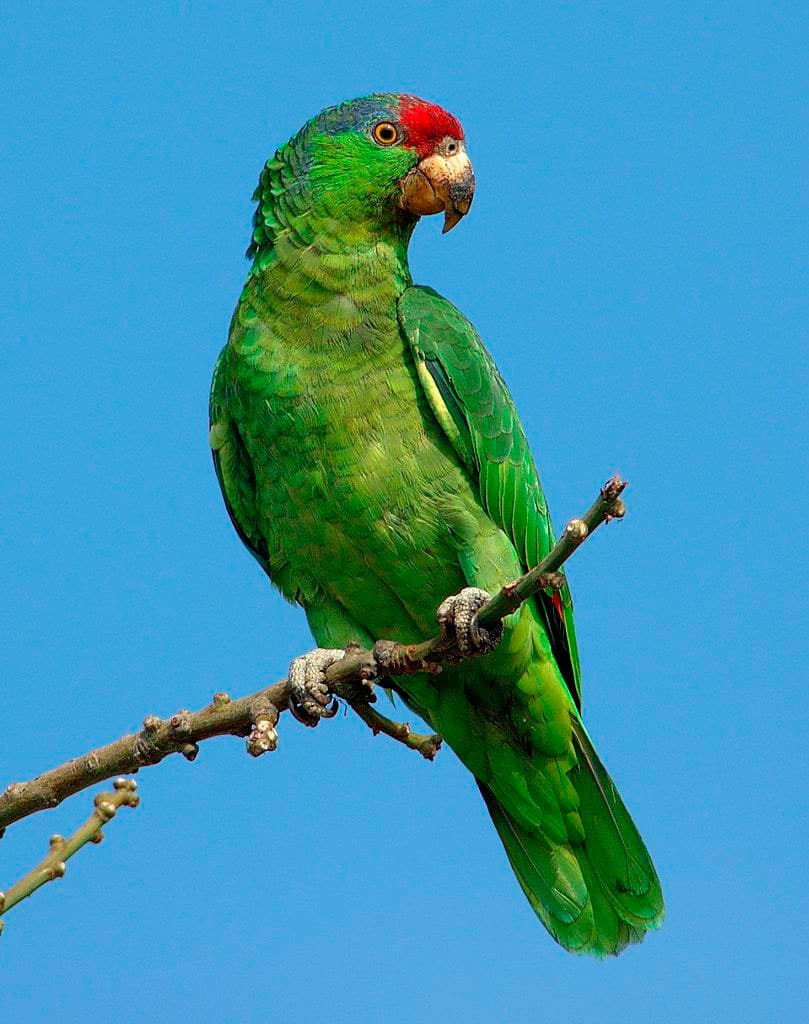
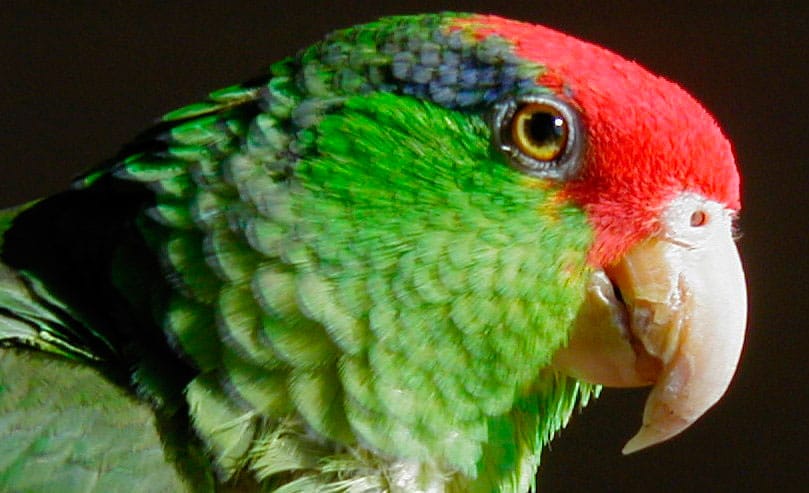
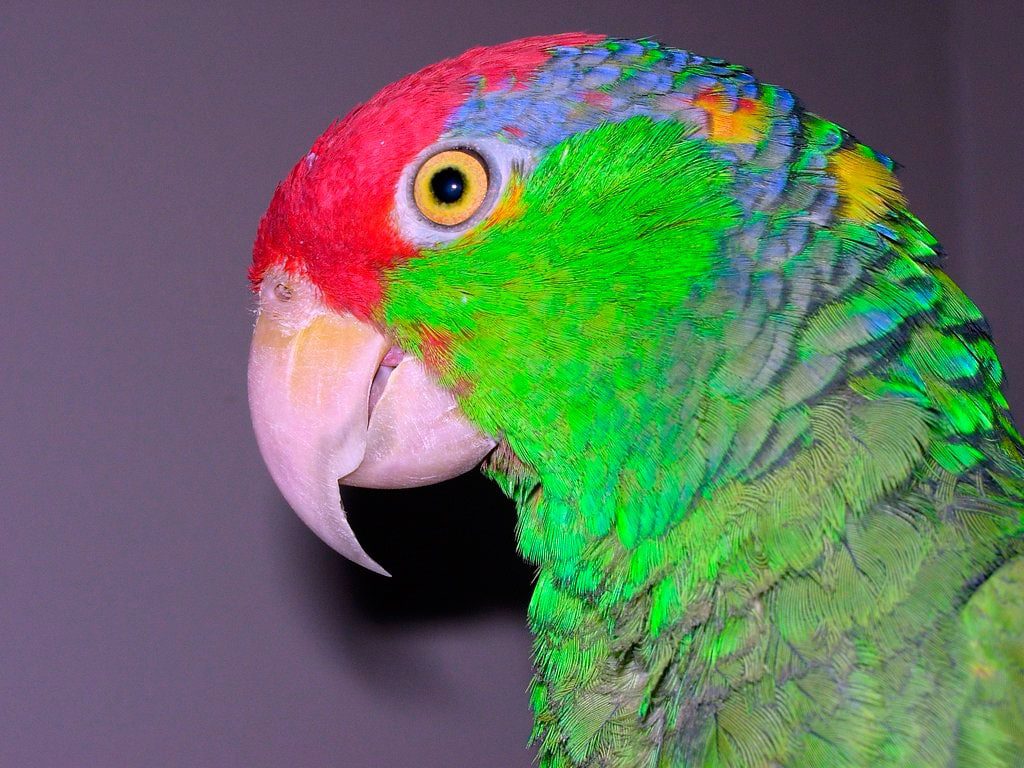
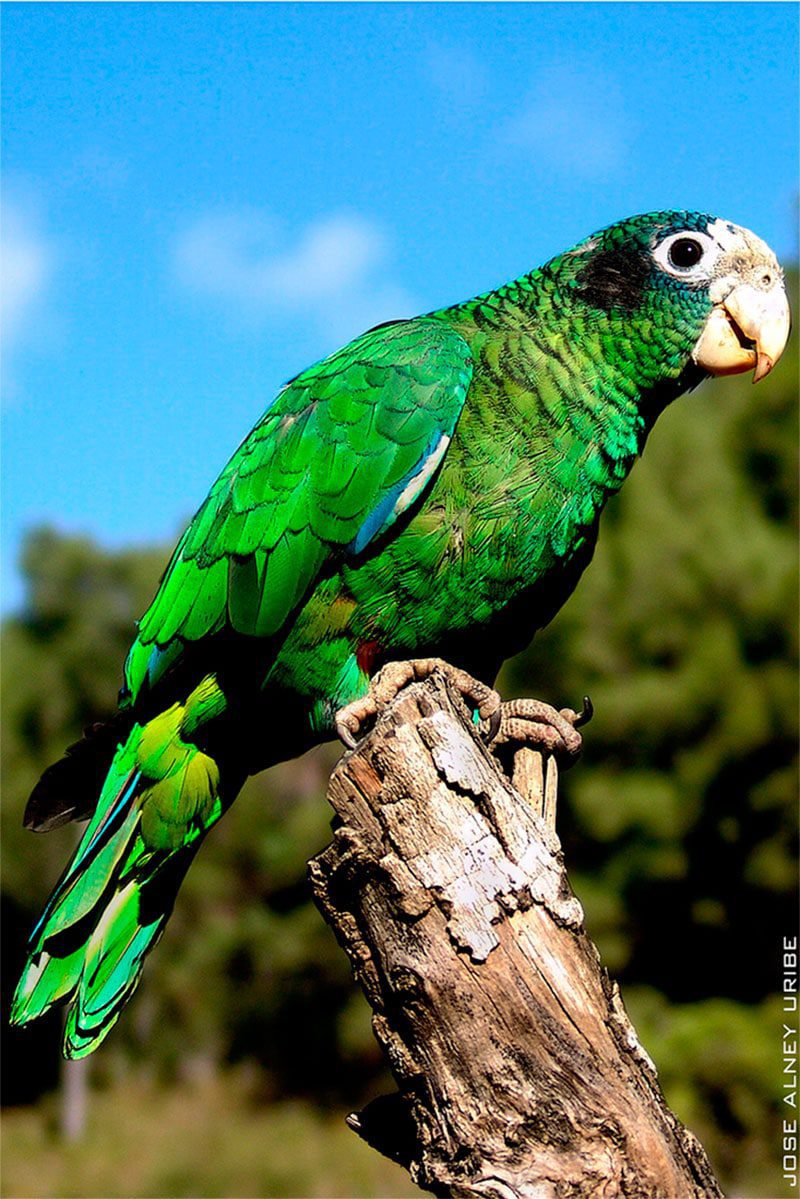
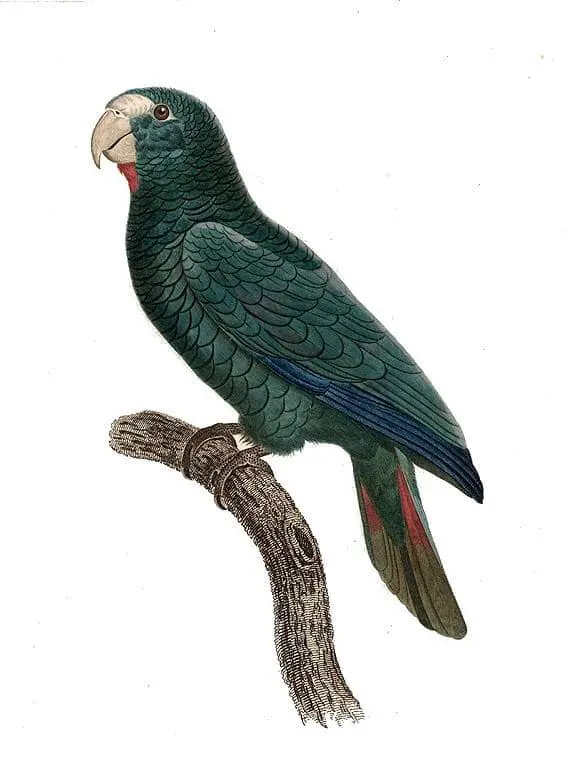
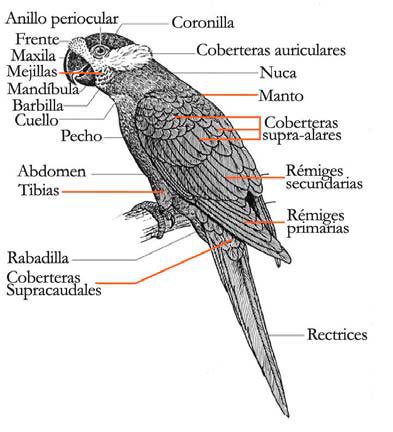
The Hispaniolan Parrot (Amazona ventralis) has the forecrown Lords color and white (variable extension); the crown and upper cheeks with blue feathers and black colored ends; ear-coverts and lower cheeks, charcoal colored (variable measure); feathers nape and the sides of the neck, emerald green with visible black tips.
Hispaniolan Parrot
Mantle and back green grass with black tips, which become progressively less visible to the bottom; rump green, slightly yellowish; uppertail-coverts brighter yellowish green. greater coverts blue; remaining coberteras grass-green. Primaries and secondaries, blue, darker towards the tips, on the innerwebs. Under the wings, green; flight feather bluish green.

The underparts usually green, slightly yellowish, with most feathers showing fairly conspicuous black margins (especially in the upper region) but sometimes with some red feathers chin; patch resizable brown in the center of belly; undertail-coverts pale yellow-green. Upper, the tail is green (perhaps a little darker than the rest of the upperparts) with visible yellowish tip and outerweb external feathers with blue margins; undertail, the tail It is yellowish with the bases of the outer feathers red. Bill Pink; cere brownish white; skin bare periophthalmic white; brown the irises; legs pale grey.

Anatomy-parrots

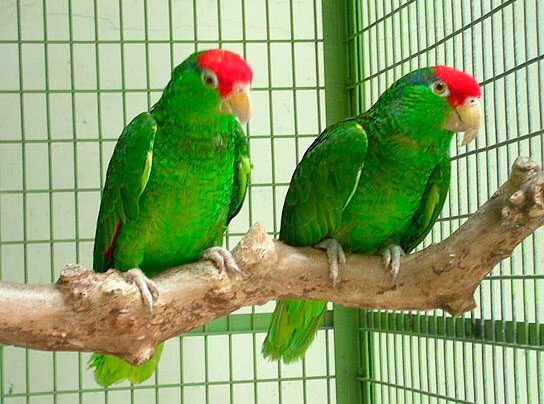
There is no sexual dimorphism. Immature as an adult but less blue in the crown and the patch abdominal is paler brown.

NOTE

Some authors consider that the Hispaniolan Parrot It conspecific (belonging to the same species) with the Cuban Parrot. Although closely related, It is believed to be quite different due to differences in hue pronounced plumage.

  • Sound of the Hispaniolan Parrot.

Habitat:

Video "Hispaniolan Parrot"

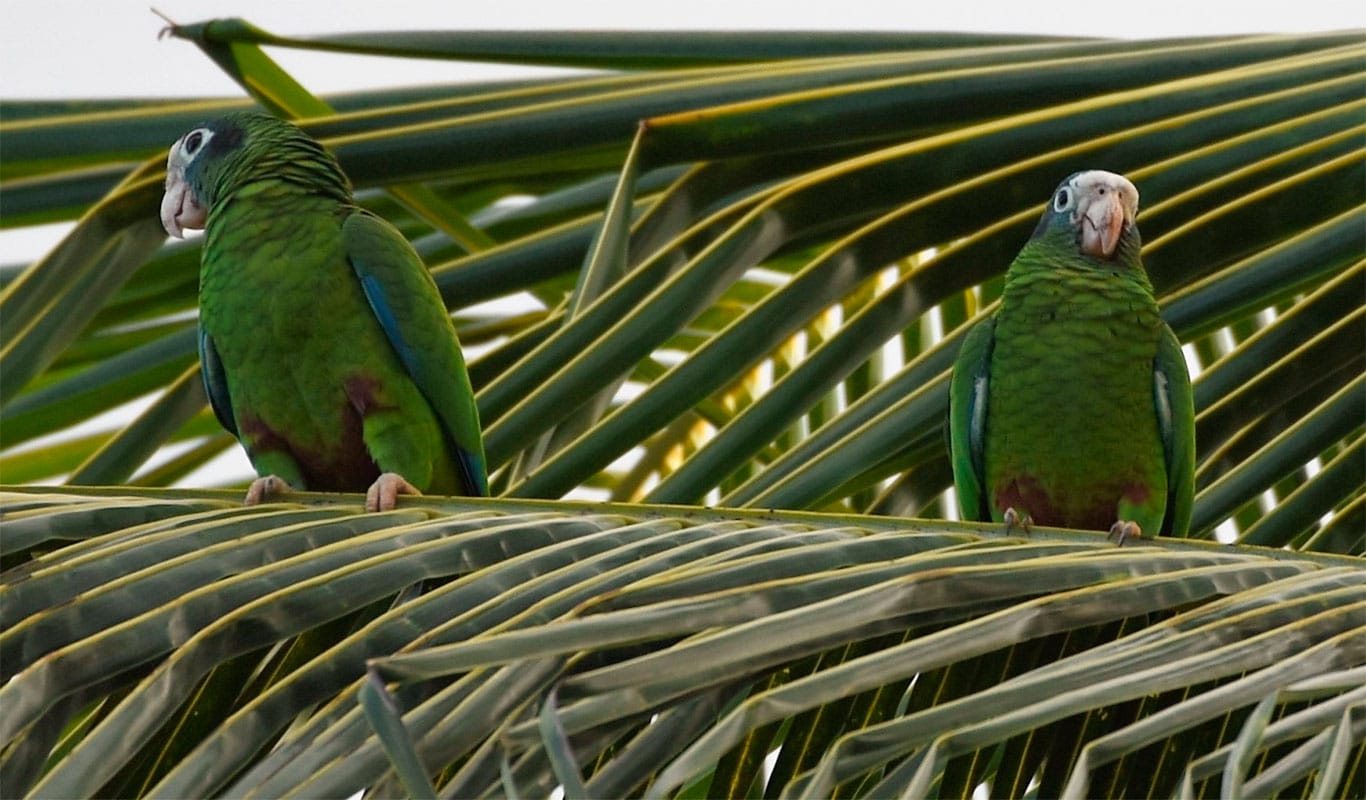
The Hispaniolan Parrot They are distributed in a variety of forested habitats, from lowland sandy palm savannahs to montane pine forests and moist montane forests. Currently most commonly observed in montane forests on the island Hispaniola, due to continued deforestation, although birds also feed at lower altitudes. Observed above 1,500 m (Hispaniola).

Views in pairs during breeding; outside the breeding season, observed in small flocks, usually up to a dozen birds; much larger meetings, until 500 reported in the nineteenth century birds. Couples and couples with young often identifiable in flocks.

Reproduction:

Nests generally constructed in tree cavities, but also in rock crevices, cactus voids and cavities in coconut. Territorial and very aggressive while playing. The breeding season It covers the months of February to May. Clutch 2-3 eggs.

Food:

They feed on, among others, of seeds or fruits of Caesalpinia, Psidium and Ficus, seeds of oranges wild Citrus, corn and bananas.

Distribution:

Size of its range (breeding/resident): 99.000 km2

The Hispaniolan Parrot are distributed by the islands of Hispaniola (Dominican Republic and Haiti), Gonave Island (Haiti), Isla Saona (Dominican Republic), Puerto Rico and probably Snake (Puerto Rico) in the West Indies. It is found in moderate numbers in parts of the Sierra de Bahoruco, Sierra Neiba and Cordillera Central in Dominican Republic. More restricted and less numerous in Haiti, with the remaining population apparently largely in the south of the country.

introduced in Puerto Rico, where the wild population derived from captive birds escaped and at least one consignment of illegally traded birds were released after discovering an attempt to import Puerto Rico. Also wild populations in US Virgin Islands.

Formerly very common in Hispaniola, although there have been during the twentieth century a strong decline in its population, mainly due to the habitat destruction (arising from agriculture and charcoal production). As well persecuted due to crop damage, hunted for food and trapped for sale as pets at local and international level.

In the Decade of 1930 It was limited to the interior mountain forests of the island of largely Hispaniola.

Although it remains locally common, it is enough rare and rare in the wild.

The population in Puerto Rico It is at least several hundred birds and apparently increasing.

Conservation:

State of conservation โ“˜


minor concern Minor Concern โ“˜ (UICN)โ“˜

โ€ข Current category of the Red List of the UICN: Vulnerable.

โ€ข Population trend: Decreasing.

โ€ข Population size : 6000-15000

Rationale for the Red List category

This species is considered Vulnerable because anecdotal evidence suggests there has been a rapid reduction of the population. The size of the population and the exact extent of the decline are unclear, clarification and may lead to the species be reclassified as near threatened.

Justification of the population

The population size It is preliminarily estimated to fall in the band between 10.000 and 19.999 individuals. This is equivalent to 6,667-13,333 mature individuals, rounded here to 6,000-15,000 mature individuals.

Justification of trend

No new data on population trends, but it is suspected that the species is declining quickly, as a result of the hunting, the loss of habitat and capture.

Threats

The agricultural conversion and charcoal production have destroyed the most suitable habitat. It is also persecuted as a crop pest, hunted as food and trapped for Local trade and above for international trade cage birds. (Juniper and Parr 1998).

Trapping adults and stealing hatchlings from nests to supply the Local pet trade It is a particular concern because in some areas most families own a parrot, and they only live a few years before they have to be replaced (G. Woolmer in some. T. White one bit., 2012). It also, activities theft nests often they cause destruction of the nest cavity or nest tree, further aggravating the loss of nesting habitat other causes (T. White in a little .

Conservation Actions Underway

โ€ข CITES Appendix II.

โ€ข You have started a education strategy with community participation to protect species (Vasquez et to the., 1995).

โ€ข In 1997-1998, 49 birds bred in captivity were released and you radiographed in East National Park, Dominican Republic (Vilella et al., 1999).

โ€ข The Biological Reserve Loma Charco Azul, created in 2009, It has populations of the species. in addition, They have carried out recent activities public education and outreach, including some actions of law enforcement, in several communities surrounding the Jaragua National Park, near the border with Haiti.

โ€ข In January of 2012 there was also a Liberation of 10 parrots raised in captivity they had been confiscated as young chicks from poachers nests. These chicks were raised and rehabilitated in National Zoological Park, and released successfully in the grounds of the zoo (T. White in a little ).

Conservation Actions Proposed

โ€ข Assess current population size.

โ€ข Establish a program of comprehensive monitoring.

โ€ข Determine at extension remaining habitat.

โ€ข Determine the impact of various threats.

โ€ข Apply laws and regulations that protect this species and its habitat (Snyder et to the., 2000).

โ€ข Promote better bird-keeping practices to reducing demand for wild birds and develop a captive breeding program.

โ€ข Educate the public about the negative impact of pet trade in native Dominican Republic (T. White in a bit., 2012).

The Hispaniolan Parrot in captivity:

It is easily reproduced in captivity and used as substitute mother to raise the young Puerto Rican Parrot as part of the recovery program for the species (highly threatened).

Each captive specimen of this species which is capable of reproducing, It is placed in a well-managed program captive breeding and not be sold as a pet, with the objective of ensure their survival long-term.

Alternative names:

– Hispaniolan Amazon, Hispaniolan Parrot, Salle’s Amazon, Salle’s Parrot, San Domingo Amazon, San Domingo Parrot (English).
– Amazone ร  ventre pourpre, Amazone de Sallรฉ, Amazone d’Hispaniola (French).
– Blaukronenamazone, Haitiamazone (German).
– Papagaio-de-hispaniola (Portuguese).
– Amazona de la Espaรฑola, Amazona Dominicana, Cotorra, Cotorra de la Espaรฑola (espaรฑol).

scientific classification:

– Order: Psittaciformes
– Family: Psittacidae
– Genus: Amazona
– Scientific name: Amazona ventralis
– Citation: (Statius Mรผller, 1776)
– Protonimo: Psittacus ventralis

Images Hispaniolan Parrot:

Species of the genus Amazona


Sources:

  • Avibase
  • Parrots of the World โ€“ Forshaw Joseph M
  • Parrots A Guide to the Parrots of the World – Tony Juniper & Mike Parr
  • Birdlife

Photos:

(1) – The parrot Cuca – Cuca The Parrot by Jose Uribe Alney – Flickr
(2) – Hispaniolan Amazon. Two in a cage By TJ Lin (originally posted to Flickr as DSCN0712) [CC BY-SA 2.0], via Wikimedia Commons
(3) – Couple of parrots Amazona ventralis in the Jaragua National Park, Dominican Republic By Yolanda M. Leon (Own work) [Public domain], via Wikimedia Commons
(4) – A Hispaniolan Amazon in a cage By Patrick Hawks (originally posted to Flickr as Hispaniolan Parrot) [CC BY-SA 2.0], via Wikimedia Commons
(5) – Blaukronenamazone (Amazona ventralis) Bรกvaro, Punta Cana, Dominican Republic By Martingloor (Own work) [CC BY-SA 4.0], via Wikimedia Commons
(6) – BARRABAND, Jacques (1767/8-1809) [male red-faced parrot (Hispaniolan Amazon [Amazona ventralis])] From Natural History of Parrots (by Francois Levaillant, 1801-1805) – Wikimedia

Sounds: Ante Strand, XC15749. accessible www.xeno-canto.org/15749
โ–ท The world of Pets: Dogs, cats, birds, reptiles, amphibians

Blue-winged Parrotlet
Forpus xanthopterygius

Cotorrita Aliazul

Content

Description:


Anatomy-parrots

12 to 13 cm.. height.

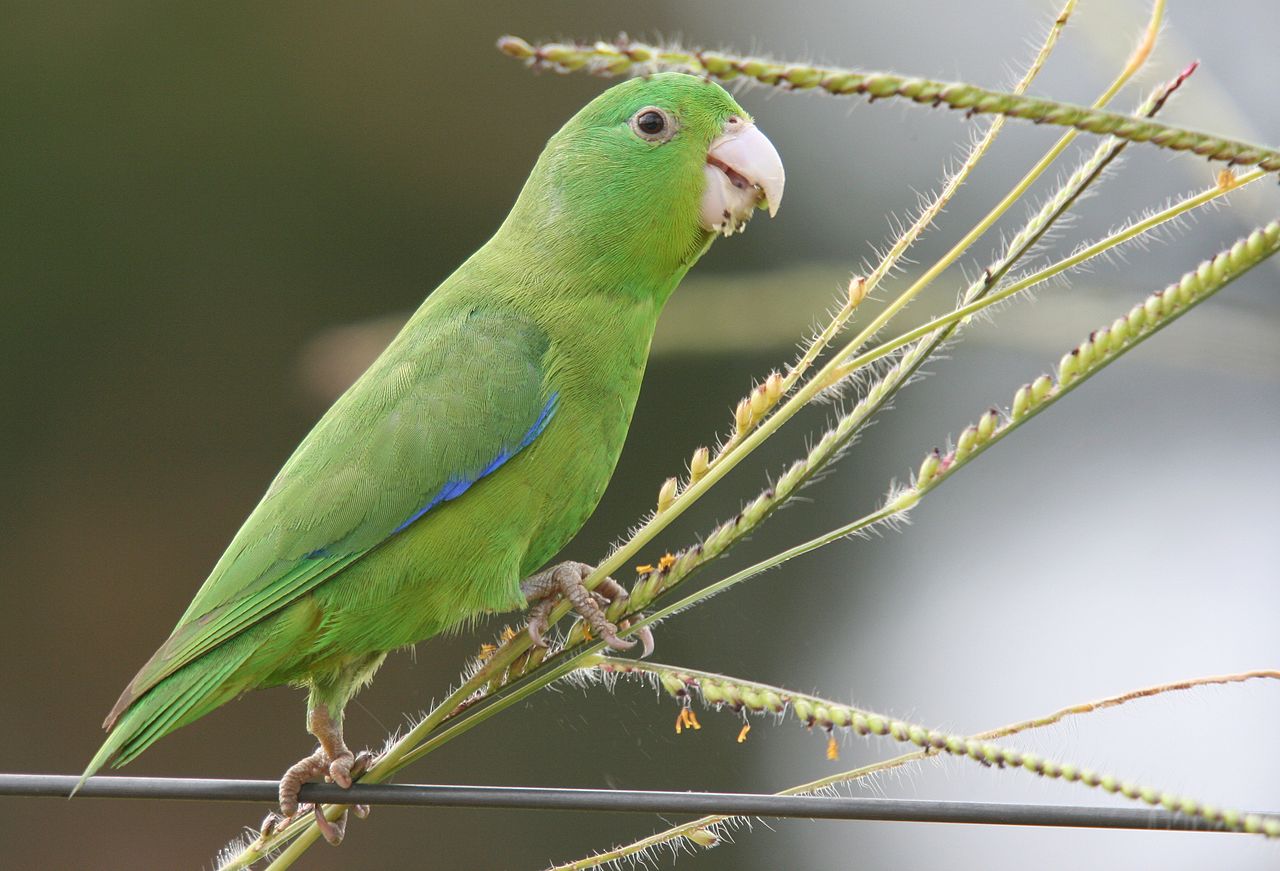
The Blue-winged Parrotlet (Forpus xanthopterygius) has the forecrown, the crown, back of the neck and ear-coverts, green; cheeks, eye area and lores, emerald green. Upperparts and wings, green, except the part inferior of the back, rump, primaries and greater coverts, are cobalt blue and blue color toward the base of the secondaries. Under, the wings with the coverts a rich cobalt blue color; the flight feathers Matte metallic blue. the underparts of color green with shades yellow and with feathers of color red Emerald around the thighs and vent. Upper, the tail green; undertail, pale green.

Bill and cere Pink with gray base up to the upper jaw; bare periophthalmic pale grey: irises dark brown: legs Gris-Rosado pale.

Female all green.

Immature similar to the adult respective but the color blue of them males young mixed with green.

Subspecies description
  • Forpus xanthopterygius flavescens

    (Salvadori, 1891) – Similar to the species nominal but the males with the rump pale blue; underparts and facial area more yellowish; undertail, the tail more bluish.

  • Forpus xanthopterygius flavescens

    (Hellmayr, 1929) – Generally paler and more yellowish which the nominal. Forehead, throat and cheeks males, yellow.

  • Forpus xanthopterygius xanthopterygius

    (Spix, 1824) – The nominal

  • Forpus xanthopterygius crassirostris

    (By Taczanowsk, 1883) – As the species nominal but blue pale with emerald green in it forecrown. Primary coverts pale, of color grisaceo-violeta that contrast with the coverts more large of color blue more dark. upper jaw laterally compressed in the Center.

    – Some authors like (Stotz et to the., 1996, Collar 1997) They have followed Pinto (1945) and considered this subspecies as monotypic species under the scientific name Forpus crassirostris

Habitat:

Frequent habitats woodlands more dry such as Open forests and riparian, closed and caatinga; at the edge of the range that is located in the Savannah, palm groves, scrub semiarid and pastures. In the western amazon appears to be mainly distributed along rivers in lighter riparian growth. Mainly in the land low, but reported to 1,200 m in the mountains of the southeast of Brazil. Gregaria, in herds of up to 50.

Reproduction:

It nests, mainly, in the cavities of trees, Although also termite tree, posts in fences, nests common hornero (Furnarius rufus), which can be occupied by force and lined with grass stalks, or even nests of the Red-rumped Cacique (Cacique haemorrhous). Clutch 3-7 eggs.

Food:

Its diet includes fruit of Cecropia, seeds of Mikania and Trema micrantha and flowers of Ambrosia and Marcgravia; Forages in open areas, sometimes in land.

Distribution:

Size of the area of distribution (reproduction / resident): 5.780.000 km2

Its distribution is discontinuous in South America, since the Basin Amazon to the North of Argentina with people separated in the North of Colombia. The latter occurs in the lowlands of the Caribbean arid from Cartagena through the valley bottom of the river Magdalena South to North of Bolรญvar and East to the base of Sierra Nevada de Santa Marta. The species reappears in the end South of Colombia about Leticia and possibly in the Putumayo, and records from the Northeast borders of the Ecuador and from the East of Peru to the East of Bolivia in hand me and Santa Cruz; It extends through the basin of the Western Amazon of Brazil eastward to the East of amazon and in large part of the interior of the this of Brazil towards the Southeast, possibly up to Rio Grande do Sul.

Apparently absent from parts of the East and northeast of brazilian amazon with its northeastern limits in maranhรฃo and Cearรก.

They are distributed in the northeast of Argentina, in Missions, Northeast of Currents, Chaco oriental and Formosa Eastern.

Is located in the East of Paraguay and can be observed over the West in the chaco.

Apparently introduced in Jamaica, but the current situation is unknown.

Mainly resident Although migrant altitude in the southeast of Brazil, with seasonal movements in Argentina in relation to food supply. common in the East of the cordillera, sometimes locally abundant (for example, in the northern parts of Bay), less abundant in the West, being uncommon and local (Perhaps reducing) in the Northwest of Colombia and scarce throughout the East of Peru and Bolivia. Perhaps increasing in parts of the western amazon with cleared of forest dense, but probably in decline in Paraguay, where formerly common and now rare.

The Blue-winged Parrotlet have been caught for the trade, with captive birds outside range countries. Is unlikely that the trade has been affected to their abundance in the Middle wild.

Subspecies distribution

With the aim of preserving the stability of the nomenclature, It has designated a lectotype for the name widely used xanthopterygius, What makes the correct name for the species present. Four subspecies currently recognized.

  • Forpus xanthopterygius flavescens

    (Salvadori, 1891) – Bolivia and Southeast Peru.

  • Forpus xanthopterygius flavescens

    (Hellmayr, 1929) – maranhรฃo, Piauรญ, Cearรก and Northeast South of Brazil to the North of Bay.

  • Forpus xanthopterygius xanthopterygius

    (Spix, 1824) – The nominal

  • Forpus xanthopterygius crassirostris

    (By Taczanowsk, 1883) – West amazon in South Colombia, is of Ecuador and this from Peru to center of amazon, Brazil.

    – Some authors like (Stotz et to the., 1996, Collar 1997) They have followed Pinto (1945) and considered this subspecies as monotypic species under the scientific name Forpus crassirostris

Conservation:

State of conservation โ“˜


minor concern Minor Concern โ“˜ (UICN)โ“˜

โ€ข Current category of the Red List of the UICN: Least concern.

โ€ข Population trend: Stable.

Justification of the population

The size of the world's population of the Blue-winged Parrotlet It has not been quantified, but this species is described as ยซcommonยป (Stotz et to the., 1996).

Justification of trend

Suspected that the population is stable in absence of evidence of any decline or threatens substantial.

"Blue-winged Parrotlet" in captivity:

In captivity they are not very frequent. They are birds enable you require a large cage. Quiet and something Shy. Not is easy to accommodate them with other parrots.
Can be prone to it Obesity.

Note:

Among the various species of the Blue-winged Parrotlet (Forpus xanthopterygius), There is, Unfortunately, a very extensive variety of colors mixed due to the crossing in captivity of the nominal species with several of their subspecies, as well as the different crosses between subspecies. So, it is rather doubtful to find yet species and subspecies properly colored, especially in the poultry raising European. Only the subspecies Forpus xanthopterygius flavescens, as pure subspecies, it's still pretty easy to recognize.

Alternative names:

– Blue-winged Parrotlet, Blue winged Parrotlet, Blue-winged, Large-billed or Turquoise-winged Parrotlet, Blue-winget parrotlet (English).
– Toui de Spix, Perruche-moineau ร  ailes bleues, xT. ร  gros bec ou T. de Spengel (French).
– Blauflรผgel-Sperlingspapagei (German).
– Tuim, bate-cu, caturra, coiรณ-coiรณ, cu-cozido, cuiรบba, cu-tapado, meudo, periquitinho, periquito, periquito-do-espรญrito-santo, quilim, tabacu, tapa-cu, tuietรช, tuim-de-asa-azul, tuitiri (Portuguese).
– Catita enana, Catita Enana Sudamericana, Cotorrita Aliazul, Periquito Azulejo, Viudita (espaรฑol).
– Catita enana (Argentina).
– Catita enana (Colombia).
– Periquito de Ala Azul (Peru).
– Viudita (Paraguay).


scientific classification:

Johann Baptist von Spix

– Order: Psittaciformes
– Family: Psittacidae
– Genus: Forpus
– Scientific name: Forpus xanthopterygius
– Citation: (of Spix, 1824)
– Protonimo: Psittaculus xanthopterygius


Images Blue-winged Parrotlet:

Videos of the "Blue-winged Parrotlet"


Species of the genus Forpus

Blue-winged Parrotlet (The xanthopterygi of Forp)


Sources:

– Avibase
– Parrots of the World โ€“ Forshaw Joseph M
– Parrots A Guide to the Parrots of the World – Tony Juniper & Mike Parr
– Birdlife

– Photos:

(1) – A male Blue-winged Parrotlet in Goiรขnia, Goiรกs, Brazil By Wagner Machado Carlos Lemes [CC BY 2.0], via Wikimedia Commons
(2) – Blue-winged Parrotlet (Forpus xanthopterygius) Vale do Ribeira, Sao Paulo (state), Brazil By Dario Sanches [CC BY-SA 2.0], via Wikimedia Commons
(3) – A male Blue-winged Parrotlet in Goiรขnia, Goiรกs, Brazil By Wagner Machado Carlos Lemes [CC BY 2.0], via Wikimedia Commons
(4) – A male Blue-winged Parrotlet (Forpus xanthopterygius) looking out from a nest in the Vale do Ribeira, Brazil By Dario Sanches [CC BY-SA 2.0], via Wikimedia Commons
(5) – Blue-winged Parrotlet (Forpus xanthopterygius) at Foz do Iguacu, Brazil By Arthur Chapman [CC BY 2.0], via Wikimedia Commons

– Sounds: (Xeno-canto)

โ–ท The world of Pets: Dogs, cats, birds, reptiles, amphibians

Blue-eared Lory
Eos semilarvata


Lori de Seram

Content

Description

Is the more small of the gender Eos, with only 24 cm.. length and an approximate weight of 170 gr.

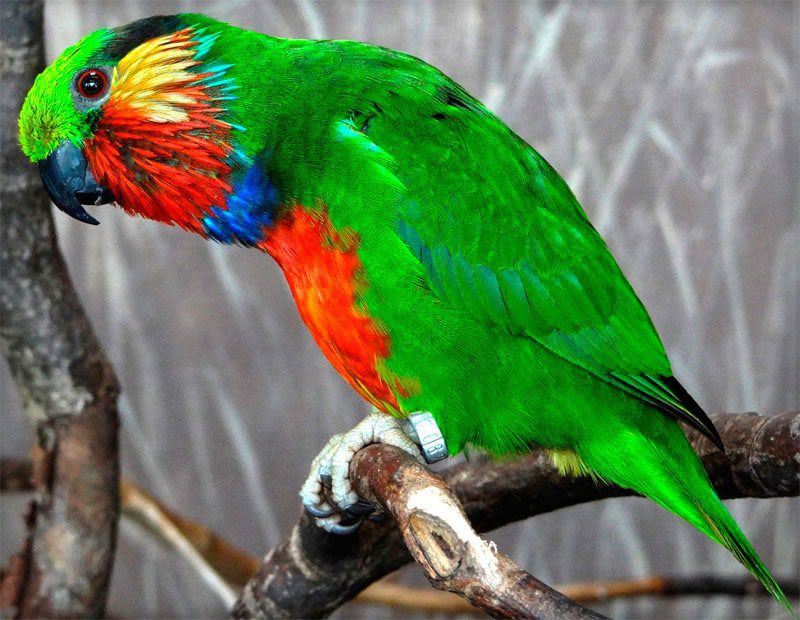
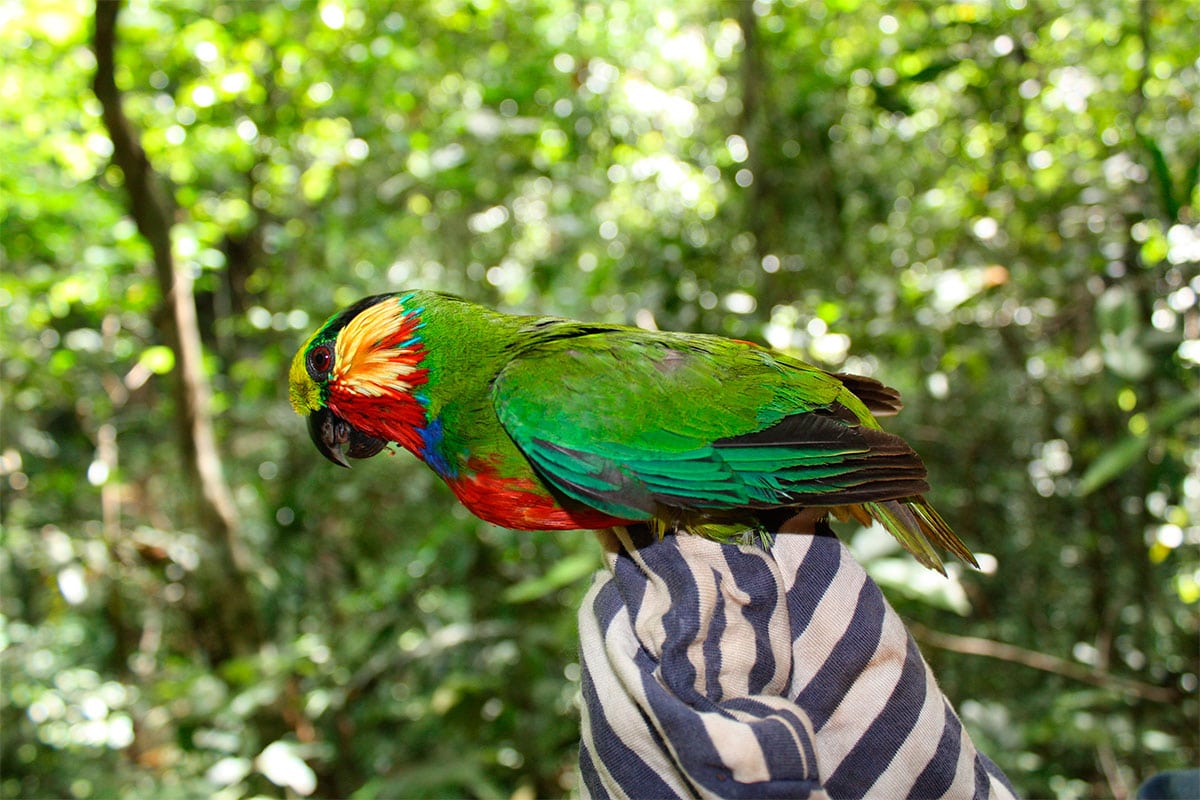
The plumage of the Blue-eared Lory x(Psittacus erithacus) is bright red.

The upperparts of the cheeks and ear-coverts form a band blue violet.

The feathers of abdomen and under the tail are blue, the primaries are black and red color on the inside, the secondaries has black spots, the feathers largest of the shoulder are blue, the back is red-brown, the underparts bright red, their irises are reddish brown, the legs grey and orange red the bill.

The plumage of the youth usually appears paler and duller Red. The mask boils down to a simple pale blue dot under the eye and the mumps. The scapulars are brownish grey with light blue striped uniform. The feathers of abdomen are red with some blue touches. The irises reddish color.

The Blue-eared Lory EOS can be mistaken for other species of the genus, but in its area of distribution, only the Red Lory (Eos Bornea) shows similarity of characters. But, does not display a blue stain in the face or at the bottom of the abdomen.

Habitat:

Frequently not only in primary forests, but also in the Highlands bordering the bare mountain peaks.

This bird usually lives above the 1.200 meters above sea level, area to which the Red Lory (Eos Bornea) fails. But, from time to time is reduced to 800 m, so sometimes they interfere in the same area two species.

The Blue-eared Lory they live alone, in pairs or small family groups.

They feed in the foreign branches of trees in flower.

They are noisy birds in flight, but they are relatively quiet and discrete When feed. When they move they tend to fly at low altitude.

Reproduction:

There is not much information of their reproduction habits in the natural environment. But, It can be assumed that the Red Lory It takes a form of very similar to that of other nesting Loris. These are cavemen, that is to say, you install their nests in tree cavities.

The season of spawning It estimated that the months of September to March.
Usually, they lay two eggs per clutch and its incubation lasts a few 26 days.

Young people are often taken up to 10 weeks before you fly.

Food:

They feed mainly on nectar in the trees in flower in lower altitudes and Heath (Heather, gorse, broom) at higher altitudes.

Distribution:

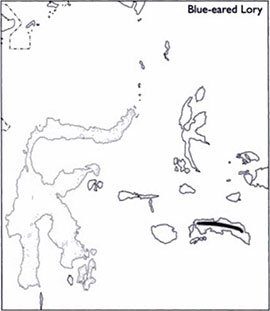
Lori distribution of Seram
The Blue-eared Lory is endemic of the Seram island in the Moluccas (Indonesian).

Conservation:


minor concern

– Current IUCN Red List category: Least concern

– The population trend: Decreasing

The world population It has not been quantified, but the species is estimated that it can range from common to abundant at the local level (pit et to the. 1997). However, justified the population trend, It is suspected to be in decline due to unsustainable levels of exploitation.
The population range is between 5,000 and 50,000 birds released.

Probably the Blue-eared Lory It will always remain a rare specimen in the world of birds.

In March of 1995 the Government of Indonesian stopped the export of these birds.

Its hunting for local trade has become especially intense.. Fortunately, There is no reason to keep to the Blue-eared Lory as a pet on the part of the indigenous population.

"Blue-eared Lory" in captivity:

Since its population is decreasing, any specimen that can not be returned to their natural habitat (natural range) should preferably be placed in a well-managed breeding program to ensure the survival of the species.

Alternative names:

– Blue-eared Lory, Ceram Lory, Blue eared Lory, Seram Lory (ingles).
– Lori masquรฉ, Lori ร  oreilles bleues (French).
– Halbmaskenlori (German).
– Loris Semilarvata (Portuguese).
– Lori de Orejas Azul, Lori de Seram (espaรฑol).

scientific classification:

– Order: Psittaciformes
– Family: Psittaculidae
– Genus: Eos
– Scientific name: Eos semilarvata
– Citation: Bonaparte, 1850
– Protonimo: Eos semilarvata

Images ยซLory of Seramยป:

Videos "Blue-eared Lory"

————————————————————————————————–

ยซLori de Seramยป – (Eos semilarvata)


Sources:

– Avibase
– BirdLife.org
– Oiseaux.NET

– Photos:

– Blue-eared Lory in the Walsrode Bird Park, Germany by Quartl – Wikimedia
– papageien.org
– Blue-eared Lory (Eos semilarvata) at the San Diego Zoo by Leon Mitchell – Wikipedia
– free-pet-wallpapers.com
– kanaria1898tuttlingen.de

– Sounds: Mark Todd (Xeno-canto)

โ–ท The world of Pets: Dogs, cats, birds, reptiles, amphibians

Edwards' Fig-Parrot
Psittaculirostris edwardsii


Edwards' Fig-Parrot

Content

Description

18 cm.. length and weight around 105 g..

The Edwards' Fig-Parrot (Psittaculirostris edwardsii) you have the front and a bright yellowish-green Crown, with a green stripe on the back; neck greyish-Brown band above the band of gris-negruzco color that extends into the eye; area before and just behind the eyes, green. Elongated lower headset feathers and orange-red fire Gorge, with some green basal feathers interspersed and ends the headphone rear (also elongated) golden yellow with orange.

Dark green back: curve of the wing marked in blue. Black flight feathers marked with green in vane outer (except the primary outer) and with vane internal yellow, forming a set of bars under her wings; marked inner coverts reddish-orange. The wings of blue-green feathers, the longest with yellow tip. Purple-blue ruff with some lighter green feathers; Centre of the breast and upper belly of a showy orange-red; flanks, supracaudales yellowish-green coverts and thighs. Upper, the Green tail; undertail, opaque yellow olive.

the black beak; reddish brown to Brown irises; light grey legs.

The female of the Edwards' Fig-Parrot It lacks the heart of red on the chest and upper abdomen, and has a broader purple-blue band on the chest, inset below with red.

Immatures resemble females, but with the headphones coverts greenish yellow.

Habitat:

The Edwards' Fig-Parrot (Psittaculirostris edwardsii) are distributed among the humid lowland forests, partially cleared areas, wooded edges, as well as near rural areas, up to about 800 meters above sea level.

The birds are usually found in pairs or small noisy flocks, Although groups have been found for up to 400 birds collected in the canopy of fruit trees.

Rapid movements are, and usually they hang you upside down to reach food.
Has been in mixed flocks with the Double-eyed Fig-Parrot.

Reproduction:

Nesting behavior of the Edwards' Fig-Parrot they have been observed since January through may. In October he was seen a male rubbing its peak with the female and hovering above its perch. The nest is in a hole, at the top of a tree in the forest.

Food:

The diet consists of fruit, including the Ficus figs and casuarinas, nectar and probably insects

Distribution:

Endemic to the lowlands of the North of New Guinea in Irian Jaya and Papua New Guinea. It is commonly distributed in the northeast of all Jayapura along the coastal lowlands and inland to around of Pagwi, Chamhri Lake and the jimi river. Observed in the region of the Sepik River, extending eastward to the lowlands of the Huon Peninsula and the markham river. The world's population is believed to be in excess of 100.000.

Conservation:


minor concern


โ€ข Current IUCN Red List category: Least concern

โ€ข Population trend: Stable

The size of the world population Edwards' Fig-Parrot It has not been quantified, It is estimated around the 100,000 specimens. The species according to sources, it is common to very frequent, at the local level (pit et to the. 1997).

The population is suspected to be stable in the absence of evidence of any reduction or substantial threats.

"Edwards' Fig-Parrot" in captivity:

active parrot, need space to exercise. It has nice voice, harmless. Initially shy and nervous, It is customary to the caregiver with the time. You can die suddenly without apparent reason.

It is very rare in poultry.

Alternative names:

– Edwards’ Fig-Parrot, Edward’s Fig Parrot, Edwards’ Fig Parrot, Edwards’s Fig Parrot, Edwards’s Fig-Parrot, Scarlet-cheeked Fig Parrot (ingles).
– Psittacule d’Edwards (French).
– Edwardszwergpapagei, Edwards Zwergpapagei, Edwards-Zwergpapagei (German).
– Psittaculirostris edwardsii (Portuguese).
– Lorito de Eduardo, Lorito de Edwards (espaรฑol).

scientific classification:

– Order: Psittaciformes
– Family: Psittaculidae
– Scientific name: Psittaculirostris edwardsii
– Genus: Psittaculirostris
– Citation: (Oustalet, 1885)
– Protonimo: Cyclopsittacus Edwardsii

Images "Edwards' Lorito":

————————————————————————————————

ยซEdwards' parrotยป (Psittaculirostris edwardsii)


Sources:

– Avibase
– Parrots of the World โ€“ Forshaw Joseph M
– Parrots A Guide to the Parrots of the World – Tony Juniper & Mike Parr
– Birdlife

– Photos:

(1) – Indonesia Traveling Guide – by Farelli in Indonesia Bird
(2) – Birds-pet-wallpapers
(3) – ยซPsittaculirostris edwardsiiยป by http://www.birdphotos.com – http://www.birdphotos.com/photos/v/parrots/IMG_3537b.jpg.html. Licensed under CC BY 3.0 via Wikimedia Commons.
(4) – By Michal Pilar – Methodical Portal
(5) – By Katerina Tvardikova – New Guinea Birds

โ–ท The world of Pets: Dogs, cats, birds, reptiles, amphibians

Meyer's Parrot
Poicephalus meyeri


Lorito de Meyer

Content


Description:

21 cm. and a weight of 100-130 g..

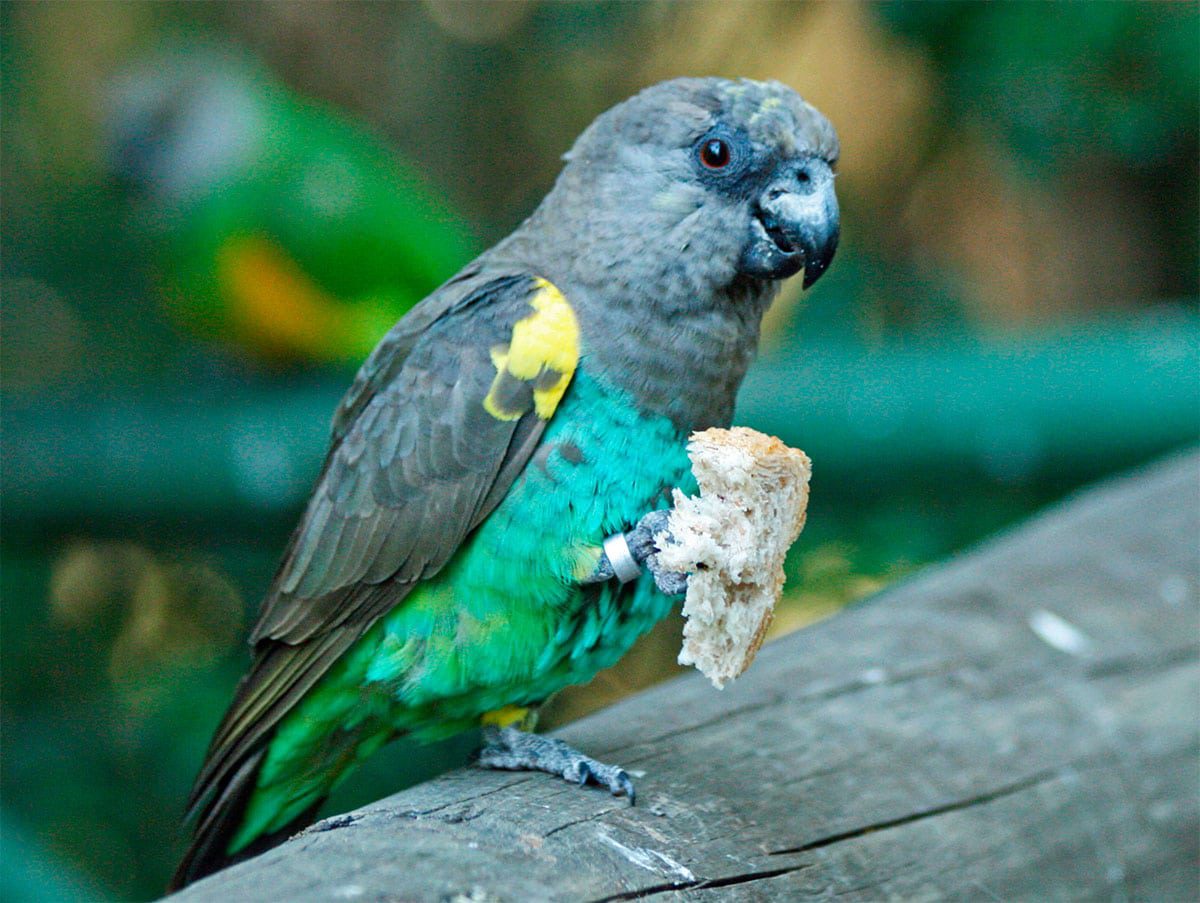
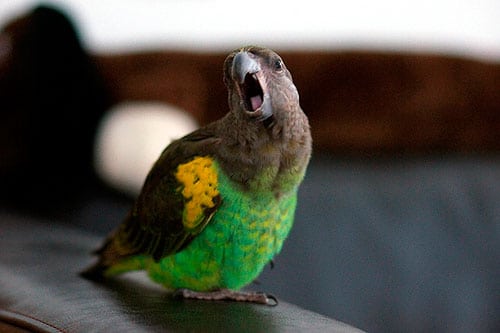
The Meyer's Parrot (Poicephalus meyeri) has the forecrown, lores, cheeks, ear-coverts and ash Brown nape; crown bright yellow. The mantle feathers ash brown edges blue or cyan dye in some birds; scapulars brown ash, some individuals show Tips blue or greenish blue; rump bright turquoise or teal; uppertail-coverts green. Outermost children and wing-coverts above bright yellow, other variables showing green tints, especially towards Tips. The primaries and high schools ash Brown with paler narrow margins to vane outer.

feathers of the wings, undertail, bright yellow in some birds, but grayish-brown in larger in other. The chin, the throat and top of the chest brown ash; remaining chest and belly turquoise or teal; the thighs yellow; undertail- coverts turquoise blue or greenish blue. Tail brown ash.

Bill dark gray or black; cere black; irises orange-red; periophthalmic skin desnuda negruzca; legs blackish.

Both sexes similar.

Youth more generally greenish brown. No yellow in the crown or the the thighs and the yellow area in the wings, at the top, It is lower. Wing coverts, undertail, green and brown with little or no yellow. The underparts mรกs greenish. Iris dark brown.

Subspecies description

Description Meyer's Parrot subspecies
  • Poicephalus meyeri damarensis

    (Neumann, 1898) – No Yellow crown. Paler than subspecies reichenowi. Intergrades with transvaalensis subspecies in the region of the delta del Okavango, Botswana and with subspecies reichenowi in Angola.


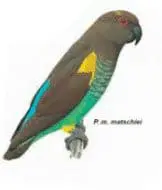
  • Poicephalus meyeri matschiei
    matschiei by Parrots of the World โ€“ Forshaw Joseph M
  • Poicephalus meyeri matschiei

    (Neumann, 1898) – Brown is paler than in the subespecie satisfied and cyan dye to the margins of the scapulars less pronounced than in the species nominal. Green colors are blue (especially below). The female spot shows yellow feathers at the base of the lower jaw.


  • Poicephalus meyeri meyeri

    (Cretzschmar, 1827) – Species nominal


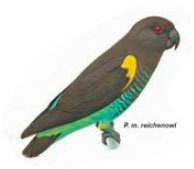
  • Poicephalus meyeri reichenowi

    (Neumann, 1898) – Similar to the subespecie matschiei but with the yellow crown generally absent. Paler blue in the rump. Size larger than the subespecie matschiei.


  • reichenowi by Parrots of the World โ€“ Forshaw Joseph M
    reichenowi by Parrots of the World โ€“ Forshaw Joseph M
  • Poicephalus meyeri saturatus

    (Sharpe, 1901) – darker than species nominal (especially the brown parts), rump less blue than the nominal, showing a bit of green in the feathers. The dark centers feathers on the bottom, giving it a mottled appearance. Intergrades with the subspecies matschiei in Tanzania.


  • Poicephalus meyeri transvaalensis

    (Neumann, 1899) – Brown clearer than in the subespecie matschiei, even bluer in the rump and below. Yellow areas in the crown They are often reduced and, sometimes completely lacking (especially in males). It is thought that can hybridize with the Poicephalus cryptoxanthus.

Habitat:

The Meyer's Parrot It is found in a wide variety of forest habitats from dry savannah to gallery forest and second-growth riparian forest around crops.. Observed in forests dominated by Terminalia laxiflora and Doka Isoberlinia, thickets Combretum acacia grasslands; as well Brachystegia and riparian forests Syzygium-Adina.

Avoid lowland rainforests in the basin Congo and other humid forests including areas of the eastern highlands of the district of Zimbabwe and Cork in Malawi.

Show a preference for the tallest trees in the drier savannah habitats – in particular specimens Adansonia. They may be confined to gallery forests in the drier parts of their range and are generally found in close proximity to water..

Where it is sympatric with the Red-bellied Parrot (Poicephalus rufiventris), the Meyer's Parrot It is limited to riparian forests.

In Kenya, which it is largely in areas with higher annual rainfall 500 mm.

Sometimes observed in suburban areas.

In general, in the lowlands at altitudes of 1,250m in Ethiopia, 2.200m in east Africa and 1.500 meters in the highlands of eastern Zimbabwe.

They are distributed in pairs or small groups 3-5 birds (possibly couples); until 50 birds may congregate in areas where there are food sources in breeding season. Roosts in tree cavities. Usually shy and cautious.

Reproduction:

Solitary nesters in tree cavities at a height between 3 and 10 meters above the ground, during the season, dry (for example Mar-June Zimbabwe, from May to September Zambia and Malawi, July Angola and in December or January Sudan).

The implementation is of 2 to 4 eggs.

Food:

The diet of the Meyer's Parrot fruit is, nuts and seeds, including Ficus, Sound abyssinica, Uapaca nitidula, Monotes glaber, Combretum, Grewia, Sclerocarya, Pseudolachnostylis, fruit of the great growth and riparian trees afzelia quanzensis and Melia volkensii, grown oranges and flowers Schotia brachypetala.

The pulp of the fruit is less important than the hard seeds and the arbolados share, the Meyer's Parrot is one of the few species consume seeds Brachystegia and other leguminous trees.

They also consume grain and is considered as crop pests in some areas.

Eat some insects, including caterpillars.

May vary widely from area to area in search of food during droughts.

Distribution:

Size of the area of distribution (reproduction / resident): 5.840.000 km2

The Meyer's Parrot They are distributed throughout the central and eastern Africa. From the North-East of Cameroon and South of Chad through the North of the Central African Republic, center Sudan and South and West Ethiopia, to the south through Uganda, Kenya Western, east of Democratic Republic of the Congo and Tanzania, coming to Malawi, Zambia, Angola, Northeast of Botswana, Zimbabwe, western end of Mozambique, Namibia and northeast of Sudafrican republic.

A wild population, possibly, is distributed in the eastern province of Cape Town, Sudafrican republic, even if they are probably extinct.

Nomad in some areas during periods of drought, when they distributed outside the normal range; normally resident with local movements.

Distribution Subspecies

Meyer's Parrot subspecies distribution
  • Poicephalus meyeri damarensis

    (Neumann, 1898) – South of Angola, Northeast of Namibia and North of Botswana.


  • Poicephalus meyeri matschiei

    (Neumann, 1898) – Southeast Kenya through eastern and central Tanzania to Southeast Democratic Republic of the Congo, North of Malawi, Zambia and northeast of Angola.


  • Poicephalus meyeri meyeri

    (Cretzschmar, 1827) – Species nominal


  • Poicephalus meyeri reichenowi

    (Neumann, 1898) – North and Central Angola from Malange and sierra central until Huila, possibly also adjacent parts of the Democratic Republic of the Congo


  • Poicephalus meyeri saturatus

    (Sharpe, 1901) – The Far East Democratic Republic of the Congo, through Burundi, Rwanda and east of Uganda, in West and Central East Kenya towards Meru and Local inside Tanzania to the South of the Parque Nacional Ruaha.


  • Poicephalus meyeri transvaalensis

    (Neumann, 1899) – Areas of northern and central Mozambique to northern Save River across the South of Zambia and central and southern Zimbabwe to northeast Botswana and West of Transvaal

Conservation:


minor concern


โ€ข Current Red List of UICN: Least concern

โ€ข Population trend: Stable

The Meyer's Parrot It, in general, common to very common and is the most abundant parrot in some parts of its range (for example, Zimbabue and Angola), although few in other areas and absent from some apparently suitable habitats.

Its population has declined in some parts (for example Transvaal) where is thought to be a result of habitat destruction. I also persecuted in some locations due to crop damage (for example, in the center of Zambezi because of the damage inflicted to the maturation of the berries Boolean).

"Meyer's Parrot" in captivity:

The Meyer's Parrot, is a bird common in captivity, quiet, tender, easy to carry and with a stable temperament.

They are birds social and they tend to bond with everyone in the family, unlike other species that may prefer one person to another. In general, No es voluble – once you liked someone, the person is a friend for life.

They are not as dependent on humans for entertainment as most parrots and therefore no son tan demanding.

They like being handled and petted on the head and neck. A hand-fed hatchling will develop into a fluffy adult if treated properly, and it is not prone to bite, although it may provide a powerful bite if provoked.

You can learn a few words, although They are not known for their ability to speak. They can learn to whistle, making noises, and occasionally they will offer strong squeals. Fortunately, They are not likely to scream or make loud squawks, making good birds for apartment life. Some individuals learn household noises, as the beep of the microwave.

The Meyer's Parrot they are ready to breed at the age of 3 to 4 years and reproduce easily in captivity.

With regard to its longevity, according to sources, Meyer lived a parrot 34,2 years in captivity.

Alternative names:

– Meyer’s Parrot, Brown Parrot (English).
– Perroquet de Meyer, Perroquet brun, Youyou de Meyer (French).
– Goldbugpapagei, Goldbug-Papagei (German).
– Papagaio de Meyer, Papagaio-de-meyer (Portuguese).
– Lorito de Meyer (espaรฑol).


scientific classification:

Philipp Jacob Cretzschmar

– Order: Psittaciformes
– Family: Psittacidae
– Genus: Poicephalus
– Scientific name: Poicephalus meyeri
– Citation: (Cretzschmar, 1827)
– Protonimo: Psittacus Meyeri


Images "Lorito de Meyer":

Videos "Meyer's Parrot"

————————————————————————————————

"Lorito de Meyer" (Poicephalus meyeri)


Sources:

– Avibase
– Parrots of the World โ€“ Forshaw Joseph M
– Parrots A Guide to the Parrots of the World – Tony Juniper & Mike Parr
– Birdlife

– Photos:

(1) – A Meyerโ€™s Parrot at Birds of Eden, Western Cape, South Africa. It is eating what looks like a piece of bread By SandyCole (mailto:sandyc@dicksandy.org) (Own work) [CC BY-SA 3.0 or GFDL], via Wikimedia Commons
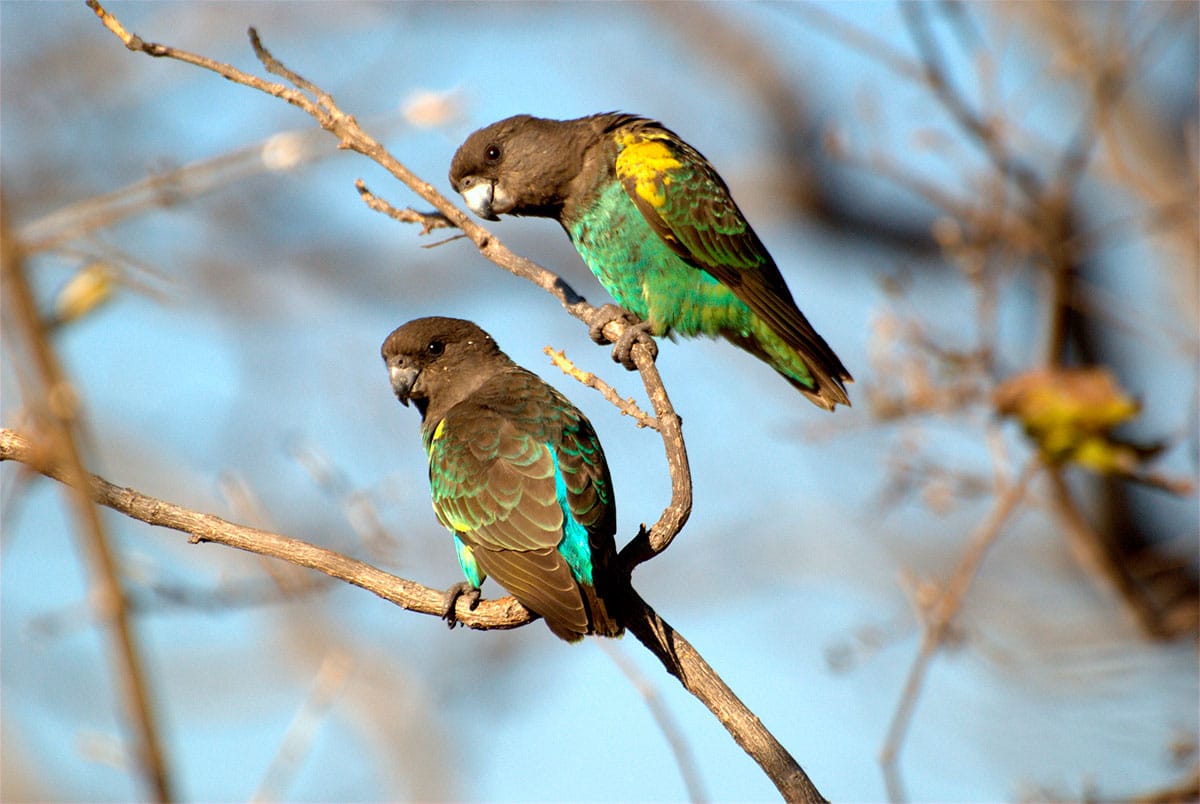
(2) – Two Meyerโ€™s Parrots in Zimbabwe By Oce Eeco (DSC_0108Uploaded by snowmanradio) [CC BY 2.0], via Wikimedia Commons
(3) – Brown parrot also known as Meyerโ€™s Parrot (Poicephalus meyeri) by Papooga – Flickr
(4) – A Meyerโ€™s Parrot near Kwara Camp, North-West District, Botswana By Benjamin Hollis from Seattle, WA, USA (Meyerโ€™s parrotUploaded by snowmanradio) [CC BY 2.0], via Wikimedia Commons
(5) – A Meyerโ€™s Parrot in Akagera National Park, Rwanda By Lip Kee Yap [CC BY-SA 2.0], via Wikimedia Commons

– Sounds: Derek Solomon (Xeno-canto)

โ–ท The world of Pets: Dogs, cats, birds, reptiles, amphibians

Red-masked Parakeet
Psittacara erythrogenys

Aratinga de Guayaquil

Content


Anatomy-parrots

Description Aratinga of Guayaquil:

33 cm.. length between 165 and 200 g.. weight.

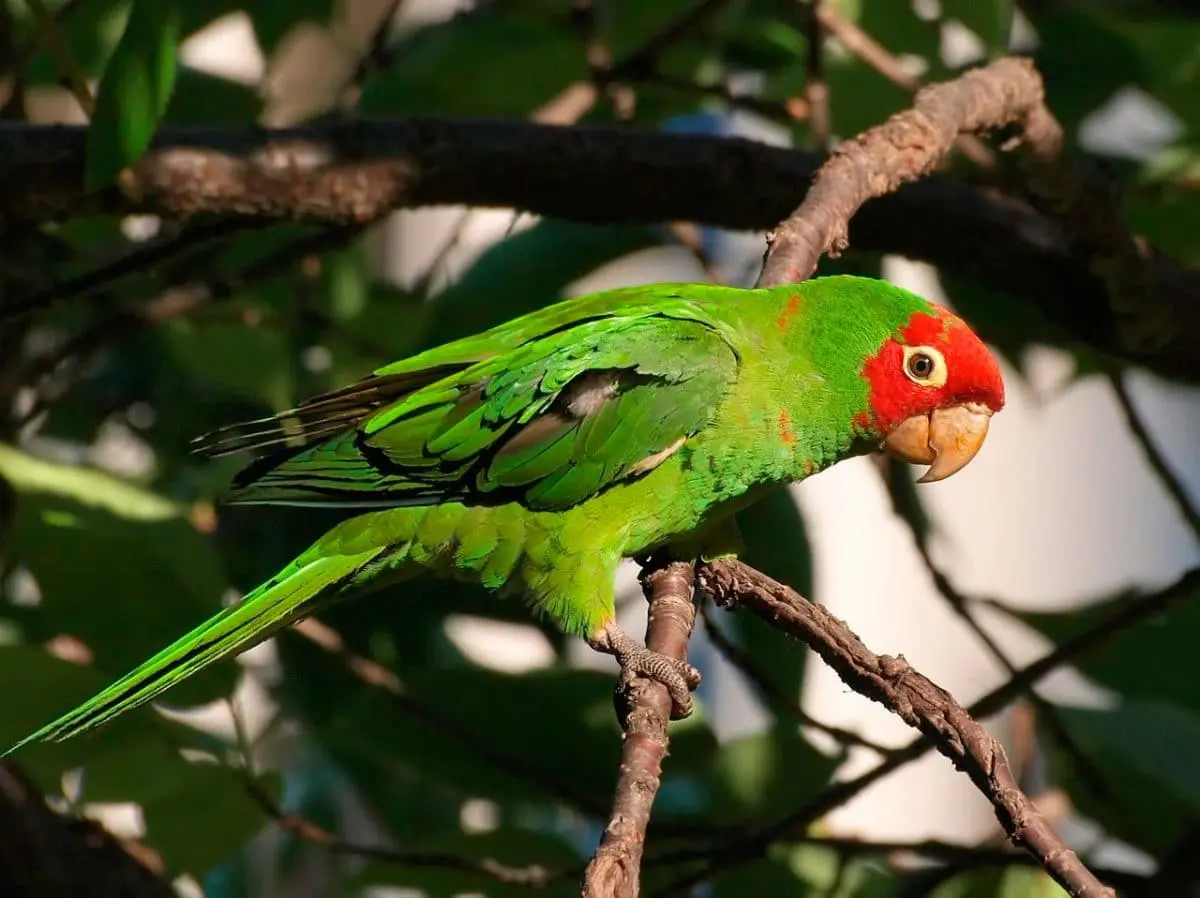
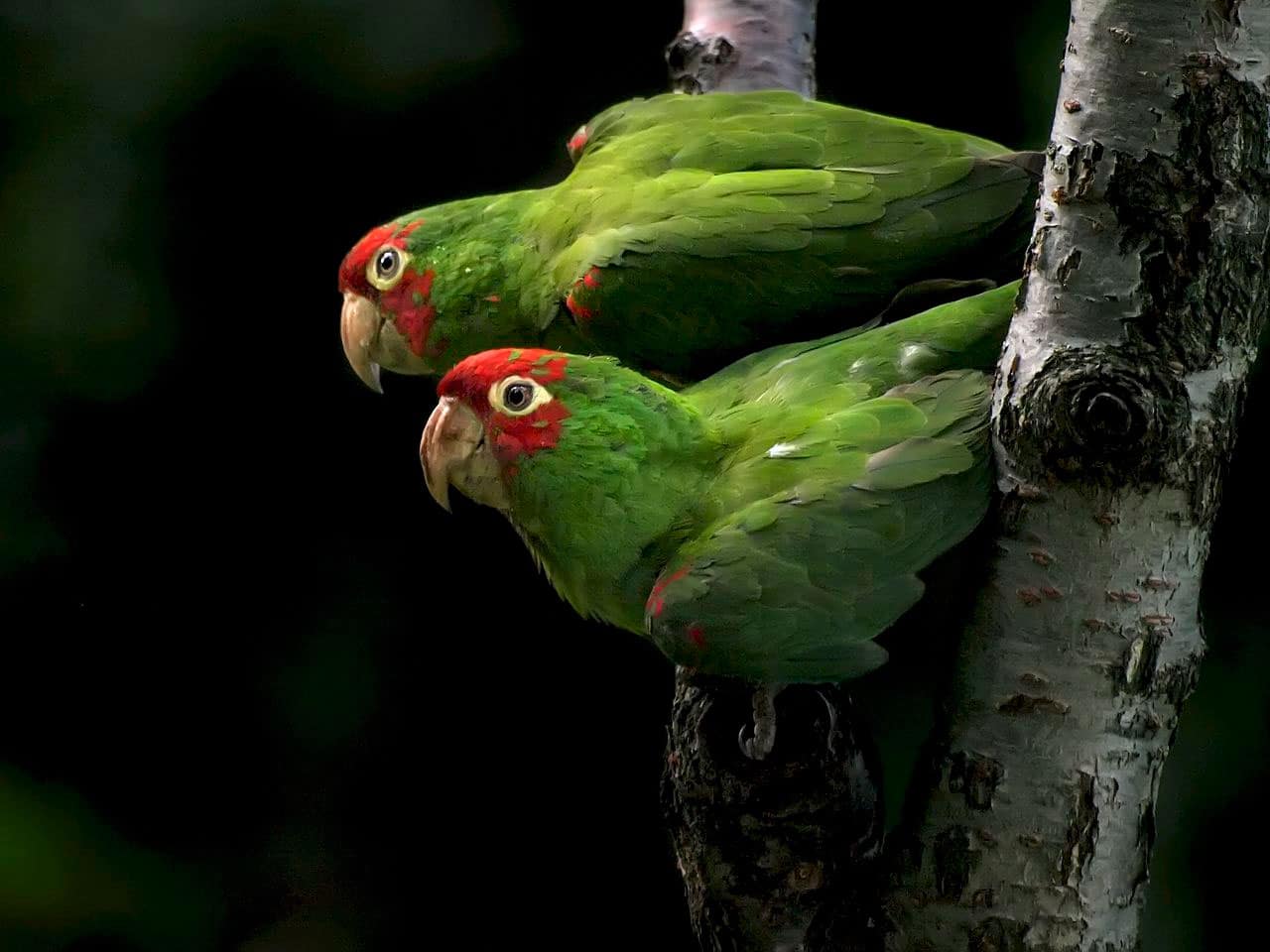
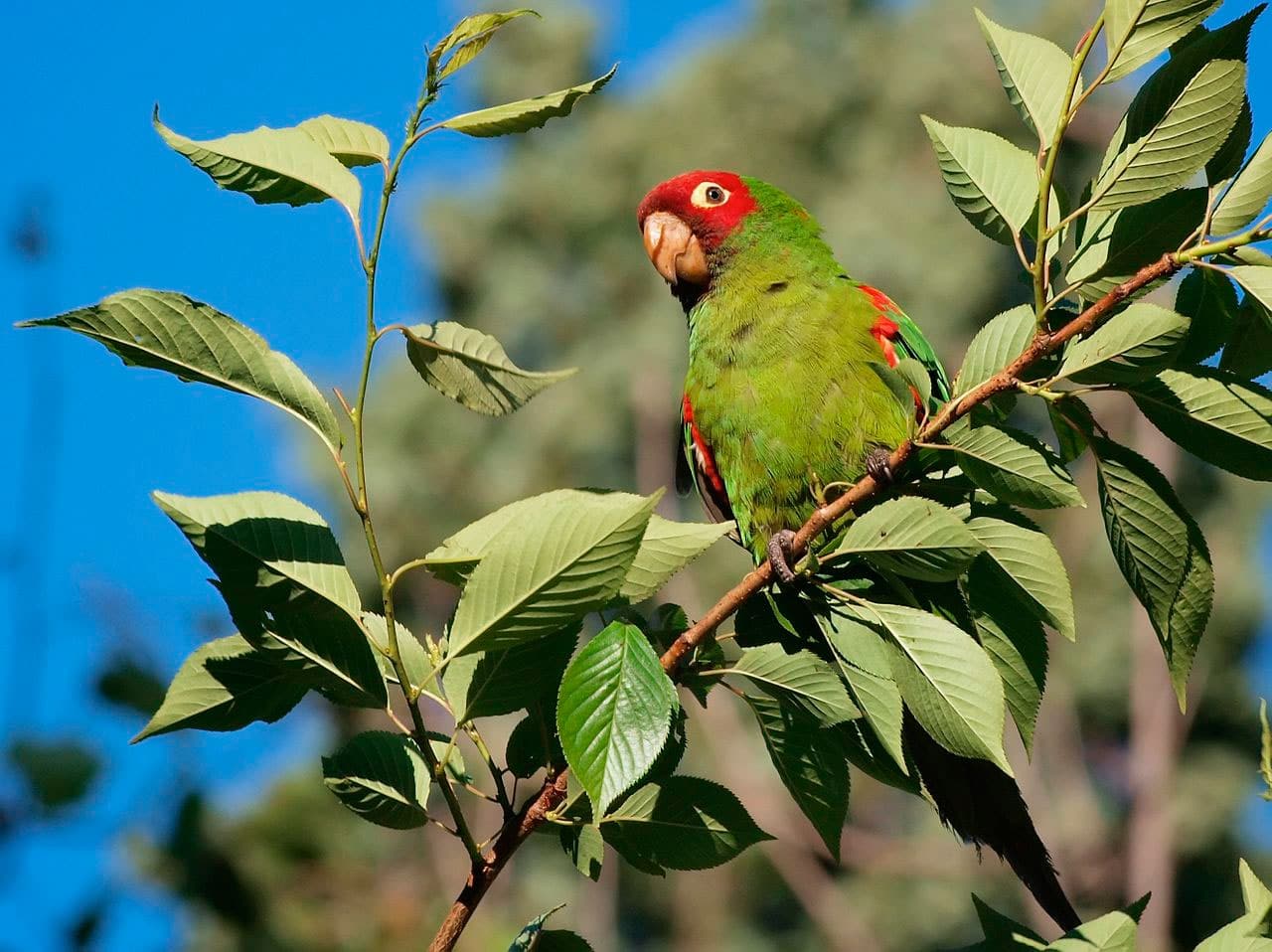
The Red-masked Parakeet (Psittacara erythrogenys) It is very similar to birds Scarlet-fronted Parakeet and to the Mitred Parakeet, but smaller and with more red area in the face, extending continuously up to the throat and nape.

Has the forecrown, crown, lores, the cheeks and the area around the eyes, bright red, generally forming a complete red mask to join to the chin (Sometimes the mask extends up to the throat). Since the nape up to the uppertail-coverts dark green, sometimes with scattered red feathers. The upperwing-coverts children with some feathers of red and the bend of wing red; remaining upperwing-coverts dark green, with dye Emerald to them vane outer the primary. The flight feather Brown Gold below; underwing-coverts minors, bright red, the greater coverts yellowish brown. The underparts brighter yellowish green, sometimes with mottled red and almost always with the the thighs red. Upper, the tail dark green; by below grayish brown.

The bill color pale horn; bare periophthalmic off-white; irises yellow; legs distant.

Both sexes similar.

The immature with the head and the thighs green.

Habitat Red-masked Parakeet:

Video – "Red-masked Parakeet" (Psittacara erythrogenys)

Telegraph Hill Parrots January 30, 2008 (HD)

The Red-masked Parakeet It occupies a wide range of vegetation types, from arid zones to rainforests, Since the sea level to altitudes 2.500 m, Although its usual habitat is below of the 1.000 m, in humid forests, deciduous forests, areas of dry thorny scrub and arid with cactus; They also live in degraded forest, areas cultivated with scattered trees, and around the urban areas. They tend to prefer arid and semi-arid habitats, not avoiding moist forest habitats.

Outside the breeding season, is a bird gregarious; in general, observed in pairs or in groups of up to 12 individuals, forming groups of up to 200 birds in the places where their communal roosts are. Formerly registered flocks of thousands of birds in Guayaquil, Ecuador.

Often associated in mixed flocks with the Grey-cheeked Parakeet (Brotogeris pyrrhoptera) and also observed in mixed flocks with the Bronze winged Parrot (Pionus chalcopterus).

Reproduction Red-masked Parakeet:

Nests in holes of mature trees, for example of Ceiba trichistandra or Cochlospermun vitifolium, There are also records of nests in termite mounds, with a report in a nest on a cliff. The breeding season in the southwest of Ecuador recorded during the rainy season (January-March). The laying, between 2 and 4 eggs. The female the incubated eggs during 23 to 24 days. The pups they are born very little developed, blind and naked. They are fed with food previously digested by their mothers.

Food Aratinga of Guayaquil:

Few details exist about food preferences of the Red-masked Parakeet, Although seasonal movements from the more arid areas are probably related to food supply.

Reported foods include fruits of Hieronyma, Anacardiaceae, Oleaceae and Boraginaceae, as well as flowers of Erythrina.

Distribution:

Size of the area of distribution (reproduction / resident): 151.000 km2

The Red-masked Parakeet is distributed to the West of Ecuador and the Northwest corner of Peru.

In Ecuador, the species has been recorded from Manabi near south of the equator, through Pichincha, The rivers, Guayas, Azuay, Gold and Loja, until Tumbes, Piura, Lambayeque and Cajamarca, in the North of Peru and the region of Chachapoyas, amazon (6ยฐ 10โ€™S).

In Ecuador, the distribution of the Red-masked Parakeet is limited to the lowlands of the peaceful, Western slope of the Andes and valleys, Although it is apparently absent from the eastern slope; similar pattern in the Peru most Eastern records in the basin of the amazon (Valley of the Utcubamba River) to 77ยฐ 54โ€™W.

The seasonal movements to and from the more arid areas, otherwise, residents.

Usually considered to be common (described as the most common parrot in various locations in the province of Gold, Ecuador), but numbers fluctuate widely in some locations due to irregular seasonal movements. In some areas there has been a very drastic decrease of copies, reflecting the combined effects of the loss of habitat and your capture for the trade in live birds, for example, in Guayas, Ecuador.

There are at least eight protected areas, of which seven are in Ecuador.

There are leaks in Spain; so also in EE. UU., with breeding populations in the California cities of San Diego, Los Angeles, San Gabriel, Sunnyvale and San Francisco, You can see them eating fruits of cultivated tropical plants, and nesting in Palm trees.

Maintained in captivity at the local level (where is the most common Parrot kept in captivity) and commercialized in large quantities at the international level, especially since Peru.

Conservation:

State of conservation โ“˜


Near-threatened Near Threatened โ“˜ (UICN)โ“˜

โ€ข Red List category of the UICN current: Near-threatened

โ€ข Population trend: Decreasing

The size of the population This species has not been estimated officially, but, in the absence of sufficient data, It is suspected that it may be in around the 10.000 specimens, more or less equivalent to 6.700 mature individuals.

The population of the species is suspected that it may be subjected to a moderately rapid decrease, due to its capture for him pet trade together with the loss of habitat and fragmentation. Further research is required.

Conservation Actions Underway:

  • Appendix II of CITES.

Conservation Actions Proposed:

  • Carry out surveys to get an estimate of the population.
  • The current threat of trade research.
  • Enforcing trade restrictions.
  • Census of population and monitoring.
  • Monitor the rates of loss and fragmentation of habitat.
  • Study its ability to persist in altered and fragmented habitats.

The Red-masked Parakeet in captivity:

Shy and distrustful. Little common in captivity outside its area of distribution.

They may live until 25 years, Although the average tends to be between 10 and 15 years.

Their diet: fruit as, Apple, pear, orange, bananas, grenades, Kiwi, papaya, cactus fruits, they form a 30 percent of the diet. Vegetables, such as: Carrot, celery, green beans and peas in the pod, sweet corn on the cob, green leavess, such as: chard, lettuce , Kale, healer, Dandelion, Aviary grass, spray millet, mixture of small seeds, such as: Millet and small amounts of oats, buckwheat, safflower and hemp.

This species is found threatened from the wild bird trade local in Peru and Ecuador, where are rates of mortality due to mismanagement and stress high.

Never buy these birds in the illegal trade, Since these tend to come from its natural environment and it must be remembered that the Red-masked Parakeet is one endangered species.

Alternative names:

– Red-masked Parakeet, Red Masked Conure, Red masked Parakeet, Red-headed Conure, Red-headed Parakeet, Red-masked Conure (English).
– Conure ร  tรชte rouge, Conure ร  tรชte cerise, Conure ร  tรชte รฉcarlate, Perriche ร  tรชte rouge, Perruche ร  tรชte rouge (French).
– Guayaquilsittich (German).
– Periquito-de-cabeรงa-vermelha (Portuguese).
– Aratinga de Guayaquil, Loro de cara roja, Periquito de Cabeza Roja, Perico Cara Roja (espaรฑol).
– Loro de cara roja (Chile).
– Cotorra de Cabeza Roja (Peru).
– Perico caretirrojo (Ecuador).


scientific classification:

Renรฉ Primevรจre Lesson

– Order: Psittaciformes
– Family: Psittacidae
– Genus: Psittacara
– Scientific name: Psittacara erythrogenys
– Citation: (Lesson, 1844)
– Protonimo: Psittacara (psittacus) Erythrogenys

Red-masked Parakeet pictures:


Species of the genus Psittacara

Sources:

– Avibase
– Parrots of the World โ€“ Forshaw Joseph M
– Parrots A Guide to the Parrots of the World – Tony Juniper & Mike Parr
– Birdlife
– Feather wind

– Photos:

(1) – A feral Red-masked Parakeet (also known as the Red-masked Conure and Cherry-headed Conure) in San Francisco, USA By Ingrid Taylar [CC BY 2.0], via Wikimedia Commons
(2) – Red-masked parakeet, Aratinga erythrogenys. Two birds in a tree in San Francisco, California By Jef Poskanzer (Flickr) [CC BY 2.0], via Wikimedia Commons
(3) – Red-masked Parakeet (Psittacara erythrogenys) at the Presidio, San Francisco, California By Frank Schulenburg (Own work) [CC BY-SA 4.0], via Wikimedia Commons
(4) – Red-masked parakeet (Aratinga erythrogenys). A juvenile parrot which is mostly green and just starting to get some red feathers on its head By Eliya Selhub (Flickr) [CC BY 2.0], via Wikimedia Commons
(5) – Red-masked Parakeet preening on a branch in San Francisco, USA By Ingrid Taylar from San Francisco Bay Area – California, USA [CC BY 2.0], via Wikimedia Commons
(6) – Red-masked Conure at Birds of Eden, South Africa By Dick Daniels (http://carolinabirds.org /) (Own work) [CC BY-SA 3.0 or GFDL], via Wikimedia Commons
(7) – A feral Red-masked Parakeet (also known as the Red-masked Conure and Cherry-headed Conure) in San Francisco, USA By Ingrid Taylar [CC BY 2.0], via Wikimedia Commons
(8) – Two feral Red-masked Parakeets in San Francisco, USA By Ingrid Taylar from San Francisco Bay Area – California, USA (Wild in SFUploaded by Snowmanradio) [CC BY 2.0], via Wikimedia Commons
(9) – Several Red-masked Parakeets eating a discarded apple in San Francisco, USA By Ingrid Taylar from San Francisco Bay Area – California, USA (A Big Find for ParrotsUploaded by Snowmanradio) [CC BY 2.0], via Wikimedia Commons

– Sounds: (Xeno-canto)

โ–ท The world of Pets: Dogs, cats, birds, reptiles, amphibians

Red-crowned Parrot
Amazona viridigenalis

Red-crowned Parrot

Content

Description:


Anatomy-parrots

30.5-33 cm.. length and 294 g. of weight.

The Red-crowned Parrot (Amazona viridigenalis) has the lores, forecrown and crown, bright red, with side margins on the back of the neck and top of the neck, showing blue feathers with black ends; ear-coverts bright green without black ends in feathers; nape boldly festooned with green feathers with their ends in black.

Mantle and back green with some weak black tips; rump and uppertail-coverts, green. Wing coverts green with black margins on some weak feathers. The flight feather, mostly green, the primaries, in general, with dark ends, of dark blue or black, the Outer secondaries, with the ends of blue with red in the outerweb. Under, the wings green. Underparts green, slightly yellowish; some feathers show visible dark tips. The tail is green, in general with its yellow end. Bill pale yellow; irises yellow; legs pale grey.

Red-crowned Parrot

although females They can have on average less red in the head, probably no consistent sexual dimorphism. The immature She has red in the head very small, with feathers in the central part of the crown green tipped black and subterminally banded pale blue; feathers on the side of the crown, forming broad band over eye.

  • Sound of the Red-crowned Parrot.

Habitat:

Video "Red-crowned Parrot"

The habitat of the Red-crowned Parrot son los Bosques deciduous, gallery forests and evergreen floodplain forests in tropical lowlands, with non-breeding birds on dry ridges extend to 1,200 meters in temperate zones Pinus and Quercus.

frequenting cultivated areas where they remain large trees. Usually in flocks, generally larger than its sympatric congeners (Red-lored Amazon and the Yellow-headed Parrot, with which sometimes mixed); in larger flocks in winter. Used roost communally.

Reproduction:

They nest in tree hollows, including abandoned nests Lineated Woodpecker (Dryocopus lineatus), generally 6-20 meters above the ground. Nests reported in trees Taxodium mucronatum, Bumelia laetivirens and Brosimum alicastrum. Reproduction April-May Tamaulipas. The laying is of 3 or 4 eggs. Only the female incubates. The incubation hard 28 days. The young are cared for for nine weeks.

Food:

Foods reported include seeds of Pinus, corn, berries of Ehretia, Jewish of Pithecellobium, acorns and berries Melia azedarach; introduced populations have adapted to the food sources parks, consuming fruitsJuglans, Liquidambar, eucalyptus and Chorisia.

Distribution and status:

Size of its range (breeding/resident ): 61.900 km2

Northeast Endemic Mexico, where records from southern Nuevo Leรณn (South of Monterrey) through Tamaulipas (mostly in the center and south of the state) and East of San Luis Potosi, to the North of Veracruz and towards the south until near 21ยบN. They can be seen as visitors in the winter Brownsville, southwestern end Texas, USA.

The current range appears confined to Tamaulipas and San Luis Potosi, no known breeding records in recent decades in Nuevo Leรณn or Veracruz, except for the seemingly wild population in the suburbs Monterrey.

wild populations in California, Florida, Oahu (Hawaiian Islands) and Puerto Ricor (small number in southern dry forests).

Resident but nomadic in winter with some altitudinal movements that lead birds to higher ground in winter (perhaps to exploit the seeds and acorns Pine) and with other movements further away from the breeding range, for example, to the South of Texas. Apparently they return to the breeding area in February, declining along the ridge, but they are most common near the east coast, especially around the Sierra de Tamaulipas and on the slopes east of the Sierra Madre Oriental in Tamaulipas. Otherwise, sparsely distributed and frequently only some strengths as the Valley Sabinas River, Tamaulipas.

Total population estimated in 3.000-6.500. Popular in captivity locally and previously traded in large numbers internationally. Clearly the recent population declines are due to excessive trade and to the continued destruction of habitats scale; they are also you fired in some areas due to crop damage. There are no large protected areas within reach and illegal trade continues.

Conservation:

State of conservation โ“˜


Endangered Endangered โ“˜ (UICN)โ“˜

โ€ข Current category of the Red List of the UICN: In danger of extinction.

โ€ข Population trend: Decreasing.

โ€ข Population size : 2000-4300.

Rationale for the Red List category

    The combination of high levels of exploitation for cage bird trade, loss of habitat and long term estimates reduced density It indicates that this species is declining very quickly. Therefore it qualifies as in danger of extinction.

Justification of the population

    In 1992-1994, estimated in an area in Mexico densities indicated a wild population of 3.000 to 6.500 birds (EC Enkerlin-Hoeflich in a bit., 1994). This estimate equals approximately 2.000-4.300 mature individuals.

Justification of trend

    The historical densities recorded for the species were 25,2 in the early birds / km2 1970 (Castro 1976), down to 5,7 birds / km2 in an area 1992-1994 (EC Enkerlin-Hoeflich in 1994, Enkerlin-Hoeflich 1995), indicating a population declines of up to 77,4% on a strip of 20 years. It is suspected that the decline will continue at a higher rate to 50% in ten years, due to threats capture and forest clearing.
Threats

โ€ข In 1970-1982, 16.490 birds (mainly chicks) They were imported legally to United States.

โ€ข Las illegal exports from Mexico and mortality prior to export to the top 50% they are equivalent to 5.000 birds per year (Enkerlin-Hoeflich and Hogan, 1997).

โ€ข Los hunters damage nests when removing chicks (sometimes cutting whole trees), reducing the availability of the nest and bringing the permanent abandonment of the site (Snyder et to the., 2000).

โ€ข Many gallery forests have been cleared or degraded, with more than 80% lowlands of Tamaulipas cleared for agriculture (especially sorghum) and pastures.

โ€ข The habitat of the Red-crowned Parrot It is now distributed unevenly in cattle ranches, where the pressure is greater capture (Enkerlin-Hoeflich and Hogan, 1997).

Conservation Actions Underway

โ€ข CITES Appendix I (1992) and part of the European Endangered Species Programme [Species] of the European Association of Zoos and Aquariums (EAZA).

โ€ข The population of Red-crowned Parrot It is distributed in the Biosphere Reserves Heaven and Sierra Gorda (A. G. Navarro in some ., 1998, T. Brush in a bit., 2003), but there are only small colonies in Sierra Gorda and status in Heaven It is unknown (Wege and Long 1995, A. G. Navarro in some 1998).

โ€ข Los livestock They are increasingly aware of the benefits of keeping large trees, but this is not reflected in practice.

Conservation Actions Proposed

โ€ข Conduct surveys to obtain an estimate of the total size of the population.

โ€ข Monitor populations to determine degree of decline.

โ€ข Identify the most important nesting aggregations for protection (Enkerlin-Hoeflich and Hogan 1997).

โ€ข Integrate ranchers in efforts to reduce capture and regenerate habitat (Enkerlin-Hoeflich and Hogan 1997) .

The Red-crowned Parrot in captivity:

CITES Appendix I. (It includes species threatened with extinction. Trade individuals of these species, it is allowed only in exceptional circumstances.)

Each captive specimen of this species which is capable of reproducing, It is placed in a well managed captive breeding program and not be sold as a pet, with the order to ensure their survival long-term.

Alternative names:

– Green-cheeked Amazon, Green-cheeked Parrot, Mexican Red-headed Amazon, Mexican Red-headed Parrot, Red-crowned Amazon, Red-crowned Parrot, red-crowned parrot parakeet (English).
– Amazone ร  joues vertes, Amazone verte ร  front rouge (French).
– Grรผnwangenamazon, Grรผnwangenamazone (German).
– Papagaio-de-coroa-vermelha, Papagaio-de-face-verde (Portuguese).
– Amazona de Corona Roja, Amazona Tamaulipeca, Cotorra Coronirroja, Loro Tamaulipeco (espaรฑol).


scientific classification:

John Cassin
John Cassin

– Order: Psittaciformes
– Family: Psittacidae
– Genus: Amazona
– Scientific name: Amazona viridigenalis
– Citation: (Cassin, 1853)
– Protonimo: chrysotis viridigenalis


Images Red-crowned Parrot:


Species of the genus Amazona


Sources:

– Avibase
– Parrots of the World โ€“ Forshaw Joseph M
– Parrots A Guide to the Parrots of the World – Tony Juniper & Mike Parr
– Birdlife

– Photos:

(1) – Amazona_viridigenalis is native of Mexico. Specimen in Palmitos Park, Gran Canaria By Bjoertvedt (Own work) [CC BY-SA 3.0 or GFDL], via Wikimedia Commons
(2) – Red-crowned Amazon (Amazona viridigenalis) also known as Green-cheeked Amazon, Red-crowned Parrot, or Mexican Red-headed Parrot By rachael fogarty (originally posted to Flickr as Fred) [CC BY-SA 2.0], via Wikimedia Commons
(3) – Red-crowned Amazon (also known as Red-crowned Parrot, Green-cheeked Amazon, or Mexican Red-headed Parrot). Two in a cage By TJ Lin [CC BY-SA 2.0], via Wikimedia Commons
(4) – Red-crowned Amazon, (Amazona viridigenalis) also known as Green-cheeked Amazon, Red-crowned Parrot, or Mexican Red-headed Parrot by Leonhard F at the German language Wikipedia [GFDL or CC-BY-SA-3.0], via Wikimedia Commons
(5) – Red-crowned Amazon By Glandauer/Roger Moore (Roger Moore (transfer from en.wiki)) [GFDL or CC-BY-SA-3.0], via Wikimedia Commons
(6) – Red-crowned Amazonian Parrot (Amazona viridigenalis) by Heather Paul – Flickr
(7) – Red-crowned Amazon (also known as Red-crowned Parrot, Green-cheeked Amazon, and Mexican Red-headed Parrot) at Tropical Birdland, Leicestershire, England By Dean Sas from Chesterfield, UK (Pieces of eight) [CC BY-SA 2.0], via Wikimedia Commons
(8) – A pet Red-crowned Amazon By jarrett chandler from Rowland Heights, US (zazu) [CC BY 2.0], via Wikimedia Commons
(9) – (Amazona viridigenalis), photographed in Heidelberg Tiergarten (Baden-Wuerttemberg, Deutschland) By 4028mdk09 (Own work) [CC BY-SA 3.0], via Wikimedia Commons
(10) – PL XXXI Chrysohs viridigenalis, (tassro) By Blanchard, Emile; Bonaparte, Charles Lucian; Bourjot Saint-Hilaire, Alexandre; Le Vaillant, Franรงois; Souancรฉ, Charles de. [CC BY 2.0 or Public domain], via Wikimedia Commons

– Sounds: Aidan Place, XC306093. accessible www.xeno-canto.org/306093

โ–ท The world of Pets: Dogs, cats, birds, reptiles, amphibians

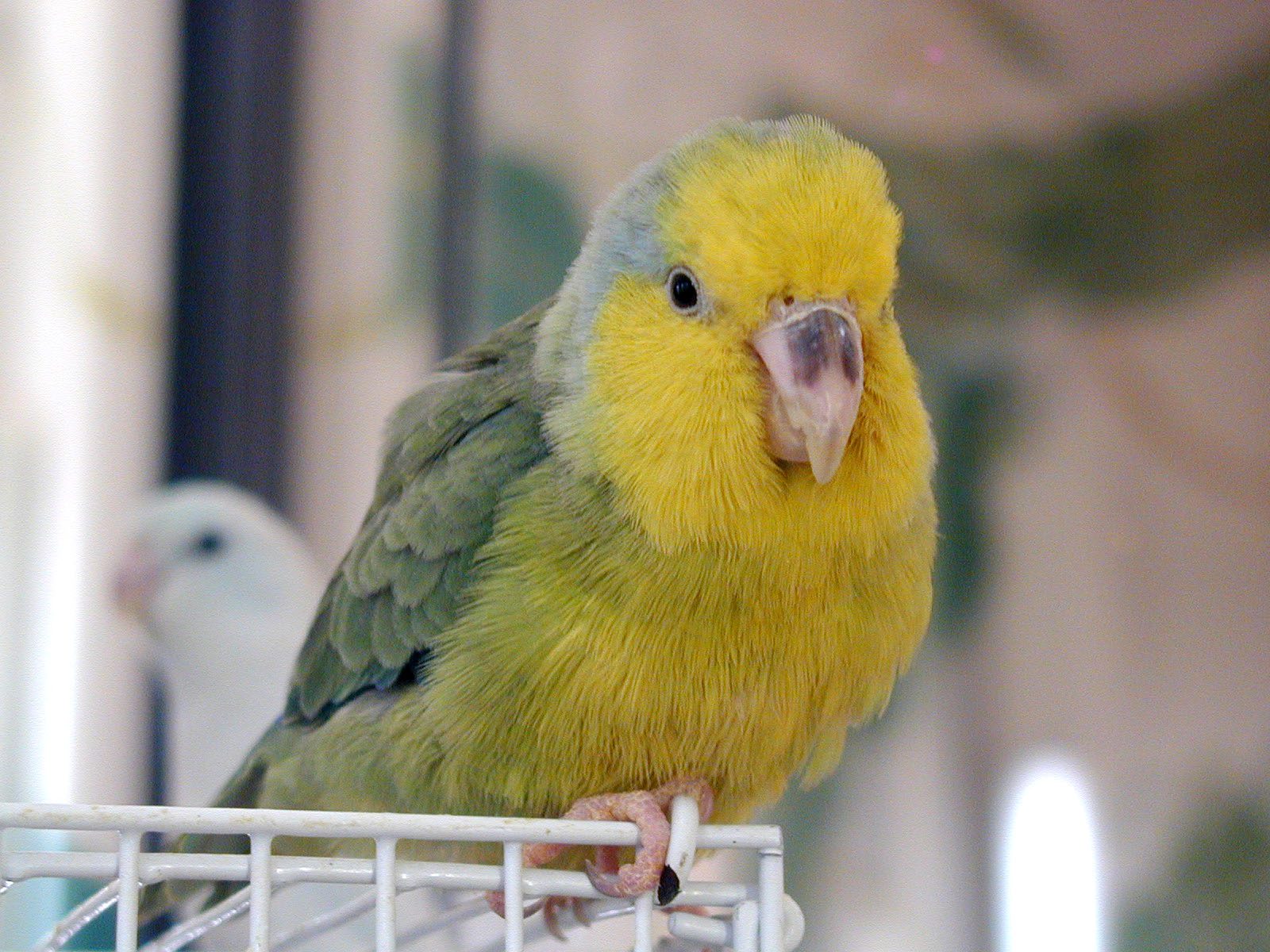
Yellow-faced Parrotlet
Forpus xanthops

Content

Description:


Anatomy-parrots

14 cm.. height. Plump appearance and short tail terminated tip. Distinguishable by the Crown, face, Yellow chest and belly, with strong wing blue patch, Flying Blue occupies almost half of the wing. Dorsally gray cafesoso, with the blue rump. The female has the blue patch on the rump and wings paler and smaller.

Sound of the Yellow-faced Parrotlet.

Habitat:

Video – "Yellow-faced Parrotlet" (Forpus xanthops)

Forpus xanthops - Yellow-faced Parrotlet - Yellow Faced Parakeet.

The Yellow-faced Parrotlet He lives in varied habitats, usually arid, forest riparian in the tropical and subtropical area, between 1000 to 1600 m, Although it has been reported to 2745 m. It is gregarious. Their diet includes cactus, In addition to fruit trees and other things. They nest in communal area, using tree hollows or sand. The breeding season is from March to April..

Distribution:

They are found in northwestern Peru., in the upper valley of the Maraรฑรณn river, from the east of La Libertad to the southeast of Cajamarca and the south of Amazonas.

Conservation:

State of conservation โ“˜


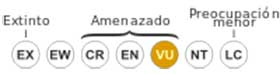
Vulnerable Vulnerable โ“˜ (UICN)โ“˜

According to the IUCN categories it is considered as Vulnerable (VU). Habitat degradation and trade are adversely affecting the population.

The ban on the capture and trade has improved the status of this species. The rate of decline was very rapid in the Decade of 1980, Although at present has been reduced and even stabilized. But, the population is still very small, with records in very few places, and as a result, according to the IUCN categories, qualified as vulnerable.

"Yellow-faced Parrotlet" in captivity

Captured for the trade of wild birds, It is estimated that 17.000 birds were captured between 1981 and 1994. The rate of mortality during capture is estimated between the 40% and the 100%. Rare and unknown in captivity until 1979-1980.

Images "Yellow-faced Parrotlet"

Alternative names:

1. Yellow-faced parrotlet (English).
2. Toui ร  tรชte jaune, Perruche-moineau ร  tรชte jaune (French).
3. Gelbmasken-Sperlingspapagei, Gelbmaskenpapagei (German).
4. Tuim-de-cabeรงa-amarela, Tuim, Periquito-de-cabeรงa-amarela (Portuguese).
5. "Catita enana de cara amarilla", Cotorrita carigualda, Periquito de Cara Amarilla (espaรฑol).


Species of the genus Forpus

Sources: Parrot Book, Parrots and macaws Neotropical
Photo: Wilkipedia