โ–ท The world of Pets: Dogs, cats, birds, reptiles, amphibians

Sulphur-winged Parakeet
Pyrrhura hoffmanni

Sulphur-winged Parakeet

Content

Description:

23 cms. length and 84 g. of weight.
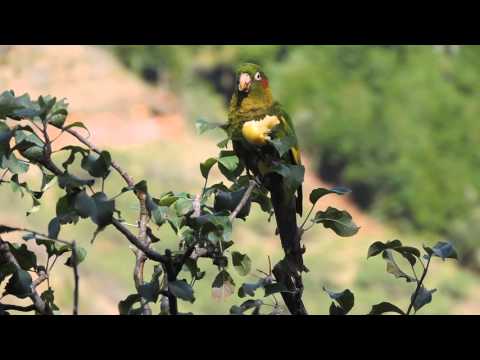
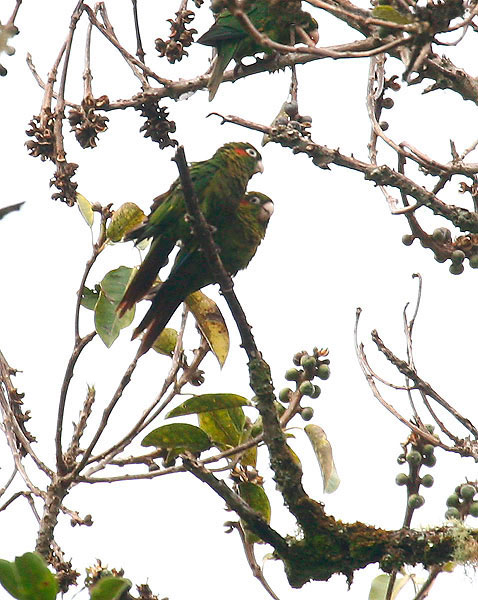
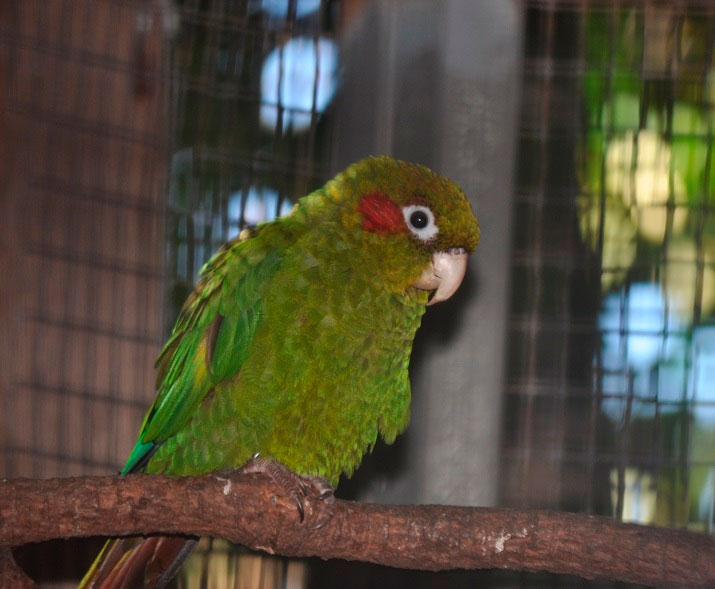
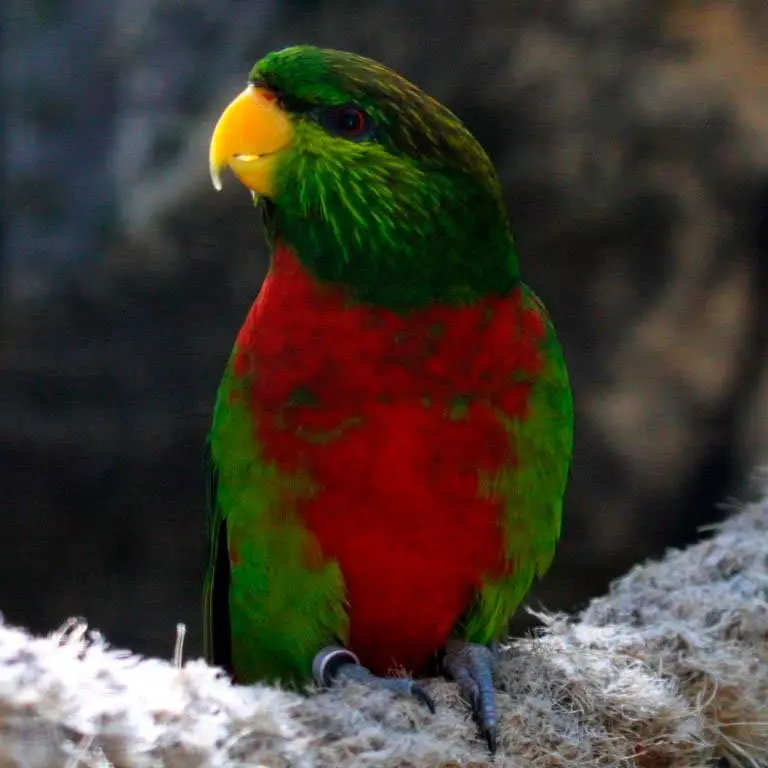
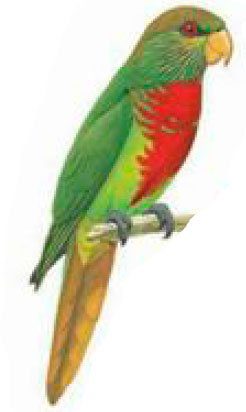
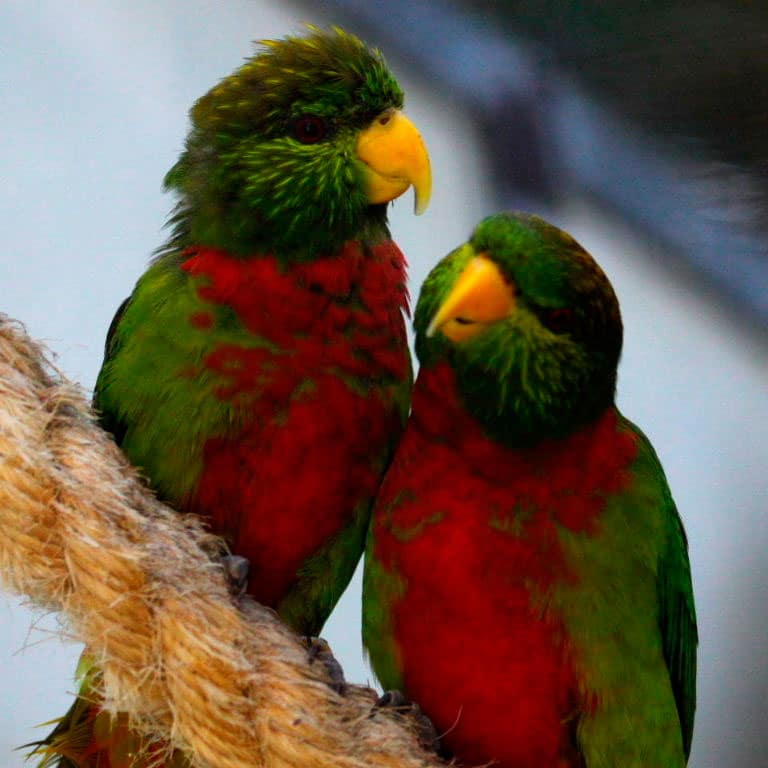
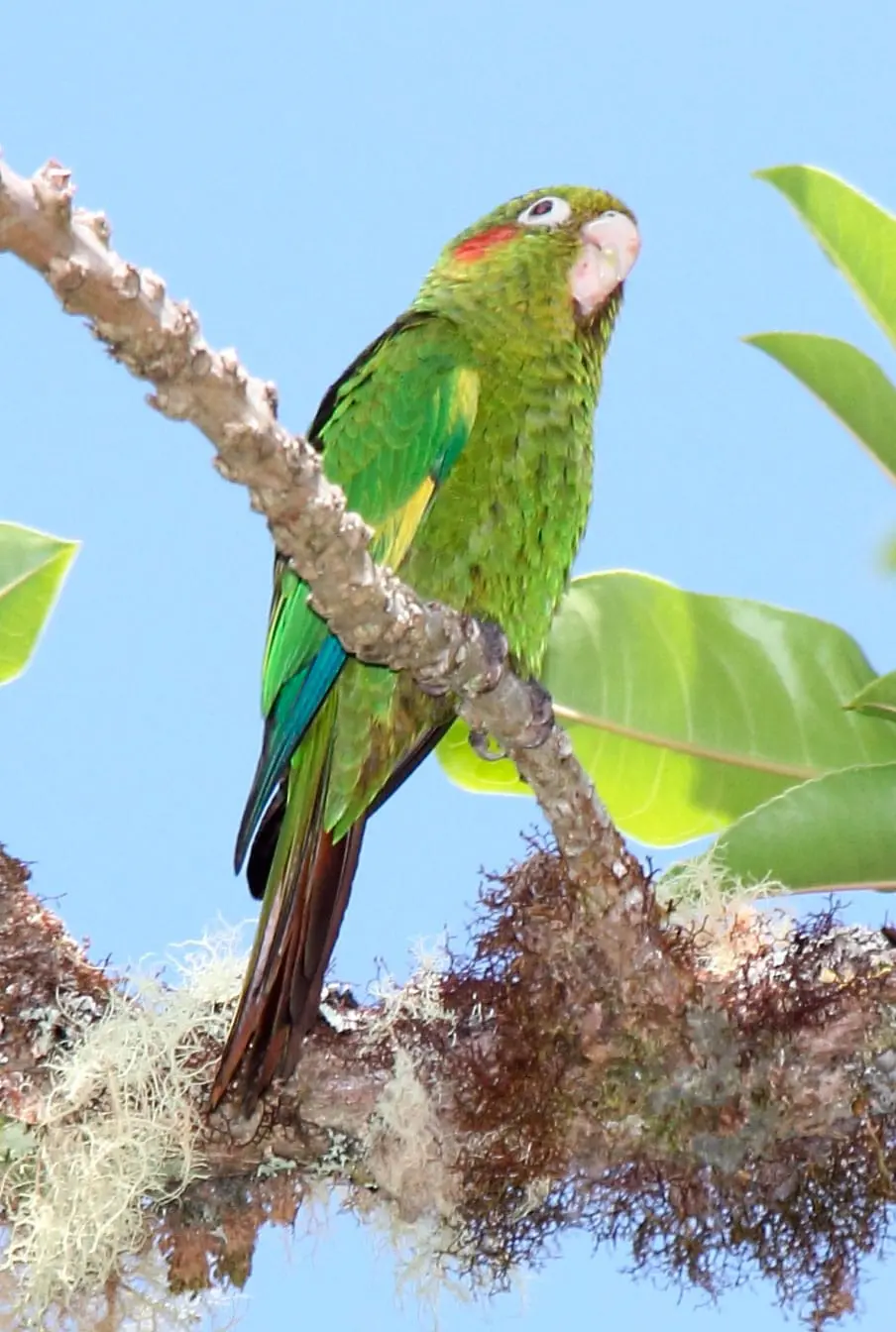
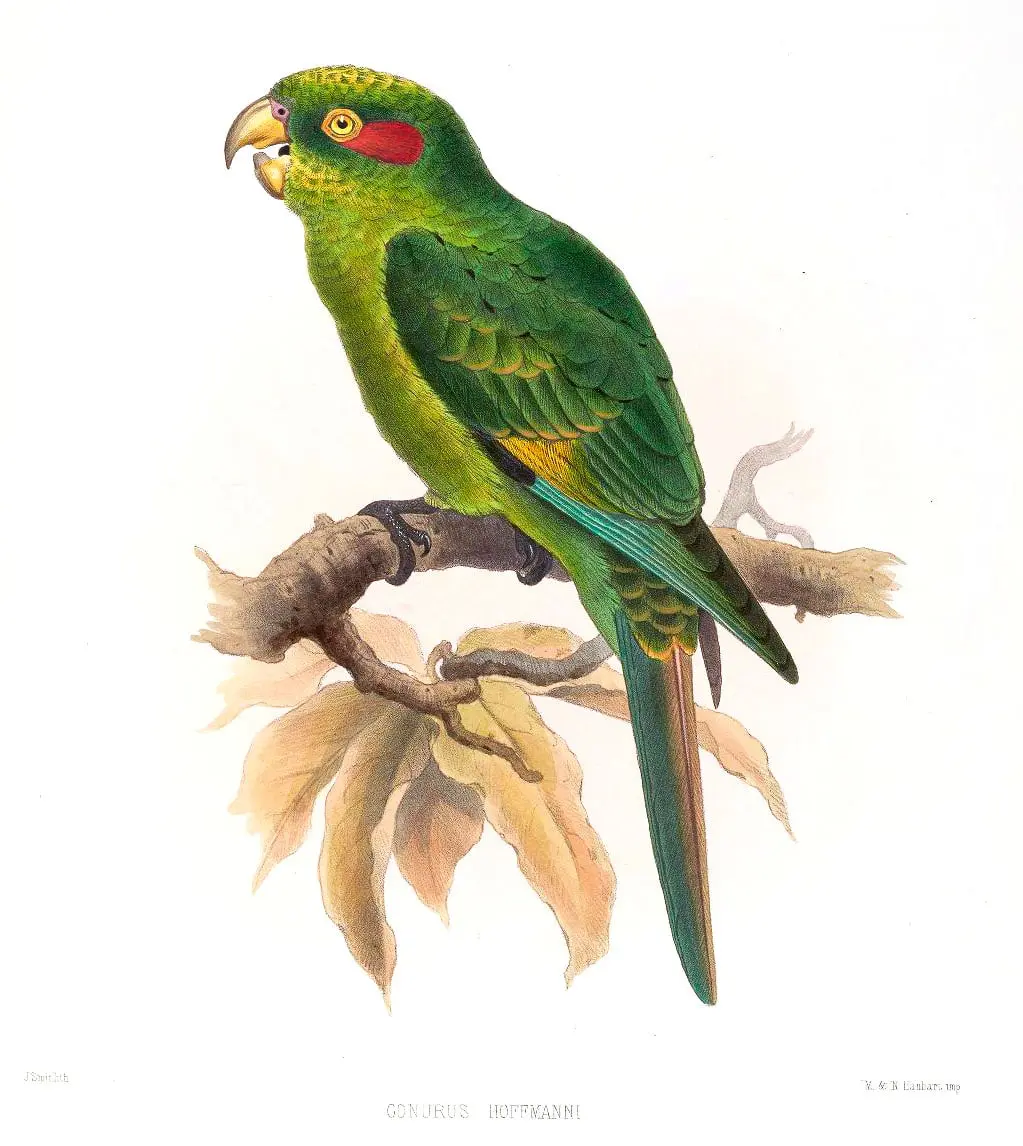
The Sulphur-winged Parakeet (Pyrrhura hoffmanni) It, mostly, green with some individual variations in plumage.

It has a distinctive tail long and round about ear-coverts crimson red. Yellow at the top of the wings, largely hidden when the bird is at rest, but perfectly visible in flight.

The feathers of the forecrown, crown, cheeks and nape, They are green with yellow centers (the proportion of the yellow color is higher in the forecrown, lower in the back of the crown). Above predominantly green, It is the leading edges of the wings, sometimes, yellow. The lesser coverts and median are, generally, green, sometimes with some yellow in outer median coverts and feathers alula.

Yellow at the base of the outerweb of the greater coverts. Outerwebs of primaries, to a great extent, blue; primaries and secondaries with bright yellow patch, especially on the basis of innerwebs; flight feather with black tips. Under, the wings with the lesser coverts green, the majors, greenish yellow; a central portion flight feather yellowed with greyish tips.
Sulphur-winged Parakeet

Chin reddish; throat, sides neck and the top chest, green with yellow tips on feathers, which gives an overall light effect Scaled. The belly, the flanks and undertail-coverts, are green. Upper, the tail is green, below, reddish.

The bill and cere They are pink colored horn; bare periophthalmic white or yellowish white; the irises brown; legs pale grey.

Both sexes are similar, but the male player has yellow stripes on pens crown.
The Immature It has less yellow in head, the chest and wings.

  • Sound of the Sulphur-winged Parakeet.

Subspecies description:

  • Pyrrhura hoffmanni gaudens

    (Bangs, 1906) – Very similar to nominal, although feathers crown and nape They have yellower, with their ends red or red and orange (in some birds, red ends of the feathers may extend over the back, the throat and the chest). Underparts slightly darker.


  • Pyrrhura hoffmanni hoffmanni

    (Cabanis, 1861) – Nominal.

Habitat:

Video – "Sulphur-winged Parakeet" (Pyrrhura hoffmanni)

Sulphur-winged Parakeet (Pyrrhura hoffmanni)

Observed, mainly, in mountainous areas, preferring montane forests in the subtropical zone, mainly 1.000 to 2.400 meters above sea level, although views 550 meters in the region Admiral's Bay, Panama and a 3.000 metres in Costa Rica.

They appear to tolerate a considerable disturbance of habitat, including managed forests, areas and the second growth partially cleared, forests and wooded pasture shrubs. Usually seen in pairs or small flocks of 5-15 birds. You can perform altitudinal movements daily to feed, returning to the mountains to rest. Forage occurs in the canopy or smaller trees and bushes near the edge of the woods.

Reproduction:

They nest in tree hollows, including old nests woodpeckers, to 8-20 meters of land. With reproduce dry season (January June). Clutch six eggs in captivity.

Food:

Its diet includes fruit of Ficus, Croton, Leandra, Myrtus and Miconia.

Distribution and status:

Extending its range (players / residents): 18.400 km2

Confined south of Costa Rica and western Panama.

The species is found in the highlands of the southern half of Costa Rica, including the slopes of Caribbean, the mountains of the central plateau south and the two sides of the Cordillera de Talamanca, sometimes the region Cartago and Paradise and the Irazu volcano.

In western Panama They are mainly distributed in the west and center chiriqui and areas adjacent in Bull's mouths, in the highest mountains (including the chiriqui volcano and the high ridges on Boquette) and at lower elevations around, for example, of the Chirรญqui Lagoon and Admiral Bay.

The easternmost Panamanian registry was found east of the central mountain range in 1868.

Some altitudinal movements (higher in the dry season). Birds are perhaps only sporadic in the extremities of their range. Apparently, It is common in the middle to high elevations of the Cordillera de Talamanca and in isolated areas, and it is believed to be quite numerous throughout the main range.

Its habitat It is now highly fragmented, though still apparently numerous, even in areas where the forest is partly cloudy. Rare in captivity.

Subspecies distribution:

  • Pyrrhura hoffmanni gaudens

    (Bangs, 1906) – West of Panama and Caribbean slope of Bull's mouths.


  • Pyrrhura hoffmanni hoffmanni

    (Cabanis, 1861) – Nominal. South of Costa Rica.

Conservation:

State of conservation โ“˜


minor concern Minor Concern โ“˜ (UICN)โ“˜

โ€ข Current category of the Red List of the UICN: Least concern.

โ€ข Population trend: Stable.

โ€ข Population size : Unknown.

Rationale for the Red List category

Although this species may have a small range, it is not believed that approximates the thresholds for Vulnerable under the criteria of size range (Extension <20,000 km2 combinada con un tamaรฑo de rango decreciente o fluctuante, extensiรณn / calidad del hรกbitat o tamaรฑo de la poblaciรณn y un pequeรฑo nรบmero de lugares o fragmentaciรณn severa). La trend of the population It appears to be stable, so that the species does not approach the thresholds for Vulnerable under the criteria of population trend (> 30% decline over ten years or three generations). The population size It has not been quantified, but it is not believed to be close to the thresholds for Vulnerable under the criterion of population size (<10.000 individuos maduros con un declive continuo estimado> 10% in ten years or three generations or a population structure). For these reasons, the species is evaluated as Least Concern.

Justification of the population

The size of the world's population has not been quantified, but this species is described as ยซquite commonยป (Stotz et to the., 1996).

Justification of trend

They suspected that the population of Catana Cotorra is stable in absence of evidence of any decline or threatens substantial.

"Sulphur-winged Parakeet" in captivity:

Rare in captivity. Quieter than other parakeets. In Panama the export of these birds is prohibited from 1980.

Alternative names:

– Hoffmann’s Conure, Hoffmann’s Parakeet, Hoffman’s Conure, Hofman’s Conure, Sulfur-winged Parakeet, Sulphur winged Parakeet, Sulphur-winged Conure, Sulphur-winged Parakeet (English).
– Conure de Hoffmann, Perriche de Hoffmann, Perruche de Hoffmann (French).
– Hoffmann Sittich, Hoffmannsittich, Hoffmann-Sittich (German).
– Tiriba-de-asa-amarelada (Portuguese).
– Cotorra Catana, Perico aliazufrado, Perico de Hofman (espaรฑol).
– Perico aliazufrado (Costa Rica).


scientific classification:
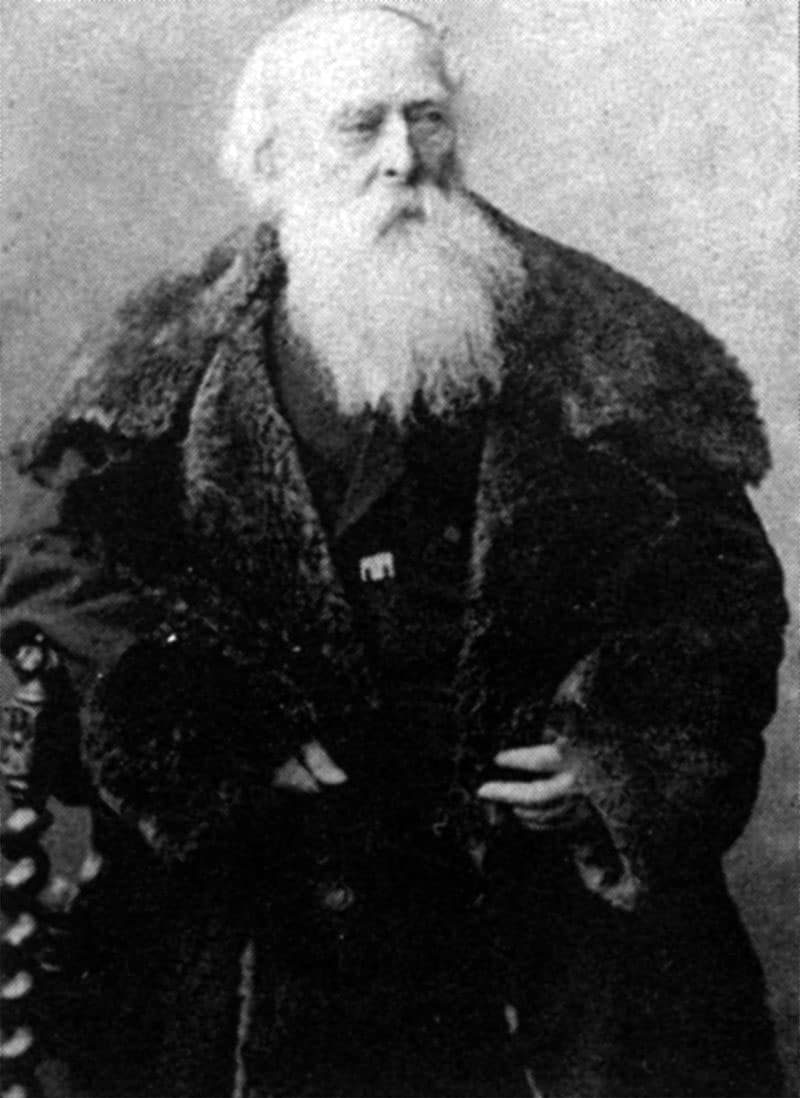
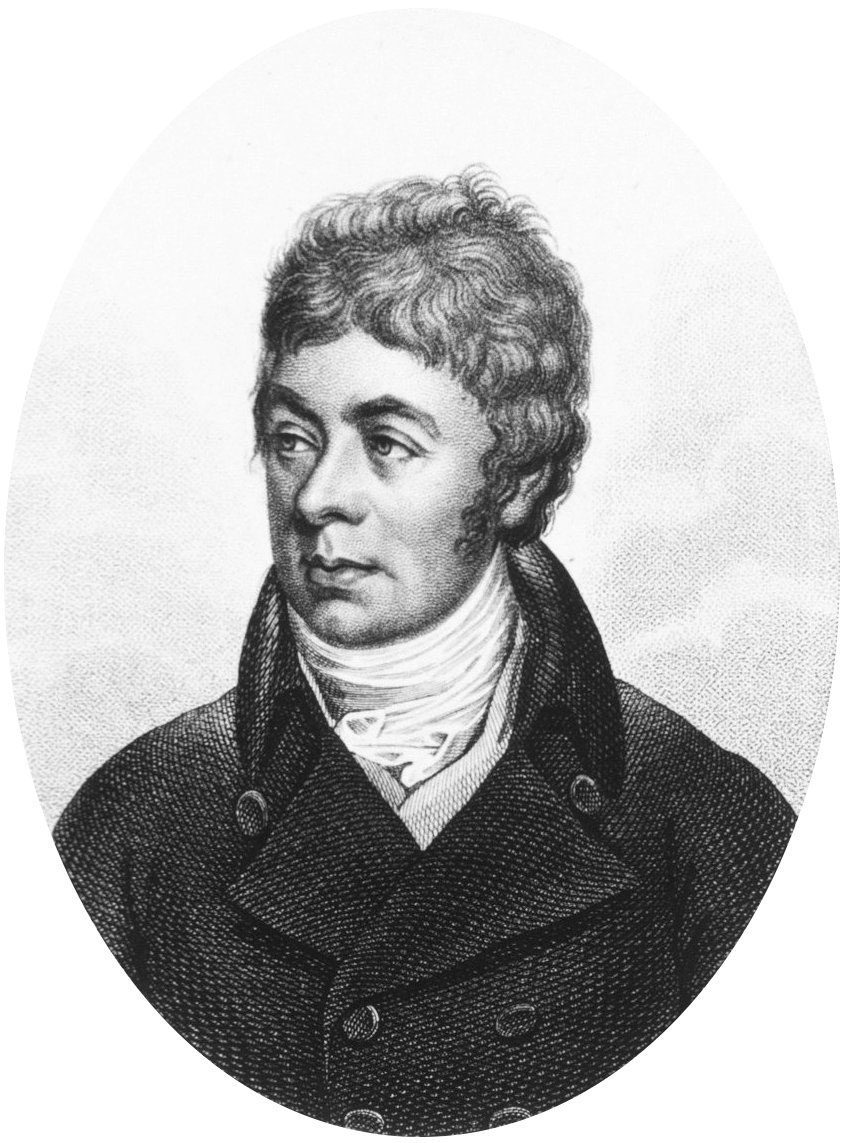
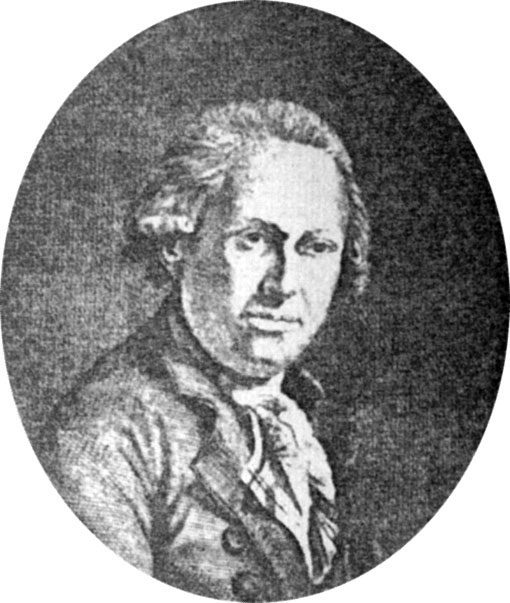
Jean Louis Cabanis
Jean Louis Cabanis

Its name refers to the German naturalist Karl Hoffman.

– Order: Psittaciformes
– Family: Psittacidae
– Genus: Pyrrhura
– Scientific name: Pyrrhura hoffmanni
– Citation: (Cabanis, 1861)
– Protonimo: Conurus hoffmanni

Sulphur-winged Parakeet Images:


Especies del gรฉnero Pyrrhura

Sources:

– Avibase
– Parrots of the World โ€“ Forshaw Joseph M
– Parrots A Guide to the Parrots of the World – Tony Juniper & Mike Parr
– Birdlife

– Photos:

(1) – Sulphur-winged Parakeet (Pyrrhura hoffmanni). Photographed at Savegre, in Costa Rica By Dominic Sherony [CC BY-SA 2.0], via Wikimedia Commons
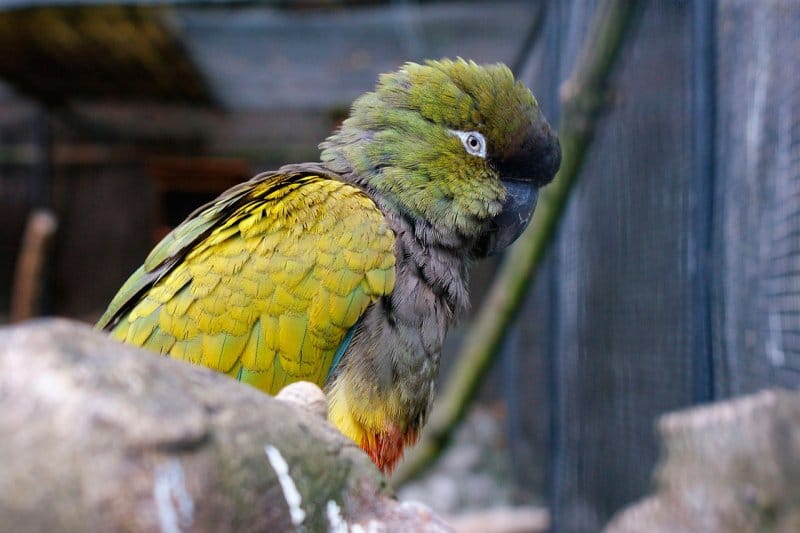
(2) – Parakeet HOFFMAN (Pyrrhura hoffmanni) Loro Parque, Tenerife by ZOOTOGRAFIANDO
(3) – A Sulphur-winged Parakeet at Savegre, Costa Rica By Dominic Sherony [CC BY-SA 2.0], via Wikimedia Commons
(4) – Sulphur-winged Parakeet (Pyrrhura hoffmanni) at Savegre Lodge, near San Gerardo, Costa Rica By Michael Woodruff [CC BY-SA 2.0], via Wikimedia Commons
(5) – Sulphur-winged Parakeet or Hoffmannโ€™s Conure (Pyrrhura hoffmanni) by elite-pets
(6) – Conurus hoffmanni = Pyrrhura hoffmanni by Joseph Smit [Public domain], via Wikimedia Commons

– Sounds: Mike Nelson, XC107214. accessible www.xeno-canto.org/107214

โ–ท The world of Pets: Dogs, cats, birds, reptiles, amphibians

Yellow-tailed black cockatoo
Calyptorhynchus funereus

Yellow-tailed black cockatoo

Content

Description

55 to 65 cm.. length and a weight of up to 900 g..
The Yellow-tailed black cockatoo (Calyptorhynchus funereus) stands out clearly by its plumage mostly black, patch yellow in cheek and yellow panels in tail.

The body feathers They are lined with yellow giving it a scalloped appearance. It has a crest short and moving on top of her head.
The female It has a yellow stain on the cheek more defined and larger than the male, Bello to singr pale gray (Pink in males)
The juveniles has plumage duller overall.
The bill top of immature male black obscures two years old, While the lower peak black four years.

Description 3 subspecies

  • Calyptorhynchus funereus funereus

    (Shaw, 1794) – Nominal. Larger and tail longer dark mottled.


  • Calyptorhynchus funereus whiteae

    (Mathews, 1912)


  • Calyptorhynchus funereus xanthanotus

    (Gould, 1838) – Smaller size, tail shorter dark mottled.

Habitat:

Variety of types habitats, including forests of eucalyptus, heaths, subalpine areas, pine plantations and occasionally in urban areas.
They are often seen flying in pairs or trios formed by a pair and their young., although outside the breeding season they can join in more numerous flocks.

Reproduction:

have a long breeding season, that varies throughout its range, although Tasmania in general it is from October to February. Both sexes construct the nest in holes of mature trees, high, generally eucalyptus. Fill the hole of wood chips. The same tree can be used for many years.

One or two eggs form a clutch. Only the female incubates the eggs, While the male supplies the food. Both parents help rear the chicks, Although usually only one chick survives. The chicks leave the nest about three months after hatching and remain in the company of their parents until the next breeding season.

Food:

Seeds native trees, terrestrial plants and pine cones. Some insects also part of their diet. Unlike other cockatoos, a significant proportion of the diet up wood borers worms. The bird put his ear against the surface of dead trees to hear the sound of worms. If a worm is detected, the bird will use their powerful beaks to pull pieces of the tree until you get to the meal, often leaving a pile of wood chips at the base of the tree. These scars on dead trees are a common sight in the forests of Tasmania.

Distribution:

Size of its range (breeding/resident ): 2.700.000 km2

It is up to the 2000 meters throughout Southeast Australia, from South Eyre Peninsula to the east-central Queensland.
Your number is declining in parts of its range due to habitat fragmentation and loss of large trees used for breeding.
In Tasmania is common and nomadic. They can be seen in many parts of the state and in the larger islands Bass Strait.

Distribution 3 subspecies

Conservation:

State of conservation โ“˜


minor concern Minor Concern โ“˜ (UICN)โ“˜

โ€ข Current category of the Red List of the UICN: Least concern.

โ€ข Population trend: Stable.

This species has a very large range, and therefore not approaching the threshold of vulnerable. Not threatened worldwide. CITES II. As with most other cockatoos, its long-term existence depends on the continued availability of hollow trees for nesting,

The population is estimated at at least 25.000 birds.

The population trend appears to be stable.

"Yellow-tailed black cockatoo" in captivity:

In the poultry industry this species is extremely rare and expensive. In Australia It has attained breed in captivity.
Like all cockatoos, they come to live over 40 years.

Alternative names:

– Yellow-tailed Black-Cockatoo, Black Cockatoo, Common Black-Cockatoo, Funeral Cockatoo (English).
– Cacatoรจs funรจbre, Cacatoรจs noir ร  queue jaune (French).
– Gelbohrkakadu, Gelbschwanz-RuรŸkakadu, RuรŸkakadu (German).
– Cacatua-negra-de-cauda-amarela (Portuguese).
– Cacatรบa Fรบnebre Coliamarilla, Cacatรบa Fรบnebre de Cola Amarilla (espaรฑol).

George Shaw
George Shaw

scientific classification:


– Order: Psittaciformes
– Family: Cacatuidae
– Genus: Calyptorhynchus
– Scientific name: Calyptorhynchus funereus
– Citation: (Shaw, 1794)
– Protonimo: Psittacus funereus


Images Cockatoo Fรบnebre Coliamarilla:


Sources:

– www.parks.tas.gov.au
– avibase
– Birdlife

– Photos: David Cook

– Sounds: Nigel Jackett

โ–ท The world of Pets: Dogs, cats, birds, reptiles, amphibians

Yellow-billed Lorikeet
Neopsittacus musschenbroekii

Yellow-billed Lorikeet

Content

Yellow-billed Lorikeet

Description

23 cm.. length and a weight between 43 and 55 g..

The head of the Yellow-billed Lorikeet (Neopsittacus musschenbroekii) is green, strongly impregnated with olive brown, veined in ear-coverts and showing a shaft of yellow stripes on the crown; darker line in the lores, above the bill; forecrown green.

Upperparts green intermediate. The wings green above with vane blackish internal to the coverts and black on the tips of the flight feather. Rojas the Underwing coverts. Flight feathers blackish with wide red central band. Throat greenish yellow yielding to red chest to the top of the the thighs. Flanks yellowish green to the sides of chest, with a central area in the bottom area chest and belly, red; coverts more yellowish than the rest of the underparts.

Cover top of queue, green, yellow tips, Brown shafts with red bases on the side of the feathers; undertail yellow-orange, showing red bases in lateral feathers when they deployed.

Bill pale yellow; irises red; gray of the legs.

Sexes alike.

Immature duller than adults with brands head less clear and red on the underparts restricted to spots in the center of belly and in the chest. Bill brownish-orange, irises yellow brown or orange. Young birds also show feathers tail pointy, which they are rounded as adults.

Description 2 subspecies

  • Neopsittacus musschenbroekii musschmbrorkii

    (Schlegel, 1871) – The nominal.


  • Neopsittacus musschenbroekii mayor

    (Neumann, 1924) – Slightly larger than the nominal and paler in upperparts.

Habitat:

It inhabits in montane forests, edges of forests, partially cleared areas of secondary growth, mainly between 1.400 and 2.500 m, even if you are also registered at altitudes as low as 1.100 meters and as high as 3,000 m. It is also common in altered areas or in groves of Casuarina or eucalyptus in garden areas.

It seems that they have adapted well to the impacts of the man. But it is absent from the places where the forest has been removed completely over large areas.

Visible and noisy, they are in pairs, small flocks and in larger congregations of up to 50 birds in flowering trees. Over most of New Guinea, This species is replaced at higher altitudes by the smaller Orange-billed Lorikeet, commonly found in the company with the latter in the upper band of its altitudinal range (except Vogelkop).

Most frequently found in flowering trees, often in the company of other species such as the Papuan Lorikeet, also in the fructification of the Schefflera and feeding is sometimes lower levels even on the weeds at ground level.

Reproduction:

Observed to be moving like a rodent along branches. The laying It is two eggs in a hole in the trunk of a tree. Period unknown but an immature nesting was observed in the Province of West Papua in late August and a fledgling in the same area in the middle of November.

Food:

Feeds of pollen, nectar, small fruits and berries. It is also thought that feed on seeds as part regular your diet, while the Orange-billed Lorikeet is limited to nectar only. As other parrots can eat insects and their larvae, deliberately or accidentally.

Distribution:

Size of its range (reproduction / resident): 587.000 km2

New Guinea in Irian Java (Indonesian) and Papua New Guineto. Is distributed from East of Vogelkop up to the Huon Peninsula and scattered areas in the Southeast. In Vogelkop, Despite the absence of the Orange-billed Lorikeet, the population of the Yellow-billed Lorikeet is relatively low. A small amount in captivity.

Distribution 2 subspecies

  • Neopsittacus musschenbroekii musschmbrorkii

    (Schlegel, 1871) – The nominal.


  • Neopsittacus musschenbroekii mayor

    (Neumann, 1924) – Live from the East of the region of Sepik to the Huon Peninsula and areas southeast.

Conservation:


minor concern


โ€ข Current IUCN Red List category: Least concern.

โ€ข Population trend: Growing.

The world population It has not been quantified, Although it is probably superior to the 300.000 specimens.

The species according to information is usually common.

The population is suspected can be increased. As the degradation of the habitat is permanent, new suitable habitat areas are being created.

"Yellow-billed Lorikeet" in captivity:

Rare in aviculture.

More distant other parrots. Average noise level. Shy.

Alternative names:

– Yellow-billed Lorikeet, Musschenbroek’s Lorikeet, Yellow billed Lorikeet, Yellow-billed Mountain Lory (ingles).
– Lori de Musschenbroek (French).
– Gelbschnabel-Berglori, Gelbschnabelberglori (German).
– Lori Montano Grande, Lori Moteado Grande (espaรฑol).

Hermann Schlegel

scientific classification:

– Order: Psittaciformes
– Family: Psittaculidae
– Scientific name: Neopsittacus musschenbroekii
– Genus: Neopsittacus
– Citation: (Schlegel, 1871)
– Protonimo: Nanodes Musschenbroekii


โ€œLori Montano Grandeโ€ images:

Video

————————————————————————————————

ยซLori Montano Grandeยป (Neopsittacus musschenbroekii)


Sources:

– Avibase
– Parrots of the World โ€“ Forshaw Joseph M
– Parrots A Guide to the Parrots of the World – Tony Juniper & Mike Parr
– Birdlife

– Photos:

(1) – Animal Photos – link
(2) – ยซNeopsittacus musschenbroekii-two captive-8aยป by TJ Lin – originally posted to Flickr as Dscn8852. Licensed under CC BY-SA 2.0 via Wikimedia Commons.
(3) – papageien.org – link
(4) – Animal Photos – link
(5) – neopsittacus musschenbroekii, male By iggino – lynx
(6) – Illustration

– Sounds: Frank Lambert (Xeno-canto)

โ–ท The world of Pets: Dogs, cats, birds, reptiles, amphibians

Scarlet-chested Parrot
Neophema splendida

Scarlet-chested Parrot

Content


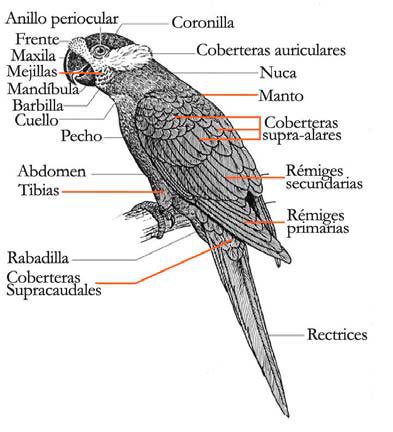
Anatomy-parrots

Description

19 cm. length and a weight between 36 and 44 g..

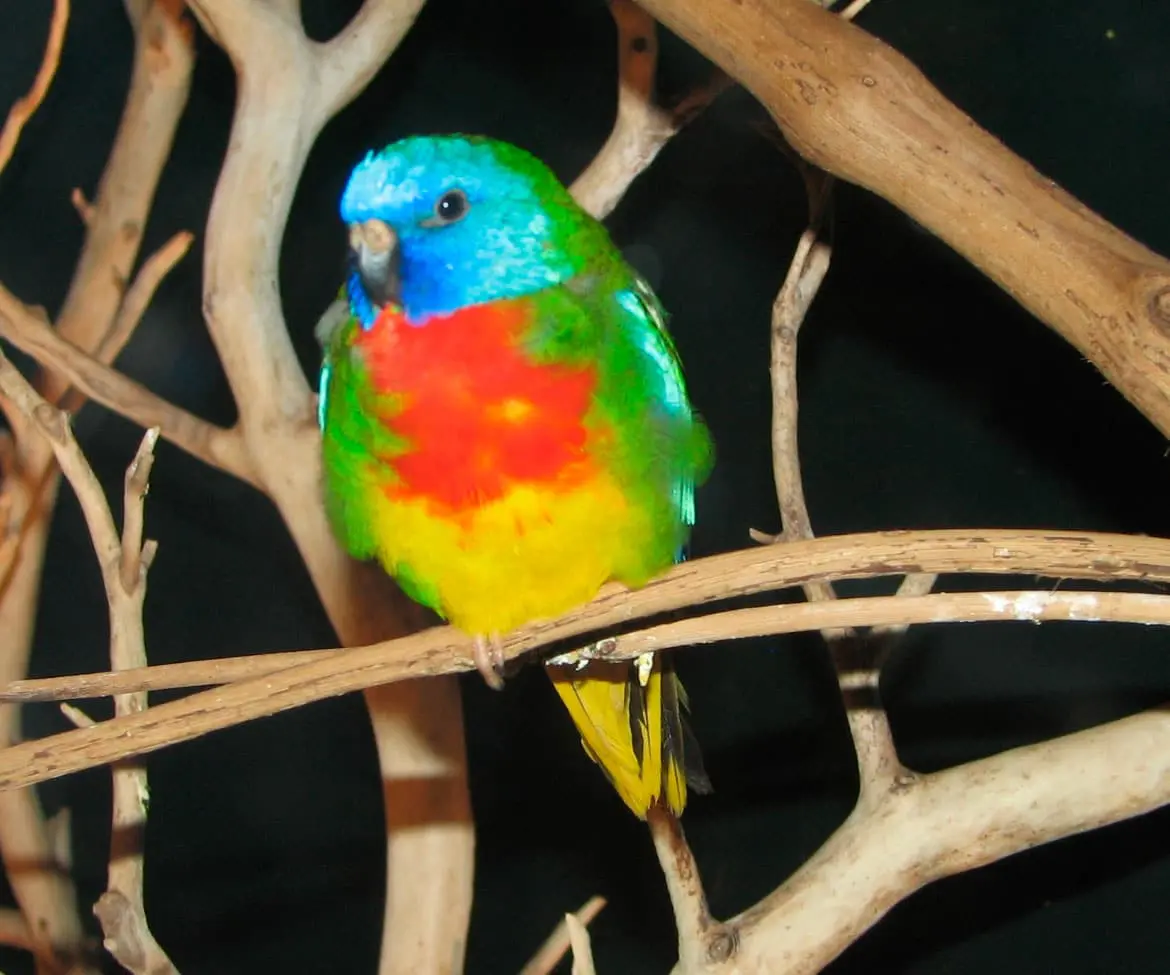
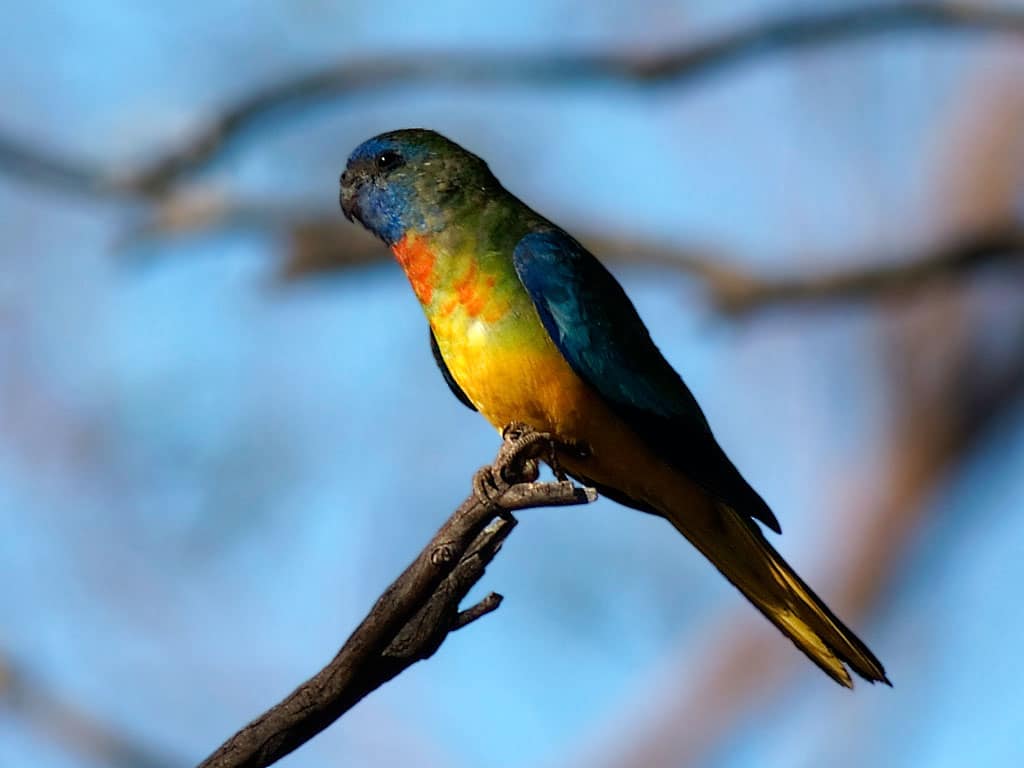
The Scarlet-chested Parrot (Neophema splendida) It is particularly colorful. It has the "face" and the forecrown are bright turquoise blue, darker in the throat and chin.

The upperparts are green. The curvature of the wings is dark blue, wing-coverts are the same blue tone to the face. Primary coverts dark blue-violet. The primaries Black has light blue brainwashed in the foreign bands. The outer edge of the secondaries has a tone blue-green that is mixed with the green of them vane inner and tertiary.

The underparts is dark blue. The chest is bright Scarlet, which is an important recognition feature. The sides of the top of the chest and flanks are green. The rest of the underparts is bright yellow. The bottom of the tail is green, but the tips of the outer tail feathers they are dyed yellow.

The bill is black, irises dark brown. The legs are gray-Brown.

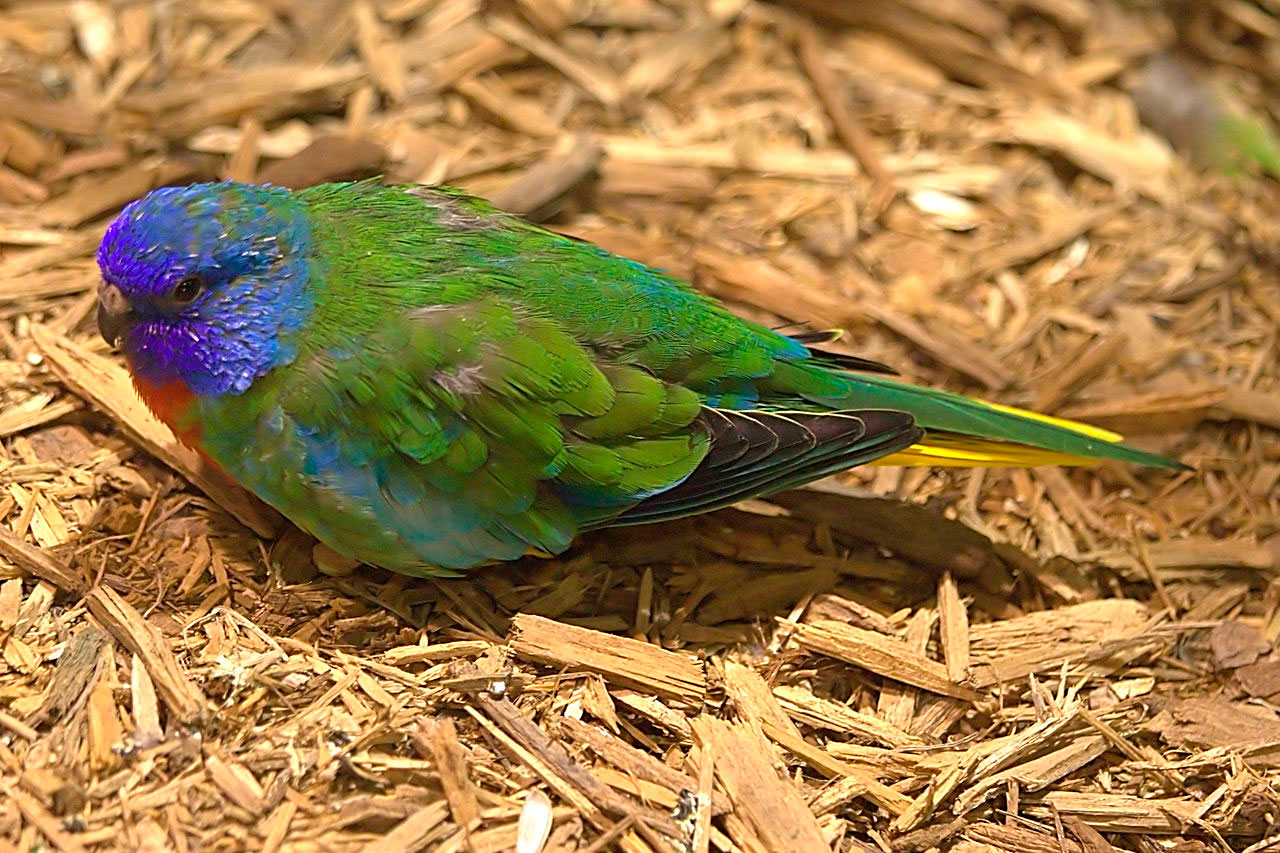
The female is duller than its companion, with the belly and the chest green. The blue color of the face is restricted.

The females and juveniles they often show Wing bars.

The young male need four months to purchase your mature plumage, and retain a youthful glow until the age of 2 years.

Habitat:

The Scarlet-chested Parrot they are usually distributed in arid scrublands that are composed mainly of acacias and eucalyptus. They appreciate, particularly, plants of Mallee (Eucalyptus gracilis) and Mulga (Acacia aneura).

Also live in wooded areas dominated by casuarinas, as well as areas where the soil is covered by Spinifex or large clumps of grass type Triodia.

The Scarlet-chested Parrot do not despise the crests of hills that are equipped with a large number of plants, like the covered Plains of Sea sandwort or Salt grass (Honckenya peploides), What are plants which grow in saline environments.

They tend to find their food on Earth and form relatively consistent flocks outside of the nesting season.

During the breeding season, These birds are not very gregarious, but couples establish their nests in trees not very far from the other.

As with the Turquoise Parrot, the division of labor is well established and the females are responsible for the collection of green leaves that adorn the interior of the nest.

There is no description of the various courtship.

Reproduction:

The season of nesting of the Scarlet-chested Parrot, usually, is carried out between January and August, but these dates can change as the reproduction is influenced, significantly, by climatic conditions, especially the rains.

The nest It is placed in a tree cavity, above all a eucalyptus, between 2,5 and 8 meters above the ground.

The Scarlet-chested Parrot they are very loose colonies.

The spawning includes of 3 to 5 eggs and your incubation lasts a few 18 days. The most numerous litters, sometimes, provide 6 eggs.

The chicks are altricial, they take flight to leave his place of birth 30 days after hatching.

Food:

The Scarlet-chested Parrot they have a diet almost exclusively granivore.

These birds acquire most of the moisture you need eating Succulents as Calandrinia. If this practice is not enough, These parrots are like other species of arid lands, that is to say, that they are going to supply themselves with liquid directly to the sources and water points.

Menu details are poorly known, but it is known that most feed on seeds of plants such as Triodia, Newcastelia, haloragis, Acacia and Stipa.

Distribution:

Size of the area of distribution (reproduction / resident): 1.280.000 km2

This rare Nomad has a wide area of historical distribution, but it is probable that now concentrate on parts with more vegetation of the Great Victoria desert, with records from Kalgoorlie, Western Australia, the East, through the North of the Nullarbor plain in Southern Australia, North of the Eyre Peninsula, about Port Augusta and in areas of Mallee to the North of the murray river, to the Northwest of Victoria, West of New South Wales, Southwest of Queensland and MacDonnell Ranges of the Northern Territory.

A flock of 240 bird was recently recorded in the Great Victoria desert.

Conservation:


minor concern


โ€ข Current category of the Red List of the UICN: Least concern

โ€ข Population Trend: Stable

The inroads among 1939 and 1996 They show that these birds are able to form very rapidly large gatherings.

Disturbances affecting the natural environment had a negative impact on the evolution of the active population. The use of aquatic resources for the livestock and competition in this field with the Bourke's Parrot they have also caused damage.

Poaching and marketing of this bird have also had devastating consequences: more than 25.000 Scarlet-chested Parrot they are in captivity in Australia.

Its population in freedom is estimated at around 10,000 specimens.

"Scarlet-chested Parrot" in captivity:

The Scarlet-chested Parrot is a species peaceful and silent. This beautiful parakeet ends up gaining confidence with your caregiver, It is only a matter of time. It is also easy to maintain and almost do not eat wood. It is resistant to cold (light Frost), but it is very sensitive to humidity, fog, and air currents.

The Scarlet-chested Parrot they feed on the ground; It is convenient to use of vermicides, deworming them regularly. They are also susceptible to ocular infections and vulnerable to infections of Candida.

The tastes for the bathroom vary from one individual to another.

In terms of their longevity, according to sources, a sample lived during 14 years in captivity. The same sources report that these parakeets can live up to 25,4 years in captivity, but this has not been verified; the same study also ensures that the Scarlet-chested Parrot You can play from around 1 year of age in captivity.

The mutations:

    โ€ข Aqua: autosomal recessive
    โ€ข Turquoise: autosomal recessive
    โ€ข Blue: autosomal recessive
    โ€ข Pastel: autosomal recessive (not in Europe)
    โ€ข Cinnamon: recessive sex-linked
    โ€ข Pale: recessive sex-linked
    โ€ข Mixed: autosomal dominant
    โ€ข Misty: autosomal co-dominant (PAS en Europe)
    โ€ข Gris: autosomal dominant
    โ€ข Mixed: autosomal recessive
    โ€ข Fallow (bronze fallow): autosomal recessive
    โ€ข INO: recessive sex-linked
    โ€ข Platinum: recessive sex-linked
    โ€ข Violet: co-dominante autosomique
    โ€ข Dark factor: co-autosomal dominant

Alternative names:

– Scarlet-chested Parrot, Scarlet chested Parrot, Scarlet-breasted Parrot, Scarlet-chested Parakeet, splendid parakeet (ingles).
– Perruche splendide, Euphรจme resplendissante, Perruche resplendissante (French).
– Glanzsittich (German).
– Periquito-esplรชndido (Portuguese).
– Papagayo Esplรฉndido, Periquito Esplรฉndido (espaรฑol).

scientific classification:

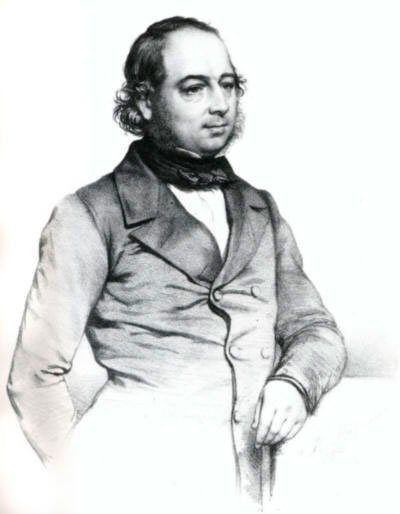
John Gould
John Gould

– Order: Psittaciformes
– Family: Psittaculidae
– Genus: Neophema
– Scientific name: Neophema splendida
– Citation: (Gould, 1841)
– Protonimo: E uphema splendida

ยซSplendid Parakeetยป Images:

Videos "Scarlet-chested Parrot"

————————————————————————————————

ยซSplendid Parakeetยป (Neophema splendida)


Sources:

– Avibase
– Parrots of the World โ€“ Forshaw Joseph M
– Parrots A Guide to the Parrots of the World – Tony Juniper & Mike Parr
– Birdlife

– Photos:

(1) – Adult male at Cincinnati zoo, USA By Ltshears (Own work) [Public domain], via Wikimedia Commons
(2) – Taken at the Cincinnati Zoo By Greg Hume (Own work) [CC BY-SA 3.0], via Wikimedia Commons
(3) – Immature male on the left and an immature female on the right at Gluepot Reserve, South Australia By David Cook Wildlife Photography from Wamboin, NSW, Australia [CC BY 2.0], via Wikimedia Commons
(4) – Immature male on the left and an immature female on the right at Gluepot Reserve, South Australia By David Cook Wildlife Photography from Wamboin, NSW, Australia [CC BY 2.0], via Wikimedia Commons
(5) – Scarlet-chested Parrot ยซNeophema splendidaยป at Cincinnati Zoo By Ltshears (Own work) [CC BY-SA 3.0], via Wikimedia Commons
(6) – By T.H. Maguire (1821โ€“1895) (http://www.birdresearch.dk/dk/jgould.htm) [Public domain], via Wikimedia Commons

โ–ท The world of Pets: Dogs, cats, birds, reptiles, amphibians

Red-and-green Macaw
Ara chloropterus


Guacamayo Aliverde

Content

Description:

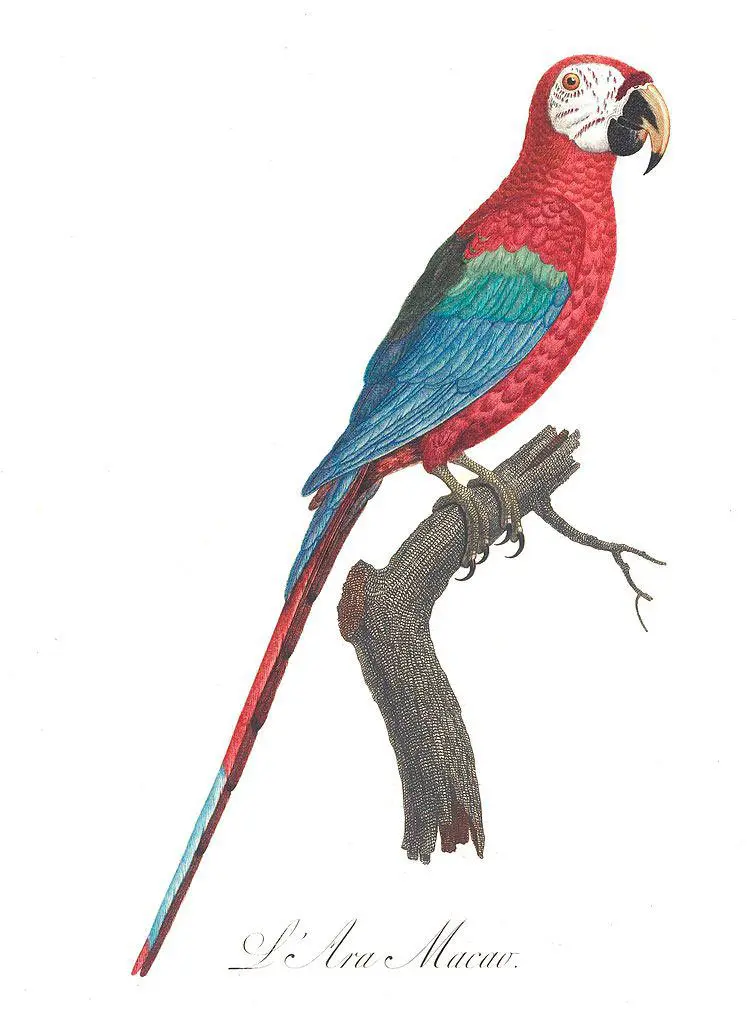
Winged Macaw, illustration
Among 90 and 95 cm.. length and a weight between 1050 and 1708 g..

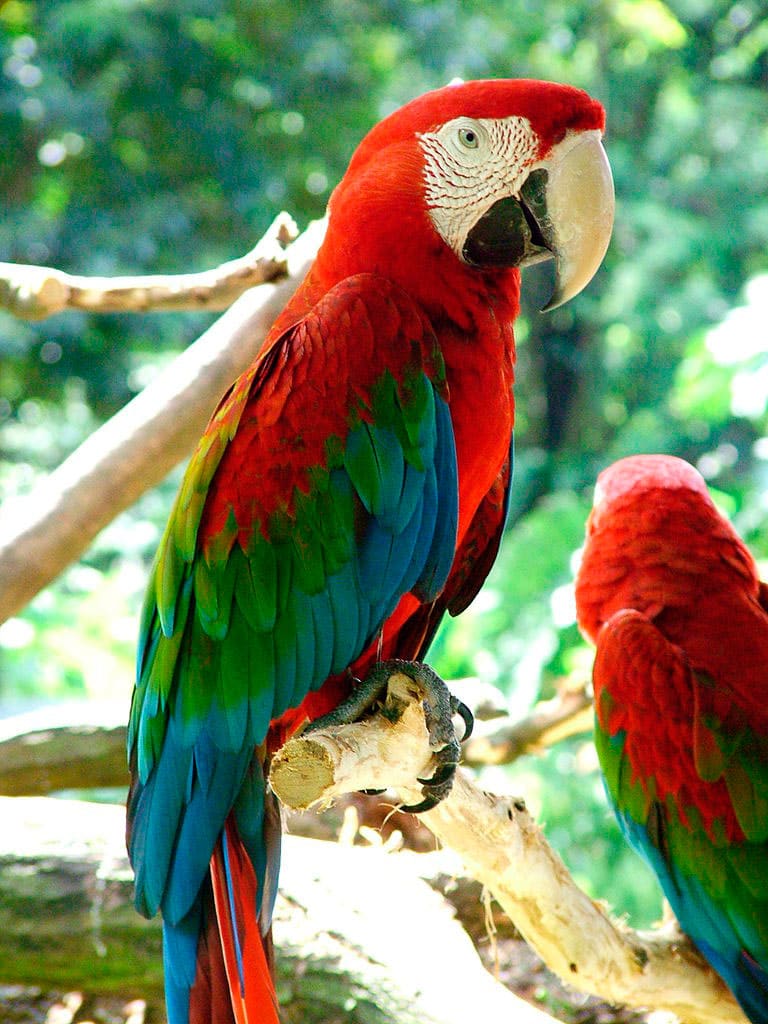
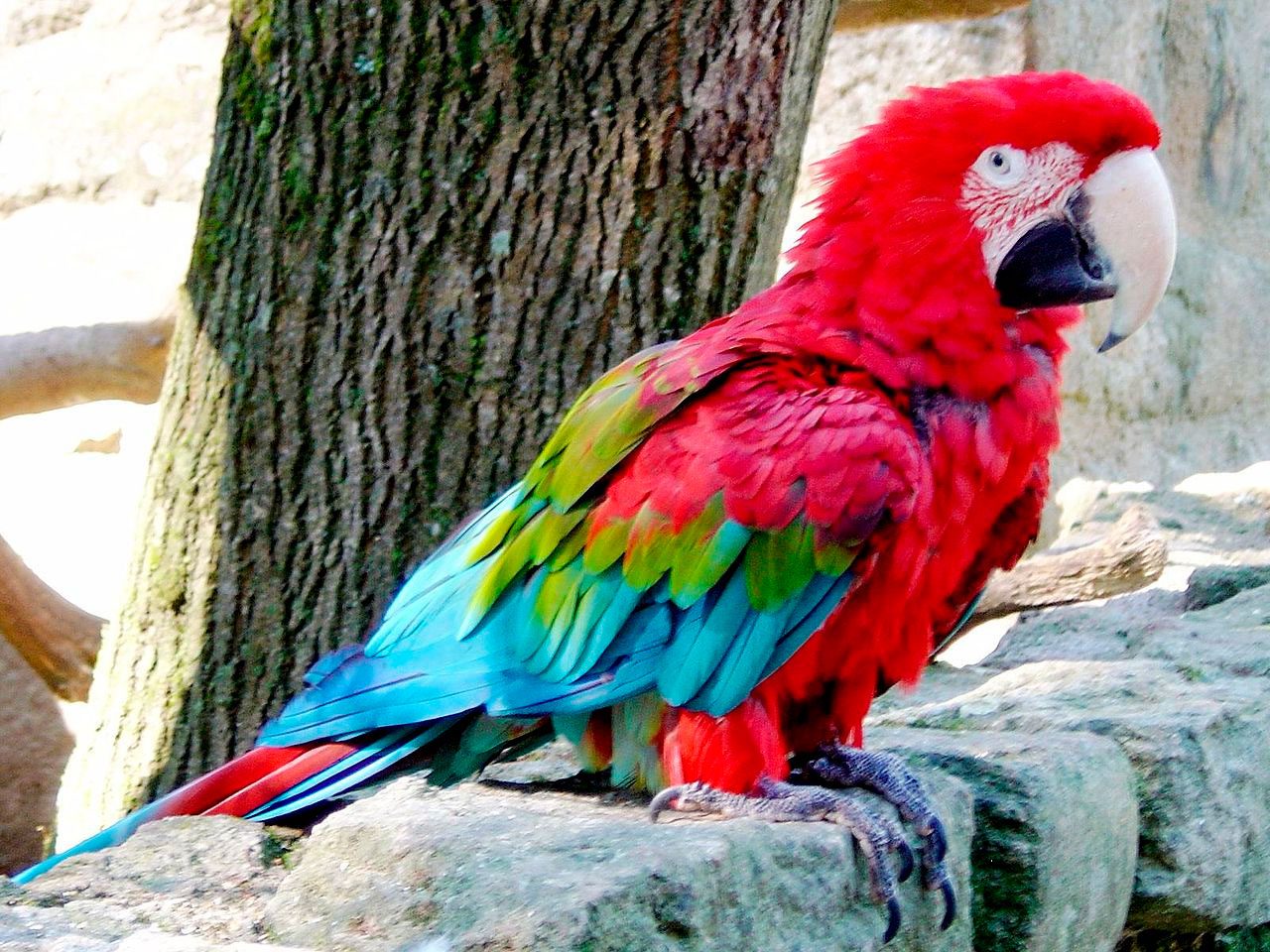
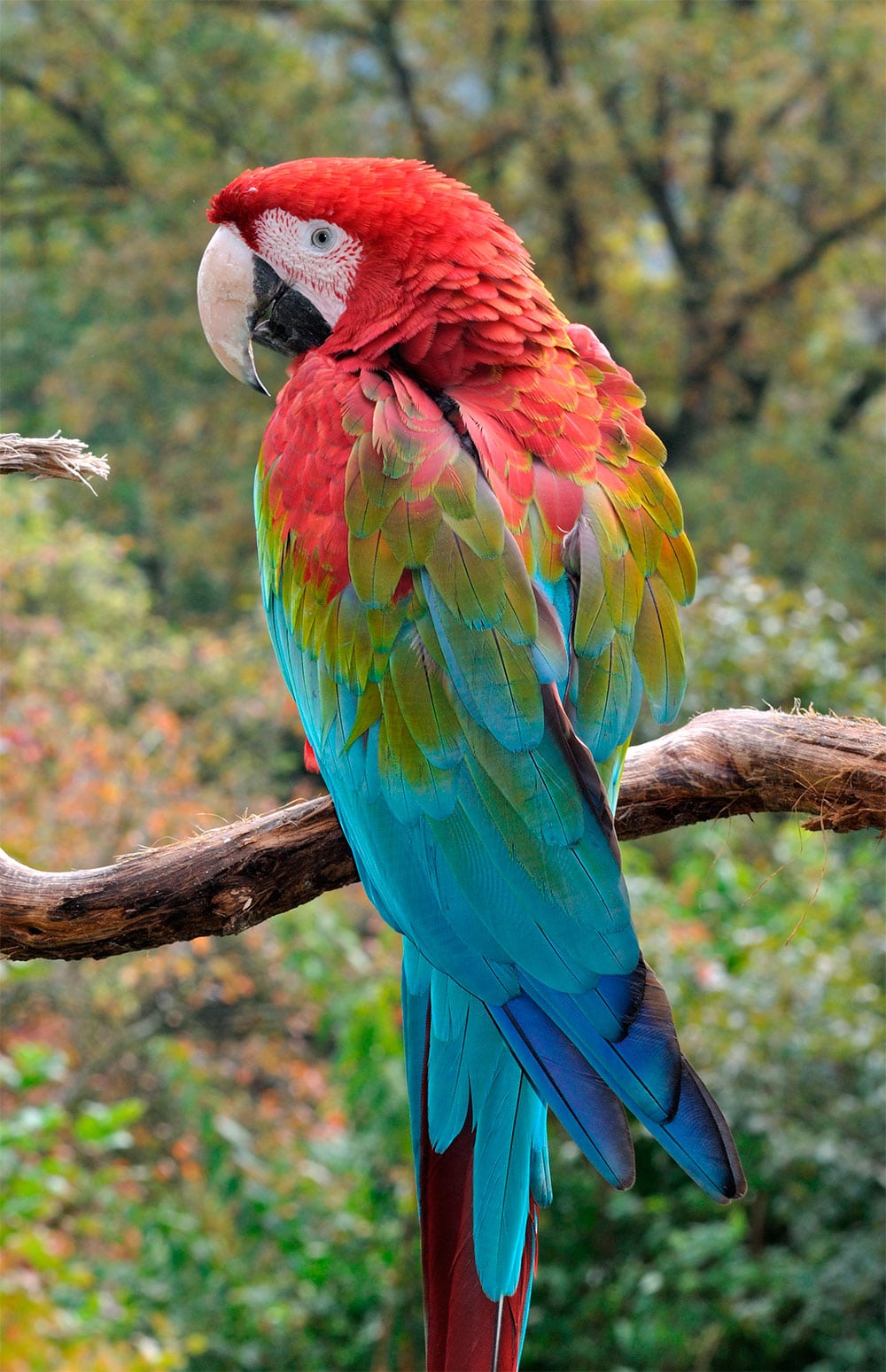
The winged Macaw (Ara chloropterus) they are the second largest family members of macaws behind the Hyacinth Macaw. They have forecrown, crown, both sides of the neck, the nape and the the mantle, a beautiful red; the back up to the uppertail-coverts, blue, scapulars green. Lesser coverts Red with green hidden bases; median green; primary coverts, secondaries outer and primaries, blue, the latter with a black margin at the vane inner; secondary internal and large coverts internal total or partially Green. Red the underwing-coverts.

Underparts Red with the exception of the undertail- coverts they are light blue. Uppertail Red in the central part with blue tips and with the outer feathers shorter, blue; undertail-coverts dark red.

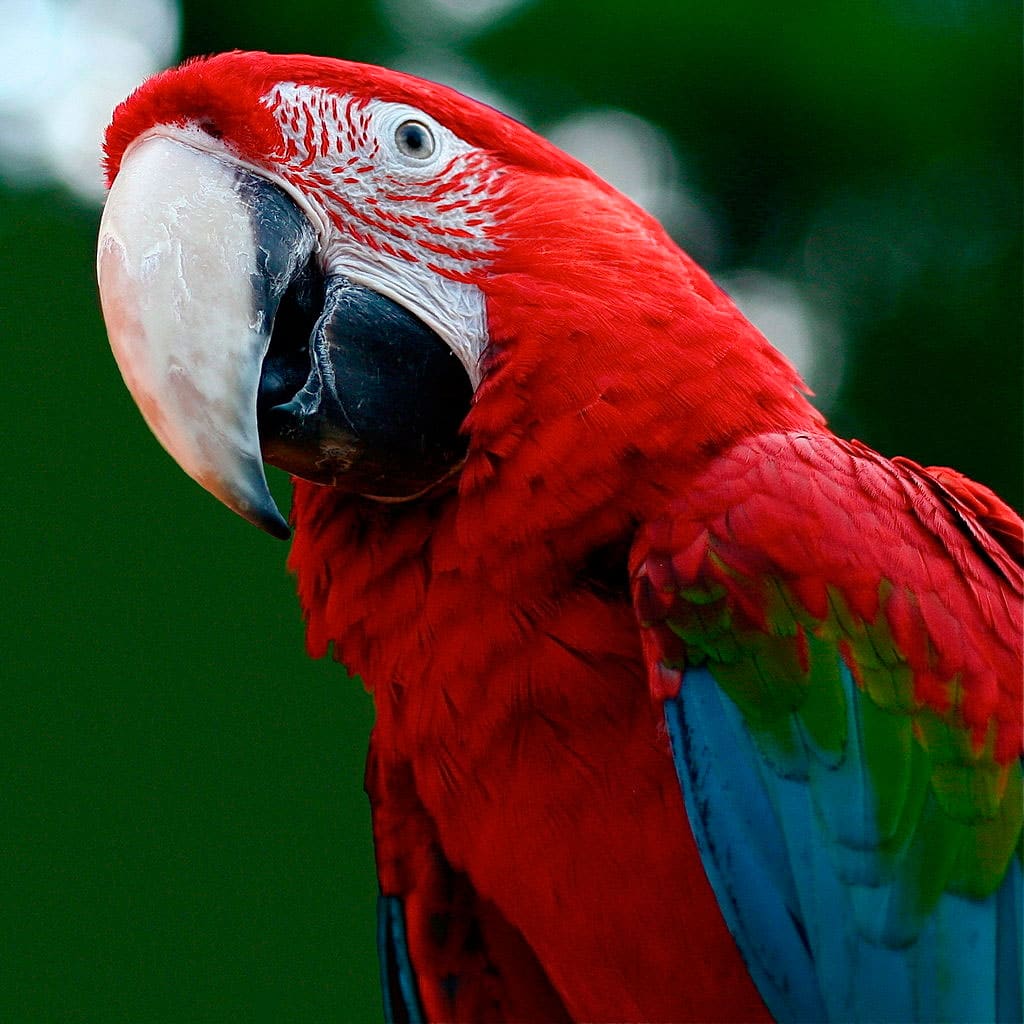
The upper jaw is mostly ivory white, except the cutting edge that is black. The lower jaw is black. The cheeks they are covered with bare white skin ending with fine lines of red feathers. Iris yellowish brown; legs black.

Both sexes similar.

Immature with tail shorter and the irises brown, sometimes with yellow in the coverts supra-alares.

Habitat:

The Red-and-green Macaw they occupy rain forest land in northern area of distribution, apparently, avoiding wetlands; in the South and East of range often in formations dry more open including seasonally flooded forests, forest Highlands and dry forests (Bolivia), entering the Savannah in Paraguay.

Its presence depends on, to a large extent, the existence of large trees and rocky cliffs that are the major providers of sites of anidacion. On the other hand, they are far from the cities, peoples and all the inhabited places, as it is a victim of intensive hunting and is often captured for the aviary bird trade

Observed to 1.000 m in Panama, 500 in Colombia, 1.400m in Venezuela.

They live in pairs or in small flocks, are less likely than the Blue-and-yellow Macaw to regroup, that does not prevent them, sometimes, partnering with them and with the Scarlet Macaw.

Large and spectacular gatherings of different species gather to consume clay on the banks of rivers.

The Red-and-green Macaw they often perch on the tops of the tallest trees. In principle, they are very shy and difficult to deal with. Early in the morning and the night entrance, they engaged on voyages of back and forth between their places of rest and feeding areas, evolving high in the air.

Reproduction:

The season of nesting It takes place at different times depending on the region: in Suriname in December, from November to April in Peru, in January in the middle of Brazil.

The nests they built, generally, in tree cavities, Although it can also be common nests located in cracks or holes of rocky cliffs, as it is the case of Bolivia and in the Northeast and South of Brazil, above all in Minas Gerais, Brazil.

The spawning usually has two or three eggs. Breeding success rate is not very high. According to Birds of the world (HBW), in a study recently envelope 25 from FRY's 16 nests, resulted in: 10 young birds (40%) they were able to fly normally, 9 of them (36%) they died of malnutrition and 6 (24%) were victims of predators.

Food:

The Red-and-green Macaw they have a vegetarian diet. Consume a variety of fruits and seeds of many types of trees. Fruits of Acrocomia and Caryocar (South-West of Brazil) fruits and seeds of Copaifera langsdorffii and Hymenaea courbaril (Northeast of Brazil).

Distribution:

Size of the area of distribution (reproduction / resident): 8.100.000 km2

The Red-and-green Macaw being endemic to the East of Panama the North and centre of South America, until almost the North of Argentina.

In Panama formerly observed in the West to the Caribbean slope of the Canal area (Although these records may be due to leaks), now only observed in the most remote parts of Eastern (for example, at the top of the Bayano River).

Observed in the tropical zone of Colombia, in the Magdalena River Valley, coast of the Caribbean, the Amazon region to the West of the Andes South to the upper area of the Atrato River and Serrania del Baudo.

Also inhabit the lowlands of Venezuela but absent in the North, from Portuguese to Monagas. Partial shape on the inside of Guianas. Along the Amazon basin of Brazil, is of Ecuador, Peru and northeast of Bolivia in Beni, Cochabamba and Santa Cruz.

In Brazil, were formerly seen in Espirito Santo, Rio de Janeiro and the interior of Paranรก; now seemingly absent; It continues to produce in Mato Grosso and the relict population remains in the Parque Estadual Morro do Diabo, to the West of Sรฃo Paulo. They persist in the North and East of Paraguayan Chaco, but now gone from Missions, Chaco, Formosa and Salta, Argentina, where a last reliable record was at 1917.

Resident. Generally uncommon after the population decline caused by habitat loss and capture for trade.

Locally distributed in Panama, Venezuela, Bolivia.

In the Amazon basin widespread but generally less common than the Scarlet Macaw and the Blue-and-yellow Macaw (fairly rare in Ecuador Eastern), Although this situation was reversed in Venezuela and Guianas (and perhaps in other places).

Partially absent near population centres and in decline or have already disappeared in the peripheries of range due to habitat loss, trade and hunting.

Despite the large size of its distribution area, the species is considered monotype (without geographical variations).

Widespread in captivity.

Conservation:

State of conservation โ“˜


minor concern Minor Concern โ“˜ (UICN)โ“˜

โ€ข Current Red List of UICN: Least concern
โ€ข Population trend: Decreasing

The size of the world's population has not been quantified, but this species is described as ยซquite commonยป (Stotz et to the. (1996)).

The population has disappeared in places where it was previously common and it is suspected that it may be in decline due to ongoing habitat destruction elsewhere, the unsustainable levels of exploitation, hunting and capture for trade in live birds.

Rare in Panama, endangered in the West of Colombia, missing in the southeast of Brazil. They are exceptions, Peru and Paraguay, where the species is still fairly common.

Not long ago, Guyana held the record for catches of young pups. Fortunately, from 1993, the country prohibited the commercial traffic of this species.

Their territory is particularly large, It is not considered in danger of extinction at the global level.

"Red-and-green Macaw" in captivity:

widespread in captivity.

It is a bird Intelligent and inquisitive but is perhaps, of all the great macaws, which is worse loneliness, so it is advisable to live with another bird, that you don't have to be necessarily of its kind. Its large size and its huge activity do require large cages and room to move.

Their breeding in captivity is more complicated than that of other large macaws.

With regard to its longevity, according to sources, A male specimen of Red-and-green Macaw was still alive after 50,1 years in captivity just before it was sold. It has reported that these animals can live up to 63 years in captivity, but this has not been verified; the same study reported that these animals they can be played back from the 8 years age in captivity.

Are often crossed with other species of Macaws to develop a series of hybrids.

Alternative names:

– Red-and-green Macaw, Green-winged Macaw, Red and green Macaw, Red-and- Green Macaw, Red-and-blue Macaw, Red-blue-and-green Macaw, Red-green Macaw (English).
– Ara chloroptรจre, Ara de Cuba (French).
– Grรผnflรผgelara (German).
– Arara-vermelha, arara-canga, arara-piranga, arara-verde, arara-vermelha-grande (Portuguese).
– Guacamaya Rojiverde, Guacamayo Aliverde, Guacamayo Rojo, Papagayo rojo (espaรฑol).
– Gonzalo, Guacamaya roja aliverde (Colombia).
– Guacamayo rojo (Ecuador).
– Carapaico (Venezuela).
– Paraba roja, Raraba colorada (Bolivia).
– Uvaรญ (Chimane).
– Arapiranga (Guarani).
– Majรก (Guahibo).
– Ja-wo (Piaroa).
– Bagarapuru (Embera).
– Tooma (Okaima).

scientific classification:

– Order: Psittaciformes
– Family: Psittacidae
– Genus: ARA
– Scientific name: Ara chloropterus
– Citation: Gray, GR, 1859
– Protonimo: Ara chloropterus

Images Red-and-green Macaw:

Videos "Red-and-green Macaw"

ยซGreen-winged Macawยป (Ara chloropterus)


Species of the genus Ara


Sources:

– Avibase
– Parrots of the World โ€“ Forshaw Joseph M
– Parrots A Guide to the Parrots of the World – Tony Juniper & Mike Parr
– Birdlife

– Photos:

(1) – Ejemplares de Guacamayo rojo (Ara chloropterus) en Singapur By Michael Gwyther-Jones (originally posted to Flickr as Singapore) [CC BY 2.0], via Wikimedia Commons
(2) – Two captive Red-and-green Macaws (also known as the Green-winged Macaw) in San Diego, California, USA By Steve Wilson from Mississippi, USA [CC BY 2.0], via Wikimedia Commons
(3) – Red-and-green Macaw (also known as Red-and-green Macaw) at Apenheul Primate Park, Apeldoorn, Netherlands By Arjan Haverkamp [CC BY 2.0], via Wikimedia Commons
(4) – Red-and-green Macaw (Ara chloropterus) in the Herborn Bird Park, Germany By Quartl (Own work) [CC BY-SA 3.0], via Wikimedia Commons
(5) – Green-winged Macaw or Red-and-green Macaw (Ara chloropterus) head and neck details By Tom Woodward (originally posted to Flickr as IMG_6422) [CC BY-SA 2.0], via Wikimedia Commons
(6) – Red-and-green Macaw flying at Pont-Scorff Zoo, Morbihan, Brittany, France By Tony Brierton from Still here…, Ireland (Pont Scorff Zoo, FranceUploaded by Snowmanradio) [CC BY-SA 2.0], via Wikimedia Commons
(7) – Ara chloropterus, Puerto Ayacucho, Venezuela By Luna04Luna04 at fr.wikipedia (Own work) [GFDL or CC-BY-SA-3.0], from Wikimedia Commons
(8) – Green-winged Macaw (also known as the Red-and-green Macaw) at Denver Zoo, USA. It is wing clipped By Drew Avery (originally posted to Flickr as Scarlet Macaw) [CC BY 2.0], via Wikimedia Commons
(9) – Red-and-green Macaws at Pont-Scorff Zoo, Morbihan, Brittany, France By Tony Brierton from Still here…, Ireland (Scarlet MacawsUploaded by Snowmanradio) [CC BY-SA 2.0], via Wikimedia Commons
(10) – Green-winged Macaw (Ara chloropterus), also known as the Red-and-green Macaw. Picture captioned ยซLโ€™Ara Macaoยป by Jacques Barraband [Public domain], via Wikimedia Commons

– Sounds: (Xeno-canto)

โ–ท The world of Pets: Dogs, cats, birds, reptiles, amphibians

Yellow-shouldered Parrot
Amazona barbadensis

Yellow-shouldered Parrot

Content

Description:

33 to 36 cm.. height and an average weight of 270 g.

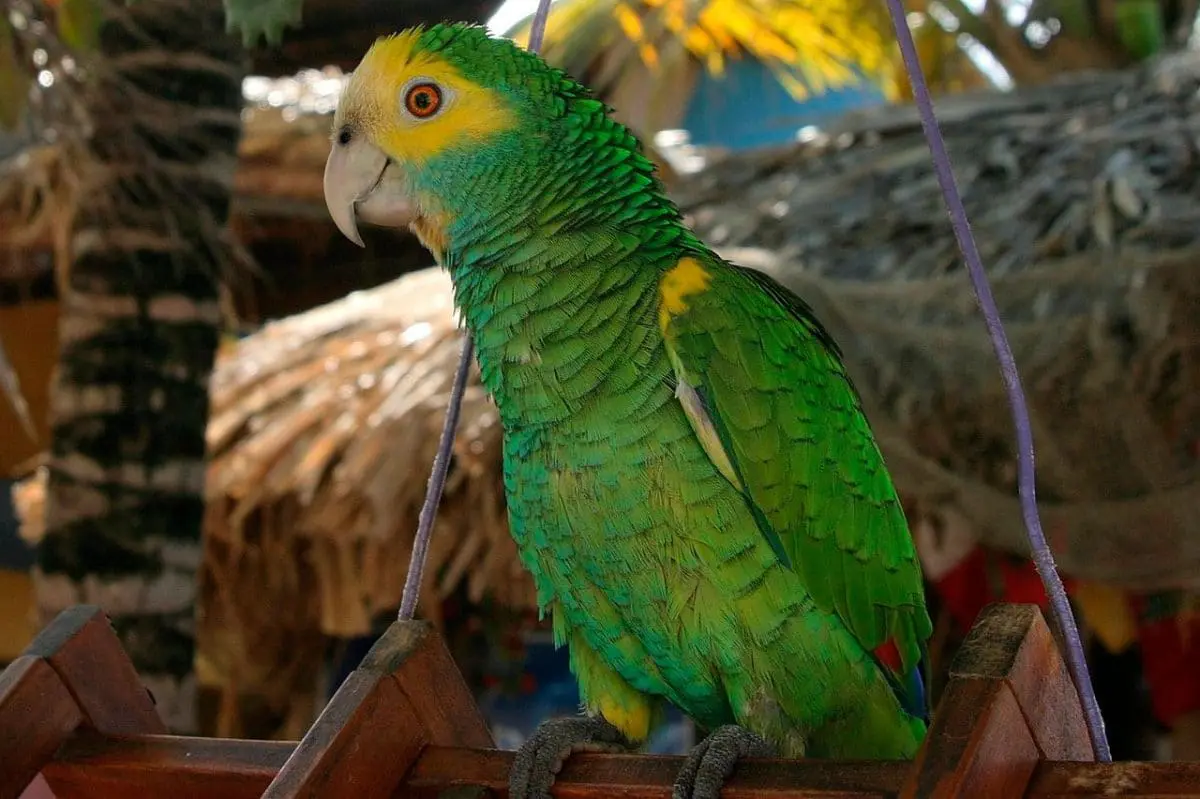
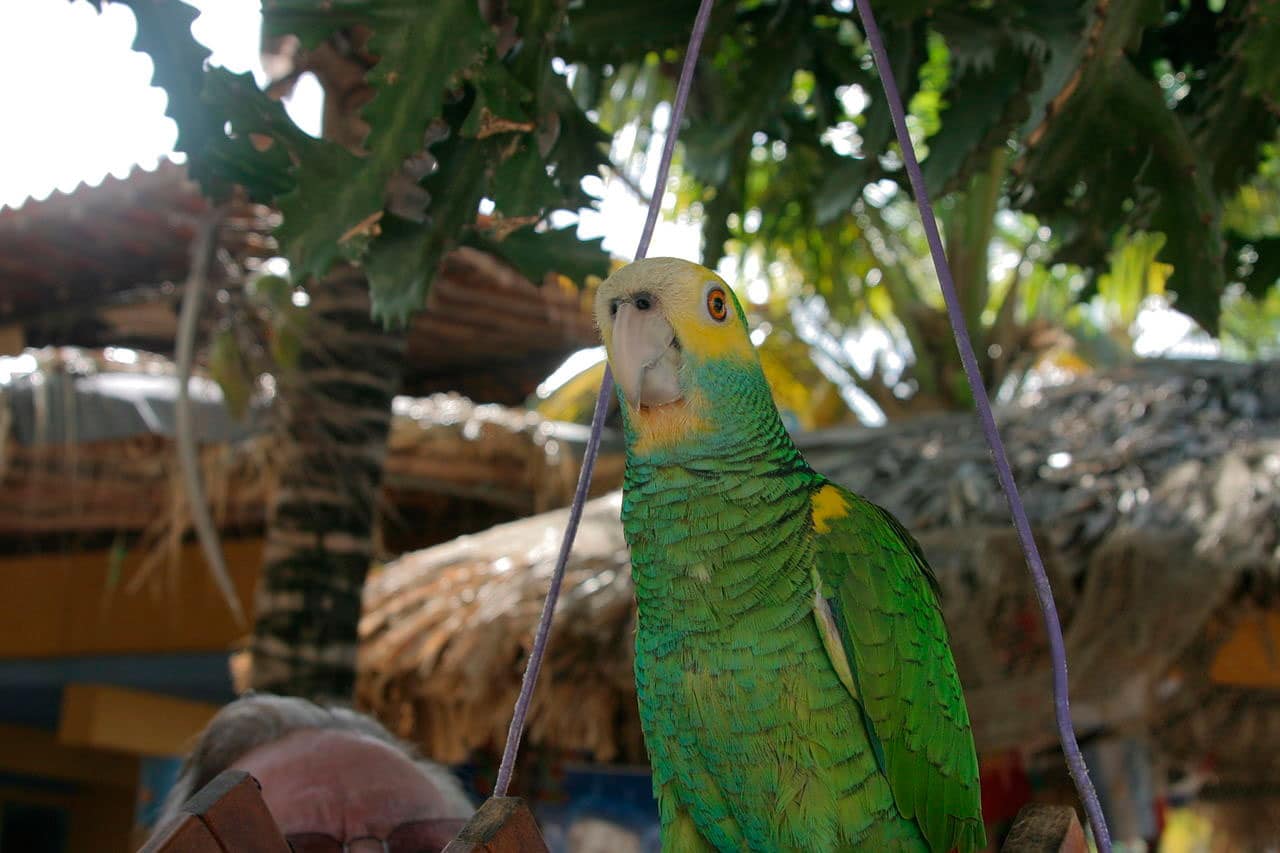
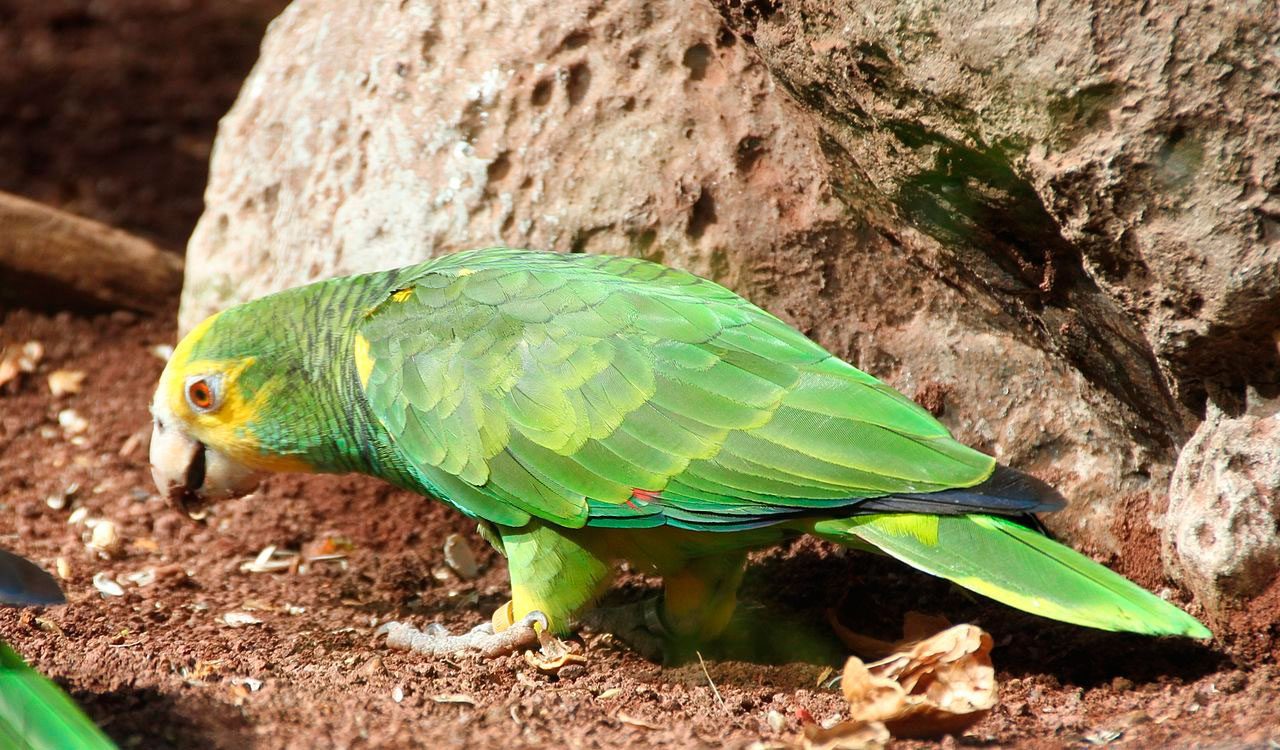
The Yellow-shouldered Parrot (Amazona barbadensis) It has a short tail, head yellow, some with forecrown white.

Its body is usually green, with black feathers edge neck, chest and back; greenish yellow in underparts.

Chin yellow with bluish tint in lower cheeks and around the chin. Shoulder and the thighs yellow.

Speculum red. dark blue tips to the flight feathers. The black edge of their feathers give them a look scaled.


Yellow-shouldered Parrot


Anatomy-parrots

The irises are red or orange and bill whitish.

The young birds are similar to adults but may distinguish by their irises and the absence darker blue hue in the lower body.

In the most notorious flight apart from the head, is the wing with shoulder yellow, Red patch and blue end.

Habitat:

They live in areas xerophytic vegetation, frequenting desert scrub dominated by cactus, cardรณn and shrubs or small trees; also frcuentan cultivated areas, until the 450 m. They move in pairs or flocks of up 100 individuals, especially at the time of feed.

Reproduction:

The nesting takes place in tree cavities, cactus or cliffs, in general, between March and August (Sanz and Rodriguez-Ferraro 2006). The average size of clutch is of 3,38 eggs per nest, and most of the eggs survive until the hatching. The incubation lasts a few 26 days and leave the nest 60 days after hatch.

It tends to rest communally in tall trees, with groups of up 700 birds recorded (Juniper and Parr 1998).

Food:

Their diet is composed of Cactus and other fruits. They have been reported in their diet fruits 22 genders. rich flowers nectar, cardรณn and the urero, which eats fruits, flowers and trunk, fruits and seeds Stenocereus, seeds and flowers guatacaro (Boarreria Sumnensis) and yaque.

Distribution:

Size of its range (reproduction / resident): 11,000 km2

The Yellow-shouldered Parrot It has a disjoint range with seven genetically isolated populations in northern Venezuela (Lara (Cerro Saroche National Park, which)), Falcon (Dabajuro, Casigua), Anzoรกtegui (about Piritu and Barcelona) and Sucre (Araya Peninsula), as well as the Margarita Islands, the blanquilla, Curacao and Bonaire (Rodriguez-Ferraro 2009).

He is currently extinct on Paraguana Peninsula (Briceรฑo-Linares et. To the. 2011). References to the presence of a population of wild parrots in Curacao They are based on a historical source of the century 18 (AO Debrot in some 1999, 2007.); there have been reports from modern 1988 (The farmer 2008, A. Rodriguez-Ferraro in litt. 2012), although it has been suggested that these birds can be released or escaped cages. (Williams 2012).

It became extinct in Aruba towards 1950 (Rojas-Suarez & Rodrรญguez 2015).

The numbers on the islands seem to fluctuate, but they have increased in Margarita of 750 birds in 1989 (Sanz y Grajal 1998) until around 2000 in 2015 (Rojas-Suarez & Rodrรญguez 2015).

The population in Bonaire It was estimated in 400 individuals in 2006 (Williams and Martin 2006) and 650-800 individuals in 2012 (Department of Resources and Planning, Bonaire by R. Martin y S. Williams a slightly. 2012).

The continent's population was considered in decline 2003 (Hilty 2003).

Their habitat continues to be lost in the eastern part of the continental mountain range (V. Sanz in some. 2016) and the population of together (is of Venezuela) it is believed that are declining due to poaching and habitat conversion for agriculture (V. Sanz n bit. 2016), so it is likely that the continental population continues to decline.

Conservation:

State of conservation โ“˜


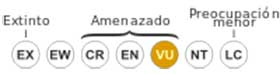
Vulnerable Vulnerable โ“˜ (UICN)โ“˜

โ€ข Current category of the Red List of the UICN: Vulnerable.

โ€ข Population trend: Unknown.

The population size: 1700-5600 specimens.

It is classified as a endangered specie, It is the main threats capture their young for pet trade, and habitat destruction of nesting and feeding by the extraction of sand for the construction industry.

The recovery of the population of this bird has been the spearhead of Provita's work in Macanao, since its conservation benefits a large part of the biodiversity of the peninsula, as their habitat covers large areas, it is also a charismatic species, that easily attracts the public to conservation efforts.

Source: PROVITA

"Yellow-shouldered Parrot" in captivity:

Rare but increasing due to the successes of captive breeding.
have a participatory personality, inquisitivas and curious to the point of being "nosy" and her gentle nature only adds to her charm. Mild to moderate its ability to speak.
Always playful, enable They require a cage equipped with toys. They worship a bathroom and displayed chatty while bathing under running warm water.

Alternative names:

– Yellow-shouldered Parrot, Yellow shouldered Parrot, Yellow-shouldered Amazon (English).
– Amazone ร  รฉpaulettes jaunes (French).
– Gelbflรผgelamazone, Kleine Gelbkopfamazone (German).
– Papagaio-de-cabeรงa-branca (Portuguese).
– Amazona de Cabeza Amarilla, Amazona de hombro gualda, Amazona Hombrogualda, Cotorra margariteรฑa (espaรฑol).
– Cotorra Cabeciamarilla (Venezuela).

Gmelin Johann Friedrich

scientific classification:


– Order: Psittaciformes
– Family: Psittacidae
– Genus: Amazona
– Scientific name: Amazona barbadensis
– Citation: (Gmelin, JF, 1788)
– Protonimo: Psittacus barbadensis


Images "Yellow-shouldered Parrot":


Species of the genus Amazona


Sources:

  • Avibase
  • Parrots of the World โ€“ Forshaw Joseph M
  • Parrots A Guide to the Parrots of the World – Tony Juniper & Mike Parr
  • Birdlife

  • Photos:

(1) – Yellow-shouldered Amazon (Amazona barbadensis) also known as Yellow-shouldered Parrot. Pet in Venezuela perching on the top of a wooden frame. By John Bรคckstrand (originally posted to Flickr as IMG_2721) [CC BY 2.0], via Wikimedia Commons
(2) – Yellow-shouldered Amazon in the Walsrode Bird Park, Germany By Quartl (Own work) [CC BY-SA 3.0], via Wikimedia Commons By Quartl (Own work) [CC BY-SA 3.0], via Wikimedia Commons
(3) – Yellow-shouldered Amazon (also known as Yellow-shouldered Parrot). Two in the foreground in a cage By TJ Lin [CC BY-SA 2.0], via Wikimedia Commons
(4) – Yellow-shouldered Amazon (Amazona barbadensis) also known as Yellow-shouldered Parrot. Pet in Venezuela perching on a hand. Shows crown By John Bรคckstrand (originally posted to Flickr as IMG_2469) [CC BY 2.0], via Wikimedia Commons
(5) – Yellow-shouldered Amazon (Amazona barbadensis) also known as Yellow-shouldered Parrot. Pet in Venezuela By John Bรคckstrand (originally posted to Flickr as IMG_2468) [CC BY 2.0], via Wikimedia Commons
(6) – Amazona barbadensis in the Loro Parque zoo of Tenerife, Spain By Bjoertvedt (Own work) [CC BY-SA 4.0], via Wikimedia Commons
(7) – Amazona barbadensis in the Loro Parque zoo of Tenerife, Spain By Bjoertvedt (Own work) [CC BY-SA 4.0], via Wikimedia Commons
(8) – Yellow-shouldered Amazon (Amazona barbadensis) also known as Yellow-shouldered Parrot. Pet in Venezuela – side view – a little red and blue seen at edge of wing By John Bรคckstrand (originally posted to Flickr as IMG_3117) [CC BY 2.0], via Wikimedia Commons
(9) – Yellow-shouldered Amazon (Amazona barbadensis) also known as Yellow-shouldered Parrot. Pet in Venezuela on the top of a wooden climbing frame. Mainly showing its upper body By John Bรคckstrand (originally posted to Flickr as IMG_2723) [CC BY 2.0], via Wikimedia Commons
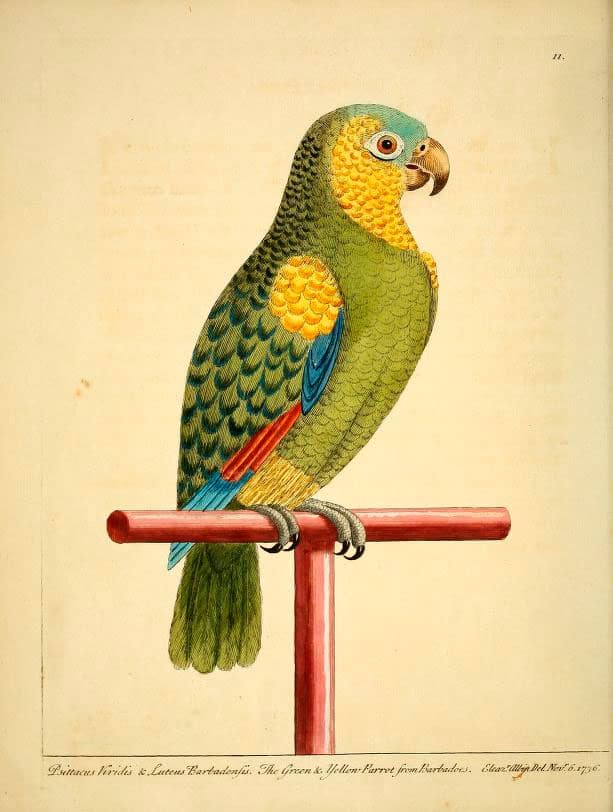
(10) – Original illustration of the ยซGreen & Yellow Parrot from Barbadosยป, currently known as Amazona barbadensis – Wikipedia

  • Sounds: ยฉ 2014 Cornell University

โ–ท The world of Pets: Dogs, cats, birds, reptiles, amphibians

Burrowing Parakeet
Cyanoliseus patagonus

Burrowing Parakeet

Content

Burrowing Parakeet

Description:

39-52 cm. length between 260 and 280 g. of weight.

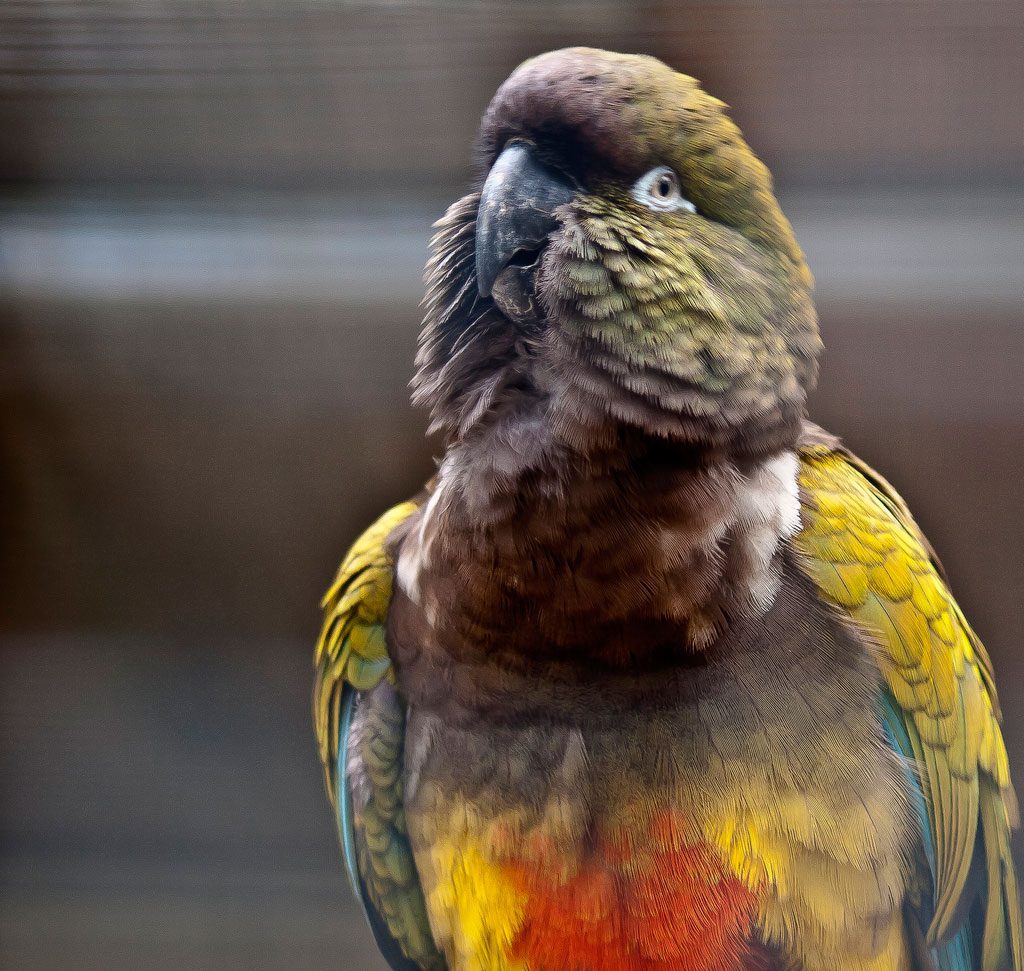
The Burrowing Parakeet (Cyanoliseus patagonus) has the forecrown, crown, lores, cheeks and nape olive brown with slight yellowish tinge; sides of neck, the mantle and back Brown olive; rump and uppertail-coverts bright canary yellow.

Blades brown, some slightly blue; covered primary blue, other yellowish olive brown. Primaries and Outer secondaries dark blue with edges innerwebs distal; inner secondary bluish brown. Underwing-coverts Yellow olive; underside of flight feather brown. Breast olive brown with white-cream area at the top of chest; rest of the underparts yellow-orange red patch through central belly. Uppertail brown tinted blue, especially next to the tips; undertail brown.

The bill It is grayish-black; the periophthalmic skin skin whitish; the irises is pale yellow; the legs They are pale yellowish brown.

Both sexes similar. Immature has horn upper mandible and the irises brown.

  • Sound of the Burrowing Parakeet.

Description Burrowing Parakeet subspecies
  • Cyanoliseus patagonus andinus

    (Dabbene & Lillo, 1913) – Similar to the species nominal but it lacks the bright yellow belly with pale areas on the sides of chest and rump olive colored duller. This and subspecies Cyanoliseus patagonus conlara they have the upperwing-coverts more brown than the nominal species.


  • Cyanoliseus patagonus bloxami

    (Olson, 1995) – Size larger than the nominal species (wings 250-263), upperparts, throat lower chest and dark brown; bill larger and heavier and patches creamy most extensive on the sides of chest (in some birds merge to form a band breast pale).


  • Cyanoliseus patagonus conlara

    (nores & Yzurieta, 1983) – Breast darker than the other Argentine subspecies.


  • Cyanoliseus patagonus patagonus

    (Vieillot, 1818) – Nominal.

Habitat:

The species usually inhabit areas open pastures, although it has also been reported in Savanna, wooded valleys cliffs and farmland some 2.000 m. Usually in a fairly arid land, although often it found near elevations or streams. Gregarious, forming large flocks, sometimes exceeding 1.000 birds, with common roosts trees, on wiring (sometimes in villages) and in tunnels dug to nest.

Reproduction:

It reproduces colonially in warrens carved into cliffs (usually limestone or sandstone Chile) often with stunning views. In San Luis, Argentina, reproduction is reported in the wet season (Novemberรขโ‚ฌโ€œApril), the birds return to nest in the cliffs lay eggs in September and November to December in San Luis, spreading of bird breeding sites in April; apparently earlier in Chile. Clutch 2-4 eggs. The male takes care of feeding the female during the incubation period.. The young leave the nest at 2 months of age, However, They continue to be fed by their parents until 6 months of age.

Food:

The diet of the Burrowing Parakeet It consists mainly of seeds and fruits predominance of fruit in the summer months (November to February). Food reported include berries of buckthorn joke and Discaria, fruit of Geoffroea decorticans, Prosopis caldenia, P. chilensis and P. flexuosa and seeds of Carduus mariana. Sometimes damaged grain crops; often it feeds on the floor or around.

Distribution:

Extending its range (breeding/resident): 1.590.000 km2

The Burrowing Parakeet They are distributed by the South South America, extending from northern Santa Cruz and Chubut in Argentina, passing by Black river and Pampa, up to Buenos Aires, San Luis and Cรณrdoba, San Juan, La Rioja, Catamarca, Tucumรกn and Salta, reaching westward across southern Uruguay.

They were recorded in the early 1920 from the center of Formosa, Argentina, away from Andes mountains, and above the center Chile from the North of The lakes to north of Atacama, but now they are confined to a few localities in the foothills of the Andes, for example in Bio Bio.

Will produce some seasonal movements, including the northward migration of birds south in the Argentine winter and shifts down Chile.

In Argentina is locally common or abundant, although in some places (p. e.g.. in Cรณrdoba and Buenos Aires Eastern) They are rare or occasional. Few and far between in Uruguay. drastic decline during the twentieth century Chile, so that the subspecies Cyanoliseus patagonus bloxami It is considered at risk, with an estimated population of less than 3.000 individuals at the end of the decade 1980. The decrease in parts of the Argentina It is attributed to the catch for the trade, the hunting for food, converting grassland and arable land persecution as crop pest. Probably continues to decline overall.

Burrowing Parakeet subspecies distribution

Conservation:


minor concern


โ€ข Current category of the Red List of the UICN: Least concern.

โ€ข Population trend: Decreasing.

โ€ข Population size : 95000 individuals.

Rationale for the Red List category

Even though the demographic trend It appears to be declining, the decline is not believed to be rapid enough to approach the Vulnerable thresholds based on demographic trend criteria (> 30% decrease in ten years or three generations). The population size is very large, and therefore does not approach the thresholds for Vulnerable under the criterion of population size (<10.000 individuos maduros con un descenso continuo estimado en >10% in ten years or three generations, or with a specific population structure). For these reasons, the species is evaluated as Least concern.

Justification of the population

The species is still common in many parts of its range in Argentina, with only small contractions reported in range Cรณrdoba (R. M. Fraga a slightly. 2003). The population size of four subspecies was estimated as follows by MASELLO et al. (2011): Cyanoliseus patagonus patagonus 43.330 nests, Cyanoliseus patagonus conlara 1.700 individuals, Cyanoliseus patagonus andinus 2.000 nests, Cyanoliseus patagonus bloxami 5.000-6.000 individuals. Based on these figures, the population Total overall can be about 95.000 mature individuals.

Justification trend

They suspected that the population is declining due to continuing habitat destruction and unsustainable levels of exploitation.

Threats

The species has been the subject of a intense trade: from 1981, year it was included in the Appendix II of the CITES, they have been 122.914 individuals caught in international trade (UNEP-WCMC CITES CITES Trade Database, January 2005).

Conservation actions underway

The species is included in the Appendix II of the CITES.

"Burrowing Parakeet" in captivity:

The average life expectancy is of 15-20 years in captivity. Protected by Appendix II of the CITES.

To help conservation Burrowing Parakeet, You can report your hunt, sale, trade and illegal possession, thus, We will be cooperating with the conservation of this species and not be complicit in the decline of their populations and their future extinction of wild.

Alternative names:

– Burrowing Conure, Burrowing Parakeet, Burrowing Parrot, Patagonian Burrowing Parrot, Patagonian Conure, Patagonian Parrot (English).
– Conure de Patagonie, Perriche de Patagonie, Perruche de Patagonie (French).
– Felsensittich, Felsen-Sittich (German).
– Periquito-das-barreiras (Portuguese).
– Loro Barranquero, Loro de la Patagonia, Loro Patagonico, Tricahue (espaรฑol).
– Loro barranquero (Argentina).
– Tricahue (Chile).
– Loro barranquero, Loro Patagonico (Uruguay).
– Perico Barranquero (Mexico).

scientific classification:

– Order: Psittaciformes
– Family: Psittacidae
– Genus: cyanoliseus
– Scientific name: Cyanoliseus patagonus
– Citation: (Vieillot, 1818)
– Protonimo: Psittacus patagonus

Images "Barranquero Loro":

Videos "Burrowing Parakeet"

————————————————————————————————

"Their barranche" (Cyanoliseus patagonus)


Sources:

– Avibase
– Parrots of the World โ€“ Forshaw Joseph M
– Parrots A Guide to the Parrots of the World – Tony Juniper & Mike Parr
– Birdlife

– Photos:

(1) – A Burrowing Parrot captive in Madeira By Rakkhi Samarasekera from London, United Kingdom (P6122982Uploaded by Snowmanradio) [CC BY 2.0], via Wikimedia Commons
(2) – Two Burrowing Parrots in Limari Province, Chile By Gerzo Gallardo (Flickr: Parrots) [CC BY 2.0], via Wikimedia Commons
(3) – Pair of cockles Cyanoliseus patagonus in the RN Cypress River By BioVipah (Own work) [CC BY-SA 4.0], via Wikimedia Commons
(4) – Burrowing Parrot (also known as the Patagonian Conure) to Lille Zoo, France By Olivier Duquesne (originally posted to Flickr as Perroquet) [CC BY-SA 2.0], via Wikimedia Commons
(5) – A Burrowing Parrot at Birds of Eden, an aviary in Western Cape, South Africa By Dick Daniels (http://carolinabirds.org /) (Own work) [CC BY-SA 3.0 or GFDL], via Wikimedia Commons
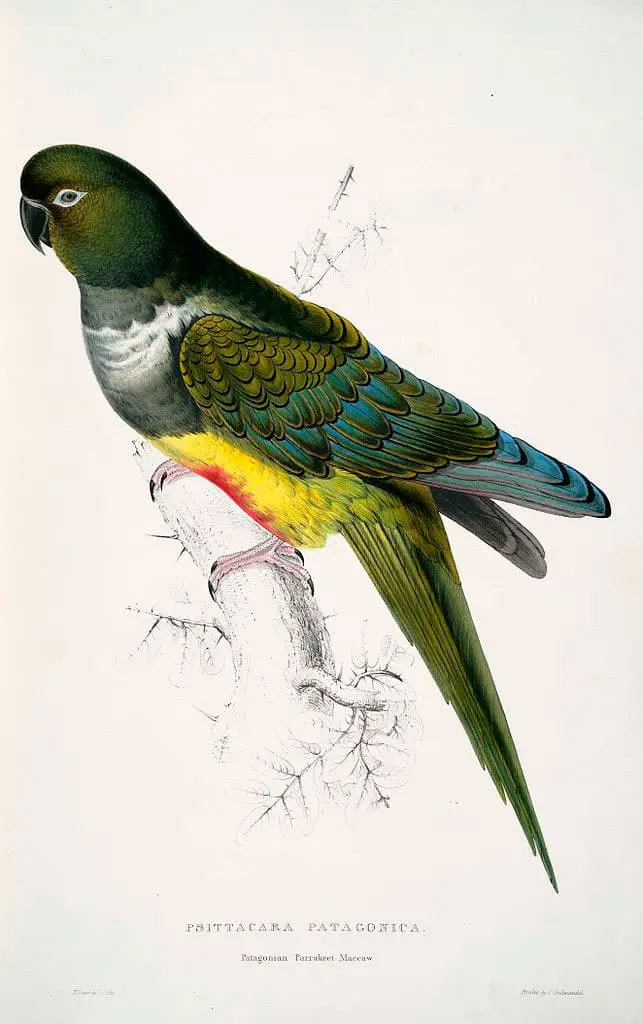
(6) – A painting of a Burrowing Parrot, also known as Patagonian Conure, (originally captioned ยซPsittacara patagonica. Patagonian Parrakeet-Maccawยป) by Edward Lear 1812-1888 – Wikipedia

– Sounds: Cristian Pinto, XC380836. accessible www.xeno-canto.org/380836.

โ–ท The world of Pets: Dogs, cats, birds, reptiles, amphibians

Gang-gang cockatoo
Callocephalon fimbriatum


Gang-gang cockatoo

Content

Description

Of approximately 35 cm.. height and an average weight of 257 g.
The Gang-gang cockatoo (Callocephalon fimbriatum) it's a little cockatoo, robust, with one crest Dim, large wings wide, and tail short. Son gregarious but relatively calm.
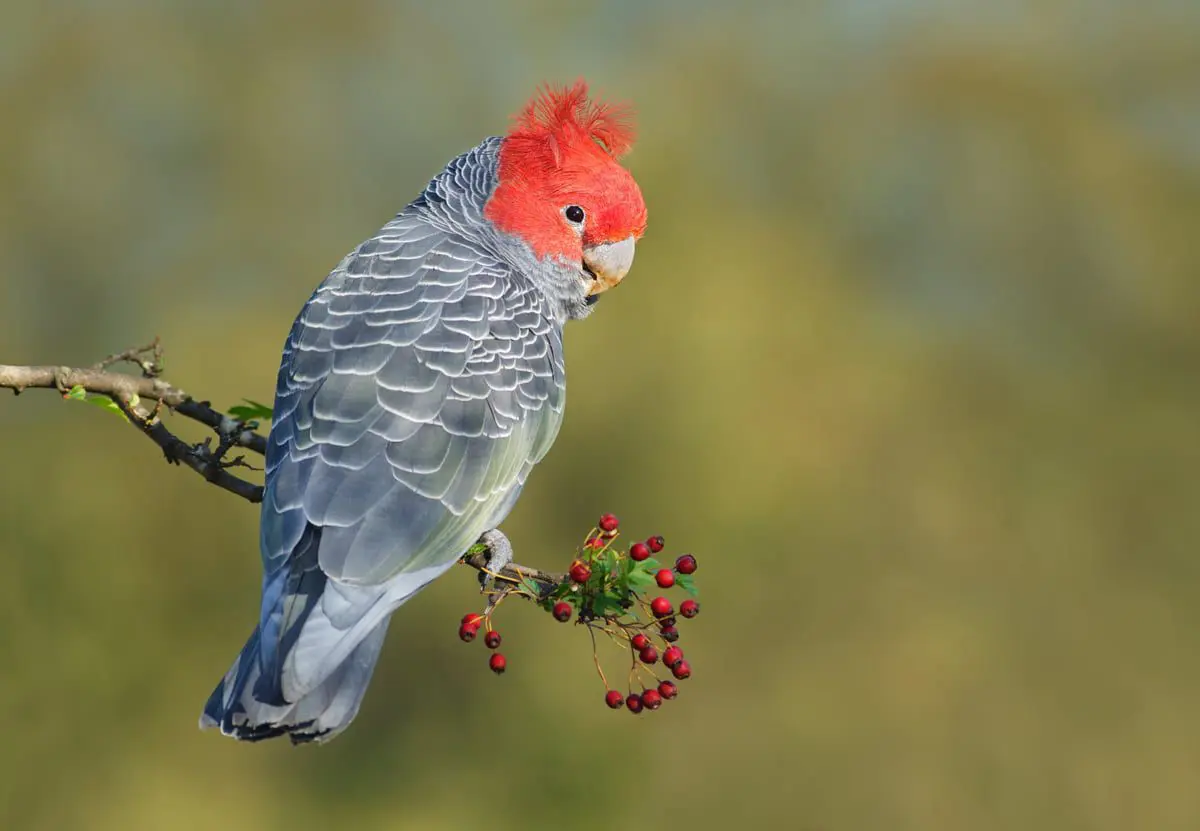
The males of the Gang-gang cockatoo they are immediately recognizable by their head and crest scarlet. The remaining plumage is slate grey.
The females they have the head and crest grey. The feathers of the part inferior of the body are lined with green Orange and yellow, giving a scaly appearance. The tail also has stripes horizontal white. Otherwise, is identical to the male.

The juveniles they are similar to the females, they differ in their top, the head Red and one crest shorter and less twisted.
The Gang-gang cockatoo not can confuse it with other species of parrots. In flight, However, sometimes their shape resembles to the cacatรบa Galah.

Habitat:

Video – "Gang-gang cockatoo" (Callocephalon fimbriatum)

Gang- gang Cockatoo (Callocephalon fimbriatum)

During the summer are found in the forests of mountain and areas with understory of shrubs dense. In Winter they will move to more dry and low altitudes, more open forests. They can often be seen along the roads and in parks and gardens in urban areas. They require high hollow trees for nest.

Reproduction:

Forman couples monogamous. The female chooses a hole in the right tree and both sexes prepare the nest for egg-laying. They line the sides of the hole with sawdust and chewing dust. Both sexes incubate the eggs and care for the young. Parents feed their young for four to six weeks after hatching. Feather.

Family groups are commonly seen feeding together during the breeding season.. In some cases, nurseries will be formed’ where have several couples nested together, their young perch together in the same tree, While their parents seek for food.

Food:

With feed mainly seeds trees and shrubs, native and introduced, with a preference for the eucalyptus, beards and thorns. They also eat berries, fruit, dried fruits, insects and their larvae.

They are mainly arboreal, they perch on the ground only to drink and forage among the fallen fruits or cones.

They feed in flocks of up 60 birds out of breeding season. Feed in pairs or small family groups during the breeding season.

They are able to use exotic plants as food in the urban areas.

Distribution:

Size distribution (reproduction / resident): 333.000 km2

They are endemic to the South-East of Australia. They are widespread in the East of New South Wales, from the Central slopes and plateaus to the South Coast, along the northeastern regions of Victoria to Seymour, with some records in the East of Melbourne, mornington peninsula and Southwest Gippsland.
Have also been introduced in the Kangaroo Island to the South of Australia.

Conservation:

State of conservation โ“˜


minor concern Minor Concern โ“˜ (UICN)โ“˜

โ€ข Current category of the Red List of the UICN: Least concern.

โ€ข Population trend: In increased.

Is come affected negatively by deforestation and the removal of mature trees (potential breeding sites). A population is classified as threatened: in the Valley Cove Lane, New South Wales.

The the rest of the population It is suspected that it may be increasing and now will spend the winter in the suburbs of Canberra.

The world population are estimated at more of 20,000 individuals.

"Gang-gang cockatoo" in captivity:

Itร‚ยดs very rare in poultry and hard to find as a pet.

Son Smart and playful, but they have a great tendency to suffer from software. They are very destructive for what need of abundant toys to not attack against the furniture of the House.

When you get bored, they are often automutilan as a way to fight against boredom.

Its life expectancy You can overcome the 60 years.

Alternative names:

– Gang-gang Cockatoo, Cockatoo Corella, Helmeted Cockatoo, Red-crowned Cockatoo, Red-headed Parrot (English).
– Cacatoรจs ร  tรชte rouge, Cacatoรจs gang-gang (French).
– Helmkakadu, Helm-Kakadu (German).
– Cacatua-gang-gang (Portuguese).
– Cacatรบa Gang Gang, Cacatรบa Gang-gang (espaรฑol).

scientific classification:

– Order: Psittaciformes
– Family: Cacatuidae
– Scientific name: Callocephalon fimbriatum
– Genus: Callocephalon
– Citation: (Grant,JB, 1803)
– Protonimo: Psittacus fimbriatus

Images Gang-gang Cockatoo:


Sources:
– Avibase
– infoexoticos
– Birdlife

– Photos: Jan Wegener, Marbiz (Panoramio), papouch.webzdarma.cz, Benjamint444 (commons.wikimedia.org)

– Sounds: (Xeno-canto)

+ More