โ–ท The world of Pets: Dogs, cats, birds, reptiles, amphibians

Chatham Parakeet
Cyanoramphus forbesi

Chatham Parakeet

Content


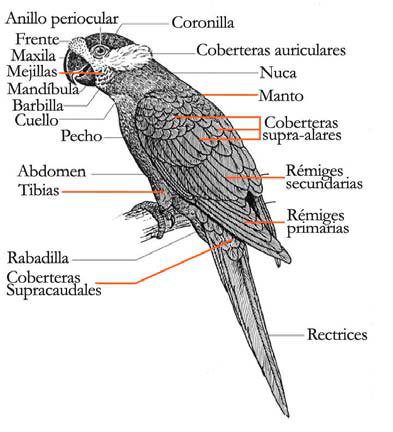
Anatomy-parrots

Description:

23 cm. length and 95 g. of weight.

The Chatham Parakeet (Cyanoramphus forbesi) They are one of the two medium bright green parrots of Chatham Islands. Although they look very similar to those Yellow-crowned parakeet (Cyanoramphus auriceps) of New Zealand continental, the color of the crown is not a reliable indicator of taxonomic relationships.

It believes that the Chatham Parakeet descended from an ancient lineage of parrots who reached the Chatham Islands before the division Yellow-crowned parakeet and Red-crowned parakeet happened in New Zealand continental, after which the Red-crowned parakeet (Cyanoramphus novaezelandiae) also they colonized Chatham Islands.

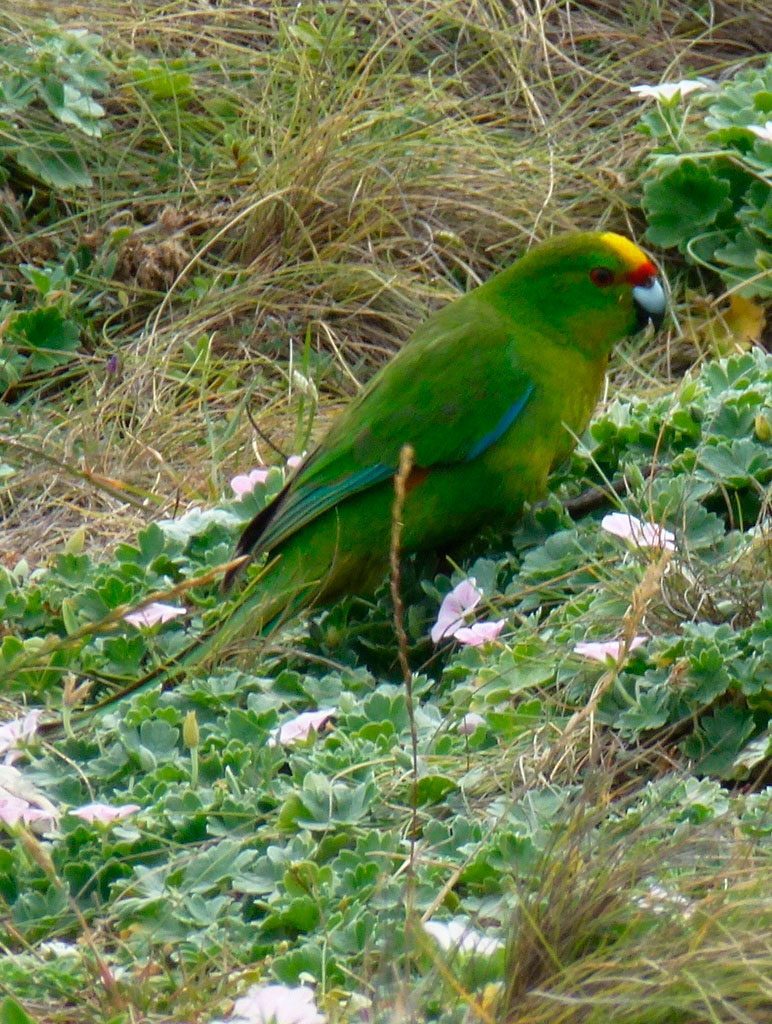
The Chatham Parakeet They are medium-sized parrots, of tail long, with wings wide and rounded and plumage predominantly emerald. have a crown bright yellow front and a crimson front band that does not reach to the eyes, unlike in the Red-crowned parakeet. Males are larger than the females.

taxonomy:

Since 1930 is commonly treated as a subspecies of the Yellow-crowned parakeet (Cyanoramphus auriceps), and clearly the two are closely related; the species differ, However, in size considerably, It is larger species Cyanoramphus forbesi. Currently considered Monotypic.

Habitat:

The Chatham Parakeet They are at higher densities in forests and dense vegetation regenerating areas than in open grassland. Despite its rather erratic flight, They fly hard and move easily between islas Mangere and little Mangere. Occasionally they have been observed Chatham Parakeet individual in the forests of southern Chatham Island (> 20 km from the Mangere Island) and nearby islands Pitt and owner. Their social behavior is similar to other species of parakeets Cyanoramphus. They are strongly territorial around nests, calling loudly and chasing intruders from nearby.

Reproduction:

The Chatham Parakeet have a long breeding season, with eggs laid between October and March. Son nesters cavity, preferring tree holes but also using rock crevices and under dense vegetation. The size medium of laying is of 5 eggs. Like all the other parakeets Cyanoramphus, females are responsible for preparing the nest, incubation, rearing and feeding the chicks until the 10-14 days old. During this period all your food is provided by your partner.. From then on, male and female parrots feed the chicks in the nest until they leave the nest.

The incubation usually begins after the start of the second egg, resulting in chicks within a clutch that vary greatly in age and size. The last chicks to hatch are usually born at a younger age and are less developed than their older brothers.. More than one brood may be attempted if the initial nest fails or if the food supply allows..

Food:

The foods consumed by Chatham Parakeet They are affected by seasonal availability, and include seeds, flowers and leaves of various plants, It is the most important invertebrates in spring. They feed extensively in soil in open areas.

Distribution and status:

Sw extension of its distribution area (reproduction / resident): 3 km2

The Chatham Parakeet It is restricted to of Tapuaenuku ISLA ISLA Pequeรฑa Mangere and Mangere in the Group of chatham islands, New Zealand. In 1930 He quenched in Mangere Island, but in 1973 had recolonized and numbered 40 birds and a small number of hybrids with the subspecies Cyanoramphus novaezelandiae chathamensis (of which there were 12 on the island) (Higgins 1999).

In 1996, two estimates indicated that the population of the Mangere Island It was from 50 to 120 Purebred birds. The population on the small island of little Mangere It is little known because the few visits made (H. Aikman a slightly. 1999). In 1999, it was estimated that the total population was about 120 birds (Aikman et al. 2001), but studies 2003 estimated 900 individuals on Isla Mangere (Aikman y Miskelly 2004, D. Houston y C. Miskelly a slightly. 2008).

A recent study estimated that more than 50% of the population of parakeets in Isla Mangere consisted of individuals hybrids (Chan et al. 2006), but this is expected to decrease due to mating positive range (T. Greene a slightly. 2012); the number of phenotypes forbes It is approaching the threshold management 10% (D. Houston a slightly. 2012) (that is to say, the number above which culling can be resumed as a management tool). There have been birds visiting South isla Chatham, the Pitt island and ISLA ISLA Chief of Sudeste (Taylor 1998, D. Houston y C. Miskelly a slightly. 2008, T. Greene a slightly. 2012).

Conservation:
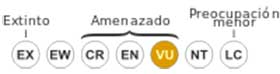

Vulnerable


โ€ข Current category of the Red List of the UICN: Vulnerable.

โ€ข Population trend: Stable.

โ€ข Population size : 250-999 individuals.
Rationale for the Red List category

This species may still have a small purebred adult population.. Possible removal by hybridization has been avoided thanks to three decades of conservation efforts, which they have seen increasing population size. It is restricted to one place (given the proximity of the small islands that lives and mobility), and its small population size means it still deserves to be listed in a threatened category, but it is likely that their population size has been more than 250 mature for more than 5 years, so it has been transferred to the category of Vulnerable.

Justification of the population

The population of phenotypes similar to those of Forbes It has increased dramatically in the Mangere Island, with the best estimates placing the population between 800 and 1.000 individuals. A survey in 2011 It assessed that the phenotypes of interest are in the 10%, the trigger level for management action (D. Houston a slightly. 2012). It is likely that populations have exceeded 250 mature for more than 5 years, so now it is in the range of 250-999 mature individuals.

Justification trend

The population has shown minor fluctuations in recent years, since the species recolonized the Mangere Island over the years 70 and it has benefited from habitat restoration, while hybridization has also suffered. In general, It is estimated that the population has remained stable for the last ten years, and It is probably increasing (T. Greene a slightly. 2012).

Threats

โ€ข Disappeared from Mangere Island due to a combination of deforestation for grazing, decades of burning, the effects of introduced grazing mammals and predation by feral cats (Higgins 1999).

โ€ข The greatest current threat is the hybridization with the Cyanoramphus novaezelandiae chathamensis, subspecies Red-crowned parakeet (Cyanoramphus novaezelandiae) What, despite the sacrifice, still it is settling in Mangere Island (J. Kearvell a slightly. 1999).

โ€ข It is believed that the rate of hybridization High above is the result of the then low population sizes of the two species (D. Houston y C. Miskelly a slightly. 2008).

โ€ข The levels of hybridization They have remained below 10% of the total population of parakeets Mangere Island over the last decade, so no management intervention was not necessary.

Conservation Actions Underway

โ€ข Appendix I and II of CITES. The Mangere Island It has been substantially replanted (Aikman et al. 2001, D. Houston y C. Miskelly a slightly. 2008).

โ€ข An ecological and genetic research program has investigated population dynamics, the hybridization and selection of partners (H. Aikman a slightly. 1999, Chan et al. 2006).

โ€ข During 1976-1999, hybrid birds and individuals of the subspecies Cyanoramphus novaezelandiae chathamensis They were sacrificed population (Nixon 1994).

โ€ข In 1998, 40 hybrids And six Cyanoramphus novaezelandiae chathamensis were killed, leaving 10 copies between hybrids and Cyanoramphus novaezelandiae chathamensis after the operation (H. Aikman a slightly. 1999).

โ€ข Surveys of the relative proportion of hybrids regarding type phenotypes Forbes They are held every two years (D. Houston a slightly. 2012).

โ€ข The translocation a fenced area predator proof in Chatham Island It is planned for 2017 (D. Houston a slightly. 2012).

Conservation Actions Proposed

โ€ข Complete the investigation ecological, biological and genetic, including analysis and dissemination of results.

โ€ข Monitor trends in the extent and quality of forest habitats on the island of Mangere.

โ€ข Restore forest habitats Mangere Island to increase the number and reduce the hybridization.

โ€ข Work for the establishment of one or more populations in the Chatham Island (H. Aikman a slightly. 1999).

"Chatham Parakeet" in captivity:

There are no data from Chatham Parakeet in captivity.

In the wild, its lonjevidad is probably similar to that of Yellow-crowned parakeet (Cyanoramphus auriceps): 10 years.

Alternative names:

Chatham Island Yellow-crowned Parakeet, Chatham Islands Parakeet, Chatham Parakeet, Forbes’s Parakeet (English).
Kakariki de Forbes, Kakariki des รฎles Chatham, Perruche des Chatham, Perruche des รฎles Chatham (French).
Chathamsittich (German).
Periquito-de-peito-amarelo-da-Ilha-chatham (Portuguese).
Perico de las Chatham (espaรฑol).

scientific classification:

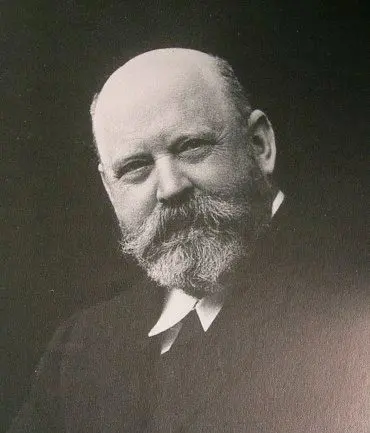
Lionel Walter Rothschild

Order: Psittaciformes
Family: Psittaculidae
Gender: Cyanoramphus
Scientific name: Cyanoramphus forbesi
Subpoena: Rothschild, 1893
Protonimo: Cyanorhamphus [sic] forbes

"Perico de las Chatham" images:
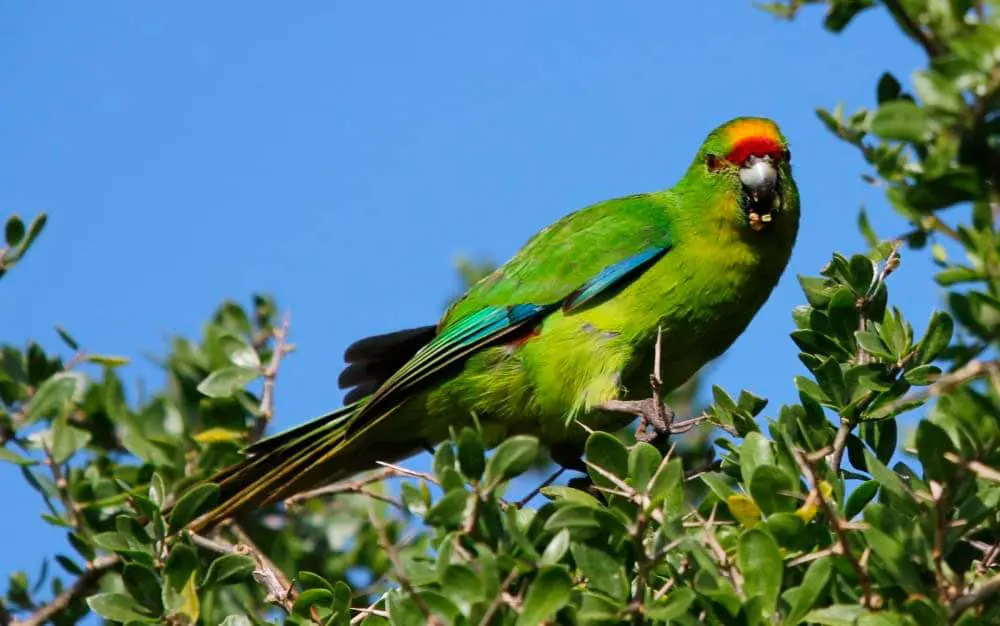
Perico-de-las-Chatham

Sources:

โ€ข Avibase
โ€ข Parrots of the World โ€“ Forshaw Joseph M
โ€ข Parrots A Guide to the Parrots of the World – Tony Juniper & Mike Parr
โ€ข Birdlife
โ€ข Greene, T.C. 2013 [updated 2017]. Forbesโ€™ parakeet. In Miskelly, C.M. (ed.) New Zealand Birds Online. www.nzbirdsonline.org.nz

Photos:

(1) – Chatham Islands Parakeet on Mangere Island by Markanderson72 [CC BY-SA 4.0], from Wikimedia Commons
(2) – Andrew Sutherland, IBC1065693. Photo of Chatham Parakeet Cyanoramphus forbesi at Chatham Islands, New Zealand. Accessible at hbw.com/ibc/1065693.

โ–ท The world of Pets: Dogs, cats, birds, reptiles, amphibians

Budgerigar
Melopsittacus undulatus


Common Budgie

Content

Description

18 cm. length and a weight between 22 and 32 g..

Periquito-Comun

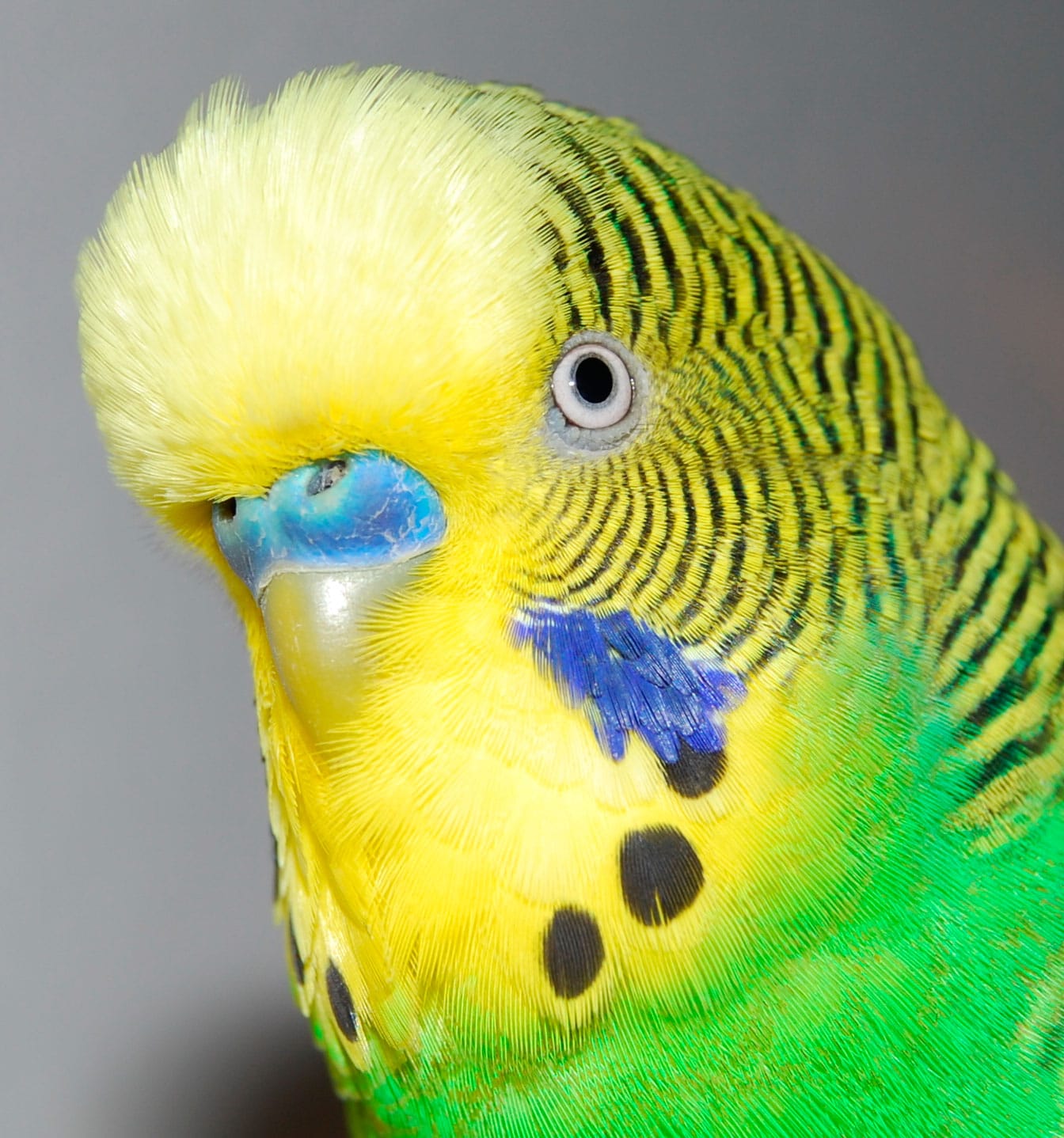
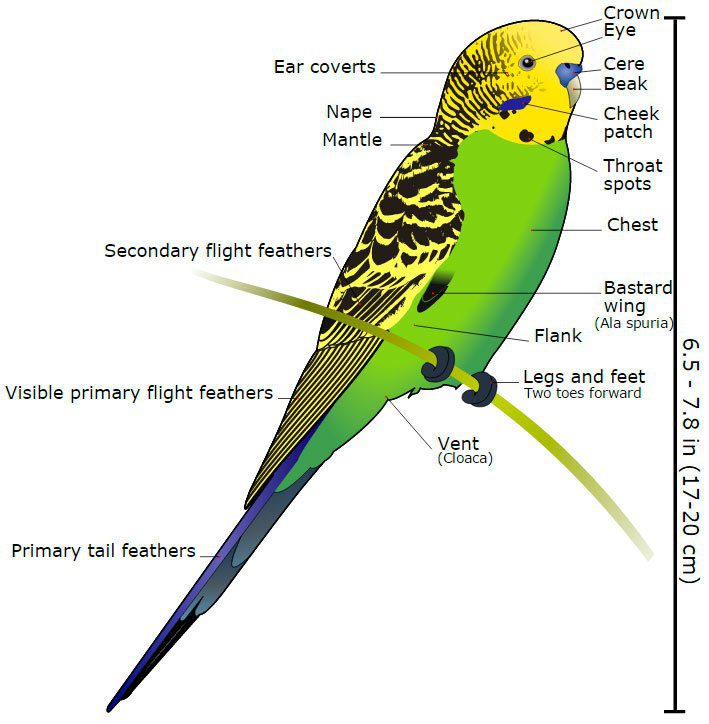
In the Budgerigar (Melopsittacus undulatus) of adults, the cere Blue contrasts with the frontal zone; the front of the face and throat are pale yellow. The latter is covered by a line of black dots. The area which is located below the cheeks it's purple.

The central part of the pileum extending from the rear of the eyes to neck It is covered with alternating thin black bands and bands of pale yellow. These bars are expanded on the the mantle and wing-coverts, forming a scaly effect.

The underparts, the area beneath the wings, the lower part of the back and rump create a beautiful pale green together. The tail is opaque blue tones with a central yellow stripe on the side feathers.

The female has a Brown wax.

The immature they are more turned off with bars on the front. The black spots on the throat they are absent.

Habitat:

The Budgerigar they are distributed by a wide variety of open habitats, including open forests, lightly wooded grasslands and savannas. Also appreciate the areas of Mallee, farmland, vegetation that grows along rivers, drought-adapted scrub and open plains. They come fitted with desert areas of Mulga (Acacia aneura). Although they are able to survive several days without water, These birds are never far from a water source.

In areas where fruit production is constant and in others where it is stable for very long periods, the movements of the Budgerigar they are easily predictable.

In the South end, Pilgrimages exist only in cases of prolonged drought and wandering parakeets return to their territory with the first rains and recolonize when river levels return to normal.

Reproduction:

The Budgerigar they build their nests of June to September in the North its area of distribution. They reproduce between August and January in the South. Nests can be installed at any time of the year after the rains fall. They establish a second brood as soon as conditions are favorable.

These parakeets usually nest in colonial way. The nest is located in a natural cavity in a tree, in a strain, an any fence post, or on a big fallen branch.

The female lays from 4 to 6 eggs and incubation lasts a few 18 days. The chicks remain in place of birth during 30 days before flying.

Food:

The Budgerigar It vegetarian, they eat herbs and seeds of quenopodios. Plants vary in categories and in proportions, according to which regions and times.

The East inside of Australia, These birds feed exclusively on seeds that are on the ground, While in the middle of the continent, There is more variety of plants to select. In the first case, grain size barely exceeds the 2 mm diameter and the second, more than 40 plant varieties make up the diet of these parakeets.

From time to time, the Budgerigar, they come in growing areas and take advantage of the ripe fruits.

Distribution:

The Budgerigar are distributed widely throughout the Interior of Australia, Although they are rare in the coastal districts of the This and the end South-West (absent of Tasmania, Arnhem Land and Cape York Peninsula).

The species may be of common to very abundant, but they are nomadic, and may change from year to year areas.

These parakeets, frequently, they burst from the arid zones to the more humid zones and there are temporary movements towards the south during the summer, but these changes may be affected by annual rainfall patterns.

We have introduced, without success, in a number of places around the world (or they have escaped from captivity and could not be) including South Africa, United Kingdom, Japan, Hong Kong, Puerto Rico, Brazil, Switzerland, Colombia, the Society Islands, New Zealand and Oman.

In the EE.UU. the species has managed to colonize Hawai and California (leaks also occur regularly in the city of New York City). In Florida a population was originally registered in the area of St. Petersburg, in the decade of 1950 and now has more of 3.000 individuals; These birds are mobile and have been recorded along the coast This of all the South from Jacksonville to Miami, and in the West everything Hudson to South of Fort Myers, from time to time go towards the North in Gainsville.

Parakeets, occasionally escaped, they may appear in Tasmania.

The world population is estimated at around 5.000,000 copies.

Conservation:


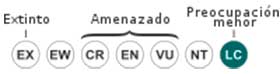
minor concern


โ€ข Current category of the Red List of the UICN: Least concern

โ€ข Population Trend: Growing

This species is not threatened at all, even they are abundant, and in some places where resources are good, countless flocks darken the sky, to cause branches to break from 4 centimeters in diameter, When large number of birds used them as support for their breaks.

Populations fluctuate widely depending on weather conditions.

Livestock living on farms in central Australia have caused Budgerigar they will benefit from new water supplies. Like this, the number of parakeets are constantly increasing.

These parakeets are the most well known psittacidas in the world.

"Budgerigar" in captivity:

This parakeet was discovered in 1805 and since then it has become the most popular captive bird in the world. While it is considered as domestic fowl, However, is a gregarious and instinctive animal, with the same needs that the parrots who freely roam the lands of Australia.

The Budgerigar It dynamic, curious, melodious and because of its small size, the beauty of their plumage and their entertaining behaviour, truly charming. This is what makes it a coveted bird. But, It is still a bird that needs to fly, play and socialize with their peers. Like any bird, It is sensitive to the social and environmental context. In fact, their real needs are too often overlooked, many parakeets suffer neglect or even abuse.

In captivity, the Budgerigar It is larger than its counterpart in nature. Measures of 20 to 25 cm. from head to tail and weighs between 30 and 45 g.. In addition to the colour of your coat, wild type, There are numerous mutations (other coat colors) associated with the increase in crossings and selections in certain genes, that translates into more spontaneous mutations.

The Budgerigar has two silent by year average, and the first moult occurs between the fourth and sixth month. The molt is complete renovation of the plumage of the bird. Pens fall to others push, includes your tube of keratin that parakeets will open with their beaks to release pen and relieve the irritation that engenders the same thrust. It can be more or less painful and intense. Some plucking is so fast that the bird may experience some difficulties during the flight.

Check the intensity of the change of the parakeet through black head tubes, tiredness and especially the number of feathers on the ground.

The feeding of the Budgerigar is based on the millet and the birdseed, Although it must be complemented with other seeds or vegetables (as the lettuce, Spinach, pepper, Carrot, corn). The fruits are also a good dietary supplement for these birds. Occasionally it can provide a little bread or biscuit, but always with caution that not give them anything very sweet. The avocado, the chocolate and the parsley they are deadly toxic for the Australian parakeets.

The the parakeet cage must be protected from the cold, a temperature between the 20-25 C. It must be of one sufficient size so you have freedom of movement and can exercise. The balusters must be arranged horizontally so that they can climb up them. The cage must be washed at least once a month with a disinfectant, change the water daily and clean the shells of the food. A cat litter tray can be placed to make their needs.
It is also important to let the parakeet out occasionally and fly freely around the room. Windows must be closed and curtains, because you can hit them.
Son very sociable birds and it is better to live with other parakeet. The best couple is formed by a male and a female. This will try to kill its companion if it is of the same gender.

With regard to its longevity, according to sources, these animals can come to live until 21 years in captivity. The same sources indicate that these parakeets suffer from a high incidence with respect to ovarian cancer.

Alternative names:

Budgerigar, Budgerygah, Budgie, Canary Parrot, Grass-Parakeet, Lovebird, Scalloped Parrot, Shell Parakeet, Shell Parrot, Undulated Parrot, Warbling Grass-Parrot, Zebra Parrot (ingles).
Perruche ondulรฉe (French).
Wellensittich (German).
Periquito-australiano (Portuguese).
Periquito Australiano, Periquito Comรบn, Cotorra Australiana, Cata Australiana (espaรฑol).

scientific classification:

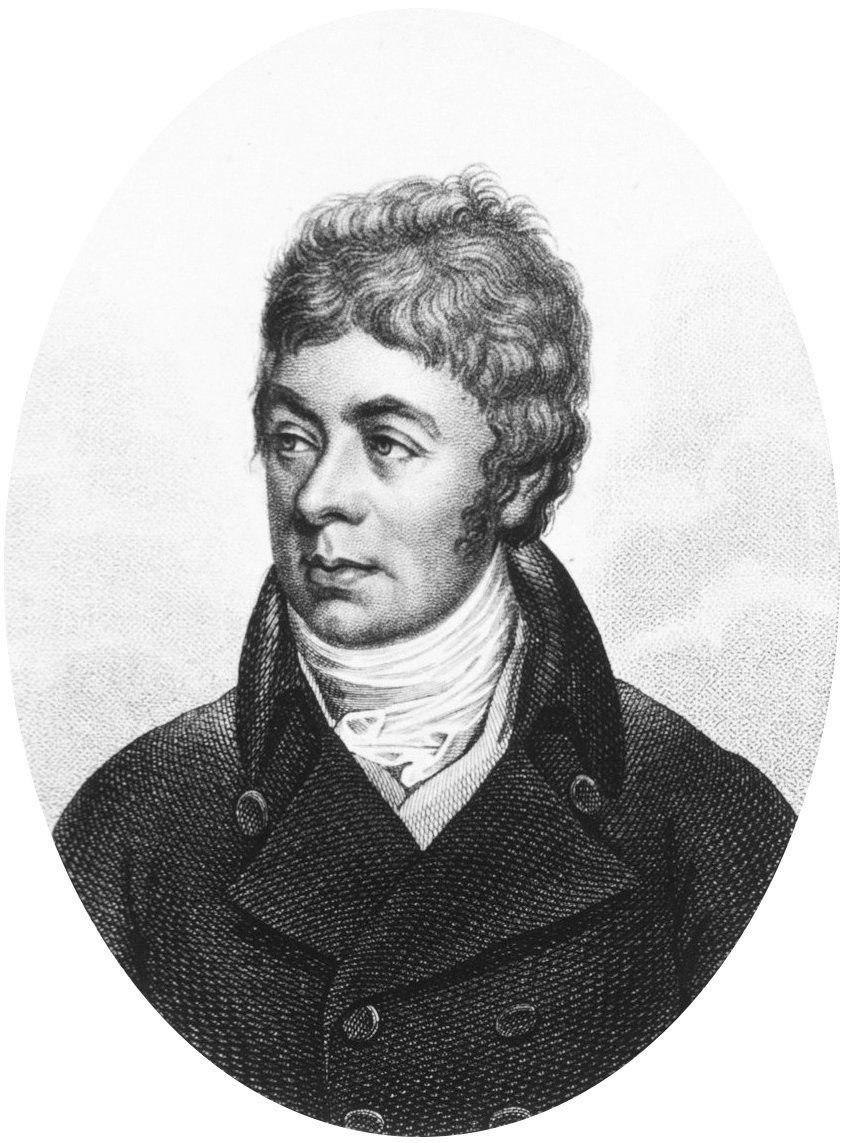
George Shaw


Order: Psittaciformes
Family: Psittaculidae
Genus: Budgerigar
Scientific name: Melopsittacus undulatus
Citation: (Shaw, 1805)
Protonimo: Psittacus undulatus

ยซCommon Parakeetยป Images:

Videos "Budgerigar"

————————————————————————————————

ยซCommon Parakeetยป (Melopsittacus undulatus)


Sources:

Avibase
– Parrots of the World โ€“ Forshaw Joseph M
– Parrots A Guide to the Parrots of the World – Tony Juniper & Mike Parr
– Birdlife

Photos:

(1) – Budgerigar at Zoo Atlanta, USA By TheSussman (Mike) (originally posted to Flickr as Parakeet) [CC BY 2.0], via Wikimedia Commons
(2) – Two budgerigar at Henry Doorly Zoo, USA By Jeff Coffman (originally posted to Flickr as DSC_1265) [CC BY 2.0], via Wikimedia Commons
(3) – male budgerigar. taken near Cameronโ€™s Corner, Qld By Benjamint444 (Own work) [GFDL 1.2], via Wikimedia Commons
(4) – Detail shot of budgerigars head By Kirk (Own work) [CC BY-SA 3.0 or GFDL], via Wikimedia Commons
(5) – Melopsittacus undulatus flock, Karratha, Pilbara region, Western Australia By Jim Bendon from Karratha, Australia (budgies_4) [CC BY-SA 2.0], via Wikimedia Commons
(6) – By User Magnus Manske on en.wikipedia [Public domain], via Wikimedia Commons
(7) – Exterior diagram of a green budgerigar By ZooFari [CC BY-SA 3.0], via Wikimedia Commons

Sounds: Marc Anderson (Xeno-canto)

โ–ท The world of Pets: Dogs, cats, birds, reptiles, amphibians

Yellow-faced Parrotlet
Forpus xanthops

Content

Description:


Anatomy-parrots

14 cm.. height. Plump appearance and short tail terminated tip. Distinguishable by the Crown, face, Yellow chest and belly, with strong wing blue patch, Flying Blue occupies almost half of the wing. Dorsally gray cafesoso, with the blue rump. The female has the blue patch on the rump and wings paler and smaller.

Sound of the Yellow-faced Parrotlet.

Habitat:

Video – "Yellow-faced Parrotlet" (Forpus xanthops)

Forpus xanthops - Yellow-faced Parrotlet - Yellow Faced Parakeet.

The Yellow-faced Parrotlet He lives in varied habitats, usually arid, forest riparian in the tropical and subtropical area, between 1000 to 1600 m, Although it has been reported to 2745 m. It is gregarious. Their diet includes cactus, In addition to fruit trees and other things. They nest in communal area, using tree hollows or sand. The breeding season is from March to April..

Distribution:

They are found in northwestern Peru., in the upper valley of the Maraรฑรณn river, from the east of La Libertad to the southeast of Cajamarca and the south of Amazonas.

Conservation:

State of conservation โ“˜


Vulnerable Vulnerable โ“˜ (UICN)โ“˜

According to the IUCN categories it is considered as Vulnerable (VU). Habitat degradation and trade are adversely affecting the population.

The ban on the capture and trade has improved the status of this species. The rate of decline was very rapid in the Decade of 1980, Although at present has been reduced and even stabilized. But, the population is still very small, with records in very few places, and as a result, according to the IUCN categories, qualified as vulnerable.

"Yellow-faced Parrotlet" in captivity

Captured for the trade of wild birds, It is estimated that 17.000 birds were captured between 1981 and 1994. The rate of mortality during capture is estimated between the 40% and the 100%. Rare and unknown in captivity until 1979-1980.

Images "Yellow-faced Parrotlet"

Alternative names:

1. Yellow-faced parrotlet (English).
2. Toui ร  tรชte jaune, Perruche-moineau ร  tรชte jaune (French).
3. Gelbmasken-Sperlingspapagei, Gelbmaskenpapagei (German).
4. Tuim-de-cabeรงa-amarela, Tuim, Periquito-de-cabeรงa-amarela (Portuguese).
5. "Catita enana de cara amarilla", Cotorrita carigualda, Periquito de Cara Amarilla (espaรฑol).


Species of the genus Forpus

Sources: Parrot Book, Parrots and macaws Neotropical
Photo: Wilkipedia

โ–ท The world of Pets: Dogs, cats, birds, reptiles, amphibians

Brown-hooded Parrot
Pyrilia haematotis


Lorito Encapuchado

Content

Description:

21 cm.. height and weight around 165 g.

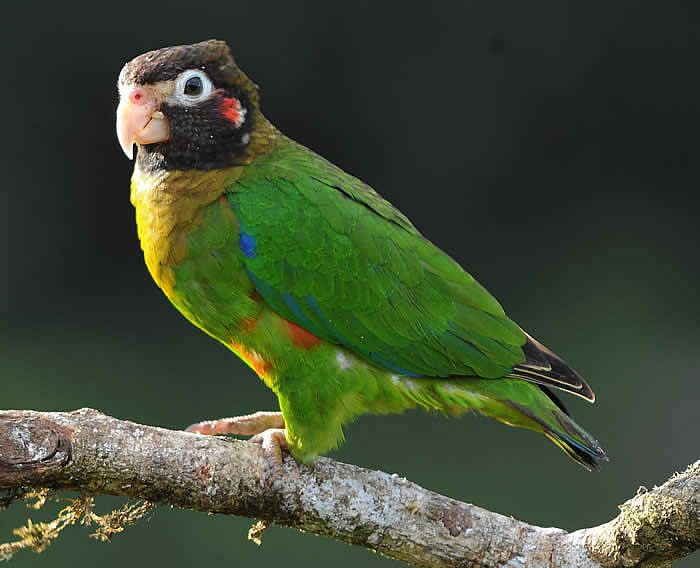
It more distinguishable from the Brown-hooded Parrot (Pyrilia haematotis) is your head, with forecrown White and the eye ring naked white also; ear with red feathers or oranges, crown grayish coffee, chest and nape Green yellowish.

The rest of the body usually green with it armpit red (easily view on the fly), contrasting with the blue-green of the wings and the green of the tail. The latter with light blue at the tip of the central feathers.

The bill is pale brown with yellow tinge. The irises they are red and the legs grayish brown.

The immature they are similar to adults, but more pale, off and without the color red in the head. Their irises is dark.

Subspecies description:

  • Pyrilia haematotis coccinicollaris

    (Lawrence, 1862) – With red marks on the bottom of the rear of the neck and in the part superior of the chest, often forming a band in the male, more weakly in the females.


  • Pyrilia haematotis haematotis

    (Sclater,PL & Salvin, 1860) – The nominal.

Habitat:

It inhabits mainly in the canopy of humid forests with a deciduous tendency, until the 1500 m. Their flocks are not numerous and are quiet at the time of feeding.
In Colombia is considered species very rare.

Reproduction:

It nests in hollow of trees and seems to share them with Blue-headed Parrot (Pionus menstruus).

Breeding season in February in Yucatan; May-July in Guatemala; August in Panama.

Food:

Feeds of fruits and seeds of trees in areas forested, as well as plants epiphytes and leaves green of some types of mistletoe.

Distribution:

Are you can observe in freedom from the Centre-South of Mexico to northwest of Colombia.
You can socialize with other parrots and toucans.

Subspecies distribution:

  • Pyrilia haematotis coccinicollaris

    (Lawrence, 1862) – It is from Panama and Northwest of Colombia.


  • Pyrilia haematotis haematotis

    (Sclater,PL & Salvin, 1860) – The nominal.

Conservation:


minor concern


โ€ข Red List category of the UICN current: Least concern

โ€ข Population trend: Stable

Justification of the population:

Partners in Flight estimates the population at fewer than 50.000 individuals (A. Panjabi in litt., 2008), by what is placed in the band 20,000-49,999 individuals here.

Justification trend:

The population of the Parrot Encapuchad suspected to be stable in the absence of evidence of any reduction or substantial threats.

"Brown-hooded Parrot" in captivity:

Extremely susceptible to stress and diseases during the acclimatization, sudden deaths occur without warning. These are reasons why the they are seldom seen in captivity.

Alternative names:

Brown hooded Parrot, Brown-hooded Parrot, Red-eared Parrot (English).
Caรฏque ร  capuchon (French).
Grauwangenpapagei, Grauwangen-Papagei (German).
Brown-hooded Parrot (Portuguese).
Cotorra Cabeciparda, Lora cabeciparda, Lorito Abigarrada, Lorito Encapuchado, Loro Cabecipardo, Loro Cabeza Oscura, loro cabeza-oscura, Loro Orejirrojo (espaรฑol).
Cotorra Cabeciparda (Colombia).
Loro cabecipardo (Costa Rica).
Lora cabeciparda (Honduras).
loro cabeza oscura, loro cabeza-oscura, Loro Orejirrojo (Mexico).
Loro Cabecipardo (Nicaragua).

scientific classification:

Order: Psittaciformes
Family: Psittacidae
Genus: Pyrilia
Scientific name: Pyrilia haematotis
Citation: (Sclater,PL & Salvin, 1860)
Protonimo: Pionus haematotis

Images "Brown-hooded Parrot"

Videos "Brown-hooded Parrot"

"Hooded Parrot" (Pyrilia haematotis)


Sources:

  • Avibase
  • Parrots of the World โ€“ Forshaw Joseph M
  • Parrots A Guide to the Parrots of the World – Tony Juniper & Mike Parr
  • Birdlife
  • parrots.org

  • Photos:

(1) – avconline

  • Sounds: controles-canto.org – Doug Knapp

โ–ท The world of Pets: Dogs, cats, birds, reptiles, amphibians

Orange-winged Parrot
Amazona amazonica

Amazona Alinaranja

Content


Anatomy-parrots

Description Orange-winged Parrot

Of 33 to 36 cm.. height can weigh between 350 gr y 450 gr.
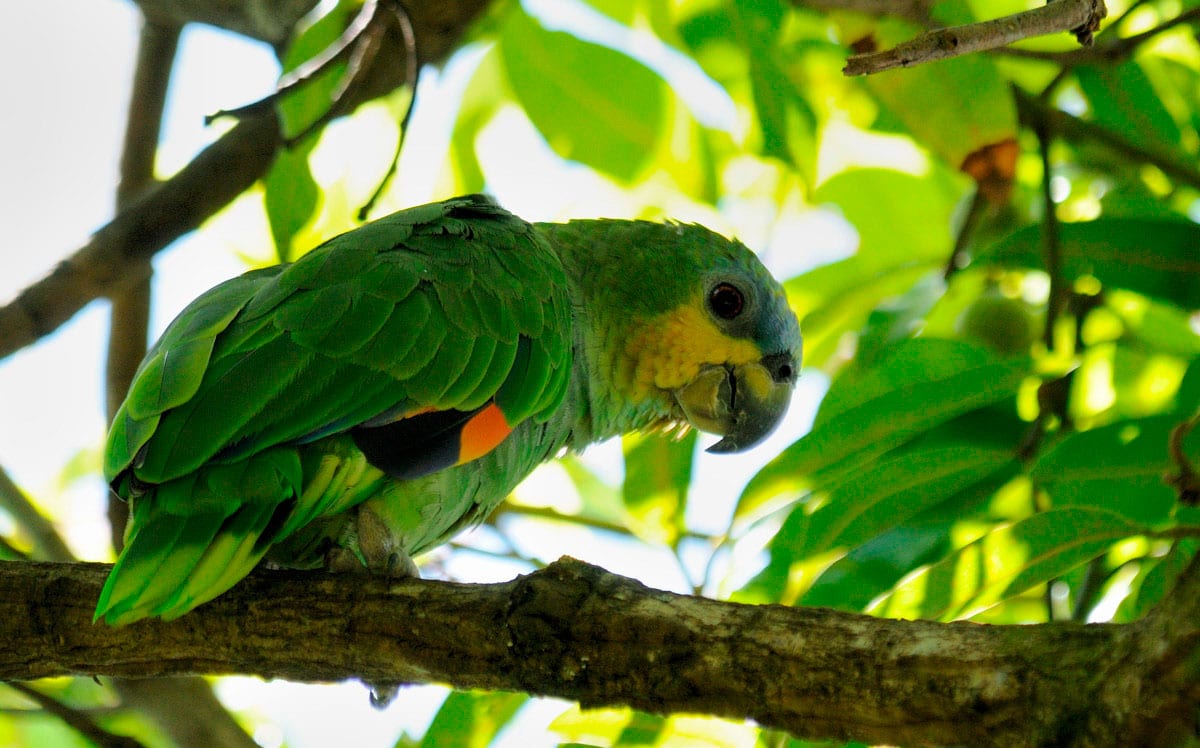
The Orange-winged Parrot (Amazona amazonica) It is distinguishable by having the Centre of the crown and cheeks yellow, separated by the forecrown and sides of the crown pale blue, edge of the wing orange, and inside of the tail Orange with stripe green in the Middle.
The copies juveniles have a color different to it of them adults; the head is green, Blue and pale yellow.
It is not possible to determine the sex of the Amazons in a safe manner by their appearance.

Habitat:

Present in varied habitats (dry forests, morichales, Savanna, stubble, mangroves, etc.) below the 500 m.

Frequently is seen in pairs or in flocks numerous out of it breeding season.

Reproduction:

It is a kind monogamous (the couple stays together for life).

It nests in trunks of Palms killed apparently at the end of the season dry.
The female lays from 3 to 5 eggs and she incubates them for three weeks approximately. the chicks take two months to develop.

Food:

It feeds on various fruits, seeds and sprouts leaves. Including the fruit of Palms (Sloanea, Richeria and Byrsonima) , flowers Erythrina and sometimes cocoa.
You can take oranges and mangoes of the cultivated areas when other food is scarce.

Distribution:


Size of the area of distribution (reproduction / resident): 7.420.000 km2

North and Central South America to the East of Peru, Brazilian Amazon and northeast of Bolivia.

Conservation:

State of conservation โ“˜


minor concern Minor Concern โ“˜ (UICN)โ“˜
  • Current red list category of the UICN: Least concern.
  • The population trend: Decreasing.

  • Trapped for the wild bird trade: they have been 268.510 wild-caught individuals for international trade from 1981.
    In some areas of their range they are hunted for food by the indigenous population.
    The loss of habitat is also a concern.


    "Orange-winged Parrot" in captivity:

    Video – "Orange-winged Parrot"

    Amazona Amazonica

    Popular as a mascot for more than 100 years.
    Loving, playful, with good ability to speak, sociable with people.

    Known for being very friendly, easy to train, very Smart.
    They need constant attention of their owners, they carry out all kinds of fun pranks to get that attention.
    Over time they will form a strong bond with their owner., they can however be quite noisy. They will make noise early in the morning and when the Sun is setting. This usually lasts for a few 10 minutes, to wake up and just before sleep.

    Alternative names:

    Orange winged Parrot, Common Amazon Parrot, Orange-winged Amazon, Orange-winged Parrot (English).
    Amazone ร  ailes orange, Amazone aourou (French).
    Venezuelaamazone (German).
    curica, airu-curuca, ajuru-catinga, ajuru-curau, ajuru-curuca, curau, curuรงรก, Papagaio-do-mangue, papagaio-grego, papagaio-poaieiro (Portuguese).
    Amazona Alinaranja, Amazona Guaro, Cotorra Alianaranjada, Lora Amazรณnica, Loro Real, Lora alianaranjada (espaรฑol).
    Lora Amazรณnica (Colombia).
    Loro Guaro (Venezuela).

    scientific classification:

    Order: Psittaciformes
    Family: Psittacidae
    Genus: Amazona
    Scientific name: Amazona amazonica
    Citation: (Linnaeus, 1766)
    Protonimo: Psittacus amazonicus

    Orange winged Parrot images :


    Species of the genus Amazona


    Sources:

    – Parrot Book, Parrots and macaws Neotropical
    avibase

    Photos:

    Our beautiful world
    – An Orange-winged Amazon at Kuala Lumpur Bird Park, Malaysia. It is eating a slice of corn on the cob by Vasenka – Wikimedia
    – by Patrick Ingremeau – IBC.lynxeds.com
    – by Snowmanradio (talk) – Wikimedia
    – by Thore Noernberg – IBC.lynxeds.com

    Sounds: Joao Antonio de B.. Vitto (Xeno-canto)

    โ–ท The world of Pets: Dogs, cats, birds, reptiles, amphibians

    Long-billed corella
    Cacatua tenuirostris

    Cacatรบa Picofina

    Content

    Description

    35 to 41 cm.. length. The weight of 500 to 600 g..
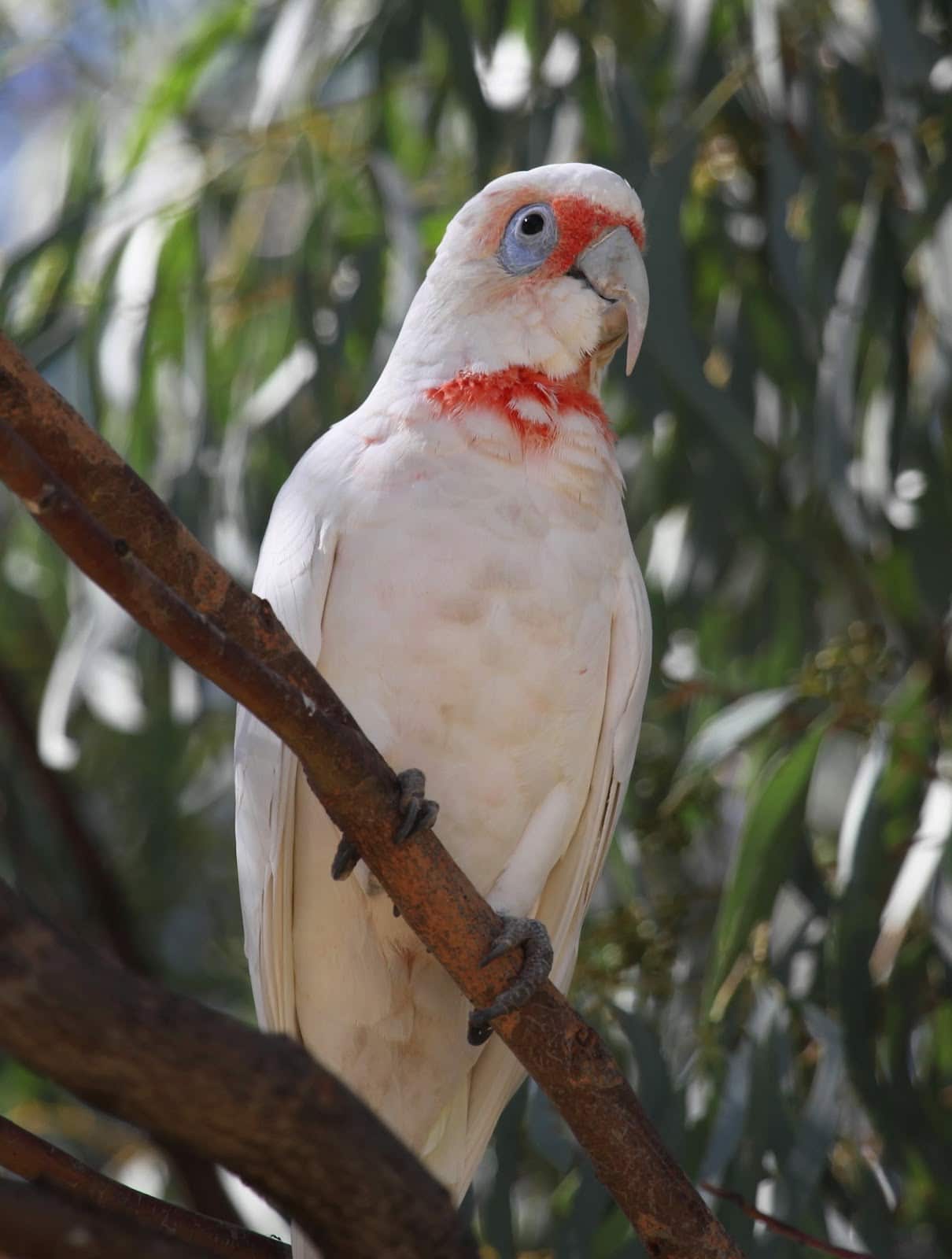
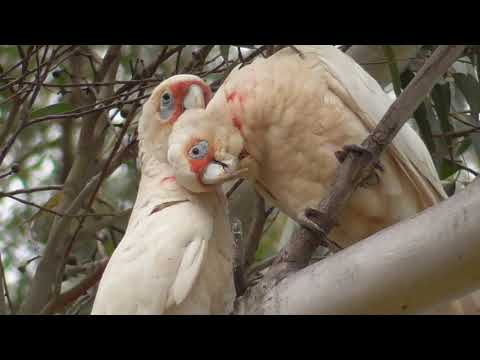
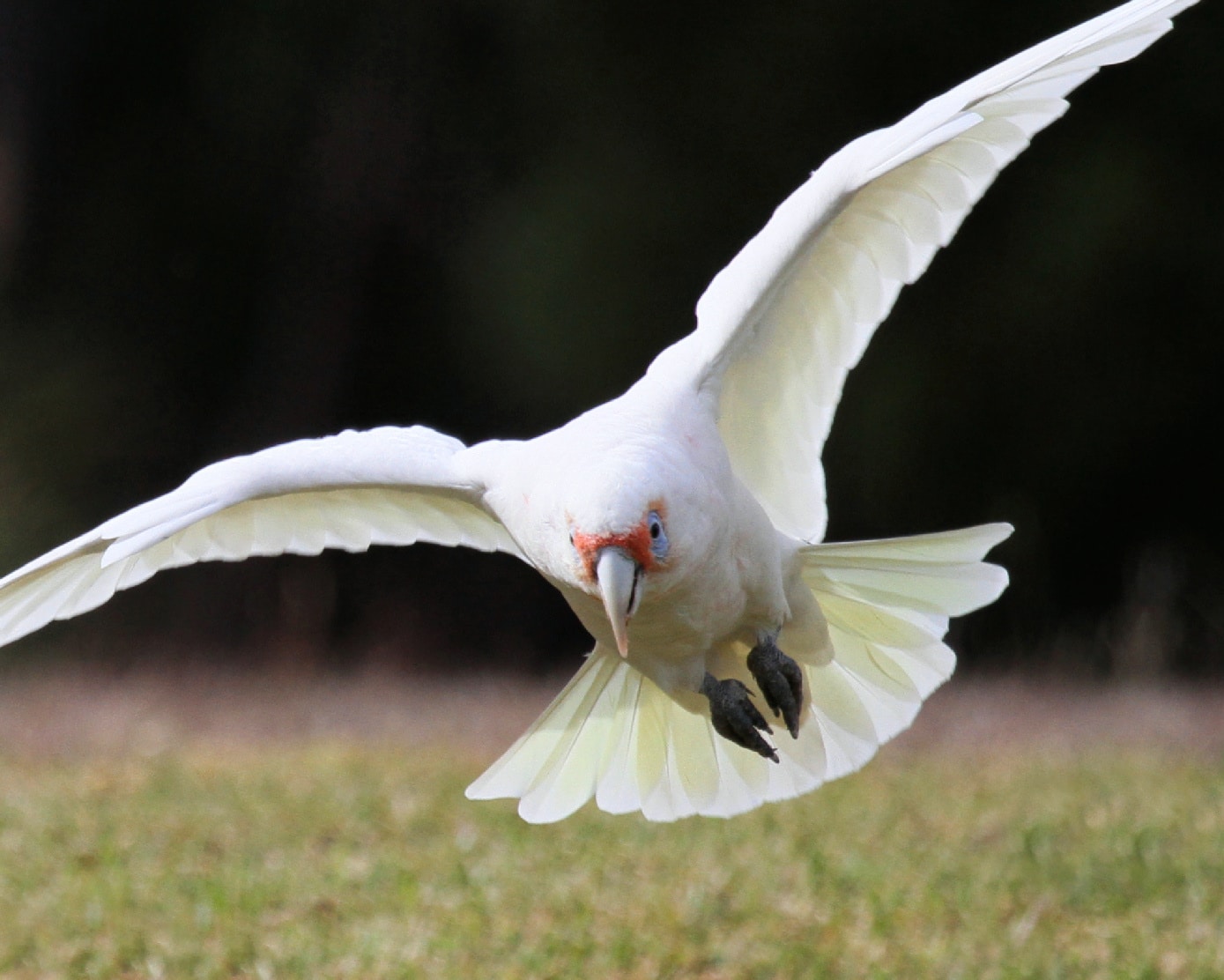
    The Long-billed corella (Cacatua tenuirostris) has white plumage. The undertail coverts and the parts below from the wings they are bathed in pale yellow, very visible in flight. It has red coloration in the throat and the chest, with a Red Crescent ranked in the upper breast.
    The Head shows a small crest white, Red front and a wide, nude and fleshy eye ring blue-grey around the eyes dark browns. The bill is white with blue base. upper jaw is long and hooked. The legs and feet are dark gray.

    The female is similar to the male, with the upper jaw more short and less red.

    There are two similar species:

    Cacatua sanguinea. Lack of forecrown Red and the red color in the neck. The upper jaw is shorter.

    Cacatua galerita. Similar in flight, has crest yellow and lacks of colour red. The bill is black.

    Habitat:

    Video – "Long-billed corella" (Cacatua tenuirostris)

    Long-billed corella ~ Cacatua tenuirostris

    Common in forests and remnant trees on farmland. It nests in Eucalyptus camaldulensis in the flooded Plains or close to streams. Wild populations living on farms and parks in urban areas.

    Behavior:

    Itร‚ยดs resident in their area of distribution, some local movements. Outside of breeding season, You can see in large flocks of up to 2.000 birds or more. Son noisy and visible, pronouncing discordant calls.

    Pose in large eucalyptus near water. They leave the roost in the morning to drink, and then, go to the feeding areas. Again when the darkness comes to sleep, but not before excited participate in games and stunts .

    They move on the floor with stunning movement jump. They do not have the other species waddling gait cockatoo.
    It causes damage to crops of cereals and tree fruit, considered as one pest for farmers.

    Nest colonies. They can create their nests with other species of Corella, and sometimes they hybridize. Populations feral in Sydney and Perth, from the release of unwanted birds, they may hybridize with endangered species such as the Cacatua pastinator

    Reproduction:

    Held from July to November. Forman couples monogamous. The male and female prepared the nest in the Hollows of large old eucalypts. If you do not find a suitable tree, You can make a burrow in soft soil Bank. They fill the nest of wood chips and often reuse it for several years.

    They nest in large colonies, with several nests in the same tree.
    The female lays 2-4 eggs White. The incubation lasts a few 24 days, shared by both parents. The young leave the nest 55 days after hatching, being fed by the parents for three weeks more.

    Food:

    Feeds mainly on what obtained from soil, seeds, estate and bulbs that unearths with its upper jaw. They feed in the coolest hours of the day. Also consumes insects.

    Distribution:

    Size of the area of distribution (reproduction / resident): 382.000 km2

    Is located in the southeast of Australia. Introduced in urban centers of Australia and Tasmania.

    Conservation:

    State of conservation โ“˜


    minor concern Minor Concern โ“˜ (UICN)โ“˜

    โ€ข Current IUCN Red List category: Least concern.

    โ€ข Population trend growing


    Populations may be declining due to loss of breeding grounds in its original distribution area.
    But, the Long-billed corella It common in its range.

    Is created that in the world there are more than 250 thousand individuals.


    "Long-billed corella" in captivity:

    It is very popular as a pet for the most part of Australia, and has been classified as the best ยซtalkative" of the australian cockatoos for its ability to mimic words almost to perfection.
    Has a personality playful and active.

    Out of its area of distribution is rare in poultry farming.

    Alternative names:

    Long billed Corella, Long-billed Cockatoo, Long-billed Corella, Slender-billed Corella (ingles).
    Cacatoรจs nasique (French).
    Nasenkakadu (German).
    Cacatua-corella-de-bico-longo (Portuguese).
    Cacatรบa de Pico Largo, Cacatรบa Picofina (espaรฑol).

    scientific classification:

    Order: Psittaciformes
    Family: Cacatuidae
    Genus: Cockatoo
    Scientific name: Cacatua tenuirostris
    Citation: (Kuhl, 1820)
    Protonimo: Psittacus tenuirostris

    Images Slender-billed Cockatoo:


    Species of the genus Cacatua

    Sources:
    Avibase
    – Photos: Alice Springs in Australiaโ€™s Red Centre, commons.wikimedia.org, Ian Barker (ibc.lynxeds.com/)
    – Sounds: Marc Anderson (Xeno-canto)

    โ–ท The world of Pets: Dogs, cats, birds, reptiles, amphibians

    Red Lory
    Eos bornea

    Red Lory

    Content

    Description

    31 cm.. length and an approximate weight of 170 gr.

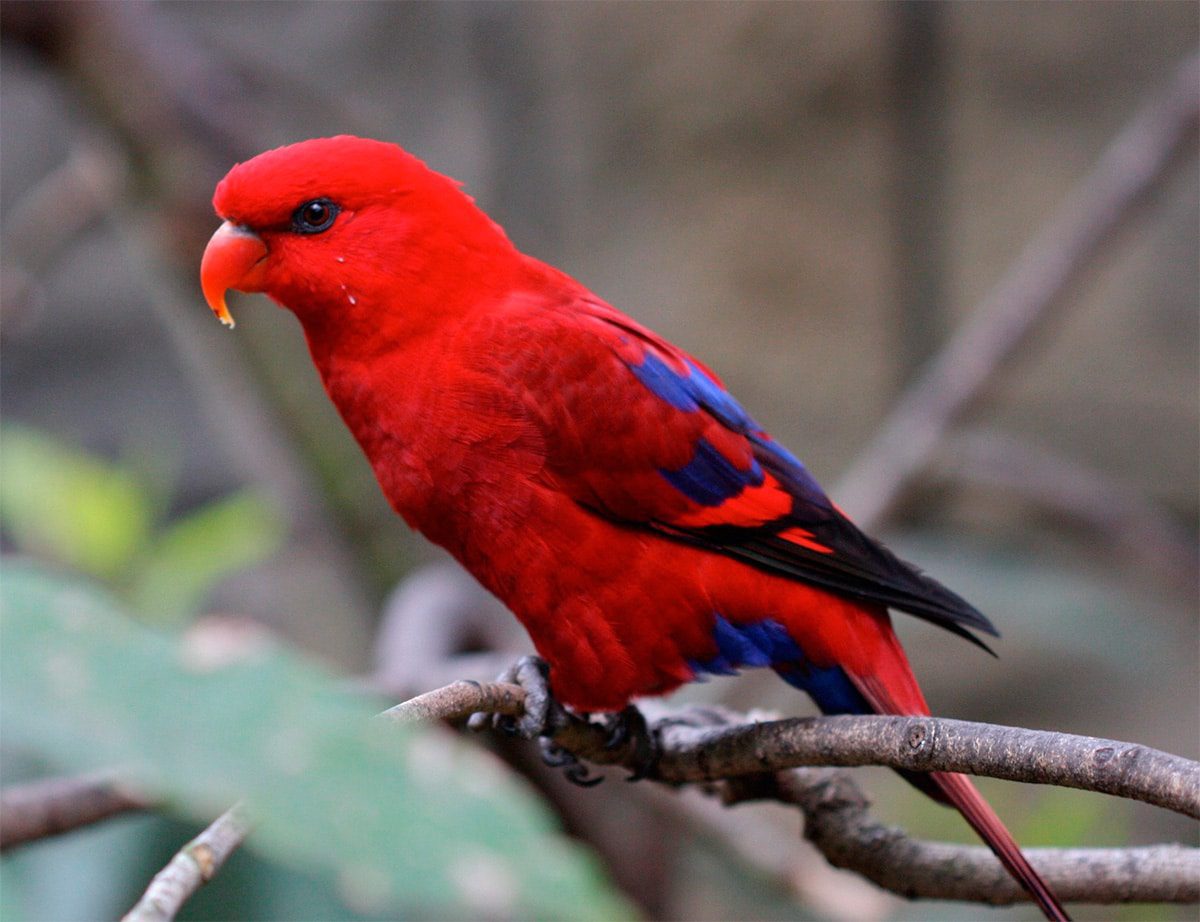
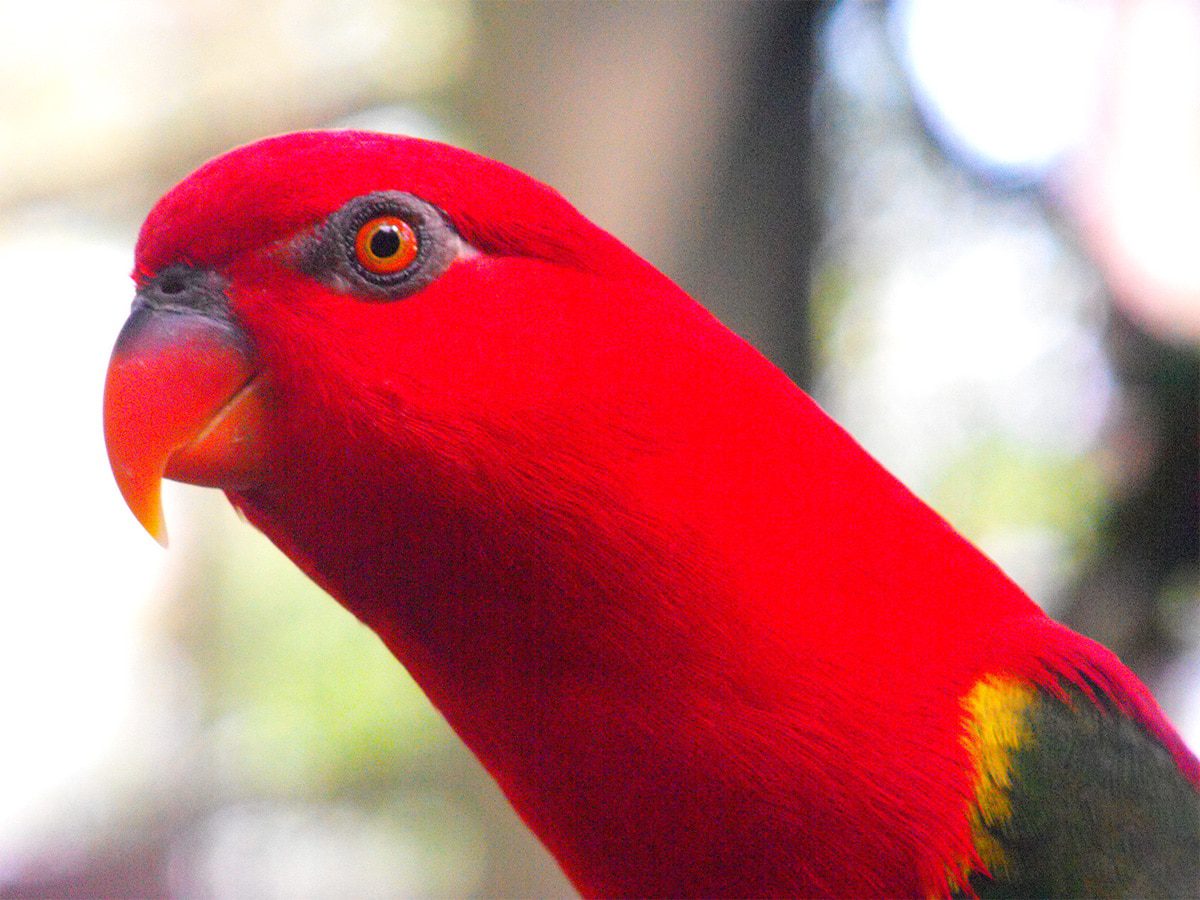
    The head and the neck of the Red Lory (Eos bornea) are entirely of a deep red color.

    In the adult the primary feathers are black with a large red mirror. The feathers tertiary and the coverts are of color blue. The joint of the feathers of the helmsman they are reddish-brown. The irises they are red, legs grayscale and the bill dark orange.

    The immature they tend to be more off than their parents coloring. They show the feathers tertiary grey, lightly stained blue. The ear-coverts Sometimes it tinges of blue. Times, the area of the vent and the thighs it infiltrates with small stains blue. The feathers of the abdomen often carry some edges blue dark. They have the irises brown.

    Not exists no sexual dimorphism visible although the males tend to be more corpulent that the females.

    Description 2 subspecies

    • Eos bornea bornea

      (Linnaeus, 1758) – Nominal.


    • Eos bornea cyanonotha

      (Vieillot, 1818) – The Red of his plumage is much more dark almost brown.

    Habitat:

    They are mostly primary forests, in the wooded areas during regeneration, Forest Hills, coconut plantations, in abandoned gardens and mangroves.

    They are mainly in coastal areas, What does not climb up to 900 m in the island of Ceram and up 1.800 m in the of Buru.

    Throughout its area, the Red Lory are fairly common, However, some populations are more dispersed around the villages, since they are very cautious towards humans.

    Behavior:

    The Red Lory they live in pairs or in small groups, but sometimes you can observe large flocks of 50 individuals.

    They are birds noisy and quite easy to observe, as they often fly above the canopy attracted by the red flowers of the tree of coral (Erythrina).

    They have a fast and direct flight and when moving, make your buzz due to its quick flapping.

    In the Kai Islands, their movements are common: all days, they cross the arm of sea that separates the different islands flying rapidly and at high altitude.

    During the rest hours that occur at noon, the Red Lory they spend most of their time smoothing their feathers in the shade of a tree. Probably, This practice is designed to strengthen marital ties. Parties that enjoy priority are the head and neck; as you can not reach these areas with its beak, you will always need your partner collaboration. The "patient" that undergoes this preferential treatment seems to express a great sense of satisfaction.

    Reproduction:

    The couples begin to look for the location of the nest between the months of August and September. It is located high in a big tree.
    In mid-December some young leaving the nest have observed.

    As in all loris, the nesting period is very long and hard 7 to 9 weeks.

    In captivity, the Red Lory puts 1 or 2 litters per year. Each spawning has usually 2 white eggs that are incubated for a period ranging from 24 to 26 days.

    Food:

    In their natural habitats, the Red Lory feed of nectar, pollen, fruits and insects of fashion casual.
    Your food รขโ‚ฌยบ seem to be them flowers of the trees of the species Eugenia and Erythrina.

    All the Loris they have a language that is especially suited, with a brush tip made up of elongated papillae. This characteristic allows birds to collect pollen from flowers and compress it in a suitable way for swallowing.. They play an important role in the pollination of flowering plants and trees.

    Distribution:

    Size of the area of distribution (reproduction / resident): 57.900 km2

    The Red Lory they have a very restricted distribution area. They live South of the Moluccan Islands, halfway between Sulawesi and the western end of New Guinea.

    Distribution 2 subspecies:

    Conservation:


    minor concern


    โ€ข Current IUCN Red List category: Least concern

    โ€ข Population trend: Decreasing

    This species has a very large range, and therefore not approaching the thresholds for Vulnerable according to the range size criterion.

    The population is suspected of being in decline due to unsustainable levels of exploitation.

    The species has undergone intense trade from 1981, When it began trading in Appendix II. 99.834 wild-caught specimens have been recorded in international trade, Although none from 2000 (UNEP-WCMC trade database, January 2005 CITES).

    "Red Lory" in captivity:

    This lori is considered one of the most widespread within poultry. It's an interesting bird, robust and easy of play, ideal for a start in the world of the loris. It also has a very attractive red color; It playful and is easy for tame.

    It is a great conversationalist. Some have entire sentences in their vocabulary. Unfortunately, his voice is sometimes very strong, with a high sharp squeal. Most are docile, even at maturity. They can be prolific breeders and are fairly easy to find as hand-raised pets..

    Too much protein in the diet can lead to gout., a type of arthritis that crystals are deposited in the joints. May be a bit uncomfortable due to liquid diet.

    Alternative names:


    Red Lory, Buru Red Lory (ingles).
    Lori รฉcarlate, Lori rouge (French).
    Rotlori (German).
    Lรณris-vermelho (Portuguese).
    Lori Rojo (espaรฑol).

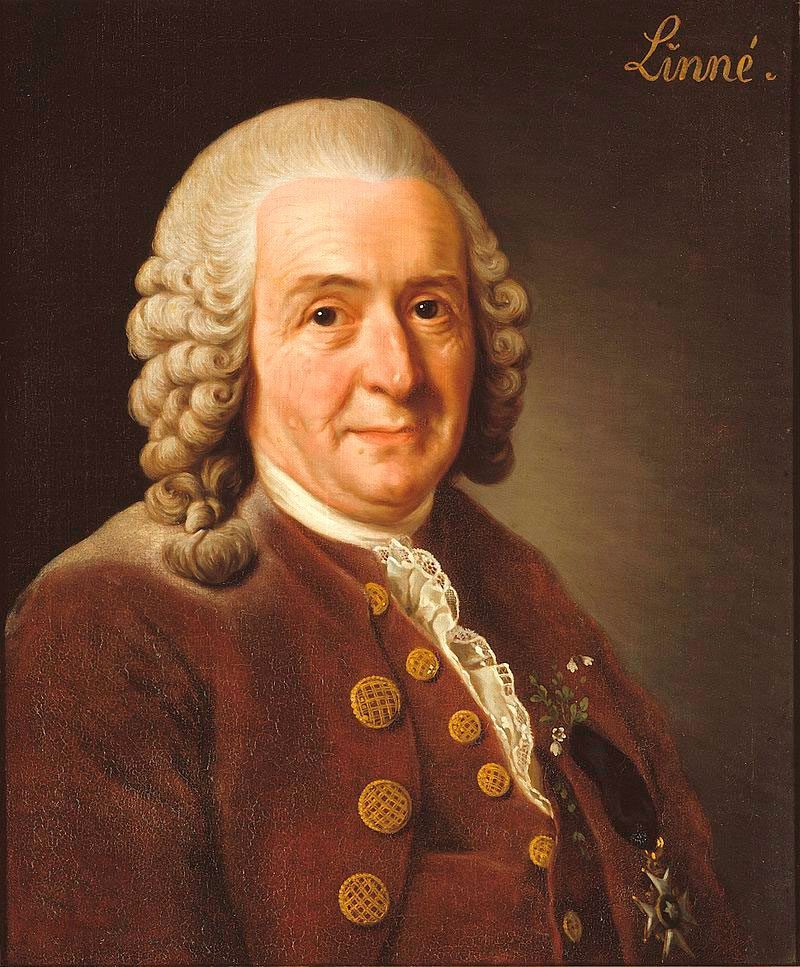
    Carl Linnaeus
    Carl Linnaeus

    scientific classification:


    Order: Psittaciformes
    Family: Psittaculidae
    Genus: Eos
    Scientific name: Eos bornea
    Citation: (Linnaeus, 1758)
    Protonimo: Psittacus borneus


    Images "Red Lori":

    Videos "Red Lory"

    ——————————————————————————————————–

    ยซLori Rojoยป (Eos bornea)


    Sources:

    Avibase
    – BirdLife.org
    – mundoexotics
    Oiseaux.NET

    Photos:

    * A Red Lorry at Taronga Zoo, Sydney, Australia by Navin – wikimdia
    * Red Lory (Eos bornea) looking upwards by shahram sharif – Wikimedia
    * Red Lory (Eos bornea) at Singapore Zoo by Joost Rooijmans – Wikimedia
    * Red Lory – KL Bird Park – Malaysia by diego_cue – Panoramio
    * Moluccan Red Lory – Parrots Australia

    Sounds: BAS van Balen (Xeno-canto)

    โ–ท The world of Pets: Dogs, cats, birds, reptiles, amphibians

    Purple-crowned lorikeet
    Parvipsitta porphyrocephala

    Purple-crowned lorikeet

    Content

    Description

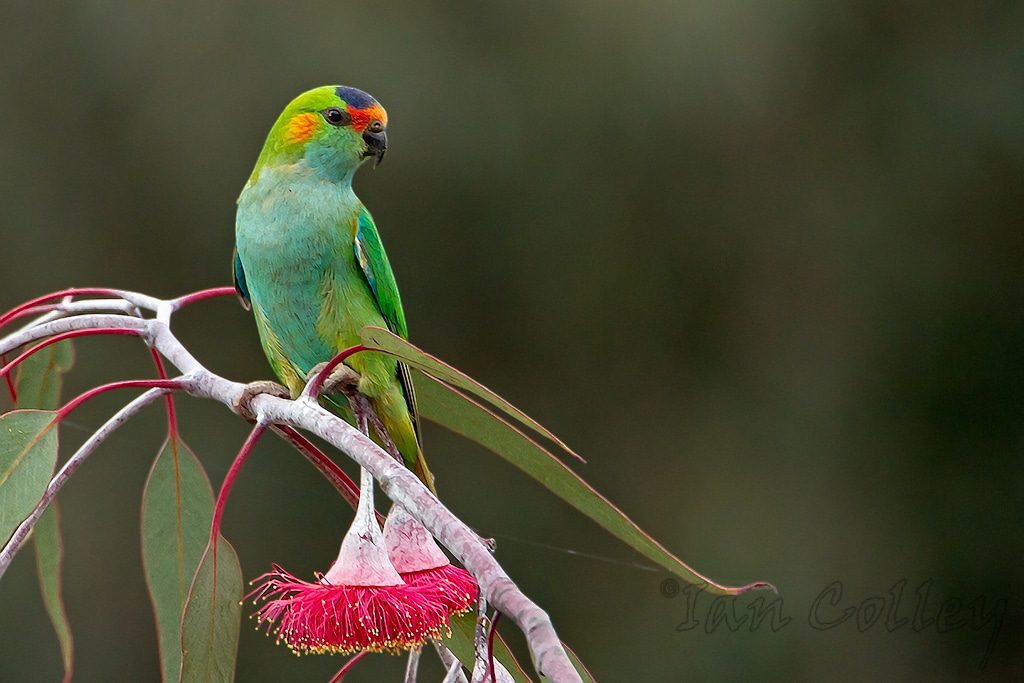
    The Purple-crowned lorikeet (Parvipsitta porphyrocephala) has a length of 16 cm.. and a weight between 40 and 50 g..

    The part forward of the crown is orange, merging is in red in the lores. Above and in front of the eyes, orange-yellow. Crown dark purple color, merging into green at the nape, also showing a few feathers of orange-red.
    The ear-coverts, yellowish-orange, Red Centre. Chin and throat, of color turquoise light.
    Upperparts, of color green with washed Brown in the the mantle and rump more bright, slightly greenish-blue.

    The upperwing green color, bright blue marked in the curve and on the edge of the carpal area.

    The interior of the flight feather color black; fine yellow margins in primaries.
    Coverts interiors, red. Breast , neck and upperparts, of color green with a wash light blue turquoise; sides chest top with slight brownish wash; Center of belly washed turquoise with flanks and coverts, of color color green; yellowish stains on the bottom sides of the chest hidden with the wing folded. Green the upper part of the tail and yellow on the inside.

    Its small bill curved is black, their legs grayscale and the irises her Brown eyes.

    The female is similar but has the irises darker, the ear-coverts lighter and lacks crimson spots.

    The immature are more muted tones and lack of purple coloration of the head.

    Habitat:

    It is a nomadic local that often are found in the forests dried sclerophyllous, especially when the eucalyptus Bloom.
    Nomadic flocks may also travel far, Sometimes the inside of the Australian continent.

    The flowering of the eucalyptus is mainly responsible of its movements unpredictable, Although in some areas, the birds may be present throughout the year.

    Found in diverse areas forming large flocks of hundreds of individuals, often with groups mixed from others Lori including the Musk Lorikeet.

    Found commonly in Woods and forests, but also visitors are urban areas, where feed on ornamental flowers.

    Casual visitors during the winter of banksias in habitats of Heath.

    The Purple-crowned lorikeet is characteristic of drier areas, lightly lined, especially eucalyptus Woods.
    Can convert it in a plague to the orchards.

    Roosts in large groups, sometimes very far from the feeding areas. Manso and discreet While feeds, except the constant calls. Usually feed on low branches and shrubs.

    Reproduction:

    The breeding season It includes the months of August to December. The nests are located in holes in trees, preferably a eucalyptus near the water. Several couples often occupy neighboring holes in the same tree.

    The cycle of of reproduction in captivity gives a period of incubation of around 22 days, with the young people of 6 to 7 weeks weaned high is after the hatching.

    Food:

    Feed primarily of nectar and pollen of the flowering of the eucalyptus, but they can also attack the orchards to feed on ripe fruit.

    Distribution:

    Size of the area of distribution (reproduction / resident): 938.000 km2

    The Purple-crowned lorikeet are located in two areas separate from Australia to the Southwest and Southeast of the continent. Separate ranges, but racial differences are not recognized, and it is possible that the birds can travel from time to time between the two areas of distribution. Also located in the Kangaroo Island, Although not found in Tasmania.

    Conservation:


    minor concern

    โ€ข Current IUCN Red List category: Least concern

    โ€ข Population trend: Decreasing

    The world population It is believed that it is superior to 50.000 individuals.
    This species has a very large range, and therefore not approaching the thresholds for Vulnerable according to the range size criterion.

    While the trend of the population seems to be decreasing, the descent do not believe that it is sufficiently fast for approaching the thresholds of Vulnerable according to the criterion of population trend.

    For these reasons, the species is evaluated as Least concern.

    "Purple-crowned lorikeet" in captivity:

    It is a bird noisy, sociable and always in motion.

    Very rare in captivity out of Australia.

    Alternative names:

    Purple crowned Lorikeet, Purple-crowned Lorikeet (ingles).
    Lori ร  couronne pourpre (French).
    Blauscheitellori (German).
    Lorikeet Roxo-coroado (Portuguese).
    Lori Coronipรบrpura, Lori de Corona Pรบrpura (espaรฑol).

    scientific classification:

    Order: Psittaciformes
    Family: Psittaculidae
    Genus: Parvipsitta
    Scientific name: Parvipsitta porphyrocephala
    Citation: (Dietrichsen, 1837)
    Protonimo: Trichoglossus porphyrocephalus

    Images "Lori Coronipurpin":

    Videos "Purple-crowned lorikeet"


    ยซOn Coroniprightยป (Parvipsitta porphyrocephala)


    Sources:

    Avibase
    Parrots of the World โ€“ Forshaw Joseph M
    Parrots A Guide to the Parrots of the World – Tony Juniper & Mike Parr
    BirdLife.org

    Photos:

    1 – by Ian Colley – IBC.lynxeds.com
    2 – "Purple-crowned Lorikeetvon KeresH – Eigenes Werk. Lizenziert unter CC BY-SA 3.0 รผber Wikimedia Commons.
    3 – by Nick Talbot – IBC.lynxeds.com
    4 โ€“ by Nick Talbot – IBC.lynxeds.com
    5 – gopixpic.com

    Sounds: nick talbot (Xeno-canto)