โ–ท The world of Pets: Dogs, cats, birds, reptiles, amphibians

Styrian Coarse-haired Hound
Austria FCI 62 - Medium-sized Hounds.

Styrian Coarse-haired Hound

Insensitive to the weather and austere, which is especially useful in high mountains and forests.

Content

History

The race Styrian Coarse-haired Hound developed from the end of the 19th century. Already in 1870, an industrial of Styria, a state in southeastern Austria, obtained an interesting litter by crossing a ยซHanoverian Scenthoundยป with a Styrian Coarse-haired Hound. The goal was to obtain a hunting dog that would combine the qualities of the two ancient breeds and inherit a coat that would allow it to withstand the elements..

The Styrian Coarse-haired Hound was created by a man named Carl Peitinger. The breed was officially recognized in its country of origin in 1889, and was finally recognized by the Fรฉdรฉration Cynologique Internationale (FCI) 65 years later, the 31 in August of 1954.

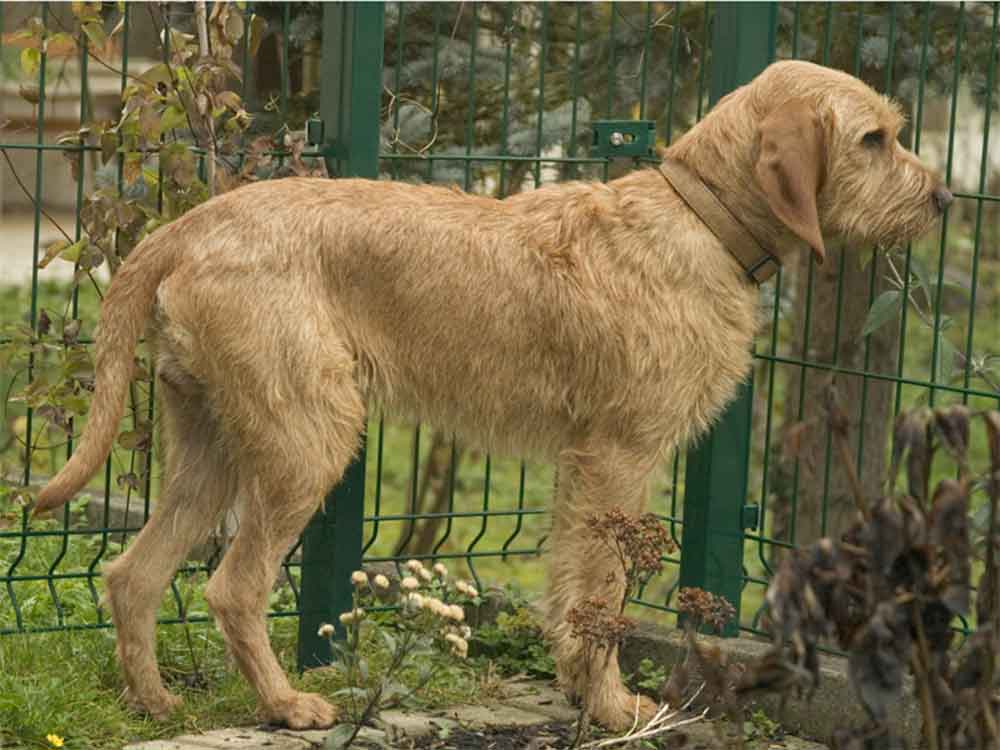
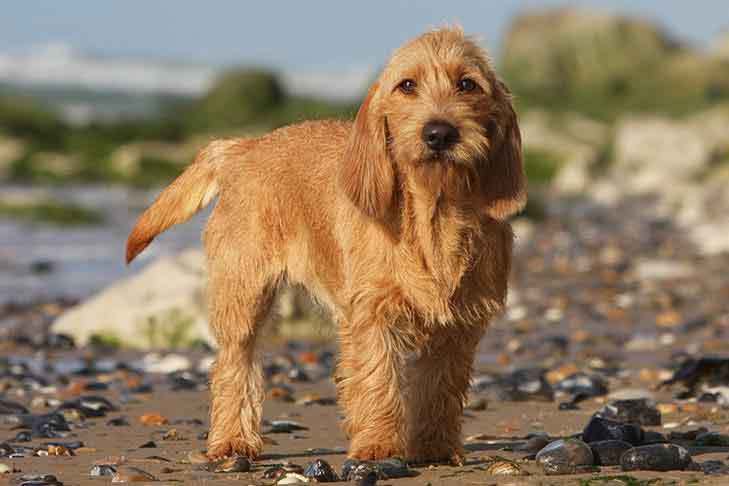
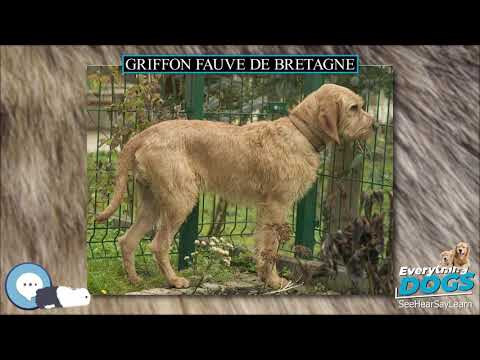
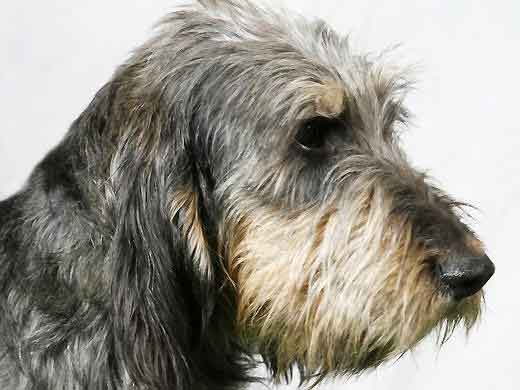
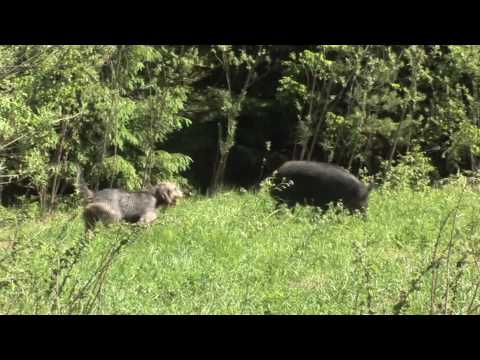
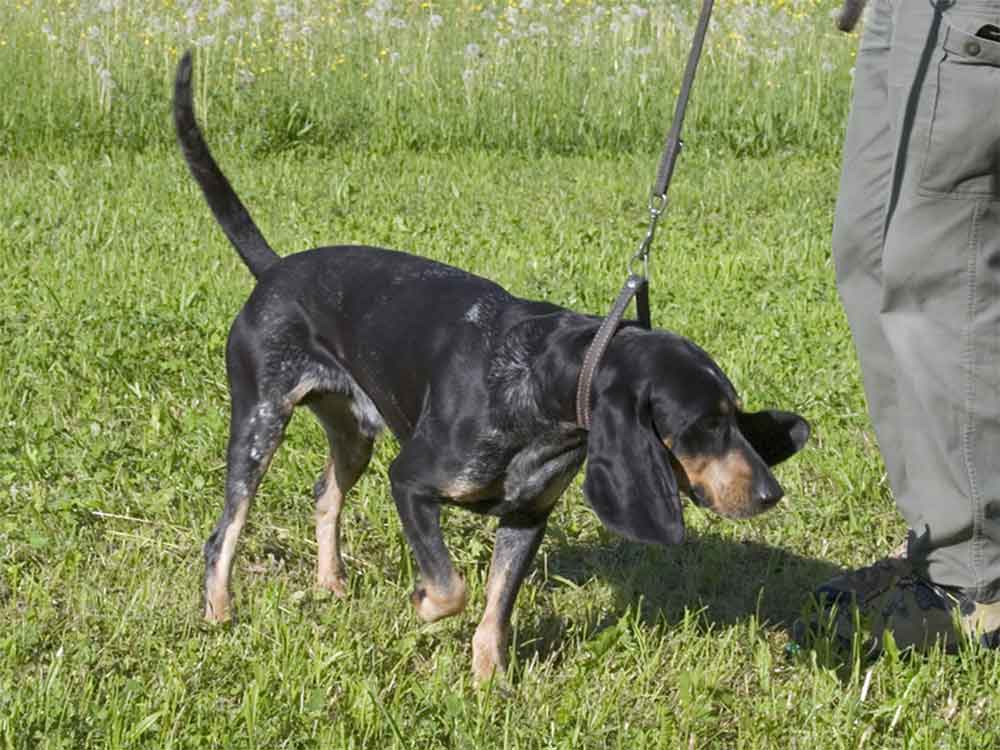
Photo: Styrian Wirehaired Hound, Half Year Old By See page for author, CC BY-SA 3.0, via Wikimedia Commons

Physical characteristics

Styrian Coarse-haired Hound

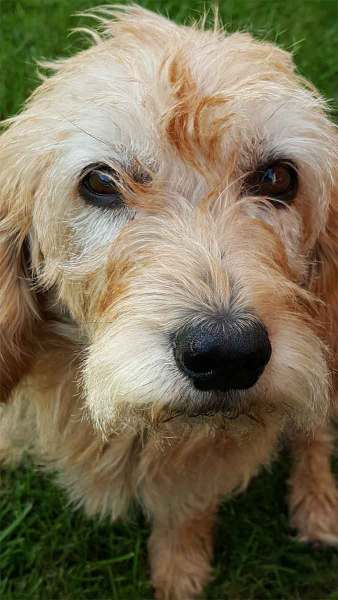
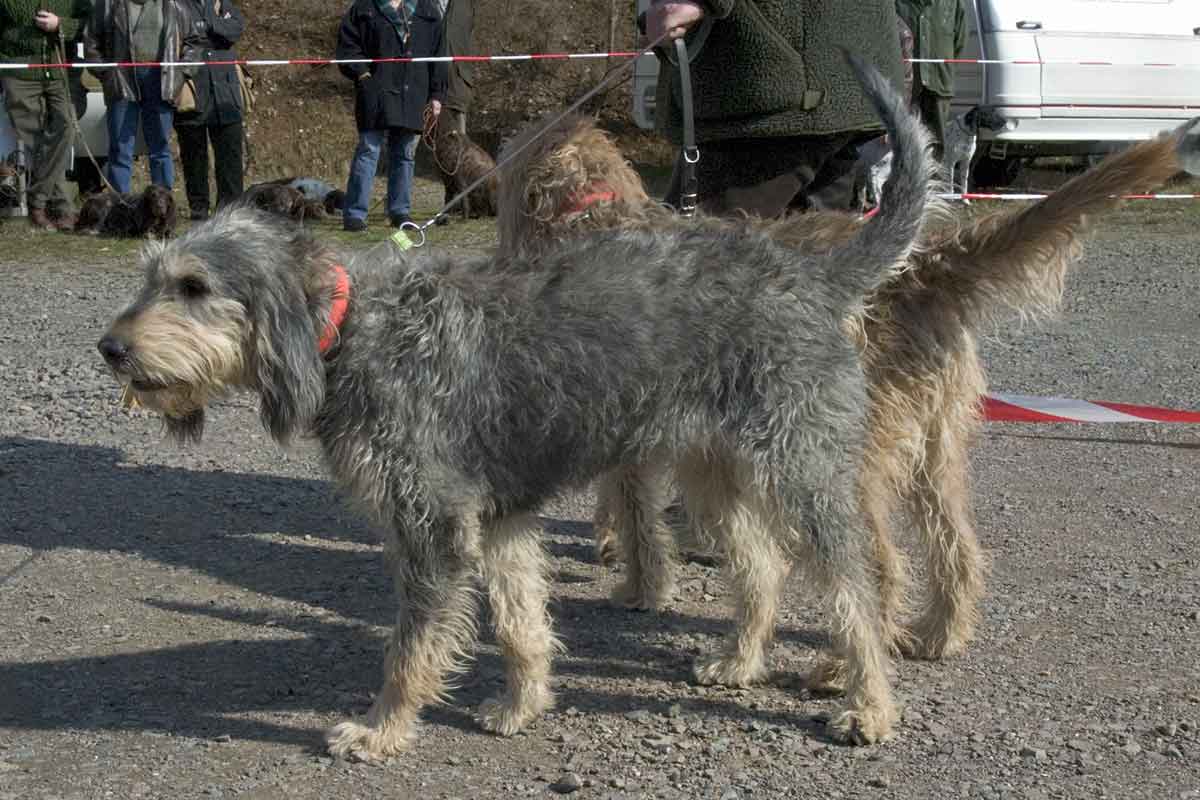
The Styrian Coarse-haired Hound they are medium-sized dogs with solid bones; the expression is austere, but not mean. The skull is slightly domed, with a well developed occipital bone. The stop is marked. The eyes are brown. The ears, Not very large, worn flat against the cheeks and covered with fine hair. The tail is of medium length, strong at the base, with dense hair, never curly but carried upward in a sickle shape; the bottom is like a brush, but without lock.

Fur : Lasted, neither furry nor shiny, hard. In the head, the hair is shorter than in the body. Has mustaches.
Color: red and pale yellow. The white star on the chest is allowed.
Size: 47 to 53 cm for the male and 45 to 51 cm for female.
Weight: approx.. 18 kg.

Character and skills

The Styrian Coarse-haired Hound they have all the qualities of a hunting dog. These dogs show great enthusiasm, determination and stamina when it comes to forcing the game by giving the voice. At home, the Styrian Coarse-haired Hound he is very close to his master and is particularly wary of strangers. They get along quite well with their peers, if they are used to its presence from puppies. They can be more turbulent with other small animals; his hunting instinct is still very strong.

The education…

The Styrian Coarse-haired Hound have a strong character and must be trained early and firmly. It is also necessary that they socialize properly and receive training in recovery to avoid incidents of all kinds.

This Styrian Hound not only used to force the game of hunting by giving the voice, but is very often considered a specialist in tracking blood in difficult mountainous terrain. This makes it a highly sought after hunting companion..

Its exclusively hunter and predator temperament makes it inadvisable as a pet.

However they are very intelligent animals, of a cheerful and affectionate nature as well as an unusual sensitivity.

Care and maintenance …

It needs regular exercise and its coat requires constant maintenance.

Characteristics "Styrian Coarse-haired Hound"

Coexistence is important that you have with your new friend. Before considering the acquisition of a dog of the breed "Styrian Coarse-haired Hound" you know certain factors. Not all breeds of dogs are apt to live in an apartment, you must take into account his character, their need for exercise, their interaction with other pets, their care and if you have small children, their level of tolerance towards them.

Adaptation โ“˜

3,0 of 5 stars (based on 1 review)

friendly dog โ€‹โ€‹โ“˜

3,0 of 5 stars (based on 1 review)

hair loss โ“˜

4,0 of 5 stars (based on 1 review)

Affection level โ“˜

3,0 of 5 stars (based on 1 review)

Need for exercise โ“˜

5,0 of 5 stars (based on 1 review)

Social need โ“˜

3,0 of 5 stars (based on 1 review)

Home โ“˜

4,0 of 5 stars (based on 1 review)

Toilet โ“˜

2,0 of 5 stars (based on 1 review)

Friendly with strangers โ“˜

3,0 of 5 stars (based on 1 review)

barking โ“˜

4,0 of 5 stars (based on 1 review)

Health โ“˜

4,0 of 5 stars (based on 1 review)

Territorial โ“˜

4,0 of 5 stars (based on 1 review)

Cat friendly โ“˜

2,0 of 5 stars (based on 1 review)

Intelligence โ“˜

4,0 of 5 stars (based on 1 review)

Versatility โ“˜

3,0 of 5 stars (based on 1 review)

Child friendly โ“˜

4,0 of 5 stars (based on 1 review)

Surveillance โ“˜

4,0 of 5 stars (based on 1 review)

joy โ“˜

5,0 of 5 stars (based on 1 review)

Videos "Styrian Coarse-haired Hound"

Hunting dog - Styrian wire-haired bracke ( Peintinger Bracke ) - a fantastic hunting dog Trailer

Hunting dog – Styrian wire-haired bracke ( Peintinger Bracke ) – a fantastic hunting dog Trailer

Hunting dog - Styrian wire-haired bracke (Peintinger Bracke) - a fantastic hunting dog!
Jagdhund – Steirische Rauhhaarbracke (Peintinger Bracke) – a fantastic hunting dog!

Type and recognitions:

  • FCI CLASSIFICATION:
  • Group :
  • Section : . .

Federations:

  • FCI – Group 6: Scent hounds, and related breeds. – Section 1.2: Medium-sized Hounds. โ“˜
  • UKCScenthounds โ“˜

FCI breed standard "Styrian Coarse-haired Hound"

Origin:
Austria

Date of publication of the valid original standard:
10.10.1995.

Use:

The job is not only about his role as a hound, but also in pure tracker work in difficult mountainous terrain.


General appearance:

Is medium sized, has strong muscles, and his expression is grim but without malice.


Behavior / temperament:

He is a tough and passionate hound dog, barks without interruption during the hunt and expresses will and security during the trail.

Head:

---

Cranial region:
  • Skull: Slightly convex, well-developed occipital protuberance.
  • Depression links (Stop): Marked.

facial region:

  • Truffle: Black.
  • Snout: Strong and straight.
  • Lips: Not hanging.
  • Jaws / Teeth: Strong scissor bite. You want a complete denture with 42 Dental parts; the lack of two PM1 or PM2 (premolars 1 or 2) is tolerated; the M3 (molars 3) they are not taken into account.
Eyes: With brown iris.
Ears: Not too big, flattened and glued, covered with fine hair.

Neck:

Strong, not too long.

Body:

  • Back: Straight and wide.
  • Pork loin: Moderately raised.
  • Rump: It descends steeply.
  • Breast : It's deep and wide.

Tail:

Medium length, strong in its insertion, well covered with hair, never curled but carried up slightly sickle-shaped; on its lower face has hair in the shape of a brush, but without forming a feather.

Tips

PREVIOUS MEMBERS: Straight, muscular, well angled.
  • Shoulder: Oblique placement.
 
LATER MEMBERS: Muscular, strong, well angled, seen from behind they look straight.
 
FEET: Not excessively large; well arched fingers, closely linked to each other; hard pads, not too big.

Movement:

It covers the ground, elastic.

Mantle

HAIR: Rough, no hirsuto, opaque, hard, tosco. The hair on the head is shorter than the rest of the body and forms a mustache.
 
COLOR: Red and yellowish. A white star is allowed on the sill.


Size and weight:

Height to the cross: 45 โ€“ 53 cm.
  • Males : 47 โ€“ 53 cm.
  • females : 45 โ€“ 51 cm.


Fouls:

Any deviation from the above mentioned criteria is considered to lack, and the gravity of this refers to the degree of deviation to the standard and its impact on the health and well-being of the dog.
  • Head too narrow.
  • Ears with creases or too pointed.
  • Tail too short, too thin or too bent up, that forms feathers.
  • Weak limbs.
  • Coat too long, fine, curly or soft.
  • Shy character.
MISS PLAYOFFS:
  • Aggressive or fearful dog.
  • Upper or lower prognathism. Lack of more than two premolars (PM 1 or PM 2).
  • Any other color different from that indicated in the standard.
 
Any dog โ€‹โ€‹showing clear signs of physical or behavioral abnormalities must be disqualified..


N.B.:

Males should have two normal-appearing testicles fully descended into the scrotum..

Source: F.C.I - International Cynological Federation

Alternative names:

1. Peintinger Bracke, Wirehair Styrian Mountain (English).
2. Brachet de Styrie ร  poil dur (French).
3. Peintinger-Bracke, Steirische Rauhhaarige (German).
4. (em alemรฃo: Steirische Rauhhaarbracke) (Portuguese).
5. Sabueso estirio de pelo รกspero (espaรฑol).

โ–ท The world of Pets: Dogs, cats, birds, reptiles, amphibians

Hound Hamilton
Suecia FCI 132 - Medium-sized Hounds

Hamilton the Hound he is an excellent hunting dog, is valued for his great intelligence and agility.

Sabueso Hamilton

Content

Ratings of the "Hamilton Hound"

Coexistence is important that you have with your new friend. Before considering the acquisition of a dog of the breed "Hound Hamilton" you know certain factors. Not all breeds of dogs are apt to live in an apartment, you must take into account his character, their need for exercise, their interaction with other pets, their care and if you have small children, their level of tolerance towards them.

Adaptation โ“˜

3,0 of 5 stars (based on 1 review)

friendly dog โ€‹โ€‹โ“˜

3,0 of 5 stars (based on 1 review)

hair loss โ“˜

2,0 of 5 stars (based on 1 review)

Affection level โ“˜

3,0 of 5 stars (based on 1 review)

Need for exercise โ“˜

5,0 of 5 stars (based on 1 review)

Social need โ“˜

3,0 of 5 stars (based on 1 review)

Home โ“˜

3,0 of 5 stars (based on 1 review)

Toilet โ“˜

1,0 of 5 stars (based on 1 review)

Friendly with strangers โ“˜

4,0 of 5 stars (based on 1 review)

barking โ“˜

4,0 of 5 stars (based on 1 review)

Health โ“˜

4,0 of 5 stars (based on 1 review)

Territorial โ“˜

3,0 of 5 stars (based on 1 review)

Cat friendly โ“˜

2,0 of 5 stars (based on 1 review)

Intelligence โ“˜

4,0 of 5 stars (based on 1 review)

Versatility โ“˜

4,0 of 5 stars (based on 1 review)

Child friendly โ“˜

5,0 of 5 stars (based on 1 review)

Surveillance โ“˜

2,0 of 5 stars (based on 1 review)

joy โ“˜

4,0 of 5 stars (based on 1 review)

History

The Hound Hamilton (in Swedish: Hamiltonstรถvare), It is a breed of dog developed in Sweden by the founder of the Swedish Kennel Club, Count Adolf Hamilton (hence its name). It is a hound that from its origins was used to hunt hares and foxes. Among his ancestors are hounds Germans, Swiss, the race English Foxhound and race Harrier (dog).

These hounds have long years of history, according to existing documentation, they are present in Sweden since 1500.
A canine exhibition held in Stockholm in the year 1886, marked the history of these dogs, There were two hounds copies (Pang and Stella), owned by count Adolf Hamilton.

Those two dogs are considered the origin of the Hound Hamilton current. At the time, was called, simply, "Swedish Dog". Only in the year 1921 it was given the name of Hound Hamilton, in honor of the first President of the Swedish Club Kennel (Count Adolf Hamilton) and their involvement in the creation and development of the breed.

It's been a long time and today the Hound Hamilton It is the breed of dog with the largest number of copies in Sweden. This year the ยซSwedish Dust Club (Swedish Club of Hamilton Stรถvare)ยป has celebrated its 100 years.

Physical characteristics

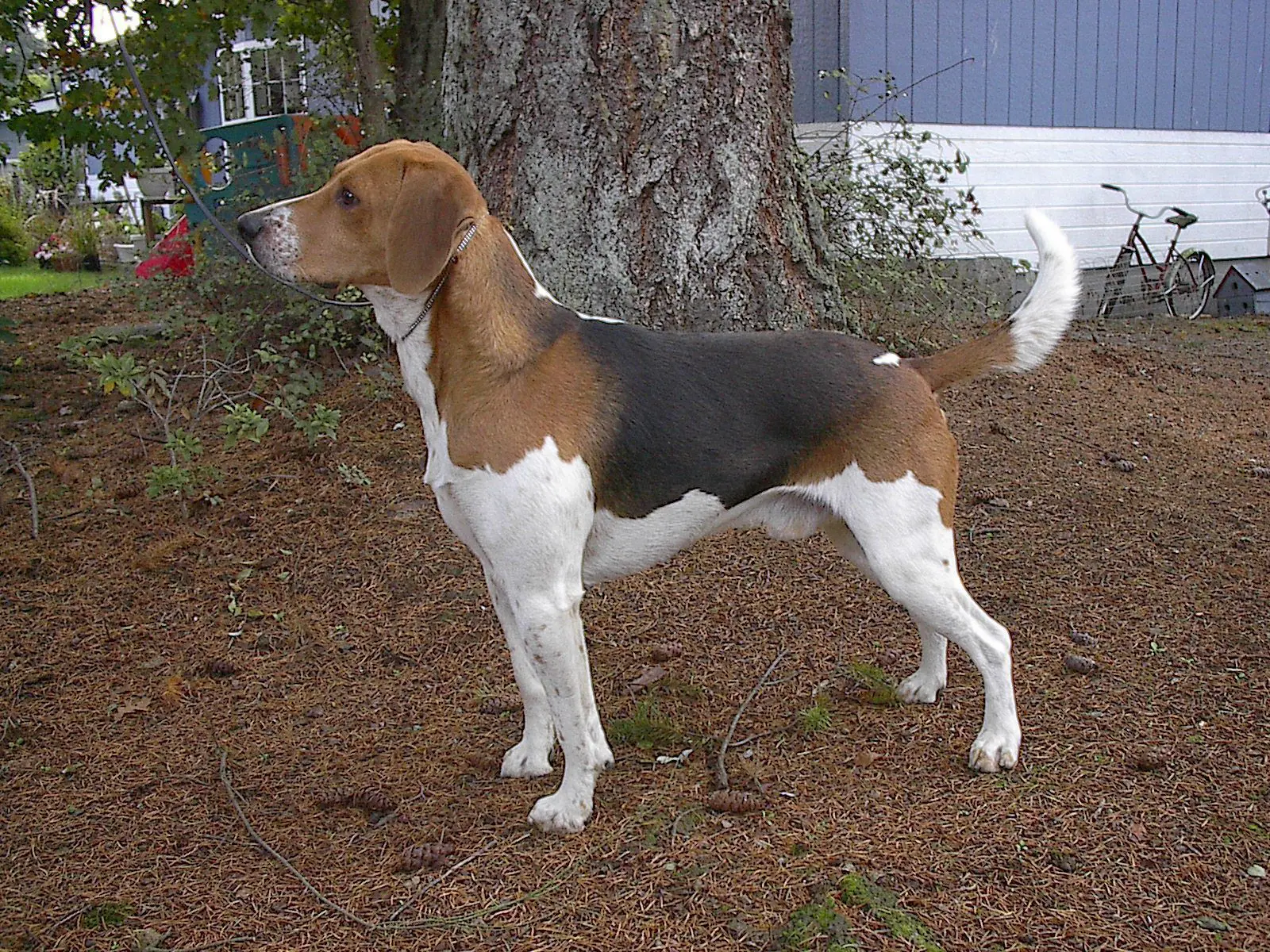
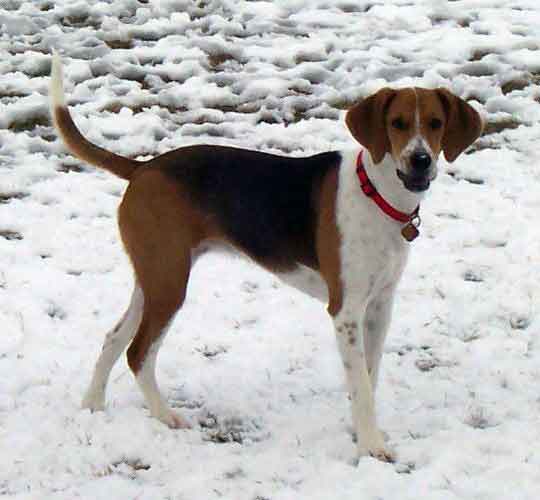
The Hound Hamilton it is known for its characteristic white spot on its head that runs down its neck, the four white legs, and the white tail. Most marked difference with the English Foxhound It is that your body is lighter.

It's a healthy and strong breed, both physically and mentally. As we said, he is a strong dog, well built, muscular, but light.

His hair coat is tricolour (white, black and Brown) very brightly colored. The hair should be thick and glued to the body. The layer requires normal maintenance and should only be bathed when necessary.

The colors in the Hound Hamilton are distributed as follows:

Upper part of the neck, the back, on the sides of the trunk and in the upper part of the tail is black. Head and legs, as well as a neck part, the trunk and tail must be Brown. And white marks appear at the top of the snout, in the lower part of the neck, the chest, the legs and feet (as if they were socks) and the tip of the tail. A mix of black and brown only, is undesirable, as well as, a preponderance of any of the three supported colors.

Their eyes of dark honey, they convey an expression of tranquility, but it will also give an impression of strength and marked resistance.

The height at the cross in the males is of 53 to 61 cm and the females of 49 to 57 cm..

Character and skills

The Hound Hamilton he is an excellent hunting dog, is valued for his great intelligence and agility. Why which is very popular among hunters, his intelligence allows him to develop hunting strategies, as for example, camouflage themselves in the bushes and wait there for the right moment to jump and scare their prey. The Hound Hamilton he is very good at hunting individually, not so much in pack.

Health "Hound Hamilton"

It is a very healthy breed with a good mentality. Hip Dysplasia is usually present. Their life expectancy is around the 13 years.

Education "Hamilton Hound"

The Hound Hamilton he is a friendly dog รขโ‚ฌโ€นรขโ‚ฌโ€นwith a calm temperament. It is flexible, easy to train and have very strong hunting instinct, is necessary to socialize them small.

Videos of the "Hamilton Hound"

Hamiltonstรถvare
World record dog Hamiltonstรถvare
Kilcavan Hamiltonstovare having fun in the snow!
Kilcavan Hamiltonstova re having fun inthe snow!

Type and recognitions:

  • FCI CLASSIFICATION:
  • Group :
  • Section : . .

Federations:

  • FCI – Group 6: Scent hounds, and related breeds. – Section 1.2: Medium-sized Hounds. โ“˜
  • AKC – The AKC does not have its own standard and, on the other hand, is linked to the FCI Hound โ“˜

FCI breed standard "Hound Hamilton"

Origin:
Sweden

Date of publication of the valid original standard:
17.07.1997

Use:

Hound type dog that bars on the trail and is used for the hunting of the hare and the fox. It is not a Jauria dog and is never used for deer hunting.


General appearance:

He is a well proportioned dog, that gives the impression of great strength and resistance. It is never heavy constitution. It is tricolor. The differences between male and female must be well defined.

IMPORTANT PROPORTIONS :

rectangular body.


Behavior / temperament:

It is a friendly and quiet hound.

Head:

Elongated.

Cranial region:
  • Skull : Slightly bulging and moderately wide.
  • Stop : Well marked, but not too pronounced.

facial region:

  • Truffle : always black, well developed with wide windows.
  • Snout : Long, strong and almost rectangular. Nasal cane straight and parallel to the line of the skull. The distance from the occipucio to the stop must be equal to the distance between the stop and the tip of the nose.
  • Lips : Relatively thin upper lip, tight and beautifully rounded, Not too much hanging. Males must have more pronounced lips than females.
  • Cheeks : Not outstanding.
  • Jaws / Teeth : Scissor bite. Strong, well-developed teeth.

Eyes : Dark brown color, Serena expression.

Ears : Moderately high implantation; When they are pull forward, The ears do not reach half the snout. Lifts them slightly when it is attentive. They are soft and hang flattened without the anterior edge form folds.

Neck:

Long, Powerful and well inserted on the shoulders. The skin skin is flexible and well stuck. Males must present a well -arched neck line.

Body:

  • Cross : Well marked.
  • Back : Straight and powerful.
  • Pork loin : Muscular and slightly arched.
  • Rump : Slightly inclined, Long and wide.
  • Breast : Deep, long and well developed, Reach to the elbows. Ribs moderately sprung.
  • Bottom line and belly : Belly only slightly retracted.

Tail:

Inserted in continuation with the line of the back. Carried straight or slightly curved in the shape of a saber. It is quite wide at its root and thinns towards the tip; reaches up to the tibio-tarsal joint. When is the dog moving, The preference tail should not be carried above the back level.

Tips

PREVIOUS MEMBERS :

  • General information : Strong bones, that harmonize with the general appearance of the dog. Seen from the front, the forelimbs are straight and parallel.
  • Shoulder : Long, muscular and well placed backward. Well attached to the body.
  • Arms : Long, forming a right angle with the shoulders.
  • Elbows : Glued to the body; without being visible below the thorax.
  • Metacarpus : Elastic, slightly angled with the forearm.
  • Previous feet : Oval with well angled and closed fingers.

LATER MEMBERS :

  • General information : Seen from behind are strong and parallel.
  • Thighs : With a well developed musculature; seen from the sides are wide.
  • Knee : Well angled.
  • Warm-tarsal joints : Well angulated.
  • Metatarsus : Short, thin and straight.
  • Hind feet : Similar to the previous; dewclaws are undesirable.

Movement:

Parallel, strong; spans space.

Mantle

HAIR : Rough, not too short, very close to the body. Over the head, ears and front of limbs, Hair must be short and soft. Below the tail and on the back of the thighs, The outer layer can be a bit long, but without forming feathers.

COLOR : It is tricolor. The upper neck, back, of the sides of the trunk and the tail are black. The head, ears, limbs as well as the sides of the neck, of the trunk and the tail are grimid. The loyed color can vary from a golden hue to an intense brown-redizo tone. The white color is located at the top of the snout (list), at the bottom and upper neck, chest, at the tip of the tail as well as at the bottom of the members and on the feet.


Size and weight:

Height of the cross :

  • Males : 53-61 cm.. Ideal size 57 cm. (22,5 inches).
  • females : 49-57 cm.. Ideal size 53 cm. (21 inches).


Fouls:

Any deviation from the aforementioned criteria is considered a fault and the severity of it is considered to the extent of the deviation from the standard and its consequences on the health and well-being of the dog..

โ€ข Undefined sexual characteristics.
โ€ข Wide skull, short or pointed.
โ€ข Short or pointed snout, COCAVA CAรฑA.
โ€ข Upper or lower prognathism, level bite.
โ€ข Heavy cheeks.
โ€ข Light eyes.
โ€ข Overdue back.
โ€ข Short croup, inclined.
โ€ข Tail carried above the line of the back.
โ€ข Pressed scapules.
โ€ข Restricted posterior movement.
โ€ข Black and grim mixture.
โ€ข Very pronounced black marks that cover the sides of the trunk, shoulders and thighs.
โ€ข Other white brands different from those described in the standard.
โ€ข Two colors (yellow-white, Black-White, black and tan) or preponderance of any of the three allowed colors.

MISS PLAYOFFS

โ€ข Very reserved dog, fearful.
โ€ข Pronounced upper or lower prognathism.
โ€ข Cross height that exceeds maximal and minimal limits.

Any dog โ€‹โ€‹showing clear signs of physical or behavioral abnormalities must be disqualified..


N.B.:

Males should have two normal-appearing testicles fully descended into the scrotum..

Source: F.C.I - International Cynological Federation

Alternative names:

1. Swedish Foxhound, Hamilton (English).
2. Anciennement: Chien courant suรฉdois (French).
3. Hamilton-Bracke (German).
4. (em sueco: hamiltonstรถvare) (Portuguese).
5. (En sueco: Hamiltonstรถvare) (espaรฑol).

โ–ท The world of Pets: Dogs, cats, birds, reptiles, amphibians

Vizsla
Hungrรญa FCI 57 . Braque Type

Vizsla

The Vizsla or Hungarian Braco It is a breed of dog originating in Hungary.. It is one of the best sporting and companion dogs, but little known outside his native Hungary.

The Vizsla was already known from the beginning of Hungarian history. The ancestors of today's Vizsla were the trusted hunting dogs and favorites of the Magyar tribes who lived in the Carpathian Basin in the 10th century.. There are primitive prints in stone - thousand years- It shows a Magyar Hunter with his Falcon and his Vizsla. The first written reference to the Vizsla breed was recorded in a chronic illustrated of the year 1357.

They were the companion dogs of royalty and barons early in the war, for which reason, the blood of the Vizsla has preserved its purity for centuries. The landed aristocracy jealously guarded them and encouraged the development of their hunting ability.Yellow pointerโ€. Records of letters and writings from the time show the high esteem in which Vizsla dogs were held..

The Vizsla, in spite of hard historical times which became, he survived the Turkish occupation (1526-1696), to the Hungarian Revolution (1848-49), the first and second world war, and the Russian occupation. But, was several times on the verge of extinction... In the year 1800 in Hungary the population of specimens of English Pointer and German Shorthaired Pointer, because they were more accessible to the entire population, This action, took them for the first time, on the verge of extinction, and then, the other nearest point was after World War II, when they thought they really..., they had disappeared.

Then, in Hungary a national survey of sports hunters was carried out, and the results revealed that only a dozen purebred Vizsla dogs had survived the debacle and were living in the country. From these copies, the race came to fame once more, After carrying out a thorough programme of recovery of the race. Outside of Hungary, Vizsla are commonly bred in Romania, Austria, Slovakia and Serbia.

The Vizsla at reached United States at the end of World War II and as the interest and devotion to the race was on the rise, the owners formed the Vizsla Club of America in order to obtain official recognition of the breed by the AKC to, took place the 25 in November of 1960.

The Vizsla was used in the development of other races, as of the Weimaraner, of the Vizsla hair hard and Braco German for short hair. There is considerable controversy regarding the races that, along with other Pointer breeds, were used to reestablish the Vizsla breed at the end of the 19th century. In any case, the similarity between the three races is undeniable…

The Vizsla is a medium-size of short hair dog, and elegant porte, light structure, with well defined muscles, that share physical characteristics with the Weimaraner or Weimaraner. Frequently confused them with dogs of other breeds such as, Redbone Coonhound, Braco of Weimar and the Rhodesian Ridgeback. Although with the races that closest thing it has is with Redbone Coonhound, the Weimaraner, the Vizsla is, As we said, the muscles are more defined and it is thinner than the aforementioned breeds.. The males measure of 56 to 63 cm. of height to the cross and weigh in 20 to 30 kg; the females measure of 53 to 61 cm. of height to the cross and weigh 18 to 25 kg. The Weimar Braco and Rhodesian Ridgeback are larger.

The nose of the Vizsla always has a reddish color that is mixed with the standard colour of the fur, It consists of different shades of the color solid oro-รณxido (copper, brown, Golden reddish and Golden dark sand). The color of the eyes and nails should also mingle with the color of the fur (if the latter is not fulfilled, then we would talk about another race).

Some variations in the Vizsla's coat color may show markings along its back.Saddleโ€™, is typical of the breed and for that reason, It is often confused with Rhodesian Ridgeback.

According to him American Kennel Club (AKC) and their standard of the breed, the Vizsla must have short hair, smooth, dense and glued to the body, without woolly subpelo. The Vizsla is not an animal prepared to live outdoors due to the absence of double layer, which leads them to be more susceptible to cold and intense heat. They are very clean dogs, they do not need to be bathed often, do not usually give off the characteristic โ€œodor to dogโ€ detectable by humans. After their forays into lakes and rivers they will develop a scent that is a very faint version of the "wet dog" scent.. A quick bath and the odor will vanish.

The Vizsla is a natural Hunter endowed with an extraordinary sense of smell, comparable to the Pointer and an above-average learning ability. Although they are encouraged, kind, emotional and sensitive, they are equally intrepid and have a well-developed protective instinct. Its hunting style is near, laceando without moving away from the Hunter hunting for the hand. They hunt in terrain, they are very versatile, and they can hunt all kinds of parts, either hair or feather. They are very athletic and resistant. Its recovery capacity is high, charge very well and can train you very easily.

Not only are large crawlers, but also, excellent collectors. Both on Earth and since water that, they are very good swimmers. Like all dogs hunting, the Vizsla require a good deal of exercise to stay healthy and happy. He is very intelligent and likes to feel challenged and stimulated, both mentally and physically. That is why they need training according to their characteristics, sweet, consistent and dedicated.

The Vizsla is a very energetic dog, soft and delicate manners, fair, loving and very warm. They often form close bonds with their owners, including children, that is why sometimes, they are nicknamed "velcro dogโ€ due to his loyalty and affection, far from being lap it is always close to his master. They are quiet dogs, They ladrarรกn only if necessary. Many sleep in bed with their owners and, If they are allowed, They shall always endeavour to make a huequito under the sheets.

Dogs breeds: Vizsla


โ–ท The world of Pets: Dogs, cats, birds, reptiles, amphibians

Briquet Griffon Vendรฉen
Francia FCI 19 - Medium-sized Hounds

Briquet Griffon Vendรฉen

Long lasting, fast and robust, the Briquet Griffon Vendรฉen he is a passionate hunter with extraordinary instincts.

Content

History

The selection of Briquet Griffon Vendรฉen dates back to before WWI, and was made by the Count of Elva.

It is a harmonious and enhanced reduction of Grand Griffon Vendรฉen. It is a distinguished dog and quite robust in its construction. Several times decimated during wars, the Briquet Griffon Vendรฉen reappears at Fontenay-le-Comte in 1946.

Today, there are many excellent quality individuals. In 1995, a group of Briquets they won the french roe deer cup, and numerous dogs work in the boar's footprint.

It is the only breed that retains the name of ยซBriquetยซ, which means "medium -sized dog".

Photo: This is a Briquet Griffon Vendรฉen. His name is Unno du Sentier D'Aimeron by Alephalpha, CC BY-SA 3.0, via Wikimedia Commons

Physical characteristics ยซBriquet Grifรณn Vendeanoยป

The Briquet Griffon Vendรฉen It is a medium-sized common griffon.. The head and body are collected. The head, quite light, shows parallel lines of skull and muzzle. The cranium, pretty short, is slightly domed with a well-marked stop. Eyes are dark brown. The flexible ones, narrow and thin ears are medium long and turned inward. The short tail is thick at birth and gradually tapers towards the tip. Carries like a saber blade.

The coat is well proportioned, hard and rough without ever being woolly. The most common coat is white and orange. Other coats are black and white, black and Brown, black and sand, tricolor, charcoal sand color with or without white.

SIZE:
Height to the cross: In males: of 50 to 55 cm., in females: of 48 to 53 cm..

Character and skills "Briquet Griffon sale"

Long lasting, fast and robust, the Briquet Griffon Vendรฉen he is a passionate hunter with extraordinary instincts. They are stubborn, enterprising and capable of taking initiative. So, the teacher must be obeyed.

Entrepreneurs and determined, they are also resistant and robust. But, he is not very patient and can be bitten.

It's a hound, used for hunting big game, the hare and the fox. Adapts to city life and makes a proper watchdog.

Characteristics "Briquet Griffon Vendรฉen"

Coexistence is important that you have with your new friend. Before considering the acquisition of a dog of the breed "Briquet Griffon Vendรฉen" you know certain factors. Not all breeds of dogs are apt to live in an apartment, you must take into account his character, their need for exercise, their interaction with other pets, their care and if you have small children, their level of tolerance towards them.

Adaptation โ“˜

2,0 of 5 stars (based on 1 review)

friendly dog โ€‹โ€‹โ“˜

3,0 of 5 stars (based on 1 review)

hair loss โ“˜

3,0 of 5 stars (based on 1 review)

Affection level โ“˜

4,0 of 5 stars (based on 1 review)

Need for exercise โ“˜

5,0 of 5 stars (based on 1 review)

Social need โ“˜

4,0 of 5 stars (based on 1 review)

Home โ“˜

3,0 of 5 stars (based on 1 review)

Toilet โ“˜

2,0 of 5 stars (based on 1 review)

Friendly with strangers โ“˜

4,0 of 5 stars (based on 1 review)

barking โ“˜

3,0 of 5 stars (based on 1 review)

Health โ“˜

2,0 of 5 stars (based on 1 review)

Territorial โ“˜

3,0 of 5 stars (based on 1 review)

Cat friendly โ“˜

3,0 of 5 stars (based on 1 review)

Intelligence โ“˜

4,0 of 5 stars (based on 1 review)

Versatility โ“˜

4,0 of 5 stars (based on 1 review)

Child friendly โ“˜

4,0 of 5 stars (based on 1 review)

Surveillance โ“˜

4,0 of 5 stars (based on 1 review)

joy โ“˜

4,0 of 5 stars (based on 1 review)

Images "Briquet Griffon Vendรฉen"

Photos:

1 – A Medium Griffon Vendรฉen. Colour: white by Canarian, CC BY-SA 4.0, via Wikimedia Commons
2 – Medium Vendรฉen Griffon, Griffon Vendรฉen lighter by Canarian, CC BY-SA 3.0, via Wikimedia Commons
3 – Briquet Grifรณn Vendeano by https://pin.it/1GsizhZ
4 – Briquet Grifรณn Vendeano by http://www.adopt-a-griffon.eu/en/breeds/briquet-griffon-vendeen-2/

Videos "Briquet Griffon Vendรฉen"

Lighter Griffon Vendรฉen ๐Ÿถ๐Ÿพ Everything Dog Breeds ๐Ÿพ๐Ÿถ
Briquet Griffon Vendรฉen ?? Everything Dog Breeds ??
Griffon Vendeen lighter / Briquet Vendรฉe Griffon
Briquet Griffon Vendeen

Type and recognitions:

  • FCI CLASSIFICATION:
  • Group :
  • Section : . .

Federations:

Federations:

  • FCI – Group 6: Scent hounds, and related breeds. – Section 1.2: Medium-sized Hounds. โ“˜
  • UKCScenthounds โ“˜
  • Central Canine Society โ“˜

FCI breed standard "Briquet Griffon Vendรฉen"

Origin:
France

Date of publication of the valid original standard:
09.01.1999

Use:

Hound used for hunting with shotgun, both of the big hunt, as of the hare and the fox.


General appearance:

It is a medium -sized tap, receptive and very determined. Your body is well proportioned and rather collected.


Behavior / temperament:

Behavior : It has a good smell, It is fast and his barking is nice. You don't mind moving in weed. It is very skilled in the rugged land and hunting with the nose to the wind.

Character : It has great initiative, It is resistant and robust. It must be able to lift the hunt and drive it near the hunter. He is a passionate hunter; Your master must make it obey.

Head:

---

Cranial region:

It is quite light; The upper lines of the skull and nasal cane must be parallel. : Slightly bulky, pretty short, not very wide.

  • Depression links (Stop) : Marked.

facial region:

  • Truffle : Grand, black, except for dogs with white and orange fur, in which the brown color is accepted. The nostrils are wide open.
  • Snout : Straight, rather short. Its length is almost equal to that of the skull. It is not very wide in its limb.
  • Lips : Poorly developed, Although they cover the lower jaw well. They are covered by large mustaches.
  • Jaws/Teeth : The joint is in the form of scissors. The incisors are set at right angles to the jaws..
  • Eyes : Large, dark, and vivacious expression. The eyebrows are well pronounced, but they don't cover the eye. The conjunctiva should not be apparent.
  • Ears : flexible, narrow and thin. They are covered with long hairs and their limb is pointed. They become well in and do not reach the limb of the nasal cane. Low-set, below the eye line.

Neck:

Is long and elegant lines. There is no presence of dewlap.

Body:

  • Back : Solid, short. It is straight or very slightly raised.
  • Pork loin : Straight, muscular and well accentuated.
  • Breast : It is quite high, not very wide. Reaches the elbow.
  • Ribs : Moderately rounded.
  • Flanks : Full. The lower line rises very slightly backwards.

Tail:

It is thick at the base and gradually tapers. High implementation, is taken in the form of saber, ever. Is rather short.

Tips

PREVIOUS MEMBERS

  • As a whole : Quite robust, but without the appearance of heaviness. They are well poised.
  • Shoulder : Long, thin and oblique.
  • Elbow : Descended and well attached to the body.
  • Forearm : Straight, for strong bones.

LATER MEMBERS

  • As a whole : well developed; the limbs are regular.
  • Thigh : Long and muscular.
  • Hock : Width and well descended. Seen from the back, It is never closed, Nor open. In profile, Your angle is medium.

FEET : They are not very big. Pads are hard; fingers are well arched and close together. The nails are solid. The appropriate pigmentation of the pads and nails is sought.

Movement:

Active, elastic, Never irregular, not even in jumps.

Mantle

SKIN : Is rather a bit thick, Although elastic; often veined in tricolor fur dogs. There is no presence of dewlap.

HAIR : It is long, Although not too much. Sometimes tangled, rough to touch; the inner layer of hairs is abundant. The belly and inner thighs should not be hairless.. The eyebrows are well pronounced, but they don't cover the eye.

COLOR : Black with white patches (black and white). Black with reddish markings (black and tan). Black with sand-colored markings. Fawn with white patches (Orange and white). Fawn with black blanket and white patches (tricolor). carbon fawn. Carbon sand color with white patches. Color arena carbonado. Traditional denominations : hare hair, wolf fur, Building hair, Woven hair.


Size and weight:

Height to the cross :

  • In males : of 50 to 55 cm..
  • In females : of 48 to 53 cm..

With a tolerance of 1 cm more or less.


Fouls:

Any deviation from the aforementioned criteria is considered a fault and the severity of it is considered to the extent of the deviation from the standard and its consequences on the health and well-being of the dog..

Head :

โ€ข Too big, similar to that of the great sale.
โ€ข Depigmentation of the truffle, lips and eyelids.
โ€ข Spine too long.
โ€ข Pincer-shaped joint.
โ€ข Light eyes.
โ€ข Very long ears, boring, With satin hair, of high implantation. body :
โ€ข Cylindrical the assault.
โ€ข Loose back.
โ€ข Sunken croup.

Tail :

โ€ข Too much wide the diverted.

Tips :

โ€ข Weak bones.
โ€ข Angles that are too straight.
โ€ข Crushed carpos.
โ€ข Not quite together fingers.

Fur :

โ€ข Scarce, fine.

Behavior :

โ€ข Shy dog.

MISS PLAYOFFS

โ€ข Fearful or aggressive dog.
โ€ข Lack of type.
โ€ข Prognathism.
โ€ข Gaze eyes. heterochromia.
โ€ข Narrow sternum region. Narrow ribs at the bottom.
โ€ข Knotted tail.
โ€ข Woolly fur.
โ€ข Solid black or white coat.
โ€ข Important depigmentation.
โ€ข Different size as stipulated by the standard.
โ€ข Visible disability. anatomical deformation.

Any dog โ€‹โ€‹showing clear signs of physical or behavioral abnormalities should be disqualified..


N.B.:

Males must have two normal appearance testicles completed in the scrotum.

Source: F.C.I - International Cynological Federation

Alternative names:

1. Medium Vendรฉen Griffon (English).
2. Briquet griffon vendรฉen (French).
3. Briquet griffon vendรฉen (German).
4. Briquet griffon vendรฉen (Portuguese).
5. Briquet griffon vendรฉen (espaรฑol).

โ–ท The world of Pets: Dogs, cats, birds, reptiles, amphibians

Polish Hound
Polonia FCI 52 - Medium-sized Hounds

Polish Hound

The Polish Hound it is quite widespread in Poland, while outside this country it is considered a rare breed.

Content

History

Originally from Poland, country to which it owes its current name, the Polish Hound it is a very old breed of dog, since it is believed that it appeared in the 13th century, although the first written records that mention it explicitly date from the 17th century. They are part of the group "Medium-sized hound dogs" and are believed to be the result of crossing between the St. Hubert Hound, German and Russian hounds and local Polish breeds. Polish nobles, fans of hunting parties, they were bred and used especially for hunting larger game.

Since the middle of the 19th century, the Polish Hound, which was very popular at that time, began appearing at dog shows in his native country. At that time, Poland was under Russian occupation, and the breed was bred mainly in the territory of present-day Belarus, which was then also annexed by Russia. After 1918, Poland regained its independence, but the brood of Polish Hound continued almost exclusively in the east of the country.

During World War II, due to successive invasions of Poland by Nazi Germany and then by the USSR, the breed saw its population decrease dramatically. After the war, Polish borders were redrawn; Poland, by losing the territories he owned in the east, lost the cradle of Polish Hound as well as all the remaining farms. No breeder took over the territory of the "new" Poland, and the race found itself on the brink of extinction.

She was eventually saved by a Polish colonel named Piotr Kartawik.. In 1959, created a kennel dedicated to him and reconstituted livestock from 4 dogs imported from Belarus. The first standard of the Polish Hound was written on the basis of individuals from this kennel and published in 1964.

The breed was officially recognized by the Fรฉdรฉration Cynologique Internationale (FCI) two years later, in 1966. But, the Polish Hound is not recognized by any other major canine organization and, although once again it is very widespread in Poland, still relatively rare in the rest of the world.

Photos: Polish Hound by Wikipedia

Physical characteristics

The Polish Hound he is a medium sized hound and companion dog. They are muscular, strong and compact, with mighty bones and a massive march, but without the impression of heaviness. They are better suited for endurance than speed.

The head, quite heavy and chiseled, appears rectangular when viewed from the side. The occipital bone is very pronounced. The line of the forehead forms an obtuse angle with that of the muzzle., and the forehead has multiple wrinkles.

The Polish Hound has a strong, long jaw with a regular bite. The eyes are dark brown and almond-shaped, with a soft expression, slightly sunken and almond-shaped. Superciliary arches are marked. The snout is elongated and truncated at the tip. Rounded at the tips, the ears are low, hanging and quite long.

Low rise and slightly curved, the tail is thick and its lower part is provided with longer hair. Chest is wide, wide and proportionally deep.

The Polish Hound has a double layer (hair and undercoat) average length. This layer gives very good water repellency and protection against heat and bad weather., especially since the undercoat is thick. Hair is longer on the spine, on the back of the hind legs and on the bottom of the tail; is shorter and smoother on the muzzle and ears.

It's brown on the head, the ears (except the sides of the skull), the legs, sternal region and thighs, and black or dark gray on the rest of the body. Tan color can vary from red to brown, but the cinnamon tone is the most sought after. In any case, the separation between the two colors must be very clear. White markings on the chest are tolerated (even up to the muzzle) and on the tips of the legs and tail.

HEIGHT AND WEIGHT :

  • Height to the cross: Males: 56-65 cm., females: 55-60 cm..
  • Weight : Males : 25-32 kg, females : 20-26 kg.

    Character and skills

    The Polish Hound he is an affectionate dog, protective and very intelligent. And unlike most Poles and other hunting dogs, who are notoriously undisciplined and not very obedient, do not pose major training problems. This character trait makes them equally appreciated by hunters and families, as is the case with your neighbor, the Austrian Black and Tan Hound, a rare but obedient and easy to train breed that is also an exception. But, the Polish Hound tends to mature a little more slowly than other dogs, so it can be expected that he will maintain his youthful demeanor at 2 or 3 years of age.

    Naturally calm and friendly, they are excellent companions, loyal as much as possible, showing affection not only to adults, but also to younger dogs. Not only is he loving, kind and protective with them, but he is also very patient. This can create a great complicity between the dog and the child, since the latter learns from a young age to respect the animal and its needs. The Polish Hound It, therefore, a breed of dog adapted to children, even the very young.

    Reputed for being naturally vigilant and distrustful of strangers, without being aggressive, the Polish Hound develops protective instincts with age, leading him to actively defend those around him, whether they are the weakest, the youngest or the oldest. Facing intruders and armed with your unerring sense of smell, Polish hounds make excellent watchdogs, protecting without fail their masters and their properties, even though they weren't bred for it.

    They are sociable animals and generally enjoy the company of other dogs.. Can sometimes become a barker in your presence, without being prone to arguing with peers. His voice is powerful, melodious cases, and allows you to communicate with your master while hunting. The voice is deep in the male and quite high in the female.

    To the Polish Hound loves large expanses and wooded areas where he can fully express his hunting instincts. Not at all suited to apartment living, and is much more comfortable in the country than in the city.

    Developed for hunting and used to living in large spaces, must be walked for a long time and very regularly (on average two or three hours a day), even if you have access to a large garden. The ideal thing for him is to be able to accompany an active teacher during his exercises: footing, running and other sports outings will make you happy. On the other hand, if not asked enough, expect a long and frequent bark, meant to get attention.

    Education

    An obedient and intelligent breed, the Polish Hound it is relatively easy to train, since he is intelligent and quite obedient. They have a good memory and, as such, easily retain what they learn, without the need for a large number of repetitions. But, their education must be early and sufficiently balanced, mixing softness and firmness. He is particularly receptive to the method of positive education, what is the best way to educate him and make him obey.

    On the other hand, How can it take time to reach mental maturity (sometimes two or three years), it is important to be patient during your education, especially if we notice that you tend to lose concentration easily.

    Last, if the dog is to be used as a hunting dog, teaching the dog to remember should be one of the priorities in his training.

    Health and care

    The Polish Hound it is a strong and resistant breed of dog, does not present any significant risk in terms of possible predisposition to certain diseases. Like most older dog breeds, has robust health and is much less susceptible to genetic diseases that can affect newer breeds.

    In spite of this, due to its large chest and high level of activity, is quite susceptible to the development of dilatation-torsion syndrome of the stomach.

    It also, how much of their time is spent outdoors, especially if they are used as hunting dogs, are more susceptible to parasites (like ticks and fleas) and infections, as well as injuries and hunting accidents.

    Last, as with any dog โ€‹โ€‹with floppy ears, be careful with the risk of ear infections and inflammation.

    Care and maintenance

    The Polish Hound it is easy to care for because its coat is short and straight. Brushing your dog's coat once a week keeps it clean and removes dead hairs, especially during molting periods. Since molt periods are not very consistent, brushing every two or three days is usually enough.

    Because its beautiful waterproof coat does not get dirty easily, bathing is rarely necessary. In fact, In most cases, it is possible to clean the coat with a simple damp cloth. It also, washing your dog tends to remove sebum, which has many positive properties, so it should only be done when the coat is really very dirty.

    It also, it is necessary to check and maintain your dog's ears regularly, since it is quite prone to canine ear infections. One can take the opportunity to examine their eyes at the same time.

    Looking at its claws, they are supposed to wear out naturally during your outings. But, If that is not the case, You should clip your dog's claws from time to time..

    Last, when he comes back from hunting or walking, it is important to ensure that there are no ticks (the application of a preventive antiparasitic treatment is strongly recommended) and any injuries you may have sustained while running.

    Price of a Polish Hound

    The price of a puppy Polish Hound is between 500 and 700 EUR.

    Images "Polish Hound"

    Photos:

    1 – Polish hound by Wikimedia
    2 – Polish Hound during dogs show in Katowice, Poland by Lilly M, CC BY-SA 2.5, via Wikimedia Commons
    3 – Polish hound by Wikimedia
    4 – Polish hound by https://pxhere.com/en/photo/1175414
    5 – Polish hound by Wikimedia
    6 – Polish hound by Wikimedia

    Videos "Polish Hound"

    POLISH HOUND THE OGAR POLSKI

    POLISH HOUND THE OGAR POLSKI
    A wise Polish hound

    Mฤ…dry ogar polski

    Type and recognitions:

    • FCI CLASSIFICATION:
    • Group :
    • Section : . .

    Federations:

    • FCI – Group 6: Scent hounds, and related breeds. – Section 1.2: Medium-sized Hounds. โ“˜

    FCI breed standard "Polish Hound"

    Origin:
    Poland

    Date of publication of the valid original standard:
    25.02.1985

    Use:

    Hound


    General appearance:

    Medium-sized, robust and compact construction, strong and relatively massive bones; of provided limbs. As a whole, seen from the side, the body reflects strength and endurance more than speed. When the dog vents, his voice is clear, sonora, medium and shifting tonality; in the female, is usually sharper.
     
    IMPORTANT PROPORTION: The skull is the same length as the muzzle.


    Behavior / temperament:

    The Polish Hound, like all hounds, hunts prey on the hot track with a loud bark.. The voice is deeper in tone in the male and somewhat higher in the female.. The barking is called by hunters โ€œgiving the tongueโ€ and the noisy search for prey is described as โ€œchasing.โ€. This exceptional hunting dog is also an excellent family dog., easy to maintain, devoted to his home and cautious of strangers.

    Head:

    Pretty heavy, nobly chiseled. In profile it looks like a medium length rectangle.

    Cranial region:
    Skull: The line of the forehead forms an obtuse angle with the nasal cannula.. Superciliary arches highly developed. The forehead has numerous wrinkles. Very pronounced occipital bone.
    Depression links (Stop): Craniofacial depression is clearly observable.

    facial region:

    Truffle: black, big and wide.
    Snout: It is elongated and truncated at its tip; it is not even cuneiform, or pointed.
    Belfos: Thick and pendulums. Lower lip with hanging corner.
    Jaws / Teeth: Strong jaws, long enough; the joint is normal.
    Cheeks: With well developed muscles.
    Eyes: Sweet and calm expression. They are located obliquely, and not sunk in the orbits. They are dark brown. In older dogs the lower eyelids appear droopy.
    Ears: Low implantation. They are quite long, freely pendulous and slightly rounded at the tip. The lower part of the pavilion is in the shape of a corkscrew and is well attached to the head.

    Neck:

    Remarkable thickness at the point where it meets the trunk; is strong, muscular, medium length. The double chin is hanging and presents abundant skin with folds.

    Body:

    Back: Long, broad and muscled.
    Rump: Wide; not very fall.
    Breast : Spacious rib cage, wide, in high proportion. The sternum region descends to the elbows. The ribs are well sprung and long, like the whole rib cage. They are closer to the upright position than in the other breeds.
    Abdomen: Marked, spacious, almost as low as the rib cage. Not too collected. The flanks are not sunken; they are solid and rounded; with a possible depression under the last ribs.

    Tail:

    Quite low implantation. It is thick and is covered with long hair at the bottom. Reaches below the hock, and it is slightly fallen; from the middle of the leg length, is slightly bent. During normal dog movement, it is somewhat elevated, Although never screwed. When the dog runs, something is up, but without exceeding the horizontal.

    Tips

    PREVIOUS MEMBERS
    Shoulder: Oblique shoulder blade; well-developed muscles.
    Forearm: Pretty muscular bien.
    Carpo: Well marked, celebrities, clean, delgado, of a thickness corresponding to that of the metacarpus.
    Front feet: Of strong bones and muscles; fingers well together; strong nails, thick and short in working dogs. They are light in color when the fingers are white, and black when the fingers are tawny.
     
    LATER MEMBERS
    Thighs: Strong bones, long, vigorous and well developed muscles.
    Leg: Inclined; quite short. Well musculada.
    Hock: Delgado; well delineated.
    Metatarsus: It is slightly inclined.
    Rear feet: Fingers are good together. The pads are wide and are covered with thick integument. Thick nails, strong and short.

    Movement:

    Normally, the dog moves at a slow trot and heavy. during the hunt, while venting and following the prey, perform a heavy gallop.

    Mantle

    HAIR: Medium length, thick, with a dense undercoat of hairs. It is a little longer over the spine, on the back of the hind legs and on the underside of the tail.
     
    COLOR: Head and ears, except for the lateral faces of the skull, they are fire color; the ears are a little darker than the rest. The extremities, the sternum and thighs are also tan. The body is gray, or a dark gray almost black; In the old Polish hunting language it was called โ€œpodzaryโ€. (burned). The essentially reddish tan color presents various intensities of this tone, that go as far as cinnamon, which is highly appreciated in the Polish pointer. White hair, allowed in star shape, appears as a stripe that reaches the muzzle, over the pectoral region, the end of the limbs, and the tip of the tail. The black color forms a blanket that extends to the head. There are clearly defined tan spots over the eyes. The black color that extends over the nasal bridge of the Polish Hound is a case of disqualification.


    Size and weight:

    Height to the cross
    • In males : 56 to 65 cm.,
    • in females : 55 to 60 cm..
    Weight:
    • In males : 25 to 32 kg,
    • in females : 20 to 26 kg.


    Fouls:

    Any deviation from the above mentioned criteria is considered to lack, and the gravity of this refers to the degree of deviation to the standard and its impact on the health and well-being of the dog.
    • Insufficient musculature.
    • Hoarsely.
    • Occipital crest of head not pronounced enough.
    • Underdeveloped superciliary arches.
    • Too pointed snout; black snout.
    • Defective denture.
    • Eyes too light.
    • Ears too long or too short, or taken off.
    • Underdeveloped rib cage.
    • Fine tail, very short or very long, threaded, with little abundant hair.
    • Crushed pastern.
    • Crushed pads.
     
    Any dog โ€‹โ€‹showing clear signs of physical or behavioral abnormalities must be disqualified..


    N.B.:

    Males should have two normal-appearing testicles fully descended into the scrotum..

    Source: F.C.I - International Cynological Federation

    Alternative names:

    1. Ogar Polski, Polish (Ogar) Hound (English).
    2. (ogar polski en polonais), podzary (French).
    3. (Ogar Polski) (German).
    4. em polonรชs/polaco: Ogar Polski) (Portuguese).
    5. Sabueso de Polonia (espaรฑol).

โ–ท The world of Pets: Dogs, cats, birds, reptiles, amphibians

Harrier (dog)
Inglaterra FCI 295 . Medium-sized Hounds

Harrier

The Harrier (dog) it is an excellent dog for hunting, specialized in foxes and hares.

Content

History

The Harrier (dog) comes from Great Britain and was first mentioned in writing in the year 1260. French hounds are supposed to, are the ancestors of this breed. Y, as well, there is considerable consensus that the Harrier (dog) Today is the product of the cross between the Beagle and the English Foxhound, born in the south of England.

The demonstrable origin of dogs, who have been hunting hares for several centuries, can probably be traced back to the 13th century in western England: The first written record of a herd of Harrier (dog) of a certain Sir Elias of Midhope in England was in 1260. Other herds of Harrier (dog) well known to history were the Holcombe herd in the 17th century and the Cambridgeshire herd in the mid-18th century.

In 1889 the first exhibition of Harrier (dog). Later, two associations were founded that have since dedicated themselves to the pure breeding of this breed..

It is not clear where the name of the Harrier (dog). Like the dog Harrier (dog) is a very ancient race, it is not easy to clarify this origin beyond all doubt.

The Harrier (dog) He was originally bred to go hunting for hares. So, Some people think that its name is derived from the English word ยซHareยซ. ยซHareยป is the word for "hare" in French and English. Harrier (dog) It, therefore, a kind of abbreviation of the English term ยซHare-Houndยป and indicates that this breed was originally bred for hare hunting.

Others believe that this breed of dog got its name from the Norman-Saxon language.

Here "Harrier" simply means "dog.".

Physical characteristics ยซHarrierยป

The Harrier (dog) it is a strong and light dog, less powerful and is used for hunting hares. It has a long and slightly arched neck on top. The eyes, medium sized and oval, they tend to be dark. The short ears, almost flat and V-shaped, they are inserted high but they are pendulous carried.

The coat of the Harrier (dog) it's shiny, hard, dense and short, well glued to the body. The hair on the ears is finer in texture than the rest of the body. Are white, black and bark, lemon and white, Red and white, black, White and bark. Tricolor with a black coat on the upper back is also allowed. This last variant is bred mainly by the French.

With a height at the cross of 48 to 55 cm and a weight of 22 to 27 kg, this dog belongs to the medium-sized dogs.

Character and skills ยซHarrierยป

Harrier (dog)
A tricolour Harrier by Smcmilla, Public domain, via Wikimedia Commons

The Harrier (dog) they are gentle, peaceful, quiet, balanced and above all intelligent and eager to learn. Its great resistance, his great joy of movement and his good assertiveness are other typical characteristics. An excellent sense of smell distinguishes this basically easy-care and undemanding dog..
Like a dog from the original pack, is naturally very sociable and very compatible with other dogs. Since the Harrier (dog) is from reason rather stubborn and independent, needs a consistent yet loving and gentle upbringing. If it is kept in the pack and acts as a hunting dog, builds little relationship with humans, but as a family dog รขโ‚ฌโ€นรขโ‚ฌโ€นhe proves to be a faithful dog, loving and undemanding. He is quite alert but completely free of aggression.

Can be kept well with various dogs in the family. The Harrier (dog) can, according to its origin, be trained well like dogs that run and sweat, although his preferred terrain is flat, at most a little bumpy. It is equally suitable for hunting on horseback, which is particularly popular in England. This breed is also suitable for dog sports. As a family dog, he needs long walks, as well as occupation and contacts.

The Harrier (dog) has a very fine sense of smell, is very resistant, persistentโ€ฆ, It seems that never were fatigue and can reach a good speed and keep it, While still at its prey, reason why it has been used since its origins for hunting in packs.

He is very obedient and intelligent, which is why, education and training firm, consistent and loving, gives very good results. Their life expectancy is around the 12 years.

Care and maintenance ยซHarrierยป

The Harrier (dog) they need a lot of exercise and have a very strong hunting instinct, so it is absolutely necessary that you challenge them enough and offer them longer rides each day.

It is important to ensure that he is kept on a leash where the game is present, otherwise he would follow his hunting instinct. The Harrier (dog) he is not a city dog, but loves to romp in a garden with plenty of exercise. When it comes to caring for your coat, not very demanding: he likes to brush once in a while. If the dog goes hunting with you, should be examined for parasites and lesions.

Characteristics "Harrier (dog)"

Coexistence is important that you have with your new friend. Before considering the acquisition of a dog of the breed "Harrier (dog)" you know certain factors. Not all breeds of dogs are apt to live in an apartment, you must take into account his character, their need for exercise, their interaction with other pets, their care and if you have small children, their level of tolerance towards them.

Adaptation โ“˜

3,0 of 5 stars (based on 1 review)

friendly dog โ€‹โ€‹โ“˜

3,0 of 5 stars (based on 1 review)

hair loss โ“˜

3,0 of 5 stars (based on 1 review)

Affection level โ“˜

3,0 of 5 stars (based on 1 review)

Need for exercise โ“˜

5,0 of 5 stars (based on 1 review)

Social need โ“˜

2,0 of 5 stars (based on 1 review)

Home โ“˜

4,0 of 5 stars (based on 1 review)

Toilet โ“˜

2,0 of 5 stars (based on 1 review)

Friendly with strangers โ“˜

3,0 of 5 stars (based on 1 review)

barking โ“˜

4,0 of 5 stars (based on 1 review)

Health โ“˜

1,0 of 5 stars (based on 1 review)

Territorial โ“˜

1,0 of 5 stars (based on 1 review)

Cat friendly โ“˜

4,0 of 5 stars (based on 1 review)

Intelligence โ“˜

3,0 of 5 stars (based on 1 review)

Versatility โ“˜

3,0 of 5 stars (based on 1 review)

Child friendly โ“˜

4,0 of 5 stars (based on 1 review)

Surveillance โ“˜

3,0 of 5 stars (based on 1 review)

joy โ“˜

2,0 of 5 stars (based on 1 review)

Videos "Harrier (dog)"

HTTPS://youtube.com/watch?v=LV_Yw96BGVo
Harrier Dog – Top 10 Facts
HTTPS://youtube.com/watch?v=unvBDZ3ga7k
Harrier – AKC Dog Breed Series

Type and recognitions:

  • FCI CLASSIFICATION:
  • Group :
  • Section : . .

Federations:

  • FCI – Group 6: Scent hounds, and related breeds. – Section 1.1: Large-sized Hounds. โ“˜
  • โ€‹KCHound โ“˜

FCI breed standard "Harrier (dog)"

Origin:
United Kingdom

Date of publication of the valid original standard:
27.11.1974

Use:

Hound


General appearance:

Strong and light dog, less powerful and more distinguished than the Foxhound.


Behavior / temperament:

---

Head:

Expressive, moderately wide.

Cranial region:
  • Skull : Plano, slightly outlined occipital protuberance.

facial region:

  • Truffle : black, quite developed.
  • Snout : Fairly long and rather pointed.
  • Lips : They cover the lower jaw.

Eyes : Always dark, never saltones, medium large, not too round.

Ears : "V" shaped, almost flattened, slightly twisted, quite short, rather high implantation.

Neck:

Long and free, but with good insertion in the shoulders ; slightly arched at the top.

Body:

  • Back : Straight and muscular.
  • Pork loin : Strong, with a slight bow.
  • Breast : Deeper than wide.
  • Ribs : Rather flat than arched.
  • Flank : Neither too round nor too retracted.

Tail:

Medium long, slightly split (up to the tip around the tail long thick hairs slightly separated in a spike) ; with good bearing.

Tips

PREVIOUS MEMBERS : Straight and plumb.

  • Shoulder : Oblique and very muscular.

LATER MEMBERS :

  • Hip : Strong and well outgoing.
  • Thigh : Long and well descended.
  • Warm-foot joint : Not too straight and not too angled.

FEET : Not too close and not too round.

Movement:

Agile and firm ride.

Mantle

SKIN : White with black spots.

HAIR : Smooth in the English way, ie flat and not too short.

COLOR : Usually white background with all shades in black to orange. In France often tricolor with a black cloak covering the upper back.


Size and weight:

Height to the cross : Since 48 to 55 cm maximum, but preferably from 48 to 50 cm..


Fouls:

Any deviation from the above mentioned criteria is considered an absence and severity of this refers to the degree of deviation to the standard and its impact on the health and welfare of the dog.

MISS PLAYOFFS

โ€ข Aggressive or fearful dog.
โ€ข Depigmented truffle.
โ€ข Prognathism.
โ€ข Long and loose loin.
โ€ข Weak thighs.
โ€ข Discolored scrotum.

Any dog โ€‹โ€‹showing clear signs of physical or behavioral abnormalities should be disqualified..


N.B.:

Males should have two normal-appearing testicles fully descended into the scrotum..

Source: F.C.I - International Cynological Federation

Alternative names:

1. Harrier (English).
2. Harrier (French).
3. Harrier (German).
4. Lebreiro, Cรฃo de caรงa a lebre (Portuguese).
5. Harrier (espaรฑol).

โ–ท The world of Pets: Dogs, cats, birds, reptiles, amphibians

Bloodhound
Bรฉlgica FCI 84 - Large-sized Hounds

Bloodhound

The Bloodhound It is the dog with thinner smell of the planet.

Content

History

The Bloodhound (Bloodhound) It is a breed of dog originally from Belgium, more specifically in the region of the Ardennes. It is one of the different breeds of hound recognized by the FCI in Group 6.

Has been traditionally considered to the monks of the monastery of St. Hubert as the creators of the race (for this reason also, are known as St. Hubert Hound), and they based their selection on the hunting dogs used by the monk Hubert, founder of the order and which later to be canonized became the patron saint of hunters. King William the Conqueror took copies of this breed to England when he ascended to the throne. The descendants of these specimens, They were known in the country as Bloodhound, referring to the purity of their blood.

Did you know??

The name "Bloodhound" does not come from this dog's ability to track game and people, but from a long history of carefully recorded bloodlines. In other words, He is a "blood" hound, a kind of dog of the aristocracy, if it can be said like that.

This legend has it that a rich nobleman hunted in a good Friday accompanied by a group of noisy dogs, and in the distance he could see a deer and when he was about to shoot he saw the image of the cross of Jesus Christ drawn on its antlers and since then he retired from his dissipated life to dedicate his fortune to good works. Since then usually give the nobles, the best specimen of his beloved dogs. Today the tradition continues, but now is a religious service and gives blessing to copies, continuing with the exposure of the race in the community of St. Hubert at Belgium.

After the race was introduced in the United States where one of his missions was the search and hunt down the fugitive slaves. For many years the recognition by a Bloodhound incriminating evidence was considered by American courts.

Physical characteristics

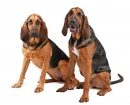
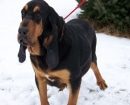
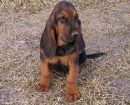
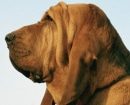
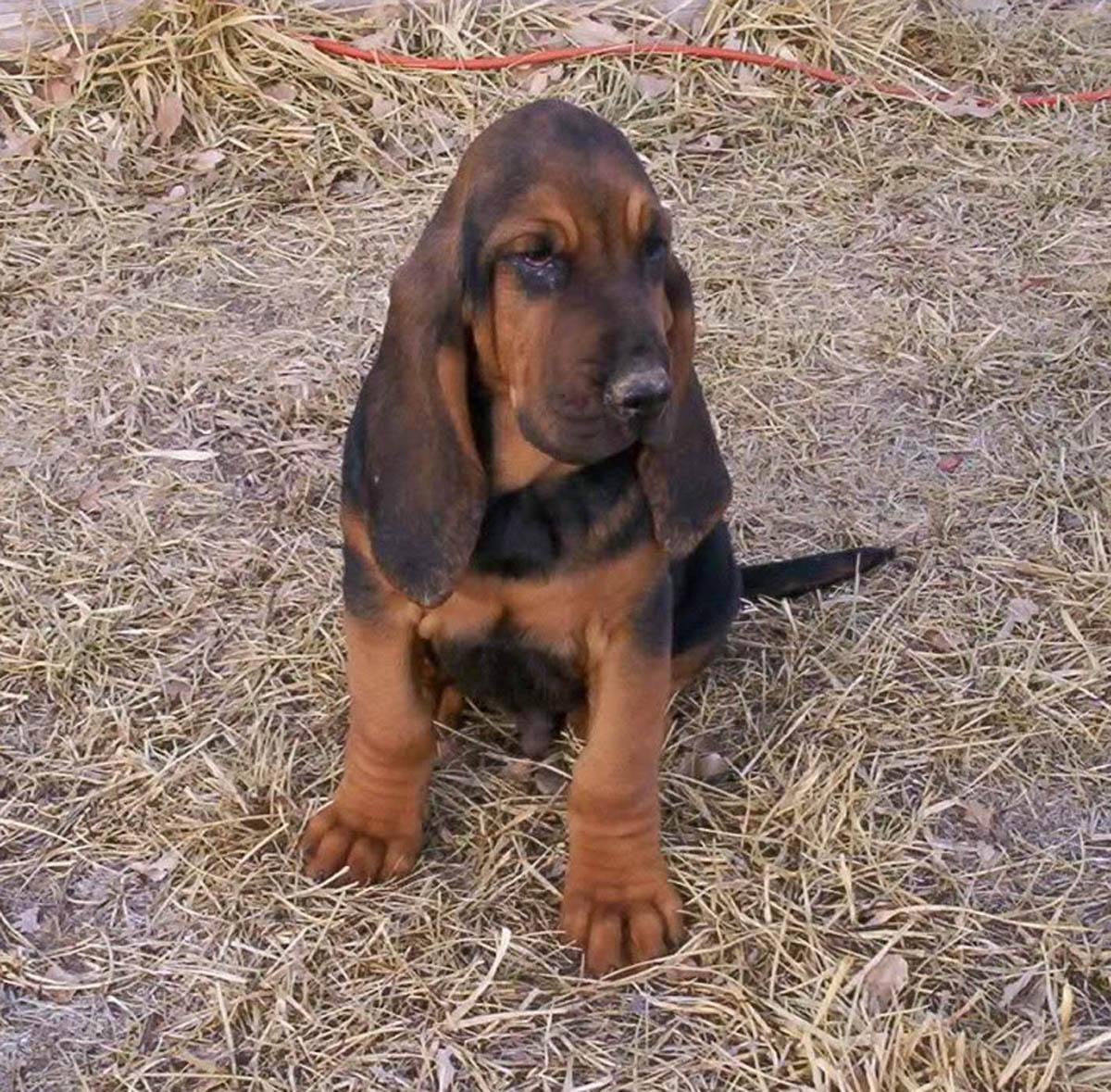
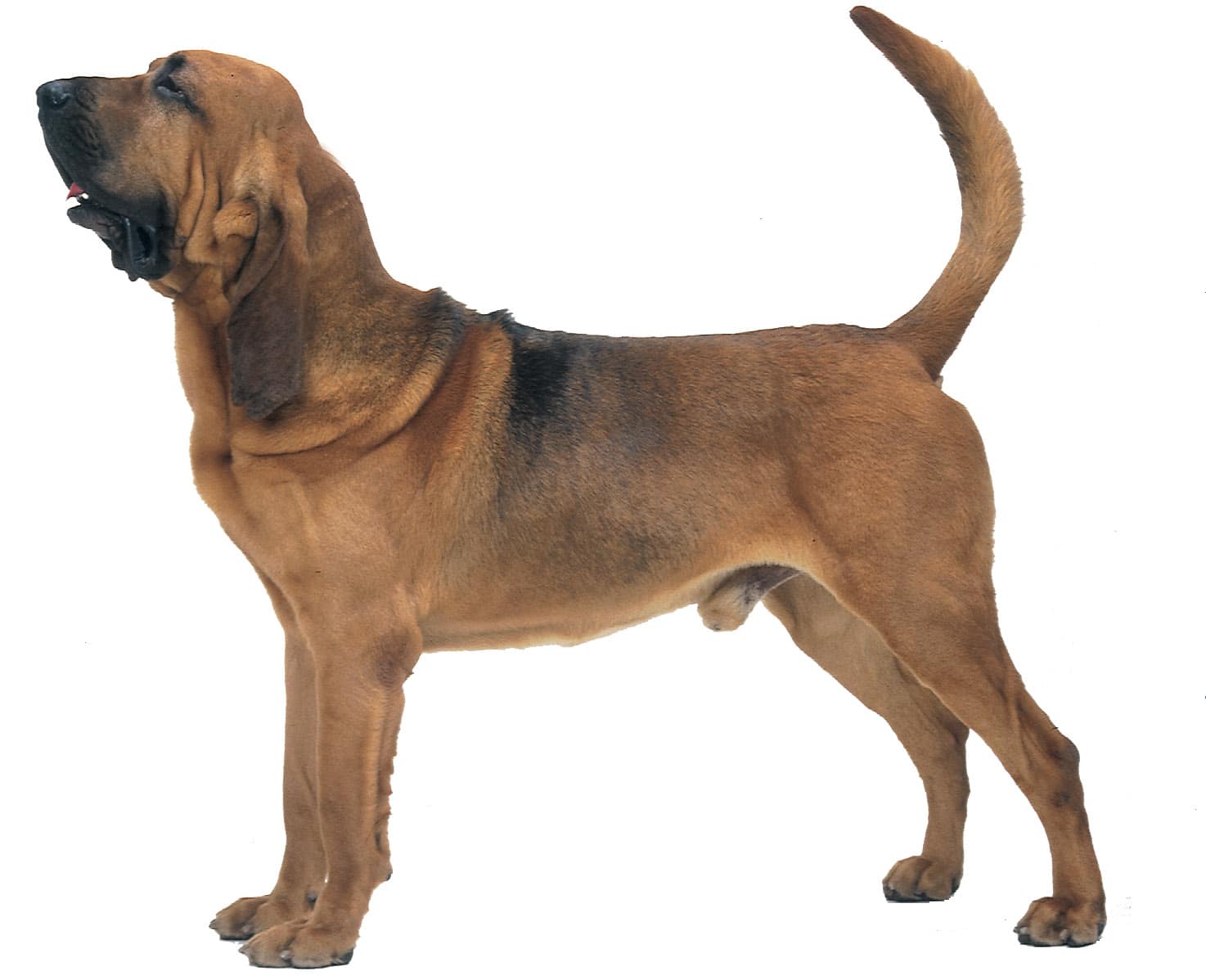
The Bloodhound is a powerful hunting dog. The back is very strong compared to the size of the dog. The head is long and narrow. The muzzle is long with a nose of black. Deeply sunken eyes and drooping eyelids. The Chin is very pronounced.

The Bloodhound is a dog with a nose finest of the planet.

Despite its size, is an agile dog. His body is longer than high. Wrinkles on the head and jowls are perhaps one of the most characteristic features, along with the length of its hanging ears. The accepted colors are black and fire, Brown and red in its different shades and fire.

The appeal is of 67 cm for males and 60 cm for females.

It has been documented that they are capable of following a trail of up to fifteen days, because of the enormous sensitivity of their sense of smell, caused by the internal folds of their nostrils. For that reason it is used as a police dog in tracking tasks..

These hounds cannot be kept in a yard without fences. There is a good chance that your tracker instinct carried them wander and get away until the end of their trail.

It is a dog that needs to be exercised (like all dogs), and usually live more happily in large spaces, Although adapts very well to home life.

The Blodhound (Bloodhound), Despite the allusion to the term blood contained in its name (blood), It is one of the animals most affable that exists. It is a dog of noble nature, can be shy around strangers. He is very patient and persevering when looking for a trailโ€ฆ

It is excellent Playmate for children, defend them from any danger. They tend to be very well with other dogs and pets.
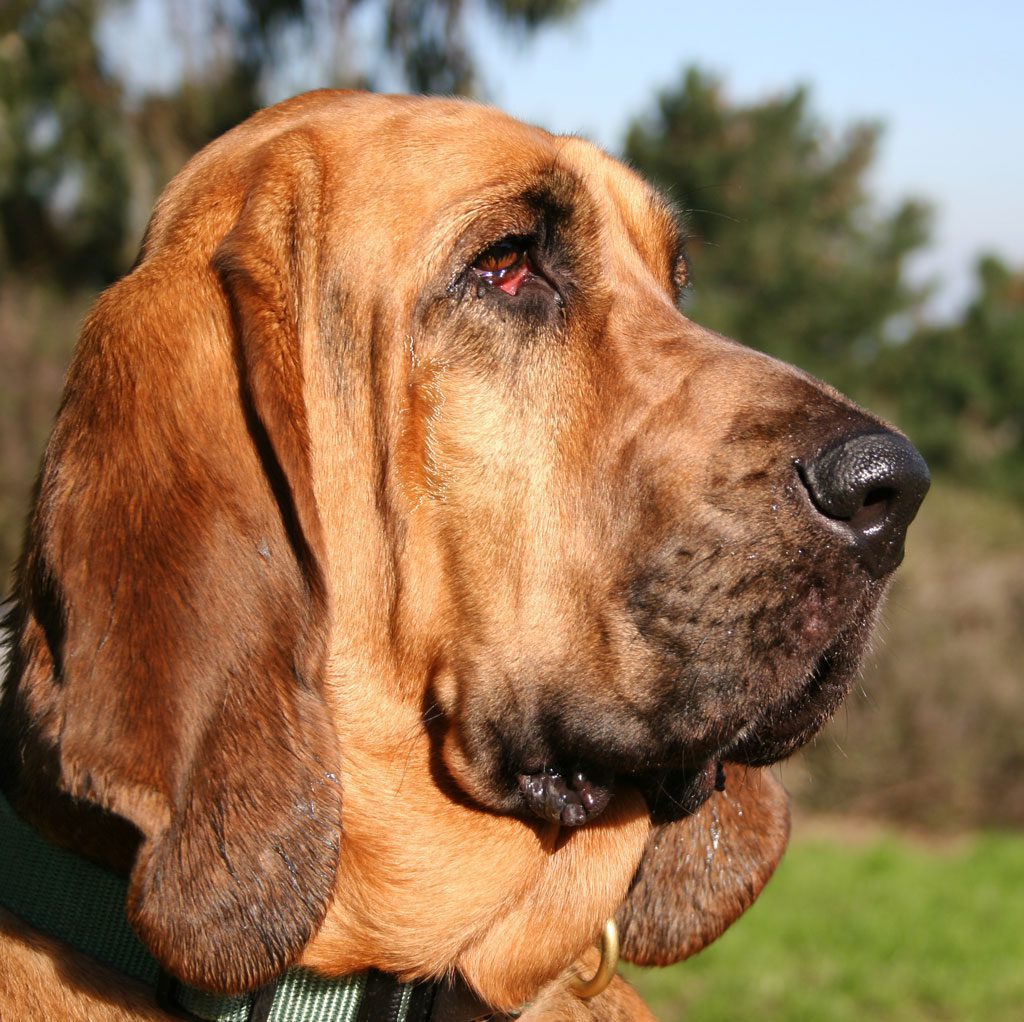
Pictures Bloodhound

Videos Dog of St. Hubert

Characteristics "Bloodhound"

Coexistence is important that you have with your new friend. Before considering the acquisition of a dog of the breed "Bloodhound" you know certain factors. Not all breeds of dogs are apt to live in an apartment, you must take into account his character, their need for exercise, their interaction with other pets, their care and if you have small children, their level of tolerance towards them.

Adaptation โ“˜

3,0 of 5 stars (based on 1 review)

friendly dog โ€‹โ€‹โ“˜

5,0 of 5 stars (based on 1 review)

hair loss โ“˜

5,0 of 5 stars (based on 1 review)

Affection level โ“˜

5,0 of 5 stars (based on 1 review)

Need for exercise โ“˜

5,0 of 5 stars (based on 1 review)

Social need โ“˜

5,0 of 5 stars (based on 1 review)

Home โ“˜

1,0 of 5 stars (based on 1 review)

Toilet โ“˜

5,0 of 5 stars (based on 1 review)

Friendly with strangers โ“˜

5,0 of 5 stars (based on 1 review)

barking โ“˜

5,0 of 5 stars (based on 1 review)

Health โ“˜

5,0 of 5 stars (based on 1 review)

Territorial โ“˜

1,0 of 5 stars (based on 1 review)

Cat friendly โ“˜

5,0 of 5 stars (based on 1 review)

Intelligence โ“˜

5,0 of 5 stars (based on 1 review)

Versatility โ“˜

3,0 of 5 stars (based on 1 review)

Child friendly โ“˜

5,0 of 5 stars (based on 1 review)

Surveillance โ“˜

5,0 of 5 stars (based on 1 review)

joy โ“˜

1,0 of 5 stars (based on 1 review)

Type and recognitions:

  • FCI CLASSIFICATION:
  • Group :
  • Section : . .

Federations:

  • FCI โ“˜,
  • AKC โ“˜,
  • ANKC โ“˜,
  • CKC โ“˜, โ€‹
  • KC โ“˜,
  • NZKC โ“˜, UKC โ“˜

  • FCI breed standard "Bloodhound"

    Origin:
    Belgium

    Date of publication of the valid original standard:
    13.03.2001

    Use:

    Big Game Hound, trail dog and family dog. It was and still is a hunting dog, that due to his remarkable sense of smell is above all a tracker, used both to find the trail of the injured small game, in search of the trail as well as to search for missing persons, in police operations. For its functional construction, the Chien de Saint-Hubert is endowed with great resistance as well as an exceptional smell, allowing you to easily follow a track over a long distance and over rough terrain.


    General appearance:

    Massive plus size hunting and tracker dog, the most powerful of hunting dogs. Its lines are harmonious and it is equipped with strong bones, well muscled and full of substance, although without giving the impression of heaviness. Its structure is elongated and the body is shaped like a rectangle. The set is imposing and full of nobility. His attitude is solemn. Head and neck draw attention to abundant skin, flexible and thin that hangs in deep folds. His movements are impressive, rather slow and with a certain sway, though flexible, elastic and loose. No characteristic can be exaggerated to the point of breaking the harmony of the whole., to give an impression of coarseness, far from harming the health or well-being of the dog. Possible exaggerations may be mentioned: very sunken or very small eyes; distended eyelids; excessively thick, loose skin, with too many folds and too deep; too much double chin; very small head. Large dogs are also undesirable, very heavy or very solid body, since this affects its use.

    IMPORTANT PROPORTIONS

    • body length / height to the cross: 10/9.
    • Chest height / height to the cross: 1/2.
    • Head length / body length: 3/7.
    • Length of the muzzle / head length: 1 /2.


    Behavior / temperament:

    Is meek, calm and gentle with people. Particularly attached to his master. Tolerant of his cage mates and other pets. Rather reserved and stubborn in temperament. He's so sensitive to praise, as to corrections. Is never aggressive. His voice is serious, but he is not barking.

    Head:

    It is the most characteristic aspect of the breed; imposing, majestic and full of nobility. Is high, but narrow in relation to its length, and long in relation to the length of the body. The bone structure is well visible. The lateral faces are flat and the profile is square. The nasal ridge is visibly parallel to the long upper line of the forehead.. The skin, fine and abundant, forms deep wrinkles and folds on the forehead and cheeks that fall when the head is down and extend into the folds of the double chin, which is highly developed. In females, the skin is less abundant.

    Cranial region:

    The skull is tall, long, rather narrow, and the side faces are flat. Superciliary arches are not very prominent, although they may seem so. The occipital protuberance is well developed and clearly protruding.

    Depression links (Stop): Bit strong.

    facial region:

    • Truffle: Black or brown in color; always black in black and tan dogs. It is wide, well developed and windows are wide open.
    • Snout: High; as long as the skull. It is wide near the nostrils and of uniform width throughout its length. The
      Nasal cane is either straight or slightly arched (slight ram's nose). Lips: They are very long and loose. The upper lip hangs over the
      bottom and forms a right angle to the front of the muzzle, which imparts a square profile to the muzzle. Behind the corners they turn into fleshy lips (less pronounced in females), that blend imperceptibly with the double chin, which is abundant. The edge of the upper lip descends a few 5 cm lower than the lower jaw. The edge of the lips is well pigmented black or brown, depending on the color of the truffle.
    • Jaws / Teeth: Complete denture, correct "scissor" joint; strong, white teeth set evenly in well-developed jaws. โ€œClamp-shapedโ€ dentures are accepted.
    • Cheeks: Sunken and thin, especially under the eyes.

    EYES: Dark brown or hazelnut color, of a lighter shade (amber) in dogs without a chair or black blanket. Medium-sized; oval, not tearful, nor outgoing, nor sunk in the orbits, thus leaving the iris completely visible. The eyelids, no irregularities in its contour, are normally adapted to the eyeball. Tolerated, However, lower eyelids somewhat distended, so that the conjunctiva is a little visible. The eyelashes cannot under any circumstances touch the eyes, nor hinder them. Your expression is sweet, gentle and dignified, the look a little melancholic.

    EARS: Thin, and flexible, covered with short hairs, fine and velvety to the touch. The pavilion is very long, exceeding at least the tip of the nose when placed on the top of the nasal bridge. Very low implantation, at eye level or below, on the sides of the head, falling in funny folds, castled in and back (corkscrew).

    Neck:

    It is long, so that the dog can keep track of it while keeping the truffle on the ground. Well muscled; throat skin is loose and extremely developed, presented a double chin, although this is less pronounced in females.

    Body:

    The top and bottom margin lines are almost parallel.

    • Cross: Slightly marked.
    • Back: Straight, wide, long and solid.
    • Pork loin: Width, solid, short, very slightly arched.
    • Rump: Well muscled, almost horizontal, never sunk. It is very wide and quite long.
    • Breast : It has an oval shape. It is broad, alto, clearly forming a keel between the forelimbs. The rib cage is long enough; the front of the thorax and the point of the shoulder are well protruding. The ribs are well sprung, ni planas, nor barrel-shaped.
    • Bottom line and belly: The bottom margin is almost horizontal; the lower part of the chest is well lowered. The flanks are very solid, wide and lowered. The belly is very little raised.

    Tail:

    It is long, strong, thick, set high; It is located in the extension of the dorsal line, and gradually becomes thinner towards the limb. It comes in the shape of a saber. When is the dog in action, forms a graceful curve above the dorsal line; never kinks, nor does it deviate laterally. His part covered with rougher hair, of about 5 cm., that gets progressively shorter towards the limb.

    Tips

    PREVIOUS MEMBERS:

    • General appearance: They are well muscled. The forelimbs are straight, powerful and perfectly parallel.
    • Shoulder: Long, well oblique and well muscled, although not heavy.
    • Arms: Oblique lengths, forming a good angle with the shoulders.
    • Elbows: They are well applied, or peeled, or together.
    • forearms: Straight, strong and round bones. Carpi: His firms.
    • Metacarpus: Robust; seen from the front, they are leaden. Seen in profile, they are slightly inclined towards the front.
    • Previous feet: They are compact and very solid; they do not deviate even inwards, nor out. The fingers are well arched, well articulated and together (Jack's foot). The pads are thick and solid, and short and strong nails.

    LATER MEMBERS:

    • General appearance: They are solid, powerfully muscular, in harmony with previous members. Seen from behind, are
      perfectly parallel, or together, nor separated.
    • Thighs: Of good length and well muscled.
    • Knees: Well angulated; they do not deviate even inwards, nor out.
    • Legs: Long enough and well muscled.
    • Hock: Solid, well angled; comes close to the ground. Metatarsals: Strong and short.
    • Hind feet: As the front.

    Movement:

    The judging of the marches, very typical of Chien de Saint-Hubert, it's extremely important. During the normal step, that is to say, the trot, the movement is uniform, steps provided; it is elastic and loose, covering more ground than any other hunting dog, and something that is very characteristic, with a balance, although not through. Hind limbs are directed well back, with good rear third drive. The amplitude of the movements of the forelimbs and hindlimbs is uniform and the upper line remains horizontal. The members move in parallel, but at a higher speed the feet get closer. The tail is high, Sabre-shaped, not too kinky though. The Chien de Saint-Hubert must be able to maintain a long trot without showing signs of fatigue.

    Mantle

    Flexible over the whole body, loose and elastic. Thin skin is very characteristic, very loose and abundant on the head. On the forehead and lateral faces of the muzzle, the skin forms hanging folds that are even more marked when the head is down. But, Very pronounced wrinkles and folds on the forehead and superciliary arches should never obstruct the eyes. Folds on the body caused by overly extended skin are undesirable.

    Fur: On the body the hair is straight, short, dense, quite hard and resistant to inclement weather. Over the ears and head, it is very short and soft to the touch. The lower part of the tail has slightly longer and rougher hairs.

    Color:

    We can distinguish three colors in the fur:

    • the bicolor black and tan (ยซblack and tanยป),
    • liver and fire (ยซliver and tanยป
    • solid red (ยซredยป).

    In black and tan dogs, the black varies, depending on whether it is a blanket or a chair. In a dog with a blanket, black predominates; the fire (leonado), occurs only on the muzzle, cheeks, on top of the eyes, on the front of the thorax, in the limbs and in the perianal region. A dog with a chair has a more widespread tan color, since the black is more or less limited to the dorsal part. The same arrangements of color zones are present in bicolor liver and tan dogs.. Colors are not always well defined, nor clearly delimited. In the darkest parts, longer or badger hairs may be scattered. This mix of different color hairs is accepted. In unicolor dogs, red can vary from light to dark. Faded tan is not desirable in bicolor dogs, nor the faded red in single-colored dogs. Tolerated, although it is not favored, a little white on the front of the chest, on the fingers and the tip of the tail.


    Size and weight:

    Height to the cross:

    The ideal height is:

    • 68 cm for males,
    • 62 cm for females.

    Tolerance: 4 cm more or less.

    Weight:

    • the males, a few 46 - 54 kg,
    • the females, approximately 40 - 48 kg.

    Size and weight must be in harmony.


    Fouls:

    • Any deviation from the aforementioned criteria is considered as a fault and the severity of this is considered to the degree of the deviation to the standard and its consequences on the health and well-being of the dog..
    • General aspect: appearance of heaviness; little substance; Lightweight bones; body raised or close to the ground; rather square than rectangular construction; absence of nobility.
    • Head: broad and bulky or excessively narrow skull; elusive forehead; forehead skin that deviates too much; shallow occipital protrusion; marked naso-frontal depression; concave muzzle; snout short or lacking in altitude; very little hanging upper lip.
    • Nose and lips: loss of pigmentation.
    • Teeth: absence of teeth.
    • Eyes: too small, deep in their orbits; too hanging lower eyelid, highly visible conjunctiva.
    • Ears: too short, very thick; occur above eye level; too close to the head or too flat.
    • Neck: short; delgado, with little double chin.
    • Body: short or too long; slightly lowered chest; anterior part of the thorax little protrusion seen in profile; flat or barrel ribs; loose or arched back, rump very raised or sunken; belly too raised.
    • Tail: appears low; squirrel tail, ring-shaped, threaded; tail knotted or folded; hooked or deviated.
    • Members: too little or too angled; short arms; incorrect poise, viewed profile (eg., Very oblique pasterns or weak carpals), front (for ex. feet that turn inward or outward, bowed forearms, elbows off), the one behind (eg., hind limbs together, separated or in barrel, hock closed or open); open feet, hare or flat.
    • Movement: closed or open; pass crossed; short steps or rigid movement; little drive, the back does not provide a good transmission.
    • Hair color: light or faded colors.
    • Character: insecurity or nervousness.

    FALTAS DESCALIFICANTES:

    • Aggressiveness or extreme shyness.
    • Any dog โ€‹โ€‹showing clear signs of physical or behavioral abnormalities must be disqualified..
    • General aspect: absence of racial type.
    • Teeth: undershot or overshot; Cross occlusion; crooked mouth.
    • Nose and lips: excessive depigmentation or pink color; colors other than black in โ€œblack and tanโ€ dogs; other colors than brown or black in dogs without a chair or black blanket
    • Eyes: light yellow (raptor eyes).
    • Hair color: all colors not corresponding to the descriptions: widespread white markings, such as white that reaches the wrists or hocks, or too widespread white color in the front part of the thorax: white patches somewhere other than the front of the chest, on the fingers and the tip of the tail, as for example, a white snout, a white stripe, etc.
    • Size: outside tolerance limits.
    • A dog that shows any signs of physical abnormality should be eliminated.


    N.B.:
    • Males should have two normal-appearing testicles fully descended into the scrotum..
    • Only functionally and clinically healthy dogs, with the typical conformation of the breed, should be used for parenting.

    Source: F.C.I - International Cynological Federation

    Alternative names:

    1. Sleuth hound, St. Hubert Hound (English).
    2. bloodhound (French).
    3. Bluthund, Bloodhound (German).
    4. Cรฃo-de-santo-humberto, Chien de St. Humbert, Bloodhound (Portuguese).
    5. Perro de San Huberto (espaรฑol).

    โ–ท The world of Pets: Dogs, cats, birds, reptiles, amphibians

    Fawn Brittany Griffon
    Francia FCI 66 - Medium-sized Hounds

    Fawn Brittany Griffon

    Its sociable, loving, balanced and very kind to people, what makes them good companions.

    Content

    History

    The Fawn Brittany Griffon it is one of the oldest breeds of French trace dogs, since in the fourteenth century a certain Huet des Ventes already had a pack of this type. Widely used until the 19th century for wolf hunting in Brittany, rested when these animals disappeared.

    In the 1949, The Brittany Fawn Club was created by Marcel Pambrun to dedicate himself to preserving the value of these dogs, that had become scarce. Since the decade of the years 80, under the impulse of Bernard Vallรฉe, the Fawn Brittany Griffon, as well as the race that derives from it, the Fawn Brittany Basset, they seem to have made a place for themselves among French track dogs. The motto "hunting above all" continues to be the Club's line of conduct.

    Photo: This is a french dog Griffon Fauve de Bretagne by Alephalpha, CC BY-SA 3.0, via Wikimedia Commons

    Physical characteristics "Griffon griffon of Brittany"

    The Fawn Brittany Griffon it is mostly a hunting dog with a muscular body. They are recognized by their short hair, rough and dry, always tawny in color but with more or less pronounced tones. Its hair is slightly longer on the sides of its elongated snout, forming a kind of mustache. Her small dark brown eyes give her a lively and alert appearance. His ears, quite large, they lay low and they wear droopy. They are covered with shorter and finer hair than the rest of the body.

    The Fawn Brittany Griffon has a medium-length tail, sickle-shaped, which is thick at the base and more tapered at the tip. When active, this dog makes quick lateral movements with his tail.

    Size: 48 – 56 cm.
    Weight: 18 – 20 kg

    Character and skills "griffon griffon of Brittany"

    Proud, bold and alive, the Fawn Brittany Griffon he is a stubborn and passionate hunter, that adapts easily to all territories and all game animals. Brave, witty, tenacious and diligent, he is also entrepreneurial and efficient, while demonstrating your ability to convene.

    Its sociable, loving, balanced and very kind to people, what makes them good companions.

    If he is well trained, is obedient and has a good memory.

    Care of "Griffon of Brittany"

    The Fawn Brittany Griffon not cut out for city living. He is quite used to living in a pack in a kennel. It is a dog that needs long walks in the forest in particular. If you grow up in the city, your master must be able to offer you very frequent and stimulating outings.

    The Fawn Brittany Griffon does not require any particular maintenance except brushing once or twice a week.

    The health of the "Giffon of Brittany"

    The Fawn Brittany Griffon he is a robust dog, tough and in pretty solid health. But, can be prone to ear infections and eye problems. This dog can also suffer from hip and elbow dysplasia.

    Characteristics "Fawn Brittany Griffon"

    Coexistence is important that you have with your new friend. Before considering the acquisition of a dog of the breed "Fawn Brittany Griffon" you know certain factors. Not all breeds of dogs are apt to live in an apartment, you must take into account his character, their need for exercise, their interaction with other pets, their care and if you have small children, their level of tolerance towards them.

    Adaptation โ“˜

    3,0 of 5 stars (based on 1 review)

    friendly dog โ€‹โ€‹โ“˜

    3,0 of 5 stars (based on 1 review)

    hair loss โ“˜

    3,0 of 5 stars (based on 1 review)

    Affection level โ“˜

    4,0 of 5 stars (based on 1 review)

    Need for exercise โ“˜

    5,0 of 5 stars (based on 1 review)

    Social need โ“˜

    4,0 of 5 stars (based on 1 review)

    Home โ“˜

    3,0 of 5 stars (based on 1 review)

    Toilet โ“˜

    2,0 of 5 stars (based on 1 review)

    Friendly with strangers โ“˜

    4,0 of 5 stars (based on 1 review)

    barking โ“˜

    3,0 of 5 stars (based on 1 review)

    Health โ“˜

    1,0 of 5 stars (based on 1 review)

    Territorial โ“˜

    2,0 of 5 stars (based on 1 review)

    Cat friendly โ“˜

    3,0 of 5 stars (based on 1 review)

    Intelligence โ“˜

    4,0 of 5 stars (based on 1 review)

    Versatility โ“˜

    4,0 of 5 stars (based on 1 review)

    Child friendly โ“˜

    5,0 of 5 stars (based on 1 review)

    Surveillance โ“˜

    4,0 of 5 stars (based on 1 review)

    joy โ“˜

    4,0 of 5 stars (based on 1 review)

    Images "Fawn Brittany Griffon"

    Photos:

    1 – Fawn Brittany Griffon female by Canarian, CC BY-SA 3.0, via Wikimedia Commons
    2 – Griffon Fauve de Bretagne, 6 Month by Markus Seim, CC BY-SA 3.0, via Wikimedia Commons
    3 – Lion Griffon from Britain by https://pxhere.com/es/photo/481096
    4 – Lion Griffon from Britain by https://www.akc.org/dog-breeds/basset-fauve-de-bretagne/

    Videos "Fawn Brittany Griffon"

    Griffon Fauve de Bretagne ๐Ÿถ๐Ÿพ Everything Dog Breeds ๐Ÿพ๐Ÿถ
    Griffon Fauve de Bretagne ?? Everything Dog Breeds ??
    Griffon Fauve de Bretagne Ari en Theo. Trimmer at home. Home Grooming . Movie 004
    Griffon Fauve de Bretagne Ari en Theo. Trimmer at home. Home Grooming

    Type and recognitions:

    • FCI CLASSIFICATION:
    • Group :
    • Section : . .

    Federations:

    • FCI – Group 6: Scent hounds, and related breeds. – Section 1.2: Medium-sized Hounds. โ“˜
    • UKCScenthounds โ“˜
    • Central Canine Society โ“˜

    FCI breed standard "Fawn Brittany Griffon"

    Origin:
    France

    Date of publication of the valid original standard:
    25.03.2003

    Use:

    Bloodhound dog used for hare hunting, the fox, the roe deer and the wild boar.


    General appearance:

    It is a bony and muscular dog, very strong and resistant. It is active and particularly adapted to difficult land. They have a good sense of smell and a sustained bark (short and repeated).


    Behavior / temperament:

    The Fawn of Brittany are passionate hunting dogs, although docile with the man, sociable, affectionate and balanced. They adapt easily to all terrain and all types of hunting. During the hunt they are brave, slums, tenacious and applied. They are enterprising and effective, but they also show aptitude to join the group. Well managed, they are obedient and of an easy return.

    Head:

    ---

    Cranial region:
    • Skull : Rather elongated and the occipital protuberance is marked. Seen from the front, skull looks lowered curvature. Its width decreases until it reaches the level of the superciliary arches, that are not very marked.
    • Depression links (Stop) : Bit strong.

    facial region:

    • Truffle : Black The Oscuro Brown. The Windows are wide open.
    • Snout : More pointed than square.
    • Belfos : They cover the lower jaw well, although not in excess. Whiskers are not abundant.
    • Jaws/Teeth : Jaws and teeth are strong, with a perfect and uniform scissor joint. Upper incisors cover lower incisors with tight contact. The incisors are set at right angles to the jaws. The absence of PM1 is not penalized.

    Eyes : Not prominent, not too sunk in the orbits. Its color is dark brown. The conjunctiva is not apparent. The look is impetuous.

    Ears : Delicately implanted at the level of the eye line, just reaching the tip of the truffle. They end in a point and are bent inwards and covered with a shallower and finer hair than the rest of the body.

    Neck:

    Quite short and muscular.

    Body:

    • Back : Short and wide. Never sunk.
    • Pork loin : Width and well muscular.
    • Breast : Wide and high.
    • Ribs : Pretty rounded.
    • Belly : The lower margin is slightly raised towards the back.

    Tail:

    It is slightly sickle-shaped. Is medium length, thick at the base, often spike-shaped and tapers at the tip. When is the dog in action, the tail is on the margin of the back and performs regular lateral movements.

    Tips

    PREVIOUS MEMBERS :

    • Seen in conjunction : They show good bone structure and are well poised.
    • Shoulder : Oblique, well attached to the thorax.
    • Elbows : They occur in the axis of the body.
    • forearms : Vertical.
    • Metacarpus : Seen in profile, they are slightly oblique. Seen from the front, are presented in the axis of the body.

    LATER MEMBERS

    • Seen in conjunction : They are well muscled. Legs are uniform. Seen from the back, they are parallel, or together, nor separated.
    • Thighs : Long and well muscled.
    • Babillas : Inclined and moderately bent.
    • Metatarsals : Vertical.

    FEET : compacts. Fingers are together and arched ; nails are solid. Plantar bearings are hard.

    Movement:

    Elastic and uniform ; never in little hops.

    Mantle

    SKIN : Quite thick and flexible; no dewlap.

    HAIR : Good hard, thin and quite short; never shaggy or curly. The face must not be tangled.

    COLOR : Fawn ranging from golden wheat to brick red. Some scattered black hairs are tolerated, on the back and on the ears. Sometimes the presence of a white star is observed on the sill, this particularity is not sought.


    Size and weight:

    Height at withers : Of 0,48 to 0,56 m for males and females, with 2 cm excess tolerance for exceptional specimens.


    Fouls:

    Any deviation from the aforementioned criteria is considered a fault and its severity is considered in proportion to the degree of the deviation from the standard and its consequences on the health and welfare of the dog.

    SERIOUS FAULTS

    Behavior
    โ€ข Fearful dog
    โ€ข Width and flat skull.
    โ€ข Superciliar arcades too pronounced.
    โ€ข Pointy or short snout. Hanging and thick lips.
    โ€ข Light eyes.
    โ€ข Flat and wide ears.

    Body
    โ€ข Weak appearance.
    โ€ข Upper margin that is not tense enough.
    โ€ข agalgado belly
    โ€ข Deviation.
    โ€ข Members
    โ€ข Poor bone structure.
    โ€ข Crushed feet
    โ€ข Scarce, short, fine, soft.

    MISS PLAYOFFS

    โ€ข Aggressive or fearful dog.
    โ€ข Absence of typical characteristics (any specimen whose characteristics differentiate it from its congeners).
    โ€ข Inferior or superior prognathism.
    โ€ข Very clear eyes.
    โ€ข Partial or total depigmentation in the truffle or on the edge of the eyelids and the Belfos.
    โ€ข Knotted tail.
    โ€ข Presence of spur in the posterior members (dewclaws never appear in this breed)
    โ€ข Long and lanudo hair.
    โ€ข Any other fur than is not the one indicated by the standard.
    โ€ข Any other size other than the standard tax.
    โ€ข Notable disability; anatomical malformation.

    Any dog โ€‹โ€‹showing clear signs of physical or behavioral abnormalities must be disqualified..


    N.B.:

    Males should have two normal-appearing testicles fully descended into the scrotum..

    Source: F.C.I - International Cynological Federation

    Alternative names:

    1. Griffon fauve de Bretagne (English).
    2. Fauve de Bretagne (French).
    3. Griffon Fauve de Bretagne (German).
    4. Griffon fauve de Bretagne (Portuguese).
    5. Griffon fauve de Bretagne (espaรฑol).