 FCI 225 - Molossoid - Dogo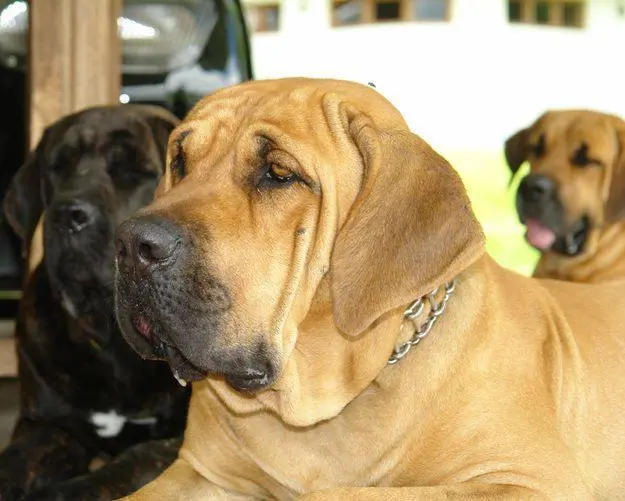
Content |
|---|
Characteristics "Fila Brasileiro"
Coexistence is important that you have with your new friend. Before considering the acquisition of a dog of the breed "Fila Brasileiro" you know certain factors. Not all breeds of dogs are apt to live in an apartment, you must take into account his character, their need for exercise, their interaction with other pets, their care and if you have small children, their level of tolerance towards them.
Adaptation ⓘ3,0 of 5 stars (based on 1 review)
|
friendly dog ⓘ1,0 of 5 stars (based on 1 review)
|
hair loss ⓘ3,0 of 5 stars (based on 1 review)
|
|---|---|---|
Affection level ⓘ4,0 of 5 stars (based on 1 review)
|
Need for exercise ⓘ4,0 of 5 stars (based on 1 review)
|
Social need ⓘ3,0 of 5 stars (based on 1 review)
|
Home ⓘ1,0 of 5 stars (based on 1 review)
|
Toilet ⓘ1,0 of 5 stars (based on 1 review)
|
Friendly with strangers ⓘ1,0 of 5 stars (based on 1 review)
|
barking ⓘ2,0 of 5 stars (based on 1 review)
|
Health ⓘ2,0 of 5 stars (based on 1 review)
|
Territorial ⓘ5,0 of 5 stars (based on 1 review)
|
Cat friendly ⓘ1,0 of 5 stars (based on 1 review)
|
Intelligence ⓘ3,0 of 5 stars (based on 1 review)
|
Versatility ⓘ2,0 of 5 stars (based on 1 review)
|
Child friendly ⓘ2,0 of 5 stars (based on 1 review)
|
Surveillance ⓘ3,0 of 5 stars (based on 1 review)
|
joy ⓘ5,0 of 5 stars (based on 1 review)
|
History
The Fila Brasileiro its history is linked to both genetic mixing and Brazilian colonization. There is no consensus on its origin, but probably the Brazilian line is the result of a mixture of dogs whose specialty was hunting and herding animals in the field. The mastiff, the Bulldog, the Terceira line (a portuguese breed) and the Scent hound are just a few examples of possible breeds that have contributed to tracing the DNA of the Brazilian line. Some say that indigenous dogs (Aracambé) and even the savages, like the guarbo wolf, they may also have participated in the miscegenation.
In some 19th century carvings, the breed was already known to assist in catching oxen, cows, sheep and even big cats, like jaguars, for example. This shows that the Brazilian line was not just a dog to keep at the door, taking a nap in the late afternoon: I was really going to fight! And maybe that's where his keen sense of protection comes from., always putting strangers in their place once they get home.
In 1946 the first effort was made to set the breed standard. In 1976, the second standard was recognized and approved during the 1st Symposium of the Brazilian Fila Race. In 1984 the third rule was defined, which is still valid today.
Physical characteristics
It is a trotting large but very agile. It has a powerful skeleton and a rectangular structure, compact and proportionate. The head is big, heavy and solid, although it is always proportionate to the body. The craniofacial relationship is almost 1:1, with the nose slightly shorter than the skull. The occipital ridge is very prominent, especially in the puppy. The stop is low and inclined, so it should not be seen when looking at the animal from the front. The eyes are medium or large, in the form of almond, quite sunken and colored according to the mantle (yellow to dark brown). Ears are wide and thick, dangling and "V" shaped. The limbs are parallel and straight, with strong bones. A characteristic of the breed is the way of moving in amble. The tail is very broad at the root and tapers rapidly when it reaches the hock..
- Fur: short.
- Color: all solid colors are supported, except white, the rat gray and the mottled or stained coat, liable to disqualification. Solid color layers may have stripes of less intense or very dark color. Black mask is optional.
- Size: in males, of 63 to 75 cm., with a minimum weight of 50 kg; in females, of 60 to 70 cm., with a minimum weight of 40 kg.
Character and skills
The Brazilian Fila is very determined, brave and can be very fierce. They can be docile and very obedient to their owners and family and are very tolerant of children.. It is a dog that loves the company of its owner and always tries to be with him.. One of the most striking points of the Fila Brasileiro is the aversion to strangers. So they are excellent guard dogs..
The Fila Brasileiro are the protectors of the pack (that is to say, the family that raises him) and therefore they need to be educated from an early age. At the age of 7 months already begin to show surveillance potential. As they are very large and very strong dogs, it's important for owners to have a firm wrist and show leadership from an early age, so that the dog becomes obedient and respects the owners.
They are very smart and tend to easily learn the owners' teachings. Be careful not to be too rigid in your corrections when the Fila Brasileiro does something wrong, because they can be a bit stubborn and make training difficult.
Care of the «Fila Brasileiro»
Videos "Fila Brasileiro" |
||
|---|---|---|
| ||

The maintenance of a “Fila Brasileiro” is not laborious, not too different from other large, short-haired dogs. The frequency of the bath can vary according to the type and intensity of the activities carried out by each dog..
– Grooming: The "Fila Brasileiro" does not need more than weekly brushing, because its coat is short and the breed doesn't get too dirty. Ideally, you should bathe monthly in summer and, in winter, Every two months.
– Nails and ears: you always have to check them. The nail cannot grow too long and the ear cannot accumulate wax and dirt. Remember that the “Fila Brasileiro” is prone to developing otitis and keeping it clean makes it easier to notice any problem..
– Eyes: if there is any spot near the eyes or accumulation of discharge, clean them with saline solution.
– Sol: sunbaths are welcome: stimulate the body to produce vitamin D, essential for strong teeth and bones. The ideal time for this is the same as for humans, avoid the hottest times of the day, between the 10 am and 4 pm.
Health of the «Fila Brasileiro»
The Fila Brasileiro it is a healthy breed of dog. Maintaining the basic care routine and controlling your physical condition, the chances of you having a happy life are great! See some problems that may affect you:
– Obesity: common cause of health problems that can affect not only the Fila Brasileiro, but to all overweight dogs. As the Fila Brasileiro have a tendency to gain weight, watch for changes in the general shape of the dog, avoid giving treats and respect the recommended amounts of food for the breed.
– Otitis is an infection that can affect the hearing of the Fila Brasileiro and it can be caused by age or even poor hygiene.
Dog's level of exercise
The Fila Brasileiro need plenty of exercise, what requires available space – even if you walk on walks. Must exercise for one hour daily. And how is a smart dog, seeks to diversify its activities. A simple change in the route of the walk offers new stimulation and keeps you happy.
Images "Fila Brasileiro"
 Fila Brasileiro 6
 Fila Brasileiro 5
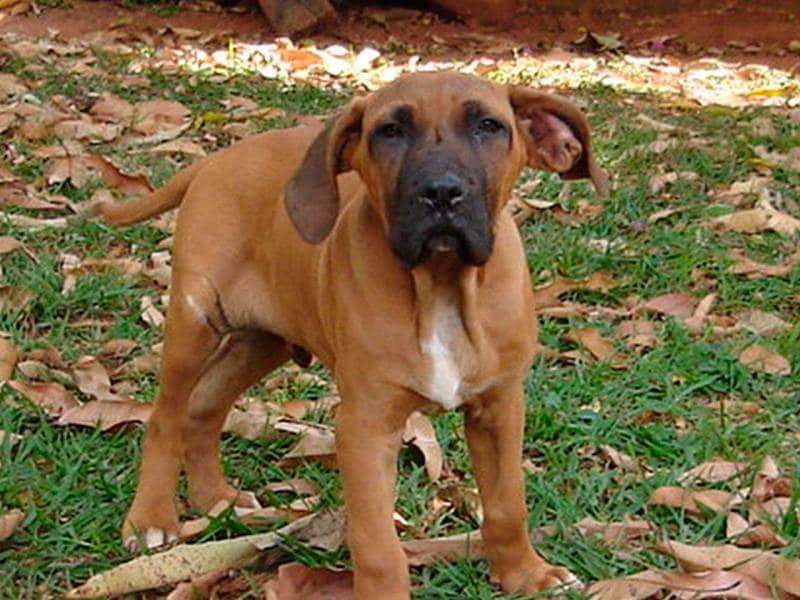 Fila Brasileiro 4
 Fila Brasileiro 3
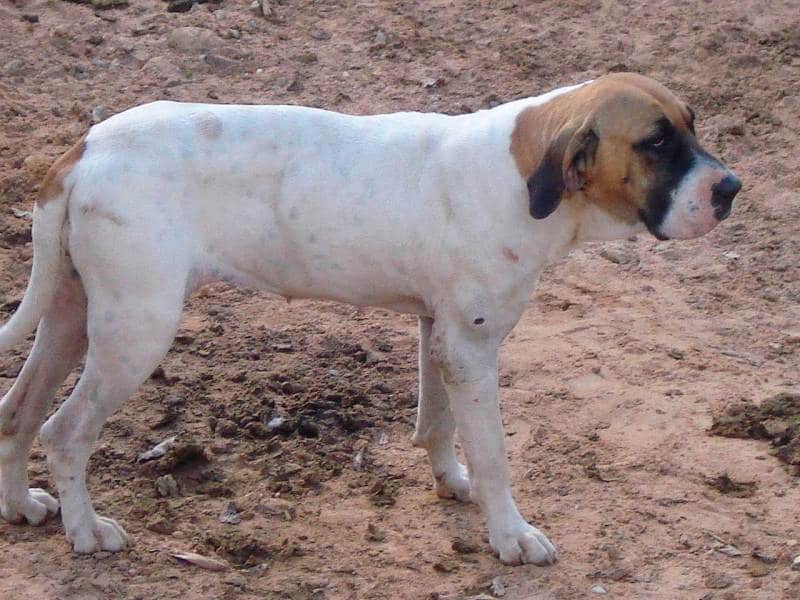 Fila Brasileiro 2
 Fila Brasileiro 1
Photos:
1 – PETRA VESELÁ has published this image «Fila Brasileiro» under public domain license.
2 – Original bitch Fila Brasileiro – branca to AJorgeSC / CC BY-SA
3 – Fila Brasileiro (ALMODOVAR Rio Grande – from RIO GRANDE kennel) by Pleple2000 / CC BY-SA
4 – Puppy OFB at 4 months old by AJorgeSC / CC BY-SA
5 – row brazilian-colombia hatchery – 223 | Julio Cesar Hoyos A | Flickr
6 – row brazilian-colombia hatchery – 086 – Flickr
Type and recognitions:
- FCI CLASSIFICATION:
- Group :
- Section : . .
Federations:
- – FCI – Pinscher and Schnauzer-Molossoid type dogs – Swiss Mountain Dogs and Cattledogs. Section 2.1 Molossoid, mastiff type. ⓘ
- – CKC – Miscellaneous list ⓘ
- – NZKC – Utility dog ⓘ
- – UKC – Watchdog ⓘ
FCI breed standard "Fila Brasileiro"
Use:
Watchdog
General appearance:
Race typically molosoid.
Powerful bone structure, rectangular and compact set, Although harmonious and well-proportioned. It presents, along with his body mass, highly concentrated and easily noticeable agility.Sexual dimorphism must be very well defined and obvious (female females, male males).
PROPIMPORTANT ORTIONS:
- Muzzle slightly shorter than skull.
- The length of the body, measured from the tip of the sternum to the tip of the buttock, exceeds height at withers by15%.
Has courage, remarkable determination and verve. With their masters and the family is docile, obedient and extremely tolerant towards children. Their loyalty is notorious, because he insistently seeks the company of his masters. One of his characteristics is to be distrustful of strangers..
Is quiet in nature, which reveals a security and self-confidence very typical of his character.. Adapt perfectly well to new environments and strange noises. It is a special guardian of properties, and it is, by instinct, a pasture for cattle dog, as well as a large game hunter.While one of its characteristics is a natural withdrawal towards strangers, especially in their own territory, must be susceptible to controlled manipulation, especially in the ring.
During rest, he is calm, noble and self-confident.
Never show a gaze lost or boredom. When is attentive, your expression must show determination, which results in a fixed and penetrating gaze.
Head:
Grand, heavy, solid, but always well proportioned to the body. View from the top, looks like a trapezoid into which the pear-shaped head has been inserted.- Craging: Its profile presents a smooth curve, that extends from the naso-frontal depression to the occipital protuberance, which is marked and outgoing, especially in puppies. Head on, it's wide, with a curved top line. Its lateral lines descend in shallow curves, almost vertically, and decrease towards the snout in a continuous line.
- Dnaso-frontal depression (Stop): Seen from the front, is practically non-existent. The middle groove gently rises almost to the middle of the skull. Profile view, it is little marked, inclined and almost formed thanks to the superciliary arches, which are well developed.
facial region:
- Trufa: Nostrils, wide, well developed, although without occupying the entire width of the maxilla. Its color is black.
- Horcico: Strong, width, celebrities, always in proportion to the skull. Of good prominence at the base, without being higher than long. Seen from above, it is well filled under the eyes and thinning very slightly to half, then widening slightly to the previous curve. In profile, the nasal passage has a straight or slightly arched upper line, but never ascending. The anterior line is almost perpendicular to the nasal passage., with a slight depression just below the nose.
- Labios: The upper lip is thick and hanging and covers the bottom in a perfect curve: the lower line of the muzzle is thus almost parallel to the upper one. The lower lip is well applied to the region of the fangs; from there it's loose all the way back, with «toothed» edges, and ends with the always apparent corner. The edge of the lips forms a deep inverted U.
- Jaws / Teeth: Teeth are characterized by being wider than they are long. They are strong and white. The upper incisors are wide at the roots and sharp at the edges.. The fangs are strong, are well positioned in the maxilla and are separated. The jointindit is scissor shaped.
- Ojors: Medium to large, macaroons, well separated and placed medium to deep. Its color ranges from brown to yellow, always in harmony with the color of the coat.However a darker color is preferred.Because the skin is loose, many specimens have hanging eyelids, detail that should not be considered as a fault, since this accentuates the sad aspect of the look, typical of the breed.
- Obars: Pendants, thick, large, V-shaped. Wide at the root, decrease in extremities, which are rounded. Inserted into the back of the skull, They occur at the level of the midline of the eyes, when the dog is at rest, and they rise above the primitive ligament when it is alert. The ears are tilted at the ligament, since the front edge is higher than the back. Hanging to one side or folded back, so that its interior is visible(Pink).
Neck:
Extraordinarily strong and muscular, seems short. The upper edge is slightly convex, well separated from the skull. Chin presence.Body:
Strong trunk, wide and tall, covered by thick and loose skin. The thorax is longer than the abdomen.
- Línand the top: Height at withers is slightly lower than rump, downline; is wide, due to the separation of the shoulder blades. In the place where the cross ends, the top line changes direction, gently rising to the front of the rump, without any sign of a bulging or arched back (carpal back).
- Itmo and flank: Less long and wide than the thorax. They are clearly separated. In the female, flank edge is more developed. Seen from above, the loin should be less broad and full than the thorax and rump, but without showing signs of tightness.
- Glikeness: Wide, long, its obliqueness approaches the 30 degrees above the horizontal and ends in a smooth curve. It is a little higher than the cross. С back view, it should be wide, almost equal in width to the chest, and can be even wider in females.
- Breast : Well arched ribs, although without affecting the position of the shoulders. The chest is broad and well sloped, reaches to the tip of the elbows; the pecs are very prominent.
- Línlower ea and belly: The chest is long and is parallel to the ground in all its extension. The belly rises gently and is never puffy.
Tail:
With wide roots and medium insertion. Quickly gets thinner to finish at hock level. When the dog is excited, the tail is raised, thus accentuating the curvature of the limb. The tail must not fall on the back, nor curl up.Tips
PREVIOUS MEMBERS:
- Apgeneral arience: Forelimb height, from elbow to floor, It must be equal to the height from the elbow to the withers.
- Shoulder: The shoulder and arm must be made up of two bones of the same length, shoulder blade and humerus. The shoulder blade forms an angle of 45° with the horizontal, and the humerus approximately 90° with the shoulder blade. The scapulo-humeral joint forms the tip of the shoulder, which must be at the level of the tip of the sternum, a little behind this one. In the ideal case, the shoulder and arm must be located in the space that goes from the cross to the sternum, and the end of the shoulder should be in the middle of this path. An imaginary perpendicular descending from the withers should pass through the elbow and reach the foot.
- Antarm: Members must be parallel. The bones are strong and straight.
- CArpos: Strong and apparent.
- Metacarpus: Short, slightly inclined.
- Pinis previous: They are formed by strong and well arched fingers, although not too close. Support is carried out on thick fingers and wide bearings, long and thick. In the correct position, fingers should be facing forward. The nails are strong, dark, and they can be white when the corresponding finger is also white.
LATER MEMBERS:
- Apgeneral arience: The bones are not as thick as those of the forelimbs, however as a whole, they should never look thin. The hind limbs are parallel.
- Thighs: Widths, with arched edges, since they are formed by the muscles that descend from the ilium and ischium. These shape the curve of the gluteus, hence it is necessary to require a good sized ischium.
- Ttorsos: they are strong.
- Metatarsals: Slightly sloping, longer than metacarpus; angulation of the stifle and hock is moderate.
- Pinis later: A little more oval than the previous ones and similar to these in everything else. There should be no dewclaws.
Movement:
Long and elastic step, like that of cats. Its main characteristic is the displacement of the two members on the same side, and then move to the two on the other side, « camel step ». This produces a waddle, with lateral rocking of the thorax and haunches, accentuated by the tail when raised. When the dog walks, its head remains below the dorsal line.. Jogging is easy, harmonious, loose, with wide and powerful strides that cover the terrain well. The gallop is powerful and with it the dog reaches an unsuspected speed in such a large and heavy animal. Its movement is always influenced by the typical joints of the molossoid., they not only give the impression, but they actually allow sudden and rapid changes of direction.Mantle
PIEL: One of the most important characteristics of the breed is that the skin must be thick and loose over the entire trunk., mainly on the neck, where it forms pronounced jowls, which in many cases, reach the chest and abdomen. Some dogs have a fold on the sides of the head and another that descends from the cross to the shoulder. During rest, the head should not show folds; when the dog is alert, contraction of the skull skin, which is formed when the dog lifts its ears, makes small longitudinal folds appear on the skull between these.
- Plink: Short, dense, soft and well stretched over the body.
- Colorr: Striped, black & Fawn. A black mask may or may not be present. In all allowed colors there may be white marks on the feet, the chest and the tip of the tail.White markings on other parts of the mantle are considered missing.
Size and weight:
Alturto the cross:
- Males: 65 to 75 cm.
- females: 60 to 70 cm.
Weight:
- Minimum, 40 kg for females.
- Minimum, 50 kg for males.
Fouls:
Any deviation from the aforementioned criteria is considered as a fault and the severity of this is considered to the degree of the deviation to the standard and its consequences on the health and well-being of the dog..
- Bite level.
- Short snout.
- Small ears
- Ears that come up high
- Overly clear eyes
- Presence of folds while the dog is at rest.
- Lower prognathism
- Double chin (fold in the skin in front of the double chin)
- Backless
- Very narrow croup
- Tail that appears curled on the back
- Slightly sloping chest.
- Markedly deviated metatarsals and metacarpus.
- Highly angled posteriors
- Short steps
FALTAS GRAVES:
- Apathy and shyness.
- Square silhouette
- Small head
- Pronounced naso-frontal depression, front view
- Short upper lip.
- Round eyes round eyes. Poor pigmentation of the eyelids.
- Absence of 2 teeth, except PM1 (premolars 1) or the first premolars
- Absence of papad
- Arched back Horizontal top line.
- Excessively raised bottom line
- Light bones Lack of substance.
- V hocks
- Absence of angulation in the hind limbs («pig's foot»).
- White marks covering more than a quarter of the body.
- Size above the maximum required.
FALTAS DISQUALIFYING:
- Aggressiveness or extreme shyness.
Any dog showing clear signs of physical or behavioral abnormalities must be disqualified..
- Pink truffle.
- Prognatismo superio
- Inferior prognathism that leaves teeth visible even if the muzzle is closed.
- Missing tusk or one of a molar except M3).
- blue eyes (different colored eyes).
- Ears or tail cut off
- Croup lower than the cross.
- Dog that doesn't show ambulation.
- Absence of loose and elastic skin
- All white dogs, mouse gray color, mottled, black and tan, and blue
- Males less than 65 cm and females less than 60 cm in height at the shoulder.
- Cryptorchidism or monorchidism, use of devices, albino specimens, absence of typical characteristics
- Males should have two normal-appearing testicles fully descended into the scrotum..
- Only functionally and clinically healthy dogs, with the typical conformation of the breed, should be used for parenting.
TRANSLATION: Federation Canófila Mexicana, A.C. (Original version: IN).
Revision: Mrs. Brígida Nestler.
Technical supervision: SR. Miguel Angel Martinez.
Alternative names:
1. Brazilian Mastiff, Onceiro (Jaguar Hound), Cabeçudo (Big-headed), Black Mouth (English).
2. chien de Fila (French).
3. Brasilianischer Mastiff (German).
4. Brazilian mastiff, Mastiff brasileiro, Boca Negra, Onceiro, Cabeçudo, Boiadeiro das Minas Gerais, Cão de Fila brasileiro (Portuguese).
5. Cabeçudo boiadeiro, Fila brasileño (español).
 FCI 340 - Molossoid - Dogo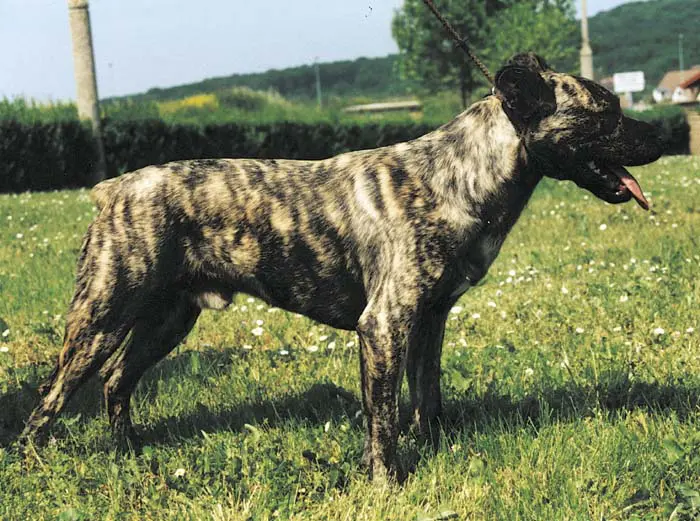


 Large-size hounds
 Barkfest with a Plott and Black and Tan
 West Virginia Bear hunting with hounds


