FCI 347 - Sheepdogs.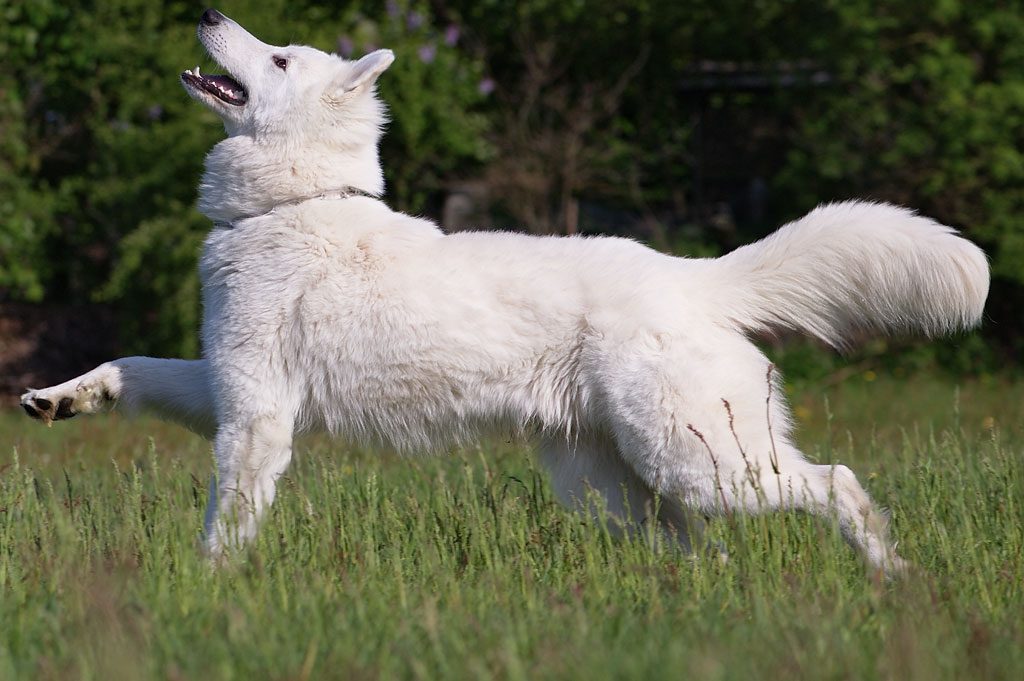
Content |
|---|
History
The White Swiss Shepherd Dog a breed of dog is pastor of Swiss origin. Share origins with the German Shepherd, but has been recognized provisionally as a breed apart by the FCI.
The 3 in April of 1899, the first dog German Shepherd, as we know it today, It was officially registered. This dog was a completely white male which was used by ranchers and sheepherders for grazing because it was very easy to distinguish it from the wolves.
The first news about a hatchery White Swiss Shepherd Dog are earlier than the year 1900 and its origin is found in Alsace-Lorraine, to be more exact in the Royal Court of the Habsburgs. In their enclosure they had a kennel of purebred white shepherds.
After the creation of the race German Shepherd, all colors were accepted. It was in the first decades of the 20th century, When were the white copies excluded, Therefore, persecuted and almost wiped out in Europe.
Back in the years 70, Switzerland had imported the first specimens of white shepherds, while in Germany - as we said above- as these dogs did not meet the standard of the German Shepherd as we know it today, White shepherds were almost wiped out.
The first Club of White Swiss Shepherd Dog was founded in the decade of 1970 in United States. For which reason, the race returned to appear in Europe. At first in Switzerland and Denmark, and later in Germany. Little by little, European Cynological societies began to open their stud books for the White Swiss Shepherd Dog.
A dog born in 1966, it was the first White Swiss Shepherd Dog which was registered in Europe, in Switzerland.
The breed was recognized in Switzerland of 1991, followed by the Netherlands in 1992. Czech Republic, Austria and Denmark, They also recognized the breed.
Switzerland, Despite the low popularity of this breed, He recovered the race and also assumed the same motherhood, so in the 26 in November of the year 2002 the Federation Cynologique Internationale acknowledged - on a provisional basis- to the White Swiss Shepherd Dog, as a separate breed.
Physical characteristics
The White Swiss Shepherd Dog, to the naked eye and as far as the physical, He is a German Shepherd in all rule, It is only slightly more elongated and less angular.
According to him standard, the White Swiss Shepherd Dog, is a dog from size medium, powerful, muscular and robust. According to the standard, males must have a tall cross ranging from 60 to 66 cm., females are slightly smaller their stature is about 55 to 61 cm..
It has the ears large, straight and triangular. The tail scimitar-shaped, is low and at rest reaches the Hock.
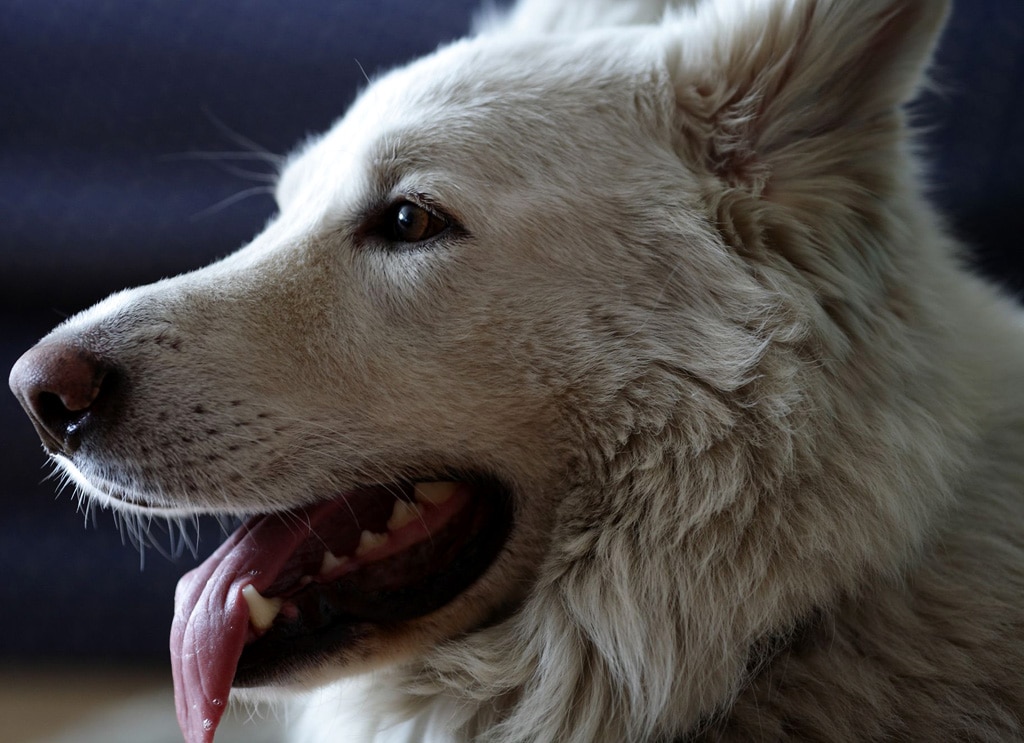
It is the eyes they are fed and slightly oblique tend to be of color dark brown or purplish-brown fire.
And perhaps, The most outstanding feature of this beautiful dog is its white mantle of double layer and medium long length. Dense and well separated hair.
The colour of the mantle is white. The nose, the lips and pads are absolutely black.
In the year 1933, the white color of the coat was pointed out as a defect that had to be eliminated by the German Shepherd Club of Germany, of America and Canada.
There are even theories, in the news, that continues to hold the white color is due to a physical defect, to a pathology but that type of theory lacks foundation and the first proof of it, It is a very healthy dog.
Its white color comes from a simple recessive gene that both parents must be carriers to continue the color, that is the reality.
Character and skills
The German Shepherd, not only the color of the mantle but also in its character differ.
While it is a dog of great temperament he displays never nervous, But if attentive and vigilant. It tends to be suspicious with strangers but never aggressive.
It is a dog friendly, very Intelligent and learn with ease.
It´s fair to his family and -as we said- he can be cautious with strangers, but should never show shy or fearful behavior and less aggressiveness. Some people think that the Arctic Wolf mixed with the breed, and that's where his caution comes from, but that only a legend.
It is a balanced dog, very good watchdog and has even been trained as a guide dog on occasion.
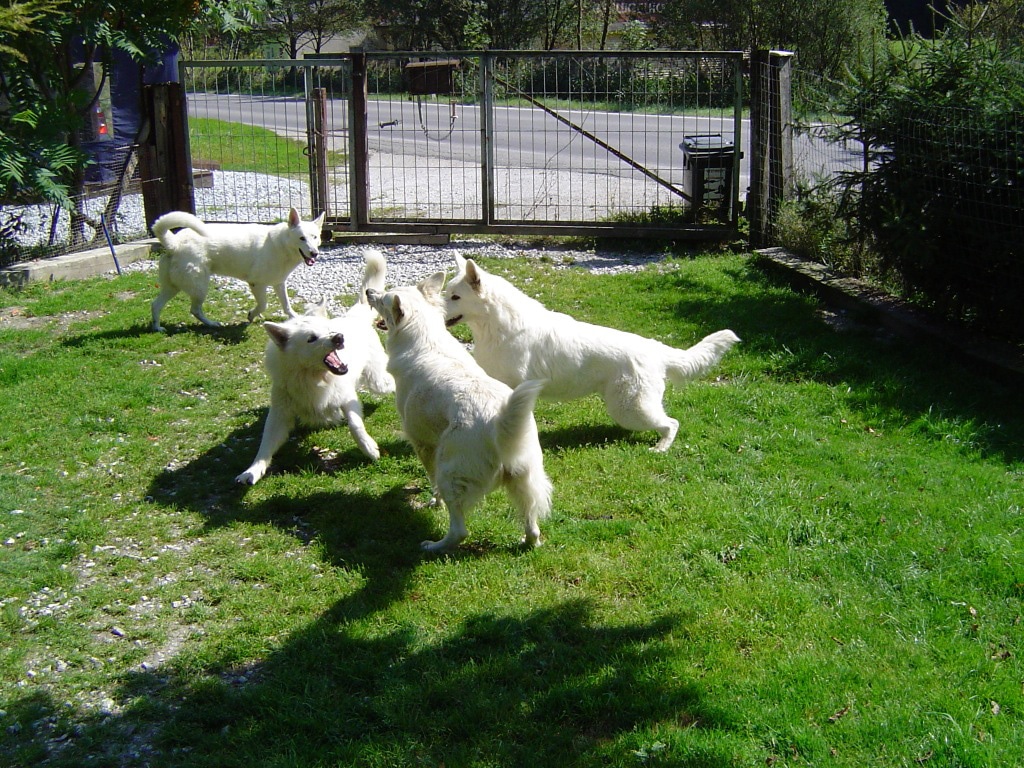
It is a great companion for everything physical exercise that is its scope, loves to play with sticks, balls, run…
While its origin speaks of a shepherd dog, today despite the fact that in some countries it is still used in such tasks, is widely accepted as a companion dog.
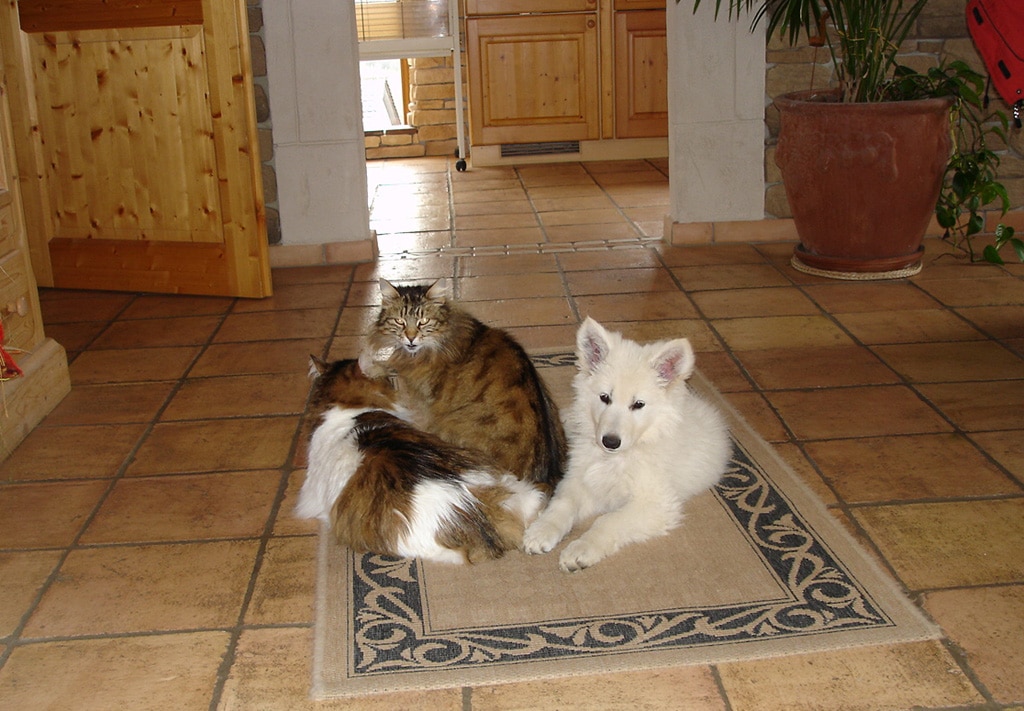
It adapts perfectly to the home, fond of children but remember that need exercise like all dogs, This always necessary if we want to keep happy balanced our puppies. Let's not forget that he is a working dog that needs physical and mental challenges.
The White Swiss Shepherd Dog gets along well with other dogs and, as well, It is usually good in agility competitions, search, rescue and obedience. They are also used as assistance dogs.
The character of White Swiss Shepherd Dog it is softer than the German Shepherd, But if you take genius to protect his family, will not hesitate it to.
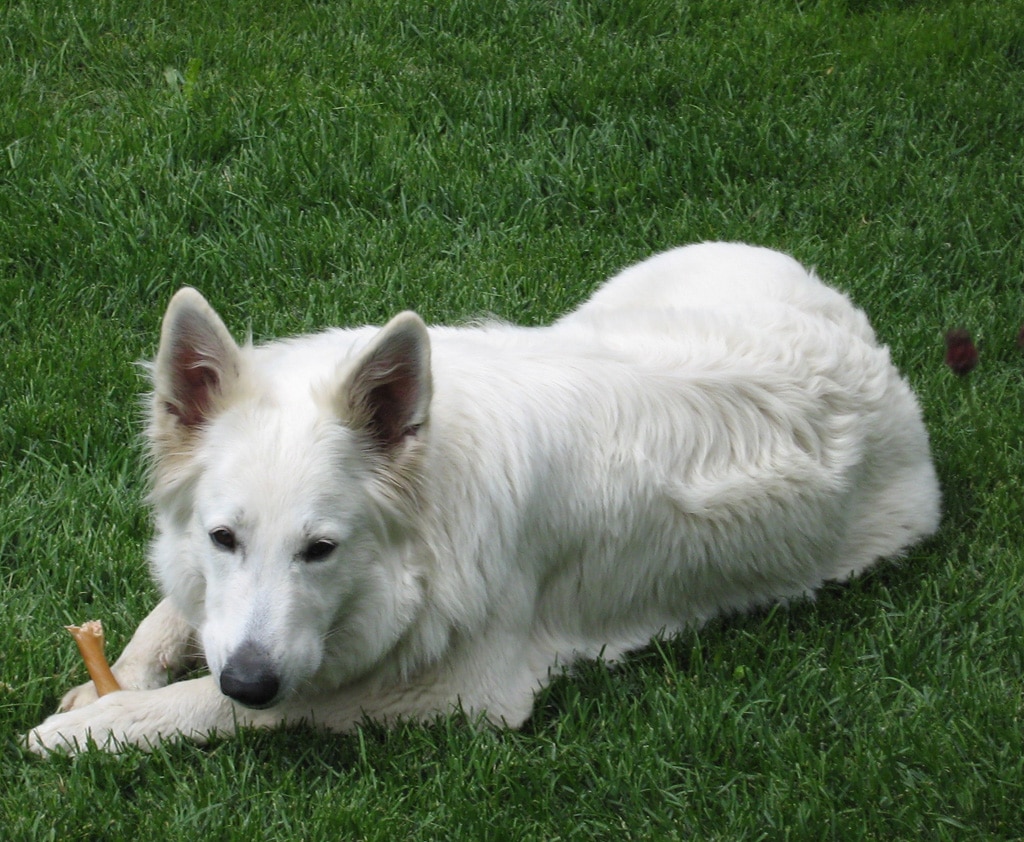
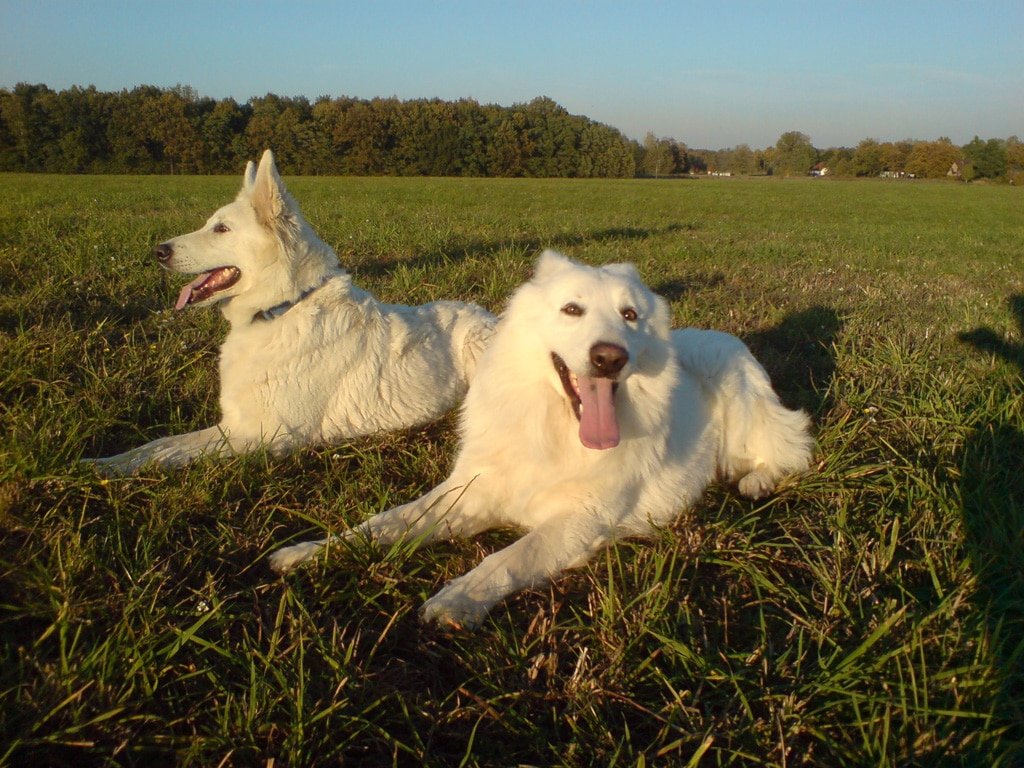
White Swiss Shepherd Dog Images
 weissefaszination
 welpenvomschlossberg
 sciencio.com
 kaisersbrunnen
 fantasyvalley.de
 dreamofwhitedynamite
 tierekleinanzeigen.com
 free-photos.com
 free-photos.com
 vombruendlweg.at
 Weisse-schaefer.com
 Berger-blanc-suisse
White Swiss Shepherd Dog videos
 White Swiss Shepherd Dog
 Zizou January 2009 White Shepherd in snow
 White Swiss Shepherd Kiani
 Berger Blanc Suisse, Welpen, Pearl in the Sun
Type and recognitions:
- FCI CLASSIFICATION:
- Group :
- Section : . .
Federations:
- – FCI – Group 1 Herding dogs, Section 1 Sheepdogs ⓘ
- – ANKC – Group 5 (working dogs) ⓘ
- – KC – Pastoral ⓘ
- – NZKC – Working dog ⓘ
FCI breed standard "White Swiss Shepherd Dog"
Use:
Family and companion dog.
General appearance:
It is a powerful White Shepherd dog, good muscular, medium-sized, with erect ears, double coat that can be medium or long; elongated; medium and elegant bone, harmonious silhouette.
IMPORTANT PROPORTIONS: Moderately long with a rectangular shape: body length (from the tip of the shoulder to the tip of the ischium) and height at the withers = 12 : 10.
The distance from the stop to the tip of the nose is slightly greater than from the stop to the occipital protuberance.
Lively and balanced temperament, enjoy the action, attentive with good ability to be trained. Friendly and discreet. With high social capacity and devoted to his master. Never skittish or aggressive without provocation. A cheerful and easily teachable working and sporting dog; with the ability to be educated in any discipline.
Its high social capacity allows it to be integrated into any kind of events and situations.
Head:
---Strong, clean cut and finely chiseled, in good proportion to the body. Wedge shaped, top or side view. The axes of the skull and muzzle are parallel.
- Skull: Only somewhat rounded; the central groove is barely perceptible.
- Depression links (Stop): Slightly marked, but clearly perceptible.
facial region:
Truffle: Medium-sized; black pigmentation is desirable; lighter pigmented and winter nose is accepted.
- Snout: Powerful and moderately long in relation to the skull; straight nose bridge and lower muzzle line, converging slightly towards the nose.
- Lips: Dried, closing fairly, as black as possible.
- Jaws / Teeth: Strong and complete scissor bite. The teeth are set at right angles to the jaws.
- EYES: Medium size, almendrada form, placed somewhat obliquely; brown to dark brown color, dark brown. Well attached eyelids, it is desirable that it has black edges.
- EARS: erect, set high, parallel and directed forward; in the shape of an elongated triangle with a slightly rounded tip.
Neck:
Moderately long and well muscled, harmoniously inserting into the body, without jowl; the elegant upper neck line runs in a continuous line from the head, which is carried moderately high, to the cross.Body:
- top line: Strong, muscular of medium length.Cross: Pronounced.
- Back: Level and firm.Pork loin: Well muscled.
- Rump: Long and medium wide, leans gently towards the root of the tail.
- Breast : Not too wide. Its depth (approx.. the 50% of the height to the cross); reaching elbow; torch oval box, spreading well back. Marked chest.
- Bottom line and belly: Thin flanks, firm: moderately retracted lower line.
Tail:
Saber-shaped and thick, slimming to tip; rather low insertion; reaching at least the hock; at rest it hangs downwards straight or with a slight saber-like curve in its last third; in action it takes it higher but never higher than the top line.Tips
PREVIOUS MEMBERS:
- General appearance: Strong, vigorous, with medium bone. Straight, seen from the front; only moderately separated; viewed profile, they are well angulated.
- Shoulder: The scapula is long and well sloped, well angled; the entire shoulder region well muscled.
- Arms: Of adequate length and well muscled.Elbows: They are well attached to the body.forearms: Long, straight and vigorous.Metacarpus: Firm and only slightly oblique.
- Previous feet: Oval; fingers are well arched and close together, footpads are firm, resistant and black. Are desired dark nails.
LATER MEMBERS:
- General appearance: Strong, vigorous, with medium bone. Viewed from behind they are straight and parallel; while standing they are not too separated; viewed from the side with adequate angulation.
- Thigh: Medium in length and well muscled.Knee: With adequate angulation.
- Leg: Medium length, oblique, with solid bone and well muscular.
- Hock: Strong, of good angulation.Metatarsus: Medium length, straight, robust.
- Hind feet: Oval; hind feet are slightly longer than fore feet. Fingers are arched and well together, footpads are firm and black, dark nails are desired.
Movement:
Rhythmic sequence of steps with push and resistance; forelimbs reaching well forward, with strong push; the trot is free, with good ground cover.Mantle
- SKIN: No creases with dark pigmentation.
Fur:
- Medium length mantle: Denso, glued with double hair; abundant undercoat covered with stiff hair, protection straight; the face, ears and forehead of limbs is covered by shorter hair; on the neck and on the back of the limbs the hair is slightly longer. Slightly wavy but hard hair is allowed.
- Long hair: Denso, double glued mantle; with abundant undercoat covered with hard hair, protection straight. The face, ears and forehead of limbs are covered by shorter hair; on the neck the long hair forms a clear mane and on the back of the legs are short and the hair on the tail is dense. The length of the coat should never be exaggerated. Slightly wavy but hard hair is allowed.
- Color: White.
Size and weight:
Height to the cross:
- Males: 58 – 66 cm.. females: approximately 53 – 61 cm.Weight:
- Males: 30 – 40 kg. females: approximately 25 – 35 kg.
Typical dogs slightly below or above the stipulated measurements should not be disqualified.
Fouls:
Any deviation from the aforementioned criteria is considered as a fault and the severity of this is considered to the degree of the deviation to the standard and its consequences on the health and well-being of the dog., and the dog's ability to perform its traditional task.
- Slight bay color overlapping (light yellow or shades of bay) on the tips of the ears, at the back and top of the tail.
- Partial loss of pigmentation giving a mottled appearance to the nose, lips and / or on the edge of the eyelids.
- Spurs. Except in countries where its removal is prohibited by law.
SERIOUS FAULTS: - Heavy appearance, too short under construction (square silhouette).
- Absence of sexual dimorphism.
- Missing more than two PM1; M3 are not taken into account.
- Floppy ears (hanging), semi-erect ears, button ears.
- Severely falling top line.
- Ring on tail, curled tail, hooked tail, tail carried higher than top line.
- Soft mantle, silky outer hair; woolly, curly, open hair; decidedly long hair without undercoat.
- Decidedly bay color (clear yellowish or bay overlay) on the tips of the ears, back or top of the tail.
- Aggressiveness or extreme shyness.
- Any dog showing clear physical or behavioral abnormalities.
- Anxiety, fear in high degree, aggressiveness due to anxiety, unnecessary aggression, lethargic behavior.
- One or both blue eyes. Protruding eyes.
- Entropion, ectropion.
- Upper or lower prognathism, deviated jaw.
- Total loss of pigmentation in the nose, lips and / or edge of the eyelids.
- Total loss of pigmentation in the skin or footpads.
- albinism.
- Males should have two normal-appearing testicles fully descended into the scrotum..
- Only functionally and clinically healthy dogs, with the typical conformation of the breed, should be used for parenting.
Alternative names:
1. Berger Blanc Suisse, White German Shepherd (English).
2. berger blanc (French).
3. Berger Blanc Suisse (German).
4. Pastor branco suíço (Portuguese).
5. Perro de pastor suizo blanco (español).
 FCI 124 . Water Dogs
 FCI 239 . Braque Type
 FCI 302 . Large and medium sized Terriers
 FCI 7 - Large and medium-sized Terrier