▷ The world of Pets: Dogs, cats, birds, reptiles, amphibians

Whippet
Gran Bretañaa FCI 162 . Short-haired Sighthounds

Whippet

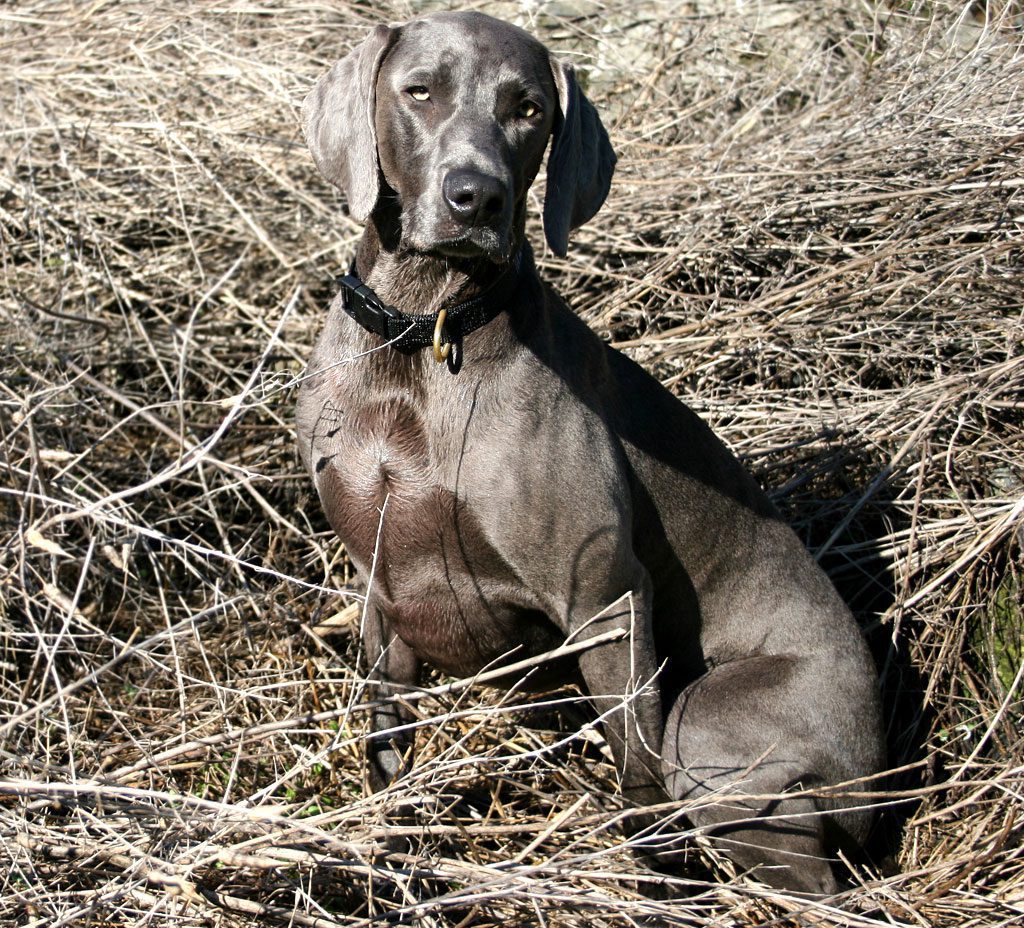
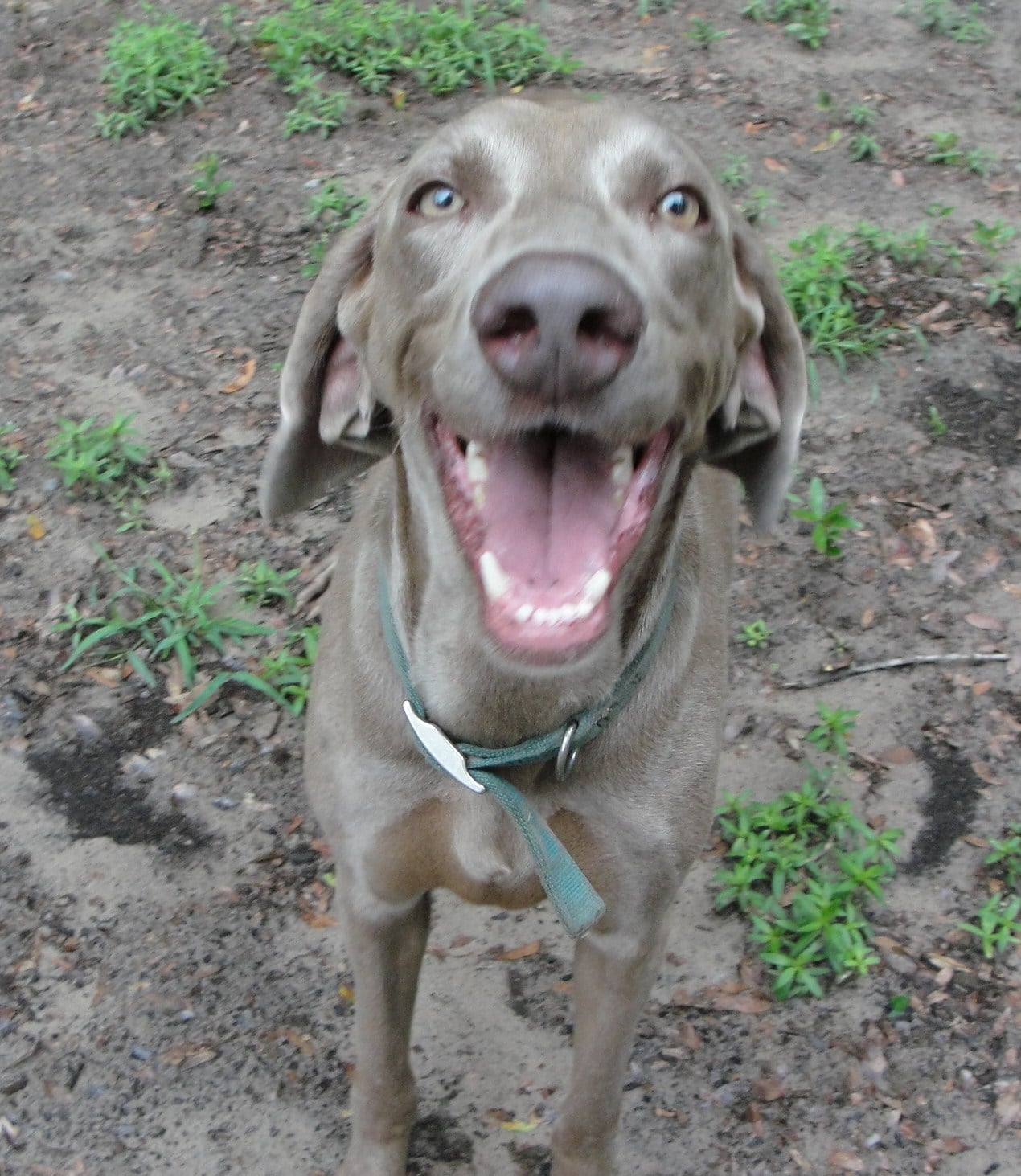
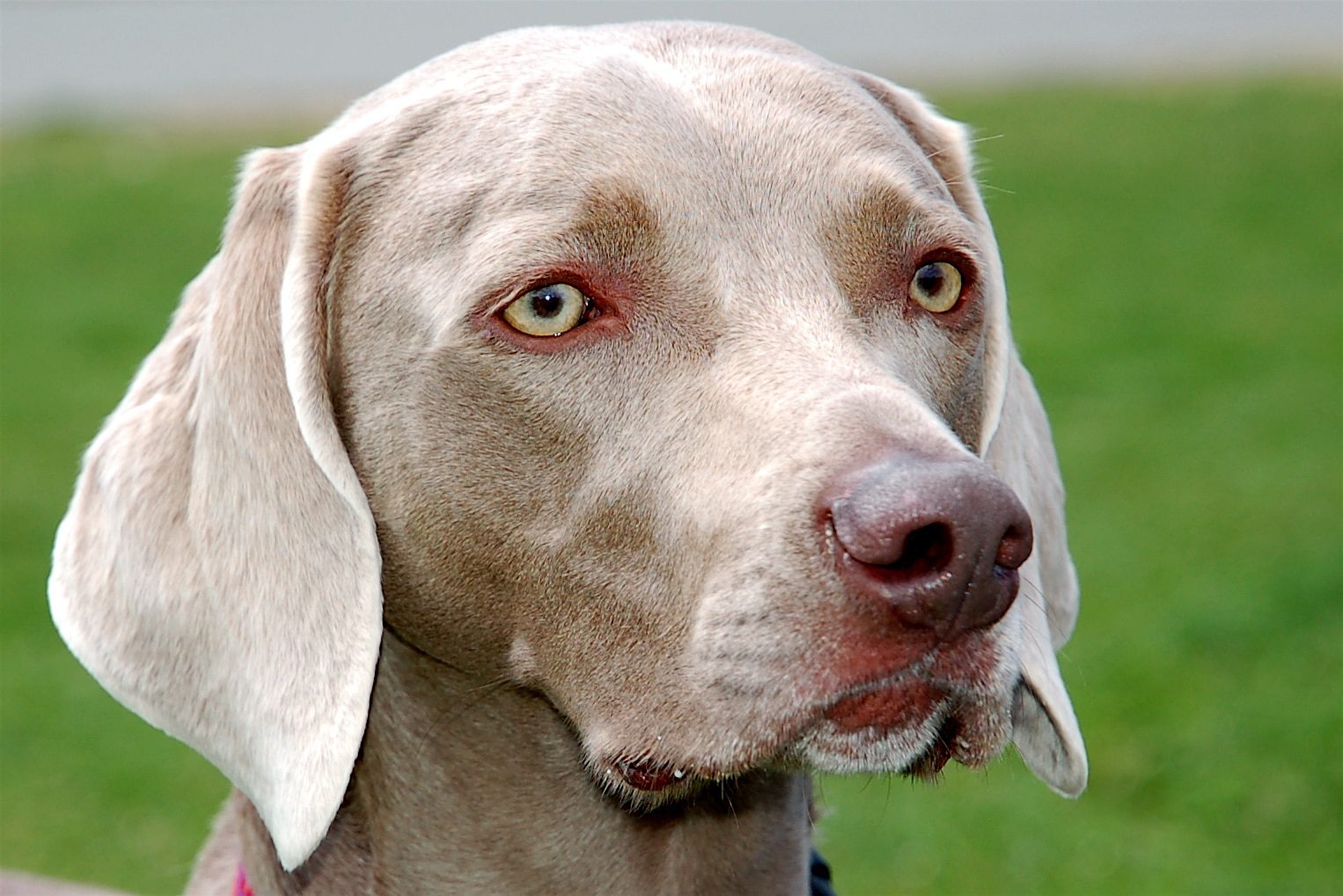
The Whippet, like all sighthounds, is quite reserved. Don't play too much. His passion is hunting.

Content

History

The Greyhounds have ancient origins, since their ancestors appear in frescoes of ancient Egypt. But, the Whippet didn't show up until much later, in the 18th century or shortly before. Although everyone agrees that the Whippet is originally from Great Britain, its exact origins are the subject of debate.

Some believe it is descended from Greyhound. The smallest members of the breed were deemed insufficient for hunting and were given to farmers, and that's how the race developed, which is also known as Hound dwarf.

Others claim that their ancestors is a Italian Greyhound large, that were used for hunting. Others also believe that Italian Greyhound is related to him Whippet, but only due to the crosses made at the end of the 19th century to perfect the breed.

Last, some people who have assumed success also mention crosses with certain Spaniels.

But, The most widespread theory is that the Whippet is the result of crosses between the Greyhound and various Terriers, in particular the Manchester Terrier. Nicknamed the "poor man's greyhound", it was used to hunt small animals, whether they were rats or rabbits.

But, appears in 18th century paintings of Jean-Baptiste Oudry (1686-1755), but mostly in a box Edward Haytley (1713-1764) titled "The Hunter with a Whippet«. The word Whippet had many different meanings between the 16th and 19th centuries, but it is commonly accepted that the name of the breed comes from the verb «to whip«, which in the 17th century meant "to move quickly".

Very popular in the 19th century with the working classes of northern England, the Whippet Greyhound was used in gambling trials in which they had to eliminate a large number of rats or rabbits as quickly as possible.. This activity ended up being prohibited, and the rodents were replaced by rag decoys that the dogs had to run after. Racing became a true sport that conquered England and then the United States. At the same time, competitors continued to use their skills on a daily basis hunting vermin and small game.

Already in 1888, the breed was recognized by the American Kennel Club (AKC), and then by him British Kennel Club (KC) in 1890. Present both at races and at dog shows, developed rapidly, gradually making its way into homes as a companion dog.

The Whippet is recognized by the main canine associations in the world. The International Cynological Federation (FCI) He did so in 1955, thus promoting its international dissemination, and almost all the large national organizations followed suit, as the United Kennel Club (UKC) American and the Canadian Kennel Club (CKC).

Today, although the races of Greyhounds have become very rare and hunting with Greyhounds is prohibited in many territories, the Whippet is still very present around the world. This is because the Whippet has been able to move away from its original role and win over the general public as a mascot.

In United States, for example, AKC registration statistics place the Whippet around the post 60 (of something less than 200) in the breed popularity ranking of the AKC.

in your country of origin, Great Britain, is even more widespread, with between 3.000 and 3.500 births reported to the KC each year.

Also in France its success is undeniable, although it is still less than on the other side of the Canal. From the age 80, Entries in the French Book of Origins (LOF) they have been around 1.000 a year, quite exceptional stability. Since the beginning of the decade 2010, this figure has not stopped increasing, approaching the 1.500 at the end of it.

Physical characteristics

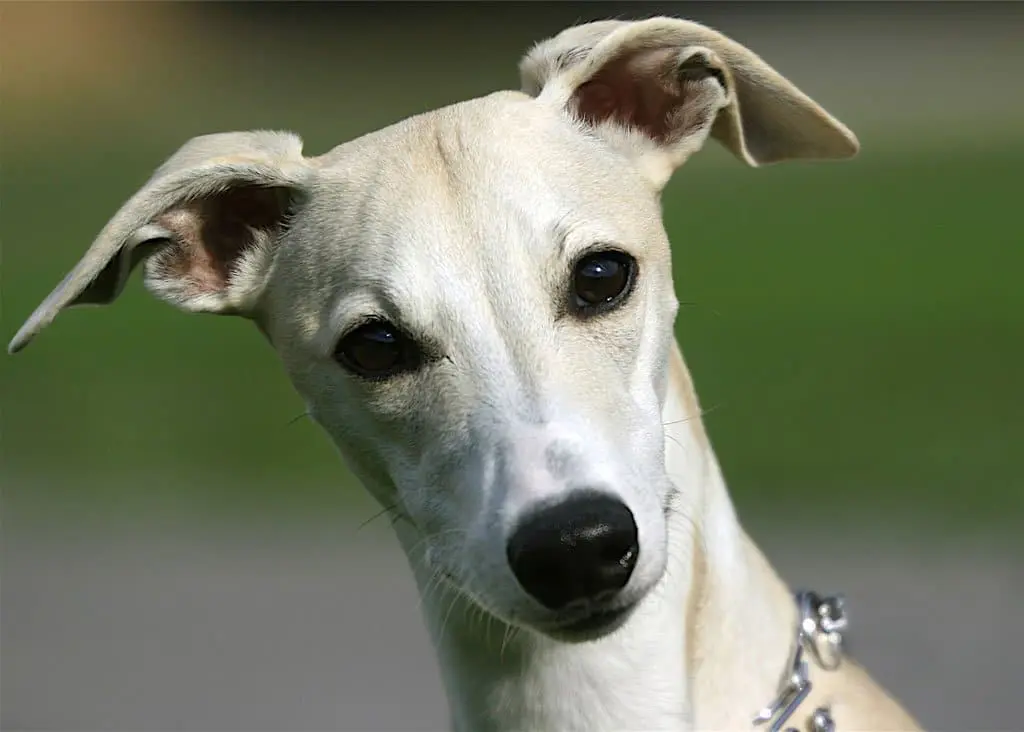
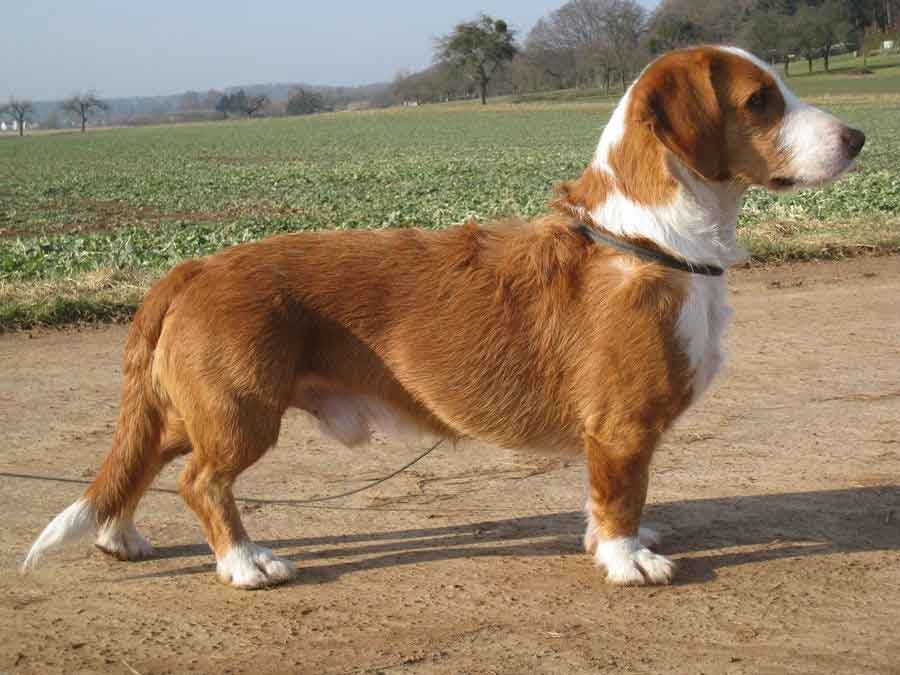
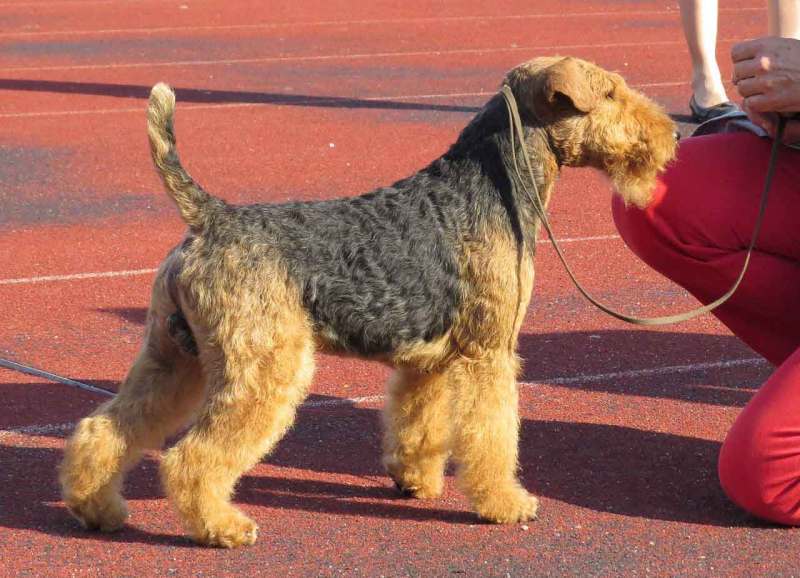
Elegance blend, power and delicacy, the Whippet it's made for speed, like all races of Sighthounds. They look like Greyhound, but they are much smaller.

Her slender body is elegant, with a pronounced arch on the back, a broad, muscular back and a well-tucked belly. The legs are long, with moderate bone and fine but marked muscles. The legs are long, moderately boned, with fine but pronounced muscles, ending in oval legs with widely spread toes and strong nails. The tail is long and thin, carried up when the dog is active, but never higher than the level of the back.

Worn on a long, muscular neck, the head is thin and elongated. The stop is slightly marked, snout continues to narrow into continuation of skull. The nose is usually black, but blue tones are allowed in blue dogs, and pink in cream-colored ones. Oval eyes have a vivid expression. The ears, which are said to be in the shape of a rose, they are thin and are carried backwards or semi-erect.

The coat of the Whippet consists only of a short, thin top layer, but very closed: this dog has no undercoat. The coat can be any color or combination of colors, except the blackbird.

Last, sexual dimorphism is well marked in this breed: the male is significantly larger than the female.

Size and weight

▷ Male size: 47 – 51 cm.
▷ female size: 44 – 47 cm.
▷ Male weight: 13 kg.
▷ female weight: 12 kg

Character and skills

The Whippet he is extremely sociable and devoted to his family, with which you need to spend a lot of time – it's not a question of living outside, isolated from his family: its place is in the heart of the house, comfortably installed on a cozy cushion. Can easily suffer from separation anxiety and does not adapt to a master who is absent often.

This problem can be alleviated if he is allowed to live with one or more other dogs.. In effect, whether it is a simple meeting or living together under the same roof, the Whippet gets along very well with other dogs and, usually, is perfectly comfortable in a home where several representatives of the canine species coexist. This allows you to continue to feel part of the pack, even when their owners are working.

Their relationships with other animals are far from being so peaceful.. In fact, his hunting instinct is well anchored in him, which leads him to chase and kill cats, rabbits and other rodents. Even the ones he would have grown up with are likely to end up in his fangs one day., so that coexistence must simply be excluded.

Active, cheerful and playful, the Whippet it is an ideal companion for children, whose presence you love. But, it is better if the children are already a certain age and have learned to behave in a respectful way with a dog, as they are much less tolerant of abuse than many of their peers. In any case, as with any breed, It is not advisable to leave a small child with him without the supervision of an adult.

Active and energetic, this dog is especially so when he is young, to the point that it can be destructive. They also like to test the limits, so it is better that their family is available to take care of them and redirect them when necessary. Once they become adults, which is usually around 18 months of age, they are still very active, but they have a much calmer temperament. You need to exercise for an hour a day, but then you can sit quietly on the couch and watch TV.

In other words, whether you can exercise comfortably and spend most of your time with your family, the Whippet he is a calm and cheerful companion. But, if any of these conditions are not met, you are likely to develop various behavior problems, like chewing on anything on hand or digging.

As long as you get enough exercise, can live in a flat. But, ideally you have access to a garden where you can run and play. Yes indeed, must be perfectly closed and at a minimum height of 1,5 m, so that it does not chase the neighborhood cats or other small animals that pass by. In any case, an electronic fence installed underground would be useless, since the discharge felt would not be enough to stop it.

His hunter instinct causes him to chase any small animal he comes across, so you should always go on a leash when you go out for a walk. But, care must be taken to place the dog with a collar adapted to its morphology (greyhounds have their necks wider than their heads) or a harness, to prevent it from escaping. The risk of the dog running away is especially high in this breed, and it is absolutely impossible to catch him if he escapes, since it is capable of running at more than 50 km/h.

It is possible to allow him to stretch his legs by taking him for a run or a bike ride. But, is primarily a sprinter, not a long distance runner: find it hard to keep up over long distances.

It should be noted that the Whippet not only is he an athlete, but he also has an above-average intelligence that allows him to learn many tricks. Dog sports such as agility, obedience, the flyball or, of course, el lure coursing, they are a great way for you to show all your physical and mental qualities.

Last, he is very respectful to his neighbors, barking very little. This explains why he cannot be counted on as a guard dog., not even as a warning dog. It also, He is not one of those who complicate the life of strangers: can be a bit shy at first, but it tends to open up quickly and make them benefit from its friendly nature.

Education

Like all "Sighthound" dogs, the Whippet benefits from socialization from an early age. By meeting all kinds of people and other dogs, but also when getting used to various everyday situations (noises, smells, city ​​walks, car trips…), gains in serenity and becomes a calm and balanced adult.

On the other hand, even when surrounded by small animals in his youth, never lose his hunting instinct. It would be useless to hope to change anything fundamentally in this regard.

It is this instinct that makes it absolutely essential to get your dog used to walking on a leash upon arrival home.. In fact, a Whippet should never be set free, except in a perfectly closed and safe environment, like a garden or a dog park. If you start chasing an animal, even perfectly integrated withdrawal orders are ignored, and nothing can distract you from your goal.

The puppy of Whippet is a bit rambunctious and likes to test limits, showing a certain stubborn streak. So, needs a firm handler who commands respect and is seen as the leader of the pack. Once the master has established his dominant position, the education of Whippet it's relatively easy. He is smart and likes to learn new tricks, so working with him is a pleasure. Of course, this is even more true if you find it interesting, because he is not obsessed with pleasing his master. So, using treats and other rewards can work wonders.

Do not forget that it is a sensitive dog, that may not respond well to traditional training methods. It is better to base your training on positive reinforcement, that reinforces his self-esteem and consolidates the relationship with his master. It is also advisable not to make the sessions last too long, so that they continue to be fun and interesting for him.

Health

The Whippet it is quite robust, with a fairly normal life expectancy for its size.

But, its short coat and lack of body fat mean that it does not tolerate cold or bad weather well. It is recommended to equip it with a dog sweater as soon as the mercury drops, and he with a raincoat in rainy weather., fits much better when you turn up the thermometer.

Among the diseases most likely to affect this breed, the most commons are:

  • the waterfall, which can be hereditary and occurs when an opaque film forms in the eye. It causes a more or less rapid degradation of sight, up to total blindness., a surgical operation can treat it;
  • corneal dystrophy, a clouding of the cornea that causes vision problems and is suspected of having a hereditary origin;
  • the progressive retinal atrophy, an incurable inherited disease that causes progressive degeneration of the eye tissues, to complete blindness;
  • the von Willebrand disease, an inherited blood clotting problem, milder forms can be controlled with medication, while the most serious cause unstoppable bleeding that requires surgery and transfusion at the slightest injury, to prevent the dog from dying from blood loss;
  • the epilepsy, which is at the origin of more or less frequent and intense seizures It can be kept under control with the help of drug treatment, which generally enables affected people to lead near-normal lives;
  • skin allergies, which may be signaled by redness and itching;
  • small wounds and skin infections, which is fine and is covered by a rather short hair;
  • of cancers;
  • heart problems, that can be congenital and increase in size, to cardiac arrest resulting in death.

It also, individuals used on the racetrack are also at risk of injury in the context of this particularly intense activity: sprain, dislocation, fracture, etc.

It also, like other breeds of Greyhounds as the Greyhound, the Whippet is sensitive to anesthetics, that can cause allergies. So, surgical operations may require a specific protocol to avoid this risk.

While the list of diseases the breed is predisposed to can seem overwhelming, a study of 2004 jointly conducted by the British Kennel Club and the British Small Animal Veterinary Association over several hundred deaths of dogs of this breed found that about a quarter of them were simply caused by the advanced age of the animal.

Then there are heart problems and cancer, which together represent another quarter., half of the reported deaths are attributable to one of these three reasons.

Knowing that this breed is predisposed to various inherited diseases, adopting a serious breeder of Whippet greatly increases the chances of getting a healthy puppy and keeping it that way. In addition to a certificate of good health signed by a veterinarian and the animal's health or vaccination record, certifying that you have received all the necessary vaccinations, the professional must be able to present the results of the genetic tests carried out to the parents or the baby, to avoid the risk of inherited diseases.

It also, once the puppy has come home, you need to limit your physical activity (both in intensity and duration) throughout its growth period, which normally lasts between 12 and 18 months, so as not to risk damaging your joints or bones.

It is then recommended to check him regularly for cuts or scratches, as his skin is barely protected by his coat, is particularly prone to it.

It also, regardless of your age and even if you appear to be in excellent health, any dog ​​should be examined in detail by a veterinarian at least once a year as part of a full medical check-up, this allows a possible problem to be detected as soon as possible, of which sometimes symptoms are not yet appreciated. In addition, this is an opportunity to make sure you are up to date on your vaccinations and to carry out any necessary reminders.

At the same time, the owner must make sure to renew the different antiparasitic treatments of his dog throughout his life, so you are never unprotected., this must be done every 1 to 3 months.

Life expectancy

Of 13 to 14 years

Grooming

The Whippet Greyhound is an easy-care breed of dog.

First of all, the maintenance of its coat is very simple, since it is short and has no undercoat. A quick brushing every week is more than enough to keep it in good condition, especially since this dog sheds very little. They also do not have annual shedding periods., unlike most dogs.

In any case, brushing sessions offer a good opportunity to check the condition of your skin. In effect, its thinness and the fact that it is only covered by a thin layer of hair make it especially exposed to cuts and scratches.

If you take care of yourself regularly, the coat is usually clean and odorless, so it is seldom necessary to bathe him. Unless it gets dirty, for example, on a particularly muddy ride, bathing him once or twice a year is more than enough. Just be sure to use a shampoo specifically designed for dogs each time., as this can damage your skin.

On the other hand, weekly coat maintenance is also an opportunity to wipe their ears with a clean cloth, to prevent the buildup of wax and debris that could be a source of infection (ear infections, etc.).

You should also take the opportunity to inspect the eyes and rub the corners with a damp cloth to remove dirt..

Last, good oral hygiene requires brushing the dog's teeth at least once a week, always with a toothpaste specially designed for dogs. This prevents tartar buildup, that can cause not only bad breath, but also diseases, some of which can be serious. Ideally, do it every day..

As for the claws of the Whippet, they often tend to grow faster than they wear out, even if you spend time outside and get enough exercise. So, it is recommended to cut them every fifteen days approximately, before they are too long and risk disturbing you, but also from breaking, and even injuring you.

Although a Whippet it is relatively easy to care, it is highly recommended to learn how to do it in the presence of a professional, either a groomer or a vet. This is the best way to know the correct way to take care of your dog and avoid mishandling that can hurt or even injure it..

Food

The Whippet adapts very well to commercial dog food. The choice of products and the amount that is given each day must be done in such a way that it perfectly covers their nutritional needs and, Therefore, suits your age, size and activity level. It also, like all dogs, it is better to divide the daily ration into at least two meals.

It also, dogs used for dog competitions must follow a specific feeding program, like any athlete worth his salt.

In any case, this dog is little eaten and this, coupled with its high energy expenditure, generally protects you from the risk of obesity. But, if obesity occurred, would have serious consequences for this dog whose body is not at all made to support excess weight.

So, it is advisable to weigh your dog regularly, At least once a month, to detect any weight gain as soon as possible. If weight gain is confirmed from one measurement to another, or even increases, it is essential to consult the vet. Only a veterinarian can reliably determine the cause of the problem (diet, disease, side effects of medication, etc.) and propose a solution.

Last, like any other dog, the Whippet must have permanent access to a bowl of fresh water to quench his thirst.

Utility

Originally, the Whippet it was used to chase and kill small rodents, eliminating the rats that threatened the food supply and putting rabbit meat on the family menu. Although the Whippet has retained its hunting instincts, this is a function that it has not fulfilled for almost two centuries.

In the 19th century, the speed of more than 50 dog km / h, his blazing acceleration and his ability to change direction made him a specialist in dog racing, and crowds flocked to see representatives of the breed chase cloth lures and bet on the results, as it was done with the horses. But, the popularity of this activity decreased considerably over the years 80, to the point that today they are very scarce. The fact that gambling is now banned in most countries (including Belgium, Canada, France and Switzerland) is not, of course, A coincidence.

But, the Whippet Sighthound was also able to seduce dog show fans with its elegance in the late 19th century., and her runway success continues today. It is rare not to see one or more representatives of the breed at these events.

But, it is mainly as a companion dog that the Whippet Sighthound has made a name for itself among the general public. dedicated and smart, they delight everyone who is looking for an active companion and are sufficiently available for him.

But, should not be relied on as a watchdog or even a watchdog. Although it is always on the prowl, He is not very suspicious and he is not one of those who barks loudly.

His sociable and playful nature makes him a sought-after therapy dog, capable of brightening the daily life of people suffering from a disease, a disability or just old age.

Last, beyond the races on the track, his intelligence and athletic qualities allow him to excel in many dog ​​sports. This is the case, in particular, of decoy hunting (PVL), but also agility, flyball and obedience.

Price

The price of a puppy Whippet round the 950 EUR, but it can vary greatly from one individual to another, oscillating between 500 euros and 1200.

Regardless of location, the reputation of the kennel and the prestige of your bulls and ancestors have a great influence on the price of a Whippet. A puppy born in a reputable kennel and from a line of champions is, of course, more expensive. Of course, the individual characteristics of the puppy are also a factor, especially the closeness to the standard. This explains why there can be quite significant price differences within the same litter.

Characteristics "Whippet"

Coexistence is important that you have with your new friend. Before considering the acquisition of a dog of the breed "Whippet" you know certain factors. Not all breeds of dogs are apt to live in an apartment, you must take into account his character, their need for exercise, their interaction with other pets, their care and if you have small children, their level of tolerance towards them.

Adaptation ⓘ

2,0 of 5 stars (based on 1 review)

friendly dog ​​ⓘ

2,0 of 5 stars (based on 1 review)

hair loss ⓘ

2,0 of 5 stars (based on 1 review)

Affection level ⓘ

4,0 of 5 stars (based on 1 review)

Need for exercise ⓘ

4,0 of 5 stars (based on 1 review)

Social need ⓘ

3,0 of 5 stars (based on 1 review)

Home ⓘ

3,0 of 5 stars (based on 1 review)

Toilet ⓘ

1,0 of 5 stars (based on 1 review)

Friendly with strangers ⓘ

2,0 of 5 stars (based on 1 review)

barking ⓘ

1,0 of 5 stars (based on 1 review)

Health ⓘ

4,0 of 5 stars (based on 1 review)

Territorial ⓘ

3,0 of 5 stars (based on 1 review)

Cat friendly ⓘ

2,0 of 5 stars (based on 1 review)

Intelligence ⓘ

3,0 of 5 stars (based on 1 review)

Versatility ⓘ

3,0 of 5 stars (based on 1 review)

Child friendly ⓘ

5,0 of 5 stars (based on 1 review)

Surveillance ⓘ

2,0 of 5 stars (based on 1 review)

joy ⓘ

3,0 of 5 stars (based on 1 review)

Images "Whippet"

Photos:

1 – Whippet by https://www.pxfuel.com/es/search?q=Whippet
2 – Puppy Whippet by andy carter, CC BY 2.0, via Wikimedia Commons
3 – Whippet by Winky, CC BY 2.0, via Wikimedia Commons
4 – Whippet by https://www.flickr.com/photos/llimaorosa/2261441243/
5 – Whippet called "Bean" by madaise, CC BY 2.0, via Wikimedia Commons
6 – Whippet by https://pixabay.com/es/photos/lebrel-sabueso-perro-canino-164118/

Videos "Whippet"

Type and recognitions:

  • FCI CLASSIFICATION:
  • Group :
  • Section : . .

Federations:

  • FCI – Group 10: Section 3: Short-haired Sighthounds
  • AKC – Hounds Toy
  • ANKC – (Hounds)
  • CKC – Hounds
  • ​KC – Hounds
  • NZKC – Hounds Toy
  • UKC – Hounds

FCI breed standard "Whippet"

Origin:
United Kingdom

Date of publication of the valid original standard:
04.09.2019

Use:

Breed originally used for hunting, either by trail or by sight.


General appearance:

It is a balanced combination of power and muscular strength with elegance and graceful lines.. Its structure is appropriate to develop speed and work. Any exaggerated form should be avoided.


Behavior / temperament:

It is an ideal companion. It fits very well in domestic and sporting environment. Is gentle, affectionate and with a balanced disposition.

Head:

--

Cranial region:
  • Skull: Long and thin, flattened in its upper region, rather wide between the eyes, thinning towards the muzzle.
  • Depression links (Stop): Light.

facial region:

  • Truffle: black. In blue dogs, a bluish color is allowed.
    Liver truffle in dogs color cream and other diluted colors, in white or split dogs a partially depigmented nose is allowed.
  • Mandible / Teeth: Strong jaws, powerful and well outlined with a perfect scissor bite, regular and complete, that is to say, that the upper incisors closely overlap the lower ones and are implanted vertically in the maxillae.
  • Eyes: Oval, bright, very lively expression.
  • Ears: Shaped like a rose, small, texture fine.

Neck:

Long, muscular, elegantly arched.

Body:

  • top line: Showing a funny bow on the back but without the dog being hump.
  • Back: Wide, well muscled, firm, somewhat long.
  • Pork loin: Gives the impression of strength and power.
  • Breast : Very deep, with ample room for the heart.; low, well-defined sill. Arched and muscular ribs at their dorsal insertion.
  • Bottom line and belly: Definitely withdrawn

Tail:

No feathers. Long, sharpened; during the movement takes it up, forming a delicate curve, but never over the back.

Tips

PREVIOUS MEMBERS:

  • ApGeneral experience:  They are straight and vertical with bone moderately sharp. The front is not too much width
  • Shoulder (Blades): Well oblique scapulae with flat musculature. The space between the scapulae at the withers is moderate.
  • Brazo(Humerus):  About the same length as scapulae.
  • Cskin: The elbows fall directly below the cross seen from perfil.
  • Metacarpus: Sturdy and slightly elastic.
  • Pinis earlier:   Oval,   well divided between the fingers; thick pads and strong nails.

LATER MEMBERS:

  • Apgeneral arience: Strong. The dog must be able to stand onturally on abundant ground.
  • Thigh: Width.
  • Rodilla: Well angled without exaggeration. Leg: Well developed.
  • Atibio-tarsal articulation: Placed well down.
  • Pinis later:   Oval,   well divided between the fingers; thick pads and strong nails.

Movement:

Must have great freedom of movement. Seen in profile, it should move with a long and easy step, maintaining the upper line. The forelimbs should be brought well forward and low close to the ground, the hind limbs should come well under the body giving a great and powerful push. The movement in general should not be pompous, nor high steps, short or affected. Effective back and forth movement.

Mantle

  • Fur: Up, short, tight.
  • Color: All colors and their combinations, except merle.


Size and weight:

Desired height at the withers:

  • Males: 47 - 51 cm. (18,5 to 20 inches).
  • females: 44 - 47 cm. (17,5 to 18,5 inches).


Fouls:

Any deviation from the aforementioned criteria is considered as a fault and the severity of this is considered to the degree of the deviation to the standard and its consequences on the health and well-being of the dog..


FALTAS DESCALIFICANTES:

  • Aggressiveness or extreme shyness.
  • Any dog ​​showing clear signs of physical or behavioral abnormalities.


N.B.:
  • Males should have two normal-appearing testicles fully descended into the scrotum..
  • Only functionally and clinically healthy dogs, with the typical conformation of the breed, should be used for breeding.

The latest changes are in bold.

Source: F.C.I - International Cynological Federation

Alternative names:

1. English Whippet, Snap dog (English).
2. Lévrier nain (French).
3. Kleiner Englischer Windhund (German).
4. Whippet (Portuguese).
5. Whippet inglés (español).

▷ The world of Pets: Dogs, cats, birds, reptiles, amphibians

Welsh Springer Spaniel
Gran Bretañaa Gales- FCI 126 . Flushing Dogs

Welsh Springer Spaniel

The Welsh Springer Spaniel tends to be quite shy, and for that reason he needs a good socialization when he is a puppy.

Content

History

Little is known about the origins of Welsh Springer Spaniel, but it is considered a very old breed, whose ancestors date back to Roman Britain. Renaissance tapestries show spaniels that look a lot like today's Welsh Springer; similar red and white Spaniels appear in some 18th century portraits. In the 19th century, dogs were little known, except in the Neath Valley region, in south wales.

The preponderance of dog shows at the end of the 19th century led to a renewed interest in the breed, who made his appearance at the first Kennel Club show, held in 1873. It was judged alongside the black and white Spaniel and the Welsh Springer Spaniel white. With the time, the two races parted.

For a long time he was mistaken for the English Cocker Spaniel and was not recognized until 1902.

It is an ancient race of pure origin, which was used for a time as a herding dog. Thanks to its enormous adaptability, the Welsh Springer Spaniel It is also an excellent companion dog..

The American Kennel Club recognized the Welsh Springer in 1906, but few people were interested in race. At the end of the Second World War, practically non-existent in the United States, until they were imported 11 copies in 1949. A dozen years later, the Welsh Springer Spaniel Club of America was founded. In the news, the Welsh Springer Spaniel still a well kept secret, since it occupies the position 127 between breeds registered by the AKC, in front of 113 a decade.

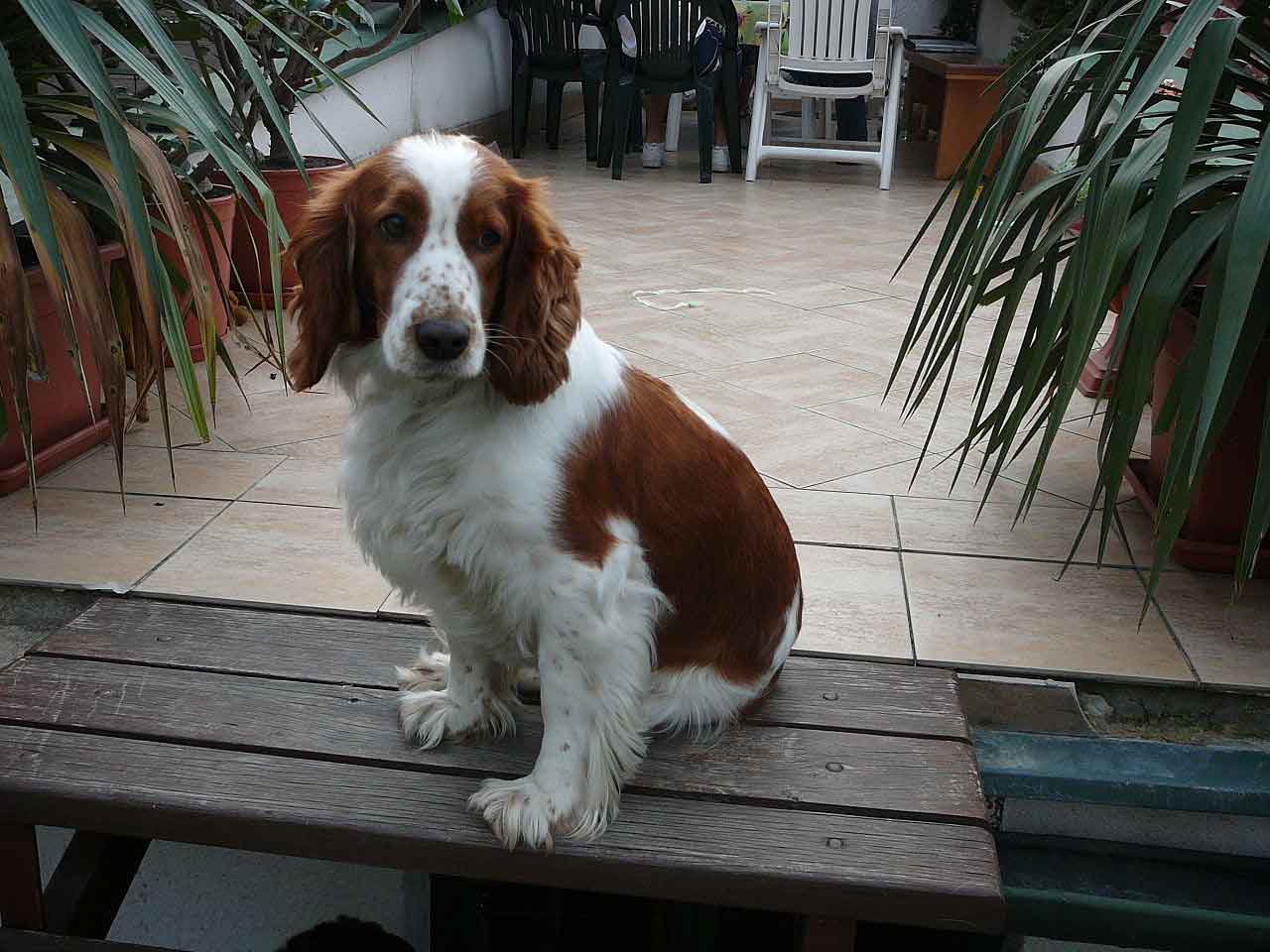
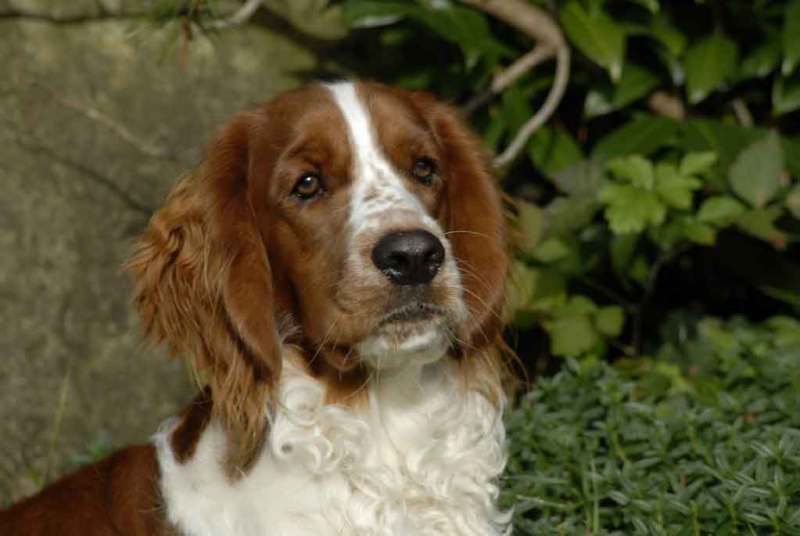
Photo: Welsh Springer Spaniel, Pozlovice by Pavel Ševela, CC BY-SA 3.0, via Wikimedia Commons

Physical characteristics

The Welsh Springer Spaniel differs from his cousin, the English Springer Spaniel, by a flowing red and white coat, a somewhat more relaxed personality and a slightly smaller size that ranges between 15 and 20 Kg.

With its moderate size, can be a good option for households with children: the Welsh Springer Spaniel not big enough to accidentally harm little ones, and he's not small enough to risk being hurt by overly enthusiastic kids.

Size and weight

▷ Male size: 45 – 48 cm.
▷ female size: 43 – 47 cm.
▷ Male weight: 15 – 20 kg
▷ female weight: 16 – 20 kg

Character and skills

The Welsh Springer Spaniel is loving, Intelligent, quick to learn and usually good at remembering what you have learned. Compared to many other Spaniels, he is protector of his family and his property, and prone to barking at anything that catches his eye. The Welsh Springer Spaniel can become very attached to his people, but a second dog can help you give an additional outlet to your affection.

But, with strangers, tends to be a reserved dog. Does not tend to be shy or unfriendly, but it takes time to get comfortable with new people. Children and other pets see your friendly side, especially when raised with them. But keep in mind that a Welsh Springer Spaniel boisterous may unintentionally knock over a young child, so always supervise play with young children.

In the countryside, the Welsh Springer Spaniel he is a great worker able to function in any terrain, and is more than happy to be outdoors all day, always staying close to his hunter. Its olfactory ability is excellent and it can hunt any type of game. If you live with a non-hunter family, two or three long walks a day will also satisfy your exercise needs.

Regarding training, opt for accolades, not by force. Although it may be stubborn, the Welsh Springer Spaniel responds well to constant training and rewards. Plan to start training your puppy the day you bring him home.. It is able to absorb everything you teach it even at seven to eight weeks of age.. One Welsh Springer Spaniel young man will test him to see what he can do, so try to take him to puppy kindergarten class when he has 12 weeks, and socializes, socialice, socialice. But, note that many puppy training classes require that certain vaccinations (such as kennel cough) stay up to date, and many veterinarians recommend limiting exposure to other dogs and public places until puppy vaccinations are complete (including rabies, distemper and parvovirus). Instead of formal training, you can start house training your puppy and socialize with family and friends until puppy vaccinations are completed.

Health

The Welsh Springer Spaniel are predisposed to some diseases, such as hip and elbow dysplasia, hypothyroidism and eye diseases such as entropion, glaucoma, progressive retinal atrophy and inherited cataracts.

Not all of these diseases are detectable in a growing puppy, and it can be difficult to predict whether an animal will be free of these maladies, so you should find a trusted breeder who is committed to raising the healthiest animals possible. You should be able to produce an independent certificate that the dog's parents (and grandparents, etc.) have been screened for these defects and considered healthy for breeding. That's where health records come in..

Careful breeders screen their dogs for genetic diseases and breed only the best-looking dogs, but sometimes mother nature has other ideas and a puppy can develop one of these diseases. In most cases, can still have a good life, thanks to advances in veterinary medicine. And remember that you have the power to protect your Welsh Springer Spaniel one of the most common health problems: the obesity. Keeping it at a suitable weight is a simple way to extend the life of your pet.

Life expectancy:

12 to 15 years.

Grooming

The Welsh Springer Spaniel has a smooth, silky coat that needs to be brushed and combed at least twice a week - and every time he returns from hunting- to avoid entanglement. The best tools for this task are a bristle brush and a stainless steel comb.. Brush the fur on the paws, the body and ears with the brush to remove dead hairs and use the comb for the rest of the body. You should also ask your breeder to show you how to do detailed trimming with razor and scissors to achieve a neat look..

The rest is basic care: Trim nails as needed, usually every one to two weeks. And keep your ears clean and dry, especially if your Welsh Springer Spaniel is a swimmer. Brush teeth frequently with a vet-approved pet toothpaste for overall good health and fresh breath.

Characteristics "Welsh Springer Spaniel"

Coexistence is important that you have with your new friend. Before considering the acquisition of a dog of the breed "Welsh Springer Spaniel" you know certain factors. Not all breeds of dogs are apt to live in an apartment, you must take into account his character, their need for exercise, their interaction with other pets, their care and if you have small children, their level of tolerance towards them.

Adaptation ⓘ

5,0 of 5 stars (based on 1 review)

friendly dog ​​ⓘ

5,0 of 5 stars (based on 1 review)

hair loss ⓘ

3,0 of 5 stars (based on 1 review)

Affection level ⓘ

5,0 of 5 stars (based on 1 review)

Need for exercise ⓘ

5,0 of 5 stars (based on 1 review)

Social need ⓘ

3,0 of 5 stars (based on 1 review)

Home ⓘ

2,0 of 5 stars (based on 1 review)

Toilet ⓘ

3,0 of 5 stars (based on 1 review)

Friendly with strangers ⓘ

3,0 of 5 stars (based on 1 review)

barking ⓘ

3,0 of 5 stars (based on 1 review)

Health ⓘ

3,0 of 5 stars (based on 1 review)

Territorial ⓘ

2,0 of 5 stars (based on 1 review)

Cat friendly ⓘ

3,0 of 5 stars (based on 1 review)

Intelligence ⓘ

5,0 of 5 stars (based on 1 review)

Versatility ⓘ

3,0 of 5 stars (based on 1 review)

Child friendly ⓘ

5,0 of 5 stars (based on 1 review)

Surveillance ⓘ

4,0 of 5 stars (based on 1 review)

joy ⓘ

4,0 of 5 stars (based on 1 review)

Images "Welsh Springer Spaniel"

Photos:

1 – Welsh Springer Spaniel by Siri, CC BY-SA 2.0, via Wikimedia Commons
2 – Our Welsh Springer Spaniel «One more time» (Sassa) from the Trigger kennel in Scania, Suecia by Local_Profile, CC BY-SA 3.0, via Wikimedia Commons
3 – Welsh Springer Spaniel by https://pixy.org/161994/
4 – Welsh Springer Spaniel, with 8 meses by echnoview
5 – Welsh Springer Spaniel by Siri Spjelkavik, CC BY-SA 2.0, via Wikimedia Commons
6 – Welsh Springer Spaniel by Wikipedia

Videos "Welsh Springer Spaniel"

Type and recognitions:

  • FCI CLASSIFICATION:
  • Group :
  • Section : . .

Federations:

  • FCI – Group 8: Retrievers - Flushing Dogs - Water Dogs – Section 2: Retrievers
  • AKCSporting
  • ANKC Group 3 (Gundogs)
  • CKCSporting Dogs
  • ​KC – Gundog
  • NZKCGundog
  • UKCGun Dogs

FCI breed standard "Welsh Springer Spaniel"

Origin:
United Kingdom, Wales

Date of publication of the valid original standard:
28.07.2009

Use:

Hunting dog


General appearance:

Symmetrically shaped dog, compact, no patilargo, evidently built to endure and dedicate himself to hard work. He is fast and very active, shows a lot of drive and vigor.


Behavior / temperament:

It is a very ancient and unique breed of pure origin. It is a robust dog, cheerful and very active. Affable character, showing no aggression or nervousness.

Head:

---

Cranial region:
  • Skull: Slightly domed, has a proportionate length; well outlined under the eyes.
  • Depression links (Stop): Well defined

facial region:

  • Truffle: Flesh to dark color; the windows are well developed.
  • Snout: It has a medium length; it is straight and quite square.
  • Jaws / Teeth: Must have strong jaws, with a scissor bite, perfect, regular and complete, that is to say that the inner side of the upper incisors is in close contact with the external surface of the lower incisors, and the teeth being placed vertically in the jaws.
  • Eyes: Hazelnut or dark, medium-sized, neither prominent nor sunken and must not show the ocular mucosa.
  • Ears: Ears should be set moderately low and hang close to the cheeks. Proportionally small, they gradually taper towards the tips and have a shape somewhat similar to the leaf of the vine..

Neck:

Long, muscular, no dewlap and well set on oblique shoulders.

Body:

Not long, but strong and muscular. The length of the body must be proportional to the height of the limbs.

  • Pork loin: Muscular, slightly arched and well attached.
  • Breast : Deep chest; the ribs are well arched.

Tail:

Previously the custom was to amputate the tail.
  • amputee: Good insertion and low, never carried above the level of the top line. Vivacious in action.
  • Without amputating: Good insertion and low, never carried above the level of the top line. Vivacious in action. With fleco. In balance with the rest of the dog


Tips

Former members:
  • General appearance: Medium long, straight and with good bones.
  • Previous feet: Round, with thick pads. Compact and cat-like; In addition, they should not be large or squashed.
Later members:
  • General appearance: Strong and muscular, wide and very well developed. They must be of good bone.
  • Femoro-tibio-patellar joints (Knees): Moderately angled, without turning in or out.
  • Legs: Deep.
  • Hocks: Well descended.
  • Hind feet: Round, with thick pads. Compact and cat-like; In addition, they should not be large or squashed.

Movement:

Agile movement, powerful, that covers a lot of ground and has a large rear drive force.

Mantle

Fur:

Smooth or flattened, dense and silky in texture, never rough or wavy. Curly hair is highly undesirable. The fore and hind legs above the hocks have moderate feather-shaped hair.; ears and tail are lightly covered with long feather hair.

Color:

Dark red and white. No other color.


Size and weight:

▷ Approximate height: Males: 48 cm. (19 inches) to the cross,

▷ Females: 46 cm. (18 inches) to the cross.


Fouls:

Any deviation from the aforementioned criteria is considered as a fault and the severity of this is considered to the degree of the deviation to the standard and its consequences on the health and well-being of the dog., and the ability of the dog to carry out their traditional work.

disqualifying fouls:

• Aggressiveness or extreme shyness.
• Any dog ​​showing clear signs of physical or behavioral abnormalities.


N.B.:
  • Males should have two normal-appearing testicles fully descended into the scrotum..
  • Only functionally and clinically healthy dogs, with the typical conformation of the breed, should be used for parenting.

The latest changes are in bold.

Source: F.C.I - International Cynological Federation

Alternative names:

1. Welsh Springer, Welsh Starter, Welshie (English).
2. Springer Gallois (French).
3. Welsh Springer Spaniel (German).
4. (em inglês: Welsh Springer Spaniel) (Portuguese).
5. Springer Galés (español).

▷ The world of Pets: Dogs, cats, birds, reptiles, amphibians

Weimaraner
Alemania FCI 99 . Braque Type

Braco de Weimar

The Weimaraner It is a medium-sized to large hunting dog.

Content

History

The Weimaraner is a specially equipped with dog as a dog collector.

The history of Weimaraner begins with Grand Duke Carl August and the nobles of the court of Weimar, known as the hunter among kings and the king among hunters, you have selected the gray race silver for hunting in forests. According to German tradition, not only the time annulled the traces of the origin of the breed, but they were perhaps cancelled deliberately by the nobles of the time, so that this magnificent specimen is exclusive to the court of Weimar. The theory today proves that it comes from France and indirectly from North Africa.. It is thought this because of the colour of the fur, similar to the race of Saint Louis.

Gray color is a recessive inherited trait, so it follows that it was selected to obtain it. We know today as the Silver ghosts or grey ghosts thanks to the American soldiers who watched them move gracefully through the German camps.

Head with slightly pronounced occipital bone, similar to the implant of the ears, are also present in the Grey Saint Louis Hound. Do not cut tail has a particular curvature that resembles the tail of the Saluki. Exceptional smell, can be considered a characteristic inherited from the ancients Leithund of Tracia, that take us back to a time before the creation of the Weimar Republic.

In the 13th century, Louis IX of France, returning from a crusade to North Africa, He brought with him copies of which later was called it the grey dog in Saint Louis, widely used in France for tracking and capture of pieces in the Woods. This breed did not live with the other dogs, lived with their caregivers, which may explain the union with man and the need to be in the family of the Weimaraner current. In the 15th century, other grey dogs were brought to Europe from Asia.

Finally the Grand Duke Carl August, passionate about all dog, Select race, search and find old french lines, and following the trend of the time, a versatile and agile dog, and probably crosses with him Old Spanish Pointer and some other races. These crossing comes from the Long hair Weimariano, which was officially accepted by the German club in 1935.

At the end of the nineteenth century, the Weimaraner he was the king of hunting dogs, he was a shy and somewhat fearful dog, that he should be treated well and gently, talking in a low tone. In 1882 the Weimaraner It was already a well known and established breed thanks to its versatility, and it was used by professional hunters and Rangers. The official recognition of the breed was not easy to obtain, but finally in 1897 born German Club. After the Second World War, the American zone had banned hunting and possession of firearms, and that is why many Weimaraner were exported. In 1951 the selection was resumed on the basis of a standard and performance in the field.

For many years made assumptions of the origin of this breed, evaluating that they were the result of crosses with German Shorthaired Pointer, Bloodhound, Pointer and even a genetic mutation of the German Shorthaired Pointer. The home is today clearer, Thanks to the studies of this race fans, paintings of the era and to the study of the genetics of colour. After World War II export, It explains the boom in United States of the race.

The real development of the race was in the years 50, When the Weimaraner was considered a dog of good taste, high class, almost human intelligence, ranks 21 in the Classification of dogs according to their functional and obedience intelligence. Stanley city’ s: "The Intelligence of Dogs". Some examples accompanied Grace Kelly, Eisenhower, Brad Pitt and Roy Rogers.

Physical characteristics

The Weimaraner It is a medium-sized to large hunting dog. The males measure of 59 to 70 cm. (ideal size: 66 cm.) and weigh in 30 to 40 kg; the females of 57 to 65 cm. (ideal size: 62 cm.) and weigh in 25 to 35 kg. It is a robust dog, harmonious, vigorous, of powerful muscles. They need daily activity, because your energy level is high.

Their short, thick fur, very well protects from moisture which allows it to be an effective Hunter in swampy areas.

The coat is composed of different layers, And there are several types...

  • Short hair: It can be, short and thin, short and dense, very short (but longer and bulk to the breeds of dogs that can compare); Smooth and regular "straight and regular hair.
  • Wire-haired: medium length, thick, straight; Smooth and regular "straight and regular hair.
  • Long hair: "from above" hair with smooth and wavy hair; It is long and straight at the start of the ear; woolly hair is supported at the tips of the ears; the hair of the flanks must of 3 to 5 cm long; It tends to be longer at the base of the neck, the upper part of the chest and belly; It fits rather less long developed towards the bottom; grown plume tail; "You will deliver" hairy; the less long head hair (the final growth of fur occurs often after two years of age).
  • The color of the fur stands out as having various shades of grey: silver grey, black or grey roe deer and grey mouse. The head and ears are generally clearer. Only tolerate some white spots in small amounts in the chest and feet. Often, in the middle of the back there is a strip of hair slightly darker and with another texture, called "eagila line" more or less wide.

The head of the Weimaraner is moderately long, provided to the body; wider in the male than the female, Although the width of the top of the head is proportionate to the total length of the head. The length from the tip of the snout to the line joining the inner corners of the eyes is slightly longer than that from this line to the occiput.. There is a cavity in the temples. Slightly apparent occipital bone. The cigomática arch is very recognizable behind the eyes. The snout is long and powerful, especially in males. The base of the front (stop) is extremely short. Lips surpass the mandible without never be mixture and are incarnated as the palate. There are small wrinkles at the corners of the lips. The cheeks are clearly pronounced and muscular.

The ears are wide and quite long, arriving at the corner of the mouth, rounded at the tips; in the sample they are slightly rotated forward, curved; implanted slightly above the eye line. The truffle is dark incarnate, that becomes gradually grey back.

The eyes and the eyes, in general, they are intelligent expression, curious, friendly. The color of the eyes changes as they grow, When they are puppies have them blue, but for the three months they are a turquesa-verdoso tone, to be amber in adulthood.

Did you know??

The Weimaraner "Blue" cannot compete on the American exhibition track, but the color is considered normal and is not associated with any health problems. The Weimaraner "Brown", on the other hand, no son Weimaraner pure breed, but mixtures Pointer / Braco German Shorthair

Character and skills

This Germanic sample dog stands out for its great elegance and versatility that it is suitable for all types of terrain and for all types of hunting.

His character is quiet and affectionate. Their submission and balance make have an easy training, besides being great as a companion dog.

It has also gained appreciation of los monteros by worth for all seasons and temperatures. Today they recorded more than 500 Puppies per month. In the United States race is revalued in all directions: tracking, capture of prey, guide dog, drug trafficking, Guarda, agility and companion of life. They are easy to train and behave very well as guard dogs. They are affectionate and obedient.

Health

The Weimaraner are generally healthy, but like all races, are prone to certain health conditions. Not all Weimaraner will contract some or all of these diseases, but it is important to be aware of them if you are considering this breed.

If you are buying a puppy, find a good breeder who will show you the health clearances of the puppy's parents. Health clearances show that a dog has been tested and cleared for a particular condition.

  • Hip Dysplasia: It is an abnormality of the hip joint. It can affect one or both sides. Dogs with hip dysplasia may or may not show any clinical signs. Although the tendency to hip dysplasia is believed to be hereditary, diet is also believed, rapid growth and the environment contribute to this condition.
  • Gastric dilation-volvulus (GDV), also called swelling or torsion: It is a life-threatening disease in large, deep-chested dogs, especially if they are fed one large meal a day, eat quickly, drink large volumes of water after eating and exercise vigorously after eating. Some think that elevated food plates and type of food may be a factor in causing this as well.. It is more common among older dogs. GDV occurs when the stomach is dilated with gas or air and then twisted (torsion). The dog is unable to burp or vomit to rid itself of excess air in its stomach, and the normal return of blood to the heart is prevented. Blood pressure drops and the dog goes into shock.. Without immediate medical attention, the dog can die. Suspect swelling if the dog has a distended abdomen, salivates excessively and gags without vomiting. May also be restless, depressed, lethargic and weak with a rapid heart rate. It is important that you take your dog to the vet as soon as possible.
  • Von Willebrand disease (VWD): It is an inherited blood disorder caused by a deficiency in the coagulation factor VIII antigen. (factor von Willebrand). The main sign is excessive bleeding after injury or surgery. There may also be other signs, like nosebleeds, bleeding gums or bleeding in the stomach or intestines. Most dogs with von Willebrand disease lead normal lives.. If you feel this is a concern, your vet can run tests to determine if your dog has it.
  • Distiquiasis: This is a condition where the dog has an extra row of eyelashes, usually on the lower eyelid, causing irritation to the cornea and tearing.
  • Entropion: This defect, which is usually obvious at six months of age, causes the eyelid to roll inward, irritating or injuring the eyeball. One or both eyes may be affected. If your Weimaraner has entropion, you may notice rubbing your eyes. The condition can be surgically corrected if necessary.
  • Factor XI deficiency: It is another bleeding disorder that is usually minor, but can become severe after trauma or surgery.
  • Hypothyroidism: Hypothyroidism is caused by a thyroid hormone deficiency and can produce signs including infertility, Obesity, mental dullness and lack of energy. The dog's hair can become rough and brittle and begin to fall out, while the skin becomes hard and dark. Hypothyroidism can be very well controlled with a daily thyroid replacement pill. Medication must continue throughout the dog's life.
  • Progressive retinal atrophy (PRA): It is a degenerative eye disorder that eventually causes blindness due to the loss of photoreceptors in the back of the eye. The (PRA) detected years before the dog shows signs of blindness. Fortunately, dogs can use their other senses to compensate for blindness, and a blind dog can live a full and happy life. Just don't make a habit of moving furniture from side to side. Reputable breeders have their dogs' eyes certified annually by a veterinary ophthalmologist and do not breed dogs with this disease.
  • Immune-mediated disease: A small percentage of the puppies of Weimaraner react to vaccines, particularly to combination vaccines, with fever, an elevated white blood cell count and swollen tissues and joints. Reactions occur most frequently between 12 and 16 weeks of age.
  • Care

    The first thing to know about him Weimaraner is that it is a domestic dog. Not made for the kennel or backyard life, and it's not made for apartment living either. This highly active dog needs a large, safe yard where he can run, and an active family that gives you the exercise and mental stimulation you need.

    A sense of humor also helps, especially when you see how you Weimaraner has remodeled your garden in its efforts to get rid of mice, moles and bugs. You will be proud of yourself for your good efforts, so don't forget to praise him while you calculate in your head how long, money and effort it will take to put the garden back the way you like it. You may want to monitor him more closely and provide him with additional exercise..

    The Weimaraner they need a couple of hours of daily exercise if they want to avoid barking, recreational chewing and digging. Play fetch and other running games, take him for a jog or a walk, teach him to run alongside his bike or get him involved in a dog sport like agility or flyball. Y, of course, you can always take him hunting.

    Make sure your patio is leak proof. The Weimaraner They are Houdinis when it comes to confinement, and they are very good at learning to open doors and gates and jump or dig under fences. That is another reason why they are best kept as domestic dogs..

    In the House, a Weimaraner mature and well trained will be his shadow, from the bedroom to the bathroom and from the kitchen to the den. a puppy of Weimaraner is challenging and requires careful supervision. Can be a destructive chewer and difficult to train. Box training is a good idea.

    The Weimaraner of any age with separation anxiety, which is not unusual for this breed, They can become destructive and can "dig" on their carpet or sofa in an attempt to create a safe nest.

    The Weimaraner they are very intelligent, and they are also independent thinkers. That combination can make them a challenge when it comes to training.. Be consistent and firm, but soft. The Weimaraner is sensitive and does not respond well to anger, But he must be able to say "no" and say it seriously. Keep training sessions short and interesting, and always end them when you've done something right so I can praise you for a job well done. Last, but not less important, keep your sense of humor. Its Weimaraner may or may not do what I ask, depending on many factors, but will always disobey with style.

    Grooming

    One Weimaraner it is one of the easiest breeds to care for. Even when he's been running through the mud, dirt seems to fall off it. Weekly brushing with a bristle brush should keep their fur and skin healthy. The Weimaraner they shed their fur, but brushing will help keep hair loose from your clothes and furniture. For your Weimaraner glasses, clean it with a chamois. Bathe when necessary. Likes to wallow in anything stinky, so it may be more often than would normally be necessary.

    All breeds with floppy ears tend to have problems with ear infections. Check your ears Weimaranerr weekly and clean them with a cotton swab moistened with a cleanser recommended by your veterinarian. Never insert cotton swabs or anything else into the ear canal, as it could damage it. Its Weimaraner you may have an ear infection if the inside of your ear smells bad, looks red or tender, or if you frequently shake your head or scratch your ear.

    Brush your teeth Weimaraner at least two to three times a week to remove tartar buildup and the bacteria that lurk inside. Daily brushing is even better if you want to prevent gum disease and bad breath.

    Trim the nails once or twice a month if your dog doesn't wear them down naturally. If you can hear the click of nails on the ground, they are too long. Short, well-trimmed nails keep the paws in good condition and prevent scratching when the Weimaraner jumps enthusiastically to greet him.

    Start getting used to your Weimaraner to have it brushed and examined when it's a puppy. Handle your feet frequently – dogs are sensitive to their feet – and look inside your mouth and your ears. Make grooming a positive experience full of praise and rewards, and will lay the groundwork to facilitate veterinary examinations and other manipulations as an adult.

    While you clean him, check for sores, rashes or signs of infection such as redness, tenderness or inflammation of the skin, in the ears, nose, mouth and eyes, and on the feet. Eyes must be clear, no redness or discharge. Your careful weekly exam will help you detect possible health problems early.

    Food for a Weimaraner

    The proper diet for a Weimaraner may vary depending on its age., weight, activity level and individual health of each dog. But, I can provide you with some general guidelines.. It is important to remember that it is always advisable to consult with your veterinarian to obtain personalized advice on your pet's diet..

    Puppy:

    Weimaraner puppies require a nutrient-rich diet for their growth and development.. Look for specific foods for large breed puppies, since these usually have an adequate balance of calcium and phosphorus for bone development.

    1. Dry food for large breed puppies: Should contain high quality protein, fat, essential vitamins and minerals. Be sure to follow the manufacturer's recommendations for daily amounts.

    2. Wet Food: You can complement the diet with quality wet food. This can help meet the puppy's hydration needs..

    Adult:

    When your Weimaraner reaches adulthood, usually around 1-2 years, you can switch to a diet formulated for large breed adults.

    1. Dry food for adults of large breeds: Look for a food that contains a balanced amount of protein, fats and carbohydrates. The daily amount will depend on your dog's weight and activity level..

    2. Wet food or mixed diets: You can continue to include quality wet food in the diet or combine it with dry food..

    Viejo (Senior):

    As your Weimaraner ages, your nutritional needs may change. Diets for older dogs often contain ingredients that promote joint and cardiovascular health.

    1. Dry food for older dogs: Look for foods formulated for senior dogs, that may contain supplements such as glucosamine and chondroitin for joint health.

    2. Wet food for older dogs: You can also provide quality wet food to help maintain good hydration..

    Quantities:

    Exact amounts of food will vary depending on the brand of food., your dog's activity and overall health. Always follow the guidelines provided by the manufacturer on the food package, and adjust as needed based on your Weimaraner's weight and activity level.. Monitor your weight and adjust the amount of food as needed to maintain a healthy weight.

    Remember that it is crucial to monitor your dog's health and adjust his diet as necessary throughout his life.. It also, fresh water must always be available. Always consult with your veterinarian for specific recommendations for your individual Weimaraner..

    Characteristics "Weimaraner"

    Coexistence is important that you have with your new friend. Before considering the acquisition of a dog of the breed "Weimaraner" you know certain factors. Not all breeds of dogs are apt to live in an apartment, you must take into account his character, their need for exercise, their interaction with other pets, their care and if you have small children, their level of tolerance towards them.

    Adaptation ⓘ

    5,0 of 5 stars (based on 1 review)

    friendly dog ​​ⓘ

    5,0 of 5 stars (based on 1 review)

    hair loss ⓘ

    3,0 of 5 stars (based on 1 review)

    Affection level ⓘ

    5,0 of 5 stars (based on 1 review)

    Need for exercise ⓘ

    5,0 of 5 stars (based on 1 review)

    Social need ⓘ

    5,0 of 5 stars (based on 1 review)

    Home ⓘ

    1,0 of 5 stars (based on 1 review)

    Toilet ⓘ

    1,0 of 5 stars (based on 1 review)

    Friendly with strangers ⓘ

    5,0 of 5 stars (based on 1 review)

    barking ⓘ

    3,0 of 5 stars (based on 1 review)

    Health ⓘ

    1,0 of 5 stars (based on 1 review)

    Territorial ⓘ

    3,0 of 5 stars (based on 1 review)

    Cat friendly ⓘ

    5,0 of 5 stars (based on 1 review)

    Intelligence ⓘ

    5,0 of 5 stars (based on 1 review)

    Versatility ⓘ

    5,0 of 5 stars (based on 1 review)

    Child friendly ⓘ

    5,0 of 5 stars (based on 1 review)

    Surveillance ⓘ

    5,0 of 5 stars (based on 1 review)

    joy ⓘ

    3,0 of 5 stars (based on 1 review)

    Weimaraner pictures

    Videos Weimaraner

    Dogs 101 - Weimaraners

    Type and recognitions:

    • FCI CLASSIFICATION:
    • Group :
    • Section : . .

    Federations:

    FCI , AKC , ANKC , CKC , ​KC , NZKC , UKC

    FCI breed standard "Weimaraner"

    Origin:
    Germany

    Date of publication of the valid original standard:
    19.03.2015

    Use:

    According to its hunting purpose as a versatile dog, the Weimaraner must possess all the talents that are required required by him, and be able to be used for all work in the forest and water field, in performance oriented, before and after shot.


    General appearance:

    Dog hunting medium to large. Suitable for different types of jobs, so beautiful, tendinoso, with strong muscles. Rate differences between the male and female must be clearly marked.

    important proportions

    * Over the body : Height to the cross : 12 : 11.
    * Proportions of the length of the head : From the tip of the nose to the stop slightly longer than from stop to occiput.
    * Former members : The distance from the elbow to the half of the metacarpal bone almost the same as that of the elbow to the cross.


    Behavior / temperament:

    It is a versatile hunting dog, manageable, energetic and passionate with a systematic and emphatic search although it is not excessively temperamental. Olfaction remarkably fine. Eager for the dam and wild animals, It is alert, without being aggressive. Best sample and the water activity. remarkable tendency to activity after shooting.

    Head:

    ---

    Cranial region:
    • Skull: In harmony with the size of the body and the facial region. In the male it is wider than in the female, although in both the relationship between width of the skull with the total length of the head should have good proportions. In the middle of the forehead there is a collapse. Mildly to moderately labeled occiput. Eyes behind the arc is visible superciliar.
    • Depression links (Stop) : very mild.

    facial region:

    • Truffle: Grand, protruding the lower jaw. Color dark meat gradually changing to gray color on its back.
    • Snout: Long, especially strong in males, with a look of almost angular profile. The muzzle and canine area approximately equally strong. Straight nose cane, sometimes slightly arched but never concave.
    • Lips: moderately overlapping, flesh colored as the palate. Small labial commissure.
    • Jaws/Teeth: Strong jaws. Complete denture, regular and strong. Scissor bite.
    • Cheeks: Muscular and well marked. "Dry head".

    Eyes: amber, from dark to light with a smart look. In puppies are blue sky. Round, just bent. Lids well adherent.

    Ears: Wide and fairly long, arriving at the corner of the mouth, with rounded tips. When the dog is attentive the bends slightly forward, folded.

    Neck:

    Consignment and noble appearance, The arched upper profile line. Muscular, almost round, not too short and dry. Widening towards men with a harmonic insert towards the back line and chest.

    Body:

    • top line: From the arched line of the neck, on the cross well marked, with a smooth transition to a relatively long back.
    • Cross: Well marked.
    • Back: Strong and muscular, without subsidence. The back should not be higher. A slightly longer back is not considered a fault.
    • Rump: Pelvis long with a placement somewhat inclined.
    • Breast : Strong, but not too wide, deep enough, almost to the level of the elbows and long enough. Well arched without having barrel-shaped; Ribs long and well marked antepecho.
    • Bottom line and belly: slightly upward, Although the belly is not withdrawn.

    Tail:

    Little lower insert of the back line, compared with other races. Tail strong and well covered with hair. Hanging at rest; when attentive during work horizontally or slightly higher.

    Tips

    Former members

    * As a whole: senior members, tendinosos, straight and parallel, but not far apart.
    * Shoulder: Long and oblique, well pasted, strong muscles. Good angulation of the joint scapulohumeral.
    * Arm: Leaning placement, long enough and strong.
    * Elbow: Free and straight. Should not deflect or outward or inward.
    * Forearm: Long and straight.
    * Carpo: Strong, keyed up.
    * Metacarpus: tendinoso, with slightly oblique positioning.
    * Front feet: Strong. Placed towards the midline of the body. Toes tight and arched. The longest central fingers are a characteristic of the race and therefore a foul should not be considered. Light colored nails dark gray. Pads well pigmented and tough.

    Later members

    * As a whole: senior members, sinewy or well muscled. Placed in parallel, without tipping either in or out.
    * Thigh: long enough, strong, with good musculature.
    * Knee: Strong, tense.
    * Metatarsus: tendinoso, placed almost perpendicular.
    * Hind feet: Strong and compact, No Spurs. The rest as forefeet.

    Movement:

    Displacement in all movements must cover the surface well and be fluid. forelegs and later placed in parallel. Gallop long low. On the trot, right back stays. Amble step is unwanted.

    Mantle

    Skin: Resistant, attached to the body, but not in excess.

    Fur

    • Short hair: The outer layer short (although longer and more dense than in most comparable races), strong, well furred and well adherent to the body. Without or with very little undercoat.
    • Long hair: outer layer of soft and long hair with or without undercoat. Straight or slightly wavy. Hair in the attachment of the ear. At the tip of a velvety ears hair is allowed. Hair along the sides of 3-5 cm.. At the bottom of the neck, forechest and belly usually a little longer. Good pens and trousers, although shorter towards the bottom. Cola with a good strip of hair. The area between the fingers covered with hair. The hair on the head is less long. Occasionally may occur, crossbreeding in dogs descendants, an external medium length hair, dense and well adhered, Tagid Internal Lanilla and Less developed feathers and pants.

    Color: Silver grey, gray deer or gray mouse as well as transitions between these shades. In general the head and ears of a lighter color. Only small white markings are permitted on chest and toes. Occasionally in the middle of the back a dark "more or less marked" line of eel ". Dogs that manifest yellowish red marks can obtain the "good" classification. Fire red markings or color are a severe lack.


    Size and weight:

    Height to the cross

    * Males: 59 to 70 cm. (ideal measure : 62-67 cm.).
    * females: 57 to 65 cm. (ideal measure : 59-63 cm.).

    Weight

    * Males: Approximately from 30 until 40 kg.
    * females: Approximately from 25 until 35 kg.


    Fouls:

    Any deviation from the above criteria is considered missing and the seriousness is considered to the extent of the deviation to the standard.

    Serious misconduct

    * Deviations marked on the type. Sexually atypical.
    * Marked variations in the size and proportions.
    * Cara : Marked variations eg. very prominent lips, short snout or pointed.
    * Jawbones and teeth : Absence of more than two PM1 or M3.
    * Eyes : minor defects, especially mild and unilateral defects of the eyelids.
    * Ears : Noticeably short or long, without duplicity.
    * Loose skin on neck (Spada). Large variations in shape and musculature.
    * Back : Noticeably concave or convex. too development.
    * Breast , abdomen : Barrel-shaped chest, depth or length of chest insufficient. Retracted abdomen.
    * Serious Posture Anomalies, such as angulation poor, outwardly inclined elbows, open feet.
    * Tips barrel-shaped or cow.
    * defective movements in each of the gaits, lack of range or push. Ambling movement.
    * General deficiencies as eg. skin too thin or too thick.
    * Transitions between variations hair specified in the standard.
    * Lack of hair on the abdomen and ears (leather ears). LANOSO HAIR DISTRIBUTED IN THE VARIETY OF SHORT HAIR. Poor or very wavy coat on the long hair variety.
    * Deviations between the gray tones such as yellow or brown. Tan markings.
    * Notable differences in size and weight. ( For example more than 2 cm.).
    * Other serious deficiencies.
    * Minor deficiencies in character.

    ELIMINATING fAULTS

    * Markedly atypical, above all heavy or weak.
    * Absolutely disproportionate.
    * Absolutely atypical, as eg. skull like the bulldog.
    * Cara: Absolutely atypical, as eg. concave nasal cane.
    * Jaws / teeth: Prognathism, enognatismo. Absence of dientes.Weimaraner
    * Eyes: Entropion, ectropion.
    * Ears: Absolutely atypical as P.EJ.: raised.
    * Gill marked.
    * Back: Strongly convex or concave. overdeveloped.
    * Breast , abdomen: Chest with a strong barrel-shaped or malformed.
    * Stunted or poorly trained members.
    * chronic lameness.
    * Marked inability during movements.
    * Defects and deformities of the skin.
    * Total or partial lack of coat.
    * Another color other than gray. Tan markings expanded. White spots elsewhere than the chest or feet.
    * Measures clearly higher or lower than those set.
    * Any other malformation. Diseases, which can be considered as eg hereditary. from epilepsy.
    * Faults in temperament as eg. SHYE THE FEARING.


    N.B.:

    Males should have two normal-appearing testicles fully descended into the scrotum..

    The latest modifications are in bold type

    Source: F.C.I - International Cynological Federation

    Alternative names:

    1. Weimaraner Vorstehhund, Raner, Grey Ghost (English).
    2. Braque de Weimar (French).
    3. Weimaraner (German).
    4. Weimaraner (Portuguese).
    5. Weimaraner, Weimi, Weimarán (Chile), Fantasma gris, Fantasma de plata (español).

    ▷ The world of Pets: Dogs, cats, birds, reptiles, amphibians

    Wirehaired Pointing Griffon
    Holanda Alemania Francia FCI 107 . Griffon type

    Grifón Korthals

    Vigorous, fiery and proud, the Wirehaired Pointing Griffon he is very attached to his master and his territory, who watches.

    Content

    History

    The Wirehaired Pointing Griffon It is a breed of dog of French origin. Their ancestors are Dutch, but shown as a French race, It was in France where he developed.

    This breed is still relatively rare today in the Americas as well as in the UK., Although it is recognized by their respective Kennel Clubs, as well as by the International Cynological Federation (CRF not. 107).

    Grifón de muestra Korthals de pelo duro

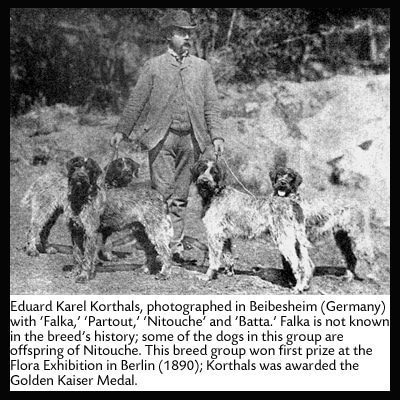
    The culprit of the existence of Korthals Griffon was a man named Eduard Karel Korthals, born the 16 in November of 1851 in Amsterdam that, he was the son of a wealthy shipbuilder who had a keen interest in breeding hunting dogs, to the extent that his son inherited that passion and as a result and the ability for business, the beautiful was born Griffon, protagonist of this post.

    His dream was to create the ideal hunting dog, versatile, with extreme resistance, force and devotion to his master. The dog, as well, he would have to know how to work close to his master, be docile and very capable of learning. In 1873 to the 22 years of age and with the financial support of his father, He settled near some friends in Hesse (Germany) a region known for its great fondness for hunting with dogs and was dedicated to the breeding of purebred dogs Griffon.

    four years later, one of his friends, the prince of Solms-Braunfels, I entrust him with the management of his kennel “Bibesheim” (was then, the most famous of Germany) which was dedicated especially to the breeding of purebred dogs English Pointer, that change in his life did not prevent him at all, continue with the development of their race Griffon.

    Soon Eduard Korthals became one of the largest breeders nationwide, very proud and sure of his work of selection, breeding began with seven specimens of Griffon of different kinds, hard hair, woolly hair, barbets, a mestizo German short hair, etc. He called them "The Seven Patriarchs" and their names were: Bank, Hector, Janus, Satan, Donna, Junon and Mouche. Thus begins the story that after twenty years, resulted in the birth of a specific breed of Griffon with wire hair, leonado, with «Pointer» blood (Although not pure, then we have) and beautiful dog, it must be said...

    We must also tell which, Eduard Korthals carried out ruthless work in its breeding program, with very close consanguinity coupling and many deaths on the road, you are right…, the history has beautiful parts and others less so. Y, here comes the bomb! Out of a total of 600 dogs, only kept alive to 62 and he made them work in the Woods, in swamps, in Plains, in different seasons, to see how they worked in different situations and hunting tasks.

    In creating your Wirehaired Pointing, Korthals did not use all the blood purity of the English Pointer, because after having tried, realized that the mixture led to his Griffon lose some of its most important features.

    With his method of consanguinity, exhaustive selection and unit, the Wirehaired Pointing Griffon It was of such quality that many specialists in the canine world in Germany, in Belgium, in the Netherlands, in France and several parts of Europe, they were stunned, Given the Korthals he had created a dog like no other, a dog with an essential width, great search speed, a well-developed sense of smell and, In short, its versatility.

    The 15 in November of 1887, supported by the contributions of a Commission formed by 16 renowned breeders and presided over by the Prince of Solm-Braunfels (who had entrusted Eduar Korthals -years before- the management of its hatchery “Bibesheim”), Eduar Korthals wrote the standard of Korthals Griffon, that curiously never amended since then. The following year, He created a Club specialized in his breed whose objective was to bring together all the lovers of his Griffon fawn with wire hair from various countries and until his death in 1896, He devoted himself to the improvement and dissemination of their race. He died of laryngeal cancer 4 in July of 1896 in the hatchery Bibeishem.

    But despite his death, his ideas continued living, then many followers and friends as Baron Gingins (Switzerland), Charles Prudommeaux (France) and the Sr. Leliman (Netherlands) they continued their valuable work, turning to improving your Wirehaired Pointing Griffon, and the diffusion of the breed throughout Europe and even in United States and Canada. It was the 8 in June of 1951, on the occasion of the fiftieth anniversary of the death of Eduar Korthals What, The "French Wirehaired Griffon Club" decided to associate the name of Korthals the race, to perpetuate the memory of its creator, and in honor of all his achievements and life dedicated to the task of breeding. Hence the name "Korthals Griffon”.

    The first specimen registered in the Book of Origins of the American Kennel Club was a Korthals Griffon called "Zolette", in the year 1887. But, the Griffon was still relatively- unknown, was registered as “Russian Setter (Griffon)”, by its supposed Russian heritage. It was not until 1916, Twenty-nine years later, the breed was officially recognized in United States.

    In the same year, sixteen copies of Korthals Griffon participated in the "Westminster Kennel Club Dog Show”, one of United States most prestigious dog shows. Since then, the race was growing in popularity, not only as a show and companion dog, but also a versatile hunting dog (that was the original intention of Korthals when he created the breed). for the most part, the breed continues to maintain its original characteristics: medium-sized, layer hard, good degree of training capacity and resistant in the field and in the ring.

    Physical characteristics

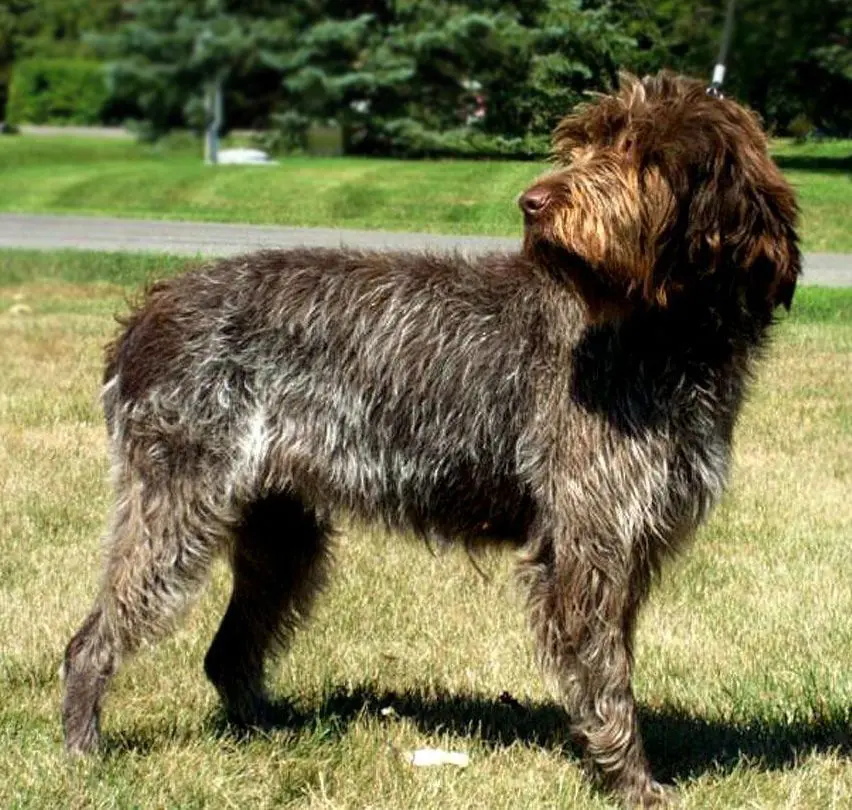
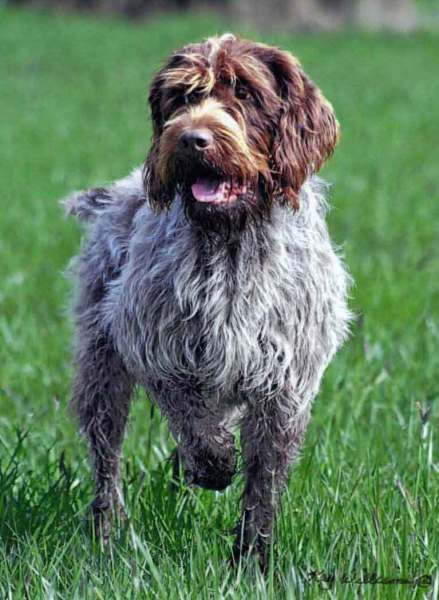
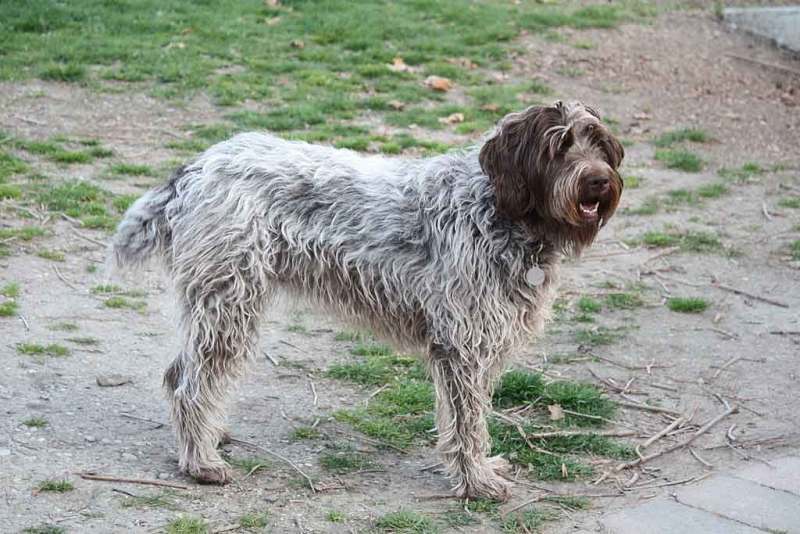
    The Korthals Griffon is a medium-sized dog with a hard and rough coat. The males measure of 55 to 60 cm de altura a la cruz y las hembras de 53 a 66 cm.. The weight should be proportional to the size and bone structure. In general, the weight varies from 20,5 a 31,75 kg. Males are usually larger and heavier than females bones. 50 to 55 cm.. Regarding weight, the males are located in 25-30 kg and females in 20-25 kg. According to the AKC standard, the hair must be color steel (grey) with brown spots. Other acceptable colors are chestnut, White and Brown, Ruano and, Orange and white. It has ears falls and well attached to the head, his eyes are yellow or Brown and the nose should always be Brown. Contrary to some publications that say that the Griffon does not lose or shed its hair, it should be clarified that yes it does, but to a lesser extent than other breeds.

    There are dogs very similar to the Griffon Korthal in other countries, both in appearance and temperament:

    Character and skills

    The Wirehaired Pointing Griffon is defined as an intelligent dog, extremely friendly and eager to please its owner. They tend to maintain their typical playful puppy character well into adulthood.. They are also known for their Adaptive temperament.

    The Korthals Griffon it is above all a hunting dog, resistant, powerful and brave. He's an outdoor dog who needs a garden to keep his instincts sharp.. Not a suitable breed of dog for apartment living, since it is very likely that confinement will cause anxiety attacks or greater nervousness that leads you to destroy everything. They need a lot of exercise to thrive, and they are tireless sporting dogs and very good swimmers. So, their owners must be able to offer them long walks and games, beyond simple daily outings for your needs: this is necessary to keep you in good physical and psychological health. In fact, the Wirehaired Pointing Griffon is an ideal candidate for canicross, el cani-VTT, the oberta or even the treasure hunt, that will fully satisfy your hunter instinct.

    most of Korthals Griffon usually live long and healthy lives, and that is due to the seriousness of all the organizations and breeders dedicated to this breed that have a strong commitment to the health of the breed and carry out breeding programs that are mostly very selective, As a result, if we look at the OFA statistics, the cases of congenital diseases are –relatively- low.

    education

    The Korthals Griffon he is an intelligent and cunning dog. These qualities make hunters happy… but the misfortune of inexperienced teachers, whose defects he takes advantage of. This dog can be undocile if it does not benefit from a firm education, consistent and not brutal. As much as saying that it is not an adapted breed as a first dog.

    It also, it is important to socialize the puppies as soon as possible so that they get used to the presence of different people and other animals. In effect, although they are not fearful in nature, the Wirehaired Pointing Griffon Too isolated or too "protected" from the outside world can be particularly nervous and difficult to adapt to everyday life.

    Health

    Robustness is a fundamental characteristic of the Grifón Korthal: It is a breed of dog that does not fear cold or bad weather.

    But, like all medium-sized dogs and large dogs, have a risk of hip dysplasia. Prostate disorders may also occur in some individuals.

    Last, it is recommended to monitor the coat and skin of individuals who do not live outdoors, to prevent the development of skin diseases in dogs due to allergies to industrial product residues present in the home (solvents, Cleaning products…).

    Life expectancy

    13 years

    Grooming

    Although it is considered a "hypoallergenic" dog due to its low hair loss., the Grifón Korthal requires weekly brushing to keep its coat shiny. During the molting period (twice a year), more frequent brushing may be necessary.

    It is also advised to clean the dog's ears regularly., especially after walks or bathing, to prevent the development of infections due to excess water inside the ear canal, or to the presence of residues or dirt. In case of redness or suspicious odors, consulting a vet is recommended.

    Price

    Adopt a Wirehaired Pointing Griffon costs between 600 and 1000 EUR.

    The price of a puppy Khortals varies according to your lineage, but also according to their gender: females tend to be more expensive than males.

    Characteristics "Wirehaired Pointing Griffon"

    Coexistence is important that you have with your new friend. Before considering the acquisition of a dog of the breed "Wirehaired Pointing Griffon" you know certain factors. Not all breeds of dogs are apt to live in an apartment, you must take into account his character, their need for exercise, their interaction with other pets, their care and if you have small children, their level of tolerance towards them.

    Adaptation ⓘ

    3,0 of 5 stars (based on 1 review)

    friendly dog ​​ⓘ

    3,0 of 5 stars (based on 1 review)

    hair loss ⓘ

    2,0 of 5 stars (based on 1 review)

    Affection level ⓘ

    4,0 of 5 stars (based on 1 review)

    Need for exercise ⓘ

    5,0 of 5 stars (based on 1 review)

    Social need ⓘ

    4,0 of 5 stars (based on 1 review)

    Home ⓘ

    3,0 of 5 stars (based on 1 review)

    Toilet ⓘ

    2,0 of 5 stars (based on 1 review)

    Friendly with strangers ⓘ

    3,0 of 5 stars (based on 1 review)

    barking ⓘ

    3,0 of 5 stars (based on 1 review)

    Health ⓘ

    4,0 of 5 stars (based on 1 review)

    Territorial ⓘ

    3,0 of 5 stars (based on 1 review)

    Cat friendly ⓘ

    2,0 of 5 stars (based on 1 review)

    Intelligence ⓘ

    4,0 of 5 stars (based on 1 review)

    Versatility ⓘ

    4,0 of 5 stars (based on 1 review)

    Child friendly ⓘ

    4,0 of 5 stars (based on 1 review)

    Surveillance ⓘ

    3,0 of 5 stars (based on 1 review)

    joy ⓘ

    4,0 of 5 stars (based on 1 review)

    Images "Wirehaired Pointing Griffon"

    Photos:

    1 – the first genuine Korthals Griffon in the USA to earn both a Grand Championship and the Advanced Master Hunter title by CarolPtak, CC BY-SA 4.0, via Wikimedia Commons
    2 – Adult Griffon dog standing by Liv klesta, CC BY-SA 3.0, via Wikimedia Commons
    3 – Griffon d’arrêt à poil dur Korthals by Pierre André, CC BY-SA 4.0, via Wikimedia Commons
    4 – running Korthals Griffon by CarolPtak, CC BY-SA 4.0, via Wikimedia Commons
    5 – Wirehaired Pointing Griffon by Pets Adviser from Brooklyn, USA, CC BY 2.0, via Wikimedia Commons
    6 – Wirehaired Pointing Griffon by Canarian, CC BY-SA 4.0, via Wikimedia Commons

    Videos "Wirehaired Pointing Griffon"

    Type and recognitions:

    • FCI CLASSIFICATION:
    • Group :
    • Section : . .

    Federations:

    • FCI – Group 7: Pointing Dogs. – Section 1: Continental Pointing Dogs. 1.3: Griffon type
    • AKCSporting group
    • ANKCSporting Group, Gundog
    • CKCSporting Group, Gundog
    • ​KC – Sporting Group, Gundog
    • NZKCSporting Group, Gundog
    • UKCGun Dog

    FCI breed standard "Wirehaired Pointing Griffon"

    Origin:
    Germany, France, Netherlands

    Date of publication of the valid original standard:
    06.05.1964

    Use:

    This is essentially a versatile pointing dog. It is also used to look for the trace of wounded big game.


    General appearance:

    It is a vigorous dog, rustic, medium-sized. It is longer than high. The skull is not very wide, the muzzle is long and square. Dark yellow or brown eyes, there are tangled eyebrows that do not cover them completely. The whiskers and beard are well developed and give the animal a characteristic expression that denotes firmness and security..


    Behavior / temperament:

    Manso, haughty, excellent Hunter. He is very attached to his master and his territory, who cares diligently. He is very friendly with children.

    Head:

    It's big and long. It is covered with coarse and abundant hair, although not very long. The whiskers, the beard and eyebrows are well pronounced.

    Cranial region:
    • Skull: Not very wide. The lines of the skull and the nasal cannula are parallel.
    • Depression links (Stop): Not very pronounced.

    facial region:

    • Truffle: It is always brown.
    • Snout: Long and square. The muzzle is slightly arched and is the same length as the skull.
    • Eyes: Dark yellow or brown in color. They are big and round, the eyebrows are abundant, but they don't cover them. His expression is smart.
    • Ears: Medium-sized, they are not bent. They are flat and contiguous to the face; Its insertion is at the level of the eye line; the short hair that covers them is mixed with longer hairs.

    Neck:

    Medium long. There is no presence of dewlap.

    Body:

    Its length is visibly greater than that of the height of the withers.

    (Of 1/20 to 1/10).
    • Back: Strong.
    • Pork loin: Well development.
    • Breast : Large, not very wide. The ribs are slightly arched.

    Tail:

    Presents horizontally or with the limb slightly raised. Hair is abundant, but without plume. The tail should usually be trimmed by a third or a quarter. If it's not cropped, must be presented horizontally, with the limb slightly raised.

    Tips

    PREVIOUS MEMBERS: Straight, powerful and thick hair. When the dog is in action there are parallels.
    • Shoulder: Well applied to the body. They are rather long and very oblique.
    LATER MEMBERS: Covered with abundant hair.
    • Thighs: Long and well muscled.
    • Hocks: Well bent.
    FEET: Round, firm. Fingers are well together and arched.

    Movement:

    The pace during the hunt is the gallop, which is interrupted by periods of jogging. The trot is elongated. The dog glides to the feline.

    Mantle

    HAIR: It's tough and rough. To the touch, looks like boar hair. Never curly, ni lanudo. Fine and tight hair is observed under the tough hair of the outer layer.

    COLOR: Preferably steel gray with brown spots or uniform brown color. It is often rubican or roan brown. White and brown and white and orange coats are also accepted.


    Size and weight:

    • In males: 55 to 60 cm.;
    • In females: 50 to 55 cm..


    Fouls:

    Any deviation from the aforementioned criteria is considered as a fault and the severity of this is considered to the degree of the deviation to the standard and its consequences on the health and well-being of the dog..

    FALTAS DESCALIFICANTES:

    • Aggressiveness or extreme shyness.
    • Any dog ​​showing clear signs of physical or behavioral abnormalities.


    N.B.:

    • Males must have two normal-appearing testicles fully descended into the scrotum..
    • Only functionally and clinically healthy dogs, with the typical conformation of the breed, should be used for parenting.

    Source: F.C.I - International Cynological Federation

    Alternative names:

    1. Korthals Griffon (English).
    2. Korthals, Griffon Korthals (French).
    3. Griffon à Poil Dur, Griffon Korthals (German).
    4. Korthals (Portuguese).
    5. Grifón Korthals, Korthals (español).

    ▷ The world of Pets: Dogs, cats, birds, reptiles, amphibians

    Westphalian Dachsbracke
    Germany FCI 100 . Small-sized Hounds

    Westphalian Dachsbracke

    The Westphalian Dachsbracke It is mainly a hunting dog that maintains an active temperament and a great need for exercise.

    Content

    History

    The Westphalian Badger Dog was developed in the 17th century in Germany, in the region between the Rhine and the Weser. The result of the cross between the German Hound and various types of Dachsbrack, was created to satisfy the need for a fast dog, small and short, able to cut through bushes and chase prey into burrows. They were the favorite companions of the Germanic nobles, who were so appreciated for their ability to hunt hares, rabbits and foxes as per their friendly disposition.

    It is mentioned in the official description of the German Hound in the decade of 1880, and a first standard was established in 1910. But, the breed was not recognized by the German Kennel Club until 1935, and then by the FCI in 1954.

    The Westphalian Dachsbracke It, However, rare outside Germany. It also, among the main canine organizations in the Anglo-Saxon world, only the UKC recognizes this breed, and only from 2006.

    Photo: Westphalian Dachsbracke by Volbu1, CC BY-SA 3.0, via Wikimedia Commons

    Physical characteristics

    The Westphalian Dachsbracke It is a small hound that measures between 30 and 38 cm at the withers and weighing about 15 kg. It seems to the German Hound, which is even considered a miniature version.

    His coat is tricolor, combining black, red and white. White markings are found on the neck, the chest, the snout, paws and tail tip. Bi-color is not accepted. The coat is rough and very tight, medium length in the back, neck and back of the tail, but short in the rest of the body.

    With a slightly elongated skull and a slightly accentuated stop, his head clearly evokes his kinship with the other double basses. His eyes are dark, while his ears, big and long, are flat against the head.

    The tail, strong and tall at the base, is in perfect extension of the line of the back. It is carried out with a saber blade or hanging.

    Character and skills

    The Westphalian Dachsbracke he's a smart working dog, stubborn and tenacious who can follow the trail of prey over great distances without hesitation.

    They are primarily hunting dogs that maintain an active temperament and a great need for exercise. This need must be met each day to prevent the dog's destructive behavior.. Live in an apartment, although it is not recommended, it is possible as long as the dog can take long walks at least twice a day. During these walks, it is strongly recommended to keep it on a leash, in case you smell prey that takes you off the beaten track. But, ideally it would have access to a garden.

    In the home, although he is not the most docile of dogs, the Westphalian Dachsbracke shows a lot of attachment and affection for his master, family loyalty, and gets along very well with children. All these are qualities that make it a very pleasant companion dog.. But, requires a lot of interaction and availability, as he needs constant company and cannot be left alone for a whole day. Playtime and obedience or agility training can keep you busy, but nothing will make you happier than a hunting trip.

    Finally, the Westphalian Dachsbracke tolerate other pets as long as they are exposed to your presence from a young age. Otherwise, his hunting instincts take over, and is capable of chasing and hurting them.

    Education

    Due to its firm character, the Westphalian Dachsbracke can be tough and stubborn in his upbringing. Some commands will take longer to assimilate than with other dog breeds. So, the master must act as the leader of the pack to be heard and obeyed, and under no circumstances allow him to take over the family hierarchy. So, It is clearly important not to be fooled by the small size of this dog and turn it into a "princess", at the risk of experiencing real cohabitation problems in the near future.

    At the end, the Westphalian Dachsbracke must be trained early and firmly, while promoting the principles of positive dog training.

    Health

    The Westphalian Dachsbracke he is a robust dog, healthy and with a good life expectancy. But, their kinship to the Basset family explains why they are prone to back problems, ranging from muscle tension to degenerative disc disease.

    It also, you have to be careful with his long and floppy ears, as they are sensitive to ear infections. In case of infection, the dog tends to shake its head and scratch its ear. Other signs are a bad smell and the development of redness around the ear canal.. An ear infection requires a visit to the vet and is treated with prescription medications..

    Last, like any working dog, a Westphalian Dachsbracke that participates in hunting is more likely to be injured than a companion dog that is kept at home. But, in the heat of the moment, the dog tends to ignore pain, so it is often only after the owner notices lacerations or bites, for example.

    Grooming

    One to two weekly brushings are recommended to maintain the very tight and rough-textured coat of the Westphalian Dachsbracke. These dogs should rarely be bathed, since they deprive the coat of its natural oils.

    The ears should also be visually inspected at least once a week and they should be dried after soaking in water to limit the risk of infection..

    Last, the dog's teeth should be brushed regularly to reduce the risk of periodontal diseases and infections, that one day may require dental extractions.

    Characteristics "Westphalian Dachsbracke"

    Coexistence is important that you have with your new friend. Before considering the acquisition of a dog of the breed "Westphalian Dachsbracke" you know certain factors. Not all breeds of dogs are apt to live in an apartment, you must take into account his character, their need for exercise, their interaction with other pets, their care and if you have small children, their level of tolerance towards them.

    Adaptation ⓘ

    2,0 of 5 stars (based on 1 review)

    friendly dog ​​ⓘ

    3,0 of 5 stars (based on 1 review)

    hair loss ⓘ

    3,0 of 5 stars (based on 1 review)

    Affection level ⓘ

    3,0 of 5 stars (based on 1 review)

    Need for exercise ⓘ

    3,0 of 5 stars (based on 1 review)

    Social need ⓘ

    3,0 of 5 stars (based on 1 review)

    Home ⓘ

    3,0 of 5 stars (based on 1 review)

    Toilet ⓘ

    2,0 of 5 stars (based on 1 review)

    Friendly with strangers ⓘ

    3,0 of 5 stars (based on 1 review)

    barking ⓘ

    3,0 of 5 stars (based on 1 review)

    Health ⓘ

    3,0 of 5 stars (based on 1 review)

    Territorial ⓘ

    2,0 of 5 stars (based on 1 review)

    Cat friendly ⓘ

    2,0 of 5 stars (based on 1 review)

    Intelligence ⓘ

    4,0 of 5 stars (based on 1 review)

    Versatility ⓘ

    4,0 of 5 stars (based on 1 review)

    Child friendly ⓘ

    3,0 of 5 stars (based on 1 review)

    Surveillance ⓘ

    2,0 of 5 stars (based on 1 review)

    joy ⓘ

    4,0 of 5 stars (based on 1 review)

    Images "Westphalian Dachsbracke"

    Westphalian Badger
    Westphalian Dachsbracke by Mare.s., CC BY-SA 3.0, via Wikimedia Commons
    Donar from the Wild Man, Westphalian Dachsbracke by <a href="https://Commons.wikimedia.org/wiki/file:Donar.jpg">Jörg Erich</a>, <a href="https://creativecommons.org/licenses/by-sa/4.0">CC BY-SA 4.0</to>, via Wikimedia Commons
    Donar from the Wild Man, Westphalian Dachsbracke by Jörg Erich, CC BY-SA 4.0, via Wikimedia Commons

    Videos "Westphalian Dachsbracke"

    Westphalian Dachsbracke - hunt: Weidmannsheil!
    Westfälische Dachsbracke – Jagd: Weidmannsheil!
    Jersey (Rhodesian Ridgeback) & Lea (Westphalian Dachsbracke) Sparring no. 2
    Jersey (Rhodesian Ridgeback) & Lea (Westfälische Dachsbracke) Sparring Nr. 2

    Type and recognitions:

    • FCI CLASSIFICATION:
    • Group :
    • Section : . .

    Federations:

    • FCI – Group 6: Scent hounds, and related breeds. – Section 1.3: Small-sized Hounds.
    • UKCScenthounds

    FCI breed standard "Westphalian Dachsbracke"

    Origin:
    Germany

    Date of publication of the valid original standard:
    24.06.1987

    Use:

    Hound.


    General appearance:

    The Westphalian Dachshund is a miniature replica of the German Hound.. It essentially corresponds to the shape of its large model, but with the effect of a more compact and stronger dog.

    The Westphalian Dachshund is a specimen that measures between 30 to 38 height cm, with the typical moderately long and strong structure of a hunting dog, with a noble medium-sized head and well-set tail, worn during calm walking in the shape of an upward or hanging saber with a small curvature at the tip. The facial expression is that of a faithful dog, friendly, serious and attentive.


    Behavior / temperament:

    ---

    Head:

    View from the front, same as in the German hound, she is thin, and start. The occipital protuberance is somewhat noticeable.

    Cranial region:
    • Skull : The skull is only slightly wider than the facial region.
    • Depression links (Stop) : somewhat noticeable.

    facial region:

    • Truffle : It has a light colored line in the middle, almost flesh color, while the lateral parts have more or less dark pigmentation.
    • Snout : Nasal cane slightly arched.
    • Lips : They hang moderately.
    • Jaws / Teeth : Very strong and uniform bite. The upper incisors fall exactly on top of the lower ones. (bite clamp) that is, the inner part of the upper incisors scratches the outer part of the lower incisors (scissor bite). The fangs are especially well developed. The buccal fold is small.

    Eyes : dark, clean, friendly expression.

    Ears : They are medium in length and wide., well adjacent, forming a slight roundness at the tip.

    Neck:

    Moderately long, compared to the head quite strong, decreasing when approaching it. Neck skin is loose, but without forming a double chin.

    Body:

    • Back : Slightly convex, medium length, a little sunken behind the shoulders.
    • Pork loin : Wide and strongly developed.
    • Rump : obliquely.

    Breast : It is thinner than in theDachshund, well supported by the limbs, without hanging deeply between the two. The thorax is long.

    Belly : A little gathered in front of the hind limbs.

    Tail:

    Relatively high implantation, without forming a very noticeable angulation with the back. At the root it is very strong, In its lower part the hair has the appearance of a brush, on the top it is smooth, stuck to the skin, ending in a point like a brush, without pen.

    Tips

    PREVIOUS MEMBERS : well developed, dry, tendinous and coarse bones. Front views, the front limbs are not curved, but straight, with feet pointed forward.

    • Elbows : They have a good position close to the trunk.

    LATER MEMBERS : They have a steeper position than other dogs. The hind limbs, compared to the front, They are much more developed than in the Dachshund.

    • Thigh : Shows strong and notable muscles and, seen both from the back and the sides, It is almost vertical.

    FEET : Rough, with short fingers, well closed.

    Movement:

    ---

    Mantle

    HAIR : All over the body, even at the bottom, very dense, and crude ; in the head, ears and lower part of the extremities is short; on the back, the neck and the inner part of the tail is somewhat longer.

    COLOR : From red to yellow, with chair or black cloak, and the typical white markings of hounds : rounded or striped white spot on head, white snout, ring on the neck, chest, white limbs and tip of tail. Two-color dogs are not desirable, as are dogs with black on the head.. Chocolate-brown color is considered missing.


    Size and weight:

    The Westphalian Dachshund is a small hound that measures between 30 and 38 cm at the withers and weighing about 15 kg.


    Fouls:

    Any deviation from the aforementioned criteria is considered as a fault and the severity of this is considered to the degree of the deviation to the standard and its consequences on the health and well-being of the dog..

    FALTAS DESCALIFICANTES:

    • Aggressiveness or extreme shyness.
    • Any dog ​​showing clear signs of physical or behavioral abnormalities.

    Any dog ​​showing clear signs of physical or behavioral abnormalities must be disqualified..


    N.B.:

    Males should have two normal-appearing testicles fully descended into the scrotum..

    Source: F.C.I - International Cynological Federation

    Alternative names:

    1. Westphalian Hound (English).
    2. (Westfälische Dachbracke en allemand) (French).
    3. Westfälische Dachsbracke (German).
    4. (em alemão: Westfälische dachsbracke) (Portuguese).
    5. Cazador de Westfalia (español).

    ▷ The world of Pets: Dogs, cats, birds, reptiles, amphibians

    West Siberian Laika
    Rusia FCI 306 - Nordic Hunting Dogs

    Laika de Siberia Occidental

    in your country of origin, Russia, the West Siberian Laika has been bred as a hunting dog for centuries.

    Content

    History

    The "West Siberian Laika" (Zapadno-Sibirskaïa Laïka), is the product of crossbreeding between the closely related species of Laïka de Chanteisk and Mansijak with Russian hunting dogs from the north of the Urals and Western Siberia. Outside its area of origin in areas mainly populated by hunters, This race has widely spread to central areas of Russia; This type of dog that abounds on these sites, they are reared in large installations. In different hunting regions there are special kennels for raising the West Siberian Laika.

    Recognition by the FCI

    Since 1980 the Russo-European Laika just like him East Siberian Laika have been recognized as independent breeds by the FCI in addition to the West Siberian Laika. But, the Yakutian Laika, as well as other types of Laïka, as the Jezdoraja Laika, the Nenezker Weather or the Karelo-Finnish Laika, are not internationally recognized until now. Within the FCI the three breeds of Laïka are classified in the group 5, Together with the Gray Norwegian Elkhound and the Karelian Bear Dog, form the Section 2 "Nordic Hunting Dogs" within this group.

    Physical characteristics

    It is a hunting dog of variable utility, but also shooting or for sledge. Is medium-sized, Slim and strong Constitution. Her bone structure is well developed, is not mass or rough. Muscle is strong and well developed. It has a strongly coiled tail, He takes her on the back or the back.

    Its fur is hard, short, with developed internal fluff. The outer layer is thick and straight. The internal fluff is abundant and dense hair's outer layer which gives a distant and leafy appearance. In the head, You ears and part of limb hair is short. On the cross, neck and back of legs the hair is longer than forming a collar in the region of the neck and a beard in the cheek area; the rear extremities presents some feathers.

    Is white, salt and pepper, Red or gray in all colors. Allow the color black, also spotted or with the same color plates.

    Strong similarity to the wolf

    With the often hairier males, it even produces a kind of mane. This feature is reminiscent of a wolf, with which the Laïka not only share the pointed and high ears, narrow wedge-shaped head and small oblique eyes, but also strong teeth and coat color, often similar to wolf.

    Assorted coat colors and a typical striped tail

    But, the colors of him West Siberian laika they are very diverse according to the wide area of ​​distribution of the breed and the large number of local traits, ranging from pure white to black, pepper and salt, the color of the wolf, reddish brown, grey, the pied or the spotted. characteristic of all races Russian Laika is the striking striped tail, worn both on the side and on the back.

    Character and skills

    Independent hunter and close ally.

    Like most hunting dogs, the West Siberian Laika also has some independence. Not only in hunting, but also as a watchdog, companion dog or sled dog, sometimes acts independently and autonomously. But, this does not mean that it cannot adapt to its humans. On the contrary: the Laïka feels closely connected to her reference person and always seeks their proximity. Even when hunting, never strays too far from his guide and makes sure each 20 or 30 minutes of hunter following.

    The intense relationship with humans allows him Laïka – despite its original roots – be used as a herding dog, protection, guard or shooting.

    Life in the family

    Once an owner has earned the trust of his Laïka, even the most demanding training goals can be achieved. It is important that the West Siberian Laika has a firm place in his "pack" from the beginning and is allowed to participate closely in the life of his people. In doing so, bonds closely with its "pack leader", but also shows himself as a patient and loving companion when dealing with other family members, especially with the children. If you socialize early and comprehensively, living with other dogs and pets usually works without problems.

    Activities «Laika of Western Siberia»

    Despite these characteristics, the West Siberian Laika is and remains primarily a working dog, for whom his “job” is as important as his people. A life as a pure domestic and family dog ​​certainly does not do justice to its nature.. Only if you can sufficiently demonstrate your stamina, agility, speed and intelligence, will present himself at home as a calm and balanced companion.

    The West Siberian Laika wants to be "needed" and, therefore, you should definitely be given a task that challenges you both physically and mentally. Owners who don't run their Laïka like the hunter he is, they must provide for sufficient substitute employment, for example, in sport form (Agility), training dog sport, runway and nose work or training as a rescue dog.

    Health «West Siberian Laika»

    Unlike many other dog breeds, which often developed rather by coincidence, Russian dogs already had very early exact ideas about the useful characteristics of this breed. The baby of him West Siberian Laika was soon put under strict controls and took place in central state approved breeding stations. In order to preserve the excellent qualities of hunting, officially organized tests were introduced. Dogs that did not meet the high usage requirements were systematically excluded from breeding..

    Healthy and robust working dogs

    Strict breeding requirements and tough selection led to the good hunting dog qualities and excellent sensory perceptions of dogs being preserved to this day. At the same time, high concentration on utility ensured that outward appearances became less of an affair. A breeding of pure beauty, that as the examples of other dog breeds show, often led to health problems, was avoided in the West Siberian Laika. Hereditary diseases typical of the breed, with which fashionable dogs often fight, are not known in this original breed. Even generalized joint diseases, such as dysplasia of the hip joint (HD), rarely occur in this Laïka.

    Nutrition «Laika de Siberia Occidental»

    Dog owners shouldn't change their diet too often either.. Although the West Siberian Laika is not very picky about his diet, the constant changes in the food plate could overload even his robust stomach. As a descendant of the wolf, dogs don't need many different foods to stay healthy. Unlike us humans, that we should have a diet as varied as possible and whose menu includes meat, fish and vegetables, as well as potatoes, noodles and other cereal products, dogs need meat above all. Both their teeth and their digestion are oriented to the processing of foods based on meat. Different types of meat and changing tastes are, by the way, desirable with respect to this main ingredient.

    Discover our selection of dog food.

    Pay attention to your dog's nutritional needs. Whether you feed your dog moist meat, dry, raw (BARF) or cooked, it is important that the quantity and content of the food meets the specific nutritional needs of your dog. These requirements depend on very individual criteria such as race, size, age, activity level and health status and may vary accordingly. If the composition is correct, a Laïka adult can get by on one or two meals a day. after feeding, the feeding bowl should be cleaned and should only be available again the next day or for the next meal. It is better to avoid snacking between meals or the constant administration of treats. But, fresh drinking water should always be available for your dog.

    Buying a West Siberian Laika

    With his healthy nature, robust and original, the West Siberian Laika satisfies many dog ​​lovers' desire for something "wild" in our modern, civilized everyday lives. And finally, but not less important, the wolf appearance of this breed fascinates people. This natural beauty, coupled with excellent hunting performance, made of him West Siberian laika one of the most popular dog breeds of the former Soviet Union already in 1960.

    How much does a “West Siberian Laika” puppy cost??

    In Europe, the Time to fall still rarely seen. So it is extremely difficult outside of Russia to get a purebred Laika from a proven breeding line.. Long, arduous roads and a comparatively high puppy price between 1.300 and 1.500 EUR are the rule. Even if you have found a suitable breeder after a long search, you may be advised not to buy a Laïka. Don't be surprised if during the first meeting you are asked very personal questions about your profession., their living conditions, your future plans and marital status. For committed and serious breeders, the welfare of dogs is, as a last resort, more important than financial benefit. After all, keeping such a demanding animal takes a long time, experience and space.

    People who are mainly attracted by the appearance and originality of this Laïka they must therefore carefully consider whether their living conditions and character really fit this breed. If in the end you are still convinced that the West Siberian Laika is the correct breed, You must prepare well for the purchase of the new "family member". Not only are you doing yourself a favor, but above all the dog, because this Laïka He demands all the attention of his handler and does not tolerate a change of owner very well..

    Care for the «West Siberian Laika»

    Although the West Siberian Laika he is a very robust dog, you need not only a healthy diet but also proper care to stay healthy and vital. Its hard and soft top layer repels dirt and water well, but you still need to brush regularly (about twice a week). During the change of coat, you Laïka should be brushed daily to remove dead hair and strands. In general, owners of this dog breed should not be bothered by dog ​​hair in the house, because although the West Siberian Laika he is basically a very clean dog, lose a lot of hair, that spreads across the sofa, the carpet and the floor. In addition to the toilet, the claws should be regularly shortened and the ears, teeth and feet should be checked and cleaned.

    Keeping

    Regarding the attention, the time required can be manageable, but the use of a Laïka alone takes a lot of time (free). Who chooses a West Siberian Laika should therefore not have to work full time. This human-oriented working dog is not cut out for long periods of solitude. As an original hunting dog needs a lot of career, an appropriate task and lots of contact with your reference person. A hatchery in a small town flat is, therefore, as unsuitable as a kennel. The Siberian breed dog feels more comfortable in a house with a large fenced garden, where you can be close to your humans at all times.

    No dog for beginners

    Also for the education of this Laïka a close relationship between dog and human is a basic requirement. If your dog trusts you, can trust your competence and sovereignty as “pack leader” and is assured of your closeness and love, will follow you willingly – despite its original roots as an independent hunting dog. But in order to reliably fulfill the role of a competent leader of the pack, technical knowledge is required, consistency and strength of character. The West Siberian Laika certainly not a beginner dog.

    Characteristics "West Siberian Laika"

    Coexistence is important that you have with your new friend. Before considering the acquisition of a dog of the breed "West Siberian Laika" you know certain factors. Not all breeds of dogs are apt to live in an apartment, you must take into account his character, their need for exercise, their interaction with other pets, their care and if you have small children, their level of tolerance towards them.

    Adaptation ⓘ

    2,0 of 5 stars (based on 1 review)

    friendly dog ​​ⓘ

    3,0 of 5 stars (based on 1 review)

    hair loss ⓘ

    5,0 of 5 stars (based on 1 review)

    Affection level ⓘ

    4,0 of 5 stars (based on 1 review)

    Need for exercise ⓘ

    5,0 of 5 stars (based on 1 review)

    Social need ⓘ

    4,0 of 5 stars (based on 1 review)

    Home ⓘ

    5,0 of 5 stars (based on 1 review)

    Toilet ⓘ

    3,0 of 5 stars (based on 1 review)

    Friendly with strangers ⓘ

    3,0 of 5 stars (based on 1 review)

    barking ⓘ

    5,0 of 5 stars (based on 1 review)

    Health ⓘ

    2,0 of 5 stars (based on 1 review)

    Territorial ⓘ

    4,0 of 5 stars (based on 1 review)

    Cat friendly ⓘ

    3,0 of 5 stars (based on 1 review)

    Intelligence ⓘ

    3,0 of 5 stars (based on 1 review)

    Versatility ⓘ

    4,0 of 5 stars (based on 1 review)

    Child friendly ⓘ

    3,0 of 5 stars (based on 1 review)

    Surveillance ⓘ

    4,0 of 5 stars (based on 1 review)

    joy ⓘ

    4,0 of 5 stars (based on 1 review)

    Images "West Siberian Laika"

    Photos:

    1 – «Laika de Siberia Occidental» by https://commons.wikimedia.org/wiki/File:West_Siberian_Laika.jpg
    2 – «Laika de Siberia Occidental» by ecured
    3 – Riga, Baltic Winner -2013, 9-10 Nov by Thomas / CC BY-SA
    4 – Riga, Baltic Winner -2013, 9-10 Nov by Thomas / CC BY-SA
    5 – First-generation (F1) wolf-dog hybrid from Wildlife Park Kadzidlowo, Poland (photos: A. Krzywinski) by Maris Hindrikson et al / CC BY
    6 – This is a 4 month old West Siberian Laika female pup. It is at this stage when a WSL pups unique natural hunting instincts become evident by Meribelles at English Wikipedia / CC BY-SA

    Videos "West Siberian Laika"

    Type and recognitions:

    • FCI CLASSIFICATION:
    • Group :
    • Section : . .

    Federations:

    • FCI – Group 5 – Section 2 Nordic Hunting Dogs.

    FCI breed standard "West Siberian Laika"

    Origin:
    Russia

    Date of publication of the valid original standard:
    13.10.2010.

    Use:

    Variable Utility Hunting Dog.


    General appearance:

    Medium to medium large dog, substantial with a strong and defined structure. The length of the body, measured from the sill to the buttock is slightly higher than the height measured from the withers to the floor. higher than the height measured from the withers to the floor.

    Clearly pronounced sexual dimorphism. Males are larger than females and clearly male. Well-developed muscles and strong bones.

    PROPIMPORTANT ORTIONS:

    The length of the body exceeds its height at the withers by 100 to 103-107%, in males and in 100 to 104-108% in females.

    Height at withers exceeds height at croup by 1-2 cm. (males) and is equal to or exceeds the height at the croup in 1 cm. (females). The length of the head considerably exceeds its width.

    The length of the muzzle is equal to or slightly less than half the length of the head.

    The length of the extremities from floor to elbow slightly exceeds half the height at the withers.


    Behavior / temperament:

    Lively, balanced temperament. A vigorous dog with a well-developed sense of smell to detect prey. A pronounced passion for hunting, alert, sensitive. He is just as enthusiastic about hunting birds as he is hunting wild animals. Confident and alert to strangers.

    Head:

    Thin, wedge shape, proportionate to the size of the dog. Its shape is similar to that of an equilateral triangle, view from above. The cranial region is moderately wide, lower in females than in males.

    Cranial region:
    • Craging: Elongate, obviously longer than wide. Seen from the front flat or slightly rounded. The nasal bridge is parallel to the top line of the skull. Sagittal crest and occiput well pronounced. The occipital area of ​​the skull is rounded. Superciliary arches slightly developed.
    • Dnaso-frontal depression (Stop): Slightly pronounced.

    facial region:

    • Trufa: Medium size, black. In white dogs a lighter color (Brown) of the truffle is tolerated.
    • Horcico: Moderately pointed widening in the mouth area. The length of the muzzle is half or slightly shorter than the
    • head length. Seen on side, muzzle is moderately wedge-shaped.
    • Labios: Tight.
    • Jaws / Teeth: Whites, large, strong, well developed, evenly placed without being overcrowded. Complete dentition according to dental formula (42 teeth), scissor bite.
    • Cheeks: Sharp cheek bones.
    • Ojors: Not big, Oval shaped, inclined, insert somewhat sunken (more than in the other Laika) with a determined and intelligent expression. The color of the eyes is dark brown or brown according to the color of the hair.
    • Obars: erect, high insertion, “V” shape with pointed edges, Mobile. Slightly developed pavilion.

    Neck:

    Muscular, dry and long. The length is equal to the length of the head. Oval. Neck insertion is approximately 45° – 55° from the horizontal line.

    Body:

    • Línand the top: Firm and solid, slight inclination from the withers to the insertion of the tail.
    • Cruz: Well pronounced, especially in males.Back: Strong, straight, well muscled, moderately wide.
    • Itmor: Short, moderately wide, well muscled with a slight arch.
    • Glikeness: Wide, moderately long, slight incline.
    • Pecho: Moderately deep, width (chest reaches elbow level), long, oval-shaped.
    • Línand the bottom / belly: Withdrawn; the lower line rises slightly from the chest to the abdominal cavity.

    Tail:

    Tightly coiled; carried on the back or hip. If it is fully stretched, it reaches the hock joint or it may be 1 – 2 shorter cm.

    Tips

    PREVIOUS MEMBERS:

    • ApGeneral arience: Seen straight ahead, placement moderately apart and parallel. Its height from the elbow to the floor is slightly higher than the height at the withers.
    • Hormbros: Long and well sloped.
    • Antarm: Long, placed obliquely, muscle. Good angulation between the scapula and the forearm.
    • Elbows: Well on the body, well developed elbow tips set back, parallel to the body axis.
    • Brazo: Long, straight, not rough, muscle, oval.
    • Metacarpus: Not long, slightly sloping viewed from the side. Dewclaws are unwanted.
    • Pinis previous: Oval, arched, fingers well together. Somewhat longer middle fingers.

    LATER MEMBERS: Muscular, strong with well defined angulations of all joints. Seen from behind the limbs are straight and parallel.

    • Thigh: Moderately long, oblique placement.
    • Knee: Well inclined.
    • PinScheme: Moderately long, oblique placement, no shorter than thigh.
    • Metatarsus: Vertical placement. Seen from the side a perpendicular line from the back of the thigh to the floor should fall just in front of the metatarsus. Dewclaws are unwanted.
    • Pinis later: Somewhat smaller than the previous ones. Oval, arched with fingers close together. Somewhat longer middle fingers.

    Movement:

    Libre, energetic. The typical movement is a short trot alternating with a gallop..

    Mantle

    PIEL: Thick and elastic with no folds or little subcutaneous tissue.

    • Plink: Bushy outer hair, hard and straight. Well developed undercoat, soft, thick and woolly. The hair on the head and ears is short and bushy.

    The hair on the shoulders and neck is longer than on the body forming a necklace. On the cheekbones it forms lateral whiskers. In males the hair on the withers is longer.

    Limbs covered with short hair, hard and bushy that is somewhat longer in the back of the forelimbs. The hair on the back of the hind legs forms pants without having feathers.

    There is a protective brush-like hair growth between the fingers. The tail is profusely covered with straight, hard hair that is somewhat longer at the bottom without forming feathers..

    • Colorr: Gray with reddish brown, red with reddish brown, grey, red, fawn and reddish brown in all shades. Pure white or particolor, that is to say, white with patches of any of the aforementioned colors similar to the base color.


    Size and weight:

    Alturto the cross:

    • Males: 55 – 62 cm..
    • females: 51 – 58 cm..


    Fouls:

    Any deviation from the aforementioned criteria is considered a fault and its severity is considered to the degree of deviation from the standard and its consequences on the health and well-being of the dog and the dog's ability to perform its traditional task..

    • Deviations of sexual dimorphism.
    • Slightly nervous or lack of confidence towards strangers
    • Absence of pronounced sagittal crest or occiput, roman nose
    • Light colored eyes.
    • Pale pigmentation of the truffle, lips or eyelid
    • Absence of teeth: absence of no more than 4 premolares considering PM1 & PM 2.
    • Pincer bite after 6 years of age.
    • Low ear insert, soft with a weak bearing, still
    • Horizontal Croup, levemente wolves
    • Right shoulders, elbows turned in or out
    • Chest with flat ribs, slightly sunken chest.
    • Flatfoot, open foot.
    • Stained (roano) in the same shade as the base color on the head and limb
    • Absence of undercoat, absence of collar and side whiskers (except for a natural change)
    • Restricted movement.
    • Exceeding the maximum height in + 2 cm in females, 2 cm below the minimum in males

    FALTAS GRAVES:

    • Obvious deviations of sexual dimorphism.
    • High excitability.
    • Males of female type, male type females.
    • Obesity or thinness.
    • Abrupt stop, snout with upturned nose, short snout, loose lips.
    • Lack of pigmentation in the nose, lips, eyelids.
    • Round eyes, horizontal placement, protruding, yellow eyes, loose eyelids
    • Absence of teeth, small, separate placement
    • Ears spread to the sides of the head, round tips, too big, overdeveloped pavilion.
    • Sunken back, back encarpado.
    • Long loin, Strait, sunken or arched, over built.
    • Sunken chest.
    • Tail that is too long or too short or does not touch the back or hips
    • Obvious feet this- West, pigeon foot or arched forehead. Low hocks
    • Posterior over angled or right, knees turned out, cow hock or narrow on the back.
    • Heavy movement, restricted, forced or prim.
    • Too long hair on the back of the forelegs, pronounced feather on thigh and tail.
    • Wavy, curly, soft or too long, hair parted on the back and on the cross.
    • Excessive staining (roano) in the same shade as the base color on the head and limbs.
    • Staining of a different color than the base color.
    • Black or black and white color.
    • Size deviation by more than +/- 2 cm.; height at withers less than height at croup.

    FALTAS DISQUALIFYING:

    • Aggressiveness or extreme shyness.
    • Any dog ​​showing clear signs of physical or behavioral abnormalities must be disqualified..
    • Wrong bite.
    • Twisted mouth.
    • Absence of 4 or more teeth, including PM 1 o M3. Incisor excess
    • Eyes gazeos, stained eyes.
    • Drooping or semi-dropping ears.
    • Feathered tail, otter tail, saber-shaped tail, muñón.
    • Hair too short or too long.
    • Brown genetic hair color, blue genetic, striped, albino.


    N.B.:
    • Males should have two normal-appearing testicles fully descended into the scrotum..
    • Only functionally and clinically healthy dogs, with the typical conformation of the breed, should be used for parenting.

    Source: F.C.I - International Cynological Federation

    Alternative names:

    1. WSL, Zapadno-Sibirskaïa Laïka (English).
    2. Zapadno-Sibirskaïa Laïka (French).
    3. Zapadno-Sibirskaïa Laïka (German).
    4. Zapadno-Sibirskaïa Laïka (Portuguese).
    5. Zapadno-Sibirskaïa Laïka (español).

    ▷ The world of Pets: Dogs, cats, birds, reptiles, amphibians

    West Highland White Terrier
    Inglaterra FCI 5 . Small sized Terriers.

    West Highland White Terrier

    The West Highland White Terrier he is a very lively dog, joyful, with great self-love, determined and independent.

    Content

    History

    The West Highland White Terrier, better known as Westie, is a former Scottish hunting terrier. The little terriers from which the Westie they served humans for many years as watchdogs and hunters. It also, they made themselves useful in the house every day. Keeping houses free from rats and mice, driving away a marten or fox that wanted to feed on chickens or pigeons at night, they proved to be useful helpers at home and in court. The true strength of West Highland White Terrier was active fox hunting, the marten and the otter. The little terrier fearlessly and determinedly chased these thieves to the furthest corner of his den., where they were trying to get them out of the burrow, as the hunters counted. Like his three Scottish brothers, Skye and Cairn Terrier, the West Highland White Terrier he is one of the four descendants of these old men Scottish hunting terrier.

    Like the others, comes from the great gene pool of all those Scottish terriers. Only through intentional breeding, that is to say, artificial separation, Scotland's four genetically separated lower terrier breeds were born. Its current form as "West Highland White Terrier» is the result of breeding directed as a companion dog and for displaying the latest 100 years. Until 1924 was raised and led along with the current Cairn-Terrier. The pure white color is the result of a selection of external traits from the time of the breeding of the sample.. It is an expression of efforts to make these four originally identical brothers more and more distinct from one another.. In 1907 the breed was recognized by the British Kennel Club. It was always a fairly rare breed in Europe. That suddenly changed around 1990.

    The advertising industry recognized the attractive effect of this smart and happy little terrier. Dog food brands like «César» remain inseparably connected with Westie. The nice one Westie became widely known as a means of advertising dog food and later other items as well. Many people knew him as "the television dog.". He was temporarily better known than the Sausage dog or German shepherd. The serious breeding scene could not meet the demand for puppies from Westie. This could not be said twice by the multipliers from Germany and all over Europe. Dubious vendors massively selling puppies in the dog market. This was not good for the dog breed, your fitness and health. Still today many of these breeders, mostly well disguised as "breed lovers", frolicking on the Internet.

    Physical characteristics

    The West Highland White Terrier he is a small and manageable dog with an impressive appearance and self-confident. He's got a pretty thick overcoat with a hard top layer but doesn't lean. Your undercoat must be hair, short, smooth and dense. Your coat is weather resistant. With a height at the withers of about 28 centimeters, weighs between 6,5 and 8,5 kg. But, the ideal weight is not given by the standard. However, the Westies they are quite heavy relative to their physical size. Of course, the color of a coat Westie it should always be white and pure white, After all, it's already in your name.

    After the experiences with the fashion hype, already in 1998 a special requirement for healthy breeding was set in the standard, so any deviation that could "harm the health and well-being of the dog" had to be rejected.. A striking feature is the tail of the West Highland White Terrier, that the standard defines as: "of 13 to 15 cm long; covered with coarse hair, without pen, as straight as possible, haughtily carried, but neither happy nor hunched over the back. A long tail is not desirable, but for no reason should it be amputated. The tail of the Westies it is a good reflection of its intelligent nature.

    Character and skills

    The West Highland White Terrier he's a lively guy, bright and confident. In it beats the heart of a true terrier. The official standard describes its character as follows: "Little, Active, bold, robust, endowed with considerable self-confidence and an air of predatory sharpness. Alert, joyful, brave, Confident but friendly". The old hunter has a tendency to independence and overconfidence. He likes to see himself as an emperor.

    One should not only accept this trait with a smile and a broad inner smile., but rather appreciate it. Of course, such ambitions must have limits, but maybe you shouldn't always notice this boundary setting by us humans. The Westies they are very loyal and affectionate. They love their family and are extremely child friendly.. They are characterized by their friendly and kind character. But they are not lap dogs. Despite his agile temperament, the Westies are not restless or nervous. Are alert, reporting unusual circumstances with excited barking.

    Westies Maintenance:

    The attitude of the Westies has no problems. Only grooming is mandatory, especially regular trimming. It has no demands regarding the size of the floor. It can also be kept well on the floor of a big city. Only one should allow him his daily walks. It should be noted that Westies they were hunting dogs, whose heritage lives on even with today's companion. Small dogs are very persevering and can follow their owners without problems when walking. Must be used to other pets from litter box. If he West Highland White Terrier is consistently and lovingly educated as early as the puppy's age, then this sturdy four-legged friend is a valuable companion, that adapts easily and willingly to all the living conditions of its caregivers.

    Westie's Education

    The education of West Highland White Terrier is an often underrated chapter. Although the puppy looks so cute, especially in his first months of life, he is a true terrier very sure of himself. And such a terrier wants to be educated and guided. The Westie requires consequences in education from adulthood. Although small, dreams like most terriers in some corner of his brain of assuming leadership of the pack. You just have to take your education seriously. Otherwise, his education is not problematic. He wants and needs the guidance of his master or caretaker and is a docile companion., friendly and sociable.

    Care of the West Highland White Terrier

    The West Highland White Terrier are prone to rashes with dry skin, and frequent bathing can exacerbate these problems. The bathing them once a month – or a longer interval- does not usually cause problems. It is advisable to use neutral soaps or baby shampoo and avoid products with aggressive substances., except veterinary prescription.

    After bathing they should pay particular attention in dry him very well the ears with a towel. If brushes you daily or regularly, his hair will remain healthy and bright.

    It is also advisable to occasionally perform a brushing through the grubbing-up of dead hair (referred to as striping), It is a totally painless method which is performed by a professional expert in canine aesthetics. This type of arrangement will maintain the texture and characteristics of the white mantle of the Westie. As well, It should be cleaned them ears weekly with a piece of cotton dampened with water to remove wax buildup and avoid possible infections.

    Special attention must be paid to cleaning the hair around the snout with a damp cloth after eating or digging a hole.. The same, the lagrimales should be cleaned to avoid the accumulation of lagañas, since being a white dog if it is not taken care of -diligently- maintain clean those parties they will wear an unsightly Brown and will make it look dirty or neglected. When they are pets they should be cleaned with baby wipes, especially the part of the belly already to be a dog with short legs, gets wet when they pee and ends up taking an ugly yellowish color.

    West Highland White Terrier Health

    Cubs West Highland White Terrier They may suffer from a disease called “craniomandibular osteopathy.”, known as "Westie or Scottie jaw" which consists of abnormal growth of the jaw bone. This genetic disease is autosomal recessive in nature, that means that what a puppy the present both parents should have the gene and transmit it to the puppy; Unfortunately, the only way to know if any breeding specimen contains this gene is until a puppy is born and presents this anomaly.. By the same, perhaps the breeder himself will not know that some specimen has this fault until the litter is born.

    Is condition usually occurs when the puppy is between 3 and 6 months of age and disappears to the 12 months.

    Diagnosis is usually made after x-rays are taken.. The treatment of the symptoms consists of providing medications that help the puppy to cope with this period., allowing him to eat and use its snout while it suffers from pain. Corticosteroids are therapeutic agents that are used most frequently. Disease disappears spontaneously when the period of growth ends. Only in very severe cases, It does not respond to treatment, is euthanasia.

    Nutrition / Food

    The nutrition of West Highland White Terrier not usually problematic, as long as it comes from a serious breeding. It is not uncommon for allergies and skin irritations to require a dietary diet.

    Westie's Life Expectancy

    The West Highland White Terrier of serious upbringing tend to have robust health and can reach 15 years in good physical condition.

    Buy a West Highland White Terrier

    There are many dubious providers of Westies on the Internet. In your own interest and especially for the welfare of dogs you should look very carefully. It is best to purchase your Westie puppy locally from an FCI member breeder. Here you should pay special attention that there is no inbreeding. Or you can go to the animal shelter and look for other types of terriers. Cubs West Highland White Terrier cost around 1.000 EUR.

    Characteristics "West Highland White Terrier"

    Coexistence is important that you have with your new friend. Before considering the acquisition of a dog of the breed "West Highland White Terrier" you know certain factors. Not all breeds of dogs are apt to live in an apartment, you must take into account his character, their need for exercise, their interaction with other pets, their care and if you have small children, their level of tolerance towards them.

    Adaptation ⓘ

    4,0 of 5 stars (based on 1 review)

    friendly dog ​​ⓘ

    4,0 of 5 stars (based on 1 review)

    hair loss ⓘ

    1,0 of 5 stars (based on 1 review)

    Affection level ⓘ

    4,0 of 5 stars (based on 1 review)

    Need for exercise ⓘ

    4,0 of 5 stars (based on 1 review)

    Social need ⓘ

    4,0 of 5 stars (based on 1 review)

    Home ⓘ

    3,0 of 5 stars (based on 1 review)

    Toilet ⓘ

    4,0 of 5 stars (based on 1 review)

    Friendly with strangers ⓘ

    4,0 of 5 stars (based on 1 review)

    barking ⓘ

    5,0 of 5 stars (based on 1 review)

    Health ⓘ

    5,0 of 5 stars (based on 1 review)

    Territorial ⓘ

    5,0 of 5 stars (based on 1 review)

    Cat friendly ⓘ

    3,0 of 5 stars (based on 1 review)

    Intelligence ⓘ

    4,0 of 5 stars (based on 1 review)

    Versatility ⓘ

    4,0 of 5 stars (based on 1 review)

    Child friendly ⓘ

    4,0 of 5 stars (based on 1 review)

    Surveillance ⓘ

    5,0 of 5 stars (based on 1 review)

    joy ⓘ

    5,0 of 5 stars (based on 1 review)

    Images "West Highland White Terrier"

    photos:

    1 – Tara posing in Simancas (Valladolid) 27 one. 2007
    2 – West Highland Terrier by Antonio Villascusa / CC BY
    3 – A West Highland White Terrier in Capelle aan den IJssel, Netherlands. by Wouter Engler / CC BY-SA
    4 – West Highland White by https://commons.wikimedia.org/w/index.php?title=User:Mateo_Squad&action=edit&redlink=1
    5 – West Highland White Terrier from 1915 by not specified (except those with signature on image) / Public domain
    6 – West Highland White Terrier by SheltieBoy / CC BY

    Videos "West Highland White Terrier"

    Type and recognitions:

    • FCI CLASSIFICATION:
    • Group :
    • Section : . .

    Federations:

    • FCI – Terriers 2 Small sized Terriers.
    • AKC – Terriers
    • ANKC – Terriers
    • CKC – Terriers
    • ​KC – Terriers
    • NZKC – Terriers
    • UKC – Terriers

    FCI breed standard "West Highland White Terrier"

    Origin:
    United Kingdom

    Date of publication of the valid original standard:
    13.10.2010

    Use:

    Terrier.


    General appearance:

    Strong structure; deep chest and well developed back ribs. Level back. Powerful hindlimbs, with good musculature, exhibiting to a high degree the combination of strength and activity.


    Behavior / temperament:

    Petit, Active, brave, without fear, possessing a lot of self-esteem, mischievous expression, alert, joyful, bold, confident and friendly

    Head:

    The distance from the occiput to the eyes is slightly greater than the length of the facial region. The head is covered with abundant fur, forming a right angle, the acute, relative to the neck axis. The head must not be worn in an extended position.

    Cranial region:
    • Skull: Slightly bulky. Side view, the forehead has a smooth curvature. The skull decreases slightly from the level of the ear to the eyes.
    • Depression links (Stop): Very notorious, formed by a visible slightly protruding bone formation immediately above the eyes, and a slight hollow between them.

    facial region:

    • Truffle: Black and somewhat elongated, forming a slight contour with the rest of the muzzle. The truffle does not project forward.
    • Snout: Gradually thins from eyes to nose. The muzzle should be well filled under the eyes., without being concave or falling sharply.
    • Jaws / Teeth: Strong and uniform jaws. As wide as possible between the tusks, keeping the mischievous expression. Teeth are large proportionally to the size of the dog, with a uniform scissor bite, that is to say, that the upper incisors fall exactly in front of the lower ones, teeth being placed perpendicularly in the jaws.
    • Eyes: Separate, medium-sized, neither rounded nor large, as dark as possibleand placed well under bushy eyebrows that give the dog a sharp and intelligent expression. The clear color eyes are very undesirable.
    • Ears: Small, erect and carried firmly, ending at tip, implanted neither too close nor too far apart. Her short soft hair (velvet) should not be cut. Feather-free at the tip. Rounded tip ears, wide, long, thick or with too much hair are undesirable.

    Neck:

    long enough, in a way that allows the required good head position; muscular neck, gradually thickening towards the base so that it can gently emerge from the sloping shoulders.

    Body:

    Compact.

    • Back: Level.
    • Pork loin: Wide and strong.
    • Breast : Deep; the ribs in the upper half are so arched that they give a flat appearance to the sides. The last ribs have considerable depth, the distance from the last rib to the hip being only long enough to allow free movement of the body.

    Tail:

    13 – 15 cm., covered with coarse hair, without pen, as straight as possible, haughtily carried, but neither happy nor hunched over the back. A long tail is not desirable, but for no reason should it be amputated.

    Tips

    PREVIOUS MEMBERS:

    • Shoulder: Leaning back with wide, well-attached shoulder bladesto the chest wall. The shoulder joint positioned forward.
    • Elbows: Well positioned so as to allow the limb free movement, parallel to the axis of the body.
    • Forearm: Short and muscular forelimbs, straight and thickly covered with short, hard hair.
    • Previous feet: The previous ones are longer than the later ones, round, provided in size, strong, with thick pads and covered with short hair, rough. The hind feet are smaller, with very thick pads. The bottom surface of the pads and all nails are preferred black.

    LATER MEMBERS:

    • General appearance: Strong, muscular and broad at the top; short hind limbs, muscular and tendon.
    • Thighs : Very muscular and not too far apart.
    • Knees: Well inclined.
    • Hock joint: Well angled and positioned under the body so that they are considerably close together when walking or standing. Straight or weak hocks are undesirable.
    • Hind feetSmaller than the previous ones, round, provided in size, strong, with thick pads and covered with short hair, rough. The hind feet are smaller, with very thick pads. The bottom surface of the pads and all nails are preferred black.

    Movement:

    Libre, straight and easily in all types of walking. In the previous members, freely extends forward of the shoulders. Rear limb movement is free, strong and united. Knees and hocks must be well angled; hocks positioned under the body give a good push. Stiff or affected movement of the cow's hind limbs and hocks are highly undesirable.

    Mantle

    SKIN: Free from obvious skin diseases.

    • Fur: It has dual layer. The outer layer consists of rough hair, of approximately 5 cm long, no ripples. The inner layer, that looks like fur, is short, soft and dense. Untight coat not desirable.
    • Color: White.


    Size and weight:

    Height to the cross: About 28 cm..


    Fouls:

    Any deviation from the aforementioned criteria is considered as a fault and the severity of this is considered to the degree of the deviation to the standard and its consequences on the health and well-being of the dog..

    FALTAS DESCALIFICANTES:

    • Aggressiveness or extreme shyness.
    • Any dog ​​showing clear signs of physical or behavioral abnormalities must be disqualified..


    N.B.:
    • Males should have two normal-appearing testicles fully descended into the scrotum..
    • Only functionally and clinically healthy dogs, with the typical conformation of the breed, should be used for parenting.

    The latest changes are in bold.

    TRADUCCION: Brígida Nestler / Original version: (IN) Technical supervision: Miguel Angel Martinez

    Source: F.C.I - International Cynological Federation

    Alternative names:

    1. Poltalloch Terrier, Roseneath Terrier, White Roseneath Terrier, Westie (or Westy) (English).
    2. Westie (French).
    3. Weißer Hochlandterrier, „Westie“, ursprünglich: Poltalloch Terrier, Roseneath Terrier (German).
    4. Westie (Portuguese).
    5. Westie, Westy (español).

    ▷ The world of Pets: Dogs, cats, birds, reptiles, amphibians

    Welsh Terrier
    Gran Bretañaa FCI 78 - Large and medium sized Terriers

    Welsh Terrier

    The official standard describes the nature of the Welsh Terrier as: "Affectionate, obedient and easy to handle; happy and grumpy, rarely timid in nature"

    Content

    History

    The Welsh Terrier it is a medium-sized and high-performance terrier. It is also often called the "little Airedale Terrier«, because it is very similar to it. But it is an independent terrier and not a miniature version of the Airedale Terrier. But, both are not only externally, but also in their nature quite similar. The name Terrier is derived from the Latin "Terra" for earth. So originally they were dogs for work on the land. The first evidence is given by the ancient Romans, in the Middle Ages terriers were already described in detail. Their home is in the British Isles, where you can find them all over the country. In the stables they kept the little vermin. Even the big rats were not a problem for them. The hens, pigeons and rabbits protected them from martens and foxes.

    It is said that the Welsh Terrier has evolved from Black y Tan Terrier, that were widespread for centuries but are now extinct. Despite this ancient history, entered the stage of modern pedigree dog breeding relatively late. The ancestors of the Welsh Terrier spread throughout the British Isles. But, It was in Wales that the first breeders began to establish this original type of terrier as an independent breed in modern times.. In 1886 the first Club de Welsh Terrier. Since then the breed has been bred according to essentially the same criteria that continue to be given in the current standard.. In 1954 the breed was officially recognized by the FCI (International Cynological Federation).

    Physical characteristics

    The Welsh Terrier is one of the highest performing terriers. His appearance is fast, Intelligent, balanced and compact. It is its external appearance that makes it unmistakable. His height exactly conveys his character: He is very attentive, ready for all actions like a charged power pack, but at the same time calm and without any aggression. This is underlined by the expression in his eyes, by the way he wears his ears and last but not least, for self-confidence, the tail that stands erect. The head of the Welsh Terrier is elongated and ends in a lush beard at the front. Ears are bent forward. The coat is also of a special kind. It's hard, very dense and abundant. Colors are preferred black and tan, or dark gray black with fiery reflections, no brush strokes of ortho color on the fingers. Males have a height at the withers of about 40 centimeters, the weight is about 9 to 10 kg.

    Character and skills

    The Welsh Terrier has first of all a character that distinguishes practically all terriers. The Welsh Terriers they are temperamental dogs that never say no to any adventure. They are lively, bright, concise, rapid. They are always alert, they are not aggressive, but they are not afraid and in an emergency they are ready to fight. They are also extremely cooperative and docile.. The official standard describes the nature of the Welsh Terrier as: "Affectionate, obedient and easy to handle; happy and grumpy, rarely timid in nature". bold and fearless, but in no way aggressive; although it can be sustained at any time, if required".

    It is a great pleasure to work with these dogs. The Terriers galeses they are open and trusting, friendly, brave and intelligent. They are faithful to their humans and adapt well as family dogs if their strong personality is not only respected., but also appreciated and managed. Its suitability as a family dog ​​also requires that when Welsh Terrier given the proper occupation, or better yet, the challenges. Just going for a walk is not enough for a Welsh Terrier, especially as a young dog.

    Fitness

    Maintaining a Welsh Terrier no problems. They have no demands regarding the size of the floor. If anything, the biggest challenge is in his temperament. for a Welsh Terrier there is nothing worse than boredom. That is why you need challenges of a physical and mental nature.. Hunting work or sports and games should be on the agenda every day. The Welsh Terriers they are good companions for active and sporty people. But, when moving in nature, keep in mind that the hunting dog still sleeps in the terrier.

    The Welsh Terrier they are very suitable for various sports with dogs. They are well positioned as companions to a runner, but also from a runner or cyclist, as long as these sporting challenges are kept in moderation. The Welsh must be used to other pets from puppyhood. Welsh Terriers are very suitable as playmates for children, they are always in a good mood for fun and robust enough to play with children. But, the house rules must be correct and the terrier must know his role in the family. You can do anything with a Welsh Terrier; he will know how to behave even in the best restaurant. Due to its manageable dimensions it is also very practical. It is always robust.

    Education «Welsh Terriers»

    The breed can be trained very well and, if you want, even educated. The clear announcement and the consequence are the miracle words here based on a respectful and loving relationship with the master or caretaker.. The Welsh Terriers they need a consistent education from the puppy's age. On this basis they can be trained for a wide variety of tasks. Due to its high willingness to learn and its body measurements it is also suitable for a committed beginner.

    Care and health «Welsh Terriers»

    The Welsh Terrier has a robust nature. The Terrier Club recommends that your hard, lean coat, which together with the dense and soft undercoat forms the so-called "English jacket", be professionally trimmed three or four times a year. It also, brushing and combing regularly is enough care.

    The Welsh Terriers they are a very healthy breed, but they may have some genetic health problems. These may include, the breed may have glaucoma, cataract, dry eye and lens dislocation. Hypothyroidism has also been reported..

    The breed also has problems with allergies and dislocation of the patella. (a condition in which the knees come out of their normal position). Although there are no screening tests for those and other conditions that can affect the Welsh Terrier, your puppy's breeder must be willing – in fact, anxious – to review the health records of your parents and close relatives, and discuss the incidence of those particular health concerns on their lines.

    Remember that after you have welcomed a new puppy into your home, has the power to protect you from one of the most common health problems: the obesity. Keep a Welsh Terrier with a proper weight is one of the easiest ways to prolong your life. Make the most of your preventive skills to help ensure a healthier dog for life.

    Nutrition / Food

    The power of the Welsh Terrier has no problems.

    Life expectancy «Welsh Terriers»

    The Welsh Terrier it has an average life expectancy of good 12 years.

    Comprar «Welsh Terrier»

    The best thing to do is buy your puppy from Welsh Terrier locally to a breeder member of the Terrier Club, or you can search the shelter for a Welsh or similar terrier. A puppy of this breed of dog costs 1200 euros and more.

    Characteristics "Welsh Terrier"

    Coexistence is important that you have with your new friend. Before considering the acquisition of a dog of the breed "Welsh Terrier" you know certain factors. Not all breeds of dogs are apt to live in an apartment, you must take into account his character, their need for exercise, their interaction with other pets, their care and if you have small children, their level of tolerance towards them.

    Adaptation ⓘ

    5,0 of 5 stars (based on 1 review)

    friendly dog ​​ⓘ

    2,0 of 5 stars (based on 1 review)

    hair loss ⓘ

    1,0 of 5 stars (based on 1 review)

    Affection level ⓘ

    4,0 of 5 stars (based on 1 review)

    Need for exercise ⓘ

    4,0 of 5 stars (based on 1 review)

    Social need ⓘ

    3,0 of 5 stars (based on 1 review)

    Home ⓘ

    4,0 of 5 stars (based on 1 review)

    Toilet ⓘ

    4,0 of 5 stars (based on 1 review)

    Friendly with strangers ⓘ

    3,0 of 5 stars (based on 1 review)

    barking ⓘ

    4,0 of 5 stars (based on 1 review)

    Health ⓘ

    2,0 of 5 stars (based on 1 review)

    Territorial ⓘ

    5,0 of 5 stars (based on 1 review)

    Cat friendly ⓘ

    1,0 of 5 stars (based on 1 review)

    Intelligence ⓘ

    4,0 of 5 stars (based on 1 review)

    Versatility ⓘ

    3,0 of 5 stars (based on 1 review)

    Child friendly ⓘ

    4,0 of 5 stars (based on 1 review)

    Surveillance ⓘ

    4,0 of 5 stars (based on 1 review)

    joy ⓘ

    5,0 of 5 stars (based on 1 review)

    Images "Welsh Terrier"

    Photos:

    1 – Welsh Terrier by publicdomainpictures.net
    2 – Welsh Terrier during the international dogs show in Katowice, Poland by https://es.m.wikipedia.org/wiki/Archivo:Terier_walijski_suka_2009_pl.jpg
    3 – Welsh Terrier by Shleiderbmx / CC BY
    4 – Tallinn, Estonia, CACIB duo 2013, August 17-18 by Thomas / CC BY-SA
    5 – A Welsh Terrier by Brian chee / CC BY
    6 – Welsh Terrier by https://pxhere.com/es/photo/847899

    Videos "Welsh Terrier"p

    Type and recognitions:

    • FCI CLASSIFICATION:
    • Group :
    • Section : . .

    Federations:

    • FCI – Terriers 1 Large and medium-sized terriers.
    • AKC – Terriers
    • ANKC – Terriers
    • CKC – Terriers
    • ​KC – Terriers
    • NZKC – Terriers
    • UKC – Terriers

    FCI breed standard "Welsh Terrier"

    Origin:
    Wales, United Kingdom

    Date of publication of the valid original standard:
    13.10.2010

    Use:

    Terrier


    General appearance:

    Faithful, obedient, easy to educate. Cheerful and fickle, rarely shy. Intrepid, but definitely without aggressiveness, even if he is always able to put himself before any situation.


    Behavior / temperament:

    Lively, passionate about work, well balanced and compact.

    Head:

    ---

    Cranial region:
    • Craging: Plano, of moderate width between the ears.
    • Depression links (Stop) : Not very defined.

    facial region:

    • Trufa: black.
    • Horcico: Median length of stop to tip of nose.
    • Jaws / Teeth: Powerful Jaws, clean cut, rather deep and tremendous. Strong JAWS, with a perfect and uniform scissor bite, so that the upper incisors fall exactly in front of the lower ones, teeth being placed perpendicularly in the jaws.
    • Ojorsrelativelysmall, well implanted, dark, with expression indicative of his temperament. Round and full eyes are not desirable.
    • Obars: Triangular shape, small, with not very thin pavilions. Relatively high implantation, positioned forward and close to the cheeks.

    Neck:

    Of moderate length and width, slightly arched, falling gracefully on your shoulders.

    Body:

    • Espalda: Short.
    • Itmor: Strong.
    • Pecho: Good depth and moderate width. Well developed ribs back.

    Tail:

    Previously the custom was to amputate the tail.
    • amputee: Properly inserted. With erect bearing.
    • Sinn amputation: Properly inserted. With erect bearing. Being in good balance with the rest of the dog.


    Tips

    PREVIOUS MEMBERS:

    • Hormbros: Long, inclined and well positioned backwards.Elbows: Perpendicular to the body.
    • Antarm: Straight and muscular limbs, with strong bones.Metacarpus: Perpendicular and powerful.
    • Pinis previous: Small, round, « cat's foot ».

    LATER MEMBERS:

    • ApGeneral arience: Strong.
    • Thighs: Muscular, good length.
    • Metatarsals: Corrin theejoneswell angled, low-lying and broad-boned.
    • Pinis later: Small, round, « cat's foot ».

    Movement:

    Anterior and posterior extremities are carried straight and parallel. The elbows move perpendicular to the body, with a free movement to the sides. Knees do not twist inward or outward.

    Mantle

    • Plink: Wire hair, hard, very dense and abundant. It is undesirable that you only have one coat of hair (no inner layer).
    • Colorr: Preferably black and tan or black-gray and tan. No black brush strokes on fingers. It is undesirable that they have black color under the hocks.


    Size and weight:

    Alturto the cross: Without exceeding 39 cm..

    Weight: Of 9 to 9,5 kg.


    Fouls:

    Any deviation from the aforementioned criteria is considered a fault and its severity is considered to the degree of deviation from the standard and its consequences on the health and well-being of the dog and the dog's ability to perform its traditional task..

    FALTAS DISQUALIFYING:

    • Aggressiveness or extreme shyness.
    • Any dog ​​showing clear signs of physical or behavioral abnormalities must be disqualified..


    N.B.:
    • Males should have two normal-appearing testicles fully descended into the scrotum..
    • Only functionally and clinically healthy dogs, with the typical conformation of the breed, should be used for parenting.

    Itlatest changes are in bold.

    TRADUCCIONBrígida Nestler / Original version: (IN)

    SupTechnical ervisionMiguel Angel Martinez

    Source: F.C.I - International Cynological Federation

    Alternative names:

    1. Welshie, WT (English).
    2. Terrier gallois (French).
    3. Welsh (German).
    4. Welsh (Portuguese).
    5. Terrier galés (español).