โ–ท The world of Pets: Dogs, cats, birds, reptiles, amphibians

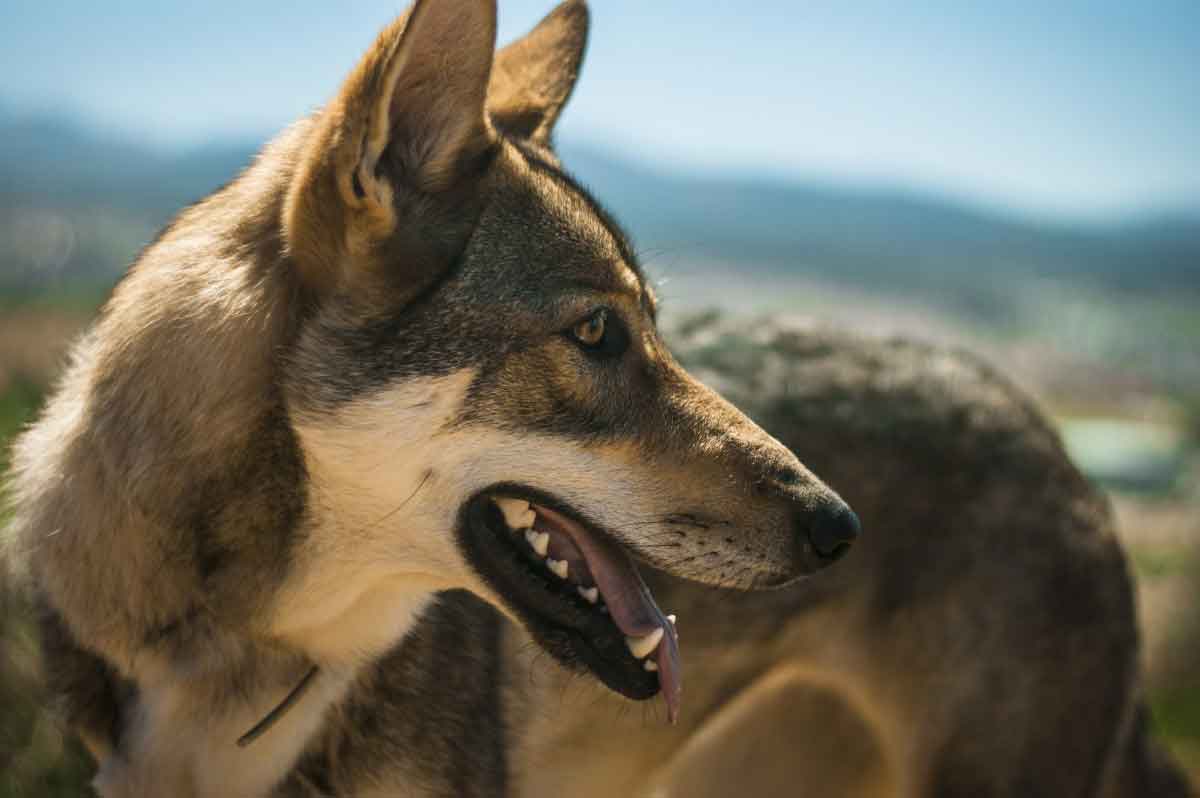
Alaskan Malamute
Estados Unidos FCI 243 . Nordic Sledge Dogs

The Alaskan Malamute he has a reputation for being stubborn and difficult to train among people who do not know him.

Alaskan Malamute

Content

Characteristics "Alaskan Malamute"

Coexistence is important that you have with your new friend. Before considering the acquisition of a dog of the breed "Alaskan Malamute" you know certain factors. Not all breeds of dogs are apt to live in an apartment, you must take into account his character, their need for exercise, their interaction with other pets, their care and if you have small children, their level of tolerance towards them.

Adaptation โ“˜

3,0 of 5 stars (based on 1 review)

friendly dog โ€‹โ€‹โ“˜

1,0 of 5 stars (based on 1 review)

hair loss โ“˜

5,0 of 5 stars (based on 1 review)

Affection level โ“˜

3,0 of 5 stars (based on 1 review)

Need for exercise โ“˜

4,0 of 5 stars (based on 1 review)

Social need โ“˜

4,0 of 5 stars (based on 1 review)

Home โ“˜

1,0 of 5 stars (based on 1 review)

Toilet โ“˜

5,0 of 5 stars (based on 1 review)

Friendly with strangers โ“˜

4,0 of 5 stars (based on 1 review)

barking โ“˜

4,0 of 5 stars (based on 1 review)

Health โ“˜

3,0 of 5 stars (based on 1 review)

Territorial โ“˜

5,0 of 5 stars (based on 1 review)

Cat friendly โ“˜

1,0 of 5 stars (based on 1 review)

Intelligence โ“˜

3,0 of 5 stars (based on 1 review)

Versatility โ“˜

2,0 of 5 stars (based on 1 review)

Child friendly โ“˜

4,0 of 5 stars (based on 1 review)

Surveillance โ“˜

4,0 of 5 stars (based on 1 review)

joy โ“˜

5,0 of 5 stars (based on 1 review)

Alaskan Malamute History

Also called Mally. It is native to the Arctic dog, and one of the oldest breeds within the sledge dogs.

It's a dog with a strong appearance, strong, with good musculature. It is capable of carrying significant weight (until 20 kg) for tens of kilometres. This is a very ancient race, from the first races of sled dogs.

Raised by a tribe of Inuit call mahlemiut. The meaning of the word mahle It is unknown, but it is known that mouse means "people of". Mahlemiut as Mahle people can therefore be interpreted. Following the English phonetics, diction is then transformed into MALAMUTE.

The area inhabited by the people of the MALAMUTE were the banks of Kotzebue Sound, a territory between two great rivers: the Kobuk and the Noatak. Men and women of the tribe mahlemiut (MALAMUTE) They were highly prized among others Inuit tribes for their courage, his pride and his skill in hunting and fishing.

    These dogs were famous for their beauty and for their characteristics of strength and endurance., that made them excellent elements for shooting.

They were, in general, larger and more powerful than the other Nordic dogs, with similar in appearance to the Wolf and large and soft tails carried on the back. Contemporary witnesses tell it between 1870 and 1880 approximately, caribou, for unexplained reasons, changed their usual migratory routes, thus taking away from the Malamute tribes an important source of livelihood.

Under these conditions, families could no longer afford to keep groups of dogs made up of more than two or three dogs.: testimonies of the time talking about men, women and even children helped their dogs to pull the sledges. So the population began to decline and the same fate befell their dogs.

His ability to bear heavy loads becomes apparent when he is chosen to go on expeditions to the Arctic Circle., as the two who placed the Admiral Byrd. They were also used as a rescue of injured dog in World War II.

His presence, always with the head-up, It gives some impressive aspect that, However, It is not at odds with a very friendly and playful character with their owners, Although it gives the impression of being a very serious dog anyone that knows no race.

Alaskan Malamute Physical Characteristics

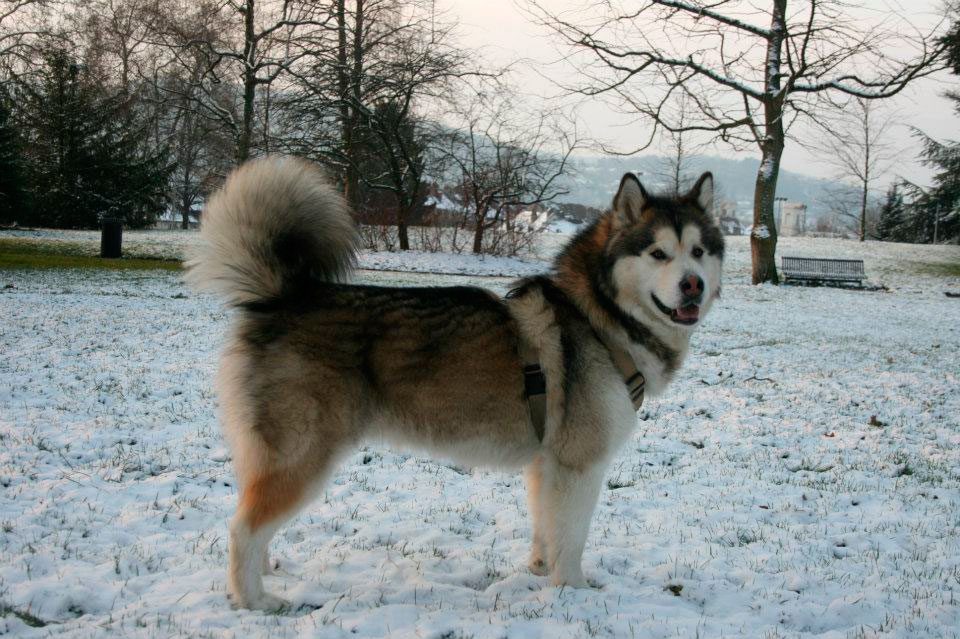
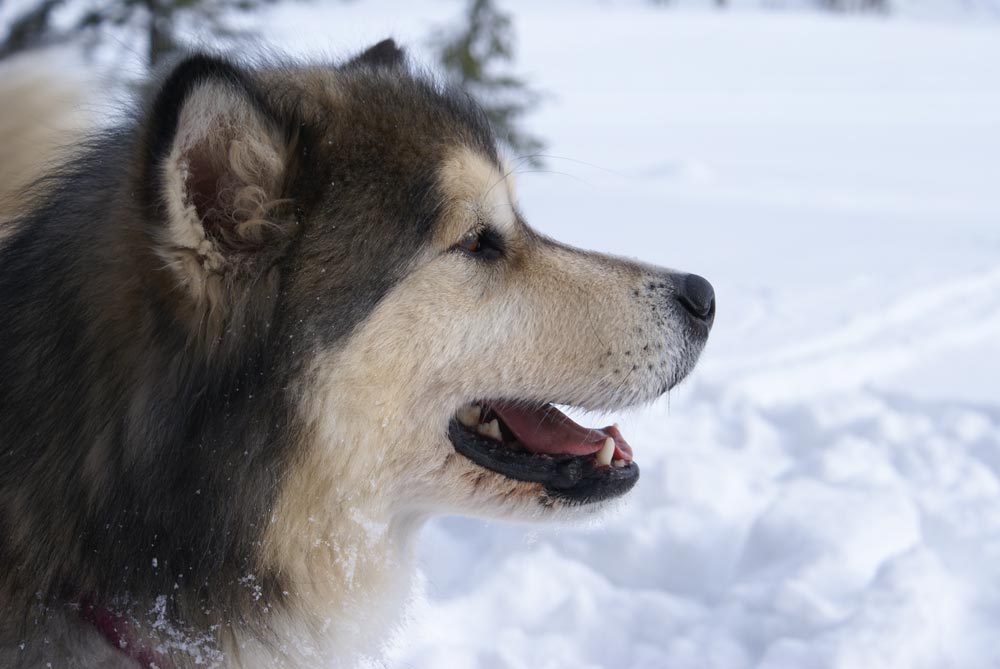
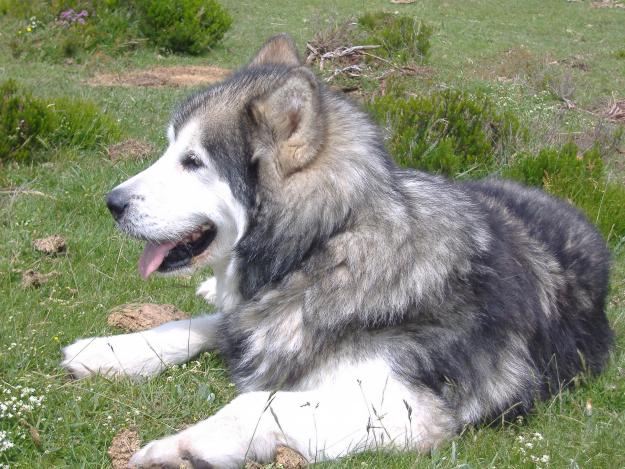
It has two layers hair: an external, thick and rough, and an internal feel oily and woolly, and it is longer in the area of the neck and shoulders, on the back and the tail. Its color It is predominantly gray but colors ranging from white to reddish sand allowed.

The tail is well covered and is carried over the back; has the appearance of a feather bush that sways.

The Malamute stands upright on its legs and embodies the pride and great joy of movement with its head-up posture and eyes that radiate alertness., interest and curiosity. His head is wide. Ears are triangular and are pricked when attention is drawn. The muzzle is massive and tapers only slightly from the base to the nose. It is neither pointed nor long nor short and thick. … The Malamute must have heavy bones and powerful legs, good legs, a deep chest, powerful shoulders and all the other physical conditions you need to do your job efficiently. Your movement should be smooth, harmonious, tireless and completely efficient. He was not bred as a racing sled dog for speed competitions.

In contrast to other races, When it gets wet is not drastically reduced its size.

There are different colors in the Alaskan Malamute, Black with white, coffee, reddish and recently found a color of white Malamute. The history of this color is equal to of the Siberian Husky; that are white to camouflage themselves with the snow and thus be able to catch their prey.

How big is an Alaskan Malamute??

Malamutes have a height at the withers of 64 centimeters in males and 59 centimeters in females. The weight is between 34 and 38 kg.

How long can an Alaskan Malamute live??

His life expectancy is more than 12 years.

Character and skills Alaskan Malamute

It is a sled dog with very ancient origins, little changed from its origin Wolf. This does not mean that it is aggressive. While his appearance and pride can impress the external observer, It's a playful animal (When you are invited to do so), faithful to his master and a great protective instinct with children.

It is a dog outside, She loves the outdoors and is happy to live in the open air; If locks it after a fence, It is very likely that finding the way to escape, because likes freedom and not lose a chance to go in search of an adventure or a career.

Shyness is usually not a good sign, but fortunately, seems to be a pretty rare feature in this race and if it occurs it may be due to causes outside of the animal genetics and having been produced by an owner who has failed to give a proper socialization, keeping him locked up and devoid of psychic stimuli, interaction with the same kind and a very limited human contact. If it detects, It should be monitored and provide training to overcome the problem, that otherwise his behavior may become unpredictable and therefore dangerous.

On the other hand, given the way of Eskimo and nomadic life share everything, is not a race of protection, but it can be a good Dog Alert, It will notify the owner that he sees something strange, with the so particular sound it emits, It is a combination between howl and bark.

    It is not a dog to guard and defense than by nature tend to be friendly with humans.

As a result of his former life, It is a dog with strong herd instinct and hierarchy, which results in frequent attacks with other animals. It also, males are very territorial and competitive with each other so it is not advisable to house them together. Females may be easier to train and better adapted to living in houses. This breed likes human company, has huge doses of loyalty, love and willingness to work, What makes a good dog home.

It is affectionate with children, even with strangers, and he loves to accompany them on all sides. Because of its independent character is reputed to be stubborn and difficult to train among people who do not know. But, There are Malamutes champions working with blind obedience.

They are sensitive, affectionate and playful, but they know to protect themselves effectively. With a good training and socialization are balanced dogs, both physically and psychologically, because they have good potential for learning because they are quick to learn and acute reflexes.

Popular mixes

Mixtures of Alaskan Malamute with other dog breeds are common in the sled dog scene. Many โ“˜ mushers they try it to improve the performance of their dogs. Individuals who from the point of view of the mushers do not bring optimal performance against the sled, they are then sometimes found in the shelter or offered as a companion dog.

Caution, health and diseases

How much care does an Alaskan Malamute need??

The Alaskan Malamute needs regular brushing, at least weekly, of the coat. Change of coat, twice a year, is particularly intensive. Then your house, his car and his clothes will be full of his long hair, even though they brush it daily. But the main effort for its care is due to its nature as a sled dog.

Are there any diseases typical of the Alaskan Malamute?

The Alaskan Malamute it is a very healthy breed of dog, as long as it is not bred in extreme form, which fortunately is seen very little so far: too heavy dogs with too short legs.

What food is best for an Alaskan Malamute?

The Alaskan Malamute is often a picky eater. The โ“˜ mushers they have secret recipes with treats to provide their dogs with enough energy before the races. like most dogs, likes a meaty beef bone and fresh meat.

Activities

The Alaskan Malamute has to work. This usually means its use as a sled dog.. An attitude like that of a farm or family dog โ€‹โ€‹would not be appropriate for the species.

Considerations before purchase

Where can you buy an Alaskan Malamute?

If you are interested in a Alaskan Malamute, the first thing to do is visit some sled dog races. Then you should check if you want to spend at least the next ten years an ordinary life, sporting and intensive with these dogs and also having the objective conditions for it. Then you should get information from a local breeder who is affiliated with a sled dog club.. If everything goes well, you will have a wonderful experience.

Breeding and maintenance

Is an Alaskan Malamute right for me??

The Alaskan Malamute a dog is not for beginners. You have high demands on your attitude, stemming from its destiny as an original sled dog. All the lives of their caregivers, your human family must adjust to your needs. The real MALAMUTE needs the challenge before the sled physically and mentally. Here are several replacement possibilities even without snow. We see a kind of sled on wheels like a tricycle or a training car with four tires. Especially for Malamutes, drag competitions are organized, which are accepted by the dogs with great joy and full commitment. Especially the sport of dogsledding has something very special. Driving with the sleigh of the MALAMUTE through a snowy landscape in winter is one of the greatest experiences of all.

It also allows you to experience a deep unity between man-dog and nature in a way that is hardly possible otherwise.. Of course it is also good for your health.

When traveling, it is better to take the MALAMUTE in an aluminum transport box. The Malamute is not a dog for an apartment. A house with a "garden" should be an ideal space for this race.

The MALAMUTE it is one of the few breeds of dog that can be kept as a pack in a kennel without any problem. But this kennel must be well secured. It is not that Malamutes are a danger to the environment, but they are kings of escape and they dig well and with gusto. You can hardly believe, through which little holes these heavy dogs can escape.

To the malamutes they like to sleep outside and snuggle with their head under their tail during the biggest snowstorm. The garden, where the Malamutes, should not be considered as an ornamental garden, to put it in a nice way. The malamutes require that the entire lifestyle be in tune with this association.

The Alaskan Malamute can be well trained by an experienced dog owner. One must accept the challenge, even love, of fighting mentally with these primitive and self-confident dogs. They will gladly accept their masters and caregivers, will be loyal to them, but they must have leadership qualities combined with a lot of doggy mind. You have to fully commit to the experience of having a MALAMUTE. Not a dog for people without deep canine experience.

Alaskan Malamute photos

Alaskan Malamute Videos
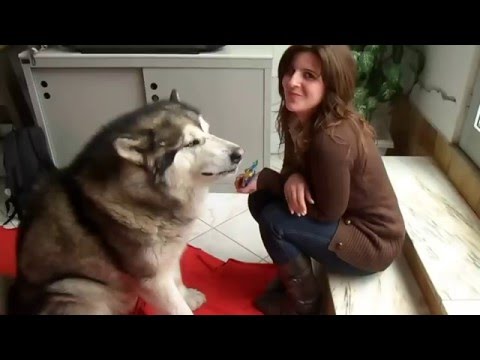
Big Funny Alaskan Malamute

Type and recognitions:

  • FCI CLASSIFICATION:
  • Group :
  • Section : . .

Federations:

  • FCI – Group 5: Section: 1 Nordic Sledge Dogs โ“˜
  • AKC – Work Toy โ“˜
  • ANKC – Group 6 – (Utility) โ“˜
  • CKC – Group 3 – (Working dogs) โ“˜
  • โ€‹KC – Work โ“˜
  • NZKC – Utility Toy โ“˜
  • UKC – Northern races โ“˜

FCI breed standard "Alaskan Malamute"

Origin:
Alaska, United States

Date of publication of the valid original standard:
14.08.1996

Use:

Sledge dog


General appearance:

The Alaskan Malamute is one of the oldest breeds of sled dogs. This is a mighty dog, solidly built, deep chest and strong, muscular body. Its limbs are well approved when standing and its attitude denotes great energy. The head takes her high, with a haughty bearing; the look, always alert, expresses interest and curiosity. The head is wide; the ears are triangular and stand erect when the dog is attentive. The muzzle is compact and its width, from the root to the truffle, only slightly decreases. It's not long, or pointed, but it is not truncated either. The pelage is dense; the hair on the outer coat is coarse and of sufficient length to protect the inner coat of hair which is woolly.
This breed exists in different colors. Face markings are a distinctive feature. These consist of a kind of headdress that covers the head. The face, or is it completely white, or has a stripe and / or a mask. The tail carried over the back has the appearance of an undulating plume. Her hair is abundant.

The malamute is endowed with a strong boss and its limbs do not present any defect. Feet are good, the chest is deep and the shoulders are powerful.

It has all the other necessary physical structures that allow the effective fulfillment of your task. His movements are fluid, balanced, tireless and fully efficient. This dog is not designed to compete with others pulling the sled in speed races, its value lies in its strength and endurance. Any individual characteristic, including temperament, that interferes in the realization of this purpose, must be considered the most serious of offenses.

IMPORTANT PROPORTIONS: The height of the chest corresponds to approximately half the height at the withers; The lowest chest point is exactly behind the forearm. The length of the body, taken from the tip of the shoulder to the tip of the buttock, exceeds the height at the withers.


Behavior / temperament:

The Malamute is an affectionate dog, friendly and not a single master's dog. He is a loyal and devoted companion, willing to play when encouraged, but usually impresses with dignity as an adult.

Head:

It's wide and deep, but it is not coarse or heavy and should be proportionate to the size of the dog. The expression is sweet and indicates an affectionate disposition.

Cranial region:
  • Skull: Wide and moderately rounded between the ears. Narrowing and gradually flattening at the top, close to the eyes; it is round in the region of the cheeks, which are rather flat. A slight furrow can be seen between the eyes. The upper line of the skull and the upper line of the snout form almost a straight line.
  • Depression links (Stop): Light.

facial region:

  • Truffle: In all the colors of the fur, except for the red, It is black, as well as the lips and edge of the eyelids.
    Brown is allowed in red-coated dogs. The nose "e snow" is accepted, which is marked by a lighter band.
  • Snout: It is big and massive, in relation to the size of the skull. Its width and depth decrease very little from the junction with the skull to the nose..
  • Lips: They are tight.
  • Jaws / Teeth: Both jaws are wide and have strong teeth. The incisors form a scissor bite. Both upper and lower prognathism constitute a fault.

EYES: They are arranged obliquely on the skull. They are chestnut, almond-shaped and medium-sized. Blue eyes are an eliminatory foul.

EARS: Medium-sized, although small in relation to the skull. They are triangular in shape and slightly rounded at the end.. Well separated implantation, They are located on the external edges of the back of the skull, aligned to the upper corner of the eye, for which, when the ears are pricked, seem to move away from the skull. When they are upright, ears point slightly forward, but when the dog works, sometimes they bend and stick to the skull. High set ears are a fault.

Neck:

They are arranged obliquely on the skull. They are chestnut, almond-shaped and medium-sized. Blue eyes are an eliminatory foul.

Body:

It is compact in construction, but it is not excessively short. Must not be overweight, and bone structure is in proportion to size.

  • Back: Straight; descends in a slight incline to the hips. Pork loin: Solid and well muscled. A long loin that can weaken
    the back constitutes a foul.
  • Breast : Well developed.

Tail:

Medium insertion following the spine line. The dog carries it on his back when he is at rest. It does not support the upper line, nor does it twist into a closed curl on the back, nor is it covered with short hairs like the fox's tail. The Malamute's tail is very bushy and has the appearance of a wavy plume..

Tips

PREVIOUS MEMBERS: They are muscular and strong boned. Seen from the front, are straight up to the metacarpals.

Shoulder: They are moderately oblique.

Metacarpus: Seen in profile, they are short, solid and slightly oblique.

Previous feet: The feet are "snow racket" type, closed and thick with well-cushioned ear cushions for a firm and compact look. They are large and the toes are close together and well arched. Protective hair grows between the fingers. The pads are thick and tough. Fingernails are short and strong.

LATER MEMBERS: They must be wide. Seen from the back, both when the dog is standing, like when in action, they must be perfectly aligned with the forelimbs. Seen from the back, the dog is not too narrow, not too wide. Hind limb dewclaws are undesirable and should be removed soon after the pups are born.

Thigh: It must be well muscled.Knee: Its angulation is moderate.

Hocks: Its joint is moderately bent and well lowered.

Hind feet: The feet are "snow racket" type, closed and thick with well-cushioned ear cushions for a firm and compact look. They are large and the toes are close together and well arched. Protective hair grows between the fingers. The pads are thick and tough. Fingernails are short and strong.

Movement:

Is loose, fluid, balanced and powerful. The Malamute is agile, taking into consideration its weight and size. Profile views, the hindlimbs produce a strong impulse that is transmitted to the forelimbs through a well-muscled lumbar region. This impulse received by the forelimbs produces a sustained and long movement. Front or back views The limbs move in a straight line and are not even together, not too far apart. During the fast jog, limbs tend to converge on the body's center of gravity. A rigid step, or any movement that is not completely effective and tireless should be penalized.

Mantle

Fur: The outer layer of hairs is thick and rough, never long, nor soft. The undercoat of hairs is dense, of 2,5 to 5 cm. (1-2 ins) of thickness. It is also oily and woolly. Hair length is variable, both on the rough outer coat, as in the inner layer. The hair ranges from relatively short to medium on the lateral parts of the body; its length increases around the shoulders and neck, on the back and on the rump, as well as in pants and plume. Usually, the Malamute has shorter and less dense hair during the summer months. At the exhibitions, this breed must be presented in the natural state. Grooming is only allowed to give the feet a clean appearance.

Color: Usual colors vary, from light gray through intermediate tones to black to red. The combination of colors in the inner layer of hairs is accepted, in the face (supraciliary arches, ears, lips, nose) and between the white and pigmented areas. The only uniform color that is accepted is white. This is always the predominant color in the lower parts of the trunk, a part of the limbs, the feet and a part of the facial markings. A white stripe across the forehead, a necklace, the both, as well as a small spot on the neck they attract attention and are admitted. The Malamute's coat is laid out like a blanket; an irregular color spreading over the whole body or in the form of asymmetric splashes should not be allowed.


Size and weight:

This breed has a natural range of sizes.

For work, the desired sizes are: 63,5 cm. (25 inches) height at the withers for a weight of 38 kg (85 English pounds) in males, and in females 58,5 cm. (23 inches) height at the withers for a weight of 34 kg (75 English pounds). But, size considerations should not be more important than type, the proportions, movement and everything that concerns function. If during the judging some dogs are of equal type, proportions and function, The one that is closest to the desired size will be selected to be able to carry out heavy work.

IMPORTANT: When judging the Malamute, what should prevail over any other consideration is its function as a sled dog used to haul heavy loads. The severity of the penalty will depend on how far the specimen deviates from the description of the ideal Malamute and to what extent a particular defect affects work ability.. Malamute's extremities must show an unusual force and a very great propulsion power. Any sign of imperfection in the limbs or feet, front or rear, either when the dog is standing, or when in action, should be considered a serious offense. Given these preconditions, Faults would be the following: crushed feet, cow hocks, defective metacarpals, straight shoulders, lack of angulation, Rigid movement (or any movement that is not balanced, energetic and uniform), lack of substance, chest that is not deep enough, thick or light-boned body and mediocre overall proportions.


Fouls:

Any deviation from the aforementioned criteria is considered as a fault and the severity of this is considered to the degree of the deviation to the standard and its consequences on the health and well-being of the dog..

FALTAS DESCALIFICANTES:

  • Aggressiveness or extreme shyness.
  • Any dog โ€‹โ€‹showing clear signs of physical or behavioral abnormalities.
  • Aggressive or fearful dog.
  • Blue eyes.


N.B.:
  • Males should have two normal-appearing testicles fully descended into the scrotum..
  • Only functionally and clinically healthy dogs, with the typical conformation of the breed, should be used for parenting.

Source: F.C.I - International Cynological Federation

Alternative names

1. Alaskan Malamute, Mal, Mally (English).
2. Malamute de l’Alaska (French).
3. Alaskan Malamute (German).
4. Malamute-do-alasca (Portuguese).
5. Alaskan malamute (espaรฑol).

โ–ท The world of Pets: Dogs, cats, birds, reptiles, amphibians

Shikoku
Japรณn FCI 319 - Asian Spitz and related breeds
Shikoku

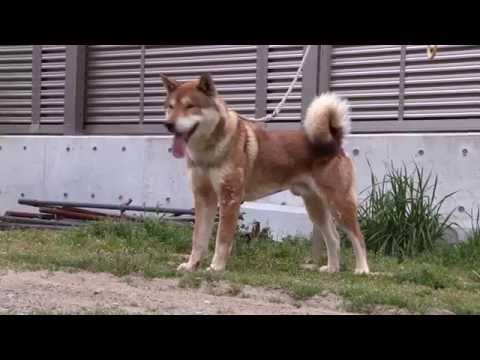
Less stubborn than the other Spitz breeds, the Shikoku, he is very little known outside his native land, Japan

Content

History

Ceramic figures from Japan that show representations of dogs have been preserved since ancient times., that look like this Japanese breed. The current breed dates back to crosses with the now extinct inu Japanese. The original field of application of these dogs was hunting, more precisely hunting in the prefecture of Kochi on isla de Shikoku – That is why the race is sometimes called ยซperro Kochiยซ. But, name Tosa-Inu, which is used in part in Japan, it's misleading, Because under the name ยซTosaยปThere is also another Japanese race. It also, three varieties of Shikoku, which were named after the respective region in which they live: pity, Hongawa and Hata. As the Hongawa region was the most difficult to access in the past, This variety is considered to be the least modified by other influences and the closest to the ideal of Shikoku. Today, the Shikoku It is considered the national dog of Japan along with the Akita.

Photos:

1 – ยซShikoku Inuยป by https://pxhere.com/en/photo/1589477

Shikoku Physical Characteristics

the typical silhouette Spitz characterizes the Shikoku: It has relatively small, erect ears and a compact body. The tail is well placed and curled over the back. This medium-sized breed with a height at the withers of about 53 cm is located between the Akita bigger and the Shiba Inu smallest within the Japanese family Spitz. For many laymen in Europe this four-legged friend is also reminiscent of a dog which is seen much more often here, the Siberian Husky. The Shikoku coat can be black sesame or white sesame. The dense coat consists, as is typical in dogs of the type Spitz, on a long, hard top coat over a soft, dense undercoat.

Shikoku character and abilities

Shikoku

The loyalty, intelligence and a certain stubbornness form the character of this dog with an agile nature. He is vigilant and behaves in a neutral manner to the point of distancing himself from strangers. When they meet conspecifics, conflicts can occur, particularly with males, because the Shikoku tend to dominate. As a hunting dog it is characterized by its corresponding sharpness.

His original behavior can also be seen in his dealings with people – he likes to lick his reference people and looks for physical contact. Sometimes shows a conspicuous preference for unpleasant odors from the human point of view. The Shikoku He is very agile and likes to be outdoors – however impetuous it may be on the move here, a Shikoku busy behaves calmly and pleasantly indoors, where he appreciates quiet hours and pampering. Although he is a stubborn dog, not as strong as the other races of Spitz from Japan. But: The special character of Spitz not suitable for all dog lovers.

Photo:

2 – Shikoku, female. Colour: sesame by https://commons.m.wikimedia.org/wiki/File:Shikokusesame1.jpg

Shikoku Care

The coat of this Japanese hunting dog is robust and easy to care for, but it must be brushed regularly, especially during coat change twice a year. advice: If you brush your dog every day during this time, It will greatly reduce hair loss at home and also shorten the "hairy phase" in a few days. Outside these few weeks of the year, grooming every few days is enough. Check your ears right now too, so you can clean them with dog ear cleaner if needed. You must bathe your dog very rarely, at most every few months, and then use a mild dog shampoo. But, it makes sense to get the puppy used to bathing. But, it is usually sufficient to simply remove the dried dirt from the coat. Check the length of the claws – especially with older dogs – to shorten claws that are too long with special pliers. This is how injuries are prevented.

Shikoku Education

If he Shikoku respects his two-legged pack leader as a wise and just leader, will gladly follow your instructions. But, first you need to earn the respect of this dog. Be consistent and bring some tolerance to the small, thick skull of this four-legged friend, that will never be completely subordinate.

Screaming or harshness will not help you and will destroy your relationship with this loyal companion.. A thorough knowledge of dog training is needed to direct the dominance and hunting instinct of dogs. Shikoku in regular courses. Please, keep in mind that only a well-trained breed of dog can make a well-behaved friend, otherwise you will look for another job.

Attending classes with dog trainers in general can be of great benefit, so that the Shikoku that tends to dominate, get stronger in social affairs and learn to get along with other dogs. Male dogs in particular can face challenges that need to be countered from puppyhood. So do not underestimate the importance of the socialization phase, because any omission can only be corrected with difficulty.

Shikoku Health

These robust dogs are considered tough and persistent. They hardly have a genetic disposition for disease, if the breeding is done responsibly. It goes without saying that you should only buy puppies from a reputable breeder who belongs to a club.. The breeder will give you competent information about the care of your animal and show you the corresponding tests. In good health, Shikoku reaches an average age of about 13 years.

Where can I find my Shikoku?

The breed is one of the very rare breeds outside of Japan. Consequently, find a puppy of Shikoku can be difficult if you have decided to have one as a new member of the family. But don't despair, because there are a handful of serious breeders in Europe who are dedicated to this breed. The first official litter outside of Japan was in 2000 in the Netherlands, where the breeders of Shikoku continue to regularly deliver litters to responsible hands. But, you may have to accept a longer trip before you can give your puppy a hug from Shikoku. No matter how rare the breed is, don't reduce the demands you can and should make on serious parenting. Learn about puppy care, of your health, ask the breeders and ask them to show you the appropriate tests, for example, in connection with exams for hip dysplasia. Of course, the breeder must also belong to a club. Will be happy to give you some good advice, but in return you will also have some questions to see if you can offer a good home to one of your protรฉgรฉs.

If you are looking for a Shikoku adult, you will need a lot of luck in europe. It is more promising to look for crosses of type Spitz in animal shelters and also get an impression of the breeds of Nordic Spitz.

Characteristics "Shikoku"

Coexistence is important that you have with your new friend. Before considering the acquisition of a dog of the breed "Shikoku" you know certain factors. Not all breeds of dogs are apt to live in an apartment, you must take into account his character, their need for exercise, their interaction with other pets, their care and if you have small children, their level of tolerance towards them.

Training ?

2,0 of 5 stars (based on 1 review)

Suitability of the apartment ?

2,0 of 5 stars (based on 1 review)

Can be alone all day ?

2,0 of 5 stars (based on 1 review)

Suitable as a first dog ?

2,0 of 5 stars (based on 1 review)

Weight gain ?

3,0 of 5 stars (based on 1 review)

Health ?

5,0 of 5 stars (based on 1 review)

Intelligence ?

4,0 of 5 stars (based on 1 review)

Kindness with child ?

4,0 of 5 stars (based on 1 review)

Tendency to bite ?

3,0 of 5 stars (based on 1 review)

Tendency to bark ?

4,0 of 5 stars (based on 1 review)

Tendency to flee ?

5,0 of 5 stars (based on 1 review)

hair loss strength ?

4,0 of 5 stars (based on 1 review)

Suitable as a guard dog ?

4,0 of 5 stars (based on 1 review)

Joy ?

4,0 of 5 stars (based on 1 review)

Cat friendliness ?

2,0 of 5 stars (based on 1 review)

Power level ?

4,0 of 5 stars (based on 1 review)

Videos "Shikoku"

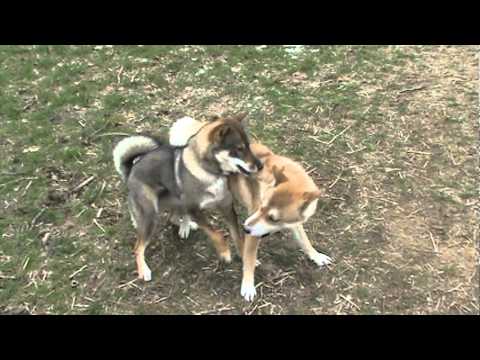
Shikoku Ken / Shikoku Inu play
Shikoku ken in Japan Spring 2014 Shikoku dog
Shikoku ken in Japan Spring 2014 ๅ››ๅ›ฝ็Šฌ

Type and recognitions:

  • FCI CLASSIFICATION:
  • Group :
  • Section : . .

Federations:

  • FCI – Group 5: Spitz-type dogs and primitive type – Section 5: Asian Spitz and related breeds. โ“˜
  • CKC – [Without Miscellaneous] โ“˜

FCI breed standard "Shikoku"

Origin:
Japan

Date of publication of the valid original standard:
16.06.1999

Use:

Hunting and companion dog.


General appearance:

It is a medium-sized dog; And his musculature is well balanced, well developed and well defined. The ears are erect and the tail is curled or in the form of a hoz. Its structure is strong, Compact and solid bones.

IMPORTANT PROPORTION : The ratio of the height at the withers to the length of the body is 10 : 11.


Behavior / temperament:

It is a great resistance dog, vivacious with a sense of smell and acute ear. Is energetic and very alert, In addition to an enthusiastic hunter. With his master he is docile.

Head:

---

Cranial region:
  • Skull : Wide forehead.
  • Depression links (Stop) : shallow, although defined.

facial region:

  • Nose : Black.
  • Snout : Rather long and wedge -shaped. The nasal helm is straight.
  • Lips : Tight.
  • Jaws / Teeth : Strong teeth. The joint is in the form of scissors.
  • Cheeks : Well developed.
  • Eyes : Relatively small, triangular and well separated. Its color is dark brown.
  • Ears : They are small, triangularly and slightly inclined to the front. They appear well erect.

Neck:

Thick and strong.

Body:

  • Cross : High and well developed.
  • Back : Straight and strong.
  • Pork loin : Wide and muscled.
  • Breast : Deep. The ribs are well sprung.
  • Belly : Well collected.

Tail:

High implementation, It is thick and carried on the back firmly curved or curved like a hoose. The tip almost reaches the corvejรณn when the tail is down.

Tips

PREVIOUS MEMBERS :

  • Shoulder : Moderately inclined and developed muscles.
  • Elbows : They are well attached to the body.
  • forearms : Straight and well defined.
  • Metacarpus : Slightly inclined.

LATER MEMBERS : They're strong, well-developed muscles.

Hock : Moderately angular and very firm.

FEET : Well together; The fingers are well arched. The pads are hard and elastic. The nails are hard and black, or a dark color.

Movement:

Elastic, of small strides, Although light. The movement is fast, And it is possible to observe a quick rotation.

Mantle

HAIR : The outer hair of hairs is rough and straight. The undercoat of hairs is soft and dense. The tail hair is rather long.

COLOR : Sesame, Black Sesam and Sesam Red.

Sesam color definition :

โ€ข Sesame : Proportionate mix of black and white hairs.
โ€ข Black Sesam : More black hairs than white.
โ€ข Sesam rojo : Coat color red, mixed with black hairs.


Size and weight:

Height to the cross :

  • In males : 52 cm..
  • In females : 46 cm..

A tolerance of +/- 3 cm..


Fouls:

Any deviation from the aforementioned criteria is considered as a fault and the severity of this is considered to the degree of the deviation to the standard and its consequences on the health and well-being of the dog..

โ€ข Inverted sexual characteristics.
โ€ข Lightweight lower prognathism.
โ€ข Wide.
โ€ข Shyness.

MISS PLAYOFFS

โ€ข Aggressive or fearful dog.
โ€ข Pronounced upper or lower prognathism.
โ€ข Ears that do not appear upright.
โ€ข Hanging tail, short tail.

Any dog โ€‹โ€‹showing clear signs of physical or behavioral abnormalities must be disqualified..


N.B.:

Males should have two normal-appearing testicles fully descended into the scrotum..

Source: F.C.I - International Cynological Federation

Alternative names:

1. Kochi-ken, Shikoku-ken, Shikoku inu (English).
2. chien de Kลchi, shikoku-inu, kochi-ken, Shikoku inu (French).
3. Shikoku inu, Kochi-Ken, Shikoku-ken (German).
4. Shikoku inu, kochi-ken, Mikawa Inu, Shikoku-ken, cรฃo-lobo japonรชs (Portuguese).
5. Kochi-ken, Shikoku-ken, Shikoku (espaรฑol).

โ–ท The world of Pets: Dogs, cats, birds, reptiles, amphibians

Volpino Italiano
Francia FCI 195 - European Spitz

Volpino Italiano

Despite the temperament of Volpino Italiano, and its small size, It is a very committed and energetic dog. Cheerful and playful and very attached to their masters.

Content

History

The Volpino Italiano (that means little Fox, in Italian) It is a dog of very ancient origins., as the strain that belongs to the Spitz. It was a very widespread breed of dog in the Renaissance in which appears in some of the representations of the period. Unfortunately, the race, in 1965 was in danger of extinction (The Italian Club Cinolรณgico, only five copies that year), and for a short time, recovering numerical and qualitative.

The Volpino, It has been recognized and loved by Italian royalty for centuries, being a favorite especially of women.

Even bearing a strong resemblance with the Pomeranian, the breed is much older and thus has a different historical background. Northern dogs found their way South very early in the history of domestic dogs.

The Italian word for wolf is lupo, and the Keeshond it is called so much Lupino and Volpino in Italian. Volpe, means Fox in Italian, from there "Volpino" what, to say, little Fox in Italian. Despite its long history, the Volpino is unknown outside of Italy and is now rare, even in his homeland..

Despite its small size, This dog was originally as a watchdog. Its function was to alert the Mastiffs (Big Dogs) the presence of an intruder. But, due to his lovely temper and great intelligence, as well, they became very popular as pets, companion dogs.

For unknown reasons the popularity of the breed fell in 1965. In 1984 an attempt was made to revive the race. Y, currently, can see the race Volpino living as guard dogs on breeding farms, or as a companion dog, but still the Volpino they are considered a rare breed, position that there are only about 2000 copies to the length and breadth of the world.
Most of the Volpinos, it is found in Italy but some people are breeding them in Scandinavian countries, in the United Kingdom and the United States.UU.

Physical characteristics

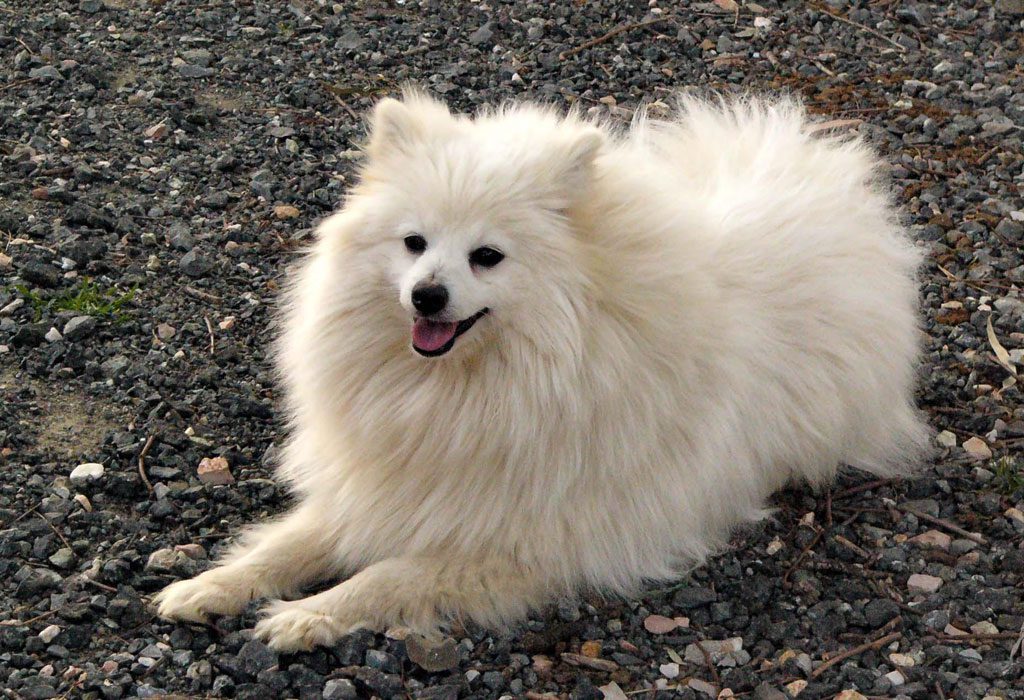
The Volpino Italiano it is a small but compact dog with a harmonious physique. Can grow up to 30 cm tall and weigh 5 kg. His long, silky coat is soft and lined with a dense undercoat. It can be white, red, brown or black. There are also champagne colored animals, but they are not very popular in breeding.

Character and skills

The Volpino Italiano has a very individual character, which means that even as a puppy you need a lot of patience and enough consistency in your upbringing. Due to its high intelligence it is very teachable and therefore very good for training. Has a very lively temperament, is curious and therefore available for all kinds of fun. So, is particularly suitable for any type of dog sport and needs sufficient mental and physical activity.

In the family it is a very affectionate dog, loving and vigilant. Has a natural distrust of strangers.
It is an ideal dog for the family and its character also makes it very suitable to live with children.

With it you can spend a lot of time in nature. Despite its size, the Volpino Italiano it is a very robust dog that is not deterred by the rain, snow and cold to do your daily need for exercise.

Volpino care

The puppy's coat requires a lot of care: should not only be brushed regularly, but also bathed from time to time.

Esperanza de vida of ยซVolpino Italianoยป

The ยซVolpino Italianoยป, which originally descends from German Spitz, he is a very robust dog, which can have a high life expectancy of up to 15 years.

Typical diseases ยซItalian Volpinoยป

Also in terms of health, the Volpino he is a very robust dog, who does not have any common hereditary disease.
In rare cases the breed is affected by an eye disease, which can happen especially in old age. May lead to lens shift of the eye, what can lead to glaucoma.

Characteristics "Volpino Italiano"

Coexistence is important that you have with your new friend. Before considering the acquisition of a dog of the breed "Volpino Italiano" you know certain factors. Not all breeds of dogs are apt to live in an apartment, you must take into account his character, their need for exercise, their interaction with other pets, their care and if you have small children, their level of tolerance towards them.

Adaptation โ“˜

3,0 of 5 stars (based on 1 review)

friendly dog โ€‹โ€‹โ“˜

3,0 of 5 stars (based on 1 review)

hair loss โ“˜

3,0 of 5 stars (based on 1 review)

Affection level โ“˜

4,0 of 5 stars (based on 1 review)

Need for exercise โ“˜

2,0 of 5 stars (based on 1 review)

Social need โ“˜

3,0 of 5 stars (based on 1 review)

Home โ“˜

3,0 of 5 stars (based on 1 review)

Toilet โ“˜

4,0 of 5 stars (based on 1 review)

Friendly with strangers โ“˜

3,0 of 5 stars (based on 1 review)

barking โ“˜

4,0 of 5 stars (based on 1 review)

Health โ“˜

4,0 of 5 stars (based on 1 review)

Territorial โ“˜

4,0 of 5 stars (based on 1 review)

Cat friendly โ“˜

3,0 of 5 stars (based on 1 review)

Intelligence โ“˜

4,0 of 5 stars (based on 1 review)

Versatility โ“˜

3,0 of 5 stars (based on 1 review)

Child friendly โ“˜

4,0 of 5 stars (based on 1 review)

Surveillance โ“˜

3,0 of 5 stars (based on 1 review)

joy โ“˜

4,0 of 5 stars (based on 1 review)

Images "Volpino Italiano"

Photos:

1 – Volpino Miฤ™dzynarodowa Wystawa Psรณw Rasowych w Katowicach 28 – 30. 03.2008 by Lilly Mreal name: Maล‚gorzata Miล‚aszewska / CC BY-SA
2 – Volpino Italiano by https://pxhere.com/es/photo/833618
3 – Volpino Italiano by https://pxhere.com/es/photo/1428909
4 – Volpino Italiano by https://pxhere.com/es/photo/863623
5 – Volpino Italiano by https://pxhere.com/es/photo/1273902
6 – Volpino Italiano owned by Kennel Hedehuset – Denmark by ยฉ Mete Appel / Kennel Hedehuset

Videos "Volpino Italiano"

youtube.com/watch?v=BlqMM99OREA

ยซVolpino Italianoยป – Breed of dog

youtube.com/watch?v=Ot3uyndzOAI

ยซVolpino Italianoยป Dog Breed – Facts and Information

Type and recognitions:

  • FCI CLASSIFICATION:
  • Group :
  • Section : . .

Federations:

  • FCI – Group 5 – Section 4 European Spitz. โ“˜

FCI breed standard "Volpino Italiano"

Origin:
Italy

Date of publication of the valid original standard:
9.06.1999

Use:

Guard and companion dog.


General appearance:

This is a small format Spitz, very compact, harmonious and covered with long, bristly hair.

IMPORTANT PROPORTIONS: It has a square shape; The length of the head reaches almost 4/10 of body length.


Behavior / temperament:

He is very attached to his environment and the people he knows well.. His temperament is very marked, jovial, lively and mischievous.

Head:

It has a pyramidal shape. Its length reaches 4/10 the height at the withers.

Cranial region:
  • Skull : Its length exceeds that of the snout (6,5/5), its bizygomatic width is greater than half the length of the head (7,3/11,5). It is more or less ovoid in shape, both in the sagittal sense, as in the transversal. The mid-frontal sulcus is not very marked, as well as the occipital protuberance. The upper axes of the skull and snout are slightly convergent. The bones protruding from the forehead are well developed and fall almost perpendicularly on the root of the nasal cannula..
  • Depression links (stop) : It is rather accentuated.

facial region:

  • Truffle : It's humid, fresh, with the windows wide open. Profile view, It is located on the same line as the nasal cannula., and does not exceed the anterior line of the lips. Its color is always black, both in the white-furred specimens, as in those with red fur.
  • Snout : Pointed. Its length is less than that of the skull and its lateral faces are convergent.. The nasal cannula is rectilinear. In profile, the lower edge of the snout is determined by the jaw.
  • Lips : Seen from the front, the upper lip draws a straight line on its lower edge. In the corner, the mucosa is not visible, so that, the lips are very short. The edges of the lips are pigmented black.
  • Jaws / Teeth : The jaws are not strong in appearance, but they are normally developed and adapt perfectly due to their anterior edge. Its branches are rectilinear. The teeth are white, are regularly aligned and complete. They are perfectly developed. The joint is in the form of scissors, but the pincer-shaped joint is accepted.
  • Eyes : They are normal size and open wide. They denote vigilance and liveliness. The palpebral opening is rounded; They are placed in planes that form a wide open angle behind.
    The eyelids join perfectly against the eyeball. The iris is dark ocher in color and the edges of the eyelids are pigmented black..
  • Ears : Short, form triangular, upright. The cartilage is rigid. The inner surface of the ears faces forward. Set high and very close to each other. The length of the ears reaches approximately half the length of the head.

Neck:

Its length is almost equal to that of the head. His bearing is always high. Your skin is well attached to the underlying tissues.

Body:

It has a square shape. Its longitude, measured from the tip of the shoulder, even the gluteus, is equal to the height at the withers.

  • top line : The dorsal line is straight; in the region of the back it is slightly convex.
  • Cross : It protrudes slightly above the line of the back.
  • Rump : Extends the line of the spine. Its obliquity, from the hip to the base of the tail, is 10ยฐ below the horizontal.
  • Breast : Come down to the level of the elbows. The ribs are tight. The sternal region is long.
  • bottom line : From the sternum to the belly there is little ascending. The depth of the flanks is not very pronounced.

Tail:

It is located in the extension of the rump, always curled up on the back. Its length is somewhat less than the height at the withers.

Tips

PREVIOUS MEMBERS : Seen in conjunction, They are parallel and vertical to each other and, in relation to the median plane of the body, they are perfectly parallel.

  • Shoulder : The length of the shoulder blade is equal to ยผ of the height at the withers. Its obliquity below the horizontal is 60ยฐ.
  • Arm : It is longer than the scapula and its obliquity below the horizontal is 60ยฐ. Appears approximately parallel to the median plane of the body.
  • Elbows : They are parallel to the median plane of the body.Forearm : Extend the vertical line. It is light boned. Its longitude, measured from the ground to the elbow, It is slightly more than half the height at the withers.
  • Carpus and metacarpus : Seen from the front, extend the vertical line of the forearm. Seen in profile, they are oblique.
  • Front feet : They are oval in shape and the fingers are well together.. The central and digital pads, as well as nails, they are black.

LATER MEMBERS : As a whole and seen from behind, They must follow a perfectly vertical line from the tip of the gluteus to the ground. They are parallel to each other.

  • Thigh : Its length is equal to 1/3 the height at the withers. It is perfectly parallel to the median plane of the body.
  • Leg : Its length is slightly less than the thigh. It is made of light bones and its obliquity below the horizontal is 55 a 60ยฐ.
  • Hock : The distance between the tip of the hock and the ground slightly exceeds ยผ of the height at the withers.
  • Metatarsus : It is vertical and, seen both in profile and from behind, his poise is perfect.
  • Rear feet : Oval, like the front feet and with the same characteristics.

Movement:

It should not be in jumps, not even during the jog, not even during the gallop. All movements must be with wide steps.

Mantle

SKIN : It is well applied and stretched, no appearance of slackness in any part of the body.

HAIR : Bushy, very long, straight and bristly in an exceptional way. It is stiff and rough in texture; should never be straight. Even if it is not very abundant, should always be bristly. The trunk gives the impression of being wrapped in a sleeve, particularly on the neck, where the hair forms a wide collar. The head is covered by semi-long hair that hides the base of the ears..
The hair that covers the muzzle is short. Above the ears the hair is very fine and thin.. The tail is provided with very long hair. On the posterior edges of the limbs the hair forms a fringe.

COLOR :

โ€ข Solid white.
โ€ข Solid red
โ€ข Champagne, accepted color, but not desirable. A pale orange tone is acceptable over the ears., But this is still an imperfection..


Size and weight:

Height to the cross :

  • Of 27 to 30 cm in males.
  • Of 25 to 28 cm in females.


Fouls:

Any deviation from the aforementioned criteria is considered as a fault and the severity of this is considered to the degree of the deviation to the standard and its consequences on the health and well-being of the dog..

MISS PLAYOFFS :

โ€ข Nose of any color other than black.
โ€ข Convex nasal canal.
โ€ข Different colored eyes.
โ€ข Tail that falls between the hind limbs.
โ€ข Size that exceeds by more than 3 cm the limits established by the standard.

DISQUALIFICATION FAULTS:

โ€ข Aggressive or fearful dog.
โ€ข Divergence of the craniofacial axes.
โ€ข Superior prognathism.
โ€ข Total depigmentation of the nose or the edges of the eyelids.
โ€ข Fully hanging ears.
โ€ข No queue, or very short tail, either congenital or artificial.
โ€ข Any color other than white, red, or the color champagne (although it is not the most desirable).
โ€ข Red spots on a white background and white or black spots on a red background.
Any dog โ€‹โ€‹showing clear signs of physical or behavioral abnormalities must be disqualified..


N.B.:

Males should have two normal-appearing testicles fully descended into the scrotum..

Source: F.C.I - International Cynological Federation

Alternative names:

1. Volpino, Cane del Quirinale, Cane di Firenze (English).
2. Volino (French).
3. Italienischer volpino (German).
4. Volpino italiano (Portuguese).
5. Zorrito italiano, volpino (espaรฑol).

โ–ท The world of Pets: Dogs, cats, birds, reptiles, amphibians

Greenland Dog
Dinamarca FCI 274 - Nordic Sledge Dogs

Greenlandรฉs

The Greenland Dog not an easy breed to control, it is necessary to thoroughly document their character.

Content

Characteristics "Greenland Dog"

Coexistence is important that you have with your new friend. Before considering the acquisition of a dog of the breed "Greenland Dog" you know certain factors. Not all breeds of dogs are apt to live in an apartment, you must take into account his character, their need for exercise, their interaction with other pets, their care and if you have small children, their level of tolerance towards them.

Adaptation โ“˜

2,0 of 5 stars (based on 1 review)

friendly dog โ€‹โ€‹โ“˜

4,0 of 5 stars (based on 1 review)

hair loss โ“˜

5,0 of 5 stars (based on 1 review)

Affection level โ“˜

3,0 of 5 stars (based on 1 review)

Need for exercise โ“˜

5,0 of 5 stars (based on 1 review)

Social need โ“˜

4,0 of 5 stars (based on 1 review)

Home โ“˜

4,0 of 5 stars (based on 1 review)

Toilet โ“˜

2,0 of 5 stars (based on 1 review)

Friendly with strangers โ“˜

2,0 of 5 stars (based on 1 review)

barking โ“˜

4,0 of 5 stars (based on 1 review)

Health โ“˜

4,0 of 5 stars (based on 1 review)

Territorial โ“˜

2,0 of 5 stars (based on 1 review)

Cat friendly โ“˜

1,0 of 5 stars (based on 1 review)

Intelligence โ“˜

4,0 of 5 stars (based on 1 review)

Versatility โ“˜

2,0 of 5 stars (based on 1 review)

Child friendly โ“˜

3,0 of 5 stars (based on 1 review)

Surveillance โ“˜

2,0 of 5 stars (based on 1 review)

joy โ“˜

5,0 of 5 stars (based on 1 review)

History

It belongs to the oldest dog breeds in the world.

For centuries, the Greenland Dog has accompanied the Inuit in their common homeland: It is said that more than 1.000 years he came with his ancestors from Siberia to North America. In the icy expanses it still serves the inhabitants as a versatile all-rounder and has always been bred specifically for its ability to work and its robustness.. Helped in hunting seals and polar bears, as well as in dragging loads through ice and snow, even over long distances. In times of need, it also served as food for the inhabitants in the past.

The outstanding physical abilities of the Greenland Dog they also sparked the interest of the first polar explorers, who saw him as an ideal companion for expeditions. These may include, Roald Amundsen, the most successful explorer of the Arctic and Antarctic, was also accompanied by Greenland dogs. The breed has its origin in Greenland and, therefore, is under the patronage of Denmark. Genetically, the Greenland Dog is identical to canadian eskimo dog, that is not recognized by the FCI. Today, the Greenland dog belongs to a total of four breeds of sled dogs. By his side are the Alaskan Malamute, the Samoyed and the Siberian Husky.

Physical characteristics

The characteristics of this dog have always been more important than its appearance. The strong build allows the Greenland Dog to drag loads through the snow for long periods of time. Size variations are possible, with males generally over 60 cm in height to the cross, females over 55 cm.. The ears are upright, triangular and slightly rounded at the tip. This sled dog wears its tail slightly curled on its back. The coat consists of a smooth undercoat and a fairly thick, smooth top coat. The fur is longer on the head, the legs and the lower part of the tail than the rest of the body. All coat colors except merle and albino are allowed. The eyes should be slightly slanted and dark – blue or different colored eyes lead to disqualification according to the standard.

Character and skills

From Greenland, the largest island in the world, this four-legged friend has conquered the hearts of many dog รขโ‚ฌโ€นรขโ‚ฌโ€นlovers. But, keeping a sled dog like this requires not only experience, but above all a lot of space and time to satisfy the need for movement of this robust worker.

The character of the breed is determined by its field of application: Like Inuit sled dogs, the greenlandic dogs they are very persistent and full of energy. It also, hunting companions are brave and show a pronounced hunting instinct. Because most of them lived in the pack and rendered their faithful services to several people, do not tend to bond strongly with people , but they are basically human friendly – and therefore are not suitable as watchdogs. But, they do not usually miss the opportunity to greet friends – or strangers – loudly and cheerfully.

Attention: The greenlandic dog may not bark much, but tends to howl a lot. He loves to live with other dogs in a pack.

Greenland Dog Education

Who wants to train a Greenland Dog need knowledge, experience with dogs and above all a lot of patience. A clear hierarchy is very important to the independent sled dog and will question it if the opportunity presents itself.. This applies to other dogs as well as their owners. You need a reliable consequence and a sensible education, accept your own head (stubborn) of the race. Exhausting this dog both physically and mentally is the basic requirement for a good education., as a little challenged sled dog will want to vent elsewhere, and this is probably not to the liking of its owners. It makes sense to go to puppy school with this dog, to be widely socialized with conspecifics of different sizes and breeds. If you want to train with the growing dog in a canine school, you should clarify in advance if the trainers have already had experience with the special character of sled dogs.

Greenland Dog Health

For centuries, robustness has been the main breeding objective of this four-legged friend, It is not surprising that the Greenland Dog be one of those breeds that have hardly any health restrictions. But, when i buy a puppy, look for parents who are free of hip dysplasia (HD) – some lines may have a slight tendency to this. As with all big dogs, the stomach can also be twisted, so it is important to take breaks after meals. Due to its origin and its fur, that adapts to icy conditions, These breeds are considered to be heat sensitive and, therefore, should not be kept in hot countries. Nor should you encourage your Greenland Dog to carry out sports activities above the 15 degrees Celsius. Your companion will feel correspondingly comfortable in the colder season. In winter, However, make sure you take proper care of the paws, as road salt can quickly lead to chapped or inflamed skin.

Greenland dog nutrition

One Greenland Dog in the use of sled dogs consumes enormous amounts of energy and needs an appropriately adapted diet. So, it is important to adapt the amount of food to the workload and the constitution of these dogs – information provided by manufacturers can only provide approximate guidelines. Of course, the puppy's energy requirement is not yet that high, since you should only move moderately anyway.

Feed your puppy three to four servings of a high-quality food per day.. Regardless of the age of your puppy, meat should be the first element of the diet and therefore the main component of food. It also, cereals have no place in dog food. If your quad performs well, increase the amount of food accordingly.

Food should be relatively high in fat and low in carbohydrates, as well as dietary fibers to supply your endurance athlete with sufficient energy. It is important that a session of physical activity is carried out with a time interval between the last meal – it is better to feed your Greenland dog three hours before training and in any case avoid too much exercise after feeding. This is the only way to minimize the risk of a life-threatening stomach twist. Of course, it is also important that fresh water is always available for your four-legged friend. On longer trips you should take adequate precautions and carry enough water with you.

Greenland dog care

A coarse-toothed comb is sufficient to comb the soft undercoat – this should be done regularly, especially during coat change, because the Greenland Dog misses – not only during this time – a relatively large amount of hair. If your partner has gotten dirty, usually it is enough to let the coat dry and then comb it well. Stubborn dirt should be gently rubbed off the coat with a damp cloth.. A bath is not normally necessary – if this happens, use a mild dog shampoo.

Especially with older dogs that move less, you should check if your partner is wearing out his claws enough and if necessary help with claw scissors. They also have eye and ear cleaners and dog tick tweezers ready to use when needed.. For dental care, for example, special dog treats are suitable. Or you can use a dog toothbrush and toothpaste, which is particularly effective in fighting tartar. Many dog รขโ‚ฌโ€นรขโ‚ฌโ€นowners perform this ritual for well-groomed small teeth regularly.. But, if you are considering this, you should get your puppy used to.

Employment for Greenland Dogs

Properly use a Greenland Dog in other latitudes it is a demanding task for which only a minority of dog lovers have enough time and space. Ideally, sled dog training should take place with him, which in turn is only possible to a very limited extent in most countries. An alternative is training with special trainers. As well โ“˜ Canicross offers sports owners the possibility to discover nature together with their partner. This four-legged friend also likes long walks through the woods as a supplement. Always be aware of your pronounced hunting instinct. It is essential that you have it under control to be able to enjoy relaxed walks. Always pay attention to an age-appropriate load and don't overload your four-legged companion.

Is a Greenland Dog right for me??

The Greenland Dog is a four-legged friend for sports connoisseurs who appreciate his independence and want to do many outdoor activities with him. Under no circumstances does this sled dog from the frozen expanses of Greenland belong to an apartment or even the city – nor does it belong to the warm regions of southern Europe. If you want to live with a greenlandic dog, you should think about buying two of them at once, because dogs like to be together with conspecifics. If you live in the country, you can keep your greenlandic dogs in a pack under the open sky in a leak-proof garden with an open kennel. So the heat sensitive sled dog can look for a shady spot in the summer – this should absolutely be available.

Of course, the Greenland Dog also happy with family connections. But, It is not the classic "one person dog". In any case, these companion animals are never primarily family or companion dogs, but rather working dogs – you should always be aware of this. If one can use your dog to his full capacity, they can live well with a family and so they are also extremely kid-friendly.

Cats or small animals are not suitable to live with this ambitious hunter. You don't have to be a professional dog if you decide to stay with this four-legged friend, but you must already have some experience with dogs and above all do not underestimate the time required for the workload. Due to these requirements, the Greenland Dog It is a breed for connoisseurs that can meet high maintenance demands.

Where do I find my desired Greenland dog??

One greenlandic dog is a rarity in Central Europe. So if you want a Greenland Dog move in with you, you should contact the Nordic dog breed clubs. They can arrange contacts with Greenland dog breeders – also abroad – and advise you on the breed requirements if necessary. If you are looking for a sled dog and cannot find one in your region, should consider whether one of the other three sled dog breeds would be an alternative: the Siberian Husky are much more common in Europe. With a little distance one also comes across relatively easily with breeders of malamutes de Alaska or samoyed. But: All breeds pose great challenges to their owners.

If you are looking for a greenlandic dog older and grown up, I should look for dogs of Nordic breeds, especially in animal shelters. Although you will most likely not find a purebred Greenlandic dog here, many Nordic dogs whose owners have underestimated their urge to move are waiting for a competent new home where they will be given enough occupancy. The most promising way to find them is to search the internet. If required, Nordic dog breed clubs can also give you tips on finding. Surely you will find a Nordic quadruped that will envelop you in a short time with its charm. Ideally, this person should not live too far from home., so that you and your potential new roommate can get to know each other before you decide to let her move in. Remember that these dogs live better with other dogs of the same species and clarify – with the breeder or the current foster home of the animal protection – how well the new dog fits in with an existing dog or if you decide to get a duo right away.

Images "Greenland Dog"

Photos:

1 – Lulo is the only Greenlandic dog kept as a pet in Upernavik, Groenlandia by Slaunger, edited by Thegreenj / CC BY-SA
2 – Greenland Dog by https://www.pikist.com/free-photo-sckxk
3 – Greenland Dog by https://www.needpix.com/photo/836500/greenland-dog-dog
4 – Greenland Dog by https://pixabay.com/es/photos/groenlandia-perro-de-groenlandia-1963005/
5 – Greenland Dog by https://www.pxfuel.com/en/free-photo-xodqt
6 – Greenland Dog by https://pixy.org/4674986/
7 – Greenland Dog by https://www.pikrepo.com/nemmp/brown-and-white-short-coated-dog-on-green-grass-during-daytime

Videos "Greenland Dog"

Type and recognitions:

  • FCI CLASSIFICATION:
  • Group :
  • Section : . .

Federations:

  • FCI – Group 5 – Section 1 Nordic Sledge Dogs. โ“˜
  • CKC – Nordic Sledge Dogs โ“˜
  • UKC – Nordic Sledge Dogs โ“˜

FCI breed standard "Greenland Dog"

Origin:
Denmark

Date of publication of the valid original standard:
03.11.2014

Use:

Sledge dog.


General appearance:

An extremely strong polar spitz, built to withstand tough sled dog work in arctic conditions. Some variation in size is allowed, assuming work ability and harmony are not affected.

IMPORTANT PROPORTIONS: The body is short and rectangular with a ratio of the height at the withers to the length of the body of 10 to 11. Slightly longer body is allowed in females.


Behavior / temperament:

The predominant temperamental qualities in the Greenland Dog are energy, mental strength and great courage. He is a passionate and tireless sled dog. With people โ€“ even strangers โ€“ he is friendly; because of his work as a sled dog, is not closely linked to a specific person and is therefore not suitable as a guard dog. When hunting seals and polar bears, he demonstrates a great hunting instinct..

Head:

---

Cranial region:
  • Skull: It is wide and slightly arched, wider between the ears.
  • Depression links (Stop): Defined, but not strongly marked.

facial region:

  • Truffle: big and dark, corresponding to coat color, Always brown (liver) in dogs with a red or brown coat and always dark in dogs with a sable coat.May turn pink during winter (โ€œsnow noseโ€).
  • Snout: Wedge shaped, wide at the base and tapering towards the nose, but without being pointed. The nasal bridge is straight and wide from the naso-frontal depression to the nose.
  • Lips: Slim and tight, very close to the teeth very strong. Jaws/Teeth: Powerful jaws with regular teeth, healthy and strong. Scissor bite.
  • Eyes: Dark eyes are preferred, but the color according to the coat is allowed. They are implanted in a slightly oblique position, but never sunken or bulging. The expression is frank and showing courage. Eyelids are tight.
  • Ears: Rather small, triangular, with rounded tips, carried firmly erect. The ears are very mobile and expressive regarding their position.

Neck:

Very powerful and rather short.

Body:

Strong and rather compact, slightly longer than the height at the withers.

  • top line: Horizontal or falling very slightly.
  • Back: Straight.
  • Pork loin: Width.
  • Rump: slightly sagging.
  • Breast : deep and wide, but the ribs should not be barreled.
  • Belly: Following the chest line. It is allowed to be slightly retracted.

Tail:

High implementation, thick and bushy. Carried in a curve or in a slight curl on the back.

Tips

PREVIOUS MEMBERS: Seen from the front the forelimbs are perfectly straight, with powerful muscles and heavy bones.

  • Shoulder: Moderately thrown back.
  • Arm: Straight and strong, slightly longer than scapulae. Elbow: Attached to the body, but allowing free movement.
  • Forearm: Straight and strong.
  • Articulation of the carpus: Strong and flexible.
  • Metacarpus: Strong and elastic, only slightly oblique.
  • Previous feet: Rather large, powerful and rounded, with strong nails and pads.

LATER MEMBERS: Seen from behind they are perfectly straight, very muscular, with powerful bones and moderate angulations.

  • Thighs: Powerful and very muscular.
  • Hock: Wide and strong, moderately angled. Hind feet: Same as previous feet.

Movement:

An efficient trot, harmonious, fluent and tireless is the most essential for a sled dog. On the track the dog should be presented on the free leash in a moderate trot to demonstrate good reach in front and good rear thrust. Seen head on when walking, the Greenland Dog does not move on a single track, but as the speed increases, the limbs gradually converge inward until the feet follow the center line.

Mantle

  • Fur: Double layer: soft, dense undercoat and straight, rough outer coat, no curls or ripples. On the head and the limbs the hair is rather short, on the body it is longer and more generous. The coat is long at the bottom of the tail, giving it a bushy appearance.
  • Color: Any color โ€“ solid or particolor โ€“ is allowed, except albinismand dogs with merle markingsthat should be disqualified.


Size and weight:

Height to the cross:

  • In males: 60 cm or more,
  • In females: 55 cm or more.


Fouls:

Any deviation from the aforementioned criteria is considered as a fault and the severity of this is considered to the degree of the deviation to the standard and its consequences on the health and well-being of the dog., and the dog's ability to perform its traditional task.

  • Light bones
  • Short members, close body of terrain.
  • Shy temperament.

SERIOUS FAULTS:

  • Conditions that negatively affect the general well-being of the dog.
  • Long, soft coat.
  • Ears that are not held firmly erect.

FALTAS DESCALIFICANTES:

  • Aggressiveness or extreme shyness.
  • Any dog โ€‹โ€‹showing clear signs of physical or behavioral abnormalities must be disqualified..
  • albinism.
  • Merle brands.
  • Eyes of different colour.
  • Blue eyes or gazeos.


N.B.:
  • Males should have two normal-appearing testicles fully descended into the scrotum..
  • Only functionally and clinically healthy dogs, with the typical conformation of the breed, should be used for parenting.

The latest changes are in bold.

TRADUCCION: Federation Canรณfila Mexicana, A.C. (Mvz Mauricio Martรญnez). Reviewed by Mr.. J. Nallem.

Source: F.C.I - International Cynological Federation

Alternative names:

1. Kalaallit qimmiat (Qimmeq), Grรธnlandshund, Grรผnlandshund, Esquimaux Dog (English).
2. Groenlandais (French).
3. Grรธnlandshund (German).
4. Gronlandshund (Portuguese).
5. Esquimal de Groenlandia, Groenlandรฉs (espaรฑol).

โ–ท The world of Pets: Dogs, cats, birds, reptiles, amphibians

Peruvian Hairless Dog
Perรบ FCI 310 . Primitive type

Peruvian Hairless Dog

The Peruvian Hairless Dog is a friendly and adaptable companion.

Content

History

The exact origin of the Peruvian Hairless Dog. But, their ancestors seem to be deeply rooted in Peru: Illustrations on the vessels of Moche culture, show hairless dogs already in the 750 AC. Later, these funny animals were reserved for the rich Incas, who took care not to mate them with other native dogs. It was also the Incas who prohibited the consumption of dog meat in the northern regions of Peru..

When the Spanish conquered the country, they found many naked dogs among the orchids of the Incas, so the Europeans called them ยซperros de las floresยซ. During the period of conquest, the breed was almost extinct, but some specimens survived in remote villages where the inhabitants valued them for the partly mythical qualities attributed to them: Because of its special appearance, four-legged creatures were said to have a healing effect on certain diseases, for example, bone and joint diseases.

In 1985, the world's largest dog breeding organization, the Federation Cynologique Internationale (FCI), recognized the Peruvian Hairless Dog as an independent race. So Today There Are Officially Three Naked Dog Breeds. Besides of Peruvian Hairless Dog, these are the Mexican Naked Dog, also known by the beautiful name of ยซXoloitzcuintleยซ, and the Chinese Crested Dog. The three races are closely related to each other.

Physical characteristics

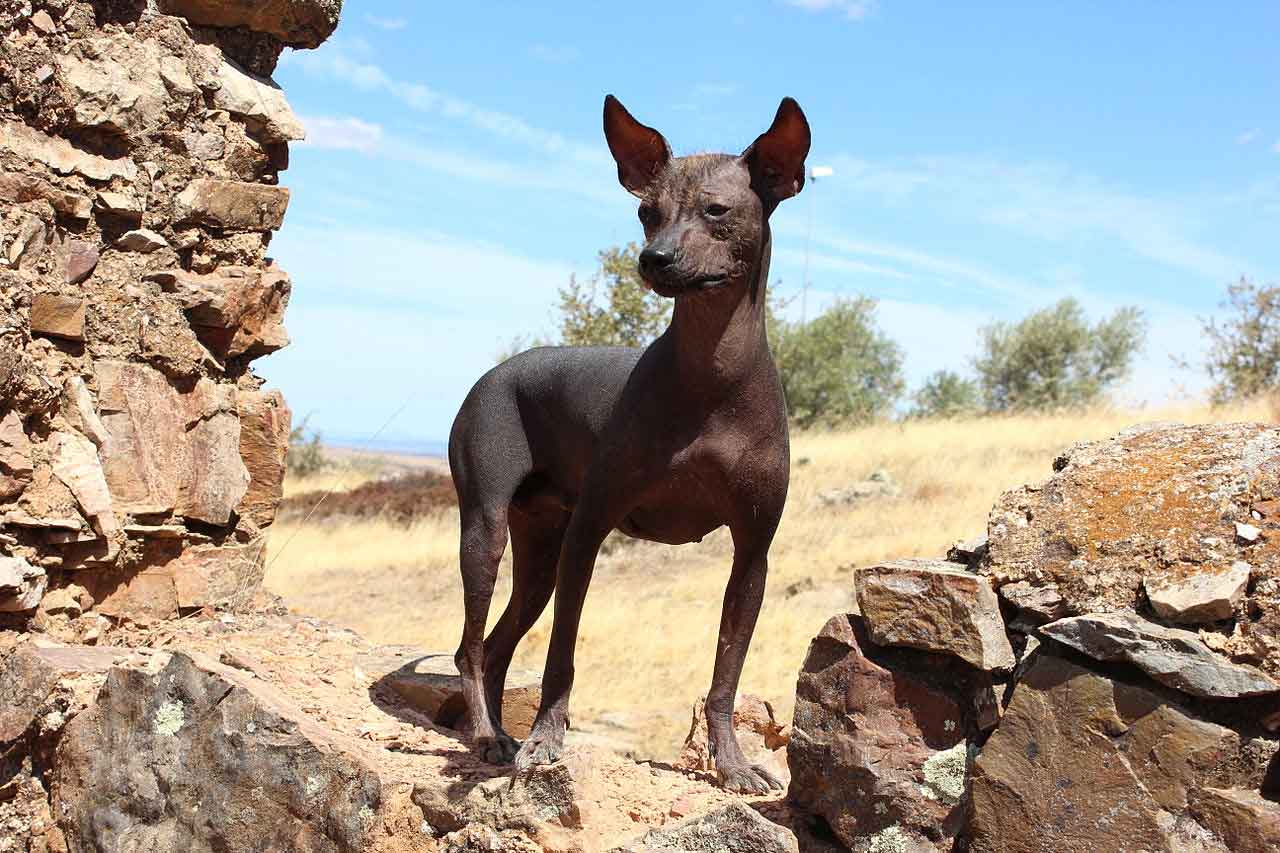
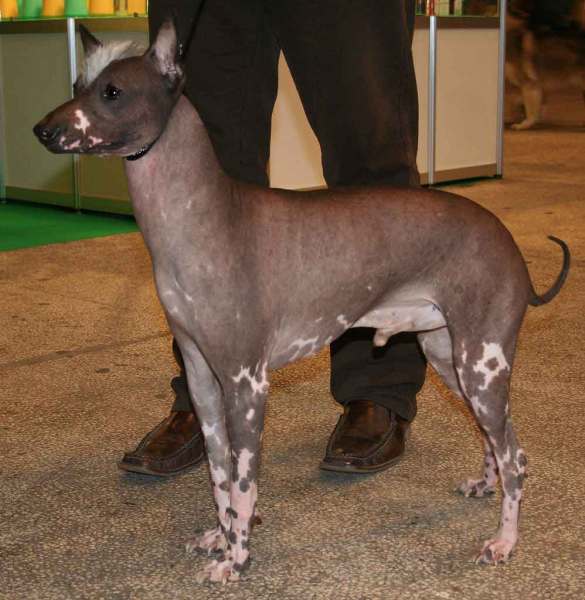
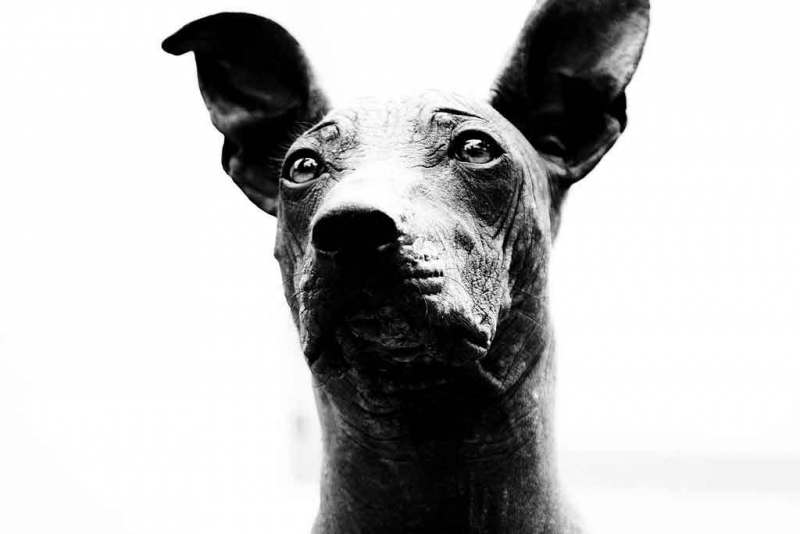
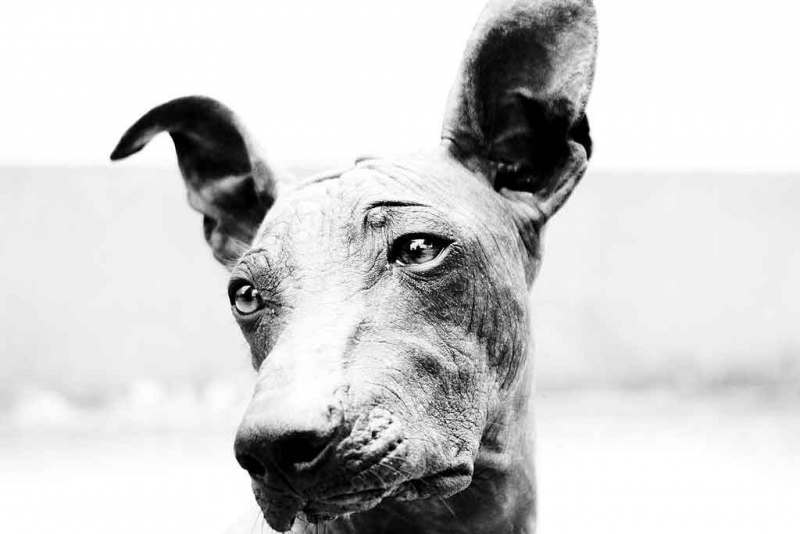
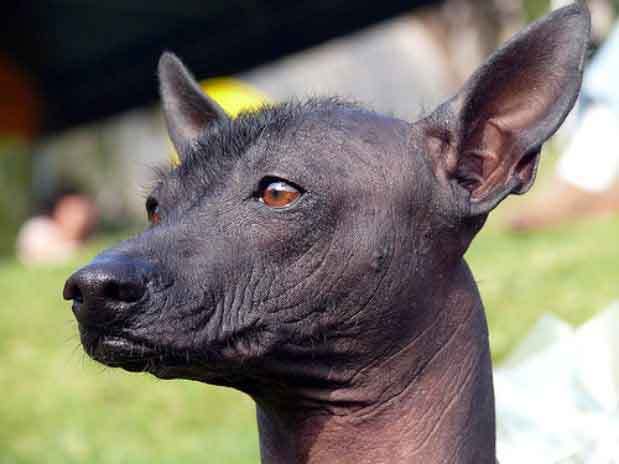
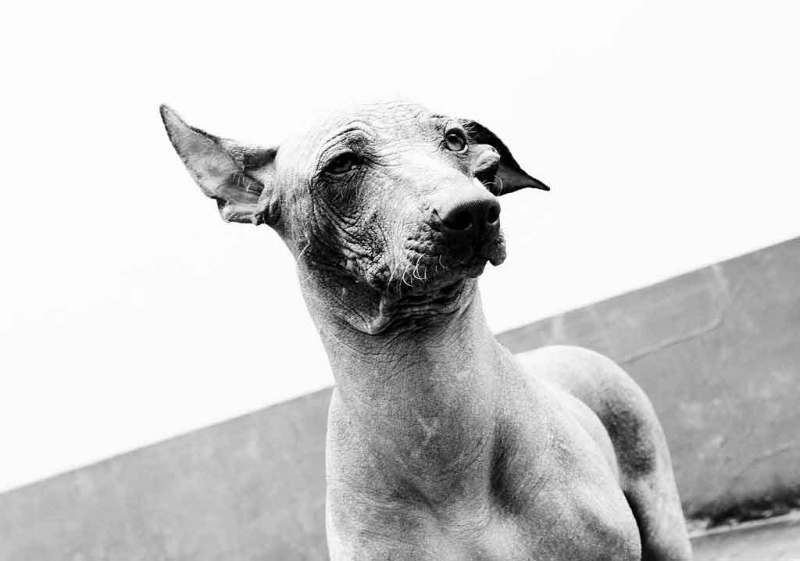
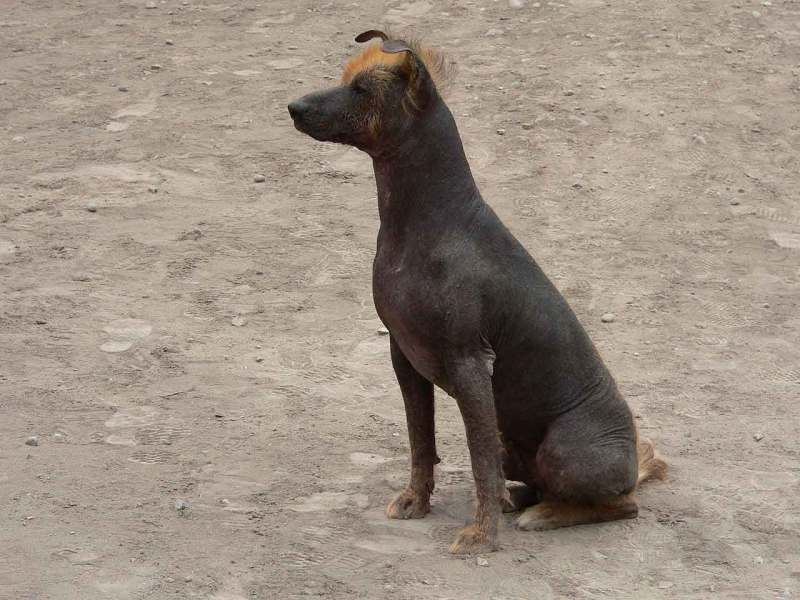
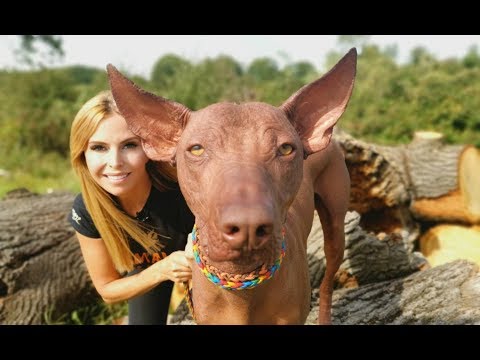
The name says it all: The most striking of the most Peruvian Hairless Dogs that's what's missing: the coat. But, the standard allows for some locks on the head and tail even in naked dogs without hair. Skin can be light or dark in different shades of color, smooth or white-spotted. But, not all naked dogs are naked, because there's a variant with hair: the so-called "hairy", which are essential for breeding for health reasons. About a third of naked dogs belong to this group.

Since 2013 hairy variants can also be seen in canine exhibitions, since they have been added to the standard. Your hair should be short and soft, all colors are allowed. The Peruvian Hairless Dog reminiscent of greyhounds in their physique. This slender breed of dog has large erect ears that can rest back, an elegantly curved and hanging tail and an athletic complexion.

Naked dog lovers can enjoy three size variations:

– The small version has a shoulder height of 25 to 40 cm..
– The median 40 to 50 cm..
– The Greats Peruvian Hairless Dogs have between 50 and 65 height cm.

The weight varies according to 4 to 25 kg. Only a few Peruvian Hairless Dogs have a full denture, but these usually include all representatives of the furry variant.

Character and skills

The Peruvian Hairless Dog is a friendly and adaptable companion. He prefers to be with his human with the one who has a close relationship. It belongs to very sociable dogs. He likes to integrate into a family and quickly befriends other pets and children. It is said that many Peruvian Hairless Dogs protect fervently, especially the women and children of the herd. Here it is important to be careful when visiting children that the Peruvian interprets offensive situations for his protรฉgรฉ and rushes to help his little two-legged friend unnecessarily..

Vivacious and curious, is a wonderful companion for outdoor activities, but behaves calmly and relaxed inside. He especially likes to get comfortable on his owner's lap and enjoys closeness and warmth.. To strangers he is often distant and alert, but not aggressive.

Education

Like a dog of the original type, the Peruvian Hairless Dog it also provides original behavior in the man-animal relationship. That's why it makes sense in educational matters if you already have any experience with dogs. But, even ambitious beginners can successfully train a Peruvian Hairless Dog. Clear rules and consistency are, as in most dogs, the key to success.

The Peruvian Hairless Dog is a sensitive four-legged friend – hard you'll only get the opposite with it – will retire. Some Peruvian Hairless Dogs tend to get scared or fear new situations. So, it is especially important to train this dog extensively and at the right pace to different situations without overloading it.

Your breeder will be able to give you some advice when you buy a puppy. Whether on a train journey, on a trip to the city center or on a visit home, introduce your partner into these everyday situations since you're a puppy. Regular training at a canine school, preferably already with the young puppy in the form of playgroups for puppies, is highly recommended and also reinforces the social side of the Peruvian Hairless Dog.

Breeding of the โ€œPeruvian Hairless Dogโ€

As already mentioned, during mating a special health feature should be taken into account: during breeding, the furry ones, that is to say, hairy representatives of the breed, should be crossed regularly. The reason for this is that the dominant allele of hairlessness can only lead to viable embryos in combination with a hair allele, that is to say, Heterozygosity. Homozygous hairless embryos are already reabsorbed in the uterus. As pure breeding for hairlessness is therefore not possible, hairless naked dogs also occur over and over again.

The Peruvian Hairless Dogs they usually have an incomplete denture, what doesn't usually restrict them. With the light-skinned specimens, especially at the beginning of summer, it's important to make sure they get used slowly in the sunlight, then tanning. Sun protection also makes sense, because otherwise dogs can develop severe sunburn, especially when they like to go to sunny places. Also in winter some specimens need protection from the weather in the form of a dog coat., because if they can't run, cool down quickly during normal ride. Smaller variants of the breed are more sensitive to this than larger ones.

One Peruvian Hairless Dog can reach an age of up to 15 years.

Care

With the naked representatives of the breed you can leave the comb with confidence. It also, has the great advantage that it can normally detect parasites in the skin of the Peruvian Hairless Dog immediately and apply appropriate antidotes – from tick tweezers to flea repellent. But, even the Peruvian Hairless Dog needs regular care. If required – some owners recommend once a week – wash it with a sponge and a mild dog shampoo. Some Peruvian Hairless Dogs tend to have dry skin, which can be remedied with soft moisturizers for fragrance-free babies or with olive or coconut oil. In summer, sunscreen is an indispensable tool for light-colored dogs. Cut the claws of your Peruvian Hairless Dog if they get too long and clean your four-legged friend's ears with a dog ear cleaner if necessary.

Buy a โ€œPeruvian Hairless Dogโ€

The Peruvian Hairless Dog are rare in Europe and therefore breeders are rare. Find the appropriate umbrella organizations in your country, that can help you in your search. In Germany, for example, el Club for Exotic Breed Dogs e.V. has a list of breeders, In Switzerland there is a "Swiss Naked Dog Club of Latin America", which is dedicated to the promotion of the two breeds of dogs: the Xoloitzcuintle and the Peruvian Hairless Dog. In these clubs and similar ones you can find information and contacts of ambitious breeders. Considering possible adoptions across national borders, consider what to consider when adopting puppies from abroad.

As a fan of naked dogs, you probably know the closely related races, the Xoloitzcuintle and the Chinese Crested Dog – perhaps one of these dogs could also be an option for you and is more likely to be found in your region. It also, openness to the other two races, as well as the crossings, it's usually a good idea if you want to give a home to a naked older dog. This usually requires some research. But in the meantime, Keywords like โ€œnaked dogs in distressโ€ on the Internet promise successes that lead adult naked dogs to look for a new place to live. Try to find out as much as possible about the story of your potential new fourth-legged partner.

Characteristics "Peruvian Hairless Dog"

Coexistence is important that you have with your new friend. Before considering the acquisition of a dog of the breed "Peruvian Hairless Dog" you know certain factors. Not all breeds of dogs are apt to live in an apartment, you must take into account his character, their need for exercise, their interaction with other pets, their care and if you have small children, their level of tolerance towards them.

Training ?

4,0
4,0 of 5 stars (based on 30 reviews)
Great
Very good
Media
Mala
Very bad

Suitability of the apartment ?

3,0 of 5 stars (based on 1 review)

Can be alone all day ?

2,0 of 5 stars (based on 1 review)

Suitable as a first dog ?

3,0 of 5 stars (based on 1 review)

Weight gain ?

3,0 of 5 stars (based on 1 review)

Health ?

3,0 of 5 stars (based on 1 review)

Intelligence ?

3,0 of 5 stars (based on 1 review)

Kindness with child ?

3,0 of 5 stars (based on 1 review)

Tendency to bite ?

2,0 of 5 stars (based on 1 review)

Tendency to bark ?

3,0 of 5 stars (based on 1 review)

Tendency to flee ?

2,0 of 5 stars (based on 1 review)

hair loss strength ?

1,0 of 5 stars (based on 1 review)

Suitable as a guard dog ?

3,0 of 5 stars (based on 1 review)

Joy ?

3,0 of 5 stars (based on 1 review)

Cat friendliness ?

3,0 of 5 stars (based on 1 review)

Power level ?

3,0 of 5 stars (based on 1 review)

Images "Peruvian Hairless Dog"

Photos:

1 – ยซHairless dog of Peruยป by Paradais Sphynx, CC BY-SA 3.0, via Wikimedia Commons
2 – ยซHairless dog of Peruยป by No machine-readable author provided. Manuel Gonzรกlez Olaechea assumed (based on copyright claims)., CC BY-SA 3.0, via Wikimedia Commons
3 – ยซHairless dog of Peruยป by Carlos Adampol Galindo from DF, Mexico, CC BY-SA 2.0, via Wikimedia Commons
4 – ยซHairless dog of Peruยป by Marina Alonso Esparrรฉ, CC BY-SA 4.0, via Wikimedia Commons
5 – ยซHairless dog of Peruยป by Carlos Adampol Galindo from DF, Mexico, CC BY-SA 2.0, via Wikimedia Commons
6 – ยซHairless dog of Peruยป by Carlos Adampol Galindo from DF, Mexico, CC BY-SA 2.0, via Wikimedia Commons
7 – ยซHairless dog of Peruยป by Pleple2000, CC BY-SA 3.0, via Wikimedia Commons

Videos "Peruvian Hairless Dog"

PERUVIAN DOG : The story of the VIRINGO dog, the mascot of ancient Peru

THE PERUVIAN HAIRLESS DOG - STRANGE OR CUTE?

Type and recognitions:

  • FCI CLASSIFICATION:
  • Group :
  • Section : . .

Federations:

  • FCI – Group 5: Spitz-type dogs and primitive type – Section 6: Primitive type. โ“˜

FCI breed standard "Peruvian Hairless Dog"

Origin:
Peru

Date of publication of the valid original standard:
08.10.2012

Use:

Companion dog


General appearance:

According to its general confirmation, it is a slender and elegant specimen., whose aspect expresses speed, strength and harmony without appearing crude.
This breed's fundamental characteristic is the absence of hair on the body.. Another of its peculiarities is that its teeth, almost always, is incomplete. Of noble and affectionate character with those at home; reserved with strangers; awake, alert and guardian.

important proportions:

The relationship between the height at the withers and the length of the body is 1:1, allowing the body of the females slightly longer than that of the males.


Behavior / temperament:

Noble and affectionate with those at home while remaining awake and alert. In the presence of strangers, becomes suspicious and guardian.

Head:

Lupoid conformation.

Cranial region:
  • Skull:Mesocephalus. Ortoide (the direction of the superior cranio-facial axes is parallel), accepting slight divergence. The skull seen from the top is wide, tapering towards the nose.. Superciliary arches are moderately developed. The occipital crest is poorly marked.
  • Depression links (Stop): Bit strong (approximately 140ยฐ).

facial region:

  • Truffle:The color of the nose should harmonize with the color of the skin, in its various shades.
  • Snout:In profile, maintains a straight line.
  • Lips:The lips should be as tight as possible and adhere to the gums..
  • Jaws/Teeth:The incisors should fit for a scissor bite and the canines are normally developed. The absence of one or all pre-molars or molars is allowed. The jaw is poorly developed.
  • Cheeks:Normally developed.

Eyes:Of attentive and intelligent expression. They should be medium in size, slightly almond shaped, or sunk or bulging, with a normal and regular location, that is to say, neither too close nor too far. Color may vary from black, going through dark brown and in descending tones to yellow, harmonizing with skin color. In all cases both eyes must be the same color. The color of the eyelids may be from black to pink for specimens whose facial area is light, allowing those of light or pink colors but not being the most recommended.

Ears:The ears should be erect in attention, while at rest they are glued back. The ears are medium long, wide at the base and gradually tapering to an almost pointed end. Its insertion begins on the top of the skull, ending laterally and obliquely. The axes of the ears in the erect position can vary their angle relative to each other, approaching 90ยฐ.

Neck:

  • Top profile:Arcuate (convex).
  • Length:About the same length as the head.
  • Form:Looks like a truncated cone. Flexible and well-muscled.
  • Skin:Fina, smooth and elastic. Intimately adhered to the subcutaneous tissue. No double chin.


Body:

Mesomorfo.

  • top line:Rectilinear, although certain specimens mark a dorso-lumbar convexity, getting lost with the rump.
  • Cross:Little pointed.
  • Back: Rectilinear top profile, with well-developed back muscles, forming in many cases a muscular biconvexity along the entire dorsal region, extending to the lower back.
  • Pork loin:Must be strong and muscular. Its length is approximately 1/5 the height at the withers.
  • Rump:The upper profile is slightly convex. Its inclination with respect to the horizontal, makes an angle of approximately 40ยฐ. Solid and muscular in shape, ensuring a good push.
  • Breast :The chest seen from the front will have good width without being excessively, descending almost to the elbow. The ribs should be slightly arched and never flat. The perimeter of the chest measured behind the elbows should be approximately 18% greater than the height at the withers.
  • Lower profile / Belly:The lower profile is formed by a well-marked elegant line, starting at the lower part of the chest and determining in the ventral retraction, which should be well delineated without being excessive.

Tail:

The tail is set low. Good thickness at the start, tapering to the tip. In a state of action, the tail may rise forming a curve without actually curling over the back.. At rest he wears it hanging with a light hook with the tip up. Sometimes it is tucked into the belly. Its length will come close to the hock. The queue must be full.

Tips

Former members

Well attached to the trunk; viewed from the front will be perfectly plumb, not sticking out elbows. Your scapulo-humeral angle will range between 100ยฐ and 120ยฐ.
Side views, the resulting angle between the pasterns and the vertical is between 15ยฐ to 20ยฐ.

  • Front feet:Semi-lengths approaching the hare's foot. The pads are strong and heat resistant. The interdigital membranes are well developed. Preferably, the nails are black in the black specimens and clear in the lighter specimens.

Later members

The muscles are round and elastic. The curvatures of the buttocks are evident. The coxofemoral angle should be between 120ยฐ to 130ยฐ. The femoral-tibial angle should be 140ยฐ. The limbs seen from behind are well plummeted. The dewclaws must be removed.

  • Rear feet:Equal to the forwards.

Movement:

Due to the angulations already described in the structures of its members, these specimens move with a shorter but faster pace and at the same time quite cushioned and flexible.

Mantle

Skin: The skin will be smooth and elastic over its entire body surface, being able to form certain surrounding and almost concentric lines on the head, around the eyes and cheeks. It is proven that the internal and external or dermal temperature, is exactly the same as the other races. The absence of fur results in a totally direct emanation of heat unlike the specimens with hair, in which heat is dissipated through them by natural ventilation.

Fur: For being a naked race, will be missing cover, admitting vestiges of hair on the head, at the tip of the limbs, the tip of the tail and sometimes some very thin hairs on the back.

Color: The color of the hairs may vary from black to black specimens., black slate, black elephant, bluish-black, full range of gray, gradient dark brown to light blonde. All these colors can be uniform or with pink spots anywhere on the body.


Size and weight:

Height to the cross

There are three types of sizes for males and females.

  • Petit:Of 25 to 40 cm..
  • Medium-:Of 40 to 50 cm..
  • Grand:Of 50 to 65 cm..

Weight

The weight is in relation to the three sizes for males and females..

  • Petit:Of 4 to 8 kg.
  • Medium-:Of 8 to 12 kg.
  • Grand:Of 12 to 25 kg.


Fouls:

Any deviation from the above criteria is considered missing and the seriousness is considered to the extent of the deviation to the standard.

  • Semi-erect ears.
  • Presence of dewclaws on the hind limbs.

ELIMINATING fAULTS

  • Aggressive or fearful dog.
  • Upper or lower prognathism.
  • Deviation of the lower jaw.
  • Hanging or cropped ears.
  • Anurismo. Braqui Tourism. amputated tail.
  • Excess hair described in the standard.
  • Presence of hairs in other parts of the body where it is not indicated.
  • albinism.

Any dog โ€‹โ€‹showing clear signs of physical or behavioral abnormalities must be disqualified..


N.B.:

Males should have two normal-appearing testicles., fully descended into the scrotum.

Source: F.C.I - International Cynological Federation

Alternative names:

1. Perro Sin Pelo de Perรบ, Inca Hairless Dog, Viringo, Peruvian Inca, Orchid, Calato, Peruvian Walking Dead dog, Dielmatian (English).
2. Chien nu Inca (French).
3. Peruanischen Nackthund (German).
4. Perro Sin Pelo del Perรบ, viram (Portuguese).
5. Perro calato, Perro chimo, Perro chimoc, Perro chimรบ, Perro de , orquรญdea peruano, Perro inca, Perro peruano, Perro peruano sin pelo, Perro pila, Perro sin pelo del Perรบ, Perro sin pelo peruano
Viringo
(espaรฑol).

โ–ท The world of Pets: Dogs, cats, birds, reptiles, amphibians

Basenji
Gongo FCI 43 . Primitive type

The Basenji is attentive, loving, energetic, curious and reserved with strangers

Basenji

Content

Characteristics "Basenji"

Coexistence is important that you have with your new friend. Before considering the acquisition of a dog of the breed "Basenji" you know certain factors. Not all breeds of dogs are apt to live in an apartment, you must take into account his character, their need for exercise, their interaction with other pets, their care and if you have small children, their level of tolerance towards them.

Adaptation โ“˜

3,0 of 5 stars (based on 1 review)

friendly dog โ€‹โ€‹โ“˜

2,0 of 5 stars (based on 1 review)

hair loss โ“˜

2,0 of 5 stars (based on 1 review)

Affection level โ“˜

2,0 of 5 stars (based on 1 review)

Need for exercise โ“˜

4,0 of 5 stars (based on 1 review)

Social need โ“˜

2,0 of 5 stars (based on 1 review)

Home โ“˜

2,0 of 5 stars (based on 1 review)

Toilet โ“˜

1,0 of 5 stars (based on 1 review)

Friendly with strangers โ“˜

2,0 of 5 stars (based on 1 review)

barking โ“˜

2,0 of 5 stars (based on 1 review)

Health โ“˜

3,0 of 5 stars (based on 1 review)

Territorial โ“˜

3,0 of 5 stars (based on 1 review)

Cat friendly โ“˜

2,0 of 5 stars (based on 1 review)

Intelligence โ“˜

5,0 of 5 stars (based on 1 review)

Versatility โ“˜

2,0 of 5 stars (based on 1 review)

Child friendly โ“˜

2,0 of 5 stars (based on 1 review)

Surveillance โ“˜

3,0 of 5 stars (based on 1 review)

joy โ“˜

5,0 of 5 stars (based on 1 review)

History

Video "Basenji"

Basenji dog sings 2

The Basenji It is a breed of dog originating from the Democratic Republic of the Congo.. It is a primitive breed used for hunting and tracking.

They have the unique characteristic of not barking, but they emit a curious sound in the style of >Tyrolean singing (Yodeling).

The stone Age images, as well as the tombs of ancient Egypt, already attest to the existence of this type of dog, who has survived the millennia: The Basenji is one of the oldest and most original breeds of dog. He's supposed to be a direct descendant of the Egyptian Testament – this is what dog experts call the dog form that has been handed down to us through Egyptian artwork from the fourth millennium B.C..

The Basenji comes from Central Africa, where he lived with village communities, but without having been specifically raised or having formed particularly close ties. Rather, they lived like ratcatchers. Often people also followed the hunting of the Basenjis to profit from the prey.. During famines the dogs were even slaughtered.

By the way, ยซBasenjiยป translated means ยซsmall wild bush animalยป. As early as the late 19th century some Basenjis arrived in Europe with African explorers. But, selective breeding did not begin until 1935 in Britain. Although the dog is native to Africa, Great Britain today has the patronage of the Basenji. From here the breed gradually spread to the rest of Europe.. In Germany, for example, enjoyed greater popularity from the years 70 of the 20th century.

Did you know??

The first Basenjis were red and white, tricolor (black and white fire) and black and white. Expeditions in Zaire 1987 and 1988 They introduced 14 dogs with new bloodlines, which brought a beautiful brindle look with tiger stripes.

There are some studies which point to the Basenji as progenitor of all Terrier.

Physical characteristics

The Basenji they are a small breed, elegant appearance, they have short hair, shiny and silky. Their ears are upright, and the tail coiled lead to perfection. Some people, they believe that its appearance similar to a deer in miniature.

They usually weigh 11 kg and the port tends to be of 40,6 cm., athletic and deceptively powerful for its size. Have a walk safe and elegant like a horse to trot.

Character and skills

Recommended for homes with adults. Although all life keeps a restless and playful spirit, When it ends its phase of growth becomes an excellent pet.

The Basenji is alert, loving, energetic, curious and reserved with strangers. It is a little distant, but it can also form strong ties with the people and can be emotionally sticking to a particular Member of the family, creating a very strong bond.

Generally does not get along well with other pets other than dogs. likes humid weather, they tend to be very skilled soaring. It can be described as fast, playful, tireless in the game, and naughty.

One of the curiosities that presents the race, In addition to not bark, It is that sule lick is the hair to be kept clean.

education

Like all dogs, the Basenji needs to be socialized from a young age. Meet lots of people (friends, neighbors, family…) allows you to get used to seeing strangers and become a sociable adult. The same goes for other dogs.: if you meet them often from their first months, the risks of dog fights during walks are reduced once he is an adult.

In his book Intelligence of Dogs (1994), Stanley Coren classifies the Basenji in the post 78 of 79 dog breeds for their intelligence… But, this is potentially a misunderstanding: the Basenji he understands very well what his owner wants from him, but is not really willing to meet your demands. In fact, shows a complete lack of interest in anything related to their education.

Like this, this extremely independent dog feels no need to please his master. Surely you understand what the command "sit" means?, but I may not see the point and, therefore, decide not to listen. Positive reinforcement methods have had some success, and a treat can be enough motivation, but even the most experienced trainers have a hard time getting them to listen. A novice is likely to be frustrated at being totally ignored despite their best efforts and may regret their choice..

At the end, it is usually the owner who has to adapt to the dog. These may include, people who live with a Basenji

Health

Although it is relatively robust and enjoys a respectable life expectancy (of 12 to 14 years), the Basenji is susceptible to several diseases of varying severity:

  • The Fanconi syndrome, that is not exclusive to this breed, but most of the dogs that suffer from this disease are Basenjis. It is a kidney problem that prevents the reabsorption of nutrients and is usually fatal in the long term.. Fortunately, there is a genetic test to detect carriers and prevent them from reproducing;
  • Colitis enteritis, an overpopulation of a certain type of bacteria in the colon, responsible for violent diarrhea, sometimes with blood;
  • Immunoproliferative intestinal malabsorption, What, as the name reflects, prevents proper absorption of nutrients by the intestine. causes diarrhea, weight loss and can be fatal;
  • Hypothyroidism, a hormonal problem responsible for lethargy and weight gain;
  • Pyruvate kinase deficiency, an enzyme needed by red blood cells. The resulting anemia is often fatal.;
  • Hemophilia type B, a clotting problem that means that even a small accident can cause death;
  • Hernias, inguinal or umbilical, in which an internal organ passes through the abdominal wall, which can be very painful;
  • Eye problems, like the coloboma (a congenital malformation of the retina), progressive retinal atrophy (a degeneration of the eye tissues that leads to vision loss) or the persistence of the pupillary membrane (an abnormality of the eye that usually does not greatly affect vision);
  • Hip Dysplasia, a problem in the hip joint that can cause varying degrees of motor difficulties.

But, the main cause of death in this breed is age (30% of the cases), according to a survey by the British Kennel Club and the British Small Animal Veterinary Association.

It also, behavior problems, although they are not usually related to a disease, but they are simply the result of ignorance of the characteristics and needs of the breed by the owner, make many Basenjis be euthanized every year.

Last, it should be noted that, as it happens with other primitive dogs, the females of Basenjis they only go into heat once a year. Most litters are born between October and December.

Life expectancy

12 to 14 years

Grooming

Although it is very difficult to train, the Basenji it is an easy breed to care for.

A quick brushing of their short coat once a week is enough to remove dead hair.. But, they shed twice a year, and it may be helpful to switch to two or three times a week in the spring to deal with excess dead hair. This is much less necessary in the fall, when the moult is much less pronounced and may even go unnoticed.

It also, just like cats, this dog grooms itself. And since he doesn't like water, not one to come back dirty after jumping in puddles or rolling around in the mud. So, bathing your dog is rarely necessary.

But, as with any dog, the brushing session should be used to check and clean the eyes and ears to reduce the risk of infection.

It's also a good time to brush your dog's teeth, to avoid the accumulation of tartar and all the risks that this entails. Ideally, do it more often., even daily.

Last, wear and tear is usually enough to limit the claws of this especially active animal. But, if not and they start to get too long, it is necessary to do it manually with a dog nail clipper, to prevent breakage or injury.

Food

The Basenji not picky about food. But, since the shoes, smartphones and other magazines you can devour don't really meet your nutritional needs, it is necessary to provide daily industrial food for dogs. They must be of good quality to provide all the nutrients you need, but also adapted to their age, size and activity level.

Being a very active dog, the Basenjis are not prone to obesity problems. But, it is advisable to weigh your dog from time to time to ensure that he is not overweight. If you do, reducing his daily food intake and increasing the time he is allowed to go outside should solve the problem.

It also, like all dogs, must have fresh water available at all times.

For sale "Basenji"

The price of a puppy Basenji it's average 1000 euros for a male and 800 euros for a female.

whatever the place, the amount charged depends on the lineage from which it comes, of the prestige of the hatchery, but also of the degree of conformity of the individual with the standard of the breed.

ยซBasenjiยป images

Photos:

(1) – walking… basenji by fugzu [CC BY 2.0], via Wikimedia Commons
(2) – Basenji puppy, Bravo, 10 weeks old by fugzu [CC BY 2.0], via Wikimedia Commons
(3) – Basenji dogs by fugzu [CC BY 2.0], via Wikimedia Commons
(4) – Portrait Basenji – CC0 Creative Commons

Videos ยซBasenjiยป

Type and recognitions:

  • FCI CLASSIFICATION:
  • Group :
  • Section : . .

Federations:

  • FCI – Group 5: Section: 6 Primitive type โ“˜
  • AKCHound โ“˜
  • ANKC – Group 4 (Hounds) โ“˜
  • CKC – Group 2 – Hounds โ“˜
  • โ€‹KC – Hound โ“˜
  • NZKCHounds โ“˜
  • UKC – Group 3 – Sighthounds and Pariahs โ“˜

FCI breed standard Basenji

FCIFCI - Basenji
Basenji

Alternative names:

1. African Bush Dog, African Barkless Dog, Ango Angari, Avuvi, Cong Dog, Zande Dog, The Jumping Up And Down Dog, Voiceless Dog (English).
2. Terrier Nyam-Nyam, Terrier du Congo (French).
3. Kongo-Terrier (German).
4. Congo Terrier (Portuguese).
5. Perro Congo, Perro Zande, Terrier del Congo (espaรฑol).

โ–ท The world of Pets: Dogs, cats, birds, reptiles, amphibians

Swedish Vallhund
Suecia FCI 14 - Nordic Watchdogs and Herders.

Vallhund Sueco

The Swedish Vallhund is `virtually unknown outside the Nordic countries.

Content

History

The Swedish Vallhund (Vรคstgรถtaspets), known as "Viking dog", was bred to herd cattle, capturing vermin (as the rats, for example), and as a watchdog.

The origin of the Vallhund is believed to date from ago 800 or 900 years, during the time of the vikings, and although there are theories that affirm it, race historians dismiss that there is a connection between the breed we know today as Pembroke Welsh Corgi, Despite its resemblance.

During World War II, the race was on the verge of extinction, but with time and great care it was recovered...

Then, in 1964, the Swedish breed standard was revised and the name Vรคstgรถtaspet (in Swedish) was officially adopted in recognition of the region the dogs come from Vรคstgรถtaland.

In 2008, the Swedish Vallhund, the dog of Basset, the Tibetan Mastiff, and the Beauceron They competed for the first time, in the sample Westminster Kennel Club International.

In the news, the Swedish Vallhund still known as Sweden's cattle keeper, par excellence, although it is still very rare around the world.

Physical characteristics

The height at the withers expected according to the standard of the Swedish Vallhund, is of 33 cm in males and 31 cm in females. A variation of 1,5 cm above or below these measures, is allowed. With regard to the weight, round between 9 to 14 kg.

The Swedish Vallhund, It is a breed endowed with good muscles (something very important in dogs with short legs). Their fur, It should be of medium length (pulling short), and hard. The outer layer is thin and firm and the inner layer is dense and soft. The hair is short on the head and in the earlier parts of the legs, While a little longer in the neck, the chest and back of the hind legs.

The desired colors are grey, grey-brown, reddish brown or greyish yellow with darker spots on the hairs in the back, the neck and sides of the body. The color white is allowed on a small proportion, as a narrow shining, (neckstop) or a light collar. White markings are allowed in the anterior and posterior limbs and chest. White patches that exceed more than the 30% on the colorful coat is generally considered a lack.

Character and skills

The Swedish Vallhund, It was created as a working dog in to the farm, but it also has a history as companion pets. This leads to it fit perfectly, in rural areas as well as life in cities.

The Swedish Vallhund it is a great companion as a pet, but - also- It can be used for grazing. They love human attention and are very devoted to their owners.

It's a funny dog, happy and having fun with any group game. He is a friendly dog โ€‹โ€‹with most people., but they can be wary with strangers and should be, correctly, socialized and trained from pups, Since, going to try to protect your home, as it is, without being aware of its small size.

The Swedish Vallhund, You can compete in agility, obedience, show, flyball, follow-up, and breeding events. As well, can be measured in non-competitive grazing trials.

Education of the "Swedish Vallhund"

Small but mighty. This original worker is by no means a spoiled lap dog. Is persevering, courageous and energetic and can be kept well as a farm dog with a close family relationship. Children should be slightly older and used to respectful contact with dogs. Because if you disturb the Swedish Vallhund, tends to be aggressive. According to your original task, cattle grazing, loves to exercise in the fresh air and only after a corresponding load of work does he appreciate a cozy afternoon on the couch. To a balanced Swedish Vallhund likes to snuggle and play and is loyal to his two-legged pack.

Like many northern dogs, this breed also tends to bark extensively, which should already be directed in a controlled manner in the puppy stage. But, will not be a particularly calm pet, even after successful training, so don't set your expectations too high. How a dog for a city walk may have a tendency to collide with other dogs, it is particularly sensible to attend puppy play classes and basic obedience courses with him at dog school. This strengthens their social skills and can also lay the foundation for friendships with other animals..

Salud ยซWall Dog Suecoยป

The Vallhund it is a small but powerful breed of dog, brave, alert, strong, Intelligent, friendly and healthy. They have few known health problems (genetically inherited), and are considered robust dogs, healthy and with a life expectancy around the 14 years.

In some cases, they may face problems in the column, due to its short legs (weight distribution...).

Food "Swedish Vallhund"

A species-appropriate dog food with a high proportion of meat is the best foundation for the life of a healthy dog. So choose a dry or wet food that contains meat as the main ingredient., you can tell by the fact that meat tops the ingredient list. Avoid dog food that contains cereal as cheap fillers. If you choose dry food, You should also make sure that your Vallhund drink enough. In any case, fresh water must always be available to him at all times and everywhere.

If you want to give your four-legged friend a special treatment, you can choose healthy treats such as jerky snacks especially for dogs or dental care snacks. Avoid anything that contains sugar. You can give your little companion an appetizing chew treat with dry chew items like cow ears or special dog bones for medium-sized dogs.. Avoid being overweight: If your four-legged friend gains weight, exercise more or reduce daily servings – you usually don't need a diet food.

A "Swedish Vallhund" is recommended

The Swedish Vallhund you are comfortable with active people who give you a task. These may include, can live as a yard dog with close contact to its two-legged pack. Here he will do an excellent job as a watchdog., but you will also need an extra workload in the form of some common activities – unless you really have the task of herding other animals.

If you are thinking of moving in with a Swedish Vallhund, you should already have experience with dogs. Can make close friends with older children, provided they give you a place to retreat and introduce you to respectful handling of dogs. With younger children up to elementary school age and sometimes beyond, misunderstandings may arise. The former rat catcher should not live together with smaller pets and should only consider socialization with cats if the breeder's household has already socialized him with them before or if he ensures that a Swedish Vallhund adult have a lot of experience with calm cats.

In any case, before moving, make sure all family members are on board with the new family member and that no one is allergic to animal hair. Also consider how to organize care during your vacation – the Swedish Vallhund you are welcome to be taken on a walking holiday, but remember it's still a dog that likes to bark. You should also keep this in mind with regard to your neighborhood. In any case, despite its practical size, the Swedish Vallhund still a four-legged friend who doesn't fit in well in a city apartment, but rather in a house in the country, where is it better to have a fenced garden.

Before moving, consider the costs of the dog itself and the basic equipment, as well as the regular expenses of the appropriate food for the dog, veterinary costs, dog tax and liability insurance. Of course, unforeseen amounts may be added in relation to veterinary expenses: Inform yourself about dog health insurance in advance and consider whether such insurance is possible for your four-legged friend.

Where can I find my "Swedish Vallhund"?

Outside of Scandinavia there are very few examples of this breed of dog. Please, inform yourself in advance about the particularities of the puppy's entry and the necessary vaccinations. The best thing to do is search the internet for breeders who should definitely belong to a club. – Only then can you be sure that you really have a Swedish Vallhund. It also, friends of the breed should always support serious and ambitious breeding and, therefore, health maintenance, the type and character of the breed. It makes sense to contact Nordic dog clubs – they can help you contact breeders of the breed.

These clubs are also a good place to contact if you want to offer a Swedish Vallhund adult a new home. But, depending on the region you live in, you should also watch out for adult crossings or look for alternatives, since outside of Scandinavia fortunately there are not many Swedish Vallhund that lose their homes among the already very few Walldogs. If you have an older dog, find out more about its history, because it is not uncommon for dog owners who have to shed their Swedish Vallhund underestimate him for his size and do not allow him to be trained properly. Here knowledge of dogs may be necessary to correct educational errors, but the Swedish Vallhund smart learners quickly in the right hands.

Characteristics "Swedish Vallhund"

Coexistence is important that you have with your new friend. Before considering the acquisition of a dog of the breed "Swedish Vallhund" you know certain factors. Not all breeds of dogs are apt to live in an apartment, you must take into account his character, their need for exercise, their interaction with other pets, their care and if you have small children, their level of tolerance towards them.

Training ?

3,0 of 5 stars (based on 1 review)

Suitability of the apartment ?

2,0 of 5 stars (based on 1 review)

Can be alone all day ?

2,0 of 5 stars (based on 1 review)

Suitable as a first dog ?

3,0 of 5 stars (based on 1 review)

Weight gain ?

4,0 of 5 stars (based on 1 review)

Health ?

3,0 of 5 stars (based on 1 review)

Intelligence ?

3,0 of 5 stars (based on 1 review)

Kindness with child ?

3,0 of 5 stars (based on 1 review)

Tendency to bite ?

4,0 of 5 stars (based on 1 review)

Tendency to bark ?

5,0 of 5 stars (based on 1 review)

Tendency to flee ?

3,0 of 5 stars (based on 1 review)

hair loss strength ?

4,0 of 5 stars (based on 1 review)

Suitable as a guard dog ?

3,0 of 5 stars (based on 1 review)

Joy ?

3,0 of 5 stars (based on 1 review)

Cat friendliness ?

3,0 of 5 stars (based on 1 review)

Power level ?

3,0 of 5 stars (based on 1 review)

Images "Swedish Vallhund"

Photos:

1 – ยซVallhund Suecoยป by https://flic.kr/p/a4mJMv
2 – ยซVallhund Suecoยป by WestportWiki / CC BY-SA
3 – Kiki, a Swedish Vallhund by https://en.wikipedia.org/wiki/File:Kiki,_a_Swedish_Vallhund.jpg
4 – A Swedish Vallhund doing agility by Ron Armstrong from Helena, MT, USA / CC BY
5 – ยซVallhund Suecoยป by Matt Lemmon / CC BY-SA
6 – ยซVallhund Suecoยป by WestportWiki / CC BY-SA

Videos "Swedish Vallhund"

Type and recognitions:

  • FCI CLASSIFICATION:
  • Group :
  • Section : . .

Federations:

  • FCI – Group 5 – Section 3 Nordic Watchdogs and Herders.. โ“˜
  • AKC – Nordic Watchdogs and Herders. โ“˜
  • CKC – Nordic Watchdogs and Herders. โ“˜
  • โ€‹KC – Nordic Watchdogs and Herders. โ“˜
  • NZKC – Nordic Watchdogs and Herders. โ“˜
  • UKC – Nordic Watchdogs and Herders. โ“˜

FCI breed standard "Swedish Vallhund"

Origin:
Sweden

Date of publication of the valid original standard:
29.10.2013

Use:

Herding dog


General appearance:

Petit, resistant, with short limbs. His expression denote a guard dog, alert and energetic.

IMPORTANT PROPORTIONS: The ratio of the height at the withers to the length of the body is 2:3. The height from the lowest point of the chest to the ground should never be less than 1/3 the height at the withers.


Behavior / temperament:

Guardian, energetic, brave and alert.

Head:

Clean cut and quite long. Skull and nasal bridge parallel.

Cranial region:

View from the top, as much as from the sides, moderately wide and tapering evenly towards the nose.

  • Skull: almost flat.
  • Stop: Well defined

facial region:

  • Truffle: black.
  • Snout: Viewed from the sides, it is short rather blunt and only slightly shorter than the skull..
  • Lips:Well adjusted and closed.
  • Jaws / Teeth: Strong lower jaw with a rather romine but not prominent cut. Perfect and regular scissor bite with a full denture, well-developed, even teeth.

Eyes: Medium-sized, oval and dark brown in color.

Ears: Medium-sized, pointy, upright. Hard cartilage from the base to the tip, movable, soft fur covered. The length of the ears should not exceed the width of the base.

Neck:

Long, with strong muscles and good reach.

Body:

  • top line: Level back with good muscles.
  • Pork loin: Short, wide and strong.Rump: Wide and slightly sloping.
  • Breast : Long with good depth. Well arched ribs. Seen from the front the chest is oval, sideways, elliptic. Reaches two fifths of the previous limbs and seen sideways, the lowest point of the chest is immediately behind the back of the elbow. Sternum visible but not overly pronounced.
  • Bottom line and belly: Slightly retracted abdomen.

Tail:

There are two types of tail, long and all length variations in a naturally short tail. In both cases, all variations in size are allowed since there is no standard for this..

Tips

Strong bones.

PREVIOUS MEMBERS:

  • Shoulder: Long and placed at an angle of 45 ยฐ with respect to the horizontal plane.
  • Arm: Slightly shorter than the scapulae and positioned at a visible angle. Glued to the ribs but very mobile.
  • Forearm: Seen from the front slightly tilted, enough to allow free movement against the lower chest.
  • Metacarpus: Elastic

Previous feet: Medium size, short, oval forward facing with strong pads, knuckled up.

LATER MEMBERS: Parallels seen from behind.

  • Thighs: Wide and well muscled.
  • Knee: Well angled.Leg:Only slightly longer than hock to ground distance.
  • The Hock joint: Well angled
  • Metatarsus: High moderate.
  • Hind feet: Medium size, short, oval forward facing with strong pads, knuckled up.

Movement:

Correct with good reach and thrust.

Mantle

Fur: Outer hair of moderate length, thick, tight and close to the body. Soft and very dense undercoat. The hair is short on the head and front of the limbs, can be longer on the neck, throat, chest and back of hind legs.

Color: Gris, grey-brown, grayish yellow, reddish yellow or reddish brown. Lighter hairs in the same color shades as those mentioned above can be seen on the muzzle, throat, chest, abdomen, thigh, feet and hocks. Darker protective hairs can be seen on the back, neck and lateral parts of the body. Clearer markings on shoulders, Thus called harness brands and lighter brands on the cheeks are highly desirable. White is allowed in small expanses such as a small star, spot on the neck or a slight collar. White markings are allowed on the chest, forelimbs and hindquarters.


Size and weight:

Height to the cross:

  • Males: 33 cm. (ideal height)
  • females: 31 cm. (ideal height)

A tolerance of more than 2 cm over the 1 cm below these heights.


Fouls:

Any deviation from the aforementioned criteria is considered as a fault and the severity of this is considered to the degree of the deviation to the standard and its consequences on the health and well-being of the dog.and the dog's ability to perform its traditional task.

  • Too close to the ground.
  • Stop not well defined.
  • Pointed snout.
  • Absence of two P1 or one P2.
  • Light eyes giving a wrong expression.
  • Ear insertion too low.
  • Chest too deep or too narrow.
  • Forehead too wide.
  • Steep shoulders.
  • Forearm too short.
  • Posterior over angled.
  • Absence of harness markings or cheek markings.

SERIOUS FAULTS:

  • Short or rounded skull.
  • Short snout.
  • Lower jaw flees, narrow or weak.
  • Bite in clamp.
  • Absence of molars (M3 is not taken into account)
  • Encarpado back.
  • Soft hair and hair separated from the body.
  • Hair too short or too long.
  • Absence of inner hair.
  • White markings that exceed 30% base color.
  • Height severely divergent from ideal height.

FALTAS DESCALIFICANTES:

  • Aggressiveness or extreme shyness.
  • Any dog โ€‹โ€‹showing clear signs of physical or behavioral abnormalities must be disqualified..
  • Prognatic or enognathic bite.
  • Blue eyes, one or both.
  • Hanging or semi-erect ears.
  • Long curly hair.
  • Black hair color, white, Brown liver or blue.


N.B.:
  • Males should have two normal-appearing testicles fully descended into the scrotum..
  • Only functionally and clinically healthy dogs, with the typical conformation of the breed, should be used for parenting.

The latest changes are in bold.

Source: F.C.I - International Cynological Federation

Alternative names:

1. Swedish Cattle Dog, Swedish Shepherd, Vallhund, Vรคstgรถtaspets (English).
2. Spitz des Wisigoths (French).
3. Westgotenspitz, Schwedischer Schรคferspitz, Swedish Cattle Dog, Schwedischer Vallhund (German).
4. (Portuguese).
5. Vallhund, spitz de los visigodos, Perro de los visigodos (espaรฑol).

โ–ท The world of Pets: Dogs, cats, birds, reptiles, amphibians

Jรคmthund
Suecia FCI 42 - Nordic Hunting Dogs

Jรคmthund

Still very old, the Jรคmthund was not recognized until the year 1946, It was previously confused with the Gray Norwegian Elkhound

Content

History

Only in 1946 the Jรคmthund (Jรคmthund) was recognized as a breed. But, the Jรคmthund it is a very old breed of dog, which is already known since the north of Sweden is populated.

The reason for this belated recognition is that the small Gray Norwegian Elkhound and the jรคmthund they were judged by the same race. At the end, this trial turned out to be untenable. The Jรคmthund mainly used to hunt moose, but it has also been used to hunt bears and lynxes, especially in the past.

Today the FCI recognizes three different moose dogs:

All three are assigned to buffers and dogs of the original type (group 5) and in them they are assigned to the section 2 ยซNordic Hunting Dogsยป.

Physical characteristics

The Jรคmthund He is respected for his wolf-like appearance and his great and powerful stature. With a height at the cross of 57 to 65 centimeters and a weight of about 30 kg, It is the largest and heaviest of the three moose dogs recognized and at the same time the largest Nordic hunting dog. Throughout its long history, the Jรคmthund not only faced wolves, lynx and elk, but also adult bears, whom he faced fearlessly when hunting.

Character and skills

Blind obedience is a long way off for this self-assured and independent pedigree dog from the far north. After all, the Jรคmthund in Sweden has been hunting moose, lynxes and even bears bravely and on their own for thousands of years. Although he always keeps in touch with his hunter, this smart and independent breed doesn't need your orders.

Strong dog personality with many talents

Dog lovers who are interested in this breed should know that the practice of certain commands sometimes requires some effort. With stupid repetitions or even with force and violence you will not achieve anything with the Jรคmthund.

But, if you accept his character and thoughtful nature and have the skills to deal with such a strong personality, you can certainly train him to be a versatile companion and working dog. With inventiveness, patience, consistency and sensitivity, the persistent and powerful Jรคmthund can be trained not only to be a versatile hunting dog, but also an excellent herding dog, guardia, sled and rescue.

Very experienced hunting dog

Despite relatively late recognition as a separate breed, the origin of Jรคmthund goes back a long time. In the province of Jamtland, in central Sweden, which is decisive for his name, the type of dog has been known for thousands of years.

Even the first settlers in northern and central Sweden had dogs to hunt bears., Moose, lynxes and wolves. Hunters appreciated above all their enormous stamina and physical strength., with which the dog, independently and bravely, went out looking for game.

Today it is regarded in hunting circles as a fearless and energetic search dog., which is not only suitable for hunting loose hounds, it can also be used for hunting guide dogs. Search and pursue game in the dense forests of Scandinavia and remain silent until you have placed the animal. Only then does he give the hunter a signal through his barking that he can hit the target.. This type of hunting is called ยซstanding stillยซ.

The Jรคmthund as a family dog

Also as a family dog รขโ‚ฌโ€นรขโ‚ฌโ€นthe Jรคmthund it is very suitable, as long as enough space is given to the independent nature and great desire for freedom of this original hunting dog. So he's considered friendly, balanced, calm and fond of children. After an appropriate period of acclimatization, also accepts conspecifics, cats and other pets without any problem.

He meets strangers with a certain distrust according to his natural instinct for vigilance and protection.. Does not act nervous or aggressive. There is also no denying a certain joy of barking to this Nordic hunting dog.

Breeding and buying a Jรคmthund

In Sweden the Jรคmthund has long been known beyond hunting circles and is popular as a versatile utility and companion dog. In other countries of the world, However, the swedish pedigree dog is very rare. Although you can find breeders in Germany, Great Britain, the Netherlands and North America, searching and waiting for a purebred puppy can sometimes take years. So, it is advisable to contact a registered association for Nordic dogs, that can help you find breeders in Scandinavia.

What do I have to consider when buying a Jรคmthund?

Although the distance to the breeder is long, those interested should take the time to get to know the kennel, the animals and the breeder in detail before buying. Don't take home the first best puppy, Before making several visits, convince yourself that it is a serious parenting, that dogs are raised with a lot of experience and love.

In addition to health tests, vaccinations and the presence of all important papers and a pedigree, animals must grow up in a close relationship with their breeder from birth. The socialization of a Jรคmthund already begins in the first weeks of life. Living with his mother and brothers, but also with the breeder's family, puppies learn the most important rules of the nest.

What demands does the Jรคmthund to the owner?

One Jรคmthund need plenty of exercise. You must also be sufficiently disabled both physically and mentally. A life in gated communities, in the city and without a garden, it certainly doesn't do this kind of dog justice.

The Jรคmthund feels more comfortable in rural areas. There you can move freely and spend a lot of time in nature. If not used for hunting purposes, you should definitely offer alternative activities. Possible are examinations for companion dogs, dog tournaments or rescue dog training. Also bike rides, long walks or sledding shots in winter are suitable to satisfy the great momentum of movement of the Jรคmthund.

Is a suit for me Jรคmthund?

Before you start looking for a suitable breeder, you should ask yourself the following question: Is this nordic pedigree dog suitable for me and my life?

This becomes especially important if you don't want to keep Jรคmthund like a hunting dog, but exclusively as a family dog. In this case you must make sure that you have enough experience, time and space to satisfy this demanding and energetic four-legged friend.

When asking if this dog is a good match for me, of course you should also keep an eye on the costs. After all, owning a dog costs not only time but also money. In addition to the purchase price, dog tax and insurance, there are also equipment expenses, watch out, food and visits to the vet.

You may be interested in our article on this topic: Getting the puppies used to the new home: Basic equipment and tips.

What food does the Jรคmthund need?

More important than the price of the food should be the price of the ingredients. This does not mean that the most expensive food is always the best.. Much more important is that the composition is adjusted to the needs of your dog and these depend on quite individual criteria such as weight, age, activity level and health status.

Basically, the food of Jรคmthund, like all the other dogs, should consist mainly of meat. It is the most important energy supplier for the descendant of the wolf and must constitute at least the 80 percent of the diet. The meat is complemented with vegetables, important fruits and fats, that provide an optimal supply of nutrients.

The cereals, the sugar, artificial flavor enhancers and chemical preservatives, on the other hand, have no place in dog food, either dry food, wet food, even cooked or raw food (BARF).

ยซSwedish Elk Hunting Dogยป Care

The waterproof coat of the Jรคmthund repels dirt and moisture well, but still needs to be brushed regularly. It is best to comb your hair daily, especially during the layer change phase. This way you can remove dead hair in time and at the same time ensure that the amount of hair in your house stays within limits.. But, you should not expect meticulous cleaning in your home as the owner of this dog.

In addition to the toilet, claws should be trimmed regularly to avoid injury. Your roommate's ears and teeth should also be cleaned and checked at regular intervals., about two or three times a week.

Health ยซSwedish elk hunting dogยป

The Jรคmthunde they are very robust

Careful grooming is not just for cleanliness and hygiene, but above all for the health of your dog. Brush your dog regularly and check his ears, claws, eyes and teeth. This way you can quickly detect any changes and make an appointment with the vet on time.

Being overweight is a problem for all dog breeds and quickly causes more complaints. So, it is advisable to check your pet's weight regularly. Hand palpation is also a good way to determine if your dog is of normal weight.. You shouldn't be able to see your dog's ribs from a distance., but i should be able to feel them.

Otherwise, the health of Jรคmthund is very robust, and there is no need to fear the hereditary diseases typical of the breed. If you have time, experience, money and the desire to fully adapt to this breed, you will surely have many years of pleasure with him Jรคmthund.

Characteristics "Jรคmthund"

Coexistence is important that you have with your new friend. Before considering the acquisition of a dog of the breed "Jรคmthund" you know certain factors. Not all breeds of dogs are apt to live in an apartment, you must take into account his character, their need for exercise, their interaction with other pets, their care and if you have small children, their level of tolerance towards them.

Adaptation โ“˜

3,0 of 5 stars (based on 1 review)

friendly dog โ€‹โ€‹โ“˜

3,0 of 5 stars (based on 1 review)

hair loss โ“˜

4,0 of 5 stars (based on 1 review)

Affection level โ“˜

3,0 of 5 stars (based on 1 review)

Need for exercise โ“˜

5,0 of 5 stars (based on 1 review)

Social need โ“˜

3,0 of 5 stars (based on 1 review)

Home โ“˜

4,0 of 5 stars (based on 1 review)

Toilet โ“˜

3,0 of 5 stars (based on 1 review)

Friendly with strangers โ“˜

3,0 of 5 stars (based on 1 review)

barking โ“˜

5,0 of 5 stars (based on 1 review)

Health โ“˜

2,0 of 5 stars (based on 1 review)

Territorial โ“˜

4,0 of 5 stars (based on 1 review)

Cat friendly โ“˜

3,0 of 5 stars (based on 1 review)

Intelligence โ“˜

3,0 of 5 stars (based on 1 review)

Versatility โ“˜

3,0 of 5 stars (based on 1 review)

Child friendly โ“˜

4,0 of 5 stars (based on 1 review)

Surveillance โ“˜

4,0 of 5 stars (based on 1 review)

joy โ“˜

4,0 of 5 stars (based on 1 review)

Images "Jรคmthund"

Photos:

1 – Jรคmthund by Jorgen Blom / CC BY-SA
2 – Jรคmthund (Swedish Elkhound) in the woods. 2 years old male. by User:Arto Pรครคkkรถnen / CC BY-SA
3 – Jรคmthund by https://pxhere.com/es/photo/644232
4 – Jรคmthund by https://pxhere.com/es/photo/619009
5 – Jรคmthund by https://pxhere.com/es/photo/1289323
6 – Jรคmthund by https://pixabay.com/es/photos/perro-tronco-mascota-animales-2064314/
7 – Jรคmthund by HTTPS://pxhere.com/es/photo/753453

Videos "Jรคmthund"

Type and recognitions:

  • FCI CLASSIFICATION:
  • Group :
  • Section : . .

Federations:

  • FCI – Group 5 – Section 2 Nordic Hunting Dogs. โ“˜
  • UKC – Nordic Hunting Dogs. โ“˜

FCI breed standard "Jรคmthund"

Origin:
Sweden

Date of publication of the valid original standard:
25.03.2003

Use:

hunting dog.


General appearance:

Grand, spitz rectangular, defined cut, strong, with good substance but agile with good structure. He is strong and of solid constitution, but also agile and imposing looking. The body does not must give the impression of being very long, or too much heavy.


Behavior / temperament:

He is brave and energetic, but also stoically calm.

Head:

It is clearly defined and elongated, proportionally wide between the ears.

Cranial region:
Skull: It is slightly bulky.
Fronto depression-nasal (Stop): Clearly marked, but not too much deep.

facial region:

Snout: The distance from the naso-frontal depression to the nose is slightly shorter than from the naso-frontal depression to the occiput. Tapers progressively towards the tip of the nose. So much in profile, as front, should not give the impression of being pointed but flat. The muzzle is straight, wide and strong,wide nose.
Lips: Tight.
Jaws/Teeth: Scissor bite.
Cheeks: clean.
Eyes: Slightly oval, brown, the look is penetrating, but at the same time calm.
Ears: High insertion, perfectamente lifted, pointed and sensitive in use. Slightly longer than wide at the base.

Neck:

Long, clearly defined, powerful and good scope.

Body:

Powerful and well defined. Its length slightly exceeds its height at the withers.
Line top : Straight, with a slight inclination from the withers to the rump.
Pork loin: Wide and well developed.
Rump: Wide, only slightly inclined.
Breast : Deep well; the ribs are well arched.
Bottom line and belly: The belly is little collected.

Tail:

High implementation. Medium length and regular thickness. It is carried curled, but not firmaments bent over or near the back. Hair is abundant, although it does not form a fringe.

Tips

PREVIOUS MEMBERS:
  • Shoulder: The shoulder blades are long and well sloped back.
  • Elbows: Well attached to the rib cage.
  • forearms: Straight, well outlined and strong bone.
  • Front feet: Strong, slightly oval. They point straight ahead; fingers are good together.
 
LATER MEMBERS: Seen from the back, they are parallel.
  • Knee: Well angled.
  • Hock: Well angled.
  • Rear feet: With the same characteristics of the front feet.

Movement:

Must be powerful, free and wide-ranging. On the trot, the feet converge towards a midline (single tracking).

Mantle

HAIR: The outer layer is made up of a fairly tight hair, although not stretched. The undercoat is short haired, soft and clear, preferably cream colored. The hair is short on the head and the front of the limbs, and longer in the neck, the chest, the tail and back of the limbs and thighs.
 
COLOR: Light to dark gray. The characteristic brands are : light gray or cream on both sides of the muzzle, cheeks, the throat, chest, belly, limbs and under the tail.


Size and weight:

Height to the cross:
  • Males : 57 โ€“ 61 cm.. Ideal 61 cm..
  • females : 52 โ€“ 60 cm.. Ideal 56 cm..


Fouls:

Any deviation from the above mentioned criteria is considered to lack, and the gravity of this refers to the degree of deviation to the standard and its impact on the health and well-being of the dog.
  • Yellow eyes.
  • Twisted tail.
  • Cream marks covered in black.
  • Cloak too short.
  • Thin bone.
  • Short tail.
  • Straight tail.
 
SERIOUS FAULTS
  • Domed skull front and raised cheeks.
  • Pointed snout.
  • Dental missing apart from P1.
  • Square body shape.
  • Slim build.
  • Heavy, lymphatic construction.
  • flattened feet.
  • Entire white stripe from the throat to the tip of the sternum called "tie".
  • Insufficient posterior angulation.
  • Fine tail, whip type.
 
MISS PLAYOFFS
  • Aggressive or too shy.
  • Height at the withers different from those specified in the standard.
  • Enognatismo o prognatismo.
  • hanging ears.
  • Lack of characteristic cream-colored markings.
 
Any dog โ€‹โ€‹showing clear signs of physical or behavioral abnormalities must be disqualified..


N.B.:

Males should have two normal-appearing testicles fully descended into the scrotum..

The latest changes are in bold.

Source: F.C.I - International Cynological Federation

Alternative names:

1. Swedish Elkhound (English).
2. Jรคmthund (French).
3. Jรคmthund (German).
4. Jรคmthund, Elkhound sueco (Portuguese).
5. Elkhound sueco, Jรคmthund (espaรฑol).