โ–ท The world of Pets: Dogs, cats, birds, reptiles, amphibians

Norwegian Hound (Dunker)
Noruega FCI 203 - Medium-sized Hounds

Norwegian Hound

The Norwegian Hound (Dunker) is found only in its country of origin and is virtually unknown outside its borders.

Content

History

The Norwegian Hound was originally called Dunker, in honor of the Norwegian captain and breeder Wilhelm Conrad Dunker (1806-1860), who established the first breed standard in 1850. During the first half of the 19th century, there was a large population of hounds in norway, including various types used for hare hunting. Wilhelm Dunker selected those with the keenest sense of smell and crossed them with a Russian Harlequin Hound to produce a versatile hound, able to hunt rabbits and hares by smell rather than sight, and tough enough to withstand the harsh weather conditions of Norway.

In 1902 was founded the Norsk Harehundklub, a club dedicated to hounds. That same year the hounds were divided into two main groups, known today as Dunker y Hygenhounds. The first was the most numerous and included local dogs from all over the country., providing a wide and varied breeding base.

Although Norway was less affected by World War II than other European countries, the demand for these dogs dropped dramatically, which made it difficult for the breeders to continue their work properly. As a result, the number of specimens decreased significantly.

After the conflict is over, the Dunker regained some popularity and was officially recognized by the Fรฉdรฉration Cynologique Internationale (FCI) in 1956.

But, this bounce was only short lived: lost ground again from the decade of 1970, due to competition from foreign breeds of hunting dogs imported into the country.

Things did not improve much in the 80, to the point that inbreeding problems began to appear. In fact, the decline in its population led many breeders to resort to inbreeding to continue breeding. This led to a high rate of congenital deafness.. For this reason, in 1987, the breeding committee Norwegian Hound asked the Norsk Kennel Klubb (NKK), the reference canine organization in Norway, permission to cross the Dunker with other races, but they denied it. But, how things did not improve much, the NKK finally gave his approval for some crosses two years later. This resulted in a more varied and healthy genetic makeup, while maintaining the characteristic traits of the breed.

The United Kennel Club (UKC) recognized it in 1996. But, the other American reference organization, the American Kennel Club (AKC), has not done the same to this day – nor does the neighboring Canadian Kennel Club (CKC) or the prestigious British Kennel Club (KC). In fact, at the global level, recognition of the breed is still quite partial.

It's the same for broadcast. Even in the other Scandinavian countries, is almost absent, with the exception of Sweden, where the Svenska Kennelklubben records a number of births each year that can be counted on the fingers of one hand, compared to around twenty in the early nineties. In France, not a single entry was made in the Book of French Origins (LOF) during the first two decades of the 21st century.

In Norway, The number of Dunkers recorded each year in the NKK has been around 150 since the mid-decade 2000. But, this marks a halving of the number compared to the change in years 90. This limited number is partly explained by the deafness problem present in this breed.: almost the 75% of its population suffers from deafness.

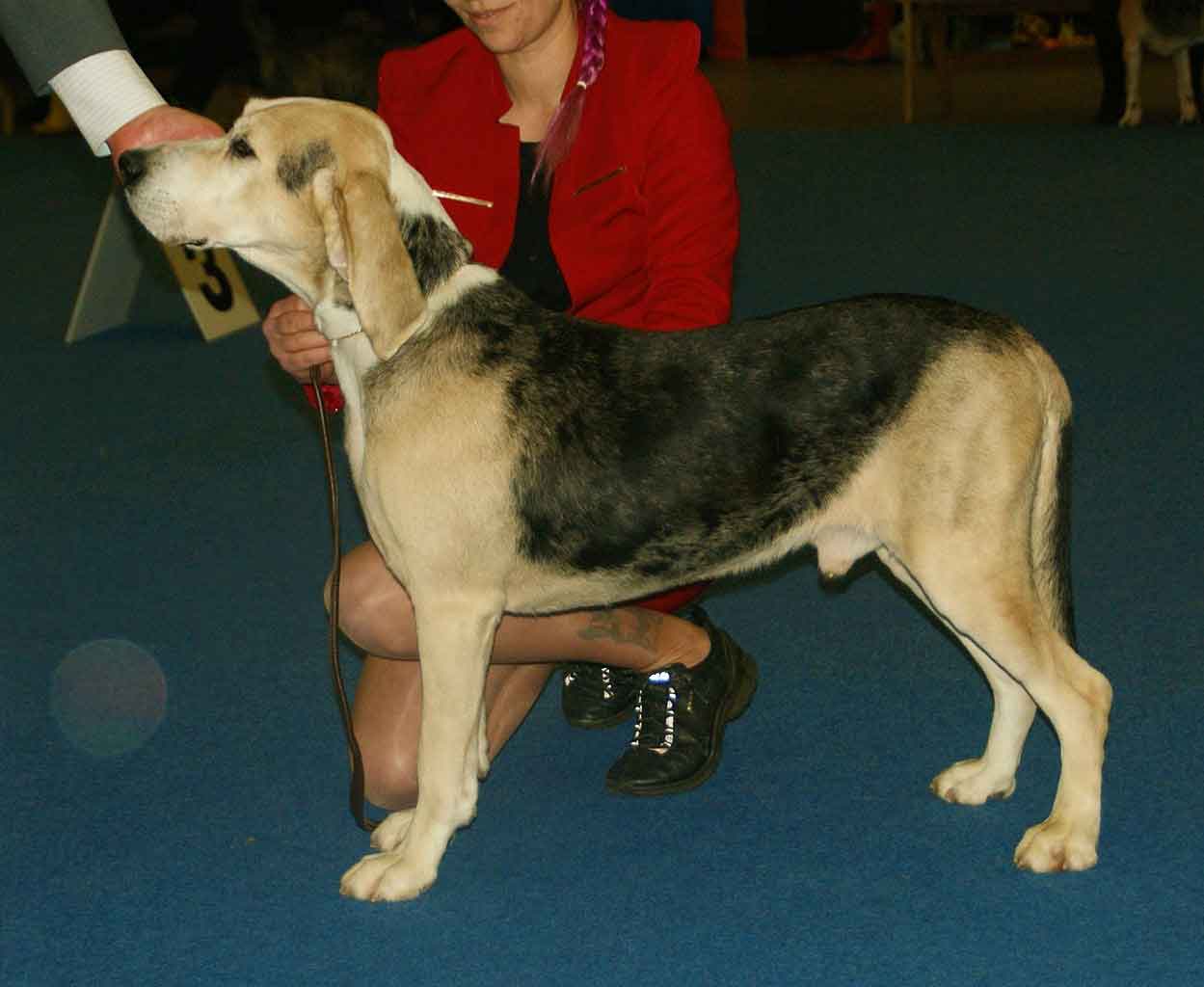
Photo: A Norwegian Hound by Canarian, CC BY-SA 4.0, via Wikimedia Commons

Physical characteristics ยซNorwegian hound (Dunker)ยป

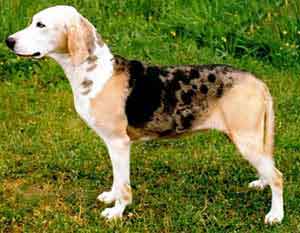
The Norwegian Hound It is a medium-sized dog distinguished by its long, well-proportioned body, his energetic and clear walk and his light weight. They have solid bones, giving an impression of strength and endurance. The back is straight, firm and long enough to give length to the rib cage. Lets on strong, dry front legs. The tail is wide and thick at the base and tapers at the tip. Descends to the hock or slightly protrudes from the hock.
Dunker
Dunker

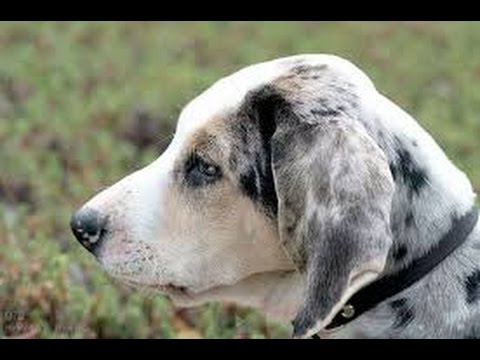
Quite long, its head is characterized by a slightly domed skull and a marked stop. Located at half height, the ears are flat, without folds, hanging and soft to the touch. medium width, taper towards its tip, which is rounded. Its mouth has scissor-shaped teeth dominated by a square, well-developed snout., a black nose and wide nostrils.

His eyes are round, large and very penetrating. Although they are usually dark in color, there are also individuals with one or two blue eyes, a characteristic that is associated with an increased risk of deafness. Minnow eyes are allowed in blue individuals (variegated). Regardless of the color of the eyes, the eyes express calm and seriousness.

The coat of the Dunker consists of short hair, hard, tight and dense. Its coloration is a distinctive sign of the breed: they are either black with light fawn and white spots, or blue merle (ยฟbigarros?) and mottled with light fawn and white spots. Jet black coats with dark tawny markings are less desirable, and those in which white predominates (to the point of representing at least the 50% Of the surface) are considered undesirable by the norm.

Last, sexual dimorphism is not very marked in this breed: males and females are quite similar in size and weight.

Life expectancy: 12 years of age.

Size of Norwegian Hound

    – female weight: Of 24 to 25 kg
    – Male weight: Of 24 to 25 kg
    – female size: Of 47 to 53 cm.
    – Male size: Of 50 to 55 cm.

Character and skills ยซNorwegian Hound (Dunker)ยป

The Norwegian Hound is a fast and tenacious hunter with an above-average olfactory ability. They excel particularly in hunting hare and rabbit.

Being also gentle, loving, cheerful and friendly, they have all the qualities required to be an excellent companion dog. balanced, patients, tolerant and devoid of aggressiveness, they are very good playmates for children. But, it is important to note that a dog should never be left alone with a small child without adult supervision, and this applies to all races.

His total lack of aggressiveness and his attraction to humans, even for those you don't know, make it totally impossible to use as a guard dog. In effect, not reserved at all, shy, fearful or aggressive with strangers, rather they tend to welcome them positively and trust them. They are more likely to greet a malicious person with curiosity and licking them rather than barking to warn their master or make them understand that they better go their way.

His sociability extends to other dogs too. So, it is quite possible to share a house with a dog companion without fearing that conflict situations will multiply, and is generally friendly with those he meets on his walks.

With cats and other animals, things are a little more complicated. His hunting instinct naturally leads him to chase any small furry animal that is not part of the canine species.. Although he has grown up with him and must consider his little companion as a member of the family and not as a potential prey, risk can never be ruled out, so it is better to avoid such cohabitation. As for those that can be found on your walks, you probably want to chase them. So, it is preferable to keep it on a leash during excursions, to avoid any accident.
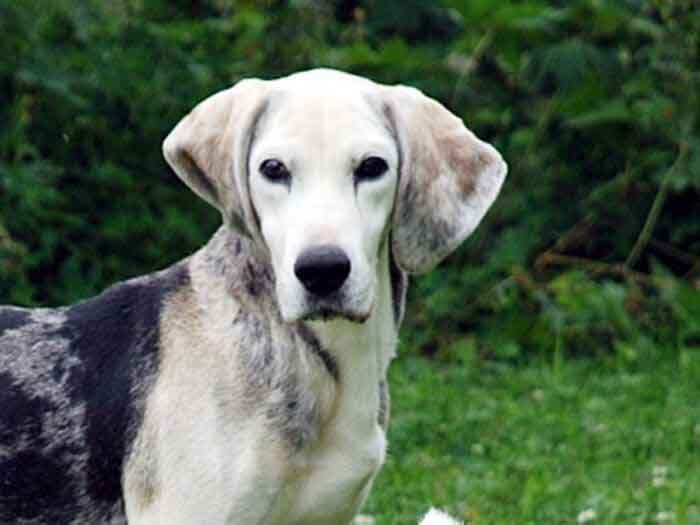
Dunker
Dunker

In any case, the fear that it will chase other animals does not mean that you should not take it out enough each day, knowing that you need a lot of activity to spend your great energy. Need at least 45 minutes of exercise per day, but his stamina makes him happy to go further if given the chance. It also, it is preferable to vary the pleasures to allow him to fully expend his energy: long walks, run through the park, sports with dogs, etc. Sports that require running (like canicross) and those that appeal to your senses (like tracking) they are the most recommended. In fact, this dog is very happy when he has to mobilize his physical and mental capacities. In any case, in addition to allowing you to exercise, all these activities reinforce the relationship with his master, which is especially important if you are hearing impaired.

From the above it follows that the Dunker not suitable for an elderly or very sedentary person, that I couldn't give you all the exercise you need. The ideal for him is a master of sport, and willing to take his partner in his various activities. Retirees may be right for him, if they are active enough.

In any case, life in the city is not ideal for him, that needs large spaces to fully develop. A house with a garden in the country is a much more appropriate environment to live in.. But, it is important to ensure that the garden is well fenced and that the environment is safe, as his instincts and hunting instincts soon lead him to follow leads and flee.

Once your need for exercise is satisfied, the Norwegian Hound has an easy and docile character; is far from being as stubborn as many hunting dog breeds. But, your sense of smell can make training difficult, as he is easily distracted by a scent and not really responsive to his master's commands.

Their propensity to bark can also be quite annoying. He is particularly prone to doing it if his master is away for a long time without having given him any exercise beforehand and without having the means to do it himself.. In fact, inactivity can be a burden and cause those behavior problems, as well as destruction, for example. But, as long as you have something to take care of in the absence of your family, not the type of dog that suffers a lot from separation anxiety.

Education ยซNorwegian Hound (Dunker)ยป

Like all the other hounds, the Norwegian Hound must be socialized from an early age. In other words, so that he becomes a balanced adult and has no trouble finding his place, should be given without delay a maximum of opportunities to meet all kinds of humans (veterinary, neighbors, delivery man, etc.), Other animals, but also to face various noises, smells and situations. This is even more important since he is easily distracted by his sense of smell..

The rules established in your education should also be taught to you from an early age, when your ability to learn and docility are at their best. As with any race, bad habits pick up quickly when he's still a puppy and become real problems when he gets older.

In any case, the Dunker it is a breed of dog that is easy to train and that listens to its master, as long as he uses a dog-friendly training method. Treatments generally prove to be very effective in positively reinforcing your good deeds and facilitating learning. But, sometimes it is necessary to show firmness and affirm your own authority to prevent this dogged dog from doing what he pleases. It can also be difficult to get their attention., given their tendency to be distracted by their sense of smell.

Since it has a strong inclination to follow its nose and to chase passing small animals, Teaching your dog to call back is especially important to avoid the risk of a frantic tug on the leash or running away if it moves freely.

It may also be helpful to try to teach him to channel his propensity to bark.. But, as it is deeply ingrained in him, should not be expected to be the calmest of dogs. If it is impossible to make him understand that some things do not necessarily require him to bark, at least he can be taught to stop on command.

Last, if the dog is deaf from birth, as is the case with a significant fraction of the representatives of the breed, the master must obviously adapt to this restriction: Training a deaf dog is not done in the same way as training another dog that is able to hear its master's voice.. Trust is then even more crucial in the relationship between the animal and its master., so that you can learn and live in good conditions despite your disability. Of course, communication is then done through non-verbal communication, and it's up to the teacher to adopt explicit body language, based on gestures and precise mimicry, specific for each indication you want to give.

Health ยซNorwegian Hound (Dunker)ยป

The Norwegian Hound is very resistant, generally have excellent health and very good longevity.

Used to living in harsh Norwegian weather, can tolerate cold and damp without difficulty. Their coat is naturally waterproof and offers good protection from the elements. On the other hand, shows some intolerance to high temperatures, even if it is able to adapt to a Mediterranean climate. You simply need to lighten up your activities during hot flashes, or at least privilege those that are carried out inside, to ensure that you always have access to a place in the shade or even air conditioning and to avoid any excessive physical exertion in the hottest hours.

Its small population and its limited diffusion prevent a very important deterioration of health, but it has been shown that it is predisposed to certain problems:

  • deafness, what is a hereditary disease. According to the Orthopedic Foundation for Animals (OFA), almost the 75% of the population of the breed is today deaf in at least one, if not both ears;
  • hip dysplasia, a joint malformation that may be characterized by a hereditary predisposition. It can cause joint pain as well as difficulty moving;
  • Elbow dysplasia, which can also be favored by a hereditary predisposition. It is painful and leads to difficulty moving and the development of osteoarthritis;
  • progressive retinal atrophy, a hereditary and incurable eye disease. Causes loss of night vision first, then loss of daytime vision, to the point that the dog becomes totally blind;
  • Demodecic scabies, a contagious parasitic disease that causes itching and true discomfort to the dog, gradually losing appetite and sleep;
  • ear infections (otitis, etc.), due to its hanging shape.
  • It also, individuals used for hunting are exposed to the various risks associated with this activity: wounds, parasites, thorns, etc.

    It also, the Dunker has a strong appetite. How it is usually active, this is not usually a problem. But, if it is not, soon becomes overweight.

    Given the hereditary conditions to which the breed is predisposed, the breeder's work plays a decisive role in the adoption of a Norwegian Hound that he is in perfect health and that he will probably remain so. In addition to the results of genetic tests performed on the parents and the puppy to reduce the risk of such diseases, every serious and responsible breeder must be able to present a certificate of good health established by a veterinarian, as well as documents related to the vaccines administered.

    It also, when the dog is small and still growing, your bones and joints are particularly fragile: therefore, any excessively intense or prolonged physical exercise should be avoided, since I could pay it off one day or another, with potentially permanent sequelae (malformations, etc.).

    Last, it is necessary to consult a veterinarian at least once a year to ensure that the dog is in good health or, on the other hand, to be able to detect as soon as possible any problem whose symptoms are not yet visible. This health check is also an opportunity to carry out your immunization reminders, which are another essential lever to keep the dog in good health. Still on the prevention registry, it is the owner's responsibility to renew the antiparasitic treatments whenever necessary throughout the year, so your partner is never unprotected.

    Care and maintenance ยซNorwegian Houndยป

    A tough breed, the Norwegian Hound do not require much maintenance.

    But, they lose a lot of hair, so brushing your hair twice a week is not too much to help remove dead hairs and keep it in good condition. During their molting periods in spring and fall, when it should be done more often (even daily) to prevent hair growth throughout the house.

    Since his hair is not very dirty and therefore does not have a strong odor, bathing him two or three times a year is generally sufficient. In any case, a too frequent bath will make the sebum naturally present on the skin disappear, insulates and protects it from the elements. Having said that, do not hesitate to give him a bath if he has gotten very dirty, for example during a particularly muddy hunting trip. In any case, you can only use a shampoo specially designed for dogs, at the risk of damaging your skin.
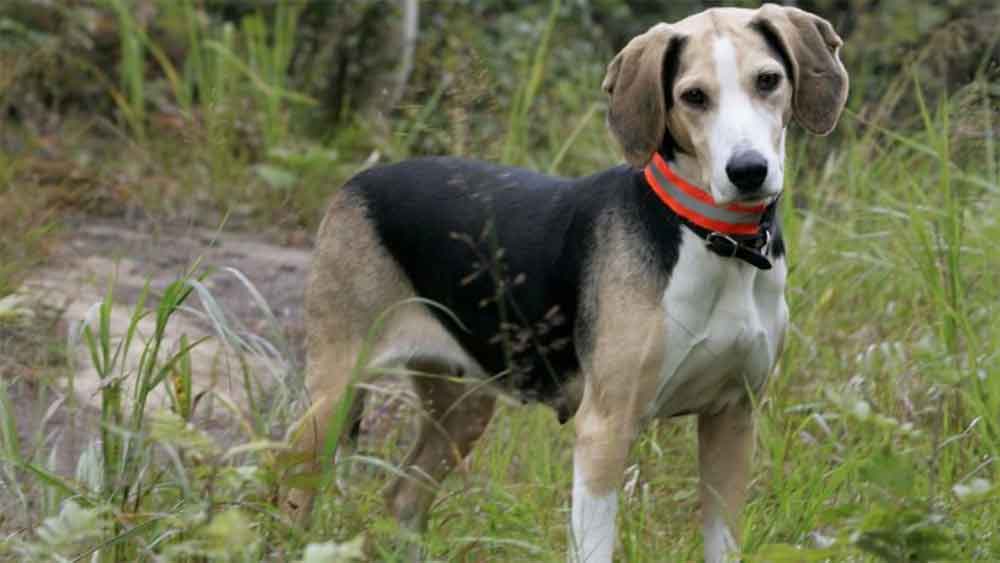
    Dunker
    Dunker

    The ears, on the other hand, require special attention, since its hanging shape implies an increased risk of infections (ear infections, etc.). They must be cleaned every week with a damp cloth or a cleaning product specially designed for this purpose.. They should also be dried after each bath or after a long period of time in a damp place..

    Their eyes they must also be examined weekly and cleaned if necessary with a damp cloth.

    It is also necessary to brush the teeth of your dog every week or even every day to avoid the formation of dental plaque and its possible consequences (bad breath, diseases, etc.). A toothpaste specially designed for dogs should always be used.

    It also, it is important to regularly check your dog's claws to make sure they are not getting too long and to trim them if this is the case. This could not only hinder your walking, but you could also break and potentially injure yourself at the same time. Having said that, while you're active and spending long hours outdoors, natural wear and tear is usually enough to file them.

    To know how to proceed during maintenance sessions, it is useful to benefit from the experience of a veterinarian or a groomer the first time. In fact, whether the various procedures for grooming the coat, the ears, the eyes, your pet's teeth or claws are not done properly, not only will satisfactory results not be obtained, but the owner may even injure or injure his pet. It also, the owner should get used to his pet very soon, so that throughout his life he accepts to be manipulated without being rebellious.

    It also, when your pet returns from a long time in the wild, it is a good idea to systematically take a little time to inspect it carefully: parasites, spikes or dirt may have gotten into their fur, and may also have been injured.

    What price does a โ€œNorwegian Houndโ€ cost?

    In Norway, a puppy Dunker It costs around 7000 Norwegian crowns (a few 650 EUR). The sale price varies from one individual to another depending on the prestige of the breeding, the lineage of the dog and its intrinsic characteristics.

    Since the breed does not have a wide international distribution, it is almost impossible to find a breeder of it outside of its country of origin.

    So, whether you are in France, Belgium, Switzerland, Canada or elsewhere, who wants to adopt a Norwegian Hound you must opt รขโ‚ฌโ€นรขโ‚ฌโ€นfor the import solution. In this case, keep in mind that transportation and administrative costs are added to the purchase price and, of course, you must respect the regulations to import a dog from abroad.

    Characteristics "Norwegian Hound (Dunker)"

    Coexistence is important that you have with your new friend. Before considering the acquisition of a dog of the breed "Norwegian Hound (Dunker)" you know certain factors. Not all breeds of dogs are apt to live in an apartment, you must take into account his character, their need for exercise, their interaction with other pets, their care and if you have small children, their level of tolerance towards them.

    Adaptation โ“˜

    2,0 of 5 stars (based on 1 review)

    friendly dog โ€‹โ€‹โ“˜

    4,0 of 5 stars (based on 1 review)

    hair loss โ“˜

    4,0 of 5 stars (based on 1 review)

    Affection level โ“˜

    4,0 of 5 stars (based on 1 review)

    Need for exercise โ“˜

    4,0 of 5 stars (based on 1 review)

    Social need โ“˜

    4,0 of 5 stars (based on 1 review)

    Home โ“˜

    4,0 of 5 stars (based on 1 review)

    Toilet โ“˜

    2,0 of 5 stars (based on 1 review)

    Friendly with strangers โ“˜

    4,0 of 5 stars (based on 1 review)

    barking โ“˜

    4,0 of 5 stars (based on 1 review)

    Health โ“˜

    4,0 of 5 stars (based on 1 review)

    Territorial โ“˜

    4,0 of 5 stars (based on 1 review)

    Cat friendly โ“˜

    2,0 of 5 stars (based on 1 review)

    Intelligence โ“˜

    3,0 of 5 stars (based on 1 review)

    Versatility โ“˜

    3,0 of 5 stars (based on 1 review)

    Child friendly โ“˜

    4,0 of 5 stars (based on 1 review)

    Surveillance โ“˜

    2,0 of 5 stars (based on 1 review)

    joy โ“˜

    4,0 of 5 stars (based on 1 review)

    Videos "Norwegian Hound (Dunker)"

    norwegian hound (Dunker) - Breed of dog
    Sabueso Noruego (Dunker) – Raza de Perro
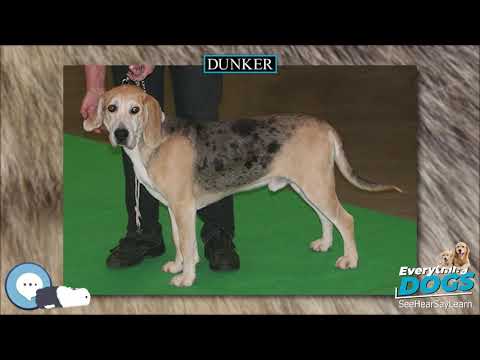
    Dunker ๐Ÿถ๐Ÿพ Everything Dog Breeds ๐Ÿพ๐Ÿถ
    Dunker ?? Everything Dog Breeds ??

    Type and recognitions:

    • FCI CLASSIFICATION:
    • Group :
    • Section : . .

    Federations:

    • FCI – Group 6: Scent hounds, and related breeds. – Section 1.2: Medium-sized Hounds. โ“˜
    • UKCScenthounds โ“˜

    FCI breed standard "Norwegian Hound (Dunker)"

    Origin:
    Norway

    Date of publication of the valid original standard:
    12.03.1999

    Use:

    Hound


    General appearance:

    Medium-sized; obviously rectangular, strong structure, without giving the impression of being heavy. Must show the ability to be tenacious and resilient.

    IMPORTANT PROPORTIONS :
    The depth of the chest should be approximately half the length of the height at the withers.


    Behavior / temperament:

    The Norwegian Hound is considered the tough and robust trail dog of the old days., a dog with an excellent temperament. The breed is characterized by nerves of steel and for being especially sociable and trusting.. They are known to have performed well in hunting tests.. In this way, They can be characterized as an excellent combination of a hunting and companion dog.. Due to his good temperament and open character, the breed is also easy to train.

    Head:

    You should not carry it high. Clean, carried with dignity, with good length and parallel lines, non-cuneiform.

    Cranial region:
    • Skull : Slightly bulky, prominent occipital protuberance. If the snout is long and well developed, the skull is allowed to be wider, especially in males, as long as it does not lose its parallel planes.
    • Depression links (Stop) : Marked, but not deep or abrupt.

    facial region:

    • Truffle : black, well open Windows.
    • Snout : Rather long than short, square cut. Straight and evenly wide nose cane.
    • Jaws / Teeth : Scissor bite. Complete denture.
    • Cheeks : clean, no prominent cheekbones.

    Eyes : dark colored, round, rather big, but not outstanding. Expressive eyes, brilliant intelligence, calm and gravity. Close-fitting eyelids. Doe eyes are allowed in ยซBlue merleยป dogs.

    Ears : Medium implementation, rather low than high. soft, moderate width, tapering towards the rounded tip. Flat, without folds. Hanging close to the face. Long enough to reach the middle of the snout when stretched forward.

    Neck:

    Relatively long, no visible double chin.

    Body:

    • top line : Level.
    • Back : Straight, firm and not too long.
    • Loins : Wide and well muscled, not convex.
    • Rump : With a slight drop, well muscled, not too short.
    • Breast : Large capacity, with well arched ribs; the last ribs must be particularly well developed, making the chest look long.
    • Bottom line and abdomen : Slightly gathered.

    Tail:

    Implementation at the top line level. Thick at its root, tapering towards the tip. It should be straight and carried with a slight upward curvature; reaching to the hock or a little below it.

    Tips

    PREVIOUS MEMBERS :

    • As a whole : Strong, thin and sinewy.
    • Shoulder : Muscular, wide and inclined scapula, well attached to the trunk; tips of shoulder blades close together at the top. Well-angled shoulder and elbow joints.
    • Arm : Straight.
    • Metacarpus : Slightly inclined.
    • Front feet : Closed and arched fingers with a lot of fur between them. Durable pads. Feet should point forward.

    LATER MEMBERS :

    • As a whole : Well angled, parallel in standing position. Without being too angled or with a "cow" hock.
    • Thigh : Large.
    • Knee : Well angled.Leg : Wide.
    • Hocks : Thin and low position, wide if seen from the side.
    • Rear feet : Like the front feet.

    Movement:

    Libre, with good scope. The extremities, views from behind, they are parallel; without cow hocks and without being too angled.

    Mantle

    HAIR : Straight, hard, dense and not very short. The back of the thighs and tail may have more hair, as long as the rest of the body has good fur.

    COLOR : Black or "Blue merle" with pale fawn or whitish markings. The intense brown or predominantly black color, reaching from the snout lower than the hocks with a so-called mask is less desirable. When the white, increasing too much, reaches below the shoulders to the lower belly or to the feet (socks), These are correct and accepted brands.


    Size and weight:

    Height to the cross:

    • Males: 50-58 cm., ideal 52-54cm
    • females: 47-54cm., ideal 49-51 cm..


    Fouls:

    Any deviation from the aforementioned criteria is considered as a fault and the severity of this is considered to the degree of the deviation to the standard and its consequences on the health and well-being of the dog..

    โ€ข When in black or light fawn dogs the white reaches the middle of the back, or if blue-merle dogs show white markings, The rating of these dogs should be decreased in proportion to the extent of the target's extent..

    MISS PLAYOFFS :

    โ€ข Aggressiveness.
    โ€ข Predominantly white color (50% or more).

    Any dog โ€‹โ€‹showing clear signs of physical or behavioral abnormalities must be disqualified..


    N.B.:

    Males should have two normal-appearing testicles fully descended into the scrotum..

    Source: F.C.I - International Cynological Federation

    Alternative names:

    1. Dunker (English).
    2. Dunker (French).
    3. Dunkerbracke, Dunkerlaufhund (German).
    4. Dunker (Portuguese).
    5. Cazador noruego, Dunker, Sabueso de Dunker (espaรฑol).

    โ–ท The world of Pets: Dogs, cats, birds, reptiles, amphibians

    Halden Hound
    Noruega FCI 267 - Medium-sized Hounds

    Halden Hound

    The spread of Halden Hound limited to your country of origin, where it is also little known.

    Content

    History

    Originally from Norway, the Halden Hound takes its name from Halden, the city where it was created.

    Breed selection was initiated by Hans Larsen Bisseberg, an Ostfold County farmer, in 1860. The breed is believed to be the result of various crosses between local hounds and Swedish hounds, Germans and English. The official breed standard was established in the decade of 1950 and it is very rare outside of its country of origin. Most frequently used the Norwegian Hound and the Hygen Hound.

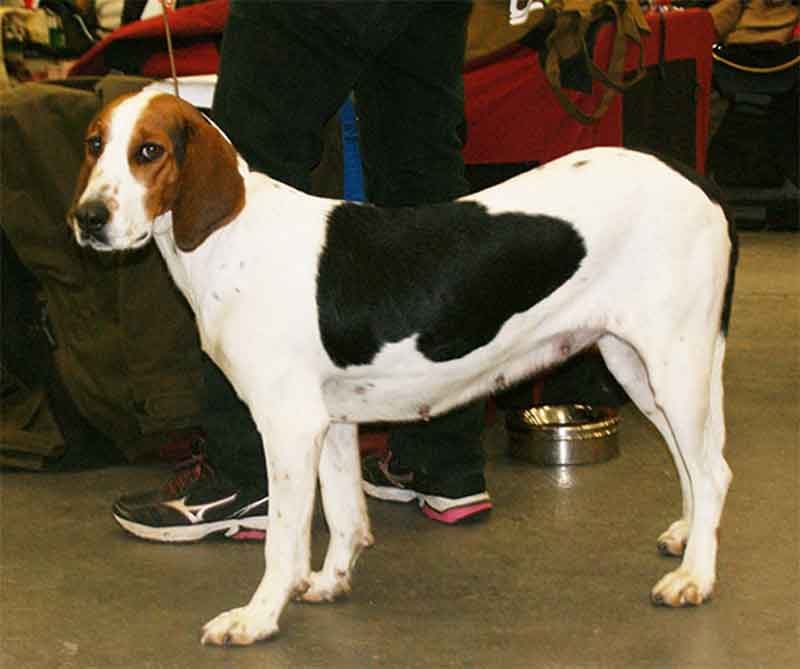
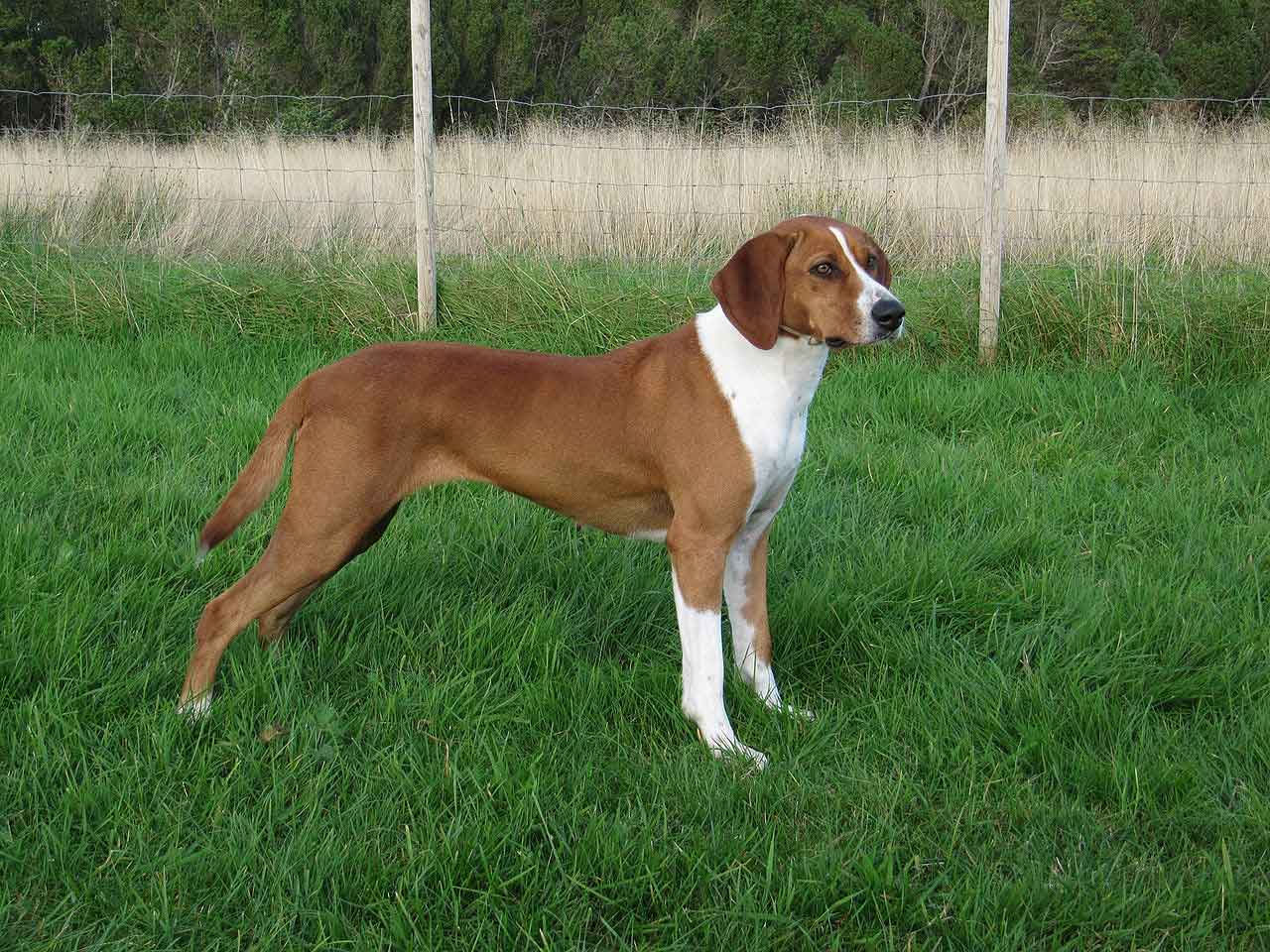
    Photo: A female Halden Hound. Colour: tricolor by Canarian, CC BY-SA 4.0, via Wikimedia Commons

    Physical characteristics ยซHalden Houndยป

    The Halden is similar to the American Foxhound ostensibly, although it is smaller.

    It is a dog whose body can fit in a rectangle, proud, strong but not heavy. The head is medium in size, well balanced. The eyes, dark brown, they are medium in size and have a calm expression. The ears, that are neither too high nor too low, they are turned forward and should reach the middle of the muzzle. The tail, that is neither too high nor too low, it is quite thick and is carried low.

    • Fur: rough, very tight and smooth, with thick undercoat.
    • Color: White with black spots, small, less dark spots on the head, limbs and sometimes between black and white. But, black should not dominate.
    • Size: 52 to 60 cm for the male and 50 to 58 cm for female.
    • Weight: 23 to 29 kg for the male and 20 to 25 kg for females.

    Character and abilities ยซHalden Houndยป

    Kind and caring, the Halden Hound He can make a great companion dog if you take the time to meet his many exercise needs.. It is a nice dog to live, but can be unsociable with children, strangers or even other animals if not well socialized. Very exclusive, he does not like to be surrounded, which makes him a very good watchdog. Excellent hunter, fast and resistant. If you are not hunting, it will be the perfect companion for a sports owner.

    Independent in nature, education should start very early to prevent this dog from developing too many bad habits. Firmness and consistency will be required to achieve results, but beware, no violence towards this sensitive dog will be tolerated.

    Characteristics "Halden Hound"

    Coexistence is important that you have with your new friend. Before considering the acquisition of a dog of the breed "Halden Hound" you know certain factors. Not all breeds of dogs are apt to live in an apartment, you must take into account his character, their need for exercise, their interaction with other pets, their care and if you have small children, their level of tolerance towards them.

    Adaptation โ“˜

    4,0 of 5 stars (based on 1 review)

    friendly dog โ€‹โ€‹โ“˜

    4,0 of 5 stars (based on 1 review)

    hair loss โ“˜

    3,0 of 5 stars (based on 1 review)

    Affection level โ“˜

    4,0 of 5 stars (based on 1 review)

    Need for exercise โ“˜

    4,0 of 5 stars (based on 1 review)

    Social need โ“˜

    3,0 of 5 stars (based on 1 review)

    Home โ“˜

    3,0 of 5 stars (based on 1 review)

    Toilet โ“˜

    2,0 of 5 stars (based on 1 review)

    Friendly with strangers โ“˜

    3,0 of 5 stars (based on 1 review)

    barking โ“˜

    4,0 of 5 stars (based on 1 review)

    Health โ“˜

    4,0 of 5 stars (based on 1 review)

    Territorial โ“˜

    3,0 of 5 stars (based on 1 review)

    Cat friendly โ“˜

    2,0 of 5 stars (based on 1 review)

    Intelligence โ“˜

    4,0 of 5 stars (based on 1 review)

    Versatility โ“˜

    3,0 of 5 stars (based on 1 review)

    Child friendly โ“˜

    2,0 of 5 stars (based on 1 review)

    Surveillance โ“˜

    4,0 of 5 stars (based on 1 review)

    joy โ“˜

    4,0 of 5 stars (based on 1 review)

    Videos "Halden Hound"

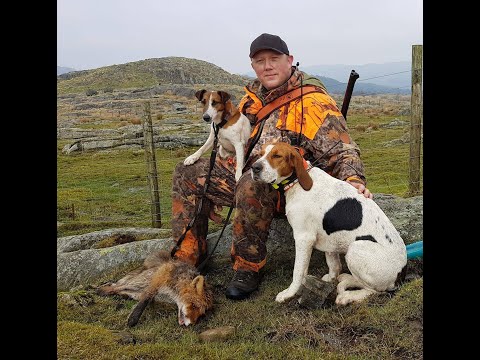
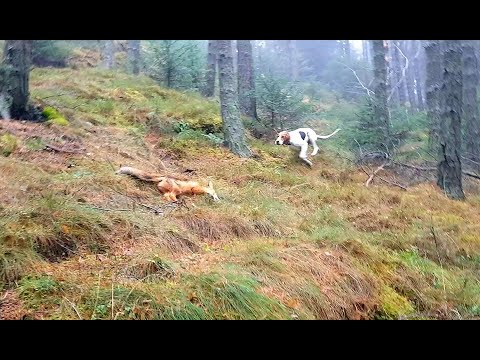
    Fox hunting with halden hound and fox terrier in Norway
    Fox hunting with halden hound and fox terrier in Norway
    Foxhunting with halden hound and fox terrier 07.11.20
    Foxhunting with halden hound and fox terrier 07.11.20

    Type and recognitions:

    • FCI CLASSIFICATION:
    • Group :
    • Section : . .

    Federations:

    • FCI – Group 6: Scent hounds, and related breeds. – Section 1.2: Medium-sized Hounds. โ“˜

    FCI breed standard "Halden Hound"

    Origin:
    Norway

    Date of publication of the valid original standard:
    09.08.1999

    Use:

    ---


    General appearance:

    Rectangular construction, noble, strong, but not heavy.


    Behavior / temperament:

    ---

    Head:

    Thin, medium sized and well proportioned.

    Cranial region:
    • Skull : Seen from the front and from the side slightly dome-shaped. The occipital protuberance is barely noticeable.
    • Depression links (Stop) : Not abrupt.

    facial region:

    • Truffle : black, open windows.
    • Snout : Not too short; straight muzzle.
    • Lips : Not very hanging.
    • Jaws/Teeth : Scissor bite; complete denture.
    • Cheeks : Relatively flat.

    Eyes : Dark brown in color, medium-sized; calm expression.

    Ears : Its insertion is neither too high nor too low; If they are placed forward they should reach up to the middle of the snout.

    Neck:

    Rather long, strong, thin and without any double chin.

    Body:

    • top line : Straight.
    • Back : Strong.
    • Pork loin : Wide and muscular.
    • Rump : Slightly oblique.
    • Breast : Deep with tight ribs, but not barrel-shaped. The last ribs must be particularly well developed.
    • Belly : Very little withdrawn.

    Tail:

    Insertion neither too high nor too low; rather thick; reaches almost to the hocks. Worn rather low.

    Tips

    PREVIOUS MEMBERS

    • As a whole : Straight, thin limbs with strong bones.
    • Shoulder : Long and oblique shoulder blade, muscular; the tips do not protrude from the back line.
    • Forearm : Straight and thin.
    • Metacarpus : Slightly inclined.
    • Front feet : Oval, well arched, preferably closed, well covered with hair between the fingers.

    LATER MEMBERS

    • Thigh : Broad and muscular.
    • Knee : Well angled.
    • Leg : Long.
    • Hocks : Thin and wide, turned neither in nor out. Well angled.
    • Rear feet : Like the front feet. Rams are allowed, but they are not desirable.

    Movement:

    Light, parallel, covers the ground well.

    Mantle

    HAIR : Rough, very dense and straight, with a dense undercoat of hairs.

    COLOR : White with black spots, shaded tan patches on head, limbs and sometimes between black and white. Black should not predominate. Small black or tan spots are considered a color defect..


    Size and weight:

    Height to the cross :

    • For males : 52-60 cm., ideal 56 cm..
    • for females : 50-58 cm., ideal 54 cm..


    Fouls:

    Any deviation from the aforementioned criteria is considered as a fault and the severity of this is considered to the degree of the deviation to the standard and its consequences on the health and well-being of the dog..

    ELIMINATORY FOULS

    โ€ข Aggressiveness.

    Any dog โ€‹โ€‹showing clear signs of physical or behavioral abnormalities must be disqualified..


    N.B.:

    Males should have two normal-appearing testicles fully descended into the scrotum..

    Source: F.C.I - International Cynological Federation

    Alternative names:

    1. (Norwegian: Haldenstรธver) (English).
    2. Halden (French).
    3. Haldenbracke, Haldenlaufhund, Halden-Stรถvare (German).
    4. (Norueguรชs: haldenstรธver) (Portuguese).
    5. (Noruego: Haldenstรธvare, Haldenstรธver) (espaรฑol).

    โ–ท The world of Pets: Dogs, cats, birds, reptiles, amphibians

    Hygen Hound
    Noruega FCI 266 - Medium-sized Hounds

    Hygen Hound

    The spread of Hygen Hound it is very limited even in Norway; outside the country it is practically unknown.

    Content

    History

    The Hygen Hound originated in Norway in the 19th century. It owes its name to its creator Hans Fredrik Hygen, that he wanted a brave and robust dog that could hunt even in the harsh climates of the north. So he decided to cross Swiss and German dogs with local dogs. The Hygen Hound has had a rocky history as the breed all but disappeared in the 1990s 1970 without the intervention of a few passionate breeders. In the Decade of 2000, these breeders made genetic improvements by crossing with the Finnish Hound. Today, the Hygen Hound it is quite rare even in his homeland.

    Photo: Norwegian dog breed hygenhound. Tosstjรธnna’s Nala by Bjรธrn Konestabo, CC BY-SA 3.0, via Wikimedia Commons

    Physical characteristics ยซHygen Houndยป

    The Hygen Hound has a robust and solid gait and a body inscribed in a triangle. Medium-sized, measured between 50 and 58 cm if it is a male and between 47 and 55 cm if it is a female for a weight of about 22 kg according to sex, size and age.

    The Hygen, as it is also nicknamed, stands out for its head of average length and size, that is wedge-shaped and marked width without being excessively heavy. The skull is slightly domed and the stop is accentuated. The eyes express both calm and seriousness. They are medium in size and show dark brown tones. The ears are of medium length and width, taper at the tips and set at a medium height. Fall while spreading and do not stick to the cheeks.

    The Hygen Hound they have rough fur, straight, short, bright and dense. The coat is available in three colors: white with yellow-red markings / brown or black and tan, black and tan with white markings or red-yellow or red-brown with or without white markings and charcoal on the back, head and tail attachment.

    Character and abilities ยซHygen Houndยป

    The Hygen Hound It is a race linked to its social group that is both protective, Gentile, balanced and versatile. Although they specialize in hunting activities, nothing prevents them from being adopted as pets, as long as the exercise is given, the necessary care and education. The worst tolerated punishment is inactivity. He also does not like to be alone despite his slightly independent nature.. To be happy, prefers open spaces over closed ones.

    Characteristics "Hygen Hound"

    Coexistence is important that you have with your new friend. Before considering the acquisition of a dog of the breed "Hygen Hound" you know certain factors. Not all breeds of dogs are apt to live in an apartment, you must take into account his character, their need for exercise, their interaction with other pets, their care and if you have small children, their level of tolerance towards them.

    Adaptation โ“˜

    4,0 of 5 stars (based on 1 review)

    friendly dog โ€‹โ€‹โ“˜

    4,0 of 5 stars (based on 1 review)

    hair loss โ“˜

    5,0 of 5 stars (based on 1 review)

    Affection level โ“˜

    4,0 of 5 stars (based on 1 review)

    Need for exercise โ“˜

    5,0 of 5 stars (based on 1 review)

    Social need โ“˜

    3,0 of 5 stars (based on 1 review)

    Home โ“˜

    4,0 of 5 stars (based on 1 review)

    Toilet โ“˜

    2,0 of 5 stars (based on 1 review)

    Friendly with strangers โ“˜

    4,0 of 5 stars (based on 1 review)

    barking โ“˜

    5,0 of 5 stars (based on 1 review)

    Health โ“˜

    5,0 of 5 stars (based on 1 review)

    Territorial โ“˜

    3,0 of 5 stars (based on 1 review)

    Cat friendly โ“˜

    2,0 of 5 stars (based on 1 review)

    Intelligence โ“˜

    4,0 of 5 stars (based on 1 review)

    Versatility โ“˜

    3,0 of 5 stars (based on 1 review)

    Child friendly โ“˜

    5,0 of 5 stars (based on 1 review)

    Surveillance โ“˜

    3,0 of 5 stars (based on 1 review)

    joy โ“˜

    5,0 of 5 stars (based on 1 review)

    Videos "Hygen Hound"

    Training Milli 130118
    Video Credits: Rolf Hestetreet
    Hygenhund Dog breed
    Hygenhund Dog breed

    Type and recognitions:

    • FCI CLASSIFICATION:
    • Group :
    • Section : . .

    Federations:

    • FCI – Group 6: Scent hounds, and related breeds. – Section 1.2: Medium-sized Hounds. โ“˜

      • FCI breed standard "Hygen Hound"

        Origin:
        Norway

        Date of publication of the valid original standard:
        09.08.1999.

        Use:

        Hound


        General appearance:

        Medium-sized, solid and compact, rectangular, with firm top line.


        Behavior / temperament:

        ---

        Head:

        Medium in size and moderately wide, but not heavy. Of a medium length, something wedge shaped, but not pointy.

        Cranial region:
        • Skull: Slightly domed, be seen from the front or from the side. The occipital bone is barely visible.
        • Depression links (Stop): Marked.

        facial region:

        Truffle: black.
        Snout: Cleansed, wide and deep, rather short than long. Straight nose cane. Side view, the front of the muzzle should be rounded, not square.
        Lips: Clean, no pendulosos, falling evenly towards the corner of the lips.
        Jaws / Teeth: Scissor bite.
        Cheeks: Clean and flattened.
        Eyes: Dark brown in color, medium-sized, not bulging. Serious and calm expression. The conjunctiva is not visible.
        Ears: Middle insert, neither wide nor long, thinning and rounded at its tip. Thin and smooth, are not glued to the cheeks, but they are somewhat separate. They are directed forward, do not reach more than half the distance to the truffle.

        Neck:

        Of average length, strong, without too much loose skin.

        Body:

        Back: Straight and strong.
        Pork loin: Strong and muscular.
        Rump: Long, wide and slightly rounded.
        Breast : Medium width, long, deep and spacious throughout its length. The last ribs must be particularly well developed, giving the thorax an appearance of length. The depth of the chest corresponds to half the height at the withers.
        Belly: Very little withdrawn.

        Tail:

        When inserted it follows the line of the back. Strong at its roots, thinning towards the limb. It is worn straight or slightly bent up; reaches up to the hocks.

        Tips

        PREVIOUS MEMBERS
         
        As a whole: Clean, solid and tendinous, but not heavy.
        Shoulder: Oblique shoulder blades, well angulated shoulder joint.
        Elbows: Well angled.
        Metacarpus: Widths, rather short than long, slightly inclined.
        Front feet: High; fingers well arched and close together, directed forward. Firm and strong pads. Between fingers and pads well covered with hair.
         
        LATER MEMBERS
         
        Thigh: Wide and muscular.
        Knee: Well angled.
        Leg: Long.
        Hock: Well angled, wide and clean.
        Metatarsus: Short, wide and slightly oblique.
        Rear feet: As the front. Rams are allowed, but double dewclaws are undesirable.

        Movement:

        Libre, parallel viewed from the front or back, with good scope. In movement the rear members are not closed in the shape of a cow and the front members do not execute a lateral-circular movement..

        Mantle

        HAIR: Straight and preferably rather rough to the touch, dense, bright and not too short. The back of the thighs and the tail may have a little more abundant hair, but without exaggeration.
         
        COLOR:
        • Red-brown or yellow-reddish, often shaded black on the head, the back and at the root of the tail, with or without white spots.
        • black and tan, usually combined with white spots.
        • White and mottled with reddish-brown or yellow-reddish spots, or with black and tan spots.
        • All these different colors must be clearly delineated from each other.


        Size and weight:

        Height to the cross:

        • For males : 50-58 cm., ideal height 54 cm..
        • for females : 47-55 cm., ideal height 51 cm..


        Fouls:

        Any deviation from the aforementioned criteria is considered as a fault and the severity of this is considered to the degree of the deviation to the standard and its consequences on the health and well-being of the dog..
         
        ELIMINATING FAULT
        • Aggressiveness.
        Any dog โ€‹โ€‹showing clear signs of physical or behavioral abnormalities must be disqualified..


        N.B.:

        Males should have two normal-appearing testicles fully descended into the scrotum..

        Source: F.C.I - International Cynological Federation

        Alternative names:

        1. Hygenhund (English).
        2. Hygen (French).
        3. Hygenbracke, Hygenlaufhund, Hygenhund (German).
        4. (Em sueco: hygenhund) (Portuguese).
        5. (En sueco: hygenhund) (espaรฑol).

    โ–ท The world of Pets: Dogs, cats, birds, reptiles, amphibians

    Gray Norwegian Elkhound
    Noruega FCI 242 - Nordic Hunting Dogs

    An advantage of Gray Norwegian Elkhound is that it is a friendly and social dog does not tend to dominate or attack.

    Cazador de Alces Noruego

    Content

    Characteristics "Gray Norwegian Elkhound"

    Coexistence is important that you have with your new friend. Before considering the acquisition of a dog of the breed "Gray Norwegian Elkhound" you know certain factors. Not all breeds of dogs are apt to live in an apartment, you must take into account his character, their need for exercise, their interaction with other pets, their care and if you have small children, their level of tolerance towards them.

    Adaptation โ“˜

    5,0 of 5 stars (based on 1 review)

    friendly dog โ€‹โ€‹โ“˜

    3,0 of 5 stars (based on 1 review)

    hair loss โ“˜

    5,0 of 5 stars (based on 1 review)

    Affection level โ“˜

    5,0 of 5 stars (based on 1 review)

    Need for exercise โ“˜

    4,0 of 5 stars (based on 1 review)

    Social need โ“˜

    3,0 of 5 stars (based on 1 review)

    Home โ“˜

    3,0 of 5 stars (based on 1 review)

    Toilet โ“˜

    5,0 of 5 stars (based on 1 review)

    Friendly with strangers โ“˜

    3,0 of 5 stars (based on 1 review)

    barking โ“˜

    5,0 of 5 stars (based on 1 review)

    Health โ“˜

    3,0 of 5 stars (based on 1 review)

    Territorial โ“˜

    3,0 of 5 stars (based on 1 review)

    Cat friendly โ“˜

    3,0 of 5 stars (based on 1 review)

    Intelligence โ“˜

    5,0 of 5 stars (based on 1 review)

    Versatility โ“˜

    3,0 of 5 stars (based on 1 review)

    Child friendly โ“˜

    5,0 of 5 stars (based on 1 review)

    Surveillance โ“˜

    3,0 of 5 stars (based on 1 review)

    joy โ“˜

    5,0 of 5 stars (based on 1 review)

    History

    National dog of Norway

    The roots of this Norwegian national dog go back a long way.: already Stone Age finds give evidence of a very similar quadruped. Some cynologists suspect that the current appearance of the breed is very close to that of the first western European domestic dogs. In scandinavia, the Gray Norwegian Elkhound they were used mainly to hunt elk, but also bears, hence its name.

    For a long time the breed was mainly bred in Sweden, where he was called "gray dog". But since 1981 Norway has had the sponsorship: The breed got its current name, The "gray dog" was formally eliminated as a breed in this context.

    In total there are three Moose Hunter dogs: Besides of Gray Norwegian Elkhound, are the Black Norwegian Elkhound and the Jรคmthund Sueco. The Norwegian gray is the most common: Although rarely seen outside of Scandinavia, he is very popular in his home country and is considered the national dog there.

    Physical characteristics

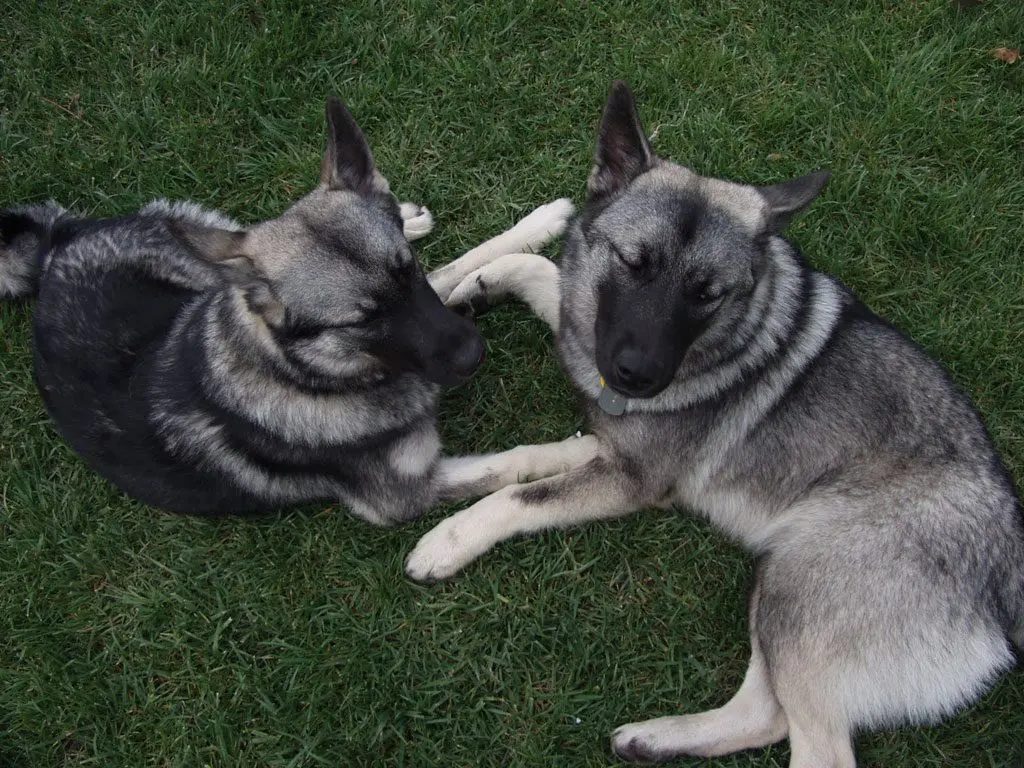
    The dog Gray Norwegian Elkhound has a very classic look, similar to the first dogs domesticated by humans in Western Europe. The waterproof coat in typical shades of gray, black and white already gives an indication of the Nordic origin of this dog Moose Hunter. But it also has the effect that some laymen at first glance consider it a mixed race with parts of the Huskys. With a maximum height of 52 cm at the withers and a body weight of about 24 kg with compact structure, the Gray Norwegian Elkhound belongs to the medium-sized breeds and is larger than the Black Norwegian Elkhound. The pointy ears are erect and the tail is ideally rolled slightly over the back..

    Character and skills

    The Gray Norwegian Elkhound they are intelligent animal companions with their own personalities. So if you are looking for a four-legged friend who is willing to subordinate, you are wrong with this proud fellow. The breed is considered brave, smart and friendly. To the Gray Norwegian Elkhound they usually like to bark, make sure to control it from when they are puppies. Many Gray Norwegian Elkhound they are therefore very suitable as watchdogs, because they are alerted by strangers – However, it is quite possible that this human-friendly breed will be caressed by a stranger. In an emergency, However, loyal four-legged friends are always ready to defend their loved ones. The Gray Norwegian Elkhound can be well kept as a family dog – whenever I exercise a lot outside. He gets along very well with children and shows his playful side, especially when interacting with them.

    Gray Norwegian Elkhound Training

    Although this breed does not have a submissive nature, is considered easy to create. An advantage is that this friendly and social dog does not tend to dominate or attack. In any case, it is important to have a sufficient workload, because a boring Gray Norwegian Elkhound seek their occupation independently, and this is usually not to the liking of their owners. It also, make sure that from the age of the puppy you work for a good recovery of the hunting dog. You should also take into account the joy of barking when training. Attending a dog training school can support you and your four-legged friend in learning together and also reinforces their social streak in handling conspecifics.

    Gray Norwegian Elkhound Health

    These Norwegian hunters they are considered very robust and hardly prone to genetic diseases. There is a slight predisposition to the eye disease Progressive Retinal Atrophy (ARP) and hip dysplasia – before buying a puppy, Please, talk to the breeder in question, who will be happy to inform you about the health precautions for your farm animals. Exercising and eating a balanced diet is the best way to keep your puppy's joints in shape during old age.. Make sure this dog always has a cool place to stay in the summer – the breed tolerates the cold well, but is considered to be heat sensitive. The Gray Norwegian Elkhound can reach an age of up to 16 years, some even more.

    Gray Norwegian Elkhound Nutrition

    Like every dog, the Gray Norwegian Elkhound you need a balanced diet that is high in meat. So make sure you give a food where meat is at the top of their intake., regardless of whether you choose wet or dry food. The Gray Norwegian Elkhound tend to gain weight quickly, so you should always watch your daily ration and include treats. The manufacturer's instructions are only a rough guide., as metabolism and exercise change your dog's energy needs. So check your partner's weight regularly so you can counter if he gains or loses weight. If you want to reward your dog, use high-quality snacks without sugar or grains. Chunks of freeze-dried meat for dogs are a good example. Dry chews meet your partner's chewing needs. Make sure your four-legged friend always has plenty of drinking water available.

    Gray Norwegian Elkhound Care

    This dog's coat consists of a longer top coat and a dense undercoat.. It is very weather resistant and easy to brush. But, the Gray Norwegian Elkhound you also lose a relatively large amount of hair, especially during coat change twice a year. During this time, you should brush him daily to stop the flood of hair in your home and rid the dog of dead hair. Especially with older animals or if your dog walks mainly on the soft forest floor, you may need to trim the claws regularly. This will prevent your Gray Norwegian Elkhound get hurt if you get stuck with them. If you are not sure, ask your vet to show you how to trim them during checkups – you can usually do the pedicure yourself with special pliers. When brushing your dog's ears, also check that they are not dirty and use a special ear cleaner for dogs if necessary. You can effectively prevent tartar and its consequences by brushing your dog's teeth every day together with a dog toothbrush and an animal-friendly toothpaste.. If you are considering this, you should get your pup used to the ritual around his shiny little teeth.

    Is a Norwegian Elkhound right for me??

    The Gray Norwegian Elkhound still suits hunters well, but he can also be a happy family dog รขโ‚ฌโ€นรขโ‚ฌโ€นif he has enough outdoor activity. Not a dog for the city. A fenced garden would be an ideal addition to your home.. This breed is not made for living in a small apartment.. Should already have experience with dogs, because although the Gray Norwegian Elkhound be smart and like to learn, will not accept instructions that seem crazy. Here you need the right mix of knowledge and sensitivity. Can get along with cats, but you should have already known them as potential mates at puppy age.

    Like any other four legged friend, keeping this dog requires a not inconsiderable amount of time: Are you prepared to spend a few hours outside with your partner every day, whatever the weather?? It also, estimate costs in advance: In addition to the purchase price and, if required, the basic equipment, there are regular expenses for vet visits, high quality food, as well as the dog's tax and insurance.

    Where can I buy a Norwegian Elkhound?

    If you are looking for a Gray Norwegian Elkhound outside scandinavia, you must have a little patience. So it makes sense to contact the Nordic dog clubs directly., that can help you, for example, to make contacts abroad. Because especially in the far north there are naturally more specimens. In scandinavia, a few 2.000 puppies of the breed see the light of day every year.

    The probability of finding a Gray Norwegian Elkhound adult in animal shelters is extremely low outside of Scandinavia. So, even if you prefer to give an old animal a new home, contact the nordic dog clubs in your country. Possibly the hybrids of the protectors are also questioned, that they will rejoice in a common coexistence with you.

    We wish you a lot of joy with your friendly companion from the far north!

    Images "Gray Norwegian Elkhound"

    Photos:

    1 – Norwegian Elk Hunter gray by https://pxhere.com/en/photo/706371
    2 – Norwegian Elk Hunter gray by https://pxhere.com/en/photo/869691
    3 – Norwegian Elk Hunter gray by https://pxhere.com/en/photo/1336997
    4 – Norvin Son of Storm owned by Nichola Herron. Photo by sannse at the City of Birmingham Championship Dog Show, 29th August 2003 by True / CC BY-SA
    5 – Norwegian Elk Hunter gray by https://pxhere.com/no/photo/1233791
    6 – Gray Norwegian Elk Hunter by https://pixabay.com/es/photos/cรฉsped-mamรญfero-animales-naturaleza-3259673/

    Videos "Gray Norwegian Elkhound"

    Type and recognitions:

    • FCI CLASSIFICATION:
    • Group :
    • Section : . .

    Federations:

    • FCI – Group 5 – Section 2 Nordic Hunting Dogs. โ“˜
    • AKC – Nordic Hunting Dogs โ“˜
    • ANKC – Nordic Hunting Dogs โ“˜
    • CKC – Nordic Hunting Dogs โ“˜
    • โ€‹KC – Nordic Hunting Dogs โ“˜
    • NZKC – Nordic Hunting Dogs โ“˜
    • UKC – Nordic Hunting Dogs โ“˜

    FCI breed standard "Gray Norwegian Elkhound"

    Origin:
    Norway

    Date of publication of the valid original standard:
    09.08.1999

    Use:

    Hunting dog for moose.


    General appearance:

    It's a typical Spitz, compact body, short and square. Elastic and well-set collar. erect ears. The coat is dense and abundant, but not bristly or long. The tail is tightly curled over the back.

    PROPIMPORTANT ORTIONS: Square shaped. The length of the skull corresponds to that of the muzzle.


    Behavior / temperament:

    Without fear, energetic, brave.

    Head:

    Wedge shaped, relatively wide at the level of the ears. Thin.

    Cranial region:
    • Craging: Slightly arched.
    • Dnaso-frontal depression (Stop): Well marked, but not too much.

    facial region:

    • Trufa: black.
    • Horcico: Whether viewed from above or in profile gradually decreases. The nasal helm is straight.
    • Labios: Tight.
    • Jaws/Teeth: Scissor bite. Complete denture.
    • Ojors: They are not prominent and should be dark brown..
    • Obars: High insertion, firm and erect, relatively small. Its length slightly exceeds its width at the base; they are pointed and well mobile.

    Neck:

    Medium length, firm, well upright. Abundant golilla, no loose skin.

    Body:

    Strong, short loin.

    • Lรญnand the top: Straight from the withers to the insertion of the tail.
    • Cruz: Well developed.
    • Espalda: companies, muscular and straight.
    • Itmor: Well developed.
    • Glikeness: Strong and wide.
    • Pecho: Broad and deep; ribs tight.
    • Lรญnlower ea and belly: Almost straight.

    Tail:

    High insertion, strong, relatively short. Dense hair, but without fringes. Tightly curled over the back, but not carried to the side. The tip of the tail cannot be stretched out in adult dogs.

    Tips

    PREVIOUS MEMBERS:

    • Apgeneral arience: Strong and firm, straight.
    • Hormbros: Inclined.
    • Brazo: Moderately inclined.
    • Elbows: Well glued, turned neither in nor out.
    • Antarm: Straight, be seen from the front or from the side.
    • Metacarpus: Straight seen from the front, moderately inclined viewed from the side.
    • Pinis previous: Rather small, compact; fingers are directed forward.

    LATER MEMBERS:

    • Apgeneral arience: Strong, skinny, muscular. Parallels seen from behind. Moderately angled.
    • Thigh: Muscled and wide.
    • Rodinllto: Moderately angled.Leg: Medium long.
    • Corvejรณn: Moderately angled.
    • Metatarsus: On the dog in a standing position, the metatarsal should not be located further back than the insertion of the tail.
    • Pinis later: Relatively small, oval, compact. Fingers are directed forward.

    Movement:

    Light, effortless. Parallel, be seen from the front or the back.

    Mantle

    PIEL: companies, no wrinkles on the head.

    • Plink: Medium long; dense outer coat of hair, rough, abundant, without curls. On the head and in the front of the limbs it is short and smooth. It's the longest on the neck, thigh, on the back of the limbs and on the tail. Soft inner fur cover.
    • Colorr: Various shades of gray. The black tips of the hairs on the outer layer determine the hue of the color. Gray is lighter on the chest, the belly, the extremities, at the bottom of the tail, below the tail insertion and on the "harness-like markings". The harness marking is a stripe width of 5 cm that extends from the withers to the elbows and in which the hairs of the outer layer do not have black tips. The ears and the front of the muzzle are dark in color (dark mask). The dark line from the eye to the ear insert limits the mask. The undercoat of hairs is light gray.


    Size and weight:

    Alturto the cross:

    • In males: ideal height: 52 cm..
    • In females: ideal height: 49 cm..


    Fouls:

    Any deviation from the aforementioned criteria is considered as a fault and the severity of this is considered to the degree of the deviation to the standard and its consequences on the health and well-being of the dog..

    • Round or domed skull.
    • Pointed or short snout.
    • Pinz bite Irregular bite.
    • light eyes.
    • Ears that are too big or wide.
    • Tail too short, not tightly screwed, deviated to one side.
    • flattened feet.
    • Too long or too short undercoat.
    • Brownish or yellowish color. Dark undercoat. Sooty color.
    • White on the tip of the tail; white on chest.
    • Weak or nervous temperament.

    FALTAS DISQUALIFYING:

    • Aggressiveness or extreme shyness.
    • Any dog โ€‹โ€‹showing clear signs of physical or behavioral abnormalities must be disqualified..
    • Upper or lower prognathism.
    • Yellow or blue eyes.
    • Not erect ears.
    • Short tail from birth.
    • Spurs on the hind limbs.
    • Any color variation other than gray.
    • Height to the cross 3 cm minus 4 cm more than the ideal height mentioned in the standard.


    N.B.:
    • Males should have two normal-appearing testicles descended into the scrotum..
    • Only functionally and clinically healthy dogs, with the typical conformation of the breed, should be used for parenting.

    Source: F.C.I - International Cynological Federation

    Alternative names:

    1. Norsk elghund, Grรฅ norsk elghund, Gray Norwegian Elkhound, Small, Grey Elk Dog, Norwegian Moose Dog, Harmaa norjanhirvikoira (English).
    2. Norwegian Elkhound (French).
    3. Norwegischer Elchhund grau (German).
    4. Elkhound, Norueguรชs cinza (Portuguese).
    5. Norsk elghund, Norsk elghund grรฅ, Cazador de alces noruego gris, Gray Norwegian elkhound, Small grey elk dog, Norwegian moose dog (espaรฑol).

    โ–ท The world of Pets: Dogs, cats, birds, reptiles, amphibians

    Black Norwegian Elkhound
    Noruega FCI 268 - Nordic Hunting Dogs

    Black Norwegian Elkhound

    The Black Norwegian Elkhound joins closely with his people and is very loyal

    .

    Content

    History

    Among the three moose hunters of the North (Black Norwegian Elkhound, Gray Norwegian Elkhound and Jรคmthund), the Black Norwegian is probably the one receiving the least attention. But the agile and friendly hunter is an attractive breed to many dog รขโ‚ฌโ€นรขโ‚ฌโ€นowners..

    Its origins go back far back along with those of the Gray Norwegian Elkhound: These self-assured four-legged friends of the Spitz type belong to the time-honoured breeds, because a similar dog look can be tried up to the stone age in Scandinavia.

    The Black Norwegian Elkhound is a modern variant of Gray Norwegian Elkhound and has been officially recognized as an independent breed since 1877. An advantage of him Black Norwegian Elkhound during hunting is that it is clearly visible in the white snow. But, These clever four-legged friends have always been used as guard dogs or pack protection dogs.

    Physical characteristics

    Despite the similarity of name, the Black Norwegian Elkhound it's a separate breed, but closely related to the Gray Norwegian Elkhound. But, the Black Norwegian Elkhound it is much less common.

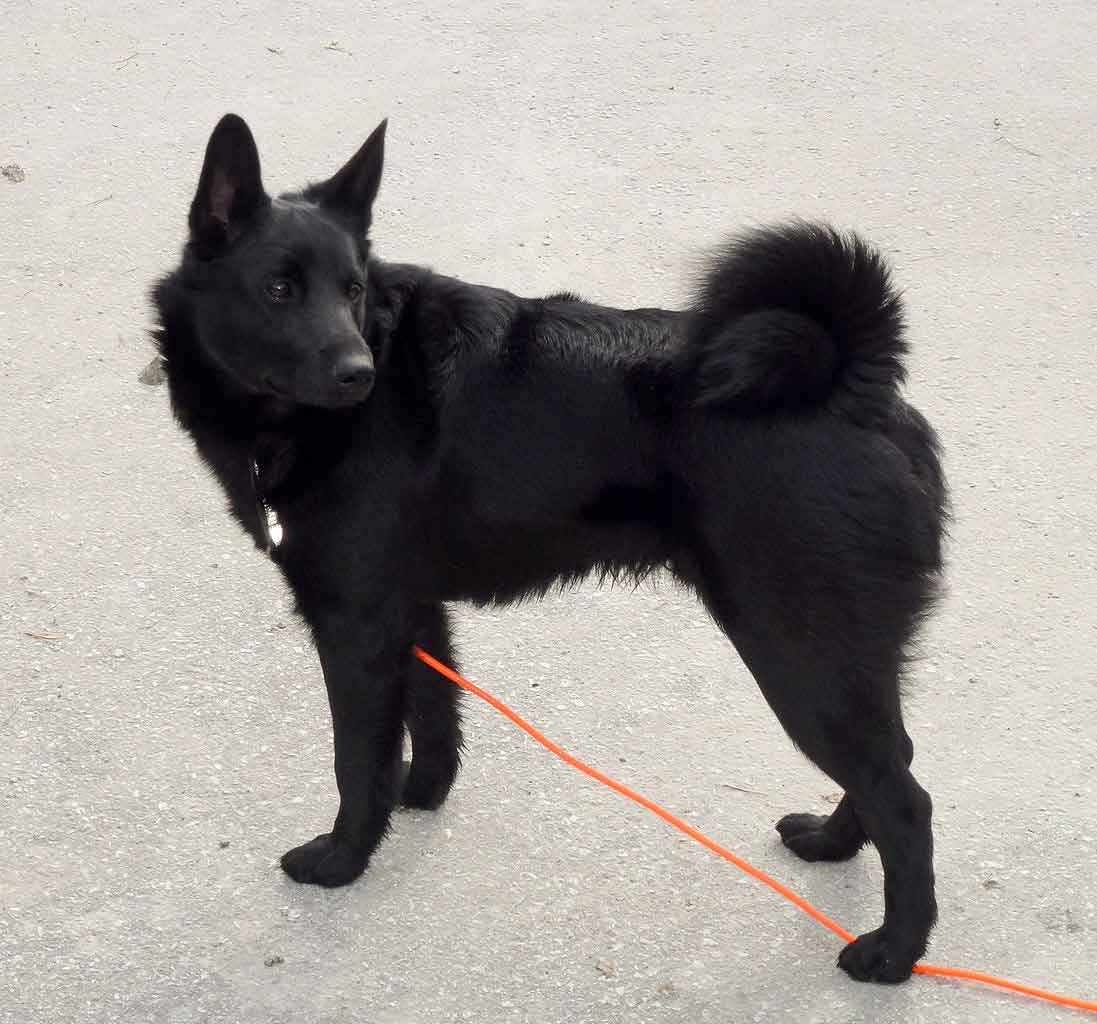
    The Black Norwegian Elkhound it is optically a typical Spitz and has a compact, square build with upright ears. He wears his tail rolled up on his back like other dogs Moose hunter from adulthood. It is smaller and more agile than the Gray Norwegian Elkhound and weighs around 18 kg with a height of 47 cm to the cross. As the name already indicates, this dog's short coat is black, but white spots on legs and chest are allowed as per standard. Also the eyes are dark. The pelage is dense, very sticky and consists of a rough top coat with a soft bottom coat.

    Character and skills

    Multifaceted character

    The Black Norwegian Elkhound he is very loyal to his people. This does not mean that this independent partner is subordinate. Abroad, these dogs are lively, curious and open to all common adventures. But, the busy Black Norwegian Elkhound they also enjoy cozy hugs on a quiet afternoon.

    They are playful, brave and very smart. Like many Nordic dogs, They are good "alarm systems", but only limited good watchdogs: They indicate to strangers – loudly and persistently – but it may happen that they then run towards a potential intruder with a wagging tail. These proud four-legged friends don't always get along with other dogs of the same species.. Proper conditioning and socialization is important

    Educating the Black Norwegian Elkhound

    Easily educated with knowledge

    His intelligence and humanity contribute to the education of this Black Norwegian Elkhound don't present big obstacles.

    He likes to work with "his" people and does what they say, as long as you find it useful too. Because you always have to take into account the small stubbornness of this independent hunter when training him. Be consistent and pay special attention to recoverability and bark control. Strength and toughness are absolutely out of place in the upbringing of this sensitive four-legged friend.

    Usually reacts very quickly and strongly to harsh words and reproaches, so use them sparingly. The Black Norwegian Elkhound can be better motivated by the principle of positive reinforcement – clicker training can also be of great help here. A visit to the puppy school helps improve this companion's social streak, which is sometimes a bit belligerent compared to other dogs. It can also be very useful to attend training classes at the dog school. – it is better to choose a suitable dog school where you and your companion feel comfortable before the puppy arrives.

    Health ยซBlack Norwegian Elk Hunterยป

    In general, the breed is considered to be quite robust and, as long as it is raised responsibly, is largely free of genetic diseases. Representatives of the breed can reach the 13 years old in good health. This energetic four-legged friend needs a species-appropriate diet, which should consist mainly of meat: So, you must choose a food in which meat is the first element of the declaration and preferably cereals are not included. Your dog's energy needs depend on his constitution and how much he consumes through exercise, so keep an eye on your slim waist and adjust daily servings as needed.

    Important: Just like us humans, small snacks move quickly to the hips too – plan your dog's snacks in the general ration. Healthy snacks include dry dog โ€‹โ€‹chews or sugar-free dental care snacks and freeze-dried meat snacks. Water must always be freely available.

    โ€œBlack Norwegian Elk Hunterโ€ Care

    The coat of the Black Norwegian Elkhound it is very important to the furry four legged friend, because it performs an outstanding protective function in the harsh northern climate and protects it from extensive autumn rains as well as icy winds. Help your companion keep his coat in a tidy condition by brushing every few days to remove any dead hairs.. You can also brush daily during the coat change, so your roommate loses less hair in the apartment. Coat dirt can be brushed off as soon as it has dried.

    You should only bathe your roommate if it can't be helped, use a mild dog shampoo for this purpose. When brushing, routinely check ears and clean with a mild shampoo if necessary. Some dog owners have chosen to brush their roommates' teeth with a dog toothbrush and toothpaste.. It is a good way to prevent tartar and its secondary diseases until the dog is old enough. But, you should already accustom your puppy to the ritual. Also check the claws of older dogs from time to time – if they no longer wear enough, you need to shorten them accordingly with a pair of dog claw pliers.

    Activities ยซBlack Norwegian Elk Hunterยป

    Although his original task was to accompany the hunter when hunting moose and bears, but also smaller animals like foxes, the Black Norwegian Elkhound it is a versatile all-rounder: Loves outdoor exercise and is considered very persistent. This is why you can easily take your four-legged adult friend with you to training sessions. jogging.

    Outdoor activities can be relaxed, especially if you have trained your Black Norwegian Elkhound so it doesn't run away with every rabbit. Apart from recovery exercises – that only very few moose hunters enjoy – the docile and energetic dog can get excited about many things: These may include, you can find great fun in agility sports and fetch games. It also, It is suitable for the work of rescue dogs. Some owners of moose hunters they also report on beautiful experiences with their partner, trained as a visiting dog, with whom they visit, for example, retirement or nursing homes and give the residents of those places an animal joy. Try together what you like, the possibilities are great!

    Is a โ€œBlack Norwegian Elk Hunterโ€ best for me??ยป

    The Black Norwegian Elkhound suits athletes who like to be outside and keep their dog busy. If you can make this possible for your dog, it is also possible to keep it in an apartment, as long as the apartment offers enough space. Training can be mastered by beginners if they are willing to deal with the hunting characteristics of the breed and adjust training accordingly..

    The Black Norwegian Elkhound it can be a wonderful companion for children. This original hunter can live normally with cats, sometimes even in a friendly way, if you have already gotten used to them as a puppy. Otherwise there could be problems, because the dog sees the cat as prey. Small animals like rabbits are not ideal companions, since they can always trigger prey drive.

    One Black Norwegian Elkhound can also sleep outside, what can be a sensible alternative for these heat sensitive animals in summer. But, needs close family connections and does not like to be alone. Before the dog moves, clarify not only the one-time and ongoing expenses you will have to pay, but also if you are willing to spend several hours a day actively with your new partner for years to come. You should also take care of your dog in case of illness or during the holidays – many destinations nowadays also offer holidays with a dog.

    Where can I find my desired ยซBlack Norwegian Elk Hunter?ยป

    It doesn't matter which of the two Norwegian Elkhound has won your heart: Outside Scandinavia, big game hunters from the far north are rarely seen. This is even more difficult with the black Norwegian than with the gray. So, if you are interested in this animal rarity, please contact the Nordic breed clubs in your country. If required, they can contact breeders at home and abroad. But, you will usually have to take into account waiting times and long distances to travel to the desired puppy. in his native country, Norway, only a few are born 120 puppies every year.

    Consequently, it becomes difficult or impossible if you are looking for a Black Norwegian Elkhound outside scandinavia, that is already grown. It is very unlikely that you will find a four-legged dog of this type in the animal protection organizations of your country.; However, a visit there may be helpful if you are open to other breeds.

    Characteristics "Black Norwegian Elkhound"

    Coexistence is important that you have with your new friend. Before considering the acquisition of a dog of the breed "Black Norwegian Elkhound" you know certain factors. Not all breeds of dogs are apt to live in an apartment, you must take into account his character, their need for exercise, their interaction with other pets, their care and if you have small children, their level of tolerance towards them.

    Adaptation โ“˜

    2,0 of 5 stars (based on 1 review)

    friendly dog โ€‹โ€‹โ“˜

    3,0 of 5 stars (based on 1 review)

    hair loss โ“˜

    4,0 of 5 stars (based on 1 review)

    Affection level โ“˜

    4,0 of 5 stars (based on 1 review)

    Need for exercise โ“˜

    3,0 of 5 stars (based on 1 review)

    Social need โ“˜

    4,0 of 5 stars (based on 1 review)

    Home โ“˜

    4,0 of 5 stars (based on 1 review)

    Toilet โ“˜

    3,0 of 5 stars (based on 1 review)

    Friendly with strangers โ“˜

    4,0 of 5 stars (based on 1 review)

    barking โ“˜

    4,0 of 5 stars (based on 1 review)

    Health โ“˜

    4,0 of 5 stars (based on 1 review)

    Territorial โ“˜

    4,0 of 5 stars (based on 1 review)

    Cat friendly โ“˜

    2,0 of 5 stars (based on 1 review)

    Intelligence โ“˜

    3,0 of 5 stars (based on 1 review)

    Versatility โ“˜

    3,0 of 5 stars (based on 1 review)

    Child friendly โ“˜

    4,0 of 5 stars (based on 1 review)

    Surveillance โ“˜

    4,0 of 5 stars (based on 1 review)

    joy โ“˜

    3,0 of 5 stars (based on 1 review)

    Images "Black Norwegian Elkhound"

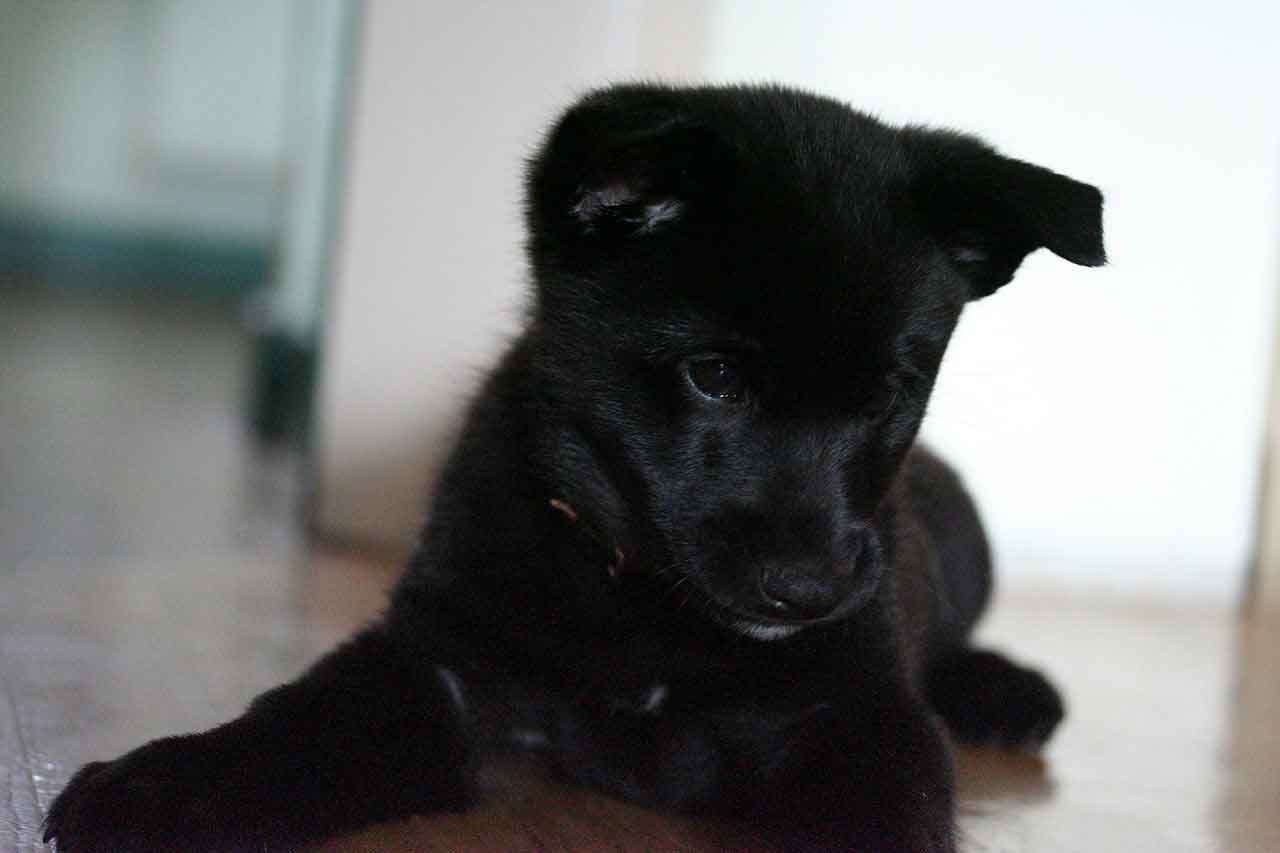
    โ€œBlack Norwegian Elk Hunterโ€ cub by Eirik Newth / CC BY

    ยซBlack Norwegian elk hunterยป running through the snow by https://pxhere.com/en/photo/1602973

    Videos "Black Norwegian Elkhound"/h2>

    Type and recognitions:

    • FCI CLASSIFICATION:
    • Group :
    • Section : . .

    Federations:

    • FCI – Group 5 – Section 2 Nordic Hunting Dogs. โ“˜

    FCI breed standard "Black Norwegian Elkhound"

    Origin:
    Norway

    Date of publication of the valid original standard:
    09.08.1999

    Use:

    Hunting dog for moose.


    General appearance:

    It is a typical Spitz with a square construction.; black hair is rather close to the body; pointed ears pricked; tail curled over the back. Muscular and athletic neck, from a noble door.
     
    IMPORTANT PROPORTIONS: The height at the withers corresponds to the length of the body. Muzzle and skull are the same length.


    Behavior / temperament:

    Without fear, energetic, brave.

    Head:

    It is wedge shaped and tapers towards the truffle. Thin and rather light, relatively wide at the level of the ears.

    Cranial region:
    • Skull: Almost flat.
    • Depression links (Stop): Notable, but not abrupt.

    facial region:

    • Truffle: black.
    • Snout: Straight nose cane.
    • Lips: Glued.
    • Jaws/Teeth: Scissor bite; complete denture.
    • Eyes: They are not prominent; preferably dark brown.
    • Ears: High insertion, upright, a little longer than wide at the root, pointy.

    Neck:

    Medium long, firm, no loose skin.

    Body:

    • top line: Straight from the withers to the rump.
    • Cross: Well developed.
    • Back: Straight and strong.
    • Pork loin: Well developed, wide and straight.
    • Rump: Wide, well muscled.
    • Breast : Proportionally deep; ribs tight.
    • Belly: slightly retracted.

    Tail:

    High insertion; short, thick, covered with a layer of hairs sparse and well attached, but without feathers. Tightly curled over the back, without being diverted to the side.

    Tips

    PREVIOUS MEMBERS
     
    • As a whole: Firms, tendinosos, strong, but not heavy.
    • Shoulder: Oblique.
    • Arm: Moderately oblique.
    • Elbow: Good paste, turned neither out nor in.
    • Forearm: Straight.
    • Metacarpus: Viewed from the side moderately inclined.
    • Front feet: Rather small, slightly oval, compact and not turned out.
     
    LATER MEMBERS
     
    • As a whole: Knee and hock moderately angled. Parallels seen from behind. Undesirable spurs.
    • Thigh: Muscular and broad.
    • Knee: Moderately angled.
    • Leg: Medium long.
    • Hock: Moderately angled.
    • Metatarsus: Viewed from the side moderately inclined; seen from behind parallel.
    • Rear feet: Rather small, slightly oval, compact.

    Movement:

    Light, effortless. Parallel seen from the front or from behind.

    Mantle

    HAIR: Dense and rough, but well attached to the body; short and smooth on the head and on the front of the extremities; longer on the chest, the neck, on the back of the limbs and on the bottom of the tail. The coat consists of a rather long, rough outer coat of hair and a soft undercoat, shaggy and black.
     
    COLOR: Glossy black. A little white on the chest and feet can be tolerated.


    Size and weight:

    Height to the cross:
    • For males : 46 โ€“ 49 cm., ideal height 47 cm..
    • For females : 43 โ€“ 46 cm., ideal height 44 cm..


    Fouls:

    Any deviation from the aforementioned criteria is considered as a fault and the severity of this is considered to the degree of the deviation to the standard and its consequences on the health and well-being of the dog..
    • Bitefork clamp; irregular teeth.
    • Absence of undercoat of hairs.
    • White hairs, white in the queue.
    • White ยซ tights ยป.
    • Agitated temperament, nervous; barking dog.
    SERIOUS LACK
    • Short tail from birth.
    MISS PLAYOFFS
    • Aggressive or fearful dog.
    • Upper or lower prognathism.
    • Height to the cross 3 cm minus 4 cm more than the ideal height mentioned in the standard.
    Any dog โ€‹โ€‹showing clear signs of physical or behavioral abnormalities must be disqualified..


    N.B.:

    Males should have two normal-appearing testicles fully descended into the scrotum..

    Source: F.C.I - International Cynological Federation

    Alternative names:

    1. Norsk Elghund Svart, Norsk Elghund Black, Black Elkhound, Norwegian Moose Dog (black) (English).
    2. Chien d’รฉlan norvรฉgien noir (French).
    3. Norsk Elghund Sort (German).
    4. Norsk elghund sort (Portuguese).
    5. Elkhound noruego negro (espaรฑol).

    Photos:

    1 – Black Norwegian Elkhound About 1 years old by Rvenes / CC BY-SA