โ–ท The world of Pets: Dogs, cats, birds, reptiles, amphibians

Norfolk Island Parakeet
Cyanoramphus cookii

Norfolk Island Parakeet

Content


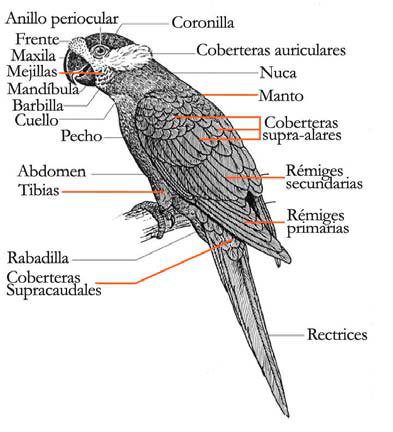
Anatomy-parrots

Description:

30 cm.. length and 100 g. of weight.

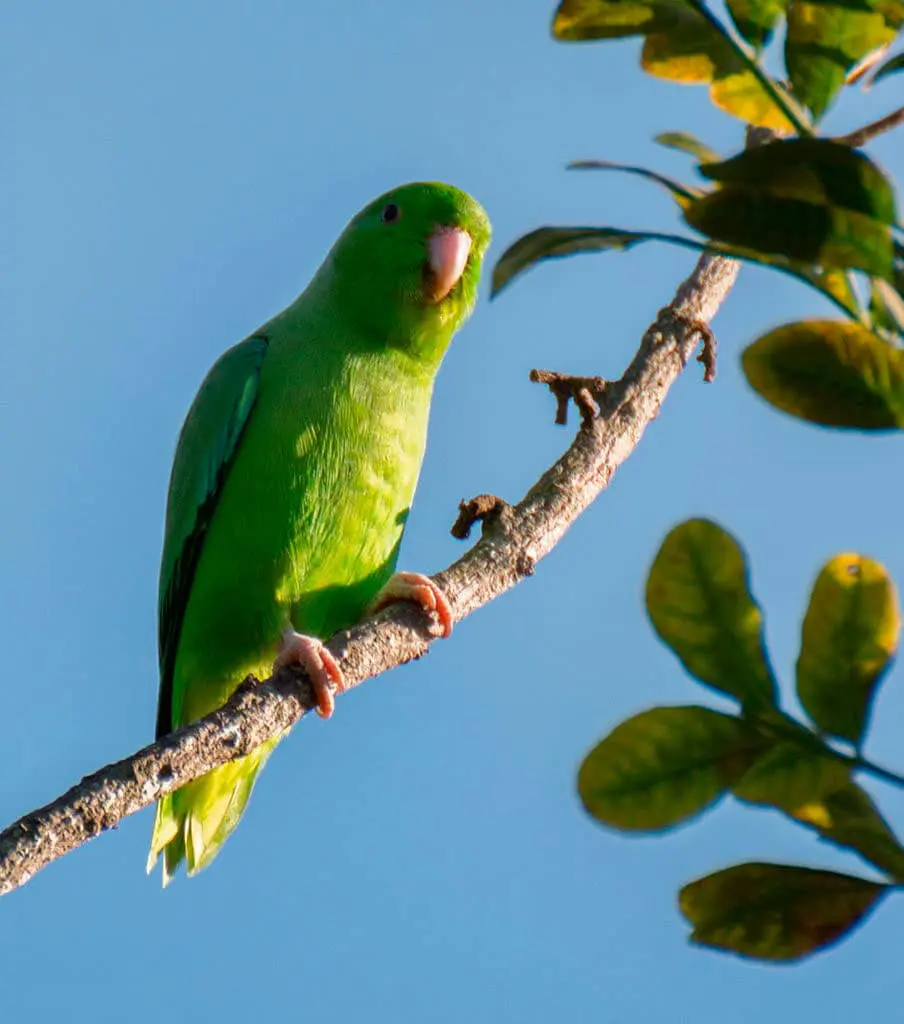
The Norfolk Island Parakeet (Cyanoramphus cookii) has a plumage bright green with reddish front, one red band extending through each eye; and light blue region in the leading edge of each wing . Upperwing-coverts green. Primary coverts and outerweb of primaries violet blue. Underwing-coverts yellow-green. red spot on each side of the rump. Above, the tail dark green with yellow edges, under dark gray. Eyes red.

The sexes are similar in appearance. The females They are distinguished by their smaller size, less red in the forecrown, stains on the front of the crown, and bill smaller and narrower. The pups hatched are coated with a thin gray background.

The youth They are similar in appearance to adults, but the red is less extensive (Forshaw 1981; Higgins 1999). Juveniles have a bill distinctive color meat during the first 4 to 6 weeks after the flight (Forshaw 1981).

Taxonomic status:

This taxon is considered a subspecies of Cyanoramphus [novaezelandiae, erythrotis, subflavescens, hochstetteri, saisseti or cookii] (sensu lato) by some authors

  • Sound of the Norfolk Island Parakeet.

Habitat:

The Norfolk Island Parakeet It is found mainly in the rainforest remainder, although it can also be seen in other areas of the island (Garnett & Crowley 2000; Hicks & Greenwood 1989; Higgins 1999; J. Hicks pers. comm. quoted in Hill 2002).

It is considered sedentary (Higgins 1999). The species moves from the National Park Norfolk Island to orchards and gardens when fruit available (Hicks & Greenwood 1989; Higgins 1999). Most of the sightings of the Norfolk Island Parakeet outside the National Park Norfolk Island They are recorded in December and January (Lane et al., 1998).

Foraging occurs in all strata of vegetation (Higgins 1999), including in the forest canopy, on the floor, in disturbed habitats and habitats modified depending on food availability (Forshaw & Cooper 1989; Higgins 1999). It has been observed to Perico Norfolk, including youth, feeding on the ground during winter, eating fallen seeds and fruits of African olive, Pine Norfolk Island and red guava (Garnett & Crowley 2000; Higgins 1999; Lane et al., 1998; Ortiz-Catedral 2013).

The Norfolk Island Parakeet It gregarious, usually they are seen in pairs or in family groups (Higgins 1999) and flocks (C. Jones pers. comm. 2016). The species occurs as a single contiguous breeding population (Garnett et to the., 2011).

Reproduction:

The Norfolk Island Parakeet usually nest less than two meters above the ground, usually in a recess or cavity in the branch, trunk or stump living or dead trees, especially in larger native trees. This includes Nestegis apetala (ironwood), Blood Wood (Corymbia spp. / Eucalyptus spp.), Cordyline spp. and Araucaria heterophylla (Norfolk Island Pine) (Garnett et to the., 2011; Hicks & Greenwood 1989; Higgins 1999; Lane et al., 1998). The species has occasionally been observed nesting in holes in the ground created by rotting pine roots. (C. Jones pers. comm. 2016).
Usually it perches in hidden areas with thick vegetation, including treeholes, epiphytes, tussocks, sedges and ferns. The species often perches on nesting sites (Higgins 1999). Inexperienced chicks often roost in exposed sites (Higgins 1999).

The reproduction It occurs throughout the year, peaking from December to March (Greenwood et al., 1989; Hicks & Preece 1991). The females. hatch eggs and are very reluctant to leave their nests during this time (P. Stevenson com. pers. quoted in Hill 2002). The incubation hard 21 days (Hicks & Preece 1991). When the chicks reach about two weeks old, the female can leave to start a new nest (Greenwood 1993). Norfolk Parakeets can have multiple clutches and give birth successfully up to four times a year., with males and females sharing the care of the young (R. Ward com. pers. quoted in Hill 2002). They prefer to use a fresh nest site for each clutch (Hill 2002). The chicks leave the nest six to seven. weeks after hatching and depend on their parents to feed three to seven weeks (Davidson 1997; Forshaw 1981; Hicks & Greenwood 1989; Hicks & Preece 1991). The clutch is large (1-8) (Hicks & Greenwood 1989). the age of first reproduction is unknown, but it may be soon after independence (Greene 1990).

Food:

Adults eat mainly seeds, fruit, flowers, bark and leaves of native and introduced trees, and shrubs, including Pine Norfolk Island, ironwood, Rhopalostylis Bauer (Palm Norfolk Island), Blood Wood, Cordyline, Lagunaria (White Oak), Elaeodendron curtipendulum (silvestre) arce), wild snuff (Solanum mauritianum), red guava (Psidium spp.), African olive (Olea europaea subsp. cuspidate), peach (Prunus persica) and lantana (Lantana camara) (Forshaw & Cooper 1978; Garnett & Crowley 2000; Higgins 1999; Lane et al., 1998).

Distribution:

The Norfolk Island Parakeet (Cyanoramphus cookii) is endemic of the Norfolk island. Before the European establishment it spread throughout the island, but now it is mainly in the region Mt Pitt de Norfolk. (460 has) and in the Botanical Gardens Norfolk Island (5,5 has) (Director of National Parks 2010; Garnett et to the., 2011). The Norfolk Island Parakeet also they are seen in wooded areas outside the national park and botanical gardens, and they are observed throughout the island in small amounts (Director of National Parks 2010).

The breeding of Norfolk Island Parakeet It is largely confined to a suitable habitat within the range of Norfolk Island National Park (Hill 2002), although there are reports playback on adjacent private property to the National Park Norfolk Island (C. Rowston press. comm. cited in Garnett et al., 2011).

In 2013, One study estimated that its population on Norfolk Island It was only 46-92 individuals (Ortiz-Catedral 2013).

Conservation:
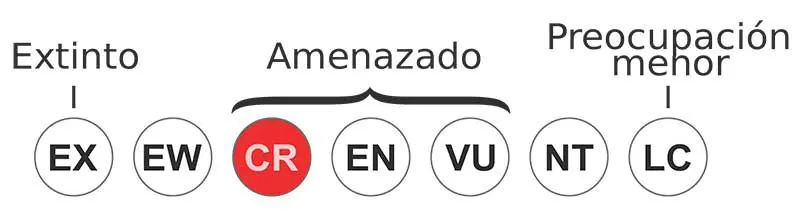

critical hazard


โ€ข Law on Environmental Protection and Biodiversity Conservation 1999 (Cwlth) (EPBC Law): Critically Endangered.

โ€ข Population trend: Decreasing.

โ€ข Population size : 50-100 mature individuals.

The Norfolk Island Parakeet (Cyanoramphus cookii) It is classified as In danger under the Law on Environmental Protection and Biodiversity Conservation 1999 (Cwlth) (EPBC Law). The species is eligible for inclusion on the list since before the start of the EPBC Act, It was included as endangered under Annexed 1 of the Law on Protection of Endangered Species 1992.

Garnett et to the (2011) They reviewed the state of conservation Norfolk Island Parakeet and they considered in Critical Hazard. The Scientific Committee of Threatened Species You are using the findings of Garnett et al. (2011) to consider whether the reassessment of the conservation status of each of the threatened birds listed in the EPBC Law It is mandatory.

The main factors causing the species to be eligible for inclusion in the List of Endangered Species are are very restricted area of รขโ‚ฌโ€นรขโ‚ฌโ€นoccupancy (< 10 km2).) and a population small (< 250 mature individuals) (Garnett et to the., 2011).

Threats

Extensive vegetation clearing for agriculture and logging of large trees destroyed nesting sites most suitable in Norfolk island (Hicks & Greenwood 1989).

A change in the structure of forests in the Norfolk island, as a result of the invasion of weeds, there may also be reduced available habitat area. (Garnett et to the., 2011).

Introduced the Crimson Rosella (Platycercus elegans), European starlings (Sturnus vulgaris), and occasionally European honey bees (Apis mellifera) competing for residues treeholes (Hicks & Preece 1991; Hill 2002).

Predation by black rats (Rattus rattus) has resulted in most nest failures and an imbalance in the sex ratio in the nest population. Norfolk Island Parakeet, as rats often surprise female incubating (Hicks & Preece 1991; Hill 2002).

The cats (Felis catus) They are also significant predators (Garnett et to the., 2011).

The illness psitacina circoviral It is present in the population and can cause mortality in individuals stressed (Hicks & Preece 1991).

Window collisions also cause a small number of deaths annually. (Hill 2002).

conservation actions

Conservation and management priorities Invasive species

or Maintaining a control program black rat in the National Park Norfolk Island using baits to reduce the number of black rats.

or Maintaining a control program cats in the National Park Norfolk Island using trapping methods to reduce the number of cats.

or Maintaining a control program Crimson Rosella (Platycercus elegans) in the National Park Norfolk Island using shooting methods to reduce their number.

Continue implementing and maintaining or protecting trees tin nesting sites (predator-proof) inside of the National Park Norfolk Island, And Botanical gardens adjacent private lands where appropriate.

Continue removing or European starlings and nesting material for nest sites.

or continue destroying the hives of european honey bees nesting sites if necessary.

o Perform intensive control weed in the National Park Norfolk Island, appropriate methods, focusing on improving habitat areas suitable playback.

Lost, disturbance and habitat modifications

o Perform habitat restoration within the National Park Norfolk Island by revegetation. appropriate areas with native plants, in conjunction with the weed control program. Breeding, reproduction and other measures ex situ

o Maintain nest sites to support breeding pairs by adding suitable nesting material and repairing nests as necessary.

or establish a wild population Phillip Island by methods translocation, when you consider that the source population is large enough to support the reduction of individuals.

Participation of stakeholders

or engage with the local community to provide information on the species and the importance of conservation actions.

o Engage with the public about Norfolk Island green parrots through conservation. and environmental interpretation center National Park Norfolk Island.

Priorities and follow-up survey

Keeping monitoring or rats and black cats within the National Park Norfolk Island to determine its relative density within the park and report management actions.

Monitor or nesting sites known to detect the presence of Crimson Rosella (Platycercus elegans), European starlings and European honey bees to determine the ongoing impact of competition from these species and the Norfolk Island Parakeet and reporting on management actions.

o Conduct population studies to assess more accurately the size of the population, reproduction and breeding of these birds, success and demographic trends.

or to perform monitoring for the presence of disease psitacina circoviral in population Norfolk Island Parakeet.

o Monitor the progress of conservation actions, including the effectiveness of management actions and adapt them if necessary to contribute to the recovery of the species.

Priorities for research and information

o Investigate options to improve the current population.

or investigate conservation benefits to establish a wild population in Lord Howe Island.

or investigate the effectiveness and cost-benefit methods for controlling predators and competitors introduced nest.

or investigate the effectiveness and cost-benefit methods for weed control.

"Norfolk Island Parakeet" in captivity:

More than 600 pups of Norfolk Island Parakeet They were banded between 1985 and 2007, most of which were bred in the national park's assisted wild breeding program.

Alternative names:

Cook’s Parakeet, Norfolk Island Green Parrot, Norfolk Island Parakeet, Norfolk Island Parrot, Norfolk Parakeet, Tasman Parakeet (English).
Perruche australe, Perruche de Norfolk (French).
Norfolkziegensittich, Ziegensittich (German).
Periquito de Norfolk (Portuguese).
Perico de Norfolk (espaรฑol).

scientific classification:

Order: Psittaciformes
Family: Psittaculidae
Gender: Cyanoramphus
Scientific name: Cyanoramphus cookii
Subpoena: (Gray, GR, 1859)
Protonimo: Platycercus Cookii

Images ยซNorfolk Parakeetยป:

Videos "Norfolk Island Parakeet"

Sources:

โ€ข Avibase
โ€ข Parrots of the World โ€“ Forshaw Joseph M
โ€ข Parrots A Guide to the Parrots of the World – Tony Juniper & Mike Parr
โ€ข THREATENED SPECIES SCIENTIFIC COMMITTEE ยฉ Commonwealth of Australia
โ€ข Perico de Norfolk cheating extinction with a little help from their human friends – abc.net.au

Photos:

(1) – Norfolk Island Parakeet (Cyanoramphus cookii) by David CookFlickr
(2) – Norfolk Parakeet (Cyanoramphus cookii), 2011 Norfolk Island National Park by Duncan Watson [CC BY-SA 4.0], from Wikimedia Commons
(3) – A Norfolk Parakeet (also called Tasman Parakeet, Norfolk Island Green Parrot or Norfolk Island Red-crowned Parakeet) in Palm Glen, Norfolk Island, Australia by Paul Gear [CC BY-SA 3.0], via Wikimedia Commons
(4) – A juvenile Norfolk Parakeet (also called Tasman Parakeet, Norfolk Island Green Parrot or Norfolk Island Red-crowned Parakeet) in Palm Glen, Norfolk Island, Australia. by Paul Gear [CC BY-SA 3.0], via Wikimedia Commons
(5) – Norfolk Island Parakeet (Cyanoramphus cookii) by David CookFlickr

โ–ท The world of Pets: Dogs, cats, birds, reptiles, amphibians

Monk Parakeet
Myiopsitta monachus

Monk Parakeet

Content

Description:

28-31 cm. length and 120-140 weight g
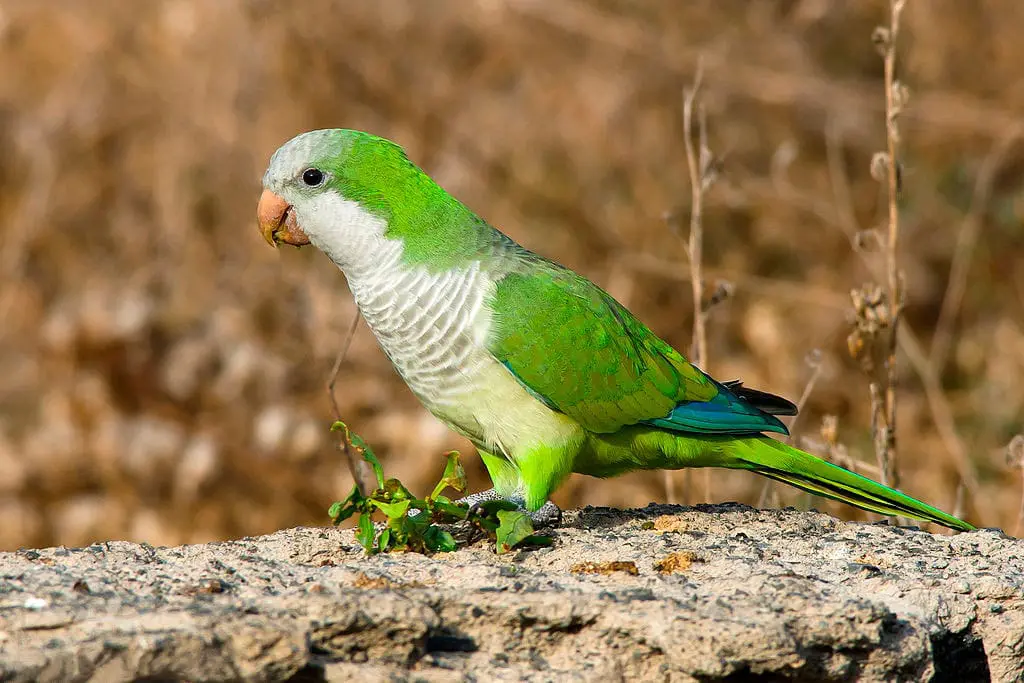
The Monk Parakeet (Myiopsitta monachus) has the forecrown (up to the half of the crown), the lores and cheeks, pale ash gray; the rear of the crown and nape, grass-green, fading to green, slightly more off, in the the mantle, the back and scapulars; rump green. Primary coverts, blue; other coverts, green.
Flight feathers Blue by up. Under the wings has the lesser coverts green, the coverts more large and innerwebs of the the flight feathers, blue. Throat and upper area of the chest, ash gray, with pale edges to the feathers, giving a beaming effect; lower area of โ€‹โ€‹the chest, pale yellow; Abdomen, the thighs and vent, pale green.

Upper, the tail is green with blue in the Center; below, pale bluish-green.
Bill color horn; Brown of the irises; legs grey.
Both sexes are similar.
Immature has the front green-tinted.

Subspecies description:

  • Myiopsitta monachus calita

    (Jardine & Selby, 1830) – Less of the nominal species (27cm.) with wings more blue and head dark gray.

  • Myiopsitta monachus cotorra

    (Vieillot, 1818) – Very similar to the subspecies Myiopsitta monachus calita, but supposedly more bright, belly least yellow.

  • Myiopsitta monachus monachus

    (Boddaert, 1783) – Nominal.

Habitat:

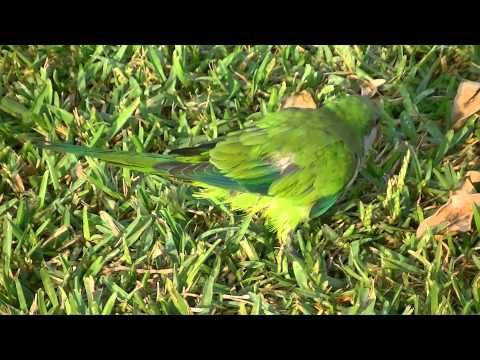
Video – "Monk Parakeet" (Myiopsitta monachus)

ARGENTINE PARROT: Myiopsitta monachus (www.riomoros.com)

The Monk Parakeet is, mainly, in dry wooded areas or fields open with trees, such as gallery forest, isolated thickets, palm groves, forests, linens and areas with thorny thickets with Cactus, also in land cultivation and in urban areas with trees, mainly below 1.000 m.

They tend to be observed in pairs or flocks of 30-50 individuals; with much larger gatherings out of breeding season. Rest communally, Sometimes the nests, While you are not playing.

Note:

    There are reports of transmission lines damaged by birds while nesting. In general, in the area in which have been introduced these birds, the impacts are associated mainly to the behaviors of nesting. This species of birds build large, bulky nests in communications and transmission towers, and distribution poles. In the towers of transmission represent simply a problem of maintenance and does not affect the communications, but in electrical installations can cause blackouts and fires since the nests can create electrical circuits. This problem is intensified in the rainy season and humid climates.. The nests of these birds can cause significant damage to the facilities power including a decrease in electrical reliability, damage to equipment and loss in income due to power outages caused by nests, an increase in maintenance and operating costs associated with removing nests and repairing damaged structures as well as public safety issues (ISC 2011).

Source: Naturalist

Reproduction:

It's the only one, between the parrots, It builds, usually, his nest with twigs (commonly from Celtis shrubs) in branches of tree (sometimes in telephone poles, etc.). Sometimes build nests alone (especially in those areas more dry), Although they are usually communal (until 100 nests, usually around 10) combined to form large structures cluttered of several meters of width, with inputs from the side or by under. Each nest It is built with remains of chewed branches. The nests are sometimes used by them Spot-winged Falconet (Spiziapteryx circumcincta) and other birds, to nest and rest. One nest can get to to weigh 50 kilos and be formed by more than 20.000 remained.

The breeding season, in your area natural's distribution, is between October-December. The clutch generally 4-6 eggs, Although according to some sources, the laying You can understand between 1-11 eggs.

Food:

Its diet includes a wide range of seeds wild and cultivated, wild fruits, as well as various plant material including grass seeds and grains, stems of cactus, estate vegetables and fruits cultivated, sometimes also insects and their larvae. Feeds, both in trees as in the soil, sometimes with other species including pigeons and birds of the genus Molothrus.

Distribution:

Size of the area of distribution (reproduction / resident): 2720000 km2

The Monk Parakeet lives in the lowlands of the South of South America, to the East of the Andes front Bolivia to Rawson Department (Chubut) in Argentina.

Observed in the East and North of Bolivia in the southeast of Peace, to the south, in Cochabamba, West of Santa Cruz, North of Chuquisaca and possibly in other areas (for example, Tarija), Paraguay and South of Brazil, in the South and West of Mato Grosso, Mato Grosso from the South and two-thirds of the southwest of Rio Grande do Sul, in all the Uruguay and in the Argentina, to the South of Rio Negro and probably to the North of Chubut.

Usually common and abundant in Uruguay and Rio Grande do Sul (although it does not play there). It is the most common parrot in much of its range and largely local expansion is due to the plantations of Euralyptus in areas without trees, partial deforestation in other areas, the Elimination of predators and the expansion of crops.

Pursued in several areas, Although the overall effect on its population is apparently slight.

Wild populations established in many towns outside of the range, including Puerto Rico, Florida, New York City (where there are fears it could become a major agricultural pest) and several cities more than them EE.UU. There have also been populations of the Monk Parakeet in Rio de Janeiro (Brazil), berlin (Germany), Austria, Belgium, Italy, Spain (including the Islas Canarias) and several places over the Mediterranean.

Is a trade in these birds, both local, as international, with large numbers of this species in captivity.

Subspecies distribution:

Conservation:

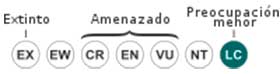
State of conservation โ“˜


minor concern Minor Concern โ“˜ (UICN)โ“˜

โ€ข Current category of the Red List of the UICN: Least concern.

โ€ข Population trend: Increasing.

Justification of the population

Global population size has not been quantified, but this species is described as ยซcommonยป (Stotz et to the., 1996) and ‘common to abundant‘ (pit et to the., 1997).

Justification of trend

The population is suspected to have increased as a consequence of the creation of new areas of habitat suitable (pit et to the., 1997).

Threats

The species has been marketed strongly: from 1981, When is included in the Appendix II of the CITES, they have been 710.686 individuals captured in the Middle wild for the Commerce International (database CITES from the UNEP-WCMC, January 2005).

"Monk Parakeet" in captivity:

Renowned for her beauty and intelligence, the Monk Parakeet is a pet people, especially in North America, since the 1960's (ISC, 2011). Can learn to imitate great amount of words, but at the same time are very bustling, demanding of attention and affection, with much character, and very territorial, by what not is rare that attack to their own owners when the manipulated or manipulate your cage. In captivity is reproduced with ease, but to the have many colonies in State Wildlife, not be usually stimulate its reproduction in captivity.
Its life expectancy It 3-10 years in freedom and 25 to 35 years in captivity (รlvarez-Romero et al., 2008).

Before trying to acquire one of these birds as a pet, you should know that in many countries its sale is prohibited as it is classified as species invasive.

MINISTRY OF AGRICULTURE, FOOD AND ENVIRONMENT

Royal Decree 630/2013, of 2 of August, which regulates the Spanish catalog of invasive alien species.

Invasive exotic species: exotic species that is introduced or set to an ecosystem or natural or semi-natural habitat, and is an agent of change and threat to native biodiversity, due to its invasive behaviour, or because of the risk of genetic contamination.
Article 7. Effects of the inclusion of a species in the catalogue.

  1. The inclusion of a species in the catalogue, According to the article 61.3 of the law 42/2007, of 13 of December, entails the prohibition generic in its possession, transport, traffic and trade of exemplary living or dead, of their remains or propagules, including the trade exterior. This prohibition is limited to the scope of application specified for each species in the annex.

Alternative names:

Monk Parakeet, Monk Parakeet (Monk), South American monk parakeet (English).
Perriche veuve, Conure veuve (French).
Mรถnchsittich, Mรถnchssittich, Sรผdamerikanischer Mรถnchsittich (German).
catorra, catorrita, Caturrita, papo-branco, periquito-do-Pantanal (Portuguese).
Cata Aliazul, Cotorra, Cotorra Argentina, Cotorra Comรบn, Cotorrita, Perico Monje (espaรฑol).
Cotorra (Argentina).
Cotorra argentina (Chile).
Cotorrita (Paraguay).
Cotorra, Cotorra Comรบn (Uruguay).
Periquito (Venezuela).

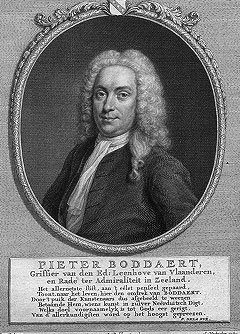
Pieter Boddaert
Pieter Boddaert

scientific classification:


Order: Psittaciformes
Family: Psittacidae
Genus: Myiopsitta
Scientific name: Myiopsitta monachus
Citation: (Boddaert, 1783)
Protonimo: Psittacus monachus


Monk Parakeet images:


Species of the genus Myiopsitta

โ–ท The world of Pets: Dogs, cats, birds, reptiles, amphibians

Green-rumped Parrotlet
Forpus passerinus


Green-rumped Parrotlet

Content

Description:

Green-rumped Parrotlet

13-14 cm.. height.

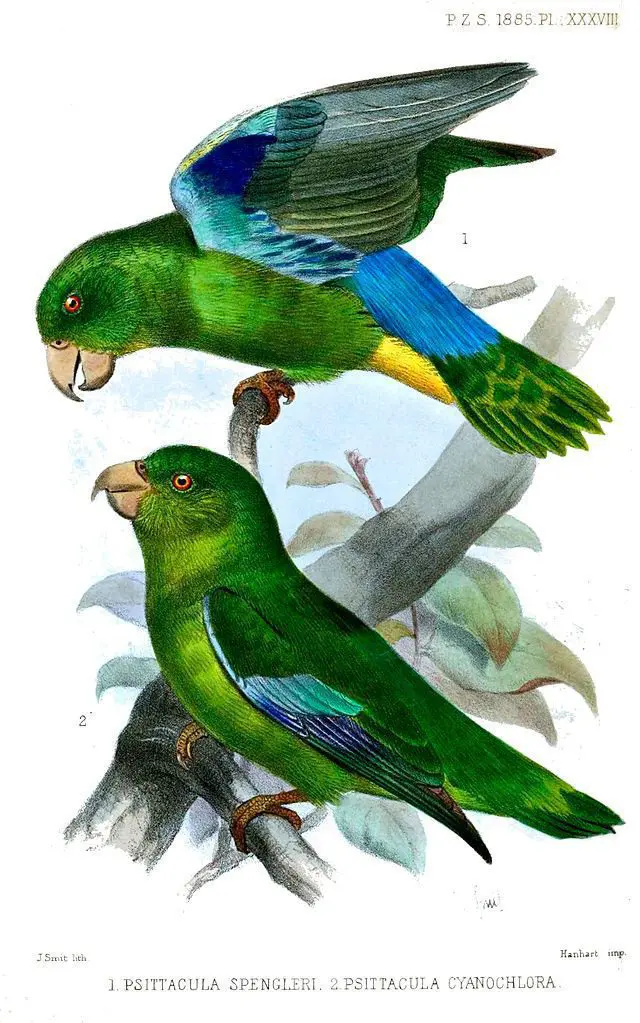
The Green-rumped Parrotlet (Forpus passerinus) is the psittacine smaller that can be found on the American continent. It is distinguished by being green, with a brighter green in the front, cheeks, lower part of the body and behind the neck; the rump bright green in the two sexes, wing with one Strip Turquoise Blue followed by another greenish-blue in males; belly lighter than the back, tail with yellow border.

Female with rump greenish-yellow and wings without blue. It is possible to have dyes more yellowish forehead.

Subspecies description:
  • Forpus passerinus cyanochlorus

    (Schlegel, 1864) – Also known as Parrotlet Schlegel. Similar to the subspecies Forpus passerinus passerinus, but the feathers of the tail of the female they are more green in the bottom. Also it has more yellow along the forecrown .


  • Forpus passerinus cyanophanes

    (Todd, 1915) – Show more blue with the wing closed in the other subspecies.


  • Forpus passerinus deliciosus

    (Ridgway, 1888) – The male has the rear area Emerald green with blue and pale blue tint at the edge of the the greater wing coverts. Female has more yellow in all the facial area.


  • Forpus passerinus passerinus

    (Linnaeus, 1758) – The nominal.


  • Forpus passerinus viridissimus

    (Lafresnaye, 1848) – Also known as Venezuela green parakeet. The plumage is green in males; in females varies considerably according to the region they inhabit.

Habitat:

It is found in dry forest, semi-open areas, crops, among others, until the 500 m. In flocks of more of 100 individuals. You can perform altitudinal migrations.

Reproduction:

It nests in abandoned nests of woodpeckers or in other holes, from May to November.

Food:

They feed on seeds, including the of the grasses.

Distribution:

Size of the area of distribution (reproduction / resident): 1.060.000 km2

This is a very widespread and common. They are distributed in the northeast of Colombia, North of Venezuela, Guyanas to the northeast of Brazil, also in Curacao, Trinidad and the West Indies.

Subspecies distribution:
  • Forpus passerinus cyanochlorus

    (Schlegel, 1864) – Is located in Roraima, Brazil.


  • Forpus passerinus cyanophanes

    (Todd, 1915) – Are found in the areas around the North of Colombia.


  • Forpus passerinus deliciosus

    (Ridgway, 1888) – Is located in the lower basin of the amazon, in Brazil.


  • Forpus passerinus passerinus

    (Linnaeus, 1758) – The nominal. Found in the Guianas.


  • Forpus passerinus viridissimus

    (Lafresnaye, 1848) – Found in the North of Venezuela, Trindad and Tobago.

Conservation:

State of conservation โ“˜


minor concern Minor Concern โ“˜ (UICN)โ“˜

โ€ข Current category of the Red List of the UICN: Least concern.
โ€ข Population trend: Decreasing.

Justification of the population

The size of the world population It has not been quantified, but this species is described as ยซcommonยป (Stotz et to the., 1996).

Justification of trend

It is suspected that this species has lost 19,2-21% of habitat within its distribution in three generations (12 years) based on a model of Amazon deforestation (Soares-Filho et to the., 2006, Bird et to the., 2011). Given the susceptibility of the species to hunt or capture, It is suspected that it will fall in <25% durante tres generaciones.

"Green-rumped Parrotlet" in captivity:

Itร‚ยดs common bird cage. In captivity they are sweet and playful. It might be possessive with toys and people.

Alternative names:

Blue-winged Parrotlet, Common Parrotlet, Green rumped Parrotlet, Guiana Parrotlet, Guianan Parrotlet, Passerine Parrotlet (English).
Toui รฉtรฉ, Perruche-moineau de Guyane (French).
Grรผnbรผrzel-Sperlingspapagei (German).
tuim-santo, periquitinho, periquito-do-espรญrito-santo, periquito-santo, periquito-tabacรบ, periquito-vassoura (Portuguese).
Catita Enana de Lomo Verde, Cotorrita Culiverde, Periquito Coliverde (espaรฑol).
Periquito Coliverde (Colombia).
Periquito Mastrantero (Venezuela).


scientific classification:

Carl Linnaeus
Carl Linnaeus

Order: Psittaciformes
Family: Psittacidae
Genus: Forpus
Scientific name: Forpus passerinus
Citation: (Linnaeus, 1758)
Protonimo: Psittacus passerinus


Images Green-rumped Parrotlet:

Videos of the "Green-rumped Parrotlet"


Species of the genus Forpus

Green-rumped Parrotlet (Forpus passerinus)


Sources:

Avibase
– Parrots of the World โ€“ Forshaw Joseph M
– Parrots A Guide to the Parrots of the World – Tony Juniper & Mike Parr
– Birdlife
– Parrot Book, Parrots and macaws Neotropical

Photos:

(1) – Forpus passerinus in Trinidad 2014, Caribbean By Jam.mohd (Own work) [CC BY-SA 4.0], via Wikimedia Commons
(2) – Photograph of pet Green-rumped Parrotlet (Forpus passerinus) By self (Own work) [Public domain], via Wikimedia Commons
(3) – Green-rumped Parrotlet, (Forpus passerinus), a pair, male (right) and female (left), in Venezuela By kulyka on flickr (Flickr) [CC BY 2.0], via Wikimedia Commons
(4) – Periquito mastrantero [Green-rumped Parrotlet] (Forpus passerinus viridissimus) by Cristรณbal Alvarado MinicFlickr
(5) – Periquito mastrantero [Green-rumped Parrotlet] (Forpus passerinus viridissimus) by Cristรณbal Alvarado MinicFlickr
(6) – Blue-winged Parrotlet, adult male (above); Green-rumped Parrotlet, young(?) male (below) Joseph Smit [Public domain], via Wikimedia Commons

Sounds: (Xeno-canto)

โ–ท The world of Pets: Dogs, cats, birds, reptiles, amphibians

Spot-winged Parrotlet
Touit stictopterus

Spot-winged Parrotlet

Content

Description:


Anatomy-parrots

17 to 18 cm.. height.
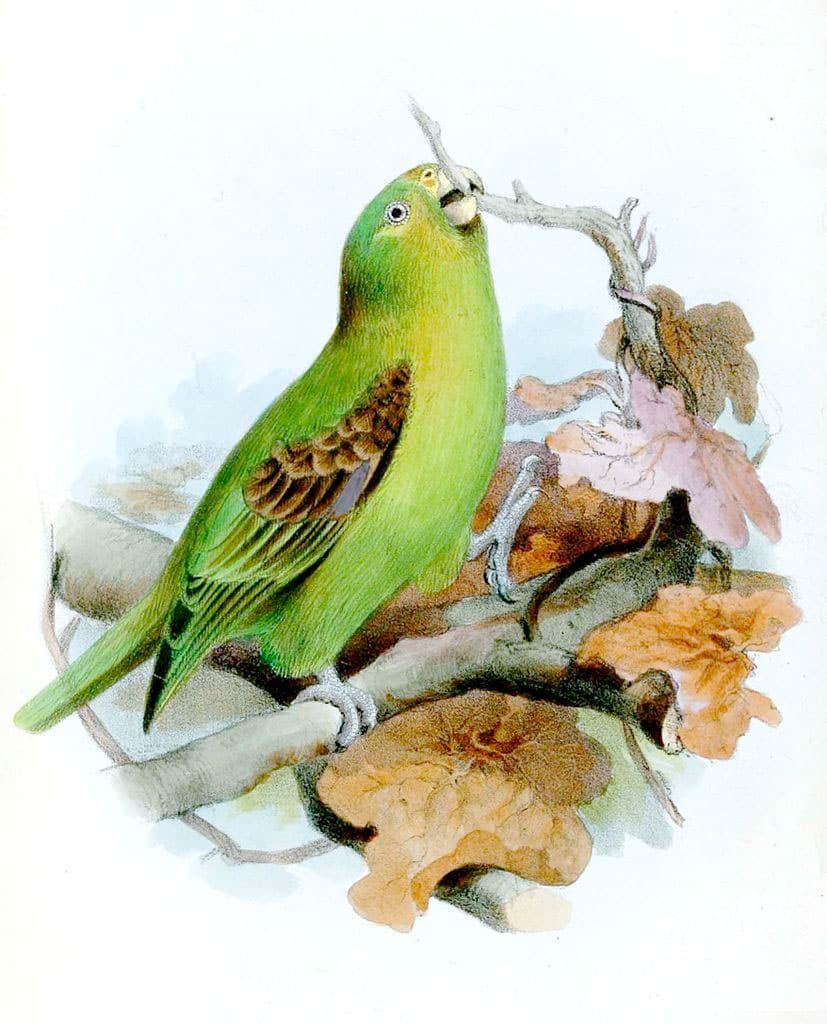
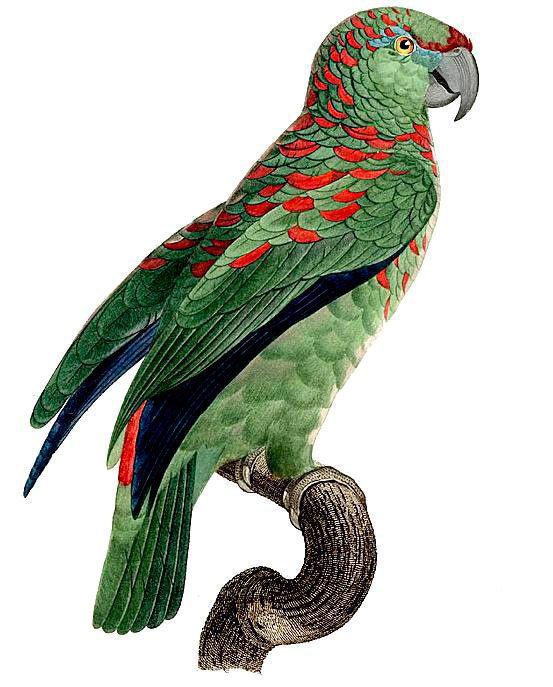
The Spot-winged Parrotlet (Touit stictopterus) It has a green overall coloration, clearer to the abdomen, wings brownish with white spots; below the tail opaque olive is yellow with blue edge.

The female differs from the male by feathers middle-lower wing which they are green; the forecrown and the face They are yellowish green.

Habitat:

Very rare species. Observed at the local level and in low densities in a Habitat in decline. Its population It is likely to be small and declining, with very small sub-populations in each known locality.
It inhabits in semi-humid cloud forests and seasonal crop areas, between 600 and 2400 m. Apparently performs altitudinal migrations, Perhaps conditioned by the supply of food.

Reproduction:

The reproduction It is performed in March.

Food:

They feed on fruit and corn.

Distribution:

Size of the area of distribution (reproduction / resident): 129.000 km2

It lives in the wild in the Andes, southern Central cordilleras and Eastern in Colombia, western Ecuador and North of Peru.

Conservation:

State of conservation โ“˜


Vulnerable Vulnerable โ“˜ (UICN)โ“˜

Globally it is in the category vulnerable (VU) and in Colombia in danger of extinction (IN). Deforestation in Andes It is their main threat.

"Spot-winged Parrotlet" in captivity:

Because of its condition It is not recommended that you keep this bird as a pet.

Alternative names:

Spot-winged Parrotlet, Brown-shouldered Parrotlet, Emma’s Parrotlet, Spot winged Parrotlet (English).
Toui tachetรฉ, Toui d’Emma (French).
Tรผpfelpapagei, Tรผpfel-Papagei (German).
Spot-winged Parrotlet (Portuguese).
Cotorrita Alipinta, Lorito de Alas Moteadas, Periquito Alipunteado (espaรฑol).
Periquito Alipunteado (Colombia).
Periquito de Ala Punteada (Peru).


scientific classification:

Philip Sclater
Philip Sclater

Order: Psittaciformes
Family: Psittacidae
Genus: Touit
Scientific name: Touit stictopterus
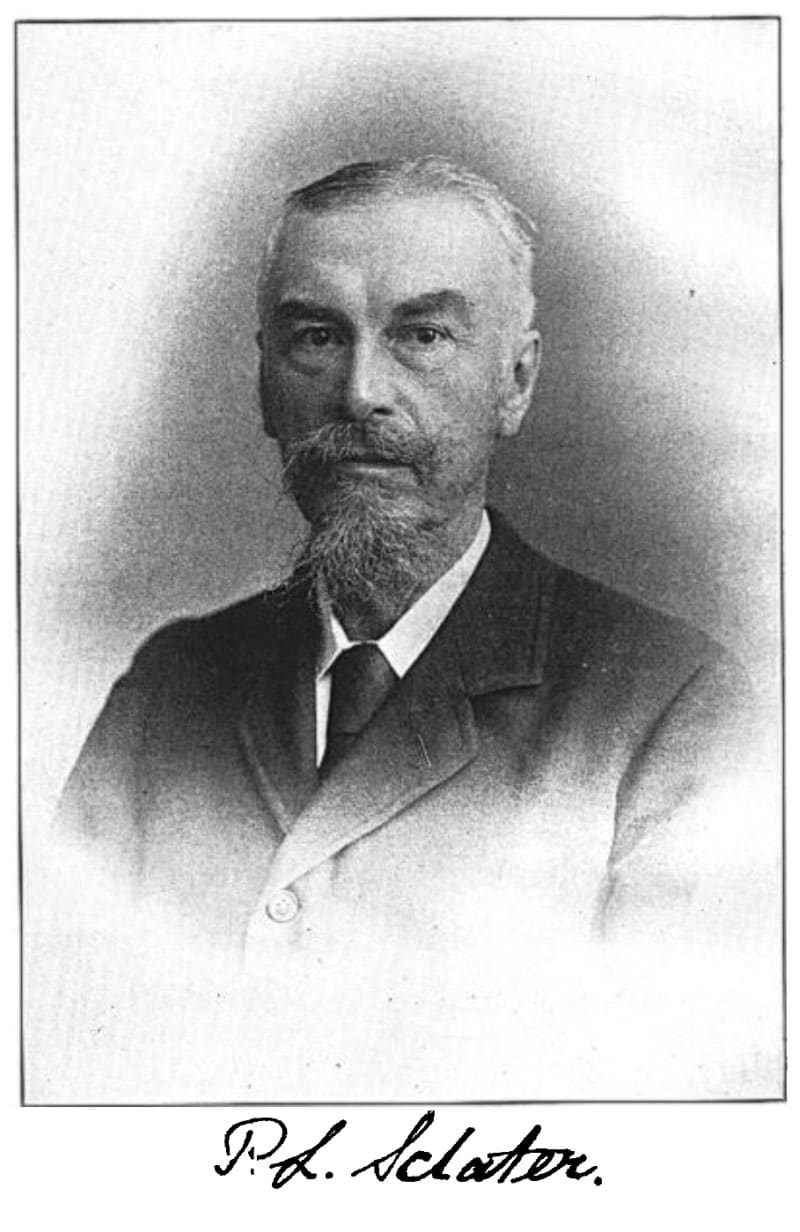
Citation: (Sclater, PL, 1862)
Protonimo: Urochroma stictoptera


Images Spot-winged Parrotlet:


Species of the genus Touit


Spot-winged Parrotlet (Touit stictopterus)


Sources:

  • Avibase
  • Parrots of the World โ€“ Forshaw Joseph M
  • Parrots A Guide to the Parrots of the World – Tony Juniper & Mike Parr
  • Birdlife
  • Parrot Book, Parrots and macaws Neotropical

  • Photos:

(1) – Urochroma stictoptera = Touit stictoptera by Joseph Wolf [Public domain], via Wikimedia Commons

โ–ท The world of Pets: Dogs, cats, birds, reptiles, amphibians

Festive Parrot
Amazona festiva

Amazona festiva

Content

Description


Anatomy-parrots

38-41 cm.. tall and 370g. weight.
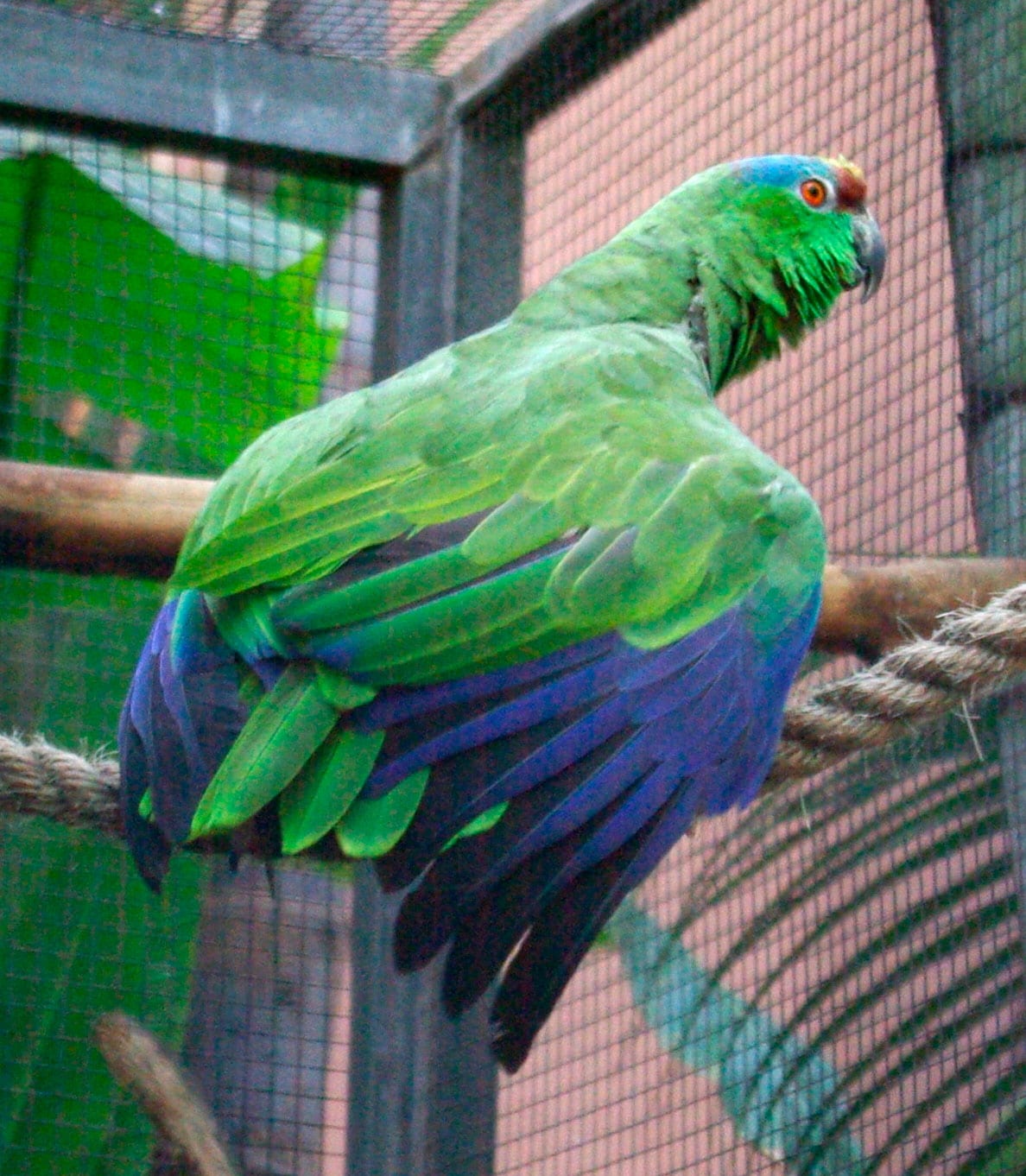
The Festive Parrot (Amazona festiva) has the cheeks and sides neck Green with strong blue diffusion; lores and a close frontal band red; feathers above and behind them eyes blue; Forehead rather yellowish green. Crown Green but darker; Feathers of the nape of color green with a band terminal dark. Mantle, scapulars, top of the back and uppertail-coverts dark green; Rump and the greater part of the low back bright red. Primary coverts Violet Blue. Other coverts dark green.

Amazon-festive-6

Edge carpal of the wing and margin of the outerweb of the primaries, blue; innerwebs black; secondaries dark blue-tipped, secondaries more interior Green. Underwing-coverts green. Chin and throat blue; Breast and belly green; coverts infra-flows brighter yellowish green. Tail green, of paler green yellowish at the tip; Trace reddish at the base of some feathers.

The bill color cuerno-marron; Iris yellow, legs dark grey.

Both sexes are similar.

Immature have irises dark and show a less intense color in the head. Its back low is practically Green; some of the pens outside of it tail they have a red base.

Subspecies description

  • Amazona festiva bodini

    (Finsch, 1873) – It has a broadband Violet Blue and red in the front behind the eyes.


  • Amazona festiva festiva

    (Linnaeus,1758) – The nominal.

Habitat:

Video – "Festive Parrot" (Amazona festiva)

Festive Amazon "Charlie"

The Festive Parrot they attend primary and secondary lowland forests, mainly vรกrzea, swamp forest and River Islands, as well igapรณ (permanently flooded forest), usually are found near the water and can prevent forests of Earth firm, although also reported in gallery forests and savannahs with scattered trees.

Observed in cocoa plantations in Brazil. At altitudes of 500 metres in Colombia and 100 metres in Venezuela. Usually in small flocks with larger meetings occasionally reported. Flocks of up to 50 birds are about Leticia between the months of May-June. Tend to gather is by the afternoon and in the evening in products communal.

Reproduction:

It nests in hollow of trees dead between mayo to June.
A breeding pair averages 3 eggs in each clutch and the incubation period is generally about 28 days.

Food:

Usually in numerous flocks, little of its power is known.

Distribution:

The Festive Parrot found in the North of South America mainly as two large populations disjunct in the basins of the amazon and Orinoco.

A population occupies the Northwest of Guyana (very few records) and Venezuela in southern Apure in the Meta River and a half Orinoco to Delta Amacuro.

The second extends from parts of the lowlands of the East (Colombia including the lower part of the Casanare River, lower Meta River and Vaupes River towards the South through the amazon of Ecuador (where birds are reported in Napo River, but few recent records) and northeast of Peru, and further to the East through the West of Brazil, from Rio Branco, Black river and bottom of the Madeira river up to the Basin Amazon East in Amapรก and For and at the mouth of the amazon on Ilha Mexiana (where is its status uncertain).

Probably in its greater part resident, Although sporadic Bird on the edge of its distribution area in Ecuador and Guyana, They suggest seasonal movements outside their range, obviously low in Guyana and local in Venezuela, Ecuador and Peru, but more common in parts of the Amazonia occidental in Brazil and locally the Amazona more common in some areas Colombia (for example by of Leticia).

Pursued to the trade in live birds in parts of its area of distribution (for example, Peru). Its swampy habitat is not much in demand for agriculture, by what does not seems to have a contraction apparent large scale of its population.

Subspecies distribution:

  • Amazona festiva bodini

    (Finsch, 1873) – It is from Colombia to the basin of the Orinoco of Venezuela


  • Amazona festiva festiva

    (Linnaeus, 1758) – The nominal.

Conservation:

State of conservation โ“˜


Near-threatened Near Threatened โ“˜ (UICN)โ“˜

โ€ข Current category of the Red List of the UICN: Least concern.

โ€ข Population trend: Decreasing.

While it has declined locally, still fairly common throughout much of its range, and may even be close to cities as Manaus and Iquitos.

The size of the world population It has not been quantified, but this species is described as ยซRareยป

Consequently, is considered of least concern by BirdLife International and the IUCN , Although it was categorized as vulnerable in 2012, because of patterns of deforestation in the Amazon rainforest and the susceptibility to hunt, predicts that the population will decrease quickly during the next three generations.

Festive Parrot in captivity:

Very rare in captivity.

His temperament is extremely excitable. Males tend to be aggressive. Good to excellent imitator.

It feeds on the sunflower seeds or other provided you ,fruit, vegetables etc..

Alternative names:

Festive Parrot, Festive Amazon, Red-backed Amazon, Red-backed Parrot (English).
Amazone tavoua, Amazona festiva (French).
Blaubartamazone (German).
Papagaio-da-vรกrzea, papa-cacau, tauรก, tavua (Portuguese).
Amazona de Lomo Rojo, Amazona Festiva, Lora Festiva (espaรฑol).
Lora Festiva (Colombia).
Loro de Lomo Rojo (Peru).
Loro Lomirrojo (Venezuela).


scientific classification:

Carl Linnaeus
Carl Linnaeus

Order: Psittaciformes
Family: Psittacidae
Genus: Amazona
Scientific name: Amazona festiva
Citation: (Linnaeus, 1758)
Protonimo: Psittacus festivus


Festive Parrot Images:


Species of the genus Amazona


Sources:

  • Parrot Book, Parrots and macaws Neotropical
  • avibase

Photos:

(1) – Festive Amazon at Loro Parque, Teneriffe By derivative work: Snowmanradio (talk)Festive_Amazon_BW. JPG: Berthold Werner (Festive_Amazon_BW. JPG) [Public domain], via Wikimedia Commons
(2) – A Festive Amazon at Tulsa Zoo, USA. This subspecies is known as Bodinus’ Amazon By Christopher G from Tulsa Oklahoma, USA (Amazon Parrot) [CC BY-SA 2.0], via Wikimedia Commons
(3) – A pet Festive Amazon By Tutu … F. Lopes (originally posted to Flickr as โ™ ) [CC BY 2.0], via Wikimedia Commons
(4) – Two Festive Amazons in an aviary at a bird park in Kaluga Oblast, Russia. They are the subspecies Amazona festiva bodini, common name Bodinus’ Amazon. They are probably jostling for room on their perch By Remiz [CC BY-SA 2.0], via Wikimedia Commons
(5) – Festive Parrot By derivative work: Snowmanradio (talk)Amazona_festiva-8.jpg: frank wouters [CC BY 2.0], via Wikimedia Commons

Sounds: Sergio Chaparro Herrera

โ–ท The world of Pets: Dogs, cats, birds, reptiles, amphibians

Blue-eyed cockatoo
Cacatua ophthalmica

Cacatรบa Oftรกlmica

Content

Description:

50 cm. length and a weight between 500 and 580 gr.
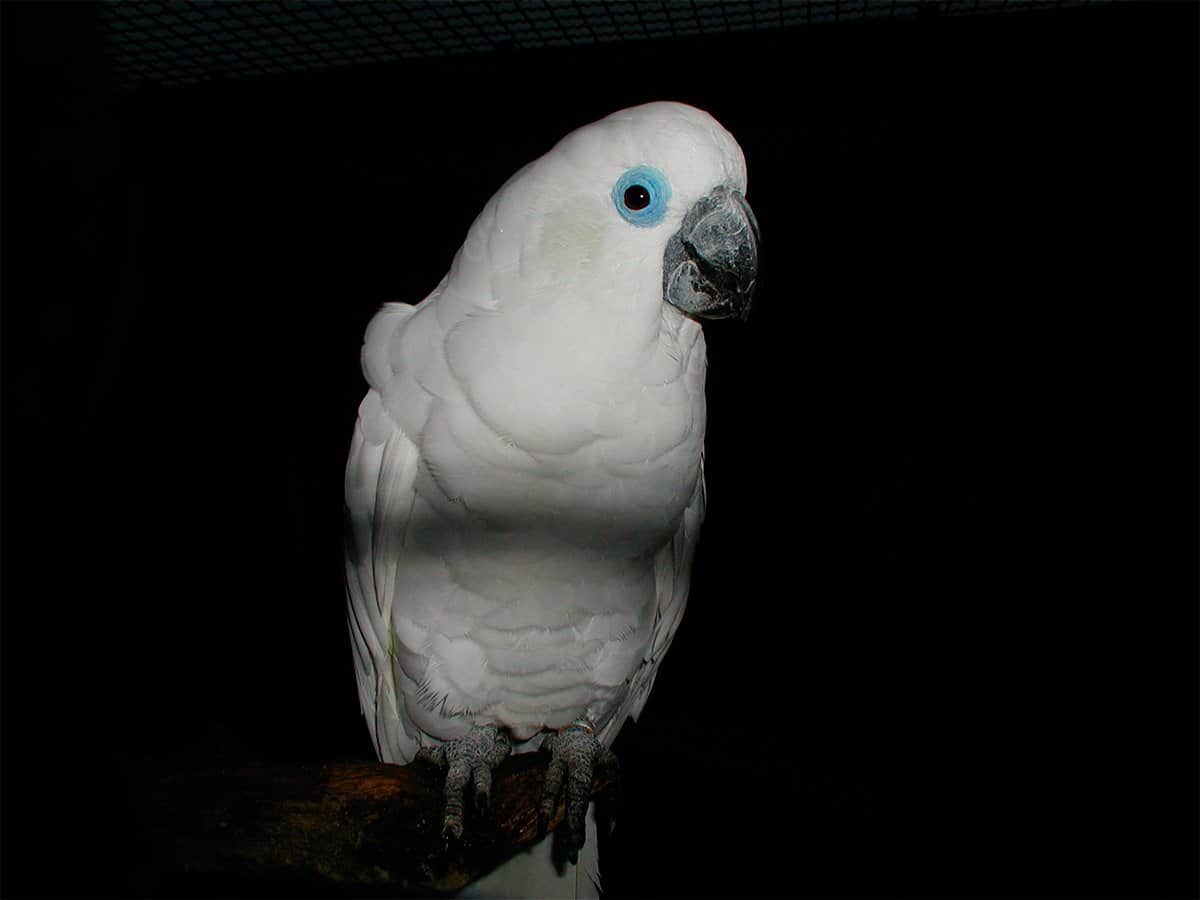
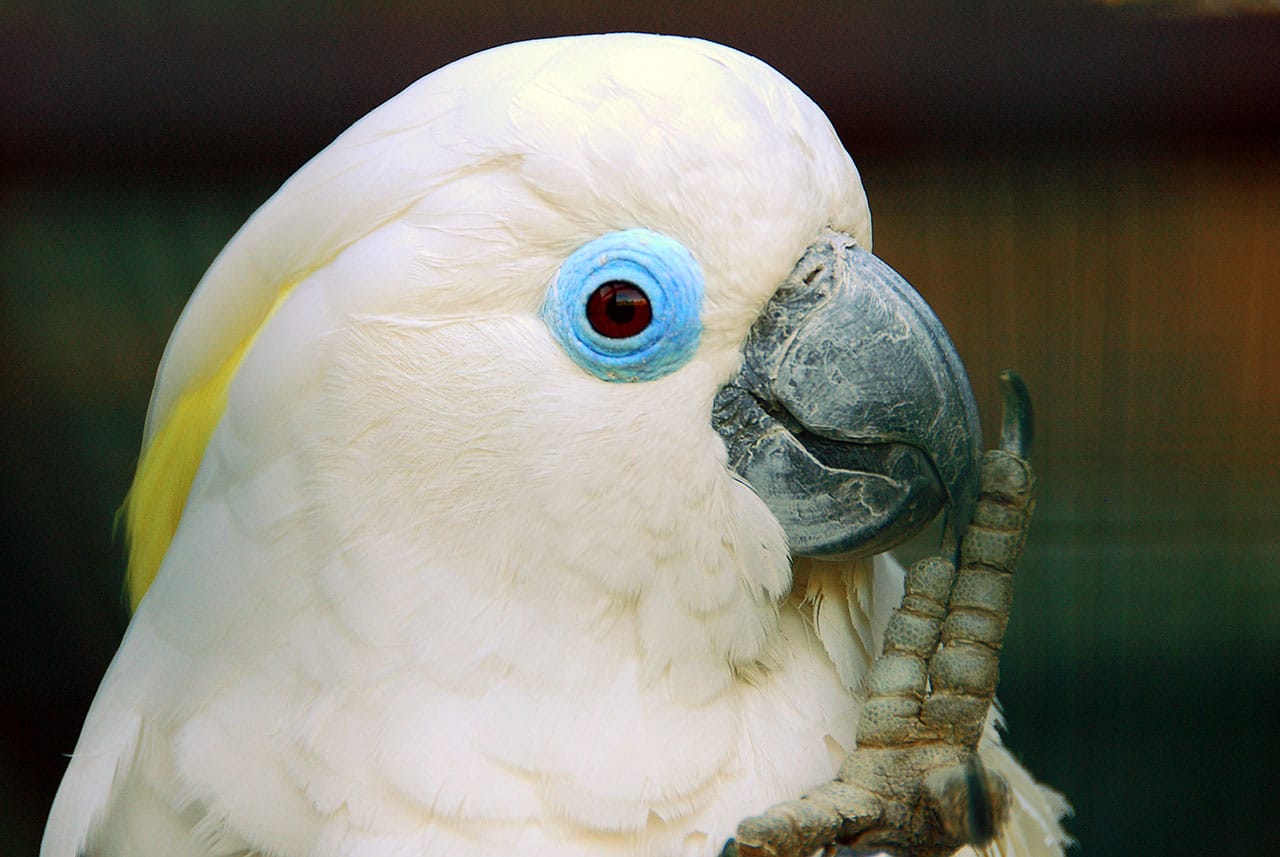
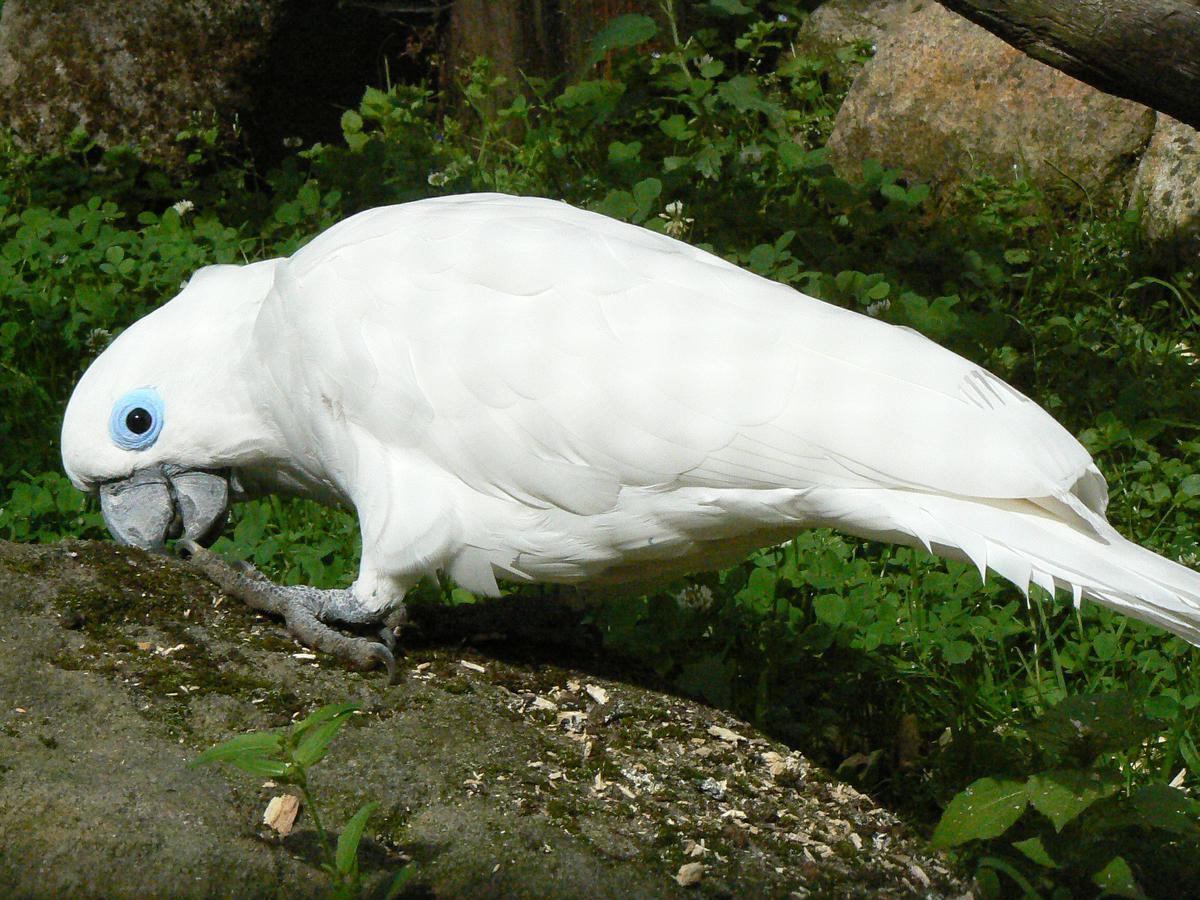
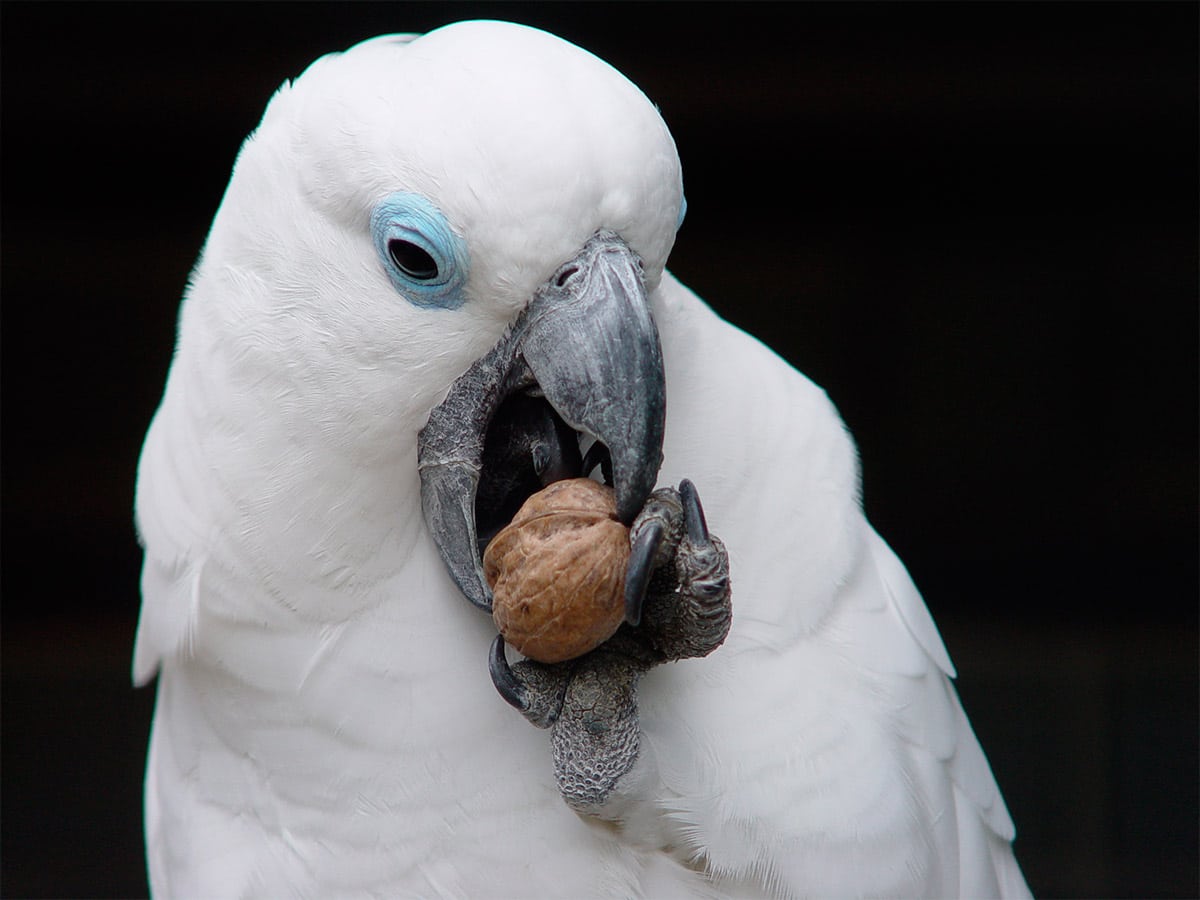
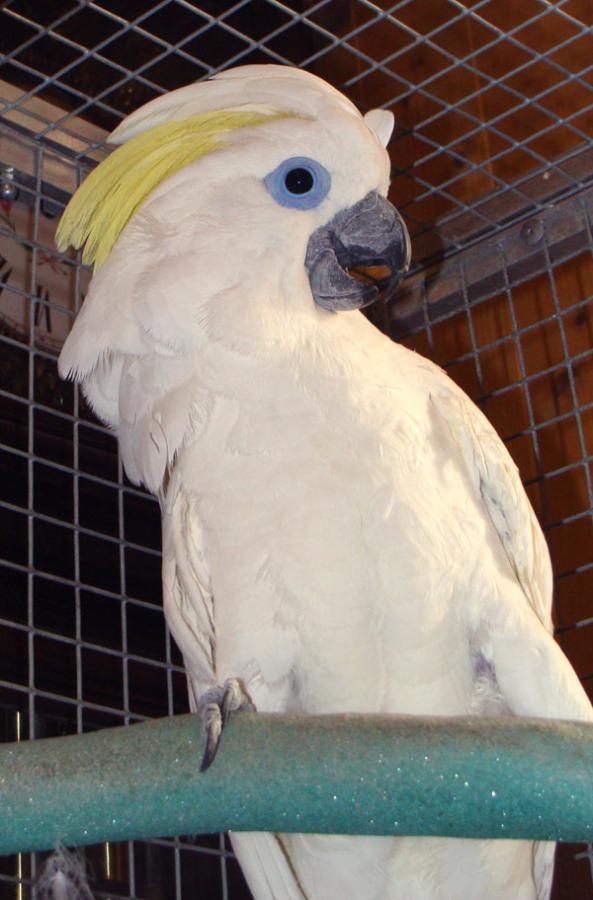
The plumage of the Blue-eyed cockatoo (Cacatua ophthalmica) is mostly white. Its crest is yellow, large and well rounded back, leaning to the neck.

The feathers that cover the ear, the base of the neck and cheek are pale yellow. The inside of the wings and tail are slightly yellowish. The ring around the eye is blue, the iris is dark brown and gray peak.
Only you can distinguish males and females by iris.

Habitat:

Video – "Blue-eyed cockatoo" (Blue-eyed cockatoo)

Ophthalmic cockatoo.MPG

Primary forest, edges of forests and areas with sparse vegetation to 1.000 m.
It is more common in the plains than in the mountains.

They live alone, in pairs or flocks of birds 10-20. Easy to distinguish and noisy, usually. When you are flying over forests, your flight is sandwiched between glide and powerful flapping. Probably similar habits to the Sulphur-crested cockatoo, screams as she, only that stronger.

Reproduction:

There is no information about the reproduction of this species in the wild, but in captivity the female lays around 2 eggs and incubation lasts 28-30 days. The young are altricial (totally dependent on their parents for the first few weeks of life) and they remain in the nest for nine to twelve weeks being fed by both parents; later, young people, they are accompanied for a few months.

Food:

They feed mainly on seeds, fruit, in particular the figs, berries and, possibly, insects and larvae.

Distribution:

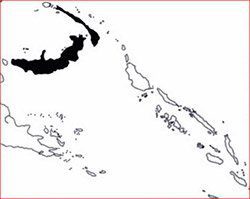
Ophthalmic Cockatoo Distribution

New Britain and new Ireland in the Bismarck Archipelago (Papua New Guinea).

Conservation:


Vulnerable

Conservation status of IUCN: Vulnerable (VU)

This species has been upgraded to Vulnerable because remote sensing techniques indicate that the lowland forest, on which this species depends for nesting, It is disappearing at a notorious enough pace to cause a rapid decline in the population.
The rapid conversion of lowland rainforest to oil plantation use over the past thirty years is likely to have caused significant loss of breeding habitat..

Although it is rare in international trade, even the limited catch would be a cause for concern.

The population is estimated at at least 10.000 mature individuals.

"Blue-eyed cockatoo" in captivity:

Extremely elegant and striking. It is gaining share as a companion pet.
It mimics human speech, is very active, capable of stunts and very close to the people.

Despite his intelligence and skills, not at all a cockatoo that can be kept in an apartment.
On the one hand, due to its high energy, and secondly because of the power of their cries.

Their average lifespan is of 40 years in captivity. Surprisingly their hope for life in nature is longer, of 50 to 60 years. The life expectancy in captivity decrease may be due to inadequate attention.

Alternative names:

Blue eyed Cockatoo, Blue-eyed cackatoo, Blue-eyed Cockatoo (ingles).
Cacatoรจs ร  oeil bleu, Cacatoรจs aux yeux bleus (French).
Brillenkakadu (German).
Cacatua-de-olhos-azuis (Portuguese).
Cacatรบa Oftรกlmica (espaรฑol).

scientific classification:

Order: Psittaciformes
Family: Cacatuidae
Scientific name: Cacatua ophthalmica
Citation: Sclater,PL, 1864
Protonimo: Cacatua ophthalmica

Ophthalmic Cockatoo Images:


Species of the genus Cacatua

Sources:
Avibase
– Photos: Wikimedia Commons, kisspanda.rajce.idnes.cz/, Gros-becs.net
– Sounds: Frank Lambert

โ–ท The world of Pets: Dogs, cats, birds, reptiles, amphibians

Violet-necked Lory
Eos squamata

Lori Escamoso

Content

Description

27 cm.. height and an approximate weight of 110 gr.

Along with the Red Lory (Eos Bornea) the "Scaly Lory" (Eos squamata) it is the only lory of the genus Eos it does not have blue marks on the ear-coverts.

Its plumage It has a scarlet general appearance. The neck It is surrounded by a violet blue collar which is well developed in some individuals, but nearly absent in others. The area from the abdomen up to the subcaudales it is dark purple. The scapulars they are dull purple with black tips. The feathers of the greater coverts and flight feather They are red with black tips.
The bottom of the wings and of remiges from below they are red with black spots at the primary level. The tail is purple red.

The irises is orange, the legs grey.

In the immature the feathers of the lower parts, have broad dull blackish purple borders. The irises They are brown.

Description 3 subspecies

  • Eos squamata squamata

    : (Boddaert, 1783) – Something smaller and feathers in the nominal species They are blue violet, in this subspecies are blackish blue.


  • Eos squamata riciniata

    : (Bechstein, 1811) – Smaller and band chest and neck is violet gray.


  • Eos squamata obiensis

    : (Rothschild, 1899) – It is somewhat smaller and with shoulders blacks. the band of neck It is variable and greyish violet. The area of the nape is red.

Habitat:

The Violet-necked Lory they are relatively common in the primeval forests or secondary forests that have large mature trees. Also found in the mountain forests and also, but with lower density in the coconut plantations bordering the coast, in the bushes during regeneration, in the abandoned gardens and mangroves.

Populations that inhabit small islands tend to stay near the coast.
On the larger islands, These birds can run in the forests of the mountains up to a height of 1.220 meters above the sea level.

The Violet-necked Lory they are particularly noisy and easily identifiable when they are in flocks, but they are a much more secretive behavior when in isolated pairs.

They usually gather in large flocks when they find abundant food sources.. This habit makes appearing more or less abundant in different regions. These flocks of birds are usually just above the tops of the trees.

Every day, they make short trips between the different islands. To do this they use a flight quick and direct, It consists of shallow wing beats. When they beat their wings produce a very audible hum.

Reproduction:

There is almost no information on the reproduction in the wild. In captivity, the implementation is of 2 eggs that are incubated during 27 days. As with all loris, the reproductive cycle is particularly long and hard about 80 days.

Food:

Exclusively vegetarian. They feed on sago palm in bloom and consume figs when they are still firm. Also eat nectar from big red flowers of Erythrina family Fabaceae.

Distribution:

Size of its range (reproduction / resident): 189.000 km2

The Violet-necked Lory They are endemic to the islands or archipelagos which are among New Guinea and Las Celebes.

They are mostly found in West Papua and of the Moluccan Islands.

Distribution 3 subspecies

  • Eos squamata squamata

    : (Boddaert, 1783) – Islands West Papua, that is to say Stupid, Waigeo, Batanta and Misool and islas Turtle (Indonesian)


  • Eos squamata riciniata

    : (Bechstein, 1811) – North of Moluccas, from Morotai to Bacan and Damar, also in islas Widi and Mayu islands in the sea of Moluccas (Indonesian).


  • Eos squamata obiensis

    : (Rothschild, 1899) – Only in the Obi Islands in the northern Moluccas.

Conservation:


minor concern


โ€ข Current IUCN Red List category: Least concern

โ€ข Population trend: Stable

The population size is very large, and therefore not approaching the threshold of Vulnerable under the criterion of population size.
The world population is estimated between 100,000 and 500,000 individuals.

About 3.000 specimens are caught every year for the trade aviaries. The pressure on the species is estimated to be quite reasonable, but it is recommended, by many associations, the establishment of catch quotas for the year.

"Violet-necked Lory" in captivity:

Son loving, curious, extroverts and show some unique behaviors. Some like to wrap yourself in a blanket to sleep. Sometimes, they can even be sleeping on your back. They can learn to mimic sounds and words.

They are capable of aggressive behavior if their territories and possessions is disregarded.

They are demanding in the requirements should be for their care, requiring much attention. Baths or showers daily should be part of your daily habit.

Alternative names:

Violet-necked Lory, Moluccan Red Lory, Violet necked Lory (ingles).
Lori รฉcaillรฉ, Lori ร  nuque violette, Lori de Wallace (French).
Kapuzenlori (German).
Lรณris-de-colar-violeta (Portuguese).
Lori de Collar Violeta, Lori Escamosa, Lori Escamoso (espaรฑol).

scientific classification:

Order: Psittaciformes
Family: Psittaculidae
Scientific name: Eos squamata
Genus: Eos
Citation: (Boddaert, 1783)
Protonimo: Psittacus Squamatus

โ€œScaly Loryโ€ Images:

Videos "Violet-necked Lory"

————————————————————————————————–

"Scaly Lory" (Eos squamata)


Sources:
Avibase, BirdLife.org, Oiseaux.NET
– Photos: SALIS- (Flickr), Bernard DUPONT (Flickr), Wikimedia, IBC.lynxeds.com
– Sounds: Frank Lambert (Xeno-canto)

โ–ท The world of Pets: Dogs, cats, birds, reptiles, amphibians

Goldie's Lorikeet
Psitteuteles goldiei

Goldie's Lorikeet

Content

Description

19 cm.. long and weighing between 45 and 60 g..

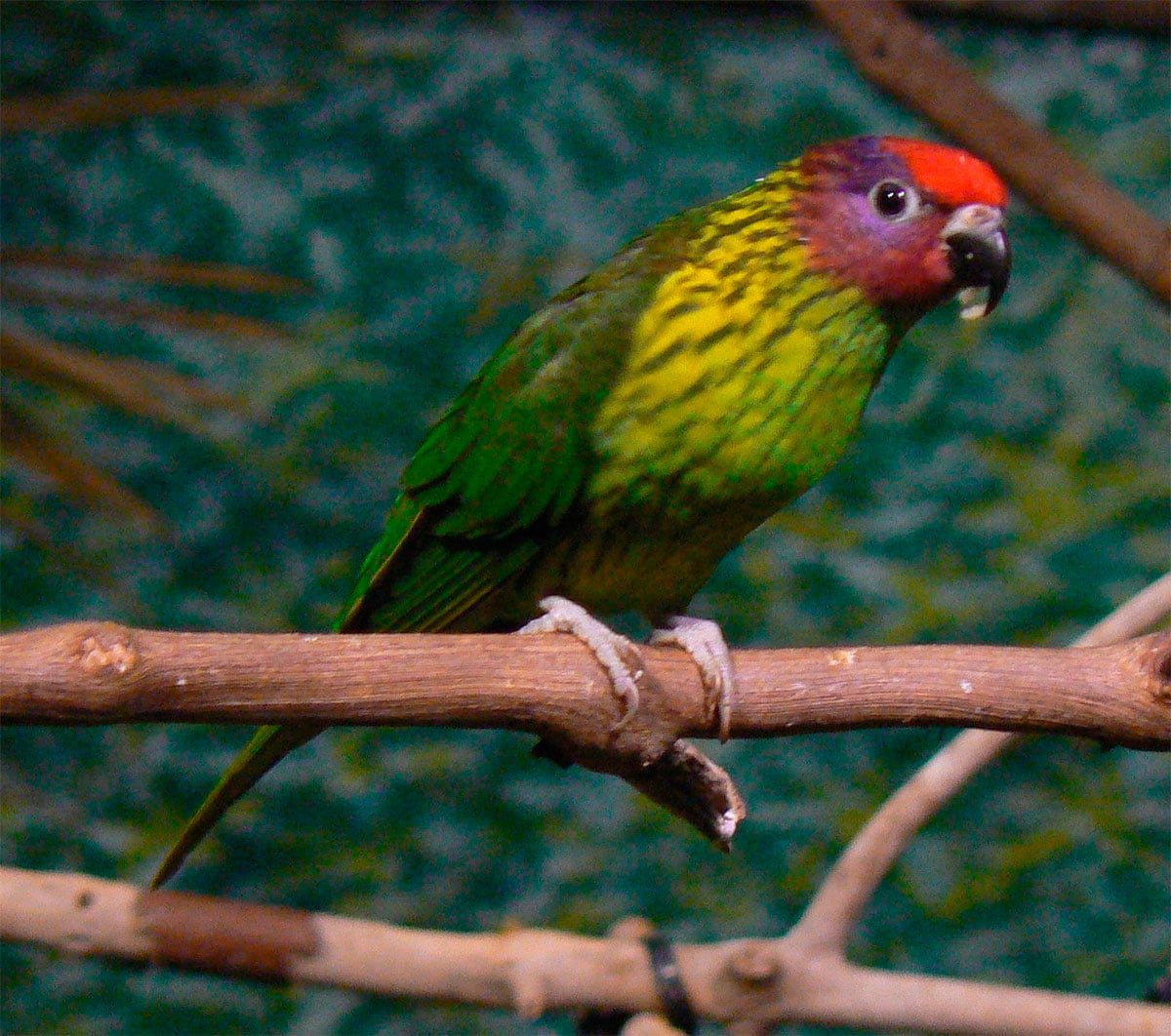
The Goldie's Lorikeet (Psitteuteles goldiei) has the top red. Its neck is surrounded by a strip blue opaque that it extends to the edge of the eye.

The mumps and their cheeks They are pink with multiple dark blue veins.. The upperparts of color green dark streaked of black in the part inferior of the neck and of color yellow greenish mottling on the sides of the layer.
The feathers that cover the wing are dark green, as well as the top of the tail.
The feathers they have a green color with black internal wires and a fine yellow edge.

The underparts are yellowish green with many streaks of dark green, more concentrated in the area of the chest. The bottom of the tail is of color yellow grey.

The bill is black, brown the iris. The legs son grises.

The females adult, they have the top more opaque and less developed.

In the immature, the top is reddish with dark blue spots. The upper mantle is spotted of yellow.

There are no geographic variations. The species is considered monotype.

Habitat:

The Goldie's Lorikeet It is distributed mainly by primary forests, mountain forests and eucalyptus between 1.000 and 2.200 meters above sea level. But, These birds are very Mobile and their habitat may vary from sea level to the 2.800 m.

At higher altitudes, sometimes be parked in the forests of beech and false Podocarpus. They are also set fairly regularly in the areas where the trees are in bloom and around small mountain villages. They have been , occasionally, in small groups of trees isolated in the middle of open spaces.

The Goldie's Lorikeet they are very sociebles. They are often associated with other Charmosyna type Loris: Fairy Lorikeet (Charmosyna pulchella) and Lori Flanquirrojo (Charmosyna placentis).

Most of the time they live in large groups of 30 or more individuals. These birds make long flights daily, often in the company of Pygmy Lorikeet (Charmosyna wilhelminae). Move from their places of rest to its feeding sites found at the middle level, or at the top of the tall trees in flower.

They probably make seasonal migrations to meet their specific feeding needs.. Between mid June and early January, the Goldie's Lorikeet they are common in the forests of the lowlands around Port Moresby.

Reproduction:

We really know very little about free-range breeding.. Apparently, the nest is well hidden inside a tree in thick foliage dry, mostly big pandanus. The female lays two white eggs.

In captivity, the incubation period ranges between 23 and 24 days. Young are altricial, and leave the nest after 8 to 9 weeks.

Food:

The Goldie's Lorikeet they have a scheme rather similar to all the lori, that is to say, they are almost exclusively vegetarian. Its menu consists mainly of pollen, nectar, flowers and fruits than that found in the trees of the genus Casuarina in shrubs of the genus honey Grevillea and of the eucalyptus.

Distribution:

Size of the area of distribution (reproduction / resident): 307.000 km2

This species is endemic of New Guinea. Lives exclusively in the mountains in the center of the island and stretches to the mountains of the Huon Peninsula and Owen Stanley.

Conservation:


minor concern

– Current IUCN Red List category: Least concern

– The population trend: Stable

The population suspected to be stable in the absence of evidence of any reduction or substantial threats.

The world population It has not been quantified, It is estimated above 100.000 specimens, but the species is reported to be locally common depending on food availability.

"Goldie's Lorikeet" in captivity:

The Goldie's Lorikeet is a bird prized as a pet. His character is not aggressive, or destructive and is quite silent for a parrot. They can be taken in pairs or in large communities. Some of them come to imitate the human voice.

Alternative names:

Goldie’s Lorikeet, Red-capped Streaked Lorikeet, Red-capped Streaked Lory (ingles).
Loriquet de Goldie (French).
Veilchenlori (German).
Lรณris-de-goldie (Portuguese).
Lori de Goldie, Tricogloso de Goldie (espaรฑol).

scientific classification:

Order: Psittaciformes
Family: Psittaculidae
Genus: Psitteuteles
Scientific name: Psitteuteles goldiei
Citation: (Sharpe, 1882)
Protonimo: Trichoglossus Goldiei

"Goldie's Lory" Images:

————————————————————————————————

"Lori de Goldie" (Psitteuteles goldiei)


Sources:

Avibase
– Parrots of the World โ€“ Forshaw Joseph M
– Parrots A Guide to the Parrots of the World – Tony Juniper & Mike Parr
– BirdLife.org
Wikipedia

Photos:

1 – ยซPsitteuteles goldiei - Pittsburgh National Aviary-8-3 cยป by derivative work: Snowmanradio (talk)Psitteuteles_goldiei_-Pittsburgh_National_Aviary-8.jpg: Benny Mazur – originally posted to Flickr as Goldieโ€™s Lorikeet and uploaded to commons as Psitteuteles_goldiei_-Pittsburgh_National_Aviary-8.jpg. Licensed under CC BY 2.0 via Wikimedia Commons.
2 – animalhouse.Re.it
3 – ยซGoldies Lorikeetยป by LtshearsOwn work. Licensed under CC BY-SA 3.0 via Wikimedia Commons.
4 โ€“ Jackson Zoological Park – Jackson, MS, USA ยฉ 2004 Jeff Whitlock
5- Bird feeding on fruit in a tree. by David Cook Wildlife Photography – IBC.lynxeds.com

Sounds: Michiel de Boer (Xeno-canto)