▷ The world of Pets: Dogs, cats, birds, reptiles, amphibians

Great Anglo-French Tricolour Hound
Francia FCI 322 - Large-sized Hounds

Great Anglo-French Tricolour Hound

The Great Anglo-French Tricolour Hound is considered rare, very little spread outside of France and currently little used even in your country.

Content

The Great Anglo-French Tricolour Hound is a large and powerful sporting dog with its origin in France. He is praised for his incredible stamina, work skills and ability to operate on any type of terrain and for any weather condition. This breed is poorly adapted to apartment living due to its high exercise requirements. This type of Anglo-French hound is considered the most powerful.

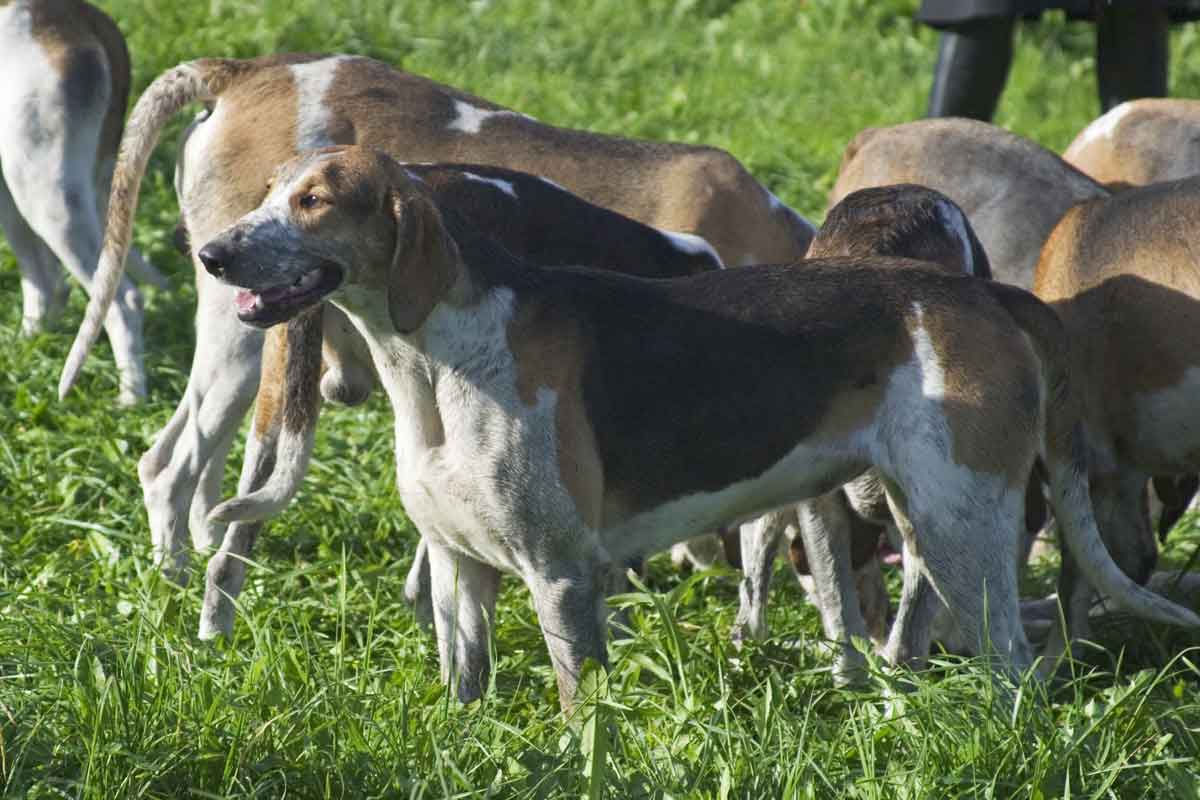
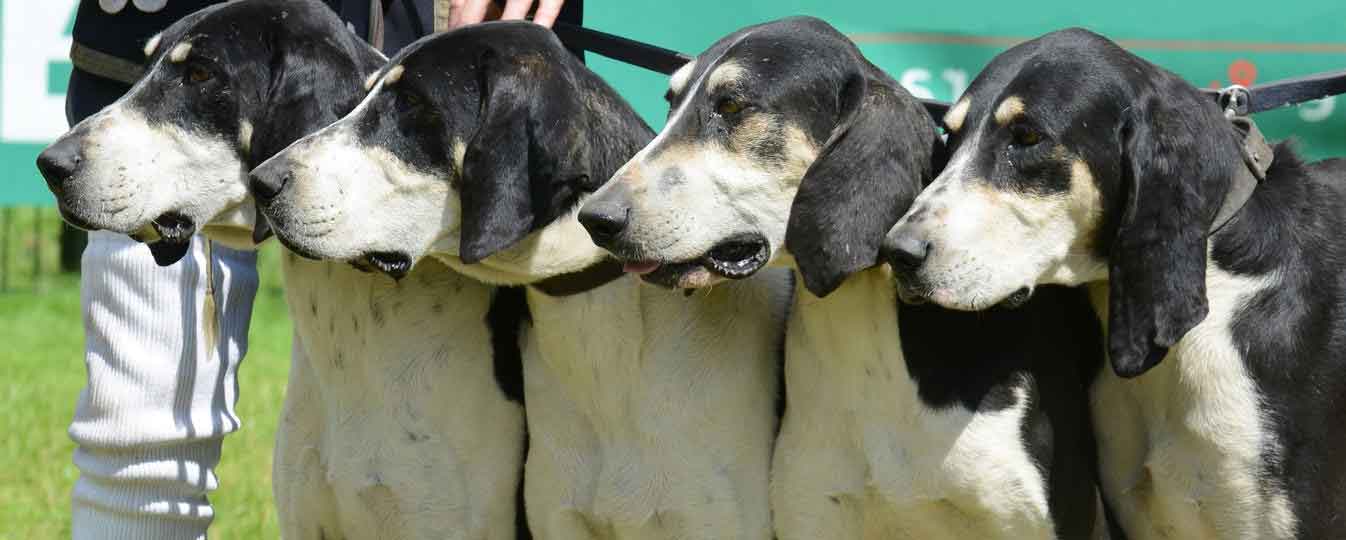
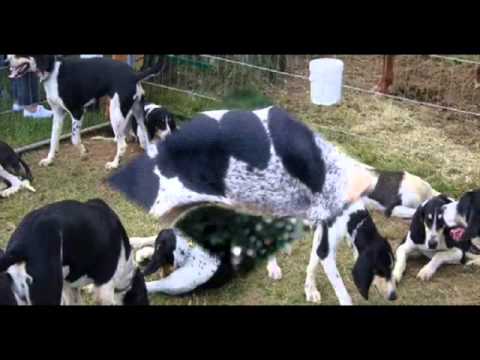
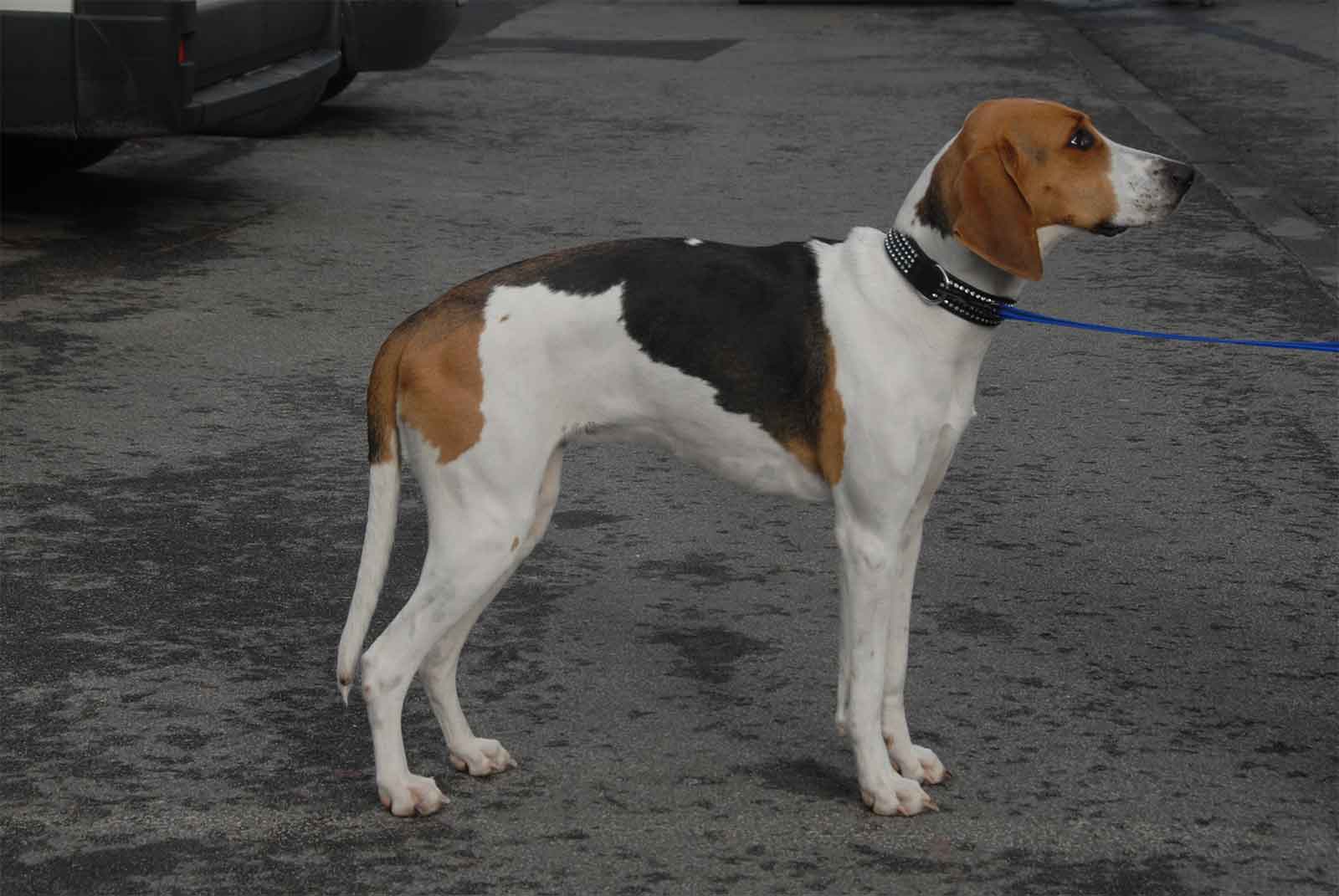
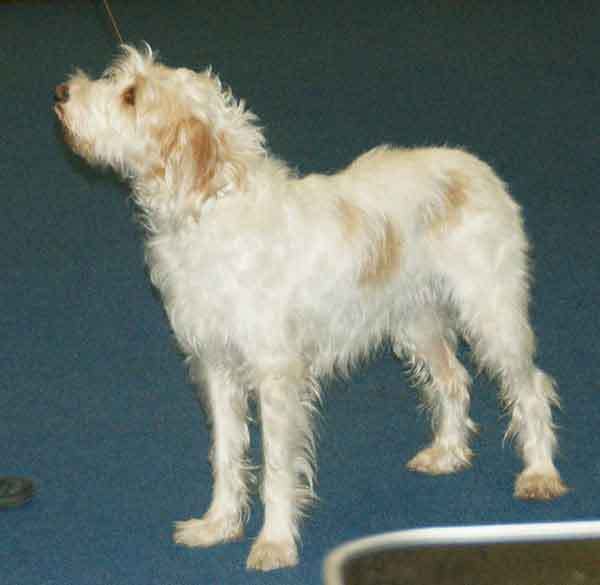
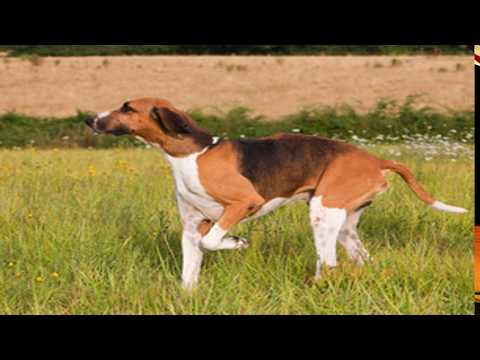
Photo: This dog is one of a pack of Grand anglo-français tricolore by Alephalpha, CC BY-SA 3.0, via Wikimedia Commons

History Great Anglo-French Tricolour Hound

The origin of the Anglo-French hound dates back to the 19th century, when hunting with large packs was at its height in France. However, the exact date of its development remains unclear, since the crossing of the French hound with various types of English hounds was a common practice in this country since the 16th century.

French hunters cared little for the appearance or pedigree of their dogs as long as they demonstrated unparalleled hunting prowess.. That is why these hounds were perceived more like stray dogs until the 20th century. The situation changed when in 1957 the breeders decided to organize the dogs according to their ancestry. His efforts resulted in the appearance of seven unique French breeds of sizes, coat texture and distinctive colors. The Great Anglo-French Tricolour Hound appeared as the result of the crossing of native French dogs, in particular the Poitevin hound and the Gascon Saintongeois and the English Foxhound. The breed is very rare, little used and virtually unknown outside of mainland France.

The word "Grand» was put in front of the breed name because it was used to hunt large game and functioned predominantly in packs of several dozen other canines. The Great Anglo-French Tricolour Hound is characterized by its resonant voice, his keen sense of smell and his relentless pursuit. This brave and passionate hunter will never be hampered by difficult terrain and harsh weather and can work for numerous hours without breaks.. The packs of the Anglo-French hounds They generally specialized in hunting roe deer and wild boar., although they could also hunt foxes and other small game animals.

Currently members of the breed are mostly active hunters as this dog is not suitable for the role of pet or show dog.. Its population was concentrated almost exclusively in its native France, where it is also considered a rare breed. But, the Great Anglo-French Tricolour Hound has the recognition of the Fédération Cynologique Internationale (FCI) and in 2006 was officially recognized by the United Kennel Club (the UKC).

Physical Characteristics Great Tricolor Anglo-French Hound

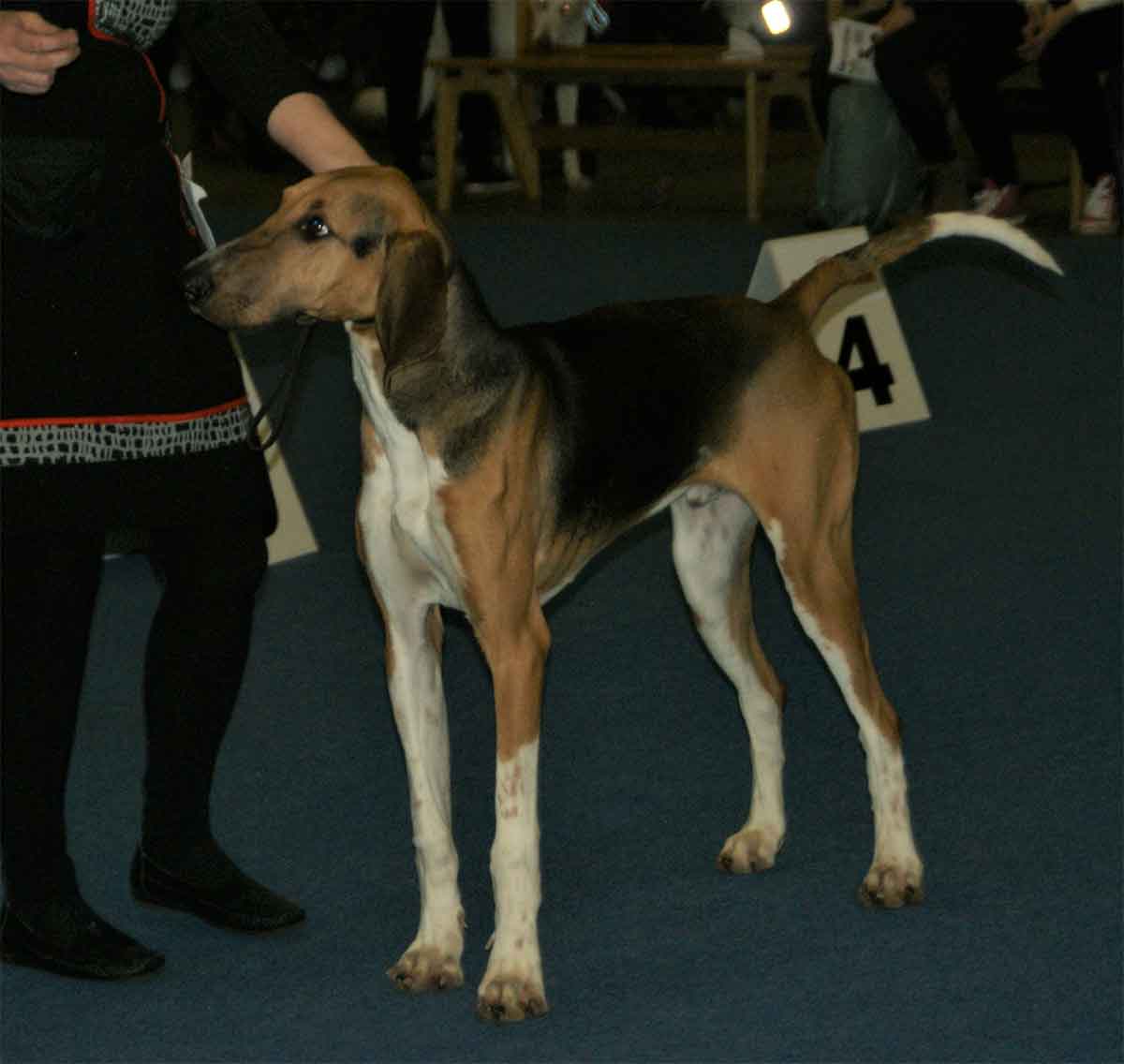
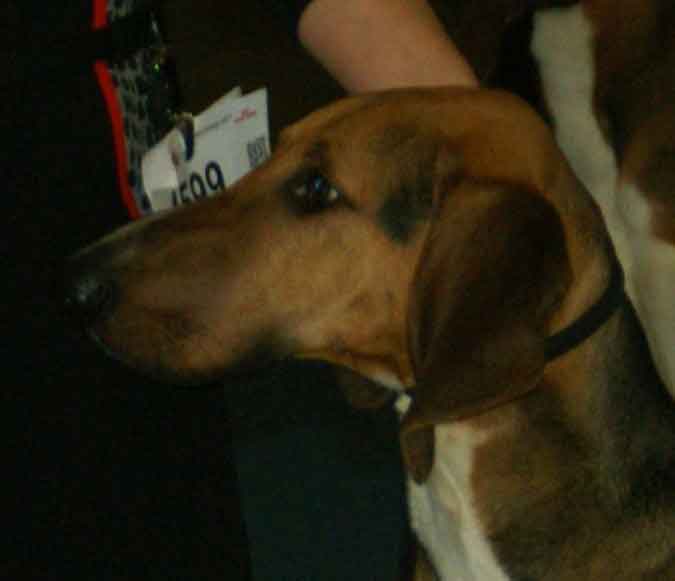
The Great Tricolor Anglo-French Hound should appear elegant and almost old-fashioned in appearance. They must be robust, with a deep chest and a straight back that is supported by straight, muscular limbs. His broad skull has an obvious stop, while its square-shaped snout should contain a full set of teeth that meet in a scissor bite. Her big brown eyes, its pendulous ears and prominent black nose are all characteristic features of a scent hound. Its long, thin tail tends to have a white tip.

as its name suggests, it is a tricolor breed with white fur, fire and black. Its double coat is short and soft. Dogs measure between 60 and 70 cm in height to the cross, generally weigh between 30 and 35 kg. Your walk should be effortless and a pleasure to behold.

Character and skills Great Anglo-French Tricolour Hound

The Great Anglo-French Tricolour Hound he is a magnificent sporting dog, that is very rarely used only as a pet. It gets used to living in large packs of other canines and requires a spacious yard to unleash its exuberant nature.. Some fans of the breed claim that their well-socialized specimen is fine with children. In any case, this vigorous and strong dog will not make an acceptable playmate for a young child.

The breed often demonstrates unwavering loyalty and affection towards their favorite people, but he stays quite distant from strangers. But, a Great Anglo-French Tricolour Hound well educated will treat a new person with essential courtesy. Usually does not express enough interest in protecting its territory to be an effective watchdog. At the same time, some specimens can make good watchdogs. This breed definitely won't make any use of it in the guard dog role anyway due to its non-aggressive disposition..

The Great Anglo-French Tricolour Hound was bred to live and work with other dogs and usually yearns to have several permanent canine companions. He does quite well with strange dogs although he will not back down from confrontation if provoked. That is why this dog should always be kept on a leash while walking. Being a tenacious and reliable hunter, it can show high aggression towards other species of animals., especially towards homeless cats. It is possible to introduce this dog into the house with other non-canine pets while it is still a friendly and inquisitive pup.

Health of the Great Anglo-French Tricolour Hound

The most common problems for the breed include:

– canine hip dysplasia;
– patella dislocation;
– arthritis;
– frequent muscle tension;
– chronic ear infections;
– hearing problems;
– cryptorchidism;
– gastric torsion.

Caring for the Great Anglo-French Tricolour Hound

The Great Anglo-French Tricolour Hound should receive fairly basic maintenance. The owner should brush his dog a couple of times a week to keep his short, sleek coat in a healthy condition. The dog's nails should be trimmed monthly.

After every hunting trip, the coat and ears of a working specimen should be thoroughly examined for signs of ticks and other external parasites. The breed easily picks up various ear infections, so they need regular and careful cleaning. The Great Anglo-French Tricolour Hound he is a moderate biter.

Training of the Great Anglo-French Tricolour Hound

The training of the Great Anglo-French Tricolour Hound usually requires an average investment of time and effort. In fact, takes on a very natural hunting behavior and will effectively carry out its original hunting duties with a minimum of training. At the same time, is characterized by a certain streak of stubbornness and will not follow the orders of a week or an indecisive person. This dog usually has a strong desire to impress its owner and easily learns basic commands.

Breed training should be done exclusively with reward-based methods, with an emphasis on the dog's favorite treats. The Great Anglo-French Tricolour Hound will not put up with abusive or disrespectful treatment and will respond to it with even more obstinacy and disobedience.

Exercise with the Great Anglo-French Tricolour Hound

The Great Anglo-French Tricolour Hound is an extremely vigorous working dog, accustomed to very intense physical exercise. When not hunting, he must be given the opportunity to expend his excessive energy. This dog is an infamous cat hunter, so it should never be released without a leash until it is in a closed and secure area.

During the hunting season it is advisable to offer the dog some type of exercise that emulates its hunting behavior.. It is worth remembering that if the Great Anglo-French Tricolour Hound lacks opportunities to vent, will gradually turn into a rebellious animal, hyperactive and destructive.

Videos "Great Anglo-French Tricolour Hound"

HTTPS://youtube.com/watch?v=TQlS7Fba0i0&feature=emb_logo
Pack of Anglo Saxons hunting wounded boar
HTTPS://youtube.com/watch?v=iOVr7Al5XYI
Grand Anglo Français Tricolore ?? Everything Dog Breeds ??

Type and recognitions:

  • FCI CLASSIFICATION:
  • Group :
  • Section : . .

Federations:

  • – FCI – Group 6: Scent hounds, and related breeds. – Section 1.1: Large-sized Hounds. ⓘ
  • – UKC – Scenthounds ⓘ
  • – Central Canine Society ⓘ

FCI breed standard "Great Anglo-French Tricolour Hound"

Origin:
France

Date of publication of the valid original standard:
27.01.1983

Use:

Hound


General appearance:

This is a solid dog, predominantly French type, that has a certain air of distinction. To different degrees it can show its Fox-Hound origin.


Behavior / temperament:

---

Head:

---

Cranial region:
  • Craging: The skull is of moderate width and rather flat.. The occipital protuberance is slightly visible and the eyebrows are not very prominent..
  • Dnaso-frontal depression (Stop): Marked.

facial region:

  • Hocico: Well sculpted under eyes. The nasal cannula is of medium length, approximately equal to that of the skull. It is usually straight.
  • Belves: They are quite developed, giving the muzzle a rather square appearance. They are never pointy.

OJOS: Large, browns; black color is seen around.

OREJAS: Medium length, fairly long implantation in the plane of the eye line. They are flat at the root and then twist a little.

Neck:

It is quite long and thick. No pronounced double chin.

Body:

  • Espalda: It is straight and pointed.
  • Lomo: Width, muscular, rectilinear and rather short.
  • Rump: It is long and oblique.
  • Pecho: It is well descended and quite wide. Long, rounded ribs, never flat.
  • Flalso: They are slightly raised and quite solid.

Tail:

It is long, well covered with hair. The dog carries it with elegant bearing.

Tips

PREVIOUS MEMBERS:

  • Ageneral appearance: Strong and perfectly poised.
  • Shoulder: Long and flat.
  • Pinis previous: Thin and rather rounded.

LATER MEMBERS:

  • Thighs: Muscular, descended and somewhat ″fleshy″.
  • Corvejón: It comes close to the ground. It is wide and slightly angled.
  • Pinis later: Thin and rather rounded.

Movement:

It is loose and imparts an impression of solidity.

Mantle

PIEL: Black and white in color.

MANTLE

  • Plink: Short and more or less thick.
  • Codor: Tricolor; often has a black blanket or more or less widespread black spots. High fire color or copper color, without being carbonated. Mixed hair called “wolf hair” is not excluded.. Excessively mottled fur is undesirable..


Size and weight:

Altura to the cross: Of 60 to 70 cm..


Fouls:

Any deviation from the aforementioned criteria is considered as a fault and the severity of this is considered to the degree of the deviation to the standard and its consequences on the health and well-being of the dog..

  • Constitutional defects that prevent the proper use of the animal.
  • Upper or lower prognathism.
  • light eyes.
  • Tail that bends to one side or curls.
  • Partial depigmentation of the nose.
  • Faded fire color.
  • Any color other than the established one.

FALTAS DISQUALIFYERS:

  • Aggressiveness or extreme shyness.
  • Any dog ​​showing clear signs of physical or behavioral abnormalities.


N.B.:
  • Males should have two normal-appearing testicles fully descended into the scrotum..
  • Only functionally and clinically healthy dogs, with the typical conformation of the breed, should be used for parenting.

Source: F.C.I - International Cynological Federation

Alternative names:

1. Grand Anglo-Francais Tricolore Hound (English).
2. Grand anglo-français tricolore (French).
3. Grand Anglo-Français, Grand anglo-français tricolore (German).
4. Grand anglo-français tricolore (Portuguese).
5. Gran anglo-francés tricolor (español).
▷ The world of Pets: Dogs, cats, birds, reptiles, amphibians

French White and Orange Hound
Francia FCI 316 - Large-sized Hounds

French White and Orange Hound

It is a very unusual breed, practically unknown outside of France.

Content

The French White and Orange Hound is a competent olfactory hound of French origin. It was specifically developed for hunting in large packs and today this breed is acquired exclusively for hunting.. Despite her fabulous work skills, it can be found very rarely not only in European countries but also in its native France.

History French White and Orange Hound

The French White and Orange Hound is one of the three «French Scent hounds«, along with the French Tricolour Hound and the French White and Black Hound. All these dogs are olfactory dogs that hunt in large herds and listen to a hunter to orient themselves.

It's a race of recent creation; among its ancestors is undoubtedly the Billy, but we don't know exactly which dogs were used in their selection. Of the three French Hounds, the French White and Orange Hound is one of the rarest.

Physical Characteristics Orange and White French Hound

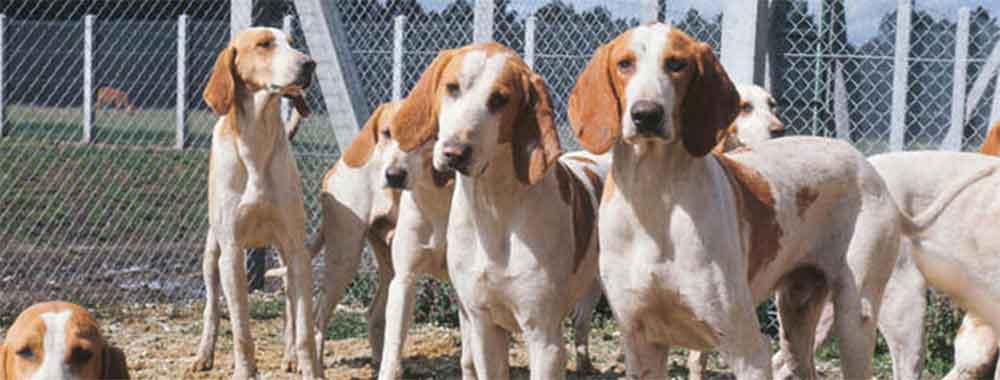
The French White and Orange Hound is a distinguished French dog that gives a rustic impression. His eyes are big, brown and dark. Located slightly below the eye line, your ears are flexible, fine, slightly screwed and reach the tip of the nose. Your walks are easy, adopts a light and sustained gallop.

Her hair is short and thin, lemon white or white-orange, as long as the orange isn't too dark, tending to red.

SIZE:

Height to the cross: 62 to 70 cm.. With 2 cm tolerance for maximum size.
Weight: Some 30 Kg.

Character and skills French White and Orange Hound

The only function of French White and Orange Hound is hunting, so it is difficult to make a generalization about their behavior patterns and temperament in a domestic environment. But, it is not necessary to suggest that a socialized specimen can become an educated and well-rounded family pet. Like most scent hounds, he is gentle with children and likes to be a part of their exciting activities.. This dog is probably too energetic and playful to be a suitable companion for a child..

The French White and Orange Hound tends to become somewhat distant and reserved in the presence of strangers. However, he will never show open aggression unless he suspects that something or someone threatens his family. Some of these dogs are vigilant enough to perform surveillance duties. This sociable and caring breed will make a terrible guardian, that he would rather greet an intruder by wagging his tail than resorting to necessary actions.

Canine aggressiveness is considered a major defect in the temperament of hounds, that were developed for herd hunting. For this reason, members with the slightest hint of this undesirable characteristic are immediately excluded from the breeding program. The French White and Orange Hound is known for its exceptional tolerance towards other canines. Despite his excessively peaceful nature, also requires early socialization in this regard. It is worth remembering that the breed has a very powerful drive to hunt down and kill other species of animals., especially stray cats. You can get along with individual family pets if you have been raised with them since your puppy.

Health of the French White and Orange Hound

The most common problems for the breed include:

– canine hip dysplasia;
– elbow dysplasia;
– eye problems;
– sarna demodex;
– skin infections;
– skin allergies;
– chronic ear infections;
– bloodhound ataxia.

Caring for the French White and Orange Hound

The French White and Orange Hound Needs a negligible amount of maintenance. Regular brushing will be enough to keep his short, graceful coat in reasonably good condition..

The ears of this breed are highly susceptible to irritation and infections., so its systematic examination and cleaning should become an essential part of care routines.

French White and Orange Hound Training

The training of the French White and Orange Hound poses a considerable challenge. The breed is a natural hunter and requires basic training in all that concerns its original hunting duties.. Unfortunately, its persistence in the search for prey turns into obstinacy in training. It also, cannot concentrate on the same boring task for a long time and is easily irritated by its many repetitions.

The best training strategy for this dog should include abundant rewards in the form of praise and tasty treats.. Negative reinforcement doesn't work with French White and Orange Hound and must be avoided at all costs.

Exercise with the French White and Orange Hound

The French White and Orange Hound it is an athletic and robust hunting dog, easily adapts to extremely intense physical activity. As minimum, should be taken on a quick walk of 45 minutes a day. You should always wear a leash when you are outside, since it is very difficult to call him back once he has been drawn down some interesting path.

The French White and Orange Hound behaves calm and relaxed once exercise requirements have been fully met. Keep in mind that a little exercised dog will gradually develop behavioral problems as unpleasant as continuous barking, internal hyperactivity or destruction. This breed is best suited for suburban life in the house with a large, secure yard.

Type and recognitions:

  • FCI CLASSIFICATION:
  • Group :
  • Section : . .

Federations:

  • – FCI – Group 6: Scent hounds, and related breeds. – Section 1.1: Large-sized Hounds. ⓘ
  • – UKC – Scenthounds ⓘ
  • – Central Canine Society ⓘ

FCI breed standard "French White and Orange Hound"

Origin:
France

Date of publication of the valid original standard:
01.02.1982

Use:

Hound


General appearance:

This is a distinguished French dog, giving an impression of rusticity.


Behavior / temperament:

---

Head:

It is quite large and not very long.

Cranial region:
  • Craging: Slightly bump; occipital protrusion is barely marked. The eyebrows are not prominent.
  • Dnaso-frontal depression (Stop): It is well marked.

facial region:

  • Nariz: Is well developed. Its color is black or brown - orange.
  • Snout: The length of the muzzle is almost equal to that of the skull.
  • Belves: Quite marked and give the muzzle a rather square look.

OJOS: Large, brown and dark.

OREJAS: Slightly inserted below the plane of the eye line. They are flexible, fine, slightly crooked and reaches within two fingers of the nose.

Neck:

Straight, quite long and has a slight dewlap.

Body:

  • Espalda: Broad and rectilinear.
  • Pork loin: It is usually convex.
  • Glikeness: Rounded, but not sunk.
  • Pecho: Large. Rounded ribs.
  • Flanks: Well solid.

Tail:

Long.

Tips

PREVIOUS MEMBERS:

  • Ageneral appearance: Strong and big.
  • Shoulder: Oblique and well muscled.
  • Pinis previous: Hare feet.

LATER MEMBERS

  • Thighs: Well muscled.
  • Corvejón: It occurs close to the ground and is slightly bent.
  • Hind feet: Hare feet.

Movement:

Pretty loose. The gallop is light and constant.

Mantle

PIEL: White, with yellow or orange spots. The palate may be yellow. The scrotum is white or yellow.

MANTLE

Plink: Satin y fine.

Codor: White - Lemon or White and Orange, provided the orange is not too dark (pulling red).


Size and weight:

Altura to the cross: 62 to 70 cm.. With 2 cm tolerance for maximum size.


Fouls:

Any deviation from the aforementioned criteria is considered as a fault and the severity of this is considered to the degree of the deviation to the standard and its consequences on the health and well-being of the dog..

• narrow nasal cane or too long.
• Upper or lower prognathism.
• Light eyes.
• Encrovated tail or deviates to the side.
• Partial depigmentation of the truffle.
• Another color fur than is not established by the standard, particularly black or red hair.

FALTAS DISQUALIFYERS:

  • Aggressiveness or extreme shyness.
  • Any dog ​​showing clear signs of physical or behavioral abnormalities.


N.B.:

• Males must have two normal-appearing testicles fully descended into the scrotum..
• Only functionally and clinically healthy dogs, with the typical conformation of the breed, should be used for parenting.

Source: F.C.I - International Cynological Federation

Photo: petpaw

▷ The world of Pets: Dogs, cats, birds, reptiles, amphibians

Bloodhound
Bélgica FCI 84 - Large-sized Hounds

Bloodhound

The Bloodhound It is the dog with thinner smell of the planet.

Content

History

The Bloodhound (Bloodhound) It is a breed of dog originally from Belgium, more specifically in the region of the Ardennes. It is one of the different breeds of hound recognized by the FCI in Group 6.

Has been traditionally considered to the monks of the monastery of St. Hubert as the creators of the race (for this reason also, are known as St. Hubert Hound), and they based their selection on the hunting dogs used by the monk Hubert, founder of the order and which later to be canonized became the patron saint of hunters. King William the Conqueror took copies of this breed to England when he ascended to the throne. The descendants of these specimens, They were known in the country as Bloodhound, referring to the purity of their blood.

Did you know??

The name "Bloodhound" does not come from this dog's ability to track game and people, but from a long history of carefully recorded bloodlines. In other words, He is a "blood" hound, a kind of dog of the aristocracy, if it can be said like that.

This legend has it that a rich nobleman hunted in a good Friday accompanied by a group of noisy dogs, and in the distance he could see a deer and when he was about to shoot he saw the image of the cross of Jesus Christ drawn on its antlers and since then he retired from his dissipated life to dedicate his fortune to good works. Since then usually give the nobles, the best specimen of his beloved dogs. Today the tradition continues, but now is a religious service and gives blessing to copies, continuing with the exposure of the race in the community of St. Hubert at Belgium.

After the race was introduced in the United States where one of his missions was the search and hunt down the fugitive slaves. For many years the recognition by a Bloodhound incriminating evidence was considered by American courts.

Physical characteristics

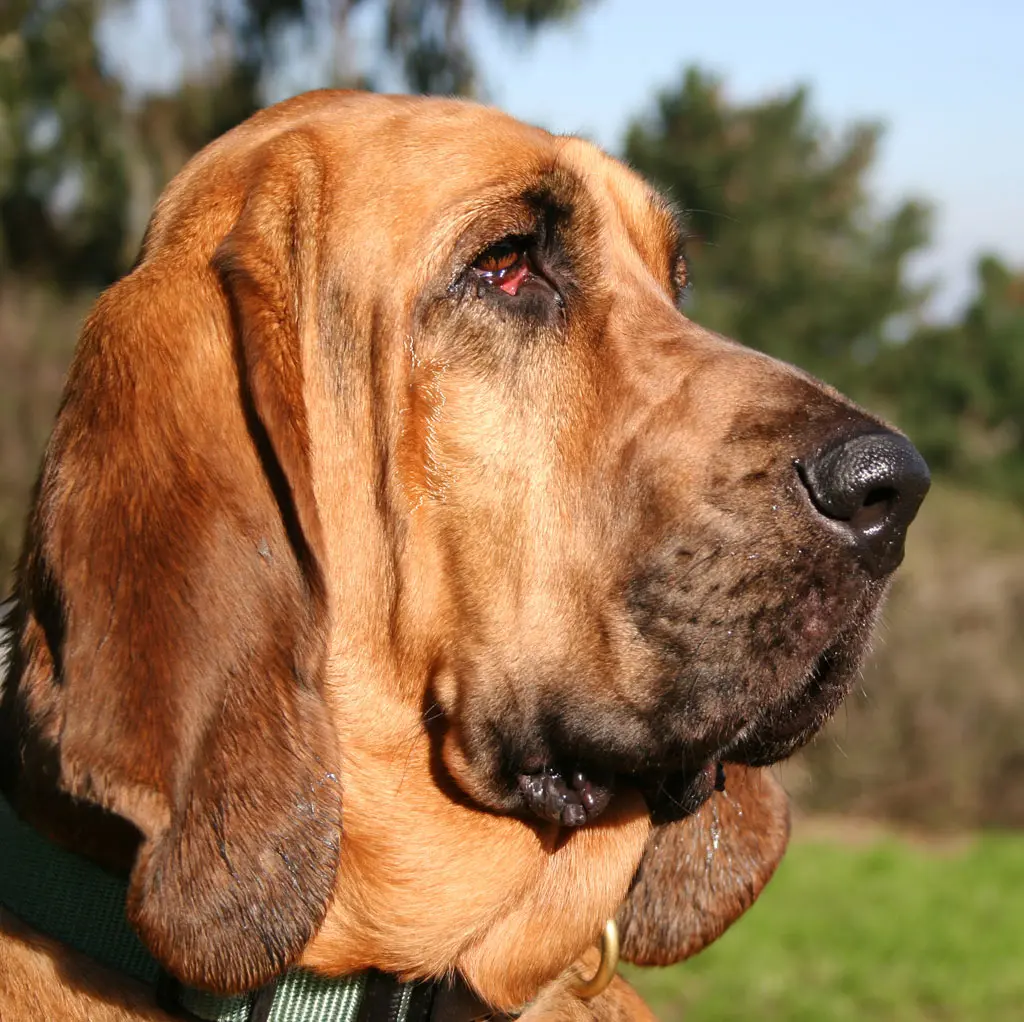
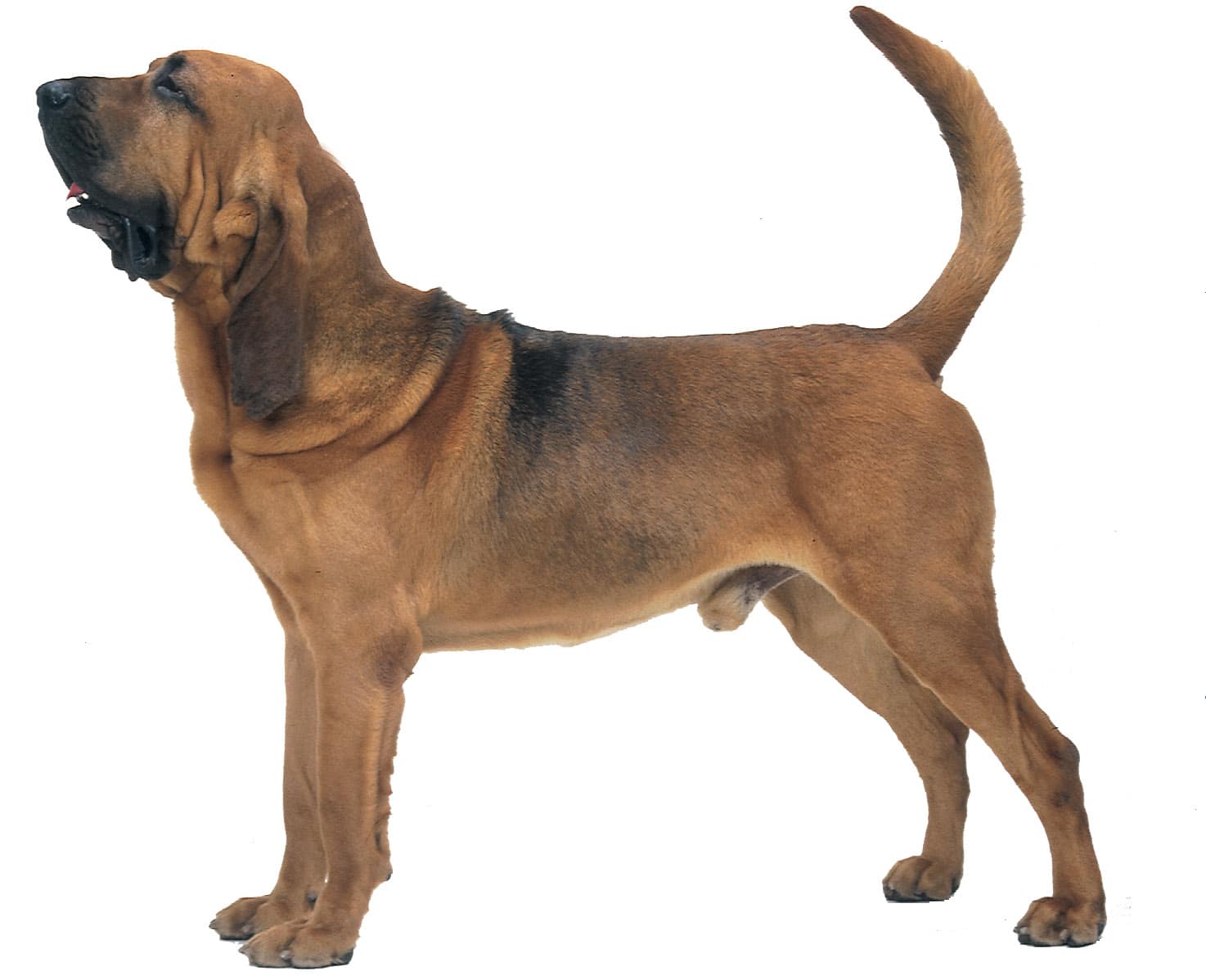
The Bloodhound is a powerful hunting dog. The back is very strong compared to the size of the dog. The head is long and narrow. The muzzle is long with a nose of black. Deeply sunken eyes and drooping eyelids. The Chin is very pronounced.

The Bloodhound is a dog with a nose finest of the planet.

Despite its size, is an agile dog. His body is longer than high. Wrinkles on the head and jowls are perhaps one of the most characteristic features, along with the length of its hanging ears. The accepted colors are black and fire, Brown and red in its different shades and fire.

The appeal is of 67 cm for males and 60 cm for females.

It has been documented that they are capable of following a trail of up to fifteen days, because of the enormous sensitivity of their sense of smell, caused by the internal folds of their nostrils. For that reason it is used as a police dog in tracking tasks..

These hounds cannot be kept in a yard without fences. There is a good chance that your tracker instinct carried them wander and get away until the end of their trail.

It is a dog that needs to be exercised (like all dogs), and usually live more happily in large spaces, Although adapts very well to home life.

The Blodhound (Bloodhound), Despite the allusion to the term blood contained in its name (blood), It is one of the animals most affable that exists. It is a dog of noble nature, can be shy around strangers. He is very patient and persevering when looking for a trail…

It is excellent Playmate for children, defend them from any danger. They tend to be very well with other dogs and pets.

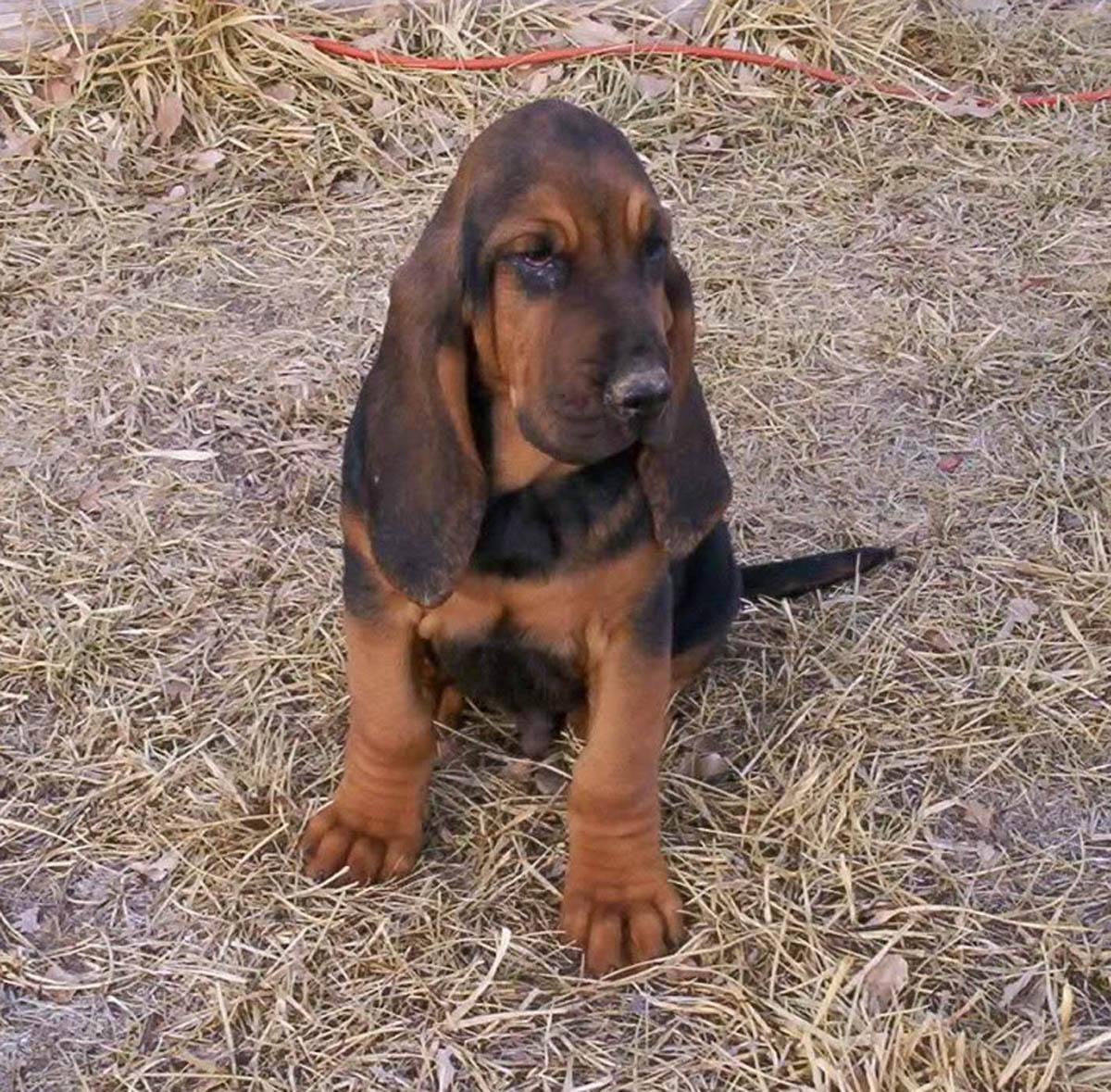
Pictures Bloodhound

Videos Dog of St. Hubert

Characteristics "Bloodhound"

Coexistence is important that you have with your new friend. Before considering the acquisition of a dog of the breed "Bloodhound" you know certain factors. Not all breeds of dogs are apt to live in an apartment, you must take into account his character, their need for exercise, their interaction with other pets, their care and if you have small children, their level of tolerance towards them.

Adaptation ⓘ

3,0 of 5 stars (based on 1 review)

friendly dog ​​ⓘ

5,0 of 5 stars (based on 1 review)

hair loss ⓘ

5,0 of 5 stars (based on 1 review)

Affection level ⓘ

5,0 of 5 stars (based on 1 review)

Need for exercise ⓘ

5,0 of 5 stars (based on 1 review)

Social need ⓘ

5,0 of 5 stars (based on 1 review)

Home ⓘ

1,0 of 5 stars (based on 1 review)

Toilet ⓘ

5,0 of 5 stars (based on 1 review)

Friendly with strangers ⓘ

5,0 of 5 stars (based on 1 review)

barking ⓘ

5,0 of 5 stars (based on 1 review)

Health ⓘ

5,0 of 5 stars (based on 1 review)

Territorial ⓘ

1,0 of 5 stars (based on 1 review)

Cat friendly ⓘ

5,0 of 5 stars (based on 1 review)

Intelligence ⓘ

5,0 of 5 stars (based on 1 review)

Versatility ⓘ

3,0 of 5 stars (based on 1 review)

Child friendly ⓘ

5,0 of 5 stars (based on 1 review)

Surveillance ⓘ

5,0 of 5 stars (based on 1 review)

joy ⓘ

1,0 of 5 stars (based on 1 review)

Type and recognitions:

  • FCI CLASSIFICATION:
  • Group :
  • Section : . .

Federations:

  • FCI ⓘ,
  • AKC ⓘ,
  • ANKC ⓘ,
  • CKC ⓘ, ​
  • KC ⓘ,
  • NZKC ⓘ, UKC ⓘ

  • FCI breed standard "Bloodhound"

    Origin:
    Belgium

    Date of publication of the valid original standard:
    13.03.2001

    Use:

    Big Game Hound, trail dog and family dog. It was and still is a hunting dog, that due to his remarkable sense of smell is above all a tracker, used both to find the trail of the injured small game, in search of the trail as well as to search for missing persons, in police operations. For its functional construction, the Chien de Saint-Hubert is endowed with great resistance as well as an exceptional smell, allowing you to easily follow a track over a long distance and over rough terrain.


    General appearance:

    Massive plus size hunting and tracker dog, the most powerful of hunting dogs. Its lines are harmonious and it is equipped with strong bones, well muscled and full of substance, although without giving the impression of heaviness. Its structure is elongated and the body is shaped like a rectangle. The set is imposing and full of nobility. His attitude is solemn. Head and neck draw attention to abundant skin, flexible and thin that hangs in deep folds. His movements are impressive, rather slow and with a certain sway, though flexible, elastic and loose. No characteristic can be exaggerated to the point of breaking the harmony of the whole., to give an impression of coarseness, far from harming the health or well-being of the dog. Possible exaggerations may be mentioned: very sunken or very small eyes; distended eyelids; excessively thick, loose skin, with too many folds and too deep; too much double chin; very small head. Large dogs are also undesirable, very heavy or very solid body, since this affects its use.

    IMPORTANT PROPORTIONS

    • body length / height to the cross: 10/9.
    • Chest height / height to the cross: 1/2.
    • Head length / body length: 3/7.
    • Length of the muzzle / head length: 1 /2.


    Behavior / temperament:

    Is meek, calm and gentle with people. Particularly attached to his master. Tolerant of his cage mates and other pets. Rather reserved and stubborn in temperament. He's so sensitive to praise, as to corrections. Is never aggressive. His voice is serious, but he is not barking.

    Head:

    It is the most characteristic aspect of the breed; imposing, majestic and full of nobility. Is high, but narrow in relation to its length, and long in relation to the length of the body. The bone structure is well visible. The lateral faces are flat and the profile is square. The nasal ridge is visibly parallel to the long upper line of the forehead.. The skin, fine and abundant, forms deep wrinkles and folds on the forehead and cheeks that fall when the head is down and extend into the folds of the double chin, which is highly developed. In females, the skin is less abundant.

    Cranial region:

    The skull is tall, long, rather narrow, and the side faces are flat. Superciliary arches are not very prominent, although they may seem so. The occipital protuberance is well developed and clearly protruding.

    Depression links (Stop): Bit strong.

    facial region:

    • Truffle: Black or brown in color; always black in black and tan dogs. It is wide, well developed and windows are wide open.
    • Snout: High; as long as the skull. It is wide near the nostrils and of uniform width throughout its length. The
      Nasal cane is either straight or slightly arched (slight ram's nose). Lips: They are very long and loose. The upper lip hangs over the
      bottom and forms a right angle to the front of the muzzle, which imparts a square profile to the muzzle. Behind the corners they turn into fleshy lips (less pronounced in females), that blend imperceptibly with the double chin, which is abundant. The edge of the upper lip descends a few 5 cm lower than the lower jaw. The edge of the lips is well pigmented black or brown, depending on the color of the truffle.
    • Jaws / Teeth: Complete denture, correct "scissor" joint; strong, white teeth set evenly in well-developed jaws. “Clamp-shaped” dentures are accepted.
    • Cheeks: Sunken and thin, especially under the eyes.

    EYES: Dark brown or hazelnut color, of a lighter shade (amber) in dogs without a chair or black blanket. Medium-sized; oval, not tearful, nor outgoing, nor sunk in the orbits, thus leaving the iris completely visible. The eyelids, no irregularities in its contour, are normally adapted to the eyeball. Tolerated, However, lower eyelids somewhat distended, so that the conjunctiva is a little visible. The eyelashes cannot under any circumstances touch the eyes, nor hinder them. Your expression is sweet, gentle and dignified, the look a little melancholic.

    EARS: Thin, and flexible, covered with short hairs, fine and velvety to the touch. The pavilion is very long, exceeding at least the tip of the nose when placed on the top of the nasal bridge. Very low implantation, at eye level or below, on the sides of the head, falling in funny folds, castled in and back (corkscrew).

    Neck:

    It is long, so that the dog can keep track of it while keeping the truffle on the ground. Well muscled; throat skin is loose and extremely developed, presented a double chin, although this is less pronounced in females.

    Body:

    The top and bottom margin lines are almost parallel.

    • Cross: Slightly marked.
    • Back: Straight, wide, long and solid.
    • Pork loin: Width, solid, short, very slightly arched.
    • Rump: Well muscled, almost horizontal, never sunk. It is very wide and quite long.
    • Breast : It has an oval shape. It is broad, alto, clearly forming a keel between the forelimbs. The rib cage is long enough; the front of the thorax and the point of the shoulder are well protruding. The ribs are well sprung, ni planas, nor barrel-shaped.
    • Bottom line and belly: The bottom margin is almost horizontal; the lower part of the chest is well lowered. The flanks are very solid, wide and lowered. The belly is very little raised.

    Tail:

    It is long, strong, thick, set high; It is located in the extension of the dorsal line, and gradually becomes thinner towards the limb. It comes in the shape of a saber. When is the dog in action, forms a graceful curve above the dorsal line; never kinks, nor does it deviate laterally. His part covered with rougher hair, of about 5 cm., that gets progressively shorter towards the limb.

    Tips

    PREVIOUS MEMBERS:

    • General appearance: They are well muscled. The forelimbs are straight, powerful and perfectly parallel.
    • Shoulder: Long, well oblique and well muscled, although not heavy.
    • Arms: Oblique lengths, forming a good angle with the shoulders.
    • Elbows: They are well applied, or peeled, or together.
    • forearms: Straight, strong and round bones. Carpi: His firms.
    • Metacarpus: Robust; seen from the front, they are leaden. Seen in profile, they are slightly inclined towards the front.
    • Previous feet: They are compact and very solid; they do not deviate even inwards, nor out. The fingers are well arched, well articulated and together (Jack's foot). The pads are thick and solid, and short and strong nails.

    LATER MEMBERS:

    • General appearance: They are solid, powerfully muscular, in harmony with previous members. Seen from behind, are
      perfectly parallel, or together, nor separated.
    • Thighs: Of good length and well muscled.
    • Knees: Well angulated; they do not deviate even inwards, nor out.
    • Legs: Long enough and well muscled.
    • Hock: Solid, well angled; comes close to the ground. Metatarsals: Strong and short.
    • Hind feet: As the front.

    Movement:

    The judging of the marches, very typical of Chien de Saint-Hubert, it's extremely important. During the normal step, that is to say, the trot, the movement is uniform, steps provided; it is elastic and loose, covering more ground than any other hunting dog, and something that is very characteristic, with a balance, although not through. Hind limbs are directed well back, with good rear third drive. The amplitude of the movements of the forelimbs and hindlimbs is uniform and the upper line remains horizontal. The members move in parallel, but at a higher speed the feet get closer. The tail is high, Sabre-shaped, not too kinky though. The Chien de Saint-Hubert must be able to maintain a long trot without showing signs of fatigue.

    Mantle

    Flexible over the whole body, loose and elastic. Thin skin is very characteristic, very loose and abundant on the head. On the forehead and lateral faces of the muzzle, the skin forms hanging folds that are even more marked when the head is down. But, Very pronounced wrinkles and folds on the forehead and superciliary arches should never obstruct the eyes. Folds on the body caused by overly extended skin are undesirable.

    Fur: On the body the hair is straight, short, dense, quite hard and resistant to inclement weather. Over the ears and head, it is very short and soft to the touch. The lower part of the tail has slightly longer and rougher hairs.

    Color:

    We can distinguish three colors in the fur:

    • the bicolor black and tan («black and tan»),
    • liver and fire («liver and tan»
    • solid red («red»).

    In black and tan dogs, the black varies, depending on whether it is a blanket or a chair. In a dog with a blanket, black predominates; the fire (leonado), occurs only on the muzzle, cheeks, on top of the eyes, on the front of the thorax, in the limbs and in the perianal region. A dog with a chair has a more widespread tan color, since the black is more or less limited to the dorsal part. The same arrangements of color zones are present in bicolor liver and tan dogs.. Colors are not always well defined, nor clearly delimited. In the darkest parts, longer or badger hairs may be scattered. This mix of different color hairs is accepted. In unicolor dogs, red can vary from light to dark. Faded tan is not desirable in bicolor dogs, nor the faded red in single-colored dogs. Tolerated, although it is not favored, a little white on the front of the chest, on the fingers and the tip of the tail.


    Size and weight:

    Height to the cross:

    The ideal height is:

    • 68 cm for males,
    • 62 cm for females.

    Tolerance: 4 cm more or less.

    Weight:

    • the males, a few 46 - 54 kg,
    • the females, approximately 40 - 48 kg.

    Size and weight must be in harmony.


    Fouls:

    • Any deviation from the aforementioned criteria is considered as a fault and the severity of this is considered to the degree of the deviation to the standard and its consequences on the health and well-being of the dog..
    • General aspect: appearance of heaviness; little substance; Lightweight bones; body raised or close to the ground; rather square than rectangular construction; absence of nobility.
    • Head: broad and bulky or excessively narrow skull; elusive forehead; forehead skin that deviates too much; shallow occipital protrusion; marked naso-frontal depression; concave muzzle; snout short or lacking in altitude; very little hanging upper lip.
    • Nose and lips: loss of pigmentation.
    • Teeth: absence of teeth.
    • Eyes: too small, deep in their orbits; too hanging lower eyelid, highly visible conjunctiva.
    • Ears: too short, very thick; occur above eye level; too close to the head or too flat.
    • Neck: short; delgado, with little double chin.
    • Body: short or too long; slightly lowered chest; anterior part of the thorax little protrusion seen in profile; flat or barrel ribs; loose or arched back, rump very raised or sunken; belly too raised.
    • Tail: appears low; squirrel tail, ring-shaped, threaded; tail knotted or folded; hooked or deviated.
    • Members: too little or too angled; short arms; incorrect poise, viewed profile (eg., Very oblique pasterns or weak carpals), front (for ex. feet that turn inward or outward, bowed forearms, elbows off), the one behind (eg., hind limbs together, separated or in barrel, hock closed or open); open feet, hare or flat.
    • Movement: closed or open; pass crossed; short steps or rigid movement; little drive, the back does not provide a good transmission.
    • Hair color: light or faded colors.
    • Character: insecurity or nervousness.

    FALTAS DESCALIFICANTES:

    • Aggressiveness or extreme shyness.
    • Any dog ​​showing clear signs of physical or behavioral abnormalities must be disqualified..
    • General aspect: absence of racial type.
    • Teeth: undershot or overshot; Cross occlusion; crooked mouth.
    • Nose and lips: excessive depigmentation or pink color; colors other than black in “black and tan” dogs; other colors than brown or black in dogs without a chair or black blanket
    • Eyes: light yellow (raptor eyes).
    • Hair color: all colors not corresponding to the descriptions: widespread white markings, such as white that reaches the wrists or hocks, or too widespread white color in the front part of the thorax: white patches somewhere other than the front of the chest, on the fingers and the tip of the tail, as for example, a white snout, a white stripe, etc.
    • Size: outside tolerance limits.
    • A dog that shows any signs of physical abnormality should be eliminated.


    N.B.:
    • Males should have two normal-appearing testicles fully descended into the scrotum..
    • Only functionally and clinically healthy dogs, with the typical conformation of the breed, should be used for parenting.

    Source: F.C.I - International Cynological Federation

    Alternative names:

    1. Sleuth hound, St. Hubert Hound (English).
    2. bloodhound (French).
    3. Bluthund, Bloodhound (German).
    4. Cão-de-santo-humberto, Chien de St. Humbert, Bloodhound (Portuguese).
    5. Perro de San Huberto (español).

    ▷ The world of Pets: Dogs, cats, birds, reptiles, amphibians

    French White and Black Hound
    Francia FCI 219 - Large-sized Hounds

    French White and Black Hound

    Of the three French Scent hounds, the French White and Black Hound, is the best known.

    Content

    The French White and Black Hound is a competent olfactory hound of French origin. It was specifically developed for hunting in large packs and today this breed is acquired exclusively for hunting.. Despite her fabulous work skills, it can be found very rarely not only in European countries but also in its native France.

    History

    Before the french revolution, hunting with large packs was one of the favorite pastimes of the French nobility. It also, it also offered the opportunity to establish trade relations and resolve global political and economic issues.. Unfortunately, the demise of the French upper class during times of political turmoil also meant the demise of numerous varieties of tracker hounds. After Napoleon's defeat, monarchical power was rebuilt and hound hunting regained its popularity. Thanks to technological advances in maritime traffic, dog breeding became a much less difficult task and many British hounds were sent to France during the period between 1815 and 1900.

    The true ancestry of the French Hound will probably never be discovered as most early breeders did not bother to keep any breeding records.. However, it can be stated with quite certainty that the breed was created by mixing live and now extinct breeds of French and English hounds. The Saintongeois, Gascon Saintongeois and Poitevin hound were the main ancestors of the French White and Black Hound. It is commonly believed that other breeds were used on a rather limited basis in their breeding program..

    The French Scent hounds kept solely for hunting in large packs. Its largest quarry were large wild animals such as deer, the wolf and the boar. A group of several hounds detected the scent trail of one of these mammals and chased it., barking loudly so the hunter could go after them. Depending on the type of animal pursued, the dogs were to corner him or kill him immediately.

    The number of specimens of this breed of hound drastically decreased after two world wars. French hunting enthusiasts managed to save her, although many unique French breeds were lost to the world during these terrible times. In 1957, the French Hound was fully recognized by the Fédération Cynologique Internationale (FCI). But, FCI recognition hardly increased the international awareness of this dog, so he did not win the appreciation of hunters from other countries. It also, currently their breeding and therefore their population are supported solely by the French hunting community. In general, the future of French White and Black Hound you will be fairly insured as long as there are fans of dog hunting in your homeland.

    Physical characteristics Black and white French Hound

    The French White and Black Hound is a big dog, distinguished and well balanced. His dark eyes give him a smart and confident look. Quite large at birth, her tail is carried high enough.
    These dogs are highly prized in many deer crews for their qualities: fineness of nose, application, seriousness, throat. dog friendly, close to man; easy in the kennel.
    He has short hair, quite strong and close.

    COLOR : The coat should be black and white with a more or less extensive black coat or patches, which may show black or bluish spots, or even small tan marks, but these only in the limbs. A pale tan patch over each eye, as well as a pale tan on the cheeks, under the eyes, under the ears and at the base of the tail. The “deer mark” on the thigh is quite common.

    SIZE :
    Males: 65 to 72 cm.
    females: 62 to 68 cm.

    Character and skills French White and Black Hound

    The only function of French White and Black Hound is hunting, so it is difficult to make a generalization about their behavior patterns and temperament in a home environment. But, it is not necessary to suggest that a socialized specimen can become an educated and well-rounded family pet. Like most track hounds, he is gentle with children and likes to be a part of their exuberant activities.. This dog is probably too energetic and playful to be a suitable companion for a child..

    The French White and Black Hound tends to become somewhat distant and reserved in the presence of strangers. However, he will never show open aggression unless he suspects that something or someone threatens his family. Some of these dogs are vigilant enough to perform surveillance duties. This sociable and caring breed will make a terrible guardian, that he would rather greet an intruder by wagging his tail than resorting to necessary actions.

    Canine aggressiveness is considered a major defect in the temperament of hounds, that were developed for herd hunting. For this reason, members with the slightest hint of this undesirable characteristic are immediately excluded from the breeding program. The French White and Black Hound is known for its exceptional tolerance towards other canines. Despite his excessively peaceful nature, also requires early socialization in this regard. It is worth remembering that the breed has a very powerful drive to hunt down and kill other species of animals., especially stray cats. You can get along with individual family pets if you have been raised with them since your puppy.

    French White and Black Hound Health

    The most common problems for the breed include:

    – canine hip dysplasia;
    – elbow dysplasia;
    – eye problems;
    – sarna demodex;
    – skin infections;
    – skin allergies;
    – chronic ear infections;
    – bloodhound ataxia.

    Caring for the French White and Black Hound

    The French White and Black Hound Needs a negligible amount of maintenance. Regular brushing will be enough to keep his short, graceful coat in reasonably good condition..

    The ears of this breed are highly susceptible to irritation and infections., so its systematic examination and cleaning should become an essential part of care routines.

    French White and Black Hound Training

    the education of French White and Black Hound poses a considerable challenge. The breed is a natural hunter and requires fairly basic training in all that concerns its original hunting duties.. Unfortunately, its persistence in the search for prey turns into obstinacy in training. It also, cannot concentrate on the same boring task for a long time and is easily irritated by its many repetitions.

    The best training strategy for this dog should include abundant rewards in the form of praise and tasty treats.. Negative reinforcement doesn't work with French White and Black Hound and must be avoided at all costs.

    Exercise with the French White and Black Hound

    The French White and Black Hound it is an athletic and robust hunting dog, easily adapts to extremely intense physical activity. As minimum, should be taken on a daily brisk walk of 45 minutes. You should always wear a leash while away, since it is very difficult to call him back once he has been drawn down some interesting path.

    The French White and Black Hound behaves calm and relaxed once exercise requirements have been fully met. It must be borne in mind that a poorly exercised dog will gradually develop such unpleasant behavior problems as continuous barking, internal hyperactivity or destruction. This breed is best suited for suburban life in the house with a large, secure yard.

    Videos "French White and Black Hound"

    White and Black French Dog 🐶🐾 Everything Dog Breeds 🐾🐶
    Chien Français Blanc et Noir ?? Everything Dog Breeds ??
    French White and Black Dog & Puppies information Video - Animal Videos
    French White and Black Dog & Puppies information Video – Animal Videos

    Type and recognitions:

    • FCI CLASSIFICATION:
    • Group :
    • Section : . .

    Federations:

    • – FCI – Group 6: Scent hounds, and related breeds. – Section 1.1: Large-sized Hounds. ⓘ
    • – Central Canine Society ⓘ

    FCI breed standard "French White and Black Hound"

    Origin:
    France

    Date of publication of the valid original standard:
    04.11.2008

    Use:

    Hound for hunting big game in a pack.


    General appearance:

    He is a distinguished pack dog, but of strong constitution, which gives an impression of balance.

    PROPORCIONES IMPORTANT:

    The muzzle is long compared to the skull.

    The length of the body from the point of the shoulders to the point of the ischium is equal to its height at the withers..


    Behavior / temperament:

    These dogs are highly prized by many deer hunters for the following qualities: fine sulfate, diligence, seriousness and throat. It is a very friendly dog, attached to the human being and easy to handle.

    Head:

    It is quite large and rather long; is in harmony with the whole, it's never heavy, nor common, but expressive and elegant bearing.

    Cranial region:
    • Craging: It is slightly bulky and rather narrow, but without exaggeration. The occipital protrusion is sufficiently apparent to prevent the skull from looking too flat. Supraciliary arches may be somewhat prominent.
    • Depression links (Stop): Slightly marked.

    facial region:

    • Trufa: It's black and the windows are wide open.
    • Caña nasal: rather long compared to the skull, the nasal bridge may be slightly arched.
    • Belves: The lips are slightly square, the upper lip barely covers the lower lip.

    OJOS: They are dark; the look is smart and confident.

    OREJAS: They are inserted in the plane of the eye line and are slightly turned. Preferably they reach the birth of the nose or two fingers of it.

    Neck:

    It is quite long and thick and sometimes has a slight dewlap.

    Body:

    • Espalda: It is rather long and well accented.
    • Pork loin: Muscular and well inserted.
    • Glikeness: Slightly inclined.
    • Pecho: It is taller than it is wide and reaches at least the tips of the elbows. The ribs are long and moderately rounded.
    • Belly: Slightly raised.

    Tail:

    Rather thick at the base with a relatively tall bearing.

    Tips

    PREVIOUS MEMBERS: Aligned with the body, strong and fairly flat.

    • Hshoulders: They're long, thin and oblique.
    • Elbows: They are pedagogues to the body.
    • Forearm: Plumbed.
    • Metacarpus: Slightly inclined seen in profile.
    • Previous feet: Elongated, thin and resistant.

    LATER MEMBERS: Parallels, seen from behind.

    • Thighs: They are long and muscular enough.
    • Corvejón: It is located close to the ground. It is broad, solid and slightly angled.
    • Pinis later: They are rather elongated, but thin and resistant.

    Movement:

    Fluid. Preferred step: agile with extended canter.

    Mantle

    PIEL: She's white under white hair and black under black hair. Sometimes it presents subcutaneous spots of blue or less dark color on the belly and on the inner side of the thighs.

    MANTLE

    Plink: It is flat, pretty strong and tight.

    Codor: It must be black and white, with a blanket or with more or less widespread black spots. It can present a mottled black or blue and even tan in color, but the latter only in the extremities. Also has a pale spot over each eye, as well as pale tan color on the cheeks, under the eyes, under the ears and at the start of the tail. It is common to see the "deer mark" on the thigh.


    Size and weight:

    • Males: 65 cm to 72 cm..
    • females: 62 cm to 68 cm..

    tolerance + / – 1 cm..


    Fouls:

    Any deviation from the aforementioned criteria is considered as a fault and the severity of this is considered to the degree of the deviation to the standard and its consequences on the health and well-being of the dog..

    FALTAS GRAVES:

    • Head: Any sign of an English Foxhound cross on the head (too bulky skull, snout short and not square enough at the end when viewed in profile)
    • Nose: Significant absence of pigmentation.
    • Jaws: Prognathism or enognatismo.
    • Eyes: too light in color.
    • Ears: Short and flat.
    • Spada: Excessive.
    • Color: On the cheeks, black spreading to lips.

    FALTAS DISQUALIFYERS:

    • Aggressiveness or extreme shyness.
    • Any dog ​​showing clear signs of physical or behavioral abnormalities.
    • Tips: weak
    • Severe deviation of the limbs.
    • Pies: round
    • Color: Tricololor cloak.


    N.B.:
    • Males should have two normal-appearing testicles fully descended into the scrotum..
    • Only functionally and clinically healthy dogs, with the typical conformation of the breed, should be used for parenting.

    Source: F.C.I - International Cynological Federation

    Alternative names:

    1. Chien Français Blanc et Noir (English).
    2. Français blanc et noir (French).
    3. Français blanc et noir (German).
    4. Français blanc et noir (Portuguese).
    5. Sabueso francés blanco y negro (español).

    Photo: https://www.centrale-canine.fr/le-chien-de-race/francais-blanc-et-noir

    ▷ The world of Pets: Dogs, cats, birds, reptiles, amphibians

    Grand Griffon Vendéen
    Francia FCI 282 - Large-sized Hounds

    Grand Griffon Vendéen

    The Grand Griffon Vendéen he is a dog of great character, beautiful cloak and dreamy look. It is a pity its little diffusion.

    Content

    History Grand Griffon Vendéen

    In the beginning, there was only the Greater Vendean. This one belonged to a variety of short-coated Vendean dogs., descendants of the ″scribes″ (so named because one of the original kennels was the king's clerk) or of the king's white dogs. Regarding its origin, neither can we fail to point out the Basset Fauve de Bretagne, since these are an essential part of the lineage of the ″scribe dog″. The missing gray of Saint-Louis and Bresse grifones (descendants of Segussian ancestors) also contributed to the creation of Grand Griffon Vendéen.

    There are also several other breeds of griffons from the Vendée, all of them smaller: the Briquet Griffon Vendéen, y el Grand y Petit Basset Griffon Vendéen. Related breeds of Griffon include the Griffon Fauve de Bretagne, the Griffon Bleu de Gascogne and the Griffon Nivernais.

    Physical Characteristics Gran Griffon Vendeano

    This is an ancient breed animal, French type, receptive and determined, distinguished in its forms and movements. It is of well proportioned construction, robust, no appearance of heaviness.

    SIZE: Height to the cross: In males, of 62 – 68 cm., In females, of 60 – 65 cm..

    Character and abilities Grand Griffon Vendéen

    It is docile, though willful and passionate. Must be well trained.
    It is an energetic dog with a passion for hunting that needs space and a lot of physical exercise.: you are strongly discouraged from living in the city. Character is balanced, However, training should be carried out from a very early age as it is considered difficult due to its very firm character: booster must be purchased very soon.

    It has a very good nose and a beautiful bark. Applied to follow the footstep, does not refuse to enter the undergrowth and prefers large territories.
    Before it was used to hunt wolves and now it is used to hunt wild boars.

    Grand Griffon Vendéen Care

    The mantle of Grand Griffon Vendéen requires daily attention because it can easily become tangled.

    Videos of the Great Basset Griffon Vendean

    Great Basset Griffon Vendeano

    Grand Basset Griffon Vendeen / Breed of dog

    Type and recognitions:

    • FCI CLASSIFICATION:
    • Group :
    • Section : . .

    Federations:

    • – FCI – Group 6: Scent hounds, and related breeds. – Section 1.1: Large-sized Hounds. ⓘ
    • – Central Canine Society ⓘ

    FCI breed standard "Grand Griffon Vendéen"

    Origin:
    France

    Date of publication of the valid original standard:
    09.01.1999

    Use:

    This is the perfect assistant for the shotgun hunter in medium-sized territories.; the fastest of all bassets. It's tenacious, courageous, a little stubborn. It is necessary to train him from an early age to obey the call; Their training involves will and sanctions that the animal does not resent..


    General appearance:

    Slightly elongated construction, straight limbs, basset setup; Its appearance should not be that of a small briquet. Its shapes are harmonious and elegant.


    Behavior / temperament:
    • Temperament : He is fast and brave; has a good bark; He is passionate about hunting and likes to be in the undergrowth and brambles..
    • Character : Although somewhat stubborn, has good character. It is up to the master to know how to control it.

    Head:

    ---

    Cranial region:
    • Skull : No appearance of heaviness; convex. It is long and not very wide. It appears well chiseled under the eyes. The occipital bone is well developed.
    • Depression links (stop) : Well marked.

    facial region:

    It is very prominent. The Windows are wide open. It is black, except for dogs with white and orange fur, in which the brown color is accepted.

    • Snout : The end is square. Its length significantly exceeds the length of the skull. It is very slightly arched.
    • Lips : They are quite pendulous and cover the lower jaw well., giving the end of the snout a square profile. They are covered with big mustaches.

    Eyes : Oval, large, dark; there is no presence of the white of the eye. His expression is confident and intelligent. The conjunctiva should not be apparent.

    Ears : flexible, narrow and thin. They are covered with long hairs and their end is shaped like an elongated oval.; they are well turned inwards. Low insertion, below the eye line. They must be able to extend beyond the tip of the nose..

    Neck:

    Long, robust, well muscled and strong insertion. It presents no Chin.

    Body:

    Typical Basset body, although not excessively long.

    • Back : Long, wide and very straight; never sunk. It begins to arch in the region where it joins the spine. The cross is very little protruding.
    • Pork loin : Solid, well muscled and slightly arched.
    • Breast : Quite wide and well descended to the elbows.
    • Ribs : Rounded, never flat, nor cylindrical. The chest is a little less wide at the elbow to facilitate movement.
    • Flanks : rather full. The belly is never picked up.

    Tail:

    It is thick at the base and gradually tapers until it reaches the tip.. Set quite high, It is carried in the shape of a saber or slightly bent, but never bent over, doesn't even touch the back. It's rather long.

    Tips

    Overall views, the bones are well developed, although they are thin. It goes without saying that quality is not a question of volume, but of density.

    PREVIOUS MEMBERS

    • As a whole : They must be straight; the forearm is thick and the carpus is very little marked, although it is very solid.
    • Shoulder : Long, thin and oblique.
    • Elbows : They should not be too close to the body., nor too far apart from it.
    • Forearm : Thick; the carpals should never be touched.

    LATER MEMBERS

    • As a whole : The hind limbs are solid and well aligned on the axis of the body..
    • Hip : Visible.
    • Thigh : Well muscled, but not very rounded. Bones and joints are solid.
    • Hock : It is wide and angled; never straight. Seen from the back, it should not deviate even inwards, nor out.

    FEET : Strong and compact. The pads are hard and the nails are solid. The appropriate pigmentation of the pads and nails is sought.

    Movement:

    When the dog is in action it must give the impression of resistance and lightness. Movement should be loose and harmonious.

    Mantle

    SKIN : Thick enough. It often appears streaked in dogs with tricolor coats.. There is no presence of dewlap.

    HAIR : Hard to the touch, not too long. It's stretched, never silky, ni lanudo. The fringes should not be very abundant. The belly and inner thighs should not be hairless.. The eyebrows are well pronounced, but they don't cover the eyes.

    COLOR :

    • Black with white patches (black and white).
    • Black with reddish markings (black and tan).
    • Black with sand-colored markings.
    • Fawn with white patches (Orange and white).
    • Fawn with black blanket and white patches (tricolor).
    • carbon fawn.
    • Carbon sand color with white patches.
    • Color arena carbonado.

    Traditional denominations : hare hair, wolf fur, badger hair or boar hair.


    Size and weight:

    Height to the cross :

    • In males : of 40 to 44 cm.
    • In females : of 39 to 43 cm..

    With a tolerance of 1 cm more or less.


    Fouls:

    Any deviation from the aforementioned criteria is considered a fault and the severity of it is considered to the extent of the deviation from the standard and its consequences on the health and well-being of the dog..

    Head

    • Too short.
    • Flat skull.
    • Short snout.
    • Depigmentation of the truffle, lips or eyelids.
    • Pincer-shaped joint.
    • Light eyes.
    • High set ears, short, not crooked enough or not hairy enough.

    Body

    • Too long or too short in construction.
    • Lack of harmony.
    • Loose back.
    • Sunken croup.

    Tail

    • Diverted tail.

    Tips

    • Weak bones.
    • Angles that are too straight.
    • Hocks too closed.
    • Crushed feet.

    Fur

    • Until, little abundant.

    Behavior

    • Shy dog.

    MISS PLAYOFFS

    • Fearful or aggressive dog.
    • Lack of type.
    • Prognathism.
    • Gaze eyes. heterochromia.
    • Narrow sternum; narrow ribs at the bottom.
    • Knotted tail.
    • Twisted or semi-twisted ends.
    • Woolly fur.
    • Solid black or white coat.
    • Important depigmentation.
    • Size that deviates from the norms of the standard.
    • Visible disability. anatomical deformation.

    Any dog ​​showing clear signs of physical or behavioral abnormalities must be disqualified..


    N.B.:

    Males should have two normal-appearing testicles fully descended into the scrotum..

    Source: F.C.I - International Cynological Federation

    Alternative names:

    1. Large Vendéen Griffon (English).
    2. grand griffon vendéen (French).
    3. GROSSER GRIFFON VENDEEN (German).
    4. Grand griffon Vendéen (Portuguese).
    5. Grifón vandeano grande (español).

    source: fci
    Photos: A large Vendée griffon by Canarian, CC BY-SA 4.0, via Wikimedia Commons

    ▷ The world of Pets: Dogs, cats, birds, reptiles, amphibians

    French Tricolour Hound
    Francia FCI 219 - Large-sized Hounds

    French Tricolour Hound

    The French Tricolour Hound it is an unusual breed and little known outside of France.

    Content

    History French Tricolour Hound

    The true ancestry of French Scent hounds It will probably never be discovered as most early breeders didn't bother to keep any breeding records.. But, it can be stated with quite certainty that the breed was created by mixing live and now extinct breeds of French and English Scent hounds.

    The French Tricolour Hound it is a breed of recent creation (1957), probably comes from the crossing of the Great Anglo-French tricolor hound with the Poitevin hound, the Billy and possibly the Great Gascony Blue. The standard is of the year 1965.

    The French Tricolour Hound kept solely for hunting in large packs. Its largest quarry were large wild animals such as deer, the wolf and the boar. A group of several hounds detected the scent trail of one of these mammals and chased it., barking loudly so the hunter could go after them. Depending on the type of animal pursued, the dogs were to corner him or kill him immediately.

    The number of copies decreased drastically after two world wars. French hunting enthusiasts managed to save her, although many unique French breeds were lost to the world during these terrible times.

    At present its breeding and therefore its population are supported solely by the French hunting community. In general, the future of French Tricolour Hound you will be fairly insured as long as there are fans of dog hunting in your homeland.

    Physical Characteristics Tricolor French Hound

    The French Tricolour Hound he is a distinguished dog, elegant, well built and muscular. The head is not too imposing, but rather elongated; the occipital protuberance is marked. Eyes are big and brown, sometimes with black border. The look is smart. The ears are larger than the Poitevin hound, placed at eye level, a little forward, not too flexible; pulled forward, it is preferred that they reach the base of the muzzle, but it is accepted that they are two fingers shorter. The queue is quite long, carried high and gracefully.

  • Fur: Short and quite fine.
  • Color: tricolor, with a more or less extensive coat. Shades of red preferably bright, that can reach the leather. Dark spots on the eyes and cheeks should be avoided, and the blue or tan spots on the limbs and body.
  • Size: 62 to 72 cm for the male and 60 to 68 cm for female.
  • Weight: approx.. 30 kg
  • Character and skills French Tricolour Hound

    The only function of French Tricolour Hound is hunting, so it is difficult to make a generalization regarding their behavior patterns and temperament in a home environment. But, it is not necessary to suggest that a socialized specimen can become an educated and balanced family pet. Like most tracking hounds, he is gentle with children and likes to be a part of their various activities.. This dog is probably too energetic and playful to be a suitable companion for a child..

    The French Tricolour Hound tends to become somewhat distant and reserved in the presence of strangers. But, will never show open aggressiveness unless they suspect that something or someone threatens their family. Some of these dogs are vigilant enough to perform surveillance duties. This sociable and caring breed will make a terrible guardian, that he would rather greet an intruder by wagging his tail than resorting to necessary actions.

    Canine aggressiveness is considered a major defect in the temperament of hounds, that were developed for herd hunting. For this reason, members with the slightest hint of this undesirable characteristic are immediately excluded from the breeding program. The French Tricolour Hound is known for its exceptional tolerance towards other canines. Despite his excessively peaceful nature, also requires early socialization in this regard. It is worth remembering that the breed has a very powerful drive to hunt down and kill other species of animals., especially stray cats. You can get along with individual family pets if you have been raised with them since your puppy.

    French Tricolour Hound Health

    The most common problems for the breed include:

    – canine hip dysplasia;
    – elbow dysplasia;
    – eye problems;
    – sarna demodex;
    – skin infections;
    – skin allergies;
    – chronic ear infections;
    – bloodhound ataxia.

    Caring for the French Tricolour Hound

    The French Tricolour Hound Needs a negligible amount of maintenance. Regular brushing will be enough to keep his short, graceful coat in reasonably good condition..

    The ears of this breed are highly susceptible to irritation and infection, so its systematic examination and cleaning should become an essential part of care routines. Apart from that, the master must cut the emails of his French Tricolour Hound at least every two months.

    French Tricolour Hound Training

    The training of French Tricolour Hound poses a considerable challenge. The breed is a natural hunter and requires basic training in all that concerns its original hunting duties.. Unfortunately, its persistence in the search for prey turns into obstinacy in training. It also, cannot stay focused on the same boring task for a long time and is easily irritated by its many repetitions.

    The best training strategy for this dog should include abundant rewards in the form of praise and tasty treats.. Negative reinforcement doesn't work with French Tricolour Hound and must be avoided at all costs.

    Exercise with French Tricolour Hound

    The French Tricolour Hound it is an athletic and robust hunting dog, easily adapts to extremely intense physical activity. At a minimum it should be taken for a brisk walk of 45 minutes. You should always wear a leash when you are outside, since it is very difficult to call him back once he has been drawn down some interesting path.

    The French Tricolour Hound behaves calm and relaxed once exercise requirements have been fully met. Keep in mind that a poorly exercised dog will gradually develop unpleasant behavior problems such as continuous barking, internal hyperactivity or destruction. This breed is best suited for suburban life in the house with a large, secure yard.

    Videos "French Tricolour Hound"

    French Tricolor Dog 🐶🐾 Everything Dog Breeds 🐾🐶
    Chien Français Tricolore ?? Everything Dog Breeds ??Chien Français Tricolore ?? Everything Dog Breeds ??
    Französischer Laufhund – Mady- Vermittelt!!

    Type and recognitions:

    • FCI CLASSIFICATION:
    • Group :
    • Section : . .

    Federations:

    • – FCI – Group 6: Scent hounds, and related breeds. – Section 1.1: Large-sized Hounds. ⓘ
    • – Central Canine Society ⓘ

    FCI breed standard "French Tricolour Hound"

    Origin:
    France

    Date of publication of the valid original standard:
    13.01.1965

    Use:

    Hound for hunting big game in a pack.


    General appearance:

    It is an elegant pack dog, quite strong and muscular build.


    Behavior / temperament:

    ---

    Head:

    Is not very big, but quite elongated. The occipital protuberance is marked.

    Cranial region:
    • Craging: It's a little bulky. The cranial vault is quite developed.
    • Dnaso-frontal depression (Stop): More accentuated than that of Poitevin hound.

    facial region:

    • Trufa: It's black and the windows are wide open..
    • Caña nasal: It is straight, rather long and sometimes a little arched.
    • Belfos: They are more notable than those of Poitevin, that is to say, with a slight square appearance.
    • Ojors: They are big and brown. Sometimes they have black color around. The look is smart.
    • Obars: They are wider than those of the Poitevin. They are located at eye level. They are slightly twisted and not very flexible. Preferably they reach the birth of the truffle or two fingers from it..

    Neck:

    It is long, quite thick and sometimes has a slight double chin.

    Body:

    • Espalda: It is accentuated and appears well inserted in the body.
    • Breast : It is long and very deep. Reaches at least to the tip of the elbow. The ribs are long and not very flat.
    • Abdomin: It's not very high.

    Tail:

    It's quite long. The dog carries it high and elegantly.

    Tips

    PREVIOUS MEMBERS: They are well poised. They are wide and straight.

    Hormbros: They are long and close to the chest.

    LATER MEMBERS:

    • Ancas: They come in the right direction, in harmony with previous members.
    • Thighs: They are long and quite muscular.
    • Corvejón: It is quite wide and slightly angled. It comes close to the ground.

    PIIS: Thin.

    Movement:

    It is loose and agile.

    Mantle

    PIEL: It's quite fine.

    MANTLE

    Plink: It is satin and rather fine.

    Colorr: Tricolor, with more or less extended blanket. The tan color is preferably deep or coppery. The carbonated fire on the cheeks and lips, as well as blue or tan mottling on the extremities and on the body are not desirable. “Wolf” hair is accepted.


    Size and weight:

    Alturto the cross: Of 62 cm to 72 cm in males and 60 cm to 68 cm in females.


    Fouls:

    Any deviation from the aforementioned criteria is considered as a fault and the severity of this is considered to the degree of the deviation to the standard and its consequences on the health and well-being of the dog..

    • Depigmentation on the nose in spots.
    • Upper or lower prognathism.
    • light eyes.
    • Ears that are too flat, too short or set too high.
    • Poorly plumb or very thin extremities.
    • Very straight hocks.
    • thick feet.
    • Any apparent trace of English blood, especially regarding the head Smoky color on the head that denotes a cross between black and white and any other coat that is not established by the standard.

    FALTAS DISQUALIFYING:

    • Aggressiveness or extreme shyness.
    • Any dog ​​showing clear signs of physical or behavioral abnormalities must be disqualified..


    N.B.:
    • Males should have two normal-appearing testicles fully descended into the scrotum..
    • Only functionally and clinically healthy dogs, with the typical conformation of the breed, should be used for parenting.

    Source: F.C.I - International Cynological Federation

    Alternative names:

    1. Chien Français Tricolore (English).
    2. Français tricolore (French).
    3. Französischer Dreifarbiger Laufhund(German).
    4. français tricolore (Portuguese).
    5. Sabueso francés tricolor (español).

    Photo: brit-petfood.com

    ▷ The world of Pets: Dogs, cats, birds, reptiles, amphibians

    Istrian Coarse-haired Hound
    Croacia FCI 152 . Medium-sized Hounds

    Istrian Coarse-haired Hound

    The Istrian Coarse-haired Hound it is an excellent hound for hunting hare and fox.

    Content

    History

    His story matches that of Istrian Shorthaired Hound, but the iconography in words and images is much more limited, as long-haired dogs are generally less attractive for renderings due to their outward appearance. But, the Istrian Coarse-haired Hound was described in detail by B. Laska in 1896 and 1905: under the name of "barbini» these hard elo hound dogs were put up for sale in the Pazin and Buzet area in Istria. During World War I the breed was almost extinct. From 1924 these dogs were registered in the Croatian Stallion Book. The FCI recognized the breed in 1948. The first standard dates back to 1969.

    Photos:

    1 – Istrian Wire-haired Hound by https://pxhere.com/es/photo/1583815

    Physical characteristics

    The Istrian Coarse-haired Hound has strong and robust bones. With a stern expression, gives the deceptive impression of being a dark and taciturn animal. His somewhat hairy appearance was the cause of his near disappearance, as he is physically repulsive to some due to his coarse fur. But, its deceptive appearance hides a wonderful character and very beautiful qualities.

    HEIGHT
    Among 45 and 58 cm. (17,72 to 22,83 inches) for the male
    Among 45 and 58 cm. (17,72 to 22,83 inches) for the female

    WEIGHT
    Among 16 and 24 kg (35,27 to 52,91 pounds) for the male
    Among 16 and 24 kg (35,27 to 52,91 pounds) for the female

    COLOR
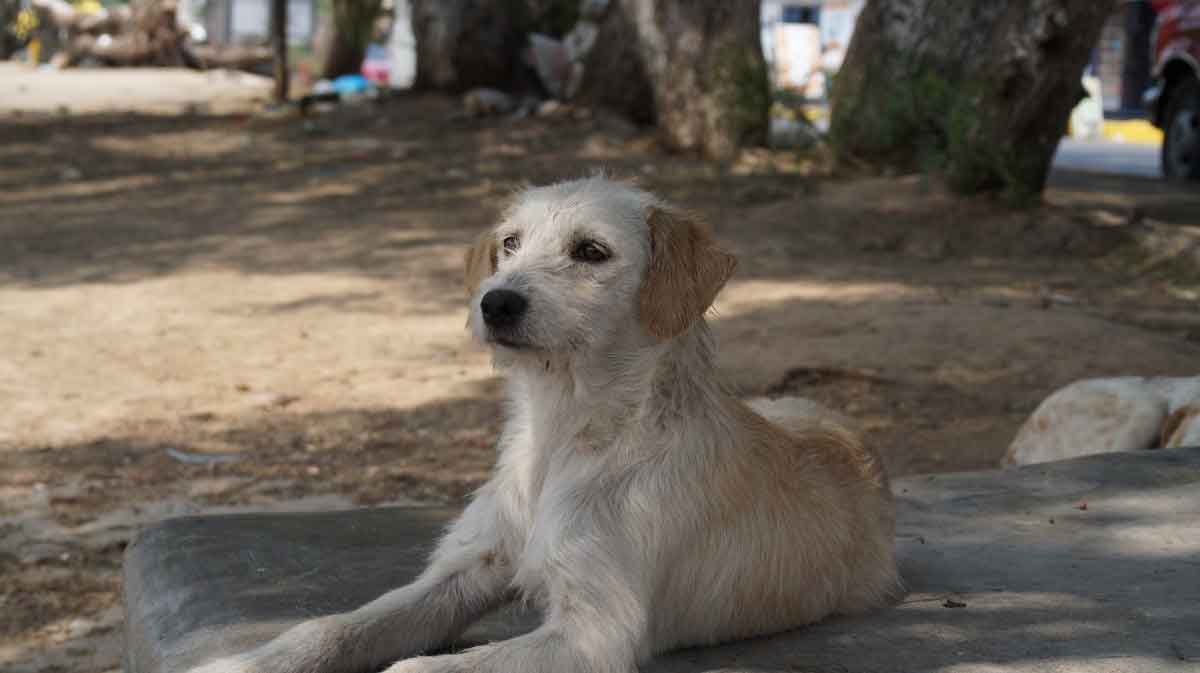
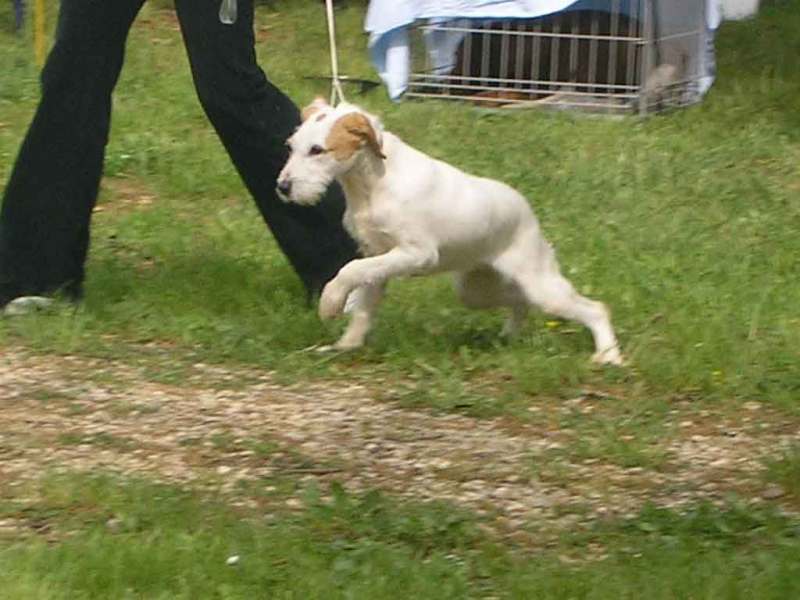
    Its fur is white with orange spots, more or less big, on the body and often at the beginning of the tail. Their ears are generally orange.

    HAIR
    Her hair is straight, hard and pointed. It usually measures between 5 and 10 cm long.

    MORPHOLOGY
    Its head has a domed skull and a slightly pointed cap. His big eyes are dark. Its slender ears are well set on the cheeks and tend to flare towards the middle. His nose is black. Its tail is quite long and reaches the hock.

    Character and skills

    His character is that of a gentle dog, obedient and calm at home, while hunting is active, independent and passionate. His temperament is moderately lively, expression indicative of a calm and balanced nature, the look is somber. His bark is loud, moderate to deep.

    He stands out for his immense diligence, it is resistant and persistent. It can have excellent performance even in the most difficult terrain and weather conditions.. The track never leaves. It is mainly used for hunting wild boar., deer, foxes and hares.

    Training / Education:

    Education is not that simple. Because when hunting he always depends on himself and cannot wait for the hunter's instructions, is suitable for a wide autonomy, the owner cannot avoid the servile obedience of this breed. You need in this direction a little understanding from the owner or coach.

    No harsh training methods, it would only interrupt her relationship with the man, what a double shame. Requires a certain amount of patience and empathy, benign and yet a totally consistent approach to both education and training. More than punishment it will help stimulate the positive voice (compliment, stimulus) and the material (a treat).

    Care and health

    This robust and resistant dog does not suffer from any genetic disease or any particular pathology associated with the breed.. His health is excellent and he rarely gets sick.

    WATCH OUT

    Its rough appearance requires regular brushing to maintain its coat and ensure good health.

    Images "Istrian Coarse-haired Hound"

    Photos:

    1 – A female Istrian Hound, Coarse-haired. Colour: white & orange by Canarian, CC BY-SA 4.0, via Wikimedia Commons
    2 – Istrian Wire-haired Hound by https://pxhere.com/en/photo/1583811
    3 – Istrian Wire-haired Hound by https://pxhere.com/es/photo/1583803
    4 – Istrian Wire-haired Hound by https://commons.wikimedia.org/wiki/File:Istrian_hound2.jpg
    5 – Istrian Coarse-haired Hound at a dog show in Zadar, Croatia (CACIB 2006.) by Mirta12, CC BY-SA 3.0, via Wikimedia Commons
    6 – ISTARSKI OSTRODLAKI GONIC by www.youtube.com

    Videos "Istrian Coarse-haired Hound"

    Type and recognitions:

    • FCI CLASSIFICATION:
    • Group :
    • Section : . .

    Federations:

    • – FCI – Group 6: Scent hounds, and related breeds. – Section 1.1: Large-sized Hounds. ⓘ
    • – UKC – Scenthound Group ⓘ

    FCI breed standard "Istrian Coarse-haired Hound"

    Origin:
    Croatia

    Date of publication of the valid original standard:
    25.10.2000

    Use:

    Bloodhound par excellence, it is used mainly for hunting hare and fox. Can also be used as a tracking dog. Its constitution is appropriate for hunting in the vast open lands of Istria.


    General appearance:

    Coat color is snow white with yellow-orange markings. The hair is long and smooth. The head is oblong, bushy eyebrows. The body is robust, for strong bones. The tail is thick and a bit saber-shaped. The face is severe and taciturn expression, sometimes even gloomy. The voice is sonorous, medium intonation, which often becomes serious.

    IMPORTANT PROPORTION : The length of the body must exceed the withers by a maximum of 10%.


    Behavior / temperament:

    This is a personable dog, docile and very attached to his master. Of moderate temperament, He is very passionate during the hunt.

    Head:

    It is well proportioned in relation to the body. Its length is 20 to 24 cm.; should not be too light. Pigmentation of visible mucosa is dark.

    Cranial region:
    • Skull : Slightly bulky. The occipital protrusion is well apparent, as well as the frontal sulcus, which is often covered by a tuft of long, straight hair. The forehead is quite wide. The skull becomes narrower in the eye region.
    • Depression links (Stop) : It is not marked.

    facial region:

    • Truffle : It is wide, with well developed nostrils. Pigmentation is dark black.
    • Snout : Thick, rectangular; the muzzle is wide and covered with bushy whiskers. Seen from the front, The jaws give the snout an appearance of roundness.
    • Teeth : Strong; the joint is scissor-shaped. The denture is complete. : They are good together and they are not very thick.
    • Eyes : The iris is dark in color. The eyes are large, but not exhorbitant. The look is gloomy. Since the hairs on the eyebrows are coarse and longer, these are tangled and bushy.
    • Ears : They are not too thick and are covered by shorter hair. They are implanted near the eyes, but they are not high, not near the edge of the upper profile of the skull. The ears are wider in the center and are close to the cheeks. Are long enough; finer and more rounded at the tip. They come forward. They are considered very long when they reach more or less to the nose, and long when they reach the canines. They must be at least semi-long and reach at least to the zygomatic arches.

    Neck:

    In profile, the junction of the neck with the head is marked at the back of the occipital protuberance. Its length is 12 to 15 cm and her skin is stretched, no dewlap.

    Body:

    Seen as a whole, the upper margin slopes slightly towards the rump.

    • Height to the cross : Little pronounced.
    • Back : It's straight and wide. Its length is well proportioned in relation to the height at the withers.
    • Pork loin : Short, muscular and rounded.
    • Rump : Wide, especially in females. Slightly inclined; rounded, since the haunches are apparent.
    • Breast : It's wide and deep. Descends at least to the elbow. Its circumference generally exceeds by 12 to 15 cm height at withers. The ribs are rounded. The tip of the sternum is barely visible. The front of the chest is rounded.
    • Belly and flanks : The lower margin rises progressively, from the xiphoid appendix, towards the ligament of the hind limbs. The belly is slightly raised. The flanks are not very accentuated and should not be crowned.

    Tail:

    Its implantation is not very high. It is thicker at the base and tapers at the tip. Low, with a slight curve towards the top. Reaches to or slightly exceeds the hock.

    Tips

    PREVIOUS MEMBERS :

    • Shoulder : The shoulder blades are oblique, long, muscular and well attached to the thorax. The angle of the scapulohumeral joint is about 90°.
    • Elbows : They do not deviate inward.
    • forearms : They are upright and well muscled.
    • Carpi : barely visible.
    • Metacarpus : Short, almost vertical; however with a slight incline, which together with the vertical forms an angle of 10°.
    • Front feet : Jack's foot, Straits, with fingers tight together. The pads are well developed and resistant. Nails are thick.

    LATER MEMBERS :

    • Thighs : Short, wide and muscular.
    • Legs : They are longer than the thighs; oblique and well muscled.
    • Hock : Thick and wide.
    • Metatarsals : They are short and vertical. If there are spurs, these must be removed.
    • Hind feet : As the front ; they are often a little longer.

    Movement:

    It is loose and energetic.

    Mantle

    SKIN : Is elastic, it is well stretched over the whole body, reddish. No presence of wrinkles.

    HAIR : The outer layer of hairs - known as wool hair - is tough. Its length is 5 to 10 cm., es hirsuto, never curled, nor with ripples. Under this layer of coarse hairs lies, especially in winter, an undercoat of abundant, short hairs. The outer layer of hairs is not stretched over the skin but is shaggy. Must not tangle or form felt-like tufts. Hair length and density vary depending on the region of the body..

    COLOR : Snow white is the background color. Ears are usually orange. A star-shaped spot of the same color is often seen on the forehead. The ears may also have orange spots, which is a sign of purebred. Orange spots, more or less extended, or specks of the same color can be seen all over the body, but they are usually found at the base of the tail. These marks should not be abundant, nor spread in such a way that they are more noticeable than the snow white color. The color of the markings must be raised, nor pale, nor dark, nor brown, which would be a sign of miscegenation. A third color is not allowed, not even in some hairs.


    Size and weight:

    Height to the cross : The height to the cross is of 46 to 58 cm Ideal size for males : 52 cm., for females : 50 cm..

    WEIGHT : The weight of a normally fed adult dog, is of 16 to 24 kg. An average weight of about 20 kg.


    Fouls:

    Any deviation from the aforementioned criteria is considered as a fault and the severity of this is considered to the degree of the deviation to the standard and its consequences on the health and well-being of the dog..

    • Square jaw, seen from the front.
    • Hanging and sagging lips.
    • Third eyelid (flashing body, membrana nictitante ) apparent.

    MISS PLAYOFFS :

    • Aggressive or fearful dog.
    • Lack of proportion between height at the withers and body length.
    • Very pink or depigmented nose.
    • Muzzle too obtuse, pointed or still raised.
    • Incorrect occlusion of the jaws; pronounced prognathism.
    • Pink eyelids.
    • Different colored eyes
    • Ears that are too short or too far from the head; very high or very low implantation. Too long ear hairs, silky, wavy, curly or with the consistency of felt.
    • Tail that deviates laterally or has been clipped.
    • Elbows far away from the body.
    • Arched forearms.
    • Very oblique pasterns.
    • Any color other than yellow-orange. Grayish or blackish marks will never be accepted.
    • Size above or below norms.

    Any dog ​​showing clear signs of physical or behavioral abnormalities must be disqualified..


    N.B.:

    Males should have two normal-appearing testicles fully descended into the scrotum..

    Source: F.C.I - International Cynological Federation

    Alternative names:

    1. Istrian Rough-coated Hound, Istrian Wire-haired Hound (English).
    2. Chien courant d’Istrie à poil dur (French).
    3. Rauhhaarige Istrische Bracke (German).
    4. Em croata: istarski ostrodlaki gonic (Portuguese).
    5. En croata, istarski oštrodlaki gonič (español).

    ▷ The world of Pets: Dogs, cats, birds, reptiles, amphibians

    Poitevin hound
    Francia FCI 24 . Large-sized Hounds

    Poitevin hound

    In the past, the Poitevin hound was also used as a wolf hunter.

    Content

    History Poitevin hound

    The most widespread hypothesis about the origin of this breed of dog is that it was Viscount Émile de La Besge who began to breed the Poitevin hound in the first half of the 19th century. Their dogs, that he had received as a present from an uncle, were the result of a union between Chiens Blancs du Roi and Larryes. The viscount bred no other dog until rabies killed him in 1842. He lost all his animals except two bitches.

    To restore its population, Émile de La Besge had six dogs brought to him from England (probably English Foxhound). But, then tried to roll back his influence by strict inbreeding. Thus the two males were born, Talbot and Rochester, and the two females, Tartane and Turbulente. Talbot and Turbulent They had a daughter, Dashing, who became famous for her particularly fine nose and speed. Mated with Traveller, an English male bred by him Conde Le Couteulx and gave birth to puppies of exceptional quality. It is assumed that Poitevin of today are all descendants of Fringante and Traveller. But, a certain earl Henri de La Porte stated that his uncles Auguste and Paul had already begun to fix the race in 1835, and that in the beginning there were quite a few others, namely, the male Ténor and the female Ravissante.

    The Poitevin hound was not accepted as a purebred dog for a long time. In the famous French hunting manualParforce, published in 1890 by the count Le Couteulx de Canteleu, only "bastards of the Haut-Poitou«, although the ability of dogs to hunt wolves was certainly appreciated. Besides the royal white dogs and the English Foxhound, it is said that the disappeared Larryes and Céris contributed to the creation of the breed. It was a Scent hound medium size white and orange. It is said that he resembled greyhounds and was a very good hare hunter.. Perhaps it is from him that the special elegance of the Poitevin hound. Some cynologists also believe that it comes from Larrye, who is said to have had greyhounds in his ancestral line.

    Photos:

    1 – A Poitevin by Canarian, CC BY-SA 4.0, via Wikimedia Commons

    Physical Characteristics Poitevino Hound

    The coat of these pedigree dogs is short and shiny.. Dogs are usually tricolor and have black fur or large black spots. Some specimens can also be two-tone orange and white or wolf-colored.. In general, the physique is powerful and elegant. The expressive dark eyes give the Poitevin a serious look.

    Height to the cross: For males between 62 and 72 cm., for females 60 to 70 cm..

    Weight: Approx.. 30 kg.

    Character and skills Poitevin hound

    The character of Poitevin hound is characterized by its resistance and toughness. This pedigree dog is not deterred even by rough terrain. The race Poitevin is brave. He's kind to humans.

    Dogs of this breed were bred for hunting and, usually, they are not satisfied with a life as a couch dog. Ideally, these dogs should be hunters. If you want to have a dog of this type, but do not use him to hunt, you must offer these animals a suitable occupation and sufficient exercise.

    Aptitudes

    In the past, the Poitevin hound he specialized mainly in hunting wolves. He was tirelessly in the way of his difficult prey. But today this beautiful hunting dog, that is strong, elegant and light at the same time, can be used for hunting all animals. The forest of La Moulière, where did he born Poitevin hound ago 150 years under the aegis of the Viscount of La Besge, it was not easy terrain. The dogs had to be able to wander through the dense, thorny undergrowth without hesitation and were not allowed to be disturbed by overhanging branches., gorse and the like. And to this day the breed has retained its special strength and tenacity., allowing you to complete a task in any circumstance.

    Poitevin hound
    Poitevin hound

    It also, the Poitevin hound I needed a proper portion of courage, because I had to put the wolf, as well, and it was much bigger than his own Poitevin. The Poitevin they even had to chase especially robust wolves, sometimes almost 100 km. During the night they and the dogs rested, but the next morning the Poitevin they had to be able to follow the trail again. For this they needed an extremely pronounced sense of smell.

    Has been used to living in a kennel for a long time, so this is still the ideal way to keep the Poitevin hound. But, the kennel should be so large that the dogs that live in it have enough space to vent. One should strictly pay attention to the hygiene and cleanliness of his place.

    Also outside the hunting season the Poitevin hound needs plenty of space and enough opportunities to run and play, a park would be ideal. If dogs live in a kennel, visit them as often as possible, because the relationship with humans should not be neglected.

    Poitevin hound health and care

    The Poitevin is considered a dog with robust health. Little maintenance required. The short coat can be brushed from time to time. The ears should be checked regularly for parasites and cleaned. Dog owners who want to cover themselves as best as possible are advised to have medical insurance for dogs and liability insurance for dogs.

    Poitevin hound Nutrition

    This dog eats for two, especially during hunting season. But he is not very picky and is satisfied with simple food. Daily 200 g of vegetables with 200 g of dog or rice flakes and 400 g of meat. offal such as liver, the kidneys and heart are particularly suitable. Especially for puppies and young dogs. Eggs also contain many valuable nutrients. They can be fed both cooked and raw. In certain circumstances, even with the shell. During hunting season, which is very hard for dogs, you must feed them fatty bacon. Of course, the dog must always have fresh water available. An automatic irrigation system is recommended here.

    Where to buy a Poitevin hound

    If you are interested in this breed of Scent hound and are looking for the right Poitevin hound breeder, you may need to plan a little more time for the search. These French hunting dogs are not too common outside of their country of origin.. For this reason, interested parties should look for a breeder in France.

    Videos "Poitevin hound"

    Poitevin hound 🐶🐾 Everything Dog Breeds 🐾🐶
    Poitevin hound ?? Everything Dog Breeds ??
    Your Ideal Pet The Poitevin
    Your Ideal Pet The Poitevin

    Type and recognitions:

    • FCI CLASSIFICATION:
    • Group :
    • Section : . .

    Federations:

    • – FCI – Group 6: Scent hounds, and related breeds. – Section 1.1: Large-sized Hounds. ⓘ
    • – Central Canine Society ⓘ

    FCI breed standard "Poitevin hound"

    Origin:
    France

    Date of publication of the valid original standard:
    17.11.1978

    Use:

    Hound


    General appearance:

    This is a very distinguished dog, that brings together, with a high degree of perfection, characteristics such as strength, elegance and agility, combined with a set of very attractive colors.


    Behavior / temperament:

    ---

    Head:

    It is elongated, but without excess. It is not very wide, and the bones protrude with a slight protuberance at the back of the skull.

    Cranial region:

    Craging: It is flatter than domed and descends in a slight slope towards the nasal cannula..

    facial region:

    • Trufa: Very strong, wide and prominent.
    • Caña nasal: Slightly swollen. It is elongated, although not in excess.
    • Belfos: The upper lip covers the lower lip well. The snout is somewhat sharp.
    • Ojors: Large, browns, black bordered. The look is expressive.
    • Obars: Medium width. They are thin and their insertion is a little low. They are medium long and somewhat crooked.

    Neck:

    It is long, delgado, and does not have a double chin.

    Body:

    • Espalda: It is well muscled and appears well attached to the body..
    • Pork loin: Well muscled.
    • Coscaffold: long.
    • Flalso: They are slightly raised, although the belly is quite developed.

    Tail:

    Medium length. It's thin, and it is not spike-shaped (towards the tip, around the tail, a few longer and thicker hairs slightly distant). It appears well attached to the spine, and has a slightly curved shape. The dog carries it with elegance.

    Tips

    PREVIOUS MEMBERS: Straight, well muscled. They are thin, strong, flat and wide.

    Hormbro: Long, flat and oblique. It appears attached to the body.

    LATER MEMBERS:

    • Ancas: Slightly oblique, solid and long.
    • Thighs: Very muscular.
    • Corvejón: It is located close to the ground. It is well poised, although it is slightly angled.

    PIIS: wolf foot, rather elongated and very resistant.

    Movement:

    It's very loose. The dog gallops easily, High effortlessly and moves very well in the undergrowth.

    Mantle

    PIEL: The truffle is black. The skin of the testicles varies between white and black.

    Plink: short and bright.

    Colorr: Tricolor, with a black cloak or with large spots; sometimes it is white or orange. Many specimens have wolf-colored hair.


    Size and weight:

    Height to the cross of 62 to 72 cm in males, and 60 to 70 cm in females.


    Fouls:

    Any deviation from the aforementioned criteria is considered as a fault and the severity of this is considered to the degree of the deviation to the standard and its consequences on the health and well-being of the dog..

    FALTAS DISQUALIFYING:

    • Aggressiveness or extreme shyness.
    • Any dog ​​showing clear signs of physical or behavioral abnormalities must be disqualified..
    • Cobarday, aggression toward owner.
    • black and white dogs.
    • Chin presence.
    • Dogs with mild underprognathism will not be eliminated.
    • In equal quality, dogs with a normal jaw are preferred.


    N.B.:
    • Males should have two normal-appearing testicles fully descended into the scrotum..
    • Only functionally and clinically healthy dogs, with the typical conformation of the breed, should be used for parenting.

    Itlatest changes are in bold.

    Source: F.C.I - International Cynological Federation

    Alternative names:

    1. Haut-Poitou (English).
    2. Chien du Haut-Poitou (French).
    3. Haut-Poitou (German).
    4. Pictava (Portuguese).
    5. Poitevino (español).