▷ The world of Pets: Dogs, cats, birds, reptiles, amphibians

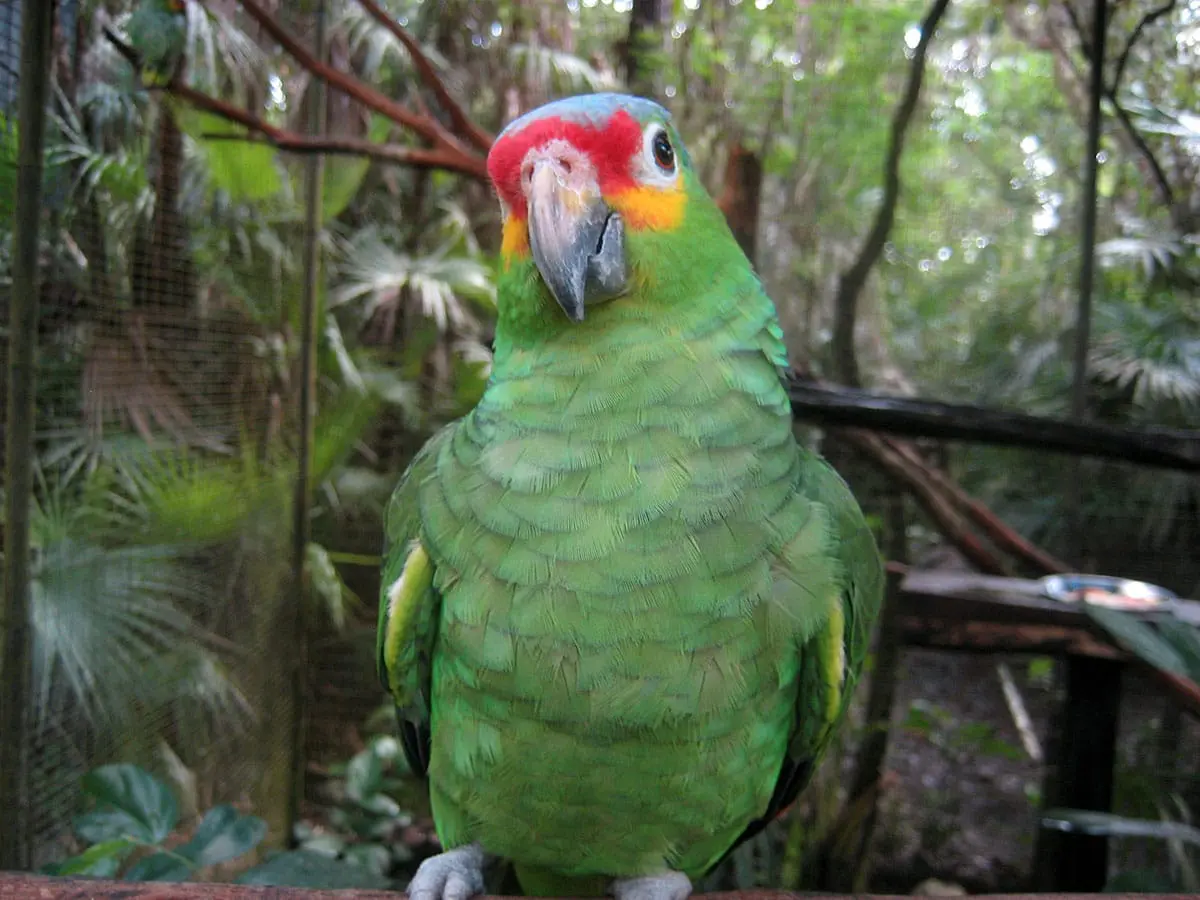
Red-lored Amazon
Amazona autumnalis

Red-lored Amazon


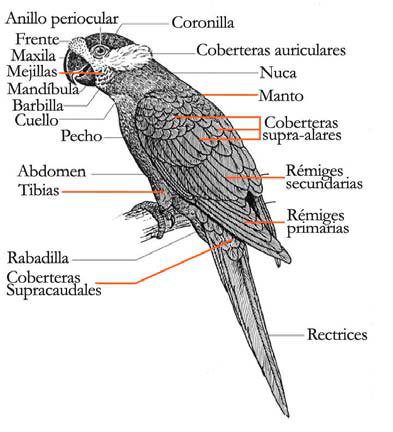
Anatomy-parrots

Content

Description:

35,5 to 38,1 cm.. height and between 314 and 485g. weight.

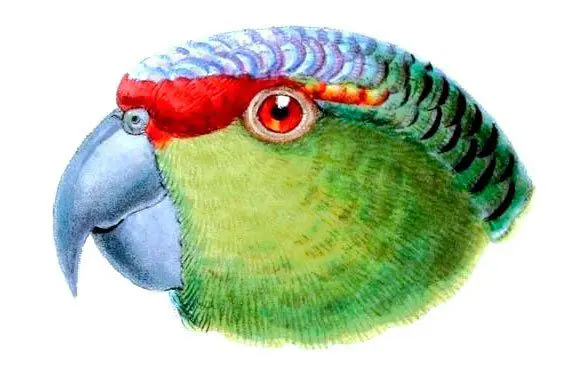
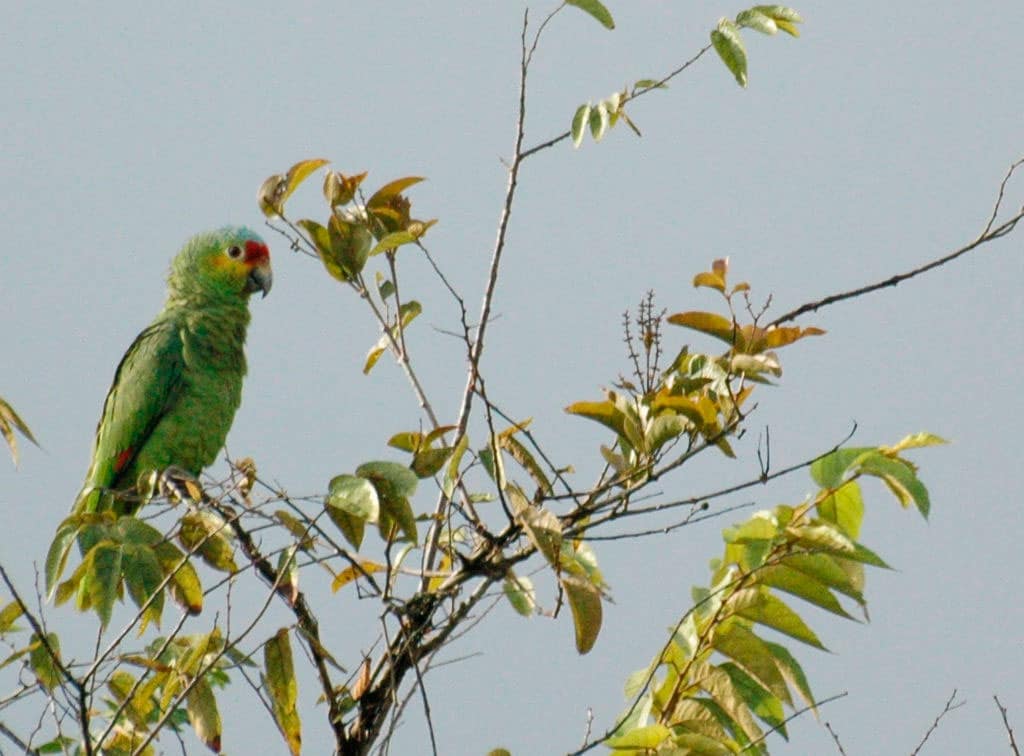
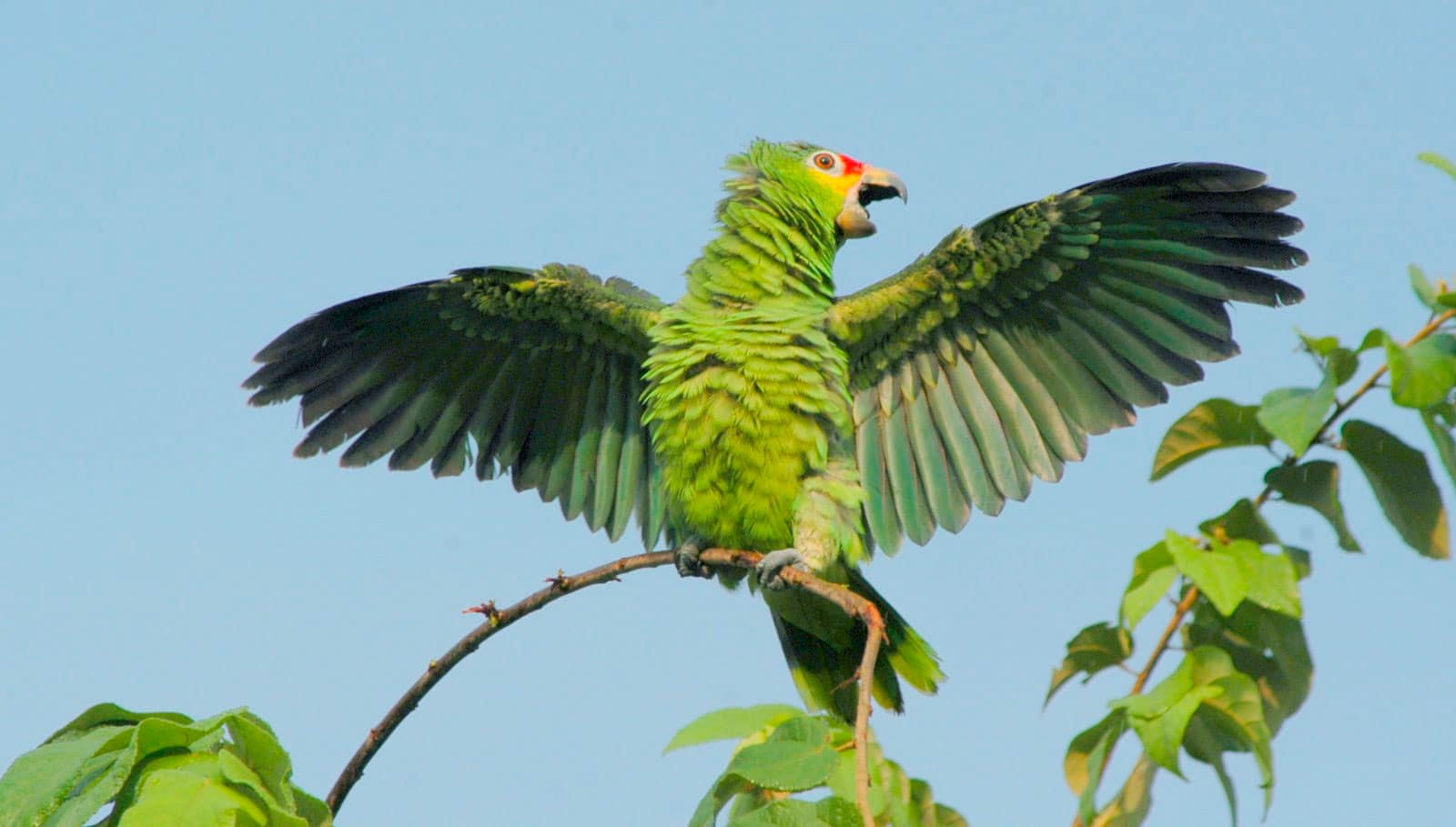
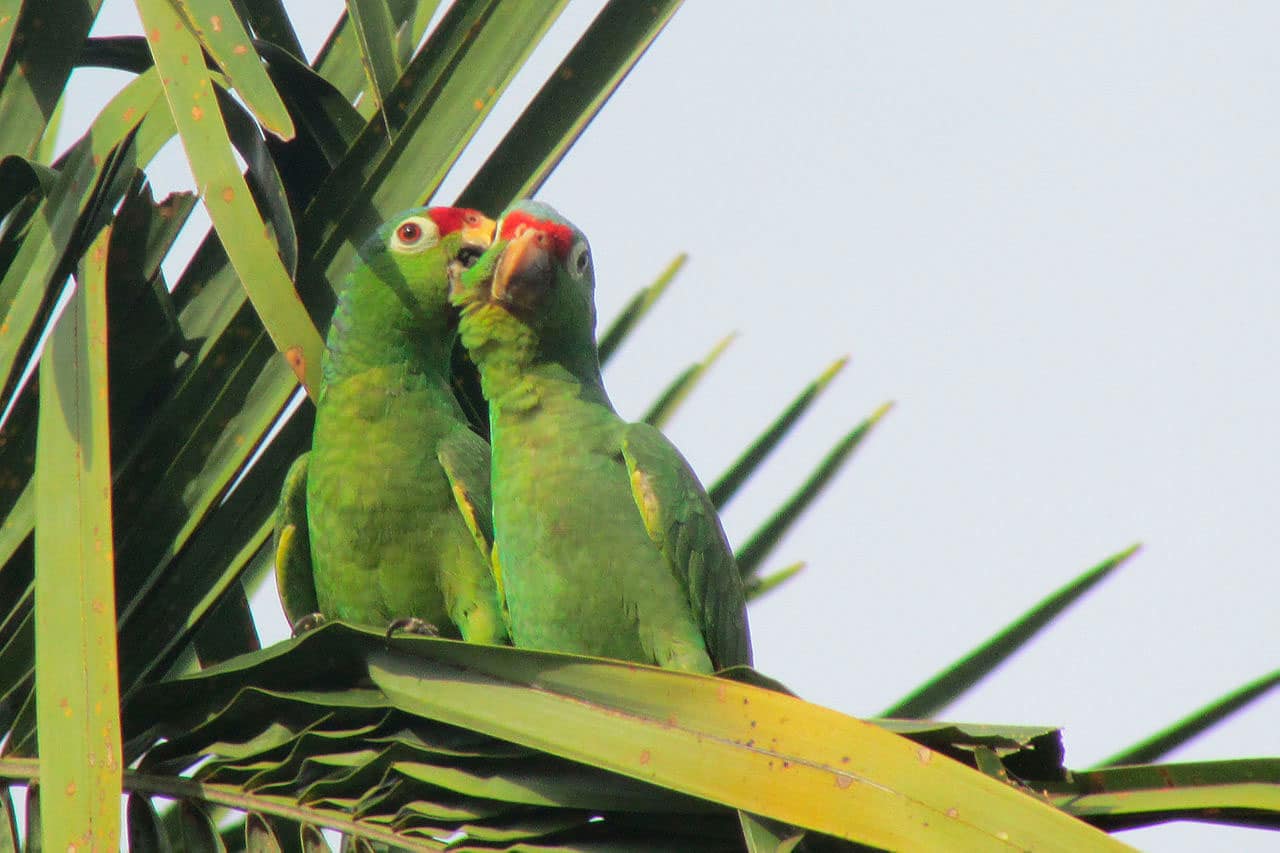
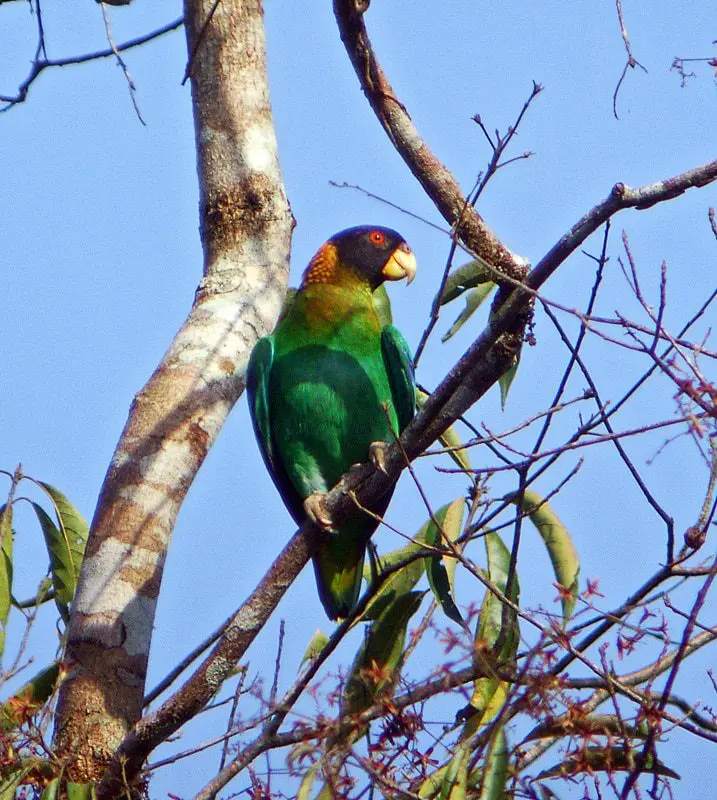
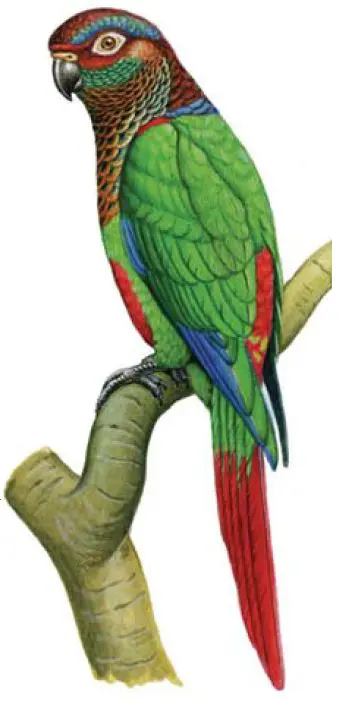
The Red-lored Amazon (Amazona autumnalis) is distinguished by its red front; Green with edge lilac it nape ; crown lilac; stain red in the wing , and tail blue margin.
The bill is grey with the upper jaw yellowish-horn. The irises his eye is orange. The legs are of color gray greenish.
They do not possess sexual dimorphism, that is to say, there is no physical difference between the male and the female.

Description 3 subspecies:

Amazona autumnalis lilacina Lesson, 1844
  • Amazona autumnalis autumnalis

    (Linnaeus, 1758) – Nominal.


  • Amazona autumnalis lilacina

    (Lesson, 1844) – It has a red band in the forecrown that it extends over them eyes; the cheeks Yellow.


  • Amazona autumnalis salvini

    (Salvadori, 1891) – It has cheeks and ear-coverts green; the basis of the tail by under Red.

Habitat:

Video – "Red-lored Amazon"

Amazonas autumnalis

This amazon frequents a wide range of habitats wooded and open with trees, including rainforest, tropical deciduous forest, pine forests, mangroves, forest swamps, gallery woods, areas cultivated with trees high and plantations; also forest dry in the South of Ecuador.

The Red-lored Amazon move from the rainforest (breeding season) to a habitat more open in winter in the Yucatan Peninsula, Mexico. The altitudes that inhabit range from sea level to the 320 metres in Oaxaca, 1.100 metres in Honduras, 800 metres in the Caribbean, 1.000 meters on the slopes of the peaceful of Costa Rica, and 1.000 metres in Colombia.
The birds tend to be in pairs or in flocks loose, being more gregarious When feed (occasionally macaws) and when resting. outside the breeding season, birds take refuge in tall trees in gallery forests or mangroves.

Reproduction:

They nest during the seasonal dry in hollow of trees (usually dead, for example, Tabebuia or Ceiba) or on the stump of a Palm tree. Birds in State reproductive in April, Oaxaca; February-March, Belice; March, Guatemala; January-February, Colombia. Reproduce between February-April, Panama; March-may, Belice and January-March, Ecuador. Clutch 3-4 eggs.

The incubation varies from 25 to 26 days. The chicks remain in the nest 70 days.

Food:

In the wild these birds feed on figs Ficus, orange, Mango, fruits of Palm (including the of Cordia lutea and Spondias purpurea), coffee beans (Coffea arabica), seeds of Ferrule, Casearia and Protium. Mainly are feeds in the tops of trees high.

Distribution:

Size of the area of distribution (reproduction / resident): 2.570.000 km2

The Red-lored Amazon It extends from the South of Mexico north of South America with a population disjunct in the amazon.
You can find in them lands low of the this of Mexico, in the South of Tamaulipas, in the East of San Luis Potosi, Puebla, Oaxaca, Chiapas, Tabasco, Campeche and Quintana Roo. Records from other parts of the country (for example, City of Mexico) probably you refer to leak.
You can see in Belice and in the lowlands of the Caribbean of Guatemala and Honduras (including Roatan and Guanaja in Bay islands and probably soon in Utila), until Nicaragua and Costa Rica, where they are present in humid areas of the tropics on both slopes (absent from the dry Northwest ), also in Panama and on the islands of Coiba and Escudo de Veraguas and in the Archipelago of pearls (absent from the driest areas of the Azuero Peninsula).

In the Northwest of Colombia appear on the Pacific slope of the Western Andes from the Panamanian border to the South up to the Serrania del Baudo and from the southwest of Cauca south to Ecuador in the Gulf of Guayaquil. Also it extends to the North of the Andes in Colombia to Magdalena Medio and to the East in the Northwest of Venezuela in Zulia (Sierra de Perija).

In the Northwestern basin of the brazilian amazon a disjunct population exists between Black river and Solimões River.

Usually resident with some local seasonal habitat preferences (for example, in Yucatan Peninsula, Mexico). Is usually the most common parrot and more numerous in some parts of the range (for example, in parts of Central America) but now is a species very rare to the West of them Andes in Ecuador and Colombia with a population of the subspecies Amazona autumnalis lilacina estimated in 400-600 specimens.

Population decreased drastically in the island of Roatan (Honduras) where he captured it is massively for export, and maybe missing in Utila for the same reason.

Capture combined with the loss of habitat also has caused declines in some other parts of its area of distribution (for example, east of Mexico and Ecuador). common in captivity in some areas, and marketed internationally.

Distribution 3 subspecies:

  • Amazona autumnalis autumnalis

    (Linnaeus, 1758) – Nominal. Coast of the Caribbean from the East of Mexico South to North of Nicaragua.


  • Amazona autumnalis lilacina

    (Lesson, 1844) – West of Ecuador.


  • Amazona autumnalis salvini

    (Salvadori, 1891) – North of Nicaragua south to Colombia and Venezuela.

Conservation:

State of conservation ⓘ


minor concern Minor Concern ⓘ (UICN)ⓘ

• Current category of the Red List of the UICN: Least concern.

• Population trend: Decreasing.

This species has a very large range and, Therefore, is not approaching the thresholds of Vulnerability at the discretion of the distribution area size.

The population size is very large and, therefore, not approaching the thresholds for vulnerable under the criterion of population size (<10.000 mature individuals with an estimated continuous decrease in> 10% in ten years or three generations or with a specific population structure). For these reasons, the species is evaluated as least concern.

Justification of trend

It is suspected that the population is in decline due to the continuous destruction of the habitat and to levels of exploitation unsustainable.

The Amazona lored in captivity:

Is of vital importance that the diet is complete and balanced in all directions, as this prevents, along with other factors, the appearance of bone problems or the known software that affects numerous parrots. To ensure the balance of this, prepared feed very well supply the nutritional needs of each animal, However, they should not miss plant, fruits and vegetables, as well as diversity of seeds that come in mixture.

As for accommodation, If they are not removed from cage constantly, it should be spacious enough to exercise the muscles of the wings and legs, and the plumage of the bird is preserved in perfect condition.

The Red-lored Amazon enjoy, like all parrots, tearing apart and finding out things, so they must have the occasional toy or we may end up having problems with the furniture. Them feet of parrot are very suitable if your stay is in the outside of the cage. Of course, they must not be exposed to draughts or sudden changes in temperature. The water must be clean at your fingertips, because the existence of fungi causes serious breathing problems.

In terms of coexistence to have it in the neighborhood area, in comparison with other species in Amazon, are relatively quiet, so in general do not cause many problems.

In captivity, can get to live up to 80 years.

BREEDING AND REPRODUCTION:

Its captive breeding started for the first time in United States, after their importation from the place of origin, South America in the 1950's.

Those individuals acquire their sexual maturity on the 4 years of age, and if you have a good breeding pair in the right conditions, they can perform two annual broods, Although the main thing if you want to raise, patience. Many pairs need several years until the first calf, so it is very important to be patient and wait for the right moment.

The female lays in the nest (No fill) of 2 to 6 eggs incubated without the help of the male usually. This is dedicated to feeding the female itself and that of the chicks after their birth at the 28 days until independence after twelve weeks.

Alternative names:

– Red-lored Parrot, Red-lored Amazon, Yellow-Cheeked Amazon (English).
– Amazone à lores rouges, Amazone diadème (French).
– Rotstirnamazone (German).
– Papagaio-diadema, Papagaio-diadema (Papagaio cavacué) (Portuguese).
– Amazona Frentirroja, Lora Frentirroja, Loro Frentirrojo (español).
– Lora cariamarilla (Honduras).
– loro cachete-amarillo (Mexico).


scientific classification:
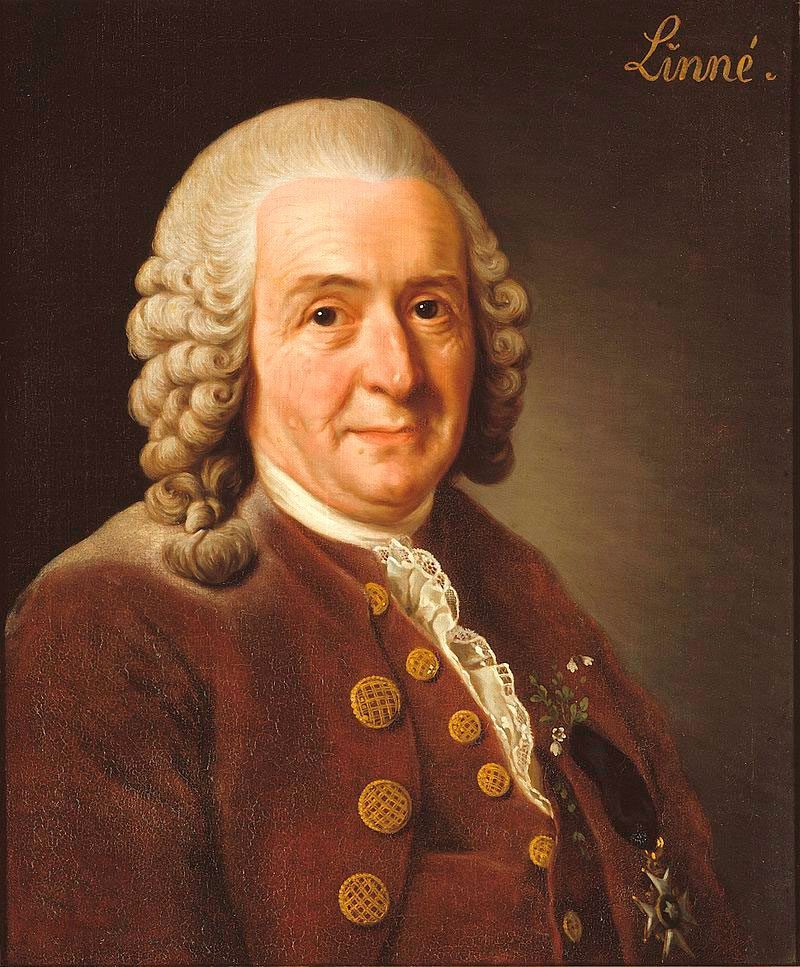
Carl Linnaeus

– Order: Psittaciformes
– Family: Psittacidae
– Genus: Amazona
– Scientific name: Amazona autumnalis
– Citation: (Linnaeus, 1758)
– Protonimo: Psittacus autumnalis


Red-lored Amazon images:


Species of the genus Amazona


Sources:

  • Avibase
  • Parrots of the World – Forshaw Joseph M
  • Parrots A Guide to the Parrots of the World – Tony Juniper & Mike Parr
  • Birdlife
  • Parrot Book, Parrots and macaws Neotropical
  • Grupohypermarkup

Photos:

(1) – Wikimedia.org
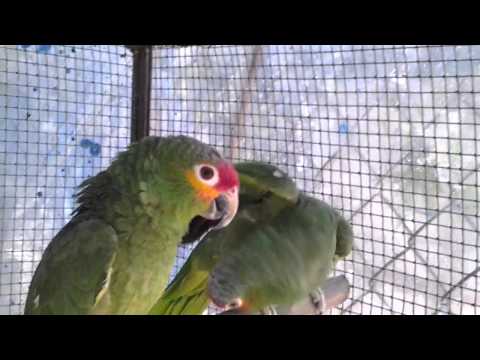
(2) – Red-lored Amazon or Red-lored Parrot; two captive parrots By Brian Gratwicke (originally posted to Flickr as Red-lored Amazon) [CC BY 2.0], via Wikimedia Commons
(3) – A Red-lored Amazon in Panama By Nelson de Witt from USA (Hello!) [CC BY-SA 2.0], via Wikimedia Commons
(4) – To pet Red-lored Amazon By Richard (originally posted to Flickr as Looming….) [CC BY 2.0], via Wikimedia Commons
(5) – Red-lored parrots (Amazona autumnalis), OSA Peninsula, Costa Rica By Charlesjsharp (Own work) [CC BY-SA 3.0], via Wikimedia Commons
(6) – A Red-lored Amazon at Rock Farm, Belize. It has a feather problem By Rigrat [CC BY-SA 3.0], via Wikimedia Commons
(7) – This is the image of a parrot originating of the jungle of Chiapas in Mexico By Joe Quick [CC BY 2.0], via Wikimedia Commons
(8) – Red-lored Amazon perching on a branch with wings open near Belmopan, Belize By Rigrat (Picasa Web Albums) [CC BY-SA 3.0], via Wikimedia Commons
(9) – A strange sight to me to see parrots flying in the wild. This Red-lored Amazon (Amazona autumnalis) was spotted with a group along the roadside in the Cayo distict of Belize By The Lilac Breasted Roller (originally posted to Flickr as Red Lored Parrot) [CC BY 2.0], via Wikimedia Commons
(10) – Lilacine Amazon, head from lateral by John Gerrard Keulemans [Public domain], via Wikimedia Commons

Sounds: Walter Rivera

▷ The world of Pets: Dogs, cats, birds, reptiles, amphibians

White-cheeked turaco
Turaco leucotis

Tauraco leucotis
Photo: fotosricardo-h

Content

Characteristics

This striking bird is native to Africa (area of Ethiopia) and reaches a size of 42 to 43 cm..

It has bright green feathers, with a dark crest on the head, may stands at will, the Underwing coverts are blue like the tail, While the primaries are intense red, and in general only be appreciated with the bird in flight. The beak is orange-red, like the ring around the eyes. In front of the eye they have "white cheeks" and two oblique white marks on the neck..

Has several other anatomical features of interest. First of all, they have strong feet and you can turn your fourth finger of the foot forward or backwards to get a better grip on its perch. In second place, the chickens of this species have claws on their wings, a strange and evocative anatomical feature for a bird that almost seems to be reminiscent of its ancient cousin, the Archaeopteryx. The chicks emerging from these claws at the time of leaving the nest.

Most of these birds have green plumage and is the result of a combination of structural coloration and pigments.. They are unique since only the Turacos, among all the birds, they produce a Green pigment, turacoverdin, It is the color of their feathers.

Character and skills

This beautiful and energetic African bird is a very popular bird in the United States and the United Kingdom., they can even be hand fed by what you become very mansas pets.

Another curiosity, and one of the things by which this bird strikes is by singing, which, It resembles the squeal of a wild monkey.

Images "White-cheeked turaco"

Videos "White-cheeked turaco"

▷ The world of Pets: Dogs, cats, birds, reptiles, amphibians

Budgerigar
Melopsittacus undulatus


Common Budgie

Content

Description

18 cm. length and a weight between 22 and 32 g..

Periquito-Comun

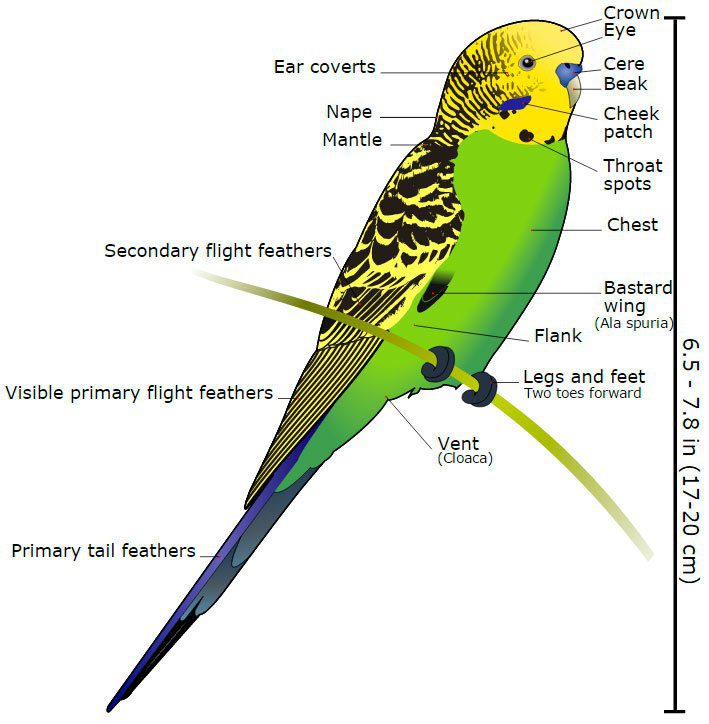
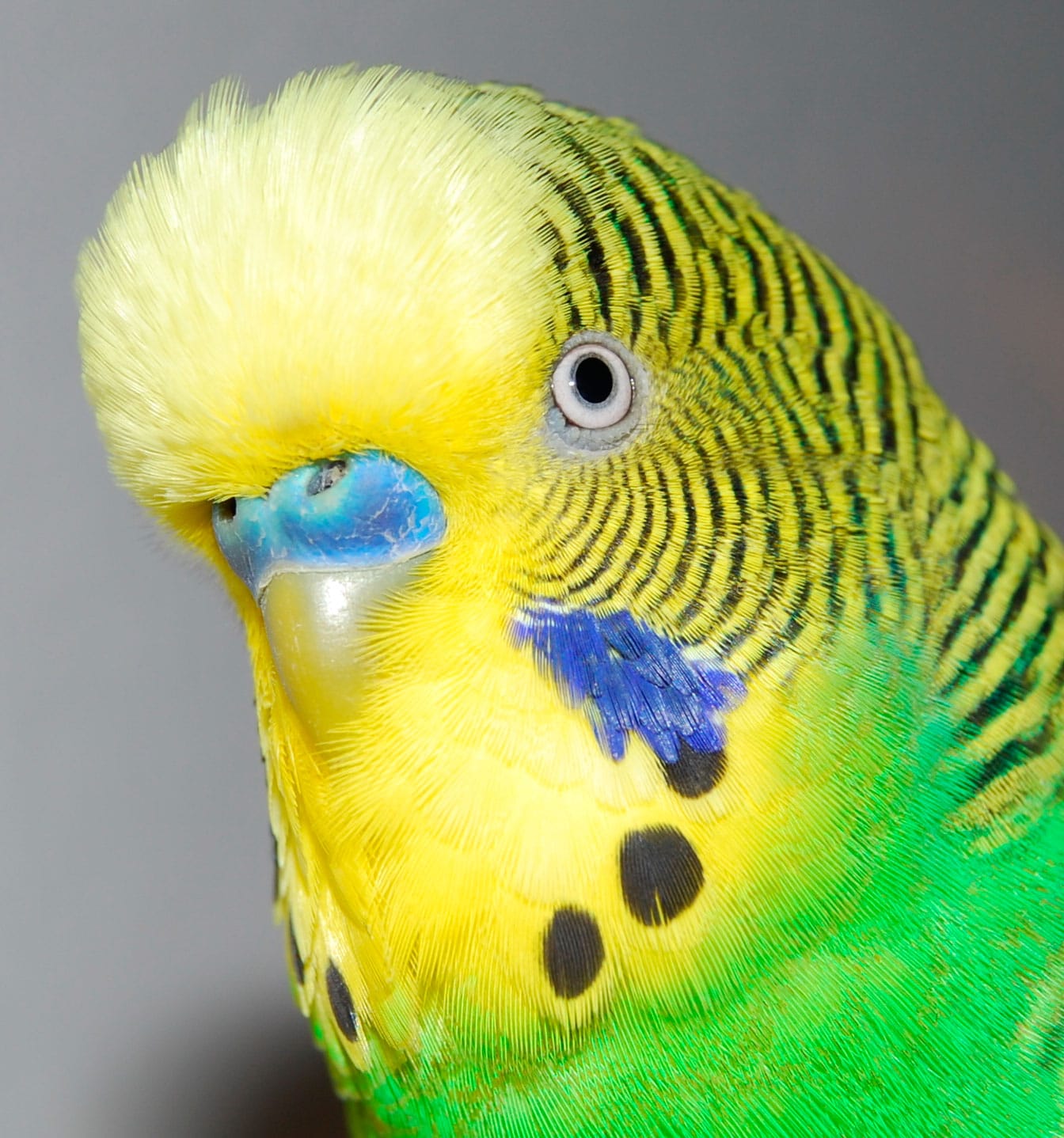
In the Budgerigar (Melopsittacus undulatus) of adults, the cere Blue contrasts with the frontal zone; the front of the face and throat are pale yellow. The latter is covered by a line of black dots. The area which is located below the cheeks it's purple.

The central part of the pileum extending from the rear of the eyes to neck It is covered with alternating thin black bands and bands of pale yellow. These bars are expanded on the the mantle and wing-coverts, forming a scaly effect.

The underparts, the area beneath the wings, the lower part of the back and rump create a beautiful pale green together. The tail is opaque blue tones with a central yellow stripe on the side feathers.

The female has a Brown wax.

The immature they are more turned off with bars on the front. The black spots on the throat they are absent.

Habitat:

The Budgerigar they are distributed by a wide variety of open habitats, including open forests, lightly wooded grasslands and savannas. Also appreciate the areas of Mallee, farmland, vegetation that grows along rivers, drought-adapted scrub and open plains. They come fitted with desert areas of Mulga (Acacia aneura). Although they are able to survive several days without water, These birds are never far from a water source.

In areas where fruit production is constant and in others where it is stable for very long periods, the movements of the Budgerigar they are easily predictable.

In the South end, Pilgrimages exist only in cases of prolonged drought and wandering parakeets return to their territory with the first rains and recolonize when river levels return to normal.

Reproduction:

The Budgerigar they build their nests of June to September in the North its area of distribution. They reproduce between August and January in the South. Nests can be installed at any time of the year after the rains fall. They establish a second brood as soon as conditions are favorable.

These parakeets usually nest in colonial way. The nest is located in a natural cavity in a tree, in a strain, an any fence post, or on a big fallen branch.

The female lays from 4 to 6 eggs and incubation lasts a few 18 days. The chicks remain in place of birth during 30 days before flying.

Food:

The Budgerigar It vegetarian, they eat herbs and seeds of quenopodios. Plants vary in categories and in proportions, according to which regions and times.

The East inside of Australia, These birds feed exclusively on seeds that are on the ground, While in the middle of the continent, There is more variety of plants to select. In the first case, grain size barely exceeds the 2 mm diameter and the second, more than 40 plant varieties make up the diet of these parakeets.

From time to time, the Budgerigar, they come in growing areas and take advantage of the ripe fruits.

Distribution:

The Budgerigar are distributed widely throughout the Interior of Australia, Although they are rare in the coastal districts of the This and the end South-West (absent of Tasmania, Arnhem Land and Cape York Peninsula).

The species may be of common to very abundant, but they are nomadic, and may change from year to year areas.

These parakeets, frequently, they burst from the arid zones to the more humid zones and there are temporary movements towards the south during the summer, but these changes may be affected by annual rainfall patterns.

We have introduced, without success, in a number of places around the world (or they have escaped from captivity and could not be) including South Africa, United Kingdom, Japan, Hong Kong, Puerto Rico, Brazil, Switzerland, Colombia, the Society Islands, New Zealand and Oman.

In the EE.UU. the species has managed to colonize Hawai and California (leaks also occur regularly in the city of New York City). In Florida a population was originally registered in the area of St. Petersburg, in the decade of 1950 and now has more of 3.000 individuals; These birds are mobile and have been recorded along the coast This of all the South from Jacksonville to Miami, and in the West everything Hudson to South of Fort Myers, from time to time go towards the North in Gainsville.

Parakeets, occasionally escaped, they may appear in Tasmania.

The world population is estimated at around 5.000,000 copies.

Conservation:


minor concern


• Current category of the Red List of the UICN: Least concern

• Population Trend: Growing

This species is not threatened at all, even they are abundant, and in some places where resources are good, countless flocks darken the sky, to cause branches to break from 4 centimeters in diameter, When large number of birds used them as support for their breaks.

Populations fluctuate widely depending on weather conditions.

Livestock living on farms in central Australia have caused Budgerigar they will benefit from new water supplies. Like this, the number of parakeets are constantly increasing.

These parakeets are the most well known psittacidas in the world.

"Budgerigar" in captivity:

This parakeet was discovered in 1805 and since then it has become the most popular captive bird in the world. While it is considered as domestic fowl, However, is a gregarious and instinctive animal, with the same needs that the parrots who freely roam the lands of Australia.

The Budgerigar It dynamic, curious, melodious and because of its small size, the beauty of their plumage and their entertaining behaviour, truly charming. This is what makes it a coveted bird. But, It is still a bird that needs to fly, play and socialize with their peers. Like any bird, It is sensitive to the social and environmental context. In fact, their real needs are too often overlooked, many parakeets suffer neglect or even abuse.

In captivity, the Budgerigar It is larger than its counterpart in nature. Measures of 20 to 25 cm. from head to tail and weighs between 30 and 45 g.. In addition to the colour of your coat, wild type, There are numerous mutations (other coat colors) associated with the increase in crossings and selections in certain genes, that translates into more spontaneous mutations.

The Budgerigar has two silent by year average, and the first moult occurs between the fourth and sixth month. The molt is complete renovation of the plumage of the bird. Pens fall to others push, includes your tube of keratin that parakeets will open with their beaks to release pen and relieve the irritation that engenders the same thrust. It can be more or less painful and intense. Some plucking is so fast that the bird may experience some difficulties during the flight.

Check the intensity of the change of the parakeet through black head tubes, tiredness and especially the number of feathers on the ground.

The feeding of the Budgerigar is based on the millet and the birdseed, Although it must be complemented with other seeds or vegetables (as the lettuce, Spinach, pepper, Carrot, corn). The fruits are also a good dietary supplement for these birds. Occasionally it can provide a little bread or biscuit, but always with caution that not give them anything very sweet. The avocado, the chocolate and the parsley they are deadly toxic for the Australian parakeets.

The the parakeet cage must be protected from the cold, a temperature between the 20-25 C. It must be of one sufficient size so you have freedom of movement and can exercise. The balusters must be arranged horizontally so that they can climb up them. The cage must be washed at least once a month with a disinfectant, change the water daily and clean the shells of the food. A cat litter tray can be placed to make their needs.
It is also important to let the parakeet out occasionally and fly freely around the room. Windows must be closed and curtains, because you can hit them.
Son very sociable birds and it is better to live with other parakeet. The best couple is formed by a male and a female. This will try to kill its companion if it is of the same gender.

With regard to its longevity, according to sources, these animals can come to live until 21 years in captivity. The same sources indicate that these parakeets suffer from a high incidence with respect to ovarian cancer.

Alternative names:

– Budgerigar, Budgerygah, Budgie, Canary Parrot, Grass-Parakeet, Lovebird, Scalloped Parrot, Shell Parakeet, Shell Parrot, Undulated Parrot, Warbling Grass-Parrot, Zebra Parrot (ingles).
– Perruche ondulée (French).
– Wellensittich (German).
– Periquito-australiano (Portuguese).
– Periquito Australiano, Periquito Común, Cotorra Australiana, Cata Australiana (español).

scientific classification:

George Shaw


– Order: Psittaciformes
– Family: Psittaculidae
– Genus: Budgerigar
– Scientific name: Melopsittacus undulatus
– Citation: (Shaw, 1805)
– Protonimo: Psittacus undulatus

«Common Parakeet» Images:

Videos "Budgerigar"

————————————————————————————————

«Common Parakeet» (Melopsittacus undulatus)


Sources:

– Avibase
– Parrots of the World – Forshaw Joseph M
– Parrots A Guide to the Parrots of the World – Tony Juniper & Mike Parr
– Birdlife

– Photos:

(1) – Budgerigar at Zoo Atlanta, USA By TheSussman (Mike) (originally posted to Flickr as Parakeet) [CC BY 2.0], via Wikimedia Commons
(2) – Two budgerigar at Henry Doorly Zoo, USA By Jeff Coffman (originally posted to Flickr as DSC_1265) [CC BY 2.0], via Wikimedia Commons
(3) – male budgerigar. taken near Cameron’s Corner, Qld By Benjamint444 (Own work) [GFDL 1.2], via Wikimedia Commons
(4) – Detail shot of budgerigars head By Kirk (Own work) [CC BY-SA 3.0 or GFDL], via Wikimedia Commons
(5) – Melopsittacus undulatus flock, Karratha, Pilbara region, Western Australia By Jim Bendon from Karratha, Australia (budgies_4) [CC BY-SA 2.0], via Wikimedia Commons
(6) – By User Magnus Manske on en.wikipedia [Public domain], via Wikimedia Commons
(7) – Exterior diagram of a green budgerigar By ZooFari [CC BY-SA 3.0], via Wikimedia Commons

– Sounds: Marc Anderson (Xeno-canto)

▷ The world of Pets: Dogs, cats, birds, reptiles, amphibians

Caica Parrot
Pyrilia caica


Lorito Caica

Content

Description:

23 cm.. height.

The head of the Caica Parrot (Pyrilia caica) totally black is it more distinguishable from this species, together with a collar Golden cafesoso that extends up to the chest.

The rest of the body usually Green, more clear in the belly and the inside of the tail; wing with blue stain and dark ends, Tip of the tail black.

Bill color bone; ring eyepiece bare of color grey pale; Orange irises.

The youth with crown green, face Dark greenish yellow, and collar not very notorious gold in neck and almost absent in chest.

  • Sound of the Caica Parrot.

Habitat:

Inhabits little disturbed humid forests, firm ground, in Tepuis, from the 50 to the 1100 m.
gregarious, They walk in small groups. They feed in the canopy of the forest.

Reproduction:

Currently with little information about the reproduction.

Food:

In the wild, It believes that its diet consists mainly of eucalyptus flowers, fruit, nectar and pollen.

Distribution:

Can be observed in the South-East of Venezuela, Guyanas and northeast of the brazilian amazon.

Conservation:


Near-threatened


• Red List category of the UICN current: Near-threatened

• Population trend: Stable

Justification of the population:

The size of the world population Caica Parrot It has not been quantified, although this species is described as 'rare’ (Stotz et to the., 1996).

Justification trend :

This species is suspected that it may lose 13,6-17,2% of habitat within its distribution over three generations (21 years) based on a model of deforestation of the Amazonia (Soares-Filho et to the., 2006, Bird et to the. 2011).

Given the susceptibility of this species to the hunting and/or entrapment, It is suspected that its population will decrease at a rate close to the 30% in three generations.

"Caica Parrot" in captivity:

They adult acclimatised quite easily to a new environment and are very resistant … Conversational skills (in comparison with other species).
They are very quiet in an Aviary, with a personality friendly and Gentile. They are very sociable and it should be with a partner or in a group environment. In any way, It is not easy to see to the Caica Parrot in captivity.

Alternative names:

– Caica Parrot, Hooded Parrot (English).
– Caïque à tête noire (French).
– Kappenpapagei, Kappen-Papagei (German).
– curica-caica, curica, papagainho, periquito-de-pescoço-marrom (Portuguese).
– Lorito Caica, Lorito de Cabeza Negra (español).
– Perico Cabecinegro (Venezuela).


scientific classification:

John Latham
John Latham

– Order: Psittaciformes
– Family: Psittacidae
– Genus: Pyrilia
– Scientific name: Pyrilia caica
– Citation: (Latham, 1790)
– Protonimo: Caïca parrot


Images "Caica Parrot"

Videos "Caica Parrot"

————————————————————————————————

«Lorito Caica» (Pyrilia caica)


Sources:

– Avibase
– Parrots of the World – Forshaw Joseph M
– Parrots A Guide to the Parrots of the World – Tony Juniper & Mike Parr
– Birdlife

– Photos:

(1) – lynxeds

– Sounds: controles-canto.org

▷ The world of Pets: Dogs, cats, birds, reptiles, amphibians

Blue-headed Parrot
Pionus menstruus


Blue-headed Parrot

Content


Anatomy-parrots

Description "Loro Cabeciazul":

28 to 30 cm.. height and between 234 and 295g. weight.

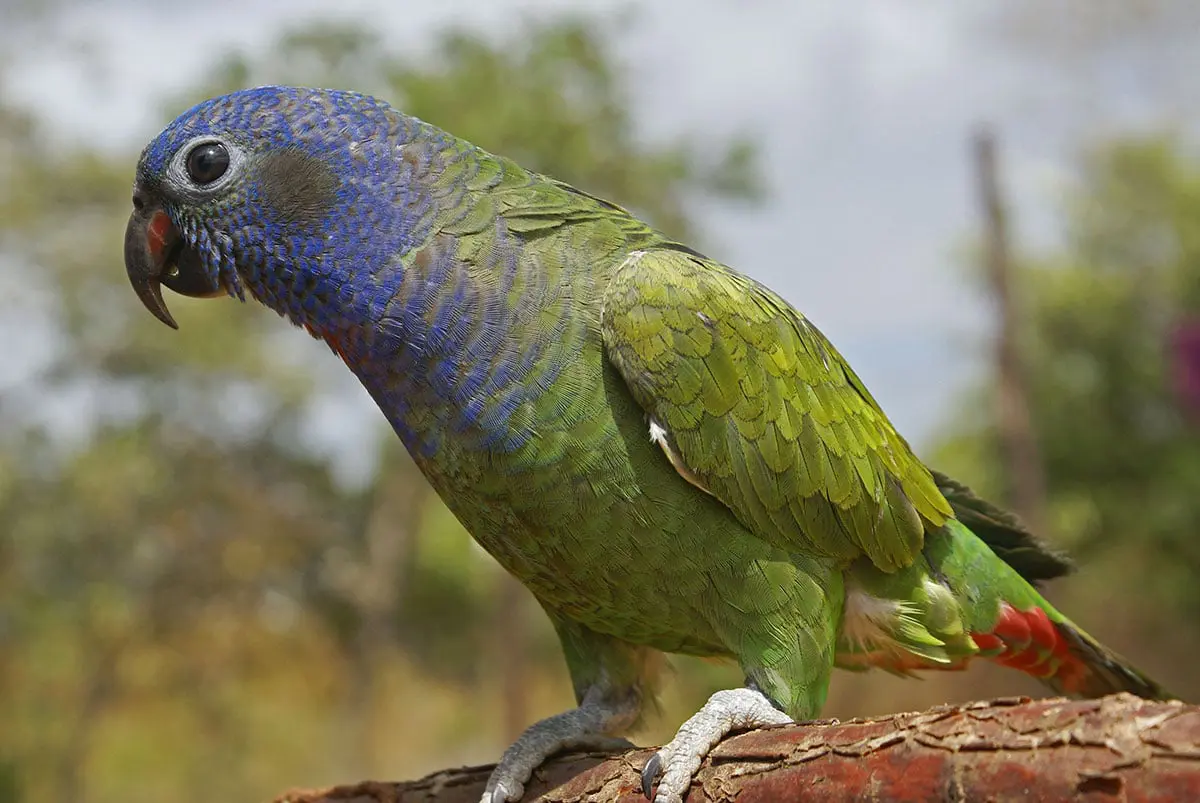
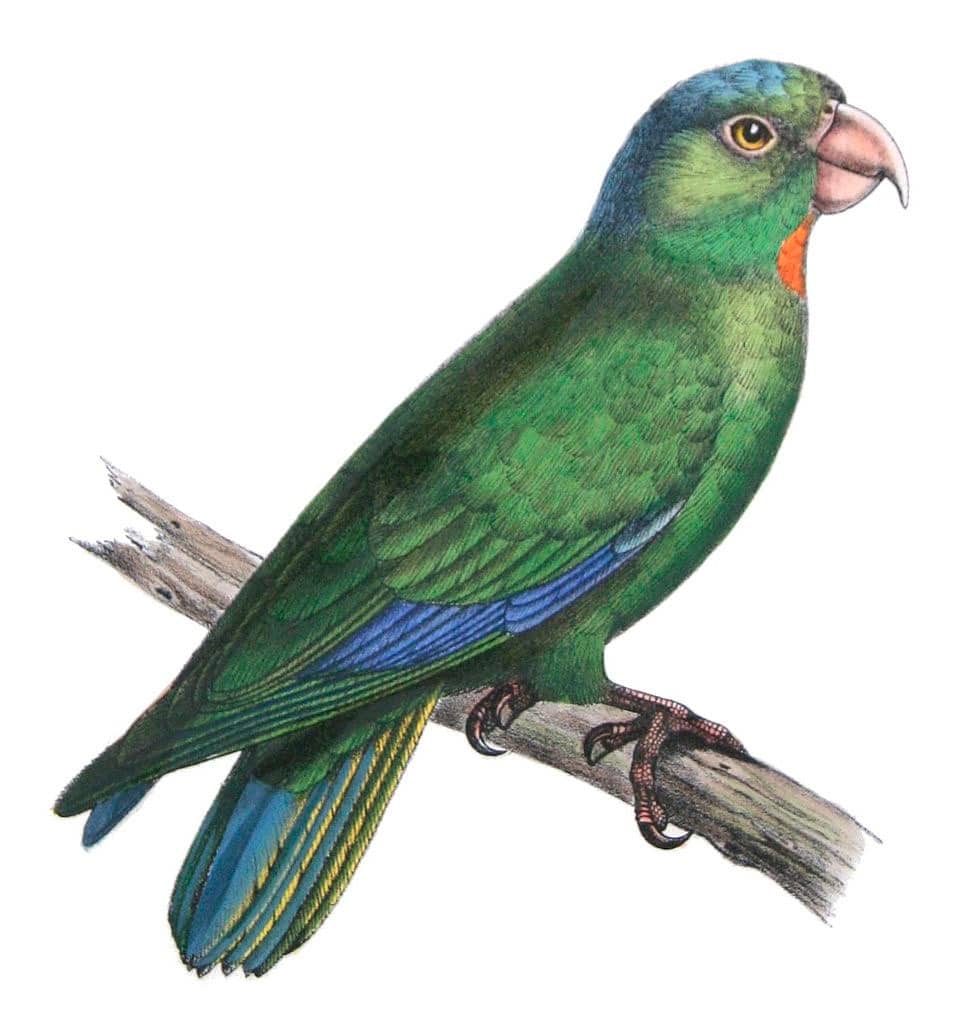
The Blue-headed Parrot (Pionus menstruus) is distinguishable by having the head, neck and chest blue; Red in the rump and in the Base ventral of the tail (very visible on the fly), basis of the bill and neck dotted with pink.

Shoulder and end of the wing olive green with yellow border, tail green with blue tip.

Subspecies description:

  • Pionus menstruus menstruus

    (Linnaeus, 1766) – The nominal

  • Pionus menstruus reichenowi

    (Heine, 1884) – Blue head, the neck and darker throat; lower underparts washed with blue green color; coverts red infracaudales with blue ends.

  • Pionus menstruus rubrigularis

    (Cabanis, 1881) – Smaller, head pale blue, neck more extensive and clear Red.

Habitat:

Species very common, lives in humid forests, semi-wet, from gallery, stubble, crop areas until the 1500 m.

Reproduction:

It feeds on various seeds, fruits and flowers.

Food:

It nests in hollows of trees and palms in dry season.

Loro distribution-headed:

They live in freedom from the South of Costa Rica, North of South America to the West of Ecuador. To the East of the Andes, comes to Peru, part of Brazil to the North of Bolivia.

Subspecies description:

  • Pionus menstruus menstruus

    (Linnaeus, 1766) – The nominal

  • Pionus menstruus reichenowi

    (Heine, 1884) – Coastal areas of the northeast of Brazil (Alagoas until Holy Spirit)

  • Pionus menstruus rubrigularis

    (Cabanis, 1881) – Tropical North of Costa Rica to western Colombia and West of Ecuador.

Conservation-headed Parrot:


minor concern


• Red List category of the UICN current: Least concern

• Population trend: Decreasing

The size of the world population of the Blue-headed Parrot It has not been quantified, but this species is described as «common» (Stotz et to the., 1996).

This species is suspected that it may lose 18,5-23% of habitat within its distribution over three generations (20 years) based on a deforestation model of the Amazon (Soares-Filho et to the., 2006, Bird et to the. 2011). So, they suspected that can decrease in <25% in three generations.

In captivity:

Pretty common in captivity. Intelligent, inquisitive although sometimes shy. Active by nature, they can become overweight if you don't have a wide space where exercise your flight. Mature birds usually match throughout his life with his partner, you will defend with aggression of any intruder.

Its diet in captivity is wide. fruits such as: Apple, pear, orange, banana, granada, cactus fruits, Kiwi, they form around the 30 percent of the diet; vegetables such as: Carrot, celery, green beans and peas in pods; fresh corn; Greens such as: chard, lettuce, Kale, dandelion, healer, chickweed; mixture of small seeds, such as: millet, birdseed, and small amounts of buckwheat, oats, safflower and hemp; soaked and sprouted sunflower; beans, cooked legumes and boiled corn.

Alternative names

– Blue-headed Parrot, Cobalt Parrot (English).
– Schwarzohrpapagei, Schwarzohr-Papagei (German).
– Cotorra Cabeciazul, Loro Cabeciazul, Loro de Cabeza Azul (español).
– Pione à tête bleue, Pionus à tête bleue (French).
– baitaca, curica, maitaca, maitaca-de-barriga-azulada, maitaca-de-cabeça-azul, sijá, Sôia, Suia (potugués).
– Pappagallo testablu (Italian).


scientific classification:

Carl Linnaeus
Carl Linnaeus

– Order: Psittaciformes
– Family: Psittacidae
– Genus: Pionus
– Scientific name: Pionus menstruus
– Citation: (Linnaeus, 1766)
– Protonimo: Psittacus menstruus

Images "Blue-headed Parrot"

Videos "Blue-headed Parrot"

«Loro Cabeciazul» (Pionus menstruus)


▷ The world of Pets: Dogs, cats, birds, reptiles, amphibians

Sinú parakeet (sub)
Pyrrhura subandina

Cotorrita del Sinú

Content

Description:

21 to 23 cm.. height.

The Sinú parakeet (Pyrrhura subandina) It, in general, green, with the forecrown and areas around eyes dark red.

In flight It is very evident dark red stain abdomen, the wings below greyish. The cheeks They have a greenish blue tone, the area surrounding the ear It is yellowish-brown and the breast feathers with design marginalized gray escamado.

Lives or lived in humid jungle, semi-humid, deciduous and gallery forests,low. It nests on trees of considerable size in hollow nests woodpeckers.

endemic to Colombia, in the lower valley of sinu river, Jaraquiel, Murrucucú hill, Córdoba.

Expeditions carried out in recent years have failed to sight it.

Estimated population: 0-100; The population trend: possibly extinct

We recommend that you devote to Sinú parakeet immediate attention to the conservation of this unique endemic species of the plain Sinu River.

Habitats in the jungle and near the Sinú river valley have been extensively altered and lost.

History:

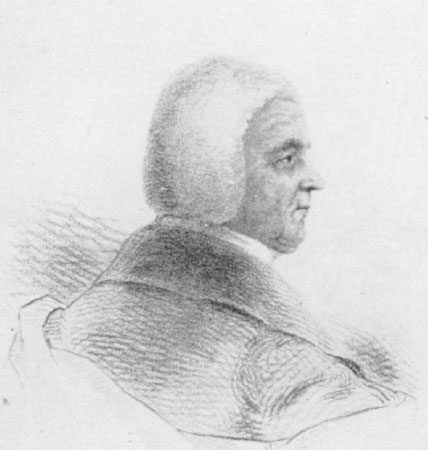
The Sinú parakeet It was described by Todd 1917 as a distinctive bird endemic Valley Sinu River, Córdoba Department, Northwest of Colombia. Peters (1937), without evidence or any basis placed the Pyrrhura subandina within the species Pyrrhura picta, and the species immediately fell into obscurity as subspecies. However, Joseph and Stockwell (2002) they restored the status to Pyrrhura subandina as a species, based on a detailed assessment and phylogenetic analyses recent (com. pers. 2003).

DNA analysis has shown that the population of the Sinú parakeet (Pyrrhura subandina) It is probably different (monotype) (Joseph & Stockwell 2002), although at present it remains a subspecies of the Pyrrhura picta pending further studies (SACC 2007).

There is no information on the ecology of the Sinú parakeet or current status. The species has never been reported alive and its range has been extensively deforested (Salaman obs. pers.)

At the beginning of 2004 Paul Salman He visited the four sites type; two are entirely deforested, While Quimari and the Cerro Murrucucú still have some fragmented forests. No evidence of any Pyrrhura It was obtained by observations and interviews with the local community. In May of 2004, a researcher at ProAves spent three months exploring in search of this species throughout the Murrucucú hill but their results were not favorable. The lack of recent records of this species and its restricted and unprotected range give reasons for concern about their survival and current status.

    Reference: Joseph, L. and Stockwell, D. 2002. Climatic modeling of the distribution of some Pyrrhura parakeets of northwestern South America with notes on their systematics and special reference to Pyrrhura caeruleiceps Todd, 1947. Ornitologia Neotropical 13: 1-8.

The Sinú parakeet (Pyrrhura subandina) was last reliably recorded in 1949. Almost nothing was recorded about their habits. Not found during searches on 2004 and 2006 (ProAves Colombia 2008). He may be extinct, but if it still survives, this bird will be seriously threatened by habitat loss and hunting associated with the armed conflict in the region; The future of this Pyrrhura It looks bleak.

* Subspecies included within the species Pyrrhura picta.

Sinú parakeet (Pyrrhura subandina)


Especies del género Pyrrhura

Sources:

– Parrot Book, Parrots and macaws.
– eLibrary
– proaves
– Extinct Birds by Julian P. Hume, Michael Walters.

Photo: Parrots, Parrots and macaws Neotropical

▷ The world of Pets: Dogs, cats, birds, reptiles, amphibians

Orange-chinned Parakeet
Brotogeris jugularis

Orange-chinned Parakeet

Content

Description:

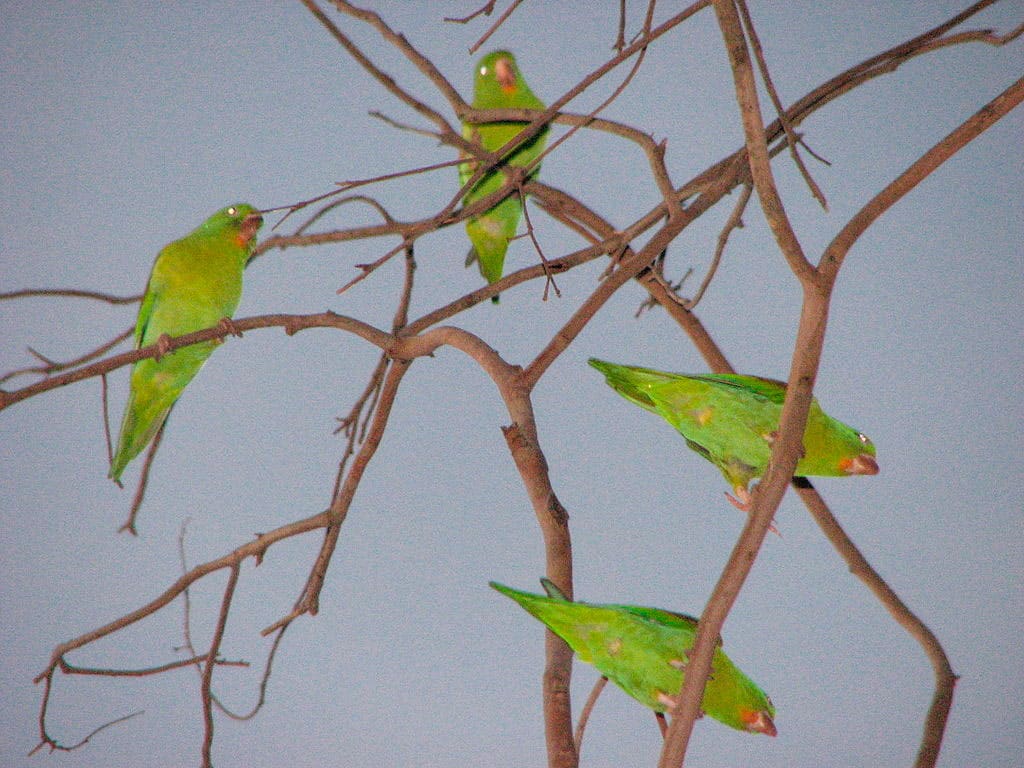
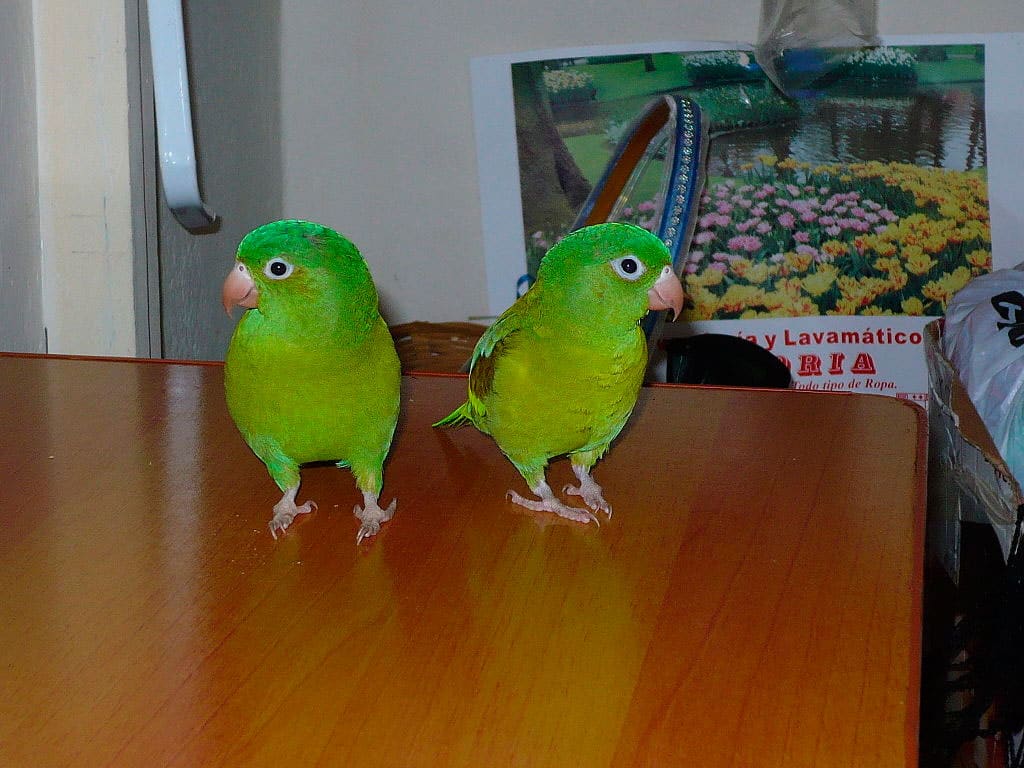
catita-churica-7

17 to 20 cm.. height.
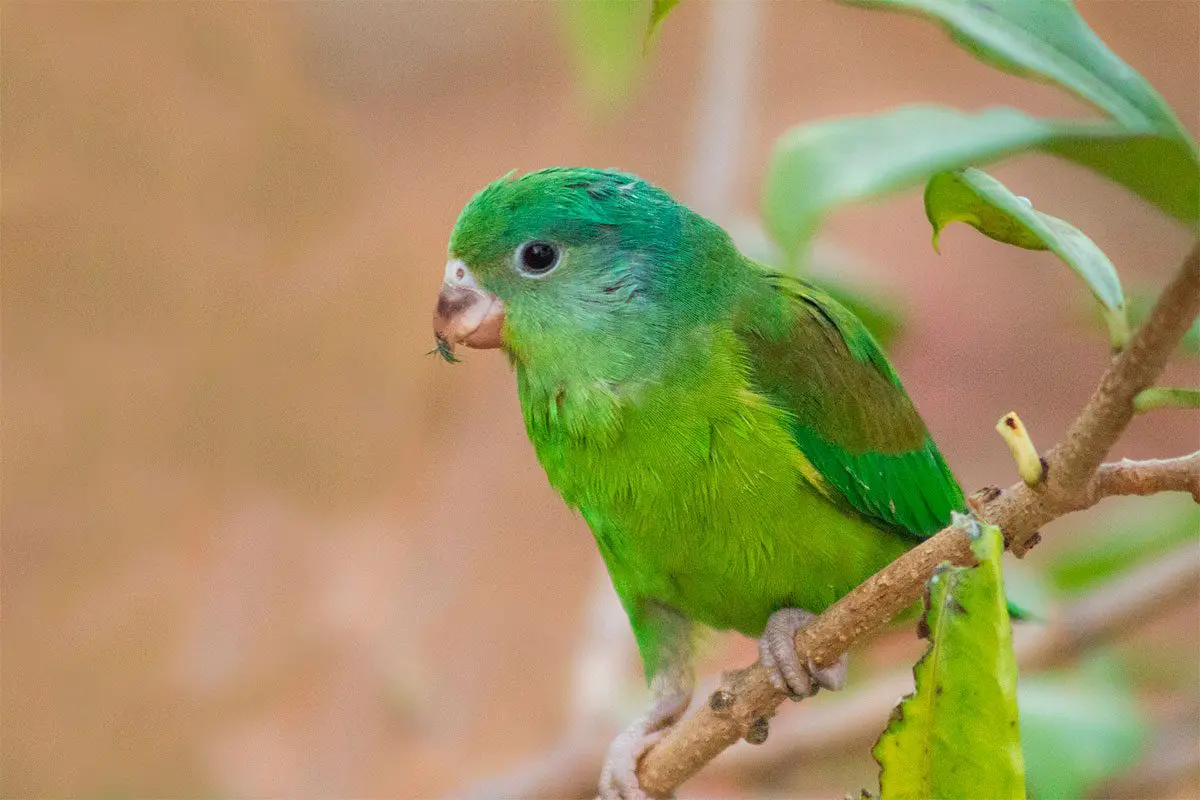
The Orange-chinned Parakeet (Brotogeris jugularis) has the forecrown, crown, back of the neck and upper cheeks, bright green with blue tinge; lores and lower cheeks, duller green with olive tinge. feathers in the the mantle and the top of the back, olive-green with more green tips; Scapulars Green tipped bronce-marrones; lower back and rump, bluish green. Lesser coverts and median, foliage color, with a patch large in the shoulder; Primary coverts blue, greater coverts green. Flight feathers greenish blue above, Blue-Green below with less yellow in the underwing-coverts.
Bright orange stain in the throat, which flying becomes very evident. Underparts brighter yellowish green, more blue from the belly up to the undertail-coverts. Upper, the tail bluish green; by below more pale and yellowish.

Bill color pale horn; bare periophthalmic whitish; irises dark brown; legs pink.

The plumage of both sexes are similar.

Description 2 subspecies:

  • Brotogeris jugularis exsul

    (Todd, 1917) – Has the back and rump olive, and dorsally the wing darker, In addition the stain in the neck smaller.

  • Brotogeris jugularis exsul
    Brotogeris jugularis exsul

  • Brotogeris jugularis jugularis

    (Statius Müller, 1776) – Nominal.

Habitat:

The Orange-chinned Parakeet prefer, generally, forests or partially wooded habitats with bushes, deciduous forest, dry and wet, plantations, edge of light and areas cultivated or grasslands with trees large. It tolerates human presence and it attends the parks and gardens in cities. Most numerous in partially deforested areas, mainly in tropical zone, Although it amounts to subtropical vegetation zones in (for example, the Cordillera de Guanacaste, Costa Rica. Observed at altitudes of 500 m (Guatemala), 900 m (Honduras), 1.360 m (El Salvador), 1.200 m (Costa Rica), 1.000 m (Venezuela). Usually, in pairs or small groups, with large gatherings where abundant food. More gregarious outside of breeding season. Rest communally on rubbers (Ficus sp.) or palms.

Son very good flying, in nature there have been flights of up to 45 kilometres per hour.

Reproduction:

Nest from May to July in tree hollows (including old Woodpecker nests) and termite mounds. A laying, usually, compose of four to six white eggs, What hatch after a few 26 days of incubation. The chicks leave the nest about 42 days after birth.

Sometimes colonial. Reproduction reported in March in Mexico; January in El Salvador; February-April in Panama; January-March in Colombia.

Food:

Feeds of seeds and fruits trees of Bombax, Ficus, Muntingia, Byrsonima, Cecropia, Ceiba, flowers and nectar of Erythrina, raft and guava. It feeds mainly in the canopy. They can be destructive crops (for example, Mango).

Distribution:

Size of the area of distribution (reproduction / resident): 781.000 km2

This parakeet occupies the lowlands of the southern Pacific slope of Mexico, in Oaxaca and Chiapas (reports of Warrior dubious) and areas adjacent to Guatemala and El Salvador, lowlands of the Honduran Pacific, and slopes of the Pacific and Caribbean Nicaragua.

In Costa Rica is mainly a bird of your side of the peaceful, but comes into the lowlands of the Caribbean adjacent, to the South of the Lake Cocibolca, spreading through the Pacific lowlands and the Caribbean from Panama, including the Islands Coiba and Cebaco.

Are also distributed to the West of the Andes in Colombia, to the south, to Atrato River and in the Caribbean lowlands of the region of Santa Marta and Serrania del Perija and further South, to the top of the Magdalena River Valley and lowlands of Norte de Santander and Arauca.

In Venezuela It extends from the North of the Orinoco in Zulia, Táchira North, Merida Western, the coastal mountains Yaracuy and Carabobo and in the lowlands of Portuguese, Cojedes, barinas, Apure and Guarico.

The Orange-chinned Parakeet are, mainly, residents although they roam locally in some areas (for example, in El Salvador after breeding season).

Usually of common to abundant though apparently uncommon at the local level (for example, Oaxaca).

Captured for the trade and common in captivity in countries of the range.

Distribution 2 subspecies:

Conservation:

State of conservation ⓘ


minor concern Minor Concern ⓘ (UICN)ⓘ

• Current category of the Red List of the UICN: Least concern.

• Population trend: Stable.

Justification of the population

Partners in Flight estimate your total population in 500,000-4,999,999 individuals (A. Panjabi in litt., 2008).

Justification of trend

They suspected that the population is stable in absence of evidence of any decline or threatens substantial.

"Orange-chinned Parakeet" in captivity:

Very common in captivity does time. It is a bird very shy and easily alarmable but with the passage of time creates a good emotional relationship with his owner. It can be aggressive with other smaller parrots.

Alternative names:

– Orange-chinned Parakeet, Bee Bee Parakeet, Brown-shouldered Parakeet, Mexican Parakeet, Orange chinned Parakeet, Tovi Parakeet (English).
– Toui à menton d’or, Perruche à front orange, Perruche tovi, Toui à menton jaune (French).
– Tovisittich, Goldkinnsittich (German).
– Periquito-de-queixo-laranja (Portuguese).
– Catita Churica, Chocoyo Barbinaranja, Perico Ala Amarilla, perico ala-amarilla, perico barbinaranja, Periquito Barbinaranja, Periquito Bronceado, Periquito de Alas Doradas (español).
– Periquito Bronceado (Colombia).
– Periquito barbinaranja (Costa Rica).
– perico barbinaranja (Honduras).
– perico ala amarilla, perico ala-amarilla, Periquito Barbinaranja (Mexico).
– Chocoyo Barbinaranja (Nicaragua).
– Perico Ala Marrón (Venezuela).

scientific classification:

– Order: Psittaciformes
– Family: Psittacidae
– Genus: Brotogeris
– Scientific name: Brotogeris jugularis
– Citation: (Statius Müller, 1776)
– Protonimo: Psittacus jugularis

Images Orange-chinned Parakeet:


Species of the genus Brotogeris

Sources:

– Avibase
– Parrots of the World – Forshaw Joseph M
– Parrots A Guide to the Parrots of the World – Tony Juniper & Mike Parr
– Birdlife

– Photos:

(1) – A pet Orange-chinned Parakeet in Panama By Nelson de Witt from USA (IMG_2058Uploaded by Snowmanradio) [CC BY-SA 2.0], via Wikimedia Commons
(2) – An Orange-chinned Parakeet feeding in Panama By Brian Gratwicke (Flickr: Orange-chinned Parakeet) [CC BY 2.0], via Wikimedia Commons
(3) – Orange-chinned parakeets in Panama City, Rep. of Panama. Aproximadamente tres o cuatro meses de edad By Ricaurte Puga (Own work) [GFDL or CC BY-SA 4.0-3.0-2.5-2.0-1.0], via Wikimedia Commons
(4) – Brotogeris jugularis en El Salvador tomando Coca Cola By Kevinmenendez (Own work) [GFDL or CC BY 3.0], via Wikimedia Commons
(5) – This is the smallest parakeet in El Salvador know as Catalnica, Perico de Lesson, Orange-chinned Parakeet (Brotogeris Jugularis) By ceasol (Flickr) [CC BY-SA 2.0], via Wikimedia Commons
(6) – Orange-chinned Parakeet | Brown wing parakeet (Brotogeris jugularis exsul) by Fernando Flores – Flickr
(7) – Conurus jugularis Dev. & Cast. = Brotogeris jugularis (Müller, 1776) by Francis de Laporte de Castelnau [Public domain], via Wikimedia Commons

– Sounds: (Xeno-Canto)

▷ The world of Pets: Dogs, cats, birds, reptiles, amphibians

Monk Parakeet
Myiopsitta monachus

Monk Parakeet

Content

Description:

28-31 cm. length and 120-140 weight g
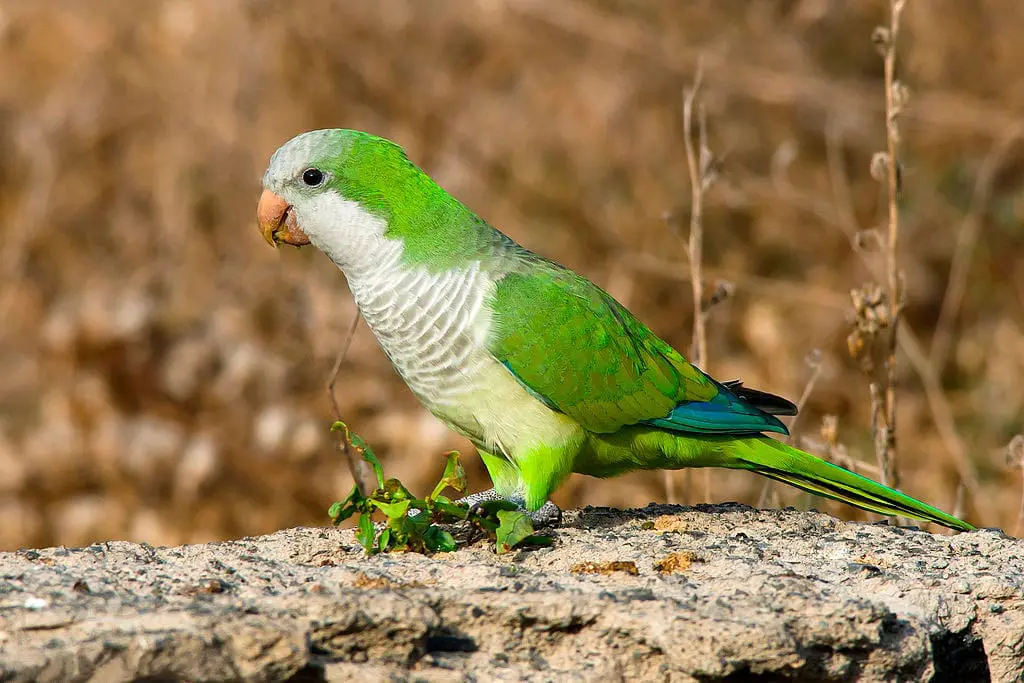
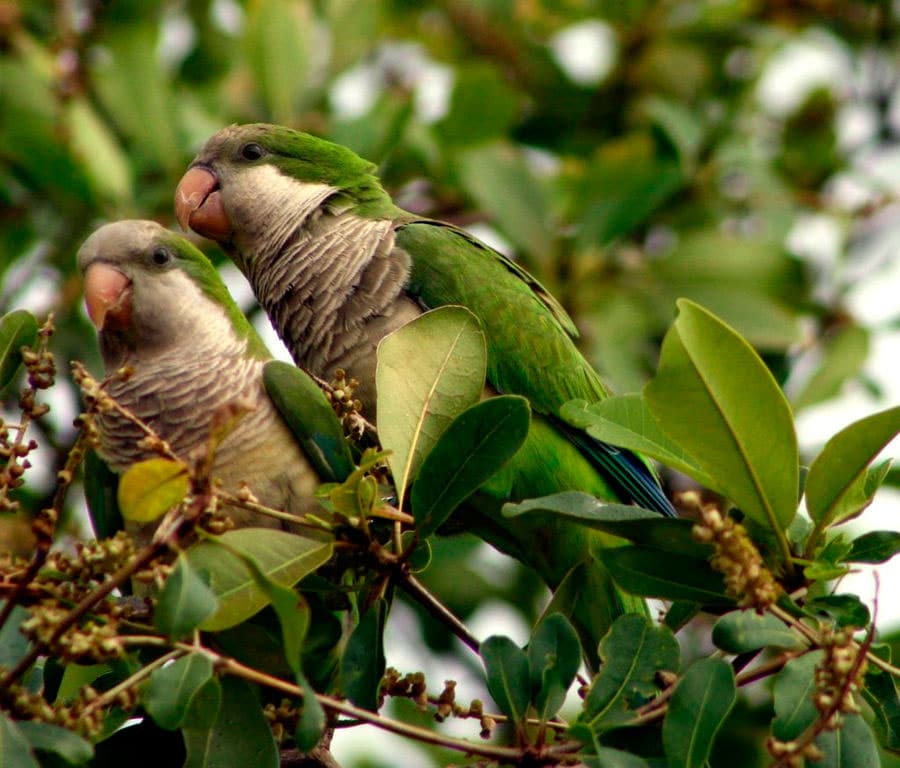
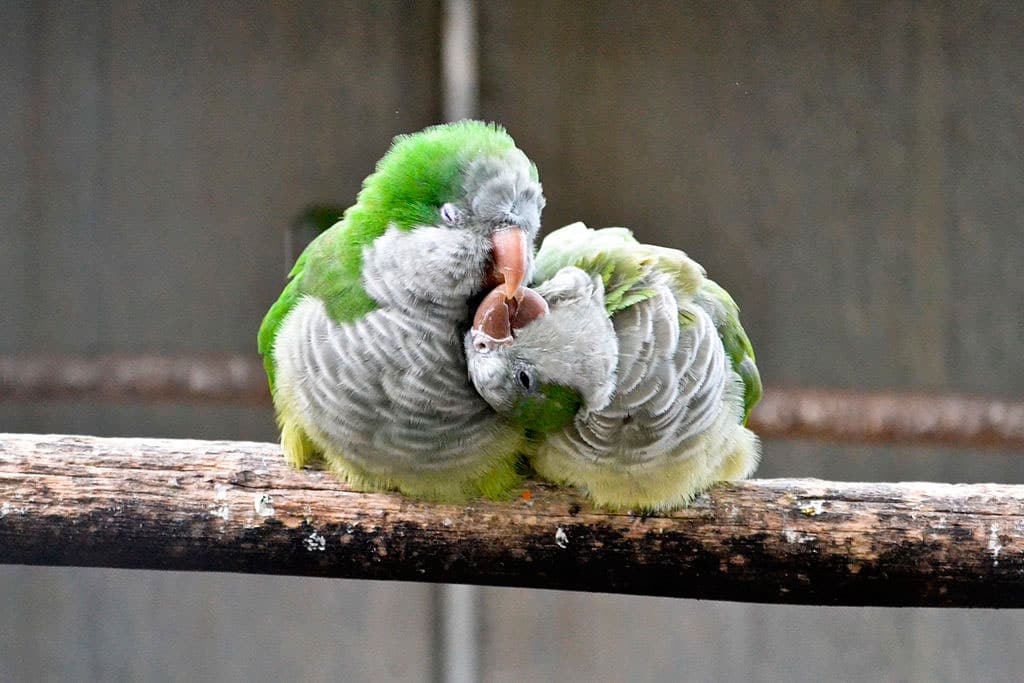
The Monk Parakeet (Myiopsitta monachus) has the forecrown (up to the half of the crown), the lores and cheeks, pale ash gray; the rear of the crown and nape, grass-green, fading to green, slightly more off, in the the mantle, the back and scapulars; rump green. Primary coverts, blue; other coverts, green.
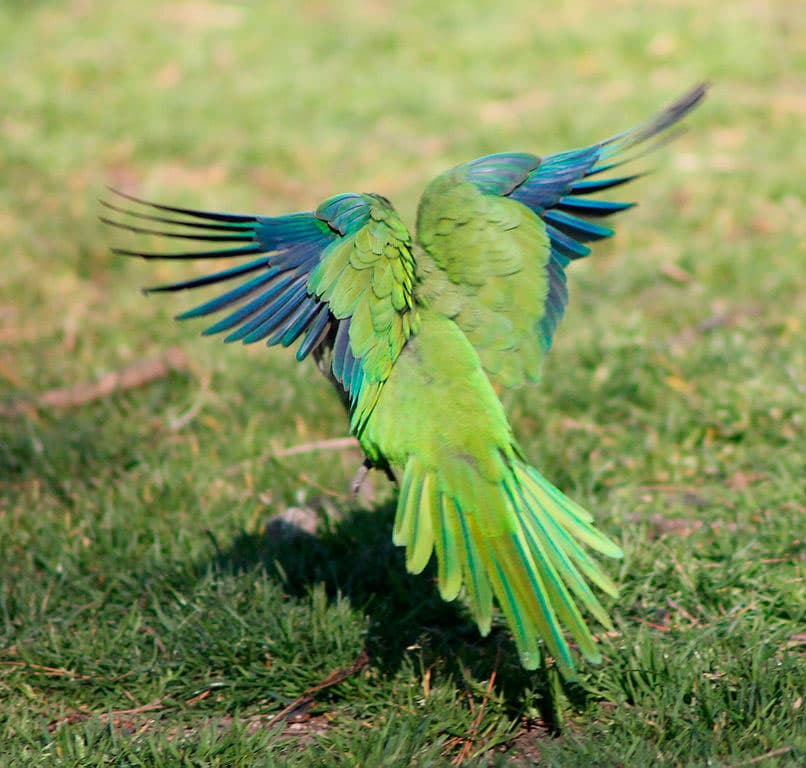
Flight feathers Blue by up. Under the wings has the lesser coverts green, the coverts more large and innerwebs of the the flight feathers, blue. Throat and upper area of the chest, ash gray, with pale edges to the feathers, giving a beaming effect; lower area of ​​the chest, pale yellow; Abdomen, the thighs and vent, pale green.

Upper, the tail is green with blue in the Center; below, pale bluish-green.
Bill color horn; Brown of the irises; legs grey.
Both sexes are similar.
Immature has the front green-tinted.

Subspecies description:

  • Myiopsitta monachus calita

    (Jardine & Selby, 1830) – Less of the nominal species (27cm.) with wings more blue and head dark gray.

  • Myiopsitta monachus cotorra

    (Vieillot, 1818) – Very similar to the subspecies Myiopsitta monachus calita, but supposedly more bright, belly least yellow.

  • Myiopsitta monachus monachus

    (Boddaert, 1783) – Nominal.

Habitat:

Video – "Monk Parakeet" (Myiopsitta monachus)

ARGENTINE PARROT: Myiopsitta monachus (www.riomoros.com)

The Monk Parakeet is, mainly, in dry wooded areas or fields open with trees, such as gallery forest, isolated thickets, palm groves, forests, linens and areas with thorny thickets with Cactus, also in land cultivation and in urban areas with trees, mainly below 1.000 m.

They tend to be observed in pairs or flocks of 30-50 individuals; with much larger gatherings out of breeding season. Rest communally, Sometimes the nests, While you are not playing.

Note:

    There are reports of transmission lines damaged by birds while nesting. In general, in the area in which have been introduced these birds, the impacts are associated mainly to the behaviors of nesting. This species of birds build large, bulky nests in communications and transmission towers, and distribution poles. In the towers of transmission represent simply a problem of maintenance and does not affect the communications, but in electrical installations can cause blackouts and fires since the nests can create electrical circuits. This problem is intensified in the rainy season and humid climates.. The nests of these birds can cause significant damage to the facilities power including a decrease in electrical reliability, damage to equipment and loss in income due to power outages caused by nests, an increase in maintenance and operating costs associated with removing nests and repairing damaged structures as well as public safety issues (ISC 2011).

Source: Naturalist

Reproduction:

It's the only one, between the parrots, It builds, usually, his nest with twigs (commonly from Celtis shrubs) in branches of tree (sometimes in telephone poles, etc.). Sometimes build nests alone (especially in those areas more dry), Although they are usually communal (until 100 nests, usually around 10) combined to form large structures cluttered of several meters of width, with inputs from the side or by under. Each nest It is built with remains of chewed branches. The nests are sometimes used by them Spot-winged Falconet (Spiziapteryx circumcincta) and other birds, to nest and rest. One nest can get to to weigh 50 kilos and be formed by more than 20.000 remained.

The breeding season, in your area natural's distribution, is between October-December. The clutch generally 4-6 eggs, Although according to some sources, the laying You can understand between 1-11 eggs.

Food:

Its diet includes a wide range of seeds wild and cultivated, wild fruits, as well as various plant material including grass seeds and grains, stems of cactus, estate vegetables and fruits cultivated, sometimes also insects and their larvae. Feeds, both in trees as in the soil, sometimes with other species including pigeons and birds of the genus Molothrus.

Distribution:

Size of the area of distribution (reproduction / resident): 2720000 km2

The Monk Parakeet lives in the lowlands of the South of South America, to the East of the Andes front Bolivia to Rawson Department (Chubut) in Argentina.

Observed in the East and North of Bolivia in the southeast of Peace, to the south, in Cochabamba, West of Santa Cruz, North of Chuquisaca and possibly in other areas (for example, Tarija), Paraguay and South of Brazil, in the South and West of Mato Grosso, Mato Grosso from the South and two-thirds of the southwest of Rio Grande do Sul, in all the Uruguay and in the Argentina, to the South of Rio Negro and probably to the North of Chubut.

Usually common and abundant in Uruguay and Rio Grande do Sul (although it does not play there). It is the most common parrot in much of its range and largely local expansion is due to the plantations of Euralyptus in areas without trees, partial deforestation in other areas, the Elimination of predators and the expansion of crops.

Pursued in several areas, Although the overall effect on its population is apparently slight.

Wild populations established in many towns outside of the range, including Puerto Rico, Florida, New York City (where there are fears it could become a major agricultural pest) and several cities more than them EE.UU. There have also been populations of the Monk Parakeet in Rio de Janeiro (Brazil), berlin (Germany), Austria, Belgium, Italy, Spain (including the Islas Canarias) and several places over the Mediterranean.

Is a trade in these birds, both local, as international, with large numbers of this species in captivity.

Subspecies distribution:

Conservation:

State of conservation ⓘ


minor concern Minor Concern ⓘ (UICN)ⓘ

• Current category of the Red List of the UICN: Least concern.

• Population trend: Increasing.

Justification of the population

Global population size has not been quantified, but this species is described as «common» (Stotz et to the., 1996) and ‘common to abundant‘ (pit et to the., 1997).

Justification of trend

The population is suspected to have increased as a consequence of the creation of new areas of habitat suitable (pit et to the., 1997).

Threats

The species has been marketed strongly: from 1981, When is included in the Appendix II of the CITES, they have been 710.686 individuals captured in the Middle wild for the Commerce International (database CITES from the UNEP-WCMC, January 2005).

"Monk Parakeet" in captivity:

Renowned for her beauty and intelligence, the Monk Parakeet is a pet people, especially in North America, since the 1960's (ISC, 2011). Can learn to imitate great amount of words, but at the same time are very bustling, demanding of attention and affection, with much character, and very territorial, by what not is rare that attack to their own owners when the manipulated or manipulate your cage. In captivity is reproduced with ease, but to the have many colonies in State Wildlife, not be usually stimulate its reproduction in captivity.
Its life expectancy It 3-10 years in freedom and 25 to 35 years in captivity (Álvarez-Romero et al., 2008).

Before trying to acquire one of these birds as a pet, you should know that in many countries its sale is prohibited as it is classified as species invasive.

MINISTRY OF AGRICULTURE, FOOD AND ENVIRONMENT

Royal Decree 630/2013, of 2 of August, which regulates the Spanish catalog of invasive alien species.

Invasive exotic species: exotic species that is introduced or set to an ecosystem or natural or semi-natural habitat, and is an agent of change and threat to native biodiversity, due to its invasive behaviour, or because of the risk of genetic contamination.
Article 7. Effects of the inclusion of a species in the catalogue.

  1. The inclusion of a species in the catalogue, According to the article 61.3 of the law 42/2007, of 13 of December, entails the prohibition generic in its possession, transport, traffic and trade of exemplary living or dead, of their remains or propagules, including the trade exterior. This prohibition is limited to the scope of application specified for each species in the annex.

Alternative names:

– Monk Parakeet, Monk Parakeet (Monk), South American monk parakeet (English).
– Perriche veuve, Conure veuve (French).
– Mönchsittich, Mönchssittich, Südamerikanischer Mönchsittich (German).
– catorra, catorrita, Caturrita, papo-branco, periquito-do-Pantanal (Portuguese).
– Cata Aliazul, Cotorra, Cotorra Argentina, Cotorra Común, Cotorrita, Perico Monje (español).
– Cotorra (Argentina).
– Cotorra argentina (Chile).
– Cotorrita (Paraguay).
– Cotorra, Cotorra Común (Uruguay).
– Periquito (Venezuela).

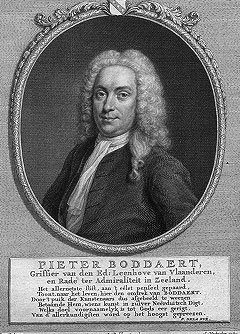
Pieter Boddaert
Pieter Boddaert

scientific classification:


– Order: Psittaciformes
– Family: Psittacidae
– Genus: Myiopsitta
– Scientific name: Myiopsitta monachus
– Citation: (Boddaert, 1783)
– Protonimo: Psittacus monachus


Monk Parakeet images:


Species of the genus Myiopsitta