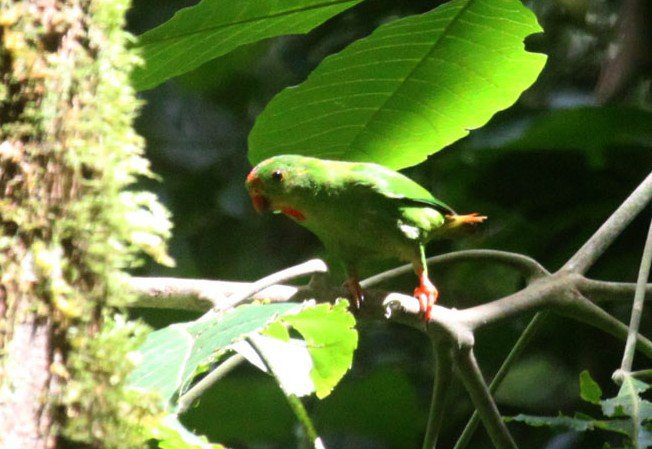
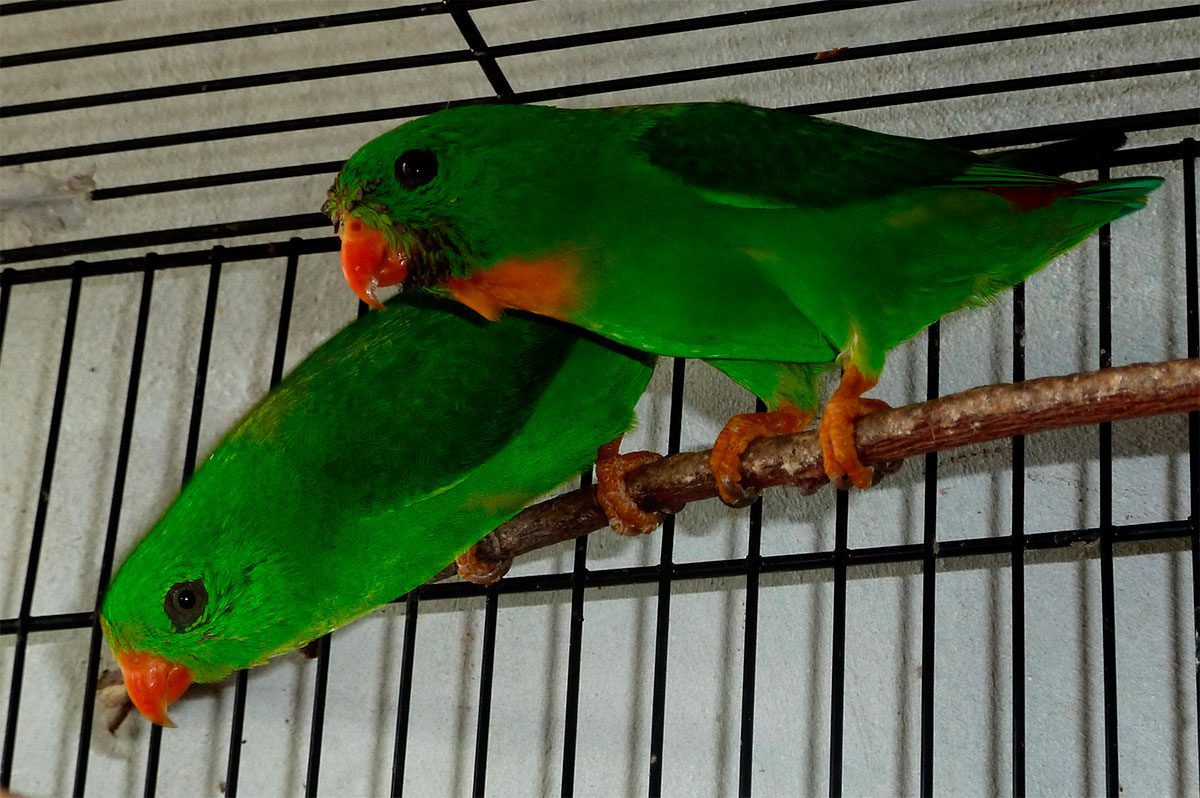
The head of the Wallace's hanging parrot(Loriculus flosculus) is green. Upperparts green with faint orange on the back of the neck; rump and uppertail-coverts red.
Wings green above. Chin red; rest of the underparts green, lighter in undertail-coverts. The tail, at the top, green color with a lighter Green Tip; ends of the lateral feathers, orange-red: Under, the tail bluish green. The bill red; Orange the irises; legs yellowish-orange.
Female with red chin reduced or nonexistent.
Immature with the red chin smaller. The color of the bill and legs more off.
Seem to need the humid mountain forests semi-evergreen. Birds have been seen in fruit trees, and outside the breeding season they gather in small flocks of up to 20 birds. Its altitudinal distribution seems to be closely linked to the distribution of fruiting figs.
They easily unnoticed due to its small size and green plumage, and they are most often in flight when they can be identified by the size, strident calls and the buzz of the rapid flapping. They are most frequently, flying above the canopy.
Reproduction:
There are no data from the reproductive process in nature.
Food:
Most sightings in 1993, the Wallace's hanging parrot they were in the fig tree in fruit trees, and dependence or specialization in this food resource is more than likely.
Its diet includes, In addition, nectar, outbreaks, flowers and seeds.
Distribution:
Size of its range (reproduction / resident): 13.400 km2
Endemic to Flowers. Found at semi-annual primary forest at an altitude between 400 and 980 m (more between 850 and 980 meters during the fructification of the Ficus figs) during observations on 1993. These birds were recorded in the area of Tanjung Kerita Mese, about Paku, to the East of Flowers and proposed as protected area.
Conservation:
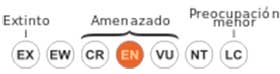
• Current IUCN Red List category: Danger
• Population trend: Decreasing
The habitat destruction through the combined effects of collecting firewood, the logging, timber extraction for construction materials and authorization for Agriculture, together they represent more relevant threats. Loss and fragmentation of forests is already widespread in Flowers, where there are semi-annual forest below 1.000 meters included within officially protected areas. These threats are exacerbated by the expansion of human population, with large volumes of wood necessary for housing construction, and the fact that there is little or no government enforcement of laws. Wet deciduous forest, it is currently being extensively destroyed through land grabbing and the establishment of agricultural areas., a factor that is inevitably shrinking the reach and the population of this species. Forest clearing continues on the coastal strip to make way for crops, and illegal logging continues in protected areas.
The population is estimated at a number of 2,500-9,999 mature individuals based on an assessment of the known records, descriptions of the abundance and range size.
Two recent studies have focused on endemic birds of Flowers. Two sites in which inhabits this species for the establishment as protected areas are proposed: Tanjung Kerita Mese and Egon Iliwuli (in Gunung Egon).
"Wallace's hanging parrot" in captivity:
Very rare in captivity.
Alternative names:
– Wallace’s Hanging-Parrot, Flores Hanging-Parrot, Wallace’s Hanging Parrot (ingles).
– Coryllis de Wallace (French).
– Florespapageichen, Flores Papageichen (German).
– Lorículo do Flores (Portuguese).
– Lorículo de Flores (español).
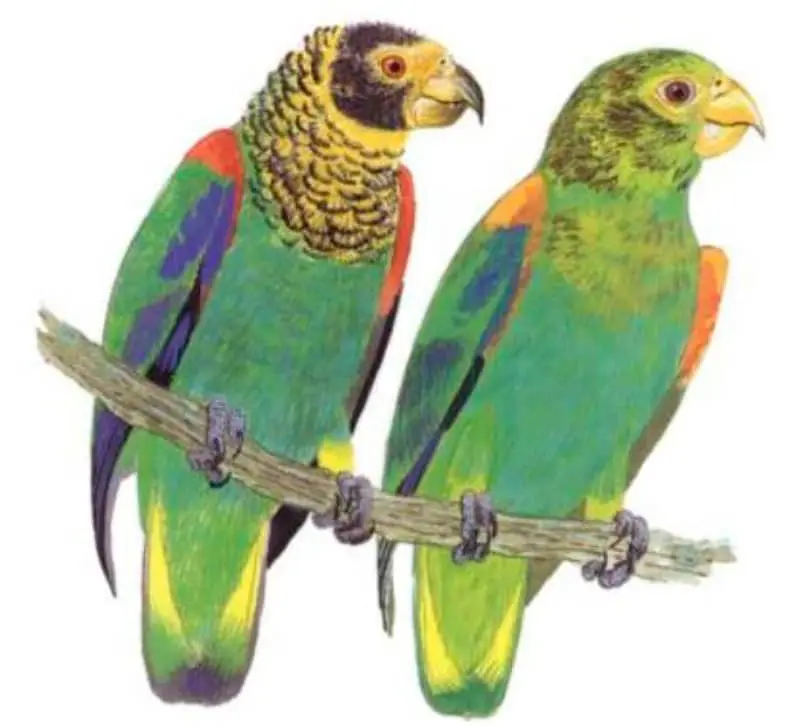
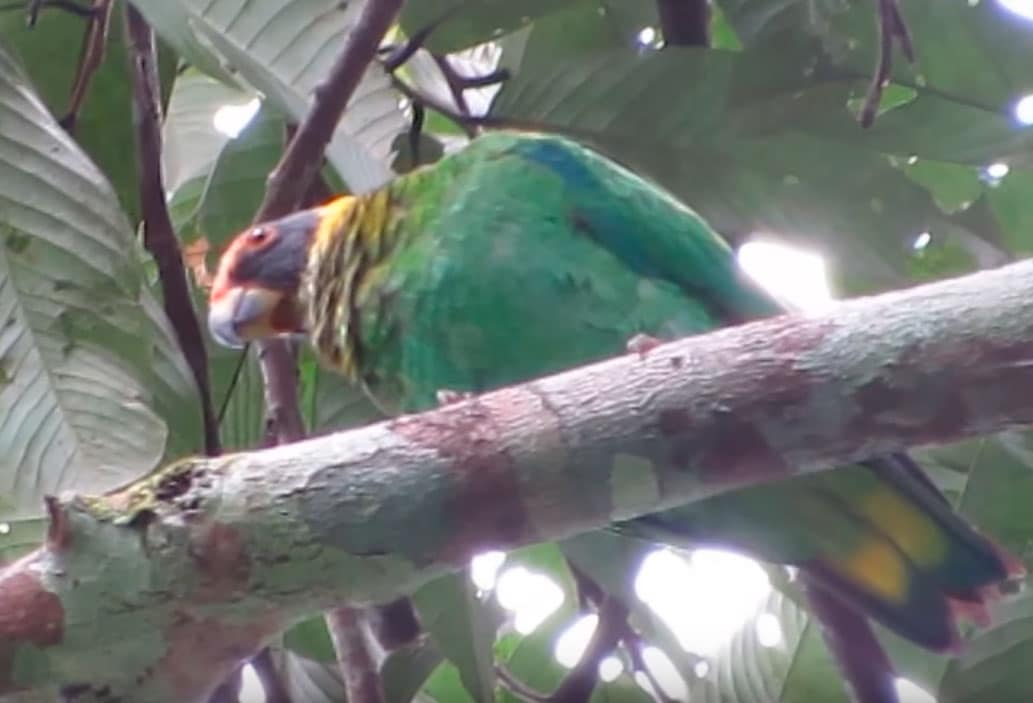
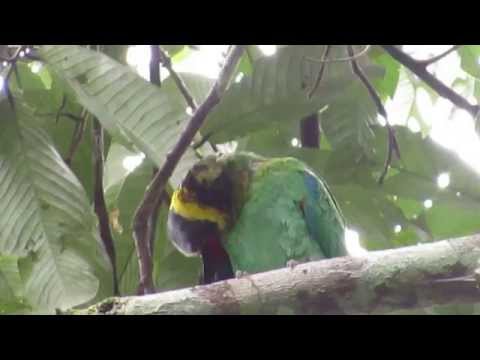
The Vulturine Parrot(Pyrilia vulturina) It is a small parrot with bare skin yellow orange and covered bristles pale hairlike, in the area that covers the forecrown and back of the crown, until the eyes; bare skin on lores, the cheeks and center of crown black and covered with bristles black hairlike; feathers on the sides of neck and in the part back from the crown, are yellow, forming a band bright contrasting with the black of the head bare; back of the neck, black; upperparts green.
carpal area and lesser upperwing-coverts, orange-yellow; outer median coverts with some blue; leading edge of wing, red; primary coverts blue; rest of the upper parts of the wings, green.
Primaries bluish-black with narrow bluish-green margins to outerweb. Under, the wings with coverts red; flight feather green with blackish tips. feathers throat and the chest, olive yellow with dark tips, giving a scalloped effect; belly green with bluish tint; undertail-coverts brighter yellowish green. Tail green with tips blue and outer feathers with yellow on base of innerwebs. Bill dark blackish-grey with patch pale yellow at the base of the upper jaw; cere yellowish-horn; irises brownish-orange; legs grey.
Both sexes are similar.
The head of the immature, fully feathered (except in the eye ring); greenish on the cheeks and yellow olive in the rest of the head with no collar yellow. The bend of wing and underwing-coverts, yellowish-orange; irises darker.
Sound of the Vulturine Parrot.
Habitat:
It inhabits in the rainforest of lowland formations várzea (seasonally flooded forest), and the Mainland (without flooding). Gregarious.
Reproduction:
No details on the reproductive biology of this species.
Food:
diet includes fruit, seeds and berries taken in the forest canopy. Its bareheaded adaptation may be a high frugivore diet, to prevent the fruit pulp enmarañara their feathers.
Distribution and status:
Size of its range (breeding/resident ): 1.030.000 km2
endemic to northeast Brazil, to the South of the amazon, from the eastern state of amazon, on the east bank of Madeira River, passing by For, to the south, up to the Serra do Cachimbo, extending eastward to the areas bordering northwest Maranhão, in the region of the Gurupi River. May be restricted to areas around major rivers within this region, which would mean that the size of the range may be overestimated.
References in relation to its range to include Venezuela (lower basin Caura River) and Guyana, They are apparently wrong.
generally considered Rare, although undoubtedly they not have a lot of data due to the difficulty of observation of this species.
The continuing rapid deforestation throughout its range has had to contribute to a substantial decrease in the population Vulturine Parrot in the last decades.
They can be seen in protected forests in the west of its range, but illegal logging and colonization remain a threat even there.
Conservation:
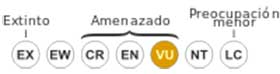
• Current category of the Red List of the UICN: Vulnerable.
• Population trend: Decreasing.
Rationale for the Red List category
Based on a model of future deforestation in the amazon basin and its dependence on primary forest and sensitivity to fragmentation, It is suspected that population of this species will decrease rapidly during the next three generations and, therefore, It has risen to Vulnerability.
Justification of the population
The population size World has not been quantified, but this species is described as «Rare» (Stotz et to the ., 1996).
Justification of trend
It is suspected that this species has lost 37,1-54,8% of habitat within its distribution over three generations (21 years) starting from a model of deforestation Amazon (Soares-Filho et to the ., 2006, Bird et to the ., 2011). Although the species may have some susceptibility to hunting and / or capture, also it appears to have some degree of tolerance habitat degradation (A. Lees in litt ., 2011). So, you suspect your population decline by 30-49% during three generations.
Conservation Actions Underway
• Is listed as Vulnerable nationally in Brazil (MMA 2014).
• No specific actions known.
Conservation Actions Proposed
• Expand the network of protected areas to effectively protect the IBA.
• Effectively manage existing and new protected areas and resources, using the emerging opportunities for financing the management of protected areas with the overall goal of reducing carbon emissions and maximize the conservation of biodiversity.
• It is also essential to conservation on private land, through the expansion of market pressures for proper land management and prevention of deforestation on land not suitable for agriculture (Soares-Filho et to the., 2006).
• Campaign against proposed changes to the Brazilian Forest Code that would lead to a decrease in the width of the areas of riparian forest protected as Permanent Preservation Areas (APPs), that function as vital corridors in fragmented landscapes.
"Vulturine Parrot" in captivity:
It is not found in aviculture; Probably they never stood outside Brazil.
Parrots A Guide to the Parrots of the World – Tony Juniper & Mike Parr
Birdlife
Photos:
(1) – Pyrilia vulturina (adult and immature) – Imagen de Parrots A Guide to the Parrots of the World – Tony Juniper & Mike Parr
(2) – Pyrilia vulturina ( Curica Vulture) by victor castro
▷ The world of Pets: Dogs, cats, birds, reptiles, amphibians
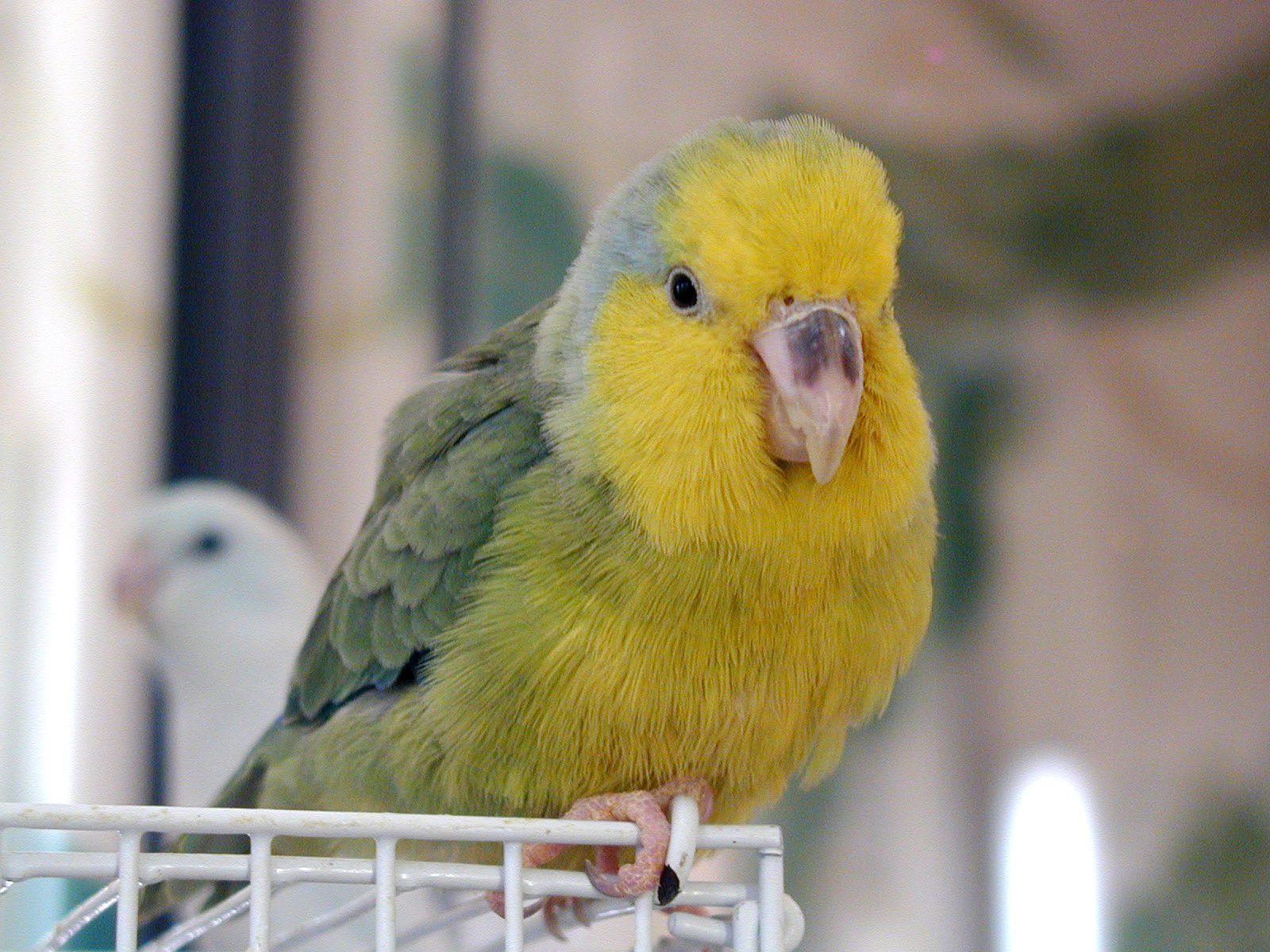
14 cm.. height. Plump appearance and short tail terminated tip. Distinguishable by the Crown, face, Yellow chest and belly, with strong wing blue patch, Flying Blue occupies almost half of the wing. Dorsally gray cafesoso, with the blue rump. The female has the blue patch on the rump and wings paler and smaller.
The Yellow-faced Parrotlet He lives in varied habitats, usually arid, forest riparian in the tropical and subtropical area, between 1000 to 1600 m, Although it has been reported to 2745 m. It is gregarious. Their diet includes cactus, In addition to fruit trees and other things. They nest in communal area, using tree hollows or sand. The breeding season is from March to April..
Distribution:
They are found in northwestern Peru., in the upper valley of the Marañón river, from the east of La Libertad to the southeast of Cajamarca and the south of Amazonas.
Conservation:
State of conservation ⓘ
Vulnerable ⓘ(UICN)ⓘ
According to the IUCN categories it is considered as Vulnerable (VU). Habitat degradation and trade are adversely affecting the population.
The ban on the capture and trade has improved the status of this species. The rate of decline was very rapid in the Decade of 1980, Although at present has been reduced and even stabilized. But, the population is still very small, with records in very few places, and as a result, according to the IUCN categories, qualified as vulnerable.
"Yellow-faced Parrotlet" in captivity
Captured for the trade of wild birds, It is estimated that 17.000 birds were captured between 1981 and 1994. The rate of mortality during capture is estimated between the 40% and the 100%. Rare and unknown in captivity until 1979-1980.
Images "Yellow-faced Parrotlet"
Alternative names:
1. Yellow-faced parrotlet (English).
2. Toui à tête jaune, Perruche-moineau à tête jaune (French).
3. Gelbmasken-Sperlingspapagei, Gelbmaskenpapagei (German).
4. Tuim-de-cabeça-amarela, Tuim, Periquito-de-cabeça-amarela (Portuguese).
5. "Catita enana de cara amarilla", Cotorrita carigualda, Periquito de Cara Amarilla (español).
The head of the Yellow-throated hanging parrot(Loriculus pusillus) is bright green.
Upperparts green with yellow orange washing pale in the mantle; rump and uppertail-coverts, bright red. Wings green above, undertail, Turquoise with coverts green. Throat bright yellow, rest of the underparts bright green. Feathers of the tail green above, with side coverts yellowed and pale blue below. The bill orange; irises yellowish white; legs oranges.
Female and immature with yellow throat very small.
Reported along the edges of the forest, and in the marshy forests of the lowlands to 1.850 meters above sea level.
Possibly Nomad in response to local plant phenology.
The species shows great activity, climbing acrobaticamente on the canopy at time of collection, and resting and sleeping mouth below as well as other members of the genus.
The birds are alone, in pairs or in groups of up to eight individuals.
Larger groups sometimes gather in trees to feed.. Although discrete, the Yellow-throated hanging parrot They attract attention, since when flying between the trees they beat their wings emitting a characteristic buzz, accompanied by shrill calls.
Reproduction:
The laying tends to be of two eggs, deposited in the hollow of a tree, Palm or arbol-helecho, from time to time in an old nest of a barbet or Woodpecker. The nesting in West Java It was recorded between March and May.
Food:
They feed on nectar, fruit (including the Ficus figs), leaves and flower buds, as Cassia and Erythrina.
Distribution:
Size of its range (breeding/resident): 167.000 km 2
Endemic to Java and Bali, where it is usually uncommon. The world's population is thought to be superior to 10.000, but it may have decreased due to the logging of forests
Conservation:
• Current IUCN Red List category: Near threatened
• Population trend: Decreasing
The world population It has not been quantified, It is thought to be above 10.000 specimens. The species is generally described as rare throughout its area of distribution (pit et to the., 1997).
There are no data on population trends; However, the species is suspected decreasing at a moderately fast pace, due to the loss and degradation of its habitat.
"Yellow-throated hanging parrot" in captivity:
Rare in captivity.
Alternative names:
– Yellow-throated Hanging-Parrot, Javan Hanging-Parrot, Little Hanging-Parrot, Yellow throated Hanging Parrot, Yellow-throated Hanging Parrot (ingles).
– Coryllis à gorge jaune (French).
– Elfenpapageichen (German).
– Lorículo do Java (Portuguese).
– Lorículo de Java, Lorículo Javanés (español).
Origin: Mexico, Guatemala, Honduras, Belice, Nicaragua, Costa Rica, Panama
Character: Curious and peaceful.
Life expectancy: 30 years
Height: 24 cm..
Content
Description:
24 cm.. length and a weight between 193-229 g..
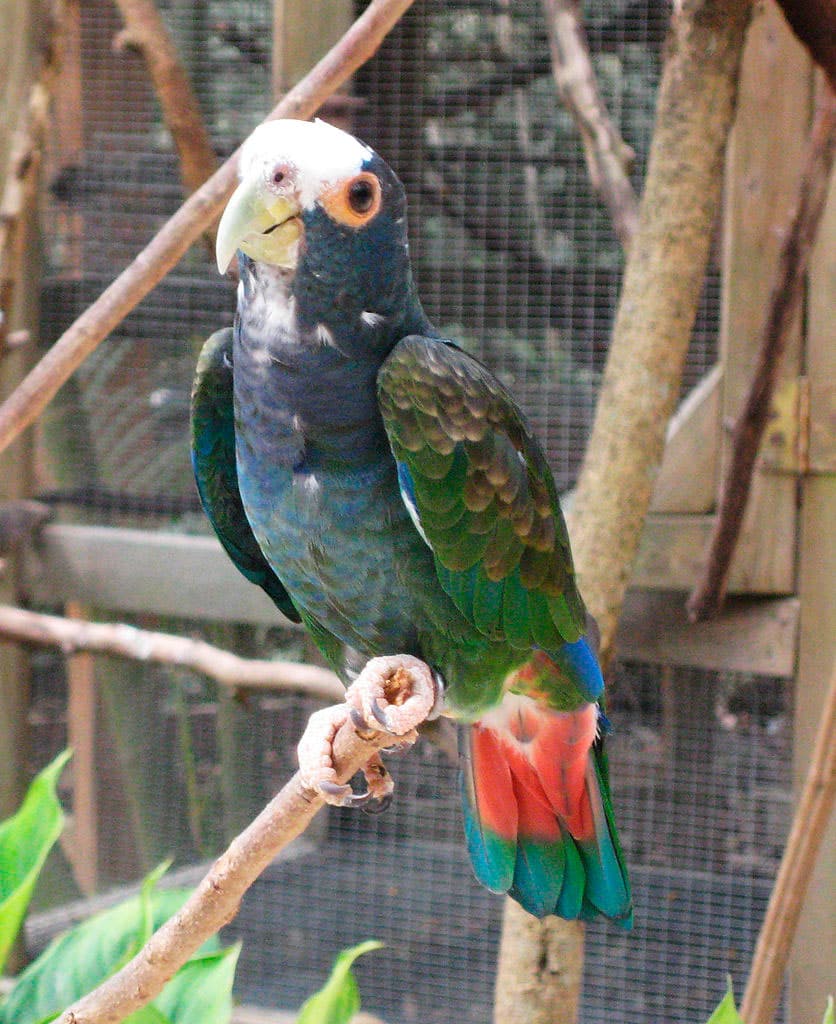
The White-crowned Parrot(Pionus senilis) has the forecrown, crown and lores, white. The feathers of the cheeks, sides head, behind eyes, and rear of the neck, basically pale bluish green with green or blue violet and blue subterminal band darker margins, giving the whole a intricate scaly appearance.
Mantle and back, green with copper plating shine; rump and uppertail-coverts, brighter green; scapulars basically colored green with coppery bronze in the points and outerweb. Lesser coverts and median, bronze with paler tips coppery, giving a mottled appearance; primary coverts, violet blue; greater coverts green. Primaries and secondaries outer, violet blue with green tips to outerweb of the primaries and inner secondary.
Under, the wings pale bluish green. Patch in chin and top of the throat, white; feathers of the chest, green at the base (mostly hidden part) tipped dark blue or violet-blue and blue band paler, giving the whole a scalloped effect; undertail-coverts red. Tail green in the center, outer feathers blue with red at base. Bill pale yellow color with light green tint; eye ring Pink; irises dark brown: legs yellowish gray.
Both sexes are similar. The immature has the head, the back of the neck and the chest, green, pale yellow with margins in the cheeks and crown, giving a pale mottling.
Note:
The subspecies decoloratus, which was distributed from yucatan peninsula to western Panama, previously recognized on the basis of their throat more purple (less blue) and your chest and wings, more blue. But, There is not much geographic variation in the species Pionus senilis and the aforementioned characters are not consistent on the proposed range.
Sound of the White-crowned Parrot.
Habitat:
The habitat of the Senile Parrot is mainly the humid forest (including tropical rain forest), but locally it can be found in forests of oak pine, and low mountain forest. Birds have been reported in forest edges, cultivated areas and grassland areas with scattered trees, plantations, secondary forest with emergent trees, woodlands and streams in Costa Rica, on the edge of urban areas.
Lives mainly in lowlands, but they are distributed locally 2.300 meters in Guatemala and near 1.600 meters in Costa Rica 1.800 meters in Panama. gregarious, mostly in pairs or out of breeding season, in small herds; sometimes in larger meetings of up to several hundred birds.
Reproduction:
Build your nests in tree cavities or hollow trunks of palm trees. The reproduction period occurs between February to May; in March in Mexico; in January-April Costa Rica; February to May in Honduras. The incubation comprises of 26-28 days, Followed by 54-68 pup growth days. It has been difficult to breed the species in captivity and there is little information on its reproduction in the wild..
The size of clutch is of 3 to 5 eggs
Food:
It feeds mainly on the tops of the trees seeds mature Inga and Erythrina and fruits Palm; sometimes cultures corn and Sorghum.
Distribution and status:
Size of its range (breeding/resident ): 1.290.000 km2
Endemic to Central America, from Mexico until Panama.
The White-crowned Parrot It is found in the humid tropics of eastern Mexico on the Caribbean side of Tamaulipas and to the East of San Luis Potosi eastward through yucatan peninsula, in Campeche and Quintana Roo, the borders of Belice and the northern lowlands and highlands of eastern Guatemala. It is found throughout the Caribbean slope of Honduras, mainly below 1.100 m (Occasionally highest altitudes) and in Roatan in the Bay islands, and on the Caribbean side of Nicaragua (possibly also on the side of peaceful) until Costa Rica, where it remains mainly in the lowlands and foothills of the Caribbean slope, becoming less and less numerous south of Lemon; also observed in the slope of peaceful in the South of Costa Rica and on both sides West Panama, to the West of Chiriqui and to the West of Bull's mouths.
Some local migrations (also apparently vertical) occur (for example, in parts of Oaxaca, Mexico and parts of Costa Rica). The species is widespread, but abundance varies from rare to very common depending on locality; It is perhaps the largest parrot in Costa Rica.
current distribution: No data where the current distribution of specified White-crowned Parrot. This species of psittacine still has a presence throughout its range, although there are regions where it has been extirpated, as the West's Quintana Roo and Gulf Coast (INE 2000).
Despite being frequently eaten by native peoples (at least once), persecuted as a pest of crops, caught in low numbers for the live bird trade and severely deforesting parts of their range, It has not detected a serious overall decline in population.
Conservation:
• Current category of the Red List of the UICN: Least concern.
• Population trend: decreasing.
sheltered Mexico by the Official Mexican Standard (NOM–059–SEMARNAT–2001–2010) under the category of Threatened.
Rationale for the Red List category
This species has a very large range and therefore it is not close to the thresholds for Vulnerable under the criterion of size range (Extension Occurrence <20,000 km2 combinada con un tamaño de rango decreciente o fluctuante, extensión / calidad de hábitat o tamaño de población y un pequeño número De lugares o fragmentación severa). A pesar de que la tendencia de la población parece estar disminuyendo, no se cree que la disminución sea suficientemente rápida para acercarse a los umbrales de Vulnerables bajo el criterio de tendencia poblacional (> 30% decline in ten years or three generations). The population size is very large and, therefore, not approaching the thresholds for vulnerable under the criterion of population size (<10.000 individuos maduros con una disminución continua estimada en> 10% in ten years or three generations or with a specific population structure). For these reasons the species is evaluated as the least concern.
Justification of the population
Partners in Flight estimates the total population of 50.000-499.999 individuals (A. Panjabi in a bit., 2008).
Justification of trend
It is suspected that the population is declining due to continuous habitat destruction.
"White-crowned Parrot" in captivity:
(CITES) It included in the Appendix II (It includes species not necessarily threatened with extinction, but in which trade must be controlled to avoid utilization incompatible with their survival.)
The species ranked first in the 80's among the most traded parrot species in Mexico (Iñigo Elias and Ramos 1992). Currently, there marketing of the species in the national and international market.
Valued as a pet or ornamental bird by its feathers, ability to imitate sounds and its tendency to form bonds with people.
Alternative names:
– White-crowned Parrot, White crowned Parrot, White-capped Parrot (English).
– Pione à couronne blanche, Pione givrée, Pionus à front blanc, Pionus à front blanche (French).
– Glatzenkopfpapagei, Glatzenkopf, Glatzenkopf-Papagei, Weißkappenpapagei (German).
– Curica-de-testa-branca (Portuguese).
– Lora coroniblanca, Loro Corona Blanca, loro corona-blanca, Loro Coroniblanco, Loro de Corona Blanca, Loro Gorgiblanco, Loro Senil (español).
– Loro coroniblanco (Costa Rica).
– Lora coroniblanca (Honduras).
– loro corona blanca, loro corona-blanca, Loro Coroniblanco (Mexico).
– Loro Gorgiblanco (Nicaragua).
– Avibase
– Parrots of the World – Forshaw Joseph M
– Parrots A Guide to the Parrots of the World – Tony Juniper & Mike Parr
– Birdlife
– Photos:
(1) – A White-crowned Parrot (also known as White-crowned Pionus) at Macaw Mountain Bird Park, Honduras By Pionus_senilis_-Macaw_Mountain_Bird_Park,_Honduras-8a.jpg: Sarah and Jasonderivative work: Snowmanradio [CC BY-SA 2.0], via Wikimedia Commons
(2) – A White-crowned Parrot (also known as White-crowned Pionus) at Macaw Mountain Bird Park, Honduras By nakashi (Flickr: P1100396) [CC BY-SA 2.0], via Wikimedia Commons
(3) – A White-crowned Parrot (also known as White-crowned Pionus) at Macaw Mountain Bird Park, Honduras By nakashi (Flickr: P1100397) [CC BY-SA 2.0], via Wikimedia Commons
(4) – (Pionus Senilis). White-crowned Parrot , Guatemala By Virgilrm at English Wikipedia (Transferred from en.wikipedia to Commons.) [Public domain], via Wikimedia Commons
(5) – A White-crowned Parrot (also known as White-crowned Pionus) at Macaw Mountain Bird Park, Honduras By nakashi (Flickr: P1100398) [CC BY-SA 2.0], via Wikimedia Commons
(6) – White-crowned Parrot (also known as the White-crowned Pionus); close up of upper body By Brian Gratwicke [CC BY 2.0], via Wikimedia Commons
(7) – A White-crowned Parrot at Cape May Zoo, New Jersey, USA By Jim Capaldi (Flickr: Parrot) [CC BY 2.0], via Wikimedia Commons
(8) – (Pionus Senilis) White-crowned Parrot in a tree By Virgilrm at English Wikipedia (Transferred from en.wikipedia to Commons.) [Public domain], via Wikimedia Commons
(9) – White-crowned Parrot (Pionus senilis), also known as White-crowned Pionus, at the aviary Birds of Eden in South Africa By SandyCole (mailto:sandyc@dicksandy.org) (Own work) [CC BY-SA 3.0 or GFDL], via Wikimedia Commons
– Sounds:
▷ The world of Pets: Dogs, cats, birds, reptiles, amphibians
the unmistakable White-bellied Parrot(Pionites leucogaster) has the lores, cheeks and throat, bright yellow lemon; "ear coverts", forecrown and crown, bright orange red; sides and rear of the neck, orange, but paler.
Upperparts green. Primary coverts blue; other coverts green. Primaries blue with green margins in outerweb. Underwing-coverts green. Breast
and center belly, white; undersides of belly and feathers the thighs, green; undertail-coverts Yellow. Upper, the tail green; undertail, pale grayish brown. Bill, color pale horn; cere Pink; irises reddish brown; legs pink.
(Sclater,PL, 1858) – As the nominal species but with the thighs and flanks bright yellow lemon (no verde); tail green.
Pionites leucogaster xanthurus
(Todd, 1925) – As the nominal species, but with the thighs yellow; flanks and tail, yellow and green the uppertail-coverts.
Habitat:
Prefers low humid forests, areas of land and várzea with probable preference for the latter and for clearings in the forests. Also observed in the drier forests (where it is less common) in the South of its range. Gregarious; Observed in the company of Blue-headed Parrot(Pionus menstruus) on Eastern Amazonia. Seen in small groups or couples.
Since they have very heavy body and very short wings, the White-bellied Parrot You can not fly long distances.
Reproduction:
With plays in January and nests in hollow trees; a nest 30m found in the cavity of a tree in the east of its range. Clutch Normal probably 2-4 eggs.
Food:
Very similar in habits Lorito Chirlecrés(Pionites melanocephalus) but no specific information about their diet; probably seeds, fruit and berries.
Distribution:
The size of its distribution area (reproduction / resident): 2.140.000 km2
The White-bellied Parrot It extends through southern amazon in Brazil, from northwest maranhão and around Bethlehem in the State of For, west on Mato Grosso to the North of Bolivia and Southeast of Peru, to the top of Ucayali, where it approaches the range of Lorito Chirlecrés(Pionites melanocephalus). Reports in eastern Ecuador (well within the limits of the latter) still not substantiated.
(Sclater,PL, 1858) – West Basin amazon, in the southeast of Peru, North of Bolivia and West of Brazil, where the subspecies intergran Pionites leucogaster xanthurus in the upper area of Yurua River
• Current category of the Red List of the UICN: In danger of extinction.
• Population trend: Decreasing.
Usually common but perhaps more scarce in drier forests on the southern fringes of the range. It is not at serious risk, but decreases locally (for example, the Eastern Amazonia) due to deforestation, and possibly extinct now Santa Cruz, Bolivia, due to the loss of habitat. Trapped for Local international trade (at least years), but apparently not yet having a serious impact on wild populations.
Conservation Actions Underway
• No specific conservation actions are known for this species.
Conservation Actions Proposed
• Expand the network of protected areas to effectively protect the IBA.
• Effectively treat resources and manage existing and new protected areas., using the emerging opportunities for funding the management of protected areas with the overall goal of reducing carbon emissions and maximize the conservation of biodiversity.
• Conservation on private land is also essential, through the expansion of market pressures for rational land management and prevention of logging on land not suitable for agriculture (Soares-Filho et to the., 2006).
• Campaign against proposed changes to the Brazilian Forest Code that would lead to a decrease in the width of protected riparian forest areas such as Permanent Preservation Areas (APPs), that function as vital corridors in fragmented landscapes.
"White-bellied Parrot" in captivity:
Do not have the capacity to speak of his larger parrots cousins, but they are very assets and can be very good pets, Despite not being very common to see them in captivity.
Alternative names:
– White-bellied Parrot, White bellied Parrot, White-bellied Caique (English).
– Maïpouri à ventre blanc, Caïque à ventre blanc (French).
– Rostkappenpapagei, Rostkappen-Papagei (German).
– Marianinha-de-cabeça-amarela, maipuré, marianinha, mariquita, periquito-d’anta, periquito-de-anta, periquito-de-cabeça-preta Pionopsitta barrabandi (Portuguese).
– Lorito Gordo de Cabeza Rojiza, Lorito Rubio (español).
– Loro de Vientre Blanco (Peru).
(1) – Pionites leucogaster xanthomeria By Mirjam (Picasa Web Albums) [CC BY-SA 3.0], via Wikimedia Commons
(2) – Pionites leucogaster leucogaster White-bellied Parrot (this subspecies is also know as the Green-thighed Parrot). Two in a cage with a nestbox By TJ Lin (originally posted to Flickr as 140) [CC BY-SA 2.0], via Wikimedia Commons
(3) – Pionites leucogaster xanthomerius A pet adult male White-bellied Caique perching by a row of books By pionetes (Own work (self-portrait)) [CC BY-SA 3.0], via Wikimedia Commons
(4) – Five White-bellied Parrots (also known as White-bellied Caique) at Bird Park, Foz do Iguaçu, Brazil. This subspecies is also known as the Green-thighed Caique (Pionites leucogaster leucogaster) By Chad Bordes (Picasa Web Albums) [CC BY 3.0], via Wikimedia Commons
(5) – White-bellied Parrot by Peter Tan – Flickr
(6) – White-bellied Parrot in captivity at Iguaçu Bird Park, Foz do Iguaçu, Brazil. Photographed on 23 April 2003 By Arthur Chapman [CC BY 2.0], via Wikimedia Commons
(7) – White-bellied Parrot (Pionites leucogaster) often referred to as the White-bellied Caique in captivity by whiskymac (Flickr) [CC BY 2.0], via Wikimedia Commons
(8) – White-bellied Parrot (often referred to as the White-bellied Caique); a chick. Its feathers have not opened yet By Ruth Rogers (originally posted to Flickr as Caique) [CC BY 2.0], via Wikimedia Commons
(9) – A painting of a White-bellied Parrot (originally captioned «Psittacus badiceps. Bay-headed Parrot») by Edward Lear (1812-1888) Edward Lear [Public domain], via Wikimedia Commons
30 cm.. length and an approximate weight of 370 g..
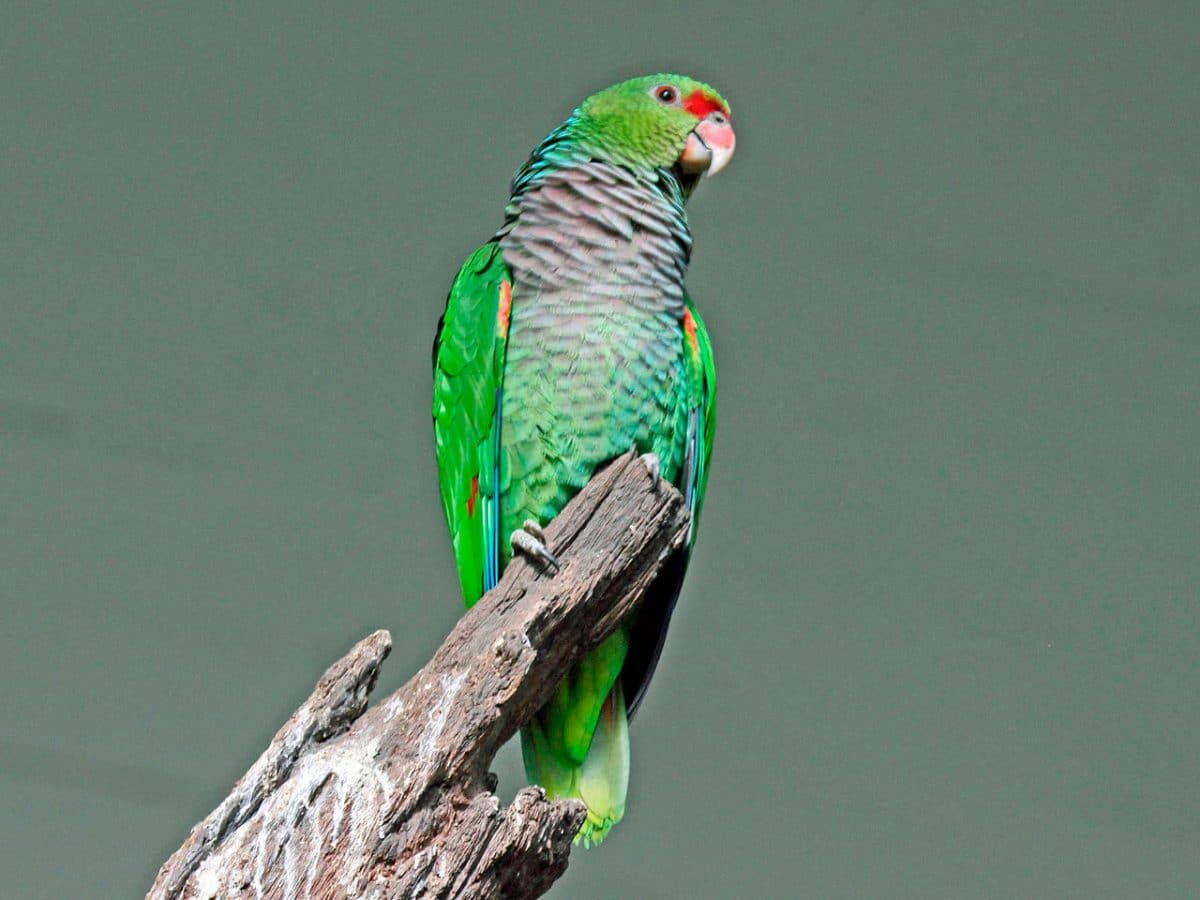
The Vinaceous Parrot(Amazona vinacea) has the lores and forecrown bright red; cheeks and crown green with black tips to some feathers head; elongated feathers on the sides of neck, the nape and the upper mantle, green at the base, subterminally light blue and black tip. The rest of the the mantle, back and scapulars, green with some feathers showing indistinct black tips; uppertail-coverts pale green.
Wing coverts green with red variable and / or yellow in leading edge of wing and the carpal area. Primaries pale bluish-green; Secondary green with blue tips, the base outerweb of the three outer secondaries, red, forming a small looking-glass. Under the wings, green. Throat and chest with shades that vary from strong wine brown to pale blue with a strong vinous diffusion; subterminal dark band at the tips of the feathers gives scalloping pattern; Belly green or yellowish green sometimes with vinous dissemination; undertail-coverts brighter yellowish green. Tail green with yellow green tip; the base lateral feathers in red innerwebs, in purple outerweb. The upper jaw It is red at the base with pale tip, horn-colored lower, reddish at the base; irises orange to reddish brown; legs grey.
Both sexes are similar. The immature It has the green suffusion in chest and the less extensive red on the head (confined to the base upper jaw).
Sound of the Vinaceous Parrot.
Habitat:
Video – "Vinaceous Parrot"
Purple-breasted Parrot in Itamonte - Minas Gerais, Brazil
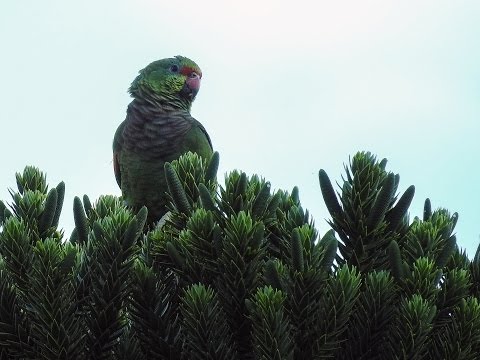
The Vinaceous Parrotinhabit in tropical and subtropical evergreen mixed forests; in the Brazil in humid coastal forests, in the East of Paraguay They can be found in forests Araucaria angustifolia and Euterpe edulis. The extent of the ecological dependence of this species on coniferous trees (Araucaria and Podocorpus) It is not clear, but the Araucaria angustifolia It is clearly important in Missions, Rio Grande do Sul and Santa Catarinaand possibly it was related to the previous distribution further north in southeast Brazil.
Mainly observed in the lowlands, but there are reports of birds seen in hills 1.500-2.000 meters in the southeast of Brazil, where the best forest remnants persist. Usually in pairs or small groups with larger meetings (up to approximately 30) in July-August. In pairs during breeding (usually around September).
Reproduction:
The Vinaceous Parrotnidifica in holes in large trees with obvious preference for the Araucaria angustifolia, including rarely cracks in the cliffs. With reproduce the May in loose colonies. breeding season during the months of September to January. Clutch 2-4 eggs.
After the breeding season (February to July), the species congregate in large groups and community shelters.
Food:
The specific foods of the Vinaceous Parrot include flowers and fruits of Euterpe edulis (which apparently it is important seasonally in East Paraguay), seeds of Araucaria angustifolia, fruits of cocoons of Achatocarpus and new leaves Eucalyptus and seeds of Pilocarpus. It has been reported damagor cause in crops of oranges, but with the current low density of this species, It is unlikely to produce a serious economic impact.
Distribution and status:
Size of its range (player / resident ): 1.230.000 km2
The Vinaceous Parrot It is endemic in Southeast South America.
There are some seasonal movements and post-breeding dispersal, possibly in relation to the food supply (for example, seed availability coniferous trees), with invasions scale reported in Paraguay in the past. Declines in the number of birds occur in Rio Grande do Sul January, with all its people disappeared by March and return in April for the rest of the year.
Formerly abundant and widespread but now there has been a contraction dramatic of its range and population, mainly due to the habitat destruction scale, the expansion of agriculture and floods caused by large hydroelectric dams. also trapped for a long time for bird trade.
Are distributed in several protected areas, but none is large enough to maintain a viable population. The former strongholds in eastern Paraguay They are subject to rapid deforestation, with a recent reduction in its scope and numbers and now probably confined only in Alto Paraná and Ganindeyu.
A census 2007 yielded a minimum of 253 copies in Argentina.
It is perhaps the Amazona more common in populations of Rio Grande do Sul, Santa Catarina and Paraná (several populations of more than 100 birds), in the South of Brazil, and the low number persists in Minas Gerais, Brazil and Sao Paulo, within an estimated total of 1.500-2.000 birds.
Conservation:
State of conservation ⓘ
Endangered ⓘ(UICN)ⓘ
• Current category of the Red List of the UICN: In danger of extinction.
• Population trend: Decreasing.
• Population size: 600-1700.
Rationale for the Red List category
This species is classified as endangered due to recent population estimates Brazil They indicate that the world population is very small and has suffered a rapid decline due to loss and fragmentation of habitat, aggravated by the trade. It is necessary to clarify whether Brazilian subpopulations exceed 250 specimens.
Justification of the population
Based on estimates 1.500 to 2.000 individuals in Brazil (G. Bencke in some. 2009), 220-400 in Paraguay and 253 in Argentina (K. Cockle in some. 2009), it is estimated that the total population is within the range of 1.970 -2.650 individuals and is probably positioned within the band 1,000-2,499. This is equivalent to 667-1.666 mature individuals, rounded here to 600-1.700 mature individuals.
Justification of trend
rapid and continuous population decline is suspected because of the Poaching of nests, the habitat destruction and persecution as a pest Of crops.
Conservation Actions Underway
• CITES Appendix I and II and protected by the Brazilian legislation.
• Nationally considered Vulnerable in Brazil (Urben-Filho et al . 2008, MMA 2014), and Critically Endangered in Argentina and Paraguay.
• Small populations are found in numerous protected areas (Wege and Long 1995, F. Olmos in some ., 1999).
• In the Argentina, two young provincial parks are used by the species, but they offer only partial protection because parrots use habitat outside the park for most of its life cycle, including, critically, the reproduction.
• In the Argentine stronghold of the species between San Pedro and Saint Rose, environmental education is underway to reduce the capture of chicks, and the population has been monitored since 2005 (Selva de Pino Paraná in litt project., 2007).
• It has been achieved successful captive breeding.
Conservation Actions Proposed
• Monitor large populations (in March Argentina).
• Study reproductive biology and demography throughout the species' range and develop structured captive breeding programs to counter the high level of poaching of wild populations..
• Protect the general Carneiro (Santa Catarina), Itaipu (Alto Paraná), RNP Itabó Rivas (Canindeyú), Estancia Golondrina (Caaguazu) and forests outside reserves Rio de Janeiro (Snyder et to the ., 2000) and between San Pedro and Saint Rose in Missions.
• Invest in permanently trained park rangers and resolve land tenure problems in Brazilian and Paraguayan reserves. (F. Olmos in some ., 1999, Cockle et al. 2007).
• Apply laws against the trafficking of species on the roads that connect the Monte Pascoal National Park with South Brazil (Snyder et to the ., 2000), in places where the species is captured and at borders and ports Paraguay and Argentina.
• Increase local public awareness to reduce nest theft and promote conservation of nesting sites..
• In Argentina, provide technical support to promote soil conservation, to avoid clearing forests for crops on small farms.
The Vinaceous Parrot in captivity:
The Vinaceous Parrot noted for its easy to imitate the human voice, better and clearer than the Amazona aestiva. Small easily they learn to speak.
Two decades ago, before placement in the Appendix 1 CITES Convention, this species was available in aviculture. It never was imported to Europe in a large number, but nevertheless often it offered for sale. Its price was higher than other species of Amazona available at that time, because of its amazing looks and his talent as an imitator. As the trade in wild birds was coming to an end, the captive population decreased markedly. While this species has been willing to breed for those that provide adequate breeding and have enough individuals to allow natural selection of the mate., captive breeding has been very disappointing, considering the number of birds that were previously available.
In the current avicultura, it seems that there are still a significant number of birds kept in Europe. A survey of amazon parrots in the European zoos, made in 1993 and published in 1994 by the EAZA, he listed in 59 species Vinaceous Parrot conserved in 11 zoological collections: of this, only three, Loro Parque (Spain), Walsrode Bird Park (Germany) and Beauval (France), had recorded breeding successes. It's known, However, that a significant number of Vinaceous Parrot They are held by private poultry farmers Europe and if these owners are willing to work in cooperation with EEP plan that can be started for this species, then the known captive population Europe could be big, enough to be considered as a viable.
The population of this species in captivity is similar to that of other species of the genus Amazona. In Loro Parque a couple is kept in an aviary in the exhibition area of ​​the park, and several more couples are kept in breeding cages suspended in their breeding outside exhibition. Suspended breeding cages are approximately 300 cm long x 95 cm width and height. Each cage has the nest-box placed against the outer rear panel, and there is a cut in the wire hole to allow birds to enter the nest-box. With the nest located outside of the cage, this eliminates the need to enter the service or inspect the nest-box.
The feeding of these birds is done twice a day. To the 7 Morning receive their main dish containing a mixed salad prepared with the following elements: – Apple, pear, tomato, beet, Carrot, alfalfa, lettuce, Peppers, papaya and other fruits and vegetables seasonally available; In addition, They are also used, when available, various fruits that are grown in the park, as nopal cactus plants and berries palmera pindó (Syagrus romanzoffiana). A second smaller dish meal in the morning provides birds commercial pellets dietary, and during the breeding season each pair is also given segments of their own supplement "pie" that is made fresh every day. The evening meal is given to 3:00 pm, with a mixture of nuts, seeds and beans cooked.
The Vinaceous Parrot It was raised for the first time Loro Parque in 1990, when one pigeon was raised hand. The couple proved to be very unreliable when it came to the incubation their eggs, why he has always resorted to artificial incubation or host and breeding. This couple Vinaceous Parrot He received on subsequent occasions eggs more common species to give them the opportunity to prove that they are good parents, but so far they remain unreliable.
No offspring were produced in 1991, but the couple tried again in 1992, when he carried out another manually raising and other raised squab. In 1993, when the same pair joined again, the clutch of eggs was transferred to a pair of Red-crowned Parrot(Amazona viridigenalis), which they proved to be excellent foster parents and raised chicks born. The same technique was used in 1994, but only one egg clutch proved to be fertile and the chick was raised successfully by Red-crowned Parrot.
– Avibase
– Parrots of the World – Forshaw Joseph M
– Parrots A Guide to the Parrots of the World – Tony Juniper & Mike Parr
– Birdlife
– THE VINACEOUS AMAZON Amazona vinacea AT LORO PARQUE – First Published in The Avicultural Magazine Vol. 103 No. 2
– Photos:
(1) – Vinaceous-breasted Amazon (Amazona vinacea) – San Francisco Zoo, California By Dick Daniels (http://carolinabirds.org /) (Own work) [CC BY-SA 3.0 or GFDL], via Wikimedia Commons
(2) – Vinaceous Amazon in captivity at the Rare Species Foundation Programme, Florida, USA By derivative work: Snowmanradio (talk)Amazona_vinacea_-RSFP-8a.jpg: Ruth Rogers [CC BY 2.0 or CC BY 2.0], via Wikimedia Commons
(3) – Vinaceous Amazon at the Walsrode Bird Park, Germany By Quartl (Own work) [CC BY-SA 3.0], via Wikimedia Commons
(4) – Vinaceous Amazon; two in a cage By TJ Lin (originally posted to Flickr as Copy of DSCN3375) [CC BY-SA 2.0], via Wikimedia Commons
(5) – flying. Picture taken in Morretes By Leandro Govoni Lacerda (Own work) [CC BY-SA 4.0], via Wikimedia Commons
(6) – A Vinaceous-breasted Amazon at Parque das Aves, Foz do Iguaçu, Brazil By Kee Yip from Union City, California, USA (IMG_4509_P1040019) [CC BY 2.0], via Wikimedia Commons
(7) – Pigeons neck Amazone (Amazona vinacea) Shot in Palmitospark Gran Canaria By Martingloor (Own work) [CC BY-SA 4.0], via Wikimedia Commons
(8) – Vinaceous-breasted Amazon (Amazona vinacea) – San Francisco Zoo, California By Dick Daniels (http://carolinabirds.org /) (Own work) [CC BY-SA 3.0 or GFDL], via Wikimedia Commons
(9) – Amazone vineuse, Bioparc Doue-la-Fontaine By Melvin TOULLEC (Own work) [CC BY-SA 4.0], via Wikimedia Commons
– Sounds: (Xeno-canto)
▷ The world of Pets: Dogs, cats, birds, reptiles, amphibians
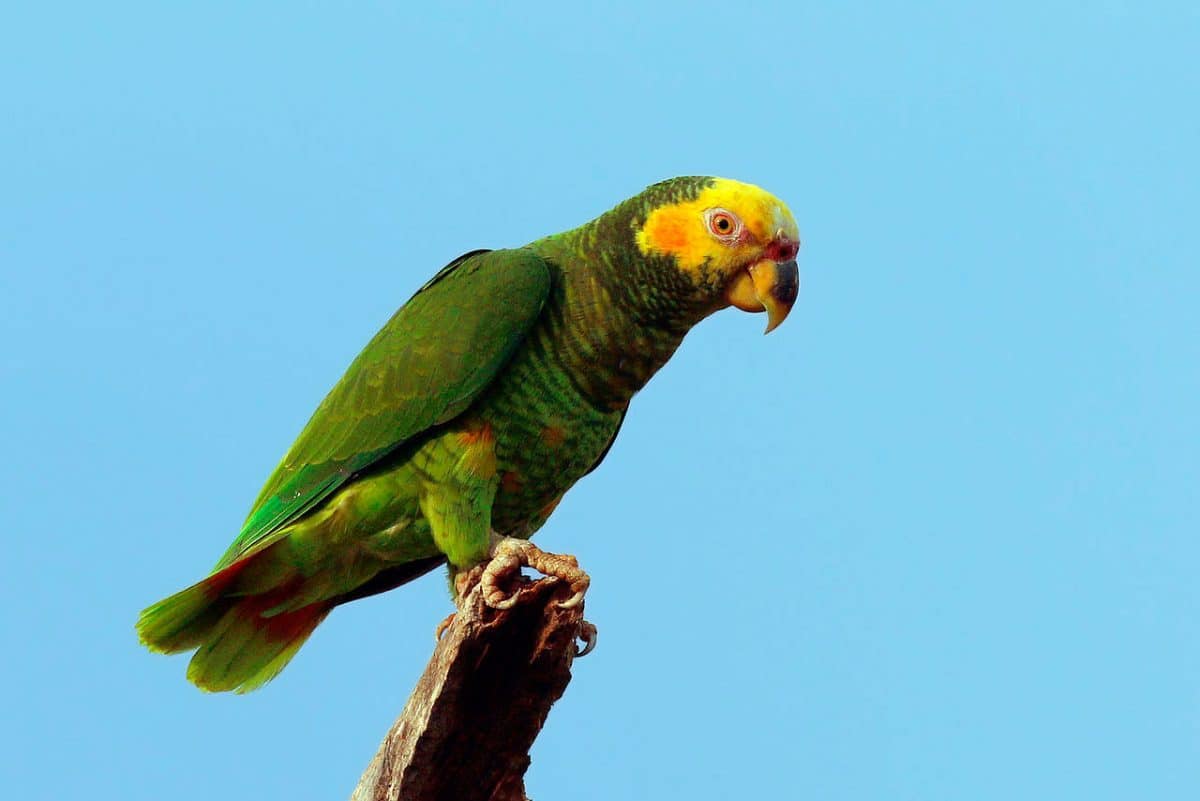
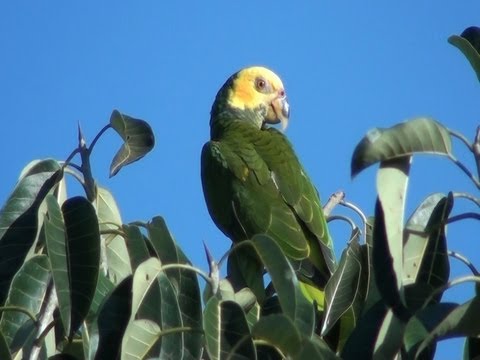
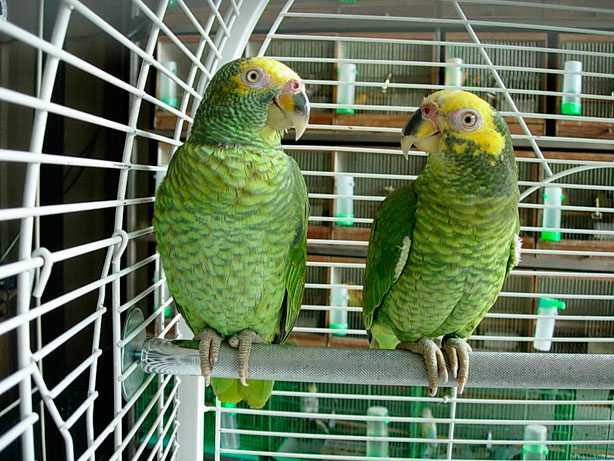
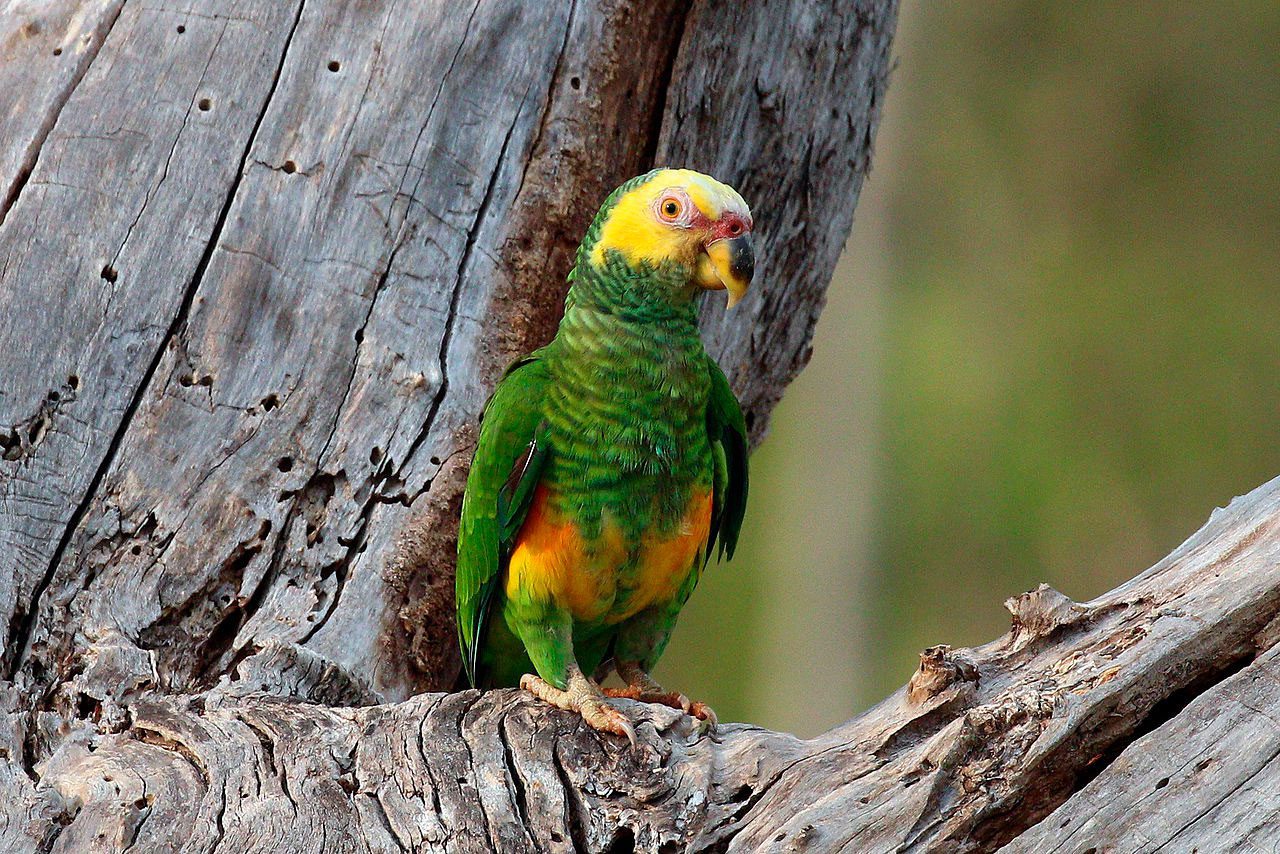
The Yellow-faced Parrot(Alipiopsitta xanthops) It is distinguished by the large area of ​​yellow in the head, with green tint nape; orange to the sides of body and upper base of the tail; collar yellowish green, belly almost all yellow, the thighs and green inner core tail green; the back it is usually green with yellow tints.
It inhabits in dry forests, also called deciduous forests, in lowlands, with the presence of palmas Mauritia, Although they prefer water courses.
They can be seen in pairs or flocks of up 50 specimens.
Although little information regarding this is available, it is known that nest in the hollows of the highest trees closed; the laying usually three eggs and the incubation period is 23-24 days.
Food:
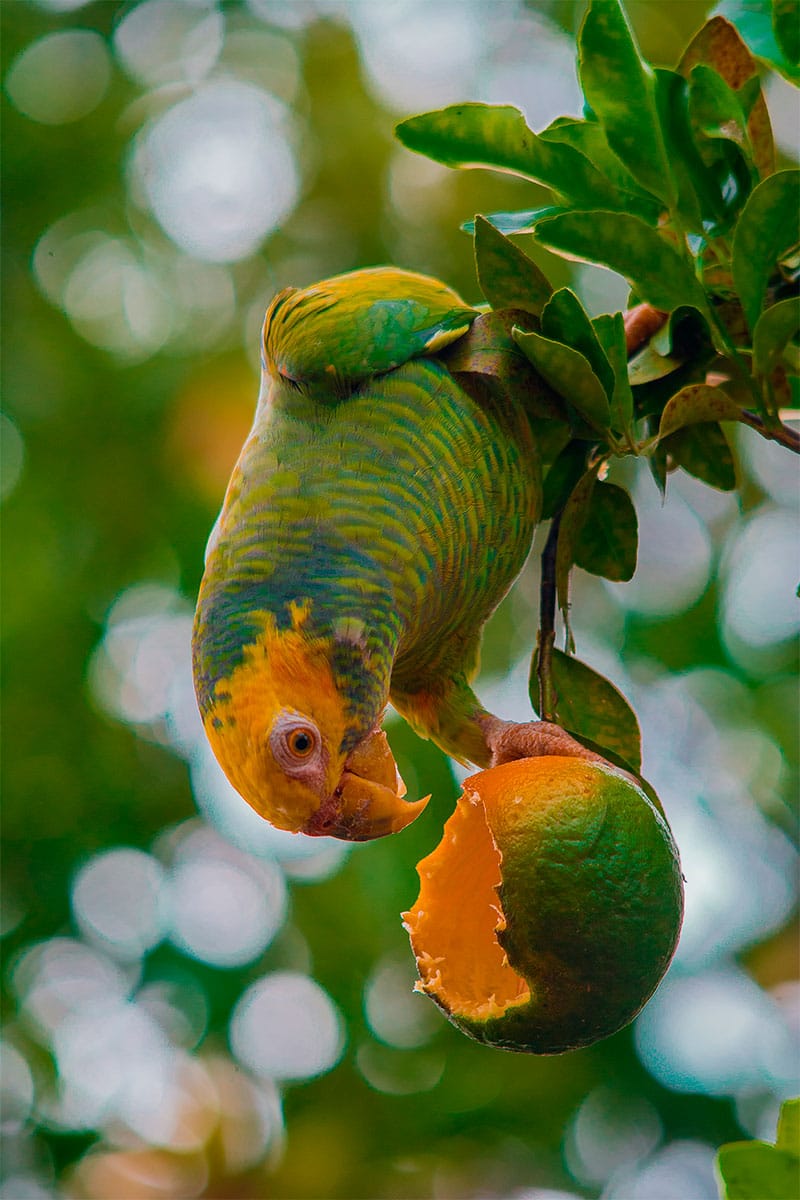
It's a species of which there are few studies of their natural habitat. Its main food It consists mainly of fruits and seeds. Very fond of mangoes, usually visit their trees full of fruit.
Distribution:
Size of its range (reproduction / resident): 2.700.000 km2
Inside of Brazil and adjacent area to the east of Bolivia and Horqueta, in the East of Paraguay.
Conservation Alipiopsitta xanthops:
State of conservation ⓘ
Near Threatened ⓘ(UICN)ⓘ
• Current category of the Red List of the UICN: Near-threatened.
• Population trend: Decreasing.
In 1993 two thirds of the Cerrado, This species inhabited, had been moderately or severely altered by agriculture, heavy cattle farming, invasive grasses, the use of pesticides and annual burning.
Conservation Actions Proposed:
• Collate sample data and recent records to provide an improved assessment of distribution and status.
• Estimate the total wild population (Bianchi 2009).
• Assess the impact of habitat loss (Snyder et to the . 2000).
active, curious and playful. Aggressive with other parrots. They can become very noisy. Prone to obesity
Its reproduction rarely been achieved in captivity. The basic requirement would be to isolate a compatible pair during the breeding season due to increased aggression towards other birds during this period.; also require spacious accommodations and a nest box of 25 x 25 x 60 cm. . with input from 8 cm in diameter.
They tend to be aggressive toward their caregivers. The breeding season begins in early May. The implementation is of 2 to 4 eggs, which are incubated during 26 days. The young leave the nest when they are near the 8 weeks of age.
Alternative names:
– Yellow faced Parrot, Yellow-crowned Amazon, Yellow-crowned Parrot, Yellow-faced Amazon (English).
– Amazone à face jaune (French).
– Goldbauchamazone, Schoapapagei (German).
– Papagaio-galego, chorão, curau, papagaio-acurau, papagaio-curraleiro, papagaio-de-barriga-amarela (Portuguese).
– Amazona Chica, Amazona del Cerrado, Loro cara amarilla, Lora chica (español).
(1) – Yellow-faced parrot (Alipiopsitta xanthops) green morph, the Pantanal, Brazil By Charlesjsharp (Own work, from Sharp Photography, sharpphotography) [CC BY-SA 4.0], via Wikimedia Commons
(2) – Yellow-faced parrot (Alipiopsitta xanthops) yellow morph, the Pantanal, Brazil By Charlesjsharp (Own work, from Sharp Photography, sharpphotography) [CC BY-SA 4.0], via Wikimedia Commons
(3) – Alipiopsitta xanthops, Yellow-faced Parrot; two in a cage By TJ Lin (originally posted to Flickr as yellow-faced amazon) [CC BY-SA 2.0], via Wikimedia Commons
(4) – Yellow-faced Parrot in Giza Zoo By Hatem Moushir (Own work) [CC BY-SA 3.0], via Wikimedia Commons
(5) – Record made in the city of Três Lagoas-MS, urban area. A flock landed on a ponca tree to feed By Jairmoreirafotografia (Own work) [CC BY-SA 4.0], via Wikimedia Commons
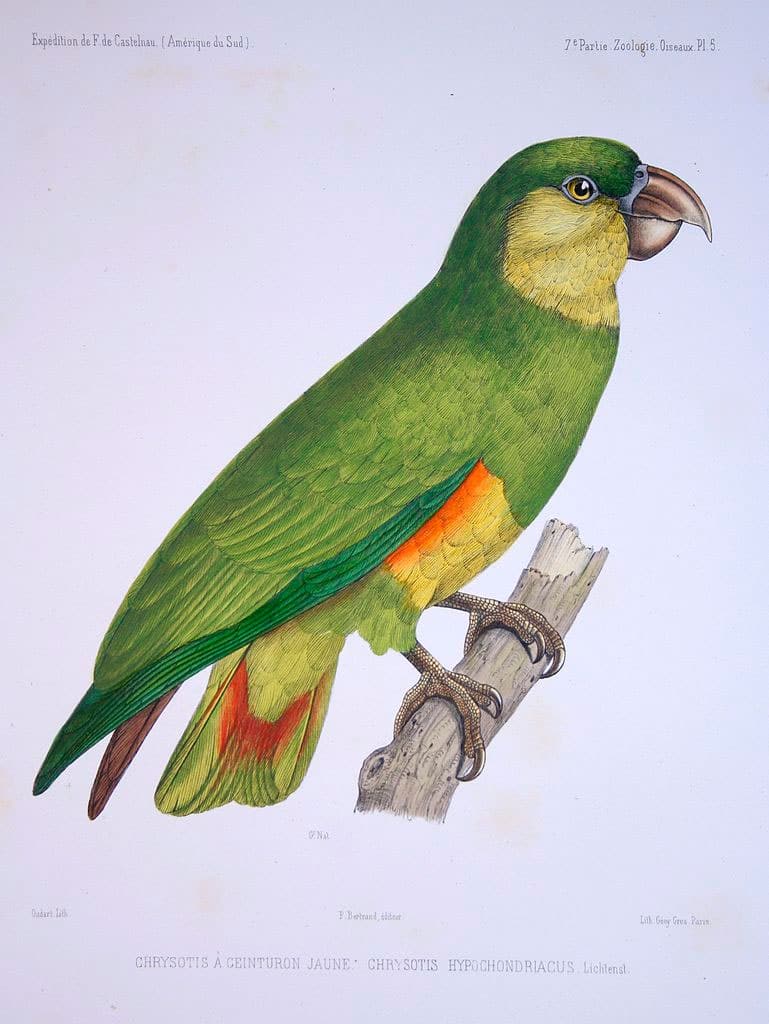
(6) – Illustration does not look like A. xanthops (Yellow-faced Parrot). Fisch's Papageien monograph discusses this dubious specimen by Francis de Laporte de Castelnau [Public domain], via Wikimedia Commons










.jpg)


.jpg)


.JPG)


_green_morph.JPG)
_yellow_morph.JPG)


