โ–ท The world of Pets: Dogs, cats, birds, reptiles, amphibians

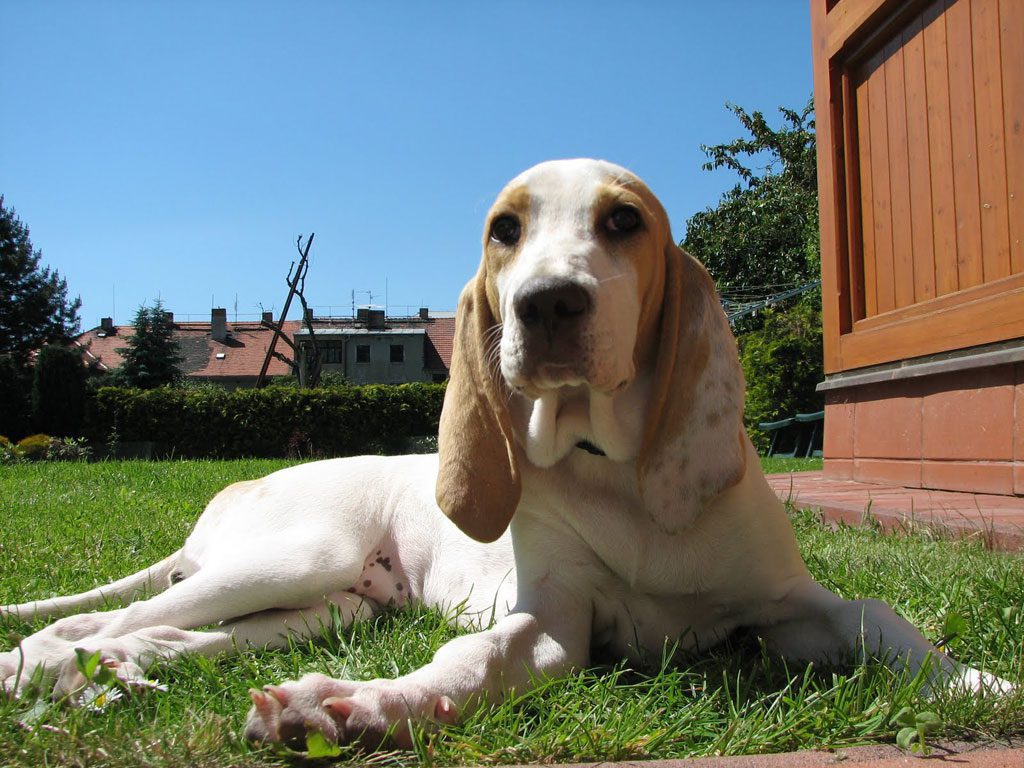
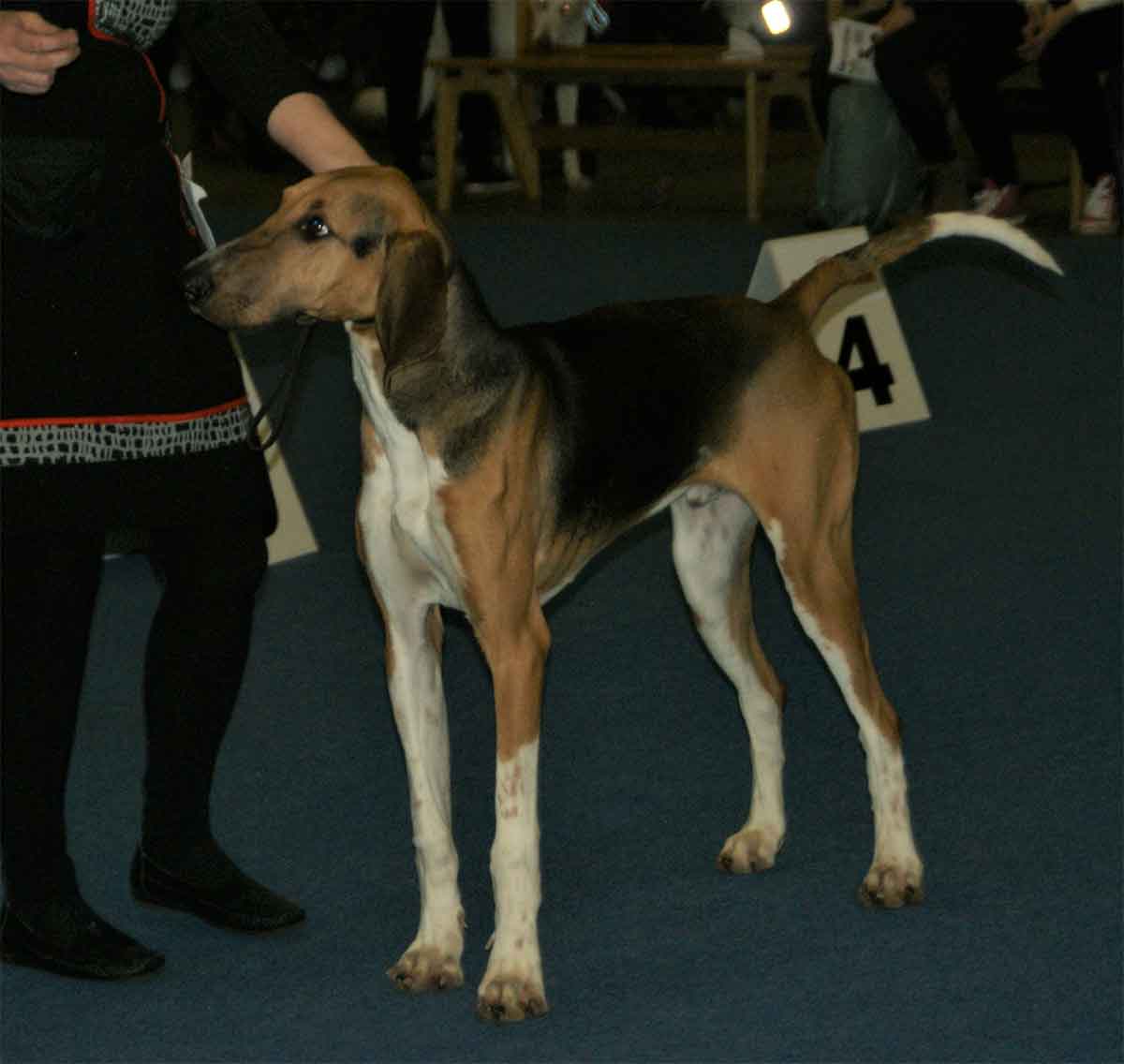
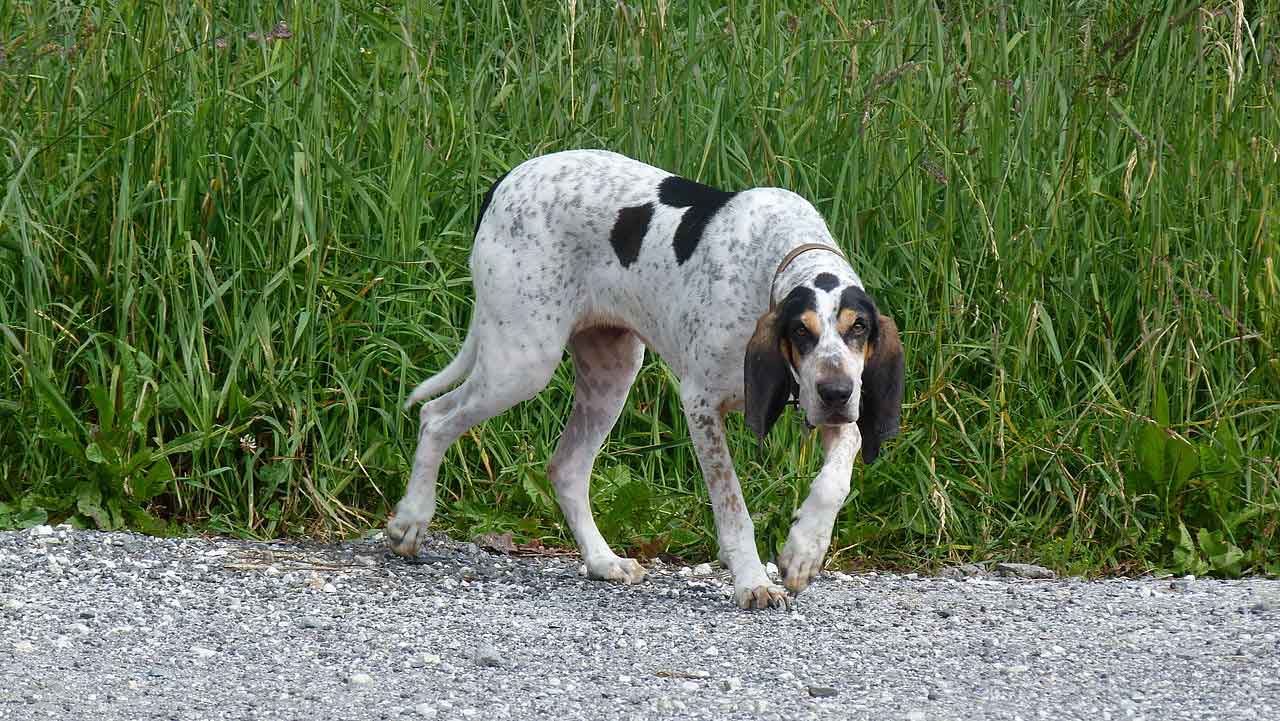
Poitevin hound
Francia FCI 24 . Large-sized Hounds

Poitevin hound

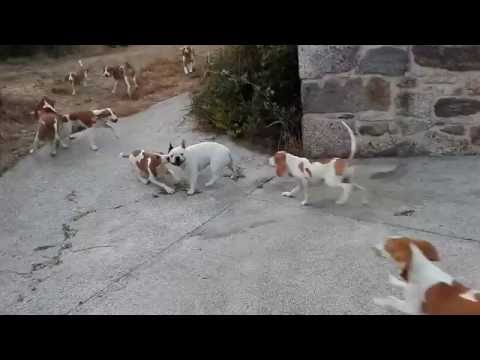
In the past, the Poitevin hound was also used as a wolf hunter.

Content

History Poitevin hound

The most widespread hypothesis about the origin of this breed of dog is that it was Viscount ร‰mile de La Besge who began to breed the Poitevin hound in the first half of the 19th century. Their dogs, that he had received as a present from an uncle, were the result of a union between Chiens Blancs du Roi and Larryes. The viscount bred no other dog until rabies killed him in 1842. He lost all his animals except two bitches.

To restore its population, ร‰mile de La Besge had six dogs brought to him from England (probably English Foxhound). But, then tried to roll back his influence by strict inbreeding. Thus the two males were born, Talbot and Rochester, and the two females, Tartane and Turbulente. Talbot and Turbulent They had a daughter, Dashing, who became famous for her particularly fine nose and speed. Mated with Traveller, an English male bred by him Conde Le Couteulx and gave birth to puppies of exceptional quality. It is assumed that Poitevin of today are all descendants of Fringante and Traveller. But, a certain earl Henri de La Porte stated that his uncles Auguste and Paul had already begun to fix the race in 1835, and that in the beginning there were quite a few others, namely, the male Tรฉnor and the female Ravissante.

The Poitevin hound was not accepted as a purebred dog for a long time. In the famous French hunting manualParforce, published in 1890 by the count Le Couteulx de Canteleu, only "bastards of the Haut-Poitouยซ, although the ability of dogs to hunt wolves was certainly appreciated. Besides the royal white dogs and the English Foxhound, it is said that the disappeared Larryes and Cรฉris contributed to the creation of the breed. It was a Scent hound medium size white and orange. It is said that he resembled greyhounds and was a very good hare hunter.. Perhaps it is from him that the special elegance of the Poitevin hound. Some cynologists also believe that it comes from Larrye, who is said to have had greyhounds in his ancestral line.

Photos:

1 – A Poitevin by Canarian, CC BY-SA 4.0, via Wikimedia Commons

Physical Characteristics Poitevino Hound

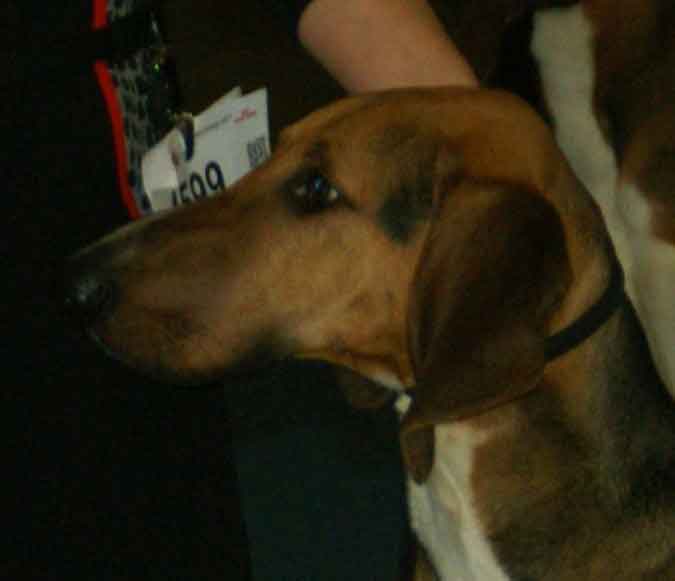
The coat of these pedigree dogs is short and shiny.. Dogs are usually tricolor and have black fur or large black spots. Some specimens can also be two-tone orange and white or wolf-colored.. In general, the physique is powerful and elegant. The expressive dark eyes give the Poitevin a serious look.

Height to the cross: For males between 62 and 72 cm., for females 60 to 70 cm..

Weight: Approx.. 30 kg.

Character and skills Poitevin hound

The character of Poitevin hound is characterized by its resistance and toughness. This pedigree dog is not deterred even by rough terrain. The race Poitevin is brave. He's kind to humans.

Dogs of this breed were bred for hunting and, usually, they are not satisfied with a life as a couch dog. Ideally, these dogs should be hunters. If you want to have a dog of this type, but do not use him to hunt, you must offer these animals a suitable occupation and sufficient exercise.

Aptitudes

In the past, the Poitevin hound he specialized mainly in hunting wolves. He was tirelessly in the way of his difficult prey. But today this beautiful hunting dog, that is strong, elegant and light at the same time, can be used for hunting all animals. The forest of La Mouliรจre, where did he born Poitevin hound ago 150 years under the aegis of the Viscount of La Besge, it was not easy terrain. The dogs had to be able to wander through the dense, thorny undergrowth without hesitation and were not allowed to be disturbed by overhanging branches., gorse and the like. And to this day the breed has retained its special strength and tenacity., allowing you to complete a task in any circumstance.

Poitevin hound
Poitevin hound

It also, the Poitevin hound I needed a proper portion of courage, because I had to put the wolf, as well, and it was much bigger than his own Poitevin. The Poitevin they even had to chase especially robust wolves, sometimes almost 100 km. During the night they and the dogs rested, but the next morning the Poitevin they had to be able to follow the trail again. For this they needed an extremely pronounced sense of smell.

Has been used to living in a kennel for a long time, so this is still the ideal way to keep the Poitevin hound. But, the kennel should be so large that the dogs that live in it have enough space to vent. One should strictly pay attention to the hygiene and cleanliness of his place.

Also outside the hunting season the Poitevin hound needs plenty of space and enough opportunities to run and play, a park would be ideal. If dogs live in a kennel, visit them as often as possible, because the relationship with humans should not be neglected.

Poitevin hound health and care

The Poitevin is considered a dog with robust health. Little maintenance required. The short coat can be brushed from time to time. The ears should be checked regularly for parasites and cleaned. Dog owners who want to cover themselves as best as possible are advised to have medical insurance for dogs and liability insurance for dogs.

Poitevin hound Nutrition

This dog eats for two, especially during hunting season. But he is not very picky and is satisfied with simple food. Daily 200 g of vegetables with 200 g of dog or rice flakes and 400 g of meat. offal such as liver, the kidneys and heart are particularly suitable. Especially for puppies and young dogs. Eggs also contain many valuable nutrients. They can be fed both cooked and raw. In certain circumstances, even with the shell. During hunting season, which is very hard for dogs, you must feed them fatty bacon. Of course, the dog must always have fresh water available. An automatic irrigation system is recommended here.

Where to buy a Poitevin hound

If you are interested in this breed of Scent hound and are looking for the right Poitevin hound breeder, you may need to plan a little more time for the search. These French hunting dogs are not too common outside of their country of origin.. For this reason, interested parties should look for a breeder in France.

Videos "Poitevin hound"

Poitevin hound ๐Ÿถ๐Ÿพ Everything Dog Breeds ๐Ÿพ๐Ÿถ
Poitevin hound ?? Everything Dog Breeds ??
Your Ideal Pet The Poitevin

Type and recognitions:

  • FCI CLASSIFICATION:
  • Group :
  • Section : . .

Federations:

  • FCI – Group 6: Scent hounds, and related breeds. – Section 1.1: Large-sized Hounds. โ“˜
  • Central Canine Society โ“˜

FCI breed standard "Poitevin hound"

Origin:
France

Date of publication of the valid original standard:
17.11.1978

Use:

Hound


General appearance:

This is a very distinguished dog, that brings together, with a high degree of perfection, characteristics such as strength, elegance and agility, combined with a set of very attractive colors.


Behavior / temperament:

---

Head:

It is elongated, but without excess. It is not very wide, and the bones protrude with a slight protuberance at the back of the skull.

Cranial region:

Craging: It is flatter than domed and descends in a slight slope towards the nasal cannula..

facial region:

  • Trufa: Very strong, wide and prominent.
  • Caรฑa nasal: Slightly swollen. It is elongated, although not in excess.
  • Belfos: The upper lip covers the lower lip well. The snout is somewhat sharp.
  • Ojors: Large, browns, black bordered. The look is expressive.
  • Obars: Medium width. They are thin and their insertion is a little low. They are medium long and somewhat crooked.

Neck:

It is long, delgado, and does not have a double chin.

Body:

  • Espalda: It is well muscled and appears well attached to the body..
  • Pork loin: Well muscled.
  • Coscaffold: long.
  • Flalso: They are slightly raised, although the belly is quite developed.

Tail:

Medium length. It's thin, and it is not spike-shaped (towards the tip, around the tail, a few longer and thicker hairs slightly distant). It appears well attached to the spine, and has a slightly curved shape. The dog carries it with elegance.

Tips

PREVIOUS MEMBERS: Straight, well muscled. They are thin, strong, flat and wide.

Hormbro: Long, flat and oblique. It appears attached to the body.

LATER MEMBERS:

  • Ancas: Slightly oblique, solid and long.
  • Thighs: Very muscular.
  • Corvejรณn: It is located close to the ground. It is well poised, although it is slightly angled.

PIIS: wolf foot, rather elongated and very resistant.

Movement:

It's very loose. The dog gallops easily, High effortlessly and moves very well in the undergrowth.

Mantle

PIEL: The truffle is black. The skin of the testicles varies between white and black.

Plink: short and bright.

Colorr: Tricolor, with a black cloak or with large spots; sometimes it is white or orange. Many specimens have wolf-colored hair.


Size and weight:

Height to the cross of 62 to 72 cm in males, and 60 to 70 cm in females.


Fouls:

Any deviation from the aforementioned criteria is considered as a fault and the severity of this is considered to the degree of the deviation to the standard and its consequences on the health and well-being of the dog..

FALTAS DISQUALIFYING:

  • Aggressiveness or extreme shyness.
  • Any dog โ€‹โ€‹showing clear signs of physical or behavioral abnormalities must be disqualified..
  • Cobarday, aggression toward owner.
  • black and white dogs.
  • Chin presence.
  • Dogs with mild underprognathism will not be eliminated.
  • In equal quality, dogs with a normal jaw are preferred.


N.B.:
  • Males should have two normal-appearing testicles fully descended into the scrotum..
  • Only functionally and clinically healthy dogs, with the typical conformation of the breed, should be used for parenting.

Itlatest changes are in bold.

Source: F.C.I - International Cynological Federation

Alternative names:

1. Haut-Poitou (English).
2. Chien du Haut-Poitou (French).
3. Haut-Poitou (German).
4. Pictava (Portuguese).
5. Poitevino (espaรฑol).

โ–ท The world of Pets: Dogs, cats, birds, reptiles, amphibians

Petit Gascon Saintongeois
Francia FCI 21 - Medium-sized Hounds

Petit Gascon Saintongeois

The Petit Gascon Saintongeois was destined, in its origins, mainly hunting the hare.

Content

History

Of French origin, named after the provinces of Gascuรฑa and Saintonge.

By mid-century 20, some large game hunters in the Southwest selected the smallest specimens from their litters of Gascon Saintongeois and they fixed this variety, destined, in its origins, mainly hunting the hare.

Photo: Little Gascon de Saintonge by Jรฉrรดme BARDIAU, CC BY-SA 3.0, via Wikimedia Commons

Physical characteristics

Medium-sized dog, well proportioned and distinguished.

Size:

Males: 56 to 62 cm..
females: 54 to 59 cm..

Character and skills

Multi-purpose dog used for rifle hunting. Because of its origin it hunts especially the hare, but it is also very good for hunting big game.

Characteristics "Petit Gascon Saintongeois"

Coexistence is important that you have with your new friend. Before considering the acquisition of a dog of the breed "Petit Gascon Saintongeois" you know certain factors. Not all breeds of dogs are apt to live in an apartment, you must take into account his character, their need for exercise, their interaction with other pets, their care and if you have small children, their level of tolerance towards them.

Adaptation โ“˜

2,0 of 5 stars (based on 1 review)

friendly dog โ€‹โ€‹โ“˜

3,0 of 5 stars (based on 1 review)

hair loss โ“˜

2,0 of 5 stars (based on 1 review)

Affection level โ“˜

2,0 of 5 stars (based on 1 review)

Need for exercise โ“˜

5,0 of 5 stars (based on 1 review)

Social need โ“˜

4,0 of 5 stars (based on 1 review)

Home โ“˜

2,0 of 5 stars (based on 1 review)

Toilet โ“˜

1,0 of 5 stars (based on 1 review)

Friendly with strangers โ“˜

2,0 of 5 stars (based on 1 review)

barking โ“˜

3,0 of 5 stars (based on 1 review)

Health โ“˜

4,0 of 5 stars (based on 1 review)

Territorial โ“˜

2,0 of 5 stars (based on 1 review)

Cat friendly โ“˜

2,0 of 5 stars (based on 1 review)

Intelligence โ“˜

4,0 of 5 stars (based on 1 review)

Versatility โ“˜

5,0 of 5 stars (based on 1 review)

Child friendly โ“˜

4,0 of 5 stars (based on 1 review)

Surveillance โ“˜

2,0 of 5 stars (based on 1 review)

joy โ“˜

4,0 of 5 stars (based on 1 review)

Videos "Petit Gascon Saintongeois"

HTTPS://youtube.com/watch?v=aM1D0Ttrupo
Petit Gascon Saintongeois
HTTPS://youtube.com/watch?v=p_qCOkxxHPs
Little Gascon Saintongeois

Type and recognitions:

  • FCI CLASSIFICATION:
  • Group :
  • Section : . .

Federations:

  • FCI – Group 6: Scent hounds, and related breeds. – Section 1.2: Medium-sized Hounds. โ“˜
  • Central Canine Society โ“˜

FCI breed standard "Petit Gascon Saintongeois"

Origin:
France

Date of publication of the valid original standard:
06.03.2007.

Use:

Gran Gascon Saintongeois: Used for rifle hunting and sometimes for small game, big game and also hare. It is generally used in a pack or alone, as a tracker.

Pequeรฑo Gascon Saintongeois: Multi-purpose dog used for rifle hunting. Because of its origin it hunts especially the hare, but it is also very good for hunting big game.


General appearance:

Gedge: Very well built dog, which gives at the same time an impression of strength and elegance. He is of a very French type when it comes to the head, fur and expression.

Psmall: Medium-sized dog, well proportioned and distinguished.

PROPORCIONES IMPORTANT:

Height at withers/scapulo-ischial length in a ratio of 10/10.5 The length of the muzzle is equal to the skull.


Behavior / temperament:

Pack dog par excellence, up to the sense of smell, bold, gifted with a beautiful voice. He joins the pack by instinct. It's calm, affectionate and obeys orders easily.

Head:

The lines of the skull and the nasal passage are divergent.

Cranial region:
  • Craging: Seen from the front, It is arched and rather narrow; the occipital protuberance is well marked. Seen from above, the back has a pronounced ogival shape.
  • Dnaso-frontal depression: Little pointed.

facial region:

  • Trufa: black, well developed, the windows wide open.
  • Labios: They cover the lower jaw, the corner is discreet. The edge of the lips is black.
  • Cnasal year: Powerful, slightly arched.
  • Jaws: Scissor joint. The incisors are at right angles to the jaws..
  • Cheeks: Thin.

OJOS: Oval, browns. The edge of the eyelids is black. The expression is sweet and confident.

OREJAS: Fine, bent. They must reach at least the end of the truffle. They occur below the eye line, quite far back, leaving the skull very clear.

Neck:

Of medium length and thickness. It is slightly arched and has little dewlap.

Body:

  • lynand the top: It is firm and not excessively long.
  • Lomo: It is well attached to the body. It is slightly convex, quite muscular and not too long.
  • Glikeness: Slightly oblique, wide enough.
  • Pecho: Large, long, descends to the level of the elbows. The front part of the chest is quite open.
  • Costillas: Slightly rounded and long.
  • Flank: It's a little raised.

Tail:

It is thick at the base; very thin at its end. Reaches to the tip of the hock. The elegant bearing, Sabre-shaped.

Tips

PREVIOUS MEMBERS:

  • Ageneral appearance: The previous room is powerful.
  • Hshoulder: Rather long, muscular, moderately oblique.
  • Elbow: Well adhered to the body.
  • Aforearm: Strong bones.
  • Pinis previous: Slightly elongated oval shape. The fingers are thin and close together. The foot pads and nails are black.

LATER MEMBERS:

  • Ageneral appearance: The hindquarters are well proportioned.
  • Thighs: Long and well muscled.
  • Corvejรณn: Width, well angled. Well inclined, visibly directed towards the axis of the body.
  • Pinis later: Slightly elongated oval shape. The fingers are thin and close together. The foot pads and nails are black.

Movement:

Uniform and loose.

Mantle

PIEL: Stretchy and not too thick. It is white with black spots.

Plink: Short and dense.

Codor: The background is white, with black spots; sometimes it is speckled, although not in excess. Two black spots are usually present on each side of the head.; cover the ears, surrounding the eyes and cheeks-reach. The cheeks are color fire, preferably pale.

Two fire-colored brands, located on the top of the eyebrows, They simulate โ€œfour eyesโ€. They are also observed, tan traces on the inner surface of the ear and specks along the extremities. Some tawny hairs may appear on the top of the ear, without this giving the head a tricolor appearance. Sometimes a typical dead leaf spot is observed on the lower part of the thigh., known as โ€œroe deer markโ€.


Size and weight:

Height to the cross:

Grand:

  • Males: 65 to 72 cm..
  • females:62 to 68 cm..

Petit:

  • Males: 56 to 62 cm..
  • females: 54 to 59 cm..

    With a tolerance of approximately 1 cm..


Fouls:

Any deviation from the aforementioned criteria is considered as a fault and the severity of this is considered to the degree of the deviation to the standard and its consequences on the health and well-being of the dog..

Cthey are not coming:

  • Short.
  • Wide skull.
  • Short ears; ears that stand high.
  • Total absence of fire color.

Cfamily:

  • Absence of volume.
  • Flabby upper margin.
  • sunken croup.
  • Deviated tail.

Members:

  • Bone structure that is not sufficiently developed.
  • Shoulders that are too oblique or too straight.
  • crushed feet.
  • Straight posterior angulation.
  • closed hock, seen from behind.

FALTAS DISQUALIFYERS:

  • Aggressiveness or extreme shyness.
  • Any dog โ€‹โ€‹showing clear signs of physical or behavioral abnormalities.
  • Lack of type, and in particular wide and round skull.
  • Upper or lower prognathism.
  • light eyes.
  • Any other layer other than that established in the standard.


N.B.:
  • Males should have two normal-appearing testicles fully descended into the scrotum..
  • Only functionally and clinically healthy dogs, with the typical conformation of the breed, should be used for parenting.

Source: F.C.I - International Cynological Federation

โ–ท The world of Pets: Dogs, cats, birds, reptiles, amphibians

Small Blue Gascony
Francia FCI 31 - Medium-sized Hounds

Small Blue Gascony

The Small Blue Gascony, in general, they are considered docile and very attached to their master, very friendly with children and sociable with other dogs.

Content

History

The Small Blue Gascony is a short legged version of the Great Gascony Blue, his ancestor. But, although the history of the latter extends deep into the history of all of Europe and even the United States, its history has remained closely linked to its country of origin, France.

Its appearance dates back to the end of the Middle Ages, and more precisely to the sixteenth century. The development of the breed is not the result of crossing the Great Gascony Blue with smaller dogs, but simply from a true selective breeding program that consists of selecting and breeding the smallest individuals, generation after generation. Although they were very efficient in hunting wild boar and large game in packs, the Great Blue was nevertheless a heavy hound, and was not entirely satisfactory in tracking small game in the high forests.

The Small Blue Gascony was therefore developed for the specific purpose of hunting rabbits, hares and other small game animals. Faster than its predecessor, inherited its tracking and exploration skills from its predecessor. Its use spread in France beyond its region of origin, Gascuรฑa (in the southwest of the country). Unlike many dog โ€‹โ€‹breeds that were decimated during these periods, did not suffer much with the French Revolution and the two World Wars. Thanks to his skill in hunting rabbits, has been able to get through these clashes in French history without too many losses, and remain present in relatively constant numbers despite events.

But, despite this resistance and its renowned performance in hunting small game, very little was exported, unlike his older brother, that set foot in the United States as early as the 18th century. This is mainly due to the fact that Small Blue, raised in herds, it was much less profitable to hunt than the Great Blue, that it was able to attack larger prey and thus provide more food. But, in France, despite this disadvantage, became progressively more popular than with hunters and families.

However, gained visibility on the international scene in 1963, cuando the International Cynological Federation (FCI) officially recognized the breed. El American United Kennel Club (UKC) did the same in 1991. But, he still has a long way to go in this respect, as they have not been emulated by many other major organizations. These may include, so far, nor the other great American organization, the American Kennel Club (AKC), nor his neighbor the Canadian Kennel Club (CCC), nor the prestigious British Kennel Club, they have taken the step.

In fact, the Small Blue Gascony is still today mainly present in its country of origin. It has even become more and more popular there in recent decades.. This was particularly surprising in the 1990s. 1980, when it happened 50 annual entries in the Livre des Origines Franรงais (LOF) in the early years of the decade to more than 200 at the end, that is to say, quadrupled. The trend increased in the early 1990s 1990, and the number stabilized at around 450 per year from 1993. There is a new rise at the dawn of the 21st century, when the 550 registrations per year. From 2006 there is a steep decline, so that by the end of 2010 there are only a few 350 births per year. But, this is still more than four times the number that its predecessor, the Great Gascony Blue, can boast.

Photo: Small Blue Gascony Hound, male ยซBrigand od Smutne rickyยป from kennel ยซLe Bleu Cardinalis FCIยป, Poland. The owner – Katarzyna Bujko by Katarzyna Bujko, CC BY 3.0, via Wikimedia Commons

Physical characteristics ยซLittle blue Gascogne houndยป

The Small Blue Gascony has an appearance very close to that of his ancestor, the Great Gascony Blue, and even its size is not so far from the latter, whatever his name is. In fact, with a height of 50 to 58 cm to the cross, is actually a medium-sized dog. The term "small" is more appropriate to describe the size of the game it was designed for..

The Small Blue Gascony has a noble and proud appearance and a rather gentle general expression. His body is well supported by his back, no excess length, with a slightly sloping croup and a long, open chest that falls to elbow height. Its front legs are powerful and its shoulders are muscular. In general, has a balanced musculature and bone structure, without excess. Its tail is thin and carried like a saber blade.

Head is slightly domed when viewed from the front, and the forehead is full. The stop (distance between the two eyes) it is little accentuated. The eyes are brown. The nose is very black and wide, and the nostrils are wide open. The whisker pads are not very thick and quite long: the upper lip falls back covering the lower lip. The snout (upper part of muzzle) is the same length as the skull; is strong and slightly arched, which contributes to giving it a noble look. The ears are moderately thin, dangling and curly. Very long, can reach the end of your nose, or even lower.

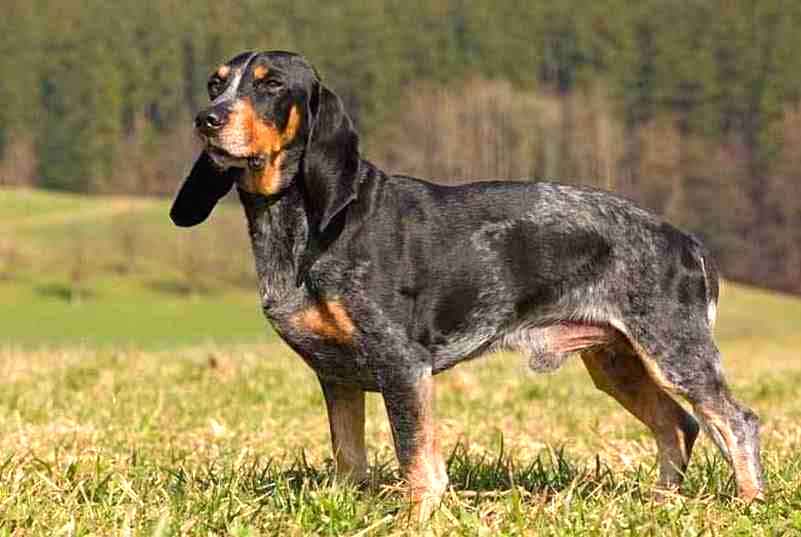
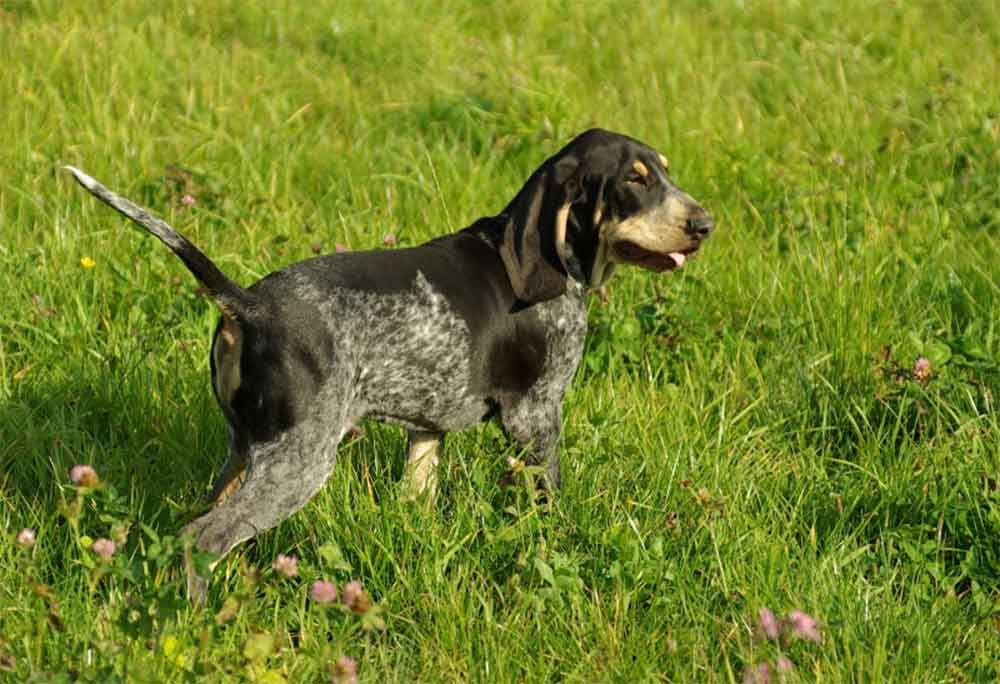
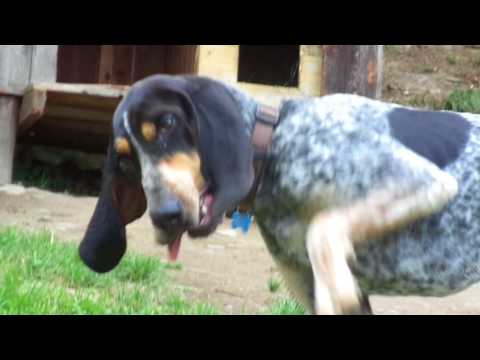
The skin of the Small Blue Gascony it is flexible, black or very mottled with black spots, and in any case never completely white. Their mucous membranes are also black. Its pelage is short, semi-thick and well furnished. Its fur is completely mottled, black and white, with a slate bluish glow, hence its name.

It also, may have more or less numerous and more or less large blackheads. These may include, at head level, usually has two black dots that are not on the top of the skull but that surround its eyes and cover its ears. At the top of the skull there is a white spot with a small oval black dot, typical of the breed. The upper part of the eyebrows are marked with more or less bright tan spots. Traces of tan are also found on the cheeks, the chops, inside the ears and sometimes on the legs and under the tail.

Last, sexual dimorphism is not very pronounced in this breed: males and females are generally very similar in size and dimensions.

Character and aptitudes ยซLittle blue Gascogne houndยป

The Small Blue Gascony he is a dog with a pleasant character, calm and affectionate. He is a very good companion dog., but it requires a lot of physical exercise and wide open spaces. Your ideal space is a house with land. It is necessary to take them out for a daily walk outside of hunting season. Dogs are generally very attached to their master. They are also kind to children and sociable with other animals. (dogs, cats…).

It is a hunting dog that runs well, very diligent in his hunting style, ideal for running after hare. It also shows good qualities for hunting big game, for example wild boar hunting. Finally, the Small Blue Gascony has a magnificent voice and a fine sense of smell.

Hygiene and health of the โ€œLittle Blue Gascogne Houndโ€

Grooming

The Small Blue Gascony often lives outdoors and requires only rudimentary grooming. If you live in the house, weekly brushing is recommended. It can also be useful to bathe him when he returns from hunting…

Care

When you come back from hunting or walking, inspect his feet and ears Small Blue Gascony looking for thorns (herbs that get into the skin causing pain and infections). Your floppy ears may be prone to ear infections. It is advised to examine and wash them once a week.

Health

The Small Blue Gascony he is a robust dog. You may suffer from otitis. Itching or a bad smell should alert you. The Small Blue Gascony you can also be injured while hunting. A fracture immediately leads to a loss of pressure in the affected limb. Skin tears may be more inconspicuous in the coat. Inspect his wound carefully when you return from the hunt..

Food

The dog's diet will depend on both its breed and weight and its lifestyle. The one with Small Blue Gascony must consider, among other things, your activity.

How much does a โ€œLittle Blue Gascogne Houndโ€ cost?

The price of a puppy Small Blue Gascony often haunt them 650 EUR, but it can reach the 1000 euros for the best subjects.

As in any other race, the price charged depends on the prestige of the kennel, of the lineage from which the dog descends and its intrinsic characteristics and, in particular, of its conformity with the standard. This explains why there may be price differences between puppies from the same litter.

In any case, the Small Blue Gascony hard to find outside France, and this is particularly true in North America, despite its recognition by the American UKC. In the case of an import from France, transportation and administrative costs are added to the purchase price. It also, it is necessary, of course, respect the regulations regarding the importation of a dog from abroad.

Images "Small Blue Gascony"

Photos:

1 – Little Gascony Blue Hound by Katarzyna Bujko, CC BY 3.0, via Wikimedia Commons
2 – Small Blue Gascony Hound, ยซBella, Baron i Brigand od Smutne rickyยป from kennel ยซLe Bleu Cardinalis FCIยป, Poland. The owner – Katarzyna Bujko by Katarzyna Bujko, CC BY 3.0, via Wikimedia Commons
3 – Small Blue Gascony Hound, female ยซClea z Beckovaยป from kennel ยซLe Bleu Cardinalis FCIยป, Poland. The owner – Katarzyna Bujko by Katarzyna Bujko, CC BY 3.0, via Wikimedia Commons
4 – Small Blue Gascony Hound, female ยซClea z Beckovaยป from husbandry ยซLe Bleu Cardinalis FCIยป, Poland. The owner – Katarzyna Bujko by Katarzyna Bujko, CC BY 3.0, via Wikimedia Commons
5 – Small Blue Gascony Hound, female ยซClea z Beckovaยป from kennel ยซLe Bleu Cardinalis FCIยป, Poland. The owner – Katarzyna Bujko by Katarzyna Bujko, CC BY 3.0, via Wikimedia Commons
6 – Small Blue Gascony Hound, male ยซCar z Beckovaยป from kennel ยซOd Smutnรฉ ล™รญฤkyยป, Czech. The owner – Slavomรญr Hanรกฤek by Katarzyna Bujko, CC BY 3.0, via Wikimedia Commons

Videos "Small Blue Gascony"

RAMBO - Small blue gascony - Unconditional love

RAMBO – โ€œLittle Blue Gasconyโ€ – Unconditional love
hare with blue gascogne cubs

hare with โ€œPetit Bleu de Gascogneโ€

Type and recognitions:

  • FCI CLASSIFICATION:
  • Group :
  • Section : . .

Federations:

  • FCI – Group 6: Scent hounds, and related breeds. – Section 1.2: Medium-sized Hounds. โ“˜
  • UKCScenthounds โ“˜
  • Central Canine Society โ“˜

FCI breed standard "Small Blue Gascony"

Origin:
France

Date of publication of the valid original standard:
24.01.1996

Use:

This is a multi-use dog. It is used for hunting with a shotgun., and sometimes to chase the game like a hound. His favorite house is the smallest (Hare) but he also goes on the hunt for big game.


General appearance:

It is a medium-sized dog, well proportioned and distinguished.


Behavior / temperament:

He has a good sense of smell and is good at hunting.. It has a loud bark and easily joins the pack.. He is calm and affectionate and obeys easily.

Head:

---

Cranial region:
  • Skull : Seen from the front, It is somewhat domed and not too wide. The occipital protuberance is slightly marked. Seen from above, the back has a shallow ogival shape. Forehead is bulging.
  • Depression links (Stop) : Sharp.

facial region:

  • Truffle : Black and wide. The Windows are wide open.
  • Snout : It is the same length as the skull and is strong. The nasal cannula is often slightly arched..
  • Lips : They are not very thick or developed. The upper lip covers the lower lip.
  • Jaws/Teeth : The joint is in the form of scissors. The incisors are set at right angles to the jaws..
  • Cheeks : Thin.

Eyes : They are oval in shape and brown in color.. Your expression is sweet.

Ears : They are crooked and moderately thin. They should at least reach the tip of the nose..

Neck:

It is long and has some double chin.

Body:

  • Back : Well accented.
  • Pork loin : Well united, and not too long.
  • Rump : Slightly oblique.
  • Breast : It is long and descends to the level of the elbow. The sternum is quite protruding. Delicately rounded ribs.
  • Flank : It's flat and deep.

Tail:

It is thin and reaches to the tip of the hock. It is carried proudly in the shape of a saber.

Tips

PREVIOUS MEMBERS : Seen in conjunction, They are quite robust.

  • Shoulder : Muscular and moderately oblique.
  • Elbows : Glued to the body.
  • forearms : Strong bones.

LATER MEMBERS : Seen as a whole they are well proportioned.

  • Thighs : Quite long, muscular, although not in excess.
  • Hock : Width, slightly angled and close to the ground.

FEET : They have an oval shape; the fingers are thin and close together. The pads and nails are black.

Movement:

Regular and executed with ease.

Mantle

SKIN : Elastic. Black, or strongly streaked with black spots. It's never completely white. The mucous membranes are black.

HAIR : Short, semi-thick and well dense.

COLOR : Completely speckled with black and white, imparting a slate blue reflection. It may or may not be marked with more or less extended black spots. Usually, there are two black spots on each side of the head, that cover the ears, circle the eyes and stop at the cheeks. These do not join over the top of the head, but they leave a white space in the center of which there is often a small oval black spot., typical of the breed. Above the eyes there are two more or less bright tan marks located on the zygomatic arches simulating four eyes.. Traces of tan can also be found on the cheeks, the lips, the inside of the ears, the limbs and under the tail.


Size and weight:

Height to the cross :

  • For males : 52 to 58 cm.,
  • for females : 50 to 56 cm..


Fouls:

Any deviation from the above mentioned criteria is considered as missing and the gravity of this is considered in proportion to the degree of deviation to the standard and its consequences on the health and well-being of the dog.

Head :

โ€ข Short.
โ€ข Skull too flat, Strait, or width.
โ€ข Short ears, high insertion, that are not twisted enough.

Body :

โ€ข Too long, loose top line, lack of volume.
โ€ข Croup sagging.
โ€ข Diverted tail.

Tips :

โ€ข Insufficiently developed bones.
โ€ข Straight shoulders.
โ€ข Hock closed, seen from behind.
โ€ข Crushed feet.

Behavior :

โ€ข Shy dog.

MISS PLAYOFFS :

โ€ข Fearful or aggressive dog.
โ€ข Characteristics that do not correspond to the type.
โ€ข Notable lack that causes any impediment.
โ€ข Serious anatomical deformation.
โ€ข Upper or lower prognathism.
โ€ข Light eyes.
โ€ข Any other coat that is not established by the standard.

Any dog โ€‹โ€‹showing clear signs of physical or behavioral abnormalities must be disqualified..


N.B.:

Males should have two normal-appearing testicles fully descended into the scrotum..

Source: F.C.I - International Cynological Federation

Alternative names:

1. Petit bleu de Gascogne (English).
2. Petit bleu de Gascogne (French).
3. Petit bleu de Gascogne (German).
4. Petit bleu de Gascogne (Portuguese).
5. Petit bleu de Gascogne, Sabueso azul de Gascuรฑa (espaรฑol).

โ–ท The world of Pets: Dogs, cats, birds, reptiles, amphibians

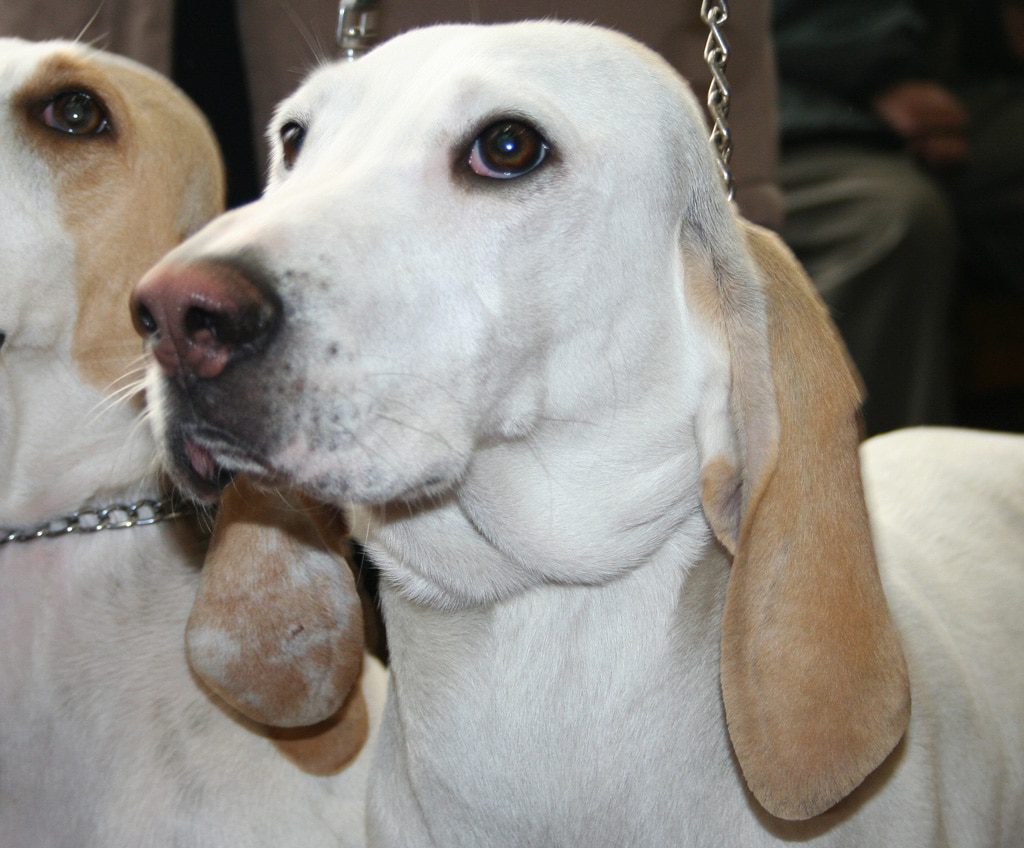
Porcelaine
Francia FCI 30 . Medium-sized Hounds

Porcelana

The Porcelaine It is a dog living in the family, is extremely friendly and affectionate.

Content

History

The origin of the breed is unknown Porcelaine, although it is probably the oldest dog breed in โ€œFranche-Comtรฉโ€. It is said to descend from the great "white dogs of Saint-Hubert de Lorraine", themselves descendants of the "royal white dogs" used in royal packs in the time of Francis I. Before the French Revolution, the white and orange hounds were present on the lands of the abbeys of Luxeuil and Cluny.

After the revolution, the breed was close to extinction, breeding resumed in the mid-19th century with the help of Swiss breeders. In 1844, Similar dogs were called ยซbriquets francs-comtoisยซ. The porcelain name is said to have been given by the Marquis Thรฉodore de Foudras.

Already in 1898 his race was consolidated. As of this year he could be found in exhibitions.

The slim build and the noble head are also witnesses to this tradition. In times past the breed was used especially for hunting. This happened especially in Switzerland, France and Italy. There these tracking dogs have been found for centuries.

Physical characteristics ยซPorcelainยป

It's a dog very striking within the French dogs, its own structure gives us the pattern that is the great race.

As shown in the canine group for which they are registered by the Federation Cynologique Internationale, is a Hound of median sizeto. Males have one height the cross of 56 to 58,5 cm and the females of between 53,5 and 56 cm., weighing between 25 and 28 kg.

Videos ยซPorcelainยป

Porcelaine puppiesPorcelaine puppies

The name Porcelaine He was born in allusion to his bright clothes, It seems made of porcelain. Its skin is white, sometimes with orange spots, most common in ears.

The eyes are dark and have a loving gaze and intelligent. The ears they are fine and well retracted, they often end in a tip and reach the end of the snout.

The nose is black with large nasal Windows, It has black eyes and ears that fall, similar to the Labrador.

The neck It is long and the tail starts thick and just fine, It is quite long and the dog carries slightly curved.

The hair thick fine is glossy and satin, There must not be any part of the body hairless.

The color the fur is white. You can submit Orange stains of rounded shape that we extend never forming a mantle, these spots appear many times overlapping other dark spots on the skin.

Character and skills ยซPorcelainยป

The Porcelaine It is a bloodhound, that is to say, dogs that search for prey and due to its characteristics it is valid to search for any type of wild animal.

It has a strong character, energetic, very willful and obstinate when he is hunting. But, When it is at rest is a very be quiet.

If you live within the family, is extremely friendly and loving. He is patient and well tolerated in children.

They have a very high level of activity, so he needs a lot of exercise, reason why is not recommended for sedentary people.

Although they are fierce hunters, they are gentle and relatively easy to educate.

Care of the ยซPorcelainยป

the care of him Porcelaine not related to their fur so much. The short-haired breed requires little effort in grooming. But you should pay close attention to your surroundings. A small flat doesn't always do it justice. There your needs are not met.

But it is not necessary to have a country house to maintain this beautiful breed.. Several walks a day can also keep dogs busy.. This shows that dogs need variety and tasks. Also the game should be in the task list.

Finding the right โ€œPorcelainโ€ breeder

If you are interested in this breed of dog and want to find the breeder of Porcelaine suitable, you may have to search for a long time. This breed of dog is rarely found. It also, cubs are often only given to hunters.

Images of โ€œPorcelainโ€

Type and recognitions:

  • FCI CLASSIFICATION:
  • Group :
  • Section : . .

Federations:

  • FCI – Group 6: Scent hounds, and related breeds. – Section 1.2: Medium-sized Hounds. โ“˜
  • Central Canine Society โ“˜

FCI breed standard "Porcelaine"

Origin:
France

Date of publication of the valid original standard:
19.10.1964

Use:

Hound


General appearance:

Dog used for hunting small game, very distinguished, absolutely french. All the details of its structure underline the nobility of its breed.


Behavior / temperament:

---

Head:

It must be very typical of the breed, thin and delicately sculpted. As a whole is rather long.

Cranial region:
  • Skull: It is wide at its height, between the ears; the occipital Protuberance is rounded. The forehead is flat; the median furrow must be marked, but without exaggeration.
  • Depression links (Stop): Marked, but without excess.

facial region:

  • Truffle: Well developed and very black. The Windows are wide open.
  • Snout: Long appropriate, Neither square nor pointed. The nasal helm is straight, but its end is slightly arched.
  • Lips: The upper lip covers the lower lip without being heavy or pendant. The mucosa of the lips is black.
  • Eyes: Normally developed, They must be looking dark and well protected under the cigomatica arch. The look is intelligent and sweet.
  • Ears: They are thin and well bent. They end up more on tip and reaches to the end of the snout. Its narrow insertion should not be above the eye line.

Neck:

It is quite long and lightweight. It may be some dewlap which must be thin and tight appearance.

Body:

  • Cross: Well outgoing.
  • Back: Wide and straight.
  • Pork loin: Width, well muscled, well together as a whole and not too long.
  • Rump: Somewhat oblique. The tips of the legs are wide apart and slightly protruding.
  • Breast : Amplitude medium, also rather deep. The ribs, in accordance with the chest, they are rather elongated, without being flat.
  • Flanks: Something raised, but full.

Tail:

It is well attached to the body. It is quite thick at the root and pointed at the end. Is never thin and medium length (without presenting to tip around the tail long and thick hairs slightly distant in the form of stem). It is carried slightly stooped.

Tips

PREVIOUS MEMBERS: They are quite long and thin, Although not too thin; tendons are well connected; the limbs are regular.

  • Shoulder: Shoulders of Jockey, long, well muscled and well inclined, though not too thick.

LATER MEMBERS:

  • Thighs: Well descended, very visible and thin muscles, moderately developed.
  • Hock: Fort and close to the ground. Usually angled.

FEET: Typically for a French dog rather elongated toes, thin but well together; hard and resistant pads.

Movement:

Executed with vitality and agility; easy and indefatigable Gallop.

Mantle

SKIN: Thin and elastic. She is grainy with numerous black spots.

HAIR: Satin, fine, tight and shiny; spotless alopecia.

COLOR: Very white, stained rounded Orange never extends in the form of blanket. These spots are usually overlapping other black spots of pigmentation of the skin. The orange splashes on the ears are very characteristic of this breed..


Size and weight:

You can vary:

  • for males between 55 and 58 cm.,
  • for females between 53 and 56 cm..


Fouls:

Any deviation from the aforementioned criteria is considered as a fault and the severity of this is considered to the degree of the deviation to the standard and its consequences on the health and well-being of the dog..

MISS PLAYOFFS:

  • Cowardice, aggression toward owner.
  • Lack of type.
  • In general all the defects that prevent the use of the dog, such as rickets, defective limbs in excess, insufficient movement range and push.
  • Eyes and nose color clear, excess of depigmented spots.
  • Tail iguanas.
  • Coarse or thick hair.
  • Presence of an orange blanket.
  • A very raised orange spots, pulling to mahogany, grey or mixed with black hairs. The light orange color, but pale and the same lack of spots are not desirable, but they can not be considered eliminatory faults.
  • Size that exceed or that does not reach the above measures. But, You can make an exception with a male that does not exceed a maximum 60 cm., Therefore, it presents excellent general characteristics and can be used as a player..
  • Any dog โ€‹โ€‹showing clear signs of physical or behavioral abnormalities should be disqualified..


N.B.:

Males should have two normal-appearing testicles fully descended into the scrotum..

Source: F.C.I - International Cynological Federation

Alternative names:

1. Chien de Franche-Comtรฉ (English).
2. Chien de Franche-Comtรฉ, briquets francs-comtois (French).
3. Chien de Franche-Comtรฉ (German).
4. Porcelaine (Portuguese).
5. Perro del Franco Condado (espaรฑol).

โ–ท The world of Pets: Dogs, cats, birds, reptiles, amphibians

Small swiss hound
Suiza FCI 60 . Small-sized Hounds

Small Bernese hound
Small Bernese hound
The dog Small swiss hound, little stimulated, tends to become a nuisance pet that can be difficult to train.

Content

History

In the early 20th century, hunting began to change in Switzerland. Private hunting grounds were introduced and the standard size of the Swiss Hound he was too fast and enthusiastic to hunt properly within these smaller hunting grounds. The hunters decided to develop a different breed of hunting that could hunt efficiently and effectively within the closed private hunting grounds.. Many people think that Small swiss hound it's just a smaller version of the Swiss Hound. While this is partly true, They are a different race that originated from crossing the Swiss Hound with the Basset Hound. The ultimate goal was to develop a breed that was shorter and smaller., but also had the same four color variants as the Swiss Hound. The resulting dogs were expected to have a strong sense of smell for nose work and a melodious voice to sound the alarm when hunting..

The Small swiss hound He is an outstanding hunter and has the ability to track scents for miles over rough terrain. The Small swiss hound became the hunting dog of people hunting on private land.

The United Kennel Club recognized the Small swiss hound in 2006. The Federation Cynologique Internationale (FCI) accepted them and adopted the official breed standard under the name Schweizer Niederlaufhund in 2015.

The Small swiss hound still a popular hunting companion in his native Switzerland.

Photo: Small Bernese Hound Smooth-coated male by Canarian, CC BY-SA 4.0, via Wikimedia Commons

Physical characteristics

In proportion smaller than the Swiss Hound. Its body shape is rectangular, moderately long, and strong conformation. Medium size head, thin, elegant, with friendly facial expression
and attentive. His ears are very long, low insertion, and he wears them folded. Thin and strong limbs. When walking calmly, he has his tail hanging, in activity bends it slightly upwards.

The Small swiss hound comes in four different varieties. The only difference between the varieties is the color, but each variety has its own name.

Variants Small swiss hound

Small hound of Juraequeรฑo de Jura
Small Jura hound
Small Bernese hound
Small Bernese hound
Small Schwyz hound
Small Schwyz hound
Small Lucerne hound
Small Lucerne hound
  • The Small Jura hound has a smooth coat that is black with tan markings found over the eyes.
    The Small Jura hound has only one coat and may only have a small amount of white on its body.
  • The Small Bernese hound has two types of fur:
    the smooth coat and the rough coat.
    The rough coat has a single hard coat and a small beard.
    The Small Bernese hound it's black and white with fiery marks over its eyes; many call it tricolor.
  • The Small Schwyz hound has a single, smooth coat that is predominantly white with yellow-red spots; orange-red spots are also acceptable.
  • The Small Lucerne hound has a single smooth coat that is predominantly white but mottled with black or gray giving the illusion of a blue body. They have black spots with tan markings over their eyes.

  • Photos:

    1 – Small Bernese Hound Smooth-coated male by Canarian, CC BY-SA 4.0, via Wikimedia Commons
    2 – Jura low-run dog by Bhv The Max
    3 – This dog is a small Schwyz Hound by pets.ch
    4 – Little Lucerne Hound by carlosh catalog

    Character and skills

    When he's hunting, the Small swiss hound is tireless and relentless, exhibiting impressive endurance and strength of character. They tend to be lively and excitable, eager to do their job. Most of the Small swiss hound they are happy to hunt regardless, without any royal order from his master.

    Despite being bred to hunt, most breed members can make the transition from working bloodhound to family pet easily and are generally affectionate and demonstrative with their owners. They are good friends with children and other dogs, but they cannot be trusted with small animals, including cats and rabbits.

    The temperaments of individuals vary, and while some may be quiet and peaceful house guests, others may be excitable and jumpy. Dogs with more energy can often be taught to settle inside the house once they have been properly exercised.. Ideally, the exercise should take the form of hunting, as this not only burns off excess energy but also occupies your inquisitive mind. The dog Small swiss hound, little stimulated, tends to become a nuisance pet that can be difficult to train.

    Not being an aggressive dog, the Small swiss hound should not be used as a guard dog as it does not tend to scare off intruders and does not usually feel the need to guard your property.

    โ€œSmall Swiss Houndโ€ Training

    The phrase "small dog syndrome" may be mentioned when talking about Small swiss hound, as they have a reputation for acting like large dogs in small dog bodies. Full of confidence, lively and independent, this is not a breed for the novice trainer. Obedience work can be a particular challenge, since they have a free-spirited character and a mind of their own.

    Coaches must be firm and inflexible, keeping your training sessions short and interesting to keep the dog's interest. How this breed likes to assume a dominant position in the home, he should be taught his place from an early age, to avoid any bad behavior.

    most dogs Small swiss hound they are still used as hunting dogs in Switzerland today, meaning your exercise requirements are easily met during hunting season. In the case of non-working dogs, or when the hunting season is over, owners should take time to meet the needs of this active hound.

    A rural setting is the ideal place for Small swiss hound, who needs wide terrain to explore and does not enjoy being confined. It is essential that your property is securely fenced to avoid solo adventures.

    Health ยซSmall Swiss Houndยป

    There are not many diseases that affect the Small swiss hound more than other races, but there are a handful of conditions that should be watched in individuals:

    ear infections

    Hanging ears are prone to developing ear infections., particularly if a dog spends a lot of time outside wet and muddy. Keeping your ears clean can prevent this from becoming a problem..

    Hip Dysplasia

    Malformed hip joints can lead to lifelong discomfort and reduced mobility. x-rays of the hips (a process called โ€œhip scoringโ€) should be performed when a breeding dog is over one year of age to ensure that its hips are of a good enough quality to be passed down.

    Grooming ยซSmall Swiss Houndยป

    Although there are a number of different coat types within the breed, all are easy to maintain and need little in the way of grooming. Weekly brushing will suffice. The Small swiss hound you will only need to be bathed a few times a year. If owners feel the need to disguise their "dog smell" they can use dry shampoo, avoiding the risk of drying out their skin and coat.

    Ears of the Small swiss hound should be cleaned weekly and ideally checked daily for signs of infection. They must be completely dried after getting wet.

    Characteristics "Small swiss hound"

    Coexistence is important that you have with your new friend. Before considering the acquisition of a dog of the breed "Small swiss hound" you know certain factors. Not all breeds of dogs are apt to live in an apartment, you must take into account his character, their need for exercise, their interaction with other pets, their care and if you have small children, their level of tolerance towards them.

    Adaptation โ“˜

    3,0 of 5 stars (based on 1 review)

    friendly dog โ€‹โ€‹โ“˜

    4,0 of 5 stars (based on 1 review)

    hair loss โ“˜

    4,0 of 5 stars (based on 1 review)

    Affection level โ“˜

    5,0 of 5 stars (based on 1 review)

    Need for exercise โ“˜

    3,0 of 5 stars (based on 1 review)

    Social need โ“˜

    3,0 of 5 stars (based on 1 review)

    Home โ“˜

    3,0 of 5 stars (based on 1 review)

    Toilet โ“˜

    2,0 of 5 stars (based on 1 review)

    Friendly with strangers โ“˜

    4,0 of 5 stars (based on 1 review)

    barking โ“˜

    4,0 of 5 stars (based on 1 review)

    Health โ“˜

    5,0 of 5 stars (based on 1 review)

    Territorial โ“˜

    4,0 of 5 stars (based on 1 review)

    Cat friendly โ“˜

    2,0 of 5 stars (based on 1 review)

    Intelligence โ“˜

    3,0 of 5 stars (based on 1 review)

    Versatility โ“˜

    3,0 of 5 stars (based on 1 review)

    Child friendly โ“˜

    5,0 of 5 stars (based on 1 review)

    Surveillance โ“˜

    4,0 of 5 stars (based on 1 review)

    joy โ“˜

    3,0 of 5 stars (based on 1 review)

    Videos "Small swiss hound"

    Swiss low-legged dog + Schweizer Laufhund + Orange hound + pets
    Swiss low-legged dog + Schweizer Laufhund + Orange hound
    Swiss Hound CERVA
    Schweizer Laufhund CERVA

    Type and recognitions:

    • FCI CLASSIFICATION:
    • Group :
    • Section : . .

    Federations:

    • FCI – Group 6: Scent hounds, and related breeds. – Section 1.3: Small-sized Hounds. โ“˜
    • UKCScenthounds โ“˜

    FCI breed standard "Small swiss hound"

    Origin:
    Switzerland

    Date of publication of the valid original standard:
    28.11.2001

    Use:

    It is a hunting dog in the strict sense of the word.. He is an independent hunter by hunting with a bark ; searches and corners its prey with great safety even in difficult terrain. The Small Swiss Hound is also used to bleed the injured animal.


    General appearance:

    Hound type dog (Hound), in proportion smaller than the Swiss Hound with a height of the withers of 35-43 cm for males and 33-40 cm for females; its body shape is rectangular, moderately long, and strong conformation. Medium size head, thin, elegant, with friendly and attentive facial expression. His ears are very long, low insertion, and he wears them folded. Moderately wide and high chest and costal arch that provide plenty of space for the heart and lungs. Thin and strong limbs. When walking calmly, he has his tail hanging, in activity bends it slightly upwards.

    Color varieties :

    โ€ข Small Bern Hound,
    โ€ข Small Jura Hound,
    โ€ข Small Lucerne Hound and
    โ€ข Small Schwyz Hound.


    Behavior / temperament:

    Of fine smell, It is agile and resistant ; small hunting dog, passionate, that keeps the trail safe and hunts with persistent harmonious bark. He is kind in nature, neither fearful nor aggressive. His temperament is calm, but lively.

    Head:

    Thin, elegant. Seen from the front it is long and narrow and slowly widens towards the cheeks..

    Cranial region:
    • Skull : Slightly convex, no wrinkles on the front, without front groove. Not very prominent occipital crest. The line that goes from the occipital crest to the stop is almost the same length and forms a parallel line with the line that goes from the stop to the nose..
    • Depression links (Stop) : Moderately marked.

    facial region:

    • Truffle : It is dark with wide open windows.
    • Snout : Powerful, quite long and moderately deep, nape pointed. The nasal canal preferably straight or slightly convex, rather narrow.
    • Lips : Upper lips slightly hanging and with rounded edges in the anterior part, never pointed. Closed lip corner.
    • Jaws / Teeth : Very strong scissor bite, regular and complete, That is, the upper incisors overlap the lower ones without leaving space between them.. The teeth are implanted in an upright position in the powerful jaw. Pincer bite is allowed. The lack of two PM1 or PM2 is tolerated (premolars 1 or 2 ). The flap of M3 (molars 3) is not taken into account.
    • Cheeks : Poorly developed.

    Eyes : dark, clean, slightly oval in shape; friendly expression. They should not be sunken or protruding. The eyelid slit is rigid with well adherent eyelids. Edges of the eyelids with good pigmentation.

    Ears : Low insert, narrow and a little backwards, no higher than the eye line. In length they reach at least to the tip of the nose. ; He wears them well folded and they hang close to his cheeks ; Their texture is soft and they are covered with fine hair.. The pinna does not protrude.

    Neck:

    Moderately long, light and elegant, but with good muscles. Throat skin is loose, but a noticeable double chin is not desired.

    Body:

    • top line : Harmonica, descends slightly from the insertion of the neck to the rump.
    • Back : Straight, firm, moderately long.
    • Pork loin : Wide and strong, flexible.Grupa : Gently descend towards the insertion of the tail; hips should not be visible.
    • Breast : Width and height, reaching up to elbow height; the tip of the sternum is visible, but not too prominent. The ribs are long and moderately rounded. The costal arch extends well posteriorly.
    • Bottom line and belly : The belly line is slightly raised towards the hind limbs. The flanks are moderately full.

    Tail:

    Low insertion in harmonious continuation with the croup ; medium length, reaching at least to the hock ; with enough hair ; ends in an elegant point, no true feathers. At rest and when walking it hangs without noticeable flexion. When active or excited, he carries it slightly raised., but never turned on the back.

    Tips

    PREVIOUS MEMBERS

    • As a whole : His muscles are strong, but it doesn't give the impression of being heavy. Seen from the front the forelimbs are thin, very straight and upright with good bones and solid feet, directed forward.
    • Shoulder : His muscles are strong ; the shoulder blades are flat and close together, relatively long and placed obliquely ; the angle of the shoulder joint is approximately 90ยฐ.
    • Arm : Almost as long as the shoulder blades, placed in an oblique position.
    • Elbows : Stuck naturally against the side.
    • Forearm : Strong, delgado, very straight, a little shorter than arms.
    • Ulnocarpal joint : Strong.
    • Metacarpus : Short ; seen from the front, its position is vertical, never deviated ; seen from the side it should never be completely straight, but slightly inclined in relation to the ground.
    • Front feet : Rounded, firm, compact. Short fingers, well arched. Hard and rough pads. solid nails. Fine fur between the fingers.

    LATER MEMBERS :

    • As a whole : They have strong muscles, well proportioned compared to previous members. Good angulations at the knee and hock joints (tibio-tarsiana). Parallel hindlimbs, neither too close nor too far apart. In a natural position they should be placed slightly backwards. Bones a little less strong than those of the forelimbs.
    • Thigh : Good length and width, strong and well muscled.
    • Knee : good angulation ; turned neither in nor out.
    • Leg : Proportionately long, with inclined position. The bones are a little less strong than those of the forelimbs.
    • Warm-foot joint : Strong, well angled, low placement.
    • Metatarsus : Short, seen from behind in a straight and parallel position.
    • Rear feet : Quite round and firm ; closed and short fingers ; hard and rough pads. Strong nails. Fine hair between fingers. Without spurs, except in countries in which amputation is not permitted by law.

    Movement:

    • Preferred natural movements : trot or gallop which both cover a lot of ground. At a trot, movement must be free and dynamic, with long steps of the forelimbs and strong impulse of the hind limbs. Limbs move in straight, parallel lines.
    • forward action : Nor narrow, nor deviated, with fingers neither too far apart nor closed.
    • Rear action : practically parallel, with notable momentum, neither too narrow nor too wide, neither in the form of a cow nor a barrel.


    Mantle

    SKIN : Well adherent and laid, without wrinkles.

    COAT

    HAIR :

    โ€ข Smooth fur : Short, smooth, well adherent, thinner on the head and ears.

    โ€ข Hard hair : Lasted, elastic, good paste ; with little internal fleece ; the beard is poorly developed.

    COLOR :

    There are four color varieties.

    • Small Bernese hound: This variety exists with hard hair and with straight hair.. Always tricolor : white black and tan (red). The basic color is white with large black plates. White very lightly splashed with black is acceptable. fire color (reddish-brown markings) on the eyes, cheeks, on the inside and upper region of the ears and around the anus. A black cloak is allowed. Black skin under black hair, blackish-white marbling beneath the white hair.
    • Small Jura hound: This variety exists with straight hair, rarely with double hair (Stockhaar). Preferably deep black with tan markings over the eyes, cheeks, in the chest and/or extremities. O well : reddish-brown color (fire) with black cape or black โ€œsaddleโ€. A small white spot on the chest is tolerated.. Black skin under black hair and lighter under tan hair.
    • Small Lucerne hound: This variety has straight hair. Basic color white- dense grayish or black-white dotted with large dark or black plates. fire color (reddish-brown markings) on the eyes, cheeks, below the tail insertion, in the chest and extremities. A black cloak is allowed. Black skin under black hair and lighter under blue-flecked hair..
    • Small Schwyz hound: This variety has straight hair. Basic color white, with large or smaller yellow-reddish or red-orange plates. Some isolated red splashes are not considered a fault. Dogs with red coats are allowed. Dark gray skin under orange hair and lighter under blue-flecked hair.


    Size and weight:

    Height to the cross : Males : 35 โ€“ 43 cm.,females : 33 โ€“ 40 cm. Tolerance : +/- 2 cm.


    Fouls:

    Any deviation from the aforementioned criteria is considered as a fault and the severity of this is considered to the degree of the deviation to the standard and its consequences on the health and well-being of the dog..

    โ€ข Bones that are too thin or too coarse ; lack of substance.
    โ€ข Thick head, not very harmonious.
    โ€ข Partially flesh-colored nose.
    โ€ข Clear eye or lost expression.
    โ€ข Ears set too high ; flat ears, thick or very short.
    โ€ข Noticeably developed double chin.
    โ€ข Saddled or arched back (carp).
    โ€ข Short croup, inclined.
    โ€ข Shallow chest, flat or barrel-shaped. Irregular rib cage (crushed ribs : bell-shaped chest).
    โ€ข Tail carried too high, very bent.
    โ€ข Curved forelimbs, deviated inward or outward.
    โ€ข Straight back (very open angle) ; arm too short.
    โ€ข Weak ulnocarpal joint, crushed metacarpus.
    โ€ข Crushed feet, hare feet.
    โ€ข Angles of the hind limbs that are too straight ; cow-shaped or barrel-shaped limbs.
    โ€ข Lack of color and markings.- In the little Bern Hound : too much black splashes on the white.- In the small Schwyz Hound : too much red-orange splashes on the white. carbon coat (tight) in the ears, at the insertion of the tail and/or on the plates.
    โ€ข Questionable behavior, slightly aggressive.

    MISS PLAYOFFS

    โ€ข Very fearful or aggressive behavior.
    โ€ข Completely flesh-colored nose.
    โ€ข Upper or lower prognathism, incisor arcade deviated.
    โ€ข Lack of incisors or canines; canines in incorrect position; lack of more than three premolars and/or molars.
    โ€ข Entropion, ectropion.
    โ€ข Sternum too short, broken chest.
    โ€ข Curled or broken tail.
    โ€ข All color combinations that do not correspond to those indicated in the standard.
    โ€ข Height at withers : Males less than 33 cm and greater than 45 cm.Females less than 31 cm and greater than 42 cm..

    Any dog โ€‹โ€‹showing clear signs of physical or behavioral abnormalities must be disqualified..


    N.B.:

    Males should have two normal-appearing testicles fully descended into the scrotum..

    Source: F.C.I - International Cynological Federation

    Alternative names:

    1. Schweizerischer Niederlaufhund (English).
    2. Schweizerischer Niederlaufhund (French).
    3. Schweizer Niederlaufhund (German).
    4. Schweizerischer Niederlaufhund (Portuguese).
    5. (en suizo, Schweizerischer Niederlaufhund) (espaรฑol).

    โ–ท The world of Pets: Dogs, cats, birds, reptiles, amphibians

    Petit Basset Griffon Vendรฉen
    Francia FCI 67 . Small-sized Hounds

    Basset Grifรณn Vandeano pequeรฑo

    The Petit Basset Griffon Vendรฉen is a very strong race.

    Content

    History

    The Petit Basset Griffon Vendรฉen It is a small size hunting dog (Petit), under (basset), hard hair (griffon) of French origin (in the region of the Vendรฉe), mainly used for hunting rabbits with his great sense of smell.
    It was developed from the Grand Basset Griffon Vendรฉen, larger copy, heavy and long.

    In the past, often to raise both races together. In 1975 are prohibited from crossing them, although puppies with characteristics of both breeds could still be born in the same litter. In France, It was a popular hunting dog for nearly a century (origin s. 16TH); However, the breed is relatively new in other regions.

    Physical characteristics

    Medium-sized, its height varies between the 33 and 38 cm and his weight between the 16 and 20 kg.
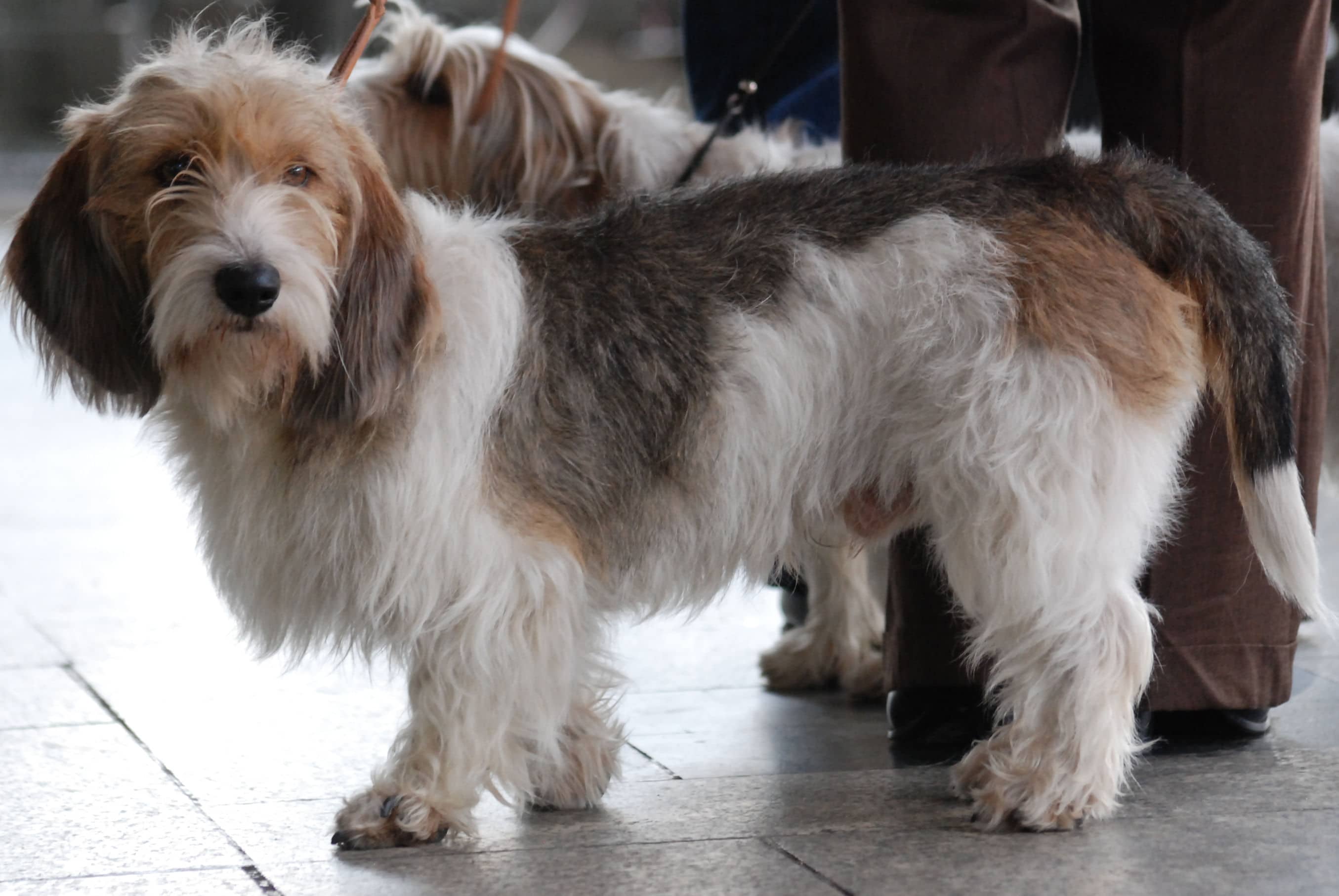
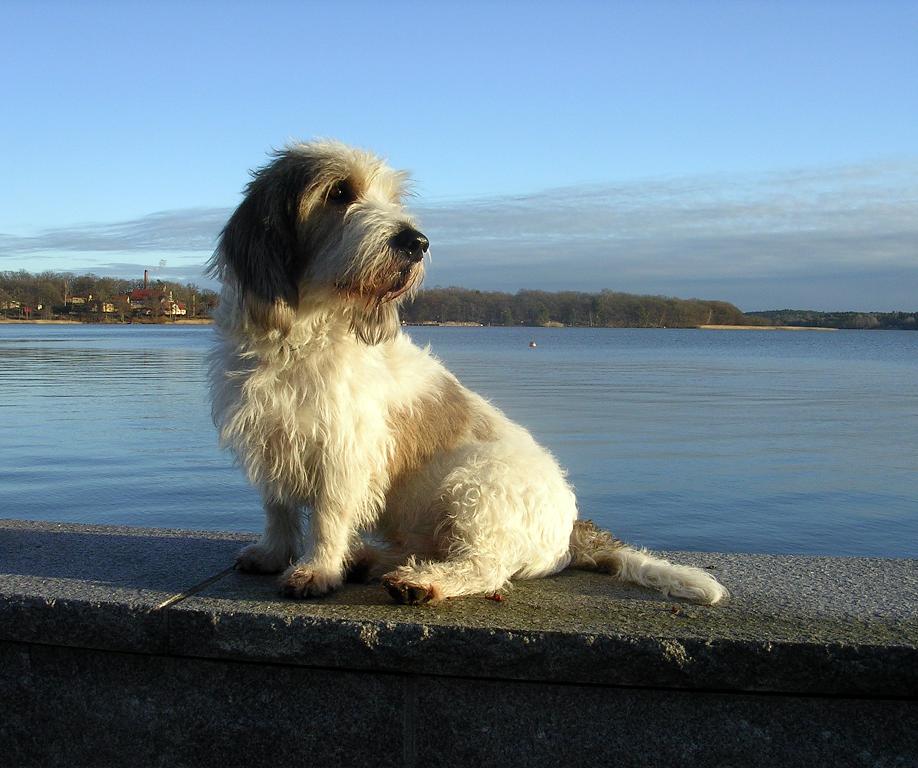
    It is a small dog, rustic. Its aspect is neglected and natural. It has hard and rough hair with eyebrows, beard and whiskers woolly. White base, with black spots, Orange or grey.

    Is well proportioned and is approximately a 50% longer than high. Wide tail at base, decreasing towards the tip thickness. It keeps it erect. Their ears are covered with hair; they are long but fail to reach the tip of the nose. Large nostrils. Its back is straight and slightly arched over the lumbar area.

    It has large fame of Digger, jumper and escape expert, so you have to keep it in a safe enclosure.
    Usually, is happy, friendly and always busy in their explorations. He is intelligent and can be stubborn. It's funny and has many security. Jealous and playful. Pretty crook.

    Character and skills

    He is good with children and quite friendly with strangers and although his obstinacy, it is a bit difficult to train, is not especially dependent or independent. Their dominance is moderate.

    He is good with other dogs, but by his hunting instinct, It is not reliable with other pets. Being of small size, has a very loud bark, and tends to the howl.

    Very strong race; serious genetic diseases are not known. prone to ear infections. Times, allergies have been given to insecticides.

    It has hard hair and moved it very little, Although it needs a cleaning and brushing regularly to avoid entanglements.
    It requires moderate exercise, being a good companion to run. At home he is very active and can only live in an apartment if he is sufficiently exercised.

    As open space, a small garden is enough. Adaptable to most climates, prefer the coldest. Itร‚ยดs suitable for novice owners. Care properly has an average life of 10 to 14 years.

    Petit Basset Griffon Vendรฉen pictures

    Videos Basset Grifรณn Vandeano small

    Alternative names:

    Petit basset griffon vendรฉen / Kleiner basset griffon vendรฉen / small basset griffon vendรฉen

    Type and recognitions:

    • FCI CLASSIFICATION:
    • Group :
    • Section : . .

    Federations:

  • FCI โ“˜
  • AKC โ“˜
  • ANKC โ“˜
  • CKC โ“˜
  • โ€‹KC โ“˜
  • NZKC โ“˜
  • UKC โ“˜

  • FCI breed standard Petit Basset Griffon Vendรฉen

    FCIFCI - Petit Basset Griffon Vendรฉen
    Basset

    โ–ท The world of Pets: Dogs, cats, birds, reptiles, amphibians

    Canarian Warren Hound
    Espaรฑa FCI 329 . Primitive type - Hunting Dogs

    Podenco Canario

    The Canarian Warren Hound is brave, decided to, generous and extremely loyal to his master.

    Content

    History

    The Canarian Warren Hound It is a breed canine Spanish Canary.

    The Canarian Warren Hound, It is one of the oldest breeds known today., According to scholars of the breed, it dates from approximately 7000 years. This realize the numerous found vestiges of its representation in engravings, statues and bas-reliefs.

    A native of Egypt, probably, He was taken by the Phoenicians, greeks, the same Egyptians to the Canary Islands and Carthaginian, where it is currently easy to see in the larger islands (Gran Canaria and Tenerife).

    Since its inception, the Canarian Warren Hound has been placed in the wild and in the possession of the peasant who needed to hunt to survive. Given the perfect hunting qualities of this dog: his sense of smell, his hearing and his clear vision, as his great speed in the race after the dam, the peasant has had, always, a wonderful ally, It has been able to take advantage of.

    The Canarian Warren Hound, as its name suggests it is found in the Canary Islands, and a dog is little known and disseminated outside their place of origin, It is not easy to find puppies.

    Today, is perfectly adapted, both the flat lands as stony and mountainous, sandy, or soft like the prairies or very hard; You can both enter caves that penetrates in Lava Tubes or galleries, in thickets or forests, in the end, does not shy away from any obstacle.

    Outside the hunting season, the living conditions of animals are very different: Well-kept dogs can be found and fed on clean kennels, as well as miserably neglected and malnourished chained dogs. Animals that are not or are no longer fit for hunting often suffer a cruel fate.
    For this reason, dogs are increasingly placed abroad by animal protection organizations and individuals – an understandable and well-meaning activity, What, However, brings with it some problems: Dogs, who are usually already grown up, sometimes they are taken out of their simple rural living environment and taken to big cities. Noise and haste can be very harsh for them, his frequent lack of trust in humans further complicates it. His pronounced passion for hunting makes the free will, which would be absolutely necessary for the maintenance of the animals and to reduce stress, is often difficult or impossible. It also, in many cases are infected with so-called travel or Mediterranean diseases, that often require long and costly treatment.

    Physical characteristics

    The Canarian Warren Hound, is a dog from size medium, very light but tough.

    The height to the cross males will of 55 to 64 cm and the females of 53 to 60 cm.. These measures have 2 cm tolerance up or down.

    Has the muscles hyper developed and as it does not present adipose panniculus it is very easy to appreciate the rib cage, the spine and hip bone.

    Has the head elongated with little pronounced stop, the eyes are small, almond-shaped and oblique.

    Their ears they are rather large, When the Earth State of arousal keeps them in erect and fall backwards when it is at rest, they are wide at the base and end up in tip.

    The limb perfectly Plumb, they are straight, has fine but strong bones. The tail is low, You can take the low or sickle-shaped, but does not exceed Hock.

    The hair the Podenco Canario is smooth, tight and short. In the layer color combinations within the following are supported colors: Red and white, with more or less intense red, and finally, Orange to mahogany.

    Observations

    :

    These dogs start to hunt from an early age, giving cases of animals less than three months that show strong hunting instinct.

    When they discover and/or they chase prey, emit a characteristic short, repetitive bark, known to local hunters as "singing a rabbit".

    Character and skills

    The Canarian Warren Hound is an animal that shows no aggression normally, extremely loyal and noble to teammate, restless, independent, stubborn, worker and intelligent.

    Itร‚ยดs brave and decided to, the race is fast and very agile, generous and extremely fell to its owner.

    There are no guard and defense attitudes, at home it is "friend of all strangers", what makes it ideal as a pet.

    If raised inside a Home, Once overcome the first six months of hyperactive life, shown as a quiet animal and customize, attitude changes drastically once comes to the field of hunting.

    In its role of Hunter It has always been dedicated to the rabbit house and its most important feature is its ability to adapt to any type of terrain. It is capable of detecting the presence of the press inside cracks thorny bushes or stone walls, the Podenco Canario only to follow the trail of the prey with the sense of smell but without catching it.

    Observations:

    In the Canary Islands is used in conjunction with the huron, since the latter catches the rabbit by the throat.

    Caring for Canarian Warren Hound

    As already mentioned, the dog should be given a housing environment that corresponds to its predisposition. Rural areas with low traffic and a manageable hunting density are appropriate.
    Proper exercise in any weather with as much free running as possible is a must for this active dog.

    The short coat is very easy to care for; just brush from time to time.

    Canarian Warren Hound Health

    The breed is basically a robust dog with low susceptibility to disease; therefore, breed-specific diseases are largely unknown.

    But, the Canarian Warren Hound can suffer from the typical travel or Mediterranean diseases of dogs (among others, leishmaniosis, dirofilariasis, babesiosis, ehrlichiosis) like all the other dogs.
    Many animals are chronically infected without showing symptoms of disease. But, these dogs are unhealthy and can infect other animals through vectors (ticks and blood-sucking insects).
    So, imported dogs should always be thoroughly examined for the diseases mentioned (the so-called "travel profile").

    The average life expectancy is about 12 years.

    Images Canarian Warren Hound

    Canarian Warren Hound videos

    Type and recognitions:

    • FCI CLASSIFICATION:
    • Group :
    • Section : . .

    Federations:

    • FCI – Group 5: Spitz-type dogs and primitive type – Section 7: Primitive type โ€“ Hunting dogs.. โ“˜

    FCI breed standard "Canarian Warren Hound"

    Origin:
    Spain

    Date of publication of the valid original standard:
    24.06.1987

    Use:

    It is used for rabbit hunting and adapts perfectly to the multiple variations of the terrain for this purpose., using their prodigious sense of smell as well as sight and hearing. Withstands high temperatures and hunts tirelessly from dawn to dusk. You can detect the presence of rabbits inside cracks with your sense of smell or hearing., stone walls, majano, volcanic tubes and thorny scrub. Its extraordinary preservation is undoubtedly due to its gifts, which have made it necessary throughout the centuries.. It is primarily a trail dog and should not bark or flap the part during tracking.. It is also used with the help of a ferret, modality allowed on the islands. It also usually catches rabbits by tooth.


    General appearance:

    It is a medium-sized dog, slightly elongated, leptosomatico, light, very resistant. The skeleton is well developed. The absence of adipose panniculus allows us to appreciate the relief of the rib cage, spine and hip bones. The muscles are highly developed, spandrel, transluciendo contractions through the skin.

    IMPORTANT PROPORTIONS: Slightly longer than high. Well developed chest, without reaching the elbow. Muzzle slightly longer than the skull.


    Behavior / temperament:

    Brave, nervous, restless and radiating a dynamism. Noble, never aggressive. Selflessly addicted to its owner. Stoically supports more rigorous sessions without the less fatigue.

    Head:

    Elongated. Truncated cone shaped, very provided with the body, measuring length 21 to 22 cm.. Parallel craniofacial lines.

    Cranial region:
    • Skull: Longer than width, plane, with prominent occipital bone.
    • Depression links (Stop): Not very marked.

    facial region:

    • Truffle: Wide, sand color, harmonized with the coat color, slightly open nostrils.
    • Snout: Prominent and wide, dull finish, flesh-colored with more or less intensity in harmony with the color of the coat.
    • Lips: Fine and collected, harmonized with the color of the nose.
    • Teeth: Bite in scissors, in perfect opposition and well-developed.
    • Eyes: Oblique, almond-shaped and small. More or less dark amber depending on the intensity of the color of the layer. His gaze is smart and noble.
    • Ears: Rather large. Carried erect in attention, slightly divergent. Take them back to sleep. Wide at its base and pointy at the end.

    Neck:

    Muscular, straight, with smooth skin, without jowl, rounded and flexible.

    Body:

    • Back: Strong, muscular, suitable for the race and exercise of hunting.
    • Pork loin: Somewhat elongated.
    • Rump: Something solid bones of the rump, more visible in the exemplary weak or in full hunting season.
    • Breast : Chest with no outgoing sternum, well developed, But however it does not reach the elbow. Oval ribs.
    • Chest perimeter more in 5 to 8 cm as height on the cross.
    • Belly: picked up, without being the Greyhound. Well marked flanks.

    Tail:

    Lowest insertion, as a continuation of the rump. Rounded, It descends somewhat lower than the Hock. Fallen or carried in the shape of a sickle. Something sharp at the tip which is usually white in color. Never screwed. Desirable not to raise in excess to the March.

    Tips

    PREVIOUS MEMBERS: Perfectly Plumb, straight, vertical and parallel, fine but solid bone. Cat feet, generally something diverted outwards. Strong and somewhat oval pads.

    Angles:

    • Angles scapulo-humeral: close to 110ยฐ.
    • Humeral-radial angles: close to 140ยฐ.

    LATER MEMBERS: Plumb, straight, strong, muscular, rather high Hock (some 18 cm from the ground). Straight feet, of cat, with strong and slightly oval pads. Without the presence of spurs.

    Angles:

    • Lame-femoral angle: about 110ยฐ.
    • Femoral-tibial angle: about 120ยฐ.
    • Hock angle: about 130ยฐ.

    Movement:

    You must have a fast trot, long and very light.

    Mantle

    SKIN: Consistent, attached to the body and without wrinkles.

    HAIR: Smooth, short and tight.

    COLOR: Preferably red and white, the Red can be more or less intense coming from Orange to dark red (Mahogany). All combinations of these colors.


    Size and weight:

    Height to the cross:

    • For males: of 55 to 64 cm..
    • for females: of 53 to 60 cm..

    These measures may vary due to the different land where living and hunting, therefore to accept differences in 2 cm above or below the maximum or minimum size, as long as the specimens are typical and with the prototype of the breed.


    Fouls:

    Any deviation from the aforementioned criteria is considered as a fault and the severity of this is considered to the degree of the deviation to the standard and its consequences on the health and well-being of the dog..

    SERIOUS FAULTS

    • Excessively wide head.
    • Too marked stop.
    • Hanging lips.
    • Lack of premolars.
    • Prognathism.
    • Ears very divergent.
    • Flat chest.
    • Outgoing sternum.
    • Threaded queue.
    • Low or cow hocks.
    • Crossing of front feet and hocks in gear.
    • Aggressive temperament.
    • Any dog โ€‹โ€‹showing clear signs of physical or behavioral abnormalities must be disqualified..

    FALTAS DESCALIFICANTES:

    โ€ข Aggressiveness or extreme shyness.
    โ€ข Any dog โ€‹โ€‹showing clear signs of physical or behavioral abnormalities.


    N.B.:

    โ€ข Males must have two normal-appearing testicles fully descended into the scrotum..
    โ€ข Only functionally and clinically healthy dogs, with the typical conformation of the breed, should be used for parenting.

    Source: F.C.I - International Cynological Federation

    Alternative names:

    1. Canary Island Podenco, Canary Island Hound, Podenco Canario (English).
    2. Podenco canario (French).
    3. Podenco Canario (German).
    4. Podenco Canario (Portuguese).
    5. Podenco Canario (espaรฑol).

    โ–ท The world of Pets: Dogs, cats, birds, reptiles, amphibians

    Pharaoh Hound
    Malta FCI 248 . Primitive type

    Pharaoh Hound

    The Pharaoh Hound in family is smart, friendly, affectionate and playful.

    Content

    History

    The Pharaoh Hound it is a hunting dog like those of hunting dog breeds, formerly at home in many areas of the Mediterranean. It is also called Kelb-tal-Fenek. ยซKelb-tal-Fenekยป is Maltese and means ยซRabbit dogยป.

    Like all Warren hound, is the specialist in rabbit hunting. But, does not go to the burrow like the Dachshund or the terriers. Because the Pharaoh Hound and Warren hound they hunt on land when they see them. They are agile like a hunting dog and can launch attacks fast as lightning. As a group, surround their prey. In this way, knock down dozens, even hundreds of rabbits in a short time. The Pharaoh Hound they often work completely independently without guidance from the hunter. In Malta they also help with herding the goats and are useful as all-rounders for all tasks around the home and on the farm..

    The Pharaoh Hound was created in Great Britain in the decade of 1960 as an independent breed of dog. It is an offshoot of the population of these dogs, that have existed for thousands of years in the northern and eastern Mediterranean. Besides of Pharaoh Hound, the Warren hound are other descendants of these dogs, each of which is now an independent race. Its roots go deep into the past.. But, its exact origin is not clear. Its resemblance to the ancient Egyptian hunting dog Tesem, one of the oldest documented dog breeds, it's amazing. But, It is neither proven nor probable that they are "pure" descendants of Tesem. This type of dog probably existed everywhere, since it already served the people of the ancient world in its current role.

    With the time, regional strains were developed that, However, repeatedly mated with each other. The World Canine Federation, Fรฉdรฉration Cynologique Internationale, took this into account when establishing a collection standard for Mediterranean breeds up to 1977. Great Britain then created the breed of dogs Pharaoh Hound and later handed over the patronage to Malta. There it was even declared a national dog in 1974. In 1991 was officially recognized by the Fรฉdรฉration Cynologique Internationale as an independent race.

    (See study on canine genome).

    Physical characteristics

    Haughty and delgado, the Pharaoh Hound is a dog from size medium with very defined lines, elegant and noble porte.

    The height in the males is of 55 to 63 cm., and weigh in 10 to 12 kg; the females measure of 52 to 61 cm to the cross, and weigh in 8 to 10 kg. If born with a tail does not lack that ampute you.

    The belly is fine and the back straight and strong. The body is made up of long muscles, of dry lines.

    Has the head triangular, almost without stop, the eyes Amber blend with the mantle, they are oval and slightly sunken. The ears they are inserted to half-height, Reprint alert to carry them, they are wide at its base and thin and long.

    The tail is curved and carries low, but when he is happy he has been in high.

    Its fur is fine, short and glossy. In some cases it may be a little rough to the touch. The color fur is reddish brown clear to reddish brown dark with white markings. According to the standard, the white tail is highly desirable.

    As well, is supported in the standard to submit a white mark on the chest and white fingertips, including a white stripe down the center line of the face.

    Character and skills

    The Pharaoh Hound he is a hunting dog and a hound at the same time. They are sometimes used in their homeland as watchdogs or herding dogs for goats.. Before genetic separation from the total population, many dogs had to struggle for scraps of human food and often suffered from hunger. These original living conditions still determine its nature today.. They are very agile and alert. Almost nothing escapes your keen senses. Especially like young dogs who crave exercise and experiences, ideally hunting and first of all the option of free running. As they tend to have a strong hunting instinct, this deep-rooted need of dogs in our latitudes can only be satisfied on rare occasions.

    It is an experience to see him Pharaoh Hound running freely. Because they can sprint fast and especially capture prey in extremely courteous races. the Pharaoh Hound hunt with all three senses: Odor, view, ear. The standard describes its nature in this way:

    Vigilant and passionate hunter who uses both sight and smell. When working short distance, he also uses his ears in a remarkable way.

    The Pharaoh Hound they are very intelligent and docile. They quickly learn what is allowed and what is taboo. They are friendly and open-minded with people. Towards humans there is no aggression; towards other dogs, However, this may be different, particularly with males. The Pharaoh Hound they have a kind and playful nature. They seek intimate connection with their masters and are loyal to them.. Even in spite of its thinness, they are very hard and resistant.

    Observations

    The Pharaoh Hound is very similar to the Cirneco dell'Etna Italian.

    Fitness

    Basically the Pharaoh Hound it's good to keep it. It is very suitable as a family dog รขโ‚ฌโ€นรขโ‚ฌโ€นand friend of children and wants to be seen as a member of their family. But, generally not suitable for a flat in the big city. You need long daily walks in nature, better several times a day. Here your senses are at their highest level. He is a dedicated and alert hunting dog. You need at least here and there the possibility of being able to exhaust yourself while running free.

    One Pharaoh Hound maintained in a species appropriate manner is calm and gentle in the home. Then you can rest relaxed in your basket or on the sofa. It also, is very playful. Some specimens are extremely alert and like to bark.. Also in another way barking is used very happily for communication and to express their feelings. It should also be noted that the Pharaoh Hound It does not have an undercoat and by nature it has little insulating fat and is therefore sensitive to cold..

    Education

    One Pharaoh Hound well socialized can be trained very well. Your senses alert, his intelligence and friendly affection make it easy for him to understand humans. He also wants to please us and live in harmony. Of course it always requires a just consequence. He realizes his master's lack of care immediately and uses him mercilessly. So he'll use every inattention to steal an unprotected gift.. For proper occupation and physical workload for dogs, the greyhound association offers the possibility of participating with Pharaoh Hound in Greyhound racing or hunting dogs. Other dog sports such as agility are also suitable. Due to his strong hunting motivation, training requires patience and empathy.

    Care and health

    The Pharaoh Hound he is very frugal. Brushing the coat from time to time is enough.

    Typical diseases

    There are no exact data on the typical diseases of this rare breed of dogs.. One problem could be inbreeding.

    Nutrition

    The Pharaoh Hound he is usually very gluttonous. you have to be careful here. Otherwise, They are very austere breeds in terms of the type of food..

    The life expectancy of โ€œPharaohโ€™s Dogโ€

    There are no figures on the life expectancy of Pharaoh Hound. But, should be around 12 years.

    Buy a "Pharaoh's Dog"

    If you want to spend your life with a Pharaoh Hound, you should first check if you can guarantee all the conditions for it, especially if you have the possibility to let it run regularly. Otherwise, you should look for very similar dogs in animal shelters, in serious animal protection organizations.

    Characteristics "Pharaoh Hound"

    Coexistence is important that you have with your new friend. Before considering the acquisition of a dog of the breed "Pharaoh Hound" you know certain factors. Not all breeds of dogs are apt to live in an apartment, you must take into account his character, their need for exercise, their interaction with other pets, their care and if you have small children, their level of tolerance towards them.

    Training ?

    2,0 of 5 stars (based on 1 review)

    Suitability of the apartment ?

    2,0 of 5 stars (based on 1 review)

    Can be alone all day ?

    2,0 of 5 stars (based on 1 review)

    Suitable as a first dog ?

    1,0 of 5 stars (based on 1 review)

    Weight gain ?

    4,0 of 5 stars (based on 1 review)

    Health ?

    4,0 of 5 stars (based on 1 review)

    Intelligence ?

    4,0 of 5 stars (based on 1 review)

    Kindness with child ?

    3,0 of 5 stars (based on 1 review)

    Tendency to bite ?

    2,0 of 5 stars (based on 1 review)

    Tendency to bark ?

    4,0 of 5 stars (based on 1 review)

    Tendency to flee ?

    5,0 of 5 stars (based on 1 review)

    hair loss strength ?

    3,0 of 5 stars (based on 1 review)

    Suitable as a guard dog ?

    4,0 of 5 stars (based on 1 review)

    Joy ?

    4,0 of 5 stars (based on 1 review)

    Cat friendliness ?

    1,0 of 5 stars (based on 1 review)

    Power level ?

    5,0 of 5 stars (based on 1 review)

    Images ยซPharaoh's Dogยป

    ยซPharaoh's Dogยป Videos

    Type and recognitions:

    • FCI CLASSIFICATION:
    • Group :
    • Section : . .

    Federations:

    • FCI – Group 5: Spitz-type dogs and primitive type – Section 6: Primitive type. โ“˜

    FCI breed standard "Pharaoh Hound"

    Origin:
    Malta

    Date of publication of the valid original standard:
    09.08.1999

    Use:

    He is an alert and enthusiastic hunter, that hunts for smell and sight, using your hearing to a significant degree when working near prey.


    General appearance:

    Medium-sized, noble bearing and well-defined lines. Funny, although also powerful. Very fast with free and easy movements. Alert expression.


    Behavior / temperament:

    Is alert, Intelligent, friendly, affectionate and playful.

    Head:

    The muzzle is slightly longer than the skull. The top line of the skull is parallel to the facial region; the entire head represents a blunt wedge when viewed in profile and from above.

    Cranial region:
    • Skull : Long, close-knit and well chiseled.
    • Stop : Light.

    facial region:

    • Truffle : Only flesh colored, similar to coat color.
    • Jaws / Teeth : Powerful jaws with strong teeth. Scissor bite, that is to say, that the upper incisors closely overlap the lower incisors and are implanted vertically in the jaws.

    Eyes : amber in color, harmoniously similar to coat color; oval, set moderately deep, with an intelligent and applied expression.

    Ears : Medium high set, carried upright when the dog is alert, but very mobile; they are wide at their base, thin and long.

    Neck:

    Long, delgado, muscular and slightly arched. Throat line is well joined.

    Body:

    The length of the body from the point of the shoulder to the point of the buttock is slightly greater than the height at the withers. Flexible, with an almost straight top line.

    • Rump : Slightly inclined tail root.
    • Breast : Deep extending down to the tip of the elbow. Well arched ribs.
    • Abdomen : Moderately withdrawn.

    Tail:

    Middle insert, quite thick at the base and tapering towards the tip (similar to a whip); at rest it reaches just below the hock. When the dog is active, takes it high and curved. The tail must not be carried between the hind limbs. Corkscrew tail is undesirable.

    Tips

    PREVIOUS MEMBERS : Straight and parallel.

    • Shoulder : Strong, long and well directed back.
    • Elbow : Well tucked.
    • Metacarpus : Strong.

    LATER MEMBERS : Seen from the back, rear limbs are parallel; strong and muscular.

    • Knee : Moderate angulation.
    • Leg : Well developed.

    FEET : Strong, well arched and firm, without drifting out or in. Hard pads. Spurs can be removed.

    Movement:

    Free and fluid; the head is carried high enough and the wide movement of the dog should cover the ground well without apparent effort. The limbs and feet should move in line with the body; any tendency to turn the feet to the side or action in high steps (๏‚ฒhackney action ๏‚ฒ) it's very undesirable.

    Mantle

    HAIR : Short and shiny, varies from being fine and close to a little rough; no feathers.

    COLOR : Reddish brown to dark reddish brown with white markings allowed in the following regions : the white tail is highly desirable. White on the chest (called ๏‚ฒstar๏‚ฒ). White on fingers. A narrow white spot is allowed (list) on the center line of the face. Mottled or white color in regions other than those mentioned are undesirable.


    Size and weight:

    • Height in males : ideal 56 cm. (from 56 until 63,5 cm = 22 โ€“ 25 inches).
    • Height in females : ideal 53 cm. (from 53 until 61 cm =21 โ€“ 24 inches).


    Fouls:

    Any deviation from the above criteria is considered missing and the seriousness is considered to the extent of the deviation to the standard, and its consequences on the health and well-being of the dog.

    FALTAS DESCALIFICANTES:

    โ€ข Aggressiveness or extreme shyness.
    โ€ข Any dog โ€‹โ€‹showing clear signs of physical or behavioral abnormalities.


    N.B.:

    โ€ข Males must have two normal-appearing testicles fully descended into the scrotum..
    โ€ข Only functionally and clinically healthy dogs, with the typical conformation of the breed, should be used for parenting.

    Source: F.C.I - International Cynological Federation

    Alternative names:

    1. Kelb tal-Fenek (English).
    2. Lรฉvrier du pharaon (French).
    3. Pharaoh Hound, Kelb tal-Fenek (German).
    4. Cรฃo de coelho, Kelb-tal fenek (Portuguese).
    5. Podenco faraรณnico, Pharaoh hound (espaรฑol).