โ–ท The world of Pets: Dogs, cats, birds, reptiles, amphibians

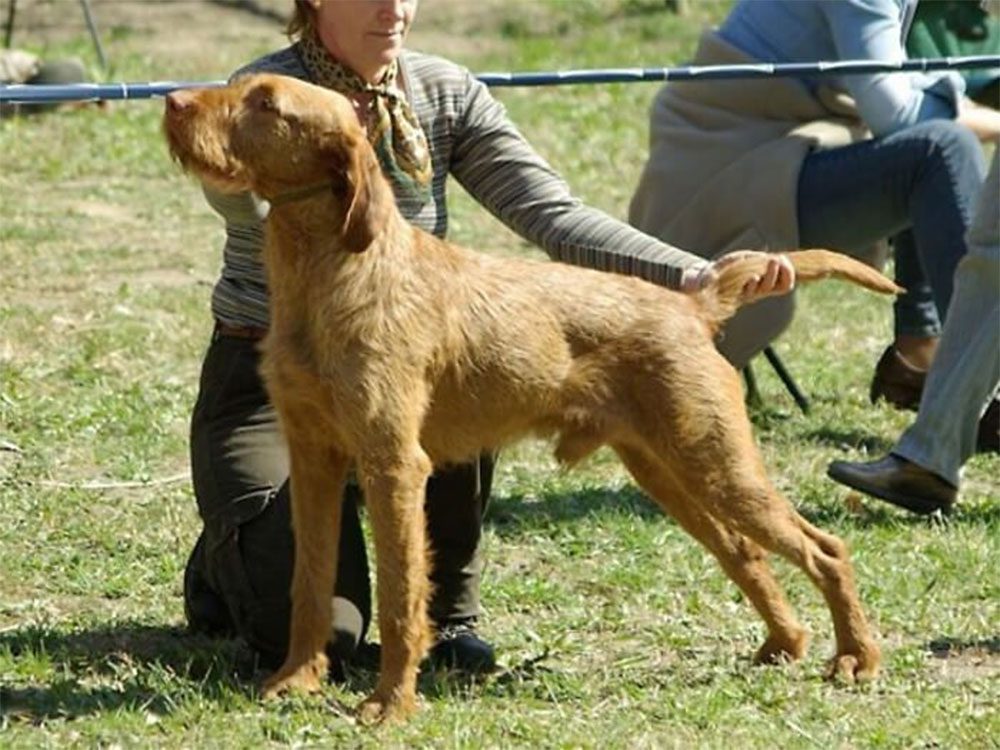
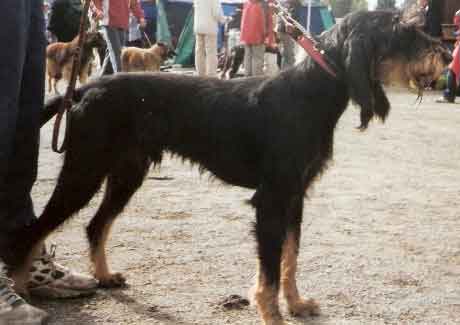
Italian Rough-Haired Hound
Italia FCI 198 - Medium-sized Hounds

Italian Rough-Haired Hound

The Italian Rough-Haired Hound is reserved, wise, calm and thoughtful in his work.

Content

History

The Italian hound It, According to the vast majority of authors, a dog with very ancient origins. It is believed, in fact, descended from hunting dogs that lived from ancient Egypt, they reached the shores of the Mediterranean Sea, and therefore also to Italy, thanks to the Phoenician merchants. Many Egyptian drawings dating from the time of the pharaohs show the presence of dogs very similar to the current one Italian hound.

His best period is the Renaissance, when its level was improved and its great diffusion began. The race then underwent a slow and inexorable decline until, from the beginning of the 20th century, the Italian hound it became very popular again.

The modern history of Italian hound started on 1920, year in which the Technical Committee of the Society of Hound Hobbyists drew up the first breed standard that a few years later, in 1929 to be exact, was approved by the Italian Kennel Club. At that time there was only one standard that unified the Italian Rough-Haired Hound y al ยซItalian short-haired Segugioยซ; in 1976 came the prohibition of mating between the two varieties; then, in 1989, the ENCI (Ente Nazionale della Cinofilia Italiana) passed two different standards, standards that were later also recognized by the FCI which classified them in the group 6, among hound-type dogs, and related breeds.

The Italian Rough-Haired Hound It probably has the same origins as the ยซItalian short-haired Segugioยซ; in fact, both varieties of hounds have always coexisted in almost the entire peninsula.

Photo: myanimallife

Physical Characteristics โ€œItalian Wirehaired Houndโ€

Italian Wirehaired Hound

It is similar to the "Italian Flat-Coated Hound". It differs mainly by the coat, made up of coarse hair no more than two inches long, but thinner and shorter on the tail, ears and head; the coat colors are fawn and fiery black (both with white spots allowed, if they are well located).

For the standard it has minimum and maximum withers heights greater than two centimeters compared to the "Italian Flat-Coated Hound": therefore it is slightly larger. She is also believed to have a calmer and more thoughtful temperament than her satin-haired variant., and that this is reflected in a slightly different approach to hunting.

The height at the withers varies in the male from 52 to 60 cm and in the female of 50 to 58 cm.. In the case of an excellent subject there is a tolerance of two centimeters more or less. Weight may vary in males of 20 to 28 kg and females in 18 to 26 kg. The length of the trunk is identical to the height at the withers.

Character and skills ยซItalian Wirehaired Houndยป

Great hunter and secret companion. It is used and fits perfectly both in the mountains and on the flat and in the most rugged terrain. It is equipped with resistance, as well as with good speed and works with commitment and passion both in isolation and in the diving suit.

Compared to "Italian Flat-Coated Hound", the Italian Rough-Haired Hound is more reserved, less exuberant, wise, calm and thoughtful in his work. A gentle look, friendly, but proud and wrapped in a halo of melancholy. A strong and very nice voice.

This dog is first and foremost a working dog, and is rarely kept as a pet.

Videos "Italian Rough-Haired Hound"

ITALIAN SEGUGIO No10 With Italian subtitles. Look now at http://www.tstv.gr/it.html
SEGUGIO ITALIANO No10 Con sottotitoli in Italiano. Guarda ora a http://www.tstv.gr/it.html
ITALIAN SEGUGIO documentary trailer

Type and recognitions:

  • FCI CLASSIFICATION:
  • Group :
  • Section : . .

Federations:

  • – FCI – Group 6: Scent hounds, and related breeds. – Section 1.2: Medium-sized Hounds. โ“˜
  • – โ€‹KC – Houndy โ“˜

FCI breed standard "Italian Rough-Haired Hound"

Origin:
Italy

Date of publication of the valid original standard:
27.11.1989

Use:

Hound, especially for hare and wild boar hunting.


General appearance:

It is of medium proportions and its body is square in shape.. Its configuration is harmonious in terms of dimensions (that is to say, the relationship between size and different parts of the body), but there is no harmony in relation to the profiles (that is to say, concordance between the profiles of the head and body). Its well balanced construction, perfectly symmetrical, well developed, of thin shapes, well muscled with no hint of fat allow you to track game from dawn to dusk

IMPORTANT PROPORTIONS :

The height from the ground at the withers is equal to the length of the trunk, measured from the scapulo-humeral joint to the tip of the ischium. The cross, which should not be very prominent, barely exceeds the level of the rump. The length of the snout should correspond to half the length of the head. The height of the chest is just less than half the height at the withers.


Behavior / temperament:

The Italian Hound adapts perfectly to the most difficult terrain and can be used for hunting in the mountains, like on flat ground. Being very resistant and fast, work with ardor and passion, so much alone, like in a pack. Compared to smooth-haired specimens, is more reserved, less exuberant, sensible, calm and prudent at work. His kind look, sweet and haughty is veiled by a reflection of melancholy. His voice is sonorous and very harmonious.

Head:

It has an elongated shape. Its length reaches 4/10 the height at the withers.

Cranial region:
  • Skull : It appears in the shape of an elongated ellipse.. In profile, the upper longitudinal axis is moderately divergent in relation to the longitudinal axis of the snout. The upper profile is slightly domed. The bizygomatic width must be less than half the length of the head. The zygomatic arches are poorly developed. The frontal furrow is not very marked. The occipital protuberance should be sharp, but short; stands a little back, so it is not very visible. Can only be perceived by touch.
  • Depression links (Stop) : It is very little marked. From the snout the upper profile should rise in a gentle slope that reaches the skull.

facial region:

  • Truffle : It is great, fresh and moist. Extends to the front, in the vertical of the anterior part of the lips. The windows are movable and open wide. Its color is always black.
  • Snout : Its measurement corresponds to half the length of the head. Its height is barely more than half its length.; its width is equal to 17% of head length. The profile is convex. The lateral faces of the snout are convergent, but not to the point of imparting a pointy appearance. The branches of the mandible are almost rectilinear; They are poorly developed in their anterior part. The suborbital region is well shaped, but somewhat less than that of the bareback Hound.
  • Jaws / Teeth : Strong jaws, normal development. The dental arches of the incisors adapt perfectly. The teeth are white, of normal size and are implanted in the shape of a regular line. The denture is complete. The joint is in the form of scissors, although the pincer-shaped joint is accepted.
  • Cheeks : They are not very marked.

Eyes : They are big and bright, dark ocher color. They are located in a semi-lateral position. The inner corner of the eyelids should be at the same distance from the anterior edge of the nose and the outer tip of the occipital crest.. Fascinating expression, the look is sweet and haughty, with a slight veil of sadness. The palpebral opening is almond-shaped; the eyelids adapt perfectly to the eyeball. The edge of the eyelids must be black.

Ears : Its implantation of moderate width is located at the level of the zygomatic arches. They are hanging, form triangular, flat in almost its entire length (66 โ€“ 70% of head length) and very wide. The ears should end in a sharp point. Although thin, your cartilage should be rather rigid throughout its entire length; Its crooked and very rigid insertion deviates the ears towards the front, but without causing them to sag or bend, the tomen shaped like a tirabuzรณn. The tip bends slightly inwards. The ears are covered with hairs of moderate length shorter than those on the trunk., less hard and without any bangs.

Neck:

The top is slightly arched. The lower part does not show any sign of a double chin. Its length is equal to the length of the head, reaching like this 4/10 the height at the withers. It has the shape of a truncated cone joined to the head by a very marked nape.. Similarly, The neck should connect with the trunk, blending harmoniously with the shoulders.. Since it is very thin and light, must give the impression of being not very muscular.

Body:

Its longitude, Measured from the tip of the shoulder to the tip of the buttock, is equal to the height at the withers.

  • top line : Profile view, from the cross to the rump, is straight. It is somewhat convex in the region of the spine.
  • Cross : It protrudes little above the line of the back; is narrow, due to the approach of the tips of the shoulder blades. Blends harmoniously with the neck.
  • Back : The upper profile is rectilinear and muscular, although the muscles are not very apparent. The relationship between the length of the thoracic and the lumbar region is 3 to 1.
  • Pork loin : The length of the spine is a little less than 1/5 the height at the withers: its width is a little less than its length; his muscles are well developed.
  • Rump : The upper profile is slightly convex. It is said to be horizontal because its obliquity, from the tip of the hip to the beginning of the tail, lies between 15 to 20 degrees; Its length corresponds approximately to 1/3 from the height to the withers and its breadth to the 2/3 its length. The muscles are strong.
  • Breast : Its length reaches approximately half the height at the withers and its width about 1/3 the height at the withers. Its height must be equal to 48% the height at the withers. The lateral faces have a slight convexity. On the other hand, the upper costal arches should be well arched. The thoracic cavity is of moderate width. The manubrium of the sternum should be in the plane of the point of the shoulders.
  • bottom line : It is determined by a line that rises in a gentle slope to the abdomen, that is thin and never elongated. The flanks are lean, usually sunken, never recharged.

Tail:

High insertion, on the line of the rump. It is thicker at the root than that of the Short-haired Hound and is covered with hair throughout its length., but he doesn't have any bangs. During rest, hangs in the shape of a saber; When the dog is in action, it rises without exceeding the height of the back., It moves from left to right, rubbing the sides, or turns at times with rotational movements.. The queue is considered long, although its end is very close to the end of the hock.

Tips

PREVIOUS MEMBERS

  • As a whole : Seen in profile, follow a vertical line, starting from the scapulohumeral joint, must reach the ground touching the tips of the fingers, while the vertical starting from the humero-radial joint must divide into two more or less equal parts (of which the largest is the above) the forearm and carpus, emerging at half the length of the metacarpal, which is oblique. Forelimb height, from the ground to the elbow, is equal to half the height at the withers.
  • Shoulder : They are thin, long, free movements. The upper tips of the shoulder blades are tightly together. The obliquity below the horizontal is 45 a 50ยฐ.
  • Arms : They are well attached to the body. Like the shoulders, They have dry and long muscles. They are parallel to the median plane of the trunk. The scapulohumeral angle is 110ยฐ, the obliquity of the scapula is 45ยฐ.
  • Elbows : They appear equidistant from the median plane of the trunk; although they should not deviate or inward, nor out. The humeral-radial angle is 135 at 145ยฐ.Forearm : Is vertical. Its length is almost equal to 1/3 the height at the withers. The ulnocarpal groove is clearly visible. The forearm should give the impression of being very dry and thin..
  • Carpi : They are dry; a thin and fine skin covers them. Seen from the front, extend the vertical line of the forearm.
  • Metacarpus : Its length is not less than one sixth of the length of the forelimb, measured from the ground to the elbow. Seen in profile, they are somewhat oblique forward.
  • Front feet : They have an oval shape (hare feet); the fingers are arched and well together. The hair that covers them is dense. The digital tubercles are not very fleshy.; the pads are thin,hard, leathery and black. The nails are strong, bent over and always black. The presence of some white nails (not pink) does not constitute a fault.

LATER MEMBERS

  • As a whole : The vertical starting from the tip of the gluteus touches or falls almost on the tip of the fingers. รยก back view, the same vertical divides the tip of the hock into two equal parts, the metatarsus and the foot. The total length of the hind limb is equal to the 90% the height at the withers.
  • Thighs : They are long and wide. Its length is not less than a third of the height at the withers. Its lower edge is slightly convex; the tip of the buttocks is visible. The protruding muscles are clearly distinguished from each other. The thighs are somewhat oblique from top to bottom and from behind to front. The angle of the coxofemoral joint varies between 90ยฐ and 95ยฐ.
  • Knee : It must be in perfect aplomb with the extremity; it should not deviate even inwards, or out. The tibiofemoral angle varies between 110 y 120ยฐ
  • Leg : Its length is slightly less than that of the thigh and its obliquity below the horizontal is 40ยฐ.. The muscles are thin; the hock groove is well marked and visible with the external saphenous vein well apparent.
  • Hock : Viewed from the side, their faces are very wide. It is considered low because the distance from the ground to its tip does not exceed the 27% the height at the withers. The tibiotarsal angle, closed due to marked obliquity of the tibia, ranges between 115ยฐ and 125ยฐ.
  • Metatarsus : Its length corresponds to the height of the hock. It is strong and thin and appears perpendicular to the ground. No presence of dewclaws.
  • Rear feet : Less oval than the front ones, but with all the same features.

Movement:

Although the favorite movement of the Italian Hound is the gallop, The hunting activity forces the dog to also walk and trot..

Mantle

SKIN : It is well attached over the entire body and is only a little thick. The color of the mucous membranes, of the third eyelid, of the nails, of the central pad and digital tubercles is exclusively black. Although dark pigmentation of the palate is not prescribed, always constitutes an appreciable quality.

HAIR : The length of the hair covering the trunk should not exceed five centimeters. The hair is clearly hard, except on the head, the ears, the extremities, tail and snout, where the hair is generally less hard than on the trunk and lips. The hair under the lips, although not very long, constitutes what is considered a beard. The hair that covers the eyebrows is of moderate length, so that it does not fall into the eyes, nor hide them.

COLOR : Accepted colors include the entire range of unicolor fawn, from dark and carbon red, to light fawn, and the black and tan. The fawn may have white on the snout and skull (the mask may or may not be symmetrical), a white star on the parapet, white color on the neck, the metacarpals and metatarsals, the feet and the tip of the tail. But, the color white is not appreciated, and it is preferable that it not be very abundant. The black and tan may present only a white star on the chest; In this case it is said that the hound is tricolor.


Size and weight:

Height to the cross :

  • In males : 52 to 60 cm.,
  • in females : 50 to 58 cm..

Weight :

  • In males : 20 to 28 kg,
  • in females : 18 to 26 kg.

A tolerance of 2 cm more or less when it comes to excellent specimens.


Fouls:

Any deviation from the aforementioned criteria is considered a fault and the severity of this is considered to the degree of the deviation from the standard and its consequences on the health and well-being of the dog. These modalities are also valid for dogs that always walk.

SERIOUS FAULTS

โ€ข Head : convergent craniofacial axes.
โ€ข Size that exceeds the upper or lower margins indicated by the standard.

MISS PLAYOFFS

โ€ข Aggressive or fearful dog.
โ€ข Concave nasal cane.
โ€ข Total depigmentation or most of the truffle, or the edges of the eyelids.
โ€ข Gaze eyes.
โ€ข Superior prognathism.
โ€ข Short tail, o absence of glue, both congenital, as artificial.
โ€ข Slate or gunmetal color; brindle coat, brown, Brown, predominantly white liver.

Any dog โ€‹โ€‹showing clear signs of physical or behavioral abnormalities must be disqualified..


N.B.:

Males should have two normal-appearing testicles fully descended into the scrotum..

Source: F.C.I - International Cynological Federation
โ–ท The world of Pets: Dogs, cats, birds, reptiles, amphibians

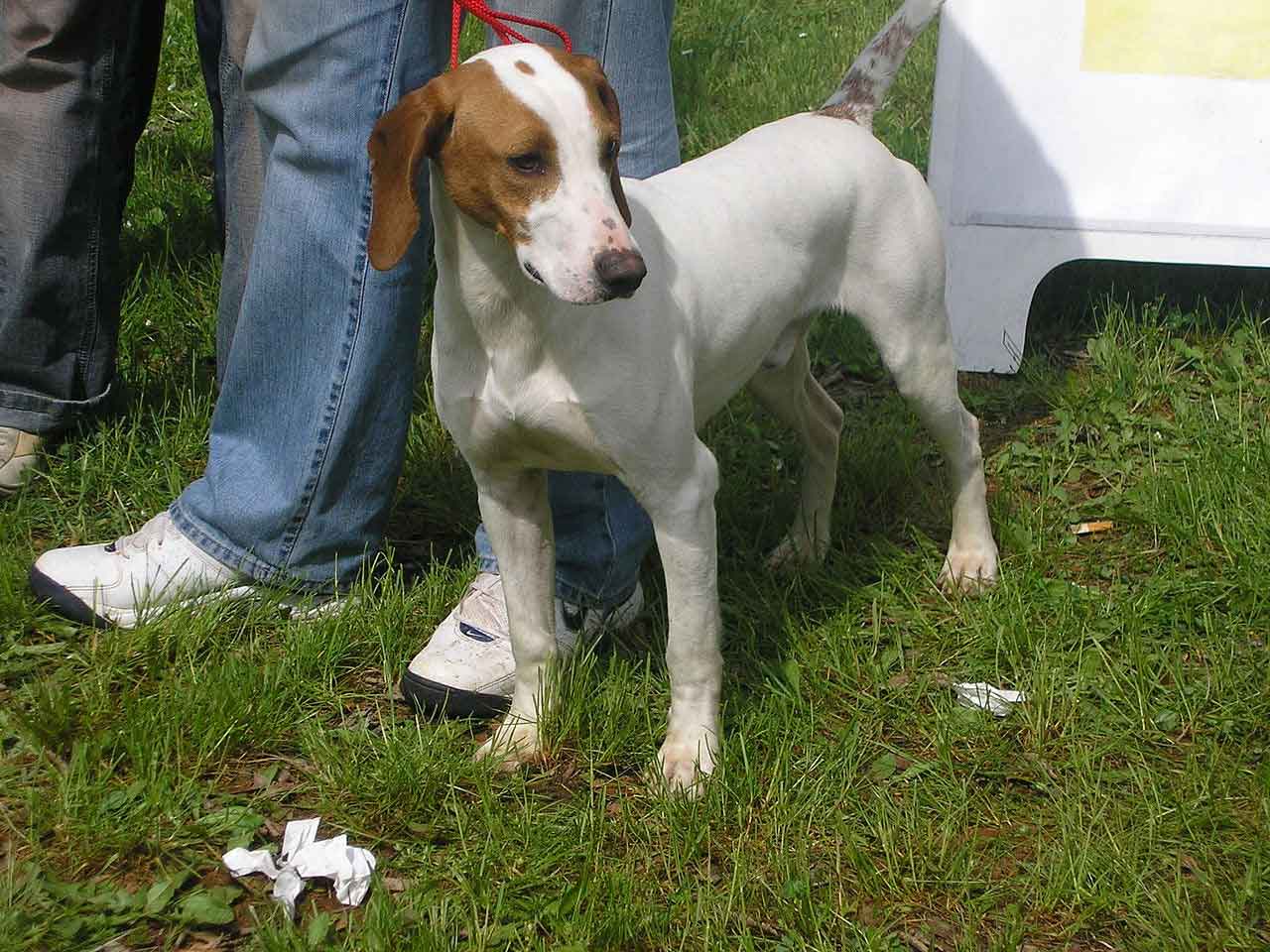
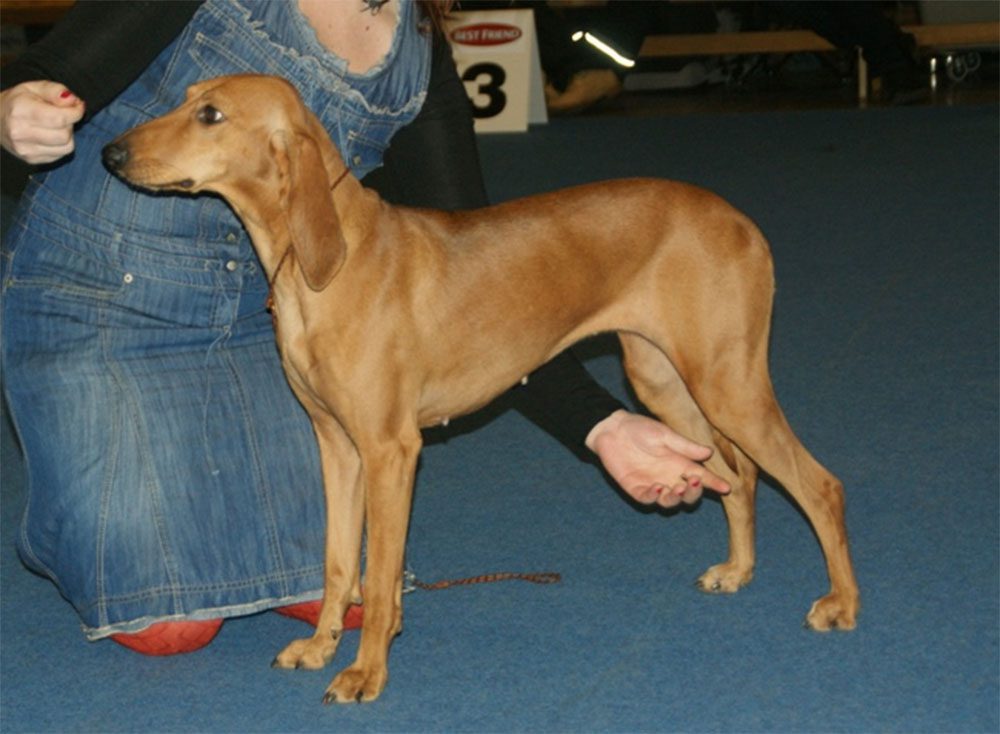
Italian short-haired Segugio
Italia FCI 337 - Medium-sized Hounds

Italian short-haired Segugio

The Italian short-haired Segugio it is a dog with a stable temperament, of a soft but not very outgoing expression.

Content

History

The Italian hound It, According to the vast majority of authors, a dog with very ancient origins. It is believed, in fact, descended from hunting dogs that lived from ancient Egypt, they reached the shores of the Mediterranean Sea, and therefore also to Italy, thanks to the Phoenician merchants. Many Egyptian drawings dating from the time of the pharaohs show the presence of dogs very similar to the current one Italian hound.

His best period is the Renaissance, when its level was improved and its great diffusion began. The race then underwent a slow and inexorable decline until, from the beginning of the 20th century, the Italian hound it became very popular again.

The modern history of Italian hound started on 1920, year in which the Technical Committee of the Society of Hound Hobbyists drew up the first breed standard that a few years later, in 1929 to be exact, was approved by the Italian Kennel Club. At that time there was only one standard that unified the Italian Rough-Haired Hound y al ยซItalian short-haired Segugioยซ; in 1976 came the prohibition of mating between the two varieties; then, in 1989, the ENCI (Ente Nazionale della Cinofilia Italiana) passed two different standards, standards that were later also recognized by the FCI which classified them in the group 6, among hound-type dogs, and related breeds.

The Italian short-haired Segugio It probably has the same origins as the ยซItalian Rough-Haired Houndยซ; in fact, both varieties of hounds have always coexisted in almost the entire peninsula.

Physical characteristics ยซItalian short-haired houndยป

Italian Hound, Short-haired
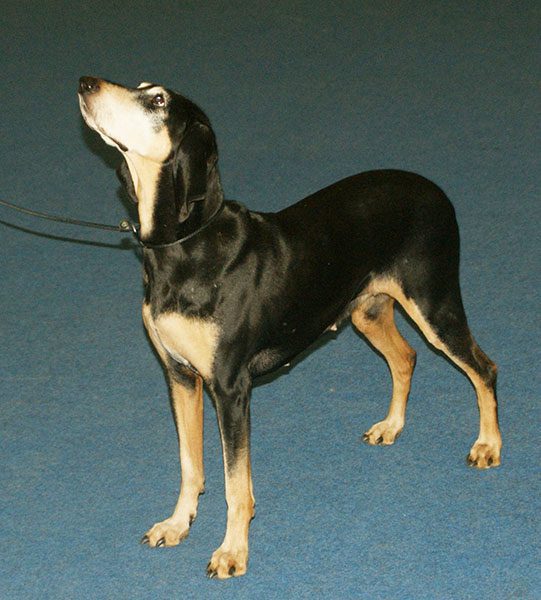
A female Italian Hound, Short-haired. Colour: black & tan by Canarian, CC BY-SA 4.0, via Wikimedia Commons

The Italian short-haired Segugio represents perfection for those who care about physical appearance: in fact, has no fat and is very muscular. This physical feature, combined with a regular body, makes it particularly fast and suitable for running. It's not a coincidence, in fact, getting tired only after intense physical activity.

Hair is shaved all over the body, dense, dense and smooth.

The allowed colors are:

– Fawn unicolor in all its gradations.
– black and tan.

Fawn dogs may have a white muzzle and skull, a white star on the chest, white on the neck, metacarpos, metatarsos, feet and tip of tail.

The height of the males ranges from 52 and 58 cm., that of the females between 48 and 56 cm.. The weight can vary between 18 and 28 kg.

Character and aptitudes ยซItalian short-haired houndยป

Alive and bold. Never aggressive towards humans; rarely towards other dogs. It does not bite. Suits austere food and country kennels. Not conspicuously affectionate, but constantly needs the presence and consideration of the owner, who often identifies with the one who accompanies him during the hunt.

If he is well-maintained and has a breed-appropriate lifestyle, the Italian short-haired Segugio You can live up 12 or 13 years. This is because this type of dog is not predisposed to particular diseases derived from its breed.

Those who love them say that…

ยซI did not choose to live with a ยซHoundยป, I mean it was not a choice out of passion for this breed… it happened to me! It turns out that I share my life with a "Hound". It was and still is the most amazing experience of my life. Living with a "Hound" means learning to have time, lots of time to walk โ€œaloneโ€ exploring life, silent. It is learning that you can stay in the forest for hours without doing anything other than living and discovering the forest. And that's it. The "Hound" teaches you not to pay attention to appearances, to pursue your passions tenaciously while those who look at you think you are just sniffing. He is an extremely sensitive partner but at the same time proud and independent. Living with Chloe is an adventure, made of constant and subtle balances between sharing and the search for individuality, the desire for freedom and the need to feel close to each other, "It is learning every day to discover and respect yourself.".

Silvia De Cristofaro

Videos "Italian short-haired Segugio"

segugio italiano sofiko evros 2/7/2017 Educational
segugio italiano sofiko evros 2/7/2017 ฮ•ฮบฯ€ฮฑฮนฮดฮตฯ…ฯ„ฮนฮบฯŒ
Short-haired fawn Italian Hound (Alexia)-1/1
Segugio Italiano fulvo a pelo raso (Alexia)-1/1

Type and recognitions:

  • FCI CLASSIFICATION:
  • Group :
  • Section : . .

Federations:

  • – FCI – Group 6: Scent hounds, and related breeds. – Section 1.2: Medium-sized Hounds. โ“˜
  • – โ€‹KC – Houndy โ“˜

FCI breed standard "Italian short-haired Segugio"

Origin:
Italy

Date of publication of the valid original standard:
13.11.2015

Use:

Hound, particularly for hare and wild boar hunting.


General appearance:

This is a dog of medium overall proportions and a square body., robust construction, perfectly proportioned and endowed with a well-developed bone structure. He is slim and has strong muscles., without the slightest trace of grease. The head is elongated and the longitudinal craniofacial axes are divergent.. The hair is satin.

IMPORTANT PROPORTIONS

โ€ข The length of the trunk is equal to the height at the withers (square appearance).
โ€ข The height of the chest is equal to half the height at the withers, or, In other words, is equal to the height of the forelimb measured from the ground to the elbow.
โ€ข The length of the nasal shank is equal to half the length of the head.


Behavior / temperament:

This is an animal that adapts well to the most diverse types of terrain and is endowed with great resistance and great speed.. Shows great ardor, whether you work alone or in a pack. He has a bold temperament, but not very communicative. His eyes are sweet and his voice is very pleasant..

Head:

---

Cranial region:
  • Skull : Seen from above, Its shape is almost oval. In profile, the axes of the skull and the nasal cannula are divergent. The upper profile is slightly convex. The bizygomatic width is less than half the length of the head. The superciliary arches are not very developed. The frontal furrow is not very marked. The occipital crest is short and apparent, although the relief is not exaggerated.
  • Depression links (Stop) : It has an accentuation of about 140ยฐ.

facial region:

  • Truffle : It is almost in the shape of a six-sided polyhedron.. It is large enough and mobile. The windows are wide open somewhat laterally.. The color of the nose must always be black.
  • Snout : Its length is equal to half the length of the head. Its depth (height) It should be a little larger than half its length. The profile of the nasal shank is somewhat convex. Its lateral faces converge forward. The branches of the mandible are almost straight along their entire length and the body of the jaw is poorly developed in its anterior part.. The lower lateral profile of the snout is defined by the upper lip.
  • Lips : They are fine and thin. Seen both from the front, as in profile, they are a little high (lying). Seen in profile, its lower edge draws a slight curve. The edges of the lips should always be black.
  • Jaws / Teeth : The jaws are shaped like a truncated cone.. The incisors are implanted at right angles to the jaw and the joint is scissor-shaped.. The denture is complete. The teeth are white and set in a regular line.. The correct joint is scissor-shaped, although the pincer-shaped joint is accepted.
  • Cheeks : Flat and thin.

Eyes : Almond shaped. They are large, luminous, dark ocher color. Your expression is sweet. They are located in a semi-lateral position. The edges of the eyelids are always black.

Ears : The insertion of the ear is located in the plane of the zygomatic arches or a little below. The ears must be hanging and have a contortion that brings them completely forward and does not even allow them to be sunken., nor twisted. They have a triangular shape, They are flat throughout almost their entire length and are very wide. Its end should end in a narrow point, but never widely rounded; this tip bends slightly inwards. The length of the ears corresponds to a 70% of the length of the head and its width, measured at the widest part, It is a little larger than half its length.

Neck:

โ€ข Profile : The upper profile is slightly arched, i.e. convex. โ€ข Length : Its length corresponds or is almost equal to the length of the head; so that, must correspond to 4/10 the height at the withers. โ€ข Form : The neck is shaped like a truncated cone.. Its appearance is thin and light, to the point of giving the impression of being not very muscular. โ€ข Skin : The skin on the neck is thin, well stretched and does not form folds or double chins. The hair is satin.

Body:

  • top line : It is rectilinear. Descends harmoniously from the withers to the rump, with a slight convexity in the plane of the lumbar region.
  • Cross : Does not protrude much above the line of the back. It is narrow due to the approach of the tip of the shoulder blades and joins harmoniously with the root of the neck.
  • Back : The upper profile is rectilinear and the muscles are not very apparent.. There is a proportion of 3 to 1 between the length of the back and the length of the lumbar region.
  • Pork loin : The length of the lumbar region corresponds to just under 1/5 the height at the withers. The width of the spine is equal to its length. The muscles of this region are well developed.
  • Rump : Its upper profile is slightly convex. Its direction has an inclination of about 10 degrees below the horizontal. Its length corresponds approximately to 1/3 from the height to the withers and its width corresponds to half its length. The muscles are well developed.
  • Breast : The height of the rib cage is equal to or slightly less than half the height at the withers and its transverse diameter, calculated at half its height, approximately corresponds to 1/3 the height at the withers. The chest should descend almost to the elbows. The ribs are not very tight, therefore they are little convex. Since the chest circumference is more than ยผ of the height at the withers, the pectoral region is not very wide.
  • bottom line : It is typical of the breed, since it appears in the form of a straight line throughout its entire length; this line goes up from the sternum to the belly, which is very thin, although not very raised.

Tail:

On the line of the rump the insertion of the tail is high. It is thin at the root and uniform throughout its extension.. It looks like a small flute (breadstick), except at the extremity, where it is very fine. The limb reaches the tip of the hock or barely touches it. The tail is covered with short hair throughout its entire length.. When the dog is at rest the tail hangs; When in action it rises and exceeds the line of the back.

Tips

PREVIOUS MEMBERS : Seen as a whole and in profile, the aplombs must correspond to an imaginary vertical line that, starting from the scapulohumeral joint, descends to the ground, touching fingertips. They must also correspond to another imaginary vertical line that, starting from the humero-radial joint, divide the forearm and carpus into two more or less equal parts to end at half the length of the metacarpus. Seen from the front, The positions must correspond to a vertical line that starts from the tip of the shoulder and divides the forearm into two visibly equal parts., the carpus, the metacarpus and the foot. The height from the elbow to the floor is equal to half the height at the withers.

  • Shoulder : Shoulder length corresponds to 1/3 the height at the withers. Its inclination below the horizontal is 45 to 55 degrees. Shoulder muscles are long, skinny, apparent and well defined. The opening of the angle of the scapulo-humeral joint is about 110 degrees.
  • Arm : The length of the arm corresponds approximately to half the height from the floor to the elbow. In relation to the vertical, the arm is located in a plane more or less parallel to the median plane of the body. Arm muscles are long and thin.
  • Elbows : They are located in the plane of the sternum line or a little below and are parallel to the median plane of the body. The end of the elbow should be on the inclined vertical that starts from the tip of the shoulder blade. The humeral-radial angle measures 135 to 145 degrees.
  • Forearm : Its length is approximately equal to 1/3 the height at the withers. It is located perpendicular to the ground and has a clearly visible carpo-ulnar groove., which makes him look thin, fleshless and without important bones.
  • Carpo : He is thin. Extends the straight line of the forearm.
  • Metacarpus : Its length must not be less than 1/6 of that of the anterior limb, measurement from the floor to the elbow. In profile, the metacarpus is wider than the carpus, but flat and thin and slightly oblique from back to front.
  • Front feet : They have an oval shape (hare foot); the fingers are well together and arched. The digital tubers are not very fleshy. Center pads are thin, hard, leathery and black. The nails are strong, bent and always black. The presence of some white nails (not pink) does not constitute a fault.

LATER MEMBERS : Seen in profile, The positions must correspond to an imaginary vertical that descends from the tip of the gluteus to the floor, rubbing or touching the tips of the fingers.. Seen from the back, the aplombs must correspond to an imaginary vertical that, from the tip of the gluteus, descends to the ground and divides the tip of the hock into two equal parts, the metatarsus and the foot. The length of the hind limbs is equal to 93 % the height at the withers.

  • Thigh : Length and width; its length is not less than 1/3 the height at the withers. thigh width (external face) is approximately equal to ยพ of its length. The muscles are prominent, but they are well separated. The posterior edge of the thigh is slightly convex. The angle of the coxofemoral joint measures 90 to 95 degrees.
  • Knees : They must be well plumb and the kneecap must not deviate even inwards, nor out. The angle of the tibiofemoral joint is about 115 degrees.
  • Leg : Its length is a little less than the thigh; Its inclination below the horizontal is approximately 40 degrees. The leg muscles are thin even in the upper part; They are solid and differentiate well from each other. The groove on the leg is well marked and apparent.. The external saphenous vein is clearly visible. The bones are rather light and very solid..
  • Hock : Its width is approximately one tenth of the height at the withers.. The distance from the ground to the tip of the hock should not be greater than the 27 % the height at the withers (low hock). The bone structure is solid and the contours of the bones are clearly visible., which accentuates the thinness of the region. The opening of the tibiotarsal angle is about 135 degrees.
  • Metatarsus : Its length is less than half the length of the forelimb measured from the ground to the elbow. It is less wide than the hock and is presented in a vertical position, that is to say, perpendicular to the ground. No presence of dewclaws.
  • Rear feet : They are less oval than the previous ones; for the rest, They have the same characteristics.

Movement:

during the hunt, the dog's movement is the gallop.

Mantle

SKIN : It is fine and thin; is well applied over the entire body. Mucosal pigmentation, of the third eyelid, of the nails, of the central pads and digital tubercles should be strictly black. Black palate is not a requirement, but it represents a quality.

HAIR : It is smooth over the entire body. It's stiff, dense, dense and uniformly smooth. Some hard hairs can be found scattered on the trunk, the snout and limbs, but this does not constitute a fault.

COLOR : Accepted colors include the entire range of unicolor fawn, from intense reddish-fawn to washed-out fawn and black and tan. The tan markings are found, as usual, on the snout, the eyebrows, the chest, the extremities, from the carpus to the foot and from the tarsus to the foot, as well as in the perineum. The fawn may have white on the snout and skull (the mask may or may not be symmetrical), a white star on the chest, white color on the neck, the metacarpals and metatarsals, the feet and the tip of the tail. But, the color white is not very appreciated, and it is preferable that it not be very abundant. The black and tan color may have a white star on the chest; In this case it is said that the hound is tricolor. The brown color (coffee, liver) it is not accepted.


Size and weight:

Height to the cross :

  • In males : of 52 to 58 cm.,
  • in females it is 48 to 56 cm..

Tolerance of more or less 2 cm. (only for excellent dogs).

Weight : The weight of 18 to 28 kg.


Fouls:

Any deviation from the aforementioned criteria is considered as a fault and the severity of this is considered to the degree of the deviation to the standard and its consequences on the health and well-being of the dog., and the dog's ability to perform its traditional task.

โ€ข Constant pacing.

MISS PLAYOFFS :

โ€ข Aggressive or fearful dog.
โ€ข Converging craniofacial axes.
โ€ข Depigmentation of all or most of the nose and the edge of the eyelids.
โ€ข Concave nasal cane.
โ€ข Superior prognathism.
โ€ข Gaze eyes, total or most of the edges of the eyelids depigmentation.
โ€ข Absence of tail or short tail, both congenital, as artificial.
โ€ข Slate or lead color; brindle dog, coffee, liver, the predominant white color.
โ€ข Size that exceeds or does not reach the tolerance margin indicated in the standard.

Any dog โ€‹โ€‹showing clear signs of physical or behavioral abnormalities must be disqualified..


N.B.:

Males should have two normal-appearing testicles fully descended into the scrotum..

Source: F.C.I - International Cynological Federation
โ–ท The world of Pets: Dogs, cats, birds, reptiles, amphibians

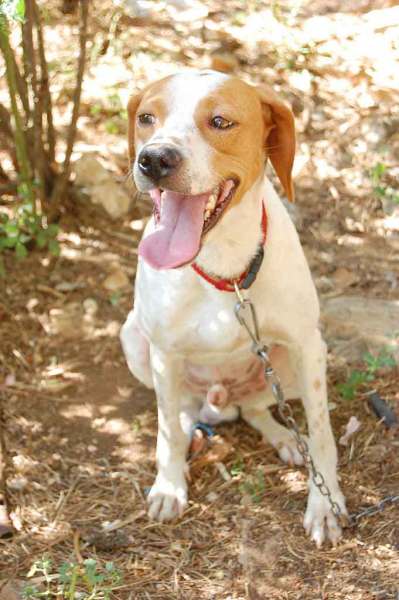
Istrian Shorthaired Hound
Croacia FCI 151 . Medium-sized Hounds

Istrian Shorthaired Hound

There is also a "Wire-Coated Istrian Hound" of slightly larger size..

Content

History

The Istrian Shorthaired Hound is an ancient breed of hound dog originating from Istria, whose origins are lost in dark prehistory. The frescoes (1474, Chapel of the Virgin Mary in Beram, near Pazin), the paintings (including Titian, first half of the 18th century), and the chronicles (1719, Bishop Bakic of Djakovo) bear witness to it.

The Istrian Shorthaired Hound, highly appreciated for its excellent hunting qualities, was sold from Istria to neighboring countries. The first inscriptions in the herd book date from 1924, the breed was recognized by the FCI already in 1949, but the standard wasn't published until 1973.

Today, the Istrian Shorthaired Hound it is quite common in and around Istria and is still very popular with hunters due to its excellent characteristics.

Photos:

1 – Istrian Shorthaired Hound at a dog show in Zadar, Croatia (CACIB 2006.) by Mirta12, CC0, via Wikimedia Commons

Physical Characteristics Istrian Shorthaired Hound

The Istrian Shorthaired Hound he is a medium sized running dog, who appears elegant and distinguished in his build and movements. The height at the withers in both males and females is between 44 and 56 cm., the weight of the dogs is 14 to 20 kg, the optimum is 18 kg.

The coat of these dogs is thin, dense and, as the name reflects, short. This short-haired variant is somewhat smaller than the wire-haired version of the Istrian Hound.. The basic color of the coat is white with orange yellow tints. As a whole, the coat is shiny.

The life expectancy of dogs is 12 – 14 years.

Character and skills Istrian Shorthaired Hound

The characteristic of Istrian Shorthaired Hound it's his distinctive hunting instinct. The dogs have always been used as hunting dogs and still show corresponding characteristics today.. This includes his liveliness and his passion for hunting itself.. Like most hunting dogs, these dogs have little instinct for protection and are therefore quite unsuitable for guarding and protection tasks.

While the Istrian Shorthaired Hound be able to live your hunting instinct and feel fully occupied, has a gentle and friendly disposition. It is obedient and loyal to its owner. Your posture is nice.
It also, these dogs are smart and insightful, so they must be challenged in this regard as well. If the dogs are not kept according to their nature, they often get stubborn and sometimes even start poaching.

Keeping an Istrian Shorthaired Hound

The Istrian Shorthaired Hound It, by its nature, first of all a tracking dog. It is particularly suitable for hunting foxes and hares and is used almost exclusively for this purpose in its native country.. It is important that the dogs of this breed are kept by a hunter and encourage them to go hunting and take the trail., so it should be considered as an example for animals. Despite your gentle nature, they are not suitable as pure family dogs, as their pronounced hunting instinct would be neglected too.

Images "Istrian Shorthaired Hound"

Photos:

2 – Luri the Istrian Shorthaired Hound in a dog shelter in Zadar, Croatia by Mirta12, CC BY-SA 3.0, via Wikimedia Commons
3 – Luri the Istrian Shorthaired Hound in a dog shelter in Zadar, Croatia. He was underweight when the photo was taken by Mirta12, CC BY-SA 3.0, via Wikimedia Commons
4 – Luri the Istrian Shorthaired Hound in a dog shelter in Zadar, Croatia. He was underweight when the photo was taken by Mirta12, CC BY-SA 3.0, via Wikimedia Commons
5 – Istrian Shorthaired Hound Luri in a dog shelter in Zadar. When the photo was taken, he was underweight by Mirta12, CC BY-SA 3.0, via Wikimedia Commons
6 – Istrian Shorthaired Hound puppies at a dog show in Zadar, Croatia (CACIB 2006.) by Mirta12, CC BY-SA 3.0, via Wikimedia Commons

Videos "Istrian Shorthaired Hound"

Type and recognitions:

  • FCI CLASSIFICATION:
  • Group :
  • Section : . .

Federations:

  • – FCI – Group 6: Scent hounds, and related breeds. – Section 1.1: Large-sized Hounds. โ“˜
  • – UKC – Scenthound Group โ“˜

FCI breed standard "Istrian Shorthaired Hound"

Origin:
Croatia

Date of publication of the valid original standard:
3.11.2014

Use:

tireless hound, especially suitable for hare hunting, foxes and wild boars, although it can also be used as a tracking dog.


General appearance:

It is noble looking, with its snow white fur interspersed with yellow-orange spots. The hair is satin and fine. The head is long, narrow and thin. The body is agile. The tail is thin and slightly curled, Sabre-shaped.
This hound barks persistently, usually in a high pitched tone.

IMPORTANT PROPORTION : The length of the body must exceed the withers by a maximum of 10%.


Behavior / temperament:

Sweet character, docile, quiet, very attached to his master. Is energetic, and very passionate while hunting.

Head:

The length of the head fluctuates between 20 and 24 cm.. The forehead has no folds.

Cranial region:
  • Skull : In profile, the occipital protrusion is pronounced. The forehead is slightly arched, presenting a smooth transition towards the nasal bridge, which is straight. View from the top, the forehead is long and rather narrow, with an apparent frontal groove.
  • Depression links (Stop) : Outfit, no sharp sinking.

facial region:

  • Truffle : It is black, or at least brown. The nostrils are wide open.
  • Snout : It is long, width at the base, gradually tapering towards the limb. The nasal helm is straight.
  • Teeth : They're strong. The joint is in the form of scissors, uniform. Teeth are complete.
  • Eyes : They have an oval shape; they do not appear nor sunk, nor protruding. The iris should be as dark a color as possible. The eyelids are black or brown. The look is clear and expressive.
  • Ears : They are fine, with a broad ligament, implanted slightly above the horizontal line of the eyes; become narrower at the end. They are considered long, when carried forward along the bridge of the nose, they reach the canines; they are very long, when the canines exceed. They must be at least semi-long and reach the zygomatic arches.

Neck:

The upper profile is slightly arched in the nape region. The junction with the head is perceptible in the posterior part of the occipital protuberance. The neck is obliquely inserted into the trunk. Neck contour is compact. From the occipital protuberance to the withers, the neck measures of 15 to 20 cm.. The skin is stretched, no jowls or folds

Body:

The upper margin gently descends from the withers towards the rump.

  • Back : It is wide, straight and muscular.
  • Pork loin : Wide and short.
  • Rump : Long and wide; slightly inclined or horizontal. It is longer in females than in males. In the region of the rump the height is about one finger less than in the region of the withers. The haunches are barely noticeable.
  • Breast : Well inclined; reaches at least to the elbow. Normally, its circumference exceeds the height at the withers by some 12 cm.. The ribs are rounded. The front of the chest is well developed, but the tip of the sternum is barely visible.
  • Belly and flanks : The superior margin rises gently from the sternum to the inguinal region, therefore, the belly is slightly raised.

Tail:

Thick at its base, diminishing in its limb. The finer the tail, the greater the noble aspect of the dog. It is high implantation, of medium length and does not exceed the level of the hock. It comes slightly curled up.

Tips

PREVIOUS MEMBERS :

  • Shoulder pads : Long, oblique and well attached to the chest.
  • Elbows : Well applied to the body.
  • forearms : Perfectly vertical, well muscled.
  • Carpi : They are barely distinguishable from the forearm.
  • Metacarpus : They are straight and short. They can be slightly inclined, but the angle they form with the vertical never exceeds 10ยฐ.
  • Front feet : They look more like a cat's foot than a hare's. They are light, with fingers together. The pads are arched and firm; nails are solid.

LATER MEMBERS : Seen from the back, thigh, Leg, the hock tendon and the metatarsal are on the same vertical.

  • Thigh : Is short, wide and muscular.
  • Knee : The kneecap is wide, set high.
  • Legs : long, oblique and well muscled.
  • Hock : It's compact.
  • Metatarsals : Short, vertical or very slightly inclined, forming an angle of 10ยฐ to 20ยฐ with the vertical.
  • Hind feet : Similar to the forwards. However, they are a little longer.

Movement:

It is agile, uniform, loose.

Mantle

SKIN : Is elastic, is well applied over the entire body. Does not form folds. It is a pinkish color.

HAIR : It is flat, fine and shiny. Sometimes longer on the back of the thighs and on the inside of the tail, but this characteristic is not valued.

COLOR : The background color is snow white. In principle, the ears are orange; color that extends beyond the base of the ears and covers both sides of the forehead to the eye region, which gives the face its characteristic mask appearance. We mean a star if, on the upper part of the forehead there is a more or less large spot of the same orange color. The ears may also be dotted with orange spots, which is highly appreciated and considered as a sign of purebred. Yellow-orange spots can be seen in the form of specks or strips spread over any part of the body, but more often in the region of the tail ligament. They should never be so numerous as to dominate the white background color. The tone of the spots should be accentuated, never pale, nor dark, not even brown, which would show signs of a mixture of races. The presence of a third color is not allowed, not even in some hairs. The coat may be uniform white, without any stain.


Size and weight:

Height to the cross : It is of 44 to 56 cm..

Ideal size

  • for males : 50 cm.,
  • for females : 48 cm..

Weight : In an adult male it is about 18 kg.


Fouls:

Any deviation from the aforementioned criteria is considered as a fault and the severity of this is considered to the degree of the deviation to the standard and its consequences on the health and well-being of the dog..

MINOR FAULTS

โ€ข Spots with partial depigmentation on the nose or on one eyelid. Nose with a very clear pigmentation.
โ€ข Convex or slightly sunken back.
โ€ข Croup too oblique.
โ€ข Thin or too solid belly.

MISS PLAYOFFS

โ€ข Aggressive or fearful dog.
โ€ข Lack of proportion between body length and height at the withers.
โ€ข Head too short.
โ€ข Spots with abundant depigmentation, or total depigmentation of the nose.
โ€ข Muzzle too short, very pointed or obtuse.
โ€ข Upper or lower prognathism.
โ€ข Incorrect joint.
โ€ข Different colored eyes.
โ€ข Ligament of the ears set very high.
โ€ข Curled tail, deviated to one side or corkscrew. Cropped tail.
โ€ข Elbows too far apart.
โ€ข Twisted forearms.
โ€ข Pasterns too oblique.
โ€ข Hair that is too long.
โ€ข Any color other than yellow-orange.
โ€ข Size above or below the norms established by the standard.

Any dog โ€‹โ€‹showing clear signs of physical or behavioral abnormalities must be disqualified..


N.B.:

Males should have two normal-appearing testicles fully descended into the scrotum..

Source: F.C.I - International Cynological Federation

Alternative names:

1. Original name – Istarski Kratkodlaki Goniฤ (English).
2. Chien courant d’Istrie ร  poil ras (French).
3. Istarski Kratkodlaki Goniฤ (German).
4. Istarski kratkodlaki gonic (Nome original) (Portuguese).
5. Nombre original – Istarski Kratkodlaki (espaรฑol).

โ–ท The world of Pets: Dogs, cats, birds, reptiles, amphibians

Ibizan Hound
Espaรฑa FCI 89 . Primitive type - Hunting Dogs

Ca Eivissenc

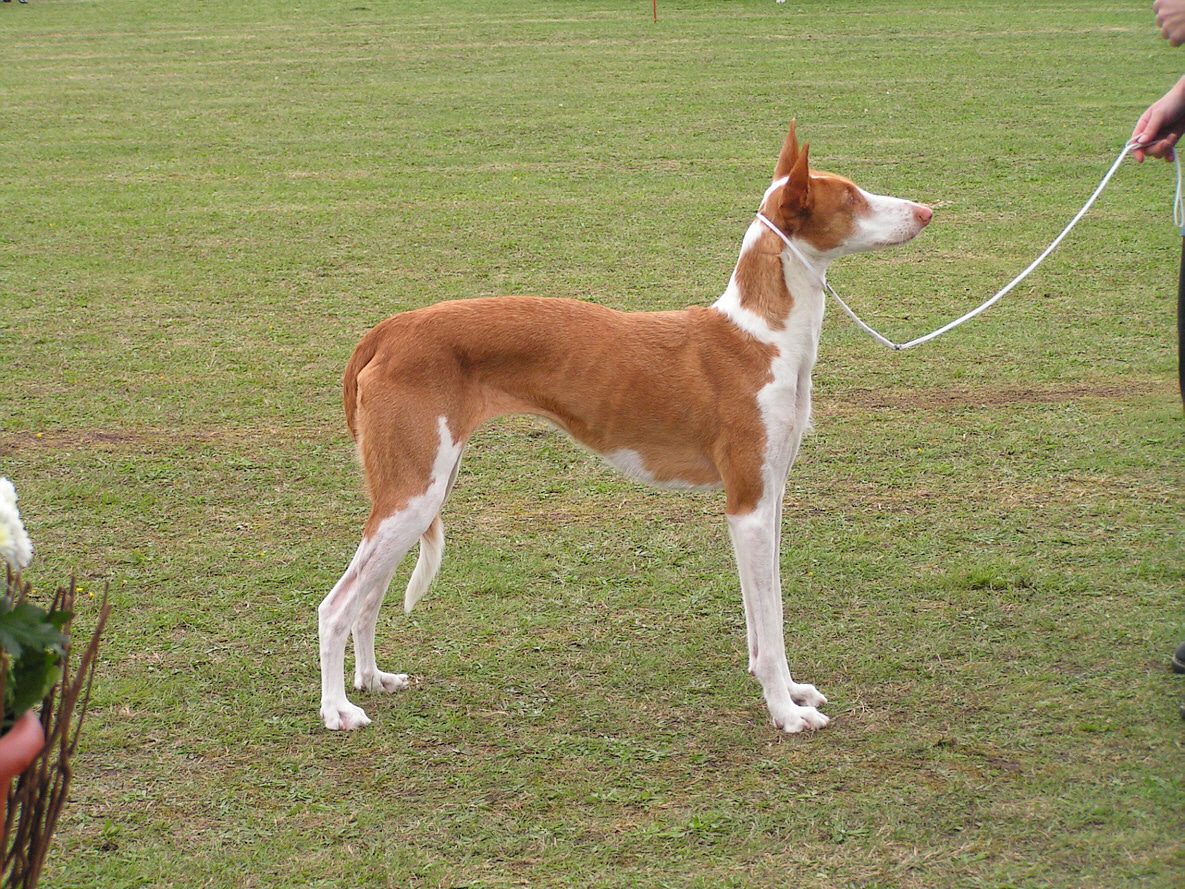
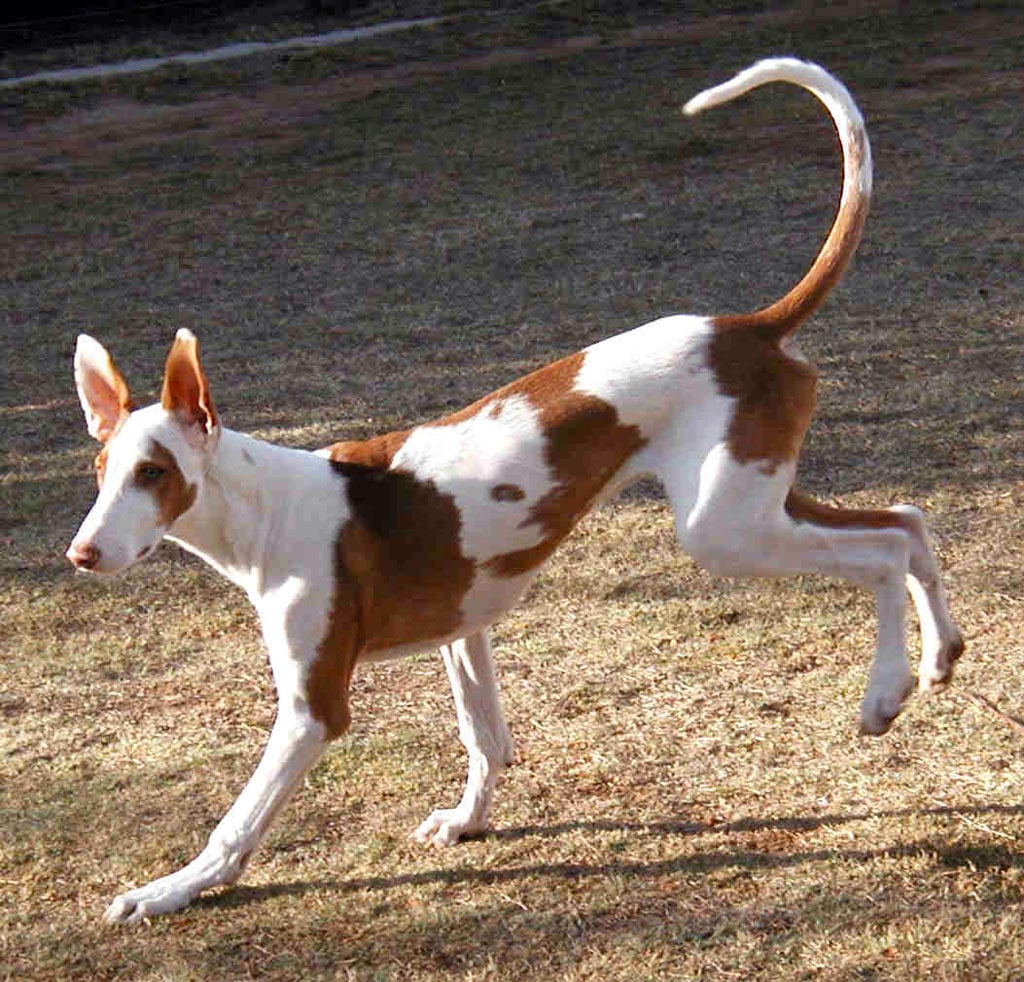
The Ibizan Hound is one of the medium sized Greyhound, very similar to Pharaoh Hound.

Content

History

The Ca Eivissenco or โ€œPodenco Ibicencoโ€, It is a breed canine Spanish Ibiza (Spain). It gets its name from the island Ibiza, belonging to the Group of islands in the Balearic Islands, bathed by the Mediterranean.

This dog, has a highly developed sense of sight and hearing, that is why he has been assigned to hunting, especially in the rabbit, both day and night.

It is a type of primitive and rustic dog, considered one of the oldest breeds that exist and can be seen the tombs of the Pharaohs and museums whose first signs can be traced back to the 3.400 A.C.

The Ibizan Hound is one of the medium sized Greyhound, very similar to Pharaoh Hound. Without a doubt a descendant of the old Egypt dogs, that's what the written theories about race say..

The origin of this breed is Spain, comes from the island of Ibiza. The city of Ibiza was founded in the 654 A.C. by the Carthaginians and it is a conjecture establishes the possibility that the first settlers took with them their dogs of Egyptian origin for simple company and to hunt the rabbits that were abundant on the island.

But various genetic studies carried out in recent years have come to the conclusion that contrary to the widespread belief that the podenco is a type of primitive dog imported a few years ago 3.000 the area of middle years, These dogs actually have a close genetic relationship with the rest of the European hunting dogs and are no more "primitive" than most of them... The researcher Antoni Pedro Marรญ, details different aspects of the morphology, ethology and ecology of Ca Eivissenc in his work Native Races of the Pitiรผses.

Did you know??

The resemblance of the Ibizan with representations of the Egyptian god Anubis dog is one of the reasons why it is often thought to be an ancient race.

Physical characteristics

Elegant and agile, with an athletic and attractive outline, and with an elastic trot.

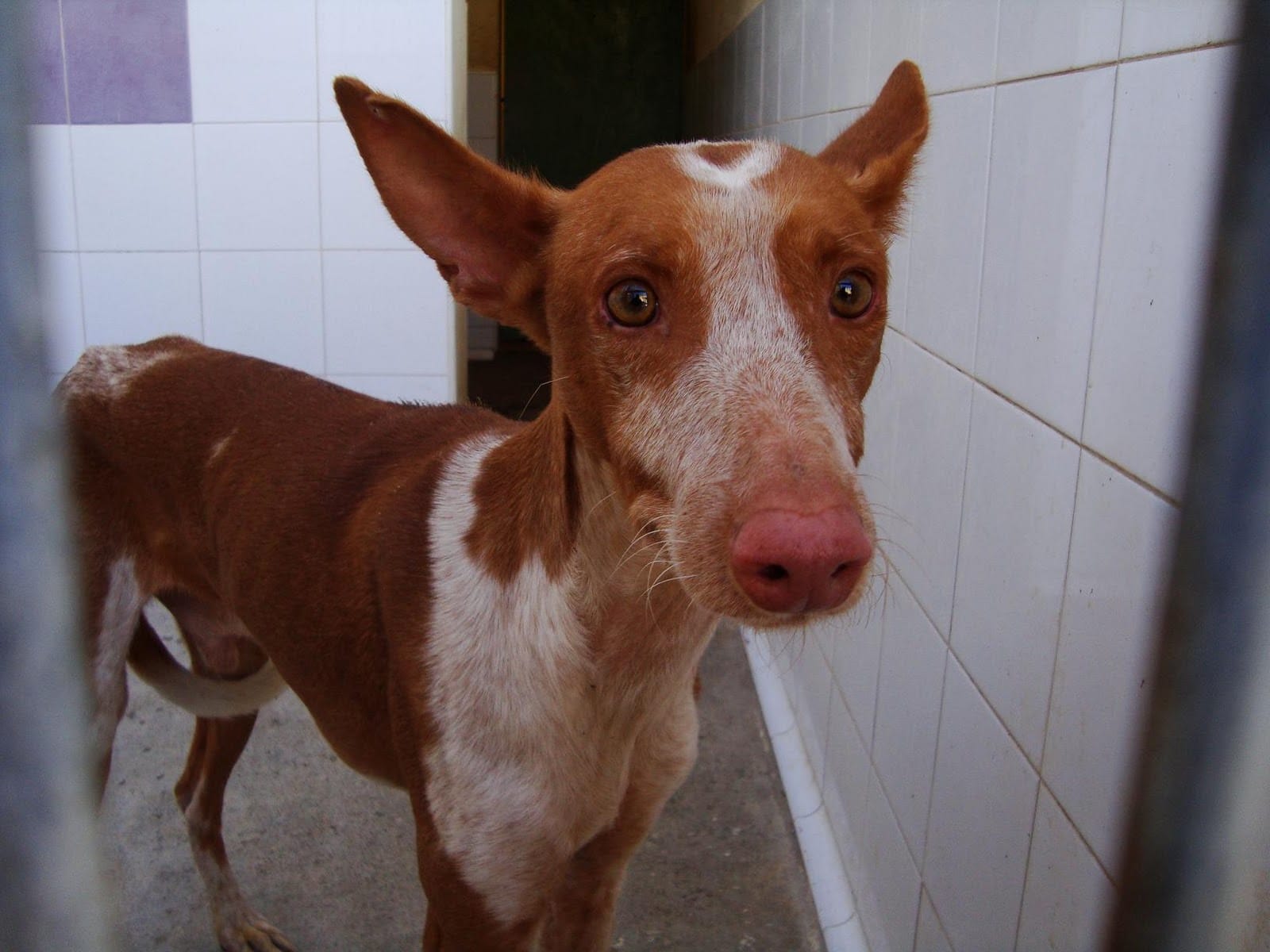
The Ibizan Hound has a long, narrow head, sharp cone-shaped; the skull is long and narrow with a little pronounced Stop. The ears must be straight, towards front and very mobile; oblique eyes, small and always amber clear.

The nose is flesh-colored and usually be taken into account to determine the purity of the breed. The color will always be blanco-marron, Blanco-leonado or unicolor, although this last possibility is more rare to find them. The weight varies between the 18 and 24 Kg, Depending on whether it's a male or a female, as well as if he is too well or poorly fed. With regard to the height of the dog there are also many disputes since fashion has at times imposed more slender and tall dogs that the found in the Pitiusas Islands.

The current standard is one height of between 66 and 72 cm., It is very far from reality and the first official standard. The dogs that are bred in Ibiza and Formentera are shorter than the maximum height allowed.

Via: criadorscaeivissenc

Character and skills

Pet is an excellent. Very easy to maintain when treated well and will respect your space. He is a dog that thinks for himself and there are times when he prefers not to have to show his appreciation to his master or be appreciated.; just let it quiet. It requires patience when it is trained.

It is not recommendable for the home where children are (He has no patience and is very independent). Generally does not get along well with other pets. Can maintain you in apartment or House, When receive plenty of daily exercise.

Characteristics "Ibizan Hound"

Coexistence is important that you have with your new friend. Before considering the acquisition of a dog of the breed "Ibizan Hound" you know certain factors. Not all breeds of dogs are apt to live in an apartment, you must take into account his character, their need for exercise, their interaction with other pets, their care and if you have small children, their level of tolerance towards them.

Adaptation โ“˜

4,0 of 5 stars (based on 1 review)

friendly dog โ€‹โ€‹โ“˜

3,0 of 5 stars (based on 1 review)

hair loss โ“˜

3,0 of 5 stars (based on 1 review)

Affection level โ“˜

5,0 of 5 stars (based on 1 review)

Need for exercise โ“˜

4,0 of 5 stars (based on 1 review)

Social need โ“˜

3,0 of 5 stars (based on 1 review)

Home โ“˜

1,0 of 5 stars (based on 1 review)

Toilet โ“˜

1,0 of 5 stars (based on 1 review)

Friendly with strangers โ“˜

2,0 of 5 stars (based on 1 review)

barking โ“˜

3,0 of 5 stars (based on 1 review)

Health โ“˜

3,0 of 5 stars (based on 1 review)

Territorial โ“˜

3,0 of 5 stars (based on 1 review)

Cat friendly โ“˜

2,0 of 5 stars (based on 1 review)

Intelligence โ“˜

3,0 of 5 stars (based on 1 review)

Versatility โ“˜

2,0 of 5 stars (based on 1 review)

Child friendly โ“˜

3,0 of 5 stars (based on 1 review)

Surveillance โ“˜

3,0 of 5 stars (based on 1 review)

joy โ“˜

3,0 of 5 stars (based on 1 review)

Ibizan Hound Images

Videos Ibizan Hound

Type and recognitions:

  • FCI CLASSIFICATION:
  • Group :
  • Section : . .

Federations:

  • Federations: FCI โ“˜, AKC โ“˜, ANKC โ“˜, CKC โ“˜, โ€‹KC โ“˜, NZKC โ“˜, UKC โ“˜

  • FCI breed standard "Ibizan Hound"

    Origin:
    Spain

    Date of publication of the valid original standard:
    26.05.1982

    Use:

    Is used, above all, in the rabbit hunt without a shotgun, day and night, well they lift them easily, even in places with a lot of vegetation due to the fineness of their smell, because he uses himself and his hearing more than his sight.. For their agility and cunning they soon collect the piece, especially hunting several dogs together; When a dog shows a piece, the others surround it at a certain distance, stalking the passage of that piece., they only beat when they see or hear the piece and also when they have closed it, all of them show and charge the piece by flipping the tail during it, the sample is easily broken.

    It is also used to hunt hares and big game.. They are good collectors. To form packs, they are used, except for exceptions, females and at most one male, because they do not help each other hunting and are quarrelsome. When a pack has taken a few thousand rabbits, the peculiarity occurs that some dogs from the same, they no longer hunt until after a long rest. This is called โ€œEnconillarseโ€.


    General appearance:

    The length of the tip of the snout to the eye is the same as the distance between them and the occipital.


    Behavior / temperament:

    ---

    Head:

    Long head, narrow cone truncated near your base, excessively dry, rather small in relation to the body.

    Cranial region:
    • Skull: Dolicocephalic, long or crushed; prominent occipital bone; narrow forehead and flat.
    • Stop: Poorly defined.

    facial region:

    • Truffle: Slightly convex, flesh-colored; Open nostrils.
    • Snout: Prominent, protrudes from the lower jaws; is narrow, long and colour harmonising with the coat meat.
    • Lips: Fine, collected, flesh-colored.
    • Teeth: In perfect opposition, White, well placed, with the Scissor bite.

    Eyes: Oblique, small, Amber clear, Recalling the color of candy; Amber can be more or less intense, depending on the color of the coat. With a not very noble look, very intelligent, shy and distrustful.

    Ears: Always rigid; directed forward, to the sides horizontally or backward; to when the dog is excited, very moving; the center of the base is located at the level of the eyes; elongated rhomboid-shaped, truncated to one third of its longest diagonal. They are fine, without hairs inside; median, not overly large.

    Neck:

    Very dry, both at the bottom and top. Its length is one-quarter the length of the body; slightly arched, muscled; the skin is taut, Lisa, without jowl. The hair is usually longer and dense in the upper lower part of this area, noticing more in straight hair.

    Body:

    The general aspect of the body is symmetrical, subconvex and medioline, quite matched dimensions, picked up, slightly longer without measure fixed difference.

    • Cross: Outstanding, high, dry and long.
    • Back: Straight, long and flexible; strong muscles, but flat.
    • Pork loin: Arcuate, average width, strong and powerful.
    • Rump: At desk, of very powerful and hard muscles, with a bone structure shows.
    • Breast : Deep, narrow and long, without elbows, sternum angle very sharp and prominent; flat ribs.
    • Belly: Collected but not agalgado.

    Tail:

    Low insertion; passing between the legs to reach the spine, monitors (towards the tip around the tail a few longer and thicker hairs slightly separated in a spike shape), long; somewhat thicker in his birth, will tweaking gradually; at rest falls naturally; in action is in the form of sickle, more or less closed, preferably is not straight or screwed too on the back.

    Tips

    PREVIOUS MEMBERS: They are aplomados, symmetric; seen from the front arms are close together; collected set, limbs long giving the impression of a thin animal, Agile but strong.

    • Shoulder: Oblique scapulae, strong and free in their movements.
    • Arms: Very long, straight and strong, and very together.
    • Elbows: Comprehensive and outstanding, parallel to the median plane of the body, never come out.
    • Forearm: Wide at its bottom end.
    • Metacarpus: Powerful, strong, width, right well.

    LATER MEMBERS: Plumb, long muscles, strong, dry, flattened muscle.

    • Hocks: Toggle, widths, close to the ground (descending), well Plumb, Neither outwards nor inwards.

    FEET: Trend of Hare, tight and long fingers, well trimmed hair interdigital spaces, very strong and generally white nails, Sometimes the color of hair; very hard pads.

    Movement:

    The preferred way is a trot suspended; the Gallop is very fast, giving feeling of agility.

    Mantle

    SKIN: Tense, attached to the body; Pink pigmentation, It can vary from color in the regions in which the layer is different.

    HAIR: Smooth, hard or long.

    • The smooth should not be silky but strong and shiny.
    • The hard must be rough, well populated, somewhat shorter on the head and ears, longer in the back of the thighs and the underside of the tail; the beard is very appreciated; the length is softer and must be at least one length 5 cm with the heavily populated head.

    COLOR: Preferably white and Red, unicolores white or red, although the fawn could also be admitted as long as it is an extraordinary specimen., Although never accept this color for hair.


    Size and weight:

    Height to the cross:

    • For males :  66 to 72 cm.,
    • for females :  60 to 67 cm..

    Without being very demanding, Since of approximate measurements you can always accept that they are proportionate and aesthetic.


    Fouls:

    Any deviation from the aforementioned criteria is considered as a fault and the severity of this is considered to the degree of the deviation to the standard and its consequences on the health and well-being of the dog..

    SERIOUS FAULTS :

    • Short and wide head.
    • Very marked stop.
    • Lack of a premolar.
    • Floppy ears.
    • Depressed Center ribbing.
    • Elbows out.
    • Cow hocks.
    • Feet out.
    • Cross feet and hocks in motion.

    MISS PLAYOFFS :

    • Aggressive or fearful dog.
    • Phased skull.
    • Brown pigmentation or black spots on truffle.
    • Any form of prognathism.
    • Eyelids and lips brownish red.
    • Miss indicating a junction with a Greyhound or a hound, that is to say :
      • folded ears
      • Dark eyes
      • Wide rump
      • Little defined sternum
      • Separate forelimbs
      • Thighs wide and rounded, with bulging veins


    N.B.:

    โ€ข Males must have two normal-appearing testicles fully descended into the scrotum..
    โ€ข Only functionally and clinically healthy dogs, with the typical conformation of the breed, should be used for parenting

    Source: F.C.I - International Cynological Federation

    Alternative names:

    1. Ibizan Warren Hound, Ca Eivissenc, IBIZAN PODENCO (English).
    2. Chien de garenne des Balรฉares (French).
    3. Ca Eivissenc (German).
    4. Podenco ibicenico (Portuguese).
    5. Ca Eivissenc (espaรฑol).

    โ–ท The world of Pets: Dogs, cats, birds, reptiles, amphibians

    Icelandic Sheepdog
    Islandia FCI 289 - Nordic Watchdogs and Herders.

    Icelandic Sheepdog

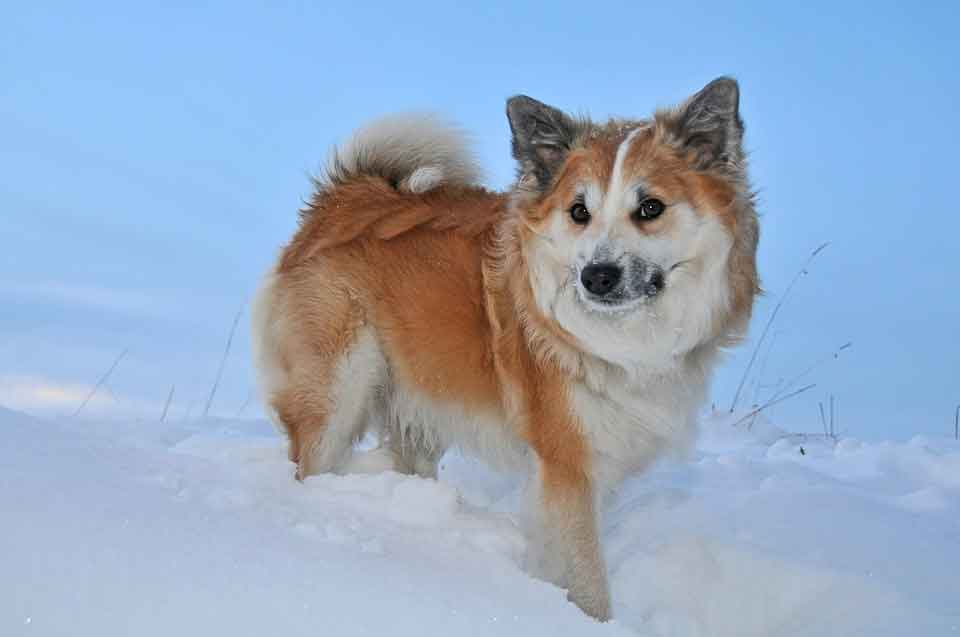
    The muzzle expression of the Icelandic Sheepdog recalls a smile that highlights your cheerful temperament.

    Content

    History


    Where does the Icelandic Sheepdog come from??

    For many centuries the Icelandic Sheepdog It was the "Swiss army knife" of the lonely farms and workshops of the great North Atlantic island. In the extremely harsh climate they had to herd sheep, keep small vermin, help in hunting, as well as taking care of the house and the farm and especially the children. On the one hand they are considered as shepherd dogs and on the other hand as Nordic Spitz. In any case, they're extremely smart, agile, flexible and robust man's aides.

    Its existence was in grave danger only recently. Due to introduced diseases and mixing with pedigree dogs legally and illegally imported to the island, they seemed already extinct. So the Icelanders recognized the danger surrounding their only native dog and took specific action against it..

    Today, this unique dog breed seems to be over the hill in its population. The Icelandic Sheepdog enjoys increasing popularity outside Iceland. Genetically speaking, has been able to maintain his Nordic identity. This is confirmed by at least a thorough genetic analysis from 2017 of more than 100 breeds of dogs by a team of geneticists led by Heidi Parker.

    The Icelandic dog has become very popular outside of his original home as a friendly, exciting and fascinating companion and family dog. Still retains much of his original acting ability, expressed in his desire to move, to work with friends and to be very alert. In 1972 was officially recognized by the FCI (International Cynological Federation).

    Physical characteristics

    The Icelandic Sheepdog of "Islenskur Fjรกrhundurยป is a very old breed of dog and the only one in Iceland. The Icelandic dog is a medium-sized dog, which is coughy and only at first glance resembles a medium-sized dog. It has a dense fur, weather insensitive and robust. The top layer is medium or long, with a dense, soft sub-hair. There are Icelandic dogs with short and long hair. Different colors are allowed, from tanning to cream, chocolate brown, grey or black. Dogs should always have white markings.

    The standard describes its overall appearance in this way:

    The Icelandic Sheepdog is a Nordic grazing Spitz; it's a little less than medium-sized and has pointed ears and a screwed tail. Seen on side, has a rectangular format, that is to say, the length of your body from the tip of your nose to the tip of your buttock exceeds your height to the cross. The depth of the chest box is equal to the length of the front legs.

    How big is an Icelandic Sheepdog?

    Males must have a height at the cross of some 46 centimeters, the females 42 centimeters. The standard does not give any information about weight.

    Longevity of an Icelandic Sheepdog

    One Icelandic dog seriously raised must have a life expectancy of 12 years or more.

    Character and skills

    The Icelandic Sheepdog remains an agile grazing dog and a watchdog at the center of his being. But, outside Iceland, usually only bred as a companion dog. This is not a disadvantage. Rather he finds very well in his current role as family dog and companion. But it's still very agile and needs your workload. He feels comfortable watching and protecting and also likes to bark. At the same time it is a very friendly family dog that turns to people. He is considered very fond of children.

    The official rule correctly describes its character as follows:

    The Icelandic Sheepdog it's a sturdy grazing dog, agile and noisy and, therefore, extremely useful for grazing and driving cattle on pastures and in the mountains, as well as for tracking lost sheep. He is alert by nature and welcomes every visitor enthusiastically without being aggressive. His hunting instinct is underdeveloped. The Icelandic Sheepdog is happy, friendly, curious, playful and not afraid.

    The Icelandic Sheepdog is definitely suitable for the ambitious beginner.

    Caution, health and diseases


    How much care does an Icelandic Sheepdog need??

    An Icelandic dog needs to be roasted during fur change. The top and bottom layer should be brushed intensely.

    Are there any breed-typical diseases in Icelandic dogs??

    The Icelandic Sheepdog it's essentially a healthy and robust breed of dog.

    What food is best for an Icelandic dog?

    The Icelandic Sheepdog is a trouble-free and unre demanding food. Of course, High quality food is good for your health and test. like most dogs, sometimes he likes a bone of fleshy beef and fresh meat.

    Considerations before purchase

    Where can you buy an icelandic dog?

    If you are interested in a Icelandic Sheepdog, you should look for a local icelandic dog breeder who is affiliated with an official nordic dog club. You should fix this in time, because puppies are rare.

    Icelandic Sheepdog Education and Maintenance


    Is an icelandic dog suitable for me?

    The Icelandic Shepherd Dog is a friendly and breus dog. He wants to integrate into the family and can fit in without problems. The ideal is a house with a garden in the countryside. But that's not an obligation.. You can also keep it in an apartment in the city, whenever you deal with him every day.

    The Icelandic Sheepdog is a loving member of the family and a great companion for children. Welcome visitors amicably and stormily. Their cordiality is contagious. If you get too bored, you can spend your energy on furniture or you become a thief.

    Since the Icelandic Sheepdog has little hunting instinct nowadays, the excursions with him to nature are quite relaxed. With an Icelandic dog you can go on a trip without problems. In the car – just by the hair – an aluminum transport box is recommended.

    One Icelandic Sheepdog needs to be looked after by fur. It is very important that humans and dogs have a common interest in lots of movement and exploring nature.. Icelandic dog is not a sofa stuffed animal.

    He can be trained very well. He is open and honest and likes to work alongside his master or carer. The art lies in finding the right level of consistency and guidance for this very lively and at the same time sensitive and intelligent dog.. The decisive basis is always a close emotional bond and mutual trust.. Because of their good behavior, you can easily do, a certain amount of work is a basic requirement. A frustrated Icelandic dog won't thank you as an obedient companion. But this is only in the possession of your caregiver. From puppy, you have to keep an eye on your eagerness to report, which is related to the bark of joy. Here you must put the strict reins, if you don't live on a lonely, lonely property. Once again, the Icelandic Sheepdog is more effective than any alarm system.

    Characteristics "Icelandic Sheepdog"

    Coexistence is important that you have with your new friend. Before considering the acquisition of a dog of the breed "Icelandic Sheepdog" you know certain factors. Not all breeds of dogs are apt to live in an apartment, you must take into account his character, their need for exercise, their interaction with other pets, their care and if you have small children, their level of tolerance towards them.

    Training ?

    4,0 of 5 stars (based on 1 review)

    Suitability of the apartment ?

    2,0 of 5 stars (based on 1 review)

    Can be alone all day ?

    1,0 of 5 stars (based on 1 review)

    Suitable as a first dog ?

    3,0 of 5 stars (based on 1 review)

    Weight gain ?

    3,0 of 5 stars (based on 1 review)

    Health ?

    4,0 of 5 stars (based on 1 review)

    Intelligence ?

    4,0 of 5 stars (based on 1 review)

    Kindness with child ?

    4,0 of 5 stars (based on 1 review)

    Tendency to bite ?

    2,0 of 5 stars (based on 1 review)

    Tendency to bark ?

    4,0 of 5 stars (based on 1 review)

    Tendency to flee ?

    2,0 of 5 stars (based on 1 review)

    hair loss strength ?

    4,0 of 5 stars (based on 1 review)

    Suitable as a guard dog ?

    4,0 of 5 stars (based on 1 review)

    Joy ?

    3,0 of 5 stars (based on 1 review)

    Cat friendliness ?

    4,0 of 5 stars (based on 1 review)

    Power level ?

    4,0 of 5 stars (based on 1 review)

    Images "Icelandic Sheepdog"

    Photos:

    1 – Icelandic Sheepdog, remembering a Corgis by Thomas Quine / CC BY-SA
    2 – Icelandic Sheepdog by https://pxhere.com/en/photo/237527
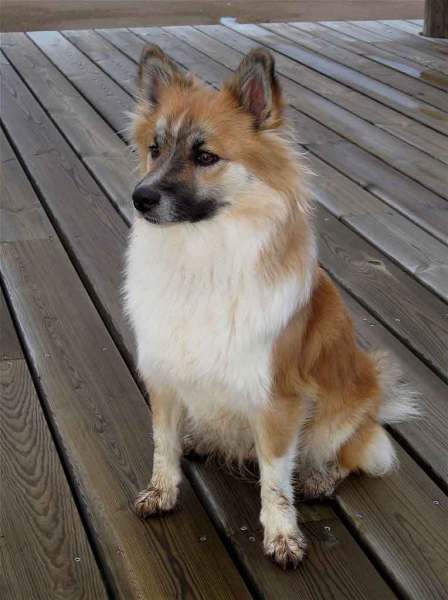
    3 – Icelandic Sheepdog by Canarian / CC BY-SA
    4 – Icelandic Sheepdog by https://pxhere.com/en/photo/237516
    5 – Icelandic Sheepdog by Alan Levine / CC BY
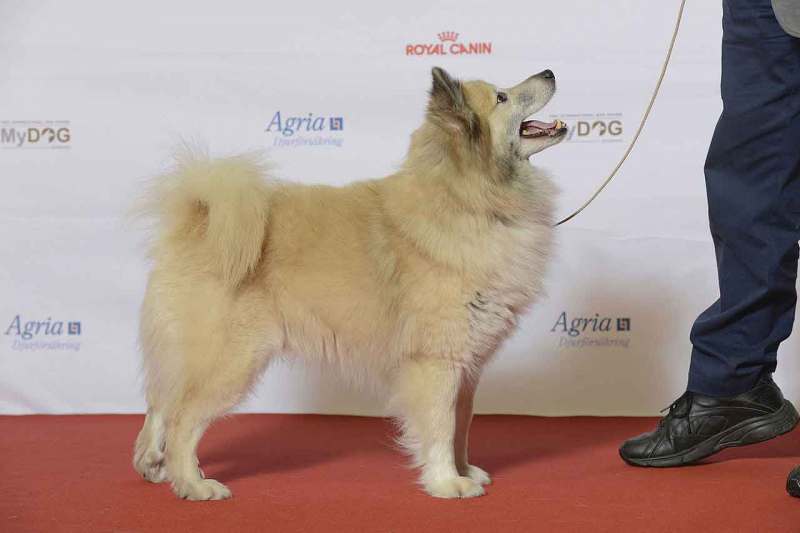
    6 – Icelandic Sheepdog by Svenska Mรคssan from Sweden / CC BY

    Videos "Icelandic Sheepdog"

    Icelandic sheepdog - Iceland's totem animal

    Type and recognitions:

    • FCI CLASSIFICATION:
    • Group :
    • Section : . .

    Federations:

    • – FCI – Group 5 – Section 3 Nordic Watchdogs and Herders.. โ“˜
    • – AKC – Nordic Watchdogs and Herders. โ“˜
    • – CKC – Nordic Watchdogs and Herders. โ“˜
    • – UKC – Nordic Watchdogs and Herders. โ“˜

    FCI breed standard "Icelandic Sheepdog"

    Origin:
    Iceland

    Date of publication of the valid original standard:
    20.06.2007

    Use:

    Pastoral Dog.


    General appearance:

    The Icelandic Shepherd Dog is a Nordic grazing spitz, slightly smaller than medium, with erect ears and curved tail. Seen on the side is rectangular, the length of the body from the tip of the shoulder to the tip of the ischion is greater than the height at the cross. Chest depth is the same as the length of the previous limbs. The expression is sweet, smart and cheerful, a confident and lively patience is typical of the breed.

    There are two types of mantle, long and short, both thick and extremely resistant to inclement weather. There is a marked difference in appearance between the two sexes.


    Behavior / temperament:

    The Icelandic shepherd dog is a hard and agile grazing dog, barking, making this extremely useful for rounding up livestock in pastures or mountains and finding lost sheep.. The Icelandic Shepherd is by nature very alert and will always give visitors an enthusiastic welcome without being pushy.. His hunter instincts are not strong. The Icelandic Shepherd is cheerful, friendly, inquisitive, playful and fearless.

    Head:

    Strongly built, with well adhered skin. Skull slightly longer than muzzle. Triangular seen from above or from the side.

    Cranial region:

    Skull : Something vaulted.
    Depression links (Stop) : Clearly defined, although neither excessive nor high.

    facial region:

    Truffle : black, dark brown in chocolate-colored dogs and some cream-colored dogs.
    Snout : Well developed, straight muzzle. Snout slightly shorter than skull, forms an obtuse triangle seen from above or from the side.
    Lips : Blacks, tight, dark brown in chocolate-colored dogs and some cream-colored dogs.
    Cheeks : Flat.
    Bite : Scissor, full dentition.

    Eyes : Medium in size and almond shape. Dark brown, slightly lighter in chocolate-colored dogs or some cream-colored dogs. The eyelids are black, dark brown in chocolate or cream dogs.

    Ears : erect, medium-sized. Triangular, with firm edges and slightly rounded tips. Very mobile, reacting sensitively to noises and showing the dog's mood.

    Neck:

    Moderately long and muscular, no loose skin. Slightly arched and carried high.

    Body:

    The length in correct proportion to the height and in harmony with the general appearance.

    top line : To level, muscular and strong.
    Pork loin : Wide and muscled.
    Rump : Moderately short and wide, with slight decline and well muscled.
    Breast : Long, deep, and well arched.

    Tail:

    High insertion, coiled and touching the top line.

    Tips

    PREVIOUS MEMBERS : Seen from the front they are straight, parallel and strong. Normal angulation.

    Shoulder : Oblique and muscular.
    Spurs : They can be double.
    Front feet : Slightly oval, well arched, close-knit toes with well-developed pads.

    LATER MEMBERS : Seen from behind they are straight, parallel and strong. Normal angulation.

    Thighs : Wide and well muscled.
    Spurs : well developed. Double spur is desirable.
    Hind feet : Same as above.

    Movement:

    Displays agility and endurance with good momentum, covering ground effortlessly.

    Mantle

    MANTLE : Double, thick and extremely resistant to inclement weather.

    HAIR : There are two varieties.

    to) Short : The outer layer is of medium length, pretty thick, with thick and soft undercoat. Hair is shorter on the face, top of head, ears and front of legs, but it's longer on the neck, chest and back of thighs. The tail is hairy and the length of the hair is in proportion to the coat.
    b) Longer hair : The outer layer is longer than the previous one, quite thick, with thick and soft undercoat. Hair is shorter on the face, top of head, ears and front of the legs and longer behind the ears, neck, chest, back of legs and thighs. The tail is very hairy, the length of the hair is in proportion to the coat.

    COLOR : Various colors are allowed, but a single color must always predominate.

    The predominant colors are :

    . Various shades of fire color, ranging from cream to reddish brown.
    . Chocolate brown.
    . Gris.
    . Negro.

    White always accompanies the predominant color. The most common white marks, which are generally irregular, are : on a strip or part of the face, collar, chest, variable height boots and the tip of the tail. Lighter shades are generally found on the underside of the dog, going from the throat to the tip of the tail. In the fire and gray dogs, the black mask is frequently given, black tips of outer hairs and occasionally black hairs. Black dogs (tricolor) they have a black cloak, with white markings as mentioned above and the traditional markings in any of the various tan colors, cheeks, on the eyes and on the paws. Patches of the colors described above, on a white background, is allowed. White must not be totally dominant.


    Size and weight:

    The ideal height is :

    • Males : 46 cm.,
    • females : 42 cm..


    Fouls:

    Any deviation from the aforementioned criteria is considered as a fault and the severity of this is considered to the degree of the deviation to the standard and its consequences on the health and well-being of the dog..

    . Dog with solid black coat or saddle of any of the tan colors.

    SERIOUS FAULTS: :

    . Without spurs.
    . Yellow eyes.
    . Bulging round eyes.

    Any dog โ€‹โ€‹showing clear signs of physical or behavioral abnormalities must be disqualified..


    N.B.:

    Males should have two normal-appearing testicles fully descended into the scrotum..

    Source: F.C.I - International Cynological Federation

    Alternative names:

    1. Icelandic Spitz, Iceland Dog, รslenskur fjรกrhundur, Islandsk, Fรฅrehund, Friaar Dog, Canis Islandicus (English).
    2. Berger islandais, Berger d’IslandeFrench).
    3. Islรคndischer Spitz, Islรคndischer Schรคferhund (German).
    4. Islenskur fjรกrhundur (Portuguese).
    5. รslenskur Fjรกrhundur (espaรฑol).

    โ–ท The world of Pets: Dogs, cats, birds, reptiles, amphibians

    Irish Soft Coated Wheaten Terrier
    Irlanda FCI 40 . Large and medium sized Terriers
    Irish Soft Coated Wheaten Terrier

    Wheaten character is cheerful, open and balanced.

    Content

    History

    The Irish Soft Coated Wheaten Terrier has been raised in Ireland for about 200 years in counties Kerry and Cork by the farmers who live there. How farm dogs fought rats and mice, as well as against predators such as foxes and martens, that threatened domestic animals. They also grazed sheep and were used for hunting.

    The history of Irish Soft Coated Wheaten Terrier has been somewhat obscured due to its closeness to the other races of Irish terriers. The Wheaten probably the oldest of the four races. His existence, along the, at least 200 years, can be deduced from the textual references made to "soft-haired" dogs.. The relationship of Irish Terrier modern with the Wheaten, although less documented, appears to have been the result of deliberate crossing experiments. Consequently, the humble Wheaten probably has a fully mixed lineage. Despite the long history of Wheaten, it was not until 1937, which was officially recognized by the Irish Kennel Club. Since then this breed has grown steadily in popularity and is currently well known worldwide..

    In 1943, the British Kennel Club He acknowledged the race in United Kingdom. The first Irish Soft Coated Wheaten Terrier were exported to the United States in the 1940, but the race gained greater interest ten years after his arrival. Last, in 1973, were recognized by the American Kennel Club.

    The Irish Soft Coated Wheaten Terrier, unofficially, were crossed with the race Pudelhund standard, to create the mixed race, known as the Whoodle and with the race Beagle to create the race known as "Wheaglesโ€.

    Today the Irish Soft Coated Wheaten Terrier It is a versatile companion dog that adapts well to its living conditions..

    Physical characteristics

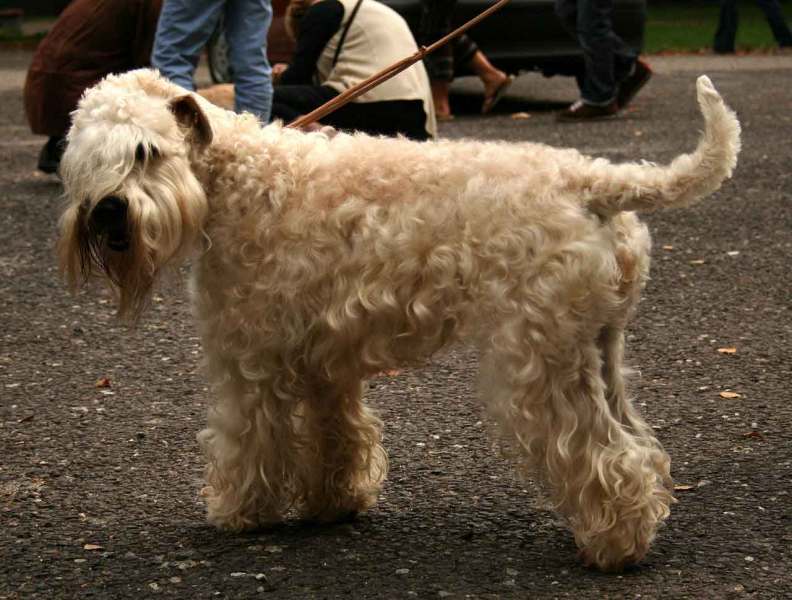
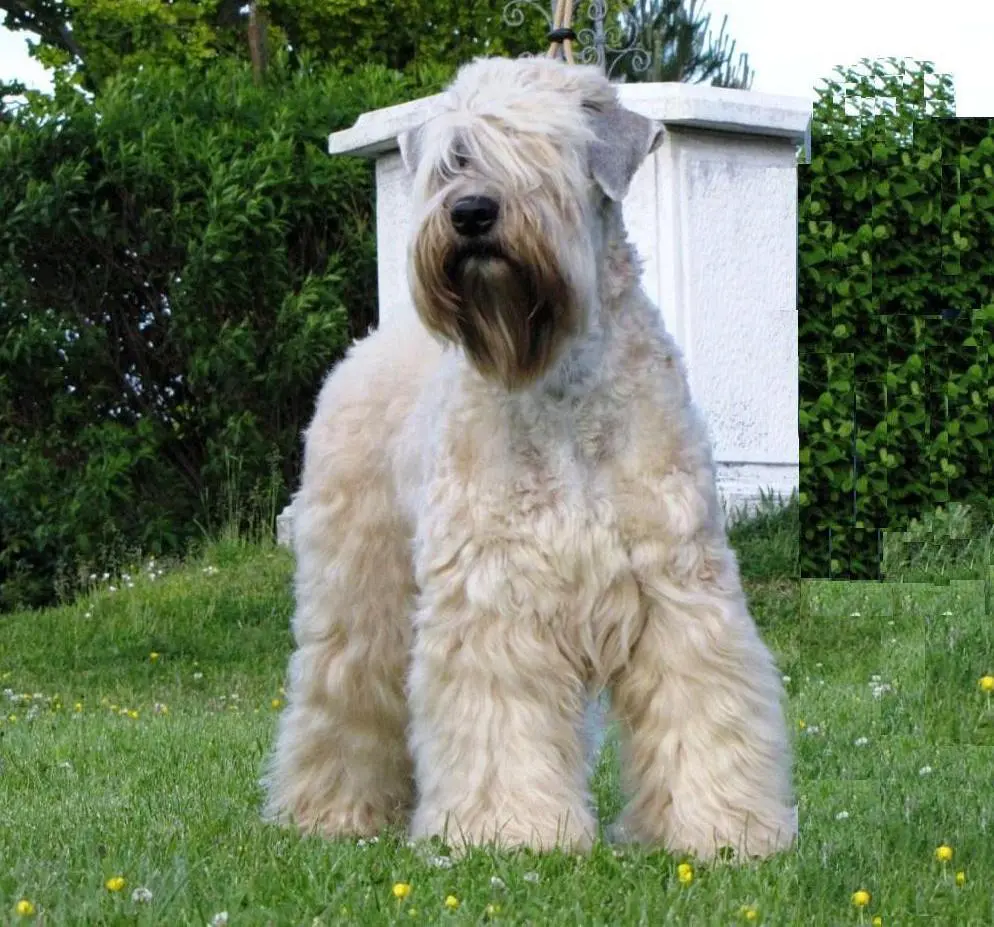
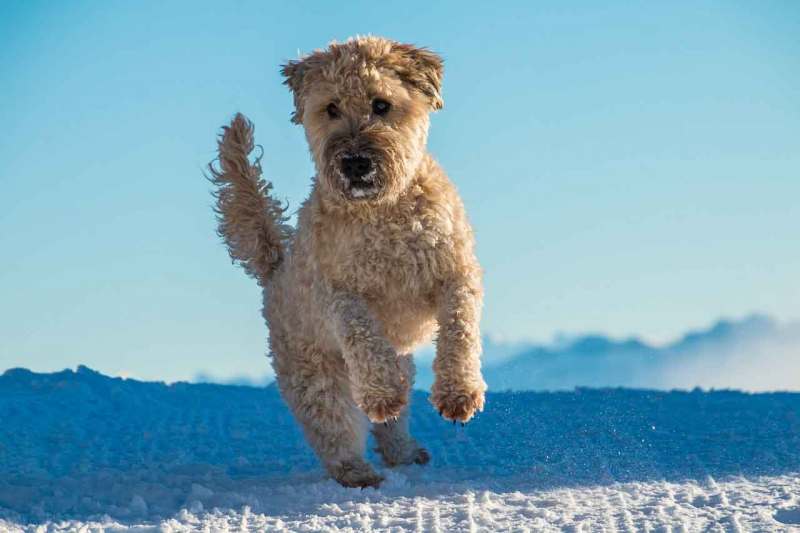
    It is a strong dog, balanced, straight back and chest deep. It has a rectangular and well-proportioned head with a defined stop. Their eyes have a slightly almendrada way and the ears are small and bent slightly forward.

    In countries where it is allowed, the Wheaten usually has a tail cut off. It has a smooth hair, silky and color wheat. These dogs have a unique coat of hair., so you can more easily tolerated by people who are allergic to other races, because they lost very little hair.

    Puppies are reddish brown or gray. Many have a black mask. Only at the age of two and a half the coat has its final color, clear and its fine structure.

    SIZE AND WEIGHT:

    – Height to the cross : Males 46-48 cm. (18 – 19 inches). females somewhat less.

    – Weight: Males between 18 – 20,5 kg (40 – 45 English pounds). The females somewhat less.

    Character and skills

    The character of the Wheaten is happy, open and balanced. As an SUV, these dogs are very docile. They enjoy participating in family life. Dog sports such as agility are a good substitute for the many different tasks these spirited terriers were originally bred for.. If they are left alone, without getting busy or moving enough, can become destructive and aggressive. Consistent breeding from the start makes them great family dogs that don't obey one person.. Due to the great care effort and the possible stubbornness of the terrier, only conditionally suitable for beginners.

    Wheaten Terrier care

    The coat of the Irish Soft Coated Wheaten Terrier requires a lot of cleaning and must be brushed daily to avoid entanglement. Hair must be cut regularly. Does not come off.

    In regards to health, it is a very healthy breed, not showing any typical hereditary disease.

    Wheaten Terrier Education

    That dog learns fast. Unfortunately also things, that you have to avoid them later. So, and also because of the hunting instinct that the breed has, initially not recommended for beginners. It also, the breed tends to be stubborn under pressure, you also have to learn to deal with it. But, who masters the rules of dog training, you will be very pleased with this dog's willingness to learn and willingness to work.

    Images "Irish Soft Coated Wheaten Terrier"

    Photos:

    1 – Soft Coated Wheaten Terrier by SusanSmithGSU / CC BY-SA
    2 – Soft-coated_wheaten_terrier at the national show in Rybnik – Stone to Pleple2000 / CC BY-SA
    3 – Soft-coated_wheaten_terrier at the national show in Rybnik – Stone to Pleple2000 / CC BY-SA
    4 – Soft Coated Wheaten Terrier Irlandรฉs by RORLVR1 / CC BY-SA
    5 – Soft Coated Wheaten Terrier Irlandรฉs by https://pxhere.com/en/photo/64565
    6 – Soft Coated Wheaten Terrier Irlandรฉs by https://www.needpix.com/photo/834722/dog-jump-play-irish-soft-coated-wheaten-terrier-young-dog-jumps-happy-winter-snow

    Videos "Irish Soft Coated Wheaten Terrier"

    Type and recognitions:

    • FCI CLASSIFICATION:
    • Group :
    • Section : . .

    Federations:

    • – FCI – Terriers 1 Large and medium-sized terriers. โ“˜
    • – AKC – Terriers โ“˜
    • – ANKC – Terriers โ“˜
    • – CKC – Terriers โ“˜
    • – โ€‹KC – Terriers โ“˜
    • – NZKC – Terriers โ“˜
    • – UKC – Terriers โ“˜

    FCI breed standard "Irish Soft Coated Wheaten Terrier"

    Origin:
    Ireland

    Date of publication of the valid original standard:
    27.01.2001.

    Use:

    Wheaten Terriers were always used by small farmers to kill vermin or help with farm work.. For a long time it was used in the difficult task of hunting badgers and otters..


    General appearance:

    It is a robust dog, active and compact, well built, giving the idea of รขโ‚ฌโ€นรขโ‚ฌโ€นstrength. Their limbs are not too long or too short.


    Behavior / temperament:

    Fiery and courageous. With good temperament. Very noble and loyal to his masters. Very intelligent. A faithful and trustworthy friend, defensive without being aggressive.

    Head:

    It must be strong as a whole, without being rough. Long, well proportioned to the body. Hair must be the same color as the body.

    Cranial region:
    • Skull: Flat and crisp between the ears, not very wide.
    • Depression links (Stop): Defined.

    facial region:

    • Trufa: Black and well developed.
    • Horcico: It should not be longer than the skull.Jaws: Strong, punishing jaws.
    • Dinentities: Big teeth, regular scissor or clamp bite, no upper or lower prognathism.
    • Cheeks: Non-prominent bones.
    • Ojors: dark, dark hazelnut, not very large or prominent, well placed.
    • Obars: Small to medium, taken to the front, level with the skull. Dark shading is allowed at the base of the ears, and it is common for it to have a light wheat reflection in the rest. This is the only area of โ€‹โ€‹the dog where undercoat is allowed.. โ€œPinkโ€ or โ€œflyingโ€ ears are objectionable.

    Neck:

    Moderately long and strong, but without presenting dewlap.

    Body:

    Not very long. The length from the withers to the base of the tail should be approximately the same as from the ground to the withers.

    • Dorrso: Strong and straight, with top line also at level.
    • Itmor: Short, strong.
    • Pecho: Deep, well arched ribs

    Tail:

    Well placed, not very thick. Carried cheerfully but never over the top line. amputee, remaining two thirds of its original length, assuming that this length is in proportion to the dog. Uncut glue is allowed.

    Tips

    PREVIOUS MEMBERS:

    • Hormbros: Thin Shoulders, well inclined. Muscled shoulders.
    • Antarms: Seen from any angle they must appear perfectly straight, good bone and muscular.

    LATER MEMBERS: Well developed and with powerful musculature.

    • Thighs: Strong and muscular.
    • Rodinllas: Angled.
    • Corvejones: Well descended, without turning in or out. Dewclaws must be amputated.
    • PinIt: Small, not scattered. Nails should preferably be black, but several dark colors are allowed.

    Movement:

    In a straight line throughout its entire length, round trip. The elbows stuck. Side view: free movement, lightweight and coordinated.

    Mantle

    • Plink: Single-haired mantle dog (no undercoat). The hair is soft and silky to the touch, does not last. Young dogs are excluded from the above. Hair preparation is allowed (Trimming).
    • Pmistakes with hair preparation: The hair should be short on the neck, chest and skull and should be left especially long over the eyes and under the jaw. It is advisable to leave the mustaches. With abundant fringes on the extremities. The body hair must be arranged in such a way that it follows the contour of the dog, without being sculpted. The tail hair should be cut short and gracefully tapering to the tip.
    • Pmistakes without preparation: Hair length at its longest point should not exceed five inches (12,7 cm.). Hair must be thick and soft, wavy or loose curls with the shine of silk. Under no circumstances should the coat be โ€œfluffyโ€ like that of the Poodle or the Old English Sheepdog.. Dogs exposed in this condition must be heavily penalized, since they give the wrong idea of รขโ‚ฌโ€นรขโ‚ฌโ€นtype and race. Special attention should be paid to the development of the coat of the puppies. Puppies are hardly born with the correct hair that they should have when adults., Care must be taken when evaluating this aspect. They undergo various color and texture changes before developing adult hair. This normally occurs between 18 months and 2 1/2 years.
    • Cachorros: Puppies are rarely born with the correct coat color and texture. Their fur may be reddish, grayish and sometimes light tawny. The masks are generally black. Sometimes there is a black streak in the center of the back or the tips of the body hair are black. These dark marks disappear during growth.
    • Colorr: A good and defined wheat color with variations ranging from light fawn to a reddish golden hue.


    Size and weight:

    Alturto the cross:

    • Males 46-48 cm. (18 โ€“ 19 inches).
    • females somewhat less.

    Pthat:

    • Males between 18 โ€“ 20,5 kg (40 โ€“ 45 English pounds).
    • The females somewhat less.


    Fouls:

    Any deviation from the aforementioned criteria is considered as a fault and the severity of this is considered to the degree of the deviation to the standard and its consequences on the health and well-being of the dog..

    • Nervosity, aggressiveness.
    • Truffle in any color other than black.
    • Upper or lower prognathism.
    • Mature dog coat not clearly wheat colored.

    FALTAS DISQUALIFYING:

    • Aggressiveness or extreme shyness.
    • Any dog โ€‹โ€‹showing clear signs of physical or behavioral abnormalities must be disqualified..
    • Yellow eyes.
    • Dull coat, thick, wool or cotton texture.
    • White fur. Brown fur.


    N.B.:
    • Males should have two normal-appearing testicles fully descended into the scrotum..
    • Only functionally and clinically healthy dogs, with the typical conformation of the breed, should be used for parenting.

    Itlatest changes are in bold.

    TRANSLATION: Lic. O. Valverde, reviewed by Dr. F. del Valle and updated by J. Nallem, Uruguayan Kennel Club.

    Source: F.C.I - International Cynological Federation

    Alternative names:

    1. Irish Soft-Coated Wheaten Terrier and variant spellings: ยซSoft Coatedยป and ยซSoftcoatedยป, Wheaten or Wheatie, Wheaten Terrier (English).
    2. Irish Soft Coated Wheaten Terrier (French).
    3. Wheaten Terrier (German).
    4. Wheaten Terrier (Portuguese).
    5. Wheaten Terrier (espaรฑol).

    โ–ท The world of Pets: Dogs, cats, birds, reptiles, amphibians

    Irish Terrier
    Irlanda FCI 139 . Large and medium sized Terriers

    Terrier Irlandรฉs

    The Irish Terrier it is a dog of pleasant appearance and endowed with an exceptional character.

    Content

    History

    Where did the "Irish Terrier" originally come from??

    The "Irish Terrier", he is a high-ranking terrier. It is often called the "Red Irishman" for its distinctive reddish coat.. Its roots are, as in all terriers, a little on the ground. The name Terrier is derived from the Latin ยซTerraยป for the earth. So they were dogs for movement on land and underground.

    High-ranking terriers were supposed to run with the pack on fox hunts. When a fox took refuge in its burrow, the terriers had to chase him underground and get him out of the burrow, as it is called in the language of the hunters. One can imagine that the fox, after all a well fortified predator, does not voluntarily abandon its burrow. so a Irish Terrier I had to be very brave, fearless and defensive. Even today the "Red Irish" are hunting dogs in their hearts. They are not afraid and with every fiber they strive to do their job as well as possible. We can still experience all these qualities in the Irish Terrier as a companion dog.

    They have a special charm but also the challenge of their ancestors.. But red Irish was also used in many different ways at home and on the farm.. He had to keep the yard free of mice and rats., protect chickens, pigeons and rabbits for the night of the martens and foxes. Finally, had to watch the farm and its inhabitants and, if necessary, protect them.

    Ludwig Beckmann reported in 1895, in his two-volume work on the "Breeds of the Dog", that already in 1847 in Ireland they had begun to breed an independent terrier, the ancestor of the current Irish Terrier. At least that's what the Irish claimed, while the English for a long time dismissed this dog as a variety.

    Until 1880 the color of the Irish Terrier was, in fact, still quite uneven. Only little by little did Irish breeders mark their dog with the red coat color as something special. But then it became very popular, even in England and especially in the US, where many Irish had emigrated. The first special breed club for Irish Terriers was founded very soon, the 31 in March of 1879 in Dublin. It was then the first race of Irish Terrier in being officially recognized by the British Kennel Club with Ireland as country of origin.

    Physical characteristics

    What is an "Irish Terrier" like??

    The Irish Terrier it's a medium sized terrier, high-ranking and distinctive in appearance. This starts with their reddish fur. It is built almost square. The legs lower vertically, the long tail stands tall, the neck stretches up. The head, eyes and ears underline their alert appearance. You can feel that every fiber of his muscular body is under tension. The standard tells us…

    …seem active, lively, agile and energetic and have a lot of substance without showing any clumsiness, because speed and endurance as well as strength are essential to the race. The Irish Terrier should not appear clumsy or amorphous; the contour of his body and figure must demonstrate speed, grace and fleetingness.

    Their coat should be thick and lean in texture. Must be, according to technical jargon, broken or broken, that is to say, it should look tough and tough and, However, be extended. The head is also hairy, giving the impression of a beard. The "red Irish" must be uniformly red, wheat-red or yellow-red. Apart from color, the Irish Terrier reminds a bit of a small and elegant Airedale Terrier, which is also quite similar to him in character.

    How tall is an "Irish Terrier"?

    One Irish Terrier It has a height at the withers of about 45 centimeters with a weight of about 12 kg. Males are slightly larger and heavier than females.

    How long does an "Irish Terrier" have??

    as a rule, the Irish Terriers they enjoy a long canine life of more than 12 years in top physical condition.

    Character and skills

    The Irish Terrier it's a power pack. It is lively, alert, concise. Always attentive, vigilant, non-aggressive, but without fear and in an emergency you are also ready to fight. It is said that the Irish Terrier he is very hard on himself and would face dangers and even his own injuries with extreme contempt. It is still used as a working dog in its country of origin.. There he does a good job as a yard dog, guard and hunting. In today's hunting it is mainly used for post-shot work.. The official standard describes its character very accurately:

    The Irish Terrier, although determined and able to face other dogs, is remarkably loyal, kind and affectionate with people; However, when he is attacked, show the courage of a lion and fight to the bitter end. It is wrongly said that the Irish Terrier he gets into fights with other dogs easily, sometimes even in the exhibition ring. Although it does not avoid any dispute when circumstances require it, the Irish Terrier it is easy to train and it is a sociable domestic dog; still embodies the qualities that, according to previous descriptions, They had made him the "guardian of the poor", "Friend of farmers and beloved of distinguished gentlemen.".

    The Irish Terrier he is essentially a reckless and not a lapdog. But, nowadays it is doing very well as a companion and family dog. He is a faithful companion, vigilant, warm and loving for young and old, as long as one allows oneself and him the movement. It has a big character, self-confident and never submissive, that one should respect and appreciate. In his book about the Irishman "Jerry the Islander", the great writer Jack London expresses his respect for this great character in the following words: ยซJerry, you are gold, pure gold, inside and outside, and no dog in the whole world can compete with you. You have a heart of gold, golden dog; be good to me and love me, and I will be good to you and I will love you now and always.".

    Care and health ยซIrish Terrierยป

    The Irish Terriers they are very easy to care for. But, your coat should be professionally trimmed and should never be sheared. During clipping, three to four times a year, dead hair is professionally plucked.

    Most Irish Terriers are in robust health. Here and there skin diseases occur (hiperqueratosis) or metabolic diseases (cistinuria). Sometimes inbreeding is a problem.

    What food is best for an "Irish Terrier"?

    The Irish Terrier has no special dietary needs. High quality food is of course good for your health. like most dogs, sometimes he likes a meaty beef bone.

    Where can you buy an "Irish terrier"?

    The best way to buy your puppy Irish Terrier is to buy it locally from a breeder registered with the FCI. You must have tested your dogs for the special risks of inherited diseases. There should also be no inbreeding, that can be estimated from the pedigree, if no name appears there twice. The breeder must have his litter well documented by photo. You should be able to see the litter along with the mother bitch, after the fix, in the place. Please, don't buy one Irish Terrier by Internet, because there is a high risk that the puppy will come from a dog vendor or breeder, normally well camouflaged.

    Education and maintenance ยซIrish Terrierยป

    Keep a Irish Terrier It is not a problem. It has no demands regarding the size of the apartment. The biggest challenge is his temperament. The Irish Terriers they need challenges of a physical and mental nature.

    As a companion dog they are suitable for a wide range of tasks.. They are very suitable for various dog sports. The Irish Terriers are well positioned as joggers or in moderation, companions of a cyclist. Their aptitude and willingness to work means both a challenge and an obligation to their masters and mistresses., and that in any weather.

    They must be used to other pets from birth, otherwise they will be seen as prey. The Irish Terriers they are very suitable as playmates for children, since they are prepared for any adventure and are robust enough to play with children. But, the house rules must be correct and the terrier must know his role in the family. On the street he tends to fight with other dogs. Due to its moderate size, his low weight and his good obedience – properly trained – is a companion without problems in all life situations.

    Can be carried very well in the transport box, if you've gotten used to it from a young age. The typical Irish Terrier can be trained and educated very well. The clear announcement and the consequence are the magic words here based on a respectful and loving relationship with the master or mistress. Its undoubted leadership role must always be present, otherwise the irishman thinks he has to handle things himself.

    Characteristics "Irish Terrier"

    Coexistence is important that you have with your new friend. Before considering the acquisition of a dog of the breed "Irish Terrier" you know certain factors. Not all breeds of dogs are apt to live in an apartment, you must take into account his character, their need for exercise, their interaction with other pets, their care and if you have small children, their level of tolerance towards them.

    Adaptation โ“˜

    5,0 of 5 stars (based on 1 review)

    friendly dog โ€‹โ€‹โ“˜

    2,0 of 5 stars (based on 1 review)

    hair loss โ“˜

    2,0 of 5 stars (based on 1 review)

    Affection level โ“˜

    5,0 of 5 stars (based on 1 review)

    Need for exercise โ“˜

    4,0 of 5 stars (based on 1 review)

    Social need โ“˜

    4,0 of 5 stars (based on 1 review)

    Home โ“˜

    3,0 of 5 stars (based on 1 review)

    Toilet โ“˜

    3,0 of 5 stars (based on 1 review)

    Friendly with strangers โ“˜

    2,0 of 5 stars (based on 1 review)

    barking โ“˜

    4,0 of 5 stars (based on 1 review)

    Health โ“˜

    4,0 of 5 stars (based on 1 review)

    Territorial โ“˜

    5,0 of 5 stars (based on 1 review)

    Cat friendly โ“˜

    2,0 of 5 stars (based on 1 review)

    Intelligence โ“˜

    4,0 of 5 stars (based on 1 review)

    Versatility โ“˜

    2,0 of 5 stars (based on 1 review)

    Child friendly โ“˜

    4,0 of 5 stars (based on 1 review)

    Surveillance โ“˜

    4,0 of 5 stars (based on 1 review)

    joy โ“˜

    5,0 of 5 stars (based on 1 review)

    Images "Irish Terrier"

    Photos:

    1 – Irish Red Terrier during dogโ€™s show in Racibรณrz, Poland by https://commons.wikimedia.org/wiki/User:Pleple2000
    2 – Irish Terrier by Batman1000 / CC BY-SA
    3 – Irish Terrier by Anne Sollerud / CC BY
    4 – Irish Terrier puppy by https://www.flickr.com/people/24649496@N00
    5 – Irish Red Terrier during dogโ€™s show in Racibรณrz, Poland by https://commons.wikimedia.org/wiki/User:Pleple2000
    6 – Irish Red Terrier during dogโ€™s show in Racibรณrz, Poland by Pleple2000 / CC BY-SA

    Videos "Irish Terrier"

    Type and recognitions:

    • FCI CLASSIFICATION:
    • Group :
    • Section : . .

    Federations:

    • – FCI – Terriers 1 Large and medium-sized terriers. โ“˜
    • – AKC – Terrier โ“˜
    • – ANKC – Terrier โ“˜
    • – CKC – Terrier โ“˜
    • – โ€‹KC – Terrier โ“˜
    • – NZKC – Terrier โ“˜
    • – UKC – Terrier โ“˜

    FCI breed standard "Irish Terrier"

    Origin:
    Ireland

    Date of publication of the valid original standard:
    13.03.2001

    Use:

    It's a farm dog, family pet, guard dog very susceptible to danger or injury, hunter and dog for work after shooting.


    General appearance:

    The dog must have an active appearance, lively, agile and wiry, a lot of substance, and at the same time free from clumsiness, since speed and endurance as well as strength are very essential. It should not be thick or robust, but to be well built within lines that denote speed and present an elegant racer appearance.


    Behavior / temperament:

    The Irish Terrier, although it is a hunting dog and capable of facing other dogs, is extremely loyal, of good temperament and loving with the man, but when attacked he has the courage of a lion and will fight to the end. His reputation for fooling around with other dogs, sometimes even on the show floor, does not deserve it. While it's true that you can be fierce when circumstances warrant, the Irish Terrier can be easily trained and is a delicate pet, staying true to his old description of being "the sentinel of the needy man", the farmer's friend and the gentleman's favorite ยป.

    Head:

    Long, wrinkle free.

    Cranial region:
    • Craging: Flattened and fairly narrow between the ears; narrows slightly towards the eyes.
    • Dnaso-frontal depression (Stop): Hardly visible except in profile.

    facial region:

    • Trufa: It must be black.
    • Labios: They must be very adherent, and on the outside they should be almost black.
    • Jaws: They must be strong, muscular, of good length and fearsome.
    • Dinentities: They must be strong, leveled, no cavities, the upper incisors slightly overlapping the lower incisors.
    • Cheeks: Not very prominent. They should have a slight decline under the eye, such that they do not present a Greyhound appearance.
    • Ojors: They must be dark in color, small, not prominent and full of life, fire and intelligence. Light or yellow colored eyes are very objectionable.
    • Obars: Small and V-shaped, of moderate thickness, well implanted in the skull and fall forward next to the cheeks. The upper line of the ear fold should be well above the level of the skull. Ears hanging to the side of the skull, like those of a hound, They are not a characteristic of the terrier, while semi-erect ears are even more undesirable. Ear hair should be shorter and darker in color than body hair.

    Neck:

    Of moderate length and gradually widens towards the scapulae, with good bearing and without dewlap. Generally has a small swirl of hair, visible on each side of the neck, which goes almost to the angle of the ear.

    Body:

    It must be symmetrical, neither too long nor too short.

    • Espalda: It must be strong and straight, without any appearance of slack behind the shoulders.
    • Itmor: Muscular and slightly arched; the back of the females may be slightly longer than that of the males.
    • Pecho: Deep and muscular, without being prominent or wide. Ribs should be quite arched, deep and carried well back.

    Tail:

    Very high insertion, happily held, but not on the back or curled; good firmness and substance and good length. By custom a third of its original length is amputated; must be well covered with coarse hair, hard, and must not be fringed or feather-shaped. Natural glue (without amputation) It is only allowed in countries where amputations are prohibited by law.

    Tips

    PREVIOUS MEMBERS:

    • Hormbros: They must be clear, long and well sloped back.
    • Elbows: They must move freely without any obstacles to the sides.
    • Antarms: Moderately long, perfectly straight with good bone and muscle.
    • Metacarpus: Short and straight, barely noticeable.

    LATER MEMBERS: They must be strong and muscular.

    • Thighs: Powerful.
    • Rodinllas: Moderately angled.
    • Corvejones: Well descended.
    • PinIt: Feet should be strong, moderately round and moderately small; the arched toes, without turning in or out; black nails are very desirable. Healthy pads without corneal cracks or excressions.

    Movement:

    The fore and hind limbs should be brought straight forward and parallel; the elbows move parallel to the axis of the body, without any obstacles on the sides; the femoro-tibio-patellar joints (knees) they should not be turned in or out.

    Mantle

    • Plink: Hair must be dense and wire-like in texture, and present a brittle appearance, tough but still flat. The hair grows so close and dense that when you separate it with your fingers you can't see the skin; should not be smooth or silky, not so long that it hides the figure of the body, particularly in the hind limbs, and should not have loops or curls. The hair on the face should have the same texture as that on the body, but it must be short (0,75 cms long), almost smooth and squashed; a sparse beard is the only long hair (and it is only long compared to the rest of the hair), which is a characteristic. A "goat" beard suggests the existence of bad, silky hair in general throughout the coat..
    • Members: They must not have fringes and must be covered, just like the head, hair with a hard texture like the one that covers the body, but not so long.
    • Colorr: Must be of a uniform color, bright red is more preferred, leonado rojizo, or reddish yellow. The white color sometimes appears on the chest, a small amount of white is frequently seen in those single-color breeds.


    Size and weight:

    Alturto the cross: About 45,5 cm. (18 inches).

    Pthat: Males 12,25 kg (27 English pounds, The females. 11,4 kg (25 English pounds).


    Fouls:

    Any deviation from the above mentioned criteria is considered to lack, and the gravity of this refers to the degree of deviation to the standard and its impact on the health and well-being of the dog.

    FALTAS DISQUALIFYING:

    • Aggressiveness or extreme shyness.
    • Any dog โ€‹โ€‹showing clear signs of physical or behavioral abnormalities must be disqualified..
    • Trufa: Any color other than black.
    • Jaw: Obvious overshot or overshot.
    • Colorr: Any color other than red, reddish yellow or reddish fawn. A small white spot on the chest is allowed, as in other breeds of uniform color.
    • PinIt: Corneal growths or cracks in the pads.


    N.B.:
    • Males should have two normal-appearing testicles fully descended into the scrotum..
    • Only functionally and clinically healthy dogs, with the typical conformation of the breed, should be used for parenting.

    TRANSLATION: Lic. Oscar Valverde (Costa Rica). Updated by J. Nallem (Uruguayan Kennel Club).

    Source: F.C.I - International Cynological Federation

    Alternative names:

    1. Irish Red Terrier (English).
    2. Irish Terrier (French).
    3. Irischer Terrier (German).
    4. Brocaire rua, rish red terrier, Irish terrier (Portuguese).
    5. Irish Red Terrier, Irish terrier (espaรฑol).

    โ–ท The world of Pets: Dogs, cats, birds, reptiles, amphibians

    Irish Glenn of Imaal Terrier
    Irlanda FCI 302 . Large and medium sized Terriers
    It is generally believed that Irish Glenn of Imaal Terrier is less excitable than other Terriers, although it takes action immediately when prompted.

    Glen of Imaal Terrier

    Content

    History

    The Irish Glenn of Imaal Terrier originates from the Irish east coast, in county wicklow, which is in the ravine (=Valle) the Imaal. From this rough and wild valley this very old breed got its name. It was first mentioned around 1575.

    Like old farm dog, the Irish Glenn of Imaal Terrier he had a very busy life and worked hard for his master. His job was to catch rats and mice on farms and operate smaller work machines like churns and work grinders., where I had to run on leather straps. He also accompanied his master on the fox hunt, the Badger and Otter. He worked in silence and if necessary he fought to the death. Before it was banned in Ireland, the Irish Glenn of Imaal Terrier also used in questionable dogfights. Of course, he was also the most loyal friend and guarded the house and the yard, never shied away from facing a much bigger and stronger opponent.

    For its owner, the Irish Glenn of Imaal Terrier it was as important as his daily bread, although undemanding, frugal and tough enough to share the barren life of farmers. This harsh life brought with it a ruthless selection. Only the toughest and most frugal Terriers survived, what characterizes the breed until today.

    The pedigree of Irish Glenn of Imaal Terrier it's an irish secret to this day. In Ireland itself, this Terrier has never been numerous and did not leave his ancestral home until 1980, when the owners preserved him as a true child of nature, marked by great courage, skill and endurance. In 1933 the breed was officially recognized by the Irish Kennel Club ( I.K.C.). The international recognition of the F.C.I. continued on 1981.

    Physical characteristics

    The Irish Glenn of Imaal Terrier it is small but strong and robust and weighs up to 16 kilograms with a maximum height at the withers of 36 centimeters. Its relatively small forward leaning ears are notable.. Its coat is medium length and consists of a rough top layer and a smooth bottom layer. It can be wheat colored, tabby blue or in different shades of red and gold. In the case of a dark-colored coat, a black-blue mask is common., which can also show as stripes over the ears, along the back and tail, so these marks become clearly clearer with increasing age.

    Character and skills

    Today the Irish Glenn of Imaal Terrier it is a gentle and docile family dog. Its balanced and faithful nature, as well as his average temperament make life with him very pleasant. The Irish Glenn of Imaal Terrier is very affectionate, always cheerful and in a good mood and preferably "in the middle". Enjoy all the attention and care, but without demanding anything. Rather, follows her around with her alert gaze and once she has gained attention, shows his joy about it with strong tail swipes. If the joy is particularly great, his temperament can also run away with him.

    Children are welcome as playmates, if they show him the respect that he shows. Pets are accepted by him without problems when they get used to each other. The Irish Glenn of Imaal Terrier she is always friendly with strangers, and with his contagious joy, His charm and his irresistible look quickly have all the sympathies on his side.. After all, it is a terrier that radiates a lot of personality. He is open-minded and not afraid to learn new things. He likes to be everywhere with his nose. In general, everything that is new – Weird people, new environments, an object that has not been there before – it is very interesting and has to be examined very carefully. The Irish Glen of Imaal Terrier is a particularly attentive observer. Along with her charming nature and her desire to do everything right, is very adaptable and develops a very close relationship with his family. He likes to accompany them whenever possible. Like a very people-oriented terrier, I would defend them in an emergency, even to death. Feel more comfortable in your proximity.

    What characterizes him Irish Glenn of Imaal Terrier is his great courage, his self-confidence and intelligence above average. Sufficient workload and intellectual work are important to the intelligent four-legged friend. Enjoy almost all activities, be it sports with dogs, search games or learning tricks – is available for all kinds of fun.

    Despite its short legs, it is very agile, due to his muscular physique, a small power. Its special characteristics are its slightly curved front legs with the legs turned outward., his big head and his pronounced chest. The Irish Glenn of Imaal Terrier it is a very balanced dog, that radiates great calm on the one hand, but on the other hand you are immediately ready for action and, if required, vigorously watches over and defends your home and family.

    The Irish Glenn of Imaal Terrier – the little irish with a big heart

    Like a silent working terrier it hardly barks. It is also less excitable than other terriers. Sometimes you can see the Irish stubbornness, but the Irish Glenn of Imaal Terrier not resentful. Due to its origin it does not tolerate heat very well, he likes harsh weather and when the wind blows around his nose. But if the chemistry ain't right, or if the other dog brazenly approaches him, you will receive the message – "Glen doesn't like your attitude.". So, it is important to socialize with other dogs from the beginning and to have contact with many dogs of different ages.

    โ€œIrish Imaal Glen Terrierโ€ Care

    Because the Irish Glenn of Imaal Terrier still very original and not over-bred, still a very healthy and robust breed. Its coat has a rough top coat with a smooth undercoat that needs to be trimmed. Otherwise, his self-cleaning coat is very easy to care for. Coat color is wheat or Brindle (Blue striped).

    A consistent but loving upbringing makes the Irish Glenn of Imaal Terrier a faithful companion, nice and gentle, which is easy to handle.

    Life expectancy ยซIrish Imaal Glen Terrierยป

    The Irish Glenn of Imaal Terrier is considered an original dog breed, which is in good health and robustness due to the absence of hereditary diseases caused by breeding. If maintained in a species-appropriate manner, will live an average of twelve years.

    Images "Irish Glenn of Imaal Terrier"

    Photos:

    1 – Irish Glen of Imaal Terrier during International show of dogs in Katowice – Saucer, Poland. Breeder – Piotr Kuznik, http://www.irishglen.pl/ by Pleple2000 / CC BY-SA
    2 – Irish Glen of Imaal Terrier during International show of dogs in Katowice – Saucer, Poland. Breeder – Piotr Kuznik, http://www.irishglen.pl/ by Pleple2000 / CC BY-SA
    3 – Adult w:Glen of Imaal Terrier by photo by Scoo / CC BY-SA
    4 – Irish Glen of Imaal Terrier during International show of dogs in Katowice – Saucer, Poland. Breeder – Piotr Kuznik, http://www.irishglen.pl/ by Pleple2000 / CC BY-SA
    5 – Irish Glen of Imaal Terrier during International show of dogs in Katowice – Saucer, Poland. Breeder – Piotr Kuznik, http://www.irishglen.pl/ by Pleple2000 / CC BY-SA
    6 – Glen of Imaalinterrieri by Sami Kronqvist / CC BY-SA

    Videos "Irish Glenn of Imaal Terrier"

    Type and recognitions:

    • FCI CLASSIFICATION:
    • Group :
    • Section : . .

    Federations:

    • – FCI – Terriers 1 Large and medium-sized terriers. โ“˜
    • – AKC – Terriers โ“˜
    • – ANKC – Terriers โ“˜
    • – CKC – Terriers โ“˜
    • – โ€‹KC – Terriers โ“˜
    • – NZKC – Terriers โ“˜
    • – UKC – Terriers โ“˜

    FCI breed standard "Irish Glenn of Imaal Terrier"

    Origin:
    Ireland

    Date of publication of the valid original standard:
    27.01.2001

    Use:

    Like all other terriers, this stubborn little breed had to hunt badgers and foxes, as well as keeping the rat population to a minimum. In the news, he is a family dog, docile and sweet.


    General appearance:

    It is a medium-sized dog, with a medium length coat, very strong and gives the impression of maximum substance for its size.

    IMPORTANT PROPORTIONS:

    The body is longer than it is tall, close to the ground.


    Behavior / temperament:

    It is an active dog, agile and quiet when working. Courageous and gifted with courage when you need it, otherwise it is kind and docile, from which personality flows, his loyal and affective nature, makes him a very acceptable dog for the home and company. Irish Glen de Imaal is said to be less easily excitable than other terriers, although he is always ready to react if asked.

    Head:

    ---

    Cranial region:
    • Skull: Good width and reasonable length.
    • Depression links (Stop): Pronounced.

    facial region:

    • Truffle: black.
    • Snout: Giving the impression of strength; narrowing towards the truffle.
    • Jaws: Strong.
    • Teeth: Healthy teeth, regular, strong and good size. Scissor bite.

    Eyes: Brown, medium-sized, round and placed well apart. Light colored eyes should be penalized.

    Ears: Small, When the dog is alert, it should be pink or semi-upright; when at rest they are carried backwards. Completely drooping or erect ears are undesirable..

    Neck:

    Very muscular and of moderate length.

    Body:

    Deep and long, longer than high.

    • top line: To level.
    • Pork loin: Strong.
    • Breast : Wide and strong, well sprung ribs.

    Tail:

    Cut. Firm at the root, well established and carried happily. Puppies' tails should be cut in half. A natural glue (not cut) It is allowed for countries where cutting them is prohibited by law.

    Tips

    PREVIOUS MEMBERS: Short, curved and with good bones.

    • Blades: Spacious, muscular and well leaning.
    • Anterior legs: Short, arching and good bone.
    • Pies: Compact and strong, with round foot pads. The front feet are slightly rotated out from the metacarpus.

    LATER MEMBERS: Strong and well muscled.

    • Thighs: Well muscled.
    • Knee: Well angled.
    • Hocks: Without turning in or out.
    • Pies: Compact and strong with round foot pads.

    Movement:

    Free and without lifting the forelimbs too much. Effortlessly cover ground with good boost from hindquarters.

    Mantle

    Fur: Hair is medium in length and coarse in texture, with a soft undercoat. Hair can be groomed to make your figure look neat.

    Color:

    • Blue tabby without the hue turning to black.
    • Wheat, from light wheat to a golden reddish hue
    • Puppies can be born blue, Wheat or Reddish Lighter-colored puppies generally have a bluish-colored mask, may have a blue stripe along the back, in the tail and in the ears. Darker marks will lighten with age.


    Size and weight:

    Height to the cross:

    • Males: 35,5 cm. (14 inches) is the maximum.
    • females: proportionally less.

    Weight:

    • Males : 16 kg (35 English pounds).
    • females : proportionally less.


    Fouls:

    Any deviation from the aforementioned criteria is considered as a fault and the severity of this is considered to the degree of the deviation to the standard and its consequences on the health and well-being of the dog..

    • Hound ears.
    • With inferior or superior prognathism.
    • Body too short.
    • Straight front.

    FALTAS DESCALIFICANTES:

    • Aggressiveness or extreme shyness.
    • Any dog โ€‹โ€‹showing clear signs of physical or behavioral abnormalities must be disqualified..
    • Black and fire color.
    • Narrow snout.


    N.B.:

    Males should have two normal-appearing testicles completely descended into the scrotum. Only functionally and clinically healthy dogs, with the typical conformation of the breed, should be used for parenting.

    TRANSLATION: Lic. O. Valverde, reviewed by Dr. F. del Valle and updated by J. Nallem, Uruguayan Kennel Club.

    Source: F.C.I - International Cynological Federation

    Alternative names:

    1. Irish Glenn of Imaal Terrier, Wicklow Terrier, Glen, Glennie (English).
    2. Irish Glen of Imaal Terrier (French).
    3. Irish Glen of Imaal Terrier (German).
    4. Glen of imaal terrier (Portuguese).
    5. Glen, Wicklow Terrier, Glen of Imaal Terrier, Irish Glen of Imaal Terrier (espaรฑol).