FCI 226 - Molossoid . Mountain
Content |
|---|
History
The Landseer was created together with Newfoundland on the east coast of Canada. The great island of Newfoundland, located off the coast of Canada, gave his ancestors his name. Just 100 years the ways of Landseer they separated from those of Newfoundland. The reason was that they wanted to keep their skin color black and white.. More on this later. Who descended from the dogs of the Vikings of pre-Columbian times, from Spain or from the dogs of the Indians, are legends that remain untested. But, according to the current genetic map of canine breeds prepared in 2017 by an international group of researchers led by Heidi G. Parker, there is a close relationship with the recuperators, What, like the Labrador, come from the same area. Probably the ancestors of the Landseer or Newfoundland arrived in North America with the first European settlers.
The big dogs proved to be important helpers for fishermen and sealers in the cold waters of the North Atlantic., and were also occasionally useful in hunting bears and big game. It also, landowners or Landseers they carried loads and even as a draft dog they are said to provide exceptional services. Working with fishermen in extremely harsh weather was very demanding. The Landseer had to think, had to do heavy work on the networks, saved the lives of the castaways over and over again. In this way he developed the peculiarities of his being and his physique.. He accomplished amazing things in the service of humanity. The Landseers or landowners came to England over and over again with cod ships as early as the 18th and early 19th centuries. Here he became famous very early for his impressive achievements.
The famous poet Lord Byron put in 1808 your dear boatswain Landseer an impressive monument. He had the words engraved on his tombstone: «Here rest the bones of one who possessed beauty without vanity, strength without exuberance, courage without savagery, and all the virtues of man without his vices". Here the greatness of character of these dogs is expressed, that can still be experienced today. The painter Sir Edwin Landseer immortalized his Newfoundlands black and white in oil several times around 1830. There is some evidence that dogs documented as Newfoundland Oh ya en Canis Earth News 1700 were predominantly black and white and that it was only later that the pure black or brown dogs that are typical of Newfoundland today. The black and white guy went out of style in England. But, Swiss and German cynologists and breeders brought the last good dogs from England and built a continental European breed.
To save these black and white dogs from Newfoundland, they were declared their own race around 1900, named after their famous painter «Landseer«. So this ancient type of dog with a great history was preserved for the world of dogs.. Since then, the Newfoundland and Landseers are raised separately. Later it is said that Kuvasz and Pyrenean Mountain Dogs were crossed to stabilize the white color of the soil.
In 1960 the Landseer (continental-european type) was officially recognized by the Fédération Cynologique Internationale.
Physical characteristics
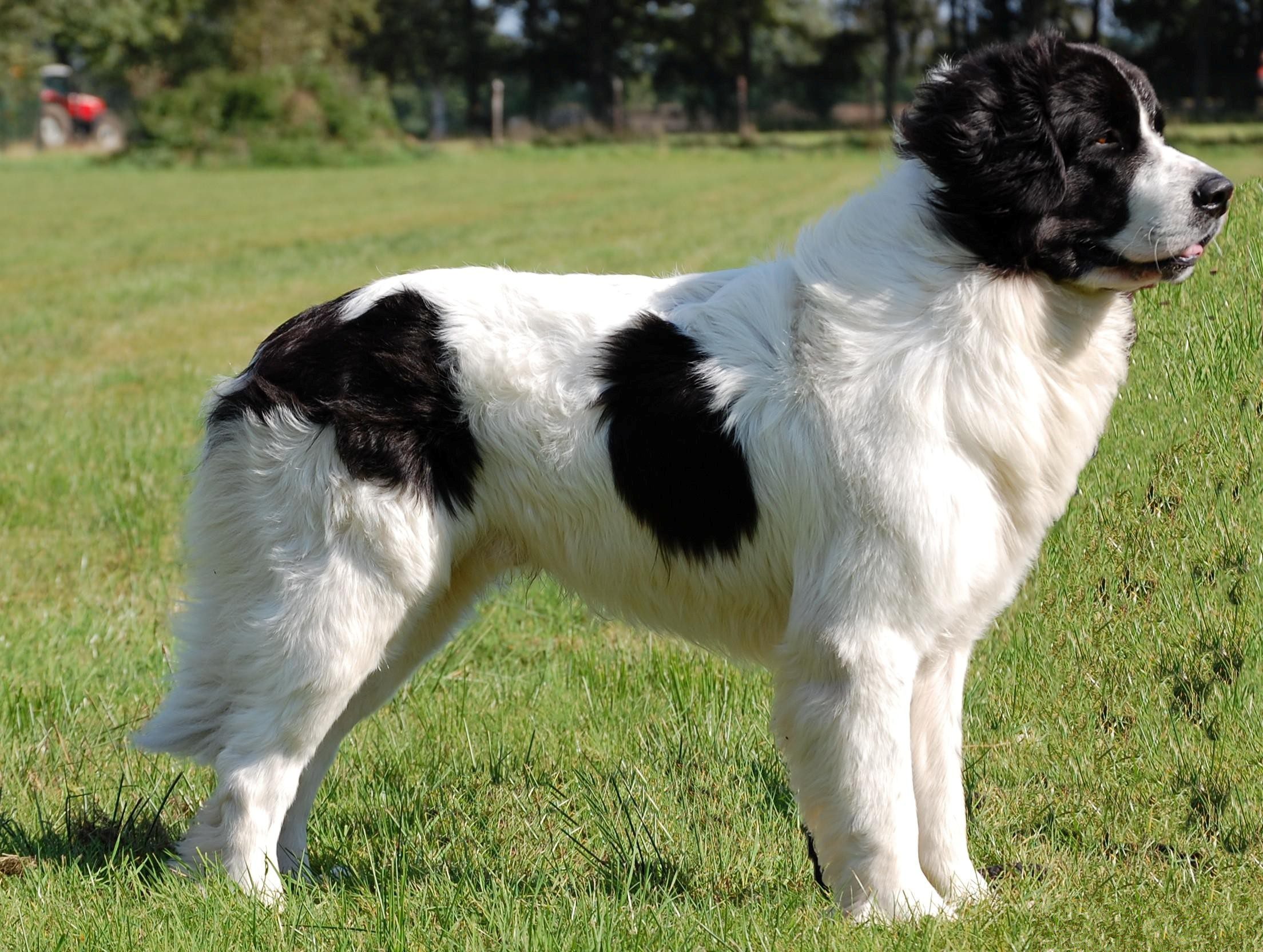
According to the breed standard of the Landseer, You must give the impression of being a but powerful and well balanced. The legs are relatively longer than the black Newfoundland. The back is straight and strong. The hind legs and shoulders are muscular.
The upper layer must be long and as straight as possible, very dense and soft to the touch. The main color of the layer is white with various patches black in the rump, the neck, backsplash, belly, legs and the tail should be white.
The head should be black with the white snout and symmetric white extends from the snout to the head, ending with the white collar. It has a distinctive shape with a noble facial expression. The ears are medium-sized and eyes should be dark brown. the size of the Landseer will of 67 to 80 cm., and at birth weigh between 500 to 750 grams and at the age of 1 year can be reached despite 50 to 60 kg.
Like all mastiff-type breeds, the Landseer It is also grown very fast during its first year. Therefore one must be careful with the exercise, because if it becomes sedentary can suffer from overweight.
Landseer video
Lightbox for Video by VideoLightBox.com v1.11
Character and skills
Throughout its development, and even at maturity (that is not until the dog is of 3 or 4 years of age), the Landseer is a very active dog who likes to do all kinds of activities. Swimming, for example, is your favorite activity. So when a Landseer smells and sees the water, already no boundaries, jump to the water.
The Landseer he is a very accommodating dog with his master. It is active, has good temperament, but it is not a nervous dog. It is a very confident dog, Intelligent, loyal to their own people, fairly mild in nature and, When they are given sufficient exercise outdoors, it attaches very well to home life. In general terms, most of Landseer they are very independent and have a mind of its own. The Landseer is very easy to train, much love and patience will be rewarded with a partner for life.
As we said in previous lines to most of the Landseer, they love water and walks, It is therefore necessary to fulfill these wishes to the dog. Being on the water takes it as a job, reason why can take advantage of these time to play to find objects, launch toy water to make it look, It can be one excellent training both for the owner and as for the dog. It is a good diver and with appropriate training, they are able to find objects in the bottom of any Lake. In this regard, It is good to note that if you want to go swimming with your Landseer you should keep in mind that, the dog will try to rescue and towed back to land. So, no doubt have to be careful to do this the first time. Basic training is required so that the dog knows when you are playing, and when not. Any other activity with the family is also something that the Landseer always wants to do.
When it comes to behaviour towards other dogs, children and people there is no problem. Especially the Landseer, they love to children.
It is good to socialize with other dogs puppies, because if he is male, It can be very dominant. But with a proper education, There will not be any problem.
Landseer Education
The Landseer can be educated very well. It is intelligent, interested and quickly understand what you are allowed to do and what you are not. Sometimes he takes it easy, but a little motivated he is very cooperative and tries to make his lord and master happy. The puppy should already show itself clearly and without exception where the hammer hangs. There should be no doubt about the orientation of your humans, as well as on the intimate relationship with.
Always keep in mind that this dog is the strongest and that orientation only works through unquestionable recognition. But with praise and consequences you can basically accomplish everything with it. On the basis of a good education you can even train very well at Landseer. Many Landseer are used as rescue dogs in the water, but also on earth. For this you can pass the work tests with water in the clubs.
Landseer Health and Care
The maintenance and care of the Landseer they are complex as with all big dogs. The dense and weather resistant layer should be brushed regularly with a special brush. Should not be sheared or trimmed.
The dogs of the breed Landseer like all large dogs they tend to hip joint dysplasia, twisting of the stomach. Due to their constitution and their dense fur they do not tolerate heat well.
Nutrition / Food
Like all large dogs, the Landseer needs a lot of good food. Especially in the growth phase you need professional nutritional planning. A high positioned food bowl is useful to counteract the risk of stomach twisting. You should always pay close attention to your weight.
Landseer's life expectancy
Life expectancy is between 10 and 12 years.
For sale Landseer
You should only purchase a puppy locally from a breeder who is affiliated with the FCI. Puppies of this breed cost between 1.500 and 2.000 EUR.
Images "Landseer"
 Landseer 6
 Landseer 5
 Landseer 4
 Landseer 3
 Landseer 2
 Landseer 1
Photos:
1 – Puppy landseer – 3 months old by OdinetPietra / CC BY-SA
2 – Landseer by https://pxhere.com/es/photo/548945
3 – Landseer by https://pxhere.com/es/photo/550456
4 – Cleo 11 months by Per Jensen – Flickr
5 – Landseer at PhotoEmotions (pixabay.com)
6 – Landseer by Katrina_S (pixabay.com)
Videos "Landseer"
 Landseer – Breed of dog
 Landseer [2019] race, Looks & Nature
 Landseer
 Rocky,Otto and Augustus the landseer swimming
Type and recognitions:
- FCI CLASSIFICATION:
- Group :
- Section : . .
Federations:
- – FCI – Pinscher and Schnauzer-Molossoid type dogs – Swiss Mountain Dogs and Cattledogs. Section 2.2 Molossoid, mountain type. ⓘ
FCI breed standard "Landseer"
Use:
Guard and companion dog.
General appearance:
The Landseer must give the impression of a large dog, strong and harmonious. Your limbs, especially in males, they are proportionally longer than in the black Newfoundland.
---
Head:
The skin of the head, short hair cover, it is wrinkle free. The head profile is marked, but it has an expression of nobility.- Craging: Wide and bulky, with a well developed occipital protuberance.
- Dfronto-nasal depression: Marked, but not as noticeable and abrupt as in St. Bernard's dogs.
facial region:
- Trufa: black.
- Horcico: The length of the muzzle is equal to its height measured against the frontal-nasal depression.
- Labios: Thin and pigmented in black; the superiors, which are as stiff as possible and do not drool, slightly cover the lower ones.
- Jaws/Teeth: Scissor bite.
- Cheeks: Moderately developed, gradually melting into the muzzle.
- Ojors: Medium-sized, moderately sunken, brown or dark brown, although light chestnut is tolerated. friendly expression; almond-shaped eyelids; the palpebral conjunctiva is not visible. Overly clear eyes (sulfur or yellowish gray color) are considered as fouls, as well as eyes implanted too close to each other.
- Obars: Medium-sized, reach the inner corner of the eye when placed towards the eyes; form triangular, a little rounded on its bottom edge, implanted high in the skull, but not too far back. Flat and glued to the sides of the head, they are covered with short and fine hair and have stripes of longer hair only at the back of the insert.
Neck:
The neck in its cross section is not completely round, but slightly oval; he's muscular, and it rises wide from the region of shoulders and thorax towards the head. In symmetrical construction, the length of the neck, from the occipital protuberance to the withers, is approximately 3/4 to 4/5 the length of the head, measured from the occipital protuberance to the tip of the nose. The presence of dewlap is not desirable (throat and neck) notable.Body:
It is very broad and powerful from the cross to the rump. The length from the withers to the tail insert should be approximately twice the length of the head.
- Espalda: Stiff and straight.
- Pork loin: Muscular.
- Glikeness: Wide, well rounded on the sides and back thanks to the powerful muscles that cover it.
- Pecho: In the middle of the very muscular shoulders, the chest is broad and deep with strongly arched ribs forming a corresponding rib cage.
- Vinbetween: Slightly retracted; between the belly and the back, a flat sag in the flank region must be visible.
A weak back is considered a fault, expired, loose backs, and the last ribs very short and an excessively retracted belly.
Tail:
Strong, reaches a little below the tibial-tarsal joint at most, covered in dense, leafy hair, but without forming feathers. When the dog is calm on its feet or at rest it carries it hanging down, eventually with a slight curve at the tip. During movement you can carry it straight with a slight upward bend at the tip. Tails bent or curled over the back are not tolerable.Tips
PREVIOUS MEMBERS: A robust muscle mass from the shoulders surrounds the strong humerus and forms a correct angulation at the junction with the powerful bones of the completely straight and muscular limbs.. The forelimb has some stripes of hair that reach the tibial-tarsal joint.
- Elbows: Well attached to the lower part of the thorax in a fairly high position and completely directed backwards.
LATER MEMBERS: The rear limb is powerful. The hind limbs must have free movement and have strong bones surrounded by powerful muscles., so that the thigh region mainly shows extensive development.
- Thighs: They have a particularly broad development.
- Espolones: Are unacceptable, They must be amputated from the first days of birth.
- PIIS: Big and well formed (cat feet). Crushed or deviated feet are reprehensible. The fingers must be joined by strong interdigital membranes to the proximity of the tip of the fingers.
Movement:
The movement of the muscular limbs must be free and wide.Mantle
- Plink: Except for the head, the coat must be long, where possible, smooth and bushy, soft to the touch and intermixed with inner fleece which should not be as dense as in Newfoundland. The presence of an outer layer of slightly wavy hair on the back and thighs is not penalized. When brushing hair in the opposite direction to the natural position, it must return by itself to the correct position.
- Colorr: The basic coat color is pure white with sharp, broken black plates distributed over the trunk and rump region.. The neck, the sill, the belly, limbs and tail must be white. The head is black. The presence of a white mark on the muzzle is typical of the breed, attached with a whitelist, symmetrical and not very wide. Smoke colored spots on the white background are not considered as faults, but they must be eliminated in breeding through selection.
Size and weight:
Alturto the cross: Height at withers in Landseer may fluctuate: in males an average between 72 and 80 cm and in females an average between 67 and 72 cm.. Small variations in size larger or smaller are tolerated.
Fouls:
Any deviation from the aforementioned criteria is considered as a fault and the severity of this is considered to the degree of the deviation to the standard and its consequences on the health and well-being of the dog..
FALTAS DISQUALIFYING:
- Aggressiveness or extreme shyness.
- Any dog showing clear signs of physical or behavioral abnormalities must be disqualified..
- Males should have two normal-appearing testicles fully descended into the scrotum..
- Only functionally and clinically healthy dogs, with the typical conformation of the breed, should be used for parenting.
Alternative names:
1. LANDSEER (EUROPEAN CONTINENTAL TYPE) (English).
2. LANDSEER (TYPE CONTINENTAL-EUROPEEN) (French).
3. LANDSEER (EUROPÄISCH-KONTINENTALER TYP) (German).
4. LANDSEER (TIPO EUROPEU CONTINENTAL) (Portuguese).
5. LANDSEER (TIPO EUROPEO CONTINENTAL) (español).
 FCI 233 . Little Lion Dog

 Not recognized by the FCI