โ–ท The world of Pets: Dogs, cats, birds, reptiles, amphibians

Irish Glenn of Imaal Terrier
Irlanda FCI 302 . Large and medium sized Terriers

It is generally believed that Irish Glenn of Imaal Terrier is less excitable than other Terriers, although it takes action immediately when prompted.

Glen of Imaal Terrier

Content

History

The Irish Glenn of Imaal Terrier originates from the Irish east coast, in county wicklow, which is in the ravine (=Valle) the Imaal. From this rough and wild valley this very old breed got its name. It was first mentioned around 1575.

Like old farm dog, the Irish Glenn of Imaal Terrier he had a very busy life and worked hard for his master. His job was to catch rats and mice on farms and operate smaller work machines like churns and work grinders., where I had to run on leather straps. He also accompanied his master on the fox hunt, the Badger and Otter. He worked in silence and if necessary he fought to the death. Before it was banned in Ireland, the Irish Glenn of Imaal Terrier also used in questionable dogfights. Of course, he was also the most loyal friend and guarded the house and the yard, never shied away from facing a much bigger and stronger opponent.

For its owner, the Irish Glenn of Imaal Terrier it was as important as his daily bread, although undemanding, frugal and tough enough to share the barren life of farmers. This harsh life brought with it a ruthless selection. Only the toughest and most frugal Terriers survived, what characterizes the breed until today.

The pedigree of Irish Glenn of Imaal Terrier it's an irish secret to this day. In Ireland itself, this Terrier has never been numerous and did not leave his ancestral home until 1980, when the owners preserved him as a true child of nature, marked by great courage, skill and endurance. In 1933 the breed was officially recognized by the Irish Kennel Club ( I.K.C.). The international recognition of the F.C.I. continued on 1981.

Physical characteristics

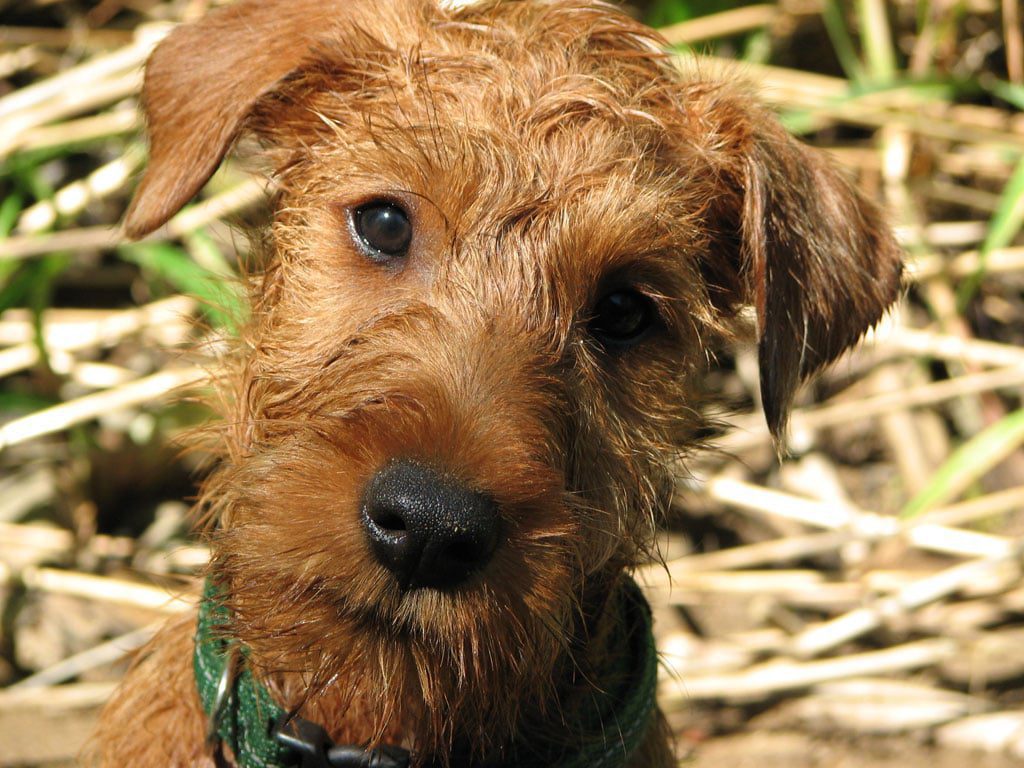
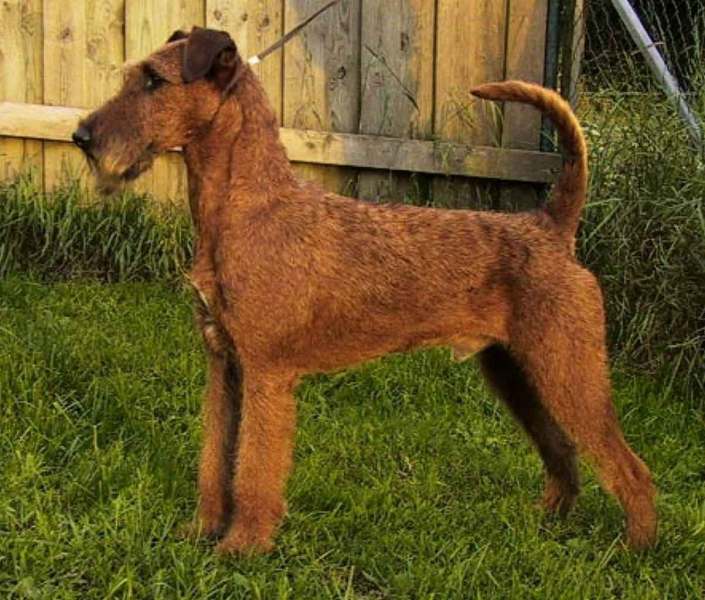
The Irish Glenn of Imaal Terrier it is small but strong and robust and weighs up to 16 kilograms with a maximum height at the withers of 36 centimeters. Its relatively small forward leaning ears are notable.. Its coat is medium length and consists of a rough top layer and a smooth bottom layer. It can be wheat colored, tabby blue or in different shades of red and gold. In the case of a dark-colored coat, a black-blue mask is common., which can also show as stripes over the ears, along the back and tail, so these marks become clearly clearer with increasing age.

Character and skills

Today the Irish Glenn of Imaal Terrier it is a gentle and docile family dog. Its balanced and faithful nature, as well as his average temperament make life with him very pleasant. The Irish Glenn of Imaal Terrier is very affectionate, always cheerful and in a good mood and preferably "in the middle". Enjoy all the attention and care, but without demanding anything. Rather, follows her around with her alert gaze and once she has gained attention, shows his joy about it with strong tail swipes. If the joy is particularly great, his temperament can also run away with him.

Children are welcome as playmates, if they show him the respect that he shows. Pets are accepted by him without problems when they get used to each other. The Irish Glenn of Imaal Terrier she is always friendly with strangers, and with his contagious joy, His charm and his irresistible look quickly have all the sympathies on his side.. After all, it is a terrier that radiates a lot of personality. He is open-minded and not afraid to learn new things. He likes to be everywhere with his nose. In general, everything that is new – Weird people, new environments, an object that has not been there before – it is very interesting and has to be examined very carefully. The Irish Glen of Imaal Terrier is a particularly attentive observer. Along with her charming nature and her desire to do everything right, is very adaptable and develops a very close relationship with his family. He likes to accompany them whenever possible. Like a very people-oriented terrier, I would defend them in an emergency, even to death. Feel more comfortable in your proximity.

What characterizes him Irish Glenn of Imaal Terrier is his great courage, his self-confidence and intelligence above average. Sufficient workload and intellectual work are important to the intelligent four-legged friend. Enjoy almost all activities, be it sports with dogs, search games or learning tricks – is available for all kinds of fun.

Despite its short legs, it is very agile, due to his muscular physique, a small power. Its special characteristics are its slightly curved front legs with the legs turned outward., his big head and his pronounced chest. The Irish Glenn of Imaal Terrier it is a very balanced dog, that radiates great calm on the one hand, but on the other hand you are immediately ready for action and, if required, vigorously watches over and defends your home and family.

The Irish Glenn of Imaal Terrier – the little irish with a big heart

Like a silent working terrier it hardly barks. It is also less excitable than other terriers. Sometimes you can see the Irish stubbornness, but the Irish Glenn of Imaal Terrier not resentful. Due to its origin it does not tolerate heat very well, he likes harsh weather and when the wind blows around his nose. But if the chemistry ain't right, or if the other dog brazenly approaches him, you will receive the message – "Glen doesn't like your attitude.". So, it is important to socialize with other dogs from the beginning and to have contact with many dogs of different ages.

โ€œIrish Imaal Glen Terrierโ€ Care

Because the Irish Glenn of Imaal Terrier still very original and not over-bred, still a very healthy and robust breed. Its coat has a rough top coat with a smooth undercoat that needs to be trimmed. Otherwise, his self-cleaning coat is very easy to care for. Coat color is wheat or Brindle (Blue striped).

A consistent but loving upbringing makes the Irish Glenn of Imaal Terrier a faithful companion, nice and gentle, which is easy to handle.

Life expectancy ยซIrish Imaal Glen Terrierยป

The Irish Glenn of Imaal Terrier is considered an original dog breed, which is in good health and robustness due to the absence of hereditary diseases caused by breeding. If maintained in a species-appropriate manner, will live an average of twelve years.

Images "Irish Glenn of Imaal Terrier"

Photos:

1 – Irish Glen of Imaal Terrier during International show of dogs in Katowice – Saucer, Poland. Breeder – Piotr Kuznik, http://www.irishglen.pl/ by Pleple2000 / CC BY-SA
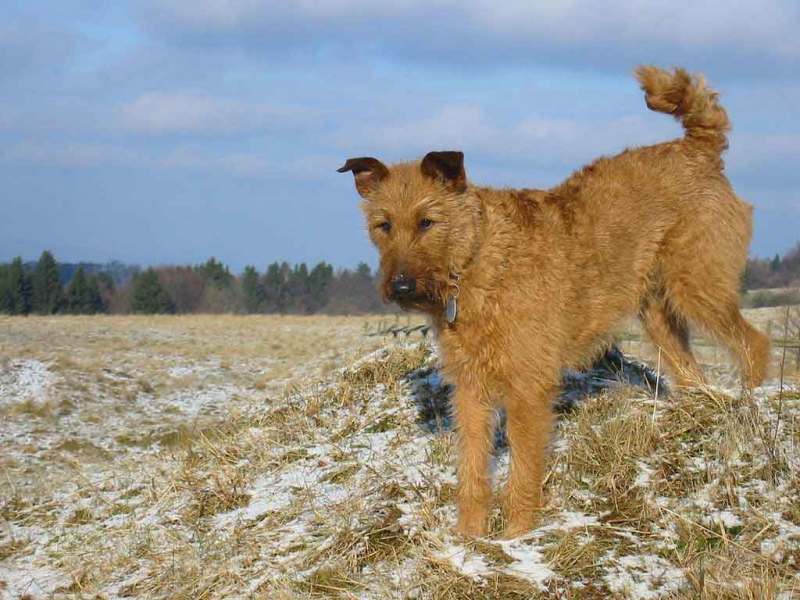
2 – Irish Glen of Imaal Terrier during International show of dogs in Katowice – Saucer, Poland. Breeder – Piotr Kuznik, http://www.irishglen.pl/ by Pleple2000 / CC BY-SA
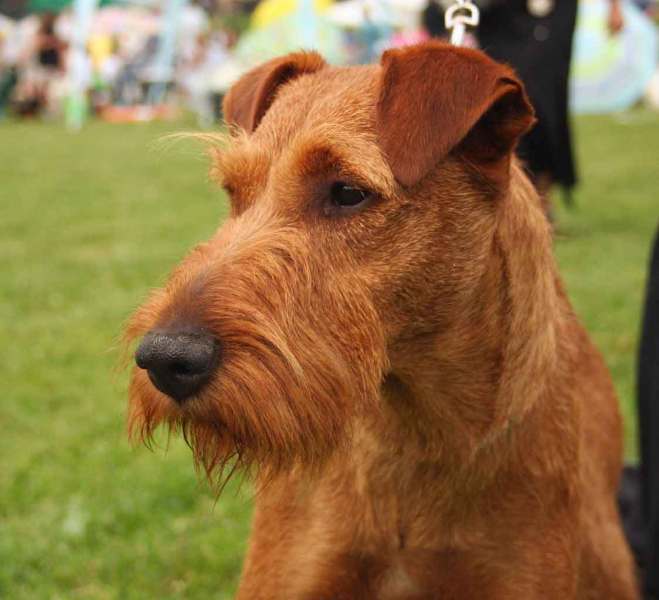
3 – Adult w:Glen of Imaal Terrier by photo by Scoo / CC BY-SA
4 – Irish Glen of Imaal Terrier during International show of dogs in Katowice – Saucer, Poland. Breeder – Piotr Kuznik, http://www.irishglen.pl/ by Pleple2000 / CC BY-SA
5 – Irish Glen of Imaal Terrier during International show of dogs in Katowice – Saucer, Poland. Breeder – Piotr Kuznik, http://www.irishglen.pl/ by Pleple2000 / CC BY-SA
6 – Glen of Imaalinterrieri by Sami Kronqvist / CC BY-SA

Videos "Irish Glenn of Imaal Terrier"

Type and recognitions:

  • FCI CLASSIFICATION:
  • Group :
  • Section : . .

Federations:

  • FCI – Terriers 1 Large and medium-sized terriers. โ“˜
  • AKC – Terriers โ“˜
  • ANKC – Terriers โ“˜
  • CKC – Terriers โ“˜
  • โ€‹KC – Terriers โ“˜
  • NZKC – Terriers โ“˜
  • UKC – Terriers โ“˜

FCI breed standard "Irish Glenn of Imaal Terrier"

Origin:
Ireland

Date of publication of the valid original standard:
27.01.2001

Use:

Like all other terriers, this stubborn little breed had to hunt badgers and foxes, as well as keeping the rat population to a minimum. In the news, he is a family dog, docile and sweet.


General appearance:

It is a medium-sized dog, with a medium length coat, very strong and gives the impression of maximum substance for its size.

IMPORTANT PROPORTIONS:

The body is longer than it is tall, close to the ground.


Behavior / temperament:

It is an active dog, agile and quiet when working. Courageous and gifted with courage when you need it, otherwise it is kind and docile, from which personality flows, his loyal and affective nature, makes him a very acceptable dog for the home and company. Irish Glen de Imaal is said to be less easily excitable than other terriers, although he is always ready to react if asked.

Head:

---

Cranial region:
  • Skull: Good width and reasonable length.
  • Depression links (Stop): Pronounced.

facial region:

  • Truffle: black.
  • Snout: Giving the impression of strength; narrowing towards the truffle.
  • Jaws: Strong.
  • Teeth: Healthy teeth, regular, strong and good size. Scissor bite.

Eyes: Brown, medium-sized, round and placed well apart. Light colored eyes should be penalized.

Ears: Small, When the dog is alert, it should be pink or semi-upright; when at rest they are carried backwards. Completely drooping or erect ears are undesirable..

Neck:

Very muscular and of moderate length.

Body:

Deep and long, longer than high.

  • top line: To level.
  • Pork loin: Strong.
  • Breast : Wide and strong, well sprung ribs.

Tail:

Cut. Firm at the root, well established and carried happily. Puppies' tails should be cut in half. A natural glue (not cut) It is allowed for countries where cutting them is prohibited by law.

Tips

PREVIOUS MEMBERS: Short, curved and with good bones.

  • Blades: Spacious, muscular and well leaning.
  • Anterior legs: Short, arching and good bone.
  • Pies: Compact and strong, with round foot pads. The front feet are slightly rotated out from the metacarpus.

LATER MEMBERS: Strong and well muscled.

  • Thighs: Well muscled.
  • Knee: Well angled.
  • Hocks: Without turning in or out.
  • Pies: Compact and strong with round foot pads.

Movement:

Free and without lifting the forelimbs too much. Effortlessly cover ground with good boost from hindquarters.

Mantle

Fur: Hair is medium in length and coarse in texture, with a soft undercoat. Hair can be groomed to make your figure look neat.

Color:

  • Blue tabby without the hue turning to black.
  • Wheat, from light wheat to a golden reddish hue
  • Puppies can be born blue, Wheat or Reddish Lighter-colored puppies generally have a bluish-colored mask, may have a blue stripe along the back, in the tail and in the ears. Darker marks will lighten with age.


Size and weight:

Height to the cross:

  • Males: 35,5 cm. (14 inches) is the maximum.
  • females: proportionally less.

Weight:

  • Males : 16 kg (35 English pounds).
  • females : proportionally less.


Fouls:

Any deviation from the aforementioned criteria is considered as a fault and the severity of this is considered to the degree of the deviation to the standard and its consequences on the health and well-being of the dog..

  • Hound ears.
  • With inferior or superior prognathism.
  • Body too short.
  • Straight front.

FALTAS DESCALIFICANTES:

  • Aggressiveness or extreme shyness.
  • Any dog โ€‹โ€‹showing clear signs of physical or behavioral abnormalities must be disqualified..
  • Black and fire color.
  • Narrow snout.


N.B.:

Males should have two normal-appearing testicles completely descended into the scrotum. Only functionally and clinically healthy dogs, with the typical conformation of the breed, should be used for parenting.

TRANSLATION: Lic. O. Valverde, reviewed by Dr. F. del Valle and updated by J. Nallem, Uruguayan Kennel Club.

Source: F.C.I - International Cynological Federation

Alternative names:

1. Irish Glenn of Imaal Terrier, Wicklow Terrier, Glen, Glennie (English).
2. Irish Glen of Imaal Terrier (French).
3. Irish Glen of Imaal Terrier (German).
4. Glen of imaal terrier (Portuguese).
5. Glen, Wicklow Terrier, Glen of Imaal Terrier, Irish Glen of Imaal Terrier (espaรฑol).

โ–ท The world of Pets: Dogs, cats, birds, reptiles, amphibians

Irish Soft Coated Wheaten Terrier
Irlanda FCI 40 . Large and medium sized Terriers
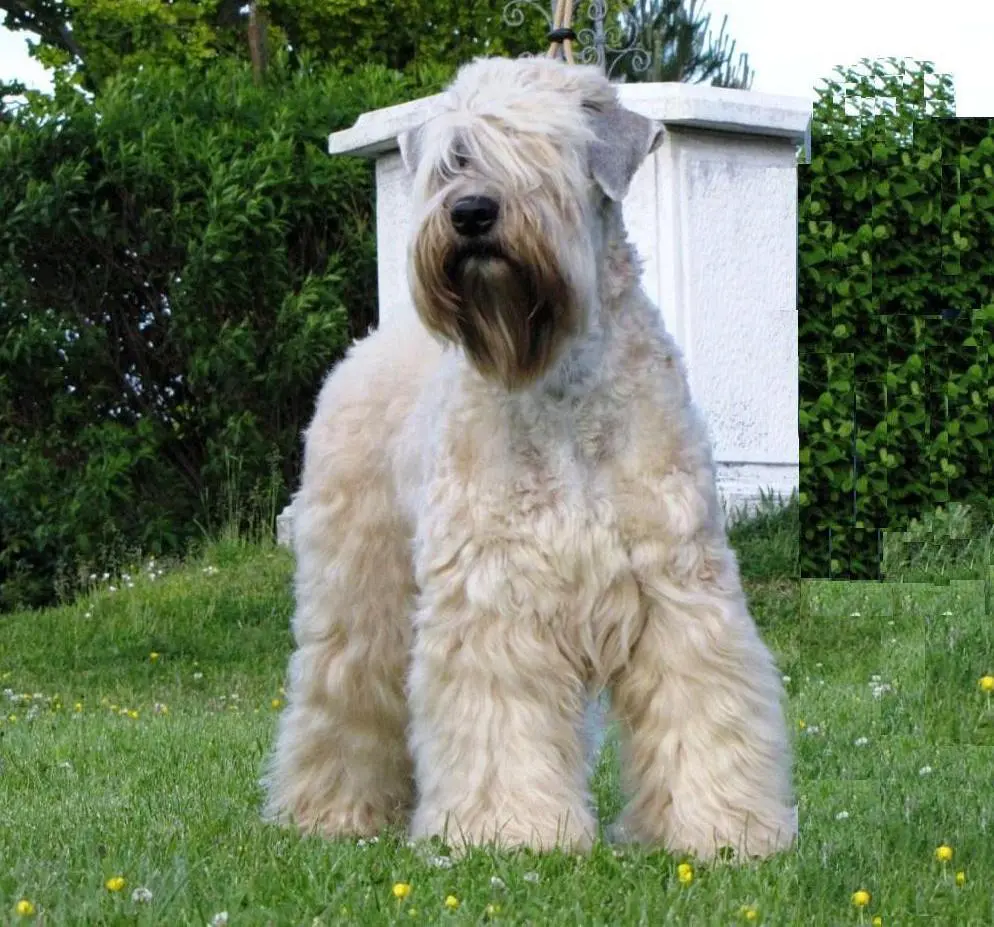
Irish Soft Coated Wheaten Terrier

Wheaten character is cheerful, open and balanced.

Content

History

The Irish Soft Coated Wheaten Terrier has been raised in Ireland for about 200 years in counties Kerry and Cork by the farmers who live there. How farm dogs fought rats and mice, as well as against predators such as foxes and martens, that threatened domestic animals. They also grazed sheep and were used for hunting.

The history of Irish Soft Coated Wheaten Terrier has been somewhat obscured due to its closeness to the other races of Irish terriers. The Wheaten probably the oldest of the four races. His existence, along the, at least 200 years, can be deduced from the textual references made to "soft-haired" dogs.. The relationship of Irish Terrier modern with the Wheaten, although less documented, appears to have been the result of deliberate crossing experiments. Consequently, the humble Wheaten probably has a fully mixed lineage. Despite the long history of Wheaten, it was not until 1937, which was officially recognized by the Irish Kennel Club. Since then this breed has grown steadily in popularity and is currently well known worldwide..

In 1943, the British Kennel Club He acknowledged the race in United Kingdom. The first Irish Soft Coated Wheaten Terrier were exported to the United States in the 1940, but the race gained greater interest ten years after his arrival. Last, in 1973, were recognized by the American Kennel Club.

The Irish Soft Coated Wheaten Terrier, unofficially, were crossed with the race Pudelhund standard, to create the mixed race, known as the Whoodle and with the race Beagle to create the race known as "Wheaglesโ€.

Today the Irish Soft Coated Wheaten Terrier It is a versatile companion dog that adapts well to its living conditions..

Physical characteristics

It is a strong dog, balanced, straight back and chest deep. It has a rectangular and well-proportioned head with a defined stop. Their eyes have a slightly almendrada way and the ears are small and bent slightly forward.

In countries where it is allowed, the Wheaten usually has a tail cut off. It has a smooth hair, silky and color wheat. These dogs have a unique coat of hair., so you can more easily tolerated by people who are allergic to other races, because they lost very little hair.

Puppies are reddish brown or gray. Many have a black mask. Only at the age of two and a half the coat has its final color, clear and its fine structure.

SIZE AND WEIGHT:

Height to the cross : Males 46-48 cm. (18 – 19 inches). females somewhat less.

Weight: Males between 18 – 20,5 kg (40 – 45 English pounds). The females somewhat less.

Character and skills

The character of the Wheaten is happy, open and balanced. As an SUV, these dogs are very docile. They enjoy participating in family life. Dog sports such as agility are a good substitute for the many different tasks these spirited terriers were originally bred for.. If they are left alone, without getting busy or moving enough, can become destructive and aggressive. Consistent breeding from the start makes them great family dogs that don't obey one person.. Due to the great care effort and the possible stubbornness of the terrier, only conditionally suitable for beginners.

Wheaten Terrier care

The coat of the Irish Soft Coated Wheaten Terrier requires a lot of cleaning and must be brushed daily to avoid entanglement. Hair must be cut regularly. Does not come off.

In regards to health, it is a very healthy breed, not showing any typical hereditary disease.

Wheaten Terrier Education

That dog learns fast. Unfortunately also things, that you have to avoid them later. So, and also because of the hunting instinct that the breed has, initially not recommended for beginners. It also, the breed tends to be stubborn under pressure, you also have to learn to deal with it. But, who masters the rules of dog training, you will be very pleased with this dog's willingness to learn and willingness to work.

Images "Irish Soft Coated Wheaten Terrier"
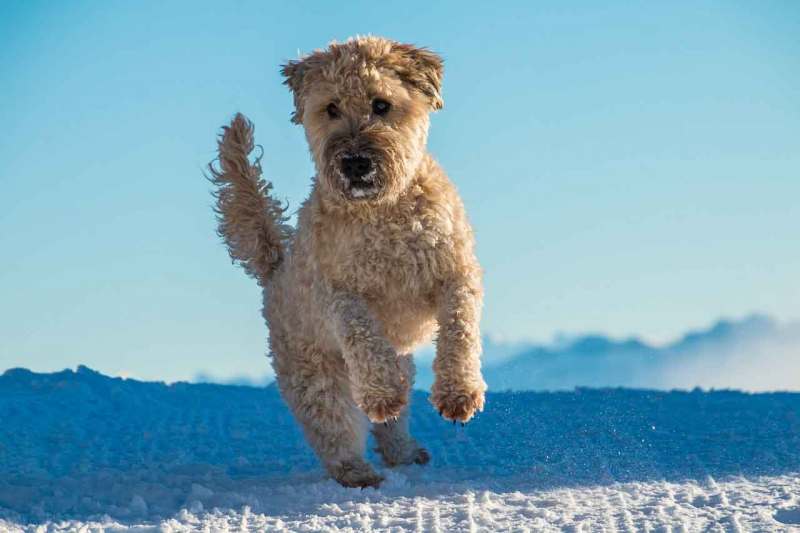
Photos:

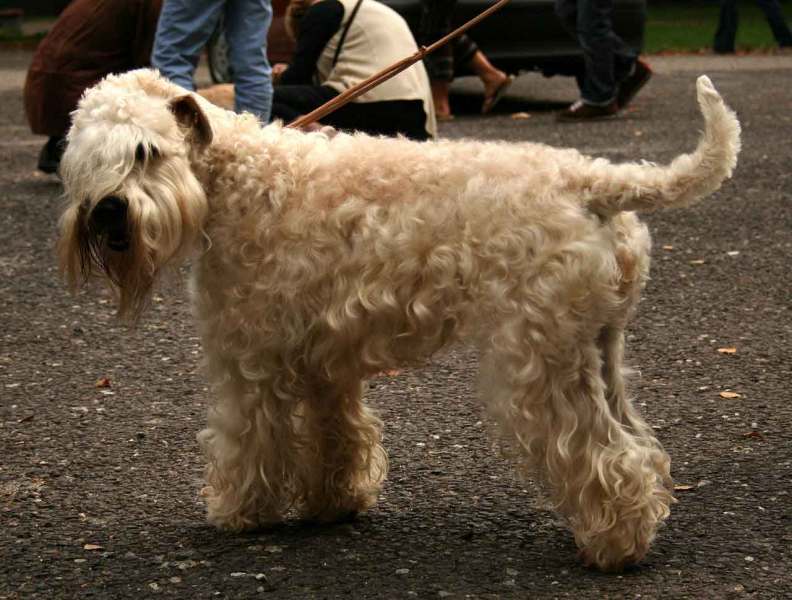
1 – Soft Coated Wheaten Terrier by SusanSmithGSU / CC BY-SA
2 – Soft-coated_wheaten_terrier at the national show in Rybnik – Stone to Pleple2000 / CC BY-SA
3 – Soft-coated_wheaten_terrier at the national show in Rybnik – Stone to Pleple2000 / CC BY-SA
4 – Soft Coated Wheaten Terrier Irlandรฉs by RORLVR1 / CC BY-SA
5 – Soft Coated Wheaten Terrier Irlandรฉs by https://pxhere.com/en/photo/64565
6 – Soft Coated Wheaten Terrier Irlandรฉs by https://www.needpix.com/photo/834722/dog-jump-play-irish-soft-coated-wheaten-terrier-young-dog-jumps-happy-winter-snow

Videos "Irish Soft Coated Wheaten Terrier"
Type and recognitions:

  • FCI CLASSIFICATION:
  • Group :
  • Section : . .

Federations:

  • FCI – Terriers 1 Large and medium-sized terriers. โ“˜
  • AKC – Terriers โ“˜
  • ANKC – Terriers โ“˜
  • CKC – Terriers โ“˜
  • โ€‹KC – Terriers โ“˜
  • NZKC – Terriers โ“˜
  • UKC – Terriers โ“˜

FCI breed standard "Irish Soft Coated Wheaten Terrier"

Origin:
Ireland

Date of publication of the valid original standard:
27.01.2001.

Use:

Wheaten Terriers were always used by small farmers to kill vermin or help with farm work.. For a long time it was used in the difficult task of hunting badgers and otters..


General appearance:

It is a robust dog, active and compact, well built, giving the idea of รขโ‚ฌโ€นรขโ‚ฌโ€นstrength. Their limbs are not too long or too short.


Behavior / temperament:

Fiery and courageous. With good temperament. Very noble and loyal to his masters. Very intelligent. A faithful and trustworthy friend, defensive without being aggressive.

Head:

It must be strong as a whole, without being rough. Long, well proportioned to the body. Hair must be the same color as the body.

Cranial region:
  • Skull: Flat and crisp between the ears, not very wide.
  • Depression links (Stop): Defined.

facial region:

  • Trufa: Black and well developed.
  • Horcico: It should not be longer than the skull.Jaws: Strong, punishing jaws.
  • Dinentities: Big teeth, regular scissor or clamp bite, no upper or lower prognathism.
  • Cheeks: Non-prominent bones.
  • Ojors: dark, dark hazelnut, not very large or prominent, well placed.
  • Obars: Small to medium, taken to the front, level with the skull. Dark shading is allowed at the base of the ears, and it is common for it to have a light wheat reflection in the rest. This is the only area of โ€‹โ€‹the dog where undercoat is allowed.. โ€œPinkโ€ or โ€œflyingโ€ ears are objectionable.

Neck:

Moderately long and strong, but without presenting dewlap.

Body:

Not very long. The length from the withers to the base of the tail should be approximately the same as from the ground to the withers.

  • Dorrso: Strong and straight, with top line also at level.
  • Itmor: Short, strong.
  • Pecho: Deep, well arched ribs

Tail:

Well placed, not very thick. Carried cheerfully but never over the top line. amputee, remaining two thirds of its original length, assuming that this length is in proportion to the dog. Uncut glue is allowed.

Tips

PREVIOUS MEMBERS:

  • Hormbros: Thin Shoulders, well inclined. Muscled shoulders.
  • Antarms: Seen from any angle they must appear perfectly straight, good bone and muscular.

LATER MEMBERS: Well developed and with powerful musculature.

  • Thighs: Strong and muscular.
  • Rodinllas: Angled.
  • Corvejones: Well descended, without turning in or out. Dewclaws must be amputated.
  • PinIt: Small, not scattered. Nails should preferably be black, but several dark colors are allowed.

Movement:

In a straight line throughout its entire length, round trip. The elbows stuck. Side view: free movement, lightweight and coordinated.

Mantle

  • Plink: Single-haired mantle dog (no undercoat). The hair is soft and silky to the touch, does not last. Young dogs are excluded from the above. Hair preparation is allowed (Trimming).
  • Pmistakes with hair preparation: The hair should be short on the neck, chest and skull and should be left especially long over the eyes and under the jaw. It is advisable to leave the mustaches. With abundant fringes on the extremities. The body hair must be arranged in such a way that it follows the contour of the dog, without being sculpted. The tail hair should be cut short and gracefully tapering to the tip.
  • Pmistakes without preparation: Hair length at its longest point should not exceed five inches (12,7 cm.). Hair must be thick and soft, wavy or loose curls with the shine of silk. Under no circumstances should the coat be โ€œfluffyโ€ like that of the Poodle or the Old English Sheepdog.. Dogs exposed in this condition must be heavily penalized, since they give the wrong idea of รขโ‚ฌโ€นรขโ‚ฌโ€นtype and race. Special attention should be paid to the development of the coat of the puppies. Puppies are hardly born with the correct hair that they should have when adults., Care must be taken when evaluating this aspect. They undergo various color and texture changes before developing adult hair. This normally occurs between 18 months and 2 1/2 years.
  • Cachorros: Puppies are rarely born with the correct coat color and texture. Their fur may be reddish, grayish and sometimes light tawny. The masks are generally black. Sometimes there is a black streak in the center of the back or the tips of the body hair are black. These dark marks disappear during growth.
  • Colorr: A good and defined wheat color with variations ranging from light fawn to a reddish golden hue.


Size and weight:

Alturto the cross:

  • Males 46-48 cm. (18 โ€“ 19 inches).
  • females somewhat less.

Pthat:

  • Males between 18 โ€“ 20,5 kg (40 โ€“ 45 English pounds).
  • The females somewhat less.


Fouls:

Any deviation from the aforementioned criteria is considered as a fault and the severity of this is considered to the degree of the deviation to the standard and its consequences on the health and well-being of the dog..

  • Nervosity, aggressiveness.
  • Truffle in any color other than black.
  • Upper or lower prognathism.
  • Mature dog coat not clearly wheat colored.

FALTAS DISQUALIFYING:

  • Aggressiveness or extreme shyness.
  • Any dog โ€‹โ€‹showing clear signs of physical or behavioral abnormalities must be disqualified..
  • Yellow eyes.
  • Dull coat, thick, wool or cotton texture.
  • White fur. Brown fur.


N.B.:
  • Males should have two normal-appearing testicles fully descended into the scrotum..
  • Only functionally and clinically healthy dogs, with the typical conformation of the breed, should be used for parenting.

Itlatest changes are in bold.

TRANSLATION: Lic. O. Valverde, reviewed by Dr. F. del Valle and updated by J. Nallem, Uruguayan Kennel Club.

Source: F.C.I - International Cynological Federation

Alternative names:

1. Irish Soft-Coated Wheaten Terrier and variant spellings: ยซSoft Coatedยป and ยซSoftcoatedยป, Wheaten or Wheatie, Wheaten Terrier (English).
2. Irish Soft Coated Wheaten Terrier (French).
3. Wheaten Terrier (German).
4. Wheaten Terrier (Portuguese).
5. Wheaten Terrier (espaรฑol).

โ–ท The world of Pets: Dogs, cats, birds, reptiles, amphibians

Cane Corso
Italia FCI 343 - Molossoid - Dogo

The Cane Corso It is a versatile and balanced dog that can adapt to all.

Cane Corso

Content

Characteristics "Cane Corso"

Coexistence is important that you have with your new friend. Before considering the acquisition of a dog of the breed "Cane Corso" you know certain factors. Not all breeds of dogs are apt to live in an apartment, you must take into account his character, their need for exercise, their interaction with other pets, their care and if you have small children, their level of tolerance towards them.

Adaptation โ“˜

2,0 of 5 stars (based on 1 review)

friendly dog โ€‹โ€‹โ“˜

3,0 of 5 stars (based on 1 review)

hair loss โ“˜

1,0 of 5 stars (based on 1 review)

Affection level โ“˜

3,0 of 5 stars (based on 1 review)

Need for exercise โ“˜

3,0 of 5 stars (based on 1 review)

Social need โ“˜

4,0 of 5 stars (based on 1 review)

Home โ“˜

2,0 of 5 stars (based on 1 review)

Toilet โ“˜

1,0 of 5 stars (based on 1 review)

Friendly with strangers โ“˜

1,0 of 5 stars (based on 1 review)

barking โ“˜

2,0 of 5 stars (based on 1 review)

Health โ“˜

4,0 of 5 stars (based on 1 review)

Territorial โ“˜

5,0 of 5 stars (based on 1 review)

Cat friendly โ“˜

1,0 of 5 stars (based on 1 review)

Intelligence โ“˜

5,0 of 5 stars (based on 1 review)

Versatility โ“˜

3,0 of 5 stars (based on 1 review)

Child friendly โ“˜

4,0 of 5 stars (based on 1 review)

Surveillance โ“˜

3,0 of 5 stars (based on 1 review)

joy โ“˜

5,0 of 5 stars (based on 1 review)

History

Something small and elegant that the Neapolitan mastiff, the Cane Corso (or Italian mastiff) It was used in the past not only as Cattle dog but also in wild boar hunting, and as dog escort on long journeys of traders and, even, as a grip of Bull Dog. It was widespread throughout the southern Italian region and even more so in Calabria, Lucannia, Pugglia, and Sannia, until end interrelating so with history, the tradition, and local legends that, in the Royal Lottery game, the Corsican was assigned the number 22.

Both fierce and determined appearance, as its imposing structure of all the molossians, They seem to be on the agenda of its name, therefore means powerful Corso, robust, strong, and these are, without a doubt, its main characteristics.

Others attribute the etymological origin of the word to the Latin "cohors" or senior guardian of the body or to the Greek "kortos.", referring to the fact that he kept and watch people and animals during periods of transhumance. Finally, others see the name associated with the island of Corsica. The truth is that outside of Italy very little is known about the Cane Corso and that even in its country of origin, for years, the race has remained forgotten and ignored. He took that in 1973 Professor Giovanni Bonatti referred to the presence in the province of Puglia of a "short-haired Molosser dog, different from the Neapolitan mastiff, similar to the Bullmastiff and similar to the dog's Mallorquin Damยป so that a group of enthusiasts got to work and tried to recover it and make it known inside and outside the country.

In fact its official recognition from the ENCI (Ente Nazionale di Cinophilia Italian) has only taken place in January of 1994, Once the table of work of the societร ย  Amatoria Cane Corso (SACC) provide sufficient documentation, photos, data and a large group of typical specimens to defend its existence and ancient origin.

It is almost always difficult to make History of the history of a dog breed, but in the case of the Cane Corso there was enough documentation that revealed its presence since ancient times in the southern part of what is now Italy. Certainly had to be traced back to many centuries ago, Learn about the legends of the inhabitants of the Mezzogiorno, investigate its folklore and more ingrained traditions, Learn about its history, the superstitions of an entire people, but, finally, After many years of intense and arduous research, Professor Fernando Casolino, of the SACC, He managed to gather enough data to this impressive animal because they have been many, many written and pictorial references that have been found about this dog. It should be noted some dating as far back as the 15th and 16th centuries, such is the case of the burlesque poems written in Italian mixed with Latin by the Benedictine friar Folengo or the quotes in the ยซOf Quadrupelibusยซ, the renowned physician and naturalist Gessner, known as the "German Pliny", without forgetting the very detailed description of the illustrious Valvassone, which evidenced his power and the strength of his jaws in the "Poem of the Head".

In the 18th century, the count of Leclerc, Georges Buffon, He mentioned him in his "Natural History" as did Oronzio Costa in his treatise on "The fauna of the Kingdom of Naples.", published in 1839. Thirty years later Palumbo also wrote about our protagonist in his "Catalog of Sicilian Mammals".

Quotations continued to be frequent and already in 1900 Spalikowski mentioned him in his work ยซEvolution of the dog in the human societyยซ, of essential reading for all lovers of dogs; much closer in time are the articles and works published by Fiorenzo Fiorone, Danilo Mainardi, Bonatti Mizzoli and how does not, my good friend Mario Perricone, who in the "Great Encyclopedia of the Dog" published by Agostino in 1987, He wrote widely on race, in which the most important monographic article on the Cane Corso is considered. Recently De Prisco and Johnson also mention him in the "Canine Lexicon" referring to him as "a recreation of the ancient Cane of Marcellaio.", under the heading of โ€œSicilian Branchieroโ€, explaining that it existed exclusively in Sicily and that it was known for its particular way of moving in front of the herd, so according to the authors it could even be related to the German bullenbeiser and that "on the island it functioned as a butcher's dog and a herd driver with unique abilities" that, At one time "he was able to participate in bullfights just as other butcher dogs did on the Continent".

Priscus and Johson they also claim that in the eighties they arrived to the United States.UU. the first puppies imported by a Sicilian farmer who died soon after and which constitute the scant breeding base in that country.

They have been missing many years of work and staff of a few efforts to again talk of Italian Corso Dog, race so ancient and so deeply linked to the traditions and the history of the South of Italy and properly recover virtually from scratch. There was, in fact, There were many contradictions about which dog truly resembled and contained the very essence of the Cane Corso and it took many debates and many discussions to finally agree on which specimen the foundations of the new breeding lines should be based on..

They all ended up agreeing on a male named "Dauno" who summarized the very essence of the race and who outlined the path that those who should follow should follow., with a passion beyond doubt wore years looking for precisely this path. It was decided to locate up to three closely related subjects in order to establish the characteristics of the breed., just as the Ballota professors had described it, Bonatti and Casolina.

After exhaustive research studies and, at the end, not without major sacrifices, the recovery programme was gradually bearing fruit. In 1988, the ENCI Board of Directors decided that the time had come to gather as many copies as possible, produced by people not linked to that society both the scope of the SACC, and carry out a pilot trial in order to check homogeneity of type, of construction and character and its similarity with the characteristics described in the draft standard that the SACC had presented to them. In three exhibitions-Bari, Florence and Milan- the judges Morsiani, Perricone and Vandoni examined fifty copies; then, in the autumn of that same year the SACC presented the ENCI the outcome of the first census carried out by the Lords Bruno and Indiveri which is didn't data out of a total of 57 perfectly typical and rustic specimens already registered.

Did you know??

The Cane Corso is also known as Dogo di Puglia, which means "dog of Puglia".

As a result of all this effort, the ENCI promulgated the opening of an "Open Book" in which all adult specimens that had been duly tattooed could be registered., and therefore recognized as conforming with the standard project and in just four years became part of the same over 500 dogs, so it was clear that the recovery program had been successful.

Such results finally gave rise to the official recognition of the race in January of 1994.

Modernity and the decline of the work for which it was intended, have not prevented this race from maintaining its characteristic gifts. He continues to be a dog with a tenacious temperament but does not bite for anything. It is one of the best races of property protection. If you are very fond with the owner can be very sensitive to your mood.

Physical characteristics

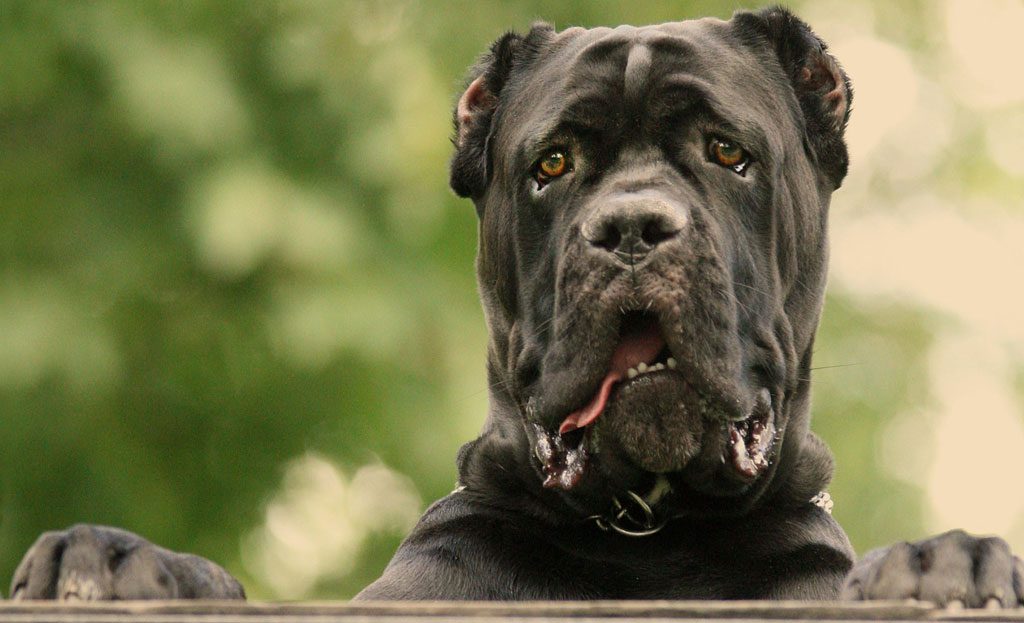
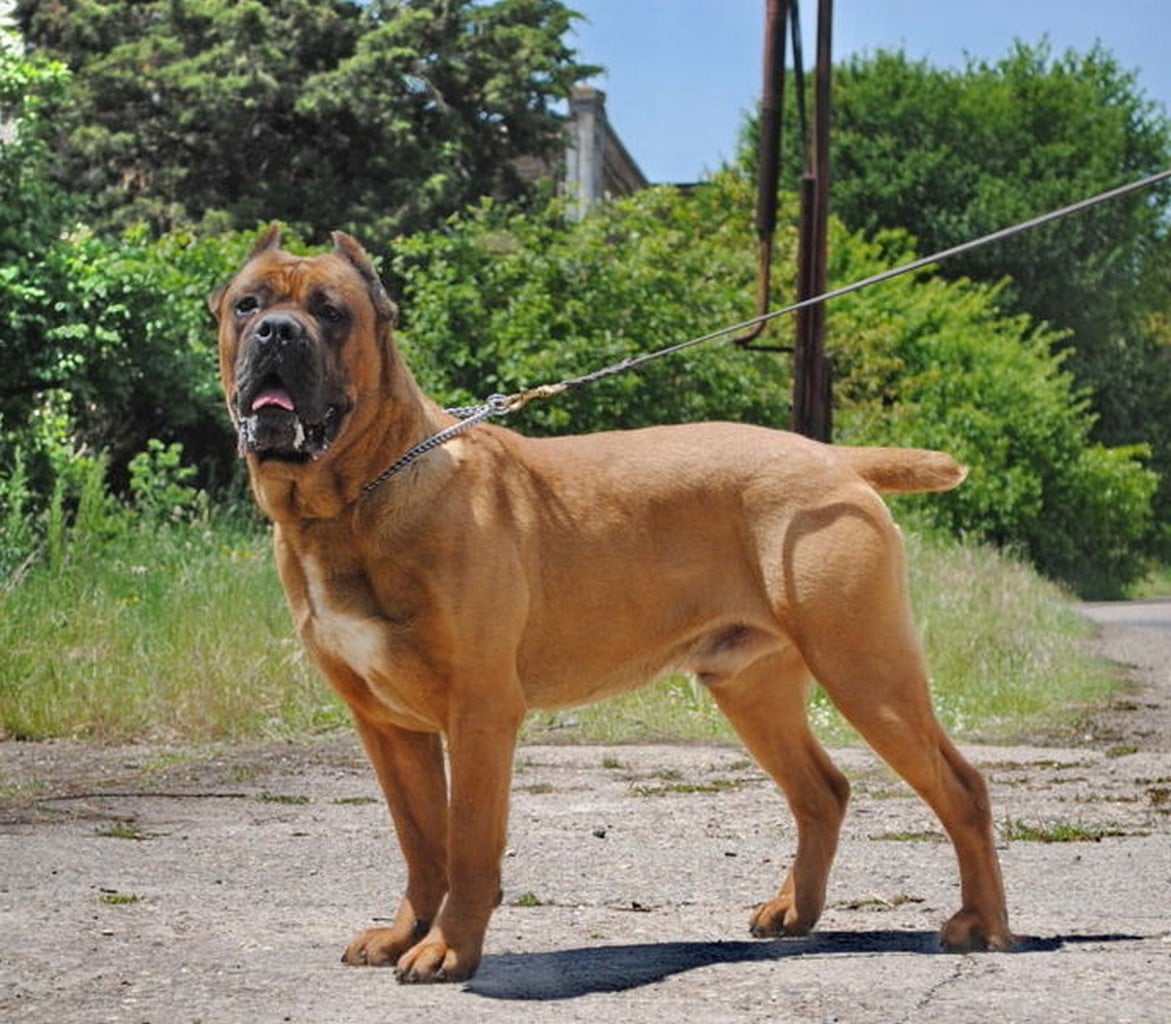
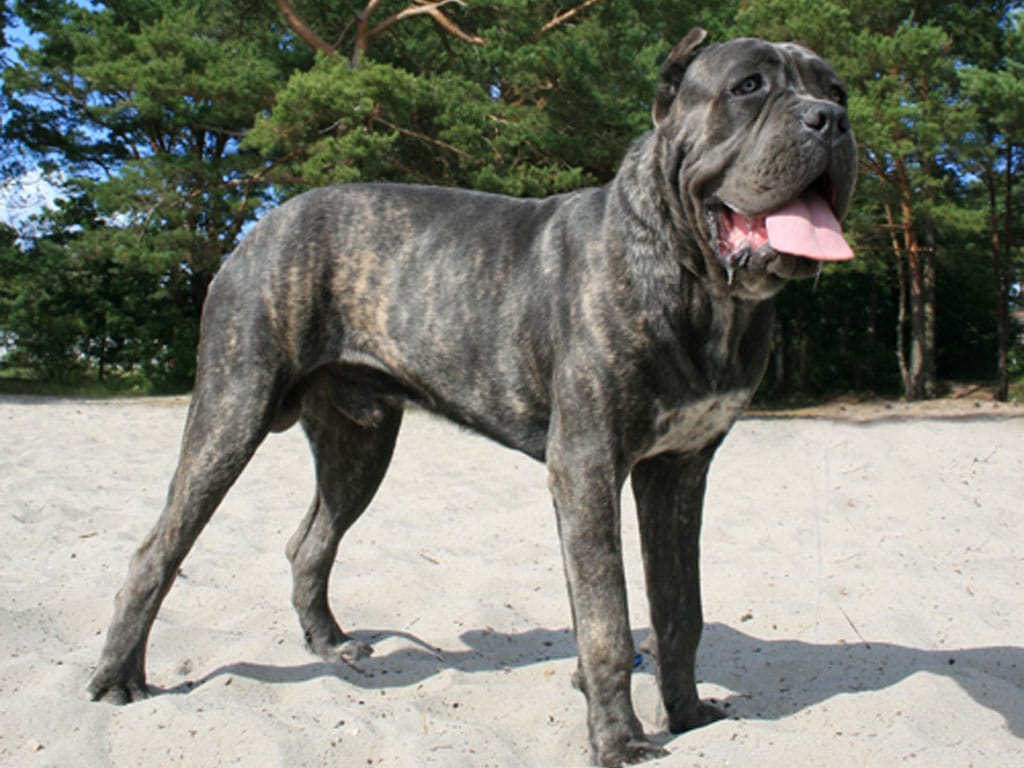
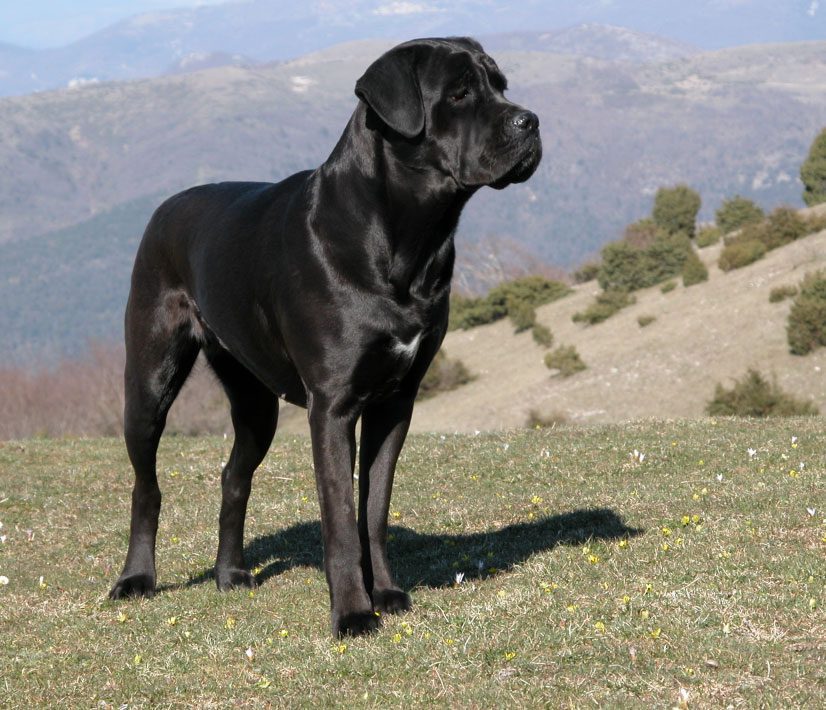
Its skin is thick enough, with tissue limited connective and therefore virtually glued to the subcutaneous tissues of each region. The neck does not present practically double chin. The head does not have to submit wrinkles. The pigment of the mucous and the esclerosas has to be black. The pigment of the soles and nails must be dark.
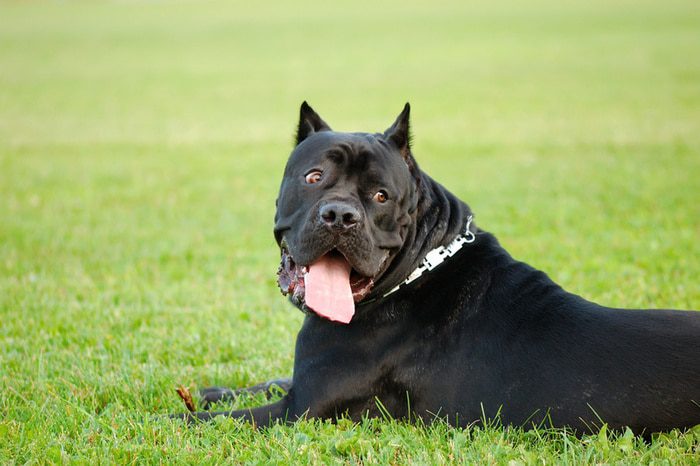
The coat is short but not satin, glassy in texture, gleaming, bright, adherent, serious, very dense, with a light layer of undercoat that is accentuated in winter, without that never reaches to emerge on the hair of coverage. His medium-length is 2/2′ 5 cm.. On the cross, the rump, and the subsequent edges of the thigh and on tail reaches the 3 cm., without ever giving rise to fringes. On the nose hair is private, smooth, adherent and not more than 1/1′ 5 cm..

It may be black, grey lead, Slate gray, light grey, Griffon clear, Red cervato, Dark tawny and striped (stripes against a background of Griffon or grey colour of various shades). In fawn and brindle subjects, a black or gray mask is present whose extension should not exceed the line of the eyes. Admitted a small white patch on the chest, at the tip of toes and on the nasal helm.

The height the cross in the males is of 64 to 68 cm., in the females of 60 to 64 cm.. With tolerance of 2 cm more or less. The weight in the males is of 45 to 50 kg (ratio weight /talla 0,71 kg per cm). And in the females of 40 to 45 kg (ratio weight /talla 0,68 kg/cm).

Salud de Cane Corso

Some of the health conditions that have been in the Cane Corso are the Hip Dysplasia, eye problems such as Entropion or ectropion, demodectic mange and the tendency to bloat.

Remember that after bringing a new puppy home, has the power to protect you from one of the most common health problems: the obesity. Cane Corso maintain an adequate weight is one of the easiest ways to prolong life. Make the most of your preventive skills to help ensure a healthier dog for life.

Character and skills

His character affable and faithful with their own. His psychological balance and extreme functional versatility that allows you to adapt to everything, He is doing to gain more followers and indeed again used you in grazing and foster as old tasks, and also in the hunt, although little by little it is gaining a preferential position as a companion animal and in what has been called therapy with domestic animals (ยซpet therapyยป).

But, for its size and extraordinary force Cane Corso owner should be able to educate from the first moment to always have it under control, in such a way that never conflicts surprises or, It must learn from puppy what is right and what not, What is prohibited and what is allowed, so that later there will be no setbacks, recommending further vocational training of certain circumstances, provided that the dog has acquired a certain degree of maturity, Therefore we must not forget that, in the case of molossians, their psychological development is always slower than the physical.

Aware of its size and appearance, corso usually does not express nervousness and willingly accepts to any person that his own master will accept either. When he is assigned the custody of a property his balanced temperament allows her always from a background, with great discretion, and only in the case of real necessity, act and attack. Thus we can conclude that the Cane Corso is an impressive animal, balanced and effective in any task requiring him. There is a legend made reality.

Cane Corso's Education

With patience and sensitivity
The Cane Corso is not a beginner dog and only belongs to responsible hands. Learn quickly and with pleasure if you treat it with patience and sensitivity during training. If it is to be kept as a family dog, Cane Corso's protective instincts should not be encouraged during training. Early and comprehensive socialization is especially important, so that the dog gets used to other people and animals and reacts calmly in all situations.

Care of Cane Corso

Cane Corso's coat is shiny, smooth and short, and does not require extensive cleaning. Cane Corso has a thin undercoat that can protect it from the cold at times. A massage sponge or soft brush should be used regularly to stimulate blood circulation. – this ensures a healthy and shiny coat.

Nutriciรณn Cane Corso

Only with high meat content
With prepared food, pay attention to a high meat content, low grain content and high quality. An adult dog needs enough fresh meat and vegetables for a healthy diet.. Young dogs, on the other hand, should not be fed too much protein. Foods that are too high in protein can promote growth too quickly and encourage skeletal diseases. Food should be divided into two meals a day. One of them must be given directly after the daily walk. In this way the dog gets his reward after the "work done".

The life expectancy of the Cane Corso

Cane Corso can reach a relatively high age, what is really unusual for such large dogs. A healthy and active dog will easily reach the age of 10 to 14 years, as long as you exercise a lot and have a balanced diet. This robustness and long life expectancy compared to other larger dog breeds are due to the strong bone structure and robust construction.

Buy Cane Corso

Serious breeders offer not only a pedigree with a complete record of the dog's ancestors, but also a complete advice that goes beyond the purchase. Before buying or reserving a puppy, exhaustive information must be obtained from the local authority to know what conservation regulations exist.

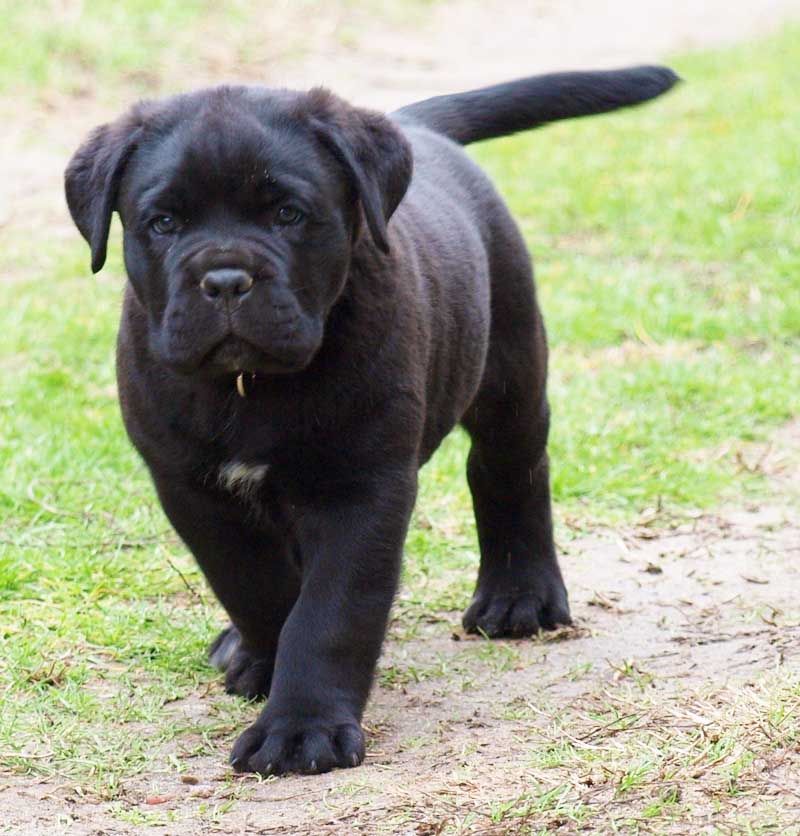
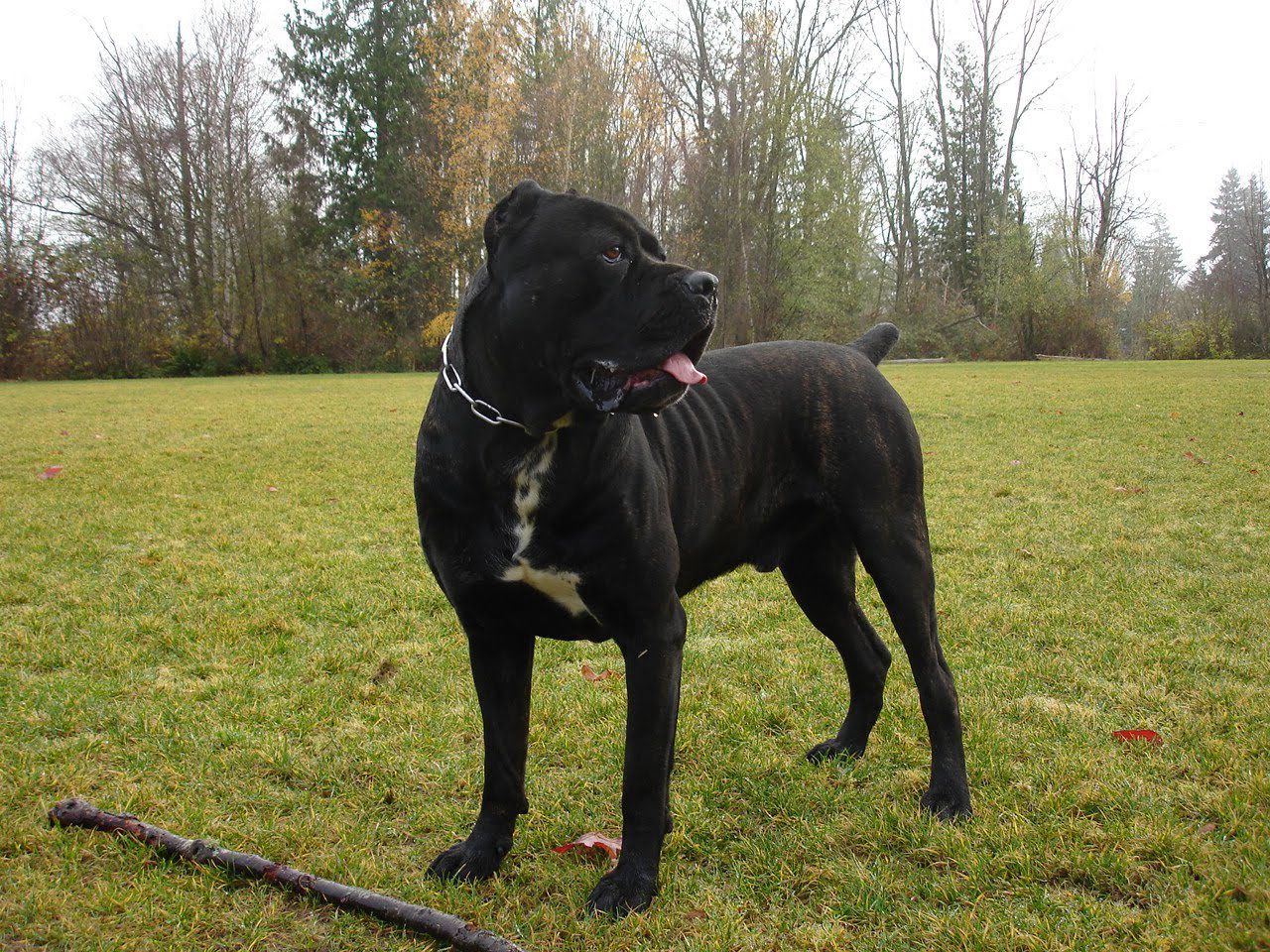
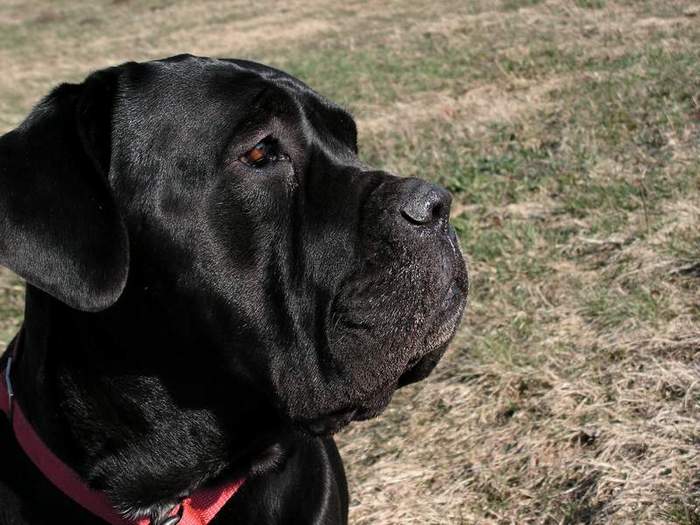
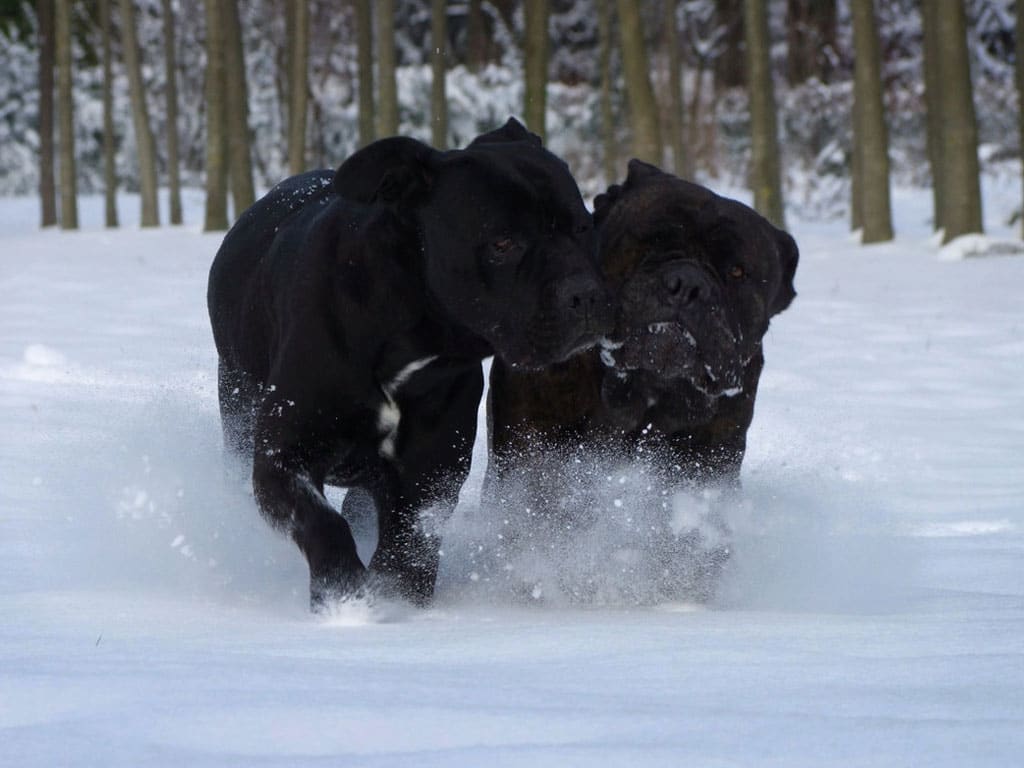
Images Cane Corso

Vรญdeos Cane Corso

Type and recognitions:

  • FCI CLASSIFICATION:
  • Group :
  • Section : . .

Federations:

FCI โ“˜, AKC โ“˜, ANKC โ“˜, CKC โ“˜, UKC โ“˜

FCI breed standard "Cane Corso"

Origin:
Italy

Date of publication of the valid original standard:
13.11.2015

Use:

Utility dog, multipurpose


General appearance:

Medium to large size. Robust and strong dog, However, with some elegance. Lean and powerful muscles.


IMPORTANT PROPORTIONS: The dog is rectangular in outline and slightly longer than it is tall. (The length of the dog is 11% greater than your height). The length of the head reaches the 36% from his height to the cross.


Behavior / temperament:

Guardian of property, family and cattle; extremely agile and responsive. In the past, It has been used to herd cattle and for hunting larger game..

Head:

Wide, typically molossoid. The superior longitudinal axes of the skull and the nasal cannula are slightly convergent with each other..

Cranial region:
  • Skull: Width; in the zygomatic arch, its width is equal to or greater than its length. Slightly convex in the front, the skull becomes significantly more plane behind the front to the back of the head. The medio-frontal furrow is visible.
  • Depression links (Stop) :  Marked.

facial region:

  • Truffle: Black and bulky, with large and open Windows. It is placed in the same line as the nasal cannula.
  • Snout: Significantly shorter than the skull (relationship skull : I muzzle approximately 1:2). Strong, square, as long as width; the front of the snout is flat; the lateral sides of the muzzle are parallel. Profile view, the nasal helm is straight.
  • Lips: The upper lips are moderately pendulous and cover the jaw., in such a way that the lower profile of the muzzle is formed by the lips.
  • Jaws / Teeth: Very wide jaws, thick and curved. Light lower prognathism; the clip joint is tolerated, but not desirable.
  • Eyes: Medium-sized, egg shape, slightly protruding; the gaze is directed forward. The eyelids are well glued. The iris color is as dark as possible depending on the coat color. Expression : lively and vigilant.
  • Ears: Triangular, pendants; its inclusion, located well above the zygomatic arch, is wide; to often amputated short in the form of an equilateral triangle.

Neck:

Strong, muscular, as long as the head.

Body:

The body is slightly longer than the height at the withers. Of strong Constitution, but not Dumpy.

  • Cross: Pronounced, exceeds the level of the rump.
  • Back: Rectilinear, very muscular and stiff.
  • Pork loin: Short and solid.
  • Rump: Long and wide, slightly tilted.
  • Breast : Chest well developed in three dimensions, descends to the elbow.

Tail:

Rather high insertion, very thick at the root. It amputated at the fourth vertebra. In action, rises, but never erect or curled up Rather high set, very thick at the root. It amputated at the fourth vertebra. In action, rises, but never an upright or threaded.

Tips

PREVIOUS MEMBERS:

  • Shoulder : Long, oblique, very muscular.
  • Arm: Powerful.
  • Forearm: Straight, very strong.
  • Carpus and Metacarpus:  Elastic.
  • Front feet: Cat feet.

LATER MEMBERS:

  • Thigh: Long, width, convex removed.
  • Leg: Strong, not fleshy.
  • Hock: Moderately angled.
  • Rear feet: A little less compact than the previous.

Movement:

Long step, lengthened trot; the trot is the preferred motion.

Mantle

  • SKIN : Slightly thick, more firmly attached to the subcutaneous tissues.
  • HAIR: Short, bright, very dense, with thin inner layer of hairs.
  • COLOR: Negro, Gris-Plomo, Gris-pizarra, light grey, Griffon clear; Red cervato, Dark Fawn; striped (stripes on a background of gray or tawny color several shades). Black and brindle dogs have a black or gray mask on the muzzle that should not extend beyond the eye line.. A small white spot on the chest,  in the tips of the toes and on the nasal helm is admitted.


Size and weight:

Height to the cross:

  • Males of 64 to 68 cm..
  • females of 60 to 64 cm..

Tolerance of more or less 2 cm..

Weight:

  • Males of 45 to 50 kg
  • Females from 40 to 45 kg.


Fouls:

Any deviation from the aforementioned criteria is considered as a fault and the severity of this is considered to the degree of the deviation to the standard and its consequences on the health and well-being of the dog..

SERIOUS FAULTS :

  • Parallelism or the upper axes of the skull and the muzzle very marked convergence. Sides of the muzzle converging.
  • Partial depigmentation of the nose.
  • Scissor bite; marked lower prognathism.
  • Threaded queue; led tail straight.
  • Permanent amble on the trot.
  • Weight that exceeds or does not reach the size indicated in the standard.

MISS PLAYOFFS

  • Cowardice, aggression toward owner.
  • Divergence of the upper axes of the skull and the muzzle.
  • Complete depigmentation of the nose.
  • Very convex or concave nose cane.
  • Upper prognathism.
  • Complete or partial depigmentation of the eyelids. Eyes gazeos; strabismus.
  • Absence of tail; short tail (cut or not).
  • Semi-long hair, very short or forming fringes.
  • All colours not indicated in the standard, long white spots.

Any dog โ€‹โ€‹showing clear signs of physical or behavioral abnormalities should be disqualified..


N.B.:

Males should have two normal-appearing testicles fully descended into the scrotum..


TRANSLATION : ENCI, Dr. I.. Small and the Sr. Ermanno way.

Source: F.C.I - International Cynological Federation

Alternative names:

1. Italian Mastiff, Italian Corso Dog, Cane Corso Italiano (English).
2. Cane Corso Italiano, Chien de Cour Italien (French).
3. Cane Corso, ITALIENISCHER CORSO-HUND (German).
4. Mastim Italiano (Portuguese).
5. Mastรญn italiano (espaรฑol).

โ–ท The world of Pets: Dogs, cats, birds, reptiles, amphibians

Wolfhound
Irlanda FCI 160 . Rough-haired Sighthounds

Galgo Irlandรฉs

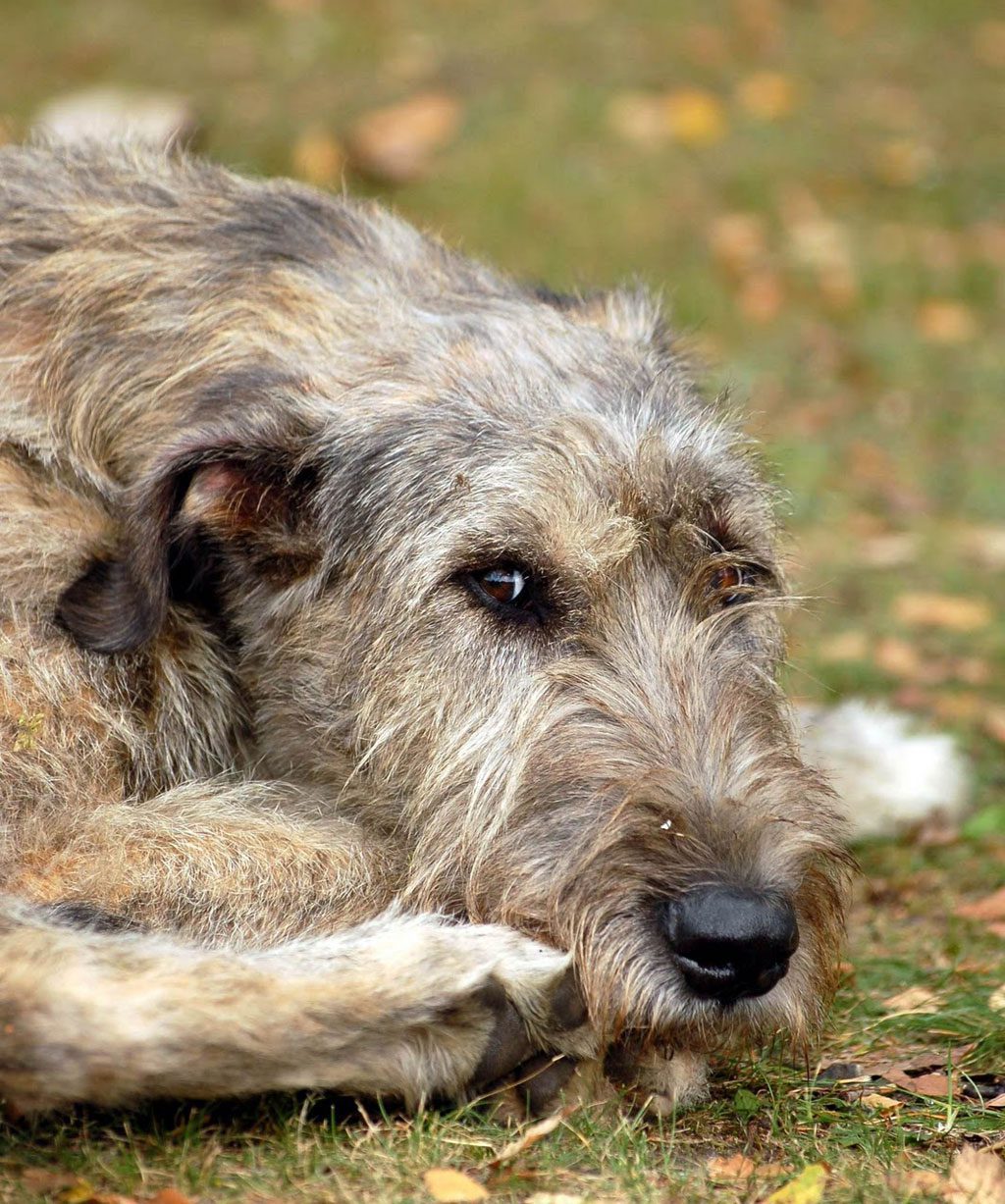
The Wolfhound It is the largest breed of dog that exists.; adults reach an average height of between 95 and 100 cm to the cross.

Known since the year 395, they are descended from the lebreles used by the Celtic Ireland for the wolf hunt, deer, and other large dams; later the Romans imported it from Ireland and is linked with the German Doge and the Scottish Deerhound.

Read all about this race, by clicking on: Irish wolfhound.

โ–ท The world of Pets: Dogs, cats, birds, reptiles, amphibians

Italian mastiff
Italia FCI 343 - Molossoid - Dogo

The Italian mastiff It is a versatile and balanced dog that can adapt to all.

Mastรญn Italiano

Something small and elegant that the Neapolitan mastiff, the Italian mastiff (or Cane Corso) It was used in the past not only as a Cattle Dog but also in wild boar hunting., and as dog escort on long journeys of traders and, even, as a grip of Bull Dog.

Otros nombres: Cane Corso / Italianischer Corso-Hund / Italian Corso Dog / Italian Mastiff

Crupo 2 / Section 2 – molosoids and mountain dogs.

Dogs breeds: Italian mastiff

Read all about the race, by clicking on: Cane Corso.

โ–ท The world of Pets: Dogs, cats, birds, reptiles, amphibians

Whiptail
Irlanda FCI 124 . Water Dogs

Irish Water Spaniel

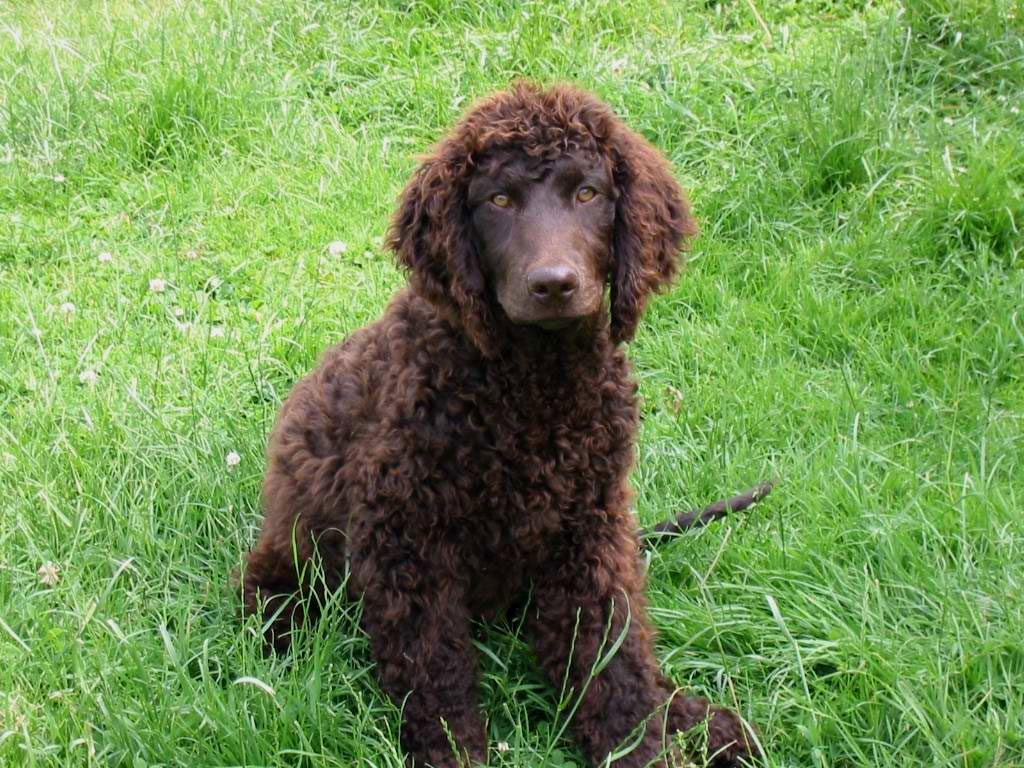
The Whiptail (Irish Water Spaniel) It is a water dog and one of the oldest breeds of Spaniel dog. in addition, is one of the rarest, being known, times, as the "clown" of the Spaniel.

Although all the theories of origin of the race point to Ireland, the origin of the breed remains unknown. It is possible that more than one of the oldest breeds of Spaniel are involved in its origin, but it is something that is not known for sure.

There is no knowledge of the ancestors of the Irish Water Spaniel, as the father of the breed, Justin McCarthy from Dublin, left no records of this.

Read more