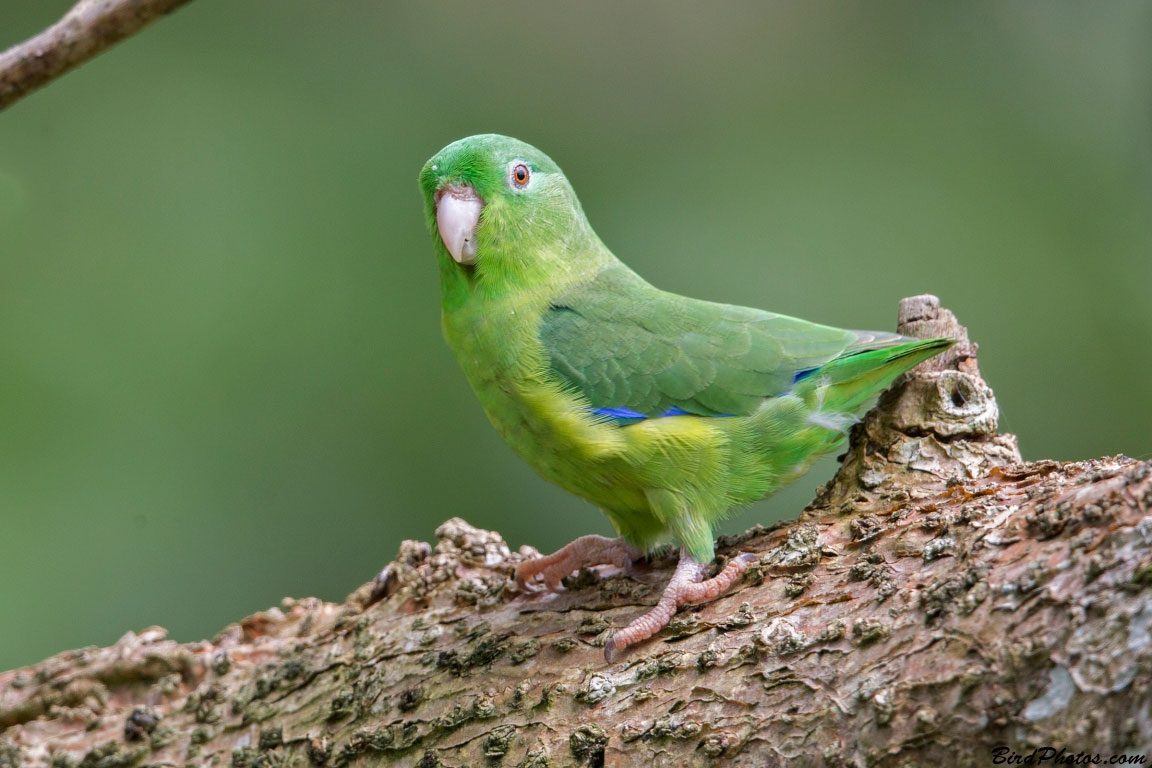
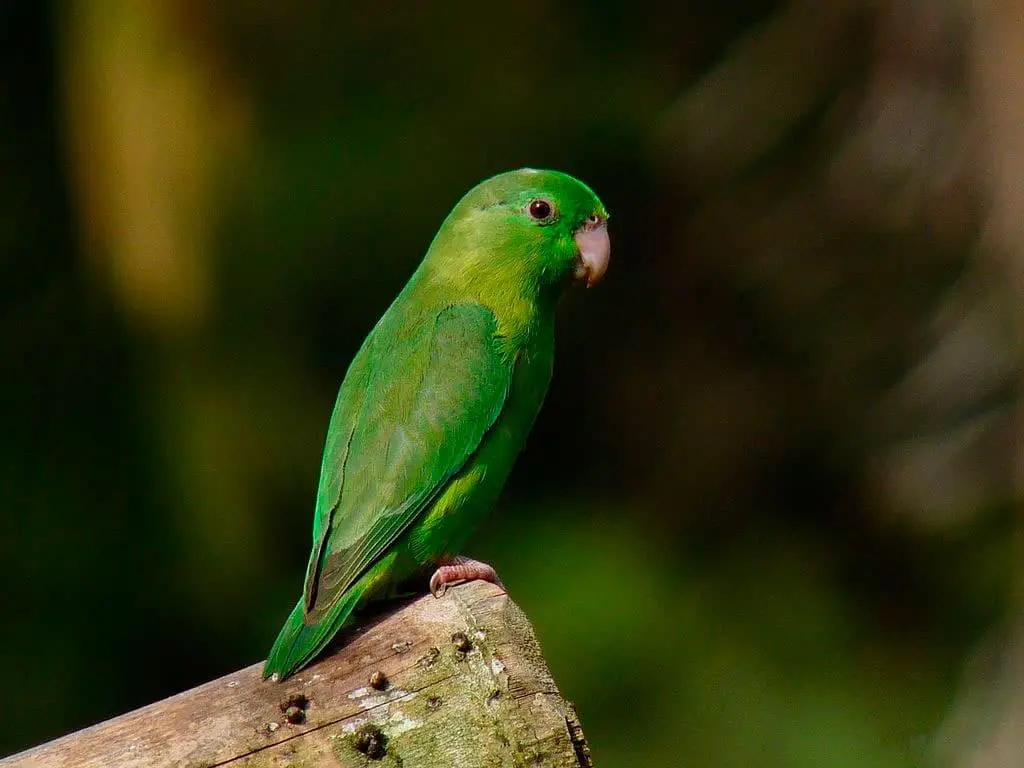
The Large-billed Parrotlet(Forpus crassirostris) has the crown, back of the neck and ear-coverts, green; the forecrown, cheeks, eye area and lores, emerald green.
Upperparts and wings, green, except the part inferior of the back, rump and greater coverts, are cobalt blue and blue color toward the base of the secondaries. Primary coverts pale grayish violet color which contrasts with the darker coverts They are cobalt blue. flight feathers Matte metallic blue. The underparts green with yellow hues. Upper, the tail green; undertail, pale green.
Bill and cere Pink with gray base up to the mandible top, laterally compressed in the Center; bare periophthalmic pale grey: irises dark brown: legs Gris-Rosado pale. Female all green with belly yellowish green without blue color wing-coverts visible in the male. Immature like adult respective, but with the blue of young males mixed with green.
Taxonomic note:
some authors (for example, Meyer de Schauensee 1966, Forshaw, 1973, Monroe y Sibley, 1993) They have used the name Forpus xanthopterygius, while other authors (Stotz et to the., 1996, Collar 1997) They have followed Pinto (1945) and used the name Forpus crassirostris to define this species.
Sound of the Large-billed Parrotlet.
Habitat:
They inhabit in forest edges, clear, riparian forests, parks and gardens in urban areas.
Reproduction:
They build their nests in tree cavities or exploit abandoned nests common hornero(Furnarius rufus); lining the nesting chamber with grass and the female lays 3 to 7 eggs White. The incubation, lasts approximately 18 days, It is carried out by the female and during this period the male is in charge of feeding her.
Food:
They compose your diet seeds, fruit, plants and flowers herbaceous. They are feeding both the ground and in trees and shrubs. Among the fruits they are highly appreciated by the Large-billed Parrotlet, palm, Trumpet trees (Cecropia spp), as well as seeds and shoots of Paineiras (Ceiba speciosa).
Melo et al, 2009, reported mass consumption flowers of Handroanthus serratifolius (Fam. Bignoniaceae), in particular its nectar, what it appears to be an important power source especially during the dry season, where scarce fruits.
Distribution:
Size of its range (players / residents) 1.312.215 km²
Southeast of Colombia to the East of Ecuador, North of Peru and West Brazil.
Conservation:
• Current category of the Red List of the UICN: Least concern.
• Population trend: Stable.
Justification of the population
The size of the world's population of the Blue-winged Parrotlet It has not been quantified, but this species is described as «common» (Stotz et to the., 1996).
Justification of trend
Suspected that the population is stable in absence of evidence of any decline or threatens substantial.
"Large-billed Parrotlet" in captivity:
In captivity they are not very frequent. They are birds enable you require a large cage. Quiet and something Shy. Not is easy to accommodate them with other parrots.
Can be prone to it Obesity.
Alternative names:
– Blue-winged Parrotlet (crassirostris), Large-billed Parrotlet (English).
– Toui à gros bec, Toui de Spix (crassirostris) (French).
– Large-billed Parrotlet (German).
– Tuim, Large-billed Parrotlet (Portuguese).
– Catita enana, Lorito Aliazul, Periquito Azulejo, Cotorrita aliazul, Lorito de alas azules (español).
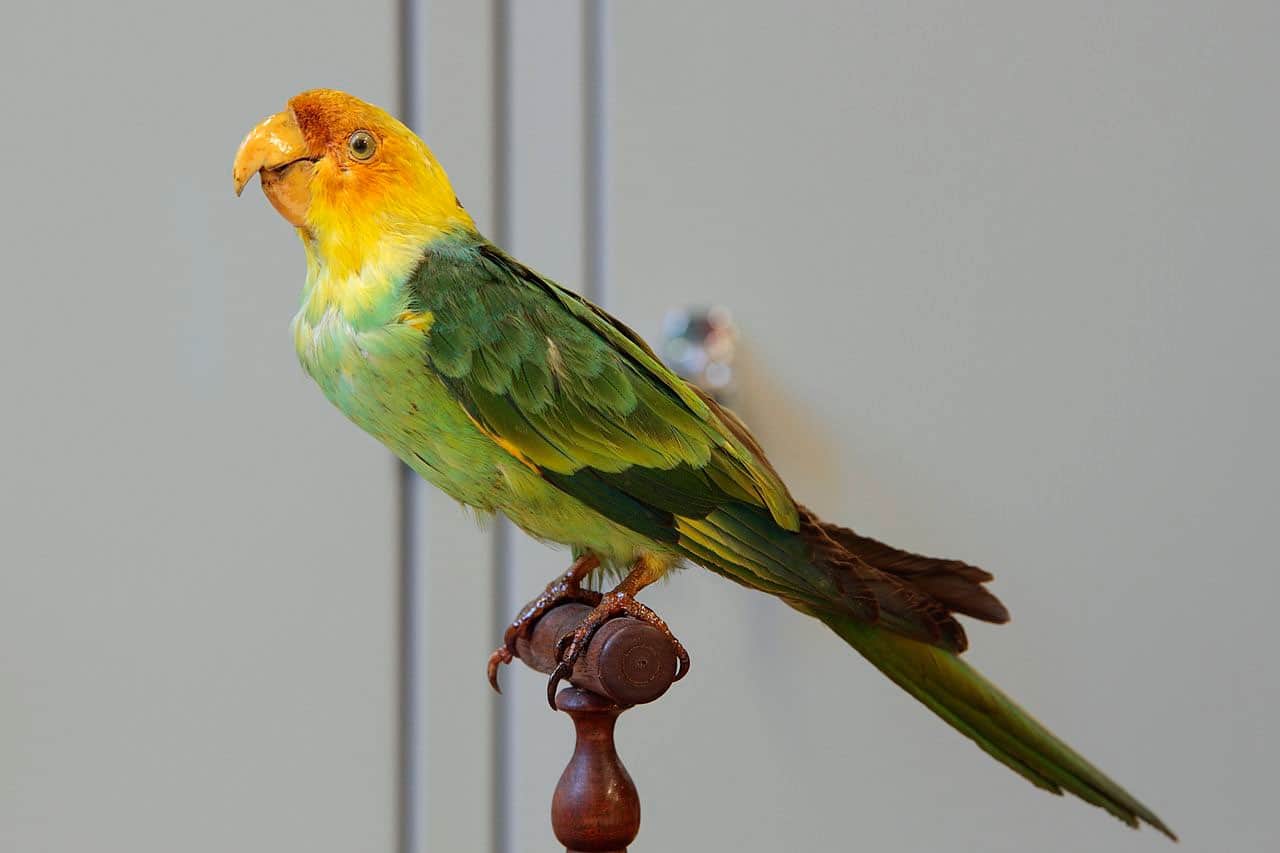
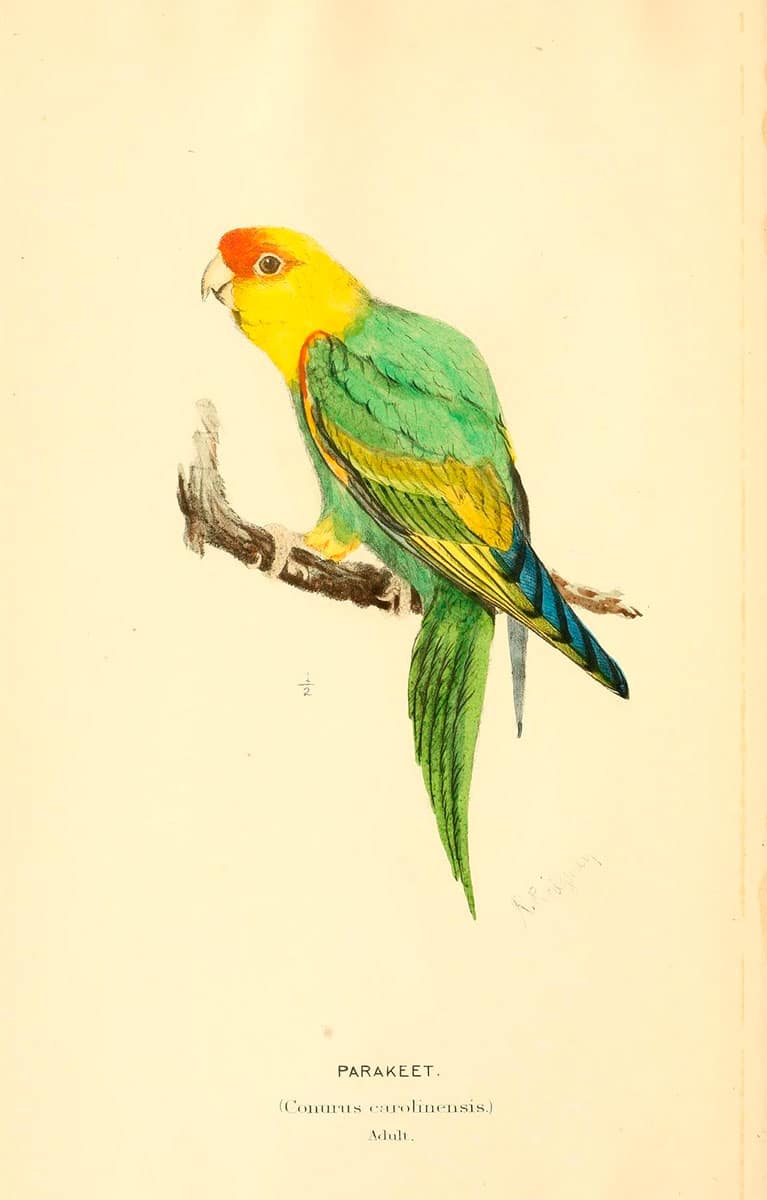
Male and female adults of Carolina parrot(Conuropsis carolinensis) They were identical in plumage, however males were slightly larger than females.
Most of the plumage It was green with underparts light green. The primary feathers They were mainly green, but with yellow edges in outer primary. The shoulders They were yellow, continuing along the outer edge of the wings. The the thighs They were green and yellow up to the feet. The legs and feet They were light brown. The most distinctive feature of this species was the forecrown and face orange. The feathers orange spread to behind the eyes and upper cheeks (lores). The skin around the eyes It was white and bill They were pale flesh color. The plumage of the head It was completely bright.
The immature They differed slightly in coloration of adults. The face and all body They were green, with underparts paler. They lacked yellow or orange plumage on the face, wings and thighs. The young were covered in mouse-gray gray, up to approximately 39-40 days when the wings and queues green. The chicks had full adult plumage around 1 año de edad.
The habitats Preferred of Carolina parrot were the heavily vegetated and heavily forested lands that bordered swamps and rivers.. These parrots also lived on agricultural land and ate the crops.. Anidaban in large groups of hollow shafts. The forests of sicomoro and swamp cypress. (» Parakeets», 2000; Fuller, 2001; Mauler, 2001; Snyder and Russell, 2002)
They were traveling in flocks of 100 to 1000 birds. Anidaban up 30 birds in a nest. They were supposed to be Monogamie. It was about very social birds, it was probably one of the many factors that led to their extinction. When a man shot a bird, fellow herd member flitted over his lost flock, making them vulnerable too. Farmers were shooting all flock to save their crops. It is doubtful that the Carolina parrot migrated, as seen in the northern states during the cold winters. They were attracted to salt pacifiers and were observed ingesting saline waters., earth and sand.
The Carolina parrot They are walking, They are jumping and climbing trees using their beaks as a third leg. Its flight was registered as a fast and elegant, but very noisy as birds rarely stayed silent during flight. Were involved in cleaning and grooming to keep their social cohesion. During the day they rested, slept or sunbathed. They fed in the morning and evening. («Parakeets», 2000;»Nature Serve, Conuropsis carolinensis», 2005; Howell, 1932; Rising, 2004; Snyder and Russell, 2002; Strattersfield y Capper, 2000)
Reproduction:
Some sources say that Carolina parrot they were Monogamie, having only one partner for life. But, no studies were conducted on mating systems and many birds apparently shared nests. (Laycock, Audobon Magazine, March of 1969; Snyder and Russell, 2002)
There is little information available upon the reproduction of this species. They reproduced in spring, producing 2 to 5 eggs These perpetual Nidada, which then incubaban during 23 days. (Snyder and Russell, 2002; Snyder and Russell, 2002)
Food:
The Carolina parrot ate mainly seeds of genre Xanthium. They also consumed the fruits and seeds many other plants, as well as flower buds and, occasionally, insects. They were recorded as ruin of many fruit crops. They would pluck the immature fruit from the tree and eat the seeds. Flocks could ruin the fruit of a tree in a matter of minutes. When they ate, the Carolina parrot They are taking food with their beaks, they placed them in their claws and held them while using their beaks to eat them.. (Greenway, JR. 1967; Howell, 1932; Snyder and Russell, 2002; Strattersfield y Capper, 2000; Greenway, JR. 1967; Howell, 1932; Snyder and Russell, 2002; Strattersfield y Capper, 2000)
Distribution:
the former Conuropsis carolinensis It was found from southern Florida until North Carolina and in coastal areas as far north as New York City. The Carolina parrot he was in the states Gulf as far west as Texas eastern and northern along the rivers Arkansas, Missouri, Mississippi and Ohio and its tributaries. They were also recorded in South Dakota, Iowa, Wisconsin, Michigan, Ohio and W.V.. The westernmost appearances were in eastern Colorado. (» Nature Serve, Conuropsis carolinensis», 2005; Fuller, 2001; Laycock, Audobon Magazine, March of 1969; Snyder and Russell, 2002)
This species was previously in the southeastern United States, but now it is EXTINCT, primarily as a result of persecution. The last wild records are of the subspecies Conuropsis carolinensis ludoviciana in 1910.
The main causes of extinction of the species were the persecution (for feeding, crop protection, poultry production and trade of hats for ladies), and also deforestation (especially lowland), probably aggravated by his gregarious nature (Saikku 1991), and competition with introduced bees (McKinley 1960).
"Carolina Parakeet †" in captivity:
One of the reasons for his extinction was the hunting of birds in the wild before their attempt to breed in captivity to sell them as pets, possibly because it was more profitable for them and it was difficult for them to breed in captivity. They could live up to 30 years in captivity.
Alternative names:
– Carolina Conure, Carolina Parakeet, Carolina Paroquet, Louisiana Parakeet (English).
– Conure de Caroline, Perriche à tête jaune, Perruche à tête jaune, Perruche de la Caroline du Sud (French).
– Carolinasittich, Karolinasittich (German).
– Periquito-da-carolina (Portuguese).
– Cotorra de Carolina (español).
– Avibase
– Parrots of the World – Forshaw Joseph M
– Parrots A Guide to the Parrots of the World – Tony Juniper & Mike Parr
– Birdlife
– Animal Diversity Web
– Photos:
(1) – axidermied Carolina Parakeet. Teaching and research collections, Laval University Library By Cephas (Own work) [CC BY-SA 3.0], via Wikimedia Commons
(2) – Conuropsis carolinensis (Linnaeus, 1758) – the extinct Carolina parakeet (mount, public display, Field Museum of Natural History, Chicago, Illinois, USA). By James St. John (Conuropsis carolinensis (Carolina parakeet) 2) [CC BY 2.0], via Wikimedia Commons
(3) – Mounted specimen of Conuropsis carolinensis, Museum Wiesbaden, Germany By Fritz Geller-Grimm (Own work) [CC BY-SA 2.5], via Wikimedia Commons
(4) – Taxodermic bird specimen in the Fairbanks Museum and Planetarium, St. Johnsbury, Vermont, USA. By Daderot (Own work) [CC0], via Wikimedia Commons
(5) – Conuropsis carolinensis Linnaeus, 1758 by Huub Veldhuijzen van Zanten / Naturalis [CC BY-SA 3.0], via Wikimedia Commons
(6) – Carolina Parakeet (Conuropsis carolinensis) by Biodiversity Heritage Library – Flickr
▷ The world of Pets: Dogs, cats, birds, reptiles, amphibians
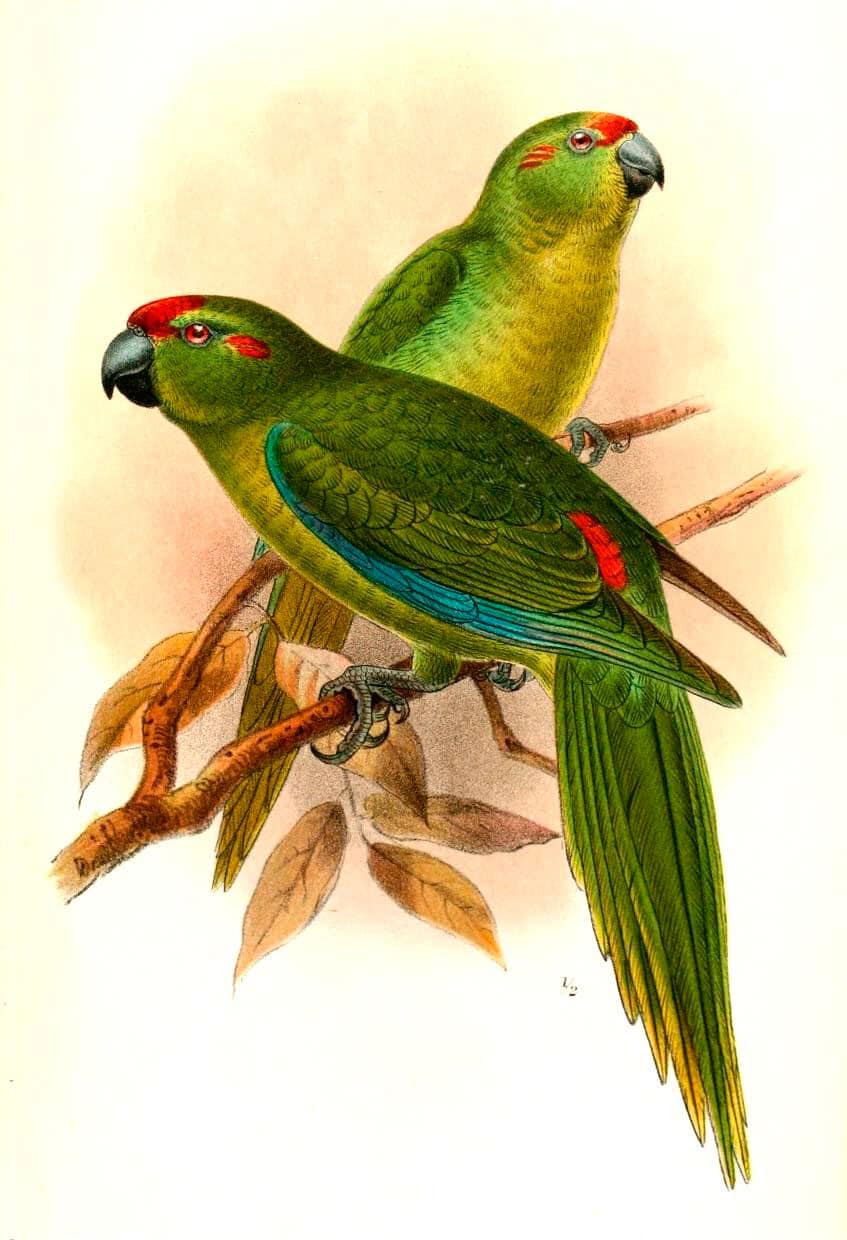
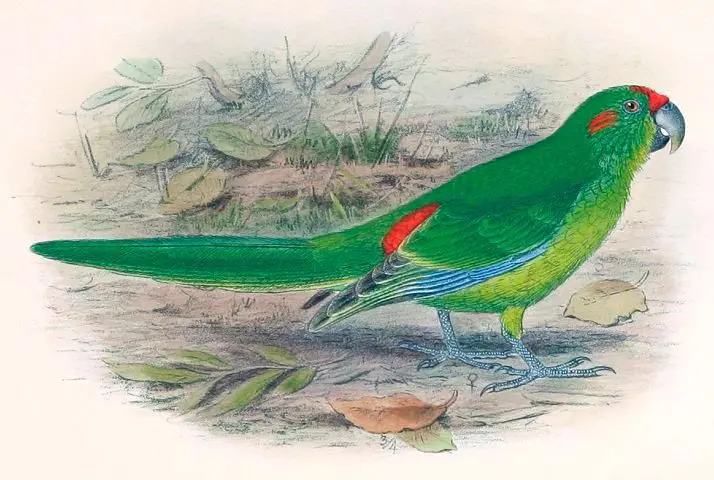
The Lord Howe Island Parakeet(Cyanoramphus subflavescens) was a medium-sized green parrot with a head bright green, the crown crimson red in color and a stripe on the eyes; the eyes were red and bill grey. The upperparts They were bright green with a dark red spot on each side of the rump (usually they are hidden by the wings when resting) and a blue border in wings; the underparts were yellowish green.
Both sexes looked similar, but the female It was smaller.
Taxonomic status:
This taxon is considered a subspecies of Cyanoramphus [novaezelandiae or subflavescens] (sensu lato) by some authors.
In 2012, World Bird List of IOC recognized him as a species [IOC world birdnames Archived 2012-08-06 at the Wayback Machine.].
Habitat:
The Lord Howe Island Parakeet It was occasionally observed in flocks. There is little information on their habitats, They probably lived in inhabited forests and cultivated areas of the Lord Howe Island. No information on the use of different habitats for different activities.
Reproduction:
Nothing is known of sexual maturity, life expectancy and natural mortality of this extinct species. But, It has been estimated that the useful life of the Lord Howe Island Parakeet should be similar to the Norfolk Island Parakeet(Cyanoramphus cookii), About three years. the age of sexual maturity is also known populations of this species, although a juvenile female was seen mating with a male just a week after achieving independence, and captive birds are said to have bred when they were less than a year old.
Little else is known of the breeding of the Lord Howe Island Parakeet, probably reproduced in response to weather conditions and food availability, nesting in tree holes or hollow pipes, in crevices between rocks or cliffs.
Food:
Meal Lord Howe Island Parakeet probably consisted of plant material, as seeds, fruit, buds and leaves of native trees and shrubs. Other extant populations ate mainly seeds, fruits and berries, egg yolks, sprouts and flowers, as well as, occasionally, a small number of invertebrates.
• The last record of this species dates from 1869. EXTINCT.
The population declines were mainly due to habitat modification, hunting, poisoning, and the introduction of predators (especially cats and rats).
But, the main threat to the Lord Howe Island Parakeet was the hunting and its capture by settlers. Formerly he abounded in the Lord Howe Island and it was said to be a plague, since it destroyed the crops and orchards of the inhabitants of the island.
There are only two copies of Lord Howe Island Parakeet. From the collection John Gould, taken by John MacGillivray in September of 1853 on tour HMS Herald, and are in the Museum of Natural History [Schodde, R.; & Mason, I.J. (1997). Birds (Columbidae to Coraciidae). In Houston, W.W.K. & Wells, A. (eds) Zoological Catalogue of Australia. Vol. 37.2. CSIRO Publishing: Melbourne. ISBN 0-643-06456-7 p.147.].
Alternative names:
– Lord Howe Island Parakeet, Lord Howe Island red-crowned parakeet, Lord Howe Parakeet, Red-Fronted Parakeet (English).
– Perruche de Lord Howe (French).
– Lord Howe-Laufsittich (German).
– Periquito de Lord Howe (Portuguese).
– Perico de Lord Howe (español).
• Avibase
• Parrots of the World – Forshaw Joseph M
• Parrots A Guide to the Parrots of the World – Tony Juniper & Mike Parr
• Red-crowned Parakeet (Lord Howe Is. subsp.) – profile | NSW Environment & Heritage
Photos:
(1) – Cyanorhamphus subflavescens (Catalogue of the Birds in the British Museum. Volume 20) by John Gerrard Keulemans [Public domain]
(2) – Hand coloured lithograph (circa 1928) showing (Cyanorhamphus subflavescens) Which is now a synonym of the Lord Howe Island Red-fronted Parakeet (Gray novaezelandiae subflavescens) From The Birds of Australia (1910-28) by Gregory Macalister Mathews (1876-1949) Artwork by Henrik Gronvold (1858–1940) a Danish bird illustrator. by Henrik Grönvold [Public domain]
▷ The world of Pets: Dogs, cats, birds, reptiles, amphibians
White-cheeked turaco
Turaco leucotis
Origin: Eritrea, Ethiopia, South Sudan, Sudan
Character: Dynamic and curious
Life expectancy: 8 to 10 years
Height: 42 to 43 cm..
Photo: fotosricardo-h
Content
Characteristics
This striking bird is native to Africa (area of Ethiopia) and reaches a size of 42 to 43 cm..
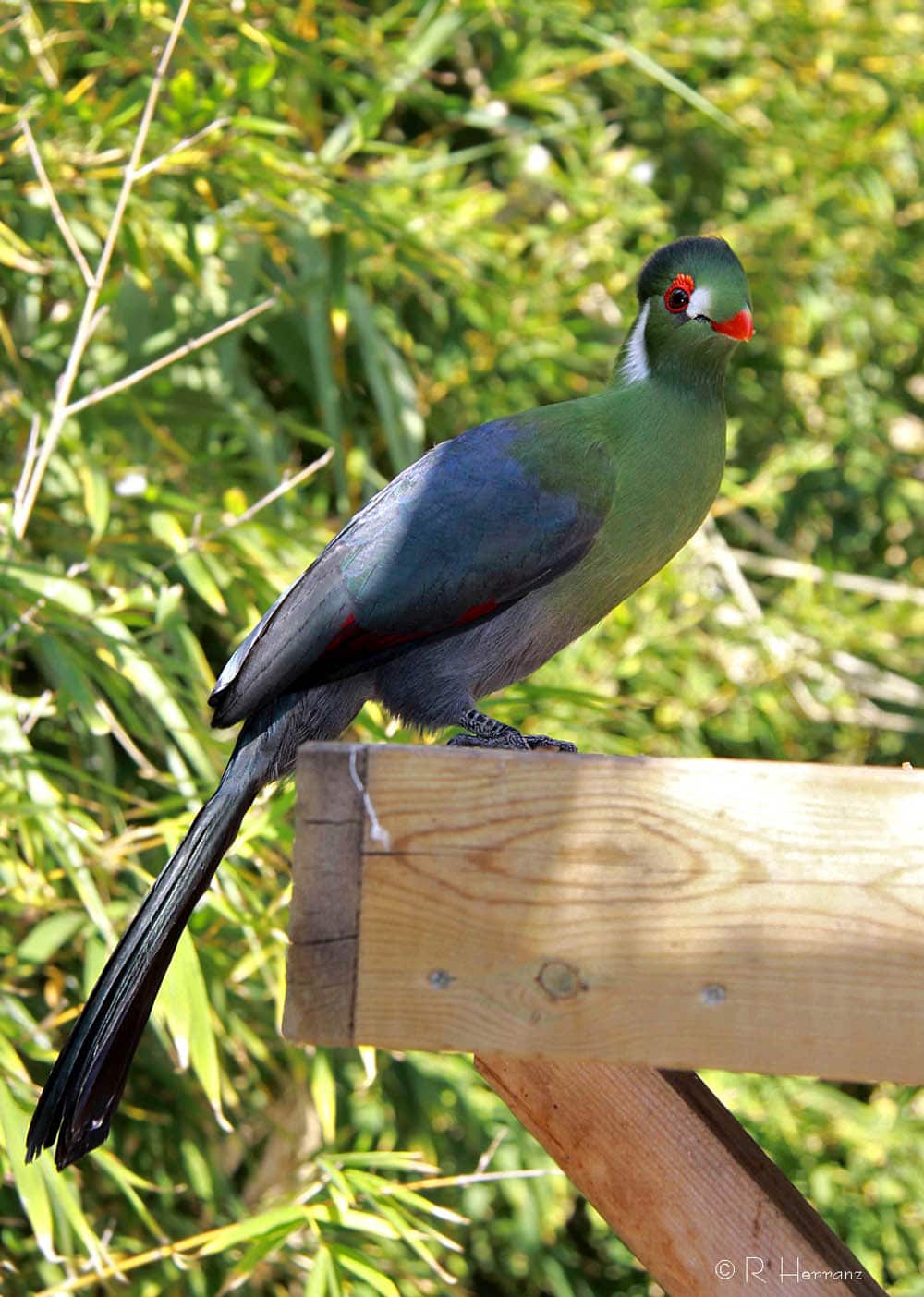
It has bright green feathers, with a dark crest on the head, may stands at will, the Underwing coverts are blue like the tail, While the primaries are intense red, and in general only be appreciated with the bird in flight. The beak is orange-red, like the ring around the eyes. In front of the eye they have "white cheeks" and two oblique white marks on the neck..
Has several other anatomical features of interest. First of all, they have strong feet and you can turn your fourth finger of the foot forward or backwards to get a better grip on its perch. In second place, the chickens of this species have claws on their wings, a strange and evocative anatomical feature for a bird that almost seems to be reminiscent of its ancient cousin, the Archaeopteryx. The chicks emerging from these claws at the time of leaving the nest.
Most of these birds have green plumage and is the result of a combination of structural coloration and pigments.. They are unique since only the Turacos, among all the birds, they produce a Green pigment, turacoverdin, It is the color of their feathers.
Character and skills
This beautiful and energetic African bird is a very popular bird in the United States and the United Kingdom., they can even be hand fed by what you become very mansas pets.
Another curiosity, and one of the things by which this bird strikes is by singing, which, It resembles the squeal of a wild monkey.
Images "White-cheeked turaco"
Videos "White-cheeked turaco"
▷ The world of Pets: Dogs, cats, birds, reptiles, amphibians
The male of the Spectacled Parrotlet(Forpus conspicillatus) has a yellowish green forehead extending the cheeks and to the throat.
The underparts They are slightly off in colouration, with a bluish gray suffusion in chest. The area surrounding the eyes It is cobalt blue. The wings and upperparts is dark green, with the back and rump blue-violet color, with a darker shade on own rear.
The bill Pink is white. The legs They are pink. The irises is dark brown.
the colors of the female they are duller in terms of the general coloring. Their upperparts They are brighter, with the area around the eyes, emerald green. The underparts They are more yellowish green.
It is very common. It is found in varied ecosystems, patches of forest, clear with scattered trees, cultivated areas, from 200 m to 1800 m (migrate attitudinally up 2600 metres in Bogotá). They are noisy flocks of more of 120 individuals.
Reproduction:
Nest in postholes and termiteros.
Food:
Feeds on grass and weed seeds, fruit, berries, flowers and buds.
Distribution:
Size of the area of distribution (reproduction / resident): 822.000 km2
Patchy and discontinuous distribution. east of Panama, Colombia and West of Venezuela.
Distribution 3 subspecies:
Forpus conspicillatus caucae
(Chapman, 1915) – Southwest of Colombia, to the West of the Andes (Cauca and Nariño); possibly west of Ecuador.
Forpus conspicillatus conspicillatus
(Lafresnaye, 1848) – Nominal. From the tropical eastern Panama north central Colombia.
Forpus conspicillatus metae
(Borrero & Hernandez-Camacho, 1961) – Slope of the Andes of Colombia to the west end of Venezuela.
Conservation:
State of conservation ⓘ
Minor Concern ⓘ(UICN)ⓘ
• Current category of the Red List of the UICN: Least concern.
• Population trend: In increased.
Justification of the population
The size of the world population It has not been quantified, but this species is described as «common» (Stotz et to the., 1996).
Justification of trend
It is suspected that the population is increasing as habitat degradation is creating new areas of suitable habitat.
"Spectacled Parrotlet" in captivity:
In captivity is common in some European countries, rare elsewhere. It is a bird lively, Intelligent and with attitude. They are highly valued for being quiet; they can learn many words and whistle very well. Son loving and they love spending time with their owners, However, they are happy and independent enough to happily play with their toys while the owner is absent. Need much space as it is a bird very active, as well as different toys.
Alternative names:
– Spectacled Parrotlet (English).
– Toui à lunettes, Perruche-moineau à lunettes (French).
– Brillensperlingspapagei, Augenring-Sperlingspapagei, Brillenpapagei (German).
– Tuim-da-colômbia (Portuguese).
– Catita Enana Pálida, Cotorrita de Anteojos, Periquito de Anteojos (español).
– Periquito Ojiazul (Venezuela).
– Avibase
– Parrots of the World – Forshaw Joseph M
– Parrots A Guide to the Parrots of the World – Tony Juniper & Mike Parr
– Birdlife
– parrots book, parrots and macaws Neotropical.
– Photos:
(1) – A female Spectacled Parrotlet in Manizales, Caldas, By Julian Londono from Colombia Manizales, Colombia [CC BY-SA 2.0], via Wikimedia Commons
(2) – A male Spectacled Parrotlet in Manizales, Caldas, By Julian Londono from Colombia Manizales, Colombia [CC BY-SA 2.0], via Wikimedia Commons
(3) – A pair of Spectacled Parrotlets in Manizales, Caldas, By Julian Londono from Colombia Manizales, Colombia [CC BY-SA 2.0], via Wikimedia Commons
(4) – A male Spectacled Parrotlet in Colombia just outside the entrance of its nest By Rogier Klappe [CC BY 2.0], via Wikimedia Commons
(5) – Spectacled Parrotlet (Forpus conspicillatus) by Ron Knight – Flickr
(6) – PSITTACULA CONSPICILLATA By Internet Archive Book Images [No restrictions], via Wikimedia Commons
– Sounds:
▷ The world of Pets: Dogs, cats, birds, reptiles, amphibians
the unmistakable White-bellied Parrot(Pionites leucogaster) has the lores, cheeks and throat, bright yellow lemon; "ear coverts", forecrown and crown, bright orange red; sides and rear of the neck, orange, but paler.
Upperparts green. Primary coverts blue; other coverts green. Primaries blue with green margins in outerweb. Underwing-coverts green. Breast
and center belly, white; undersides of belly and feathers the thighs, green; undertail-coverts Yellow. Upper, the tail green; undertail, pale grayish brown. Bill, color pale horn; cere Pink; irises reddish brown; legs pink.
(Sclater,PL, 1858) – As the nominal species but with the thighs and flanks bright yellow lemon (no verde); tail green.
Pionites leucogaster xanthurus
(Todd, 1925) – As the nominal species, but with the thighs yellow; flanks and tail, yellow and green the uppertail-coverts.
Habitat:
Prefers low humid forests, areas of land and várzea with probable preference for the latter and for clearings in the forests. Also observed in the drier forests (where it is less common) in the South of its range. Gregarious; Observed in the company of Blue-headed Parrot(Pionus menstruus) on Eastern Amazonia. Seen in small groups or couples.
Since they have very heavy body and very short wings, the White-bellied Parrot You can not fly long distances.
Reproduction:
With plays in January and nests in hollow trees; a nest 30m found in the cavity of a tree in the east of its range. Clutch Normal probably 2-4 eggs.
Food:
Very similar in habits Lorito Chirlecrés(Pionites melanocephalus) but no specific information about their diet; probably seeds, fruit and berries.
Distribution:
The size of its distribution area (reproduction / resident): 2.140.000 km2
The White-bellied Parrot It extends through southern amazon in Brazil, from northwest maranhão and around Bethlehem in the State of For, west on Mato Grosso to the North of Bolivia and Southeast of Peru, to the top of Ucayali, where it approaches the range of Lorito Chirlecrés(Pionites melanocephalus). Reports in eastern Ecuador (well within the limits of the latter) still not substantiated.
(Sclater,PL, 1858) – West Basin amazon, in the southeast of Peru, North of Bolivia and West of Brazil, where the subspecies intergran Pionites leucogaster xanthurus in the upper area of Yurua River
• Current category of the Red List of the UICN: In danger of extinction.
• Population trend: Decreasing.
Usually common but perhaps more scarce in drier forests on the southern fringes of the range. It is not at serious risk, but decreases locally (for example, the Eastern Amazonia) due to deforestation, and possibly extinct now Santa Cruz, Bolivia, due to the loss of habitat. Trapped for Local international trade (at least years), but apparently not yet having a serious impact on wild populations.
Conservation Actions Underway
• No specific conservation actions are known for this species.
Conservation Actions Proposed
• Expand the network of protected areas to effectively protect the IBA.
• Effectively treat resources and manage existing and new protected areas., using the emerging opportunities for funding the management of protected areas with the overall goal of reducing carbon emissions and maximize the conservation of biodiversity.
• Conservation on private land is also essential, through the expansion of market pressures for rational land management and prevention of logging on land not suitable for agriculture (Soares-Filho et to the., 2006).
• Campaign against proposed changes to the Brazilian Forest Code that would lead to a decrease in the width of protected riparian forest areas such as Permanent Preservation Areas (APPs), that function as vital corridors in fragmented landscapes.
"White-bellied Parrot" in captivity:
Do not have the capacity to speak of his larger parrots cousins, but they are very assets and can be very good pets, Despite not being very common to see them in captivity.
Alternative names:
– White-bellied Parrot, White bellied Parrot, White-bellied Caique (English).
– Maïpouri à ventre blanc, Caïque à ventre blanc (French).
– Rostkappenpapagei, Rostkappen-Papagei (German).
– Marianinha-de-cabeça-amarela, maipuré, marianinha, mariquita, periquito-d’anta, periquito-de-anta, periquito-de-cabeça-preta Pionopsitta barrabandi (Portuguese).
– Lorito Gordo de Cabeza Rojiza, Lorito Rubio (español).
– Loro de Vientre Blanco (Peru).
(1) – Pionites leucogaster xanthomeria By Mirjam (Picasa Web Albums) [CC BY-SA 3.0], via Wikimedia Commons
(2) – Pionites leucogaster leucogaster White-bellied Parrot (this subspecies is also know as the Green-thighed Parrot). Two in a cage with a nestbox By TJ Lin (originally posted to Flickr as 140) [CC BY-SA 2.0], via Wikimedia Commons
(3) – Pionites leucogaster xanthomerius A pet adult male White-bellied Caique perching by a row of books By pionetes (Own work (self-portrait)) [CC BY-SA 3.0], via Wikimedia Commons
(4) – Five White-bellied Parrots (also known as White-bellied Caique) at Bird Park, Foz do Iguaçu, Brazil. This subspecies is also known as the Green-thighed Caique (Pionites leucogaster leucogaster) By Chad Bordes (Picasa Web Albums) [CC BY 3.0], via Wikimedia Commons
(5) – White-bellied Parrot by Peter Tan – Flickr
(6) – White-bellied Parrot in captivity at Iguaçu Bird Park, Foz do Iguaçu, Brazil. Photographed on 23 April 2003 By Arthur Chapman [CC BY 2.0], via Wikimedia Commons
(7) – White-bellied Parrot (Pionites leucogaster) often referred to as the White-bellied Caique in captivity by whiskymac (Flickr) [CC BY 2.0], via Wikimedia Commons
(8) – White-bellied Parrot (often referred to as the White-bellied Caique); a chick. Its feathers have not opened yet By Ruth Rogers (originally posted to Flickr as Caique) [CC BY 2.0], via Wikimedia Commons
(9) – A painting of a White-bellied Parrot (originally captioned «Psittacus badiceps. Bay-headed Parrot») by Edward Lear (1812-1888) Edward Lear [Public domain], via Wikimedia Commons
Origin: Panama, Brazil, Bolivia, Venezuela, Colombia, Ecuador, Guyana, Trinidad and Tobago, Peru
Character: active and smart
Life expectancy: 50 to 60 years.
Height: 35 to 41 cm..
Content
Description
35 to 41 cm.. height and between 380 and 500 g. of weight.
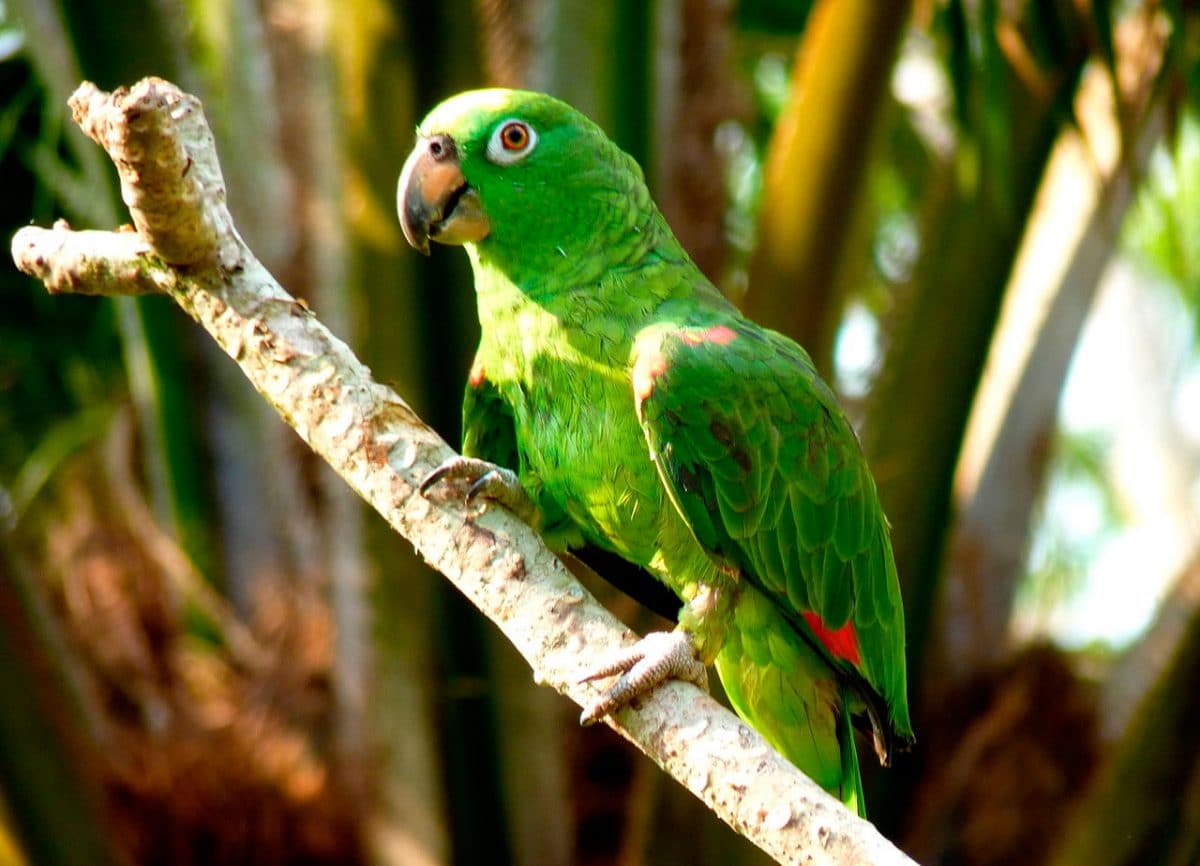
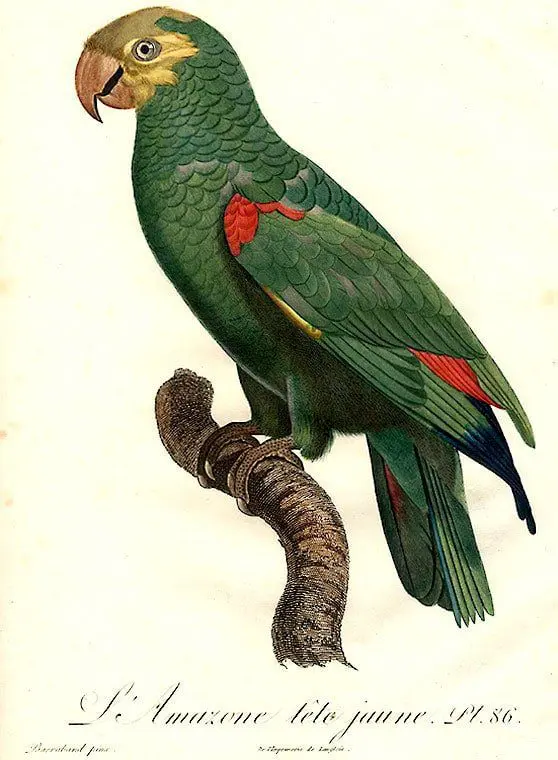
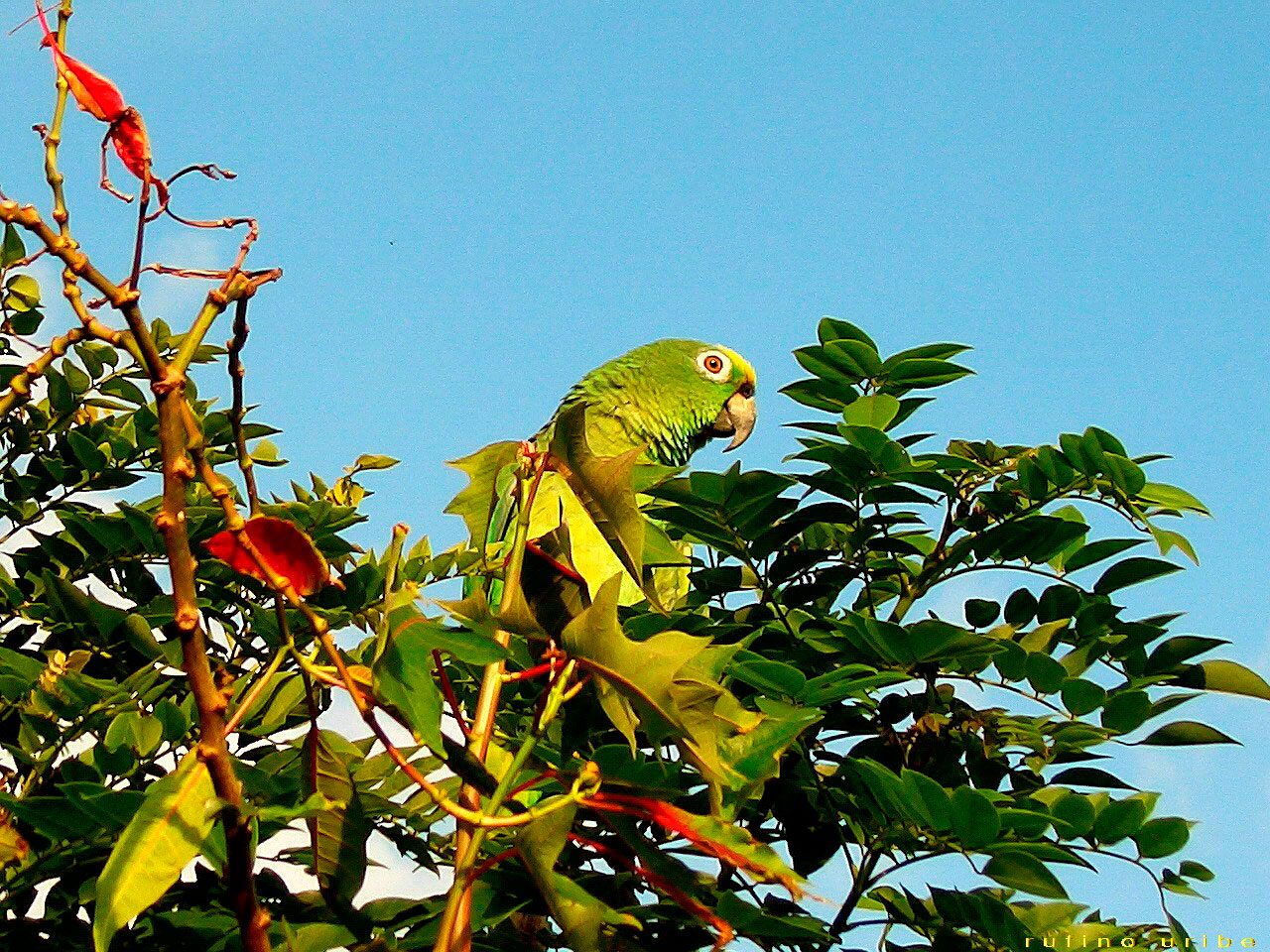
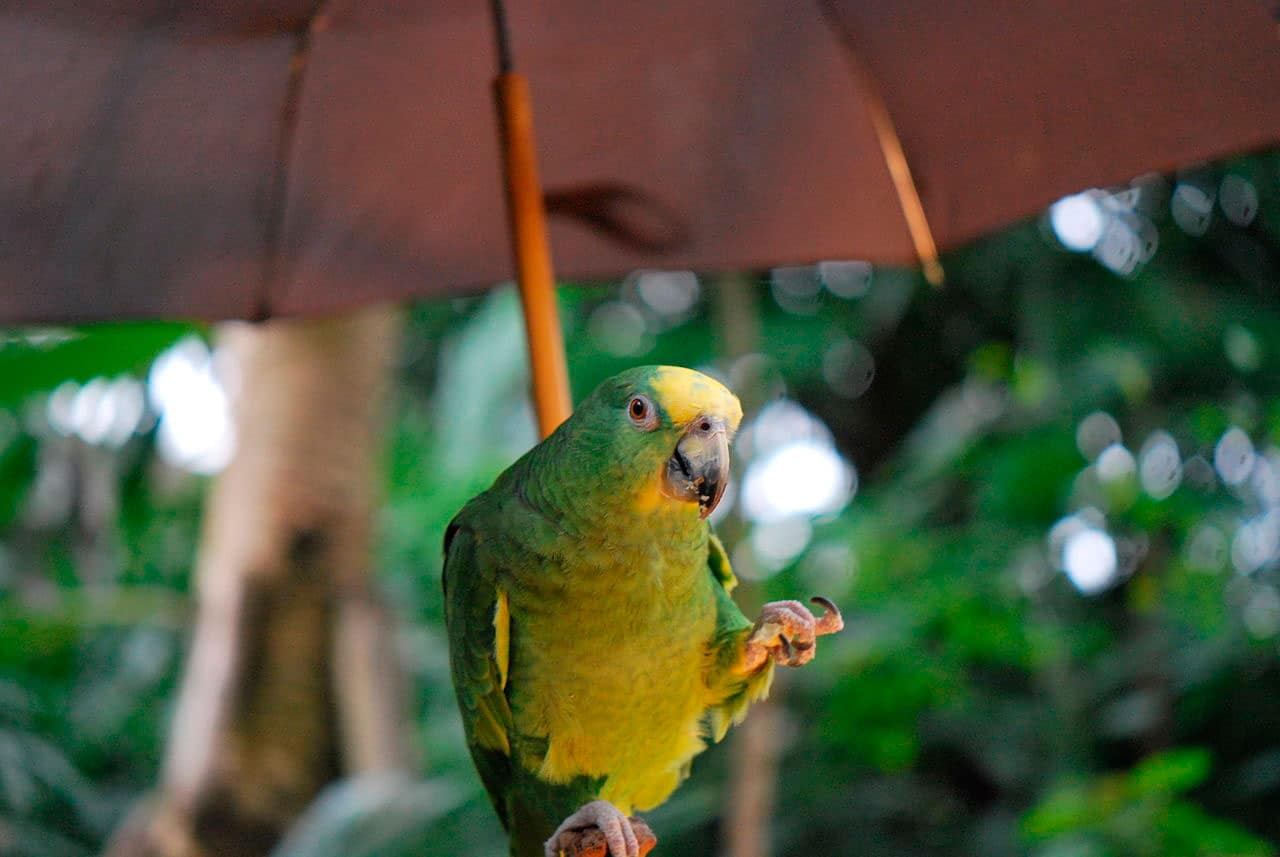
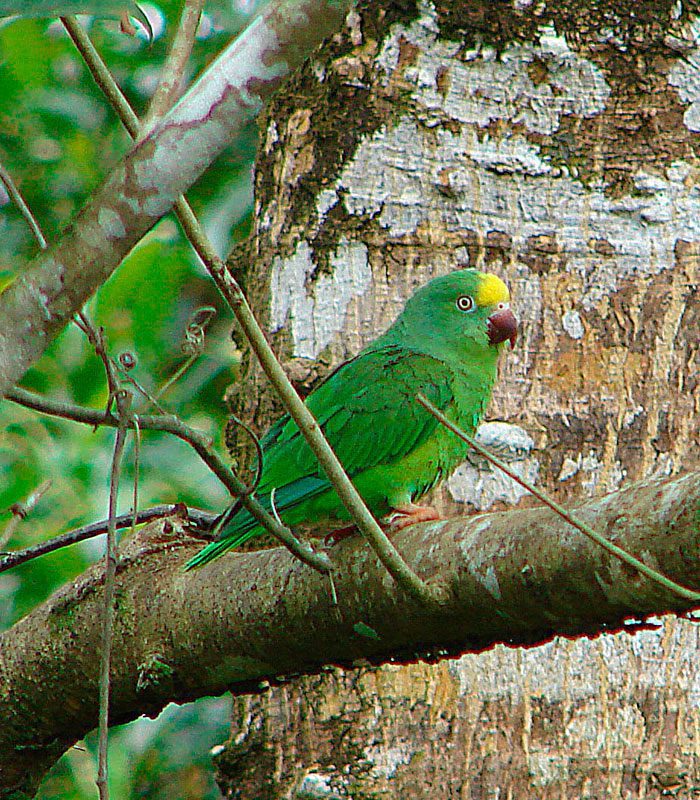
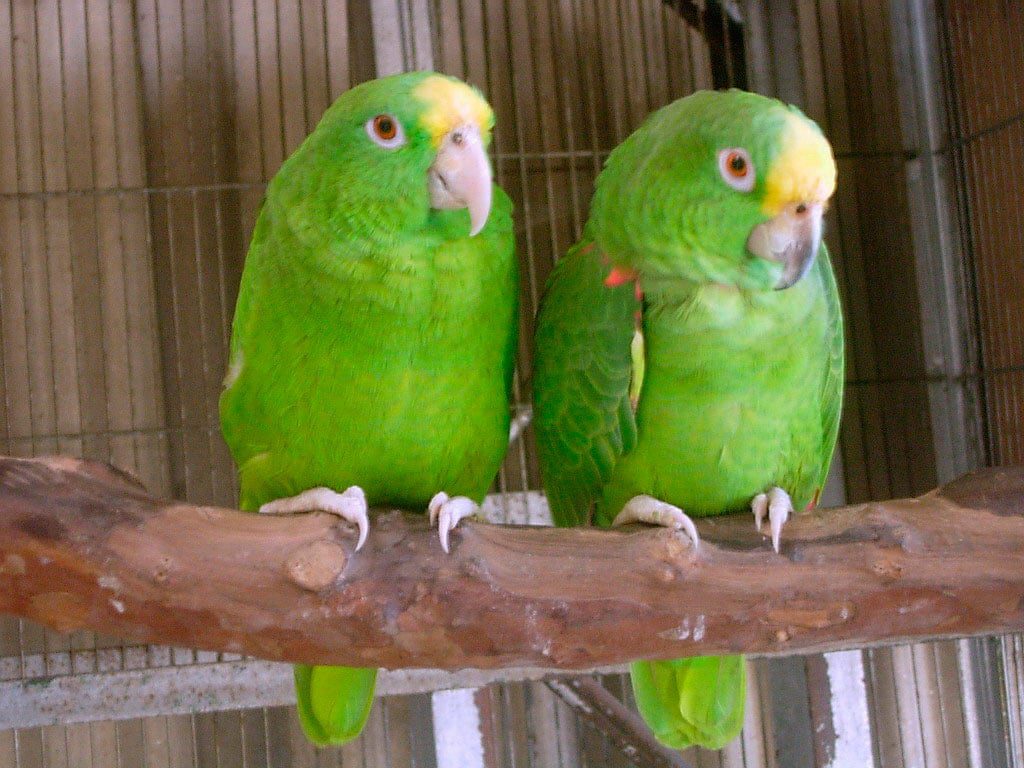
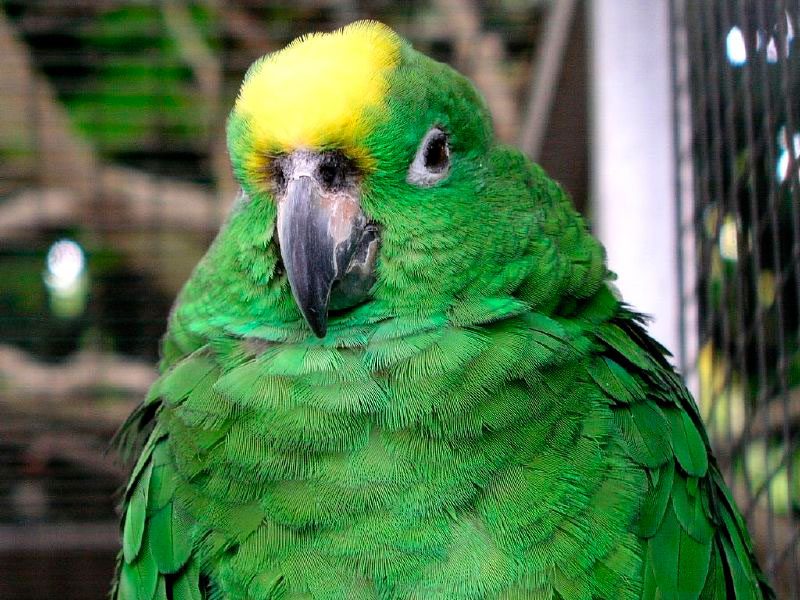
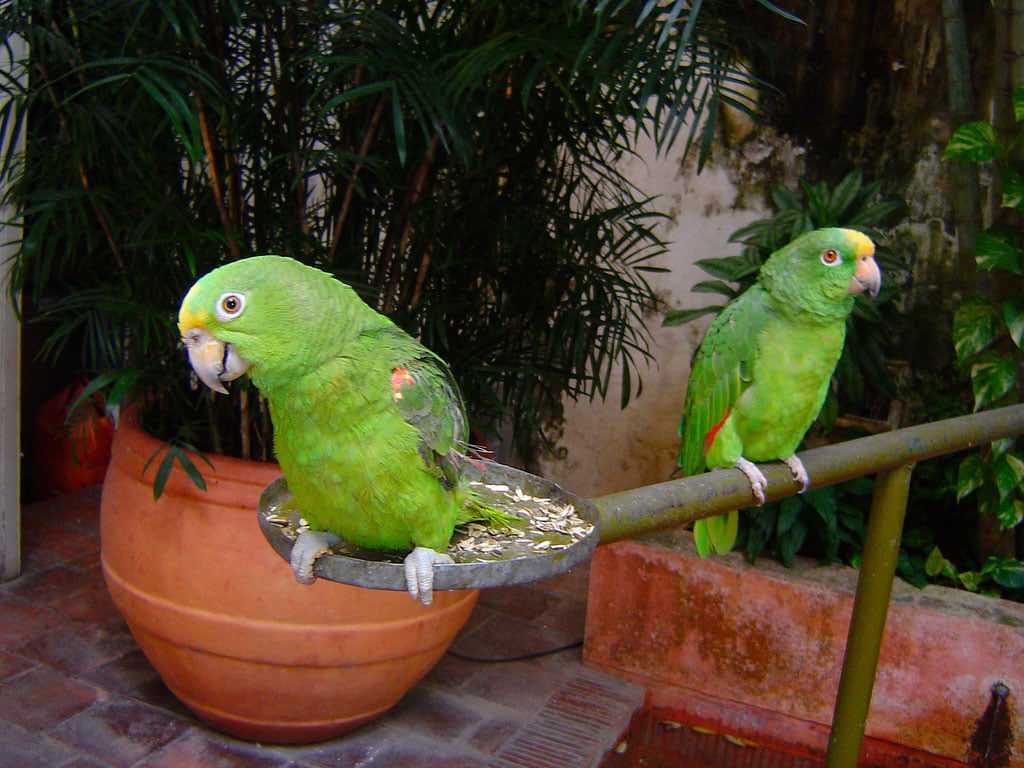
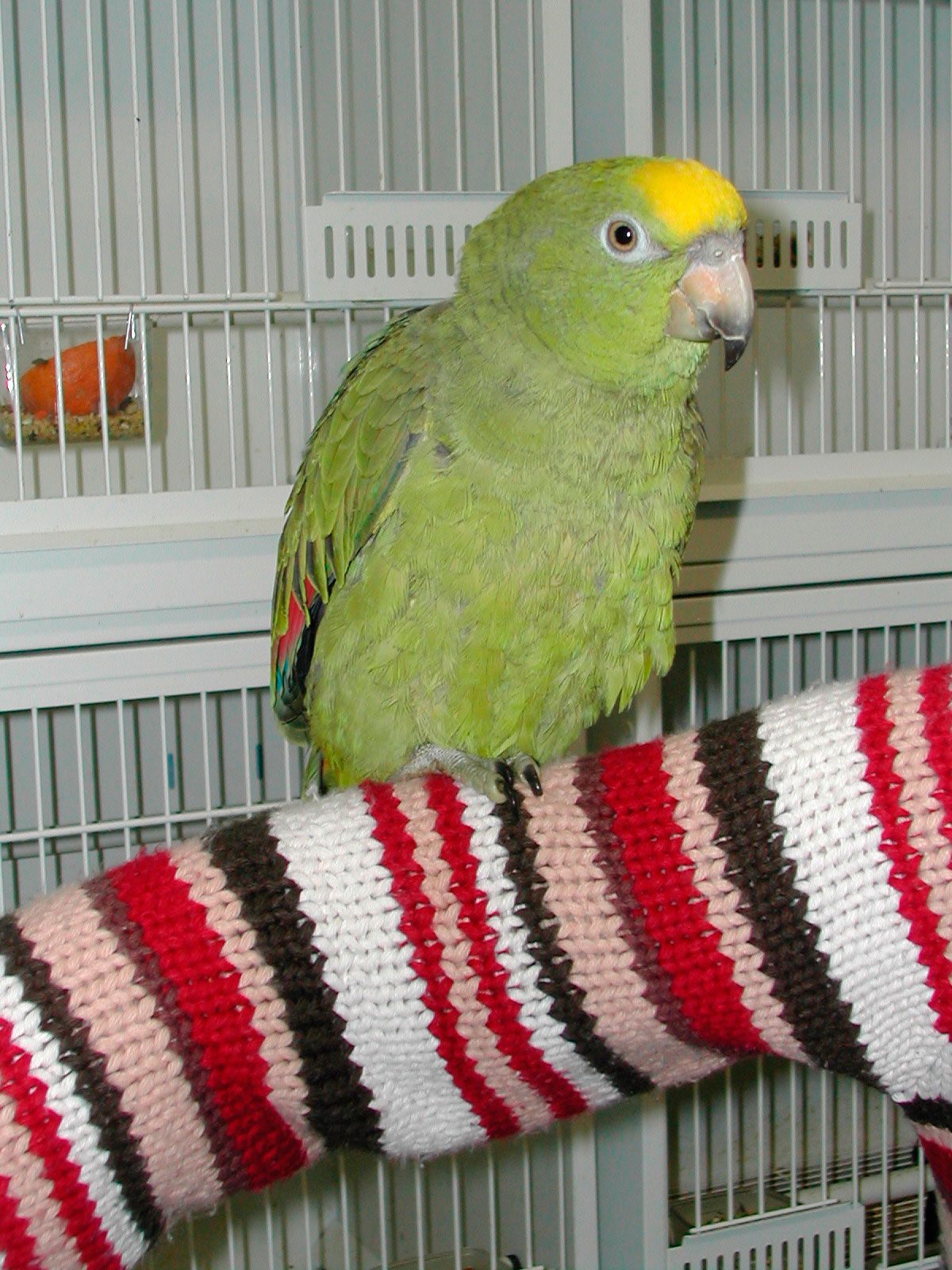
The Yellow-crowned Parrot(Amazona ochrocephala) has the forecrown and front area crown, bright yellow; lores, cheeks and supercilii area, green in most birds, but sometimes with yellow extending over lores and around eyes, and some birds with red bases hidden by yellow feathers crown; sides and back of the neck, nape and the mantle, green with dark margins, giving scalloped effect.
Upperparts green. coverts lower red, other coverts green; edge front of the wing
yellowish; five o'clock outer secondaries They are green with bright red to outerweb forming speculum; flight feather green with blue tips to secondaries and primary outerweb, dark to black in points. Underwing-coverts, dull green with blackish tips. Underparts green with plenty of blue in the chest; yellow feathers on the the thighs (often few and discrete).
Upper, the tail It is green with yellow stripes; below green with wide yellow ends; both with outer feathers basically red and a bluish puckered in outerweb.
Dark gray Bill, reddish at base of upper jaw; iris orange; legs grey.
Both sexes they are similar. The immature It has a narrower yellow patch on the head, stripes orange-red to yellow feathers crown; less red at the base of feathers tail; feathers of the tail more pointed and irises brown.
(Finsch, 1865) – Less yellow in the head that the nominal species, with frontal band green. Cheeks, supercilii area and lores with blue tint. Red curve wing
often mixed with yellow feathers.
(Cabanis, 1874) – Bill horn-colored pink, yellow feathers restricted as V in forecrown and front of the crown. Possibly average smaller than the nominal species.
Amazona ochrocephala xantholaema
(Berlepsch, 1913) – More extensive yellow in the head which extends to the back of the neck, around the eyes, to cheeks and to the ear-coverts. Often with frontal band narrow green. bluish tint in the chest.
They inhabit in open forests, moist forest edges, gallery forests, deciduous forest, open savannas and wetlands in lowland rain forests, also cultivated and suburban areas in some localities, and often near rivers.
The gallery forest It is your preferred Panama where Yellow-crowned Parrot avoid continuous humid forest, being replaced, possibly, there and in many areas of South America, by the Orange-winged Parrot(Amazona amazonica).
Usually observed in the lowlands; reported to 500 metres in Colombia and Venezuela and a 750 metres in Honduras. Usually in pairs or small flocks of 10-30 birds, with occasional gatherings up 300. Birds gather in common trees.
Reproduction:
Son Monogamie, couples joined in for life.
His time of reproduction It is from December to May. During this time, they lay clutches of 2 to 4 eggs, only Por those Nidada Tempordaa. Nest palm trunks and termite mounds.
It takes about 25 days for the eggs to hatch and near 56 days to become fledglings. The young become independent 2 months after hatching. Both male and female Yellow crowned Parrot reach sexual maturity around the 3 years.
Food:
Foods reported in the diet include fruit Immature American Curatella, Pereskia guamacho and other Cactus. Mainly feeds on treetop.
It is considered a plague in some localities for their love of eating bananas (Mussa paradisea), handles and Corn crops.
This species is considered a pest in some areas by his fondness for the consumption of bananas (Mussa paradisea), mangoes and corn crops.
Distribution:
Size of its range (reproduction / resident): 8.010.000 km2
The Yellow-crowned Parrot are in Panama, in Central America and in South America, from south to east Brazil and to the North of Bolivia.
Observed in the eastern foothills of the Andes and adjacent lowlands Colombia; eastward across the tropical zone Venezuela and south, from the coastal mountains through Bolívar (where apparently it is not known from south) and amazon, until Guyanas and Trinidad (where their status is uncertain due to the captive birds introduced).
Present in the basin Amazonas Brazil, to the south, to the Northwest of Mato Grosso and west, in the lowlands of eastern Ecuador and through the Peruvian Amazon, to the North of Bolivia.
Apparently residents throughout its distribution area. very small numbers in Panama, although locally fairly common, especially in those areas more dry; it is the most common parrot (at least once) in the San Blas Islands. generally common (even locally abundant) in South America, but the numbers are reduced in the more accessible areas due to trade.
Distribution 4 subspecies
Amazona ochrocephala nattereri
(Finsch, 1865) – South of Colombia in Caqueta, is of Ecuador, is of Peru, West of Brazil and North of Bolivia. Possibly integrated with nominal species in border areas Goal and Caquetá in Colombia.
Amazona ochrocephala ochrocephala
(Gmelin, 1788) – Nominal. It is from Colombia, Venezuela, Trinidad, Guianas and North of Brazil south to the tributaries of the lower margin right amazon in amazon and For.
• Current category of the Red List of the UICN: Least concern.
• Population trend: Decreasing.
This species is considered at present as minor concern BirdLife International, and, as a result, also by UICN.
Even though the populations it is believed that are in decline, still do not approach the threshold specified by BirdLife International to evaluate the species as Near-threatened.
It is listed in the Appendix II of the CITES.
The Yellow-crowned Parrot in captivity:
Known for his pranks and excellent skills imitate the human voice. Having said that, the ability to mimic will vary between birds and although many of them are excellent conversadoras, Some will never come to talk. These Amazons are generally affectionate. Its friendly and playful nature make them excellent pets.
Son easily domesticable and easy to train. Known to be very active, What makes them more suited to an environment that enables them to fly.
Son known for their voices. It is said that it is the strongest of all Amazon parrots. People who are not tolerant to noise, they will do well to live with this Parrot.
like most parrots, this horsewoman it can be very destructive. We must "personalize their environment" by providing them with objects to chew such as different toys and branches.
Its longevity should also be a consideration. These parrots They can live between 60 and 80 years.
Alternative names:
– Yellow crowned Parrot, Yellow-crowned Amazon, Yellow-headed Amazon, Yellow-headed Parrot (English).
– Amazone à front jaune, Amazone à tête jaune, Amazone verte de Colombie (French).
– Gelbscheitalamazone, Gelbscheitelamazone, Panama Amazone, Surinamamazone (German).
– papagaio-campeiro, ajurú-apara, papagaio-de-Suriname (Portuguese).
– Amazona Real, Cotorra Cabeciamarilla, Lora Cabeciamarilla, Lora coroniamarilla, Lora Real (español).
avibase
Parrots of the World – Forshaw Joseph M
Parrots A Guide to the Parrots of the World – Tony Juniper & Mike Parr Birdlife
Parrot Book, Parrots and macaws Neotropical
Photos:
(1) – A pet Yellow-crowned Amazon in Puerto Maldonado, Peru By Kate from UK (Lola) [CC BY-SA 2.0], via Wikimedia Commons
(2) – A pet Yellow-crowned Amazon By Freegiampi (From Giuseppe's farm) [CC BY-SA 2.5], via Wikimedia Commons
(3) – Yellow-crowned Amazon or Yellow-crowned Parrot (Amazona ochrocephala) in captivity By Stephen Joyce from barcelona, Spain (Parrot) [CC BY-SA 2.0], via Wikimedia Commons
(4) – Yellow-crowned Amazon or Yellow-crowned Parrot (Amazona ochrocephala) in captivity in the Parrot’s Garden (Jardim dos Louros), in the Botanical Garden of Funchal, Madeira island, Portugal By jmaximo [CC BY 2.0], via Wikimedia Commons
(5) – A Yellow-crowned Amazon in Gatorland, Florida, USA By greyloch from Washington, DC, area, U.S.A. (green parrot preening) [CC BY-SA 2.0], via Wikimedia Commons
(6) – Amazona ochrocephala panamensis, Panama Amazon (also known as the Panama Yellow-headed Amazon); two in captivity By TJ Lin (originally posted to Flickr as DSCN1005) [CC BY-SA 2.0], via Wikimedia Commons
(7) – A Yellow-headed Amazon (or Parrot) near the Brazil-Peru-Colombia triple junction By Dick Culbert from Gibsons, B.C., Canada (Amazona ochrocephala) [CC BY 2.0], via Wikimedia Commons
(8) – A Yellow-crowned Amazon at Bloedel Floral Conservatory, Vancouver, Canada By Karen Neoh (Parrot) [CC BY 2.0], via Wikimedia Commons
(9) – Yellow-crowned Amazon or Yellow-crowned Parrot (Amazona ochrocephala) in a tree in Venezuela By Rufino (originally posted to Flickr as camouflage) [CC BY-SA 2.0], via Wikimedia Commons
(10) – Amazona ochrocephala From Natural History of Parrots (by Francois Levaillant, 1801-1805) – Wikimedia
40 to 50 cm.. length and a weight of approximately 550 gr.
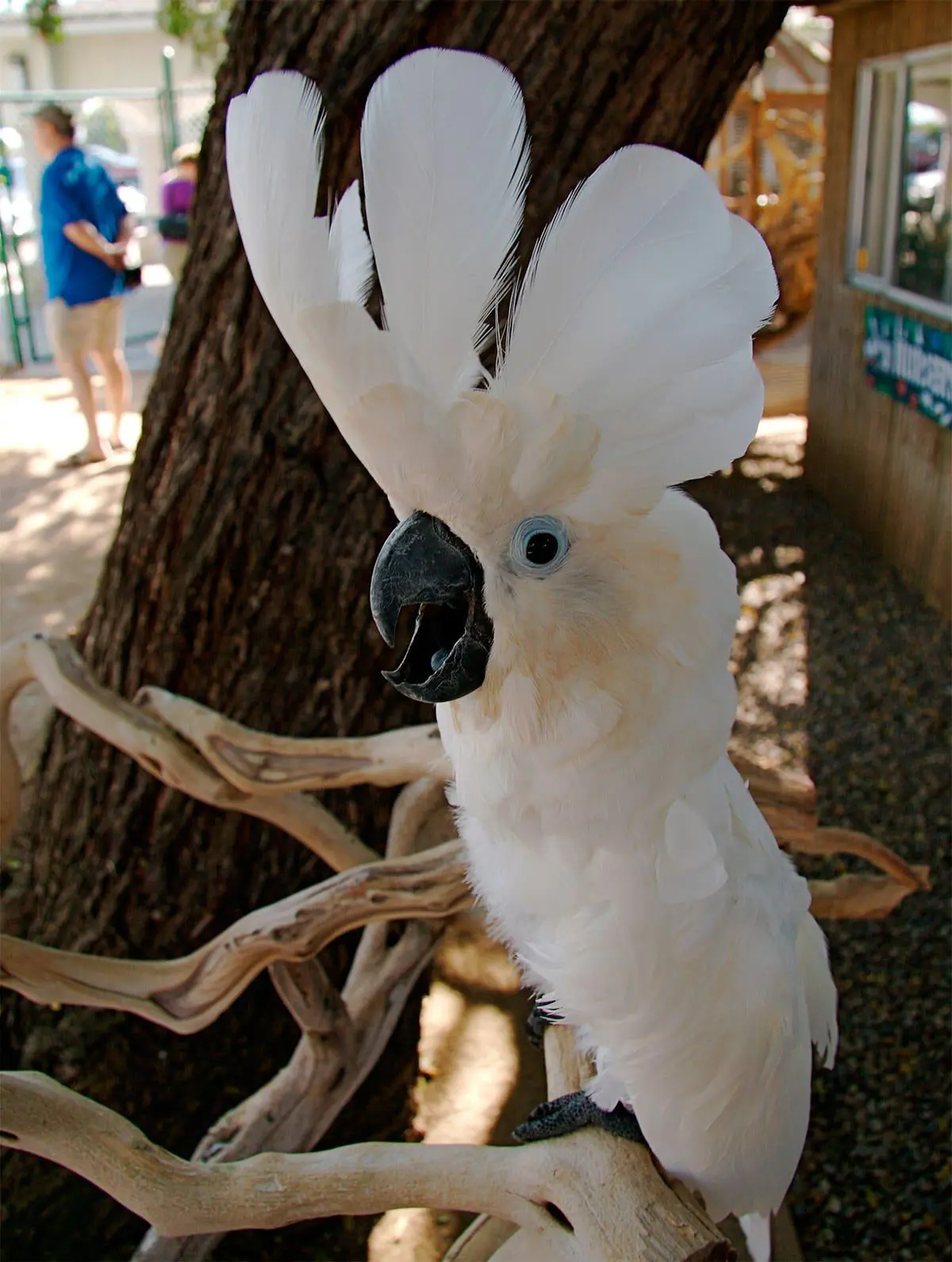
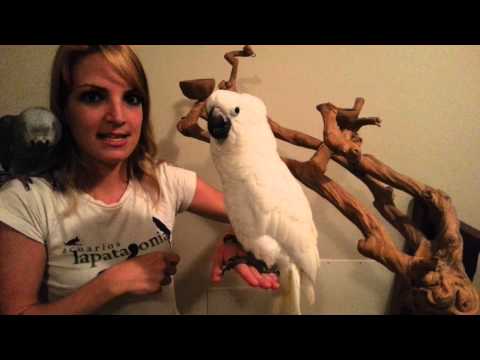
The White cockatoo(Cacatua alba) is completely white, with yellowing below wings, bill black and legs dark gray.
The eye ring is blue.
It has a crest exuberant, that is elevated or low, Depending on your state of mind. The wings They are tapered or rounded.
If he irises is brown, then it is male, if reddish, it is female. The females has bill smaller.
They usually fly solo, in pairs, small groups, or in flocks of up to fifteen birds. In the afternoon, they gather in groups of up to fifty birds. even though they are social, with the exception of mating pairs, usually, they do not form close ties with others. As a result, There is no firmly defined order of dominant position in the community. Son day and they tend to be sedentary, Although some can be nomadic and wander in search of food.
The white cockatoos they are very bright and curious birds. They have the ability to use tools, as the use of a branch to scratch your back. They are monogamous, with couple bonds lasting lifetime. They can fall into a deep depression if you lose your partner.
They live in lowland forests below 900 m, as well as in mangrove forests, plantations and agricultural land.
they are particularly common around the edge of clearings and rivers. They spend most of their time in the tops of the trees. The secondary vegetation high is its preferred habitat.
White Cockatoo Reproduction:
It nests in the hollows of trees. They lay two eggs and two birds hatch for a few 28 days. The larger hatchling tends to take dominance over the smaller hatchling, which will not be able to survive.. The chicks leave the nest to the 84 days old and are independent around 15-18 weeks. These birds reach sexual maturity at the age of 3-4 years.
White Cockatoo feeding:
In nature it feeds mainly on Tree fruits. They are often seen feeding on papaya, Durian, complexioned and rambutan. It has also seen them will eat crickets and lizards. They often feed on corn that grows in the fields, sometimes doing considerable damage.
Distribution:
Size of its range (reproduction / resident): 51.400 km2
Appears as vulnerable by the IUCN and placed in Appendix II in 1981.
In their natural environment, the white cockatoo is a species vulnerable Due to the decrease in number due to habitat loss natural, as well as for the capture for the illegal bird trade. There are restrictions on the number of birds that can be exported, but BirdLife International He says that this is being exceeded by up to 18 times the agreed number in some areas.
It can cause substantial damage to Corn crops.
World population: 43,000 – 183,000 individuals.
The White Cockatoo in captivity:
The White cockatoo You can live more than 60 years. It is very common in poultry farming and it is perhaps one of the most frequent pet cockatoos.
They are sympathetic, calm, beautiful, sweets and easy to domesticate. Bred to porridge they are usually wonderful pets, You can play some words but are not good talkers. These birds in captivity require mental stimulation almost constant. They are in constant motion, up and doing gymnastics. When lack of mental stimulation, often they are become neurotic, booting the feathers to the point of causing areas of baldness.
They are known for being very affectionate with their human companions, acting more like a dog than a bird in this regard as.
In the absence of a partner, captive white cockatoos will bond with their keeper as if that person were their mate.
Alternative names:
– White cackatoo, Great White Cockatoo, White Cockatoo, White-crested Cockatoo (ingles).
– Cacatoès blanc, Grand Cacatoès blanc (French).
– Weißhaubenkakadu (German).
– Catatua-branca (Portuguese).
– Cacatúa Alba, Cacatúa Blanca, Cacatúa Copete Blanco, Cacatúa de Goffin (español).
– Avibase
– Parrots of the World – Forshaw Joseph M
– Parrots A Guide to the Parrots of the World – Tony Juniper & Mike Parr
– Birdlife
– avimarparrots.es











.jpg)


_(14729508596).jpg)


.jpg)
.jpg)
