About 30 cm.. length and a weight between 140 and 170 gr.
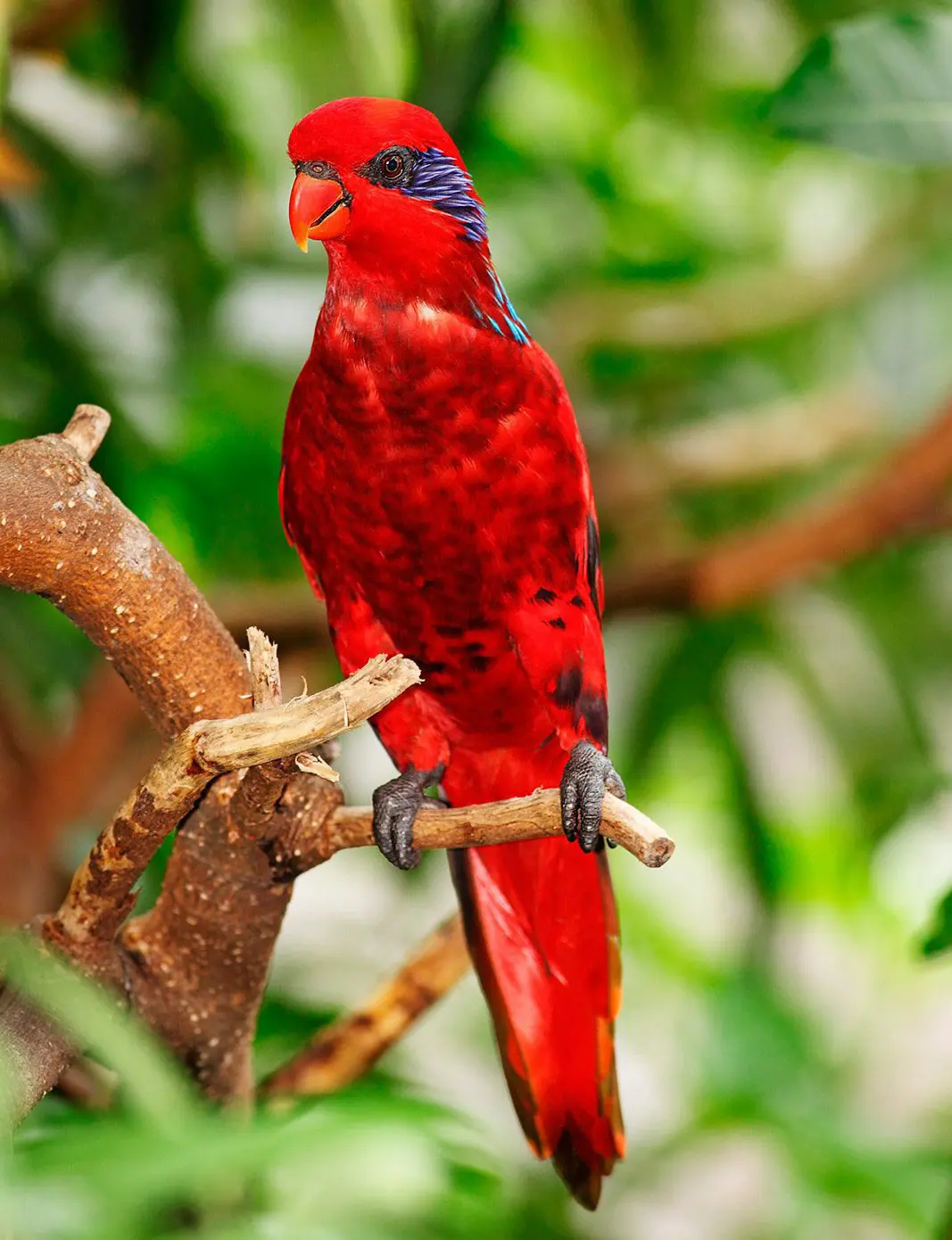
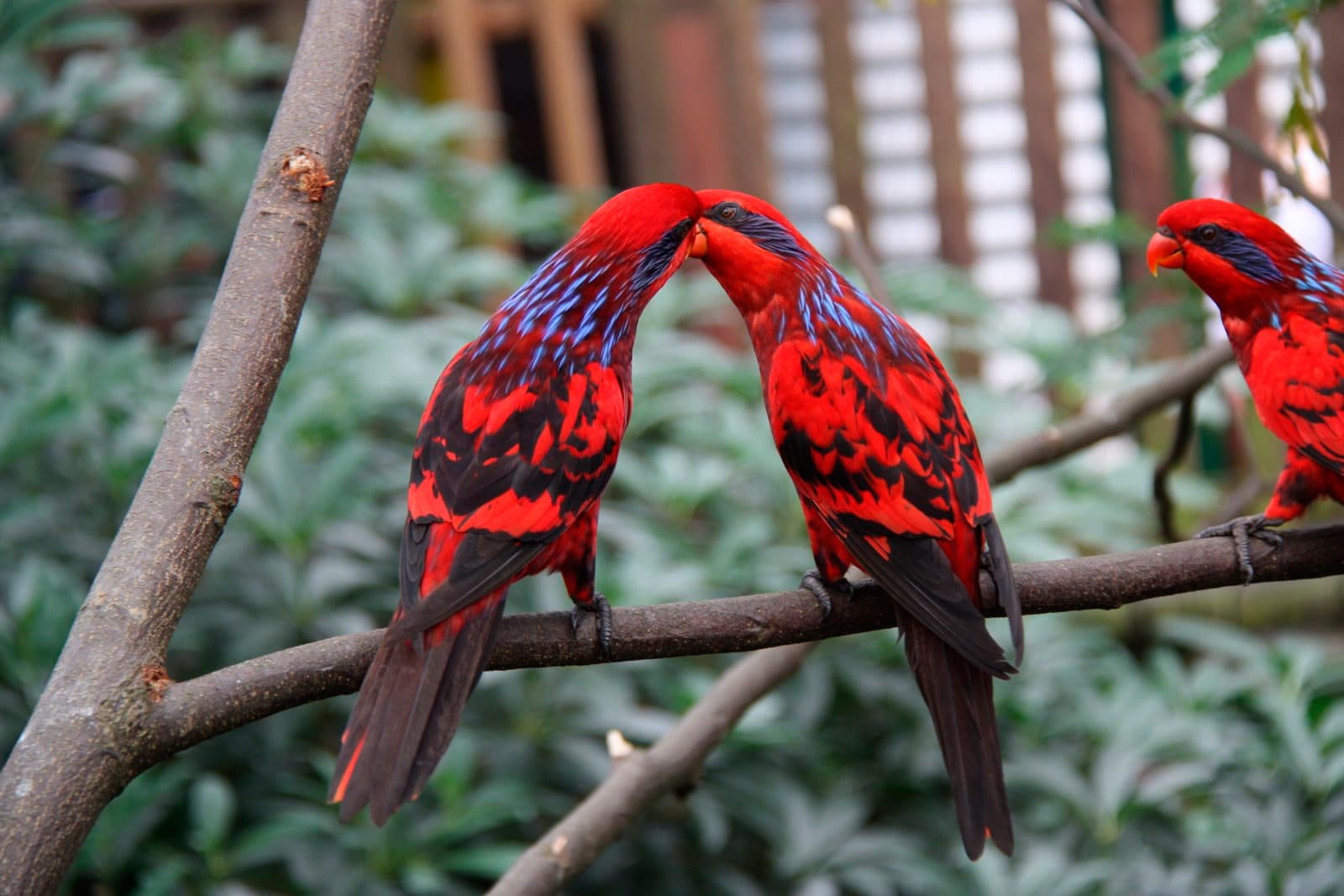
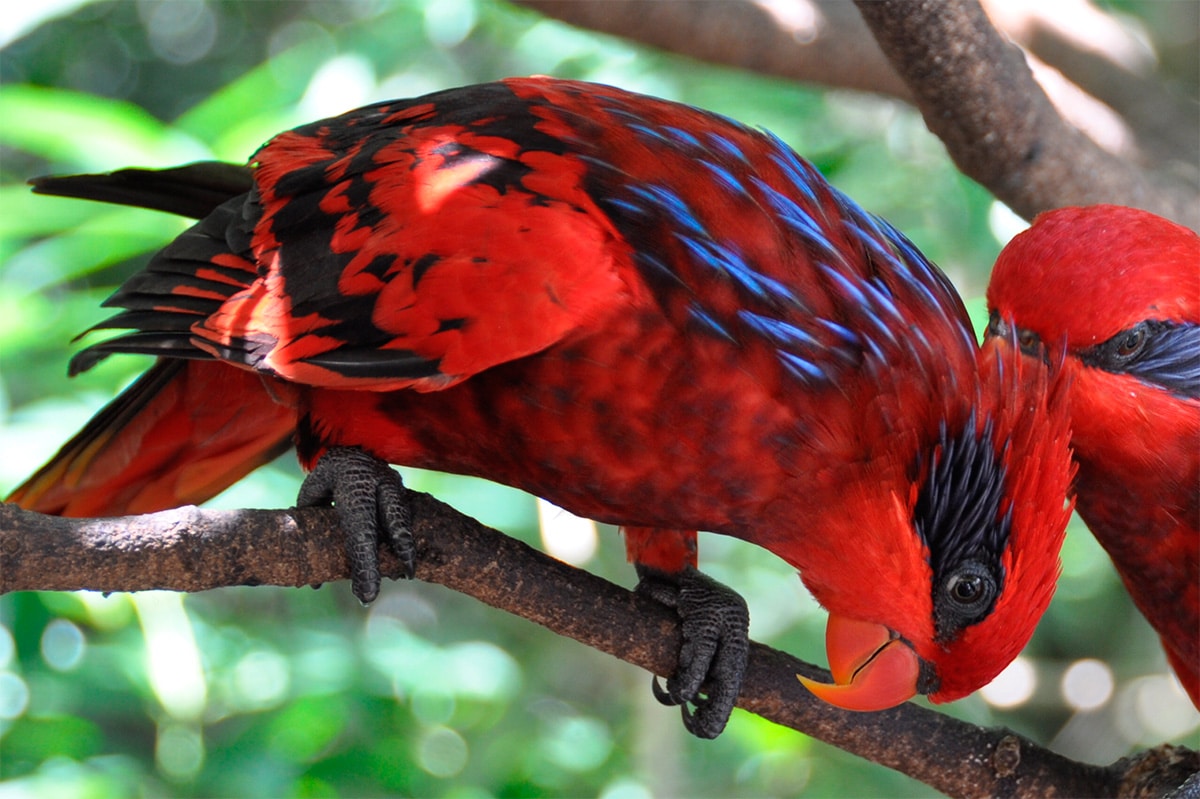
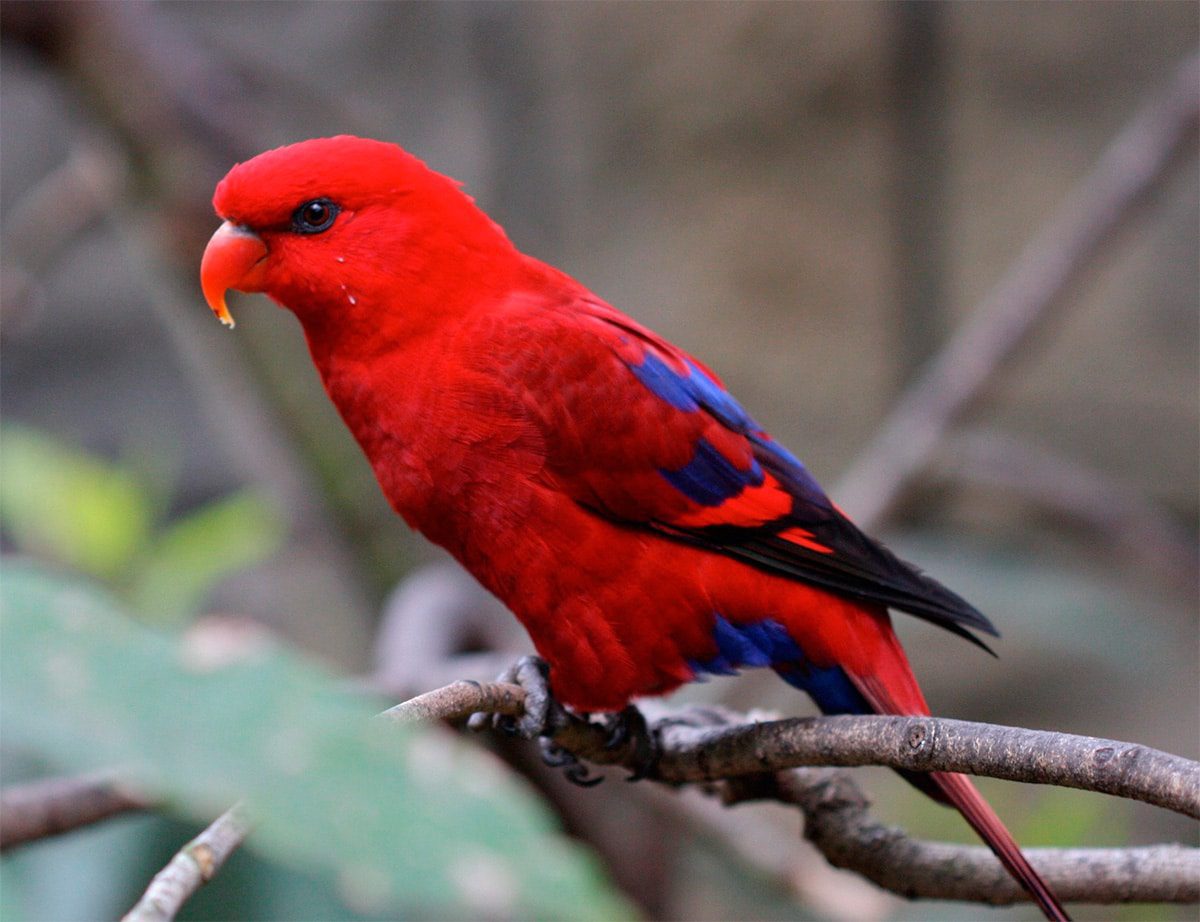
Like all species of the genus Eos, the “Tanimbar Lory” (Eos reticulata), shows a beautiful plumage mainly red. In adults, a great band blue-violet crosses the region of the eye and continues in the patches that cover the ears, at the sides of the neck.
The under neck and the mantle they are covered with long, violet-blue stripes.
The back and tail they are more or less blue red striped.
The pens and large blankets have terminations in black. The primary is almost entirely black. The tail is brownish black above and below a red opaque.
The bottom of the wings they have the edge and dark tips. Thighs and flanks they are completely Red. The bill coral red. Iris orange-red. The legs are grey.
In youth , the feathers the lower parts are aligned blue-black variably. The shield It is covered with blue spots instead of stripes. The bill is brownish Orange. The irises They are brown.
The Blue streaked Lory they live mostly in the most wooded areas, including primary and secondary forests. They are also found in coconut plantations, of sago palms, in the mangroves and the cultivated lands.
It seems that they show a certain attraction for the monsoon forests, relatively open and located in low-lying areas.
They live alone, in pairs or in small groups of up to ten or more individuals. These are rather shy and discreet, but their presence is often betrayed by the screams produced flocks in flight.
They have a direct flight, quite fast and composed of many flapping. Often feed on coconut blossom trees and the sago palms.
Reproduction:
There is little information of the natural environment. The Blue streaked Lory They typically make 2 or 3 eggs that colouring of 24 to 26 days. The chicks leave the nest after 7 to 8 weeks. But, even after feather, they return regularly to rest awhile. The youth they stay in the family throughout the summer and then join the dormitories where they continue their learning.
Food:
They have an exclusively vegetarian diet. They feed on fruits, seeds, buds and immature seeds. His tongue with a brush-shaped end is specialized to collect nectar and pollen.
Distribution:
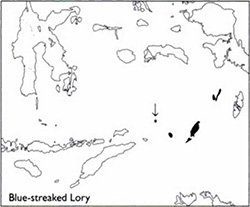
Is located in Yamdena and Larat, Tanimbar Islands and island of Babar, Indonesian. Introduced in Kai Islands and island of Damar, where has possibly gone.
Conservation:
– Current IUCN Red List category: Near threatened
– The population trend: Decreasing
Habitat loss continues apace in southern Yamdena
The species is suspected that it is decreasing at a rate of slow to moderate, due to the combined forces of habitat loss and capture.
It is estimated a population of 220.000 ± 50.000 birds in Yamdena
Nearly 3000 birds are traded on the international market of birds each year, fact that probably has not caused a decrease in its population. Habitat loss continues however, and this, combined with capture, probably if that will lead to more declines.
Conservation Actions Proposed:
– Regularly monitoring at certain sites throughout its range to determine population trends.
– Investigate the degree of capture and take appropriate measures, including the use of awareness-raising campaigns, to address these issues.
– Protection of the areas significant of forest right in all the Islands where is distributes the species.
"Blue streaked Lory" in captivity:
Lives of 15 to 30 years in the wild; and between 28 and 32 years in captivity.
Fairly common in the s 1970. Nowadays it is not unusual to see them in captivity.
Alternative names:
– Blue streaked Lory, Blue-streaked Lory (ingles).
– Lori réticulé, Lori à raies bleues, Lori strié bleu (French).
– Strichellori (German).
– Lóris-de-crista-azul (Portuguese).
– Lori de las Tanimbar, Lori Reticulado (español).
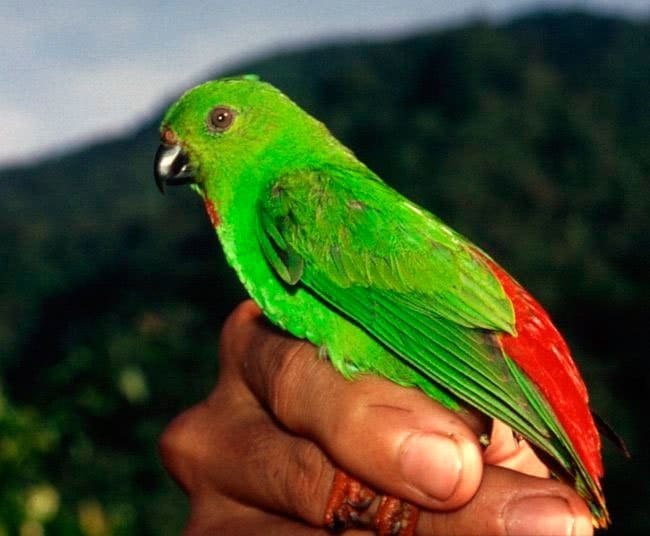
The Sangihe hanging parrot(Loriculus catamene) has the head Green with the front of the crown and the bib red. Upperparts Green with light wash of color orange in the the mantle; rump and long tail coverts red. Wings green, slightly dark; carpal edge brighter yellowish green. The flight feather blue with green coverts.
The underparts Green with the belly Beige and tail coverts of color red marked in green. Upper, the tail of color green with lips Red; Blue below. The bill black; irises brown; legs orange.
The female not have the Red of the crown; the Red of the bib reduced to a few points, and green the coverts infracaudales.
The immature with carpal edge yellow, lack of crown red, But if the bib red.
Found in pairs or in small groups on them flowers of coconut and shrub in flower, and groups of up to four birds found with greater frequency in plantations mixed. The species is has adapted to habitats side and their main source of food seems to be the nectar of coconut. One roost of 17 birds is the largest group reported.
Reproduction:
One nest with two eggs is noted in 1985, little more is known of the habits reproductive of this species.
Food:
Their main source of food is the nectar of coconut.
Distribution:
Size of the area of distribution (reproduction / resident): 700 km2
endemic to the Sangir Islands. Most of the original vegetation in Sangir, It has now been replaced by plantations of coconut and nutmeg, and secondary vegetation of the abandoned gardens. Observations during mid of 1980 showed that it is quite common in coconut forests, and two pairs were observed in the steep volcanic slopes covered with trees in 1986. In 1995, the species was recorded of all forest habitats on the island from sea level up to around the 900 m (also be meeting around Tahuna). The birds are observed more frequently in fragments of forest and coconut plantations.
Conservation:
• Current IUCN Red List category: Near threatened
• Population trend: Decreasing
There are few data on recent trends, but not there is evidence of a continuous decrease and given your apparent tolerance to different secondary habitats, the declines in their population may have been insignificant.
The population of the Sangihe hanging parrot It is estimated between 10.000 and 46.000 specimens.
The original forest in Sangihe It has been almost completely replaced by the crop, but the species appears to be tolerant to degraded habitats and cultivated areas and there is no evidence of a continuous decrease. Other potential threats include the widespread settlement of large trees in the Decade of 1980, the escaped parrots-borne disease and the volcanic activity in the future (Riley 2002).
"Sangihe hanging parrot" in captivity:
Is not usual.
Alternative names:
– Sangihe Hanging-Parrot, Sangihe Hanging Parrot, Sangir Hanging Parrot (ingles).
– Coryllis des Sangi, Coryllis de Sangihe (francés).
– Rotsteisspapageichen (alemán).
– Loriculus catamene (portugués).
– Lorículo de la Sangihe, Lorículo de Sangihe (español).
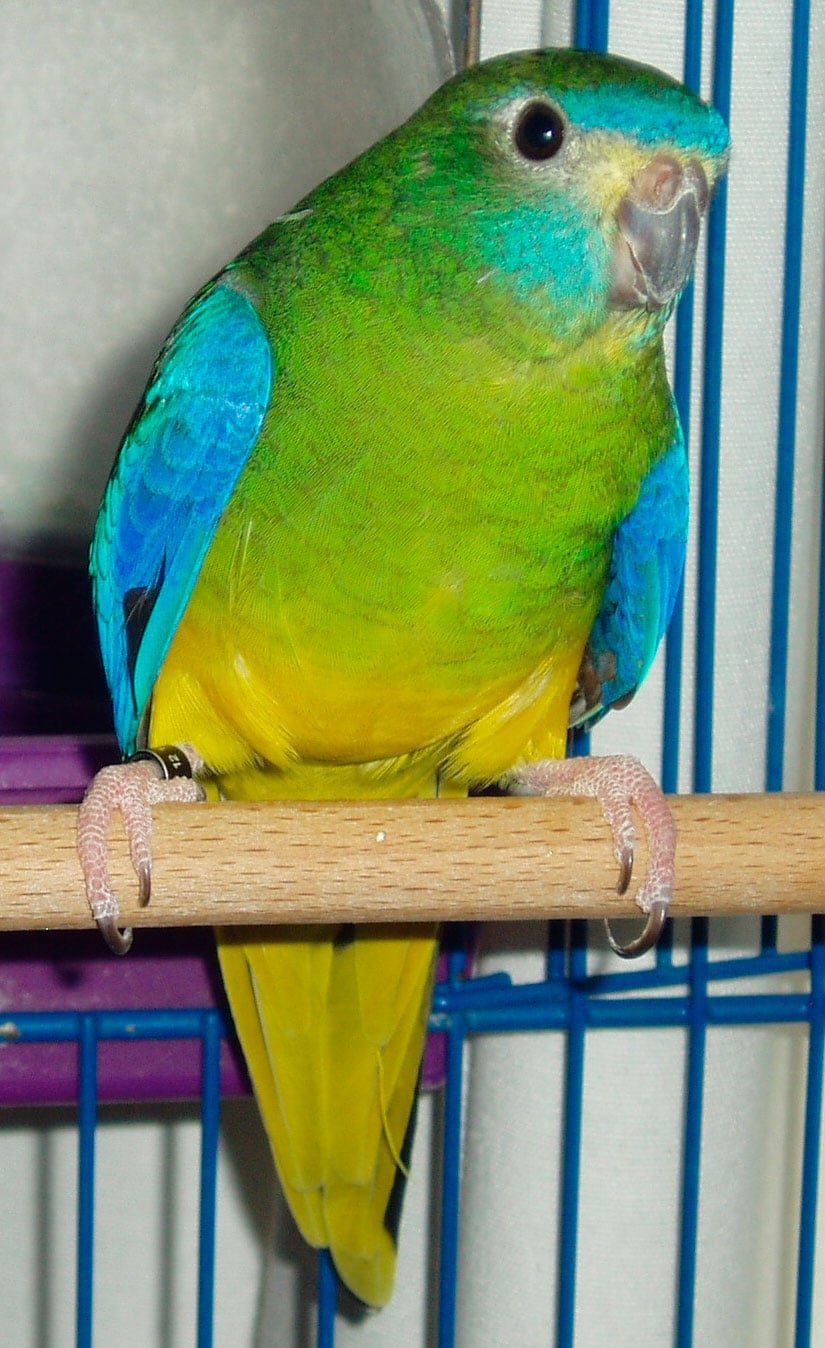
The Turquoise Parrot )(Neophema pulchella has the head bright turquoise blue, darker on the front of the crown, with the chin yellow and green on the back side of the crown.
Upperparts green.
The interior of the small and medium-sized coverts is reddish brown, the median are light blue. big blankets and primary coverts are blue-violet color. The primary feathers Black have them vane inmates of blue color and a fine yellow edge. The secondary feathers Black has foreign bands of yellowish green colour that tend toward the blue on the edges of the feathers. The lesser coverts the wings are blue-violet color.
The underparts is bright yellow with a slight orange patch in the throat and the chest. An orange stain, sometimes, is visible in the abdomen of certain individuals. The two pairs of the Central feathers of the tail are bright green, the outer tail feathers are yellow with green bases. The bill is black and the irises dark brown. The legs they are a pinkish-brown hue.
In the females, the plumage is more off than in males. There are no brown spots in the shoulders. The underparts they are much more green, especially in the chest. The lores they are whitish and the blue of the face is considerably reduced. A bar can be seen in the wing
.
The immature are similar to the females.
The Immature males are distinguished by a small brown spot in the wing
and blue dark figure.
The Turquoise Parrot they are distributed by clear wooded areas, wooded areas, meadows with native grasses, Although they have a strong preference for the ecotones, that is to say, regions that are intermediate between the forests and farmland.
In the State of Victoria, seasonally, These parakeets make positive use of habitats that suit them: the eucalyptus trees that are found in the Rocky Mountains in winter, wetlands and ravines from spring to fall and slopes that face southeast during all months of the year.
The Periquito turquoise they live in small flocks or family groups that feed near the ground.
These birds are sedentary but after nesting, You can attend a light dispersion.
During this last period, the formation of dorms is not uncommon.
We can often see them begging for food on the verges of roads.
Reproduction:
The Turquoise Parrot they breed from august to december. In other areas, the nests are also visible in April-may, but they are probably second clutches or broods alternatives. The nest is located in one a tree cavity, usually a eucalyptus, at least in regards to the State of Victoria. But it can also be located in a strain, a fallen pole or branch.
The spawning contains an average of 4 or 5 eggs with one incubation that lasts a few 20 days.
The chicks are altricial and remain in the nest for at least 4 weeks before you fly.
Food:
The Turquoise Parrot they have a diet vegetarian. They feed on seeds, flowers and fruits that are native and imported plants. Love cultivated herbs, wild herbs and different parts of the bushes.
A detailed census has identified the following genera: shrubs in Bloom's leucopogon, not less than 4 types of Danthonia, nettle, Urtica urens, Paspalum dilatatum, who are the edges of sea grass and the gernaios. The list is not exhaustive.
Distribution:
Size of its range (reproduction / resident): 771.000 km2
Currently fluctuates irregularly from the southeast of Queensland (North around Chinchilla and Maryborough) to the East of New South Wales, arriving at the coast, about Sydney, and extending to the South up to Nowra) in Victoria to the West of Bendigo. There is also an isolated population in the East of Victoria. The increase of population ,probably, continues in Victoria and New South Wales.
Conservation:
• Current category of the Red List of the UICN: Least concern
• Population Trend: Stable
at the beginning of 20th century, the increase of pastoral activities, catastrophic drought in 1902, and to a lesser extent, poaching, they gave rise to the population of the Turquoise Parrot almost disappeared.
Since the decade of 1940, there has been a resurgence in the number of individuals. The resurgence of this species began in the vicinity of Chinchilal and Maryborough and little by little the South joined with the State of Victoria through New South Wales.
Today, growth tends to spread and strong presence in the national parks proof that the cessation of grazing is a great benefit for the development of these parrots. Since they nest close to the ground, These birds are still vulnerable to predation by foxes. The other recurring threat is habitat degradation and loss of nesting sites.. The world population deemed superior to the 20 000 birds, birds captive are estimated at 8 000.
"Turquoise Parrot" in captivity:
The Turquoise Parrot they are birds that are regularly and which are obtained very good results in the reproduction. These parakeets are highly recommended for amateur beginners.
In terms of its behavior, they are relatively strong with a sweet and melodious voice. These parakeets are not shy and are easy to keep..
During the breeding season they do not support other congeners or other species of neophemas. It is mainly of assaults by males. Your need to crack is very limited and their need for bathroom is very different from an individual to another. They tolerate dry climates, but they are very sensitive to cold and wet fog. They like to spend time on the floor, investigating, and therefore, they are vulnerable to infection by worms.
According to sources, a sample lived during 21 years in captivity. In captivity, these animals have been known that they can raise from 1 año de edad.
Approximately from 55 cm.. length and 525 g. weight.
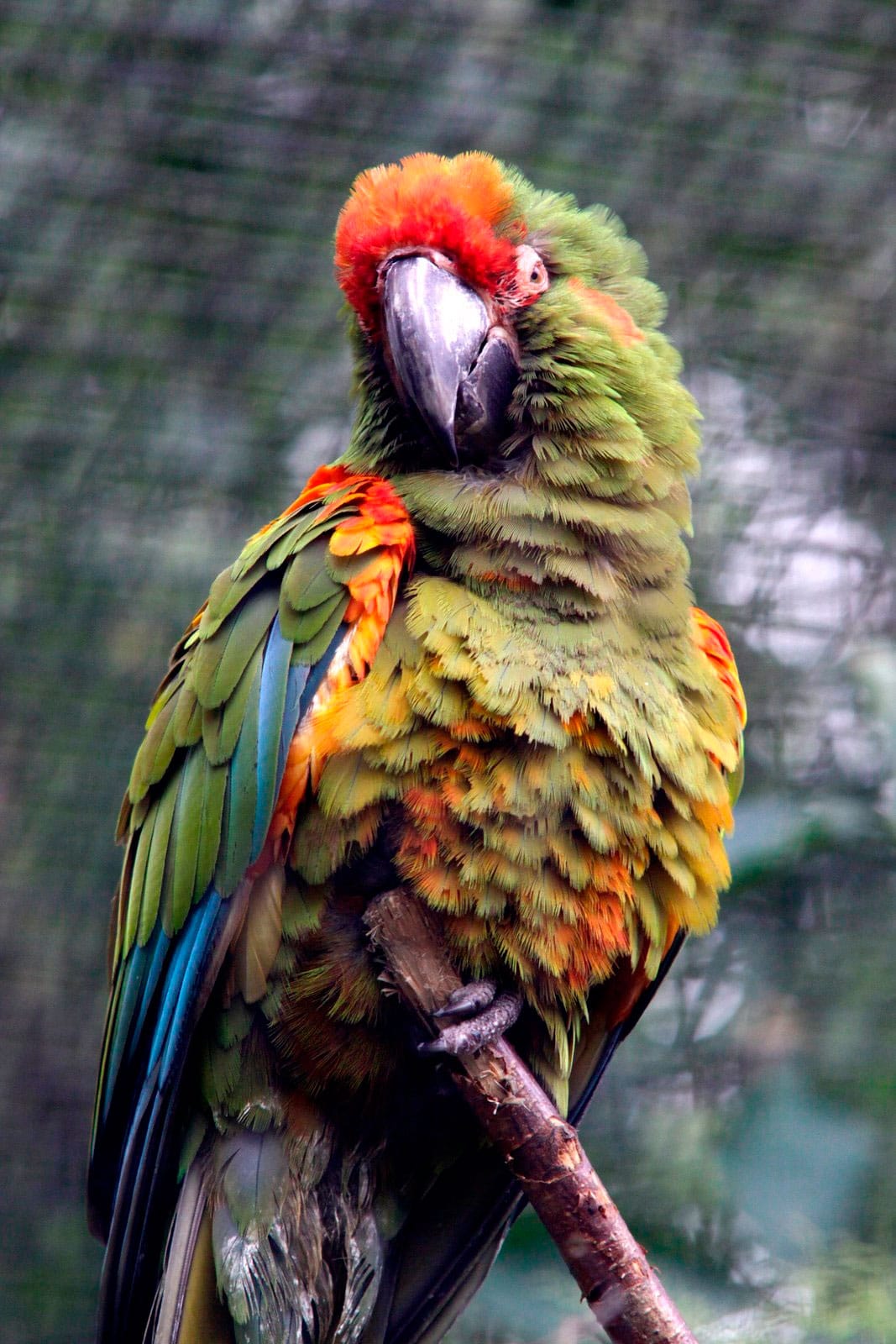
The Red-fronted Macaw(Ara rubrogenys) they are the smallest of the large macaws.
They have forecrown, former Lords, crown and some ear-coverts bright orange red. back of the crown, nape and the mantle olive green color orange color in some feather-tipped; scapulars color marron-oliva; rump and uppertail-coverts olive green, pale that the of the the mantle. Lesser coverts, bend of wing and carpal edge orange-red; median olive green, some pale orange tips, the outermost impregnated blue; greater coverts mostly blue, back more olive at the body; vane outer primary blue, olive green internal. Underwing-coverts juvenile red-orange, remaining the rest of green olive beige.
The underparts olive green with the the thighs red. Upper, the the tail feathers color olive green suffusion blue tip blue and; undertail, olive green yellowish.
The bill dark grey; the bare area of the subsequent Lords and upper cheeks, white crossed with narrow lines of dark brown feathers; Orange the irises; perioftalmico ring white; legs dark grey.
Both sexes similar.
Immature more opaque, with less extensive orange-red color in the head and in the ear-coverts and without the orange-red in the wing
.
Another fundamental characteristic of the habitat of the Red-fronted Macaw they are the steep slopes and coastal cliffs unchanged to that used for nesting and roosting sites.
Often share space with communities of farmers who used the land of valleys with climates mesothermic to plant peanuts, corn and other cereals, the same people who are part of the diet of the Red-fronted Macaw.
They are birds social and rarely stands alone. Are often seen flying in small groups of 3 to 5 individuals. For most activities such as feeding or roosting they congregate in large groups of 20 to 30 individuals. They rest frequently during the middle of the day in the hottest hours. Activity level largely depends on age and number of macaws in the group.
Reproduction:
Observed nests loose or in colonies in ravine holes on the banks of rivers. In rainy season the egg laying It has been reported in the months November-April. They are of 1 to 3 eggs per season, usually two, and incubation lasts around 26 days. Most pairs fledge one young per year..
They form bonds of monogamous they maintain throughout the year. Even in the off-season of breeding, the copula and preening appear exclusively between the consolidated couple, presumably to maintain their bond.
Generally speaking they are not territorial, but during the breeding season You can defend the area surrounding the cavity of the nest.
But, natural food is often scarce and birds feed on, to a large extent, of crop plants, especially the peanutsArachis hypogaea and corn unripened.
Distribution:
Size of the area of distribution (reproduction / resident): 27.100 km2
The Red-fronted Macaw being endemic to a small area in the East of the Andes, in the Center-South of Bolivia, from the South of Cochabamba and West Santa Cruz, passing by Chuquisaca, to the East of potosi, mainly in the valleys of Rio Grande, Mizque and Pilcomayo.
The full range estimate is of 20,000 km², with 18,000 km² in Grand / system of Mizque and 2.000 km² in the valley of the Pilcomayo, between 1.100 and 2.500 m (local after breeding at 3,000m).
They perform many Local movements in response to the availability of food.
Locally common, but declining and endangered at the global level.
The population of the Red-fronted Macaw (Ara rubrogenys) is estimated between 1.000-4.000 individuals, more or less equivalent to a strip between 670-2,700 mature individuals.
This species has a very small population and decreasing. Conservative estimates suggest that all subpopulations are extremely small. So, qualified as endangered.
Conservation status:
Is located in the Appendix I to the International Convention on the trafficking of endangered species of Fauna and Flora (CITES). Its capture, transport and export is prohibited by Bolivian law. However is captured by live bird catchers for the illegal trade and is pursued in an intensive way for the farmers that the consider a plague for their corn and peanut crops.
Its natural habitat It is being impaired activities human unsustainable as indiscriminate logging and grazing goats envelope. Approximately the 40% of the natural vegetation of the valleys inhabited by these macaws have been converted into agricultural land since 1991. As native vegetation is losing the exhibition of the Macaw of Cochabamba in the growing areas to search for food is greater. The continuous illegal capture, most of the illegal trade is domestic but some species are marketed in Peru.
Conservation measures:
The presence of small populations inside national parks Amboro and Torotoro, they constitute an effective conservation measure.
The Harmony Association It has a long range project in the Mizque River through which it works with peasant families to protect nesting cliffs.
in addition, in 2006, a was opened ecotourism stay that promotes conservation of this bird in time of generating profits for the local community; It also plans to establish a protected area in that site. Additionally, in 1992, 5000 posters of protection of this species and its habitat were apparently well received in the region, as a secondary measure to preserve it.
"Red-fronted Macaw" in captivity:
Uncommon in captivity.
It is an extremely intelligent and curious bird that has the ability to imitate the human voice, Although the indigenous people of Bolivia refer to them as "donkey birds", due to their inability to speak. All skills require a training; holders of these birds breeders give proof of how easy it is to talk.
With regard to its longevity, according to sources, a pair of these macaws still breed after 23 years in captivity. It has been reported that these animals can live up to 36,2 years in captivity, something possible, but that has not been verified; the same study reported that these animals can reproduce at the age of 3 years in captivity.
Due to the few specimens that are released and their situation in danger of extinction, The Red-fronted Macaw only recommended for experienced handlers and breeders.
Alternative names:
– Red-fronted Macaw, Lafresnaye’s Macaw, Red fronted Macaw, Red-cheeked Macaw (English).
– Ara de Lafresnaye, Ara rubrogenys (French).
– Rotohrara (German).
– Arara-de-fronte-vermelha (Portuguese).
– Guacamayo de Cochabamba, Guacamayo Dorado, Guacamaya frente roja (español).
– Paraba frente roja (Bolivia).
– Qaqa Loro (Quechua).
Frédéric de Lafresnaye
scientific classification:
– Order: Psittaciformes
– Family: Psittacidae
– Genus: ARA
– Scientific name: Ara rubrogenys
– Citation: Lafresnaye, 1847
– Protonimo: Ara Rubro-woodpecker
– Avibase
– Parrots of the World – Forshaw Joseph M
– Parrots A Guide to the Parrots of the World – Tony Juniper & Mike Parr
– Birdlife
– Photos:
(1) – Red-fronted Macaw at Berlin Zoological Garden, Germany. Some of the tail feathers are not clean By Konstantinos K [CC BY 2.0], via Wikimedia Commons
(2) – Two Red-fronted Macaws at Tulsa Zoo, Oklahoma, USA By originally posted to Flickr at Tulsa Zoo – Parrots and uploaded to Commons at Ara_rubrogenys_-Tulsa_Zoo,_Oklahoma,_USA-8a.jpg: Doug Wertman from Rogers, AR, USAderivative work: Snowmanradio (Ara_rubrogenys_-Tulsa_Zoo,_Oklahoma,_USA-8a.jpg) [CC BY 2.0], via Wikimedia Commons
(3) – A Red-fronted Macaw at Wilhelma Zoo, Stuttgart, Germany By Kathrin Gaißer (PapageiUploaded by snowmanradio) [CC BY-SA 2.0], via Wikimedia Commons
(4) – A Red-fronted Macaw flying at Doué la Fontaine zoo, France By frank wouters (originally posted to Flickr as papegaai) [CC BY 2.0], via Wikimedia Commons
(5) – Red-fronted Macaw (Ara rubrogenys) head By Benjamin Graves (originally posted to Flickr as Red Fronted Macaw) [CC BY 2.0], via Wikimedia Commons
(6) – Red-fronted Macaw (Ara rubrogenys) on a branch in the foreground By derivative work: Snowmanradio (talk)Red-fronted_Macaw_(Ara rubrogenys)_-on_branch.jpg: Balaji Dutt M V [CC BY 2.0], via Wikimedia Commons
(7) – Red-fronted Macaw in the Walsrode Bird Park, Germany By Quartl (Own work) [CC BY-SA 3.0], via Wikimedia Commons
(8) – A Red-fronted Macaw at Jurong Bird Park By Peter Tan (Red-fronted MacawUploaded by Snowmanradio) [CC BY-SA 2.0], via Wikimedia Commons
(9) – Red-fronted Macaw – Jurong BirdPark, Singapore By Doug Janson (Own work) [CC BY-SA 3.0 or GFDL], via Wikimedia Commons
(10) – Illustration Ara rubrogenys (Red-fronted Macaw) by Marc Athanase Parfait Oeillet Des Murs [Public domain], via Wikimedia Commons
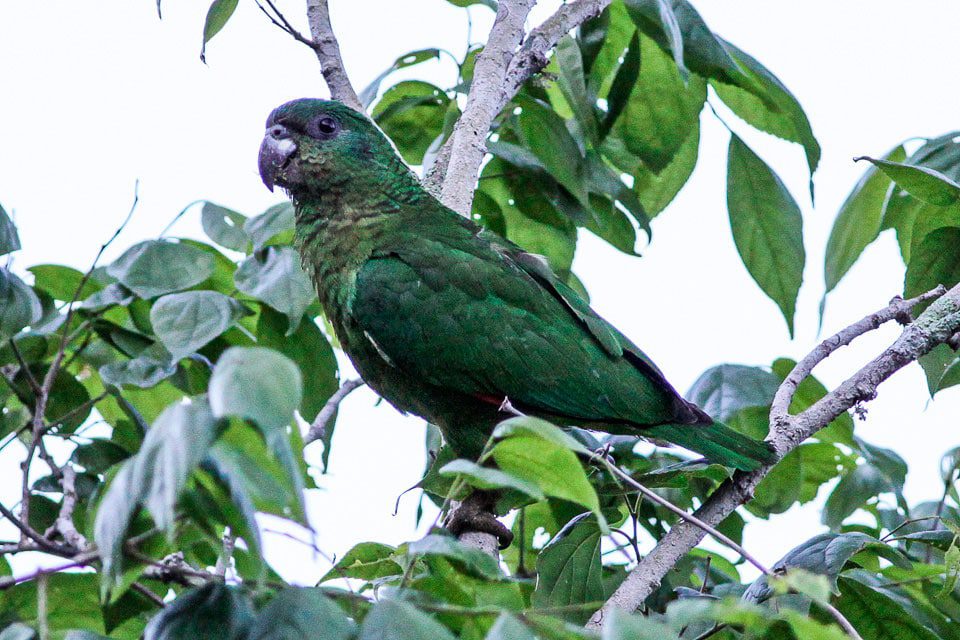
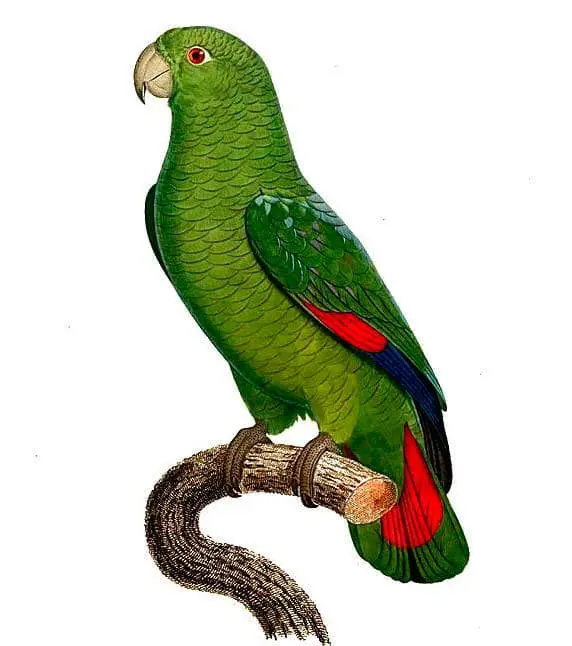
The Black-billed Parrot(Amazona agilis) It is the smallest of the Amazon parrots, and is one of only two species of Amazona endemics Jamaica.
This species, brightly colored, has a plumage, mostly, of color green with them underparts lighter, green or yellow.
The slightly darker edges in feathers of the back of the neck, one dan scalloped effect. Flight feathers darker at the tip; feathers of the tail blue in the margins with red bases to outer feathers. Their eyes They are surrounded by a dark brown ring dark grey, and the bill is black.
The adult male they have the coverts red on the outer of the wings, While these feathers They are usually green in females and in the immature.
Sound of the Black-billed Parrot.
Habitat:
Video "Black-billed Parrot"
Parrots in the world
It is in the humid limestone forests to elevations of 1.600 m. They can be seen in the upper canopy, and they can also be found foraging in cultivated land and plantations near the edge of the forest.
Form groups 6 to 30 individuals.
Reproduction:
The Black-billed Parrot used for nest the tree holes are formed from or related to weathering processes and pathogen attacks insects, at least a 18 meters above the ground. It has reported the use of cavity left by the Jamaican Woodpecker(Melanerpes radiolatus).
Like other species of parrots, the vigorous vocalizations among couples announce nesting territories.
The breeding season It is from March to August. The laying is of 2-4 eggs, with a range of about 48 hours between successive eggs. Eggs are incubated only by the female during 24 days. During this time the male will feed and exchange food with female. The incubation It begins after the first egg is placed, so hatching occurs at intervals, with up to seven days between the first and last hatching. Chicks this amazon They spend up to eight weeks in the nest.
Most nest failures do so in the early mating period., as a result of predation by Jamaican Boa(Epicrates subflavus) (Gruber 1980) and to a lesser extent Jamaican Crow(Corvus jamaicensis).
Food:
The Black-billed Parrot It feeds on fruit, seeds, dried fruits, berries and flowers in the forest canopy. The populations of this species will move in response to the location of food sources. This species also feed on crops and can cause considerable damage to fruit ripening.
Distribution and status:
Size of its range (breeding/resident): 5.100 km2
Its distribution area it is restricted to mid-level moist limestone forests, which have been drastically reduced in recent 40 years. Locally common by all the Cockpit Country, particularly in disturbed edge habitat where it is more common than the Yellow-billed Parrot(Amazona collaria), with which occasionally is associated.
The populations of the Black-billed Parrot also they found in Mount Diablo, in the center of the island. Historical reports also placed at the eastern end of the island, although recent sightings in that area are rare. But, small flocks have been recently in the John Crow Mountains. Preliminary surveys indicate population estimates much higher than those described above, and possibly more than 10.000 individuals in the region of Cockpit Country (C. Levy in some 1999).
Conservation:
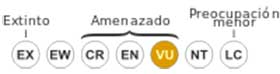
State of conservation ⓘ
Vulnerable ⓘ(UICN)ⓘ
• Current category of the Red List of the UICN: Vulnerable.
• Population trend: Decreasing.
• Population size : 6000-15000
Rationale for the Red List category
This species has a range very small within which its habitat is declining in extent, area and quality; and additional reductions of the population are being caused by the trampeo and predation, qualifying the species as Vulnerable. Currently it does not qualify as endangered because the habitat is severely fragmented and is known in more than five places. But, the species can requalify for inclusion in a top list in the future due to population decline likely if the three proposed mining concessions Cockpit Country They are awarded.
Justification of the population
Preliminary population estimates are those that best place the world population in the band between 10.000 and 19.999 individuals (S. Koenig in a bit., 2008). This is equivalent to 6,667-13,333 mature individuals, rounded here to 6,000-15,000 mature individuals. Further studies are needed to get an accurate figure.
Justification of trend
The data suggest that decrease of at least 50% of the population of this species could occur in the next 40-50 years as a result of habitat destruction due to three proposed mining concessions, two of which have recently been granted (Koenig, 2008). But, It is not sure if the third concession is granted (S. Koenig in some. 2010), and as such it is projected to suffer a decrease of species 30-49% over the next 37 years (three generations).
Conservation Actions Underway
• CITES Appendix II. protected under the Protection Act Wildlife Jamaica and Endangered Species Act of 2000, which together prohibit keeping the species as a domestic animal and local and international trade.
• Since 1995 He has worked to delineate its distribution, estimate the size of the population, identify long-term factors limiting reproductive performance and train local people in research methods and techniques for monitoring (Davis 1997, BirdLife Jamaica in little 1998).
• There is a permanent campaign of public awareness high-profile to prevent bauxite mining in Cockpit Country, by having the area declared closed to mining by the Minister's Discretion (S. Koenig in some. 2007, 2009).
• Proponents remain optimistic that, while losing a large area of ​​habitat, a large area of mining habitat will be declared closed (S. Koenig in some. 2007, 2009).
• Discussions have started that may lead to the ban the importation of psittacine to Jamaica to reduce the risk of leakage and hybridisation (S. Koenig in some. 2007, 2009).
• There are populations of captive breeding.
Conservation Actions Proposed
• Survey to delineate the range and evaluate the numbers (BirdLife Jamaica in little 1998).
• Design and implement Educational programs in the area occupied by the species and adjacent areas (BirdLife Jamaica in little 1998) and develop a structured captive breeding program.
• Improve the application of the legislation against poaching.
The Black-billed Parrot in captivity:
CITES Appendix II. protected under the Protection Act Wildlife Jamaica and Endangered Species Act of 2000, which together prohibit keeping the species as a domestic animal and local and international trade.
Populations of captive breeding.
Alternative names:
– Black-billed Parrot, Active Amazon, Active Parrot, All-green Amazon, All-green Parrot, Black billed Parrot, Black-billed Amazon (English).
– Amazone verte (French).
– Rotspiegelamazone (German).
– Papagaio-de-bico-preto (Portuguese).
– Amazona de Pico Negro, Amazona Jamaicana Piquioscura (español).
Avibase
Parrots of the World – Forshaw Joseph M
Parrots A Guide to the Parrots of the World – Tony Juniper & Mike Parr Birdlife
Photos:
(1) – A Black-billed Parrot in Jamaica By Ron Knight from Seaford, East Sussex, United Kingdom (Black-billed Parrot) [CC BY 2.0], via Wikimedia Commons
(2) – Amazona agilis in Wuppertal zoo By Simon J. Tonge [CC BY 3.0], via Wikimedia Commons
(3) – A Black-billed Amazon at Vienna Zoo, Schonbrunn Palace, Vienna, Austria By Alois Staudacher (Rotspiegelamazone) [CC BY 2.0], via Wikimedia Commons
(4) – A Black-billed Amazon at Vienna Zoo, Schonbrunn Palace, Vienna, Austria By Alois Staudacher (Rotspiegelamazone) [CC BY 2.0], via Wikimedia Commons
(5) – A Black-billed Parrot in Jamaica By Ron Knight from Seaford, East Sussex, United Kingdom (Black-billed Parrot) [CC BY 2.0], via Wikimedia Commons
(6) – A Black-billed Amazon at Vienna Zoo, Schonbrunn Palace, Vienna, Austria By Alois Staudacher (Rotspiegelamazone) [CC BY 2.0], via Wikimedia Commons
(7) – Black-billed Amazon in the John Crow Mountains, Portland, Jamaica By Brennan Mulrooney (originally posted to Flickr as Black-billed Parrot) [CC BY 2.0], via Wikimedia Commons
(8) – A Black-billed Parrot in Jamaica By Ron Knight from Seaford, East Sussex, United Kingdom (Black-billed Parrot) [CC BY 2.0], via Wikimedia Commons
(9) – Psittacus agilis By Barraband, Jacques; Bouquet; Le Vaillant, François [CC BY 2.0 or Public domain], via Wikimedia Commons
(10) – [Little green parrot (Black-billed Amazon [Amazona agilis])] From Natural History of Parrots (by Francois Levaillant, 1801-1805) by Jacques Barraband – Wikimedia
Of 25-30 cm. length; 70-169 grams and a wingspan of 46 cm..
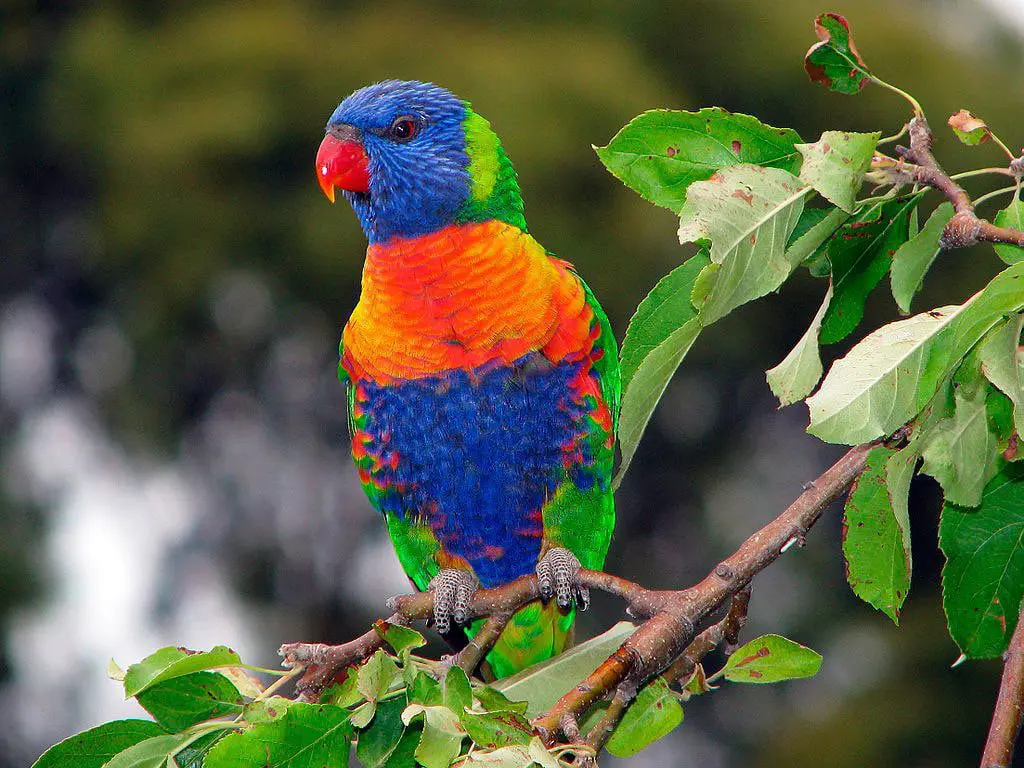
The plumage of the Rainbow Lorikeet(Trichoglossus moluccanus) is very bright. The head is deep blue with a neck greenish-yellow and the rest of the upperparts (wings, back and tail) are deep green. The chest is red with blue-black barring.. The belly is deep green, and the thighs and rump are yellow with deep green barring.. In flight, a yellow wing-bar contrasts clearly with the red underwing-coverts.
There is little to visually distinguish between the sexes; However, for an acute observer, their dimorphism is readily apparent.
The youth has bill black, which gradually brightens to orange in the adults..
The markings of Trichoglossus moluccanus resemble of the Coconut Lorikeet(Trichoglossus haematodus), but with a belly blue and breast with little or no blue-black barring..
Rainbow Lorikeet taxonomy
With one exception, the species have been treated so far as a group of subspecies within the extended group Coconut Lorikeet(Trichoglossus haematodus), but they differ from the Trichoglossus haematodus her pale red breast without bars ; its blue belly against green or blackish; its pale blue hood without black edge and its larger size.
The subspecies Trichoglossus moluccanus eyrei (South of Australia) It is included within the species nominal. Small hybrid population of present species paired with the Musk Lorikeet(Glossopsitta concinna) in SE Southern Australia (Yorke Peninsula).
Sound of the Rainbow Lorikeet. (1)
(1) Some species are under extreme pressure because of traps and harassment. So, the open availability of high-quality recordings of these species may further worsen the problems, this being the reason why downloading these recordings is off. In conclusion, recorders themselves are free to share these files on xeno-canto, but they will have to approve access to these recordings.
We do not take this action lightly, and we wish it wasn't necessary, but we are convinced that the negative impacts of offering easy access to these recordings outweigh the benefits. To access these recordings, You can contact directly with the recorder.
(Robinson, 1900) – As the species nominal but with brighter purple/blue stripes on the head and tail shorter.
Habitat:
The Rainbow Lorikeet often they travel together in pairs and occasionally respond to calls to fly like a flock, then they disperse again in pairs. Couples aggressively defend their feeding and nesting against other lstallion arcoiris and other bird species. Not only they scare off smaller birds, as the Noisy Miner(Manorina melanocephala) and the Brush Wattlebird(Anthochaera chrysoptera), but also to larger, as the Australian Magpie(Gymnorhina tibicen).
Reproduction:
In Australia, Reproduction usually takes place during spring (from September to December), but it may vary from one region to another with changes in food availability and climate. Sites nesting They are variable and may include gaps as tall trees eucalyptus, trunks of palm trees or overhanging rocks.
Couples sometimes nest in the same tree with other couples Rainbow Lorikeet or other species of birds. The clutch size is between one and three eggs, which are incubated for about 25 days. Incubation tasks are performed by the female alone.
The Rainbow Lorikeet are mostly monogamous and remain paired for long periods, if not for life.
Extension of the distribution (breeding/resident): 3,810,000 km2
Endemic East and Southeast Australia (of Cape York to the Eyre Peninsula, South of Australia)
They were recorded for the first time in Perth in 1968 and the population is believed to have come from fewer than ten birds that were deliberately released or had escaped from aviaries.
Since the beginning of the decade 1960, the population has grown exponentially and has spread rapidly throughout 174 km2 metropolitan area. The current population is estimated at 8.400 birds and their range is expanding at a rate of 0,7 km per year.
(Robinson, 1900) – North of Queensland (Cape York Peninsula), in northwestern Australia; also the Torres Strait Islands (Boigu and Saibai except, at the north end) and it was introduced in the district of Perth, in southwest Australia..
Conservation "Rainbow Lorikeet":
1. Current red list category of the UICN: Least concern.
2. The population trend: Decreasing.
3. Population size : Unknown.
Rationale for the Red List category
This species has a extremely large distribution area, and therefore does not approach the thresholds for Vulnerable under the criteria of size range (Extent of Occurrence <20,000 km2 combined with a decreasing area size or fluctuating distribution, extension / habitat quality, or population size and a small number of places or severe fragmentation). While the trend of the population seems to be decreasing, the decline is not believed to be rapid enough to approach the Vulnerable thresholds according to the population trend criterion (decrease of more than 30% in ten years or three generations).
The population size has not been quantified, but it is not believed to approach the thresholds for Vulnerable under the criterion of population size (<10.000 mature individuals with an estimated continuous decrease in> 10% in ten years or three generations, or with a specific population structure). For these reasons, the species is assessed as Least concern.
Justification of the population
Global population size has not been quantified, but the species is described as abundant in northern Australia and rare Tasmania(pit et to the. 1997).
Justification trend
They suspected that the population is declining due to unsustainable levels of exploitation.
Rainbow Lori Threats
The species has been the subject of a intense trade: from 1981, When it was included in the Appendix II of the CITES, they have been 100.388 individuals caught in international trade (UNEP-WCMC CITES Trade Database, January 2005).
In captivity:
Not very common. Its longevity It 20 years en libertad, 15-25 years in captivity and its market price is around wild birds 250 EUR.
Alternative names:
– Rainbow Lorikeet, Rainbow Lorikeet (Rainbow) (English).
– Loriquet à tête bleue (de Swainson), Loriquet à tête bleue (moluccanus), Loriquet arc-en-ciel, Loriquet de Swainson (French).
– Regenbogenlori (German).
– Lóris-molucano, Periquito-arco-íris (moluccanus) (Portuguese).
– Lori arcoiris, Lori de Arco Iris (español).
(1) – A Rainbow Lorikeet Trichoglossus moluccanus in Melbourne, Australia by Alfred Sin [CC BY-SA 2.0], via Wikimedia Commons
(2) – Rainbow Lorikeet Trichoglossus moluccanus on a garden bird feeder, Sydney, Australia by Tim Douglas from Sydney, Australia [CC BY-SA 2.0], via Wikimedia Commons
(3) – Rainbow Lorikeets (Trichoglossus moluccanus) feeding frenzy South Molle Island, Airlie Beach, Central Queensland, AUSTRALIA by Bernard DUPONT – Flickr
(4) – Rainbow Lorikeet (Trichoglossus moluccanus) Kangaroo Flat, Vic by patrickkavanagh – Flickr
(5) – Rainbow Lorikeet Trichoglossus moluccanus, Daintree Village, Queensland, Australia by JJ Harrison (jjharrison89@facebook.com) [GFDL or CC BY 3.0], from Wikimedia Commons
(6) – Rainbow Lorikeets Trichoglossus moluccanus in Broulee, New South Wales, Australia by Steve Shattuck from Canberra, Australia [CC BY 2.0], via Wikimedia Commons
(7) – Trichoglossus moluccanus by Skitterphoto [CC0], via Wikimedia Commons
(8) – Rainbow lorikeet, Trichoglossus moluccanus, Royal Botanic Gardens, Melbourne, Australia by Derek Keats from Johannesburg, South Africa [CC BY 2.0], via Wikimedia Commons
(9) – Rainbow Lorikeets Trichoglossus moluccanus at a bird feeder in Narooma, New South Wales, Australia by Robyn Jay [CC BY-SA 2.0], via Wikimedia Commons
(10) – A digital image of Trichoglossus moluccanus, by the esteemed scientific illustrator Ferdinand Bauer [Public domain], via Wikimedia Commons
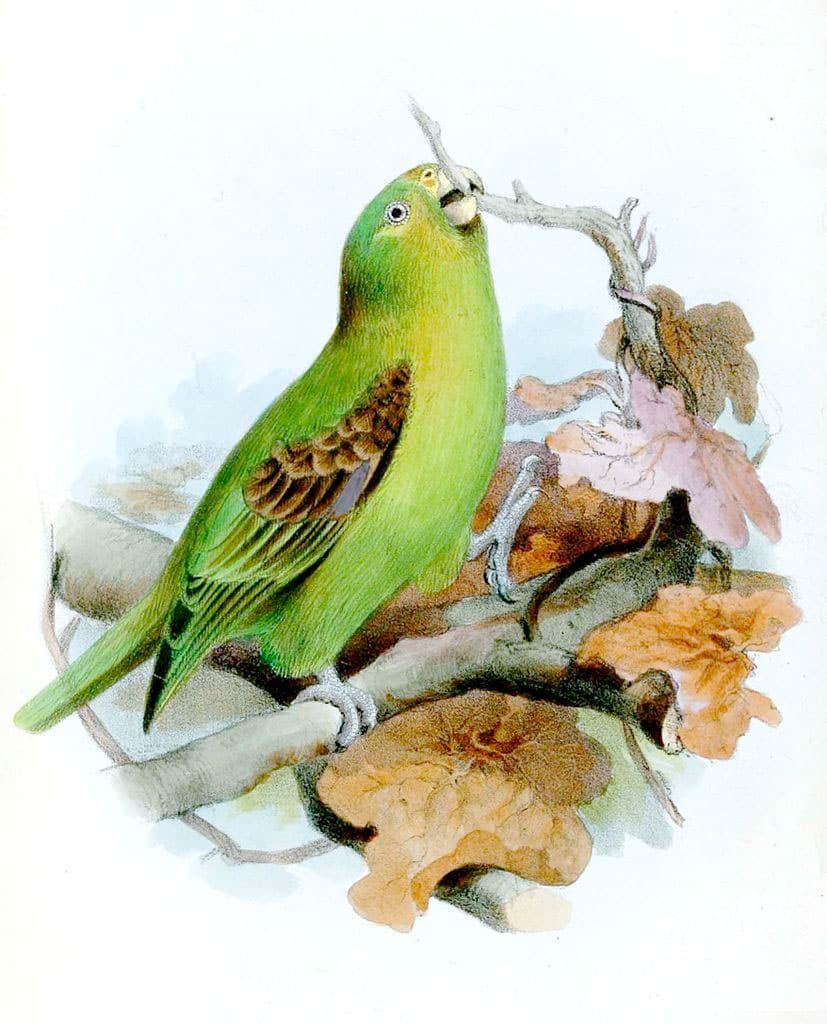
The Spot-winged Parrotlet(Touit stictopterus) It has a green overall coloration, clearer to the abdomen, wings brownish with white spots; below the tail opaque olive is yellow with blue edge.
The female differs from the male by feathers middle-lower wing
which they are green; the forecrown and the face They are yellowish green.
Very rare species. Observed at the local level and in low densities in a Habitat in decline. Its population It is likely to be small and declining, with very small sub-populations in each known locality. It inhabits in semi-humid cloud forests and seasonal crop areas, between 600 and 2400 m. Apparently performs altitudinal migrations, Perhaps conditioned by the supply of food.
Reproduction:
The reproduction It is performed in March.
Food:
They feed on fruit and corn.
Distribution:
Size of the area of distribution (reproduction / resident): 129.000 km2
It lives in the wild in the Andes, southern Central cordilleras and Eastern in Colombia, western Ecuador and North of Peru.
Conservation:
State of conservation ⓘ
Vulnerable ⓘ(UICN)ⓘ
Globally it is in the category vulnerable (VU) and in Colombiain danger of extinction (IN). Deforestation in Andes It is their main threat.
"Spot-winged Parrotlet" in captivity:
Because of its condition It is not recommended that you keep this bird as a pet.
31 cm.. length and an approximate weight of 170 gr.
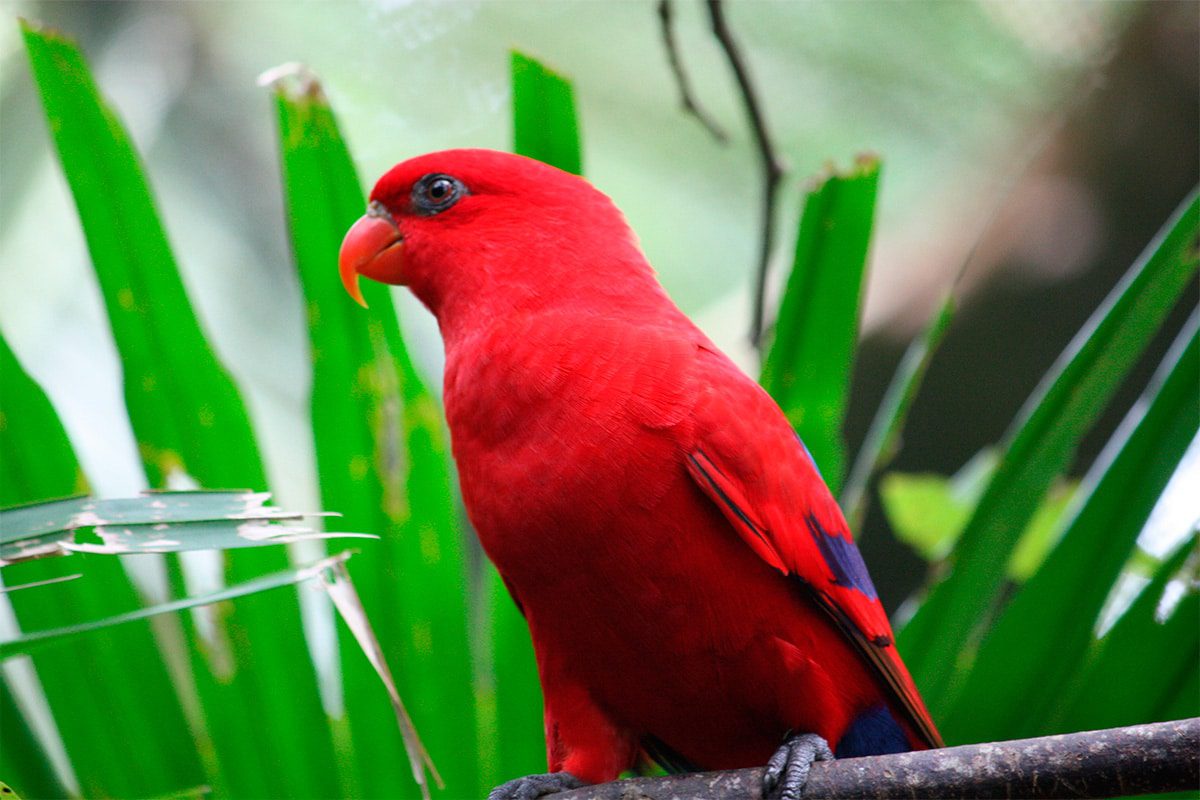
The head and the neck of the Red Lory(Eos bornea) are entirely of a deep red color.
In the adult the primary feathers are black with a large red mirror. The feathers tertiary and the coverts are of color blue. The joint of the feathers of the helmsman they are reddish-brown. The irises they are red, legs grayscale and the bill dark orange.
The immature they tend to be more off than their parents coloring. They show the feathers tertiary grey, lightly stained blue. The ear-coverts Sometimes it tinges of blue. Times, the area of the vent and the thighs it infiltrates with small stains blue. The feathers of the abdomen often carry some edges blue dark. They have the irises brown.
Not exists no sexual dimorphism visible although the males tend to be more corpulent that the females.
(Vieillot, 1818) – The Red of his plumage is much more dark almost brown.
Habitat:
They are mostly primary forests, in the wooded areas during regeneration, Forest Hills, coconut plantations, in abandoned gardens and mangroves.
They are mainly in coastal areas, What does not climb up to 900 m in the island of Ceram and up 1.800 m in the of Buru.
Throughout its area, the Red Lory are fairly common, However, some populations are more dispersed around the villages, since they are very cautious towards humans.
Behavior:
The Red Lory they live in pairs or in small groups, but sometimes you can observe large flocks of 50 individuals.
They are birds noisy and quite easy to observe, as they often fly above the canopy attracted by the red flowers of the tree of coral (Erythrina).
They have a fast and direct flight and when moving, make your buzz due to its quick flapping.
In the Kai Islands, their movements are common: all days, they cross the arm of sea that separates the different islands flying rapidly and at high altitude.
During the rest hours that occur at noon, the Red Lory they spend most of their time smoothing their feathers in the shade of a tree. Probably, This practice is designed to strengthen marital ties. Parties that enjoy priority are the head and neck; as you can not reach these areas with its beak, you will always need your partner collaboration. The "patient" that undergoes this preferential treatment seems to express a great sense of satisfaction.
Reproduction:
The couples begin to look for the location of the nest between the months of August and September. It is located high in a big tree.
In mid-December some young leaving the nest have observed.
As in all loris, the nesting period is very long and hard 7 to 9 weeks.
In captivity, the Red Lory puts 1 or 2 litters per year. Each spawning has usually 2 white eggs that are incubated for a period ranging from 24 to 26 days.
Food:
In their natural habitats, the Red Lory feed of nectar, pollen, fruits and insects of fashion casual.
Your food › seem to be them flowers of the trees of the species Eugenia and Erythrina.
All the Loris they have a language that is especially suited, with a brush tip made up of elongated papillae. This characteristic allows birds to collect pollen from flowers and compress it in a suitable way for swallowing.. They play an important role in the pollination of flowering plants and trees.
Distribution:
Size of the area of distribution (reproduction / resident): 57.900 km2
The Red Lory they have a very restricted distribution area. They live South of the Moluccan Islands, halfway between Sulawesi and the western end of New Guinea.
This species has a very large range, and therefore not approaching the thresholds for Vulnerable according to the range size criterion.
The population is suspected of being in decline due to unsustainable levels of exploitation.
The species has undergone intense trade from 1981, When it began trading in Appendix II. 99.834 wild-caught specimens have been recorded in international trade, Although none from 2000 (UNEP-WCMC trade database, January 2005 CITES).
"Red Lory" in captivity:
This lori is considered one of the most widespread within poultry. It's an interesting bird, robust and easy of play, ideal for a start in the world of the loris. It also has a very attractive red color; It playful and is easy for tame.
It is a great conversationalist. Some have entire sentences in their vocabulary. Unfortunately, his voice is sometimes very strong, with a high sharp squeal. Most are docile, even at maturity. They can be prolific breeders and are fairly easy to find as hand-raised pets..
Too much protein in the diet can lead to gout., a type of arthritis that crystals are deposited in the joints. May be a bit uncomfortable due to liquid diet.
Alternative names:
– Red Lory, Buru Red Lory (ingles).
– Lori écarlate, Lori rouge (French).
– Rotlori (German).
– Lóris-vermelho (Portuguese).
– Lori Rojo (español).
* A Red Lorry at Taronga Zoo, Sydney, Australia by Navin – wikimdia
* Red Lory (Eos bornea) looking upwards by shahram sharif – Wikimedia
* Red Lory (Eos bornea) at Singapore Zoo by Joost Rooijmans – Wikimedia
* Red Lory – KL Bird Park – Malaysia by diego_cue – Panoramio
* Moluccan Red Lory – Parrots Australia
















.jpg)


-6.jpg#/media/File:Turquoise_Parrot_(Neophema_pulchella)-6.jpg)


_-on_branch-3cp.jpg)


.jpg)


.jpg)


.jpg)
.jpg)
.jpg)


.jpg)


