โ–ท The world of Pets: Dogs, cats, birds, reptiles, amphibians

English Cocker Spaniel
Inglaterra FCI 5 . Flushing Dogs

Cocker Spaniel Inglรฉs

The English Cocker Spaniel he is a sweet and affectionate dog. Excellent guard and loving with children.

Content

History

The term spaniel it applied to any dog รขโ‚ฌโ€นรขโ‚ฌโ€นthat hunted game birds and pulled. Usually they distinguished by their size or the way they work. These may include, there was spaniels land and spaniels water. The dogs that hunted woodcocks were known as Cockers, while the larger spaniels that 'pulled' game from cover by flushing were known as Springers. At any given time, different types could be born in the same litter, but eventually they separated in races: Cocker Spaniels and English Springer Spaniel.

In the United States and Britain, the Cocker They developed a different aspect, while began to be considered separate races. The Club of the English Cocker Spaniel America was formed in 1935 for people who appreciate the look and the different skills of the English Cocker. The American Kennel Club recognized him as an individual race 1946. The American Cocker It became more popular, but fans of the English Cocker consider their dogs a well kept secret. Today, the English Cocker ranks 66 between breeds registered by the AKC.

Physical characteristics

The English Cocker Spaniel, It has the benefit of having many coat colors, and each can have their favorite color. However the selection of the color does not have any influence or precedent on health.

There are two varieties of Cocker Spaniel, the English Cocker Spaniel, from Wales and the American Cocker Spaniel, It is resulting from the adjustment of the English Cocker Spaniel to United States.

The English Cocker Spaniel It is a strong dog, Atlรฉtico, Compact and balanced, they weigh in 12 to 15 Kg. In them, the extent of the ground to the cross (39 to 41 cm.) and this at the tail is equal, approximately. The body of the dog is compact, with a well developed chest and possess a slight tilt from the back to the tail.

The legs are strong and muscular, especially the rear. The wide head, Lightweight aspect, with a large truffle. The English Cocker Spaniel ears are lobular shape and low insertion, at the height of the eyes. It has large eyes. They tend to be Brown, almost dark, although some Cocker they have clear.

The expression of eyes is intelligent, alert, bright and cheerful. You can see this dog in multiple colors. Copies of solid color only allows a white patch on the chest.

Character and skills

The English Cocker Spaniel, It is currently a very popular dog as a companion pet., for those who enjoy the countryside. To develop this race in Wales The aim was to get a dog that would chase the chickens, herding them from their hiding places in the bushes.. Its versatility grew up and went when they realized that this dog was happy in a different position and was also able to swim.

They enjoy playing with children (especially the females) provided that these comply, It should educate the can so that it does not jump on infants.

While they are dogs that like to play is recommended to be very careful in dealing with these animals due to his hyperactive character.

It is a sweet and affectionate dog. Excellent guard and loving with children. Although it is sometimes dominant. Why should be severe education from the beginning. It is a very active dog, cheerful and curious. He likes to be in family or accompanied by. It is a very sensitive breed, If it is many hours alone will be sad. You need love, care in your coat if you want to leave the long skirt.

Grooming

Your fur needs cut and this must be done by a professional, or the owner can acquire appropriate equipment and learn to do it himself, on the instructions of the breeder. Depending on each country, There are generally different options of professionals specialized in the grooming of pets in each city, and usually they also provide the service to pick them up and bring them back home when the Cocker It is elegantly trimmed.

The upper teeth close over the lower teeth and are square in the jaw, and they must be cleaned regularly. Nails should be trimmed as needed. The long ears should be revised weekly and special attention, cleaning up any dirt, grass, seeds, excrement, and other waste that have been able to adhere to the same, Since as you said, they are very susceptible to suffering otitis by his excessive Seborrheic secretion. It is also common for them to have a large number of warts..

Health

All purebred dogs have the potential to develop genetic health problems, just as all people have the potential to inherit diseases. Avoid any breeder who does not offer a health guarantee on puppies., I say that race has no known problems, or keep the cubs isolated from the main part of the home for health reasons. A reputable breeder will be honest and open about the health problems of race and incidence occurring with.

The English Cockers They have some health conditions that may be of concern. They include progressive retinal atrophy, the patellar luxation, cataracts, immune-mediated hemolytic anemia, ear infections, kidney failure juvenile onset, Hypothyroidism and, in particular, hearing loss.

Remember that after bringing a new puppy to your home, You have the power to protect one of the most common health problems: the obesity. Keep a English Cocker with a proper weight is one of the easiest ways to prolong your life. Make the most of your preventative abilities to help ensure a healthier dog for life.

Characteristics "English Cocker Spaniel"

Coexistence is important that you have with your new friend. Before considering the acquisition of a dog of the breed "English Cocker Spaniel" you know certain factors. Not all breeds of dogs are apt to live in an apartment, you must take into account his character, their need for exercise, their interaction with other pets, their care and if you have small children, their level of tolerance towards them.

Adaptation โ“˜

5,0 of 5 stars (based on 1 review)

friendly dog โ€‹โ€‹โ“˜

5,0 of 5 stars (based on 1 review)

hair loss โ“˜

4,0 of 5 stars (based on 1 review)

Affection level โ“˜

5,0 of 5 stars (based on 1 review)

Need for exercise โ“˜

4,0 of 5 stars (based on 1 review)

Social need โ“˜

4,0 of 5 stars (based on 1 review)

Home โ“˜

5,0 of 5 stars (based on 1 review)

Toilet โ“˜

4,0 of 5 stars (based on 1 review)

Friendly with strangers โ“˜

3,0 of 5 stars (based on 1 review)

barking โ“˜

3,0 of 5 stars (based on 1 review)

Health โ“˜

3,0 of 5 stars (based on 1 review)

Territorial โ“˜

2,0 of 5 stars (based on 1 review)

Cat friendly โ“˜

4,0 of 5 stars (based on 1 review)

Intelligence โ“˜

4,0 of 5 stars (based on 1 review)

Versatility โ“˜

5,0 of 5 stars (based on 1 review)

Child friendly โ“˜

5,0 of 5 stars (based on 1 review)

Surveillance โ“˜

4,0 of 5 stars (based on 1 review)

joy โ“˜

5,0 of 5 stars (based on 1 review)

Images "English Cocker Spaniel"

credits:

1. An English Cocker Spaniel at a dog show by Pleple2000, corected by Torn
2. Cocker Spaniel Inglรฉs by https://pxhere.com/es/photo/1204664
3. English Cocker Spaniel, 8 months old by John / CC BY
4. English Cocker Spaniel by Loyalty4life / Public domain
5. English Cocker Spaniel by https://www.needpix.com/photo/983524/cocker-spaniel-english-cocker-spaniel-coker-spaniel-dog-doggy-it-lies-resting-their
6. A red and white ticked male English Cocker Spaniel. by eNil / CC BY

Videos "English Cocker Spaniel"

Type and recognitions:

  • FCI CLASSIFICATION:
  • Group :
  • Section : . .

Federations:

FCI โ“˜, AKC โ“˜, ANKC โ“˜, CKC โ“˜, โ€‹KC โ“˜, NZKC โ“˜, UKC โ“˜

FCI breed standard English Cocker Spaniel

FCIFCI - English Cocker Spaniel
Cocker

Alternative names:

1. English Cocker Spaniel, Cocker (English).
2. Cocker spaniel anglais (French).
3. English Cocker Spaniel (German).
4. English Cocker Spaniel (Portuguese).
5. Cocker Spaniel Inglรฉs, Cocker (espaรฑol).

โ–ท The world of Pets: Dogs, cats, birds, reptiles, amphibians

American Cocker Spaniel
USA FCI 167 . Flushing Dogs

Cocker Spaniel Americano

The American Cocker Spaniel will go is easy to train, friendly and playful, and loves to splash around in the water.

Content

History

The references to the ยซSpanyellsยป date from the 14th century. Different types of spaniels They evolved over the centuries, some working on collecting land and other water birds. the Cocker, hunting and hunting under the command retrieves, It derives its name from his skill in hunting woodcock, a type of wader.

The spaniels they used to be sorted by size, and different types of spaniels could be born in the same litter. Eventually, The different types of spanieles They became individual races, and so it was with him Cocker. For 1946 the size and appearance of the Cocker and what is now the English Cocker Spaniel they had changed enough for the two to split into separate races.

The popularity of the Cocker spiked after the release of the classic Disney film โ€œLady and the Trampโ€ in 1955. The immense popularity fueled an increase in bad parenting that resulted in some bad temperaments, but the breeders American Cocker Spaniel They have worked hard to correct the situation. But, It's still important today to find a responsible breeder who maintains the breed's hallmark cheerful disposition rather than continuing to bring out the fearful, gruff dogs that nearly ruined the breed..

Until 1990, the American Cocker Spaniel It was the most popular breed registered by the American Kennel Club. Today it is ranked 25, but you will always have a place among people who appreciate its moderate size, sweet nature and intelligence.

Physical characteristics

The American Cocker Spaniel It is the smallest member of the sporting dogs hunting. His body is strong, compact, delicately modeled head and refined. As a whole, It is a dog well balanced and ideal size. Well shoulders upright on a straight forelegs, its topline slopes slightly towards strong hindquarters, muscled and moderately angulated. A dog is able to develop a considerable speed, combined with a lot of resistance. Above all, It must be a brash and cheerful dog, healthy and well balanced in all its parts; vehement action shows inclination towards work. A well-balanced dog in all its parts is more desirable than a dog with strong contrasting good features and flaws..

The females weigh on average 9 to 12 kg and have a size of 34 to 36 cm., While males weigh in 10 to 13 kg and measure of 37 to 39 cm..

Character and skills

Cheerful and lively, the American Cocker Spaniel It's also smart and confident. Although it still retains a strong hunting instinct, It is often a housemate. With her family is loving and docile. It may be a bit reserved at the beginning with strangers, but soon makes friends. Cockers can be good companions for children. when they grow up together, They can make friends with other pets, including cats, but birds can be an irresistible lure – and not in a good way.

The Cocker It is highly trainable, but it has a sensitive soul. Early socialization is critical, and even with it some Cockers submissively urinate when your people get home or when they meet new people or dogs or go to new places. Focused training with positive reinforcement methods, especially praise and food rewards.

The Cocker It can be good in the field tests and as a hunting dog, although for years he was thought of as "just" a companion. One Cocker It is versatile and can do much more than walk around the house, but he is happy to do it because you love being with you.

any dog, no matter how pleasant it, detestable levels can develop barking, excavations and other undesirable behavior if you are bored, He is not trained or are unsupervised. And any dog รขโ‚ฌโ€นรขโ‚ฌโ€นcan be a test that live during adolescence. In the case of the Cocker, The "adolescence" years begin at six months and continue until the dog is one year old. Barking can be a problem unless the frenes.

Start training your puppy the day you bring him home. Even at eight weeks old, He is able to absorb everything you can teach. Don't wait until you have 6 months to start training him or you'll have to deal with a more stubborn dog. If possible, take him to puppy kindergarten class when he's between 10 and 12 weeks, y socialize, socialize, socialize.

But, Note that many kinds of training puppies require certain vaccinations (such as kennel cough) stay up to date, and many veterinarians recommend limited exposure to other dogs and public places until puppy vaccinations (including rabies, distemper and parvovirus) They are completed. Instead of formal training, You can start training your puppy to socialize at home and among family and friends until immunizations are completed in the puppy.

Talk to the breeder, It describes exactly what you are looking for a dog and asks for help to select a puppy. Breeders see puppies daily and can make incredibly accurate recommendations once they know something about their lifestyle and personality.

The American Cocker Spaniel Perfect not fully formed out of the whelping box. It is a product of his background and upbringing. Cockers are bred too much in the past, sometimes resulting in a fearful dog, slightly scary in no way represents a good breeding Cocker. Look for one whose parents have good personalities and has been well socialized from an early age puppy.

ยซAmerican Cocker Spanielยป Grooming

Beautiful silky coat Cocker seen in dogs in the exhibition circuit does not occur by chance. It takes a lot of work to keep it shiny and tangle. For good reason, most people keep their pets in a trim everywhere, known as cut puppy. Even that requires some maintenance. Dogs with cuts puppy should be bathed, brushed and cut approximately every two weeks.

If you want long flowing coat, You must be more careful and time, and usually the bathroom, brushing and trimming are done once a week. Most people choose to wear their Cocker a professional groomer, but you can learn to do it yourself. The cost of the equipment amounts to only a few grooming sessions, you will not have to ask for appointments and you will discover that you increase your bond with your Cocker. But, the toilet is not for everyone, so if you don't want to do it, find a hairdresser you like because it is an absolute requirement for a Cocker.

Like the ears of Cocker They are prone to infections, check them weekly to make sure the inside is a healthy, deep pink color and free of a bad odor. If that is not the case, get to the vet quickly before the ear infection becomes a major problem. Take special care when checking a puppy's ears as there is a significant buildup of wax as the ear canal develops. Clean the ears with a solution recommended by the veterinarian.

The rest is basic care. Cut toenails every few weeks. Should never last long enough to drown out the noise from the floor. Long nails can make uncomfortable walking in the Cocker, and they can get caught on things and tear. That is so painful, and bleed much. Brush your teeth often for good dental health and fresh breath.

Health ยซAmerican Cocker Spanielยป

All dogs have the potential to develop genetic health problems, just as all people have the potential to inherit a particular disease. Run, not walk, from any breeder that does not offer a health guarantee on puppies, tell you that race is 100 percent healthy and has no known problems, or to tell you that their puppies are isolated from the main part of the home for health reasons. A reputable breeder will be honest and open about the breed's health problems and the incidence with which they occur in their lines.. Here is a brief summary of what you should know about the health of the Cocker.

The American Cocker Spaniel are susceptible to a number of health problems that are, at least in part, genetic. These include many different eye disorders, including cataracts and glaucoma, as well as painful defects of the hips and knees.

Disc disease can cause the movement is painful for the American Cocker Spaniel, which it is by nature an active dog who loves to run and play. Heart diseases, liver, epilepsy… the Cocker It is at risk of all.

The variety of eye problems that can afflict the Cocker Spaniel ranging from the aesthetic – a condition called "cherry eye" that can be corrected through surgery – and sight-threatening, including cataracts and glaucoma. While many Cocker completely lose vision in old age, some may already losing two years of age due to progressive retinal atrophy. The Cockers They are also prone to keratoconjunctivitis sicca, a condition known as dry eye, a deficiency of tears that can lead to corneal problems.

Make sure your pet's eyes are examined by a board-certified veterinary ophthalmologist. Cocker Spaniel once a year and seeking veterinary attention immediately for any signs of vision loss, cloudiness, redness, eye irritation or if the dog squints or bumble.

The Cockers They may also have hypothyroidism, It is underproduction of thyroid hormone. This can cause weight gain, lethargy, loss of hair, chills and skin infections. a blood test whenever a suspected thyroid disease should be. Skin problems also may indicate allergies, which they are common in the breed, As to the skin masses, which may be benign or cancerous.

Some Cocker Spaniels They seem to be prone to congenital deafness, associated with white hair and blue eyes. At the age of three or four weeks, in some of these dogs the blood supply to the inner ear is degenerated. It can occur in one or both ears and is permanent.

those long ears spaniel tend to trap warm, moist air inside the ear canals, creating the perfect environment for the growth of bacteria and yeast, that lead to ear infections. Ear infections can be chronic in some dogs with long ears, so it is necessary to be aware of the care of the ears and clean them religiously. Repeated infections can cause so much damage to the ear canal that the dog will lose their hearing. Severely affected ears may require surgery. Follow-up care is especially important for the ear to prevent new flare-ups of old problems..

Many Cocker Spaniels are prone to autoimmune hemolytic anemia (AIHA), in which the immune system attacks the dog its own red blood cells to the point that the dog becomes anemic. Although there is treatment, the mortality rate is high.

Not all of these conditions are detectable on a growing puppy, and it is impossible to predict if an animal will be free of these diseases, so you need to find a reputable breeder who commit to raise healthier animals possible. They should be able to provide an independent certification that the parents of the dog (and grandparents, etc.) have been examined for common defects and considered healthy for breeding. That's where health records come in..

Careful breeders screen their breeding dogs for genetic diseases and breed only the healthiest, best-looking specimens., but sometimes mother nature has other ideas and a puppy develops one of these diseases despite good husbandry practices. Advances in veterinary medicine mean that in most cases dogs can still live a good life. If you're going to have a puppy, ask the breeder about the ages of the dogs in their lines and what they died of.

Remember that after getting a new puppy at home, You have the power to protect one of the most common health problems: the obesity. Keep a Cocker Spaniel with a proper weight is one of the easiest ways to prolong your life. Make the most of your preventive skills to help ensure a healthier dog for life.

Characteristics "American Cocker Spaniel"

Coexistence is important that you have with your new friend. Before considering the acquisition of a dog of the breed "American Cocker Spaniel" you know certain factors. Not all breeds of dogs are apt to live in an apartment, you must take into account his character, their need for exercise, their interaction with other pets, their care and if you have small children, their level of tolerance towards them.

Adaptation โ“˜

5,0 of 5 stars (based on 1 review)

friendly dog โ€‹โ€‹โ“˜

4,0 of 5 stars (based on 1 review)

hair loss โ“˜

3,0 of 5 stars (based on 1 review)

Affection level โ“˜

5,0 of 5 stars (based on 1 review)

Need for exercise โ“˜

4,0 of 5 stars (based on 1 review)

Social need โ“˜

5,0 of 5 stars (based on 1 review)

Home โ“˜

5,0 of 5 stars (based on 1 review)

Toilet โ“˜

5,0 of 5 stars (based on 1 review)

Friendly with strangers โ“˜

5,0 of 5 stars (based on 1 review)

barking โ“˜

4,0 of 5 stars (based on 1 review)

Health โ“˜

4,0 of 5 stars (based on 1 review)

Territorial โ“˜

3,0 of 5 stars (based on 1 review)

Cat friendly โ“˜

3,0 of 5 stars (based on 1 review)

Intelligence โ“˜

5,0 of 5 stars (based on 1 review)

Versatility โ“˜

5,0 of 5 stars (based on 1 review)

Child friendly โ“˜

5,0 of 5 stars (based on 1 review)

Surveillance โ“˜

4,0 of 5 stars (based on 1 review)

joy โ“˜

3,0 of 5 stars (based on 1 review)

Images "American Cocker Spaniel"

credits:

1. golden-american-cocker-spaniel by www.localpuppybreeders.com
2. American Cocker Spaniel at the Cloisters City Park in Morro Bay, California by "Mike" Michael L. Baird / CC BY
3. Golden American Cocker SpanielRyan Johnson / CC BY-SA
4. American Cocker in Tallinn duo CACIB, 17-18 Aug 2013 by Thomas / CC BY-SA
5. AMERICAN COCKER SPANIEL PUPPY 7 WEEKS – https://commons.wikimedia.org/wiki/File:AMERICAN_COCKER_SPANIEL_PUPPY_7_WEEKS.jpg
6. A black American Cocker Spaniel. By Yoko / CC BY-SA

Videos "American Cocker Spaniel"

Type and recognitions:

  • FCI CLASSIFICATION:
  • Group :
  • Section : . .

Federations:

FCI โ“˜, AKC โ“˜, ANKC โ“˜, CKC โ“˜, โ€‹KC โ“˜, NZKC โ“˜, UKC โ“˜

FCI breed standard American Cocker Spaniel

FCIFCI - American Cocker Spaniel
Cocker

Alternative names:

1. Cocker Spaniel, Cocker, Merry Cocker (English).
2. Cocker (French).
3. American Cocker Spaniel, Cocker (German).
4. American Cocker Spaniel, Cocker (Portuguese).
5. Cocker americano, Cocker spaniel, Cocker (espaรฑol).

โ–ท The world of Pets: Dogs, cats, birds, reptiles, amphibians

Field Spaniel
Inglaterra FCI 123 . Flushing Dogs

The Field Spaniel take his name ยซfieldยป of its great ability to work in open fields.

Field Spaniel

Content

Characteristics "Field Spaniel"

Coexistence is important that you have with your new friend. Before considering the acquisition of a dog of the breed "Field Spaniel" you know certain factors. Not all breeds of dogs are apt to live in an apartment, you must take into account his character, their need for exercise, their interaction with other pets, their care and if you have small children, their level of tolerance towards them.

Adaptation โ“˜

5,0 of 5 stars (based on 1 review)

friendly dog โ€‹โ€‹โ“˜

5,0 of 5 stars (based on 1 review)

hair loss โ“˜

3,0 of 5 stars (based on 1 review)

Affection level โ“˜

5,0 of 5 stars (based on 1 review)

Need for exercise โ“˜

5,0 of 5 stars (based on 1 review)

Social need โ“˜

4,0 of 5 stars (based on 1 review)

Home โ“˜

4,0 of 5 stars (based on 1 review)

Toilet โ“˜

3,0 of 5 stars (based on 1 review)

Friendly with strangers โ“˜

3,0 of 5 stars (based on 1 review)

barking โ“˜

3,0 of 5 stars (based on 1 review)

Health โ“˜

4,0 of 5 stars (based on 1 review)

Territorial โ“˜

2,0 of 5 stars (based on 1 review)

Cat friendly โ“˜

3,0 of 5 stars (based on 1 review)

Intelligence โ“˜

5,0 of 5 stars (based on 1 review)

Versatility โ“˜

5,0 of 5 stars (based on 1 review)

Child friendly โ“˜

5,0 of 5 stars (based on 1 review)

Surveillance โ“˜

3,0 of 5 stars (based on 1 review)

joy โ“˜

5,0 of 5 stars (based on 1 review)

History

The Field Spaniel (Field) is an example of what can go wrong when trying to breed sporting dogs for their looks without considering their use in the field. In the early days of the breed, in the XVIII century, the Spaniels were defined by their size, and it was considered Field Spaniel to any dog รขโ‚ฌโ€นรขโ‚ฌโ€นthat weighed more than 11 kg (25 pounds). The Spaniels smaller ones were known as "Cockers", and both sizes could be born in the same litter. His fur used to be liver, liver and white, red, Red and white, yellow or black and white.

The advent of dog shows in the mid-19th century motivated dog breeders to start considering both appearance and function.. The different was good. This is how the "black spaniel" was born. That was good, but unfortunately the dogs that were long and short – As the "Sussex Spanielยซ- they were popular at dog shows at the time. The breeders began to cross Field Spaniel con ยซSussex Spanielsยซ. How the size of the dogs was so different, the results were disastrous, converting to Field into a heavy, unattractive dog who could barely move. Even so, exaggerated-looking dogs won at shows.

Finally, people came to their senses and the fashion of Field Spaniel finished. Dogs could have gone extinct, but they were revitalized after the First World War through crosses with the "English Springer Spaniel.", that were more suitable for the size of the Field Spaniel. Through careful breeding, their usefulness as hunting dogs was restored, with the ability to cut through brush that was too difficult for the "Springer", and the speed that the ยซSussex" and the "Clumberยซ.

The breed was not yet saved. World War II put an end to breeding, and then only a few good dogs were left. In United States, there was no Field Spaniel until the age of 60. The Field Spaniel Society of America was formed in 1978. Dogs are still little known today, but they are no longer in danger of extinction. The Field Spaniel ranks 132 between breeds registered by the AKC.

Physical characteristics

The Field Spaniel is closely related to the Cocker Spaniel and the "English Springer Spaniel". In the beginning, the three races were separated mainly by size. With a weight range of 15 to 22 Kg, the Field Spaniel It is larger than the ยซCockerยป but smaller than the ยซSpringerยซ. In addition to hunting, competes in field tests and uses his excellent nose in tracking tests. It is a rare breed, but if you are looking for a solid hunter in addition to a family companion, the Field Spaniel is one of those you should consider.

Weight and size:

Females have an approximate size of 43 cm., While the males measure approximately 45 cm.. Its approximate weight varies from 18 – 25 kg.

Character and skills

The Field Spaniel has the typical features of Spaniel: sensitivity, affection for his family and willingness to learn. With strangers, is reserved, even shy if not well socialized, but their owners will experience a playful and mischievous side. It can be a barker when it shows joy or restlessness.

Its medium size and docile character can make it a good choice for families with children.. He also gets along well with pets, as cats, if he grew up with them. But, pet birds may need to watch their tail. Even though i don't hunt, the Field Spaniel he will take every opportunity to hunt birds and will do his best to go after them. Unless you are in an area with no traffic, keep it on a leash or you'll lose it in the chase.

The Field Spaniel is a dog that needs a job. He is not the type of dog that spends the day eating cookies. Take a daily leash walk of at least an hour, take him to safe, traffic-free areas where he can run off-leash and sign him up for dog sports like agility, obedience, rally and crawl.

Education

The Field Spaniel is intelligent and accepts training well. Like most Spaniels, has a mild temperament and responds best to positive reinforcement techniques, like the compliments, the game and the food rewards. Tends to mature slowly, so you must be patient and constant. In the field he has a natural tendency to explore, which can be stopped by teaching commands such as "Come", "Wait" and "Stay".

Start training your puppy the day you bring him home. Even at eight weeks old, is able to absorb everything that can be taught. Don't wait for you to have 6 months to start training or you will have to deal with a stubborn dog. If possible, take him to a kennel school for puppies when he is between 10 and 12 weeks, and socializes.

Health

All dogs have the potential to develop genetic health problems, like all people have the potential to inherit diseases. Avoid any breeder that does not offer a health guarantee for the puppies, to tell you that the breed has no known problems or to keep puppies isolated from the main part of the house for health reasons. A reputable breeder will be honest and open about breed health problems and the incidence with which they occur.

The Field Spaniel They have some health conditions that may be of concern, especially if you are not cautious with breeder selection. Among them are the Hypothyroidism and eye problems such as cataract, progressive retinal atrophy and retinal dysplasia.

Do not buy a puppy from a breeder who cannot provide you with written documentation that the parents have been exempted from health issues affecting the breed. Having dogs โ€œvet checkedโ€ is no substitute for genetic health testing.

Careful breeders screen their breeding dogs for genetic diseases and breed only the healthiest and best-looking dogs, but sometimes mother nature has other ideas. A puppy can develop one of these diseases despite good husbandry practices. Advances in veterinary medicine mean that, In most cases, dogs can still have a good life. If you are getting a puppy, ask the breeder about the ages of the dogs in their lines and what are the most common causes of death.

Remember that after welcoming a new puppy into your home, you have the power to protect you from one of the most common health problems: the obesity. Keeping the dog at an adequate weight is one of the easiest ways to extend its life. Take advantage of your prevention skills to ensure a healthier dog for life.

Grooming

The Field Spaniel has only one coat, that is to say, does not have undercoat. Silky hair is moderately long and can be straight or slightly wavy. The front of the chest, the belly, The back of the legs and hindquarters have fringes like those seen on "Setter" breeds..

The coat is not heavy and it is easy to maintain. You have to brush it weekly and comb its fringes a couple of times a week, or whenever the dog has been outside or has twigs or other debris stuck to the hair. Trim the hair between the paw pads and inside the ears. Bathe the dog only when necessary; regular brushing should keep it pretty clean. The Field Spaniel they molt moderately.

If you plan to expose your Field Spaniel, ask the breeder for advice on how to present the dog at a dog show. You must have a natural look, but may need a little more razor cleaning, scissors and grooming blades of what a pet dog would receive.

The rest is basic care. Trim nails as needed, usually every few weeks. Yes to your Field Spaniel he likes to swim - and even if he doesn't like- keep hanging ears clean and dry to avoid bacterial or fungal infections. Brush your teeth frequently for general good health and fresh breath.

Images "Field Spaniel"

Photos:

1 – Field Spaniel by Peter, CC BY 2.0, via Wikimedia Commons
2 – A Grupp 8: FIELD SPANIEL, Winterbourne Itsy Bitsy Spider by Swedish fair
3 – My dog, Lily, after enjoying a smelly romp through a fetid swamp close to home. what a plague. Lily is a Field Spaniel. by Jo-Anna Ghadban, CC BY 2.0, via Wikimedia Commons
4 – Daisy – Field Spaniel by Peter, CC BY 2.0, via Wikimedia Commons
5 – Field Spaniel In Liver Color by RishiBali, CC BY-SA 3.0, via Wikimedia Commons
6 – Field Spaniel The Westminster Kennel Club 137th Annual All Breed Dog Show February 11-12, 2013 New York, NY by Andrea Arden

Videos "Field Spaniel"

Field spaniel Molly
Playing with Jekku
Valpelek Field Spaniel
Field Spaniel Bite jumps into water

Type and recognitions:

  • FCI CLASSIFICATION:
  • Group :
  • Section : . .

Federations:

  • FCI – Group 8: Retrievers - Flushing Dogs - Water Dogs – Section 2: Retrievers โ“˜
  • AKCSporting โ“˜
  • ANKC Group 3 (Gundogs) โ“˜
  • CKCSporting Dogs โ“˜
  • โ€‹KC – Gundog โ“˜
  • NZKCGundog โ“˜
  • UKCGun Dogs โ“˜

FCI breed standard "Field Spaniel"

Origin:
United Kingdom, England

Date of publication of the valid original standard:
26.03.2009

Use:

Hunting retriever and lifting dog. Ideal for difficult hunting or as a companion for dwellers in rural areas. Not a suitable dog for the city.


General appearance:

Well balanced and noble dog. It is an upright spaniel, sports, developed for activity and endurance.


Behavior / temperament:

It is an upright spaniel, sports, developed for activity and endurance.

Head:

Its features give the impression of quality, character and nobility.

Cranial region:
  • Skull : It is well molded, well-defined occipital region, thin under the eyes; a thickness at this point gives the whole head a rough look. The region of the eye lids is slightly raised.
  • Fronto-nasal depression (Stop) : Is moderate.

facial region:

  • Nose : Well developed, with wide open Windows.
  • Snout : Long and thin, but not pointed or square. Seen in profile, it presents a curvature that gradually descends from the nose to the throat..
  • Jaws/Teeth : Strong JAWS, with healthy and complete teeth; scissor bite, that is, the inner face of the upper incisors is in contact with the outer face of the lower incisors and placed at right angles to the jaws.
  • Eyes : Wide open, but almond shaped, with well-adherent eyelids, without showing the ocular conjunctiva. With grave and gentle expression. dark brown.
  • Ears : Moderately long and wide, set low and well covered with long feather hair.

Neck:

Long, strong and muscular, allowing the dog to collect the prey without undue effort.

Body:

  • Back and kidney region: Strong, level and muscular.
  • Breast : Deep and well developed chest. Ribs moderately sprung. The length of the rib cage should be 2/3 of the body.

Tail:

Previously the custom was to amputate the tail.
  • amputee: Amputated to one third. Low insertion. Never carried above the level of the top line. With good fringe, and lively action.
  • Without amputating: Low insertion. Never carried above the level of the top line. With good fringe, and lively action. It should reach approximately the hocks. Of moderate length in balance with the rest of the dog.


Tips

PREVIOUS MEMBERS: The limbs are of moderate length and straight and flattened bones..

  • Shoulder : Long, oblique and well back.

LATER MEMBERS: Strong and muscular.

  • Knees : Moderately angled.
  • Hocks : They must be well descended.

FEET : compacts, round, not very small with strong footpads.

Movement:

Long stride, slow, with a large drive given by the hind limbs. The short and heavy step is undesirable.

Mantle

HAIR: Long, smooth; its texture is silky and shiny. Never curly, short or hard. Dense and offers weather protection. It should be abundant and feather-shaped on the chest, belly and back of the limbs; However, these should not exist below the tibi-tarsal joints (hocks).

COLOR: Negro, liver or roan. Any of these colors with fire markings. In unicolor dogs, white or roan are allowed on the chest. Combination colors black and white or liver and white are not accepted..


Size and weight:

Approximately 18 '' (18 inches) to the region of the cross.

Weight: Among 18-25 kg (40-55 English pounds).


Fouls:

Any deviation from the aforementioned criteria is considered as a fault and the severity of this is considered to the degree of the deviation to the standard and its consequences on the health and well-being of the dog., and the dog's ability to perform its traditional task.

FALTAS DESCALIFICANTES:

โ€ข Aggressiveness or extreme shyness.
โ€ข Any dog โ€‹โ€‹showing clear signs of physical or behavioral abnormalities.


N.B.:

โ€ข Males must have two normal-appearing testicles fully descended into the scrotum..
โ€ข Only functionally and clinically healthy dogs, with the typical conformation of the breed, should be used for parenting.

Source: F.C.I - International Cynological Federation

Alternative names:

1. Field (English).
2. Field (French).
3. Field (German).
4. Field (Portuguese).
5. Field, Spaniel de campo (espaรฑol).

โ–ท The world of Pets: Dogs, cats, birds, reptiles, amphibians

American Water Spaniel
Estados Unidos FCI 301 . Water Dogs

Perro de Agua Americano

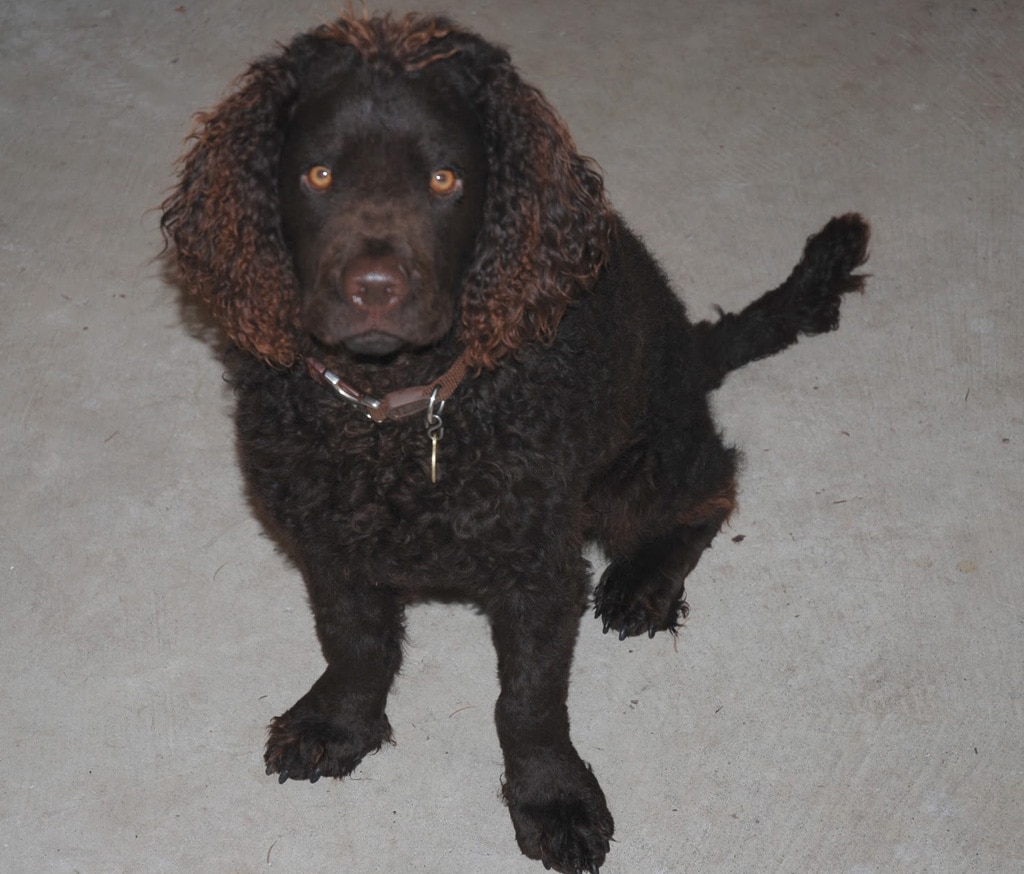
The American Water Spaniel always delivered to work, He is obedient and easy to train..

Content

History

The American Water Spaniel It is a breed of dog originating in United States, little-known outside of North America.

Although the exact origins of the American Water Spaniel remain a mystery, experts agree that it probably developed in the first half of the 19th century in the Fox and Wolf river valleys of Wisconsin, an American state in the Great Lakes region.

During the conquest of the West in the 19th century, European settlers who moved to the Midwest regions of the United States brought their hunting dogs with them to help meet their food needs. Over the years, used various Old World breeds to create a new dog perfectly adapted to the peculiarities of hunting in the Great Lakes region. They needed a versatile animal with an excellent sense of smell, able to work both on land and in water, and expert in recovering downed waterfowl. They also wanted their companion to be compact enough to carry in a small boat or canoe., and could withstand the cold Wisconsin water temperatures.

It is not possible to know with total certainty which races were used to achieve this, but experts believe they were the English Water Spaniel (now extinct), the Irish Water Spaniel, the Curly-coated Retriever, the Poodle and the Sussex Spaniel or other type of Spaniel. Native American dogs were also used in the various crosses.

The small brown animal thus created was known at the time as American Brown Spaniel. It had thick curly fur that protected it from cold water and winter temperatures.. They were used to hunt and retrieve waterfowl, but also for hunting on land, like grouse, quail and pheasant, as well as the occasional rabbit. At the end of the 19th century, the American Brown Spaniel had made a name for itself in the Great Lakes region and enjoyed some popularity with Wisconsin hunters, Michigan y Minnesota.

But, the number of specimens of this breed began to decline rapidly at the beginning of the 20th century, due both to the reduction of the duck population in these areas and to changes in hunting practices. In fact, hunting became at that time a leisure activity, more than in a true feeding medium. It also, hunters began to prefer new European hunting dogs that were larger and more specialized in a specific type of hunting, already were Retrievers, Pointers or Spaniels.

Fortunately, the American Brown Spaniel had an ardent admirer in Dr.. Fred J. Pfeifer, based in New London, Wisconsin. Firmly convinced that this dog should be preserved and recognized, Pfeifer created a kennel dedicated to the breed, Wolf River Cattery, and set out to save it from extinction. He spared no effort to offer his puppies to all corners of the country, mostly through various advertisements.

The American Water Spaniel is probably one of the main races that contributed to the development of the Boykin Spaniel.

The recognition and dissemination of American Water Spaniel

The efforts of Fred Pfeifer and other enthusiasts who joined him paved the way for official recognition of the breed by the United Kennel Club (UKC) in 1920, with the name of American Water Spaniel. It was Pfeifer's own dog, called Curly Pfeifer, the first representative of the breed to be registered with the organization. The breed was also recognized by the Field Dog Stud Book in 1938 and by the American Kennel Club (AKC) in 1940.

The breed took much longer to be recognized in other parts of the world. Like this, acceptance by the Fรฉdรฉration Cynologique Internationale (FCI) did not occur until 1979, followed shortly after by that of British Kennel Club in 1981. The Canadian Kennel Club it is also among the organizations that recognize the race.

Distribution and popularity

In United States, the American Water Spaniel still extremely rare today, with a world population estimated at about 3.000 specimens, most of them in the American Midwest, especially in the states of Wisconsin, Minnesota y Michigan, where it is still very popular with hunters. The race occupies the position 165 (of something less than 200) in the breed classification of the American Kennel Club (AKC) depending on the number of annual registrations in the organization, and the situation has been comparable at least since the beginning of the 21st century. Obviously, the fact that it is one of only two sporting breeds developed in the United States (along with the Chesapeake Bay Retriever) does not seem to be enough to make her popular with the American public.

In the rest of the world, race is even more confidential.

In France, for example, There are less than 10 registrations per year in the Livre des Origines Franรงaises.

In Great Britain, the number of births registered with the Kennel Club is even zero most years.

Physical characteristics

The American Water Spaniel it is a compact dog, medium in size and well muscled. Designed to work in the icy waters and swampy shores of the Great Lakes region of the United States, they are perfectly equipped for it: the pads of its feet are thick, their toes are webbed and small enough to jump off a small boat without capsizing it. It also, their hips and hind legs are strongly developed, which gives it some propulsion force and prevents it from jamming. Like this, is able to break through even on wet hunting grounds.

The head is well proportioned to the body. ears are drooping. The eyes are long and wide, and they can be hazel colored, brown or amber. They contribute to a cheerful expression and a smart look. The nose is black or brown and the nostrils are well developed, which reminds us that this dog was designed to sniff out game. The nose is dominated by tight lips.

The American Water Spaniel has a dense undercoat that greatly protects it from water, extreme temperatures and branches. The top layer is of medium length and can have even waves or tight curls. The density of the latter can vary from one area of โ€‹โ€‹the body to another.. In all cases, the head is covered with short, straight hair and the tail is moderately bushy.

It also, its top layer is naturally very oily to be waterproof and avoid scratches from vegetation. Thus, their fur has a strong odor, and can sometimes leave a greasy stain when rubbed against a wall or furniture.

The coat of the American Water Spaniel it is always uniform and liver-colored, chocolate or black, although a small amount of white hairs are sometimes found on the fingers or on the chest.

Last, sexual dimorphism is quite marked in this breed, since the males are, average, considerably heavier and more massive than females.

The standard the FCI is the same as the American Kennel Club. This indicates that the American Water Spaniel has a size ranging from the 38 to 45 cm and weigh in 13 to 20 kg. Some reaching a height of 50 cm and a weight of 23 kg. This not disqualifies them but costs them points.

Character and skills

Like most hunting dogs, the American Water Spaniel is full of energy and enthusiasm, and you need a good dose of daily exercise and mental stimulation to be balanced. As long as its owner meets your needs, either making them hunt, taking them for a run or letting them play with the children, They are excellent companion dogs..

In fact, he's basically a jolly dog, friendly and loving, eager to please their owners and who likes to spend time with them. You may also become especially fond of the person who dedicates the most time and attention to you., but he is still very friendly with the rest of the tribe.

Usually, have a strong affinity with the youngest, to the point of being a recommended dog breed with children. Inexhaustible, they love spending time with them, entertain them and participate in all kinds of activities with them, either on land or in the water. However, it is important to teach children to interact with them in a respectful way, to avoid any accident. In any case, no dog, whatever race he is and no matter how friendly he is, should be left unsupervised with a young child.

You can play all day and, At night, snuggle into your family's lap for a hug.

Sociable and affectionate with his family, the American Water Spaniel It, on the other hand, shy and suspicious of strangers, without showing aggressiveness. As a result, It may take several introductions before you finally decide to befriend someone you regularly meet..

Nor does he feel very comfortable with his companions, and can sometimes be territorial and aggressive towards them. But, if you share your home with one of them or with a cat, considers you as a full member of your family, so normally there is no problem. This is even more true if you are used to being with him from a young age..

The same cannot be said for a possible coexistence with a rodent or a bird., even if it starts when he is still very young. In fact, the hunting instinct that makes him chase these species when he finds them during his walks could lead him to do the same at any moment, and thus put an end to said coexistence.

Letting him live with a dog or cat is not without interest in any case., because his proximity to his masters makes him easily suffer from separation anxiety if he stays alone for more than a few hours. So it's likely to bark excessively, which can quickly become a source of tension with neighbors. The presence of a little companion can keep you busy and ease your anxieties., although the best is, Obviously, have your family at home as often as possible. In any case, this dog is not really adapted for people who generally spend their days away from home.

Developed to be a tough hunting companion, the American Water Spanielhave energy to spare: one or two short walks around the neighborhood a day are not enough to meet your exercise needs, and then he would have every chance of developing various behavioral problems.

Although it depends on the age and health of each, in general it is necessary to anticipate not less than one or two hours of activity a day so that the dog can keep moving. It is best to divide it into several opportunities spread throughout the day, for example combining two or three walks, jogging sessions or bike rides with a good period of play. Of course, if any of these activities offer the opportunity to bathe, Will be delighted, since it is a water-loving breed of dog.

Giving him plenty of opportunities to exercise is the best way to avoid a number of potentially problematic behaviors., as it has a strong natural tendency to bite, dig and jump.

It also, as soon as your need for exercise is satisfied, that is to say, as the day is full of outings that are so many opportunities to make you spend, can live in an apartment, although obviously it is far from being an ideal environment for him. In any case, if you spend a lot of time indoors, it is important to provide all kinds of balls, chew toys and other distractions that allow you to burn energy throughout the day.

The fact is that the American Water Spaniel it's a country dog รขโ‚ฌโ€นรขโ‚ฌโ€นat heart, much happier when you have access at all times to a large outdoor space where you can expend your energy. But, although he loves to play and spend time outdoors, it is out of place to put him there and make him spend most of his time away from his family, since you need prolonged and daily contact with her.

It also, if the house has a garden, it is advisable to make sure that it is well fenced, to avoid any leak. In fact, this dog has a pronounced hunting instinct and is a wanderer at heart: if given the opportunity, he is likely to run off hunting small critters or just exploring the surroundings.

However, how he usually responds well to withdrawal orders once he has been properly trained, it is possible to walk without a leash in nature. On the other hand, in places where the presence of other dogs is very likely or even safe, it is better to wear him systematically on a leash, to avoid any risk of dog fighting.

Last, it is not likely that the American Water Spaniel be the best friend of the neighbor. In fact, although he is calm and affectionate with his family, he is very awake and barks a lot, sometimes for no apparent reason. This makes for an excellent watchdog., especially since his barks are quite loud, but also a potential source of trouble. But, this propensity to bark can be mitigated by addressing the problem in the context of their education.

Education

The American Water Spaniel can be stubborn and independent at times: he likes to do what he wants and may try to impose himself by behaving as a dominant, both with their masters and with other dogs. Thus, you need to have an experienced and solid master in front of you, able to show your dog who decides and to keep a steady hand throughout his life, because at any time you can try to question the established order.

But, he is also an intelligent dog and eager to please his caregiver, as soon as he recognizes him as the leader of the pack. So, responds well to an education that is firm, smooth and consistent, and this can give excellent results when in good hands.

To get it, it is best to opt for short and motivating training sessions and not skimp on the use of positive reinforcement techniques: compliments, petting, candies, etc. On the other hand, it is advisable to avoid the use of punishments, that could affect this sensitive dog and degrade the trust it should have in its master.

Learning to call back should be a top of his education if he's allowed to live off-leash. Otherwise, his hunting instinct would make him flee soon when small animals similar to prey passed by.

In any case, this instinct obviously makes it a good potential to be used for hunting. A little more training on the different hunting techniques is still necessary to fully exploit it..

Another aspect to address in the context of your education is barking, because he tends to be very barking. The ideal is to make him distinguish between what he deserves to bark and what he does not, as well as simply teaching him to stop immediately when asked.

Last, like any dog, the American Water Spaniel needs to be thoroughly socialized from a young age, facing all kinds of people, animals, places, situations and stimuli, to hone your social skills and allow you to grow balanced. This is all the more necessary as he tends to be shy., distrustful or even aggressive towards people or dogs you don't know.

Health

The American Water Spaniel is generally robust and healthy, which is explained in particular by the selection work that was at the origin of its creation and the multiple criteria that it had to meet at that time.

Among these, resistance to cold and weather stood out., and its double layer perfectly fulfills the objective: protects her wonderfully from the cold (both on land and in the water) and from the elements, but also from the heat, even if in case of a heat wave you should be able to take refuge in the shade, or even in an air-conditioned place, in general it is able to adapt to almost any type of climate.

His good general health does not prevent the American Water Spaniel are particularly prone to certain diseases:

  • theHip Dysplasia, joint malformation that can be caused by a hereditary cause causes pain, limp then causeosteoarthritis afrom a certain age;
  • Dermatitis sensitive to growth hormone,alopecia (hair loss)caused by a lack of growth hormone (somatropina).The latter is secreted by the pituitary gland., an endocrine gland that secretes many hormones and is necessary for coat growth. Affected people have varying degrees ofalopecia., but are otherwise healthy. Veterinarians do not yet know if this condition is genetic or not. Hair loss often begins at puberty and men between 1 and 5 years are the most affected., it comes in the neck, torso, thighs and abdomen, and the underlying skin is noticeably darker due to increased pigmentation.This condition can be treated with injections of growth hormones, but it is expensive and difficult to obtain. Sterilization can sometimes solve the problem in men. In any case, in the absence of treatment, alopecia and hyperpigmentation can spread throughout the body, with the exception of the head and feet.How hereditary transmission is suspected,
  • The symmetric alopecia, causing a gradual loss of hair that usually begins between the 6 and 9 months of the puppy and progresses until the affected areas are completely bald, these are the neck, the back of the thighs and the tail.There is no treatment to date, but this condition does not significantly affect the lives of the affected people;
  • The waterfall, which is an increasing clouding of the lens of the eye, causing increasing difficulty in seeing, even blindness The disease can be inherited, usually occurs in old age and can be treated with surgery.
  • Retinal dysplasia, an abnormal development of the retina that often has a hereditary cause and results in the appearance of retinal folds. They bother the dog's sight in a more or less pronounced way, according to the degree of severity. The latter does not progressively progress, because the disease is not progressive, there is no cure, but the other senses can compensate for the visual impairment.
  • The progressive retinal atrophy, incurable inherited disease that causes loss of photoreceptor cells in the retina of the eye, gradually leading to the total blindness of the animal;
  • Entropion, which can be of hereditary origin and corresponds to the turning of an eyelid towards the inside of the eye, causing severe irritation of the eyeball (Red eyes, tearing, etc.). But, this condition can be treated surgically;
  • The epilepsy, sometimes an inherited disorder causing sometimes impressive seizures cannot be cured, but lifelong treatment can allow affected people to lead near normal lives;
  • The Hypothyroidism, a deficiency of hormones produced by the thyroid gland that can cause all kinds of mild symptoms. Lifelong treatment helps prevent them;
  • Allergies, that can be hereditary and have all kinds of origins: foods, domestic products, pollen, dust, insects, etc. The cause may be difficult to identify and, Therefore, allergies difficult to treat.
  • Theear infectionsbecause the sloping shape of the past favors the accumulation of moisture and dirt.

It also, an individual used for hunting is also more exposed to the risks involved in this activity: injuries, parasites,spikelets,etc.

Taking into account that several diseases to which the breed is predisposed are or may be hereditary, going through a serious breeder who carefully selects his breeders is essential to maximize the chances ofadopt a puppythat not only has he benefited from good socialization since his first weeks. , but also that it gets rid of any hereditary ailment.

The American Water Spaniel Club of America participate in the Canine Health Information Center (CHIC), a database ofcanine health.Any breeder worthy of the name must, Therefore, get a CHIC number for your dogs, which requires transmitting the results of the health tests of the Orthopedic Foundation for Animals (OFA) and those of the eye tests of the Canine Eye Registry Foundation (CERF)., Whatever your conclusions. The fact that a dog has a CHIC number is not, therefore, a guarantee of good health, but your test results are publicly accessible on the CHIC website: This allows anyone considering theadoption of a puppycheck your results and also those of your parents.

The breeder will also be able to present the results of additional genetic tests carried out to the parents or the puppy to detect some other diseases as well., in addition to providing a certificate of good health established by a veterinarian, as well as details of vaccinations. administered. to the little one.

Once the latter has moved into its new home, keep in mind that their bones and joints are especially fragile until they reach adulthood., it is necessary to avoid physical exercises that are too intense or prolonged while you are still young and growing, under penalty of causing injury or even deformity, so potentially life-long consequences.

It also, even if he seems to be in perfect health, any dog รขโ‚ฌโ€นรขโ‚ฌโ€นshould be examined by a vet at least once a year for a full checkup, this can allow detecting a possible problem as soon as possible, and you can also take the opportunity to have your vaccination reminders done at the same time., your teacher should make sure to renew your deworming treatments throughout the year whenever necessary, so that also at this level you are never unprotected.This is even more important as you spend a lot of time outdoors.

Life expectancy

12 to 13 years

Grooming

The curly coat of the American Water Spaniel needs to be brushed once or twice a week to prevent tangling and to help evenly distribute sebum, the natural oil that protects your skin. This dog sheds relatively little throughout the year, but much more in spring and autumn, so it is necessary to opt for a greater frequency of brushing during these times to remove dead hair and prevent it from accumulating throughout the house.

Some hunters choose to shear their pets regularly to prevent foliage and branches from sticking to their fur.. A pet dog can be left with its coat untrimmed., or cropped and ears shaved for a more polished look.

It must be taken into account that the upper layer of the American Water Spaniel is naturally rich in sebum. This can cause some discomfort in everyday life., like a certain smell or grease marks in the house, when rubbed against a wall or furniture.

But, it only needs to be washed when it is very dirty or smells bad. In effect, too frequent bathing would lead to the loss of the natural oils that protect their coat, which would cause irritations by making your skin drier. In any case, it is essential to systematically use a shampoo specially designed for dogs, since the pH of your skin is different from that of human skin. It also, a good habit to adopt is to systematically rinse the dog with fresh water after each visit to salt water or algae, to avoid any irritation.

It is also useful to dry the ears after each bath or after being in a humid place for a long time., because its drooping shape predisposes it to otitis. They should also be inspected and cleaned every week, to prevent moisture or dirt build-up that can cause infection.

Like any dog, it is also advisable to check your eyes and clean their contour every week, there too to avoid any infection. This is especially useful since he is prone to various diseases at this level., some of which can be treated.

The weekly maintenance session is also an opportunity to brush your teeth, making sure to use a toothpaste designed for canines. This helps prevent tartar buildup and the risks that come with it.: bad breath, oral diseases, etc. Ideally, do it more often, even every day if possible.

The nails of the American Water Spaniel generally require less attention, as their high level of activity means that they generally wear out naturally and do not need to be trimmed manually. But, it is better to make sure every one or two months. In any case, as soon as rubbing is heard when walking on hard surfaces, it's time to take care of them. Otherwise, could get in the way, but also break it or even hurt it.

coat care, the ears, the eyes, your dog's teeth and nails is not something to be taken lightly. If they are not done correctly, could not only be ineffective, but they could also harm you. So don't hesitate to learn them from a vet or professional groomer the first time., to learn how to do it. It also, it's better not to wait to start: the sooner the dog gets used to these different manipulations, more easily accept them throughout your life.

Last, a brief visual inspection of its coat and different parts of its body each time you return from a long stay abroad (for example, during a hunting day) allows you to quickly detect a possible wound or the presence of a parasite, a spike, A spike…, and act accordingly to avoid taking too large proportions.

Utility

The American Water Spaniel was developed to be a versatile hunter. Specialized in hunting waterfowl, this talented and resilient swimmer is delighted to jump into the water to retrieve the downed game, so much so that it could be considered a Retriever like a Spaniel. On land, they are mainly used to hunt grouse, quail, pheasants and rabbits. Still popular with hunters in the Midwest, where are they from?.

In addition to his athletic qualities, his intelligence also allows him to excel in many sports and dog activities such as agility, obedience, flyball, canicross, field trial, tracking… and of course hunting competitions.

How much can you exercise?, it is also a wonderful pet. It is the ideal companion for an experienced owner, who has a garden and who is active enough to satisfy his important need for activity (or that I can delegate this task in part to the children) and that he is present enough at home to avoid being alone too long. His distrust of strangers and loud barking also make him an excellent watchdog..

Last, sometimes found as a therapy dog โ€‹โ€‹entrusted to a person suffering from a problem, a use where your gentle and affectionate temperament can work wonders.

Price

The American Water Spaniel It is a rare breed of dog., so very few puppies are born per year. The vast majority of breeders are located in Michigan and Wisconsin ((UNITED STATES)UU.), and they usually have waiting lists of a few months to a year. They usually offer their puppies between 600 and 1.000 $ (between 500 and 900 EUR).

It is very difficult to find a breeder outside of the United States..

Importing from abroad is often the only possible option to adopt a American Water Spaniel, transportation and administrative costs are added to the purchase price, without mentioning the cost of eventual registration in the national registry of the country of adoption. It also, it is important to respect the regulations regarding the importation of a dog from abroad.

Characteristics "American Water Spaniel"

Coexistence is important that you have with your new friend. Before considering the acquisition of a dog of the breed "American Water Spaniel" you know certain factors. Not all breeds of dogs are apt to live in an apartment, you must take into account his character, their need for exercise, their interaction with other pets, their care and if you have small children, their level of tolerance towards them.

Adaptation โ“˜

3,0 of 5 stars (based on 1 review)

friendly dog โ€‹โ€‹โ“˜

2,0 of 5 stars (based on 1 review)

hair loss โ“˜

3,0 of 5 stars (based on 1 review)

Affection level โ“˜

3,0 of 5 stars (based on 1 review)

Need for exercise โ“˜

5,0 of 5 stars (based on 1 review)

Social need โ“˜

3,0 of 5 stars (based on 1 review)

Home โ“˜

2,0 of 5 stars (based on 1 review)

Toilet โ“˜

2,0 of 5 stars (based on 1 review)

Friendly with strangers โ“˜

2,0 of 5 stars (based on 1 review)

barking โ“˜

2,0 of 5 stars (based on 1 review)

Health โ“˜

3,0 of 5 stars (based on 1 review)

Territorial โ“˜

4,0 of 5 stars (based on 1 review)

Cat friendly โ“˜

2,0 of 5 stars (based on 1 review)

Intelligence โ“˜

3,0 of 5 stars (based on 1 review)

Versatility โ“˜

3,0 of 5 stars (based on 1 review)

Child friendly โ“˜

5,0 of 5 stars (based on 1 review)

Surveillance โ“˜

4,0 of 5 stars (based on 1 review)

joy โ“˜

5,0 of 5 stars (based on 1 review)

ยซAmerican water dogยป images

ยซAmerican Water Dogยป Videos

Type and recognitions:

  • FCI CLASSIFICATION:
  • Group 8: Retrievers, Hunting Lifting Dogs, Water Dogs.
  • Section 3: Water Dogs. .

Federations:

  • FCI – Group 8: Retrievers - Flushing Dogs - Water Dogs – Section 3: Water Dogs โ“˜
  • AKCSporting โ“˜
  • CKCSporting Dogs โ“˜
  • โ€‹KC – Gundog โ“˜
  • UKCGun Dogs โ“˜

FCI breed standard "American Water Spaniel"

Origin:
United States

Date of publication of the valid original standard:
14.02.1995

Use:

The American Water Dog was developed in the United States as a hunting dog of mixed abilities., bred to collect from small boats and canoes, as well as the land, with relative ease.


General appearance:

It is an active dog, muscular, medium-sized, with a coat that goes from wavy to curly. Emphasis is placed on proper size and symmetrical relationship of parts, as well as the texture and color of the coat. This dog, tough and muscular, brims with strength and distinction. Substance and bones are enough to support the bodybuilding, but without any sign of heaviness.

important proportions: It's something longer than tall, and not too square or compact. But, exact proportions are not as important as the dog being well balanced, robust and perform the proper functions of the breed.


Behavior / temperament:

His behavior denotes intelligence, desire to please and a personable character. Shows great energy and dedication to hunting, although it is controllable on the ground.

Head:

It must be in proportion to the general constitution of the dog. Its length is moderate. His expression is alert, denotes self-confidence, attractive force, and intelligence.

Cranial region:
  • Skull : It is rather wide and padded.
  • Depression links (Stop) : Moderately defined, although not very pronounced.

facial region:

  • Truffle: It is dark in color, black or dark brown. It is wide enough and has well-developed windows to allow good use of smell..
  • Snout: No tendency to be pointy, of moderate length, square and very deep.
  • Lips: Well-defined and glued. There is no presence of excess skin or lips.
  • Bite: The bite is in the shape of scissors or pincers.
  • Eyes: They are medium in size and well spaced.. Although they are somewhat round, They should not be bouncy, nor bulky. The eyelids are contiguous, not hanging. Eye color can range from light yellowish brown to hazel brown., or a dark tone that harmonizes with the coat. Yellow eyes will be disqualified. Yellow eyes have a bright color, like lemon, and should not be confused with light yellowish brown.
  • Ears: Set slightly above the eye line, although not too high. Son lobulares, long and wide. The pavilion extends to the nose.

Neck:

It is rounded and of medium length, strong and muscular without a double chin; the head is inserted into it with dignity; it's not too arched.

Body:

Well developed, strongly built, although not too compact.

  • top line : It is level and uniform, or with a slight inclination that starts from the cross.
  • Pork loin : Strong.
  • Breast : It is well developed and extends to the elbow. Not too wide, not too narrow. Snugly ribs, but not so much as to interfere with the movement of the forelimbs.
  • Flank : not lifted.

Tail:

Of moderate length, slouches in the shape of a rocking chair. Can be worn slightly below or above the level of the back. Gradually decreases to the tip; lively, It is covered with a moderate fringe of hair.

Tips

Former members:

Medium length, straight and strong boned. They are not so short as to prevent work, nor so heavy as to move clumsily.

  • Shoulder: They are inclined, muscular and well outlined.
  • Metacarpus: They're strong, no tendency of weakness. Front dewclaws are allowed.
Later members:

The entire hindquarter denotes strength and energy. From hock joint to pads, moderately long limbs, straight and with good bone structure.

  • Hips: Well developed.
  • Thighs: well developed.
  • The Hock joint: Slightly rounded; the angulation is moderate. The contour should not be even thin, nor outstanding.
  • Metatarsals: Parallels.
  • Pies: Well together, joined by a membrane. The pads are strong. The size of the feet must match the size of the dog..

Movement:

This is characterized by a balance between the reach of the forelimbs and the push of the hind limbs.. When watching a dog move towards you there should be no signs that the elbows are sticking out.. If you look at the dog from behind, one should have the impression that the hind limbs, They are well muscled and not in the shape of a cow, they move as parallel as possible, and that the hocks have good movement and are flexible, thus denoting strength and power.

Mantle

Fur: Can fluctuate from even waves to tight curls. The amount of waves or curls can vary from one part of the body to another. The presence of an inner layer of hair that is dense enough to protect against inclement weather is important., from water or in thick bushes. The inner layer of hair should not be too rough, not too soft. The throat, the neck and back of the body are well covered with hair. Both sides of the ears are well covered with hair and, when examined, the ear canal must be observable. The forehead is covered with short, soft hair, but without a pompadour. The tail is covered with hair up to the tip, which has not very abundant fringes.. The fringes of hair on the limbs are not very abundant and the waves or curls on this part must harmonize with the rest of the coat.. The coat can be trimmed to impart a good appearance and the ears can be shaved. But it is not necessary.

Color: Liver, brown or solid dark chocolate. Some white color is acceptable on the fingers and chest.


Size and weight:

▷ The size fluctuates between 38-46 cm. (15 and 18 inches) for both sexes.

Weight: Males weigh in 13,5-20,5 kg (30 to 45 English pounds) and females 11,5-18 kg (25 to 40 English pounds). Females tend to be somewhat smaller than males..

There is no size preference within the measurements indicated for each sex, as long as proper proportions are maintained, solidity and balance.


Fouls:

Any deviation from the aforementioned criteria is considered as a fault and the severity of this is considered to the degree of the deviation to the standard and its consequences on the health and well-being of the dog..


ELIMINATING fAULTS:
  • Aggressive or fearful dog.
  • Yellow eyes.

Any dog โ€‹โ€‹showing clear signs of physical or behavioral abnormalities must be disqualified..


N.B.:

Males should have two normal-appearing testicles fully descended into the scrotum..


Via: FCI

Source: F.C.I - International Cynological Federation

Alternative names:

1. American Brown Spaniel, American Brown Water Spaniel, AWS (English).
2. American Water Spaniel, Epagneul d’eau amรฉricain (French).
3. American Water Spaniel (German).
4. (em inglรชs: american water spaniel) (Portuguese).
5. American Water Spaniel, Spaniel de Agua Americano (espaรฑol).

โ–ท The world of Pets: Dogs, cats, birds, reptiles, amphibians

Spanish Water Dog
Espaรฑa FCI 336 . Water Dogs

Perro de Agua Espaรฑol

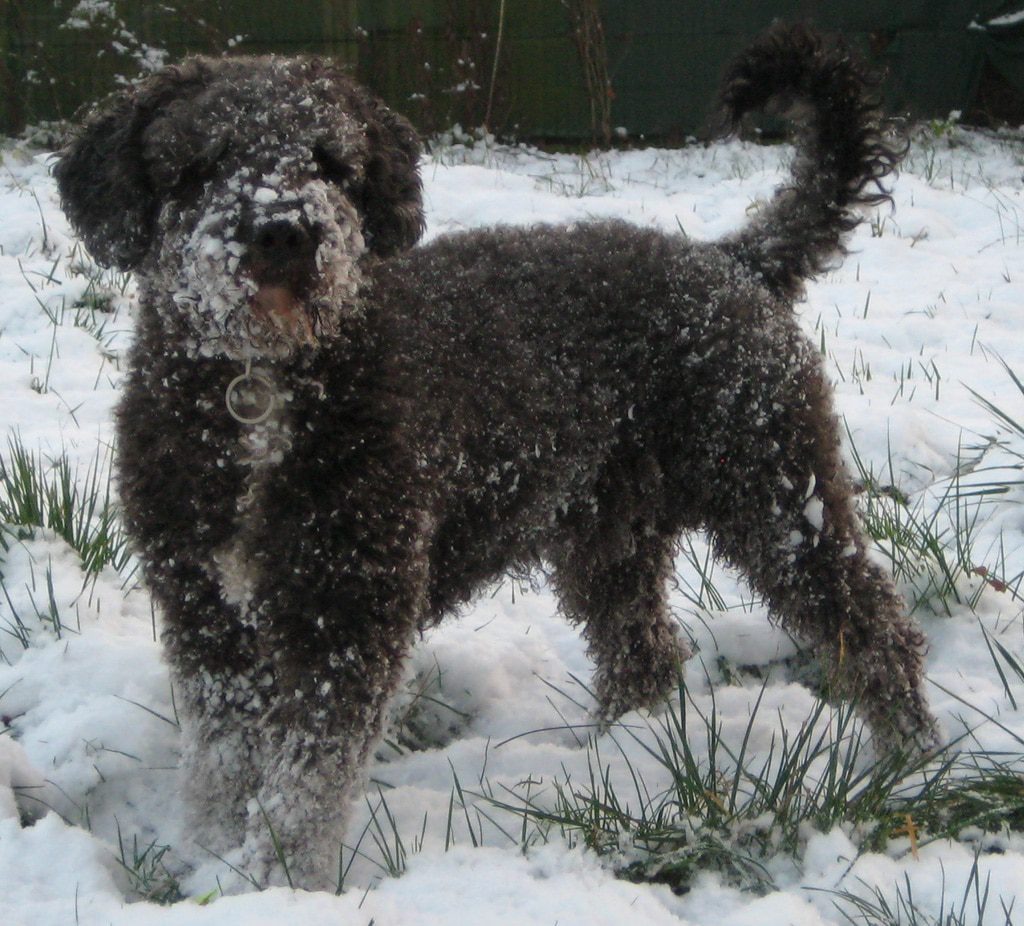
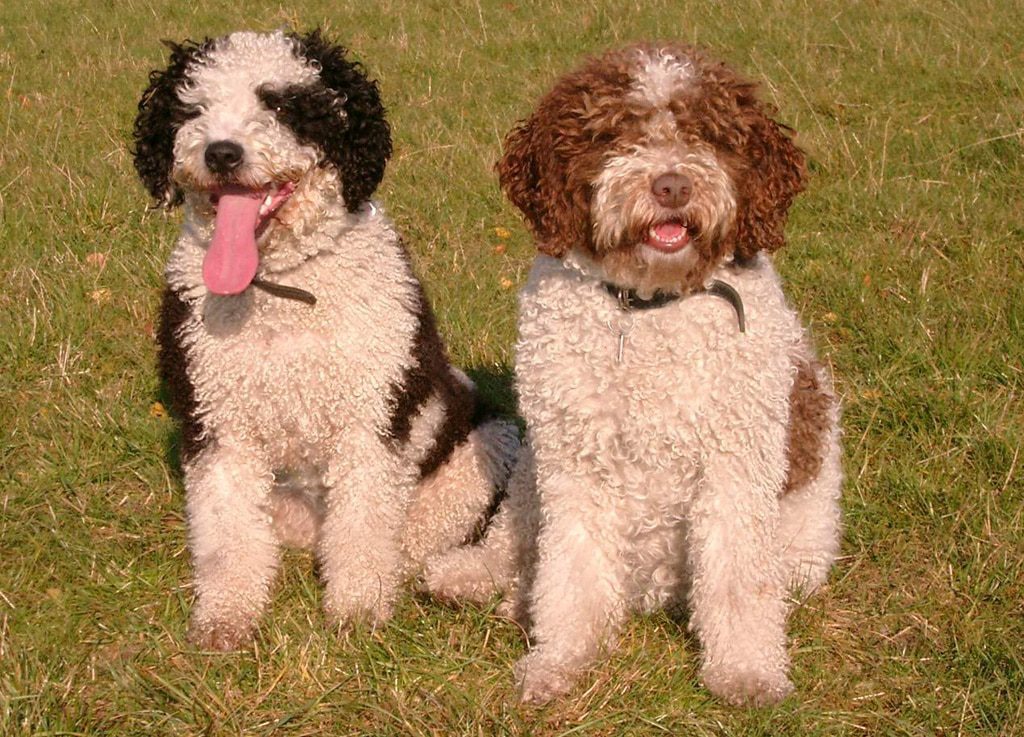
The Spanish Water Dog is a faithful dog, obedient, joyful, laborious, courageous and balanced. It is a breed little seen outside of Spain.

Content

History

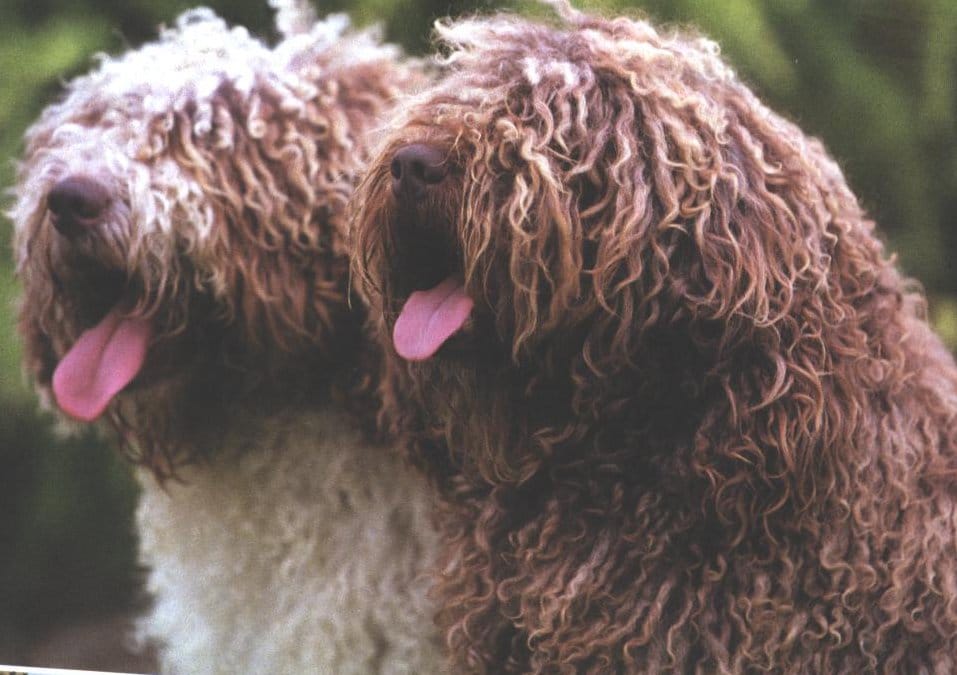
Little is known about the origins of Spanish Water Dog. Some dog experts believe they are descended from African dogs or are related to other European spaniels., as the Portuguese Water Dog, or with Turkish or Hungarian herding and herding breeds.

Dogs of this type were hardworking helpers on Spanish farms., in the mines and in the fishing villages, where they performed many functions, like grazing, the recuperation, rat patrol and protection. Your physical characteristics, especially its fur, they are adapted to the variations of humidity and dryness of the marshy regions. This makes him a versatile dog., able to adapt to the needs not only demanded of a shepherd dog, but also a fishing dog and a waterfowl hunter.

With mechanization and migration of people to cities from rural areas, dogs were less necessary for their traditional work, but people interested in the breed strove to preserve it, starting in 1975 with collecting a variety of dogs from various areas, selective breeding to maintain its appearance and working capacity, and directing their talents towards new jobs such as search and rescue and drug and bomb detection.

In the news, its densest population is in Andalusia, where it is usually used as a sheepdog. In this part of Spain it is usually known as the "Turkish dog.".

Physical characteristics

The Spanish Water Dog it's rustic, Middleweight eumรฉtrico, subgilinear proportions, harmonic, Athletic complexion and muscular well due to the constant functional gym exercising; subconvex profile with a tendency to rectilinear; view, highly developed sense of smell and hearing.

The height at the withers is between 44 and 50 cm for males and 40 to 46 cm., for females. Males weigh in 18 to 22 kg and females in 14 to 18 kg.

His head is strong, of elegant porte; the relationship between length of skull and face will be approximately 1.5 / 1. Flat skull with some marked occipital Crest. Soft and little sharp frontal trough. Subconvex face profile with a tendency to rectilinear. Nose with nostrils well defined, It truffle pigmented equal to or stronger than the darker tone of his coat. Lips; the maxilla and mandibular contact in a very defined lip corner.

Well formed teeth, soft, developed tusks. Slightly oblique eyes, very expressive look; Hazelnut color to Brown IRIS, still desired a tonality according to the layer; apparent ocular conjunctiva. Triangular ears and drop of medium insertion. Short and muscular neck, with perfect Union to the trunk without jowl. Robust trunk, arched ribs, with great breathing capacity bicostal diameter. Little pronounced cross. Powerful chest, collected belly, well linked to the rump steak, slightly inclined grupa.

The tail is of average insertion. Puppies are born with or without, in your case you must amputate from the second to the fourth coccygeal vertebra. The preferred way is the trot, Although he develops a range of careers, jumps, highly spectacular twists and turns that demonstrate inexhaustible energy.

Its skin is flexible, fine and well attached to the body. Can be pigmented in chestnut, black, or despigmentada according to the darker tone of his coat, like all the mucous membranes.

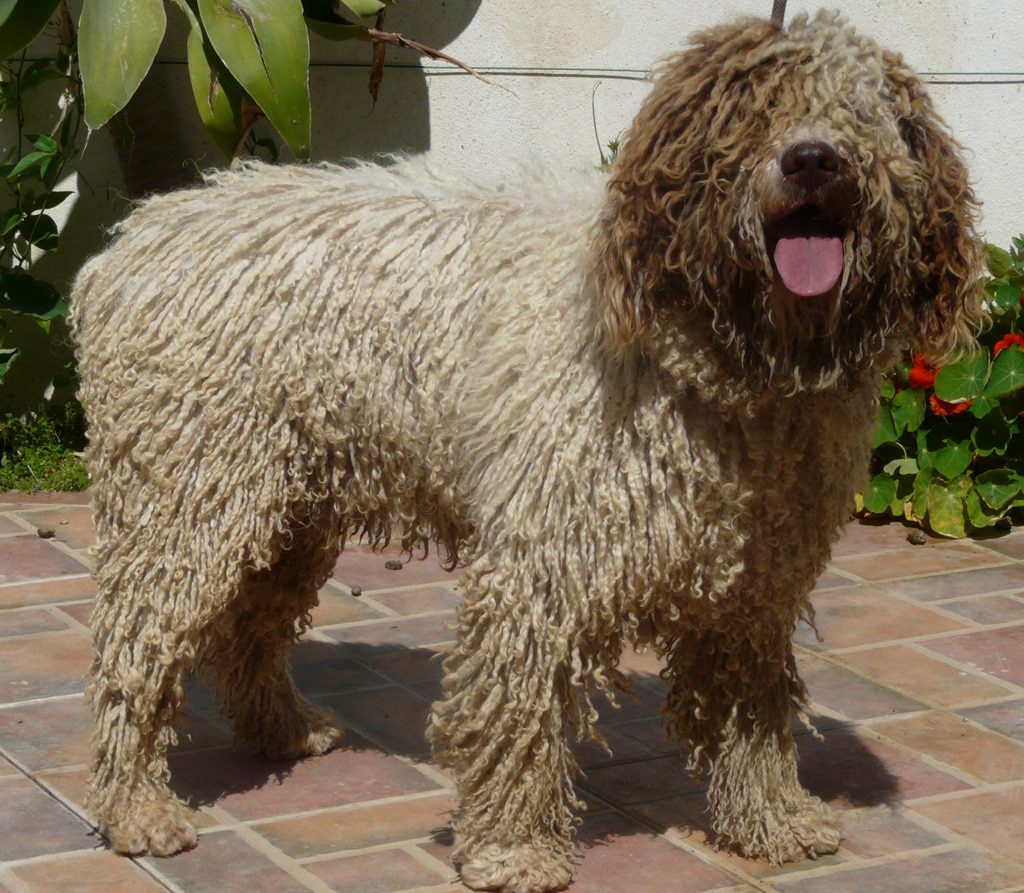
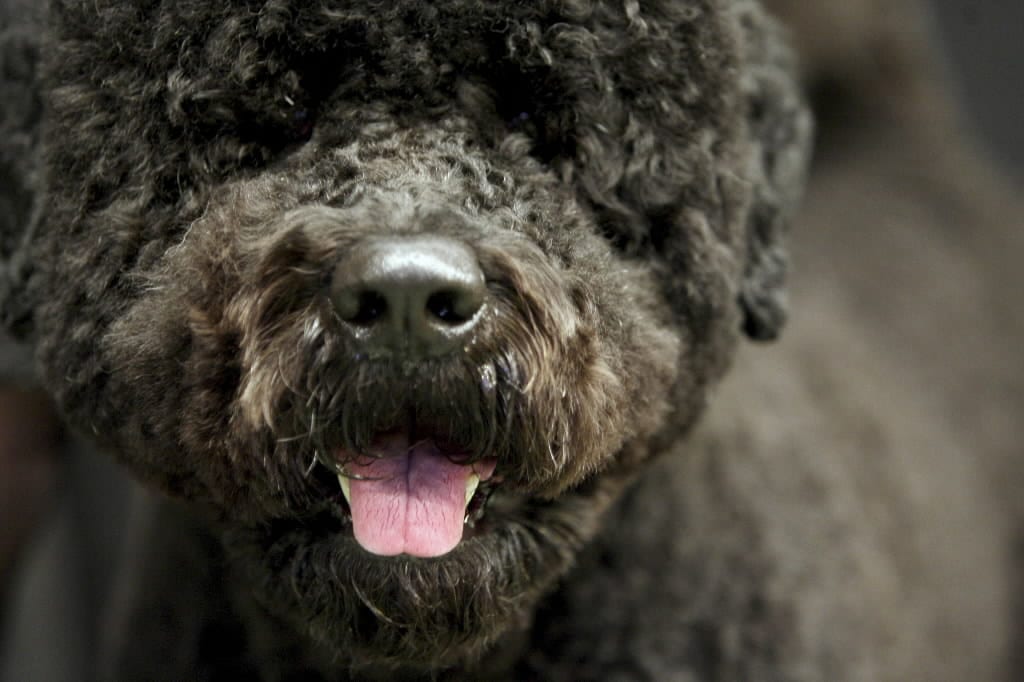
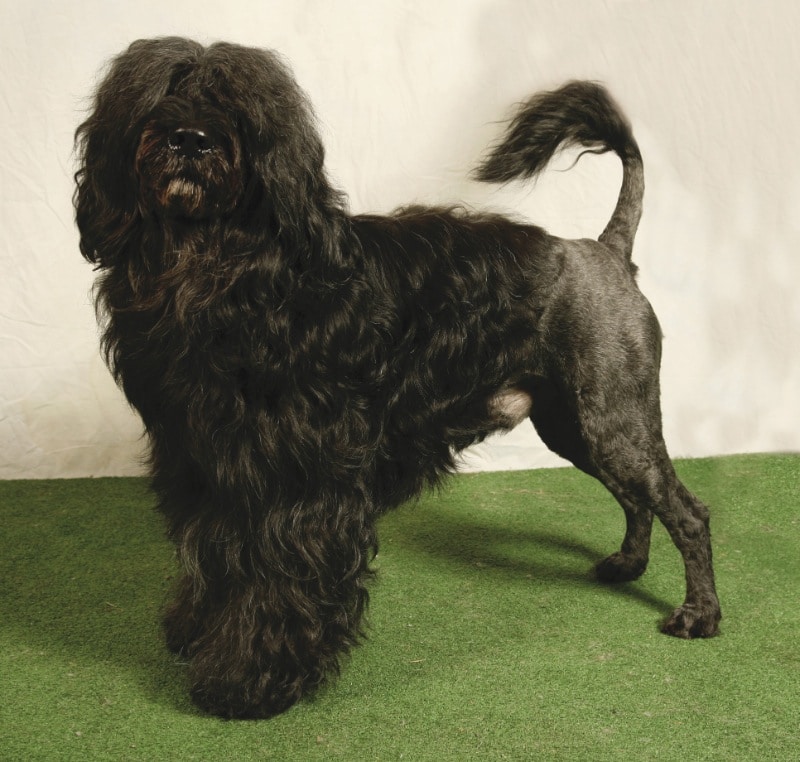
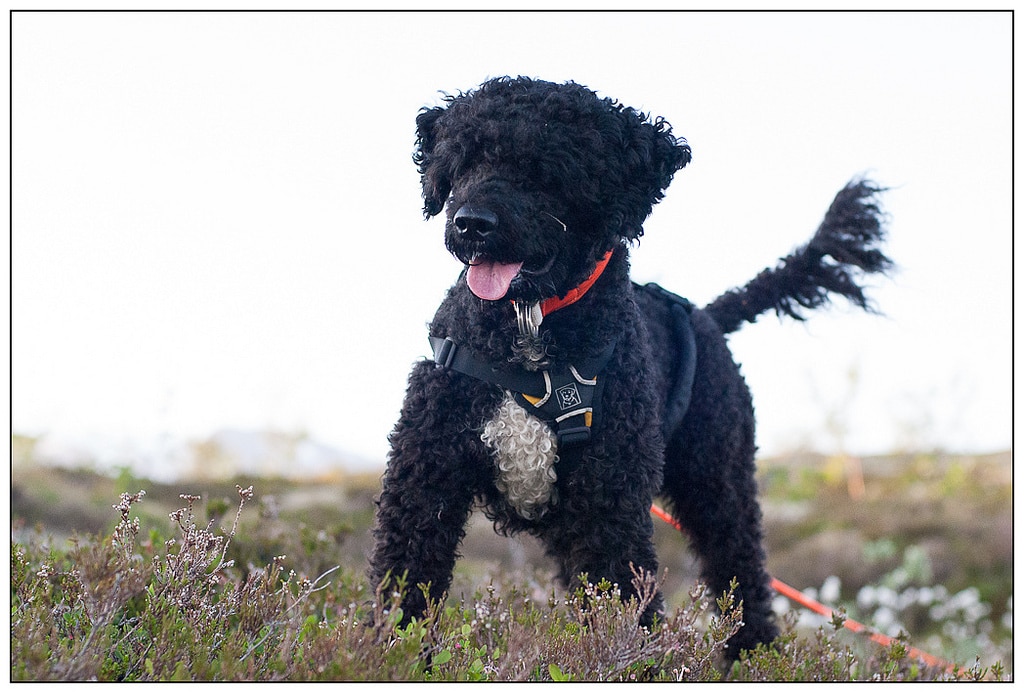
The hair is long and uniform in all its bodily forms always curly and Bristly consistency. Copies of long hair will be accepted, well sheared, as well as those who have their hair cut off, hands and feet; under no circumstances aesthetically sheared.

With regard to the fur, all monocolores layers and bi-coloured compound uniforms are allowed, being always present white. Any Spanish Water Dog puppy should be skinned between three and four months of age wherever it is, North or South. The following bare will be per year, that is to say, to the 15 or 16 months of the animal. And so on until an annual peeling is achieved as a rule in spring..

Character and skills

The Spanish Water Dog belongs according to the FCI classification to Group VIII, section 3, that is to say, is considered a collection dog and more - specifically- a water dog. However, they have traditionally been used as shepherds dogs, in the conduct of sheep and goats, as well as in pigs and cattle.

Because of their great capacity for learning it is currently used by the bodies of Spanish firefighters in their rescue and rescue teams, having spoken specimens of this breed in the disaster caused by Hurricane Mitch. It is also possible to see them in the company of the Civil Guard in search of drugs and explosives in airports., ports and customs.

Within the canine sport, the Spanish Water Dog is finding a place in the world of agility, with some Spain champions and world runner-up in Elite Finland, Ubrique. The agility, It is not a classical proof of work in which copies of race can only participate, but that is rather a combination of competition and show open to all sorts of dogs. The owner also participates in the proof accompanying your dog. Cooperation and good friendship between the members of the team are determinants (dogs and people).

It is a faithful dog, obedient, joyful, laborious, courageous and balanced; of great capacity for learning by his extraordinary understanding, amoldable to different situations and conditions.

Thanks to its appearance of Teddy, as well as its active nature, Intelligent, cheerful and balanced, has achieved a position within the companion races, they are highly valued in Northern Europe and United States.

Health

All dogs have the potential to develop genetic health problems, like all people have the potential to inherit a certain disease. Huya, do not walk, from any breeder who does not offer a health guarantee on their puppies, to tell you that the breed is 100% healthy and has no known problems, or tell you that your puppies are isolated from the main part of the house for health reasons. A reputable breeder will be honest and open about the health problems of the breed and the incidence with which they occur in their lines..

The Spanish Water Dog can develop certain health problems, among them

  • Allergies
  • Hip Dysplasia
  • Glaucoma
  • Hypothyroidism
  • Progressive retinal atrophy

The main problems observed in the breed are hip dysplasia and allergies. Other problems seem to occur less frequently. Other conditions that can be seen in the breed are exocrine pancreatic insufficiency, Addison's disease, congenital hypothyroidism with goiter, myasthenia gravis and seizures.

These conditions are not necessarily widespread in the breed., but you must know them when looking for your puppy.

Careful breeders screen their breeding dogs for genetic diseases and breed only the healthiest and best-looking dogs, but sometimes mother nature has other ideas and a puppy develops one of these diseases despite good husbandry practices. Advances in veterinary medicine mean that, in many cases, dogs can live well. If you are getting a puppy, ask the breeder about the age of the dogs in his line and what they have died of.

Will you have your Spanish Water Dog some or all of these diseases? Not necessarily, but it's smart to know the possibilities.

Remember that after you have welcomed a new puppy into your home, you have the power to protect him from one of the most common health problems in all dogs: the obesity. The breed standard requires that the Spanish Water Dog weigh between 9 and 15 kg. If you can't see the waist of your Spanish Water Dog the feel (but not see) his ribs, it's time to talk to your vet about a weight management program. Keep a Spanish Water Dog at a proper weight is one of the easiest ways to protect your overall health. Take advantage of diet and exercise to help ensure a healthier dog for life.

Grooming

The Spanish Water Dog has only one coat, which means that it has little or no undercoat. Does not change much, although it does lose hair, just like people. The unique, curly coat often leads people to believe that the Spanish Water Dog it is hypoallergenic, but all dogs produce allergens to some extent in their dander, saliva and urine. If you have allergies, you should spend time with several dogs of this breed to determine if he reacts to them.

The toilet of the Spanish Water Dog It is easy. Usually, the coat is trimmed once or twice a year to about 2 centimeters all over the body, including head and ears. Between one cut and another, no need to comb, brushing or drying the coat, as all this can damage the texture and shape of the curls.

However, it is important to check the coat regularly for specks and hot spots, especially behind the ears and in the area where the legs join the body. The incidence of mats can be reduced by separating the fingers when stroking the dog and not rubbing the coat in a circular motion.

If it is allowed to grow, the fur of the Spanish Water Dog can be cordoned off, forming long tight curls that look like dreadlocks. Some work and supervision is needed to ensure the laces are formed properly and groomed properly. Your dog's breeder can explain how it is done and how to maintain a corded coat..

When your Spanish Water Dog get dirty, bathe him with a gentle, pet-safe shampoo. Gently apply to fur, like hand washing a cashmere sweater. Rinse well with lukewarm water and, then, use your hands to wring out excess water. Dry the fur with a towel, being careful not to rub it roughly. Let your dog air dry in a warm, draft-free place.

The rest is basic care. Trim his nails every week or two and brush his teeth oftenโ€”with a vet-approved pet toothpaste- for good general health and fresh breath.

Characteristics "Spanish Water Dog"

Coexistence is important that you have with your new friend. Before considering the acquisition of a dog of the breed "Spanish Water Dog" you know certain factors. Not all breeds of dogs are apt to live in an apartment, you must take into account his character, their need for exercise, their interaction with other pets, their care and if you have small children, their level of tolerance towards them.

Adaptation โ“˜

3,0 of 5 stars (based on 1 review)

friendly dog โ€‹โ€‹โ“˜

3,0 of 5 stars (based on 1 review)

hair loss โ“˜

1,0 of 5 stars (based on 1 review)

Affection level โ“˜

5,0 of 5 stars (based on 1 review)

Need for exercise โ“˜

4,0 of 5 stars (based on 1 review)

Social need โ“˜

2,0 of 5 stars (based on 1 review)

Home โ“˜

3,0 of 5 stars (based on 1 review)

Toilet โ“˜

2,0 of 5 stars (based on 1 review)

Friendly with strangers โ“˜

3,0 of 5 stars (based on 1 review)

barking โ“˜

3,0 of 5 stars (based on 1 review)

Health โ“˜

3,0 of 5 stars (based on 1 review)

Territorial โ“˜

4,0 of 5 stars (based on 1 review)

Cat friendly โ“˜

3,0 of 5 stars (based on 1 review)

Intelligence โ“˜

3,0 of 5 stars (based on 1 review)

Versatility โ“˜

3,0 of 5 stars (based on 1 review)

Child friendly โ“˜

2,0 of 5 stars (based on 1 review)

Surveillance โ“˜

3,0 of 5 stars (based on 1 review)

joy โ“˜

4,0 of 5 stars (based on 1 review)

ยซSpanish water dogยป images

ยซSpanish Water Dogยป Videos

Type and recognitions:

  • FCI CLASSIFICATION:
  • Group 8: Retrievers, Hunting Lifting Dogs, Water Dogs.
  • Section 3: Water Dogs. .

Federations:

  • FCI – Group 8: Retrievers - Flushing Dogs - Water Dogs – Section 3: Water Dogs โ“˜
  • AKCSporting โ“˜
  • โ€‹KC – Gundog โ“˜
  • NZKCGundog โ“˜
  • UKCGun Dogs โ“˜

FCI breed standard "Spanish Water Dog"

Origin:
Spain

Date of publication of the valid original standard:
01.10.2019

Use:

Shepherd dog, Hunter and Assistant of fishermen.


General appearance:

rustic dog, eumรฉtrico (medium-sized), sweetheart, sublongilinear proportions, harmonic of forms, beautiful print, Athletic complexion and muscular well due to the constant functional gym exercising; rectilinear profile; view, highly developed smell and hearing.

important proportions

- Body length / size (height to the cross) = 9/8.
- Chest depth / size (height to the cross) = 4/8.
- Length of muzzle / length of skull = 2/3.


Behavior / temperament:

Faithful, obedient, joyful, laborious, courageous and balanced; of great capacity for learning by his extraordinary understanding, adaptable to all situations and temperaments.

Head:

Strong, of elegant porte.

Cranial region:
  • Skull: Flat with slightly marked occipital crest. The axes of the skull and muzzle are parallel.
  • Depression links (Stop): Soft and not very accentuated.

facial region:

Nasal cane with rectilinear profile.

  • Truffle: Nose with nostrils well defined. The pigmented truffle in the same color or stronger than the darkest shade of the coat.
  • Lips: Picked up; well-defined corner of the mouth.
  • Teeth: Well formed, whites and developed fangs.
  • Eyes: Slightly oblique, very expressive look; Hazelnut color to Brown IRIS, being desirable a tonality that agrees with the layer; ocular conjunctiva not apparent.
  • Ears: Middle insertion, triangles and falls.

Neck:

Short, muscular and without dewlap. Well inserted at the back.

Body:

Robust.

  • top line: Straight.
  • Cross: Little pronounced.
  • Back: Straight and strong.
  • Rump: Gently sloping.
  • Breast : Width, deep. Well arched ribs; wide chest perimeter that denotes great respiratory capacity.
  • bottom line: Slightly gathered belly.

Tail:

Middle insertion. The tail must be amputated from the second to the fourth vertebra. There are brachyurus specimens.


Tips

Former members

Solid and correct poles.

  • Shoulder: Muscular and oblique.
  • Arm: Powerful.
  • Elbows: Well attached to the chest and parallel.
  • Forearm: Straight and strong.
  • Carpus and metacarpus:  Straight. Being rather short.
  • Front feet: Rounded, with fingers tightly joined; nails with different shades; consistent pads.
Later members

Perfectly Plumb, with rear angulations that are not excessively pronounced and muscles capable of giving the body sudden momentum in running and easy and elegant jumps.

  • Thigh: Long and muscular.
  • Leg: Well developed.
  • Hock: Well descended.
  • Metatarsus: Short, dry and perpendicular to the ground.
  • Rear feet: With the same characteristics as the previous ones.

Movement:

The preferred gait is the trot.

Mantle

Skin

Flexible, fine and well attached to the body. Can be pigmented in chestnut, black or no pigment, according to the tone of your cape, like all the mucous membranes


Fur

Always curly and woolly in consistency. Curly when short, to form strings when it is long. Shorn specimens will be admitted, This must be complete and uniform and under no circumstances will "aesthetic" shearings be admitted..
The maximum recommended length for exposures is 12 cm. (15 cm spreading curls) and the minimum is 3 cm., to appreciate the quality of the curls.
Puppies are always born with curly hair.


Color
  • Unicolores: White, black and brown in their different shades.
  • Bicolour: Black and white or white and brown, in its different shades.

The tricolor, black and tan and hazelnut and tan are not admitted.


Size and weight:

Height to the cross

  • Males: 44 - 50 cm..
  • females: 40 - 46 cm..

In both sexes a maximal variation of 2 cm is therefore allowed for the dog to have general proportions compatible with its height at the withers.

Weight

  • Males: 18 - 22 kg.
  • females: 14 - 18 kg.


Fouls:

Any deviation from the above criteria is considered missing and the seriousness is considered to the extent of the deviation to the standard.


Serious misconduct
  • Manifestly saddled dorso-lumbar line.
  • Wrong limbs.
  • Hanging or excessively gathered belly.


ELIMINATING fAULTS
  • Aggressive or fearful dog.
  • Upper or lower prognathism.
  • Presence of dewclaws.
  • Smooth u wavy hair.
  • albinism.
  • Spotted or spotted coat, black and tan or hazelnut and tan.
  • Unbalanced character.


Any dog โ€‹โ€‹showing clear signs of physical or behavioral abnormalities must be disqualified..


N.B.:

Males should have two normal-appearing testicles fully descended into the scrotum.

Source: F.C.I - International Cynological Federation

Alternative names:

1. SWD, Perro de agua espaรฑol (English).
2. Perro de Agua Espaรฑol, Chien turc (French).
3. Perro de Agua Espaรฑol, Tรผrkenhund, Andalusischer Tรผrke (German).
4. (em castelhano perro de agua espaรฑol) (Portuguese).
5. Turco andaluz, Perro turco, Churrino (espaรฑol).

โ–ท The world of Pets: Dogs, cats, birds, reptiles, amphibians

Frisian Water Dog (Wetterhoun)
Holanda FCI 221 . Water Dogs

Perro de Agua Frisรณn

The Frisian Water Dog is - virtually- unknown outside the Netherlands.

Content

History

The ancestors of Frisian Water Dog also called Wetterhoun they were already bred as farm dogs in the Middle Ages. Served as a watchdog, which also kept vermin away.

Wetter is the Friesian word for water, so the Wetterhoun is a spaniel in the classical sense.

The beginning of the ancestral chain was probably made by the Portuguese Water Dog and it is also said that the Curly-coated Retriever belongs to the direct ancestors of Wetterhoun, from them he surely inherited his curly fur. The second Frisian breed, the Stabyhoun, is closely related to the Wetterhoun.

Over the years 50, the Frisian Water Dog it was almost extinct. The rescue was carried out by a Friesian woman, in her youth she owned a Frisian Water Dog, who committed to conservation. Through an advertisement in the newspaper, looked for the Wetterhouns alive and received some letters from local farmers. From these dogs the current population was built. There are currently some 800 dogs, most of which are in the Netherlands.

The FCI includes the Wetterhoun in the Group 8, section 3, standard number 221 (Water Dogs).

Physical characteristics

The Frisian Water Dog, originally from the Netherlands, it is a dog of normal proportions. It is of powerful constitution, stocky and square, but without being plump or heavy.

Ideally, males should reach a shoulder height of 59 cm and the females of 55 cm.. The weight must be proportional to the dog and be between 15 and 25 kg.

Skin is tight, without wrinkles, double chin and hanging lips. Firm, strong hair is thickly curled, except on the head and limbs. Finer tuft of hair curls give the dog an almost plush, woolly look, but this turns out to be a fallacy when touched, as the fur is rough and greasy to the touch, due to its origin as a spaniel.

The Wetterhouns are solid black or brown in color, or black or brown with white markings. Marks may be stained or molded.

The tail is worn curled over the back.

Life expectancy

an average of 9 to 15 years.

Character and skills

The Frisian Water Dog is a quiet dog, but with a stubborn character. He is reserved with strangers and a good watchdog. As with many breeds, it is easy to train, but it requires constancy, sensitivity and know-how. Get bored quickly with repetitive exercises, showing joy in lessons that excite you. Among them are recovery, exploration and digging.

Utility

The Wetterhoun was originally bred to hunt otters and polecats, but it was also used to hunt moles, since their skins were used as merchandise around 1900. If the Wetterhouns they were of strong stature, they were also used as carriage dogs. Even today, are used for the maintenance of levees, where they catch muskrats, among other things.

In the news, they are mainly used as yard and guard dogs.

Characteristics "Frisian Water Dog (Wetterhoun)"

Coexistence is important that you have with your new friend. Before considering the acquisition of a dog of the breed "Frisian Water Dog (Wetterhoun)" you know certain factors. Not all breeds of dogs are apt to live in an apartment, you must take into account his character, their need for exercise, their interaction with other pets, their care and if you have small children, their level of tolerance towards them.

Adaptation โ“˜

3,0 of 5 stars (based on 1 review)

friendly dog โ€‹โ€‹โ“˜

3,0 of 5 stars (based on 1 review)

hair loss โ“˜

3,0 of 5 stars (based on 1 review)

Affection level โ“˜

4,0 of 5 stars (based on 1 review)

Need for exercise โ“˜

4,0 of 5 stars (based on 1 review)

Social need โ“˜

2,0 of 5 stars (based on 1 review)

Home โ“˜

3,0 of 5 stars (based on 1 review)

Toilet โ“˜

3,0 of 5 stars (based on 1 review)

Friendly with strangers โ“˜

2,0 of 5 stars (based on 1 review)

barking โ“˜

2,0 of 5 stars (based on 1 review)

Health โ“˜

3,0 of 5 stars (based on 1 review)

Territorial โ“˜

4,0 of 5 stars (based on 1 review)

Cat friendly โ“˜

3,0 of 5 stars (based on 1 review)

Intelligence โ“˜

3,0 of 5 stars (based on 1 review)

Versatility โ“˜

3,0 of 5 stars (based on 1 review)

Child friendly โ“˜

4,0 of 5 stars (based on 1 review)

Surveillance โ“˜

4,0 of 5 stars (based on 1 review)

joy โ“˜

3,0 of 5 stars (based on 1 review)

Images "Frisian Water Dog (Wetterhoun)"

Frisian Water Dog
Frisian Water Dog (Wetterhoun) at the World Dog Show in Poznaล„ by Pleple2000, CC BY-SA 3.0, via Wikimedia Commons

Frisian Water Dog

Wetterhoun, Frisian Water Dog, FCI recognized breed (FCI No. 221) by 23things for museums, CC BY 3.0, via Wikimedia Commons

Videos "Frisian Water Dog (Wetterhoun)"

Promotion video Wetterhoun English
Pedigree dog of the week Wetterhoun
Rashond van de week Wetterhoun

Type and recognitions:

  • FCI CLASSIFICATION:
  • Group 8: Retrievers, Hunting Lifting Dogs, Water Dogs.
  • Section 3: Water Dogs. .

Federations:

  • FCI – Group 8: Retrievers - Flushing Dogs - Water Dogs – Section 3: Water Dogs โ“˜
  • UKCGun Dogs โ“˜

FCI breed standard "Frisian Water Dog (Wetterhoun)"

Origin:
Netherlands

Date of publication of the valid original standard:
30.05.1989

Use:

Dog for otter hunting.


General appearance:

Well-balanced dog used since ancient times for otter hunting. Without being rough or clumsy, has a strong constitution, compact, and square. The skin is firm, no creases or double chin; lips are not hanging.


Behavior / temperament:

It is a quiet dog, with stubborn character; reserved with strangers, It is the ideal guard dog.

Head:

Dry, strong and powerful; Its size is in good proportion to the body.

Cranial region:
  • Skull : The skull and muzzle have the same length. The slightly domed skull gives the impression of being wider than it is long and descends towards the cheeks forming a slight convexity.
  • Depression links (Stop) : Bit strong.

facial region:

  • Truffle : It is black in dogs with a basic black color and brown in dogs with a basic brown color.. The truffle is well developed, not cracked and the windows are wide open.
  • Snout : Powerful, gradually tapers towards the end of the nose without being pointed, but rather it is truncated at its end. Wide and straight nose cane; profile view, It should not be concave or convex.
  • Lips : Adherents, not hanging.
  • Jaws / Teeth : Powerful scissor bite.
  • Cheeks : They have moderately developed muscles.
  • Eyes : Medium-sized, oval; tight eyelids, conjunctiva not visible. The eyes are placed slightly obliquely, which gives the dog a somewhat angry appearance. The eyes do not protrude or are sunken. Its color is dark brown in dogs whose basic color is black, and brown in dogs whose basic color is brown. The eyes of birds of prey are punished.
  • Ears : Quite low insertion. The external pinna is so poorly developed that the ears hang flat on the sides of the head., without forming a fold. Overdeveloped pinnae that do not fold directly at the insertion but rather lower down and that, Therefore, they do not hang flat on the sides of the head. The ear is medium in size and shaped like a bricklayer's trowel.. The hair that covers the ears is typical of the breed : it's curly, quite long at the base and becomes shorter towards the ends so that in the lower third the ears are covered with short hair.

Neck:

Short and strong, rounded; forms with the upper line of the back such an obtuse angle, the head being normally carried low. The neck is slightly arched and does not have loose skin or dewlap..

Body:

Very strong.

  • Back : Straight and short.
  • Pork loin : Strong.
  • Rump : Little inclined.
  • Breast : Seen from the front, It is broad; It is wider than deep so that the forelimbs are well separated from each other. The rounded parapet does not reach below the level of the elbows. The ribs are well arched and well developed towards the back..
  • Bottom line and belly : Only moderately withdrawn.

Tail:

Long, carried in a ring shape on the side or on the rump.

Tips

Former members :
  • Shoulder : Scapulae well attached to the trunk, oblique, with good angulation of the scapulohumeral joint.
  • Forearm : Strong and straight.
  • Metacarpus : Straight, not inclined.
  • Previous feet : Round, well-developed and arched fingers, hard pads.
Later members:

Strong, with moderate angulations in all joints.

  • Legs : not very long.
  • Warm-foot joint : In low position.
  • Metatarsus : Short.
  • Hind feet : Round with well-developed pads.

Movement:


Mantle

Fur : With the exception of the head and extremities, the body is completely covered with dense curls formed by hard and strong hair strands. The presence of sparse curls as well as curls in the form of thin tufts give the dog a woolly appearance., which is considered a serious offense. The hair is quite coarse and greasy to the touch..

Color : Unicolor black or brown, like black or brown with white marks, A mottling or mixed hair may appear on the white part..


Size and weight:

▷ Ideal size in males : 59 cm.
▷ Ideal size in females : 55 cm.


Fouls:

Any deviation from the aforementioned criteria is considered as a fault and the severity of this is considered to the degree of the deviation to the standard and its consequences on the health and well-being of the dog..

Any dog โ€‹โ€‹showing clear signs of physical or behavioral abnormalities must be disqualified..


N.B.:

Males should have two normal-appearing testicles fully descended into the scrotum..

Via FCI

Source: F.C.I - International Cynological Federation

Alternative names:

1. Wetterhoun, Otterhoun (English).
2. Wetterhoun (French).
3. Wetterhoun (German).
4. (em alemรฃo: wetterhoun) (Portuguese).
5. Spaniel holandรฉs, Wetterhoun (espaรฑol).

โ–ท The world of Pets: Dogs, cats, birds, reptiles, amphibians

Irish Water Spaniel
Irlanda FCI 124 . Water Dogs

Today, despite relative popularity with some hunters, the Irish Water Spaniel still not very widespread outside its country of origin.

Perro de Agua Irlandรฉs

Content

Characteristics "Irish Water Spaniel"

Coexistence is important that you have with your new friend. Before considering the acquisition of a dog of the breed "Irish Water Spaniel" you know certain factors. Not all breeds of dogs are apt to live in an apartment, you must take into account his character, their need for exercise, their interaction with other pets, their care and if you have small children, their level of tolerance towards them.

Adaptation โ“˜

3,0 of 5 stars (based on 1 review)

friendly dog โ€‹โ€‹โ“˜

3,0 of 5 stars (based on 1 review)

hair loss โ“˜

2,0 of 5 stars (based on 1 review)

Affection level โ“˜

3,0 of 5 stars (based on 1 review)

Need for exercise โ“˜

4,0 of 5 stars (based on 1 review)

Social need โ“˜

3,0 of 5 stars (based on 1 review)

Home โ“˜

3,0 of 5 stars (based on 1 review)

Toilet โ“˜

3,0 of 5 stars (based on 1 review)

Friendly with strangers โ“˜

2,0 of 5 stars (based on 1 review)

barking โ“˜

2,0 of 5 stars (based on 1 review)

Health โ“˜

4,0 of 5 stars (based on 1 review)

Territorial โ“˜

4,0 of 5 stars (based on 1 review)

Cat friendly โ“˜

3,0 of 5 stars (based on 1 review)

Intelligence โ“˜

4,0 of 5 stars (based on 1 review)

Versatility โ“˜

3,0 of 5 stars (based on 1 review)

Child friendly โ“˜

5,0 of 5 stars (based on 1 review)

Surveillance โ“˜

4,0 of 5 stars (based on 1 review)

joy โ“˜

4,0 of 5 stars (based on 1 review)

History

The origin of the Irish Water Spaniel, but several texts mention that their ancestors would have accompanied the Celts a few years ago. 1000 years. More concretely, These 11th century texts mention a race similar to the Irish Water Spaniel, simply described as a dog used south of the River Shannon, In Ireland. But, although the characteristics of this ancestor are not documented in detail, experts agree that it was probably not a member of the family of the Spaniel. In fact, This mysterious ancestor is believed to be an ancient race of irish dog that contributed to the development of Irish Water Spaniel. This hypothesis is based on the fact that the Irish Water Spaniel has a very different tail than other breeds of Spaniels. In fact, unlike other representatives of the Spaniels family that have a rather bushy tail, the Irish Water Spaniel has a whip-shaped tail, also known as rat tail.

The other races of Spaniels they descend from Persian dogs imported to the Iberian Peninsula. They did not appear in France - where they were then called ยซespaigneulsยซ- until the twelfth century. But, only later did mentions of specific breeds appear in the literature, which explains the dog's somewhat hazy past.

The most popular theory about the origin of Irish Water Spaniel is that the Spaniels were imported to Ireland and mixed with other irish dogs, possibly even with the Portuguese Water Dog, the Poodle and the now extinct English water spaniel. Although this theory can be supported by the great resemblance between the Poodle and the Irish Water Spaniel, the latter's origins remain unclear, and we must be content with speculation, as there are no documents describing how the breed was created.

But, What is certain is that the Irish Water Spaniel It was developed mainly for duck hunting and is very happy bringing the game to its master, both on land and in the water: in this way, looks more like a Retriever that a Spaniel. They can even be used to replace certain hunting dogs in a pack., since they are able to point and take the game to its owner when necessary. It is these characteristics and the flexibility that make them so popular with hunters..

In the first half of the 19th century, a Dublin breeder named Justin McCarthy played an essential role in the development of the breed. Until then there were at least two distinct varieties of the breed, and he was able to combine them to create the Irish Water Spaniel as we know it today. It is known that one of his dogs, Boatswain (1834-1852), contributed greatly to the development of the breed by giving birth to a large number of offspring, and that several dogs of this line were champions in various dog shows.

The Irish Water Spaniel first appeared at dog shows in 1862 in Birmingham, England. For a long time, they were represented mainly by the descendants of the boatswains in these events. But, was not up 1899 when he entered the dog shows, still in england. The first breed club was founded in Ireland in 1890.

The Irish Water Spaniel was introduced in the United States in the decade of 1870. In 1877, in the first Westminster Kennel Club, the most famous dog show in the country, four representatives of the breed were presented to the public. The American Kennel Club (AKC) recognized the breed in 1884, but the United Kennel Club, the other American reference organization, waited until 1948 to do the same.

The Fรฉdรฉration Cynologique Internationale (FCI) It took even longer to recognize the Irish Water Spaniel until 1954.

Today, despite relative popularity with some hunters, the Irish Water Spaniel still not very widespread outside its country of origin, where it also remains quite marginal. These may include, ranks 150 of 190 in the AKC's ranking of America's most popular dog breeds, according to the number of records. In France, it's even weirder, Since the SCC (Sociรฉtรฉ Centrale Canine) received less than 10 registration requests between 2010 and 2016. In Great Britain, the Kennel Club receives an average of one hundred a year: although it is much more consistent than in France, this figure is still quite modest.

Physical characteristics

The appearance of the Irish Water Spaniel it's quite unique. Although at first glance it may be mistaken for a Poodle Grand, its appearance is more robust than this, although it maintains an elegant silhouette. Its coat is also denser than that of the poodle and is made up of long, soft curls.; this is what protects them from water and helps them float. Its waterproof coat also allows it to face harsh climates and bad weather without flinching..

His head is rather broad and round, and ends with a rather square muzzle, strong looking, covered in short hairs. The ears are large, are set high on the skull and fall back on the head with abundant curls. The eyes are small, brown and almond-shaped.

The neck is strong and wide, though it's hidden under a thick layer of hair. The chest is also wide and deep, followed by a slimmer waist, characteristic of active breeds. His well-developed musculature and strong bones make him a fairly robust looking dog..

Its feet are webbed, which gives them a natural facility to swim, which makes the Irish Water Spaniel in one of the best races for swimming.

The tail is also unique and clearly distinguishes the Irish Water Spaniel other Water Dogs. It's shorter, straighter and has a very short coat (or is he almost naked), unlike other breeds of Water Dogs, they all have bushy tails. This explains why the Irish Water Spaniel Sometimes known as "Rat-tailed Spaniel" or "Whip-tailed Spaniel". Although this anatomical feature sometimes makes you smile, makes the Irish Water Spaniel be a better swimmer than others Water Dogs.

Last, the fur of the Irish Water Spaniel is lustrous and is made up of dense curls, with a lot of plumage. They are often called "the clown of the clown family." Water Dogsยซ, not only for his playful personality, but also because of the longer curly hair they have on their heads, which often gives them the appearance of having a tuft on the top of the head, much like a clown wig. The coat is always reddish brown with chocolate tones.

Size and weight

▷ Male size: 55 – 61 cm.
▷ female size: 53 – 59 cm..
▷ Male weight: 25 – 31 kg
▷ female weight: 20 – 27 kg

Character and skills

The Irish Water Spaniel is sometimes described as a dog with a difficult character, and probably for this reason it has never been especially sought after as a companion dog, despite its qualities. In fact, it is a dog developed for hunting: It, Therefore, decided to, Intelligent, Active, playful and energetic. This mix can sometimes lead to stubborn or mischievous behavior.. Even when they compete, their playful personality is often imposed and leads them to turn any activity into a game, causing some headaches for your coach. In general, not a breed of dog suitable for a beginner: on the contrary, needs an experienced master, able to give you a constant and structured education.

But, the Irish Water Spaniel it is a perfect companion dog if it is well socialized and trained, and can get enough exercise. Devoted to his master and his family, will do anything to please them, although sometimes this can lead to unwanted mischievous behavior or wanting to play when it's not the time. By the way, although he is devoted to his whole family, it's not uncommon for him to show a preference for a particular member, with whom you have a special affinity.

Able to easily adapt to all situations and conditions, the Irish Water Spaniel he is delighted to accompany his master in many activities, and can excel not only in hunting, but also in water activities or dog competitions, like the exhibitions. In effect, is agile, hardworking and has a good nose. It also, is naturally happy and balanced, as well as loyal and obedient. With a real propensity to turn any activity into a game, they usually feel great pleasure when doing them, whatever they are.

The Irish Water Spaniel he is one of the best swimmers and loves the water. You have to watch them when they are in the water, as they jump in at the first opportunity and enjoy swimming so much that it can be difficult to get them out. Having said that, swimming is a good way to satisfy your need to expend energy. But, even if you are familiar with the water and swim very well, it is important to keep an eye on him to ensure his safety, as with a child.

The Irish Water Spaniel does not bark much, and generally reserves its impressive barks for situations where you need to warn your family of immediate danger. So, he is quite calm and makes an excellent watchdog, as he is naturally suspicious of strangers. Having said that, his lack of trust with strangers should not be confused with shyness, although he is rarely aggressive towards them: is content to advise. Even when hunting, just bark a little, having the peculiarity of being speechless about hunting, which makes him a good pointer.

The Irish Water Spaniel they tend to get along very well with other dogs and pets. The same goes for children. Whoever your partner is, can spend hours playing with it without getting tired, especially when it comes to looking for the ball.

It must be said that it is a very resistant and lively breed of dog, making it unsuitable for apartment living. You need at least one garden where you can stretch your legs, and it is even better if the garden has a pool. But, a small garden is not enough to satisfy their need for exercise and balance: needs at least an hour of daily running and some walks, as well as swimming regularly.

In fact, it is essential that he can expend his energy to be a calm and obedient dog once home. Otherwise, the owner should expect destructive behavior from the dog. In fact, it is a recommended breed of dog for an athletic master, not a dog recommended for an elderly or sedentary person.

Starting at 9 or 10 weeks of age, it is recommended to give them 15 to 20 minutes of play in the morning and in the evening, in addition to socializing and doing other exercises. As is still the case for an adult, loves to play fetch or chase a frisbee. But, while waiting for your body to develop and gain muscle, it is better to prevent him from running with his master and, on the other hand, be content with training him to walk a distance of less than one kilometer. You can gradually increase the intensity of your dog's activities and the distances traveled, but you should not rush: too much exercise at a young age can affect your bones and joints, with repercussions for the rest of his life. Once adult, it is possible to run with your dog, but it is advisable to stick to reasonable distances and durations: due to risk of dysplasia, not a dog made to run marathons.

Education

The Irish Water Spaniel it is not a recommended dog for a first adoption. In fact, although it is quite easy to train because he likes to please his master, sometimes has an independent character that pushes him to want to act according to his own will. This is especially true of young males., who are very prone to testing the limits of their master. So, it is necessary to know how to show your dog who the master is, establish firm limits and a structured discipline framework with clear and consistent rules. In effect, This dog is known to take advantage of his master at the slightest inconsistency., or if you lack confidence. The fact that they are energetic and need a good amount of daily exercise also contributes to their being a demanding breed..

But, although sometimes they can be stubborn and independent, the Irish Water Spaniel it is usually easy to train. Being one of the most intelligent dog breeds, learn many commands with ease and excel at dog sports. When properly trained, are perfectly capable of performing very specific tasks, both in leisure and in obedience, agility and even dog shows. But, you need to deal with his mischievous nature: the more he learns, Plus you can turn your new abilities into games or mischief of any kind. In fact, it is clear that he has an overflowing imagination.

The Irish Water Spaniel responds better to dog training techniques based on positive reinforcement and rewards. They benefit from being coached by a patient teacher who does not raise his voice, at the risk of awakening their stubborn side and encouraging them to decide to do things their own way. That is why it is important to vary the activities during the educational sessions., to keep your interest and prevent you from starting to do things your way.

Last, the socialization of Irish Water Spaniel is an important aspect of your education. He is extremely suspicious of strangers, although this should not be confused with shyness. The younger you are exposed to a variety of situations, the more comfortable you will be with strangers and will be able to recognize real danger, how not to confuse the postman's visit with a possible intruder. Schools for puppies (puppy socialization classes) they are an interesting option, but it can also be as simple as taking the puppy out in public and visiting the neighborhood. Whatever happens, will always be attentive, so it is the various socialization activities in your training that should help you differentiate between what is a normal part of your life and what is abnormal and should alert your family.

Health

The Irish Water Spaniel they are generally in good health and their fur makes them particularly resistant to bad weather.

But, are prone to various diseases:

waterfalls: unlike other dog breeds, in which they are generally due to aging, cataracts are most often hereditary in theIrish Water Spaniel, and they can appear from the age of five.
follicular dysplasia ;

Hip Dysplasia: it is very common in this breed, and appears to be genetic rather than due to joint wear and tear.

Dental malocclusion: this deformation makes the lower jaw more pronounced, which often causes the lower teeth to pop out of the mouth. Although this can be treated with plastic surgery, it is usually recommended to simply remove the teeth that prevent the mouth from closing normally.
Progressive retinal atrophy (ARP);

Von Willebrand disease;

Hypothyroidism in dogs.

It also, it is known that the Irish Water Spaniel have allergic reactions to vaccines given to dogs. So, it is important to monitor him during the hours following the vaccination, to react as quickly as possible in case of swelling of the face, lethargy, sharp pain around the injection site, etc. This risk should not be taken lightly, because very serious reactions can lead to the death of the dog.

In addition to this risk linked to vaccines, the Irish Water Spaniel may be sensitive to dewormers and certain dog antibiotics. So, it is necessary to choose a veterinarian who knows well the specificities of this breed, starting with drugs that can cause an allergic reaction in the dog.

Last, like any breed of dog with hanging ears, have a higher risk of ear infections.

Since many of these diseases are genetic and, Therefore, hereditary, it is important to check, when adopting an Irish spaniel, that comes from a line in which these health problems are rare.

Life expectancy

12 to 13 years

Grooming

The dense fur of the Irish Water Spaniel requires regular care to avoid hair build-up. In particular, dead hair must be removed with a natural hair comb two or three times a week, which also helps distribute natural oils and prevent dirt build-up, that the density of its coat makes it retain especially quickly.

It is important to get your dog used to brushing relatively early, why start brushing your dog as an adult, when it is fully active and its coat is a little longer, it can be a real challenge if it is a new experience for him.

It also, Your dog's coat should generally be trimmed every two months to maintain a healthy appearance.

It is also important to regularly bathe your dog or allow him to expose his coat to water.. The Water Dogs secrete large amounts of natural oils that help protect their coat from water, and regular bathing keeps their coat healthy by preventing too much oil and dirt from accumulating.

By the way, the Irish Water Spaniel is considered a breed of dog hypoallergenic, since it changes very little. But, it is important to remember that no race is 100% hypoallergenic: if you are allergic to dogs, it is better that you do some tests before adopting your new partner.

Last, like any breed of dog with hanging ears, the Irish Water Spaniel have an increased risk of ear infections, since their ears are poorly ventilated and tend to accumulate a lot of wax. Thus, it is important to examine your dog's ears weekly and clean the accumulated wax with a product designed for it. This weekly exam is also a good opportunity to examine the dog's nails to make sure they are not too long.; if they are, must be trimmed.

Food

They are recommended between 180 and 310 grams of quality active dry food per day for the Irish Water Spaniel, and should be divided into two meals (one in the morning and one at night).

But, as it is a breed of dog that gets fat quickly, but which also has a great need for quality energy sources, the vet can give good advice to help you choose the right type of food for your dog, and adjust the amount based on your activity level.

Utility

The Irish Water Spaniel traditionally used as a hunting dog for waterfowl. They have an excellent sense of smell. So, he is an experienced hunter who feels very comfortable in the water, but can be easily adapted to most shooting disciplines. When looking for the hunt, often stands still, but it can also bring her back. It is even capable of pulling its prey out and chasing it through thick and tight bushes..

Due to its natural ease in the water, the Irish Water Spaniel also used as a rescue dog at sea.

Last, although they are not well known for this feature and are not commonly used in this context, the Irish Water Spaniel has all the qualities of an ideal companion dog.

Price

The Irish Water Spaniel it is a very rare breed in France, Belgium and Switzerland, so it is difficult to determine the market price of a puppy of this breed.

In other places, either in the United States or in England, for example, the average price of a puppy of Irish Water Spaniel varies between the 700 and 800 EUR, without great differences between males and females.

Images "Irish Water Spaniel"

Photos:

1 – ยซIrish Water Dogยป by And IggersFlickr
2 – ยซIrish Water Dogยป by Canarian, CC BY-SA 4.0, via Wikimedia Commons
3 – ยซIrish Water Dogยป by anatamanFlickr
4 – ยซIrish Water Dogยป ยซDukeยป by DianeFlickr
5 – ยซ8 Week old Irish Water Spaniel puppy, Fergusยป by Tom StrattonFlickr
6 – ยซIrish Water Dogยป by cchoFlickr

Videos "Irish Water Spaniel"

Type and recognitions:

  • FCI CLASSIFICATION:
  • Group 8: Retrievers, Hunting Lifting Dogs, Water Dogs.
  • Section 3: Water Dogs. .

Federations:

  • FCI – Group 8: Retrievers - Flushing Dogs - Water Dogs – Section 3: Water Dogs โ“˜
  • AKCSporting โ“˜
  • ANKC Group 3 (Gundogs) โ“˜
  • CKCSporting Dogs โ“˜
  • โ€‹KC – Gundog โ“˜
  • NZKCGundog โ“˜
  • UKCGun Dogs โ“˜

FCI breed standard "Irish Water Spaniel"

Origin:
Ireland

Date of publication of the valid original standard:
13.03.2001

Use:

The Irish Water Dog can easily adapt to hunting with any type of firearm; often shows and collects without difficulty in dense vegetated terrain. The structure and nature of the breed have traditionally made it a favorite among wild bird hunters..


General appearance:

Intelligent, erected, heavily built, compact and stocky.


Behavior / temperament:

Proud, combining great intelligence and resistance with a bold and determined character, a lot of vigor and loyalty. A good family dog รขโ‚ฌโ€นรขโ‚ฌโ€นwith a sense of humor but insightful with strangers.

Head:

The skull and head must be of good size.

Cranial region:
  • Skull: It's high in the dome, of good length and width, allowing good brain capacity. The pompadour (Top-knot)  should consist of long, loose curls that fall downward forming a well-defined peak between the eyes, and should not be in the shape of a wig, that is to say, make them straight from one side to the other.
  • Depression links (Stop): Gradual.

facial region:

  • Cara: Perfectly smooth. Hair grows in a narrow strip, forming a beard on the back of the lower jaw.
  • Truffle: Large and well developed and dark liver color.
  • Snout: Long, strong and somewhat square in appearance.
  • Teeth: Strong and regular teeth, scissor bite.
  • Eyes: Comparatively small almond-shaped, dark amber or dark hazel and with a look of intelligence.
  • Ears: Very long and lobular in shape, low insertion, they hang quite close to the cheeks and covered with long, twisted curls of hair.

Neck:

Rather long, strong and arched (holds the head well above the level of the back) and with strong insertion in the scapulae.

Body:

Good size, and in general it must be so proportionate as to give the appearance of a cramped form, accentuated by arching of ribs. Generally strong and well muscled.

  • Back: Short, wide and straight, tightly attached to the hindquarters.
  • Lumbar region: Deep and wide.
  • Breast : Deep but not very broad or round between the forelegs, although broad in circumference with well sprung ribs behind scapulae. The ribs should extend well back.

Tail:

Lisa, strong and thick at birth (where it should be covered with short curls of 7,5 to 10 cms) and gradually tapers to a fine point. Its length should not reach the garrones, and it should be carried straight almost to the level of the back.

Tips

Former members:
  • Shoulder: Very strong and inclined.
  • Arms: With good bone and straight, forearm at the tip of the elbow, in a straight line with the tip of the scapula.
Later members:

Very powerful.

  • Knees: Well angulated.
  • Metatarsals: Short
  • Pies: Large, somewhat round and extended, well covered with hair, so much about, as between the fingers, but free of excessive fringes.

Movement:

It is a peculiar characteristic of the breed. It is a rocking motion produced by the cramped shape of the rib cage.

Mantle

  • Fur: Denso, tight, in small well defined curls, woolly free, but with a natural oiliness. The top and side of the neck should be covered in curls similar to those on the body. Throat hair should be straight; the straight hair should form a V-shaped mark from the back of the lower jaw to the sternum. The forelimbs should be covered with fringes that should be abundant around the entire leg all around, but on the front they should be shorter;   under the hocks, hair must be short in front, but from behind to the feet they must have fringes.
  • Color: Pure and very intense liver; white markings on the chest are objectionable.


Size and weight:

  • The males between 53-59 cm (21-23 inches),
  • The females between 51-56 cm. (20-22 inches). 


Fouls:

Any deviation from the aforementioned criteria is considered a fault and the severity of it is considered with respect to the degree of deviation from the standard.

  • White on the chest.
  • Pale mantle.
  • light eyes.
  • Woolly mantle.
  • Fringes in anterior part of metatarsals.
  • Lack of fringes on the front of the forelimbs.
  • crushed feet.
  • Fringes on the tail.
  • Fringes on the face.
  • White on the feet.


N.B.:

Males should have two normal-appearing testicles fully descended into the scrotum..


Source: FCI

Source: F.C.I - International Cynological Federation

Alternative names:

1. Whiptail, Shannon Spaniel, Rat Tail Spaniel, Bog Dog, (Irish: An Spรกinnรฉar Uisce) (English).
2. Chien d’eau irlandais (French).
3. Irish Water Spaniel (German).
4. (em inglรชs: Irish water spaniel) (Portuguese).
5. Spaniel de Agua Irlandรฉs, Irish Water Spaniel (espaรฑol).

โ–ท The world of Pets: Dogs, cats, birds, reptiles, amphibians

Large Mรผnsterlรคnder
Alemania FCI 118 . Spaniel type

Mรผnsterlรคnder Grande

Nature Large Mรผnsterlรคnder is lively but not express nervousness.

Content

History

Historically, the Large Mรผnsterlรคnder, It was a dog used to hunt birds and hawks in the middle ages, its origins are located in the trackers and retrievers, as well as sample of 19th century dogs.

The Large Mรผnsterlรคnder is considered to be, similar to the Small Munsterlander and the German Longhaired Pointer as part of the family of Pointing Dogs germans, whose professional parenting was beginning around the end of the 19th century.

After the ยซDeutscher-Langhaar-Vereinยป definitively excluded the black dog in 1909, the "Association for the Pure Breeding of the Long-Haired Black-White Mรผnsterlรคnder Pointing Dog", founded in 1919, assumed the raising of the black and white Longhair. Once the remaining, still extant dogs of this long-haired native breed were documented in an original list, mostly from the eastern Mรผnster region and Lower Saxony, the Association began in 1922 planned parenting Large Mรผnsterlรคnder.

The founding list comprised 83 dogs. Descendants of the dogs on the original list were entered into the record book for the Large Mรผnsterlรคnder. The club that kept the record book was the โ€œAssociation of Large Munsterlandersโ€, to date organized eight independent regional groups. The Club of the Large Mรผnsterlรคnder is a member of the VDH and the Federation of Working Gundogs (JGHV)

Physical characteristics

It is a dog with strong and muscular body structure, with a stylized picture; expression of intelligence and nobility.

Has a step and trot elastic, covers the ground, with a wide range. Elastic Gallop, with great momentum and thrust of the later members, and broad jump.

Video of โ€œMรผnsterlรคnder Grandeโ€
Large Munsterlander Wilson Hunting duck retrieve

The skin is adherent. Her hair is long and dense, Although smooth; It is not wavy or separated, because this could be an impediment to perform its function in the hunt. typical broad hair.

The hair, both the male and the female, It must be especially long and dense in the posterior region of members before and after (with good feather). Also on the tail the hair must be especially long. The longest boom in the queue must be half the length of this.

The hair of the ears It should be long (with good formation of stripes) and it must be so long that it symmetrically exceeds the lower edge of the ears (never leather ears). In the rest of the head hair should be short and adherent.

It is of color White with plates and black spots, or a black splash. Black head, eventually with a spot or a whitelist.

Character and skills

El Munsterlander Grande, is a versatile hunting dog, his greatest skill is at work to perform after the firing of the Hunter.

Its main characteristics are docility, ability to learn and reliable utility for hunting. Its nature is lively but not obvious nervousness.

It can be perfectly adapted to the home life, from which you will greatly enjoy the warmth of your family, but you also need to run in the field to feel completely happy moments.

Observations

You need to do plenty of exercise, It is an ideal companion to go out running.

Use

Due to its versatility, it is necessary that the Large Mรผnsterlรคnder be placed regularly in the most varied fields. His medium head size has made him a specialist in the search for injured game animals, on the plains and in the woods. His main job is to, after the shot, avoids unnecessary suffering of the injured animal to some extent. The goal is to have a very good all-terrain dog; therefore, it is necessary to maintain in him these natural qualities.

Health

The Large Mรผnsterlรคnder he is a robust dog, living a long time and generally in very good health.
This dog is not predisposed to being overweight. Their activities should be oriented to humid environments (swamps) in hot weather. It is not afraid of the cold and can even live outside in a kennel..

Comprar a โ€œMรผnsterlรคnder Grandeโ€

The price of a Large Mรผnsterlรคnder varies according to their origins, age and gender. The limited diffusion of the breed on French soil does not allow knowing the average price of a puppy of Large Mรผnsterlรคnder registered in the LOF (Sociรฉtรฉ Centrale Canine).

Characteristics "Large Mรผnsterlรคnder"

Coexistence is important that you have with your new friend. Before considering the acquisition of a dog of the breed "Large Mรผnsterlรคnder" you know certain factors. Not all breeds of dogs are apt to live in an apartment, you must take into account his character, their need for exercise, their interaction with other pets, their care and if you have small children, their level of tolerance towards them.

Adaptation โ“˜

4,0 of 5 stars (based on 1 review)

friendly dog โ€‹โ€‹โ“˜

4,0 of 5 stars (based on 1 review)

hair loss โ“˜

3,0 of 5 stars (based on 1 review)

Affection level โ“˜

5,0 of 5 stars (based on 1 review)

Need for exercise โ“˜

4,0 of 5 stars (based on 1 review)

Social need โ“˜

3,0 of 5 stars (based on 1 review)

Home โ“˜

2,0 of 5 stars (based on 1 review)

Toilet โ“˜

3,0 of 5 stars (based on 1 review)

Friendly with strangers โ“˜

3,0 of 5 stars (based on 1 review)

barking โ“˜

3,0 of 5 stars (based on 1 review)

Health โ“˜

3,0 of 5 stars (based on 1 review)

Territorial โ“˜

3,0 of 5 stars (based on 1 review)

Cat friendly โ“˜

2,0 of 5 stars (based on 1 review)

Intelligence โ“˜

5,0 of 5 stars (based on 1 review)

Versatility โ“˜

4,0 of 5 stars (based on 1 review)

Child friendly โ“˜

5,0 of 5 stars (based on 1 review)

Surveillance โ“˜

3,0 of 5 stars (based on 1 review)

joy โ“˜

5,0 of 5 stars (based on 1 review)

Images of the โ€œLarge Mรผnsterlรคnderโ€

Videos of โ€œMรผnsterlรคnder Grandeโ€

Type and recognitions:

  • FCI CLASSIFICATION:
  • Group :
  • Section : . .

Federations:

  • FCI – Group 7: Pointing Dogs. – Section 1: Continental Pointing Dogs. 1.2: Spaniel type โ“˜
  • ANKC Group 3 (Gundogs) โ“˜
  • โ€‹KC – Gundogs โ“˜
  • NZKC – Hunting dogs โ“˜
  • UKCGun Dog โ“˜

FCI breed standard "Large Mรผnsterlรคnder"

Origin:
Germany

Date of publication of the valid original standard:
29.10.2013

Use:

According to its hunting needs as a versatile dog, the Great Munsterlander must meet all the necessary challenges and must be able to work in the field., forest and water before and after shooting.


General appearance:

Strong and muscular body, bold overall impression. Expression of intelligence and nobility. Clean exterior lines.

IMPORTANT PROPORTIONS:

The height at the withers and the length of the body must be as equal as possible. The length of the body may exceed the height at the withers by 2 cm..


Behavior / temperament:

The most important qualities are: be manageable and easy to teach, reliable for use as a hunting dog particularly after shooting. Loving temperament without being nervous.

Head:

Noble and elongated with intelligent expression. Defined chin with good muscles.

Cranial region:
  • Stop: moderate.

facial region:

  • Nose: Pronounced black nose.
  • Snout: Strong, long and well developed for use. Right nasal bridge.
  • Lips: not hanging.
  • Jaws/Teeth: Strong bite and full dentition (42 teeth) with well-formed canines and a perfect scissor bite.

Eyes: The darker the better, tight-fitting eyelids. Ears: Wide, medium high insertion, rounded tips, adjusted

Ears: Wide, medium high insertion, rounded tips, adjusted.

Neck:

Strong and well muscled with a noble curve.

Body:

  • Cross: moderately high, long, good musculature.
  • Back: Short, firm, straight. Pork loin: Pronounced, protected by tight muscles.
  • Rump: Long, wide, only slightly inclined, good musculature.
  • Breast : Width seen from the front, deep viewed from the side with a marked parapet. Bottom line and belly: slightly ascending, tight, slender. Short flanks and set high.

Tail:

Carriage horizontally or slightly higher. Side view in continuation with the upper line without break.

Tips

PREVIOUS MEMBERS:

  • Right limbs, strong and well muscled. Correct angulations.
  • Shoulder: Scapulae tightly fitting to ribs.
  • Arm: Must be strong and well muscled.
  • Forearm: Right limbs, strong and well muscled.
  • Metacarpus: elastic.
  • Previous feet: Moderately long and rounded, tight fingers, No Spurs.

LATER MEMBERS:

  • General appearance: Strong, tight muscles, vertical position.
  • Knee: correctal angulation.
  • The Hock joint: correct angulation.
  • Hind feet: Moderately long and rounded, tight fingers, No Spurs.

Movement:

Elastic in the walk and trot, covering the surface with long strides. Gallop: elastic, animated with the necessary push and long reach.

Mantle

SKIN: tight.

Fur: Long and bushy, straight and not wavy or standing as it hampers hunting ability. typical broad hair. The hair must be especially long and dense on the back of the forelimbs and hindquarters.. (Well covered in feathers) both males and females. In the tail the hair must be particularly long. The area most heavily feathered should be in the middle of its length. The hair in the ears must be long (good fringes) and arrive clearly and evenly on the tips of the ears (leather at the end of the ears is not desirable). The hair on the head is short and soft.

Color: The three varieties of color are:

  • White with black patches and spots,
  • roan blue,
  • pure black.

The head is always black, a cutout or white star is possible.


Size and weight:

Height to the cross (average):

  • Males 60 โ€“ 65 cm.
  • females 58 โ€“ 63 cm.

Tolerated 2 cm above specified size.

Weight: About 30 kg.


Fouls:

Any deviation from the aforementioned criteria is considered a fault and its severity is considered to the degree of deviation from the standard and its consequences on the health and well-being of the dog and the dog's ability to perform its traditional task..

โ€ข Skull too wide. Too much stop, snout
too short.
โ€ข Roman nose or plate face, complete absence of
pigmentation or just spots.
โ€ข Swollen or pendulous lips.
โ€ข Slight missing teeth and bite; bite clamp, double PM 1, absence of 1-2 premolars (PM1) or 3 molar (M3) (Maximum 2 teeth)
โ€ข Eyes too light. Visible red membrane. Loose eyelids.
โ€ข Low set ears, separated from the head. Ears that are too short or folded back showing cartilage.
โ€ข Neck too short, too long, very thick, very thin, Spada.
โ€ข Cross too low, very short.
โ€ข Back too long, sunken or hooded.
โ€ข Loin with loose muscles. Non-harmonious transition of the croup; over built.
โ€ข Short croup, close, with abrupt fall.
โ€ข Barrel-shaped chest, Strait, not deep enough, lack of sill,
โ€ข Abdomen too ascending or too low
โ€ข Carrying the tail to one side, rolled up, broken or ring-shaped tail.
โ€ข Forelimbs: too steep angles, protruding or crooked elbows. Stupid Carpos. Forehead too narrow or too wide.
โ€ข Hind limbs: too steep angles, cow hock or bow legs as well as a rear that is too open or closed.
โ€ข Round cat foot, long hare, flatfoot. Pigeon fingers or violin forehead.
โ€ข Walk and short trot, rigid or remilded. Gallop: hard heels, little push.

FALTAS DESCALIFICANTES:

โ€ข Aggressiveness or extreme shyness.
โ€ข Any dog โ€‹โ€‹showing clear signs of physical or behavioral abnormalities.
โ€ข Pale nose.
โ€ข Entropion, ectropion.
โ€ข Prognathic or enognathic mouth, mouth crossed, absence of incisors or canines, absence of molars or premolars (except 2 PM1 the 1 M3)
โ€ข Colors not in accordance with the breed standard.
โ€ข Dogs above or below the indicated height.
โ€ข Fearful or sensitive to triggering to any degree. Fear of prey, teether out of fear, fearful of strangers.


N.B.:

โ€ข Males must have two normal-appearing testicles fully descended into the scrotum..
โ€ข Only functionally and clinically healthy dogs, with the typical conformation of the breed, should be used for parenting.

Source: F.C.I - International Cynological Federation

Alternative names:

1. GroรŸer Mรผnsterlรคnder (English).
2. Grand mรผnsterlรคnder (French).
3. GroรŸer Mรผnsterlรคnder Vorstehhund (German).
4. (em alemรฃo: Grosser mรผnsterlรคnder) (Portuguese).
5. (en alemรกn GroรŸer Mรผnsterlรคnder), Gran Munsterlander (espaรฑol).