โ–ท The world of Pets: Dogs, cats, birds, reptiles, amphibians

Siberian Husky
Estados Unidos FCI 270 . Nordic Sledge Dogs

Husky Siberiano

The Siberian Husky is a highly specialized working dog. Running is his passion.

Content

History

Where does he come from Siberian Husky originally?

The history of the Siberian Husky is inseparably connected with the lives of the people of the Arctic Circle. Only with their dogs, that pulled the sleds, they helped in the hunt, provided reliable GPS, they protected them from polar bears and finally warmed them on cold nights, the people there managed to survive. But, the Siberian Husky as a modern dog breed it is quite young. Its history began around 1910, and in Alaska the huskies they were bigger and stronger, comparable to current MALAMUTE.

At the sled races a Siberian fur trader appeared with his thin dogs. They were called "Huskyยซ, at that time an expletive for the eskimos. But these dogs won race after race. The polar explorer Roald Amundsen noticed them. Norwegian Leonard Seppala began to reproduce them. His breakthrough came in 1925 when a diphtheria epidemic broke out in the remote city of Name in the middle of the polar winter. In the extremely heavy snow there was no way to get through. Adults and children died. so brave โ“˜ mushers under Seppala's leadership they decided to bring the salivary serum to more than 1000 kilometers with their sleds of huskies. They gave it their all and the people were saved. A monument was erected on the Central Park in New York in honor of Husky. Even today theGreat Iditarod Sled Raceยป continues to be celebrated every year in Name.

The Husky Siberian began his triumphal procession with the people of the sled dogs. He benefited from the fact that โ“˜ mushers they wanted fast dogs for short distances, While the inuit depended on endurance and long distances. There are many breeds of sled dogs that vary according to need, as the Husky de Alaska. But only the Siberian Husky is recognized as a breed of dog.

In 1932 The standard that defines it as a working sled dog according to โ€œform for functionโ€ was approved. In the USA., breeders started around 1970 to create a Husky For the general public. Two lines developed, the Showdog and the Siberian Husky employee.

Popular mixes

Mixes with Siberian Husky they are not rare. But due to the highly specialized nature of this sled dog it is not infrequently problematic.. So it's not uncommon for nervous dogs to emerge, that can also bite.

Physical characteristics

What is a "Siberian Husky" like??

The Siberian Husky, call Husky To abreviate, it is one of the most original dog breeds. Has an unmistakable appearance. One Husky embodies wildlife, he immediately remembers his father the wolf. In fact, it is one of the dog breeds most closely genetically related to the wolf. And that, even though he has been working as a sled dog for over 10.000 years and there has been no significant interbreeding with wolves since then, as shown by genetic investigations from 2020. The official FCI standard still defines the Siberian Husky as:

Medium size working dog, fast, light feet… extremely capable of performing its original task as a sled dog and pulling light loads at moderate speed over long distances.

All colors from black to white are allowed. Characteristic is the structure of its coat with a very dense undercoat and a skin-like topcoat.. As a whole, the Husky reminds of a wolf in appearance, complexion and sometimes in his coat.

One Husky moves with light feet. His walk is unmistakable. It is a special pleasure to see your elegance and power in space while running. But, only one legend says that a black eye belongs to the Husky. Although it is allowed by the rule, still a genetic defect. Inuit have avoided blue eyes, because they reduce your vision in the polar sun.

How big is a โ€œSiberian Husky?โ€?

The height at the withers is between 50 and 60 cm with a weight between 20 and 28 kg.

Characteristics and traits

The Husky is a highly specialized working dog. Running is his passion, especially pulling sleds. If you are interested in a Husky, you should visit the sled dog races in winter. It is deeply impressive and fascinating. You can feel the extreme tension of the dogs much earlier. When you go to the exit, there is hardly a stop. Like in an explosion, this tension dissolves in the rapid acceleration of the sled, which can then be dragged over dozens of kilometers in a stretch. The Siberian Husky loves this job and needs it too. This is a challenge to your position.

The Husky it is a modern and archaic dog. In his character there is much wolf life although – purely genetically speaking – is not more closely related to him than other dogs. The huskies they are quiet but excellent observers and can, for example, steal a piece of sausage from your plate in an instant and with great precision. They don't make much of a fuss about their actions. At most before a common excursion the temper crosses them. The huskies they are excellent hunters. To their humans they are friendly and gentle. The Husky he is not a guard dog but is willing to defend his family effectively.

Caution, health and diseases

How much care does a "Siberian Husky" need??

The Siberian Husky needs regular grooming, at least weekly. Coat changes, twice a year, they are particularly intense. Then your house, his car and his clothes will be full of his long hair, even if you brush it daily.

Typical diseases of the breed

The Siberian Husky it is a very healthy breed as long as it is not raised in extreme conditions. One extreme is the racing huskies, that are only optimized for the sporting success of mushers. Here we see many deformations of the march, thermal balance, the entire cardiovascular system and even the psyche. Partially bad in both directions, what is made of these extremely robust primitive dogs today.

What food is best for a "Siberian Husky"?

The Siberian Husky is often a very picky eater. That is why their diet is often demanding. Of course, this always depends a little on each dog. The โ“˜ mushers they have secret recipes with treats to provide their dogs with enough energy before the races.

Activities

How much exercise does our โ€œSiberian Huskyโ€ need??

The Siberian Husky Nowadays it is divided into two types as described. In both, However, the Husky
authentic still alive. The huskies they want to run. This doesn't just mean an extensive nature walk. Can you feel the essence of a Husky when you experience it at sled dog races. You can only keep one Siberian Husky in a species-appropriate way, if you do a sled sport or its variants for training without snow. Otherwise, you have to give it a lot of activity, all days.

Considerations before purchase

Where can you buy a "Siberian Husky"?

If you are interested in a Siberian Husky, the first thing to do is check if you want and can spend at least the next ten years of a common sporting life with these dogs. Then you should find a trusted local breeder, or in an animal shelter.

Education and maintenance

Should a "Siberian Husky" suit me??

The Siberian Husky a dog is not for beginners. You have high demands on your attitude, stemming from your destiny as a sled dog. All of our routines must be tailored to your needs. This applies especially to working line dogs.. In the case of show lines for family dogs, these requirements are only valid up to a point. Dogs accustomed to living in an apartment can sometimes even be seen directly here. But are they still huskies?

The real Siberian Husky needs the challenge in front of the sled physically and mentally. There are many possibilities here even without snow. We see a kind of sled on wheels like a tricycle or a training car with four tires. Canicross is the name of the discipline in which huskies they pull a runner by the lap belt. In bike riding they pull a mountain bike, in scooterjรถring of a special scooter, in skiing of a skier. This type of dog sport has something very special. It allows you to experience a deep unity between the man-dog and nature in a way that is otherwise almost impossible..

Ride with a sleigh of Huskies through a snowy landscape in winter is one of the greatest experiences of all. Of course it is also good for your health.

Sporting success should never be sought at the expense of dogs. The Siberian Husky not a dog for an apartment. The ideal would be a house with a garden. The Husky it is one of the few dog breeds that can be kept in a kennel with several dogs. He likes to sleep outside and curls his head under his tail during the heaviest snowfall and enjoys his peace and quiet. The garden, where to Huskies they like to stay, should not be considered as an ornamental garden.

The Siberian Husky can be well trained by an experienced dog owner. He is open and honest and likes to work alongside his master or carer, although their "will to please" is limited. Not a partner for any kind of tricks. Only when it comes to pulling a sled are you with all your senses and all your will to do so. Quickly learn to follow the orders of the โ“˜ musher. In daily contact he is trouble free and frugal. Must be used to other pets, especially cats or rabbits, from the puppy, otherwise it sees them as prey.

Breeders list "Siberian Husky"

REGISTER KENNEL

Siberian Husky breeders

Offer your puppies for free. Sign up here.

  • This field is a validation field and should be left unchanged.
  • Enter an image of your kennel.


Characteristics "Siberian Husky"

Coexistence is important that you have with your new friend. Before considering the acquisition of a dog of the breed "Siberian Husky" you know certain factors. Not all breeds of dogs are apt to live in an apartment, you must take into account his character, their need for exercise, their interaction with other pets, their care and if you have small children, their level of tolerance towards them.

Adaptation โ“˜

5,0 of 5 stars (based on 1 review)

friendly dog โ€‹โ€‹โ“˜

5,0 of 5 stars (based on 1 review)

hair loss โ“˜

5,0 of 5 stars (based on 1 review)

Affection level โ“˜

5,0 of 5 stars (based on 1 review)

Need for exercise โ“˜

4,0 of 5 stars (based on 1 review)

Social need โ“˜

3,0 of 5 stars (based on 1 review)

Home โ“˜

2,0 of 5 stars (based on 1 review)

Toilet โ“˜

2,0 of 5 stars (based on 1 review)

Friendly with strangers โ“˜

3,0 of 5 stars (based on 1 review)

barking โ“˜

4,0 of 5 stars (based on 1 review)

Health โ“˜

3,0 of 5 stars (based on 1 review)

Territorial โ“˜

1,0 of 5 stars (based on 1 review)

Cat friendly โ“˜

1,0 of 5 stars (based on 1 review)

Intelligence โ“˜

5,0 of 5 stars (based on 1 review)

Versatility โ“˜

1,0 of 5 stars (based on 1 review)

Child friendly โ“˜

5,0 of 5 stars (based on 1 review)

Surveillance โ“˜

4,0 of 5 stars (based on 1 review)

joy โ“˜

1,0 of 5 stars (based on 1 review)

Images "Siberian Husky"

Photos:

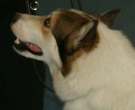
1 – A black-and-white Siberian Husky with blue eyes by Flickr user Pamela Carls (IrisDragon) / CC BY-SA
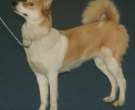
2 – Siberian Huskies by Dolphin / CC BY-SA
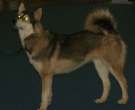
3 – A ยซsableยป-coloured Siberian Husky by Original photo taken by Flickr user Sue and Marty. Edited by User:Pharaoh Hound / CC BY-SA
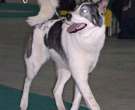
4 – Husky Siberiano in Mont-Tremblant, Canada by Ellie Lord ellie_lord / CC0
5 – Five year old female Siberian Husky named Luna by Biowk / CC BY-SA
6 – A head of 3-months old Siberian Husky by MrPanyGoff / CC BY-SA

Videos "Siberian Husky"

Type and recognitions:

  • FCI CLASSIFICATION:
  • Group :
  • Section : . .

Federations:

  • FCI – Group 5 – Section 1 Nordic Sledge Dogs. โ“˜
  • AKC – Nordic Sledge Dogs โ“˜
  • ANKC – Nordic Sledge Dogs โ“˜
  • CKC – Nordic Sledge Dogs โ“˜
  • โ€‹KC – Nordic Sledge Dogs โ“˜
  • NZKC – Nordic Sledge Dogs โ“˜
  • UKC – Nordic Sledge Dogs โ“˜

FCI breed standard "Siberian Husky"

Origin:
United States

Date of publication of the valid original standard:
02.02.1995.

Use:

Working dog to pull sleds


General appearance:

The โ€œSiberian Huskyโ€ is a medium-sized working dog., fast and light. Her movement is free and graceful. His body moderately compact and well covered with hair, erect ears and bushy tail with brush hair suggest its Nordic heritage. His characteristic gait is smooth and seemingly effortless.. It performs its original role as a dog to pull in the most capable way, carrying a light load at moderate speed over long distances. The proportions and shape of his body reflect his basic balance of power, speed and endurance. The males of the โ€œSiberian Huskyโ€ breed are masculine, but never rough; the females are female but without showing weakness in their structure. In good health, with firm and well developed muscles, The โ€œSiberian Huskyโ€ should not be overweight.

PROPIMPORTANT ORTIONS:

  • In profile, the length of the body from the point of the shoulder to the point of the buttock is slightly greater than the height of the body from the floor to the withers.
  • The distance from the tip of the nose to the stop is equal to the distance from the stop to the occipital bone.


Behavior / temperament:

The characteristic temperament of the โ€œSiberian Huskyโ€ is friendly and gentle., but also alert and extroverted. Does not manifest the possessive qualities of the guard dog, nor is he overly suspicious of strangers or aggressive towards other dogs. A certain reserve and dignity is expected in the adult dog. His intelligence, docility and disposition for pleasure make this dog a pleasant companion and an always willing worker.

Head:

---

Cranial region:
  • Craging: Medium in size and proportionate to the body; slightly rounded at the top and gradually tapering from its widest point towards the eyes.
  • Dnaso-frontal depression (Stop): Well defined.

facial region:

  • Trufa: Black on gray dogs, leonados or black; liver color in copper dogs; can be flesh-colored in all-white dogs. Pink striped โ€œsnow noseโ€ is acceptable.
  • Horcico: Medium long. The muzzle is of medium width, slimming gradually towards the truffle; the tip is not pointed or square. The nasal bridge is straight from the stop to the tip.
  • Labios: Well pigmented and tight.
  • Jaws / Teeth: They close in a scissor bite.
  • Ojors: Almond biscuits, moderately spread and very slightly oblique. The color of the eyes can be brown or blue; two different colored eyes or one heterochrome eye are acceptable. Vivacious expression, but kind, interested and even naughty.
  • Obars: Medium in size and triangular in shape, placed very close to each other, set high on the head. They are thick, well covered with hair, slightly arched at the back and intensely erect, with slightly rounded tips, which are directed straight up.

Neck:

Medium long, bowed and carried proudly upright when the dog is standing. During the trotting movement, It extends the neck so that the head is carried slightly forward.

Body:

  • Espalda: Straight and strong, with a level top line from withers to rump. It is of medium length, nor relatively short like a "cob" dog, nor elastic due to excessive length.
  • Itmor: It is tight and thin, narrower than the rib cage and slightly raised.
  • Glikeness: It is inclined in relation to the spine, but never so inclined as to restrict the rear thrust of the hind limbs.
  • Pecho: Deep and strong, but not too wide; its deepest point is just behind and at the elbow level. The ribs are well sprung from the spine, but flattened on the sides to allow greater freedom of movement.

Tail:

The tail, that is well covered with hair, shaped like a fox brush; It is inserted just below the level of the upper line and is usually, when the dog is attentive, It is carried on the back in the shape of a curved sickle. When carried up, tail does not curl to either side of the body, nor does it lie flat on the back. It is normal to wear it hanging when the dog is at rest. The hair that covers the tail is of medium length and approximately the same length at the top and bottom and at the sides, thus giving the impression of a round brush.

Tips

PREVIOUS MEMBERS: When the dog is standing and seen from the front, limbs are moderately separated, parallel and straight. The bones are substancial but never heavy. The length of the limb from the elbow to the ground is slightly greater than the distance from the elbow to the point of the withers.. The rams of the forelegs may be extirpated.

  • Hormbrivers and arms: Scapula well placed back. The arm is slightly oblique back from the point of the shoulder to the elbow and is never perpendicular to the ground. The muscles and ligaments that attach the shoulders to the rib cage are firm and well developed..
  • Elbows: Close to the body and without deviations outward or inward.
  • Acarpal joint: Strong, but flexible.Metacarpus: Viewed from the side they are slightly inclined.

LATER MEMBERS: When the dog is standing and seen from behind, hindlimbs are moderately apart and parallel. If there are spurs, must be removed.

  • Thigh: Well muscular and powerful.
  • Rodinllto: Well angled.
  • Atibio-tarsal articulation: Well defined and placed low close to the floor.

FEET: Oval, without being long. Are medium-sized, compact and well covered with hair between the fingers and the pads. The latter are hard and well padded. When the dog adopts the natural posture, the feet show no outward or inward deflection.

Movement:

The characteristic movement of the โ€œSiberian Huskyโ€ is smooth and seemingly effortless.. He is fast and light on his feet and on the show ring with a loosely handled guide, shows a moderately fast trot thus showing good reach in the forelimbs and good drive in the hindlimbs. Seen from the front to the back while walking, The โ€œSiberian Huskyโ€ does not show a single footprint, but as the speed increases, the limbs gradually tilt inward until the pads are situated in a line directly below the longitudinal center of the body. As the footprints of the pads converge, the forelimbs and hindlimbs are carried in a straight line, without the elbows or femoral-tibio-patellar joints deviating inward or outward. Each hind limb moves in the tread of the corresponding fore limb on the same side. While the dog is in motion, top line remains firm and level.

Mantle

Plink: The coat of the โ€œSiberian Huskyโ€ is double and of medium length., giving the appearance of being bushy, but never so long as to cover the well-defined external lines of the dog. The undercoat is soft, dense and long enough to support the outer layer. The hairs of the outer coat are straight and somewhat glued gently to the body; they are never rough or separated from the body. It should be noted that the absence of undercoat during molt is normal. Mustache hairs and hairs between the toes and around the feet are allowed to be trimmed for a cleaner appearance. Trimming hair in any other region of the body is unforgivable and must be severely penalized.

Colorr: All colors from black to pure white are allowed. A variety of markings on the head are common, including many striking patterns not found in other breeds.


Size and weight:

Alturto the cross:

  • Males: 21 to 23,5 inches to the withers (53,5 โ€“ 60 cm.),
  • females: 20 to 22 inches to the withers (50,5 โ€“ 56 cm.).

Pthat:

  • Males: 45 to 60 english pounds (20,5 โ€“ 28 kg),
  • females: 35 to 50 english pounds (15,5 โ€“ 23 kg).

The weight is proportional to height. The measurements mentioned above represent the extreme limits of size and weight without giving preference to either extreme.. Any appearance of skeleton or excessive weight should be penalized.

Resumen: The most important racial characteristics of the โ€œSiberian Huskyโ€ are its medium size, moderate skeleton, well balanced proportions, free and easy movement, appropriate coat, nice head and ears, correct tail and good nature. Any excess weight, rough bones, constricted or heavy movement or a long or coarse coat should be penalized. The โ€œSiberian Huskyโ€ is never so heavy and coarse in appearance as to suggest that it is a powerful pack animal., nor is it so light and brittle as to suggest that it is a sprint sprinting animal. In both sexes, The โ€œSiberian Huskyโ€ has the appearance of great capacity and resistance. In addition to the fouls already mentioned, The obvious structural faults common to all breeds are undesirable in the โ€œSiberian Huskyโ€ as in any other breed., although they are not specifically mentioned in this standard.


Fouls:

Any deviation from the aforementioned criteria is considered as a fault and the severity of this is considered to the degree of the deviation to the standard and its consequences on the health and well-being of the dog..

  • Heavy or rough head; thin head too chiseled
  • Insufficient stop
  • Muzzle too pointed or too thick; snout too short or too long.
  • Any bite other than scissors
  • Eyes too slanted or too close together
  • Ears too large in relation to the head; too separate; not upright enough
  • Neck too short and thick; neck too long.
  • Weak or elastic back; convex back; inclined top line
  • Chest too wide, rack of ribs, ribs too flat or weak
  • Tail bent or tightly curled; tail with many feathers; insertion tail too high or too low
  • Straight shoulders; loose shoulders
  • Weak pasterns; too heavy bones; limbs too narrow or too far apart in front; elbows turned out
  • Straight knee joints, cow hocks, viewed from behind too narrow or too far apart
  • Flexible or squashed fingers; feet too big and heavy; feet too small and delicate; fingers deviated outward or inward
  • Short step, elastic, jumping, heavy or wobbly movement; crossed or like a crab.
  • Long coat, rough the hirsute; too rough or too silky texture; haircut, except where allowed

FALTAS DISQUALIFYING:

  • Aggressiveness or extreme shyness.
  • Any dog โ€‹โ€‹showing clear signs of physical or behavioral abnormalities must be disqualified..
  • Males older than 60 cm. (23,5 inches) and females over 56 cm. (22 inches).


N.B.:
  • Males should have two normal-appearing testicles fully descended into the scrotum..
  • Only functionally and clinically healthy dogs, with the typical conformation of the breed, should be used for parenting.

Source: F.C.I - International Cynological Federation

Alternative names:

1. Chukcha, Husky, Sibe (English).
2. Husky sibรฉrien, Husky (French).
3. Husky (German).
4. Husky (Portuguese).
5. Siberian husky, Husky siberiano, Chukcha, Shusha, Keshia, Siberiano (espaรฑol).

โ–ท The world of Pets: Dogs, cats, birds, reptiles, amphibians

Gray Norwegian Elkhound
Noruega FCI 242 - Nordic Hunting Dogs

An advantage of Gray Norwegian Elkhound is that it is a friendly and social dog does not tend to dominate or attack.

Cazador de Alces Noruego

Content

Characteristics "Gray Norwegian Elkhound"

Coexistence is important that you have with your new friend. Before considering the acquisition of a dog of the breed "Gray Norwegian Elkhound" you know certain factors. Not all breeds of dogs are apt to live in an apartment, you must take into account his character, their need for exercise, their interaction with other pets, their care and if you have small children, their level of tolerance towards them.

Adaptation โ“˜

5,0 of 5 stars (based on 1 review)

friendly dog โ€‹โ€‹โ“˜

3,0 of 5 stars (based on 1 review)

hair loss โ“˜

5,0 of 5 stars (based on 1 review)

Affection level โ“˜

5,0 of 5 stars (based on 1 review)

Need for exercise โ“˜

4,0 of 5 stars (based on 1 review)

Social need โ“˜

3,0 of 5 stars (based on 1 review)

Home โ“˜

3,0 of 5 stars (based on 1 review)

Toilet โ“˜

5,0 of 5 stars (based on 1 review)

Friendly with strangers โ“˜

3,0 of 5 stars (based on 1 review)

barking โ“˜

5,0 of 5 stars (based on 1 review)

Health โ“˜

3,0 of 5 stars (based on 1 review)

Territorial โ“˜

3,0 of 5 stars (based on 1 review)

Cat friendly โ“˜

3,0 of 5 stars (based on 1 review)

Intelligence โ“˜

5,0 of 5 stars (based on 1 review)

Versatility โ“˜

3,0 of 5 stars (based on 1 review)

Child friendly โ“˜

5,0 of 5 stars (based on 1 review)

Surveillance โ“˜

3,0 of 5 stars (based on 1 review)

joy โ“˜

5,0 of 5 stars (based on 1 review)

History

National dog of Norway

The roots of this Norwegian national dog go back a long way.: already Stone Age finds give evidence of a very similar quadruped. Some cynologists suspect that the current appearance of the breed is very close to that of the first western European domestic dogs. In scandinavia, the Gray Norwegian Elkhound they were used mainly to hunt elk, but also bears, hence its name.

For a long time the breed was mainly bred in Sweden, where he was called "gray dog". But since 1981 Norway has had the sponsorship: The breed got its current name, The "gray dog" was formally eliminated as a breed in this context.

In total there are three Moose Hunter dogs: Besides of Gray Norwegian Elkhound, are the Black Norwegian Elkhound and the Jรคmthund Sueco. The Norwegian gray is the most common: Although rarely seen outside of Scandinavia, he is very popular in his home country and is considered the national dog there.

Physical characteristics

The dog Gray Norwegian Elkhound has a very classic look, similar to the first dogs domesticated by humans in Western Europe. The waterproof coat in typical shades of gray, black and white already gives an indication of the Nordic origin of this dog Moose Hunter. But it also has the effect that some laymen at first glance consider it a mixed race with parts of the Huskys. With a maximum height of 52 cm at the withers and a body weight of about 24 kg with compact structure, the Gray Norwegian Elkhound belongs to the medium-sized breeds and is larger than the Black Norwegian Elkhound. The pointy ears are erect and the tail is ideally rolled slightly over the back..

Character and skills

The Gray Norwegian Elkhound they are intelligent animal companions with their own personalities. So if you are looking for a four-legged friend who is willing to subordinate, you are wrong with this proud fellow. The breed is considered brave, smart and friendly. To the Gray Norwegian Elkhound they usually like to bark, make sure to control it from when they are puppies. Many Gray Norwegian Elkhound they are therefore very suitable as watchdogs, because they are alerted by strangers – However, it is quite possible that this human-friendly breed will be caressed by a stranger. In an emergency, However, loyal four-legged friends are always ready to defend their loved ones. The Gray Norwegian Elkhound can be well kept as a family dog – whenever I exercise a lot outside. He gets along very well with children and shows his playful side, especially when interacting with them.

Gray Norwegian Elkhound Training

Although this breed does not have a submissive nature, is considered easy to create. An advantage is that this friendly and social dog does not tend to dominate or attack. In any case, it is important to have a sufficient workload, because a boring Gray Norwegian Elkhound seek their occupation independently, and this is usually not to the liking of their owners. It also, make sure that from the age of the puppy you work for a good recovery of the hunting dog. You should also take into account the joy of barking when training. Attending a dog training school can support you and your four-legged friend in learning together and also reinforces their social streak in handling conspecifics.

Gray Norwegian Elkhound Health

These Norwegian hunters they are considered very robust and hardly prone to genetic diseases. There is a slight predisposition to the eye disease Progressive Retinal Atrophy (ARP) and hip dysplasia – before buying a puppy, Please, talk to the breeder in question, who will be happy to inform you about the health precautions for your farm animals. Exercising and eating a balanced diet is the best way to keep your puppy's joints in shape during old age.. Make sure this dog always has a cool place to stay in the summer – the breed tolerates the cold well, but is considered to be heat sensitive. The Gray Norwegian Elkhound can reach an age of up to 16 years, some even more.

Gray Norwegian Elkhound Nutrition

Like every dog, the Gray Norwegian Elkhound you need a balanced diet that is high in meat. So make sure you give a food where meat is at the top of their intake., regardless of whether you choose wet or dry food. The Gray Norwegian Elkhound tend to gain weight quickly, so you should always watch your daily ration and include treats. The manufacturer's instructions are only a rough guide., as metabolism and exercise change your dog's energy needs. So check your partner's weight regularly so you can counter if he gains or loses weight. If you want to reward your dog, use high-quality snacks without sugar or grains. Chunks of freeze-dried meat for dogs are a good example. Dry chews meet your partner's chewing needs. Make sure your four-legged friend always has plenty of drinking water available.

Gray Norwegian Elkhound Care

This dog's coat consists of a longer top coat and a dense undercoat.. It is very weather resistant and easy to brush. But, the Gray Norwegian Elkhound you also lose a relatively large amount of hair, especially during coat change twice a year. During this time, you should brush him daily to stop the flood of hair in your home and rid the dog of dead hair. Especially with older animals or if your dog walks mainly on the soft forest floor, you may need to trim the claws regularly. This will prevent your Gray Norwegian Elkhound get hurt if you get stuck with them. If you are not sure, ask your vet to show you how to trim them during checkups – you can usually do the pedicure yourself with special pliers. When brushing your dog's ears, also check that they are not dirty and use a special ear cleaner for dogs if necessary. You can effectively prevent tartar and its consequences by brushing your dog's teeth every day together with a dog toothbrush and an animal-friendly toothpaste.. If you are considering this, you should get your pup used to the ritual around his shiny little teeth.

Is a Norwegian Elkhound right for me??

The Gray Norwegian Elkhound still suits hunters well, but he can also be a happy family dog รขโ‚ฌโ€นรขโ‚ฌโ€นif he has enough outdoor activity. Not a dog for the city. A fenced garden would be an ideal addition to your home.. This breed is not made for living in a small apartment.. Should already have experience with dogs, because although the Gray Norwegian Elkhound be smart and like to learn, will not accept instructions that seem crazy. Here you need the right mix of knowledge and sensitivity. Can get along with cats, but you should have already known them as potential mates at puppy age.

Like any other four legged friend, keeping this dog requires a not inconsiderable amount of time: Are you prepared to spend a few hours outside with your partner every day, whatever the weather?? It also, estimate costs in advance: In addition to the purchase price and, if required, the basic equipment, there are regular expenses for vet visits, high quality food, as well as the dog's tax and insurance.

Where can I buy a Norwegian Elkhound?

If you are looking for a Gray Norwegian Elkhound outside scandinavia, you must have a little patience. So it makes sense to contact the Nordic dog clubs directly., that can help you, for example, to make contacts abroad. Because especially in the far north there are naturally more specimens. In scandinavia, a few 2.000 puppies of the breed see the light of day every year.

The probability of finding a Gray Norwegian Elkhound adult in animal shelters is extremely low outside of Scandinavia. So, even if you prefer to give an old animal a new home, contact the nordic dog clubs in your country. Possibly the hybrids of the protectors are also questioned, that they will rejoice in a common coexistence with you.

We wish you a lot of joy with your friendly companion from the far north!

Images "Gray Norwegian Elkhound"

Photos:

1 – Norwegian Elk Hunter gray by https://pxhere.com/en/photo/706371
2 – Norwegian Elk Hunter gray by https://pxhere.com/en/photo/869691
3 – Norwegian Elk Hunter gray by https://pxhere.com/en/photo/1336997
4 – Norvin Son of Storm owned by Nichola Herron. Photo by sannse at the City of Birmingham Championship Dog Show, 29th August 2003 by True / CC BY-SA
5 – Norwegian Elk Hunter gray by https://pxhere.com/no/photo/1233791
6 – Gray Norwegian Elk Hunter by https://pixabay.com/es/photos/cรฉsped-mamรญfero-animales-naturaleza-3259673/

Videos "Gray Norwegian Elkhound"

Type and recognitions:

  • FCI CLASSIFICATION:
  • Group :
  • Section : . .

Federations:

  • FCI – Group 5 – Section 2 Nordic Hunting Dogs. โ“˜
  • AKC – Nordic Hunting Dogs โ“˜
  • ANKC – Nordic Hunting Dogs โ“˜
  • CKC – Nordic Hunting Dogs โ“˜
  • โ€‹KC – Nordic Hunting Dogs โ“˜
  • NZKC – Nordic Hunting Dogs โ“˜
  • UKC – Nordic Hunting Dogs โ“˜

FCI breed standard "Gray Norwegian Elkhound"

Origin:
Norway

Date of publication of the valid original standard:
09.08.1999

Use:

Hunting dog for moose.


General appearance:

It's a typical Spitz, compact body, short and square. Elastic and well-set collar. erect ears. The coat is dense and abundant, but not bristly or long. The tail is tightly curled over the back.

PROPIMPORTANT ORTIONS: Square shaped. The length of the skull corresponds to that of the muzzle.


Behavior / temperament:

Without fear, energetic, brave.

Head:

Wedge shaped, relatively wide at the level of the ears. Thin.

Cranial region:
  • Craging: Slightly arched.
  • Dnaso-frontal depression (Stop): Well marked, but not too much.

facial region:

  • Trufa: black.
  • Horcico: Whether viewed from above or in profile gradually decreases. The nasal helm is straight.
  • Labios: Tight.
  • Jaws/Teeth: Scissor bite. Complete denture.
  • Ojors: They are not prominent and should be dark brown..
  • Obars: High insertion, firm and erect, relatively small. Its length slightly exceeds its width at the base; they are pointed and well mobile.

Neck:

Medium length, firm, well upright. Abundant golilla, no loose skin.

Body:

Strong, short loin.

  • Lรญnand the top: Straight from the withers to the insertion of the tail.
  • Cruz: Well developed.
  • Espalda: companies, muscular and straight.
  • Itmor: Well developed.
  • Glikeness: Strong and wide.
  • Pecho: Broad and deep; ribs tight.
  • Lรญnlower ea and belly: Almost straight.

Tail:

High insertion, strong, relatively short. Dense hair, but without fringes. Tightly curled over the back, but not carried to the side. The tip of the tail cannot be stretched out in adult dogs.

Tips

PREVIOUS MEMBERS:

  • Apgeneral arience: Strong and firm, straight.
  • Hormbros: Inclined.
  • Brazo: Moderately inclined.
  • Elbows: Well glued, turned neither in nor out.
  • Antarm: Straight, be seen from the front or from the side.
  • Metacarpus: Straight seen from the front, moderately inclined viewed from the side.
  • Pinis previous: Rather small, compact; fingers are directed forward.

LATER MEMBERS:

  • Apgeneral arience: Strong, skinny, muscular. Parallels seen from behind. Moderately angled.
  • Thigh: Muscled and wide.
  • Rodinllto: Moderately angled.Leg: Medium long.
  • Corvejรณn: Moderately angled.
  • Metatarsus: On the dog in a standing position, the metatarsal should not be located further back than the insertion of the tail.
  • Pinis later: Relatively small, oval, compact. Fingers are directed forward.

Movement:

Light, effortless. Parallel, be seen from the front or the back.

Mantle

PIEL: companies, no wrinkles on the head.

  • Plink: Medium long; dense outer coat of hair, rough, abundant, without curls. On the head and in the front of the limbs it is short and smooth. It's the longest on the neck, thigh, on the back of the limbs and on the tail. Soft inner fur cover.
  • Colorr: Various shades of gray. The black tips of the hairs on the outer layer determine the hue of the color. Gray is lighter on the chest, the belly, the extremities, at the bottom of the tail, below the tail insertion and on the "harness-like markings". The harness marking is a stripe width of 5 cm that extends from the withers to the elbows and in which the hairs of the outer layer do not have black tips. The ears and the front of the muzzle are dark in color (dark mask). The dark line from the eye to the ear insert limits the mask. The undercoat of hairs is light gray.


Size and weight:

Alturto the cross:

  • In males: ideal height: 52 cm..
  • In females: ideal height: 49 cm..


Fouls:

Any deviation from the aforementioned criteria is considered as a fault and the severity of this is considered to the degree of the deviation to the standard and its consequences on the health and well-being of the dog..

  • Round or domed skull.
  • Pointed or short snout.
  • Pinz bite Irregular bite.
  • light eyes.
  • Ears that are too big or wide.
  • Tail too short, not tightly screwed, deviated to one side.
  • flattened feet.
  • Too long or too short undercoat.
  • Brownish or yellowish color. Dark undercoat. Sooty color.
  • White on the tip of the tail; white on chest.
  • Weak or nervous temperament.

FALTAS DISQUALIFYING:

  • Aggressiveness or extreme shyness.
  • Any dog โ€‹โ€‹showing clear signs of physical or behavioral abnormalities must be disqualified..
  • Upper or lower prognathism.
  • Yellow or blue eyes.
  • Not erect ears.
  • Short tail from birth.
  • Spurs on the hind limbs.
  • Any color variation other than gray.
  • Height to the cross 3 cm minus 4 cm more than the ideal height mentioned in the standard.


N.B.:
  • Males should have two normal-appearing testicles descended into the scrotum..
  • Only functionally and clinically healthy dogs, with the typical conformation of the breed, should be used for parenting.

Source: F.C.I - International Cynological Federation

Alternative names:

1. Norsk elghund, Grรฅ norsk elghund, Gray Norwegian Elkhound, Small, Grey Elk Dog, Norwegian Moose Dog, Harmaa norjanhirvikoira (English).
2. Norwegian Elkhound (French).
3. Norwegischer Elchhund grau (German).
4. Elkhound, Norueguรชs cinza (Portuguese).
5. Norsk elghund, Norsk elghund grรฅ, Cazador de alces noruego gris, Gray Norwegian elkhound, Small grey elk dog, Norwegian moose dog (espaรฑol).

โ–ท The world of Pets: Dogs, cats, birds, reptiles, amphibians

Karelian Bear Dog
Finlandia FCI 48 - Nordic Hunting Dogs

Karelian Bear Dog

The Karelian Bear Dog is a very independent and intelligent dog.

Content

History

The Karelian Bear Dog, which also bears the name of zyrians dog, is considered the progenitor of the breed. But the basic strain of the breed came from the Carelia de Ladoga, the Olonets and the Carelia Rusa, where these dogs were used to hunt in different ways. Breeding started in 1936 with the aim of developing a robust dog that could make noise when hunting big game. At that time it was agreed that the breed name should be Karelian Bear Dog. The first standard was created in 1945. In 1946 the first dogs were registered in the stud book. Today the breed is well established in Finland..

Physical characteristics

This four-legged friend has a great similarity to the Laika related to him.

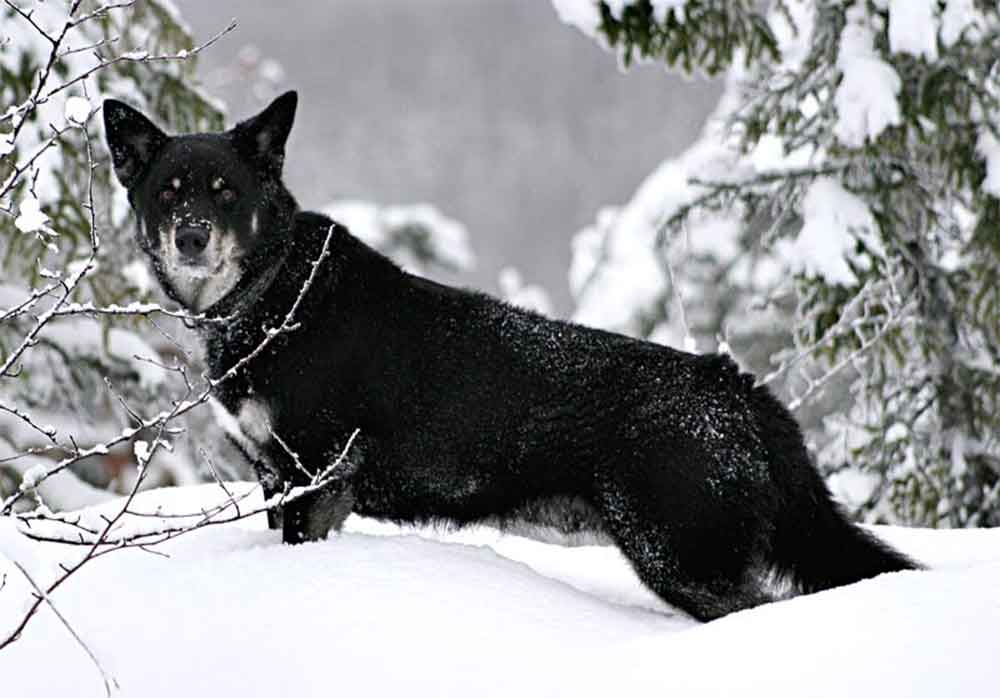
With a height at the withers of up to 60 cm., males weigh about 28 kg. Bitches are slightly smaller and should not weigh more than 20 kg. The Karelian Bear Dog has a strong trunk and generally a compact and dynamic stature. On his head there are medium and erect ears and he wears a folded tail on his back. The icing on the cake is usually a white tip. Otherwise, dense coat color is usually black with white markings. The rough top layer is very close to the dense undercoat, that glows with a slight brown hue.

Character and skills

The freedom-loving character

This dog loves the vastness of the forest and its independence, a combination that combines his attitude with some challenges, because he'll take any chance to roam free. As this four-legged friend acts very independently during the hunt and must place the game alone, it is also, for the rest, a confident partner, who gladly takes command when the opportunity presents itself.

He is considered brave and is always ready to defend his loved ones. Contact with other dogs can be problematic without extensive socialization, because some Karelian Bear Dog show aggressiveness when meeting other dogs. But, other owners report their dogs great balance and praise their social compatibility. It is a fact that many Karelian Bear Dog they are also working together as hunting assistants – so with good conditioning and socialization this should not be a problem.

They are excellent watchdogs, that reliably indicate intruders. Despite all the lovely nooks and edges, the Karelian Bear Dog they also have their soft sides: They are not aggressive with people, they like to be petted at home and they love to be petted by their caregivers.

Karelian Bear Dog Education<

Education without subordination

Its independent nature requires a lot of knowledge, but it should be clear from the start to anyone considering having a Karelian Bear Dog: that this proud quadruped will never be subservient. Their independence reaches such a point that many Karelian Bear Dog they disappear into the woods for days in their native country, just to show up again when it suits him.

Harshness and yelling are absolutely out of place in training this sensitive dog, which will then retreat or crawl. But, with the right mix of positive reinforcement, empathy and consistent behavior, good daily obedience can be achieved.

It is important to socialize extensively with other four-legged friends from puppy age onwards., since some Karelian Bear Dog are considered incompatible with other dogs of the same species, what can become problematic on daily trips. It is a challenge to keep this dog available and away from independent hunting trips.. Specialists with experience in dogs of this breed are definitely needed.

Karelian Bear Dog Health and Nutrition

The original breed is considered very robust. If you buy it from a serious breeder and pay attention to a balanced and age-appropriate diet- plenty of exercise, your four-legged friend can reach a age up to 13 years.

Important for a healthy dog รขโ‚ฌโ€นรขโ‚ฌโ€นlife is, of course, also the daily food content. give to you Karelian Bear Dog a high quality food with a high proportion of meat and little grain. The energy needs of your four-legged friend depend on their constitution and daily exercise. So make sure to adjust your food accordingly and keep an eye on her slim waist..

As in humans, extra kilos increase the risk of various diseases, including painful joint problems. Always provide fresh water. On the longest trips, you should also have enough water for your partner, which is also more sensitive to heat. Visit the vet at least once a year for a checkup with your pet and talk to him about necessary vaccinations and regular deworming.

Caring for the Karelian Bear Dog

The fur of this weather-resistant quadruped is easy to care for. But, loses more hair during coat change, so it can be useful to brush it every day, so that less hair is spread around the house. Otherwise, brush it every few days; this ritual also strengthens the bond and should already be practiced with the puppy for a relaxed routine.

Always check the eyes, your puppy's ears and claws and use a special eye and ear cleaner if necessary. The claws can become too long in dogs that walk a lot on soft ground – or they move too little, what in this quadruped, However, should only occur in very old or diseased specimens. In this case, shorten them with special tweezers.

Many dog โ€‹โ€‹owners brush their quadrupeds' teeth regularly with dog toothpaste and brush to prevent tartar and associated secondary diseases. You can now practice this with your puppy. Alternatively, you can offer your dog dental care snacks.

Activities with the Karelian Bear Dog

Occupation: go out into the woods!

This four-legged friend's favorite hobby is clearly hunting.: extensive travels through the forest and hunting tracking are his passion. The Karelian Bear Dog seek the game to be hunted almost silently. Once you have reached your destination, barks long and persistently at the hunt to keep it in place until the hunter arrives.

The Karelian Bear Dog sometimes they hunt in threes, so they can also keep larger animals like bears at bay. The breed does not necessarily have to be hunted. As an alternative to hunting, the karelian bear dog also suitable for dog sports, but in this case you can only do activities that you like. If you enjoy it, Agility sports can be a good activity for a Karelian Bear Dog adult. Also suitable as a companion for jogging or cycling – but you must keep his hunting instinct in check. Most of these excellent crawlers like crawling work of all kinds.

Is a Karelian Bear Dog right for me??

The Karelian Bear Dog belong to the hands of seasoned enthusiasts, preferably hunters. Alternatively, need a lot of exercise and outdoor work. Only then is it possible to keep them as family dogs. Dog experience should be available in any case. In addition, you must be clear that this quadruped can only be trained conditionally.. Does not belong to the group of dogs that subordinate to themselves – as a dog owner you must respect this, but still be able to direct their power in a controlled manner.

The Karelian Bear Dog not in any way suitable for a city apartment. The ideal would be to offer you a leak-proof garden, in addition to the daily run in forests and fields, but beware: the Karelian Bear Dog freedom lover is considered a fugue artist and can jump up to two meters high.

This four-legged friend likes to befriend children, but they should be older and have learned to treat animals with respect.

Cats in the same household are not necessarily a good idea, not to mention rabbits or other small animals. The norse hunter you will always see potential prey in them. Of course there are exceptions to the rule and there may even be friendships between Karelian Bear Dog and cats socialized at a young age – but you won't be able to get a guarantee before you move in. So you must bring a lot of time, space and experience if you want this proud dog to move in with you.

The Karelian Bear Dog is a four-legged friend for connoisseurs, which should not be chosen as a new roommate for its rustic appearance. If you are not looking for a true character head, you will have little joy with this animal roommate. Of course, before moving, it is also necessary to calculate the one-time expenses (buy creator, basic team, travel expenses) and regular expenses (food, veterinary, dog tax and insurance).

Where can I find a Karelian Bear Dog?

This breed of dog is found naturally mainly in Scandinavia, especially in finland. Further south there are only a few dogs of this very special hunting breed. In Germany, for example, not a single cub of Karelian Bear Dog in recent years. Special Nordic dog clubs can help you find the dog of your dreams. But, There are some things to consider if you are interested in a puppy from abroad. It's always better if you can get a picture of the puppies' house and meet their parents. The Nordic Dog Experts, who you should contact through the appropriate associations, can advise you if there are possible alternatives to Karelian Bear Dog that suit you, to your life situation and your wishes. Or you can refer them to the breeders of Karelian Bear Dogs, if there is currently no one in your country who will have a litter in the near future.

Characteristics "Karelian Bear Dog"

Coexistence is important that you have with your new friend. Before considering the acquisition of a dog of the breed "Karelian Bear Dog" you know certain factors. Not all breeds of dogs are apt to live in an apartment, you must take into account his character, their need for exercise, their interaction with other pets, their care and if you have small children, their level of tolerance towards them.

Training โ“˜

1,0 of 5 stars (based on 1 review)

Suitability of the apartment โ“˜

1,0 of 5 stars (based on 1 review)

You can be alone all day โ“˜

1,0 of 5 stars (based on 1 review)

Suitable as first dog โ“˜

1,0 of 5 stars (based on 1 review)

Weight gain โ“˜

3,0 of 5 stars (based on 1 review)

Health โ“˜

4,0 of 5 stars (based on 1 review)

Intelligence โ“˜

4,0 of 5 stars (based on 1 review)

Kindness with child โ“˜

3,0 of 5 stars (based on 1 review)

Tendency to bite โ“˜

2,0 of 5 stars (based on 1 review)

Tendency to bark โ“˜

4,0 of 5 stars (based on 1 review)

Tendency to flee โ“˜

5,0 of 5 stars (based on 1 review)

Hair fall force โ“˜

4,0 of 5 stars (based on 1 review)

Suitable as a guard dog โ“˜

4,0 of 5 stars (based on 1 review)

joy โ“˜

3,0 of 5 stars (based on 1 review)

Kindness with cat โ“˜

1,0 of 5 stars (based on 1 review)

energy level โ“˜

4,0 of 5 stars (based on 1 review)

Images "Karelian Bear Dog"

A 10-year-old male Karelian Bear Dog. Head shot with tracking collar around neck by Uusijani / CC0

Karelian bear dog by Friesian.marcin / CC BY-SA

Videos "Karelian Bear Dog"

Watch the Karelian Bear Team in Action

Type and recognitions:

  • FCI CLASSIFICATION:
  • Group :
  • Section : . .

Federations:

  • FCI – Group 5 – Section 2 Nordic Hunting Dogs. โ“˜
  • AKC – Nordic Hunting Dogs โ“˜
  • CKC – Nordic Hunting Dogs โ“˜
  • UKC – Nordic Hunting Dogs โ“˜

FCI breed standard "Karelian Bear Dog"

Origin:
Finland

Date of publication of the valid original standard:
12.03.1999

Use:

It is used mainly for hunting moose and bear. It is very adept at keeping cornered prey barking. He is an enthusiastic and independent hunter, although he cooperates by pointing out with his bark the place where the prey is. All your senses are sharp, especially that of smell, so this breed is useful for hunting big game. Has a very good sense of direction.


General appearance:

It is of medium size and robust constitution. It's strong and something longer than tall. The coat is dense and the ears are erect.

IMPORTANT PROPORTIONS : The length of the body is only slightly greater than the height at the withers.. The depth of the body corresponds to half the height at the withers. The relationship between the muzzle and the skull is about 2 : 3. The length of the skull corresponds approximately to its width and depth.


Behavior / temperament:

It is balanced in nature and somewhat reserved. Is brave, persistent and very self-confident. Can be aggresive with other dogs, but never with people. His fighting instinct is highly developed.

Head:

Seen from the front, has a triangular shape.

Cranial region:
  • Skull: Seen from the front, it's wide; in profile, it is somewhat arched. It is wider between the ears. The frontal sulcus is barely visible. Superciliary arches are only poorly developed.
  • Depression links (Stop): Naso-frontal depression is not very pronounced; is rather long and gradually arches towards the skull region.

facial region:

  • Truffle:Wide, black.
  • Snout: Deep; tapers only a little to the nose. The nasal helm is straight.
  • Lips: They are thin and tight.
  • Jaws / Teeth: The jaws are very strong. The teeth are well developed and symmetrical. Teething is normal and the joint is scissor-shaped.
  • Cheeks: The zygomatic arches are strong.

Eyes: They are rather small and somewhat oval. In different shades of brown; never yellow. His expression is alert and fiery.
Ears: They are set high and stand erect. Medium-sized, with slightly rounded tips.

Neck:

Muscular, arched and of medium length. It is covered in thick fur. There is no presence of dewlap.

Body:

  • Cross: It is clearly defined, especially in males. In females, is less defined.
  • Back: Straight and muscular.
  • Pork loin: Short and muscular.
  • Rump: Wide, strong and slightly sloping.
  • Breast : Spacious, not very wide, rather long, reaches approximately to the elbows. The ribs are slightly arched; the sill is well visible, although not very wide.
  • bottom line: Slightly collected.

Tail:

High insertion. It is of medium length and hunches over the back; the tip of the tail touches the body on the back or on one of the flanks. Short tail is allowed from birth.

Tips

PREVIOUS MEMBERS:

  • As a whole : Robust, for strong bones. Seen from the front, they are straight and parallel. Arm and shoulder blade are the same length; the forearm is a little longer.
  • Shoulder : Relatively oblique and muscular.
  • Arm : It is strong, slightly oblique.
  • Elbows : They point well back and are placed on the vertical line drawn from the highest point of the shoulder..
  • Forearm : Strong and upright.
  • Metacarpus : Slightly oblique and of medium length.
  • Front feet : compacts, well arched. They are rounded in shape and point forward. The pads are flexible and have a dense coat on both sides.

LATER MEMBERS:

  • As a whole : Strong and muscular. Seen from the back, they are straight and parallel. The front line of the hind limb forms a harmonious arch.
  • Thigh : Width, long, of strong muscles.
  • Knee : Point to the front. It is of medium angulation.
  • Leg : She is long and muscular.
  • Hock : Low. Angulation is clearly visible.
  • Metatarsus : Short, strong and vertical.
  • Rear feet : They are compact and a bit longer and less arched than the front ones. The pads are flexible and have a dense coat on both sides.

Movement:

It's lightweight and covers the ground effortlessly. The dog easily changes from trot to gallop, which is the most natural movement. The members move in parallel.

Mantle

SKIN: It is well fitted throughout the body and does not form folds.

HAIR: The hair of the outer coat is rough and smooth. It is longer on the neck, the back and the back of the thigh. The undercoat of hairs is soft and dense.

COLOR: Negro; can be opaque or with brown tones. Most dogs have clearly defined white markings on the head, the neck, the chest, belly and limbs.


Size and weight:

Height to the cross: The ideal height at the withers is 57 cm in males and 52 cm in females, with a tolerance of +/- 3 cm..

Weight: In males, 25 to 28 kg and in females , 17 to 20 kg.


Fouls:

Any deviation from the aforementioned criteria is considered as a fault and the severity of this is considered to the degree of the deviation to the standard and its consequences on the health and well-being of the dog..

โ€ข Weak bones.

โ€ข Narrow skull.

โ€ข Strongly bulging forehead.

โ€ข Pointed snout.

โ€ข Yellow eyes.

โ€ข Bat ears

โ€ข Papada.

โ€ข Very deep or barreled rib cage.

โ€ข Tail straight or not curved enough.

โ€ข Straight shoulders.

โ€ข Straight hocks and flat feet.

โ€ข Dewclaws on the hind limbs.

โ€ข Wavy coat.

โ€ข Predominant white color, with black markings or color called wolf color.

MISS PLAYOFFS

โ€ข Aggressive or fearful dog.

โ€ข Upper or lower prognathism.

โ€ข Gaze eyes.

โ€ข Ears hanging or with the tip hanging down.

โ€ข Colors different from those stipulated in the standard.

Any dog โ€‹โ€‹showing clear signs of physical or behavioral abnormalities should be disqualified..


N.B.:

Males should have two normal-appearing testicles fully descended into the scrotum..

Source: F.C.I - International Cynological Federation

Alternative names:

1. Karjalankarhukoira, Karelsk Bjรถrnhund (English).
2. Karjalankarhukoira (French).
3. Karjalankarhukoira, Bjรถrnhund (German).
4. Karjalankarhukoira (Portuguese).
5. Karjalankarhukoira (espaรฑol).

โ–ท The world of Pets: Dogs, cats, birds, reptiles, amphibians

Hokkaido
Japรณn FCI 261 - Asian Spitz and related breeds

Hokkaido

The Hokkaido still a very rare breed of dog, who is hardly ever seen outside of his home country.

Content

History

This ancient lineage of dogs, known today as Hokkaรฏdo (name of the second Japanese island, largest), It is also known as Kyushu or Ainu dog. According to historical data, its existence dates back to the year 1000 A.C. The offspring of Hokkaido dogs, is uncertain, but some authors believe that they come from the Nordic dogs. The Hokkaido is, probably, the oldest Japanese purebred. Similar to the Scandinavian Spitz in appearance, also has features of the Chow Chow and of the Shar-Pei.

Since its origins it has been used as a guard dog in the Hokkaido Island, and, as well, in hunting bears and other large animals.

In 1937, this breed was recognized as a Natural Heritage of the Japan, by the society for the preservation of Japanese races.

It is also a breed recognized by the FCI.

Rare monument of nature

The Hokkaido It is one of the oldest dog breeds in the Asian world and is part of the cultural heritage of the Japanese island. In 1937 Hokkaido was even declared ยซMonument of NatureยปAnd since then it has been recognized and protected as a race.

Due to the difficult to access regions of the island, Dogs retained their "pure blood" for centuries. Unlike Akita or Shiba Inu, who gave way to Europe long ago, the Hokkaido still a very rare breed of dog, who is hardly ever seen outside of his home country.

Physical characteristics

This is a dog's size medium; its height usually get to the 53 cm in males and the 48 cm in females. Their weight varies between 20 and 30 Kg. Their life expectancy is around the 14 years.

The fur of this species is double: the sub-pelo is dense and soft and external hair is coarse and size medium or short. Its colors vary between fiery red, black and grey.

Character and skills

With regard to his temperament, Whereas it is a hunting and guard dog, we can highlight features such as bravery, impulsivity, agility and speed of movement.

Within the family, is a tame animal, Devoto, with a safe and protective temperament with children if he is accustomed to their presence from an early age. However, tends to be distrustful with strangers, reason why you need a good training and re-education of their less sociable side.
They are very active dogs and it is necessary to provide good rides, long walks, workspace very well to the family but they need space, have a garden where you can be at your leisure.

Hokkaido care

The coat of Hokkaido should be gently brushed regularly (about two or three times a week). You should even use the brush daily during the shedding to remove dead hair from your dog.. It also, Your dog's ears and teeth should be cleaned once or twice a week. To avoid injury, claws should also be trimmed regularly. You will hardly ever need to bathe your Hokkaido: first, He likes to jump to rivers or lakes and "bathe" there, in the second place, it is naturally very clean and thirdly, the skin's own protective barrier should not be attacked by too frequent bathing or even dog shampoo.

Hokkaido Health

In fact, a possible inbreeding in the breeding of Hokkaido in Europe, since due to the rarity of this breed there are very few breeding dogs. So, there is a realistic risk of undesirable hereditary diseases being introduced. A close look at the pedigree is worth it in any case and can perhaps prevent unpleasant surprises.. Apart from the problem of inbreeding, the dogs of Hokkaido They are very robust and resistant to typical dog diseases.. The life expectancy of healthy animals is between 9 and 15 years.

Hokkaido Nutrition

In addition to good genetic material, nutrition also has a decisive influence on the dog's health. Like descendants of the wolf, dogs are carnivores, this also applies to Hokkaido. The original dog especially likes fish. In his homeland., Japan, where it is still traditionally used for fishing and where salmon are caught on their way to spawning grounds with great skill and reaction speed, this preference is not always appreciated – because the Hokkaido first he eats the fish caught by himself and only gives away some of his prey when he is full.

Characteristics "Hokkaido"

Coexistence is important that you have with your new friend. Before considering the acquisition of a dog of the breed "Hokkaido" you know certain factors. Not all breeds of dogs are apt to live in an apartment, you must take into account his character, their need for exercise, their interaction with other pets, their care and if you have small children, their level of tolerance towards them.

Training ?

1,0 of 5 stars (based on 1 review)

Suitability of the apartment ?

1,0 of 5 stars (based on 1 review)

Can be alone all day ?

2,0 of 5 stars (based on 1 review)

Suitable as a first dog ?

1,0 of 5 stars (based on 1 review)

Weight gain ?

4,0 of 5 stars (based on 1 review)

Health ?

4,0 of 5 stars (based on 1 review)

Intelligence ?

4,0 of 5 stars (based on 1 review)

Kindness with child ?

2,0 of 5 stars (based on 1 review)

Tendency to bite ?

3,0 of 5 stars (based on 1 review)

Tendency to bark ?

3,0 of 5 stars (based on 1 review)

Tendency to flee ?

4,0 of 5 stars (based on 1 review)

hair loss strength ?

4,0 of 5 stars (based on 1 review)

Suitable as a guard dog ?

5,0 of 5 stars (based on 1 review)

Joy ?

2,0 of 5 stars (based on 1 review)

Cat friendliness ?

2,0 of 5 stars (based on 1 review)

Power level ?

5,0 of 5 stars (based on 1 review)

Videos "Hokkaido"

HTTPS://youtube.com/watch?v=Z34qpCIZ9YM
15 Things You Should Know About Ainu Dog
HTTPS://youtube.com/watch?v=ZDlVRoYaXKE
Hokkaido Puppy Katana

Type and recognitions:

  • FCI CLASSIFICATION:
  • Group :
  • Section : . .

Federations:

  • FCI – Group 5: Spitz-type dogs and primitive type – Section 5: Asian Spitz and related breeds. โ“˜

FCI breed standard "Hokkaido"

Origin:
Japan

Date of publication of the valid original standard:
16.06.1999

Use:

Hunting dog and company.


General appearance:

medium size dog, well proportioned, strong structure with robust skeleton and well -defined sexual characteristics. The muscles are highly developed and have clear lines.

Important proportion :

โ€ข The relationship between the height of the cross and the length of the body is 10 to 11.
โ€ข The relationship between the skull length and the length of the nasal cane is 3 : 2.
โ€ข The length of the skull corresponds to its width at the height of the cheeks and constitutes a quarter of the height of the cross.


Behavior / temperament:

It has remarkable resistance; His behavior is noble and his spontaneous character. Is faithful temperament, docile, Very much and brave.

Head:

---

Cranial region:
  • Skull and front : Broad and a little flattened.
  • Depression links (Stop) : Unremarkable, but visible.

facial region:

  • Truffle : Black; In white fur dogs, liver truffle is allowed.
  • Snout : Wedge shaped. Straight nose cane.
  • Lips : Very adherent, With black edges.
  • Jaws / Teeth : Powerful scissors bite.
  • Cheeks : Well developed.

Eyes : Relatively small, almost triangular, well separated, dark brown.

Ears : Small, triangular, slightly directed forward and carried vigorously erect.

Neck:

Strong and muscular, without jowl.

Body:

  • Cross : High.
  • Back : Straight and strong.
  • Pork loin : Moderately wide and muscular.
  • Rump : Properly oblique.
  • Breast : Well developed sill. Deep and moderately wide chest. Well arched ribs.
  • Belly : Well withdrawn.

Tail:

High insertion, thick, carried vigorously screwed or folded on the back in the form of a hoz. The tip of the tail must reach almost the corvejones when it is down.

Tips

PREVIOUS MEMBERS :

  • Shoulder : Moderately oblique.
  • Forearm : Straight, well delineated.
  • Metacarpus : Slightly inclined.

LATER MEMBERS : Strong.

  • Warm-tarsal joints : Robust, quite strong.

FEET : Well arched and compact fingers. Thick and elastic pads. hard nails, black or dark.

Movement:

Agile, lively, Light and elastic.

Mantle

HAIR : The outer layer is resistant and straight, the undercoat is soft and dense. In the tail the hair is relatively long and separate.

COLOR : Color sesam (red-tawny hairs with black tips), striped, red, black, Black with fire, white.


Size and weight:

Height to the cross :

  • In males : 48,5 โ€“ 51,5 cm..
  • In females : 45,5 โ€“ 48,5 cm..


Fouls:

Any deviation from the aforementioned criteria is considered as a fault and the severity of this is considered to the degree of the deviation to the standard and its consequences on the health and well-being of the dog..

โ€ข Inverted sexual characteristics.
โ€ข Mild upper or lower prognathism.

MISS PLAYOFFS

โ€ข Aggressive or fearful dog.
โ€ข Pronounced upper or lower prognathism.
โ€ข Ears that do not get erect.
โ€ข Very short or pendant tail.
โ€ข Shyness.

Any dog โ€‹โ€‹showing clear signs of physical or behavioral abnormalities must be disqualified..


N.B.:

Males must have two normal appearance testicles completely descended in the scrotum. The blue-negruzco tongue should not be considered as a lack.

Source: F.C.I - International Cynological Federation

Alternative names:

1. Dล-ken, Ainu-ken, Seta, Ainu dog, Hokkaido-Ken (English).
2. Aรฏnou, Ainu-ken, Hokkaรฏdo-ken (French).
3. Hokkaido-Hund, Ainu-Hund, Ainu Inu, Hokkaido-Ken (German).
4. Hokkaido (cรฃo) (Portuguese).
5. Dล-ken, Ainu-ken, Ainu Dog (espaรฑol).

โ–ท The world of Pets: Dogs, cats, birds, reptiles, amphibians

Chow Chow
FCI 205 - Asian Spitz and related breeds

Chow Chow

The Chow Chow are distinguished by their unusual blue-black tongue

Content

History

The Chow Chow has been known for more than 2500 years in China, where it is represented in bas-reliefs of the time. Dog of mysterious origin, belongs to the Spitz family. Some believe it is a cross between a Tibetan Mastiff and a Samoyed., while others think it is more of an original dog, that is to say, that comes from the Nordic dogs (internal temperature above average, particular shape of the bony structure of your skull…). In any case, stories about the origins of Chow Chow they are usually just hypotheses.

In Manchuria and Mongolia it was used as a war dog, to watch over herds or rushes and as a draft animal. The Chow Chow they were also found in Tibetan monasteries: his function was to defend the monks. Occasionally it was a hunting dog, it was eaten in some parts of china, and his skin was also traded.

It was introduced in Europe in 1865, when Queen Victoria of England received one as a gift and started raising it. It was officially recognized by the Kennel Club English little less than 30 years later, in 1894. Today, only used as a pet.

The term ยซChow Chowยซ has appeared recently. In fact, during the interwar period, the Chow-Chow It was known in the West as the "Hong Kong dog".

Despite some other blood additions over the years 50, the Chow Chow is a breed that has remained pure.

Physical characteristics

The Chow Chow It is a dog with a robust body that goes hand in hand with its wide skull and its small triangular ears slightly rounded at the tip and it carries them apart with the tip slightly inclined forward which are always erect. His eyes are dark, from Brown to black always small, almendrada form. The nose is completely black and wide except in color Chow cream and white, which supports the color pink. The mouth is wide and strong. They have a characteristic "stilt" movement, due to the peculiar conformation of their hind legs, which lack angle, and it makes it look like walking on stilts.

It is a dog of agile and balanced movement. By joining the legs in parallel to two in the movement. This breed has a very dense fur that can be rough or soft, which it accumulates more around his neck, giving it its distinctive frill or horsehair. Its fur can be red, black, Blue and cream. Those who have spotted or multi-coloured fur are considered outside the standards of the breed.

The Chow Chow They are distinguished by their unusual bluish-black or purple tongue and strong legs.. The gene for the bluish-black or purple tongue is usually dominant in this breed, and so it also tends to be in from mixed races of a Chow Chow.

A legend that says, When the gods placed the stars in the firmament, pieces of the sky fell that the Chow Chow licked and since that day he has had a blue tongue..

Character and skills

Today, the Chow Chow is commonly a companion dog. His strong sense of ownership of their homes with their - sometimes- intriguing approach to strangers may be misinterpreted by those who do not belong to his family. But, signs of shyness and aggression are not characteristic of this breed. Copies of the sex opposite usually coexist with less tension than with those of the same sex, but it is not uncommon to see Chow Chow of different sexes living together peacefully.

They are extremely loyal to their family and it costs change masters. Affection usually shown only to people you know, so visitors should not push them physically as they will not immediately accept strangers as quickly as they do with their family members.

They are not a very active breed. Life in an apartment suits them, if they are given the opportunity to get enough physical activity daily. The owners must take daily walks with their Chow Chow, so be it in a small place, to maintain their physical and mental abilities in a healthy way.

Although this breed shows low energy most of the time, needs a routine to be able to explore their environment and thus maintain a loving nature. Its typical behavior resembles that of a domestic cat more than that of a dog., for cleaning and its enigmatic nature.

Grooming

Grooming requirements depend on the type of fur. A Chow straight hair needs to be brushed weekly only. One with a rough coat should be brushed every other day. Both varieties molt twice a year, during which the coat will abundantly. Rarely need a bath, although a hot bath followed by a thorough drying can help remove the coat you're missing.

The rest is basic care. Trim nails as needed, usually once a month. Brush your teeth frequently for general good health and fresh breath. Check ears weekly for dirt, redness or odor that may indicate an infection. If the ears look dirty, clean them with a damp cotton ball and a mild ear cleaner recommended by your vet.

Health

The Chow Chow is the breed of dog most affected by Dysplasia elbow. It is also vulnerable to hip dysplasia, dislocation of patella, thyroid disease, Pemphigus Foliaceus and ocular disorders such as entropion and ectropion. The risk of these disorders increases exponentially when they are purchased at pet stores unscrupulous caregivers who do not test their dogs to see if there is existence of genetic disorders. Like this, a potential buyer of this breed should ask about the health status of the pet to buy. Animal caretakers must provide the client with a guarantee of the dog's health. But despite his delicate health, It is an excellent companion dog for humans..

Characteristics "Chow Chow"

Coexistence is important that you have with your new friend. Before considering the acquisition of a dog of the breed "Chow Chow" you know certain factors. Not all breeds of dogs are apt to live in an apartment, you must take into account his character, their need for exercise, their interaction with other pets, their care and if you have small children, their level of tolerance towards them.

Adaptation โ“˜

2,0 of 5 stars (based on 1 review)

friendly dog โ€‹โ€‹โ“˜

1,0 of 5 stars (based on 1 review)

hair loss โ“˜

5,0 of 5 stars (based on 1 review)

Affection level โ“˜

2,0 of 5 stars (based on 1 review)

Need for exercise โ“˜

2,0 of 5 stars (based on 1 review)

Social need โ“˜

2,0 of 5 stars (based on 1 review)

Home โ“˜

3,0 of 5 stars (based on 1 review)

Toilet โ“˜

5,0 of 5 stars (based on 1 review)

Friendly with strangers โ“˜

1,0 of 5 stars (based on 1 review)

barking โ“˜

5,0 of 5 stars (based on 1 review)

Health โ“˜

4,0 of 5 stars (based on 1 review)

Territorial โ“˜

3,0 of 5 stars (based on 1 review)

Cat friendly โ“˜

2,0 of 5 stars (based on 1 review)

Intelligence โ“˜

2,0 of 5 stars (based on 1 review)

Versatility โ“˜

2,0 of 5 stars (based on 1 review)

Child friendly โ“˜

2,0 of 5 stars (based on 1 review)

Surveillance โ“˜

2,0 of 5 stars (based on 1 review)

joy โ“˜

3,0 of 5 stars (based on 1 review)

Images "Chow Chow"

credits:

1 – Flickr: Chowdren
2 – International Dog Show, Szczecin 2007 by Remigiusz Jรณzefowicz
3 – Pets Adviser from Brooklyn, USA / CC BYwww.petsadviser.com
4 – by https://pxhere.com/es/photo/234926
5 – Flickr: Bokeh the Chow by Luigi Borromeo
6 – Flickr: Chowdren (chow chow) by Seongbin Im
7 – by https://www.needpix.com/photo/371158/chow-chow-dog-snow-canine-domestic-pet-portrait-looking-attentive
8 – Russian: photo from the exhibition by Vladimir gubanov

Videos "Chow Chow"

Type and recognitions:

  • FCI CLASSIFICATION:
  • Group :
  • Section : . .

Federations:

  • Federations: FCI โ“˜, AKC โ“˜, ANKC โ“˜, CKC โ“˜, โ€‹KC โ“˜, NZKC โ“˜, UKC โ“˜

  • FCI breed standard Chow Chow

    FCIFCI - Chow Chow
    CHOW

    Alternative names:

    1. Chow (English).
    2. Chow (French).
    3. Chow (German).
    4. Chow (Portuguese).
    5. Chow (espaรฑol).

    โ–ท The world of Pets: Dogs, cats, birds, reptiles, amphibians

    Finnish Spitz
    Finlandia FCI 49 - Nordic Hunting Dogs

    Finnish Spitz

    The Finnish Spitz it is a dog that can annoy the neighbors, because he barks a lot and with a particularly piercing voice.

    Content

    This fox-colored four-legged friend from Finland with the typical concise character of the Spitz is a Nordic hunting dog, who has gathered a small but loyal following around the world. It is especially popular in its homeland, Finland. Below you can read interesting facts about the Finnish Spitz, which in Finnish is called ยซSuomenpystykorvaยซ.

    History

    Finnish national dog

    For centuries, the Finnish Spitz has been used as a hunting companion in northern and eastern Finland. In particular, has helped hunt small predators, moose and waterfowl, and later this dog became more and more specialized in grouse and black grouse: Scare these large birds into the surrounding treetops. Now him Finnish Spitz barks persistently until its two-legged partner is close enough to shoot prey.

    Little is known about the exact development of the breed. But, the Finnish Spitz probably descended from dogs Spitz, who have been the everyday helpers of the people in Russia for more than 1.000 years. Towards the end of the 19th century, finnish Hugo Roos observed the original Spitz in northern Finland while hunting and recognized its extraordinary abilities. He advocated selective breeding and thus developed the modern Finnish Spitz – although the standard has been changed several times since then. In Russia, the four-legged friend is also known as the Karelo-Finnische Laika, but in 2006 the Finnish and Russian breeding associations agreed that the two names are the same breed. This means that Finland has been recognized as the country of origin of the breed and is responsible for the standard..

    Since 1979 the Finnish Spitz has been the national dog of Finland.

    Physical characteristics

    Compact body, upright ears and a bushy tail curled over the back: The Finnish Spitz medium-sized it is optically a typical Spitz and stands out especially for its red or golden-brown fur. This consists of two layers: The soft, dense undercoat and the hard top coat. The undercoat is always a little lighter.

    Males can reach a height at the withers of about 47 cm., the females some 42 cm.. Depending on its size, the dogs weigh between 10 and 15 kg.

    Character and skills

    If you want a stuffed dog that always strives for recognition from his two-legged friends, you are wrong with a Finnish Spitz. This independent and sovereign dog knows better than anyone where he is going, and therefore never fully subordinate. He is extremely intelligent and loves to learn, if you can teach him something new. Frequent repetitions quickly bore you, so your willingness to cooperate can decrease rapidly. He is brave and very keen to bark: one of his characteristics is a penetrating voice – More on this later. One Finnish Spitz can be used as a guard dog, but he needs to be connected to his human pack. He is friendly with his caregiver or family and enjoys spending time with children.

    Attention: It is a very Barking Dog.

    At this point we would like to point out a special feature of this dog, the bark of joy Finnish Spitz. Please, consider it: In finland, with a population density of about 16 Inhabitants per square kilometer, the closest neighbor usually lives far away. Here the dog is not only known for his strong voice, but also positively emphasized and encouraged in the form of barking competitions.

    This skill is extremely important for hunting, so that the dog can offer good guidance to the two-legged hunter who cannot move so easily through partially snowy forest. The Finnish Spitz they don't just bark, they also dominate different variations, from short sounds to a kind of song.

    Many Finnish Spitz they can do up 160 sounds per minute. So if you are thinking about the arrival of such a dog, you must first inform yourself about their joy of barking. Even if you can control or reduce it, some Finnish Spitz they will continue to bark more than most other dogs – this is simply in their genes. If you live in a rural area, you can use the Finnish Spitz as an excellent guardian of the house and the yard.

    Activities with the Finnish Spitz

    To the Finnish Spitz he loves the time he spends with his reference person, as well as being outside. So, it's better to combine both as often as possible and take it for long, long walks. It is a wonderful companion on walks, if you keep him on a leash or have his hunting instinct under control. this last, However, is a challenge with this breed, if recoverability is not trained from the beginning. Frequent repetitions are not fun for him Finnish Spitz, but they are looking for a common activity that also trains their smart little head. The trace job, for example, it's a pleasure for him Finnish Spitz. In all sports activities, you must ensure that your partner does not overexert himself., so you stay motivated and injuries don't occur.

    Finnish Spitz education

    If you are thinking that a Finnish Spitz move in with you, You should already have some canine experience to guide this independent companion to the required basic obedience. Don't expect me to be completely subordinate to you, race is too independent for that. Be consistent with everything that is important to you, but leave the Finnish Spitz his own head (testaruda) elsewhere.

    With a loving consistency and positive reinforcement you can train this dog well as a rule. In any case, he is very intelligent and likes to learn new things – then it is also, as a result, cooperative. Use this for your training. With a young man Finnish Spitz it makes sense to visit the puppy school, to establish positive contacts with puppies of other breeds and to strengthen or develop your social streak. Also basic command training at a dog school can be very helpful with him. – it's best if you find a dog school that already has experience with the idiosyncratic character of Spitz.

    Robust health

    The typical Finnish Spitz is a robust and weather resistant dog: the breed is considered to be hardly affected by specific hereditary diseases. If you are thinking of acquiring a dog of this type, it is important that you buy it from reputable breeders, as they reduce the risk of genetic diseases through responsible breeding. An example would be the predisposition of some dogs to Hip Dysplasia or problems with the knee and elbow joints. Talk to the breeder in question about the health care of parental animals.

    You yourself can contribute a great deal to your dog's health by providing him with a healthy diet and exercising appropriately for his age and level of training..

    This breed of Spitz it is quite sensitive to heat due to its origin in the far north… The walks in winter, on the other hand, are to the taste of this four-legged friend. The breed reaches an average age of 12 to 13 years.

    The Finnish Spitz diet

    It also, a balanced diet adapted to the needs of your four-legged friend is an important component for their health. Like all dogs, the Finnish Spitz requires a meat-based diet. So, make sure meat is the first component for the pet food you choose. The grain should not be included. This applies regardless of whether wet or dry food is chosen. With a pure diet of dry food you must pay special attention to the fact that your quadruped ingests enough liquid.

    Water must always be freely available. After meals, their Finnish Spitz definitely must have time for a digestive nap, so it is better to feed after joint excursions. Remember that treats must be added to the daily ration, otherwise your dog's slim waist will be in danger. It is also possible to bring dry food as a reward.

    Dry chews, like cattle ears, satisfy your partner's chewing needs. Dental care treats or freeze-dried meat snacks especially for dogs are other sensible rewards that you can give your four-legged friend a tasty little treat with..

    Care for the Finnish Spitz

    Although caring for this dog's coat is quite easy, should not be careless, especially during coat change. In spring and autumn the Finnish Spitz usually has a lot of hair – help him get rid of dead hairs by brushing him regularly – preferably daily. This way you can prevent skin irritation, which can develop rapidly if too many hairs from the dense undercoat remain on the dog. Outside the coat change, just brush your partner once a week. During this grooming ritual, that you should already practice with your puppy, it is better that I also look in the ears, which should be cleaned with a dog ear cleaner if necessary. A brief claw check should also be performed at regular intervals – usually older quadrupeds or those that only walk on soft ground need support from you in the form of a pedicure. Here a dog clip provides valuable services.

    Is a Finnish Spitz right for me??

    A dream home for a Finnish Spitz It is a large plot of land in the field to watch over her, including family connection. The breed is suitable for dog lovers with a great sense of independence, who like to move in nature with their partner and who can impart basic obedience to the stubbornness of their four-legged friend thanks to the skill, consistency and calm. He is not a city dog โ€‹โ€‹and his barks of joy alone could make him unsuitable for keeping indoors., even if you can have a quiet Finnish Spitz as a roommate through lots of activity and patient training.

    As a family dog รขโ‚ฌโ€นรขโ‚ฌโ€นit is very suitable, provided you have the appropriate occupation and education. It also, is patient and trusting with children with whom he usually has a good relationship – but make sure the four-legged friend can back off if he feels like it. The Finnish Spitz not suitable for hot regions and also not a companion for a beach holiday – loves cooler climates, what is much better for him.

    Talking about vacation: Before deciding on this dog, Please also consider that you should be well looked after in case of illness and on vacation. Preferably from someone who already knows you and is familiar with the characteristics of a Spitz. Of course, you can also take it on vacation with you, but before registering it in a hotel, you must be sure that you do not want to charm every hotel guest with your loud voice. So, this type of trip is only possible with a very well bred Finnish Spitz.

    Also consider in advance the one-time costs and especially the regular costs that you will have to pay when your new pet roommate moves in.: In addition to the basic equipment and purchase price of a dog from a reputable breeder, there may be considerable travel expenses for a puppy bought abroad. Once your Spitz lives with you, there will be high quality food costs, taxes and insurance for the dog and expenses for regular visits to the vet, including vaccinations and deworming.

    Where can I find my Finnish Spitz?

    Like many other races from the far north, the Finnish Spitz is a rarity in southern Scandinavia. In many countries not a single litter of Finnish Spitz in a year, so if you have fallen in love with this breed, you will usually have to travel long distances to get a puppy as a new member of the family. Contact the Nordic dog breed clubs, that can help you find a dog of this breed, which is especially popular in its home country, and possibly establish contacts with breeders in Scandinavia. If you adopt a puppy from abroad, there are some things you should consider… Find out in time! Remember: It always makes sense to visit the puppy in the kennel to meet the parents and the circumstances in which the four-legged friends live.. If possible, you should also visit the breeder personally before deciding to buy a puppy from abroad. Here too there is the possibility to sniff each other and ask questions without time pressure. After all, buying a puppy is a matter of trust.

    If you want a Finnish Spitz adult as companion, there is little chance in most Central European countries to get a matching dog – maybe you are considering a trip to Finland in the near future and find it there. Otherwise, nordic dog breed clubs will help you on your quest. Maybe a Nordic cross or another breed of Spitz can conquer your heart.

    advice: Start looking for your new partner with watchful eyes and an open heart, because many hybrids of Spitz have similar characteristics.

    Characteristics "Finnish Spitz"

    Coexistence is important that you have with your new friend. Before considering the acquisition of a dog of the breed "Finnish Spitz" you know certain factors. Not all breeds of dogs are apt to live in an apartment, you must take into account his character, their need for exercise, their interaction with other pets, their care and if you have small children, their level of tolerance towards them.

    Training ?

    3,0 of 5 stars (based on 1 review)

    Suitability of the apartment ?

    1,0 of 5 stars (based on 1 review)

    Can be alone all day ?

    1,0 of 5 stars (based on 1 review)

    Suitable as a first dog ?

    2,0 of 5 stars (based on 1 review)

    Weight gain ?

    3,0 of 5 stars (based on 1 review)

    Health ?

    4,0 of 5 stars (based on 1 review)

    Intelligence ?

    4,0 of 5 stars (based on 1 review)

    Kindness with child ?

    3,0 of 5 stars (based on 1 review)

    Tendency to bite ?

    2,0 of 5 stars (based on 1 review)

    Tendency to bark ?

    5,0 of 5 stars (based on 1 review)

    Tendency to flee ?

    4,0 of 5 stars (based on 1 review)

    hair loss strength ?

    4,0 of 5 stars (based on 1 review)

    Suitable as a guard dog ?

    4,0 of 5 stars (based on 1 review)

    Joy ?

    3,0 of 5 stars (based on 1 review)

    Cat friendliness ?

    2,0 of 5 stars (based on 1 review)

    Power level ?

    4,0 of 5 stars (based on 1 review)

    Images "Finnish Spitz"

    Spitz finlandes

    Spitz finlandรฉs by Pets Adviser from Brooklyn, USA / CC BY

    Spitz finlandes

    Spitz finlandรฉs by Pets Adviser from Brooklyn, USA / CC BY

    Videos "Finnish Spitz"

    Type and recognitions:

    • FCI CLASSIFICATION:
    • Group :
    • Section : . .

    Federations:

    • FCI – Group 5 – Section 2 Nordic Hunting Dogs. โ“˜
    • AKC – Nordic Hunting Dogs โ“˜
    • ANKC – Nordic Hunting Dogs โ“˜
    • CKC – Nordic Hunting Dogs โ“˜
    • โ€‹KC – Nordic Hunting Dogs โ“˜
    • NZKC – Nordic Hunting Dogs โ“˜
    • UKC – Nordic Hunting Dogs โ“˜

    FCI breed standard "Finnish Spitz"

    Origin:
    Finland

    Date of publication of the valid original standard:
    04.04.2016

    Use:

    A hunting dog mainly for forest birds, also small game predator, waterfowl and moose. Eager hunter; rather independent that works marking the prey with its barks.


    General appearance:

    It is small to medium in size and has an almost square body. Its configuration is slim, firm, and has a good bearing.

    important proportions

    The length of the body is equal to the height at the withers. The depth of the chest is slightly less than half the height at the withers. The ratio of the muzzle to the skull is about 3:4. The skull is slightly wider than it is long; its width is equal to its depth.


    Behavior / temperament:

    This is a lively dog, vigorous, courageous and determined. Can be somewhat reserved with strangers, but never malicious.

    Head:

    ---

    Cranial region:
    • Skull:Seen from above, has an ovoid shape. It gradually widens towards the region of the ears and is wider between the ears. Seen from the front and profile, skull is slightly convex. Upper axes of skull and muzzle are nearly parallel. The frontal furrow is very superficial. Superciliary crest and occiput are not very visible.
    • Depression front naso (Stop): It is not very pronounced. The angle between the muzzle and the skull is well visible.

    facial region:

    • Truffle:It is rather small and jet black.
    • Snout:Narrow and thin. Viewed from above and in profile, gradually decreases. The nasal helm is straight. The lower jaw is clearly visible.
    • Lips:Together, rather thin and tight. Are well pigmented.
    • Jaws/Teeth:The jaws are strong. The teeth are symmetrical and well developed; teething is normal. Joint is narrow scissor-shaped.
    • Cheeks:The zygomatic arches are slightly pronounced.
    • Eyes:Medium in size and almond shaped. They are somewhat oblique and preferably dark. His expression is lively and alert.
    • Ears:They are rather tall, always upright. They are rather small, pointed and very mobile. They are covered with fine hair.

    Neck:

    He's muscular. It appears rather short in males due to the thick collar of hairs. In females, is of medium length. There is no presence of dewlap.

    Body:

    • Cross: It is clearly outlined, especially in males.
    • Back: She is straight and muscular; rather short.
    • Pork loin: Short and muscular.
    • Rump: Medium length, well developed and slightly sloping.
    • Breast : Deep, reaches almost to the elbows and is not very wide. The ribs are slightly arched. The sill is well visible and not very wide.
    • bottom line: It is slightly raised.

    Tail:

    Bends strongly forward from its base, worn tightly across the back. Below and behind it rests against the thigh and its extremity extends to the middle of it. When extended it reaches almost to the hock.

    Tips

    Former members

    • As a whole:Seen from the front, they are straight and parallel. The bones are of medium strength. The arm is somewhat shorter than the shoulder blade and forearm.
    • Shoulder:His firms, very mobile and relatively straight.
    • Arm:A little shorter than the shoulder blade. It is somewhat inclined and very strong.
    • Elbows:They appear in front of a vertical line drawn from the highest point of the shoulder blade. They are directed straight back.
    • Forearm:Rather strong, vertical.
    • Metacarpus:Medium length; slightly inclined.
    • Front feet:Rounded climbing shoe. The fingers are close together and well arched. The pads are elastic, always black, and its lateral parts are covered with dense hair.

    Later members

    • As a whole:Seen from the back, they are straight and parallel. They are strong and of medium angulation. The bones are moderately strong. The thigh is a little longer than the leg.
    • Thigh:Medium length. It is rather wide and has well-developed muscles..
    • Knee:It is presented pointed forward. Angulation is medium.
    • Leg:Muscled.
    • Hock:It is moderately low and the angulation is medium.
    • Metatarsus:It's rather short, strong and vertical.
    • Hind feet:They are a little longer than the forwards, but otherwise they are equal to these. The dewclaws must be removed.

    Movement:

    It's lightweight and covers the ground effortlessly. Easily switch from trot to canter, which is the most natural movement. The members move in parallel. When it is launched after the prey, the dog bursts into a fast gallop.

    Mantle

    Skin: It is well fitted throughout the body and does not form folds.

    Fur: It is rather long on the trunk, upright or semi-erect and more rigid in the neck and back. It is short and tight in the head and limbs, except on the back of the hind limbs. Stiff shoulder hair, especially in males, is visibly longer and rougher. In the back of the thighs (pants) and in the queue, the hair is long and dense. The undercoat of hairs is short, soft, dense and light in color.

    Color: The hair on the back is reddish brown, or golden brown, preferably bright. Of a lighter shade, are the hairs inside the ears, cheeks, the chest, the throat, the belly, the inside of the limbs, the back of the thighs and tail. A white stripe on the chest and small white markings on the feet are allowed.


    Size and weight:

    Height to the cross

    • Males:47 cm with a tolerance of +/- 3 cm..
    • females:42 cm with a tolerance of +/- 3 cm..

    Weight

    • Males:Among 12 and 13 kg.
    • females:Among 7 and 10 kg.


    Fouls:

    Any deviation from the aforementioned criteria should be considered as fault, and its severity is considered in proportion to the degree of the standard deviation.

    • Heavy head.
    • Thick snout.
    • Loose lower jaw.
    • Ears pointing forward at an acute angle, or whose tip points inward or outward. Ears that droop back, or with long hairs inside.
    • Loose or excessively curved tail.
    • Pasterns too loose.
    • Long coat, soft, too short or tight.
    • Visibly delimited different colors.

    ELIMINATING fAULTS

    • Aggressive or fearful dog.
    • Flesh colored nose.
    • Upper or lower prognathism.
    • Bright yellow eyes or gazy eyes.
    • Ears with droopy tips.
    • Bent tail.
    • Wavy or curly coat.
    • Visibly different from the basic color
    • Large white patches on the chest or / and a white stocking.

    Any dog โ€‹โ€‹showing clear signs of physical or behavioral abnormalities should be disqualified..


    N.B.:

    Males should have two normal-appearing testicles fully descended into the scrotum..

    Source: F.C.I - International Cynological Federation

    Alternative names:

    1. Finnish Hunting Dog, Finnish Spets, Finsk Spets, Loulou Finois, suomalainen pystykorva, suomenpystykorva (English).
    2. Spitz finlandais (French).
    3. Karelo-Finnische Laika, Suomenpystykorva (German).
    4. Spitz finlandรชs (Portuguese).
    5. Loulou Finois, Suomalainen pystykorva, Finsk Spets (espaรฑol).

    โ–ท The world of Pets: Dogs, cats, birds, reptiles, amphibians

    Jamthund
    Suecia FCI 42 - Nordic Hunting Dogs

    As with most breeds developed for hunting, the Jรคmthund requires a lot of regular exercise to keep fit, both physically and mentally.

    swedish mountain dog

    Content

    Training ?

    3,0 of 5 stars (based on 1 review)

    Suitability of the apartment ?

    1,0 of 5 stars (based on 1 review)

    Can be alone all day ?

    2,0 of 5 stars (based on 1 review)

    Suitable as a first dog ?

    2,0 of 5 stars (based on 1 review)

    Weight gain ?

    3,0 of 5 stars (based on 1 review)

    Health ?

    5,0 of 5 stars (based on 1 review)

    Intelligence ?

    4,0 of 5 stars (based on 1 review)

    Kindness with child ?

    4,0 of 5 stars (based on 1 review)

    Tendency to bite ?

    2,0 of 5 stars (based on 1 review)

    Tendency to bark ?

    4,0 of 5 stars (based on 1 review)

    Tendency to flee ?

    4,0 of 5 stars (based on 1 review)

    hair loss strength ?

    4,0 of 5 stars (based on 1 review)

    Suitable as a guard dog ?

    4,0 of 5 stars (based on 1 review)

    Joy ?

    3,0 of 5 stars (based on 1 review)

    Cat friendliness ?

    3,0 of 5 stars (based on 1 review)

    Power level ?

    5,0 of 5 stars (based on 1 review)

    History

    The Jamthund, also called Swedish Elkhound, It is a breed of dog of type Spitz northern europe. Jรคmthund is an eponymous of Jamtland, central province of Sweden.

    This race, of similar appearance to the Wolf, It was recognized by the FCI from 1946, due to the intense work of Aksel Lindstrรถm and other. Prior to that, the Jรคmthund and the Gray Norwegian Elkhound they were seen as the same race.

    Despite the short history in regards to the official recognition of the race, theories of the locals in Jamtland claim that the Jรคmthund have lived with them since the end of the last ice age. The Jamthund, they have been used (and they are used) for hunting Moose and pull sledges.

    Physical characteristics

    The Jamthund has erect ears, medium long nose, Brown eyes and mantle of double hair with two colors. The eyes are brown.

    The Jรคmthund He is respected for his wolf-like appearance and his great and powerful stature. With a height at the cross of 57 to 65 centimeters and a weight of about 30 kg, It is the largest and heaviest of the three recognized moose dogs and at the same time the largest Nordic hunting dog. Throughout its long history, the Jรคmthund not only faced wolves, lynx and elk, but also adult bears, whom he faced fearlessly when hunting.

    Character and skills

    Despite the calm and affectionate with the members of the family, the Jรคmthund can be a bit dominant with other dogs and has a strong prey drive. It is a very versatile dog, easy adaptation, You will be happy to go to a hunting trip and return home safely, you will also be happy there. It tends to take everything very calmly and not vistas with ease, That makes him an excellent companion dog..

    The Jรคmthund is easy to train, It will become a happy student who loves to please its owner.

    It should be socialized at an early age to avoid problems of dominance and territoriality, When you get to adulthood.

    As with most breeds developed for hunting, the Jรคmthund requires a lot of regular exercise to keep fit, both physically and mentally. He bored quickly if it stays inside for a long time and can be destructive.

    It is an excellent companion, fell, quiet, balanced and very affectionate.

    Jรคmthund care

    The waterproof coat of the Jรคmthund repels dirt and moisture well, but still needs to be brushed regularly. It is best to comb your hair daily, especially during the layer change phase. This way you can remove dead hair in time and at the same time ensure that the amount of hair in your house stays within limits.. But, you should not expect meticulous cleaning in your home as the owner of this dog.

    In addition to the toilet, claws should be trimmed regularly to avoid injury. Your roommate's ears and teeth should also be cleaned and checked at regular intervals., about two or three times a week.

    What food does the Jรคmthund need?

    More decisive than the price of the food should be the price of the ingredients. This does not mean that the most expensive food is always the best.. Much more important is that the composition is adjusted to the needs of your dog and these depend on quite individual criteria such as weight, age, activity level and health status.

    Basically, the food of Jรคmthund, like all the other dogs, should consist mainly of meat. It is the most important energy supplier for the descendant of the wolf and must constitute at least the 80 percent of the diet. The meat is complemented with vegetables, important fruits and fats, that provide an optimal supply of nutrients.

    The cereals, the sugar, artificial flavor enhancers and chemical preservatives, on the other hand, have no place in dog food, regardless of whether it is dry food, wet, even cooked or raw food (BARF).

    Jรคmthund Health

    Careful grooming is not just for cleanliness and hygiene, but above all for the health of your dog. Brush your dog regularly and check his ears, claws, eyes and teeth. This way you can quickly detect any changes and make an appointment with the vet on time.

    Being overweight is a problem for all dog breeds and quickly causes more complaints. So, it is advisable to check your pet's weight regularly. Hand palpation is also a good way to determine if your dog is of normal weight.. You shouldn't be able to see your dog's ribs from a distance., but i should be able to feel them.

    Otherwise, the Jรคmthund he is a very robust dog, and there is no need to fear the hereditary diseases typical of the breed. If you have the time, the experience, money and the desire to fully adapt to this breed, you will surely have many years of pleasure with him Jรคmthund.

    Breeding and buying a Jรคmthund

    In Sweden the Jรคmthund has long been known beyond hunting circles and is popular as a versatile utility and companion dog. In other countries of the world, However, this swedish dog is very rare. Although you can find breeders in Germany, Great Britain, the Netherlands and North America, searching and waiting for a purebred puppy can sometimes take years. So, it is advisable to contact a registered association for Nordic dogs, that can help you find breeders in Scandinavia.

    What do I have to consider when buying a Jรคmthund?

    Although the distance to the breeder is long, those interested should take the time to get to know the kennel, the animals and the breeder in detail before buying. Don't take home the first best puppy, but convince yourself in several visits that it is serious parenting, that dogs breed with a lot of experience and love.

    In addition to health tests, vaccinations and the presence of all important papers and a pedigree, animals must grow up in a close relationship with their breeder from birth. The socialization of a Jรคmthund already begins in the first weeks of life. Living with his mother and brothers, but also with the breeder's family, puppies learn the most important rules of the nest.

    What demands does the Jรคmthund make to the owner?

    One Jรคmthund need plenty of exercise. You must also be sufficiently disabled both physically and mentally. A life in gated communities, in the city and without a garden, it certainly doesn't do this kind of dog justice.

    The Jรคmthund feels more comfortable in rural areas. There you can move freely and spend a lot of time in nature. If not used for hunting purposes, you should definitely offer alternative activities. Possible are examinations for companion dogs, dog tournaments or rescue dog training. Also bike rides, long walks or sledding shots in winter are suitable to satisfy the great momentum of movement of the Jรคmthund.

    Images "Jamthund"

    Photos:

    1 – Swedish Elkhound by Canarian / CC BY-SA
    2 – A female Swedish Elkhound. Colour: wolf-grey with cream markings by Canarian / CC BY-SA
    3 – PHOTO: EAST NEWS/COGIS JAMTHUND by https://flic.kr/p/qdryfN
    4 – Jamthund by https://pxhere.com/es/photo/644232
    5 – Jรคmthund (Swedish Elkhound) in the woods. 2 years old male by User:Arto Pรครคkkรถnen / CC BY-SA
    6 – Jamthund by https://pixabay.com/es/photos/perro-retrato-animales-cachorro-5290821/

    Videos "Jamthund"

    4 Jรคmthund- a nordic hunter
    4 Jรคmthund- a nordic hunter
    Swedish Elkhounds - Jamthund Male Rico and Jamthund Female Aina
    Swedish Elkhounds – Jamthund Male Rico and Jamthund Female Aina

    Type and recognitions:

    • FCI CLASSIFICATION:
    • Group :
    • Section : . .

    Federations:

    • FCI – Group 5 – Section 2 Nordic Hunting Dogs. โ“˜
    • UKC – Northern Breeds โ“˜

    FCI breed standard "Jamthund"

    Origin:
    Sweden

    Date of publication of the valid original standard:
    25.03.2003

    Use:

    hunting dog.


    General appearance:

    Grand, spitz rectangular, defined cut, strong, with good substance but agile with good structure. He is strong and of solid constitution, but also agile and imposing looking. The body does not must give the impression of being very long, or too much heavy.


    Behavior / temperament:

    He is brave and energetic, but also stoically calm.

    Head:

    It is clearly defined and elongated, proportionally wide between the ears.

    Cranial region:
    Skull: It is slightly bulky.
    Fronto depression-nasal (Stop): Clearly marked, but not too much deep.

    facial region:

    Snout: The distance from the naso-frontal depression to the nose is slightly shorter than from the naso-frontal depression to the occiput. Tapers progressively towards the tip of the nose. So much in profile, as front, should not give the impression of being pointed but flat. The muzzle is straight, wide and strong,wide nose.
    Lips: Tight.
    Jaws/Teeth: Scissor bite.
    Cheeks: clean.
    Eyes: Slightly oval, brown, the look is penetrating, but at the same time calm.
    Ears: High insertion, perfectamente lifted, pointed and sensitive in use. Slightly longer than wide at the base.

    Neck:

    Long, clearly defined, powerful and good scope.

    Body:

    Powerful and well defined. Its length slightly exceeds its height at the withers.
    Line top : Straight, with a slight inclination from the withers to the rump.
    Pork loin: Wide and well developed.
    Rump: Wide, only slightly inclined.
    Breast : Deep well; the ribs are well arched.
    Bottom line and belly: The belly is little collected.

    Tail:

    High implementation. Medium length and regular thickness. It is carried curled, but not firmaments bent over or near the back. Hair is abundant, although it does not form a fringe.

    Tips

    PREVIOUS MEMBERS:
    • Shoulder: The shoulder blades are long and well sloped back.
    • Elbows: Well attached to the rib cage.
    • forearms: Straight, well outlined and strong bone.
    • Front feet: Strong, slightly oval. They point straight ahead; fingers are good together.
     
    LATER MEMBERS: Seen from the back, they are parallel.
    • Knee: Well angled.
    • Hock: Well angled.
    • Rear feet: With the same characteristics of the front feet.

    Movement:

    Must be powerful, free and wide-ranging. On the trot, the feet converge towards a midline (single tracking).

    Mantle

    HAIR: The outer layer is made up of a fairly tight hair, although not stretched. The undercoat is short haired, soft and clear, preferably cream colored. The hair is short on the head and the front of the limbs, and longer in the neck, the chest, the tail and back of the limbs and thighs.
     
    COLOR: Light to dark gray. The characteristic brands are : light gray or cream on both sides of the muzzle, cheeks, the throat, chest, belly, limbs and under the tail.


    Size and weight:

    Height to the cross:
    • Males : 57 โ€“ 61 cm.. Ideal 61 cm..
    • females : 52 โ€“ 60 cm.. Ideal 56 cm..


    Fouls:

    Any deviation from the above mentioned criteria is considered to lack, and the gravity of this refers to the degree of deviation to the standard and its impact on the health and well-being of the dog.
    • Yellow eyes.
    • Twisted tail.
    • Cream marks covered in black.
    • Cloak too short.
    • Thin bone.
    • Short tail.
    • Straight tail.
     
    SERIOUS FAULTS
    • Domed skull front and raised cheeks.
    • Pointed snout.
    • Dental missing apart from P1.
    • Square body shape.
    • Slim build.
    • Heavy, lymphatic construction.
    • flattened feet.
    • Entire white stripe from the throat to the tip of the sternum called "tie".
    • Insufficient posterior angulation.
    • Fine tail, whip type.
     
    MISS PLAYOFFS
    • Aggressive or too shy.
    • Height at the withers different from those specified in the standard.
    • Enognatismo o prognatismo.
    • hanging ears.
    • Lack of characteristic cream-colored markings.
     
    Any dog โ€‹โ€‹showing clear signs of physical or behavioral abnormalities must be disqualified..


    N.B.:

    Males should have two normal-appearing testicles fully descended into the scrotum..

    The latest changes are in bold.

    Source: F.C.I - International Cynological Federation

    Alternative names:

    1. Swedish Elkhound (English).
    2. Jรคmthund (French).
    3. Jรคmthund (German).
    4. Jรคmthund, Elkhound sueco (Portuguese).
    5. Elkhound sueco, Jรคmthund (espaรฑol).

    โ–ท The world of Pets: Dogs, cats, birds, reptiles, amphibians

    Shiba Inu
    Japรณn FCI 257 . Asian Spitz and related breeds

    Shiba Inu

    The Shiba Inu It is the smallest of the six original and distinct breeds of dog Japan.

    Content

    History

    The Shiba Inu It is an ancient breed of Japanese dog. It is also known as Shiba or Shiba Ken. Shiba means "small" and "Inuยป or ยซKenยป means ยซdogยป in Japanese.

    The Shiba It is the smallest of the six recognized Japanese dog breeds.

    Historical representatives of the breed were much smaller and short-legged than current specimens. Mountain farmers kept them as farm dogs and to hunt small game and birds.. They could develop independently of other races and changed little. Towards the end of the 19th century the British brought their English Setters and Pointer. As a result, the Shiba Purebred became a rarity within a few decades. Almost a hundred years ago the breed was almost extinct. Around the year 1928 early breeders began to revive the breed and in 1934 established an official standard. Internationally, the FCI tells it in the Group 5 ยซSpitz-type and primitive type dogsยป in Section 5 "Asian Spitz and related breeds".

    Physical Characteristics Shiba Inu

    Translated ยซShiba Inuยป simply means ยซlittle dogยป. In fact, the Shiba Inu, weighing up to 13 kg, is the smallest representative of the six breeds of Japanese dogs recognized by the FCI.

    The Shiba Inu is an original dog and a close relative of the wolf. Its appearance is reminiscent of a fox, especially with reddish specimens. Triangular standing ears stand out, the small slightly triangular eyes, as well as the curly tail, which is very close to the back. The hard and straight top coat can have the colors red, black tan, Sesame, as well as black or red sesame. "Sesame" in Japanese dogs means a mixture of red and black hairs. All colors must have the so-called ยซUrajiroยซ. They are whitish hairs on the muzzle, the chest, cheeks, as well as in the lower part of the body and inside the extremities.

    Shiba Inu character and skills

    The Shiba Inu is a perceptive and independent dog that never fully submits. In general, is lively, entrepreneur, affectionate and brave. He doesn't like to share his "properties" like baskets, food or toys with other dogs. But, with good socialization, living with other pets is possible. Relatively little thief, but can communicate with other sounds in complex ways. He is reserved and very reserved with strangers. You have a strong will and can convince your caregiver of your qualities. With his strong self-confidence you will have to compete with him at first, what can be a big challenge. But, the dog remains calm and collected and is never aggressive. If you acquire some authority, the Shiba is an affectionate and faithful four-legged companion.

    Shiba Inu puppy education

    The Shiba Inu he is a demanding dog that is difficult for beginners to understand. You need an owner who can cope with your complex and stubborn character. He never gives up his independence and needs a consistent and loving education. Punishment is not appropriate for sensitive dogs, because they are not only sensitive but also resentful. Even for experienced dog owners, stubborn dog can be a challenge. So, it will be a while before he accepts you as a higher ranking dog. For essential socialization, it is recommended to attend a dog school.

    Activities with the Shiba Inu

    Depending on how you are, the Shiba Inu can be very agile. Likes to decide for himself when he feels like moving, but he needs his daily walks. Depending on your character, some representatives of the breed are suitable for dog sports. If they make sense of it, Japanese dogs can be convinced of agility. Dogs can also be great companions when jogging or cycling. The strong hunting instinct coupled with the dog's stubbornness allows it to run freely without a leash only in rare cases. Preferred activities vary greatly from dog to dog. The owner's motivation to convince the dog of the benefits of an activity is also decisive. Silly recovery games or tricks are not very attractive to these serious dogs. This intelligent breed wants to understand the meaning of a task.

    Shiba Inu health and care

    The Shiba he is a robust and easy-care dog. But, you should brush their fur regularly. Loses its dense undercoat twice a year during coat change. If you don't want to fight with large amounts of hair at this time, you should regularly brush the dog to remove loose hair. Overall Shiba it is a clean and odorless dog, who is said to be clean as a cat.

    With regard to health, the breed is one of the most robust breeds, but you should avoid great efforts in hot weather. Dogs feel more comfortable in the cold and snow. When it comes to nutrition, you should opt for a high-protein, high-meat diet.

    Does the Shiba Inu suit me?

    If you are looking for a demanding dog with a strong charisma, the Shiba Inu It will make you happy. It is a very clean dog, whose fur has little inherent odor. In general, the Asian dog breed is suitable for self-confident people who want to deal seriously and intensively with their dog. Beginners should refrain from buying this dog, despite his beautiful appearance. If you are sure of the breed, it is better to look for a breeder that belongs to an approved club. For a purebred puppy with papers you can calculate between 800 and 1500 EUR. Representatives of this breed are occasionally found in the shelter looking for a new home..

    Shiba Inu curiosities

    in his native country, Japan, the Shiba It is not only a "National Natural Monument", but together with the Akita Inu is the most popular companion dog. Due to its unique appearance, these dogs are also very popular in social media today. The Shiba most popular is probably the male Maru Taro (@marutaro) from the Japanese city of Nezu with more than 2,5 million subscribers on Instagram. Among Internet friends since 2013, the call Doge Meme has become particularly well known. It consists of a photo of a Shiba and a rudimentary text in English. The most used photo shows the male Kabosu, a dog adopted by the kindergarten teacher Atsuko Sato.

    Breeders list "Shiba Inu"

    REGISTER KENNEL

    Creators of Shiba Inu

    Offer your puppies for free. Sign up here.

    • This field is a validation field and should be left unchanged.
    • Enter an image of your kennel.


    Characteristics "Shiba Inu"

    Coexistence is important that you have with your new friend. Before considering the acquisition of a dog of the breed "Shiba Inu" you know certain factors. Not all breeds of dogs are apt to live in an apartment, you must take into account his character, their need for exercise, their interaction with other pets, their care and if you have small children, their level of tolerance towards them.

    Training ?

    2,0 of 5 stars (based on 1 review)

    Suitability of the apartment ?

    3,0 of 5 stars (based on 1 review)

    Can be alone all day ?

    3,0 of 5 stars (based on 1 review)

    Suitable as a first dog ?

    1,0 of 5 stars (based on 1 review)

    Weight gain ?

    3,0 of 5 stars (based on 1 review)

    Health ?

    4,0 of 5 stars (based on 1 review)

    Intelligence ?

    4,0 of 5 stars (based on 1 review)

    Kindness with child ?

    3,0 of 5 stars (based on 1 review)

    Tendency to bite ?

    3,0 of 5 stars (based on 1 review)

    Tendency to bark ?

    3,0 of 5 stars (based on 1 review)

    Tendency to flee ?

    5,0 of 5 stars (based on 1 review)

    hair loss strength ?

    4,0 of 5 stars (based on 1 review)

    Suitable as a guard dog ?

    5,0 of 5 stars (based on 1 review)

    Joy ?

    3,0 of 5 stars (based on 1 review)

    Cat friendliness ?

    2,0 of 5 stars (based on 1 review)

    Power level ?

    4,0 of 5 stars (based on 1 review)

    Shiba Inu pictures

    Videos of Shiba Inu

    Type and recognitions:

    • FCI CLASSIFICATION:
    • Group :
    • Section : . .

    Federations:

    • FCI – Group 5: Spitz-type dogs and primitive type – Section 5: Asian Spitz and related breeds. โ“˜
    • AKCNon-sporting โ“˜
    • ANKCGroup 6 (Utility) โ“˜
    • CKCGroup 6 – Non-Sporting โ“˜
    • โ€‹KCUtility โ“˜
    • NZKCUtility โ“˜
    • UKCNorthern Breeds โ“˜

    FCI breed standard "Shiba Inu"

    Origin:
    Japan

    Date of publication of the valid original standard:
    30.10.2016.

    Use:

    Hunting dog for birds and small animals. Companion dog.


    General appearance:

    It is a small dog, well balanced, of good bones, with well developed muscles. Of strong Constitution. Quick, agile and beautiful.

    important proportions: The relationship between the height at the withers and the length of the body is 10:11.


    Behavior / temperament:

    It is a dog of loyal temperament, keenly felt and very lively.

    Head:

    ---

    Cranial region:

    Wide forehead.

    • Fronto-nasal depression (Stop): Defined, with a slight groove.

    facial region:

    • Truffle: Preferably black. Straight nose cane.
    • Snout: Moderately thick; thins to the tip.
    • Lips: Closed.
    • Jaws / Teeth: Strong teeth; scissor bite.
    • Cheeks: Well developed.

    Eyes: Relatively small, triangular and dark brown; the corner of the eyes turned up.

    Ears: Relatively small, triangular, slightly bent forward and firmly erect.

    Neck:

    Thick, strong and well balanced with head and body.

    Body:

    • Back: Straight and steady.
    • Pork loin: Broad and muscular.
    • Breast : Deep, ribs moderately arched.
    • Belly: Well collected.

    Tail:

    High implementation, thick and carried vigorously coiled or curved like a sickle; the tip of the tail almost reaches the hocks when hanging down.

    Tips

    Former members: Seen from the front, straight forelimbs.

    • Shoulder pads: Moderately oblique.
    • Elbows: They must be well attached to the body.

    Later members:

    • Thigh: Long.
    • Legs: Short, but well developed.
    • Hocks: Thick and strong.

    Pies: Fingers should be close together and well arched. The pads must be strong and elastic. Strong and desirably dark colored nails.

    Movement:

    The movement must be light and agile.

    Mantle

    Fur: The outer layer should be smooth-haired, with a hard texture, the undercoat should be of fine and abundant hair; the hair on the tail should be slightly long and kept parted.

    Color: Red, Black with fire, sesame, sesame black, red sesame.

    Sesam color definition:

    ยท Sesame: Proportionate mix of black and white hairs.
    ยท Sesame negro: More black hairs than white.
    ยท Sesam brook: Coat color red, mixed with black hairs.

    All above mentioned colors, except for the White, They must have ยซ URAJIRO ยป.

    URAJIRO: Whitish hair on the sides of the muzzle and on the cheeks, under the jaw, neck and abdomen, under the tail, and on the inside of the legs.


    Size and weight:

    Height to the cross:

    • Males: 40 cm..
    • females: 37 cm..

    A difference of more or less is tolerated 1,5 cm..


    Fouls:

    Any deviation from the aforementioned criteria is considered a fault and its seriousness is considered to the degree of the deviation to the standard and its consequences on health and
    the welfare of the dog.

    ยท Female males / male female.
    ยท Defective occlusion (upper or lower prognathism).
    ยท Absence of a large number of teeth.
    ยท Shyness.

    disqualifying fouls:

    ยท Aggressiveness or extreme shyness.
    ยท Any dog โ€‹โ€‹showing clear signs of physical or behavioral abnormalities should be disqualified.
    ยท Ears not erect.
    ยท Hanging or short tail.


    N.B.:

    ยท Males must have two normal-appearing testicles completely descended into the scrotum.
    ยท Only functionally and clinically healthy dogs, with the typical conformation of the breed, should be used for parenting.

    Source: F.C.I - International Cynological Federation

    Alternative names:

    1. Japanese Shiba Inu, Japanese Small Size Dog, Japanese Brushwood Dog, Japanese Turf Dog, Shiba Ken (English).
    2. shiba inu (French).
    3. Shiba-ken, Shiba Inu (German).
    4. Shiba (Portuguese).
    5. Japanese Shiba Inu, Japanese Small Size Dog, Shiba Ken (espaรฑol).