โ–ท The world of Pets: Dogs, cats, birds, reptiles, amphibians

Dogue de Bordeaux
Francia FCI 116 - Molossoid - Dogo

Dogo de Burdeos

The Dogue de Bordeaux It is very faithful to its owner and loving with children.

Content

History

The Dogue de Bordeaux, it is a medium to large size molossian from France. The Molossoid type has been known since ancient times and played a considerable role in various cultures of the ancient world.. The Babylonians carved their molosser out of granite. They served rulers like Hammurabi as war dogs. Molosses are strong and heavy dogs. They have a commanding head with a short snout and long lips.. The ears are usually worn hanging. According to the traditions of antiquity in words and images, the main characteristics of the molossian have remained essentially the same for thousands of years.

The range of their tasks in the service of man has also remained constant for a long time. The ancestors of the Dogue de Bordeaux served as a hunting dog for large, well-fortified game, especially as a saupacker. They had to catch and corral the dangerous boar until the hunter could kill it with the boar feather, a special spear. This required speed, resistance, much courage and strength. The Dogue de Bordeaux served and continues to serve today as a guard and protection dog. In the Middle Ages it was used for the arenas of animal fighting. Large and small mollusks have always been scattered across Europe. The Dogue de Bordeaux was created as an independent breed with the emergence of modern dog breeding as a separate breed of dog. In 1863 The first French dog show was held at the Paris Acclimatization Garden.

The Dogue de Bordeaux it was already shown there under its current name. The name must be derived from the fact that these dogs were most often seen in the butcher shops of the city of Bordeaux.. At that time the Dogue de Bordeaux they were not so big however, heavy and as wrinkled as today. The monochromaticity required today was also missing. The award-winning male in Paris in 1883, ยซBatailleยป, he had a wrinkle-free head with a black mask. The Dogue de Bordeaux often had to suffer the political turmoil of mankind. During the French Revolution in 1789 was almost exterminated, because he was considered the dog of the rich. During the two world wars, the dogs had to suffer so much that their breed was endangered after the wars. Since the decade of 1960 has been experiencing a new boom. To revive the race, it is said that they were crossed with the St. Bernard shorthair.

Physical characteristics

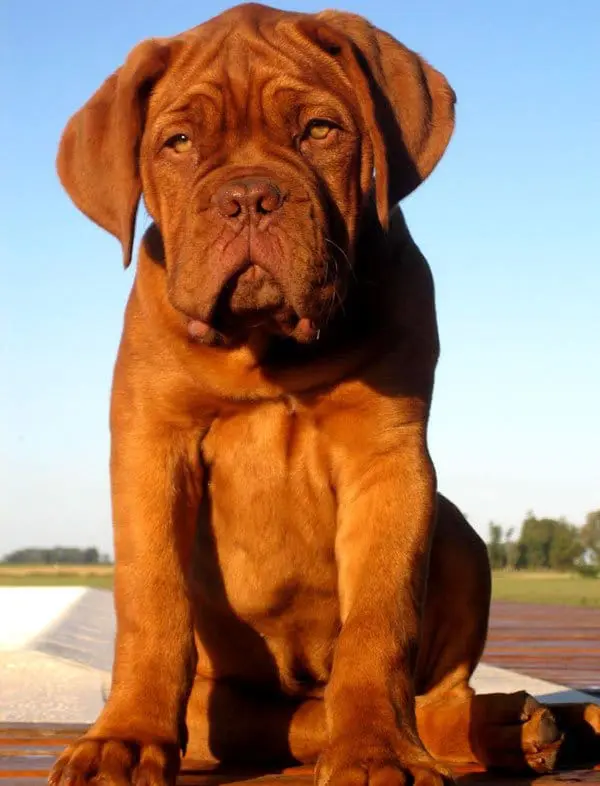
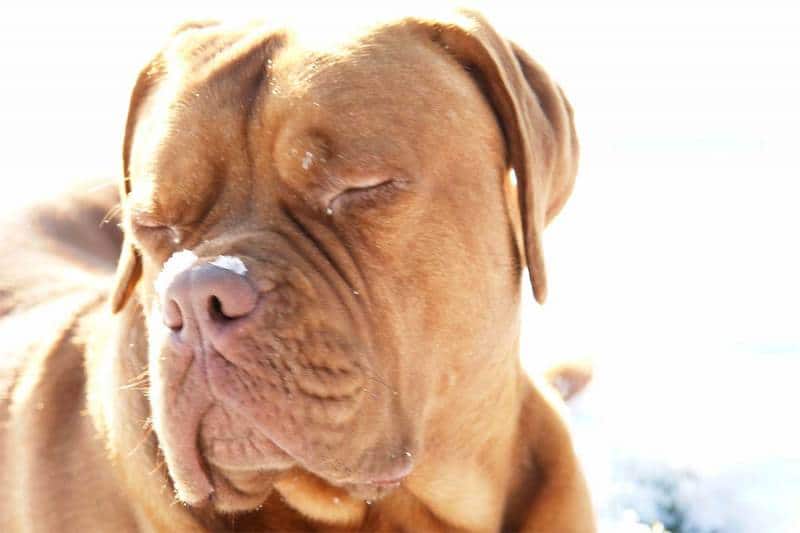
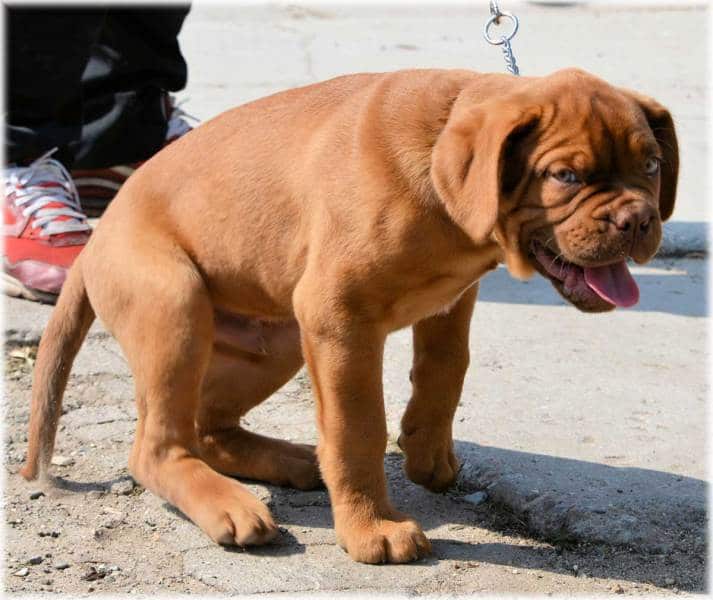
The Dogue de Bordeaux It has an impressive appearance, despite or perhaps because it is not as big and heavy as a Mastiff or Saint Bernard. But, you can see the power it presents in majestic serenity. The standard establishes a height at the withers of 60 to 68 cm for males and 58 to 66 cm for females. The weight of the males is "at least 50 kg" and that of females of "at least 45 kgยป. Unfortunately, the standard does not provide an upper weight limit. So today we see specimens with 70 kg and more.

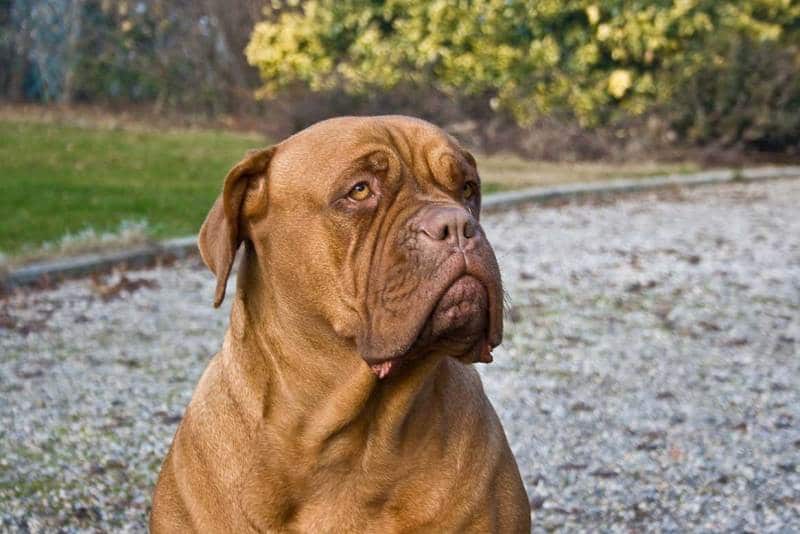
Especially such gigantism is at the expense of dogs' fitness and health.. Belgian Earl Bylandt gives 1894 as weight for the male 54 – 60 kg. German cynologist Richard Strebel reports in 1905 of 54 – 55 kg as the best weight for a male and 45 – 46 kg for a female. Such a weight would also do the current Dogue de Bordeaux very well.. The coat of the Dogue de Bordeaux must be thin, short and soft to the touch. It should be "solid in all shades of fawn from mahogany to Elizabethan". White spots on the chest and extremities of the limbs are allowed when they are not very extensive. This color restriction is also not very beneficial for the gene pool of the Dogue de Bordeaux. All this leads to the fact that today the Dogue de Bordeaux is one of the most ephemeral dogs..

Character

serious and sure of himself, but with an underlying sense of humor, the Dogue de Bordeaux is a vigilant and brave companion. It has several personalities: distant, outgoing, funny, sweet, wrestler, quick to learn, each one belongs to a different dog.

In the best case, the Bulldog is calm and gentle, but it can also be stubborn. When a dog this size is stubborn and wants to get away with it, can be difficult to treat. The Dogue de Bordeaux Must have early and extensive socialization combined with strong leadership from its owner, or it can become aggressive towards other dogs, smaller animals or even people. If you want to live with a Dogue de Bordeaux, you must be willing to learn to work with him, to control it and earn its respect.

A Bulldog who has an owner whom he respects is a wonderful family dog. Enjoy spending time with them, even in bed and sofa. It is not an active dog and is content to be in the house, making sure everyone is safe. Short walks and game moments are just your speed. But don't be fooled. If someone approaches the door, the Dogue de Bordeaux is there to protect you from harm.

With young children, is loving, Protector, gentle and tolerant. Unlike many large breeds, they can be too rowdy with young children, the Bulldog is usually careful with them. But, large dogs are not appropriate for childcare, and all interaction between the two must be supervised.

The perfect Dogue de Bordeaux not prepared by the breeder. any dog, no matter how pleasant it, detestable levels can develop barking, excavation, counter-browsing and other undesirable behaviors if you are bored, is not trained or is not supervised. And any dog รขโ‚ฌโ€นรขโ‚ฌโ€นcan be a test that live during adolescence.

Start training your puppy the day you bring him home. Even at eight weeks old, He is able to absorb everything you can teach him. Don't wait until you have 6 months to start train or have to deal with more stubborn dog. If possible, Take it to a trainer when you have between 10 and 12 weeks, and socializes, socialice, socialice. But, Note that many kinds of training puppies require certain vaccinations (such as kennel cough) stay up to date, and many veterinarians recommend limited exposure to other dogs and public places until puppy vaccinations (including rabies, distemper and parvovirus) They are completed. Instead of formal training, You can start training your puppy to socialize at home and among family and friends until immunizations are completed in the puppy.

Talk to the breeder, Describe exactly what you want in a dog and ask for help choosing a puppy. Breeders see puppies daily and can make incredibly accurate recommendations once they know something about their lifestyle and personality. Regardless of what you want from a Dogue de Bordeaux, look for one whose parents have nice personalities and who has been well socialized since the puppy's first stage.

Dogue de Bordeaux fitness

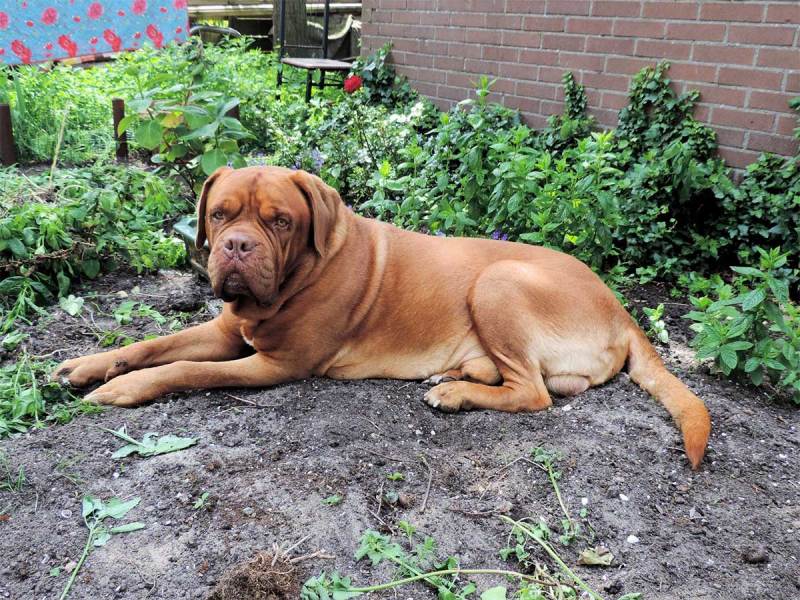
The Dogue de Bordeaux it is somewhat more demanding in its maintenance. Not suitable for an apartment. Although it is not a very agitated dog, he really likes having a little freedom of movement, for example in a garden. Here he likes to spend several hours sleeping and watching. You need a lot of space, because he wants to be able to move freely. Appreciate long walks and short bike rides. You need your daily exercise, but she is not an athlete. Physical and mental exertion should be avoided in hot weather. Also keep in mind that dogs as large and strong as the Dogue de Bordeaux in our current society, supposedly animal friendly, often meet with great rejection, sometimes aggressive. Some people simply fear him out of ignorance. This is one of the reasons why it is not advisable to keep it in the big city.. One must have a sufficient budget to be able to pay a lot of good food and, in case of doubt, also the vet bills.

Dogue de Bordeaux Education

The Dogue de Bordeaux can be trained very well, in regards to the basic rules of behavior. He must also be well educated from the age of a puppy to be able to always run this center of power.. She does not like to learn tricks whose meaning is not clear to her. Even more than with most other dogs, an intimate relationship of trust with your master or lover is the basis for a successful education. There are also consequences, because the Dogue de Bordeaux is intelligent, he notices every little discrepancy and knows how to use it for his own purposes. The Dogue de Bordeaux it is also very sensitive. Do not forget the injustices. Always keep in mind that the leash of these dogs is only a symbolic control. The Dogue de Bordeaux he would easily have the power to maneuver the other end of the leash at will, If I wanted. But it doesn't.

Health Dogue de Bordeaux

Like any giant breed with a short snout, the Dogue de Bordeaux have health problems. The breed's limited gene pool creates a dog susceptible to extreme temperatures, to heart diseases such as dilated cardiomyopathy and aortic stenosis, and ectropion, a condition in which the eyelid fades out. Dogue de Bordeaux is also prone to foot pad hyperkeratosis.

Not all of these conditions are detectable on a growing puppy, and it is impossible to predict if an animal will be free of these diseases, so you need to find a reputable breeder who commit to raise healthier animals possible. Must be able to produce independent certification that the dog's parents (and grandparents, etc.) have been examined for common defects and considered healthy for breeding. That's where health records come in..

Remember that after you have welcomed a new puppy into your home, has the power to protect you from one of the most common health problems: the obesity. Keeping a Dogue de Bordeaux at the right weight is one of the easiest ways to extend its life.. Make the most of your preventive skills to help ensure a healthier dog for life.

Dogue de Bordeaux grooming

The short coat of the Dogue de Bordeaux it is easy to care. Brush it once a week with a rubber brush to remove dead hair..

But there is more to grooming than caring for the coat. The Dogue de Bordeaux you have wrinkles and need special care to avoid becoming infected. Clean them with a damp cloth or baby wipe, and then dry the folds thoroughly to avoid skin infections.

Bring a hand towel to clean your wrinkled face after every meal or drink of water. When he shakes that big head, throw chunks of slime everywhere. It also comes off a lot, so you will spend a lot of time sweeping and vacuuming.

The rest is basic care. Check ears weekly and clean if necessary, brush your teeth as often as possible, and cut your nails regularly, usually every few weeks.

Nutrition / Food

As with all these heavy dogs, especially in the growth phase, diet and composition must be carefully considered. Later this is not problematic. The risk of stomach torsion must be taken into account.

The life expectancy of the Dogue de Bordeaux

The average life expectancy of Dogue de Bordeaux It, Unfortunately, extremely low, of 6 to 8 years. It would be good for the race to do everything humanly possible to correct this.

Buy a Dogue de Bordeaux

A puppy should only be purchased personally from a reputable breeder.. This can be planned for a few 1.500 – 2.500 EUR. You should look closely at the litter and parents, as well as obtain information about the ancestors. You must pay attention to the age of the ancestors, and that they are not too heavy or too wrinkled.

Characteristics "Dogue de Bordeaux"

Coexistence is important that you have with your new friend. Before considering the acquisition of a dog of the breed "Dogue de Bordeaux" you know certain factors. Not all breeds of dogs are apt to live in an apartment, you must take into account his character, their need for exercise, their interaction with other pets, their care and if you have small children, their level of tolerance towards them.

Adaptation โ“˜

3,0 of 5 stars (based on 1 review)

friendly dog โ€‹โ€‹โ“˜

2,0 of 5 stars (based on 1 review)

hair loss โ“˜

3,0 of 5 stars (based on 1 review)

Affection level โ“˜

5,0 of 5 stars (based on 1 review)

Need for exercise โ“˜

2,0 of 5 stars (based on 1 review)

Social need โ“˜

3,0 of 5 stars (based on 1 review)

Home โ“˜

1,0 of 5 stars (based on 1 review)

Toilet โ“˜

4,0 of 5 stars (based on 1 review)

Friendly with strangers โ“˜

1,0 of 5 stars (based on 1 review)

barking โ“˜

2,0 of 5 stars (based on 1 review)

Health โ“˜

5,0 of 5 stars (based on 1 review)

Territorial โ“˜

5,0 of 5 stars (based on 1 review)

Cat friendly โ“˜

3,0 of 5 stars (based on 1 review)

Intelligence โ“˜

3,0 of 5 stars (based on 1 review)

Versatility โ“˜

3,0 of 5 stars (based on 1 review)

Child friendly โ“˜

3,0 of 5 stars (based on 1 review)

Surveillance โ“˜

2,0 of 5 stars (based on 1 review)

joy โ“˜

5,0 of 5 stars (based on 1 review)

Images "Dogue de Bordeaux"

Photos:

1 – Dogue de Bordeaux puppy 10 weeks old by publicdomainpictures.net
2 – Dogue de Bordeaux Harley by publicdomainpictures.net
3 – Bordeaux is comfortably in the garden by publicdomainpictures.net
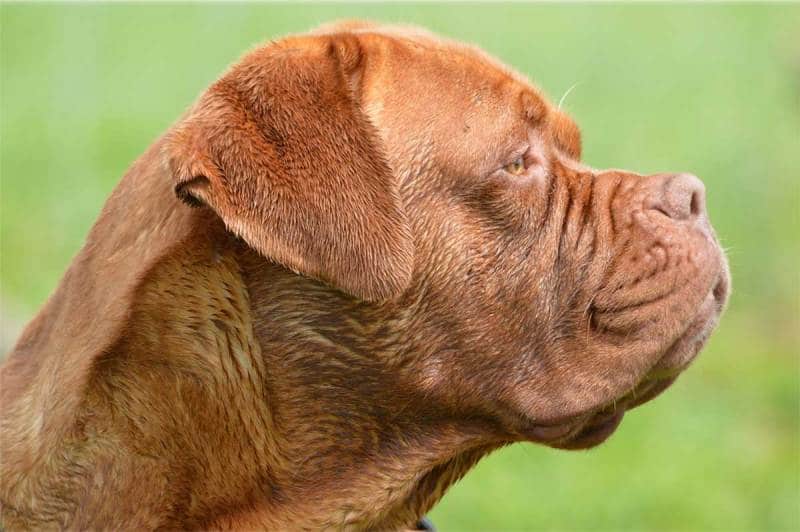
4 – Portrait of a Dogue de Bordeaux by publicdomainpictures.net
5 – A portrait of a Dogue de Bordeaux (French Mastiff) by spaceodissey from Parma, Italy / CC BY
6 – Harley and Doutzen – Dogue de Bordeaux and bulldog playing together by publicdomainpictures.net

Videos "Dogue de Bordeaux"


Type and recognitions:

  • FCI CLASSIFICATION:
  • Group :
  • Section : . .

Federations:

  • FCI – Pinscher and Schnauzer-Molossoid type dogs – Swiss Mountain Dogs and Cattledogs. Section 2.1 Molossoid, mastiff type. โ“˜
  • AKC – Dogs working โ“˜
  • ANKC – Group 6 (utility dogs) โ“˜
  • โ€‹KC – Working dogs โ“˜
  • NZKC – Utility dog โ“˜
  • UKC – Watchdog โ“˜

  • FCI breed standard "Dogue de Bordeaux"

    Origin:
    France

    Date of publication of the valid original standard:
    04.11.2008

    Use:

    Watchdog, defense and deterrence


    General appearance:

    Typical brachycephalic molossus with concave lines. The Dogue de Bordeaux is a very strong dog with a very muscular body but maintaining a harmonious general line.. Its structure is rather close to the ground, The sternum-floor distance is somewhat less than the depth of the chest.. Well-built, athletic and imposing, his appearance is very dissuasive.


    IMPORTANT PROPORTIONS:

    • The length of the body measured from the tip of the shoulder to the tip of the ischium is greater than the height at the withers in a proportion of 11 / 10.
    • Chest depth is greater than half the height at the withers.
    • The maximum length of the muzzle is equal to one third of the length of the head.
    • The minimum length of the snout is equal to one quarter of the length of the head..
    • In males, The perimeter of the skull corresponds more or less to the height at the withers.


    Behavior / temperament:

    An old fighting dog, the Dogue de Bordeaux is suitable as a guardian,
    what he assumes with attention and great courage but without aggressiveness.
    A good companion, very attached to his master and very affectionate. Calm, balanced with a high stimulus. The male usually has a dominant character.

    Head:

    Voluminous, angular, wide, rather short, trapezoid top and front view. The longitudinal axes of the skull and the nasal bridge are convergent (forward). The head is covered in wrinkles, on both sides of the central groove. These deep wrinkle cords are mobile depending on whether the dog is vigilant or not. The fold that goes from the internal angle of the eye to the angle of the mouth is typical. If present, the crease from the outer corner of the eye to the corner of the mouth or double chin must be inconspicuous.

    Cranial region:
    • In the male: The perimeter of the skull measured at the maximum width level corresponds approximately to its height to the cross.
    • In females: may be less.
    • Its volume and shape are the consequence of a very important development of the storms, supra orbital arches, zygomatic arches and lower jaw spaces. The upper region of the skull is slightly convex from one side to the other. The frontal groove is deep, decreasing towards the posterior end of the head.. The foreface dominates the head, but it does not exceed it. Anyway, it is wider than it is tall.
    • Stop: Very pronounced, almost forming a right angle with the muzzle. (95ยบ - 100ยบ)

    facial region:

    • Truffle: Wide, nostrils wide open, well pigmented according to the color of the mask. An upturned truffle is allowed but not if it is backwards, directed towards the eyes.
    • Snout: Strong, width, thick, but not fleshy under the eyes, rather short, upper profile somewhat concave with pleats moderately visible. Its width decreases slightly towards the tip; top view has a general square appearance. In relation to the upper part of the skull the snout line forms an ascending very obtuse angle.

    When the head is held horizontally, the tip of the snout, truncated and thick at the base, is opposite a vertical tangent to the front of the truffle.

    Its perimeter is usually two thirds to the head. Its length varies between a third and minimum a quarter of the total length of the head, from the truffle to the occipital crest. The established limits (maximum one third and minimum a quarter of the total length of the head) are allowed, but not wanted, the ideal muzzle length should be between these two ends.

    • Jaws: Strong and wide jaws. Prognathism (Prognathism is a characteristic of race). The back of the lower incisors are anterior and not in contact with the anterior aspect of the upper incisors.

    The lower jaw is curved up. The chin is well marked and must never be excessively covered or covered by the upper lip.

    • Teeth: Strong, particularly the canines. Lower canines positioned well apart and slightly curved. Incisors ok aligned especially in the lower jaw where they form a seemingly straight line.
    • Lips: Thick upper lip, moderately pendulum, retractable. Viewed profile shows a rounded lower line. Covers the lower jaw than the sides. In front the edge of the lip upper lip is in contact with the lower lip, then it falls to both sides which forms a wide and inverted V.
    • Cheeks: Prominent due to the very strong development of the muscles.


    • EYES: Oval shaped placed well apart. The space between the two inner angles of the eyelids is equal to twice the length of the eye (eye opening). Frank expression. The third eyelid must not be visible.

    Color: hazelnut to dark brown for a dog with a black mask, lighter color tolerated, but it is not sought after in dogs with a brown mask or without a mask.

    • EARS: Relatively small in color somewhat darker than the mantle. In its insertion, the front of the base of the ear is slightly raised. They must be falls, but don't hang up; the front edge stuck to the cheeks when the dog is attentive. The edge of the ears slightly rounded; should not go below the eye. High enough insertion, at the top line of the skull which further accentuates its wide.

    Neck:

    Very strong and muscular, almost cylindrical. The skin is thin, flexible, abundant and loose. The average of its circumference almost equal to that of the head. It is separated from the head by a slightly accentuated transverse fold, slightly curved. The upper edge is slightly convex. The well defined double chin begins at throat level forming folds towards the chest, without hanging excessively. The neck, very wide at its base smoothly fuses with the shoulders.

    Body:

    • top line: Well held. Cross: Well marked.
    • Back: Wide and muscular.
    • Pork loin: Width. Rather short and solid.
    • Rump: Moderately descending towards the base of the tail.
    • Breast : Strong, long, deep, width, descending below the level of the elbows. Wide and strong sneak whose lower line (inter armpit) it is convex towards the end. Ribs well lowered and well arched but not barrel-shaped. The chest circumference should be between 25 to 35 cm.. more than the height at the withers.
    • Bottom line and abdomen: Curved from the deep chest to a somewhat retracted and firm abdomen. It should never be pendular or too withdrawn.

    Tail:

    Very thick at the base. The tip preferably reaching the height of the hock and not below. Low bearing, never broken or curved but flexible. Pendant when the dog is calm, generally rising from 90ยบ to 120ยบ from that position when the dog is in action without curlying on the back or curling.

    Tips

    PREVIOUS MEMBERS: Strong bone structure, very muscular limbs.

    • Shoulder: Strong, prominent muscles. The inclination of the middle scapula (approx.. 45ยบ of the horizontal), angle of the scapulo-humeral joint somewhat greater than 90ยบ.
    • Arm: Very muscular.
    • Elbows: On the axis of the body, never too close to the chest or leaning out.
    • Forearm: Seen from the front, straight or slightly inclined towards inside approaching the median plane, especially in dogs with a very broad chest. Seen from vertical profile.
    • Metacarpus: Strong. Seen in profile somewhat inclined. Seen from the front, sometimes slightly outward compensating for slight inward tilt of the forearm.
    • Previous feet: Strong. Closed fingers, strong curved nails, well developed and elastic pads: the Dogue de Bordeaux stands well on its fingers despite its weight.

    LATER MEMBERS: Robust limbs with strong bone structure. Well angulated. Seen from behind, the posterior ones are parallel and vertical which gives the impression of strength., even though the back is not as wide as the front.

    • Thigh: Highly developed, thick with visible musculature.Knee: In a plane parallel to the median plane or slightly outwards.Leg: Relatively short, musculada, descendant.
    • Hock: Short, tendinoso, its moderately open angle.Metatarsus: Robust, No Spurs.
    • Hind feet: Somewhat longer than the previous ones, tight fingers.

    Movement:

    Elastic for a moloso. When walking the movement is free and elastic, glued to the ground. Good push from the rear, good extension of the forelimbs especially during jogging which is the preferred movement.When jogging is accelerated the head tends to drop, la lรญnea superior se inclina hacia el frente y los pies anteriores se juntas mรกs hacia el plano medio dando pasos hacia fuera con un movimiento de largo alcance de los miembros anteriores. The gallop with quite a vertical movement. Capable of high speed over short distances glued to the ground.

    Mantle

    • SKIN: Thick, loose enough, without excessive folds.
    • Fur: Up, short and soft to the touch.
    • Color: All shades of leonado from mahogany to isabella. Good pigmentation is desired. Delimited white spots on the forehead and limbs are allowed.

    Mask:

    • Black mask: The mask is usually only slightly extended and should not invade the cranial region. There may be a slight black shading on the skull, ears, neck and upper body. The truffle is black.

    • Brown mask: (Usually called red or bistre). The truffle is brown, pigmentation of the eyelids and the edge of the brown lips. May have non-invasive brown shading; each hair must have a tawny or sand-colored area and a brown area. In this case the inclined parts of the body are of a lighter color.

    • Without mask: The hair is tawny: the skin appears red (Previously called "Red Mask"). The nose may be reddish.


    Size and weight:

    The height must correspond to the perimeter of the skull or less.

    • Height to the cross:
    • Males: 60 โ€“ 68 cm..

    females: 58 โ€“ 66 cm.. Tolerated 1 cm.. below or 2 cm.. above these limits.

    Weight:

    • Males: Minimum 50 Kg.
    • females: Minimum 45 Kg.

    females: Identical characteristics, but less accentuated.


    Fouls:

    • Any deviation from the aforementioned criteria is considered as a fault and the severity of this is considered to the degree of the deviation to the standard and its consequences on the health and well-being of the dog..


      SERIOUS FAULTS

    • Males should have two normal-appearing testicles fully descended into the scrotum..
    • Only functionally and clinically healthy dogs, with the typical conformation of the breed, should be used for parenting.
  • Disproportionate head (too small or excessively bulky).
  • Hypertipo Bulldog: (flat skull, snout less than a quarter of the total length of the head, bulging folds (scrolls) behind the truffle). Important folds around the head.
  • Significant lateral deviation of the lower jaw.
  • Permanently visible incisors when the mouth is closed. Very small incisors, uneven placement. Arched back (Convex).
  • Fused tail vertebrae, but not deviated.
  • Front feet tilted inward (even slightly).
  • Front feet leaning too far out.
  • Flat thighs.
  • Corvejรณn angle too open (Straight angulation).
  • Corvejรณn angle too closed, The dog standing under himself in the posterior.
  • Cow hock or crowded.
  • Forced or severe undulating movement of the posterior.
  • Excessively short breath, cleared my throat.
  • White at the tip of the tail or in the front area of รขโ‚ฌโ€นรขโ‚ฌโ€นthe forelimbs, over the carpus (wrist) and tarsus (Hock) or white without interruption in the front of the body from the chest to the throat.


    FALTAS DESCALIFICANTES

  • Aggressiveness or extreme shyness.
  • Any dog โ€‹โ€‹showing clear signs of physical or behavioral abnormalities.
  • Long narrow head with insufficiently pronounced stop, with a muzzle measuring more than a third of the total length of the head (absence of typicality of the head).
  • Spine parallel to the upper line of the skull or convex.
  • Twisted jaw.
  • Non-prognostic mouth.
  • Canine constantly visible when the mouth is closed.
  • Tongue constantly visible when the mouth is closed.
  • Blue eyes. Protruding eyes.
  • Tail knotted and deflected to the sides, twisted. (curled tail, ravine).
  • Stunted tail.
  • Violin front and short tarsi.
  • Hock angle open backwards (inverted hock).
  • White on the head or body, any other color of the mantle than tawny (shaded or not) and in a particular brindle or solid brown called โ€œchocolate.โ€ (every hair totally brown).
  • Identifiable disability defects.


  • N.B.:
    • Males should have two normal-appearing testicles fully descended into the scrotum..
    • Only functionally and clinically healthy dogs, with the typical conformation of the breed, should be used for parenting.

    Source: F.C.I - International Cynological Federation

    Alternative names:

    1. Bordeaux Mastiff, French Mastiff, Bordeauxdog (English).
    2. Dogue de Bordeaux (French).
    3. Dogue de Bordeaux (German).
    4. Mastim francรชs (Portuguese).
    5. Dogo de Burdeos (espaรฑol).

    โ–ท The world of Pets: Dogs, cats, birds, reptiles, amphibians

    Dutch Smoushond
    Holanda FCI 308 . Pinscher and Schnauzer type

    Ratonero Dutch

    Content

    The Dutch Smoushond was born to follow the horse and rider, and catch the rats in the blocks.

    History

    The Dutch Smoushond is a very ancient race. Its name derives from the term smous (mouse), because among their tasks it has always been found to hunt these rodents.

    By mid-century 19 he was very popular with the upper middle class in the Netherlands following the carriages and horses and as a rat catcher in the stables. Although the origin of the breed is uncertain, it is generally believed that the Yellow schnauzer was one of the original dogs in the creation of this breed. A dog trader sold the dog as "The Knight of the Stables Dog" to tourists from commodity exchanges in Amsterdam. Quickly the name changed to โ€œSmousโ€, rough barbarian, This distinguished him from Griffon Bruxellois. The first standard dates from 1905, was written by Messrs H.A. Earl of Bylandt, A. Woltman Elpers y L. Seegers. After a long period in which the popularity and public interest decreased, the last litter was recorded in the Dutch Record Book (Dutch Dog Studbook) in 1949. In 1973, la Sra. H.M. Barkman van der Weel took the initiative to rebuild the breed. It started with a cross looking like a Dutch Smoushond. FCI-St. Nยฐ308 / 16.03.2012 3 Since 1978 interest in Dutch Smoushond is protected by the Hollandse Smoushonden Club. In 1980 the standard of 1905.

    In the news, puppies of this breed are very difficult to get outside of the Netherlands.

    Physical characteristics

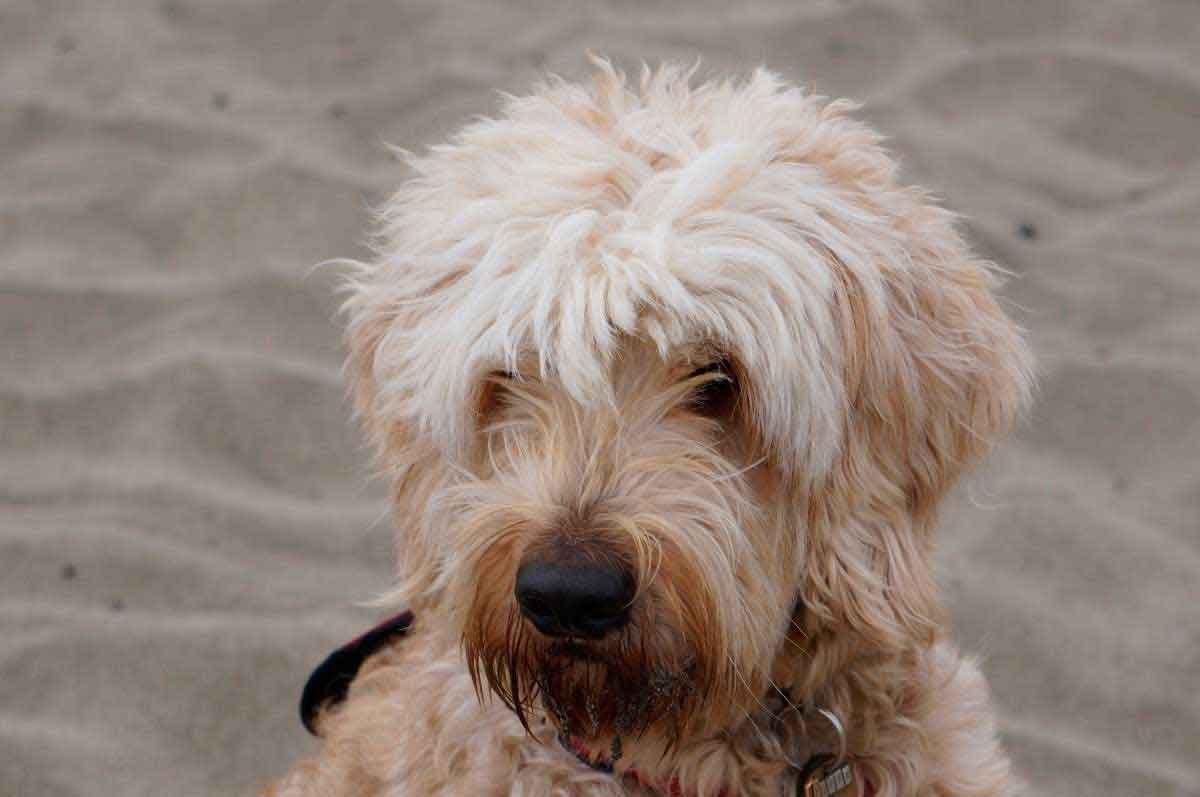
    It is an agile dog, whose silhouette is inscribed in a square, It should not be thick or heavy. The eyes are characteristic of the breed, with a lively and benevolent expression, large, round and dark colored, the ears, inserted high, they fall forward and rest on the cheeks; they are small, thin and triangular in shape, with the end slightly rounded. The tail should be quite short, with a happy demeanor, but not coiled on the back. Can be cut to 2/3 its length.

    • Fur: on the body it is thick, enough, hard, straight, shaggy looking. In the extremities it has an average length, not tight but turned inward suggesting locks. Over the head is shorter, with mustaches, beard and longer eyebrows.
    • Color: yellowish along with all its gradients; straw yellow is preferable.
    • Size: males, of 37 to 42 cm.; females, of 35 to 40,5 cm..

    Character and skills

    The Dutch Smoushond was born to follow the horse and rider, and catch the rats in the blocks, the Dutch Smoushond has an affectionate character, joyful, friendly, always comfortable with everyone, fearless or very nervous. It is a perfect family dog, friendly and easy to educate.

    Images "Dutch Smoushond"

    Dutch Smoushond Videos

    Type and recognitions:

    • FCI CLASSIFICATION:
    • Group :
    • Section : . .

    Federations:

    • FCI – Pinscher and Schanuezer dogs. Molossian type Dogs and Swiss Mountain and Cattle Dogs. , Section 1: Pinscher and Schnauzer. โ“˜
    • UKC – Terrier Group. โ“˜

    FCI breed standard Dutch Smoushond

    FCIFCI - Dutch Smoushond
    Buzzard

    Alternative names:

    • Dutch Ratter, Hollandse Smoushond (English).
    • Hollandse Smoushond (French).
    • Hollรคndischer Rattler, HOLLร„NDISCHER SMOUSHUND (German).
    • Hollandse Smoushond (Portuguese).
    • Smoushond holandรฉs, Perro ratonero holandรฉs (espaรฑol).

    Photos:

    1 – Dutch buzzard by https://pxhere.com/en/photo/1424539
    2 – Dutch buzzard by https://pxhere.com/es/photo/1581327
    3 – Dutch buzzard by https://pxhere.com/es/photo/1061995
    4 – Dutch buzzard by https://pxhere.com/es/photo/1426949
    5 – Dutch buzzard by gwendolenFlickr

    โ–ท The world of Pets: Dogs, cats, birds, reptiles, amphibians

    Dogo Canario
    Espaรฑa FCI 346 - Molossoid . Dogo

    Dogo Canario

    The aggressiveness of Dogo Canario should not be overly stimulated. It is an optimal guardian and defender without the need for training.

    Content

    History

    The Dogo Canario It is a classic moloso. It is the offspring of an ancient and in this ancient form is only rarely found in Central Europe today.. It has many names: Presa Canario, Perro de Presa, Perro de Toro, Alano o Presa Canario. Dogs of the current type Dogo Canario they existed still ago 200 years everywhere. They were the old saupackers, bear teethers, guard dogs, butcher dogs, the ancestors of the current great danes, bulldogs, boxers and mastiffs. They are extremely strong and bulky dogs, that even today are summarized as molossers. They were already bred in ancient times and have always been highly appreciated. They were used on large farms, with livestock herds or for example on merchant ships such as guard and protection dogs, served as herding dogs and as hunting dogs for wild boar or bear. They served rulers like Hammurabi as war dogs, they had them carved in stone in full recognition does 3700 years.

    Due to its strength, courage and determination, have been used as fighting dogs in the arenas of animal fighting since Roman times. Molossians have a commanding head with a rather short snout and long lips.. The ears are usually worn hanging. According to the traditions of antiquity in words and images, the main characteristics of the molossian have remained essentially the same for thousands of years, but in recent centuries and especially due to modern dog breeding, the classic type of molosser has been lost to some extent. In extreme cases strange shapes have been bred with many extremely short folds or snouts such as bulldogs or giants like him Great Dane or the Mastiff. The Dog is still raised in his homeland only for his performance at work.

    So, chances are that the Dogo Canario still personify the type Molosoide as was common in the old days. It is clearly recognized as trotting, but does not suffer from cultivated exaggerations of any bodily characteristics or traits. Can only hope it stays that way. Unfortunately, breeders are very much at odds with Dogo Canario. They haven't even managed to agree on a name and a registry office. Since 1991 It has been officially considered as "The Canarian Presa Dog" among the natural symbols of the Canary Islands.. Meanwhile in 2001 the Spanish Ministry of Agriculture recognized these dogs as a national breed also under the name of Dogo Canario, the same dogs were then provisionally recognized as Dogo Canario by the world federation FCI in 2001 and finally in 2011. Other names are Perro de Presa y Alano. Alano It is an old word that means Great Dane.

    Physical characteristics

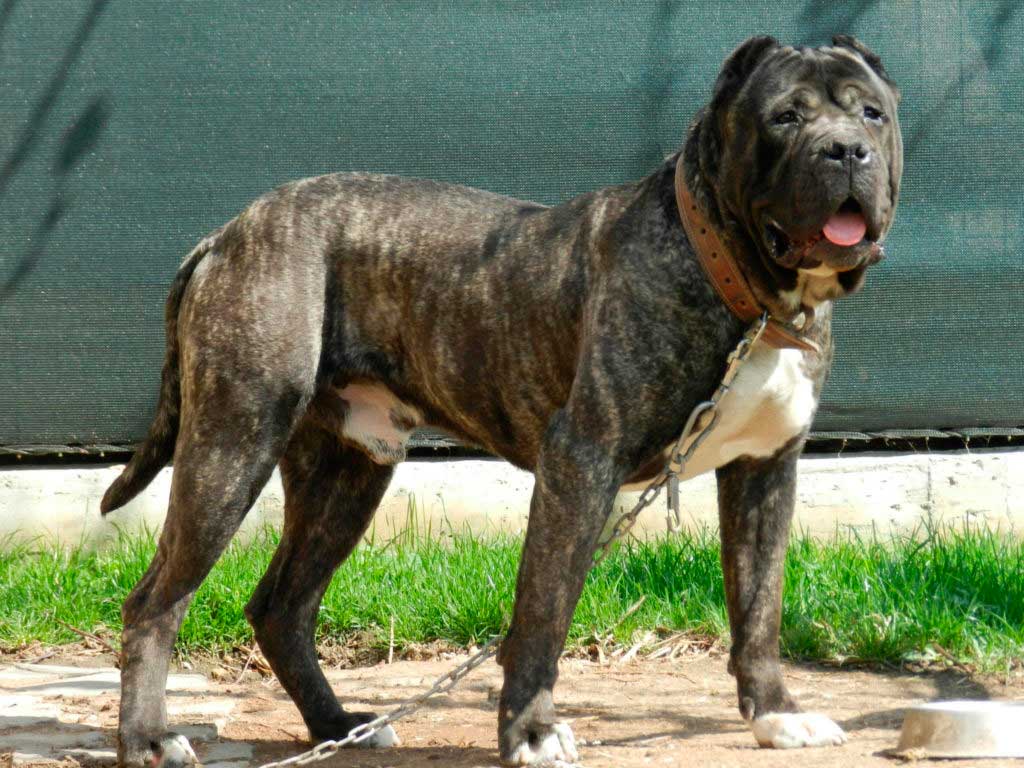
    The Dogo Canario, Perro de Presa, Perro de Toro, Alano o Presa Canario – all designations for the same four-legged friend – he is an elegant dog that radiates athletic power. He is an athletic, muscular, elongated but nevertheless typical molosser.

    The skull-muzzle ratio is approximately 6:4. The upper lip rests a little flaccidly on the lower one. The eyes, medium-sized, they are oval and hazelnut, the ears, high, they are separated from each other and are shaped like a button; they are only amputated to remember their original function as a combat dog. The neck, long and muscular, shows a slight dewlap. The tail is implanted high: thick at the base, is tuned to the extreme. the belly is retracted, but the last ribs stand out only slightly, giving a harmonious harp shape. Limbs are sturdy, muscular and perfectly plumb; angulation of the hind limbs is not very marked.

    The difference between male and female bulldogs desired by the FCI standard is therefore unnaturally large. In any case, desires of this standard for outward appearance should not be taken so seriously.

    Because fortunately this originally preserved dog breed, robust and healthy has set its standard โ€œfor itselfโ€, more exactly for their performance at work, and has kept it in the practice of life until today. People, who now wants to put him in a standard of modern pedigreed dog breeding, don't even agree to the principle, as we can see in its history of the breed. Modern pedigreed dog breeding has done no breed of dog any good, both in terms of health and character. In old times, the Bulldog fitted with pleasure to the ears, so that they protruded upwards. This is now prohibited. Today they show large down-hanging ears..

    • Fur: short, without Undercoat, pretty hard.
    • Color: leonado or atigrado. The tabby specimens have a wide range of colors, from very dark to a light gray with a rather cold tone.
    • Size: males, of 61 to 66 cm.; females, of 57 to 62 cm..

    Character

    The Dogo Canario is a quiet dog, balanced and self-assured. He is a powerful and defensive athlete who can show his performance at any time. Like all molossi, he is extremely kind, has strong nerves and a high stimulus threshold. But, he is more eager to move and not as lethargic as most molossers today bred only as companions. One Dogo Canario well socialized is friendly to people who know and like children. It is very sociable. Towards strangers is at first a little distant without fear. He is an incorruptible guardian, fearless and protective of his family without being aggressive himself. The FCI standard describes the character desired by the breed:

    Calm appearance; alert look. It is especially suitable as a watchdog… His temperament is even-tempered and he is very self-confident.. Deep barking. He is docile and kind to his family members and with strong ties to his master, but you may suspect strangers. Self-assured demeanor, elegant and somewhat distant. When you are alert, his attitude is confident and alert.

    It must be added that the Dogo Canario rarely barks. But if it barks once, it's pretty awesome.

    Fitness

    The Dogo Canario is undemanding in terms of external conditions. Of course: a small apartment in the big city would not be optimal for your attitude. But other than that it's easy to maintain. It is also a working dog, a guard, a driver, a hunting dog for hunting wild boar. The Dogo Canario it is suitable as a family dog รขโ‚ฌโ€นรขโ‚ฌโ€นonly on the condition that it is well socialized, well educated and physically fit. You also have to take into account a fact: It is considered a "dangerous dog" in many countries.

    Dogo Canario Education

    The Dogo Canario can be trained well, but still not a beginner dog. It is intelligent, very sociable and eager to work. But at the same time he is very powerful and assertive. In case of doubt, always the strongest end of the strap. So, his master or caretaker should not leave doubts about his role as leader and this on the basis of natural authority. So this dog will gladly leave the leading role to his bipeds without reservation.. But it must be filled. The Dogo Canario it is even suitable for demanding tasks such as training as an assistance or protection dog. The basic requirement is that it comes from a serious breeder and that it has already been socialized there..

    Dogo Canario health and care

    The Dogo Canario has no special demands on your care.

    Typical diseases

    Breed-specific diseases are not known.. Due to his still short career as an official pedigree dog, it can be assumed that the population of the Dogo Canario, Presa Dog or Presa Canario – Whatever this ancient breed of dog is called – enjoys robust health.

    Nutrition / Food

    The Dogo Canario has no special demands on their diet.

    Life expectancy Dogo Canario

    There are no reliable figures on life expectancy. Seriously raised, the Dogo Canario should be able to live off 10 to 12 years.

    Buy Dogo Canario

    Before making a purchase, be aware that the restrictive attitude of the State can cause many problems in daily life and additional financial burdens. The Dogo Canario it is a large and powerful dog that belongs to the hands of an experienced teacher or lover. The cost of a Dogo Canario is of some 1200 EUR.

    Characteristics "Dogo Canario"

    Coexistence is important that you have with your new friend. Before considering the acquisition of a dog of the breed "Dogo Canario" you know certain factors. Not all breeds of dogs are apt to live in an apartment, you must take into account his character, their need for exercise, their interaction with other pets, their care and if you have small children, their level of tolerance towards them.

    Adaptation โ“˜

    4,0 of 5 stars (based on 1 review)

    friendly dog โ€‹โ€‹โ“˜

    1,0 of 5 stars (based on 1 review)

    hair loss โ“˜

    3,0 of 5 stars (based on 1 review)

    Affection level โ“˜

    4,0 of 5 stars (based on 1 review)

    Need for exercise โ“˜

    4,0 of 5 stars (based on 1 review)

    Social need โ“˜

    1,0 of 5 stars (based on 1 review)

    Home โ“˜

    3,0 of 5 stars (based on 1 review)

    Toilet โ“˜

    2,0 of 5 stars (based on 1 review)

    Friendly with strangers โ“˜

    2,0 of 5 stars (based on 1 review)

    barking โ“˜

    3,0 of 5 stars (based on 1 review)

    Health โ“˜

    4,0 of 5 stars (based on 1 review)

    Territorial โ“˜

    5,0 of 5 stars (based on 1 review)

    Cat friendly โ“˜

    2,0 of 5 stars (based on 1 review)

    Intelligence โ“˜

    4,0 of 5 stars (based on 1 review)

    Versatility โ“˜

    2,0 of 5 stars (based on 1 review)

    Child friendly โ“˜

    2,0 of 5 stars (based on 1 review)

    Surveillance โ“˜

    5,0 of 5 stars (based on 1 review)

    joy โ“˜

    3,0 of 5 stars (based on 1 review)

    Images "Dogo Canario"

    Photos:

    1 – Canarian Presa Dog – Canary Dog by Kamen Rider Snipe / CC BY-SA
    2 – Presa Canario dog – Dogo Canario by Basil Dragon / CC BY-SA
    3 – Presa Canario by https://pxhere.com/es/photo/732874
    4 – Canary bulldog, edited by Canecorsodog (en.Wikipedia) edited by Caronna 12:25, 6 February 2008 (UTC) / CC BY-SA
    5 – Zai-Kan de Irema Curtรณ. Canary prey perro byManuel Curtรณ Jr. / CC BY-SA
    6 – Presa Canario by Wikipedia
    7 – Presa canario dog by https://pxhere.com/es/photo/75916

    Videos "Dogo Canario"

    Type and recognitions:

    • FCI CLASSIFICATION:
    • Group :
    • Section : . .

    Federations:

    • FCI – Pinscher and Schnauzer-Molossoid type dogs – Swiss Mountain Dogs and Cattledogs. Section 2.1 Molossoid, mastiff type. โ“˜
    • AKC – FSS โ“˜
    • UKC – Watchdog โ“˜

    FCI breed standard "Dogo Canario"

    Origin:
    Spain

    Date of publication of the valid original standard:
    26.11.2018

    Use:

    Guard dog and caring for cattle.


    General appearance:

    Large Medium-sized Molossoid Dog, straight profile and black mask. Robust and well proportioned.

    IMPORTANT PROPORTIONS: The body is longer than its height at the withers. This characteristic is more pronounced in females..

    The ratio of the skull to the antecara is 60-40 %. The width of the skull is 3/5 the total length of the head. The distance from the elbow to the ground must be 50 % height at withers in males and somewhat less in females.


    Behavior / temperament:

    calm look, attentive expression. Especially suitable as a guard dog and traditionally used to care for livestock. Balanced temperament and very self-confident. Low and deep bark. Obedient and docile with family members, very devoted to his master but can be reserved with strangers. Confident fitness, noble and somewhat distant. When he is alert his posture is firm with an alert attitude.

    Head:

    Solid, brachycephalic and compact in appearance covered in thick skin. Its shape tends towards a slightly elongated cube. The skull lines- facials are parallel or slightly convergent.

    Cranial region:
    • Skull: Somewhat convex in anteroposterior and transverse direction. The frontal bone tends to be flat. The width is almost identical to its length.
      Pronounced zygomatic arches with well-developed but not prominent cheek and jaw muscles, covered in loose fur. Occipital bump only slightly marked.
    • Stop: The stop is pronounced but not abrupt. The fold between the frontal lobes is well defined and approximately two thirds the size of the skull.

    facial region:

    • Truffle: Wide, heavily pigmented black. In the same line of the muzzle. Large nostrils to facilitate breathing.
    • Snout: Shorter than the skull, usually about the 40 % of the total length of the head. Width is 2/3 the width of the skull. Its base is very wide, slightly tapering towards the nose. Flat, straight nose without grooves.
    • Lips: The upper lip is hanging but not excessively. Seen from the front, the upper and lower lip join forming an inverted V. The edges are slightly divergent. The inside of the lips is dark.
    • Jaws / Teeth: Scissor bite or slightly prognathic bite, max. 2 mm. Tweezer bite is accepted but not desired due to tooth wear. The canines have a wide transverse distance. Teeth are wide with strong implantation base. Large molars, small incisors and well-developed canines.

    EYES: Slightly oval, medium to large. Placed well apart but never sagging or protruding. Tight black eyelids, never fallen. Color varies from dark to medium brown depending on coat color. They should never be clear.

    EARS: Medium size, set well apart with short fine hair. Naturally fall on both sides of the head. If they are folded they are shaped like a rose. Its insertion is slightly above the level of the eyes. Ears with a very high insertion or close together are considered unusual. In countries where amputation is permitted, they must be erect..

    Neck:

    Shorter than the length of the head. Skin on the lower part loose forming a slight dewlap. Solid and straight, tends to be cylindrical and muscular.

    Body:

    Long, wide and deep.

    • top line: Straight, without deformations supported by well-developed but poorly visible muscles. Rising slightly from the cross to the rump. The height at the rump is 1 โ€“ 2 cm greater than the height at the withers.
    • Rump: Average length, wide and rounded. It should not be long because it would limit your movement.. Females are usually wider.
    • Breast : High capacity and well-defined pectoral muscles. Seen both from the front and in profile, it must be lowered, at least down to elbow level. Chest circumference is generally equal to the height at the withers plus 45 %. Well arched ribs.
    • Bottom line and belly: Slightly collected and never lowered. The flanks only slightly pronounced.

    Tail:

    Thick at the base tapering towards the tip, reaching no further than the height of the hock. Middle insertion. During movement it lifts it in the shape of a saber but without stooping or leaning on the back. At rest it hangs right with a slight curve towards the end.

    Tips

    PREVIOUS MEMBERS:

    • Shoulder: With good inclination.
    • Arms: Well angled, oblique.
    • Forearm: Well balanced, straight. Strong bones and good musculature.
    • Elbows: They must not be glued to the ribs or open outwards. Metacarpus: Very solid and slightly inclined.
    • Previous feet: Cat foot with rounded toes, not very close.
      The foot pads are highly developed and black. Nails are dark. White nails should be avoided although it can happen according to the coat color.

    LATER MEMBERS:

    • General appearance: Seen from behind strong and parallel without deviations.
    • Thighs: Long and very muscular.
    • Knee: Angulation is not very pronounced but should not be insufficient.
    • Metatarsals: Always well descended.
    • Hind feet: Slightly longer than the front ones and with similar characteristics.

    Movement:

    During movement, the Presa Canario is agile and elastic, covering the terrain well. Long step. The tail is brought down and the head is only slightly raised above the level of the back. When you are alert, the tail and the head are carried high.

    Mantle

    SKIN: Thick and elastic. Looser over and around the neck. When alert, the skin over the head forms symmetrical folds that form from the fold between the frontal lobes..

    • Fur: Short, rough, smooth without undercoat (may appear on the neck and on the back of the thigh). Rather rough to the touch. Very short and thin on the ears, slightly longer on the withers and on the back of the thighs.
    • Color: All shades from fawn to sand, from dark brown to light gray or blonde. All shades from tabby to sand. White marks are accepted on the chest, at the base of the neck or throat, front feet and back toes but this should be minimal. The mask is always black and should not be spread above eye level.


    Size and weight:

    Height at the withers:

    • Males: 60 to 66 cm..
    • females: 56 to 62 cm..

    In the case of very typical specimens, 2 cm tolerance above or below limits.

    Minimum weight:

    • Males: 50 Kg.
    • females: 40 kg.

    Maximum weight:

    • Males: 65 kg.
    • females: 55 kg.


    Fouls:

    Any deviation from the aforementioned criteria is considered as a fault and the severity of this is considered to the degree of the deviation to the standard and its consequences on the health and well-being of the dog..

    Bite in clamp

    SEVERE FAULTS:

    Any fault is considered severe when it affects the expression and limits the type of dog..
    Incorrect head proportions
    Extremely convergent craniofacial lines (stop too steep)
    Loin and cross at the same height
    Incorrect limb position
    Square profile.
    Triangular head, close (not cube)
    Fine tail, threaded. High insertion.
    Sunken or soggy back.
    light eyes (yellow), very close to each other or oblique, sunken or bulging
    Excessively prognathic bite.
    Insufficient mask.
    Absence of teeth (Except P 1)

    FALTAS DESCALIFICANTES:

    Aggressiveness or extreme shyness.
    Any dog โ€‹โ€‹showing clear signs of physical or behavioral abnormalities.
    Totally nonpigmented nose.
    White marks not accepted.
    Bite: enognรกtica.
    Croup lower than the cross. Sloped top line.
    Blue eyes or with tonal difference.
    amputated tail.


    N.B.:
    • Males should have two normal-appearing testicles fully descended into the scrotum..
    • Only functionally and clinically healthy dogs, with the typical conformation of the breed, should be used for parenting.

      TRANSLATION: Brรญgida Nestler

    Technical supervision: SR. Miguel Angel Martinez

    Source: F.C.I - International Cynological Federation

    Alternative names:

    1. Canary Mastiff, Canary Catch Dog, Canarian Dogo, Presa Canario.Dogo Canario, Presa (English).
    2. dogo Canario (French).
    3. Presa Canario, Kanarische Dogge (German).
    4. Perro de presa canรกrio, Dogo canรกrio (Portuguese).
    5. Perro de presa canario (espaรฑol).

    โ–ท The world of Pets: Dogs, cats, birds, reptiles, amphibians

    Dutch Shepherd
    Holanda FCI 223 - Sheepdogs.

    Dutch Shepherd

    The most widespread variety of Dutch Shepherd she is the one with long hair, but the breed is almost unknown outside the Dutch borders.

    Content

    History

    The Dutch shepherd descends directly from the belgian shepherds, who looks a lot like (including subdivision into three hair varieties).

    Originally the main function of the Dutch shepherd It was typical of a country shepherd dog. From the earliest times the Dutch had an agricultural culture, among others, made up of flocks of sheep. The dogs had to keep the flock away from the sowing, which they did patrolling the borders of the road and the fields. They also accompanied the transfer of the herd to the common meadows, markets and ports. In the farm, they kept the chickens out of the kitchen yard, cows were herded for milking and the milk cart was pulled. They also alerted farmers if anyone entered. About 1900, the herds had almost disappeared in the Netherlands. The Dutch Shepherd's versatility made him suitable for training, which at that time was beginning to become popular. Thus began a new career as a police dog., search and rescue and as a guide dog for the blind. In any case, he is still capable of herding herds.. The first breed standard dates from 12 in June of 1898.

    Physical characteristics

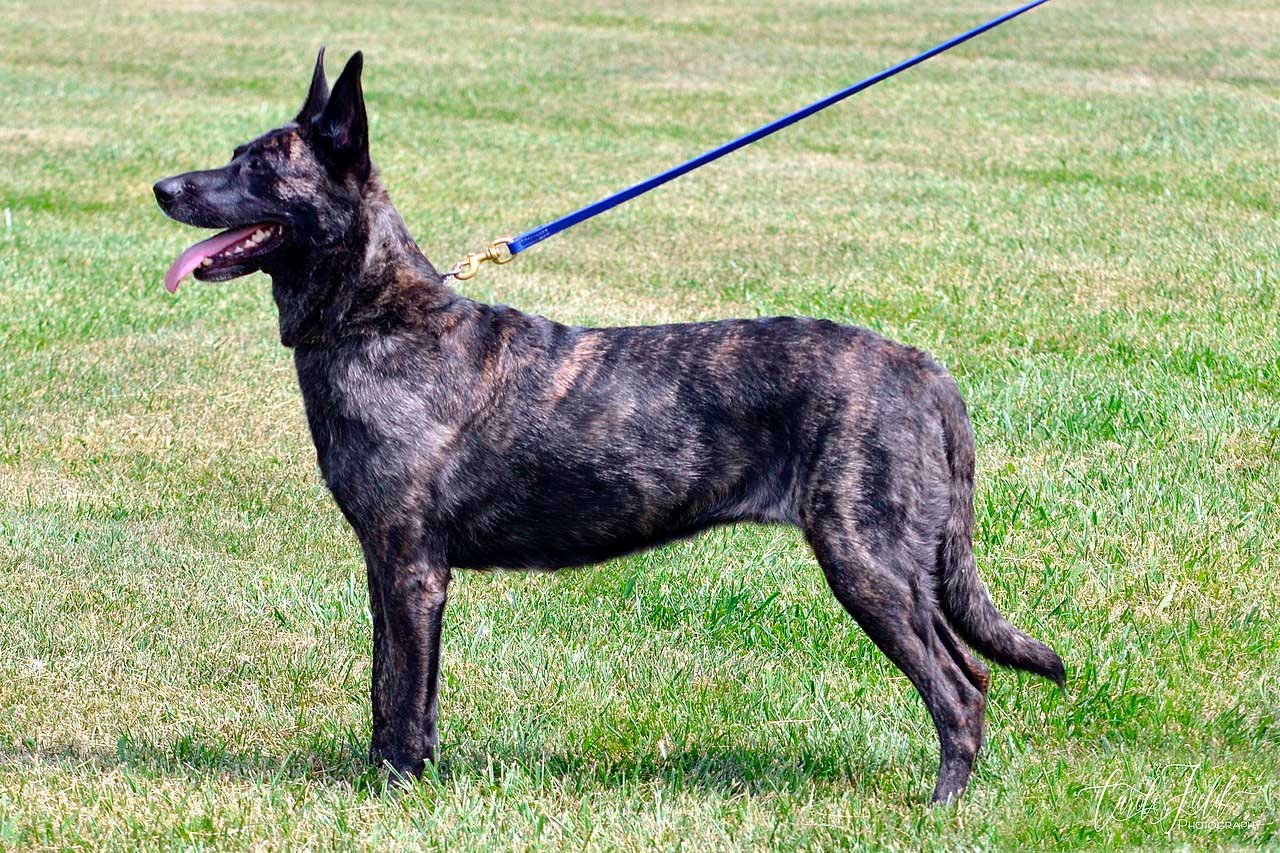
    It is a dog of medium size and weight, quite muscular, Powerfully built and well proportioned. His expression is intelligent and temperament, live. The eyes are dark in color, medium-sized, macaroons, somewhat oblique and never round. The ears, smaller than big, they are straight and facing the front, and inserted high. The tail, that at rest hangs straight or forms a slight curve, reaches the tip of the hock. When it is active, the dog is elegantly elevated, never coiled; never falls on the sides.

    • Fur: the short-haired variety has a well attached coat; the long-haired one has straight hair, and the variety of hard hair has it thick and hard; on the head it forms prominent eyebrows, mustaches and beard. Depending on the cloak, in the breed there are three varieties: shorthair, long and hard.
    • Color: striated but the least intensely, on brown background (golden fluted) or gray (fluted gray). The stripes are less evident in hard-haired specimens. Black mask is preferable.
    • Size: males, of 57 to 62 cm.; females, of 55 to 60 cm..

    Character and skills

    Affectionate, obedient, docile, vigilant, trustworthy, undemanding and very resistant. Always watch out, active and endowed with the true nature of a shepherd dog. It is a little less reactive and less nervous than Belgian Shepherd, the one who looks like, However, even in character.

    The Dutch Shepherd works willingly with his master and is able to cope with any task assigned to him.
    Herding larger herds must have the ability to work in conjunction with various other dogs..

    Characteristics "Dutch Shepherd"

    Coexistence is important that you have with your new friend. Before considering the acquisition of a dog of the breed "Dutch Shepherd" you know certain factors. Not all breeds of dogs are apt to live in an apartment, you must take into account his character, their need for exercise, their interaction with other pets, their care and if you have small children, their level of tolerance towards them.

    Adaptation โ“˜

    4,0 of 5 stars (based on 1 review)

    friendly dog โ€‹โ€‹โ“˜

    3,0 of 5 stars (based on 1 review)

    hair loss โ“˜

    3,0 of 5 stars (based on 1 review)

    Affection level โ“˜

    4,0 of 5 stars (based on 1 review)

    Need for exercise โ“˜

    5,0 of 5 stars (based on 1 review)

    Social need โ“˜

    3,0 of 5 stars (based on 1 review)

    Home โ“˜

    3,0 of 5 stars (based on 1 review)

    Toilet โ“˜

    3,0 of 5 stars (based on 1 review)

    Friendly with strangers โ“˜

    4,0 of 5 stars (based on 1 review)

    barking โ“˜

    2,0 of 5 stars (based on 1 review)

    Health โ“˜

    4,0 of 5 stars (based on 1 review)

    Territorial โ“˜

    5,0 of 5 stars (based on 1 review)

    Cat friendly โ“˜

    3,0 of 5 stars (based on 1 review)

    Intelligence โ“˜

    5,0 of 5 stars (based on 1 review)

    Versatility โ“˜

    4,0 of 5 stars (based on 1 review)

    Child friendly โ“˜

    4,0 of 5 stars (based on 1 review)

    Surveillance โ“˜

    4,0 of 5 stars (based on 1 review)

    joy โ“˜

    4,0 of 5 stars (based on 1 review)

    Images "Dutch Shepherd"

    Videos "Dutch Shepherd"

    Type and recognitions:

    • FCI CLASSIFICATION:
    • Group :
    • Section : . .

    Federations:

    • FCI – Group 1 Herding dogs, Section 1 Sheepdogs โ“˜
    • AKC – PASTORAGE โ“˜
    • ANKC – Group 5 (working dogs) โ“˜
    • โ€‹KC – Pastoral โ“˜
    • NZKC – Working dog โ“˜
    • UKC – Herding dogs โ“˜

    FCI breed standard Dutch Shepherd

    FCIFCI - Dutch Shepherd
    Pastor

    Alternative names:

    1. Dutch Herder, Hollandse Herder (English).
    2. Berger hollandais (French).
    3. Hollรคndischer Schรคferhund (German).
    4. Pastor holandรชs (Portuguese).
    5. Perro de pastor holandรฉs (espaรฑol).

    Photos:

    1 – Short-haired Dutch Shepherd stacked by CaroleField / CC BY-SA
    2 – Silverbrindle and goldbrindle are the approved colors of the breed by Lissunmusta / CC BY-SA
    3 – Short-haired brindle male Dutch Shepherd named Black, 2 years old, owned by Jason Paluck by Wikipedia
    4 – Adult brindle Dutch shepherd by https://www.pikrepo.com/fyvdb/adult-brindle-dutch-shepherd
    5 – dutch shepherd by https://www.peakpx.com/504961/dutch-shepherd
    6 – Dutch shepherd by https://pxhere.com/en/photo/1387398
    7 – Neros van Guard is a Dutch Shepherd imported from Canada to the USA by Ulyseemuff / CC BY-SA

    โ–ท The world of Pets: Dogs, cats, birds, reptiles, amphibians

    Do khyi
    Tรญbet FCI 230 - Molossoid . Mountain

    The Do khyi It is not a dog to live with children.

    Dogo del Tรญbet

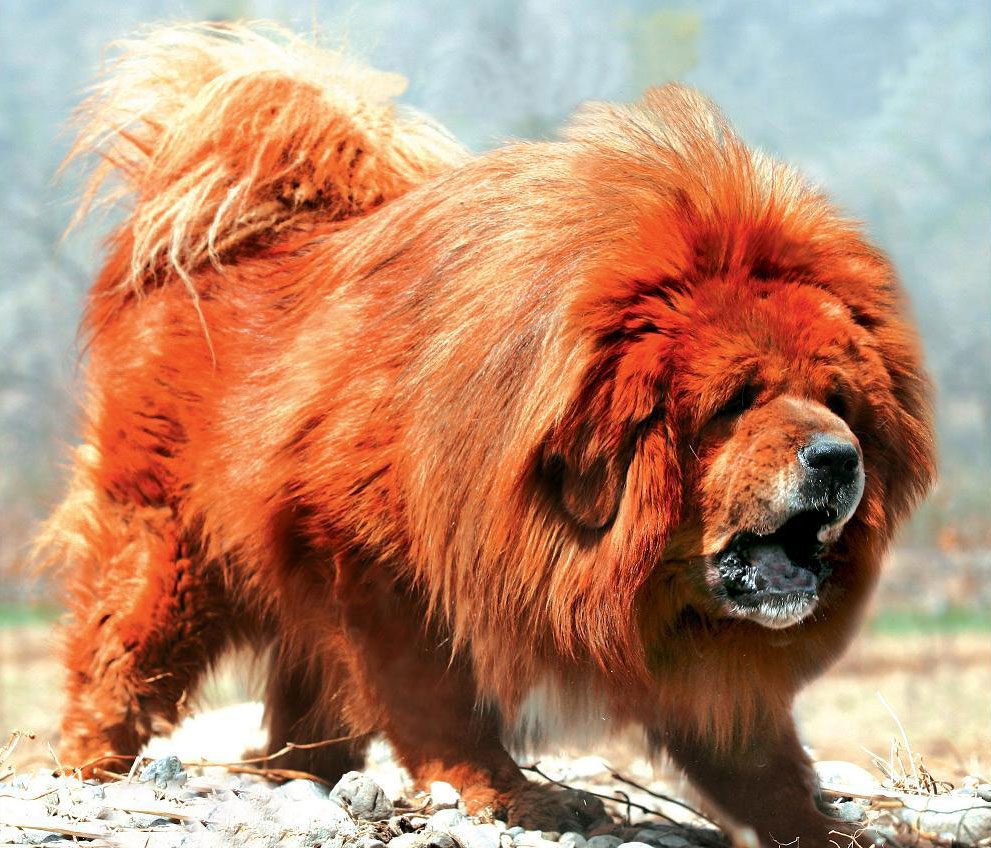
    It is a breed native to Tibet, It appeared to the year 8000 to. C. Ancient working breed of nomadic herders of the Himalaya and a traditional guardian of the Tibetan monasteries. It has been surrounded by great mysticism since it was discovered in ancient times..

    It is a companion dog, Guard and protection; slow to mature, females only reach their apogee between 2 and 3 years and males at least the 4 years.

    Otros nombres: Dogo del Tรญbet / Do-Khy / Dogue du Tibet / Tibet-Dogge / Tibetan Mastiff

    Crupo 2 / Section 2 – molosoides

    Dogs breeds: Do khyi

    โ–ท The world of Pets: Dogs, cats, birds, reptiles, amphibians

    Dogo cubano
    Cuba Extinct

    The Dogo cubano It was very notable and renowned for their ferocity. Extinct race.

    Mastรญn Cubano

    Content

    History

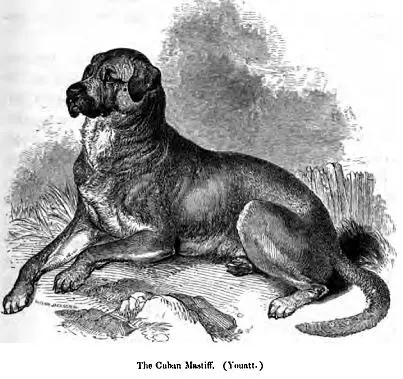
    The Dogo cubano or Cuban dogge, It is a breed of dog of Cuba that has been terminated. It was very similar to the Bullmastiff. This breed of dog was used for dog fighting.

    This breed of dog was introduced in Cuba to capture fugitive slaves (Maroons). After the abolition of slavery it became too expensive an animal to feed and it was so that, the race ceased to exist with the time.

    Physical characteristics

    They were among a Bulldog and Mastiff as far as size is concerned. Snout is short, bandwidth and abruptly truncated.

    The head was broad and flat, and lips, pendants. The ears of medium-sized, and hanging also. Rather short tail, cylindrical, round upwards tipped forward.

    They were described as a "rusty-colored wolf" with the face, the lips and black legs. The Cuban Mastiff is the largest breed of mastiff with an average weight of 136.5 Kg.

    The Cuban Mastiff was very notable and recognized for his ferocity in the fight and for the skill in the persecution of slaves..

    โ–ท The world of Pets: Dogs, cats, birds, reptiles, amphibians

    Dutch bulldog
    China Gran Bretaรฑa FCI 253 . Small Molossian type Dogs

    The Dutch bulldog It is a friendly and affectionate dog with other dogs and with people.

    Dutch bulldog

    Content

    Adaptation โ“˜

    5,0 of 5 stars (based on 1 review)

    friendly dog โ€‹โ€‹โ“˜

    5,0 of 5 stars (based on 1 review)

    hair loss โ“˜

    4,0 of 5 stars (based on 1 review)

    Affection level โ“˜

    5,0 of 5 stars (based on 1 review)

    Need for exercise โ“˜

    1,0 of 5 stars (based on 1 review)

    Social need โ“˜

    5,0 of 5 stars (based on 1 review)

    Home โ“˜

    5,0 of 5 stars (based on 1 review)

    Toilet โ“˜

    1,0 of 5 stars (based on 1 review)

    Friendly with strangers โ“˜

    5,0 of 5 stars (based on 1 review)

    barking โ“˜

    3,0 of 5 stars (based on 1 review)

    Health โ“˜

    5,0 of 5 stars (based on 1 review)

    Territorial โ“˜

    4,0 of 5 stars (based on 1 review)

    Cat friendly โ“˜

    5,0 of 5 stars (based on 1 review)

    Intelligence โ“˜

    3,0 of 5 stars (based on 1 review)

    Versatility โ“˜

    3,0 of 5 stars (based on 1 review)

    Child friendly โ“˜

    4,0 of 5 stars (based on 1 review)

    Surveillance โ“˜

    3,0 of 5 stars (based on 1 review)

    joy โ“˜

    4,0 of 5 stars (based on 1 review)

    History

    The Dutch bulldog (also known as Chinese Carlino, Mops, Carlinogu) is a breed of dog miniature with wrinkled face and a body of small to medium-sized, originating in China.

    This breed is often summed up as โ€œmultum en parvoโ€ (much in little), describing the personality of the Dutch bulldog related to its small size.

    The word "Pug" may come from Old English Carlinog, it is an affectionate adjective it would be something like a little playful demon or monkey. Carlin puppies are called Carlinolets.

    The breed of dog Dutch bulldog, has very ancient origins. It was raised and selected in China, country where he was the favorite dog of officials, It is also a very popular in Holland and England breed of dog.

    In fact, England claimed the patronage of la raza, since they had carried out excellent selection work for years. Finally, part of the patronage of the race was awarded to Great Britain.

    This wrinkled and funny puppy, He was a faithful companion of the ladies of the 19th century in Italy.

    As almost all dog breeds, it knew how to have its difficult moments, especially when the world wars took place, but it has not been on the verge of extinction like others.

    Today the breed Dutch bulldog it is highly appreciated in almost every corner of the world.

    Did you know??

    Among the rich and famous are admirers of the Dutch bulldog King Louis XIV, Josefina, Empress of Napoleon, Queen Victoria, the Duke and Duchess of Windsor and fashion designer Valentino.

    Physical characteristics

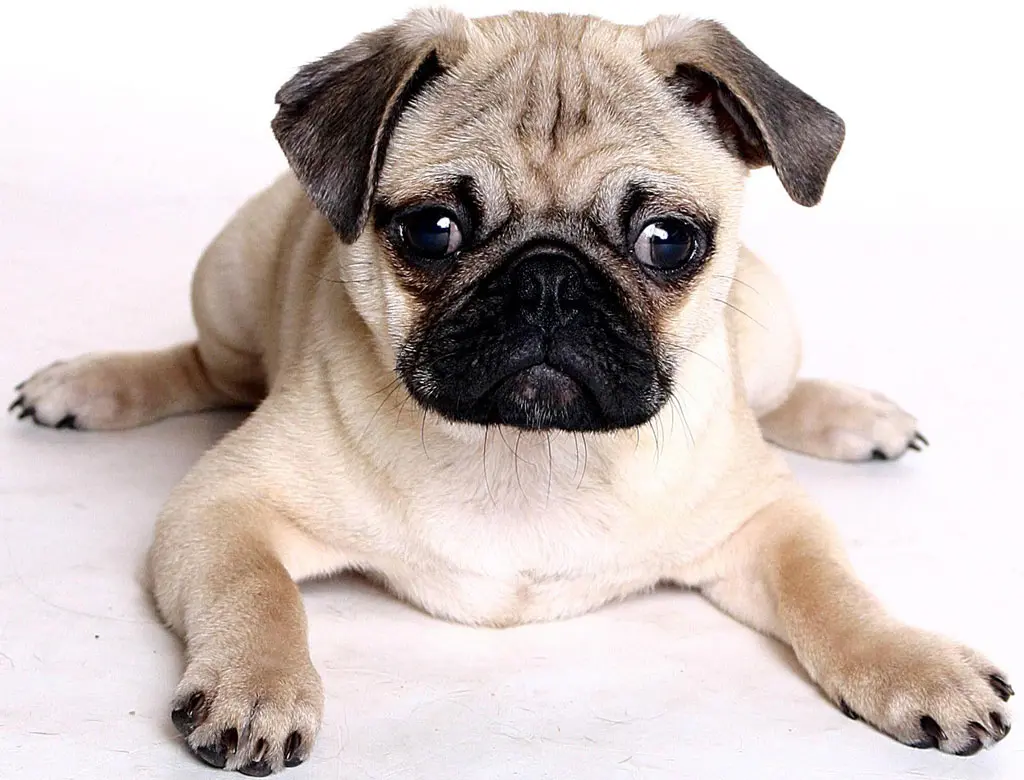
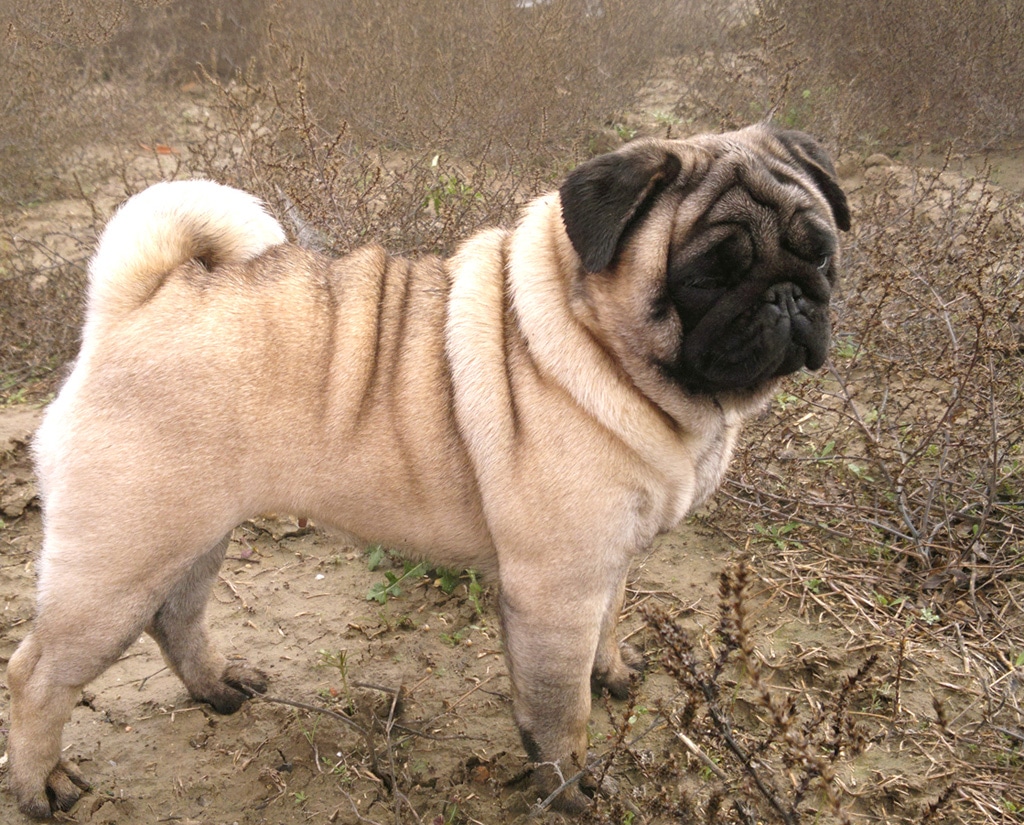
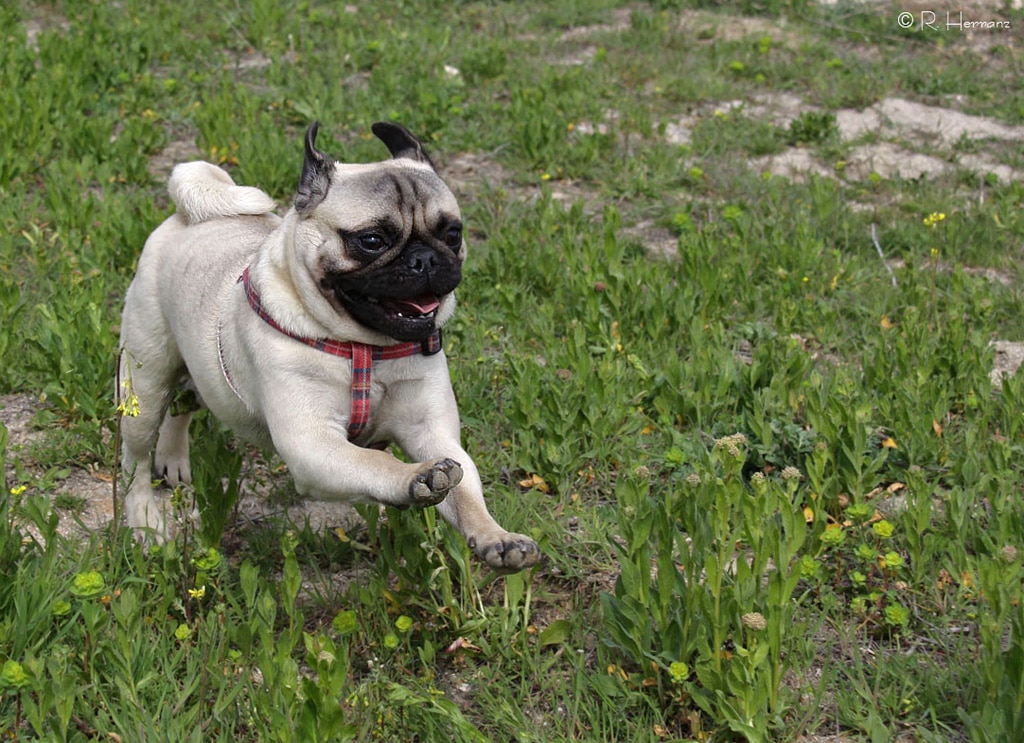
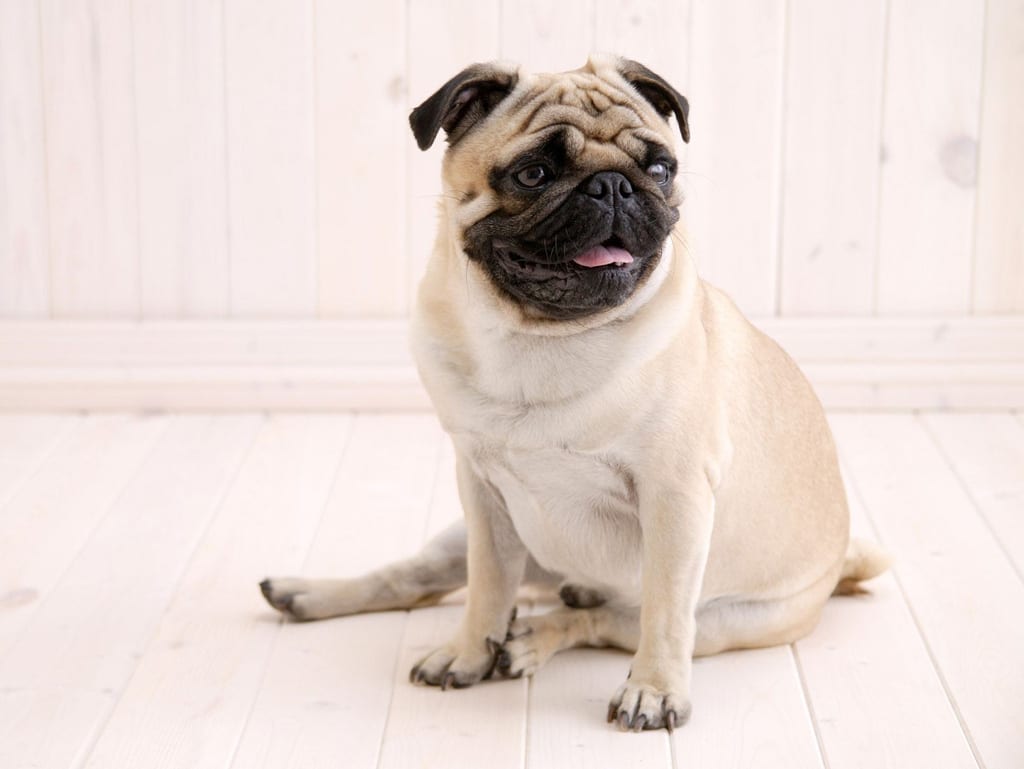
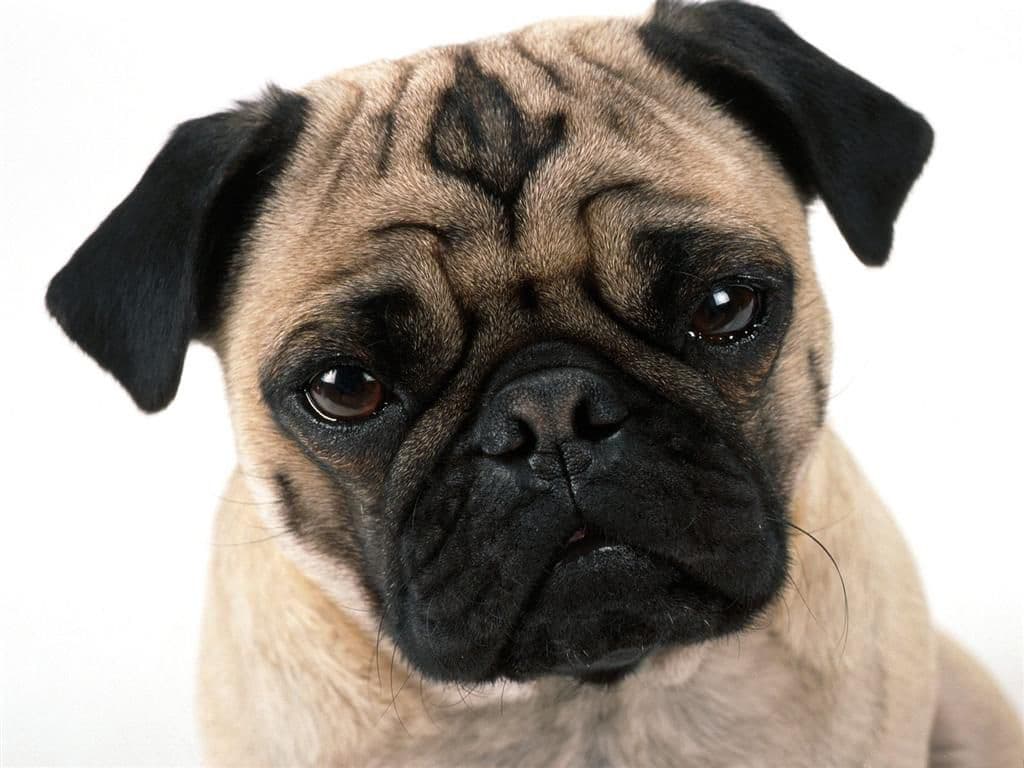
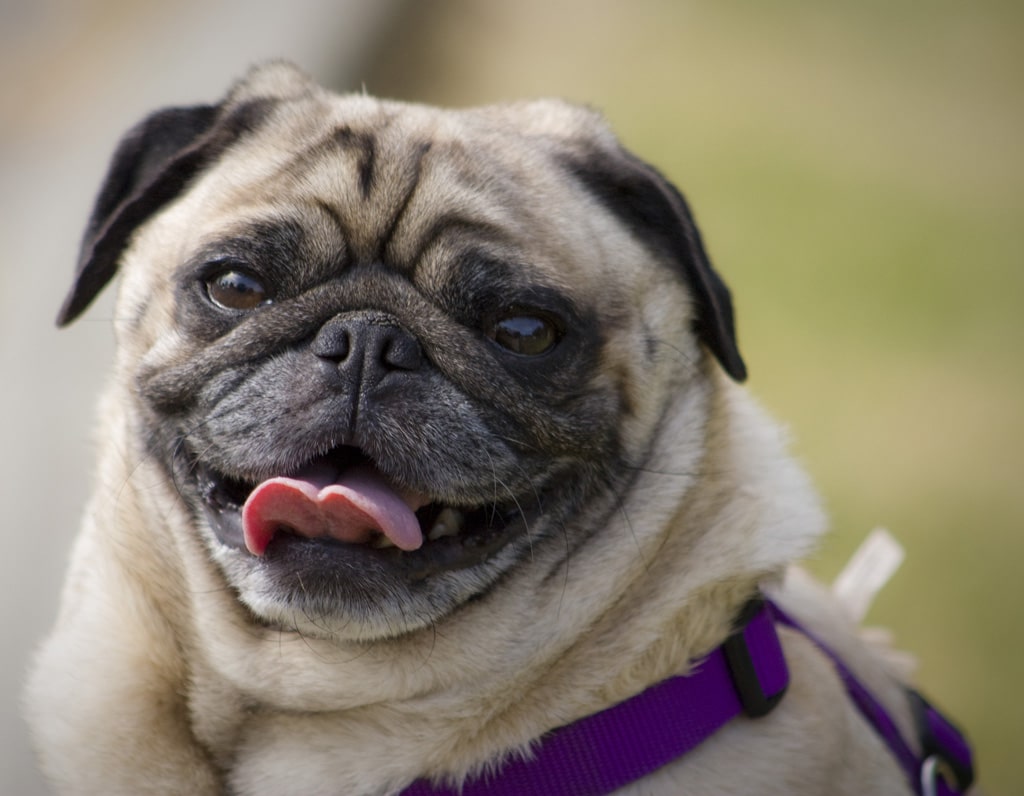
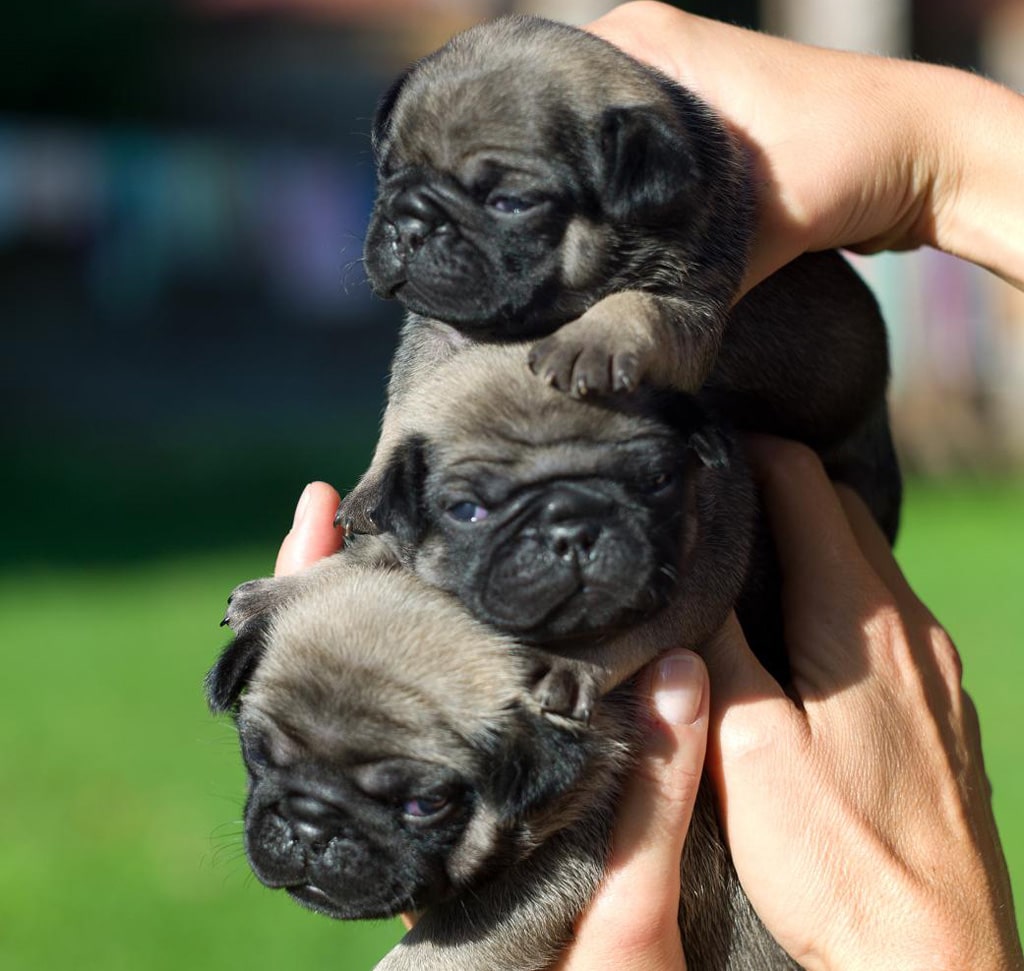
    It is a dog under, solid square and compact appearance, well proportioned and muscular; the head, large, rounded and solid appearance, is covered with folds; the muzzle is square and flat; the eyes, large, bulging, they are dark; It has straight legs and looped collector queue. The hair is tight, smooth and shiny.

    The Dutch bulldog can be silver or soft apricot with a black mask, in both cases it presents a black stripe that goes from head to tail; It can also be pure black or white which is the more scarce and expensive of all.

    It measures each 30 cm to cross and weighs between 6 and 8 kg. His confident nature, docile and friendly makes the Pug an appreciated companion animal. The Pug is particularly a dog "with a sense of humor", exhibiting very human facial expressions given its bone structure. Due to its striking appearance, some people tend to think that the characteristics of the Dutch bulldog are the result of genetic manipulation or inbreeding. But, the characteristics of the Pug are similar in the last five hundred years, period in which Europeans began it importing from China.

    The tail of the Dutch bulldog It has a characteristic spiral or letter "Q" shape. This variation in the way of the tail is due to the vertebrae in this portion of the column are actually hemivertebra. In some few puppies, This alteration of the shape can be extended to the rest of the column and the animal presents spina bifida.. The spine of the animal must feel before purchasing to avoid choosing a sick puppy. An animal that suffers from this malformation should not be reproduced in order to not pass this problem to their offspring.

    Given the shape of the skull, the eyes of the Dutch bulldog have a bouncy and lively appearance. To find the eyes located above, they are more exposed to friction with plants and objects to the eyes of other animals, and it is advisable to take them to the vet as soon as possible if they have an injury. It is recommended that the owners of the Dutch bulldog clean the animal's eyes once a week with a clean cotton swab moistened with cold boiled water or cold tea, in order to remove secretions or dirt.
    The characteristic wrinkles of the face can also accumulate secretions and dirt. It is recommended at least once a week clean gently between wrinkles using the same method. It is not necessary to apply SOAP, creams or other substances. Simple toilet is enough and to spare.

    The Dutch bulldog although it is a short-haired dog, tends to constantly pelechar, so his tenure is not recommended for persons allergic or asthmatic. They have a characteristic pungent odor that may bother some people, but that decreases a bath every couple of weeks.

    The biggest health problem presented by the Dutch bulldog is one that is completely preventable and treatable, and that depends entirely of the OWNER. This disease is the OBESITY. A Carlin receiving proper care can live more than fourteen years, Although on average they tend to live around ten.

    One 1% of puppies can develop a degenerative neurological disease called Pug Encephalitis (or tap for its acronym in English). This disease is lethal and has no known cure. For this reason dogs must not be reproduced within the two years, in order to not transmit the gene to their offspring. Last year of life is very unlikely to reach Carlin present this disease.

    Character and skills

    The Dutch bulldog they are not aggressive animals. Like any dog, they can bite, but it is very rare that this happens without the animal mistreatment. The Dutch bulldog They live up to their motto "multum in parvoยป and are not intimidated by larger breed dogs, which you can get into trouble.

    Before humans, the Dutch bulldog tend to be playful and seek interaction. However can be apprehensive to strangers, and with their barking to announce the presence of unknown people. Although its size are not guard dogs, If they are good "alert dogs".

    The Dutch bulldog show a moderate level of intelligence, being able to use their short snouts and front paws to obtain objects out of reach. They sometimes tend to stubbornness, and do not necessarily come when you are called, but rather when crave it. Despite this, they do not go far from their owners and prefer their company to that of other dogs..

    During the first years of life Dutch bulldog may occasionally be hyperactive (run, jumping and barking constantly) but this characteristic tends to disappear over the years. The Dutch bulldog 5 and older tend to be calmer and enjoy the chairs more than the street.

    There is a tendency to believe that Dutch bulldog They are "sick" animals, which is very far from reality. A healthy Carlin will behave aggressively and playful, and even a bit hyperactive in its first years of life. Its solid structure makes they tolerate well the game with children and adults, and its particularly hard head can cause bumps and falls in young children and older adults.

    The Dutch bulldog It's a small animal, and although strong, requires very little food. But, being a pet, owners tend to supercharge them and share their food with them. This must not be. The Carlin may well eat a cup of dry food in the morning and a cup at night, and you won't go hungry or require any extra supplements.

    One Dutch bulldog obese is not a Dutch bulldog ยซbelloยป, on the contrary, It is an animal that sick because you can not breathe well, be it exhausted easily and will begin to suffer from problems in the spine and joints. A Carlin is fed healthily, on the other hand, a robust animal, with his sharp and clearly visible muscles under the skin. A healthy Carlin can run as fast as any other dog I, and you can skip two or three times its own height. Although the animal enjoys eating extra foods and receiving "treats" occasionally, is task of the owner to ensure that the quantity and quality of food that consumes is adequate.

    Characteristics "Dutch bulldog"

    Coexistence is important that you have with your new friend. Before considering the acquisition of a dog of the breed "Dutch bulldog" you know certain factors. Not all breeds of dogs are apt to live in an apartment, you must take into account his character, their need for exercise, their interaction with other pets, their care and if you have small children, their level of tolerance towards them.

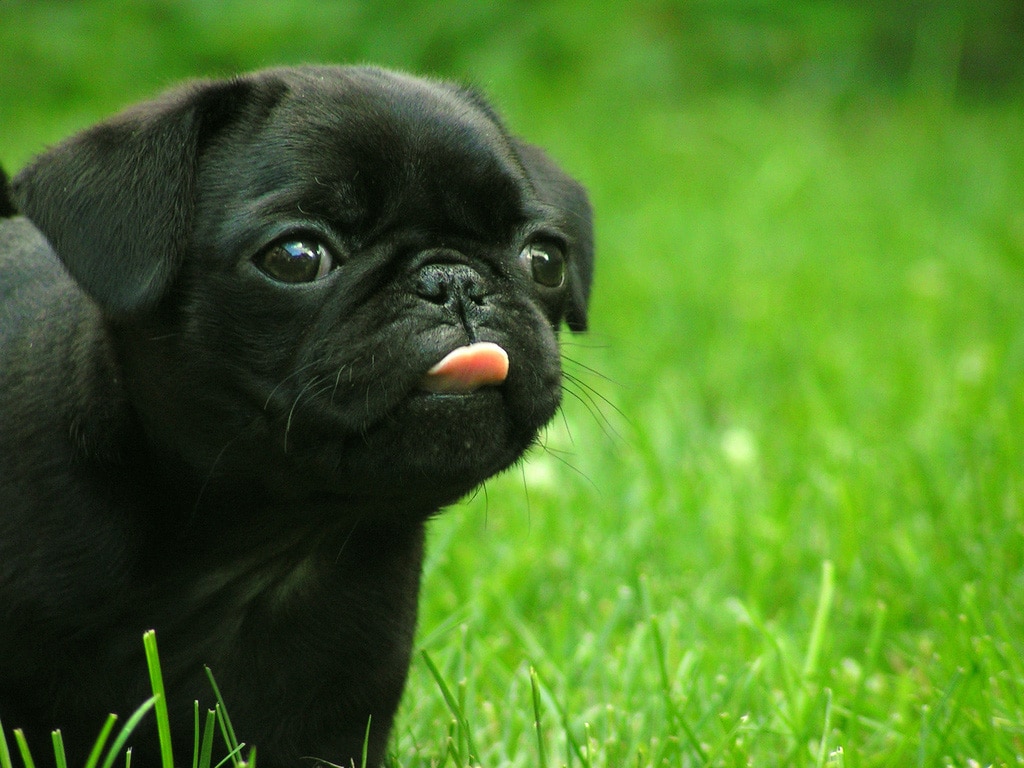
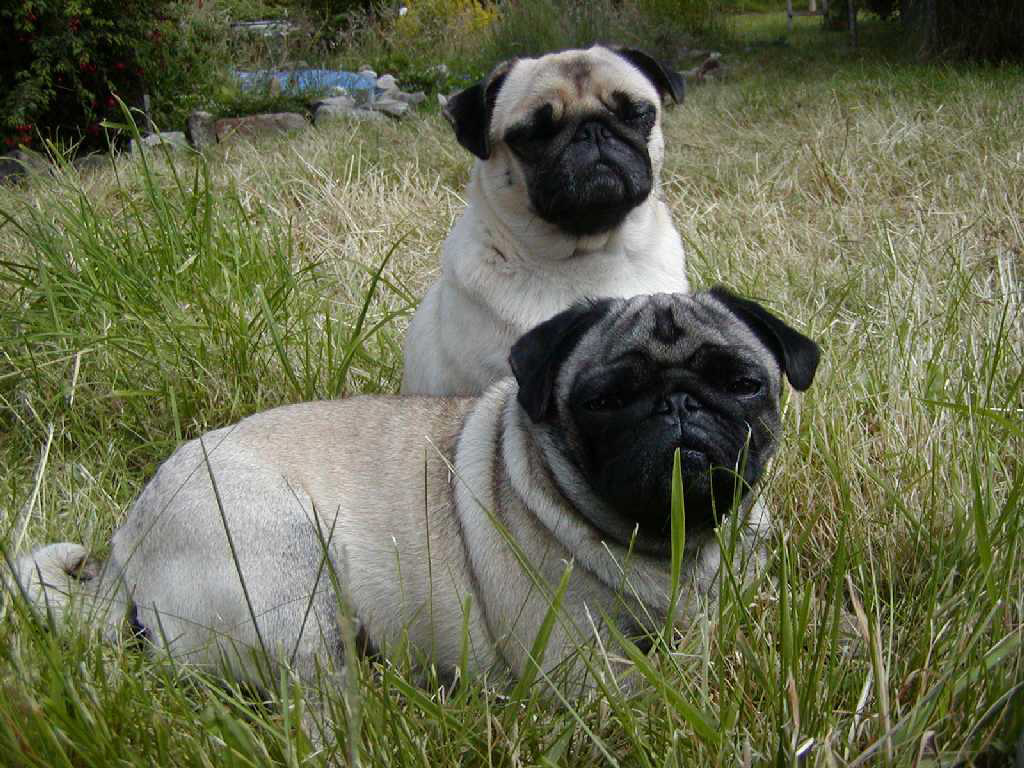
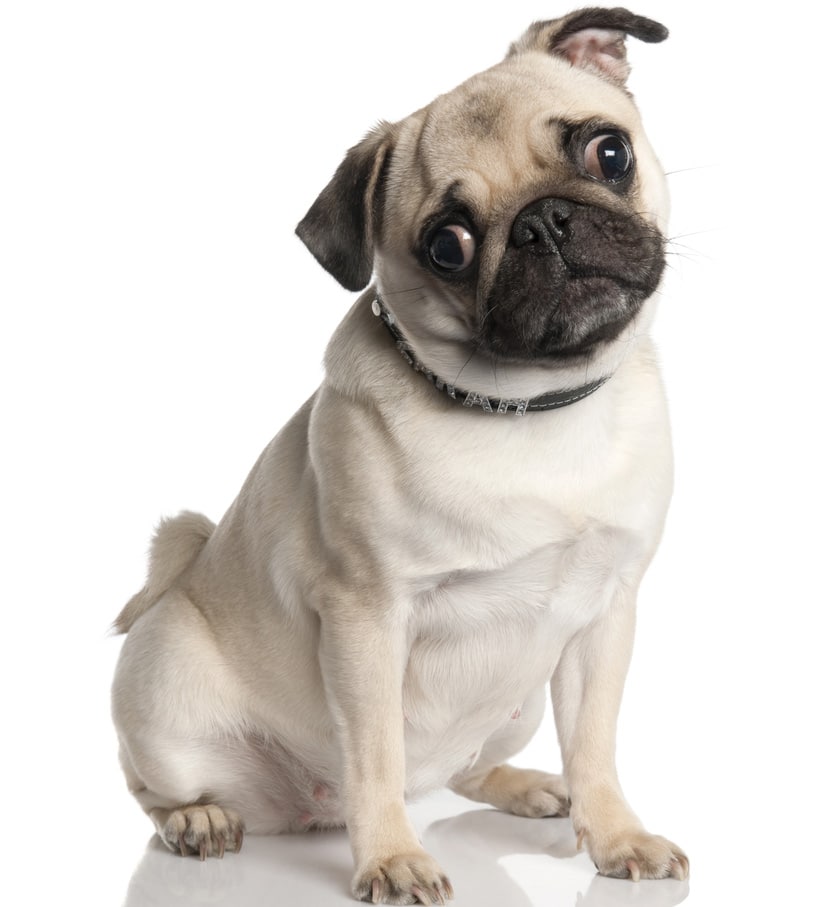
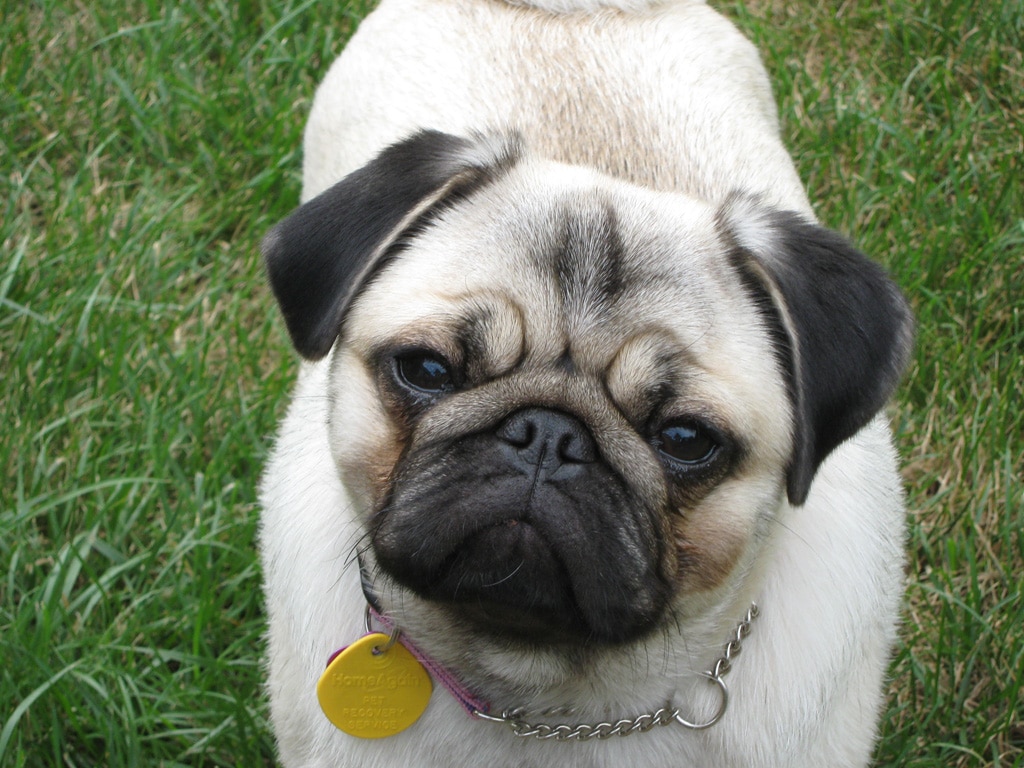
    Images of the ยซPugยป

    ยซCarlinoยป Videos

    Type and recognitions:

    • FCI CLASSIFICATION:
    • Group :
    • Section : . .

    Federations:

    FCI โ“˜, AKC โ“˜, ANKC โ“˜, CKC โ“˜, โ€‹KC โ“˜, NZKC โ“˜, UKC โ“˜

    FCI breed standard "Dutch bulldog"

    Origin:
    China, United Kingdom

    Date of publication of the valid original standard:
    13.10.2010

    Use:

    Companion dog


    General appearance:

    It is undoubtedly a square and plump dog, "Multum in parvo" (a lot of substance in a small space) showing it in its compact structure, his well-built proportions and the hardness of his muscles, but it should never seem short-limbed, neither lean nor โ€œlargeโ€.

    IMPORTANT PROPORTIONS:

    Definitely square and compact.


    Behavior / temperament:

    Great charm, dignity and intelligence. Balanced, cheerful and lively.

    Head:

    Relatively large and provided with the body, round, You must not have Apple shape.

    Cranial region:
    • Skull: Without Groove. Wrinkles on the antecara should be clearly defined without exaggeration.

    facial region:

    • Truffle: Black with nostrils large and wide open. Narrow nostrils and heavy on the nose folds are unacceptable and must be severely penalized.
    • Snout: Relatively short, obtuse, square, not drooping upwards. Eyes and nose should never be adversely affected or be hidden by excessive folds on the nose.
    • Jaws / Teeth: With a slight lower prognathism. The lower jaw is wide with the incisors placed almost in a straight line. It is highly undesirable Wry mouth, teeth and tongue look and should be severely penalized.

    Eyes: dark, relatively large, round, sweet and concerned expression, very bright, and when it is excited ardor full. Never protruding, exaggerated or showing white when they look forward. Free eye problems.

    Ears: Thin, small and soft black velvet. There are two types: โ€œEar in pinkโ€, It is a small hanging ear that bends backwards to show the ear canal. โ€œButton earโ€, It is an ear that folds by bending forward, Tip adheres to the skull to cover the opening. The latter are preferred.

    Neck:

    Slightly arched it resembles a crest, strong, thick, with long enough to take the head proudly.

    Body:

    Short and compact.

    • top line: Level; It must be neither concave nor inclined.
    • Breast : Large. Ribs well arched back.

    Tail:

    High insertion, tightly coiled on the hip. The dual threading is highly desirable.

    Tips

    PREVIOUS MEMBERS:

    • Shoulder: Well inclined backwards.
    • forearms: Very strong limbs, straight, long moderate and positioned low in the body.
    • Previous feet: As long as the foot of the Hare nor so round as the foot of the cat; with separate fingers; the nails must be black.

    LATER MEMBERS:

    • General appearance: Very strong limbs, of moderate length, well positioned under body, straight and parallel when you look at them from the back.
    • Knee: Good angulation of stifle warm joints rotulianas (knees).
    • Hind feet: As long as the foot of the Hare nor so round as the foot of the cat; with separate fingers; the nails must be black.

    Movement:

    Viewed from the front you must lift the forelimbs and drop well straight below shoulders, keeping the feet directly forward, unoffset in or out. From behind, the action must be equally correct. The forelimbs uses them with force bringing them well forward and the rear moving freely and bending your knees well. Light balancing the quarterfinals later characterized the journey. Capable of performing a resolved and safe movement.

    Mantle

    Fur: Texture fine, smooth, soft, short and bright. Neither rough nor woolly.

    COLOR: Silver, apricot, Griffon clear or black. Each of these colors must be clearly defined, to emphasize the contrast between the color, the stretch mark (a black line extending from the occiput to the tail) and the mask. The marks must be well defined. The muzzle or mask, the ears, moles on the cheeks, the thumb mark or the forehead rhombus and the striation should be as black as possible.


    Size and weight:

    The ideal weight is between 6,3 and 8,1 kg. You must have strong muscles, but the substance should not be confused with an overweight.


    Fouls:

    Any deviation from the aforementioned criteria is considered a fault and the severity of this is considered to the degree of the deviation from the standard and its consequences on the health and well-being of the dog..

    FALTAS DESCALIFICANTES

    • Aggressive or fearful dog.
    • Any dog โ€‹โ€‹showing clear signs of physical or behavioral abnormalities must be disqualified..


    N.B.:

    โ€ข Males must have two normal-appearing testicles fully descended into the scrotum..
    โ€ข Only functionally and clinically healthy dogs, with the typical conformation of the breed, should be used for parenting.

    TRANSLATION: Brรญgida Nestler / Original version: (IN).

    Source: F.C.I - International Cynological Federation

    Alternative names:

    1. Chinese pug, Dutch mastiff (English).
    2. Pug (French).
    3. Pug (German).
    4. Carlin, Mops (Portuguese).
    5. Pug chino, Mops, Pug carlino, Doguillo (espaรฑol).