โ–ท The world of Pets: Dogs, cats, birds, reptiles, amphibians

Thick-billed Parrot
Rhynchopsitta pachyrhyncha


Cotorra Serrana Occidental

Content

Description:

Ilustraciรณn Cotorra Serrana Occidental

38 cm.. of length and a weight of 300 g..

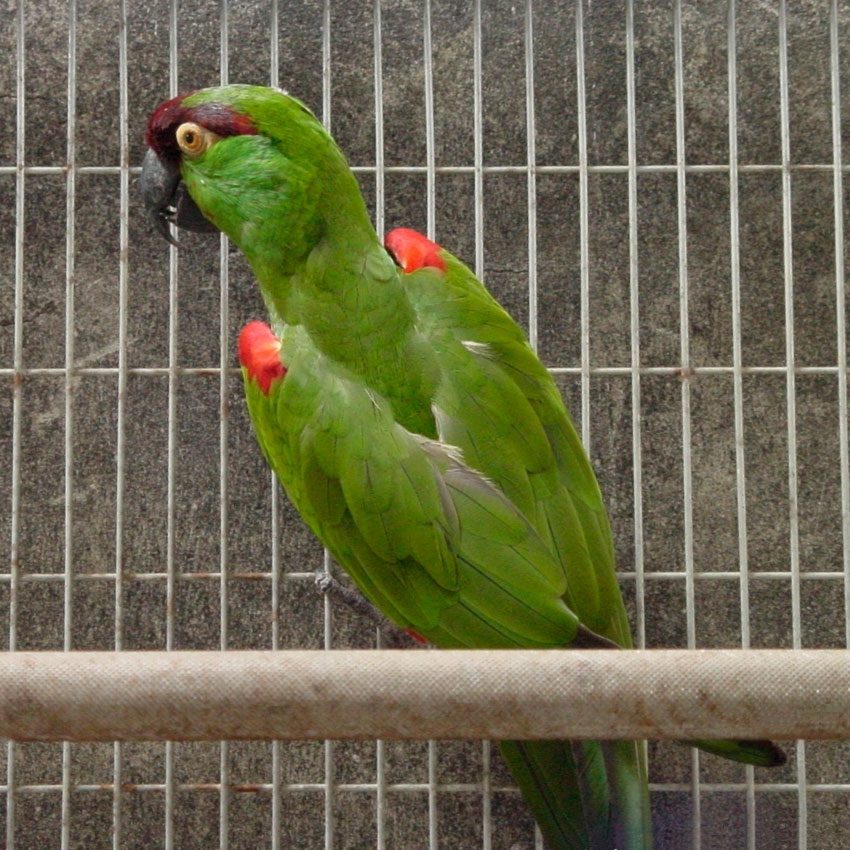
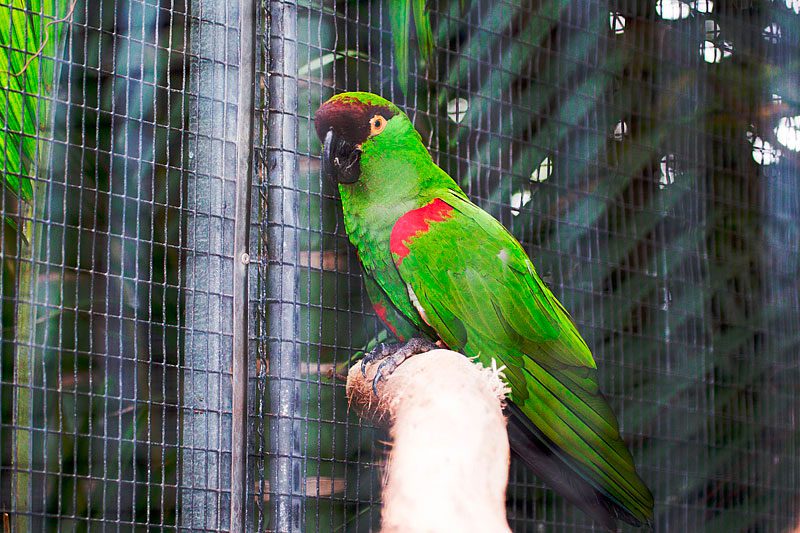
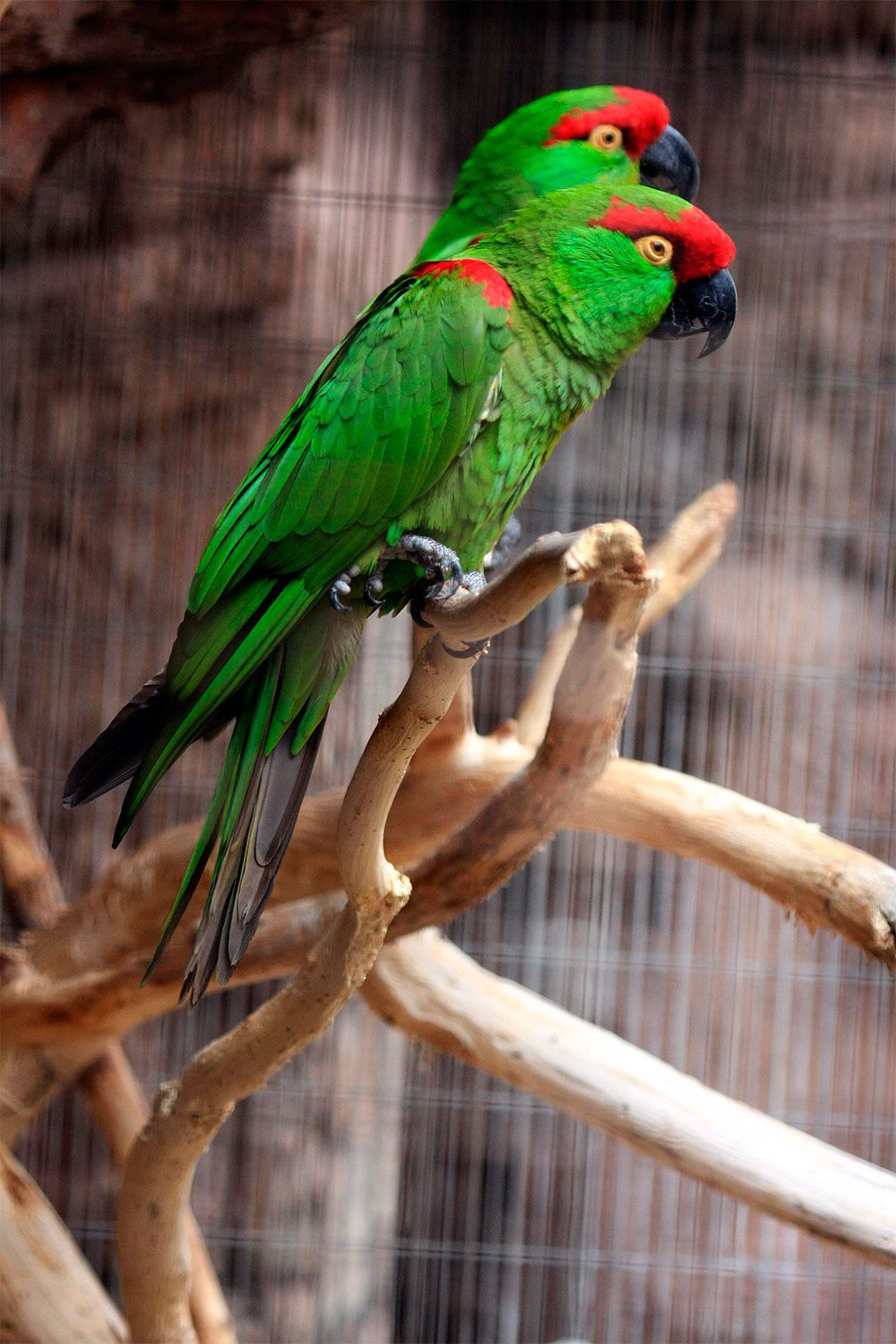
The Thick-billed Parrot (Rhynchopsitta pachyrhyncha) has the forecrown, the lores and a large swath in the region supercilii, bright Scarlet Red; a small patch of feathers brown in color lores, directly in front of the eyes; the crown, the cheeks and the sides of the neck are green with yellow tinge. The upperparts Green tinged indistinct tone olive in scapulars.

Upperwing-coverts Green with red feathers in the region where bend the wings. The flight feather of color green for over, with blackish tips and margins to the vane inner, grey below. Large infra-wing coverts Yellow, other coverts green.

Underparts Green with red on the the thighs. Upper, the tail green; gray at the bottom.

The bill black; bare orbital skin yellowish white; irises yellow-orange; legs grey.

Both sexes similar.

Immature with the bill color horn, greyish the bare orbital skin, and no Scarlet feathers behind the eye or red in the region where bend the wings.

The Thick-billed Parrot is often treated as the same species as the Maroon-fronted Parrot.

Habitat:

It inhabits in Highlands with mature pine forests or pine forests with other conifers of the genus Pseudotsuga, malls Populus and/or trees of the genus Quercus, in areas isolated and often rugged, sometimes are also observed in towns of lowlands.

They are mostly distributed at altitudes between 1,500 and 3,000 m, breeding generally at heights between 2,000 and 3,000 m.

Its preference they are areas with Pinus arizonica and Pinus ayacahuite. In general, observed in flocks. They rest in large groups on inaccessible cliffs or trees with dense foliage. Diurnal movements of up 40 km between resting areas and feeding.

Long-lived and gregarious, they form social groups; because of this, over time the Thick-billed Parrot they return to visit forests which are of your choice.

Reproduction:

Nest in the cavities of trees, usually pine, but also, according to sources, in trees of the species Populus tremuloides and Pseudotsuga taxifolia; usually in trees partially dead or alive, with small holes excavated, for example, by woodpeckers as the Northern Flicker (Colaptes auratus) or caused by fungal decomposition in the Heartwood wood; sometimes very together (in the same tree) When there is available room, Although generally scattered.

The breeding season coincides with the ripening of the pine seeds; birds, usually, They arrive at the breeding area between the months of April and May, carrying out the mid June to end of July update. The young begin to leave the nest from early September to late October, after 59 – 65 days, depending on their parents for a period of time after fledging.

Clutch of 2 to 4 eggs, generally three, Perhaps variable with the size of the harvest of pine seeds. The care of the eggs during incubation is carried out by the female and the care of the young is biparental..

Food:

Diet Thick-billed Parrot It is mainly composed of pine seeds (including the of the Pinus teocote and of the Pinus leiophylla) extracted from the cones with its powerful beak; They also feed, according to sources, of seeds and sprouts coniferous Pseudotsuga, fruits of the American black cherry (Prunus serotina) and acorns.

Distribution:

Size of the area of distribution (reproduction / resident): 67.100 km2

The distribution Master of the Thick-billed Parrot lies between the West and centre of Mexico, with sporadic movements towards the North and towards South.

You can see in Sierra Madre Occidental in the South of Chihuahua, South and West of Durango, the adjacent areas of the East of Sonora and Sinaloa; confirmed breeding only in the first two states.

Like other bird specialists in pine seeds, the Thick-billed Parrot wanders widely after playback, sporadically to South-West of Mexico in Jalisco, Colima and Michoacรกn, previously to the East up to Veracruz (Although these records are possibly involved the Maroon-fronted Parrot – Rhynchopsitta in terris) and, possibly, Coahuila de Zaragoza.

Formerly it was a sporadic visitor, and possibly resided and lesson in Arizona (especially in the mountains of Chiricahua, in the South) and in New Mexico, EE.UU, Although since the beginning of the century 20 no large-scale visits have been observed and the latest reproductive data in the area date from the 1938.

The presence of the Thick-billed Parrot is determined by the availability of pine seeds; the core of your playback area It seems to be the most constantly occupied area.

The decrease important in your population during the century 20 as a result ,mainly, of the loss and degradation of habitat, with the absence of these birds where the large pines were cut down, mainly by forestry. The loss of birds in EE.UU. was attributable to the hunt, but his presence there, probably, It was only in the short term, When were feeding conditions unusually favorable (or on the contrary very unfavorable in Mexico).

The recent threats in Mexico they are the trade in live birds and the continuous loss of habitat for livestock, as well as logging (the loss of old trees for nesting is a major problem that puts this species at a higher risk than the of the Maroon-fronted Parrot, when the latter uses the cliffs to build their nests).

Confiscated and captive-bred birds were released in Arizona at the end of the Decade of 1960, with the first successful reproduction in EE.UU. shortly after, although unfortunately the birds have mostly disappeared from that area.

There are no protected areas in Sierra Madre Occidental. The Appendix I. In danger.

Conservation:

State of conservation โ“˜


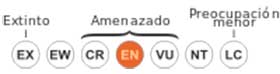
Endangered Endangered โ“˜ (UICN)โ“˜

โ€ข Red List category of the UICN current: In danger of extinction

โ€ข Population trend: Decreasing

The thick-billed Parrot is found in danger of extinction due to the destruction of nesting habitat, as well as his commercial exploitation, the decrease of population who have suffered these parrots is very evident to those that, long overdue, They inhabit the timber areas of Chihuahua and Durango (Lanning and Shiflett, 1981).

The commercial logging of pine living for wood, as well as standing dead trees to obtain their pulp, they are ending with a lot of nesting sites effective and potential for these birds (Lanning and Shiflett, 1983).

The trade of the parrots seemed to be minimal until the 1980s (Lanning and Shiflett, 1981), However, It is estimated that during 1985 and 1986 between several hundred and even thousands of parrots were illegally trafficked to the United States of America (Snyder & Wallace, 1988).

To reduce these threats the species and its habitat, There are legal instruments such as the vedas and provisions in the Law-General ecological balance and environmental protection (LGEEPA) and General wildlife law (LGVS); as well as the Norma Oficial Mexicana NOM-059-SEMARNAT-2001 that lists the species of Mexican wild flora and fauna under some risk category and the inclusion and modification mechanisms.

The size of the population of the Thick-billed Parrot It is estimated between 2000-2800 mature individuals.

"Thick-billed Parrot" in captivity:

Its sale as a pet is illegal.

Alternative names:

– Thick-billed Macawlet, Thick billed Parrot, Thick-billed Parrot (English).
– Conure ร  gros bec, Perriche ร  gros bec, Perruche ร  gros bec (French).
– Kiefernsittich, Arasittich, Kiefern Sittich (German).
– Papagaio-mexicano-de-testa-vermelha (Portuguese).
– Cotorra de Pico Ancho, Cotorra serrana, Cotorra Serrana Occidental, Cotorra-serrana Occidental (espaรฑol).
– Cotorra serrana, Cotorra-serrana Occidental, Loro de Pico Grueso Occidental Mexicano, Cotorra de Pico Duro,
Guacamaya, Guaca
(Mexico).


scientific classification:
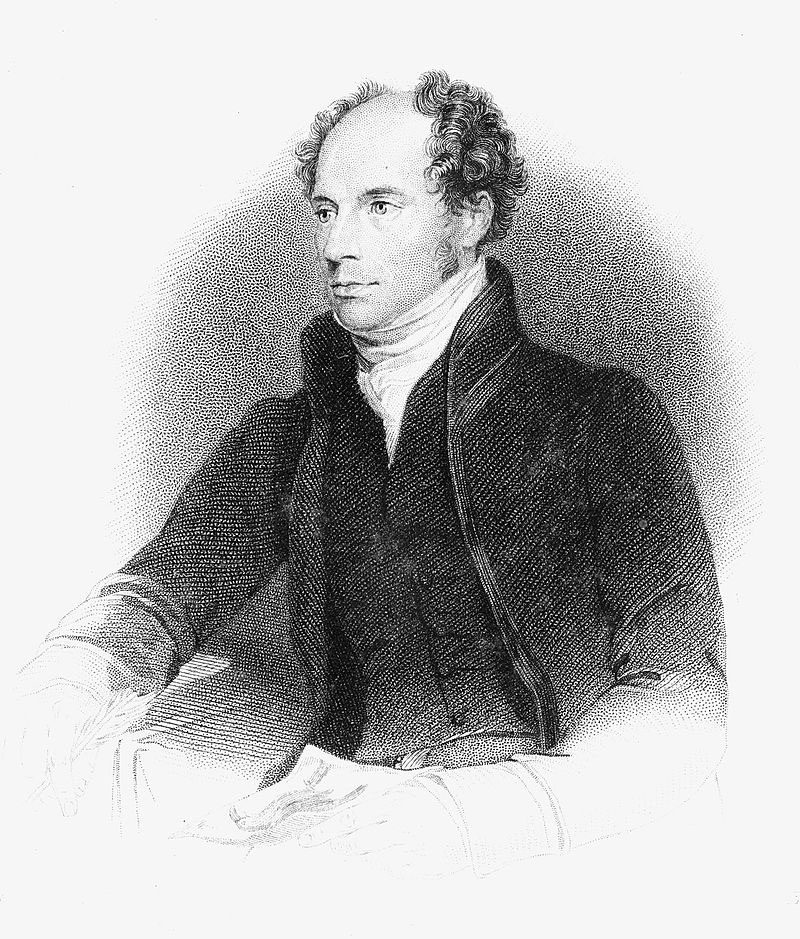
William Swainson
William Swainson

– Order: Psittaciformes
– Family: Psittacidae
– Genus: Rhynchopsitta
– Scientific name: Rhynchopsitta pachyrhyncha
– Citation: (Swainson, 1827)
– Protonimo: Macrocercus pachyrhynchus


Thick-billed Parrot images:


Species of the genus Rhynchopsitta

Thick-billed Parrot (Rhynchopsitta pachyrhyncha)


Sources:

– Avibase
– Parrots of the World โ€“ Forshaw Joseph M
– Parrots A Guide to the Parrots of the World – Tony Juniper & Mike Parr
– Birdlife
– National Commission of Natural Protected Areas

– Photos:

(1) – Two Thick-billed Parrots at Arizona-Sonora Desert Museum, Tucson, Arizona, USA By Tim Lenz from Ithaca (Thick-billed ParrotsUploaded by Snowmanradio) [CC BY 2.0], via Wikimedia Commons
(2) – Thick-Billed Parrots at Twycross Zoo, Leicestershire, England By derivative work: Snowmanradio (talk)Rhynchopsitta_pachyrhyncha_-Twycross_Zoo-8.jpg: Paul Reynolds from UK [CC BY 2.0 or CC BY 2.0], via Wikimedia Commons
(3) – An adult Thick-billed Parrot at Edinburgh Zoo, Scotland By Jenni Douglas from Edinburgh, Scotland (Thick billed ParrotUploaded by Snowmanradio) [CC BY 2.0], via Wikimedia Commons
(4) – A Thick-billed Parrot at Cincinnati Zoo, USA By Rhynchopsitta_pachyrhyncha_-captive-8a.jpg: Jean from Shelbyville, KYderivative work: Snowmanradio [CC BY 2.0], via Wikimedia Commons
(5) – Three adult Thick-billed Parrots in captivity in the USA By Joe Mazzola (LovebirdsUploaded by snowmanradio) [CC BY-SA 2.0], via Wikimedia Commons
(6) – Thick-billed Parrot (Rhynchopsitta pachyrhyncha). Two parrots on a nestbox By Just chaos [CC BY 2.0], via Wikimedia Commons
(7) – Thick-billed Parrot Rhynchopsitta pachyrhyncha at Cincinnati Zoo By Ltshears (Own work) [CC BY-SA 3.0 or GFDL], via Wikimedia Commons
(8) – A Thick-billed Parrot in captivity By Mark Dumont from Cincinnati, USA (Thick Billed ParrotUploaded by snowmanradio) [CC BY 2.0], via Wikimedia Commons
(9) – Thick-billed Parrot – Rhynchopsitta pachyrhyncha at Cincinnati Zoo By Ltshears (Own work) [CC BY 3.0], via Wikimedia Commons
(10) – Monographia Psittacorum By Wagler, Johann Georg [CC BY 2.0 or Public domain], via Wikimedia Commons

– Sounds: Scott Olmstead (Xeno-canto)
โ–ท The world of Pets: Dogs, cats, birds, reptiles, amphibians

Dusky-headed Parakeet
Aratinga weddellii

Aratinga Cabecifusca

Content


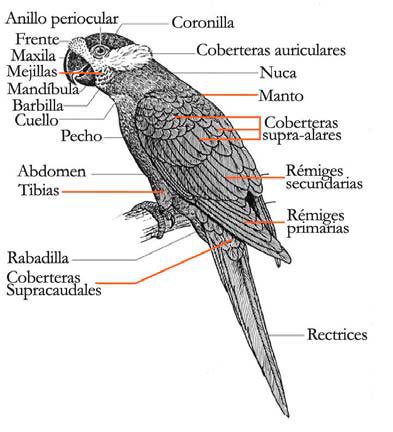
Anatomy-parrots

Description:

Of 25-30 cm.. length and a weight between 95-115 g.

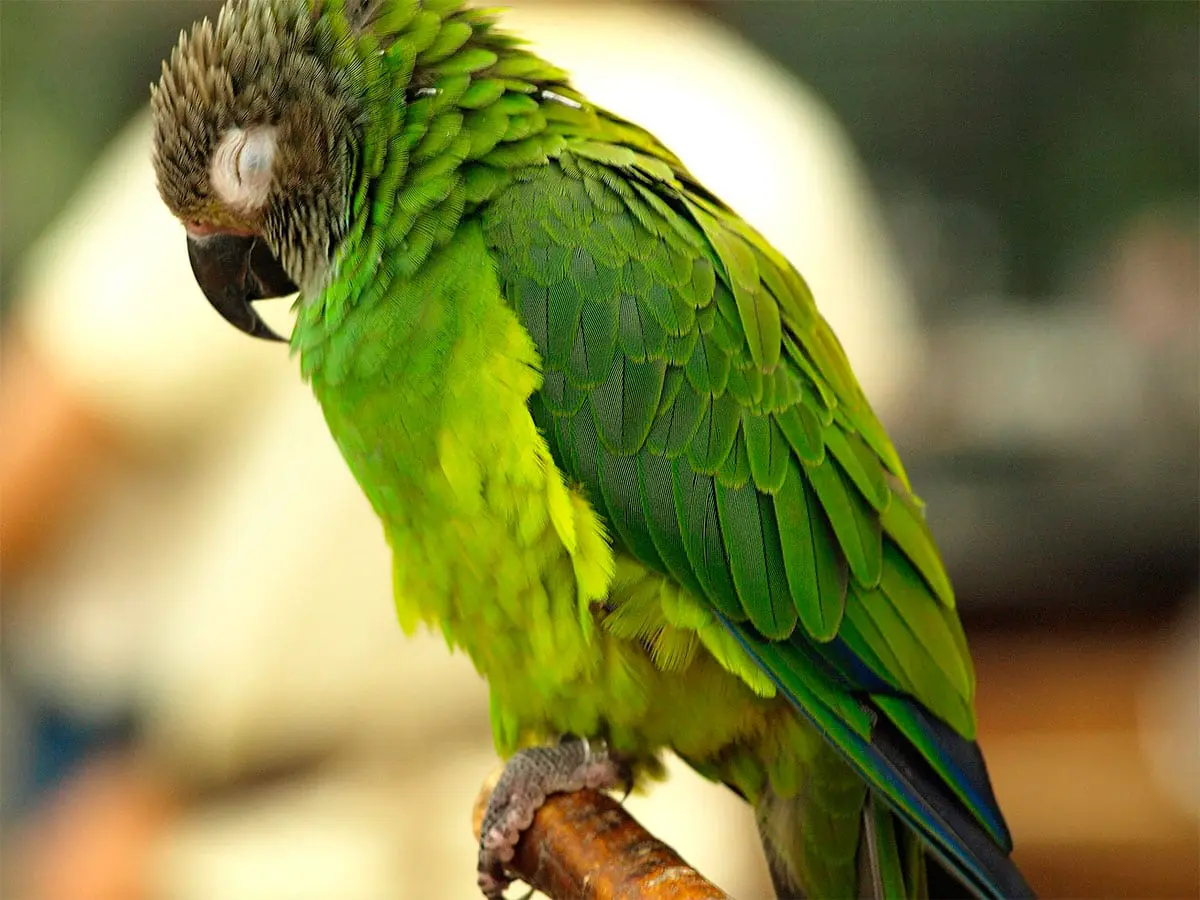
The head of the Dusky-headed Parakeet (Aratinga weddellii) is greyish Brown, with off blue stripes that give it a scaly appearance. The upperparts are green, the feathers of the nape they have yellowish margins (some banks in the mantle), the back and Hip with Brown centers, giving an appearance of Brown altogether. The scapulars with varying between Brown and green edges; the minor, large and medium-sized inner coverts green grass with paler green margins; the outer and the primary coverts are dark blue. Primary and secondary mostly blue with vane outer Green or green margins toward the vane external in the primaries; very dark (almost black) the Tips. Underwing-coverts green: underside of the flight feather opaque gray. Top of the chest pale green with turquoise suffusion; belly and undertail-coverts pale yellowish green, greener on the flanks. Upper, the tail green, Blue towards the tip: undertail, opaque gray.

Dusky-headed Parakeet

The bill shiny black; cere pinkish grey; wide area orbital off-white; irises yellowish white; legs dark gray.

Both sexes similar.

The immature are like adults but with the irises darker.

Habitat:

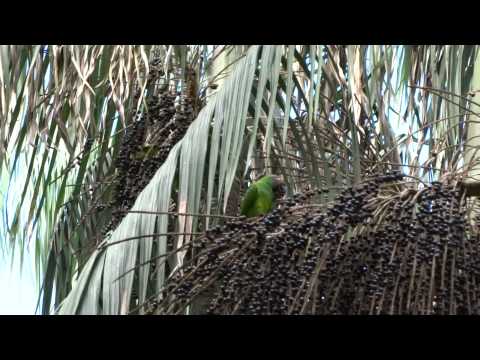
Video – "Dusky-headed Parakeet"

Dusky-headed Parakeet (Aratinga weddellii)

They inhabit in humid jungle, semi-wet, swamps, involved swamp forest and stubble, until 500 metres in Colombia and exceptionally 750 metres in Bolivia. Its preferred habitats are the forests and marshes and flooded forests in swampy areas. Also in the remnants of forest in humid savannah and cleared areas with patches of remnant forest. Also observed in coffee and sugarcane plantations; apparently rarely fly over the dense forest. Usually, in pairs or in small groups, but flocks of up to 75 reported individuals where food is plentiful.

Reproduction:

It nests in trees and palms of marshy or riparian areas, between June and August. They also used the cups of dead Palm trees and termite nests.
Four nests observed in Leticia, Colombia, between 4 and 15 metres in height. Birds incubating in the month of February in Colombia. Bird in reproductive condition in the month of August in Bolivia. Observed breeding from June to September in Loreto, eastern peru; from April to July in the Mato Grosso.
A normal start is of 3 to 5 eggs and both parents feed the chicks.

Food:

Its diet consists of seeds, fruit, flowers, berries, as well as insects and their larvae found in decaying trees and stumps.

Distribution:

Its distribution ranges from the southeast of Colombia, east of Ecuador and Peru to the East of Bolivia and West of Brazil.

Apparently Nomad in some parts of the distribution. In general common, even in partially deforested areas, and perhaps increase due to clearing and fragmentation of dense forest.

Conservation:

State of conservation โ“˜


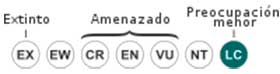
minor concern Minor Concern โ“˜ (UICN)โ“˜

โ€ข Red List category of the UICN current: Least concern

โ€ข Population trend: Growing

The size of the world population Dusky-headed Parakeet It has not been quantified, but this species is described as common (Stotz et to the. (1996)).

This species is suspected that it has been lost between the 15 and the 17,7% of its suitable habitat within its range over three generations (21 years) based on a model of deforestation of the Amazon (Soares-Filho et to the., 2006, Bird et to the. 2011). Given the susceptibility of this species to the hunting or trapping, It is suspected that its population may decrease in around the 25% in three generations.

"Dusky-headed Parakeet" in captivity:

Not common in captivity, but in the past was part of the international trade. They are common in cultivation areas, for this reason they are common in homes of peasants.

The Dusky-headed Parakeet is not known for its ability to mimic the speak human, but they are nevertheless birds very fun, kind and loving – provided that they have been hand reared and socialized properly. They are not as active and noisy as other species of parrots, they only emit sounds, not too high, when excited.

wonderful pets. His charming personality makes them good pets for children. They are not demanding, they spend happy hours playing with their favorite toys but still enjoy human company very much.

They are relatively easy to raise. They may have several broods per year; But, good husbandry practice stipulates that they should not be allowed to have more than two or three clutches to allow for their rest. The size of Sunset is of 3 to 4 eggs, they are incubated for a few 23 days. Both parents take care of the young.. The chicks leave the nest after a few 50 days.

In the wild, according to sources, females have been estimated can live up to 25 years. Its longevity in captivity It has not been studied in detail. It has been observed a muscle aging in wild animals.

Alternative names:

– Dusky-headed Parakeet, Dusky Conure, Dusky headed Parakeet, Dusky Parakeet, Dusky-headed Conure, Weddell’s Conure (English).
– Conure de Weddell, Conure ร  tรชte sombre, Perriche de Weddell, Perruche de Weddell (French).
– Weddellsittich, Weddell-Sittich (German).
– Aratinga-de-cabeca-escura, aratinga-de-cabeรงa-suja, jandaia-de-cabeรงa-azulada, jandaia-de-cara-suja, periquito-de-cabeรงa-suja (Portuguese).
– Aratinga Cabecifusca, Perico Canoso, Periquito de Cabeza Gris, Perico cabezagris(espaรฑol).
– Loro canoso, Perico Canoso, Cotorra cabecigris, Cotorra cabeciparda (Colombia).
– Cotorra de Cabeza Oscura, San Pedrito, Lorito cabeza gris (Peru).
– Perico cabecioscuro (Ecuador).
– Tarechi (Bolivia).
– Ipiรญ (Chimane).
– Bambaorito (I ingano).
– Sacara (Cofรกn.).
– Butuquiria (Macuna).

scientific classification:

– Order: Psittaciformes
– Family: Psittacidae
– Genus: Aratinga
– Scientific name: Aratinga weddellii
– Citation: (Deville, 1851)
– Protonimo: Conurus Weddellii

Dusky-headed Parakeet images:


Species of the genus Aratinga

Sources:

– Avibase
– Parrots of the World โ€“ Forshaw Joseph M
– Parrots A Guide to the Parrots of the World – Tony Juniper & Mike Parr
– Birdlife

– Photos:

(1) – Dusky-headed Conure or Weddellโ€™s Conure (Aratinga weddellii) in captivity. Kobe Kachoen By merec0 (originally posted to Flickr as Kobe Kachoen (32)) [CC BY 2.0], via Wikimedia Commons
(2) – A Dusky-headed Parakeet at Jurong Bird Park, Singapore By Sham Edmond [CC BY 2.0], via Wikimedia Commons
(3) – Dusky-headed Conure or Weddellโ€™s Conure (Aratinga weddellii) By Steve Beger [CC BY-SA 2.0], via Wikimedia Commons
(4) – Dusky-headed Conure or Weddellโ€™s Conure (Aratinga weddellii) By en:user:Jhwodchuck (http://en.wikipedia.org/wiki/Image:DuskyConure.jpg) [GFDL, GFDL or CC-BY-SA-3.0], via Wikimedia Commons
(5) – Aratinga weddellii – black-headed conure – Dusky-headed conure – dusky-headed conure Florin Feneru – Flickr
(6) – Ilustraciรณn Dusky-headed parakeet by Biodiversity Heritage Library – Flickr

– Sounds: (Xeno-canto)
โ–ท The world of Pets: Dogs, cats, birds, reptiles, amphibians

Rusty-faced Parrot
Hapalopsittaca amazonina

Rusty-faced Parrot

Content


Anatomy-parrots

Description:

23 cm.. height and a weight between 97 and 115g.

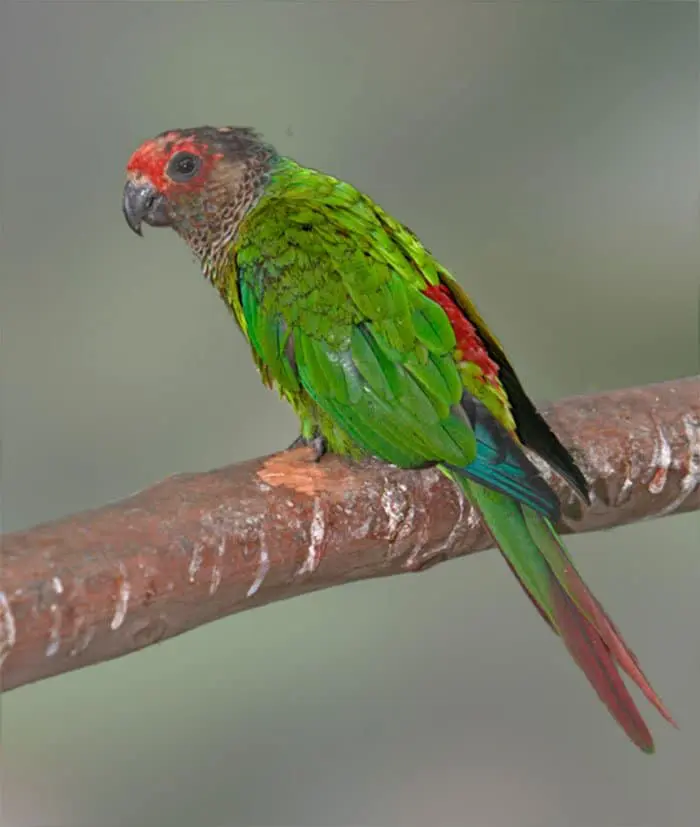
The Rusty-faced Parrot or Parrot mountain (Hapalopsittaca amazonina) It is distinguishable by the dirty red of his face and crown. Its bill is pale with to the base of the lower jaw and the chin of color red orange. Headphones coverts reddish brown with yellow lines that extend behind the nape and the neck. The rest of upperparts they are green. Its chest This is olive green, with red spots in the shoulders similar to their Wing coverts internal minors. The rest of your wing-coverts they are blue-green and the remiges bluish-black. Its tail It is mainly dull red with wide blue apexes.

It has no sexual dimorphism. The youth are green-yellow color, with the face pale red and the secondaries grey.

Description 3 subspecies:

  • Hapalopsittaca amazonina amazonina

    (Des Murs, 1845) – Nominal.


  • Hapalopsittaca amazonina theresae

    (Hellmayr, 1915) – The plumage with more olive tones and the face dark red.


  • Hapalopsittaca amazonina velezi

    (Serious,GR & Restrepo, 1989) – With part of the crown and nape, brighter yellowish green; forecrown red; list fine near to the ear; below and behind the eye, green. More information.

Habitat:

It inhabits in mountains with semi-humid and cloud forests, between the 2000 to 3600 m, with the presence of Oak (Quercus humboldtii) and Alder (Alnus acuminata).
Fly high in the forest canopy, in groups of 5-30 individuals. Presents aggregation behaviors for the night, establishing communal bedrooms in groups of between 2-35 individuals.

Reproduction:

Many aspects of the reproductive biology of the Rusty-faced Parrot. Probably nests in tree hollows of Oak dead.

Food:

Consumes fruits of the "matapaloยซ, flowers and seeds, including the of Clusia sp. and some GUIs of which is fed with high frequency.

Distribution:

Size of the breeding range / resident): 234.000 km2

Is located in Colombia and Venezuela and Peru. In Colombia lives between 2000 and 2700 m above the sea level in the Cordillera Oriental and in the The upper Magdalena valley (South of the Department of the Huila). Among 3100 and 3600 m of height in the cordillera Central in Caldas (where it is considered Bird emblem), in the basin of the White River in the municipality of Manizales. In the Cordillera Oriental is known only in Norte de Santander and the southwest of Bogotรก. Has also been recorded in the departments of Risaralda, Tolima, Huila (Cave of the Guacharos, Meremberg nature reserve) and Cauca (Puracรฉ National Park).

Distribution 3 subspecies:

  • Hapalopsittaca amazonina amazonina

    (Des Murs, 1845) – Nominal. East of the Colombian Andes.


  • Hapalopsittaca amazonina theresae

    (Hellmayr, 1915) – Eastern edge of the Andes of Colombia and Northwest of Venezuela.


  • Hapalopsittaca amazonina velezi

    (Serious,GR & Restrepo, 1989) – Center of the Colombian Andes. More information.

Conservation:


Vulnerable


โ€ข Current category of the Red List of the UICN: Vulnerable.

โ€ข Population trend: Decreasing.

From makes several years appears in the book red of species threatened by fault of the destruction of their habitat, including, the Palm of wax (Ceroxylon quindiuense).

Rationale for the Red List category

This species is classified as Vulnerable Since its small population consists of subpopulations very small and scattered that probably will be experiencing declines continuous due to the loss widespread of habitat.

Justification of the population

Renjifo et to the. (2002) estimated that in Colombia the population can count 2,500-10,000 individuals, based on a hypothetical C.1 density of individuals / km2, and the 25% occupation of the approximately 13.890 km2 of habitat suitable. This may be an overestimate and the population could be right around the few thousand mark in Colombia (P. Salaman in litt., 2005). There are also much smaller populations in Venezuela. Its location in the Ecuador is uncertain. Be placed better in the band 2.500-9.999 mature in general individuals, which is equivalent to 3.750-14.999 individuals, rounded here to 3.500-15.000 individuals.

Justification of trend

Se sospecha una lenta y continua disminuciรณn de la poblaciรณn del Rusty-faced Parrot sobre la base de la continua destrucciรณn y fragmentaciรณn del hรกbitat.

"Rusty-faced Parrot" in captivity:

No encontrado en avicultura.

Alternative names:

– Rusty-faced Parrot, Bogota Parrot, Little Amazonian Parrot, Rusty faced Parrot (English).
– Caรฏque ร  face rousse, Caรฏque ร  face rouge (French).
– Caรฏque ร  face rousse (German).
– Rusty-faced Parrot (Portuguese).
– Cotorra Montaรฑera, Lorito Amazonino, Lorito Multicolor, Loro fantasma (espaรฑol).
– Cotorra Montaรฑera, Lora montaรฑera (Colombia).
– Perico Multicolor (Venezuela).


scientific classification:

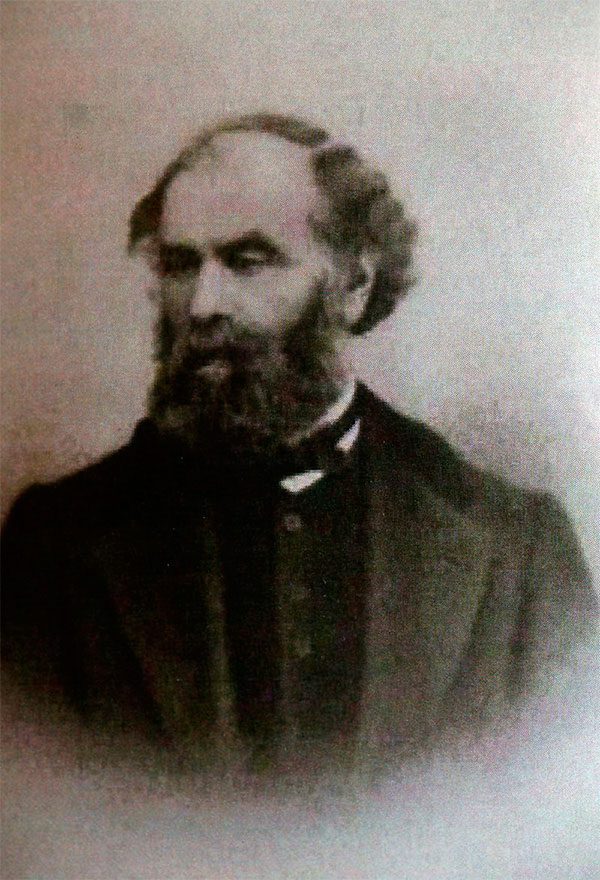
Marc Athanase Parfait Oeillet Des Murs

– Order: Psittaciformes
– Family: Psittacidae
– Genus: Hapalopsittaca
– Scientific name: Hapalopsittaca amazonina
– Citation: (Des Murs, 1845)
– Protonimo: Psittacus amazoninus


Images ยซLorito Amazoninoยป:

Videos ยซLrito Amazoninoยป:


ยซAmazonino Blondoยป (Hapalopsittaca amazonina)


Sources:

Avibase
Parrots of the World โ€“ Forshaw Joseph M
Parrots A Guide to the Parrots of the World – Tony Juniper & Mike Parr
Birdlife

Photos:

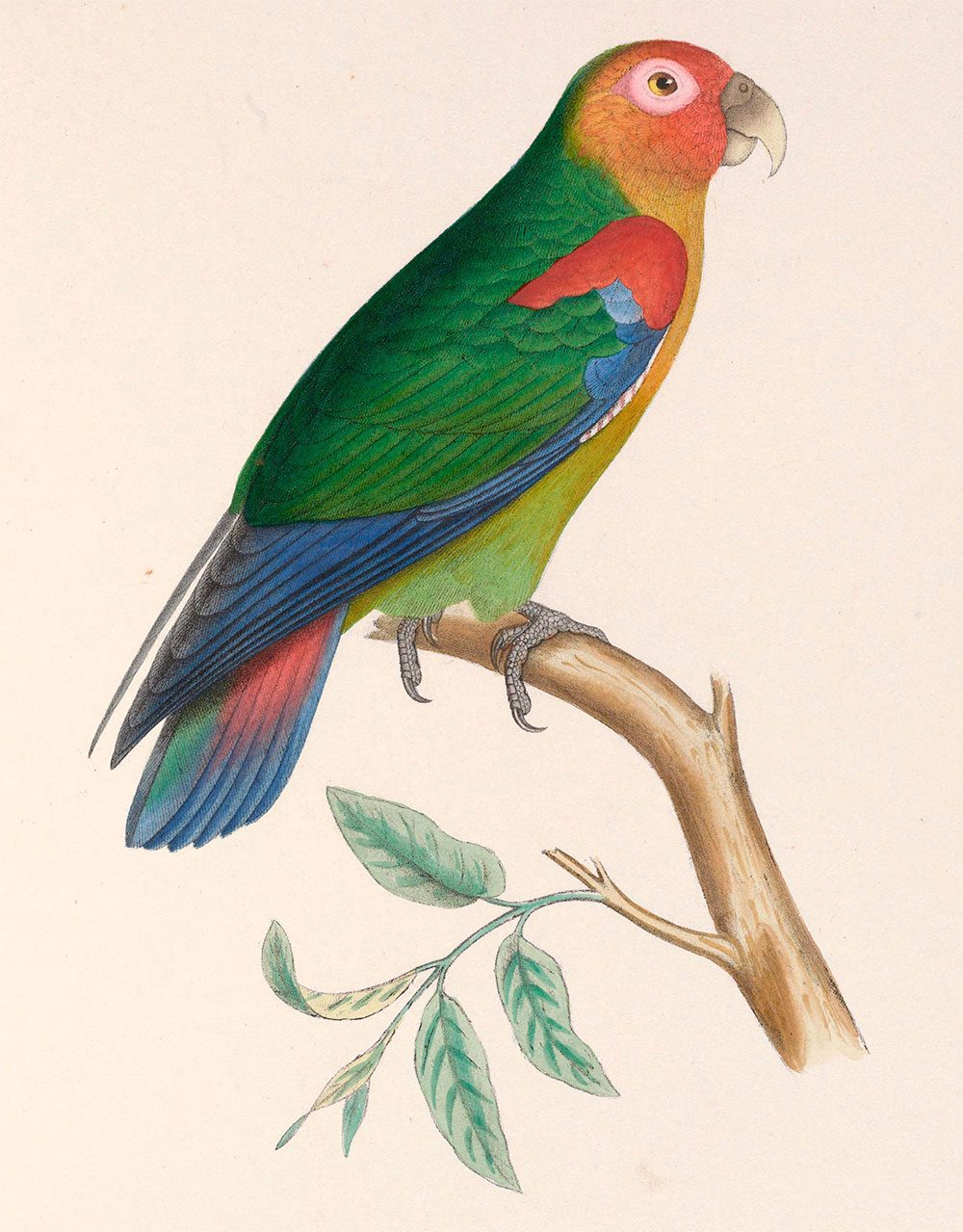
(1) – Iconographie ornithologique By Marc Athanase Perfect Carnation Walls (1804-1878) (Iconographie ornithologique) [Public domain], via Wikimedia Commons

Sounds:

Restrepo, Daniel Uribe

* – Restrepo, Daniel Uribe

Daniel has been chasing birds since he was 9-years old, growing on a farm in the Central Andes of Colombia, with his bedroom walls covered with colorful prints of John James Audubonโ€™s birds. Daniel graduated in Veterinary Medicine and Animal Science and has pursued bird and nature photography as his main passions in life.

He is co-founder of the Caldas Ornithological Society (SCO) based in Manizales. Dedicated mainly to conservation and sustainable development projects, Daniel has consulted for many of the most prominent environmental organizations in Colombia and currently assists private nature reserves in Colombia in the establishment of agritourism and ecotourism services.

โ–ท The world of Pets: Dogs, cats, birds, reptiles, amphibians

Red-crowned Parakeet
Pyrrhura roseifrons

Red-crowned Parakeet

Content

Description:


Anatomy-parrots

22 cm.. in length and a weight ranging from 54 and 70 g..

The Red-crowned Parakeet (Pyrrhura roseifrons) has the head pinkish red. The neck and the area of รขโ‚ฌโ€นรขโ‚ฌโ€นthe upper chest They are dark with whitish scales. The bill is black. The tail and the central area of belly They are red. The tip of his tail It is dark red. The wings they are blue. Orbital ring dark gray bordered by a yellowish white. the legs are grey.

The immature It has reddish forehead and dark tones in the rest of the head. The pinkish red head in adults it is distinctive. Losl youth They may resemble subspecies Pyrrhura roseifrons peruviana or the Deville's Parakeet (Pyrrhura lucianii), but it lacks of the ear-coverts pale.

  • Sound of the Red-crowned Parakeet.

Description 4 subspecies
  • Pyrrhura roseifrons dilutissima

    (Arndt, 2008) – Blue restricted to a narrow strip on the forecrown; yellowish beige in ear-coverts; upper region chest pale brown festooned with pale yellowish beige.

  • Pyrrhura roseifrons roseifrons

    (Gray,GR, 1859) – Nominal. –

  • Pyrrhura roseifrons parvifrons

    (Arndt, 2008) – It looks like the Pyrrhura roseifrons peruviana, but with blue, rather than red, on forecrown.

  • Pyrrhura roseifrons peruviana

    (Hocking, Blake & Joseph, 2002) – 22 cm., length. Absent in his bright red plumage, It has more dark brown in crown and the area eyes, the crown with bluish.

Habitat:

They mostly live in small groups of a dozen members and remain in pairs during the breeding period. breeding. They lead a life Nomad, little little is known about the behavior of this species in the wild.

Reproduction:

build their nest in tree cavities. The laying is of 5 to 7 eggs incubated by both parents for 26 days (captive breeding data). The pups remain in the nest 2 months, becoming independent at the age of 3 months.

Food:

It feeds on fruits, seeds, leaves and flowers.

Distribution:

Size of its range (reproduction / residents): 1.000.000 km2

It is located in the west of the Amazonia, from the state amazon about the Juruรก, in Brazil, and the lowlands of eastern Peru in the North of Bolivia. In Brazil, They spread south and west of habitat Deville's Parakeet (Pyrrhura lucianii)–

Distribution 4 subspecies
  • Pyrrhura roseifrons dilutissima

    (Arndt, 2008) – Center of Peru around the rio Ene at the confluence with the rio Quipachiari, and around Hacienda Louisiana, on Cordillera Vilcabamba.

  • Pyrrhura roseifrons roseifrons

    (Gray,GR, 1859) – Nominal. – Amazonia occidental, to the South of the amazon, from the North of Peru South to North of Bolivia (Peace) and in the West of Brazil (Western Amazon).

  • Pyrrhura roseifrons parvifrons

    (Arndt, 2008) – Two disjoint regions in northern Peru; in the East of San Martin and adjacent areas, Center west Loreto, and along the amazon in the northeast of Loreto (only on the southern shore of amazon).

  • Pyrrhura roseifrons peruviana

    (Hocking, Blake & Joseph, 2002) – Foothills of Andes in the southeast of Ecuador (Morona-Santiago) and North of Peru (Amazon and Loreto Western)

Conservation:

State of conservation โ“˜


minor concern Minor Concern โ“˜ (UICN)โ“˜

โ€ข Current category of the Red List of the UICN: Least concern.

โ€ข Population trend: Decreasing.

โ€ข Population size : Unknown.

Justification of the Red List of the Category

This species has a very large range, and therefore does not approach the thresholds for vulnerable under the range size criterion (extent of occurrence <20.000 km2 combinan con un tamaรฑo gama disminuciรณn o fluctuante, hรกbitat medida / calidad, o de la poblaciรณn tamaรฑo y un pequeรฑo nรบmero de localidades o fragmentaciรณn severa). A pesar de que la tendencia de la poblaciรณn parece estar disminuyendo, el descenso no se cree que es suficientemente rรกpido como para acercarse a los umbrales para Vulnerables segรบn el criterio tendencia de la poblaciรณn (> 30% decrease of more than ten years or three generations). The population size It has not been quantified, but is not believed to be a reason to approach the thresholds for Vulnerable based on population size criteria (<10.000 individuos maduros con una disminuciรณn continua estima en> 10% in ten years or three generations, or a specific population structure). For these reasons, the species is evaluated as Least concern.

Justification of the population

Recent world population is unknown given taxonomic divisions.

Justification trend

This species is suspected that there may be lost 7,0-7,3% of habitat within its distribution over three generations (18 years) based on a model of deforestation of the Amazon (Soares-Filho et to the. 2006, Bird et to the. 2011). Given the susceptibility of this species to hunting and / or entrapment, it is suspected that its population can decrease <25% en tres generaciones.

"Red-crowned Parakeet" in captivity:

little presence in captivity and found only in some aviaries, where however they reproduce very well. After acclimation is a strong bird that can live outdoors. It is a bird suspicious although curious and playful nature, especially if they feel safe. Young birds in captivity quickly lose their fear and are very attached to their caregivers. Itร‚ยดs noisy, especially in the morning and sleeps in the nest. The female is very aggressive during the breeding period with other birds..

Alternative names:

– Red-crowned Parakeet, Rose-fronted Parakeet, Rose-fronted Parakeet (Rose-fronted) (English).
– Conure ร  calotte rouge, Conure rougissante (French).
– Rotscheitelsittich (German).
– Tiriba-de-cabeรงa-vermelha (Portuguese).
– Cotorra frentirrosa, Perico de Frente Rosada (espaรฑol).

scientific classification:

– Order: Psittaciformes
– Family: Psittacidae
– Genus: Pyrrhura
– Scientific name: Pyrrhura roseifrons
– Citation: (Gray, GR, 1859)
– Protonimo: Conurus roseifrons

Images Red-crowned Parakeet:

Videos "Red-crowned Parakeet"


Especies del gรฉnero Pyrrhura

Red-crowned Parakeet (Pyrrhura roseifrons)


Sources:

– Avibase
– Parrots of the World โ€“ Forshaw Joseph M
– Parrots A Guide to the Parrots of the World – Tony Juniper & Mike Parr
– Birdlife

– Photos:

(1) – Painted Parakeet (Pyrrhura picta) – the subspecies on this photo, roseifrons, is now often considered a separate species, the Rose-fronted Parakeet (Pyrrhura roseifrons) By http://www.birdphotos.com (http://www.birdphotos.com) [CC BY 3.0], via Wikimedia Commons

– Sounds: Micah Riegner, XC208597. accessible www.xeno-canto.org/208597

โ–ท The world of Pets: Dogs, cats, birds, reptiles, amphibians

White-necked Parakeet
Pyrrhura albipectus

Cotorra cuelliblanca

Content

Description:

White-necked Parakeet

24 to 25,5 cm.. height.

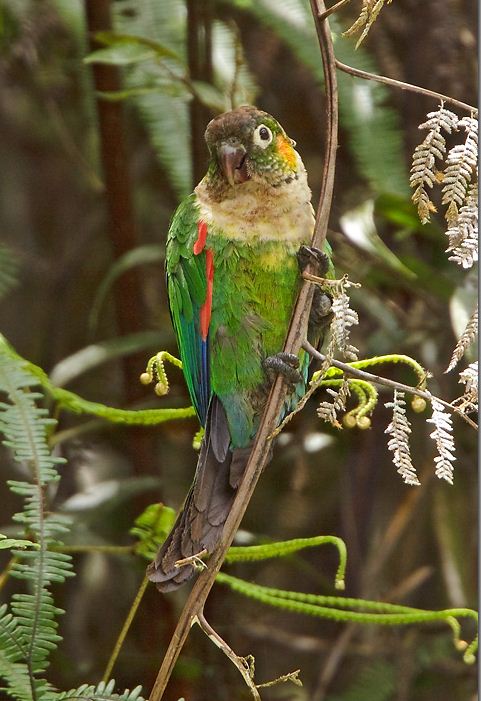
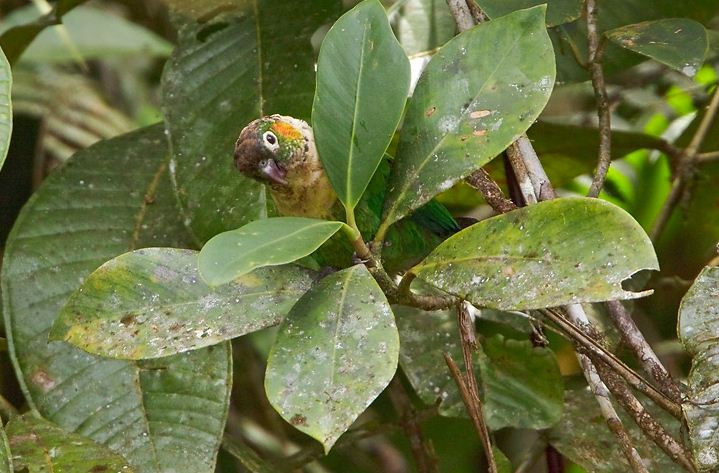
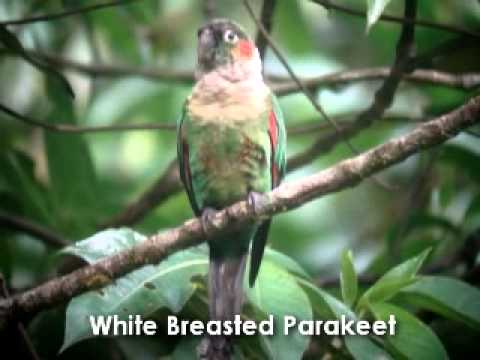
The most notorious of the White-necked Parakeet (Pyrrhura albipectus) It is the yellowish-white or white that goes from the cheeks to chest.

Crown dark stripes pale gray on the back; frontal band reddish thin; cheeks escalations of yellow and green and ear-coverts Orange; collar full white and chest yellow; belly and remaining upperparts green. Wings Greens with primary coverts red and carpal area, and primaries Bluish; tail long and pointy green, red opaque at the bottom.

The immature lacks the frontal band and has paler the ear-coverts.

Habitat:

Lives mainly in humid primary forest, foraging on fruit trees, preferably along rivers, Although he tolerates areas open and intercepted, from 900 to 2000 m (usually between 1400 and 1800 m).
Make altitudinal movements following the fruiting. Flies in flocks of 12 to 50 individuals. It bathes in pools or between rocks covered with MOSS.

Reproduction:

There is little evidence about its reproduction, possibly from May to July. A young clerk was seen in September (Snyder et to the., 2000).

Food:

The diet includes fruit, seeds and flowers Vine, mainly taken in the canopy.

Distribution:

Size of its range (reproduction / resident): 19.600 km2

Confined to three areas in southeast Ecuador and recently also it has been found in northern Peru.

In Ecuador It is known from the Podocarpus national park, the Cordillera de Cutucรบ and Cordillera del Condor. Although their numbers seem relatively low, possibly with a total population of only a few thousand individuals, is apparently common in the Podocarpus national park. There are also confirmed records as far south as the Pangui in Zamora-Chinchipe. Also recently it observed in adjacent parts of the Cordillera del Condor, Peru, with a sighting released from Condor Mirador on Morona-Santiago Province (Navarrete 2003). These range extensions suggest that it is not as severely threatened as previously feared. (Balchin y Toyne 1998).

Conservation:

State of conservation โ“˜


Vulnerable Vulnerable โ“˜ (UICN)โ“˜

โ€ข Current category of the Red List of the UICN: Vulnerable.

โ€ข Population trend: Decreasing.

Rationale for the Red List category

This species is classified as Vulnerable because it dwells in a few places and has a small range in which the habitat (and presumably the population) it is decreasing.

Justification of the population

The total population it may be only a few thousand birds, by what is placed in the band 2.500-9.999 individuals. This is equivalent to 1.667-6.666 mature individuals, rounded here to 1.500-7.000 mature individuals.

Justification of trend

It is suspected that the species is falling slowly, on the basis of continuous habitat destruction.

Conservation Actions Underway

โ€ข CITES Appendix II.
โ€ข The Podocarpus national park It is an important site for the conservation of the species. A revised management plan has been designed for the area and a public awareness campaign highlights the importance of the park (Snyder et to the. 2000).
โ€ข The White-necked Parakeet It is also found in the reserve Tapichalaca of 3.500 acres of the Fundaciรณn Jocotoco, where they are used successfully artificial nesting boxes (Waugh 2009).
โ€ข It is also located in the Ichigkat Muja- Condor Range National Park (F. Angulo 2012 a bit.).

Conservation Actions Proposed

โ€ข Conduct surveys to assess species distribution and total population size.
โ€ข Monitor rates of habitat loss and degradation within its range.
โ€ข Manage the Podocarpus national park so that endangered species are better protected.

"White-necked Parakeet" in captivity:

It is not easy to find it in captivity.

Alternative names:

– White-necked Parakeet, White necked Parakeet, White-breasted Conure, White-breasted Parakeet, White-necked Conure (English).
– Conure ร  col blanc, Perriche ร  col blanc, Perruche ร  col blanc (French).
– WeiรŸhalssittich, Weisshals-Sittich (German).
– Tiriba-do-pescoรงo-branco (Portuguese).
– Cotorra Cuelliblanca, Perico de Pecho Blanco (espaรฑol).
– Perico de Cuello Blanco (Peru).


scientific classification:

Frank Chapman
Frank Chapman

– Order: Psittaciformes
– Family: Psittacidae
– Genus: Pyrrhura
– Scientific name: Pyrrhura albipectus
– Citation: Chapman, 1914
– Protonimo: Pyrrhura albipectus


Images White-necked Parakeet:

Videos "White-necked Parakeet"

White Breasted Parakeet

White-necked Parakeet (Pyrrhura albipectus)


Especies del gรฉnero Pyrrhura

Sources:

– Avibase
– Parrots of the World โ€“ Forshaw Joseph M
– Parrots A Guide to the Parrots of the World – Tony Juniper & Mike Parr
– Birdlife
– Parrot Book, Parrots and macaws Neotropical

– Photos:

(1) – Ingrid Grunwald, IBC943789. Photo of White-necked Parakeet Pyrrhura albipectus at Zamora-Chinchipe Province, Ecuador. Accessible at hbw.com/ibc/943789.

– Sounds: (Xeno-canto)
โ–ท The world of Pets: Dogs, cats, birds, reptiles, amphibians

Glossy black cockatoo
Calyptorhynchus lathami


Glossy black cockatoo

Content

Description

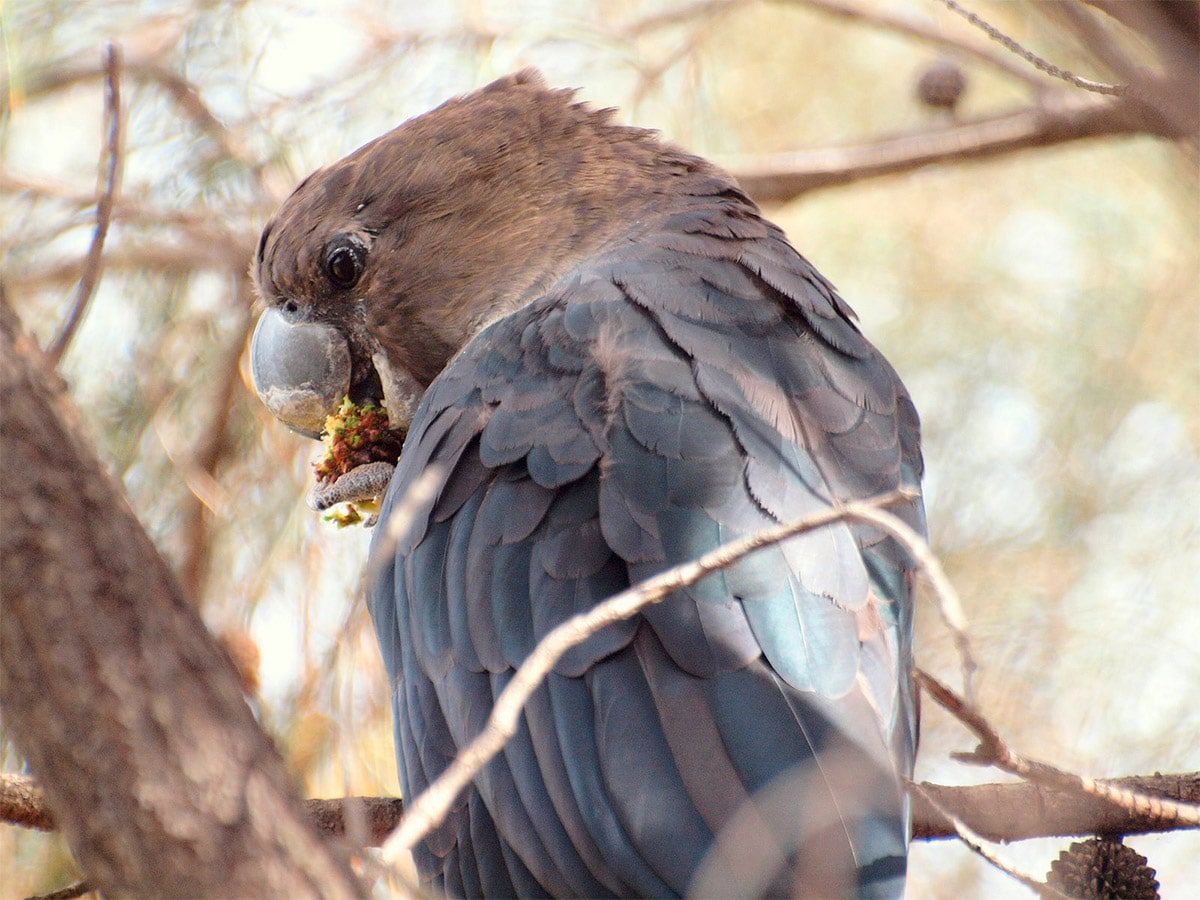
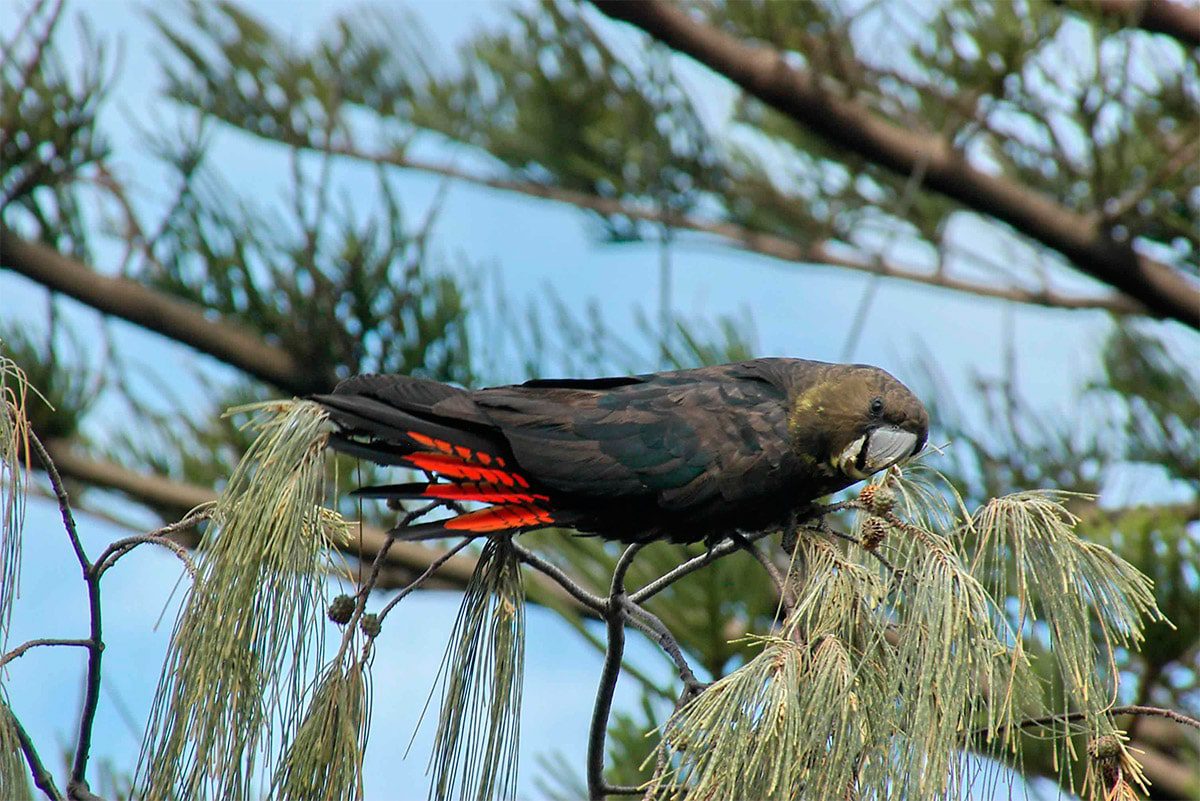
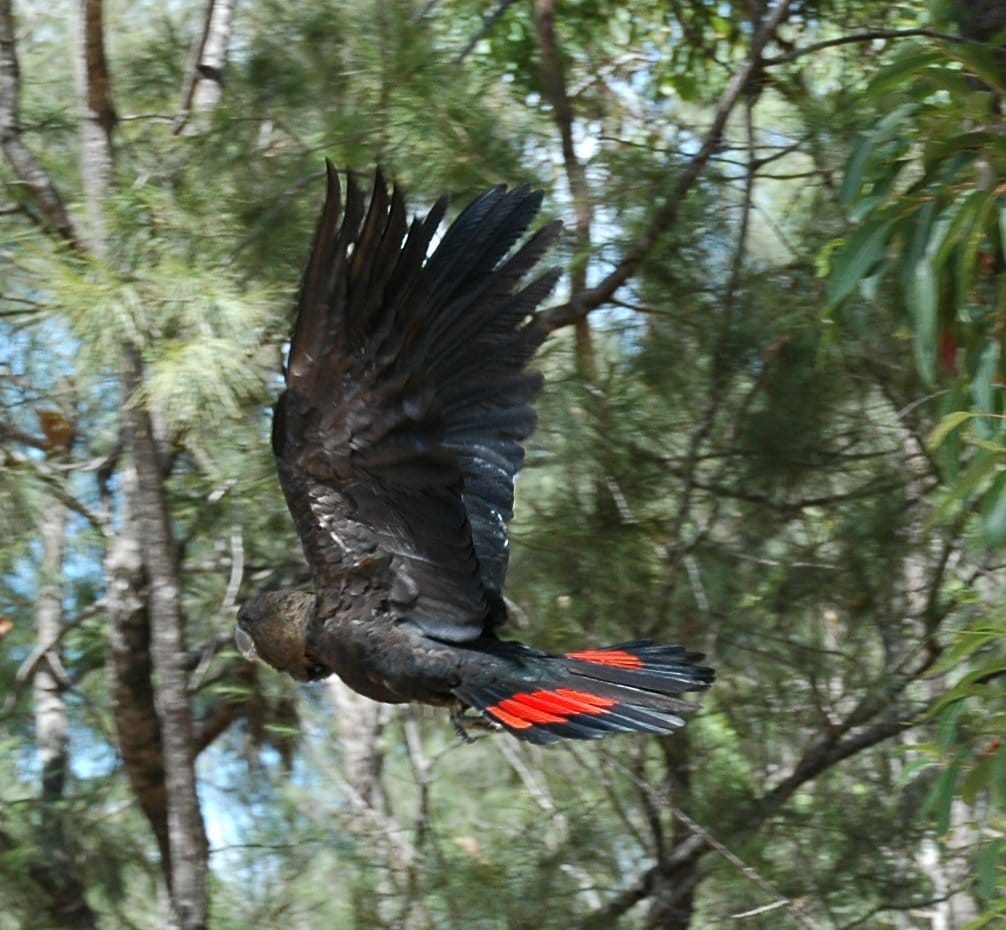
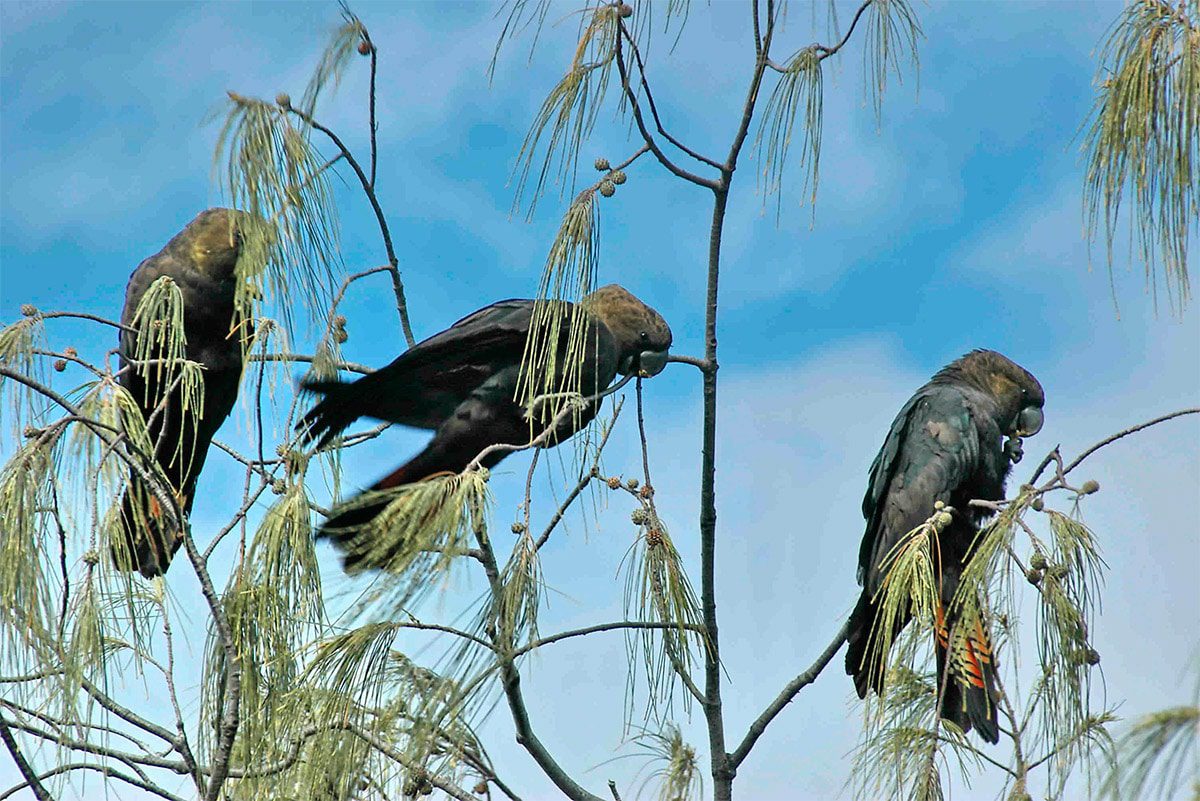
46 to 51 cm.. height and between 400 and 500 g. of weight.
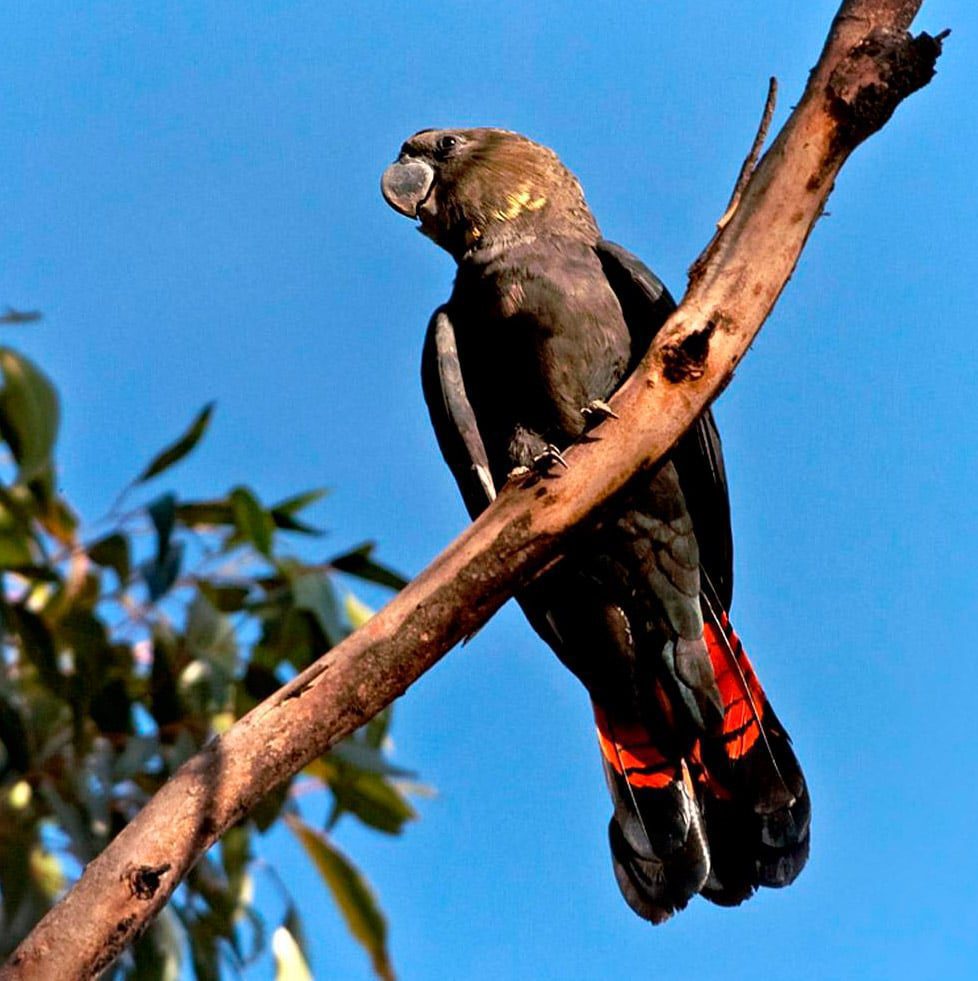
The Glossy black cockatoo (Calyptorhynchus lathami) is the smallest of the 5 black cockatoos and is restricted to the East coast of Australia (a population isolated also is reproduced in the Islands Kangaroo).
The male is brown-black color with a small crest rounded and bright Scarlet spots in the tail. The female shows spots irregular in color yellow in it head, The Scarlet patches in the tail they are permeated by narrow black bars and edges of pale yellow on the underparts of the wings.
The immature they are similar to the females, but they lack the yellow markings on the head and show different yellowish tones in the feathers, the chest and in the belly.

Subspecies description

  • Calyptorhynchus lathami lathami

    (Temminck, 1807) – The nominal.


  • Calyptorhynchus lathami halmaturinus

    (Mathews, 1912) – Medium-size ones 48 cm. length and 510 to 515 weight g, with a wing of approximately 90 cm.. The of adults they are mainly black, dark brown in the head, the neck and the bottom of the body, and Red panels (in males) or orange-red with bars Black (in females) on tail. The female adult is also conspicuous in the head. These patches are absent from most males., Although they can be expressed faintly in a few individuals (Higgins 1999).

    The immature are similar in appearance to the male adult, but have small stains yellow in it head; spots or bars yellow in the chest, belly and flanks; yellow or orange spots on the wing (mainly on the bottom); Red or orange-yellow panels with black bars at the tail; One bill pale grey (instead of dark); And a ring of skin around the eye pale grey (instead of grey dark) (Higgins 1999, L. Pedler 2007, com. Pers.).


  • Calyptorhynchus lathami erebus

    (Schodde & Mason,IJ, 1993) – The only difference with the nominal species resides in that has the bill shorter.

Habitat:

Video – "Glossy black cockatoo" (Calyptorhynchus lathami)

Glossy-black Cockatoo (Calyptorhynchus lathami ) HD Video clip 1/3

Areas forested frequently dominated by casuarinas of which are highly dependent for its food. These are small shrubs commonly known as the Sheoaks, wood for beef (Beefwood) or Australian pine. These shrubs are widespread in tropical and subtropical regions.

They are also distributed in open humid forests, difficult terrain where deforestation has not been too great. They have an imperative for natural tree cavities to nest.

Reproduction:

Forman couple during all the life. The couple has relationships throughout the year. This type of family of them parrots prefers to nest in cavities natural of the eucalyptus, whether dead or in full vitality. The nest usually placed at an altitude that ranges between the 3 and 30 meters above the ground. The cavity is filled with leaves and branches. Sometimes, together with other breeding pairs, they share the same tree year after year.

In New South Wales the season extends from March to August. The spawning It consists of a single egg white. It is the female that takes charge of most of the tasks.: It prepares the nest and incubates herself. Never leave the nest until the small is reached the age of one week. In most cases, the male provides the female with food and assistance until the young can fend for itself, normally four months which remains with them until the next breeding season.

Food:

It feeds almost exclusively on the seeds several species of She-oak (Casuarina and Allocasuarina). You can also sometimes eat larvae of wood-boring. They feed in threes, less frequently in pairs, small groups or flocks of up to 60 birds. They can be detected by the snapping of their beaks and the remains of the casuarina cones and twigs that fall.

Distribution:

Size distribution (reproduction / resident): 770.000 km2

The species is Rare Although widespread in suitable forests of the central coast and forest habitats of Queensland and in the interior of the southern plateaus and Plains of the Midwest's New South Wales, with a small population in the Riverina. There is an isolated population in the Kangaroo Island, South of Australia.

Subspecies distribution

  • Calyptorhynchus lathami lathami

    (Temminck, 1807) – The nominal.


  • Calyptorhynchus lathami halmaturinus

    (Mathews, 1912) – Kangaroo Island (South of Australia)


  • Calyptorhynchus lathami erebus

    (Schodde & Mason,IJ, 1993) – It is from Australia (the central eastern coastal area of Queensland)

Conservation:

State of conservation โ“˜


minor concern Minor Concern โ“˜ (UICN)โ“˜

โ€ข Current category of the Red List of the UICN: Least concern.

โ€ข Population trend: Decreasing.

Like most parrot species, the Glossy black cockatoo is protected by the Convention on international trade in endangered species of Fauna and Flora Silvestres ( CITES ), with its inclusion in the list of the Appendix II of vulnerable species, What makes the import, the export and trade of animals captured in the wild is illegal.

Justification of the population

Garnett and Crowley (2000) estimated the size of the population in the following way: 12.000 individuals of the subspecies lathami, 70 breeding pairs of the subspecies halmaturinus (equivalent to 140 individuals) and 5.000 individuals of the subspecies erebus giving a total of 17.140 individuals.

Justification of trend

They suspected that the population is declining in general Since the largest subpopulation, lathami, It is slowly decreasing throughout its range. However it is believed that the subspecies Erebus is increasing and the subspecies halmaturinus It is increasing as a result of conservation efforts in the Island Ganguro (Garnett and Crowley 2000).

"Glossy black cockatoo" in captivity:

Like the other black cockatoos, the Glossy black cockatoo (Calyptorhynchus lathami) is extremely rare in the poultry. In Australia It has attained breed in captivity.

Alternative names:

– Glossy Black-Cockatoo, Casuarina Cockatoo, Casuarine Cockatoo, Latham’s Cockatoo, Leach’s Black-Cockatoo, Leach’s Red-tailed Cockatoo, Nutcracker (English).
– Cacatoรจs de Latham, Cacatoรจs noir รฉtincelant (French).
– Braunkopfkakadu (German).
– Cacatua-preto-brilhante (Portuguese).

scientific classification:

– Order: Psittaciformes
– Family: Cacatuidae
– Scientific name: Calyptorhynchus lathami
– Genus: Calyptorhynchus
– Citation: (Temminck, 1807)
– Protonimo: Psittacus Lathami

Images Calyptorhynchus lathami:


Species of the genus Calyptorhynchus
  • Calyptorhynchus banksii
  • —- Calyptorhynchus banksii banksii
  • —- Calyptorhynchus banksii graptogyne
  • —- Calyptorhynchus banksii macrorhynchus
  • —- Calyptorhynchus banksii naso
  • —- Calyptorhynchus banksii samueli
  • Calyptorhynchus lathami
  • —- Calyptorhynchus lathami erebus
  • —- Calyptorhynchus lathami halmaturinus
  • —- Calyptorhynchus lathami lathami

  • Sources:
    – Avibase
    – Parrots of the World โ€“ Forshaw Joseph M
    – Parrots A Guide to the Parrots of the World – Tony Juniper & Mike Parr
    – Birdlife

    – Photos: commons.wikimedia.org, The Glossy Black Conservancy,

    – Sounds: Nigel Jackett (Xeno-canto)

    โ–ท The world of Pets: Dogs, cats, birds, reptiles, amphibians

    Bismarck hanging parrot
    Loriculus tener


    Bismarck hanging parrot

    Content

    Description

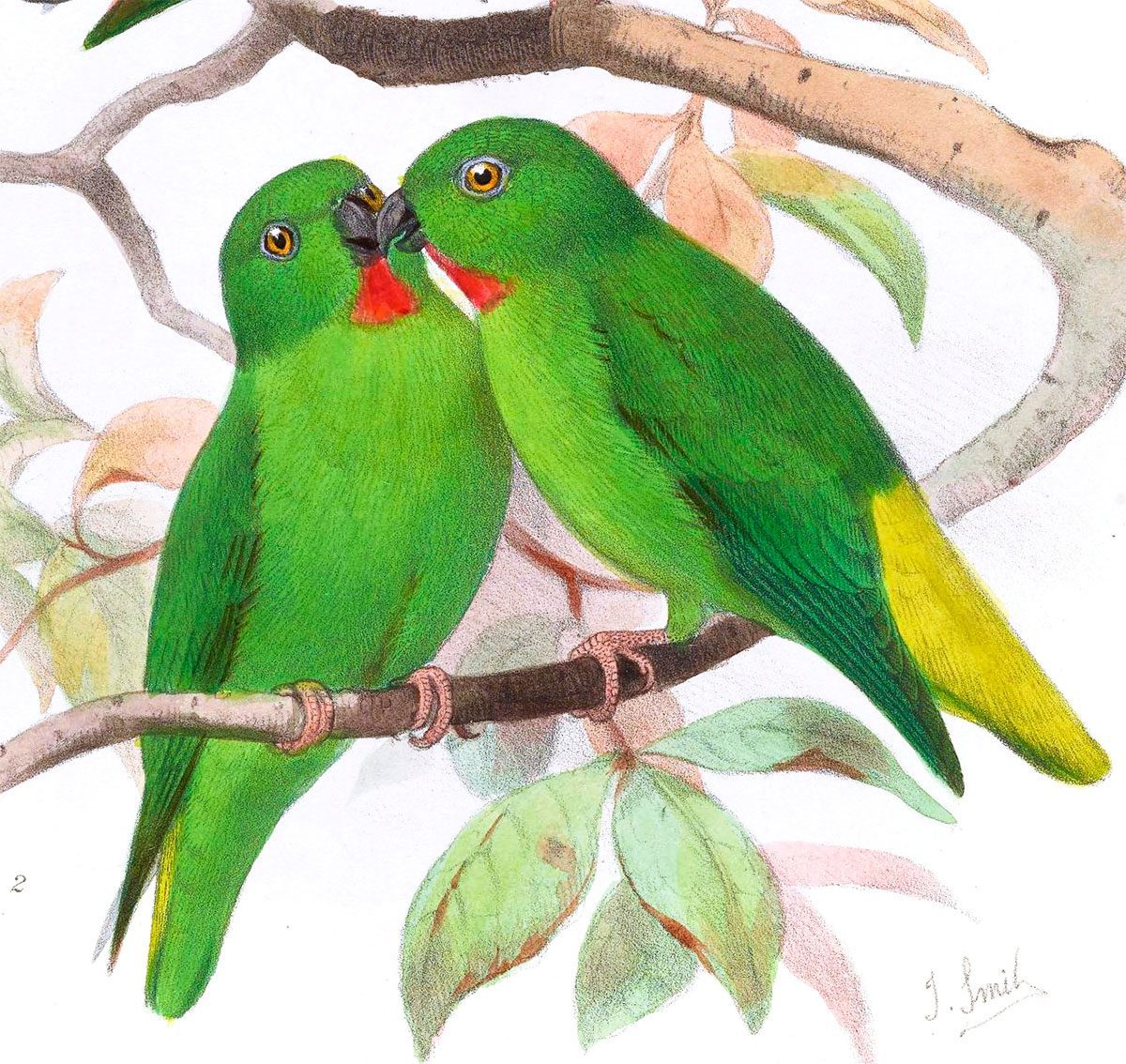
    Measured around 10 cm.. length and approximately 12 g. of weight.

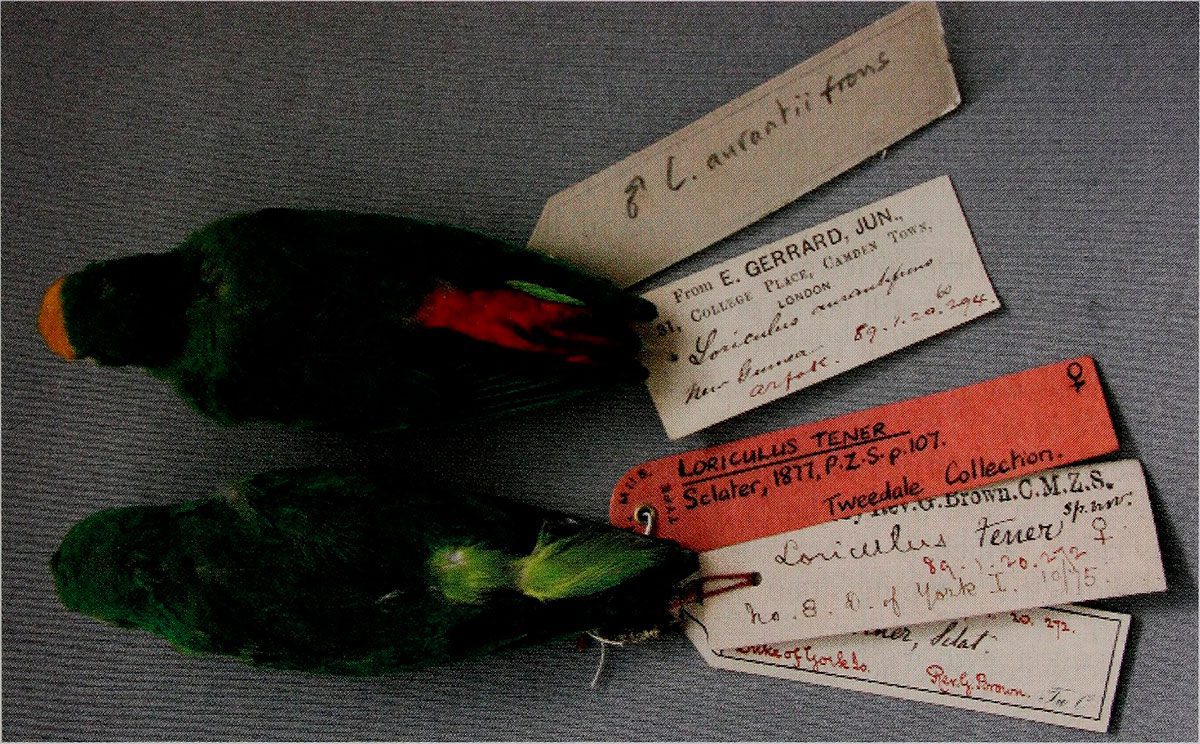
    The head of the Bismarck hanging parrot (Loriculus tener)(Loriculus tener) is green. Upperparts Green except for the rump and upper coverts of the tail that are yellowish-green. The wings they are green with vane internal darker towards the flight feather.

    Under, the wings blue with Feather coverts green. Chin red orange; rest of the underparts green. Upper, the tail green, pale blue view from below.

    The bill black; irises yellowish white; legs yellowish brown.

    The female have the front part of the crown and face blue.

    The young birds they lack the orange patch of the throat and your bill is pale-brown.

    Habitat:

    A species very little known. Has been recorded along of the edge of forests and partially cleared from the lowlands up to the low hills areas.

    Reproduction:

    There is practically no information. Only a nest found, in the stump of one areca palm.

    Food:

    There is practically no information, but it is suspected that they feed on flowers and small fruit, usually, alone or in pairs, and often hung upside down.

    Distribution:

    Size of the area of distribution (reproduction / resident): 26.300 km2

    Endemic to the Islands in the Bismarck Archipelago, registered in New Britain, New Ireland, Duke of York and New Hanover.

    Conservation:


    Near-threatened


    โ€ข Current IUCN Red List category: Near threatened

    โ€ข Population trend: Decreasing

    This little known species is classified as Near-threatened, Since it is believed that it has a moderately low population that is limited to the lower forests. These areas are developing rapidly in oil palm plantations and therefore the population is undoubtedly decreasing.

    In New England, clearing of lowland forests for conversion to oil palm plantations has been intense in recent decades.

    The population size is between the 10.000 and 19.999 mature individuals.

    "Bismarck hanging parrot" in captivity:

    Usually they are not in captivity.

    Alternative names:

    – Green-fronted Hanging Parrot, Bismarck Hanging Parrot, Bismarck Hanging-parrot, Green fronted Hanging Parrot, Green-fronted Hanging-Parrot (ingles).
    – Coryllis des Bismarck, Coryllis ร  front vert, Coryllis des Bismark (French).
    – Bismarckpapageichen, Goldstirnpapageichen, Zartpapageichen (German).
    – Lorรญculo de las Bismarck (espaรฑol).

    scientific classification:

    – Order: Psittaciformes
    – Family: Psittaculidae
    – Genus: Loriculus
    – Scientific name: Loriculus tener
    – Citation: Sclater,PL, 1877
    – Protonimo: Loriculus tener

    Images ยซBismarck's Parrotยป:

    Loriculus tener. Image from page 18 of "Bulletin of the British Ornithologists' Club" (2007) - (N. J. Collar ยฉ Natural History Museum)
    Loriculus tener. Image from page 18 of ยซBulletin of the British Ornithologists’ Clubยป (2007) – (N. J. Collar ยฉ Natural History Museum)

    ————————————————————————————————

    "Bismarck's Parrot" (Loriculus tener)


    Sources:

    – Avibase
    – Parrots of the World โ€“ Forshaw Joseph M
    – Parrots A Guide to the Parrots of the World – Tony Juniper & Mike Parr
    – Birdlife

    – Photos:

    (1) – ยซLoriculus tener Smitยป by Joseph Smit – Ornithological Miscellany. Volume 2. Licensed under Public Domain via Wikimedia Commons – http://Commons.wikimedia.org/wiki/file:Loriculus_tener_smit.jpg#mediaviewer/file:Loriculus_tener_smit.jpg

    โ–ท The world of Pets: Dogs, cats, birds, reptiles, amphibians

    Maroon-fronted Parrot
    Rhynchopsitta terrisi


    Cotorra Serrana Oriental

    Content

    Description:


    Anatomy-parrots

    Among 40 and 45 cm.. length and 300 g. of weight.

    The Maroon-fronted Parrot (Rhynchopsitta terrisi) It has a size slightly larger than the Thick-billed Parrot. Its bill is large, hooked and curved black. Of tail short in comparison to other members of the family, by high green and below Brown gray. Upright perching, legs short but strong and the fingers toes zigodactilos, i.e. two toes forward and two backwards. Is bright green, slightly more clear and yellowish on the cheekbones and ears. It has a patch brown in the forecrown, red spots on the shoulders and in the the thighs.

    The color of the irises in adults is yellow amber, While in juveniles is coffee. The eye ring is yellow. below the wings they have red border. The rest of the inside of the wings darker Green is. The legs they are greyish.

    Both sexes of similar shape and color.
    Immature with eyes browns and bill paler.

    Often treated as the same species as the Thick-billed Parrot.

    Habitat:

    It lives in temperate with dry winter climates, to high altitudes ranging from the 1,900 to the 3,000 m, exceptionally a 1.300 meters and 3.700 m, in mountainous regions with pine forest (Pinus duranguensis, Pinus ayacahuite, and Pinus arizonica among others), forest of Pine-oak (Pinus spp.. and Quercus spp..), isolated forest fragments of pure FIR (Abies spp..), or mixed forests of oyamel, firs (Pseudotsuga spp..) and poplars (Populus tremuloides). Forests may be at the top of the mountains, open areas or be part of abrupt cliffs and crags land.

    The Maroon-fronted Parrot is a Diurnal with activity social. To the nestsr meets in large flocks, at times of until 100 individuals and to build their nest, Unlike in the Thick-billed Parrot, don't use holes in trees but cavities and cracks in the rock of the cliffs. With pairs once a year with a single partner throughout the reproductive season. Form flocks to find their food. These groups tend to fly at low altitude moving long distances in search of trees with fruits and seeds that can be eaten. It is also possible to find lonely couples looking for food. They sleep in community, flocking on inaccessible crags. Individuals within the flock to communicate by means of strong vocals similar to harsh squawks and squeaks, While they are looking for food or to warn of threats. In general, the species of this family are known to be noisy, especially when they are in groups.

    You know when these birds are approximated by the noises that make, the group flies in a flock that forms an โ€œopen Vโ€. The reproductive colony You can move up to 30 km to find food, If it is scarce. With enough food available near the nests, just move in 3 to 5 daily km.

    Reproduction:

    The breeding season It between July and November. To build the nest using cracks and voids in high limestone crags and they tend to use the same sites year after year to nest. The colony nests above the 1,300 and 1,700 m.

    They put between 2 and 5 eggs (average is 2.7) between mid-June and late July. When is food scarce, drastically reduces the production of broilers. The female incubates eggs between 24 and 27 days which hatch between early September and late October. Since they are born until they fly chicks they remain in the nest for approximately two months, being fed and cared for by both parents. Of all the eggs laid and incubated in the colony only the 60% fledged young occur. The chicks are bred in sync with the maturation of pine seeds, It usually occurs in late summer and autumn.

    Food:

    They eat mainly seeds of coniferous cones, especially of pines (Pinus durangensis, Pinus leiophylla, Pinus ayacahuite, Pinus arizonica, Pinus gregii, Pinus teocote, Pinus montezumae, Pinus cembroides and Pinus engelmannii) and bur-marigold (Pseudotsuga menziesi).

    Its beak is specially adapted to extract seeds from the cones (pine nuts) of Pine. When are pine seeds scarce, include in your diet oak acorns (Quercus spp..) and Guatemalan FIR seeds (Abies spp..). Their diet also includes capulin fruits (Prunus capuli) and flowers of Agave Nectar. In general the diet of both species, the Eastern Mountain Parrot and the Thick-billed Parrot es similar. The Maroon-fronted Parrot has the habit of eating dirt (geophagy) in clay banks.

    Distribution:

    The distribution of the Maroon-fronted Parrot is restricted in the northeast of Mexico. confined in Sierra Madre Oriental, in the southeast of Coahuila de Zaragoza, about Saltillo, in the Centre-West of Nuevo Leรณn, including mountains to the South-West of Monterrey, and the mountains of the West of Tamaulipas.

    Full range of approximately 300 km from North to South, with an average of 60 kilometers from West to East and breeding pairs, possibly, only in the North third.

    Similar to the Thick-billed Parrot, ago seasonal movements (Although probably less extensive) in response to the availability of pine seeds, apparently being distributed to the South of their range only between October and April (old reports of the Thick-billed Parrot in Veracruz they may belong to this species).

    Rare, very local and extinct in many areas. Now limited to restricted areas in the few pine forests that remain (probably around 7.000 kmยฒ of forests within the 18.000 kmยฒ of its range, they are suitable).

    The decrease in its population is mainly due to the loss of habitat by logging, the Agriculture, the burning and the grazing, Although their habits of nesting on cliffs, It avoids the need of old or dead trees. Selective logging can reduce the diversity of pine trees and therefore the availability of food.

    Conservation:

    In 1981 they were estimated between 2,000 and 3,000 individuals of this species.

    State of conservation โ“˜


    Endangered Endangered โ“˜ (UICN)โ“˜

    โ€ข Red List category of the UICN current: In danger of extinction

    โ€ข Population trend: Decreasing

    In 1997 ranked in the The Taray sanctuary, in Coahuila de Zaragoza as the reproductive Center of the species for having been found there near 100 reproductive couples. A 16 km from there, in a place known as Condos the second largest colony was located with 60 couples.

    Census continued and in 1999, the population was estimated at a minimum of 2,500 individuals.

    One recent census based on the large flocks threw an account of approximately 3,500 individuals of Eastern Mountain Parrot.

    The main threat facing the Maroon-fronted Parrot is the destruction and modification of their habitat, mainly due to actions such as agriculture, livestock, logging (to produce wood and paper) and forest fires.

    Its current Habitat is very limited, as well as the area of โ€‹โ€‹its distribution as an endemic species that is.

    The deforestation continues to diminish more and more forests mountain of the region, and unfortunately the recovery or regeneration of these forests is poor compared to pine forests in other parts of the country, which is probably due to the layer of soil of the region is thin and Rocky and scarce rain.

    In 2006, a forest fire devastated about 2,000 It has pine forest in the Sierra, destroying trees that provided food to the Parrot and causing a decrease in the number of chickens raised in the era of nidation. Additionally, when the average size of the trees that make up a forest is reduced and also the area occupied by seed production decreases and the number of defective cones increases, Finally affecting to the Maroon-fronted Parrot that feeds on the seeds.

    Exist protected natural areas on Sierra Madre Oriental that protect and preserve to the Maroon-fronted Parrot.

    Since 1939 was decreed the Cumbres de Monterrey National Park, in Nuevo Leรณn to protect more than 150 thousand hectares of forest, including half of the areas where the species nests. Shortly before it had been decreed, in 1936, The El Potosi National Park, in San Luis Potosi.

    In 1985 created the The El Cielo biosphere reserve, in Tamaulipas. And between the three Protected natural areas partially cover the rest of the known colonies and part of the winter range. Also they have formed private protected natural areas, as the The Taray sanctuary in Coahuila de Zaragoza, nail 350 has of forest, created in 1996 specifically to protect the Maroon-fronted Parrot that contains the nidation largest colony known. This area is managed by the Museum of the birds of Mexico in Saltillo, Coahuila de Zaragoza and has been funded by the National Commission for the knowledge and use of biodiversity (CONABIO) and donations from other national and foreign organizations such as the Zoological Society of San Diego and the Fish and Wildlife Service of United Statess.

    Various research projects they have been conducted from 1995 for the knowledge and conservation of the Maroon-fronted Parrot.

    Recently in 2008, the Universidad Autรณnoma de Nuevo Leรณn (UANL), carried out a project on the Cumbres de Monterrey National Park. For its part, the Instituto Tecnolรณgico de Monterrey (ITESM) and Pronatura After studies in the same area, they have begun to establish landscape-level conservation strategies.

    In the Official standard of species at risk (NAME-059-ECOL-2001), The Maroon-fronted Parrot (Rhynchopsitta terrisi) appears as danger of extinction.

    The Convention on international trade in endangered species of Fauna and Flora Silvestres (CITES) protects it inside of the Appendix I.

    The International Union for the conservation of nature (IUCN for its acronym in English) in his Red list of threatened species, granted the threatened category to the Maroon-fronted Parrot from 1988. Category changed to vulnerable from 1994 up until the present day.

    In the year 2000 the National Consultative Technical Subcommittee for the protection, Conservation and recovery of the Psitacidae, developed the Conservation project, Management and sustainable utilization of the Psitacidae in Mexico (PREP), in which we considered both mountain parrots as priorities for conservation.

    The species of Thick-billed Parrot (R. pachyrhyncha) and Maroon-fronted Parrot (R. terrisi), they are considered from 2008 as priority species in the Species at risk conservation program (NATIONAL HERO) of the National Commission of Protected Natural Areas (CONANP). Due to their biological similarities and a common problem, both were included in a single PACE (Programmes of action for the conservation of species), after the Subcommittee on Psitacidae carried out the Workshop of species identification of priority Psitacidae to be included in a PACE, document that contains, among other aspects related to the biology of the species, the objectives, goals and strategies for the conservation of both Mountain parrots.

    Conservation actions have also been made in the field of the environmental education.

    at the end of 2008, in the framework of the Program for the conservation of species at risk (NATIONAL HERO), seven locations of the Cumbres de Monterrey National Park they conducted environmental education activities with the Maroon-fronted Parrot as a priority species.

    Perhaps the most important conservation measure, the publication is the 14 in October of 2008, in the Official Journal of the Federation, the decree that reforms to the General wildlife law (Decree Art. 60 Bis 2) What prohibits the capture of parrots and macaws from Mexico. The law prohibits the extractive use subsistence or commercial, export, the import or re-export of these native species of the country. With this law is protected 22 bird species of the family Psittacidae in Mexico. The violation of the above provision, is in a federal crime that is punished with prison, through a penalty ranging from 1 to 9 years in prison and up to 12 years if the offence is committed within a protected natural area or is done for commercial purposes.

    The priority regions for the species are located in the Sierra Madre Oriental: The Cumbres de Monterrey National Park, in Nuevo Leรณn, The El Potosi National Park, in San Luis Potosi, the The El Cielo biosphere reserve, in Tamaulipas and the The Taray sanctuary in Coahuila de Zaragoza.

    Source: Site on the network of knowledge on birds of Mexico

    "Maroon-fronted Parrot" in captivity:

    The mountainous region of Wood, Chihuahua, It has been inhabited since makes 1500 years by the ethnic groups that built the "cliff houses", those who originally were hunters and gatherers. The archaeological remains of Paquimรฉ, to 350 km to the Northwest of the city of Chihuahua and half a kilometer from Large houses they indicate that the region had a dedicated trade to the production of feathers from macaws, shells, ceramic and copper among others, the being first settlers in capture and breed, both the Eastern Mountain Parrot as to the Thick-billed Parrot.

    In the conquest increased interest in capturing individuals from the family of the parrots. Starting at the century XVI, they gained greater popularity among Mexicans, mainly as pets.

    During the 20th century This intense trade, In addition to the illegal traffic, has resulted from 1970 and 1982, Mexico It was the largest exporter of live birds to the pet trade coming from the countries of the Neotropics, exporting on average 14,500 Mexican parrots, annually a United States.

    During the period of 1981 to 1985 United States imported a minimum of 703 thousand parrots; and still in 1987 Mexico was the largest source of smuggling of wild birds. In addition only between 1982 and 1983, 104,530 individuals the family were captured in Mexico for the internal domestic market.

    Sale as pets is illegal.

    Alternative names:

    – Maroon-fronted Parrot, Maroon fronted Parrot (English).
    – Conure ร  front brun, Perriche ร  front brun, Perruche ร  front brun (French).
    – Maronenstirnsittich, Maronenstirn-Sittich (German).
    – Papagaio-de-fronte-castanha (Portuguese).
    – Cotorra Serrana Oriental, Cotorra-serrana Oriental (espaรฑol).

    scientific classification:

    – Order: Psittaciformes
    – Family: Psittacidae
    – Genus: Rhynchopsitta
    – Scientific name: Rhynchopsitta terrisi
    – Citation: Moore, RT, 1947
    – Protonimo: Rhynchopsitta terrisi

    Maroon-fronted Parrot images:

    Video of the "Maroon-fronted Parrot"


    Species of the genus Rhynchopsitta

    Maroon-fronted Parrot (Rhynchopsitta terrisi)


    Sources:

    – Avibase
    – Parrots of the World โ€“ Forshaw Joseph M
    – Parrots A Guide to the Parrots of the World – Tony Juniper & Mike Parr
    – Birdlife
    – CONABIO. 2011. Priority species sheets. Maroon-fronted Parrot (Rhynchopsitta terrisi). National Commission of Protected Natural Areas and National Commission for the Knowledge and Use of Biodiversity, Mexico D.F.

    – Photos:

    (1) – An adult Maroon-fronted Parrot in a cage By TJ Lin (originally posted to Flickr as DSC01484) [CC BY-SA 2.0], via Wikimedia Commons
    (2) – Maroon-fronted Parrot by ยฉ greglasley – inaturalist.org
    (3) – Maroon-fronted Parrot by ยฉ greglasley – inaturalist.org
    (4) – Maroon-fronted Parrot by Zรณcalo Saltillo
    (5) – Maroon-fronted Parrot (Rhynchopsitta terrisi) – Loro Parque

    – Sounds: Jon King (Xeno-canto)