โ–ท The world of Pets: Dogs, cats, birds, reptiles, amphibians

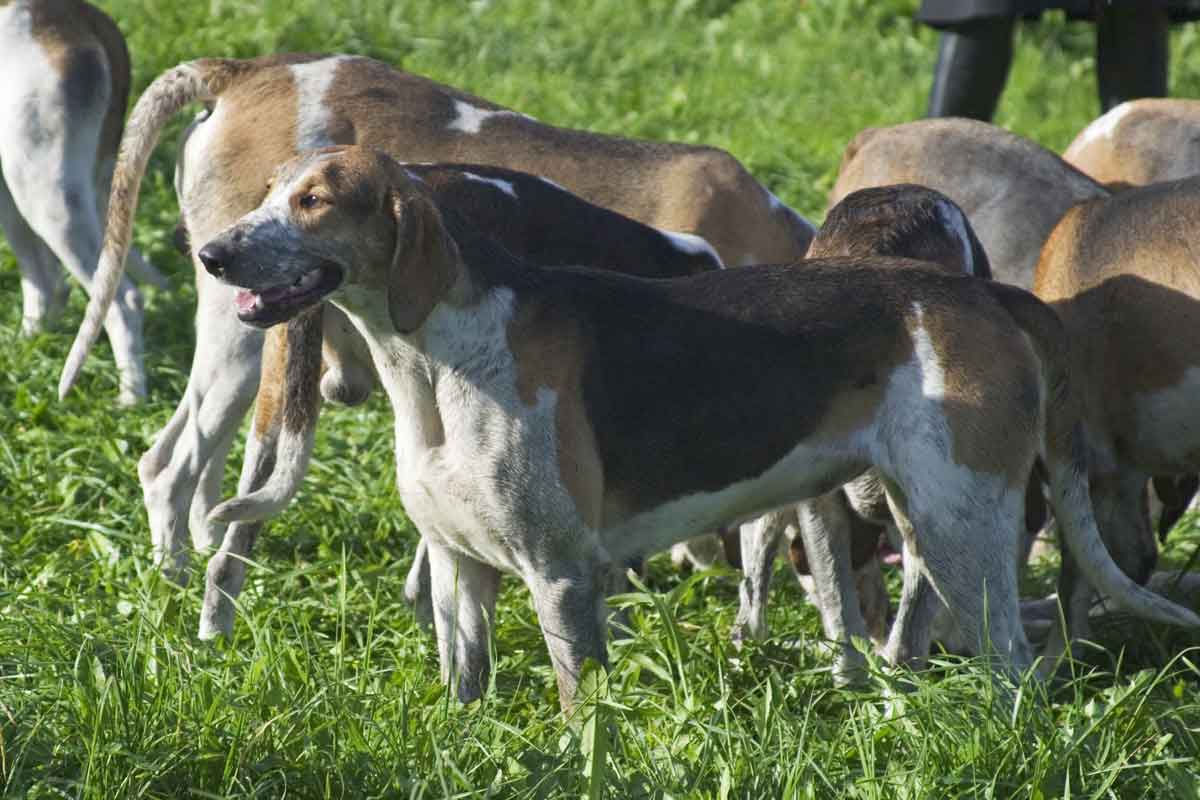
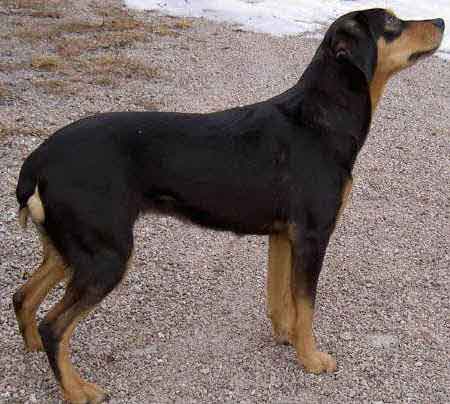
French Pointing Dog - Gascogne type
Francia FCI 133 . Braque Type

French Pointing Dog - Gascogne type

Some even say that the French Pointing Dog - Gascogne type it is a dog that was born trained.

Content

History

The type French Pointing Dog - Gascogne type grew up in the region of Gascuรฑa which bears his name. He is a direct descendant of the oldest known race of pointing dogs already described by Gaston PHEBUS, Count of Foix. This excellent pointing dog has managed to preserve its stamina. In the same way, It has maintained the efficiency of the days when dogs were raised only for the services they provided.

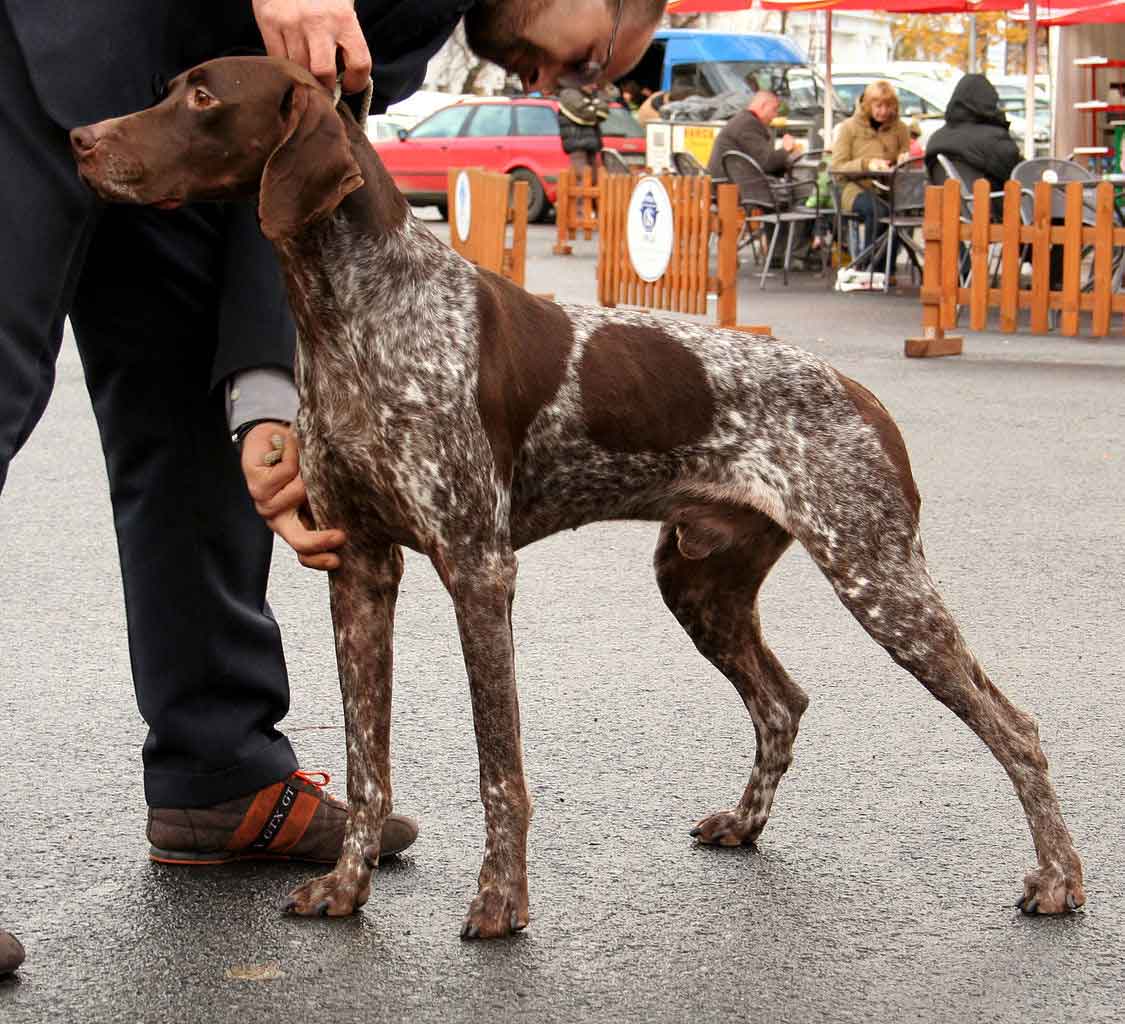
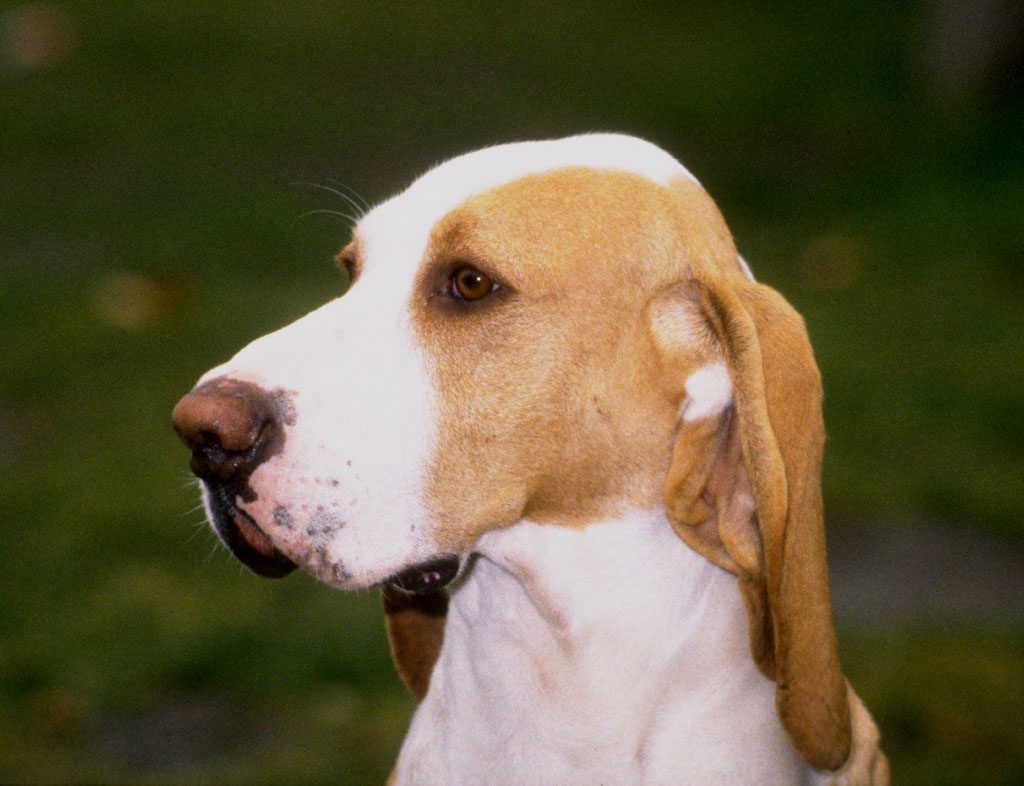
Photo: Pyrenean Pointer at the World Dog Show in Poznaล„ by Pleple2000, CC BY-SA 3.0, via Wikimedia Commons

Physical characteristics

Nose and muzzle
Has a big brown nose. Has a wide muzzle, rectangular, sometimes slightly convex.

Eyes
Has a frank look. Your brown or dark yellow eyes are wide.

Ears
The ears of the brave French Pointing Dog - Gascogne type they go well up to the tip of your nose. Slightly bent, turn round at the tip.

Fur
His hair French Pointing Dog - Gascogne type it is very thick. Their head and ears have finer hair.

Their fur can be brown, Brown and white, mottled or spotted brown and white or brown with tawny markings above the eyes, lips and limbs.

Tail
The French Pointing Dog - Gascogne type has a generally docked tail, follows well the prolongation of the convex line of the croup. A long tail is not considered a defect, as long as it is well managed; neither the short tail of
birth

Character and skills

Smart, obedient and very attached to their master, the kind dogs French Pointing Dog - Gascogne type they are soft and calm. Some even say it is a dog that was born trained.

Your training will be smooth and early, since it is a very sensitive dog, even shy, and you have to get used to city noises very quickly. Let's not forget that he is an athlete and that he needs to "vent" regularly. Soft and calm, adapts very well to the city, as long as you get used to it at a young age. The French Pointing Dog - Gascogne type must live with his caregiver and is very affectionate with children.

Education

The reputation of French Pointing Dog - Gascogne type is well established. Like his cousin, the French Pointing Dog - Pyrenean type , "born trained", say his followers. Intelligent and very attached to his teacher, he will know how to learn all the tricks of a good education.

It is a sensitive dog with which you must use gentleness. This dog must understand the commandments to assimilate them. One of the reasons why coercive methods should be banned. This is also true for all dog breeds.

The French Pointing Dog - Gascogne type can be perfectly adapted to living in the city. But, will have to be introduced to noise and crowds at a very young age.

Characteristics "French Pointing Dog - Gascogne type"

Coexistence is important that you have with your new friend. Before considering the acquisition of a dog of the breed "French Pointing Dog - Gascogne type" you know certain factors. Not all breeds of dogs are apt to live in an apartment, you must take into account his character, their need for exercise, their interaction with other pets, their care and if you have small children, their level of tolerance towards them.

Adaptation โ“˜

3,0 of 5 stars (based on 1 review)

friendly dog โ€‹โ€‹โ“˜

5,0 of 5 stars (based on 1 review)

hair loss โ“˜

2,0 of 5 stars (based on 1 review)

Affection level โ“˜

4,0 of 5 stars (based on 1 review)

Need for exercise โ“˜

5,0 of 5 stars (based on 1 review)

Social need โ“˜

4,0 of 5 stars (based on 1 review)

Home โ“˜

3,0 of 5 stars (based on 1 review)

Toilet โ“˜

1,0 of 5 stars (based on 1 review)

Friendly with strangers โ“˜

4,0 of 5 stars (based on 1 review)

barking โ“˜

3,0 of 5 stars (based on 1 review)

Health โ“˜

5,0 of 5 stars (based on 1 review)

Territorial โ“˜

3,0 of 5 stars (based on 1 review)

Cat friendly โ“˜

3,0 of 5 stars (based on 1 review)

Intelligence โ“˜

5,0 of 5 stars (based on 1 review)

Versatility โ“˜

5,0 of 5 stars (based on 1 review)

Child friendly โ“˜

5,0 of 5 stars (based on 1 review)

Surveillance โ“˜

3,0 of 5 stars (based on 1 review)

joy โ“˜

4,0 of 5 stars (based on 1 review)

Videos "French Pointing Dog - Gascogne type"

French Shorthaired Pointer - Gascony type
Braque Francais-type Gascogne
Gascony French Pointer
Braque Francais-type Gascogne

Type and recognitions:

  • FCI CLASSIFICATION:
  • Group :
  • Section : . .

Federations:

  • FCI – Group 7: Pointing Dogs. – Section 1: Continental Pointing Dogs. 1.1: Braque Type โ“˜

FCI breed standard "French Pointing Dog - Gascogne type"

Origin:
France

Date of publication of the valid original standard:
06.05.1988

Use:

Pointing Dogs.


General appearance:

The French Pointer is a medium-sized pointing dog., brachoid type, noble in appearance, robust but not very heavy; strong, with good members. Females are thinner. The skin is soft and quite loose.

IMPORTANT PROPORTIONS :
The length of the snout is a little less than that of the skull.


Behavior / temperament:

---

Head:

Quite big but not too heavy. The upper longitudinal axes of the skull and snout are slightly divergent.

Cranial region:
  • Skull : Almost flat or very slightly rounded; It has a not very deep median groove. The occipital protuberance is little accentuated.
  • Depression links (Stop) : It's sunken and accentuated.

facial region:

  • Truffle : Thick, brown; the windows are wide open.
  • Snout : Wide and rectangular; sometimes a little convex.
  • Lips : They descend a little until they form folds at the corners..
  • Jaws / Teeth : The denture must be complete. Pincer bite is tolerated.

Eyes : Wide open and well placed in their orbit. Brown or dark yellow in color. frank look.

Ears : Medium length, implanted at the level of the eye line, not too wide at their insertion point, framing the head well, slightly bent and rounded at the bottom edge. One or two vertical wrinkles may appear on the cheek at the level and slightly below the insertion of the ear.. The tips of the ears should reach the tip of the nose..

Neck:

suitably long, slightly arched at the top, has a little double chin.

Body:

  • Back : Wide, straight, sometimes a little long but always well held.
  • Pork loin : Short, muscular and slightly arched.
  • Rump : Slightly inclined in relation to the top line.
  • Breast : Seen from the front it is wide; in profile it is long; reaches up to elbow level; the ribs are arched without exaggeration.
  • Belly : Flattened flanks, slightly retracted belly.

Tail:

Usually cut, follows well the prolongation of the convex line of the croup. A long tail is not considered a defect, as long as it is well managed; nor the short tail from birth.

Tips

PREVIOUS MEMBERS : With good poise, They are wide and muscular.

  • Shoulder : Very muscular and moderately oblique.
  • Arms : Strong and muscular.
  • Elbows : Placed at the level of the sternum.
  • Previous feet : The fingers are closed and well arched, compact, almost round. Strong nails and thick pads.

LATER MEMBERS : Excellent poise.

  • Thighs : Strongly muscular.
  • Legs : Muscular.
  • Warm-tarsal joints : Medium angled.
  • Metatarsus : Pretty short.
  • Hind feet : compacts, almost round.

Movement:

---

Mantle

HAIR : Rather thick and dense; thinner on the head and ears.

COLOR :

โ€ข Brown.
โ€ข Brown and white.
โ€ข Heavily mottled brown and white.
โ€ข Brown and fawn tan (below the eyes, on the snout and limbs).


Size and weight:

  • Male : 58 to 69 cm..
  • Female : 56 to 68 cm..

Ideal size : 61 to 63 cm..


Fouls:

Any deviation from the aforementioned criteria is considered as a fault and the severity of this is considered to the degree of the deviation to the standard and its consequences on the health and well-being of the dog..

โ€ข General appearance very heavy or very light.
โ€ข Very pronounced occipital protuberance.
โ€ข Lips that are very thick or not hanging enough.
โ€ข Very round eyes due to the exaggeration of the zygomatic and supraorbital arches.
โ€ข Flat ears, too short or too coiled.
โ€ข Fat belly.
โ€ข Crushed feet.

MISS PLAYOFFS

โ€ข Aggressive or fearful dog.
โ€ข Marked divergence or convergence of the longitudinal craniofacial axes.
โ€ข Double nose, very depigmented truffle.
โ€ข Upper or lower prognathism.
โ€ข Entropion, ectropion. White spots on the eyelids.
โ€ข Absence of the tail.
โ€ข Syndactyly, polydactyly, adactyls.

Any dog โ€‹โ€‹showing clear signs of physical or behavioral abnormalities should be disqualified..


N.B.:

Males should have two normal-appearing testicles fully descended into the scrotum..

Source: F.C.I - International Cynological Federation

โ–ท The world of Pets: Dogs, cats, birds, reptiles, amphibians

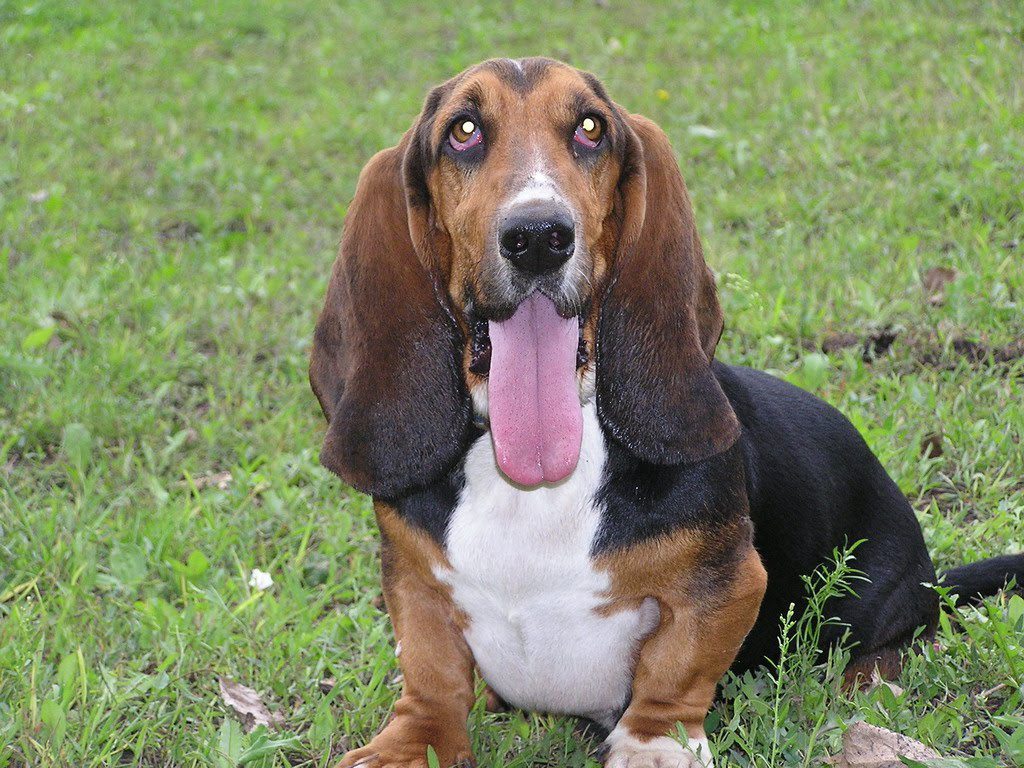
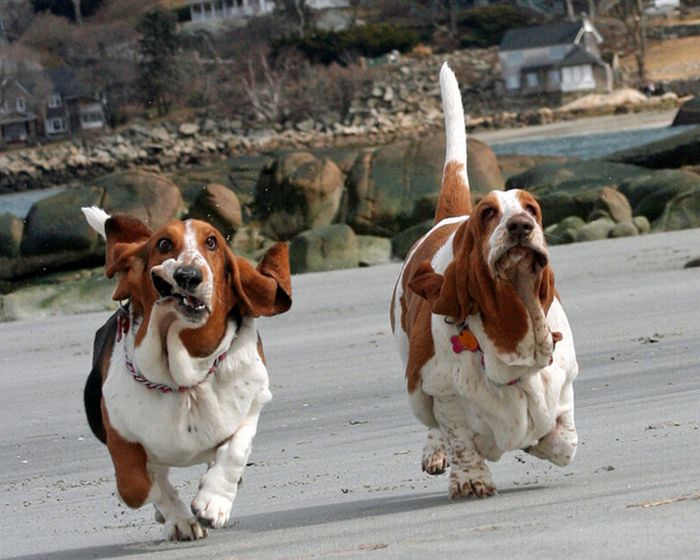
Basset Hound
Reino Unido FCI 163 . Small-sized Hounds

The Basset Hound is a very happy dog, good and very sociable

Basset Hound

Content

Characteristics "Basset Hound"

Coexistence is important that you have with your new friend. Before considering the acquisition of a dog of the breed "Basset Hound" you know certain factors. Not all breeds of dogs are apt to live in an apartment, you must take into account his character, their need for exercise, their interaction with other pets, their care and if you have small children, their level of tolerance towards them.

Adaptation โ“˜

5,0 of 5 stars (based on 1 review)

friendly dog โ€‹โ€‹โ“˜

5,0 of 5 stars (based on 1 review)

hair loss โ“˜

3,0 of 5 stars (based on 1 review)

Affection level โ“˜

5,0 of 5 stars (based on 1 review)

Need for exercise โ“˜

5,0 of 5 stars (based on 1 review)

Social need โ“˜

3,0 of 5 stars (based on 1 review)

Home โ“˜

1,0 of 5 stars (based on 1 review)

Toilet โ“˜

2,0 of 5 stars (based on 1 review)

Friendly with strangers โ“˜

5,0 of 5 stars (based on 1 review)

barking โ“˜

5,0 of 5 stars (based on 1 review)

Health โ“˜

3,0 of 5 stars (based on 1 review)

Territorial โ“˜

1,0 of 5 stars (based on 1 review)

Cat friendly โ“˜

5,0 of 5 stars (based on 1 review)

Intelligence โ“˜

3,0 of 5 stars (based on 1 review)

Versatility โ“˜

3,0 of 5 stars (based on 1 review)

Child friendly โ“˜

5,0 of 5 stars (based on 1 review)

Surveillance โ“˜

3,0 of 5 stars (based on 1 review)

joy โ“˜

1,0 of 5 stars (based on 1 review)

History

The origin of the Basset Hound It, without a doubt, French and one of its closest ancestors is the Artois Hound, that was brought to England in 1.874 along with the Norman artesian Basset, crossing in England into a single breed which in turn was crossed with the St. Hubert Hound (using in 1.892 techniques of artificial insemination), favouring, during the selection, copies of most short legs, in order to obtain a dog capable of getting even between the most thick vegetation.

In 1880 It is considered the first class of Basset Hound in England and it is also being prepared at this time that the first standard and it appears that the dichotomy between Work and Beauty. At the end of the 19th century, the breeding of this breed grows rapidly and the quality of their dogs, as well, and they are divided into two lineages, the work and the exhibition. Y, was in 1935 the name "Basset Hound" was born, registered first, documented. In 1962, Figure the first litter is registered in France.

The United States adopted the breed and created a companion-only dog.

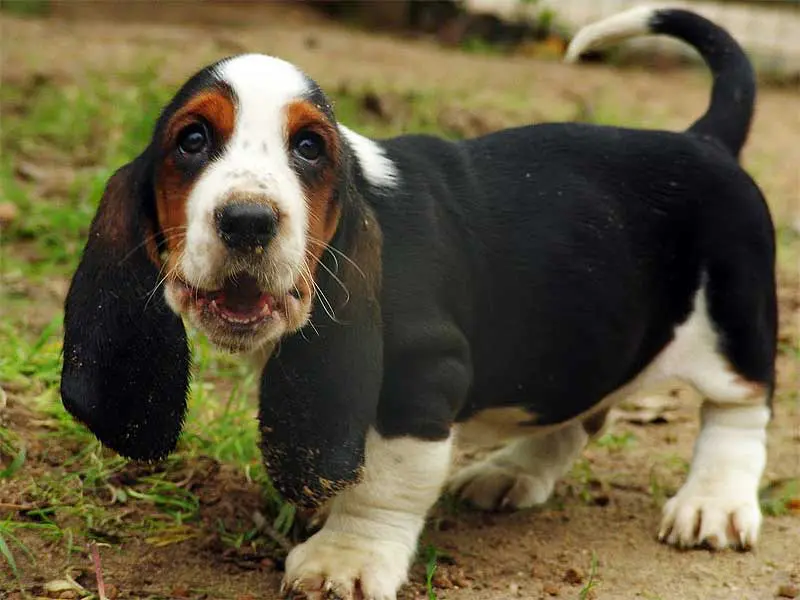
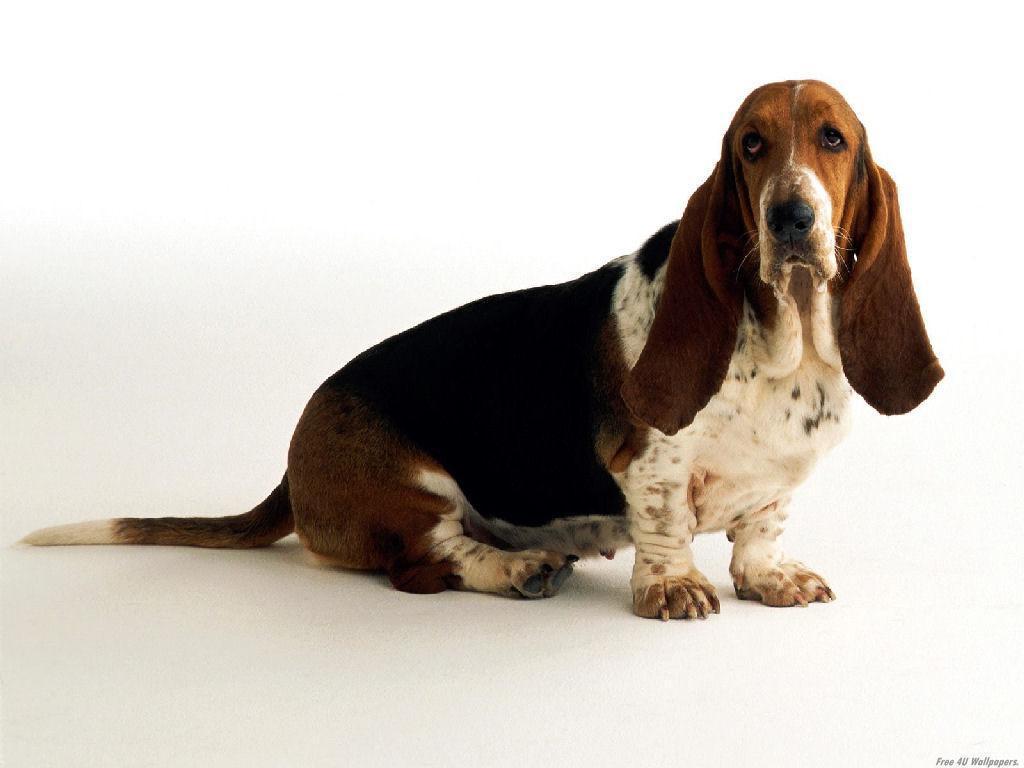
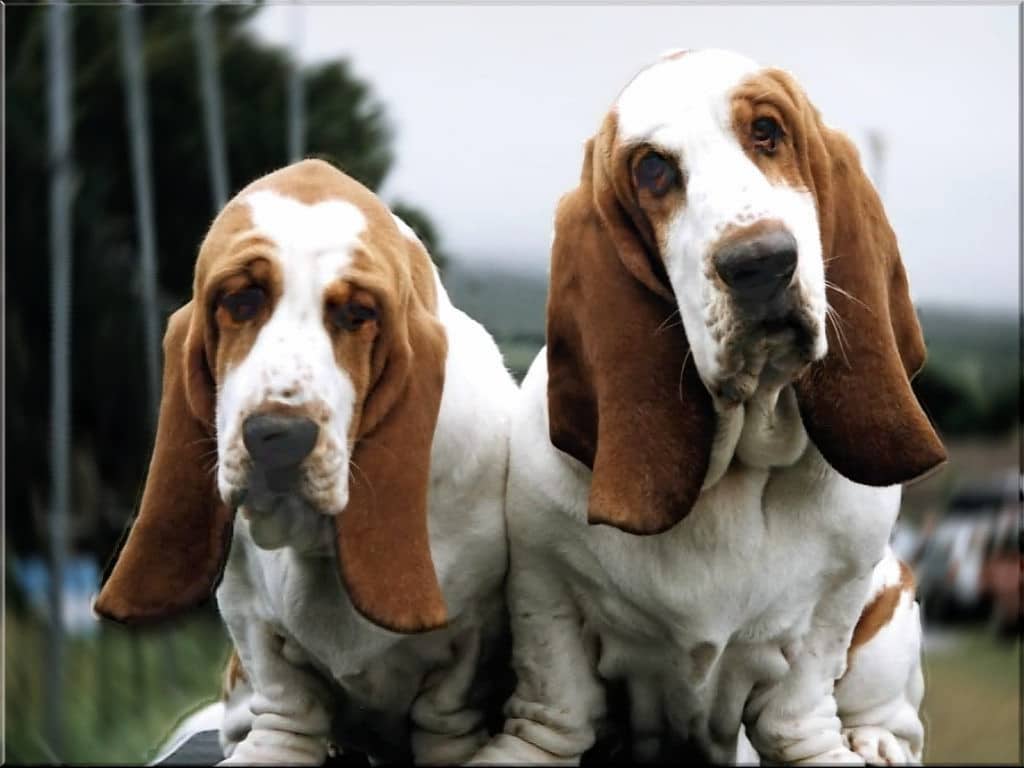
These dogs are around 33 to 38 cm. (on the cross), they have short hair and are generally tricolor (black, honey and white). They also tend to be white with red spots or Red-footed. Some, Although few, they can be gray. They may occasionally leave copies with long hair, although it is not a desirable characteristic according to the breed standard.

They have very long ears (up to the chest), also long neck with much loose skin and wrinkles around your head, This causes that you have a permanently sad. Its tail is long, erect and a curve.

Physical characteristics

"Basset Hound"

His short stature is misleading because they are very long and they can reach things that dogs of similar heights could not.
It has marked degree, features that equip it admirably for tracking through rough terrain. Dog short members, heavier bones, considering its size, than any other breed of dog; and although slow movements, they are in no sense clumsy.

The word Basset It comes from the French "bas" which means low and that is the main characteristic of this breed. The Basset Hound It is a breed of small stature due, fundamentally, their short legs and elongated body. The head is prominent and it highlights a few wrinkled brows (due to the large amount of skin), long floppy ears, a few deep eyes that convey sadness and hanging lips. The skin is flaccid and causes many wrinkles around the body and is covered by a short hair, rough can be of different colors of the Bassets (white, black & Fawn) in any combination.

Character and skills

Low and somewhat plump appearance might suggest it is a lazy dog and something sleazy but this is only an impression, is a loving dog of the year. You need to do plenty of exercise to prevent overweight and arthritis at advanced ages.

A specific care of this breed is the possibility of the development of conjunctivitis due to the loose skin around the eyes. (that leads to contain moisture), should be monitored continuously.

His facial expression promises sadness, fatigue, but a dog very joyful, good and very sociable, She loves children and adapts perfectly to the family environment. As well, despite his physical appearance, is a dog She loves the exercise, Sport and trips. It can be very stubborn, as well, about all dogs...

Nice temperament, never aggressive or shy (only in some cases). It has great strength in the field. extremely faithful.

Basset Hound Education

The stubborn side of Basset Hound requires authoritative parenting. You don't have to wait for him to "pass his youth", since it only matures around 3 years. A constant education, firm and consistent from an early age will make a good companion dog.

In fact, no matter how smart I am, you will know how to make the most of every hesitation. Hence the importance of being consistent and clear in the rules and the rewards that will be given. It shouldn't surprise you that he can turn a deaf ear when you annoy him..

Salud ยซBasset Houndยป

It is known that the Basset Hound Have overweight, so the risk of canine obesity must be taken into account, that can damage your spine.

Being the back a sensitive point of the Basset Hound, it is recommended to avoid obstacles and stairs in your daily life.

It also, the Basset Hound have a predisposition to certain skin conditions:

– atopia;
– dermatitis with malassezia;
– primary seborrhea;
– intertrigo (in the folds of the skin).

Their long ears can also be a complicating factor. In fact, are prone to infections such as scabies in the ear, due to Otodectes cynotis, a microscopic mite that causes itching and pain. This infection is diagnosed by direct examination of the parasite in the ear and then treated by local application of an acaricidal treatment..

Last, the eyes of the Basset Hound, since it is known that the breed has a genetic predisposition that favors the development of primary glaucoma, an eye disease in dogs that impairs the function of the optic nerve. This disease is diagnosed by an ophthalmological exam that measures intraocular pressure, what should a vet do. It is recommended that this examination be performed as soon as possible in the Basset, since the adverse effects of this disease can be reduced if detected early.

Aseo ยซBasset Houndยป

The Basset Hound does not need much coat maintenance. But, the Basset Hound loses hair all the time, so it should be brushed regularly to avoid the accumulation of hair in the house.

It also, their ears often need to be cleaned, as their length makes it particularly easy for dirt to enter them.

Basset Hound pictures

Basset Hound Videos

Type and recognitions:

  • FCI CLASSIFICATION:
  • Group :
  • Section : . .

Federations:

FCI โ“˜, AKC โ“˜, ANKC โ“˜, CKC โ“˜, โ€‹KC โ“˜, NZKC โ“˜, UKC โ“˜

FCI breed standard "Basset Hound"

Origin:
France

Date of publication of the valid original standard:
13.10.2010

Use:

Hunting dog.


General appearance:

It is a short-limbed hound, of considerable substance, well balanced and with countless qualities. It is important to keep in mind that it is a working hound and must be suitable for those purposes., therefore it must be strong, active and have great resistance in the field of work. TEMPERAMENT / BEHAVIOR: It is a tenacious hound of ancient lineage, that hunts by venting its prey and has the instinct of the pack. His voice is deep and melodious. He is gentle and affectionate, never aggressive or shy.


Behavior / temperament:

It is a tenacious hound of ancient lineage, that hunts by venting its prey and has the instinct of the pack. His voice is deep and melodious. He is gentle and affectionate, never aggressive or shy.

Head:

The forehead may have a small amount of wrinkles, as well as the part next to the eyes. In any case, the skin on the head is elastic enough to wrinkle slightly when facing forward or when the dog lowers its head.

Cranial region:

The top of the snout is almost parallel to the top line of the skull and is not much longer than the head., measured from the naso-frontal depression to the occiput.

  • Skull: It is domed in shape and the occipital protuberance is prominent; its width is medium in the region of the eyebrows and decreases slightly to the muzzle.
  • Depression links (Stop): Something marked.

facial region:

  • Truffle: Completely black, except for light colored hounds, where it appears brown or liver. Windows are wide and wide open; the truffle sticks out a little beyond the lips.
  • Snout: The appearance of the muzzle is thin, but it is not pointed.
  • Lips: The flews of the upper lip considerably cover the lower lips.
  • Jaws / Teeth: The jaws are strong, with a perfect bite, regular and full scissor, That is, the upper incisors cover the lower incisors in close contact and are implanted at right angles in the jaws..

Eyes: Rhomboid-shaped, they are neither prominent, or sunk. They are dark, but they can be medium brown in light colored hounds. His expression is calm and serious. Light or yellow eyes are very undesirable.

Ears: Low insertion, just below the eye line. They are long, although not in excess, and extend only slightly beyond the tip of a snout of correct length. They are narrow throughout their length and tightly curled inwards. They are very flexible, fine and smooth texture.

Neck:

He's muscular, well arched, quite long and with a pronounced dewlap, although not in excess.

Body:

Long and deep throughout its length; the withers and the loin are approximately the same height.

  • Back: Rather wide and horizontal. From the withers to the hips the back is not excessively long.
  • Pork loin: May be somewhat arched. Breast : Viewed from the front, the sill adapts perfectly to the curvature of the forearms. The sternum is prominent, but the chest is neither narrow nor too deep. The ribs are well rounded and tight; extend well back, no protruding edges.
  • bottom line, belly: There must be adequate clearance between the lower part of the chest and the floor that allows the dog to move freely over all types of terrain..

Tail:

It is well established and is rather long. It is strong at its root and gradually diminishes. Under the tail rough hairs are observed in moderate quantity. When is the dog moving, tail stands up well and forms a smooth saber-shaped curve, but never kinked or carried too high.

Tips

PREVIOUS MEMBERS:

  • General appearance: Upper forearm slopes inward slightly, but not so much as to impede free movement, nor that the forelimbs touch each other when the dog is standing or in action. Some skin folds may appear on the leg but this should not be excessive in any way.
  • Shoulder: They are not heavy; shoulder blades are well tilted back.
  • Elbows: They are not directed inward or outward; are well attached to the sides of the chest.
  • Forearm: Short limbs, strong with good bones.
  • Carpo: It is highly undesirable for it to be deviated forward.
  • Previous feet: Large, with strong joints and pads. The front feet can be pointed straight forward or slightly brought out, but in any case the dog must stand correctly. Weight falls equally on all fingers and pads, so that the feet leave the imprint of a large hound and the pads touch and completely cover the ground.

LATER MEMBERS:

  • General appearance: They are very well muscular and prominent, imparting an almost spherical appearance, seen from the back. There may be a few folds between the hock, the foot and on the back of the hock joint may appear a slight bag of skin but by no means this should be excessive.
  • Knee: Well angled.
  • Metatarsus: Hocks set low, slightly carried under the body, but they are not oriented neither in nor out when the dog is standing naturally.
  • Hind feet: Large, with strong joints and pads. Weight falls equally on all fingers and pads, so that the feet leave the imprint of a large hound and the pads touch and completely cover the ground.

Movement:

It is important to ensure that the dog can do its job. Movement is smooth and fluid powerful and effortless with front limbs extending well forward and rear limbs, that provide a strong impulse. Movement is free both at the front and at the back. The movement of the hock and knee should not be rigid; fingers should not drag on the ground.

Mantle

SKIN: Soft and stretchy without any exaggeration.

Fur: Smooth, short, and tight, although not too fine. All the outline is clean, no fringes. Long soft hair, fringed, it is highly undesirable.

Color: It is usually white, black and tan (tricolor) or lemon and white (bicolor), but any of the recognized colors on hounds is acceptable.


Size and weight:

Height to the cross: Of 33-38 cm..


Fouls:

Any deviation from the aforementioned criteria is considered a fault and its severity is considered to the degree of deviation from the standard and its consequences on the health and well-being of the dog and the dog's ability to perform its traditional task..

FALTAS DESCALIFICANTES:

  • Aggressiveness or extreme shyness.
  • Any dog โ€‹โ€‹showing clear signs of physical or behavioral abnormalities must be disqualified..


N.B.:
  • Males should have two normal-appearing testicles fully descended into the scrotum..
  • Only functionally and clinically healthy dogs, with the typical conformation of the breed, should be used for parenting.

Source: F.C.I - International Cynological Federation

โ–ท The world of Pets: Dogs, cats, birds, reptiles, amphibians

Bosnian Broken-haired Hound – Bosnian Broken-haired Hound
Bosnia FCI 155 . Medium-sized Hounds

Sabueso de bosnia de pelo duro - Barak

The Bosnian Hound, nicknamed Barak, It is a dog developed in Bosnia.

Content

History

This medium-sized breed of hound has been bred in Bosnia since the 19th century, at that time still under the name ยซHound of Illyriaยซ. Later the name was changed to ยซBosnian Broken-haired Hound – Bosnian Broken-haired Houndยซ. It is also called "Bracke Bosniaยซ. They have a full and deep bark.

Its origin dates back to the crossing of local dog breeds (for example, Pariah) and greyhounds, from the Mediterranean area. With his resilient and persevering nature, shows itself as an excellent hunting companion, but also serves in his home country as a companion, family and guard dog.

The famous ancestor of the Bosnian Hound is the St. Hubert Hound (or Bloodhound), It was par excellence the hunting dog in the 7th century.

Barak's name is believed to come from the Turkish word 'Barak', the nominaban dogs of hard hair or thick hair.

Physical characteristics

The Bosnian Broken-haired Hound – Bosnian Broken-haired Hound he is a very robust dog, with a long, somewhat broad head and bushy, pronounced eyebrows. So, a serious, partly strict but also cheerful facial expression develops in this breed. The back is very muscular and wide, the loin is short and also muscular, while the rump is broad and slightly sloping (especially in females). The so-called hip humps are slightly prominent. The ears are of medium height, wide, falls and a little thick. Towards the tip, they get thinner and in the end they get rounded.

The coat of the Bosnian hound it is very long, hard and hairy, with a lot of inner layer. So, It is especially in harsh climates and in cold and humid weather, broad protection.

The Bosnian Broken-haired Hound has a size of 46 to 56 cm with a weight of 16 to 24 kg. Their life expectancy is of 12 to 14 years.

Their fur can be yellow-red, wheat yellow, earth gray or a little blackish. There may be white marks on the head (fire or star), down the throat, below the neck, on the chest, under chest, on the tip of the tail or on the legs. Coat colors can also appear in different color combinations.

The Bosnian hound requires a bit more grooming, the coat must be combed regularly and freed from coarse dirt.

Character and skills

The Bosnian Broken-haired Hound – Bosnian Broken-haired Hound appears with a lively temperament, great resistance and a lot of courage. The breed is very hardy and was used as a sniffer dog in the mountainous landscape of Bosnia. But besides being a hunting dog, the Bosnian Broken-haired Hound it is also an excellent watchdog, that hardly ever breaks or bites. He is a typical working dog., where excellent skills are the main focus of parenting.

But, he is a friendly dog, that gets along well with children and their peers. So, he is also a great companion and a family dog, he likes to be close to his owners and is always happy to be caressed.

The Bosnian Broken-haired Hound – Bosnian Broken-haired Hound needs a lot of exercise and occupation possibilities daily. Whoever decides on a Bosnian Broken-haired Hound, you should consider that this breed is not at all suitable for a life as a city dog. The optimal would be to keep it in a rural area, with a large property and sufficient runoff area.
Also in breeding their owners must be consistent, because this breed has a certain stubbornness and a strong hunting instinct. But, if you use the docile nature of the Bosnian hound, you will get an anxious dog, loyal and hardworking, who likes to take on new challenges. Besides, scores with excellent social behavior and irresistible charm!

Observations:

It is virtually unknown outside the territory of the former Yugoslavia.

Images Bosnian Broken-haired Hound – Bosnian Broken-haired Hound

Videos Bosnian Broken-haired Hound – Bosnian Broken-haired Hound

Type and recognitions:

  • FCI CLASSIFICATION:
  • Group :
  • Section : . .

Federations:

  • FCI – Group 6: Scent hounds, and related breeds. – Section 1.2: Medium-sized Hounds. โ“˜
  • UKCScenthound Group โ“˜

FCI breed standard "Bosnian Broken-haired Hound – Bosnian Broken-haired Hound"

Origin:
Bosnia y Herzegovina

Date of publication of the valid original standard:
15/01/1973

Use:

Good working bloodhound dog, it is resistant and persistent, with a loud bark of high pitch and sometimes low pitch.


General appearance:

It is a robust dog; its fur is long and shaggy; long and moderately wide head, pronounced and bushy eyebrows. Serious expression, serious, but playful. The basic color is reddish yellow or earth gray with white markings in the lower regions.

IMPORTANT PROPORTIONS: The length of the body must exceed the height at the withers by a 10%.


Behavior / temperament:

It is a dog with a lively temperament, brave and persistent.

Head:

As a whole: Profile view, the occipital Protuberance is well developed, the frontal region is slightly convex and the moderate stop. Straight nose cane. Snout in a rectangular shape, covered with abundant a moustache and beard. View from the top, the head is of medium width, narrowing towards the nose. The muzzle is slightly longer than the skull. The total length of the head is of approximately 20 to 25 cm..

Cranial region:
  • Skull: Very pronounced supraorbital arches. To the touch, front Groove feels moderately developed.
  • Depression links (Stop): It presents a moderate pitch.

facial region:

  • Truffle: Long, with wide open Windows, pigmented dark brown or black.
  • Snout: Strong, long, deep, broader at its root, slimming to the truffle.
  • Lips: Stiff and a little thick.
  • Jaws / Teeth: Strong teeth; scissor bite, full dentition.
  • Eyes: Large, oval, Hazel, with a smart and playful expression.
  • Ears: Moderately high insertion, moderate and wide long. Pendulosas, slightly thick, being thin and rounded at the tip.

Neck:

  • Profile: The insertion in the head shows a sharp demarcation. The neck is oblique from the top down.
  • Form: Average width, increases its depth to the region of the chest. Muscular.
  • Skin: Adherent, flexible and covered with dense hair.


Body:

  • top line: It leans slightly towards the rump.
  • Cross: Moderately steep.
  • Back: Wide and muscular.
  • Lumbar region: Short and muscular.
  • Rump: Slightly inclined and wide (especially in females). The barely visible hip bones.
  • Breast : Long, average amplitude, slightly rounded ribs; its depth reaches at least up to elbows. Ample ribcage.
  • Belly and flanks: Slightly retracted belly.

Tail:

Properly inserted, thicker at its root, slimming to tip; it reaches up to the joint foot warm or slightly below. Held slightly curved upward in the form of scimitar. Well covered with hair.

Tips

PREVIOUS MEMBERS:

  • As a whole: Viewed in profile and from the front, the forelimbs are vertical, straight and parallel
  • Shoulder: Long, oblique and muscular.
  • Scapulohumeral angle: It must be 90ยฐ.
  • Arm: Long and muscular. Elbows set close to the body
  • Forearm: Vertical, straight, muscular and strong.
  • Articulation of the carpus: Just apparent.
  • Metacarpus: Short, vertical or slightly inclined at an angle of 10ยฐ with the vertical line.
  • Front feet: Cat feet, well United fingers, hard pads, strong and well pigmented nail.

LATER MEMBERS:

  • As a whole: Seen from the rear and profile, the hind limbs are vertical and parallel.
  • Thigh: Moderate long, wide and muscular.
  • Leg: Strong, long, oblique and muscular.
  • Warm-foot joint: Strong and well positioned.
  • Metatarsus: Perpendicular to the ground, short and strong.
  • Rear feet: Same as previous, but a little longer.

Movement:

Long and energetic steps.

Mantle

SKIN: Moderate thickness, elastic, adherent, well pigmented and covered with dense hair.

HAIR: Long, hard, Ogres, disheveled with a dense internal NAP.

COLOR: The basic color can be yellow wheat, yellow red, Earth grey or blackish. White markings on the head are often found (Star, list), under the throat, down neck, above or below the chest, lower parts of the members or at the tip of the tail. Color can be combined with bi-color or tri-color.


Size and weight:

  • Height to the cross: Of 46 to 56 cm., ideal height 52 cm., in the females a little less.
  • Weight: Of 16 to 24 kg, ideal weight 20 kg.


Fouls:

Any deviation from the aforementioned criteria is considered as a fault and the severity of this is considered to the degree of the deviation to the standard and its consequences on the health and well-being of the dog..

SERIOUS FAULTS:

  • Insufficient proportions between parts.
  • Light bone structure.
  • Weak muscles.
  • Head long and heavy than in the standard.
  • Bitefork clamp.
  • Inadequate pigmentation of the edges of the eyelids and the belfos.
  • Folded or erect ears.
  • Chin only slightly pronounced.
  • Slightly sunken or arched back.
  • Too wide or narrow chest.
  • Irregularities of the extremities and the angles joints.
  • Hare feet.
  • Not enough United fingers, presence of spurs.

MISS PLAYOFFS:

  • Aggressive or fearful dog.
  • Disproportion between the different parts of the body and especially between the height and the length of the body.
  • Non-typical head, excessively rough.
  • Depigmentation of the nose, the edges of the eyelids and the belfos.
  • Signs of degeneration of the dentition (lack of teeth), and of the jaws.
  • Very clear eyes or gazeos.
  • Diverted or curled tail.
  • Hocks cow or barrel-shaped.
  • Too long hair, woolly, wavy or curly.
  • All colors other than those listed, But first and foremost chocolate and black.
  • Height at the withers or too little.
  • Any dog โ€‹โ€‹showing clear signs of physical or behavioral abnormalities must be disqualified..


N.B.:

Males should have two normal-appearing testicles fully descended into the scrotum..

TRANSLATION: Federation Canรณfila Mexicana, A.C.

Source: F.C.I - International Cynological Federation

Alternative names:

1. Bosnian Broken-haired Hound, Bosnian Rough-haired Hound, Bosnian Rough-coated Hound, Bosnian Coarse-haired Hound, Bosnian Hound, Illyrian Hound, Barak (English).
2. Chien courant d’Illyrie, Barak (French).
3. Barak, Illyrischer Laufhund (German).
4. Sabujo-da-bรณsnia, Barak (Portuguese).
5. Cazador bosnio, Sabueso bosnio, Barak (espaรฑol).

โ–ท The world of Pets: Dogs, cats, birds, reptiles, amphibians

Great Anglo-French Tricolour Hound
Francia FCI 322 - Large-sized Hounds

Great Anglo-French Tricolour Hound

The Great Anglo-French Tricolour Hound is considered rare, very little spread outside of France and currently little used even in your country.

Content

The Great Anglo-French Tricolour Hound is a large and powerful sporting dog with its origin in France. He is praised for his incredible stamina, work skills and ability to operate on any type of terrain and for any weather condition. This breed is poorly adapted to apartment living due to its high exercise requirements. This type of Anglo-French hound is considered the most powerful.

Photo: This dog is one of a pack of Grand anglo-franรงais tricolore by Alephalpha, CC BY-SA 3.0, via Wikimedia Commons

History Great Anglo-French Tricolour Hound

The origin of the Anglo-French hound dates back to the 19th century, when hunting with large packs was at its height in France. However, the exact date of its development remains unclear, since the crossing of the French hound with various types of English hounds was a common practice in this country since the 16th century.

French hunters cared little for the appearance or pedigree of their dogs as long as they demonstrated unparalleled hunting prowess.. That is why these hounds were perceived more like stray dogs until the 20th century. The situation changed when in 1957 the breeders decided to organize the dogs according to their ancestry. His efforts resulted in the appearance of seven unique French breeds of sizes, coat texture and distinctive colors. The Great Anglo-French Tricolour Hound appeared as the result of the crossing of native French dogs, in particular the Poitevin hound and the Gascon Saintongeois and the English Foxhound. The breed is very rare, little used and virtually unknown outside of mainland France.

The word "Grandยป was put in front of the breed name because it was used to hunt large game and functioned predominantly in packs of several dozen other canines. The Great Anglo-French Tricolour Hound is characterized by its resonant voice, his keen sense of smell and his relentless pursuit. This brave and passionate hunter will never be hampered by difficult terrain and harsh weather and can work for numerous hours without breaks.. The packs of the Anglo-French hounds They generally specialized in hunting roe deer and wild boar., although they could also hunt foxes and other small game animals.

Currently members of the breed are mostly active hunters as this dog is not suitable for the role of pet or show dog.. Its population was concentrated almost exclusively in its native France, where it is also considered a rare breed. But, the Great Anglo-French Tricolour Hound has the recognition of the Fรฉdรฉration Cynologique Internationale (FCI) and in 2006 was officially recognized by the United Kennel Club (the UKC).

Physical Characteristics Great Tricolor Anglo-French Hound

The Great Tricolor Anglo-French Hound should appear elegant and almost old-fashioned in appearance. They must be robust, with a deep chest and a straight back that is supported by straight, muscular limbs. His broad skull has an obvious stop, while its square-shaped snout should contain a full set of teeth that meet in a scissor bite. Her big brown eyes, its pendulous ears and prominent black nose are all characteristic features of a scent hound. Its long, thin tail tends to have a white tip.

as its name suggests, it is a tricolor breed with white fur, fire and black. Its double coat is short and soft. Dogs measure between 60 and 70 cm in height to the cross, generally weigh between 30 and 35 kg. Your walk should be effortless and a pleasure to behold.

Character and skills Great Anglo-French Tricolour Hound

The Great Anglo-French Tricolour Hound he is a magnificent sporting dog, that is very rarely used only as a pet. It gets used to living in large packs of other canines and requires a spacious yard to unleash its exuberant nature.. Some fans of the breed claim that their well-socialized specimen is fine with children. In any case, this vigorous and strong dog will not make an acceptable playmate for a young child.

The breed often demonstrates unwavering loyalty and affection towards their favorite people, but he stays quite distant from strangers. But, a Great Anglo-French Tricolour Hound well educated will treat a new person with essential courtesy. Usually does not express enough interest in protecting its territory to be an effective watchdog. At the same time, some specimens can make good watchdogs. This breed definitely won't make any use of it in the guard dog role anyway due to its non-aggressive disposition..

The Great Anglo-French Tricolour Hound was bred to live and work with other dogs and usually yearns to have several permanent canine companions. He does quite well with strange dogs although he will not back down from confrontation if provoked. That is why this dog should always be kept on a leash while walking. Being a tenacious and reliable hunter, it can show high aggression towards other species of animals., especially towards homeless cats. It is possible to introduce this dog into the house with other non-canine pets while it is still a friendly and inquisitive pup.

Health of the Great Anglo-French Tricolour Hound

The most common problems for the breed include:

– canine hip dysplasia;
– patella dislocation;
– arthritis;
– frequent muscle tension;
– chronic ear infections;
– hearing problems;
– cryptorchidism;
– gastric torsion.

Caring for the Great Anglo-French Tricolour Hound

The Great Anglo-French Tricolour Hound should receive fairly basic maintenance. The owner should brush his dog a couple of times a week to keep his short, sleek coat in a healthy condition. The dog's nails should be trimmed monthly.

After every hunting trip, the coat and ears of a working specimen should be thoroughly examined for signs of ticks and other external parasites. The breed easily picks up various ear infections, so they need regular and careful cleaning. The Great Anglo-French Tricolour Hound he is a moderate biter.

Training of the Great Anglo-French Tricolour Hound

The training of the Great Anglo-French Tricolour Hound usually requires an average investment of time and effort. In fact, takes on a very natural hunting behavior and will effectively carry out its original hunting duties with a minimum of training. At the same time, is characterized by a certain streak of stubbornness and will not follow the orders of a week or an indecisive person. This dog usually has a strong desire to impress its owner and easily learns basic commands.

Breed training should be done exclusively with reward-based methods, with an emphasis on the dog's favorite treats. The Great Anglo-French Tricolour Hound will not put up with abusive or disrespectful treatment and will respond to it with even more obstinacy and disobedience.

Exercise with the Great Anglo-French Tricolour Hound

The Great Anglo-French Tricolour Hound is an extremely vigorous working dog, accustomed to very intense physical exercise. When not hunting, he must be given the opportunity to expend his excessive energy. This dog is an infamous cat hunter, so it should never be released without a leash until it is in a closed and secure area.

During the hunting season it is advisable to offer the dog some type of exercise that emulates its hunting behavior.. It is worth remembering that if the Great Anglo-French Tricolour Hound lacks opportunities to vent, will gradually turn into a rebellious animal, hyperactive and destructive.

Videos "Great Anglo-French Tricolour Hound"

HTTPS://youtube.com/watch?v=TQlS7Fba0i0&feature=emb_logo
Pack of Anglo Saxons hunting wounded boar
HTTPS://youtube.com/watch?v=iOVr7Al5XYI
Grand Anglo Franรงais Tricolore ?? Everything Dog Breeds ??

Type and recognitions:

  • FCI CLASSIFICATION:
  • Group :
  • Section : . .

Federations:

  • FCI – Group 6: Scent hounds, and related breeds. – Section 1.1: Large-sized Hounds. โ“˜
  • UKCScenthounds โ“˜
  • Central Canine Society โ“˜

FCI breed standard "Great Anglo-French Tricolour Hound"

Origin:
France

Date of publication of the valid original standard:
27.01.1983

Use:

Hound


General appearance:

This is a solid dog, predominantly French type, that has a certain air of distinction. To different degrees it can show its Fox-Hound origin.


Behavior / temperament:

---

Head:

---

Cranial region:
  • Craging: The skull is of moderate width and rather flat.. The occipital protuberance is slightly visible and the eyebrows are not very prominent..
  • Dnaso-frontal depression (Stop): Marked.

facial region:

  • Hocico: Well sculpted under eyes. The nasal cannula is of medium length, approximately equal to that of the skull. It is usually straight.
  • Belves: They are quite developed, giving the muzzle a rather square appearance. They are never pointy.

OJOS: Large, browns; black color is seen around.

OREJAS: Medium length, fairly long implantation in the plane of the eye line. They are flat at the root and then twist a little.

Neck:

It is quite long and thick. No pronounced double chin.

Body:

  • Espalda: It is straight and pointed.
  • Lomo: Width, muscular, rectilinear and rather short.
  • Rump: It is long and oblique.
  • Pecho: It is well descended and quite wide. Long, rounded ribs, never flat.
  • Flalso: They are slightly raised and quite solid.

Tail:

It is long, well covered with hair. The dog carries it with elegant bearing.

Tips

PREVIOUS MEMBERS:

  • Ageneral appearance: Strong and perfectly poised.
  • Shoulder: Long and flat.
  • Pinis previous: Thin and rather rounded.

LATER MEMBERS:

  • Thighs: Muscular, descended and somewhat โ€ณfleshyโ€ณ.
  • Corvejรณn: It comes close to the ground. It is wide and slightly angled.
  • Pinis later: Thin and rather rounded.

Movement:

It is loose and imparts an impression of solidity.

Mantle

PIEL: Black and white in color.

MANTLE

  • Plink: Short and more or less thick.
  • Codor: Tricolor; often has a black blanket or more or less widespread black spots. High fire color or copper color, without being carbonated. Mixed hair called โ€œwolf hairโ€ is not excluded.. Excessively mottled fur is undesirable..


Size and weight:

Altura to the cross: Of 60 to 70 cm..


Fouls:

Any deviation from the aforementioned criteria is considered as a fault and the severity of this is considered to the degree of the deviation to the standard and its consequences on the health and well-being of the dog..

  • Constitutional defects that prevent the proper use of the animal.
  • Upper or lower prognathism.
  • light eyes.
  • Tail that bends to one side or curls.
  • Partial depigmentation of the nose.
  • Faded fire color.
  • Any color other than the established one.

FALTAS DISQUALIFYERS:

  • Aggressiveness or extreme shyness.
  • Any dog โ€‹โ€‹showing clear signs of physical or behavioral abnormalities.


N.B.:
  • Males should have two normal-appearing testicles fully descended into the scrotum..
  • Only functionally and clinically healthy dogs, with the typical conformation of the breed, should be used for parenting.

Source: F.C.I - International Cynological Federation

Alternative names:

1. Grand Anglo-Francais Tricolore Hound (English).
2. Grand anglo-franรงais tricolore (French).
3. Grand Anglo-Franรงais, Grand anglo-franรงais tricolore (German).
4. Grand anglo-franรงais tricolore (Portuguese).
5. Gran anglo-francรฉs tricolor (espaรฑol).

โ–ท The world of Pets: Dogs, cats, birds, reptiles, amphibians

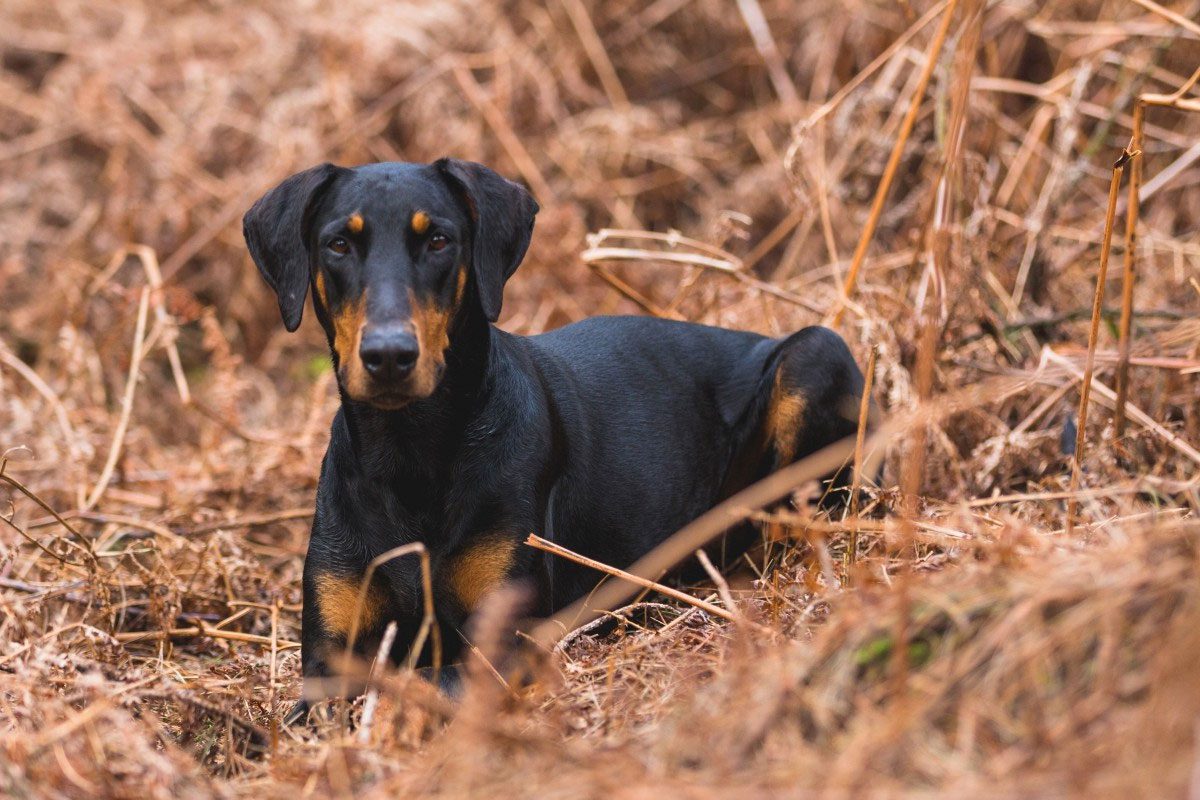
Montenegrin Mountain Hound
Montenegro FCI 279 - Medium-sized Hounds

Montenegrin Mountain Hound

Even in his country of origin the Montenegrin Mountain Hound it is little spread, in other countries it is practically unknown.

Content

History

Although its origins are surely much older, the existence of Montenegrin Mountain Hound (Crnogorski planinski goniฤ) is attested since the beginning of the 19th century.

The race, confined to the border region with Greece, has kept its features intact.

Bred for its ability to work in rocky terrain and scrub, hunt both small and large animals.

There are two varieties: the Montenegrin Mountain Hound and the โ€œSerbian Tricolor Houndโ€, that are distinguished mainly by the color of their fur, and both are virtually unknown outside its borders.

In the past, the Montenegrin Mountain Hound It has sometimes been called the "Black Hound".

The first standard dates back to 1924 y la F.C.I. officially recognized the breed at its Warsaw meeting on 8 in May of 1969.

Belonging to the โ“˜American Rare Breed Association (abbreviated as ARBA)

Photo: https://pxhere.com/en/photo/1493407


Physical characteristics ยซMontenegrin mountain houndยป

Montenegrin Mountain Hound
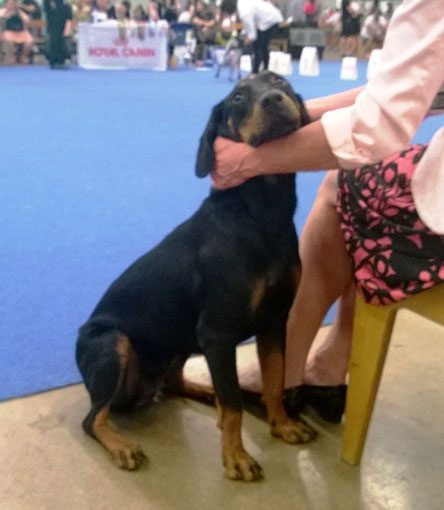
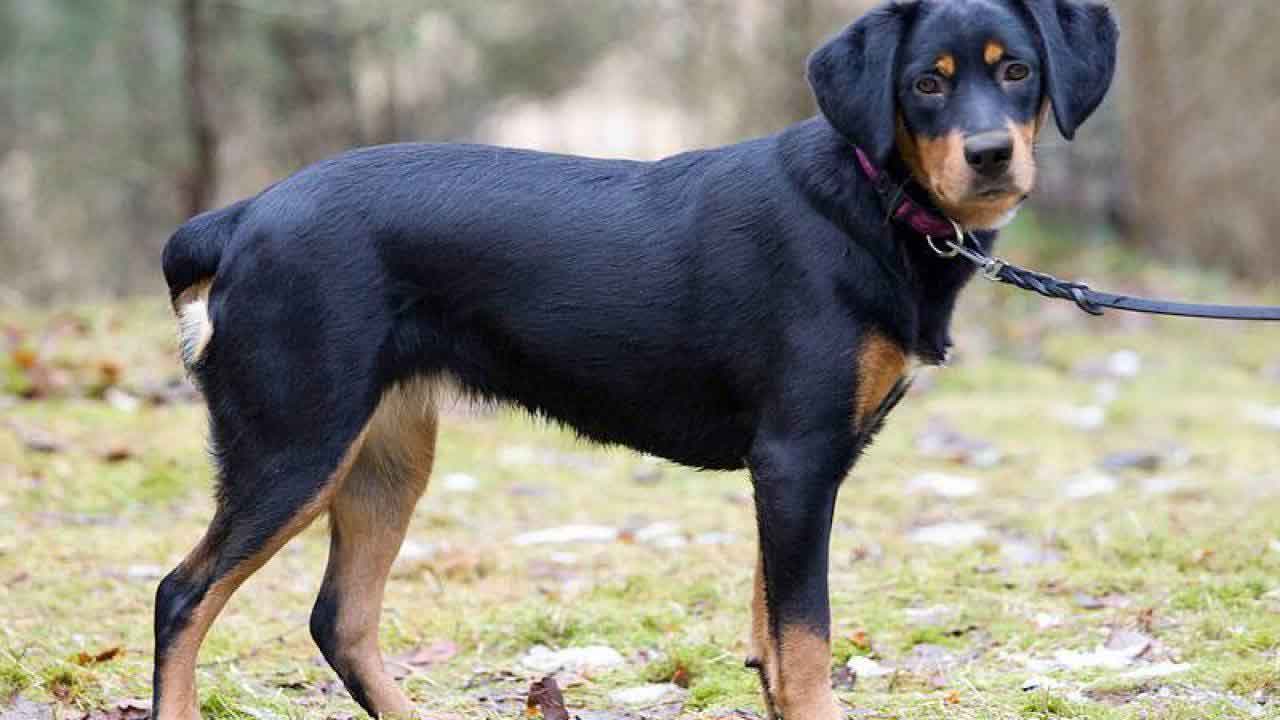
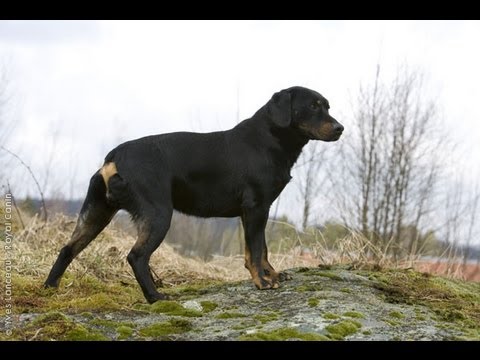
Montenegrin Mountain Hound, b&t by Canarian, CC BY-SA 4.0, via Wikimedia Commons

Robust medium-sized hounds, well balanced, calm and good-natured, very attached to their master.

The skull is slightly domed, the muzzle is slightly shorter than the skull, the nose is always black, eyes are dark with a smart expression, the ears are hanging and without folds, their tips are rounded.

The body is muscular and slightly long. The fur-covered tail is saber-shaped. The pelage is dense, short and with abundant undercoat. The coat is black with brown markings over the eyes, on the muzzle and lower legs.

Size: Height to the cross 44 to 54 cm..

Ideal size for males: 49 to 50 cm., ideal size for females: 48 to 49 cm..


Character and aptitudes ยซMontenegrin mountain houndยป

The Montenegrin Mountain Hound is bold, smart and calm. They are also particularly agile, resistant and tenacious.

They are balanced dogs, quiet, kind, loving and obedient, which makes them excellent companions.

It is often used to hunt hares and foxes, sometimes deer.

Although its qualities make it a good companion dog, life in the city is not recommended for this hound..

Videos "Montenegrin Mountain Hound"

The Montenegrin mountain dog special 08.09.2012
Specijalka Crnogorski planinski gonic 08.09.2012
Moans - Montenegrin mountain dog
Stenci – Crnogorski planinski gonic

Type and recognitions:

  • FCI CLASSIFICATION:
  • Group :
  • Section : . .

Federations:

  • FCI – Group 6: Scent hounds, and related breeds. – Section 1.2: Medium-sized Hounds. โ“˜

FCI breed standard "Montenegrin Mountain Hound"

Origin:
Montenegro

Date of publication of the valid original standard:
15.07.1997

Use:

Hound


General appearance:

Agile and solid, medium-sized.

IMPORTANT PROPORTIONS :

The length of the body (measured from the tip of the shoulder to the tip of the buttock) and the perimeter of the chest exceed approximately one 10% the height at the withers. The length of the head corresponds to 45% the height at the withers.


Behavior / temperament:

This is a well balanced dog, attached to his master, docile and trustworthy.

Head:

Dolicocephalic; the upper lines of the skull and the nasal cannula are divergent.

Cranial region:
  • Skull : It is longer than the muzzle. In the occipital region, its width is less than the distance between the naso-frontal depression and the occipital protuberance. Seen from the front or in profile, is flat or slightly domed. Its width decreases from the top of the skull to the naso-frontal depression. The frontal furrow is pronounced, while the occipital protuberance is less marked; supraciliary arches are well developed.
  • Depression links (Stop) : Little pronounced.

facial region:

  • Truffle : Is well developed. It is always black.
  • Snout : It is thick and wide at its base; is shorter than the skull. The desired correlation should be 7,5 : 10. The lateral lines of the muzzle are convergent. The nasal helm is straight.
  • Jaws / Teeth : The jaws are strong and have a regular and complete scissor-shaped bite.. Pincer bite is acceptable. Teeth are well developed and evenly implanted.
  • Lips : Medium developed. They are together and the upper lip slightly exceeds the lower. The corner of the mouth is firm; the edge of the lips is black.
  • Cheeks : Flat.

Eyes : They have an oval shape, they are slightly oblique and their color ranges from light brown to dark brown. The edge of the eyelids is black.

Ears : Set high and medium long, they range from thin to moderately thick. They are hanging, they do not present folds and are glued to the head. Its limb has a more or less marked oval shape.

Neck:

Is powerfull, oblique, forming an angle of 45 at 50ยฐ relative to the horizontal. Its length is almost equal to that of the head. He is thin, muscular and does not present a double chin.

Body:

Is rectangular. Its length exceeds almost a 10% the height at the withers.

  • Cross : Well pronounced. : Muscled, wide, moderately long.
  • Pork loin : He's muscular, solid, not very long. It is well attached to the rump.
  • Rump : Slightly inclined (of 20 at 25ยฐ relative to the horizontal); she is muscular, powerful and wide.
  • Breast : It is strong, deep; its height corresponds to between 45 to 50% from the height to the withers and its perimeter exceeds almost 10% the height at the withers.
  • Bottom line and belly : The xiphoid appendix is รขโ‚ฌโ€นรขโ‚ฌโ€นprotruding. The belly is slightly raised.

Tail:

Prolongs the line of the rump and gradually decreases from its root to its extremity, that reaches the hock. Carried in a saber shape above the line of the back, it is covered with abundant hair..

Tips

PREVIOUS MEMBERS : Together they are strong, solid, muscular and parallel.

  • Shoulder : The shoulder blade is muscular and well attached to the chest wall. Its length is almost equal to that of the head. Forms an angle of 40 at 45ยฐ to the horizontal.
  • Elbow : Solid, well glued to the body. The distance from the ground to the elbow corresponds to 50% the height at the withers.
  • Forearm : Straight, muscular, strong.
  • Carpo : Solid.
  • Metacarpus : Robust, delgado, slightly oblique (until 15% in relation to the vertical).
  • Front foot : Jack's foot. The fingers are strong, together and well arched. The pads are resistant, elastic and black. Nails are always black.

LATER MEMBERS : Together they are strong, muscular, parallel and solid boned.

  • Thighs : They are powerful and muscular; they are not outgoing.
  • Knee : It is solid and is positioned parallel to the median plane of the body. The knee angle is about 120ยฐ.
  • Leg : Muscled. Its length corresponds approximately to that of the thigh.
  • Hock : It is solid and pronounced. Its angulation is about 135 a 140ยฐ.
  • Metatarsus : It is powerful and almost vertical.
  • Rear foot : As the front foot.

Movement:

It is uniform and elastic, with a good drive from the hind limbs. The movement of choice is an agile and fluid trot.

Mantle

SKIN : It is elastic and adheres well to the body. Its pigmentation is dark.

HAIR : Is short, dense, rough, little thick and shiny. It is well glued and smooth. The undercoat of hair is quite developed.

COLOR : The base color is black with tan markings on the eyes, muzzle and lower limbs. The tan markings on the eyes are the size of a hazelnut, while on the lateral parts of the muzzle they extend at most to the corner of the lips. Tan markings range from light red, going through brownish red to deep red. A white mark on the chest is accepted, although it is not very desired. Its diameter must not exceed 3 cm..


Size and weight:

Height to the cross : It is of 44 to 54 cm.. The ideal size for males is of 49 to 50 cm and females is of 48 to 49 cm..


Fouls:

Any deviation from the aforementioned criteria is considered as a fault and the severity of this is considered to the degree of the deviation to the standard and its consequences on the health and well-being of the dog..

MISS PLAYOFFS

โ€ข Shy or aggressive dog.
โ€ข Upper or lower prognathism; incisor arcade deviated.
โ€ข Missing tooth; the lack of two premolars is accepted 1 (PM1).
โ€ข Very light colored eyes; gaze eyes; different colored eyes; entropion and ectropion.
โ€ข Curled tail, carried above the line of the back or deviated laterally.
โ€ข Colors that are not established by the standard.
โ€ข Any other white mark that is not accepted by the standard.
โ€ข Size greater or less than that accepted by the standard.

Any dog โ€‹โ€‹showing clear signs of physical or behavioral abnormalities must be disqualified..


N.B.:

Males should have two normal-appearing testicles fully descended into the scrotum..

Source: F.C.I - International Cynological Federation

Alternative names:

1. Montenegrin: (Crnogorski planinski goniฤ), Black Hound, Yugoslavian Mountain Hound (English).
2. Montenegrin: (Crnogorski planinski goniฤ), Chien courant yougoslave de montagne, Chien courant noir (French).
3. Montenegrin: (Crnogorski planinski goniฤ), Montenegrinische Gebirgsbracke, Frรผher Jugoslawischer Gebirgslaufhund (German).
4. Montenegrin: (Crnogorski planinski goniฤ), Sabujo-negro (Portuguese).
5. Montenegrin: (Crnogorski planinski goniฤ), Sabueso montaรฑรฉs de Montenegro (espaรฑol).

โ–ท The world of Pets: Dogs, cats, birds, reptiles, amphibians

Smaland Hound
Suecia FCI 129 - Medium-sized Hounds

Smaland Hound

The Smaland Hound It is used for hunting hare and fox; It is not a pack dog and is not used for deer hunting..

Content

History

The history of Smaland Hound starts in the county of Smaland, in southern Sweden; There was a wide variety of hounds in the 19th century. Some, of german origin, Polish or Baltic, They had arrived in the company of soldiers returning from the great wars between 1611 and 1678.

These hunting dogs were later crossed with local farm dogs type Spitz and english hounds, becoming the ancestors of Smaland Hound. The size, tail color and length varied at that time: some dogs were black and tan, others red or yellow. But, white markings were common. Some cubs were born with short tails.

During the early years of the 20th century, great efforts were made to rebuild the type of the old Smalandsstรถvare, especially the short-tailed variety. The first standard, written in 1921, allowed dogs to have both short and long tails. First it was decided that the color would be black and tan, but red and yellow were allowed, as well as the white spots.

The Smaland Hound received continuous infusions of new blood, sometimes using strong lines from other dog breeds. New blood was last used in the 1980s. 1950, When, for a brief period, dogs of unknown origin were registered, but accepted type, as Smaland Hound.

Photo: Smalandsstovare by amoreaquattrozampe.it

Physical characteristics ยซSmaland Houndยป

Smaland-Stรถvare
Smaland-Stรถvare

The Smaland Hound he is a robust dog, similar to Rottweiler, and elegant looking. His eyes are dark brown with a calm expression. Ears are stuck high, slightly raised when the dog is paying attention. They are carried hanging, with rounded ends. The tail is placed in the extension of the line of the back, straight or slightly saber-shaped. May be short at birth.

Fur: average length, rough, well attached to the body; thicker in the back and neckline. The undercoat is colored: black and fiery (all shades range from amber to reddish brown). Small white spots are allowed on the bib and fingers.

Size: males 46-54 cm. (ideal 50 cm.); females 42-54 cm. (ideal 45 cm.).

Character and abilities ยซSmaland Houndยป

These Hounds form a strong bond with their owners, being loyal and devoted, kind and loving, which also makes them great companions at home.

When they hunt, they are used mainly for hunting fox and hare. He is gifted with exceptional talent, he is a brave and determined dog.

At home, is a gentle, calm and affectionate family companion. They are known to be territorial and wary of strangers., which makes them good watchdogs that will not fail to warn their masters of marauders.

The Smaland Hound is very intelligent and they learn easily. He gets along well with his peers if they have grown up together, but it must be presented with delicacy and attention to other dogs and other animals.

It is a dog that needs a lot of time in the presence of its master, who needs space and the ability to spend his energy. So, it is not a dog for owners who are absent or who do not have enough time to dedicate to it.

The breed needs space and is therefore not suitable for apartment living.

Ratings of the โ€œSmaland Houndโ€

Coexistence is important that you have with your new friend. Before considering the acquisition of a dog of the breed "Smaland Hound" you know certain factors. Not all breeds of dogs are apt to live in an apartment, you must take into account his character, their need for exercise, their interaction with other pets, their care and if you have small children, their level of tolerance towards them.

Adaptation โ“˜

4,0 of 5 stars (based on 1 review)

friendly dog โ€‹โ€‹โ“˜

4,0 of 5 stars (based on 1 review)

hair loss โ“˜

3,0 of 5 stars (based on 1 review)

Affection level โ“˜

3,0 of 5 stars (based on 1 review)

Need for exercise โ“˜

4,0 of 5 stars (based on 1 review)

Social need โ“˜

3,0 of 5 stars (based on 1 review)

Home โ“˜

3,0 of 5 stars (based on 1 review)

Toilet โ“˜

2,0 of 5 stars (based on 1 review)

Friendly with strangers โ“˜

3,0 of 5 stars (based on 1 review)

barking โ“˜

5,0 of 5 stars (based on 1 review)

Health โ“˜

4,0 of 5 stars (based on 1 review)

Territorial โ“˜

4,0 of 5 stars (based on 1 review)

Cat friendly โ“˜

2,0 of 5 stars (based on 1 review)

Intelligence โ“˜

4,0 of 5 stars (based on 1 review)

Versatility โ“˜

3,0 of 5 stars (based on 1 review)

Child friendly โ“˜

5,0 of 5 stars (based on 1 review)

Surveillance โ“˜

4,0 of 5 stars (based on 1 review)

joy โ“˜

4,0 of 5 stars (based on 1 review)

Videos of the โ€œSmaland Houndโ€

Smรฅland duster / Smalands Hound / Smalandstevar

Smรฅland duster / Smalands Hound / Smalandstevar

hare hunting with small land duster diva
harjakt med smรฅlandsstรถvare diva

Type and recognitions:

  • FCI CLASSIFICATION:
  • Group :
  • Section : . .

Federations:

  • FCI – Group 6: Scent hounds, and related breeds. – Section 1.2: Medium-sized Hounds. โ“˜
  • UKCScenthounds โ“˜

FCI breed standard "Smaland Hound"

Origin:
Sweden

Date of publication of the valid original standard:
17.07.1997

Use:

Bloodhound type dog used for hare and fox hunting. It is not a pack dog and is not used for deer hunting..


General appearance:

It is a robust dog with an elegant appearance.. He is of strong constitution, without being heavy. The coat should be rough.

IMPORTANT PROPORTIONS :

The body is almost square. The height of the body should be almost equal to half the height at the withers.


Behavior / temperament:

He is a calm dog, loving, with enthusiastic and reliable temperament.

Head:

---

Cranial region:
  • Skull : Medium length and thin. It is wider between the ears.
  • Stop : Well defined; The distance from the occiput to the stop should be equal to the distance from the stop to the tip of the nose..

facial region:

โ–ท Truffle : black, with large nostrils.
โ–ท Snout : Well developed, without being thick or pointy. Nasal cane straight and parallel to the line of the skull.
โ–ท Lips : The upper lip hangs only slightly over the lower lip..
โ–ท Cheeks : They are not prominent.
โ–ท Jaws/Teeth : Scissor bite. Strong, well-developed teeth.

โ–ท Eyes : Dark brown in color; calm expression.
โ–ท Ears : High insertion, he raises them a little when he is attentive. They are slightly shorter than the distance from the base of the ear to the middle of the snout.. They hang flat and the tips are rounded.

Neck:

Moderately long, powerful without being thick, descends harmoniously towards the shoulders. The skin that covers the neck is tight and flexible.

Body:

โ–ท Cross : Well marked.
โ–ท Back : Short, and strong.
โ–ท Pork loin : Muscular and slightly arched.
โ–ท Rump : Slightly inclined, long and wide.
โ–ท Breast : Well developed with well sprung ribs.
โ–ท Bottom line and belly : Belly just a little retracted.

Tail:

  • It can be long and inserted in a straight line with the back. Straight or slightly curved in the shape of a saber. It barely reaches the tibio-tarsal joints. Queues with medium length are also allowed. When the dog moves, It is preferable that the tail is not carried above the level of the back.
  • Short queue allowed, natural or bear tail.


Tips

PREVIOUS MEMBERS :

โ–ท Generalities : Viewed from the front, the forelimbs are straight and parallel. Strong bones should give the impression of harmony with the dog's overall appearance..
โ–ท Shoulders : They're long, muscular, well attached and well directed backwards.
โ–ท Arms : Long, they form a right angle with the shoulders.
โ–ท Elbows : Glued to the body, without being visible below the thorax.
โ–ท Metacarpos : Flexible and slightly angled with the forearm.
โ–ท Front feet : Firms, with well-angled and closed fingers.

LATER MEMBERS :

โ–ท Generalities : Seen from the back, They are strong and parallel.
โ–ท Thigh : It has well-developed muscles. Seen from the sides, thighs are wide.
โ–ท Knee : Well angled.
โ–ท Tibio-tarsal joints : With good angulation
โ–ท Metatarsal : Short, thin and straight.
โ–ท Hind feet : Similar to the previous. Dewclaws are undesirable.

Movement:

Parallel, strong, spans space.

Mantle

HAIR : Medium long, rough, the attached outer layer is thicker on the back and neck. The undercoat is short, dense and smooth. Over the head, ears and front of limbs, the coat should be short and soft. Below the tail and on the back of the thighs, the outer layer should be longer than on the back. The hair is abundant between the toes and pads.

COLOR : black and tan. Fuego: any shade from amber to reddish brown. Some small white markings on the chest and toes are permitted..


Size and weight:

Height at the withers :

  • Males: 46-54 cm.. Ideal size: 50 cm..
  • females: 42-52 cm.. Ideal size: 46 cm..


Fouls:

Any deviation from the aforementioned criteria is considered a fault and its seriousness is considered to the degree of
deviation from the standard and its consequences on the health and well-being of the dog.

โ€ข Incorrect proportions, p.ej. very rectangular body.
โ€ข Lack of definition of sexual characteristics.
โ€ข Heavy head, wide skull.
โ€ข Short or pointed snout.
โ€ข Pendulous lip commissure.
โ€ข Upper or lower prognathism, level bite.
โ€ข Light eyes.
โ€ข Too long back.
โ€ข Short croup, inclined.
โ€ข Tail carried above the level of the back
โ€ข Restricted movements of the hind limbs.
โ€ข By je cut the thin.
โ€ข Lack of fire marks; black tips of hair in fire color.
โ€ข Too much white color or white hair in inappropriate places.
โ€ข Liver and brown color.

MISS PLAYOFFS

โ€ข Cowardice, aggression toward owner.
โ€ข Very reserved dog, fearful.
โ€ข Marked upper or lower prognathism.
โ€ข Variations in height at the withers less than or greater than 1 cm..

Any dog โ€‹โ€‹showing clear signs of physical or behavioral abnormalities must be disqualified..


N.B.:

Males should have two normal-appearing testicles fully descended into the scrotum..

Source: F.C.I - International Cynological Federation

Alternative names:

1. (Swedish: Smรฅlandsstรถvare) (English).
2. Smรฅlandsstรถvare (French).
3. Smรฅland-Bracke, Smรฅlandsstรถvare (German).
4. Smalandsstovare (Portuguese).
5. Cazador de Smรฅland (sueco: Smรฅlandsstรถvare) (espaรฑol).

โ–ท The world of Pets: Dogs, cats, birds, reptiles, amphibians

Petit Basset Griffon Vendรฉen
Francia FCI 67 . Small-sized Hounds

Basset Grifรณn Vandeano pequeรฑo

The Petit Basset Griffon Vendรฉen is a very strong race.

Content

History

The Petit Basset Griffon Vendรฉen It is a small size hunting dog (Petit), under (basset), hard hair (griffon) of French origin (in the region of the Vendรฉe), mainly used for hunting rabbits with his great sense of smell.
It was developed from the Grand Basset Griffon Vendรฉen, larger copy, heavy and long.

In the past, often to raise both races together. In 1975 are prohibited from crossing them, although puppies with characteristics of both breeds could still be born in the same litter. In France, It was a popular hunting dog for nearly a century (origin s. 16TH); However, the breed is relatively new in other regions.

Physical characteristics

Medium-sized, its height varies between the 33 and 38 cm and his weight between the 16 and 20 kg.
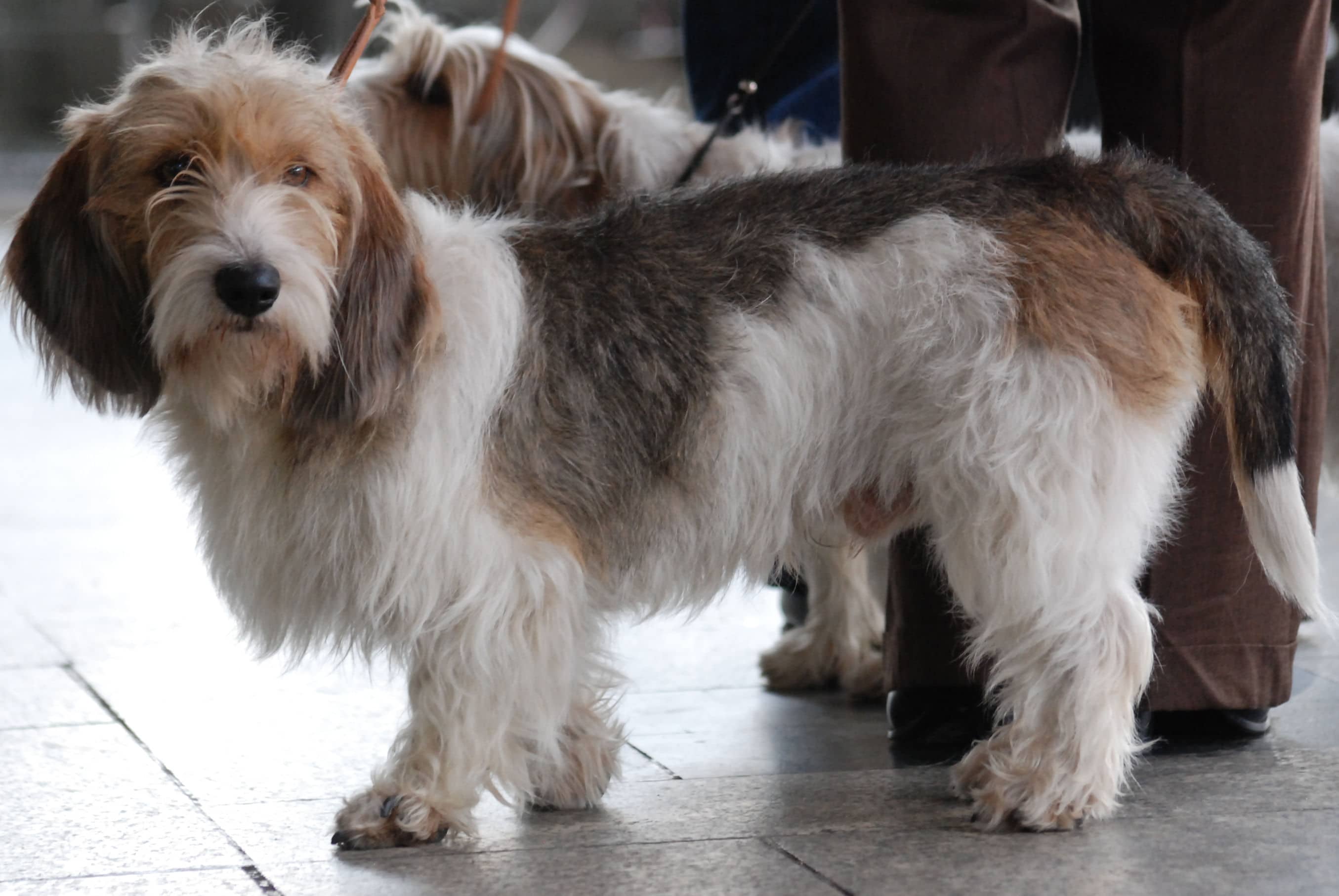
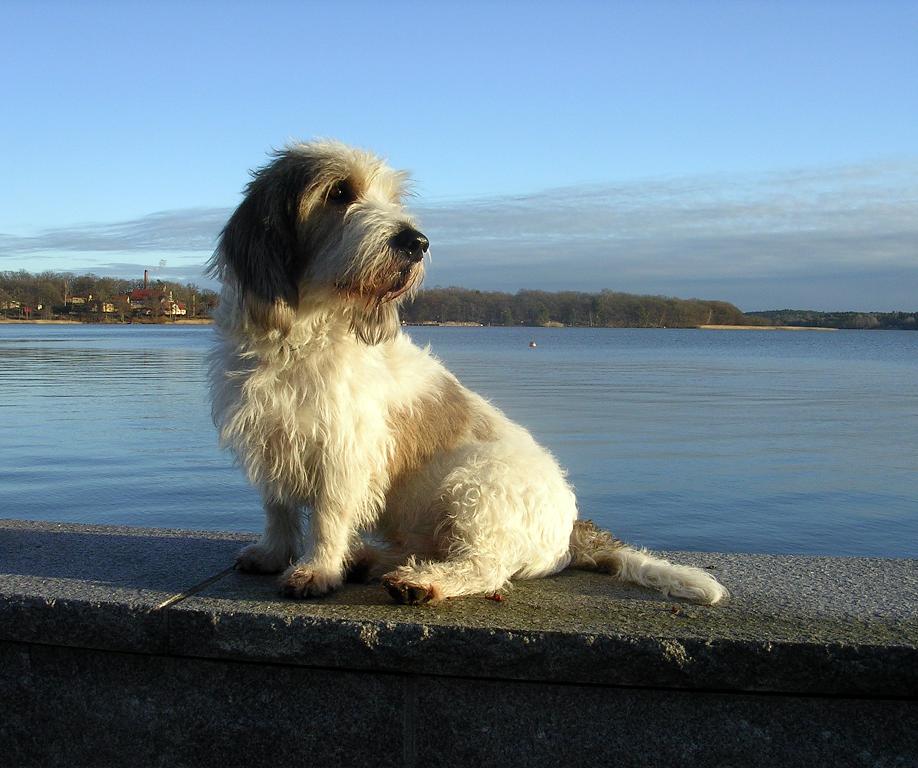
It is a small dog, rustic. Its aspect is neglected and natural. It has hard and rough hair with eyebrows, beard and whiskers woolly. White base, with black spots, Orange or grey.

Is well proportioned and is approximately a 50% longer than high. Wide tail at base, decreasing towards the tip thickness. It keeps it erect. Their ears are covered with hair; they are long but fail to reach the tip of the nose. Large nostrils. Its back is straight and slightly arched over the lumbar area.

It has large fame of Digger, jumper and escape expert, so you have to keep it in a safe enclosure.
Usually, is happy, friendly and always busy in their explorations. He is intelligent and can be stubborn. It's funny and has many security. Jealous and playful. Pretty crook.

Character and skills

He is good with children and quite friendly with strangers and although his obstinacy, it is a bit difficult to train, is not especially dependent or independent. Their dominance is moderate.

He is good with other dogs, but by his hunting instinct, It is not reliable with other pets. Being of small size, has a very loud bark, and tends to the howl.

Very strong race; serious genetic diseases are not known. prone to ear infections. Times, allergies have been given to insecticides.

It has hard hair and moved it very little, Although it needs a cleaning and brushing regularly to avoid entanglements.
It requires moderate exercise, being a good companion to run. At home he is very active and can only live in an apartment if he is sufficiently exercised.

As open space, a small garden is enough. Adaptable to most climates, prefer the coldest. Itร‚ยดs suitable for novice owners. Care properly has an average life of 10 to 14 years.

Petit Basset Griffon Vendรฉen pictures

Videos Basset Grifรณn Vandeano small

Alternative names:

Petit basset griffon vendรฉen / Kleiner basset griffon vendรฉen / small basset griffon vendรฉen

Type and recognitions:

  • FCI CLASSIFICATION:
  • Group :
  • Section : . .

Federations:

  • FCI โ“˜
  • AKC โ“˜
  • ANKC โ“˜
  • CKC โ“˜
  • โ€‹KC โ“˜
  • NZKC โ“˜
  • UKC โ“˜

  • FCI breed standard Petit Basset Griffon Vendรฉen

    FCIFCI - Petit Basset Griffon Vendรฉen
    Basset

    โ–ท The world of Pets: Dogs, cats, birds, reptiles, amphibians

    Spanish Hound
    Espaรฑa FCI 204 . Medium-sized Hounds

    Sabueso Espaรฑol

    The Spanish Hound It is described in the "Book of Monterรญa" of King Alfonso XI (1312-1350).

    Content

    HISTORY ยซSPANISH HOUSEยป

    Already in the fourteenth century, a dog of this breed was described by King Alfonso XI. But also other documents from this time referred to its existence.

    Due to the increasing isolation in the Iberian Peninsula, the breed was kept completely pure and there were no crosses with other dog breeds.

    Almost with all likelihood we are faced with a race descended from ยซCanis segusiusยซ, tracking dog used by Celtic peoples settled in central France.

    The first description of peninsular hounds appears in the โ€œBook of the Monterรญa of Alfonso XIโ€, King of Castile, written during the second half of the s. XIV, that in his chapter 39 talk about "which doneness should be the hounds and the sabuesasโ€.

    Over the years the Spanish Hound went repeatedly hunting small game, like hares, rabbits or foxes. He often hunted together with other dogs in the pack.

    It also, was used to recover the shooting game. But also in the police force he soon had a very important task.

    Full of enthusiasm for action, this spunky breed of dog proved to be a tracking dog, that already chased many trails. Due to his enormous eagerness to work and his resistance, was able to help clear up all the cases and make his teachers proud.

    Still used for those tasks, preferably in your home country, Spain.

    Physical characteristics "Spanish hound"

    The coat of the Spanish Hound often a bit reminiscent of a cow. Often has a white background on which there are various dots and patterns.

    These can be black, White, red or also multicolored. Most of the back is affected by color patterns, occasionally also the sides.

    Its pelage is short, thin but nevertheless dense. Doesn't have much underlayer, making it suitable for allergy sufferers.

    The Spanish Hound It belongs to the category of "medium -sized dogs". Males reach a shoulder height of up to 57 cm., the females up 53 cm.. The average weight is between 20 and 25 kg, females tend to be somewhat lighter.

    Character and skills "Spanish hound"

    The Spanish Hound he is a fearless hunter, eager and reliable, that nothing is lost so fast. Has an enormous need to move, who has to live regularly.

    It is a minor hunting dog, which is also used for wild boar hunting, roe deer, the deer, the wolf or the bear, because in addition to being very skilled in the search, I have a determination out of the ordinary. He is also gifted with the trail of blood. Excels in hare hunting, in which he transmits to the hunter the development of the search with his voice modulations.

    As a member of the family it is not very suitable, because the rhythm of life in a big city is not made for this active breed of dog. Under no circumstances do you want to be alone for hours every day.. Daily walks are mandatory with him.

    He is friendly and loyal to his human being and at home he is quite calm. And you need this calm even if you have been in nature for many hours.

    How do you want to find peace and quiet within the four walls of a home?, does not get along with young children. The over-excitement of children does not come at all well. But if your freedom is granted, he soon becomes a loving friend to them too. But there are certain limits!

    Suspicion of strangers, so it is also a good watchdog.

    The Spanish Hound is very independent and despite unconditional loyalty to his humans, always has a mind of its own.

    This is why it is so important that you get the right education from the start. This must be done consistently, but nevertheless with love and patience.

    Maintenance and care of the "Spanish hound"

    In a narrow city apartment, that possibly on a 5th floor, a Spanish Hound has as much to look for as an elephant in a china shop. I could possibly come here in the long run to a similar result. If our Scent hound you don't have your usual workload, it may be that he destroys the furniture for lack of challenge.

    A house with a large garden is an absolute must for this energetic hunter.. At the same time this aspect also relieves the owners, if our dog can let off steam regularly in the garden. Then he is already more relaxed and calm when he goes out for a walk, although he still has a lot of energy. Long walks are absolutely necessary for him.

    Care:

    His short coat does not require much care and his health is generally very good.

    However, there must be a competent veterinarian who regularly deals with tick treatments, deworming, caring for teeth and claws, your anal glands and also from routine blood tests.

    Characteristics "Spanish Hound"

    Coexistence is important that you have with your new friend. Before considering the acquisition of a dog of the breed "Spanish Hound" you know certain factors. Not all breeds of dogs are apt to live in an apartment, you must take into account his character, their need for exercise, their interaction with other pets, their care and if you have small children, their level of tolerance towards them.

    Vitality

    4,0 of 5 stars (based on 1 review)

    Ladrador

    3,0 of 5 stars (based on 1 review)

    Vigilance instinct

    2,0 of 5 stars (based on 1 review)

    Protection instinct

    1,0 of 5 stars (based on 1 review)

    Relationship with children

    3,0 of 5 stars (based on 1 review)

    Relationship with dogs

    4,0 of 5 stars (based on 1 review)

    Learning capacity

    3,0 of 5 stars (based on 1 review)

    Need exercise

    4,0 of 5 stars (based on 1 review)

    Friendly with strangers

    2,0 of 5 stars (based on 1 review)

    Health

    4,0 of 5 stars (based on 1 review)

    Friendly with cats

    2,0 of 5 stars (based on 1 review)

    Intelligence

    3,0 of 5 stars (based on 1 review)

    Images of the "Spanish hound"

    Videos of the "Spanish hound"

    Type and recognitions:

    • FCI CLASSIFICATION:
    • Group :
    • Section : . .

    Federations:

    • FCI – Group 6: Scent hounds, and related breeds. – Section 1.2: Medium-sized Hounds. โ“˜
    • The Royal Canine Society of Spain. โ“˜

    FCI breed standard "Spanish Hound"

    Origin:
    Spain

    Date of publication of the valid original standard:
    26/05/1982

    Use:

    Small game trail dog, though he doesn't despise the big game trail, either wild boar, deer, corzo, fox wolf or bear. The hunter, informed by voice (beat or beat) of the dog and its modulations, you will know the development of the trail hunt and its incidents such as old or recent trail, double trail, โ€ณ Stop beat or call dead โ€ณ. The Spanish hound is the great specialist in the Hunting of Liebres โ€ณ Vuelta โ€ณ and is extremely effective in the Rastro of Blood.


    General appearance:

    It is a medium-sized dog, eummetric and longilรญneo. With a beautiful head and long ears. Highlights the high thoracic perimeter of the race and the longitudinal diameter that widely exceeds the raised to the cross. Compact skeleton and strong members; fine hair, smooth and stuck. Fresh look, sad and noble.

    IMPORTANT PROPORTIONS: Longylรญnea Structure.

    โ€ข Longitudinal diameter widely (7 - 10 cm.) higher than the raised to the cross.
    โ€ข Skull-hocic relationship = 1:1, that is, equal in lengths.


    Behavior / temperament:

    Loving and meek, it is a beautiful animal, that in combat with big game pieces proves to possess a rare bravery and courage.

    Head:

    Harmonica, provided with the rest of the body and long. Divergent skull-facial lines. The joint facial craneo-region viewed from above should be very uniform and elongated, without giving feeling of pointed snout.

    Cranial region:
    • Skull: Average width, being higher in males. Convex profile. The width of the skull should be equal to its length. Seen from the front, It should be vaulted. Simply marked occipital Crest.
    • Depression links (Stop): Soft, little sharp.

    facial region:

    • Truffle: Grand, wet and wide and wide development windows. Its color ranges from a light brown to a deep black, always accompanying the color of mucous membranes.
    • Snout: Straight profile, admitting light subconvexidad in the terminal section. Seen from above it appears moderately rectangular, decreasing its width in direction to the truffle.
    • Lips: The superior must cover decidedly lower being loose and detached with moderation. The bottom is marked labial commissure. Mucous membranes must be of the same color that the truffle. Palate of color of mucous membranes with marked ridges.
    • Jaws / Teeth: Scissor bite. Teeth white and healthy; Canine well-developed; There are all the premolars.

    Eyes: Medium, macaroons, Hazelnut dark color. Sad looking, noble and intelligent. The color of the truffle pigmented eyelids; mucous membranes attached to the eyeball, admitting Dim relaxation resting.

    Ears: Large, long and falls. Of soft texture, rectangular and round tip; They are inserted below the line of the eyes and hang freely in Tirabuzรณn. Without exerting traction have widely exceed the truffle. Venous network visible and a flor de piel.

    Neck:

    Conical trunk, wide and powerful, muscular and flexible. Thick and very loose skin, that is marked and released but not exaggerated dewlap.

    Body:

    Strongly rectangular, very strong and robust, of a large chest perimeter that must be superior in 1/3 to the height at the withers: height at the withers 3, chest perimeter 4.

    • top line: Straight with slight concavity on the back and convexity on the spine, Race characteristics, but not ensillamiento.
    • Cross: Ahead and simply marked.
    • Back: Powerful, wide, accused length.
    • Pork loin: Very long, width, powerful and slightly raised.
    • Rump: Powerful, wide. With a tendency towards horizontal. The height at the Croup should be equal to or less than the height at the withers: taking into account the existing racial trend to be elevated, will be allowed slightly.
    • Breast : Highly developed, width, deep and high, widely reaching the elbow. Tip of the sternum marked. Ribs with intercostal of broad and rounded spaces, you are home a large rib cage.
    • Belly and flanks: Little collected belly, very notable and descended flanks and ample sidewalls.

    Tail:

    Thickness birth and average insertion. Strong and full of very short hair forming a small brush at the tip. At rest, your port is light, curved and low beyond the Hock; in work and movement, is high in Sabre without excess and mostra a continuous lateral movement of jig. Never straight up or resting on the rump.

    Tips

    PREVIOUS MEMBERS: Perfectly Plumb, straight, parallel; They give short and tendons are clearly appreciated. The length of the forearm must be equal to the shoulder.

    • Strong bone; with powerful Metacarpus and well bonded to the thorax elbows.
    • Shoulder: Oblique scapula, rounded, muscled and similar to the arm length. Scapular-humeral angle close to 100 degrees.
    • Arm: Strong.
    • Elbows: Stuck to the chest. Humer-Radial Angle near the hundred and twenty degrees.
    • Forearm: Straight, short and well poised. Strong bone.
    • Metacarpus: Strong bone and powerful. Seen little laterally inclined.
    • Previous feet: Of cat. Tight toes, high and strong phalanx. Hard and strong nails; spacious, resistant pads. Interdigital membrane moderate and provided with fine hair.

    LATER MEMBERS: Powerful, muscular and excellent angles. Correct limbs, hocks without deviations, long metatarsus and strong feet. Provide your pet force, agility and thrust required for slopes land very rough and with notable drop-offs.

    • Thigh: Strong and muscular. Coxal-femoral angle close to 100 degrees.
    • Leg: Half length, muscular. Stifle-tibial angle close to fifteen hundred grades.
    • Hocks: Well marked, with clear appreciation of the tendon. Angle of the open Hock, close to one hundred twenty degrees.
    • Hind feet: Of cat, slightly oval. More elongated than the previous feet. Presence or not of spurs that are usually simple, rarely double, admitting your amputation.

    Movement:

    Preferred movement is the trot, still a long, sustained and economic, without any tendency to laterality or amble. Particular attention to elbows and hocks will be presented during the movement. Exist during the March natural trends in the race walking sniffing with low head.

    Mantle

    SKIN: Highly elastic, thick, pink, by all zones, forming sometimes frontal wrinkles in head position low.

    HAIR: Bushy, short, fine and glued. Distributed by the body to interdigital spaces.

    COLOR: White and orange, with a predominance of one or another color and distributed in well-defined irregular spots and no speckle. The orange color can range from a tone lighter (lemon) to the strong reddish brownish.


    Size and weight:

    Seen in this race a high index of sexual dimorphism that is reflected in the difference in size between males and females, being females significantly more low and less girth.

    Height to the cross:

    • Males: of 52 to 57 cm..
    • females: of 48 to 53 cm..

    A centimeter of lodging tolerance is admitted for copies of excellent proportions.


    Fouls:

    Any deviation from the aforementioned criteria is considered as a fault and the severity of this is considered to the degree of the deviation to the standard and its consequences on the health and well-being of the dog..

    • Profile of the acarnerado snout, but without excess.
    • Bite in clamp; absence of any premolar.
    • Eyelids so relaxed cause little visible conjunctiva.
    • Weak and distorted upper line during march.
    • Elevation of the region of the spine, Although permitted, It should not be never exaggerated.

    SERIOUS FAULTS

    • Frail.
    • Snout blunt or pointed in excess.
    • Moderate upper prognathism. Absence of canine or Premolar, not due to trauma.
    • Entropion or ectropion.
    • Amputated ear.
    • Upper lines.
    • Height at the Croup very higher than the height at the withers.
    • Scarce thoracic perimeters.
    • Too high or resting on the rump tail. amputated tail.
    • Wrong limbs, weak or deviant.
    • Outgoing elbows during the March or in station.
    • Cow hocks.
    • Lateral braceos during operation.
    • Wavy hair, hard or mediumlength.
    • Barks.
    • Unbalanced character, excessive shyness, nervousness or aggressiveness.

    MISS PLAYOFFS

    • Aggressive or fearful dog.
    • Longitudinal diameter equal to or less than the height at the withers.
    • Split nose.
    • Excessive upper prognathism. Any degree of lower prognathism.
    • Hard or long hair. Woolly hairs indicating miscegenation.
    • Copies tri-color or with brands heat in beak and members.
    • Any dog โ€‹โ€‹showing clear signs of physical or behavioral abnormalities must be disqualified..


    N.B.:

    Males should have two normal-appearing testicles fully descended into the scrotum..

    Source: F.C.I - International Cynological Federation

    Alternative names:

    1. Spanish Scenthound (English).
    2. Sabueso espaรฑol (French).
    3. Sabueso Espaรฑol (German).
    4. Sabueso Espaรฑol (Portuguese).
    5. Sabueso Asturiano, Sabueso Navarro, Sabueso Santanderino, Sabueso Alavรฉs (espaรฑol).